The Displaced Nation

A home for international creatives

Tag Archives: Travel yarn

JESS IN JAPAN: Tokyo’s top 6 delights from my newbie expat perch

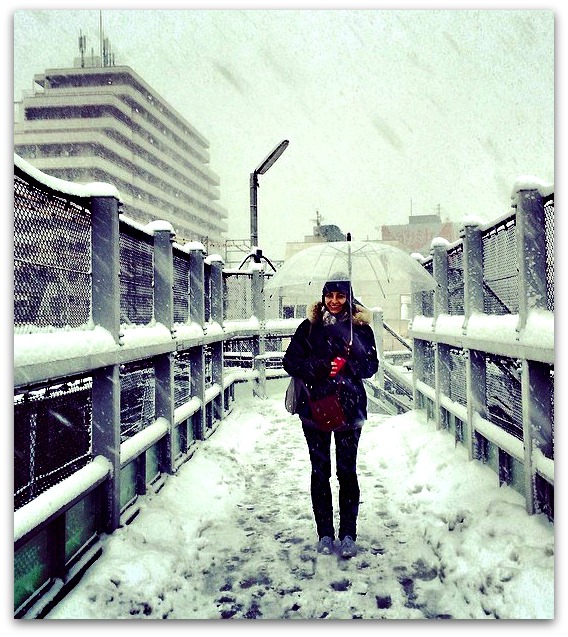
So is snow the same in Tokyo? Kind of, except everyone carries see-through plastic umbrellas! Jess in Tokyo's first February snowfall. Photo credit: Hiro Awanohara

So is snow the same in Tokyo? Kind of, except everyone carries see-through plastic umbrellas! JESS IN JAPAN in a rare heavy snowfall earlier this month. Photo credit: Hiro Awanohara

Today we welcome a new guest columnist: Jessica Awanohara. Any relation, you may wonder? Yes, she’s the American wife of my nephew by marriage, Hiro. The pair, who’d become dyed-in-the-wool New Yorkers, surprised us all by announcing they were moving to Tokyo at the end of 2013. Naturally, I was curious: how is Jessica adjusting to life in that “through-the-looking glass” city? Is it different to live there versus just visit (which she’s done many times in the past)?

—ML Awanohara

There are many things to love about moving to a new country and a few things not to love. Most expats eventually strike a balance between the two.

But are there also places where the love-hate continuum doesn’t apply? I’m beginning to think so ever since I moved from New York to Tokyo in late December of last year. A bad mood is impossible to sustain in this city because everything is hilarious. Wherever you turn, there is something riotous laying in wait…and the next thing you know, you are collapsing in fits of laughter.

I’ve been in Tokyo for over a month now, and have delighted endlessly in many things.

Here are six off the top of my head:

1) Trains are in happy colors.

I live on the Keiō Inokashira railway line, the color of which is bright pink. Not the barfy green of the 4/5/6, nor the almost-royal blue of the A/C, nor the vibrantly atrocious orange of the B/D/F, in New York City. Rather, this line is a sparkling and spritely pink mixed with what I imagine to be the color equivalent of delicious farm-fresh milk. It’s the pink of the gods: the Disney Princess Gods.

2) Subway stations are deeply amusing, so to speak.

Think of New York City’s deepest subway platform: the 63rd Street station on the F Line near Hunter College, or the 191st Street Station on the 1 Line. Imagine how long those escalators are, and now double it—no, triple it! Triple it, and add a couple of extra escalators and a brick-and-mortar set of stairs to the street, and now you have an idea how deep the average street to subway platform trip is in Tokyo. Have you ever tried going to Roppongi, or Azabu-Jūban? Try it!! You may feel as though you’ve walked far enough to be back in New York. Good for quite a few laughs!

3) People on the subway may be dressed much better than us, but they smell just as funny.

How could men in suits and overcoats, or women in designer outfits, smell as bad as we much more disheveled Americans do on the subway? Before taking the leap of moving to Tokyo, I dreaded the idea of being taller, sweatier, and worse smelling than the average citizen on a notoriously packed Japanese train car. Rest assured, inquiring minds, curdled humans smell much the same in Tokyo as in New York: like sweat socks… By the time summer arrives—I’ve visited here often enough to know that summer is no joke!—I should blend in perfectly fine, a thought I find immensely entertaining.

4) Furniture delivery can be farcical, especially when it doesn’t fit through doors.

After a month of living out of another person’s apartment, my husband and I moved into our own place a couple weeks ago. We ordered what can aptly be described as the world’s most beautiful bargain basement sofa and had it delivered to our new, completely empty home. No sooner did our large and lovely couch arrive, than it was exchanged for its tiny, two-seater cousin—that is, tiny enough to actually fit through our front door. In Japan, small is beautiful. How could we have overlooked this basic principle? Our hilarity could not be contained…

5) In Tokyo, cost-of-living statistics are a bit of a joke.

Really, Expatistan.com? I appreciate the cost-of-living data you supply for this great world’s great cities, and am aware that countless magazines and listservs use your data for splashy articles sizing up one city against another. But I’m confused about your aim. On your website it says you want to give people the information “to live as nicely as you live currently.” That means…what exactly? How does one measure the quality of life across cultures? And what about that ideal, which many of us expats hold dear, of “When in Rome…” I can lead the same life materially in Tokyo as I led in New York, but that’s not what makes me happier in this city. Sure, living the luxury life in Tokyo is expensive, but numbers are not the point. The point is, cost-of-living stats are hilarious in a city that gives me such joy!

6) Appliance installation is a riot and a half.

In a related hilarity, it is true that most Tokyo apartments are not outfitted with appliances normally packaged with an apartment in NYC. We had to order our own refrigerator and washing machine (both standard fixtures for the Tokyoite). Our refrigerator, a lovely and highly rated model, cost us all of $500; the washing machine was comparably rated and lower priced. As with anything you buy larger than a shopping bag, you have it delivered to your home for maybe $30 or $50 additional dollars, or oftentimes for free. The hilarity lies in the fact we had two choices when the refrigerator and washing machine were shipped—the delivery men would either leave them at our front door OR huff them up countless flights of stairs and install the machines for the low, low price of…one U.S. dollar. Tough choice, right? Hahaha.

No doubt about it, Japan is a barrel of laughs. Reaching beyond the cruel and unusual TV game shows, the Hello Kitty cafes, the Fruits magazine documenting outlandish clothes in the Harajuku area, and other enduring staples of pop culture in this part of the world, I’ve found countless things to delight me during my first month of residency in Tokyo. My main takeaway is how excited I am to let this town continue to delight me for years to come.

* * *

Readers, what do you think of Jess in Japan’s observations of her new home? I don’t know about you, but I find it ever-so-amusing that so many of her thoughts are focused on subways and apartments: not so different from life here in New York!

STAY TUNED for next week’s fab posts!

If you enjoyed this post, we invite you to register for The Displaced Dispatch, a round up of weekly posts from The Displaced Nation, with seasonal recipes, book giveaways and other extras. Register for The Displaced Dispatch by clicking here!

Related posts:

For this Filipina with a passion for immersive escapades, a picture says…

Jean Alaba Collage

Canon zoom lens; photo credit: Morguefiles. Jean Alaba in front of moat surrounding Osaka Castle, Osaka, Japan. Photo credit: Jean Alaba.

Welcome to our monthly series “A picture says…”, created to celebrate expats and other global residents for whom photography is a creative outlet. The series host is English expat, blogger, writer, world traveler and photography enthusiast James King, who thinks of a camera as a mirror with memory. If you like what you see here, be sure to check out his blog, Jamoroki.

My February guest is 20+ Filipina Jean Alaba. An extrovert who describes herself as a “God-fearing human being” and a “firm believer of living vividly,” Jean is, without a doubt, fulfilling her passion in life: TO TRAVEL. As she explains on the About page of her blog, The Eager Traveller, travel affords her an opportunity to move outside her comfort zone and grow as a person.

Jean was motivated to start up her blog just over a year ago, as a space to record the re-collections of her travels—which she modestly calls “my humble escapades”—in hopes of inspiring others to “nurture their zeal for new adventures” and of promoting the joy of immersing yourself in “the vibrant cultures across the globe.”

Why am I not surprised that Jean has gathered a considerable following in just over one year? My interview with her may provide a few clues as to why other avid travellers are drawn to Jean and her suggested itineraries.

* * *

Hi Jean. I know it has taken us a bit of time to connect, but I’m glad we finally managed to find some time to discuss your photo-travel experiences. Firstly, I see that you are 20+ (I am also 20+: 20 + 50!!), and for one so young you have travelled a fair bit. Can you tell us where you were born and when did you spread your wings to start travelling?
I was born in the Philippines. This may sound like a cliché but my first source of inspiration for travelling was a National Geographic magazine I saw in our school library.

National Geographic is a wonderful publication. I love it.
But I didn’t spread my wings until I made my first trip to West Coast USA. The Strip struck me the most because everyone there seemed to be having the time of their lives. There was such a lot to experience and yet the time was way too short. After that, I developed a passion to immerse myself in new cultures, interact with unfamiliar nationalities and engage in overseas adventures.

To a fearless person, no fence is high enough.—Filipino tagalong proverb

I assume you mean the famous Sunset Strip that has featured in so many movies over the years? I want to know more about your travels, but let’s start with what it’s like to be a solo female traveller.
So far I’ve travelled for pleasure and for business but as yet have never travelled alone. That’s a hurdle I hope to cross this year. I realize it can be risky, but from the inspiring articles I’ve read online, it’s clear it can also be rewarding.

Even though stepping into the unknown by yourself can sometimes be difficult, even for seasoned travellers, I believe preparation is the key. I’m sure you will be fine. Next I would love to know what what countries you have already visited?
So far, I’ve only been to the United States, India, Singapore, Japan, South Korea, Hong Kong, China and Taiwan. I lived in Singapore as an exchange student for four months, which gave me a a sense of independence and responsibility. Another highlight was my six-week business trip in India, where I had the opportunity of visiting Mumbai, Agra, New Delhi and Jaipur. Here are two photos I took on that trip:

Q9-Taj-Mahal

The Taj Mahal in all of its intricacy. Photo credit: Jean Alaba

The first is of the Taj Mahal. I immediately fell in love with its intricate design. By pure luck, a bird flew across at the moment when I snapped this shot. It was only when I was viewing my photos on my laptop that I realized I had captured such an amazing moment. For me, the bird is special: it symbolizes freedom from all the worries in one’s life and from whatever is holding you back from achieving your dreams.

Q9-Bhawani

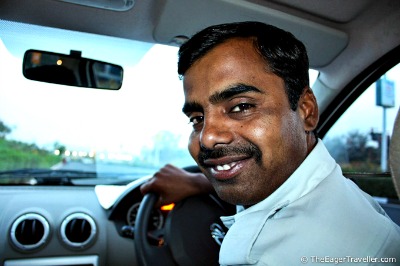
The jolly Jaipur driver Bhawani. Photo credit: Jean Alaba

The second is of Bhawani, the driver assigned to my group during our two-day outing to Jaipur. It reminds me of his kindness and positive disposition in life. He had to take us around Jaipur in the burning hot summer, but never once did he become irritated or impatient. He always had a smile on his face, and that kept us all in a good mood during the trip. In fact, the following week when we went to New Delhi, the company driver assigned to us was totally rude and inconsiderate. At one point he left us in the car sleeping (engine shut off!) while he had his dinner. Worse, when we lightly honked the car to signal that we were awake and frankly not amused, he completely ignored us.

I loved your photo of the Taj Mahal when I first saw it on your blog’s Home Page, but I have to be honest, I never noticed the bird until you pointed it out just now. Maybe that’s good as I was able to appreciate the intricate carvings. Now I’m worried I’ll miss the building and concentrate on the bird!! You’ve captured Bhawani exactly as you describe him; perfect.

One finds a way, or finds a reason to do something.—Filipino tagalong proverb

You are very modest to say you’ve been to “only” eight countries. That’s a lot more than most people visit in a lifetime. So tell us about where are you right now and why.
Well, as you know, James, I am currently in my country of birth, the Philippines, but I’m working out a deal that will hopefully pave the way for life in a new place. I’ll keep you posted.

Q9-Baler

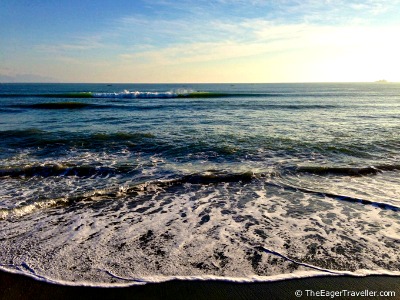
Baler, nicknamed the Philippines’ surfing capital. Photo credit: Jean Alaba

So you are keeping the secret for now, but I’m sure your blog will be give the game away when you are on the move again. The Philippines is a beautiful country and I see you have included one picture in your selection.
Yes, I’ve included this photo of Baler, which is in Aurora province. I like it because it reminds me of my first time attempting to surf and for someone not sporty, I didn’t do too badly. This was also my first time to go beyond my comfort zone in my own part of the world: I travelled for six hours just to catch the waves. It was a spontaneous weekend that proved to be pretty rewarding.

For me, the Baler surf lapping the shore looks just like a welcoming carpet in someone’s lounge.

If you plant, you will harvest.—Filipino tagalong proverb

I know you take a lot of photos but where, so far, are your favourite places to do so? and Can you explain why these places inspire you and how it shows in your next three photos?
My favourite places to take photos so far are India, Japan and Hong Kong. I’ve included one photo of each.

Q10-India

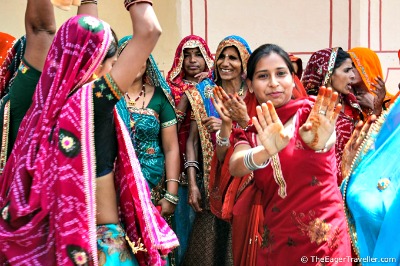
Indian women in colorful saris. Photo credit: Jean Alaba

I like taking photos in India because Indians are very proud of their heritage. This was apparent everywhere we went in India, regardless of the people’s social status.

Q10 Japan

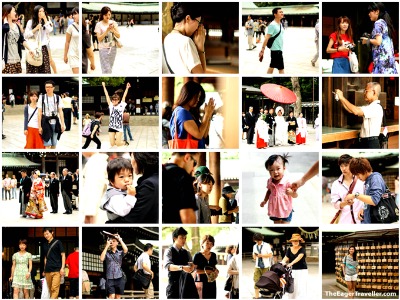
Portraits of Japanese people. Photo credit: Jean Alaba

Japan is a favorite of mine because the people are so organized, disciplined and polite. I never run out of things to see and admire.

Q10-Hong-Kong

A Hong Kong eatery. Photo credit: Jean Alaba

Hong Kong inspires me because of the food! I should think its vast array of local dishes are enough to inspire anyone!

I like that you manage to get a handle on people from the different countries you visit, without actually living in that place. You are clearly a good observer of people, as well as a keen researcher. Tell me, do you feel reserved about taking photos of people, particularly when they are conscious you are doing so?
Not really unless I see they’re offended. But so far, no one has reacted angrily when they see me taking their photo. This is a good thing since I like shooting people. Capturing their unique expressions enables me to glimpse who they are and the kind of lives they lead. I must have taken a thousand portrait shots while in India. Perhaps I’ll get some of these printed and make it my wall art.

I’m the same. I hate to take “posed” photos so never get into a discussion with my subjects. I either take the pic or I don’t. So you like shooting people? Don’t worry; I know what you mean! I think the wall art is a great idea. I know this is a similar question but do you ever ask permission before taking people’s photographs. And how do you get around any language barriers?
Most of the time, I don’t ask but when I was in Japan, where permission needs to be secured for taking photographs of infants and kids, I would politely approach one of the parents and ask them in Japanese—of course with the help of sign language (pointing to my camera and their kids).

Thanks to you, I won’t get into trouble if I ever go to Japan. Would you say that you are motivated by the possibility of capturing something unique, which will never be seen again?
Definitely. You always have to live in the moment, and there is nothing more rewarding than being able to capture the special moments that, unless you have a time machine, you’ll never be able to bring back. Those photos may give you inspiration just when you need it most.

I have to agree, as I think most photographers would. So when did you first realize the power of photography, and how has it changed you?
I first realized it after borrowing a decent SLR for my trip to Hong Kong in 2008. I was able to take high-quality photos to serve as a memento. Ever since, I’ve made it a point to capture moments with my camera, whether during a vacation or simply at a gathering of family or friends—moments I’ll be wanting to view when I get old and grey.

I know what you mean. The picture for me is like a diary of an event in visual form. The photographer can write about it but no one else could.

When the sheets are short, one needs to make do.—Filipino tagalong proverb

Most readers will know by now that I’m not too good on the technical stuff but some of our readers will want to know what kind of camera and lenses you use.
I’m still using the borrowed camera; it’s a Canon 450D. I use the kit lens and a prime lens. It’s outdated equipment now.

You sound a bit like me except that I haven’t managed to borrow any equipment yet. And you aren’t asking me for technical advice. That’s great!! Finally, do you have any advice for wannabe photographers who are traveling or living abroad?
I don’t feel I’m in a position to give advice since I haven’t really achieved anything noteworthy. But I would say from my experience, don’t hesitate to take as many pictures as you can while travelling. Before embarking on a journey, research and learn from the professionals online. You can try copying them, using a trial and error process.

I actually think that is very good non-technical advice, Jean. I’d like to thank you for taking the time to tell your story so far in this interview. On your blog you say:

It has been a spectacular life so far but there is so much more to be seen! I have yet to find that life-changing opportunity which will allow me to do my passion for travelling and blogging as a living.

I have no doubt you will find that opportunity. I’m booking you in for a follow up interview next year to check your progress!!

* * *

Readers, what do you make of Jean’s experiences and her photography advice? And do you have any questions for her on her photos and/or travels? Please leave them in the comments!

And if you want to know more about Jean, don’t forget to visit her excellent blog, The Eager Traveller. You can also follow her on social media:
Twitter: @eagertraveller
Instagram: theeagertraveller
Google+: Jean Alaba

(If you are a photographer and would like to be interviewed by James for this series, please send your information to ml@thedisplacednation.com.)

STAY TUNED for tomorrow’s fab post!

If you enjoyed this post, we invite you to register for The Displaced Dispatch, a round up of weekly posts from The Displaced Nation, with seasonal recipes, book giveaways and other extras. Register for The Displaced Dispatch by clicking here!

Related posts:

An expat’s thoughts on flying and the journey “home”

20131128-020743.jpg

Photo credit: A Windram

This is my third attempt at writing this post. The previous two attempts were quickly aborted; I had tried drafting them during two separate flights back to the UK, but quickly gave up in frustration.

Flying—for me, at least—is not conducive to creativity (if hastily scribbled blog posts can be described as such). I can never settle on a flight, I can never forget that I am 30,000 feet above the earth trapped in a metal tube powered by 36,000 gallons of jet fuel.

But, of course, flying remains an occupational hazard for the expat. No matter how long you may have been away, the call home is at some point unavoidable. After an absence from “home” of nearly three years, over the last few months I’ve had to make two trips back. One for reasons pleasant; one for reasons unpleasant.

Flying, when you think about it, and when I am flying I find I would much rather not think about it (those 36,000 gallons of highly flammable jet fuel remain heavy on my mind), is astonishing. Indeed, it is so astounding that we have to go out of our way to avoid that fact and focus on the banal. The aviation industry is helpful on this point. You wait in a terminal, shitty retail and even shittier food your scant choices to kill time, but it helps numb you, I suppose. Makes you unthinking about the journey ahead, your entry into the heavens.

When I was flying back for more pleasant reasons I began reading French philosopher Michel SerresAngels: A Modern Myth. Serres opens his work with a fictional couple meeting at an airport. He a traveling inspector; she a doctor at the airport medical center. For Serres, the couple see angels when they look around the airport:

I see angels—which, incidentally, in case you didn’t know, comes from the ancient Greek word for messengers. Take a good look around. Air hostess and pilots; radio messages; all the air crew just flown in from Tokyo and just about to leave Rio; those dozen aircraft neatly lined up, wing to wing on the runaway, as they wait to take off; yellow postal vans delivering parcels, packets and telegrams; staff calls over the tannoy; all these bags passing in front of us on the conveyor, endless announcements for Mr X or Miss Y recently arrived from Stockholm or Helsinki; boarding announcements for Berlin and Rome, Sydney and Durban; passengers crossing paths with each other and hurrying for taxis and shuttles while escalators move silently and endlessly up and down . . . like the ladder in Jacob’s dream . . . Don’t you see—what we have here is angels of steel, carrying angels of steel, carrying angels of flesh and blood, who in turn send angel signals across angel air waves . . .

I don’t see any angels sitting around me in the terminal, and I don’t think our messages are worth conveying across the world. I would have enjoyed reading the Serres anywhere other than here, in a terminal.

“Business or pleasure?”

For the expat, the answer is neither. I am going home. I am leaving home. I am leaving the present. I am returning to the past.

On the plane, I put the Serres away and try to read a book (The Journey of Theophanes: Travel, Business, and Daily Life in the Roman Middle East) about a Roman lawyer journeying to Antioch. Over six months he slowly makes his way, noticing the slight changes in geography. Compared to that, what I am doing seems a cheat. I put the book away. I can’t concentrate enough, there’s slight lurch in the plane’s movement that suggests we are beginning to enter turbulence. I just try to watch Iron Man 3 instead.

I am going home. I am leaving home.

STAY TUNED for tomorrow’s post, a TCK Talent interview by monthly columnist Elizabeth Liang.

If you enjoyed this post, we invite you to register for The Displaced Dispatch, a round up of weekly posts from The Displaced Nation, with seasonal recipes, book giveaways and other extras. Register for The Displaced Dispatch by clicking here!

Related posts:

Happy Halloween! A cauldron of 6 cautionary tales for the intrepid traveler

Image: Lake View Cemetery / MorgueFile.com

Yesterday’s Halloween post by Anthony Windram, about the top 5 ghostly settings from literature and film, got us thinking again about the ghostly and ghoulish, the mystical and macabre, the dark and demonic.

Our thoughts, however, did not turn towards the new and original, but to the jaw-clanging skeletons in the Displaced Nation’s very own Crypt.

At which point…someone (Kate Allison?) suggested that we pile all of our Gothic Tales of Old into a cauldron and chant “Bubble, bubble, toil and trouble.” All was going well until one of us—must have been the American—broke in with:

Stirring and stirring and stirring my brew…

Just as she screeched “O-o-o-o-o, o-o-o-o-o”, 6 apparitions arose from the pot: 6 terrifying tales from the Displaced Nation’s deep dark past. Each said they were there to teach travelers a lesson.

And here is what they told us:

1) The Ghost of the Mysteriously Misplaced Post

I am the ghost the represents the post titled The Displaced Nation’s Halloween post is…mysteriously displaced!, composed on Halloween night two years ago by ML Awanohara, whose blood was curdling because:

Kate Allison was supposed to post today, for Halloween…but then, pouf, she vanished without a trace!

As readers who are paying attention know, Kate has now posted 80+ episodes in the life of a fictional British expat family living in New England, called Libby’s Life. Two years ago she vanished before uploading the latest episode because of a freak snowstorm in Connecticut, her adopted home.

She finally resurfaced on On All Saint’s Day—in a MacDonald’s! (Has she gone native, or what?)

Travelers, here is the lesson I’m here to impart for your sake: Truth is stranger than fiction, where so’er you roam.

2) The Ghost of Quizzing Others on Their Supernatural Sightings

Hello there, I am the ghost that arises from THE DISPLACED Q: On your travels … have you ever seen a ghost?, which was composed by Tony James Slater just over a year ago. He impressed with his self-knowledge when he said: “I’m about as psychic as a cheese.” But then he went on to say:

And then, just occasionally, I have dreams when I’m visited by the spirits of people I’ve lost….

Is there any wonder there were no comments and no likes on his post? He scared the bejeezus out of most of his readers.

Still, point taken, and I’m here to impart an important lesson that you international travelers may not have fully considered: As you traverse the world, bear in mind that any ghosts you meet will be people you know (and left behind), not strangers.

3) The Ghost of Compiling a Master List of Grim Reapers

Greetings, I have emanated from the post called Grim Reapers around the globe: 7 creatures that say “Time’s up!”, composed by Kate Allison just over a year ago. Kate reported on the surprising number of cultures that maintain some version of the mythological conniving female who lures men to their deaths.

As frequent visitors to this site will know, Kate has a way with words. For instance, she described
Sihuanaba of Central America as follows:

Seen from the back, she’s an attractive woman with long hair; from the front, it’s a horse. (No jokes about Sex and the City, please.)

But even Kate’s rather offbeat humor could not dissuade from the freakishness of some of these figures.

As far as lasting lessons, this will have to suffice: Next time you get lost in a canyon, try blaming an ancient ghoul. Depending on where you’ve landed, as well as gender, you may just about pull it off.

4) The Ghost of Delivering a Screed against Princess Diana Dolls

A cheery hello to one and all, I am the ghost of Anthony Windram’s EXPAT MOMENTS: The Doll Collection, which he wrote almost exactly a year ago.

As anyone who came across it may recall, Mr. Windram was most distressed to find himself at a bed-and-breakfast in NEW England (he is from Jolly Olde) where the innkeeper has put her prized collection of “individually authenticated” Princess Diana dolls on display in the sitting room. He tossed and turned all night, even heard scratchings at his door.

Now, as regular visitors to this esteemed site know, Mr. Windram is no fool. On the contrary, he has has a mighty brainbox. Which is why I’m so stunned that he allowed himself to be frightened by a set of Lady Di figurines. I’m sure they were only there to cover up the fact that the house is haunted—by a young and rather vigorous ghost, which is how ghosts tend to come in America (just ask Libby). The real take-away, then, particularly for those who venture into the New World: Avoid American B&Bs like the plague if you want a decent night’s sleep.

5) The Ghost of the Expat Criminals Exposé

ML Awanohara showed some temerity in writing a post entitled What did Agatha Christie know? Expats make great criminals back when this blog first started.

As the ghost that arose from this post, I’m here to say she hit the proverbial coffin nail soundly on the head with this assertion:

Just as we don’t like to think of rats being part of the animal kingdom, we don’t like to think of conmen, pirates, gangsters, and terrorists being part of the group we have loosely defined as “global voyagers” … But trust me, they are a part of it — as are murderers.

Which leads us to the lesson I’ll impart today: Just because you’re in a part of the world where marrows tend to thrive, don’t assume the likes of Hercule Poirot will turn up and save you.

6) The Ghost of Finding Travel Inspiration in Margaret Drabble’s “Red Queen”

Not long ago compared to other posts in this collection, ML Awanohara wrote FOOTLOOSE & FANCIFUL: Margaret Drabble’s “The Red Queen”, explaining how her views of Korea had shifted after reading a book by Dame Drabble depicting a period of bloodshed and horror in the 18th-century Korean court. A real-life tale made more vivid by Drabble’s considerable fictional powers, in which the Prince is a homicidal maniac, and his father, the King, a stern Confucian. The King ultimately decides to murder his son in a style so dramatic that ML couldn’t get it out of her head next time she went to Korea. She remains haunted to this day.

As the ghost of this post about a ghost, I find myself torn. On the one hand, what kind of person would read Drabble—that serious, hip, intellectual British novelist, who likes to come across as one’s brainy, Cambridge-educated best friend—to get a handle on what the Koreans are really like? Apples and oranges—or marmite and kimchi, I should say.

On the other—and this is the lesson I’ve come to deliver: Never hesitate to use a Cambridge-educated Brit as a resource for novel sightseeing ideas.

* * *

Readers, have we got you thinking twice about those travel plans? Do let us know in the ca-ca-comments. Hey, at least we spared you the horrors of Sezin Koehler’s 15 films that depict the horrors of being abroad, or otherwise displaced; Tony James Slater’s 5 travel situations that spell H-O-R-R-O-R!; or Kate Allison’s Global grub to die for, including a rather scrumptious recipe for fried tarantula, which goes down a treat in Cambodia.

STAY TUNED for next week’s fab posts!

If you enjoyed this post, we invite you to register for The Displaced Dispatch, a round up of the week’s posts from The Displaced Nation, with our weekly Alice Award, book giveaways, and other extras. Register for The Displaced Dispatch by clicking here!


FOOTLOOSE & FANCIFUL: Margaret Drabble’s “The Red Queen”

Welcome to Footloose & Fanciful, an occasional series of posts where we talk about books, films or other art forms that have inspired us to travel to new places or appraise familiar places with fresh eyes.

I’m probably not the best person to kick off this series. As much as I adore fiction, I’m not one to travel on a whim, because of something I read in a book. Especially not these days, when my expat years, spent in England and Japan, are behind me and I have to take time off from work. Typically, I arrive at my destination and collapse in a heap of exhaustion. It’s not until I’ve had a good rest that I am able to take in my surroundings. I peer out the window and say: “Really, I’m in xxx?!”

At that point I go to the other extreme, manically trying to find out as much as possible about where I’ve landed, visiting bookstores with an English-language section to stock up on translated novels, expat memoirs, the lot…

The second time I went to Seoul, South Korea, though, was different, and I’ll make that the subject of today’s post. That trip marked a rare time when a book had piqued my interest in a country to the point of influencing what I wanted to do and see and talk about during my stay.

Finding the soul of Seoul

I said my second visit to Seoul. The first had occurred a few years before. It followed the typical pattern. I arrived tired and unprepared, although on that occasion, I got an immediate lesson in the local culture.

Just as my husband and I were landing in Incheon International Airport, the news was breaking that Dr. Hwang Woo Suk—a veterinary researcher who had achieved world fame by cloning an Afghan hound named Snuppy—had falsified his latest results to make it look as though he’d made advances in human cloning.

“It’s a very Korean story,” some Korean friends of my husband’s informed us. I wasn’t sure what they meant, but little by little, I pieced it together. The Korean government, desperate to project a modern, high-tech face to the world, had turned Dr. Hwang into a national hero. He appeared in many of their promotional campaigns. The post office sold stamps to commemorate his research, and Dr and Mrs Hwang enjoyed a decade of first-class tickets on Korea Air, because of his status as “national treasure.”

Interestingly, our Korean friends were reluctant to condemn him outright. He’d been under a phenomenal amount of pressure to produce results and bring his country greater glory. If you were under that much pressure, you’d probably be tempted to skip a few rounds of clinical trials, too, they seemed to be saying.

I had to think about that for a while. Already, I was inclined to feel sorry for the Koreans because I knew how they’d suffered under Japanese rule. They are the Central Europeans of Asia, if you will. Just as the Hungarians, Poles and Czechs have had to put up with Germany and Russia, the Koreans, due to being sandwiched between China and Japan, have had to put up with incursions from both.

Gradually, I came round to the Korean point of view. My thought process went something like this:

Okay, the Koreans have been victims of some bad geography. But then why do they make things so much worse for themselves by setting such impossibly high standards? What Dr. Hwang did was wrong, a violation of ethical standards in medical research. But, okay, if I can feel sorry for all the Korean schoolchildren cramming like crazy for exams, I guess I can spare a bit of sympathy for Snuppy’s creator…

After arriving home from that trip, I was eager to read more about the country (I hadn’t found much in translation in Seoul’s bookstores).

That was when I happened upon the novel The Red Queen, by Margaret Drabble.

Seeing Korea in shades of red

A novel on Korean history by one of the writers I’d most admired when living in the UK: what could be a more perfect bridge between the two parts of my expat life?

The Red Queen of the book’s title refers to Lady Hyegyong, a Korean woman who lived in the 18th and early 19th centuries. She was plucked from obscurity to marry the Crown Prince of Korea, Sado, who turned out to be…a HOMICIDAL MANIAC, I kid you not.

The reason we know all of this is that Lady Hyegyong left behind a diary, and Part 1 of the novel is Drabble’s version of that document, which she based on JaHyun Kim Haboush’s translation of The Memoirs of Lady Hyegyong: The Autobiographical Writings of a Crown Princess of Eighteenth-Century Korea.

In Part 1, the Crown Princess tells us about what it was like to live with a husband and in a court where daily, several dead bodies would be carried out of the palace (whenever Sado felt agitated or depressed, he would seek relief by murdering his servants) or reports would arrive of another court lady being raped. After he murders his concubine, he starts harassing his own sister, too.

At about this point, I concluded that the only thing worse than discovering you’re married to psychopath would be to find out you’re confined with him in a palace, from which there’s no escape. Terror within a claustrophobic setting must be the worst kind there is!

The story has a further twist. The Crown Prince’s father, King Yongjo, turns out to have been deeply Confucian. He is the kind of Korean parent who sets impossibly high standards for his son, which—it is hinted in the Crown Princess’s diaries—may be part of what triggers the son’s madness.

In the end, the cruel father proves more than the psycho son’s match. On a hot day in July 1762, he summons Sado and orders him to get into a heavy wooden chest, ordinarily used for storing rice or grain. The lid is shut and locked, and Sado is left to starve. It takes eight days.

The Crown Princess is traumatized all over again at witnessing her father-in-law execute her husband in such a cruel manner.

In part 2 of the book, an Oxford academic travels to Seoul with the Crown Princess’s diary in hand (which has been sent to her anonymously via Amazon.com) and finds parallels between her own life and hers. Professor Halliwell feels that the Princess “has entered her, like an alien creature in a science-fiction movie.” She becomes possessed by her—just as I was by the end of the book, just as I’m sure Drabble was, which was what inspired her to create (in her words) this “transcultural tragi-comedy.”

More questions than answers

I went back to Korea for a second time not long after reading the novel, accompanying my husband on some work he had there. So moved had I been by Drabble’s book that I was determined to find a way to pay tribute to the Red Queen, so called because of all the blood that flowed during her husband’s reign.

But here’s the strange thing. All of my attempts to find out about Lady Hyegyong came to naught. My Korean friends said I needed special permission to visit Changgyeong Palace, where this tragic series of events took place. They did not seem to want to engage in a conversation about this period of their history.

I left Korea with more questions than answers: Do Koreans repress this part of their past, and if so, what does that tell us about them? Is my previous view of them as helpless victims all wrong? Did other countries walk in and take over because Korea had weakened itself through its impossibly high Confucian ideals, which had led to total anarchy by the end of the 18th century?

But the weirdest thing is, I wasn’t that surprised by the Korean reaction. While the Western part of me applauds Drabble for resurrecting Lady Hyegyeong as feminist hero, one who lived long enough to write her tale (the existence of her memoirs, incidentally, served to refute later attempts to restore Sado to a position of honor in Korean history books), the Asian part thinks that poor Lady Hyegyeong must feel displaced in Drabble’s novel. Relationships are, after all, a central theme to Confucianism. The husband is the head of the household and the wife is obedient to him, full stop.

This inner dilemma of mine, along with the spirit of Lady Hyegyeong, which Drabble portrays so vividly in her novel, still haunts me to this day…

* * *

Readers, have you ever read a book that has colored your impressions of a place in weird ways? Also, if you would like to contribute to this new series—perhaps an uplifting tale of being inspired by a book set in the idyllic Tuscan countryside would be in order after this rather macabre story?—please don’t hesitate to get in touch: ml@thedisplacednation.com.

STAY TUNED for next week’s fab posts!

If you enjoyed this post, we invite you to register for The Displaced Dispatch, a round up of weekly posts from The Displaced Nation, with seasonal recipes, book giveaways and other extras. Register for The Displaced Dispatch by clicking here!

Related posts:

Don Quixote & Sancho, John Steinbeck & Charley…Olga & George? A travelogue for the expat annals (plus we’re giving away a copy!)

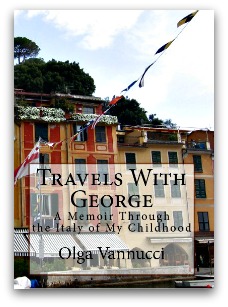
Olga Vannucci CollageWhen I first stumbled across Olga Vannucci’s memoir, Travels with George, I wondered whether the title alluded to John Steinbeck’s book Travels with Charley, about his road trip across America in the company of his French standard poodle, Charley.

Turns out, I got it right. Born in Italy, Olga went to Brown University and currently lives in rural New Jersey. As she tells it, she was driving through Doylestown, Pennsylvania, one day when Steinbeck’s travelogue popped into her head, and she knew she wanted to call her book “Travels with George.” When she announced this to her son (the “George” of the title), he said: “So I’m the dog?”

As you can gather from this story, mother and son make quite a pair.

Olga says she’s no Steinbeck, though she does prefer a plain and honest writing style. Also like Steinbeck, she had the desire to see her native land again.

So, how did she find the Italy of today: did she still fit in? And what did her sidekick, George, the blonde all-American kid, make of his mammina‘s homeland? Did he enjoy these escapades or feel puzzled by his mother’s motives? Perhaps the story he saw himself in wasn’t Steinbeck’s at all, but a modern Italian version of Don Quixote, in which he occupied the role of a skeptical Sancho Panza?

Olga has kindly agreed to give away one copy of the book to the reader who is keenest to find out the answers to these questions (see giveaway details below).

But before we get into that, let’s talk to Olga and hear some more about the travels that inspired her to put pen to paper…

* * *

Travels with George Book CoverCiao, Olga! Let’s begin at the beginning. Tell us more about your decision to take a trip to Italy with your young son and write about it.
I was born in Italy (Milano), lived in Brazil two different times as a child, and came to the United States to attend college. I’ve been here ever since. When my son was seven years old, I realized suddenly that I hadn’t been back to Italy in ten years, and I went, taking him along. I thought he would learn about Italy and acquire a feel for what it’s like. I also hoped he would learn some Italian. I don’t know how much of that was accomplished, but I loved showing him around. We went back four more times over the course of six years (he is now 14). I wrote the book about those trips: a mix of travelogue, personal history, and little anecdotes, with some humor.

What impact did writing about the experience have on you—did it help you process your childhood memories?
It was wonderful to see the locales of my childhood again. At this point, my memories are either indelibly fixed or just gone—for instance, I can remember clearly sitting on the steps with my friends Sassello, in Ligurio, as I recount here:

[My sister and I] had two friends in Sassello, two girls the same age as [us]—Paola and Maria Elena. They spent their summers thirty meters from where we spent ours, and we spent hours and hours of every day together.

[George and I] walk by the steps where we used to sit. I expect to see them, I expect them to be there, but they’re not. No one is. It’s all the same, but it isn’t.

Did you also learn something about yourself, in taking these excursions down Memory Lane?
I did find out about my current self through the book, but primarily from what others told me my words said about me—for example that I’m kind, funny, and honest. It was also interesting to hear from others about the things that they could relate to in the book, ranging from the more profound to the totally mundane situations. That was amazing, to realize that what I wrote spoke to others.

George’s ordeal

Do you think it will help George someday, in understanding part of his heritage that might not otherwise be accessible?
George has not read the book because, he says, “I was there, I don’t need to read about it.” I do hope and trust that both the experience and the writing will be a part of him, that he will consider the book a gift.

What was your most displaced moment when you & George were touring Italy, when you thought of yourself as a stranger within your homeland?
I always struggle with whether I am Italian or, at this point, American, or, more likely, not really either one. What makes me feel at home in Italy is the fact that it’s largely so unchanged. What makes me feel displaced is that the people of the older generation, my parents’ generation, who are the people I particularly associate with Italy, are passing. They’re my biggest connection with Italy, and they will soon be gone. After that, I may feel displaced…

I gather you don’t feel nearly as comfortable with younger generations of Italians?
Yes. I’m not sure why not. Possibly because the younger generation is doing its own thing and is more all over the place, unlike the older, which has stayed put.

What was your least displaced moment, when it all seemed to make sense for you and George to be there—that you fit right in?
On all the trips we visited my aunt, my mother’s sister, and stayed at her house, where we slipped naturally into being part of the family. I had coffee with her in the morning, we planned meals, I helped her water her garden, George fed her goldfish, and we watched television in the evening.  There was not an ocean or even a smidge of formality between us.

I love the description you provide of your aunt in the book:

My aunt is a lovely person, she’s beautiful and she likes to dress well. She’s 80 now, and she still looks good in her clothes, she wears fashionable clothes. She is cheerful and tells funny stories. She loves to do stuff and see people, she’s chatty. She’s fun to be around.

In that same passage, you mention the “recurring nightmare” of finding food that George likes to eat. What was the most challenging thing about traveling with a young child?
I did not realize how jarring the experience would be for George. To me, Italy is pleasant, and while I knew it would all be new to him, I didn’t realize how different it really was. Being in a completely unrecognizable place where he didn’t understand the language was way outside his comfort zone. I also probably didn’t verbalize things enough. I could have prepared him more and explained things better.

The other thing about traveling with a small child is that I, as the adult, had to be “on” 100% of the time.  Not only did I have to plan and handle everything, but I also had to manage him and make sure I didn’t lose him, which was something I actually worried about, and when I became stressed I had to try to hide it so he wouldn’t become stressed, which I didn’t do very well. He’s very perceptive.

What do you think he took from the experience?
The knowledge that he can survive a terrible ordeal… Possibly I took him on a few too many hikes up hills. It wasn’t always fun and idyllic. I do believe that the trips will serve as a foundation for him to understand that the world is large and diverse and for him to appreciate differences.

The potential perils of writing about one’s offspring

What was the most difficult part of the book-writing process?
It was hard to write about others and protect their privacy at the same time, particularly with my son. I find him very amusing, but he doesn’t intend to amuse me, and he is sensitive to it. He thinks I’m making fun of him, basically. So I’m always walking that line, writing about him, but trying to be respectful of him.

I understand you decided to self-publish the book. Why is that, and do you have any advice for other writers who opt for self-publishing?
I made some attempts to get an agent but ultimately I went with self-publishing because I didn’t have the patience to wait. What I like about self-publishing is that it’s all mine, I created the book cover, I chose the font, I decided to favor the comma over all other punctuation, and it’s been incredibly fun and very rewarding.

There are so many options today to publish and distribute and get the word out, and it can be done without a big financial investment. All you need is the investment of time. Given that this is your passion, you want to spend your time on it anyway. And there are so many people who are open to help. I would encourage other writers not to be afraid to ask. Putting your thoughts out there to share with others is a gift, and people respond very kindly.

What audience did you intend for the book, and has it been reaching those people?
I thought it was a mother/son book, which it is, but it’s very much a book for people who love Italy, who have been there, or who plan to go. My writing is very direct and the book is written in the present tense, so readers feel like they’re there along with me. It combines some very personal time in Italy–with family or revisiting places of personal significance—with visits to the big tourist destinations like Venice and Rome.

Are you working on any other ambitious writing projects?
I am working on a book about traveling with George in America. It’s not an organized itinerary, it’s just places we’ve been or will go to. Mostly in the northeast, plus San Fran and Arizona. It’s still in the infant stages, this project. But I promise it will be extra funny!

10 questions for Olga Vannucci

Finally, I’d like to ask a series of questions that I’ve asked some of our other featured authors, about your reading and writing habits:
1. Last truly great book you read: Don’t Let’s Go to the Dogs Tonight, by Alexandra Fuller, about growing up in Africa.
2. Favorite literary genre: Definitely travel!
3. Reading habits on a plane: I don’t like to fly so I bring an easy-reading book that I know will keep me engaged, and paperback so it’s lightweight.
4. The one book you’d require President Obama to read, and why: He has such a tough job. I would wish, not require exactly but only wish, for him to read a book that his daughters like, so he can have a topic of conversation that they can share and enjoy. He will then tackle his job rejuvenated.
5. Favorite book as a child: Mary Poppins—the P.L. Travers book and the Disney movie, too. I think I had it in both languages. It was just magical, different, not at all like my daily life with my mother and sister.
6. Favorite heroine: Martha Gellhorn, who was a great journalist and writer. She was married to the literary giant Ernest Hemingway yet always retained a strong sense of herself.
7. The writer, alive or dead, you’d most like to meet: I would like Calvin Trillin to take me out to eat in New York, in the Village, to all his favorite eating places. It might take several days because he has a lot of favorite eateries. I would like to hear all about Alice, about his daughters, and about his long and brilliant career.
8. Your reading habits: I read in bed every single night, and I have been reading more during the day recently. I’ve been deliberate about carving out more time in the day, when it’s otherwise easy to get caught up in other activities.
9. The book you’d most like to see made as a film: Any book that takes place overseas, so I can see the place in which the events take place.
10. The book you plan to read next: Hard to tell… I have a stack of some thirty books in my bedroom, and I’m not sure which one is next. I may need to devise a lottery system to determine the reading order…

* * *

Grazie tanto, Olga! Your story certainly sounds amusing while also saying something profound about parent-child relationships and the quest to go home again. Something to rival the wisdom of Steinbeck or Miguel de Cervantes, for sure.

Readers, it’s time for you to ENTER OUR DRAW TO WIN A FREE COPY of Olga Vannucci’s book, by entering a comment below. Olga says she will favor comments that tell her why you’d like to read about her and George’s adventures.

Extra points, as always, if you’re a Displaced Dispatch subscriber!

The winner will be announced in our Displaced Dispatch on September 28, 2013.

To read more excerpts from Travels with George, go to Olga Vannucci’s author site. You can also keep up with her on the book’s very active Facebook page. Also feel free to order the book from Amazon.com.

STAY TUNED for tomorrow’s quota of Global Food Gossip. Rumor has it, Joanna Masters-Maggs has something particularly tasty in store for us!

If you enjoyed this post, we invite you to register for The Displaced Dispatch, a round up of weekly posts from The Displaced Nation, with seasonal recipes, book giveaways and other extras. Register for The Displaced Dispatch by clicking here!

Related posts:

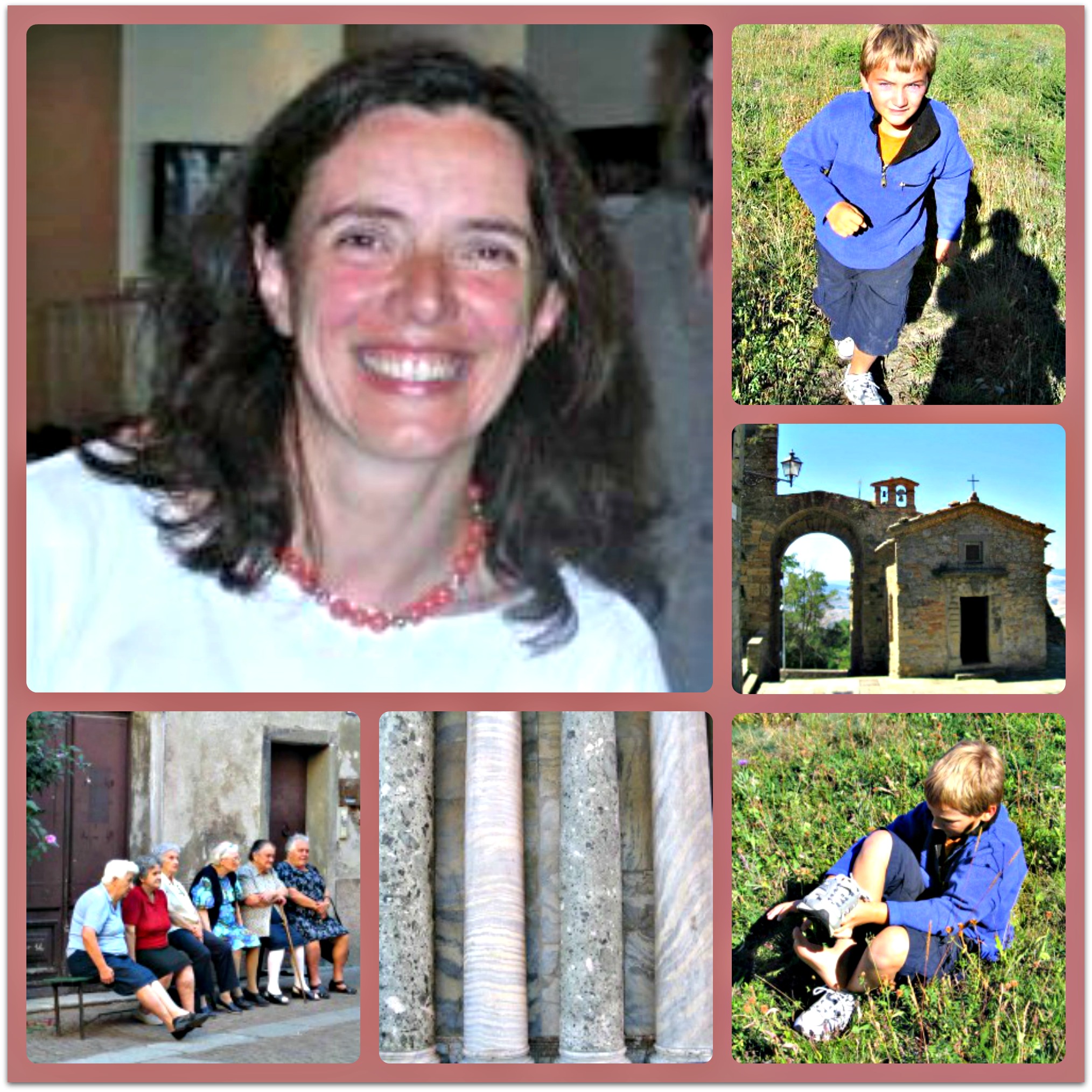
Images: Olga Vannucci and George, interspersed with Italian scenery. Of the George photos, Olga writes:

Let me provide the audio from George: “Where are we going? How much longer? I have something in my shoe. I want to go back. Why are we doing this? Do you know where we are? Do you know where we’re going? Mammaaaaaaa!”

What’s it like to “come out” as a Third Culture Kid on stage? Elizabeth Liang tells all!

Liang Alien Citizen dancingAs reported here last month, Elizabeth Liang spent the month of May performing, at a venue in Los Angeles, a one-woman show about being a Third Culture Kid, or TCK. As some readers may recall, Liang is a self-described Guatemalan-American business brat of Chinese-Spanish-Irish-French-German-English descent. She was brought up by peripatetic parents in Central America, North Africa, the Middle East, and Connecticut. Many of us were curious about not only how she could pack all of that personal history into a solo stage performance, but also how the (mostly American) audiences would respond. Today is the day we get to find out. Take it away, Elizabeth!

—ML Awanohara

I had no idea what to expect from audiences when I opened my solo show, Alien Citizen, in Hollywood, California, on May 3rd (it closed June 1st).

Since the show is about my upbringing as a dual citizen of mixed heritage in six countries, I assumed it would appeal mainly to Adult Third Culture Kids (ATCKs) and people of mixed heritage—the people I wrote it for, since we rarely see our stories portrayed on stage or screen.

I wanted the show to be funny, but wasn’t sure if the humor would translate.

And I wanted people to be moved by the story.

Some pleasant surprises

As it turned out:
1) I was happily surprised by the composition of the audience. People of all backgrounds, ethnicities, and ages came to see my performance. Some were Americans who had never left their home state until college, others had moved domestically countless times as kids. By the same token, I was pleased that the audience did include ATCKs, global nomads, people of mixed heritage, expats, and immigrants.

2) Many of the houses were full. I had tentatively hoped the story would resonate with enough people to fill the house because the play is about identity, which everyone grapples with. That said, I didn’t expect everyone to empathize with my lifelong experience as an outsider of some kind and even feared that this experience would alienate some audience members… The full houses suggested that the show was actually resonating with most people. For this I must give credit to my director, Sofie Calderon, because she guided me to a brave and inclusive performance. I also take pride in the script, which I worked on for two years.

3) The audience laughed in the right places, mostly. I was astounded at the number of laughs I got in my preview performance. It was wonderful. This continued once the play got under way, although I did have a few quiet nights, when the audience was listening intently and smiling rather than laughing. (Then there was the night when a man in the front row fell asleep. This thickened my skin…after I considered quitting!)

4) The audiences were moved—not only at the end of the play where it was intended, but throughout the performance. People told me that they oscillated between tears and laughter for a large part of the performance—the highest praise I could have hoped for.

Nights to remember

The performance that stands out most for me was the first time my parents, brother, and aunt came to watch me. They had all traveled internationally or cross-country to see it.

My parents and brother are characters in the show, so I was unsure of how they might react. That night got some of the biggest laughs, and my family told me afterward that while they certainly laughed, they also wept throughout the performance because I was telling their story, too. The show brought back experiences they hadn’t thought of in years.

Opening and closing nights were wildly different and weirdly similar. I performed in abject terror on opening weekend, and while I kept it hidden from the audience, it was difficult to enjoy myself on stage. Through the run, I gained heaps of confidence, and was able to relax and “play” more.

However, the final show was reminiscent of opening night in that it wasn’t my best. An actor’s performance is like a speeding train with no seats—ideally, the actor makes a flying leap to catch it, hangs onto the rails, and rides it without falling. Sometimes, though, the actor has to sprint for some time to catch the train, using every skill s/he has—and then keeps slipping from the handrails and grabbing them again, never able to “coast” and enjoy the ride.

I was sorry that my closing night wasn’t a great ride for me, but the good thing about performing for different groups of people each night is that the audience has no idea of what to expect, yet the story remains the same. So closing night still managed to get a standing ovation, as had other nights.

Lessons learned from “coming out” on stage

Performing Alien Citizen was a “coming out” for me. Although I told the story as entertainingly as possible, the play explores the darker aspects of having a peripatetic childhood, being a child of color and mixed heritage in the socially segregated USA of my youth, and being a girl blooming into womanhood on the hostile sidewalks of North Africa and the cold campus of a women’s college in the States.

I had never told these stories publicly (and rarely in private) because I didn’t want to seem ungrateful for all of the wondrous experiences I’d had as a TCK (including life in North Africa and at college), but also because I’m accustomed to listeners failing to understand my point. Hearing negative stories, people tend to conclude that a peripatetic childhood is terrible, or that the country in question is not worth visiting. But that isn’t what I’m trying to say.

Alien Citizen was my attempt to pronounce that:

  1. Being a nomad, a kid of mixed heritage, and a girl can be hard.
  2. This doesn’t nullify the glorious experiences to be had from having any or all of these selves.
  3. The accompanying stories—positive and negative—have a right to be told. They are rarely told, they validate many people’s experiences, and they make a good yarn.

The overwhelmingly positive response of my audiences, night after night, taught me that my story is relatable and interesting, and that it’s a testament to my own strength as a human being, something I hadn’t known would be the case.

Doing the show also confirmed my belief that if a story is told with humor, people will listen to the darker side of it, and empathize.

I’ve been approached by universities in and out of state, as well as venues in Central America, to perform the show and teach workshops on how to create a solo show.

I hope to take the show all over the world.

I’m profoundly grateful that the world premiere of Alien Citizen has led to so many opportunities. I will also teach workshops in Los Angeles starting this fall.

* * *

Readers, I feel moved by this report even though I didn’t get to witness Elizabeth Liang’s deeply moving performance. (Elizabeth, please bring the show to New York so that I can see it!) How about you—any further questions for this brave and bold artist?

STAY TUNED for next week’s posts, featuring yet more international creatives as well as the latest episode in our fictional expat series, Libby’s Life.

If you enjoyed this post, we invite you to register for The Displaced Dispatch, a round up of weekly posts from The Displaced Nation, with seasonal recipes, book giveaways and other extras. Register for The Displaced Dispatch by clicking here!

Related posts:

img: Elizabeth Liang performing Alien Citizen in LA.

Getting carried away with author Lisa Egle on a magic carpet, or is it a chicken bus? (Win a copy of her travel memoirs!)

Lisa E Collage for TNBack in the days when my nieces were small—and I’d just repatriated to the United States after quite a few years abroad—I got to know them again through long bouts of playing make-believe at my mother’s (their grandmother’s) house.

We particularly enjoyed Magic Carpet. We had our own home-made version. Adorning ourselves in Grandma’s silk scarves, we would plonk down on her quilted bedspread for a flight of fancy, à la Arabian Nights (not for us the Disney version!):

Whoever sitteth on this carpet and willeth in thought to be taken up and set down upon other site will, in the twinkling of an eye, be borne thither, be that place nearhand or distant many a day’s journey and difficult to reach.

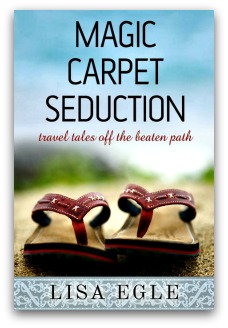
I trust this anecdote will explain why I’m so excited about hosting new author Lisa Egle today. It’s Magic Carpet time again, and this time I get to be the kid, listening to Egle tell of the off-the-beaten-track adventures that are captured in her travel memoirs, Magic Carpet Seduction.

Hey, we even have prizes! Two of our readers will be the lucky recipients of a copy of Egle’s book (see giveaway details below). The giveaway is now over! 😦

Hmmm… The only thing is, I suspect that before we board the Magic Carpet, Egle will ask us to ride on a chicken bus. (Leave the silk scarves at home, girls!)

* * *

MagicCarpetSeduction_cover_pmHi, Lisa! I won’t need too much persuasion to be seduced by your writing. I’m already a follower of your travel blog, ChickyBus. And I know you’re an American like me, living in New Jersey. Why made you decide to travel in the first place?
After taking short solo trips in the U.S. back in the 1990s, I went on a two-week group tour of Egypt and thought it was the most exciting thing I’d ever done. I then went on another tour, of Ecuador, which turned out to be a life-changing experience (for many reasons, including the fact that I moved there a few months later). While living in Ecuador, I began to travel independently and realized how much I enjoyed it. From that point on, I entered the ranks of “travel addicts.”

How many countries have you been to at this point?
In total, I’ve been to 36 countries, on five continents. I was an expat twice: in Ecuador for a year and half and in Spain for a year. Recently, I spent two months in Indonesia.

And home is now New Jersey?
Yes. I’m a full-time ESL professor at a two-year college in Bloomfield.

I don’t get it. Is a “chicken bus” magical?

Where does the epithet “Chicky Bus” come from?
“Chicky Bus” is the name of one of the stories in my book. It’s about a quirky 12-hour “chicken bus” ride I took in Central America that led me to have epiphanies about living in the moment. When I started my blog, I thought “ChickyBus” would be a cool domain name—one that related to travel and one that people would remember. I also liked it as a blog concept. I’m the “driver” taking readers—”passengers”—on “rides” with me, allowing them to experience the same random moments and unexpected journeys that I do.

There’s also a deeper meaning, however. “Chicky bus” is a metaphor for my unique style of travel—being in the moment while venturing off the beaten path and taking risks (nothing too crazy, of course). It refers to that place of magic and self-discovery that I find wherever I go.

Why did you decide to publish some of your travel stories as a book?
Years ago, while blogging about general topics on a site called http://www.gaia.com, I began sharing travel tales. The feedback was incredibly positive; people were inspired and entertained by what I wrote and said they felt like they were right there with me. After a while, I decided to go all the way with it, to write more stories and to compile them into a book—four major “rides” to different regions of the world (and a total of 9 countries: China, Nicaragua, El Salvador, Guatemala, Mexico, Turkey, Jordan, Syria and Lebanon).

Are any of your chapters based on blog posts?
Interestingly, none of the stories are based on blog posts. I wrote most of the book before I started ChickyBus. There are, however, a few stories (simplified versions) on the blog that came from the book.

Mostly magical connections

We like to talk about “displaced moments” on the Displaced Nation. We can see you’ve experienced your fair share: from close encounters with Carpet Casanovas in Turkey, to meeting with a hermit in the Lebanese mountains, to experiencing political intrigue in a Chinese classroom, to receiving a marriage proposal on that infamous chicken bus in Nicaragua. But we still have to ask you: which is the MOST displaced moment that you’ve included in this book?
The moments you mention were truly unique ones and—believe it or not—I didn’t feel as displaced as one might think. Because I was in the moment and going with the flow, I felt quite comfortable and that I was where I needed to be.

There were a few instances, however, in which I did have that “displaced” feeling—the most extreme of which occurred in China.

It was 1999 and I was teaching English at a university in Changsha in Hunan Province, which was definitely considered off the beaten path back then. For most of my time there, I was in a deep state of culture shock. I struggled with many things, from freedom of speech issues to getting to know my students. There were many “displaced moments”—and even days. Fortunately, after a while, things leveled out and went more smoothly.

So from what you’ve just said, I guess there is a lot of competition for your LEAST displaced moment, when you felt you actually belonged with all of these characters you discovered off the beaten track?
One of my least displaced moments (and possibly favorite) was when a friend and I ended up spending the night with a Mexican family we barely knew. They’d invited us over for lunch. We were planning to take a bus to another city that night because we had to fly home from there the next day. It got later and later and because we were so comfortable, we didn’t want to leave. We ended up staying (and sleeping in two very tiny beds, slightly larger than coffins) and having a wonderful time being part of the family.

P.S. A little Boone’s Farm wine went a long way in helping make us even more comfortable…

Don’t exit until the rug has made a complete stop!

Okay, time to get off that chicken bus and onto that magic carpet. On your post announcing the book’s publication, you say:

So imagine that my book is the equivalent of an invitation to a Bedouin lounge of sorts. If you decide to join me, we’ll get comfy on the cushions and share some tea (or coffee or whichever beverage you like). When you’re ready, I’ll start telling you my favorite travel tales—and together, we’ll take a magic carpet ride.

Why did you choose this metaphor, and indeed use “magic carpet” in your title?
When I was a kid, my friends and brother and I used to sit on the front porch and listen to my mother telling us stories. Years later, I found myself doing the same thing with friends and later, on a blog. Then, I spent time with the Bedouins in Wadi Rum, Jordan. We told our own stories while sharing tea and sitting on the sand under a tent or on a cushion inside a house. In retrospect, I believe that the “invitation” into the Bedouin lounge has something do with each of these experiences.

Re: the title, when people see the words “magic carpet,” the freedom to travel anywhere, magically, usually comes to mind. Also, “Magic Carpet Seduction” is the name of one of the stories in the book. It’s about two men, seemingly different, trying to sell me a carpet and what happens I see through their each one’s sales pitch/ploy.

Also in your blog post announcing the book’s publication, you confess to being exhausted. (I confess to having had similar feelings after long games of Magic Carpet with my nieces!) What was the most challenging part of the writing process?
Mostly, it was finishing the book, editing it and formatting it while maintaining my blog and my full-time teaching job, and being on social media. At times, it was difficult to prioritize and I often felt burnt out.

Overall, however, I would say that editing took a lot out of me. There were a few times when I thought I was finished with a certain stage of the process; then, I’d realize that I wasn’t. Having said this, that is where I learned the most and what helped me become a better writer. So, in the end, it was a positive experience.

Capturing the magic of self-publishing

Why did you self-publish the book?
I took this route mostly because I wanted creative control; I believe the book is unique and slightly nichey. Also, I didn’t want to have to spend a lot of time pursuing an agent and traditional publisher. Mostly, I wanted to get the book done my own way and on my own schedule.

Can you offer any tips for others who are contemplating going down this path?
My best tips for anyone who’d like to self-publish are:

• Hire a professional editor and a proofreader—two (even three) people. Also, get a critique done before you pass the manuscript on to an editor. It’s important because each editor has his/her own specialty and will probably catch something another didn’t.

• Have a cover professionally designed. I know there are ways to do this cheaply or yourself, but it’s worth spending money to do this right since the cover is first thing that people see when searching for a book.

• Have your blog (and social media accounts) set up/established before you publish the book. I’ve seen many people do it the other way around. They finish and publish their book, then set up a blog and join Twitter. Many aren’t sure what to do—they just tweet about their book and don’t interact with others. This tends to hurt them more than help them.

• Don’t give up. I can’t begin to tell you how many times I wanted to quit just because of the sheer amount of work (blog, social media, the book itself, etc.) You can burn out very easily and, if you’re not careful, your health can suffer. Keep going, though, and you’ll cross that finish line!

What audience did you have in mind when writing the book?
I’ve always envisioned the audience as:

  • armchair travelers and those who take tours and fantasize about breaking away
  • other independent travelers/expats
  • non-travelers with an interest in countries often in the news
  • anyone curious about the cultural perspective/insights of a female American traveler.

Is it reaching those readers?
I don’t know the customer demographics yet, but I know that a few men have written reviews on Amazon—and that makes me happy. As is the case with ChickyBus, the book is for people of all ages and both genders. It’s definitely not just for women.

I see you’ve opened your own publishing company and are working on some more ambitious travel-cum-writing projects. Can you tell us some more about that?
I set up a small publishing company for a number of reasons, including accounting and taxes. More than that, I thought it made sense because I will be publishing more books and hopefully, a collection of travel tales written by others. This is a longer-term goal, but definitely something I’m considering for the future.

Are you already working on your next book?
I’m currently working on a trilogy about Native American-style healing journeys in the U.S. (in the Northeast and the Southwest). After that, I’ll hopefully wrap up the rough draft of a book about life-changing experiences I had in Ecuador. That, like the trilogy, would fall under a “spiritual travel” genre.

10 Questions for Lisa

Finally, I’d like to ask a series of questions that I’ve asked some of our other featured authors, about your reading and writing habits:
1. Last truly great book you read: Grey Wolves and White Doves, by John Balian
2. Favorite literary genre: Political thrillers; travel literature.
3. Reading habits on a plane: (what kinds of things do you tend to read and by what means?) Now, because I own a Kindle, this is much easier. I usually have several books to choose from: one I’m sure I’ll love and lose myself in and—a few that I’m curious about. One thing I love to do on a plane (and during my trip) is keep a journal. During my return flight, I re-read the journal and re-experience the trip. I almost always do that and love it!
4. The one book you’d require President Obama to read, and why: Hmmm. That’s a tough question. Maybe my book? I’d want him to see that there are Americans who embrace the rest of the world, despite the media’s distortions of it. Also, I think my book would show him how travel, the way I approach it—focusing mostly on meeting the locals—can help people to connect in a very real way and to overcome cultural misconceptions, ultimately helping make world peace more attainable. Another reason I’d want him to read it is because I think it would provide good escapism since it’s quite humorous. He’s got a tough job and might enjoy it for the entertainment value alone.
5. Favorite books as a child: The Outsiders, a coming-of-age novel by S.E. Hinton; and Go Ask Alice, by Beatrice Sparks.
6. The writer, you’d most like to meet, who is no longer living: Aldous Huxley
7. The writer, you’d most like to meet, who is still alive today: Daniel Keyes
8. Your reading habits: I have a pretty short attention span, so there are many books that I start to read that I don’t finish. However, if a book really gets my attention, then I can’t stop. It becomes something I look forward to and put aside other things to do. Unfortunately, since I started my blog a few years ago, I’ve been reading less than previously. I spend more time reading other blogs and articles than reading actual books. When I seem to read the most is when I’m traveling and find myself without Internet. I end up loving it, too.
9. The book you’d most like to see made as a film: A cyber suspense I’ve written about two women who “meet” on the Internet and what happens when the bond they’ve formed takes a dysfunctional and frightening turn. It’s now in rough draft form (about 15,000 words), but I’m hoping to publish it on Amazon (just for Kindle) in a few months.
10. The book you plan to read next: Actually, there’s a book I’m itching to finish reading—and that’s Shantaram. I always start it and then get interrupted. It’s a very long book (over 900 pages). I think Gregory David Roberts is an awesome writer. His storytelling ability—the way he writes dialogue, how he describes characters, settings and situations, and the way he uses metaphor—makes his experiences incredibly real to me.

* * *

Thanks so much, Lisa! That was absolutely magical, a carpet ride to write home (to my nieces) about! And that chicken bus? It wasn’t half bad! 🙂

What about you, readers? Has she seduced you?

Lisa Egle writes a blog, Chicky Bus, the concept of which is “finding yourself off the beaten path.” Over the past three years, it has been recognized on two “Top 100” lists of independent travel blogs. Egle is also Assistant Professor of ESL at Passaic County Community College in Paterson, New Jersey, where she teaches students from all over the world, especially Latin America and the Middle East. She holds a BA in Social Sciences from New York University and an MA in TESOL (Teaching English to Speakers of Other Languages) from Fairleigh Dickinson University. Lisa recently published a humorous piece in OH SANDY! An Anthology of Humor for a Serious Purpose (sales of which help victims of Hurricane Sandy), and an article on one of her quirkier adventures in Indonesia in LifeLift, the Oprah.com blog. She received an honorable mention in the 77th Annual Writer’s Digest Contest, in the Inspirational category.

STAY TUNED for tomorrow’s post, by guest blogger Elizabeth Liang, who will be updating us on her one-woman play about the TCK life, Alien Citizen.

If you enjoyed this post, we invite you to register for The Displaced Dispatch, a round up of weekly posts from The Displaced Nation, with seasonal recipes, book giveaways and other extras. Register for The Displaced Dispatch by clicking here!

Related posts:

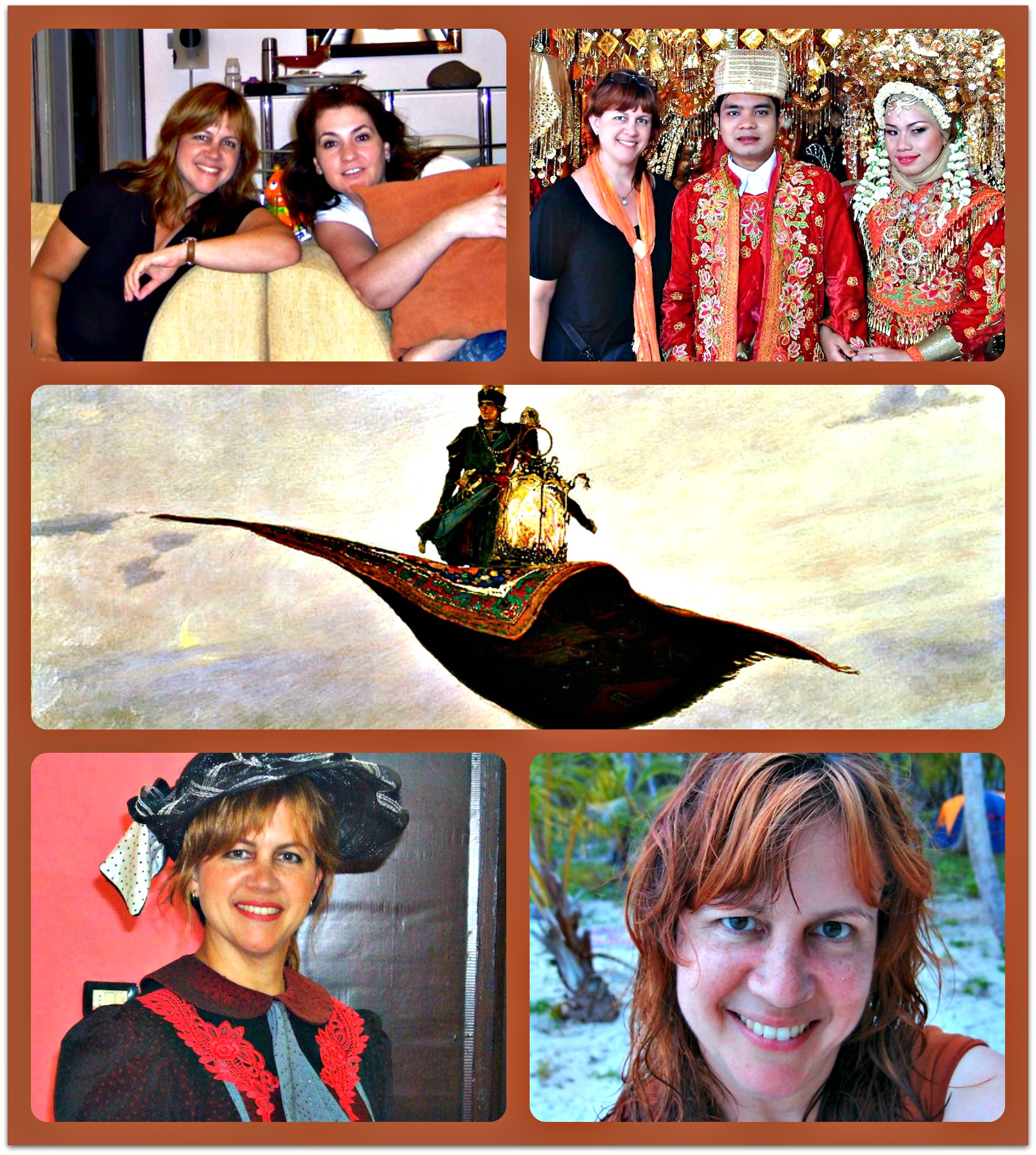
Images (clockwise, starting top left): Lisa at the home of her Cirassian-Jordanian friend, Souzan, with whom she was staying before the latter’s move to New Jersey(!) [this photo is in the book]; Lisa at a wedding in a Minangkabau village in Sumatra (hey, you can’t attend without posing with the bride and groom); Lisa camping in San Blas, Panama, during rainy season and a full moon (a displaced moment, to be sure, as the local Kuna indigenous believe that a full moon equals a curse); and Lisa after being recruited to be on a famous TV show in Damascus, which aired during Ramadan afforded an opportunity to meet one of the most famous actors in Syria—Qusai Khouli (she is wearing a late 1800s outfit, in case you were wondering). The painting in the center is “The Flying Carpet,” by Viktor Vasnetsov (1880), courtesy Wikipedia.

TRAVEL YARN: Two madcap Indonesian ladies in weird & wonderful Japan (2/2)

Japan — the country that many Westerners have likened to Lewis Carroll’s “wonderland” for its quality of wacky unpredictability. But what about for other Asians — do they feel as displaced and disoriented there as we do? Our very first Random Nomad, Anita McKay, ventured into the Land of the Rising Sun for the first time this summer, in the company of another Indonesian, P, who had been there once before as a student. This is Part 2 of the pair’s adventures. (See also Part 1.)

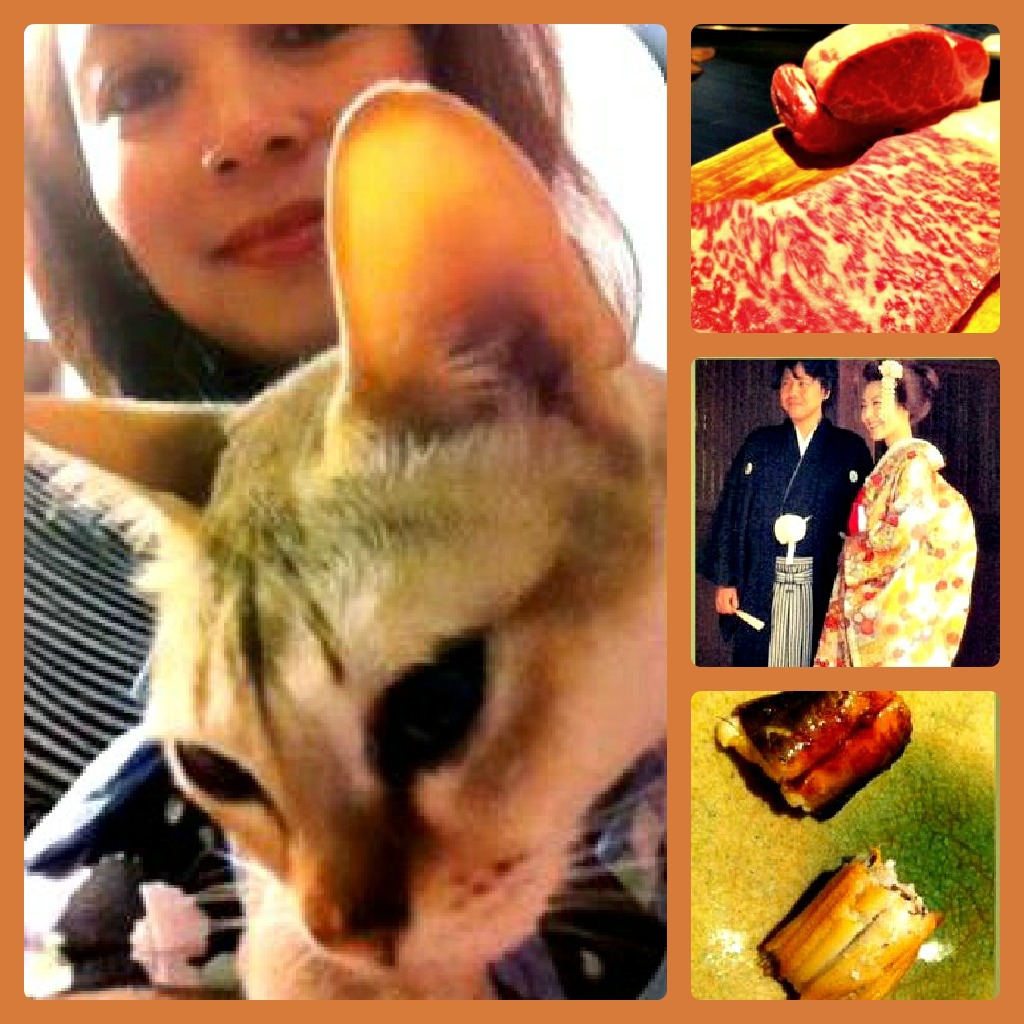
After Tokyo and Kyoto, P and I headed to Kobe — with Kobe beef as our main target. We’re Indonesians, remember? Which means we’re always looking forward to our next meal.

Gluttons for gourmet food

Our hotel in Kobe had booked us a table at Mouriya, a restaurant that prides itself on serving superior quality beef from the Kobe Cow and the Tajima Cow. Mmmm…

The meat was really delicious, but not long afterwards, I was craving sushi again. Fortunately, I was able to indulge in some serious sushi eating one last time with my blogging buddy from Yokohama, whom we met on our way back up to Tokyo. She and I went out for a meal at Kyubey, a high-end sushi restaurant in the Ginza. (P couldn’t join as she actually had to work in Tokyo for her Indonesian company for the last two days of our trip.)

Kyubey, which is actually two restaurants across the street from each other, doesn’t take bookings and always has a long queue. Luckily, my friend and I were able to get a table — and, to our delight, the chef had rather fluent English.

He patiently explained to us about the fish we were eating. One particular sushi had to be held with chopsticks in a certain way and nibbled at from the side, not the front.

We told the chef that both of us weren’t too keen on tuna, as the tuna we’d tried had been chewy or smelled too fishy — so we preferred salmon instead. He smiled and then put some tuna on our plates and told us to try it. We soon realized that this might be the best thing we’d ever eaten — melted like butter in our mouths.

Our nine-course lunch, which included eel (unagi), tuna, scallop, and squid, cost only about AUD 50 (around the same in US$). I would happily go back to Kyubey again and again and again.

P, upset at being stuck in the office while my friend and I were feasting on sushi, insisted that we go to Tsukiji market on our last morning in Japan. We got to the market just after 6:00 a.m. — but by then had already missed the tuna auction.

Still, we took a good look around at all the weird and wonderful sea creatures for sale, and then decided to have a sushi assortment for breakfast. While at the sushi restaurant, I discovered that different parts of the tuna are sold at different prices. I also came to realize that tuna costs 2-3 times more than salmon. Remembering what I’d told the chef at Kyubei about salmon and tuna, I think he must have been laughing at us!

Sex (and hugs), please, we’re Japanese!

Our first night in Kobe, P and I had wandered around looking for a place to have a drink after dinner. It was only 9:00 p.m., but outside nearly every club were girls in miniskirts handing out pamphlets.

(If guys, not girls, were standing outside the clubs, it was to advertise that “go go dancing” was on offer. Hmmm…is that a euphemism?)

We passed one big place claiming to be an Arabian club (actually, the building did have a Middle Eastern look), with a big banner of three Japanese girls dressed as nurses and “A Whole New World” blasting loudly.

We passed a couple who looked as though they were in their mid-50s and had had too much fun too early. The lady was leaning against a tree and wrenching; not exactly the picture of elegance!

We decided just to go back to our hotel instead.

Later, when we joined my blogging buddy for some shopping at the Yokohama Red Brick Warehouse, we rested over coffee as she regaled us with some stories she’d collected of strange and rather lewd behavior engaged in by Japanese men.

And then, as if to illustrate her story, something rather creepy happened. Ever the snap-happy tourist, P had decided to take a parting shot of me and my blogging buddy with the Red Brick Warehouse in the background. There was a young couple doing the same thing, who turned out to be Indonesians, sent by their companies for a training session in Yokohama.

While we were busy exchanging e-mails and phone numbers, a young Japanese man popped up out of nowhere.

He shook my hand, asked my name (in English), and mumbled something I couldn’t understand. He then walked over to my blogging buddy, repeated the same series of gestures — and then hugged her. He walked over to P and did the same thing. And then it was the turn of the young Indonesian couple.

By then, all of us had realized there was something “not right” about this guy — but as he seemed harmless enough, we waited patiently until he finished hugging the last person in the group.

At that point, he walked back to my blogging buddy and hugged her again.

I laughed a little because it seemed so strange — also because I was the only one he hadn’t hugged so felt safe.

But then, to my horror, he came back to me, shook my hand again, asked my name again, and then really hugged me and wouldn’t let go.

My blogging buddy, seeing the expression on my face, started walking away as fast as she could. The rest of us followed her. I broke free and followed her as well. As we looked back at Hugger Boy, he just waved and started laughing.

Another funny, weird, horrifying tale for my blogging buddy’s collection!

Some seriously good people watching

As our time in Japan drew to a close, I entertained myself by staring at the Frank Lloyd Wright wall in Tokyo’s Imperial Hotel, spying on a wedding procession at Meiji Shrine — and, best of all, people watching.

As I was sitting on the subway, I noticed two very pretty girls sitting right in front of me. Their hair was almost light brown (a favorite color in Japan), very long and slightly wavy (favorite style in Japan). They also wore fake eyelashes, but there was something about them that made me keep staring at them. After a few minutes I realized that their eyeballs were unusually large, more like dolls than human.

Later I consulted with Google and found that Japanese girls sometimes wear special contact lens that do make their irises look bigger. Odd…

More odd stuff: both P and I had been wondering why so many young Japanese men carry bags just like us girls. There was one guy in the subway who carried a black Dior tote bag. And if that wasn’t weird enough, I saw a guy carrying a brown city messenger bag by Balenciaga. (Google the bag and your jaw will drop, just as mine did.) Oh, and there was also a man with matching red tote bag and shoes in Bvlgari’s Il Café in Omotesandō, where P and I stopped for martinis.

Still, I did enjoy watching that particular man, who was accompanied by his two pooches. One dog kept begging from the cute girl at the next table, while the other kept demanding food from him.

Meow — or should it be nyan?!

Actually, I’m more of a cat person — so before we flew home I wanted to visit the Calico Cat Café in Shinjuku, where people can enjoy coffee or tea in the company of real cats. P still had to work so I went by myself. I didn’t even get lost!

The café has two floors and charges the guest by the first hour, then per 15 minutes. I saw a wide variety of cat breeds: Maine Coon, Abyssinian, Ragdoll, Persian, Scottish Fold, and so on. No Sphinx, though.

The café has strict rules about entering the cat area: you have to change your shoes to slippers, clean your hands with disinfectant, and not take any photos with a flash.

All of the cats seemed rather spoiled. They refused to be petted unless you gave them a snack first. A Scottish Fold named Apollo apparently thought he was the cashier, so he sat at the cashier counter, looking at us lazily.

One hour passed by so quickly that I wished I could spend at least another day in Tokyo! P, meanwhile, wished she didn’t have to work so she could experience the cat café as well.

A fond sayonara

We spent our last minutes at the airport buying Tokyo bananas and green-tea Kit Kats for friends and family back home. I was pondering about buying sake, but then all of a sudden, it was time for boarding!

P is determined to go back again, and I, too would love to go back. But as the seat belt sign went off, we looked at the world map spread in our screen, and started day-dreaming about our next adventure…

* * *

Readers, any questions or comments for Anita? Where do you think she’ll go next?!

Anita McKay is a property consultant, travel junkie, cat lover, food enthusiast. She resides in Perth with her Scottish husband but is still searching for a place called home. To learn more about her, check out her blog, Finally Woken, and/or follow her on Twitter: @finallywoken.

STAY TUNED for tomorrow’s review of an expat memoir of a cross-cultural elopement.

If you enjoyed this post, we invite you to register for The Displaced Dispatch, a round up of weekly posts from The Displaced Nation, with seasonal recipes, book giveaways and other extras. Register for The Displaced Dispatch by clicking here!

Related posts:

Images (clockwise): Anita McKay making a feline friend in Café Calico in Shinjuku, Tokyo; the marble-ous Kobe beef; the bride and groom at a Japanese wedding at the Meiji Shrine; and Kyubey sushi (all from Anita McKay’s extensive collection).

TRAVEL YARN: Two madcap Indonesian ladies in weird & wonderful Japan (1/2)

Japan — the country that many Westerners have likened to Lewis Carroll’s “wonderland” for its quality of wacky unpredictability. But what about for other Asians — do they feel as displaced and disoriented there as we do? Our very first Random Nomad, Anita McKay, ventured into the Land of the Rising Sun for the first time this summer, in the company of another Indonesian, P, who had been there once before as a student. McKay reports on the pair’s adventures in this two-part travel yarn.

The message exchange between my travel buddy, P, and me, in May, went like this:

Me: “So have we decided where we want to go this July?”

P: “How about Japan?

Me: “Okay.”

P had lived in Japan decades ago for a student exchange program. She hadn’t been back since, and thought this year would be a good time.

I, on the other hand, didn’t really have any specific destination in mind — just so long as I could go somewhere I hadn’t been to. As I explained in my interview with the Displaced Nation, although I am from Indonesia originally, I have lived for extended periods in Aberdeen, Scotland, and in Australia. But I still hadn’t made it to Japan.

P suggested Tokyo, Kyoto, and Kobe. I added Yokohama to the list because there’s a blog buddy I wanted to meet up with. She and I had been trying to catch up forever and everywhere — UK, Singapore, and Indonesia — but kept missing each other. If I went to Yokohoma, where she is now based, surely we would finally get together?

I prepared myself for the trip by scanning some pages in Trip Advisor and the Lonely Planet guidebook. At least I would have an idea of what to do and where to go — and wouldn’t be entirely dependent on P, who speaks and reads Japanese and has lived there before so presumably knew how to get around.

Madcap traveler’s motto: Be unprepared!

When we landed at Narita Airport, I suggested that we take a taxi because it was 9:00 a.m., and I had taken the notion of a red-eye quite literally — my eyes looked red as I was still recovering from flu. I desperately wanted to have a quick nap before exploring the city.

We crossed the road, dragging our gigantic suitcases with us, and I let P speak with the men at the taxi rank. When she showed them the address of the hotel, one guy frowned and looked at us. “Tokyo?” he asked in disbelief.

We nodded eagerly. The drivers exchanged glances and apparently decided we weren’t crazy. One of them spoke in Japanese to P, who translated: “It’s 23,000 yen.”

I did a quick calculation, and almost fainted when I found out it will cost us almost 300 AUD [around the same in US$] for a taxi to our hotel.

“300 bucks??” I asked P. She nodded calmly, but her eyes couldn’t lie. She was just as shocked as I was.

“No! Cancel!” I shook my head furiously, while P apologized to the drivers. The men just laughed and pointed us back to the airport. “Take the train instead,” I think they said. “Like normal people.” Maybe they said that, too!!

Now we know why there was no one queuing for a taxi, whereas there was a long queue at the train ticket window. And we thought we were being smart!

Everyone had warned us that Japan — Tokyo in particular — is “very expensive!” The city ranks number 1 in the list of the most expensive cities in the world, while Perth, where I now live, is number 19. But really, if the taxi would cost us almost 300 bucks, what kinds of prices could we expect to find in Tokyo?

P had no memory of taxis from the airport. Years ago when she landed in Tokyo, she was picked up by a shuttle bus.

She’d also paid no attention to the length of the journey — she’d been too busy meeting and getting to know the other students. Both of us were surprised when it took almost an hour for the Narita Express to reach Tokyo Station. P had assumed it would be like Jakarta airport to the city centre (just because), and I must have skipped that page in the guidebook…

Well, at least we now knew why it was so expensive to take a taxi: the distance is more like Heathrow to London.

We just kept laughing at our silliness.

It’s food?!?!?

By the time we’d reached our hotel in Chiyoda, a quiet area near the Imperial Palace, we were both rather hungry and decided food would come first on the agenda, before tackling the first sight on our list: Sensō-ji, Tokyo’s oldest temple, in Asakusa.

Food is important to us Indonesians. We eat all the time. In Japan for the first time, I wanted to try something new: not sushi, yakiniku, donburri (rice bowl), soba, or ramen.

“Let’s try this!” I excitedly pointed at one restaurant name in the guidebook. “It’s in Asakusa and it looks…exotic enough.”

P agreed, and under the glare of the July sun we made our way to a restaurant called Komagata Dojo, only to be greeted by the sight of a rather long queue. If there is a queue, then the food must be good, we assured each other. Plus it seems as though most of the people in the queue are locals, so the taste must be authentic.

As it turned out, the restaurant is in its sixth generation of owners, and is famous for its dojo: a tiny freshwater fish like an eel or sardine, cooked in a cast iron pot.

We ordered what seemed to be everyone’s favorite, dojo nabe (hot pot), and also asked for two bowls of rice.

The waitress lit the charcoal burner in front of us, set the pot down on top of it, and told us to sprinkle the spring onions, or negi, on top of the fish.

We looked at each other after the first gulp.

“What do you think?” I asked P.

“What do you think?” she replied back.

“Well…it’s…all right. Weird.”

She nodded. “The rice is very good though.”

I can’t describe the taste. It’s rather bland for my liking, as I grew up in Indonesia, which is famous for its spicy dishes. Not just hot spicy, but lots of flavors in every dish. But dojo nabe isn’t tasteless either. Lots of soft flavors, like soy and spring onions.

When we were about to finish our lunch, I asked P how come Japanese people look so slim if, like the rest of us Asians, they enjoy eating all the time. We were thinking that their diet of raw seafood might be the answer.

“But this isn’t raw,” I pointed at the dojo. “It’s cooked. Plus the size of the rice is rather big.”

We looked around at the other patrons — and, to our horror, we were the only ones who’d seemed to have ordered a bowl of rice each! The rest of the customers were adding the spring onions to their fish but had no rice bowls.

“That’s the only thing they eat for lunch!” I hissed to P. “Spring onions and tiny fish! No wonder they’re slim!”

“No wonder the waiter asked if we wanted one or two bowls of rice,” P admitted when we were at the cashier. “I thought it was because of my rusty Japanese, but now I know because she didn’t believe two small girls can eat that much!”

Hanging our heads in shame, we slipped out of the restaurant and determined we would burn away the calories by walking to Sensō-ji temple. The temple, however, was only a few minutes’ walk away. Still, we had fun taking photos of ourselves under the gigantic red lantern at the temple gate, and looking at the stalls lining the 200-metre-long Nakamise-dōri, the street approaching the temple — selling every manner of Japanese trinket and souvenir, including yukata robes (cotton kimono), tenugui (hand towel, often used as a headband), furoshiki (rectangular cloth for gift wrapping) and folding fans. There were also local snacks for sale, of a kind I’d never seen before in my life, in every shape and color possible, in beautiful packaging.

Kyoto and the Indonesian connection

After two days in Tokyo, we took the shinkansen to Kyoto and stayed in a ryokan — a traditional Japanese guesthouse where you sleep on tatami mats. Being shoppers at heart (another trait of Indonesian tourists!), we were pleased to see that the ryokan was just two minutes away from Nishiki Market, which we saved for our last day.

At first I was skeptical. How “weird and wonderful” can the Nishiki market wares be? I’m an Asian, I’ve seen lots of weird and wonderful things, I don’t think that the Japanese can produce anything that would shock me. Well, I was wrong. From pickled eggplants to live turtles, from grilled sea-eels to rakugan (tea-ceremony sweets) shaped as sushi — every single stall was full of wonders that had me alternatively oohing and ahing, or eek-ing and yuck-ing (along with a few WOWs and OMGs).

But I’m getting ahead of myself. We ended up having a better experience in Kyoto because of making an Indonesian connection on our very first day. After encountering the tail end of the Gion Matsuri, one of Japan’s most famous festivals, named for Kyoto’s Gion district, we stopped in one of the shops in Gion, where the owner happily chatted with us in English. He knew about Indonesia’s first president (I guess because the third of Soekarno’s nine wives was a Japanese woman), and explained to me that the stuff I was buying wasn’t candy but rakugan, made of sugar and starchy powder and often served in Japanese tea ceremony to offset the bitterness of the green tea.

Arranged in a pretty box, the rakugan have the most beautiful soft colors, from baby pink to green. Each was in a floral shape, with delicate carvings on the surface — yet each was only as big as my smallest fingernail. How they could make such detailed coverings in such a small space, I had no idea.

We told the shop owner we were hoping to eat a good soba for dinner. He said to go straight ahead until we reached the kabuki theatre. Next door to that theatre is a famous soba place called Matsuba, he said.

We found the place easily (thanks to P’s ability to read the restaurant sign!), and had fantastic soba with smoked herring.

Our luck didn’t stop there. The next day, after wandering around Kiyomizu-dera, a famously beautiful temple in Eastern Kyoto, and spending a fortune buying souvenirs, cookies and ice cream from virtually every shop along the temple street, we made a quick stop at a proper store to buy sunglasses for P. One of the staff turned out to be an Indonesian. He recommended a bar not far from our hotel for a drink, where the owners are Japanese sisters but can speak Indonesian. Thanks to this advice, we ended up spending our last night in Kyoto befriending a set of Indonesian-speaking Japanese twins.

IT’S FOOD!!!

I queried the twins about where to have lunch on our last morning. They booked us into Gion Nishikawa — 2 stars in the Japanese Michelin Guide and the first restaurant in Japan that made me appreciate how wonderful Japanese food can be. The eight-course, kaiseki-style lunch cost only around 70 AUD and was served directly by the cute chef (whom P rather fancied!) from across the counter. No other Japanese food I’d had before in my life could compare to this.

The chef would tell us (in Japanese, of course) what type of dish he was putting on our plates, and which food goes with which sauce. By the fourth course, which featured three types of fish, even we were starting to feel rather full, and P decided not to finish it — she wanted to save some space for course No. 8. When the chef cleared her dish, he saw that there was still some fish left, put it back in front of her and told her to finish it! I assumed he did that because it was such a costly delicacy.

Meanwhile, I was amazed that one of the fish in the bowl was koi (carp or goldfish) — yes, koi, what people normally keep as a pet! I looked at the chef in disbelief and he only laughed at me and said (as translated by P) that of course they eat koi.

Hahaha — I still felt as though I was eating my own cat…

By the eighth course both P and I swore we wouldn’t eat again until tomorrow. Famous last words! 🙂 We’re Indonesians, remember?

* * *

Readers, do you have any questions or comments for Anita? Stay tuned for the second part of her travel yarn, when the madcap duo move on to Kobe and Yokohama, and then back to Tokyo, to be posted within the next two weeks.

Anita McKay is a property consultant, travel junkie, cat lover, food enthusiast. She resides in Perth with her Scottish husband but is still searching for a place called home. To learn more about her, check out her blog, Finally Woken, and/or follow her on Twitter: @finallywoken.

STAY TUNED for tomorrow’s interview with a hilariously funny British expat author.

If you enjoyed this post, we invite you to register for The Displaced Dispatch, a round up of weekly posts from The Displaced Nation, with seasonal recipes, book giveaways and other extras. Register for The Displaced Dispatch by clicking here!

Related posts:

Images (clockwise from top left): Japanese trinkets for sale at the famed Nakamise-dori in Asakusa, Tokyo; Anita McKay deciding that dojo nabe may be an acquired taste (at a famous Tokyo restaurant); one of the many fabulous lunch courses at Gion Nishikawa in Kyoto; one half of the dynamic duo (A) outside of the JR Station in Kyoto; the other half of the dynamic duo (P) at Nishiki Tenmangu Shrine, just outside Nishiki Market, Kyoto. All photos from Anita McKay’s personal collection.