The Displaced Nation

A home for international creatives

Tag Archives: TCK

BOOKLUST, WANDERLUST: Beach bound? Check out summer reading recommendations from featured authors (2/2)

booklust-wanderlust-2015

Attention displaced bookworms! Our book review columnist, Beth Green, an American expat in Prague (she is also an Adult Third Culture Kid), empties the remainder of her treasure chest that she brought to us two days ago, stuffed with recommended reads to take you through the summer.

Hello again. As explained in Part One of this post, I reached out to some of my bookish friends as well as a few of the authors whose books I’ve recently reviewed to see what books they recommend taking on vacation. I asked them to tell me:

Summer Reading 2015

Photo credits: Amazon Kindle PDF, by goXunuReviews via Flickr (CC BY 2.0); beach chair and sandy feet via Pixabay.

Here are the rest of the recommendations I received, including a few from yours truly and ML Awanohara (Displaced Nation’s founding editor) at the end. Enjoy!

* * *

MARK ADAMS, best-selling travel writer and author of Meet Me In Atlantis (which we reviewed in May): My recommendations are a classic travelogue, a biography of an intrepid traveler, and an adventure novel.

The-Snow_Leopard_cover_300xThe Snow Leopard, by Peter Matthiessen (Viking Press, 1978)
Shortly before he died, I had the honor of interviewing Matthiessen at his home on Long Island. I was surprised by how concerned he seemed, knowing that his death was rapidly approaching, that he would be remembered less as a novelist than as the author of The Snow Leopard. I went back to reread it for the first time in twenty years and was amazed by how good it was—a moving story about a man’s search for meaning through Zen Buddhism after the death of his young wife, intertwined flawlessly with a thrilling narrative about an incredible journey through the Himalayas. So fresh and evocative it could have been published yesterday.

Bruce-Chatwin_A-Biography_cover_300xBruce Chatwin: A Biography, by Nicholas Shakespeare (Anchor, 2001)
Chatwin, of course, is one of the great travel writers of all time; he practically reinvented the genre with books like In Patagonia and The Songlines. But as Shakespeare’s brilliant biography demonstrates, Chatwin’s greatest creation may have been the globetrotting persona that he carefully presented to the world. The descriptions—decodings might be a better term—of how Chatwin assembled his literary works will be absolutely riveting to anyone who has tried his or her hand at trying to pin down the essence of a place using only words.

State-of-Wonder_cover_300xState of Wonder, by Ann Patchett (HarperCollins, 2011)
I once heard Ann Patchett on the radio, talking about the job of a novelist. She described it as “creating a world.” No one creates worlds with quite the skill that Patchett does. Reading her descriptions of pharmaceutical research being conducted in the Amazon is like being dropped into the jungle—you can feel the sweat beading on your forehead and the buzz of malarial mosquitoes preparing to land on the back of your neck. And you know what? Patchett’s Bel Canto, which takes place in Lima, Peru, is an equally brilliant tale that performs the magic tricks that only great fiction can, allowing you to read minds and travel through time and space.


MARIANNE C. BOHR, Displaced Nationer and author of the soon-to-be-published Gap Year Girl: A Baby Boomer Adventure Across 21 Countries: My summer reads are usually of the meaty kind because as a teacher, I have more time in July and August to pay close attention and savor every word. As one who suffers wanderlust daily, my three choices all have to do with travel. They are very different books, but each grabs my heart in a different way and I could read them over and over, each time discovering something new.
Bohr Collage

The Drifters, by James A. Michener (Random House, 1971)
This book takes me back to my youth and the thirst for exotic adventure that goes along with being young.

Nothing to Declare: Memoirs of a Woman Traveling Alone, by Mary Morris (Houghton Mifflin Harcourt, 1998)
I wanted to head straight to Mexico when I read this heart-wrenching book and also felt like the author was a new friend when I finished.

An Italian Affair, by Laura Fraser (Vintage, 2001)
What a guilty pleasure immersing myself in this book of islands, romance, lust and longing is. I could read it again and again.


SHIREEN JILLA, adult TCK and former expat and author of The Art of Unpacking Your Life (which we reviewed in May) and Exiled (which we featured in 2011): I would pack three very different books:
Jilla Collage

Red Dust: A Path Through China, by Ma Jian (Vintage, 2002)
Dissident artist Ma Jian’s diary of his walk across China in the wake of his divorce and threatened arrest is utterly enlightening, moving, profound and playful. Walking is clearly an under-rated pastime.

Look at Me, by Jennifer Egan (Anchor, 2009)
A powerful, beautiful novel about the crazed nature of modern urban life, it elevates Egan to one of the greats of American literature.

Paris Stories, by Mavis Gallant (NYRB Classics, 2011)
A regular writer for the New Yorker, Gallant penned these short stories about expats and exiles in Europe particularly Paris. They are brilliantly laid bare. (Born in Montreal, Gallant moved to Paris when she was 28 determined to be a full-time writer. She lived there until her death in 2014.)


BETH GREEN, writer, expat, TCK and BOOKLUST, WANDERLUST columnist: Here are my three picks, one of which I’ve not read and two that I have:

The-Messenger-of-Athens_cover_300xThe Messenger of Athens by Anne Zouroudi (Reagan Author Books, 2010)
Summer is the best time to really sink into a mystery series. I love taking a few titles from an established series and binge reading them on the beach or by the pool. Previously, I’ve done this with Elizabeth George’s Inspector Lynley novels, Janet Evanovich’s Stephanie Plum books and Charlaine Harris’ Southern Vampire mysteries. This year I’ll be spending some time on the beach in Greece, so I’ve got my eyes set on British writer Anne Zouroudi’s Greek Inspector mysteries, which depict ugly crimes based on the seven deadly sins in beautiful Mediterranean surroundings. The series now has seven books, of which Messenger is the first. (Born in England, Zouroudi worked in the UK and the USA before giving it all up to live on a Greek island. She married a Greek as well.)

swamplandia_coverSwamplandia! by Karen Russell (Vintage, 2011)
This darkly fascinating and somewhat magical story of a girl and her siblings abandoned in a run-down theme park in Florida fascinated me when I read it a few years ago. It’s both a chilling odyssey into a swampland netherworld and an exploration of subcultures of the kind rarely seen in American books. For me it had the right amount of tension to keep you turning pages and the right amount of whimsy to keep the potentially depressing material light enough for a summer read.

Daughter-of-Fortune_cover_300xDaughter of Fortune, by Isabel Allende, trans. by Margaret Sayers Peden (Harper, 2014)
Summer is a time for voyages—or at least reading about them! I can name a whole bagful of road trip books I’d happily re-read over summer, but for pure swashbuckling joy I have to recommend Isabel Allende’s historical cross-cultural adventure Daughter of Fortune. An upper-class girl raised in an English enclave in Chile in the 1800s stows away to follow her lover to the gold fields of California. I haven’t read the sequel, Portrait in Sepia, yet, but I’m guessing it’s also worth adding to that beach bag. (Born in Peru and raised in Chile, Allende lives in California.)


ML AWANOHARA, former expat and Displaced Nation founding editor: We are constantly reporting on new displaced reads in the Displaced Dispatch, which comes out once a week. Just to give you a taste of the kinds of things we feature, here is a selection. As you can see, it comprises a work of historical nonfiction that reads like a novel, a memoir with elements of Nordic myth, and a novel by a once-displaced poet, all with beach-bag potential.

Daughters_of_the_Samurai_cover_300xDaughters of the Samurai: A Journey from East to West and Back, by Janice P. Nimura (W.W. Norton, May 2015)
Call it the early Japanese version of our gap year or junior year abroad. The story begins in 1871, after Commodore Perry’s ships opened Japan to the outside world, when five young women were sent to the United States on a mission to learn Western ways and help nurture a new generation of enlightened Japanese leaders. Three of them stayed for ten years and returned to Japan determined to revolutionize women’s education. Several critics have said the book reads like a modern fairy tale. But if the women faced many hurdles in the course of their unusual journey, the tale doesn’t necessarily end happily ever after. “I cannot tell you how I feel,” one of them remarked upon her return to her native land, “but I should like to give one good scream.” Janice Nimura, an American who is married to a Japanese, has spent time living in Japan.

Passage-of-the-stork_cover_300xPassage of the Stork: One Woman’s Journey to Self-Realization and Acceptance, by Madeleine Lenagh (Springtime Books, March 2015)
Madeleine Lenagh is American but spent her first five years as an expat child in Europe, after which she grew up in Connecticut. Rebelling against her mother’s interference in her love life, she set out to travel across Europe alone. Arriving in the Netherlands broke, she took a job as an au pair—and the rest is history. She has now been living in the land of cheese and tulips for over four decades and speaks fluent Dutch. But that’s her travel history. Her own personal history remained repressed until she wrote this memoir. One of the things that interests me about it is that Lenagh chose to weave together the narrative using Nordic mythology. (As long-term followers of the Displaced Nation will know, we are fond of doing the same with the Alice in Wonderland story.) Passage of the Stork is a publication of Springtime Books, the new fledgling of Summertime Publishing, which specializes in books by expats and for expats and is the brainchild of global nomad Jo Parfitt.

hausfrau_coverHausfrau, by Jill Alexander Essbaum (Random House, March 2015)
This novel by Texas-born American poet Jill Alexander Essbaum, her first, depicts an American woman in a cross-cultural marriage to a Swiss banker. They are living with their three young children in a postcard-perfect suburb of Zürich. In the spirit of Essbaum’s erotic poetry, Anna (yes, the name is a nod to Tolstoy’s heroine) engages in a series of messy affairs. Now, is this book the expat answer to Fifty Shades? Actually, the answer to that question interests me less than the fact that Essbaum herself was once a hausfrau in Dietlikon, near Zürich, where she moved with her first husband, an American interested in studying Jungian psychoanalysis. Like Anna, she experienced intense loneliness and isolation—albeit no torrid affairs. Who would have guessed?

* * *

Thank you so much for your recommendations, ML and everyone else! Readers, it’s your turn now. What books are you looking forward to popping in the book bag this summer? And, for our friends in the Southern Hemisphere, what books are getting you through the winter?

Also, can I echo ML’s contribution by urging you to sign up for the DISPLACED DISPATCH, which has at least one Recommended Read every week. And please feel welcome to make recommendations for books to be featured in the Dispatch, and in this column, by contacting ML at ML@thedisplacednation.com.

STAY TUNED for next week’s fab posts!

Beth Green is an American writer living in Prague, Czech Republic. She grew up on a sailboat and, though now a landlubber, continues to lead a peripatetic life, having lived in Asia as well as Europe. Her personal Web site is Beth Green Writes. She has also launched the site Everyday Travel Stories. To keep in touch with her in between columns, try following her on Facebook and Twitter. She’s a social media nut!

If you enjoyed this post, we invite you to subscribe to The Displaced Dispatch, a weekly round up of posts from The Displaced Nation and much, much more. Sign up for The Displaced Dispatch by clicking here!

Related posts:

BOOKLUST, WANDERLUST: Beach bound? Check out summer reading recommendations from featured authors (1/2)

booklust-wanderlust-2015

Attention displaced bookworms! Our book review columnist, Beth Green, an American expat in Prague (she is also an Adult Third Culture Kid), has arrived with a treasure chest full of recommended reads to take you through the summer. NOTE: Check out Part Two here.

Hello again, Displaced Nationers!

Summer is upon us—well, for readers in the northern hemisphere, that is! And for those in the United States, Fourth of July weekend is coming shortly. Even if you’re not beach bound, perhaps you are at least picturing yourself sitting in a beach chair feeling the sand through your toes, the waves pounding towards you, the fresh, bracing sea air filling your lungs…

And what’s that you have in your hand—a book or a Kindle?

I find the sound of the waves and the ocean breeze the perfect conditions for escaping into other worlds that writers conjure up for us in their books. This summer, I’ve already been to a few local parks with my e-reader, and I’ll soon be topping it up with some of the books from our best-of-2014 list for an overseas trip. But I’m always on the look-out for fresh new material, and as there are miles to go before I can flop down on the beach of my dreams, I fear I’ll run out of prime reading matter by then. With this eventuality in mind, I decided to reach out to a few of the authors whose books I’ve recently read or reviewed, along with a few of my bookish friends, to see what books they recommend taking on vacation. I asked them to tell me:

Summer Reading 2015

Photo credits: Amazon Kindle PDF, by goXunuReviews via Flickr (CC BY 2.0); beach chair and sandy feet via Pixabay.

They responded with recommendations that seem tailor made for an audience of international creatives. Enjoy! Part 2 will be posted on Friday.

* * *

ALLI SINCLAIR, world traveler, Australian romance author and former co-blogger at Novel Adventurers: I recommend that you bring one travel book, one classic, and one novel. The following make a good combination:

ChasingtheMonsoon_cover_x300Chasing the Monsoon: A Modern Pilgrimage Through India, by Alexander Frater (Henry Holt & Co, May 1992)
There are some books that touch something in your soul that stays with you forever. For me, Chasing the Monsoon falls into that category. Originally published in the early nineties (and thankfully, still available!), Alexander Frater follows the monsoonal rains from the Kerala backwaters in southern India to Cherrapunji, in northern India—known as the wettest place on earth. Frater connects beautifully with the people he meets and he writes for all senses, giving the reader a full immersion into one of the most captivating countries on Earth.

The Ascent of Rum Doodle_cover_x300The Ascent of Rum Doodle, by W.E. Bowman (Vintage Classics, 2010)
Originally published in 1956 but still in print, this book is one of the most celebrated mountaineering stories of all time. The 1950s saw some of the world’s highest mountains successfully climbed (including Everest), and this book is a parody of mountaineering at it’s finest…er, worst. There’s a route finder who is constantly lost, a diplomat who continually argues, and a doctor who is always ill. Rum Doodle will most definitely appeal to fans of Bill Bryson, who wrote the introduction to the book’s international edition (published in 2010).

HellofromtheGillespies_cover_x300Hello From The Gillespies, by Monica McInerney (Penguin, 2014)
I’m a long time fan of Monica McInerney’s books, maybe because Monica is a “displaced” person: having grown up in Australia, she has split her time between Australia and Ireland for the past 20 years. This book is mostly set in outback Australia but with ties to England. Angela Gillespie, a mother of four adult children, has sent out a regular Christmas letter to friends and family for thirty years. The notes are always cheery and full of good news but this year, her note details the unsettling truth of how her family has fallen apart. If you enjoy family sagas with humour and heart, you can’t go wrong with this book. (True, some people recommend it for the holidays, but it’s summer in Australia at Christmas time, remember?)


BRITTANI SONNENBERG, adult TCK, current expat and author of Home Leave (which we reviewed in November): I would pack the following books (assuming I’d be packing it for someone else, who hadn’t read them yet).
Sonnenberg_collage

The Dog, by Joseph O’Neill (Vintage, September 2014)
It’s a devilish, compelling take on cosmopolitan and expat life by the TCK author of Netherland. (Joseph O’Neill was born in Cork, Ireland, in 1964 and grew up in Mozambique, South Africa, Iran, Turkey, and Holland. He now lives in New York City.)

Ghana Must Go, by Taiye Selasi (Penguin, 2014)
This is an intimate examination of a splintered family, set in Accra, Lagos, London, and New York.

All My Puny Sorrows, by Miriam Toews (McSweeney’s, 2014)
One of the saddest and funniest books I’ve ever read; an honest, moving portrayal of sisters and mental illness.


CHRISTINE KLING, author of travel- and sailing-related thrillers: I’ve just finished up the edits on a the third novel in my Shipwreck Adventure series, and I’m looking forward to taking a bit of time off from writing and working at reading my way through some of the long list of books I’ve been wanting to read. The three books I’d take in my beach bag include two novels and a combination cookbook/memoir/travelogue.

The-Janissary-Tree_cover_x300The Janissary Tree, by Jason Goodwin (Sarah Crichton Book, 2006)
My husband and I are contemplating building a new boat in Turkey, and after our recent visit, I’ve fallen in love with the country. Jason Goodwin has written travel books, histories, and thrillers, and I’ve been waiting for the chance to begin reading his work. The Janissary Tree, winner of the 2007 Edgar Award for Best Novel, is the first in what is now his five-book series set in in the waning days of the Ottoman Empire’s Istanbul. The series features a very unique protagonist Yashim Togalu, a eunuch guardian. In this book, Yashim is called upon to investigate a series of crimes including murder and theft of jewels.

Marina_cover_x300Marina by Carlos Ruiz Zafón (Little, Brown Books for Young Readers, 2014)
The first book I read by this author was The Shadow of the Wind, which I often cite as one of my favorite books of all time. I knew Zafón had written a young adult novel that was published in 1999 and became a “cult classic” in Spanish, and since I enjoy good YA novels like the Harry Potter series and the Hunger Games, I was happy to see this book finally released in English in 2014. Marina is set in Barcelona around 1980 at the end of Franco’s regime. This gothic tale is touted as containing elements of mystery, romance and horror as a young boarding school boy meets the exotic, dark Marina. Together they embark on a series of adventures where they meet the kind of grotesque Barcelona characters Zafón does so well.

Sea-Fare_cover_x300Sea Fare: A Chef’s Journey Across the Ocean, by Victoria Allman (Norlightspress Com, 2013)
Years ago I worked as a chef on our owner-operated charter sailboat, and I know what it is like to have to create meals for demanding guests. Victoria Allman is in an entirely different category as she trained as a chef and has worked your years on multi-million dollar yachts. In Sea Fare, Allman has combined the tales from her beginning as a green Canadian chef looking for a job in the charter yacht industry to the joys of shopping in exotic markets from Italy to Vietnam. From the descriptions of her experiences on board the yacht, dealing with crew problems and falling in love with the captain, the stories are grand, but the recipes and the outstanding color photos of the food, will probably cut my trip to the beach short as I head home to try some new dish.


HEIDI NOROOZY, adult TCK, translator and author of multicultural fiction: I just returned from a research trip to Germany, and my choices seem to reflect that! (I went there because I’m writing a novel about an East German detective, Johannes Christian Alexander Freiherr von Maibeck—I know, it’s a bit of a mouthful—I created for a short story I once wrote. The setting is Leipzig, German Democratic Republic, 1981.)

The-Leipzic-Affair_cover_x300The Leipzig Affair, by Fiona Rintoul (Aurora Metro Press, May 2015)
Set in 1985, this novel tells the story of a Scottish student at Leipzig University who falls in love with an East German girl and stumbles into a world of shifting half-truths. Well written and fast paced, the story captures the atmosphere of its setting very well, a world where nothing is ever quite what it seems. As one reviewer writes: “The book is expertly written and seems to me to be a very comprehensive picture of what it was like to live in the East German state.” (Rintoul, a Scot who lives in Glasgow, gathered her material for the book by visiting East Germany and meeting a woman who had been imprisoned. She also looking at extracts of STASI files on people she met.)

Zoo-Station_cover_x300Zoo Station: Adventures in East and West Berlin, by Ian Walker (Atlantic Monthly Press, 1988)
British journalist Ian Walker, who once covered Central America for the Observer (and never managed to write his promised volume on Nicaragua), produced this travelogue on the two Berlins back in 1988. It depicts bohemian life in the once-divided city, where everyone seemed to be from somewhere else: West Berlin was full of Brits, Asians, Danes, Turks and East German exiles; East Berlin, of Anglo-Austrian expats. Walker’s descriptive narrative and reflections on the broader social issues of the day are what make this book stand out. As one of Amazon reviewer puts it:

Having read “Zoo Station”, I was able to understand why some people regarded East Germany as a pinnacle of socialist achievement, much more preferable to its capitalist twin in the West. It is good travel writing, and is both politically and culturally astute.

The-One-That-Got_Away_cover_300xThe One That Got Away, by Simon Wood (Thomas & Mercer, 2015)
Okay, this one isn’t about Germany, and I haven’t read it yet—but it’s at the top of my summer book bag. Tag line: “She escaped with her life, but the killer’s obsessed with the one that got away.” The story of two grad students in California who decide to take a road trip to to Las Vegas, this suspense novel deals with survivor’s guilt and is bound to be a thrilling ride. (Originally from England, Simon Wood lives in California with his wife.)

* * *

Readers, that’s it for this round; we’ll have another round on Friday (update: check it out here). Meanwhile, have you read any of the above and/or do you have summer reading recommendations to add? Please leave in the comments!

And if you need more frequent fixes, I urge you to sign up for the DISPLACED DISPATCH, which has at least one Recommended Read every week.

STAY TUNED for PART 2 of this post on July 3rd!

Beth Green is an American writer living in Prague, Czech Republic. She grew up on a sailboat and, though now a landlubber, continues to lead a peripatetic life, having lived in Asia as well as Europe. Her personal Web site is Beth Green Writes. She has also launched the site Everyday Travel Stories. To keep in touch with her in between columns, try following her on Facebook and Twitter. She’s a social media nut!

If you enjoyed this post, we invite you to subscribe to The Displaced Dispatch, a weekly round up of posts from The Displaced Nation and much, much more. Sign up for The Displaced Dispatch by clicking here!

Related posts:

TCK TALENT: Lisa Liang takes her show back on the road; first stop: Valencia, Spain!

This month our TCK Talent columnist Elizabeth (Lisa) Liang updates us on her own creative life.

¡Hola, amigos!

As those of you who subscribe to the Displaced Dispatch will know, Alien Citizen: an earth odyssey, my one-woman show about growing up as a Third Culture Kid, or TCK, of mixed heritage, was accepted by two international conferences in two of the world’s most appealing locations: Valencia, Spain, and Cape Town, South Africa. Thinking I’d be a fool to pass up this kind of opportunity, I launched an online crowd-funding campaign to fund both journeys. Two of us would be going: myself and my husband, Dan, who also serves as my “techie” for the show.

It was my fourth experience with crowd-funding—the most recent being last year, to cover expenses for taking the show to an arts center in Reykjavík, Iceland; and once again, the campaign worked. (A relief since I feared I might have tapped out my supporters’ goodwill, but people were as generous as ever—and I won’t ever fundraise for this show again.) We didn’t quite make our goal but could afford to cover the balance. We would be able to attend two international conferences on two continents in two months—hooray!

In this month’s column I’ll recount our trip to Valencia, Spain, to participate in the 2015 SIETAR Europa Congress, on May 21–23. SIETAR, which stands for the Society for Intercultural Education, Training and Research, is the world’s largest association dedicated to intercultural issues.

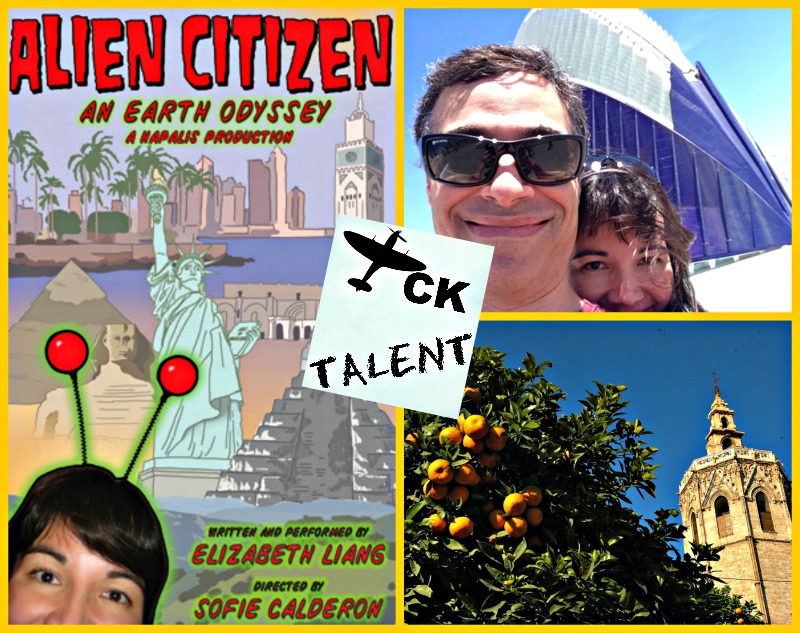
TCK Talent Lisa Liang takes her show on the road to Valencia, Spain.

TCK Talent columnist Lisa and her husband (and techie), Dan, head to Spain. Photo credits: (from left) Alien Citizen poster; Dan and Lisa in front of Ciudad de Artes y Ciencias (supplied); “Naranjo y el Campanario Valencia,” by Emilio via Flickr (CC BY-SA 2.0).

First impressions of the Land of Sweet Orange Trees

Dan and I had a couple of days of sightseeing before the three-day conference took place at the Universitat de Valencia. We drank lots of fresh-pressed zumo de naranja (“orange juice” in Catalán)—and yes, the oranges are the best we’ve ever tasted!

We toured the wonderful old section of the city, including the Cathedral and its Torre del Micalet, and the spectacular Ciudad de Artes y Ciencias (City of Arts & Sciences)—a futuristic outdoor/indoor complex near the beach, with an awesome aquarium. We even took the long bus route back to our hotel, which gave us a chance to see a lot of the Turia Gardens, a park built on a riverbed.

Dan got to carry on sightseeing while I attended sessions (workshops, panels, and lectures) during the first two days in order to meet people, learn more about the interculturalist professional world, and get the word out on Alien Citizen.

First impressions of SIETAR

In general the other conference participants seemed very nice but a tad noncommittal when I told them about my one-woman show. I think it was rather unusual to have a theatrical piece at the congress, though I noticed there were several sessions on storytelling as an important means of generating intercultural understanding.

Most of the attendees were what I would describe as interculturalist entrepreneurs—perhaps not your usual fringe theatre-goers? Still, I appreciated learning what sort of cross-cultural issues Europeans have been facing, and there was the bonus of generous lunches and yummy pastries along with coffee, tea, and zumo during the breaks. (I may have gained a pound or two.)

At the end of the second day, I was beat—but still had to do a run-through of my show in our hotel room that evening. Theatre takes stamina, so perhaps my two full days of attending conference events had done me a favor.

attending performing SIETAR

First she observes; then she performs. Lisa Liang at Congress Valencia 2015. (Photos supplied.)

Show Day!

The third day of the congress: show day! And some tension… For one thing, I didn’t realize until then that many congress-goers would take the day off to go to the beach or do sightseeing. I feared I might only have five or so attendees, which would be enormously disappointing after making the long journey from California (not to mention the fundraising!).

And for another, I was performing in a classroom like all the other session presenters, which meant we had just 10 minutes to set up. Ten minutes may be fine for a PowerPoint presentation but, especially as the session before us ran a little late, Dan and I really had to hustle to set up all the props, as well as the laptop, old-fashioned slide projector with voltage converter, my tape marks so I would know where to stand when projecting words onto my torso, and chair. We were in such a hurry that I forgot to set up chairs to stand and dance on “upstage.” I had to grab them from the front row in the middle of the performance. Funfunfun!

Despite these challenges, the show was a hit! People did turn up, and there were many more than five, thank goodness. They stayed for the whole performance, which was a coup—there had been walkouts from every session I attended in the previous days (with all the concurrent sessions, people were constantly session-hopping).

After the show, the applause lasted for such a long time that I exited the room to give the audience a break. But they didn’t stop, which was deeply gratifying and a huge relief, so I came back in and took some more bows. Many audience members stayed afterward to thank Dan and me, and in some cases draw parallels with their own lives. Those who found the story relatable included not just people like me, who grew up in different countries, but also people who’d lived only in Spain. One woman said she would distribute the show’s flyers at international schools in her country…so here’s hoping!

Most importantly: the show seemed to help people feel more connected and better understood, which is its ultimate mission.

Post-show celebrations

Post-show, Dan and I went out for a celebratory drink of horchata (made with tiger nuts) at one of Valencia’s oldest and prettiest horchata joints. Then we ambled over to the formerly half-Moorish, half-Catholic quarter, where we ordered a pitcher of sangria (since it cost the same as two glasses).

It may well have been the best sangria I’ve ever had—certainly worth the headache afterwards.

We made it back in time to attend the conference’s gala dinner, which took place in a lovely courtyard at the university. A couple of people who came to the performance approached me to say they were telling everyone at their tables about Alien Citizen. Again, I felt a mix of pride and relief.

Congrats Collage

Brava, Lisa, to another fine performance! Photo credits: (top and bottom) Lisa and Dan celebrating with sangria and at the gala dinner (supplied); (right) “A glass of horchata, Spain” via Wikimedia Commons (CC-BY SA 2.0).

To sum up…

Reflecting on the experience, I came to the conclusion that if the show is accepted at another non-theatre conference in the future, I should perform it only if it can be a keynote (as it was at the FIGT conference in 2014). Practically speaking, it takes time to set up the equipment and props, and as a performer I need space/room to relax and warm up before the show, which runs 80 minutes non-stop and takes my entire being to perform with the energy, precision, and authenticity that the audience deserves.

Still, I’m glad that we brought the show to this intercultural gathering, and I’d love to visit Valencia again. Food-wise, we had truly fantastic tapas and excellent wine, and as a night owl, I appreciated the late dinners. Virtually every Valenciana/o was very polite and friendly, and they all understood my slightly-gringa-inflected Guatemalan accent in Spanish.

The jet lag was only a problem on our first night. It took about a week to recover from it back in L.A., but that may partially be due to wistfulness: we’re not in Valencia anymore (woe!). Between its delights and our appreciative SIETAR audience, it was a fantastic, and very worthwhile, trip.

Next stop: South Africa!

At the time of writing I am preparing to attend the 10th Women Playwrights International Conference, being held in Cape Town from June 29 to July 3. WPI has brought together women playwrights and allied theatre artists, cultural workers and scholars since 1988. It facilitates communications and collaborations among the international community of women in theatre by holding conferences every three years.

It sounds like my crowd. But South Africa: that’s a first! We’re hoping to do a winelands tour and maybe a one-day safari tour. Watch this space for my next update.

* * *

Thank you, Lisa! I enjoyed taking that vicarious journey into a part of Spain to which I’ve never been. Imagine being able to drink fresh-pressed zumo de naranja to one’s heart’s content! (I’m not so sure about the horchata, though.) It was also interesting to hear your take on SIETAR: I know several Displaced Nationers were planning to attend. Readers, please leave questions or comments for Lisa below.

STAY TUNED for the next fab post!

If you enjoyed this post, we invite you to register for The Displaced Dispatch, a round up of weekly posts from The Displaced Nation, with news, book giveaways and other extras. Register for The Displaced Dispatch by clicking here!

Related posts:

BOOKLUST, WANDERLUST: In Shireen Jilla’s second novel, a group of old friends go on safari and unpack their lives

Booklust Wanderlust column for the Displaced Nation

Attention displaced bookworms! Our book review columnist, Beth Green, an American expat in Prague (she is also an Adult Third Culture Kid), is back with her latest recommended read.

Hello Displaced Nationers! Do I have a treat in store for you this month! Shireen Jilla, whose 2011 psychological thriller, Exiled, was previously featured on the Displaced Nation, is with us again. She has written a new novel, The Art of Unpacking Your Life, which came out in March, and has graciously agreed to answer my questions about her latest work.

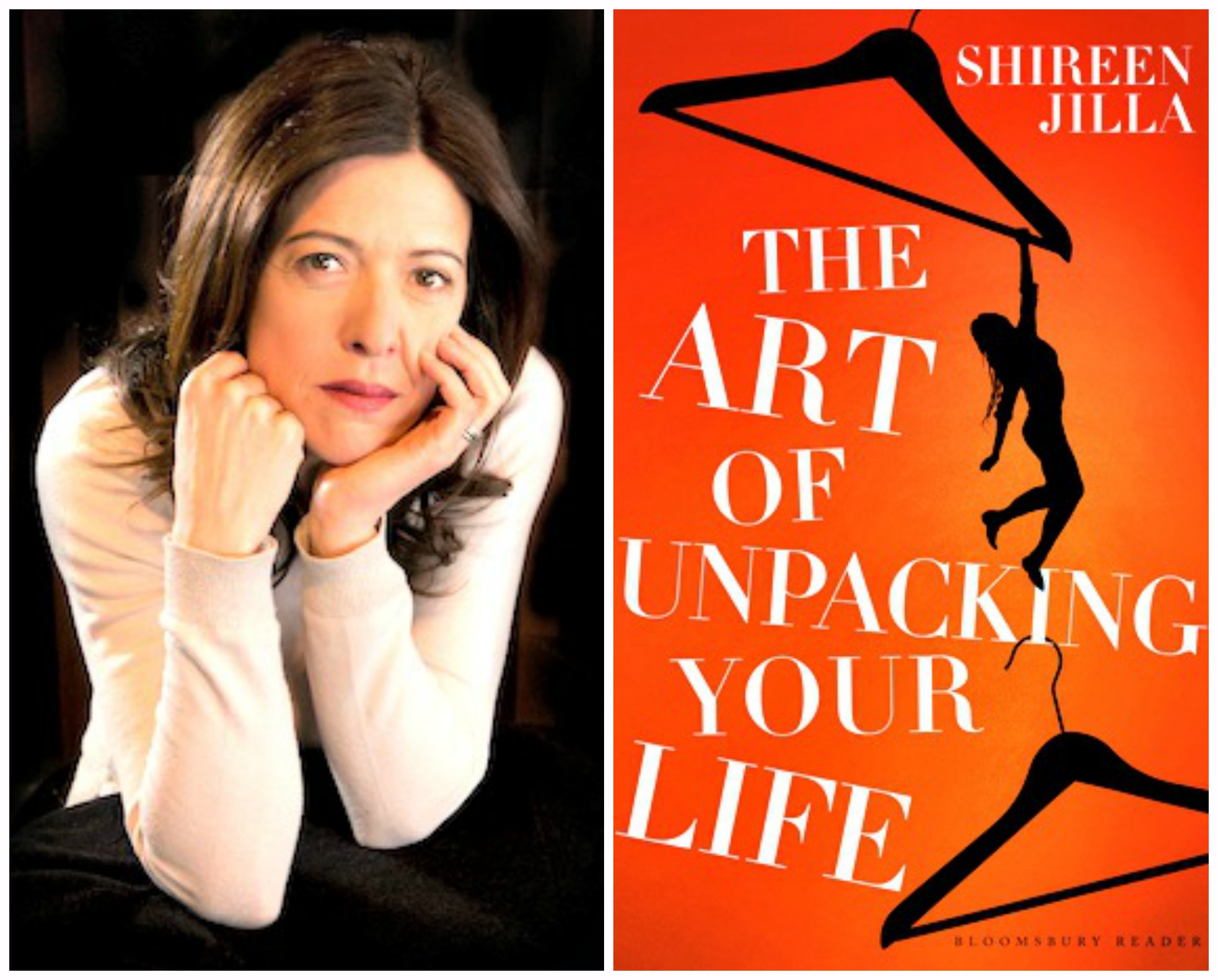
Shireen Jilla author photo and book cover for her second novel, The Art of Unpacking Your Life

Shireen Jilla author photo, by Francesco Guidicini (from her author site); cover art.

The book made our list of anticipated “displaced reads” for 2015. For those not in the know, it tells the story of what happens when an Englishwoman named Connie decides to celebrate her 40th birthday by organizing a group of her old university friends and their partners to go on an African safari.

But if Connie is the main character, she is not the only point-of-view character. She functions as the heart of the group—but, as we soon learn, doesn’t seem to manage her own affairs very well. To quote one of my favorite lines from the book:

“Connie was brilliant at life’s details, particularly other people’s life details.”

We all know someone like that, don’t we?

Many authors stick to similar genres and even similar stories but in her two books, Jilla has explored very different places and themes. Where Exiled is a thriller akin to Rosemary’s Baby—it centers on Anna, a British expat leading a privileged life in New York—Unpacking is The Big Chill set in an exotic landscape. Anna may feel isolated within the bustle of the Big Apple, but Unpacking‘s characters are faced with the Kalahari Desert, the kind of place where one must unpack one’s life, finding strengths as well as weaknesses.

Both stories are informed by Jilla’s own travels. An adult TCK and former expat, she has lived in Paris, Rome, and New York as an adult; and in Germany, Holland and England as a kid. (She is now back “home” in London.) And as a traveler, she has experienced firsthand the dry, unusual beauty of the South African bush she describes in Unpacking.

But enough introduction! Time to give Shireen Jilla the floor.

* * *

Hi, Shireen, and welcome back to the Displaced Nation. When we discussed your previous novel, you told us about how the cityscape of New York lent itself to writing a thriller. What made you go from New York’s hustle bustle to the stark, sparse landscape you describe in The Art of Unpacking Your Life? Why the Kalahari?
I had the characters in my mind for a long time. I wanted to explore my generation’s surprisingly disparate lives: single, divorced, gay, with children, successful, jobless. I needed them to be away from home, from their daily lives, unnerved and unsure and therefore open to exploring their issues. I tried setting the book in Sardinia because I know it well. But it wasn’t remote or dramatic enough to force them to “unpack” their problems. When I stepped out of an eight-seater plane into the vast orange heat of the Green Kalahari, I knew I had found my setting.

“Everything in Africa bites—but the safari bug, worst of all.” —Brian Jackman

Tell us more about that moment. I understand from another of your interviews that you went to the Kalahari with your brother?
Yes. My brother generously took me on what can only be called a trip of a lifetime to a private reserve, Tswalu, in the Northern Cape Province of South Africa, bang near the border of Botswana. I had never been to Africa before. So my own experience of this extraordinary trip coloured my story in Unpacking. I was surprisingly drawn to the Kalahari.

Connie and her friends started out in the same place—in a shared house at university—but when the book takes place, they’re all at different places in their lives and don’t appear to have much in common any more. One is a happy housewife, or so she thinks, another feels like success has passed her by both professionally and romantically, others want to start a family, while still others are recuperating from seeing their families crumble. Many books are written from the point of view of a single character, but you give us a glimpse into the thoughts of six multi-layered characters. Was it difficult to imagine how all these people would react to the same events—how they would react to travel?
Thank you for asking this question. It touches the heart of the novel. I wanted to tell this story from the point of view of each of the main six characters because I am fascinated by how differently people read, and react to, the same events. I was inspired by Virginia Woolf’s Mrs Dalloway, which roams from character to character, from paragraph to paragraph. That said, I wasn’t keen to jump around that much, so each chapter in Unpacking is told from a different character’s point of view. I loved writing the same scene from different points of view. It gave me a great sense of freedom.

“Africa is mystic; it is wild; it is a sweltering inferno…” —Beryl Markham

Many of our readers are international creatives, so I’m asking this with them in mind: how do you capture inspiration while you travel? 

“Instead they snapped away, looking up periodically from their cameras, as if undecided whether photo memories or physical ones were more powerful.”

This line in Unpacking reflects my own feelings. While in Africa, I kept a detailed diary and took hundreds of photos, a selection of which are on my author’s site. Having started life as a journalist, I also bought books and talked extensively to the guides. I used all of this material for Unpacking, which I believe is faithful to the actual setting.

In the book, Connie and her group have a very dramatic encounter with one of the animals in the park and the friends’ various reactions reveal their state of mind. Did you have any big-animal encounters during your Africa adventure? 
Thankfully not! The scene was imagined.

Giraffe & Namibian sand Collage

A silent, self-contained Kalahari giraffe and blood orange sands make it into Shireen Jilla’s novel about a group of friends on an African safari. Photo credits: Male giraffe, by Charles Sharp, and Silhouettes in Sossusvlei, by Monica Guy, both via Flickr (CC BY 2.0).

“The more I traveled, the more I realized, fear makes strangers of people who should be friends.” —Shirley MacLaine

As I mentioned in the introduction, you grew up a Third Culture Kid and you’ve also been an expat. Is there anything from your experiences living abroad as a child and an adult that worked its way into this book?
From own experience, I am acutely interested in how people react to being outside their comfort zone. Living or traveling abroad is a very visceral way of exploring this theme. With Unpacking, I wanted to place a group of close friends, who haven’t traveled extensively, into a remote, unnerving location. For me, it gives the novel its heartbeat.

I’m an Adult Third-Culture Kid, too (and an expat currently), and one of the things that I found remarkable in this book is the close cohesion of a group of people who met at an early stage of their adult lives—not always something we TCKs can find! I’m curious. Do you have a group of friends like Connie’s?
Actually, I have a varied and disparate group of old friends from many places and stages in my life. What I drew on in Unpacking is the notion that one can still feel intensely loyal to old friends, despite growing in different directions. But no, I’ve never planned a big trip with old friends as Connie does.

I noticed that within the group of friends you’ve created, there are two cross-cultural relationships. I enjoyed watching the conflicts from their opposing cultures arise in their relationships. Was this something you set out to capture from the beginning?
This is an interesting question. I haven’t consciously created two cross-cultural relationships. But I am clearly fascinated by and drawn to them. I loved writing both relationships, particularly exploring the cultural misunderstandings between the English friends and New Yorker Katherine.

“Travel and change of place impart new vigor to the mind.” —Seneca

So far you’ve given us two great books based on interesting locations—New York and South Africa. What’s next? Will you follow up with Connie and her friends in another novel? Take your readers on a new adventure somewhere else?
I’m normally adverse to sequels, but I would actually love to write another novel based on the same characters. I’m not ready to let any of them go. I am deeply attached to them all. And I would also enjoy the challenge of another new setting abroad. It’s like moving country. Always exciting.

Lastly, my favorite question for everyone—what are you reading at the moment? Any suggestions for good books that might appeal to the Displaced Nation audience?
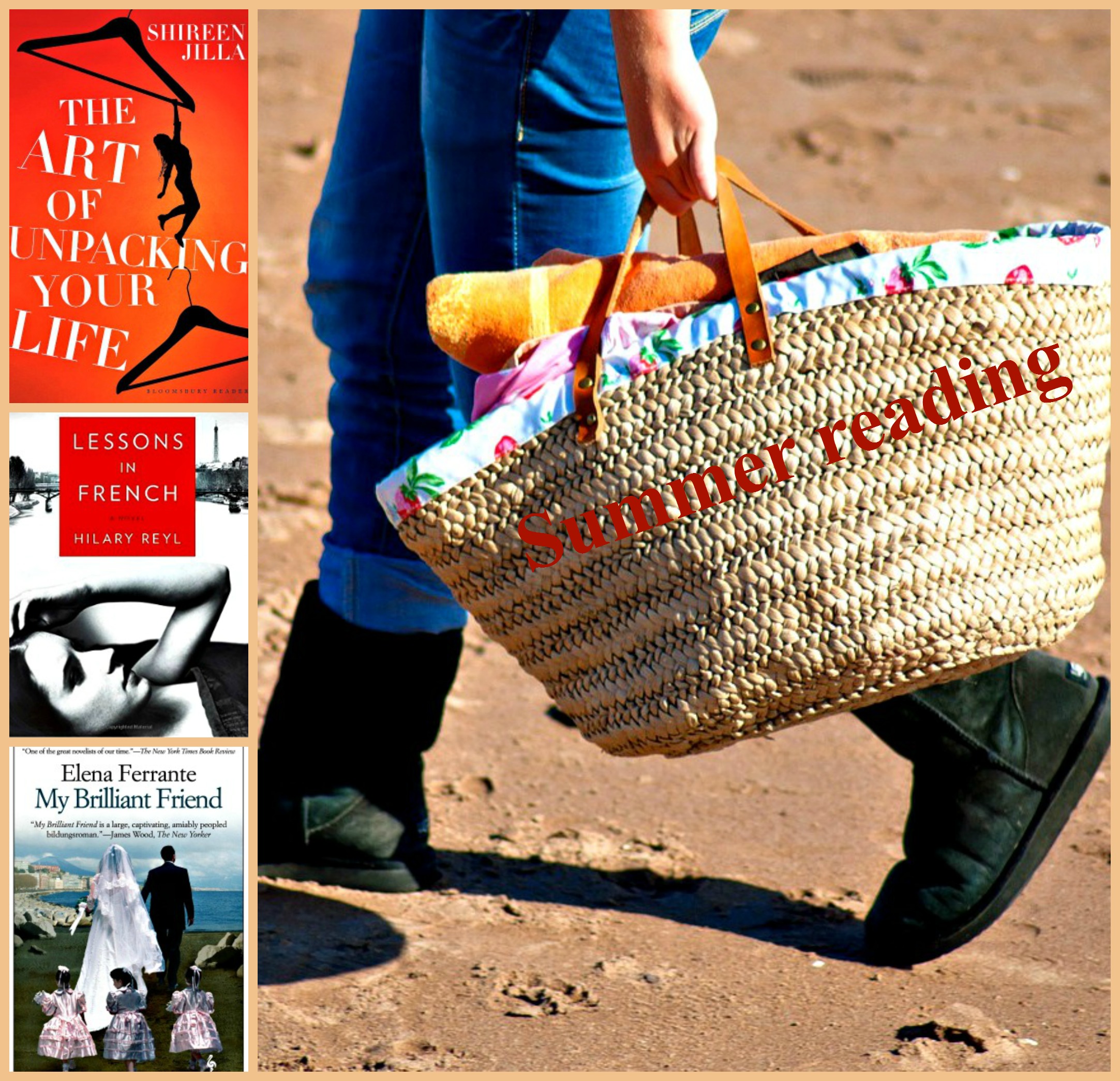
I am currently reading New York writer Hilary Reyl’s Lessons in French. The novel is an absorbing coming-of-age story about an American girl who does work experience with a demanding photographer in Paris. It’s an evocative, lyrical read for all expats. Elena Ferrante’s My Brilliant Friend, is another addictive page turner that lights up a poor working class community in fifties Naples.

Thanks, Shireen, I’ll check those out! And readers, if you’re selecting books for your summer reading list, I suggest you pack Unpacking in your beach bag! Or on your Kindle, more likely… 🙂

Beach bag via Pixabay.

Don’t go to the beach without Shireen’s book and at least one of her recommended reads! Beach bag via Pixabay; book cover art.

* * *

And now Displaced Nationers, it’s your turn to answer some questions. And have you ever tried traveling with friends? Did you pick up any insights about them and/or about yourself? Do let us know in the comments!

Beth Green is an American writer and English teacher living in Prague, Czech Republic. She grew up on a sailboat and, though now a landlubber, continues to lead a peripatetic life, having lived in Asia as well as Europe. Her personal Web site is Beth Green Writes, and she is about to launch a new site called Everyday Travel Stories. To keep in touch with her in between columns, try following her on Facebook and Twitter. She’s a social media nut!

STAY TUNED for the next fab post!

If you enjoyed this post, we invite you to register for The Displaced Dispatch, a round up of weekly posts from The Displaced Nation, and SO much more. Register for The Displaced Dispatch by clicking here!

Related posts:

Photo credit (top of page): “Notebook in hand,” by Oleh Slobodeniuk via Flickr (CC BY-NC-SA 4.0).

CULTURE SHOCK TOOLBOX: How to pry open your mind to new cultures—and keep them all sorted

Yelena Parker for CST Displaced Nation Columnist H.E. Rybol never saw a culture clash she didn’t want to fix. A “transitions enthusiast,” she credits her Third Culture Kid upbringing with giving her a head start in this department. That said, H.E. is always on the lookout for shiny new tools, and toward that end has been interviewing other displaced creatives about their culture shock memories and coping strategies. Today she speaks to Yelena Parker, a Ukrainian expat, executive coach, and writer who, through her many international moves, claims to have mastered the art of “moving without shaking.”

—ML Awanohara

Hello, Displaced Nationers! I’d like you to meet today’s guest, businesswoman and author Yelena Parker. Yelena is Ukrainian but has lived in the United States, Switzerland, Tanzania and now the United Kingdom, and has conducted business in many more countries. Last year she published a book titled Moving without Shaking, which made the Displaced Nation’s “Best of 2014 in Expat Books” list. Described as a “guidebook-meets-memoir,” it aims to help women “who are interested in building their new global life styles whether through working, studying, volunteering or simply living abroad.”

One of Yelena’s contentions is:

Once you are on a serial expat path, new relocations get easier.

Can we take this to mean it’s possible to get better at handling culture shock?

Let’s find out by asking Yelena to describe a few of her own culture shock experiences. She may advocate for moving without shaking; but how does that line up with her own adventures? Has she never shaken like a leaf at some point during her various international moves?

* * *

Hi, Yelena! First can you please tell us which countries you’ve lived in and for how long?

I came to California from Ukraine in my 20s to get an MBA and ended up living there for more than nine years. I didn’t make it till the very end of year 10 as an opportunity came along to relocate to Switzerland for work. After two years in Geneva I moved to London to continue working in tech. I’ve now lived in the UK for four years, only interrupted by a four-month volunteering stint in Tanzania, with a Kilimanjaro climbing break in between.

You’ve certainly made your fair share of cultural transitions. Did you ever put your foot in your mouth? Any memorable stories?

I travel to Moscow frequently for work. During the last trip the taxi driver asked me where I was from. This question is always complicated since, like many here at the Displaced Nation, I now feel as though I’m from everywhere and nowhere in particular. I tend to focus on the most recent location when giving an answer. To be polite, I share where I am coming from literally (versus where I am from). On this occasion, the last port of call was St. Petersburg, which in Soviet times was known as Leningrad. Some wires in my brain must have crossed as I blurted out: “From Leningrad.” The driver said “Really???” We ended up engaging in a much longer conversation, about my Soviet childhood in Ukraine and so on. I think I had a reverse culture shock reaction after being away from where I grew up for so long.

What lessons can you offer to the rest of us from this story?

It’s a bit of a strange example, but what I am trying to get across is that keeping your life truly connected to multiple worlds is very difficult. You are bound to lose some of your identity, forget the basics, replace them with new realities and then, perhaps, come full circle as you find yourself back in your good old comfort zone. You and your memories have many layers now. It can be challenging to keep them sorted. That toolbox of yours needs to have quite a few compartments!

Looking back on your many cultural transitions, can you recall any situations that you handled with surprising finesse?

Moving to Tanzania, I was surprised at how quickly I embraced the pole pole (slowly-slowly) way of life. Until I went on this amazing adventure, I had always been a workaholic. But then I found myself living enjoying the most beautiful sunsets and spending a lot of time talking to people in front of me instead of using various digital ways to connect with people remotely. I didn’t complain about the lack of speedy or efficient services anywhere as I no longer expected that kind of thing. I was not rushed or overwhelmed so wasn’t concerned about being late or other people being late or not showing up to meetings. I just enjoyed every moment of this new experience: no deadlines, no crazy work hours, only things I truly wanted to do. You could say I felt burnt out after working non-stop (or being in school) for 23 years. I do believe, however, that something in that culture was appealing to my natural preferences, which had been suppressed by years of working in the corporate world. I also realized that I wanted to teach again. My first career was in teaching English at a university level in Ukraine—work I’d chosen to abandon when I took a degree in business. That said, I am back on the corporate path again.

If you had to give advice to new expats, what’s the tool you’d tell them to develop first
and why?

I guess it would be some kind of crowbar to pry open your mind to new experiences, no matter how many times you relocate. Learn everything you can about your new home country. Explore it thoroughly. If you end up moving back home, you will regret that you didn’t do enough. If you stay, the more you learn, the easier your assimilation into your new life is going to be.

Thank you so much, Yelena, for taking the time to share your experiences and reminding us that keeping an open mind and a willingness to learn about other cultures can be effective tools, sometimes in unexpected ways! I love your example of becoming immersed in an East African culture and learning more about your own (suppressed) natural preferences as a result. And I of course love the idea of moving without shaking! That’s what this toolbox is for…

* * *

Readers, what do you make of Yelena’s advice? Have you ever found yourself having a Rip-Van-Winkle moment like hers? How about discovering your “true self” in a vastly different culture? Do tell!

If you like what you heard from Yelena, be sure to check out her author site and follow her on Facebook and Twitter.

Well, hopefully this has you “fixed” until next month.

Until then. Prost! Santé!

H.E. Rybol is a TCK and the author of Culture Shock: A Practical Guide and Culture Shock Toolbox. She loves animals, piano, yoga and being outdoors. You can find her on Twitter, Linkedin and Goodreads. She is currently working on her new Web site and her second book.  

STAY TUNED for next week’s fab posts.

If you enjoyed this post, we invite you to register for The Displaced Dispatch, a round up of weekly posts from The Displaced Nation—and much, much more! Register for The Displaced Dispatch by clicking here!

Related post:

WONDERLANDED: “Can you make me a Manhattan?” by A. Spaice

Can you make me a Manhattan Collage

Drink a Manhattan at Eat Me in Bangkok. Photo credit: “Alice 15,” by AForestFrolic via Flickr (CC BY 2.0); Eat Me Restaurant, Bangkok; Manhattan cocktail via Pixabay.

A couple of days ago, we wonder-landed in Phnom Penh with serial expat writer, artist and sometime photographer A. Spaice. She told us falling down rabbit holes in Europe and Asia has sparked her imagination in untold ways—not least by convincing her that a Mad Hatter’s tea Party would not be complete without champagne and an opera singer.

Spaice ended her musings on the expat writer’s life on this fittingly dramatic note:

Knowing it’s the connection that I write for now, instead of the “art,” I’m moving into a different channel. I trust this current, because it feels good. It moves, it flows. Sometimes, when I’m lucky, it even likes to dance.

Today she offers a sample of her work that seeks to connect with others who have wonder-landed and lived to tell the story—whether in words, photos, or other forms of creative expression. It’s an except from her short book Bangkok, which she produced as a kind of roman à clef after taking a trip from her current home of Phnom Penh to the Thai capital. Bangkok marks the first in an unconventional short book series she is planning, titled n+1.

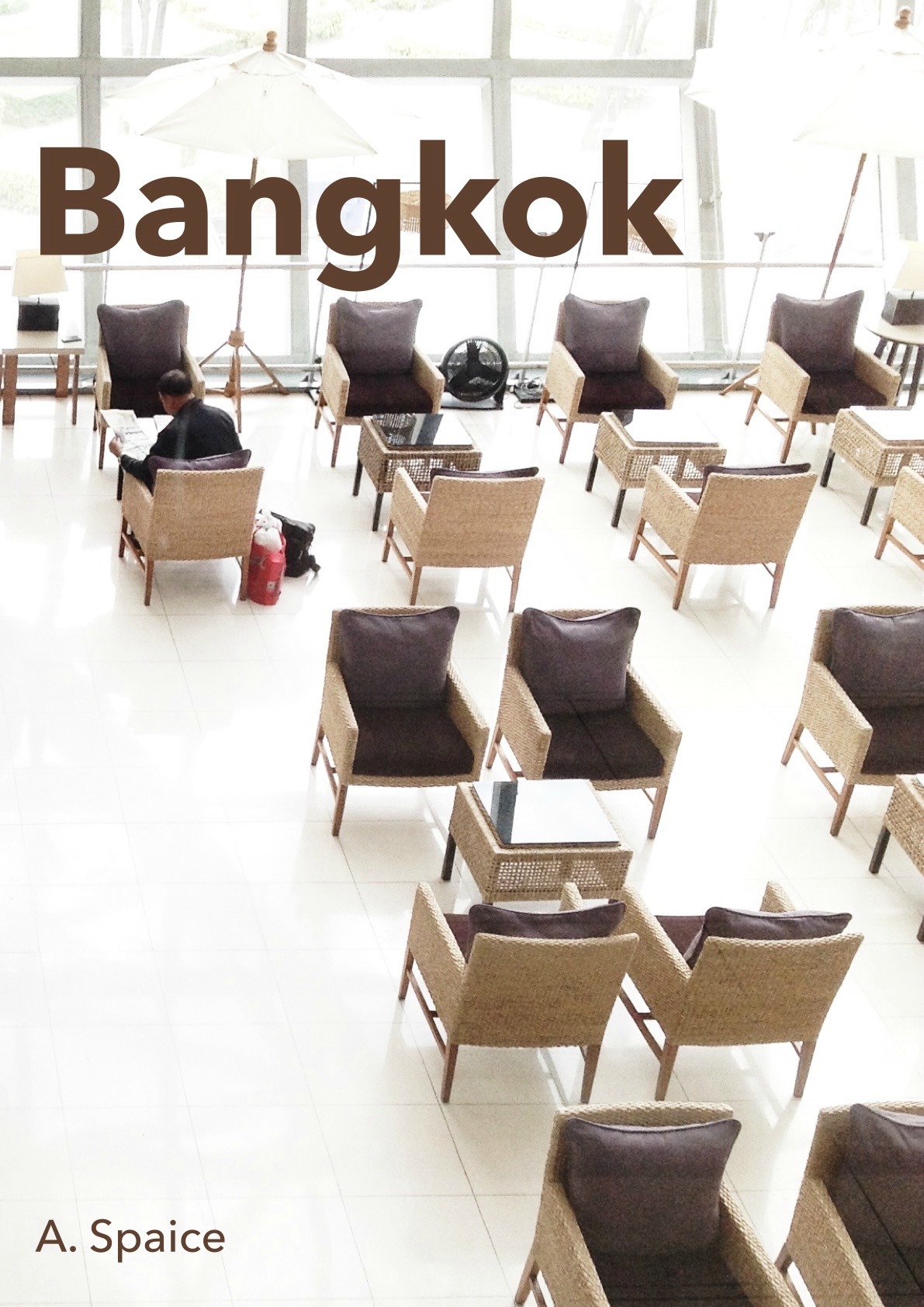
Cover art for Bangkok, by A. Plaice.

Cover art for Bangkok, by A. Spaice

* * *

Excerpt from Bangkok

The story principally concerns Karin Malhotra’s attempt to reconnect with an old female friend in Bangkok, Thailand, the Land of Smiles, only to discover they are no longer that compatible. But in this passage, Karin is about to meet someone new, another displaced creative, a magazine editor who has professed an interest in her work…

“CAN YOU MAKE ME A MANHATTAN?” I asked, truly wondering. “Of course.” This was supposed to be the best bar on this side of Bangkok, according to the gay couple that seemed like good people to ask the day before. I wanted a comfortable place. Not too conspicuous, not too loud. But I didn’t expect it to have the kind of name it did. Eat Me.

Still, the guy from the magazine had said “yes,” to meet me there. I muttered something about the name and how I’d heard about it from a bunch of people (two being a bunch) and thought it could work for a conversation space.

He was taller than I’d pictured, and seemed like he might have been French, because of the two-kiss thing that the Europeans like to do when they meet you for the first time. For some reason, he was extremely close to the lips on the second one, but that was kind of flattering, in a way, because he had a rich dark musty scent and I rather liked it.

“So,” he said. “You’re Karin Malhotra. We meet at last.”

At last? Hadn’t we just talked online like, twice? Business conversation making, that was the agenda today.

“Tell me about what you do.”

Oh, boy. Here it was. The test. I hadn’t really prepared for this. I was going to have to wing it. Really, at the end of the day, pretty much everything good that’s come to my life has come of winging it, I realized. With that thought in the forefront of my mind, I got into character. “I make space. I know that might sound odd, but I was meant to be an architect. Designing physical spaces with bricks and glass and maybe new materials but not concrete because in Kyoto I got a giant magazine with Tadao Ando teahouses all in these sad greys which got me depressed for a while because the ones they have in northern Thailand, Chiang Mai and stuff? They have these lovely bamboo colors and textures and earth tones. Which is better. Anyway, I didn’t become an architect for lots of reasons, the biggest one being that I don’t like projects that take more than three or four months to finish. With books, you know, you can take years to write books, but I got into eBooks and nothing more than like a two-hour read, you know? People like that. Short and sweet.”

“Uh-huh.”

“People like it because we are so time-poor right now. Modern people, that is. I’m talking about the malaise of the Western progressive world, where we have books and medicine but we have nothing to get happy about because our souls aren’t nourished properly in the time we’re growing up.

“What I’ve been doing, what I’ve just started since putting the brakes on my own design studio, which you’ll never believe this but is the second time I’ve done that. The first time I just felt compelled to do the same thing again, when we moved from Seattle to Durham NC. Durham is in North Carolina. Have you been there?”

“No. I rarely go to America. I can’t say that I’d ever want to live there, and visiting is a trial.”

“So you’re actually from…”

“Vienna.”

Oh. Memories of college.

Schubert.

Nabokov.

A bottle of Sauvignon blanc.

“Yes, I knew someone from your country once.” I stammered. I wanted to forget about that, but you can’t really forget about those ones you fall for at first sight. Why was I talking about that, though? That was weird. “He was a colleague.” A lie. But… so?

“Where did you work together?”

Shite. I was going to have to keep going with this one? “Oh, just a small firm in Tokyo. They did architecture, but had a base in Los Angeles. I thought I’d make it to Los Angeles because I knew my husband was big into the West Coast, drier air and all. But we wound up in Seattle. It took a while to get there from our time in Japan, though.”

“I love Japanese teas, they are the best.”

“I prefer Darjeeling to everything, personally. But I do love those whisks from those places they have in Kyoto.”

“Are your genetics from India?”

Wow. That was a first. No one put it that way before. Are my genetics from India?

“Yes,” I said. Not barking at them that I’m from the outskirts of Detroit. I hate the where-are-you-from question but I still ask other people, for some reason. I guess it’s habit? Smalltalk.

My bar companion brushed his dark brown hair with his hand, and I noticed that it had a few stray grays. This was interesting. When did I ever think men with gray hair could be attractive? This was news. Maybe it had something to do with turning almost-forty. A round number.

“I have never been to India,” said Glenn. He had a really long last name that I couldn’t pronounce, much less remember to spell. What was the custom in Austria when greeting someone? Was it two kisses like the French, or three like the Swiss? I tried to remember how it had been in those couple of weeks with

“But I intend to go. This winter, in fact.” Glenn was all business, and that reminded me to focus. Not on his hair and his hands and his blue eyes, so puzzlingly deep, but the agenda. “I have to get more writers from that part of the world.”

“You do?”

“Yes. We want to diversify the magazine. It’s far too European for its own good. I really want to bring in some new voices. From afar. From the East. That’s why I contacted you. You seem to have… an Indian-sounding name. I’m sorry… I guess I just assumed…”

“Oh, that’s fine,” I said, waving it away. The truth was it wasn’t fine. Why did my stupid name have to make me into an Indian person automatically? I’d been there enough times to know that the gender bias there is ridiculous and horrid and people aren’t nice within their families, especially to daughters. Goodness knows I’d put up with enough of that growing up with my mother. My complicit brother and father, standing by while she’d hurl psychological abuse upon stones. I hated thinking about those days, and pushed aside the thought as if it were one of Glenn’s locks. I had to stop myself from reaching out to touch his crown, to see if he might notice that kind of action. Just out of curiosity, I’d say, if he asked. Not trying to get with you or anything. Just like the look of you, and enjoy studying your features. High, strong cheekbones made him look a little feminine, but his hands were rough from, what? Magazine work couldn’t possibly be physical.

“Were you always in the publishing industry?”

He took a sip of a new drink that arrived, a tall slim glass that contained a mojito. Kind of a girly drink, wasn’t it?

“No,” he said. “I was a joiner in the past.” “A what?” “Joinery. It’s a kind of carpentry, but specialized. I trained in Germany for it, for about four years. That’s where I met my partner.” “Your… partner?” “He’s a joiner, too, yes.” He. I recalibrated, and quickly. “Ah.”

The waiter came around and saved me. “Another drink?”

* * *

Readers, what did you make of this portion of A. Spaice’s expat-life story? Among other things, I think she has nailed the down-the-rabbit-hole feeling of no longer knowing who you really are or anyone else is, once you have wonder-landed.

Interested to read more of Bangkok? It’s available for purchase at Gumroad and Amazon.

STAY TUNED for next week’s fab posts!

If you enjoyed this post, we invite you to register for The Displaced Dispatch, a round up of weekly posts from The Displaced Nation, and much, much more. Register for The Displaced Dispatch by clicking here!

Related posts:


Wonderlanded in Phnom Penh with serial expat writer, artist and sometime photographer A. Spaice

A Spaice Wonderlanded Collage

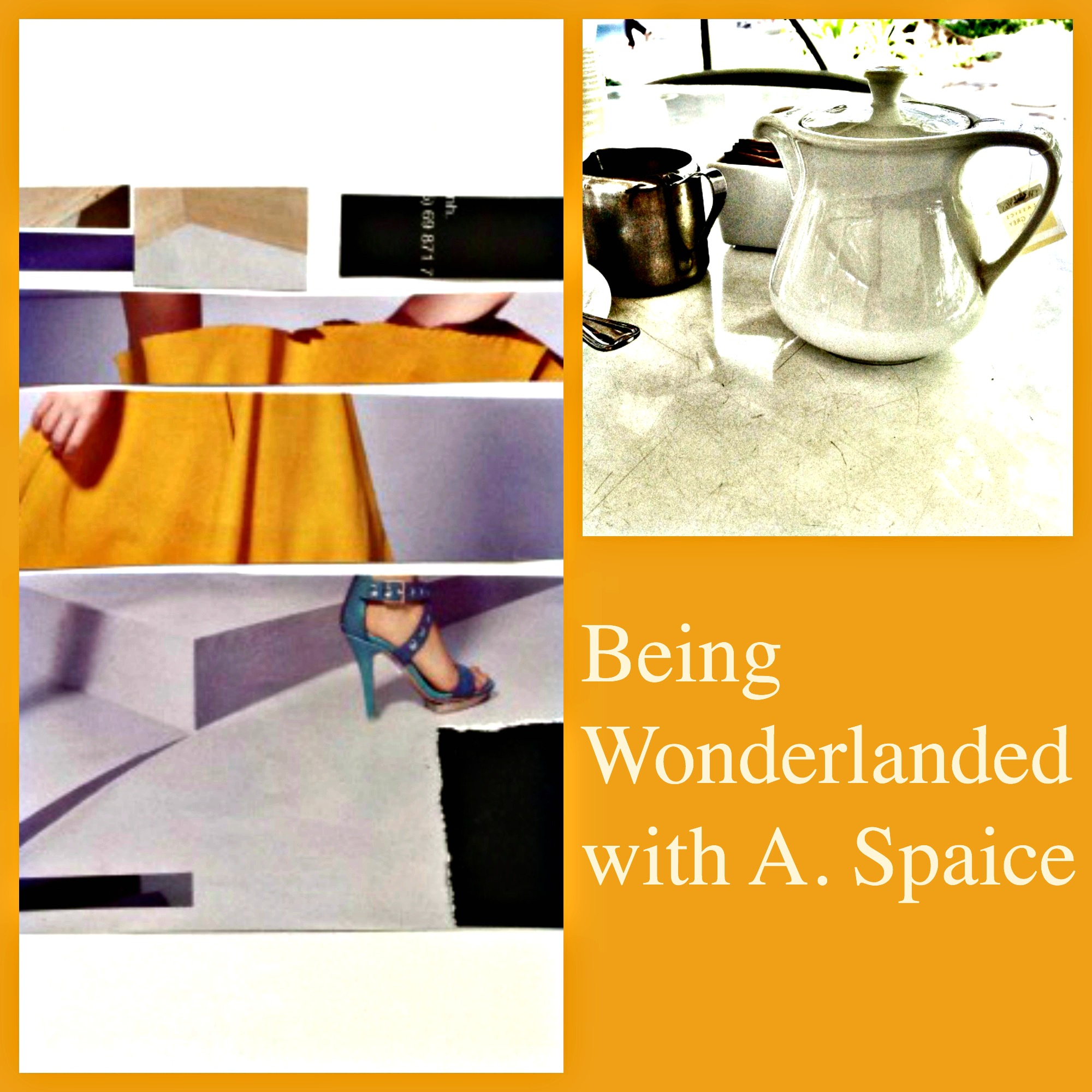
Tea in Bangkok and Yellow in Phnom Penh. Photo credit: A. Spaice.

Curiouser and curiouser! Residents of the Displaced Nation have always had a deep affiliation with Lewis Carroll’s Alice. We can identify with her experiences of falling down a rabbit-hole and stepping through a look-glass into a world where one doesn’t know, can’t even guess at, the rules of the game. Alice’s sense of discombobulation—which of us hasn’t had at least one pool-of-tears moment after moving to another culture?

By the same token, which of us hasn’t grown, and been stretched, in new and unexpected directions by our displaced lives of global residency and travel?

This year, to celebrate the 150 years of Alice’s Adventures in Wonderland, I am hosting a new “Wonderlanded” series, beginning with today’s post.

Our very first Wonderlanded story is from A. Spaice, who has led a life of remarkable transitions after falling
d
o
w
n
the hole.

Spaice grew up in a rich Western country to be an engineer-artist, disappointing a lot of relatives who insisted (without invitation) that a more “normal” career would make life easier.

But this just pushed her to resent all sorts of social mores, sparking a journey that would never stop anywhere for more than six years. Her path cut a line to the Far East, looped Western Europe, and now, as we hear the details of her Wonderlanded story, Spaice writes from Phnom Penh, Cambodia, having assumed a few new layers to her creative identity as she continues to insist on looking inward to work out Alice’s big question:

“Who in the world am I?’ Ah, that’s the great puzzle!”

Without further ado, I give you A. Spaice!

* * *

Greetings, Displaced Nation readers! I look forward to telling you my story of how I became wonderlanded. But first, a few details about me. Before taking this new name, A. Spaice, I’d been happily writing under my own, mostly first-person essay style accounts and often set in foreign lands. It was fine. I got places. I enjoyed it. But then, I hit bricks. Through my writing, I’d wanted to tell my story and when that was done, I realized it was okay to stretch a bit, to try new things, maybe even third person. Crazy! So after a long time of not knowing one phase could end and a new one begin, I feel a reinventing going on, from within. This propels me, and it’s been a while since I’ve felt that kind of inward push, and I know this is the kind of thing you need to have if you want to get it done and make it good. So I’m happy to make the transition, and let go of the old style.

“Why, sometimes I’ve believed as many as six impossible things before breakfast.”

Along the way I got surprised about something. My major in college was engineering, and I worked in architecture firms for a while, so it’s been fun playing with new concepts in my work, like torque and momentum, or the radiation heat transfer equation, that kind of thing. I’m going to have to find a way to use ! for factorial. I’m terribly excited, and I hope this energy will reverberate through in my just-born, about-to-become-something N+1 series. (Mathy, right? I kind of dig it.)

“I’m afraid I can’t explain myself, sir. Because I am not myself, you see?”

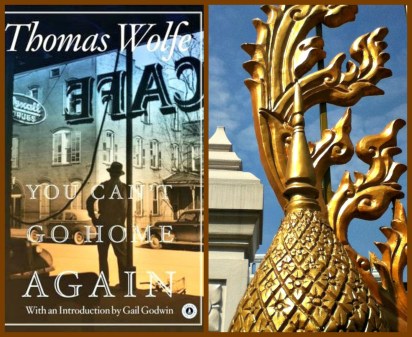
A year ago at this time I was in Chiang Mai, Thailand. I had no idea what I was going to do for work or how I was going to “make it,” or if I’d need to abandon some old idea about what that even means, or something else. Among my possessions was an old copy of You Can’t Go Home Again, which, if you are traveling Asia and the kind of person who sizes people up by the amount of luggage they have, you wouldn’t have given me an ounce of attention because this thing is cement.
You Can't Go Home_Thailand

You can’t go home again; you’re in the Kingdom of Wonder! Photo credit: Book cover art; A. Spaice.

Thomas Wolfe was pretty roundly criticized, it says in the back notes of the book, for not being able to edit stuff himself and relying on people to help him cut things into a story-like form. But wow. His writing. It’s just…it’s so lovely and right on.

It was there with me in the suitcases, and it is here with me now, as I write. It’s been a comfort. I didn’t know anything about what was ahead (a bus ride to Siem Reap, then another to Phnom Penh, a welcome from some people social media introduced me to, and then, falling in love with Cambodia in an abstract way, because of the whole “Kingdom of Wonder” thing, but also, in general, its aesthetics (architecture, attention to symmetry, detail, and something… something I’m working on trying to capture and will stay until I can name). Ask me about the tuk tuk driver whose floor’s decked out with astroturf. A humor, a style, something else. Unpretentiousness, perhaps? Directness? Reality? Maybe it was this that made me feel, “Yes. Stay.”

But the book, that book being with me, that’s been an anchor. I keep it for comfort. I read it for love. I look to it to remember that yes, the road is ahead of you, that you can’t go back, that you just can’t fall upon some idyllic picture that isn’t real. Snap! You Can’t Go Home Again. And accepting that, right there, in the middle of the wondering, in the enchanting early evening hour of arriving on that long road from Chiang Mai to Phnom Penh, with sun reddening this sky, I knew. Something would work out. “I’ve got this. This is going to be just fine.”

An early “pool of tears” moment

Ireland. 2000. I was plonking myself into the countryside “indefinitely.” There were times out there on the farm in southwest County Cork that I wondered, “What the heck was I thinking?” I was still young then, and feared I was missing something. The city, the lights. A more familiar variety of arts and culture. What did I have in the hills? Views, rainbows, sheep, the grass-fed cow’s milk and Kerry Gold butter, sometimes shared by friends and neighbors in Union Hall and Dunmanway. Lots and lots of partying, but the honest kind, with board games and stories and singing and the craic. This was before the Internet era, so I have my doubts it would be the same now. But little by little, sticking around three years and a bit, you got to know the place and the people, and they got to know you. (A part of me is Irish, you know. From West Cork, like, so.)

“But I’m not used to it!” pleaded poor Alice in a piteous tone.

bathroom slippers anime

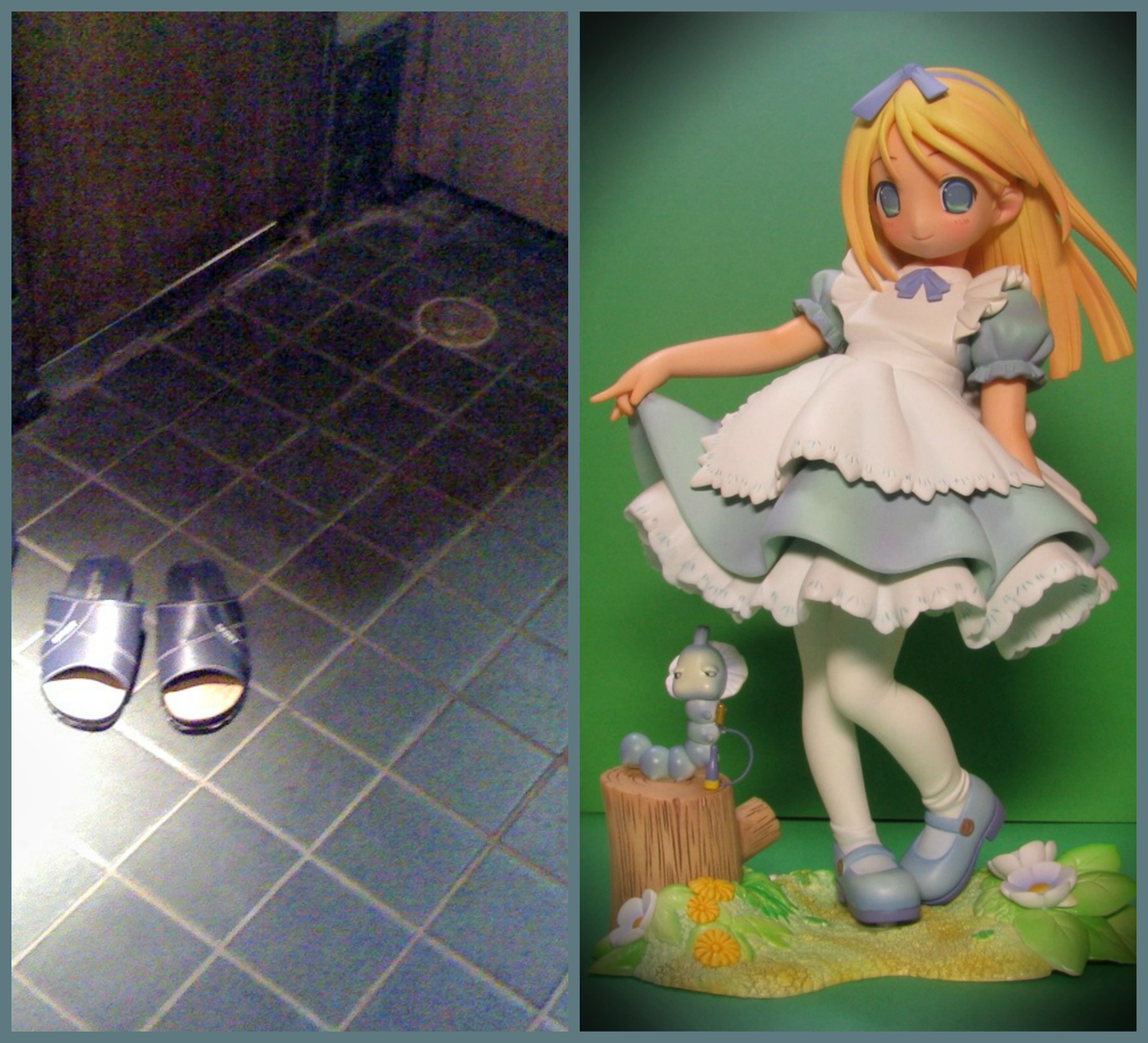
Through the Utsunomiya looking glass. Photo credit: Toilet Slippers, by Lloyd Morgan (CC BY-SA 2.0); Alice in Wonderland anime doll.

When I was in high school I did a Youth for Understanding exchange to Utsunomiya, Japan. I knew some things, like how you were supposed to bring omiyage so I had one small item each for my host brother, sister, father, and mother. I felt cool knowing you were supposed to leave your shoes in the genkan and wear slippers around the house. What I didn’t know was that when you go to the bathroom you change into special bathroom slippers.

I saw those, put them on, but forgot to change back into regular non-bathroom slippers and so entered the dining room, excited about all the new kinds of food. My host family was horrified. Awkward, but they made a printout of house rules, which they left on the kitchen table the next day. “Bathroom slippers are for the bathroom.” When I realized what had happened, I was redder than the cherry tomato atop the last night’s dinner salad.

“Well, I’ll eat it,” said Alice.

Iced tomato smoothies. Saigon.

Recipe for a successful Mad Hatter’s tea party

I’d host it in a place with lots of windows, preferably floor-to-ceiling, maybe on the second floor of a well-maintained building with high ceilings. There would be just 16 people—I find this to be a magical number for gatherings, you can arrange guests in pairs and then change it up, into four sets of four. Also cozy. I love having people shift about when I throw a party, it changes up the energy, and gives it a tint of surprise. I would invite people of all ages and career types because there tends to be a lot of silos out here. There would be tea for everyone, and later, an impromptu concert, with an opera singer, and then, champagne. (The opera singer and champagne part actually happened once here, magic!, so I’d have that for my guests for sure.)

champagne and opera

This mad hatter entertains with champagne and opera. Photo credit: Champagne via Pixabay; singer via Pixabay

“Oh, I’ve had such a curious dream!”

I think it’s weird when I go to California, say, and see people eating salads out of boxes. Noticed myself wishing there was more rice around San Francisco. I wondered, quite out of character, why women don’t cover their skin, especially when swimming. Isn’t that funny, when you’ve grown up in the West? Yet there are also the nice parts: people understand one hundred percent of what I say, and vice versa, and I can joke around, and it’s received, and I feel like my “old” self again. Remarkable.

“I almost wish I hadn’t gone down that rabbit-hole—and yet—and yet—it’s rather curious, you know, this sort of life!”

But I also see now that I’m interested in other kinds of things and that my experiences have taken me to far edges, the kinds of edges that aren’t photographable, and these make me feel like I get along better with a traveled set, not necessarily those from a particular country, or style, or personality, or something else. I like the everykind, the mixitup. I like the sense of possibility and connect with those who also want to keep it open, not box it in. Maybe that’s why I’ve lost interest in identifying with a certain country, or any other kind of label, come to think of it, too. Disorientation is part of it, but it’s precisely because of the crisscrossings that I’m figuring out, slowly, who I am. And it’s this feeling, this waking-up feeling, that is why I wanted to connect with Displaced Nation because it’s here I see it’s not just me in this big pot of “Wait. What just happened?”

Advice for those who have only just gone through the looking glass

Trust the process.

“Alice had begun to think that very few things indeed were really impossible.”

Okay. Well, moving from essays in high school to papers in college to, later, writing that has to go out on deadline, I’m finally able to say: I’ve got my voice. I know who the writer in me is. I’m confident, too, that this writer really wants to grow and stretch beyond previous boundaries, and that’s where this new thing, this thing I’m calling “N+1”, came from. A series of short books, based on the people I’m meeting in real time in the places where I go for three weeks or maybe two months at a time.
"In Bangkok" by A. Spaice; cover art for A. Spaice's short book, Bangkok

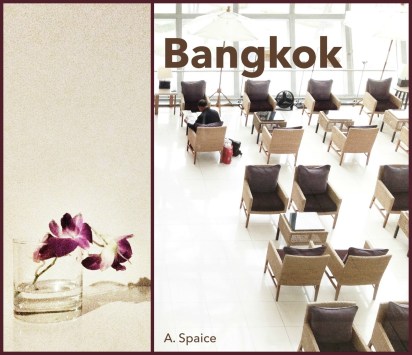
Creative output from Bangkok. Photo credit: “In Bangkok” by A. Spaice; cover art for A. Spaice’s first short book, Bangkok.

I’ve spent my whole life observing and taking notes, but it’s not the notes I’m referring to anymore. It’s not the pretty turns of phrase that I can feel like I can put in there, just, there!, or things I used to think made a person go, “I’m a writer!” No, it’s other stuff. It’s knowing that something you’re saying actually resonates. Connecting deeply with other people in small moments of sharing—that’s important to me. Words have a brilliant potency to make that possible, but they’re just one way. Knowing it’s the connection that I write for now, instead of the “art,” I’m moving into a different channel. I trust this current, because it feels good. It moves, it flows. Sometimes, when I’m lucky, it even likes to dance.

After Bangkok I’ll publish a new piece set in Dalat. It’ll be the first thing I’ve written in third person. My best friend, and my go-to editor, is listening to me read this aloud, and nodding, and smiling. Switching gears, writing different. It’s a good, happy change.

* * *

Readers, how did you enjoy spending time being wonderlanded with A. Spaice? Did you find her story a curiosity or could you relate?

STAY TUNED for the next fab post: an excerpt from A. Spaice’s short book Bangkok!

If you enjoyed this post, we invite you to register for The Displaced Dispatch, a round up of weekly posts from The Displaced Nation, and much, much more. Register for The Displaced Dispatch by clicking here!

Related posts:

TCK TALENT: Neil Aitken, Computer Gaming Whiz Kid Turned Award-Winning Poet

Neil Aitken Poet

Neil Aitken (photo supplied)

Elizabeth (Lisa) Liang is back with her column featuring interviews with Adult Third Culture Kids (ATCKs) who work in creative fields. Lisa herself is a prime example. A Guatemalan-American of Chinese-Spanish-Irish-French-German-English descent, she has developed her own one-woman show about growing up as a TCK, called Alien Citizen, which premiered nearly two years ago and is still going strong. In fact, she will soon be taking the production to Valencia, Spain, and Capetown, South Africa!

—ML Awanohara

Welcome back, readers! Today’s interviewee is poet Neil Aitken: winner of the prestigious Philip Levine Prize for Poetry for his book of poems, The Lost Country of Sight and founding editor of Boxcar Poetry Review. Neil and I met at the Mixed Roots Literary & Film Festival in 2009. I am so pleased to have the chance to interview him this month for TCK Talent.

* * *

Welcome to The Displaced Nation, Neil. I understand that you’re a multi-ethnic ATCK like me! Please tell us about your heritage.
My father was born in the Okanogan Valley in British Columbia, Canada, of Scottish and English descent. My mother was born on Hainan Island, south of China, in the midst of the conflict between the Nationalists and the Communists in China. Shortly after her birth, her parents—her father was a high-ranking officer in the Nationalist Army and her mother, the daughter of one of the elite island families—fled to Taiwan to escape the Communists. Despite growing up a world apart, my parents met in the middle, Hawaii, while both attending university there.

Where were you born, and where did you live growing up?
I was born in Vancouver. My father’s bachelor’s degree was in Linguistics & ESL. His first job took us to Dhuhran, Saudi Arabia, where he taught English in the oil universities. But then my mother developed severe asthma due to the extreme heat and dust, and the doctors warned her that if she stayed any longer, she would be putting her life in peril. So she took my younger sister and me (I was four, my sister two-and-half) to Taiwan to live with relatives while my father completed the last nine months of his teaching contract. While in Taiwan, my sister and I forgot all our English, switched completely to Mandarin Chinese, and attended a Chinese-speaking pre-school. When my father finally arrived to pick us up, apparently we were so frustrated in our inability to communicate with him, we refused to speak Chinese until we relearned English. By the time we returned to Canada, we’d made the switch—but lost our Chinese in the process. My father returned to school in Vancouver, concluding that it was too hard to raise a family as an ESL professor. He completed a Masters in Library Science degree at the University of British Columbia and, when I was eight, we moved to North Battleford, Saskatchewan, a small city surrounded by farmland in the northern part of the province. Later we moved to Regina, the province’s capital and a much more vibrant multicultural center, where my father took his dream job as the supervisor over a special book collection focused on local, regional, and family histories of the Central Plains and Prairie Provinces. I completed elementary school and high school there.

“It is dark always, then someone opens a door./Then another. Then another.” —Neil Aitken from “Prodigal”

Fascinating! Did you stay in Canada for college?
No, I moved to Provo, Utah, to attend Brigham Young University, but I took a two-year break from school to serve as a missionary in Taiwan, relearning Mandarin in the process and re-immersing myself in culture, family, and place. When I returned, I completed my studies and then returned to Canada—to Calgary, Alberta. I looked for work for a year and eventually landed a job in Los Angeles.

I understand that just as your background spans two very different cultures, your academic background spans two very different disciplines?
Yes, as an undergraduate I studied Computer Engineering with a minor in Mathematics. I also took a number of graduate courses in Creative Writing. My first job was working in the computer games industry, but after five years, I left programming to pursue an MFA in Creative Writing and then returned to Canada for a year to look for work and to care for my father, who was in rapid decline from ALS. I also spent that year writing and finishing my first book of poetry and then applying to PhD programs. I received a number of excellent offers from all over the US, but in the end chose to return to Los Angeles and pursue a PhD in Literature and Creative Writing at the University of Southern California. I’ve been here in Los Angeles ever since, but now, on the threshold of graduating, am likely to be packing up and moving again to somewhere as yet undetermined.

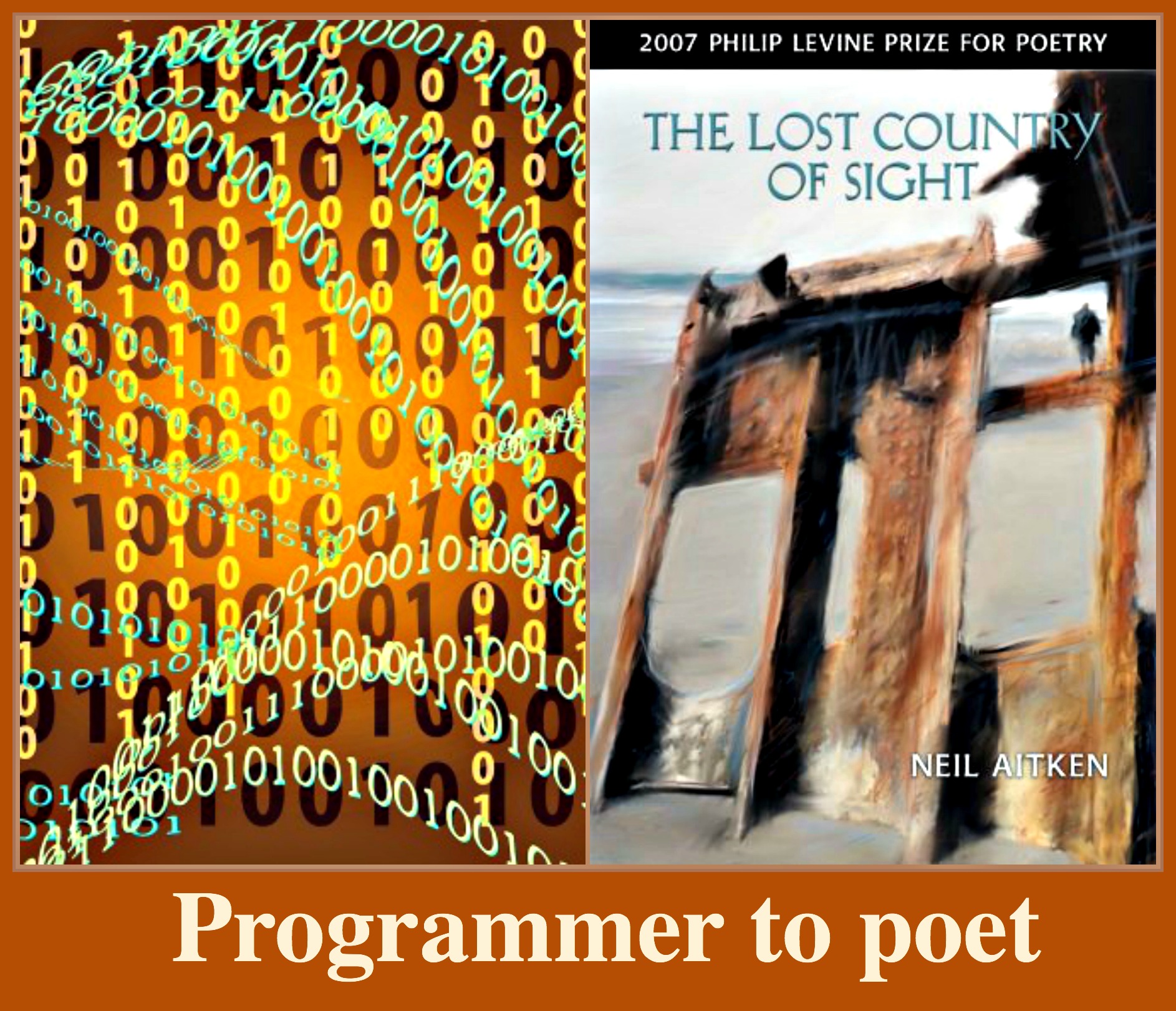
Binary code via Pixabay; cover art.

Binary code via Pixabay; cover art.

What has the transition been like, going from computer programmer to poet?
In truth, I’ve been writing poetry almost as long as I’ve been programming. I started writing poetry in earnest when I was around 10, about the same time my father brought home an IBM PC Jr with GW-BASIC on it. One of my very first original programs was a haiku generator that produced pretty awful haiku. Even as an undergraduate studying computer science, I sought permission to take creative writing classes at the graduate level. For a long time, I thought I could juggle writing poetry with computer programming. Eventually, however, programming lost its luster and I stopped loving the work, despite still being good at what I did. I knew at some point I needed to jump ship—I couldn’t bear the thought of spending my life in a field that no longer held my attention or affection. Working full time as a computer games programmer, I found myself putting in 60-, 70-, 80-, and occasionally 94-hour weeks. It was just too much. It was time to find a way out. At the same time, it was important to me that I avoid going into debt for my poetry degree, so I had to wait for the right offer. All the while, I continued programming and when possible, spent my evenings at open mic poetry venues, listening to all sorts of poets read their works. Eventually, I received a call from UC Riverside offering me a generous full-ride MFA scholarship, which made the transition possible.

“I wake already longing for those whom I soon will leave—” —Neil Aitken, from “Kundiman”

One of the judges for the Philip Levine Prize said that “Traveling Through the Prairies, I Think of My Father’s Voice” struck him as being a “perfectly made poem.” Was your family close?
I have many fond memories of time spent as a family together, whether it was picking through a coal seam at the side of a mountain highway with my father searching for fossils, or gathering together as a family on the eve of my graduation—the photo of which is the only family photo where we’re all smiling naturally, unrehearsed, unburdened by life’s later challenges and sorrows—or just simply lazing around the house at Christmas, listening to my father read Dylan Thomas’ A Child’s Christmas in Wales to us with his usual gusto and dramatic flair.

Where have you been happiest as an adult?
My happiest moments in recent years have been tied to my friends and fellow poets whom I met through Kundiman, an organization dedicated to the creation and cultivation of Asian American literature. The three years I attended the Kundiman Poetry Retreat set in motion lifetime friendships and bonds with people that, to this day, I count as my closest poetry kin—I was unprepared for how deeply and completely I would fall in love with the community, and how this group of Asian American poets would come to be a second family. When I showed up for my first Kundiman retreat in 2005, I was convinced that there had been an error—how had they let me in? What use could they have for a Chinese-Scottish-English Canadian poet who rarely wrote about identity, at least not directly? But on the first day, as we made our introductions in a classroom at the University of Virginia, I soon realized that many of the other participants felt the same way I did. We had all arrived convinced that our lives and our writing were somehow outside of what was expected and permitted—only to discover that what was happening on the front lines of Asian American literature was much more diverse and vibrant, much more compelling and dynamic, much more inclusive than whatever we had been led to believe from the anthologies we’d read and the classes we’d taken. To this day, I love running into a fellow Kundiman and can’t wait to hear about their work and discover what they have to offer to the conversation.

Your Kundiman experience sounds like a quintessentially good TCK experience. In general, do you find that “your people” tend to be other ATCKs, or cross-cultural people, or creative folk?
It varies quite a bit, but generally speaking I’ve found myself most at home with other Asian American writers (especially those I’ve met through Kundiman), other editors of literary journals, and other people who negotiate the fragile yet fertile space between faith, science, and compassion. On a broader level, I find my people are those who share a love of language and literature, whose eyes are on the forgotten spaces and figures of the world, and whose efforts and desires pointed outwards, with the ambition to make more room at the table. I love surrounding myself with people who are building bridges and tearing down arbitrary walls, who are not afraid to speak against the structures of oppression and forgetting, and who challenge themselves to do more and be more than who they were yesterday.

“There is always something that refuses to be contained…” —Neil Aitken in “Encapsulation”

On top of working toward your PhD, you won the DJS Translation Award for your co-translations of poetry from Mandarin to English. How do you feel about your two “native” languages? Do you prefer one to the other?
I love the strange and omnivorous nature of English. English is constantly devouring other languages, incorporating new terms into its lexicon, and expanding with each passing year and succeeding social revolution. In terms of tone, music, and range, very few languages can compete with English. That being said, I also have a big place in my heart for Mandarin Chinese, a language I learned once when I was very young, forgot, then relearned at 19.

What is it like to translate from Chinese into English?
The two languages could not be more different. Chinese is a language traditionally learned by the memorization of classical and literary texts. It relies heavily on allusion, each word and phrase carrying with it a wealth of cultural association and literary reference. It moves not just sonically but also visually, evoking the elements—fire and water, air and earth—and connecting words and ideas that share some common philosophical history. The act of translation is a humbling experience—I’m constantly reminded of how fluid concepts and relationships are between ideas once they are unshackled from one’s mother tongue. And yet, there is great pleasure in it as well. I enjoy puzzles—I enjoy this bit of creative play where the translator searches for a way to create an equivalent experience and gesture in a new language for something that they have encountered in the original. My childhood experiences with Chinese left a deep imprint in my mind that manifests itself now as a type of intuition when it comes to finding the right equivalent phrase or understanding the cultural impact or resonance of the original line. It’s an imperfect intuition, but one that nevertheless guides me through tricky places in the poems and helps me feel still a part of the Chinese culture.

Finally, I’d like to congratulate you on winning of the prestigious Philip Levine Prize for Poetry for The Lost Country of Sight. Is there a particular poem from that collection that expresses your feelings of transience or loneliness or instability—or freedom or curiosity or love of travel—that you are most proud of, and could you share it with us?
In many respects, my entire first book of poetry, The Lost Country of Sight, grapples with these themes and, therefore, it’s actually pretty hard to settle on just one poem. I’m going to suggest two, if I may:

In the Long Dream of Exile

You are counting the dark exit of crows
in the rear view mirror, or from the top of an overpass
looking back into the last flames of cloud.
Your car, steel to the world of flint, rests listless
with its windows wide, the stars slipping in
and settling down for the night.
Now, what you could not leave rides in boxes
heavy with numbers and places you’ve already
turned into poems. There is nothing left
in your pockets, your clothes worn down
to this list of miles taking you out of the known earth.
Outside your open window, the dark repeats
like the wind in late fall, twisting the names
of familiar back roads into a long rope of sighs.
You could lower yourself down with such longing.
It could be a woman or a young girl, the way the light
clings to that body like a sheet of immaculate heat,
invisible to the eye, but something, you are certain,
something that must be on the verge of love.

driving_abstractly

In the Country I Call Home

I have two countries, Cuba and the night.
~ José Marti

There is no Cuba, no other half of night.
No dark woman in her deep robe of grief,
no wooden doors flung open to emptiness. Nothing
of music. No city in flames. All this absent.

In me, there are as many countries as names.
As many versions of the world.

If there is a country, it is a white-limbed tree,
a wind-drifted plain of snow. It is a country buried.
Or a man holding a camera to his eye. Or a silence.

If there is a country, there are two countries.
A double exposure. The other world ghosting the first.
The second full of dark-haired strangers. Ink ground
from charcoal pressed to stone. Hard as raw rice.

If there are two countries, a third always rises.
Life preserver on the waves. A ship without reference.
Anywhere. Everywhere. A nation of one.

If there are three, there must be a fourth.
I will find it in your skin. Hear it resonate in your bones.
A ringing echo. Something of sound. It will be small.
Almost a hut. A thatched roof shack in the wilderness.
A hermitage for two. A boat in a river. Almost a home.

snowdrift

“Wind shapes,” by John Holm via Flickr (CC BY 2.0).

* * *

Thank you, Neil, for these two lyrical offerings. Again, congratulations on your numerous accomplishments in poetry and translation, and best of luck with post-PhD life! Readers, please leave questions or comments for Neil below.

STAY TUNED for more fab posts!

If you enjoyed this post, we invite you to register for The Displaced Dispatch, a round up of weekly posts from The Displaced Nation, and so much more! Register for The Displaced Dispatch by clicking here!

Related posts:

CULTURE SHOCK TOOLBOX: How to be a diva in another culture–by not being one!

Culture Shock Toolbox April 2015 Rossi Columnist H.E. Rybol never saw a culture clash she didn’t want to fix. She calls herself a “transitions enthusiast” and credits her Third Culture Kid upbringing for giving her a head start in that department. That said, H.E. is always looking for new tools to add to her kit, and toward that end has been interviewing other displaced creatives about their culture shock experiences. Today she speaks to Kristen Rossi, a New Yorker who is on a mission to spread the Golden Age of Broadway/jazz throughout Asia. Okay, H.E. and Kristen, time to paint the town and all that jazz!

—ML Awanohara

Hello, Displaced Nationers! Today I am delighted to introduce Kristen Evelyn Rossi to Culture Shock Toolbox readers. Kristen is an American actress, singer and voice over artist based in Southeast Asia. Besides being a talented performer, she is an entrepreneur and, while living in Bangkok, has co-founded two organizations: Broadway Babe, an endeavor to bring Broadway style to the Thai capital, and Musical Theatre for KIDS, which offers Broadway musical and theatre workshops for Asian youth.
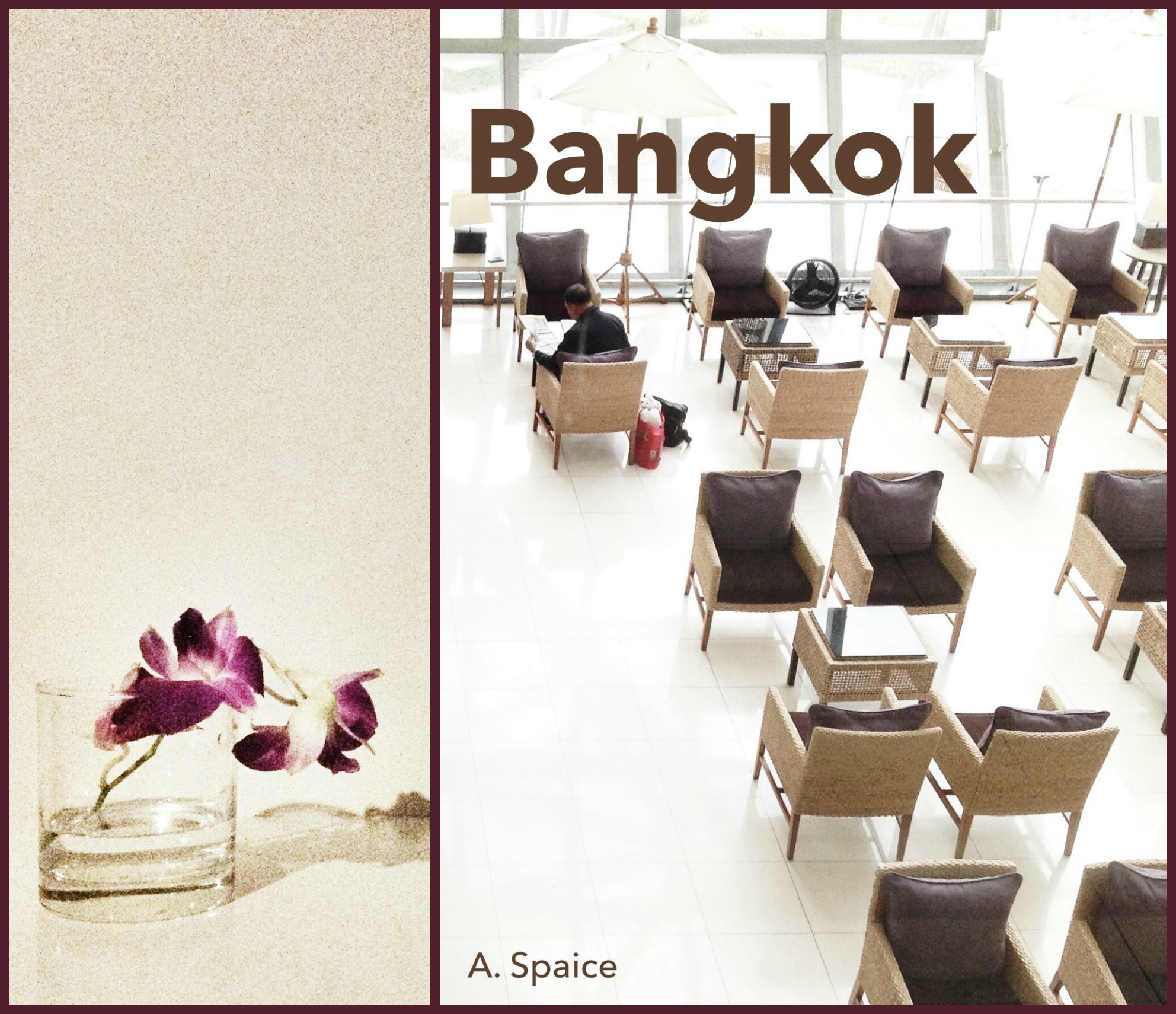
I was lucky enough to catch up with Kristen recently and ask her a few questions about her somewhat unusual life of crooning her way around Asia, while also teaching others how to traipse the Broadway boards. I can see from the YouTube videos on her Website that she has racked up many successful performances; but I wanted to know: have there been any cultural flops?
Here’s what she had to say…

* * *

Hi, Kristen, and welcome to the Displaced Nation. Can you tell us which countries you’ve lived in and for how long?

I have lived in London (UK) for just under a year; about seven years in Bangkok, Thailand; Hanoi, Vietnam for the past four months; and I will call Macau home in May.

That is quite a few cultural transitions! You are a singer, so I’m not sure if this is the right question, but did you ever put your foot in your mouth? Any memorable stories?

As an entertainer I meet people from all over the world. One common mistake I make is in judging a guest’s nationality. In particular I find it hard to tel the difference between Japanese and Koreans. Sometimes I can tell the difference and sometimes it is hard, especially when they come in their business suits! Several times I have said, “oh are you from ___” and they will just say “no, we are ____” and then look at me very seriously. Awkward.

Another occasional mistake related to nationality is that I don’t always know what the people of a country are called. I remember the first time I was speaking with a diplomat from Qatar. I was about to refer to the people…and hesitated. It made me feel a little embarrassed. (Of course I know now it’s Qatari!)

How do you usually handle these situations?

I try to quickly move on to something I do know and like about the country or culture in question. For example, with Koreans I always say, “Oooh, I just love makgeolli (an alcoholic beverage native to Korea).” Once I say this, I usually get smiles and “ooooh!” and laughs. I’ve found that it helps to learn a few positive facts about the nation and its culture—so you can always change the subject quickly.

In general, how do you think you have handled your many cultural transitions?

Most of my transitions have been positive and quite easy I think because I’m a performer by nature. I just get out there. I walk around, I interact, I am patient, I smile a lot. I figure out how to make the best of the situation.

If you had to give advice to someone who just moved to a new country, what’s the tool you’d tell them to develop first and why?

Engage with the culture. I can only speak on behalf of Southeast Asia/Asia, but what I have found is people want to share their culture with you. They want to be good “hosts”; embrace this. Ask your colleagues or new friends to show you their favorite local artists (music, gallery, etc). Ask them to take you to their favorite coffee spot or their favorite place to get their favorite local dish. Most of the time, they will be flattered you are interested in them, happy to share their culture—and you’ll probably end up making new friends. Another important tool is language. Make an effort to learn even a few words in the local language. You can practice simple words at home and then go into the office and ask your local colleagues if you are saying the words right. They will LOVE IT, I promise!

Thank you so much, Kristen, for taking the time to share your experiences. It’s wonderful to hear that a Broadway diva knows when not to be a diva. And I think you’ve hit the nail soundly on the head in advising that the best way to handle culture shock is to engage with the culture head on. Show interest and ask questions; learn the language and ask for feedback.

* * *

Readers, what do you make of Kristen’s advice? Do you agree with my impression that she’s brought some of the energy of the “city that never sleeps” to this column?

If you like what you heard, be sure to check out Kristen’s site and follow her on Facebook and Twitter.

Well, hopefully this has you “fixed” until next month.

Until then. Prost! Santé!

H.E. Rybol is a TCK and the author of Culture Shock: A Practical Guide and Culture Shock Toolbox. She loves animals, piano, yoga and being outdoors. You can find her on Twitter, Linkedin and Goodreads. She is currently working on her new Web site and her second book.  

STAY TUNED for next week’s fab posts.

If you enjoyed this post, we invite you to register for The Displaced Dispatch, a round up of weekly posts from The Displaced Nation—and much, much more! Register for The Displaced Dispatch by clicking here!

Related post:

TCK TALENT: Maya Evans, Poet, Writer, Teacher, Translator, Consultant & Transition Facilitator

Maya Evans for TDN

Maya Evans (own photo)

Elizabeth (Lisa) Liang is back with her column featuring interviews with Adult Third Culture Kids (ATCKs) who work in creative fields. Lisa herself is a prime example. A Guatemalan-American of Chinese-Spanish-Irish-French-German-English descent, she has developed her own one-woman show about growing up as a TCK, called Alien Citizen, which premiered nearly two years ago and is still going strong. In fact, she is now raising funds to take the production to Valencia, Spain, and Capetown, South Africa, later this year.

—ML Awanohara

Greetings, readers. Today’s interviewee is Maya Evans, a poet and writer, transition facilitator, international education consultant, and translator based in Boston, Massachusetts. She is also my fellow ATCK author in the anthology Writing Out of Limbo, in which her poem “Le Français” appears. Currently, she is working on a memoir about her extraordinary life, which took her from the Middle East to Europe to South America and finally to her current home of the United States.

* * *

Welcome to The Displaced Nation, Maya. I understand that you were born to a Francophone Jewish Egyptian-Hungarian family in Alexandria, Egypt, and that you grew up there and in Caracas, Venezuela. Please tell us why your family moved.
My family moved from Alexandria, Egypt, in 1958 after what history termed the Suez Crisis, which is to say the nationalization of the Suez Canal. Built by the French in 1869, and jointly controlled by the British and French until 1956, the Canal was of strategic importance to Western powers. Egyptian President Gamal Abdel Nasser‘s actions to nationalize it provoked a brief war—a lot like the wars carried out presently in the Middle East. Nasser wanted to end Egypt’s colonization. We left because Jews were no longer welcome in Egypt. The revolutionary government confiscated Jewish properties and bank accounts, even expelling some Jewish people holding French or British passports. My father was demoted, the bank where he worked was taken over by the authorities, and clearly his career was finished. His brothers, sisters, and their families mostly went to Brazil, although some ended up in France, but none in Hungary, where they’d come from originally. (At the time, Hungary was occupied by the Soviet Union.) When we left, I was 12-and-a-half—and still have vivid memories.

Did your mother’s family leave as well?
My mother’s family, rooted in the area for generations, did not leave. My grandmother refused to leave her house. My uncles and one of my mother’s sisters, who were very close, all stayed, not daring to contradict their mother.

Where did your family end up going?
For a brief time we lived in Paris, scattered among relatives. We also stayed in Genoa, Italy, for a couple of months waiting for my father to clear his affairs and obtain a visa for emigrating to Venezuela. We were “stateless” at the time, having left Egypt with a travel document valid for one trip with no return. My father had managed to “transfer” money out of Egypt to Switzerland, which was needed to buy our passages to South America. This is a story on its own, one I’m attempting to describe in my memoir.

Achieving happiness in the midst of displacement

I find your story moving as it’s about exile, not the usual voluntary migration for TCK families (voluntary for the parents at least). Still, your moves from North Africa to Europe to the Americas is very relatable for this ATCK. Were you happiest in a certain place at a certain time?
I can recall the exact time when I realized I was truly happy. It was at Brenau College (now Brenau University), in Gainesville, Georgia. It took one year to convince my father to allow me to go to college in the U.S. He thought that a girl had to stay home and go to the university nearest to where her family lives which in my case would have been the Universidad Central de Venezuela (UCV), a 15-minute ride from our home in Caracas. The problem was that the Venezuelan government did not recognize my high school degree from Colegio Internacional de Caracas (CIC)—the school is only accredited in the United States. Besides, my Spanish was not at a high enough level for the entrance exam. A solution would be to transfer to the UCV from an accredited school in the U.S., after a year of university-level courses. Reluctantly, my father agreed as long as I went to a “girls only” school, properly chaperoned during my trip to the States. I was fortunate enough to meet a trustee of Brenau College at a tea sponsored by the American Association of University Women. She traveled with me from Caracas to Atlanta, and drove me to her college. For a variety of reasons, among them the lack of money, neither my father nor mother could have made the trip at that time.

What was it like being in a small southern town after living in Caracas?
At Brenau, I was one of a handful of international students. Besides Venezuela, there were also girls from Norway and Taiwan. Luckily, two Hungarian sisters from Venezuela, in their third and last year of college respectively, took me under their wing. Both were intelligent and poised, which made me a “cool girl” by association. Suddenly, there was no need to explain why French was my native language but I wasn’t French, etc. It was easy to say: “I am from Venezuela.” Period. I had a distinct identity, foreign but also exotic. It was also wonderful to be far from the dramas of home. I had postponed the moment of reckoning, which would occur upon my return to Venezuela, when I would find out what it would be like to be a university student in Caracas who had attended an American high school full of students with tenuous ties to the country.

Maya Universities

From studying at Brenau in Georgia to getting a degree at Universidad Central Caracas Venezuela to working at Harvard…

Eventually, though, you moved back to the United States. Why was that?
I was just starting to feel Caraqueña (from Caracas)—finding my bearings as a journalism student at the UCV by night and as a bilingual assistant in an export company by day, enjoying 80-degree Fahrenheit weather year-round, living in a beautiful apartment facing the mountain—when I met my husband, an American. (We met in Caracas.) We moved to the States in the early 1970s. His job moved us to Boston; then to Stanford, Connecticut, where our first child was born; and then back to Boston.

Allow me to bridge cultures, people and dreams…

At what point did you start your career…or careers I should say, as I know you’ve had more than one.
After the birth of my second child, I was determined to find a job that would link me to the Latino community, or better yet, send me on frequent trips to Latin America. I found that job at Harvard, in a department facilitating studies in the United States for professors and business executives from Latin America. I traveled all over Latin America, and in the mid-90s, was assigned to a project in Venezuela sponsored by Petróleos de Venezuela (PDVSA) to train a cadre of executives for studies in the United States. I left Harvard shortly after and worked directly as a consultant for PDVSA. I also trained as an interpreter, working for the Massachusetts courts, and taught Spanish at the University of Massachusetts.

Consultant, trainer, interpreter, teacher: your careers seem to have been influenced by your peripatetic upbringing…
True. I would slide in and out of professions just as I slid in and out of countries, and adjust like the chameleon I’d become. I was always being uprooted but then would find ways to adapt. This in turn led me to my life’s “calling”: to facilitate transitions for others. Whether working with foreign students at American universities, or with international researchers trying to find the right department to pursue their research, or with companies wanting to train their personnel to live somewhere else, I would bridge cultures and languages in an effort to help others ease into their new surroundings.

Who am I? Where am I from?

Have you found that “your people” tend to be Adult TCKs or other cross-cultural people?
Undoubtedly, I feel comfortable with other Adult TCKs as well as multicultural people. I am actually uncomfortable with monocultural, monolingual people, regardless of their education level or accomplishments. I find that I have little in common with them, or that I have to “explain” myself again—and at a certain stage in life, it gets tiresome. I also feel a kinship with artists and people who are a bit out of the mainstream. Like Adult TCKs, they tend to look at the world from the outside. For the longest time, I felt outside, looking in. Even now, that feeling hasn’t left me completely.

Not only for your sake but for the rest of us ATCKs, I’m happy you are now working on your memoir, a few parts of which I was privileged to hear you read. What inspired you to start writing it, and how far along are you in the process?
Thank you for your kind words. It’s been a long and tortuous road. For the longest time, from my days as a journalism student, I wanted to tell stories. Stories I heard around the world, and stories of my relatives who happen to be an eclectic bunch of multinational people. But I am always escaping into work, travel, poetry writing, whatever other excuse I can find. Now I’ve decided to work less and, while I still can conjure the memories, dedicate more time to writing what I like to call a “romanticized memoir,” with characters loosely built on the stories I heard about Egypt and on the memories I have of the places where we lived. I am still at the beginning of the process, and need to speed it up, lest it get buried alongside other writings.

Attempting to “capture all the voices in my head without sounding schizophrenic”

On top of all of this, you are a published poet. Is there a particular poem of yours that expresses your feelings of transience or loneliness or instability—or freedom or curiosity or love of travel—that you are most proud of? If so, could you share it with us?
Two years ago, a poem of mine I like the best, “Voz Ajena” (“Alien Voice”), was published in Spanish in the New England Translators Association’s newsletter. Although I translate other people’s work, I cannot translate my own. I don’t hear it in any other language but Spanish. In that poem, I attempted to capture all the “voices” in my head without sounding schizophrenic. To me, it is interesting to note that I can do this only in Spanish, which was the third language I acquired, after which it became my “go to” language. Even though French is rooted in me, Spanish carries Latin America with its music and colors, which trumps all others! I’ll give you that poem, but for those who don’t read Spanish, I’ll first give you a poem I wrote in English:

Notebook with a Missing Language

Only English is missing
in these familiar lines
that stretch quietly on a
tidy little notebook
filled in French with spatters of Spanish;
scents of places and of people long gone
leaving behind tender thoughts,
silent melodies, objects of desire,
histories of exiles and commencements
of lenities and humiliations,
of successes and exonerations;
tales of lost places, warm embraces,
mute voices, empty houses,
doors shut on bygone worlds.

door_shut_maya_poetry

The last line of “Notebook with a Missing Language,” a poem by Maya Evans


And now for those who read Spanish:

Voz Ajena

Le preguntó un día por su acento opaco,
esa manera que tiene ella
de tropezar con las erres,
saltar continentes al azar,
atar letras sin más sabor
en un ritmo extraño, ritmo de blanco.

Son recuerdos de otras voces,
las vivencias de mi memoria
de crêpe georgette y chantilly,
dijo ella con voz de seda, voz de sirena.

Yo no sabía de los fantasmas que te habitan,
No sabía de Egipto, España,
Francia y Hungría,
No sabía que te comían noche y día,
ocultándote la luz, clamando por aire,
y todos con ese afán de ser.

Y más aún le dijo ella,
tocan tambores y hacen ruidos,
se contorsionan en las tinieblas
por estallar en mil estrellas,
dejar arañas y demás vainas,
ser lentejuelas, champaña fino, jamón ibérico,
Ravel de fuego, Maria Callas reencarnada,
vistiendo toga, comiendo astros, tragando mundos.

Maya
Boston, 19 de abril de 2010

* * *

It’s been a pleasure, Maya, hearing about your many professional accomplishments and “romanticized memoir” in progress. And thank you so much for sharing two of your poems! Readers, please leave questions or comments for Maya below.

STAY TUNED for next week’s fab posts!

If you enjoyed this post, we invite you to register for The Displaced Dispatch, a round up of weekly posts from The Displaced Nation, and so much more! Register for The Displaced Dispatch by clicking here!

Related posts: