The Displaced Nation

A home for international creatives

Tag Archives: South America

4 films that will make you want to travel — and one that won’t!

Now, there’s a pretty standard list of travel-inspiring movies out there; it’s everywhere you look online, and it goes something like this:

But I wanted to give you some slightly more alternative choices — because I try to avoid being ordinary whenever possible. Yes, okay, you can say it — because I’m downright weird. So in place of those otherwise awesome films, may I present to you the following movies which have inspired me personally:

1) The Adventures of Priscilla, Queen of the Desert (1994), directed by Stephan Elliot

Why I love this film: It’s ridiculous and lots of fun, which is pretty much how I think all life should be! As three Sydney drag queens travel through the barren Australian outback, we get to see that iconic terrain, vast and empty and aching to be explored. This film has it all: humor, a light-hearted way of handling a serious message (about homophobia) and visuals to die for as the trio procession through some of Australia’s most awe-inspiring scenery. In a big pink bus.
Personal note: Not only did I travel to Australia and fall in love with a woman who considers this her favorite movie ever –- I also had the good fortune to be with her when she decided to re-enact one of the film’s famous scenes, when the drag queens hike around King’s Canyon in their fabulous dresses! I’d say we got mixed reactions from the other tourists — probably me, most of all…
Memorable line:

Felicia: The only life I saw for the last million miles were the hypnotized bunnies. Most of them are now wedged in the tires.

2) Black Sheep (2007), directed by Jonathan King

Also ran: Actually, I was going to nominate The Lord of the Rings trilogy but then decided — NO! I can’t use it. It’s too easy. Plus we’ve already had one film with Hugo Weaving (the mighty Elrond played a drag queen in Priscilla!). I know, across the three films they showcase the sights of New Zealand at their jaw-dropping best — anyone who hasn’t watched these films and felt an urgent need to visit New Zealand needs to watch them again but ignore the kick-ass sword fighting… Yeah, I know. That’s never going to happen.
Why Black Sheep won out: The rugged landscape looks every bit as impressive in this movie as it does in Lord of the Rings — but it’s also populated by were-sheep, an accidental result of some unusual genetic manipulation… See it, and laugh at the New Zealanders. Oddly enough, they’ll love you for it. It’s the Kiwis’ love of poking fun at everything, especially themselves — their self-deprecating humor — that really made me want to visit the place. I felt like I would fit in there. And I did — I stayed for two years. By the time I left, I was on a first-name basis with the entire population.
Memorable lines:

There are 40 million sheep in New Zealand…and they’re pi**ed off!

Harry (as the were-sheep charge towards them): F**k, the sheep!
Tucker: No mate, we haven’t time for that.

3) Lost in Translation (2003), directed by Sofia Coppola

Why I love this film: It’s an odd one, this one. The first time I watched it, my mind boggled at how something so boring, with nothing remotely resembling a plot, could get made into a movie. Then I watched it again. And again. Because it was the rainy season in Thailand, where I was living, so I couldn’t go outside — and we only had three DVDs in English, so we watched all of them every day. For two months. Somewhere around the halfway point of this torturous process, I fell in love with Lost in Translation — maybe I just needed to relax to appreciate it? Once I stopped looking for something to happen, I started to understand what it was all about: loneliness, uncertainty, being adrift and confused in a completely alien culture. And ever since then I’ve desperately wanted to go to Tokyo. Well, not enough to actually go there — yet — but you know what I mean. I do travel vicariously — just sometimes — and this is one of ‘em.
Caveat: If, like me, you’re a fan of films where, you know, stuff happens — it might take you a few viewings to get used to it. Forty or fifty should do the trick.
Memorable line:

Charlotte: Let’s never come here again because it would never be as much fun.

4) Ip Man (2008), directed by Wilson Yip

Why I love this film: The closest I’ve come to China are the little “made in” labels on almost everything I own. This film, however, kindled a desire to visit China that I never knew I had in me. It’s the biographical story of the most famous kung fu practitioner in the world — not Bruce Lee but his teacher in Wing Chun kung fu, master Ip Man. It’s set in Foshan, China in the 1930s-40s during the Japanese Invasion, but was filmed in Shanghai. It follows the family of the master as he becomes ensnared in the war, losing everything over the course of the Occupation and being forced to face the hardest choices a man could make. The insight into a lifestyle and culture so utterly different from my own was fascinating enough, but this is a story both moving and powerful.
Audience participation: I dare anyone to watch it and not leap off the couch at some point with a cry of “Yeah, kick his ASS!” Ahem. Okay, so maybe that’s just me.
In sum: Will it make you want to visit China? I think so. Will it make you want to learn kung fu? I absolutely guarantee it!

And because I’m a contrary kind of guy, I just had to retaliate against my own optimism by highlighting a film that made me NOT want to travel:

5) Cidade de Deus (City of God) (2002), directed by Fernando Meirelles and Katia Lund

Why I don’t recommend this film: The film is set in the 1970s, in the poorest districts surrounding Rio de Janeiro, where drugs and guns rule and the population live in a fear only matched by their misery. I saw it in South America, in its native Portuguese — but with Spanish subtitles. Given my fledgeling abilities in that language, as described in a previous post, I may have failed to grasp every nuance of the story, but basically what I took from it was: “DON’T EVER GO THERE! They will kill you for the hell of it.”
Analysis:There is poverty everywhere in the world — I’ve worked in homeless shelters in the UK and seen people every bit as desperate as the denizens of Brazilian favelas (shanty towns). But these kind of places, where automatic weapons are more readily available than McDonald’s hamburgers and life is so very cheap…they absolutely terrify me.
In sum: Brazil remains on my list of all-time favorite, must-visit countries — but no way am I going anywhere near the favelas in Rio. This film has put me off — for life.

* * *

And finally…there’s one character that stands head and shoulders (and hat!) above all the rest when it comes to inspiring my travels. I’ve carefully avoided mentioning his films, as I was trying hard to keep this a cheese-free list — but I can’t hold it in any more.

I WANT TO BE INDIANA JONES!

I know, I know! So does everybody in the world, ever. Even people in remote tribes that have never been contacted by the Western world, secretly harbor a desire to be Indiana Jones — they just don’t know how to put it into words.

So — now it’s your turn!
1) What films have made you want to travel? And why?
2) What films have made you want to run screaming from the very idea of travel — and why?
3) If you WERE Indiana Jones — what would you do?

STAY TUNED for tomorrow’s post on cinema and the expat life.

If you enjoyed this post, we invite you to register for The Displaced Dispatch, a round up of weekly posts from The Displaced Nation, with seasonal recipes, book giveaways and other extras. Register for The Displaced Dispatch by clicking here!

Related posts:

Images: Tony James Slater (yes, that’s really him!) playing out his fantasy of being Indiana Jones; film posters courtesy Wikipedia.

RANDOM NOMAD: Megan Farrell, American Expat in São Paulo, Brazil

Place of birth: Chicago, Illinois USA
Geographical history: USA (Chicago, Illinois; West Palm Beach, Florida; Ventura, California; Washington, DC): 1969 – 2002; Spain (Barcelona): 2001; USA (Princeton, New Jersey; New York, New York): 2002-10; Brazil (São Paulo): 2010 – present.
Passport: USA — my daughter, however, has three: USA, Brazil & Germany.
Current occupation: Aspiring novelist and screenplay writer, business school lecturer, and former research director at a Wall Street firm.
Cyberspace coordinates: Born Again Brazilian (blog) and @BornAgainBrazil (Twitter handle)

What made you leave your homeland in the first place?
Ever since I was a child, I wanted to explore the world and always had it in my head that I would live in other countries. I think it was because I used to read a lot as a kid, stories about other places, some of my favorites being James and the Giant Peach and The Little Prince. I also loved Laura Ingalls Wilder‘s Little House series. By the time I reached adulthood, I was open to opportunities to travel and explore new cities as a local.

Describe the moment when you felt most displaced since making your home in Brazil’s largest city, São Paulo.
Wandering lost, in the rain, in an unfamiliar neighborhood, after a boy on a bike tried to wrestle my iPhone out of my hands. I’d grabbed it out of his hands, but he still hung around yelling something at me and trying to get the phone. It seemed incredible to me this was happening because although it was raining, it was broad daylight and I was on a street where there was a row of little shops. So after putting a bit of distance between us, I stopped and started screaming like a horror movie starlet and pointing at him. People came out of their shops and of course he got scared — I think mostly because he thought I was crazy. I’d never before experienced anything so bold.

Your blog is called Born Again Brazilian. I imagine you’ve also had many moments when you feel more at home in Brazil than you do in the USA. When have you felt least displaced?
While sitting on the beach of Leblon, in Rio de Janeiro, viewing the ocean. On a beautiful day, it absolutely makes you feel as though all is right with the world and you are exactly where you are meant to be.

You may bring one curiosity you’ve collected from each of your adopted countries into The Displaced Nation. What’s in your suitcase?
No need for a suitcase as what I’d most like to bring with me to The Displaced Nation is a couple of intangible items:
From Brazil: Jeitinho or jeito, the ability to get in, out and/or around something despite a law, a regulation, a contract, physics or gravity.
From Barcelona: The recipe for survival possessed by local shops, which seem to close and open at random times — and when you enter, the owners or employees often act as though you are completely putting them out by wanting to buy something. It’s hilarious and curious at the same time.

Food is close to the heart of all Displaced Nation citizens. We would therefore like to invite you to make a meal for us. What will you offer?
I can offer a choice of two classic menus:
1) Brazilian (São Paulo/Rio de Janeiro)
Appetizer: Bolinho de bacalhau (codfish cakes), served with Original cerveja (beer)
Main: Feijoada (traditional bean stew with beef and pork), served with caipirinhas (Brazilian national cocktail, made with rum, sugar and lime)
Dessert: Mouse de maracujá (passion fruit mousse)
2) Spanish (Barcelona)
Appetizer: Assorted pinchos (bar snacks eaten with toothpicks), served with cider
Main: Paella Valenciana (Valencian paella), served with a nice Spanish white wine
Dessert: Flan (crème caramel)

What’s your pleasure?

You may add a word or expression from the country where you live in to The Displaced Nation argot. What will you loan us?
Tudo bem! When you greet someone in Brazil, you say tudo bem instead of hello, but you use it like a question: “Tudo bem?” (All is well?) And you might respond with tudo bem (all is well) or tudo otimo (all is great) or simply tudo (all). Brazilians must use this greeting countless times a day. What I love about tudo bem is that it represents how familiar and personal the Brazilian culture is. A stranger in the elevator will greet you by asking if all is right in the world for you. That is totally Brazilian.

This month, in honor of Valentine’s Day, The Displaced Nation has been delving into the topic of finding love abroad. I understand you have a Brazilian husband. Where and how did the pair of you meet, and was it love at first sight?
I met my husband while we were getting our MBAs at Georgetown University (in Washington, DC). The first time I met him, I thought he was pretty stern — little did I know he had just arrived to the country the day before and wasn’t so comfortable with his English. I kind of wrote him off as one of the machismo Latin guys that didn’t like to work closely in a business setting with women. But after the final exams of our first semester, we wound up at the same party. I actually attempted to hook him up with my friend — he is tall and she is tall — but it turned out he was more interested in me. After I saw a few of his dance moves…it was love at second sight!

Thanks to Gisele, many people have an image of Brazilian women as very attractive. Is that also true of the men, and do they make good husbands?
First, my husband is not your typical Brazilian man. He spent a great deal of his childhood in Germany with his grandparents and has his behavior has been heavily influenced by his German father. Typical Brazilian men see the roles of men and women as clearly defined channels. From what I’ve seen and heard from my Brazilian and American friends married to Brazilians, the menfolk rarely if ever help out with household chores or issues, as they feel that is the woman’s role — even if she is working a full-time job! However, for the most part, Brazilian men are very charming, complimentary and romantic. They see themselves as Prince Charming, and if that is what a woman is looking for, a Brazilian man is a good catch.

You said you fantasized about traveling to other lands from the time you were a child. How about marrying someone from another land?
I never thought much about it, but before my husband, I only dated All-American guys, so I think it came as a surprise to my parents. However, when my now husband asked me to marry him, I knew that my life would never be boring, and always full of adventure. And I was right!

Now that Valentine’s is over, The Displaced Nation is moving on to look at expat and travel films, in time for the Oscars. Do you have a favorite film(s) in this “genre”? I see you’re interesting in screenplay writing, which makes me doubly curious.
I think the first movies that inspired travel for me were Cocktail with Tom Cruise (he finds love while working in a bar in Jamaica) and Only You with Marisa Tomei (she follows the man she thinks will be her true love to Italy). When I was a bit older, I was definitely was drawn to seeing the world by a beautifully filmed, but wildly depressing, New Zealand-Australian-British film by Jane Campion titled An Angel At My Table. It’s based on Janet Frame‘s autobiographical series about growing up in New Zealand, leaving and returning.

Readers — yay or nay for letting Megan Farrell into The Displaced Nation? Tell us your reasons. (Note: It’s fine to vote “nay” as long as you couch your reasoning in terms we all — including Megan — find amusing.)

STAY TUNED for tomorrow’s installment from our displaced fictional heroine, Libby, who is discovering that Valentine’s Day in the US is quite different from the UK version — a fact that doesn’t come naturally to her three-year-old son. (What, not keeping up with Libby? Read the first three episodes of her expat adventures.)

If you enjoyed this post, we invite you to register for The Displaced Dispatch, a round up of weekly posts from The Displaced Nation, with seasonal recipes, book giveaways and other extras. Register for The Displaced Dispatch by clicking here!

Related posts:

img: Megan Farrell poses at the nature center in Parque Estadual do Pico do Itacolomi, which is outside Ouro Preto, Minas Gerias (July 2011).

THE DISPLACED Q: Does love conquer all — even language barriers?

Last week Tony James Slater, the newest addition to the TDN team, reported on his success with finding love abroad. But it wasn’t always that easy for him. He may be an incurable adventureholic, but when Cupid’s arrow led to a romance with a woman who didn’t speak English, even he had to wonder if there were limits…

Here’s the scenario:

You’re minding your own business in a friendly sort of bar, enjoying the heady mix of cultures as foreigners — a mix of holiday-makers, transients and expats — rub shoulders with the locals.

Suddenly you see him — or her — across the crowded room. This gorgeous individual is staring right at you, smiling seductively. You make contact with those smoldering eyes…and that’s where it ends.

Because she doesn’t speak your language, and you speak none of hers.

So really, what are you going to say to her?

Can romance transcend the language barrier?

It’s a tricky one.

No lo entiendo, mi amor

I have a little experience in this area; once upon a time, when I doing a three-month stint of volunteering at an animal shelter in Ecuador, I fell madly in lust with a gorgeous Latino woman.

Of course she didn’t speak English — there was no one who could for miles in any direction. I spoke no Spanish, because until that moment there had never seemed enough reasons to learn it.

I was captivated by her — she was the kind of exotic beauty you read about in well, the kind of books that I don’t read. Ahem.

So what do you do?

Two obvious tactics spring to mind.

The first is what I did: get horribly drunk and throw yourself at the poor woman, in the hope that you’ll never remember the embarrassment in the morning, if she laughs in your face.

As it happens, this tactic worked — but it should be noted that this is the first time ever, in the history of mankind, that this has been the case. As a rule, I cannot endorse extreme inebriation as a successful method of flirtation; truly, this must have been Cupid himself in action.

The second tactic is to get a friend who does speak both languages to make some kind of introduction. This can help you get over that incredibly awkward initial stage when neither of you is really sure if the other is genuinely interested.

This is the tactic I should have used, as I had a perfectly good friend with the requisite language skills. Of course by the time I’d thought of that, I was already too drunk to pronounce even English words. It was quite a way down the road when I finally got to communicate in words with my new lover, through an interpreter.

At that point, it was great to have it confirmed that she felt the same way about me as I felt about her!

It was slightly less great to discover that she was already married and had two children. But then, that’s the chance you take when you practice tactic no.1.

Thankfully, she was separated from her husband — although as our relationship progressed, I did hear some disturbing rumors that her husband was looking for me…with a machete. I fervently hoped that was just my boss trying to wind me up. (If it was, he succeeded!)

Pidgin Spanish and pantomime…are there limits?

Although she was beautiful, the thought of meeting her again terrified me anew each time. I felt like such an idiot, struggling to express myself in pidgin Spanish and pantomime. I lived in fear of those awkward moments, when neither of us could make the other understand some fundamental issue.

That said, it definitely motivated me to learn Spanish! After every date I’d come back fired up with the desire to study. I never did any studying, of course — my day job (mucking out animal cages) kept me way too busy for that — but the desire was there. The desire, in fact, had never been a problem!

But how far can a relationship really go, when you don’t even have a language in common? Think how close you can get to someone in a long-term relationship; a connection bordering on the psychic, where you’re almost reading each other’s minds — it just doesn’t work when you’re constantly guessing at what the other person is saying.

The Austrian-British language philosopher Ludwig Wittgenstein once remarked:

The limits of my language are the limits of my world.

If he is right, then isn’t the lack of a shared language the very essence of incompatibility?

Relationship experts the world over agree that couples must work hard to bridge communication gaps. Well, when the gaps of linguistic understanding are wide enough to fly a 747 through — and it can feel like a long-distance relationship even when you’re standing next to each other — bridge-building can be something of a challenge.

My Ecuadorian love and I were together three months, after which I left to fly back home. Ironically, we’d each learned just enough of each other’s languages to really get to know each other’s thoughts, hopes, fears and frustrations — the day before my flight to England.

I’d like to open it up to the floor at this point!

Has anyone got any experience of this that they wouldn’t mind sharing? Or an opinion, on whether or not it’s possible?

Can love really conquer all — including that ultimate bad guy of cross-cultural barriers, linguistics?

What do you think?

I’d love to know!

TONY JAMES SLATER is a self-confessed adventureholic. For the last six years he’s been traveling nonstop around the world, working at a variety of jobs including yacht deliverer in the Mediterranean, professional diver in Thailand and snow boarder in New Zealand. Last year, Slater published his first book, That Bear Ate My Pants!, an account of his misadventures while volunteering at the animal refuge in Ecuador. (The book was featured in The Displaced Nation’s list of 2011 expat books.) He is currently working on a second book set in Thailand, while exploring his new home in Perth, Australia.

STAY TUNED for Tuesday’s post, a review of Matt Krause’s memoir recounting how he met a woman on a plane — and followed her all the way to Turkey! NOTE: Subscribers to our weekly DISPLACED DISPATCH are eligible to win a free, autographed copy!

If you enjoyed this post, we invite you to register for The Displaced Dispatch, a round up of weekly posts from The Displaced Nation, with seasonal recipes, book giveaways and other extras. Register for The Displaced Dispatch by clicking here!

Related posts:

I traveled in search of adventure — and ended up embracing a simpler life

Today we welcome Tony James Slater to The Displaced Nation as the newest addition to our team. He makes his debut with a post about his trip to Ecuador for the purposes of volunteering at an animal sanctuary in the Andean Mountains — an experience that led to some deep (as well as humorous) reflections.

My first real trip abroad was to Ecuador. (I made a trip to France once, but since I’m from England, that doesn’t really count.)

I went there in search of adventure. I sure wasn’t going to “find myself.” If I had any deeper motive, it was to reinvent myself — ideally as Indiana Jones.

(NB. If you’re going to Ecuador — take cheese. The stuff they have there has the same taste and consistency as soggy toilet-roll.)

I’d planned to volunteer in an animal refuge; it was my way of doing something more meaningful with my life, of giving a little bit back to nature.

And I was absolutely terrified.

There were reasons for this:

  1. I’d never really traveled. (As mentioned, France doesn’t really count.)
  2. I spoke no Spanish.
  3. I had no experience with animals, other than owning a pet rabbit when I was nine.
  4. I was, it has to be said, a pretty weedy human being.

But nobody in Ecuador knew me. I could cast off the bits I didn’t like — and that would start with the fear.

It helped that the setting was gorgeous. The refuge, called Santa Martha Animal Rescue Center, was surrounded by cloud-forest, halfway up a mountain in the Avenue of Volcanoes.

Talk with the animals…

I felt an immediate connection with the animals, who were in the sanctuary because they’d been victims of animal trafficking. I even connected with the monkeys, who escaped so often I spent more time chasing them than feeding them.

But you can’t have an adventure inside your comfort zone. That’s like nipping next-door for a cup of tea and calling it a night out.

First I had to strip everything back. My computer couldn’t make the trip as it was the size of a small building. My phone survived for less than a day before committing suicide from the top bunk-bed, but it was only good as an alarm clock anyway.

(I didn’t even need an alarm clock; I had a rooster for that. Which was great, except it went off an hour early every morning.)

Before I knew it I’d slipped into a much simpler pattern. Get up. Feed the animals. Clean the animals. Tend the wounds I’d received whilst feeding and cleaning the animals. Then chop, dig, carry, nail…

The boss would show me a task that needed doing, give me the tools and then leave me to it. Build a cage. Fix a cage. Build a parrot perch…

Generally the tasks were simple, manual, and I got better each day at handling them. (Except one Saturday morning when he tried to teach me welding; I made the mistake of looking at the torch at the exact moment it flared up, like a miniature sun. In fact I did this every time it flared up. As a result, not a lot of welding got done, and I was blind for the rest of the weekend!)

At the end of a long day I could feel how hard I’d worked; tired in body and nothing in mind to concern me beyond wondering what crazy job they’d get me doing tomorrow. I could just kick back in the hammock and day-dream…

As Albert Camus once philosophized:

But what is happiness except the simple harmony between a man and the life he leads?

Swingin’ in a hammock

Ever notice how when people think of “paradise,” there’s almost always hammocks? No corner offices or Mercedes Benzes. Even shoe shops rarely make an appearance.

It’s that idea of “getting away from it all” that holds the allure, I think; relaxing on a beach wouldn’t be the same if you were doing your tax return while you were at it.

Hence the hammocks. Symbolic of the chance to do — and think of — absolutely nothing; at least for as long as your sojourn lasts.

Perhaps I was in fact searching for a simpler life? Perhaps we all are?

In any event, I loved it.

I was getting stronger, more confident, with every week that passed.

(I was also getting bitten, clawed and mauled by everything that could bite, claw and maul, from monkeys to crocodiles — but that’s another story.)

I was learning to focus, to take my time looking for a solution to a problem and to work at it until it was right. I owned less and less each day as my clothes got shredded through work, but it didn’t matter. I wasn’t out to impress anyone, at least not with my fashion sense.

Best of all I had an identity. It didn’t need explaining — I was “that guy from the animal place.” It was a good job to be defined by. It felt positive and honest.

Reality bites as well

Returning to the “real” world back in the UK was like a wet fish in the face — all of a sudden people had places to be and a time-limit for getting there; everyone seemed so busy, so stressed out about it and so worried that something, somewhere was going wrong.

I don’t think a single one of them was about to be eaten alive, but a lot of them acted like it.

I hadn’t even realized what I’d been a part of until I saw it from the outside — and frankly it scared me more than removing the remnants of a jaguar’s breakfast.

I had two choices at that point. I’d gone “back to basics” and knew how rewarding that kind of lifestyle could be. Or I could rejoin my native society, get a real job, get a career even — go corporate.

It wasn’t too hard a choice to make.

Another Albert — Einstein — famously had

Three Rules of Work: Out of clutter find simplicity; From discord find harmony; In the middle of difficulty lies opportunity.

In Ecuador I’d found simplicity and harmony, wrapped up in the most difficulty I’d ever faced, and it had indeed led to opportunity.

I sold my body to medical science (and that’s not even a joke!), bought a one-way ticket to Thailand and spent the next nine months working in an animal clinic that really was in paradise. I didn’t wear shoes for the better part of a year.

I had found myself after all. I’d made my decision not to rejoin the rat race and I’ve been traveling ever since.

Which is probably why I’m broke.

But I couldn’t be happier!

TONY JAMES SLATER is a self-confessed adventureholic. For the last six years he’s been traveling nonstop around the world, working at a variety of jobs including yacht deliverer in the Mediterranean, professional diver in Thailand and snow boarder in New Zealand. He even deprived the world of sandalwood one tree at a time in Australia (though he still maintains it was an accident). Last year, Slater published his first book, That Bear Ate My Pants!, an account of his misadventures while volunteering at the animal refuge in Ecuador. (The book was featured in The Displaced Nation’s list of 2011 expat books.) He is currently working on a second book set in Thailand, while exploring his new home in Perth, Australia.

STAY TUNED for tomorrow’s episode from Libby’s Life. Did the absence of her mother-in-law at Christmas compensate for the absence of Libby’s own mother — and, come to that, the Mother Country? (What, not keeping up with Libby? Read the first three episodes of her expat adventures.)

If you enjoyed this post, we invite you to register for The Displaced Dispatch, a round up of weekly posts from The Displaced Nation, with seasonal recipes, book giveaways and other extras. Register for The Displaced Dispatch by clicking here!

Related posts:
Image: “Hammocks are not just for humans” — Slater took this photo of Machita, the dog he befriended at Santa Martha, the Ecuadorian animal sanctuary.

12 NOMADS OF CHRISTMAS: Brian Peter, Scottish expat in Brazil (3/12)

Current home: Rio das Ostras, RJ, Brazil
Past overseas location: Houston, Texas, USA
Cyberspace coordinates: A Kilt and a Camera | Travel tales, reviews, photos, interviews and crazy goings on. Because you never know what’s going to happen (blog) and @KiltandaCamera (Twitter handle)
Most recent post: Brazil — “Getting to know Aldeia Velha,” by Peg Peter [Brian’s American photographer wife] (December 19, 2011)

Where are you spending the holidays this year?
In Houston.

What will you do when you first arrive?
Peg will arrive three weeks before I do, so the first thing I want to do is hug my wife. After that I’ll put my feet up and relax after the long flight from Rio for a few hours. That night we will spend the evening with good friends we haven’t seen in way too long.

What do you most like doing during the holidays?
Relax. We are living in Brazil while I’m working as a manufacturing and production manager in the oil and gas field. The growth in the industry has been enormous. I’ve been working long hours, and long weeks, for too many months. I’m going to turn off my phone, keep my laptop shut and switch my mind off.

So you’ll be offline?
Pegs is the Internet junkie of the team so I trust she’ll let me know if anything important happens out in cyberworld.

Are you sending any cards?
Peg will send a few Christmas cards for us. As for a Christmas letter, we do too many things and go to too many places each year to write something brief. Our family and friends who want to know more about what we’re doing can take a look at our Web site.

What’s the thing you most look forward to eating?
A bloody decent whiskey, and a tin of haggis. If I can find a good smoked mackerel, I’ll eat that too. I really wish I could get my hands on an Orkney black pudding.

Can you recommend any good books other expats or “internationals” might enjoy?
Because of work I haven’t had time to read a single book all year, unless you count industrial engineering books as a good read. But Peg always has her nose in a book. Right now she says she’s really enjoying Barbara Kingsolver’s The Poisonwood Bible. The sense of stepping into another world is something any traveler or expat can relate to.

If you could travel anywhere for New Year’s Eve, where would it be?
I’d love to do an Old Year’s Night in Comrie, a small village in the Scottish highlands. As I remember, its Hogmanay ritual starts in the evening with the kids in a fancy-dress parade riding on the back of a lorrie — a kind of float. That goes on until nearly midnight, when the whole community gathers at the bridge on the side of town near Oban and throws three flambeaux (flaming torches) over it into the River Earn. Then there’s a procession through the village with a pipe band leading the way — the villagers in the middle, the float bringing up the rear. When they reach the bridge at the other end of town, they throw the remaining flambeaux into the river. The whole thing is a ritual to protect the village from evil spirits for the year. Back in the center of town the party, including a céilidh, will go on for hours.

My sister has lived there for the past twenty years. Someday I’ll take Peg back there to show her how my family of Scots does an old fashioned Old Year’s Night properly.

What’s been your most displaced celebration of the holidays?
My first Christmas in Houston. I spent the day in shorts, roasting by the pool. It just doesn’t feel like Christmas without freezing your b*******s off.

How about the least displaced — when you’ve felt the true joy of the season?
Even though we live in Brazil, we always go back to Houston to spend the holidays with Peg’s kids. I’ve enjoyed the last few holidays with them, among new family, but I still don’t feel at home as much as I did back in Scotland– especially since I’m so far away from my own adult sons.

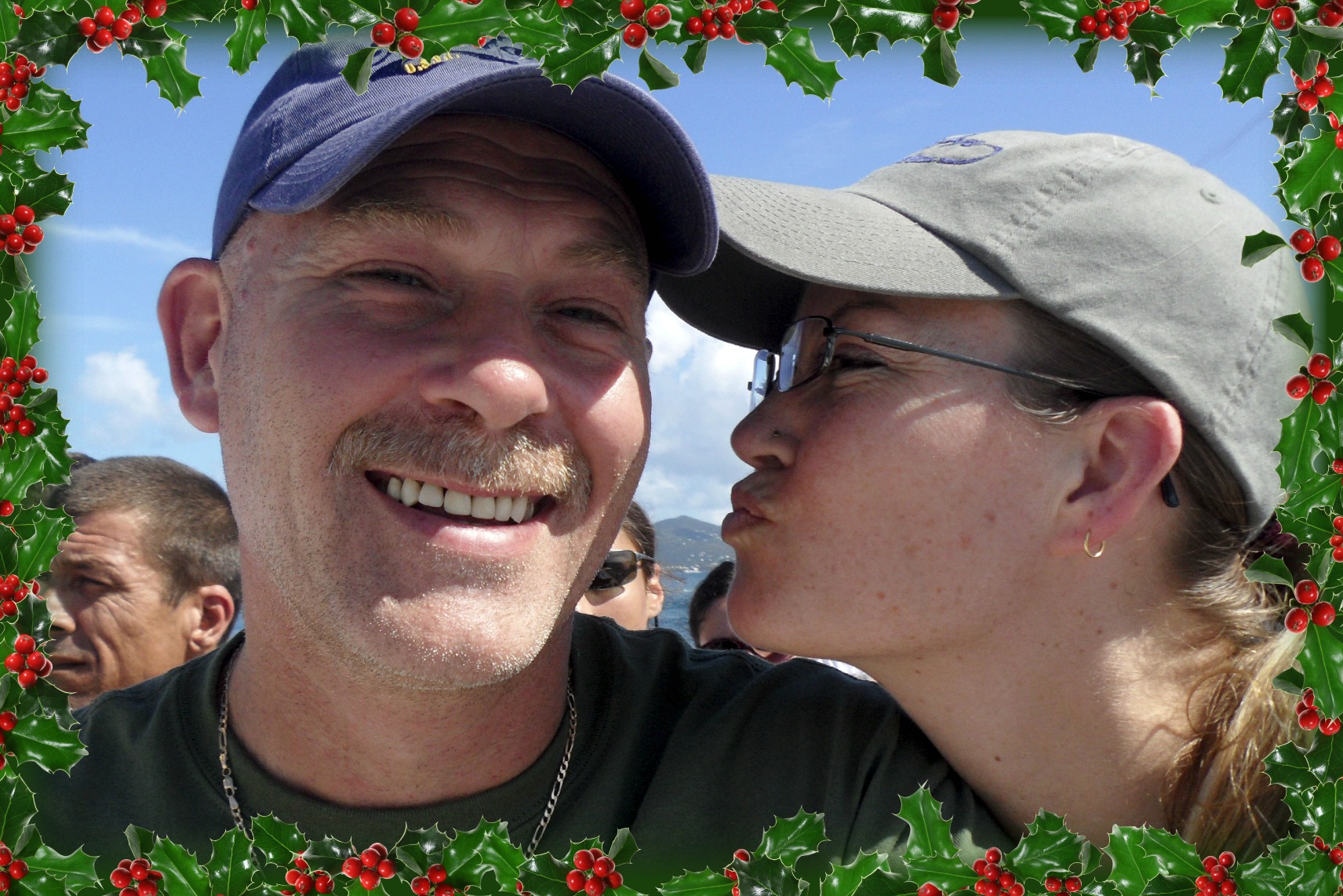
However, last year was a bit more exciting because Peg and I had a big secret plan between us. On Boxing Day we hopped on a plane and flew to the Caribbean. One long haul, three airports, three islands and one ferry later we arrived on St. John in the US Virgin Islands, where we eloped on the beach on December 28th. The photo above was taken of us on the ferry ride over to the courthouse in Charlotte Amalie to pick up our marriage license the day before. This year, of course, we’ll have our first anniversary!

How do you feel when the holidays are over?
It’s a bit anti-climactic. I start the new year with a long flight back to Brazil, which is a country we love living in, but it means back to work for a while. When my job is done there, we’ll have more time to travel when we please. In the meantime, we’ll enjoy as much of Brazil as we can. We both love to travel and look forward to the day when we can just keep going.

On the first day of Christmas, my true love said to me:
THREE DECENT WHISKIES,
TWO CANDY BOXES,
& AN IRISHMAN IN A PALM TREE!

STAY TUNED for tomorrow’s featured nomad (4/12) in our 12 Nomads of Christmas series.

If you enjoyed this post, we invite you to register for The Displaced Dispatch, a round up of weekly posts from The Displaced Nation, with seasonal recipes, book giveaways and other extras. Register for The Displaced Dispatch by clicking here!

Related posts:

RANDOM NOMAD: Aaron Ausland, NGO Research Director & Development Practitioner

Born in: Eugene, Oregon (but raised in Plains, Montana, a town of 1,200)
Passport: USA*
Countries, states, cities lived in: Washington (Yakima, Tacoma, Spokane): 1989-95; Alaska (Anchorage): 1995-97; Bolivia (Bañado de la Cruz & Santa Cruz): 1997; 1998 – 2002; Washington (Seattle): 2002-03; Massachusetts (Cambridge): 2003-05; Guatemala (Guatemala City): 2004; California (Duarte): 2006-10; Colombia (Bogotá): 2010 – present.
Cyberspace coordinates: Staying for Tea | Good Principles and Practice of Community-based International Development (blog); @AaronAusland (Twitter handle); Aaron Ausland at Huffington Post (column)
*My passport is only three years old, but multiple entries to about 40 countries filled it right up and I’ve had to add more pages. By the end of this year, I will have slept somewhere other than home about 190 of the 365 nights.

What made you leave your homeland in the first place?
My late first wife and I wanted to make a difference in the world and were particularly passionate about issues of justice, peace, and poverty. After graduating from university, we decided that maybe the best place to match our greatest gifts with the world’s greatest needs was in the public policy arena. We thought it would be good to represent a view on behalf of the marginalized — those uninvited to the table where policy decisions are made that nevertheless affect their lives in profound ways. In particular, we were thinking of illiterate poor persons living in underdeveloped countries ruled by bad or incompetent leaders and subjected to all the crap that comes with weak institutions of governance.

But we realized it would be pretty lame to run off to graduate school straight out of undergrad and then find some job in a policy think tank or as a Congressional aide in the hopes of working our way up to having a place at the table with a mind to represent these unrepresented views when we really hadn’t a clue what they were.

So we made a three-year commitment with the Mennonite Central Committee to go live and serve in a Bolivian village with people who fit this description.

We were young, hopeful, idealistic, earnest, and naïve. I can say that I’m not so young anymore.

Is anyone else in your family a “displaced” person?
I have a brother who served in Iraq for a couple of years, but he now lives about a hundred meters from our dad’s house in Yakima, Washington. I’m really the only one in my family who has chosen a lifestyle for which the question “Where are you from?” generates a confusing jumble of explanation rather than a simple city-state combo. 

Unless you count my son, Thiago. He’s six and is definitely more “displaced” than me. He literally speaks of living in two different “worlds.” In one “world” he speaks Spanish, has a home and school in Colombia, where his sister was born, and has family in Bolivia (his mother is Bolivian). In the other world” — where he says he is really from — he speaks English and has friends in California and a large family on my side including a whole set from my late first wife. Yesterday he told his mother: “My brain is confused, I don’t know where I should live. All my friends are in California, but my cousins are in Bolivia, and I go to school in Colombia and have friends there, too.” Poor little nomad.

Describe the moment when you felt most displaced.
For me the question was “How the hell did a small town boy from Montana end up here?” Physically, at that moment, “here” was a stainless steel operating table in a dark and empty hospital room in Santa Cruz, Bolivia. But more profoundly, “here” was a situation so far from my expectations, I was literally struggling to connect the dots and figure out how I had gotten myself there. I was 25 years old. Somewhere in a ravine a hundred miles away lay the broken body of my wife. A few hours earlier, the public bus in which we were riding had missed a turn on the narrow, winding road that passes through the Andean foothills and tumbled 1,000 feet into the dark.

She and I had gone to Bolivia with a long-term vision of our lives together, and now I was here, in a foreign land, alone, the slate of the future wiped clean. It was so profoundly disorientating, I just kept coming back to the question: “How did I get here?” Maybe it was a way to push off the searing emotional pain that would come with facing into my new reality, but the question wouldn’t go away. What sequence of events and decisions led me here? Did I make a mistake?

I remembered scenes from my idyllic boyhood in small-town Montana when my whole world was contained in a 100- mile radius and a handful of friends and family members. How had the world gotten so big, so uncertain, so complicated? And what was I doing wandering around in it like a lost child? How had I gotten here?

Much later, I would decide that I hadn’t made any mistakes. My first wife and I had made decisions based on a set of values that we held in earnest and I continue to hold. The fact that those decisions led to tragedy does not diminish the certainty of those values — it just means that those who hold them are not exempt from catastrophic loss that come to all who live.

I know you were probably hoping for a funny anecdote about crazy food or wacky cultural misunderstanding, but this is my one true displacement story.

Describe the moment when you felt least displaced.
Nowadays, I feel a sort of indifference about the whole location thing, to be honest. Whether I’m living in Cambridge attending the Kennedy School of Government, or setting up a new home in Colombia, or sitting where I am at this moment at an outdoor bar in a hotel in Bamako, Mali, I feel neither particularly at home nor particularly displaced. Feeling at home has a lot less to do with place than it used to, and it’s often unpredictable. I can feel more at home in Albania when I have a good macchiato and an Internet connection to video Skype with my children than I might in a hotel in Atlanta after a missed flight, with a dead computer battery. I can feel more at home when I’m sharing a beer with a fellow expat I’ve just met in rural Cambodia than I might sharing a beer with an old friend I grew up with who never left Montana.

I’ve experienced profound moments in my adopted homelands — from becoming a widower, to getting married, to rejoicing at the birth of my daughter, to undergoing major medical treatment. In each of these, it was the people who surrounded me that made me feel at home, and the uniqueness of the event that made me feel displaced. The location or culture has ceased to hold much power over my perception of self at particular moments.

You may bring one curiosity you’ve collected from each of your adopted countries into the Displaced Nation. What’s in your suitcase?
I’ll bring my wife from Bolivia, my son from the USA, and my daughter from Colombia. They are certainly a curious bunch, but I can’t live without them.

You’re invited to prepare one meal based on your travels for other Displaced Nation members. What’s on the menu?
Well, the cuisines of places like India, Thailand, Ethiopia, and Mexico are always worth sharing. The rich complexities that have come from centuries of experimentation with combinations of local flavors as well as some exotic additions from old trade routes are heritage gifts to the world. But, I’m sure someone will bring a few dishes from these parts into the Displaced Nation, so maybe I’ll bring some less likely ones such as the rich Malian sauce made in part from the boiled fruit of the baobab tree; the surprisingly filling chicken hearts strung on a kabob, flavored with soy sauce and charcoal smoke, sold on the streets of Bolivia; or maybe a lesser known dish from Mexico — the corn smut omelet made with cuitlacoche, a purplish fungus that grows on corn; or maybe I’ll just bring the beer…

You may add one word or expression from the countries you’ve lived in to The Displaced Nation argot. What will you loan us?
I think I’ll pass on this one. Pole sana (so sorry!) as we say in Swahili. Actually, maybe that’s a good one. Pole (pronounced POH-lay) doesn’t have an exact English equivalent — it’s used to say you empathize and understand someone’s problems, without the connotation of inferiority that “I pity you” might have.

This month we are looking into “philanthropic displacement” — when people travel or become expats on behalf of helping others less fortunate than themselves. Do you have a role model you look up to when engaged in this kind of travel — whose words of advice you cherish?
I’ve never really had a specific role model for philanthropic displacement. That said, I’ve always been impressed with people who make long-term commitments to live among the people they wish to serve and voluntarily forego access to comforts and safety they might otherwise enjoy.

There are some famous examples like Mother Theresa, but the ones that have had the biggest personal impact on me are unknowns — volunteers and professionals I’ve met and worked with along the way. Such people taught me how to live with a kitchen stocked with just 12 items — that’s counting the spices. They taught me how to bring my water up from the river in the morning and hang it in a tree from a bucket painted black so that the sun would heat the water throughout the day, in preparation for a warm evening bucket shower. I learned how to capture rain water, how to build dry latrines, how to trust local medicinal practices, how to enjoy silence, how to walk the equivalent of a marathon a day to visit local families, how to sit and unhurriedly share tea over conversations that circle around rather than cut to the chase, how to embrace simplicity as a virtue… I also forgot how to complain and remembered to be grateful in the midst of scarcity.

Most of my role models didn’t do anything spectacular — they didn’t invent microfinance or the treadle pump, they didn’t negotiate peace accords or write a best seller. But the way they displaced themselves so thoroughly, the way they embraced their local communities with such authenticity — this had a big impact on how the communities valued their presence and their contribution, and on me.

Voluntourism is said to be the fastest growing segment of the travel industry (itself one of the world’s fastest growing industries). Do you think this kind of travel can help the uninitiated understand the problems our planet is facing?
No, not really. It’s not that I think voluntourism is unequivocally a bad thing, but I just don’t think you can expect people to gain a very accurate understanding of complex problems under such circumstances. In fact, I think it’s more likely to leave them with a distorted understanding. There is a saying I picked up somewhere that goes something like this:

Travel to a new place for three weeks and you can write a book, travel for three months and you can write an article, travel for three years and you’ll likely have nothing to say.

There’s just something about a short and intense exposure that seems to set very strong ideas into the minds of those who’ve experienced it. But their ideas are biased by the specificity, narrowness, and brevity of that experience.

For example, someone who has had a high-impact experience volunteering in an orphanage for a week may feel they know more about the issue than people who haven’t had that experience. In fact, they may actually know less due to the biases they have picked up. It’s like believing you know something about the average person in a country from a single observation.

Sometimes, people know just enough to be dangerous; they mistake their shallow knowledge for an actual understanding of some enormously complex problem, and they act on it in ways that are ultimately irresponsible.

The truth is, the problems facing our planet are complex and we should all be grateful for the specialists who have dedicated their lives to understanding and addressing them. Doing something serious about addressing these problems will require professionals, not hobbyists; lifers, not tourists.

Again, it’s not necessarily a bad thing to pass through as a tourist, but with regards to your question here, we need to guard against self-deception. I’ve taken a few tours of a number of hydro-electric projects across the Western USA. I think they are really interesting. But, I know better than to believe I know the first thing about harnessing the power of water to generate electricity while balancing the ecological, economic, legal, social and political interests of farmers, consumers, industry, and the environment.

Likewise, you can’t take a two-day tour of an urban slum in Kenya and think you understand poverty, urban migration, economic development, or whatever other angle one might give such a tour.

For a broader scope of my thoughts on voluntourism, I encourage you to see my blog posts:

Readers — yay or nay for letting Aaron Ausland into The Displaced Nation? Tell us your reasons. (Note: It’s fine to vote “nay” as long as you couch your reasoning in terms we all — including Aaron — find amusing.)

img: Aaron Ausland in Mexico City (he’s the suit!). While on a lunch break from her work conducting a month-long operations audit of an NGO office, Aaron happened upon a lucha libre wrestling match putting on an outdoor show, and decided it would be amusing to pose with the star luchadore.

STAY TUNED for tomorrow’s installment from our displaced fictional heroine, Libby, when we get to find out whether she’s recovered from eating her mother-in-law’s undercooked Thanksgiving turkey. (Not keeping up with Libby? Read the first three episodes of her expat adventures.)

If you enjoyed this post, we invite you to register for The Displaced Dispatch, a round up of weekly posts from The Displaced Nation, with seasonal recipes, book giveaways and other extras. Register for The Displaced Dispatch by clicking here!

Related posts:

My grandfather tried saving the world long before it became trendy — with mixed results

Our Third Culture Kid columnist, Charlotte Day, upon reading this month’s posts about those who displace themselves on behalf of those less fortunate, felt moved to contact her grandfather in Sydney, Australia, for a chat about his own experiences with international aid work, which began in the 1950s.

These days, it is a rare teenager who has not shown some evidence of civic engagement by a certain age: spending their summers beneath foreign suns in search of that fabled sensation, that fulfillment born of “helping others.”

Of course, no altruistic act is truly pure, but I would argue that it is better than nothing.

Nothing, however, is the word that best qualifies my own civic engagement. I have reached the age of 17 tacitly scorning the moral and spiritual quests of British gap-year students, as well as American Ivy-League hopefuls, from my comfortable desk chair.

I read Dostoevsky’s portraits of tormented youths, striving in vain and misguidedly to effect a change in society…and decide that changing the world is futile.

Yet a chastening thought sometimes breaks through this complacency: there are many who do valuable work. There are many who displace themselves — not only from their comfortable desk chairs, but from comfortable world-views and notions — to serve others, outside the framework of self.

My grandfather’s first foray into global philanthropy

One such person is my maternal grandfather, Robert Ayre-Smith. He entered the field of international aid before the idea of a “third world” even existed. As he informed me in our recent email exchange:

In the middle of the last century, there were the tropics, the Empire, the Americas, the colonies, etc. But they were not rated economically as is now the case.

Paradoxically, he chose animals over humans when he initially diverged from the family profession, medicine, and entered London’s Royal Veterinary College. His first appointment as a livestock specialist came in 1952, shortly after his marriage to my grandmother, Carol. The newlyweds set off for Kenya’s Rift Valley, where Robert set up a research station by Lake Naivasha, working with cattle, sheep and pigs. As motivation, he cites scientific interests in “tropical animal production” — a topic he’d investigated while doing graduate work at Louisiana State University.

As is often true of those who move from the halls of academe to real-life applications, Robert soon found that what he calls his “enthusiasm for science itself, and then for the benefits bestowed by scientific advances,” matured into “some feeling of disillusionment.” His focus shifted away from books to people — and looking at what small-scale farmers in Kenya’s villages were realistically capable of accomplishing.

But while he found fulfillment in these human interactions, he remained bothered by the tension between his “lofty agricultural scientist’s perspective” and the perspective taken by the farmers whose cares he was attempting to alleviate.

Some thirty years later, an “Aha!” moment

Fast forward to 1989, by which time my grandfather was working in Indonesia. During a roadside breakdown, Robert experienced an epiphany. Watching a nearby farmstead owner and his family tending their crops and livestock, he “started to question the appropriateness of much [then] current agricultural research for increasing crop and livestock productivity.”

His own knowledge, “derived from vastly different circumstances,” seemed markedly out of place. Until then, he’d been seeing agricultural development in the Third World through the lens of First World research, where commercial farms are relatively large-scale operations, and where farmers are literate and can therefore study results and adopt them to increase their productivity.

Yet most Third World farmers are fighting an altogether different battle. Their farms are small in scale, with “only two acres for the house, food crops and animals and virtually no machinery except hoe and sickle.”

From that time on, my grandfather thought it would be unreasonable — and betrayed a lack of empathy on the part of the professed do-gooder — to expect farmers in Indonesia and other developing countries to make changes according to developed-world research. He became a founding member of the Asian Farming Systems Association in 1991, which aimed to “undertake research of relevance to the farmer that it was hoped to benefit.”

As he concludes in his message to me:

So you see, Charlotte, it took time to mature my thoughts and approaches — a lot of time.

The world as one’s oyster — whatever that means

This being the Displaced Nation, I felt obliged to ask to what extent my grandfather ever felt himself displaced in the course of his work. “NEVER!” came his emphatic reply. He traces the desire to live and work abroad to his mother, “a great traveler in body and soul.”

Born and raised in India “at the height of the Raj,” my great-grandmother was educated in England and Switzerland before traveling widely in the United States and then working in France as a Voluntary Aid Detachment nurse during World War I.

Even after marrying, she continued to travel the Continent.

As Robert puts it: “I believe I may have learned from her that the world was my oyster — whatever that means. Certainly I have never had fear of the world.”

The only environment in which he recalls being ill at ease was Bogotá, Colombia, in 1980, where he was conscious of an underlying malaise about a possible recurrence of La Violencia, the nation’s horrifying period of civil conflict that had taken place from 1948 to 1958. He remembers being “hoicked out of a bus” between the Amazonian Basin and Bogotá by “some roadside gang — or was it the police?” It did not help matters that he found himself “doing an impossible job that no one really wanted [him] to do.”

Even in the presence of immense danger, my grandfather appears to have taken things in his stride. Here’s how he described being in Baghdad in late 1956, when the city revolted as a result of the British and French invasion of Egypt during the Suez Crisis:

I remember no fear although there was one moment when I was in the street of gold and silver smiths when a big and noisy mob rushed down a street parallel to it and all the merchants pulled down their corrugated metal shutters. Machine gun fire ensued.

A plethora of lessons learned

When I asked what he considered the most effective form of international aid, my grandfather’s immediate answer was “the health and welfare of under-privileged people, maybe I should say village people.” Yet this, he added, is not a form of aid, it’s an aim of aid. He went on: “Moreover, it sounds very pompous — as there are plenty of under-privileged people in all parts of the world, not just in villages.”

On the matter of food aid, Robert had this to say:

I could make a good case against food aid, and against some of the inappropriate advice that I gave in the past to small and large landholders. But what I can say with some confidence is that people in the front line of providing development aid must have empathy with those towards whom the aid is directed.

Empathy formed the heart of his approach — coupled with a saying of his father’s, borrowed from Hamlet (Act I, Scene iii):

To thine own self be true, and it must follow, as the night the day, thou canst not thence be false to any man.

Robert and Carol now live in Sydney, Australia — the last in a long series of displacements. Though he contentedly remembers his work in developing countries, and those with whom he worked, Robert prefers to focus on the present. Yet from time to time, he allows those close to him glimpses of the past — cuttings from the swathes of his memory.

His experiences have persuaded me that it does not pay to be defeatist about “changing the world” — and that the world, even amid current extremes of xenophobic paranoia, is nothing to be afraid of.

Readers, questions for Charlotte — or responses to her grandfather’s insights?

STAY TUNED for tomorrow’s post by the Displaced Nation’s agony aunt, Mary-Sue Wallace.

If you enjoyed this post, we invite you to subscribe to The Displaced Dispatch, a weekly round up of posts from The Displaced Nation, plus some extras such as seasonal recipes and occasional book giveaways. Sign up for The Displaced Dispatch by clicking here!

Related posts:

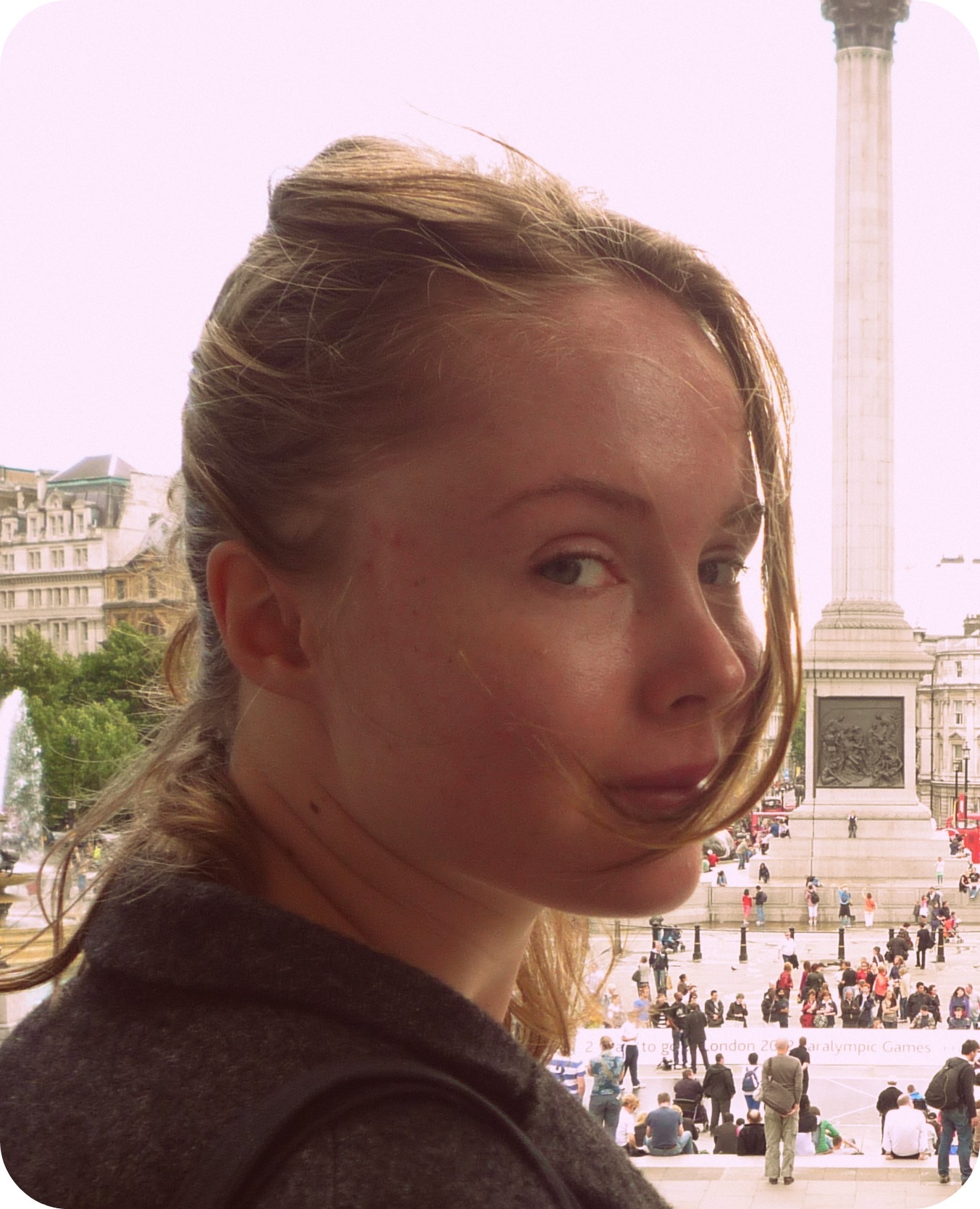
img: Charlotte Day surveying Trafalgar Square in London

RANDOM NOMAD: Adria Schmidt, Career Consultant at Violence Intervention Program & Former Peace Corps Volunteer

Born in: Phoenixville, Pennsylvania USA
Passport: USA
Countries, states, cities lived in: Pennsylvania (Collegeville & Landenberg): 1985-87 & 1996 – 2004; Ohio (Cincinnati): 1987-96; Massachusetts (Boston): 2004-06, 2008-09; Argentina (Buenos Aires): 2007-08; Dominican Republic (Cambita Garabitos, San Cristóbal province): 2009-11; New York (New York): June 2011 – present.

What made you leave your homeland in the first place?
I guess you can say I left my homeland in search of a home. I never felt very “at home” as a teenager in Pennsylvania, so when the opportunity came to travel to Spain on a class trip I went eagerly. On this short trip I found that I felt more comfortable with some parts of the Spanish culture than with my own. The seed of wanderlust was planted.

When I went to school in Boston at Northeastern University, I decided to study the Spanish language, partly because of my interest in the language and the culture of Ibero-America, and partly because of my wish to study abroad.

Under Northeastern’s “Dialogue of Civilizations” program, I worked in Puebla, Mexico in a women’s prison, as well as in a small indigenous village in the mountains of Cuetzalan, where the people spoke only Nahuati. Both were amazing experiences.

And under Northeastern’s study abroad program, I lived in Argentina for nearly a year — during which I decided I wanted to help impoverished people in developing countries so would try joining the Peace Corps. Two years and one Master’s degree later, I was finally accepted and sent off to the Dominican Republic.

So did I ever find that “home” I was looking for? To be honest, my travels have only nurtured that original seed of restlessness. The more I travel the more I discover about myself and others — and the more I realize how much I still have to learn. For now, at least, home is wherever I want it to be.

Is anyone else in your family a “displaced” person?
As far as my immediate family goes, no one is or has ever been “displaced” — although I do like to think that my travels have inspired family members to explore other countries. My father was always one of those people who felt it would never be necessary to leave the United States as he had everything he wanted or needed right here. But when I went to Argentina, my parents decided to visit, and my dad absolutely fell in love with the country. To this day, he tells people that Argentina has the best pastries in the world. Now when I tell my parents I’m going overseas, they no longer respond by saying: “Why do you want to go there?” Instead it’s “When can we visit?”

Describe the moment when you felt most displaced.
One night in Cambita my host sister’s husband brought me a guayaba (guava). He was really excited for me to try one for the first time, and I didn’t have the heart to tell him I had eaten this fruit before in Mexico. After I ate it I started to feel nauseous and dizzy. Soon my lips began to swell and my whole face was itchy. I was having an allergic reaction to a chemical (a fertilizer or pesticide) that had been used on the fruit. I called the Peace Corps doctor, who told me to take two Benadryl and then a shower to wash the chemicals off.

When I got to the shower — an outdoor zinc and cement block latrine with a drain in the middle — I hung my towel on the cement blocks and poured cold water from a bucket over my head. It was already dark and I couldn’t see anything.

As soon as I finished, I wrapped the towel around myself and as I was heading back to the house, I felt a small sting on my stomach, then another one on my back, and another one on my chest. Soon my whole body was burning with these sharp little stings. Inside my towel was a colony of fire ants! I ran to my room, only to find it occupied. My host parents, Doña Romita and Don Rafael, were busy adjusting a new table the latter had constructed from an old cabinet. All I wanted to do was rip off my towel, but I could not get naked in front of my 70-year-old hosts!

By that time, the ants were all over my body. I was jumping up and down, shaking my towel and yelling for them to get out of the room. In all the commotion the oil lamp was knocked over and shattered on the floor. Doña Romita refused to let me in the room with the glass on the floor. Still unsure of what was wrong with me, she rushed me to her room. I quickly closed the door and whipped the towel off, slapping the ants off my body.

Just when I thought the nightmare was over I looked up and realized the shades were wide open and everyone outside the house had seen me naked and jumping around. At that moment, Doña Romita knocked on the door to tell me that my project partner and his wife were there to see me.

Describe the moment when you felt least displaced.
After being in the Dominican Republic for more than a year, I came back to the States to visit my friends and family. One night, while out with some friends all the girls couldn’t stop talking about their weight. They were commenting about how beautiful one of our friends was because they had never seen her so skinny before. All I could think of was how sickly she looked and how much I wanted to feed her. I couldn’t understand why being skinny was considered better while in the Dominican Republic being called “fat” or (my favorite) “fatty” was a compliment. My view of what was healthy and beautiful had been altered from my time in the Peace Corps.

You may bring one curiosity you’ve collected from each of your adopted countries into the Displaced Nation. What’s in your suitcase?
From Argentina: All the ingredients and utensils for brewing maté, a drink made from the leaves of the yerba maté plant, containing caffeine and related compounds. (This is sadly ironic since I accidentally left behind my maté in my apartment in Buenos Aires.) The yerba is packed into a hallowed-out gourd, which is then filled with boiling water. You drink the mixture directly from the gourd using a metallic straw with a filter at the bottom, called a bombilla. Some people walk around with a thermos of hot water and the gourd to drink maté whenever they have the urge. It has a very strong, bitter taste, but you can add liquid sugar.

From the Dominican Republic: Some large jugs of the tree bark, sticks and herbs that can be used for making the classic Dominican drink mamajuana. I assume the Displaced Nation has honey and rum we can add to it? After filling with rum and honey, you let the jug sit for a few days. You can also add cinnamon sticks soaked in red wine and honey, or raw squid and seafood soaked in rum. Men use the seafood mamajuana to boost their virility. Regular mamajuana supposedly cleans the blood, provides a tonic for liver and kidneys, relieves menstruation pains, and cures many other ailments (depending on who you talk to).

You’re invited to prepare one meal based on your travels for other Displaced Nation members. What’s on the menu?
I would make the meal I ate the most of in the Dominican Republic: rice, beans, plantains, and overcooked spaghetti with carnation milk, canned tomatoes, and corn. It’s the perfect carb overload — are any of you marathon runners?

You may add one word or expression from the countries you’ve lived in to The Displaced Nation argot. What will you loan us?
From Argentina: Che, boludo. Che is similar to the American word “dude.” I love che because it means that whenever I’m talking to someone and can’t remember their name, I can just call them che. Boludo technically means “jerk” (or worse), but it can also be used in an endearing way. My Argentinian friends and I always used to greet each other with a “Che, boludo!”
From the Dominican Republic: Vaina — though it technically means the pod around pigeon peas (gandules), everyone uses it to mean a thing or object. If I ever got stuck and couldn’t think of the Spanish word for something, I would just call it vaina while pointing to the object with my lips. It’s a great word for anyone learning Spanish.

This month we are looking into “philanthropic displacement” — when people travel or become expats on behalf of helping others less fortunate than themselves. Do you have a role model you look up to when engaged in this kind of travel — whose words of advice you cherish?
Strangely, I have never had a role model for this kind of travel. I was always drawn to it — but for some reason never felt the need to seek out others who had done it before me. My family were against my joining the Peace Corps because of fears for my health and safety. A psychic I met at a Renaissance fair right before leaving for Argentina told me I was going to do the Peace Corps. I don’t really believe in psychics but everything she told me that day has come true. So perhaps it was simply a matter of fate?

Voluntourism is said to be the fastest growing segment of the travel industry (itself one of the world’s fastest growing industries). Do you think this kind of travel can help the uninitiated understand the problems our planet is facing?
Voluntourism is a tricky subject for me personally. On one hand I feel that it is ridiculous to pay someone’s plane ticket, lodging, food, and transportation at a more luxurious level than any host country national has ever experienced to have them “volunteer” and do a job that a local person would probably be more than willing and capable of doing had all that money been spent on their salary. On the other hand, I do realize the value of cross-cultural communications for both parties and that, on the occasions when it’s done correctly, the volunteer might actually be able to transfer a valuable skill to the host country nationals. In short, it all depends on how the voluntourism is being executed.

While in the Dominican Republic, I observed many volunteers who were asked to do jobs that could have been, and in some cases even were once done by Dominicans. It wasn’t that the local population didn’t have the knowledge or training to do some of these jobs; it was that they didn’t have the money to pay a salaried person and wanted a “free” volunteer instead.

Luckily, most Peace Corps volunteers were successfully trained to avoid taking jobs away from Dominicans, and instead focus on areas where they and their community felt the need was greatest.

Readers — yay or nay for letting Adria Schmidt into The Displaced Nation? Tell us your reasons. (Note: It’s fine to vote “nay” as long as you couch your reasoning in terms we all — including Adria — find amusing.)

img: Hair washing ritual in Constanza, a mountainous area of the Dominican Republic, in spring of this year. Adria Schmidt is the one getting her hair washed — the one doing the washing is Rebecca, a fellow Peace Corps volunteer, and they are in the home of another Peace Corps volunteer, Malia (not pictured). Due to the primitive plumbing conditions, hair washing has to be done in the kitchen, by heating water up on the stove.

STAY TUNED for tomorrow’s installment from our displaced fictional heroine, Libby, who finds herself celebrating her first Thanksgiving under less-than-ideal circumstances. (What, not keeping up with Libby? Read the first three episodes of her expat adventures.)

If you enjoyed this post, we invite you to register for The Displaced Dispatch, a round up of weekly posts from The Displaced Nation, with seasonal recipes, book giveaways and other extras. Register for The Displaced Dispatch by clicking here!

Related posts:
Look at little me on my gap year! I’m so superior to other kinds of tourists!

We welcome back Lawrence Hunt to the Displaced Nation, who wrote a popular post for us in September about what it’s like to grow up in England with a mum who is an expat American. Today, in keeping with our theme of global philanthropy, he offers some thoughts on why the UK’s educated youth seems so preoccupied with the authentic, meaningful travel experience.

It’s hard to pinpoint when and how it started, but more and more UK students feel compelled to spend at least part of their gap years between secondary school and university doing their bit to save the world.

The wealthiest students were the first to pioneer this trend. Many of you may be familiar with Prince William’s gap year in Southern Chile with Raleigh International, an organization started by his father, to help build schools and teach English; and Prince Harry’s gap year in Lesotho to further his mother’s work with AIDS orphans.

But have you watched “Gap Yah,” a comedy video that’s been dominating the British corner of YouTube?

“Tarquin, yes, I can’t come shopping on the King’s Road today, because, yes, I’m literally in Burma.” A traveling student is on the phone to a friend back home, droning on about being subject to various experiences of “spiritual, cultural and political” significance, such as meeting a malaria-suffering woman with flies around her eyes, and then having “chundered [vomited] everywhere” due to excessive partying the night before.

The notion of a Hooray Henry returning home with stories of his interactions with noble, primitive cultures has really struck a chord with university students. As one exasperated YouTube user from Manchester University comments under the video: “I know so many people like this! Worst kind of person.”

The offense is made infinitely worse by the fact these kids have been so brazenly insulated from the realities of these places by wads of their parents’ money all the way through.

I love animals. I love kids. I want to save the world.

I’m one to talk. I did a gap year in China before going off to Warwick University in 2008. I chose China as I wanted to learn Chinese and see what it’s like to live under a post-communism communist regime. I took on a job as a teacher in a city called Wuhu in Anhui Province, and spent the next five months struggling to make myself understood above the noise of 60-plus unruly teenagers.

And yes, my friends who saw the “gap yah” video said it reminded them of me! (But I worked to pay for my trip, damn it!)

Did I help the kids? Maybe a little. Did I have fun? For sure. But I also came back with the realization that not much can be accomplished in just a few months by people who don’t speak the language and have little cultural training.

Judith Brodie, the director of Voluntary Service Overseas, one of Britain’s leading charities, concurs. Voluntourism has become big business in the UK, with the average student paying out close to $10,000 for the opportunity to teach street children, rescue sea turtles, dig wells and the like. Brodie cautions that many of these projects have been designed to satisfy the demands of students rather than the needs of locals. As she told the Guardian:

“Young people want to make a difference, but they would be better off traveling and experiencing different cultures, rather than wasting time on projects that have no impact and can leave a big hole in their wallet.”

The desire for authenticity — whatever that means

Going hand in hand with this compulsion for doing good — as long as you can cram it into a half-year stint, preferably funded by your parents — is the desire to prove to others that you won’t settle for anything less than an “authentic” cultural experience.

During my own gap year, I spent some time walking around Beijing with a friend of mine, Josh, who was obsessed with the idea of “authenticity” — the acid test for which was the absence of any sort of commercial element aimed specifically at tourists.

Josh would thoroughly inspect any restaurant we went to before deciding whether it was “touristy” or the “real China.” It almost got to the point where if there was a suspect old Chinese man hunched up in the corner looking as though he needed serious medical attention, Josh would yelp excitedly and sit down, commenting on how he could taste the poverty in the noodle soup.

One particularly vivid memory from the experience was walking through the hutongs, the ancient lanes that revolve around the Forbidden City in a maze of houses and courtyards. They are a popular tourist attraction, and though they house half the city’s population of 18 million, many of them are being demolished to make room for more modern buildings.

Josh, at the behest of his trusty guidebook, was insistent that we take the chance to see them before they were modernized beyond recognition. While we walked, we were followed by an angry rickshaw driver who wanted to take us on a tour. We refused to pay for his services — not because the price he was asking was too high but because to accept his offer would be tantamount to admitting that we’d settle for a staged and commercial version of the “hutong experience.” And that would undermine our whole reason for being there.

Just a little too late, I realized the gross insensitivity of what we were doing. We were walking through people’s back gardens and peering over their fences on the pretext of digging beneath the veneer of their culture. Ultimately, however, what we were getting was exotic, and cheap, entertainment. And if that was the case, we might as well have allowed the locals to set the terms of their own commodification.

Unintended consequences

If I had any sort of epiphany myself from traveling, it was this: the search for the “authentic” experience outside of Western boundaries is itself the reason for these cultures’ destruction.

The way I see it, it happens in three phases:

  1. Travelers arrive at an undeveloped exotic location.
  2. They report on the experience as having been so “authentic” that other people follow them.
  3. Soon enough the locals catch on to this, and offer their services in delivering what people want — mountain treks, temple tours, and so on until eventually, it becomes an overly commercialized “tourist spot” and the landscape becomes dominated by souvenirs, maps, and information points.

And just about then, the original travelers, exasperated with all those damn tourists, leave in search of more fertile ground and the cycle repeats itself.

For years in this way, the counter-cultural traveler has served as the main shock trooper of mass tourism.

While there is nothing wrong with spreading a little Western wealth through tourism to places that need it — although admittedly the process of development does have its drawbacks — the idea that anti-materialist tourists are superior to the other kinds — well, that’s just pretentious, isn’t it?

Readers, any responses to Lawrence Hunt’s thoughts on gap years, voluntourism and the quest for the “authentic” travel experience?

STAY TUNED for Tuesday’s post, providing a humorous slant on the aid work profession.

If you enjoyed this post, we invite you to subscribe to The Displaced Dispatch, a weekly round up of posts from The Displaced Nation, plus seasonal recipes, book giveaways and other extras. Sign up for The Displaced Dispatch by clicking here!

Related posts:

Img: Lawrence Hunt playing the tourist in Beijing’s Forbidden City during his gap year (August 2008).

RANDOM NOMAD: Camden Luxford, Hostel Owner, Freelance Writer/Blogger & Student

Born in: Mackay, Queensland, Australia
Passport: Australia
Countries lived in: United Kingdom (Brighton, Oxford, Edinburgh, and a country hotel near Crickhowell, Powys, Mid Wales): 2005-06; Peru (Cusco): 2009-present.
Cyberspace coordinates: The Brink of Something Else (blog)

What made you leave your homeland in the first place?
I left, at 20, because I’d always had an itch. As a kid, I’d poured over National Geographics and Lonely Planets, plotting these exotic routes across strange lands. I think I imagined myself some kind of Lara Croft-type figure. Then I grew up and didn’t really know what I wanted to do with the rest of my life, so I boringly did what thousands of Australian 20-somethings do every year — took off to the UK for a couple of years.

Is anyone else in your immediate family displaced?
Dad’s displaced — in a jet-setting, corporate type of way. He always traveled a lot for work when I was young, domestically and internationally, and now he’s semi-retired and living most of the year in Italy. It’s handy, ‘cos now I have a great place to stay close to really good pizza and wine.

Describe the moment when you felt most displaced.
Waiting at the police station to report an alcoholic Latino ex for threatening to kill me, and having the cops not really care. I just thought in that moment, what I wouldn’t do to be back home, away from this machismo, in a place were I instinctively understand how men and women relate to each other.

Describe the moment when you felt least displaced.
Every Wednesday I get together with my closest friends here in Cusco for lunch. We cook, open a few bottles of wine, and laugh away all the week’s problems and dramas. It’s my Cusco family, and when we sit around the table, teasing each other mercilessly, I feel completely at home.

You may bring one curiosity you’ve collected from your adopted country into The Displaced Nation. What’s in your suitcase?
I tend not to hold on to things, just memories — and a hard drive full of photos. So I’ll describe a treasured photo from each country, instead.

From England: One of myself and my friends on the pebbly beach of Brighton. It’s a candid, and nobody’s posing, we’re just scattered about doing our thing. A couple of the boys are playing chess, a small group is talking, I’m reading a book, someone’s playing guitar. It’s a lovely slice of our lives that summer.

From Wales: Tintern Abbey caught just as the sun set. I was driving, turned a corner, and that sight took my breath away.

From Scotland: An entire album covering my 22nd birthday — from the moment my roommates woke me up with fairy bread and beer until about 4:00 a.m. the following morning. The deteriorating respectability is spectacularly documented.

From Peru: A Photoshopped-together photo of “Yamanyá,” the name of my hostel, spelled out in fire. We were camping by the Templo de la Luna (Moon Temple) outside of Cusco, and after half a bottle of rum I pulled out the camera and an Argentinian friend lit a stick on fire. It kept us entertained for more than an hour.

You’re invited to prepare one meal based on your travels for other Displaced Nation members. What’s on the menu?
Definitely a starter of ceviche: thin fish strips flash-marinated in lime with a touch of coriander, a load of chile, and a pile of fresh red onion, accompanied by a very cold Cusqueña beer. Served on the sand within spraying distance of the waves.

Then, in anticipation of my upcoming move to Buenos Aires, it’s a thick Argentinian steak cooked rare, with a glass of Malbec. Good meat is hard to come by in Cusco, and I miss it.

For dessert we’ll visit Dad in Italy: tiramisu, and then a strong espresso to finish the caffeine kick.

Then the Pisco gets opened, and it’s chilcanos all round: Pisco, ginger ale, a drop of Angostura bitters and a squeeze of lime.

You may add one word or expression from the country you’re living in to The Displaced Nation argot. What will you loan us?
From the UK: Minging has always stuck with me; I have no idea why. For the uninitiated it means disgusting, ugly, gross.
From Peru: Sí, no? — a delightfully Limeñan turn of phrase whose English translation (yes, no?) doesn’t make any sense at all.

It’s Zen and the Art of the Road Trip month at The Displaced Nation. Robert M. Pirsig, author of Zen and the Art of Motorcycle Maintenance, famously said: “Sometimes it’s a little better to travel than to arrive.” Do you agree?
I’ve always loved long, uncomfortable journeys, whether in car, train, bus, boat, or on foot — the process of being in transit, of movement, of change. I even have a sick fascination with long stopovers in airports: sleeping curled up on an uncomfortable bench, announcements blaring over the loudspeakers.

So for me, yes, the journey is a little better. Having been here, in Cusco, for almost two years, I’m growing uncomfortably restless. My mother argues that this is fear of commitment on an epic scale, but I like my life most — feel like I’m learning the most — when I’m on the move, and in the first blush of a new life in a new place.

I will point out in my own defense that I maintain my work and studies even while on the road. In a very stop-start sort of fashion, I’m finishing a Bachelor of Arts in International Studies and a Bachelor of Commerce in Economics from Deakin University in Melbourne, as part of their off-campus program. So I’m not completely irresponsible. (So there, Mum.)

Pirsig’s book details two types of personalities: 1) those who are interested mostly in gestalts so focus on being in the moment, not rational analysis; and 2) those who seek to know the details, understand the inner workings, and master the mechanics. Which type are you?
Despite a thoroughly scientific upbringing and education — Dad’s an engineer — and a very rational approach to my studies, when it comes to travel and expat life I’m all about the gestalts. I stayed in Cusco on little more than a whim, and recently returned from an ill-planned but exhilaratingly unpredictable road trip to Ecuador in a Volkswagen Kombi. Every moment of that road trip was a surprise — the cast of characters, a rotating mix of backpackers and South American musicians and circus performers. We followed the sun north, took a minor detour inland to teach a music and clowning workshop to the children in a poor community, and played music on the beach.

But although I laughed and made wonderful new friends and was constantly surrounded by music, this road trip, with its constant visits to mechanics, was also the reminder I needed of the importance of the rational type of personality. Road trips in general are a wonderful encapsulation of this duality, I think. Driving with the windows down on the highway with the music blaring, going where the wind takes you…but going there in a machine that needs care and understanding and maintenance. I’ve leaned too heavily to the romantic side, and it’s time to start taking better care of my machine.

Readers — yay or nay for letting Camden Luxford into The Displaced Nation? Tell us your reasons. (Note: It’s fine to vote “nay” as long as you couch your reasoning in terms we all — including Camden — find amusing.)

img: Camden Luxford on her recent road trip — in a tiny community about two hours form Pedernales in Ecuador, where she helped put on a juggling (among other things) workshop. She is posing with some of the kids and a teacher, along with members of the Colombian cumbia band she had as passengers for a couple of weeks. Yes, that’s the famous Kombi in the background!

STAY TUNED for tomorrow’s installment from our displaced fictional heroine, Libby, whose road-trip adventure of last week ended on a dramatic note. What, not keeping up with Libby? Read the first three episodes of her expat adventures.

If you enjoyed this post, we invite you to register for The Displaced Dispatch, a round up of weekly posts from The Displaced Nation. Includes seasonal recipes and book giveaways. Register for The Displaced Dispatch by clicking here!

Related posts: