The Displaced Nation

A home for international creatives

Tag Archives: Memoir | Travel | Food Writers

The Displaced Nation selects its top 5 chillingly atmospheric Halloween locations from literature & film

From greedy children holding up whole neighborhoods to blackmail as they seek a cheap fix for their addiction to stores selling cheap plastic masks and covering their aisles in fake cobwebs, I’ve always found Halloween to be tedious time of the year. Everything ends up looking more crappy than creepy. As the day lacks its own miserly Ebenezer Scrooge-figure I would be more than happy to fill the role.

Of course, that makes me a poor choice indeed to write a Halloween-themed post for The Displaced Nation, but we can all take solace in the knowledge that as I write this I have the lights in my living room turned off and I am ignoring the pleading of the legions of candy junkies knocking on my door asking for one last Hershey hit.

But enough whinging, Windram. Now for my picks for atmospheric locations that can send a chill down your spine:

1) Whitby, United Kingdom

Quite understandably Dracula is associated with Transylvania, but the Yorkshire coastal town of Whitby is also heavily featured in Bram Stoker’s novel as the site of Dracula’s shipwreck.

Stoker visited Whitby in 1890 and was struck by the atmospheric fishing town. It is easy to see why with the ruins of Whitby Abbey high atop the east cliff overlooking the town it is visually spectacular, which makes it a wonder why the Whitby portions of Stoker original novel have so often been ignored by filmmakers adapting Dracula. John Badham’s 1979 adaptation is one of the few movie Draculas to try and depict Whitby, though unfortunately even here the use of the Whitby storyline is disappointing as the Cornish coast in fact stood in for the Yorkshire coast. This adaptation also has Frank Langella as Count Dracula, so make of that what you will. It’s certainly not obvious casting, I’ll give them that.

2) Geneva, Switzerland

Sticking with a Gothic theme, let’s focus our attention on that other horror mainstay: Frankenstein, by Mary Shelley.

Frakenstein was inspired by Shelley’s stay in Geneva, and large parts of the novel are also set there. Of course, modern, clean, ever-so-slightly-dull Geneva is not the inspiration, but rather the Villa Diodati, a country house on the shores of Lake Geneva. It is here that famously the Shelleys, Byron, and Dr Polidori challenged each other to come up with a horror story. From this challenge Mary Shelley wrote Frankenstein.

For an appropriate bit of campy Halloween schlock, Ken Russell’s film Gothic (1986), which is about the events of that challenge, is well worth a watch.

Equally, Benjamin Markovits’ novel Imposture, about Dr Polidori and his writing of the short story “The Vampyre” during that same challenge, is recommended.

3) A field of susuki grass, Japan

This entry is something of a cheat. This is an entry about the 1964 Japanese film Onibaba (literally, “Demon Hag”), which has no specific setting beyond Medieval Japan; but it’s one of the few horror films I’ve found genuinely affecting.

This is a very brief and unsatisfying summary of the film, but during a civil war two women, one old and one young—living in poverty in an area thick with reeds—kill soldiers who find themselves lost near their home, taking their possessions to sell. The older woman is worried that the younger woman, who is having an affair with a neighbor recently returned from the war, will soon be leaving her so she will have to fend to herself. When the older woman kills a samurai wearing a demon mask, she pulls the mask off the corpse (his face is disfigured) and wears it pretending to be a demon so as to scare the younger woman. Once she puts on the mask, however, she is unable to take it off.

Wow, that summary really doesn’t do the film justice. The film’s director, Kaneto Shindo, was especially keen for the film to be shot in a field of susuki grass, which they found near a river bank in Chiba Prefecture. That setting really makes Onibaba visually arresting. Claustrophobic, but also surreal and languid, these grasses heighten the tension, which is why I feel justified in adding a susuki grass field in Japan to this list.

4) Maine, USA

Obviously this is in reference to the frighteningly prodigious novelist Stephen King, a Maine native and someone who in his work has made use of the fictional Derry, Maine.

With its atmospheric coastline, rocky and dramatic, it’s easy to see how it has inspired King in a similar way to how east cliff in Whitby inspired Stoker a century before.

5) Georgetown, Washington, DC, USA

Or, more specifically, the stone steps that are on M Street in Georgetown, which were made famous in the classic horror film The Exorcist (1973). May the power of Christ compel you to visit! Word of warning: The steps are pretty steep, so if you’re heart starts beating fast, it’s probably the cardio-vascular workout you’re getting rather than any ghoulish happening.

* * *

Readers, literature and film are of course packed with thrills and chills. Have I missed anywhere you think belongs in the Top Five? Let me know in the comments…

STAY TUNED for next tomorrow’s Halloween posts, and prepare to be scared!

If you enjoyed this post, we invite you to register for The Displaced Dispatch, a round up of the week’s posts from The Displaced Nation, with our weekly Alice Award, book giveaways, and other extras. Register for The Displaced Dispatch by clicking here!

Related posts:

TCK TALENT: Wendy Laura Belcher, best-selling author, memoirist, and distinguished scholar of her adopted cultures

wendy-l-belcher-tck-collageWelcome to the third installment of “TCK Talent,” Elizabeth (Lisa) Liang’s monthly column about adult Third Culture Kids who work in creative fields. As some readers may recall, Lisa—a Guatemalan-American of Chinese-Spanish-Irish-French-German-English descent—has written and performed a one-woman show about being a Third Culture Kid, or TCK. It debuted in LA in the spring, and I had the pleasure of seeing it during its too-short run in New York City last month. It was stupendous!

—ML Awanohara

Greetings, readers, and thanks, ML, for that vote of confidence in my work. But it cannot compare to the output of today’s guest, a woman of extraordinary talents. Wendy Laura Belcher is a professor of African literature at Princeton University as well as a published memoirist, produced playwright, popular workshop leader, and author of the best-selling Writing Your Journal Article in Twelve Weeks: A Guide to Academic Publishing Success.

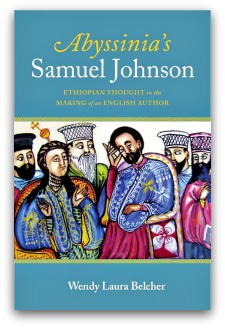
Wendy grew up in Ethiopia, Ghana, and the USA, and has been a writer since childhood. Her most recent book, Abyssinia’s Samuel Johnson: Ethiopian Thought on the Making of an English Author, is a finalist for the African Studies Association’s 2013 Ogot Award (to be announced in Baltimore at the end of next month).

* * *

Welcome to The Displaced Nation, Wendy, and thank you for joining us. I’ve known you for years and yet don’t know as much as I should about your TCK childhood, so am happy to take this opportunity to learn more. You are the daughter of an American dad and a Canadian mom. What’s the story behind why your family moved to Ethiopia and Ghana?
My father is a physician and my mother always loved to travel, so she convinced him to move to Ethiopia. Her idea was that he would teach and do clinical work at a public health college in Gondar, and she would be the college librarian. My first memories are of Ethiopia. I moved back to the US when I was 14. But my specific geographical trajectory is as follows: Philadelphia (birth), Boston, Seattle, Gondar (Ethiopia), Seattle, Accra (Ghana), Seattle, and South Hadley (Massachusetts). After that I lived in Tamale (Ghana). Then back to Washington DC, Accra, Los Angeles, Princeton, Addis Ababa (Ethiopia), and now Princeton again.

That’s an impressively peripatetic life! When and where were you happiest while growing up?
As a child, I loved Ethiopia the best, perhaps because it was the first place my family went and perhaps because, as a child who loved reading, it seemed like a magical place. There was a castle in my backyard as well as oxen threshing grain like in the Bible. On the throne was a descendant of King David. From a child’s perspective, it was like living in a book.

How did you find your first “repatriation” to the United States, at age 14?
I never got used to Seattle, it was very parochial in the 1970s when we moved there, and the weather was too gloomy for someone who had spent a significant part of her childhood in the tropics.

At home, but without a role, in Africa

Has your relationship to Africa evolved as an adult?
As an adult, I settled in the US and not Africa, returning to Africa only a few times until 1997, after which I started going every third year or so. Since 2009, I’ve gone every year to Ethiopia. I thought I might settle in Africa, but as an adult my relationship with Africa was more vexed.

That is, what could my role in Africa be as a white American woman?

I wasn’t particularly interested in “helping,” as it seemed to me that Africans were perfectly adept at solving their own problems and only didn’t do so because of all the “help” they received from the West.

But also, I was in a bind. In the US I often didn’t feel a strong sense of calling in my work, but I felt more satisfied emotionally. In Africa, I felt a strong sense of calling in my work, but I was often lonely.

The problem for me as an adult in Africa as a single woman without children was the lack of female friendships. In the 1980s and 1990s I found it difficult to find in Africa other career women like myself with whom I would have something in common.

One of the reasons I’ve found it easier to return to Ethiopia and have done so regularly in the recent past is that I’ve found some good Ethiopian female friends.

Where do you think of as “home” these days?
My mother always thought that my father never really had a sense of home as a particular place, because he had an identical twin brother. It was the presence of one other human being from the beginning that meant home was someone to him, not somewhere. He didn’t really know what loneliness was, she thought.

I may be somewhat similar albeit for different reasons. I don’t think of anywhere as home.

I lived in Los Angeles for 20 years and loved many things about it, but I mostly think of it as a place where my network of affection is. It isn’t the place so much but the people who make it a kind of home.

At the same time, I still have good friends in Seattle, and my family of origin is still there, so it is also a kind of home.

Are you like many TCKs in finding yourself drawn to people of similar backgrounds?
Almost all my friends are people who live straddling some boundary: either geographically, being from elsewhere or spending significant time outside the US, or racially (growing up as minorities). I am almost never in a room with people who mostly look like me.

Writing calls from an early age

I often wonder if TCKs who pursue writing careers do so because the story is entirely in their hands as opposed to the experienced upheaval of their itinerant childhoods. Did your TCK upbringing influence a) your desire to be a writer and b) what you wrote about?
Growing up in Africa, I was surrounded by literary culture. In Ethiopia, a country with a 3,000-year-old written civilization, people read illuminated manuscripts on sheepskin bound with wood. In Ghana, hand-written epigrams adorned most vehicles, and my father’s Ghanaian colleagues traded bon mots in Latin. At school, I would pick a promising library shelf and work my way through it from left to right. I wrote my first novel when I was nine, titled Shipwrecked at Silver Lagoon. I had set myself the task of writing the best title for a book ever and, after I came up with this, decided it was too good to go unwritten. It was about two English girls in the 17th century who, after their ship is wrecked off the American coast, go on to discover what happened to the disappeared colony of Roanoke: it had moved into an underground, underwater kingdom. The book ground to a halt on page 40, perhaps because, as I tried to articulate issues that were all too real to me (the loss of home and the entry into the hybrid colonial world), my imagination foundered on the demands of the adventure form.

After that, I wrote for my middle school and high school newspapers, where I was the editor.

I was shy, partly due to all the moving and not being sure how to fit in, so I spent most of my time reading. Reading allowed me to immerse myself in a world where I could watch and not be watched (or judged). It also allowed me to develop skills in “reading” people and situations, which is essential to surviving so much moving.
HoneyfromtheLion_coverTell us what drew you to write your memoir, Honey from the Lion: An African Journey, when you were in your twenties.
I had enough credits to graduate from Mount Holyoke in three years so I spent my junior year back in Ghana. While working for a nonprofit organization that was spreading literacy and translating the Bible into local languages, I spent a weekend in a village with an Irish Bible translator. A series of events transpired, the impact of which was so powerful I decided I wanted to write about it. It was a gift: the story was so fascinating that I didn’t worry about writing it. Even if I wrote it poorly, I thought people would find it compelling.

Do you ever go back to the memoir now, and if so, does it resonate very differently due to the passage of time?
I can’t bring myself to read the book now. It seems like a different self wrote itsomeone who was more religious for one.

Congratulations on Abyssinia’s Samuel Johnson being selected as a finalist for a prestigious academic award. Please tell us what inspired you to write the book.
Belcher_AbyssiniaSamJohnson_coverIn 2002, I was talking with an Ethiopian friend about reading Samuel Johnson’s Rasselas, an eighteenth-century fiction he wrote about an Ethiopian prince. This Ethiopian friend surprised me by saying that he had read the book and quite liked it. When I asked him why, he said the book was “very Ethiopian.” I started to correct him, but then I began to wonder if he could be right, if a book written by a European could be Africanin particular, if it could be animated by African discourse. It’s my hope that my book will be convince others about the importance of African thought to the European canon.

From offering TCK courses at Princeton to helping junior faculty

At Princeton you teach courses that I wish had been offered when I was in college, like “Growing Up Global: Novels and Memoirs of Transnational Childhoods” and “Model Memoirs: The Life Stories of International Fashion Models.” You also teach workshops around the world to aid faculty in publishing academic articles. Please tell us the countries in which you’ve taught the workshops.
The workshops have taken place in Norway, Sudan, Malawi, Ethiopia, Indonesia, Canada and all over the USA.

What led you to teach academics about how to write for publication?

belcher_writingyourjournalarticle_coverI did two master’s degrees in the early nineties and I struggled in writing my classroom papers. What did these professors want and why did some papers succeed and others didn’t? I decided not to go on for a doctorate and when people asked me why, I said I just didn’t feel like I got the hang of being a graduate student and in particular about how to write in graduate school.

To my surprise, I found that most other graduate students felt the same way and were as confused and uncertain as I had been. Then UCLA Extension asked me to teach a writing class. I had always sworn I would never teach, but I think you grow when you do things you are terrified of, so I agreed and found that three of my first six students were academics looking for help with their writing.

UCLA Extension agreed to let me restructure the next class around writing for academic journals. The restructured class was a massive success and changed my life.

Within a few years I was teaching “Writing and Publishing the Academic Article” twice a year at UCLA to graduate students, where the class was in great demand, as well as at other universities and institutes around the world. I wrote the workbook Writing Your Journal Article in Twelve Weeks: A Guide to Academic Publishing Success for people who could not take the workshop.

Turning back to your writing, can you tell us what you are working on at present?
I have several writing and translation projects; here are the top three:
1) The Life and Struggles of Our Mother Walatta Petros: A Translation of the Earliest African Biography of an African Woman. Thirty years after the death of a revered African religious leader who led a successful nonviolent movement against European incursions, her Ethiopian disciples (many of whom were women) wrote this vivid book, full of dialogue and drama. The original text, which was written in 1672 by Africans for Africans in an African language, is unknown in the United States (Walatta Petros does not have a Wikipedia entry, for instance). Thanks to the Fulbright US Scholar Award that I held during my third year at Princeton, I was able to spend ten months in Ethiopia devoting myself to archival research. I worked on the translation with Michael Kleiner, a leading scholar and translator of Ge’ez. We believe it will electrify the fields of early modern and gender studies.
2) The Black Queen of Sheba: A Global History of an Ethiopian Idea. Those familiar with the sixth century BCE biblical tale of the Queen of Sheba’s visit to King Solomon may be surprised to hear that there is also an Ethiopian version, variations on which have in fact circulated for centuries, far beyond the Ethiopian highlands. According to the medieval text Kəbrä Nägäśt, the biblical Queen of Sheba was an Ethiopian woman—the wisest, the wealthiest, and the most powerful woman in the world. Tricked by Solomon into sleeping with him, she gives birth to their biracial son, who later takes the Ark of the Covenant to Ethiopia forever. My book traces how the Ethiopian tale came about and the impact it had on not just literature but the world. The emergence of the religion of Rastafari is one of its most far-reaching effects…
3) A Wardrobe of Selves: The Literature of Transnational Childhoods. Based on my life experiences, observing those of my TCK friends, and reading lots of memoirs, I am thinking of writing a book about memoirs by those who have spent their childhood crossing boundaries (in terms of culture, nation, state, language, gender, school, etc.). It would attend to how the narrators like Barack Obama, John McCain, Edward Said, Eva Hoffman, Gloria Anzaldua, Diana Abu-Jaber, Alice Kaplan, Gene Luen Yang, and Mohsin Hamid construct meaningful identities through narrative. These writers—usually considered separately, as part of American ethnic literatures like Arab American, African American, Asian American, or Latino—often negotiate the intricacies of identity in similar ways and should be considered together. That is, this would be a broad comparative project on diasporic memoir in the context of American ethnic literature.

* * *

Thanks, Wendy! You are so prolific, it’s an inspiration to all of us creatives! If we could accomplish just a fraction of what you’ve already done, what a life we’d be leading! Readers, any questions or comments for the amazing Wendy? Please leave them below. And…see you next month!

STAY TUNED for tomorrow’s post, when we hear from an international traveler who has started up her own business in New York City, catering to expats.

If you enjoyed this post, we invite you to register for The Displaced Dispatch, a round up of weekly posts from The Displaced Nation, with seasonal recipes, book giveaways and other extras. Register for The Displaced Dispatch by clicking here!

Related posts:

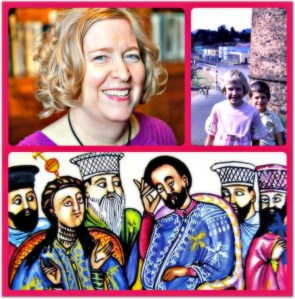
Images: Wendy Belcher; Wendy with her brother in front of a castle in Gondar, Ethiopia; detail from the cover of Wendy’s latest book, Abyssinia’s Samuel Johnson.

GLOBAL FOOD GOSSIP: Keeping food real in Brazil

JoannaJoanna Masters-Maggs, our resident repeat-expat Food Gossip and Creative Chef, is back with her column for like-minded food lovers, which includes pretty much every expat we’ve ever encountered. This month: Authenticity, Brazilian-style.

* * *

“What’s the most depressing thing I’ve seen this morning?” I demanded of my husband as we arrived at our hotel on that first day in Brazil.

Was it something in my tone of voice that made my husband stick out his jaw? Having your wife positive about a new location is always a good thing. Any hint of wifely discontent can put the terrors into most expat husbands, even the most rufty-tufty oil field types.

“The favelas on either side of the motorway for the entire journey from the airport?” His voice had a slight tone of —  could it be? — belligerence. He’d decided to meet head on what he feared was my Western European squeamishness over visible poverty. I’d agreed to come, after all; it wasn’t his doing that the favelas existed.

“Oh.” I felt a pin pricking my outrage. “Actually no. It was the model of the Statue of Liberty outside the shopping mall we passed, the one with the Hard Rock Café.”

Not the voice of a woman with a strong social conscience, then.

“Aren’t we in Brazil?” I asked lamely.

Living in the shadow of the USA

In my defense, I was afraid that this most exciting and culturally rich of countries appeared in thrall to the ego of a foreign superpower. Here, where Christ the Redeemer looks down calmly over Rio and Guanabara Bay, it distressed me that he was unable to turn his cheek from the abominable reproduction Liberty. Such are the drawbacks of being made of stone.

My frustration really hadn’t abated much by the time we left several years later, but it was tempered. Here was a country that had its own great music, landscape, history and food. Brazil’s son Santos Dumont’s first flight had been overshadowed by the earlier but aided take off of the Wright Brothers’ heavier than air plan.

But surely the same could not happen to Brazilian fast food – and at their own hands?

Coxinha  — wins the Pepsi Challenge against the Chicken McNugget, any day

When I was in Brazil, workers could fill a canteen with beans, rice, a little meat and some pasta for 5 reais. A meal from McD costs four times that and cannot keep a belly as full for as long. Yet not only was there a Hard Rock Café, Dominos and McDonald’s, but the bloody Statue of Liberty to boot, holding her torch triumphantly aloft as if lighting the invasion of foreign fast food. (I know, I need to get over that tacky statue.)

Brazilian fast food choices, which can be grabbed on the run in a similar way to a hamburger, are extensive. Kibe consists of meat and bulgur wheat shaped into rugby balls and deep-fried. Empadhinas are little pastry pies often filled with palm hearts but options are endless. There are bollinhas de arroz (rice balls) and, a slightly more costly option these days, bollinhas de bacallao (salt cod).

Then there is the coxinha. Oooh, heaven. It is a pear-shaped, breadcrumb-coated, deep-fried confection of pulverized chicken, creamy catupiry cheese, and onion. I don’t want to be rude, but for heaven’s sake, Brazil — how could you choose a chicken nugget over that?

Please. It’s time for a Coxinhas R Brazil brand to sweep all before it.

Turn the milk sour with your grouse? Or simply dance the samba?

Brazilians probably have a greater openness and sense of fun than I do. They seem to tolerate kitschy statues and dodgy food for what it is, just a bit of fun not to be taken as a serious threat to national pride. There is a great deal of pride in being Brazilian and, I’m told, there are as many Americans trying to emigrate to Brazil as vice versa – it is a new land of opportunity.

Brazilians seem less sulky or passive aggressive than many in dealing with what they don’t like. One amusing example came in the immediate aftermath of 9/11 when America required passengers arriving on planes to America from Brazil to be subject to the same security searches, and delays, as planes coming from countries deemed a threat. Brazil has no history of terrorism and people were offended. However a cheerful approach was chosen. Officials simply decided to apply the same principle to American planes landing in Sao Paolo, Brazilian style. To ease the pain of the wait, passengers were treated to smiling samba bands and charming dancers. Nothing was ever going to change, but the point was made and relations not permanently soured.

A meal fit for a (Burger) King

Perhaps this non-confrontational approach is best. The invasion of American fast food is all-conquering everywhere. Its advance hasn’t been slowed by a thousand angry French farmers and restauranteurs, or by the Italian Slow Food movement. But its growth in Brazil alongside a rapidly emerging obesity crisis comes alongside economic improvements. According to a recent BBC Programme on the rise of obesity around the world and particularly in developing and BRIC countries, the answer is to be found less in the innate appeal of the food, but in the message that is sent out when you’re seen eating it. McDonald’s is an “aspirational food”.

(You might notice that I started a new paragraph rather suddenly. It was to give you a moment to recover from the shock of seeing the words “McDonalds” and “aspiration”, not only in the same sentence, but right next to each other. The idea of being proud to be seen eating fast food is a difficult one that takes time to absorb. I too enjoy the odd foray into the depths of culinary depravity, but I hide the bags – I admit hypocrisy right here. May I continue now?)

You might think you would aspire to a Wolf oven or even a Meile vacuum cleaner, but McDonald’s? No — bear with me. A Brazilian McDonald’s meal costs four times that of a plate of rice and beans. Its cost would buy you any number of coxinhas. It is impressive conspicuous consumption. You pay to eat a meal which won’t actually fill you and you will have to pay to eat again soon after, but the point is: you can.

It’s a fairly modest aspiration for the new middle class. Thousands of Brazilians have been lifted out of poverty over the last 10 years. But potential hunger is still a recent memory and the fear of slipping back must be strong for many. An outrageously priced Big Mac is still less expensive than a ritzy restaurant in Leblon and it’s certainly easier to avoid potentially embarrassing etiquette gaffes for those not yet accustomed to what is known in America as “fine dining”. This is what fast food companies can trade on, and before you know it, new habits are formed.

If you’re going to gain Brazilian pounds, make them worthwhile

Why get fat on this so-so food, though, when you can get gloriously fat on real cooking? You can easily pile on the pounds with Brazilian feijoida, Let the weight gain be a result of leisurely, indulgent meals and not sandwiches grabbed in plastic furnished, fluorescent lighted “restaurants” that are tiled like public lavatories.

I’d say the same to America. Ditch the McD and get fat on Southern and Soul Food, some of the most luscious food in the world. Wow, those Southerners know how to take a healthy low-calorie green vegetable and give it the cholesterol punch of cheesecake. My two personal favourites: collard greens cooked in fatty port cuts and sweet potatoes mashed with butter and topped with a crumble made of brown sugar pecans and a handful of marshmallows. Sounds appalling, but it is the closest thing to ambrosia since Zeus was a viable god to worship.

Both Brazilian and American Soul food has the opulence and indulgence to deaden and dazzle the senses at the same time. It has what a dried up hamburger and flabby white bun bread cannot hope to rival even with liberal dollops of ketchup.

Oh please. Get fat on real fat and be patriotic about that: your nation’s fat.

Make it worth your while.

Make it worth your money.

Aspire.

* * *

Joanna was displaced from her native England 16 years ago, and has since attempted to re-place herself and blend into the USA, Holland, Brazil, Malaysia, Venezuela, Saudi Arabia, and now France. She describes herself as a “food gossip”, saying: “I’ve always enjoyed cooking and trying out new recipes. Overseas, I am curious as to what people buy and from where. What is in the baskets of my fellow shoppers? What do they eat when they go home at night?”

Fellow Food Gossips, share your own stories with us!

STAY TUNED for tomorrow’s post!

If you enjoyed this post, we invite you to register for The Displaced Dispatch, a round up of weekly posts from The Displaced Nation, with seasonal recipes, book giveaways and other extras. Register for The Displaced Dispatch by clicking here!

Related posts:

JACK THE HACK: Expat authors, let’s reopen that blogging can of worms (1/3)

JACK THE HACK _writingtipsA pressured existence in the UK led Jack Scott and his partner, Liam, to seek sanctuary in the Turkish port town of Bodrum. This expat experience was literally something to write home about (as in a book!), after which the pair returned to the UK, where they are living the life of Riley in Norwich.

We have invited Jack, now reinvented as Jack the Hack, to submit a monthly column targeted at those of you who are still displaced and hacking away at travelogues-cum-memoirsor, in some cases, autobiographical novels. Warning to non-Brits: Don’t be put off by his wry sense of humo(u)r!

—ML Awanohara

As far as the book malarkey goes, unless you’re lucky enough to bag a big boy in the publishing world, you will carry the can to get the word out. These days, this means developing a strong and dynamic online presence.

To some, this seems like a step too far. I’ve worked with a number of new authors who just don’t have the time, skill or inclination to do what it takes.

“I wrote the damn book. Isn’t that enough?” I’ve been told.

Well, no, it isn’t, I’m afraid, not by a long chalk.

So I work with them to take the pain away. You see, it doesn’t need to be a can of worms. Those who regularly dip into Jack the Hack will know that I’m a passionate advocate of blogging—for fun and for glory. With a little effort and imagination, you really can make the Web work for you, and blogging is a very good place to start (cue Julie Andrews, the old Dame who tragically lost her fabulous soprano timbre).

Still not convinced?

Then let’s start at the very beginning…

So what is a blog?

The word is an abbreviation of “weblog”. Put simply, a blog is a journal where the entries (posts) are published online, with the most recent first (the reverse of a traditional hand-penned diary). A blog can take many forms and is a perfect vehicle to reflect our multi-media world of words, music, video and images.

Importantly, blogs differ from standard websites. They are dynamic (rather than static) and constantly evolving (assuming they are kept up to date).

Why do people blog?

It may sound grandiose, but blogging is an important democratizing force, giving a real voice to those who might otherwise not have one. It’s a great social leveler tooanyone can do it, no qualification required. There’s no editor to correct your flabby grammar and no one to censure your words (unless, of course, you live somewhere with lively Internet police).

While this means a fair amount of dross is floating round the crowded blogosphere, there are roses among the weedsand you could be one of them.

Bloggers blog for all sorts of reasons and to continue the tenuous Sound of Music theme, here are a few of my favo(u)rite (things):

• Because they have something to say about an issue they care about (the campaigners and spleen-ventors);
• To tell their world what they’re up to and to keep in touch with friends and family (a common topic for expat blogs);
• To help others (health-related blogs are often written for this purpose);
• To be seen as an expert or influencer in a particular arena or place (the Arts, politics and travel leap to mind);
• To connect with like-minded people (this blog, The Displaced Nation, is a good example);
• To flog a service, brand or product (oh, like a book).

Most successful blogs tend to focus around a particular theme or niche. I know a blogger who writes about knitting patterns. It’s hugely popular, attracting thousands of hits a week.

Among the big hitters are travel, politics, food, family life and…ta-da! books and creative writing.
Blogs are a boundless, no-to-low-cost way to lay out your stall in a way an ordinary Website might not. Why so? Because Internet search engines like Google love content that’s new, fresh and frequently updated.

Even well-established businesses take blogging seriously these days. So why wouldn’t you?

Has Jack converted you to the cause? If you’re hooked, let him reel you next month with tips to launch your blog with bang.

BLOGGING TIP FOR EXPAT AUTHORS NO 1:

Blogging increases the chances of getting your mug shot on the first page of Googleand that just might sell a book or two.

* * *

Readers, any comments, further questions for Jack the Hack? He’ll be back next month with the second in his blogging advice trilogy…

Jack Scott’s debut book, Perking the Pansies—Jack and Liam move to Turkey, is a bitter-sweet tragi-comedy that recalls the first year of a British gay couple in a Muslim country. For more information on this and Jack’s other titles, go to his author site.

STAY TUNED for tomorrow’s post, another installment in the life of our fictional expat heroine, Libby. (What, not keeping up with Libby? Read the first three episodes of her expat adventures.)

If you enjoyed this post, we invite you to register for The Displaced Dispatch, a round up of weekly posts from The Displaced Nation, with seasonal recipes, book giveaways and other extras. Register for The Displaced Dispatch by clicking here!

Related posts:

Images: from top, clockwise: Hand with pen / MorgueFile.com; Boats in King’s Lynn, Norfolk / MorgueFile.com; Jack Scott, used with his permission; Turkish boats / MorgueFile.com

And the September 2013 Alices go to … these 4 international creatives

 © Iamezan | Dreamstime.com Used under license

© Iamezan | Dreamstime.com
Used under license

If you are a subscriber to our weekly newsletter, Displaced Dispatch, you’re already in the know. But if you’re not (and why aren’t you? off with your head!), listen up. Every week, when that esteemed publication comes out, we present an “Alice Award” to a writer or other kind of creative person who we think has a special handle on the curious and unreal, who knows what it means to be truly displaced as a global resident or voyager. Not only that, but this person tries to use this state of befuddlement to their advantage, as a spur to greater creative heights.

Today’s post honors September’s four Alice recipients.

Starting with the most recent, and this time with annotations, they are (drumroll…):

1) SHERRY OTT, travel photographer and blogger

Source: Photographing Vietnam’s Rainy Season,” on Everything Everywhere
Posted on: 20 September 2013
Snippet:

From a cultural experience and photography standpoint, inclement weather seasons are a wonderful opportunity to see how the locals really live in situations that we would deem less desirable. You get a true feel for the country and local culture and traditions through the “tough” times. On top of it you get introduced to a number of new products that are used in that inclement weather season that you probably never even dreamed of…

Citation: Sherry, we have to stop you there. Right now we are picturing Alice sloshing through her own tears:

As she said these words her foot slipped, and in another moment, splash! she was up to her chin in salt water. Her first idea was that she had somehow fallen into the sea, “and in that case I can go back by railway,” she said to herself.

But what interests us about you, Sherry—what’s curiouser and curiouser, as Alice might put it—is that, unlike her, you were not having a pool-of-tears moment. As you set foot in Saigon at the height of the monsoon season, your first thought was, my, how lucky I am to see “the skies open up and pour down their wrath on city streets.” And you know what, Sherry? We agree with you. Unlike Alice, who had no means of transport except possibly the train, you had your own motorbike. Also unlike her, you were privy to some unusual sights: double-headed ponchos and ponchos with headlight windows! Poor Alice, on the other hand, when she heard something splashing about in a pool a little ways off, thought she might encounter a walrus or hippopotamus, only to find … a mouse.

2) ALYSSA JAMES Canadian blogger, journalist, traveler

Source: How fast can you slow travel?” on Matador Network
Posted on: 13 September 2013
Snippet:

Because of regulations on how long a truck driver is allowed to be on the road in a day, I was able to explore the city [of Chicago] for exactly 1 hour and 19 minutes.

In those 79 minutes, I was still able to slow travel. I visited the sculpture and centerpiece of Millennium Park known as the Bean (actually called Cloud Gate) and went to the Art Institute. More importantly, I talked with people who lived there. I received interesting insights about the place I wouldn’t have gathered otherwise, like where to get the most delicious Chicago-style pizza ever (Giordano’s deep-dish, double-crusted and stuffed deliciousness).

Citation: Alyssa, we appreciate that you were able to plumb the depths of the Windy City, the largest city in the Midwest, America’s third largest, in just over an hour (hey, that’s no mean feat given how deep the pizza is!). And all this without the benefit of the Queen’s insights in Through the Looking Glass:

“A slow sort of country!” said the Queen. “Now, HERE, you see, it takes all the running YOU can do, to keep in the same place. If you want to get somewhere else, you must run at least twice as fast as that!”

Our only question is, had you followed the Queen’s advice and run twice as fast, do you think you might have at least sampled the stuffed pizza? And of course, had you run twice as fast, you could have sampled it guilt-free! That’s a thought. Next time, perhaps?

3)  ANNE COPELAND, founder and Executive Director of The Interchange Institute

Source: “Tiger Moms, Bébés, and Warm Eskimos” on FIGT blog
Posted on: 1 September 2013
Snippet:

[A]s an interculturalist, I’m at once fascinated, excited … and disappointed by these accounts of parenting in other cultures…. In each case, the message is roughly, “Here’s a new and superior way to raise your children; the result is better than what you’re doing; try it, you’ll like it.” But nowhere do they describe the deep values underlying the parenting choices, the ultimate goals for the kind of adult parents are trying to raise, or the cultural milieu into which the children will be expected to grow.

Citation: Anne, we feel certain that Alice could relate to your woes. She was, after all, rather discombobulated by what she saw of the Duchess’s parenting style. To quote from her account:

While the Duchess sang the second verse of the song, she kept tossing the baby violently up and down, and the poor little thing howled so, that Alice could hardly hear the words:—
“I speak severely to my boy,
I beat him when he sneezes;
For he can thoroughly enjoy
The pepper when he pleases!”

Just imagine, a child that enjoys unlimited amounts of pepper thanks to harsh parenting. It totally makes sense in the Wonderland context. Except…achoo! or should we say: hach-chu (Bengali), hāt-chī (Cantonese), atsjú (Hungarian), aatsjoo (Norwegian), or atchoum (French)? In any case, some sort of onomatopoeia must be required. Parenting may vary from place to place, but not sneezing! But wait, the Japanese say hakushon. Are they trying to stifle the sneeze while frantically searching for a face mask? (Anne, please tell us: will intercultural wonders ever cease?)

4)  NIKKI HODGSON, blogger & traveler

Source: “What is lost (and gained) when the traveler settles down” on Matador Network
Posted on: 16 August 2013
Snippet:

“…Every day that passes separates me from the places I used to belong to, the places I learned to belong to. As I dig my roots deeper into the rocky Colorado soil, I must relinquish my grasp of the banks of the Neckar where I first studied abroad, the mountains of Grenoble that stood guard over me as I fell apart, the dusty hills of Bethlehem where I put myself back together.

And I know that I will never belong to these places the way I once did.”

Citation: Nikki, you put us in mind of Alice’s sister, who like you after your travels, was old and wise enough to know that Wonderland wouldn’t, couldn’t last. Here is the relevant passage:

So she sat on, with closed eyes, and half believed herself in Wonderland, though she knew she had but to open them again, and all would change to dull reality—the grass would be only rustling in the wind, and the pool rippling to the waving of the reeds…

Crazy Wonderland or dull reality? Or, in your case: dusty hills or rocky soil? That is THE expat question… Not much of a choice, is it?

*  *  *

So, readers, do you have a favorite from the above, or have you read any recent posts you think deserve an Alice Award?  We’d love to hear your suggestions! And don’t miss out on these weekly sources of inspiration. Get on our subscription list now!

STAY TUNED for our next post!

Writers and other international creatives: If you want to know in advance whether you’re one of our Alice Award winners, sign up to receive The Displaced Dispatch, a round up of weekly posts from The Displaced Nation, with news of book giveaways, future posts, and of course, our weekly Alice Award!. Register for The Displaced Dispatch by clicking here!

Related posts:

Mark Hillary delivers reality check to gringos who moan about Brazil, in self-published book (2/2)

Mark Hillary Part 2 CollageIn Part 1 of my interview with Mark Hillary, a fellow Brit and amigo in São Paulo, we learned about what spurred him to write a book called Reality Check: Life in BRAZIL through the eyes of a foreigner.

A lively discussion ensued about what makes Brazil such a contentious country for expats (short answer: it’s a country of extremes).

Today I’ll ask Mark about his decision to publish Reality Check as an e-book. As I mentioned last week, Mark is well published in his chosen field of technology and globalization. He is a HuffPo columnist and has also blogged for Reuters about British politics. But Reality Check represents his first venture into the Amazon e-book platform.

I was curious about why he chose this route and also had some questions about his reading and writing habits generally.

* * *

Mark, Reality Check isn’t the first book that you’ve written. Can you tell us something about your other books?
It’s actually my tenth book. I used to be quite a senior IT manager in a bank, managing people all over the world. I had already started contributing articles to technology magazines while I was at the bank, and eventually I was sent off to India to help the company build up a big new office in Bangalore. I was hiring hundreds of technical team members and then trying to sell their services bank to other sections of the bank. It was quite an experience, especially as it occurred right at the beginning of the big push to India by many technology companies.

I wrote a book about it all, which was published by the respected German publisher Springer and well received in journals and newspapers such as the FT.

After that I carried on writing about the connection between work, technology, and globalization.

It’s impressive that you can span the range from big IT questions to a foreigner’s take on life in Brazil.
I’m interested in many areas, which is probably why my three times at university have included courses on computer science, business and management, and psychology. My earlier work on outsourcing naturally led me to how companies are changing and globalization, and this has naturally led onto my writing about being an expat. If there’s a connecting thread, it’s work and the changing nature of work in our time. That said, I wouldn’t want to only ever comment on a single topic. Life is a lot more complex than that.

You decided to release Reality Check in the Amazon Kindle format. Why did you make that decision?
I’ve been asked that question a lot. Six of my books were published using traditional publishers, and three were self-published via Lulu. And now, with the Brazil book, I’ve used the Amazon Kindle format. I went into some detail on the pros and cons of each of these methods in a recent Huffington Post article, but in short the important thing to remember is how the publishing market is changing. Obviously there is still a lingering sense of kudos with the traditional publishers. A novel published by Penguin is still seen as “better” than something self-published, but it doesn’t have to be. The platform and process of publishing itself has just been democratized and made available to all.

If you know how to write and you can market your work to an audience, then it is much faster to publish with Amazon or Lulu. And, not only can you reach a global audience instantly—you earn a far greater percentage of the sale price.

In the case of Reality Check, I wanted it to be available around the world as quickly as possible, and Amazon has a great system for doing that. Plus you don’t actually need a Kindle: iPads and phones are all being used to read this book.

Do you think it helps that you already had a following through your writings and other books?
Reality Check has has been in the Amazon top 20 books about Brazil since publication on September 1st, and yesterday when I checked, it was the number one book about Brazil and number two book about South America. So people have been noticing it.

I think it does help if you already have a following. It used to be that publishers and agents acted as the gatekeeper, so readers could be confident a book that ended up in the shops was good. Now anyone can publish any old rubbish, so there is no longer that guarantee of a published book being any good.

The much-celebrated poet Seamus Heaney is a good example. He has been lauded as one of the greatest writers of the past century, and he had plenty of work published by traditional publishers. But he was self-publishing new work before his recent death.

Do you plan to make Reality Check anything other than an e-book?
I’m planning to also release a paper version of the book, but it will not be until the second edition—planned to come out just before the World Cup football competition in June next year.

Are you working on any other writing projects at the moment?
The present one is about my own experience of ghostwriting. I’ve written for ambassadors and company CEOs, and I once had to help astronaut Neil Armstrong add a few jokes to his standard Apollo 11 speech. The work I have written for others to be delivered in their name has often, but not always, gone down well, and I wanted to explore that. And in the tech area, I’m working on a book project that aims to be a graduates’ guide to how you get a job in a job market where nobody wants to pay you a salary.

10 Questions for Mark Hillary

Finally, I’d like to ask a series of questions that we’ve asked some of our other featured authors, about your reading and writing habits:

1. Last truly great book you read: I recently read all of Ira Levin’s novels back to back—all great; but I’ll go for Paul Trynka’s biography of David Bowie, which I just now finished.
2. Favorite literary genre: Dystopian novels: Burgess, Orwell, Ballard.
3. Reading habits on a plane: I read fiction and non-fiction and always carry my Kindle because it’s so much better for travel than lugging around a lot of books. This week I was on a plane and I read The Default Line, by Faisal Islam—about the financial crash of 2008 and what has happened since.
4. The one book you’d require David Cameron to read, and why: Why It’s Kicking Off Everywhere: The new global revolutions, by Paul Mason. It’s a study of the various riots, uprisings and protests around the world, particularly in 2011. I think the UK has more unrest to come because living standards and earnings are in decline—the people are going to kick off again one day.
5. Favorite books as a child: Those by Roald Dahl, though everyone seems to think he was actually a nasty piece of work in real life.
6. Favorite heroine: Harper Lee. To Kill a Mockingbird was her only book and she never courted any publicity. It challenged racism over 50 years ago and still retains its power today.
7. The writer, alive or dead, you’d most like to meet: Oscar Wilde. He wrote 20th-century books and plays in the 19th century and despite his sad downfall, is still remembered and loved today.
8. Your reading habits: I mostly read in the evening. I don’t watch TV, other than for movies so that gives me more time. I tend to read one or two books a week unless I’m traveling a lot then it’s more just because of the endless time spent in airports or on buses.
9. The book you’d most like to see made as a film: The Drowned World, by J.G. Ballard. Life after the oceans have risen and the world we know now is flooded.
10. The book you plan to read next: Jesse Norman’s biography of Edmund Burke—already on the Kindle waiting for me.

* * *

Readers, any more questions for Mark? He may sound a bit intimidating, but in fact he’s very approachable and happy to answer any questions about e-publishing. (Though he doesn’t write fiction, he also has views on publishing platforms for novels.) Meanwhile, if you’re interested in Reality Check, you can purchase it on Amazon. I would also recommend becoming a fan of its Facebook page and following Mark on Twitter: @MarkHillary

STAY TUNED for tomorrow’s post, by another Englishman who is also an expat albeit in California: Anthony Windram.

If you enjoyed this post, we invite you to register for The Displaced Dispatch, a round up of weekly posts from The Displaced Nation, with seasonal recipes, book giveaways and other extras. Register for The Displaced Dispatch by clicking here!

Related posts:

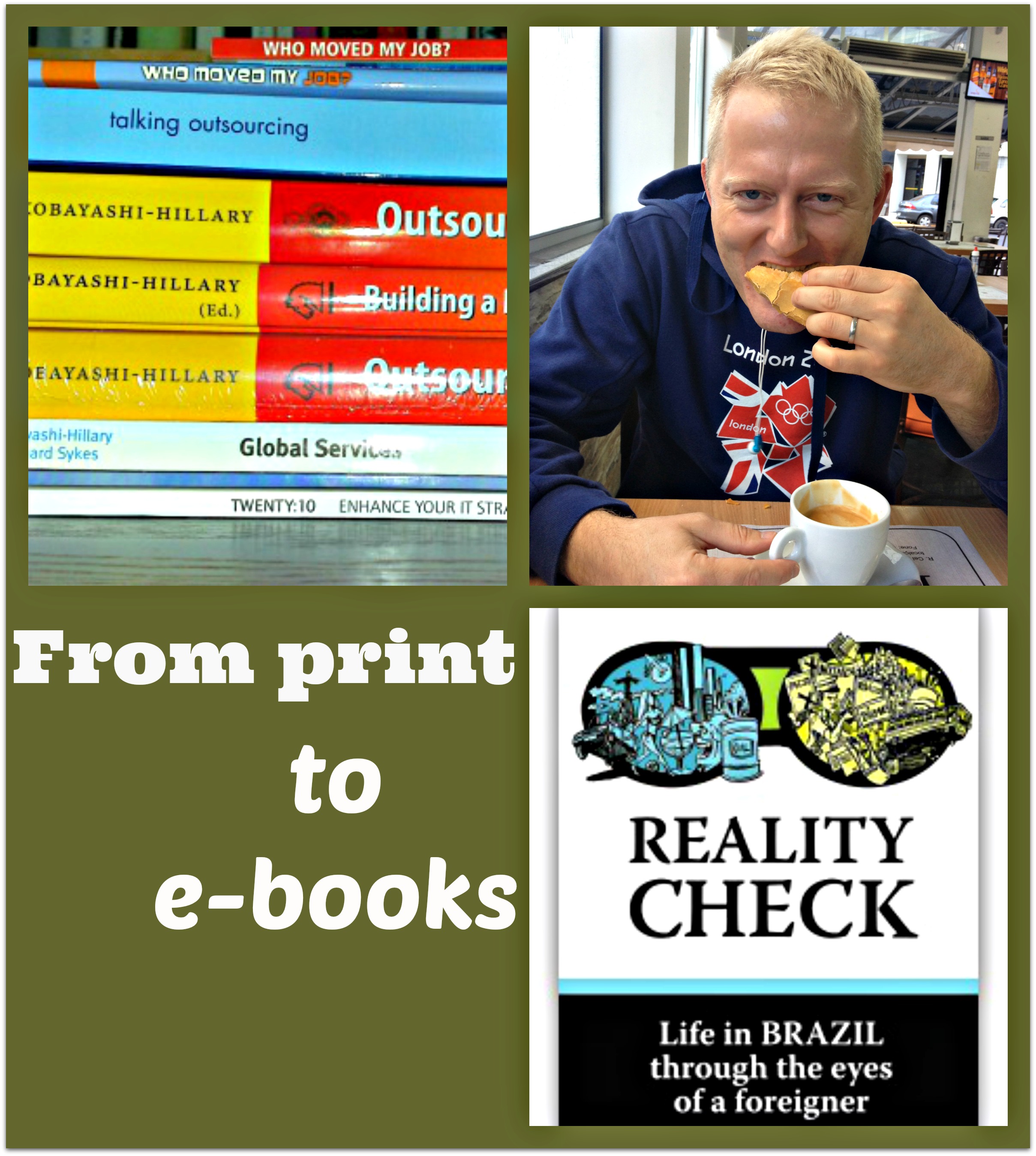
images: Mark Hillary surrounded by his traditional books and his e-book cover.

Mark Hillary delivers reality check to gringos who moan about Brazil, in self-published book (1/2)

Mark_HillaryA little while ago I interviewed Megan Farrell, a fellow gringo in São Paulo, about the book she had written about “exbrat” life in the city. As far as I’m aware, Megan’s was the first book to be written about life in SP by a foreigner, although she seems to have started a new trend because within the last fortnight another has emerged: Reality Check: Life in BRAZIL through the eyes of a foreigner.

Reality Check is by Mark Hillary, a fellow Brit in São Paulo (he recently moved outside the city), who is an author, blogger, and advisor on technology and globalization. He has already published a number of books and is a contributor to Huffington Post, Reuters, The Guardian, and Computer Weekly.

Mark is also a friend of mine. We connected through Twitter just over a year ago. We eventually met at a local bar when—unsurprisingly, given his background in technology and social media—he organized a meet-up of gringos who had connected online but had yet to meet up in the flesh.

Since then he and I have continued to meet up, although less so since his move to the countryside. We had a particularly memorable trip in June to Rio to watch England play Brazil in football at the brand new Maracanã Stadium. (As anyone who follows my posts should recall, I’m a bit of a football geek.)

Over the past year Mark has written, in his column for the Huffington Post, a number of insightful articles about life as a foreigner in Brazil—most notably, “No HP Sauce, Endless Red Tape: Would You Want to Live in Brazil?, which responded to a gringo Facebook forum that had listed all the reasons why foreigners hated living in this country.

It was to my pleasant surprise, then, when Mark announced he had extended his account of life in Brazil and intended to publish it as an e-book.

Leaving aside my acquaintance with Mark (and the fact he gives a nod to my personal blog in the book!), I must say that I found Reality Check a very enjoyable read. It is a thoughtful and critical, yet balanced, account of his experiences in Brazil and of the country in general—and frankly, I’m rather annoyed that I haven’t written it myself.

Mark’s book also seems to be a good accompaniment to Megan’s. Whilst hers is a straightforward, step-by-step guide to life in São Paulo, his is a narrative providing a broad overview of gringo life. Either way, both books will be of use to those who are either moving to Brazil or perhaps are simply interested in finding out a bit more about South America’s largest and most populous country (it’s also the world’s fifth largest economy).

Anyway, enough of my wittering on. Let’s hear more from Mark himself.

* * *

RealityCheck_bookcoverHi, Mark. Congratulations on your new book and thanks for agreeing to this interview. First off, can you say a little more about what inspired you to write it?
As you already mentioned, I wrote the book in large part as a reaction to the negative posts about Brazil in online gringo communities. Everyone has their own reasons for moving and living away from their home country, but the majority of the groups I’ve encountered online are full of complaints about Brazilian food, prices, bureaucracy… Anyone who reads the posts made in the Facebook group for Gringoes.com would think that the UK and US offer a utopian paradise that would be madness to ever leave.

As you said in your intro, I wrote an article for the Huffington Post where I tried to give a more balanced view on life in Brazil.

Then I thought that, as someone who has rented and bought a home, started a company, hired people, and married a Brazilian, I could probably give a more detailed opinion on the experience—hence the book.

So being married to a Brazilian was what brought you to Brazil?
Yes, we were living in London, but after the financial crash in 2008 my business was much slower than before. By 2010 it became clear that there were many more opportunities for me to build a research and publishing business in Brazil than in the UK and so we moved just before the end of that year, nearly four years ago.

We recently featured another book about expat life in Brazil: American Exbrat in São Paulo, by Megan Farrell. Megan’s focus was on the “exbrat” community in São Paulo—i.e., those who are transferred here for work by a large company. My impression is that your focus is less specific and more of a broad overview of life in Brazil as a foreigner.
I’m not really interested in the exbrats. If a big company transfers someone to Brazil and they have their home taken care of and a driver to ferry them around, and they only ever go for a drink in expat pubs, then I don’t think they are experiencing the real Brazil. I’m not suggesting that the only authentic Brazil experience is living in a favela, but there are other kinds of foreigners here—journalists, teachers, people from all walks of life—who are constantly looking for ways to explore their new home.

Did you have a specific audience in mind when you wrote the book?
I really set out to explore some of my own experiences, with the expectation that people investing in Brazil or looking for a job here might have an interest in the book.

The book has only just been published (2nd September) so I guess it is a little early to tell, but how has it been received so far?
It is very recent, but there is already a very positive review from a Brazilian reader on Amazon. I started my author Facebook page when I published the book, and that community is growing by around a hundred people every day—so people are noticing it. One of the biggest newspapers in Brazil (Folha de SP) has been in touch to interview me about the book—despite my not having done any press promotion for the book due to my traveling almost every day since the publication!

Did you connect with São Paulo and/or Brazil in any new ways whilst writing the book?
It made me more determined to plug areas outside of Rio, which has a lot of friends already. I’ve really enjoyed living in both São Paulo the city and interior—SP needs a few gringo fans to speak out and remind people that the city is not just about concrete and cops murdering civilians.

You recently moved to the countryside outside São Paulo—how and why did that come about?
We spent two years living in the centre of São Paulo and just wanted to find something a bit quieter. I love it where we are now. There is a great sense of community; the neighbours all know each other. There is none of the security paranoia you find in the city centre, and there is some fantastic scenery on our doorstep.

Do you miss SP at all?
I miss being able to go out to see my friends in the city, or go to concerts by international bands that will only ever play in major cities. But we are planning to get a very small apartment in SP soon, so we don’t completely lose touch with it.

You mentioned the “security paranoia” in SP. In my observation, most of us gringos carry a fear that is at odds with how our Brazilian partners and/or friends feel. I enjoyed reading the section of your book covering this perception gap. Do you think that more positive accounts of Brazil by writers/bloggers like you and myself can help to shift these perceptions?
If people like you and me can get visitors to realize that they can walk down Avenida Paulista or along Copacabana Beach without fearing for their life, that would help. On more than one occasion I have met business contacts who flew into town and then were shocked when I suggested meeting away from their hotel. Standard advice from American and European companies is often to stay inside when in Brazil because of all the street crime.

The Brazilians, too, should play a part in correcting this situation. I don’t think we have much influence because we are seen as outsiders, but as more Brazilians get exposed to alternative cultures through travel, I hope it can change a little.

Last year I brought my wife’s teenage cousin on a trip to the USA, just to show her what life is like outside of Brazil. She found it incredible that you could walk up to the front of so many celebrity homes in Los Angeles—that anyone could walk into Sylvester Stallone’s garden. That’s unimaginable in Brazil.

What are you thoughts on foreign media portrayals of Brazil? Do you feel, for example, that persistent foreign criticisms of Brazil’s preparations for the World Cup and Olympics have been fair?
Every World Cup and Olympic games gets this negative press, so I don’t know if it is any worse than the last time. Anyone from the UK should be able to recall how the London Games were going to be a disaster right up to the week of the Games—the attitude seemed to change only when everyone saw that spectacular opening ceremony.

All I know from personal experience is that when you and I went to the Brazil v England football game at the Maracanã in June, the organization was superb. The stadium looked good, the public transport all worked, and the volunteers helping the crowd were great. I couldn’t fault it—so I’m really looking forward to the World Cup.

From the way you write so passionately about Brazil it is clear that you love living here, but there must have been the odd difficult moment when you wondered whether you’d made the right decision in fleeing the economically stagnant UK for your wife’s native land. When have you felt most displaced?
Sometimes the bureaucracy in daily life does get perverse and goes beyond just the criticism of a foreigner claiming that it all works better in Europe. Examples include having to pay someone to get my car registered to a new address or being fined for not paying my stamp duty on the day I agreed a mortgage with the bank—even though I paid on the day I got the documents myself. Sometimes I wonder if there is ever going to be any government that sweeps away this nonsense. I also fear that the job cuts created by improved efficiency means we are stuck with much of this.

Conversely, when have been your least displaced moments, when it all seemed to make sense?
I live in a really beautiful place now surrounded by a lot of wonderful people. Every morning when I take my dog for a walk then start work for the day I know I’m lucky to be here.

* * *

Readers, I will be talking to Mark again on Tuesday of next week, when we focus on his decision to self-publish his book. Any further questions for him, meantime? And don’t forget, if you’re interested in Reality Check, you can purchase it on Amazon. I would also recommend becoming a fan of its Facebook page and following Mark on Twitter: @MarkHillary

STAY TUNED for tomorrow’s post, a new episode in our “Location, Locution” series, by JJ Marsh.

If you enjoyed this post, we invite you to register for The Displaced Dispatch, a round up of weekly posts from The Displaced Nation, with seasonal recipes, book giveaways and other extras. Register for The Displaced Dispatch by clicking here!

Related posts:

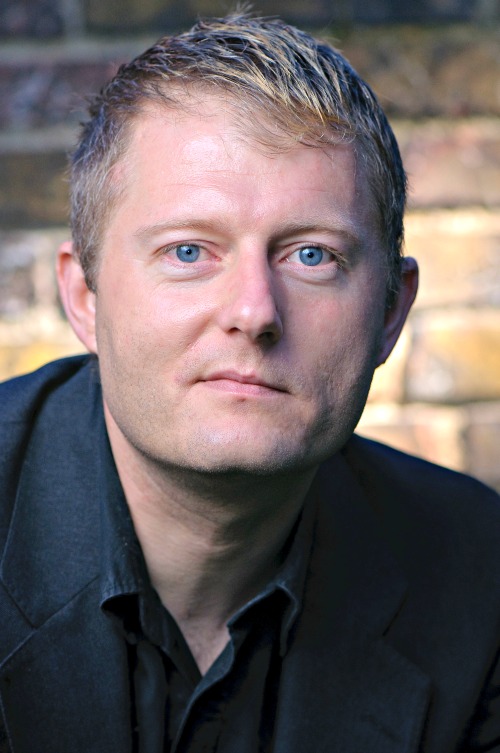
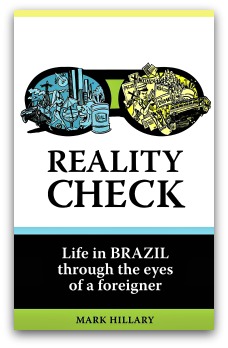
images: Mark Hillary’s author image and book cover

TCK TALENT: Diahann Reyes is in her element as writer, actor & storytelling coach

DiahannReyes_headshot_pmWelcome to the second installment of “TCK Talent,” Elizabeth (Lisa) Liang’s monthly column about adult Third Culture Kids who work in creative fields. As some readers may recall, Lisa—a Guatemalan-American of Chinese-Spanish-Irish-French-German-English descent—has written and performed a one-woman show about being a Third Culture Kid, or TCK. (It debuted in LA in the spring and is coming next week to NYC!)

—ML Awanohara

My guest today is Diahann Reyes, a professional writer/actor who is launching a new blog, writing a memoir, and beginning an additional career as a writer’s editor/coach. Diahann grew up in six countries, worked as a journalist for CNN before becoming an actor, and currently lives in Los Angeles, California.

Growing up here and there and everywhere

Greetings, Diahann, and welcome to the Displaced Nation. I understand you’re the TCK child of Filipino parents. Can you fill us in a little more: why did your family move around and which countries did you live in as a kid?
My dad was a marketing expat. I learned how to speak English with a Kiwi accent in New Zealand, discovered my love for books in Argentina, rode my first camel in Pakistan, went through puberty in the US, attended junior prom in the Philippines, and graduated from high school in Indonesia.

Of all those cultures, did you identify with one in particular?
Like you, I’m a “mash up” of the different cultures I’ve lived in. Living in America for most of my life now, I feel most at home here, which is its own kind of cultural mishmash. In my twenties, I realized that I had to pick one of my “home” cultures as my main one or I’d continue to feel ungrounded. I also identify with particular subcultures that aren’t necessarily considered mainstream, such as the artist culture.

Where and when were you happiest while growing up?
My family’s two years in Argentina were some of my happiest, probably because my mom, dad, sister, and I were all so excited to be living in a new country together. Moving to a different culture was still an adventure of which I had yet to grow weary. Also, at age 8, I was still very much myself and hadn’t been impacted yet by the pressures of puberty and the need to fit in.

What lies beneath the surface…

Speaking of puberty and the female body brings me to the launching of your new blog, Stories from the Belly: A Blog About the Female Body and Its Appetites. What inspired you to begin it and what can followers look forward to from the blog?
For women especially, there are so many truths, emotions, and desires that we tend to suppress: they get buried deep down in our bodies. My blog is my way of excavating this buried inner emotional landscape. I want to talk about the female body in ways not normally touched upon in mainstream media. My blog will include personal stories as well as commentary on relevant current events.

You’ve been working on a memoir. Is it specific to a time and place in your life?
Yes. My memoir is about my latest “move,” only this time rather than going to live in a new country, I’ve spent the last decade “moving into” and learning how to fully inhabit my own body. Location-wise, I take the reader across the globe to some of the places I’ve lived growing up, but the main action takes place in my body.

What themes are you exploring?
The story I tell is absolutely personal, but it does touch on a lot of bigger ideas involving the female body and its objectification and how this can impact a woman’s relationship to herself and others. Desirability, cultural assumptions, sexuality, power, pleasure, and wholeness are some of the through-lines in the book.

Owning who she is

On your website you describe how you fell in love with reading and acting. Did you always know you would pursue both of these interests as careers, or did you struggle with the decision?
I knew I wanted to be a writer from the time I could read, but it took me a long time to own that this is who I am, in part because the grownup me couldn’t imagine that my younger self could just “know” this. Still, writing has been the primary way I’ve made a living—as a TV news writer, an editor, a ghostwriter, and now a blogger, so I guess I didn’t need to know I was a writer to be one.

The decision to act was tougher. I didn’t start to pursue acting until my 30th birthday, and by then I had established a pretty good career in journalism and online media, so I was giving up a lot to change focus. But acting was like this siren calling to me, saying “act, act, act.”

You and I grew up reading many of the same (mostly American and British) authors: Ingalls Wilder, L’Engle, Cleary, Blyton… I remember the day I realized I would never get cast as Jo in any theatrical production of Alcott’s Little Women because I was a girl of color. Did you ever have a moment like this, and if so, which beloved character(s) and book(s) or play(s) did you realize you wouldn’t get to explore as an actress?
I always thought I could be anyone because while growing up I’ve had to be a chameleon. “Adapt and assimilate and fit in” was one of my mantras as a global nomad. But when I got to LA and started auditioning, I realized that I would never be able to play certain characters because I was the wrong ethnicity or type. I was primarily limited to not even Asian parts but Latina roles because I look more Hispanic than Southeast Asian. This meant that I was likely never going to play Maggie from Cat on a Hot Tin Roof or Caroline Ingalls in any future Little House on the Prairie remake, and parts that were for people of my actual ethnicity were out, too. Fortunately, the industry has changed, and more minorities are getting cast outside of ethnicity and stereotype.

What sorts of roles are you attracted to now?
I love parts that call for emotional depth and angst.

I wonder if one of the reasons we’re writers is that we have more autonomy to tell stories than we do as actresses?
I love that I can write what I want—I don’t need anyone to “cast” me first. And I can create characters that aren’t limited by ethnicity or type. I am thinking of creating a solo show that would probably require me to write and play different characters.

I understand you also write poetry. What drew you to that?
I kept diaries growing up and would process my feelings through poetry. With both nonfiction and poetry, I can just be myself. After so many years of working hard at adapting and assimilating to fit in, getting to just be me on the page is a relief.

Helping others to own their stories

You’re about to begin a new endeavor as a writer’s editor/coach. What inspired you to follow this new path?
I know what it is like to have something to say and to struggle with fully expressing my truth—especially when the fears come up—and I want to help other writers overcome these obstacles so they can get their stories out there. I want to work with people who are just as engaged in their process as they are in having a finished product.

What are you looking for in a student/client?
I work with nonfiction writers, bloggers, storytellers, and essayists, and other people with writing and online content projects. Healers and people with unusual business ideas like to work with me, too.

Do you have any other projects coming up?
I hope to publish my memoir next year. The film Out of Her Element, in which I play a therapist with a pill addiction, will premiere soon.

* * *

I must congratulate Diahann on her exciting new ventures, which I believe will resonate with people working in creative fields—and with female travelers and TCKs, especially! Readers, please leave questions or comments for Diahann below.

STAY TUNED for tomorrow’s post, when Andy Martin will talk to Mark Hillary about his new book, Reality Check: Life in Brazil through the Eyes of a Foreigner.

If you enjoyed this post, we invite you to register for The Displaced Dispatch, a round up of weekly posts from The Displaced Nation, with seasonal recipes, book giveaways and other extras. Register for The Displaced Dispatch by clicking here!

Related posts:

img: Diahann Reyes

GLOBAL FOOD GOSSIP: How (not) to feed a convalescent expat

JoannaJoanna Masters-Maggs, our resident Food Gossip, is back with her column for like-minded food gossips.

This month: The state of worldwide hospital food.

* * *

“The last thing you need on top of everything else when you are in hospital is red wee.”

So ended my husband’s texted tirade after a few days in an Abu Dhabi hospital following an emergency appendectomy which turned out to be less than straightforward.  The indignities, pain, and discomfort could be handled with fortitude, but the food had caused the British stiff upper lip some serious challenges.  Beetroot was served at every meal and in every conceivable form — none of which was remotely welcome to this convalescent.

Almost unbelievably, the day after my husband was admitted to a Middle Eastern hospital, my 9-year-old son was diagnosed with the same condition and admitted to Taunton Hospital, in Somerset, England, for the same operation.  Patrick took it all in his stride, only threatening mutiny when a disposable bottle, apparently made of the same recycled cardboard as egg cartons, was proffered in response to his request to go to the loo.  With furious determination he heaved himself upright  and made his way to the bathrooms, wheeling his drip ahead of him and making my heart swell with maternal pride.

Several hours later, when wrinkled potato wedges and bright orange fish fingers confronted him, Patrick’s attitude was rather different.  My husband’s texted complaint lacked the colour a human voice could give the words.  My son’s anguished “Why, why, why?” however, provided a glimpse of  The Husband’s state of mind when he composed his text.  The pitch of “Why can’t I just have a tuna sandwich?”  swung from already-stressed contralto to end-of-tether soprano.

KISS: Keep It Simple, Sandwich

This question is one I ask myself every time I face airline food.  Why not a sandwich? A simple sandwich is perfect food for those on the go; ask any hill-walker. It is easily transported and eaten and requires little in the way of tableware.  It certainly beats sub-standard wannabe home-cooking, or, more depressingly, wannabe gourmet cooking.  KLM used to do a nice sandwich on granary, a little oatcake and a good cup of tea or coffee on their London to Schiphol shuttle.  I have never enjoyed airborne eating as much.  Flights since, even champagne-soaked upgrades, have never hit the spot as well.

Hospitals, like airlines, are susceptible to the curse of being the girl who tries too hard at parties and embarrasses everyone, for different reasons of course.  Airlines because they feel they are part of the same package as the business trip or holiday and have to provide something special.  Hospitals, being in the health business. feel under pressure to produce something healthy and balanced.  Easy healthy and balanced is a lump of protein, a lump of carbohydrate and some boiled veg.  Each element can be whatever is readily to hand in the locale.  Obviously, beetroot is easy to come by in Abu Dhabi – who’d have thought?

A few years ago I found myself admitted with an unpleasant stomach bug to a hospital in Kuala Lumpur.  During my recovery, meal after meal was placed in front of me,  each consisting of overdone, indigestible chicken in glutinous sauce with rice and boiled vegetables. (Never talk to me again about English food.) Not appetizing at any time, but certainly not in the recovery period.  At the end of day two I was begging for cream crackers and jelly.  Even if I was unable to eat them, they were easier to tolerate the look of in the post-prandial two hours that the staff took to remove the debris.

The Victorians –now, they knew how to run a sickroom

When I’m sick I crave the ideal Victorian sickroom.  I want chicken soup, broth, and little crustless sandwiches cut into triangles.  I want food that makes me feel pampered and I want it in miniature form.  What I don’t want is big hunks of meat that I have to take a hacksaw to.  I don’t want to bother with a knife and fork.  I’d like little sips of water, or tea and maybe the odd ginger biscuit.  Some soft-boiled eggs and soldiers (fingers of toast) would be nice too.  In short, give me the whole Victorian sickroom vibe complete with flowery china and a little vase of flowers.  Do that and I’ll put on a white nighty, brush my hair and smarten up my convalescent act accordingly.

What explains this wanton disregard for dainty and light in preference for The Undigestibles? I suggest it is because hospitals the world over want us out, and want us out fast. In cash-strapped UK NHS land, beds are at a premium and waiting lists must be kept down.  Make things too comfortable and delicious and who knows how long malingering patients will stay?  I also imagine American insurance companies would like to minimize the number of nights their customers spend in hospitals which are often more costly than excellent hotels.

If you can’t keep it simple, keep it real

So, what’s my point talking about all this in our “displaced” world?  I suppose it is simple, really.  I want any experience that takes place outside of my own country to be distinctive and of that place.  If a hospital cannot, or will not, convert its menu into something I might find in Little Women, I want to lose my appetite for something distinctive.  If I have some indescribably unpleasant stomach complaint and find myself again in hospital in KL, I want to be unable to eat Malaysian food, truly Malaysian food.  If I’m not eating, give me beef rendang to reject and not boiled chicken breasts.  If I am in Rio, I want to lose my appetite for black beans and chiffonade of couve (actually, that will never happen) and if I ever end up in a  Abu Dhabi hospital, I want to reject grated raw beetroot.

You see, be it Victorian pampered convalescent on a chaise longue, or expat overseas, I yearn to feel special when I am sick.  Is that really too much to ask?

* * *

Joanna was displaced from her native England 16 years ago, and has since attempted to re-place herself and blend into the USA, Holland, Brazil, Malaysia, Venezuela, Saudi Arabia, and now France. She describes herself as a “food gossip”, saying: “I’ve always enjoyed cooking and trying out new recipes. Overseas, I am curious as to what people buy and from where. What is in the baskets of my fellow shoppers? What do they eat when they go home at night?”

Fellow Food Gossips, share your own stories with us!

Image:

STAY TUNED for tomorrow’s post!

If you enjoyed this post, we invite you to register for The Displaced Dispatch, a round up of weekly posts from The Displaced Nation, with seasonal recipes, book giveaways and other extras. Register for The Displaced Dispatch by clicking here!

Related posts:

Don Quixote & Sancho, John Steinbeck & Charley…Olga & George? A travelogue for the expat annals (plus we’re giving away a copy!)

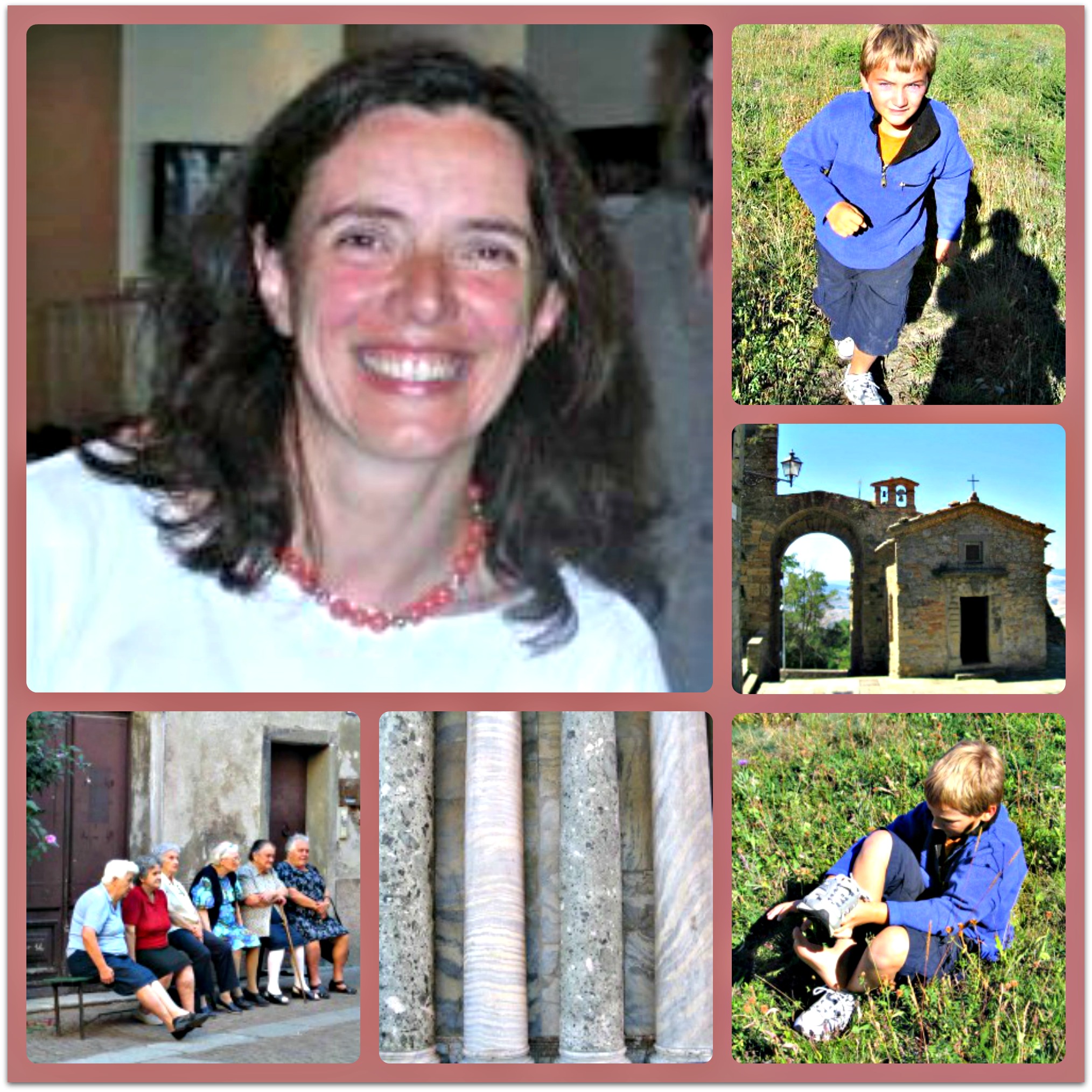
Olga Vannucci CollageWhen I first stumbled across Olga Vannucci’s memoir, Travels with George, I wondered whether the title alluded to John Steinbeck’s book Travels with Charley, about his road trip across America in the company of his French standard poodle, Charley.

Turns out, I got it right. Born in Italy, Olga went to Brown University and currently lives in rural New Jersey. As she tells it, she was driving through Doylestown, Pennsylvania, one day when Steinbeck’s travelogue popped into her head, and she knew she wanted to call her book “Travels with George.” When she announced this to her son (the “George” of the title), he said: “So I’m the dog?”

As you can gather from this story, mother and son make quite a pair.

Olga says she’s no Steinbeck, though she does prefer a plain and honest writing style. Also like Steinbeck, she had the desire to see her native land again.

So, how did she find the Italy of today: did she still fit in? And what did her sidekick, George, the blonde all-American kid, make of his mammina‘s homeland? Did he enjoy these escapades or feel puzzled by his mother’s motives? Perhaps the story he saw himself in wasn’t Steinbeck’s at all, but a modern Italian version of Don Quixote, in which he occupied the role of a skeptical Sancho Panza?

Olga has kindly agreed to give away one copy of the book to the reader who is keenest to find out the answers to these questions (see giveaway details below).

But before we get into that, let’s talk to Olga and hear some more about the travels that inspired her to put pen to paper…

* * *

Travels with George Book CoverCiao, Olga! Let’s begin at the beginning. Tell us more about your decision to take a trip to Italy with your young son and write about it.
I was born in Italy (Milano), lived in Brazil two different times as a child, and came to the United States to attend college. I’ve been here ever since. When my son was seven years old, I realized suddenly that I hadn’t been back to Italy in ten years, and I went, taking him along. I thought he would learn about Italy and acquire a feel for what it’s like. I also hoped he would learn some Italian. I don’t know how much of that was accomplished, but I loved showing him around. We went back four more times over the course of six years (he is now 14). I wrote the book about those trips: a mix of travelogue, personal history, and little anecdotes, with some humor.

What impact did writing about the experience have on you—did it help you process your childhood memories?
It was wonderful to see the locales of my childhood again. At this point, my memories are either indelibly fixed or just gone—for instance, I can remember clearly sitting on the steps with my friends Sassello, in Ligurio, as I recount here:

[My sister and I] had two friends in Sassello, two girls the same age as [us]—Paola and Maria Elena. They spent their summers thirty meters from where we spent ours, and we spent hours and hours of every day together.

[George and I] walk by the steps where we used to sit. I expect to see them, I expect them to be there, but they’re not. No one is. It’s all the same, but it isn’t.

Did you also learn something about yourself, in taking these excursions down Memory Lane?
I did find out about my current self through the book, but primarily from what others told me my words said about me—for example that I’m kind, funny, and honest. It was also interesting to hear from others about the things that they could relate to in the book, ranging from the more profound to the totally mundane situations. That was amazing, to realize that what I wrote spoke to others.

George’s ordeal

Do you think it will help George someday, in understanding part of his heritage that might not otherwise be accessible?
George has not read the book because, he says, “I was there, I don’t need to read about it.” I do hope and trust that both the experience and the writing will be a part of him, that he will consider the book a gift.

What was your most displaced moment when you & George were touring Italy, when you thought of yourself as a stranger within your homeland?
I always struggle with whether I am Italian or, at this point, American, or, more likely, not really either one. What makes me feel at home in Italy is the fact that it’s largely so unchanged. What makes me feel displaced is that the people of the older generation, my parents’ generation, who are the people I particularly associate with Italy, are passing. They’re my biggest connection with Italy, and they will soon be gone. After that, I may feel displaced…

I gather you don’t feel nearly as comfortable with younger generations of Italians?
Yes. I’m not sure why not. Possibly because the younger generation is doing its own thing and is more all over the place, unlike the older, which has stayed put.

What was your least displaced moment, when it all seemed to make sense for you and George to be there—that you fit right in?
On all the trips we visited my aunt, my mother’s sister, and stayed at her house, where we slipped naturally into being part of the family. I had coffee with her in the morning, we planned meals, I helped her water her garden, George fed her goldfish, and we watched television in the evening.  There was not an ocean or even a smidge of formality between us.

I love the description you provide of your aunt in the book:

My aunt is a lovely person, she’s beautiful and she likes to dress well. She’s 80 now, and she still looks good in her clothes, she wears fashionable clothes. She is cheerful and tells funny stories. She loves to do stuff and see people, she’s chatty. She’s fun to be around.

In that same passage, you mention the “recurring nightmare” of finding food that George likes to eat. What was the most challenging thing about traveling with a young child?
I did not realize how jarring the experience would be for George. To me, Italy is pleasant, and while I knew it would all be new to him, I didn’t realize how different it really was. Being in a completely unrecognizable place where he didn’t understand the language was way outside his comfort zone. I also probably didn’t verbalize things enough. I could have prepared him more and explained things better.

The other thing about traveling with a small child is that I, as the adult, had to be “on” 100% of the time.  Not only did I have to plan and handle everything, but I also had to manage him and make sure I didn’t lose him, which was something I actually worried about, and when I became stressed I had to try to hide it so he wouldn’t become stressed, which I didn’t do very well. He’s very perceptive.

What do you think he took from the experience?
The knowledge that he can survive a terrible ordeal… Possibly I took him on a few too many hikes up hills. It wasn’t always fun and idyllic. I do believe that the trips will serve as a foundation for him to understand that the world is large and diverse and for him to appreciate differences.

The potential perils of writing about one’s offspring

What was the most difficult part of the book-writing process?
It was hard to write about others and protect their privacy at the same time, particularly with my son. I find him very amusing, but he doesn’t intend to amuse me, and he is sensitive to it. He thinks I’m making fun of him, basically. So I’m always walking that line, writing about him, but trying to be respectful of him.

I understand you decided to self-publish the book. Why is that, and do you have any advice for other writers who opt for self-publishing?
I made some attempts to get an agent but ultimately I went with self-publishing because I didn’t have the patience to wait. What I like about self-publishing is that it’s all mine, I created the book cover, I chose the font, I decided to favor the comma over all other punctuation, and it’s been incredibly fun and very rewarding.

There are so many options today to publish and distribute and get the word out, and it can be done without a big financial investment. All you need is the investment of time. Given that this is your passion, you want to spend your time on it anyway. And there are so many people who are open to help. I would encourage other writers not to be afraid to ask. Putting your thoughts out there to share with others is a gift, and people respond very kindly.

What audience did you intend for the book, and has it been reaching those people?
I thought it was a mother/son book, which it is, but it’s very much a book for people who love Italy, who have been there, or who plan to go. My writing is very direct and the book is written in the present tense, so readers feel like they’re there along with me. It combines some very personal time in Italy–with family or revisiting places of personal significance—with visits to the big tourist destinations like Venice and Rome.

Are you working on any other ambitious writing projects?
I am working on a book about traveling with George in America. It’s not an organized itinerary, it’s just places we’ve been or will go to. Mostly in the northeast, plus San Fran and Arizona. It’s still in the infant stages, this project. But I promise it will be extra funny!

10 questions for Olga Vannucci

Finally, I’d like to ask a series of questions that I’ve asked some of our other featured authors, about your reading and writing habits:
1. Last truly great book you read: Don’t Let’s Go to the Dogs Tonight, by Alexandra Fuller, about growing up in Africa.
2. Favorite literary genre: Definitely travel!
3. Reading habits on a plane: I don’t like to fly so I bring an easy-reading book that I know will keep me engaged, and paperback so it’s lightweight.
4. The one book you’d require President Obama to read, and why: He has such a tough job. I would wish, not require exactly but only wish, for him to read a book that his daughters like, so he can have a topic of conversation that they can share and enjoy. He will then tackle his job rejuvenated.
5. Favorite book as a child: Mary Poppins—the P.L. Travers book and the Disney movie, too. I think I had it in both languages. It was just magical, different, not at all like my daily life with my mother and sister.
6. Favorite heroine: Martha Gellhorn, who was a great journalist and writer. She was married to the literary giant Ernest Hemingway yet always retained a strong sense of herself.
7. The writer, alive or dead, you’d most like to meet: I would like Calvin Trillin to take me out to eat in New York, in the Village, to all his favorite eating places. It might take several days because he has a lot of favorite eateries. I would like to hear all about Alice, about his daughters, and about his long and brilliant career.
8. Your reading habits: I read in bed every single night, and I have been reading more during the day recently. I’ve been deliberate about carving out more time in the day, when it’s otherwise easy to get caught up in other activities.
9. The book you’d most like to see made as a film: Any book that takes place overseas, so I can see the place in which the events take place.
10. The book you plan to read next: Hard to tell… I have a stack of some thirty books in my bedroom, and I’m not sure which one is next. I may need to devise a lottery system to determine the reading order…

* * *

Grazie tanto, Olga! Your story certainly sounds amusing while also saying something profound about parent-child relationships and the quest to go home again. Something to rival the wisdom of Steinbeck or Miguel de Cervantes, for sure.

Readers, it’s time for you to ENTER OUR DRAW TO WIN A FREE COPY of Olga Vannucci’s book, by entering a comment below. Olga says she will favor comments that tell her why you’d like to read about her and George’s adventures.

Extra points, as always, if you’re a Displaced Dispatch subscriber!

The winner will be announced in our Displaced Dispatch on September 28, 2013.

To read more excerpts from Travels with George, go to Olga Vannucci’s author site. You can also keep up with her on the book’s very active Facebook page. Also feel free to order the book from Amazon.com.

STAY TUNED for tomorrow’s quota of Global Food Gossip. Rumor has it, Joanna Masters-Maggs has something particularly tasty in store for us!

If you enjoyed this post, we invite you to register for The Displaced Dispatch, a round up of weekly posts from The Displaced Nation, with seasonal recipes, book giveaways and other extras. Register for The Displaced Dispatch by clicking here!

Related posts:

Images: Olga Vannucci and George, interspersed with Italian scenery. Of the George photos, Olga writes:

Let me provide the audio from George: “Where are we going? How much longer? I have something in my shoe. I want to go back. Why are we doing this? Do you know where we are? Do you know where we’re going? Mammaaaaaaa!”