The Displaced Nation

A home for international creatives

Tag Archives: Memoir | Travel | Food Writers

DIARY OF AN EXPAT WRITER: Testing one, two, three…Can anybody hear me?

DiaryExpatWriterToday we welcome a brand new columnist, the up-and-coming author Shannon Young. This past summer, Shannon announced she’d cut 18 inches off her hair, quit her day job to become a full-time writer, and given herself a pen name for her new series of adventure novels. And, yes, she is an expat, a kind of love refugee, living in Hong Kong. She has generously agreed to chronicle her writing adventure for us.

—ML Awanohara

Dear Displaced Diary,

In this column, I’ll be recording my experiences as a full-time expatriate writer. Officially, this is only a test.

Let’s start with a bit of background: I have been an expat, an American in Hong Kong, for four years and one month. For the past four years, I taught English in a local primary school while harboring a desire to work in book publishing.

Originally, I wanted to be an editor, to find talented writers and help them get their work into the world. I didn’t think I had stories of my own. Then, I moved to Hong Kong. In my new expatriate life, I found stories: personal dramas, bewildering worlds, opportunities for stimulating observations, and even ideas for fiction.

So, I started writing…

I discovered I love the process: mulling over half-formed ideas, stealing character descriptions from people I saw on the street, scribbling outlines on everything, and sitting down in coffee shops for hours at a time to actually do the work.

Four years later, I’ve completed a number of projects composed of bytes and bits of code, of pages and ink, of words and stories. Each project has taught me to look closer at the world around me. Each project has challenged me to be more diligent and to look for opportunities to write something that will matter.

One of those projects, a Kindle single called Pay Off, discusses how my teaching job in Hong Kong enabled me to pay off my large student loans from a US university. I’ve been debt free since December 2013 so have been able look seriously at other occupations.

I want to keep writing…

My teaching contract ended in July 2014. By that time I had accrued some savings, some complete or nearly complete books, and a husband with permanent residency. Instead of continuing to teach, I realized that now was the time to try to make it as a writer.

This is only a test. If I am not bringing in enough money from my writing (or worse, not enjoying the work) around Chinese New Year, I will start looking for a new job.

For now, I’m jumping in with both feet, seeing if this dream is feasible.

Like becoming an expat all over again…

Quitting a day job to write full-time is a lot like moving to a new country. You might know a bit about what to expect and what to pack. You do your homework; you find stories of people who’ve done it successfully, who love their new lives. You also find stories of people who’ve failed, who didn’t gel with the new place for any number of reasons. Most expats fall somewhere in between, learning to live with the difficulties while also enjoying many good moments.

Some people say it isn’t possible to make a living as a writer. They cite the successes and insist such people are outliers: exceptionally good or exceptionally lucky. As with moving to a new country, I suspect the truth lies somewhere in between. All I can do is take the leap and see if I can make it work.

But, just as I wouldn’t move to a new country without a suitcase, I am not starting this writing journey with a blank Word document and “Once upon a time…”

I have a strategy!

Here’s what I’m “packing” for my full-time writing life:

1) A portfolio of published works—comprising not just the student debt Kindle single but also the anthology How Does One Dress to Buy Dragonfruit: True Stories of Expat Women in Asia, which I edited for a small Hong Kong publisher. It came out earlier this year.* Neither of these works is a huge moneymaker, but sales can add up slowly. More importantly, these two publications have given me valuable publishing experience.

2) A book deal. My memoir of my first year in Hong Kong, Year of Fire Dragons, is being published by Blacksmith Books, an independent Hong Kong publisher, at the end of October. Hong Kong is a small market and even healthy sales won’t pay my rent, but at least I have a book to launch and a tangible opportunity to build my career.

3) A genre series in the works. This is the essential part of my strategy, the heavy winter coat, if you will, that I’m packing as you never quite know, once you become an expat, where you might end up. (I’m in Hong Kong now, but as I never could have predicted that, shouldn’t I be prepared for the day when I move to, say, Finland?) Since late 2012 I have had the wild pleasure of working on a series of post-apocalyptic adventure novels set at sea called The Seabound Chronicles (under the pen name Jordan Rivet). I’ve planned for a four-book series and written drafts of three of the titles. Book One, Seabound, is currently with the copy editor and should be ready to launch in November. I plan to self-publish this series as e-books and POD paperbacks and, frankly, hope to make some money.

4) Last but not least, reasonable expectations. While I am hopeful that the combination of my publishing experience so far, my existing works, and a highly commercial series will enable me to continue doing what I love, I am also realistic. I don’t expect to get rich. The goal here is to build up an audience—and a long tail of sales—that will eventually enable me to pay my rent and buy the occasional plane ticket home to see my family. But my primary expectation is that I will work hard, produce the best books I can, and try to learn as I go.

“If you want a pearl, you must dive for it.”—Chinese proverb

I realize I’m taking a risk by forgoing a steady income and living on savings in order to give myself more time to write. But taking risks is second nature to expats. We leave behind everything we know, and there are never any guarantees about how things will turn out.

My own jump into expat life occurred when I followed the man I loved to his home country. At the time, I didn’t even know if we would get along when we finally lived in the same country. At first, it looked like everything would fall to pieces because a month after I arrived in Hong Kong my boyfriend’s company sent him to London. I had a year on my own in Asia, fearing that my risk had been in vain.

That story has a happy ending: that boyfriend is now my husband—and I love Hong Kong. It was a risk that paid off, but it could have gone very wrong. Now, I hope the risk I’m taking will turn out at least half as well.

And can I tell you a secret, diary? Since I stopped working and started focusing on writing full time, I’ve been deliriously happy. I love having hours to myself each day to sit down and work on my own creative projects. I love reading about the publishing industry and studying other people’s books and careers. I’m trying hard not to become an obnoxious friend who only talks about their own work because it’s all I think about these days.

Yes, I know this honeymoon period won’t last forever, but at least allow me to say: it’s been wonderful so far!

And yes, I sometimes struggle with prioritizing, but that’s because there are so many things I want to do! But I’m gradually getting used to my new routines and performing triage on my to-do lists. I’m developing the daily habits of a writer. I want to use this period well.

Each month, I’ll share a bit more with you about where this journey is taking me. I hope you’ll come along for the ride.

Thanks for reading!

Yours,

Shannon Young
www.shannonyoungwriter.com

*From now until the end of the year, Shannon will be sharing excerpts from Dragon Fruit. Stay tuned!

* * *

Readers, it’s your turn. What is a risk you’ve taken in order to follow a dream? Was it becoming an expat or something even more daring, like becoming a full-time writer? What are some difficulties you faced along the way? Let me know in the comments!

STAY TUNED for next week’s fab posts!

If you enjoyed this post, we invite you to register for The Displaced Dispatch, a round up of weekly posts from The Displaced Nation, with snippets of worldly wisdom, exclusive book giveaways and our nominees for the monthly Alice Awards. Register for The Displaced Dispatch by clicking here!

Related posts:

BOOKLUST, WANDERLUST: Curiosity leads Elizabeth Gilbert’s Victorian heroine to international travel

Booklust Wanderlust Collage

Left: Oleh Slobodeniuk (CC BY-NC-SA 4.0); right: Beth Green (her own photo).

Attention displaced bookworms! Our book review columnist, Beth Green, is back. An American who lives in Prague, Beth mixes booklust with wanderlust in equal measures, which gives her just the right background for reviewing book releases on behalf of international creatives.

—ML Awanohara

Hello again, Displaced Nationers! Since I last wrote, summer has slipped by us. The gradual wicking away of days and weeks puts me in mind of the protagonist of the book I have chosen to review this month: The Signature of All Things, a scientific and historical novel by Elizabeth Gilbert (she of Eat, Pray, Love fame).

The story’s heroine, Alma Whittaker, an early Victorian botanist living in North America, thinks of time as running on three concurrent tracks:
1) Human Time, which goes by as quickly and flittingly as a summer’s day.
2) Geological Time, in which the Earth moves.
3) Moss Time, which reflects the events of both Human and Geological time but moves at its own pace, expanding rapidly.

signature_coverAlma regrets that her life is stuck on the track of Human Time in an era that doesn’t favor women of character, intelligence and strength (but not looks). I found her fascinating and think that you international creatives will find her that way as well for these three reasons:

1) She is a Third Culture Kid and a polyglot.

As the daughter of English and Dutch botanists who eloped to start an empire on stolen seeds in the New World, Alma is a delightful fictional example of a Third Culture Kid. She has an unconventional upbringing at a time when most young ladies of her class were strictly bound by convention.

Gilbert writes:

She learned that walking carefully in the mud to save one’s boots or the hems of one’s skirts never rewarded one’s search. She was never scolded for returning home with muddied boots and hems.

At home, Alma speaks English with her British-born father, an old rascal who sailed with Captain Cook and turned himself into a rare plants and pharmaceuticals baron, one of the richest and most powerful men in Philadelphia; and a mix of classical languages with her highly educated mother. As for her nurse:

[The nurse] always spoke Dutch to Alma, and Dutch, to Alma’s ears would forever be the language of comfort and bank vaults and salted ham and safety.

Alma spends her childhood wandering in the breathtaking gardens and fields of her father’s estate, working on French and Latin, and being regaled with tales of far-flung expeditions at her parents’ dinner parties. She grows into a young woman with a wide breadth of knowledge but a constricted life experience.

2) Alma chooses to expand her horizons through international travel, rather like Gilbert herself.

Many novelists would slow down the narrative at this point, bring in a love interest (and a rival or two), and make the story all about the broadening of Alma’s horizons through a courtship followed by marriage. But Gilbert, who first made herself known to the world through the memoir of her solo travels to Italy (to eat), India (to pray) and Bali (where she found love), isn’t the right author for such conventions.

True, Alma’s youth, measured in Human Time, speeds by, but in the world Gilbert creates, one need not be young to have adventures. Indeed, Alma’s true adventures begin only after she believes she’s past her prime, when she enters Moss Time.

The spark that ignites those adventures is a surprise even to her. While contemplating the passage of her middle years, Alma discovers her passion for researching moss and its evolution. Moss, of course, knows no national boundaries. As Gilbert writes:

Moss grows where nothing else can grow. It grows on bricks. It grows on tree bark and roofing slate. It grows in the Arctic Circle and in the balmiest tropics; it also grows on the fur of sloths, on the backs of snails, on decaying human bones.

After Alma’s marriage fails, she sets sail for Tahiti.

As she takes off, so does the book—at least for me: Alma’s voyage across the Atlantic and Pacific was one of my favorite parts of the novel. Experiencing the long, slow sea voyage through the eyes of someone educated but who, at age 48, had barely left the confines of the family estate made for a compelling read.

“The ocean both stunned and disturbed her. Nothing had ever put more of an impression upon her being,” writes Gilbert. “It seemed to her the very distillation of matter, the very masterpiece of mysteries.”

There are also moments when her innocence clashes with her surroundings, as we see in this passage:

Alma offered payment in American coins, but the man attempted to make change for her from a handful of dirty Spanish piastres and Bolivian pesos. Alma could not figure out how he was possibly calculating his currency exchange, until she realized hew as trading in his dull old coins for her shiny new ones.

3) Alma’s insatiable curiosity is the driving force behind her travels.

It is tempting to see Alma as an extension of Gilbert: abandoning a marriage to travel recalls Gilbert’s break-out memoir Eat, Pray, Love. But in that book, along with its sequel Committed: A Love Story, Gilbert’s primary concern is with her ongoing personal evolution as writer, person, friend and romantic partner. In Signature, by contrast, Gilbert has created a character who as a young girl has already surpassed society’s expectations of what she can become. Alma is an intellectual whiz—fluent in languages, adept at math and strategy, precise in science and research—and a sensitive, caring friend. She’s strong. She’s healthy. But most of all, she’s curious—something I think she has in common with those of us who’ve chosen to live in other cultures.

When Alma reaches 16, she is faced with the decision to throw away a pornographic book or hide it. Gilbert writes:

But what about the cankerworm of curiosity that lived within Alma’s belly? What about its desire to feed daily upon the novel, the extraordinary, the true?

Then when Alma is approaching 60, she finally meets the special someone she has been searching for for years and says:

Allow me to tell you something about myself, for it might help you to speak more freely. Implanted in my very disposition—though I do not always consider it either a virtue or a blessing—is a desire to understand the nature of things.

Interestingly, curiosity seems to have become a mantra for Gilbert these days. On recent speaking tours (with Oprah, for example), she has been offering writers this advice:

Foster your curiosity even more than your passion.

To sum up: The Signature of All Things is not always a page-turner and Alma is not always a likable character, but the book held my attention to the end, in large part because I wanted to find out what happened to Alma. Gilbert’s writing, too, is impressive. Certain scenes in the book—the docks and a moss cave in Tahiti, the Spartan kitchen Alma’s abolitionist sister keeps, the crude sea tales of Alma’s father—are portrayed with such cinematic clarity I will never forget them.

Those who have read the book may know that readers have criticized Gilbert for focusing too much attention on Alma’s (mostly unfulfilled) sexual desires. I did not feel that way. Through the force of her sheer intelligence, Alma takes us closer to a period of our history that wasn’t so long ago, at least in Geological Time, when scientific findings were beginning to challenge traditional beliefs. As the English philosopher Thomas Hobbes once said:

Curiosity is the lust of the mind.

What say you, Displaced Nationers? Are you curious about Gilbert’s latest? Until we meet again, may Human Time roll by slowly for a change. (And if it doesn’t, plant some moss on it!)

* * *

Thanks, Beth! Until I read this review, I hadn’t realized that Elizabeth Gilbert, a member of our Displaced Hall of Fame for her travel memoir, had moved on to fiction. Readers, are you familiar with Signature and Alma Whittaker? If so, were you just as smitten as Beth was?

Beth Green is an American writer and English teacher living in Prague, Czech Republic. She grew up on a sailboat and, though now a landlubber, continues to lead a peripatetic life, having lived in Asia as well as Europe. Her personal Web site is Beth Green Writes, and she is about to launch a new site called Everyday Travel Stories. To keep in touch with her in between columns, try following her on Facebook and Twitter. She’s a social media nut!

STAY TUNED for the next fab post!

If you enjoyed this post, we invite you to register for The Displaced Dispatch, a round up of weekly posts from The Displaced Nation, with Alice nominations, exclusive book giveaways and other extras. Register for The Displaced Dispatch by clicking here!

Related posts:

EXPAT ART AS THERAPY: A new series based on Alain de Botton’s strange and wonderful notions

expat_art_as_therapy introGreetings, Displaced Nationers. While countries in Asia are celebrating harvest and moon festivals, we are marking the occasion with the start of a new series: EXPAT ART AS THERAPY. The series owes its provenance to the fertile and somewhat loony imagination of the young Swiss-English philosopher Alain de Botton. Today and over the next few months, we’ll cover some of the same ground as de Botton in his “Art as Therapy” lecture, in which he demonstrates how art can shed light on life’s big themes.

Except our topic will be the work of international creatives, a subset of artists more generally. Can the art people produce as a result of living among cultures in other parts of the world—and feeling, at times, displaced—shed light on life’s big questions?

Haven’t yet heard of de Botton? Here is (more than) you need to know:

  • Having grown up in both Switzerland and the UK, he’s an Adult Third Culture Kid who comes across as European, English, both and neither.
  • He’s a prolific pop philosopher, with a shelf-full of books and two very popular TED talks to his name.
  • He also has his critics, who call him a “high-brow self-help guru.”
  • Regardless, he hasn’t looked back since his 1997 essay titled How Proust Can Change Your Life became an unlikely blockbuster in the “self-help” category.
  • As explained in a recent Displaced Dispatch—what, not a subscriber yet? get on with it!—de Botton has set up a cultural enterprise in Bloomsbury, London, called The School of Life, which aims to “teach ideas to live by” and “inspire people to change their lives through culture.”

Returning to the aforementioned “art as therapy” lecture, De Botton lists six ways that art can respond to human needs, and in this series I’ll be attempting to apply this scheme to the works of international creatives. Does the art produced by expats, rexpats, TCKS, ATCKs repats, and other international creatives have something to contribute to the good of humanity at large and if so, in what ways?

It all sounds rather grand, doesn’t it—or would grandiose be more accurate? In any event, not to worry, you won’t remember any of this by the time the column starts up properly next month.

That said, perhaps it would help if I left you with a couple of examples of the kinds of questions we’ll be examining, enough to whet your appetite for more.

Here goes:

1) How does it benefit the world that Alan Parker has written a best-selling indie book about what it’s like to be a Brit man trying to raise alpacas in Spain? I’ll warrant that many of us, myself included, have no wish to live in Spain or raise alpacas—yet I did feel moved by the account of his adventures as reported on this blog, and presume that others have as well. What are we all getting out of it?

2) Likewise, are there pleasures for all to be reaped from long-term expat Kathleen Saville’s description of the acacia trees on the island in Zamalek, Gezira Island, where she lives in Cairo? (NOTE: Saville, who blogs at Water Meditations, is a contender for a September Alice Award, which you’d know if you read our most recent Dispatch.) Take me for example. The thought of living in Egypt scares me, and I’ve been avoiding most trees ever since Hurricane Sandy, but after reading Saville’s description of Egyptian acacias—

I see folds and twists in the trunks like nothing I have ever seen in another tree. Each tree looks like a long thin body or leg covered with support hose. It’s odd because the appearance is almost human like.

—I was blown away. Why, and would others with no special interest in Egypt feel the same?

* * *

At this point I hope I’ve said enough for you to make a mental note about checking out next month’s column!

In closing, please join me in a resounding chorus of “Shine on, shine on harvest moon/Up in the sky…” (Click here if you don’t know what I’m talking about or can’t remember the words.) Yes, I know it’s not high art; it’s a Tin Pan Alley stuff. But it’s seasonal and makes me smile—and our mentor, Alain de Botton, would give me a pat on the back for that!

STAY TUNED for Beth Green’s book review column.

If you enjoyed this post, we invite you to register for The Displaced Dispatch, a round up of weekly posts from The Displaced Nation, with Alice nominations, book giveaways, and other extras. Register for The Displaced Dispatch by clicking here!

Related post:

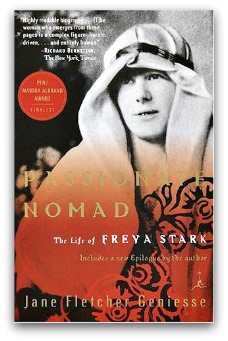
BOOKLUST, WANDERLUST: Jane Fletcher Geniesse’s biography of the passionate nomad (but displaced expat) Freya Stark

Booklust Wanderlust Collage

Left: Oleh Slobodeniuk (CC BY-NC-SA 4.0); right: Beth Green (her own photo).

Attention displaced bookworms! Our book review columnist, Beth Green, is back. An American who lives in Prague, Beth mixes booklust with wanderlust in equal measures, which gives her just the right background for reviewing book releases on behalf of international creatives.

—ML Awanohara

Hello again, Displaced Nationers! Hasn’t the summer gone by fast? How’s your progress on that reading list you made back in the day when it seemed like the dog days would go on forever?

Well, if you abide by the rule that summer ends with the equinox, then you still have a few more weeks. And if you’re searching for one last read to feed your wanderlust, I would recommend the volume I just now finished: a biography of Dame Freya Stark, one of the most amazing travelers and travel writers of the last century. Called Passionate Nomad: The Life of Freya Stark, it’s by former New York Times journalist Jane Fletcher Geniesse.

Passionate_Nomad_coverDays after reading, I’m still in a daze (so to speak), transported by Geniesse’s tale of this intrepid British war-time adventurer.

Stark is one of those people—we’ve all met them on our travels, haven’t we?—who seems to have crammed many lives’ worth of living into one single walk on Earth.

Born to Anglo-Italian-German parents who made their living painting, growing flowers, and managing textile factories (among other pursuits) across Europe, Stark was the original Third Culture Kid. As she traipsed with her parents across Britain, France and Italy, she had no real place to call home. She was further burdened by her parents’ separation and an emotionally manipulative mother, along with numerous illnesses and financial troubles.

A late bloomer

Though she would eventually achieve renown as a witty speaker who could always be counted on to liven up a party, as a young woman Stark despaired of being able to have her own life. She did not make her first trip to the Orient (as it was known in those days) until age 33.

Perhaps because Stark herself told the stories of her travels in the 25 books she published, Geniesse gives most of her attention to the adventures Stark had before being lionized for her travel exploits and writings. (Geniesse covers the last 40 years of Stark’s life—Stark lived to age 100!—in just one chapter.)

For me, Geniesse’s portrait is most brilliant when recreating the straitened times that preceded the period when Stark became fluent in Arabic, gained a reputation for bravery abroad and published her first articles and books on her Middle Eastern travels.

Geniesse relies on her intuition as well as meticulous research to highlight the details of Stark’s upbringing that help to explain her transformation from a penny-pinching flower farmer in Italy to a voracious student of classical literature, a free-spirited wanderer (she was one of the first non-Arabians to travel through the southern Arabian Deserts), and an internationally respected author, speaker, ethnologist and political consultant.

A misfit in the expat community

In tracing Stark’s life journey, Geniesse provides some sense of her struggle to find a place in the expat communities of the interwar years. On the one hand, she had trouble relating to the other Europeans she encountered on her travels, writing in one of her letters:

[The British missionaries in Lebanon] suffer from stagnation of the brain, and that surely produces stagnation of the soul in time. To feel, and think, and learn—learn always: surely that is being alive and young and the real sense. And most people seem to want to stagnate when they reach middle age. I hope I shall not become so, resenting ideas that are not my ideas, and seeing the world with all its changes and growth as a series of congealed formulas.

But during the period she spent within the expat community in Baghdad while researching her next trip, it was clear her fellow expats weren’t clear what to make of her either. As Geniesse writes:

Freya, now 37, was feeling her earlier despair give way to expanding hope. She could change her life; she had watched herself do it—although precisely to what purpose remained as much a mystery to her as the question of what Miss Stark was doing in their midst intrigued the Baghdad community. Freya enjoyed being directionless, learning purely for learning’s sake—and adjusting, if that was her fate, to a spinster’s life.

Geniesse concludes it may have been easier for Stark to explain herself to the tribes and villagers she encountered during her travels as they had no expectations of how she should be behaving. As a European, Christian woman traveling in remote areas of Yemen, Lebanon, Syria, Persia, Iraq and Iran, she was accepted as a foreigner, while in the expatriate communities there was some expectation that she should conduct herself as a proper unmarried lady.

(In fact she did eventually marry, in her fifties, to a good friend—but the couple separated soon afterwards, when her husband told her he was gay.)

Warts and all

Like all good biographers, Geniesse also highlights Stark’s less flattering qualities. From Stark’s petty rivalry with archaeologist Gertrude Caton-Thompson, to her sharp attitude toward women she felt were prettier than herself, to her irresponsible attitude to money and certain friends, Geniesse shows us the other side of this larger-than-life character. I liked Stark all the more for this mix of traits.

As I got to the end of Genisse’s work, I felt a little bereft. I missed Freya. There is something irresistible about a woman who not only writes her own script for her life but also gives herself a series of challenging parts. As Geniesse says, at the end of her life

Freya had followed her own genius. She had imagined herself as the star in many roles over the years—explorer in Persia and Luristan, Mata Hari at the imam’s court, English plenipotentiary during the war, and humble pilgrim, wandering through Turkey’s ancient ruins.

Next up on my reading list will have to be one of Stark’s own stories, several of which are still in print.

And now, I’ll leave you with a quote from Freya Stark herself, excerpted from a letter to her mother, listing the “7 cardinal virtues for a traveller”:
1. To admit standards that are not one’s own standards and discriminate the values that are not one’s own values.
2. To know how to use stupid men and inadequate tools with equanimity.
3. To be able to disassociate oneself from one’s bodily sensations.
4. To be able to take rest and nourishment as and when they come.
5. To love not only nature but human nature also.
6. To have an unpreoccupied, observant and uncensorious mind—in other words, to be unselfish.
7. To be as calmly good-tempered at the end of the day as at the beginning.”

* * *

Thanks, Beth, for bringing Dame Freya Stark to our attention! And now I would like to offically nominate her for our Displaced Hall of Fame. Readers, had you heard of Freya Stark before reading Beth’s column? What do you make of her? Have you encountered an eccentric like her on your own travels, or does she seem like a product of a previous age?

Beth Green is an American writer and English teacher living in Prague, Czech Republic. She grew up on a sailboat and, though now a landlubber, continues to lead a peripatetic life, having lived in Asia as well as Europe. Her personal Web site is Beth Green Writes, and she is about to launch a new site called Everyday Travel Stories. To keep in touch with her in between columns, try following her on Facebook and Twitter. She’s a social media nut!

STAY TUNED for the next fab post!

If you enjoyed this post, we invite you to register for The Displaced Dispatch, a round up of weekly posts from The Displaced Nation, with seasonal recipes, book giveaways and other extras. Register for The Displaced Dispatch by clicking here!

Related posts:

For this adult TCK writer with an ocean-loving soul and a passion for travel, a picture says…

Canon zoom lens; photo credit: Morguefiles. Rita Gardner at home in California.

Canon zoom lens; photo credit: Morguefiles. Rita Gardner at home in California.

Welcome to our monthly series “A picture says…”, created to celebrate expats and other global residents for whom photography is a creative outlet. The series host is English expat, blogger, writer, world traveler and photography enthusiast James King, who thinks of a camera as a mirror with memory. If you like what you see here, be sure to check out his blog, Jamoroki.

My guest this month is 67-year-old Rita Gardner, who grew up on her expatriate family’s coconut farm in a remote seaside village in the Dominican Republic. Her father declared them to be the luckiest people on earth. In reality, the family was in the path of hurricanes and in the grip of a brutal dictator, Rafael Trujillo.

But if life was far from the Eden her father had envisioned, Rita developed a set of childhood passions that sustains her to this day: writing, traveling, hiking—and photography.

TheCoconutLatitudes_cover_dropshadowShe may no longer live in the Dominican Republic but she continues to dream in Spanish, dance the merengue, and gather inspiration from nature and the ocean. Her favorite color is Caribbean blue.

And now Rita has written a memoir about her life as a Third Culture Kid in República Dominicana. Due out from She Writes Press in September, the book is evocatively titled The Coconut Latitudes: Secrets, Storms and Survival in the Caribbean.

Rita contacted me because she is enjoying “A Picture Says…” I am pleased that she can be this month’s featured guest.

* * *

Hi, Rita, and welcome to the Displaced Nation. I’m delighted to hear you’re enjoying “A Picture Says…” and to have the opportunity to do this interview. Before we get down to the nitty gritty, can you tell me a little more about how your family ended up living in the Caribbean?
My father was an electrical engineer and traveled all over the world installing hydro-electric dams. I think my travel wings must have sprouted in the womb since my parents were in Uruguay on a job site when my mother got pregnant. They flew back to the U.S. so I could be born, and six weeks later we were on another plane, this time to an engineering job in the Dominican Republic. My parents fell in love with that Caribbean island nation, and my father quit his engineering job and “went off the grid” to become a coconut farmer on an isolated beach on the country’s northern coast. It became our permanent home for the next 19 years, and, as you already mentioned, our Caribbean life is the subject of my forthcoming memoir, The Coconut Latitudes.

I guess that being born into an expat family was a passport, so to speak, to a life of travel?
That’s true. It influenced me in other ways as well. I tend to travel “close to the ground,” getting to know the people where I’m visiting. I also travel light as I want to be free to immerse myself (to the extent possible) in other cultures, exploring commonalities as well as differences. Most of my travels have been within Latin America, where I’ve been able to put my Spanish-language skills to use.

And I gather that growing up where you did, on a Caribbean island, you sometimes encountered real adventurers? Did they inspire you as well?
Yes. Those who made it as far as our isolated coconut farm were pretty intrepid and would have stories to tell. Because they were so rare, these visitors made a big impression on me, and their stories made me thirst for the day when I could venture out into the wider world myself. In my new memoir I chronicle one such encounter with a group of strangers who shipwrecked near our farm, and turned out to be not who they appeared to be. Someone else who inspired me was my older sister. By the time she was in her fifties, she’d traveled to over seventy countries.

Wow, she does sound adventuresome. How about you—which countries have you visited?
Most of the islands in the Caribbean, several of them by sailboat, plus Mexico, Costa Rica, Argentina, and Uruguay. In Europe I’ve been to Italy (where I attempted to speak Italian but it came out Spanish), France, and Greece (island-hopping by small boat plus a side trip to Athens).

A day at the beach restores the soul…

South America is a part of the world I have never been but the three weeks I spent in Trinidad more than thirty years ago gave me an idea of what it may be like. I’m sure you have some wonderful memories and I look forward to reading them soon in The Coconut Latitudes. I see you now live in North America. Can you tell us where?
I’m in northern California, right on San Francisco Bay. I found my way here a few decades ago. I’ve always chosen to live near the ocean. Like most people, I had to earn a living, so travel was only an option during vacations. Luckily, I’ve recently retired so have more to time to travel, take pictures, and write.

RG1 Smoking Bride

The smoking bride; photo credit: Rita M. Gardner.


Photo credit: Rita M. Gardner.

Wading chairs; photo credit: Rita M. Gardner.


Photo credit: Rita M. Gardner.

A sitting duck; photo credit: Rita M. Gardner.

Speaking of taking pictures, let’s have a look at a few in your collection that capture favorite memories. Can you describe the story behind each one and what makes them so special?
I visited France for the first time last year with a dear friend, and one of our favorite things to do was meander about. We saw this bridal couple in Monmartre. The bride’s leg-baring gown and the cigarette struck me as being improper yet fun.

She obviously stepped out of the part for a while, which makes for a lovely scene—almost like an actor taking a break on a film set. What else do you have for us?
The next one is from Boca Chica Beach, in the Dominican Republic, whose pastel turquoise waters I had loved since the time I was a small child. I recently went back to the Dominican Republic to attend a friend’s mother’s 100th birthday party. A group of us decided to pay a visit to this beach. I liked the whimsy of the chairs in the shallows, as if they were bathing.

So you didn’t put the chairs there yourself?
No—it was un-staged! The third photo won “Best of Show” earlier this year in a camera club I belong to. If you look closely, you’ll see a small duck in the foreground, which I didn’t notice when I got the shot. The ship itself is one of the last Liberty ships that had been built for action in World War II by the Kaiser Shipyards, near where I now live. At the peak of the war, ships were being turned out at the rate of one almost every week! It’s now “mothballed”, and volunteers, some of whom saw action in that war, maintain it. They’re getting pretty old…

“Seas” the day!

That may not be such a small duck but it certainly is a big ship. And now can you share some examples of your favorite places to take photographs? What is it about these places that inspires you?
It’s a bit of a mixture really. One of my favorite subjects is nature. Growing up on a Caribbean island, I saw the entire range, from watching in awe as thundering waves destroyed our pier and pitch-poled fishing boats, to contemplating sunsets that painted calm seas with exuberant color, to enjoying the deep chorus of frogs announcing rain. To this day, I love to take pictures out of doors. I enjoy finding unusual patterns in nature and looking for images that are “hidden in plain sight.” My other favorite subject is people: I am endlessly curious. Sometimes I plunge into crowds in hopes of getting opportunities for candid people shots.

This photo was taken in the midst of a parade in Santo Domingo, where the child’s attention was riveted to the action beyond the scene.

Photo credit: Rita M. Gardner.

Out of this displaced world; photo credit: Rita M. Gardner.

I took the next photo, of leaf patterns, at nearby Phoenix Lake during a hike with friends. I love the variety of colors and shapes.

Photo credit: Rita M. Gardner.

Leaf patterns; photo credit: Rita M. Gardner.

This third photo, taking in Mykonos, combines my love of nature and people. It feels meditative to me; clearly the fisherman is at one with his environment.

Photo credit: Rita M. Gardner.

Fishing for serenity of mind; photo credit: Rita M. Gardner.

I particularly love the fisherman shot because I have had many wonderful holidays in Mykonos, where I’ve taken photos—but never witnessed a scene like this one. In fact it is one that most people would not associate with Mykonos. Moving on, I know some people feel reserved about taking photos of people, particularly when they are conscious that they are doing so. What’s your feeling about this?
I feel respect more than reserve, and if it seems that taking pictures would not be a welcome experience, I back away from doing it.

In that case, do you ask permission before taking people’s photographs? And how do you get around any problem of language?
I’m a pretty friendly person, so if I’ve caught someone’s eye,I might engage them in a brief conversation and ask if it’s OK if I take their picture. I find smiles break through a lot of language barriers. Also, most people I meet like to practice their English, so language is not usually a problem. That said, some of the best photos are candid ones. Sometimes I try to capture a shot without the subject being aware—I don’t engage in conversation in those instances.

Would you say that photography and the ability to be able to capture something unique which will never be seen again is a powerful force for you and has changed the way you look at life?
I consider myself extremely lucky when I’ve managed to capture an image that is unusual and unlikely to be photographed again. I don’t think the experience changes me. My chief emotion is to feel grateful that I have an eye for images that others may lack.

Sea-ing the light

Photographers never tire of discussing cameras and lenses. What kind of equipment do you use?
I gave up my SLR and its array of lenses for the convenience of a small digital camera. I use a Canon PowerShot and my i-Phone. Both fit in pockets, so I can travel light. Also, I prefer to shoot in natural light rather than use a flash (unless it’s absolutely necessary). So I guess I could say I travel light, and I shoot “light.” How’s that for a quick summary of my style?

Well said! I see nothing wrong with using smaller cameras. Their power and versatility is improving all the time, so unless you need big images for printing they do a great job, sufficient for posting on websites and social media. What is your take on post-processing?
I don’t manipulate my photos other than with the standard tools for cropping, adjusting exposure, etc. I don’t use Photoshop or any the other software products available. Okay, I have to confess I just discovered some apps for the i-Phone camera which I’m having fun with, but mostly “what I see is what I get.” That said, I’m not a purist; I may get into photo software at some point in the future.

The results are good so don’t tell anyone!!! Finally, do you have any advice from your experiences for wannabe photographers who are traveling or living abroad?
Given the ability to erase unwanted images on digital cameras, just shoot away, assuming you get a photo card with enough memory that it doesn’t fill up quickly. Always carry an extra battery and extra film card, because it does you no good to have those items tucked away in your suitcase, or wherever you are lodging! Oh, and do have a battery charger if you are on a long trip so you don’t have to worry about running out of juice. So to speak.

Thanks so much for all these practical tips and for sharing these photos, Rita, and may I take this opportunity to wish you the very best when you launch The Coconut Latitudes this coming month.

* * *

Readers, what do you make of Rita’s experiences and her photography advice? And do you have any questions for her on her photos and/or travels? Please leave them in the comments!

And if you want to know more about Rita, don’t forget to visit her author site and like her author page on Facebook. You can also follow her on Twitter and Pinterest.

Last but not least, I would highly recommend that you pre-order a copy of Rita’s Dominican memoir, The Coconut Latitudes, from Amazon.

(If you are a photographer and would like to be interviewed by James for this series, please send your information to ml@thedisplacednation.com.)

STAY TUNED for next week’s fab posts!

If you enjoyed this post, we invite you to register for The Displaced Dispatch, a round up of weekly posts from The Displaced Nation, with seasonal recipes, book giveaways and other extras. Register for The Displaced Dispatch by clicking here!

Related posts:

4 observations after 3 years of holding up a mirror to expat (& repat) life

Las Meninas, by Diego Velázquez [Public domain], via Wikimedia Commons

Las Meninas, by Diego Velázquez [Public domain], via Wikimedia Commons

Earlier this month, I wrote a post in celebration of the Displaced Nation’s third birthday, which occurred on April 1st.

For three years we’ve held up a mirror, as it were, to what we’ve been calling the displaced life, writing and commissioning posts on what motivates people to venture across borders to travel and live.

During the past three years, here’s what our looking-glass has revealed:

1) We aspire to be the fairest of them all.

If our site stats are anything to go by, the Fountain of Youth myth is still alive and well. We may not be searching for water with restorative powers on our travels, but we never tire of reading about Jennifer Scott’s top 20 lessons she learned from Madame Chic while living in Paris, TCK Marie Jhin’s advice on Asian beauty secrets, or my post summarizing beauty tips I picked up on two small islands, England and Japan (three of our most popular posts to date). Heck, even 5 tips on how to look good when you backpack still gets plenty of hits.

2) We mostly just want to have fun.

The popularity of two of Tony James’s Slater’s posts—one listing his five favorite parties around the world and other other telling the tale of his attempt to overcome language barriers in pursuit of an Ecuadorian woman—suggest that good times and love still rank high on the list of reasons why people opt for the road much less traveled. That said, some of us worry about going too far with the latter, if the enduring popularity of my post four reasons to think twice before embarking on cross-cultural marriage is anything to go by.

3) But we love hearing stories about international travelers with a higher purpose.

Most of us do not venture overseas in hopes of changing the world, but we are inspired by tales of those who once did—how else to explain the golden oldie status of 7 extraordinary women with a passion to save souls? And our fascination with the international do-gooder of course continues to the present. Kate Allison’s interview with Robin Wiszowaty, who serves as Kenya Program Director for the Canadian charity Free the Children, still gets lots of hits, as does my post about Richard Branson and other global nomads who delve into global misery. Perhaps we like to bask in reflected glory?!

4) Last but not least, we think we know things other people don’t.

Indeed, the most common phenomenon that has occurred when holding up our mirror to international adventurers is to find our mirror reflected in theirs, and theirs reflected in the lives of people they depict, ad infinitum, in a manner not unlike a Diego Velázquez painting (see above). In my view, this mise en abyme owes to the conviction among (particularly long-term) expats that in venturing so far afield, they have uncovered things about our planet that are worth examining, reporting, and creating something with, be it a memoir of what they’ve experienced (think Jack Scott’s Perking the Pansies: Jack and Liam Move to Turkey, Janet Brown’s Tone Deaf in Bangkok, or Jennifer Eremeeva’s soon-to-be featured Lenin Lives Next Door: Marriage, Martinis, and Mayhem in Moscow), a novel based on their overseas adventures (think Kate Allison’s Libby’s Life or Cinda MacKinnon’s A Place in the World), and/or an art work that springs from what they saw and felt when living in other cultures (eg, Elizabeth Liang’s one-woman show about growing up a TCK).

In short, although many of us can relate to Alice’s feeling of having stepped through the looking glass, we also aren’t afraid to hold up a looking glass to that experience. I often think of Janet Brown telling us she almost went home “a gibbering mess” upon discovering that her Thai landlord was spreading salacious rumors about her, but the point is, she survived to tell us about the experience in her gem of a book. Surely, that’s the kind of hero/ine Linda Janssen has in mind for her self-help book The Emotionally Resilient Expat?

* * *

No doubt there are even more insights our three years of running the Displaced Nation have revealed, but I’ll stop here to see what you make of this list of traits. Does it strike you as being accurate, or perhaps a bit distorted? (Hmmm… Given this site’s proclivity for humor and sending things up, how can you be sure this isn’t a funhouse mirror and I’m not pulling your leg? Har har hardy har har.)

STAY TUNED for next week’s fab posts.

If you enjoyed this post, we invite you to register for The Displaced Dispatch, a round up of weekly posts from The Displaced Nation, with seasonal recipes, book giveaways and other extras. Register for The Displaced Dispatch by clicking here!

Related posts:

This expat arrived in the tropics without any saucepans—but then cooked up a potboiler of love, horror and adventure!

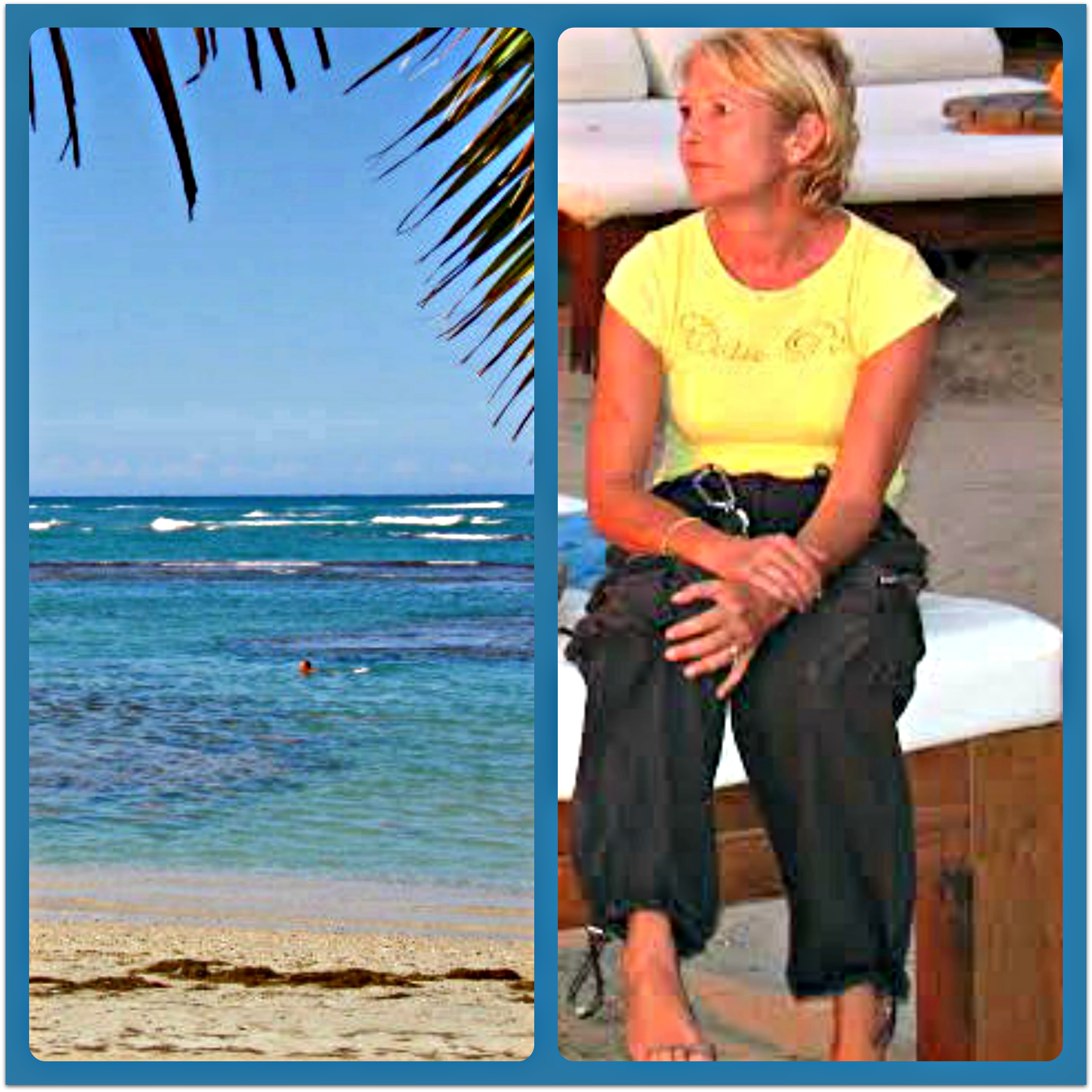
LDF in DR Collage

Las Mameyes, Puerto Plata, Dominican Republic (Morguefiles); Lindsay de Feliz (her own photo).

My guest today, the author Lindsay de Feliz, was scuba diving in the Maldives when one night she found herself on a tiny island in the middle of the Indian Ocean gazing up at the stars, the warm water lapping up against her toes.

She thought about life, love and the meaning of the universe. And then she had an epiphany: she no longer wanted the life she had made for herself in the UK. She would leave her husband of ten years, her cats, her house, her cars and her successful career, and buy a one-way ticket to Paradise (she hoped).

“What about your saucepans?” her mother responded upon hearing of this momentous decision. Possibly she was thinking her daughter had gone potty, but instead of saying that, she talked about the set of expensive pans she and Lindsay’s father had bought her for her birthday and Christmas the previous year.

Lindsay did not pack her saucepans and, when she accepted a job as a diving instructor in the Dominican Republic, was glad she didn’t—especially once she’d settled down with her Dominican boyfriend, Danilo. His son, who lived with them as well, had a habit of throwing pans in the bin because he didn’t like washing them.

Yet her mother’s question stuck in her mind, and she decided to write a memoir called What About Your Saucepans?, which was published last year.

I am thrilled to have the chance to talk to Lindsay about this memoir today, which I found an extraordinarily gripping read. Although Lindsay finds her pot of gold in terms of a man who loves her and a life on her own terms, it all goes to pot at a couple of points. And how she copes with these setbacks is as interesting as anything she has to say about the details of life within the country that has the distinction of being the most visited in the Caribbean (though her account of Dominican life is compelling, too).

And now, before we start, can you hear me banging on a saucepan as I yell out: BE SURE TO LEAVE A COMMENT; YOU’LL HAVE A GOOD CHANCE OF WINNING A DIGITAL COPY!

* * *

Saucepans-Cover_pmHola, Lindsay. ¿Que lo que? Can we start, please, by having you tell us what prompted your decision to write a memoir after a decade of living in the Dominican Republic?
I used to send monthly emails to friends and family about what I was doing and many of them said that I should write a book. I know people often say this, but the longer time went on the more the idea started to grow on me. However, the major prompt was when I was shot by a couple of burglars I’d apprehended at the gate to my home. The bullet passed through my throat and then went straight through my right lung. I made it to the local hospital being carried, then draped over the back of a motorbike, and eventually in a car. After a botched tracheotomy, I was taken to a hospital in the capital, where they put in chest drains. I went home after 12 days.

Wow! So being shot was what motivated you to write about your expat life?
There were lots of things I couldn’t remember about the incident—to this day, my recollections of it are a bit fuzzy—so I asked those who helped me what happened, and then wrote it all down. That became a chapter in the book, and then I filled in before and after.
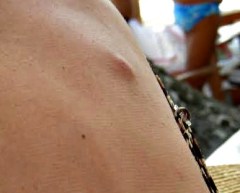
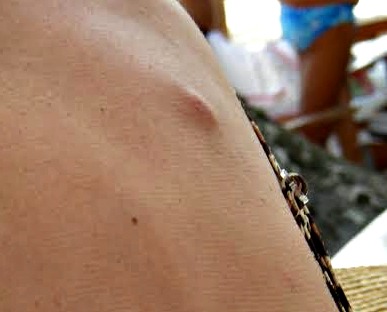
C5 Bullet stuck in my back 2 weeks after the shooting

The bullet went through Lindsay’s lung and got stuck in her back. Here it what it looked like two weeks after the shooting (Lindsay’s own photo).

Did you ever think of writing a novel instead? I ask because your memoir almost reads like a novel. I felt as though I get to know all the characters and missed them when I put the book down.
No, I never thought about writing a novel—my life was like a novel!

I understand the life you left behind in the UK was somewhat more mundane. Can you describe a typical day?
Typically, I would drag myself out of bed at around 5:30 a.m. in the dark. Get showered and dressed in a power suit making sure high heeled shoes and jewelry matched. Wrap up warm and walk 20 minutes to the train station. Train to Central London. Tube to the city. Another tube to Canary Wharf. Total journey time around two hours assuming no delays, which there often were. Work out in the gym and then walk or train to the office. Work all day long, maybe lunch at The Ivy with agencies or journalists, then the same journey home again, getting home around nine and falling into bed to do the same thing the next day.

What was the trigger (so to speak) that made you decide to pack it all in and become a scuba diving instructor?
I adored scuba diving in tropical places and managed to go a few times a year and it just seemed daft to work so hard to pay to go diving when I could dive all the time and earn enough to live off doing something I loved.

How did you end up in the D.R., of all places?
I started off in the Maldives, then went east to Asia, found it impossible to obtain work permits so ended up in Menorca, an island in the Mediterranean belonging to Spain. I decided I should learn Spanish as I already spoke French and German (as an instructor, the more languages you can speak the better). I wanted to get back to the tropics and a job came up in the Dominican Republic, so off I went.

Every pot will find its lid

February is a month for celebrating romance and love. How did you meet Danilo, the Dominican man who became your second husband?
I had seen him around, but I wasn’t even thinking about a relationship. My plan was simply to learn Spanish then head for Costa Rica and work as an instructor there as the diving was supposed to be excellent. One night at a bar Danilo was there and offered me a lift home on his scooter.

Was it love at first sight?
No, although he was seriously cute. But once Dominicans decide that you are the one, they are like Rottweilers and never let you go! He pursued me with a vengeance.
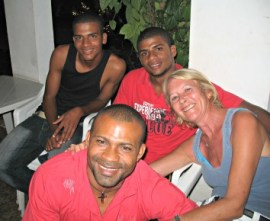
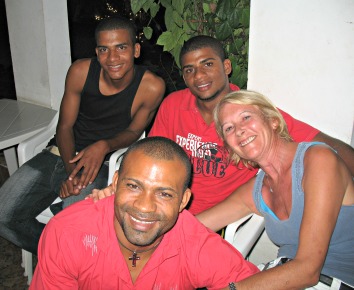
Lindsay&family

A happy family, Caribbean style: Lindsay with her husband, Danilo, and two sons.

Your courtship led to a ready-made family (his kids) and marriage. Was that a difficult decision?
Not at all. Danilo moved in with me after a couple of weeks courting—as I said they move fast, and as soon as he moved in I was called his “wife” (the vast majority of Dominicans don’t actually get married they just live together but are known as husband and wife). He moved his three children in a week later. We were like that for three years, so most of the big cultural adjustments had already taken place—and there were many, which I discuss in the book. He gave me what I wanted in terms of doing everything to make me happy and to make my life easier, and most of all he made me laugh.

But isn’t “happily ever after” particularly challenging for those of us in cross-cultural marriages?
I must admit, due to the fact we were from such different backgrounds I doubted that we would ever become soul mates, in the way you dream of as a child. However, over the past couple of years—we have now been together for 12 years—he has become my media naranja, as they say here—my half an orange—and is totally my soul mate, my best friend and more. Much I think is due to fact that he is now at university, so we have more “intellectual” conversations, and my Spanish is now much more fluent than it was in the early days. We still laugh all the time and I could not contemplate life without him.

If ifs and ands were pots and pans…

Looking back over the decade you’ve lived in the Dominican Republic, what was your most “displaced” moment: when you thought, what’s a nice girl like me doing in a place full of superstition, political corruption, thievery, and the many other cultural quirks you mention in your book?
You are right, there are many—so many I don’t know where to start. Maybe squatting down to have a pee in the sugar cane fields, taking photographs of dead people in their coffins as their families wanted a picture and had no camera, going into a store and being asked to wait while they catch a rat, going to a jail to get prostitutes out, delivering a baby to a Haitian women on the mud floor of her hutand of course having been shot, which, although I didn’t realize it at the time, meant being taken to hospital draped over the back of a motorbike because there are no ambulances or emergency services where I live.

Goodness, that’s quite a selection! Can you also pinpoint your LEAST displaced moment, when you felt you were much more comfortable living in that place than in your native UK?
I feel like that every day now as I have become totally adjusted to Dominican life. Dominicans call foreigners like me aplatanado—literally, “like a plantain banana,” signifying we’ve become one of them. Nowadays I don’t care what I wear, no make up, material possessions are not important, I don’t get annoyed if the car is scratched—a whole different set of values to those I had before. Instead of dragging myself out of bed, I leap out, happy to see what the day has to bring. I go downstairs and look across at the mountains and watch the sun rise drinking fabulous Dominican coffee. I have never been happier. I talk in the book about my search for joy. Those moments of pure joy that you experience occasionally. Now here I have them every single day. No one could ask for more.

Could you ever live in the UK again?
No, I could never live in the UK again. In the D.R., there are very few rules, which, while it does give rise to some problems, also means one has the freedom of being able to park wherever you want, smoke a cigarette where you want, not wear a seat belt if you choose not to, and so on. I love that. Also, in the UK, Danilo and I have experienced racism—groups of youths making monkey noises on the trains—because I am white and he is brown. I could never ask him to suffer that. Here we have never been made to feel uncomfortable.

Does your husband feel the same way?
My husband loves the organization in the UK, the fact that people queue, the lack of litter in the street and the trains. But even if we did want to live in the UK, we couldn’t as the new immigration regulations mean that I would have to earn a salary I could never earn, and he would have to speak pretty fluent English, which would be very hard for him.

Panning for a publisher

Moving on to the book: what was the most difficult part of the writing process for you?
The first draft was easy. I tend to think for days about what I want to write—in bed before I go to sleep, when I am walking the dogs… I wait and wait and wait until I am bursting to write it down. It is so satisfying when you actually write then. Just like when you eventually find a toilet when you have been dying for a pee for ages. The hard bit was changing it to incorporate what the publisher and editor wanted. They wanted me to write much more dialogue, which I found hard, and to talk about things I didn’t really want to talk about. I didn’t want to hurt anyone, and in a memoir you really need to tell the truth. They were right, of course, and the book was much much better as a result; but it was difficult for me to describe all of the emotions.

You published with Jo Parfitt of Summertime Publishing. How did that happen?
The path to publishing was not an easy one. I wrote to literary agents and publishers, and some said no and others told me to get it edited and then resubmit—which I did, but it all cost money. I think in some instances they were just helping out their editor mates as they all said no even after I resubmitted it. In the meantime, I’d started a blog of the same name, which began to build me an audience ready for when the book came out. In the end I found Jo Parfitt, who directed me to a great editor, Jane Dean. Between them they knocked me and the book into shape.

What audience did you have in mind for the book, and has it been reaching those people?
Originally, I had in mind people who were interested in the Dominican Republic. Yes, it has been reaching them, but it is constant work to make sure you find them and tell them about the book. Luckily, the reviews have been fabulous and those who read the book have said that everyone should read it, not just those who like the DR.

I agree, I think it appeals on many levels, not just to those with an interest in the Caribbean.
Thank you for saying that. Apart from being about life in the Dominican Republic, it’s a love story, a horror story, it has adventure, and I like to think that it might make some people reevaluate their lives and what is important to them.

Do you have any advice for others who are writing memoirs and hoping to publish them?
Firstly, write the memoir. Do it. It is great fun and also cathartic. Never stop writing at a point where you are stuck or it takes ages to pick it up again. Stop when you know exactly what you want to write next. I would also say don’t give up when you are looking for a publisher, just keep at it. It must have taken me over a year at least to find Jo. And when I did she set me targets to achieve, which gave me a purpose and a goal. You must also be honest with yourself as to whether people will be interested in your story and what it can do for them, not just what it might do for you. And finally, don’t be arrogant and precious when your editor and publisher suggest changes. They know the market a million times better than you. Take their suggestions on board. In the end it will produce something much better than you could on your own.

10 Questions for Lindsay de Feliz

Finally, I’d like to ask a series of questions that I’ve asked some of our other featured authors, about your reading and writing habits:
1. Last truly great book you read: In the Time of the Butterflies, by Julia Alvarez, a historical novel about the Mirabal sisters, who opposed the dictatorship of Rafael Trujillo in the Dominican Republic.
2. Favorite literary genre: Murder mystery
3. Reading habits on a plane: I haven’t been on a plane since Kindles and such like came out(!). But I used to read novels—the latest Patricia Cornwell or Tom Clancy—which I would buy at the airport.
4. The one book you’d require President Obama to read, and why: Mine. Because I know he would enjoy it, it would make him smile and help him to understand all of the Dominicans in the USA. He would also enjoy the part about Dominican politics. I can just see him reading bits of it to Michelle in bed in his stripey pajamas and them both laughing.
5. Favorite books as a child: Enid Blyton‘s The Famous Five series; the What Katy Did series by Sarah Chauncey Woolsey, under her pen name Susan Coolidge; Heidi; and books about horses and ballet dancers. As I moved into my teens I loved Georgette Heyer books.
6. Favorite heroine: Lisbeth Salander in The Girl with the Dragon Tattoo
7. The writer, alive or dead, you’d most like to meet: This is someone who hasn’t yet published a book so I hope that counts: Aisha Ashraf. Her writing simply blows me away and I could never write like she does. I am a story teller and she has a way of touching your heart. I would love to meet her one day.
8. Your reading habits: I don’t read as much as I would like now. However, when the electricity goes off (which it does here quite a lot) I grab a book and devour it. I also read books online by other Summertime authors which they send to me.
9. The book you’d most like to see made as a film: Mine again! I know it would make a great film. My dream is to go to the Oscars. I just need to make it happen.
10. The book you plan to read next: Linda Janssen’s The Emotionally Resilient Expat. She is another Summertime author, and I am really looking forward to getting into this one.

* * *

Thanks so much, Lindsay. Readers, what I love about Lindsay is her attitude. Some of us might think that she went out of the frying pan (a life she could no longer stand in the UK) and into the fire (getting shot in the Caribbean), but she doesn’t see it that way at all. In fact, as she explains in the book, after surviving the shooting, she has even more purpose in life and even more devotion to her adopted home.

So, any COMMENTS or QUESTIONS for Lindsay? Do you think you would react in the same way to hardships?

And don’t forget, there’s a copy of the book to be won for the best comment! NOTE: If you can’t wait to read the book or don’t win, What About Your Saucepans? is available from Amazon, Apple iTunes, Kobo and Barnes and Noble. And you can also start following Lindsay on her blog, of course!

STAY TUNED for tomorrow’s post, another episode in the life of our fictional expat heroine, Libby, told from the point of view of her husband, Olivera rare treat! (What, not keeping up with Libby? Read the first three episodes of her expat adventures.)

If you enjoyed this post, we invite you to register for The Displaced Dispatch, a round up of weekly posts from The Displaced Nation, with seasonal recipes, book giveaways and other extras. Register for The Displaced Dispatch by clicking here!

Related posts:

GLOBAL FOOD GOSSIP: Gourmet coffee vs The Pod — France’s answer to England’s “Lapsang Souchong vs PG Tips”

global food gossipJoanna Masters-Maggs, our resident repeat-expat Food Gossip and Creative Chef, is back with her column for like-minded food lovers. This month: Coffee, the Achilles heel of French cuisine.

* * *

“I wouldn’t mind French coffee being quite so terrible, if they would just admit it,”  my English friend said in exasperation as she clicked her cup back into its saucer.  “It’s the equivalent of British tea, from an urn, at a railway station in 1930s Huddersfield.”  There was a pause as she picked up her croissant for my inspection. “But I suppose there are compensations.”

If you have spent any significant time in France, you will have noticed that it is very difficult to find a really good cup of coffee.  If you have never visited, I’m sure you will find that difficult to believe, such is France’s reputation for wonderful food, wine and coffee.  So, take a breath, retrieve your eyebrows from your hairline and trust me on this one:

If you’re not a fan of Starbucks, France might just be the place to drive you there.  If you can find one, that is.

Why is French coffee in so unpalatable?  It has the power to cause involuntary facial spasms and to make my stomach roil.  At first I put these symptoms down to my taste buds being insufficiently sophisticated to appreciate its forceful nature.  After two and half years, my friend’s comment helped me to recover some self-esteem and quit making a victim of myself.

Maybejust maybeit’s not only me.

Tea: A Brit’s second language

IMG_2742

Joanna, apparently mildly surprised at her enjoyment of French coffee

I drink the tea this way, because that’s how I was brought up drinking it.  We drink it for comfort, to stay awake, to go to sleep, or to get over a nasty shock.  It comes with its own social language.  Offering tea to an upset friend shows concern when we cannot find words.  Failing to offer it to an unexpected guest says they should not expect to stay long.  Giving some to a workman is a way to show your respect for them and to ensure a good job.  Thus, overseas, tea is a rock of sameness I cannot let go of.  In fact, it is the only overseas product I really must have if I must have something from home.  It works for me.

Coffee: A rough guide

The coffee in France, therefore, should appeal to my rough taste in beverages.  It is largely made from robusta beans which are recklessly roasted until the flavor verges on the acridity of all things cremated.  It is drunk black, the addition of milk or cream deemed unsophisticated; ironic, given the rough, bad manners of the coffee itself.  The tiny cups are instead dangerously laced with extreme amounts of sugar or sweetener and then downed rapidly in a way Mary Poppins would have approved of.  And why not?  Sometimes even the French should be allowed a break from tasting and judging good food and drink.  My tea gives me the comfort and hit I demand, so why can’t I accept that the French should also be allowed, sometimes, to demand substance over style?

With coffee, the French give themselves a break from the world’s demand for them to be so effortlessly chic.  Coffee is not approached as is, say, wine, with a sort of intellectual or artistic mindset.   The routines of coffee tasting are not observed.  Whereas wine is lifted to the light, swirled, inhaled luxuriously and sucked over the tongue, coffee is knocked back as if by a Russian soldier engaged in long evening of vodka toasting. Coffee is not cupped with the hand to prevent the aroma escaping prematurely before the nose is lowered to inhale the intensified aromas.  It is not sucked over the tongue to seek the full range of flavor.

I must admit, it does the heart good to see the French behaving so badly.

Coffee climate change in Montpellier

IMG_2736

Coffee in Montpellier

I understand, though, that this is changing.  There are increasing numbers of little cafés which roast their own beans and grind to order.  Little places where robusta beans are eschewed for the more subtle delights of arabicas.  It’s been a while since I have had the time to hunt down these places in Paris.  However, last week I was in Montpellier and had the great good fortune to find two of these hallowed places.

Café Solo is an adorable place where the smell of coffee can be enjoyed a considerable distance from the front door even on a rainy February day.  I had forgotten this smell.  You don’t get it in a Starbucks or a Costa or any of the many similar establishments.  The tiny interior is crammed with drawers of beans, a counter of homemade delights in little covered cake stands and, in a corner, a large roasting machine.   My family and I discovered it quite by chance while exploring the streets of Montpellier.

Here we enjoyed what can only be described as a consultation with the artiste who would make our drinks.  She listened to what we like and do not like, and pronounced her judgement on what would suit.  Describing the flavours of each of the beans in that day’s selection, she guided our choice.   Then we waited and watched while our coffee was made.  It arrived in charming mismatched espresso cups and, thoughtfully, with little jugs of frothed milk– just in case.  Hmmmthere was me thinking I am a coffee hooligan who needs the milky stuff, just like a kid, but I absolutely did not need a drop of it.  My mocha bean from Ethiopia was soft and smooth with a tumble of flavours which lasted in the most pleasant way.   It was a delightful surprise.  I am so accustomed to a punch in the back of the throat from a tough one-dimensional over-roast.  Not so here.

“You see,” explained the artiste behind our coffees, “we French make terrible coffee.  We just don’t know how to make it.”    She smiled broadly, knowing full well that we could not agree with her.

We found a similar place a few streets later and just had to go in to try another.  Would it be possible to find two great coffees in one day?  Yes, it was. This time Columbian for me; a bit more acidity, but absolutely no acridity. Lovely.  Again, intoxicating smell of roasting coffee beans.

As we returned to our hotel, nursing the residual flavor of our coffees, we saw a Nespresso shop and just had to go in.  We knew that the chic, modern interior with its rows geometrically displayed and pristine pods as well as the absolute absence of the smell of real coffee would round off our day perfectly.  Today that clinical chicness, instead of depressing us, would only intensify the memory of the delightful little stores we had just left.  How deliciously wonderful it is to confirm how right I was.  Clutching my bags of beans from Café Solo to my nose, I knew in that moment I would never succumb to the clinical pod.  May my work surfaces be forever stained by the work of my little espresso machine and my walls stained by the periodic explosions to which the enthusiastic amateur is prone.

I thought I had no sophistication when it comes to coffee, but, perhaps because I don’t drink tea for the tea itself, I do drink coffee for the coffee itself.  I am much more open to trying different flavours and I am very willing to drink a lot of bad coffee until I find it.  Since I can manage without coffee, I am not lured by the siren call of Nespresso machines, Starbucks, or any of the lesser places.  I found absolute delight in those two shops which sell the stuff the way it should be sold.  I am willing to keep trying everywhere, until I next hit coffee gold.

Perhaps the next big discovery I will make is that the French acceptance of routinely bad coffee has freed them to become gourmet tea drinkers.  It would be fun to think so.

* * *

Joanna was displaced from her native England 16 years ago, and has since attempted to re-place herself and blend into the USA, Holland, Brazil, Malaysia, Venezuela, Saudi Arabia, and now France. She describes herself as a “food gossip”, saying: “I’ve always enjoyed cooking and trying out new recipes. Overseas, I am curious as to what people buy and from where. What is in the baskets of my fellow shoppers? What do they eat when they go home at night?”

Fellow Food Gossips, share your own stories with us!

STAY TUNED for tomorrow’s post!

If you enjoyed this post, we invite you to register for The Displaced Dispatch, a round up of weekly posts from The Displaced Nation, with seasonal recipes, book giveaways and other extras. Register for The Displaced Dispatch by clicking here!

Related posts:

Images: All images from Joanna’s personal photo albums, and used here with her permission

For this Filipina with a passion for immersive escapades, a picture says…

Jean Alaba Collage

Canon zoom lens; photo credit: Morguefiles. Jean Alaba in front of moat surrounding Osaka Castle, Osaka, Japan. Photo credit: Jean Alaba.

Welcome to our monthly series “A picture says…”, created to celebrate expats and other global residents for whom photography is a creative outlet. The series host is English expat, blogger, writer, world traveler and photography enthusiast James King, who thinks of a camera as a mirror with memory. If you like what you see here, be sure to check out his blog, Jamoroki.

My February guest is 20+ Filipina Jean Alaba. An extrovert who describes herself as a “God-fearing human being” and a “firm believer of living vividly,” Jean is, without a doubt, fulfilling her passion in life: TO TRAVEL. As she explains on the About page of her blog, The Eager Traveller, travel affords her an opportunity to move outside her comfort zone and grow as a person.

Jean was motivated to start up her blog just over a year ago, as a space to record the re-collections of her travels—which she modestly calls “my humble escapades”—in hopes of inspiring others to “nurture their zeal for new adventures” and of promoting the joy of immersing yourself in “the vibrant cultures across the globe.”

Why am I not surprised that Jean has gathered a considerable following in just over one year? My interview with her may provide a few clues as to why other avid travellers are drawn to Jean and her suggested itineraries.

* * *

Hi Jean. I know it has taken us a bit of time to connect, but I’m glad we finally managed to find some time to discuss your photo-travel experiences. Firstly, I see that you are 20+ (I am also 20+: 20 + 50!!), and for one so young you have travelled a fair bit. Can you tell us where you were born and when did you spread your wings to start travelling?
I was born in the Philippines. This may sound like a cliché but my first source of inspiration for travelling was a National Geographic magazine I saw in our school library.

National Geographic is a wonderful publication. I love it.
But I didn’t spread my wings until I made my first trip to West Coast USA. The Strip struck me the most because everyone there seemed to be having the time of their lives. There was such a lot to experience and yet the time was way too short. After that, I developed a passion to immerse myself in new cultures, interact with unfamiliar nationalities and engage in overseas adventures.

To a fearless person, no fence is high enough.—Filipino tagalong proverb

I assume you mean the famous Sunset Strip that has featured in so many movies over the years? I want to know more about your travels, but let’s start with what it’s like to be a solo female traveller.
So far I’ve travelled for pleasure and for business but as yet have never travelled alone. That’s a hurdle I hope to cross this year. I realize it can be risky, but from the inspiring articles I’ve read online, it’s clear it can also be rewarding.

Even though stepping into the unknown by yourself can sometimes be difficult, even for seasoned travellers, I believe preparation is the key. I’m sure you will be fine. Next I would love to know what what countries you have already visited?
So far, I’ve only been to the United States, India, Singapore, Japan, South Korea, Hong Kong, China and Taiwan. I lived in Singapore as an exchange student for four months, which gave me a a sense of independence and responsibility. Another highlight was my six-week business trip in India, where I had the opportunity of visiting Mumbai, Agra, New Delhi and Jaipur. Here are two photos I took on that trip:

Q9-Taj-Mahal

The Taj Mahal in all of its intricacy. Photo credit: Jean Alaba

The first is of the Taj Mahal. I immediately fell in love with its intricate design. By pure luck, a bird flew across at the moment when I snapped this shot. It was only when I was viewing my photos on my laptop that I realized I had captured such an amazing moment. For me, the bird is special: it symbolizes freedom from all the worries in one’s life and from whatever is holding you back from achieving your dreams.

Q9-Bhawani

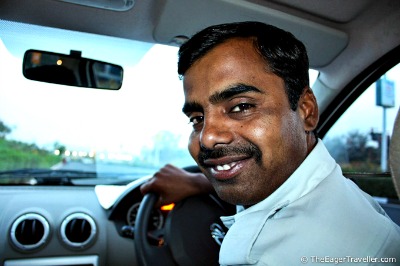
The jolly Jaipur driver Bhawani. Photo credit: Jean Alaba

The second is of Bhawani, the driver assigned to my group during our two-day outing to Jaipur. It reminds me of his kindness and positive disposition in life. He had to take us around Jaipur in the burning hot summer, but never once did he become irritated or impatient. He always had a smile on his face, and that kept us all in a good mood during the trip. In fact, the following week when we went to New Delhi, the company driver assigned to us was totally rude and inconsiderate. At one point he left us in the car sleeping (engine shut off!) while he had his dinner. Worse, when we lightly honked the car to signal that we were awake and frankly not amused, he completely ignored us.

I loved your photo of the Taj Mahal when I first saw it on your blog’s Home Page, but I have to be honest, I never noticed the bird until you pointed it out just now. Maybe that’s good as I was able to appreciate the intricate carvings. Now I’m worried I’ll miss the building and concentrate on the bird!! You’ve captured Bhawani exactly as you describe him; perfect.

One finds a way, or finds a reason to do something.—Filipino tagalong proverb

You are very modest to say you’ve been to “only” eight countries. That’s a lot more than most people visit in a lifetime. So tell us about where are you right now and why.
Well, as you know, James, I am currently in my country of birth, the Philippines, but I’m working out a deal that will hopefully pave the way for life in a new place. I’ll keep you posted.

Q9-Baler

Baler, nicknamed the Philippines’ surfing capital. Photo credit: Jean Alaba

So you are keeping the secret for now, but I’m sure your blog will be give the game away when you are on the move again. The Philippines is a beautiful country and I see you have included one picture in your selection.
Yes, I’ve included this photo of Baler, which is in Aurora province. I like it because it reminds me of my first time attempting to surf and for someone not sporty, I didn’t do too badly. This was also my first time to go beyond my comfort zone in my own part of the world: I travelled for six hours just to catch the waves. It was a spontaneous weekend that proved to be pretty rewarding.

For me, the Baler surf lapping the shore looks just like a welcoming carpet in someone’s lounge.

If you plant, you will harvest.—Filipino tagalong proverb

I know you take a lot of photos but where, so far, are your favourite places to do so? and Can you explain why these places inspire you and how it shows in your next three photos?
My favourite places to take photos so far are India, Japan and Hong Kong. I’ve included one photo of each.

Q10-India

Indian women in colorful saris. Photo credit: Jean Alaba

I like taking photos in India because Indians are very proud of their heritage. This was apparent everywhere we went in India, regardless of the people’s social status.

Q10 Japan

Portraits of Japanese people. Photo credit: Jean Alaba

Japan is a favorite of mine because the people are so organized, disciplined and polite. I never run out of things to see and admire.

Q10-Hong-Kong

A Hong Kong eatery. Photo credit: Jean Alaba

Hong Kong inspires me because of the food! I should think its vast array of local dishes are enough to inspire anyone!

I like that you manage to get a handle on people from the different countries you visit, without actually living in that place. You are clearly a good observer of people, as well as a keen researcher. Tell me, do you feel reserved about taking photos of people, particularly when they are conscious you are doing so?
Not really unless I see they’re offended. But so far, no one has reacted angrily when they see me taking their photo. This is a good thing since I like shooting people. Capturing their unique expressions enables me to glimpse who they are and the kind of lives they lead. I must have taken a thousand portrait shots while in India. Perhaps I’ll get some of these printed and make it my wall art.

I’m the same. I hate to take “posed” photos so never get into a discussion with my subjects. I either take the pic or I don’t. So you like shooting people? Don’t worry; I know what you mean! I think the wall art is a great idea. I know this is a similar question but do you ever ask permission before taking people’s photographs. And how do you get around any language barriers?
Most of the time, I don’t ask but when I was in Japan, where permission needs to be secured for taking photographs of infants and kids, I would politely approach one of the parents and ask them in Japanese—of course with the help of sign language (pointing to my camera and their kids).

Thanks to you, I won’t get into trouble if I ever go to Japan. Would you say that you are motivated by the possibility of capturing something unique, which will never be seen again?
Definitely. You always have to live in the moment, and there is nothing more rewarding than being able to capture the special moments that, unless you have a time machine, you’ll never be able to bring back. Those photos may give you inspiration just when you need it most.

I have to agree, as I think most photographers would. So when did you first realize the power of photography, and how has it changed you?
I first realized it after borrowing a decent SLR for my trip to Hong Kong in 2008. I was able to take high-quality photos to serve as a memento. Ever since, I’ve made it a point to capture moments with my camera, whether during a vacation or simply at a gathering of family or friends—moments I’ll be wanting to view when I get old and grey.

I know what you mean. The picture for me is like a diary of an event in visual form. The photographer can write about it but no one else could.

When the sheets are short, one needs to make do.—Filipino tagalong proverb

Most readers will know by now that I’m not too good on the technical stuff but some of our readers will want to know what kind of camera and lenses you use.
I’m still using the borrowed camera; it’s a Canon 450D. I use the kit lens and a prime lens. It’s outdated equipment now.

You sound a bit like me except that I haven’t managed to borrow any equipment yet. And you aren’t asking me for technical advice. That’s great!! Finally, do you have any advice for wannabe photographers who are traveling or living abroad?
I don’t feel I’m in a position to give advice since I haven’t really achieved anything noteworthy. But I would say from my experience, don’t hesitate to take as many pictures as you can while travelling. Before embarking on a journey, research and learn from the professionals online. You can try copying them, using a trial and error process.

I actually think that is very good non-technical advice, Jean. I’d like to thank you for taking the time to tell your story so far in this interview. On your blog you say:

It has been a spectacular life so far but there is so much more to be seen! I have yet to find that life-changing opportunity which will allow me to do my passion for travelling and blogging as a living.

I have no doubt you will find that opportunity. I’m booking you in for a follow up interview next year to check your progress!!

* * *

Readers, what do you make of Jean’s experiences and her photography advice? And do you have any questions for her on her photos and/or travels? Please leave them in the comments!

And if you want to know more about Jean, don’t forget to visit her excellent blog, The Eager Traveller. You can also follow her on social media:
Twitter: @eagertraveller
Instagram: theeagertraveller
Google+: Jean Alaba

(If you are a photographer and would like to be interviewed by James for this series, please send your information to ml@thedisplacednation.com.)

STAY TUNED for tomorrow’s fab post!

If you enjoyed this post, we invite you to register for The Displaced Dispatch, a round up of weekly posts from The Displaced Nation, with seasonal recipes, book giveaways and other extras. Register for The Displaced Dispatch by clicking here!

Related posts:

Trevi Fountain blesses American woman’s coins, granting her true love, a new life abroad, and now a book (we’re giving it away!)

Catherine Tondelli book signing photoWhile an expat in Japan, I mastered the ritual of tossing coins into the offering box, or saisenbako, at the Shinto shrine or Buddhist temple while clapping twice (to attract divine attention) and then making a short prayer.

In the West, of course, we toss coins into fountains and make a wish, but I’d never been one for doing that.

I might start trying it, though, now I’ve read Catherine Tondelli’s memoir, Three Coins in the Fountain, which recounts the luck she had in finding a mate the moment she tossed three coins into the Trevi fountain in the Città Eterna.

Sounds like a pitch for a Hollywood film, doesn’t it? Except, wait a minute, that film has already been done (in the 1950s)!

And it’s real life we are talking about here, not the movies.

Besides, Tondelli has kindly granted me three wishes:

  1. She will answer some questions about her memoir as well as her writing process (see below).
  2. She will GIVE AWAY TWO COPIES (hard copy or Kindle) to the two readers who toss in the best comment below.
  3. She will make the book available for free download for a short period—to be revealed at some point in our weekly Displaced Dispatch. (What? Not a subscriber? SIGN UP NOW!)

Before we start, I should mention that Tondelli’s book has been likened to another book recounting travels in the wake of divorce: Eat, Pray, Love, by Elizabeth Gilbert. But for me, a half-Italian American, Tondelli’s more restricted itinerary makes a a lot more sense. Who needs India and Bali when you can easily get the whole package—great food, a renewed faith in relationships and family, and love—in Bella Italia?

Like me, Tondelli is half-Italian, and I like to think it’s that ancestry that made her realize the truth of Madonna Louise Ciccone’s assertion: “Italians do it better.”

* * *

3-Coins-in-Fountain-by-Catherine-Tondelli_dropshadowWelcome, Catherine. I read your book not long after I’d finished Imperfect Pairings, by Jackie Townsend, which we featured in this space this past November. But that was an autobiographical novel based on Jackie’s marriage to an Italian man. So here’s my question: did you ever consider telling your story as fiction, or perhaps using it to develop a film script for a romantic comedy?
I originally thought about writing it as a novel, but my story was so unique and it gave so much hope to women who have given up all hope of ever finding the man of their dreams after 40 years old. Most people would never believe that stories like this really do happen and that true love will find you as easily as tossing some coins in a fountain. I also felt that many people could relate to my crazy stories of growing up in a large family. In the 1960s it was normal to have families of seven or more children; but, with the exception of Cheaper by the Dozen, there is very little written about large families. You have a lot of crazy stories when you grow up with ten siblings!

Yes, I noticed in the press release for the book that you grew up in Chicago as one of 11 kids who were left behind by a deadbeat, jazz musician dad. Can you tell us a little more about your relationship with the man who bequeathed you the surname “Tondelli”? After all, he features in the book quite a bit as well.
I had a very challenging relationship with my father and harbored resentment towards him for many years. I was only 12 years old when he walked out on my mother. It had a huge impact on the relationships I had and the men I chose. A daughter’s first bonding with any man is with her father: he is her first boyfriend, role model for the men she chooses. We often repeat what we know rather than what we want: we need “familiar,” even if it’s unhealthy. I kept choosing unsuitable men until fate stepped in and finally tossed me a “get a good man” coin to throw in the Trevi fountain.

Did you and your father ever reconcile?
I didn’t speak to him for twenty years. We finally reunited when I was attending a conference in Las Vegas and he was a musician playing on the strip. I called him and we had dinner together. We hugged and kissed at the end of the evening: it was a huge healing moment in my life. I was never as close to him as I was to my mother but we had a good relationship up until the day he passed away one year ago. Writing about him also helped me to heal.

Sono pazzo di te (I’m crazy about you…or am I just crazy?!)

Now turning to the man who would become your husband, the handsome and irrepressible Fausto. Since romance is a big part of what your book is about, I’d like to recount the first moment when the pair of you set eyes on each other. Newly divorced, you were traveling in Italy with your mom and had by that time reached Rome and the Fontana di Trevi, where your mother handed you three coins and urged you to wish for a nice man to come into your life. At that very moment, you heard an Italian man say: “Eeffa you wanta your wish to comb true, you avv to trow the coins witah your layft (h)and as eet’s closer to your (h)art…”
Yes, and then he asked if I knew “de meaning of da tree coins”:

“Da first coin, you find your love in Rome, da second coin, you return to Rome and the t(h)ird coin, you marry in Rome.”

And that’s what happened: he and I fell in love, I returned, and we got married.

Chi ama me, ama il mio gatto (Whoever loves me, loves my cat)

Jackie Townsend entitled her book “Imperfect Pairings” because she thinks Americans have an idyllic view of cross-cultural marriage with Europeans, thinking it sounds very romantic—whereas the reality tends to be culture clash after culture clash. You seem to believe in the romance while also acknowledging there were hurdles along the way. After you got over assuming Fausto was gay, you suspected you might be just one in a long line of fountain pick-ups. And even after he at last won your trust, you and he had to struggle to get used to each other’s habits. He did not take well at first to sleeping with your beloved Siamese cats, for instance.
Three Coins is not your stereotypical girl-on-holiday-meets-man-of-her-dreams-and-lives-happily-ever-after. Yes, we did meet on my trip to Italy, but falling in love and moving to Italy was the last thing I’d expected. I came to Italy only after I had worked for three years in London and only when finding a good job in Rome. And when he proposed, I called my sister.

I like that you put a map at the beginning of the book, showing all the destinations you and Fausto traveled to together, before you decided to live in the same place. I presume Italy and Italian culture were an adjustment?
Even though I grew up in an Italian American household, the cultural learning curve for me was huge.
My mother descends from Irish stock, and Fausto couldn’t believe his ears when I told him my Irish grandmother had put money aside in her will to host a luncheon following her funeral for all her friends and family. When his father passed away, we went down to the morgue to say our last goodbye and then off to the church and finally the cemetery, all within two hours. No lunch, no funeral home, no photographs—it was all too fast, no time to mourn to grieve with family or friends. A real Mork & Mindy moment for me.

Was that your most displaced moment: when you thought, what’s a nice girl like me doing with an Italian?
That’s one, and another would be the Christmas after we moved into our new palazzo in Rome. I went to our five neighbors in the building and brought them Christmas cookies I made and a bottle of Spumante. Fausto looked at me with all my plates of cookies and bottles of Asti in my hand and said: “My love, what are you doing??” I went on to explain that we always bring something over to the next door neighbors in America for Christmas. He just stood there and smiled and said “We don’t do that in Italy.” I said, well, we’re going to start now!

Can you also pinpoint your least displaced moment, the first time you realized you felt much more comfortable with him and in Italy than you do with a man from your own culture in the U.S.?
I think it was when there was a Lazio (Rome) football game on TV and instead he took me to see a classical music concert at the Auditorium. He wasn’t telling me all night how much he was giving up for me…he really enjoyed the concert! I am a big baseball fan, not soccer. I was thrilled.

Non si serra mai una porta che non se n’apra un’altra (When one door closes another opens)

Moving on to the writing of the book: What was the most difficult part of the writing process?
Being constantly turned down by traditional publishers. Also, people I knew who already had books published weren’t very encouraging. Luckily, I didn’t let them get me down. After shopping it around for about six months, I decided to self publish. I realized with all my marketing and PR experience I could do a better job then they could in promoting my book in getting it to the right audience.

I see that you’ve listed Francesca Maggi as a co-author. How did that relationship work?
I was lucky as she was an editor and also an author and a friend. She had just published Burnt by the Tuscan Sun, and I asked for her help on the editing process. I gave her my manuscript and she polished and refined it pointing out my weaknesses and suggested options to strengthen those areas. She was instrumental in getting the flow right and helped with the technical elements. She was a natural choice for me as we share a common love of Italy and America, and she knew my husband well.

Can you offer any advice for others who are writing memoirs and hoping to publish them?
Don’t get discouraged. Publishing a book is not easy but if you have a good story, you now at least have options to get it out there. I love this quote by women’s fiction writer Jennifer Weiner:

The difference between people who believe they have books inside of them and those who actually write books is sheer cussed persistence—the ability to make yourself work at your craft, every day—the belief, even in the face of obstacles, that you’ve got something worth saying.

What audience did you have in mind for the book, and has it been reaching those people?
I really thought the target would be women between 20 and 60 (I do get a lot of emails from women like myself, and am happy they can relate), but I have been amazed at how many men also have written to me to say how much they enjoyed reading it. Obviously anyone who loves Italy, old-time romance, or stories of expat life in Europe would find it entertaining.

What do men like about the book?
I’ve had some nice comments from men who said that they were taking notes on Fausto’s techniques… Many of them also grew up in a large family. Also, Fausto was still a bachelor at 50. His story, too, can be inspiring!

Living La Dolce Vita

In your book you question whether Americans have their values in the right place given that we take so little vacation compared to people in Europe. Have you continued to feel this way about the U.S. since marrying Fausto and settling down in Rome?
Two years ago I decided to live like the Romans do and started working for myself so I could spend more time in the US visiting family and friends and also have more time to enjoy La Dolce Vita.

Do you think you could come back to live in the United States? What would be the adjustments?
After living in Italy for more than 12 years it would be very difficult for me to return to live in the US. Fausto and I have discussed moving back to California as he also acts in film and there are many more opportunities, but then we thought: how can we go and live in a city where they close the restaurants at ten o’clock? It would be very difficult to replace our lifestyle in the US. That said, I would love to transport the US postal office here as Italy still doesn’t have postal stamp machines. I bring my book and my computer now when I go to the post office as I know I’ll be spending the day there.

10 Questions for Catherine Tondelli

Finally, I’d like to ask a series of questions that I’ve asked some of our other featured authors, about your reading and writing habits:
1. Last truly great book you read: Blood from a Stone, by Donna Leone, part of her crime series set in Venice.
2. Favorite literary genre: Biographies or autobiographies: real-life stories are always so much more interesting than anything you could make up. That said, I also enjoy reading fiction.
3. Reading habits on a plane: I usually have long flights as my mother lives in San Diego and I fly from Rome three or four times per year to see her couple that with all the travel I do for my work (am working on events in Dubai, Nairobi, Singapore and London at the moment). I always have three or four books in my library at home that I wait eagerly to put in my carry-on bag for my long, hopefully peaceful journey. I am old fashioned and still like to feel the paper when i read a book.
4. The one book you’d require President Obama to read, and why: Jimmy Carter’s book Our Endangered Values: America’s Moral Crisis. I believe that Jimmy Carter has been one of our great leaders yet he is so humble. He was my 95-year-old grandmother’s favorite president. He tells us that for example the USA gives far less foreign aid to developing countries than most people imagine. And, much of this aid goes to certain select countries whose loyalty we are trying to buy rather than because we want to help the poor. The book opened up my eyes to understand how we are perceived internationally. It will give Obama a good reminder that values and morals are more important than being powerful.
5. Favorite books as a child: Charlotte’s Web, The Adventures of Tom Sawyer
6. Favorite heroine: I have many but at the moment it is Malala, the girl who stood up for education and was shot by the Taliban and survived.
7. The writer, alive or dead, you’d most like to meet: Beatrix Potter. I loved her books as a child, and she was also one of the early pioneer woman who broke the male barrier in publishing.
8. Your reading habits: I like to read in bed with my two Siamese cats (Stella and Luisa) on my lap.
9. The book you’d most like to see made as a film: Three Coins in the Fountain, of course!
10. The book you plan to read next: E-Squared: Nine Do-It-Yourself Energy Experiments That Prove Your Thoughts Create Your Reality, by Pam Grout. She provides experiments that prove our thoughts really do create our reality.

* * *

Thanks so much, Catherine. Readers, your turn! Any COMMENTS or QUESTIONS for Catherine? What would YOU wish for with your three coins, having heard her story? Come on, Valentine’s Day is coming! Surely, someone out there aspires to be the next heart wearing the valentine of the Frank Sinatra song?

STAY TUNED for tomorrow’s TCK TALENT column, by Lisa Liang.

If you enjoyed this post, we invite you to register for The Displaced Dispatch, a round up of weekly posts from The Displaced Nation, with seasonal recipes, book giveaways and other extras. Register for The Displaced Dispatch by clicking here!

Related posts: