The Displaced Nation

A home for international creatives

Tag Archives: India

LOCATION, LOCUTION: Clare Flynn, a well-traveled novelist who specializes in geographical displacement

JJ Marsh Clare Flynn

LOCATION, LOCUTION columnist JJ Marsh (left) talks to the novelist Clare Flynn.

In this month’s LOCATION, LOCUTION, expat crime writer JJ Marsh interviews Clare Flynn, the author of A Greater World and the just now published Kurinji Flowers.

Born in Liverpool, the eldest of five children, Clare Flynn read English Language and Literature at Manchester University, although spent most of her time exploring the city’s bars and nightclubs and founding the Rock ‘n’ Roll Society.

For many years she worked in consumer marketing, serving as the international marketing director for big global companies selling detergents, diapers, tuna fish and chocolate biscuits. This included stints in Paris, Brussels, Sydney and Milan.

She began her novel A Greater World, which is set in the Blue Mountains of New South Wales, in 1998, after the first of many visits to Australia. When Clare had almost completed the first draft, burglars stole her computer. Determined that they would not get the better of her, she sat down and wrote it all again.

Her second novel, Kurinji Flowers, is set in a tea plantation in South India in the 1930s. The inspiration for the book came during a sleepless night in a hotel in Munnar in Kerala. The kurinji flowers of the title grow across this region and are renowned for flowering only once in every 12 years.

Both novels are about people being displaced. In A Greater World Elizabeth Morton and Michael Winterbourne are unwilling emigrants from England for Australia, driven away by tragic events. Ginny Dunbar in Kurinji Flowers, following a scandal that wrecks her future, is catapulted from her life as a debutante into the world of colonial India. None of these people is equipped to deal with what lies ahead.

Which came first, story or location?

Definitely location. My latest book, Kurinji Flowers, is set in a small hill town in South India. While on holiday in Kerala, in 2011, the plot came to me one sleepless night. By morning I’d mapped out the basic elements although, as always when writing, it’s changed radically since then. It’s set in the 1930s in a fictional hill town called Mudoorayam, loosely based on Munnar. After I’d finished the first draft I went back, alone, to the area and stayed in a former plantation manager’s bungalow in the midst of the tea gardens. As well as writing, I sketched and painted (then decided my main character would paint, too).

Kurinji Flowers Collage

Photo credit: Kurinji flowers by Suresh Krishna (CC BY-SA 2.0); book cover art.

What’s your technique for evoking the atmosphere of a place?

Definitely being there. I try to walk in my characters’ steps. A Greater World is set mainly in the Blue Mountains and Sydney. I was lucky enough to work there for six months—the perfect opportunity to imbibe a place. I went back after the first draft was written—again, alone, and just went everywhere, taking photographs and making notes. I do a lot of research as well—and gather pictures, both online and in books. As my novels are historical, old photographs are invaluable.

A Greater World Collage

Photo credit: The Three Sisters, Katoomba, New South Wales, Australia, by JJ Harrison (CC BY-SA 3.0); book cover art.


Which particular features create a sense of location? Landscape, culture, food?

I think they all do. Plus sounds and smells—when the heroine of Kurinji Flowers, Ginny Dunbar, arrives in Bombay from England, the scene is evoked with six different sounds, eleven smells and loads of colours. I also use trees, flowers, birds, architecture—anything that makes the place special and takes you there. Writing about London is hard for me as it’s so familiar—but the fact that my plots are historical helps: I have to do a bit of time-travelling. I try to use place as part of the narrative, not as add-on description—it has to have a fundamental impact on the plot.

Can you give a brief example of your work which illustrates place?

From Kurinji Flowers:

We went back to England and a bungalow on the downs outside Eastbourne, where after a while I started to become fond of the sheep, the curving contours of the landscape and the grey-green, chalky sea. But I missed Muddy. I missed the warmth of the late afternoon sun, the intensity of the rains, the bustle of the market, the vast undulating expanse of the tea plantations, the gentle cry of the Nilgiri pigeons, the sluggish, murky river, the blue of the morning glory, and the patchwork of the tea gardens in more shades of green than my palette could do justice.

How well do you need to know the place before using it as a setting?

You don’t need to know it well, but you have to feel strongly enough about it to bring it to life on the page. There are people who write beautifully about places they’ve never visited—finding inspiration in other literature, in photographs and art. Shakespeare never left England as far as I know and it didn’t stop him writing about distant places real and imagined. And you can always use some artistic licence if you rename the place, as I did with my hill town.

Which writers do you admire for the way they use location?
So many—but I’ll pick Dickens and Chapter 1 of Bleak House, which gives a fabulous evocation of smoggy, muddy, London in “implacable November weather,” with a whole page devoted to describing the fog. Read that and you can’t help but be there trudging through those streets and coughing up that filthy air. And what’s great about it is that the depiction of the fog is also an extended metaphor for the impenetrable fog that is the Court of Chancery.

* * *

Next month’s Location, LocutionThe Rucksack Universe series author Anthony St. Clair, with his travel fantasy books set in Hong Kong, India and Ireland.

JJ Marsh grew up in Wales, Africa and the Middle East, where her curiosity for culture took root and triggered an urge to write. After living in Hong Kong, Nigeria, Dubai, Portugal and France, JJ finally settled in Switzerland, where she is currently halfway through her European crime series, set in compelling locations all over the continent and featuring detective inspector Beatrice Stubbs.

STAY TUNED for our next post!

If you enjoyed this post, we invite you to register for The Displaced Dispatch, a round up of weekly posts from The Displaced Nation, with seasonal recipes, book giveaways and other extras. Register for The Displaced Dispatch by clicking here!

Related posts:

TCK TALENT: Esther Williams Kalbfleish, Military Brat with a Heart for Theatre and a Mind for Teaching Other TCKs

Esther & Leon collage

TCK BELLS: Esther with her ATCK husband, Leon Kalbfleisch, on their wedding day six years ago. The couple originally met at the International School in Bangkok. Photo credit: Vikki Goodman.

Elizabeth (Lisa) Liang is back with her monthly column about Adult Third Culture Kids (ATCKs) who work in creative fields, Lisa herself being a prime example. A Guatemalan-American of Chinese-Spanish-Irish-French-German-English descent, she has developed her own one-woman show about being a TCK, which was the closing keynote at this year’s Families in Global Transition (FIGT) conference and will be staged in Europe for the first time this August.

—ML Awanohara

Greetings, readers! Today’s guest is Esther Williams Kalbfleisch, an actress who also works as an ESL teacher in Alhambra, California, teaching kids from around the world whose families have migrated to the USA. I hope you enjoy her TCK Tale as much as I did!

* * *

Hello, Esther, and welcome to The Displaced Nation. I know you grew up in a military family, which gave you automatic admission into the ranks of us Third Culture Kids. Is it true that your dad worked as a spy at one point?
Yes, my dad was an army officer who served for 33 years, and while we were in India he was assigned to the Diplomatic Corps and worked as a spy!

So what did your mom do?
She was a housewife. Besides being a Cub Scout Den Mother and Girl Scout Leader, she assisted my dad with all of the entertaining that was necessary in his position.

I understand you were the youngest of four TCK siblings and the only girl, and that only one of your brothers traveled with you the first time you went overseas.
Yes, John was my only sibling to go overseas with my family after I was born; he was four years older and was born in Germany. My two eldest brothers, Wynn and Dennis, were from my dad’s first marriage and had gone overseas with him years before I was born. Wynn was 17 when I was born; Dennis was 13. Wynn attended West Point for a year and then served in Germany and Vietnam—my first memory of him would be from years later. By the time we went to India, Dennis had enlisted in the army.

Hey, we serve, too!

Tell me about all the moves and transitions you experienced as a kid.
We moved about every two years after I was born at Fort Eustis in Virginia. At that time my family was living off post, in a town called Lee Hall. Eventually we moved on post, to housing on Fort Eustis, and then to Springfield so that my parents could attend a foreign language school in D.C. in preparation for my father’s next assignment, in India. I remember my mom and dad bringing home films to give John and me an idea of what was to come. They also taught us how to count and say some simple phrases in Hindi. We moved to New Delhi when I was six, where I attended an American school. After two years we were transferred to Travis Air Force Base, in California, where we were one of the few army families. My dad was MATCO (Military Air Traffic Coordinating Officer)—his job was to organize and send materials to Vietnam and other places overseas. We moved to Thailand when I was in my last month of fourth grade. I enrolled in the International School of Bangkok, where I stayed and graduated from high school. My dad retired in Thailand, and my parents continued living there until 1976, when they moved back to the States.

When did your love of acting start?
Like many other military brats, I was raised in a very strict environment. My parents taught us that as Americans living overseas we were mini-ambassadors for the USA. Country, God, and family came first, especially country. When outside the home, we had to be polite, quiet, and respectful to all, and it was like that at home as well: no heated discussions or emotional outbursts. But then I got cast as Princess Lonelyheart in the second-grade play. Princess Lonelyheart stomped her feet when angry, cried when sad, and jumped up and down for joy. I had no idea one was allowed to react to the world in such a way—and thus began my life-long love affair with the theatre. I helped to found Thespian Troop 1163 at my high school in Bangkok, and performed or worked on over 12 productions.

The drama of choosing an acting career

But you went on to earn an education degree?
When it came time for college I was torn. My parents (who paid for my college, bless them!) considered theatre to be impractical and frivolous. And I had to struggle with my own feeling that acting was basically selfish. It didn’t fit in with my sense of duty to others. But even after I enrolled at the University of Colorado to study education, I couldn’t resist the pull of theatre. I continued to take classes and work with local theatre groups, both in college and immediately afterwards. I taught for three years in Dallas, Texas, before deciding to quit and study acting full time. I earned a second degree, in theatre, from the University of Texas.

So you got a second degree in theatre?
Yes, and eventually a master’s degree, from Cal State L.A.

It sounds like you really were torn.
For my entire adult life, I’ve been going back and forth between teaching and acting, struggling to find a place where I can best “serve” my community. After pursuing a career in theatre in the Chicago area, I moved to the L.A. area, where, for a time, teaching took over as my second love. For three years I was content to teach—there is nothing quite like watching a spark of understanding flit across a child’s face. But then one morning I woke up and vowed to find a theatre community. I learned that Theatre of NOTE was holding auditions the following day. I dragged out some monologues and went to the audition. For the next 24 years, Theatre of NOTE would be my artistic family. Due to my teaching demands I have now become an associate member. I still struggle with my choices.

Give me someone who has lived in another country…

Like many other ATCK artists I’ve talked to in this series, you’ve lived among worlds—first quite literally, when growing up in different cultures; and then professionally, as you found yourself torn between acting and teaching. As an adult TCK, have you also struggled with your cultural identity? And do you tend to gravitate towards people with interests or backgrounds similar to yours? 
To this day I have a particular fondness for the Thai people and their culture. Like most TCKs, I imagine, I identify most closely with people who have similar interests or who have lived abroad. I was a bit of a snob when I came back to the states for college. I couldn’t believe everyone was discussing Homecoming. I was far more interested in the latest Thai coup d’état… Give me someone who has lived in another country and I can LISTEN, as well as talk, for hours.

Were you happiest in a certain place at a certain time? 
I have fond memories of each place I’ve lived in, but I think India captured my curiosity. I was 6–8 years old when we lived there—old enough to be curious and yet not old enough to be set in any particular way of thinking. For me, India was a great mystery just waiting to be discovered. As I was always accompanied by my brother, John, I had nothing to fear. We would wander the streets of Dehli together or with friends, having adventures.

“The worst thing about being a military brat is not being a military brat anymore.” —Marc Curtis

As an ATCK, do you have “itchy feet” or do you prefer to have a home base and only travel for pleasure?
For many years I had “itchy feet”—I moved to different states or apartments every two to three years. Then someone asked me, was I running away or towards something. That got me thinking! I had three older brothers, all of whom were married with kids. I realized I was in search of something similar, a sense of community and family. That’s when I stopped moving and bought my own place. I realized I had to learn the skills to keep friendships and relationships going. There are wonderful people everywhere, but it is making the time to be with them that creates enduring bonds.

Have you kept in touch with friends from your TCK days?
One thing I’ve done for many years is to attend reunions of the International School in Bangkok, which are held every two years in different locations in the United States and even sometimes in Thailand. What is unique about the reunions is that they are for all graduating classes at the same time. I’ve attended almost every one since 1984. It has been great to reconnect with old friends and create many new ones.

I understand your husband is an old friend from the international school in Bangkok.
Yes! I re-met Leon at the 2000 reunion in Virginia—we had worked together on some plays in high school and were in choir and a couple of shared classes, but there had been nothing romantic between us. During that particular reunion we enjoyed a few nice chats. Fast forward to the next reunion, held in Arizona, in 2002. I had just returned from a magical, month-long trip to Kenya, and when I saw Leon, there was a little flutter in my stomach. It’s a long story, but for a while we had a long-distance relationship, after which he moved to California. We got married six years ago. We both enjoy traveling, but our first priority is visiting family and friends. We still attend the reunions every two years.

A good teacher is a good actor

What drew you to teaching?
The 1974 documentary film Hearts and Minds, which is about the Vietnam War. I came out of that movie believing that if everyone could learn to love and respect others as they love and respect themselves, no one would need to “react” out of fear, and we would no longer need war. It’s a somewhat naive thought, of course, but I can’t let go of it. I hold it in my heart each day when facing my students.

Do you think your international upbringing makes you particularly well suited to be an ESL teacher?
Definitely. As you mentioned at the outset, the students I work with are recent arrivals to the USA. Together we share what it is to leave your own country, family, and friends and try to create a new world for yourself in a new place. I’m currently working with high school students. Besides culture shock, they have the usual teenage angst about boyfriends or girlfriends left behind… Because I lived overseas and constantly moved around as a kid, I can easily relate to what they might be feeling.

Do you use both acting and diplomacy skills as a teacher? 
I think all teachers are actors to some degree. Especially working with high school students, one needs to react in a calm and thoughtful way, even if you’re not feeling that way inside. Teens will try to unnerve you if they can. I am constantly using both my acting skills and my diplomatic skills to create an environment of mutual trust and respect. One thing that drew me to the ESL students is that because their English is so limited, they don’t use language to hide what they need or want; they are too busy trying to make their meanings clear. Their needs are laid right out there for all to see. I find my ESL students to be especially honest and compassionate.

Our time is nearly up, but let’s give acting the final word. Are you performing anything soon? 
I’ll be performing in the New Short Fiction Series, L.A.’s longest running spoken words series, on Sunday, October 12, at 7:00 p.m. at the Federal Bar in North Hollywood. I’ll be presenting a new work of short fiction by a featured West Coast writer. Anyone who is passing through LA at that time is welcome to attend. You can sign up for tickets at www.newshortfictionseries.com.

* * *

Thank you, Esther! Readers, please leave any questions or comments for Esther or me below. I’ll see you in September, after I’ve returned from Iceland. As ML mentioned above, I’m kicking off a global theatre tour of Alien Citizen on August 20 and 22 at the amazing Tjarnarbíó creative center in Reykjavik! Thanks to all those who supported my Kickstarter campaign.

STAY TUNED for next week/month’s fab posts!

If you enjoyed this post, we invite you to register for The Displaced Dispatch, a round up of weekly posts from The Displaced Nation, with seasonal recipes, book giveaways and other extras. Register for The Displaced Dispatch by clicking here!

Related posts:

For this global travel buff who meditates with camera in hand and HDR on screen, a picture says…

Andy Harvard A Picture Says Collage

Canon zoom lens; photo credit: Morguefiles. Andy Harvard enjoying an ice-cold Hansa in a hotel bar off the coast of Durban (photo source: Andy Harvard).

Welcome to our monthly series “A picture says…”, created to celebrate expats and other global residents for whom photography is a creative outlet. The series host is English expat, blogger, writer, world traveler and photography enthusiast James King, who thinks of a camera as a mirror with memory. If you like what you see here, be sure to check out his blog, Jamoroki.

My guest this month is the 45-year-old South African photographer, traveller and chef Andrew (Andy) Harvard. Most chefs enjoy eating and are by nature creative people. Andy is no exception and his creative talents, ideas and passion spill over into his passion for photography, which he indulges on travels in South Africa and worldwide. He has a blog that celebrates all three passions under the descriptive title “snap fly cook”.

An early bird, Andy often wakes-up at 03h00 in summers to be on the beach in Durban, where he lives, in time for first light and sunrise an hour or so later. He is also fond of seeking out “hard to access” locations and revels in the hours spent working and reworking his photos through his favorite software packages. As he puts it:

I find this process very calming and am sometimes like a kid in awe when something magical happens. It is a meditation of sorts for me, an “addiction” that has to be fed. Oh! The wonders of HDR processing.

* * *

Hi, Andy. Even though we haven’t met face to face, we’ve had a fair amount of electronic communication over the past six months, and I’m pleased we’re finally doing this interview. Before we start I’d like to thank you for the support you gave me when I was grappling with the real basics of DLSR and HDR photographylike how to take the lens cap off so my photos wouldn’t look so dark! I know you were born in Durban, which was the first place I visited in South Africa, in 1990. When did you spread your wings and start travelling around photographing different places?
It all started in 1999 at the end of a relationship. My ex-girlfriend and I had travelled to destinations such as Mauritius and the Maldives luxuriating in 4 & 5 star hotels and resorts. As part of our very amicable breakup, she gave me a free return flight to England, where I met my (now) best friend, Jason. He and I flew from England to Amsterdam for three nights. Remember the adage “what goes on tour stays on tour”? Well, I will say no more than it was a good tour and the start of my real travel and photography adventures.

Now we all want to know more; please carry on, Andy.
Well, I have mostly travelled alone and up until meeting my wife, have enjoyed adventuring by myself. I found that travelling with others has the potential to cause unnecessary complications. Maybe you want to eat Italian and your companion wants to eat Indian. One wants to head into Northern India, and the other wants to go spend a week in a houseboat in Kerala, a state in southwest India. I have no problem talking to strangers, mingling and keeping myself very busy. Budget accommodation and street food are my favorites, although I have been known to spend 5,000 INR (Indian rupees, around 80 USD) on a lobster and 14,000 INR (around $2,300 USD) on a hotel room in Mumbai, as well as similar amounts in other locations. But that is only once in a blue moon. It will, therefore, come as no surprise that on each occasion I have been to India, I have suffered from food poisoning.

Concentrate the mind on the present moment – Buddhist precept

You’ve been to quite a number of places in the world. Can you give us a clearer idea of the range?
I have travelled on business to Swaziland and many other destinations in South Africa. In pursuit of the Buddhist spiritual path, I have been to Germany, Spain and the UK to participate in retreats and festivals. I have an appetite for grassroots communication that has taken me to countries such as Brazil, Thailand, Croatia, Turkey and Lesotho. Meeting people from various cultures has been a great inspiration. According to Trip Advisor, I have been to 18 countries and 115 cities.

I understand you like to disconnect completely when you’re on a trip?
When I travel, I have minimal to nil contact with my home country. I purposely detach myself from everyday life for the time I am away so that I can dissolve into a dreamland of new discoveries and possibilities.

Despite having gone North, South, East and West, you are currently living in your birthplace, Durban, a city of which I have fond memories. It’s so long since I was there! What is life like in your hometown these days?
Durban (Zulu: eThekwini, from itheku, meaning “bay/lagoon’), for those who don’t know it as well as you do, is the largest city in the South African province of KwaZulu-Natal and the busiest port in South Africa and Africa. Though a major manufacturing hub, it’s also a major centre of tourism because of its subtropical climate and fabulous beaches. I don’t think it’s changed much since you left. We Durbanites have always been “laid back”. Our roads are nowhere near as busy as those in the capital, Johannesburg. The beach is still magnificent for surfers and sun lovers, but swimmers must take care. The surf is big and the sharks bite! It’s never cold as you will know, but often the humidity is high. Let’s see, what else can I tell you? Oh, I know. Durban is the home of the Sharks Rugby Union, who are usually title contenders (rugby being our national sport).

It still sounds like a great place to be, but as I became an adopted Capetonian, I afraid I can’t support the Sharks. It’s the Stormers for me.

Receive the present moment, pleasant or unpleasant, just as it is… – Buddhist precept

Let’s get down to one of your passions that is fast becoming one of mine, too—photography. First, you have kindly agreed to share three photos that capture some of your favorite memories. Can you describe the story behind each one and what makes them so special for you?
These three photos are from 2009 and 2010, before the photography bug really bit me hard. But they have each etched a place in my heart.
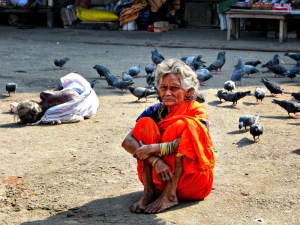
Calcutta_1

The grim reality of poverty in Kolkata; photo credit: Andy Harvard.

This photograph, taken in Kolkata (aka Calcutta), India, shows an elderly, thin, grey-haired lady in an orange sari. The lady in the white sari, lying curled up on the ground, I’d previously seen walking hunchbacked, slowly and in considerable pain, toward Mother Teresa’s home. I had a strong suspicion she was desperately trying to reach Mother Teresa’s Home for the destitute, sick and dying. I do not recall having ever having seen poverty of this magnitude when walking the main and side roads of South Africa, or anywhere else.

The picture alone tells a tragic story but your explanation adds a lot more. Thank you.

Calcutta_2

Another view of poverty in Kolkata, slightly more uplifting; photo credit: Andy Harvard.

This photo, also taken in Kolkata, indicates how desperate the lives of some people still are. The driver shovels refuse onto the truck while the crows watch in anticipation of scraps as a lady and her son appear to do so as well. The lady was searching for food and maybe something of value whilst her son sat quietly guarding their personal belongings. The dog, relaxed, watched as drivers constantly hooted and maneuvered around one another. A lot of noise but minimal fuss, no road rage or the time-consuming jams we tend to associate with dense traffic. The Kolkata experience was very brief, but I felt a sense of spirituality here. Small shrines are erected on the sides of most roadssometimes seen every fifty metres or so. Every person (other than the beggars at the temple), including the crows, dogs and cows appeared to be busy, desperately doing something meaningful in their quest for survival.

Knowing the story behind this photo helps us to appreciate how well you have captured a small corner of peace and quiet surrounded by a cacophony of noise.

WorldCup_SouthAfrica

The 2010 World Cup quarter-final match Uruguay vs. Spain, held in Durban, SA (Spain won to eventually take home the title); photo credit: Andy Harvard

Spain beat Germany in Durban on 7 July 2010. They reached a World Cup final for the first time and went on to beat Holland in Johannesburg. The only goal in Durban came from a header by Carles Puyol. This was the first time I had witnessed extreme soccer fever, and this photo won a competition in one of Durban’s newspapers.

In this photo you have captured the spirit of the occasion, which is now upon us again in Brazil. Congratulations on your award.

The key to happiness is inner peace – Buddhist precept

Next we’re going to talk about some of your current favorite places to take photographs. Can you explain why these three places inspire you and how it shows in the photos you’ve selected?
1) Huge mountains, deep valleys, tranquillity, big skies, rural living, clean fresh breezes, golden lightMonteseel, in the Valley of One Thousand Hills, makes one realize how small and insignificant certain problems we all have actually are:
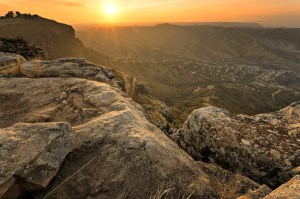
Monteseel, in the  Valley of 1000 Hills, South Africa; photo credit: Andy Harvard.

Monteseel, in the Valley of 1000 Hills, South Africa; photo credit: Andy Harvard.

2) This unspoiled coastline with restricted access is literally around the corner from Durban’s Central Business District, which we call CBD. It’s a photographer’s paradise:
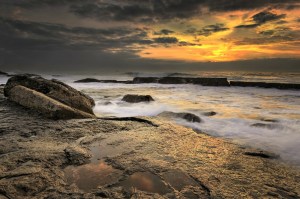
SouthAfricanBeach

Northern Bluff coastline, Durban, South Africa; photo credit: Andy Harvard.

3) Early mornings at this spot are full of activity: surfers, ski boats, fishermen, sailboats, people exercising, seine netters, photographers, holiday makers, recovering late night revellers and more. After a year of hard slogging, I managed to take this serene pier shot:

MoyoPier

Moyo uShaka Pier, Durban, South Africa; photo credit: Andy Harvard.

This photo actually won first place in my photo club’s monthly competition. The chairman said:

Brilliant, love the symmetric composition with a warm and cold side, slightly reminiscent of Turner’s sky in The Fighting Temeraire.

I know that Monteseel is an awesome place, so powerful it’s almost overpowering. It’s a great capture. Your photo of CBD is so dramatic that, although I know how warm the sea is, it looks positively cold. Why have you never shown me this before? It’s awesome. So you had to work a bit to get the last one! Well done.

You should move with a sharp consciousness… – Buddhist precept

Would you say that photography and the ability to be able to capture something unique, which will never be seen again, is a powerful force for you?
Yes, but more importantly, photography is the way I choose to meditate. I go into a semi-transcendental state when shooting and later when processing the photos on the computer. I believe the habit dates from my mother’s death in early 2013. When we visited her in hospital, we would all sit on the veranda outside the ward while I took night-time photos. Later, when going through some boxes of photos she had taken in her youth, I learned that she had been a photographer of “social” note. Not long after, I got hooked on HDR photography. I was a member of a Buddhist tradition for two years, attending teachings and meditation classes about 6–7 hours a week. Now my “meditation” is taking photos while a new day dawns in near complete silence and then sitting for hours post-processing photos to create a work of art. It isn’t a jobit’s a passion; and I want to keep it that way and share the results with others.

Thank you, Andy, for sharing such a fascinating personal story. Now for the technical stuff. What kind of camera and lenses do you use?
I have a Canon 6D, 17/40mm and 24/105mm. I also have my “old” baby Canon 550D which uses either lens above when not in use by “big brother”.

And which software do you use for post-processing?
Which software do I not use? I will use any software available to manipulate my photos to achieve the look I want to see. I know no bounds in this regard. I started with Photomatix HDR software and would attempt to “HDR” everything I could at any time of the dayi.e., dogs, people, machinery and trees. Later I learnt that this was a little foolish but, as I realized when reading this article on the topic, a necessary part of my progression. Lately, I’ve been shooting fewer exposures and manually blending them in Photoshop with layers and masks. I am new at this and on another learning curve.

Sounds like you are a post-processing junkie. I can identify with that and hope to move up to your level when I understand a lot more about the various programs. Finally, do you have any advice for wannabe photographers who are traveling or living abroad?
Be confident and take charge. Keep the camera in hand or on a sling (not deep in a bag). Take lots of photos and even different angles on the same scene. Go into a tunnel zone where you are only thinking about and taking photos. Get down on the street and get dirty. Find top photographers who you admire and follow them. Study their work and every word on their pages (great tips sometimes come hidden in a few sentences). Look at the best photo you find and think “I can do this and better, it might just take some time”. Some really kind photographers offer free tutorials in video or written formatmake the time to find them and work through them.

* * *

Thank you, Andy. I have really enjoyed our interview. Your story is so compelling and you do approach things from a different angle to many of us.

Readers, what do you make of Andy’s experiences and his photography advice? And do you have any questions for him on his photos and/or experiences? Please leave them in the comments!

And if you want to know more about Andy, don’t forget to visit his blog, Snap Fly Cook. You can also connect with him on Facebook and visit his gallery of “special” photos on Pixels.com.

(If you are a photographer and would like to be interviewed by James for this series, please send your information to ml@thedisplacednation.com.)

STAY TUNED for next week’s fab posts!

If you enjoyed this post, we invite you to register for The Displaced Dispatch, a round up of weekly posts from The Displaced Nation, with seasonal recipes, book giveaways and other extras. Register for The Displaced Dispatch by clicking here!

Related posts:

For this Filipina with a passion for immersive escapades, a picture says…

Jean Alaba Collage

Canon zoom lens; photo credit: Morguefiles. Jean Alaba in front of moat surrounding Osaka Castle, Osaka, Japan. Photo credit: Jean Alaba.

Welcome to our monthly series “A picture says…”, created to celebrate expats and other global residents for whom photography is a creative outlet. The series host is English expat, blogger, writer, world traveler and photography enthusiast James King, who thinks of a camera as a mirror with memory. If you like what you see here, be sure to check out his blog, Jamoroki.

My February guest is 20+ Filipina Jean Alaba. An extrovert who describes herself as a “God-fearing human being” and a “firm believer of living vividly,” Jean is, without a doubt, fulfilling her passion in life: TO TRAVEL. As she explains on the About page of her blog, The Eager Traveller, travel affords her an opportunity to move outside her comfort zone and grow as a person.

Jean was motivated to start up her blog just over a year ago, as a space to record the re-collections of her travels—which she modestly calls “my humble escapades”—in hopes of inspiring others to “nurture their zeal for new adventures” and of promoting the joy of immersing yourself in “the vibrant cultures across the globe.”

Why am I not surprised that Jean has gathered a considerable following in just over one year? My interview with her may provide a few clues as to why other avid travellers are drawn to Jean and her suggested itineraries.

* * *

Hi Jean. I know it has taken us a bit of time to connect, but I’m glad we finally managed to find some time to discuss your photo-travel experiences. Firstly, I see that you are 20+ (I am also 20+: 20 + 50!!), and for one so young you have travelled a fair bit. Can you tell us where you were born and when did you spread your wings to start travelling?
I was born in the Philippines. This may sound like a cliché but my first source of inspiration for travelling was a National Geographic magazine I saw in our school library.

National Geographic is a wonderful publication. I love it.
But I didn’t spread my wings until I made my first trip to West Coast USA. The Strip struck me the most because everyone there seemed to be having the time of their lives. There was such a lot to experience and yet the time was way too short. After that, I developed a passion to immerse myself in new cultures, interact with unfamiliar nationalities and engage in overseas adventures.

To a fearless person, no fence is high enough.—Filipino tagalong proverb

I assume you mean the famous Sunset Strip that has featured in so many movies over the years? I want to know more about your travels, but let’s start with what it’s like to be a solo female traveller.
So far I’ve travelled for pleasure and for business but as yet have never travelled alone. That’s a hurdle I hope to cross this year. I realize it can be risky, but from the inspiring articles I’ve read online, it’s clear it can also be rewarding.

Even though stepping into the unknown by yourself can sometimes be difficult, even for seasoned travellers, I believe preparation is the key. I’m sure you will be fine. Next I would love to know what what countries you have already visited?
So far, I’ve only been to the United States, India, Singapore, Japan, South Korea, Hong Kong, China and Taiwan. I lived in Singapore as an exchange student for four months, which gave me a a sense of independence and responsibility. Another highlight was my six-week business trip in India, where I had the opportunity of visiting Mumbai, Agra, New Delhi and Jaipur. Here are two photos I took on that trip:

Q9-Taj-Mahal

The Taj Mahal in all of its intricacy. Photo credit: Jean Alaba

The first is of the Taj Mahal. I immediately fell in love with its intricate design. By pure luck, a bird flew across at the moment when I snapped this shot. It was only when I was viewing my photos on my laptop that I realized I had captured such an amazing moment. For me, the bird is special: it symbolizes freedom from all the worries in one’s life and from whatever is holding you back from achieving your dreams.

Q9-Bhawani

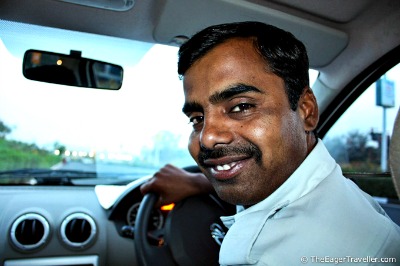
The jolly Jaipur driver Bhawani. Photo credit: Jean Alaba

The second is of Bhawani, the driver assigned to my group during our two-day outing to Jaipur. It reminds me of his kindness and positive disposition in life. He had to take us around Jaipur in the burning hot summer, but never once did he become irritated or impatient. He always had a smile on his face, and that kept us all in a good mood during the trip. In fact, the following week when we went to New Delhi, the company driver assigned to us was totally rude and inconsiderate. At one point he left us in the car sleeping (engine shut off!) while he had his dinner. Worse, when we lightly honked the car to signal that we were awake and frankly not amused, he completely ignored us.

I loved your photo of the Taj Mahal when I first saw it on your blog’s Home Page, but I have to be honest, I never noticed the bird until you pointed it out just now. Maybe that’s good as I was able to appreciate the intricate carvings. Now I’m worried I’ll miss the building and concentrate on the bird!! You’ve captured Bhawani exactly as you describe him; perfect.

One finds a way, or finds a reason to do something.—Filipino tagalong proverb

You are very modest to say you’ve been to “only” eight countries. That’s a lot more than most people visit in a lifetime. So tell us about where are you right now and why.
Well, as you know, James, I am currently in my country of birth, the Philippines, but I’m working out a deal that will hopefully pave the way for life in a new place. I’ll keep you posted.

Q9-Baler

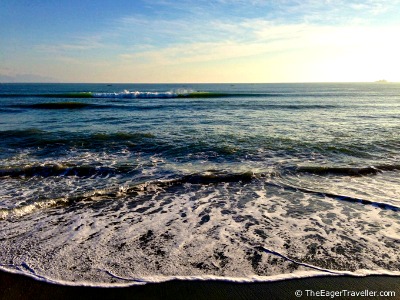
Baler, nicknamed the Philippines’ surfing capital. Photo credit: Jean Alaba

So you are keeping the secret for now, but I’m sure your blog will be give the game away when you are on the move again. The Philippines is a beautiful country and I see you have included one picture in your selection.
Yes, I’ve included this photo of Baler, which is in Aurora province. I like it because it reminds me of my first time attempting to surf and for someone not sporty, I didn’t do too badly. This was also my first time to go beyond my comfort zone in my own part of the world: I travelled for six hours just to catch the waves. It was a spontaneous weekend that proved to be pretty rewarding.

For me, the Baler surf lapping the shore looks just like a welcoming carpet in someone’s lounge.

If you plant, you will harvest.—Filipino tagalong proverb

I know you take a lot of photos but where, so far, are your favourite places to do so? and Can you explain why these places inspire you and how it shows in your next three photos?
My favourite places to take photos so far are India, Japan and Hong Kong. I’ve included one photo of each.

Q10-India

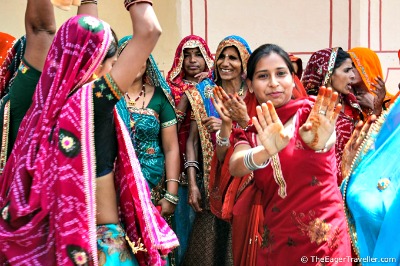
Indian women in colorful saris. Photo credit: Jean Alaba

I like taking photos in India because Indians are very proud of their heritage. This was apparent everywhere we went in India, regardless of the people’s social status.

Q10 Japan

Portraits of Japanese people. Photo credit: Jean Alaba

Japan is a favorite of mine because the people are so organized, disciplined and polite. I never run out of things to see and admire.

Q10-Hong-Kong

A Hong Kong eatery. Photo credit: Jean Alaba

Hong Kong inspires me because of the food! I should think its vast array of local dishes are enough to inspire anyone!

I like that you manage to get a handle on people from the different countries you visit, without actually living in that place. You are clearly a good observer of people, as well as a keen researcher. Tell me, do you feel reserved about taking photos of people, particularly when they are conscious you are doing so?
Not really unless I see they’re offended. But so far, no one has reacted angrily when they see me taking their photo. This is a good thing since I like shooting people. Capturing their unique expressions enables me to glimpse who they are and the kind of lives they lead. I must have taken a thousand portrait shots while in India. Perhaps I’ll get some of these printed and make it my wall art.

I’m the same. I hate to take “posed” photos so never get into a discussion with my subjects. I either take the pic or I don’t. So you like shooting people? Don’t worry; I know what you mean! I think the wall art is a great idea. I know this is a similar question but do you ever ask permission before taking people’s photographs. And how do you get around any language barriers?
Most of the time, I don’t ask but when I was in Japan, where permission needs to be secured for taking photographs of infants and kids, I would politely approach one of the parents and ask them in Japanese—of course with the help of sign language (pointing to my camera and their kids).

Thanks to you, I won’t get into trouble if I ever go to Japan. Would you say that you are motivated by the possibility of capturing something unique, which will never be seen again?
Definitely. You always have to live in the moment, and there is nothing more rewarding than being able to capture the special moments that, unless you have a time machine, you’ll never be able to bring back. Those photos may give you inspiration just when you need it most.

I have to agree, as I think most photographers would. So when did you first realize the power of photography, and how has it changed you?
I first realized it after borrowing a decent SLR for my trip to Hong Kong in 2008. I was able to take high-quality photos to serve as a memento. Ever since, I’ve made it a point to capture moments with my camera, whether during a vacation or simply at a gathering of family or friends—moments I’ll be wanting to view when I get old and grey.

I know what you mean. The picture for me is like a diary of an event in visual form. The photographer can write about it but no one else could.

When the sheets are short, one needs to make do.—Filipino tagalong proverb

Most readers will know by now that I’m not too good on the technical stuff but some of our readers will want to know what kind of camera and lenses you use.
I’m still using the borrowed camera; it’s a Canon 450D. I use the kit lens and a prime lens. It’s outdated equipment now.

You sound a bit like me except that I haven’t managed to borrow any equipment yet. And you aren’t asking me for technical advice. That’s great!! Finally, do you have any advice for wannabe photographers who are traveling or living abroad?
I don’t feel I’m in a position to give advice since I haven’t really achieved anything noteworthy. But I would say from my experience, don’t hesitate to take as many pictures as you can while travelling. Before embarking on a journey, research and learn from the professionals online. You can try copying them, using a trial and error process.

I actually think that is very good non-technical advice, Jean. I’d like to thank you for taking the time to tell your story so far in this interview. On your blog you say:

It has been a spectacular life so far but there is so much more to be seen! I have yet to find that life-changing opportunity which will allow me to do my passion for travelling and blogging as a living.

I have no doubt you will find that opportunity. I’m booking you in for a follow up interview next year to check your progress!!

* * *

Readers, what do you make of Jean’s experiences and her photography advice? And do you have any questions for her on her photos and/or travels? Please leave them in the comments!

And if you want to know more about Jean, don’t forget to visit her excellent blog, The Eager Traveller. You can also follow her on social media:
Twitter: @eagertraveller
Instagram: theeagertraveller
Google+: Jean Alaba

(If you are a photographer and would like to be interviewed by James for this series, please send your information to ml@thedisplacednation.com.)

STAY TUNED for tomorrow’s fab post!

If you enjoyed this post, we invite you to register for The Displaced Dispatch, a round up of weekly posts from The Displaced Nation, with seasonal recipes, book giveaways and other extras. Register for The Displaced Dispatch by clicking here!

Related posts:

LOCATION, LOCUTION: JD Smith – from Cornwall to 3rd century Syria

Book cover art, Tristan & Iseult; JD Smith author photo; JJ Marsh author photo

Book cover art, Tristan & Iseult; JD Smith author photo; JJ Marsh author photo

In this month’s “Location, Locution”, expat crime writer JJ Marsh interviews  JD Smith, author of the novella Tristan and Iseult and the first in The Rise of Zenobia series, Overlord, based in ancient Palmyra, to be released in early 2014.

JD Smith lives in the English Lake District. She has worked in the graphic design industry for over a dozen years, and now specialises in book cover design and typesetting.

The pseudonym JD Smith was adopted as her preferred Editor’s title when launching the writing magazine Words with JAM.

Which comes first, story or location?
Always the story. The location is influential to the story, but the story is the most important thing, the part which excites me as a reader. The location is the background upon which the story is played out, and the history is the framework upon which it is hung.

How do you go about evoking the atmosphere of a place?
With great difficulty. In writing Tristan and Iseult I evoked the wet and wind the British know only too well. I’ve always lived on the coast, though in the north, not Cornwall (Kernow), but those salt winds and perpetually grey skies are the same. The Rise of Zenobia is based in 3rd century Syria, and I’m finding that much harder. I didn’t grow up with the atmosphere ingrained in me. I haven’t spent years of my childhood visiting the remains, the palaces and the fortifications. I rely on films a lot. Being a designer I’m an incredibly visual person, and seeing it played out, filmed in the locations I’m trying to conjure on the written page, helps immensely.

Which particular features create a sense of location? Landscape, culture, food?
All of the above, definitely. Although I think in order to relate better to a reader I am all in favour of sacrificing certain aspects which readers might not gel with, and using others to push plotlines forward. Of course, all of these things give a clue as to the time, as well as the place, in which a book is set.

How well do you need to know the place before using it as a setting?
I’ve never visited Syria but I’m writing about it. You need to know it to a degree, but I think you need to know your characters more. Location is secondary. You can paint the background afterwards. Of course it depends. I write historical novels based on historical events and people, and knowing them and the history of the place, rather than the place as it stands, is key.

Could you give a brief example from your work which you feel brings the location to life?
These two extracts are my favourite descriptions of the weather in Britain which for me was a huge part of the setting of Tristan and Iseult:

Rustling emanates from the dense forest, even though the wind has dropped. White mist shrouds us. I tense to stop cold shivers taking hold. The rain is fine, yet a hand through my hair proves it is wetter than the streams in springtime and my footing slides on the muddy grass as we pick our way through undergrowth.

And:

‘Ireland is no home for me,’ she says. ‘I was at home with the sea and the sand and the shingle of my shores, with the salt spray in my hair.’

Which writers do you admire for the way they use location?
Tricky one. I tend to admire writers for their story, and their characters, not for their use of location. And for me it’s both the time and the place that work together as one with any author’s writing, because I love historical fiction. Time and place are tied so tightly together one does not exist without the other. Sarah Bower’s descriptions are second to none.  Philippa Gregory evokes the royal court with ease. And Bernard Cornwell can describe a battle on any field.

Next month on Location, Locution:  award-winning author Amanda Hodgkinson.

 * * *

JJ Marsh grew up in Wales, Africa and the Middle East, where her curiosity for culture took root and triggered an urge to write. After living in Hong Kong, Nigeria, Dubai, Portugal and France, JJ finally settled in Switzerland, where she is currently halfway through her European crime series, set in compelling locations all over the continent and featuring detective inspector Beatrice Stubbs.

STAY TUNED for tomorrow’s post!

If you enjoyed this post, we invite you to register for The Displaced Dispatch, a round up of weekly posts from The Displaced Nation, with seasonal recipes, book giveaways and other extras. Register for The Displaced Dispatch by clicking here!

Related posts:

LOCATION, LOCUTION: Jeet Thayil on bringing location to life in a semi-dream state

Jeet Thayil

Clockwise from top: author photo Jeet Thayil; book cover art “Narcopolis”; author photo JJ Marsh

In this month’s “Location, Locution”, expat crime writer JJ Marsh interviews Jeet Thayil, author of  Narcopolis.

Jeet Thayil was born in Kerala, India, in 1959 and educated in Hong Kong, New York and Bombay. He is a performance poet, songwriter, librettist and guitarist, and has published four collections of poetry: These Errors Are Correct (Tranquebar, 2008), English (2004, Penguin India, Rattapallax Press, New York, 2004), Apocalypso (Ark, 1997) and Gemini (Viking Penguin, 1992). He is also the editor of The Bloodaxe Book of Contemporary Indian Poets (2008). His first novel, Narcopolis (Faber & Faber, 2012), won the DSC Prize for South Asian Literature and was shortlisted for the 2012 Man Booker Prize and the Hindu Literary Prize 2013. He currently lives in Berlin.

Which came first, story or location?
I knew Narcopolis would be set in Bombay. I started with that city and that period in mind. It was about telling a story that hadn’t been told before, in a way that Indian fiction doesn’t really tell stories. Unsentimental, brutal and beautiful. When I realised that was what the book would be like, it revealed itself to me.

What’s your technique for evoking the atmosphere of a place?
When I was working on Narcopolis, I would work till very late at night, go to bed, wake up and start on it again, without really thinking. I found that when you’re in that oneiric, half-oneiric state, still slightly in the dream, very interesting things would happen. I’d come up with things I’d never have thought of later in the day. I was astonished about how much I remembered from that time, 25 years earlier, when I had no idea I would write a novel, when I was not exactly in the clearest of mental states. I was also surprised how unhealthy it was, the process of remembering.

A negative experience?
Absolutely. It was the opposite of cathartic.

Which particular features create a sense of location? Landscape, culture, food?
All of those. I’m a big fan of crime fiction, the bloodier the better. I’m addicted to crime thrillers. That, and poetry, is what I read on a daily basis. I’m sure a lot of that atmospheric noir milieu seeped into Narcopolis.

That’s curious. Not a link I would have made. I was going to ask you if you had a guilty reading pleasure, but you obviously don’t feel guilty.
Not at all. I hold those books up proudly on the train.

How well do you need to know the place before using it as a setting?
I’ve set poems in places I’ve never been to, and that can be a huge liberation. I think the worst is to know a place glancingly. To visit a place for a few days, get a false sense of it and then try to write about it. It might even be better to have never been there than read a guide about it.

Because it’s too superficial?
I think so. Either never go there or have been there too long.

Which writers do you admire for the way they use location?
I mentioned my love for crime writers and the way they do exactly that, evoking streets and cities and ambiance. But I’m also tremendously fond of the fiction that’s set in the opposite of cities: William Trevor, Henry James, E.M. Forster. Writers that do evoke a sense of place but often in the most mysterious and indirect of ways.

Next on Location, Locution … JD Smith, author of Tristan and Iseult (12th-century Cornwall) and Overlord: The Rise of Zenobia (3rd-century Syria), to be released in early 2014.

 * * *

JJ Marsh grew up in Wales, Africa and the Middle East, where her curiosity for culture took root and triggered an urge to write. After living in Hong Kong, Nigeria, Dubai, Portugal and France, JJ finally settled in Switzerland, where she is currently halfway through her European crime series, set in compelling locations all over the continent and featuring detective inspector Beatrice Stubbs.

STAY TUNED for tomorrow’s post!

If you enjoyed this post, we invite you to register for The Displaced Dispatch, a round up of weekly posts from The Displaced Nation, with seasonal recipes, book giveaways and other extras. Register for The Displaced Dispatch by clicking here!

Related posts:
TCK TALENT: Amber Godfrey, Diplomatic Kid Turned Performer-Writer

Amber Godfrey Collage

Photo credits: left: RoganJosh (MorgueFiles); right: Amber Godfrey, from her portfolio.

Welcome to Elizabeth (Lisa) Liang’s monthly column about adult Third Culture Kids (TCKs) who work in creative fields. Lisa is herself a prime example. A Guatemalan-American of Chinese-Spanish-Irish-French-German-English descent, she recently debuted her one-woman show about being a TCK, which I had the pleasure of seeing during its too-short run in New York City in September: stupendous!

—ML Awanohara

Happy Thanksgiving, readers! I’m thankful to be bringing you today’s guest, a kindred spirit of mine. She is Amber Godfrey, an actress-writer who, like me, has written and performed her own solo show about growing up as a TCK of mixed heritage.

* * *

Welcome to The Displaced Nation, Amber! I’m happy to have met another solo performer whose TCK story parallels my own. Since your dad is a Canadian diplomat, you grew up in eight countries. Can you tell us which ones?
Besides Canada, I’ve lived in the USA, Ecuador, Trinidad, India, Hong Kong, Sri Lanka and England.

Growing up, which of these countries do you identify most strongly with?
I identified, and continue to identify, strongly as a Canadian probably because of my dad’s job and the fact that we always connected with the Canadian expat community wherever we went. I also heard on more than one occasion (usually when I was being busted for some rebellious act): “You represent Canada!!” I’ve spent most of my adult life in Canada and the US, so I feel very “North American” at this point. At the same time, though, I do feel like a “citizen of the world,” and the bond that I feel with other TCKs is unique.

“Are you adopted?”

Your family is particularly diverse. Let’s see if I can get this right. You are the daughter of an Ecuadorian mom and an African American father, but you were raised by your mom and a Caucasian-Jewish Canadian stepdad, who then had your brother, David. Was your family’s status ever challenged by strangers, like mine was? In grade school, no one believed my brother was my brother, and people asked my mom if I was adopted.
Yes! This still happens all the time. When the four of us go out for dinner, servers will assume my brother and I are a couple. If I check into a hotel with my Dad, we get stares. When I was in fifth grade, I had to go to the school nurse and, when she realized who my brother was, she asked pointedly: “Are you adopted?” I panicked and said “Yes,” even though that wasn’t the whole truth. Looking back—what an inappropriate question to ask a 10-year-old!

Do you feel offended when that happens?
Honestly, it sort of tickles me that people don’t know what to make of us. I figure, that’s their problem and it doesn’t have to ruin my day. As an actor, I get irritated by the under-portrayal of mixed-race families on stage and in film. When I was auditioning a lot, I became really frustrated realizing I would most likely not be considered for “sister of” so-and-so because the other actor had already been cast as white.

Love the place you’re in

I completely relate! So, with such a mixed background, which culture(s) form the core of your identity?
I grew up with a lot of focus on Jewish history, tradition and heritage, which I resisted up to a point—I chose not to be Bat Mizvah’d—but to which I also really connected. As a pre-teen I was obsessed with The Diary of Anne Frank and wrote short stories about young Jewish girls in the Nazi era. In my early 20s, the combination of acting roles I was being sent out for and my burgeoning adulthood piqued a stronger curiosity in the African-American side of me, which ultimately led to me reaching out to find my birth father. Now, in my 30s, I find myself seeking to connect with my Latin American roots. Of course I also identify with the cultures of the countries I grew up in! I think the quest to understand my “identity” is ongoing…

Were you happiest in a certain place at a certain time?
I guess the short answer is: I aim to be happiest in the moment I am in. Every place I went to had its good and bad moments…

What were your school experiences like growing up?
I went to private school in California, international schools in India, HK and Sri Lanka, and the local public school in Canada. During high school I had to contend with three completely different school systems, which was a challenge to say the least.

How about college?
I went back to Canada for college: I studied theatre at Acadia University, in Nova Scotia. It was hard to get good information back then (the Internet was just a baby!), but my Dad pointed out that as a small school in a small town, it might be an easier transition than if I went to a big school in a bigger city like Toronto. And Acadia has a good theatre program.

“It’s all in me…”

Did your TCK upbringing influence your desire to become a performer?  
Being in school plays or performance groups was a good way to get involved and make friends when moving from place to place. But I also think that portraying characters on stage allowed different parts of myself to come forth and was a way for me to work out my identity. I’m laughing because I’m thinking of Whitney Houston’s “I’m Every Woman”—I’m a hippy at heart and believe we are all one and connected. Seeking to experience and understand life/truth from multiple viewpoints is an essential part of who I am.

Before we get into your solo show, let’s talk about your series of performances of Anna Deavere Smith‘s solo show Fires in the Mirror, a docudrama for a solo performer about the racial tensions that erupted between blacks and Jews in Brooklyn in 1991.
I was asked to do Fires in the Mirror by Jesse Freedman, a fellow performer and prolific director, whom I met in a SITI Company Suzuki/Viewpoints workshop. I jumped at the chance to engage with this epic piece because it is constructed so thoughtfully and allows me to play with my Black/Jewish roots. I initially performed Fires in the Mirror at the Limmud Conference, which took place in Coventry, England. Then the Jewish Theatre Workshop in Baltimore requested the show as part of an initiative to continue dialogue between Blacks and Jews who share space in that community. I also had a short run in NYC at the New Yiddish Repertory Company Theatre.

Moving over to your autobiographical solo show: why did you create DipKid?
I’d been thinking for many years about telling my story but couldn’t decide which way to tell it. After taking a Soulo-Show Workshop with Tracey Erin Smith, I finally started writing. I submitted a proposal to a small festival in NY, and when I got in, I realized it was time to start making the show! My efforts resulted in a short but sweet twenty-minute piece (you can watch it here).

How was it received?
The reaction was fascinating. I had assumed my story was unique, but it seemed that people could relate to it, and wanted more! That’s where the struggle began for me. I didn’t know how to finish the piece because I felt I wanted it to link up with my current situation—but that kept changing! The next time I performed the show, I expanded it to 45 minutes but felt less satisfied. I’d watched the video of my first performance so many times I felt sort of stuck in the past. I also found myself listening to many differing opinions on where my show should go and how it should be crafted—my vision got a little lost in the din. Finally, the festival format was crazy-making—especially as I was holding down a full-time job. Trying to write and rehearse this piece all for just one evening was too much pressure. My dream would be to take the show to the countries I lived in and beyond. I’d love to perform it at international schools and for expat communities worldwide.

As the interviewer, I think I can permit one question that’s of particular interest to me, which is: how do you like solo performing?
Solo performance is relatively new for me and I do miss getting to work with other actors on stage. That said, the medium allows me to be a bit more in control of the work and my approach. And it’s wonderfully vulnerable!

I understand you’re planning to film a documentary. What will it be about?
The focus will be on other children of diplomats (i.e., “dip kids”) and how their lives have been shaped by their upbringing and the jobs of their parent(s). I plan to tell the story from my perspective and also weave in my experiences as a mixed-race individual who continues to search for an understanding of and connection to my identity, heritage and all the parts that I am made of.

Do you have any other projects coming up?
I am writing a memoir that will delve deeper into the stories I reveal in DipKid.

Best and worst (Canadian) Thanksgiving memories

Canadian Thanksgiving was in October, but since American Thanksgiving is today, please share with us your best and worst Thanksgivings.
The best occurred when we were living in New Delhi. We were invited to the Official Residence of the High Commissioner for a Canadian Thanksgiving celebration. It was a big party with live music and food sprawled out on the grounds. At dusk everyone looked up and gasped as hundreds of bats swarmed the sky. It was the coolest thing I had ever seen!

I think the worst was my first Thanksgiving away from home. My parents were in Sri Lanka and I was in Wolfville, Nova Scotia (where Acadia U is). Everyone I knew at school had family nearby, but it was only October and I hadn’t bonded with anyone enough to get an invite. I ate Pop-Tarts and drank Dr. Pepper and felt homesick for my family and a bit sorry for myself…

* * *

Thank you, Amber, for being you, a fellow TCK theatre-maker! Readers, please leave questions and comments for Amber below. And if you want to keep up with her creative undertakings, I suggest you also follow her on Twitter: @DipKidAmber.

STAY TUNED for next week’s/month’s fab posts!

If you enjoyed this post, we invite you to register for The Displaced Dispatch, a round up of weekly posts from The Displaced Nation, with seasonal recipes, book giveaways and other extras. Register for The Displaced Dispatch by clicking here!

Related posts:

Mark Hillary delivers reality check to gringos who moan about Brazil, in self-published book (2/2)

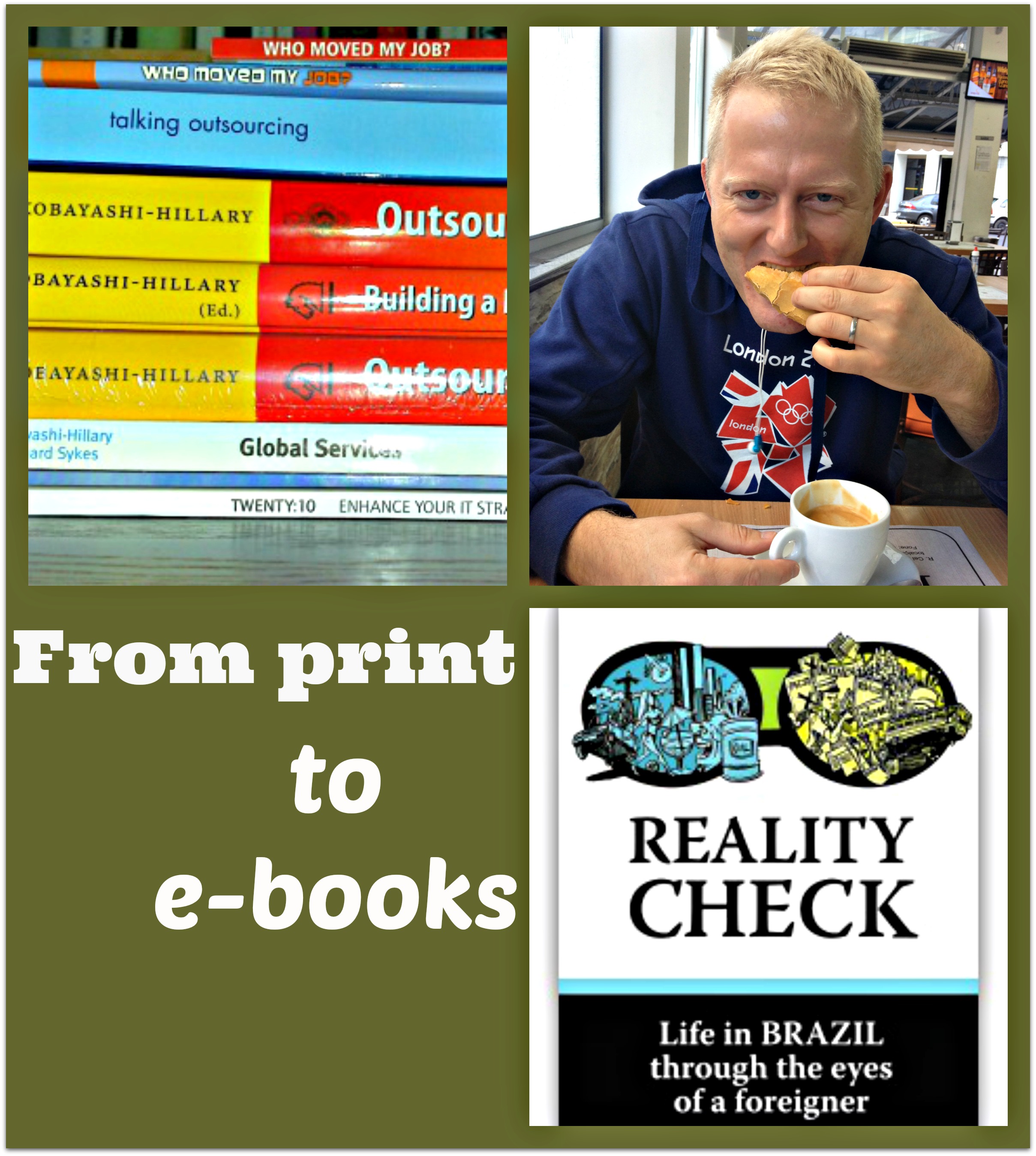
Mark Hillary Part 2 CollageIn Part 1 of my interview with Mark Hillary, a fellow Brit and amigo in São Paulo, we learned about what spurred him to write a book called Reality Check: Life in BRAZIL through the eyes of a foreigner.

A lively discussion ensued about what makes Brazil such a contentious country for expats (short answer: it’s a country of extremes).

Today I’ll ask Mark about his decision to publish Reality Check as an e-book. As I mentioned last week, Mark is well published in his chosen field of technology and globalization. He is a HuffPo columnist and has also blogged for Reuters about British politics. But Reality Check represents his first venture into the Amazon e-book platform.

I was curious about why he chose this route and also had some questions about his reading and writing habits generally.

* * *

Mark, Reality Check isn’t the first book that you’ve written. Can you tell us something about your other books?
It’s actually my tenth book. I used to be quite a senior IT manager in a bank, managing people all over the world. I had already started contributing articles to technology magazines while I was at the bank, and eventually I was sent off to India to help the company build up a big new office in Bangalore. I was hiring hundreds of technical team members and then trying to sell their services bank to other sections of the bank. It was quite an experience, especially as it occurred right at the beginning of the big push to India by many technology companies.

I wrote a book about it all, which was published by the respected German publisher Springer and well received in journals and newspapers such as the FT.

After that I carried on writing about the connection between work, technology, and globalization.

It’s impressive that you can span the range from big IT questions to a foreigner’s take on life in Brazil.
I’m interested in many areas, which is probably why my three times at university have included courses on computer science, business and management, and psychology. My earlier work on outsourcing naturally led me to how companies are changing and globalization, and this has naturally led onto my writing about being an expat. If there’s a connecting thread, it’s work and the changing nature of work in our time. That said, I wouldn’t want to only ever comment on a single topic. Life is a lot more complex than that.

You decided to release Reality Check in the Amazon Kindle format. Why did you make that decision?
I’ve been asked that question a lot. Six of my books were published using traditional publishers, and three were self-published via Lulu. And now, with the Brazil book, I’ve used the Amazon Kindle format. I went into some detail on the pros and cons of each of these methods in a recent Huffington Post article, but in short the important thing to remember is how the publishing market is changing. Obviously there is still a lingering sense of kudos with the traditional publishers. A novel published by Penguin is still seen as “better” than something self-published, but it doesn’t have to be. The platform and process of publishing itself has just been democratized and made available to all.

If you know how to write and you can market your work to an audience, then it is much faster to publish with Amazon or Lulu. And, not only can you reach a global audience instantly—you earn a far greater percentage of the sale price.

In the case of Reality Check, I wanted it to be available around the world as quickly as possible, and Amazon has a great system for doing that. Plus you don’t actually need a Kindle: iPads and phones are all being used to read this book.

Do you think it helps that you already had a following through your writings and other books?
Reality Check has has been in the Amazon top 20 books about Brazil since publication on September 1st, and yesterday when I checked, it was the number one book about Brazil and number two book about South America. So people have been noticing it.

I think it does help if you already have a following. It used to be that publishers and agents acted as the gatekeeper, so readers could be confident a book that ended up in the shops was good. Now anyone can publish any old rubbish, so there is no longer that guarantee of a published book being any good.

The much-celebrated poet Seamus Heaney is a good example. He has been lauded as one of the greatest writers of the past century, and he had plenty of work published by traditional publishers. But he was self-publishing new work before his recent death.

Do you plan to make Reality Check anything other than an e-book?
I’m planning to also release a paper version of the book, but it will not be until the second edition—planned to come out just before the World Cup football competition in June next year.

Are you working on any other writing projects at the moment?
The present one is about my own experience of ghostwriting. I’ve written for ambassadors and company CEOs, and I once had to help astronaut Neil Armstrong add a few jokes to his standard Apollo 11 speech. The work I have written for others to be delivered in their name has often, but not always, gone down well, and I wanted to explore that. And in the tech area, I’m working on a book project that aims to be a graduates’ guide to how you get a job in a job market where nobody wants to pay you a salary.

10 Questions for Mark Hillary

Finally, I’d like to ask a series of questions that we’ve asked some of our other featured authors, about your reading and writing habits:

1. Last truly great book you read: I recently read all of Ira Levin’s novels back to back—all great; but I’ll go for Paul Trynka’s biography of David Bowie, which I just now finished.
2. Favorite literary genre: Dystopian novels: Burgess, Orwell, Ballard.
3. Reading habits on a plane: I read fiction and non-fiction and always carry my Kindle because it’s so much better for travel than lugging around a lot of books. This week I was on a plane and I read The Default Line, by Faisal Islam—about the financial crash of 2008 and what has happened since.
4. The one book you’d require David Cameron to read, and why: Why It’s Kicking Off Everywhere: The new global revolutions, by Paul Mason. It’s a study of the various riots, uprisings and protests around the world, particularly in 2011. I think the UK has more unrest to come because living standards and earnings are in decline—the people are going to kick off again one day.
5. Favorite books as a child: Those by Roald Dahl, though everyone seems to think he was actually a nasty piece of work in real life.
6. Favorite heroine: Harper Lee. To Kill a Mockingbird was her only book and she never courted any publicity. It challenged racism over 50 years ago and still retains its power today.
7. The writer, alive or dead, you’d most like to meet: Oscar Wilde. He wrote 20th-century books and plays in the 19th century and despite his sad downfall, is still remembered and loved today.
8. Your reading habits: I mostly read in the evening. I don’t watch TV, other than for movies so that gives me more time. I tend to read one or two books a week unless I’m traveling a lot then it’s more just because of the endless time spent in airports or on buses.
9. The book you’d most like to see made as a film: The Drowned World, by J.G. Ballard. Life after the oceans have risen and the world we know now is flooded.
10. The book you plan to read next: Jesse Norman’s biography of Edmund Burke—already on the Kindle waiting for me.

* * *

Readers, any more questions for Mark? He may sound a bit intimidating, but in fact he’s very approachable and happy to answer any questions about e-publishing. (Though he doesn’t write fiction, he also has views on publishing platforms for novels.) Meanwhile, if you’re interested in Reality Check, you can purchase it on Amazon. I would also recommend becoming a fan of its Facebook page and following Mark on Twitter: @MarkHillary

STAY TUNED for tomorrow’s post, by another Englishman who is also an expat albeit in California: Anthony Windram.

If you enjoyed this post, we invite you to register for The Displaced Dispatch, a round up of weekly posts from The Displaced Nation, with seasonal recipes, book giveaways and other extras. Register for The Displaced Dispatch by clicking here!

Related posts:

images: Mark Hillary surrounded by his traditional books and his e-book cover.

Dipika Kohli on world community art, defining a future, and why “wait and see” won’t cut it

tumblr_m7b7kmftdt1qaqyfmToday TDN welcomes Dipika Kohli, author of The Elopement, which we reviewed in September last year. Raised in America by Indian parents, Dipika now lives with her Japanese husband, Akira, in Durham, North Carolina, where the couple run a design company

Together, they are the driving force behind Stitch, a community art project for which they are currently raising funds on Kickstarter in order to take the project around the globe. 

Dipika, who has channeled her own feelings of displacedness into writing and art, joins us today to tell us more about this exciting project, the first in a series.

We begin with an intro to what Stitch is all about…

Stitch 101

Stitch is about supporting local artists and the art scene; it’s about a community defining the fabric of itself and its future. It’s community art, and an exercise in word-driven intention-setting at the same time.

Dipika and Akira say:

Now, we’re bombarded by images we never chose for ourselves—we let brands and labels do the work to define and express who we are. It doesn’t have to be that way. What if we could choose what we see? In simple, uplifting, people-nominated and people-chosen words and images? Would we, as a community, behave differently? Would we know who we are?

5d4954b68a302fd6081cb8f67e904ad2_large-1

The 276 words representing Durham, NC, in a word-cloud indicating frequency/popularity

For two months, Dipika and Akira talked to hundreds of people in their town of Durham, North Carolina, asking them one question:

What would you like to see Durham become, in one word?

After collecting many words, the residents of Durham voted for those that described their vision of the future Durham — the Durham they would like to be part of.

The resultant 276 words were passed onto two dozen local artists, who created work inspired by these words. Collectively, these pieces create a vision for the town, while money raised from the selling of these pieces will take Stitch to other communities in the world,

“connecting disparate communities with a common thread of art and collective visions.”

And now — over to Dipika:

Insane…or brilliant?

You have to either be insane or brilliant. To do it, I mean. To get up and do the crazy thing that no one believes will ever work. Everyone who says they care about you and your future likes to say, “Just wait, and see.” See if you can save enough. See if you still feel like doing something wild and crazy. Wait. See.

I’m done with that approach.

You see, I’ve been “waiting and seeing” for about a year now. I’ve been wanting to get back on the road, but why? How? What would that accomplish? A little Descartes reincarnation was sitting on my shoulder, niggling.

March, I said, was when I’d pull the trigger. Whether it made “sense” or not to jump ship and move out of my apartment for some unknown adventure ahead.

Taking Flight

March 16. My birthday. The day I launched the book that took me 13 years to get the nerve up to actually publish. So romantic, I thought, to finally upload Flight of Pisces and then move out of my apartment, and “away.” Wherever that might be.

Flight of Pisces was about the time I left Durham, NC, to trek about in India. Footloose and in search of “identity,” I wanted to see the place where my parents originally come from. New Delhi, and Old Delhi. I went solo, and I did it big, culminating in something that all these years later, I shake my head about, thinking, “Did I have some kind of death wish?”

Maybe I did.

Maybe it was survivor’s guilt. Or more, or less. Who knows.

What I do know, and what I can say, is that it had to be the way it was. I had to go and try something that seemed like it was the most absurd and off-the-track kind of thing in the world, in the universe, even, because without having gone and done it, I wouldn’t have ever gotten it. “The glimpse.” A feeling that the world was shifting beneath my feet. And, indeed, it was.

Now, the same feeling is resurfacing.

On the road again

I’m getting lost in the world, again, and on purpose one more time. It’s okay with me that I have a four year-old who’ll be my classmate on this new tour as we go on an educational field trip together to someplace new. I can’t disclose all the details (yet), but I’m trusting it’s going to be okay.

We’ll have just one text with us, in our imaginations. A book that’s got a bunch of blank pages inside, and one image. It’s the cover, and it looks like this:

It’s the drawing I made back in 1994, when I met my husband, Akira Morita. He’s from Japan, and I’m Indian-American, and we eloped to Ireland in 2000. You could say we like to mix it up. Or just trust that we’ll find something wherever we go. One thing’s for sure, we’re always getting to know a bunch of people well, and anyone who’s into the displaced feeling of being elsewhere knows what I mean.

I held a roundtable last year called EXPAT at a place in town called Mad Hatter’s. It’s a little cafe, and about a dozen of us got together to talk about our experiences in places like Ghana, Madagascar, and all parts of Europe, too. Conversations like that made me feel like I was on the road again.

From T-shirt designs to Stitch concept

Now, Akira and I are 18 years older than we were when we met, and we’ve evolved a lot from those days when we thought printing a T-shirt design on a shirt was cool. Our style has gone conceptual, and now we’re doing our biggest art project together yet. It’s called STITCH, and it’s on Kickstarter now through April 28.

Part of the reason we’re doing this is to shape the community for the place where we both have spent the biggest chunks of our life: Durham, North Carolina. But there’s more, too. Lots of things I want to talk about with you in upcoming posts from this new series. I hope you’ll enjoy the journey with me.

Find out more about STITCH here at the Kickstarter website!

* * *

STAY TUNED for tomorrow’s post from our fictional expat heroine, Libby. (What, not keeping up with Libby? Read the first three episodes of her expat adventures.)

If you enjoyed this post, we invite you to register for The Displaced Dispatch, a round up of weekly posts from The Displaced Nation, with seasonal recipes, book giveaways and other extras. Register for The Displaced Dispatch by clicking here!

Related posts:
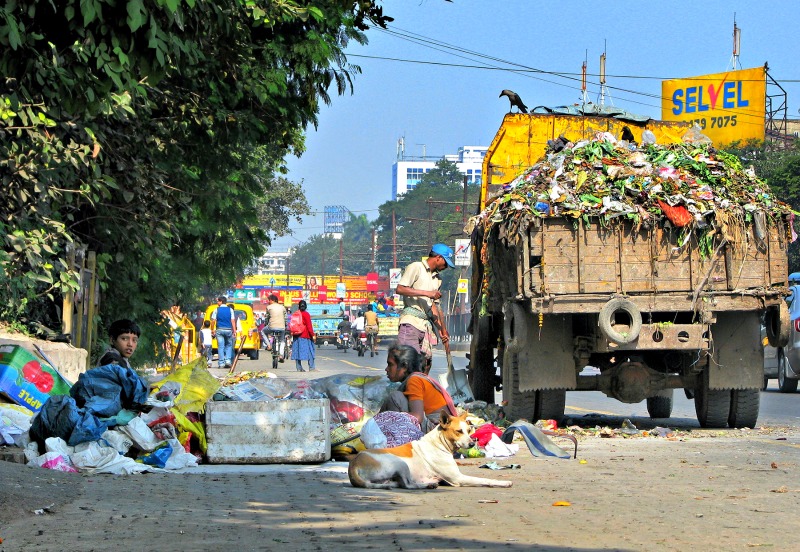
And the nominees for best expat/travel film are…seeking your vote! Welcome to the 2013 Displaced Oscars

Don’t miss our 4 polls below! Results to be announced in March 2nd Displaced Dispatch! Enjoy!

When I first repatriated to the United States, I relished the chance to watch the Oscars again. For some reason — I’m not sure why, particularly as I was never a big movie buff — I regretted missing out on the pinnacle of Hollywood glamour during my years of living overseas, first in England and then in Japan.

It did not take long, however, before the novelty wore off. I grew bored with the dresses — they all seemed so same-y. And a tux is a tux is a tux.

I also grew bored with the selection of films. Typically, Oscar-nominated films take place within a single country’s borders — and when people cross these borders, it is in the service of maintaining them (IT’S WAR!!!). Apart from when Sofia Coppola was singled out for her Lost in Translation screenplay, the plots do not exactly speak to me and my prior situation of displacement.

Case-in-point: 2013 Oscar nominees

A great example of what I’m talking about are the two historical — or, more accurately, historically informed — movies that are up for this year’s Oscars:

  1. Steven Spielberg’s Lincoln — the quintessential American biographical period piece that the Academy loves (it is predicted to win five Oscars, including best director for Spielberg).
  2. Les Misérables, the film of the musical theatre adaptation — which in turn is based on an historical novel by Victor Hugo (1862), depicting life in the aftermath of the French Revolution. (Les Mis is likely to win for its score, sound mixing, makeup and hair styling, and best supporting actress for Anne Hathaway.)

Actually, make that three historical films, as Quentin Tarantino’s Django Unchained (up for best picture, cinematography and best original screenplay) can come under that rubric as well. The first half is a mock Western and the second, a mock-revenge melodrama about slavery. At least, though, it has one foreign character: German bounty hunter King Schultz (Christoph Waltz). Posing as a dentist, he gallivants around Texas, speaking perfect English. And you’ll never guess what? He’s a villain. He does have manners — but does that mitigate or enhance his villainy? One can never tell with Mr Tarantino…

Likewise, Argo (likely to win best picture along with some other prizes) and Zero Dark Thirty (likely to win for best original screenplay) depict epic events in the — albeit much more recent — American past. And although each of these films portrays Americans abroad, it shows them acting in the service of president and country — with the aim of protecting other Americans. Nothing too displaced about that.

The comedy-drama Silver Linings Playbook (likely to win Best Actress for Jennifer Lawrence) is about two people who bond over shared neuroses — could anything be more American? Not to mention their common love of pro-football (no, Andy, not the soccer kind!).

Perhaps the best of this year’s films for anyone with a proclivity for venturing across borders is Life of Pi (likely to win for best original score and visual effects). The story is about an Indian family that is emigrating to Winnipeg, Canada. Yet, as even those of us who haven’t seen the film know by now, Pi Patel (Suraj Sharma) gets stranded on a lifeboat in the Pacific with a Bengal tiger. (That’s after the steamliner carrying his family’s zoo is pulled underwater during a freak storm.)

Over the course of months, the two unlikely castaways must depend on each other to survive — a scenario that provides an occasion for reflecting on cross-spiritualism, not cross-culturalism. (Pi, who was born a Hindu, loves Jesus and practices Islam.)

It also provides an occasion for displaced Taiwanese filmmaker Ang Lee to try his hand at 3D storytelling.

Why are we trying so hard to fit in when we were born to stand out?

WELCOME TO THE 2013 DISPLACED OSCARS. If we don’t fit into the Hollywood version, we may as well host our own event. We invite you to vote on your favorite films in the four categories we have created below. Preliminary results were announced in the Displaced Dispatch that came out on Saturday, February 23rd. Final results will appear in the Dispatch that comes out on Saturday, March 2nd. Be sure to sign up if you haven’t already!

1) Best Film Exploring Themes of Interest to Expats & International Travelers

This category honors the films that put cross-cultural themes right at the center. And the nominees are:

ShanghaiCalling_pm1) Shanghai Calling (2012, dir. by Daniel Hsia)
SUMMARY: Manhattanite Sam (Daniel Henney), an arrogant young lawyer, is transferred to his firm’s Shanghai office. He bungles his first assignment and finds his career in jeopardy. With the help of his beautiful relocation specialist, among others, he just might be able to save his job and learn to appreciate the wonders that Shanghai has to offer.
WHAT CRITICS ARE SAYING: How often do we get to see Shanghai on the big screen? That said, the plot is somewhat shallow and fails to make the most of Sam’s background as a Chinese American.


TheBestExoticMarigoldHotel_pm2) The Best Exotic Marigold Hotel (2012, dir. by John Madden)
SUMMARY: A group of British retirees — played by British acting greats like Judi Dench, Maggie Smith and Bill Nighy — have outsourced their retirement, attracted by the less expensive and seemingly exotic India. They are enticed by advertisements about the newly restored Marigold Hotel and given false dreams of a life with leisure.
WHAT CRITICS ARE SAYING: At the 2012 Mumbai Film Festival, the film was honored for showcasing Indian filming locations — a view not necessarily shared by viewers outside the subcontinent. Some of us feel that India was slighted by being treated as the shimmering background to a story about retirement-age self-renewal.

TheImposter_pm3) The Imposter (2012, dir. by Bart Layton)
SUMMARY: Thirteen-year-old Nicholas Barclay disappeared from his home in San Antonio, Texas, in 1994. Three and a half years later, he is allegedly found alive, thousands of miles away in a village in southern Spain with a story of kidnapping and torture. His family is overjoyed to bring him home. But all is not quite as it seems. The boy bears many of the same distinguishing marks he always had, but why does he now have a strange accent? Why does he look so different? This British documentary concerns the 1997 case of French serial imposter Frédéric Bourdin.
WHAT CRITICS ARE SAYING: By common consensus, The Imposter is one of the year’s most provocative pictures. Certainly, Displaced Nation writer Anthony Windram found it that way. In one of our most popular posts of last year, he mused that Bourdin’s story is not entirely unfamiliar to expats, all of whom have chameleon-like qualities.

CAST YOUR VOTE HERE!

2) Best Foreign Displaced Film

This category honors films about displacement that take place in non-English speaking countries and therefore require English speakers to read subtitles while learning about other cultures. And the nominees are:

Tabu_pm1) Tabu (2012, dir. by Portugal’s Miquel Gomes)
SUMMARY: The action in this experimental fiction ranges from contemporary Lisbon to an African colony in the distant past, in what was Portuguese Mozambique. First we are introduced to a cantankerous elderly Portuguese lady with a gambling addition. Then we flashback to her youth as a beautiful young woman living a kind of White Mischief existence at the foot of Mount Tabu, where she falls in love with a handsome adventurer…(Notably, the film’s title references the 1931 German silent film of that name, which took place in the South Seas.)
WHAT CRITICS ARE SAYING: The film shows what happens to expats who live too long — there are no remnants of “paradise” left. But some — e.g., A.O. Scott of the New York Times — have faulted the director for glossing over the issues of colonialism in the film in favor of simple aestheticism.

ClandestineChildhood_pm2) Clandestine Childhood (2011, dir. by Benjamín Ávila)
SUMMARY: A cinematic memoir drawn from Ávila’s own experiences, the film paints an unsettling portrait of families affected by military dictatorships. The year is 1979, five years after Perón’s death, and the family of 12-year-old Juan, who have been living in exile in Cuba, returns secretly to Argentina. Juan’s parents are members of an underground organization and for sake of their cover, he must assume the name of “Ernesto” and pretend to be a newcomer from northern Argentina.
WHAT CRITICS ARE SAYING: Juan’s parents aren’t fleeing the law because of their past misdeeds but are trying violently to overthrow a current dictatorship. The film therefore raises the question: do urban guerrillas make good parents? After all, they are asking their son, a Third Culture Kid, to act the part of a native in the homeland he never knew, for the sake of their political ideals. But while this question is intriguing, the story is driven almost entirely by clichés. As one critic remarked:

[T]he writing needs to be sharper to avoid feeling like a generic coming-of-ager.

LetMyPeopleGo_pm3) Let My People Go (2011, dir. by Mikael Buch)
SUMMARY: French immigrant Reuben (Nicolas Maury) is living in fairytale Finland — where he got his MA in “Comparative Sauna Cultures” — with his gorgeous Nordic boyfriend Teemu (Jarkko Niemi). He works as the mailman in a neighborhood whose colorful houses look like Scandinavian Skittles. Then, after a misunderstanding involving a parcel full of Euros, Teemu casts his lover out of Eden, sending him back to where he came from: Paris.
WHAT CRITICS ARE SAYING: Ruben’s return to Paris — where he finds his family weathering various crises as well as emotional instability — demonstrates why he left in the first place. (Aren’t most expats escaping something?) However, the scenes with his wacky, feuding family members soon become tedious. As one critic puts it:

The movie’s labored attempt at creating comedy mostly means lots of scenes with Ruben cringing as relatives shout.

CAST YOUR VOTE HERE!

3) Most Displaced Director

This category honors the director who has shown the most chutzpah in raiding the literature of other cultures to make a commercially successful movie (note: they do not cast the natives!). This year’s nominees are:

AnnaKarenina_pm1) Joe Wright for doing a British version of Anna Karenina (2012), casting his muse (Keira Knightly) in the titular role
WHAT CRITICS ARE SAYING: Some enjoyed Wright’s bold new interpretation of this classic Russian novel, while others felt that he did Tolstoy a terrible injustice — for instance, New Yorker critic Richard Brody had this to say:

Wright, with flat and flavorless images of an utterly impersonal banality, takes Tolstoy’s plot and translates it into a cinematic language that’s the equivalent of, say, Danielle Steel, simultaneously simplistic and overdone.

LesMiserables_pm2) Tom Hooper for casting a bunch of Aussies, Brits and Americans in Les Misérables
WHAT CRITICS ARE SAYING: Since Hooper previously won the Best Director Oscar for the terribly English drama The King’s Speech (historical drama, yay!), many found it odd that he would choose to take on this sprawling French story, and beloved musical, to create what he calls “an oil tanker of a picture.” But for what it’s worth, Hooper had no qualms about directing a film having to do with French history instead of his own. He is persuaded that Victor Hugo’s story speaks to issues of concern today:

Hugo’s story of populist uprising in 1832 Paris resounds in an era of the Arab Spring, the Occupy protests and general frustration over economic inequality.

DangerousLiaisons_pm3) Korean director Hur Jin-ho for making an Asian version of Dangerous Liaisons (2012) — which was originally an 18th-century novel by Pierre Choderlos de Laclosset — and setting it in 1930s Shanghai
WHAT CRITICS ARE SAYING: Many have complimented Hur Jin-ho’s decorous adaptation, saying it was clever of him to swap the insular, decadent world of de Laclos’ book, which takes place pre-French Revolution, with the similarly gilded cage of Chinese aristocrats just prior to the Japanese invasion. But the film isn’t particularly sophisticated on a political or historical level. As one critic writes: “It’s all just window-dressing: pretty, but substance-free.”

CAST YOUR VOTE HERE!

4) Most Displaced Actor/Actress

This category honors the actor who has performed this year’s greatest feat of playing a role that requires them to take on a whole new nationality. We’re talking Versatility Plus! And the nominees are:

Daniel_Day-Lewis_pm1) Daniel Day-Lewis, the Anglo-Irish actor who portrayed Abe Lincoln in Lincoln
WHAT CRITICS ARE SAYING: Apparently, there was no American actor good enough to play one of the most exceptional presidents the nation has ever known as critics have had nothing but praise for Day Lewis’s performance. Here is a sampling:

His Lincoln is tall and tousled and bent over with the weight of melancholy responsibility in the fourth year of the Civil War.

[Day-Lewis] manages to inject so much quiet humour into what could have been a very reverential portrait.

[The actor] inhabits the ageing figure of the 16th President of the United States with exquisite poise, intellect and grace.

AnneHathaway_pm2) Anne Hathaway for playing saintly prostitute Fantine in Les Misérables
WHAT CRITICS ARE SAYING: Many find it impressive that Hathaway, cast as the tragic Fantine, sings the show-stopping “I Dreamed a Dream” in one take. (Tom Hooper’s contribution to the genre was having the actors sing rather than lip synch.) And some say that her willingness to have her locks shorn off on screen shows her commitment to her craft. That said, her performance is not to everyone’s taste. “Rarely have the movies seen such an embarrassingly naked plea for applause,” writes Australian film critic Jake Wilson — the implication being the Victor Hugo’s Fantine would have had more dignity.

Alicia_Vikander_pm3) Swedish actress Alicia Vikander for taking on two non-Swedish roles: Caroline Matilda of Great Britain (she served as Queen of Denmark and Norway in the 18th century) in A Royal Affair (2012); and Kitty in Anna Karenina (2012)
WHAT CRITICS ARE SAYING: Vikander’s “moxie” is apparently what landed her both of these parts. According to A Royal Affair director Nikolaj Arcel, every actress in Denmark wanted the role of Mathilde, but only Vikander had the requisite “regal quality.” She even went to Copenhagen two months before shooting began to learn to speak Danish fluently. Likewise, Anna Karenina director Joe Wright saw in her the qualities to play Kitty, a flirtatious young woman who believes the dashing Count Vronsky is her Prince Charming, only to find love with a kind-hearted farmer named Levin. It is not uncommon for movie-goers to remark that she outshines Kiera Knightly’s Anna.

CAST YOUR VOTE HERE!

* * *

Are we missing out on any films/categories? Please leave your suggestions in the comments below.

Longing for even more expat and international travel films? Please go to our Displaced Oscars Pinterest board.

As for me, I’m going in search of a displaced after-party! Let’s hope I don’t have to travel too far to find one! 🙂

STAY TUNED for tomorrow’s post, another installment in the life of our fictional expat heroine, Libby. (What, not keeping up with Libby? Read the first three episodes of her expat adventures.)

If you enjoyed this post, we invite you to register for The Displaced Dispatch, a round up of weekly posts from The Displaced Nation, with seasonal recipes, book giveaways and other extras. Register for The Displaced Dispatch by clicking here!

Related posts:
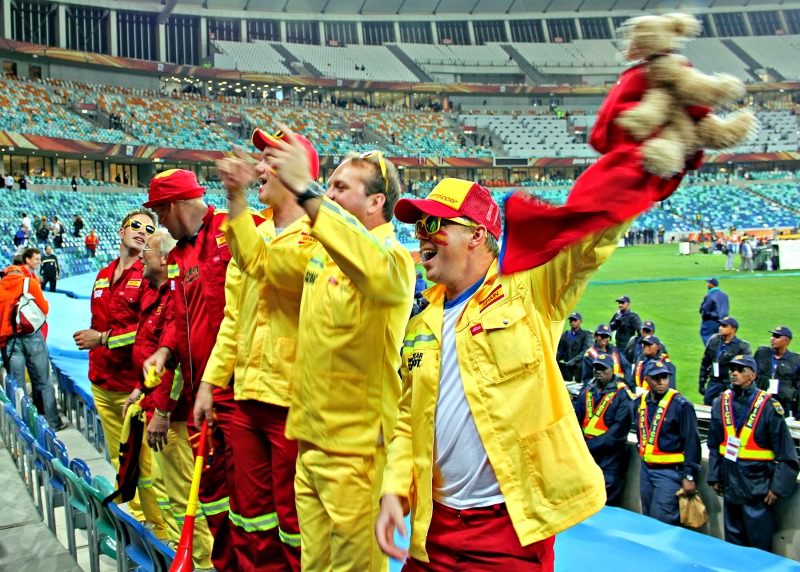
Images: Oscar statuette courtesy Dave_B_ on Flickr; actor pix from Wikimedia.