The Displaced Nation

A home for international creatives

Tag Archives: France

LOCATION, LOCUTION: Chris Pavone, author of “The Expats”, on why story and location are inseparable

Cover art "The Accident; Author photo Chris Pavone; Author photo JJ Marsh

Cover art “The Accident; Author photo Chris Pavone; Author photo JJ Marsh

In this month’s “Location, Locution”, expat crime writer JJ Marsh interviews author Chris Pavone, whose  first novel, The Expats, was published in 2012, and was a New York Times and international bestseller, with nearly twenty foreign editions and a major film deal.

The Expats was nominated for a Los Angeles Times Book Prize and a Macavity, and awards from the Strand Magazine Critics Circle, the Mystery Booksellers Association, and the International Thriller Writers. It received the 2013 Edgar Award and the 2013 Anthony Award for Best First Novel.

Pavone’s new book, The Accident, will be published in March 2014.


Which comes first, story or location?
For some books I think the story and location are inextricably intertwined: the story is about the location. My thriller The Expats is one of those, defined by taking place in a country that’s not the protagonist’s home. The plot is driven by this situation, by her sense of disassociation and isolation, by the necessity of her reinvention.

How do you go about evoking the atmosphere of a place?
I love walking around cities, looking around at the architecture and the shops and the restaurants, at the people and their pets. My characters do the same, using all their senses to inhabit the world around them. Of course walking around, in and of itself, isn’t the type of action that does much to drive a plot forward, so characters should also be doing something else while walking around. Something such as spying…

Which particular features create a sense of location? Landscape, culture, food?
On the written page, I think the clearest evocation is via the physical landscape, especially when it echoes the culture. New York is the big brashness of skyscrapers and noise; London is the polite order of elegant uniformity; Rome is cheerful dilapidated chaos.

How well do you need to know the place before using it as a setting?
As much as my characters. If they’re only in a city for a day, they don’t know that much about the place, and I don’t need to either. Both The Expats and my next book, The Accident, use a variety of locations, and the amount of time the characters spend in placesLuxembourg, Paris, the Alps, Amsterdam, London, Zurich, Los Angeles, etc.is roughly proportionate to the amount of time I’ve spent there.

Could you give a brief example from your work which you feel brings the location to life?
This is the final sentence of The Expats . . .

Kate watches them merge into the flow of the dense crowd, all the streetlights and lamplights ignited in the Carrefour de l’Odeon, a little red Fiat beeping at a bright green Vespa that’s weaving in the traffic, the policeman oblivious while he continues to flirt with the pretty girl, cigarette smoke wafting from the tables filled with wineglasses and tumblers and carafes and bottles, plates of ham and slabs of foie-gras terrine and napkin-lined baskets of crusty sliced baguette, women wearing scarves knotted at the neck and men in plaid sport jackets, peals of laughter and playful smirks, hand-shaking and cheek-kissing, saying hello and waving good-bye, in the thick lively humanity of early night in the City of Light, where a pair of expats is quickly but quietly disappearing.

Which writers do you admire for the way they use location?
Hemingway was not only a master of evoking location, but also of using physical atmosphere as emotional metaphor. Empty barges on the Seine can represent a lot more than just boats.

Next month on Location, Locution:  award-winning author Amanda Hodgkinson.

 * * *

JJ Marsh grew up in Wales, Africa and the Middle East, where her curiosity for culture took root and triggered an urge to write. After living in Hong Kong, Nigeria, Dubai, Portugal and France, JJ finally settled in Switzerland, where she is currently halfway through her European crime series, set in compelling locations all over the continent and featuring detective inspector Beatrice Stubbs.

STAY TUNED for our next post!

If you enjoyed this post, we invite you to register for The Displaced Dispatch, a round up of weekly posts from The Displaced Nation, with seasonal recipes, book giveaways and other extras. Register for The Displaced Dispatch by clicking here!

Related posts:

Two expats in Senegal spin “wax” into Western lifestyle brand

6 Bougies Collage Drop Shadow

Clockwise from top: Six Bougies logo; Kim at the fabric market in Dakar; Megan at a craft fair in Dakar. Photo credit: Six Bougies.

Having repatriated some years ago to the United States, I occasionally still crave the adventure of living abroad. But then I console myself by recalling the Internet journeys I make every week on behalf of the Displaced Nation, in search of international creatives. Those virtual journeys can open my eyes to whole new worlds full of breathtaking color—rather literally in the case of Six Bougies, a siteI landed on from Pinterest several weeks ago.

It turned out to be the companion blog for a business of the same name, run by two American expats in Senegal, the equally bedazzling Kim Rochette and Megan Carpenter.

Kim and Megan are my guests today and will talk about how they came to a life of spinning Western clothes, accessories and home wares out of gorgeous West African fabrics.

In addition, Kim and Megan have kindly agreed to GIVE AWAY A SIX BOUGIES DUFFEL BAG (see photo below) TO THE PERSON WHO LEAVES THE BEST COMMENT! (Wow, a non-book giveaway, a first…)

And one more: Displaced Dispatch subscribers will receive a discount code for use in the Six Bougies Etsy shop. How cool is that? (What, not a subscriber yet? SIGN UP NOW!!)

But before we proceed, I want to make sure you know how to pronounce “bougie.” I initially made the mistake of pronouncing it with a hard “g”—which led to a vision of two American women in colorful garb boogying down the streets of Dakar, Senegal’s capital city.

Outlandish, I know. (Besides, who were the other four?) So take my advice and start practicing now practicing how to say “bougie” with a soft “g”: boo-gee boo-gee boo-gee boo-gee boo-gee boo-gee.

As for why there are six boo-gees, read on. Almost needless to say, it’s a colorful story!

* * *

Greetings, Kim and Megan. Before we get to the meaning of “Six Bougies,” something we’re all curious to know, let’s cover a few of the basics. How long have you been running the business?
KIM: For a little under a year. And don’t forget: it’s “boo-gee.”

In your Etsy shop you describe Six Bou-GEES as “a lifestyle brand that fuses West African textiles, colors and patterns with a Western aesthetic.” What do you mean by a “lifestyle brand”?
MEGAN: We’ve conceived of Six Bougies as a brand that appeals to people who yearn for travel and love to surround themselves with beautiful objects from around the world. Our pillows, neckties and bags can add a little of that spice to everyday life.

I understand that you have a blog that supports this brand?
KIM: Yes, as I try to show with the Six Bougies blog (I’m the the writer of our team, while Megan is the artist), the concept goes far beyond a selection of home wares and accessories for sale. I post about fashion, expat life in Africa, local decor, cultural events in Senegal, and related topics. A few months ago I did a post full of tips on how to have Western clothing made by African tailors. Dakar, where we both live, has affordable tailors at every street corner and a wealth of vibrant textiles for sale at the fabric market. Soon I will write about my attempt to commission furniture for my apartment with local materials from Senegalese artisans, but with a Western aesthetic.

Ah, that sounds like a good example of “African-Western fusion”—true of your product line as well?
KIM: Yes. We use fabrics purchased (and mostly made) in Africa and rely on the expertise of local tailors to execute Megan’s Western-influenced designs, with an international audience in mind. The duffel bags Megan designed are a perfect example of this African-Western fusion, as is our line of neckties in wax.

6 Bougies Merch collage

Six Bougies products: cushion, tie, and duffel bag (we’re giving one away!). Photo credit: Six Bougies.

Please tell me what “wax” is.
KIM: “Wax” is short for “wax print,” which is similar to batik printing. In Africa, these prints are made on colorful cotton cloths, which are mostly industrially produced.

When life gives you scraps…

So, where did the idea for Six Bougies originate?
MEGAN: I had been teaching in Senegal for about a year, acquiring (stockpiling?) wax fabric, beads, and other locally produced goods. It was everywhere, in just about every room and closet of my apartment. But I never had anything made because I was nervous as to how my vision would be executed. But at the end of my first year, I decided to bite the bullet and have 15 pairs of size 8 shorts made in wax. Most of my friends and family (females) are the same size-ish, and I would just give them out as gifts when I went home. They were a huge hit: some friends and family actually wanted more than one pair! That gave me the confidence to start making more products, and eventually transition this into a business.

KIM: About a year ago, I felt the itch to start my own blog on life in Senegal—but beyond the travel blog I had previously updated for family and friends, I wanted to create a space for telling the story of what it’s like for a young, international woman to live in West Africa and travel the region for work, trying to carve out a place in this sometimes crazy and always invigorating place. I also have a great love for design and textiles, which has grown exponentially living in such a tactile, sensory locale. Megan and I decided to join forces and build a brand that melds our passion for West African textiles while also empowering women in the process.

Before we get to the topic of women’s empowerment, it’s high time we learned how you got that unusual name…as I think it relates to that goal?
KIM: We named the business “Six Bougies” after an iconic African pattern by Vlisco that depicts six bougies (spark plugs). A person would wear this fabric to signal that they had a six-cylinder car, a sign of wealth. Eventually, the fabric came to symbolize female empowerment in Africa. Thus “Six Bougies” perfectly marries our passions for design and women’s rights.

Tailors Penda and Adji at work in Dakar

Tailors Penda and Adji at work in Dakar. Photo credit: Six Bougies.

Please tell me that I’m not the only one who mispronounces “bougie”?
KIM: People do mispronounce it sometimes, but it was a risk we were willing to take!

Moving over to your decision to donate a portion of your business’s profits to support and empower women: why that cause in particular?
KIM: In Senegal, tailoring is traditionally a male-oriented career path. Honestly, there aren’t a lot of jobs out there for women, especially single women and/or mothers. So when I meet a female tailor, I try to help them out by giving them business because I know how hard it is to branch out and do something different. And, as Megan and I are both involved in education, we hope to steer our business efforts to this cause as well. We are both very inspired by Della, a similar business based out of Ghana and LA which has really taken off in the past year, partnering with Apple, Urban Outfitters, and Vans to build a veritable social enterprise in Hohoe, Ghana.

“Sew” very happy in Dakar!

Moving on to your expat life in Senegal. What brought you to Dakar originally?
KIM: I first studied abroad in Dakar when I was a junior in college and returned after I graduated. I’ve been living here for nearly four consecutive years. I had always been drawn to African literature, film, and history; and then when I had the opportunity to live in Africa for a semester, I was drawn to Senegal for its complex history with France (I am half-French) and role as as a hub for development in West and Francophone Africa. After studying in Dakar, I was hooked.

MEGAN: I was working at an inner city charter school is Los Angeles as a teacher and decided it was time to teach in a different part of the world to have more access to places that would otherwise be difficult and expensive to reach. There were lots of offers for the Middle East and one for my current school in Senegal. I chose Senegal because the school is highly regarded as a stand out in the region and the country seemed like a fascinating mix of modern yet traditional ideologies. I’ve been here three years and am so happy I took the leap.

What do you like most about life in Dakar?
KIM: I love so much about it! I love the inspiration at every turn—the textiles and local arts, the warm and embracing people, the ocean and cliffs, the music scene. I also love living outside all year round in this coastal, tropical climate, especially after growing up on the East coast with such frigid and long winters! I love how nearly every experience, even and especially the challenges I encounter as an outsider, lead to personal growth. But in many ways, Dakar is also easy; as an expat, I am able to live a comfortable life, eating out, living in a spacious apartment, enjoying all the cultural events the city has to offer, and escaping much of the patriarchy to which most Senegalese women are subject. I am privileged in Dakar and I try not to take that for granted.

MEGAN: Even after three years, there is still so much to discover in this city. I am constantly finding new inspiration in the culture and the people.

Do you ever feel “displaced”?
KIM: I know what you’re saying: what’s a nice girl like me doing living in a boisterous, developing African capital?! It has taken four years, but I have definitely found my niche in Dakar—sometimes to the surprise of friends and family back in the U.S. and France. But there are inevitably moments I feel “displaced,” especially as women living in a patriarchal society. I encounter sexism on a daily basis and there are still cultural nuances that boggle my mind. I’ve written about Dakar’s “Bottom Ten” on the blog.

I also travel throughout West Africa for my “day job,” which entails working extensively in the male-dominated commercial sector. I’ve fielded many advances that might border on sexual harassment in the U.S., and sometimes I don’t feel taken seriously as a woman. In certain settings, I have to be very aware of how my “Western” actions (like direct eye contact!) might be interpreted by men and women of vastly different backgrounds. But learning how to carry myself and to pick up on cultural cues in these extremely diverse settings has also become some of my greatest strengths. I wouldn’t trade these formative experiences for the world!

MEGAN: I’m not going to lie, the first year was tough. The Air France flight I was on landed in the middle of the night, which is when most flights arrive and depart from Dakar. The director of my school picked me up from the airport, which is probably one of the most depressing ones I’ve ever seen, and then drove me through the main thoroughfare, La Corniche, to my apartment, which, in the dead of night, looked like block after block of deserted burnt-out buildings. I thought to myself, “I think I’ve made a terrible decision and how the $@&*% can I get out of here!?” Luckily, my impression of the city has changed dramatically. Getting to know a bit of the culture and cultivating meaningful friendships with locals as well as the expat community has helped me feel at ease.

Do you sometimes feel more comfortable in Dakar than you do back in the U.S.?
KIM: For now, Dakar is home to me. I have a solid group of friends, a real sense of community, and I live here with my boyfriend. But I’m able to travel back to the U.S. two to four times per year for work and holidays, and I relish these opportunities. To be honest, I feel comfortable in both countries. I grew up living between countries—France and the U.S.—and I think this has conditioned me to adapt easily to new environments and transitioning between them. That being said, I do plan to “settle” in the United States eventually, and suspect that reintegrating into American life will be challenging as I moved to Dakar right after graduation and haven’t really lived a typical adult life in the U.S. I’m sure it will be more difficult to build the kind of community you find easily with fellow expats living abroad. We’ll see if life goes according to plan!

MEGAN: When I first moved to Senegal I was in the downtown area people watching and spotted two young talibé boys, probably around seven or eight years old, having an argument. It escalated into blows but then was quickly broken up by a passerby, who was only a few years older than the boys. Watching this teenager mediate the fight instead of walking by like nothing was happening (or worse yet recording and posting it on YouTube) made me feel good about being here. The way people treat each other feels a little more humane, a little more civilized.

Words to sew by…

Was opening up your own business something you always wanted to do?
KIM: Honestly, its not something I had ever really considered! I studied Political Science and envisioned working in the development sector. And now I’m doing both… building a creative business while working as a consultant on various development initiatives.

MEGAN: Being an entreprenuer is in my blood. My dad has started several companies and family dinner conversations often included new business ideas. When I went to Summer Art Camp in high school I used my fake ID to sell cigarettes. I had a streak of badass in me back then 😉 I also set up a impromptu face-painting stand with my friends at an art festival, donation based. Between those two enterprises I made a killing that summer and was able to afford…you guessed it…more art supplies!

During college I studied fine art, mostly drawing and painting, which I now teach. Making paintings for example can be extremely consuming (time and otherwise) and has the possibility to take over your life, while making jewelry is instantly gratifying as well as therapeutic. So I really enjoy making jewelry and designing totes and accessories in my spare time.

What has been the biggest challenge?
KIM: With a demanding “day job,” it has been challenging giving Six Bougies the time and dedication the company really needs to get off the ground. I’m transitioning to pursuing freelance projects so as to devote a lot more time to Six Bougies in 2014—which I’m very excited about!

From a business perspective, it has also been very challenging developing reliable systems to support our creative pursuits. For example, it can be difficult to find tailors who are consistently available for work or willing to teach other women the skills necessary for making our products. In Senegal, most tailors are men so we are still trying to develop the most sustainable system for training women that we can work with longer term.

MEGAN: Kim summed it up pretty well. We are working on sustainability and exposure!

The most fulfilling aspect?
KIM: As the primary blogger in the duo, I absolutely love connecting with people through my posts, especially women who are moving to Dakar or are interested in following a similar path. And as Six Bougies’ social programs develop, I really look forward to the deeper connections and impact we will hopefully make in our Senegalese community.

MEGAN: I love it when people buy my products and really LOVE them. When I see customers wearing the products I make, it makes my heart smile 🙂

“Sew” much fabric, “sew” little time!

If you could do anything else, what would it be?
KIM: I already feel rather stretched, so for now I’d just like to work on Six Bougies and my other professional endeavors to my best ability and see the fruits of that labor!

MEGAN: I think I have the best of both worlds right now, but I would love to be able to be in my studio more and really dedicate time to my personal artistic pursuits.

What’s on your bucket list?
KIM: I have always wanted to live in Madrid and become fluent in Spanish—need to brush up on those high school courses! And I want to attend graduate school in the next couple of years. Let the applications begin…

MEGAN: Actually taking the leap and traveling for a year…or longer.

Do you have any advice for others who are thinking about setting up their own lifestyle brand and selling fashion/homewares? For instance, you’re selling your merchandise through an Etsy shop. Is that working for you?
MEGAN: Etsy is great for where we are at right now, very small scale. I think if business continues to grow and we need to do more shipping overseas, we may have to change our distribution system.

Do you have any big plans, travel or business wise, for 2014?
MEGAN: I’m traveling to Nigeria next month for a volleyball tournament with my students. Then the trifecta of New York, Texas, and California to see family and friends later this summer. As far as the business goes, I’d like to focus on perfecting the quality of our goods and hopefully getting them into boutiques in Dakar and New York.

KIM: I miss traveling for pleasure! I have a trip to South Africa planned for April with my mom and I’m thrilled. I also look forward to growing Six Bougies and pursuing my professional passions more freely. 2014 is going to be good, inshallah 😉

* * *

Inshallah, indeed. Readers, has this interview boo-gee-ed, I mean sparked, any thoughts or questions? Make your comments colorful, why don’t you…there’s an African-Western-fusioned duffel bag on offer!

STAY TUNED for next week’s fab posts.

If you enjoyed this post, we invite you to register for The Displaced Dispatch, a round up of weekly posts from The Displaced Nation, with seasonal recipes, book giveaways and other extras. Register for The Displaced Dispatch by clicking here!

Related posts:

GLOBAL FOOD GOSSIP: The Mysterious Case of the Missing Pastries

global food gossipJoanna Masters-Maggs, our resident repeat-expat Food Gossip and Creative Chef, is back with her column for like-minded food lovers.

This month: The regrettable global takeover of the Cronut, and what should be getting the publicity instead.

* * *

“What in dog-breeding hell is a Cronut?” demanded my son Seb, reading over my shoulder while swigging milk from the bottle in that annoying way 16-year-olds have. Baffled for a second, I realized the confusion and laughed.  My German Shepherd, Sophie, is my obsession and I am always reading articles about breeding and training.  Today, though, I was reading a food magazine which discussed trends for the New Year. Seb had seen a headline that asked:

“2013 was the year of the Cronut and Duffin but what does 2014 hold?”

Those of you elsewhere — anywhere except France, that is — may laugh, but Seb’s assumption that a Cronut is German Shepherd-related rather than food-related was completely justifiable.  My own ignorance of Cronuts and other “blended” pastries was only brought to my attention in December, when a friend living in Kuala Lumpur posted that they had finally arrived there.

I think it true to say that the Cronut hasn’t yet arrived in France and probably never will.

Some dishes deserve to go global

I do hope the same will not be the case for other treats that, my magazine suggested, will be sweeping tastebuds worldwide this year.  I was particularly happy to see the arepa from Venezuela and Columbia on the list. My hips might not want to revisit my interest in these delectable goodies, but I am smacking my lips in anticipation.

I first met arepas in Maracaibo, Venezuela, and our friendship deepened while I lived in Caracas.  These flattened balls of unleavened maize flour-based dough are fried and then filled with a cornucopia of ingredients, depending on the region. North Western Venezuela, where I first fell in love with the arepa, has its own speciality, the Arepa Cabimera, whose filling consists of the improbable combination of cheese, jam, chicken and boiled eggs.  You know when someone is eating a Cabimera as the arepas are unusually square.  Other varieties often include queso guayanés  — a mild, medium-soft cheese similar to mozzarella, shredded chicken and, if you are very lucky, crispy pork rind.

Global — with the exception of France, that is

The idea that I will miss such delights as they sweep the world is distressing, but our ignorance of the Cronut is a sad portent of what might come.  How had the Year of the Cross-bred Pastry missed France? Perhaps it’s not such a surprise; France is not culturally inclined to faddy trends as is, say, London or New York.  Why a “need-to-please” hybrid, when a classic, small, and delightfully buttery croissant is available?  How intolerably vulgar to take such perfection and, presumably, add jam and deep-fry it.

I can feel a thousand thin and elegantly clad Parisian shoulders shudder at the thought.

Hybrid – it’s the new pedigree

On further reflection, my less-thin shoulders shudder too.  As my son’s comment shows, cross-bred dogs are very much at the front of people’s minds at the moment.  Maybe the Cockerpoo, Labradoodle, and Schitzpoo are the canine equivalents of our human desire to have our cake and eat it.  A dog that doesn’t shed and mess up the carpet and sinuses, and a croissant that doesn’t — oh, wait. It does crumble.  Well, a pastry that isn’t a croissant or a doughnut but which still makes a crumbly mess…

Why?  Why make a mash-up of existing pastries when you could come up with something less plagiaristic or stick with what already works?  Oh, listen to me: maybe I do belong in France!  After all, for each hybrid that works there are the unlucky ones in each batch which fail to inherit the best of both worlds and instead exhibit the worst of each.  A croissant where the delicate buttery flavor has been killed by over-sweetening?  A  Labradoodle which sheds anyway and isn’t a pedigree but which costs the same and has the potential to inherit the congenital defects of two different breeds?

What’s more, the frying of such a delicate thing as croissant pastry is not for amateurs.  Getting the layers of pastry and butter to open in the heat of an oven is no mean feat; getting them to do the same in hot fat is entirely different.  Apart from that, think how easily butter burns.  That’s a lot of worry when pâtissierières across France already have mastered the art of injecting chocolate into croissants to make pain au chocolate or, better, almond paste.

For me the almond croissant is the pinnacle of pastry pleasure.  This marriage of crisp pastry with nutty and unctuous almond paste represents the Paul Newman and Joanne Woodward of the Pâtisserie.

The Cronut is, as yet, a Brangelina wannabe and everyone is already asking how much longer is it going to last.

“New” but not necessarily “improved”

The French disdain for change for change’s sake can be seen everywhere.  Fashion classics which stand the test of time are valued over the new and the shocking.  London fashion is all about iconoclasm and rebellion, rather than restraint.   Surely, when it comes to food, good taste should not be derided.  Maybe the French are right not to jump on the bandwagon of each new craze, instead waiting to see what stands the test of time and has what it takes to become part of the pâtisserie canon.

I doubt that the Duffin will ever be the Little Black Dress of the pâtisserie world; certainly not with a name that makes it sound like something an ageing hippie would wear on a cold winter day in Glastonbury, UK.

Hmm, pause for thought indeed.  At least with baking, we can bin the rejects; we cannot do the same with our canine friends who don’t pass the successful hybrid test.

How, then, can a modern culinary classic find acceptance in France?

So, let me find order to my reasoning.  The French, so far, have not accepted the hybrid pastry which tries too hard to please and lacks the elegant restraint of better behaved French patisserie staples.  However, history reveals that the French will eventually accept what will not go away: dishes with an enduring appeal, such as the pizza so…

…let’s return to my arepa whose pedigree cannot be questioned.  This is a traditional, tried and tested, and regionally variable dish.  Given time, I am hopeful that the French, who enjoy regional variety in cheese and wine, should be open to accepting this newcomer.  France has already embraced with overwhelming enthusiasm the pizza and tweaked it to French tastes – crème fraiche anyone?  There is a little van with a wood burning stove on most street corners in every city, town and village of the country.  For every Domino there are scores of restaurants, parlours, and vans, nearly all of them French owned and run.

For the arepa this is hopeful news indeed. I may have to wait longer than a resident of London, Birmingham or, indeed, Kuala Lumpur, but I have hope that the Venezuelans are coming to Aix.

* * *

Joanna was displaced from her native England 16 years ago, and has since attempted to re-place herself and blend into the USA, Holland, Brazil, Malaysia, Venezuela, Saudi Arabia, and now France. She describes herself as a “food gossip”, saying: “I’ve always enjoyed cooking and trying out new recipes. Overseas, I am curious as to what people buy and from where. What is in the baskets of my fellow shoppers? What do they eat when they go home at night?”

Fellow Food Gossips, share your own stories with us!

STAY TUNED for tomorrow’s post!

If you enjoyed this post, we invite you to register for The Displaced Dispatch, a round up of weekly posts from The Displaced Nation, with seasonal recipes, book giveaways and other extras. Register for The Displaced Dispatch by clicking here!

Related posts:

Images: All images from Joanna’s personal photo albums, and used here with her permission

2013 Holiday Special: Notable books for, by and about expats

Looking for last-minute gifts—or have your holiday celebrations brought you to the point where you might need an escape for yourself?

In the tradition of looking back at the past year’s highlights, I present, on behalf of the Displaced Nation team, a list of books for, by, and about expats that were featured in some way on this site in 2013.

Click on the category that interests you:

  1. FICTION
  2. MEMOIRS
  3. HANDBOOKS & GUIDEBOOKS
  4. COOKBOOK (singular because we have only one!)
  • Books in each category are arranged from most to least recent.
  • Unless otherwise noted, books are self-published.

Go on, download a few! It’s the time of the year to be generous to one’s fellow human beings. That said, on the Displaced Nation it’s always the season to support the creative output of those who’ve embraced the life of global residency and travel.

* * *

Fiction

Shemlan Ebook_coverShemlan: A Deadly Tragedy (November 2013)
Author: Alexander McNabb
Genre: International thriller
Synopsis: The third in McNabb’s Levant Cycle, Shemlan tells the story of a retired British foreign service officer who, dying from cancer, returns to Beirut in hopes of meeting the Lebanese love of his youth one last time. But then his past catches up with him, threatening to do him in before the disease does—until British spy Gerald Lynch gallops to the rescue…
Expat credentials: Born in London, McNabb has lived in the Middle East for more than a quarter century. He often receives praise for getting the historical and cultural details right in his books.
How we heard about: We encountered McNabb a year ago when we were doing a series of food posts! We love his books and are giving away Shemlan this month, as well as doing an offer for Displaced Dispatch subscribers on all three books in the cycle. Check it out!
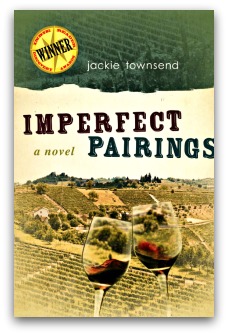
ImperfectPairings_cover_pmImperfect Pairings (May 2013)
Author: Jackie Townsend
Genre: Women’s fiction
Synopsis: American career woman Jamie had not intended to fall in love—and to a foreigner no less, a man who tells her his name is Jack, short for John, but it’s really short for Giovanni. Insanely handsome and intense but unreadable, Giovanni has left a complicated family life back home in Italy. Is this more than Jamie signed up for?
Displaced credentials: In real life, Townsend is married to an Italian and has spent 16 years backing and forthing to her husband’s family in Italy.
How we heard about: ML Awanohara, who rightly or wrongly considers herself something of an expert on cross-cultural marriage, read the book on her Kindle and was so impressed with its depiction of cross-cultural relationship woes that she asked Townsend to be our featured author of November. Read the interview.

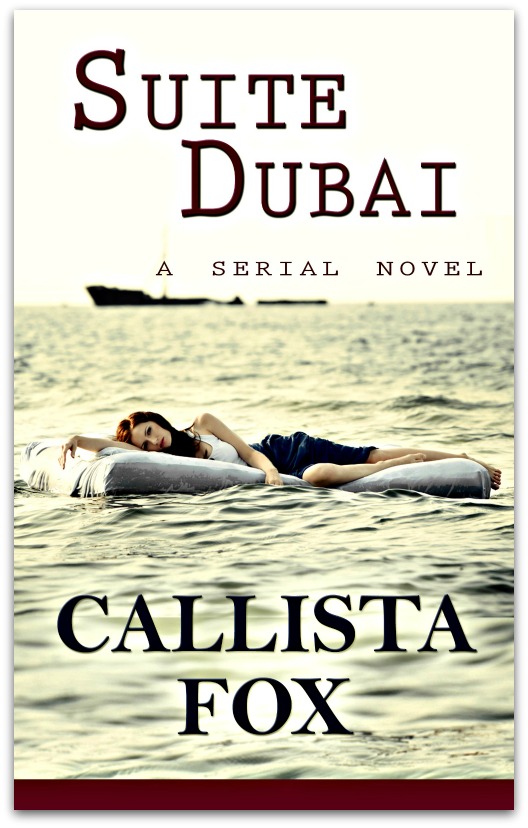
SuiteDubai-cover_dropshadowSuite Dubai (April 2013)
Author: Callista Fox
Genre: “New adult” lit
Synopsis: As Callista tells it, the book grew out of a story that entered her head that wouldn’t go away: “There was this girl, young, vulnerable, naive, walking along a concourse in an airport, among men in white robes and checkered scarves and woman in black gauzy material. Where was she going? What would happen to her there?”
Expat credentials: Fox moved to Saudi Arabia when she was eight and lived there off and on until turning 19. She went to boarding schools in Cyprus and Austria. Now back in the United States, she thinks of herself as an adult Third Culture Kid, or TCK.
How we heard about: Noticing our fondness for serial fiction (see Kate Allison’s book below), Fox sent us a note saying she’d written a serial novel reflecting her experience of growing up in the Middle East. We responded by asking if we could publish her series in even smaller parts. Part 1 and Part 2 have already gone up, and there are six more parts to come in 2014. Warning: Highly addictive!

Libby'sLifeTakingFlight_coverLibby’s Life: Taking Flight (April 2013)
Author: Kate Allison
Genre: Women’s fiction
Synopsis: 30-something Libby Patrick is just regaining some post-baby control over her life when a change in husband’s job means they must move from their English home to Woodhaven, a town in rural Massachusetts. The book is Libby’s journal covering the first year of her life as trailing spouse.
Expat credentials: Born and raised in Britain, Kate has lived in the United States with her family for almost two decades.
How we heard about: We were the first to know! Kate is a founding member of the Displaced Nation and has been publishing regular episodes of Libby’s Life (on which the book is based) since the blog began. She has accrued countless fans, the most faithful of whom is Janice. (Libby to Janice: xoxo for your support in 2013!)

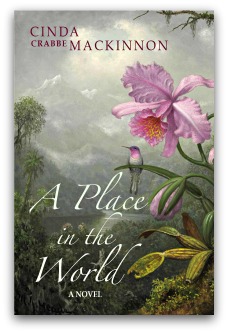
APlaceintheWorld_coverA Place in the World (March 2013)
Author: Cinda Crabbe MacKinnon
Genre: Romance
Synopsis: Third Culture Kid Alicia meets a young Colombian man at college in the United States. She follows him to Bogotá and the pair end up marrying and settling on his family’s remote coffee finca (farm) in the Andes. Educated as a biologist, Alicia revels in the surrounding cloud-forest. But then her idyllic life starts to unravel…
Expat credentials: Crabbe MacKinnon grew up in several countries as a military brat and diplomatic kid and, though she has since repatriated to the United States, still thinks of Latin America as home.
How we heard about: Crabbe MacKinnon commented on one of Elizabeth Liang’s “TCK Talent” posts and ended up becoming October’s featured author. Read the interview. We love her and her work, and are sure you will, too!

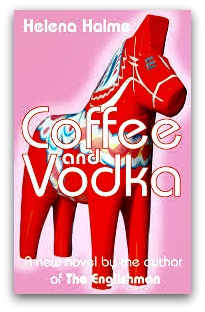
CoffeeandVodka_coverCoffee and Vodka (March 2013)
Author: Helena Halme
Genre: Women’s fiction
Synopsis: A Finnish family emigrate to Sweden in the 1970s and find themselves in turmoil, caused partly by the displacement, but also by the cracks in family dynamics. At its heart, the book reveals what it is like for a young girl to be uprooted and transplanted to a country where she doesn’t speak the language and is despised for her nationality.
Expat credentials: Halme grew up in Tampere, central Finland, and moved to Britain at the age of 22 via Stockholm and Helsinki, after marrying “The Englishman” (how she always refers to him on her blog, Helena’s London Life). She spent her first ten years in Britain working as journalist and translator for the BBC. She and The Englishman now live in North London.
How we heard about: Halme is a big favorite of ours! She was one of our earliest Random Nomads as well as serving as an expat style icon back in the days when we covered fashion. More recently, Kate Allison reviewed Halme’s first book: The Englishman: Can Love Go the Distance?, and we did a giveaway of Coffee and Vodka. And that’s not all: Halme’s latest book, The Red King of Helsinki, received an “Alice” Award in July. (As noted then, the Alices could hardly ignore a book of that title!)

MonkeyLoveAndMurder_dropshadowMonkey Love and Murder (February 2013)
Author: Edith McClinton
Genre: Adventure mystery
Synopsis: A jungle environment in Suriname (spider monkeys and all) is the setting for a closed-door mystery surrounding the death of the renowned director of the International Wildlife Conservation followed by the machete murder of one of the researchers. None of this bodes well for poor Emma Parks, who has joined the research project on a whim. (So much for that budding primatologist career!)
Expat credentials: MacClintock volunteered for the Peace Corps in Suriname for two years, and joined a monkey research project afterwards.
How we heard about: One of our Random Nomads, Patricia Winton, referred us to the now-defunct blog Novel Adventurers, where Edith was one of the writers. We invited her to guest blog for us about the muses behind her monkey mystery.

ArchangelofMercy_dropshadowArchangel of Mercy (Berkley – Penguin Group, December 2012)
Author: Christina Ashcroft
Genre: Paranormal romance
Synopsis: The first storyline in Ashcroft’s new series focusing on a group of angels and archangels and the lives of the people they come in contact with every day.
Expat credentials: Ashcroft is an expat Brit who now lives in Western Australia with her high school sweetheart and their three children.
How we heard about it: We encountered Christina online and asked her to be one of our Random Nomads for a Valentine’s Day special. In that interview, she said she attributes her success as a writer at least in part to her expat status: “I’ve often wondered whether my career would have followed the same route if we’d stayed in the UK. While I’ve always loved writing it wasn’t until we moved to Australia that I decided to to write with the aim of publication.”

SpiritofLostAngels_dropshadowSpirit of Lost Angels (May 2012)
Author: Liza Perrat
Genre: Historical novel
Synopsis: Set against a backdrop of rural France during the French Revolution, the story centers on Victoire Charpentier, a young peasant woman whose mother was executed for witchcraft and who herself suffers abuse at the hands of a nobleman. Can she muster the bravery and skill to join the revolutionary force gripping France, and overthrow the corrupt aristocracy?
Expat credentials: Liza grew up in Wollongong, Australia, where she worked as a general nurse and midwife for fifteen years. When she met her French husband on a Bangkok bus, she moved to France, where she has been living with her husband and three children for twenty years.
How we heard about: The redoubtable JJ Marsh (see below) interviewed Perrat on writing a location to life, for her monthly column, “Location, Locution.”

BehindClosedDoors_dropshadowBehind Closed Doors (June 2012)
Author: JJ Marsh
Genre: Crime mixed with literary fiction
Synopsis: A smart, technologically sophisticated mystery set in Zürich and surrounding countries, featuring a bipolar detective named Beatrice Stubbs, and quite a few surprises… NOTE: JJ Marsh was listed in the Guardian “readers’ recommended self-published authors” this year, for Behind Closed Doors.
Expat credentials: JJ Marsh grew up in Wales, Africa and the Middle East, where her curiosity for culture took root and triggered an urge to write. After living in Hong Kong, Nigeria, Dubai, Portugal and France, she has finally settled in Switzerland.
How we heard about: We owe displaced author Helena Halme (see above) a king’s ransom for telling us about JJ, who since April has been contributing a monthly “Location, Locution” column. Don’t miss her posts under any circumstances! Highly stimulating and cerebral.
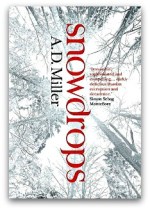
snowdrops_dropshadowSnowdrops (Anchor/Random House, February 2011)
Author: AD Miller
Genre: Literary fiction
Synopsis: Lawyer Nick Platt trades his dull British life for pushing paper in Moscow at the turn of the 21st century. He is soon seduced by a culture he fancies himself above. Snowdrops was shortlisted for the Man Booker Prize in 2011.
Expat credentials: British born and educated at Cambridge and Princeton, Andrew Miller joined The Economist and was appointed, in 2004, to become their Moscow correspondent. He covered, among other things, the Orange Revolution in the Ukraine.
How we heard about: JJ Marsh interviewed AD this past July about bringing foreign locations to life in fiction.
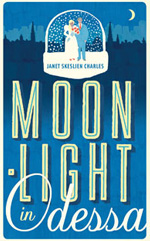
odessa_brit_cover_smallMoonlight in Odessa (Bloomsbury, August 2010)
Author: Janet Skeslien Charles
Genre: Women’s fiction
Synopsis: With an engineering degree and perfect English, Daria longs for a life beyond Odessa, Ukraine. And then she moonlights for a dating agency that facilitates hasty, long-distance matches between lustful American men and impoverished Ukrainian women. Her big chance?
Expat credentials: Skeslien Charles went to Odessa, Ukraine, as a Soros Fellow, living through blackouts, heatless winters, corruption and so on. She stayed for two years before returning to the U.S. Then she found a job in France and met her husband. She now lives in Paris but leads a multicultural life. As she puts it: “The novel is set in Odessa, Ukraine. My agent is English. My editor’s assistant is Japanese-Danish, my copy editor is from New Zealand. I’m American. The book was written in France and typeset in Scotland. My first fan letter came from a Swede.”
How we heard about: JJ Marsh picked Skeslien Charles’s brain on “location, locution”, in her November column.

Memoirs

AddictedtoLove_cover_dropshadowAddicted to Love (April 2013)
Author: Lana Penrose
Synopsis: Penrose is the kind of Australian who throws herself wholeheartedly into adventure, which is why her years spend living in Europe have merited not one but three memoirs! This one is the third. In the first memoir (published by Penguin/Viking), To Hellas and Back, she marries the love of her life, an Australian Greek, and accompanies him back to Greece, only to find him becoming increasingly Greek and herself increasingly isolated. In the second, Kickstart My Heart, she moves to London, single and desperate to find love again. And in this third memoir, she returns to Greece, where she encounters a seemingly perfect man named Adonis. (Hey, she never gives up!)
Expat credentials: From Sydney originally (she is back there now), Penrose lived in Athens for five years before moving to London.
How we heard about it: We happened across Penrose online and asked her to guest-post for us a year ago on what it was like to spend Christmas in Greece. At that time, we also did a giveaway of her first memoir. We invited her back this past April to write about Addicted to Love.

MagicCarpetSeduction_cover_pmMagic Carpet Seduction: Travel Tales Off the Beaten Path (May 2013)
Author: Lisa Egle
Synopsis: Travel with the author to China, Latin America, Turkey and the Middle East, and watch while she takes risks off the beaten path, and dances with strangers in strange lands…
Expat credentials: Egle characterizes herself as a lover of offbeat travel. She’s been to 36 countries on five continents and has been an expat twice: in Ecuador for a year and half, and in Spain for a year.
How we heard about: We got to know Egle first through her blog, Chicky Bus, and when we heard she’d put out a book, asked her to be one of our featured authors. Read the interview.

Pilgrimage-Cover_pmRunning the Shikoku Pilgrimage: 900 Miles to Enlightenment (Volcano Press, January 2013)
Author: Amy Chavez
Synopsis: After losing her job at a Japanese university, Chavez undertakes a solo journey running Japan’s 900-mile Buddhist pilgrimage, a distance equal to running from San Diego, California to Oregon. A Buddhist priest who is also a friend gives her “cosmic tools” to take with her.
Expat credentials: American expat Amy Chavez has been a columnist for Japan’s oldest English-language newspaper, The Japan Times, since 1997. She lives with her husband and cat on Shiraishi Island in Japan’s Seto Inland Sea.
How we heard about: We interviewed Chavez about her pilgrimage, and what it took to write the book, in April.

Don'tNeedtheWholeDog_dropshadowDon’t Need the Whole Dog! (December 2012)
Author: Tony James Slater
Synopsis: In the summer of 2004, Slater went to Ecuador, thinking that the experience would turn him into a man. He went back to his native England fueled by a burning desire to do something that mattered—and, ideally, to get the heck out of England in the process. He dreamed of going to Thailand and becoming a professional diver. This is the story of what happened next.
Expat credentials: A Brit, Slater now lives in Perth, Australia, with his Australian wife.
How we heard about: Slater made himself known to us for failing to include his first book, The Bear That Ate My Pants: Adventures of a Real Idiot Abroad, about his time volunteering at an animal shelter in Ecuador, in our 2011 holiday round-up. He probably should have left well enough alone, though, as next thing he knew, we had him writing for the Displaced Nation. His post on the world’s best parties remains one of our most popular!

TruckinginEnglish-dropshadowTrucking in English (December 2012)
Author: Carolyn Steele
Synopsis: This is the tale of what happens when a middle-aged mum from England decides to actually drive 18-wheelers across North America instead of just dreaming about it. Nothing goes well, but that’s why there’s a book.
Expat credentials: Born and bred in London, Carolyn and her son are now Canadian citizens and live permanently in Kitchener, Ontario.
How we heard about: One of our featured authors in 2012, Martin Crosbie, sent Steele our way, and Kate Allison reviewed her book in March. Steele later contributed an amusing post to our “New vs Olde World” series, about the difficulties of mastering the Canadian “R”.
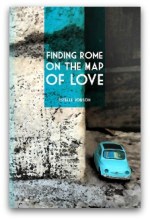
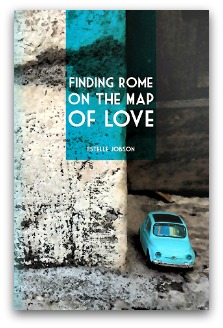
Finding-Rome-on-the-Map-of-Love_dropshadowFinding Rome on the Map of Love (September 2012)
Author: Estelle Jobson
Synopsis: When her Italian diplomat boyfriend gets posted to Rome, Jobson throws up her career in publishing in her native South Africa to accompany him. There, she reinvents herself as Signora Stella, a casalinga (housewife). The book captures a year’s worth of quirky observations about life amongst the Italians.
Expat credentials: Originally from South Africa, Jobson now lives in Geneva, where she works as a writer and editor.
How we heard about: Jobson was our featured author in February. Her book and sense of humor are terrific!
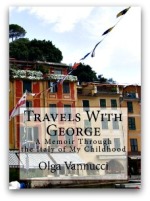
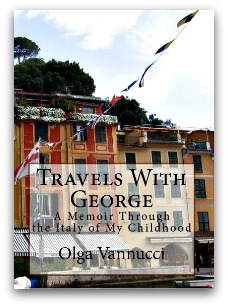
Travels with George Book CoverTravels with George: A Memoir Through the Italy of My Childhood (April 2012)
Author: Olga Vannucci
Synopsis: In five separate trips to Italy with her young son, George, in tow, Vannucci strolls and hikes through the landscapes of her Italian childhood. She looks at Italy both as local native and awed visitor.
Expat credentials: Born in Italy, Vannucci lived in Brazil and came to the United States to attend Brown University. She lives in rural New Jersey with her son.
How we heard about: Vannucci was our featured author in September. Read the interview. We loved this quote from her son: “Where are we going? How much longer? I have something in my shoe. I want to go back. Why are we doing this? Do you know where we are? Do you know where we’re going? Mammaaaaaaa!”
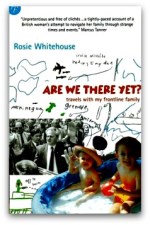
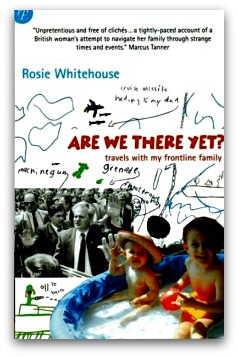
AreWeThereYet_cover_dropshadowAre We There Yet? Travels with My Frontline Family (May 2009)
Author: Rosie Whitehouse
Synopsis: A vivid, funny, and very human account of the author’s travels with her family through war-torn Europe.
Expat credentials: Whitehouse spent five years as a housewife in the war-torn Balkans married to a correspondent of The Economist, caring for their growing family.
How we heard about: We happened across Whitehouse’s work online and asked her to be a featured author last summer. Read the interview. She’s absolutely fascinating, as one might expect of the kind of woman who trails her spouse into a war zone.

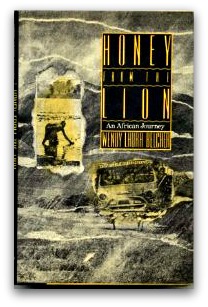
HoneyfromtheLion_coverHoney from the Lion: An African Journey (Dutton Adult, 1988)
Author: Wendy Laura Belcher
Synopsis: Brought up in Africa, Belcher returned to Ghana in the early 1980s to work with a “national linguistic group” that is spreading literary into rural areas by translating the Bible into native languages. A coming-of-age story that was called “lyrical” by the New York Times when first issued.
Expat credentials: An adult Third Culture Kid, Belcher grew up in East and West Africa, where she became fascinated with the richness of Ghanaian and Ethiopian intellectual traditions. She is now an assistant professor of African literature at Princeton.
How we heard about: Elizabeth Liang interviewed Belcher for her TCK Talent series.

Handbooks & Guidebooks

cathy_feign_coverKeep Your Life, Family and Career Intact While Living Abroad, 3rd Ed. (Stvdio Media, September 2013)
Author: Cathy Tsang-Feign
Synopsis: A survival manual for those who are living abroad, with real-life examples and easy-to-understand explanations about the unique issues faced by expats: from preparing to move, to daily life overseas, to returning home.
Expat credentials: Tsang-Feign is an American psychologist who lives in Hong Kong, specializing in expat psychology and adjustment issues. She has also lived in London.
How we heard about: When Kate Allison learned about the book, she decided it merited one of our “Alice” awards for the understanding displayed of the “through the looking glass” complex.

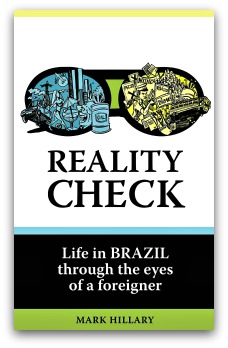
realitycheck_bookcoverReality Check: Life in Brazil through the eyes of a foreigner (September 2013)
Author: Mark Hillary
Synopsis: Targeted at those who plan on living, working or just visiting Brazil, it covers issues such as the difficulties of finding new friends, using a new language, and finding a job. Also provided is some background on the fast-changing society in Brazil that resulted in extensive street protests during 2013.
Expat credentials: Hillary is a British writer who moved to Brazil in 2010, bought a home, started a company, and has experienced both difficulties and joys.
How we heard about it: Andy Martin, another Brit in Brazil and a writer for the Displaced Nation in 2013, is a friend of Hillary’s and was jealous he’d produced a book that is not only a practical guide but also provides much of the cultural backdrop an international resident needs for a country as complex as Brazil. The next best thing, Martin thought, would be to do an interview with Hillary, which he delivered in two parts. Read Part 1 and Part 2.

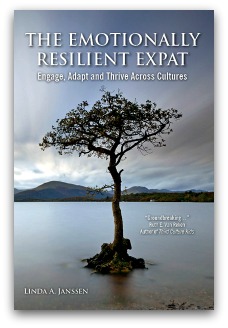
TERE_cover_dropshadowThe Emotionally Resilient Expat: Engage, Adapt and Thrive Across Cultures (Summertime, July 2013)
Author: Linda A. Janssen
Synopsis: A guide for those facing the challenge of cross-cultural living, with candid personal stories from experienced expats and cross-culturals, and a wealth of practical tools, techniques and best practices for developing the emotional resilience for ensuring a successful transition.
Expat credentials: Janssen lived for several years in the Netherlands while her husband, an adult TCK, worked in the Hague. She recently repatriated to the United States.
How we heard about: We’ve had many satisfying interactions with Janssen since starting the Displaced Nation and were thrilled to hear about her new book—a natural for one of this year’s “Alice” awards, particularly as Janssen has been running a popular blog called Adventures in Expatland.

AmericanExbratinSaoPaulo_cover_pmAn American Exbrat in São Paulo: Advice, Stories, Tips and Tricks for Surviving South America’s Largest City (May 2013)
Author: Maggie Foxhole (Megan Farrell)
Synopsis: Aimed at those who are moving or traveling to São Paulo, it is designed to be a companion on the journey through the ups and down, ins and outs, and the curious roundabouts of life in that city.
Expat credentials: Megan/Maggie moved to Brazil with her Brazilian husband and their daughter. She keeps a blog: Born Again Brazilian.
How we heard about: Farrell/Foxhole was one of our early Random Nomads. She kept in touch and we were very pleased to learn about her book, which ML Awanohara read and admired for its comprehensiveness. Andy Martin, a Brit who also lives in São Paulo with a Brazilian spouse, reviewed the book for our site this past July.

101reasons_dropshadow101 Reasons to Live Abroad and 100 Reasons Not to (March 2013)
Author: Chris Alden
Synopsis: Targeted at the wannabe expat, the aim is to help you discover if living abroad is right for you. It’s an uplifting guide to the positive sides of life as an expatriate and a reality check about the challenges that relocation brings.
Expat credentials: A professional writer, Alden lived for three years in a beautiful village in the Troodos foothills of Cyprus, which resulted in his first travel guidebook: 250 Things to Do in Cyprus on a Sunny Day.
How we heard about: Alden was the recipient of one our “Alice” awards for this book. We were impressed that he offered a final, 101st reason to live abroad for those of us who, having been offered as many as a hundred reasons both for and against, still find ourselves dithering…
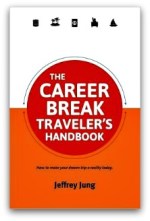
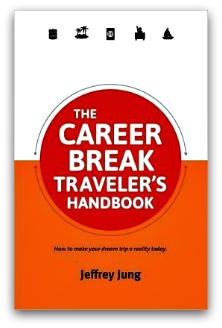
career-break-travelers-handbook_dropshadowThe Career Break Traveler’s Handbook (September 2012)
Author: Jeffrey Jung
Synopsis: Intended to inspire people to go for it and take the break they’ve been seeking from their jobs and go travel, with tips and tricks Jung learned from his own and other career breakers’ experiences.
Expat credentials: Having left the corporate ladder, Jung now lives in Colombia, where he founded his own business to help others do the same: CareerBreakSecrets.com.
How we heard about: Jung was one of our Random Nomads. He let us know about his book, and we reviewed it this past February. Not that he needed our help—it also got a shout-out in Forbes!
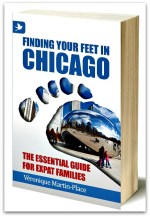
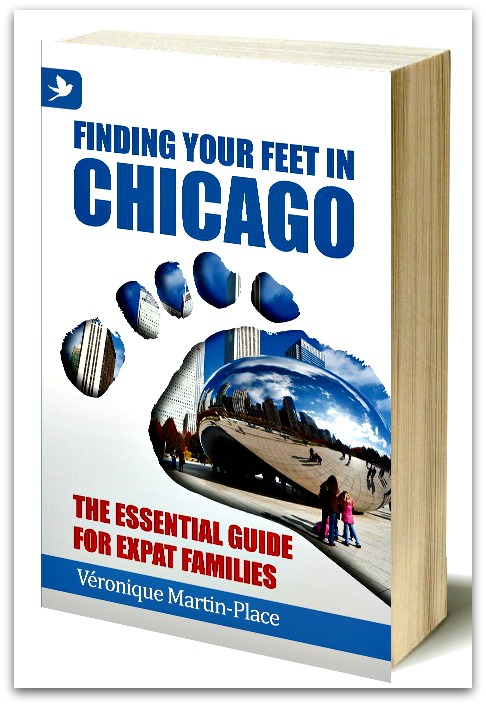
finding-your-feet-in-chicago-3D-Book CoverFinding Your Feet in Chicago: The Essential Guide for Expat Families (Summertime Publishing, August 2012)
Author: Véronique Martin-Place
Synopsis: A down-to-earth pocket guide to help expats settle into the USA’s third largest city with their families.
Expat credentials: As the wife of a French diplomat (they have two daughters), Martin-Place is accustomed to moving around the world. Chicago was one of her more enjoyable stops, but she also enjoyed Sri Lanka(!). The family is now in Shanghai.
How we heard about: ML Awanohara had interviewed Martin-Place on her blog, Seeing the Elephant. She had fun interviewing her again, this time about the process of composing a guidebook.

Cookbook

FromtheGlobalScottishKitchen_cover_tdnFrom the Global Scottish Kitchen (Self-published, November 2012)
Author: Sharon Lorimer
Genre: Cooking
Synopsis: Recipes based on Scottish cuisine but influenced by the restaurants and other kinds of cuisines Lorimer has experienced as an expat: e.g., Cock a’ Leekie Udon!
Expat credentials: Born in Scotland, Lorimer now lives in New York City and is married to an Asian American.
How we heard about it: We interviewed Lorimer about her decision to start up Doshebu, a business providing training to company employees being sent abroad on the “art” of being an expat.

* * *

Questions: Have you read any of the above works and if so, what did you think of them? And can you suggest other works to add to the list? My colleagues and I look forward to reading your comments below!

STAY TUNED for some upcoming posts, though we’ll be taking a bit of a break over the holidays!

If you enjoyed this post, we invite you to subscribe to The Displaced Dispatch, a weekly round up of posts from The Displaced Nation, plus some extras such as seasonal recipes and occasional book giveaways. Sign up for The Displaced Dispatch by clicking here!

Related posts:

GLOBAL FOOD GOSSIP: Stuffing a chair with boar’s hair, and your face with Charlotte Royale – British style, bien sûr.

global food gossipJoanna Masters-Maggs, our resident repeat-expat Food Gossip and Creative Chef, is back with her column for like-minded food lovers, which includes pretty much every expat we’ve ever encountered.

This month: Upholstering armchairs to the tune of Mary Berry.

* * *

I haven’t been cooking much this month.

This is because, instead, I have been totally absorbed in reupholstering an armchair for my daughter’s bedroom.

Like so many “trailing spouses”, I am an International Jack of All Trades and, possibly, Masters of None.  Work visas are rarely applied to spouses and we must do what the current location allows us if we wish to work.

In my time I have taught English (yes, I have a qualification), arranged flowers (basic qualification), taught exercise classes on a Saudi compound (absolutely qualified with first aid certificates to boot) and baked and decorated birthday cakes (the qualification here is hard to pin down, but I am very enthusiastic).

My latest enterprise, however, is gripping me, and might well be what saves me from permanent life as an expat dilettante.

A family history, as recorded on sofa cushions

Over the years my four children have wrought destruction on all our soft furnishing, but the sofas have suffered the worst.  In part, I have been loath to recover them, as they represent something of both the material culture and culinary history of our family.  The stains, ever more poorly hidden by artfully draped throws and cushions, track the growth of the children from breast to solids. Here and there are the stains of snacks smuggled from the pantry or the marks made by friends I felt woefully too weak to upbraid.   Perhaps I’m just too English to tell off other people’s kids successfully.  My “Take the hamburger back to the kitchen before I am forced to beat you” delivered mildly with a smile and a wink, is taken as face value and ignored – I should expect no more, really.   Anyway, confronted with an upholstery bill that reached into five digits, I decided to take another “Have a go, Jo” course.

The result is that I can no longer visit a friend’s house, or watch a film or TV, without becoming entirely distracted by the chairs and sofas on display.

Thanksgiving stuffing? Not unless it’s made of boar’s hair

This new interest has caused me to all but abandon the kitchen.  Meals are late and gracelessly served.  Plates generally consist of pasta with a side of chopped tomatoes, cucumber, and sundry vegetables dragged from the back of the fridge or freezer – anything to make up the 5 a day and free me to return to the basement.  I’m amazed that my family is bored by this approach.  Perhaps they need a little footstool project of their own.

Thankfully for this webpage, this dearth of food-related happenings in my household has been tempered by my need to listen to radio or TV while I work.

This month I caught up with Great British Bake Off: the perfect accompaniment for the stripping and recovering process.  If you haven’t yet discovered the delights of this quintessentially British of “competitions”, I recommend a quick rifle through YouTube.  I’m sure you too will be hooked.

None of the competitors claim that winning the show is their dream, or assure us that they must win because they want it so bad. That they don’t do so on a televised competition comes as a surprise and seems to suggest that things back home have changed more than I could ever have guessed.  So accustomed are we all to naked ambition and self-puffery despite slender talents that the shock of modesty seems inconceivable.  This year there was even a competitor, Ruby, who was so self-effacing that she became a hate figure in the press.  Holding up her various offerings and apologizing for their variously burned, dry or just plain terrible states, she seemed to hail from a bygone age, ignorant of Simon Cowell.  But today this is mistrusted and seems to be insincere, even manipulative.  Interestingly, Mary Berry, the rather strict octogenarian judge, was quick to comfort and reassure.  Modesty has been lost to the British TV in 15 years of TV competitions in music, food, modeling and god-knows-what.

The public might mistrust Ruby’s handwringing over her uselessness, but Mary did the proper thing and bucked her up.

What, really, is so wrong with such a world?

Killing two oiseaux

IMG_2070

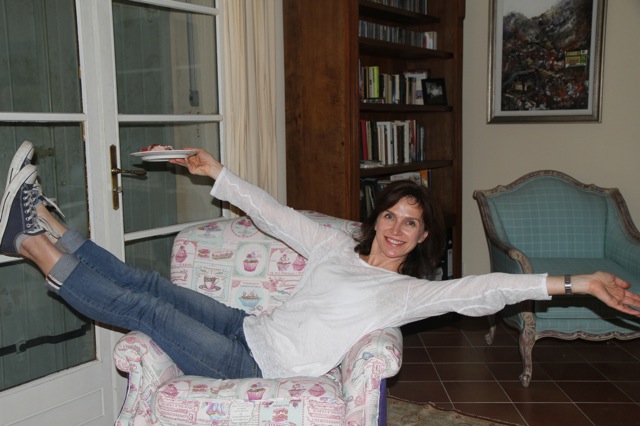
Joanna and her impressive reason
for a lack of cooking this month

Where am I going with this?  Welcome to the wandering mind of someone whose hands are deep in boar’s hair and webbing.  I’ll tell you where, though.  It occurred to me that, since this hugely successful show had been spun off to many countries, each tweaking it to its own tastes and state of mind, I could find the French version and improve my lamentable French while never pausing in my upholstery endeavours.

The first two hour episode proved to be a deeply comforting and successful experiment in language acquisition — mal cuit, anyone?  But then, halfway through the next episode I received a bit of a douche froide, so to speak.  The announcer, thankfully less humorous than her British counterparts as my French is barely up to understanding French slapstick let alone gentle, self-deprecating humour, announced that the Challenge Technique would be English in origin.  Cue the endless pause so beloved of such shows, then:

“Le challenge est……….  Charlotte aux fruits rouge.

Well, strike me down with a langue de chat.  You see, Charlotte Royale wasn’t English, it was French.  I knew this, because it had appeared only a week before on English T.V. and during French Week, no less.

Charlotte? C’est un French name, non?

Finally, something had occurred which made me look up from my stitching.  What gave Charlotte her ambiguous status between the French and the Brits, while retaining value as a challenge worth attempting?  The British show gave no clue.  Although their Charlotte involved Swiss Roll and looked like one of the illustrations in your mother’s 1970s copy of, er, a Mary Berry recipe book, it was accepted without demur by all as French.  Similarly, the French contestants, while sucking in their breath and declaring they were going to have to concentrate hard on this one, they failed to cry as one patissier,  “Zut alors, c’est un recet francais!”

The French presenter thickened the plot further, introducing a historian to explain the English origins of the dish.  Apparently, it was invented by Antoine Carême (yes, the father of the art of patisserie) who worked at both the English and Russian courts for a time.  You see?  Strange, no?  He made it for either a Queen Charlotte, a Princess Charlotte, a cousin Charlotte and then at some point tagged on Russe to include the Tsar in his flattery.

So why is this not considered French if a French man really did invent it?

Unearthing Charlotte’s origins in my own kitchen

IMG_2042

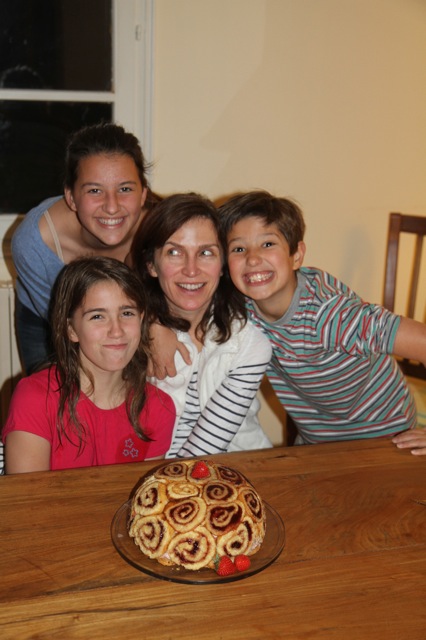
Patrick sharing his British Charlotte Royale. In France.

Patrick, my 9 year old, and I, decided to make the British version.  Doing it for myself cleared up all my questions.  It was, let’s say, a woman of substance.  French Women Do Not Get Fat, and their puddings cannot be hefty either.

My own Charlotte Royal was no slip of a thing.

The Swiss Roll lining was easily managed by Patrick working alone with our trusty KitchenAid.  While the French contestants piped boudoir biscuits to surround their moulds for the light bavarois filling, Patrick sliced up jammy sponge rolls which gave the pud a slightly cerebral air when turned out. How can you cut a petite tranche from that?  Piping even biscuits would be much more of a challenge for child and adult alike.  The Swiss Roll is infinitely more forgiving.

The difference between the French version and the English became clearer.  Simiar amounts of work and skill are involved, but one must be elegant and the other must be generous.  One should look preternaturally perfect, and the other is valued for comfort.  A French dessert should perhaps make you feel you are not quite elegant enough to eat it, while the English makes you feel better because you do not look like the Duchess of Windsor.  Ha ha –  it is not generosity of spirit that holds the French back from planting the tricolor on this this dish.  They are anxious that it is a recipe that can look unfinished, so trifle-like.

When Carême returned to France, he apparently rechristened the dish Charlotte á la Parisienne, probably to soothe the nerves of alarmed locals who may have heard a thing or two about the English king Carême had worked for.  I have no doubt when Charlotte arrived on French shores she resembled a trifle as little as possible.

Carême’s Charlotte is a little rootless, like so many of us expats.  Like us, it is unsure where it belongs and if home will ever be home again.  The Charlotte is perhaps a sort of Third Culture Dessert.

But at least I think I may have found the name for my upholstery business if I ever start one.

Here’s to Third Culture Sofas.

* * *

Joanna was displaced from her native England 16 years ago, and has since attempted to re-place herself and blend into the USA, Holland, Brazil, Malaysia, Venezuela, Saudi Arabia, and now France. She describes herself as a “food gossip”, saying: “I’ve always enjoyed cooking and trying out new recipes. Overseas, I am curious as to what people buy and from where. What is in the baskets of my fellow shoppers? What do they eat when they go home at night?”

Fellow Food Gossips, share your own stories with us!

STAY TUNED for tomorrow’s post!

If you enjoyed this post, we invite you to register for The Displaced Dispatch, a round up of weekly posts from The Displaced Nation, with seasonal recipes, book giveaways and other extras. Register for The Displaced Dispatch by clicking here!

Related posts:

Images: All images from Joanna’s personal photo albums, and used here with her permission

LOCATION, LOCUTION: Janet Skeslien Charles, bringing Odessa to life through writing

2013-11 jsc visual

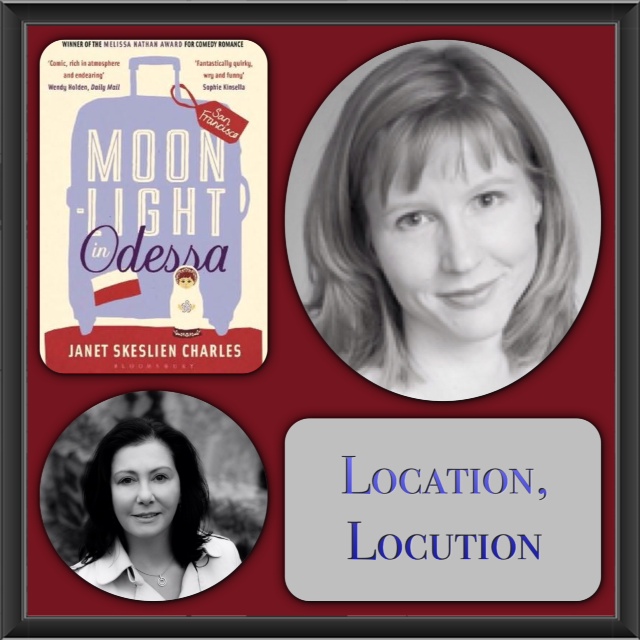
Images, clockwise from top: Moonlight in Odessa cover art; Janet Skeslien Charles author photo; JJ Marsh author photo

In this month’s “Location, Locution”, expat crime writer JJ Marsh interviews Janet Skeslien Charles, author of Moonlight in Odessa.

Janet, welcome! Tell us a little about yourself.
I grew up on the plains of Montana, in a town of two thousand people. I have always been a writer, with a journal for observations, prose, and poetry, though for me, writing is a very private activity.

At the University of Montana, I studied English, French, and Russian. I also spent a year on a university exchange at the University of Maryland. After graduation, I went to Odessa, Ukraine, for two years as a Soros Fellow.

I found a job in France and intended to stay for a year. On my first day in France, I met the man who became my husband, and I’ve been in Paris for over ten years.

Moonlight in Odessa is truly an international effort. The novel is set in Odessa, Ukraine. My agent is English. My editor’s assistant is Japanese-Danish, my copy editor is from New Zealand. I’m American. The book was written in France and typeset in Scotland. My first fan letter came from a Swede. Rights have been sold in Germany, Italy, the Netherlands, Brazil, Sweden, Iceland, Serbia, Romania, Taiwan, and Denmark.

When you’re writing, which comes first, story or location?
My novel was an ode to Odessa, a city I love. The story grew from the place.

How do you go about evoking the atmosphere of a place?
The way my characters speak, what they eat, how they dress, who they believe, how they love, and where they go are all very particular to the city of Odessa.

Which particular features create a sense of location? Landscape, culture, food?
For me, it is how characters react to situations. Odessa is the humor capital of the former Soviet Union, which means that my characters use humor as a shield to ward off painful situations. Odessans are capable of laughing at things that would make me bawl. Their mental toughness is impressive. So for me, the sense of city is the sense of self.

Also, trying to understand what is important to characters is important. My character Daria is defined by her ambitions, which exist because of her experiences in Odessa, a comsmopolitan sea port.

How well do you need to know the place before using it as a setting?
I was immersed in Odessa for two years and am still in touch with friends there, so it was easy for me to write about the city, but I love that Jeanette Winterson wrote The Passion without visiting Venice. It is one of my favorite books and so evocative of time and place. I don’t think you need to know a place, though it helps. I think imagination and observation are the most important tools when creative a setting.

Could you give a brief example from your work which you feel brings the location to life?
Daria, my main character, is at a job interview and must decide whether she is able to do the job and stay ahead of the lecherous boss:

Chess. There’s a reason the former Soviet Union has more world champion players than any other country. Chess is strategy, persistence, cunning, and the ability to look farther into the future than an opponent. The bloodlust of killing off others, one at a time. Chess is every man for himself. Building traps and avoiding them. It is mental toughness. And sacrifice. In Odessa, life is chess. Moves. Countermoves. Feigns. Knowing your adversary and staying one step ahead of him.

I took the job.

Which writers do you admire for the way they use location?
I absolutely love Venice in Jeanette Winterson’s The Passion. Michael Perry’s Population: 485 and Julia Alvarez’s How the Garcia Girls Lost Their Accents are also great examples of how place shapes the narrative. I have also read two unpublished novels by friends — one evokes North London, the other life in small-town France — and six months later, I am still savoring these two places I have never been.

The authors are Marie Houzelle, a French woman who writes in English, and Katya Jezzard-Puyraud, who wrote about North London so convincingly, I finished her novel feeling as if I had grown up there.

Next month’s Location, Locution guest  will be Jeet Thayil, the winner of the DSC Prize for South Asian Literature, shortlisted for the 2012 Man Booker Prize and the Hindu Literary Prize 2013.

 * * *

JJ Marsh grew up in Wales, Africa and the Middle East, where her curiosity for culture took root and triggered an urge to write. After living in Hong Kong, Nigeria, Dubai, Portugal and France, JJ finally settled in Switzerland, where she is currently halfway through her European crime series, set in compelling locations all over the continent and featuring detective inspector Beatrice Stubbs.

STAY TUNED for tomorrow’s post!

If you enjoyed this post, we invite you to register for The Displaced Dispatch, a round up of weekly posts from The Displaced Nation, with seasonal recipes, book giveaways and other extras. Register for The Displaced Dispatch by clicking here!

Related posts:

LOCATION, LOCUTION: Paulo Coelho, on the monuments that immortalise cities

2010-26In this month’s “Location, Locution”, expat crime writer JJ Marsh talks with Paulo Coelho, the Brazilian best-selling author of The Alchemist, The Devil and Miss Prym, and The Witch of Portobello, among many others.

*  *  *

When I asked Paulo Coelho to take part in the “Location, Locution” concept, he was happy to oblige.

But he wanted to do it his way. So in a change to our usual format, here’s Paulo Coelho on place.

The moving monument

I have visited many monuments in this world that try to immortalize the cities that erect them in prominent places. Imposing men whose names have already been forgotten but who still pose mounted on their beautiful horses. Women who hold crowns or swords to the sky, symbols of victories that no longer even appear in school books. Solitary, nameless children engraved in stone, their innocence for ever lost during the hours and days they were obliged to pose for some sculptor that history has also forgotten.

And when all is said and done, with very rare exceptions (Rio de Janeiro is one of them with its statue of Christ the Redeemer), it is not the statues that mark the city, but the least expected things. When Eiffel built a steel tower for an exposition, he could not have dreamed that this would end up being the symbol of Paris, despite the Louvre, the Arc de Triomphe, and the impressive gardens. An apple represents New York. A not much visited bridge is the symbol of San Francisco. A bridge over the Tagus is also on the postcards of Lisbon. Barcelona, a city full of unresolved things, has an unfinished cathedral (The Holy Family) as its most emblematic monument. In Moscow, a square surrounded by buildings and a name that no longer represents the present (Red Square, in memory of communism) is the main reference. And so on and so forth.

Perhaps thinking about this, a city decided to create a monument that would never remain the same, one that could disappear every night and re-appear the next morning and would change at each and every moment of the day, depending on the strength of the wind and the rays of the sun. Legend has it that a child had the idea just as he was … taking a pee. When he finished his business, he told his father that the place where they lived would be protected from invaders if it had a sculpture capable of vanishing before they drew near. His father went to talk to the town councilors, who, even though they had adopted Protestantism as the official religion and considered everything that escaped logic as superstition, decided to follow the advice.

Another story tells us that, because a river pouring into a lake produced a very strong current, a hydroelectric dam was built there, but when the workers returned home and closed the valves, the pressure was very strong and the turbines eventually burst. Until an engineer had the idea of putting a fountain on the spot where the excess water could escape.

With the passing of time, engineering solved the problem and the fountain became unnecessary. But perhaps reminded of the legend of the little boy, the inhabitants decided to keep it. The city already had many fountains, and this one would be in the middle of a lake, so what could be done to make it visible?

And that is how the moving monument came to be. Powerful pumps were installed, and today a very strong jet of water spouts 500 liters per second vertically at 200 km per hour. They say, and I have confirmed it, that it can even be seen from a plane flying at 10,000 meters. It has no special name, just “Water Fountain” (Jet d’Eau), the symbol of the city of Geneva (where there is no lack of statues of men on horses, heroic women and solitary children).

Once I asked Denise, a Swiss scientist, what she thought of the Water Fountain.

“Our body is almost completely made of water through which electric discharges pass to convey information. One such piece of information is called Love, and this can interfere in the entire organism. Love changes all the time. I think that the symbol of Geneva is the most beautiful monument to Love yet conceived by any artist.”

I don’t know how the little boy in the legend would feel about it, but I think that Denise is absolutely right.

© Translated by James Mulholland

www.paulocoelhoblog.com

Read JJ Marsh’s 2011 interview with Paulo Coelho for Words with JAM magazine

Next on Location, Locution: Janet Skeslien Charles, author of Moonlight in Odessa

* * *

JJ Marsh grew up in Wales, Africa and the Middle East, where her curiosity for culture took root and triggered an urge to write. After living in Hong Kong, Nigeria, Dubai, Portugal and France, JJ finally settled in Switzerland, where she is currently halfway through her European crime series, set in compelling locations all over the continent and featuring detective inspector Beatrice Stubbs.

STAY TUNED for next week’s posts!

If you enjoyed this post, we invite you to register for The Displaced Dispatch, a round up of weekly posts from The Displaced Nation, with seasonal recipes, book giveaways and other extras. Register for The Displaced Dispatch by clicking here!

Related posts:

Image: Paulo Coelho, 2010 – PauloCoelho.com, used with permission.

And the September 2013 Alices go to … these 4 international creatives

 © Iamezan | Dreamstime.com Used under license

© Iamezan | Dreamstime.com
Used under license

If you are a subscriber to our weekly newsletter, Displaced Dispatch, you’re already in the know. But if you’re not (and why aren’t you? off with your head!), listen up. Every week, when that esteemed publication comes out, we present an “Alice Award” to a writer or other kind of creative person who we think has a special handle on the curious and unreal, who knows what it means to be truly displaced as a global resident or voyager. Not only that, but this person tries to use this state of befuddlement to their advantage, as a spur to greater creative heights.

Today’s post honors September’s four Alice recipients.

Starting with the most recent, and this time with annotations, they are (drumroll…):

1) SHERRY OTT, travel photographer and blogger

Source: Photographing Vietnam’s Rainy Season,” on Everything Everywhere
Posted on: 20 September 2013
Snippet:

From a cultural experience and photography standpoint, inclement weather seasons are a wonderful opportunity to see how the locals really live in situations that we would deem less desirable. You get a true feel for the country and local culture and traditions through the “tough” times. On top of it you get introduced to a number of new products that are used in that inclement weather season that you probably never even dreamed of…

Citation: Sherry, we have to stop you there. Right now we are picturing Alice sloshing through her own tears:

As she said these words her foot slipped, and in another moment, splash! she was up to her chin in salt water. Her first idea was that she had somehow fallen into the sea, “and in that case I can go back by railway,” she said to herself.

But what interests us about you, Sherry—what’s curiouser and curiouser, as Alice might put it—is that, unlike her, you were not having a pool-of-tears moment. As you set foot in Saigon at the height of the monsoon season, your first thought was, my, how lucky I am to see “the skies open up and pour down their wrath on city streets.” And you know what, Sherry? We agree with you. Unlike Alice, who had no means of transport except possibly the train, you had your own motorbike. Also unlike her, you were privy to some unusual sights: double-headed ponchos and ponchos with headlight windows! Poor Alice, on the other hand, when she heard something splashing about in a pool a little ways off, thought she might encounter a walrus or hippopotamus, only to find … a mouse.

2) ALYSSA JAMES Canadian blogger, journalist, traveler

Source: How fast can you slow travel?” on Matador Network
Posted on: 13 September 2013
Snippet:

Because of regulations on how long a truck driver is allowed to be on the road in a day, I was able to explore the city [of Chicago] for exactly 1 hour and 19 minutes.

In those 79 minutes, I was still able to slow travel. I visited the sculpture and centerpiece of Millennium Park known as the Bean (actually called Cloud Gate) and went to the Art Institute. More importantly, I talked with people who lived there. I received interesting insights about the place I wouldn’t have gathered otherwise, like where to get the most delicious Chicago-style pizza ever (Giordano’s deep-dish, double-crusted and stuffed deliciousness).

Citation: Alyssa, we appreciate that you were able to plumb the depths of the Windy City, the largest city in the Midwest, America’s third largest, in just over an hour (hey, that’s no mean feat given how deep the pizza is!). And all this without the benefit of the Queen’s insights in Through the Looking Glass:

“A slow sort of country!” said the Queen. “Now, HERE, you see, it takes all the running YOU can do, to keep in the same place. If you want to get somewhere else, you must run at least twice as fast as that!”

Our only question is, had you followed the Queen’s advice and run twice as fast, do you think you might have at least sampled the stuffed pizza? And of course, had you run twice as fast, you could have sampled it guilt-free! That’s a thought. Next time, perhaps?

3)  ANNE COPELAND, founder and Executive Director of The Interchange Institute

Source: “Tiger Moms, Bébés, and Warm Eskimos” on FIGT blog
Posted on: 1 September 2013
Snippet:

[A]s an interculturalist, I’m at once fascinated, excited … and disappointed by these accounts of parenting in other cultures…. In each case, the message is roughly, “Here’s a new and superior way to raise your children; the result is better than what you’re doing; try it, you’ll like it.” But nowhere do they describe the deep values underlying the parenting choices, the ultimate goals for the kind of adult parents are trying to raise, or the cultural milieu into which the children will be expected to grow.

Citation: Anne, we feel certain that Alice could relate to your woes. She was, after all, rather discombobulated by what she saw of the Duchess’s parenting style. To quote from her account:

While the Duchess sang the second verse of the song, she kept tossing the baby violently up and down, and the poor little thing howled so, that Alice could hardly hear the words:—
“I speak severely to my boy,
I beat him when he sneezes;
For he can thoroughly enjoy
The pepper when he pleases!”

Just imagine, a child that enjoys unlimited amounts of pepper thanks to harsh parenting. It totally makes sense in the Wonderland context. Except…achoo! or should we say: hach-chu (Bengali), hāt-chī (Cantonese), atsjú (Hungarian), aatsjoo (Norwegian), or atchoum (French)? In any case, some sort of onomatopoeia must be required. Parenting may vary from place to place, but not sneezing! But wait, the Japanese say hakushon. Are they trying to stifle the sneeze while frantically searching for a face mask? (Anne, please tell us: will intercultural wonders ever cease?)

4)  NIKKI HODGSON, blogger & traveler

Source: “What is lost (and gained) when the traveler settles down” on Matador Network
Posted on: 16 August 2013
Snippet:

“…Every day that passes separates me from the places I used to belong to, the places I learned to belong to. As I dig my roots deeper into the rocky Colorado soil, I must relinquish my grasp of the banks of the Neckar where I first studied abroad, the mountains of Grenoble that stood guard over me as I fell apart, the dusty hills of Bethlehem where I put myself back together.

And I know that I will never belong to these places the way I once did.”

Citation: Nikki, you put us in mind of Alice’s sister, who like you after your travels, was old and wise enough to know that Wonderland wouldn’t, couldn’t last. Here is the relevant passage:

So she sat on, with closed eyes, and half believed herself in Wonderland, though she knew she had but to open them again, and all would change to dull reality—the grass would be only rustling in the wind, and the pool rippling to the waving of the reeds…

Crazy Wonderland or dull reality? Or, in your case: dusty hills or rocky soil? That is THE expat question… Not much of a choice, is it?

*  *  *

So, readers, do you have a favorite from the above, or have you read any recent posts you think deserve an Alice Award?  We’d love to hear your suggestions! And don’t miss out on these weekly sources of inspiration. Get on our subscription list now!

STAY TUNED for our next post!

Writers and other international creatives: If you want to know in advance whether you’re one of our Alice Award winners, sign up to receive The Displaced Dispatch, a round up of weekly posts from The Displaced Nation, with news of book giveaways, future posts, and of course, our weekly Alice Award!. Register for The Displaced Dispatch by clicking here!

Related posts:

GLOBAL FOOD GOSSIP: How (not) to feed a convalescent expat

JoannaJoanna Masters-Maggs, our resident Food Gossip, is back with her column for like-minded food gossips.

This month: The state of worldwide hospital food.

* * *

“The last thing you need on top of everything else when you are in hospital is red wee.”

So ended my husband’s texted tirade after a few days in an Abu Dhabi hospital following an emergency appendectomy which turned out to be less than straightforward.  The indignities, pain, and discomfort could be handled with fortitude, but the food had caused the British stiff upper lip some serious challenges.  Beetroot was served at every meal and in every conceivable form — none of which was remotely welcome to this convalescent.

Almost unbelievably, the day after my husband was admitted to a Middle Eastern hospital, my 9-year-old son was diagnosed with the same condition and admitted to Taunton Hospital, in Somerset, England, for the same operation.  Patrick took it all in his stride, only threatening mutiny when a disposable bottle, apparently made of the same recycled cardboard as egg cartons, was proffered in response to his request to go to the loo.  With furious determination he heaved himself upright  and made his way to the bathrooms, wheeling his drip ahead of him and making my heart swell with maternal pride.

Several hours later, when wrinkled potato wedges and bright orange fish fingers confronted him, Patrick’s attitude was rather different.  My husband’s texted complaint lacked the colour a human voice could give the words.  My son’s anguished “Why, why, why?” however, provided a glimpse of  The Husband’s state of mind when he composed his text.  The pitch of “Why can’t I just have a tuna sandwich?”  swung from already-stressed contralto to end-of-tether soprano.

KISS: Keep It Simple, Sandwich

This question is one I ask myself every time I face airline food.  Why not a sandwich? A simple sandwich is perfect food for those on the go; ask any hill-walker. It is easily transported and eaten and requires little in the way of tableware.  It certainly beats sub-standard wannabe home-cooking, or, more depressingly, wannabe gourmet cooking.  KLM used to do a nice sandwich on granary, a little oatcake and a good cup of tea or coffee on their London to Schiphol shuttle.  I have never enjoyed airborne eating as much.  Flights since, even champagne-soaked upgrades, have never hit the spot as well.

Hospitals, like airlines, are susceptible to the curse of being the girl who tries too hard at parties and embarrasses everyone, for different reasons of course.  Airlines because they feel they are part of the same package as the business trip or holiday and have to provide something special.  Hospitals, being in the health business. feel under pressure to produce something healthy and balanced.  Easy healthy and balanced is a lump of protein, a lump of carbohydrate and some boiled veg.  Each element can be whatever is readily to hand in the locale.  Obviously, beetroot is easy to come by in Abu Dhabi – who’d have thought?

A few years ago I found myself admitted with an unpleasant stomach bug to a hospital in Kuala Lumpur.  During my recovery, meal after meal was placed in front of me,  each consisting of overdone, indigestible chicken in glutinous sauce with rice and boiled vegetables. (Never talk to me again about English food.) Not appetizing at any time, but certainly not in the recovery period.  At the end of day two I was begging for cream crackers and jelly.  Even if I was unable to eat them, they were easier to tolerate the look of in the post-prandial two hours that the staff took to remove the debris.

The Victorians –now, they knew how to run a sickroom

When I’m sick I crave the ideal Victorian sickroom.  I want chicken soup, broth, and little crustless sandwiches cut into triangles.  I want food that makes me feel pampered and I want it in miniature form.  What I don’t want is big hunks of meat that I have to take a hacksaw to.  I don’t want to bother with a knife and fork.  I’d like little sips of water, or tea and maybe the odd ginger biscuit.  Some soft-boiled eggs and soldiers (fingers of toast) would be nice too.  In short, give me the whole Victorian sickroom vibe complete with flowery china and a little vase of flowers.  Do that and I’ll put on a white nighty, brush my hair and smarten up my convalescent act accordingly.

What explains this wanton disregard for dainty and light in preference for The Undigestibles? I suggest it is because hospitals the world over want us out, and want us out fast. In cash-strapped UK NHS land, beds are at a premium and waiting lists must be kept down.  Make things too comfortable and delicious and who knows how long malingering patients will stay?  I also imagine American insurance companies would like to minimize the number of nights their customers spend in hospitals which are often more costly than excellent hotels.

If you can’t keep it simple, keep it real

So, what’s my point talking about all this in our “displaced” world?  I suppose it is simple, really.  I want any experience that takes place outside of my own country to be distinctive and of that place.  If a hospital cannot, or will not, convert its menu into something I might find in Little Women, I want to lose my appetite for something distinctive.  If I have some indescribably unpleasant stomach complaint and find myself again in hospital in KL, I want to be unable to eat Malaysian food, truly Malaysian food.  If I’m not eating, give me beef rendang to reject and not boiled chicken breasts.  If I am in Rio, I want to lose my appetite for black beans and chiffonade of couve (actually, that will never happen) and if I ever end up in a  Abu Dhabi hospital, I want to reject grated raw beetroot.

You see, be it Victorian pampered convalescent on a chaise longue, or expat overseas, I yearn to feel special when I am sick.  Is that really too much to ask?

* * *

Joanna was displaced from her native England 16 years ago, and has since attempted to re-place herself and blend into the USA, Holland, Brazil, Malaysia, Venezuela, Saudi Arabia, and now France. She describes herself as a “food gossip”, saying: “I’ve always enjoyed cooking and trying out new recipes. Overseas, I am curious as to what people buy and from where. What is in the baskets of my fellow shoppers? What do they eat when they go home at night?”

Fellow Food Gossips, share your own stories with us!

Image:

STAY TUNED for tomorrow’s post!

If you enjoyed this post, we invite you to register for The Displaced Dispatch, a round up of weekly posts from The Displaced Nation, with seasonal recipes, book giveaways and other extras. Register for The Displaced Dispatch by clicking here!

Related posts:

GLOBAL FOOD GOSSIP: Winning the war of Global Food One-upmanship

JoannaJoanna Masters-Maggs, our resident Food Gossip, is back with her column for like-minded food gossips.

This month: The war of foodie one-upmanship, or “Who’s travelled the most?”

* * *

“I’m doing it the Malaysian way” said my friend with satisfaction as she poured her too hot tea from one cup to another and back again to cool it.

It was my cue to ask “How do you mean?” thus allowing her to launch into (yet another) story of how things are done in some place or other she had visited.

It was hot, I was grumpy, and my friend’s tone was just a touch too self-satisfied.

The pause grew as I busied myself with milk and sugar.  It extended into a grim silence as I resolutely avoided asking.  Not generous of me, I know, but in my defense I have never pretended to be Pollyanna, and sometimes those “we found this marvelous place just off the beaten track” stories just get on your nerves.

It would be another 5 years before I lived in Malaysia and discovered Teh Tarik for myself.  The pouring trick was not to do with cooling, but with the mixing and frothing of a sort of tea made with condensed milk.  An environmentally friendly cuppotino, I suppose.

Look where I’ve been — and you have not!

All expats have probably found themselves on one side or another, or both, of this conversation.  Expats and serious travellers are all engaged in an endless war of covert operations.  We maneuver for superiority by exposing snippets of our discoveries and being impressed, or not, by those of others.  We certainly don’t like to admit to this unedifying trait of One-upmanship, preferring instead to see ourselves as laid back free spirits and survivors of alien situations.  Yet, the truth is, it is our Achilles heel.

Expat tales of unusual foods, which hopefully Waitrose will not discover before we get home, allow us to say “look where I’ve been, and you have not”. While appearing to share generously of our experience, we want to show what we know and what those who stayed at home do not.

Calling bluff on Bi Bim Bap

“You’ll never go hungry in a Korean restaurant if you can just remember to ask for Bi Bim Bap.  After all, who could forget a word like Bi Bim Bap?”

My friend’s hands spread out, palms up.  Her shoulders and eyebrows rose in perfect synchronicity.  The gesture suggested that not only was it impossible to forget such a word once heard, but that not knowing about Bi Bim Bap was unimaginable in itself.  We had reached the point that expats will recognise from the cold war of One-upmanship.

I faced a difficult choice.  Was I going to expose my lack of knowledge over “Bi Bim Bap” and lose a little position in the “most well travelled”, or was I going to take the dangerous but potentially game-winning risk of pretending that I knew what it was and indeed had been taught to produce one by a well-known Korean chef whom I had just happened to bump into?

The advantage of the first approach is  the warm glow of generosity of giving another a moment to shine. That and the fact you might actually learn something interesting.  The second approach means you avoid having to listen to a long-winded boast.

Does she actually think she invented the Bi Bim Bap? you mutter darkly to yourself.

Of course, in not asking, you remain in frustrating ignorance, especially if you forget to Google it upon returning home.  More seriously, you risk exposure as a fraud.  That is enough to chill the heart.

You might be thinking that the example of Bi Bim Bap was a little repetitive, following so quickly as it does on the heels of Teh Tarek.  I’m afraid I couldn’t resist the opportunity to show off – again.  As I say, it is a hazard of being an expat with an unfortunate interest in food.

Expats 1, Tourists 0

Hari Raya Aidilfitri:  outlying suburb of KL far from the Tourist Zone.  These stalls offer traditional foods for  to locals and a wealth of boasting opportunities for the lucky expat passerby.

Hari Raya Aidilfitri: outlying suburb of KL far from the Tourist Zone. These stalls offer traditional foods for to locals and a wealth of boasting opportunities for the lucky expat passerby.

Expats like to think that living overseas gives you a window on a world that tourists or those who remain at home will never see.  Tourists will never have to face the problems of daily life in a strange language or culture.  They will never have to get the electricity turned on, find a plumber, or do the weekly family shop.  A tourist’s world in many respects doesn’t differ hugely from place to place.   Pre-booked hotels, transport from airports, organized trips on air-conditioned buses.  Even backpackers travels follow a familiar path.

The wonderful Nasi Lemak (coconut rice to you) of a tourist hotel was doubtless an experience, just not the same as the hawker stall the expat discovers in the backstreet to which they have been directed to find a furniture repair store.

That, we believe is the uniqueness of living overseas.

Expats trump tourists.

How naughtily satisfying.  One-upmanship indeed.

A Tower of Babel for the food industry

As the globalization of food companies and supermarkets continues to homogenise world food experiences, the expats’ territory is further threatened.  The same products appear the world over and are marketed similarly in the name of brand identity.

Take the confectionary market.  An advert for Maynards Sour Patch Kids is currently airing on UK television.  It has been voiced over in an American accent and uses American vocabulary such as “soda”. It upsets me. Maynards was bought by Cadbury, which in turn was bought by American Kraft, but why did a company with a uniquely English Quaker social and economic philosophy have to be marketed in England in much the same way as it is probably marketed in America?  How could this happen to the company of a man who had invented the wine gum to help wean the impoverished working class off the demon drink?

Sour Patch Kids should be sold in America to American kids.  Maynards should be selling wine gums to English kids, using an English accent.  Kids should be allowed the thrill of receiving a unique item from granny or auntie when she returns from her travels.   They should be asking friends visiting those countries to “bring us back a packet”.  They should be learning at an early age the delicate game of Travellers’ One-upmanship.

The joy unbounded of discovering a packet of a long remembered treat is equal to the joy of a pig that unearths a truffle.  These are the experiences of travel and expatness that must not be lost.  They will be lost, mark my words, if Haribo takes over the world as it threatens to do so, with their gummy bears and fizzy cola.  Brands unique to different countries must be guarded jealously, much as France guards the name “champagne”.  Mexican Chili sweets, English Trebor mints and American Peanut Butter Cups can then keep their allure and remain in production.  The thrill of the chase and the discovery of the new should not be lost.  A world of confectionary should there for us all.

Expat living: A licence to boast

Expats have a sneaky feeling that knowledge of and access to certain foods is our earned right.  It is cheating if the supermarkets bring them to homebodies and tourists collect them at the airport on the way out.

I feel I have earned the right to drone on about wonderful Venezuelan coffee and why it is so difficult to find because I survived Caracas’ toilet roll shortage of 2009.  Really, every day for weeks I drove around all the supermarkets of the city searching out any flushable paper products.  Like the natives of the city, I bought my one allocated packet in one supermarket, got in the car and drove to the next.  If there was none, I bought none.   Expat and local as one in a shared quest.  It was while diligently scouring the shelves of every aisle in one that I found the white shrink-wrapped bricks of Venezuelan coffee nirvana.  They represented the ideal pick-me-up after shopping, the ideal gift for home, the ideal story to tell.   I had earned my licence to boast.

As I say, I’m far from perfect, but I’m not alone.  Global Food One-upmanship is not a truly bad fault in the great scheme of things and we combatants do ameliorate our annoyingness with gifts of the delicious foods we have found whenever we can.

Be gentle when you judge us.

P.S.  Bi bim bap is a Korean dish meaning “mixed rice”.  Rice is topped with vegetables and raw or fried egg and different meats.  The sauce is chilli based.

* * *

Joanna was displaced from her native England 16 years ago, and has since attempted to re-place herself and blend into the USA, Holland, Brazil, Malaysia, Venezuela, Saudi Arabia, and now France. She describes herself as a “food gossip”, saying: “I’ve always enjoyed cooking and trying out new recipes. Overseas, I am curious as to what people buy and from where. What is in the baskets of my fellow shoppers? What do they eat when they go home at night?”

Fellow Food Gossips, share your own stories with us!

Image:

STAY TUNED for tomorrow’s post!

If you enjoyed this post, we invite you to register for The Displaced Dispatch, a round up of weekly posts from The Displaced Nation, with seasonal recipes, book giveaways and other extras. Register for The Displaced Dispatch by clicking here!

Related posts: