The Displaced Nation

A home for international creatives

Tag Archives: France

CULTURE SHOCK TOOLBOX: Expats, don’t let the cultural prism you carry around blind you to the most interesting facets of the experience

Culture Shock Toolbox Joe Lurie
Transitions enthusiast H.E. Rybol consults with a world expert on cross-cultural communication for this month’s column.

Hello, Displaced Nationers! This month I’d like to introduce you to Joe Lurie, Executive Director Emeritus of the University of California Berkeley’s International House. If you’re not familiar with it, I-House is a multicultural residence and program center that serves Berkeley’s students, alumni, and the local community. Its mission is to foster intercultural respect, understanding, lifelong friendships, and leadership skills to promote a more tolerant and peaceful world. Founded in 1930, Berkeley’s is part of a network of International Houses worldwide.

In addition to having led this esteemed cross-cultural institution, Joe has worked as a teacher, trainer and consultant. Last year, he published Perception and Deception: A Mind-Opening Journey Across Cultures, which contains the sum total of his knowledge about cross-cultural communication.

On the book cover is a cow, with the question:

What am I?

Divine?
Dowry?
Dinner?

Already this tells you something about Joe—the fact that he has a sense of humor along with many stories to tell about bridging cultures. As one of his Amazon reviewers says, the book is “sometimes laugh out loud, sometimes moving, always thought provoking.”

Joe also shares stories on his YouTube channel, along with information about how our own narratives can lead to incorrect perceptions. Tune in to watch him speak about an Italian student who thought his Sikh roommate was Jesus, the various meanings slurping and belching can have—and much more!

But for now, let’s hear a couple of Joe’s stories about gift giving, along with his theory of cultural prisms, the kind that can blind you once you exit your comfort zone. Warning: Joe’s culture shock toolbox may require donning safety specs!

* * *

Hi, Joe, and welcome to Culture Shock Toolbox. Tell us, which countries have you lived in and for how long?

I lived in Kenya as a Peace Corps Volunteer for three years; directed international educational programs in various parts of France (Strasbourg, Toulouse, Dole and Corsica) for four years; directed a study abroad program in Ghana for six months; and studied in Montreal, Canada, for two years. I have also traveled widely in Asia, Africa, Europe and Latin America, New Zealand and Australia as part of my career in international and intercultural education.

In the course of your many cultural transitions, have you ever ended up with your foot in your mouth?

I recall, while living in Ghana, offering a gift to an Ashanti chief with my left hand, which caused a very angry reaction from the chief and the villagers who were present. Little did I know then that offering something with the left hand is virtually taboo in many parts of Africa, the Middle East and Asia. The left hand in these areas is considered dirty, used frequently to clean oneself after a bowel movement.

How did you handle that situation? Would you handle it any differently now? What are the tools that you think are most useful for adapting to this kind of scenario?

Before entering another culture, it’s helpful to become familiar with its values, taboos and related behaviors, in contrast to your own values, taboos and behaviors. It is also useful to spend time with someone from the countries to be visited, asking them what they see as strange, offensive, or even unacceptable in your culture. This kind of research makes it easier to pause and suspend judgement when encountering a strange, inexplicable behavior beyond the horizons of your experience.

Of course, I apologized profusely—but to little avail until another Ghanaian, who had been to the United States, explained to all assembled that I meant no harm. It was at that moment that I fully understood the spirit behind the West African proverb: “The stranger sees only what he or she knows.” The Japanese also have a good one: “You cannot see the whole world through a bamboo tube.”

Japanese proverb bamboo tube

Can you think of a situation you handled with finesse, and why do you think that was?

I recall an Indian friend offering me a beautifully wrapped gift with two hands—a signal that I should accept the gift with two hands, as is the custom in many parts of Asia. Also, many Americans will open the gift immediately in front of the giver, eager to know what’s there—and perhaps even feigning joy if the gift is not particularly desirable. Because I had read about and experienced the discomfort that opening a gift in front of the giver could cause, I paused and chose to open the gift in private later, in order to prevent any possible sign of disappointment that might cause the giver to lose face.

If you had any advice for someone moving abroad for the first time, what tool would you suggest they develop first?

Travelers and new expats would do well to realize that their cultures function like narrow prisms that distort their perceptions of what lies beyond their cultural ponds. As far as the Culture Shock Toolbox goes, I would advise that you take out your chisel and keep chipping away at these prisms to include facets of other cultures. The original prism never completely goes away, but you shouldn’t let it prevent you from taking in all you can from all the people you meet in other places. It’s enlightening as well as enriching.
cultural prism and chisel

Thank you so much, Joe, for taking the time to share your culture shock stories with us! Your description of one’s native culture as a prism is spot on. A prism takes light but then bends and distorts it. And I think you are right, we ought to chip away at these prisms, or at least become more aware of their refractive effects in producing cultural biases that limit our understanding of other cultural realities. We would all, whether we travel or not, do well to heed that advice, given that so much of our world is multicultural these days.

* * *

Readers, in light of Joe’s advice, why not take a moment and ask yourself: what is my cultural perspective and what does it make me see (and not see) in others? And now if you want to learn more about what Joe has to say, I recommend you visit his author site and/or consider buying his book for further inspiration (and entertainment!).

Well, hopefully this has you “fixed” until next month.

Until then. Prost! Santé!

H.E. Rybol is a TCK and the author of Culture Shock: A Practical Guide and Culture Shock Toolbox. She loves animals, piano, yoga and being outdoors. You can find her on Twitter, Linkedin and Goodreads. She recently launched a new Web site and will soon be publishing her second book, on repatriation.  

STAY TUNED for more fab posts.

If you enjoyed this post, we invite you to register for The Displaced Dispatch, a round up of weekly posts from The Displaced Nation—and much, much more! Register for The Displaced Dispatch by clicking here!

Related post:

Photo credits: Book cover and author image supplied; all other photos from Pixabay.

LOCATION, LOCUTION: Writer Tracey Warr is a troubadour of medieval life, telling stories she collects from roaming far and wide

Location Locution
Columnist Lorraine Mace, aka Frances di Plino, is back with her latest, and last(!), interview guest.

My guest this month is Tracey Warr, a writer of fiction and nonfiction who was born in London and lived there for a substantial portion of her life—but these days can be found in Pembrokeshire, in the south west of Wales; on the Aveyron in southern France; or in transit.

Actually, Tracey is more than just a guest; from next month onwards, she will be assuming the reins of the Location, Locution column. I’ve enjoyed my time interviewing a variety of talented expat authors, and I thank you all for your comments and for being part of my writing life.

I know you will be in good hands with Tracey, who already has lots of interesting interviews lined up for you. But first, like Jill Marsh and I before her, Tracey will introduce herself and her writing by answering the Location, Locution interview questions.

Tracey has enjoyed two illustrious careers. Her day job for many years was as an academic specialist in contemporary art history and theory. She studied English Literature at Oxford University and holds a PhD in Art History. She held the post of senior lecturer for 15 years, teaching art history and theory in not only the UK but also Germany and the Netherlands. She has been involved in art curation projects all over the world, including in Australia, the USA, Spain, Lithuania, Norway and Finland. She has a long list of published books and articles and contributes art book reviews to Times Higher Education. Her most recent publication in the contemporary art field is the edited volume Remote Performances in Nature and Architecture, which came out last year with Routledge.

But if Tracey’s head is in the world of contemporary art, her heart belongs to historical fiction. After earning an MA in Creative Writing at University of Wales Trinity St Davids in Carmarthen, she entered her second career: writing fiction and biographies inspired by the landscapes and medieval histories of southern France and south west Wales.

If Tracey’s head is in the world of contemporary art, her heart belongs to historical fiction. Photo credits: (top row) The mind via Pixabay; cover art for Warr’s recent book; (middle row) Tracey Warr author photo; Map bastides in 1271, by FRAMYJO, Wikimedia Commons (public domain); (bottom row) Hearts via Pixabay; Ramon Berenguer I and his wife, Almodis de la Marche, counting out 2,000 ounces of gold coins, via Wikimedia Commons (public domain).

Thus far Tracey has published two novels set in early medieval France, Spain and Wales: Almodis the Peaceweaver (2011) and The Viking Hostage (2014). Her new novel, Conquest: Daughter of the Last King, due out later this year, focuses on the 12th-century Welsh princess Nest ferch Rhys and the Welsh resistance to the Normans. In addition, Tracey is working on a biography entitled Three Female Lords, charting the lives and interactions of three medieval sisters who ruled in 11th-century southern France and Catalonia.

Tracey has already garnered numerous awards in her new career as a novelist and biographer. I won’t go on to list them because I am eager to get to our interview, but I urge you to read about her accolades on the page created by her publisher, Impress Books.

And now let’s meet Tracey Warr and hear her views on location, locution.

* * *

Welcome, Tracey, to Location, Locution, a column that will soon be yours! You have a strong sense of place in your historical novels, but tell us, which comes first, story or location?

Thank you, Lorraine, for hosting me and I look forward to assuming the column reins next month. In answer to your question: location! I was staying in a friend’s house in a remote village in the Tarn Valley in southern France for four months during a very cold winter. I visited the nearby medieval castle and village of Brousse-le-Château with my nephew, who was around 10 at the time and asked me to write a story about the castle. He loved it when I made up stories, and actually had me under a “contract” to write him at least one story a year—a hard task-master! During my research I came across an extraordinary real woman, Almodis de La Marche—and realised she would make a fascinating adult novel. The incidents of her life astonished me and I had to become a self-taught historian to discover more and more about her and then imagine what had happened during the gaps in the historical evidence. The landscape in this part of France is littered with spectacular castles and medieval bastide towns clustered around hilltops and connected by rivers, which served as highways in medieval times, so it became a process of location initiating and then feeding the development of the story.

Almodis inspiration

During her research on the castle, Tracey Warr came across an extraordinary real woman, Almodis de La Marche. Photo credits: Brousse-le-Château and Almodis cover art (supplied).

I’m particularly fascinated by watery landscapes—rivers, estuaries, coasts and islands. My second novel and the third one I’m working on now also began with landscapes—the Welsh islands off the coast of Pembrokeshire and the great triple river estuary at Carmarthen Bay.

What techniques do you use for evoking place in your stories? After all, the action takes place long ago.

If possible go there, take photographs, experience it, make notes on how it smells, sounds, feels, looks. The small details you gain from walking the ground are invaluable. The novel I’m writing at the moment centres around a number of medieval castles in Wales. I spent a few days staying in the village of Llansteffan near one of the castles, walking the cliffs and looking down on the spectacular river estuary and the dangerous tides and sandbanks of Carmarthen Bay. Watching birds hovering in the wind, seeing the weather lowering and rain coming in fast—I’ve used all those details in the novel. Although I’m writing historical fiction and many things have changed in a place, there are also many things that don’t change.

Which particular features create a sense of location? Landscape, culture, food?

I use all of those, with landscape probably dominating, but I also use objects in museums, the literature of the times and places and medieval cookery books to help me evoke places. My characters need to eat, sleep, work, travel, use the garderobe and observe the rhythms of medieval life. A map of 11th-century Toulouse, a model of Viking Dublin, a Viking serpent brooch, medieval objects such as the Dunstable Swan Jewel, a medieval book of hours, the poetry of the female troubadours—all have been vital in helping me to create my fictional locations.

The Viking Hostage influences

Medieval objects such as the Dunstable Swan Jewel have been vital in helping Tracey create her fiction. Photo credits: (clockwise from top left) The Viking Hostage cover art, Dunstable Swan Jewel (British Museum), print from a Viking brooch (all supplied); Labors of the Months: May, from a Flemish Book of Hours (Bruges) via Wikimedia Commons (public domain).

Books such as medieval historian Ian Mortimer’s The Time Traveller’s Guide to Medieval England, which treats that distant time like the Rough Guide series, are full of helpful details on everyday life. I do a lot of historical, literary, material culture and visual research, picking out details that I can use and adapt to my story to create a credible world for my readers to step into. I started writing medieval fiction as a kind of holiday in time away from my academic work with contemporary art, so I try to recreate that experience for the reader. I hope that when they have their noses in my books, sitting on the Tube in London, on a train going to Birmingham, in their modern bedrooms and living rooms or on a crowded beach, they find themselves travelling with my characters to 11th-century Barcelona, 10th-century Tallinn (in Estonia), 12th-century Pembroke—or they are on a Viking ship or a medieval passenger boat plying up and down the Thames.

Can you give a brief example from your writing that illustrates place?

In The Viking Hostage I used my knowledge of traditional markets in France and modern-day Tallinn to help me create the opening scene in the 10th-century Tallinn slave market:

A list of items for sale was called out in the marketplace. I was described as one female Northchild, but my name is Sigrid Thorolfsdottir. I am for sale along with my brothers, Thorgils and Olafr, who stand either side, holding my hands.

‘Ease up Sigrid,’ Thorgils whispers to me, ‘you’re crunching the bones of my hand. It will be alright.’

I try to relax my grip on his knuckles and look out at the few buyers staring up at the platform where we stand barefoot. Most of the crowd have gone since we are the last and least interesting item. Around the edges of the market square tall, thin houses are painted in gay colours. Awnings above the stalls flap in the slight breeze, their colours leached out by sun. Apples, nuts and cheeses are carefully arranged in small mounds and circles. Chickens are panicking in wooden cages. If I squint my eyes I can just see the sun sparkling on the sea in the distance, beyond the square and the buildings, and the buyers.

‘Three fine children of the Northmen, already growing muscled and hard-working,’ Klerkon, the slaver, shouts to the sparse audience, pushing up the grimy sleeve of Thorgils’ shift and pinching the flesh of his bicep, leaving white fingerprints against the brown skin. I glance up at the angry muscle shifting in my brother’s cheek.

Medieval markets

“A list of items for sale was called out in the marketplace. I was described as one female Northchild…” Photo credits: Talinn, Estonia (Old Town) via Pixabay; Villefranche-de-Rouergue market (supplied).

Later on in the novel my heroines are held hostage by Vikings on a Welsh island. I blended together the real Welsh islands of Caldey and Skomer, which were actually occupied by Vikings, to create my fictional island.

We climb the hill in the direction Thorgils indicated. As we move up the path we alarm plump brown curlews with long curving beaks like darning needles that are nesting in the brilliant green bracken. Large dragon-flies fly towards us swerving at the last minute. From the top of the hill we can discern the rough diamond shape of the island, cliffs spearing out erratically into the blue sea on all sides and ravines full of white flowers. Our eyes crease against the brightness of the light reflecting from the surrounding water. There is an overwhelming sense of space. The grey cliffs are dotted with short bright green grass and yellow lichen. To the left comes the regular boom of the sea in a rocky blow-hole. The white foam of waves studded with black boulders look like a thin necklace slung around the coast. Thick green and yellow seaweed rolls back and forth on the strand. The irregular patchwork of fields established by the monks where the thralls now labour, blanket the rocks and undulations of the island. Planes of colour are visible in the sea—greens, dark blues, grey-blues, grey-greens and blacks. Strings of other islands in the distance look as if they have been dropped out of the sky from a giant’s hand.

The island is teeming with life. Raucous screeching seabirds wheel around us, sit on nests on the narrow ledges of the guano-streaked cliffs like a great shrieking city, skid across the surface of the ocean carrying flapping fish in their beaks, plunge-dive at dark clouds of mackerel. Aina and I lay on our bellies on the edge of the cliff, watching the birds. There are fat black and white birds with striped beaks and long talons like the fingers of a lute player.

Blend of two islands

“Planes of colour are visible in the sea—greens, dark blues, grey-blues, grey-greens and blacks.” Photo credits: (top) Sea cave right through Skomer; view of the sea through Llansteffan Castle (both supplied).

How well do you need to know a place before using it as a setting?

It helps to know a place well from living there or visiting and making detailed research. But I also sometimes completely imagine a place without going there, or I transpose my knowledge and experiences of one place to somewhere else. In my first novel I had to write about a journey across the Pyrenees. At the time I’d never been there so I used maps together with experiences of the Scottish Highlands to conjure it. Now I have spent quite a lot of time in writing residencies in the Pyrenees and would probably write it differently—but I hope the ‘Scottish’ version still worked in the novel for the readers. I find that if I really imagine a place or a building in my own head, such as the Norman motte-and-bailey castle at Cardiff that I’m writing about at the moment, this can drive the plot. Certain scenes and events happen because of the layout of a place, because I’m imagining moving through that place with my characters.

Which writers do you admire for the way they use location?

Donna Leon—in her Commissario Brunetti series, she makes me feel that I am in Venice, wandering the streets, riding boats in the canals with Brunetti, dropping into a corner bar for a glass of wine or a quick coffee, accompanying him on his way home for a delicious lunch with his smart, Henry-James-loving wife. Being in Venice with Brunetti is at least 60 percent of the charm of reading those books, and the murder mystery is the rest. British historical crime writer Antonia Hodgson—her 18th-century London in her recent novel, The Devil in Marshalsea, is absolutely believable and alarming. And Wilkie Collins—in The Moonstone, he creates a vivid landscape and mansion that his story unfolds within, and he infuses place with emotions and suspense.

Fave books for place Tracey Warr

Tracey’s picks for novelists who have mastered the art of writing about place

Thanks so much, Tracey!

* * *

Readers, any questions for Tracey? Please leave them in the comments below.

And if you’d like to discover more about Tracey before she begins her column next month, why not visit her author site. You can also follow her on twitter.

And with that, I bid you a fond adieu!

* * *

Thanks, Lorraine! You’ve introduced us to so many fabulous writers, an experience that has touched all of us who have been inspired by the landscapes we’ve visited, or in many cases, have made into our homes. We hope you’ll drop by the Displaced Nation every so often and see what we’re up to. Don’t be a stranger!! —ML Awanohara

Lorraine Mace writes for children with the Vlad the Inhaler books. As Frances di Plino, she writes crime in the D.I. Paolo Storey series. She is a columnist for both of the UK’s top writing magazines, has founded international writing competitions and runs a writing critique service, mentoring authors on three continents.

STAY TUNED for the next fab post!

If you enjoyed this post, we invite you to register for The Displaced Dispatch, a round up of weekly posts from The Displaced Nation, with weekly updates and much, much more. Register for The Displaced Dispatch by clicking here!

Related posts:

Photo credits: Top of page: The World Book (1920), by Eric Fischer via Flickr; “Writing? Yeah.” by Caleb Roenigk via Flickr (both CC BY 2.0).

BECAUSE WE (ALMOST) MISSED IT: Best of expat nonfiction 2015

Best of Expat Nonfiction 2015

As some readers may recall, I posted, at the end of January, a “best of” list of fiction works by, for, and about expats and other international creatives that came out in 2015.

I know, I know, it should have come out in early December.

And now it’s nearly the end of February, and I still haven’t posted my list of nonfiction books that appeared last year: all of those lovely memoirs, photo guides, guides to expat life, and so on.

But then Leap Day arrived, and I thought to myself: we only get an extra day every four years; why not take the leap and tackle my nonfiction list (so much longer than the fiction one!) once and for all?

Today I present the fruits of my Leap Day labors. May I suggest that you follow my example by springing for one or more of these for your Kindle? Spring is, after all, just around the corner… 🙂

(Hm, if it’s not too late for a New Year’s resolution, I resolve to publish my “best of 2016” list in December. Harumph, do I hear you say? Yes, you are right: famous last words!)

PLEASE NOTE: The books, which include indie as well as traditionally published nonfiction works, are arranged in reverse chronological order.

* * *

The Other Paris_coverThe Other Paris (October 2015)
Author: Luc Sante
Expat credentials: Born in 1954 in Belgium, Sante emigrated to the United States with his family in the early 1960s. On his first visit to Paris, with his mother when he was not quite nine years old, he found the city exciting. Returning as a college student, he couldn’t get enough of the City of Light and spent time hanging out with the literary expat community. Sante currently lives in Ulster County, New York, and teaches at Bard College.
Synopsis: The book surveys the Paris underworld in the 19th and 20th centuries. It echoes Sante’s 1991 debut, Low Life, which provided a similar glance toward the history of New York City, where Sante lived for many years. Both books celebrate the outcast, the criminal, and the bohemian.
How we heard about: From a review by Molly Haskell in the New York Times’s Sunday Book Review.


My Life on the Road_coverMy Life on the Road (Springtime Books, October 2015)
Author: Gloria Steinem
Expat credentials: Born in Ohio and based for many years in New York, the 81-year-old Steinem had an itinerant childhood and has traveled widely throughout the world, first as a journalist and then as a feminist leader. We count her as an international creative!
Synopsis: In her first book in 20 years, Steinem recounts the highlights of her travels across the country and the world to champion women’s rights, listening to stories that changed her perspective. She picked up the idea of a “talking circle,” for instance, during her extensive travels in India.
How we heard about: Steinem’s interview with Charlie Rose.


Polish-Your-Poise-NYT-coverPolish Your Poise with Madame Chic: Lessons in Everyday Elegance (Simon & Schuster, October 2015)
Author: Jennifer Scott
Expat credentials: Jennifer was a foreign exchange student in Paris who lucked out when her hostess turned out to be the epitome of chic and also took the time to teach Scott, a keen learner, about how to develop a personal style and lead a stylish life. Now back in her native California, Scott has applied these lessons to her everyday life and has published a “Madame Chic” book series.
Synopsis: Recalling the tips she received from her Parisian mentor, Scott addresses topics such as proper attire at social events, good grooming, communication skills, hospitality, being a good guest, and interactions with neighbors and strangers. (This is the third book in the series.)
How we heard about: We interviewed Scott about her debut work just before Simon & Schuster came knocking.


Behind the Indian Veil_coverBehind the Indian Veil (Liah Design Private Limited, September 2015)
Author: Sephi Bergerson
Expat credentials: An award-winning Israeli photographer, Bergerson has lived in India for more than 13 years, of which seven were spent working on this project.
Synopsis: Bergerson traveled the length and breadth of India experiencing, witnessing and documenting a greater variety of Indian weddings than any person on the planet. The book presents images and written stories from nuptials that took place in a vast assortment of Indian communities.
How we heard about: Bergerson’s first book, Street Food of India, was listed by the New York Times as one of the top ten cookbooks of 2010.


Beautiful Affliction_coverBeautiful Affliction (She Writes Press, September 2015)
Author: Lene Fogelberg
Expat credentials: A native to Sweden, Fogelberg has lived elsewhere in Europe as well as in the United States, Indonesia, and now Malaysia.
Synopsis: Imagine finding out, just after you’ve made a big move to the United States with your family, that you’re in the last stages of a congenital fatal heart disease. Fogelberg, who is also a poet in Sweden, tells the story of her affliction with unflinching honesty, deep emotion, and exquisite detail.
How we heard about: Fogelberg was one of several expat writers to be “wonderlanded” on the Displaced Nation.


WaitingfortheTulipstoBloom_coverWaiting for the Tulips to Bloom: Adrift in Istanbul (September, 2015)
Author: Lisa Morrow
Expat credentials: Born in Sydney, Australia, Morrow dropped out of university to go overseas. She hitchhiked through the UK, traveled in Europe and arrived in Turkey just as the Iraq War was starting. She ended up staying three months in the Anatolian village of Göreme, in Cappadocia, an experience that changed her life. She trundled between Australia and Turkey while finishing her university degree and then moved to Göztepe, on the Asian side of Istanbul, for a time. She has produced two collections of stories about her experiences in Turkey in addition to this full-length travelogue, which covers her decision to move to Istanbul permanently more than five years ago, this time with her husband in tow.
Synopsis: This is the story of Morrow’s unexpectedly bumpy transition into becoming an expat in Istanbul with her husband. Morrow takes a deep look into the challenges of intercultural living: what is it like to live as an expat and adjust to a new culture? For a start, there is the need to master the language. And then there is the Turkish bureaucracy, which can’t be avoided because of the need for work permits, health insurance, and real estate. So, did the tulips eventually bloom?
How we heard about: Morrow’s works are on several “best books on Turkey” list, and we hope to feature her memoir on our site this year.


The Dead Ladies Project_coverThe Dead Ladies Project: Exiles, Expats and Ex-Countries (University of Chicago Press, September 2015)
Author: Jessa Crispin
Expat credentials: When Jessa Crispin was thirty, she burned her settled Chicago life to the ground and took off for Berlin with a pair of suitcases and no plan beyond leaving. Half a decade later, she’s still on the road. As it says on her author site: “She currently lives nowhere in particular.”
Synopsis: This is a memoir about Crispin’s personal journey, but the itinerary includes a number of locations that attracted artists who were in need of breaking free from their origins and starting afresh (e.g, Russian composer Igor Stravinsky, who started over from nothing in Switzerland), which gives Crispin pause for reflection.
How we heard about: From Crispin’s essay in the Boston Review: “How not to be Elizabeth Gilbert.”


WayofWanderlust_coverThe Way of Wanderlust: The Best Travel Writing of Don George (Travelers’ Tales, September 2015)
Author: Don George, with foreword by Pico Iyer
Expat credentials: Though he lives in California, George has visited 90 countries and is one of America’s most acclaimed travel writers. He is the author of the best-selling Lonely Planet’s Guide to Travel Writing. He qualifies as an “international creative”!
Synopsis: George takes us on a “mind travel” through Pakistan, Paris and Peru (among many other places) while also sharing something of his own life journey. A must-read for wannabe travel writers.
How we heard about: We follow Don George and National Geographic Traveler, where he is a columnist and editor at large, on Twitter.


Gap Year Girl_coverGap Year Girl: A Baby Boomer Adventure Across 21 Countries (She Writes Press, September 2015)
Author: Marianne C. Bohr
Expat credentials: Bohr is based in Bethesda, Maryland, but for her extensive travels we have given her a permanent pass into the land of international creatives.
Synopsis: In the 1960s and ’70s, thousands of baby boomers strapped packs to their backs and flocked to Europe, wandering the continent on missions of self-discovery. Many of these boomers still dream of “going back”―of once again cutting themselves free and revisiting the places they encountered in their youth, recapturing what was, and creating fresh memories along the way. This is the story of how Marianne Bohr and her husband, Joe, did just that.
How we heard about: Bohr is a Displaced Dispatcher and since last year has been contributing a “World of Words” column to the Displaced Nation.


Between River and Sea_coverBetween River and Sea: Encounters in Israel and Palestine (Eland Books, August 2015)
Author: Dervla Murphy
Expat credentials: Born in Ireland as an only child, Murphy developed a determination to travel and see the world from an early age. In the event, she became a superb adventurer and prolific writer. Her first book, Full Tilt, describes her bicycle ride from Ireland to India, through Iran and Afghanistan. Though she still lives in Ireland (the town where she grew up), she belongs to our tribe of “international creatives.”
Synopsis: In her late seventies, Murphy took buses and tramped through the cities, villages, olive groves and pathless hills of the West Bank over five months in 2009 and 2010. She also spent three months in Israel in the winter of 2008-9, and met a wide cross-section of its residents. This book reports on the open conversations Murphy had with people she encountered on both sides of the Israeli-Palestinian conflict.
How we heard about: From an essay in the Boston Review by Jessa Crispin: “How not to be Elizabeth Gilbert.”


How Not to Travel the World_coverHow Not to Travel the World: Adventures of a Disaster-Prone Backpacker (August 2015)
Author: Lauren Juliff
Expat credentials: Born in London, England, Lauren has spent the past several years visiting over 50 countries across five continents and is still searching for a place to call home. She blogs at Never Ending Footsteps.
Synopsis: Juliff tells the story of how someone who never thought she would venture out of her miniscule comfort zone has become a full-time traveler and writer, as well as a “walking disaster.” She says her example shows that transformation through travel is possible, even when terrible things happen to you.
How we heard about: Social media


Deconstructing Brazil_coverDeconstructing Brazil: Beyond Carnival, Soccer and Girls in Small Bikinis (Springtime Books, August 2015)
Author: Simone Torres Costa
Expat credentials: Born in Brazil, Costa has had successive international relocations throughout her adult life, both alone and with her family, with stays in the USA, Sweden, Poland, and Italy. After 15 years abroad, she moved back to Brazil and rediscovered an interest in Brazilian culture.
Synopsis: Costa attempts to “deconstruct” Brazil for foreign visitors. As she told editor Jane Dean in an interview, she wants expats to get beyond carnival, soccer, and girls in small bikinis to see what makes Brazil tick, which involves delving into the nation’s history.
How we heard about: From Jo Parfitt, the founder of Springtime Books.


From Venice to Istanbul_coverFrom Venice to Istanbul (BBC Digital, July 2015)
Author: Rick Stein
Expat credentials: Stein, who is an Englishman of German descent and was educated at Oxford, is a part-time expat in Sydney, Australia—his wife is Australian and he has a restaurant in New South Wales.
Synopsis: The book presents the recipes Chef Stein collected in his travels in the Eastern Mediterranean.
How we heard about: The book accompanies Stein’s BBC Two cookery series in the UK.


The Good Shufu_coverThe Good Shufu: Finding Love, Self & Home on the Far Side of the World (G.P. Putnam’s Sons, June 2015)
Author: Tracy Slater
Expat credentials: A writer and an academic in her native Boston, Slater was sent to Japan to teach in an executive MBA program, where she met and fell in love with one of her students, a Japanese salaryman in Osaka. They married and she moved to Japan, where she lives in Greater Tokyo with her husband and daughter.
Synopsis: Slater narrates a moving story of letting go of her identity as an independent American woman to become part of a couple and an entirely different culture, where her chief identity is that of foreigner (gaijin) and housewife (shufu).
How we heard about: The Displaced Nation is a big supporter of Tracy Slater and her work, and we hope vice versa!


year of Fire Dragons_coverYear of Fire Dragons: An American Woman’s Story of Coming in Age in Hong Kong (Blacksmith Books, June 2015)
Author: Shannon Young
Expat credentials: Originally from Arizona, Shannon lives in Hong Kong with her Eurasian husband.
Synopsis: In 2010, Young followed her Eurasian boyfriend to Hong Kong, eager to forge a new love story in his hometown. But when work sends him to London a month later, she embarked on a wide-eyed newcomer’s journey through Hong Kong – alone. This is the story of her adventures teaching English in a local school and exploring Asia with other young expats. Oh, and reader—she married him.
How we heard about: Young writes the popular Diary of an Expat Writer column for the Displaced Nation.


Inside the Crocodile_coverInside the Crocodile: The Papua New Guinea Journals (Matador, June 2015)
Author: Trish Nicholson
Expat credentials: Born in the Isle of Man, Nicholson was destined from an early age to become a world traveler, culminating in five years of living in the wilds of West Sepik province of Papua New Guinea. She has since retreated to a quiet New Zealand hillside.
Synopsis: Nicholson has written a memoir of her adventures of working in development aid and serving as Honorary Consul in the Land of Surprises, as PNG is known. While based in the province of West Sepik, she had to contend with crocodiles, sorcery, near-fatal malaria—the list goes on.
How we heard about: Lorraine Mace interviewed Trish Nicholson about her memoir and other “scribblings” for Location, Locution.


TurkeyStreet_coverTurkey Street: Jack and Liam move to Bodrum (Springtime Books, May 2015)
Author: Jack Scott
Expat credentials: Scott is a former expat in Turkey. He has since repatriated to Norwich, England.
Synopsis: In the sequel to his popular memoir, Perking the Pansies, which was based on his expat blog of this name, Scott continues to narrate, in his dryly entertaining style, the Anatolian adventures he and his partner, Liam, embarked on after moving from London to Bodrum. Note: This particular expat tale has a surprising finale.
How we heard about: Jack Scott is a former Displaced Nation columnist.


The Year of Living Danishly_coverThe Year of Living Danishly: Uncovering the Secrets of the World’s Happiest Country (Icon, May 2015)
Author: Helen Russell
Expat credentials: A British journalist and former editor for MarieClaire.co.uk, Russell traded London for Jutland, Denmark, when her husband got a job at Lego. She now works as a Scandinavia correspondent for the Guardian as well as writing a column on Denmark for the Telegraph.
Synopsis: When she was unexpectedly given an opportunity to live in rural Denmark, Russell decided to give herself a year to uncover the Danish formula for happiness. She presents her findings in this book: where the Danes get it right, where they get it wrong—and how we might just benefit from living a little more Danishly ourselves.
How we heard about: Helen Russell’s column in Telegraph Expat.


My Paris Dream_coverMy Paris Dream: An Education in Style, Slang, and Seduction in the Great City on the Seine (Spiegel & Grau, May 2015)
Author: Kate Betts
Expat credentials: Before she became a fashion editor at Vogue and the youngest-ever editor of Harper’s Bazaar, Betts was an expat in Paris. She moved there shortly after graduating from Princeton for a journalist internship, learning French, and ended up staying on. Although she now lives in New York, she says: “Paris has always stayed with me, close to me, and I’ve continually felt nourished by it.”
Synopsis: Betts reminisces about how she came of age as a fashion journalist while living in Paris in the 1980s, the highlight of which was working for Women’s Wear Daily under the legendary John Fairchild.
How we heard about: How we heard about: New York Times book review by Alexandra Jacobs (reviewed the same time as Brooks’s book).


Greekscapes_coverGreekscapes: Illustrated Journeys with an Artist, 2nd ed. (May 2015)
Author: Pamela Jane Rogers
Expat credentials: Born in North Carolina, Rogers left America after the break-up of her 12-year marriage and ended up settling on Poros, where for more than 26 years she has made her living as an artist.
Synopsis: This is Rogers’s memoir, edited by Bryony Sutherland. The second edition includes a selection of Rogers’s paintings, as requested by her readers.
How we heard about: Social media


Always Pack a Party Dress_coverAlways Pack a Party Dress: And Other Lessons Learned From a (Half) Life in Fashion (Blue Rider Press, May 2015)
Author: Amanda Brooks
Expat credentials: The ultimate American glamour girl, Brooks married the British artist Christopher Brooks and now lives with him and their two children on his family’s farm in Oxfordshire, UK.
Synopsis: After spending two decades in the fashion world that culminated in her appointment as creative director at Barney’s, Brooks abandons that plum post to become a Yankee in Queen Elizabeth’s court, moving to a farm in the English countryside where she spends her days on fields and in barns, among animals and children. This memoir is her swan song to the world of fashion.
How we heard about: New York Times book review by Alexandra Jacobs (reviewed the same time as Betts’s book).


The Expat Partners Survival Guide_coverThe Expat Partner’s Survival Guide: A light-hearted but authoritative manual for anyone accompanying their partner on an overseas assignment (April 2015)
Author: Clara Wiggins
Expat credentials: Born in Cuba to British diplomat parents, Wiggins started traveling as a baby and hasn’t stopped since. She has visited nearly 70 countries and lived in 12—the twelfth being South Africa, where she recently moved with her husband and two daughters.
Synopsis: Drawing on the expert advice of more than 70 expat partners who have been there, done that and survived to tell their tales, Wiggins has produced an authoritative how-to guide for expat partners, aka trailing spouses. She is of course an expert herself, having spent her childhood as a trailing daughter accompanying her diplomat parents on various postings including the Philippines and Venezuela. She later saw life from the other side, when posted to Jamaica. More recently, she has been moving around with her young family because of her husband’s postings to Islamabad, St Lucia, and South Africa.
How we heard about: Social media.


AdventuresofaRailwayNomad_coverAdventures of a Railway Nomad: How Our Journeys Guide Us Home (Café Society Press, April 2015)Author: Karen McCann
Expat credentials: A fourth-generation Californian, McCann lived in Cleveland, Ohio, with her husband for two decades before the couple moved to Seville, Spain, “for a year” and decided to make it their home.
Synopsis: McCann, who works as a freelance journalist and writer, provides an account of the attempt she and her husband made to recapture the spontaneity of travel in their youth by walking out of their Seville home with no more than a small bag and three-month Eurail pass in hand to see where life would take them.
How we heard about: One of her blog posts.


A Million Sticky Kisses_coverA Million Sticky Kisses: The Story of a Gringa Teacher in Chile (April 2015)
Author: Sally Rose
Expat credentials: Born and raised in the piney woods of East Texas, Sally Rose lived in the Cajun Country of Louisiana, the plains of Oklahoma, the “enchanted” land of New Mexico, and the Big Apple, New York City, before moving overseas to Santiago de Chile. She is now reviewing the prospects for her next overseas “home.”
Synopsis: In 2009, Sally Rose’s life-long dream of teaching English abroad becomes a reality when she goes to Chile as a volunteer teacher. Some days, her dream is more like a nightmare as she struggles with both the language and the culture. From avaricious school owners to chaotic classrooms, she is confronted with the complexities of being a “stranger in a strange land” while striving to make a difference for her students.
How we heard about: Rose was one of the writers to be “wonderlanded” on our site last year, and she is currently contributing a “perpetually perplexed peripatetic” expat column to the Displaced Nation.


HomersWheretheHeartIs_coverHomer’s Where The Heart Is: Two journalists, one crazy dog and a love affair with Greece (Pelagos Press, April 2015)
Author: Marjorie McGinn
Expat credentials: Born in Scotland, McGinn moved to Australia as a child. As an adult she has worked as a journalist in both Sydney and the UK. With a life-long passion for Greece, she set off in 2010 for an adventure in the Mani region of the southern Peloponnese. She and her partner, also a journalist, and their dog ended up staying four years. They are now back in Britain, living in East Sussex.
Synopsis: This is the second book in McGinn’s planned Peloponnese trilogy telling the story of what it was like to live in a remote village in southern Greece just as the country was sliding into economic crisis. The first was Things Can Only Get Feta, and the third is due out this summer.
How we heard about: From an article McGinn wrote for Telegraph Expat.


Daughters of the Samurai_coverDaughters of the Samurai: A Journey from East to West and Back (W. W. Norton, April 2015)
Author: Janice P. Nimura
Expat credentials: An American, Nimura married a Japanese man who was raised as a Third Culture Kid in Seattle; he refused to accompany his parents back to Japan when he was in his teens. After their marriage, the couple moved to Tokyo for a while. Nimura claims to have become more Japanized than her husband did, even learning the language. They couple now lives in New York City.
Synopsis: In 1871, five young girls were sent by the Japanese government to the United States. Their mission: learn Western ways and return to help nurture a new generation of enlightened men to lead Japan. Nimura reconstructs their Alice in Wonderland adventure.
How we heard about: Reviewed by Christopher Benfey for the New York Times‘s Sunday Book Review.


India Hicks Island Style_coverIndia Hicks: Island Style (Rizzoli, March 2015)
Author: India Hicks
Expat credentials: Born in England to famed decorator David Hicks and Lady Pamela Dicks (her grandfather was Lord Mountbatten, her godfather is Prince Charles, and she was a bridesmaid at his wedding to Lady Diana), Hicks has lived for many years on Harbour Island, in the Bahamas, with her partner, David Flint Wood, and their five children.
Synopsis: Hicks offers an illustrated guide to achieving her bohemian decorating style, which combines carefree Caribbean culture with British colonial form and formality. She takes us right insider her family’s enclave in the Bahamas.
How we heard about: A slideshow on Architectural Digest.


PassageoftheStork_coverPassage of the Stork, Delivering the Soul: One woman’s journey to self-realization and acceptance (Springtime Books, March 2015)
Author: Madeleine Lenagh
Expat credentials: Lenagh grew up as a Third Culture Kid and is a long-time expat (inpat?) in the Netherlands.
Synopsis: Using poetic vignettes and commentary by archetypes from Nordic mythology and fairy tales, Lenagh tells the story of her life-long struggle to put down roots and find a sense of permanency. She lived in Europe until age five because of her stepfather’s job as a military attaché; grew up in Connecticut; and then circled back to Europe, which she toured around, financed by her parents, at age 21. Her travels ended when she arrived in the Netherlands broke and took a job as an au pair. Did she know she would still be in Holland four decades later?
How we heard about: From her publisher Jo Parfitt; plus we have featured her photography in an “A Picture Says…” post.


Laughing All the Way to the Mosque_coverLaughing All the Way to the Mosque: The Misadventures of a Muslim Woman (Virago, March 2015)
Author: Zarqa Nawaz
Expat credentials: Born in Liverpool, England, to Pakistani parents, Nawaz was raised in Toronto. A successful Canadian journalist and broadcaster, she now lives in Regina, Saskatchewan.
Synopsis: Nawaz tells us what it’s like to be a practicing Muslim in Canada—from funeral rites to Rice Krispie squares—with a great sense of humor.
How we heard about: From one of the Virago editors, who said it was one of her favorite books of the year. She said it made her hoot with laughter while also teaching her about what it’s really like to be a Muslim in Western society.


Neurotic Beauty_coverNeurotic Beauty: An Outsider Looks at Japan (Water Street Press, March 2015)
Author: Morris Berman
Expat credentials: Berman emigrated from the US to Mexico in 2006, where he currently lives.
Synopsis: In Berman’s view, craftsmanship is Japan’s cultural soul, but in the 20th century, the country lost its way in trying to catch up to the West. This century, however, Japan has a chance to recapture its soul and become the first post-capitalist society, one where living is more important than owning.
How we heard about: Review by Peter Van Buren in HuffPostBooks.


Wonderlanded_coverWonderlanded: Life as an expat in China
(February 2015; note: also published in German)
Author: Kristina Kinder
Expat credentials: After working and studying in Spain, Kinder, who trained as an architect in her native Germany, decided to take the leap in 2010 and move to China. Initially she went to Shanghai—but then found herself in the running for a freelance architecture job in Kunming, a small city in Yunnan Province. She has since adopted Kunming as her home.
Synopsis: Kinder uses Alice in Wonderland allusions—for instance, she describes the three-and-a-half-hour-long flight to Kunming as a “crazy tea party,” where “everyone is chattering and shouting across the seats while holding the obligatory tea bottle”—along with her own whimsical illustrations, to tell the story of how living in China has enabled her to pursue her dream of becoming an artist.
How we heard about: Through our Alice in Wonderland connections, Alice being one of the themes on the Displaced Nation from its start nearly five years ago.


Going Gypsy_coverGoing Gypsy: One Couple’s Adventure from Empty Nest to No Nest at All (Skyhorse Publishing, February 2015)
Author: David and Veronica James
Expat credentials: Since becoming empty nesters, this American couple has led a life of “perpetual motion,” the highlights of which they report on their popular blog Gypsynester.com. We consider them to be honorary expats. They are certainly international as well as being highly creative!
Synopsis: In telling the story of their lives, David and Veronica James show that it’s possible to do things backwards: marry, have kids, and then go gypsy.
How we heard about: We follow them on Twitter.


Pearl River Drama_coverPearl River Drama: Dating in China: A Memoir (January 2015)
Author: Ray Hecht
Expat credentials: Born in Israel and raised in the Midwest, freelance journalist Hecht moved from California to China in 2008. He now lives in Shenzhen, China.
Synopsis: The story of a Western male’s sexploits in the Far East is as old as the hills, but Hecht somehow makes this a story about every expat. The book is based on stories he already told in his blog.
How we heard about: Through Jocelyn Eikenburg’s interview with Hecht on her blog about cross-cultural relationships in China, Speaking of China.


Leaving Before the Rains Come_coverLeaving Before the Rains Come (Penguin Books, January 2015)
Author: Alexandra Fuller
Expat credentials: Born in England and grew up in Rhodesia/Zimbabwe, Malawi, and Zambia, Fuller currently spends much of her time in a yurt near Jackson, Wyoming.
Synopsis: This is Fuller’s third expat memoir. Her first two covered the first 20 years of her life, which she spent on a farm in revolution-torn southern Africa, the child of British expats. In this book, the focus is on the men in her life: her fatalistic father and her American (now ex-) husband, with whom she relocates from the wilds of Africa to the tamer wilds of Wyoming. They have three children, but then the marriage unravels.
How we heard about: Fuller is an outstanding memoirist and a master of writing about the displaced condition.

* * *

Tell me, what have I missed? Kindly leave your recommendations for memoirs and other nonfiction works for, by, and about expats that came out in 2015 in the comments!

ML Awanohara, one of the Displaced Nation’s founders and its current editor, has a section in the weekly Displaced Dispatch where she mentions the latest expat books. Why not subscribe for the new(ish) year?

STAY TUNED for next week’s fab posts.

If you enjoyed this post, we invite you to register for The Displaced Dispatch, a round up of weekly posts from The Displaced Nation, and much, much more. Register for The Displaced Dispatch by clicking here!

Related posts:

Photo credits: All photos via Pixabay.

WORLD OF WORDS: Oh, those faux pas! Those you commit, and others that are committed upon you, during your travels abroad

Marianne Bohr in the Luxembourg Gardens in Paris—is she reading or indulging in reveries about words?

Marianne Bohr in the Luxembourg Gardens in Paris—is she reading or indulging in reveries about French words?

Columnist Marianne Bohr’s first book, Gap Year Girl, about an adult gap year she took with her husband, came out last September with She Writes Press. Here she recounts some amusing faux pas from their travels, and owns up to one of her own (from her first time in France).

In the world of words, language is a subtle art. So what happens when non-native speakers miss out on linguistic subtleties? To what extent does it rock the native speaker’s world?

Over the course of 12 months backpacking across Europe on an adult gap year with my husband in 2012, we were frequently amused by the quirky use of English we encountered. Indeed, while we would never want to discourage non-native speakers from giving English a try, hearing translations of our mother tongue that weren’t quite right was, more often than not, a source of entertainment.

And sometimes the results of such attempts were downright, flat-out, laugh-out-loud funny.

I’ll elaborate on those examples—that’s after I own up to one of my own French faux pas.

Pas de tout or pas tout? There’s a difference?!!

The delicate nature of language was highlighted for me when teaching a middle school French class a couple of weeks ago. I asked one of my best students if she understood the lesson we’d just completed on the formation of the passé composé. She looked at me guardedly and replied with a crooked smile, “Pas de tout.”

I was deflated. Crushed. One of my stars had freely admitted she’d understood nothing at all of my lecture. How could that be? Was my explication really that obtuse?

Vous comprenhez Pas de tout

Photo credits: Studying French at home and in Paris, by Modern Languages @ Finger Lakes Community College, by The LEAF Project via Flickr (CC0 1.0).

But then, like a flash, I remembered something from my own life that occurred almost 40 years ago, during my initial entry to France. I was a youthful 21-year-old backpacker, not the gap-year backpacker I would write about later, and was having my first authentic conversation with a native speaker. Instead of a husband, I was traveling with several companions, not one of whom spoke a word of the language of love.

We were checking into a seedy, Parisian budget hotel on the right bank. The front desk clerk spoke at a speed beyond my college ken, and from what I understood, yes, he had a room, but just one for the four of us (one boy and three girls).

My hesitation to reply, searching for the right words, and the panicked look in my eyes, stretched beyond the limits of his harried patience, and he demanded: “Vous comprenez, alors, mademoiselle?” Do you understand, miss?

Pas de tout,” I replied, so pleased that I’d managed to tell him that I understood most of what he’d said.

Oh, la,” he replied, straightening his posture and rolling his eyes in that distinctively Gallic way. “You understood nothing,” he said, in heavily accented English.

“No, no,” I countered, not even aware of how quickly I’d collapsed, reverting to the comfort of English. “I meant, I didn’t understand everything.”

I didn’t want him to think I was a complete imbecile. But the damage was done. I’d told him I hadn’t understood a word, when what I’d wanted to convey was that I’d understood, but perhaps not every word. The simple insertion of the little word “de” had completely changed what I’d said. “Pas tout.” Not everything. “Pas de tout.” Nothing at all. My merry band of four American youth did settle into a single room that night, but my faux pas would haunt me for the balance of our stay in Paris.

Fast-forward to my present-day classroom. “Did you understand today’s lesson?” I ask. “Pas de tout,” is the response, and now I smile. “Not everything,” is what she means, and not, “Nothing at all.”

She’s making the same mistake I did forty years ago. How can I possibly fault her?

A Catalan breakfast a la Cee-lo Green

Two months into our year-long gap-year journey, my husband and I have arrived in Barcelona after having spent seven weeks in my beloved France.

The familiar doorbell chime greeting of “bonjour, messieurs-dames” each time we walk into a shop or hotel has been replaced with a simple, straightforward “hola.” And we’re reminded at every turn by the abundant bright red-and-yellow striped flags and the street signs and billboards (the words of which I can decipher only a few), that we’re not yet fully in Spain; we’re in Catalonia, as we were in Andorra on our way here.

Now and then, I’ll spot a familiar word, like bella for beautiful, carrer for street or gambeta for shrimp.

Ordering food off a Catalan menu can be a real adventure!

On our very first morning in Spain, we experience one of those unexpected, laugh-out-loud moments that surprise you when you travel. In the well-lit hotel breakfast room, painted pale green and decorated with plentiful plastic oranges and daisies, we are the only two Americans filling our plates from the buffet. Imagine our surprise when the English-language rock music playing in the background launches into Cee-Lo Green’s original “Forget You.”

We practically drop our huevos in our laps. Are they really playing the uncensored version? “I’m like, 
f*** you! And f*** her too!”

No one else in the cantina even flinches. Ah, the beauty and innocence of enjoying another country’s music while you have no idea what the lyrics mean.

Breakfast in Barcelona

Photo credits (clockwise from top): Cee-Lo, by Pat Guiney via Flickr (CC BY 2.0); Hello sign, by Oh-Barcelona.com via Flickr (CC BY 2.0); Manifestació Som Una Nació, Nosaltres Decidim! 50, by Merche Pérez via Flickr (CC BY-SA 2.0); and Breakfast (Barcelona, Spain), by PunkToad via Flickr (CC BY 2.0).

The Golden Virgin & Kid

Marseille was founded in 600 BC. As the oldest town in France, it’s now the second largest city in the country (although the residents of Lyon often like to challenge this claim). My husband and I have an early seafood dinner along the lines of yachts and fishing boats and are pleasantly surprised that the wharf area isn’t half as gritty as we imagined.

Despite the sea breezes, the day is extremely hot, lethargy prevails and we find ourselves purchasing the most touristy tickets of our year. We take the miniature baby blue train on wheels that wanders the city and up to the top of a limestone peak with a panoramic view over the city.

As we approach the summit, the electronically generated (and apparently translated) French commentary announces we’re arriving at the Notre Dame de la Garde church, famous for its 30-foot high gilded Madonna and Child atop the steeple.

So far, so good except that the English translation that follows suggests that we “fold our necks and look up to see the golden Virgin and her kid.”

We must be the only English speakers aboard because we’re the only ones laughing.

* * *

Thank you, Marianne, for sharing these très drôles d’histoires (gosh, did I get that right?), one of which was at your own expense.

Readers, any faux pas of note to report from your travels, yours or others’? We’d love to hear about them in the comments!

Marianne C. Bohr is a writer, editor and French teacher whose book, Gap Year Girl: A Baby Boomer Adventure Across 21 Countries, was published last September (She Writes Press). She married her high school sweetheart and travel partner, and with their two grown children, follows her own advice and travels at every opportunity. Marianne lives in Bethesda, Maryland, where after decades in publishing, she has followed her Francophile muse to teach French. She has an author site where she keeps a blog, and is active on Facebook and Twitter.

STAY TUNED for the next fab post!

If you enjoyed this post, we invite you to register for The Displaced Dispatch, a round up of weekly posts from The Displaced Nation, and SO much more. Register for The Displaced Dispatch by clicking here!

Related posts:

LOCATION, LOCUTION: Uprooted from life in the UK, Vanessa Couchman writes novels about people with roots

Location Locution
Columnist Lorraine Mace, aka Frances di Plino, is back with her latest interview guest.

This month’s guest, Vanessa Couchman, was uprooted from her native UK in 1997, when she moved, with her husband (who is Swedish) to an 18th-century farmhouse in the Midi-Pyrénées region, in southwest France. Between the pair of them (he has lived in France twice and in the UK) they have clocked up nearly 60 years of living abroad!

Like many Scandinavians, her better half is fluent in several languages, but Vanessa has done her best to catch up. “My French was hopeless when we first moved here,” she told me, “but, by force of perseverance, I am now almost fluent.”

She still enjoys occasional visits to London for art galleries, bookshops and museums, but in general, she says, England makes her feel like a fish out of water. As she puts it on Life on La Lune, the blog she keeps about her life in France:

I love living here, even if aspects of French life are still unfathomable.

As for work, like my guest last month, Rachel Abbott, Vanessa is a refugee from corporate life in the UK (she worked first in publishing and then in public sector auditing and research). Unlike Rachel, she still has a day job: running her own copywriting business and writing magazine and journal articles about aspects of French life.

But being an expat has also enabled her to become what she calls on her writer’s blog a “young author” of fiction (“young” because she started comparatively late): specifically, historical fiction, which harks back to one of her great passions in life (she read history at Oxford University). She produced her first novel, The House at Zaronza, a year-and-a-half ago with Crooked Cat Publishing.

Thanks to modern technology, Vanessa can live in rural France without being cut off from other English-language writers. She belongs to Writers Abroad, an online community of expat writers based in countries from Nova Scotia to Australia. “This is a great support network and has helped improve my writing no end,” she says. “The members have all become friends, even though I may never meet some of them.”

And these days there are more English-language writers in her local area—enough for Vanessa to help establish, in 2013, an annual Franco-British literary festival in the nearby village of Perisot.

But I mustn’t gloss over an extremely important detail about this expat author’s story. Although she has written short stories set in rural France, Vanessa chose to set her first novel in early 20th-century Corsica. As she told another interviewer:

Corsica is almost a character in its own right in “The House at Zaronza” and a lot of people have remarked that it comes over strongly. I ought to be getting commission from the Corsica Tourist Board!

Vanessa Cushman France and Corsica

Living in one place while dreaming of another. Photo credits: (top row) Midi-Pyrénées region in southwest France, where Vanessa Couchman lives (via Pixabay); the square tower of the Château of Cornusson, in Parisot, by Thérèse Gaigé via Wikimedia (CC BY-SA 3.0); (middle row) Vanessa Couchman and Nonza Paoline Tower, Corsica (both supplied); (bottom row) Corsican village and Filitosa IX stern face captured in granite (both supplied).

Corsica?! What’s more, the novel explores a topic that seemingly has not been nearly as important to Vanessa as it is to her characters: “how centuries of Corsican history and culture remain deeply rooted in people, even if they move away,” as she puts it. We see this dynamic in her main character, Maria, when she leaves Corsica to serve as a military nurse on the Western Front during World War I. Unlike her creator, Maria feels displaced.

So what has drawn Vanessa Couchman so powerfully to this particular location? Perhaps there is something about this Mediterranean island’s own displacement that appeals to her? Annexed by France in 1769, Corsica retains a distinctly Italian flavor. Vanessa, too, is some kind of mix: an Oxford-trained historian who feels more at home in the French countryside than in the UK, a “young author” of historical fiction…

But instead of speculating, let’s see what Vanessa herself has to say on the topic of location, locution.

* * *

Welcome, Vanessa, to Location, Locution. I can vouch for the fact that you have a strong sense of place in your writing, but tell us, which tends to come first, story or location?

Thank you for inviting me, Lorraine.

For my first novel, The House at Zaronza, story and location came together, really. As you said, it is set mostly on Corsica. In fact it is based on a true story my husband and I came across on holiday there. The owners of the B&B found some old love letters hidden in a niche in the attic when they restored the house. They were from the local schoolmaster to the daughter of the house in the 1890s. Her parents would have disapproved, so they met in secret. She was required to marry a cousin to keep the family property together, which was common in Corsica into the 20th century.

The story kept nagging at me, so I had to write it. I’m very attached to the Mediterranean island of Corsica, with its rugged and majestic scenery—we’ve visited six times! And so it made perfect sense to set the novel there, especially as it has distinct cultural and historical elements that I was able to use in the story. The house and the village of the title are loosely based on real life, which enabled me to visualise the place as I wrote it, although I changed a number of aspects, including the name. The name of the village in the title of my book, Zaronza, is invented.

The House at Zaronza_cover_pm

As you hinted in your introduction, Corsica won’t leave me alone and so my second novel—a work in progress—is set there, too. A third is in my head, also against the backdrop of the island.

That said, I do also want to set novels in southwest France, where I live, one day. As you also mentioned, a number of my short stories are already set here.

What techniques do you use for evoking the atmosphere of Corsica?

I believe it’s important for readers to feel they are there so that they get fully involved with the characters and their surroundings. That means evoking a complete sensory picture of the place. I went to a great workshop about creating a world for your novel. We were told to go outside for 10 minutes and make notes of what we saw, touched, heard, smelled and even tasted. This heightened sensory awareness is very valuable when describing a place.

I also think that using particular objects or landmarks in a novel gives them symbolic significance and helps to add depth to the setting. So, in The House at Zaronza, the front door often catches on the flagstones, a ruined tower on top of a hill is a place the heroine, Maria, always goes to think, and her father’s stylet (a Corsican dagger) becomes a symbol of him.

Which particular features have you used to create a sense of what clearly is to you a special location? Landscape, culture, food?

All of those things are important to me and I try to weave them into my writing. When it comes to Corsica, I am particularly interested in its culture. I’ve been greatly influenced by a wonderful book called Granite Island: Portrait of Corsica, by Dorothy Carrington, who first visited Corsica just after World War II. She was so taken with it that she eventually lived there and became an international authority on its history and culture. I wish I could have met her, but she died aged 91 in 2002.

Despite being French since 1768, and Genoese before that, Corsica has always been a land apart. It has been invaded, conquered and occupied from prehistoric times, so the island was a cultural melting pot, and as you speculated at the outset, I think that appeals to me. Different traditions have overlaid one another, such as Christianity on top of paganism. The hairs on the back of my neck stood up when we visited a megalithic site at Filitosa, where standing stones carved with stern human faces have been excavated.

Until very recently, the Corsicans had strong superstitious beliefs, some of which I am writing into my second novel. The geography of this mountainous island and the isolation of many of the villages also led to the development of solid clan bonds. The concept of honour is very deep-seated and to infringe someone’s honour was a serious matter that could lead to vendettas of long duration. I find all this fascinating, though it’s easy for people to parody it.

Which of your works provides the best illustration of place, and can you give us a brief example?

Here’s a short extract from The House at Zaronza. A young British woman has come to Corsica for the first time to find out more about her Corsican forebears:

She moved to the other window and opened it. A salt-laden breeze wafted in. For a moment, the sight of the purple-tinged mountains on the other side of the bay made her hold her breath. The sun’s lengthening rays tinted the sea with red and gold. Another scent prickled her nostrils, aromatic and dry like sun-baked mud. She closed her eyes and breathed it in. This was the unique aroma of Corsica, that many Corsicans claim they can detect miles out to sea: part of the magic of the island, the Circe that had enchanted many a traveller before Rachel.

VanessaCouchman_quotes_small

Photo credits: (left) Corsica Ferries, by Conan via Flickr (CC BY 2.0); The witch Circe poisons Odysseu’s men, by Alessandro Allori (1580), Wikimedia Commons (CC BY-SA 3.0).

How well do you need to know a place before using it as a setting?

I wouldn’t advise using a real place as a setting if you don’t know it at all. There are exceptions— the summit of Everest, for example, or the South Pole—which most people are unlikely ever to visit; and there are plenty of descriptions of them to draw on. Having said that, the novelist Rosie Thomas has been to both of those extreme locations and is a distinct example of someone who has visited all the exotic places she writes about. But if you really want your readers to get inside a place, I believe you have to know it yourself. I would feel uneasy trying to describe somewhere I have never been.

Having said that, I do think it’s possible to know a location too well. If you write about the place you live in, there’s a danger that you start taking for granted what visitors see as fresh and new. I try to prevent this by visiting places I know well in SW France, finding out new things about them and then recording them on my French life blog.

I also take many photos, both of Corsica when we are there and of my region in France. These visual prompts help me a lot when I’m writing.

Which writers do you admire for the way they use location?

There are so many! But some stand out for me and have influenced my own writing. Hannah Kent‘s first novel Burial Rites is set in 19th-century Iceland, and she evokes brilliantly the uncompromising landscape and climate, the hard and unforgiving life of the people and the plight of unmarried women at that time. Jessie Burton‘s The Miniaturist is set in 17th-century Amsterdam, a time when the city was wealthy and thriving but stifled by the strict morality that prevailed. They both evoke a strong sense of place in these two very different novels. This is challenging in any novel, but particularly in an historical novel, where you have to describe locations that may have changed significantly over time. Khaled Hosseini‘s novels set in Afghanistan have given me a much deeper insight into that troubled country and its modern history.

Vanessa Inspirational Reads

Vanessa’s picks for novelists who have mastered the art of writing about place

Thanks so much, Vanessa!

* * *

Readers, any questions for Vanessa Couchman? Please leave them in the comments below before she immerses herself in all things Corsican again…

And if you’d like to discover more about Vanessa, why not visit her site about living in France, Life on La Lune, as well as her author site. You can also follow her on twitter at @Vanessainfrance and Facebook.

Until next month!

Lorraine Mace writes for children with the Vlad the Inhaler books. As Frances di Plino, she writes crime in the D.I. Paolo Storey series. She is a columnist for both of the UK’s top writing magazines, has founded international writing competitions and runs a writing critique service, mentoring authors on three continents.

STAY TUNED for the next fab post!

If you enjoyed this post, we invite you to register for The Displaced Dispatch, a round up of weekly posts from The Displaced Nation, with weekly updates and much, much more. Register for The Displaced Dispatch by clicking here!

Related posts:

Photo credits (top of page): The World Book (1920), by Eric Fischer via Flickr; “Writing? Yeah.” by Caleb Roenigk via Flickr (both CC BY 2.0).

WORLD OF WORDS: At least know the meaning of “gauche” before you travel abroad

Marianne Bohr in the Luxembourg Gardens in Paris—is she reading or indulging in reveries about words?

Marianne Bohr in the Luxembourg Gardens in Paris—is she reading or indulging in reveries about French words?

Columnist Marianne Bohr, whose first book, Gap Year Girl, came out in September with She Writes Press, recounts some of the bad elements she and her husband encountered during their travels.

When living in or even just briefly visiting a country not your own, bad behavior often involves words. Or sometimes, the lack of them.

Over the course of the adult gap year I took with my husband to explore Europe, we frequently witnessed what we considered bad behavior by expats or tourists. There’s no excuse for being in a country without learning the basics of its culture and at least a modicum of words for pleasantries. To do otherwise selfishly places you and your mother tongue at the center of the language universe and disrespects the country and the people you’ve chosen to visit.

Rude Americans in the City of Light

Our 365 days of travel began with a month in Paris. In the space of two evenings, we observed very different, yet equally disappointing, back-to-back dining experiences. The food was terrific but our neighbors were not. Both incidents involved Americans in the City of Light for long stays.

Parisian cafe bad elements

Photo credit: Parisian bistro at night, by La Citta Vita via Flickr (CC BY-SA 2.0).

The first took place in a bright busy bistro where we were seated next to a retired married couple from Reno, Nevada. They had been coming to Paris for six weeks at the end of every summer for several years.

The second was in a dim crêperie where we sat across from a middle-aged man and woman from U.S. parts unknown (although her accent gave her away as coming from the deep south). He taught something somewhere to students in Paris and she stated indignantly as we ordered our drinks that she, “could not take another year over here—twelve months was more than enough.” Everyone has a story.

Some of the two couples’ background they shared with us and other bits we overheard. What absolutely amazed me—in fact made me wince—was that none of these four Americans even attempted to speak French to the wait staff.

I completely identify with not knowing a language; we traveled through multiple countries whose languages eluded me, yet we always learned to say hello, please, thank you and you’re welcome.

But all four of these people had spent significant time in France. Would it have been so difficult to read off the menu and say, “la salade” and ”le poulet” instead of “the salad” and “the chicken?” Could the guy who’s been teaching here for a year at least have learned to say, “l’addition, s’il vous plaît” instead of “the check, please?” Might they all have been able replace, “Thank you—goodbye,” with “Merci—au revoir?”

I’m sympathetic towards tourists who travel for brief visits, but after six weeks every year and a full twelve months in Paris, there’s simply no excuse. That’s behaving badly in my book.

Blatant bad behavior in Aix

Well into our sabbatical year having traveled through 20 additional countries, we were back in the pleasures of France. And yet again, we found ourselves observing a more blatant brand of bad behavior.

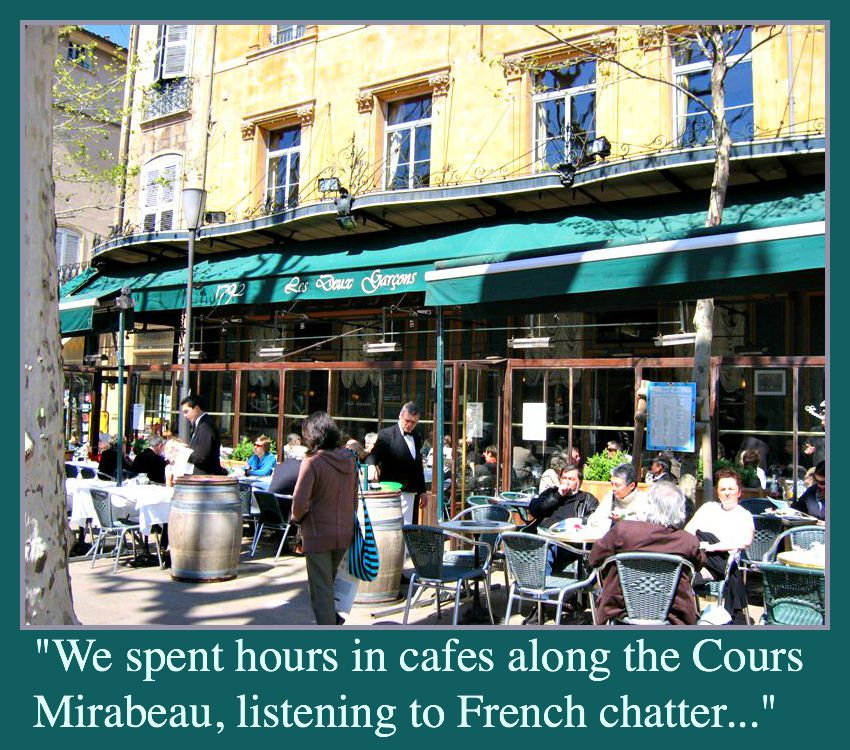
We had settled in the stylish university town of Aix-en-Provence at the height and in the heat of a south-of-France summer. One of our favorite pastimes was sitting for long mornings under the dense shade of sycamores—les platanes—their green canopies arching over appealing squares filled with tiny bistro tables. The unique mosaic of the sycamores’ peeling bark intrigued us—uneven patterns of pastel yellows, tawny russets, avocado greens and dull grays—and we never tired of studying the colors.

Aix plantanes

But on one morning, our idyllic interlude under royal sycamores was marred by the manners of plebeians.

Enjoying cafés au lait, croissants, and the daily chatter of French summer school students in the outdoor shade, we were startled when an Eastern European quartet of two tanned Moms and their Mini-Me daughters, each one more rude than the other, unceremoniously marched onto the terrace.

There were no “bonjours” and no smiles in response to the sweet greetings of the waitress. The women’s bravado more than upset the drowsy morning ambience.

All were similarly clad in skinny jeans, patent leather stilettos and Jackie-O shades with “spoiled” plastered across heavily made-up faces. Distressed that the cafe served no food for breakfast and when politely urged, as we had been, to run up the street to the local boulangerie for croissants, the most vocal of the four retorted brusquely and loudly in accented English, “What, the French don’t eat breakfast? Ridiculous.”

We so wanted to see her wobble up the cobblestoned hill in search of pastries in those heels.

stilettos in Aix

Rather than rebuke the vocal twenty-something for bad behavior and creating a scene, however, her mother barked an order for orange juice—“freshly squeezed.” The OJ not forthcoming, they settled loudly for espressos, plopped down in their chairs and insolently picked up their Blackberries with identical pouts.

Bad-mannered people come from all corners of the world, and, unfortunately, they sometimes chose to sit next to us.

* * *

Thank you, Marianne, for sharing these horror stories! I agree, more people need to join your world of words!

Readers, have you ever met the tourists from hell, and were they using English in a non-English-speaking country at the time? We’d love to hear about it in the comments!

Marianne C. Bohr is a writer, editor and French teacher whose book, Gap Year Girl: A Baby Boomer Adventure Across 21 Countries, was published in early September (She Writes Press). She married her high school sweetheart and travel partner, and with their two grown children, follows her own advice and travels at every opportunity. Marianne lives in Bethesda, Maryland, where after decades in publishing, she has followed her Francophile muse to teach French. She has an author site where she keeps a blog, and is active on Facebook and Twitter.

STAY TUNED for the next fab post!

If you enjoyed this post, we invite you to register for The Displaced Dispatch, a round up of weekly posts from The Displaced Nation, and SO much more. Register for The Displaced Dispatch by clicking here!

Related posts:

WORLD OF WORDS: There’s a word for that homesickness that grips expats and overseas travelers, and it’s French!

Marianne Bohr in the Luxembourg Gardens in Paris—is she reading or indulging in reveries about words?

Marianne Bohr in the Luxembourg Gardens in Paris—is she reading or indulging in reveries about French words?

Columnist Marianne Bohr, whose first book, Gap Year Girl, came out at the start of this month with She Writes Press, recounts a time during her travels in France when she and her husband felt suddenly out of place and full of longing for home. Ironically, however, the most apt expression she could think of to describe this feeling was French!

They’re inevitable. Those days that occasionally, and sometimes from out of nowhere, invade the life of a long-term international traveler or expat. You miss home, you’re a stranger in an alien place, you’re gripped by le cafard.

While French has an expression for homesickness (mal du pays), I prefer the other term, le cafard, to describe this dark visitor. It literally means “the cockroach”.

Le_cafard_cockroach

Photo credits: Alone In The Dark, Nobody Waiting, by Môsieur J.; (inset) Gaspard le cafard, by InOutPeaceProject. Both images via Flickr (CC BY-SA 2.0).

The creepy cockroach of homesickness

Seven weeks into our year of living in Europe, homesickness hit and hit hard. My husband, Joe, and I were in southwestern France. The fall weather had turned decidedly cold under steely gray skies and thick cloud cover—never good for lifting one’s spirits. Though we never imagined our adventure abroad would be daily champagne and constant merriment, we didn’t expect the blues to make their appearance so soon.

Exploring endless desolate, medieval stone hamlets had darkened our mood. Everything had been touched not only by the savagery of the Hundred Years’ War between the French and English in the 14th and 15th centuries but also by the 13th-century Cathar Crusade.

Prior to leaving for Europe, I’d read extensively about the Cathars and decided that we had to visit the region in which this shameful yet fascinating period of history took place.

The bloodthirsty military campaign of the pope, ironically named Innocent III, to eliminate the dualist offshoot of Catholicism in Languedoc-Roussillon was conducted with abandon against the heretics. No one was spared—men, women, children, and the elderly were all slaughtered. And when Catholics refused to give up their Cathar neighbors, one religious leader (a monk, no less) famously declared: “Kill them all. God will know his own.”

In a sunnier clime, this history might have been remote and intriguing. But against a backdrop of unrelenting gray with no access to the Internet, it left us feeling fogged in and low. Very low. After visiting so many places that witnessed sieges, starvation, plagues, pestilence, and butchery, even the cheeriest of souls would have succumbed to its grip.

Cathar Crusade

Photo credits (clockwise from top left): Pope Innocent III wearing a Y-shaped pallium, by unknown 13th-century artist; “Saint Dominic presiding over an Auto da fe” (detail), by Pedro Berruguete; Expulsion of the inhabitants from Carcassone in 1209, taken from the manuscript Grandes Chroniques de France. All images via Wikimedia Commons.

It’s a bug that thrives in the dark—and in the Dark Ages!

Melancholia, tinged with some serious mal du pays, reared its ugly head without warning. Perhaps we’d had our fill of cold, antiquated spaces and lonely, abandoned stone villages. Or perhaps the total absence of others to provide even a bit of people-watching diversion had brought us down. But maybe we were just in a trough of the normal vicissitudes of travel.

To put it simply, we missed our children and we missed our country—we’d come down with a serious case of le cafard.

Despite knowing that immersing ourselves in the brutal extinction of the Cathars might not be what we needed to improve our dispositions, we plowed ahead toward our next destination: Caunes-Minervois, just north of Carcassonne. On the way, we stopped and hiked the steep Cathar hill town of Cordes-sur-Ciel, where the region’s alleged heretics had taken refuge, and took a long midday break for a sunny, outdoor lunch in Albi (home of Toulouse-Lautrec), with its austere, imposing redbrick cathedral of Sainte-Cécile, unlike any other church in the world. We noted that the cylindrical exterior of its nave looked like a space shuttle ready for launch. Sainte-Cécile was built after the Cathars were wiped out as a visible reminder to those who might be thinking of defying Rome not to forget who was in charge.

Sainte-Cécile Cathedrale

Photo credit: Cathédrale Sainte-Cécile d’Albi, vue de la rive opposée du Tarn, by Jean-Christophe BENOIST via Wikimedia Commons (CC BY-SA 3.0).

Back on the road, we drove farther south into the Montagne Noire to our ultimate destination: the constricted streets of Caunes-Minervois, where our Internet-enabled hotel awaited. It had been over a week since we’d communicated with our children, and we were lost in reverie about what we would learn when we fired up our laptops. Our son had had an interview the last time we spoke. Did he get the job? we wondered. Our daughter was coming down with a cold. Was she feeling better? Did my latest Amex payment process, and was the house we hoped to rent in Spain still available?

Just can’t get rid of it…

Our home for the next three nights was the Hôtel d’Alibert, an age-old townhome in the heart of the medieval quarter. The affable but quirky owner (you cannot arrive at the hotel between 2:00 and 5:00 p.m. because he is napping—it says so right on the door) lets us in through the French doors of the hotel’s restaurant at just after five. (The front portal remained inexplicably locked all day.)

The coda to our arrival in Caunes-Minervois was this: “Yes, the hotel has free Wi-Fi,” the proprietor confirmed, “but I’m afraid it’s not working; there have been problems.”

Wifi problems at Hotel dAlibert

Photo credit: Hôtel d’Alibert à Caunes-Minervois, by Gaël Gendrotvia Wikimedia Commons (CC BY-SA 3.0).

We were enraged and on the verge of tears. Here we were in yet another deserted town with no means to connect. We dragged our devastated spirits up the spiral stone stairway to our room and dropped our luggage. Le cafard attacked with a vengeance. For the rest of the evening, in a fit of pique, we seriously contemplated the possibility of returning home—of giving up on this gap year business—but finally agreed that all would be better in the morning.

After our night of frustration and reflection, the morning light bolstered our resolve to rally.

* * *

Now back stateside, I still refer to a bout with the blues as le cafard. It just seems so perfect a term. How do other languages express this feeling of profound melancholia? Are there expressions in other languages as accurate as the French?

* * *

Thank you, Marianne! How well you’ve described, with the help of that vivid French metaphor, the sense of alienation that at some point or another plagues all of us who venture beyond borders to travel or live. The word we use on this site, “displaced”, simply isn’t strong enough! Readers, do you have any suggestions for words or sayings in other languages that can convey these feelings? Do let us know in the comments!

Marianne C. Bohr is a writer, editor and French teacher whose book, Gap Year Girl: A Baby Boomer Adventure Across 21 Countries, was published in early September (She Writes Press). She married her high school sweetheart and travel partner, and with their two grown children, follows her own advice and travels at every opportunity. Marianne lives in Bethesda, Maryland, where after decades in publishing, she has followed her Francophile muse to teach French. She has an author site where she keeps a blog, and is active on Facebook and Twitter.

STAY TUNED for the next fab post!

If you enjoyed this post, we invite you to register for The Displaced Dispatch, a round up of weekly posts from The Displaced Nation, and SO much more. Register for The Displaced Dispatch by clicking here!

Related posts:

LOCATION, LOCUTION: For Stephanie Patterson, the role of expat historical novelist seems to have been predestined

Location Locution
Columnist Lorraine Mace, aka Frances di Plino, is back with her latest interview guest.

Hello again, readers. Last month I introduced you to expat writer Oliver Tidy, who found his calling in writing crime novels set in the UK once he became an expat in Turkey. For my guest this month, Stephanie Patterson, it was the other way around. Stephanie developed an early passion for places other than her home country of Germany, and for the English and Scottish medieval periods. In other words, it seemed almost predestined that she would move to the UK and write historical novels set in these places and times.

Although Stephanie first lived in Kent when she arrived in the UK 18 years ago, she relocated to Aberdeen and then, after a stint in Wales (Cardiff), where she met her British husband, Laurence, has lived in Edinburgh for the past 10 years.

Stephanie Patteson destiny

Photo credits (left): Stephanie Patterson in her beloved Scottish Highlands (supplied); Map of Germany, by Central Intelligence Agency; The main geographical divisions of Scotland, by SFC9394—both images via Wikimedia Commons (CC BY-SA 3.0).

Not surprising, given her proclivities, Stephanie believes the key to settling into a new country is total immersion. In her case this technique greatly improved her grasp of the language (she is a certified translator of English to German). It has also enabled her to write romantic suspense and adventure set in Scotland, England and Normandy under the pen name of Cathie Dunn.

In 2011, Stephanie and Laurence set up Crooked Cat Publishing on the model of an independent US publisher. To date, Crooked Cat has published over eighty paperbacks and e-books with authors across the world, several of which have won (or been shortlisted for) prizes. It has quickly developed a reputation for producing quality fiction.

As Cathie Dunn, Stephanie has two historical novels published with Crooked Cat:

  • Highland Arms, a romantic Scottish adventure (originally released through Wild Rose Press), set in Stephanie’s favourite area of the Scottish Highands: Lochaber. It’s the first in her Highland Chronicles series.
  • Dark Deceit, the action of which takes place in 1140s England and Normandy, when a brutal civil war is taking place. It’s the first in her Anarchy Trilogy, set mainly in medieval Normandy.

She has also self-published Silent Deception, a romantic paranormal novella set in Victorian Cornwall.

When she isn’t writing, editing or publishing, Stephanie is visiting castles, towns and cathedrals throughout the UK. A hobby historian, she has taken university modules in Tudor Studies and Scottish Studies. While in Wales, she took part in medieval re-enactment (the medieval and Jacobite eras being her favorites).

Stephanie’s love for medieval Norman history saw her back in Normandy for a holiday in July. Ultimately, she (and her husband) would not rule out moving to France one day, and, yes, she is currently studying French to improve her knowledge of language and culture.

* * *

Welcome, Stephanie, to the Displaced Nation. I think I can guess the answer but I’ll ask you anyway: which comes first, story or location?

Yes, as you probably guessed, I’m usually inspired by location and/or architecture first, which I then combine with potential plot ideas. My Scottish romance, Highland Arms, was born when I travelled through Glencoe and along the dramatic Loch Linnhe in the Scottish Highlands. The forbidding scenery (helped by the adverse weather of sleet, rain and fog) was the perfect setting for an adventure set in the 1720, featuring a smuggler. I always carry a notepad, and on that occasion I found it very useful for jotting down ideas.

Photo credits (clockwise from top left): Highland Arms cover art; A view of Glencoe, by Ronhjones via Wikimedia Commons[https://commons.wikimedia.org/wiki/File:Gleann_comhainn.jpg] (CC BY-SA 3.0) [http://creativecommons.org/licenses/by-sa/3.0/]. Loch Linnhe, by Moralist via Wikimedia Commons[https://commons.wikimedia.org/wiki/File:Vy_i_skottland.JPG](CC BY-SA 3.0) [http://creativecommons.org/licenses/by-sa/3.0/].

Photo credits (clockwise from top left): Highland Arms cover art; A view of Glencoe, by Ronhjones; Loch Linnhe, by Moralist. Both images via Wikimedia Commons (CC BY-SA 3.0).

What’s your technique for evoking the atmosphere of a place?

For Highland Arms, I was fortunate enough to find booklets by local historians about the era, which allowed me to paint a more realistic picture. This, in combination with a number of visits during different seasons, allowed me to set the scene quite realistically. I did the same for Dark Deceit, which is partly set in Gloucestershire and partly in Normandy. I took hundreds of photos during a holiday in Normandy and kept going back to my travel diary for pointers. I prefer to write about areas I’ve visited. If I can convey my own feelings and impressions, it helps create the atmosphere.

Is landscape the only feature you look at to create a sense of location? What about culture, or even food?

As I write historical adventures, I tend to focus on history and landscape. I found Normandy hugely inspiring for its medieval history and the buildings that have survived from that era. The castles and cathedrals paint a vivid picture of 12th-century life, and I try my best to capture it and convey it into my stories. As you mentioned, I consider myself a hobby historian and have bookshelves full of history tomes, in English and French. It helps that I love the culture.

Can you give a brief example of your work which illustrates place?

Here is a passage from Highland Arms:

Catriona nodded. “Thank you, Mr MacKinnon. I wasn’t looking forward to scaling those peaks.” Her gaze scanned the shimmering surface high up, so glaringly white against the deep blue morning sky. Hidden under layers of cloud the day before, the steep hillsides now presented themselves in all their dangerous glory. Stunned by the beauty yet relieved she did not have to cross them, Catriona smiled as she gazed across crags as sharp as a dagger’s edge.

Relaxing in the stillness of her surroundings, she was surprised at her own reaction. Instead of the misery that held her in its grasp for the last few weeks, a new sense flowed through her.

A feeling of…belonging?

She shook her head in disbelief. What brought this on? The eerie stillness should unnerve her, but instead it calmed and steadied her. Taking a deep breath, she gave her mare a nudge with her heel. Perhaps this journey was going to be good for her after all. No longer banishment, but rather an escape. Perhaps even a fortunate escape.

By the time they reached a small settlement by the shore of Loch Linnhe, the sun had crossed its zenith. Melted snow, and the footfalls of men and horses, turned the ground into a muddy slush. A handful of cottages stood scattered along the path, their walls covered in a thick layer of mud to repel the winds. Smoke swirled through holes in the roofs, filling the air with the smell of peat.

Catriona took a deep breath, enjoying the dusky scent. While she waited for MacKinnon to return from a cottage he’d entered on their arrival, she nudged her mare to the water’s edge to let her drink. Her gaze roamed over the large loch, to the far shore and back to where a narrow arm of water branched off into Loch Leven, disappearing from sight between high peaks behind her. The rugged beauty pulled her in.

How well do you need to know the place before using it as a setting?

Though not always possible, I find it easier to describe a setting once I’ve visited it for long enough to develop a “feel” for the location. For Dark Deceit, I developed an impression of what life was like in that region during medieval times by exploring the abbeys in Caen and Falaise Castle, among other monuments from that era. The book’s hero is originally from a town called Mortagne, in today’s southern Normandy. During our holiday, we drove down to the town and had a wander through it. I took in the surrounding forests (which haven’t changed too much since the 1100s) and ignored the more modern aspects. I try my best to picture the landscapes as they might have been.

Which writers do you admire for the way they use location?

One of my favourite novels is Daphne du Maurier’s Jamaica Inn. The way she describes the desolate landscape, the remoteness of the location, is compelling. You have a real sense of being there. I also enjoy reading MM Kaye’s novels, mostly set in India and Africa. A Third Culture Kid (she was born in Simla and lived all over the world as an adult), Kaye evoked a sense of place that many other authors writing about those areas don’t manage in quite the same way.

Patterson faves

Photo credits: Cover art; insets: Young Daphne du Maurier (about 1930), by The Chichester Partnership via Wikimedia Commons (CC BY-SA 3.0); M.M. Kaye via goodreads.

Thanks so much, Stephanie!

* * *

Readers, any questions for the intrepid Stephanie Patterson? Please leave them in the comments below.

And if you’d like to discover more about Stephanie, why not visit her author site. You can also follow her on twitter at @cathiedunn.

Until next month!

Lorraine Mace writes for children with the Vlad the Inhaler books. As Frances di Plino, she writes crime in the D.I. Paolo Storey series. She is a columnist for both of the UK’s top writing magazines, has founded international writing competitions and runs a writing critique service, mentoring authors on three continents.

STAY TUNED for the next fab post!

If you enjoyed this post, we invite you to register for The Displaced Dispatch, a round up of weekly posts from The Displaced Nation, with weekly updates and much, much more. Register for The Displaced Dispatch by clicking here!

Related posts:

Photo credits (top of page): The World Book (1920), by Eric Fischer via Flickr; “Writing? Yeah.” by Caleb Roenigk via Flickr (both CC BY 2.0).


WORLD OF WORDS: How a mysterious passion for learning French has shaped the life of writer Marianne Bohr

Marianne Bohr in the Luxembourg Gardens in Paris—is she reading or indulging in reveries about words?

Marianne Bohr in the Luxembourg Gardens in Paris—is she reading or indulging in reveries about French words?

New columnist Marianne Bohr, whose first book, Gap Year Girl, is about to come out with She Writes Press, is here with her second post attesting to how a passion for learning languages can engender a passion for travel.

I decided long ago that I was born in the wrong country. There must have been some mistake. But then again, if I’d been born in l’Hexagone, my passion for all things French wouldn’t exist. I’d have been raised with the language’s romantic euphony, and the fluid succession of words would be part of my everyday world. Some other tongue and faraway culture would have caught my fancy—so perhaps, just perhaps, it’s fortuitous my birthplace was Fort Wayne, Indiana, and not Paris.

Passions are essential to a happy life. When we care about something, it shrinks the world to a human scale, breaking it into wieldy pieces to love and nurture. My passion for French shapes my world, yet why I love this lyrical language so dearly is an essential mystery I’ll never fully understand.

In my first post I spoke about the decision my husband, Joe, and I made to do a senior year abroad at age 55. For the final six weeks of our “gap year” traveling through Europe, we settled into Aix-en-Provence, a stylish, sun-kissed university town in the south of France. We delighted in the daily outdoor markets and spent hours in cafes along the Cours Mirabeau, sipping rosé wine and listening to the mellifluous French chatter around us.

Photo credit: Les Deux Garçons, by tpholland via Flickr (CC BY 2.0).

I signed up for daily French conversation classes, hoping to further exercise my sometimes-lazy American jaw in preparation for the new career that awaits me back in the States. Over thirty years in book publishing is behind me and armed with the degree I completed before we left for our gap year, I’m ready to embrace being a French teacher, full throttle.

First day of school

I’ve always loved being a student of French, no matter my age, but on the first day of my class at IS Aix-en-Provence (a language institute that specializes in teaching French to adults), I’m predictably nervous, as I’ve been on day one of every school year of my life. I lay out my clothes the night before and imagine first days of school gone by: my freshly ironed plaid uniform, crisp white blouse, just-purchased navy knee socks with tags still attached, and newly polished oxfords. I pack a snack, just as I did in grammar school, and I’m ready to go.

My giddy younger self emerges the moment I cross the classroom threshold, polished floorboards creaking, where I am once again a wide-eyed schoolgirl eagerly poised over a blank composition book, pencil sharpened and my ardor for the subject on my sleeve.

My class of ten includes students from Australia, Finland, the Netherlands, Spain, and Sweden, none of us a youngster and all on an educational vacation in summertime Aix. I introduce myself and stumble on the choice of tense. Do I use the present or the future tense of “to be”? Do I affirm I am a French teacher, or do I demur and say I’ll soon be a French teacher? I opt for the former, Je suis prof de français. It bolsters my confidence with a frisson of pride.

My prof is Céline—gorgeous, funny, and particularly warm. I so wish I could be like her—une jolie française who speaks lovely French. As I walk home from class, it hits me, as it has so often before: yes, I am a newly minted French teacher, but no matter how I try, no matter how I practice, no matter how fiercely I study, I’ll never be French. I’ll never be française. I’ll never sound like Céline. I’ll forever be on the outside looking in, my face and palms pressed against the linguistic glass. I plunge into a microflash of depression. But I proceed across town, under soaring sycamores, content to have a passion I can call my very own.

The French and their apocopes

The French often truncate words by dropping the final syllables and adding an “o.” Apéro, McDo, and resto (aperitif, McDonald’s, and restaurant) have long been staples of my French vocabulary, but thanks to my classes, I add abbreviations to my repertoire:

  • accro hooked on
  • les actus (the news),
  • un ado (an adolescent),
  • bio (organic),
  • un dico (a dictionary),
  • perso (personal), and,
  • (my favorite) Sarko (Nicolas Sarkozy).
Shortened French words

A few examples of the Gallic fondness for apocopes. Photo credits: Apéro au coin du feu, by Sébastien Bertrand via Flickr (CC BY 2.0); English-language dictionary via Pixabay; _EPP Summit, by European People’s Party via Flickr (CC BY 2.0).

Each week in class, we prepare presentations about les actus, and I do one on social media. Twitter and blogger have now entered the daily lexicon as regular “-er” verbs. We learn the quirky French term for “walkie-talkie” (talkie-walkie), that the expression vachement bien (amazingly good), which was very popular thirty years ago, is much less in vogue nowadays, and that it is très chic to say super (pronounced “sue pair”—accent on the “sue”), especially if you’re a woman.

The café was super-bon; your dress is super-chic; he looks super. I imagine the French language police, the Académie Française, must be super-fâché (very angry) about all the new Franglais.

Why won’t anyone speak French with me?

Indeed, much has changed in France over the past 35 years. There’s a new generation with kinder attitudes, more customer-service orientation, and lots of English spoken, so unlike the France of days gone by. Everyone wants to speak English, but I want to speak French. I’m bolstered by Joe, who always encourages, “Make them speak French, babe,” so we have uneven, lopsided exchanges:

“Good evening, madame.”

“Bonsoir, monsieur.”

“Would you like an aperitif?”

“Oui, je prends un kir, s’il vous plaît.”

“Very good. And you, sir?”

“Un kir aussi, merci.”

It’s initially disconcerting, but they eventually get the point and give us what we want. They speak to us in French! We really do appreciate the attempt to be accommodating and their eagerness to practice our language. If only we Americans would exhibit the same passion for learning new tongues.

* * *

Thank you, Marianne! How about the rest of you out there? Do you have a passion for a foreign language and if so, what kind of lengths have you gone to in its pursuit? Do let us know in the comments!

Marianne C. Bohr is a writer, editor and French teacher whose book, Gap Year Girl: A Baby Boomer Adventure Across 21 Countries, will be published in September 2015 (She Writes Press). She married her high school sweetheart and travel partner, and with their two grown children, follows her own advice and travels at every opportunity. Marianne lives in Bethesda, Maryland, where after decades in publishing, she has followed her Francophile muse to teach French. She has an author site where she keeps a blog, and is active on Facebook and Twitter.

STAY TUNED for the next week’s fab posts!

If you enjoyed this post, we invite you to register for The Displaced Dispatch, a round up of weekly posts from The Displaced Nation, and SO much more. Register for The Displaced Dispatch by clicking here!

Related posts:

GLOBAL FOOD GOSSIP: To ease the stress of yet another international move, tea all round and some jammie biscuits?

Global Food Gossip 062315
Serial expat (and soon to be repat!) Joanna Masters-Maggs is back with some tasty global food gossip to share.

As I write this, we are in the middle of packing for our eighth international move.

By the way, I don’t count moves within countries as an actual move. Indeed, when people complain about having to move from one house to another, I have an unpleasant tendency to judge them for being just a little, well, weak.

Call me strange, but I have almost come to enjoy the stress because I know how deeply the memories will be imprinted as a result.

I especially relish the sweaty dirtiness of a move in a hot climate. You look dreadful and just don’t care. The joy of the dirt sloughing off you in the shower at the end of the day, is unspeakably satisfying. As they say, you never appreciate water until you have experienced thirst.

Memories set to the soundtrack of masking tape being torn from the roll and objects being wrapped in rustling paper—I have a few, including:

  • Watching the Malaysian movers slip on and off their shoes as the moved in and out of our house, no matter how heavy their load.
  • Spying the Brazilian workers taking a siesta under the removal van.
  • Above all, enjoying the sight of my children playing for days with empty boxes.

Tea, all round?

Tea all round

Photo credits: (clockwise from top left) “We’re Moving!” by David Goehring via Flickr (CC BY 2.0); Moving Day, by Cambodia4kids.org via Flickr (CC BY 2.0); Allied Movers, allied Moving Truck, by Mike Mozart via Flickr (CC BY 2.0); (overlay) Tea time, by Daniela Vladimirova via Flickr (CC BY 2.0).

In England it is customary to offer tea to anyone who comes to work around your house. It politely defines their status as providers of services rather than servants.

I have come to associate removal men with strong, sweetened tea and a biscuit to go with it. No move has ever been complete without these accompaniments—and my biscuit of choice under the circumstances is the Jammie Dodger.

A Jammie Dodger comprises two vanilla biscuits sandwiched together with a red jam and possibly buttercream, too. The upper biscuit boasts a little cut out to reveal a little filling—what a tease!

Jammie Dodgers are freely available in English supermarkets. The store-bought version used to do the trick, but I am afraid I have, like an addict, come to demand something more refined as my drug of choice.

No dodging the Jammie Dodger

Years ago, while living in Virginia as a student, I started to make my own Jammie Dodgers, craving as I did a taste of home. Come on, I had to tolerate Lipton Yellow Label tea, which lacks the body I demand. If I couldn’t magic up a suitable English blend, at least there was something I could do about the biscuit situation.

Jammie Dan[https://www.flickr.com/photos/lacuna007/3399511720/], by Andrea Black via Flickr (CC BY-SA 2.0)[https://creativecommons.org/licenses/by-sa/2.0/]

Jammie Dan, by Andrea Black via Flickr (CC BY-SA 2.0).

I hit on a good combination of a shortbread style biscuit and a good-quality jam. Imagine my surprise on discovering these were so much better than the factory version—so much so that I have never again willingly returned to the supermarket to buy them. I was young, remember. I still am. As the years passed I have tweaked that recipe until nothing surpasses it.

Arriving in France I was astonished discover that there was a chain of French bakeries that came very close to my recipe. What a disaster for my thighs! They could no longer look forward to being given a respite on the days when I don’t have time to bake.

Even the French can’t resist!

Known as sablé (literally, sand) for their sandy, crumbly texture, these confiture-filled delights are uncharacteristically large for a French pâtisserie. I relish the idea that even the French find them difficult to resist despite being a nation of “Oui, mais only one”.

I understand their dilemma. The sablé’s crumbly, buttery, shortbread-like texture offers what food technicians call “mouth fill”.

Talking of fillings, the French version comes generally in raspberry or chocolate as well as the ill-advised Nutella. Hm.. France really ought to give the concept of the Nutella sablé a rethink. This biscuit calls for a contrasting texture, so non merci to Nutella, here at least.

Photo credits: flickr black day[https://www.flickr.com/photos/29233640@N07/11273242073/], by Robert Couse-Baker (CC BY 2.0)[https://creativecommons.org/licenses/by/2.0/] ; nutella cookies[https://www.flickr.com/photos/ginnerobot/7095126765/], by Ginny via Flickr (CC BY-SA 2.0)[https://creativecommons.org/licenses/by-sa/2.0/]

Photo credits: flickr black day, by Robert Couse-Baker (CC BY 2.0); nutella cookies, by Ginny via Flickr (CC BY-SA 2.0).

Apart from the size, the other difference in a French Jammie dodger is that instead of one hole cut in the upper biscuit to expose the filling there can be as many as three. Alors, the French can actually do vulgar excess it would seem!

Personally, I love the idea of the French ditching the restrained elegance we are so used to seeing from them. I also love that it is a jammie biscuit that drove them to it.

Cate the Cake: She’s the biscuit!

This move is the most special of all my international moves, because this time, my daughter is providing the Jammie Dodgers that fuel us. Since arriving in France, Catherine has developed first an interest in baking and then in patisserie—developments that have made my heart sing a special version of the 1812 Overture.

Instead of the “La Marseillaise” being quieted by the Russian national anthem, we have a case of “God Save the Queen” being, if not crushed by the French anthem, at least over-laid and dusted down with a Gallic flourish.

Cate the Cake (a weak nickname, but I can’t resist) has taken courses in all sorts of things from éclairs to crème brûlée. She has brought a certain French flair to my Jammie Dodger, making them even more irresistible, if that were possible.

Cate the Cake She's the biscuit

Having the patience and perfectionism I so entirely lack, she is willing to stare through the oven door until just the right shade of pale delicacy is reached that ensures the texture is melting, but not cloying. Adhering strictly to butter only, the flavor is delectable and well worth an extra few centimeters to the waistline. These beauties scream for a strong cup of English blend tea made with leaves, not a bag, and steeped a full five minutes.

Talking of which, I think I’ll nip in to the kitchen before the teapot is packed and give the packers a cultural experience to remember. After all, it’s the presence of workmen in the house that provides the impetus (or excuse?) for an extra-special tea-and-biscuits ritual.

*****************************

Jammy Dodgers/Sablés

Ingredients
• 250g plain flour
• 200g butter, cut into small cubes
• 100g icing sugar
• pinch of salt
• 2 free-range egg yolks
• Raspberry or Strawberry Jam

Method
1. Preheat the oven to 170C/325F
2. Place the flour, butter, icing sugar and salt into a bowl. Using your fingertips, rub the ingredients together until the mixture resembles breadcrumbs.
3. Add the egg yolks and mix until a dough forms. Turn out onto a lightly floured work surface and roll out to a thickness of about 0.5cm. Cut out shapes using a 4cm cutter.
4. Divide the sablés in half. Using a 2cm, fluted cutter, make a hole in the middle of half of the sablé biscuits and discard the dough. Place all the sablés on a baking tray.
5. Liberally dust the tops with icing sugar passed through a fine sieve.
6. Bake the sablés for 10-12 minutes, or until pale golden-brown and crisp. Remove and transfer to a wire rack to cool.
7. Using a teaspoon, place a small dollop of jam on a whole sablé. Place a sablé (with a hole) over the whole sablé biscuit.

* * *

Readers, we invite you to continue the food gossip! Can you relate to Joanna’s instinct for strong tea and Jammie Dodgers? And can you offer any other food tips to alleviate the stress of an international move? Be sure to let us know in the comments!

Joanna Masters-Maggs was displaced from her native England 17 years ago, and has since attempted to re-place herself in the USA, Holland, Brazil, Malaysia, Venezuela, Saudi Arabia, and now France. She describes herself as a “global food gossip”, saying: “I’ve always enjoyed cooking and trying out new recipes. Overseas, I am curious as to what people buy and from where. What is in the baskets of my fellow shoppers? What do they eat when they go home at night?”

STAY TUNED for the next fab post!

If you enjoyed this post, we invite you to register for The Displaced Dispatch, a round up of weekly posts from The Displaced Nation—and much, much more! Register for The Displaced Dispatch by clicking here!

Related posts: