The Displaced Nation

A home for international creatives

Tag Archives: Fiction Writers

BOOKLUST, WANDERLUST: Beach bound? Check out summer reading recommendations from featured authors (1/2)

booklust-wanderlust-2015

Attention displaced bookworms! Our book review columnist, Beth Green, an American expat in Prague (she is also an Adult Third Culture Kid), has arrived with a treasure chest full of recommended reads to take you through the summer. NOTE: Check out Part Two here.

Hello again, Displaced Nationers!

Summer is upon us—well, for readers in the northern hemisphere, that is! And for those in the United States, Fourth of July weekend is coming shortly. Even if you’re not beach bound, perhaps you are at least picturing yourself sitting in a beach chair feeling the sand through your toes, the waves pounding towards you, the fresh, bracing sea air filling your lungs…

And what’s that you have in your hand—a book or a Kindle?

I find the sound of the waves and the ocean breeze the perfect conditions for escaping into other worlds that writers conjure up for us in their books. This summer, I’ve already been to a few local parks with my e-reader, and I’ll soon be topping it up with some of the books from our best-of-2014 list for an overseas trip. But I’m always on the look-out for fresh new material, and as there are miles to go before I can flop down on the beach of my dreams, I fear I’ll run out of prime reading matter by then. With this eventuality in mind, I decided to reach out to a few of the authors whose books I’ve recently read or reviewed, along with a few of my bookish friends, to see what books they recommend taking on vacation. I asked them to tell me:

Summer Reading 2015

Photo credits: Amazon Kindle PDF, by goXunuReviews via Flickr (CC BY 2.0); beach chair and sandy feet via Pixabay.

They responded with recommendations that seem tailor made for an audience of international creatives. Enjoy! Part 2 will be posted on Friday.

* * *

ALLI SINCLAIR, world traveler, Australian romance author and former co-blogger at Novel Adventurers: I recommend that you bring one travel book, one classic, and one novel. The following make a good combination:

ChasingtheMonsoon_cover_x300Chasing the Monsoon: A Modern Pilgrimage Through India, by Alexander Frater (Henry Holt & Co, May 1992)
There are some books that touch something in your soul that stays with you forever. For me, Chasing the Monsoon falls into that category. Originally published in the early nineties (and thankfully, still available!), Alexander Frater follows the monsoonal rains from the Kerala backwaters in southern India to Cherrapunji, in northern India—known as the wettest place on earth. Frater connects beautifully with the people he meets and he writes for all senses, giving the reader a full immersion into one of the most captivating countries on Earth.

The Ascent of Rum Doodle_cover_x300The Ascent of Rum Doodle, by W.E. Bowman (Vintage Classics, 2010)
Originally published in 1956 but still in print, this book is one of the most celebrated mountaineering stories of all time. The 1950s saw some of the world’s highest mountains successfully climbed (including Everest), and this book is a parody of mountaineering at it’s finest…er, worst. There’s a route finder who is constantly lost, a diplomat who continually argues, and a doctor who is always ill. Rum Doodle will most definitely appeal to fans of Bill Bryson, who wrote the introduction to the book’s international edition (published in 2010).

HellofromtheGillespies_cover_x300Hello From The Gillespies, by Monica McInerney (Penguin, 2014)
I’m a long time fan of Monica McInerney’s books, maybe because Monica is a “displaced” person: having grown up in Australia, she has split her time between Australia and Ireland for the past 20 years. This book is mostly set in outback Australia but with ties to England. Angela Gillespie, a mother of four adult children, has sent out a regular Christmas letter to friends and family for thirty years. The notes are always cheery and full of good news but this year, her note details the unsettling truth of how her family has fallen apart. If you enjoy family sagas with humour and heart, you can’t go wrong with this book. (True, some people recommend it for the holidays, but it’s summer in Australia at Christmas time, remember?)


BRITTANI SONNENBERG, adult TCK, current expat and author of Home Leave (which we reviewed in November): I would pack the following books (assuming I’d be packing it for someone else, who hadn’t read them yet).
Sonnenberg_collage

The Dog, by Joseph O’Neill (Vintage, September 2014)
It’s a devilish, compelling take on cosmopolitan and expat life by the TCK author of Netherland. (Joseph O’Neill was born in Cork, Ireland, in 1964 and grew up in Mozambique, South Africa, Iran, Turkey, and Holland. He now lives in New York City.)

Ghana Must Go, by Taiye Selasi (Penguin, 2014)
This is an intimate examination of a splintered family, set in Accra, Lagos, London, and New York.

All My Puny Sorrows, by Miriam Toews (McSweeney’s, 2014)
One of the saddest and funniest books I’ve ever read; an honest, moving portrayal of sisters and mental illness.


CHRISTINE KLING, author of travel- and sailing-related thrillers: I’ve just finished up the edits on a the third novel in my Shipwreck Adventure series, and I’m looking forward to taking a bit of time off from writing and working at reading my way through some of the long list of books I’ve been wanting to read. The three books I’d take in my beach bag include two novels and a combination cookbook/memoir/travelogue.

The-Janissary-Tree_cover_x300The Janissary Tree, by Jason Goodwin (Sarah Crichton Book, 2006)
My husband and I are contemplating building a new boat in Turkey, and after our recent visit, I’ve fallen in love with the country. Jason Goodwin has written travel books, histories, and thrillers, and I’ve been waiting for the chance to begin reading his work. The Janissary Tree, winner of the 2007 Edgar Award for Best Novel, is the first in what is now his five-book series set in in the waning days of the Ottoman Empire’s Istanbul. The series features a very unique protagonist Yashim Togalu, a eunuch guardian. In this book, Yashim is called upon to investigate a series of crimes including murder and theft of jewels.

Marina_cover_x300Marina by Carlos Ruiz Zafón (Little, Brown Books for Young Readers, 2014)
The first book I read by this author was The Shadow of the Wind, which I often cite as one of my favorite books of all time. I knew Zafón had written a young adult novel that was published in 1999 and became a “cult classic” in Spanish, and since I enjoy good YA novels like the Harry Potter series and the Hunger Games, I was happy to see this book finally released in English in 2014. Marina is set in Barcelona around 1980 at the end of Franco’s regime. This gothic tale is touted as containing elements of mystery, romance and horror as a young boarding school boy meets the exotic, dark Marina. Together they embark on a series of adventures where they meet the kind of grotesque Barcelona characters Zafón does so well.

Sea-Fare_cover_x300Sea Fare: A Chef’s Journey Across the Ocean, by Victoria Allman (Norlightspress Com, 2013)
Years ago I worked as a chef on our owner-operated charter sailboat, and I know what it is like to have to create meals for demanding guests. Victoria Allman is in an entirely different category as she trained as a chef and has worked your years on multi-million dollar yachts. In Sea Fare, Allman has combined the tales from her beginning as a green Canadian chef looking for a job in the charter yacht industry to the joys of shopping in exotic markets from Italy to Vietnam. From the descriptions of her experiences on board the yacht, dealing with crew problems and falling in love with the captain, the stories are grand, but the recipes and the outstanding color photos of the food, will probably cut my trip to the beach short as I head home to try some new dish.


HEIDI NOROOZY, adult TCK, translator and author of multicultural fiction: I just returned from a research trip to Germany, and my choices seem to reflect that! (I went there because I’m writing a novel about an East German detective, Johannes Christian Alexander Freiherr von Maibeck—I know, it’s a bit of a mouthful—I created for a short story I once wrote. The setting is Leipzig, German Democratic Republic, 1981.)

The-Leipzic-Affair_cover_x300The Leipzig Affair, by Fiona Rintoul (Aurora Metro Press, May 2015)
Set in 1985, this novel tells the story of a Scottish student at Leipzig University who falls in love with an East German girl and stumbles into a world of shifting half-truths. Well written and fast paced, the story captures the atmosphere of its setting very well, a world where nothing is ever quite what it seems. As one reviewer writes: “The book is expertly written and seems to me to be a very comprehensive picture of what it was like to live in the East German state.” (Rintoul, a Scot who lives in Glasgow, gathered her material for the book by visiting East Germany and meeting a woman who had been imprisoned. She also looking at extracts of STASI files on people she met.)

Zoo-Station_cover_x300Zoo Station: Adventures in East and West Berlin, by Ian Walker (Atlantic Monthly Press, 1988)
British journalist Ian Walker, who once covered Central America for the Observer (and never managed to write his promised volume on Nicaragua), produced this travelogue on the two Berlins back in 1988. It depicts bohemian life in the once-divided city, where everyone seemed to be from somewhere else: West Berlin was full of Brits, Asians, Danes, Turks and East German exiles; East Berlin, of Anglo-Austrian expats. Walker’s descriptive narrative and reflections on the broader social issues of the day are what make this book stand out. As one of Amazon reviewer puts it:

Having read “Zoo Station”, I was able to understand why some people regarded East Germany as a pinnacle of socialist achievement, much more preferable to its capitalist twin in the West. It is good travel writing, and is both politically and culturally astute.

The-One-That-Got_Away_cover_300xThe One That Got Away, by Simon Wood (Thomas & Mercer, 2015)
Okay, this one isn’t about Germany, and I haven’t read it yet—but it’s at the top of my summer book bag. Tag line: “She escaped with her life, but the killer’s obsessed with the one that got away.” The story of two grad students in California who decide to take a road trip to to Las Vegas, this suspense novel deals with survivor’s guilt and is bound to be a thrilling ride. (Originally from England, Simon Wood lives in California with his wife.)

* * *

Readers, that’s it for this round; we’ll have another round on Friday (update: check it out here). Meanwhile, have you read any of the above and/or do you have summer reading recommendations to add? Please leave in the comments!

And if you need more frequent fixes, I urge you to sign up for the DISPLACED DISPATCH, which has at least one Recommended Read every week.

STAY TUNED for PART 2 of this post on July 3rd!

Beth Green is an American writer living in Prague, Czech Republic. She grew up on a sailboat and, though now a landlubber, continues to lead a peripatetic life, having lived in Asia as well as Europe. Her personal Web site is Beth Green Writes. She has also launched the site Everyday Travel Stories. To keep in touch with her in between columns, try following her on Facebook and Twitter. She’s a social media nut!

If you enjoyed this post, we invite you to subscribe to The Displaced Dispatch, a weekly round up of posts from The Displaced Nation and much, much more. Sign up for The Displaced Dispatch by clicking here!

Related posts:

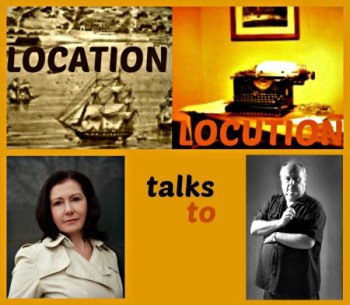
LOCATION, LOCUTION: Expat author and new columnist Lorraine Mace offers her own thoughts on writing about place

Location Locution
Please join us in welcoming Lorraine Mace, aka Frances di Plino, to the Displaced Nation for the first time. From this month, she’ll be taking over the Location, Locution column from JJ Marsh.

Hello, Displaced Nationers! I am thrilled to be taking over this column from JJ Marsh, and I already have lots of interesting guests lined up to take part over the coming months. For this first post, however, I am going to follow in Jill’s footsteps and use my first column to answer the “location locution” questions as a means of introducing myself.

But before I do that, let me give you a few basics. I was born and raised in London, but moved to South Africa just before my 25th birthday. I first lived just outside Johannesburg, then moved to the Orange Free State before discovering, and falling in love with, “the fairest cape”. Since leaving Cape Town I’ve been a nomad for more years than I care to count, having moved continent and country nine times. I finally put down roots in Spain, but have an inclination to spend summers in British Columbia, Canada.

Like JJ, I write crime fiction. I also have a book series for children.

Lorraine May and books

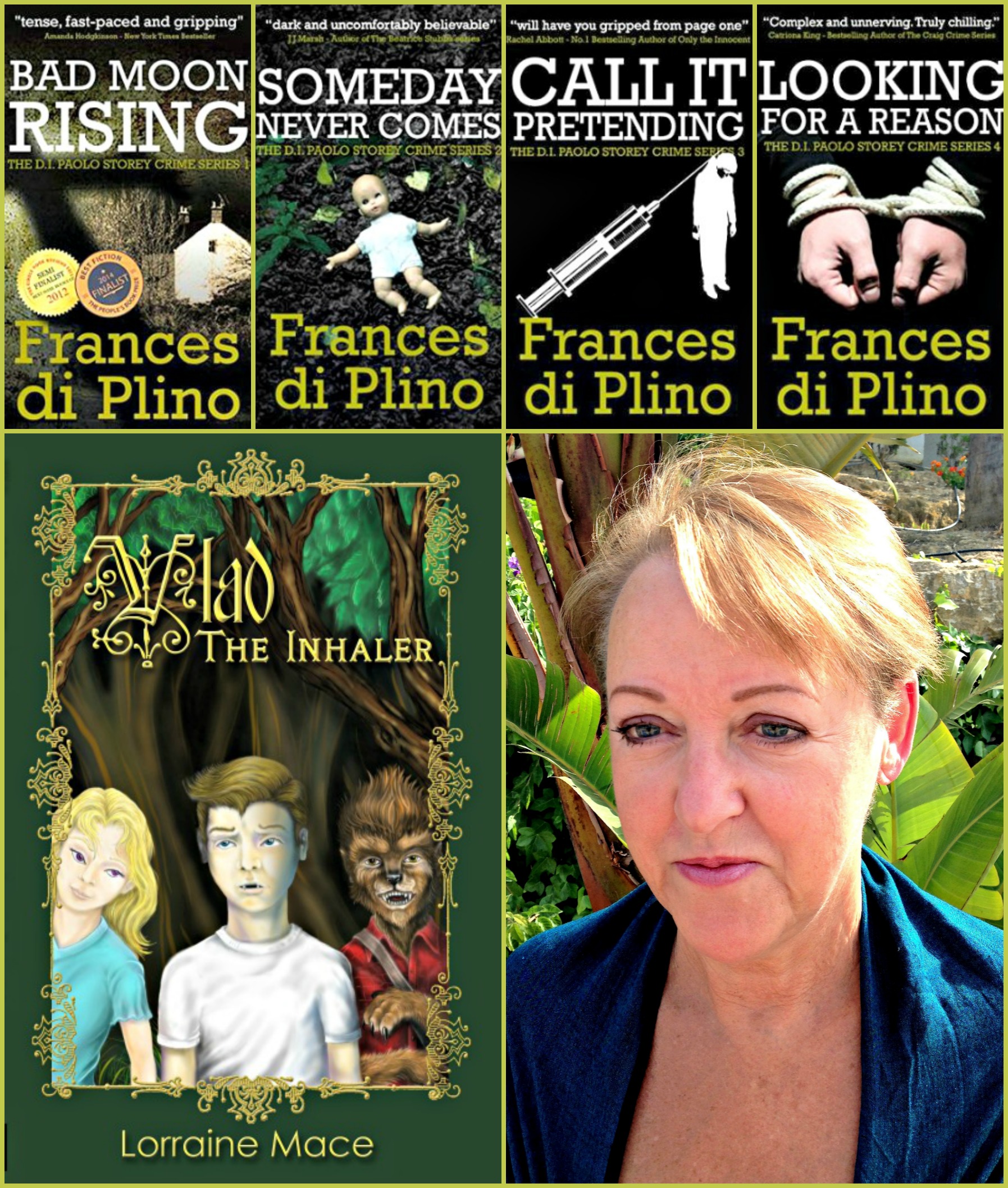
The prolific Lorraine Mace has produced four books in her D.I. Paolo Storey crime thriller series, and one book in her Vlad the Inhaler series (vampires, werewolves and peaches, oh my!).

Oh, and one last item before I move to the questions: don’t forget to visit my predecessor’s farewell post and enter the book giveaway competition. So far there’s only two comments, which by my reckoning gives you a pretty good chance at winning seven great e-books!

* * *

Which came first, story or location?

This can vary from book to book and story to story. However, in my crime novels, written as Frances di Plino, story came first—but then location helps to formulate the plots. Although the series is set in a fictional town, the surrounding British countryside is very real. Bradchester is situated close to Rutland Water and the nearest city is Leicester, both of which feature in the novels on a regular basis. I know this area well. During my last (brief) sojourn in England I lived in a small village a stone’s throw from Rutland Water and frequently visited Leicester.

What’s your technique for evoking the atmosphere of a place?

I put myself into the heads of my characters and experience the place through their senses. When I can smell the bread in the local bakery, or hear the cries of street vendors, weep over a beautiful sunset, taste an orange straight from the tree, or touch the moss-covered stones of a monastery, I know it’s time to start writing, using my character’s experiences of the place.

Which particular features create a sense of location? Landscape, culture, food?

All three, but I must admit I find it easier to use food allied to culture when the story is set outside of the British Isles. Having lived in South Africa, on the Maltese island of Gozo, as well as in France and Spain, I know I can use regional dishes to bring areas of those countries to life. But in Britain I think we have lost the regional aspect of many of our foods. Fish and chips, roast beef and so on are now available throughout the country, where other nations seem to have guarded their regional food identities.

Can you give a brief example of your work which illustrates place?

Bradchester is a town that has more than its fair share of rundown, seedy areas set side by side with gentrified neighbourhoods. This leads to a great deal of social unrest—the haves want the have-nots moved elsewhere and the have-nots resent the wealth and easy life of the haves. This short passage illustrates an area that has, as yet, remained untouched by either sector, but just a street away it is very different.

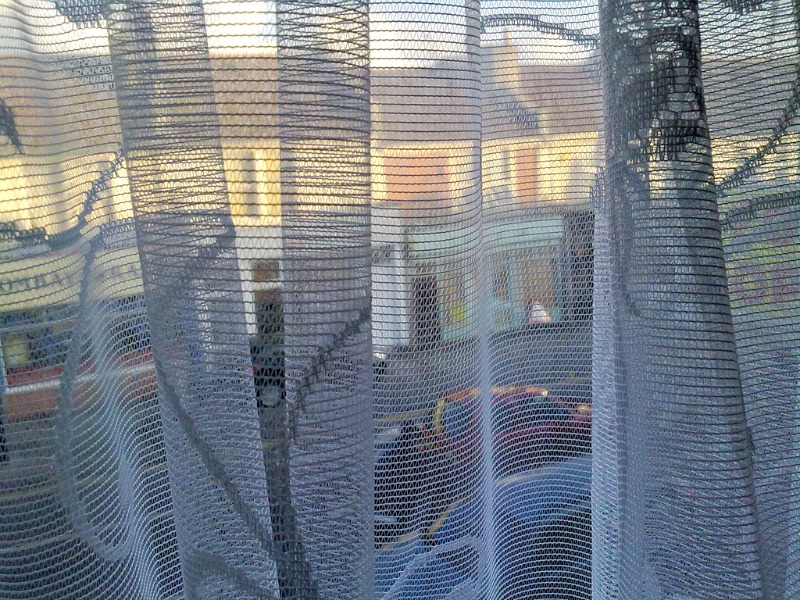
Station Road wasn’t exactly the best part of town, but the place looked respectable. Paolo was pleased to see that most of the businesses he remembered from his youth were thriving. This was one of the few communities that still had a drycleaners, newsagent, old-fashioned fruit and veg shop, alongside a mini-supermarket, hairdressers and a bank. He glanced up. Even the flats above the businesses looked lived in and cared for. Nice nets and curtains framed the windows and many of the street doors had been painted in recent history.

They walked a couple of hundred yards before turning into Zephyr Road. It was like moving into another country. Here, most of the shops they passed were boarded up and the few remaining open for business seemed to Paolo to concentrate on ways to transform goods into money. Pawnbrokers, gold for cash, payday cheque converters. It appeared as though all the dregs of the financial service industry had found their way into this street. This time when he glanced up, Paolo saw the flats above the shops were likewise either boarded up or had dirty nets hiding whatever was going on up there.

net curtains

The quality of the net curtains tells you where you are in Bradchester. Photo credit: Joss Smithson via Flickr (CC BY-SA 2.0).

How well do you need to know the place before using it as a setting?

I prefer to use places I’ve lived in, or visited many times. I like to know the area and people so well I can conjure them up at will when I’m writing.

Which writers do you admire for the way they use location?

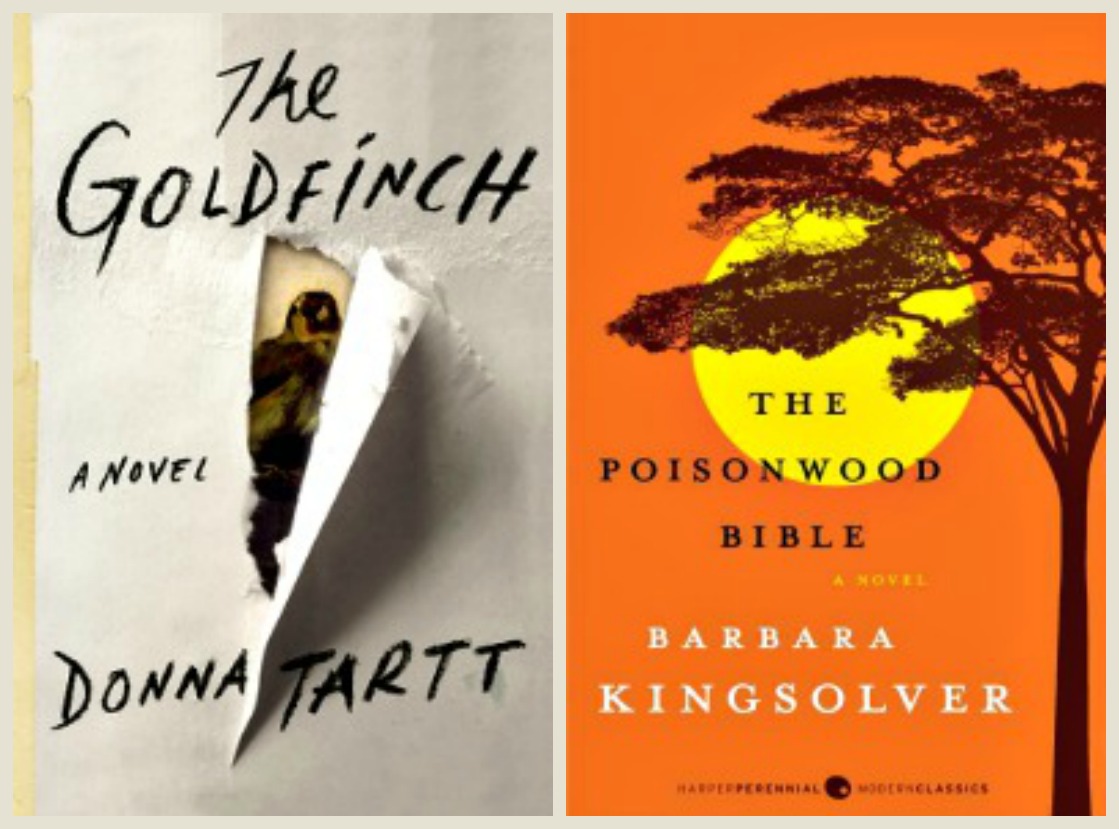
Barbara Kingsolver and Donna Tartt spring to mind. With both authors I feel as if I am living in the locations depicted. In Donna Tartt’s The Goldfinch she manages to recreate both city and desert locations to the extent one can almost feel the weather. Kingsolver’s The Poisonwood Bible brings the 1959 Belgian Congo to life so powerfully the reader is swept into the villages, fearful alike of jungle creatures and the inhospitable landscape.

Books that get "place" right: The Goldfinch, by Donna Tartt; and The Poisonwood Bible, by Barbara Kingsolver.

Books that get “place” right: The Goldfinch, by Donna Tartt; and The Poisonwood Bible, by Barbara Kingsolver.

* * *

Thanks so much, Lorraine! I’m impressed that you created your own place for your crime series novels, and that it’s in the UK, where you haven’t lived for quite some time. Readers, any words of welcome and/or questions for our new columnist? Please leave them in the comments below.

And don’t forget to leave a comment on her predecessor, JJ Marsh’s last post for a chance to win 7 e-books that should take you through the summer. All you have to do is answer the question, in 50 words or less: Where and when in the world would you like to go, and why?

Lorraine Mace writes for children with the Vlad the Inhaler books. As Frances di Plino, she writes crime in the D.I. Paolo Storey series. She is a columnist for both of the UK’s top writing magazines, has founded international writing competitions and runs a writing critique service, mentoring authors on three continents.

STAY TUNED for the next fab post!

If you enjoyed this post, we invite you to register for The Displaced Dispatch, a round up of weekly posts from The Displaced Nation, with weekly updates and much, much more. Register for The Displaced Dispatch by clicking here!

Related posts:

Photo credits (top of page): The World Book (1920), by Eric Fischer via Flickr; “Writing? Yeah.” by Caleb Roenigk via Flickr (both CC BY 2.0).

LOCATION, LOCUTION: Columnist JJ Marsh bids farewell with generous book giveaway

JJ Marsh hands over the Location Locution reins to Lorraine Mace, who will start next month.

JJ Marsh hands over the Location Locution reins to Lorraine Mace, who will start next month.

JJ Marsh first graced the shores of the Displaced Nation two years ago. Growing up a Third Culture Kid in Africa and the Middle East, and now an expat in Switzerland, she was an immediate fit. For two years we have benefited from her love of language and place, and now, as she takes her leave from this column (though not from the Displaced Nation), she does something that makes us love her even more: hand picks a successor and offers a chance to win a set of SEVEN books from Triskele, the acclaimed writers’ collective she helped to found. Thank you, JJ!

—ML Awanohara

Two years after joining Displaced Nation with the Location, Locution column, it’s time for me to say goodbye.

It’s been a terrific experience and I’ve learnt so much from my interviewees, not to mention discovering wonderful books and unexplored places. Heartfelt thanks to ML Awanohara and the Displaced Nation team for taking a risk on me.

I’m going to hand over to a fresh face, with her own unique flair. From June, Location, Locution will be in the expert hands of inveterate creative and nomad, Lorraine Mace. I asked Lorraine to introduce herself to you next month by providing her own answers to the Location, Locution questions.

Finally, I’d like to leave you with a goodbye present. As international creatives, I know you enjoy exploring books that make a feature of place.

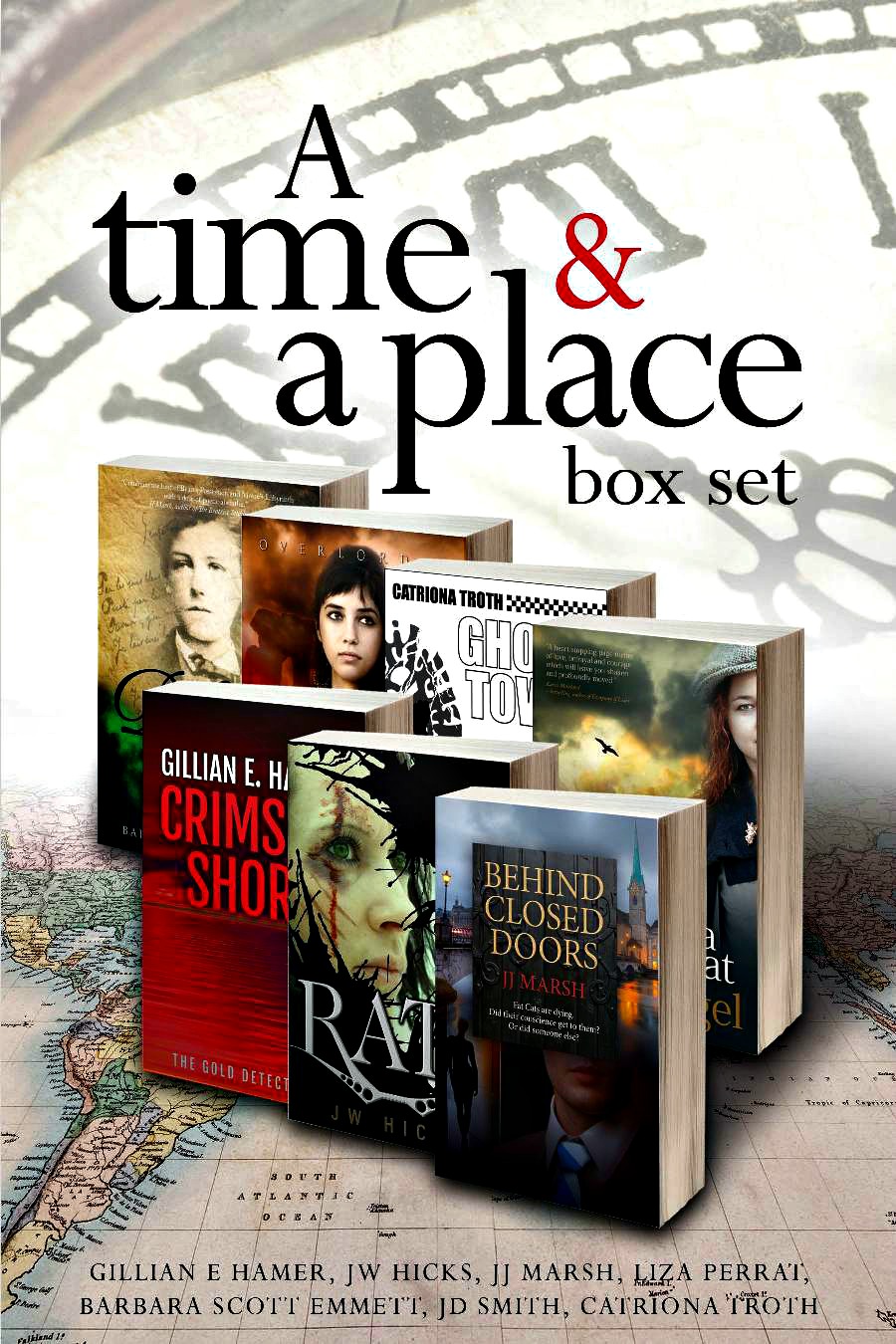
My colleagues and I at Triskele Books have created a box set of books to transport you across time and place, from 3rd century Syria to futuristic Wales. A Time & A Place contains seven award-winning novels that have in common the theme of this column: location, locution.

Come on a journey.
We’ll take you to another place.
And tell you a story.

And as my farewell gift to Displaced Nation readers, I have one free copy (ebook only) to give away. You can win by adding a comment in the box below. In no more than 50 words, where and when in the world would you like to go, and why?

JJ Marsh's farewell giveaway

JJ Marsh’s farewell giveaway

The winner will be announced in next month’s Location, Locution.

* * *

Where would you like to be taken?

1) Modern-day Anglesey on the trail of a psychopath
Crimson Shore, by Gillian Hamer (Contemporary crime)
“Hamer does for Anglesey what Rankin does to Edinburgh, what Dexter did to Oxford”

2) Post-apocalyptic Wales, surviving with a rat pack
Rats, by JW Hicks (YA)
“An absolute treat for fans of SF, dystopian, and YA novels, but I would recommend it to anyone who loves a great story brilliantly told.”

3) Contemporary Zurich, where everyone has a secret
Behind Closed Doors, by JJ Marsh (European crime)
“Warning: once you start this book you may not be able to put it down, and you may find yourself talking to it.”

4) WWII France to resist occupation and fall in love
Wolfsangel, by Liza Perrat (Historical fiction)
“Fascinating, forceful and extremely well researched… will thrill historical fiction fans.”

5) Ancient Palmyra to fight alongside a warrior queen
The Rise of Zenobia, by JD Smith (Historical fiction)
“Packed to the hilt with tension and adventure, it kept me spellbound.”

6) Charleville, France, and the poetic voyage of a manuscript
Delirium – The Rimbaud Delusion, by Barbara Scott-Emmett (Literary fiction)
“Beautifully plotted and written, this absorbing, enchanting novel is one of the best books I have read this year.”

7) Coventry – a 1980s crucible of racial tensions
Ghost Town, by Catriona Troth (Literary fiction)
“Unique and brilliant… not just a compelling read, but also a learning experience.”

JJ Marsh and her  fellow Triskelites.

JJ Marsh and her fellow Triskelites.

Can’t wait to get the set? It’s available for a limited period at the special offer price of $9.99/£7.99. Don’t miss this box of delights. Who knows what you’ll discover?

Or, to reiterate, you can try your luck at winning a FREE copy (ebook only) by adding a comment in the box below:

In no more than 50 words, where and when in the world would you like to go, and why?

Goodbye, thank you for reading the column and I wish you all excellent journeys.

Jill

* * *

Happy trails to you as well, Jill! I noticed you said in a recent interview: “My definition of literary genius is writing about places you want to visit.” May that become the Displaced Nation’s new mantra! Readers and JJ fans, let’s all bid JJ a fond farewell by answering the question: In no more than 50 words, where and when in the world would you like to go, and why? (Seven books, wow! That’s your summer reading…)

JJ Marsh grew up in Wales, Africa and the Middle East, where her curiosity for culture took root and triggered an urge to write. After living in Hong Kong, Nigeria, Dubai, Portugal and France, JJ finally settled in Switzerland, where she has been writing a European crime series set in compelling locations all over the continent and featuring detective inspector Beatrice Stubbs. She recently produced the fourth book in the series: Cold Pressed, which takes place on a luxury cruise bound for Santorini.

STAY TUNED for the next fab post!

If you enjoyed this post, we invite you to register for The Displaced Dispatch, a round up of weekly posts from The Displaced Nation, with weekly updates and much, much more. Register for The Displaced Dispatch by clicking here!

Related posts:

LOCATION, LOCUTION: Canadian writer Lee Strauss uses busy, multicultural Dresden as setting for romance

Location Locution_LeeStrauss

LOCATION, LOCUTION: JJ Marsh (left) talks to author Lee Strauss about the craft of setting contemporary romance novels in foreign locations.

In “Location, Locution” expat crime series writer JJ Marsh chats with fellow displaced fiction writers about their methods of portraying place in their works. Her guest today is contemporary romance and speculative fiction writer Lee Strauss. Born near Chicago to Canadian parents, Lee might have grown up a California girl had it not been for Vietnam, which caused her parents to retreat back to Canada. At age 22, she married Norm Strauss, a Canadian folk rock musician—and signed up for a life of adventure. They have traveled extensively overseas and live part-time in Germany.

—ML Awanohara

Lee Strauss is the author of the Minstrel Series, a collection of contemporary romance novels set in the singer/songwriter world, taking place in Germany and England; the Perception Series, a trilogy of young adult dystopian novels; and several works of YA historical fiction. Under the alter ego of Elle Strauss, she writes fanciful younger adult stories about time travel, mermaids and fairies.

Lee is the married mother of four grown children, three boys and a girl. Because of her husband’s job as an indie folk musician, she has traveled to twelve European countries, Mexico, fourteen states, and six Canadian provinces. Currently, the couple divide its time between Kelowna, a town in British Columbia’s temperate Okanangan Valley, and Dresden, Germany. When not writing or reading Lee likes to cycle, hike and do yoga. She enjoys travel (but not jet lag :0), soy lattes, red wine and dark chocolate.

Now let’s talk to Lee about how she has woven European settings into several of her books.

* * *

Which came first, story or location?

It was a simultaneous decision. My singer-songwriter husband and I spent some time brainstorming on how we could merge our two worlds, indie publishing collaborating with indie music artists, and the idea for the Minstrel Series was born. (Each of the books has accompanying music.) The first two books, Sun & Moon and Flesh & Bone, are song titles of music used in the books. We live part of the year in Dresden, Germany, and I just knew that the books had to be set there, right in our neighbourhood.

Minstrel Series Set in Dresden

Cover art from first two books of the Minstrel Series; (middle) view of Dresden’s historical center, from the same spot where Canaletto made his famous painting.

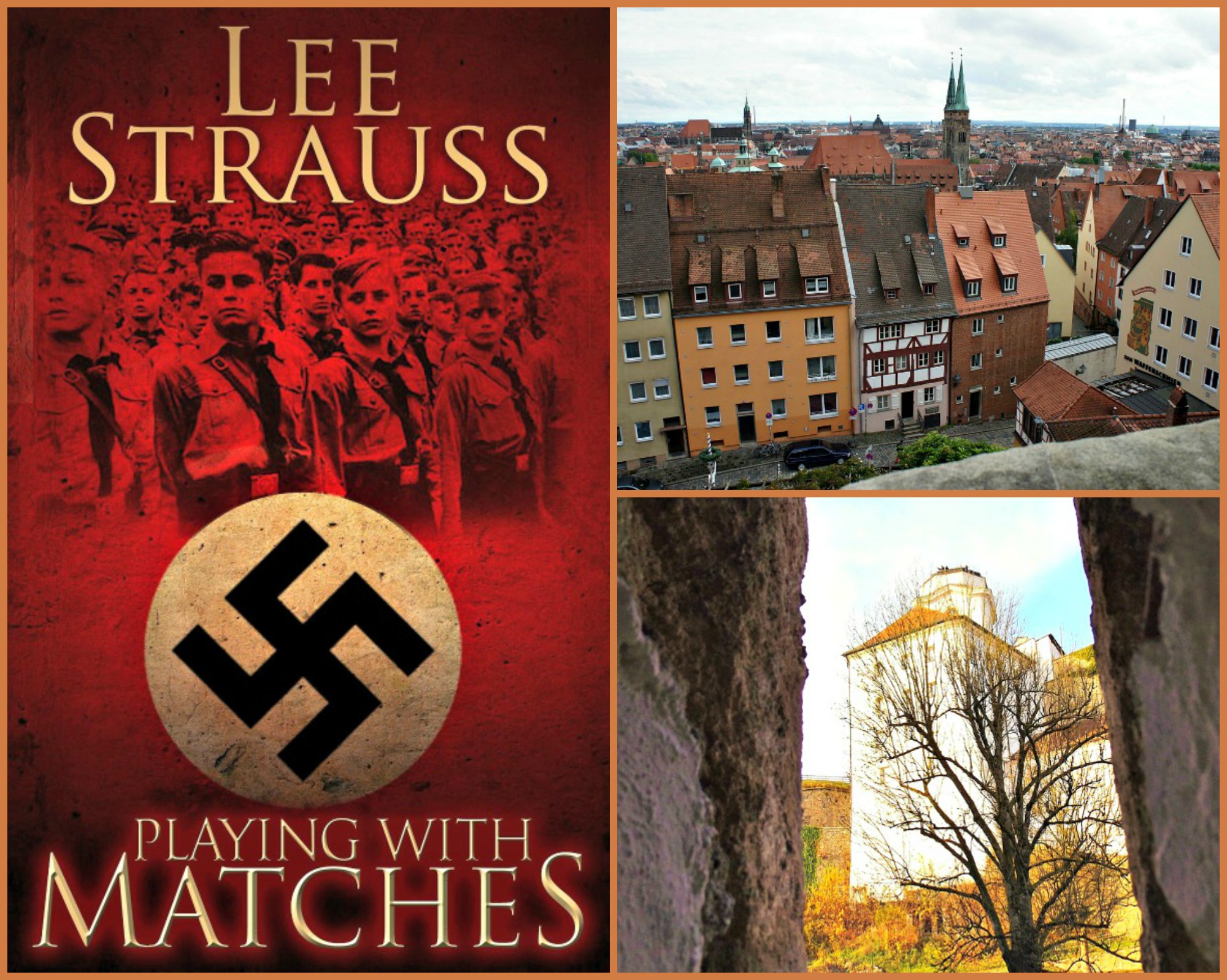
I’ve also written a WW2 historical novel called Playing with Matches, about a group of boys growing up in Hitler Youth. The story takes place in Passau and Nuremberg. Traveling to both cities made a huge difference in getting the setting and ambiance right.

Playing with Matches Collage

Clockwise, left to right: Cover art; Nuremberg citiscape; view of Veste Oberhaus, a 13th-century fortress in Paussau, in lower Bavaria, Germany.

What’s your technique for evoking the atmosphere of a place?

Nothing like living in the middle of it! The street and building in Dresden where we lived are featured in great detail in Sun & Moon and Flesh & Bone. Many readers comment on how they feel like they visited Germany while reading my books.

Which particular features create a sense of location? Landscape, culture, food?

All three. I share a lot of Dresden images on Tumblr, including not just landscape but also food and the local culture.

Can you give a brief example of your work which illustrates place?

Here’s a passage from the Minstrel Series, describing a scene in Dresden:

Katja stood in one of the cutaways on the old stone bridge over the River Elbe that joined the Altstadt with the Neustadt, the old city with the new.

She shivered despite her winter jacket and the scarf wrapped around her neck and strummed her guitar with fingerless gloves. The limestone dome of the Frauenkirche—the Church of our Lady—peaked out over the city’s ancient, baroque skyline. Like all the buildings in the historic center, it had been completely demolished during the Second World War. The entire city was rebuilt to look much like it had before it was destroyed. In essence, the old town was now the new one, and the new town the old one.

It was majestic and awe-inspiring to look upon.

Most days.

Katja’s guitar case lay open at her feet. She’d thrown in the few cents she’d found under the sofa cushions, hoping to lure other donations.

The cold wind kept people hunched over and moving at a fast pace across the bridge, most with chins tucked down and hands shoved into deep pockets. No one took the time to stop and listen, much less drop money in her case.

How well do you need to know the place before using it as a setting?

Spending time living there is the absolute best way. There’s so much you see and learn about a place over time. The second best is to visit in person. After that, talking to people who have lived or visited there along with research and Google Earth.

Which writers do you admire for the way they use location?

Maeve Binchy has a wonderful way of pulling the reader deep into Ireland. (My next book in The Minstrel Series will be set in Ireland and Boston, where I’ve lived.) Susan Grafton does the same for Southern California with her Alphabet Mystery series, set in the fictional city of Santa Teresa, based on Santa Barbara.

* * *

Readers, if this interview has piqued your curiosity about Lee Strauss and her creative array of fiction works, we encourage you to visit her author site.

JJ Marsh grew up in Wales, Africa and the Middle East, where her curiosity for culture took root and triggered an urge to write. After living in Hong Kong, Nigeria, Dubai, Portugal and France, JJ finally settled in Switzerland, where she is currently halfway through her European crime series, set in compelling locations all over the continent and featuring detective inspector Beatrice Stubbs.

STAY TUNED for the next fab post!

If you enjoyed this post, we invite you to register for The Displaced Dispatch, a round up of weekly posts from The Displaced Nation, with weekly updates and much, much more. Register for The Displaced Dispatch by clicking here!

Related posts:

BOOKLUST, WANDERLUST: When what happens in a third culture refuses to stay there: Allen Kurzweil’s “Whipping Boy”

Booklust Wanderlust Collage

Left: Oleh Slobodeniuk (CC BY-NC-SA 4.0); right: Beth Green (her own photo).

Attention displaced bookworms! Our book review columnist, Beth Green, an American expat in Prague (she is also an Adult Third Culture Kid), is back with a rather unusual selection: a memoir that reads like crime fiction. The author, but of course, is an international creative. Enjoy!

—ML Awanohara

Hello again, Displaced Nationers!

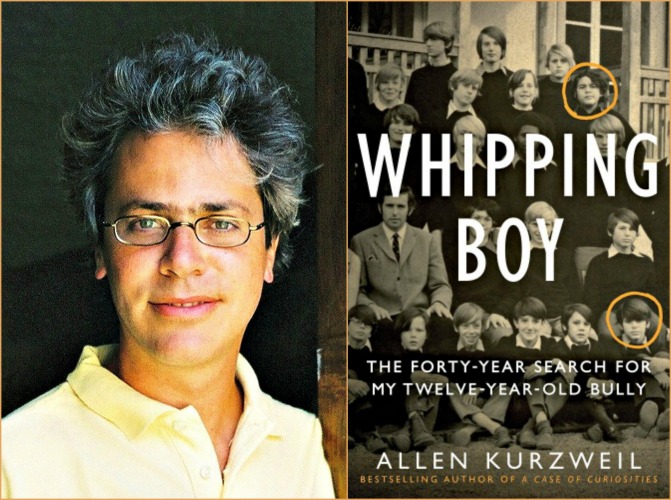
Our Booklust, Wanderlust roundtable series left me with such a wide selection of books to read that I’m only just now coming up for air. This month I’d like to tell you about Whipping Boy: My Forty-Year Search for My Twelve-Year-Old Bully, by the bestselling novelist Allen Kurzweil—which our own ML named as one of the books on her radar in early 2015.

Well, Whipping Boy is out, and it’s a cracking (so to speak) read!

"Allen Kurzweil Wiki2007," by Allen Kurzweil - an image provided by Allen Kurzweil. Transferred from en.wikipedia by SreeBot. Licensed under CC BY-SA 3.0 via Wikimedia Commons.

TCK author Allen Kurzweil & his memoir. Photo credits: “Allen Kurzweil Wiki2007,” by Allen Kurzweil – an image provided by Allen Kurzweil. Transferred from en.wikipedia by SreeBot. Licensed under CC BY-SA 3.0 via Wikimedia Commons.

Kurzweil has produced a memoir that deals with deep emotions dating back to his displaced youth—but that still manages to flow fast and fun like an international thriller. As marketing whiz Kat Gordon put it in a recent tweet:

Hanging on every word of @AllenKurzweil memoir “Whipping Boy.” A whodunit + fairytale in one.

In the fairy tale portion, we watch as our hero, age ten, attends a British-style boarding school perched on an alpine meadow high above Geneva. All goes well until he meets the dastardly Cesar (full name Cesar Augusto Viana), who torments him mercilessly. When our hero grows up, he resolves to track down and confront his childhood nemesis, however long it takes…

The whodunit starts the moment Kurzweil discovers that Cesar has become a leading figure in an international fraud scheme. At that point he converts into an investigative journalist, leaving no stone unturned in his quest to find out how many victims the adult Cesar has racked up.

Before saying anything more about the book, I should point out that Kurzweil is an adult Third Culture Kid. His parents were Jewish émigrés from Vienna to New York City. The family relocated to Milan, Italy, when Kurzweil was young, but he spent his teen years back in New York. He got his education at Yale and the University of Rome and then worked for ten years as a freelance journalist in France, Italy, and Australia before settling back in the United States with his French wife and son.

Kurzweil’s previous works include two novels and a children’s book inspired by his son’s preschool bully. The Whipping Boy has also been excerpted and condensed in the New Yorker.

“In 1971, I met a boy who changed my life forever.”

Kurzweil roomed with Cesar—a burly Filipino rumored to be the son of Ferdinand Marcos’s head of security—at the exclusive Aiglon College, in Villars, Switzerland, for the better part of a year, while Kurzweil’s mother was “test-driving her third husband.” (Kurzweil’s father died of cancer when he was five.)

Kurzweil loved the idea of the school—his deceased father had adored the Alps and mountaineering. But he hated boarding, particularly at night, when Cesar and his stooges would subject him to all manner of hazing. They forced him to eat hot pepper sauce, stole his things (including his most prized possession, his father’s Omega Seamaster watch), taunted him with anti-Semitic slurs, and at one point whipped him with a belt while playing “The 39 Lashes” from Jesus Christ Superstar (Kurzweil was Jesus).

Some form of bullying in schools is universal, but when the kids are internationals, and boarders—dealing with the losses of worlds they have loved (which in Kurzweil’s case was tied to the loss of his dad)—things can get even more intense, something non-TCKs may not appreciate.

Fortunately, though, Kurzweil has a sense of humor. In this book he never misses a chance to point out that life, even when traumatizing, has its comic moments.

“It didn’t take long to shed the habits I’d picked up in Switzerland.”

After a year at the school, Kurzweil moves back to New York City, and quickly re-acculturates:

“[My mother and I] returned to New York, where the plimsolls, anoraks and rucksacks I wore at Aiglon reverted to sneakers, parkas and backpacks. I no longer had to address my teachers as sir and ma’am.”

But while Kurzweil displays the TCK’s resilience in adjusting back to life in the U.S., happy to get rid of the crossbars on his “7s” and scuttle his schooner-sail “4s”, he cannot let go of his memories of Cesar so easily. He harbors an obsession, which grows worse with the years, even (especially?) after he finds success as a writer.

When he learns that his boyhood enemy is most probably a con man working for a shady “royal”-family-led corporation named Badische (pronounced “Baddish,” Kurzweil notes slightly gleefully) that runs investment “schemes” for hard-up New York one-percenters, Kurzweil becomes unstoppable:

Obsessives tend to have obsessions. Cesar wasn’t my first fixation, and I’m sure he won’t be the last. Baseball cards, Matchbox cars, Pez dispensers—I’ve always been a collector…my point is I tend to go overboard. I investigated Cesar and Badische the same way I collected Lincoln pennies—intent on filling every void.

“…I began to acknowledge the obvious: Cesar had taken over my life.”

His investigations span decades and continents, and throughout it all he is haunted by memories of Cesar:

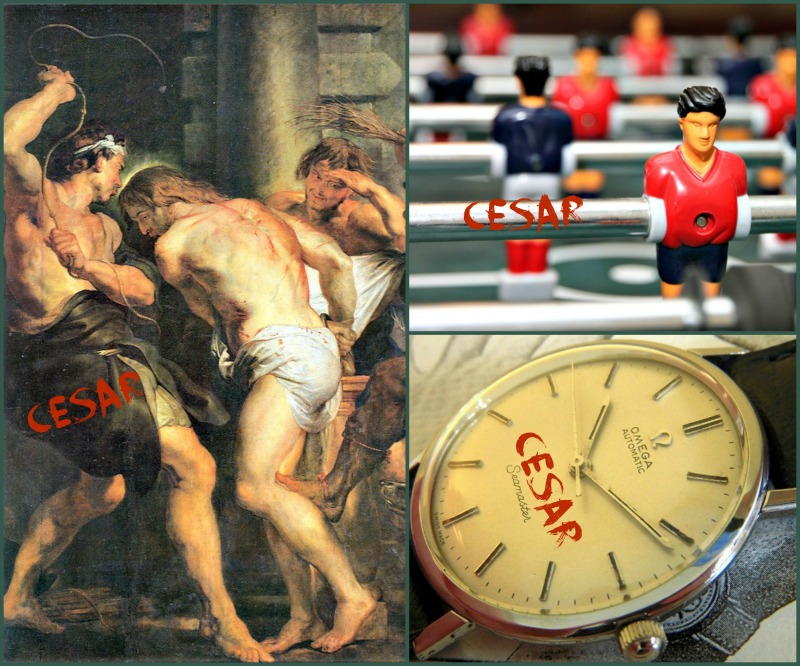
At the back of a dingy bar in Alice Springs, a pair of drunks playing foosball recalled my ex-roommate’s unstoppable bank shot. In Vienna, hanging on the wall of the Kunsthistoriches Museum, a Flagellation of Christ reinvoked the musical whipping. Hot sauce, Andrew Lloyd Weber tunes, Ferdinand Marcos, Montblanc fountain pens, and more than anything else, vintage Omegas, had me reaching for the journal.

The Ubiquitous Cesar. Photo credits (clockwise from left): “Flagellation-of-christ-Rubens” by Peter Paul Rubens (licensed under CC BY-SA 3.0 via Wikimedia Commons); foosball, byrev via Pixabay; Omega watch, ephotographythemes via Pixabay.

Kurzweil shares with the reader his mixed emotions when he at last finds Cesar, wondering what to say to someone who may not even remember him. And then the fear returns—the fear that he experienced as a shy boy being whipped with a belt in his dorm room…only now it is morphing into an adult fear as Kurzweil realizes he has tracked down an actual criminal:

Fake knights. False banks. Imaginary kingdoms. These guys travelled on bogus passports. They hosted lavish dinner parties at five-star hotels. They performed knighting ceremonies. (When I interviewed the assistant U.S. attorney who filed the initial charges, he summed up the crime as Dirty Rotten Scoundrels meets Clue.)

“So, basically, I’m being blamed for your memories?”

Whipping Boy was a quick, satisfying read. I loved the truth-is-stranger-than-fiction details that Kurzweil unearths about Cesar and his company’s schemes.

I loved his humor.

I also enjoyed the quiet pauses when Kurzweil would describe personal moments having nothing to do with the hunt for Cesar: for example, when he met his wife in outback Australia:

A French anthropologist named Françoise Dussart spotted me wandering toward a sacred site off limits to visitors. Concerned for my safety, she drove up and warned me away. She was sitting in the cab of a Toyota Land Cruiser and cradling a baby kangaroo. How could I not fall in love?

And then:

She flew west, from Alice. I flew east, from New York. We met each other halfway, in Paris, broke and in love.

Juanchito via Pixabay[http://pixabay.com/en/kangaroo-australia-jump-creature-250873/]; talitaraquel via Pixabay[http://pixabay.com/en/eiffel-tower-paris-france-tower-350453/]. License: CC0 Public Domain[http://pixabay.com/en/service/terms/#download_terms]

From kangaroo love to love in the City of Light. Photo credits: Australian kangaroo, Juanchito via Pixabay; Eiffel Tower, talitaraquel via Pixabay. License: CC0 Public Domain

I further appreciated his candor in admitting that two people can remember the details of an event differently, particularly when one of them is a psychopath with a chip on his shoulder. As Cesar puts it when they finally meet up again for the first time:

“I recall a lot… But just in bits and pieces. There are some things that people have told me about that I really don’t remember. You might need to prod me a bit.”

I would particularly recommend the book to those who like stories about heists or con artists—the movie American Hustle has some parallels—as well as to anyone who has harbored a fantasy of facing down a childhood bully.

Kurzweil may be beaten but he isn’t conquered, and that’s an inspiration to victims everywhere.

But most of all I appreciated Kurzweil’s understanding that for us TCKs, what happens in a third culture doesn’t always stay in a third culture. Some readers may wonder why Kurzweil couldn’t leave his bullying experience behind, particularly as it happened overseas, in a country to which he had limited personal ties. But for Third Culture Kids, the floating world of the expat is as real as it gets. And, as Kurzeil’s story shows, what happens there can have a life-long impact.

* * *

Fellow TCKs, do you have a Cesar or other skeletons in your cupboard dating back to your school days, at an international school or boarding school? Do tell!

Till next time!

Editor’s note: All subheds are quotes taken from Allen Kurzweil’s New Yorker article.

Beth Green is an American writer and English teacher living in Prague, Czech Republic. She grew up on a sailboat and, though now a landlubber, continues to lead a peripatetic life, having lived in Asia as well as Europe. Her personal Web site is Beth Green Writes, and she is about to launch a new site called Everyday Travel Stories. To keep in touch with her in between columns, try following her on Facebook and Twitter. She’s a social media nut!

STAY TUNED for the next fab post!

If you enjoyed this post, we invite you to register for The Displaced Dispatch, a round up of weekly posts from The Displaced Nation, and much, much more. Register for The Displaced Dispatch by clicking here!

Related posts:

LOCATION, LOCUTION: British expat author Carl Plummer turns his gaze upon his adopted home of China

Columnist JJ Marsh (left) talks to Carl Plummer,

Columnist JJ Marsh (left) talks to Carl Plummer, a writer of historical adventure fiction.

We welcome JJ Marsh back to the Displaced Nation for this month’s “Location, Locution.” If you are new to the site, JJ, who is a crime series writer, chats with fellow fiction writers about their methods for portraying place in their works. Her guest today is Carl Plummer, who writes World War II adventure spoofs under the pen name of Robert E. Towsie. Born in Hull, England, he lived in Cyprus, Paris and Libya before moving to his current home of China, where he works as a university lecturer. Today he does something unusual for this column: describes the place where he’s living right now.

—ML Awanohara

JJ MARSH: Once in a while, Location, Locution likes to surprise you. Remember the Paulo Coelho piece on monuments that immortalise cities? If not, go read it now. Is it any surprise this man is an international bestseller?

This month, I tracked down an author I’ve admired for a long time. Carl Plummer writes as Robert E. Towsie, in a classic comic style, setting his capers around Europe against the backdrop of its dramatic history.

But what interested me about Carl/Robert is where this expat creative lives. China. A place I find fascinating, mysterious and sometimes a little scary. So this month’s Location, Locution is his take on China, its people and and how he sees it. Enjoy.

* * *

CARL PLUMMER: In 2004, after a stint in Libya, I arrived in China and started a job at Nanyang Normal University to teach British and American literature. The city of Nanyang (pop. 1,000,000) in Henan Province was proud to boast ten lao wai, foreigners.

Every minute, on every street, in every shop, I was reminded I was a foreigner. Some reminders were harsh, nationalistic and racist with the “go back where you came from” we associate with racism in England.

Other reminders were through curiosity, the wish to speak English to and even touch a foreigner, the assumption all foreigners are American and a sense of me being something exotic, something new and different, and most of all—rich.

I wasn’t rich, am not rich. Teachers are the poorest working travellers of the world. We are the intellectual navvies from the western world. We are not businessmen with expense accounts; we are not oil people or wheeler and dealers. But we are approachable because we have to mingle, use the buses and the metros, and the trains. We do not have company cars with around-the-clock company drivers.

During the rainy season in a small coal-mining town near Pingdingshan the streets would run black when it poured and families would come out to shower beneath the torrents thundering off awnings.

What made me rich to such people? I had an apartment with a shower and I could afford the water it used—I didn’t have to wait for the rain.

In China, the iron rice bowl has long gone.

Why am I talking about money instead of garnishing the text with tales of magnificent walls, gaudy ancient temples or food conjured up with every living creature imaginable? Well, that’s all been done before.

I’m talking of money because poverty is not romantic; it never has been and it never will be. It is cruel and it doesn’t discriminate; there are no deserving and no undeserving poor.

That cradle-to-the-grave surety of Communism is a generation ago, but that generation brought up in it is still around. It is my age, brought up in the 60s and 70s, taught to root out the treacherous intellectual bourgeoisie, taught to spy on parents and teachers, taught to love the state above all else.

It worked in theory for a while because the state cared; it looked after your every need as long as your toed the line, as long as you never asked questions. Now it doesn’t. Now there is no line to toe.

The young are asking questions. That is their hope.

I meet many young people, in their 20s, who have something hanging around their necks; cultural and domestic demands, greatly exacerbated by the growth of capitalism and the cracking of the iron rice bowl.

Education is expensive in China, as is being healthy. Young people have shown me lists, lists almost like invoices saying: we spent this much on your upbringing and this is what you must pay back to us. It is easy to get the sense parents have children for one reason: someone to take care of them in their old age. Babies, especially boys, are glorified little emperors, smothered and mothered—especially grandmothered—to the extreme; but once in their teens they are seen as future life-support systems.

Rich CEOs and husbands framed

Haozhi Chen (CEO of Chinese mobile powerhouse Chukong), by Jon Jordan via Flickr; “Wedding couple in the clan house,” by shankar s. via Flickr. Both photos are licensed under Creative Commons (CC BY 2.0).

Boys are expected to become CEOs and girls are expected to find rich husbands. All are expected to become members of extended families because extended families are safer, more secure. Individualism and independence is dangerous.

The average salary in China is still about 2000 yuan a month (about 200GBP) for a ten-hour-day and a six-day week. Millions of workers live in dormitories more akin to barracks, and send home half their salaries to support families back home. Young people must pay back the money they owe their parents. This is how it is for the majority of young people in China. The majority has to save because everyone has to pay.

When the future is precarious you have to save.

When I lived in the Bai Yun district of Guangzhou (Guangdong province, in Southern China), I used to cycle through a huge housing estate (apartments by the thousand) and cut through the grounds of Jinxi Nanfang Hospital.

Those middle-class apartments sell for about 3,000,000 yuan each, rented out for between 3,000 and 4,000 a month.

From the higher balconies you can see the rows of beggars in the streets around the hospital. These are not the beggars we expect—those in shop doorways with mangy dogs for company.

These beggars are lying in makeshift hospital beds, out in the open, with drips hanging from stands. These beggars are families trying to get the 500 yuan a night needed for hospital treatment, or even the 100 yuan just to see a doctor.

Dontspend$$youdonthave

Lesson for all SL-ers, by Laurence Simon via Flickr (CC BY 2.0).

This is why so many Chinese people are savers, not spenders.

And those apartments—the richer you are, the higher up you live. The higher up you are, the farther you can see across the hospital surrounds where the aged and sick lie in the shadows of a hospital they cannot afford to enter. It is a world where education and health is a luxury, not a right.

For the growing middle-class it is different; for the Chinese aristocracy—very different. There is a Chinese aristocracy; it’s the cushioned group of party members—the 5 percent. (Google “My father is Li Gang”* if you wish to know how that works.)

The growing middle classes do not live with the fearful uncertainties of old age. They do not fear the need to see a doctor or the need to stay in hospital for a few days. They can send their children to good schools; send them to the UK, the USA or Australia to continue with their studies. They can send their children out into the world to be whatever they wish to be—something so many westerners take for granted. They do not need their offspring to look after them in old age. They can be spenders and savers.

I’d rather cry in the back of a BMW than laugh on the back of a bicycle.

"Cargirl," by Xuan Zheng via Flickr (CC BY-SA 2.0); (bottom) "Shanghai cyclists," by Gwydion M. Williams via Flickr (CC BY 2.0).

“Cargirl,” by Xuan Zheng via Flickr (CC BY-SA 2.0); “Shanghai cyclists,” by Gwydion M. Williams via Flickr (CC BY 2.0).

How about the girl who said on a TV show “I’d rather cry in the back of a BMW than laugh on the back of a bicycle”?

Yes, she was condemned and ridiculed, but she does not have the luxury of choice, the luxury of hope; the safety net is not yet there for her.

I believe and hope it will be for her children. Already, there are newly middle class young people who not have to choose between the BMW and the bicycle. Educated women are buying their own BMWs, their own apartments. They do not have to get married as soon as possible in order to be secure.

And more importantly, their individualism and prosperity is running alongside a new sense of social justice, political justice, and an awareness of the needs of others.

Religion, philosophy, or just simple humanism, whatever it is—the humanity is breaking through.

Twenty years ago, capitalism was raw in China; it was Darwinian and brutal, but it is slowly coming around, perhaps in the way it eventually did so in Britain until it was scuppered by the bankers who played with money as though it was Monopoly money.

We started with the Bounderby style of capitalism where Britain was the richest country in the world, populated by the poorest masses.

That is where China has been, perhaps still is, but it is moving through that. Communism denuded the soul, evicted compassion and turned the people into soldier ants. Capitalism came along to lift people out of poverty, but it did not fill the spiritual vacuum—the vacuum of feeling and compassion.

Christianity is becoming ever more popular in China. Confucianism is being taught again. The vacuum is being filled. The younger capitalist—who is not from the spoilt 5 percent—has a sense of social responsibility, the idea of giving back.

Mr Cameron’s “long-term plan” is but a sparrow’s sneeze in Chinese terms.

It’s a long process, but China has a long history and has always been about long processes.

The hope is, and I am confident about it, is the young; they have enough to eat, will have roofs over their heads, but more importantly, they can afford to be more thoughtful, more caring—they can afford humanity. Breaking free from poverty allows kindness to flourish (kindness in individuals and kindness from the state) if it is not smothered by the unacceptable face of capitalism or the dehumanization of totalitarianism.

I believe it will get there. But we cannot think in European terms; European terms are far too short. And remember why you can afford your cheap TV, cheap mobile phone and cheap computer; it is funded by cheap labour.

There are still millions and millions with a standard of living we would find totally unacceptable; but the fear of starvation has gone and the idea of a health service free at the point of use is slowly becoming more than just a dream. For most young people, going to university is still a dream.

It is changing. The young people are making it change.

* * *

Readers, if this interview has piqued your curiosity about Carl Plummer and his Robert E. Towsie books, we encourage you to visit his author site.

JJ Marsh grew up in Wales, Africa and the Middle East, where her curiosity for culture took root and triggered an urge to write. After living in Hong Kong, Nigeria, Dubai, Portugal and France, JJ finally settled in Switzerland, where she is currently halfway through her European crime series, set in compelling locations all over the continent and featuring detective inspector Beatrice Stubbs.

STAY TUNED for next week’s fab posts!

If you enjoyed this post, we invite you to register for The Displaced Dispatch, a round up of weekly posts from The Displaced Nation, with seasonal recipes, book giveaways and other extras. Register for The Displaced Dispatch by clicking here!

Related posts:

LOCATION, LOCUTION: Kiwi-Brit author team produce first in eco-thriller series spanning continents where they’ve lived

JJ LN Collage

Columnist JJ Marsh (left) talks to Lambert Nagle, Kiwi/Brit co-writers of international thrillers.

Today we welcome JJ Marsh back to the Displaced Nation for this month’s “Location, Locution.” If you are new to the site, JJ, who is a crime series writer (see her bio below), talks to fellow fiction writers about their methods for portraying place in their works. We’re excited that her guest today is the better half of a husband-wife team who have composed an eco-thriller that takes place all over the world, including places where they’ve been expats.

—ML Awanohara

Lambert Nagle is the pen name of co-authors Alison Ripley Cubitt and Sean Cubitt. They write thrillers set in sunny climes.

Sean’s day job is Professor of Film and Television, Goldsmiths, University of London. He has been published by leading academic publishers.

Alison worked in TV and film production for companies including the BBC and Walt Disney but her passion has always been for writing. She is an author, screenwriter and novelist.

Serial expats, Lambert Nagle have lived in Malaysia, Canada, New Zealand, Australia and are now based in leafy Hampshire.

Now let’s find out how they perceived the connection between location and locution for their debut novel, Revolution Earth. (Alison is answering for the pair.)

* * *

Which comes first, story or location?

We knew that Revolution Earth had to have a circular structure as one of the themes is that an event in one part of the world will have an impact in another. We needed a major global city for the inciting incident as well as the conclusion and we chose the one we know best—London. Sean was once a bicycle courier and he knew what it was like to have to dodge potholes and taxis in Soho and still get the delivery there on time.

We wrote the New Zealand section after we’d reluctantly left my native land and moved to Melbourne. It was a bit of a love letter to a place we adored but needed to leave in order to pursue professional opportunities abroad. In southeast Australia we were thrilled to find that there was an oil refinery—identical to one we had driven past in Cheshire years ago, which inspired the story.

What’s your technique for evoking the atmosphere of a place?

For the Antarctica portion of the story, Sean had spent four years in Canada as a post-graduate student. The memory of cold is something that never leaves you, so we drew on that, starting from the physical experience and expanding out into the visual side of things.

Photo credits (clockwise from top left): Kakadu in the Australian outback, by Muireann Ní Cheallacháin via Flickr; book cover with photo of Snowy Mountain region of New South Wales, Australia, taken by Alison Ripley Cubitt; lady bicyclist in London, by Danica via Flickr; Alberta, Canada, by davebloggs007 via Flickr (all Flickr photos CC BY 2.0).

How well do you need to know the place before using it as a setting?

Revolution Earth was originally a screenplay. As a screenwriter you have to know a place extremely well before you’d dare use it as a setting. Film is a literal medium and your job is to give very clear instructions about an actual place—as a camera has to be able to film the location exactly as you’ve described it. So we went to extremes: including a trip to a uranium mine in the Outback, thousands of miles from where we lived in Australia.

Eventually we realised we needed to write a novel first, before we could interest film-makers. But by then, we knew we couldn’t get to every location and would have to inhabit some places purely through imagination. The important thing is that the imagined places have to be just as detailed, just as carefully tuned to the physical experience of being there, as the real ones. Something really familiar like a dusty, disorganised office in a backstreet in the East End of London should be as deeply felt as battling a storm in a leaky boat in the Southern Ocean encircling Antarctica. As someone who goes green at the mention of the phrase “rough seas,” this is where the imagination comes in as well.

The liberation of cresting the top of a hill on a bicycle before swooping down towards the valley is the same everywhere, but knowing the twists of the road, the steepness of it, how it burns up your lungs before filling them with joy, is all the richer if you can take your reader into what is special about this road, this time of year, for this character.

Which particular features create a sense of location: landscape, culture, food?

Whether it’s real or imagined, a place comes as a feeling first. Then you identify the elements of that feeling: what can you hear, smell, see, taste. How do people talk? Hot, cold, windy or still? What plants and animals, how personal or impersonal, what sense of the past, ancient or recent, does it communicate and what are the things that carry that sense—things like the absence of birdsong or the sound of a kettle boiling. Sometimes you reach out to the reader to share an experience, but sometimes you have to lead them into an experience they have never had, and then it’s often the emotion of the characters and scene that drive the description rather than its physical elements.

Can you give an example from Revolution Earth that illustrates place?

Great mountains of blue-white floating in a sea caught between the colour of the sky and the fresh green of young pine forests under mid-summer sun. Between them, smaller floes drifted about aimlessly, as though in some kind of trance. On the horizon she saw, thanks to Novak, a steep rise of endless white cliffs. This must be where the glaciers came down to the sea, where the icebergs calved. It was as alien a place as she had ever seen, more alien even than a science fiction film because it was right there, illuminated for her in the startling clarity of dazzling sunshine.

Which writers do you admire for the way they use location?

For Sean, Dickens immediately comes to mind: hardly a scene goes by that isn’t redolent of a life lived in it—stuffy banqueting rooms, Essex marshes, debtors’ prison… I admire Tim Winton who writes about his home state of Western Australia in such a way that I just want to jump on a plane and go there. He’s as comfortable describing what life’s like for the struggling poor living in beachside shacks as he is showing the reader what the inside of a wave looks like from a surfer’s point-of-view.

* * *

Readers, if this interview has piqued your curiosity about Lambert Nagle and the Cubitts, we encourage you to visit their author site.

JJ Marsh grew up in Wales, Africa and the Middle East, where her curiosity for culture took root and triggered an urge to write. After living in Hong Kong, Nigeria, Dubai, Portugal and France, JJ finally settled in Switzerland, where she is currently halfway through her European crime series, set in compelling locations all over the continent and featuring detective inspector Beatrice Stubbs.

STAY TUNED for next month’s Location, Locution, with Carl Plummer, who lives in China and writes comic thrillers as Robert E. Towsie.

If you enjoyed this post, we invite you to register for The Displaced Dispatch, a round up of weekly posts from The Displaced Nation, with seasonal recipes, book giveaways and other extras. Register for The Displaced Dispatch by clicking here!

Related posts:

BOOKLUST, WANDERLUST: 2014–2015 books recommended by expats & other international creatives (2/2)

Globe Bookshelf Part TwoHello Displaced Nationers! As those who caught Part One of this post last week will know, we are continuing the party we had at the end of last year in publishing a Best of 2014 in expat books list by soliciting various international creatives and other “displaced” contacts for more recommended books.

In Part One, several of my bookworm friends from a previous blog, Novel Adventurers, along with ML and JJ Marsh (JJ writes the Location, Locution column for Displaced Nation), revealed their favorite 2014 reads.

In Part Two, below, kicking off with yours truly, we talk about releases we’re hotly anticipating this year.

A “forthcoming reads” roundtable, if you will.

—Beth Green

* * *

BETH GREEN: I actively search out books by Elizabeth George, the American author of the Inspector Lynley mystery novels set in Britain, and Elizabeth Gilbert, who achieved fame with her travel memoir, Eat, Pray, Love. 2015 is a great year for me as both Elizabeths have books coming out.

A_Banquet_of_Consequence_300s_coverA Banquet of Consequences (Inspector Lynley Book 19), by Elizabeth George, due out in October.
Synopsis: Lynley and Havers are drawn from Cambridge to London to the windswept town of Shaftesbury during one of their most complex cases yet: the murder of a feminist writer and speaker.
Why I’m excited: Though actually not in the “expat” realm, I have to confess it’s the book I’m most looking forward to reading. I’m a huge fan of George’s diverse characters and elaborate stories.

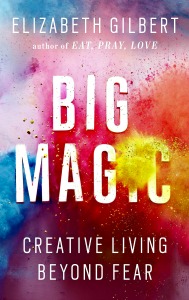
BigMagic_cover_300Big Magic: Creative Living Beyond Fear, by Elizabeth Gilbert, due out in September.
Synopsis: Gilbert digs deep into her own creative process to share her wisdom and unique perspective about creativity.
Why I’m excited: As some readers may recall, I reviewed her novel The Signature of All Things last fall for this column. It seems that Gilbert is now turning her hand to self-help/motivational books for us creatives. I’m intrigued, and I figure other international creatives should be as well.

Three other upcoming books, by authors I’ve not come across before, have also caught my eye:

Displacement_cover_300Displacement, by Lucy Knisley, due out February 8th.
Synopsis: A graphic-novel-style/comic-book travelogue reporting on a cruise ship trip to the Caribbean Knisley took with her grandparents.
What interests me: Even though I seldom read graphic novels, I’m curious to pick it up, especially given its title(!). Knisley has two previous travelogues in graphic form: French Milk (her six-week trip to Paris to celebrate a milestone birthday) and An Age of License (her all-expenses trip to Europe/Scandinavia).

Meet_Me_in_Atlantis_cover_300Meet Me in Atlantis: My Obsessive Quest to Find the Sunken City, by Mark Adam, due out in March
Synopsis: A few years ago, travel writer Mark Adams made a strange discovery: everything we know about the lost city of Atlantis comes from the work of one man, the Greek philosopher Plato. Then he made a second, stranger discovery: amateur explorers are still actively searching for this sunken city all around the world, based entirely on the clues Plato left behind. Adams decides to track these people down. He reports on what he learns from scientists and amateur historians who all share his curiosity about the facts and fiction surrounding the “lost city.”
What interests me: Count me in that curious group!

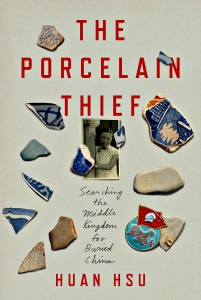
The Porcelain Thief: Searching for the Middle Kingdom in Buried China, by Huan Hsu (forthcoming in March).
The_Porcelain_Thief_cover_300Synopsis: The author, raised in Utah, goes back to his ancestral homeland in China, in part to look for porcelain and other treasures his great-great-grandfather may have buried before the family fled the Sino-Japanese War.
What interests me: As a former expat in China, I love anything about this part of the world, and this displaced family saga sounds particularly fascinating!


ML AWANOHARA: I am always on the lookout for books that could be of interest to the Displaced Nation readership. (Whether I end up reading them or not is a different matter!) I’m sure this is just the tip of the iceberg, but thus far in 2015 I have my eye on one novel and several memoirs.

First, the novel:

The_Art_of_Unpacking_Your_Life_cover_300The Art of Unpacking Your Life, by Shireen Jilla (forthcoming in March)
Synopsis: A million miles away from their daily concerns, on a safari in the Kalahari Desert, two women who were once best friends see if they can reconnect.
What interests me: We featured Jilla’s first novel, Exiled, on the Displaced Nation shortly after we started the site as we were curious to as to why, after her own expat life in New York City, she had produced such a dark, dysfunctional family psychodrama concerning a British expat family living on the Upper East Side of New York. (Her answer was extremely satisfying!)

As to memoirs, here are three that were issued in January:

Leaving_Before_the_Rains_Come_cover_300Leaving Before the Rains Come, by Alexandra Fuller (came out in January)
Synopsis: A child of the Rhodesian wars and daughter of two deeply complicated parents, Alexandra Fuller is no stranger to pain. But the disintegration of her own marriage leaves her shattered. Looking to pick up the pieces of her life, she finally confronts the tough questions about her past, about the American man she married in hopes of being saved from the madness of her early life, and about the family she left behind in Africa.
What interests me: I so enjoyed Fuller’s first memoir, Don’t Let’s Go to the Dogs Tonight, about growing up in a white family during the Rhodesian Bush War, I have come to think of her as a modern-day displaced heroine, or goddess: larger than life, an extraordinary mix of beauty and brains, out of this displaced world… (Hmmm… No wonder her marriage to a mere mortal didn’t last.)

Russian_Tattoo_cover_300Russian Tattoo: A Memoir, by Elena Gorokhova
SYNOPSIS: In her first memoir, A Mountain of Crumbs, Gorokhova detailed her life growing up with an iron-willed mother in Soviet-era St. Petersburg. In this follow-up, she escapes both mother and country by entering into an unsuitable marriage with an American. When her husband first brings her to live in Austin, Texas, the culture shock is extreme. He then ships her off to Princeton to live with his psychotherapist mother. There she meets her second husband and a happier future.
WHAT INTERESTS ME: Maybe because I lived abroad for so long and then had to readjust to life in the U.S., I identify very closely with immigrant stories. And for personal reasons, I’m always attracted to stories that revolve around the challenges of cross-cultural marriage.

Whipping_boy_cover_300Whipping Boy: The Forty-Year Search for My Twelve-Year-Old Bully, by Allen Kurzweil
SYNOPSIS: As a 10-year-old American shipped to a Swiss boarding school, Kurzweil endured a year of torment. Years later he set out to search for the chief bully, Cesar, who, it turned out, had gone to prison twice, having become a professional con man. In circling the globe to find Cesar, Kurzweil stands up for all who’ve been the victim of bullies.
WHAT INTERESTS ME: As we’ve always recognized on this site, some of us who are “displaced” have gothic tales to tell. Thank goodness in this case the villain picked on a man who was destined to become a world-class writer, hence able to exact an exquisite revenge.

Finally, I just now heard about another memoir whose title alone has me panting to know more: The Dead Ladies Project: Exiles, Ex-Pats and Ex-Countries, by litblog founder and book reviewer Jessa Crispin, who moved to Berlin in 2009. It’s due out in September; no book cover yet.


JJ MARSH, crime series author and Displaced Nation columnist (Location, Locution): I have a novel and a poem on my list, along with one publishing house.

A_Spool_of_Blue_Thread_300A Spool of Blue Thread: A Novel, by Anne Tyler (forthcoming this month).
Synopsis: It’s not an expat story but rather the opposite: a domestic family saga. The family, Whitshanks, have lived in Baltimore for several generations.
What interests me: Tyler wrote The Accidental Tourist (about the ultra-insular Leary family, who also live in Baltimore) and I’m curious.

“Sentenced to Life”, by Clive James (James, for those who don’t know, is an Australian writer and personality who has long lived in Britain.)
Synopsis: It’s one of James’s recent poems, published in May of last year, and can be read in full on her author site.
What interests me: I heard James on the radio talking about writing poetry about facing death and it humbled me.

I also look forward to whatever Galley Beggar Press puts out because they’re exciting and adventurous and try things other publishers will not. This strategy paid off with their Baileys Prize success of A Girl is a Half-Formed Thing by Eimear McBride last year.


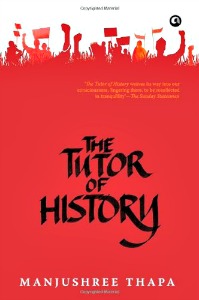
The_Tutor_of_History_cover_300HEIDI NOROOZY, adult TCK, translator and author (@heidinoroozy): This year I’ve resolved to read more books in translation and stories from far-flung parts of the world. And, as I enjoy novels set in foreign locations that are told in local voices, I’ve got these two on my list:

The Tutor of History, written in English by the Nepali author Manjushree Thapa
SYNOPSIS: One of South Asia’s best-known writers, Thapa follows the lives of a variety of characters in the lead-up to local and national elections in a small town in central Nepal.
NOTE: This novel came out in 2012, but I haven’t gotten round to reading it yet.

The_Little_Paris_Bookshop_cover_300The Little Paris Bookshop, by the German author Nina George (forthcoming in English in June).
SYNOPSIS: Monsieur Perdu calls himself a literary apothecary. From his floating bookstore in a barge on the Seine, he prescribes novels for the hardships of life. The only person he can’t seem to heal through literature is himself…but will he manage to do that on a mission he takes to the south of France, with an Italian chef as his companion?
NOTE: I already read the novel in German. In Germany it spent over a year on the bestseller lists.


My_Fellow_Prisoners_cover_300KELLY RAFTERY, translator and writer: In 2015, I am looking forward to being able to read Mikhail Khodorkovsky’s collection of short stories entitled My Fellow Prisoners. Already available in Europe, it is due to have its U.S. release in late February. Convicted on thinly disguised, politically motivated charges, Mikhail Khodorkovsky went from being Russia’s richest man to a labor camp inmate in Siberia. In the decade of his incarceration, Khodorkovsky scribbled short sketches of the men he encountered, jailers and prisoners alike.


SUPRIYA SAVKOOR, editor and mystery writer: In the last roundtable, I mentioned having recently read two gripping memoirs: Not My Father’s Son, by Alan Cumming, and A Long Way Home, by Saroo Brierley. In 2015 I’m looking forward to more books that surprise me as these two did, particularly ones in which the new stories are intertwined with the old ones and make me see the grander scheme of things.


Rebel_Queen_cover_300ALLI SINCLAIR, world traveler and novelist (www.allisinclair.com): I’m a huge fan of Michelle Moran’s books and any book of hers is an automatic buy for me. Moran has an interesting story. Born in Southern California, she was a public high school teacher before becoming a writer, using her summers to travel around the world. It was her experiences as a volunteer on archaeological digs that inspired her to write historical fiction. Moran’s upcoming work, Rebel Queen, will be released in March. It’s about Queen Lakshmi—also known as India’s Joan of Arc because she stood up to the British invasion of her beloved Kingdom of Jhansi. The queen raises two armies—one male and one female—and they go into battle against the well-prepared British.

Moran’s books are rich in historical facts but the stories are so enthralling it never feels like a history lesson. Another reason I’m a fan is because she usually chooses the point of view of someone not so well known. For example, in this story the main character is Sita, one of the Queen’s trusted soldiers and companions, a device that serves to paint a less-biased picture of the more famous Queen Lakshmi.

* * *

Thank you, ML, JJ and guests! Readers, do you have any further 2015 recommendations? Please leave a comment below. And then let’s get our noses back into our books!

Finally, please be sure to sign up for the DISPLACED DISPATCH, which has a Recommended Read every week. You can also follow the Displaced Nation’s DISPLACED READS Pinterest board.

STAY TUNED for next week’s fab posts!

If you enjoyed this post, we invite you to subscribe to The Displaced Dispatch, a weekly round up of posts from The Displaced Nation, plus some extras such as seasonal recipes and occasional book giveaways. Sign up for The Displaced Dispatch by clicking here!

Related posts:

A valentine to displaced creatives: Let a thousand friendships flourish!

Valentine_Displaced_Friendships

Photo credit: PublicDomainPictures via Pixabay.

In my nearly four years of managing the Displaced Nation, I’ve had about as many face-to-face meet-ups with the creatives I’ve “met” on this site. Let me see…the last one was was about eight months ago, when the delightful Jennifer Eremeeva and I had coffee. Among many other things, we talked about her autobiographical novel based on her two decades of living in Russia: Lenin Lives Next Store: Marriage, Martinis and Mayhem in Moscow (don’t you love the alliteration?).

I suppose it’s not surprising how rare these real-life encounters are, given that, by definition, displaced creatives tend to be on the move and/or opt to live in far-flung corners of the globe. (Jennifer was on her way to her summer home—or dacha, as she jokingly referred to it—in Northampton, Massachusetts, when we met, but would soon be heading “home” to Russia.)

Still, putting a gravatar to a name is one thing, putting an actual face to a name quite another. It cements your friendship in a way that nothing else can.

No doubt that’s why I was so thrilled to learn that another such meet-up has taken place between two writers who first encountered each other here: Cinda MacKinnon, author of the novel A Place in the World, and Rita Gardner, author of the memoir The Coconut Latitudes.

Both Cinda and Rita have kindly agreed to answer a few questions about their flourishing friendship (there’s that alliteration again!). This being February, I offer it as a kind of valentine to the pair of them, who have been great friends not only to each other but to TDN, as well as what they represent about the site’s potential to be a haven from the storm of the displaced life, a “home”.

* * *

Rita and Cinda, welcome back to the Displaced Nation! Why don’t we start by having you recount how you discovered each other on this site?

Cinda&Rita
RITA: I first discovered Cinda when she posted a comment on James King’s interview with me in his delightful “A Picture Says” column for the Displaced Nation. I immediately responded to her and we began our online friendship, which evolved into our discovering we were practically neighbors in the San Francisco Bay Area—and subsequent in-person get-togethers.

CINDA: It is ironic to think that James, who lives in Thailand, is responsible for connecting two writers who now live in the San Francisco Bay Area. James’s blog, Jamorocki, and the Displaced Nation are my two favorites.

Thank you for that lovely compliment, Cinda! We’ll be sure to pass on to James… Tell us, what was the thing that immediately drew you the two of you together?

CINDA: We were both expats who grew up in Latin American and her story reminded me of other foreigners I knew, whose parents exchanged a comfortable life for a more adventurous, exotic one…but sometimes with devastating consequences—have you read/seen Mosquito Coast? Actually, I told Rita that Cocoloco—the name of her family’s coconut finca (plantation) in the Dominican Republic—would have served as an apt alternative title for her book. She said it was her working title but then she changed it to The Coconut Latitudes just before publication.

RITA: Besides the obvious—that Cinda was an expat and a TCK who grew up in Latin America—I was intrigued that she’d written a novel that is set in Colombia.

Cinda, you’ve also been a guest of James King’s photography column. Can each of you tell me what which photo of each other’s you liked best?

Rita & Cinda Fave Pix
RITA: My favorite photo of Cinda’s was “A Profusion of Wildflowers in Arvin.” I liked the subtle angles and composition and it reminded me of the unexpected beauty that can be encountered everywhere flowers bloom.

CINDA: I think the “Wading Chairs.” That is so Latino! You can just picture a couple of islanders lounging there and keeping their feet cool.

By now, I assume you’ve read each other’s books. What were your impressions?

Cinda&Rita covers
RITA: I read the TDN interview with Cinda before reading her book. The first line struck a chord, about how her fiction “was a way to revisit homes she has cherished.” I also appreciated learning about Cinda’s life and her writing process and her list of favorite books, many of which mirrored my own. Once I got to reading the novel itself: I loved so much about it! The first thing was its sensory lushness; I could see, smell, taste, and feel the cloud forest setting and the coffee finca. I felt for Alicia, the main character, as she ached to find her own place in that world amid complicated relationship struggles. It was a satisfying read.

CINDA: I loved reading Rita’s memoir. The honesty—a lot of soul searching went into this work. Although her upbringing was difficult and her entry into adult life harsh, the writing is straightforward. And I have to say, her mother must have done a marvelous job with home schooling. For those who aren’t aware: Rita mostly taught herself to write, I believe. The results are extremely impressive.

One of you chose to write a novel based on your TCK life, whereas the other wrote a memoir. Do you think those were the right choices?

CINDA: If Rita had written this story as fiction, we would have assumed that she was exaggerating any real life background that went in to it. It is a haunting and compelling memoir.

RITA: I wondered of course if Cinda’s novel was autobiographical (which I’ve learned it is not, other than being influenced by her South American roots and her love of botany). I thought it was perfect as fiction. A memoir would not have produced A Place in the World—and since I liked this book just as it is, I’m glad she chose that route. However, I’d love to see her write a memoir, too!

Both of you grew up as Third Culture Kids, which gives you something in common right away, though not all adult TCKs become fast friends, of course. What are the closest parallels you’ve discovered?

RITA: Goodness—the parallels are uncanny: We both grew up in families that roamed the world before settling in Latin America. We both love nature, writing, photography, many of the same authors and books. We both wrote our books as ways to revisit our own past. We both arrived in the U.S. as teens, wearing “the wrong clothes” and struggled to basically “become” North Americans. I could go on!

CINDA: I could immediately relate to this line in Rita’s author bio: “She continues to dream in Spanish and dance the merengue.” Like many TCKs we are multilingual and have a tolerance for and interest in other cultures. Both of us had parents that were somewhat negligent and we were on our own by the time we were 18 (maybe 17 for Rita—and I did have some encouragement elsewhere).

You almost sound like the Bobbsey Twins, but I guess you also have some differences?

CINDA: One major difference is that as children, Rita lived in a very isolated village, home-schooled and restricted to certain contacts, whereas I went to international schools with a mélange of teachers and friends. My siblings and I didn’t see our parents as often as most kids, but they were stable individuals. Also, between the ages of 6 and 12, I spent a month every summer stateside with my cousins and affectionate aunts; this helped me both emotionally and gave me a glimpse of American life.

RITA: Also in terms of our adult lives: Cinda pursued a life as an environmental scientist and has had a successful academic career. She possesses a deep knowledge of botany and geology I’ll never have. I’m sure there are a lot of other differences—and look forward to continuing our friendship and discovering more about each other, whether differences or connections.

Finally, can you each tell me something about the other you think might be interesting to Displaced Nation readers?

CINDA: Rita is not just as a writer but has had a big job reporting to the Vice Chancellor of Administration at UC Berkeley. She also garnered a good review from the acclaimed Dominican American author/professor Julia Alvarez, who declared her an “honorary Dominicana”. Rita is an accomplished artist as well; supporting the TDN theory of the creativity of expats .

RITA: Cinda has a generous heart—evident both in person and through her blog posts. For example: Through her blog I’ve learned about a Cuban musician who defected to the US and now is in the San Francisco Bay Area; she did an excellent interview with him and included links to his music. In ways like that, she expands everyone’s horizons. Likewise, she has gotten the word out to friends and readers about my book, and has introduced me to other writers in the area. Oh, and she loves Burmese food!

* * *

Thank you, Cinda and Rita! Readers, be sure to check out their books if you haven’t already! Any further questions for these two writers and adult third culture kids? Any of your own meet-ups to report?! Let a thousand friendships bloom!! As usual, please let us know in the comments…

STAY TUNED for PART 2 of our 2014-2015 reads!

If you enjoyed this post, we invite you to subscribe to The Displaced Dispatch, a weekly round up of posts from The Displaced Nation, plus some extras such as seasonal recipes and occasional book giveaways. Sign up for The Displaced Dispatch by clicking here!

Related posts:

BOOKLUST, WANDERLUST: 2014–2015 books recommended by expats & other international creatives (1/2)

Global Bookshelf Part OneHello Displaced Nationers! Looking back at the our popular series Best of 2014 in expat books, published at the end of last year, I decided we should continue the fun at the start of the year—and managed to convince our redoubtable editor, ML Awanohara, that the pair of us should canvass our “displaced” contacts to see what they’d enjoyed reading from last year’s crop of new books, as well as books they’re looking forward to reading in 2015.

A “best reads” roundtable, if you will.

In Part One, which appears below, several of my bookworm friends from a previous blog, Novel Adventurers, along with ML and JJ Marsh (JJ writes the Location, Locution column for Displaced Nation), discuss their favorite 2014 reads.

In Part Two, a similar group of us will talk about releases we’re hotly anticipating this year.

Having already shared my 2014 faves in last year’s series, I’ll concede the floor to others, beginning with ML.

—Beth Green

* * *

ML AWANOHARA: Thanks, Beth. These days, I seem to be more of a collector than a reader (I simply can’t keep up with all the titles I hear about!). If you’ll allow me to bend the rules, I’d like to highlight five more 2014 books I’ve discovered since our Best of 2014 in expat books went live. While I can’t personally recommend any of these titles, I feel justified in presenting them as an addendum to our series.

I’ll start with these four “displaced” novels, listed from most to least recent:

IHaveLivedToday_cover_300x200I Have Lived Today (October 2014)
Author: Steven Moore
Synopsis: Having barely survived his Dickensian childhood in 1960s Britain, Tristan Nancarrow sets out on a journey that will take him through the alleys of London and New York, to the rocky shores of ancient islands, and on pub crawls in dark and gloomy ports. The book is a classic coming-of-age adventure.
Expat creds: Originally from England, Moore is a writer, photographer, traveler and part-time ESL teacher who splits his time between Mexico, Korea and the world.
How we learned about: From his blog, Twenty-first Century Nomad.

SleepwalkersGuide_cover_300x200The Sleepwalker’s Guide to Dancing (Random House, July 2014)
Author: Mira Jacob
Synopsis: This debut novel takes us on a journey that ranges from 1970s India to suburban 1980s New Mexico to Seattle during the dot.com boom. It follows the fortunes of the Eapens, an Indian American family dealing with tragedy and loss. Alternating between past and present, it shows the family’s transition from India to the United States. As one Indian critic writes, the story is “firmly rooted in an immigrant home, its peculiar methods and madness.”
Expat creds: Jacob is an Adult Third Culture Kid, whose Syrian Christian parents came over from Kerala, India, to New Mexico, in the 1960s. She now lives in Brooklyn with her Jewish American husband and son.
How we found out about: Recommended by Condé Nast Traveler as a book to read on a plane.

SummerattheLake_cover_300x200Summer at the Lake (Orion, June 2014)
Author: Erica James
Synopsis: An Oxford Tour guide, Floriana, a property developer, Adam, and Esme, an elderly woman who lives next door to a recent purchase by Adam, meet by chance and develop a lovely friendship, which takes them from the glittering spires of Oxford to the balmy shores of Lake Como. The story blends the tale of an old romance with a modern love affair.
Expat creds: James divides her time between living in Cheshire, UK, in a small rural hamlet and Lake Como, Italy, giving her plenty to draw upon in her books.
How we heard about: Pinterest.

TheBalladofaSmallPlayer_cover_300x200The Ballad of a Small Player: A Novel (Deckle Edge, April 2014)
Author: Lawrence Osborne
Synopsis: Lord Doyle decamps from the stuffy legal courtrooms of London to the smoky back-alley casinos of Macau, where he tries to capitalize on the ill-gotten gains that forced his flight from his homeland. But can he game the system at the island’s glitzy baccarat tables? With its expat angst and debauched air of moral ambiguity set amid the sinister demimonde of the Far East’s corrupt gambling dens, the book is an introspective study of decline and decay.
Expat creds: Lawrence Osborne was born in England and lives in New York City. A widely published and widely traveled journalist, he has lived a nomadic life in Mexico, Italy, France, Morocco, Cambodia and Thailand, places that he draws on in his fiction and non-fiction. His first novel was The Forgiven, which Beth Green reviewed for the Displaced Nation last year.
How we learned about: From Amazon.

Lastly, I have another expat memoir that was issued in 2014 and I think deserves a spot on our shelves:

FallinginHoney_cover_300x200Falling in Honey: How a Tiny Greek Island Stole My Heart (Sourcebooks, March 2014)
Author: Jennifer Barclay
Synopsis: Barclay first visited the tiny Greek island of Tilos, in the south Aegean, with friends, including a lover with promising prospects. In her mid-thirties when those prospects fell apart, she decides to reconnect with herself by returning to Tilos for a month and immersing herself in Greek culture, food, language, and dance. Emotionally healed and recharged, she returns to England, where she meets a man who wants what she wants, only to discover… (I won’t ruin it for you.)
Expat creds: Born in Manchester, UK, Barclay subsequently grew up on the edge of the Pennines—but has lived in Greece, Canada and France, with longish stays in Guyana and South Korea. She now lives mostly on Tilos. Notably, she previously produced a memoir about life in South Korea, amusingly titled Meeting Mr. Kim: Or How I Went to Korea and Learned to Love Kimchi.
How we learned about: Barclay’s “Gathering Road” podcast interview with Elaine Masters.


TheShadowoftheWind_coverJJ MARSH, crime series author and Displaced Nation columnist (Location, Locution): My best book of 2014 is The Shadow of the Wind, by Carlos Luis Záfon. All booklovers will fall hopelessly in love with this tale of a boy and a book he swears to protect after he is taken to the Cemetery of Forgotten Books by his bookseller father. Which of us could resist doing the same? Readers know how a story can act as a portal to otherwhere. This is the most perfect example, not to mention illuminating Barcelona in addition to the Franco dictatorship, love, loyalty and growth.


TheLie_coverHEIDI NOROOZY, adult TCK, translator and author (@heidinoroozy): One of the most remarkable and memorable books I’ve read recently is The Lie, by Hesh Kestin. Set in Israel, it features a Jewish human rights lawyer whose commitment to her principles is put to the test when her soldier son is kidnapped by Arab militants and whisked over the border to Lebanon. I love stories that explore the human spirit and are set against a backdrop of real-life events. The heart of this novel is the question of how far a mother is willing to go to save her child. Very chilling at times, heartbreaking at others and masterfully told overall.


PointofDirection_cover_300x200KELLY RAFTERY, translator and writer: In 2014, I loved Point of Direction, by Rachel Weaver. A starkly beautiful tale set in the Alaskan outback, it reads like a cross-cultural adventure. Most expats will recognize the feelings of culture shock, disorientation and unreality that haunt Anna, a woman on the run from her own ghosts. The sharp writing style perfectly mirrors the jagged mountains and rough seas that inhabit the novel as surely as another character.


SUPRIYA SAVKOOR, editor and mystery writer: I haven’t read many memoirs, but in recent months, I read two that blew me away. The first, Not My Father’s Son, by Alan Cumming, is a must-read, even if celebrity memoirs aren’t your thing or you don’t know much about this Scottish actor, now a dual American-British citizen based in New York City. NotMyFathersSon_cover_300x200Cumming, it turns out, is a genius storyteller, and he takes us on an extraordinary journey through two juicy family mysteries across four countries and three time periods. It is, in turns, emotional, tragic, exciting, suspenseful, and funny. The colorful cast of characters, with names like Tommy Darling and Sue Gorgeous, are real people. Along the way, you’ll learn all kinds of fascinating little tidbits, much of it cross-cultural, about genealogy, history, pop culture, language, psychology. Even Cumming’s anecdotes about his life as a TV and film star are surprisingly interesting, largely because of the author’s clear-eyed, honest wisdom. (I also highly recommend the audiobook, narrated by Cumming himself. Alongwayhome_cover_300x200 His lovely Scottish accent and intonations are an additional treat.)

A Long Way Home: A Memoir, by Saroo Brierley, is another great read. The story is simple but powerful: a five-year-old boy in rural India gets lost, is ultimately adopted to a family in Australia, then, as an adult, tracks down his birth family and reunites with them. How he pieces together his past and finds his roots is one of several beautiful mysteries in this small book. Loss and identity are obvious themes, but not just for the author. A truly unique story. (Side note: Modern technology is one of this book’s heroes.)


ASuitableBoy_coverALLI SINCLAIR, world traveler and novelist (www.allisinclair.com): I recently re-read A Suitable Boy by Vikram Seth. It was released way back in 1993 and caused quite a stir in the literary world as it was one of the longest novels ever to be published in English (1,349 pages hardcover). I first read it then, and, while it’s highly unusual for me to give a book a second or third read, every few years I return to this wonderful novel rich with Indian history, family saga, and a heartbreaking romance. It’s set in post-partition India and explores the political issues at the time (1950s), along with the Hindu-Muslim issues and the caste system. It’s quite an undertaking to read this book but I enjoy revisiting the characters I love. I am very fond of stories written by Indian authors as there is a beautiful style and interesting points of view I find appealing. There’s a sequel in 2016—I can’t wait!

* * *

Thank you, ML, JJ and guests! Readers, have you read any of the above or do you have further 2014 recommendations? Please leave a comment below. And stay tuned for Part Two of this post, books to look forward to in 2015!

Finally, please be sure to sign up for the DISPLACED DISPATCH, which has a Recommended Read every week. You can also follow the Displaced Nation’s DISPLACED READS Pinterest board.

STAY TUNED for PART 2 of this post: 2015 reads!

If you enjoyed this post, we invite you to subscribe to The Displaced Dispatch, a weekly round up of posts from The Displaced Nation, plus some extras such as seasonal recipes and occasional book giveaways. Sign up for The Displaced Dispatch by clicking here!

Related posts: