The Displaced Nation

A home for international creatives

Tag Archives: Entrepreneurs

And the July 2013 Alices go to … these 4 international creatives

 © Iamezan | Dreamstime.com Used under license

© Iamezan | Dreamstime.com
Used under license

As subscribers to our weekly newsletter know, each week our Displaced Dispatch presents an “Alice Award” to a writer who we think has a special handle on the curious and unreal aspects of the displaced life of global residency and travel. Not only that, but this person likes to use their befuddlement as a spur to creativity.

Today’s post honors July’s four Alice recipients, beginning with the most recent and this time including citations.

So, without further ado: The July 2013 Alices go to (drumroll…):

1) HELENA HALME, author and Finnish expat in London

For her latest novel: The Red King of Helsinki
Published: March 2013
From the book description:

Nordic Noir meets Cold War Espionage.

Pia’s ambitions to win a gymnastics competition between her Helsinki college and a school from Moscow trigger a set of dangerous events when her best friend disappears and a violent KGB spy, The Red King of Helsinki, threatens her. Will a friendly British ex-navy officer, Iain, be able to save Pia before its too late?

This fast-moving novel set in Finland has everything—a young, feisty protagonist, Nordic Noir and old-fashioned chivalry.

Citation: Helena, how could we not award you an Alice once we heard you’d written a story revolving around a Red King? While we do not know whether you purposely modeled your Red King of Helsinki on the Red King of Lewis Carroll’s Through the Looking Glass, it almost doesn’t matter. The point is, you present us with a classic through-the-looking-glass situation, having set the action during the Cold War and made your Red King into a Soviet spy. Will Pia/Alice checkmate the Red King with the help of that kindly British military gentleman? Or will she go out—bang—like a candle? No need for Tweedledum/dee to explicate. What’s more, you are the perfect person to take us on this particular fictional journey. With your thick blonde locks and acute appreciation for the curious and unreal in your adopted country, it’s not much of a stretch to dub you the Finnish Alice!

2) TRACEY CROKE, Manchester-born, Australia-based freelance journalist and blogger

Source: “A Pom versus the pests” in Telegraph‘s Expat Life
Posted on: 12 June 2013
Snippet:

Small self-amputating lizards dart out of my fruit bowl. Ants march in to weightlift a few missed crumbs off my floor. Possums push their cute limits with roof-dancing antics.

While the elusive ghost bug remains a mystery, large “harmless” spiders, innocent-sounding paper wasps and alien insects get the boot or get spiked by my neighbour’s stilettoes.

It’s just a few of the ways to deal with uninvited houseguests in the subtropics.

Citation: Tracey, your description of the critters of Aussie-land is almost as fascinating as Alice’s account of Wonderland’s inhabitants. In fact, in many ways it sounds as though you have it worse than Alice, who at least didn’t have lizards and hairy hunstman spiders to contend with, though she did have the Caterpillar. Still, on the plus side, you’re lucky that these various creatures do not interact, apart from the Hunstman spiders, that is, who like to eat cockroaches and geckos. Poor Alice, in watching a large plate come out of the door of the Duchess’s house and graze the nose of her footman, couldn’t help but mutter to herself: “It’s really dreadful, the way all the creatures argue. It’s enough to drive one crazy!”

3) STEPHEN CLARKE, an Englishman who grew up in Bournemouth and now lives in Paris; author and Telegraph Expat blogger

Source: “If you listen carefully, you can hear French cheese breathing,” in his Telegraph Expat blog
Posted on: 6 July 2013
Snippet:

A friend sent me the link to a BBC report about American food officials declaring French cheese “filthy” and inedible. The funniest thing was that it was Mimolette, a hard Edam-like cheese that even I as a Brit find a bit bland. It’s usually sold in small semi-circular slices with a curve of rind, or the kind of rectangular rindless blocks that you would think the Americans might enjoy. It’s the last cheese you would expect to get an import ban.

Citation: Stephen, we agree with you that anything bland does not deserve an import ban. For Alice, the most objectionable food in Wonderland was the Duchess’s soup, which had so much pepper that she, the Duchess, and the Duchess’s baby couldn’t stop sneezing. That would hardly do for a roomful of customs officials! Also, since you did such a good job in writing about cheese, we hope you will write about mushrooms next—a food close to Alice’s heart, and also, we believe, very important to the French. Only, do they have any varieties that can alter one’s size? (As long as they don’t alter speed, Americans may not object…)

4) TORRE DE ROCHE, Australian-American TCK and author

Source: “Blogger to Watch: Torre de Roche talks about her journey to big publishing deal”: interview by Jade Craven on ProBlogger.net
Posted on: 22 June 2013
Snippet:

Art is uncertain. Sometimes, in order to feel the delicious comfort of certainty, you might try to make art while grasping onto some idea or technique that seems safe. If you do that, your writing will come out stiff and contrived because you’re not creating, you’re imitating.

Loosen your grip. Let go of control. Embrace the freefalling sensation of having no idea where you’re going with something.

Good art comes from risk, experimentation, and play.

Citation: Torre, we love the way you took your own advice and embraced the free-falling sensation of having no idea where you were going when you fell for a handsome Argentinean man with a humble sailboat and agreed to join him in pursuing the dream of setting off to explore the world, this despite your morbid fear of water. You’ve had a series of adventures to rival Alice’s. Also like her, you’ve lived to tell the story for subsequent generations of wannabe free-falling adventurers, via both your highly successful blog, which you aptly refer to as a “literary potluck party, Mad Hatter style,” and now memoir, Love with a Chance of Drowning. Kudos!

* * *

So, readers, do you have a favorite from the above, and do you have any posts you’d like to see among August’s Alice Awards? We’d love to hear your suggestions! And don’t miss out on these weekly sources of inspiration. Get on our subscription list now!

STAY TUNED for tomorrow’s post!

Writers and other international creatives: If you want to know in advance whether you’re one of our Alice Award winners, sign up to receive The Displaced Dispatch, a round up of weekly posts from The Displaced Nation, with news of book giveaways, future posts, and of course, our weekly Alice Award!. Register for The Displaced Dispatch by clicking here!

Related posts:

And the June 2013 Alices go to… these 5 international creatives

 © Iamezan | Dreamstime.com Used under license

© Iamezan | Dreamstime.com
Used under license

As subscribers to our weekly newsletter know, each week our Displaced Dispatch presents an “Alice Award” to a writer who we think has a special handle on the curious and unreal aspects of the displaced life of global residency and travel. Not only that, but this person has used their befuddlement as a spur to their own (or others’) creativity.

Today’s post honors June’s five Alice recipients, beginning with the most recent and this time including citations.

So, without further ado: The June 2013 Alices go to (drumroll…):

1) LILLIAN AFRICANO, president of the Society of American Travel Writers

Source:How to use words to cinematic effect in your travel writing.” in Matador Network
Posted on: 21 June 2013
Snippet:

Once a satisfying story has been told, it needs an ending, ideally, one that circles around to the beginning and gracefully achieves a satisfying sense of closure. If a good travel story is like a cinema of the mind, then whoever heard of a movie that had no ending?

Citation: Lillian, your advocacy of the cinematic style puts us in mind of Alice, who, before plunging into her adventures, expresses a similar thought:

…once or twice she had peeped into the book her sister was reading, but it had no pictures or conversations in it, “and what is the use of a book,” thought Alice “without pictures or
conversation?”

And although Alice’s creator, Lewis Carroll, died around the time the first motion picture camera was invented, he clearly believed in telling stories in clear, vivid word pictures. What’s more, the story of Alice’s wonderland adventures circles round to where it began, with Alice waking up on the lap of her sister, who is brushing stray leaves from her face. Like many of us who return from a long international journey, Alice can’t quite believe that she actually underwent such a metamorphosis. Still, she manages to persuade her sister, who after sending Alice to get her tea, dozes off while watching the sun set half-believing herself to be in Wonderland. (Hmmm…if you can persuade the kind of person who doesn’t read picture books, that’s some pretty good storytelling!)

2) ACe Callwood & the other creators of Coffitivity

Source: “How the Hum of a Coffee Shop Can Boost Creativity“— a report on Coffitivity by Anahad O’Connor in the New York Times
Posted on: 21 June 2013
Snippet: As the Times article explains, Coffitivity plays an ambient coffee shop soundtrack that, according to researchers, helps people concentrate. Co-founder ACe Callwood says that, although the site attracted only just over a hundred page views when it first started on March 4th, since then traffic has “exploded”:

Seoul, Korea, is our top user city. New York City is second, followed by London, L.A. and Chicago.

Citation: ACe, we understand that you and your partners are now developing new coffee shop soundtracks tailored to specific countries. For the sake of us creative internationals (see #4, Mike Sowden, below), we wonder if you’d also consider a “Lewis Carroll” track since many of us in that category are trying to account for topsy-turvy ideas of life we’ve obtained from living overseas. We are aware it will take some research to find the right sounds, but our hunch is that some mix of rustling grass, rippling waters, tinkling sheep-bells, a bit of Victorian singing, and Pre-Raphaelite Brotherhood chatter will do the trick.

3) ANNABEL KANTARIA, Telegraph Expat blogger

Source: “Do you suffer from fake accent syndrome?” in Telegraph Expat blog
Posted on: 6 June 2013
Snippet:

Just like the “transatlantic twang” of those who divide their time between the UK and US, the generic global accent of the UAE takes a little from English, Arabic, Hindi and Tagalog, and spits out some sort of accent and vocabulary that we all hope everyone will be able to understand.

Citation: Hmmm… Annabel, especially given those blonde locks of yours, are you sure you’re not Alice reincarnated? Because this is the SECOND time we’ve awarded you an Alice. Either you know the works of Lewis Carroll very well and/or life in the Emirates has given you a special grasp on his canon of works. Last time you received an Alice, it was for a post that told us about the importance of playing by the rules, which reminded us of Alice’s croquet match under the Queen of Hearts’s stern command. This time, you talk about the odd, fake-sounding accents people pick up in foreign spots—which reminds us of poor Alice’s initial meeting with Mouse:

“Perhaps it doesn’t understand English,” thought Alice; “I daresay it’s a French mouse, come over with William the Conqueror.” … So she began again: “Ou est ma chatte?: which was the first sentence in her French lesson-book. The Mouse gave a sudden leap out of the water, and seemed to quiver all over with fright. “Oh, I beg your pardon!” cried Alice hastily, afraid that she had hurt the poor animal’s feelings. “I quite forgot you didn’t like cats.”

Stuff and nonsense, to be sure!

4) MIKE SOWDEN, travel writer

Source: “Why I Blog (On A Napkin)” in Fevered Mutterings—Misadventures in Travel & Storytelling blog
Posted on: 26 May, 2013
Snippet: Notably, Sowden should be a consultant for Coffitivity’s “international creative” app (see #2 above). He reports that he is writing this post

…next to a sunlit window in a Costa coffee house in Birmingham… A regular Chai latte is to the right of my laptop, and I’m fascinated by the lazy snow of cinnamon drifting to the bottom of the glass.

But the passages we really love refer to his napkin diagram:

  • “[Potential blog] [s]ponsors hover in the middle reaches of napkin-space.”
  • “Let’s soar into the upper napkinsphere. … It’s the ideal audience of your blog: anyone with a brain and a pulse.”
  • “This is what the fold in the napkin is all about, just under that line/curve. It’s a mountain you have to climb. A mountain made of enormous amounts of hard work, business planning, Art, applied psychology, smart, non-spammy marketing and all sorts of heart-on-sleeve public-facing transparency and vulnerability. It’s a process of learning how to make something those people will genuinely find meaningful. In business, this is the hardest thing in the world. It’s a mountain littered with the remains of failed expeditions, and it’ll probably end up littered with some of your own.”

Citation: Wow, Mike, you are certainly drinking the coffee if you can see a mountain in the folds of a Costa napkin, and use that image to tell a story about the thru-the-looking-glass challenges most bloggers face. Say, no wonder they pay you (or should be paying you) the big bucks for travel writing! I think other expat and travel bloggers will agree with us that it’s a fantasy feat worthy of Carroll.

5) PATRICIA WINTON, crime writer, food guru and American expat in Rome

Source: “The Tiramisù Is Out of This World” in Italian Intrigues blog
Posted on: 23 May 2013
Snippet: In this post, Winton reports that Chef Davide Scabin, whose restaurant (near Turin) ranks as one of the world’s 50 best, was chosen to prepare a new menu of Italian foods for the astronauts who took off in the European supply spacecraft Albert Einstein ATV [automated transfer vehicle], on June 5th (note: it successfully docked with the International Space Station on June 15th):

Each meal must also have a 36-month shelf life and be prepared without salt. Against this rigorous backdrop, Chef Scabin discovered another challenge. “The olfactory system doesn’t function at 100 percent in space. The astronauts eat with the sensation of having a cold,” he said…

Thanks to Chef Scabin’s efforts, the crew—who include one Italian, Luca Parmitano—are now feasting not on food from NASA or Roskosmoson (its Russian counterpart), but on lasagna, risotto, caponata, eggplant Parmesan, and for dessert—tiramisù.
Citation: To be honest, we weren’t sure whether to award the Alice to Chef Scabin, for spending two years thinking about how to translate Italian food for outer space without turning it into a Mad Hatter’s tea party; Luca Parmitano, for blogging(!) about his “out of this displaced world” experience from the spacecraft; or to Patricia Winton, for making this strange tale known to the expat and travel community. But we decided to go with Winton. Given her penchant for mystery and deceit, could it even be that she fabricated this story just because she fancied a world where astronauts could feast on tiramisù instead of the freeze-dried ice cream served by NASA on the Apollo missions? Stranger things have happened! 🙂

* * *

So, readers, do you have a favorite from the above, and do you have any posts you’d like to see among July’s Alice Awards? We’d love to hear your suggestions! And don’t miss out on these weekly sources of inspiration. Get on our subscription list now!

Speaking of creative chefs, STAY TUNED for tomorrow’s post, by Global Food Gossip Joanna Masters-Maggs.

Writers and other international creatives: If you want to know in advance whether you’re one of our Alice Award winners, sign up to receive The Displaced Dispatch, a round up of weekly posts from The Displaced Nation, with news of book giveaways, future posts, and of course, our weekly Alice Award!. Register for The Displaced Dispatch by clicking here!

Related posts:

Entrepreneur Daniel Abrahams: From London to Israel, start-up nation of the world

Daniel Abrahams CollageToday we welcome Suzi Dixon to the Displaced Nation. Though it is her first time guest posting for us, Suzi is well known among expats and other internationals for her articles and blogs in The Telegraph and Huffington Post. Here she tells the story of British entrepreneur Daniel Abrahams, who decided to move his Internet start-up from London to Tel Aviv. Suzi has also kindly agreed to allow us to pose a few questions of our own to Daniel, from our “displaced” perspective.

Kate Allison & ML Awanohara

Brits looking to move abroad face a decisiondo they look for work or start their own business? But what if you’ve already got a business back home in Blighty? Times are tough globally and, particularly for those with a business still in the start-up stage, a move throws up all sort of added pressure.

I spoke to Daniel Abrahams, co-founder of MyCurrencyTransfer.com, who recently relocated this thriving internet start-up from the Google @ Campus in London to TechLoft in Tel Aviv.

Their business is expanding rapidly. MyCurrencyTransfer.com and its sister site, MyTravelMoney.co.uk, have already helped more than 1.2 million visitors find a fairer and cheaper deal on both travel money and international payments.

However, the opportunity to move their headquarters to Israel, known as the “start-up nation,” for three months was hard to resist.

“We want to be immersed in one of the most dynamic and successful startup hubs in the world,” Daniel said. “During our stay in Tel Aviv, we will meet face-to face with other high impact startups, entrepreneurs, and investors. In the first week of being here, we’ve spontaneously met literally dozens of high impact, high potential companies that are only too happy to knowledge share.”

When it came to making the decision, Daniel turned to a good old-fashioned list of pros and cons. The pros won out and, now, he wants to inspire other Brits with a business big or small to take the plunge.

“You’ve got to focus on the pros,” he said. “Think of the Serendipity Factorif the opportunity arises to move overseas, perhaps that’s happened for a reason? It’s an opportunity to build your company culture and widen your network. And, with advances in technology, there’s no reason why you can’t have your PR firm, accountant and admin in London while you relocate. That’s where cloud computing excels!”

Moving also keeps you on your toes. “Getting too comfortable in one environment can be your own worst enemy,” Daniel said. “I want to see the world and new business environments. There’s also a good chance that you may be able to find and nurture local talent you might not otherwise come across.”

*  *  *

Thanks, Suzi! And now, our curiosity aroused, we have some questions of our own for Daniel.

Daniel, thank you so much for joining us! As we’re not all finance types here, can you please explain in a nutshell what your business is all about?
Launched in September 2010, MyCurrencyTransfer.com and MyTravelMoney.co.uk are award-winning comparison Web sites for foreign exchange. Every day, we help thousands of expats, overseas property buyers, students, businesses and holidaymakers find a fairer deal on travel money and international payments.

How does your startup compare to businesses offering similar services?
We help our visitors access the sharpest currency rates on the market via our proprietary comparison platform. The rates quoted are wholesale exchange rates provided by FCA-regulated currency companies. We’re trying to make awesome currency deals accessible to the everyday consumers and not just reserved for big institutions transacting in the billions.

How did you get the idea for the business?
My co-founder, Stevan Litobac, and I launched the business after being ripped off on foreign exchange. I was travelling in Australia, and Stevan was holidaying around Europe. We couldn’t believe the somewhat ludicrous exchange rate markups banks and airport bureaus were adding to the “real” rate of exchange. After doing some research, we found this was a $400 billion dollar per year market that was in desperate need of innovation.

Our USP is the custom-built technology that our tech teams have built. We are neither a bank nor a broker, and can therefore be truly independent and impartial when finding our visitors the best-value currency deals.

At the moment, our business has eight staff members, pretty much split down the middle between tech and marketing talent.

You say that the opportunity to move your headquarters to Israel, known as the start-up nation, for three months was “hard to resist.” Can you say a little more about that: did you seek out the opportunity, or did it come your way?
Absolutely. Israel has the largest proportion of startups per capita in the world. It is a thriving country that is home of some of the most exciting technological innovation the world has seen. In Tel Aviv, there are thousands of startups and many accelerators. Every day there is another type of meetup happening, from marketing to development. The buzz was a great draw for us.

We did seek out the opportunity. We saw some other startups do similar temporary HQ relocations and this inspired us. Israel is also a great fit in terms of location, being only five hours from London and not too far at all from our partners.

In making your decision, you made a list of pros and cons. What were the main items on each list, and how close was the contest?
Here’s the very shorthand version of the list:

Pros:

  • Amazing tech community
  • Great startup ecosystem
  • Only 5 hours from London, and much closer than the Silicon Valley (another strong contender)
  • Great for team bonding
  • Good place to freshen up the working environment to stimulate creativity (serendipity factor, experience of living in another country, minor time difference, stunning weather, beach).
  • Other startups have succeeded in doing similar relocations.

Cons:

  • Leaving parts of the team back home.
  • Uncertainty about how our partners would react to the move.
  • Delay in taking new office space.
  • Slowdown in growing the team back in London.

With such a big move, we obviously took a long time to consider whether to do it. I think the biggest “pro” that swung our decision was the sheer excitement at immersing ourselves in such a dynamic “startup nation.” We’re so glad we did it. In our first month of being in Israel, we celebrated a record month revenue wise. This was definitely validation we’d made the right choice!

Now that you’re settled in Tel Aviv, what would you say are the main differences between working at Google @ Campus in London to TechLoft in Tel Aviv? Are there any similarities?
TechLoft is a much smaller co-working space than Campus. However, they share the same principles. There is lots of collaboration between the companies during and after work hours. I’d say there are definitely more on-site events at Google Campus whereas in Tel Aviv you normally need to travel to the relevant meetups. Also, the more intimate size at Techloft means you really get to know everyone on the floor, whereas at Campus you are constantly meeting new people.

What do you love the most about living and working in Israel?
First of all, I love being able to wake up, put a pair of shorts on and run on the beach or ride my bike on the promenade before work. It’s such an incredible feeling living in a city that has such an outdoor culture! The food is sensational and the people are nothing but warm, charming and friendly.

The tech community here is so switched on, and the entrepreneurs are a lot more mature than those back in the UK. As most have already been through their military service plus graduated from uni, would-be entrepreneurs can often be starting their careers in their late twenties. Every day, we’re meeting fascinating potential service providers or being introduced to relevant people who can help us build our business. I love the “culture of introductions” out here, with entrepreneurs and investors willing to open up their Rolodex.

Do you ever feel “displaced” in Tel Avivwishing you were in London instead?
Great question! There are definitely cross-cultural differences between London and Tel Aviv. In Israel, we have a saying about people talking dugriwhich means no holds barred, to the point, straight. The culture is FAR more direct, and people are pretty aggressive when airing their thoughts. This shouldn’t be mistaken for being rude. Israelis call a spade a spade!

In both a business and social settings in London, it seems people are far more formal and polite compared to Israel. Meetings are actually held on time (something we miss), and there is a lot more structure to the meetings themselves.

Still, I have never really felt displaced. My co-founder Stevan and I, together with the wider team, have quickly adapted to the pace of life in Tel Aviv, and the community has welcomed us with open arms.

Can you give us a concrete example of how your business has been enriched by taking it abroad, and would you say that working abroad has made you more creative?
By taking MyCurrencyTransfer and MyTravelMoney away from the safe harbours of home, we’ve become travellers ourselves, and as such have started experiencing a lot of what we previously only half absent-mindedly tweeted, retweeted, liked, blogged or quoted on our social channels. Travel challenges and settling-in challenges have taken us out of our comfort zones, whereas before we were taking the tube to work and back mindlessly. We’ve also started using our own personal travel pictures and journals as inspiration for our community discussions, so we’re way more authentic as a brand now, I believe.

Another way that it has made us creative is in search of local experts. Israel has some of the smartest tech and marketing people in the world, and we feel a sense of urgency in meeting them before our time here runs out! We have identified two or three key individuals whom we’ll be hiring in Israel to assist with our digital marketing activity across both MyTravelMoney and MyCurrencyTransfer. They are experienced hires and will have a direct impact on the growth of our business. Having two thriving offices in both London and Tel Aviv is a medium to long-term goal of ours.

It was always important for us to establish a legacy, and not just simply be here for three months, go back to London and not leave anything behind in Tel Aviv. The talent here is too rich to waste.

You say that “getting too comfortable in one environment can be your own worst enemy.” Are you definitely going back to Britain? Where else would you like to go?
Staying in an all too comfortable place might not be your worst enemy, but it certainly limits your experience and potential for serendipity. As they say: to be lucky, you need to go outside. And outside can mean going to a new meet-up or going to an altogether new country. We will be back in Britain, we see it as our base, as a lot of our target market are based there, so having a stable office there for the business makes sense for us. Where next? Who knows! We like Israel for its people, warm weather, nearby beaches and its rich history. San Francisco might not be so dissimilar to that perhaps?

With the knowledge of hindsight, would you do anything differently? What were your biggest challenges?
I don’t think we would have done much differently to be honest. We organised all of the logistics before leaving the UK, which also happens to have been our biggest challenge: office and apartment rental, things like that. Once we arrived here, however, it really wasn’t too far apart from what we were used to back at home. There are slight differentiating nuances between Britain and Israel. For example, there aren’t such huge supermarkets here, and there’s no chip and pin, just sign the receipt (if they even ask for that!)—all the little things that are fun to learn about a new place!

What piece of advice would can give someone who’s thinking of moving to Israel and starting up (or relocating) a business abroad?
If you have the desire to do it, I’m sure you will find a way. If you’re not sure or a bit “iffy” about it, then chances are you won’t regret doing it at the end of the day, so skip all the thinking and start planning. The only disclaimer I’d put here is that we were quite mobile before we even moved; we’re essentially three guys with three laptops, and you could put us anywhere with a WiFi connection. If we had an expensive office lease, then we may have weighed up the pros and cons of the costs of keeping the lease/cancelling it early, but that’s about it. We’re a much bigger company now in terms of staffso we’ll give some tips next time around when planning a bigger company relocation!

* * *

Thank you, Daniel! Readers, what about you? Do you have any more questions for Daniel Abrahams? And how do you think you’d feel about being a “trailing entrepreneur”?

STAY TUNED for some more great posts next week!

If you enjoyed this post, we invite you to register for The Displaced Dispatch, a round up of weekly posts from The Displaced Nation, with seasonal recipes, book giveaways and other extras. Register for The Displaced Dispatch by clicking here!

Related posts:

Images (clockwise from top left): View of London and the Thames (morguefiles); ice cream bicycle, Google London campus, courtesy Clive Darra on Flickr; presentation on Israel’s start up culture, courtesy Frank Boyd on Flickr; view of Tel Aviv from Old Jaffa (morguefiles); Stevan Litobac (L) and Daniel Abrahams (R).

Talking to expat entrepreneur Alison McGowan about cracking the hard nut of Brazil’s tourism market

Hidden Pousatas Brazil CollageAlison McGowan is rather famous among us expats in Brazil: a foreigner who has settled here and “made it” as an entrepreneur. Her business is called Hidden Pousadas Brazil. Pousada literally means “place to land” or “place to stay”; but as McGowan explains on her About Us page, unlike in Portugal where a pousada is usually a luxury inn in a restored historical building, in Brazil the concept encompasses a much wider range of price and accommodation.

Alison has visited and vetted many of Brazil’s pousadas on behalf of Western tourists who might be overwhelmed by a country of Brazil’s size and complexity. She offers a set of well-honed marketing services to pousadas that come up to her standard, consisting of an English-language Web page on her site optimized for Google, from which they can receive direct bookings. (She will also add social media and PR for a further fee.) And she provides an English-speaking interface for those pousada owners who lack the requisite linguistic skills to attract foreign guests.

Perhaps you’ve heard of Alison’s pousada business, too? Word has traveled far and wide among the English-speaking world thanks to some choice publicity. Seth Kugal chose to include it in his write-up on Brazil for the New York Times‘s Frugal Traveler series, urging those looking to make Brazil more affordable to try

a rare English-language pousada site nicely curated by an expatriate Englishwoman, Alison McGowan.

And the intrepid Michael Palin, while he finally added Brazil to his itinerary with a four-part BBC series last year, gave a shout-out to McGowan for her “gorgeous pousada” recommendations.

Yet her accomplishment can’t have been easy. According to recent data, 40 percent of Brazilian start-up businesses do not survive for more than two years after opening due to the “excess of laws, regulations, taxes, paperwork…”

I caught up with McGowan recently on behalf of the Displaced Nation and peppered her with questions about her business success story. Any wannabe displaced entrepreneurs out there, listen up!

Olá, Alison! Tudo bem? Thanks for agreeing to be interviewed for the Displaced Nation. How long have you been working in Brazil?
I established Hidden Pousadas Brazil in 2008 but have a long history of working with and in Brazil dating back to 1979 when I was sent out to set up the first office for Oxford University Press. In 1984 I decided to return to UK but continued working with Brazil over the next 18 years before returning to the country definitively in 2002, bringing my old business in educational marketing—called Florence Associates—with me. This lasted me very well until 2008, when the increased use of broadband Internet and students booking direct with schools effectively put paid to the business model. Hidden Pousadas Brazil was a very lucky idea which came to me at just the right time. It never occurred to me to go “home” when the other business ended.

Let’s go back even further in time. What first attracted you to the country both of us now call home?
I lived in Paris for a year in the early 70s and that was where I first discovered Brazilian music, and Brazilian musicians. I fell in love with both!

What do you love most about living here?
I love the people, the attitude, the optimisim, the energy and the light.

As an Englishwoman, do you ever feel “displaced”?
I rarely feel “displaced” but had one such moment yesterday when I realized I had spent over a thousand reais paying company bills which were actually optional. My Britishness and desire to be up to date with payments had blinded me to the possibility that anyone would or could legally send an official demand for something which I actually didn’t have to pay.

Have you reached a point where you now feel more comfortable in Brazil than in Britain?
I feel totally comfortable in both countries and move easily between them, partly because I am pretty well bilingual and understand both cultures very well. People here often refer to me as a gringa carioca—basically a foreigner who is at the same time someone from Rio de Janeiro. Brazilian musician friends just introduce me to others as a fellow musician. Nationality isn’t usually mentioned.

You said that Hidden Pousadas Brazil was a “lucky idea.” Where did it come from?
I was super stressed from running a huge cello festival in Rio and asked a friend for a recommendation of somewhere to stay where I could just chill out in peace for a while. He immediately told me to go to the Pousada Santa Clara on Boipeba. I had no idea at the time where Boipeba was or indeed what a pousada was, but I went and discovered paradise—a traffic free island with endless deserted sandy beaches fringed by palm trees and a lovely, friendly pousada guesthouse to stay at. I thought if this paradise existed there must be other paradises in Brazil, and I reckoned I knew quite a lot of people who would like to be in paradise if they only knew it existed! Hidden Pousadas Brazil was born.

Was opening up your own business something you always wanted to do?
Had I not lost my rather well-paid job in the UK, I might not have started down the entrepreneurial path. That was the original stimulus. But now that I’m on my second business, I can’t imagine working for someone else again!

What’s been the biggest challenge of running your own business in Brazil?
The most challenging part is undoubtedly Brazilian bureaucracy and tax system. It is both expensive and time consuming to get it right.

The most fulfilling?
Meeting so many satisfied travelers who have been choosing pousadas and trips just using the recommendations on www.hiddenpousadasbrazil.com.

If you could do anything else, what would it be?
I can’t imagine doing anything else right now. Once Hidden Pousadas Brazil is in a mature phase and is no longer challenging, a logical step would be to move into consultancy, public speaking and training for pousada owners, but whatever I do would still have to allow me extensive travel in offbeat Brazil!

What’s on your bucket list?
Right at the moment a few pousadas on deserted beaches in Piauí, Ceará, Maranhão, and Rio Grande do Norte are beckoning; also some places near the capital city of Brasília such as Pirenópolis and São Jorge in the neighboring state of Goias, as well as in the historical cities of Minas Gerais.

It sounds as though you still have a lot to explore. Have you left Britain behind, or will you go back to live some day?
I will be here in Brazil for as long as good is good, but I still go back to the UK twice a year, and could easily run the business the other way round, living in the UK and coming over to Brazil a few times a year.

Do you have any advice for anyone else wanting to be an entrepreneur in Brazil?
I wouldn’t do it unless you speak Portuguese fluently, understand the culture, have tons of patience, considerable money and support behind you, AND see a gap in the market for that brilliant idea you are passionate about! If you’ve got all that then go for it! The rewards are enormous.

We understand you are creative in another way: as a travel writer. Do you have any books planned?
I have plans for two forthcoming books: one just entitled The Hidden Pousadas of Brazil and the other on foreign immigration and entrerpreneurship in the Amazon in early-20th century Brazil (title still to be decided).

É boa pra caramba! We look forward to featuring one day on the Displaced Nation.

* * *

Readers, I found talking to Alison McGowan quite a trip! Do you have any questions for her before she ventures off in hot pursuit of the next Brazilian paradise? You can also follow Hidden Pousadas Brazil on Twitter, like them on Facebook, and subscribe to their YouTube station, where the latest video shows Alison giving advice for anyone planning a trip to Brazil for the World Cup in 2014 (coming soon!) or the Rio Olympics in 2016. As an avid football fan myself, I have only one comment to make on Alison’s creative enterprise: Vai Brasil! O Brasil é o número um! For the purposes of today’s celebration of Alison, this football rallying cry may be translated as “Go to Brazil! It’s the number-one country!”

STAY TUNED for tomorrow’s post, about a theatrical enterprise…

If you enjoyed this post, we invite you to register for The Displaced Dispatch, a round up of weekly posts from The Displaced Nation, with seasonal recipes, book giveaways and other extras. Register for The Displaced Dispatch by clicking here!

Related posts:

Images: (Clockwise from Alison McGowan’s headshot) Pousada Araras Eco Lodge, in the northern Pantanal (home of the Hyacinth Macaw); Pousada Uacari (in the Mamirauá reserve, home of the uacari monkey); Pousada de Selva Mato Limpo (in the hills of the Serra da Mantiqueira); and Hidden Posadas Brazil logo.

NEW VS OLDE: The Canadian “R”

Libby Collage New&OldFor just over two years, readers of the Displaced Nation have been following a novel-in-progress by Kate Allison called Libby’s Life. It’s the running diary of Libby Patrick, an Englishwoman who has trailed her spouse to a town just outside Boston. Libby’s Life is rich in Kate’s observations about life in New England vs. England. In the weeks when she doesn’t publish an episode, we plan to feature posts by writers who are sensitive to the often-subtle differences between new and old worlds.

This week: Carolyn Steele, a Brit now living in Canada, whose book, Trucking In English, we reviewed last month.

It’s a useful thing, the Canadian R. There are times that I wish my English way of speaking—my inherent BBC accent—could learn to incorporate it. The technique would have helped a lot with a potentially disastrous spot of linguistic difficulty. The discovery that I am still prone to linguistic difficulty is surprising in itself. I have been through the initial culture shock associated with realizing that no-one in Canada knows that Brits speak a different language. I have come to terms with the fact that old episodes of Are You Being Served on TVO don’t help me when I want to buy petrol, crisps or knickers.

Carolyn Steele, TruckingI came through all that and emerged on the other side the sort of wise and whimsical Brit who uses the language barrier for fun but can turn it off at will when there is serious work to be done. I went native vocabulary-wise and thought I knew it all. Well guess what? Vocabulary isn’t always enough. An inability to produce the Canadian R can get you into just as much trouble as a car with a bonnet.

It all began with an email from a friend; another ex-pat from London, transplanted to Ontario. Another mascot with a quaint accent who entertains all and sundry on a regular basis with jolly misunderstandings of a transatlantic nature. After a few years of gags about putting trunks in the boots and boots in the trunks of our cars, asking for tomatoes that don’t rhyme with potatoes just to confuse people, and clinging doggedly to trousers and torches and lorries, we both considered ourselves adept at mangling the language for pleasure; the deliberate, linguistically delicious cabaret.

Light dawns…or should that be “dorns”?

So, what strange alignment of the planets, which unheard of synchronicity of biorhythms, caused us both to discover in the same week that Canadians pronounce ‘pawn’ and ‘porn’ somewhat differently? Of course, I am very grateful to have received the email. Without it (typed amid tears of glee I understand, after what sounds like a classic cabaret day) I would not have known. And that is the big difference between his story and mine, his listeners put him right. There and then. Embarrassment, laughter, beer, funny anecdote.

Mine were polite. Without the anecdotal email I still might not have known quite how I had managed to horrify a couple of guests at my B&B. I would only have known that they appeared to think me a little strange. If my ex-pat pal had not been among work colleagues who consider it their inalienable right to poke fun, and if he had refrained from kindly sharing the joke with me, I would still be none the wiser.

If you’re not using the Canadian R — be specific.

It might have helped if I had told them I was looking for a TV to upgrade one of our bedrooms but I didn’t. They told me all about their day and I told them all about mine. About finding this great little pawn shop where the people were so friendly and helpful. My guests looked a little nonplussed but smiled encouragingly. They appeared to want me to continue with an explanation, so I did. “They have this great scratch and dent section for electrical goods,” I wittered. “All new stuff, nothing used…and I have a 30 day guarantee too.”

If you are reading this, dear guests, I am truly sorry if you thought I was running a brothel out of the room next to yours. I wasn’t you see; I was a landed immigrant who would have been deported for breaking the law. It was a beautiful little TV and I was delighted with it, I am quite normal really.

I have been practicing my diction ever since. I thought I could be relatively Canadian when I chose, after all I could do a really authentic howarya on the telephone sometimes after a beer or two, so this bothered me. I tried really hard to make ‘pawn’ and ‘porn’ sound different just in case I ever needed to use either word again. Different people thought I was mad but I got there in the end. I run little podcasts on my blog these days and when I listen to them back while editing I can hear the BBC accent plus randomly sprinkled Canadian Rs.

Should I ever frequent a pawn shop again it’ll be ok.

* * *

Readers: what linguistic trouble have you unwittingly landed yourself in?  Please leave your thoughts in the comments!

A Londoner born and bred, Carolyn Steele is now a Canadian citizen and lives in Kitchener, Ontario, where she ran a Bed & Breakfast for five years before trying her hand at negotiating 18-wheelers. Depending on who is asking,  she “maintains that she is either multi-faceted or easily bored”. Confirming this, her résumé states that, in addition to being a lady trucker, she has also been a psychologist and a London Ambulance Service paramedic, while her hobbies include tatting, a form of lace-making. 

Check out her website, Trucking in English, at TruckingTales.com, and/or follow her on Twitter:  @Trucking_Lady

STAY TUNED for next week’s fabulous posts!

If you enjoyed this post, we invite you to register for The Displaced Dispatch, a round up of weekly posts from The Displaced Nation, with seasonal recipes, book giveaways and other extras. Register for The Displaced Dispatch by clicking here!

Related posts:

Images: Picture of Carolyn from herself.

Portrait of woman from MorgueFile; Lighthouse (R) from MorgueFile; Lighthouse (L) from MorgueFile

RANDOM NOMAD: Mark Wiens, Traveling Entrepreneur and Street Food Addict

Place of birth: Phoenix, Arizona, USA
Passport: USA
Overseas history: France (Albertville): 1990–91); Democratic Republic of Congo (Tandala): 1991–94; Kenya (Nairobi): 1995–2004; Thailand (Bangkok): 2009 – present.
Occupation: Freelance writer, blogger, video blogger, and food lover.
Cyberspace coordinates: Migrationology — Cultural Travel and Street Food Around the World (blog); Eating Thai Food (blog); @migrationology (Twitter handle); Migrationology (Facebook); and Migrationology (YouTube channel).

What made you leave your homeland in the first place?
I grew up traveling and living overseas with my parents, who are Christian missionaries. So after returning to the United States to attend university, I was ready to get back to traveling again.

Is anyone else in your immediate family “displaced”?
My parents are now residing in Tanzania. My father is now in leadership so he ventures into remote parts of Africa frequently and gets to see some pretty cool things!

As a Third Culture Kid, you’ve grown up living in several different countries. Tell me about the moment when you felt the most displaced.
What makes me feel out of place? Showing up at the airport, train station or bus station of a new city and not knowing how to get to the city center. That happened a lot when I first began solo traveling. I didn’t do enough initial research before arriving in a country.

One time I flew into Clark Airport in the Philippines thinking it was in Manila, but in reality it’s located about three hours from the city, and there’s no easy way to get to Manila center. I should have known this before arriving and getting lost!

I now still don’t do a lot of planning, but I always do a bit of research to figure out the best way to get from the airport (or station) to the city center!

Wow, you sound pretty comfortable in the big wide world out there, if you don’t even bother doing research before a trip. When have you felt the most comfortable?
Whenever I’m eating delicious food cooked by a local — that’s when I feel the least displaced. In Sri Lanka, for instance, I got into the habit of stopping to eat food along the side of the road. I would always be greeted by genuinely friendly and hospitable people. So in addition to delicious food, I would be connecting with others. That’s how I feel at home in a foreign place.

You may bring one curiosity you’ve collected from your travels into The Displaced Nation. What’s in your suitcase?
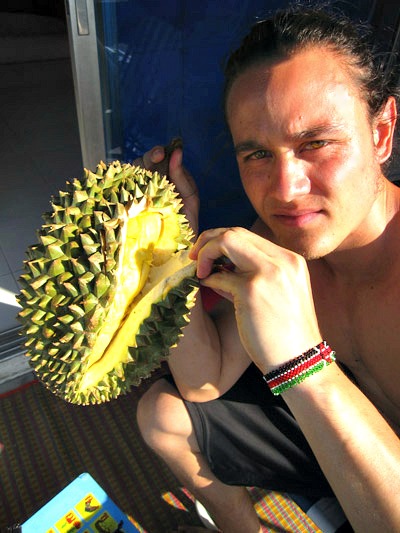
Durian from Southeast Asia — the most amazing fruit in the world! It makes me very happy!

And now you are invited to prepare one meal based on your travels for other members of The Displaced Nation. What’s on the menu?

Appetizer: Poke, the Hawaiian sashimi: cubed pieces of raw fish marinated in onions, soy sauce, and sea salt.
Main: Sichuan fish hot pot, known as Shuizhuyu. It’s the signature dish in Sichuan cooking.
Dessert: Either Thai-style sticky rice with durian, or just plain durian fruit.
Drink: Stoney, a strong ginger soda from East Africa that burns going down.

I wonder if you could also add a word or expression from one or more of the countries you’ve lived in to The Displaced Nation argot.
From Kenya: Sema boss, a slang term for greeting the person who is in charge. It’s a good way to connect.
From Thailand: Mai pen rai, how Thais say “don’t worry about it” or “no problem.” It’s a polite phrase.
From Mexico: Pansa llena, corazón contento: “Stomach full, heart is happy.” When I lived in the US, I had many friends from Mexico who would use that expression with me as they knew I loved to eat. I also have visited northern Mexico a number of times.

This month we’ve been exploring the idea of organizing one’s travels around the wish to try particular foods. I understand that many of your travels are motivated by food interests?
Yes, nowadays just about all my travels are motivated by food. I do travel to see other countries and meet new people, but my main passion is food and that’s what I enjoy searching for. I would be very happy to fly to a destination and not do any of the normal tourist attractions, but just eat. A few months ago I took just a short 24-hour trip to Malaysia with a strict mission to eat. It was an amazing food binge!

Are you more motivated by the idea of trying new foods or by finding the very best of particular foods?
I’d say I’m equally motivated to try new foods and to find the very best foods that I’ve already eaten previously. I’m always excited to try something I’ve never seen or heard of before, but at the same time if I hear about the best bowl of Thai boat noodles, or the most amazing seafood restaurant, I’m quite tempted too!

If you were to design a world tour based on food, what would be your top five stops/foods to try?
I couldn’t narrow it down to five, so here are six:
1) Thailand — try the gaeng som (sour spicy soup), som tam (green papaya salad), and boo pad pongali (crab yellow curry).
2) Malaysia — try the nasi campur (mixed curry and rice), nasi lemak (rice and toppings), and roti canai (roti bread with curry).
3) China — try the Sichuan hot pot and all kinds of exotic delicacies.
4) India — try the thali (rice with a variety of curries), dhosa (pancake with curries) and home-cooked curries.
5) Mexico — try the tacos, burritos, mole (chocolate curry), carne asada (grilled meat), and ceviche (seafood salad).
6) Ethiopia — try the mahaberawi, a platter that includes injera (white spongy bread) topped with a variety of spicy curries.

Readers — yay or nay for letting Mark Wiens into The Displaced Nation? He’s an adventuresome eater, that’s for sure, but can you stand the smell of what’s in his suitcase? (Note: It’s fine to vote “nay” as long as you couch your reasoning in terms we all — including Mark — find amusing!)

STAY TUNED for tomorrow’s episode in the life of our fictional expat heroine, Libby. (What, not keeping up with Libby? Read the first three episodes of her expat adventures.)

If you enjoyed this post, we invite you to register for The Displaced Dispatch, a round up of weekly posts from The Displaced Nation, with seasonal recipes, book giveaways and other extras. Register for The Displaced Dispatch by clicking here!

Related posts:

img: Mark Wiens in the act of trying, for the first time, to cut open a durian fruit, on his balcony in Bangkok.

RANDOM NOMAD: Jeff Jung, American Expat in Colombia & Career Break Travel Guy

Jeff JungPlace of birth: Fredericksburg, Texas USA
Passport: USA*
Overseas history: South Africa (Vanderbijlpark): 1988-1989; Argentina (Buenos Aires): 2007 (on and off between March-December 2007, continuously from September-December); Colombia (Bogotá): 2009 – present.
Occupation: Editor of CareerBreakSecrets.com and producer/host of the soon-to-be-globally-televised “The Career Break Travel Show.”
Cyberspace coordinates: Career Break Secrets Website/blog, Facebook page and YouTube channel; @CareerBrkSecret (Twitter handle).
*It’s filled up again so time to get to the embassy to add pages.

What made you leave your homeland in the first place?
Originally, I left to go travel the world when I took a career break from the corporate world in 2007. When I left, I didn’t know that I was going to start as an expat. But, while traveling, I met someone here in Colombia and wound up staying.

Is anyone else in your immediate family “displaced”?
I have many family members who have a bit of wanderlust in their soul. But, I think I am the only one who is living as an expat.

Can you describe the moment when you felt the most displaced?
That would probably be my trip to Egypt in 2008. I normally feel at home on the road. I love to travel. But, in Egypt, I just couldn’t seem to make a connection with the people, the culture or the country. I spent about ten days traveling with a friend. The combination of the heat, the constant sales pitches in the streets, and the culture of backsheesh just wore me out. It wasn’t all bad though. I had a few days on a felucca on the Nile and a few days to hang out in Luxor. But, when we returned for our final two days to Cairo, I didn’t go out. I hid in my room — not my travel style at all. I just wanted to rest and wait until it was time to go to the airport and leave.

Is there any particular moment that stands out as your “least displaced”?
That’s easy. I was an exchange student to South Africa just after high school. I had such an amazing year. Between four host families and a lot of great friends that I made at my host school, I didn’t want to leave. It’s probably why I’ve been back six times since then. On my last trip in 2009, I got to see the country preparing for the World Cup. I was so proud of South Africa. I’ve seen it go from pariah apartheid state to emerging world influencer — with many bumps along the way. It really is a special place. It’s been a few years since I’ve been, so I’m probably due for a visit again. I’m missing a good braai (barbeque) with my friends. My dream is to have a place in or just outside of Cape Town someday, with a view onto the ocean.

You may bring one curiosity you’ve collected from your adopted country into The Displaced Nation. What’s in your suitcase?
From Argentina: Breakfast foods — coffee, facturas (sweet Argentinian pastries with various fillings) and medialunas (Argentinian croissants).
From South Africa: Some bottles of wine, probably red. No, definitely red.
From Colombia: My mochila (over-the-shoulder daybag). These are used by everyone in Colombia, men and women, and they are perfect for carrying your stuff while you’re out running around.

You are invited to prepare one meal based on your travels for other members of The Displaced Nation. What’s on your menu?

Oh, this is going to be fun!
Appetizers: A selection of dips and finger foods from Turkey. I love the food there and really miss it.
Main course: A pork barbecue prepared by my dad who is a national award-winning BBQer in the US. Maybe we’ll have some fresh Patagonian lamb with it too. The meat will be served with a Greek salad and lots of veggie dishes — the veggies will have been bought fresh from La Vega Central, the produce market in Santiago, Chile. Finally, there will be plenty of my Dad’s award-winning sauce to go with the meal.
Drinks: Of course there will be plenty of wine from South Africa and we’ll also have sparkling water for a non-alcoholic option.
Dessert: Why select one? It’s a dinner party so there should be a variety! Brigadeiro (chocolate bonbons) from Brazil, ice cream from Argentina (unexpectedly amazing!), fresh fruit from Ecuador and Colombia, and churros from Spain (that can be a dessert, right?).
Nightcap: Amarula (cream liqueur) from South Africa, served with Segafredo coffee from Italy.

And now you may add a word or expression from the country where you live in to The Displaced Nation argot. What will you loan us?
Chucha (pronounced choo-chah): This Spanish word has multiple meanings across Latin America. In Chile, Ecuador and Peru, where I picked it up, it’s an interjection meaning “sh**” or “shoot.” In Colombia, it has two entirely different meanings depending on where you say it. In Bogotá, it means armpit odor and in Cartagena, it means vagina. People often look at me funny here when I say it. I’m sure the Displaced Nation has occasions when you could use a confusing swear word…

Put it this way: we like anything that makes people laugh! And this month we are looking at ways of achieving “la dolce vita” — by that we mean, indulging in life with all your senses. Can you describe an instance on your travels when you felt you were living la dolce vita?
In 2008, I traveled through Patagonia and had an amazing six weeks. The first part of the trip was on a Chilean ferry called Navimag, which cruises north to south from central Chile to the southern tip. You are in protected waters (most of the time) and on both sides of the ship is this beautiful, untouched landscape full of snow-capped volcanoes, lush green countrysides, enormous glaciers (some of the biggest in the world), and tiny, remote villages. You can also see marooned ships and the occasional dolphin. The weather can change from clear, sunny skies to blustery snow in a heartbeat. That trip is one of my most special trips ever. I really felt like I was living La Dolce Vita during those four days.

I personally think that the yearning for la dolce vita increases as one grows older. I know you are an expert on adult gap years. What made you decide to take one for yourself?
My catalytic moment was the night I went out with some friends to dinner on the River Walk in San Antonio, Texas, on a hot, balmy Friday night. They could tell I was down, and had been for some time. They asked me what it was going to take to make me happy. I didn’t have a good response that night. But, the question haunted me all weekend. I finally had an epiphany that I really wanted to leave my corporate job and get out in the world and travel. I traveled for almost two years mostly through South America, parts of Europe, Turkey and Egypt.

And then you decided to set up a business to encourage others to do the same?
Once I decided to settle in Colombia, I chose the entrepreneurial path and set up CareerBreakSecrets.com. I wanted to help popularize the idea of taking a career break and show other people that they can do it with just a little bit of guidance and inspiration. We’re now in our third year and will be releasing a book and launching our show, The Career Break Travel Show, globally later this year. I love hearing from real people who have decided to take their own break and if they set up a blog, follow them around the world on their travels. The people I’ve encountered have ranged from teachers to social workers to business people who have done some amazing things like volunteer and share their skills, hike Patagonia, bike across New Zealand, or take transcontinental train rides.

Readers — yay or nay for letting Jeff Jung into The Displaced Nation? Tell us your reasons. (Note: It’s fine to vote “nay” as long as you couch your reasoning in terms we all — including Jeff — find amusing!)

STAY TUNED for tomorrow’s diary entry from our fictional expat heroine, Libby, who is desperately trying to hang onto her sanity…and her marriage. (What, not keeping up with Libby? Read the first three episodes of her expat adventures.)

If you enjoyed this post, we invite you to register for The Displaced Dispatch, a round up of weekly posts from The Displaced Nation, with seasonal recipes, book giveaways and other extras. Register for The Displaced Dispatch by clicking here!

Related posts:

img: Jeff Jung with baby cheetahs near Oudtshoorn, South Africa, September 2009.

RANDOM NOMAD: Wendy Williams, Canadian Expat in Austria

Place of birth: Northern Ontario, Canada
Passport: Canadian, and apparently I can live in Austria forever now with my unlimited Aufenhaltsbewilligung.
Overseas history: Austria (present), Germany, Switzerland, Slovak Republic, UK. I have also worked on a project basis for extended periods in Sweden, Tunisia, Holland and Estonia.
Occupation: Author*
Cyberspace coordinates: The Glolo Blog; The Globalisation of Love (Facebook page); and @WilliamsGloLo (Twitter handle)
*Wendy Williams is the author of The Globalisation of Love, one of the top books for expats in 2011.

What made you leave your homeland in the first place?
Burning curiosity! I just love to know what is around the next corner — and the corner after that, too. My grandparents are all immigrants to Canada from Europe, and I guess listening to their stories about their homelands got me thinking that “home” can be very different and it can be anywhere.

Is anyone else in your family “displaced” besides your grandparents?
I am the only of my siblings who went back across the pond, as my grandmother would say — though they certainly come to visit me in Austria (and to ski!).

You’ve lived in quite a few places in Europe before moving to Vienna with your Austrian husband. Does any one moment of that time abroad stand out as your “most displaced”?
While vacationing on one of the Canary Islands, which belong to Spain, I fell ill and required an injection in my, ahem, gluteus maximus. It was 1995, when the so-called Turbot War took place between Canada and Spain — a dispute over fishing rights along the coast of Canada that challenged international diplomatic relations between the two countries. The doctor held up the rather long needle and said, “So, you’re from Canada are you? You like to fish?” I remember thinking, “Uh-oh, this is going to hurt!” It may be conjecture, but I felt the jab of the needle was particularly forceful.

Is there any particular moment that stands out as your “least displaced”?
It happens all the time while skiing in Austria. I grew up skiing on a tiny little bump of a hill and always dreamed about the long alpine slopes of Austria. I was lucky enough to marry an Austrian who is also a passionate skier, and we ski frequently throughout the winter. I feel right at home as I swish, swish down the slopes. I enjoy the après ski, too!

You may bring one curiosity you’ve collected from your adopted country into The Displaced Nation. What’s in your suitcase?
From Georgia in the Caucasus: Antique brass candle holders
From Murano, a series of islands in the Venetian Lagoon: A red Murano chandelier
From Morocco: An onyx stone bathroom sink
From Austria: An 18th-century Tyrolean kitchen table
From France: A yellow ceramic Pernot jug
My house is a diary of my travels through life, and as you can see, I plan to continue living that way on The Displaced Nation — even though it will entail dragging in a rather large and heavy suitcase!

You are invited to prepare one meal based on your travels for other members of The Displaced Nation. What’s on your menu?

Appetizer: My husband’s pumpkin soup with 100% pure Austrian pumpkin seed oil
Salad: Arugula mixed salad with blue cheese, grapes, cranberries, pear and pistachios — as served at the Loriot in Washington, D.C.
Main course: Viennese Schnitzel with potato salad … of course!
Dessert: My mom’s lemon meringue pie
Drinks: Bubbly to start — Crémant d’Alsace is one of my favourites; and for the main course, red wine from Burgenland in Austria.

And now you may add a word or expression from the country where you live in to The Displaced Nation argot. What will you loan us?
Actually, I would like to loan you an expression that my husband picked it up while living in Australia: Happy as Larry. (I picked it up from him while living in Austria.)

This month we are looking into parties and celebrations abroad. What has been your most memorable party or celebration since you became “displaced” from your native land?
The celebration of my 10th wedding anniversary, in 2008! My husband and I had about 50 friends in a small restaurant in Vienna that served elegant, locally-sourced organic food. An opera singer sang “‘O Sole Mio” so beautifully we thought the wine glasses would burst like in a cartoon. We gave a speech about our 10 years together and then announced what we had planned for the upcoming years — I was four months pregnant. The crowd went wild with excitement and gave a 10-minute standing ovation amongst congratulatory hugs, tears and high fives. It was total kitsch and corny Hollywood romance — and we loved every minute of it!

The Displaced Nation has just turned one year old. Can you give us some advice on themes to cover in our second year — anything you think should be on our radar?
Multicultural couples — what I call GloLo couples — usually meet in interesting ways. Chance and coincidence often conspire to bring two people together. It would be fun if The Displaced Nation could feature some stories from GloLo couples about how they met — and whether their displaced lives brought them together — and how they worked things out so they can stay together.

Editor’s note: In February Wendy Williams contributed a post to The Displaced Nation that has remained very popular: Why “expat” is a misleading term for multicultural couples.

Readers — yay or nay for letting Wendy William into The Displaced Nation? Tell us your reasons. (Note: It’s fine to vote “nay” as long as you couch your reasoning in terms we all — including Wendy — find amusing.)

STAY TUNED for tomorrow’s installment from our displaced fictional heroine, Libby, as she discovers that Oliver’s mum and her own mother have more in common than she’d realized. (What, not keeping up with Libby? Read the first three episodes of her expat adventures.)

If you enjoyed this post, we invite you to register for The Displaced Dispatch, a round up of weekly posts from The Displaced Nation, with seasonal recipes, book giveaways and other extras. Register for The Displaced Dispatch by clicking here!

Related posts:

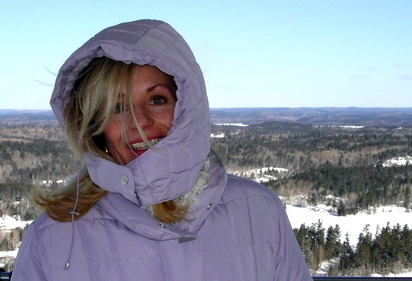
img: Wendy wrapped up against the elements — but is she in Austria, her adopted home, or Northern Ontario, her birthplace? (Hint: It was minus 25 degrees Celsius.)

BOOK REVIEW: “Asian Beauty Secrets,” by Marie Jhin

TITLE: Asian Beauty Secrets: Ancient and Modern Tips from the Far East
AUTHOR: Marie Jhin, M.D.
PUBLICATION DATE: July 2011
FORMAT: Paperback and Kindle e-book, available from Amazon
GENRE: Health, fitness & dieting, beauty
SOURCE: Paperback purchased from the Korea Society, New York City

Summary:

Drawing on her experience as a Cornell University-trained dermatologist, combined with a knowledge of Asian beauty remedies, both ancient and modern, Dr. Marie Jhin delivers an East-West guide to vibrant skin and beauty. Born in Seoul, South Korea, Jhin emigrated to Hawaii with her family when she was six (they settled eventually in New York City). She now lives in San Francisco, where she runs her own practice, Premier Dermatology. She has been rated as one of America’s top doctors for the past three years.

Review:

The first time I visited Seoul, my husband, who is Japanese, insisted that I try a spa treatment, as Koreans do this sort of thing better than other Asians, he said. Before I knew it, I was lying naked on a table with an older Korean lady scrubbing every inch of my body. Eventually, she took my hand and put it on my stomach. At first I thought I was touching a piece of terry cloth but no, it was my skin — it had come off in shreds!

I lay there thinking, “Can this be healthy?”

Having pondered these issues quite a lot — also during my years of living in Japan, where I could hardly fail to note how obsessed Japanese women are with skincare — I was intrigued to come across a new book on Asian beauty methods, by San Francisco-based dermatologist Marie Jhin.

Born in Seoul, Jhin is now settled in California. She is not an expat, which makes the title of this post a little misleading; but is she “displaced”? Yesterday she told me in an email exchange that while she doesn’t think of Korea as “home” any more, her birth country remains something of a lodestar. She specializes in Asian skincare, lived in Seoul for two years after college to teach ESL, and has been going to Korea on business of late.

But what really convinced me of Jhin’s “displacedness” is that like me, she was uncertain of the benefits of Korean skin scrubbing but unlike me, let it get under her skin, so to speak:

I grew up doing certain things beauty-wise that I wanted know the truth of. For example, … my mother used to take me to get my skin scrubbed at a Korean sauna. Back then I didn’t understand what the point was, but now, as a dermatologist, I realize that it was basically whole body microdermabrasion that they have been doing for centuries that is great for the skin.

(Good to know!)

Jhin called her book “Asian Beauty Secrets” because it covers the beauty habits of not only Korean but also Chinese and Japanese women. Her key finding is that while women in all three countries have been caught up in the quest to look more Western, they have plenty to be proud of in their native beauty traditions.

The influence of Western beauty ideals

The last time I visited Tokyo, I couldn’t always tell who was a foreigner and who wasn’t since so many Japanese youth had dyed their hair a reddish blonde (I no longer stood out in the crowd!).

Thus I was glad to see Jhin tackle the issue of Western beauty ideals. In addition to dying and streaking their hair, many Asians are getting plastic surgery in the quest to look more Western.

Jhin notes the popularity — especially in Korea, cosmetic surgery capital of Asia (and the world?) — of procedures such as blepharoplasty (double eyelid surgery), rhinoplasty (nose jobs) and surgery to correct what Japanese call daikon-ashi (radish-shaped calves).

And when Asian women do Botox, she says, it’s not to reduce wrinkles but to soften square jaw lines and/or to atrophy cheek muscles and thereby shrink a too-round face.

Jhin draws a line, however, between these procedures and the value traditionally placed by women in all three cultures — Chinese, Japanese and Korean — on having white skin. She cites Chinese Canadian consumer research professor Eric Li in stating that the preoccupation with whiteness predates colonialism and Western notions of beauty. In fact, the Japanese see their own version of whiteness as superior to the Western one!

What Asian women bring to the vanity table

We Westerners are notorious for mistaking one Asian culture for another. Jhin helps us negotiate this sometimes-fraught territory by listing some of their distinguishing elements when it comes to notions of beauty:

1) KOREA

  • Who’s the fairest of them all? In the Far East, it’s Korean women, by common consensus.
  • Korean women like to exfoliate the skin to keep it glowing and healthy.
  • Koreans have long revered the ginseng plant, a vital ingredient in health and beauty potions.

2) JAPAN

  • Going back at least to the Heian period, Japanese have celebrated long tresses — the record of that era being 23 feet! Their favorite conditioning treatment is camellia oil, thought to promote glossy hair growth without making it greasy.
  • Japan spa culture, which dates back thousands of years, favors the use of natural ingredients for cleansing the skin: eg, volcanic mud, wakame seaweed and even nightingale droppings(!).
  • Though Japanese are known for rushing around, they in fact have a tradition of enjoying “empty moments.” Such meditative practices contribute to well-being and bring out a woman’s natural beauty.

3) CHINA

  • In ancient China, pearls were a girl’s best friend: ground pearl powder was taken internally and applied topically. (Hmmm…did they get that habit from Cleopatra, or vice versa?)
  • Chinese have a saying that “a woman’s second face is in her hands” — to this day, Chinese women are meticulous about moisturizing their hands and feet.
  • Traditional Chinese Medicine (TCM) emphasizes certain foods for balancing yin and yang within the body. This inner harmony is thought to contribute to outer radiance.

There is also, of course, much overlap among the three cultures.. All subscribe to the belief that by eating healthy foods, releasing stress (e.g., by getting an accu-massage), and pursuing nature-based healing (TCM) on a regular basis, a woman can enhance her best assets.

The “skinny” on beauty tips and secrets

One of the reasons to pick up a book with the word “secrets” in the title is to find out what one is missing out on. On this score, Jhin’s book is a bit of a mixed beauty bag. Some of her suggestions struck me as being far fetched — and I have a reasonably high tolerance for Asian cultural quirks.

Bird’s nest soup or soup containing hasma (frog fallopian tubes), anyone? Both are ancient Chinese foods thought to nurture glowing skin (Jhin provides recipes). Um, thanks, but no thanks. I’d almost rather eat fugu (which likewise has stimulating properties).

Even more offputting is the Chinese custom of spreading sheep’s placenta on one’s face. (It’s a mercy they’ve moved on from ingesting human placenta, that’s all I can say…)

As for V-steaming one’s chai-york (Korean for vaginal tract) with medicinal herbs such as mugwort (common wormwood) — it will take more than a reassurance by a Beverly Hills doctor to convince me that such a practice doesn’t lead to other problems such as UTIs.

On the other hand, I might actually consider soothing my skin with a high-quality ginseng cream. That sounds nice. Or perhaps I’ll try facial acupuncture. It’s noninvasive and, according to Jhin, can have the effect of a mini-facelift.

Note: More secrets can be found on Jhin’s book site.

Verdict:

For me, the most interesting portion of Asian Beauty Secrets is when Jhin addresses her area of specialization: the conditions peculiar to Asian skin, such as eczema (they are more prone to it than we are) or sun damage that manifests itself not in wrinkles but in brown spots. I also found fascinating the chapter on the latest skin renewal techniques being pioneered by Korean doctors. Acupuncture meets nanotechnology with the “INTRAcel laser” treatment! (The laser reaches “deeper into the dermis for more lasting collagen production and overall skin rejuvenation,” Jhin explains.)

That said, I’d hesitate about recommending Jhin’s book to anyone who isn’t yet oriented (no pun intended!) to beauty practices in this part of the world. Instead you might try experimenting with some of the brands Jhin recommends — e.g., Sulwhasoo cosmetics (now being carried at Bergdorf Goodman here in New York) — by way of familiarizing yourself with Asian skincare methods. As it happens, I got some Sulwhasoo samples when I bought the book — and would be more than happy to report back on the effects, if anyone’s curious! 🙂

STAY TUNED for tomorrow’s installment from our displaced fictional heroine, Libby. (What, not keeping up with Libby? Read the first three episodes of her expat adventures.).

If you enjoyed this post, we invite you to register for The Displaced Dispatch, a round up of weekly posts from The Displaced Nation, with seasonal recipes, book giveaways and other extras. Register for The Displaced Dispatch by clicking here!

Related posts:

Why “expat” is a misleading term for multicultural couples

Today we welcome author and “global love” expert Wendy Williams to The Displaced Nation. A Canadian, she lives in Vienna with her Austrian husband and their daughter. But is she an expat or an immigrant? Yes, that old chestnut! Except…Williams has a novel way of addressing it.

“At the risk of sounding like a snooty intellectual or immigrant diva, I think it’s time to clear up some confusion about the term ‘expat,'” I announced to a features editor recently.

“Oh no,” she warned me, “don’t get bogged down with tedious definitions and classifications. Just write something about the joys and the dramas of being an expat couple. And offer some good advice, too,” she added cheerily.

As the author of The Globalisation of Love — a book about multicultural romance and marriage — I am frequently asked for advice on “expat relationships.” And that’s my whole point today — what is an expat relationship, anyway? And are multicultural couples and expat couples one and the same?

An “expat couple” — what exactly does that mean?

Expat is a term that is bandied about, dare I say recklessly, to describe someone who is living in a foreign country and it is often used to describe couples where one or more partners are foreign born.

Exhibit A: I am Canadian and my husband is Austrian. We live in Vienna. Often we are referred to as an “expat couple” — or even as an “expat family” if our born-in-Austria daughter is included. Granted, I have pretty high standing as matriarch of my family of three, yet does just one “expat” in the family make us an “expat family”? My husband and daughter are living in the country where they were born after all. Other than a bit of English and a lot of peanut butter that I smuggle in from Canada, there is very little “expat” about them.

Yet expat is a label given to anyone with any kind of international flair.

So, time to get to the heart of this worldly weighty matter. An “expatriate,” in my understanding, as well as that of Merriam Webster and even Wikipedia, is “any person living in a different country from where he or she is a citizen.”

Expats usually start their international lives on assignment for a multinational corporation — unless they are Australian, in which case they begin by bussing tables in London’s grottier pubs or teaching Dutch guests to ski in Austria.

Typically, expats enjoy a long list of job perks to deal with the “stresses” of life abroad so they get free rent, paid trips back to the motherland and private school for the kids. Paying income tax seems to be optional. Expats are like visitors to a country: they deal with external issues like culture, language, and religion. Usually they live from one to five years in a given location “making the most of it” exploring the region and learning about the local culture. They always know they will be going home at some point, even if there are more international postings along the way.

Vs a “GloLo couple” — now there’s a precise label!

A multicultural relationship, by contrast, is one where each partner is from a different country or culture. Multicultural couples — or what I call “GloLo couples” in The Globalisation of Love (blatant self-promotion, I know) — deal with issues like culture, language, and religion within the relationship. GloLo couples do not usually have the job perks of expats because they work locally, so they pay their own rent, they have to pay taxes and their kids go to the local school.

Whether they live in his country or her country — or swing back and forth between the two countries every few years — there is a sense of permanence about the geography. The imported partner is an immigrant really, although “immigrant” has taken on some negative connotations in our nilly-willy live-here-work-there globalized society.

Barring bureaucracy and ludicrous immigration laws (Austria, this means you!), GloLo partners may even gain citizenship in the country into which they have married. At the risk of more shameless self-promotion, I call it the “globalization of love.”

So here is my point: An expat couple and a multicultural couple are not necessarily the same relationship constellation and should not be confused with one another. An expat couple can be a GloLo couple if they have different nationalities, however a GloLo couple is not necessarily an expat couple, even if one partner is an expatriate. It is only when a GloLo couple live in a third neutral country that they become an expat couple as well.

Aren’t you glad we cleared that up?

Meanwhile, the features editor still wants some advice on dealing with the joys and the dramas of being an expat couple though. Hmm, how about make the most of it, explore the region and learn about the local culture?

And my advice for multicultural couples? Well, there’s this book I should tell you about…

Question for readers: How do you define “expat” vs “immigrant” — and does Williams’s “glo-lo” term strike you as being useful?

WENDY WILLIAMS is the author of The Globalisation of Love, which was featured in The Displaced Nation’s post Best of 2011: Books for, by and about expats. You can learn more about Williams and her book at her author site, The Globalisation of Love.

STAY TUNED for Monday’s post, an introduction to March’s Cleopatra(!) theme…

If you enjoyed this post, we invite you to register for The Displaced Dispatch, a round up of weekly posts from The Displaced Nation, with seasonal recipes, book giveaways and other extras. Register for The Displaced Dispatch by clicking here!

Related posts: