The Displaced Nation

A home for international creatives

Tag Archives: Australia

5 tips on how to look good when you backpack

I don’t know about you, but I look terrible when I travel.

Not intentionally of course; jet lag notwithstanding, it’s impossible to look crisp and put together after an extended journey by public transport, no matter where in the world you are.

My problem has more to do with my style of travel — or lack thereof… There are two real options when you’re a backpacker: clothes that look good, or clothes that are comfy. Now, bearing in mind you’ll be spending quite a lot of time in them — alternating between the same two pairs of trousers every day until they drop off you and disintegrate — it’s not much of a choice.

Is that because I’m a guy? Maybe — see the note about my wife at the end of this post.

But I don’t care whether you’re male or female, there’s something about being a backpacker that makes keeping up one’s appearance a constant challenge. However fastidious you are about your personal appearance (and most backpackers I know are!), however much you shower before an 18-hour bus journey, you’re still going to look (and smell!) pretty bad afterwards.

So, bearing in mind the following advice from Mr Will Kommen:

If you look like your passport photo, you’re too ill to travel.

…here are five of my tips on how to look good as you bounce around the globe:

1) Haunt charity shops.

Many countries have these in some form or other, and the richer the country the more expensive and interesting gear you can pick up for next to nothing. They’re perfect for replacing an item of clothing that is giving up the will to live in your backpack; or something you’ve become so sick of wearing you daydream constantly about burning it. This shops are incredibly cheap, so you can go crazy — and then just give the stuff back when it’s time to move on.

I don’t travel with any technical clothing, so when my wife and I decided to do a two-month, 1,000 km hike, we had to equip ourselves from scratch — on next-to-no budget. Guess how we did it? Yup, “op shops” they call them in Australia — we visited every one. In a couple of weeks we had all the gear we needed for the hike — plus all the money had gone to charity! And when we were done, we gave most of it back as donations (except the t-shirts, which were too stained to be of use to anyone).

2) Adopt local dress.

Fisherman’s trousers in Thailand, those crazy-colored woolly trousers in South America — pseudo local fashions are cheap to buy, fun to wear and, if they don’t become a souvenir, easy to dispose of before onward travel. I say “pseudo local” because real locals wear the uniform of the world: jeans and a fake Nike T-shirt. Or a Manchester United strip (shirt and shorts).

3) Take any opportunity to wash.

It’s amazing how good it feels to be clean. Most people take it for granted, but then most people have never spent three consecutive nights on the same train, going backwards and forwards to avoid paying for a hotel room. Anyway, the point is there are opportunities everywhere: most major train stations have showers open to the public cheaply, almost all airports do too — and some places you wouldn’t expect, like shopping centres. Shopping centres are free to enter, with regularly cleaned public loos. A lot of them also have “mother-and-baby” rooms, with a table or fold-down shelf, a sink — in short, an open invitation for a full body wash and a change of clothes. Just be wary in Japan — a lot of the public toilets there are “smart.” They unlock and open if you’re in there for too long, which can be pretty embarrassing if you’re soaping yourself down when the door opens opposite Starbucks…

4) Take any opportunity to “dress up.”

Looking posh is a moral boost, and should be possible for most of us bedraggled travelers just by shaving and wearing all-clean clothes! I also travel with a shirt — just one — which transforms a pair of jeans into an outfit smart enough for a nice restaurant or swanky bar (well, as long as they don’t look at my feet, on which I have either flip-flops or hiking boots…).

5) Wear jeans!

The rest of the world will be. Seriously — for every sweat-wicking-fast-drying-wind-proof-mesh-venting-ThermaCELL-layering-system you own, there’s another person behind you who has none of it. And you know what? They look a lot better than you! This is why so much “technical” clothing ends up in charity shops (see above) just waiting for you to pick it up — people with lots of cash buy it, don’t use it for anything more strenuous than shopping, then realize that it looks pretty crummy when compared to clothes that were, you know, designed to look good whilst shopping. So they ditch it. You should too — or at the very least, stop paying outrageous prices for the stuff. Unless you’re headed to Everest Base Camp — in which case, buy it all from those people who’ve just realized that no matter how expensive it was, it doesn’t look right in Sainsbury’s.

* * *

Obviously, this is a bit of a male perspective on things. My wife swears by traveling with a small (for an elephant) bag of “essential” make-up. It’s the main reason she’s recently swapped her rucksack for a suitcase…but she assures me it helps her feel good about herself when otherwise she’d look as bad as I do. So I indulge her.

What do you do to look good while you travel?

Tell us in the comments section!

STAY TUNED for tomorrow’s post, a review of a new book on Asian beauty.

If you enjoyed this post, we invite you to register for The Displaced Dispatch, a round up of weekly posts from The Displaced Nation, with seasonal recipes, book giveaways and other extras. Register for The Displaced Dispatch by clicking here!

Related posts:

Images: (clockwise beginning top left): Charity shop in West Street (© Copyright Basher Eyre and licensed for reuse under this Creative Commons Licence)  baby changing room sign and South American wool pants for sale, by Tony James Slater; backpackers (Morgue photos).

RANDOM NOMAD: Lei Lei Clavey, Australian Expat in New York

Place of birth: Melbourne, Australia
Passport: Australia + USA
Overseas travel history: France (Paris): 2005; USA (Santa Barbara, California): 2008-09; USA (New York, New York): May 2011 – present.
Current occupation: Casting director for StyleLikeU, an online fashion magazine based in New York City.
Cyberspace coordinates: Style Like U | Freedom of expression through personal style (work) and @LeiLeiClavey (Twitter handle)

What made you leave your homeland in the first place?
I’ve had the travel bug for as long as I can remember. A lot of it came from my parents, who took me around the world shortly after I was born. The excitement of being in a different country, immersed in a new culture and environment — it’s something I now crave.

Of course, travel is one thing; living in a place for an extended period is another. To make a home amongst strangers takes you out of your comfort zone and tests your courage in new ways. I enjoy the challenge. I always learn new things about myself as I open my eyes to different people, perspectives, and ways of life.

Was anyone else in your family “displaced”?
My father is what you might call permanently displaced. Born in Chicago, he attended Colorado State University and then left the US to live in Taiwan and study Chinese language and herbal medicine. Taiwan was where he met my mother, who was likewise displaced (she is Chinese Australian). My parents lived in Taipei for five years and then moved to Mainland China for two more years before settling permanently in Melbourne, Australia, where my mother was born and grew up — my father now practices there as a Chinese herbal doctor. (Incidentally, The Displaced Nation interviewed my mother, whose name is Gabrielle Wang, last summer about a book she had written on a half-Chinese, half-Aborigine girl who lived in 19th-century Australia.)

A couple of my cousins share my passion for travel and have recently embarked on an adventure in the UK, where many Australians choose to live (the two-year work visa for Australians under 25 is a relatively straightforward process).

Another of my cousins recently shaved her head and embarked on a solo, life-changing adventure in India. I have yet to hear her tales firsthand. All I know is that she has more guts than I ever will to have done that by herself.

Describe the moment when you felt most displaced since making your home in New York City.
I don’t believe anything could surpass how I felt on my first night in New York City. Before leaving Australia I had arranged to stay with a friend of a friend for a month. He told me: “When you arrive, come to 10th, between A and B, and up to the third floor.” A and B: what country uses letters as street names? Surely they must be abbreviations for something!

It was close to midnight by the time I arrived at East 10th Street between Avenue A and Avenue B (thank you, taxi driver, for clearing that up!).

But then I had another challenge. I was exhausted and ready to collapse after my 22-hour plane flight from Melbourne to LA and another five hours to New York City. After dragging my 32kg (70lbs) suitcase up three flights of stairs — yes, it was a walk-up! — bed was the only thing I had in mind. I knocked and waited. No answer. I knocked again. Still no answer. I sat on my suitcase and was feeling very sorry for myself, wondering why I had ever decided to move to NYC, when three young men walked up the stairs. They were surprised and a little bemused to see me sitting outside the door to their apartment. After exchanging glances, they informed me that I was on the 4th floor, not the 3rd. (In the US there is no such thing as a “ground floor” like we have in Australia. The ground floor is the first floor.) So I struggled my way back down one flight of stairs and walked into an artist’s hazy East Village apartment.

People, music and smoke filled the room. It was community open-mic night, held weekly in this man’s apartment in exchange for rent (a great deal, I now realize!). The owner was asleep on the couch, despite the noise of someone playing the Asian zither.

My eyes scanned the audience, and then I saw Will, the friend of my friend. I could finally relax.

I had entered an alternative universe, an environment utterly foreign to me. But I knew at that moment, my New York adventure had begun and my life would be changed forever.

How about the moment when you have felt least displaced?
When I first came to New York City as a tourist, in 2008, it was as if I had lived here before, perhaps in a past life. I loved the city’s multicultural feeling. So many different faces, cultures and languages — I immediately felt at home. Since coming to live in the city ten months ago, I will occasionally bump into the few people I know in the street. That this can happen even in a city of over eight million gives me a buzz.

You may bring one curiosity you’ve collected from each of your adopted countries into The Displaced Nation. What’s in your suitcase?
From Paris: The 2-hour lunch break. Unlike Parisians, New Yorkers work too hard and I believe with no better results than if they were to have a decent break, get refreshed and go back to work. Australia, unfortunately, is following in America’s footsteps. Surely, citizens of The Displaced Nation could enjoy a reasonable work-life balance?
From New York City: The concept of convenience. For most New Yorkers, it is only a short walk to the grocery store, bank or coffee shop. In fact, I have all three on my block — I love it! On the other hand, New Yorkers like to push those convenience boundaries and have EVERYTHING delivered. Convenience has never been so lazy! The Displaced Nation should find a way to have convenience without the laziness.
From Santa Barbara: The practice of recycling. Santa Barbara does a great job of keeping the University of California-Santa Barbara campus, city streets and beaches clean. They understand the need for it and how trash impacts the environment. I cannot stand how dirty the streets are in New York City. I would therefore urge The Displaced Nation to institute Californian-style recycling policies (if you haven’t already!).

You are invited to prepare one meal based on your travels for other members of The Displaced Nation. What’s on your menu?

My menu is inspired by New York City brunches*. I always crave a nice weekend brunch when I fly back to Australia on holiday!
Appetizer: Shrimp and grits, based on a recipe from Peels** with two (allegedly) secret ingredients: a little Budweiser and a lot of tasso, a Cajun-spiced ham.
Main: Fried chicken sandwich, with chilli lime aioli & pickled egg on sweet-potato focaccia with hand-cut fries — based on a recipe from Diner in Williamsburg, Brooklyn.
Dessert: Chocolate sundae consisting of vanilla and malt ice cream, hot fudge, whipped cream, brownie bites, nuts, and pretzels — based on a Peels** recipe.
Drinks: Traditional Bloody Mary, a solid brunch favorite!
*This is an imaginary meal so ignore the high calorie count and just enjoy it!
**Peels is an American diner with a Southern-inspired menu in NYC’s East Village. I used to host there.

And now you may add a word or expression from the country where you live in to The Displaced Nation argot. What will you loan us?
From New York: Debbie Downer, slang for someone who frequently adds bad news and negative feelings to a gathering, thereby bringing down the mood of everyone around them. I hear it being said all the time in the streets of New York. (It was also the name of a fictional character from Saturday Night Live.)
From Paris: La ziqmu/la ziq (music) — an example of verlan, which, similar to Pig Latin, transposes syllables of individual words (la musique) to create slang words (la ziqmu, often shortened to la ziq). Verlan combinations are endless and have become a part of everyday French, especially for younger people.

This month we are looking into beauty and fashion. What’s the best beauty treatment you’ve discovered while abroad?
New Yorkers are crazy about spa treatments, facials, massages, manicures and pedicures. It seems to be everyone’s de-stressing fix, and I have to agree there’s something very relaxing about someone picking dead skin off your feet. Last September, on the weekend when Hurricane Irene was threatening to hit NYC, can you believe that the places that were most packed out were the nail salons? (Besides liquor stores and bars, that is.) There are also speciality barber shops for men in New York. Australian men, take heed! Men in this city have no shame in caring about their looks as much as women do: they see it as a masculine thing.

What about fashion — can you tell us about any beloved outfits, jewelry, or other accessories you’ve collected in your adopted country or countries?
Living in New York and working at an online fashion magazine, I’ve been exposed to the the cutting edge of weird and wonderful styles. Really anything goes, unlike in Australia! No matter how far-out the boundary you feel you are pushing, someone else will always out-do you. I love that! The city has inspired me to accessorize more: to jazz up an otherwise regular outfit with hats, statement jewelry and/or shoes. Also, New York is a walking city, so clothing also has to be practical — a hat to keep your head warm in winter or the sun off your face in summer, and shoes you can actually walk in (more than cab-to-curb, that is!).

Readers — yay or nay for letting Lei Lei Clavey into The Displaced Nation? Tell us your reasons. (Note: It’s fine to vote “nay” as long as you couch your reasoning in terms we all — including Lei Lei — find amusing.)

STAY TUNED for tomorrow’s installment from our displaced fictional heroine, Libby. (What, not keeping up with Libby? Read the first three episodes of her expat adventures.)

If you enjoyed this post, we invite you to register for The Displaced Dispatch, a round up of weekly posts from The Displaced Nation, with seasonal recipes, book giveaways and other extras. Register for The Displaced Dispatch by clicking here!

Related posts:

img: Lei Lei Clavey outside a favorite coffee shop of hers in the East Village, New York City.

RANDOM NOMAD: Liv Hambrett, Australian Expat in Germany

Place of birth: Sydney, Australia
Passport: Just my little blue Australian one. And I’d like to keep it.
Geographical history: Greece (Santorini): for several three-month stints since 2008; Germany (Münster, Nord Rhine-Westphalia): 2010 – TODAY, LEAP DAY! (February 29, 2012); Germany (Weiden in der Oberpfalz, Bavaria): TOMORROW onwards!!!
Current occupation: Writer and language trainer.
Cyberspace coordinates: A Big Life | An Australian in Germany (blog) and @LivWrites (Twitter handle)

What made you leave your homeland in the first place?
The only thing that really made me leave my home was me. I had traveled on and off throughout my studies and was ready for something a bit more … daring. I wanted to live in Europe, not just travel through it whenever I could get enough money and find enough time. I am incredibly lucky to come from the country I do. To return to it would be no problem, to have its passport is a blessing. I just wanted to try something different, and in Germany I found something more solid to assuage my constantly itching feet.

Was anyone else in your family “displaced”?
My parents are both travelers and my mother spent a year working in London in her twenties. My uncle spent four years living in South Africa and traveling through Europe, before meeting his Swiss wife and bringing her back to Australia — she’s now displaced. I think many Australians are nomadic by nature — we like to wander, we like to see what’s out there. It’s in our blood.

Describe the moment when you felt most displaced since making your home in the historic university city of Münster.
Münster is one of the “nicest” cities in the world, so my displacement here is usually a case of: “What’s a girl like me doing in a nice city like this?” I’m pleasantly displaced, in other words! But while there haven’t been precise moments of aggravation, there have been parts of the ongoing adjustment process that made me want to click my heels together three times. As much as I love it, Germany has this thing with bureaucracy and paperwork and red tape; and sometimes, when I am drowning in letters from my insurance company, or wading through the healthcare system, or putting together paperwork for my visa renewal, or trying and failing to understand the language, I do think: wouldn’t it just be easier if you were at home? I’ll soon be moving to Bavaria — and all the bureaucracy that will come with a new job, a new visa and a new state (or as some Germans would have you believe, a new country) will probably have me hurling abuse at walls every so often. Just for therapy. Oh yes, and when it is -18 degrees celsius, I start thinking: what the hell am I doing in this country?

Have you also had some moments when you feel more at home in Germany than you did in Oz?
Any time I have a cup of tea in hand and am talking to a good friend, I feel as if I could be anywhere in the world, and this person and I would still have stories to share and understanding to give. It isn’t a matter of feeling more at home than in my home country, it is a matter of feeling as at home — and I think that’s as comfortable as it gets.

You may bring one curiosity you’ve collected from your adopted country into The Displaced Nation. What’s in your suitcase?
Probably an enormous amount of würste in the many and varied forms it comes in.

Food is close to the heart of all Displaced Nation citizens. Are there any other special German foods you’d like to offer us besides German sausages?
Yes — Schnitzel (deep-fried veal) and rotkohl (German red cabbage).

I assume you’d drain the cabbage in your Villeroy & Boch colander? I saw a photo of it on your blog — rather whimsical and wonderful! And now you may add a word or expression from the country where you live in to The Displaced Nation argot. What will you loan us?
From Germany: Actually, I have two: Das stimmt (that’s true) — it rolls off the tongue; and schnabel (a bird’s beak or bill) … because it is SO CUTE.
From Greece: Siga siga (slowly slowly) — it sums them up perfectly.

This month, because of Valentine’s Day, The Displaced Nation has been delving into the topic of finding love abroad. And today is Leap Day, when according to legend, women get to propose to men. Have you found a candidate in Gerany?
I met the Significant German — I call him SG on my blog — within four months of moving to Münster. I wrote about our story in a blog post last November. As I said then, if I had to give a tagline to the movie poster for my life as it currently is, it would be “she came for the adventure and stayed for love.” Sounds romantic and exciting, doesn’t it? But it’s a new one for me.

I read that on Leap Day (February 29), women are allowed to propose to men. Any plans?
Well, I’m starting my second big life in Germany TOMORROW when I move to Bavaria to be with SG.

On a more prosaic note, are German men very different from their Aussie counterparts?
Oh Lord, the differences are many. The main thing — and this applies to Australian men as compared to many European cultures, not just Germany — is that Australian men have this ongoing thing with being a “bloke”: masculinity in its conventional sense is quite important to an Australian male’s identity, even if they aren’t aware of it.

Also, this month we’ve been looking at expat and travel films, in honor of the Oscars. Do you have any favorite films in this “genre”?
Bienvenue chez les Ch’tis” (Welcome to the Sticks) — not exactly about an expat, but the character moves towns in France. It captures the essence of moving and feeling like an alien, then adapting, perfectly! And as far as the Love theme of February goes: Love Actually. Always Love Actually.

Readers — yay or nay for letting Liv Hambrett into The Displaced Nation? Tell us your reasons. (Note: It’s fine to vote “nay” as long as you couch your reasoning in terms we all — including Liv — find amusing.)

STAY TUNED for tomorrow’s installment from our displaced fictional heroine, Libby. Having de-stresed with Oliver on their Valentine’s Day weekend, she thinks she may be ready to face the Woodhaven world again and its tribulations. But as we all know, it takes more than a facial and pedicure to attain such a level of serenity. (What, not keeping up with Libby? Read the first three episodes of her expat adventures.)

If you enjoyed this post, we invite you to register for The Displaced Dispatch, a round up of weekly posts from The Displaced Nation, with seasonal recipes, book giveaways and other extras. Register for The Displaced Dispatch by clicking here!

Related posts:

img: Liv Hambrett with her mug of glühwein in Münster, Germany.

4 films that will make you want to travel — and one that won’t!

Now, there’s a pretty standard list of travel-inspiring movies out there; it’s everywhere you look online, and it goes something like this:

But I wanted to give you some slightly more alternative choices — because I try to avoid being ordinary whenever possible. Yes, okay, you can say it — because I’m downright weird. So in place of those otherwise awesome films, may I present to you the following movies which have inspired me personally:

1) The Adventures of Priscilla, Queen of the Desert (1994), directed by Stephan Elliot

Why I love this film: It’s ridiculous and lots of fun, which is pretty much how I think all life should be! As three Sydney drag queens travel through the barren Australian outback, we get to see that iconic terrain, vast and empty and aching to be explored. This film has it all: humor, a light-hearted way of handling a serious message (about homophobia) and visuals to die for as the trio procession through some of Australia’s most awe-inspiring scenery. In a big pink bus.
Personal note: Not only did I travel to Australia and fall in love with a woman who considers this her favorite movie ever –- I also had the good fortune to be with her when she decided to re-enact one of the film’s famous scenes, when the drag queens hike around King’s Canyon in their fabulous dresses! I’d say we got mixed reactions from the other tourists — probably me, most of all…
Memorable line:

Felicia: The only life I saw for the last million miles were the hypnotized bunnies. Most of them are now wedged in the tires.

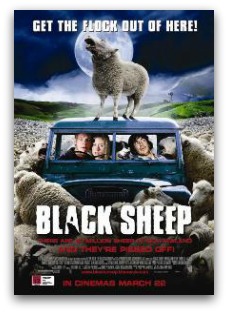
2) Black Sheep (2007), directed by Jonathan King

Also ran: Actually, I was going to nominate The Lord of the Rings trilogy but then decided — NO! I can’t use it. It’s too easy. Plus we’ve already had one film with Hugo Weaving (the mighty Elrond played a drag queen in Priscilla!). I know, across the three films they showcase the sights of New Zealand at their jaw-dropping best — anyone who hasn’t watched these films and felt an urgent need to visit New Zealand needs to watch them again but ignore the kick-ass sword fighting… Yeah, I know. That’s never going to happen.
Why Black Sheep won out: The rugged landscape looks every bit as impressive in this movie as it does in Lord of the Rings — but it’s also populated by were-sheep, an accidental result of some unusual genetic manipulation… See it, and laugh at the New Zealanders. Oddly enough, they’ll love you for it. It’s the Kiwis’ love of poking fun at everything, especially themselves — their self-deprecating humor — that really made me want to visit the place. I felt like I would fit in there. And I did — I stayed for two years. By the time I left, I was on a first-name basis with the entire population.
Memorable lines:

There are 40 million sheep in New Zealand…and they’re pi**ed off!

Harry (as the were-sheep charge towards them): F**k, the sheep!
Tucker: No mate, we haven’t time for that.

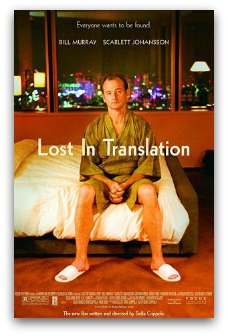
3) Lost in Translation (2003), directed by Sofia Coppola

Why I love this film: It’s an odd one, this one. The first time I watched it, my mind boggled at how something so boring, with nothing remotely resembling a plot, could get made into a movie. Then I watched it again. And again. Because it was the rainy season in Thailand, where I was living, so I couldn’t go outside — and we only had three DVDs in English, so we watched all of them every day. For two months. Somewhere around the halfway point of this torturous process, I fell in love with Lost in Translation — maybe I just needed to relax to appreciate it? Once I stopped looking for something to happen, I started to understand what it was all about: loneliness, uncertainty, being adrift and confused in a completely alien culture. And ever since then I’ve desperately wanted to go to Tokyo. Well, not enough to actually go there — yet — but you know what I mean. I do travel vicariously — just sometimes — and this is one of ‘em.
Caveat: If, like me, you’re a fan of films where, you know, stuff happens — it might take you a few viewings to get used to it. Forty or fifty should do the trick.
Memorable line:

Charlotte: Let’s never come here again because it would never be as much fun.

4) Ip Man (2008), directed by Wilson Yip

Why I love this film: The closest I’ve come to China are the little “made in” labels on almost everything I own. This film, however, kindled a desire to visit China that I never knew I had in me. It’s the biographical story of the most famous kung fu practitioner in the world — not Bruce Lee but his teacher in Wing Chun kung fu, master Ip Man. It’s set in Foshan, China in the 1930s-40s during the Japanese Invasion, but was filmed in Shanghai. It follows the family of the master as he becomes ensnared in the war, losing everything over the course of the Occupation and being forced to face the hardest choices a man could make. The insight into a lifestyle and culture so utterly different from my own was fascinating enough, but this is a story both moving and powerful.
Audience participation: I dare anyone to watch it and not leap off the couch at some point with a cry of “Yeah, kick his ASS!” Ahem. Okay, so maybe that’s just me.
In sum: Will it make you want to visit China? I think so. Will it make you want to learn kung fu? I absolutely guarantee it!

And because I’m a contrary kind of guy, I just had to retaliate against my own optimism by highlighting a film that made me NOT want to travel:

5) Cidade de Deus (City of God) (2002), directed by Fernando Meirelles and Katia Lund

Why I don’t recommend this film: The film is set in the 1970s, in the poorest districts surrounding Rio de Janeiro, where drugs and guns rule and the population live in a fear only matched by their misery. I saw it in South America, in its native Portuguese — but with Spanish subtitles. Given my fledgeling abilities in that language, as described in a previous post, I may have failed to grasp every nuance of the story, but basically what I took from it was: “DON’T EVER GO THERE! They will kill you for the hell of it.”
Analysis:There is poverty everywhere in the world — I’ve worked in homeless shelters in the UK and seen people every bit as desperate as the denizens of Brazilian favelas (shanty towns). But these kind of places, where automatic weapons are more readily available than McDonald’s hamburgers and life is so very cheap…they absolutely terrify me.
In sum: Brazil remains on my list of all-time favorite, must-visit countries — but no way am I going anywhere near the favelas in Rio. This film has put me off — for life.

* * *

And finally…there’s one character that stands head and shoulders (and hat!) above all the rest when it comes to inspiring my travels. I’ve carefully avoided mentioning his films, as I was trying hard to keep this a cheese-free list — but I can’t hold it in any more.

I WANT TO BE INDIANA JONES!

I know, I know! So does everybody in the world, ever. Even people in remote tribes that have never been contacted by the Western world, secretly harbor a desire to be Indiana Jones — they just don’t know how to put it into words.

So — now it’s your turn!
1) What films have made you want to travel? And why?
2) What films have made you want to run screaming from the very idea of travel — and why?
3) If you WERE Indiana Jones — what would you do?

STAY TUNED for tomorrow’s post on cinema and the expat life.

If you enjoyed this post, we invite you to register for The Displaced Dispatch, a round up of weekly posts from The Displaced Nation, with seasonal recipes, book giveaways and other extras. Register for The Displaced Dispatch by clicking here!

Related posts:

Images: Tony James Slater (yes, that’s really him!) playing out his fantasy of being Indiana Jones; film posters courtesy Wikipedia.

THE DISPLACED Q: Where did you meet your honey abroad?

It can be hard to make new friends abroad — let alone find a significant other. Thus it’s always inspiring to hear from nomads who’ve found that special someone hiding under a shamrock drinking green beer, or in other such fanciful locales. One such lucky fellow is Tony James Slater, the newest addition to the TDN team. Here is his story — can’t wait to hear yours!

There’s always a great story behind a travel romance, I find, often running the full gamut of emotions, from anguish to bliss. From experiencing a breathless holiday whirlwind romance to finding a soul mate in a distant land, nothing beats a tale of love — true and requited, tragically unrequited or trapped agonizingly somewhere in between.

And today I would very much like to hear yours!

Because our February theme is LOVE — and because it’s rapidly approaching That Day, when you should have bought something a bit special for your other half — I would like to invite EVERYONE to share their tale of passion and/or romance abroad!

Now, I can’t ask you folks to do something I wouldn’t do myself — so here’s an interesting tale of my own…

Once upon a time, in a faraway land…

I first met my wife in America. I know, right? Fascinating! But wait, I’m English — and the young lady in question, Krista, is from Australia, as evidenced by her nickname: Roo.

Roo had been working for Camp America, which supports summer work adventures in the United States. She was teaching kids how to ride horses at a summer school in Maine. And, as fate would have it, that was where she met…my sister!

My sis, whose name is Gillian, was doing Camp America at the same time, and was the only other staff member who wasn’t scared of horses!

Roo and Gill got to know each other quite well — so much so that the pair of them went traveling around the US after the job finished, which is where they met…Richie! An awesome, Kung-Fu kicking dude, muscle-bound and handsome, Roo fell for him immediately and the two became an item.

Which could have turned out rather differently for me, except this unexpected romance kept the couple in America for much longer than expected. You see, at the time some of this was happening, I was in Ecuador volunteering at an animal shelter. On my way home to the UK, I called in to the States to visit my sister, when I also met Roo and Richie. We traveled together for a couple of weeks and had a lot of fun.

Then Richie left, Roo left, and I followed my sister back to the UK, where, as explained in a previous post, I grew bored and dissatisfied with my hollow, consumer-led lifestyle.

(In other words, I was broke.)

Twists and turns worthy of Shakespearean comedy

So Gill remained close friends with Roo, inviting her over to England the following summer. She arrived just in time to be part of my farewell party — I’d finally scraped together enough cash to go to Thailand, where I planned to volunteer at an animal clinic and learn to dive. I would be gone for three months — exactly the same length of time that Roo would be in England.

Which was a pity, as she’s recently broken up with Richie and I rather liked her.

Gill and Roo explored every corner of my native country together, and Roo went back to Australia having elicited a promise from my sister that she would travel to Oz as soon as she could afford it.

I, meanwhile, had missed my flight home. It was accidentally on purpose — my subconscious clearly didn’t want me to leave Thailand just then. My regular conscious didn’t want me to leave either, being rather more aware of my income — or at least, the lack.

Volunteering for a living is notoriously unprofitable, and I couldn’t earn money from diving until I could afford to get qualified. A bit of a Catch 22!

But then — we came into some money. Both my sister and I profited from the sale of a house we’d helped renovate since getting back from America. I used the money to become a Divemaster (and for just a little bit of partying!), while Gillian, rather more sensibly, used hers to buy a ticket to Australia. She stopped off in Thailand on her way through, found me drunk in a bar and gave me such a talking to that I promised to come to Australia just to get her off my back. She was determined to save me from myself, which was probably for the best (I had very little intention of saving myself!).

I dallied for another three months while Gill met up with Roo in Oz and started to explore. They bought a beat-up old van between them and called it Rusty because, well, it was. Seriously — you could see daylight through bits of it.

To the ends of the earth — well, the Great Southern Land

That’s when I showed up. Penniless again, I arrived in Perth airport without the price of a cup of coffee to my name. I’d been living in Thailand for a year by this point, and all I owned was a bulging bag full of dive gear. It was winter in Australia and I didn’t even own a pair of shoes, or anything at all with sleeves.

Not in the least bit phased by me looking like a homeless person, Roo found me work with a local temp agency and within a few weeks I had enough money to travel.

The three of us piled into that crumbling van and set off for horizons unknown…and somewhere along the line, Roo and I fell in love.

Which thrilled my sister of course, as we were all sharing a tent. (But don’t worry — we got our own tent before long!)

Poor Gill left us, in disgust, in Sydney. She’d always hated being around couples in love — romance just wasn’t her thing. I still feel a little guilty for this…well, almost. But not quite!

Epi(c)logue

Since then, Roo and I have visited more than a dozen countries together. We married last July — in England because only Roo’s immediate family is in Oz. (She’s of Dutch descent, so all her rellies from Holland came over — including some she’s never met before! Her Aussie family — all four of them — flew over to the UK for the ceremony. ) And we now live in Perth — for a while in Roo’s family home but we now have a flat of our own. People always ask where we met — out of politeness more than interest, I feel — but it usually surprises them when we both say “America!”.

And as for Gill…well, she lingered in Sydney long after Roo and I left. Then she grew bored and flew to New Zealand, to a job in the ski fields, where she met a short blonde ski technician from Hampshire, UK, called Chris. They hit it off rather well as it happens — Gill had always liked short men — and four years later, the pair of them were married, a month before us and less than fifty miles away.

Roo got to be my sister’s Maid of Honor!

And because I’d been out of the country for so long that I’d lost touch with all my male friends, Gill — poor, suffering Gill — had to be my Best Man!

* * *

Your turn!

So. Let me hear it! Tales of love in far-flung and exotic locations: the triumphs, the failures and the ones that got away! We want to hear them all — post them in the comments section please, so everyone can read ’em and weep! (They don’t have to be as long and waffley as mine — I’ve been told I can be verbose.)

Oh, and keep it clean — some of these expat love stories lasted long enough to have children, and even grandchildren.

Love,
Tony xo

TONY JAMES SLATER is a self-confessed adventureholic. For the last six years he’s been traveling nonstop around the world, working at a variety of jobs including yacht deliverer in the Mediterranean, professional diver in Thailand and snow boarder in New Zealand. Last year, Slater published his first book, That Bear Ate My Pants!, an account of his misadventures while volunteering at the animal refuge in Ecuador. (The book was featured in The Displaced Nation’s list of 2011 expat books.) He is currently working on a second book set in Thailand, while exploring his new home in Perth, Australia.

STAY TUNED for Tuesday’s post, on 7 of the world’s most seductive foods — for seducing that valentine of yours.

If you enjoyed this post, we invite you to register for The Displaced Dispatch, a round up of weekly posts from The Displaced Nation, with seasonal recipes, book giveaways and other extras. Register for The Displaced Dispatch by clicking here!

Related posts:

Image: Tony Slater and Krista (Roo) participating in the traditional European ceremony of handfasting where the couple’s hands are tied together (in their case, with a garland of flowers), at their medieval-themed wedding last summer.

My quasi-religious pilgrimage to Oxford University — will I be judged sufficiently pious?

In past columns, Charlotte Day has illuminated aspects of her life as a Third Culture Kid who was born in Sydney, Australia, grew up mostly in New York and is now studying at an English boarding school in Kent. Today she describes her quest to earn a place at Oxford, which she has long revered as her spiritual home.

At 8:45 in the morning, my taxi turns down Holywell Street, and slows to a stop at the front entrance of New College, Oxford. Approaching the Santiago de Compostela of my adolescent dreams, my state of mind can best be described through shameless lyricism.

At this hour, the streets are populated only by the purposeful. Each dark-suited individual has some thought of unfathomable gravity revolving behind his or her furrowed brow. The morning light casts a celestial glow over the Bodleian Library, the Sheldonian Theatre, the Bridge of Sighs. Uniformly, these benevolent sandstone structures breathe in the sun.

God be in my head

Despite these poetic musings, I am incredibly nervous. I left my boarding school bed at a chill 5:00 a.m., knowing I did not know Crime and Punishment well enough, I did not know the Brothers Karamazov at all, and my ideas about the Seamus Heaney translation of Beowulf were utterly laughable.

Once they found me out, would I break down crying? And what about the unseen poem I would be told to discuss on the spot? If it were impermeable, I would certainly not be able to bluff my way through it. After all, what spotty 17-year-old can deceive them? Those eagles of intellect, with their acute, focused gazes; indisputable, measured statements; considered pauses; lofty, balanced arguments…

Oh! It was all too judicious and reasonable for an impulsive wreck like me.

You see, my feelings about Oxford are akin to an otherwordly obsession. So passionate have I grown about this ancient seat of learning that my preparations for this journey, especially in recent months, had taken on a quasi-religious purposefulness.

I spent the end of last year trying to live up to a set of self-imposed monastic ideals. I was to be irreproachably right at all times, my logic to be consistently clear, my views to display great penetration and uncanny powers of observation.

I even dressed in a way that reflected these intellectual ideals: threadbare corduroys in varying neutral tones, and moth-eaten jumpers would create a suitable aesthetic. I was unsparing of myself, subsisting largely on Lenten fare (watery porridge, steamed broccoli, etc.), and never going to bed before one o’clock if I could be reading instead.

Now I simply had to get into Oxford to complete this quest for ascetic perfection.

Getting in to Oxford… Now I am remembering all those melancholy 13-year-old evenings listening to Professor Stuart Lee’s Beowulf lectures on iTunesU, craving with all my ill-adjusted, lonely heart, that one day I would be sitting in that lecture theatre.

Lo, the full, final sacrifice

I am inching closer. Sitting in New College’s Lecture Room Six, with my baggage stacked around me, I will not return to the outside world for four days, and each minute of each of those days is shrouded in mystery.

A steady click comes from the two connect-four sets in the room: the science and law applicants letting off steam.

I gaze around the room. The English applicant is curled into herself, scanning a volume of Ezra Pound with a look of fatalistic despair on her pinched face.

The classicists sit in a convivial circle, trading sections of newspaper.

I take out my Beowulf and start reviewing my notes — columns of fluorescent green post-its, each bearing a comment more absurd than the last. Will I look too intimidating if I do this? I do not seek to intimidate — if only I could tell everyone in that room how intimidated I feel!

I glance at the Russian poem I have been given to analyze, by Yevtushenko: age, youth, gorging an omelette…middle age…the paranoia of the young? Our tendency to fill our lives with empty nothings, like omelette gorging? But these are rather pedestrian observations — is not some sort of inspiration called for? I avail myself of some instant oatmeal — to weigh down those jumpy nerves with a bit of stodge.

It is not hard to spot the two Etonians. One, so endearingly badly dressed, his argyle jumper tucked into a pair of murky-water-green corduroys. Both, so painstakingly polite, so frightfully embarrassed about their origins, so terribly unwilling to share where they live, or let slip that a relative of theirs had once been at the college himself.

I do not deny that there is a lack of diversity in that room, nor do I seek to explain it. The other candidates I encounter in Lecture Room Six are, every one, interested, charming, honest, terribly nervous teenagers — not representative of a centuries-old tradition of inequality.

Beati quorum via (I will lift up my eyes)

I am summoned out of Lecture Room Six to confront the English interview, which takes place by an electric fire, in an office lined with volumes of Elizabethan and Jacobean drama. Perched uneasily on a fur-swathed sofa, I answer questions on Doctor Faustus and the aesthetics of mathematics. Each response meets with a dreamy sort of assent, notes are jotted, and the conversation becomes increasingly oblique.

And then it is time for my Russian interview. I climb to the top of a rickety wooden stairwell, after a walk through the quad, turned hostile in the penetrating wet. (By now it is our second day.)

One tutor merges with the sofa, which in its turn has disappeared beneath stacks of application forms, submitted essays, and Modern Languages Aptitude Tests. The other sits before the fire, her high forehead reflecting its glow.

The discussion that ensues prompts the eyebrow-raising and chilling nods I have foreseen, and then questions about War and Peace — leaving the deficiencies of my 13-year-old’s reading of that tome quite exposed.

Afterwards, I stand, bedraggled in the dark quad, with a terrible sense of emptiness. I have two more days to fill; ahead of me, long hours in Lecture Room Six drinking bitter Tetley tea from a plastic cup. The expansive passion I have carried inside for years has tightened, wound itself into a taut cord of longing.

And I saw a new Heaven

When the fellows swish in to formal dinner, I almost feel ill. I do not know where to rest my eyes, each square inch of wood paneling makes me twitch with anxiety.

We rise with the hollow thud of wood on wood, grace is muttered in Latin, a mallet bangs, and we sit again, our murmured conversation echoing from the high arches of the ceiling.

I have always envisioned an affinity between Oxford and the stars, and even carry an image of my 14th-century counterpart adjusting his astrolabe while attempting to unveil the secrets of the heavens.

I cannot help praying, then, that a benevolent cosmos might know of the yearnings — my own and those of the other applicants — sympathize with our plight, and sweep our destinies into her swirling compass.

STAY TUNED for Monday’s post, when we invite in a guru to help us sort out some of the misconceptions our site has been propagating over the past few weeks on spiritual quests.

If you enjoyed this post, we invite you to subscribe to The Displaced Dispatch, a weekly round up of posts from The Displaced Nation, plus some extras such as seasonal recipes and occasional book giveaways. Sign up for The Displaced Dispatch by clicking here!

Related posts:

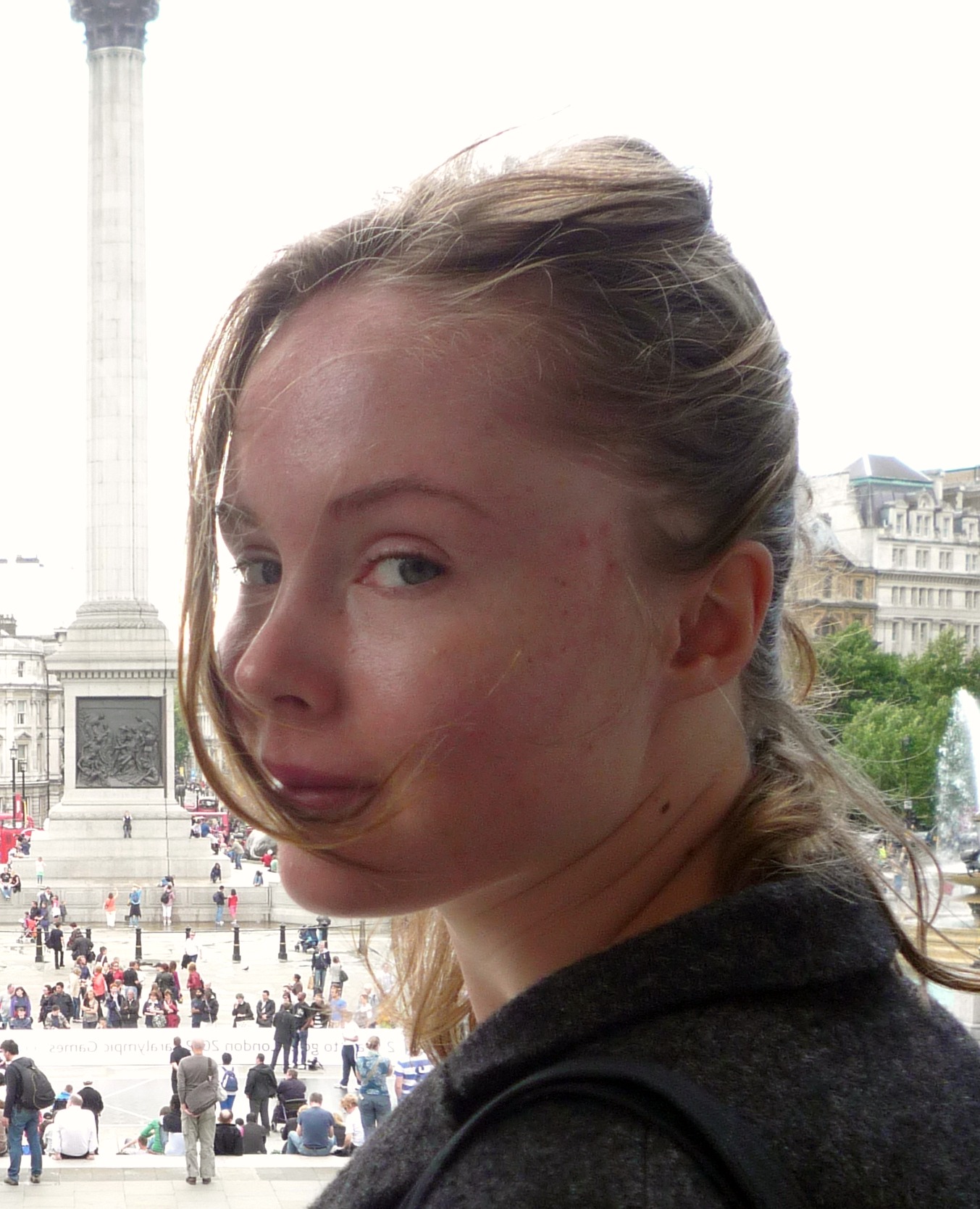
img: Charlotte Day surveying Trafalgar Square in London

12 NOMADS OF CHRISTMAS: Janet Newenham, Irish internationalist (10/12)

Current home: Dublin, Ireland
Past overseas locations: Korea, Australia, South Africa
Cyberspace coordinates: Journalist on the run | Follow my adventures around the world (blog) and @janetnewenham (Twitter handle)
Most recent post: “Dear Diary — Laughter and Crocodiles” (January 3, 2012)

Where are you spending the holidays this year?
Spending Christmas at home in Cork for the first time in 3 years. (I am currently doing a Masters in Humanitarian Action at University College Dublin.) My dad has a vegetable farm so there will be Brussels sprouts galore!!

Had you gone abroad for the holidays, what would you have done first?
Look for a party!

What do you most like doing during the holidays?
I love the friend and family reunions. As everyone lives all over the world nowadays, chances are few for crossing paths with friends and even some family members.

Will you be on or offline?
Offline for the holidays — maybe curled up by the fire watching movies and drinking wine.

Are you sending any cards?
I LOVE snailmail, especially making personalized cards with photographs. Plus after Christmas I will have to hand write thank-you notes to my grandparents, aunts and uncles, as is the family tradition.

What’s the thing you most look forward to eating?
A full tin of chocolates!!

Can you recommend any good films or books other “internationals” might enjoy?
I liked The Whistleblower (2010, directed by Larysa Kondracki and starring Rachel Weisz) — about a peacekeeper in post-war Bosnia who outs a UN scandal. It portrays the kind of work I would like to get into after I finish my MSc.

While living in South Korea, I read Nothing to Envy: Ordinary Lives in North Korea, by the journalist Barbard Demick (Spiegel & Grau, 2009). By following the lives of six people who escaped from North Korea, Demick provides some fascinating insights into a country we know little about. I found it deeply moving.

If you could travel anywhere for Christmas +/or New Year’s Eve, where would it be?
Somewhere hot and sunny…so maybe back to Australia or South Africa for Xmas on the beach.

What famous person do you think it would be fun to spend New Year’s Eve with?
Charlie Todd, the guy who set up Improv Everywhere. Who knows what sort of New Year’s Even mischief he and I might improvise?

What’s been your most displaced holiday experience?
Christmas in Ethiopia, where they don’t actually celebrate Christmas. And, because they use a different calendar, it’s never Christmas there when it’s Christmas everywhere else. The Ethiopians were preparing to celebrate the millennium when it was September 2007 everywhere else!

How about the least displaced experience — when you’ve felt the true joy of the season?
Last year I was really settled into my life in Korea with a great group of expat friends, so even though we were abroad it felt like home.

How do you feel when the holidays are over?
Tired, hungover and broke!

On the first day of Christmas, my true love said to me:
TEN SPROUTS A-BRUSSELING,
NINE CELLPHONES DANCING,
EIGHT WHOOPHIS WHOOPING,
SEVEN SKIERS A-PARTYING,
SIX SPOUSES TRAILING,
FIVE GOOOOOOOFY EXPATS.
FOUR ENGLISH CHEESES,
THREE DECENT WHISKIES,
TWO CANDY BOXES,
& AN IRISHMAN IN A PALM TREE!

STAY TUNED for tomorrow’s featured nomad (11/12) in our 12 Nomads of Christmas series.

If you enjoyed this post, we invite you to register for The Displaced Dispatch, a round up of weekly posts from The Displaced Nation, with seasonal recipes, book giveaways and other extras. Register for The Displaced Dispatch by clicking here!

Related posts:

12 NOMADS OF CHRISTMAS: Iain Mallory, English adventurer (7/12)

Current home: Salford, UK
Cyberspace coordinates: Mallory on Travel | Making Everyday an Adventure! (blog) and @MalloryonTravel (Twitter handle)
Recent posts: “The ABCs of Travel — Reflections on a Wanderlusting Life”; “Adventure in Lucerne, Switzerland — Travel Journal”; Cologne: The Bridge of Love Locks (December 2011)

Where are you spending the holidays this year?
I have two trips planned before Christmas: Lucerne for a week and then Cologne for just a few days. That does not leave a lot of time to help with getting the dinner ready for the main day, so I guess Christmas will be spent in the doghouse.

What will you do when you first arrive?
In Lucerne, I’ll be exploring. Cologne is more of a social visit so the Christmas markets will get a battering — along with copious amounts of glühwein and bratwurst.

What do you most like doing during the holidays?
If in Europe, meeting friends for laughs and drinks on a cold evening at a small town Christmas market. But if anything goes, then careering down a piste on two planks of carbon fibre with a group of friends followed closely by plenty of après-ski.

Will you be on or offline?
This year as I’ll be home, I’ll be spending time online, though a little quieter on Christmas day.

Are you sending any cards?
My closest circle of friends will receive a card, handed to them personally at sometime over the festive period when we meet. As for those that I have gotten to know online, hmmm…anybody know a good online card site? I would need some news to produce a newsletter.

What’s the thing you most look forward to eating?
During my travels, I’ll be staying at a veggie house so most definitely looking forward to the turkey although I’ll have to go out for it myself, a day or so before the big day.

Can you recommend any good books other expats or “internationals” might enjoy?
I’ve always loved The Worst Journey in the World by Apsley Cherry-Garrard, about Scott’s final Antarctic expedition (Cherry-Garrard was the youngest member of Scott’s team and one of three men to survive the notorious Winter Journey). Any of the mountaineering books by Joe Simpson is worth reading. These days I don’t have that much time to read but when I do, I prefer mountain or exploration literature. I’m looking forward to finding some time to read The Mammoth Book of Adventures on the Edge, by Jon E. Lewis — a collection of 28 eyewitness accounts of climbing adventures on the world’s greatest mountains.

If you could travel anywhere for the holidays, where would it be?
Mount Everest or maybe Mount Erebus (in Antarctica) for skiing. And I really have to bring in the New Year in Sydney one day.

What famous person or persons do you think it would be fun to spend New Year’s Eve with?
Billy Connolly or Peter Kay would be the funniest people to party with over New Year; David Attenborough and Ranulph Fiennes would provide the most fascinating stories.

What’s been your most displaced holiday experience?
I like to think that it is possible to adapt to most cultures and environments and therefore fit in well, but if I had to pick anywhere, it is hard not to feel a little alien in India. Every day seems to throw up a new surprise that often can be quite shocking.

How about the least displaced experience — when you’ve felt the true joy of the season?
Any time when I’m surrounded by friends, it doesn’t matter where I am. The feeling is one of belonging and being completely at home.

How do you feel when the holidays are over?
Excited; the New Year always offers new opportunities and the potential to be an amazing year.

On the first day of Christmas, my true love said to me:
SEVEN SKIERS A-PARTYING,
SIX SPOUSES TRAILING,
FIVE GOOOOOOOFY EXPATS.
FOUR ENGLISH CHEESES,
THREE DECENT WHISKIES,
TWO CANDY BOXES,
& AN IRISHMAN IN A PALM TREE!

STAY TUNED for Monday’s featured nomad (8/12) in our 12 Nomads of Christmas series.

If you enjoyed this post, we invite you to register for The Displaced Dispatch, a round up of weekly posts from The Displaced Nation, with seasonal recipes, book giveaways and other extras. Register for The Displaced Dispatch by clicking here!

Related posts:

12 NOMADS OF CHRISTMAS: Santi Dharmaputra, Indonesian expat in Australia (6/12)

Current home: Sydney, Australia
Past overseas locations: Germany, USA, The Netherlands, Syria
Cyberspace coordinates: Trilingual: Indonesian, French, English | world trotters raising two multilingual kids (blog)
Most recent post: “”A Woman’s Work” (my article in The Jakarta Globe)” (December 23, 2011)

Where are you spending the holidays this year?
At my parents’ house in Indonesia.

What will you do when you first arrive?
Hugging and kissing my parents.

What do you most like doing during the holidays?
Spending time with family and old friends.

Will you be on or offline?
Online.

Are you sending any cards?
I usually write greetings on my FB wall or my blog.

What’s the thing you most look forward to eating?
Any kind of Indonesian food. Pineapple tarts (a festive Indonesian cookie) and kastengel (Indonesian cheese sticks) are among my favorite guilty-pleasures.

Can you recommend any good books other expats or “internationals” might enjoy?
Trailing wives — regardless of whether they are sojourners or seasoned expats — might appreciate:
1. A Broad Abroad: The Expat Wife’s Guide to Successful Living Abroad, by Robin Pascoe (The Expatriate Press, 2009)
2. A History of the Wife, by Marilyn Yalom (Harper, 2001)
These are two among many books that have made me feel more empowered. By reading widely, I’ve come to understand that (trailing) wives everywhere and in every era have struggled to find happiness, just as I have. 🙂

What’s been your most displaced holiday experience?
I spent part of my childhood in The Netherlands. I loved it when Sinterklaas visited our school and gave us presents. When my family moved to Syria, I was disappointed: no Sinterklaas! By the time I returned to Indonesia at age 11, I didn’t believe in Santa. To this day, though, I believe that Sinterklaas is the only real Santa (LOL).

How about the least displaced experience — when you’ve felt the true joy of the season?
Tricky. I’m an adult TCK married to another adult TCK, and we’ve continued moving around the globe in our adulthood. I can feel both displaced and part of a place at the same time. But if I had to pick one occasion, it would be when I witnessed my trilingual children celebrating the holidays with their paternal relations in Alsace, France. Their granny and great-granny spoiled them, and it was lovely to see my kids so happy. I felt very at home in my husband’s French family. At the same time, though, I felt displaced — I was missing my own family in Indonesia.

How do you feel when the holidays are over?
Also tricky, as it depends on where we happen to be. Last year we spent the holidays on our own, just the four of us. My husband was too busy working and had only two days off. I was left to entertain the kids during their six-week school break (in Australia, Xmas break is the equivalent of the long summer break in the Northern Hemisphere). At that time, we’d been living in Sydney for less than a year, so we spent most of the time exploring the beach.

When we were living in Munich, we spent two Christmases with my husband’s family in Alsace, and it was sad each time we left. As adult TCKs ourselves, my husband and I are used to living with our nuclear families, so it was a novelty to spend those two Xmases with the extended family, including my husband’s siblings and their kids. Our kids were even happier with their grannies and cousins around, and the same was also true of us (at least during holiday seasons ;)).

When living in Chicago, we tended to use the time between Xmas and New Year for road trips. Sometimes we were traveling in snowstorms — so were happy and relieved to arrive back home safely.

While we were in Holland, I worked as a lawyer and used to enjoy the Xmas dinner held by the office along with the generous Xmas bonus. But when I had to return to the office after the New Year, I did so rather reluctantly — LOL.

The last time I spent New Years in Jakarta was in 2001. My brothers, husband and I (we didn’t have kids yet) stayed at a hotel to celebrate New Year’s Eve. It was kind of sad to leave Jakarta to return to the winter season in Europe (we were in Holland then).

This year, we traded in Australian summer for the Indonesian rainy season. Temperature wise, though, there’s almost no difference. I guess our kids will be sad to leave their Indonesian grandparents and cousins when we go back to Sydney.

On the first day of Christmas, my true love said to me:
SIX SPOUSES TRAILING,
FIVE GOOOOOOOFY EXPATS.
FOUR ENGLISH CHEESES,
THREE DECENT WHISKIES,
TWO CANDY BOXES,
& AN IRISHMAN IN A PALM TREE!

STAY TUNED for tomorrow’s featured nomad (7/12) in our 12 Nomads of Christmas series.

If you enjoyed this post, we invite you to register for The Displaced Dispatch, a round up of weekly posts from The Displaced Nation, with seasonal recipes, book giveaways and other extras. Register for The Displaced Dispatch by clicking here!

Related posts:

I may be a Third Culture Kid, but bring me the (gluten-free) figgy pudding!

We welcome back our Third Culture Kid columnist, Charlotte Day, for her final post of 2011. Melding together an interest in food with philosophical musings, she has crafted an ornament of love to what she calls her “triply displaced” Christmas.

Within the context of celebrating a displaced Christmas, my family offers an interesting case study.

In Australia, where I spent my first six years, my maternal grandparents always valiantly brought out a hot ham oozing brown sugar glaze, at a time of year when most Australians took to the beaches, celebrating over seafood and chilled beer.

In our vapor-filled family stronghold, we gathered about the fireplace, though no winter’s cold threatened outside, listening to carols from King’s College Cambridge.

Fired up by dreams of a white Christmas

My mother and I were forbidden from leaving the United States in December 2002, while our green card applications were being processed. So we settled on Jackson Hole, Wyoming, as a place sure to bring us the then unfamiliar Christmas apparition: snow.

Snow it did, forcing my stepfather on to the ski slopes for the first time — a foray into the unknown he hopes never to repeat.

In our hotel room kitchen, we managed to melt the plastic mould around the Christmas pudding, setting off the hotel fire alarms. Yet even this misadventure did not chasten our efforts to bring English tradition with us, wherever we found ourselves celebrating.

This year’s family cook-fest

Now ensconced at an English boarding school, I have come “home” for Christmas to New York City, where my mother and stepfather live.

What fresh culinary (mis)adventures await? The ham lies in its canvas bag, in anticipation of that most keenly felt indignity: pineapple and toothpicks. My mother has produced two gluten-dairy free Christmas puddings, determined that I should not feel shortchanged in a season that can be unkind to those with restricted diets.

Her mince pies, however, were a failure, after the dairy free butter and shortening could not be pummeled into a shapely dough.

My stepfather’s choice of fowl has diverged from tradition: he settled on a pair of Cornish hens and a duck after months of deliberation, spurning turkey early on but then toying with chicken and goose. My mother and I forbade him from using the barbecue, barring all vestiges of Australia from our emphatically English pageantry.

The “true” meaning of Christmas — the wrong question?

When considering my family’s triple displacement — an English Christmas, celebrated by Australians in America — I sometimes wonder: is there some kernel of truth we are missing out on, by not being true to the home traditions of the cultures we live in? And are we missing out on the true meaning of Christmas anyway, amid the holiday’s surface distractions?

Taking the second question first, my answer is no. For me, the sensuality of Christmas is one of the best things about it. Before we can seek truth and integrity, we must first acknowledge that the vast majority of us revel in the commerciality, the gluttony, the clichés and platitudes, no matter how much we may condemn them.

John Betjeman does an excellent job of stripping back the excess in his poem “Christmas.” It is not the holiday’s religious significance alone, but the disparity between this significance (regardless of whether or not this resonates with us) and our concerns with triviality, that should give pause.


And is it true,
This most tremendous tale of all,
Seen in a stained-glass window’s hue,
A Baby in an ox’s stall?
The Maker of the stars and sea
Become a Child on earth for me?

And is it true? For if it is,
No loving fingers tying strings
Around those tissued fripperies,
The sweet and silly Christmas things,
Bath salts and inexpensive scent
And hideous tie so kindly meant,

No love that in a family dwells,
No carolling in frosty air,
Nor all the steeple-shaking bells
Can with this single Truth compare —
That God was man in Palestine
And lives today in Bread and Wine.

But whereas Betjeman emphasizes the inadequacy of mankind’s efforts to celebrate the wonder of Christmas, I think we should not be so hard on ourselves. Is it not enough that there is a time of year when we all seem to bear a little more good will towards each other than usual, when we couple shameless self-indulgence with generosity?

Trivial, exuberant, voluptuous — why ever not?

The Christmas truce of 1914, when unofficial ceasefires took place along the Western Front, involved no burdensome reflections on the holiday’s true meaning. Rather, simple gestures like sharing tobacco transformed these few days into a symbol of fraternity, exemplifying the best of humanity.

As it happens, exchanging things, often trivial things, is a very potent expression of human feeling. The medium is, without a doubt, inadequate, but it is one with which we are comfortable — and is therefore as profoundly human as any Truth, spiritual, cultural, universal or otherwise.

Returning, then, to my family’s Christmas mishmash: my family associates English stodge with the best of human sentiment, and indulge in it to the full. We do not attempt to deny our weaknesses and are shamelessly gluttonous and commercial. We may not be faithful to the holiday traditions of the cultures that host us, but we have at least remained true to our innermost desires, and to what seems natural to us.

For what would a celebration of the best of human sentiment be, untempered by these most exuberant and voluptuous of our follies? In asserting this, I do not mean to glorify the self-indulgent: we would do well to become less so. I simply feel that our self-indulgence is as deeply human — and reflects as pertinent a truth — as any more outwardly meaningful way of celebrating this oft-contentious season.

Readers, any responses to Charlotte Day’s thoughts on her triply displaced Christmas and the holiday’s true meaning?

STAY TUNED for tomorrow’s post, the first of our 12 Nomads of Christmas.

If you enjoyed this post, we invite you to subscribe to The Displaced Dispatch, a weekly round up of posts from The Displaced Nation, plus some extras such as seasonal recipes and occasional book giveaways. Sign up for The Displaced Dispatch by clicking here!

Related posts by or about Charlotte Day:

img: Charlotte Day surveying Trafalgar Square in London, this time with a jolly holly border (no ivy, though — that’s for next year!).