The Displaced Nation

A home for international creatives

Tag Archives: Argentina

RANDOM NOMAD: Antrese Wood, American Expat in Argentina and Artist on an Epic Expedition

Place of birth: Pomona Valley Hospital. I grew up in Claremont, California — in fact, my mother still lives in the house she brought me home to.
Passport: USA
Overseas history: Honduras (San Pedro Sula): 1986; Argentina (San Antonio de Arredondo + Villa Carlos Paz), 2010-11 + 2011 – present.
Occupation: Artist (painter).
Cyberspace coordinates: Antrese.com (art site + blog); @antresewood (Twitter handle);  Antrese Wood Artist Page (Facebook); and Antrese Wood (Pinterest) — see “A Portrait of Argentina” board.

What made you leave your homeland in the first place?
A friend of mine in high school asked me to go with her to an American Field Service (AFS) meeting. I went because she didn’t want to go alone. I had no idea what it was, but after the meeting I thought, “Awesome! I’m in!!” I ended up going to San Pedro Sula, Honduras, for six months. I didn’t speak a word of Spanish when I left. I memorized the three questions I thought I would get asked most: What is your name, where are you from & how old are you? Unfortunately, I got them mixed up. When someone asked “What is your name?,” with a huge smile I would answer: “I’m 15 years old!” By the time I left, my Spanish was pretty good.

I didn’t travel much until after college, and I didn’t practice my Spanish, so I lost most of it. After college, I got bit by the travel bug again. I would go anywhere if I had the chance. I worked in the video game department at Disney for years, and got to travel a lot with them — all over the US, Vancouver, Montreal, London, Paris, even to the South of France. On my own, I went to South Korea. I also lived in Alaska for a short while (not a foreign country but compared to the Los Angeles culture, it might as well be). At one point I decided I wanted to do a semester with NOLS (the National Outdoor Leadership School). I choose their semester in Patagonia, and thinking this was my last chance to see South America, I spent a few months exploring Chile, Argentina, Peru, and Ecuador.

Indirectly, that is how I met my husband. A friend was worried about my traveling alone, so she introduced me to her friend from Argentina (“even though she doesn’t live there, she can at least give you a few phone numbers just in case…”). Years later, my new Argentine friend introduced me to my future husband.

Which brings me to why I left Los Angeles to live in Argentina: I fell in love.

Wow — that’s some wanderlust! So is anyone else in your immediate family “displaced”?
No one else in my family is displaced. My mother and I both travel as much as possible, but my brothers and sisters are happy where they are.

Can you describe the moment in your Argentinian life when you felt the most displaced?
My husband and I first lived in a tiny town called San Antonio de Arredondo. It’s in el campo — literally, the countryside. But when you move from Los Angeles to a town of barely 5,000…you call it the boondocks. Some friends rented us their quincho (guest house) while they were out of the country. It was in a new neighborhood with few other houses and lots of empty lots. Green and beautiful, but no natural gas, no phone lines…and worst of all, no Internet!

I was used to 24-hour access to everything. The Internet, grocery stores, restaurants…everything. Another thing: San Antonio and Carlos Paz (where we currently live), both honor the siesta. Everything closes between 1:30 and 5:00 p.m.

It was quaint and beautiful at first, but I got tired of riding my bike to the next town to check my email. I’m completely dependent on the Internet. It was in those moments when I admittedly thought “Oh my god, what have I done!?” When we moved to Carlos Paz, the first question I had about the apartment was: “Does it have high-speed Internet?”

And does it?
YES IT DOES!!!….yay!

Now that you have Internet access and are feeling more at home, is there any particular moment that stands out as your least displaced?
As I contemplate this question, a series of images and moments flashes through my head: our house filled with friends for an impromptu dinner; the huge smile on my husband’s face when he cooks for a crowd (he loves it!); looking at the clock and being surprised that it’s already 4:00 a.m…. A big cultural difference is that you can call friends for a dinner, and within an hour or two, your house is filled with all your friends and all their kids. There is always room for just one more.

If I had to pick one event where I didn’t feel displaced, it would definitely be our wedding. It was the best of both worlds. Friends and family from the US, along with about 200 of our “closest” friends from Argentina, came to celebrate. We had a huge asado (barbecue), lots of wine, dancing until 6:30 a.m.

Sounds amazing. And now you may bring one curiosity you’ve collected from your adopted country into The Displaced Nation. What’s in your suitcase?
Really? only one!?

I’m tempted to pack some fernet, but I’ll bring my mate instead.

Drinking mate is a national pastime in Argentina. The mate is a hollowed out gourd that you fill with tea leaves called yerba. You add hot water and drink the tea from a bombilla (a kind of straw with a filter at the bottom). Typically, it’s shared with other people — one person serves the mate to the circle. Drinking mate plays an important social role; it’s the preferred excuse to get together and hang out. “Let’s have a mate” really means “Let’s hang out and chat for a while.” Most gas stations have a hot water dispenser at exactly the right temperature, and almost any restaurant will fill your thermos regardless of whether you eat there. They understand the importance.

There are various subtleties to preparing mate (sugar, no sugar, with mint, water temperature, etc.), and the opinions on how to properly prepare mate are strong and sometimes fiercely debated. When a person drinks mate alone for the first time, its like a right of passage into adulthood. When my husband came home and found me drinking mate by myself, he said: “AHA!! now you are an Argentine!!”

Let’s move on to food. You are invited to prepare one meal based on your travels for other members of The Displaced Nation. What’s on your menu?

Now we’re talking! This one is pretty easy:

Appetizer: Empanadas — dough filled with just about anything and then baked or fried. They’re a staple here. A common filling is ground beef, olives, hard boiled egg, paprika, cumin and salt. My favorite is the árabes, which is ground beef “cooked” with lemon and aromatic spices.

Main: Definitely an asado: various cuts of Argentine beef, and lamb. The meat here is so good, people are surprised how much flavor it has. Typically the only condiment used is salt. (Argentina would be a difficult place for vegetarians!)

Dessert: We could have ice cream — call and have it delivered (yes, they do!!); but I think I’d prefer to introduce you to alfajores from Las delicias de Mamushka. An alfajor is like a cookie sandwich: two cookies made from cornmeal, filled with dulce de leche. I never liked them until I tried Mamushka’s. Now I’m addicted.

Wine & after-dinner drinks: A nice Malbec wine. I like Trapiche. A few hours later, after dessert and coffee, an ice-cold Fernet con Coka.

And now you may add a word or expression from the country you live in to The Displaced Nation argot. What will you loan us?
There are so many — again, hard to choose.

Che and “más vale!” are among my favorites.

Che is used all the time here, especially in the province of Córdoba. Depending on the context, it means “hey…” or “umm…” Sometimes, it seems to be used in the same way we Californians use the word “like.” Che Guevara is from this area. He is actually called Che because when he went to Cuba, he used the word so frequently, people just started calling him “Che.”

Más vale is equivalent to “Hell, yeah!!” — and also has a bit of “Let’s do this!!”

This summer we’ve been doing some posts with an Olympics theme. Are you planning to watch the Summer Olympics in London? If so, who will you be rooting for: Americans, Argentines, both, or neither?
I’ll be rooting for them both. In the event that the U.S. squares off against Argentina in a soccer match, I will be wearing a helmet and full body armor — and cheering for the US!

Are Agentines excited about the Games?
In general, Argentines are fanatical about sports. Especially soccer. Messi is a God. During the World Cup, It seemed like every man, woman and child in this country was wearing a blue-and-white striped #10 jersey. We went to a  friend’s house to watch a game. Normally busy streets were completely deserted. The city had literally shut down. There was an eerie silence occasionally broken by simultaneous cheers erupting from the houses and (closed) shops. During national playoffs, you see grown men sobbing uncontrollably after their local team has lost. The first time I saw this, I was flipping channels on TV. As the camera switched from one sobbing man to another, I thought there had been a national disaster. So, yes, I think it’s safe to say that there will be plenty of excitement about the Games!

The Olympics gives me a segue way into your 8-month project to paint Argentina. That strikes me as being an Olympian feat. Can you say a little bit more about it?
Now that you mention it, it is an Olympian feat! The project is called “A Portrait of Argentina.” I will spend eight months visiting the country’s 23 provinces, traversing something like 15,600 miles, painting portraits of the people I meet. I’ll listen to their stories and then paint en plein-aire, the scenes from their daily life. I’m hoping to deliver a cultural portrait of my adopted home.

When did you first conceive of the project?
The idea came out of a period of misery after I left Los Angeles to live in Argentina. The first year I lived here, I saw everything from a touristic point of view. It was quaint, beautiful and…a little quirky. But the second year was more difficult. It was no longer cute and quirky; the honeymoon was over. I made unfair comparisons and was judging everything. My normally optimistic and upbeat attitude shifted to “This sucks.”

I had two obvious choices: go back to California — or change my outlook, appreciate all that is good, and stay. My husband (fiancé at the time) left it up to me (no pressure, eh?). We could pack everything up and head back to Los Angeles, or I could give Argentina another try.

I realized that much of my misery was self imposed. It came from the fact that I had not integrated and was spending the majority of my time alone, working out of the house. You can’t love anything until you take the time to develop a relationship with, and really get to know, it. Here I was, on an adventure of living in another country, and I wasn’t even willing to give it the time of day. What a wasted opportunity!

As I integrated myself more and became determined to learn as much as I could about Argentina, I started taking classes at the university and began developing this idea about painting my way across the country. Painting has always been my way of making sense out of the world. It forces me to pause and really look at my subject.

Is the project having the effect that you’d hoped — is it improving your attitude?
Just by researching the project, looking for “known” and “unknown” people and places, I have a new-found appreciation for this country. I’m realizing how easy it would be to say I know Argentina because I’ve lived here for two years. The fact is, I know a lot about one region in one province of a very large country, and a little bit about a dozen other places. A native New Yorker and a native Alaskan may live in the same country, but they are culturally worlds apart. The same can be said for a Porteño (a person from Buenos Aires) and a person from La Quiaca near the Bolivian border. Same country, worlds apart.

I’m also overjoyed that so many people here seem excited about my project. Obviously, I’m super excited about it (it’s my baby, after all), but when I share my vision with Argentines and their response is equally enthusiastic, it’s just amazing.

I’ve barely started, and already my outlook has changed. I’m owning the project in a way I didn’t at the start.

What do you hope the project will ultimately accomplish?
“A Portrait of Argentina” is both a personal and a professional journey. I expect to be surprised, challenged, and profoundly affected by it. I’ll be seeking out people from diverse backgrounds, looking to honor those who have dedicated their lives to their passion and whose work positively impacts others: scientists, athletes, artists, musicians, teachers, even the abuelita (little old lady) on the street corner. It’s a collaborative project, and I hope to involve as many people as possible. Luckily, the people I’m meeting are quick to offer help and introduce me to others who might want to participate.

Do you ever feel daunted by the scale of the project?
Argentina is a huge country so I’ve set myself a very ambitious goal to cover this much ground in just eight months. When I break it down into small chunks, it feels manageable. When I think about its entirety, it’s overwhelming.

Finance was another daunting prospect. When I first thought about the funds it would take to get me to and from so many places, it seemed completely insane and impossible. I decided to launch a Kickstarter campaign with a $25k goal. Kickstarter is all or nothing, so if I didn’t hit the goal, my five-week campaign would end with $0.

There were days when I did let the campaign get to me and was sure it would fail. To keep going, I would sometimes just think, okay, how can I raise just $100?

In addition to a herculean effort by family and friends, I was fortunate to have some key influencers get excited about the project and promote it. In the end, with just 17 hours to spare, I made my goal!

I’m sure I will have some of these same feelings on the road, but I’ve developed a number of tactics to deal with it. I don’t give up easily. Besides, there are too many people supporting me and cheering me on. I know it will be hard, but am I ready for it? Más vale!!

Readers — yay or nay for letting Antrese Wood into The Displaced Nation once she’s finished her travels for her project? Tell us your reasons. (Note: It’s fine to vote “nay” as long as you couch your reasoning in terms we all — including Antrese — find amusing!)

STAY TUNED for tomorrow’s episode in Libby’s Life, our fictional expat series set in small town New England. (What, not keeping up with Libby? Read the first three episodes of her expat adventures and/or check out “Who’s Who in Libby’s Life.”)

If you enjoyed this post, we invite you to register for The Displaced Dispatch, a round up of weekly posts from The Displaced Nation, with seasonal recipes, book giveaways and other extras. Register for The Displaced Dispatch by clicking here!

Related posts:

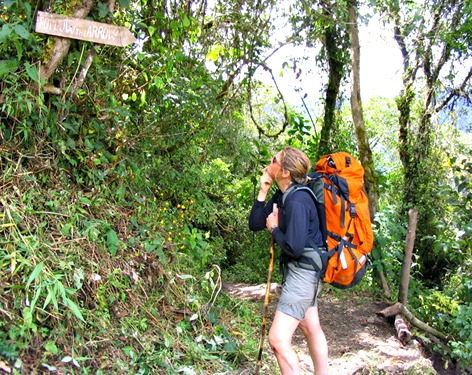
img: Antrese Wood displaying her intrepid travel skills on the Machu Picchu trail in Peru. Her comment: “I thought the Follow the Arrow sign was hilarious because 1) the trail is so well marked I cant imagine anyone getting lost; and 2) this was the one and only sign on the trail and it was near the end of the four-day hike. The other hilarious thing about the photo, at least to me, is that if you look closely, you can see my knee is bleeding. I had just spent 80 days carrying a backpack two-three times as heavy in seriously remote back country, no trails, no markers, nothing. We had to sign a waiver acknowledging the understanding that if something should happen, it could take a helicopter up to a week to arrive. I made it through without a scratch. Here, on this comparative cake-walk, on a perfectly even trail, I fell for no apparent reason and totally skinned up my knee.”
RANDOM NOMAD: Jeff Jung, American Expat in Colombia & Career Break Travel Guy

Jeff JungPlace of birth: Fredericksburg, Texas USA
Passport: USA*
Overseas history: South Africa (Vanderbijlpark): 1988-1989; Argentina (Buenos Aires): 2007 (on and off between March-December 2007, continuously from September-December); Colombia (Bogotá): 2009 – present.
Occupation: Editor of CareerBreakSecrets.com and producer/host of the soon-to-be-globally-televised “The Career Break Travel Show.”
Cyberspace coordinates: Career Break Secrets Website/blog, Facebook page and YouTube channel; @CareerBrkSecret (Twitter handle).
*It’s filled up again so time to get to the embassy to add pages.

What made you leave your homeland in the first place?
Originally, I left to go travel the world when I took a career break from the corporate world in 2007. When I left, I didn’t know that I was going to start as an expat. But, while traveling, I met someone here in Colombia and wound up staying.

Is anyone else in your immediate family “displaced”?
I have many family members who have a bit of wanderlust in their soul. But, I think I am the only one who is living as an expat.

Can you describe the moment when you felt the most displaced?
That would probably be my trip to Egypt in 2008. I normally feel at home on the road. I love to travel. But, in Egypt, I just couldn’t seem to make a connection with the people, the culture or the country. I spent about ten days traveling with a friend. The combination of the heat, the constant sales pitches in the streets, and the culture of backsheesh just wore me out. It wasn’t all bad though. I had a few days on a felucca on the Nile and a few days to hang out in Luxor. But, when we returned for our final two days to Cairo, I didn’t go out. I hid in my room — not my travel style at all. I just wanted to rest and wait until it was time to go to the airport and leave.

Is there any particular moment that stands out as your “least displaced”?
That’s easy. I was an exchange student to South Africa just after high school. I had such an amazing year. Between four host families and a lot of great friends that I made at my host school, I didn’t want to leave. It’s probably why I’ve been back six times since then. On my last trip in 2009, I got to see the country preparing for the World Cup. I was so proud of South Africa. I’ve seen it go from pariah apartheid state to emerging world influencer — with many bumps along the way. It really is a special place. It’s been a few years since I’ve been, so I’m probably due for a visit again. I’m missing a good braai (barbeque) with my friends. My dream is to have a place in or just outside of Cape Town someday, with a view onto the ocean.

You may bring one curiosity you’ve collected from your adopted country into The Displaced Nation. What’s in your suitcase?
From Argentina: Breakfast foods — coffee, facturas (sweet Argentinian pastries with various fillings) and medialunas (Argentinian croissants).
From South Africa: Some bottles of wine, probably red. No, definitely red.
From Colombia: My mochila (over-the-shoulder daybag). These are used by everyone in Colombia, men and women, and they are perfect for carrying your stuff while you’re out running around.

You are invited to prepare one meal based on your travels for other members of The Displaced Nation. What’s on your menu?

Oh, this is going to be fun!
Appetizers: A selection of dips and finger foods from Turkey. I love the food there and really miss it.
Main course: A pork barbecue prepared by my dad who is a national award-winning BBQer in the US. Maybe we’ll have some fresh Patagonian lamb with it too. The meat will be served with a Greek salad and lots of veggie dishes — the veggies will have been bought fresh from La Vega Central, the produce market in Santiago, Chile. Finally, there will be plenty of my Dad’s award-winning sauce to go with the meal.
Drinks: Of course there will be plenty of wine from South Africa and we’ll also have sparkling water for a non-alcoholic option.
Dessert: Why select one? It’s a dinner party so there should be a variety! Brigadeiro (chocolate bonbons) from Brazil, ice cream from Argentina (unexpectedly amazing!), fresh fruit from Ecuador and Colombia, and churros from Spain (that can be a dessert, right?).
Nightcap: Amarula (cream liqueur) from South Africa, served with Segafredo coffee from Italy.

And now you may add a word or expression from the country where you live in to The Displaced Nation argot. What will you loan us?
Chucha (pronounced choo-chah): This Spanish word has multiple meanings across Latin America. In Chile, Ecuador and Peru, where I picked it up, it’s an interjection meaning “sh**” or “shoot.” In Colombia, it has two entirely different meanings depending on where you say it. In Bogotá, it means armpit odor and in Cartagena, it means vagina. People often look at me funny here when I say it. I’m sure the Displaced Nation has occasions when you could use a confusing swear word…

Put it this way: we like anything that makes people laugh! And this month we are looking at ways of achieving “la dolce vita” — by that we mean, indulging in life with all your senses. Can you describe an instance on your travels when you felt you were living la dolce vita?
In 2008, I traveled through Patagonia and had an amazing six weeks. The first part of the trip was on a Chilean ferry called Navimag, which cruises north to south from central Chile to the southern tip. You are in protected waters (most of the time) and on both sides of the ship is this beautiful, untouched landscape full of snow-capped volcanoes, lush green countrysides, enormous glaciers (some of the biggest in the world), and tiny, remote villages. You can also see marooned ships and the occasional dolphin. The weather can change from clear, sunny skies to blustery snow in a heartbeat. That trip is one of my most special trips ever. I really felt like I was living La Dolce Vita during those four days.

I personally think that the yearning for la dolce vita increases as one grows older. I know you are an expert on adult gap years. What made you decide to take one for yourself?
My catalytic moment was the night I went out with some friends to dinner on the River Walk in San Antonio, Texas, on a hot, balmy Friday night. They could tell I was down, and had been for some time. They asked me what it was going to take to make me happy. I didn’t have a good response that night. But, the question haunted me all weekend. I finally had an epiphany that I really wanted to leave my corporate job and get out in the world and travel. I traveled for almost two years mostly through South America, parts of Europe, Turkey and Egypt.

And then you decided to set up a business to encourage others to do the same?
Once I decided to settle in Colombia, I chose the entrepreneurial path and set up CareerBreakSecrets.com. I wanted to help popularize the idea of taking a career break and show other people that they can do it with just a little bit of guidance and inspiration. We’re now in our third year and will be releasing a book and launching our show, The Career Break Travel Show, globally later this year. I love hearing from real people who have decided to take their own break and if they set up a blog, follow them around the world on their travels. The people I’ve encountered have ranged from teachers to social workers to business people who have done some amazing things like volunteer and share their skills, hike Patagonia, bike across New Zealand, or take transcontinental train rides.

Readers — yay or nay for letting Jeff Jung into The Displaced Nation? Tell us your reasons. (Note: It’s fine to vote “nay” as long as you couch your reasoning in terms we all — including Jeff — find amusing!)

STAY TUNED for tomorrow’s diary entry from our fictional expat heroine, Libby, who is desperately trying to hang onto her sanity…and her marriage. (What, not keeping up with Libby? Read the first three episodes of her expat adventures.)

If you enjoyed this post, we invite you to register for The Displaced Dispatch, a round up of weekly posts from The Displaced Nation, with seasonal recipes, book giveaways and other extras. Register for The Displaced Dispatch by clicking here!

Related posts:

img: Jeff Jung with baby cheetahs near Oudtshoorn, South Africa, September 2009.

How to throw a party for a bunch of global nomads

One year has passed since our first random nomad, Anita McKay, crashed through the gates of The Displaced Nation, bribing the guards with chicken tikka masala and cranachan and shouting “bollocks” at several of us who tried to stop and question her.

And now there are 40 such nomads within our ranks — the latest being Annabel Kantaria, who insisted on bringing an alarm clock that looks like a miniature mosque — it rings every morning with the call to prayer. (Note to other founders: perhaps we need to find guards who aren’t so easily intimidated when travelers show a bit of temerity…)

Still, as we now have 40 nomads, randomly selected, why not make the best of the situation and throw a party? And what better excuse than The Displaced Nation’s 1st birthday — which, as announced by Kate Allison in a post a couple of days ago, took place on April 1 (no fooling!).

Further to that end, I’ve come up with a Party Primer that I think should work for this group — as well as for similar gatherings.

PARTY PRIMER FOR DISPLACED NOMADS

Click on the headlines below to go to each section:

  1. INVITATIONS
  2. DRESS CODE
  3. DECORATIONS
  4. MUSIC
  5. TABLE ASSIGNMENTS
  6. FOOD
  7. TOPICS FOR SMALL TALK
  8. PHOTOGRAPHY
  9. GAMES
  10. SONGS

INVITATIONS

As this party marks a special occasion (who ever thought we’d make it to be one year old?), a deluxe printed invitation is in order. The only thing is, our invitees are a bunch of nomads! We’ll be lucky if we can catch them on email, let alone at a fixed address. Let’s compromise on an attractively designed message: see mock-up at top of this page.

DRESS CODE

As some of you may know, Cleopatra recently paid a visit to The Displaced Nation. Based on her observations of today’s international travelers, we’ll be doing well if we can get the men to shower and change before joining us. As for the women, well, allow me to offer these pearls of wisdom from Jennifer Scott — the American guru of Parisian chic who was featured on this blog last week. Jennifer says:

There are certain occasions that always warrant dressing up. Generally any gathering … where others went to a lot of effort for your sake.

DECORATIONS

The theme is easy: the wide wide world! (Rather the opposite of Disney’s “It’s a small world after all” concept.) This calls for tablecloths imprinted with the world map (to make it easy for guests to point out where exactly “Moldova” etc is); globe-patterned balloons (can we coin a new term: globalloons?); and for the centerpieces, flags from each of the adopted country represented at the table in question.

Optional extras include party hats, noisemakers and loot bags. It’s fun when the loot contains some surprises. Given all the items our nomads have insisted upon carrying into The Displaced Nation, we should have plenty to choose from, eg:

  • mosque alarm clocks (thanks, Annabel!)
  • hairy coo fluffy toys (thanks, Nerissa!)
  • fake Harry Potter glasses (thanks, Charlotte!)
  • boomerangs (thanks, Kim & Vicki!)
  • brie bakers (thanks, Toni!)

MUSIC

As Todd Lyon, author of a number of party and lifestyle books, puts it:

Without music, a party isn’t a party. It might be an assembly, a meeting, or a bee, but it can never be a shindig, a bust-up or a ball unless there’s fine tunes that never stop.

Not being a party tunes buff myself, I’ve consulted with The Displaced Nation’s resident music expert, Kate Allison, about the kind of soundtrack that would cultivate just the right ambience. Her suggestions include:

Everybody all around the world, gotta tell you what I just heard
There’s gonna be a party all over the world…

TABLE ASSIGNMENTS

8-10 person tables work well. Since we’ll have 40 guests, I’ve decided on five tables of eight people each, and to mix everyone up as much as possible. Hostesses must also, of course, take steps to reduce the risk of a “silent table,” where people just eat and don’t talk. To be honest, I don’t there is too much risk of that with this crowd — have you ever watched a bunch of expats try to outdo each other with stories of their (cross-cultural, linguistic and travel) adventures? But just in case, I’m offering some “hostess notes” for each table (the hostess’s job being to introduce everyone and make sure the conversation keeps flowing!).

TABLE 1
Matthew Chozick (American expat in Japan)
Tom Frost (American expat in China)
Lyn Fuchs (American expat in Mexico — Sacred Ground Travel Magazine)
Turner Jansen (American canine in Holland)
Annabel Kantaria (English expat in Dubai — Telegraph Expat blog)
Kirsty Rice (Australian expat in Qatar — 4 kids, 20 suitcases and a beagle)
Jack Scott (English expat in Turkey — Perking the Pansies)
Karen van der Zee (Dutch/American expat in Moldova — Life in the Expat Lane)
Hostess notes: Introduce Tom Frost to Matthew Chozick — Tom used to live in Japan and speaks Japanese. Kirsty Rice should sit next to Turner Jansen, as she travels around with a beagle. Annabel Kantaria, Jack Scott and Kirsty all have in common life in the Middle East. Karen van der Zee and and Lyn Fuchs should find each other fascinating, as both have had some extraordinary adventures (Karen could entertain Lyn with her crocodile tale and Lyn, keep Karen amused talking about the time he went paddling with orcas.)

TABLE 2
Balaka Basu (Indian American in New York City)
Santi Dharmaputra (Indonesian expat in Australia)
Michelle Garrett (American expat in UK — The American Resident)
Robin Graham (Irish expat in Spain — a lot of wind)
Anita McKay (Indonesian expat in Australia — Finally Woken)
Brian Peter (Scottish expat in Brazil — A Kilt and a Camera)
Kate Reuterswärd (American expat in Sweden — Transatlantic Sketches)
Wendy Tokunaga (Former American expat in Japan)
Hostess notes: You might want to break up Santi Dharmaputra and Anita McKay, who are the same nationality (Indonesian) and already friends. Anita should definitely be introduced to Brian Peter, who like her hubby, is Scottish, and will probably be amused by her stories of toasting oatmeal in whisky. And make sure Anita also talks to Wendy Tokunaga — I know from personal experience how intrigued Anita is by stories of Western woman marrying Asian men. To be honest, everyone at this table should really be socializing with everyone else, as each and every one of them has a partner of a different nationality! (Now if that isn’t a talking point, I don’t know what is…)

TABLE 3
Kim Andreasson (Swedish expat in Vietnam)
Jo Gan (American expat in China– Life behind the wall)
Jennifer Greco (American expat in France — Chez Loulou)
David Hagerman (American expat in Malaysia — SkyBlueSky)
Helena Halme (Finnish expat in UK — Helena’s London Life)
Vicki Jeffels (Kiwi expat in UK — Vegemite Vix)
Janet Newenham (Irish internationalist — Journalist on the run)
Adria Schmidt (former Peace Corps worker in the Dominican Republic)
Hostess notes: Seat David Hagerman next to Jennifer Greco — since his wife is a well-known food writer and expert cook, he’ll find nothing strange in her quest to sample all the known French cheeses. Janet Newenham should be near Adria Schmidt and Kim Andreasson as they are all interested in international affairs. Vicki should be introduced to Helena as I’m sure the latter would love to hear about her recent spa experience in Cyprus. Jo Gan, too, should meet Vicki as she is now experiencing visa problems with the Chinese authorities — on a level that may even surpass Vicki’s own nightmare experience in Britain.

TABLE 4
Aaron Ausland (American expat in Colombia — Staying for Tea)
Emily Cannell (American expat in Japan — Hey from Japan)
Charlotte Day (Australian expat in UK)
Toni Hargis (English expat in USA — Expat Mum)
Vilma Ilic (Former aid worker in Uganda)
Jennifer Lentfer (Former American expat in Africa — How Matters)
Camden Luxford (Australian expat in Argentina — The Brink of Something Else)
Piglet in Portugal (English expat in Portugal — Piglet in Portugal)
Hostess notes: Aaron Ausland will naturally gravitate towards Jennifer Lentfer as they are both deeply involved in global aid and development. Make sure you introduce the pair of them to Piglet in Portugal — she’ll ask them some thought-provoking questions about whether it’s better to save the world or cultivate your own garden. Jennifer should also be near Vilma as the two will want to share their Africa experiences, and you might urge Emily Cannell to join that conversation as well — she has such an adventuresome spirit! Along with Toni Hargis, who runs her own charity supporting a school in Ghana. As for Camden Luxford, she’s an easy one: a social butterfly! Perhaps she could take fellow Aussie Charlotte Day under her wing (ha ha) and make sure she gets plenty of material to write about for her courses at Oxford next year!

TABLE 5
Lei Lei Clavey (Australian expat in New York City)
Matt Collin (American expat in UK)
Megan Farrell (American expat in Brazil — Born Again Brazilian)
Liv Hambrett (Australian expat in Germany — A Big Life)
Mardi Michels (Australian expat in Canada — eat. live. travel. write | culinary adventures, near and far)
Iain Mallory (English adventurer — Mallory on Travel | Making Everyday an Adventure)
Nerissa Muijs (Australian expat in Holland — Adventures in Integration)
Simon Wheeler (English expat in Slovakia — Rambling Thoughts of Moon)
Hostess notes: As soon as Lei Lei Clavey, Liv Hambrett, Mardi Michels and Nerissa Muijs discover they all have Australia in common, they will be blabbing away — just hope it doesn’t turn into an Ozfest! Also, make sure Mardi connects with Matt — I suspect he may need her counseling about how to seek creative refuge from academia. Iain Mallory and Simon Wheeler will form a natural pair, exchanging stories of their travel adventures and perhaps even breaking into a rousing chorus of “Jerusalem.” But should their antics get too raucous, ask Mardi to step in: she teaches cooking classes to 9-11-year-old boys in Canada. Megan Farrell should connect with Nerissa and Simon on the topic of what it’s like to raise a child in a nationality (and language) other than your own.

FOOD

One of the purposes of gathering together nomads from the four corners of the earth has to be eating, especially if each of them brings along some of their favorite dishes. For our party, we will have a dazzling tableaux brimming over with rare and exotic foods. (We know that because our Random Nomads have already described their faves to us in their interviews.)

Shall we go over the list? (Warning: Don’t read on an empty stomach, or if on a restricted diet!)

NIBBLES/STARTERS

  • Guacamole & chips (Kim — recipe provided)
  • Selection of mezze with pita bread (Annabel Kantaria)
  • Assorted pinchos (Megan Farrell)
  • Avocado & mango salad (Matt Collin)
  • Bhelpuri (Tom Frost)
  • Satay sticks (Nerissa Muijs)
  • Four kinds of eggs: tea eggs, thousand-year-old eggs, fried eggs with tomato, and boiled salted eggs with a chicken embryo inside (Jo Gan)
  • Shrimp & grits (Lei Lei Clavey)
  • Vietnamese caramelized chili prawns (Mardi)
  • Ceviche (Camden Luxford)
  • Bluff oysters from New Zealand (Vicki Jeffels)
  • Gravad lax with Finnish rye bread (Helena Halme)
  • Tuna sashimi with ponzu sauce (Emily Cannell)

COCKTAILS

  • Traditional Bloody Marys (Lei Lei Clavey)
  • Caipirinhas (Megan Farrell)
  • Margaritas (Kirsty Rice)

WINE

  • Rich red wines from Lebanon (Annabel K)
  • Red wine from Macedonia (Vilma Ilic)
  • Malbec wine from Argentina (Camden Luxford)
  • Shiraz from Australia (Vicki Jeffels)
  • White wine from Australia (Simon Wheeler)
  • Chilled sake (Tom Frost)
  • Rice wine (Jo Gan)

BEER

  • Carlsberg browns (Matt Collin)
  • Cusqueña beer (Camden Luxford)
  • Mexican Pacifico (Tom Frost)
  • Harbin beer (Jo Gan)
  • Coopers beer (Simon Wheeler)

MAINS
Meat dishes:

  • Carne de Porco a Alentejana (Piglet in Portugal)
  • Schnitzel served with rotkohl (Liv Hambrett)
  • Bondiola-chevre-basil wraps and nattō (Tom Frost)
  • Fried chicken sandwiches with hand-cut fries (Lei Lei Clavey)
  • Chicken tikka masala (Anita McKay)
  • Libyan soup (Kirsty Rice — recipe provided)
  • Cuban ropa vieja (Mardi)
  • Argentinian steak cooked rare (Camden Luxford)
  • Tapola black sausage with lingonberry jam (Helena Halme)
  • Barbecued steak, snags & lamb chops (Nerissa Muijs)

Fish dishes:

  • Paella Valenciana (Megan Farrell)
  • Llish in mustard and chili paste, smoked in banana leaves (Balaka Basu)
  • Chambo curry with nsima (Matt Collin)
  • Moreton Bay bugs (Vicki Jeffels)
  • Grilled salmon on a plank (Emily Cannell)
  • Sushi (Simon Wheeler)

Vegetarian offerings:

  • Peanut butter vegetable stew (Jennifer Lentfer)
  • Overcooked spaghetti with carnation milk, canned tomatoes and corn (Adria Schmidt)

DESSERTS

  • Summer pudding (Toni Hargis)
  • Apple crumble (Matt Collin)
  • Cranachan (Anita McKay)
  • Hot fudge sundaes (Lei Lei Clavey)
  • Blackberry gelato (Balaka Basu)
  • Caramel cheesecake (Kirsty Rice)
  • Bread pudding with Bourbon sauce (Jennifer Greco)
  • Île flottante (Mardi)
  • Molotof cake (Piglet in Portugal)
  • Mouse de maracujá (Megan Farrell)
  • Tiramisu (Camden Luxford)
  • Homemade Slovakian cream cakes (Simon Wheeler)
  • Dutch waffles (Turner Jansen)
  • Oblande, tulumbe, kadaif & krempite (Vilma Ilic)
  • Umm Ali (Annabel Kantaria)
  • Sigara borek (Jack Scott)
  • Juustoleipä with fresh cloudberries and cream (Helena Halme)
  • Yangmei fruit (Jo Gan)
  • Languedoc cheese: Roquefort, Pélardon and Tomette des Corbières (Jennifer Greco)

AFTER-DINNER DRINKS

  • Chlicanos (Camden Luxford)
  • Rakija (Vilma Ilic)
  • Fernet (Tom Frost)
  • Homemade Slivovica (Simon Wheeler)
  • Dragon-wall green tea (Jo Gan)
  • Espresso (Balaku Basu)
  • Large “flat whites” (Charlotte Day)

FOR THE TOAST(S):
New Zealand champenoise (Vicki Jeffels)

NOTE: Charlotte Day will be cooking a Sydney-style breakfast for diehards who care to linger to the next morning. (And Nerissa Muijs will be frying up some bacon!)

TOPICS FOR SMALL TALK

There are some topics that should be avoided at all costs. As style writer Rita Konig puts it,

It is very dull to talk about journeys. Once you have arrived somewhere, try to keep quiet about how long it took you to get there.

Should you notice anyone engaging in this, put the kibosh on it by asking them to help with pouring drinks, or with putting away coats in the spare room.

PHOTOGRAPHY

Fortunately, there’s usually one great photographer or two in a group of global nomads, thereby saving unnecessary expenditure. (We will ask David Hagerman — he’s sensational!)

GAMES

Games are a great ice breaker. Here are a few that might be appropriate for a well-traveled crowd:
1) Musical countries: Draw a big map on a piece of vinyl (back of a Twister mat might do), and give everyone a flagpole. When the music stops, they must place the flagpole on a country, Anyone whose flagpole ends up in the ocean is out.

2) Variation on “Pin the Donkey”: Pin the rudder on the 747! (Contributed by Kate Allison.)

3) Word games: As we’ve found out from our interviews, global nomads pick up words and expressions from here and there. Taking some of these and mixing them together, we can come up with some pretty strange exchanges. (Prizes for anyone who manages to decipher!)

A: Prego, could you get me a ba ba ba? Kippis!
B: Inshallah, a barbie would also be awesome. And how about la ziq?
A: Avustralyalılaştıramadıklarımızdanmışsınızcasına.
B: So desu ne!

A: Tudo bem? You look a bit daggy.
B: Life can be arbit sometimes.
A: Zvakaoma.

A: Hey.
B: Hey. Das stimmt, sorry to be such a Debbie Downer but I’m knackered after all this work.
A: Bless!
B: Zikomo.

A: Oh la vache! You are lost. Siga, siga. Ni chifan le ma?
B: Bollocks! [Sucking air through gritted teeth.] I think I got lost in the wopwops.
A: Well, there’s the big ol’ tree out the front.
B: Bula! Okay-la. Le bon ton roule!

TOASTS

Toasts should be made repeatedly throughout the latter half of the dinner. Just in case no one feels inspired, prepare one or two classics for the host or hostess to offer, eg:

I’d rather be with all of you than with the finest people in the world.

SONGS

Songs can be sung in several languages. In this case, a stirring rendition of “Happy Birthday” is called for, sung not only in English but in:
Dutch (Karen, Nerissa)
Finnish (Helena)
French (Jennifer, Mardi)
Indonesian (Anita & Santi)
Japanese (Emily, Matthew, Tom, Wendy)
Spanish (Aaron, Adria, Camden, Lyn, Megan, Robin)
Swedish (Kate, Kim)
Woof-woof (Turner)

Finally, the party should end with the Displaced Nation founders treating the guests to a round of:

For you are all jolly good fellows, for you are all jolly good fellows,
For you are all jolly good fellows…
Kate, Anthony, Tony: And so say all of us!
ML: Which nobody can deny!

* * *
Have I left out any important details? Any tweaks you can suggest? Your turn!!! Let’s work together to make this the most awesome gathering of global nomads ever. Onegaishimasu, shokran — and all that!

STAY TUNED for tomorrow’s installment from our displaced fictional heroine, Libby. She is expecting a visitor: her own mother, who is — in theory — coming to help as her due date gets closer. Will Granny Jane be an improvement on Sandra, the MIL from hell — or will she prove to be one more spanner in the works for our poor displaced heroine? (What, not keeping up with Libby? Read the first three episodes of her expat adventures.)

If you enjoyed this post, we invite you to register for The Displaced Dispatch, a round up of weekly posts from The Displaced Nation, with seasonal recipes, book giveaways and other extras. Register for The Displaced Dispatch by clicking here!

Related posts:

Top 10 expat & travel posts on spiritual escapes

As the holidays draw to a close and a new calendar year commences, many of us find ourselves desperately in need of some “me” time — a chance to reassess our “to do” lists and decide which of our life goals deserves top priority.

Gah?? Did I just write that? Talk about understatements! If you’re like me, you are lucky if you can remember that you used to have personal goals at one point. (My only aims for the past few weeks have been writing x many cards, wrapping x many gifts, hosting/visiting x many relations…)

That could be why Kate Allison’s post on Monday — announcing that The Displaced Nation has dedicated this month to spiritual escapes — was a goad to such debate. Does the quest for spiritual enlightenment require geographical displacement, away from the demands of family and everyday life? And what about those who are already living far away from “home” — do they need to displace themselves even further, to the most obscure corners of the globe? (Wait, aren’t some of them already living there?!)

Having tracked this topic on social media for several weeks, I would like to share my top 10 findings as further food for meditation, so to speak… My hope is that these writers can help us disentangle our thoughts — which might otherwise come to resemble advanced yoga positions — on the best techniques for getting in touch with the innermost core of our beings.

As usual, and as befits our blog’s slightly irreverent tone, they’re from a mix of indie and conventional publications.

1) Meditation vacation
Author: Matthew Green (@MattGreenAfPak), a reporter covering Pakistan and Afghanistan and author of The Wizard of the Nile
Publication: Financial Times, Life & Arts (@FTlifeandarts)
Why it’s helpful: Spending so much time in war zones, Green desperately needed the kind of retreat where alcohol, email — and talking — are all banned. During his 10-day “Buddhist boot camp” at the Himachal Vipassana Centre in the Himalayas, he ended up weeping harder than he could remember, for a reason he couldn’t fathom — but he also had to bite his lip to stifle the kind of giggles he hadn’t felt since school!

2) The Joy of Quiet
Author: Pico Iyer, British essayist, novelist, travel writer, and Third Culture Kid (born in Britain to Indian parents, he grew up in California), who once said: “And if nowhere is quite home, we can be optimists everywhere.”
Publication: New York Times Week in Review (@nytopinion)
Why it’s helpful: Iyer suggests that there’s something in the zeitgeist to make us all in need of stillness at this particular moment — that the more ways we have to connect, the more desperate we become to unplug, and would pay almost anything for the privilege. (Hmmm… Perhaps I should end this post right here?) I also found it interesting that as a writer, he prefers to live in rural Japan,

“in part so I could more easily survive for long stretches entirely on foot, and every trip to the movies would be an event.”

(Presumably the other part, which he doesn’t mention, is that his wife is Japanese.) Almost needless to say, Iyer has never tweeted or gone on Facebook.

3) The Threshold
Author: Catherine Yiğit (@Yarzac), a writer who was born, bred and buttered in Ireland but who now lives as an expat (also mother and wife) in northwestern Turkey near the mythical city of Troy.
Publication: The Skaian Gates: Notes from an Online Wanderer (Yiğit’s personal blog)
Why it’s helpful: If you’re serious about bringing change to your life, sometimes it helps to take a “tough love” approach. Yiğit found the kick she needed for empowering herself after stumbling upon a program for women writers called “A Year with Myself.” The approach, she says, is gentler than that taken by the unmercifully profane Chuck Wendig (@ChuckWendig), he of the author-advice blog Terrible Minds. (Ironically, Yiğit cites a post by Wendig that I’d shortlisted for this top-ten list: 25 Things Writers Should Stop Doing Right F****** Now. But then I found Yiğit’s post — and could relate to her yearning for some blend of toughness and forgiveness to help her cross the threshold…)

4) A year in awe over the fabulously mundane
Author: Lauren Alissa Hunter (@SankofaMeLately ), world traveler, former expat in China, and blogger (SankofaMe Lately), currently in search of a publisher for her WIP.
Publication: She Writes (@shewritesdotcom), a virtual workplace for women who write from all 50 states and more than 30 countries.
Why it’s helpful: Wannabe novelists, before making any major changes to your life this year, take heed of this rather cautionary tale. A year ago, Hunter upped and quit her job and booked a one-way flight to China in hopes it would spark her creativity as a writer. But instead of finding serenity, she found “intense loneliness, terrifying introspection, emotional vulnerability.” Still, at least she discovered where “home” is — her native United States. What’s more, she currently finds the mundane simply fabulous.

5) The (hateful) ties that bind: Expats and cultural criticism
Author: Camden Luxford (@camdenluxford), an Australian traveler and freelance writer who is now an expat in Argentina. Note: Luxford has been one of TDN’s Random Nomads.
Publication: The Brink of Something Else (Luxford’s blog)
Why it’s helpful: In her inimitable style, Luxford raises the vexed issue of why some expats can’t resist slagging off the countries where they live. Though she didn’t design the post as a contemplation on the January blahs, it dovetails neatly with TDN’s current theme. Are some of us feeling low simply because we can’t stand the thought of starting a new calendar year in the same old same old country? Or because we’re no longer that thrilled about being a world traveler? Burn-out is a serious condition. If you think you might be a victim, I would suggest adding to the comments on Luxford’s post as a first step to recovery… (In this connection, it’s also worth taking a look at the post Struggling in Seville by Ayngelina on her Bacon is magic blog. Ayngelina was traveling solo through Latin America, ended up in Spain — and then decided she was done with being a nomad and would return to Canada. Her post attracted a whopping 168 comments!)

6) 10 of the world’s best yoga retreats 2012
Author: Susan Greenwood (@Pedalfeet) — Guardian writer, bike rider & blogger (Pedalfeet)
Publication: Guardian Travel (@GuardianTravel)
Why it’s helpful: One of the things that always puts me off considering a yoga retreat is the cost — for which you’ll need some controlled breathing even before you’ve learned the proper technique! Greenwood claims that the retreats on her list qualify not only as inspirational but also affordable. I’m not sure if that’s true, especially if you had to add the cost of airplane travel to the cost of the retreat (most of these places aren’t exactly offering bargain-basement prices). Still, the Yoga Barn in Bali seems surprisingly unpretentious and good value — eat-pray-love, anyone?
Worth noting: This Saturday’s Guardian Travel has a special issue on healthy holidays and “courses that will change your life.”

7) 5 magical places in China to disconnect from the world and recharge
Author: “travelingman” Troy on GotSaga (From California, he is now planning a trip to Peru.)
Publication: GotSaga (@GotSaga), an online community for sharing travel sagas, tips, and destinations.
Why it’s helpful: Having been to Mainland China several times, I wouldn’t put it first on my destination list for spiritual escapes, though it’s such a large country it’s bound to have a few spots that are conducive to contemplation — especially if you’re willing to venture to the back of Outer Mongolia. Though Troy doesn’t completely persuade me — some of his proposed retreats sound rather touristy — I do like the idea of glimpsing rural life amid the bamboo forests of Huzhou, which also boasts the distinction of having the world’s only museum devoted to bamboo. As I rather like things that are in bad taste, I might even be tempted to take home some kitsch bamboo products along with my white tea, for the memories. (Listen, if you can find peace of mind in today’s China, you can find it anywhere! No need for fancy yoga retreats…)

8) Happy New Year and the Clutter-free Home
Author: Jennifer L. Scott (@jenlyneva), author of Lessons from Madame Chic, a how-to book based on her experience of living in posh apartment in Paris for a semester while a student at the University of Southern California. (NOTE: The book was featured on our 2011 expat book list.)
Publication: The Daily Connoisseur (Scott’s popular lifestyle blog)
Why it’s helpful: I love the idea of someone deriving powerful life lessons from a study-abroad experience and then distilling them into a “Top 20” list for the benefit of wider humanity. (I’m also rather jealous — have always wanted to do something like that with my years in Japan…) And what better time to contemplate such life lessons than in January — beginning with the need to declutter. Because they understand the pleasure of only using the best things you own, the French apparently excel at getting rid of excess belongings (or not buying them in the first place). Les gens extraordinaires!

9) Quick and Dirty Japanese: It’s What’s for Dinner
Author: Larissa Reinhart Hoffman (@RisWrites), a former expat in various parts of Japan, with a WIP entitled “Portrait of a Dead Guy.”
Publication: The ExPat Returneth: A place to express what you miss about living abroad (a new blog just started up by Hoffman — she hopes to recruit other writers eventually).
Why it’s helpful: Have you included healthier eating in your New Year’s resolutions? Then you ought to be eating Japanese food, Hoffman states. She also gives short shrift to complaints that it’s too hard to tackle their cooking, insisting that if she can handle making Japanese food (she was a late bloomer to cooking), anyone can. While living in Japan as an expat with her (American) husband and their two girls, Hoffman developed a repertoire of what she likes to call “quick and dirty” recipes (the Japanese might be horrified by the latter adjective!). Her main message:

You don’t have to be Martha Stewart to make home-style Japanese food.

Thank God.

10) The Buzz in Mexico
Author: Melina Gerosa Bellows, editor-in-chief of National Geographic Kids and Huffington Post blogger
Publication: Jan/Feb 2012 issue of National Geographic Traveler (@NatGeoTraveler)
Why it’s helpful: Bellows spins the yarn of her recent trip to Tulum, Mexico. She was on a mission to follow the path of the stingless Melipona beecheii bee, which is now endangered — a cause of concern to all those who value traditional Mayan culture. As she explains:

At risk of dying along with the insect is a beekeeping tradition that for centuries has been sacred to the Maya for its spiritual benefits.

In the process, she slows down and learns to value the art of “just being” (pun intended?). Her story is a reminder of how peace of mind can hit you over the head when you least expect it — in Bellows’ case, while on a work assignment (albeit to a very agreeable part of the world, where even bees behave in a civilized manner).

* * *

Question: Can you suggest any other works that should have made the list?

STAY TUNED for Monday’s post, a contrarian perspective on spiritual escapes from TDN contributor Anthony Windram.

If you enjoyed this post, we invite you to register for The Displaced Dispatch, a round up of weekly posts from The Displaced Nation, with seasonal recipes, book giveaways and other extras. Register for The Displaced Dispatch by clicking here!

Related posts:

Image: MorgueFile

RANDOM NOMAD: Adria Schmidt, Career Consultant at Violence Intervention Program & Former Peace Corps Volunteer

Born in: Phoenixville, Pennsylvania USA
Passport: USA
Countries, states, cities lived in: Pennsylvania (Collegeville & Landenberg): 1985-87 & 1996 – 2004; Ohio (Cincinnati): 1987-96; Massachusetts (Boston): 2004-06, 2008-09; Argentina (Buenos Aires): 2007-08; Dominican Republic (Cambita Garabitos, San Cristóbal province): 2009-11; New York (New York): June 2011 – present.

What made you leave your homeland in the first place?
I guess you can say I left my homeland in search of a home. I never felt very “at home” as a teenager in Pennsylvania, so when the opportunity came to travel to Spain on a class trip I went eagerly. On this short trip I found that I felt more comfortable with some parts of the Spanish culture than with my own. The seed of wanderlust was planted.

When I went to school in Boston at Northeastern University, I decided to study the Spanish language, partly because of my interest in the language and the culture of Ibero-America, and partly because of my wish to study abroad.

Under Northeastern’s “Dialogue of Civilizations” program, I worked in Puebla, Mexico in a women’s prison, as well as in a small indigenous village in the mountains of Cuetzalan, where the people spoke only Nahuati. Both were amazing experiences.

And under Northeastern’s study abroad program, I lived in Argentina for nearly a year — during which I decided I wanted to help impoverished people in developing countries so would try joining the Peace Corps. Two years and one Master’s degree later, I was finally accepted and sent off to the Dominican Republic.

So did I ever find that “home” I was looking for? To be honest, my travels have only nurtured that original seed of restlessness. The more I travel the more I discover about myself and others — and the more I realize how much I still have to learn. For now, at least, home is wherever I want it to be.

Is anyone else in your family a “displaced” person?
As far as my immediate family goes, no one is or has ever been “displaced” — although I do like to think that my travels have inspired family members to explore other countries. My father was always one of those people who felt it would never be necessary to leave the United States as he had everything he wanted or needed right here. But when I went to Argentina, my parents decided to visit, and my dad absolutely fell in love with the country. To this day, he tells people that Argentina has the best pastries in the world. Now when I tell my parents I’m going overseas, they no longer respond by saying: “Why do you want to go there?” Instead it’s “When can we visit?”

Describe the moment when you felt most displaced.
One night in Cambita my host sister’s husband brought me a guayaba (guava). He was really excited for me to try one for the first time, and I didn’t have the heart to tell him I had eaten this fruit before in Mexico. After I ate it I started to feel nauseous and dizzy. Soon my lips began to swell and my whole face was itchy. I was having an allergic reaction to a chemical (a fertilizer or pesticide) that had been used on the fruit. I called the Peace Corps doctor, who told me to take two Benadryl and then a shower to wash the chemicals off.

When I got to the shower — an outdoor zinc and cement block latrine with a drain in the middle — I hung my towel on the cement blocks and poured cold water from a bucket over my head. It was already dark and I couldn’t see anything.

As soon as I finished, I wrapped the towel around myself and as I was heading back to the house, I felt a small sting on my stomach, then another one on my back, and another one on my chest. Soon my whole body was burning with these sharp little stings. Inside my towel was a colony of fire ants! I ran to my room, only to find it occupied. My host parents, Doña Romita and Don Rafael, were busy adjusting a new table the latter had constructed from an old cabinet. All I wanted to do was rip off my towel, but I could not get naked in front of my 70-year-old hosts!

By that time, the ants were all over my body. I was jumping up and down, shaking my towel and yelling for them to get out of the room. In all the commotion the oil lamp was knocked over and shattered on the floor. Doña Romita refused to let me in the room with the glass on the floor. Still unsure of what was wrong with me, she rushed me to her room. I quickly closed the door and whipped the towel off, slapping the ants off my body.

Just when I thought the nightmare was over I looked up and realized the shades were wide open and everyone outside the house had seen me naked and jumping around. At that moment, Doña Romita knocked on the door to tell me that my project partner and his wife were there to see me.

Describe the moment when you felt least displaced.
After being in the Dominican Republic for more than a year, I came back to the States to visit my friends and family. One night, while out with some friends all the girls couldn’t stop talking about their weight. They were commenting about how beautiful one of our friends was because they had never seen her so skinny before. All I could think of was how sickly she looked and how much I wanted to feed her. I couldn’t understand why being skinny was considered better while in the Dominican Republic being called “fat” or (my favorite) “fatty” was a compliment. My view of what was healthy and beautiful had been altered from my time in the Peace Corps.

You may bring one curiosity you’ve collected from each of your adopted countries into the Displaced Nation. What’s in your suitcase?
From Argentina: All the ingredients and utensils for brewing maté, a drink made from the leaves of the yerba maté plant, containing caffeine and related compounds. (This is sadly ironic since I accidentally left behind my maté in my apartment in Buenos Aires.) The yerba is packed into a hallowed-out gourd, which is then filled with boiling water. You drink the mixture directly from the gourd using a metallic straw with a filter at the bottom, called a bombilla. Some people walk around with a thermos of hot water and the gourd to drink maté whenever they have the urge. It has a very strong, bitter taste, but you can add liquid sugar.

From the Dominican Republic: Some large jugs of the tree bark, sticks and herbs that can be used for making the classic Dominican drink mamajuana. I assume the Displaced Nation has honey and rum we can add to it? After filling with rum and honey, you let the jug sit for a few days. You can also add cinnamon sticks soaked in red wine and honey, or raw squid and seafood soaked in rum. Men use the seafood mamajuana to boost their virility. Regular mamajuana supposedly cleans the blood, provides a tonic for liver and kidneys, relieves menstruation pains, and cures many other ailments (depending on who you talk to).

You’re invited to prepare one meal based on your travels for other Displaced Nation members. What’s on the menu?
I would make the meal I ate the most of in the Dominican Republic: rice, beans, plantains, and overcooked spaghetti with carnation milk, canned tomatoes, and corn. It’s the perfect carb overload — are any of you marathon runners?

You may add one word or expression from the countries you’ve lived in to The Displaced Nation argot. What will you loan us?
From Argentina: Che, boludo. Che is similar to the American word “dude.” I love che because it means that whenever I’m talking to someone and can’t remember their name, I can just call them che. Boludo technically means “jerk” (or worse), but it can also be used in an endearing way. My Argentinian friends and I always used to greet each other with a “Che, boludo!”
From the Dominican Republic: Vaina — though it technically means the pod around pigeon peas (gandules), everyone uses it to mean a thing or object. If I ever got stuck and couldn’t think of the Spanish word for something, I would just call it vaina while pointing to the object with my lips. It’s a great word for anyone learning Spanish.

This month we are looking into “philanthropic displacement” — when people travel or become expats on behalf of helping others less fortunate than themselves. Do you have a role model you look up to when engaged in this kind of travel — whose words of advice you cherish?
Strangely, I have never had a role model for this kind of travel. I was always drawn to it — but for some reason never felt the need to seek out others who had done it before me. My family were against my joining the Peace Corps because of fears for my health and safety. A psychic I met at a Renaissance fair right before leaving for Argentina told me I was going to do the Peace Corps. I don’t really believe in psychics but everything she told me that day has come true. So perhaps it was simply a matter of fate?

Voluntourism is said to be the fastest growing segment of the travel industry (itself one of the world’s fastest growing industries). Do you think this kind of travel can help the uninitiated understand the problems our planet is facing?
Voluntourism is a tricky subject for me personally. On one hand I feel that it is ridiculous to pay someone’s plane ticket, lodging, food, and transportation at a more luxurious level than any host country national has ever experienced to have them “volunteer” and do a job that a local person would probably be more than willing and capable of doing had all that money been spent on their salary. On the other hand, I do realize the value of cross-cultural communications for both parties and that, on the occasions when it’s done correctly, the volunteer might actually be able to transfer a valuable skill to the host country nationals. In short, it all depends on how the voluntourism is being executed.

While in the Dominican Republic, I observed many volunteers who were asked to do jobs that could have been, and in some cases even were once done by Dominicans. It wasn’t that the local population didn’t have the knowledge or training to do some of these jobs; it was that they didn’t have the money to pay a salaried person and wanted a “free” volunteer instead.

Luckily, most Peace Corps volunteers were successfully trained to avoid taking jobs away from Dominicans, and instead focus on areas where they and their community felt the need was greatest.

Readers — yay or nay for letting Adria Schmidt into The Displaced Nation? Tell us your reasons. (Note: It’s fine to vote “nay” as long as you couch your reasoning in terms we all — including Adria — find amusing.)

img: Hair washing ritual in Constanza, a mountainous area of the Dominican Republic, in spring of this year. Adria Schmidt is the one getting her hair washed — the one doing the washing is Rebecca, a fellow Peace Corps volunteer, and they are in the home of another Peace Corps volunteer, Malia (not pictured). Due to the primitive plumbing conditions, hair washing has to be done in the kitchen, by heating water up on the stove.

STAY TUNED for tomorrow’s installment from our displaced fictional heroine, Libby, who finds herself celebrating her first Thanksgiving under less-than-ideal circumstances. (What, not keeping up with Libby? Read the first three episodes of her expat adventures.)

If you enjoyed this post, we invite you to register for The Displaced Dispatch, a round up of weekly posts from The Displaced Nation, with seasonal recipes, book giveaways and other extras. Register for The Displaced Dispatch by clicking here!

Related posts:

RANDOM NOMAD: Camden Luxford, Hostel Owner, Freelance Writer/Blogger & Student

Born in: Mackay, Queensland, Australia
Passport: Australia
Countries lived in: United Kingdom (Brighton, Oxford, Edinburgh, and a country hotel near Crickhowell, Powys, Mid Wales): 2005-06; Peru (Cusco): 2009-present.
Cyberspace coordinates: The Brink of Something Else (blog)

What made you leave your homeland in the first place?
I left, at 20, because I’d always had an itch. As a kid, I’d poured over National Geographics and Lonely Planets, plotting these exotic routes across strange lands. I think I imagined myself some kind of Lara Croft-type figure. Then I grew up and didn’t really know what I wanted to do with the rest of my life, so I boringly did what thousands of Australian 20-somethings do every year — took off to the UK for a couple of years.

Is anyone else in your immediate family displaced?
Dad’s displaced — in a jet-setting, corporate type of way. He always traveled a lot for work when I was young, domestically and internationally, and now he’s semi-retired and living most of the year in Italy. It’s handy, ‘cos now I have a great place to stay close to really good pizza and wine.

Describe the moment when you felt most displaced.
Waiting at the police station to report an alcoholic Latino ex for threatening to kill me, and having the cops not really care. I just thought in that moment, what I wouldn’t do to be back home, away from this machismo, in a place were I instinctively understand how men and women relate to each other.

Describe the moment when you felt least displaced.
Every Wednesday I get together with my closest friends here in Cusco for lunch. We cook, open a few bottles of wine, and laugh away all the week’s problems and dramas. It’s my Cusco family, and when we sit around the table, teasing each other mercilessly, I feel completely at home.

You may bring one curiosity you’ve collected from your adopted country into The Displaced Nation. What’s in your suitcase?
I tend not to hold on to things, just memories — and a hard drive full of photos. So I’ll describe a treasured photo from each country, instead.

From England: One of myself and my friends on the pebbly beach of Brighton. It’s a candid, and nobody’s posing, we’re just scattered about doing our thing. A couple of the boys are playing chess, a small group is talking, I’m reading a book, someone’s playing guitar. It’s a lovely slice of our lives that summer.

From Wales: Tintern Abbey caught just as the sun set. I was driving, turned a corner, and that sight took my breath away.

From Scotland: An entire album covering my 22nd birthday — from the moment my roommates woke me up with fairy bread and beer until about 4:00 a.m. the following morning. The deteriorating respectability is spectacularly documented.

From Peru: A Photoshopped-together photo of “Yamanyá,” the name of my hostel, spelled out in fire. We were camping by the Templo de la Luna (Moon Temple) outside of Cusco, and after half a bottle of rum I pulled out the camera and an Argentinian friend lit a stick on fire. It kept us entertained for more than an hour.

You’re invited to prepare one meal based on your travels for other Displaced Nation members. What’s on the menu?
Definitely a starter of ceviche: thin fish strips flash-marinated in lime with a touch of coriander, a load of chile, and a pile of fresh red onion, accompanied by a very cold Cusqueña beer. Served on the sand within spraying distance of the waves.

Then, in anticipation of my upcoming move to Buenos Aires, it’s a thick Argentinian steak cooked rare, with a glass of Malbec. Good meat is hard to come by in Cusco, and I miss it.

For dessert we’ll visit Dad in Italy: tiramisu, and then a strong espresso to finish the caffeine kick.

Then the Pisco gets opened, and it’s chilcanos all round: Pisco, ginger ale, a drop of Angostura bitters and a squeeze of lime.

You may add one word or expression from the country you’re living in to The Displaced Nation argot. What will you loan us?
From the UK: Minging has always stuck with me; I have no idea why. For the uninitiated it means disgusting, ugly, gross.
From Peru: Sí, no? — a delightfully Limeñan turn of phrase whose English translation (yes, no?) doesn’t make any sense at all.

It’s Zen and the Art of the Road Trip month at The Displaced Nation. Robert M. Pirsig, author of Zen and the Art of Motorcycle Maintenance, famously said: “Sometimes it’s a little better to travel than to arrive.” Do you agree?
I’ve always loved long, uncomfortable journeys, whether in car, train, bus, boat, or on foot — the process of being in transit, of movement, of change. I even have a sick fascination with long stopovers in airports: sleeping curled up on an uncomfortable bench, announcements blaring over the loudspeakers.

So for me, yes, the journey is a little better. Having been here, in Cusco, for almost two years, I’m growing uncomfortably restless. My mother argues that this is fear of commitment on an epic scale, but I like my life most — feel like I’m learning the most — when I’m on the move, and in the first blush of a new life in a new place.

I will point out in my own defense that I maintain my work and studies even while on the road. In a very stop-start sort of fashion, I’m finishing a Bachelor of Arts in International Studies and a Bachelor of Commerce in Economics from Deakin University in Melbourne, as part of their off-campus program. So I’m not completely irresponsible. (So there, Mum.)

Pirsig’s book details two types of personalities: 1) those who are interested mostly in gestalts so focus on being in the moment, not rational analysis; and 2) those who seek to know the details, understand the inner workings, and master the mechanics. Which type are you?
Despite a thoroughly scientific upbringing and education — Dad’s an engineer — and a very rational approach to my studies, when it comes to travel and expat life I’m all about the gestalts. I stayed in Cusco on little more than a whim, and recently returned from an ill-planned but exhilaratingly unpredictable road trip to Ecuador in a Volkswagen Kombi. Every moment of that road trip was a surprise — the cast of characters, a rotating mix of backpackers and South American musicians and circus performers. We followed the sun north, took a minor detour inland to teach a music and clowning workshop to the children in a poor community, and played music on the beach.

But although I laughed and made wonderful new friends and was constantly surrounded by music, this road trip, with its constant visits to mechanics, was also the reminder I needed of the importance of the rational type of personality. Road trips in general are a wonderful encapsulation of this duality, I think. Driving with the windows down on the highway with the music blaring, going where the wind takes you…but going there in a machine that needs care and understanding and maintenance. I’ve leaned too heavily to the romantic side, and it’s time to start taking better care of my machine.

Readers — yay or nay for letting Camden Luxford into The Displaced Nation? Tell us your reasons. (Note: It’s fine to vote “nay” as long as you couch your reasoning in terms we all — including Camden — find amusing.)

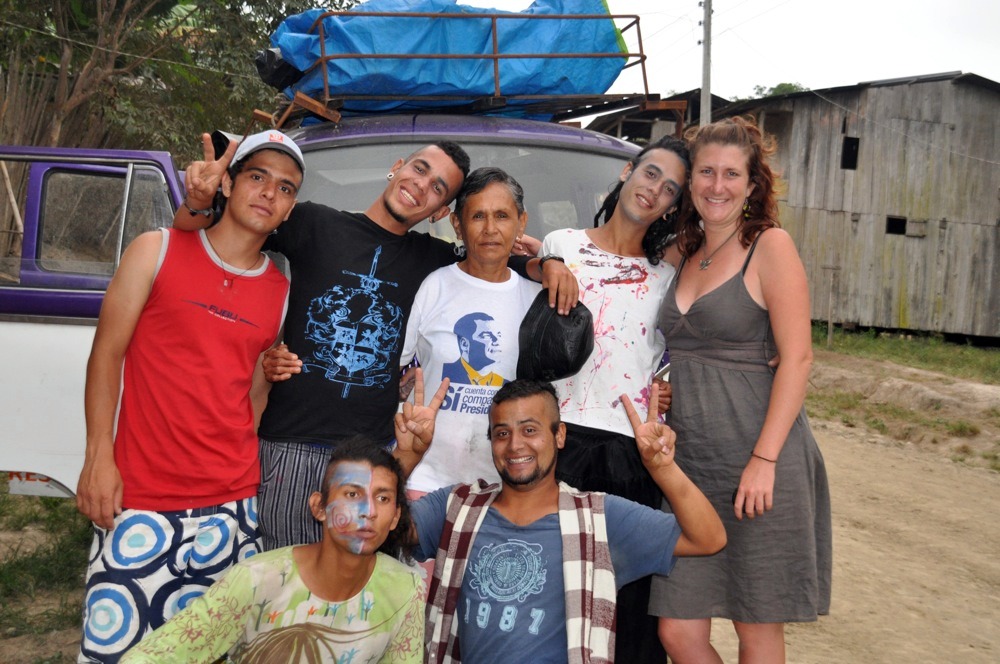
img: Camden Luxford on her recent road trip — in a tiny community about two hours form Pedernales in Ecuador, where she helped put on a juggling (among other things) workshop. She is posing with some of the kids and a teacher, along with members of the Colombian cumbia band she had as passengers for a couple of weeks. Yes, that’s the famous Kombi in the background!

STAY TUNED for tomorrow’s installment from our displaced fictional heroine, Libby, whose road-trip adventure of last week ended on a dramatic note. What, not keeping up with Libby? Read the first three episodes of her expat adventures.

If you enjoyed this post, we invite you to register for The Displaced Dispatch, a round up of weekly posts from The Displaced Nation. Includes seasonal recipes and book giveaways. Register for The Displaced Dispatch by clicking here!

Related posts:

RANDOM NOMAD: Tom Frost, Kindergarten Teacher & Expat Blogger

Born in: Hillsboro, Oregon USA
Passport: USA
Countries lived in: India (Belgaum): 1979-80; Japan (Mutsu and Hachinohe): 1983-88; Mexico (Mazatlán):2005-06; Argentina (Buenos Aires): 2006-09; Uruguay (Colonia del Sacramento): 2009-10; Asia (Japan, Thailand, Malaysia, Laos, Hong Kong): 2010-2011; China (Beijing): July 2011 – present.
Cyberspace coordinates: Expat Alley (blog)

What made you leave your homeland in the first place?
My wife, Maya Frost, and I left the US to give our children a taste of the world outside and to supercharge their brains with new languages, new challenges and new experiences. Maya wrote the book The New Global Student: Skip the SAT, Save Thousands on Tuition, and Get a Truly International Education, detailing our experiences getting the kids — we have four daughters — through high school and college without going the traditional route. Two of them are now working in Buenos Aires and Abu Dhabi. The other two are in New York, one of whom has just completed a couple of years working as a multilingual events coordinator on Norwegian Cruise Lines — she was craving some “land time.” Maya and I have settled in Beijing for the time being.

Is anyone else in your immediate family displaced?
My wife and I were both displaced Oregonians living in Japan when we first met. All of my family have traveled quite extensively. Like me, my three siblings were all Rotary exchange students for a year in France, Philippines and South Africa (I lived in India). For a time one of my siblings lived in Japan for several years. I have a niece in Barcelona, a nephew in Japan, a cousin in Africa…

Describe the moment when you felt most displaced.
Getting off a plane in Miami after being in South America for two years. It was overwhelming to understand everything that was going on around me. All the magazine racks were screaming that I was too fat, too old, too poor and too poorly dressed. I wanted so much just to get back on the plane and go “home” to Buenos Aires.

Describe the moment when you felt least displaced.
The longer I stay out of the US the more this is happening. The “normal” feeling for me now is to feel displaced. Not understanding the language, not feeling like one of the crowd, not recognizing anything on a menu — that is when I feel at home.

You may bring one curiosity you’ve collected from your adopted country into the Displaced Nation. What’s in your suitcase?
My wife and I are obsessively light travelers. Even when moving to a new place to live for an extended period of time, we never have more than one carry-on each. I am a firm believer in the old adage that “you don’t own stuff, your stuff owns you.” I have a compass that was left to me by my father and about 30 photographs (unframed) of our family — we buy new frames each time we set up a new home. Beyond those items we take nothing more than a few changes of clothes and our laptops.

You’re invited to prepare one meal based on your travels for other Displaced Nation members. What’s on the menu?
Let’s start with the drinks because they generally taste the same each time they come out of the bottle, unlike my favorite meals which are those have not yet tasted.

A bucket of iced Mexican Pacifico [a Pilsner-style beer] for the appetizer, chilled sake for the cold course, a hearty Uruguayan Tannat for the main, Argentine fernet for dessert — and a couple of Tylenol for a nightcap.

I love to cook and am in charge of all the meals in our house. But I do not use recipes and generally do not make the same thing twice. Each time I go to the grocery store I buy at least one item I do not recognize. Past favorites have included:

My current craving is for shrimp Chinese dumpling, purple cabbage and cucumber in a spicy chili sauce, with cut chives for garnish. How does that sound?

You may add one word or expression from the country you’re living in to The Displaced Nation argot. What will you loan us?
My ability with languages is less than stellar so I’d prefer to loan you a few body language motions.

From Japan: Sucking air through gritted teeth and turning your head to the side — this means you are giving something a great deal of thought but also buys time to figure out what what was just said. Even if you cannot come up with a reply, you get points for showing you are thinking hard about the subject at hand.

From Argentina: The shoulder shrug — a good way of masking your ignorance of an indecipherable comment. Essentially it means: “Sometimes shit just happens, you know?”

From India: The head bobble — it can be construed as an affirmation but is ambivalent enough that you can later change your mind and renege on whatever you agreed to. It is also fun to practice in the mirror for your own amusement when bored.

It’s Zen and the Art of the Road Trip month at The Displaced Nation. Robert M. Pirsig, author of Zen and the Art of Motorcycle Maintenance, famously said: “Sometimes it’s a little better to travel than to arrive.” Do you agree?
I dislike traveling without arriving.

There are certain things I immediately look for in any destination to make me feel at home, but in reality, it is silly I look for them — why bother traveling if I want to feel at home?

I love this paradox.

Pirsig’s book details two types of personalities: 1) those who are interested mostly in gestalts so focus on being in the moment, not rational analysis; and 2) those who seek to know the details, understand the inner workings, and master the mechanics. Which type are you?
I definitely lean more toward the rational mindset. I love getting to know transportation — specifically, bus routes and subways — as well as getting a handle on how traffic patterns have developed over time. As a child of the US suburbs, I used to equate riding public transportation with being a loser, but now I know it is freedom. And it’s not just rational, it can also be “in the moment.” Life happens on public transportation — the grateful glance from an elderly woman you give up your seat to on a subway in Tokyo, the giggles of the small child you play peek-a-boo with on the train in Kuala Lumpur, the strains of the guitarist serenading bus riders on a Friday afternoon in Buenos Aires. Nothing interesting has ever happened to me by myself in a car.

Readers — yay or nay for letting Tom Frost into The Displaced Nation? Tell us your reasons. (Note: It’s fine to vote “nay” as long as you couch your reasoning in terms we all — including Tom — find amusing.)

img: Tom Frost becoming displaced yet again — by an elephant in Pai, Thailand (June 2011).

STAY TUNED for tomorrow’s installment from our displaced fictional heroine, Libby, who is just back from a road trip with Oliver and Jack, during which she has pondered her new life and the Melissa situation. What, not keeping up with Libby’s expat adventures? Read the first three episodes here.

If you enjoyed this post, we invite you to register for The Displaced Dispatch, a round up of weekly posts from The Displaced Nation. Includes seasonal recipes and book giveaways. Register for The Displaced Dispatch by clicking here!

Related posts: