The Displaced Nation

A home for international creatives

Tag Archives: Africa

How to throw a party for a bunch of global nomads

One year has passed since our first random nomad, Anita McKay, crashed through the gates of The Displaced Nation, bribing the guards with chicken tikka masala and cranachan and shouting “bollocks” at several of us who tried to stop and question her.

And now there are 40 such nomads within our ranks — the latest being Annabel Kantaria, who insisted on bringing an alarm clock that looks like a miniature mosque — it rings every morning with the call to prayer. (Note to other founders: perhaps we need to find guards who aren’t so easily intimidated when travelers show a bit of temerity…)

Still, as we now have 40 nomads, randomly selected, why not make the best of the situation and throw a party? And what better excuse than The Displaced Nation’s 1st birthday — which, as announced by Kate Allison in a post a couple of days ago, took place on April 1 (no fooling!).

Further to that end, I’ve come up with a Party Primer that I think should work for this group — as well as for similar gatherings.

PARTY PRIMER FOR DISPLACED NOMADS

Click on the headlines below to go to each section:

  1. INVITATIONS
  2. DRESS CODE
  3. DECORATIONS
  4. MUSIC
  5. TABLE ASSIGNMENTS
  6. FOOD
  7. TOPICS FOR SMALL TALK
  8. PHOTOGRAPHY
  9. GAMES
  10. SONGS

INVITATIONS

As this party marks a special occasion (who ever thought we’d make it to be one year old?), a deluxe printed invitation is in order. The only thing is, our invitees are a bunch of nomads! We’ll be lucky if we can catch them on email, let alone at a fixed address. Let’s compromise on an attractively designed message: see mock-up at top of this page.

DRESS CODE

As some of you may know, Cleopatra recently paid a visit to The Displaced Nation. Based on her observations of today’s international travelers, we’ll be doing well if we can get the men to shower and change before joining us. As for the women, well, allow me to offer these pearls of wisdom from Jennifer Scott — the American guru of Parisian chic who was featured on this blog last week. Jennifer says:

There are certain occasions that always warrant dressing up. Generally any gathering … where others went to a lot of effort for your sake.

DECORATIONS

The theme is easy: the wide wide world! (Rather the opposite of Disney’s “It’s a small world after all” concept.) This calls for tablecloths imprinted with the world map (to make it easy for guests to point out where exactly “Moldova” etc is); globe-patterned balloons (can we coin a new term: globalloons?); and for the centerpieces, flags from each of the adopted country represented at the table in question.

Optional extras include party hats, noisemakers and loot bags. It’s fun when the loot contains some surprises. Given all the items our nomads have insisted upon carrying into The Displaced Nation, we should have plenty to choose from, eg:

  • mosque alarm clocks (thanks, Annabel!)
  • hairy coo fluffy toys (thanks, Nerissa!)
  • fake Harry Potter glasses (thanks, Charlotte!)
  • boomerangs (thanks, Kim & Vicki!)
  • brie bakers (thanks, Toni!)

MUSIC

As Todd Lyon, author of a number of party and lifestyle books, puts it:

Without music, a party isn’t a party. It might be an assembly, a meeting, or a bee, but it can never be a shindig, a bust-up or a ball unless there’s fine tunes that never stop.

Not being a party tunes buff myself, I’ve consulted with The Displaced Nation’s resident music expert, Kate Allison, about the kind of soundtrack that would cultivate just the right ambience. Her suggestions include:

Everybody all around the world, gotta tell you what I just heard
There’s gonna be a party all over the world…

TABLE ASSIGNMENTS

8-10 person tables work well. Since we’ll have 40 guests, I’ve decided on five tables of eight people each, and to mix everyone up as much as possible. Hostesses must also, of course, take steps to reduce the risk of a “silent table,” where people just eat and don’t talk. To be honest, I don’t there is too much risk of that with this crowd — have you ever watched a bunch of expats try to outdo each other with stories of their (cross-cultural, linguistic and travel) adventures? But just in case, I’m offering some “hostess notes” for each table (the hostess’s job being to introduce everyone and make sure the conversation keeps flowing!).

TABLE 1
Matthew Chozick (American expat in Japan)
Tom Frost (American expat in China)
Lyn Fuchs (American expat in Mexico — Sacred Ground Travel Magazine)
Turner Jansen (American canine in Holland)
Annabel Kantaria (English expat in Dubai — Telegraph Expat blog)
Kirsty Rice (Australian expat in Qatar — 4 kids, 20 suitcases and a beagle)
Jack Scott (English expat in Turkey — Perking the Pansies)
Karen van der Zee (Dutch/American expat in Moldova — Life in the Expat Lane)
Hostess notes: Introduce Tom Frost to Matthew Chozick — Tom used to live in Japan and speaks Japanese. Kirsty Rice should sit next to Turner Jansen, as she travels around with a beagle. Annabel Kantaria, Jack Scott and Kirsty all have in common life in the Middle East. Karen van der Zee and and Lyn Fuchs should find each other fascinating, as both have had some extraordinary adventures (Karen could entertain Lyn with her crocodile tale and Lyn, keep Karen amused talking about the time he went paddling with orcas.)

TABLE 2
Balaka Basu (Indian American in New York City)
Santi Dharmaputra (Indonesian expat in Australia)
Michelle Garrett (American expat in UK — The American Resident)
Robin Graham (Irish expat in Spain — a lot of wind)
Anita McKay (Indonesian expat in Australia — Finally Woken)
Brian Peter (Scottish expat in Brazil — A Kilt and a Camera)
Kate Reuterswärd (American expat in Sweden — Transatlantic Sketches)
Wendy Tokunaga (Former American expat in Japan)
Hostess notes: You might want to break up Santi Dharmaputra and Anita McKay, who are the same nationality (Indonesian) and already friends. Anita should definitely be introduced to Brian Peter, who like her hubby, is Scottish, and will probably be amused by her stories of toasting oatmeal in whisky. And make sure Anita also talks to Wendy Tokunaga — I know from personal experience how intrigued Anita is by stories of Western woman marrying Asian men. To be honest, everyone at this table should really be socializing with everyone else, as each and every one of them has a partner of a different nationality! (Now if that isn’t a talking point, I don’t know what is…)

TABLE 3
Kim Andreasson (Swedish expat in Vietnam)
Jo Gan (American expat in China– Life behind the wall)
Jennifer Greco (American expat in France — Chez Loulou)
David Hagerman (American expat in Malaysia — SkyBlueSky)
Helena Halme (Finnish expat in UK — Helena’s London Life)
Vicki Jeffels (Kiwi expat in UK — Vegemite Vix)
Janet Newenham (Irish internationalist — Journalist on the run)
Adria Schmidt (former Peace Corps worker in the Dominican Republic)
Hostess notes: Seat David Hagerman next to Jennifer Greco — since his wife is a well-known food writer and expert cook, he’ll find nothing strange in her quest to sample all the known French cheeses. Janet Newenham should be near Adria Schmidt and Kim Andreasson as they are all interested in international affairs. Vicki should be introduced to Helena as I’m sure the latter would love to hear about her recent spa experience in Cyprus. Jo Gan, too, should meet Vicki as she is now experiencing visa problems with the Chinese authorities — on a level that may even surpass Vicki’s own nightmare experience in Britain.

TABLE 4
Aaron Ausland (American expat in Colombia — Staying for Tea)
Emily Cannell (American expat in Japan — Hey from Japan)
Charlotte Day (Australian expat in UK)
Toni Hargis (English expat in USA — Expat Mum)
Vilma Ilic (Former aid worker in Uganda)
Jennifer Lentfer (Former American expat in Africa — How Matters)
Camden Luxford (Australian expat in Argentina — The Brink of Something Else)
Piglet in Portugal (English expat in Portugal — Piglet in Portugal)
Hostess notes: Aaron Ausland will naturally gravitate towards Jennifer Lentfer as they are both deeply involved in global aid and development. Make sure you introduce the pair of them to Piglet in Portugal — she’ll ask them some thought-provoking questions about whether it’s better to save the world or cultivate your own garden. Jennifer should also be near Vilma as the two will want to share their Africa experiences, and you might urge Emily Cannell to join that conversation as well — she has such an adventuresome spirit! Along with Toni Hargis, who runs her own charity supporting a school in Ghana. As for Camden Luxford, she’s an easy one: a social butterfly! Perhaps she could take fellow Aussie Charlotte Day under her wing (ha ha) and make sure she gets plenty of material to write about for her courses at Oxford next year!

TABLE 5
Lei Lei Clavey (Australian expat in New York City)
Matt Collin (American expat in UK)
Megan Farrell (American expat in Brazil — Born Again Brazilian)
Liv Hambrett (Australian expat in Germany — A Big Life)
Mardi Michels (Australian expat in Canada — eat. live. travel. write | culinary adventures, near and far)
Iain Mallory (English adventurer — Mallory on Travel | Making Everyday an Adventure)
Nerissa Muijs (Australian expat in Holland — Adventures in Integration)
Simon Wheeler (English expat in Slovakia — Rambling Thoughts of Moon)
Hostess notes: As soon as Lei Lei Clavey, Liv Hambrett, Mardi Michels and Nerissa Muijs discover they all have Australia in common, they will be blabbing away — just hope it doesn’t turn into an Ozfest! Also, make sure Mardi connects with Matt — I suspect he may need her counseling about how to seek creative refuge from academia. Iain Mallory and Simon Wheeler will form a natural pair, exchanging stories of their travel adventures and perhaps even breaking into a rousing chorus of “Jerusalem.” But should their antics get too raucous, ask Mardi to step in: she teaches cooking classes to 9-11-year-old boys in Canada. Megan Farrell should connect with Nerissa and Simon on the topic of what it’s like to raise a child in a nationality (and language) other than your own.

FOOD

One of the purposes of gathering together nomads from the four corners of the earth has to be eating, especially if each of them brings along some of their favorite dishes. For our party, we will have a dazzling tableaux brimming over with rare and exotic foods. (We know that because our Random Nomads have already described their faves to us in their interviews.)

Shall we go over the list? (Warning: Don’t read on an empty stomach, or if on a restricted diet!)

NIBBLES/STARTERS

  • Guacamole & chips (Kim — recipe provided)
  • Selection of mezze with pita bread (Annabel Kantaria)
  • Assorted pinchos (Megan Farrell)
  • Avocado & mango salad (Matt Collin)
  • Bhelpuri (Tom Frost)
  • Satay sticks (Nerissa Muijs)
  • Four kinds of eggs: tea eggs, thousand-year-old eggs, fried eggs with tomato, and boiled salted eggs with a chicken embryo inside (Jo Gan)
  • Shrimp & grits (Lei Lei Clavey)
  • Vietnamese caramelized chili prawns (Mardi)
  • Ceviche (Camden Luxford)
  • Bluff oysters from New Zealand (Vicki Jeffels)
  • Gravad lax with Finnish rye bread (Helena Halme)
  • Tuna sashimi with ponzu sauce (Emily Cannell)

COCKTAILS

  • Traditional Bloody Marys (Lei Lei Clavey)
  • Caipirinhas (Megan Farrell)
  • Margaritas (Kirsty Rice)

WINE

  • Rich red wines from Lebanon (Annabel K)
  • Red wine from Macedonia (Vilma Ilic)
  • Malbec wine from Argentina (Camden Luxford)
  • Shiraz from Australia (Vicki Jeffels)
  • White wine from Australia (Simon Wheeler)
  • Chilled sake (Tom Frost)
  • Rice wine (Jo Gan)

BEER

  • Carlsberg browns (Matt Collin)
  • Cusqueña beer (Camden Luxford)
  • Mexican Pacifico (Tom Frost)
  • Harbin beer (Jo Gan)
  • Coopers beer (Simon Wheeler)

MAINS
Meat dishes:

  • Carne de Porco a Alentejana (Piglet in Portugal)
  • Schnitzel served with rotkohl (Liv Hambrett)
  • Bondiola-chevre-basil wraps and nattō (Tom Frost)
  • Fried chicken sandwiches with hand-cut fries (Lei Lei Clavey)
  • Chicken tikka masala (Anita McKay)
  • Libyan soup (Kirsty Rice — recipe provided)
  • Cuban ropa vieja (Mardi)
  • Argentinian steak cooked rare (Camden Luxford)
  • Tapola black sausage with lingonberry jam (Helena Halme)
  • Barbecued steak, snags & lamb chops (Nerissa Muijs)

Fish dishes:

  • Paella Valenciana (Megan Farrell)
  • Llish in mustard and chili paste, smoked in banana leaves (Balaka Basu)
  • Chambo curry with nsima (Matt Collin)
  • Moreton Bay bugs (Vicki Jeffels)
  • Grilled salmon on a plank (Emily Cannell)
  • Sushi (Simon Wheeler)

Vegetarian offerings:

  • Peanut butter vegetable stew (Jennifer Lentfer)
  • Overcooked spaghetti with carnation milk, canned tomatoes and corn (Adria Schmidt)

DESSERTS

  • Summer pudding (Toni Hargis)
  • Apple crumble (Matt Collin)
  • Cranachan (Anita McKay)
  • Hot fudge sundaes (Lei Lei Clavey)
  • Blackberry gelato (Balaka Basu)
  • Caramel cheesecake (Kirsty Rice)
  • Bread pudding with Bourbon sauce (Jennifer Greco)
  • Île flottante (Mardi)
  • Molotof cake (Piglet in Portugal)
  • Mouse de maracujá (Megan Farrell)
  • Tiramisu (Camden Luxford)
  • Homemade Slovakian cream cakes (Simon Wheeler)
  • Dutch waffles (Turner Jansen)
  • Oblande, tulumbe, kadaif & krempite (Vilma Ilic)
  • Umm Ali (Annabel Kantaria)
  • Sigara borek (Jack Scott)
  • Juustoleipä with fresh cloudberries and cream (Helena Halme)
  • Yangmei fruit (Jo Gan)
  • Languedoc cheese: Roquefort, Pélardon and Tomette des Corbières (Jennifer Greco)

AFTER-DINNER DRINKS

  • Chlicanos (Camden Luxford)
  • Rakija (Vilma Ilic)
  • Fernet (Tom Frost)
  • Homemade Slivovica (Simon Wheeler)
  • Dragon-wall green tea (Jo Gan)
  • Espresso (Balaku Basu)
  • Large “flat whites” (Charlotte Day)

FOR THE TOAST(S):
New Zealand champenoise (Vicki Jeffels)

NOTE: Charlotte Day will be cooking a Sydney-style breakfast for diehards who care to linger to the next morning. (And Nerissa Muijs will be frying up some bacon!)

TOPICS FOR SMALL TALK

There are some topics that should be avoided at all costs. As style writer Rita Konig puts it,

It is very dull to talk about journeys. Once you have arrived somewhere, try to keep quiet about how long it took you to get there.

Should you notice anyone engaging in this, put the kibosh on it by asking them to help with pouring drinks, or with putting away coats in the spare room.

PHOTOGRAPHY

Fortunately, there’s usually one great photographer or two in a group of global nomads, thereby saving unnecessary expenditure. (We will ask David Hagerman — he’s sensational!)

GAMES

Games are a great ice breaker. Here are a few that might be appropriate for a well-traveled crowd:
1) Musical countries: Draw a big map on a piece of vinyl (back of a Twister mat might do), and give everyone a flagpole. When the music stops, they must place the flagpole on a country, Anyone whose flagpole ends up in the ocean is out.

2) Variation on “Pin the Donkey”: Pin the rudder on the 747! (Contributed by Kate Allison.)

3) Word games: As we’ve found out from our interviews, global nomads pick up words and expressions from here and there. Taking some of these and mixing them together, we can come up with some pretty strange exchanges. (Prizes for anyone who manages to decipher!)

A: Prego, could you get me a ba ba ba? Kippis!
B: Inshallah, a barbie would also be awesome. And how about la ziq?
A: Avustralyalılaştıramadıklarımızdanmışsınızcasına.
B: So desu ne!

A: Tudo bem? You look a bit daggy.
B: Life can be arbit sometimes.
A: Zvakaoma.

A: Hey.
B: Hey. Das stimmt, sorry to be such a Debbie Downer but I’m knackered after all this work.
A: Bless!
B: Zikomo.

A: Oh la vache! You are lost. Siga, siga. Ni chifan le ma?
B: Bollocks! [Sucking air through gritted teeth.] I think I got lost in the wopwops.
A: Well, there’s the big ol’ tree out the front.
B: Bula! Okay-la. Le bon ton roule!

TOASTS

Toasts should be made repeatedly throughout the latter half of the dinner. Just in case no one feels inspired, prepare one or two classics for the host or hostess to offer, eg:

I’d rather be with all of you than with the finest people in the world.

SONGS

Songs can be sung in several languages. In this case, a stirring rendition of “Happy Birthday” is called for, sung not only in English but in:
Dutch (Karen, Nerissa)
Finnish (Helena)
French (Jennifer, Mardi)
Indonesian (Anita & Santi)
Japanese (Emily, Matthew, Tom, Wendy)
Spanish (Aaron, Adria, Camden, Lyn, Megan, Robin)
Swedish (Kate, Kim)
Woof-woof (Turner)

Finally, the party should end with the Displaced Nation founders treating the guests to a round of:

For you are all jolly good fellows, for you are all jolly good fellows,
For you are all jolly good fellows…
Kate, Anthony, Tony: And so say all of us!
ML: Which nobody can deny!

* * *
Have I left out any important details? Any tweaks you can suggest? Your turn!!! Let’s work together to make this the most awesome gathering of global nomads ever. Onegaishimasu, shokran — and all that!

STAY TUNED for tomorrow’s installment from our displaced fictional heroine, Libby. She is expecting a visitor: her own mother, who is — in theory — coming to help as her due date gets closer. Will Granny Jane be an improvement on Sandra, the MIL from hell — or will she prove to be one more spanner in the works for our poor displaced heroine? (What, not keeping up with Libby? Read the first three episodes of her expat adventures.)

If you enjoyed this post, we invite you to register for The Displaced Dispatch, a round up of weekly posts from The Displaced Nation, with seasonal recipes, book giveaways and other extras. Register for The Displaced Dispatch by clicking here!

Related posts:

An Italian with a passion: How to live the Dolce Vita, with Barbara Conelli

Barbara Conelli is a woman on a mission — a mission to bring, as she puts it on her website, “Fantastic Fearless Feminine Fun into women’s lives.”

A prolific writer, with one book already published (Chique Secrets of Dolce Vita, a journey through Italy), another coming out in May, and other writing credits galore, Barb “invites women to explore Italy from the comfort of their home with elegance, grace and style, encouraging them to live their own Dolce Vita no matter where they are in the world.”

While many of you will be familiar with her writing and blog, others will know Barb from her popular Chique Show at Blog Talk Radio, where she interviews authors and talks about life in and her passion for Italy.

Today, though, it’s Barb’s turn to be interviewed.

Thank you, Barb, for agreeing to be interviewed! Can you tell us a bit about your background — where you were born, where you grew up, where you studied?
I was born in London to an Austrian mother and an Italian father. My background was incredibly multicultural and the fact that I had relatives in different countries who spoke different languages encouraged me to start learning the languages they spoke, and when I did, I realized some of the relatives were much nicer when I didn’t understand them. But it was too late; at that time I was already speaking eight languages and traveling around the globe, a passion that turned out to be totally incurable. I tried hard to be a homebody but it never worked.

A chronic gatherer of knowledge, I studied at several universities in Spain, Portugal, Italy and the US, and when I got my second PhD I realized the academic career was totally killing my creativity and my soul. (As you can see, realizing important stuff too late was a pattern in my 20s.)

Although I’ve had many homes away from home, Italy has always been my real home. Grandma Lily, my paternal grandmother, made sure I grew up to be a real Italian – food-loving, high-spirited, untameable, capricious and addicted to shoes. I frequently visited my cousins in Italy already when I was a kid, and when I got my heart-broken by an Italian at the age of sixteen, I knew there was no turning back. I was an Italian. Until today I’m not sure whether it’s a blessing or a curse. (Thanks, Grandma Lily!)

You split your time between New York and Milan, correct? When did you move to Milan, and why there in particular?
That’s right! Grandma Lily was born in Milan. She left the city and the country with her parents when she was a little girl and she never went back. However, the city stayed in her heart. I visited Milan many, many times, but I decided to actually get a place there and make it my home when I started to think about writing a book about the city. I wanted to really live it, breathe it, be it. I couldn’t live in Tuscany and write about Milan. That would have made me a tourist, not a Milanese. And I wanted to be one with the city and become familiar with its many faces.

Your first book, Chique Secrets of Dolce Vita, was published last year, and your second, Chique Secrets of Dolce Amore, is due to be published in May. Can you tell us a little about your new book?
Yes, I’d love to! I’m so excited because my editor has just sent me the final version of the manuscript, and I’m totally in love with the book! In Chique Secrets of Dolce Amore, I share my unexpected encounters with the capricious, unpredictable and extravagant city of Milan, its glamorous feminine secrets, the everyday magic of its dreamy streets, the passionate romance of its elegant hideaways, and the sweet Italian art of delightfully falling in love with your life wherever you go. This book is very informative and contains lots of factual information about the city, but at the same time it’s very poetic, lyrical and romantic. It shows that Milan is the perfect city to have a love affair with.

And what happens after Dolce Amore? Another book? Can you give us any hints?
There are several exciting projects I’m working on. Later this year, I’m planning to publish a collection of selected articles and essays I’ve written about Milan and published in magazines and on my blog. I’m also putting together a travel anthology that’s going to be released in the fall, with travel essays and short stories written by sixteen amazing, wonderful authors.

As far as my Chique Book series is concerned, with Chique Secrets of Dolce Amore I’m leaving Milan and venturing into Rome. The next book is titled Chique Secrets of Dolce Far Niente, and in this book I’m going to reveal the hidden face of Rome and share with my readers the Roman art of pleasant, carefree idleness.

My books always have a deeper message and I love using the city I write about as “the stage of life”, a creative space where we can learn, grow and get to know ourselves. Milan is about loving your life and finding beauty in simple, everyday things. Rome is about being fully present in your life instead of exhaustingly focusing on doing, doing, doing.

Something that comes across loud and clear in the reviews of Dolce Vita is your talent for writing descriptive prose and storytelling. What made you decide to write non-fiction rather than a novel?
A good question! I’ll be honest with you: I am working on a novel (okay, looks like I’ve just come out of the closet and admitted I’m a shadow novelist). However, I find writing fiction much less appealing. I love exploring the real world, I love talking to people, I enjoy discovering their stories, understanding what makes them tick. I’m incredibly curious and inquisitive, and I always look deeper, beyond the obvious, the visible. My readers often say that when they read my book, they feel they’re actually there with me, experiencing the same things, tasting the food, submerging themselves in the atmosphere. My books are like a magic carpet that takes you to beautiful places enabling you to live a beautiful adventure sitting in an armchair and wearing your jammies. I truly believe that being able to give this to the reader through the pages of my book is a miracle, and it makes me endlessly happy.

What audience did you have in mind for Dolce Vita when you first wrote it, and did you end up attracting those sorts of readers?
It’s an interesting question. I write primarily for women and I wanted my book to appeal to experienced, avid travelers as well as to those who dream of Italy and desire to explore this beautiful country. I definitely succeeded in connecting with my audience and I’m very grateful for my fabulous readers and fans from all around the world who give me lots of love, support, encouragement and wonderful feedback. However, I was very surprised to see that my book attracted also many male readers who totally enjoyed my writing. I just love that.

To which aspects of your writing have readers responded the most?
When you read the reviews, there seems to be one strong common denominator: “I felt I was really there with the author.” I’ve been so touched by this, and I feel very blessed because it means I’ve been able to get my message across and bring Italian beauty, charm and grace into the lives of many women. This is my definition of success – doing what you love and touching other people’s hearts by sharing your passion with them.

Have you written anything else?
I have two previously published books on relationships and self-love, based on my coaching career. I have also written screenplays for TV shows and scripts for TV talk shows. And I’m a movie translator – I have translated and subtitled over 800 feature films, shows and documentaries for major movie studios, TV channels and distribution companies. I have also translated several fiction and poetry books. Yes, I’m a typical “slasher” – a multi-talented person with many careers. But if you ask me who I truly am, my answer is I’m a writer and traveler. That’s my soul’s calling.

I first heard you — and heard of you! — on your blog talk radio show, the Chique Show. How long has the Chique Show been running?
Chique Show has been broadcasting for about a year. It has gained incredible momentum and today, just 12 months later, we have over 5,500 listeners, recently adding more than one hundred new listeners every week.

Is a radio talk show something you have always wanted to do?
When it all started, it really wasn’t my goal or dream to be a radio hostess, although I had always found this medium fascinating. Chique Show was meant to be just another platform to promote my new book but I immediately fell in love with it, and today it’s much bigger than I ever imagined. Chique Show is a great connector, a wonderful opportunity to meet new people, and my way of giving back and bringing authors closer to their readers.

How would you like to see it evolve?
I would love Chique Show to become a featured, branded show that would broadcast every day on a variety of topics. You know, one of my mottos is the words of Donald Trump: “If you’re going to think anyway, think big.” And Eleanor Roosevelt’s: “You must do the thing you think you cannot do.” I’m a visionary, and there’s not just a branded radio show on my vision board, but also a magazine and TV channel. I love challenging myself and pushing my own boundaries. My mum says I decided I was going to be a success story already as a toddler. I’ve always been stubbornly creative and free-spirited.

You’ve had a lot of guests on the show. Have there been any particularly memorable moments?
You know, I really love those moments when my guest and I totally click. When we find a topic we’re both fascinated about, we chat, we laugh. There’s a fantastic vibe and irresistible energy that totally fill the radio waves, and our listeners can feel it. We are just wonderfully connected.

I’ve also had deeply moving moments on the show when my guests opened up and talked about their life experiences, their struggles, their pain, and how they managed to overcome adversity and follow their dreams.

One of my favorite shows is the interview with author Lyn Fuchs that you featured here on Displaced Nation a couple of months ago. I love smart, talented, open-minded and humble people who are not afraid to do their thing and stand out from the crowd. Lyn is one of those people and having him on the show has been a real pleasure.

Is there anyone you would *love* to interview on your show — a “fantasy” interviewee, as it were, be they alive or dead?
Leonardo da Vinci: the most fantastic “slasher” in history. I wrote about his years in Milan in Chique Secrets of Dolce Vita, and I find him fascinating. I believe his genius is still undervalued. Madeleine Albright, a lady who epitomizes feminine power and wisdom. And Grandma Lily — the sage of my family.

With March being Fashion Month, many of our recent posts have been fashion- and style-related. Now, if you’ve actually read any of those posts, you’ll have realized that three of us anyway are the last people on earth who should be advising on fashion. I poke fun at haute couture, Anthony’s fashion advice begins and ends with chinos and a shirt, and Tony’s staple apparel is shorts and T-shirts. As someone who has made her home in two of the world’s fashion capitals, can you give us any tips about where a couture-challenged person can start?
Okay, my fantasy’s running wild here. Chinos make me think of Indiana Jones (a.k.a. Harrison Ford at his best). And shorts and a t-shirt? Matthew McConaughey. Hot, sexy, juicy! (May I join your team like right now?)

I love fashion because to me it’s yet another expression of creativity and art. It’s also one of the easiest ways to say who you are. You can use fashion to make a statement and I’m totally non-judgmental when it comes to people’s choices.

The best piece of advice is, be yourself. You don’t need to choose one style or color palette and stick with it forever. Fashion is a game and it’s meant to be played and enjoyed. Fashion is not created by designers, it’s created by you, every single morning.

In my closet, you’d find little black dresses and faded jeans, pantsuits and colorful skirts, white shirts and t-shirts with wild patterns. Lots of scarves and hats and other accessories. My wardrobe has as many faces as I do because I may be different every day but I always insist on being myself.

To sum it up, stop flipping through fashion magazines and show the world how beautifully unique you are!

OK, so we’re following your advice and doing a bit of retail therapy in two continents. Where would you suggest as first stop for shopping in Milan?
I suggest you leave your Lonely Planet Guidebook in your bag and start exploring. I love Milanese vintage stores, visiting them is a real adventure. I can recommend “Cavalli e Nastri” in Via Brera, or Oplà in Via Vigevano. For original jewelry, Vigano in Galleria Vittorio Emanuelle. And a Borsalino hat is a must!

And then we take a transatlantic flight and go shopping in New York…where’s our first stop there?
Tiffany & Co., of course! Okay, just kidding. The Tiffany store in both Milan and New York plays a very important role in the last chapter of Chique Secrets of Dolce Amore where it turns into a spicy matchmaker. Plus, I love Breakfast at Tiffany’s.

I almost never shop for clothes in New York but I love New York bookstores. I live on Broadway and I’m addicted to the Strand Book Store at the corner of Broadway and 12th Street.

And on Saturdays, I love going to the Greenmarket at Union Square, the most wonderful outdoor market in New York whose atmosphere reminds me of Italy.

Splitting your time between two countries as you do, do you find it difficult to settle into the ways of one country after a length of time in the other?
Actually, it’s funny because when I come to Milan, my friends usually tell me: “Stop being so American!” It takes me a few days to slow down and return to the spirit of la dolce vita. It always reminds me how fast we actually live in the States, and how we allow life to just pass us by.

When I return to New York, it takes me about a week or two to get used to the bustle of the city. I love New York, it’s an incredibly vibrant city, but it can truly wear you down. You need to manage your energy really well and set your boundaries. Although New York is said to be the city that never sleeps, a New Yorker needs to get some sleep at least every now and then.

What aspect of Italy would you like to transplant to New York life — and why?
The art of taking the time to actually live. Experiencing life with gratitude and a sense of awe. The sweetness of human experience. Achieving great things is wonderful, but your life needs to be balanced, and that’s what New York sometimes misses. We need to stop and smell the roses more often.

What about vice versa? Any aspect of New York life you would like to transplant to Italy?
The glitz, the flashiness and the flamboyance. New York is a self-confident brat and it would be fun to see more of that in the easy-going, laid-back Italian way of life.

You’ve traveled extensively — have you discovered any other places where you’d like to live for a while?
After living in Middle East, Africa, in the Australian outback, in stunning European cities and wonderful metropolises of this world, I would like to create one more home-away-from home in French Polynesia. Sleep, eat, dance, swim in the ocean and write books. My idea of writer’s heaven.

Your suggestion about joining the TDN team? Yes — on condition we can all descend upon your new home in French Polynesia… Heaven indeed. Thanks, Barb, for talking so honestly to us!

We will hear more about Barbara Conelli in a few weeks, when we review her new book, Chique Secrets of Dolce Amore, and subscribers to the Displaced Dispatch can look forward to another exciting giveaway!
If you enjoyed this post, we invite you to subscribe for email delivery of The Displaced Dispatch, a round up of the week’s posts from The Displaced Nation. Sign up for The Displaced Dispatch by clicking here!

Related posts:

Image: Barbara Conelli

Talking with former expat Meagan Adele Lopez about travel, romance & novel/screenplay writing

Earlier this week I caught up with Meagan Adele Lopez, actor, world traveler, blogger and now a first-time author. She self-published her novel, Three Questions: Because a quarter-life crisis needs answers, in October of last year. It was featured on The Displaced Nation’s post Best of 2011: Books for, by and about expats.

Meagan — who is also known as MAL and the Lady Who Lunches (after her blog of that title) — may have just three questions, but I had quite a few more! I wanted to find out what inspired her to write her book, which she is now attempting to turn into a screenplay — the story behind the story…

Here’s what she had to say.

Meagan, I think it’s fair to say that you’ve been around a bit — I mean that in the nicest possible sense! Would you mind telling us a bit about your background — where you grew up, what you studied?
Do you mean I’ve been around as in I’ve lived for a long time, or do you mean I’ve traveled loads? (I won’t bother going to the other possibility!) Actually, I am getting up there in age — just six more months of my twenties; but there’s no need to rub it in, Tony! Just kidding. I think I’ll be relieved to be out of my twenties. What a crazy ride they were!

No, of course I wasn’t referring to your age — I’m an English gentleman, remember? I meant, you’ve lived in quite a few places — and that was before you moved abroad.
By the time I was 12 years old, I had lived in 12 different houses, and four different states. I pretty much grew up in a suburb of Baltimore called Towson. I say “pretty much” because I also lived in Tennessee and New Jersey for two years in between. But Towson is where I call home.

You have a passion for acting. When did you develop it?
Since I was eight years old, acting was all I wanted to do. For high school, I auditioned for a conservatory arts school called Baltimore School for the Arts (it boasts Jada Pinkett, Josh Charles and Tupac as students), where I was lucky enough to be trained by professional actors everyday.

Funnily enough, I wanted to be an actor, too. What drew you to the profession?
I had this fear that my life would pass too fast, and acting was somehow a way to slow down time, and be “in the moment.” Nowadays I find that writing is what does this for me. I am able to record thoughts and moments forever. Very existential, I know.

But you haven’t completely lost your passion for acting — I see you’ve instilled it in your main character, Adele (“Del”), in Three Questions. And I noticed there’s a mention of a horror film in your author’s bio — could you tell us a bit about that?
About the horror film? Oh no, you really don’t want to know about that (wink). But okay, my first starring role was in a horror movie called Sleepy Hollow High, about students who believe that the legend of Sleepy Hollow is real. It’s one of those films that is so cheesy and kitschy that it might be considered entertaining at some level. At the time, I was just excited to be in something, but it certainly wasn’t Oscar-worthy — ahem — at all. 

And you also got into some major motion pictures?
My first speaking role in a big Hollywood movie was as a cocktail guest in Traffic, with Catherine Zeta Jones and Michael Douglas — now there’s an Oscar worthy film. Unfortunately, my lines got cut — but you can still see me shaking Michael Douglas’s hand. I got my Screen Actors Guild card from acting in small parts in Enemy of the State, a spy-thriller starring Will Smith, and The Replacements, a college football film starring Keanu Reeves. Numb3rs was my first TV show.

Wow — you gave all that up to become a writer?
I got disillusioned with acting after working in casting for four years. I saw how completely random and superficial some of the choices can be for who gets cast. I’d gotten into acting for a much more altruistic goal — I wanted to make a difference in how people see the world — but ultimately realized that the place where I could make a real difference, because I have control over my own success, was with writing. Without great content, after all, actors couldn’t do their job!

Well you’re having plenty of success with writing. In addition to the book (which we’ll come to, don’t worry!), you started up a popular expat blog, A Lady Who Lunches, while you were living in the UK. Now that you’ve repatriated, and are living in Chicago, are you still keeping it up?
When I got to Chicago, the blog went through a bit of an identity crisis. Even though I’d never lived in that city, writing about the adventures of a newbie Chicagoan didn’t really interest me. Especially since I was no longer lunching — I was working, hard. Though I still have the same URL and twitter handle (@theladylunches), I now call the blog by my own name, and I’m glad I’ve kept it up. It’s a built-in fan platform that has helped me to sell my novel.

You’re also something of a social media guru. Are there any secrets you can impart to other bloggers about building an audience?
I didn’t set out for the blog to become popular (and thank you for saying so). It was a lot of ground work, as well as trial and error. You can’t expect results from a blog unless you’re updating it frequently, creating a community with other similar, like-minded people, and engaging with them on a consistent basis. My biggest piece of advice to other bloggers is to take a course in SEO. I never really paid attention to SEO, and it wasn’t until I took a course that I realized the importance of knowing the basics. Simple things like: are people even searching for the topics that you’re writing? Are you wasting two hours of writing time on a topic that gets only 100 hits per month?

Now let’s turn to Three Questions, which follows the developing love between two young people — who have only met each other once, by chance, on a night out in Las Vegas. The love interest, Guy, is from England, as is your real-life boyfriend, Jock. So what I’d like to know is, just how much of the book is autobiographical?
This is a question that Jock and I dodge quite often! I would say that about sixty percent of the book is autobiographical. There are many similar personality characteristics between Guy (Del’s boyfriend) and Jock, and between Del and me, Even the outline of the story conforms quite closely to what happened to Jock and me. Jock and I did meet in Las Vegas before his trip to Africa, and we did write letters back and forth to get to know each other. Hey — they always say to write about what you know, so that’s what I did! However, “how” things happened — and obviously the ending — are all very different.

One of my favorite aspects of the book was the use of the three questions in each email between Del and Guy, which the couple used to get to know one another during their long separation. It’s genius! Where did the idea for that come from?
Thanks, Tony! It came from Jock, actually. He used to play a questions game with his mates in England when they were out at the pubs. They were quirky questions like “If you were an animal, what would you be?” When Jock went traveling through Africa and we had only met that one night, he decided to take a slightly different spin on it, and ask me three VERY different questions to get to know me. It was such a great way to get to know someone, and build up the intensity and connection. I highly recommend it for anyone who has a long-distance relationship.

Tell us about the screenplay for the novel.
At the end of last year, I raised some money through a Kickstarter campaign to take the novel to the next level, which hopefully will include turning it into a movie. I’m working on the screenplay now, and then I’ll pitch it to Hollywood. What they do with it after that is up to them.

To give you a taster, Meagan has just released this movie-style trailer for the book, which is awesome!

Right, here’s something your fans will be keen to know the answer to: are you writing another book, and can you share any juicy details with us? Is it about travel again?
I’m now working on a second novel, which — particularly as a citizen of The Displaced Nation — you’ll be interested to learn is about someone who is forcibly, not voluntarily, displaced. It’s about a Cuban teenager who was torn from her homeland and true love in the early 1960s — and the struggles, ghosts and eventual success she faces in the United States leading up to today.

Love is a recurring theme in your writing, and one we’ve been looking into recently at The Displaced Nation. So, post Valentines Day, do you have an advice for the singletons out there, wherever they are?
My only advice is to figure out who you are first, and what you want before worrying about finding someone. I really believe that the right man or woman will come when you finally decide that you’re the most important person in your life, and you are taking care of you.

And I have to ask this of someone who has written such a beautiful and memorable love story; tell me about True Love. Does it exist? Is there one person for each of us?
Wow — that’s the kind of question that years ago, I always used to ask everyone else. I never thought I’d be on the receiving end. (Maybe I am getting old?!) I come from a family where love comes multiple times in their lives, so for a long time I never believed that there could be only one person for me. What I’ve come to learn is that with a mixture of timing, chemistry and hard work, true love can certainly be created. How else do I explain running into Jock in a bar in Vegas on Easter Sunday, and thus creating a life out of it, despite our different backgrounds, cultures and nationalities?

Yes, how does a girl from Towson get together with a bloke from Portsmouth? Can I ask, how is Jock coping with the transition to life in Chicago?
Ah… besides the constant yelling at the way we drive, the lack of manners that Americans have when opening doors, and absolutely hating the egos and pompous attitudes of our politicians and media? I would say he’s adjusted much better than I did when I was in England! (I did a lot better in Paris!) Luckily, Chicago has a variety of cultures. He has actually started a business with another Englishman, and found another good friend who’s English. Plus, I think he secretly loves the attention that his accent brings him.

And will your love story have a traditional ending — any plans to tie the knot?
He has one more year before he has to get down on his hands and knees. I gave him five years not thinking he would take the entire five! But we’ve had a few cross-continental moves in the past four years, which has made it challenging to find the right moment.

In Three Questions, Del describes her perfect future as “living by the water in a big city, traveling as much as possible.” You’ve traveled and lived in France and England, and now you’re living in the Windy City, presumably somewhere near the lake… Have you found that perfect future yet? Or is your dream different from Del’s?
Perhaps when I first started writing the book, that was my dream. But success is very important to me as well. I want to leave this life with a feeling that I have left a significant mark on people’s lives. I don’t think I will feel satisfied until that happens, which means I may always be striving to better myself, to make a difference… On a more practical note, I can see myself back in SoCal or having a flat in Paris eventually. That’s not too much to ask for, is it??

Thanks very much, Meagan! It was great chatting with you.

* * *

So, what do you all think? I loved Meagan’s book Three Questions and I’m not normally a fan of love stories and chick lit. I strongly recommend you all give it a read. Three Questions is available now on Amazon.com for the Kindle and, most excitingly of all, is now in paperback!
Three Questions on Amazon Kindle
Three Questions in Paperback

And luckily for you lot, Meagan has also agreed to participate in a giveaway, just for Displaced Nation readers!!!

She’s agreed to give a free ebook to the first 15 people who tweet: I want a free copy of @theladylunches’ new romance from afar novel, #ThreeQuestions via @displacednation

AND, she’s offered to give away a free copy of the paperback to the best comment in the comments section.

So what are you waiting for? Let’s chat 🙂

STAY TUNED for tomorrow’s episode from our long-running expat soap, Libby’s Life. You can look forward to a battle with tiger-mums, a three-hour glucose tolerance test, one suspected case of galloping dandruff, and the crowning glory of a Valentine’s Day party for three-year-olds. (What, not keeping up with Libby? Read the first three episodes of her expat adventures.)

If you enjoyed this post, we invite you to register for The Displaced Dispatch, a round up of weekly posts from The Displaced Nation, with seasonal recipes, book giveaways and other extras. Register for The Displaced Dispatch by clicking here!

Related posts:

Images: Meagan Adele Lopez; Three Questions book cover (designed by Kathleen Bergen).

10 expat books ripe for movie adaptations

Those who have been following this blog for some time are probably all too aware of my unhealthy preoccupation as to what constitutes an expat or travel book.

Is it, as often seems the case when I browse the expat blogosphere, that expat books must occupy themselves with the oh-so-amusing hi-jinks of expat life? The result almost invariably of such approach is that we are depressingly left with another third-rate knock-off of Bill Bryson for us to throw on the bonfire.

So when considering which expat books are ripe for movie adaptations, my first thought is that the film world, not to mention the world in general — at least, the one I want to live in — really doesn’t need any more travesties such as Under the Tuscan Sun, A Good Year or — most horrifying of all — Eat, Pray, Love. So with that in mind I will nominate the following 10 expat books as being ripe for interesting adaptations.

10. A Moveable Feast (1964, revised 2009)

Author: Ernest Hemingway
Synopsis: Hemingway’s posthumously published memoir detailing his years as a young American expat in Paris socializing with the likes of F. Scott Fitzgerald, Gertrude Stein and Ezra Pound.
Film pitch: Perhaps now is the perfect time for an adaptation of A Moveable Feast. The surprising success of Woody Allen‘s Midnight in Paris will perhaps have whetted Hollywood’s appetite for a more serious take on the same subject matter.

9. One Fat Englishman (1963)

Author: Kingsley Amis
Synopsis: Inspired by a year Amis spent teaching at Princeton, One Fat Englishman follows the badly behaved Roger Micheldene with Amis’s typical brio. An English gentleman who is affronted by everything on the American scene, Roger fails to see how his presence might adversely affect Anglo-American relations.
Film pitch: Cast Timothy Spall as Roger and watch the fireworks.

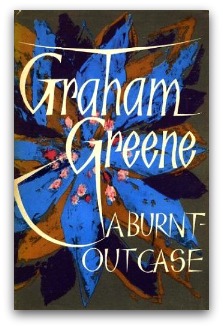
8. A Burnt Out Case (1960)

Author: Graham Greene
Synopsis: A man named Querry arrives at a leper colony in the Congo. He assists the colony’s doctor, who diagnoses him as suffering depression. It is revealed that Querry is in fact a world-famous architect, though he is hiding other secrets, too.
Film pitch: Perhaps Greene’s bleakest work — which may explain why it hasn’t been filmed previously despite being optioned twice by Otto Preminger (Greene was said to be thankful that it was never made). I would argue, however, that it has all the material for a fascinating film.

7. Travels through France and Italy (1766)

Author: Tobias Smollett
Synopsis: After the sad death of his daughter, Tobias Smollett and his wife left England for a tour of France and Italy. Detailing the quarrels Smollett has on his journey with those pesky Continentals, this is a very funny book.
Film pitch: Yes, I am suggesting that someone should make a movie based on an 18th-century travelogue. If Robbie Coltrane and John Sessions can turn Boswell and Johnson’s tour of the Hebrides into a delightful TV movie then I think the same could be done with this.

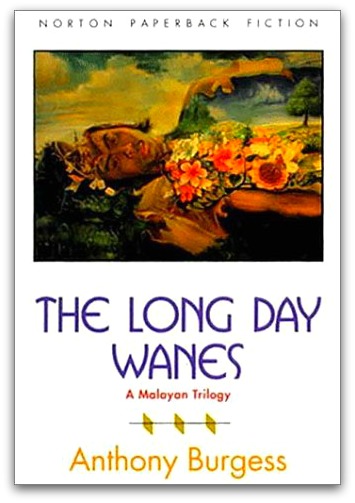
6. The Long Day Wanes: A Malayan Trilogy (1956-59)

Author: Anthony Burgess
Synopsis: Burgess’s first three novels are concerned with the character of Victor Crabbe, a teacher in a village in Malaya (now Malaysia). Based upon Burgess’s own experiences as a British civil servant in Malaya, the three novels that make up The Long Day Wanes detail the death of Empire and the birth pains of a newly independent nation.
Film pitch: Other than A Clockwork Orange, whose adaptation Burgess had strong misgivings over, Burgess’s work often seems overlooked for movie adaptations. It really shouldn’t be.

5. The Thousand Autumns of Jacob de Zoet (2010)

Author: David Mitchell
Synopsis: Until Commodore Perry in 1853 anchored four warships off the Japanese coast and so opened up Japan to western trade, Japan had been a “locked country” (sakoku) where it was illegal for a foreigner to enter Japan and for a Japanese subject to leave. The exception to this was at Dejima, in Nagasaki, where trade with some select foreign powers was allowed. This fascinating piece of history is the basis for David Mitchell’s latest novels. Set in 1799, The Thousand Autumns of Jacob de Zoet details a young Dutch trader who has come to Dejima to make his fortune though he discovers a lot more.
Film pitch: The book has all the makings of a wonderful historical epic.

4. Up Above the World (1966)

Author: Paul Bowles
Synopsis: Dr and Mrs Slade are an American couple touring Central America. A chance encounter with an elderly woman leads to a tense and gripping chain of events.
Film pitch:A disturbing and intense work typical of Bowles, it would make for a deeply compelling thriller.

3. Burmese Days (1934)

Author: George Orwell
Synopsis: Similar to Burgess’s The Long Day Wanes, this novel is concerned with the dying days of Empire. Orwell, who was himself an officer in the Indian Imperial Police Force in Burma, paints a depressing picture of expatriate life that is based around the stultifying social hub of the European club.
Film pitch: Orwell’s first novel and while certainly not his best work, even a bad Orwell novel is still worthy of consideration.

2. Henderson the Rain King (1959)

Author: Saul Bellow
Synopsis: Eugene Henderson is a rich American with an unfulfilled desire. Not knowing quite what it is, he hopes he will discover it by going to Africa. Through a series of misadventures Eugene Henderson finds himself away from his original group and in the village of Wariri in Africa. After performing a feat of strength, Eugene is adopted by the villagers as the Wariri Rain King.
Film pitch: Bellow’s funniest book, Henderson the Rain King could be pitched as an intellectual Joe Versus the Volcano (or maybe not — that’s a terrible pitch).

1. Turkish Embassy Letters (1763)

Author: Lady Mary Wortley Montagu
Synopsis: An important writer in her own right, Lady Mary Wortley Montagu was the wife of Edward Wortley Montagu, who was appointed as the ambassador at Constantinople. Accompanying her husband just after recovering from contracting smallpox marring her famed beauty, Lady Wortley Montagu wrote about her observations in numerous letters. These letters form a fascinating look at the Ottoman Empire — from how they inoculated against smallpox to the zenanas, special areas of the house reserved for women — as observed by an aristocratic English woman of the time.
Film pitch: Just think what a great biopic you could make about her.

Note: If you click on the book titles in the above list, you’ll be taken to Amazon, where the books can be purchased — except in the case of Tobias Smollett’s travelogue, which goes to Gutenberg, where he can be read FOR FREE!!

STAY TUNED for tomorrow’s post, an interview with first-time novelist Meagan Adele Lopez, and her plans for turning the book into a film.

If you enjoyed this post, we invite you to register for The Displaced Dispatch, a round up of weekly posts from The Displaced Nation, with seasonal recipes, book giveaways and other extras. Register for The Displaced Dispatch by clicking here!

Related posts:

4 films that will make you want to travel — and one that won’t!

Now, there’s a pretty standard list of travel-inspiring movies out there; it’s everywhere you look online, and it goes something like this:

But I wanted to give you some slightly more alternative choices — because I try to avoid being ordinary whenever possible. Yes, okay, you can say it — because I’m downright weird. So in place of those otherwise awesome films, may I present to you the following movies which have inspired me personally:

1) The Adventures of Priscilla, Queen of the Desert (1994), directed by Stephan Elliot

Why I love this film: It’s ridiculous and lots of fun, which is pretty much how I think all life should be! As three Sydney drag queens travel through the barren Australian outback, we get to see that iconic terrain, vast and empty and aching to be explored. This film has it all: humor, a light-hearted way of handling a serious message (about homophobia) and visuals to die for as the trio procession through some of Australia’s most awe-inspiring scenery. In a big pink bus.
Personal note: Not only did I travel to Australia and fall in love with a woman who considers this her favorite movie ever –- I also had the good fortune to be with her when she decided to re-enact one of the film’s famous scenes, when the drag queens hike around King’s Canyon in their fabulous dresses! I’d say we got mixed reactions from the other tourists — probably me, most of all…
Memorable line:

Felicia: The only life I saw for the last million miles were the hypnotized bunnies. Most of them are now wedged in the tires.

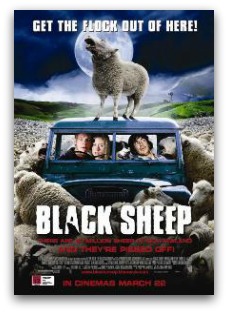
2) Black Sheep (2007), directed by Jonathan King

Also ran: Actually, I was going to nominate The Lord of the Rings trilogy but then decided — NO! I can’t use it. It’s too easy. Plus we’ve already had one film with Hugo Weaving (the mighty Elrond played a drag queen in Priscilla!). I know, across the three films they showcase the sights of New Zealand at their jaw-dropping best — anyone who hasn’t watched these films and felt an urgent need to visit New Zealand needs to watch them again but ignore the kick-ass sword fighting… Yeah, I know. That’s never going to happen.
Why Black Sheep won out: The rugged landscape looks every bit as impressive in this movie as it does in Lord of the Rings — but it’s also populated by were-sheep, an accidental result of some unusual genetic manipulation… See it, and laugh at the New Zealanders. Oddly enough, they’ll love you for it. It’s the Kiwis’ love of poking fun at everything, especially themselves — their self-deprecating humor — that really made me want to visit the place. I felt like I would fit in there. And I did — I stayed for two years. By the time I left, I was on a first-name basis with the entire population.
Memorable lines:

There are 40 million sheep in New Zealand…and they’re pi**ed off!

Harry (as the were-sheep charge towards them): F**k, the sheep!
Tucker: No mate, we haven’t time for that.

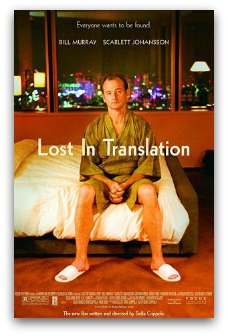
3) Lost in Translation (2003), directed by Sofia Coppola

Why I love this film: It’s an odd one, this one. The first time I watched it, my mind boggled at how something so boring, with nothing remotely resembling a plot, could get made into a movie. Then I watched it again. And again. Because it was the rainy season in Thailand, where I was living, so I couldn’t go outside — and we only had three DVDs in English, so we watched all of them every day. For two months. Somewhere around the halfway point of this torturous process, I fell in love with Lost in Translation — maybe I just needed to relax to appreciate it? Once I stopped looking for something to happen, I started to understand what it was all about: loneliness, uncertainty, being adrift and confused in a completely alien culture. And ever since then I’ve desperately wanted to go to Tokyo. Well, not enough to actually go there — yet — but you know what I mean. I do travel vicariously — just sometimes — and this is one of ‘em.
Caveat: If, like me, you’re a fan of films where, you know, stuff happens — it might take you a few viewings to get used to it. Forty or fifty should do the trick.
Memorable line:

Charlotte: Let’s never come here again because it would never be as much fun.

4) Ip Man (2008), directed by Wilson Yip

Why I love this film: The closest I’ve come to China are the little “made in” labels on almost everything I own. This film, however, kindled a desire to visit China that I never knew I had in me. It’s the biographical story of the most famous kung fu practitioner in the world — not Bruce Lee but his teacher in Wing Chun kung fu, master Ip Man. It’s set in Foshan, China in the 1930s-40s during the Japanese Invasion, but was filmed in Shanghai. It follows the family of the master as he becomes ensnared in the war, losing everything over the course of the Occupation and being forced to face the hardest choices a man could make. The insight into a lifestyle and culture so utterly different from my own was fascinating enough, but this is a story both moving and powerful.
Audience participation: I dare anyone to watch it and not leap off the couch at some point with a cry of “Yeah, kick his ASS!” Ahem. Okay, so maybe that’s just me.
In sum: Will it make you want to visit China? I think so. Will it make you want to learn kung fu? I absolutely guarantee it!

And because I’m a contrary kind of guy, I just had to retaliate against my own optimism by highlighting a film that made me NOT want to travel:

5) Cidade de Deus (City of God) (2002), directed by Fernando Meirelles and Katia Lund

Why I don’t recommend this film: The film is set in the 1970s, in the poorest districts surrounding Rio de Janeiro, where drugs and guns rule and the population live in a fear only matched by their misery. I saw it in South America, in its native Portuguese — but with Spanish subtitles. Given my fledgeling abilities in that language, as described in a previous post, I may have failed to grasp every nuance of the story, but basically what I took from it was: “DON’T EVER GO THERE! They will kill you for the hell of it.”
Analysis:There is poverty everywhere in the world — I’ve worked in homeless shelters in the UK and seen people every bit as desperate as the denizens of Brazilian favelas (shanty towns). But these kind of places, where automatic weapons are more readily available than McDonald’s hamburgers and life is so very cheap…they absolutely terrify me.
In sum: Brazil remains on my list of all-time favorite, must-visit countries — but no way am I going anywhere near the favelas in Rio. This film has put me off — for life.

* * *

And finally…there’s one character that stands head and shoulders (and hat!) above all the rest when it comes to inspiring my travels. I’ve carefully avoided mentioning his films, as I was trying hard to keep this a cheese-free list — but I can’t hold it in any more.

I WANT TO BE INDIANA JONES!

I know, I know! So does everybody in the world, ever. Even people in remote tribes that have never been contacted by the Western world, secretly harbor a desire to be Indiana Jones — they just don’t know how to put it into words.

So — now it’s your turn!
1) What films have made you want to travel? And why?
2) What films have made you want to run screaming from the very idea of travel — and why?
3) If you WERE Indiana Jones — what would you do?

STAY TUNED for tomorrow’s post on cinema and the expat life.

If you enjoyed this post, we invite you to register for The Displaced Dispatch, a round up of weekly posts from The Displaced Nation, with seasonal recipes, book giveaways and other extras. Register for The Displaced Dispatch by clicking here!

Related posts:

Images: Tony James Slater (yes, that’s really him!) playing out his fantasy of being Indiana Jones; film posters courtesy Wikipedia.

12 NOMADS OF CHRISTMAS: Karen van der Zee, Dutch/American expat in Moldova (8/12)

Current home: Chișinău, Moldova
Past overseas locations: Kenya, Ghana, Indonesia, Palestine, Ghana (again), Armenia, Moldova. (For years I was also an expat in the USA, my husband’s home country, and have dual — Dutch and American — citizenship.)
Cyberspace coordinates: Life in the Expat Lane — Foreign Fun in Exotic Places (blog) and @missfootloose (Twitter handle)
Recent posts: “Life Abroad: Of Red Undies, Sugary Pigs, and Freezing Waters” (December 31, 2011); “Expat Foodie: What to Do with Goose Fat?” (December 27, 2011); “Expat Life: Holiday Greetings from Afar” (December 26, 2011)

Where are you spending the holidays this year?
In Moldova. It will be the first time ever that my husband and I will not be spending it with the rest of our family.

What do you most like doing during the holidays?
Besides spending time with family, I enjoy decorating and cooking. This year I will cook dinner for expat friends who are also not going home. We can cry on each other’s shoulders, or perhaps just have a good time.

Will you be on or offline?
The computer will be on. We may be able to Skype.

Are you sending any cards?
I send only a few snailmail paper cards. Mostly I write short personal emails, using in part a few paragraphs of prepared text, but no newsletters. Newsletters never seem to quite fit for everybody the same way.

What’s the thing you most look forward to eating?
I wish I had something exotic to tell you about here, but actually, I just love having a good Christmas dinner and some decadent dessert. Normally I don’t eat much sugary food.

Can you recommend any good books other expats or “internationals” might enjoy?
Two works of nonfiction:

1) The Last Resort: A Memoir of Mischief and Mayhem on a Family Farm in Africa, by Douglas Rogers (Crown, 2009): A tragic-comic account of the author’s (white) parents’ life in Zimbabwe in the last 15 years and the trials and tribulations of running and holding on to their resort while all around them farms of white owners are being stolen and the country is falling apart. Great read.

2) Almost French: Love and a New Life in Paris, by Sarah Turnbull (Gotham, 2003): An Australian journalist falls in love with a Frenchman, moves to Paris, and culture shock ensues. I always enjoy culture shock stories, and Paris is a great setting for culture shock.

And one novel:

Finding Nouf, by Zoë Ferraris (Houghton Mifflin Harcourt, 2008): A murder mystery set in Jeddah, Saudi Arabia, with Saudi Arabian characters. I love this book because it offers an intimate look into the culture and lives of men and women in the very closed society of the Kingdom. Fascinating.

If you could travel anywhere for the holidays, where would it be?
I must be a terrible bore, but spending the holidays anonymously with strangers in some exotic place doesn’t appeal to me. However, I would love to live in the highlands of Bali!

What famous person do you think it would be fun to spend New Year’s Eve with?
What a fun question! Let me think. How about New Year’s Eve with Whoopi Goldberg? Why? Well, she’s unconventional, creative, fun, and loves to hang loose. What else do you need in a person to have some fun?

What’s been your most displaced holiday experience?
When we lived in Indonesia with our two young daughters. It was difficult to create a Christmas atmosphere in the sweltering tropics because we were used to a cold Christmas in the northern hemisphere. The year after that, while still living in Indonesia, we visited friends in Australia over the holidays. It was better, but still, it was summer there. It just wasn’t quite right!

How about the least displaced experience — when you’ve felt the true joy of the season?
I honestly cannot pick just one. I’ve had so many Christmasses and they’ve always been good one way or another.

How do you feel when the holidays are over?
Usually it’s a bit of a drag to take down the tree and pack up all the decorations and the house looks so bare and boring, but then I get busy and get on with life. I do not go into a major funk or depression, fortunately.

In the past, we would be returning from the US to wherever we were living, in the tropics or elsewhere, and that sort of took care of the transition to normal life.

On the first day of Christmas, my true love said to me:
EIGHT WHOOPHIS WHOOPING,
SEVEN SKIERS A-PARTYING,
SIX SPOUSES TRAILING,
FIVE GOOOOOOOFY EXPATS.
FOUR ENGLISH CHEESES,
THREE DECENT WHISKIES,
TWO CANDY BOXES,
& AN IRISHMAN IN A PALM TREE!

STAY TUNED for tomorrow’s featured nomad (9/12) in our 12 Nomads of Christmas series.

If you enjoyed this post, we invite you to register for The Displaced Dispatch, a round up of weekly posts from The Displaced Nation, with seasonal recipes, book giveaways and other extras. Register for The Displaced Dispatch by clicking here!

Related posts:

An interview with Robin Wiszowaty: Kenya Program Director for Free The Children

Last week I had the privilege of speaking with a young woman called Robin Wiszowaty. She isn’t a household name. You won’t find her in newspaper gossip columns, or on celebrity chat shows, or sashaying down the red carpet at the Oscars.

Yet I came away from our 45-minute conversation quite star-struck – not even my treasured chance meeting with Paul McCartney could compete – and more inspired than I can say.

A brief bio: From Suburbia to Savannah

Robin Wiszowaty was born in 1981 and grew up in Schaumburg, Illinois: a predominantly white, middle-class suburb outside Chicago. Although on paper Schaumburg appears an ideal place to spend childhood, with its summer block parties and strong sense of neighborliness, Robin says she never quite fit in.

“From an early age, I was unsatisfied with my ordinary life….I could never find my niche or any comfortable sense of self.” [My Maasai Life]

This feeling of discontent followed her through her teen years and into college at the University of Illinois where she studied speech communications. Only after a two-week trip to Israel in December 2001, to explore her Jewish heritage, did Robin begin to understand what she wanted from life.

“It [reminded] me how fiercely I longed to break out of this Western mindset and find something else.” [My Maasai Life]

While her concerned and long-suffering parents assumed the trip would rid her system of dissatisfaction and wanderlust, those two weeks in Israel were, in fact, only the beginning of a lifetime of traveling.

To the dismay of her parents a few months later, through a program run by the University of Minnesota, Robin was on her way to Kenya. After two months with a host family in Nairobi, where she learned basic Swahili and took classes on Kenyan culture, she went to live for a year in rural Nkoyet-naiborr, a Maasai community in the Great Rift Valley – a community and lifestyle as far removed from her Illinois home as anyone can imagine.

Nevertheless, Nkoyet-naiborr became her second home, in the truest sense. Here she forged deep, lasting friendships with her host family and members of the community, and was bestowed with a Maasai name: Naserian, meaning “peaceful person.” Mama, the mother in her host family, became her Kenyan mother, and Robin refers to the children of the family to as her brothers and sisters.

Today, nearly a decade after first arriving in Nairobi, Robin divides her time between Toronto and Kenya, working as Kenya Program Director with the charity Free The Children, implementing long-term development projects in partnership with local communities.

* * *

I spoke to Robin while she was in Canada, a few hours before she made the long trip back to Kenya. Her voice is soft, gentle, diffident, and not exactly what I’d expected; she’s had to overcome a lot of hurdles to be where she is today and, after reading her autobiography, I’m aware that I’m talking to one very determined person.

On Free The Children…

Kate Allison: Tell us a little more about what you do for Free The Children.
Robin Wiszowaty: As Kenya Program Director, I oversee the Alternative Income projects for Kenyan women. We teach the women leadership, financial literacy, how to access loans; and by being able to earn their own money, the women can invest that extra income in their families, their homes and, importantly, their children’s education. They work in groups — there are around 120 women’s groups now — and one example of how they earn income is doing quality beadwork. The bracelets and necklaces they make are sold at the Me to We store in Toronto, and also at the online store. My own Mama, by the way, is one of the beaders — she’s a fantastic beader.

Craig and Marc Kielburger, the founders of Free The Children and Me to We, have more to say about Robin’s role:

We’ve seen her sitting in hushed, intimate conversation with village elders, whose trust she earned through empathy and understanding. We’ve seen her astonish visiting students and volunteers with stories of her adventures. And we’ve seen her embraced by the teary-eyed mamas who are eternally grateful for her hard work in her role as Free The Children’s Kenya Program Director.

On writing…

Eighteen months ago, Robin’s autobiography “My Maasai Life” was published by Me to We Books — publishing division of Me to We, the for-profit social enterprise that supports Free The Children — and having read the book, I wanted to know more about it.

KA: Your book, “My Maasai Life”, tells the story of your transition from the American suburbs to life in a Kenyan village. What made you decide to write it?
RW: Lots of people have said to me that I should write a book about my experiences, but it was at the prompting of Craig Kielburger that I eventually wrote it. Craig was looking for books with a social message to be published by Me To We. “My Maasai Life” was the result, and was actually one of the first books in the Me to We publishing stable.

KA: What audience did you have in mind for the book when you wrote it?
RW: I originally intended it for high-school-aged girls who wanted to see the world — and also for their mothers, to help them understand this.

KA: Yes…in your book, you say your relationship with your own mother was somewhat rocky when you were that age.
RW: It was. But I look at myself now, and I think I’ve become the kind of person my parents always wanted me to be – albeit on my own terms.

(In fact, Robin’s parents long ago accepted, and proudly support, their daughter’s unconventional life choices.)

KA: What other kinds of readers have been attracted to the book?
RW: Young adults, in their 20s and 30s, who want to find a deeper meaning from life than they find in the corporate world where they are at present. And teachers; they read my book in World Issues classes, and discuss it with their students.

KA: Have you written any other books, or are you intending to do so?
RW: “My Maasai Life” has been adapted into a children’s book, subtitled “A Child’s Adventure in Africa”, and I’m currently working on another book, which I hope to have published in another couple of years or so. I’m about halfway through writing it — I don’t know what it will be called, and it doesn’t have a working title — and although it’s also about Kenya, this book is from the perspective of the women there, focusing on the universal concepts of motherhood and womanhood.

On fitting in…

KA: Can you think of a particular occasion in Kenya when you wondered, “What’s a nice girl like me doing in a place like this?”
RW: [laughs] I can tell you exactly when that was. It was on my first night in Nkoyet-naiborr, when I was sleeping in the bed I shared with my sister, Faith, and I heard a wild animal howling outside…

“Faith! ” I whispered.
“Naserian . . . ?”
“What is that sound?”
Faith rolled over, annoyed at being woken. “Hyenas.”
Hyenas? Now sleep was even more impossible. I tried to block out those echoing wails, but my mind flooded with questions. Was I doing the right thing? Was I just substituting one set of frustrations for another? Had I made a terrible mistake?

KA: And what about the other way round — can you think of a moment when you felt more at home in Africa than in the United States?
RW: Oh yes…I’m “taken” by Kenya. There, I feel comfortable within my own soul, that I’m in the right spot. You could say that it’s a calling. The time I feel it most is when I’m sitting with the women, making tea over the fire, just talking…there’s so much soul, such a feeling of family and community.

When I first went to Kenya, I felt at home on the first occasion my Mama let me fetch the water on my own. It felt good to be a provider for the family who were hosting me.

Fetching the water is much easier said than done:

Transporting water, I saw from the women, is an art unto itself. The mitungi must be carefully balanced on two rocks beneath the spout and then held in place while the trickling water slowly fills it all the way to the top. And with water always in scarce supply, we could never afford to waste or spill a drop. When the cylindrical twenty litre container was full, it weighed more than twenty kilos.

More recently, I can think of an occasion at the Kisaruni High School, which is Free The Children’s first all-girls secondary school, and has 41 students who board there. When it first opened last spring, these girls came to the school and we all had a big sleepover party. It was such a lot of fun, and for many of these girls it was the first time they’d slept on a mattress.

It’s the feeling of true community in Kenya that I love. It seems to me that when people come together for the benefit of others, that’s when you get the most profound sense of community.

KA: What about repatriation? Do you find it difficult to adjust between living in your two different worlds?
RW: The first transition from Kenya back to Chicago was most difficult. I felt like a lost 8-year-old, trying to get used to life in America again after a year away. I found it hard to wear shoes, having been barefoot for so long. And I was full of anger, of judgment for the way things were done — for example, at people who ran the water for so long, at the extravagant amounts of food.

Huge wasteful, overpriced family dinners. Thoughtless waste of water, flushing the toilet so many times every day.

But I don’t feel that way now. Then, I was going through that time of life when everyone tries to work out who they are and feels a certain amount of anger. Now I accept that it’s not about everyone having the same; it’s about everyone having enough.

Today, whichever direction I travel in, I always feel that I’m going home to family.

On our November theme of Global Philanthropy…

KA: Over the last month, we’ve discussed — fairly heatedly — the growing trend towards volun-tourism. As part of your work with Free The Children and Me to We, you lead groups of people on international volunteer experience each year. Can the people who go on these trips, who lack language and cultural training, really accomplish much in such a short time?
RW: Volun-tourism can play a great part when it’s done responsibly. Our youth volunteer trips last three weeks, while our family and corporate trips are shorter at ten days. We regularly have employees of large companies like KPMG and Virgin Atlantic on our corporate trips.

After some orientation, our volunteers hit the ground running — they help with building schools, with clean water projects, they go into the community’s homes to help, they learn Swahili. For many of them, it is literally a life-changing experience. It gives them a different perspective on life and on their careers. It’s very positive for both the volunteers and for the communities they are helping.

Volun-tourism skeptics should maybe note that Robin herself first came to Kenya with an attitude of “What can Kenya do for me?” rather than “What can I do for Kenya?”, as can be seen in this extract from her book, describing an incident during her initial two months in Nairobi:

One street man nearby…said in Swahili, “What are you doing in Kenya, if you can’t help us?”

Despite my halting comprehension of the language, I understood his question. What was I doing here? Was I here to help Kenyans? I couldn’t remember any sort of altruistic impulse as my reason for being me here. I only pictured myself three months earlier, curled up on my family room couch reading books on cultural sensitivity, or shopping in neighbourhood department stores for appropriate clothing, thinking this was a chance for me to enlarge my experience and pick up others’ points of view. I’d been driven simply by a desire to escape, not to improve the lives of these poor people.

KA: Which person or people, dead or alive, do you look up to most in your work?
RW:
I would have to say the other team members of Free The Children and Me to We, both in Kenya and Toronto. They all work for the children, not the paycheck. The world may never know their names, but they work so hard and achieve so much for others.

KA: Are there any inspirational stories of theirs you can share with us?
RW: Spencer West, a speaker on the Me to We team, was born with a genetic disease, and lost both his legs at the hips when he was a child. We met in Kenya when he was on an international volunteer trip, helping to build a school there.

Next June, he is going to “Redefine Possible” and climb Mount Kilimanjaro in his wheelchair, in order to raise $500,000 to bring clean water programming to 12,500 people in East Africa.

You can’t get any more inspirational than that.

KA: And lastly — it’s the holiday season. We’re inundated with requests for giving. In your opinion, what’s the best way to spend our dollars (or pounds, or euros, or yen, or whatever) to help those in other parts of the world who have so much less than we do?
RW:
Well — you could sponsor Spencer West on his climb and help those affected by the drought in East Africa, which is the worst in 60 years. Or you could buy your holiday gifts from the Me to We store, either in Toronto or online at www.metowe.com/shop.

Epilogue

The interview ends, and I thank Robin for giving her time, even when she has a hundred other things she could probably be doing, since in a few hours she will be flying back to her Kenyan home. I am awed by our conversation, by how much she has achieved in her short life — she is only 30 — and I feel humbled.

I tell her this. “People like you, who do so much with your lives, make me feel very small.”

There’s a slight pause at the end of the phone, then Robin says, “But… you’re a mother.”

I can’t count the number of times over the last fifteen years when, in answer to the question “What do you do?” I’ve said, “I’m just a stay-at-home mom.” Emphasis on the “just” — an apology for the mundanity of my existence. The counter-reaction, so often, is “But that’s a very important job!” in a slightly condescending tone that makes me feel, even more, that motherhood is merely a consolation prize for missing out on life’s other, more important achievements.

Robin’s tone holds none of this condescension. “You’re a mother,” she says, and it’s a statement of the obvious, that being a mother is an achievement in itself.

It occurs to me that her years with the mamas in Kenya have taught Robin the value of motherhood — a lesson that maybe passes by the young women growing up in our “developed” culture. It’s an irony, perhaps, that in our Western pursuit of progress and women’s rights, we have devalued the most important women’s right of all — that of pride in raising a strong next generation.

Robin, thank you. It was wonderful to talk to you. I hope we meet in person one day.

.

Quotations from “My Maasai Life: From Suburbia to Savannah.” Wiszowaty, Robin (2010-07-01), Perseus Books Group.

Img: Robin Wiszowaty — photo courtesy of www.metowe.com

Related posts:
RANDOM NOMAD: Aaron Ausland, NGO Research Director & Development Practitioner
RANDOM NOMAD: Adria Schmidt, Career Consultant at Violence Intervention Program & Former Peace Corps Volunteer

If you enjoyed this post, we invite you to subscribe for email delivery of The Displaced Dispatch, a round up of the week’s posts from The Displaced Nation. Sign up for The Displaced Dispatch by clicking here!

RANDOM NOMAD: Aaron Ausland, NGO Research Director & Development Practitioner

Born in: Eugene, Oregon (but raised in Plains, Montana, a town of 1,200)
Passport: USA*
Countries, states, cities lived in: Washington (Yakima, Tacoma, Spokane): 1989-95; Alaska (Anchorage): 1995-97; Bolivia (Bañado de la Cruz & Santa Cruz): 1997; 1998 – 2002; Washington (Seattle): 2002-03; Massachusetts (Cambridge): 2003-05; Guatemala (Guatemala City): 2004; California (Duarte): 2006-10; Colombia (Bogotá): 2010 – present.
Cyberspace coordinates: Staying for Tea | Good Principles and Practice of Community-based International Development (blog); @AaronAusland (Twitter handle); Aaron Ausland at Huffington Post (column)
*My passport is only three years old, but multiple entries to about 40 countries filled it right up and I’ve had to add more pages. By the end of this year, I will have slept somewhere other than home about 190 of the 365 nights.

What made you leave your homeland in the first place?
My late first wife and I wanted to make a difference in the world and were particularly passionate about issues of justice, peace, and poverty. After graduating from university, we decided that maybe the best place to match our greatest gifts with the world’s greatest needs was in the public policy arena. We thought it would be good to represent a view on behalf of the marginalized — those uninvited to the table where policy decisions are made that nevertheless affect their lives in profound ways. In particular, we were thinking of illiterate poor persons living in underdeveloped countries ruled by bad or incompetent leaders and subjected to all the crap that comes with weak institutions of governance.

But we realized it would be pretty lame to run off to graduate school straight out of undergrad and then find some job in a policy think tank or as a Congressional aide in the hopes of working our way up to having a place at the table with a mind to represent these unrepresented views when we really hadn’t a clue what they were.

So we made a three-year commitment with the Mennonite Central Committee to go live and serve in a Bolivian village with people who fit this description.

We were young, hopeful, idealistic, earnest, and naïve. I can say that I’m not so young anymore.

Is anyone else in your family a “displaced” person?
I have a brother who served in Iraq for a couple of years, but he now lives about a hundred meters from our dad’s house in Yakima, Washington. I’m really the only one in my family who has chosen a lifestyle for which the question “Where are you from?” generates a confusing jumble of explanation rather than a simple city-state combo. 

Unless you count my son, Thiago. He’s six and is definitely more “displaced” than me. He literally speaks of living in two different “worlds.” In one “world” he speaks Spanish, has a home and school in Colombia, where his sister was born, and has family in Bolivia (his mother is Bolivian). In the other world” — where he says he is really from — he speaks English and has friends in California and a large family on my side including a whole set from my late first wife. Yesterday he told his mother: “My brain is confused, I don’t know where I should live. All my friends are in California, but my cousins are in Bolivia, and I go to school in Colombia and have friends there, too.” Poor little nomad.

Describe the moment when you felt most displaced.
For me the question was “How the hell did a small town boy from Montana end up here?” Physically, at that moment, “here” was a stainless steel operating table in a dark and empty hospital room in Santa Cruz, Bolivia. But more profoundly, “here” was a situation so far from my expectations, I was literally struggling to connect the dots and figure out how I had gotten myself there. I was 25 years old. Somewhere in a ravine a hundred miles away lay the broken body of my wife. A few hours earlier, the public bus in which we were riding had missed a turn on the narrow, winding road that passes through the Andean foothills and tumbled 1,000 feet into the dark.

She and I had gone to Bolivia with a long-term vision of our lives together, and now I was here, in a foreign land, alone, the slate of the future wiped clean. It was so profoundly disorientating, I just kept coming back to the question: “How did I get here?” Maybe it was a way to push off the searing emotional pain that would come with facing into my new reality, but the question wouldn’t go away. What sequence of events and decisions led me here? Did I make a mistake?

I remembered scenes from my idyllic boyhood in small-town Montana when my whole world was contained in a 100- mile radius and a handful of friends and family members. How had the world gotten so big, so uncertain, so complicated? And what was I doing wandering around in it like a lost child? How had I gotten here?

Much later, I would decide that I hadn’t made any mistakes. My first wife and I had made decisions based on a set of values that we held in earnest and I continue to hold. The fact that those decisions led to tragedy does not diminish the certainty of those values — it just means that those who hold them are not exempt from catastrophic loss that come to all who live.

I know you were probably hoping for a funny anecdote about crazy food or wacky cultural misunderstanding, but this is my one true displacement story.

Describe the moment when you felt least displaced.
Nowadays, I feel a sort of indifference about the whole location thing, to be honest. Whether I’m living in Cambridge attending the Kennedy School of Government, or setting up a new home in Colombia, or sitting where I am at this moment at an outdoor bar in a hotel in Bamako, Mali, I feel neither particularly at home nor particularly displaced. Feeling at home has a lot less to do with place than it used to, and it’s often unpredictable. I can feel more at home in Albania when I have a good macchiato and an Internet connection to video Skype with my children than I might in a hotel in Atlanta after a missed flight, with a dead computer battery. I can feel more at home when I’m sharing a beer with a fellow expat I’ve just met in rural Cambodia than I might sharing a beer with an old friend I grew up with who never left Montana.

I’ve experienced profound moments in my adopted homelands — from becoming a widower, to getting married, to rejoicing at the birth of my daughter, to undergoing major medical treatment. In each of these, it was the people who surrounded me that made me feel at home, and the uniqueness of the event that made me feel displaced. The location or culture has ceased to hold much power over my perception of self at particular moments.

You may bring one curiosity you’ve collected from each of your adopted countries into the Displaced Nation. What’s in your suitcase?
I’ll bring my wife from Bolivia, my son from the USA, and my daughter from Colombia. They are certainly a curious bunch, but I can’t live without them.

You’re invited to prepare one meal based on your travels for other Displaced Nation members. What’s on the menu?
Well, the cuisines of places like India, Thailand, Ethiopia, and Mexico are always worth sharing. The rich complexities that have come from centuries of experimentation with combinations of local flavors as well as some exotic additions from old trade routes are heritage gifts to the world. But, I’m sure someone will bring a few dishes from these parts into the Displaced Nation, so maybe I’ll bring some less likely ones such as the rich Malian sauce made in part from the boiled fruit of the baobab tree; the surprisingly filling chicken hearts strung on a kabob, flavored with soy sauce and charcoal smoke, sold on the streets of Bolivia; or maybe a lesser known dish from Mexico — the corn smut omelet made with cuitlacoche, a purplish fungus that grows on corn; or maybe I’ll just bring the beer…

You may add one word or expression from the countries you’ve lived in to The Displaced Nation argot. What will you loan us?
I think I’ll pass on this one. Pole sana (so sorry!) as we say in Swahili. Actually, maybe that’s a good one. Pole (pronounced POH-lay) doesn’t have an exact English equivalent — it’s used to say you empathize and understand someone’s problems, without the connotation of inferiority that “I pity you” might have.

This month we are looking into “philanthropic displacement” — when people travel or become expats on behalf of helping others less fortunate than themselves. Do you have a role model you look up to when engaged in this kind of travel — whose words of advice you cherish?
I’ve never really had a specific role model for philanthropic displacement. That said, I’ve always been impressed with people who make long-term commitments to live among the people they wish to serve and voluntarily forego access to comforts and safety they might otherwise enjoy.

There are some famous examples like Mother Theresa, but the ones that have had the biggest personal impact on me are unknowns — volunteers and professionals I’ve met and worked with along the way. Such people taught me how to live with a kitchen stocked with just 12 items — that’s counting the spices. They taught me how to bring my water up from the river in the morning and hang it in a tree from a bucket painted black so that the sun would heat the water throughout the day, in preparation for a warm evening bucket shower. I learned how to capture rain water, how to build dry latrines, how to trust local medicinal practices, how to enjoy silence, how to walk the equivalent of a marathon a day to visit local families, how to sit and unhurriedly share tea over conversations that circle around rather than cut to the chase, how to embrace simplicity as a virtue… I also forgot how to complain and remembered to be grateful in the midst of scarcity.

Most of my role models didn’t do anything spectacular — they didn’t invent microfinance or the treadle pump, they didn’t negotiate peace accords or write a best seller. But the way they displaced themselves so thoroughly, the way they embraced their local communities with such authenticity — this had a big impact on how the communities valued their presence and their contribution, and on me.

Voluntourism is said to be the fastest growing segment of the travel industry (itself one of the world’s fastest growing industries). Do you think this kind of travel can help the uninitiated understand the problems our planet is facing?
No, not really. It’s not that I think voluntourism is unequivocally a bad thing, but I just don’t think you can expect people to gain a very accurate understanding of complex problems under such circumstances. In fact, I think it’s more likely to leave them with a distorted understanding. There is a saying I picked up somewhere that goes something like this:

Travel to a new place for three weeks and you can write a book, travel for three months and you can write an article, travel for three years and you’ll likely have nothing to say.

There’s just something about a short and intense exposure that seems to set very strong ideas into the minds of those who’ve experienced it. But their ideas are biased by the specificity, narrowness, and brevity of that experience.

For example, someone who has had a high-impact experience volunteering in an orphanage for a week may feel they know more about the issue than people who haven’t had that experience. In fact, they may actually know less due to the biases they have picked up. It’s like believing you know something about the average person in a country from a single observation.

Sometimes, people know just enough to be dangerous; they mistake their shallow knowledge for an actual understanding of some enormously complex problem, and they act on it in ways that are ultimately irresponsible.

The truth is, the problems facing our planet are complex and we should all be grateful for the specialists who have dedicated their lives to understanding and addressing them. Doing something serious about addressing these problems will require professionals, not hobbyists; lifers, not tourists.

Again, it’s not necessarily a bad thing to pass through as a tourist, but with regards to your question here, we need to guard against self-deception. I’ve taken a few tours of a number of hydro-electric projects across the Western USA. I think they are really interesting. But, I know better than to believe I know the first thing about harnessing the power of water to generate electricity while balancing the ecological, economic, legal, social and political interests of farmers, consumers, industry, and the environment.

Likewise, you can’t take a two-day tour of an urban slum in Kenya and think you understand poverty, urban migration, economic development, or whatever other angle one might give such a tour.

For a broader scope of my thoughts on voluntourism, I encourage you to see my blog posts:

Readers — yay or nay for letting Aaron Ausland into The Displaced Nation? Tell us your reasons. (Note: It’s fine to vote “nay” as long as you couch your reasoning in terms we all — including Aaron — find amusing.)

img: Aaron Ausland in Mexico City (he’s the suit!). While on a lunch break from her work conducting a month-long operations audit of an NGO office, Aaron happened upon a lucha libre wrestling match putting on an outdoor show, and decided it would be amusing to pose with the star luchadore.

STAY TUNED for tomorrow’s installment from our displaced fictional heroine, Libby, when we get to find out whether she’s recovered from eating her mother-in-law’s undercooked Thanksgiving turkey. (Not keeping up with Libby? Read the first three episodes of her expat adventures.)

If you enjoyed this post, we invite you to register for The Displaced Dispatch, a round up of weekly posts from The Displaced Nation, with seasonal recipes, book giveaways and other extras. Register for The Displaced Dispatch by clicking here!

Related posts:

Dear Mary-Sue: Holiday travel plans & profound epiphanies

Mary-Sue Wallace, The Displaced Nation’s agony aunt is back. Her thoughtful advice eases and soothes any cross-cultural quandary or travel-related confusion you may have. Submit your questions and comments here, or else by emailing her at thedisplacednation@gmail.com.

Dear Mary-Sue,

Would love some great travel tips for this holiday season. 

Anon, Vermont.

Dear Anon,

I love this time of year. Admittedly for a traveler it can be a very expensive and chaotic time so I try and strike a balance between travel and being at home. The Wallace household, like many families across the fine, fertile land, has its own holiday traditions that we like to observe at this time. For me, it’s about spending some time with little John, the intelligent one of my two grandkids, he comes over to stay  the weekend before Christmas. We make sure to make chex mix and drink hot mulled cider. We head on over to St Michael’s where we go to the annual Handel’s Messiah sing-in. My soprano leaves a little to be desired, but it’s always great fun nonetheless. John will then help me decorate the Christmas tree and then we’ll go and see all the wonderful lights that my neighbors who haven’t foreclosed have covered their houses in.

On Christmas Eve it’s time for John to go back to his parents, that’s when me and hubby Jake things up and it becomes all about just the two of us. We pack all of our warmest, snuggliest clothing and get on a plane to Reykjavik. Once there we also stay at  our favorite hotel near the Hallgrimskirkja. Once we’ve slept off our jet lag and had a lovely cup of hot chocolate, we then give it large until New Year’s Eve. There’s one club, in particular, we hang out in called the Birch Tree. Now hubby Jake likes his trance to be fairly chilled, but I’m more about old skool Acid trance. When Gunnar is DJing at the Birch Tree he always manages to give a set that balances hubby Jake’s tastes with mine. We then might hit the sauna and do some shots of Brennivin with this South African couple we always meet up with at Christmas, because that’s what the season is about for ol’ Mary-Sue – celebrating your own traditions.

Mary-Sue

——————————————————————————————————————

Dear Mary-Sue,

Earlier this month, as I was trekking through the Kilimanjaro National Park, which is in Tanzania, with these local guys who I knew, I was struck by — and the readership of my blog The Wistful Traveler all agreed — a beautifully profound thought.  It was about how fortunate I was to be there at that moment, to be alive in the now. I blogged about it, you should check it out on my blog. There’s some pretty amazing pictures there too. Now my question to you Mary-Sue is this, do you have any profound thoughts like I do?

The Wistful Traveler, Everywhere and nowhere.

Only when drinking Brennivin.

——————————————————————————————————————

Dear Mary-Sue,

Thank you so much for responding to my question in last month’s “Ask Mary-Sue.” I was so pleased to be featured that I’m sending an early Christmas present of chocolate-covered macadamia nuts for you. Anyhoo, I was wondering if you might want to reconsider your response that you can’t meet up for coffee. I’ve tried calling your office, but they keep saying that you’re out. Such a shame as I really would love to pick your brains over coffee – not literally, ha, ha, ha. That would just be disturbing. You’re my inspiration.

Susie-May, Arizona

Dear Susie May,

Thanks for the present. My unpaid intern tells me that they were delicious. Unfortunately, my calendar is really full at the moment.

Mary-Sue

p.s. You really should stop calling my office.

——————————————————————————————————————

Anyhoo, that’s all from me readers. I’m so keen to hear about your cultural issues and all your juicy problems. Do drop me a line with any problems you have, or if you want to share your fave meatloaf recipe with me (yum! yum!). As they say in Italy, “ciao!”

Mary-Sue is a retired travel agent who lives in Tulsa with her husband Jake. She has taken a credited course in therapy from Tulsa Community College and is the best-selling author of Traveling Made Easy, Low-Fat Chicken Soup for the Traveler’s Soul, The Art of War: The Authorized Biography of Samantha Brown, and William Shatner’s TekWar: An Unofficial Guide. If you have any questions that you would like Mary-Sue to answer, you can contact her at thedisplacednation@gmail.com, or by adding to the comments below.

STAY TUNED for Wednesday’s post — another Random Nomad in our global philanthropy series.

If you enjoyed this post, we invite you to subscribe to The Displaced Dispatch, a weekly round up of posts from The Displaced Nation, plus some extras such as seasonal recipes and occasional book giveaways. Sign up for The Displaced Dispatch by clicking here!

Related posts:

My grandfather tried saving the world long before it became trendy — with mixed results

Our Third Culture Kid columnist, Charlotte Day, upon reading this month’s posts about those who displace themselves on behalf of those less fortunate, felt moved to contact her grandfather in Sydney, Australia, for a chat about his own experiences with international aid work, which began in the 1950s.

These days, it is a rare teenager who has not shown some evidence of civic engagement by a certain age: spending their summers beneath foreign suns in search of that fabled sensation, that fulfillment born of “helping others.”

Of course, no altruistic act is truly pure, but I would argue that it is better than nothing.

Nothing, however, is the word that best qualifies my own civic engagement. I have reached the age of 17 tacitly scorning the moral and spiritual quests of British gap-year students, as well as American Ivy-League hopefuls, from my comfortable desk chair.

I read Dostoevsky’s portraits of tormented youths, striving in vain and misguidedly to effect a change in society…and decide that changing the world is futile.

Yet a chastening thought sometimes breaks through this complacency: there are many who do valuable work. There are many who displace themselves — not only from their comfortable desk chairs, but from comfortable world-views and notions — to serve others, outside the framework of self.

My grandfather’s first foray into global philanthropy

One such person is my maternal grandfather, Robert Ayre-Smith. He entered the field of international aid before the idea of a “third world” even existed. As he informed me in our recent email exchange:

In the middle of the last century, there were the tropics, the Empire, the Americas, the colonies, etc. But they were not rated economically as is now the case.

Paradoxically, he chose animals over humans when he initially diverged from the family profession, medicine, and entered London’s Royal Veterinary College. His first appointment as a livestock specialist came in 1952, shortly after his marriage to my grandmother, Carol. The newlyweds set off for Kenya’s Rift Valley, where Robert set up a research station by Lake Naivasha, working with cattle, sheep and pigs. As motivation, he cites scientific interests in “tropical animal production” — a topic he’d investigated while doing graduate work at Louisiana State University.

As is often true of those who move from the halls of academe to real-life applications, Robert soon found that what he calls his “enthusiasm for science itself, and then for the benefits bestowed by scientific advances,” matured into “some feeling of disillusionment.” His focus shifted away from books to people — and looking at what small-scale farmers in Kenya’s villages were realistically capable of accomplishing.

But while he found fulfillment in these human interactions, he remained bothered by the tension between his “lofty agricultural scientist’s perspective” and the perspective taken by the farmers whose cares he was attempting to alleviate.

Some thirty years later, an “Aha!” moment

Fast forward to 1989, by which time my grandfather was working in Indonesia. During a roadside breakdown, Robert experienced an epiphany. Watching a nearby farmstead owner and his family tending their crops and livestock, he “started to question the appropriateness of much [then] current agricultural research for increasing crop and livestock productivity.”

His own knowledge, “derived from vastly different circumstances,” seemed markedly out of place. Until then, he’d been seeing agricultural development in the Third World through the lens of First World research, where commercial farms are relatively large-scale operations, and where farmers are literate and can therefore study results and adopt them to increase their productivity.

Yet most Third World farmers are fighting an altogether different battle. Their farms are small in scale, with “only two acres for the house, food crops and animals and virtually no machinery except hoe and sickle.”

From that time on, my grandfather thought it would be unreasonable — and betrayed a lack of empathy on the part of the professed do-gooder — to expect farmers in Indonesia and other developing countries to make changes according to developed-world research. He became a founding member of the Asian Farming Systems Association in 1991, which aimed to “undertake research of relevance to the farmer that it was hoped to benefit.”

As he concludes in his message to me:

So you see, Charlotte, it took time to mature my thoughts and approaches — a lot of time.

The world as one’s oyster — whatever that means

This being the Displaced Nation, I felt obliged to ask to what extent my grandfather ever felt himself displaced in the course of his work. “NEVER!” came his emphatic reply. He traces the desire to live and work abroad to his mother, “a great traveler in body and soul.”

Born and raised in India “at the height of the Raj,” my great-grandmother was educated in England and Switzerland before traveling widely in the United States and then working in France as a Voluntary Aid Detachment nurse during World War I.

Even after marrying, she continued to travel the Continent.

As Robert puts it: “I believe I may have learned from her that the world was my oyster — whatever that means. Certainly I have never had fear of the world.”

The only environment in which he recalls being ill at ease was Bogotá, Colombia, in 1980, where he was conscious of an underlying malaise about a possible recurrence of La Violencia, the nation’s horrifying period of civil conflict that had taken place from 1948 to 1958. He remembers being “hoicked out of a bus” between the Amazonian Basin and Bogotá by “some roadside gang — or was it the police?” It did not help matters that he found himself “doing an impossible job that no one really wanted [him] to do.”

Even in the presence of immense danger, my grandfather appears to have taken things in his stride. Here’s how he described being in Baghdad in late 1956, when the city revolted as a result of the British and French invasion of Egypt during the Suez Crisis:

I remember no fear although there was one moment when I was in the street of gold and silver smiths when a big and noisy mob rushed down a street parallel to it and all the merchants pulled down their corrugated metal shutters. Machine gun fire ensued.

A plethora of lessons learned

When I asked what he considered the most effective form of international aid, my grandfather’s immediate answer was “the health and welfare of under-privileged people, maybe I should say village people.” Yet this, he added, is not a form of aid, it’s an aim of aid. He went on: “Moreover, it sounds very pompous — as there are plenty of under-privileged people in all parts of the world, not just in villages.”

On the matter of food aid, Robert had this to say:

I could make a good case against food aid, and against some of the inappropriate advice that I gave in the past to small and large landholders. But what I can say with some confidence is that people in the front line of providing development aid must have empathy with those towards whom the aid is directed.

Empathy formed the heart of his approach — coupled with a saying of his father’s, borrowed from Hamlet (Act I, Scene iii):

To thine own self be true, and it must follow, as the night the day, thou canst not thence be false to any man.

Robert and Carol now live in Sydney, Australia — the last in a long series of displacements. Though he contentedly remembers his work in developing countries, and those with whom he worked, Robert prefers to focus on the present. Yet from time to time, he allows those close to him glimpses of the past — cuttings from the swathes of his memory.

His experiences have persuaded me that it does not pay to be defeatist about “changing the world” — and that the world, even amid current extremes of xenophobic paranoia, is nothing to be afraid of.

Readers, questions for Charlotte — or responses to her grandfather’s insights?

STAY TUNED for tomorrow’s post by the Displaced Nation’s agony aunt, Mary-Sue Wallace.

If you enjoyed this post, we invite you to subscribe to The Displaced Dispatch, a weekly round up of posts from The Displaced Nation, plus some extras such as seasonal recipes and occasional book giveaways. Sign up for The Displaced Dispatch by clicking here!
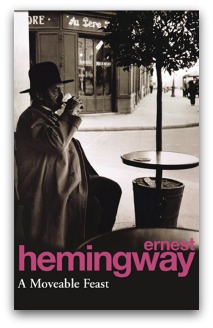
Related posts:

img: Charlotte Day surveying Trafalgar Square in London