The Displaced Nation

A home for international creatives

Tag Archives: Africa

LOCATION, LOCUTION: Expat author and new columnist Lorraine Mace offers her own thoughts on writing about place

Location Locution
Please join us in welcoming Lorraine Mace, aka Frances di Plino, to the Displaced Nation for the first time. From this month, she’ll be taking over the Location, Locution column from JJ Marsh.

Hello, Displaced Nationers! I am thrilled to be taking over this column from JJ Marsh, and I already have lots of interesting guests lined up to take part over the coming months. For this first post, however, I am going to follow in Jill’s footsteps and use my first column to answer the “location locution” questions as a means of introducing myself.

But before I do that, let me give you a few basics. I was born and raised in London, but moved to South Africa just before my 25th birthday. I first lived just outside Johannesburg, then moved to the Orange Free State before discovering, and falling in love with, “the fairest cape”. Since leaving Cape Town I’ve been a nomad for more years than I care to count, having moved continent and country nine times. I finally put down roots in Spain, but have an inclination to spend summers in British Columbia, Canada.

Like JJ, I write crime fiction. I also have a book series for children.

Lorraine May and books

The prolific Lorraine Mace has produced four books in her D.I. Paolo Storey crime thriller series, and one book in her Vlad the Inhaler series (vampires, werewolves and peaches, oh my!).

Oh, and one last item before I move to the questions: don’t forget to visit my predecessor’s farewell post and enter the book giveaway competition. So far there’s only two comments, which by my reckoning gives you a pretty good chance at winning seven great e-books!

* * *

Which came first, story or location?

This can vary from book to book and story to story. However, in my crime novels, written as Frances di Plino, story came first—but then location helps to formulate the plots. Although the series is set in a fictional town, the surrounding British countryside is very real. Bradchester is situated close to Rutland Water and the nearest city is Leicester, both of which feature in the novels on a regular basis. I know this area well. During my last (brief) sojourn in England I lived in a small village a stone’s throw from Rutland Water and frequently visited Leicester.

What’s your technique for evoking the atmosphere of a place?

I put myself into the heads of my characters and experience the place through their senses. When I can smell the bread in the local bakery, or hear the cries of street vendors, weep over a beautiful sunset, taste an orange straight from the tree, or touch the moss-covered stones of a monastery, I know it’s time to start writing, using my character’s experiences of the place.

Which particular features create a sense of location? Landscape, culture, food?

All three, but I must admit I find it easier to use food allied to culture when the story is set outside of the British Isles. Having lived in South Africa, on the Maltese island of Gozo, as well as in France and Spain, I know I can use regional dishes to bring areas of those countries to life. But in Britain I think we have lost the regional aspect of many of our foods. Fish and chips, roast beef and so on are now available throughout the country, where other nations seem to have guarded their regional food identities.

Can you give a brief example of your work which illustrates place?

Bradchester is a town that has more than its fair share of rundown, seedy areas set side by side with gentrified neighbourhoods. This leads to a great deal of social unrest—the haves want the have-nots moved elsewhere and the have-nots resent the wealth and easy life of the haves. This short passage illustrates an area that has, as yet, remained untouched by either sector, but just a street away it is very different.

Station Road wasn’t exactly the best part of town, but the place looked respectable. Paolo was pleased to see that most of the businesses he remembered from his youth were thriving. This was one of the few communities that still had a drycleaners, newsagent, old-fashioned fruit and veg shop, alongside a mini-supermarket, hairdressers and a bank. He glanced up. Even the flats above the businesses looked lived in and cared for. Nice nets and curtains framed the windows and many of the street doors had been painted in recent history.

They walked a couple of hundred yards before turning into Zephyr Road. It was like moving into another country. Here, most of the shops they passed were boarded up and the few remaining open for business seemed to Paolo to concentrate on ways to transform goods into money. Pawnbrokers, gold for cash, payday cheque converters. It appeared as though all the dregs of the financial service industry had found their way into this street. This time when he glanced up, Paolo saw the flats above the shops were likewise either boarded up or had dirty nets hiding whatever was going on up there.

net curtains

The quality of the net curtains tells you where you are in Bradchester. Photo credit: Joss Smithson via Flickr (CC BY-SA 2.0).

How well do you need to know the place before using it as a setting?

I prefer to use places I’ve lived in, or visited many times. I like to know the area and people so well I can conjure them up at will when I’m writing.

Which writers do you admire for the way they use location?

Barbara Kingsolver and Donna Tartt spring to mind. With both authors I feel as if I am living in the locations depicted. In Donna Tartt’s The Goldfinch she manages to recreate both city and desert locations to the extent one can almost feel the weather. Kingsolver’s The Poisonwood Bible brings the 1959 Belgian Congo to life so powerfully the reader is swept into the villages, fearful alike of jungle creatures and the inhospitable landscape.

Books that get "place" right: The Goldfinch, by Donna Tartt; and The Poisonwood Bible, by Barbara Kingsolver.

Books that get “place” right: The Goldfinch, by Donna Tartt; and The Poisonwood Bible, by Barbara Kingsolver.

* * *

Thanks so much, Lorraine! I’m impressed that you created your own place for your crime series novels, and that it’s in the UK, where you haven’t lived for quite some time. Readers, any words of welcome and/or questions for our new columnist? Please leave them in the comments below.

And don’t forget to leave a comment on her predecessor, JJ Marsh’s last post for a chance to win 7 e-books that should take you through the summer. All you have to do is answer the question, in 50 words or less: Where and when in the world would you like to go, and why?

Lorraine Mace writes for children with the Vlad the Inhaler books. As Frances di Plino, she writes crime in the D.I. Paolo Storey series. She is a columnist for both of the UK’s top writing magazines, has founded international writing competitions and runs a writing critique service, mentoring authors on three continents.

STAY TUNED for the next fab post!

If you enjoyed this post, we invite you to register for The Displaced Dispatch, a round up of weekly posts from The Displaced Nation, with weekly updates and much, much more. Register for The Displaced Dispatch by clicking here!

Related posts:

Photo credits (top of page): The World Book (1920), by Eric Fischer via Flickr; “Writing? Yeah.” by Caleb Roenigk via Flickr (both CC BY 2.0).

BOOKLUST, WANDERLUST: In Shireen Jilla’s second novel, a group of old friends go on safari and unpack their lives

Booklust Wanderlust column for the Displaced Nation

Attention displaced bookworms! Our book review columnist, Beth Green, an American expat in Prague (she is also an Adult Third Culture Kid), is back with her latest recommended read.

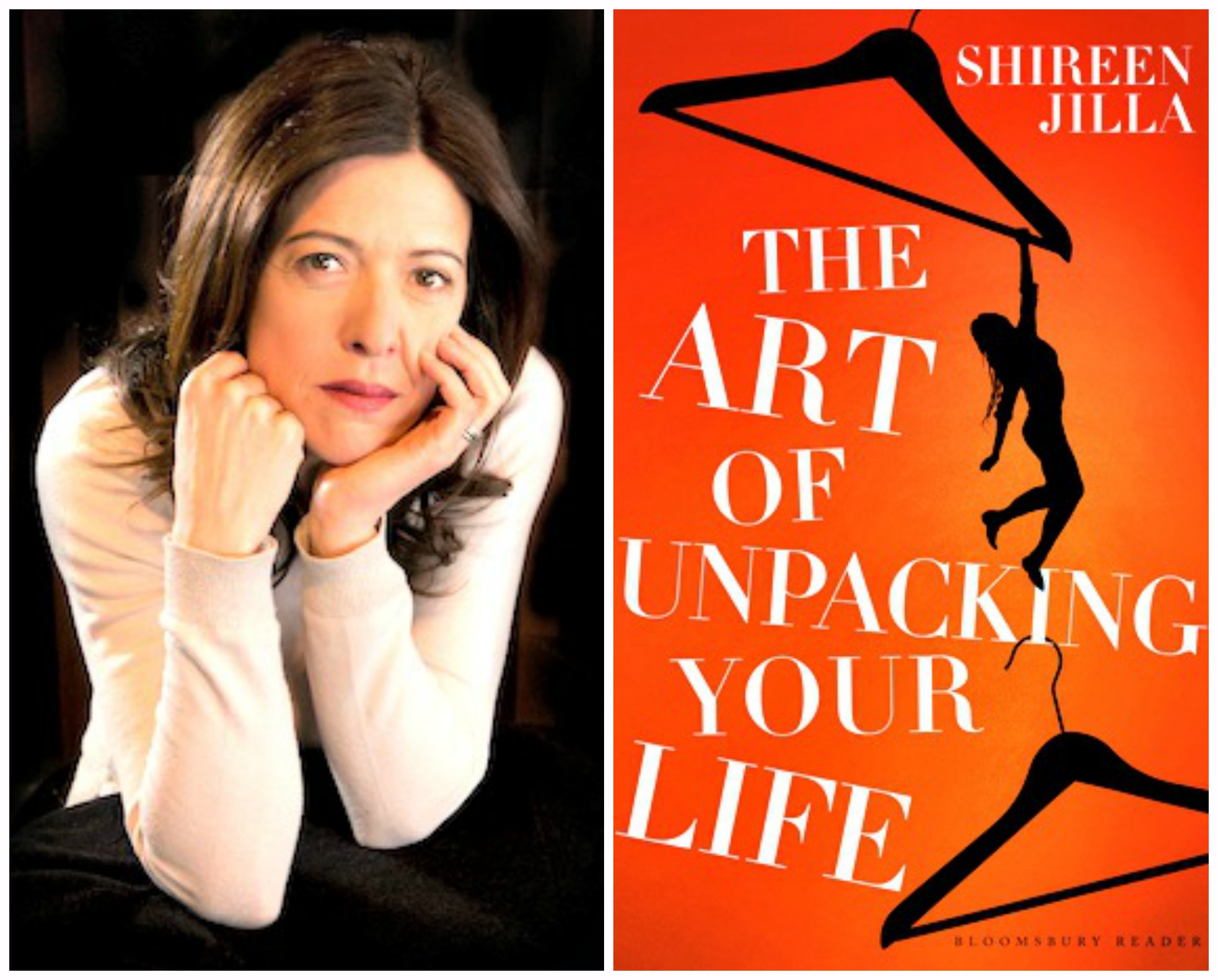
Hello Displaced Nationers! Do I have a treat in store for you this month! Shireen Jilla, whose 2011 psychological thriller, Exiled, was previously featured on the Displaced Nation, is with us again. She has written a new novel, The Art of Unpacking Your Life, which came out in March, and has graciously agreed to answer my questions about her latest work.

Shireen Jilla author photo and book cover for her second novel, The Art of Unpacking Your Life

Shireen Jilla author photo, by Francesco Guidicini (from her author site); cover art.

The book made our list of anticipated “displaced reads” for 2015. For those not in the know, it tells the story of what happens when an Englishwoman named Connie decides to celebrate her 40th birthday by organizing a group of her old university friends and their partners to go on an African safari.

But if Connie is the main character, she is not the only point-of-view character. She functions as the heart of the group—but, as we soon learn, doesn’t seem to manage her own affairs very well. To quote one of my favorite lines from the book:

“Connie was brilliant at life’s details, particularly other people’s life details.”

We all know someone like that, don’t we?

Many authors stick to similar genres and even similar stories but in her two books, Jilla has explored very different places and themes. Where Exiled is a thriller akin to Rosemary’s Baby—it centers on Anna, a British expat leading a privileged life in New York—Unpacking is The Big Chill set in an exotic landscape. Anna may feel isolated within the bustle of the Big Apple, but Unpacking‘s characters are faced with the Kalahari Desert, the kind of place where one must unpack one’s life, finding strengths as well as weaknesses.

Both stories are informed by Jilla’s own travels. An adult TCK and former expat, she has lived in Paris, Rome, and New York as an adult; and in Germany, Holland and England as a kid. (She is now back “home” in London.) And as a traveler, she has experienced firsthand the dry, unusual beauty of the South African bush she describes in Unpacking.

But enough introduction! Time to give Shireen Jilla the floor.

* * *

Hi, Shireen, and welcome back to the Displaced Nation. When we discussed your previous novel, you told us about how the cityscape of New York lent itself to writing a thriller. What made you go from New York’s hustle bustle to the stark, sparse landscape you describe in The Art of Unpacking Your Life? Why the Kalahari?
I had the characters in my mind for a long time. I wanted to explore my generation’s surprisingly disparate lives: single, divorced, gay, with children, successful, jobless. I needed them to be away from home, from their daily lives, unnerved and unsure and therefore open to exploring their issues. I tried setting the book in Sardinia because I know it well. But it wasn’t remote or dramatic enough to force them to “unpack” their problems. When I stepped out of an eight-seater plane into the vast orange heat of the Green Kalahari, I knew I had found my setting.

“Everything in Africa bites—but the safari bug, worst of all.” —Brian Jackman

Tell us more about that moment. I understand from another of your interviews that you went to the Kalahari with your brother?
Yes. My brother generously took me on what can only be called a trip of a lifetime to a private reserve, Tswalu, in the Northern Cape Province of South Africa, bang near the border of Botswana. I had never been to Africa before. So my own experience of this extraordinary trip coloured my story in Unpacking. I was surprisingly drawn to the Kalahari.

Connie and her friends started out in the same place—in a shared house at university—but when the book takes place, they’re all at different places in their lives and don’t appear to have much in common any more. One is a happy housewife, or so she thinks, another feels like success has passed her by both professionally and romantically, others want to start a family, while still others are recuperating from seeing their families crumble. Many books are written from the point of view of a single character, but you give us a glimpse into the thoughts of six multi-layered characters. Was it difficult to imagine how all these people would react to the same events—how they would react to travel?
Thank you for asking this question. It touches the heart of the novel. I wanted to tell this story from the point of view of each of the main six characters because I am fascinated by how differently people read, and react to, the same events. I was inspired by Virginia Woolf’s Mrs Dalloway, which roams from character to character, from paragraph to paragraph. That said, I wasn’t keen to jump around that much, so each chapter in Unpacking is told from a different character’s point of view. I loved writing the same scene from different points of view. It gave me a great sense of freedom.

“Africa is mystic; it is wild; it is a sweltering inferno…” —Beryl Markham

Many of our readers are international creatives, so I’m asking this with them in mind: how do you capture inspiration while you travel? 

“Instead they snapped away, looking up periodically from their cameras, as if undecided whether photo memories or physical ones were more powerful.”

This line in Unpacking reflects my own feelings. While in Africa, I kept a detailed diary and took hundreds of photos, a selection of which are on my author’s site. Having started life as a journalist, I also bought books and talked extensively to the guides. I used all of this material for Unpacking, which I believe is faithful to the actual setting.

In the book, Connie and her group have a very dramatic encounter with one of the animals in the park and the friends’ various reactions reveal their state of mind. Did you have any big-animal encounters during your Africa adventure? 
Thankfully not! The scene was imagined.

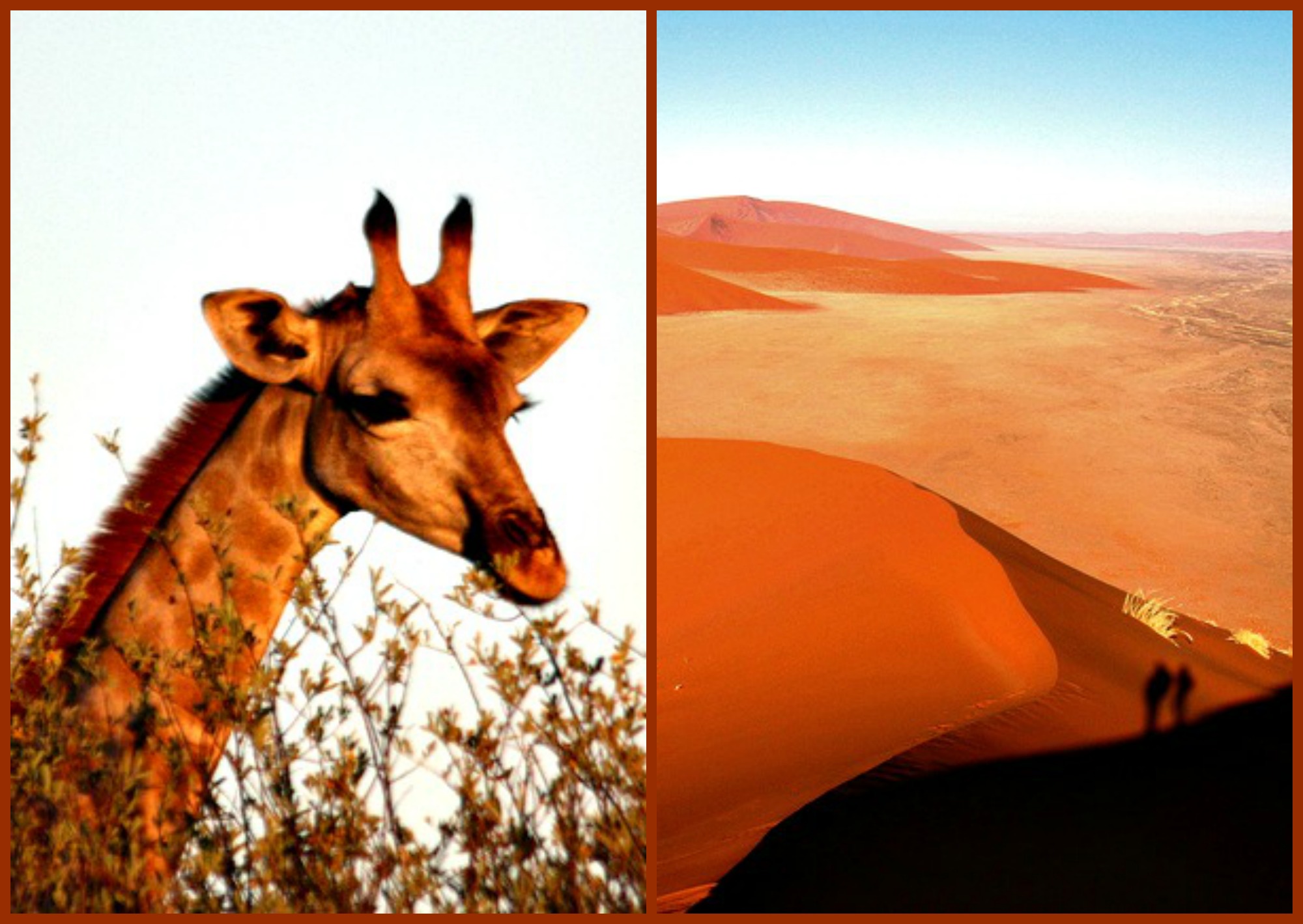
Giraffe & Namibian sand Collage

A silent, self-contained Kalahari giraffe and blood orange sands make it into Shireen Jilla’s novel about a group of friends on an African safari. Photo credits: Male giraffe, by Charles Sharp, and Silhouettes in Sossusvlei, by Monica Guy, both via Flickr (CC BY 2.0).

“The more I traveled, the more I realized, fear makes strangers of people who should be friends.” —Shirley MacLaine

As I mentioned in the introduction, you grew up a Third Culture Kid and you’ve also been an expat. Is there anything from your experiences living abroad as a child and an adult that worked its way into this book?
From own experience, I am acutely interested in how people react to being outside their comfort zone. Living or traveling abroad is a very visceral way of exploring this theme. With Unpacking, I wanted to place a group of close friends, who haven’t traveled extensively, into a remote, unnerving location. For me, it gives the novel its heartbeat.

I’m an Adult Third-Culture Kid, too (and an expat currently), and one of the things that I found remarkable in this book is the close cohesion of a group of people who met at an early stage of their adult lives—not always something we TCKs can find! I’m curious. Do you have a group of friends like Connie’s?
Actually, I have a varied and disparate group of old friends from many places and stages in my life. What I drew on in Unpacking is the notion that one can still feel intensely loyal to old friends, despite growing in different directions. But no, I’ve never planned a big trip with old friends as Connie does.

I noticed that within the group of friends you’ve created, there are two cross-cultural relationships. I enjoyed watching the conflicts from their opposing cultures arise in their relationships. Was this something you set out to capture from the beginning?
This is an interesting question. I haven’t consciously created two cross-cultural relationships. But I am clearly fascinated by and drawn to them. I loved writing both relationships, particularly exploring the cultural misunderstandings between the English friends and New Yorker Katherine.

“Travel and change of place impart new vigor to the mind.” —Seneca

So far you’ve given us two great books based on interesting locations—New York and South Africa. What’s next? Will you follow up with Connie and her friends in another novel? Take your readers on a new adventure somewhere else?
I’m normally adverse to sequels, but I would actually love to write another novel based on the same characters. I’m not ready to let any of them go. I am deeply attached to them all. And I would also enjoy the challenge of another new setting abroad. It’s like moving country. Always exciting.

Lastly, my favorite question for everyone—what are you reading at the moment? Any suggestions for good books that might appeal to the Displaced Nation audience?
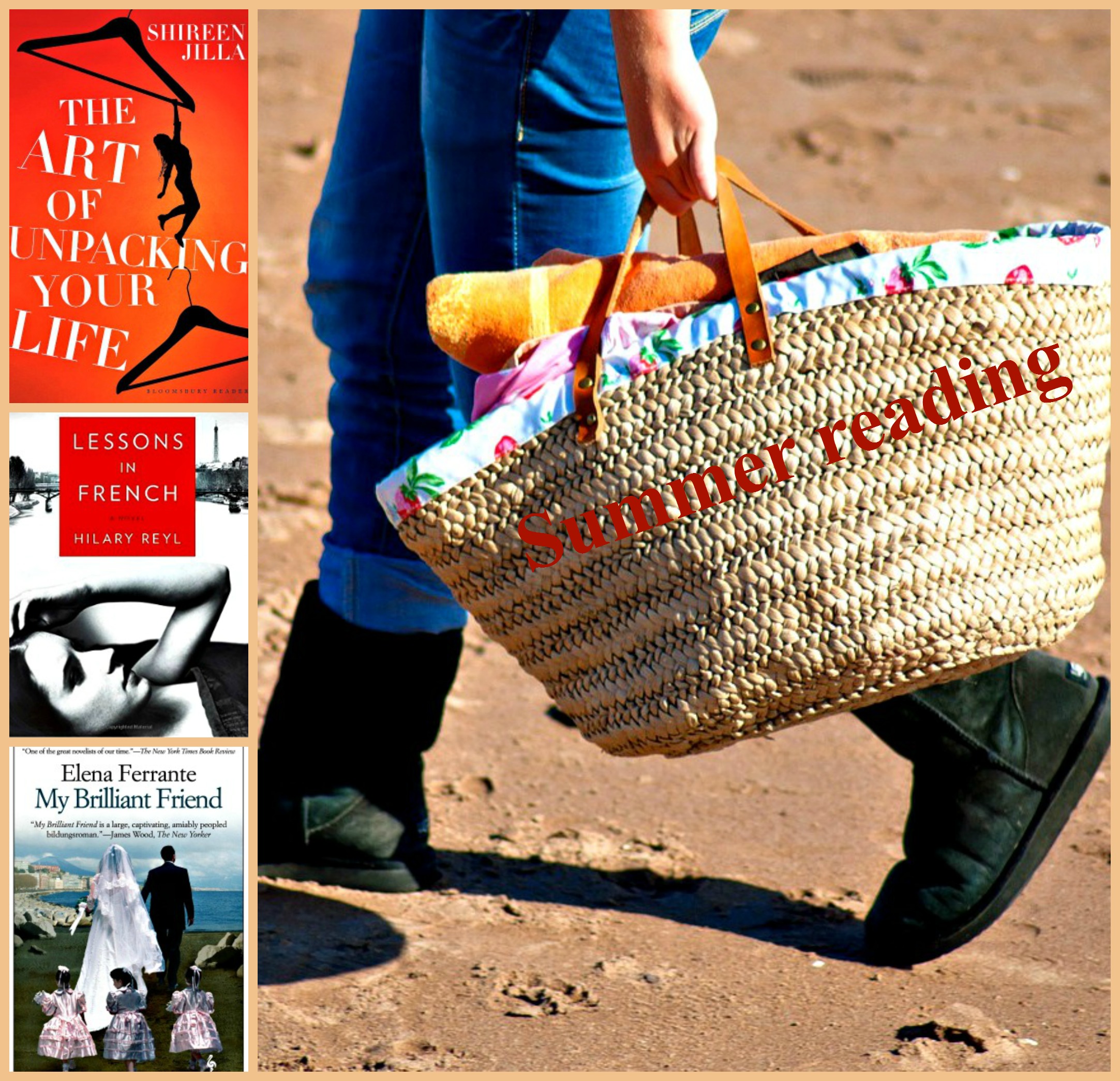
I am currently reading New York writer Hilary Reyl’s Lessons in French. The novel is an absorbing coming-of-age story about an American girl who does work experience with a demanding photographer in Paris. It’s an evocative, lyrical read for all expats. Elena Ferrante’s My Brilliant Friend, is another addictive page turner that lights up a poor working class community in fifties Naples.

Thanks, Shireen, I’ll check those out! And readers, if you’re selecting books for your summer reading list, I suggest you pack Unpacking in your beach bag! Or on your Kindle, more likely… 🙂

Beach bag via Pixabay.

Don’t go to the beach without Shireen’s book and at least one of her recommended reads! Beach bag via Pixabay; book cover art.

* * *

And now Displaced Nationers, it’s your turn to answer some questions. And have you ever tried traveling with friends? Did you pick up any insights about them and/or about yourself? Do let us know in the comments!

Beth Green is an American writer and English teacher living in Prague, Czech Republic. She grew up on a sailboat and, though now a landlubber, continues to lead a peripatetic life, having lived in Asia as well as Europe. Her personal Web site is Beth Green Writes, and she is about to launch a new site called Everyday Travel Stories. To keep in touch with her in between columns, try following her on Facebook and Twitter. She’s a social media nut!

STAY TUNED for the next fab post!

If you enjoyed this post, we invite you to register for The Displaced Dispatch, a round up of weekly posts from The Displaced Nation, and SO much more. Register for The Displaced Dispatch by clicking here!

Related posts:

Photo credit (top of page): “Notebook in hand,” by Oleh Slobodeniuk via Flickr (CC BY-NC-SA 4.0).

CULTURE SHOCK TOOLBOX: How to pry open your mind to new cultures—and keep them all sorted

Yelena Parker for CST Displaced Nation Columnist H.E. Rybol never saw a culture clash she didn’t want to fix. A “transitions enthusiast,” she credits her Third Culture Kid upbringing with giving her a head start in this department. That said, H.E. is always on the lookout for shiny new tools, and toward that end has been interviewing other displaced creatives about their culture shock memories and coping strategies. Today she speaks to Yelena Parker, a Ukrainian expat, executive coach, and writer who, through her many international moves, claims to have mastered the art of “moving without shaking.”

—ML Awanohara

Hello, Displaced Nationers! I’d like you to meet today’s guest, businesswoman and author Yelena Parker. Yelena is Ukrainian but has lived in the United States, Switzerland, Tanzania and now the United Kingdom, and has conducted business in many more countries. Last year she published a book titled Moving without Shaking, which made the Displaced Nation’s “Best of 2014 in Expat Books” list. Described as a “guidebook-meets-memoir,” it aims to help women “who are interested in building their new global life styles whether through working, studying, volunteering or simply living abroad.”

One of Yelena’s contentions is:

Once you are on a serial expat path, new relocations get easier.

Can we take this to mean it’s possible to get better at handling culture shock?

Let’s find out by asking Yelena to describe a few of her own culture shock experiences. She may advocate for moving without shaking; but how does that line up with her own adventures? Has she never shaken like a leaf at some point during her various international moves?

* * *

Hi, Yelena! First can you please tell us which countries you’ve lived in and for how long?

I came to California from Ukraine in my 20s to get an MBA and ended up living there for more than nine years. I didn’t make it till the very end of year 10 as an opportunity came along to relocate to Switzerland for work. After two years in Geneva I moved to London to continue working in tech. I’ve now lived in the UK for four years, only interrupted by a four-month volunteering stint in Tanzania, with a Kilimanjaro climbing break in between.

You’ve certainly made your fair share of cultural transitions. Did you ever put your foot in your mouth? Any memorable stories?

I travel to Moscow frequently for work. During the last trip the taxi driver asked me where I was from. This question is always complicated since, like many here at the Displaced Nation, I now feel as though I’m from everywhere and nowhere in particular. I tend to focus on the most recent location when giving an answer. To be polite, I share where I am coming from literally (versus where I am from). On this occasion, the last port of call was St. Petersburg, which in Soviet times was known as Leningrad. Some wires in my brain must have crossed as I blurted out: “From Leningrad.” The driver said “Really???” We ended up engaging in a much longer conversation, about my Soviet childhood in Ukraine and so on. I think I had a reverse culture shock reaction after being away from where I grew up for so long.

What lessons can you offer to the rest of us from this story?

It’s a bit of a strange example, but what I am trying to get across is that keeping your life truly connected to multiple worlds is very difficult. You are bound to lose some of your identity, forget the basics, replace them with new realities and then, perhaps, come full circle as you find yourself back in your good old comfort zone. You and your memories have many layers now. It can be challenging to keep them sorted. That toolbox of yours needs to have quite a few compartments!

Looking back on your many cultural transitions, can you recall any situations that you handled with surprising finesse?

Moving to Tanzania, I was surprised at how quickly I embraced the pole pole (slowly-slowly) way of life. Until I went on this amazing adventure, I had always been a workaholic. But then I found myself living enjoying the most beautiful sunsets and spending a lot of time talking to people in front of me instead of using various digital ways to connect with people remotely. I didn’t complain about the lack of speedy or efficient services anywhere as I no longer expected that kind of thing. I was not rushed or overwhelmed so wasn’t concerned about being late or other people being late or not showing up to meetings. I just enjoyed every moment of this new experience: no deadlines, no crazy work hours, only things I truly wanted to do. You could say I felt burnt out after working non-stop (or being in school) for 23 years. I do believe, however, that something in that culture was appealing to my natural preferences, which had been suppressed by years of working in the corporate world. I also realized that I wanted to teach again. My first career was in teaching English at a university level in Ukraine—work I’d chosen to abandon when I took a degree in business. That said, I am back on the corporate path again.

If you had to give advice to new expats, what’s the tool you’d tell them to develop first
and why?

I guess it would be some kind of crowbar to pry open your mind to new experiences, no matter how many times you relocate. Learn everything you can about your new home country. Explore it thoroughly. If you end up moving back home, you will regret that you didn’t do enough. If you stay, the more you learn, the easier your assimilation into your new life is going to be.

Thank you so much, Yelena, for taking the time to share your experiences and reminding us that keeping an open mind and a willingness to learn about other cultures can be effective tools, sometimes in unexpected ways! I love your example of becoming immersed in an East African culture and learning more about your own (suppressed) natural preferences as a result. And I of course love the idea of moving without shaking! That’s what this toolbox is for…

* * *

Readers, what do you make of Yelena’s advice? Have you ever found yourself having a Rip-Van-Winkle moment like hers? How about discovering your “true self” in a vastly different culture? Do tell!

If you like what you heard from Yelena, be sure to check out her author site and follow her on Facebook and Twitter.

Well, hopefully this has you “fixed” until next month.

Until then. Prost! Santé!

H.E. Rybol is a TCK and the author of Culture Shock: A Practical Guide and Culture Shock Toolbox. She loves animals, piano, yoga and being outdoors. You can find her on Twitter, Linkedin and Goodreads. She is currently working on her new Web site and her second book.  

STAY TUNED for next week’s fab posts.

If you enjoyed this post, we invite you to register for The Displaced Dispatch, a round up of weekly posts from The Displaced Nation—and much, much more! Register for The Displaced Dispatch by clicking here!

Related post:

BOOKLUST, WANDERLUST: 2014–2015 books recommended by expats & other international creatives (2/2)

Globe Bookshelf Part TwoHello Displaced Nationers! As those who caught Part One of this post last week will know, we are continuing the party we had at the end of last year in publishing a Best of 2014 in expat books list by soliciting various international creatives and other “displaced” contacts for more recommended books.

In Part One, several of my bookworm friends from a previous blog, Novel Adventurers, along with ML and JJ Marsh (JJ writes the Location, Locution column for Displaced Nation), revealed their favorite 2014 reads.

In Part Two, below, kicking off with yours truly, we talk about releases we’re hotly anticipating this year.

A “forthcoming reads” roundtable, if you will.

—Beth Green

* * *

BETH GREEN: I actively search out books by Elizabeth George, the American author of the Inspector Lynley mystery novels set in Britain, and Elizabeth Gilbert, who achieved fame with her travel memoir, Eat, Pray, Love. 2015 is a great year for me as both Elizabeths have books coming out.

A_Banquet_of_Consequence_300s_coverA Banquet of Consequences (Inspector Lynley Book 19), by Elizabeth George, due out in October.
Synopsis: Lynley and Havers are drawn from Cambridge to London to the windswept town of Shaftesbury during one of their most complex cases yet: the murder of a feminist writer and speaker.
Why I’m excited: Though actually not in the “expat” realm, I have to confess it’s the book I’m most looking forward to reading. I’m a huge fan of George’s diverse characters and elaborate stories.

BigMagic_cover_300Big Magic: Creative Living Beyond Fear, by Elizabeth Gilbert, due out in September.
Synopsis: Gilbert digs deep into her own creative process to share her wisdom and unique perspective about creativity.
Why I’m excited: As some readers may recall, I reviewed her novel The Signature of All Things last fall for this column. It seems that Gilbert is now turning her hand to self-help/motivational books for us creatives. I’m intrigued, and I figure other international creatives should be as well.

Three other upcoming books, by authors I’ve not come across before, have also caught my eye:

Displacement_cover_300Displacement, by Lucy Knisley, due out February 8th.
Synopsis: A graphic-novel-style/comic-book travelogue reporting on a cruise ship trip to the Caribbean Knisley took with her grandparents.
What interests me: Even though I seldom read graphic novels, I’m curious to pick it up, especially given its title(!). Knisley has two previous travelogues in graphic form: French Milk (her six-week trip to Paris to celebrate a milestone birthday) and An Age of License (her all-expenses trip to Europe/Scandinavia).

Meet_Me_in_Atlantis_cover_300Meet Me in Atlantis: My Obsessive Quest to Find the Sunken City, by Mark Adam, due out in March
Synopsis: A few years ago, travel writer Mark Adams made a strange discovery: everything we know about the lost city of Atlantis comes from the work of one man, the Greek philosopher Plato. Then he made a second, stranger discovery: amateur explorers are still actively searching for this sunken city all around the world, based entirely on the clues Plato left behind. Adams decides to track these people down. He reports on what he learns from scientists and amateur historians who all share his curiosity about the facts and fiction surrounding the “lost city.”
What interests me: Count me in that curious group!

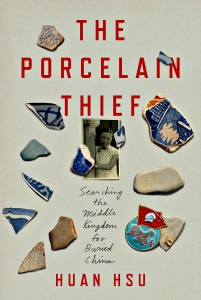
The Porcelain Thief: Searching for the Middle Kingdom in Buried China, by Huan Hsu (forthcoming in March).
The_Porcelain_Thief_cover_300Synopsis: The author, raised in Utah, goes back to his ancestral homeland in China, in part to look for porcelain and other treasures his great-great-grandfather may have buried before the family fled the Sino-Japanese War.
What interests me: As a former expat in China, I love anything about this part of the world, and this displaced family saga sounds particularly fascinating!


ML AWANOHARA: I am always on the lookout for books that could be of interest to the Displaced Nation readership. (Whether I end up reading them or not is a different matter!) I’m sure this is just the tip of the iceberg, but thus far in 2015 I have my eye on one novel and several memoirs.

First, the novel:

The_Art_of_Unpacking_Your_Life_cover_300The Art of Unpacking Your Life, by Shireen Jilla (forthcoming in March)
Synopsis: A million miles away from their daily concerns, on a safari in the Kalahari Desert, two women who were once best friends see if they can reconnect.
What interests me: We featured Jilla’s first novel, Exiled, on the Displaced Nation shortly after we started the site as we were curious to as to why, after her own expat life in New York City, she had produced such a dark, dysfunctional family psychodrama concerning a British expat family living on the Upper East Side of New York. (Her answer was extremely satisfying!)

As to memoirs, here are three that were issued in January:

Leaving_Before_the_Rains_Come_cover_300Leaving Before the Rains Come, by Alexandra Fuller (came out in January)
Synopsis: A child of the Rhodesian wars and daughter of two deeply complicated parents, Alexandra Fuller is no stranger to pain. But the disintegration of her own marriage leaves her shattered. Looking to pick up the pieces of her life, she finally confronts the tough questions about her past, about the American man she married in hopes of being saved from the madness of her early life, and about the family she left behind in Africa.
What interests me: I so enjoyed Fuller’s first memoir, Don’t Let’s Go to the Dogs Tonight, about growing up in a white family during the Rhodesian Bush War, I have come to think of her as a modern-day displaced heroine, or goddess: larger than life, an extraordinary mix of beauty and brains, out of this displaced world… (Hmmm… No wonder her marriage to a mere mortal didn’t last.)

Russian_Tattoo_cover_300Russian Tattoo: A Memoir, by Elena Gorokhova
SYNOPSIS: In her first memoir, A Mountain of Crumbs, Gorokhova detailed her life growing up with an iron-willed mother in Soviet-era St. Petersburg. In this follow-up, she escapes both mother and country by entering into an unsuitable marriage with an American. When her husband first brings her to live in Austin, Texas, the culture shock is extreme. He then ships her off to Princeton to live with his psychotherapist mother. There she meets her second husband and a happier future.
WHAT INTERESTS ME: Maybe because I lived abroad for so long and then had to readjust to life in the U.S., I identify very closely with immigrant stories. And for personal reasons, I’m always attracted to stories that revolve around the challenges of cross-cultural marriage.

Whipping_boy_cover_300Whipping Boy: The Forty-Year Search for My Twelve-Year-Old Bully, by Allen Kurzweil
SYNOPSIS: As a 10-year-old American shipped to a Swiss boarding school, Kurzweil endured a year of torment. Years later he set out to search for the chief bully, Cesar, who, it turned out, had gone to prison twice, having become a professional con man. In circling the globe to find Cesar, Kurzweil stands up for all who’ve been the victim of bullies.
WHAT INTERESTS ME: As we’ve always recognized on this site, some of us who are “displaced” have gothic tales to tell. Thank goodness in this case the villain picked on a man who was destined to become a world-class writer, hence able to exact an exquisite revenge.

Finally, I just now heard about another memoir whose title alone has me panting to know more: The Dead Ladies Project: Exiles, Ex-Pats and Ex-Countries, by litblog founder and book reviewer Jessa Crispin, who moved to Berlin in 2009. It’s due out in September; no book cover yet.


JJ MARSH, crime series author and Displaced Nation columnist (Location, Locution): I have a novel and a poem on my list, along with one publishing house.

A_Spool_of_Blue_Thread_300A Spool of Blue Thread: A Novel, by Anne Tyler (forthcoming this month).
Synopsis: It’s not an expat story but rather the opposite: a domestic family saga. The family, Whitshanks, have lived in Baltimore for several generations.
What interests me: Tyler wrote The Accidental Tourist (about the ultra-insular Leary family, who also live in Baltimore) and I’m curious.

“Sentenced to Life”, by Clive James (James, for those who don’t know, is an Australian writer and personality who has long lived in Britain.)
Synopsis: It’s one of James’s recent poems, published in May of last year, and can be read in full on her author site.
What interests me: I heard James on the radio talking about writing poetry about facing death and it humbled me.

I also look forward to whatever Galley Beggar Press puts out because they’re exciting and adventurous and try things other publishers will not. This strategy paid off with their Baileys Prize success of A Girl is a Half-Formed Thing by Eimear McBride last year.


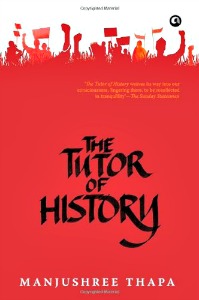
The_Tutor_of_History_cover_300HEIDI NOROOZY, adult TCK, translator and author (@heidinoroozy): This year I’ve resolved to read more books in translation and stories from far-flung parts of the world. And, as I enjoy novels set in foreign locations that are told in local voices, I’ve got these two on my list:

The Tutor of History, written in English by the Nepali author Manjushree Thapa
SYNOPSIS: One of South Asia’s best-known writers, Thapa follows the lives of a variety of characters in the lead-up to local and national elections in a small town in central Nepal.
NOTE: This novel came out in 2012, but I haven’t gotten round to reading it yet.

The_Little_Paris_Bookshop_cover_300The Little Paris Bookshop, by the German author Nina George (forthcoming in English in June).
SYNOPSIS: Monsieur Perdu calls himself a literary apothecary. From his floating bookstore in a barge on the Seine, he prescribes novels for the hardships of life. The only person he can’t seem to heal through literature is himself…but will he manage to do that on a mission he takes to the south of France, with an Italian chef as his companion?
NOTE: I already read the novel in German. In Germany it spent over a year on the bestseller lists.


My_Fellow_Prisoners_cover_300KELLY RAFTERY, translator and writer: In 2015, I am looking forward to being able to read Mikhail Khodorkovsky’s collection of short stories entitled My Fellow Prisoners. Already available in Europe, it is due to have its U.S. release in late February. Convicted on thinly disguised, politically motivated charges, Mikhail Khodorkovsky went from being Russia’s richest man to a labor camp inmate in Siberia. In the decade of his incarceration, Khodorkovsky scribbled short sketches of the men he encountered, jailers and prisoners alike.


SUPRIYA SAVKOOR, editor and mystery writer: In the last roundtable, I mentioned having recently read two gripping memoirs: Not My Father’s Son, by Alan Cumming, and A Long Way Home, by Saroo Brierley. In 2015 I’m looking forward to more books that surprise me as these two did, particularly ones in which the new stories are intertwined with the old ones and make me see the grander scheme of things.


Rebel_Queen_cover_300ALLI SINCLAIR, world traveler and novelist (www.allisinclair.com): I’m a huge fan of Michelle Moran’s books and any book of hers is an automatic buy for me. Moran has an interesting story. Born in Southern California, she was a public high school teacher before becoming a writer, using her summers to travel around the world. It was her experiences as a volunteer on archaeological digs that inspired her to write historical fiction. Moran’s upcoming work, Rebel Queen, will be released in March. It’s about Queen Lakshmi—also known as India’s Joan of Arc because she stood up to the British invasion of her beloved Kingdom of Jhansi. The queen raises two armies—one male and one female—and they go into battle against the well-prepared British.

Moran’s books are rich in historical facts but the stories are so enthralling it never feels like a history lesson. Another reason I’m a fan is because she usually chooses the point of view of someone not so well known. For example, in this story the main character is Sita, one of the Queen’s trusted soldiers and companions, a device that serves to paint a less-biased picture of the more famous Queen Lakshmi.

* * *

Thank you, ML, JJ and guests! Readers, do you have any further 2015 recommendations? Please leave a comment below. And then let’s get our noses back into our books!

Finally, please be sure to sign up for the DISPLACED DISPATCH, which has a Recommended Read every week. You can also follow the Displaced Nation’s DISPLACED READS Pinterest board.

STAY TUNED for next week’s fab posts!

If you enjoyed this post, we invite you to subscribe to The Displaced Dispatch, a weekly round up of posts from The Displaced Nation, plus some extras such as seasonal recipes and occasional book giveaways. Sign up for The Displaced Dispatch by clicking here!

Related posts:

BOOKLUST, WANDERLUST: Best of 2014 in expat books (1/2)

Best of Expat Books 2014

Kindle Amazon e-reader by Unsplash via Pixabay (CC0 1.0)

Seasons greetings, Displaced Nationers. That special time of the year is here again, when we publish our selection of this year’s books with meaningful connections to expats, Third Culture Kids, global wanderers, and others of us who have in some way led “displaced lives”.

Having assembled this list on my own in years past, I am pleased to be joined this year by Beth Green, our BOOKLUST, WANDERLUST columnist, who has also graciously agreed to sign over her column space for the month.

Let’s give Beth the floor:

Happy holidays, all! Preparing for this yearly special, I went back through all of the books I’ve read since January—not such an easy task; I read a lot!—and realized that I hadn’t actually read all that many that were published in 2014. I just now took a look at my TBR list, to which I’m constantly adding—and saw it includes a few that were written a couple of hundred years ago!

As is the case I suspect for many a well-traveled reader, I read most often on my Kindle, which means that I don’t often look at the title and publication pages to see when the book came out. Probably the book that has stayed with me for the longest this year is The Tiger’s Wife, the debut novel by Téa Obreht, an American writer of Bosniak/Slovene origin. But that came out in 2011!

* * *

And now for some 2014 picks in these three categories (stay tuned for a follow-up post with THREE MORE CATEGORIES!!):

  1. TRAVEL
  2. MEMOIRS
  3. CROSS-CULTURAL CHALLENGES

A few points to note:

  • Books in each category are arranged from most to least recent.
  • Unless otherwise noted, books are self-published.
  • Contributions by Beth are (appropriately enough!) in green.

* * *

TRAVEL

My_Gutsy_story_cover_smallMy Gutsy Story Anthology: Inspirational Short Stories About Taking Chances and Changing Your Life (Volume 2) (October 2014)
Compiled by: Sonia Marsh
Synopsis: Marsh celebrates the gutsy in each of us with this collection of stories from 64 authors who found the courage to face their fears and live their dreams.
Expat credentials: Born to a Danish mother and British father, who brought her to live in West Africa at the age of three months, Marsh has lived in many countries—Demark, Nigeria, France, England, the U.S. and Belize—and considers herself a citizen of the world. With a degree in environmental science from the University of East Anglia, U.K., she is currently living in Southern California with her husband but in 2015 intends to start a new chapter as a Peace Corps volunteer.
How we heard about: We have long enjoyed Marsh’s collection of “gutsy” travel stories and have followed her on Twitter for some time.
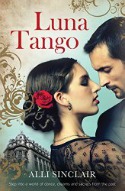

Luna_Tango_Cover_smallLuna Tango (The Dance Card Series Book 1) (Harlequin Mira, July 2014)
Author: Alli Sinclair
Genre: Romance
Synopsis: Tango is a mysterious—and deadly—influence in journalist Danni McKenna’s life. She looks for answers about her mother’s and grandmother’s lives, and finds romance in the process.
Expat credentials: Alli Sinclair is from Australia but lived for many years in South America, where she worked as a mountain and tour guide. She considers herself a citizen of the world.
How we heard about it:  I used to blog with Alli on the now-retired Novel Adventurers and have enjoyed hearing about her book’s path to publication. I was especially thrilled when Luna Tango won Book of the Year in the inaugural AusRom Today Reader’s Choice Awards last month. Congratulations, Alli!
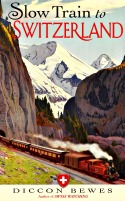

Slow-Train-final-cover_smallSlow Train to Switzerland (Nicholas Brealey Publishing, April 2014)
Author: Diccon Bewes
Genre: Travel history
Synopsis: Bewes follows “in the footsteps” of Miss Jemima Morrell, a customer on Thomas Cook’s first guided tour of Switzerland in 1863, and discovers how this plucky Victorian woman helped shape the face of modern tourism and Switzerland itself, transforming it into the Cinderella of Europe.
Expat creds: An Englishman who grew up in “deepest Hampshire”, Bewes worked for ten years at Lonely Planet and the UK consumer magazine Which? Travel, before moving to Bern, Switzerland, where he is now a full-time writer. He considers himself a “permanent expat.”
How we discovered: I came across Bewes’s blog through a Google Alert and was impressed by how prolific he is. I also liked the fact that he admits to being a chocolate lover. (No wonder he has a thing for Switzerland!)


Kamikaze_kangaroos_cover_smallKamikaze Kangaroos!: 20,000 Miles Around Australia. One Van,Two Girls… And An Idiot (February 2014)
Author: Tony James Slater
Synopsis: Tony James Slater knew nothing about Australia. Except for the fact that he’d just arrived there. The stage is set for an outrageous adventure: three people, one van, on an epic, 20,000-mile road trip around Australia. What could possibly go wrong?…
Expat credentials: As a former writer for the Displaced Nation, what more creds does Tony need?
How we heard about: The Displaced Nation is committed to tracking Tony’s progress as a writer. We are especially fond of his ability to make fun of himself! He wears his travels lightly, you might say…


MEMOIRS
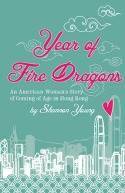
Year_of_Fire_Dragons_cover_smallYear of Fire Dragons: An American Woman’s Story of Coming of Age in Hong Kong (Blacksmith, forthcoming June 2015; available for pre-order)
Author: Shannon Young
Synopsis: When 22-year-old Shannon follows her Eurasian boyfriend to his hometown of Hong Kong, she thinks their long distance romance is over. But a month later his company sends him to London. The city enchants her, forcing her to question her plans. Soon, she will need to choose between her new life and the love that first brought her to Asia.
Expat creds: Shannon is an American twenty-something currently living in Hong Kong. (Reader, she married him!)
How we knew about: Shannon writes our “Diary of an Expat Writer” column and has also been sharing “chunks” from an anthology she edited of writings by women expats in Asia (see listing below: under “Crosscultural Challenges”).


Coming_Ashore_cover_smallComing Ashore (October 2014)
Author: Catherine Gildiner
Synopsis: The third and final in a series of best-selling memoirs by this American who has worked for many years as a psychologist in Toronto and writes a popular advice column in the Canadian women’s magazine Chatelaine. The book begins with Gildiner’s move to Canada in 1970 to study literature at the University of Toronto, where she ends up rooming with members of the FLQ (Quebec separatists), among other adventures.
How we heard about: Book #2 in Chatelaine’s 7 must-read books for November.
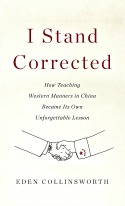

I_stand_corrected_cover_smallI Stand Corrected: How Teaching Manners in China Became Its Own Unforgettable Lesson (Nan A. Talese, October 2014)
Author: Eden Collinsworth
Synopsis: Collinsworth tells the story of the year she spent living among the Chinese while writing an advice manual covering such topics as personal hygiene (non-negotiable!), the rules of the handshake, and making sense of foreigners. (She has since returned to live in New York City.)
How we heard about: Book #3 in Conde Nast Traveler’s 7 Books to Get You Through Travel Delays, Bad Company.


Seven_Letters_from_Paris_cover_smallSeven Letters from Paris: A Memoir (Sourcebooks, October 2014)
Author: Samantha Vérant
Synopsis: At age 40, Samantha Verant’s life is falling apart—she’s jobless, in debt, and feeling stuck…until she stumbles upon 7 old love letters from Jean-Luc, the sexy Frenchman she’d met in Paris when she was 19. She finds him through a Google search, and both are quick to realize that the passion they felt 20 years prior hasn’t faded with time and distance.
How we heard about: From an interview with Vérant by British expat in Greece Bex Hall on her new blog, Life Beyond Borders.


Becoming_Home_cover_smallBecoming Home: A Memoir of Birth in Bali (October 2014)
Author: Melinda Chickering
Synopsis: Though born in small-town USA, Melinda never felt quite at home there. As an adult, her search for herself led her to the Indonesian island of Bali, where she found herself living a life she hadn’t anticipated, becoming a housewife and mother. This memoir of her experience with pregnancy and birth offers a window on life for a western woman living in an Asian culture that respects the forces of darkness as well as the light.
Expat credentials: Originally from Iowa, Chickering has settled in Bali.
How we heard about it: Displaced Nationer Melinda contacted me earlier this year to tell us the exciting news that her memoir was being published. Congratulations, Melinda!

The_Coconut_Latitudes_cover_smallThe Coconut Latitudes: Secrets, Storms, and Survival in the Caribbean (September 2014)
Author: Rita M. Gardner
Synopsis: Rita is an infant when her father leaves a successful career in the US to live in “paradise”—a seaside village in the Dominican Republic. The Coconut Latitudes is her haunting, lyrical memoir of surviving a reality far from the envisioned Eden—and of the terrible cost of keeping secrets.
How we heard about: Displaced Nation columnist James King interviewed Rita for “A picture says”.

At_home_on_Kazakh_Steppe_cover_smallAt Home on the Kazakh Steppe: A Peace Corps Memoir (August 2014)
Author: Janet Givens
Synopsis: The story a middle-aged grandmother who left behind a life she loved and forged a new identity as an English teacher, mentor, and friend in Kazakhstan, a newly independent country determined to find its own identity after generations under Soviet rule.
How we heard about: Recommended by the We Love Memoirs Facebook Community.


Good_Chinese_Wife_cover_smallGood Chinese Wife: A Love Affair with China Gone Wrong (Sourcebooks, July 2014)
Author: Susan Blumberg-Kason
Synopsis: A shy Midwesterner, Blumberg-Kason spent her childhood in suburban Chicago dreaming of the neon street signs and double-decker buses of Hong Kong. She moved there for graduate school, where she fell for Cai, the Chinese man of her dreams. As they exchanged vows, she thought she’d stumbled into an exotic fairy tale, until she realized Cai—and his culture—where not what she thought. One of our featured authors, Wendy Tokunaga, says: “A fascinating, poignant and brutally honest memoir that you won’t be able to put down. Good Chinese Wife is riveting.”
How we heard about: We had known about the book for some time but hadn’t realized it came out this year Jocelyn Eikenburg tipped us off in her comment below. She, too, highly recommends.

Into_Africa_cover_smallInto Africa: 3 kids, 13 crates and a husband (June 2014)
Author: Ann Patras
Synopsis: Patras was born and raised in Burton-upon-Trent, in the English Midlands. When her husband, Ziggy, is offered a two-year contract as site manager for building a new cobalt plant in Zambia, they discuss the pros and cons of leaving luxuries and England behind—and then decide it could be an “interesting” family adventure. They end up raising three kids, countless dogs and living in Africa for over thirty years. (She and Ziggy now live in Andalucía, Spain, and have absolutely no intention of ever moving again. Hmmm…have they encountered Charlotte Smith yet? See next item.)
How we heard about: E-book promotion.

PawPrintsinOman_cover_smallPaw Prints in Oman: Dogs, Mogs and Me (April 2014)
Author: Charlotte Smith
Synopsis: Smith was born, raised and lived in West Sussex, UK, until her persuasive husband, Nick, swept her and their youngest daughter off to live in mystical Oman. Her love of animals helped her to shape an extraordinary life in the Middle East—her first step being to convince a local veterinary clinic to employ her. (Note: Smith now lives in Andalucía, in southern Spain.)
How we heard about: Recommended by the We Love Memoirs Facebook community. The book was also on the New York Times best-seller list (“animals”) in October.


loveyoubye_cover_smallLoveyoubye: Holding Fast, Letting Go, And Then There’s the Dog (She Writes Press, April 2014)
Author: Rossandra White
Synopsis: A collision of crises on two continents forces Rossandra White to face the truth. Just as her American husband disappears to Mexico, her brother’s health crisis calls her back home to Africa, and her beloved dog receives a fatal diagnosis. She faces down her demons to make a painful decision: stay in a crumbling marriage, or leave her husband of 25 years and forge a new life alone.
How we heard about: Through a Facebook share of White’s Good Reads giveaway.
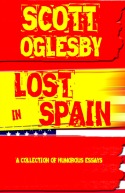

Lost_in_Spain_cover_smallLost in Spain: A Collection of Humorous Essays (March 2014)
Author: Scott Oglesby
Synopsis: Scott Oglesby moved to Spain to start over. When he discovered he was still the same person, now six thousand miles from home, the result was dysfunction, delusion, chaos and this book, which many readers have described as “hilarious” and “brilliant”.
How we heard about: E-book promotion.


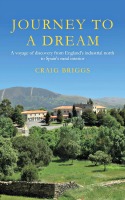
Journey_to_a_Dream_cover_smallJourney to a Dream: A voyage of discovery from England’s industrial north to Spain’s rural interior (February 2014)
Author: Craig Briggs
Synopsis: Craig, his wife Melanie and their dog, Jazz, left their home town of Huddersfield, in England’s industrial north, and set off for Galicia: a remote and little-known autonomous province in the northwest corner of Spain. And so began their Journey to a Dream…
How we heard about: E-book promotion, as a result of which I am currently reading this on my Kindle. It’s very well written and entertaining.


Paris_Letters_cover_smallParis Letters: One woman’s journey from the fast lane to a slow stroll in Paris (February 2014)
Author: Janice Macleod
Synopsis: MacLeod found herself age 34 and single, suffering from burn-out and dissatisfaction. So she abandoned her copywriting job and headed off to Europe, where she ended up finding love and freedom in a pen, a paintbrush…and Paris! Macleod says her journey was inspired by The Artist’s Way, written by Julie Cameron.
How we heard about: From an interview with MacLeod by American expat in Paris Lindsey Tramuta, which appeared on Lindsey’s blog, Lost in Cheeseland.


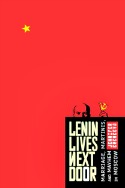
lenin_smallLenin Lives Next Door: Marriage, Martinis, and Mayhem in Moscow (Small Batch Books, January 2014)
Author: Jennifer Eremeeva
Synopsis: Based on Eremeeva’s two decades in Russia, Lenin Lives Next Door is a work of self-described “creative nonfiction.” It knits together vignettes of cross-cultural and expatriate life with sharp observation, historical background, and humor. Each chapter explores an aspect of life in today’s Russia, told with the help of a recurring cast of eccentric Russian and expat characters, including HRH, Eremeeva’s Handsome Russian Husband (occasionally a.k.a. Horrible Russian Husband), and their horse-mad daughter.
How we heard about: Eremeeva sent me a review copy and we met up for coffee at Columbia University. I found her a delightful conversationalist. No wonder several reviewers have likened her style to Jane Austen’s.


CROSS-CULTURAL CHALLENGES
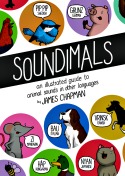
Soundimals_cover_smallSoundimals: An illustrated guide to animal sounds in other languages (November 2014)
Author/illustrator: James Chapman.
Synopsis: In English, we say dogs go WOOF, but in Romanian they go HAM HAM. Chapman regularly publishes illustrations of onomatopoeia and animal sounds in other languages on his Tumblr blog. This book (available through his Etsy shop) collects some of those plus a lot of new sounds that weren’t in the original comics, and a few new animals that haven’t been posted at all.
Expat creds: None that we know of; would love to hear more about how he got started collecting these sounds.
How we heard about: Pinterest.
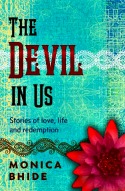

The_Devil_in_us_cover_smallThe Devil in Us (CreateSpace, October 2014)
Author: Monica Bhide
Genre: Literary fiction
Synopsis: Short stories that carry you to a far away place, amidst people seemingly very foreign to you, but somehow create a connection—from the Indian-American cancer survivor escaping her pain and finding passion in Mumbai, to the Japanese teen in Georgetown discovering forbidden love. Bhide is known for her writings about Indian food. This is her first work of fiction.
Expat creds: Monica is originally from Delhi, India, but has lived in Bahrain ad now in the United States.
How we found out about: Pinterest.
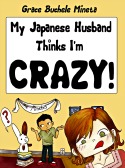

Japanese_Husband_cover_smallMy Japanese Husband Thinks I’m Crazy! The comic book: Surviving and thriving in an intercultural, interracial marriage in Tokyo (October 2014)
Author: Grace Buchelle Mineta
Genre: Comics/manga; humor
Synopsis: The autobiographical misadventures of a native Texan freelancer and her Japanese “salaryman” husband, in comic book form.
Expat credentials: Mineta grew up mostly in Texas, but also spent her teenage years in Accra, Ghana and Sapporo (Hokkaido), Japan. She now lives in Tokyo with her Japanese husband (they got married in January) and blogs at Texan in Tokyo.
How we found out about: From a guest post by Mineta on Jocelyn Eikenburg’s blog, Speaking of China, titled The “Dark Side” to Moving Across the World for Love.
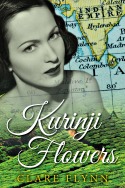

Kurinji_Flowers_cover_smallKurinji Flowers (October 2014)
Author: Clare Flynn
Genre: Historical romance
Synopsis: Set in South India during World War II and India’s struggle for independence, the book is centered on a young British colonial, Ginny Dunbar, who has arrived in India for a new start in life. She has to battle her inner demons, the expectations of her husband, mother-in-law, and colonial British society, and her prejudices towards India and its people.
Expat credentials: Flynn is a repeat expat, having lived for two years each in Paris and Brussels, three years in Milan, and six months in Sydney, though never in India. She now lives in London but spends as much time as she can in Italy. Almost needless to say, Flynn loves travel and her idea for this book came while she was on holiday in Kerala, India.
How we knew about: Flynn was interviewed by JJ Marsh for the latter’s popular column, LOCATION LOCUTION.
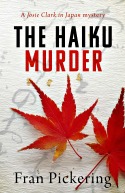

The_Haiku_Murder_cover_smallThe Haiku Murder (Josie Clark in Japan mysteries Book 2) (October 2014)
Author: Fran Pickering
Genre: Expat mystery series
Synopsis: A haiku-writing trip turns to tragedy when a charismatic financier falls from the top of Matsuyama castle. But was he pushed? Expat Londoner Josie Clark thinks he was, and that’s when the trouble starts…
Expat credentials: Pickering has lived and worked in Tokyo, and though she is now back in London (literally next door to where she was born), she travels back to Japan frequently to visit friends and do research for the Josie Clark mystery series.
How we heard about: Pickering was interviewed by JJ Marsh for the latter’s popular column, LOCATION LOCUTION.
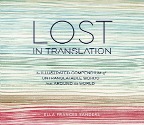

LostinTranslation_cover_smallLost in Translation: An Illustrated Compendium of Untranslatable Words from Around the World (September 2014)
Author: Ella Frances Sanders
Genre: Illustration/Translation
Synopsis: Did you know that the Japanese language has a word to express the way sunlight filters through the leaves of trees? Or that there’s a Finnish word for the distance a reindeer can travel before needing to rest? This book is an artistic collection of more than 50 drawings featuring unique, funny, and poignant foreign words that have no direct translation into English.
Expat credentials:  A self-described “intentional” global nomad, Sanders has lived all over the place—most recently Morocco, the United Kingdom, and Switzerland.
How we heard about: From a post about the book by Maria Popova on her much-acclaimed Brain Pickings site.


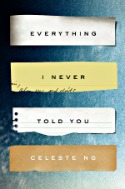
Everything_I_Never_Told_You_cover_smallEverything I Never Told You (Penguin, June 2014)
Author: Celeste Ng
Genre: Thriller
Synopsis: A mixed-race family in the 1970s tries to unravel a family tragedy.
Expat credentials: Celeste Ng isn’t an expat, but she has a deep understanding of what it means to feel displaced. Her work deals with multiculturalism and race issues in the United States.
How we heard about it: It was voted the Amazon Book of the Year.
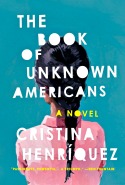

TheBook_Of_Unknown_Americans_smallThe Book of Unknown Americans (Knopf, June 2014)
Author:  Cristina Henríquez
Genre: Literary fiction
Synopsis: Arturo and Alma Rivera have lived their whole lives in Mexico. One day, their beautiful fifteen-year-old daughter, Maribel, sustains a terrible injury, one that casts doubt on whether she’ll ever be the same. And so, leaving all they have behind, the Riveras come to America with a single dream: that in this country of great opportunity and resources, Maribel can get better.
Expat credentials: Henríquez isn’t an expat, but her father was—he came to the US from Panama to attend university.
How we heard about it: Henríquez’s novel was Amazon’s No. 1 bestseller this year in the Hispanic American Literature & Fiction category.


TheOtherLanguage_cover_smallThe Other Language (Pantheon, April 2014)
Author: Francesca Marciano
Synopsis: A collection of short stories involving women who are confronted by radical change or an old flame, in locations that range from New York to India to Kenya to southern Italy.
Expat credentials: Marciano is an Italian novelist who left Rome at age 21 to live in the United States. She later moved to Kenya, where she lived for a decade. Although Italian is her first language, she chooses to write in English.
How we found out: From an essay by William Grimes in the New York Times Book Review: “Using the Foreign to Grasp the Familiar: Writing in English, Novelists Find Inventive New Voices.”


Dragonfruit_cover_smallHow Does One Dress to Buy Dragon Fruit: True Stories of Expat Women in Asia (April 2014)
Editor: Shannon Young
Genre: Expat non-fiction; anthology
Synopsis: In this collection, 26 women reveal the truth about expatriate life in modern East Asia through original works of memoir and creative non-fiction.
Expat credentials: To qualify for inclusion in the volume, writers had to be able to say they were, or had once been, expats.
How we heard about: We have followed Shannon Young ever since she contributed to the Displaced Nation on the topic of the London Olympics. She currently writes a column for us about being an expat writer, and we’ve been sharing “chunks” from her Dragonfruit anthology for the past few months.


Chasing_Athens_cover_smallChasing Athens (April 2014)
Author: Marissa Tejada
Genre: Romance
Synopsis: When Ava Martin’s new husband unexpectedly ditches her months after they’ve relocated across the world to Greece, the heartbroken American expat isn’t sure where home is anymore. On the verge of flying back to the States with her tail between her legs, she makes an abrupt decision to follow her gut instead and stay on in Greece, until a crisis back home forces her to decide where she truly belongs.
Expat credentials: A Native New Yorker, Tejada is an author, writer and journalist based in Athens, Greece. Living the expat life in Europe inspired her to write her debut novel.
How we heard about it: Again, from an interview conducted by British expat in Greece Bex Hall on her blog, Life Beyond Borders.


Moving_without_Shaking_cover_smallMoving Without Shaking: The guide to expat life success (from women to women) (April 2014)
Author: Yelena Parker
Genre: Guidebook-meets-memoir
Synopsis: Parker draws from the experiences and views of 9 women who have lived across 12 countries, to craft a resource for those who are dreaming of—or already facing—relocation abroad.
Expat creds: Parker herself is originally from Eastern Ukraine but has lived and worked in the US, Switzerland, the UK and Tanzania. She has chosen London as her latest expat location.
How we heard about: From a Google Alert.
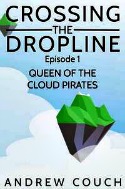

QueenOfCloudPirates_cover_smallQueen of the Cloud Pirates (Crossing the Dropline Book 1) (March 2014)
Author: Andrew Couch
Genre: Fantasy novella
Synopsis: Far to the North of the Iron League core cities lies the Dropline. Beyond this line of cliffs the power of elemental Air rules supreme. The crucial region is threatened and two young men stand at the tipping point. In order to survive, they must learn to work together and rise above their own shortcomings. Oh yeah, and escape from pirates. Don’t forget the pirates….
Expat credentials: An American abroad, Couch lives with his wife in Freiburg, Germany. He says that much of the inspiration for the worlds he writes about is a mix of a wild and crazy imagination (he grew up reading fantasy books) and his travels around the world.
How we found out about: Couch contributes the HERE BE DRAGONS column to the Displaced Nation, focusing on the connection between the displaced life and fantasy writing (more powerful than any skeptics out there might think!).
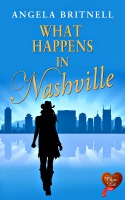

What_Happens_in_Nashville_cover_smallWhat Happens in Nashville (March 2014)
Author: Angela Britnell
Genre: Romance (“choc lit”)
Synopsis: Claire Buchan, a straight-laced barrister from Exeter, UK, flies to Nashville, Tennessee, to organize her sister Heather’s bridal bash—and quickly finds herself out of her comfort zone and into the arms of a most unsuitable beau…
Expat credentials: Britnell grew up in a small Cornish village in southwestern England. She served in the Royal Navy for almost six years, culminating in an assignment in Denmark, where she met her American husband. Thus began a chronic expat life. The couple, now empty nesters, have settled in Brentwood, Tennessee.
How we heard about: Rosie Milne wrote about Britnell in an article that appeared on Telegraph Expat: “Expat romantic novelists inspired by real life.” (Milne btw lives in Singapore and runs Asian Books Blog.)


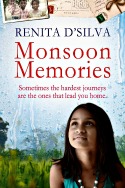
Monsoon_Memories_cover_smallMonsoon Memories (January 2014)
Author: Renita D’Silva
Genre: Literary fiction
Synopsis: Sometimes the hardest journeys are the ones that lead you home. Exiled from her family in India for more than a decade, Shirin and her husband lead a comfortable but empty life in London. Memories of her childhood fill Shirin with a familiar and growing ache for the land and the people that she loves. With the recollections, though, come dark clouds of scandal and secrets. Secrets that forced her to flee her old life and keep her from ever returning…
Expat credentials: Now living in the UK, Renita grew up in a picturesque coastal village in South India.
How we heard about: Amazon.
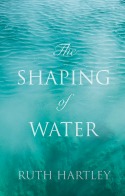

The_Shaping_of_Water_cover_smallThe Shaping of Water (December 2013—we’re letting it squeak in!)
Author: Ruth Hartley
Genre: Literary fiction
Synopsis: The story concerns the overlapping lives of several different people, expats and locals or some mix, who are connected to a ramshackle cottage by a man-made lake in Central Africa during the Liberation wars across its region.
Expat credentials: Hartley grew up on her father’s farm in Zimbabwe, which at that point was known as Rhodesia, at a time when struggles for independence in European-ruled African territories were spreading like a wave. As a young woman, she moved to South Africa to study art and then had to escape to England because of her political activities. She later moved back to Africa, as an expat. She now lives in Southern France.
How we heard about: I discovered Hartley via one of my social networks and then decided to approach her about being interviewed for the Displaced Nation.

* * *

Your turn readers: Have you read any of the above works and if so, what did you think of them? And can you suggest other works to add to the list? Beth and I look forward to reading your comments below!

From Beth:
Intrigued by some of these titles? Go on, download a few! ‘Tis the season to support the output of other international creatives!

Finally, please note: Beth and I may repeat this exercise in six months (summer reads!). But if you can’t wait until then, I suggest that you sign up for our DISPLACED DISPATCH, which has a Recommended Read every week, and also follow our Pinterest board: DISPLACED READS.

STAY TUNED for PART 2 of this post: IT’S FOOD!, THIRD CULTURE KIDS & COUNTRY GUIDES/TRIBUTES.

If you enjoyed this post, we invite you to subscribe to The Displaced Dispatch, a weekly round up of posts from The Displaced Nation, plus some extras such as seasonal recipes and occasional book giveaways. Sign up for The Displaced Dispatch by clicking here!

Related posts:

In this novel of displacement, water shapes the land, the country and people’s lives, almost beyond recognition

Ruth Hartley Collage

The Shaping of Water cover art; Ruth Hartley author portrait; Ruth Hartley’s painting of her father’s farm.

My guest today, Ruth Hartley, is a writer and an artist—but from the point of view of the Displaced Nation, she is something else as well: an expert on displacement.

Ruth has lived a life of displacement. She grew up in Africa, a continent that continues to have the world’s largest number of forcibly displaced peoples. She grew up on her father’s farm in Zimbabwe, which at that point was known as Rhodesia, at a time when struggles for independence in European-ruled African territories were spreading like a wave. As a young woman, she moved to South Africa to study art and then had to escape to England because of her political activities.

Ruth took refuge in London, where she married and started raising a family—but still felt the pull of her native Africa and chose to become an “expatriate economic migrant” in Zambia (formerly Northern Rhodesia). She lived with her husband and children in Zambia for 22 years, returning to the UK in 1994 to practice and teach art. Five years ago she set out on a long tour of Europe and Turkey. She now lives in Southern France.

Manzi ni moyo (water is life) —Chinyanja saying

Ruth recently published her first novel, The Shaping of Water, which, perhaps not surprisingly, reads like an ode, a kind of paean, to displacement. The action follows the progress of a decision by Rhodesia’s rulers to build a dam across the mighty Zambezi. They called it the Kariba Dam because the dam wall spans the narrowest and steepest of the gorges along the river, known locally as kariwa (a trap). Completed in 1959, the Kariba Dam created a vast man-made lake, Lake Kariba, in the Zambezi Valley. The lake displaced the river people, the Tonga, and forever changed the ecology of the region.

The book’s protagonists are a colonial couple, Margaret and Charles. They decide to build a lake-front cottage in Siavonga, a settlement that springs up to accommodate the displaced Tonga.

Ironically, although the ramshackle cottage sits in a spot that would never have existed had it not been for the building of the dam, which shaped the river in a new way, it is the one constant, a kind of retreat from the forces that displace practically everyone during the African liberation wars that ensue. Margaret and Charles use it as a place of sanctuary, and eventually two other couples come to do so as well: South African freedom fighters Marielise (Margaret’s niece) and Jo, and NGO worker Nick and his UK-raised African wife, Manda.

The cottage also provides a livelihood for Milimo, the son of a Tonga woman whose home was drowned by the lake. Margaret hires Milimo as gardener and caretaker for the property at the suggestion of Father Patrick, a missionary who worked in the Zambezi Valley before its shaping by water.

As a kind of review of the many layers of displacement in this novel, I offer this quote from the book, which I think also demonstrates Ruth’s lyrical style of storytelling:

Here near Kariba, ‘the trap’, in the middle of a wilderness, is a place called Siavonga, which is a name without meaning. It is a place that will be a town but a place that is not yet built. It is a place that is presently isolated by poor and inadequate roads and it is difficult to reach. It is in a country that is becoming another country, with another name. It is here that there is a plot where a contractor builds a cottage above a lake not yet filled with water. All this takes place in the newly created Central African Federation of the Rhodesias and Nyasaland that will be no more in a few short years. Two of these countries will change into independent states with different names when that happens.

It is an exercise in madness and dreams, in magic and megalomania, and the Tonga people know it to be impossible.

And now I think it’s time to get to know Ruth a little better, and hear some more about her book as well as the other creative projects she is working on.

* * *

Hi, Ruth, and welcome to the Displaced Nation. I expect you will feel entirely at home here. I wonder, did you consciously set out to write a book exploring displacement?
Displacement is a good way of describing what happens in the story. Displacement can lead to new opportunities but it is also damaging. I deliberately structured the book so that it explored three main themes:

  • Damage to the environment.
  • Damage done for political reasons.
  • Damage that is personal, emotional and private. It includes damage done by racism and sexism and deals with both in subtle ways.

Though each of these themes gets its own part in the book, they are also interwoven. I passionately wanted to bring the issues of contemporary Africa to life in a truthful, but also empathetic and positive, way.

I know you lived through many of the events that are depicted in this novel. To what extent is your work autobiographical fiction and to what extent historical fiction?
My novel is about entirely fictional characters living through actual and verifiable political and social events. I grew up in an intense political climate in Africa with a strong personal commitment to human rights. I did live through those events and have always made notes and collected newspaper articles and books throughout my life. But because I respect and love the individuals I knew in Africa I was careful to invent the people in my story. None of them is me either though like Margaret, I, too, am a gardener. The cottage, however, is real and the cottage guest book provided me with records of the weather and the lake levels.

“…all that I have left of my life, work, and friendships is stored on my computer” —Marielise

For me, the cottage assumed the role of the central character. You said it was real. Was it a place where you actually stayed?
If a cottage can be a character, then the one real and existing “character” in the novel apart from historical political figures is the “Cottage”. The book was in part, written as an elegy for a place I loved. Built before Zambian independence, the cottage belonged to a group of friends who were no longer resident in Zambia and my husband and I became its caretakers and at times its only guests. Here are some photos of how it looked:

TSOW cottage 001 (2)

The cottage in Zambia on Lake Kariba that Ruth Hartley and her family often visited. Photo credit: Ruth Hartley.

view from the cottage to the lake 001

The view from the cottage to Lake Kariba; photo credit: Ruth Hartley.

The steps leading down to Lake Kariba from the cottage; photo credit: Ruth Hartley.

The steps leading down to Lake Kariba from the cottage; photo credit: Ruth Hartley.

In 1975 I gave the owners a Visitor’s Book to record happy weekends spent there with friends. The book became my sole responsibility and I kept it as a log of the cottage and the lake from 1975 until 1994. It was finally returned to me after 2000 when the cottage was sold.

TSOW guestbook DN 001 (2)

The original Guest Book from the cottage, which Ruth inherited and used to inspire her novel. Photo credit: Ruth Hartley.

Looking at these materials makes me wonder: did you ever consider writing a memoir instead?
I wrote a fictionalized memoir called The Love and Wisdom Crimes in 1999 in which I was careful to protect people’s identities. It is about how I became politicized and fell in love when I lived in South Africa in 1965. Though I was told it is good and poetic, I had countless rejections because the African setting was not considered to be easily marketable. I have just completed a no-holds-barred memoir of the year that followed when I survived as a single mother in London. It is titled A Bad Girl in Search of Love.

Goodness, you are prolific! Can you describe your path to publishing The Shaping of Water?
At 70, I didn’t want to waste time or energy on rejections so I went for self-publication and self-promotion. I believe the market is moving this way in any case. I used Troubador Publishing because they offer a comprehensive printing and marketing package at a reasonable cost and with integrity. I don’t expect to recoup my investment but I will self-publish again. Hopefully it will be cheaper because of what I have learnt.

What kind of audience did you intend for the book?
I think that my audience is anyone who reads for pleasure and who also likes to make journeys of discovery into new worlds and ideas with believable and interesting characters.

“It’s not sensible—this—this racism!” —Margaret

I enjoyed reading the book because it gave me a feeling for contemporary African history, while also making me realize how little I actually know about Africa. I think I identified most strongly with Margaret and Charles. I felt bad that they saw a future Africa that would have a place for them, only to have that vision eradicated as the violence of the liberation wars escalated. It seemed to me that even if you wanted to do the right thing for Africa, after a while it was hard to know what the right thing was.
I have been thrilled to find readers who do not know Africa or its politics but who still have enjoyed the book and its characters. I didn’t intend this book as a lesson in African history, but I expect it would be good background material.

So what are you working on next and will you continue exploring some of these same themes?
I am working on two more novels. I am more than half way through writing The Tin Heart Gold Mine, a book that is set half in a fictional African country and half in London. The setting and the plot are quite different to The Shaping of Water, but the themes should be of universal interest. It is the story of Lara who begins in Africa as a wildlife artist and the lover of Oscar, an entrepreneur who owns a defunct gold mine and is also a political manipulator. Her journey takes her to London and a life with Tim (a journalist) and Adam, a child of doubtful paternity. She makes, owns and uses art that is troubling and troublesome.

I enjoyed looking at some of your art on your author site. I look forward to reading your book about an African wildlife artist. What’s your other novel about?
I have plans for another novel titled Hannah’s Housekeeping. Hannah is a mature woman who has seen the world and had many lovers. She runs a B&B but though Hannah cleans up the dirt in her house, her husband is missing and she doesn’t know if she can keep death from her door…

Sounds tantalizing! Finally, are there any pieces of advice you could impart to other international creatives?
I am an artist and writer who was effectively prevented from writing and painting for a good part of my adult life though I did teach and work in support of artists for many years. I learnt that it is important and essential to make art and to write, though very few artists and writers make a living from their art or get much recognition for it. Creative people, however reclusive, need an audience and to communicate.

How about lessons for other wannabe novelists?
It is important to write well and that takes practice and humility and many, many redrafts. I am always anxious about what my readers think even when I know I have written a good book. My readers matter to me so I have to keep on improving my craft as a writer.

Thank you, Ruth, for being with us today and for sharing some more of the story behind The Shaping of Water. On your Web site you describe yourself as a compulsive storyteller. I think we got a feeling for this today as well.

* * *

So, readers, any COMMENTS or QUESTIONS for Ruth? To learn more the Kariba Dam and the experiences that inspired the story Ruth tells in her novel, please watch this short video interview with Ruth and also be sure to visit her author’s site.

And if you think you’d like to read Ruth’s novel (we highly recommend it as a Christmas read!), Ruth has kindly arranged for Displaced Nation readers to get a 50 percent discount when ordering a paperback copy at the Troubadour site (enter the code: HARTLEY).

You can also buy the book in a Kindle format, not only from Troubadour but also from Amazon UK and Amazon US.

STAY TUNED for next week’s fab posts!

If you enjoyed this post, we invite you to register for The Displaced Dispatch, a round up of weekly posts from The Displaced Nation, with seasonal recipes, book giveaways and other extras. Register for The Displaced Dispatch by clicking here!

Related posts:
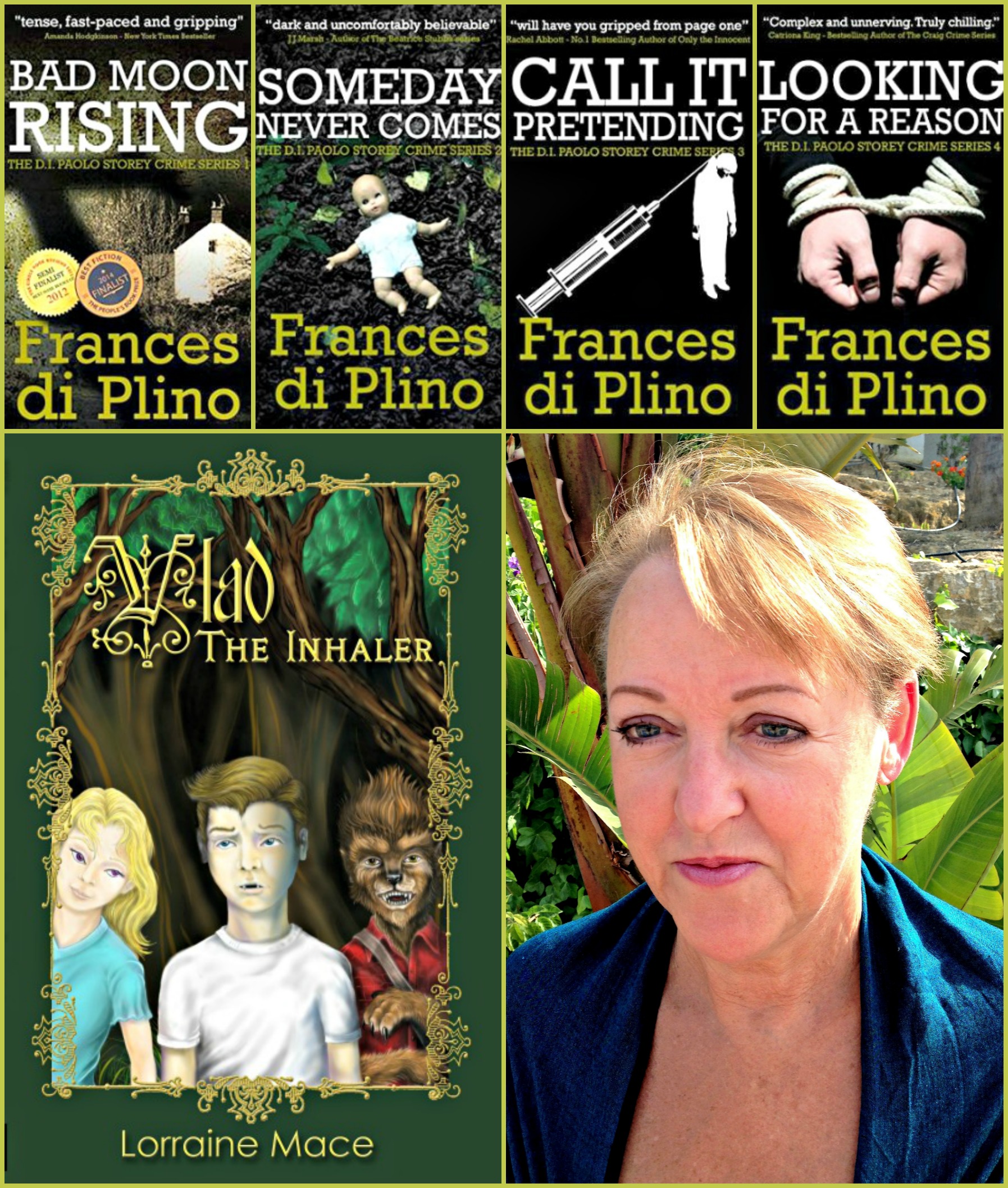
And the November 2014 Alices go to … these 3 international creatives

 © Iamezan | Dreamstime.com Used under license

© Iamezan | Dreamstime.com
Used under license

If you are a subscriber to our weekly newsletter, the Displaced Dispatch, you’re already in the know. But if you’re not, listen up. (Hey, why aren’t you? Off with your head!)

Every week, when that esteemed publication comes out, we present contenders for a monthly “Alice Award,” most of whom are writers or other kinds of international creatives who appear to have a special handle on the curious and unreal aspects of being a global resident or voyager.

Not only that, but this person tries to use this state of befuddlement as a spur to greater creative heights.

Today’s post hono(u)rs our three Alice recipients for November. Listed in order of most to least recent, they are (drumroll…):

1) Becky Ances, American expat in China and creator behind the Moo-Cow Fan Club, an award-winning children’s magazine & book series

For her post: “No I DO NOT Want to Drink F&%#%$ Hot Water,” to her personal blog, Writer Traveler Tea Drinker: Doing all three in China
Posted on: 18 November 2014
Queen Alice Drink CollageAlice Connection:

“Drink more hot water”
This is the most annoying piece of advice you hear ALL THE TIME when living in China. My friend smashed her elbow, the bone, and went to the hospital. Their recommendation? Drink hot water.

Citation: Becky, please forgive us for having found your post about what happened when you came down with a “major disgusting, hocking, snotty nose, bleary-eyed” case of flu in your adopted home of China highly amusing. That is actually a compliment, coming from us! We also think, moreover, that you may have overreacted slightly to being told repeatedly by Chinese students and friends to drink hot water. We refer you to the “Queen Alice” chapter in Through the Looking Glass, specifically the section where Alice, having found herself wearing a golden crown, arrives at a party being held in her honor. She is surprised to be serenaded by a solo singer with a shrill voice pretending to be her stand-in. She is even more surprised when the hundreds of looking-glass creatures (animals, birds, even a few flowers) who are attending as guests join in a refrain that proposes concocting drinks full of cats and mice, treacle and ink, etc., for a special toast. Looping back to your situation in China: Be grateful it was only hot water they were prescribing (besides, isn’t hot water safer to drink in China?). Under other circumstances, your Chinese friends might have been foisting snake wine or other therapeutic drinks on you as curatives. You are absolutely right, however, to avoid people who sneeze and don’t cover their mouths. And we hope you are also sensible enough to know that if someone offers you a  bottle labeled 我喝 to pour the contents into a flower pot when no one’s looking. (The flowers will thank you for it!) Get well soon, Becky. We wish to read more of your posts!

2) Ruth Van Reken, Adult Third Culture Kid writer, editor, and lecturer; and author of the memoir Letters Never Sent

For her interview: “Exploring Her Third Culture Through Journaling with Ruth Van Reken,” by Eric for geodip
Posted on: 3 November 2014
Alice Connection:
Alice Cheshire Cat Collage

It is from this frequent changing of worlds and communities that the two main challenges of growing up global form. The question of identity: Which of my many selves am I? and the matter of unresolved grief. With so many cycles of transition, if people don’t process the inevitable losses as they happen, the grief that is inherent in losing things that we love will have to go somewhere deep inside.

Citation: Ruth, reading about your struggle to embrace your multiple identities and channel your grief at saying so many goodbyes at a young age—well, let’s say it makes Alice’s confession of an identity crisis to the Cheshire Cat seem a bit of a cake walk. Alice presumably had only one other self, that of a well-behaved Victorian girl, to reconcile with the adventuresome spirit she’d become in Wonderland. You by contrast have had to deal with multiple selves after spending your first 13 years in Nigeria with your missionary parents. We must say, it was brilliant of you to use journaling as your Cheshire Cat when you found yourself, in your late thirties, suffering from a depression about these unresolved emotions. Translating feelings of loss, grief and confusion into the written word has clearly been a tonic. It has left you with a grin about your cross-cultural life, which you’ve generously shared with others through your memoir and other writings. Kudos, Ruth, and thank you.

3) Hannah Reyes, photographer, travel enthusiast, Filipina expat in Phnom Penh, Cambodia, and National Geographic Young Explorer

For her interview: “I Heart My City: Hannah’s Phnom Penh,” in Beyond the Guidebook, a feature of NationalGeographic.com’s Intelligent Travel section.
Posted on: 22 October 2014
Tweedle Dums Collage

The most random thing about my city is the quantity of people going about their workdays dressed in matching, printed pajamas.

Citation: Hannah, our first concern, after reading your engrossing interview post, is whether there’s a way to tell “dee” from “dum” when you see two people wearing identical pajamas—and if not, would they consider embroidering their names on their collars? Also, the concept of wearing pajamas during the workday sounds most unusual to those of us who know Japan, where pajama costumes might be worn to the hot springs bath but certainly not to work. Finally, we are curious about the print on the pajamas. Most uniforms we’ve seen, including those for Tweedle Dum and Tweedle Dee, don’t involve prints (apart, that is, from the stripes on their caps). We hope for your sake that the print is subtle rather than garish. Otherwise, there might be too much “ditto”, as Tweedledum might say, or “ditto ditto” as Tweedle Dee would respond. To sum up, Hannah, your interview has left us curiouser and curiouser. Well done!

*  *  *

So, readers, do you have a favorite from the above, or have you read any recent posts you think deserve an Alice Award? We’d love to hear your suggestions! And don’t miss out on the shortlist of Alice contenders we provide in each week’s Dispatch, which are sources of creative thought if nothing else! Get on our subscription list now!

STAY TUNED for more fab posts.

Writers and other international creatives: If you want to know in advance the contenders for our monthly Alice Award winners, sign up to receive The Displaced Dispatch, a round up of weekly posts from The Displaced Nation, with news of book giveaways, future posts, and of course, our weekly Alice Award!. Register for The Displaced Dispatch by clicking here!

Related posts:
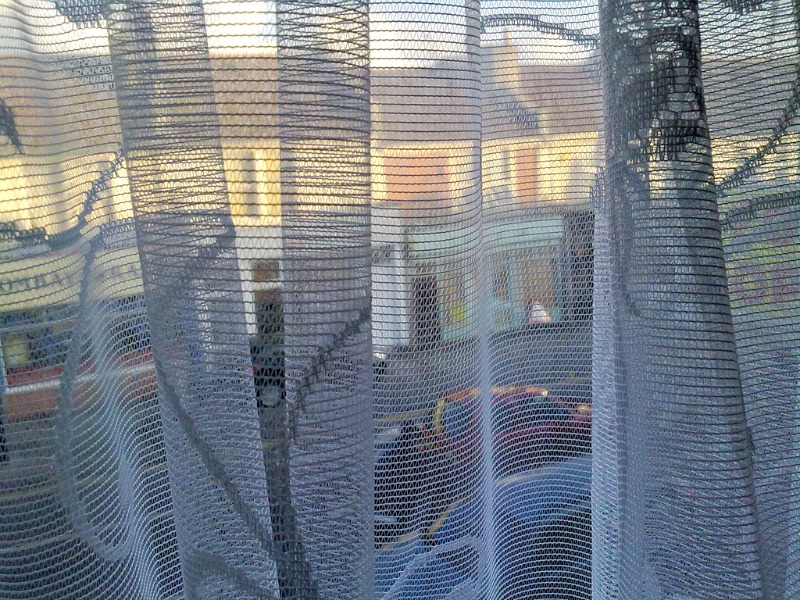
EXPAT ART AS THERAPY: Works that capture precious memories of life in other countries

ExpatArtasTherapy_Principle1As explained in my introductory post to this series, the Swiss-British philosopher (and Adult Third Culture Kid) Alain de Botton argues that art of all kinds can be a form of therapy, providing powerful solutions to many of life’s dilemmas.

But is that also true of expat works? Does our art benefit humanity more broadly, or are we creating things—memoirs, novels, films, dance and stage performances, social enterprises—that will only ever speak to people like ourselves: what fellow global soul Pico Iyer has called the great floating tribe of people “living in countries not their own”? (We currently number around 230 million, or just over 3 percent of the world’s population.)

SEND IN THE CLOUDS: "London from Hampstead Heath," by John Constable (British Museum)

SEND IN THE CLOUDS: “London from Hampstead Heath,” by John Constable (British Museum). Photo credit: John Constable, via Wikimedia Commons.

In his “Art as Therapy” lecture, de Botton specifies 6 ways art can answer human needs.

The remainder of this series will look at whether, and to what extent, these observations apply to the works of international creatives, beginning with…

Principle #1: Art can compensate for the fact that we have bad memories.
De Botton cites John Constable and his paintings of clouds above Hampstead Heath as an example of how an artist can sometimes capture something significant yet fragile they have experienced and don’t want to forget.

Will the John Constables among us please stand up? Seriously, it strikes me that we international creatives are well positioned to preserve the memories of the daily wonders we’ve encountered in far-flung parts of the world, our knowledge of which accrues over time. (Not for us the Wonders of the World, when there are so many intrepid world travelers around, eager to conquer them.)

Back in the days when I lived first in England and then in Japan, I always felt like the poor cousin of the anthropologist—I wasn’t an area specialist but that left me free to approach life with an Alice-like curiosity, never quite losing the sensation of having fallen through the rabbit hole. And to convey that to others…

But let’s look at some examples, shall we? Each of the visuals below is inspired by or belongs to the work of an international creative that has featured on this site in some way. I selected these four individuals because of their ability to conjure up an image of something rather precious within their new landscape—the expat equivalent of a dramatically shaped cloud. And, as de Botton has been invited to do at several museums, I’ve added post-it notes describing the therapeutic effects I experienced.

#1: Parabéns: We’re All Mad Here

Parabens

Photo credit: Marbela via Flickr (CC BY-SA 2.0)

OBJECT LABEL: Parabéns: We’re All Mad Here, inspired by Megan Farrell (aka Maggie Foxhole) and her book, American Exbrat in São Paulo.
ML’S POST-IT: I have never been to Brazil, but reading Farrell’s step-by-step guide for foreigners who are living (or planning to live) in São Paulo piqued my curiosity. I particularly enjoyed her vivid account of the Brazilian birthday party. What a palava! Far beyond my wildest imaginings. But what is even more curious to me is the Sweet Table, sitting in splendid isolation until the very end of the festivities. According to Farrell:

“The design of the Sweet Table is on the same level of importance for the birthday party as is the set design for a Broadway performance. It consists of hundreds of sweets, strategically placed around the other decorations. But most importantly, NO ONE TOUCHES the Sweet Table until the birthday candles have been blown out at the end of the party. No one. An interesting objective when you have anywhere from thirty to fifty children running around wild and free.”

I rather like the thought of deprivation in the midst of so much decadence: does that make the brigadeiro, when you finally get one, taste even sweeter?
FURTHER READING: Our interview with Megan Farrell, by Andy Martin: Why exbrats in São Paulo need their own book to appreciate life in Brazil’s largest city.

#2: Are Acacia Trees Humans in Disguise?

Acacia Trees

Photo credit: Gezira Sporting Club, by Jorge Láscar via Flickr (CC BY 2.0).

OBJECT LABEL: Are Acacia Trees Humans in Disguise?, inspired by Alice Award nominee Kathleen Saville‘s description of these trees in Zamalek, Gezira Island (Cairo, Egypt) in a post for her personal blog.
ML’S POST-IT: The thought of living in Egypt scares me, and I’ve been avoiding most trees ever since Hurricane Sandy. But after reading Saville’s description of Egyptian acacias—

I see folds and twists in the trunks like nothing I have ever seen in another tree. Each tree looks like a long thin body or leg covered with support hose. It’s odd because the appearance is almost human like.

—I feel calmer. Might I have a tree-hugging future?
FURTHER READING: Saville’s blog, Water Meditations, focusing on her water travels.

#3: Elephant Road Trip

Elephant Road Trip
OBJECT LABEL: Elephant Road Trip, inspired by Ruth Hartley and her novel about Africa, The Shaping of Water (Hartley grew up in that part of the world).
ML’S POST-IT: Hartley’s novel begins with the construction of the Kariba Dam, one of the largest dams in the world, over the Zambezi, the fourth-longest river in Africa, flowing into the Indian Ocean. As much as I enjoyed Hartley’s book, I could never quite wrap my head around the scale of what she describes, whether talking about the dam, a massively ambitious project, or about the problems Africa faces as it attempts to shake off the colonial yoke. Perhaps that’s why I took comfort in Hartley’s description of elephants serving as the continent’s original bulldozers:

The roads over the escarpment follow for the main part the old migratory routes taken year after year for millennia by elephants. Elephants, who for all those thousands of years would roam, not just around Zimbabwe, or just around Kenya, but all the way up sub-Saharan Africa from south to north and back again. Now human governments have decreed that elephants must obey human laws and stay within the bounds of national boundaries drawn by straight-edged rulers on maps. In the time before colonization, a mere 150 years ago, elephants travelled where they always travelled, and they walked across mountains with consummate skill and ease, always finding the most direct routes through the least difficult of the passes.

In the midst of a man-against-nature, man-against-man story, I found it a restorative to imagine these pre-colonial times when the elephant, such a magnificent beast, could be relied on to forge trails through the dense brush and trees.
FURTHER READING: Coming soon: our interview with Ruth Hartley about her book.

#4: Shanghai Mix

Shanghai Mix

Photo credit: Rachel Kanev.

OBJECT LABEL: Shanghai Mix, consisting of a photo taken by globe drifter Rachel Kanev, which she chose to feature in her iinterview with James King for our site’s “A Picture Says…” column.
ML’S POST-IT: Rachel has captured a memory of an experience I’ve had several times myself but had nearly forgotten: namely, what it’s like actually to witness Asian economic development rather than pontificate about it. As Rachel puts it in her chat with James:

In that fleeting instant, one can see Shanghai’s varied transportation, high-rise buildings and red lanterns, as well as Kate Winslet—that curious amalgamation of Western modernity and Chinese traditionalism that is everywhere around you in the city.

Perhaps because she snapped the photo just as the sun was setting, it fills me with sweet nostalgia. (I’m not remembering the smog, for a change…)
FURTHER READING: Rachel Kanev’s blog, Globe Drifting

* * *

So, readers, what do you think of the above “exhibition” of works that touch on expat experiences and emotions. Did you find it therapeutic? And are there other expat works you would recommend for this reason? Do tell in the comments.

STAY TUNED for next week’s fab posts.

If you enjoyed this post, we invite you to register for The Displaced Dispatch, a round up of weekly posts from The Displaced Nation, with Alice nominations, book giveaways, and other extras. Register for The Displaced Dispatch by clicking here!

Related posts:
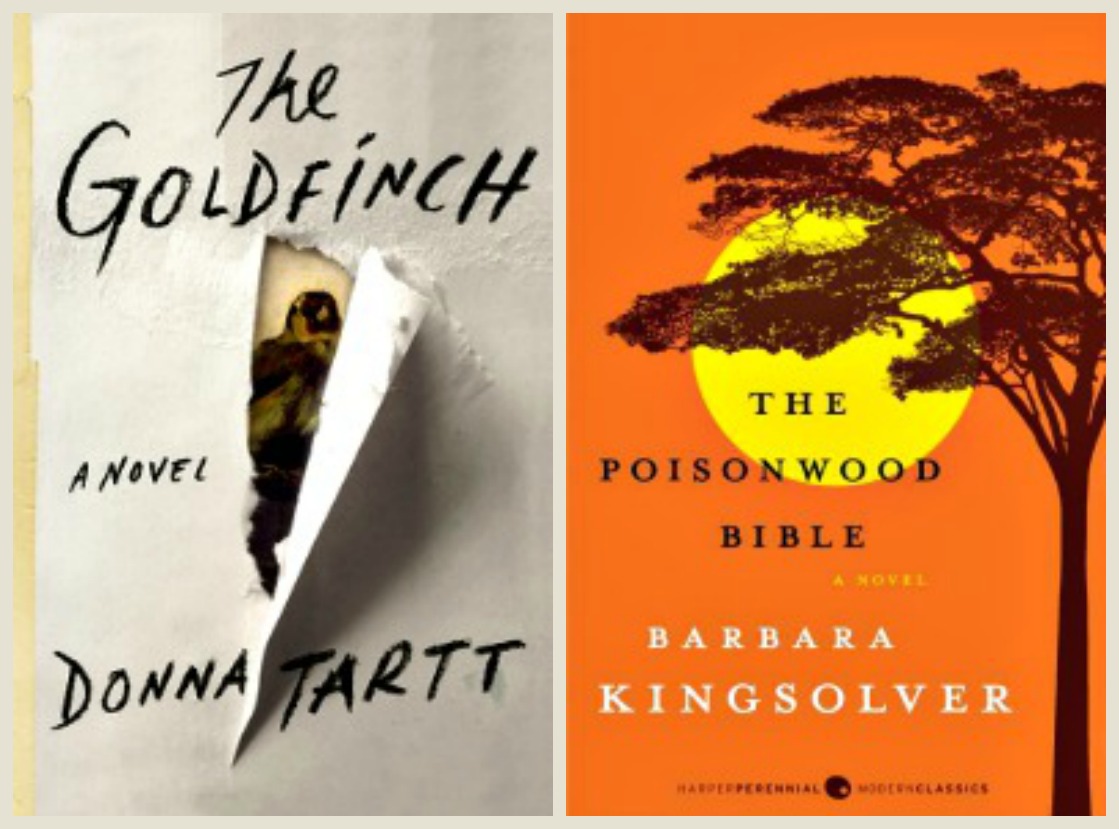
And the August 2014 Alices go to … these 3 international creatives

 © Iamezan | Dreamstime.com Used under license

© Iamezan | Dreamstime.com
Used under license

If you are a subscriber to our weekly newsletter, the Displaced Dispatch, you’re already in the know. But if you’re not, listen up. (Hey, why aren’t you? Off with your head!)

Every week, when that esteemed publication comes out, we present contenders for a monthly “Alice Award,” most of whom are writers or other kinds of international creatives who appear to have a special handle on the curious and unreal aspects of being a global resident or voyager.

Not only that, but this person tries to use this state of befuddlement as a spur to greater creative heights.

Today’s post honours August’s three Alice recipients. They are (drumroll…):

1) JESSICA WRAY, overthinking Californian, serial expat (currently in Madrid), and blogger

For her post: Seven Reasons Why English Food Doesn’t Actually Suck on her blog, Curiosity Travels
Posted on: 13 August 2014
Snippet:

3. Yorkshire Pudding
Not the pudding we are used to, this version doesn’t come from a powdered Jello packet. Instead, the Yorkshire pudding is actually referring to the pastry-like cooked dough which holds an assortment of heart attack inducing savory foods.

This specific Yorkshire pudding came with mashed potatoes, sausage and smothered in gravy. Accompanied by an ale, it was great for my soul but horrible for my waistline.

Citation: Jessica, the title of your post goes down in the annals. If that isn’t damning with faint praise, we don’t know what is. Your British hosts would be impressed. And it’s rather too literally gutsy of you to champion the cause of as many as 10 stogy foods merely because of “having dated a Brit for an extended period of time” and after having visited the country only twice. And while we don’t wish to stop you from acquiring a taste for stodge (British victuals need all the support they can get!), we worry you’ve become too focused on the gravy that’s smothering the Yorkshire pud and what it’s doing to your waistline to take in the protocol surrounding the British Sunday roast tradition. Alice, too, forgot her manners after stepping through the looking glass. We refer to the faux pas she committed when attempting to carve the leg of mutton just after having been introduced to it—only to be informed by the Red Queen:

“It isn’t etiquette to cut any one you’ve been introduced to. Remove the joint!”

Should you be possessed by a similar urge to seize the carving knife, don’t be surprised if your hosts are less than appreciative. You may wish to say something cheeky just as Alice did, i.e.:

“I won’t be introduced to the pudding, please, or we shall get no dinner at all.”

Then again, you could always utter an Americanism like: “Don’t get your panties in a bunch.” After all, the Brits have a comparable expression about getting their knickers in a twist. (What’s the worst that can happen—you don’t get invited back and have to make do with the food in Madrid?)

2) KEN SEEROI, American expat in Japan and professional writer, photographer and blogger

For his post: How to Stop Learning Japanese on his blog, Japanese Rule of 7
Posted on: 2 August 2014
Snippet:

Who knew languages had so many components? It’s all those words—that’s the real problem. First, I only wanted to know enough Japanese to order a beer. I figured I’d be happy with one word. But then I wanted another beer, so I needed another word. See, I told you I don’t think about the future.

Citation: We can empathize, Ken. How beautiful life in Japan would be if we foreigners didn’t have to grapple with the “devil’s tongue”. One minute you’re ordering a beer, and the next you find you’ve been captured and hooked: condemned to the life of an eternal student. And the struggle to learn vocabulary that doesn’t resemble Latin in any way is only the half of it. You also have to get into the mode of thinking that what isn’t said is usually far more important than what is said—the (in)famous wa factor. Indeed, if you have wa going, then your listeners should be able to finish your sentences for you—which is great if you’ve forgotten the verb, but not so great if they fill in the blank in the wrong way and you find you’ve agreed to something like tutoring their child in English for the rest of his born days when you were actually trying to say you’re giving up tutoring because you’re writing a book. Another challenging aspect of wa is the tendency to allow emotion to take over in favor of clarity. After all, stating something clearly may mean that that the speaker commits to something and thus would get the blame if the situation goes awry. Should you become the victim of this, you could always do a Humpty Dumpty—we refer to the (in)famous exchange between Alice and Humpty Dumpty over semantics, in Through the Looking Glass:

“When I use a word,” Humpty Dumpty said in rather a scornful tone, “it means just what I choose it to mean—neither more nor less.”

“The question is,” said Alice, “whether you CAN make words mean so many different things.”

“The question is,” said Humpty Dumpty, “which is to be master—that’s all.”

All things considered, though, you may be better off floating in a sea of vagueness. You had the right instincts, Ken, when ordering that beer and realizing one might not be enough. Well done!

3) DR. KATE EVANS, British zoologist, founder of Elephants for Africa (based in Botswana), and expat in Germany

For her remarks in an interview, The Expat that African Elephants Will Never Forget, with Claire Bolden McGill in Global Living Magazine (July/August 2014)
Posted on: 18 August 2014
Snippet:

The sounds we wake up to at night are very different. In Botswana my nights are disturbed by the roaring of a lion, the cackle of hyena or the rumble of an elephant, and I wake up to the sounds of the local franklin (a small chicken-like bird that is common throughout Southern Africa and very funny to watch running).

Citation: Dr. Kate, first of all we must congratulate you on heading up an organization that is doing one of the most noble deeds on the planet—attempting to save the African elephant from extinction. And although we know you have a list of degrees as long as an arm for doing such important work, we also suspect it’s your Alice-like curiosity that makes you so suited to the task. It is not at all surprising to us when you tell Claire (who btw was an Alice winner back in June and has also guest posted for our “New vs. Olde Worlds” series), that you feel more at home in the bush than you do in “hectic lifestyle of the West”. Your comfort level among African wildlife brings to mind this passage from Through the Looking-Glass:

…[Alice] found herself sitting quietly under a tree—while the Gnat (for that was the insect she had been talking to) was balancing itself on a twig just over her head, and fanning her with its wings.

It certainly was a VERY large Gnat: “about the size of a chicken,” Alice thought. Still, she couldn’t feel nervous with it, after they had been talking together so long.

You go on to tell Claire that your expat life owes to a promise you made to an elephant at the age of seven. Were you aware you were channeling Alice?!

*  *  *

So, readers, do you have a favorite from the above, or have you read any recent posts you think deserve an Alice Award? We’d love to hear your suggestions! And don’t miss out on the shortlist of Alice contenders we provide in each week’s Dispatch, which are sources of creative thought if nothing else! Get on our subscription list now!

STAY TUNED for more fab posts.

Writers and other international creatives: If you want to know in advance the contenders for our monthly Alice Award winners, sign up to receive The Displaced Dispatch, a round up of weekly posts from The Displaced Nation, with news of book giveaways, future posts, and of course, our weekly Alice Award!. Register for The Displaced Dispatch by clicking here!

Related posts:

EMERALD CITY TO “KANSAS”: Amy Rogerson on seeing the Wizard of Expat Life and returning home (for just six months)

Amy Rogerson wrapping up warm in the UK at Christmas (her own photo); the Ruby Slippers (CC); corn path (Morguefiles).

Amy Rogerson wrapping up warm in the UK at Christmas (her own photo); the Ruby Slippers (CC); corn path (Morguefiles).

Welcome to “Emerald City to ‘Kansas,'” a series in which we focus on expatriate-into-repatriate stories. This month our subject is Amy Rogerson, an Englishwoman who blogs at The Tide That Left about trailing her husband (aka “Mr Tide”), at breathless pace, all around the globe. The couple now live in Dar es Salaam in Tanzania, but in the past four years have also made homes in South Africa, Angola, Qatar, Russia, and Libya. As we catch up with Amy, she is back to the UK (as of April 7th) for a six-month stay. What is it like going “home” again after such a life of adventure? Without further ado, let’s dig into a slice of Amy’s “back to Kansas” story.

—ML Awanohara

To Oz? To Oz!

I didn’t really choose expat life. Rather, it chose me when I fell head over heels in love with a nomadic man. I met my husband five years ago in his final weeks in the UK before he moved to Libya. We continued our relationship long distance for a year, but eventually knew that one of us had to move. I was in a job that made me miserable, whilst he was welcoming new opportunities at work, so it seemed for the best that I move to Benghazi to be with him.

Lions and tigers and bears, oh my!

Moving to Libya was so far beyond my comfort zone that I shocked both myself and those who loved me most. All I knew is that I wanted to be with the man I loved. I never expected my life to become that of a serial expat. As well as living in Libya, we’ve also lived in Russia, Qatar, Angola, South Africa and Tanzania together. In fact, my home is still in Tanzania; repatriation to the UK is just a temporary move for a project I am working on, and I fully intend to return to Dar es Salaam and my wonderful husband in just under six months from now.

We’ve been gone such a long time…

I’m surprised at how much I’ve grown to love my new lifestyle. I’d never wanted to travel or live abroad before I met my husband, but now I struggle with the idea of ever “going back to Kansas” permanently (not that I don’t think I will one day!). I’ve discovered that life can be different from what I was brought up to believe. If choosing the expat life has meant I’ve had to say goodbye to any dreams I had of the picket fence, the family home, the stable job—that isn’t going to happen, at least not for a while—it isn’t necessarily a bad thing.

What have you learned, Dorothy?

Living in six countries in four years, I’ve learned to adapt to change. Nothing stays the same, and I’ve had to be flexible. That flexibility doesn’t just apply to where we live and work, or what our holiday plans are. I’ve also had to learn that there is not just one way of doing something, especially once I started working for a South American company in the Middle East and now in Africa. I’ve had no choice but to get my head round different ways of doing things that I used to believe we do best “at home”. As a Brit working with people from different parts of the world, I’ve often felt as though my colleagues and I weren’t talking the same language when it came to business practices and relationships. But I’ve come to see that instead of believing the British way is right, it helps if I can open my mind to other approaches, some of which may work if you’re willing to give them a try. With time I’ve been able to overcome the differences and pick up skills that will no doubt help me in future.

No place like home?!

Repatriation is bitter-sweet for me. I didn’t really want to return to the UK right now, but circumstances have dictated otherwise. Having been gone from the UK for four years I’m really struggling with settling back in. Much of what I knew before now seems unfamiliar. My time abroad has coloured my behaviour and expectations. In a sense, I’m having to relearn some of that most basic stuff that I found so hard to let go of when I became an expat.

Oh dear! I keep forgetting I’m not in Kansas!

I once thought huge shopping centres where I could buy everything I needed in one go were the perfect solution to hectic British life. Now I find myself shying away from the crowds of people, the flashy goods, and the elevated prices for things with a short shelf life. During my life abroad, I often missed the choices that were available to me in the UK, be it in the supermarket, on the high street, even on the television, but now I just feel overwhelmed and a tad spoilt by all the options. In adapting to new ways of living and thinking abroad, I no longer completely fit in the country I was born and raised in. Perhaps I need to look at this six-month repatriation like a new expat assignment and approach it like I would any other move. I need to be open to adapting. I need to forgive myself for not “feeling at home” immediately when I wouldn’t ask that of myself anywhere else. I’m incredibly lucky to have so many wonderful connections here in the UK. I expect it won’t be long before I feel more settled at home than I do after a few weeks. One thing I do know: the call of expat life hasn’t quietened yet.

* * *

Thank you, Amy, for such an honest, heart-felt account about what it feels like to go home again, if only for half a year. It’s interesting that you’re now having to apply the adaptability you learned from expat life to feeling more at home in your native UK. Readers, can you relate to what Amy says?

STAY TUNED for tomorrow’s fab post!

If you enjoyed this post, we invite you to register for The Displaced Dispatch, a round up of weekly posts from The Displaced Nation, with seasonal recipes, book giveaways and other extras. Register for The Displaced Dispatch by clicking here!

Related posts: