The Displaced Nation

A home for international creatives

THE DISPLACED Q: What’s the cheapest — yet tastiest — meal you’ve discovered on your world travels?

So what is the tastiest cheap-eat I’ve come across whilst traversing the globe? Not being much of a foodie, and being a writer, cheap — yet tasty — is what I’m all about.

Well, I hate to be boring and predictable — so I won’t be. Yeah, the street food you get in Thai markets is to die for when you’re hungry. Not only that but you can eat three full meals back to back for the price of a loaf of bread in Australia.

But that’s not what I’m going for. No, for sheer cheapness compared with mouth-watering deliciousness, I’m going to have to go with an old favorite: Indo Mi goreng, an instant-noodle brand produced by the world’s largest instant noodle manufacturer, located in Indonesia.

Not just any old noodles!

Now you could be forgiven for thinking I’ve gone off my rocker here. There are countless brands of instant noodles floating around out there, and they’re pretty much all unified by one thing: being rubbish.

Nutritionally rubbish. Tasteless. Processed. Crap.

But not these noodles! I ate them almost every day on my rejuvenating hike across Western Australia — mostly because they were light enough to carry in a full rucksack and impossible to mess up in terms of cooking. These ones are nice, super nice even. And when I went back to England recently and discovered I couldn’t buy them there, the wife made me order them wholesale! I think they came directly from Indonesia. Forty packet… Oh, yes, this is how much we love these noodles.

Even though we buy them in bulk, they still cost less than the postage!

All the Asians in my area of Australia buy them — either in ten-packs, or in the same giant box I had delivered to me in England. That’s how you know they’re good noodles — when your Malaysian housemates fill their shelves with them!

But I can’t devote this entire post to one brand of instant noodles, can I? Um…no. But I’m hard pressed to think of anything else that’s so delicious for less than 50 cents.

A case of “you get what you pay for”?

Well, Canadian athlete Joe Sakic spoke true when he said:

Any free meal is a good meal, you know?

Or did he? I’ve come across a few ways of getting free food in my time — from famous vegan soup kitchens in a hippie commune in Margaret River (Western Australia) to the delightful food they served me in hospital when I was selling my body to medical science (also know as being a guinea pig for medical testing). And none of these meals were especially delicious.

You know, they would shoot me full of weird, untested drugs, imprison me in a hospital for weeks at a time, make me sleep on rubber sheets and wake me every morning at 4:00 a.m. to take my blood.

But still, the worst thing about the whole experience was the food.

Free is only good if you don’t have to have it; being forced to eat isn’t great no matter the quality of the food. Which, unsurprisingly, wasn’t great.

Tastes that refuse to be acquired

Then, of course, there are the meals in foreign lands that people treat you to. In my experience, that can be risky.

On my last morning in South America, my Ecuadorian girlfriend took me for a surprise breakfast she’d been planning for some time.

She led me all through the suburbs of Quito, to a restaurant which was famous for one dish in particular: ceviche.

Now, I’m not a fan of seafood. I can just about choke down a fish-finger — as long as I can’t see the insides of it. Ugh!

Of course, this topic had never come up; one of the myriad disadvantages to starting a relationship when you don’t share even one common language. We communicated mostly in sign language, and the half-assed version of Spanish I was picking up.

So naturally, I’d never mentioned my intense dislike of seafood, in much the same way as she thought it would be too much effort to explain what her surprise was. As a result, neither of us knew what to expect until I lifted the lid on my service and saw what it was: namely, half the cast of Finding Nemo, after being put in a blender with some brown sauce and chillies…

I tried to eat it, honestly I did!

I didn’t succeed though.

At least, the bit I did eat came back up so rapidly we have to make our excuses and leave the restaurant at top speed…

So remember that, whilst free food is irresistible, you should always season your desire for a cheap eat with a little caution, especially when traveling. The old adage is true: there is no such thing as a free lunch (or breakfast).

There are few things worse than being violently ill in the middle of a country where no one speaks your language. Far from home. Far from healthcare you trust… And wearing most of your raw-seafood breakfast.

That is almost never a good look. :0)

* * *

So, that’s all from me on this particular displaced Q! Now it’s your turn! What experiences have you had in your search for cheap eats around the world? Any tasty morsels? Anything we should avoid? Any scrumptious stories…? We’d love to hear from you! You can also hit us up on Twitter: @TonyJamesSlater +/or @displacednation.

STAY TUNED for Tuesday’s post, the second part of a two-part travel yarn about two madcap Indonesian ladies who are taking Japan by storm!

If you enjoyed this post, we invite you to register for The Displaced Dispatch, a round up of weekly posts from The Displaced Nation, with seasonal recipes, book giveaways and other extras. Register for The Displaced Dispatch by clicking here!

Related posts:

Img: The contents of Tony James Slater’s shopping bag, taken on 9 September 2012 in his current home of Perth, Australia.

LIBBY’S LIFE #59 – Fanning the flames

Somehow, I manage to get away from that hideous coffee morning. As I drive, I automatically answer Jack’s questions about the finer details of Ironman’s personal habits — “I have no idea how he goes to the bathroom. No, I can’t imagine Ironman wearing Pampers.  Yes, I suppose he might go rusty if he’s not careful.” — but I’m not really paying attention.

Anita’s words keep looping around in my head.

“Jeffrey Connor’s gone back to Shelley,” she’d said. Shelley, his first wife, whom he’d left for Melissa Harvey. Jeffrey and Shelley Connor had been Melissa’s tenants — just as Oliver and I are now.

I cringe every time I replay my innocent reply:

“Why? What happened to him and Melissa?”

And Anita’s embarrassed answer: “We all assumed you would know about that.”

Her meaning was unmistakable: We assumed you knew because you are involved in this situation. Or, rather, not me, but Oliver.

It was as if someone had smacked me over the head with a large stick. Everything made sense: the sudden silence as I entered Anita’s house, as if they had been talking about me; Charlie’s protectiveness, as she loudly emphasised my “post-natal depression” as the excuse for my four-month absence from Posse society.

It wasn’t post-natal depression, not in the conventional sense. It was my inability to face anyone because of the issues Oliver and I were having about his father’s marital history.

Now, though, I wish I’d been brave enough to venture onto the coffee morning rounds. Without me there to set the story straight, rumours had flourished like unattended dandelions. In my absence, everyone had gossiped behind my back, assuming I wasn’t showing my face in public because Melissa Harvey Connor was having it away with yet another tenant of hers: Oliver.

How ridiculous. Right? I mean — when would Oliver see Melissa?

Yet here’s the thing: while I can keep telling myself that it’s all conjecture and careless whispers amongst silly women with too much time and not enough brain cells, and I don’t believe a word of it, at the back of my head a little voice of paranoia insists that rumours have to come from somewhere.  As my Dad would say: “There’s no smoke without fire, Libby.”

What to do now? I wonder.

Do I ignore the smoke? Douse the embers? Or — fan the flames?

If the topic comes up, I decide, I will probe.

*  *  *

“How was your day?” Oliver asks over dinner. “Did you go to Charlie’s leaving do?”

I pause. “Yep,” I say, trying to keep my voice light and casual, and instead hearing it come out high-pitched and tense.

“Everything all right?” Oliver shoots me a look which I interpret as concerned.

Concerned for whom? Me? Or him?

“Fine,” I say, hoping my voice sounds more natural.

“OK,” he says. Oliver tends to take things at face value. If I say I’m fine, then I must be.

“I hear Jeffrey’s gone back to England.” I cut into a piece of chicken on my plate, and glance up quickly to watch Oliver’s expression, which is a study in nonchalance.

“Yeah. He decided our landlady wasn’t a good enough trade-in for his first wife. Gone back with his tail between his legs.”

“It took him this long to work that out? Everyone else could have told him Melissa’s a complete bitch.”

Oliver raises his eyebrows. “She’s not that bad. A bit overbearing, maybe. Jeffrey didn’t handle her right. You’ve got to be firm with her.”

I choke, cough, and run into the kitchen where I splutter out a wad of half-chewed chicken.

“And you’d know about this, I suppose,” I say, when I return to the table.

“Well, yes. Of course I would.” He looks around the table for ketchup. Honestly, it drives me nuts how Oliver insists on drowning everything with ketchup. If I took him to Alain Ducasse, he’d be asking for ketchup to go with the foie gras. “Seeing as she’s been working at the company for — what?  Three months now.”

I lean back in my chair, aware that my jaw is dropping open unattractively.

“She works at your place? Why? She’s a realtor. You never told me.”

Oliver shrugs. “Housing market has tanked around here, and Jeffrey got her this admin job. I suppose she joined when we…when you and I weren’t talking much to each other.”

And whose fault was that? I want to scream, but instead I count to ten, very slowly, because I need to know more.

Suddenly the Posse’s whispers don’t seem so careless any more.

“Do you see much of her at work?” I ask in that same fake-casual voice.

“She works for me. Technically, I’m her boss.”

“And there is no connection between that and the fact that Jeffrey has decided to return to his first wife.”

He hesitates, just a fraction of a second too long, and my internal bullshit radar switches to high alert.

“Now you’re just being silly,” he says, sticking out his chin.

We finish our meal.

There is silence in the room, marred only for me by my internal radar’s sirens and red flashing strobe lights.

*  *  *

.

Next post: LIBBY’S LIFE #60 – Cotswold espionage

Previous post: LIBBY’S LIFE #58 – Careless whispers

A note for Libby addicts: Check out Woodhaven Happenings, where from time to time you will find more posts from other characters.  Want to remind yourself of Who’s Who in Woodhaven? Click here for the cast list!

Read Libby’s Life from the first episode.

STAY TUNED for Monday’s food-related Displaced Q!

If you enjoyed this post, we invite you to subscribe for email delivery of The Displaced Dispatch, a round up of the week’s posts from The Displaced Nation. Sign up for The Displaced Dispatch by clicking here!

Image: Travel – Map of the World by Salvatore Vuono / FreeDigitalPhotos.net

Repatriating from paradise — and breaking all the rules

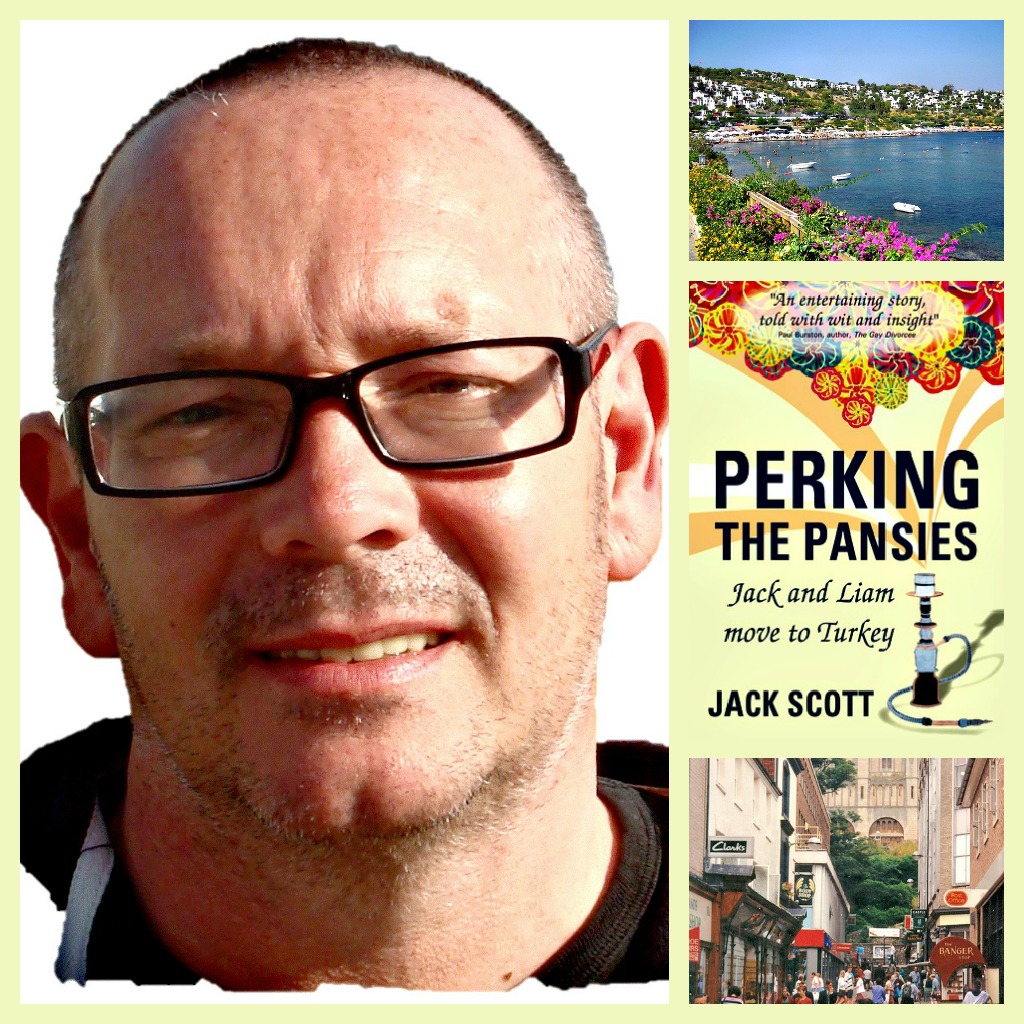
One of our earliest Random Nomads, Jack Scott, drank deeply of the cup of expat life. He and his civil partner, Liam, moved to their version of paradise: Bodrum, Turkey. This decision enabled Jack to become a writer, parlaying his popular blog, Perking the Pansies, into a book, which was published about a year ago and reviewed on this blog. After so much success, why have the pair traded in Bodrum for Norwich, in East Anglia? Yes, that’s right, they’ve repatriated!

In the beginning there was work and work was God. After 35 years in the business, the endless predictability made me question the Faith.

I wrote those words on the 8th October 2010 — the opening sentence of my debut post on a brand new blog, Perking the Pansies, about a couple of silly, cynical old queens who decided to jump the good ship Blighty and wade ashore to Asia Minor.

For a minority report, the blog’s done rather well. Then there was a book. That’s done rather well too. Remarkable. Both crept up behind me unexpectedly, without hint or herald. Sometimes I wonder if we should have listened to the early advice from our playground peers; maybe we should have kept our backs to the wall. Too late now.

At the time, we had a plan — well, a plan of sorts. We would stay in Turkey for a good few years, slowly descend into memory loss and erectile dysfunction (both disguised by a haze of alcohol) and eventually paddle back to Blighty for the liver transplant and the Grim Reaper’s call.

It was not to be. I wanted to do author things and keep the pennies (and believe me I do mean pennies) rolling in. I could do neither in Turkey. Added to this, serious family issues beckoned us back from paradise and we wanted to do our bit.

Decision #1: Leaving Bodrum

When we first announced our intention to up sticks and become “repats,” we were taken aback by the reaction in our little corner of expatland.

There was a strong sense that some gang members felt badly let down, betrayed even. It was as if our decision to leave reflected badly on their decision to stay.

Some even suggested that we’d soon be back, presumably with our tail between our legs and begging to re-join the fold.

You see, our particular expat ghetto was meant to be the final destination, a place to retire and expire. We were breaking the unspoken rules.

Ironically, when we first left Blighty for our place in the sun, our friends and family, the people with whom we have the deepest roots, simply wished us well and promised to visit.

Decision #2: Picking Norwich

So, the first big decision was to leave. The second was where next to lay our hatboxes. We were adamant that we wouldn’t revert to the world of coffees-on-the-run, nose-to-nipple commutes, kiss-my-arse bosses and treadmill mortgages. So, London was off the agenda.

After much heated debate and pins on maps, we settled on Norwich, a small cathedral city in Eastern England, a two hour drive northeast of the Smoke. Our choice was met with a wall of incredulity, both at home and away. To be fair, all I really knew of Norwich was the classic seventies game show “Sale of the Century”, Bernard Matthews gobbling turkeys at his farm in Norfolk, and the acronym (k)Nickers Off Ready When I Come Home, first used in the BBC Radio show “Just a Minute” in 1979. (I’ve often used the latter in text messages to Liam, but that’s another story…)

By common consent, the former Anglo-Saxon kingdom of East Anglia is full of inbreds fiddling with their siblings and marrying their cousins. That’s the myth peddled by the urban pretentious. In reality, Norwich is a sparkling jewel hidden in the rural flatlands of England’s gobbling breadbasket with more art houses, wines bars and fancy restaurants than you could shake a stick at. As the most complete medieval city in England and home to a thriving university, Norwich is where the old and the young are blended in perfect harmony.

We were delighted to join the north folk of Norfolk as neo-Norwichians (not to be confused with Norwegians who, as Vikings, did a bit of raping and pillaging in this flat part of our Sceptred Isle).

No regrets…

Our time in the sun was a magical experience. We don’t regret a single second, not even those cold winter days huddled under a duvet and fighting over the hot water bottle as torrential rain battered the house. Thank you, Turkey. Thank you for breaking the umbilical cord between wages and lifestyle, and teaching us to make do with less. Thank you, for giving me the time and space to write. Thank you, for handing me a story on a plate. One day, we may return. But, for now, there will be no going back on going back.

* * *

Readers, any thoughts on, reactions to Jack Scott’s rule-breaking move back home? Can you relate at all?

STAY TUNED for tomorrow’s episode in the life of our fictional expat heroine, Libby. (What, not keeping up with Libby? Read the first three episodes of her expat adventures.)

If you enjoyed this post, we invite you to register for The Displaced Dispatch, a round up of weekly posts from The Displaced Nation, with seasonal recipes, book giveaways and other extras. Register for The Displaced Dispatch by clicking here!

Related posts:

Images (clockwise from left): Jack Scott; Bodrum, Turkey, courtesy Yilmaz Ovunc (Flickr) Creative Commons CC BY-SA 2.0; Perking the Pansies book cover; Norwich, England, courtesy Roger Wollstadt (Flickr) Creative Commons CC BY-SA 2.0.

DEAR MARY-SUE: Can you tell me how to stomach other countries’ bizarre food obsessions?

Mary-Sue Wallace, The Displaced Nation’s agony aunt, is back. Her thoughtful advice eases and soothes any cross-cultural quandary or travel-related confusion you may have. Submit your questions and comments here, or else by emailing her at thedisplacednation@gmail.com.

Well, this month I’ve been asked to deal with your food-based queries. That’s pretty easy for this gal! I love to chow down. Not in a Paula Deen kinda way, you understand, but I sure do love a refined meal and am pretty well known on the Tulsa culinary scene.

****************************************************************************************

Dear Mary-Sue,

Fermented salted herring — how does that sound to you as a national dish? [Not great. Think roadkill cooked up in the finest Ozarks tradition sound preferable, if I’m being honest – M-S]  As an American living in Northern Sweden, I have yet to acquire the taste let alone abide the smell. However, a friend at my new church has invited me to a party where they’ll be serving surströmmingsklämma — that’s a sandwich made with slices of surströmming (the name for this fish — quite a mouthful, too, though at least it’s not fermented!) between two pieces of the hard and crispy kind of bread they love so much up here. The bread is buttered and there is a further layer of boiled and sliced or else mashed potatoes.

What to do? Do I accept my friend’s invitation or pretend to be busy “settling in”?

– Mary-Louise from Umeå, Sweden

Dear Mary-Louise,

You don’t have to pretend to be Anthony Bourdain if you don’t want to be. Look at Samantha Brown, she travels all the world and never once leaves her comfort zone or experiences something new.

Also, you’re in Sweden, not some village in the third world where they are honoring you by offering you a slice of roast anteater rump. I’m sure you won’t be insulting anyone by politely declining. Just be graceful and say you’re not big into fish.

Mary-Sue

*****************************************************************************************

Dear Mary-Sue,

I know you’re very pro-USA, but as an English expat who has just spent his first summer in the United States, I haven’t been able to get the hang of some of your summer desserts.

Take, for instance, strawberry shortcake — overly sweetened strawberries on a sweet biscuit, which should actually be called a scone. Whose bright idea was that? I guess that person hadn’t heard of strawberries and cream?

Moving right along to that traditional American Girl Scout favorite, s’mores. The chocolate and graham crackers are fine, but a roasted marshmallow — that’s OTT. Please, sir, can I have no-more?

I could go on about the American obsession with eating ice cream in a wide variety of sickening flavors, when there’s absolutely nothing wrong with chocolate and vanilla (okay, strawberry, too, if you like) — but I’ll stop there.

Here’s the thing, old girl [??????? M-S]. I would love to tell my various American hosts that nothing beats a tall glass of Pimm’s on a summer’s day, and a slice of summer pudding, but I’m guessing that wouldn’t go down too well.

Nigel of Nevada

Dear Nigel,

Old girl??! Why, aren’t you a little slice of honey pie? I’d certainly like to beat you with a tall glass of Pimms. It actually isn’t too difficult to get hold of a Pimms cup here in the land of the free. As for the rest of your letter: yeah, we like our desserts to be sweet. What a surprise!

Mary-Sue

********************************************************************************************************

Dear Mary-Sue,

I’m originally from Winnipeg, in Manitoba, Canada, and am teaching English in Korea. The other day one of my students went so far as to tell me that the reason the Korean economy has gotten strong is because they all eat so much kimchi.

I wanted to tell him that I think there’s something strange about a nation being so obsessed with what is essentially spicy fermented cabbage.

I mean, can’t they think of anything else to brag about?

– Sally from Seoul

Dear Sally,

First Mary-Louise’s problems with fermented fish and now this. I don’t know what it is with foreigners and fermentation — seems crazy to me. The Mary-Sue rule is that unless you’re fermenting something that I can make into a mimosa or margarita, then it’s best not to bother.

My hubby, Jake, is always going off to the Korean barbeque in town. If the owner is sending back all the money he makes off dear ol’ hubby, well, it’s probably that that’s keeping the Korean economy strong.

Mary-Sue

********************************************************************************************************

Dear Mary-Sue,

Oh. My. God. Do people really eat this stuff? I’m an American student staying with a British family as part of a semester abroad, and they SERIOUSLY just offered me the most foul-tasting stuff imaginable on toast. I thought I was going to spit it out. I mean, it was soooo salty! And then they presented the jar to me as a GIFT! What am I supposed to do with it?!?!?!?

– Patti in Plymouth

Dear Patti,

I’m assuming you’re talking about Marmite. I wouldn’t worry too much, it probably won’t make it past customs when you return to the land of milk and honey.

Mary-Sue

___________________________________________

Anyhoo, that’s all from me readers. I’m so keen to hear about your cultural issues and all your juicy problems. Do drop me a line with any problems you have, or if you want to talk smack about Delilah Rene.

Mary-Sue is a retired travel agent who lives in Tulsa with her husband Jake. She is the best-selling author of Traveling Made Easy, Low-Fat Chicken Soup for the Traveler’s Soul, The Art of War: The Authorized Biography of Samantha Brown, and William Shatner’s TekWar: An Unofficial Guide. If you have any questions that you would like Mary-Sue to answer, you can contact her at thedisplacednation@gmail.com, or by adding to the comments below.

STAY TUNED for tomorrow’s post by Jack Scott.

If you enjoyed this post, we invite you to register for The Displaced Dispatch, a round up of weekly posts from The Displaced Nation, with seasonal recipes, book giveaways and other extras. Register for The Displaced Dispatch by clicking here!

Related posts:


Chocolate on the go: The Chocoholic Traveler (App review)

Having spent much of the summer with an athletic, Olympic theme to our site, it’s time for us to switch to a less exhausting topic for a few weeks, and return to a TDN favorite: food.

Or, more specifically, traveling across or around the world to eat certain foods. What kind of foods, of course, depends on the individual. It’s literally a matter of personal taste.

For example, while I would happily pass on trekking across Cambodia to sample some deep-fried tarantula, I could be persuaded to travel to Sweden – although not for the Surströmming. As a self-confessed chocoholic, I’d need a sweeter temptation than fermented Baltic herring. October’s Stockholm Chocolate Fest in the National Museum of Cultural History, on the other hand —  a weekend of chocolate demonstrations, tasting, and (of course) purchasing — would entice me.

An app for the hopeless chocoholic

One woman who might agree with me is Kay Harwell Fernandez. Journalist Kay writes about travel as it relates to food and drink — particularly chocolate. Her passion for world chocolate is such that she has created an app for iPad/iPhone, called Chocoholic Traveler.

Be warned: this is an app for even the most dedicated of chocoholics, and one which will considerably lengthen their bucket lists.

Fancy a pilgrimage to Joanne Harris‘s Lansquenet-sous-Tannes, the fictional French town in Chocolat? For $18,200 for a party of four, you can take a barge cruise through the French Burgundy Canal and, along the way, have lunch in Flavigny, where the movie of Harris’s Chocolat was filmed.

Perhaps you prefer a more hands-on approach. From the app, I discovered several chocolate cooking classes, ranging from a $10 class at Hershey Story Museum, to a $900 four-day summer camp at Burdick’s in New Hampshire.

Need to crush the chocolate guilt? Try a chocolate walking tour of London’s Mayfair and Chelsea. The three-hour walk will go some way to silencing the voice of your conscience as you drink hot chocolate and taste different varieties of chocolates, including the Queen’s favorite. The tour, by the way, starts off with a chocolate cocktail. Of course.

Verdict

If you’re looking for an app that identifies individual chocolate shops, this isn’t it. This is more accurately an act of worship for the cacao bean. In the same way an app for Napa Valley wine tours wouldn’t list every local liquor store, this doesn’t list every Main Street confectionery store. Kay Harwell Fernandez is, however, continually updating her app with new global chocolate events. One nice touch is the comments page — users can see others’ suggestions for future updates.

Check out Chocoholic Traveler on iTunes here, and

STAY TUNED for Tuesday’s post: helpful advice on the subject strange food obsessions, from our resident agony aunt, Mary-Sue Wallace.

If you enjoyed this post, we invite you to register for The Displaced Dispatch, a round up of weekly posts from The Displaced Nation, with seasonal recipes, book giveaways and other extras. Register for The Displaced Dispatch by clicking here!

Related posts:

Image: Chocolate Splash by Idea go; courtesy FreeDigitalPhotos.net

EXPAT MOMENTS: A Question of Sport

As this summer, for me at least, has been a summer of sport, I thought I would continue this Expat Moments series with a post I originally put in 2010 on my own blog Culturally Discombobulated. They are thoughts I had while watching a San Francisco giants baseball game. That season the giants would go on to win the World Series, and the fans celebrating outside my apartment elicited a sound like that of a dying whale.


I’m in AT&T Park, San Francisco. It’s the top of the 4th innings and the San Francisco Giants trail the Arizona Diaomondbacks 6 – 1. It is little surprise therefore that the atmosphere in the stadium is tetchy. The main object of the crowd’s impatience is the Giant’s pitcher Barry Zito who to use a British expression is “having a ‘mare.” Even to me – a man who could write everything he knows about the art of pitching on the back of a postage stamp – it is apparent that Zito is a player struggling with confidence and that’s affecting his ability to settle into a rhythm. Within minutes of the game starting he had allowed Arizona to wrest the initiative. That disaster of a first innings would see Arizona score 6 quick runs – now they’re hoping to add more. Zito is in trouble again as he preps himself to pitch at Reynolds. Young has already walked and LaRoche hit a single. There’s an unpleasant air of expectancy in the ground as Zito pulls his left arm back readying himself to throw. It doesn’t feel as if the crowd expect much from this pitch – at least not heroics from Zito. There’s a palpable feeling of a crowd readying itself for disappointment, a collective anxiety over the failure they anticipate. Crack!! It’s a sweet hit from Reynolds. The crowd groans in anguish. Jesus, they knew it, they just knew it was going to happen. As the groan turns into boos, Young, LaRoche and Reynolds pass home plate. Arizona Diamondbacks 9 – San Francisco Giants 1.

A few minutes later and Zito is “relieved”, to use a baseball term, by Ramirez, another of the Giants’ pitchers. Relieved: to free from anxiety, fear, pain – that sounds about right. Zito trudges off the field disappointed. Some of the crowd feel the need to make their feelings known. “You suck, Zito!!” Despite the anger of those shouting, as someone used to English soccer fans, the language the baseball fans employ is clean – unimaginative even. For me, I am disappointed that Zito is off. He is one of the few players I’d bothered to read about before the game and was vital in my attempt to try and pass as being vaguely knowledgable about the Giants. I feel disconnected from the rest of the crowd; alone in the communal. Various things have confused me. I don’t get why the National Anthem was performed by a guitarist who looks Will Ferrell done up as a generic rock star for an SNL sketch. I don’t get why the Giants came out to Radiohead’s Idoteque; surely the oddest choice of song to get 30,000 people pumped up? And then there’s the game itself, following it takes effort. Though I think of myself as a sports fan, this game is not my sporting heritage and mythology. I am having to start from scratch, learning new rules and new idols. Though some aspects of the game are familiar, for me it is still the Other, it is still foreign. I feel like a Christian pilgrim worshipping in a mosque. This feeling is made worse (or better) by the opportunity for contemplation and reflection that the game allows. It is in that respect that I find baseball most like cricket – quick bursts of action punctuated by long periods of anticipation, the moments where it pleases me to sit and think.

And as I think, I’m reminded of an old teacher of mine. He was American, first-generation. Possessing both an Ivy League and Oxbridge education he was smart, but not overbearing about it, and though now mature in his years he had the height and broad shoulders of a man who back in college must have made for a hell of a footballer. To my mind, he was like a character out of a Philip Roth novel. And here at AT&T Park, I am reminded of a conversation I once had with him, a conversation that hadn’t really registered much with me at the time, but now a few years later is striking a chord. Like so many American stories, it centres around a child’s grievances against their father. In this case, my teacher told me about how he had unfairly resented his immigrant father for not understanding or enjoying the same sports as he did. Unlike his friends’ fathers, his didn’t play catch with him in the backyard or explain the rules of baseball or football. When it came to sport they spoke different languages: the son spoke in the vernacular of the New World, of Red Sox and Yankees, of touchdowns and home runs; the accented father could only speak of the weird and unknown – of Dynamos and Red Stars. And so my teacher, as a boy, would observe his friends and their fathers and how they bonded over sport. Fathers teaching sons how best to catch, how best to bat. When they did this, they would mention how the Babe gripped the bat, how DiMaggio hit the ball, without knowing it they were passing down an ocular history of American sport, a sense of identity ever bit as important as tales of Washington or Lincoln. To my teacher’s young self, his father was failing in the very purpose a father was meant for. He wasn’t giving him this rites of passage that all the other fathers were giving their sons. Heck, if a father can’t show you how to throw a curveball, just what use is he? Today, I feel like that father.

For me, dealing with sport in America is like having a whole idiom and vocabulary removed; I feel emasculated even. All those useless little facts and figures that I know about sport are useless here. No one knows of Dixie Dean or has an opinion on the relative merits of the Duke ball against the Kookaburra ball. Where once I was confident with the sports round in a pub quiz or in a game of trivia pursuit, it’s now my weakest subject and to be avoided at all costs. When a discussion turns to Roger Clemens or Brett Favre I have to Wikipedia them to remind myself just who they are and what sport they play. I try to learn a few facts so I have something that I can at least talk about. For this Giants game, by rote I have learnt the following: that the Giants were until 1957 the New York Giants after which they oved to San Francisco; that since leaving New York they have failed to add to their tally of five World Series; that game 3 of the 1989 World Series against local rivals Oakland Athletics was disrupted by the Loma Prieta earthquake; that Giants pitcher Barry Zito has a teddy bear collection and is the nephew of Dallas actor Patrick Duffy. But they’re just random facts that I have learnt, it’s not as if I have an opinion about any of these sports. And if you don’t have dumb sports opinions then it is difficult to connect with 90% of American males. What noticeable about my time here is that I’ve found that I don’t get along with American men as much as American women. Put a group of men together and talk quickly descends into discussing the minutiae of sport. When that happens I find I have little to say and so for the most part keep quiet.

I am going to try and change that. I often feel that I’m only in America when I step out of my apartment. Thanks to the web, my apartment remains de facto British soil where I can still listen to British radio, read the British papers and watch British sport. By that token, I remember coming across a photograph of Kim Philby; it had been taken late in his life when he was exiled in Moscow. Behind him, you could clearly see a bookshelf, and on the shelf where fat, yellow volumes of Wisden – the cricket lovers bible. That image has stuck with me. Though Philby had defected to the USSR and had betrayed his country, he still couldn’t escape the trappings of his Britishness – nor I guess did he have any intention of. I imagine Philby struggling to explain to his KGB handlers about just how important Test cricket is and resenting them for their indifference. And I’m guilty of that too, isolating myself culutrally from those around me. I need to make a concerted effort to change that and understand American sports better. With the baseball season getting to its interesting stage and the football season about to start, it seems an opportune time to make a greater effort to learn this new (for me) language though I will still, from time to time, talk of Dynamos and Red Stars.

STAY TUNED for Monday’s post where Kate will be reviewing a chocolate app.

If you enjoyed this post, we invite you to register for The Displaced Dispatch, a round up of weekly posts from The Displaced Nation, with seasonal recipes, book giveaways and other extras. Register for The Displaced Dispatch by clicking here!

Related posts:

Images: by Anthony Windram.

Lessons from Two Small Islands — 4) Keep Calm and Focus on Your Core

Keep calm and focus on your core — it sounds as though I’m about to lead a Pilates class!

Is that what life on two small islands taught me — the value of doing daily sit-ups and push-ups?

Hardly. I wasn’t into exercise routines in either England or Japan, the two small islands where I lived for almost as long as I’d (consciously) lived in my birth country, the United States.

It was only after repatriating that I ventured into my first Pilates class — and ended up cursing Joseph Pilates for developing, in essence, a set of military exercises for civilians. Hup two! Hup two!

I asked around at the class but no one seemed to have a clue who the founder of this torture had been. I did some investigation and discovered, somewhat to my surprise, that Mr Pilates had led a displaced life not dissimilar from mine.* He was descended from a family of Greeks who’d emigrated to Germany — German kids would taunt him for being “Christ’s killer” because they thought “Pilates” sounded like “Pontius Pilate.” Still, he had something going for him: an athletic physique. His father having been a prize-winning gymnast, Pilates Junior was a gymnast, a diver and a body-builder. He moved to England in 1912 to earn a living as a professional boxer and circus performer. Eventually, he would emigrate to the United States, where he set up his first exercise studio for professional dancers and other performers, offering them a routine that focused on core postural muscles.

What impressed me the most about Mr Pilates’s life, though, was that at his most displaced moment, his instinct was to think about his core. That moment occurred few years after he arrived in England. World War I broke out, and because of being German, he was rounded up and sent to an internment camp on the Isle of Wight. In great physical condition himself, he wanted to help the other prisoners, who included some wounded German soldiers, stay in shape, too. He thoughht it would lift their spirits. The exercises he developed for them, for strengthening the core, were the precursors of what we now call the Pilates routine. (See, I wasn’t so far from the mark: military exercises for civilians!)

No core, no cry

I thought about my core a lot, too, when leading my life of displacement first in England and then in another shimaguni (island country), Japan.

To begin with, I was convinced that it was my very lack of a cultural core that enabled me to live in other cultures for as long as I did. What does it mean to be an American from Delaware, of all places? I didn’t have any clear cultural identity — yet it didn’t really bother me. It meant I could go with the flow.

I still remember my first job in Tokyo, which involved working as an editor in the research department of a British stockbrokers that had been taken over by a major Swiss bank.

Being a displaced person myself after several years of living in the UK, I looked forward to working in what I thought would be a mini-UN: Brits, Swiss and Japanese.

It did not take long to disabuse me of that fantasy. The Brits and the Swiss were always clashing, and the Japanese kept themselves to themselves (they probably wished they’d never allowed foreign bankers into their country!).

There were three or four of us Yanks in the department, and we tended to be the ones who tried to be pleasant to everyone else and didn’t bear grudges. A couple of us (not including me) were great speakers of Japanese so were often called on to facilitate when “war” broke out.

“Why can’t we all get along?” was our motto. “Go with the flow.”

But that was then…

By the time I got back to the United States, however, I envied the residents of the two island nations where I’d lived for knowing what they were about — for having such a strong sense of core, or self. Which, when you think about it, is no easy feat in the face of globalization!

Not only did I envy them, but I was grateful for the bits of each nation’s core that I’d picked up on my travels. These are the principles I keep going back to in times of stress, particularly when I’m struggling to readjust to life in my native U.S. — which is what this series is about.

Indeed, if it weren’t for those core pieces I’ve borrowed from other countries, I think I’d now feel like the tin man wishing for a heart, the scarecrow wondering what it would be like to have a brain, the lion yearning for courage… (Boy, did L. Frank Baum ever understand his native country!)

England would not be England without…

A couple of months ago, a group of Britophiles and Brits were debating the essence of Britishness on our site. They were responding to a list created by the gardening journalist Alan Titchmarsh (could there be any more British name than that?) beginning with “England would not be England without…”

Some were disputing the items on the list as being hopelessly out of date and romanticized — Miss Marple, daisies in the lawn, and cucumber sandwiches without crusts. Come on, what century is he living in?

Meanwhile, the author of the post, Kate Allison, maintained that Britain had become more like a mini-US in recent years.

But I didn’t agree with any of that. After spending so many years in the UK, I am ALWAYS overjoyed when encountering someone else who “gets” the part of me that’s anglicized. It means they share my need to discuss politics over a beer, my love of creamy desserts, my preference for baths not showers, my excitement at seeing fresh rhubarb and gooseberries at the green market, or my passion for public transport and national healthcare.

Now if I, a quasi-Brit, feel this way, how much more so must the true natives feel?

Japan would not be Japan without…

Likewise in Japan — or perhaps even more so, as that nation adopted a policy of isolating itself from the outside world, which lasted over two centuries. Plenty of time to develop a core of Japanese-ness.

Again, I am not a true Japanese — but I was the only foreigner in a Japanese office for four years, when I was more or less adopted by the group and taught their code of ethics. I used to joke with my colleagues and say, “I’m a bad Japanese,” as they often had to nudge me about some protocol I’d forgotten.

Still, they trained me well. To this day, I can rattle off a long list of what it means to be Japanese. Surely, Japan would not be Japan without sakura (cherry blossoms) set lunches, soba, slurping soba, sushi, sashimi, shiatsu, shinkansen, and sumo? And that’s just the “s”es. Japanese traits run the gamut from A (amae) to Z (“Zen”).

Even tonight, when I was walking down 9th Street in the East Village and heard the sound of obon music in front of one of the Japanese restaurants, I longed to hear the beat of taiko and join in a traditional dance… Now that’s at the very core of Japanese culture — and I happily went there, still would!

America would not be America without…

What is the American core? Despite Joseph Pilates’s efforts, I don’t see much of one. Here is my attempt to brainstorm a list.

America would not be America without:

  • wide highways chockerblock with traffic (at least here on the East Coast, where it’s one person, one car)
  • gas-guzzling cars
  • poor people using the Emergency Room for their health care
  • shooting sprees every so often by young men who are too easily able to buy guns
  • racial incidents/slurs (even against the president — we still seem to be fighting the civil war)
  • rudeness and the blame game (there’s so much rage here!)
  • supersized food portions
  • junk food of all kinds
  • children with obesity/diabetes
  • mindless popular culture as represented by Kate Perry, Lindsay Lohan, Britney Spears…
  • gridlocked politics and a Supreme Court with a political agenda
  • men in power who think they know what’s best for women
  • men in power who act like cowboys
  • religious nuts who home-school their kids so that they won’t learn evolution

Of course I know there are good things about being American — such as the freedom and openness we represent to oppressed people, our generosity in helping strangers, our inventiveness, our can-do attitude (not for us “ten reasons why not” as it was for many of the people in both of my small-island homes), Hollywood, jazz, and of course the old stand-bys of baseball and apple pie — can we also throw in some Sonoma Valley wine?!

But several of these positive aspects were breaking down when I left this country to live abroad, and now the situation seems so much worse! Indeed, our much-vaunted openness to outsiders seems to be in question now that so many states are threatening to send hard-working  immigrants back to their countries. (Strange, given that such immigrants are among the few left who carry some core-building potential…)

Why don’t we have a proper core, on which we continue to build an identity? Is it because we are too big or too new? Size probably has a lot to do with it — and the fact that we are divided into states.

Several cities/states/regions have stronger cores — I’m thinking of New York, Vermont, Texas, Silicon Valley, the Deep South — than the nation as a whole.

But our national core seems to be as hallow as the European Union’s is proving to be.

Newness, too, could be the reason our core is underdeveloped. Both England and Japan have lived through hard times, which have given their people a sense of who they are. Thus far our hard times — e.g., 9/11 — bring us together only for a brief respite, after which we are more divided than ever.

Readers, please tell me that I’m wrong — that America has a sound core, but I just haven’t seen it?

Next time I do Pilates, I’m going to breathe in thought the nose, out through the mouth, so that I can keep calm, and focus not only on strengthening my own core, but on what we citizens can do to strengthen that of our native land…
* I herewith nominate Joseph Pilates for the Displaced Nation’s Displaced Hall of Fame!

STAY TUNED for Thursday’s post, another in our “Expat Moments” series, by Anthony Windram.

If you enjoyed this post, we invite you to register for The Displaced Dispatch, a round up of weekly posts from The Displaced Nation, with seasonal recipes, book giveaways and other extras. Register for The Displaced Dispatch by clicking here!

Related posts:


A day in the life of an expat writer

So, today I’ve been asked to share with you all what it’s like to be an expat writer. I looked around for a real writer to ask, but they’re notoriously hard to spot in the middle of the day, so I’m afraid you’re stuck with me. Currently, I’m working on a sequel to my first book, That Bear Ate My Pants! — a second light-hearted travelogue that covers my volunteering adventures in Thailand (amongst other things).

The fantasy:

It is, as you can well imagine, an extremely glamorous life, full of high-octane car chases, explosions and pithy one-liners… At least, inside my head it is.

The reality:

I wake up at 6:40 a.m. I’ve no choice, because that’s what time my wife wakes up. Much as I would love to moan at her about it, she’s doing it for me — in fact, she gets up, gets breakfast and goes out to work, all in the name of supporting me while I lounge around at home, pretending to be a writer.

So, yeah, I figure it’s best not to grumble.

Even though it’s bloody freezing at 7 a.m.!

It continues to surprise me that it can be this cold in Australia. Who knew? (But I’ve already written a post about that.)

At random intervals throughout the day I receive instructions from the wife via text message.

“It’s sunny out! Go for a walk.”

“It’s raining — bring the washing in!”

“Don’t forget to clean the bathroom today!”

“Eat something!”

It’s because she loves me, but also because she’s lived with me long enough to know that I’m an idiot. Without these helpful prompts she’d get home to find I’d tweeted my heart out, e-mailed everyone I know in this hemisphere and written thousands of words of my new manuscript — but that I hadn’t eaten anything since breakfast.

Then, when she takes me to the gym, I end up fainting halfway through the class.

Oz is for artists

Australia is an amazing place for such a wide variety of reasons that I could fill this entire blog post waffling about them; but there’s one stand-out fact that makes a real difference at this point.

The wages here are good. Very good. So good, in fact, that my wife, working part time as a cleaner, can comfortably support us both!

Now, we’ve been backpackers long enough to know how to live frugally. We rent the room on the top floor of a share-house, for example, rather than splashing out on our own flat. (Hey, it’s a nice share-house, not a rat-infested dump like most of them!)

Other than that, I’d say we do okay. We eat out plenty, go to parties and the cinema, and have a gym membership so ridiculously expensive I sweat more thinking about it than I do using it — but we manage it all quite comfortably, on one part-time wage. (Ever since sales of my book took off in February, I’ve been earning just about a minimum wage from it; before then, it was pocket change!)

I’ve never found another country where this is possible.

Back to my productive morning

After wading through a mountain of emails, tweets and Facebook messages — some of which aren’t even spam — I finally get to start on the real work. And then…

10:00 a.m.: Check my sales.
10:02 a.m.: Shout “WOOHOO!” unnecessarily loudly, pissing off my student friend in the next room, who doesn’t have to be up ’till 12:00.
10:05 a.m.: Celebrate with a coffee.
10:10 a.m : Back to work, until…
10:30 a.m.: Check sales again — just to be sure I wasn’t imagining things.
10:32 a.m.: Wake up student again with another cry of “Woohoo!”
10:35a.m.: Celebrate with another coffee…

There is a compulsion amongst self-published authors to constantly check our sales and our Amazon rankings. This is because, unlike “properly” published authors, we have access to this information in real time. Watching sales tick up one by one — or watching them stubbornly refuse to do so — is a highly addictive (and utterly pointless) pastime.

I DO NOT suffer from this.

I check less than five times a day — except on the days when I check more often. Which is quite often.

But I don’t suffer from the compulsion. At all.

I also don’t do denial.

The sounds of silence

So, we’ve reached lunch. Or rather, we should have. By this time I’m usually quite deep into the world I’m writing in — which for me is my own torrid past. Having to nail it down so completely, with colors and gestures and remembering what people said, sends me into such a vivid re-living of the event I’m describing that I lose all track of time.

If I don’t get that text from my wife telling me to eat, I don’t eat lunch.

Which is one reason why I’m so skinny, despite sitting in front of my desk all day.

When I do get the text, it scares the hell out of me.

I’m usually sitting in silence. I can’t work with music on, or else I end up listening to the lyrics and, inevitably, singing along with gusto. As the student in the next room can attest, I’m one of the worst singers in the entire country. Maybe even the world.

So all is calm and quiet. Only the rhythmic clacking of keys disturbs the air as I try to produce 2,000 words (my daily minimum) — 2,000 good words (5-6 pages), not random churned-out waffle. Then my phone screeches at me and I jump three feet off my chair, in a move that amazes anyone lucky enough to see it happen.

“How the hell do you jump that high while you’re sitting down?” they ask.

“You must have some potent muscles in your arse!”

“Why thank-you,” I tell them. “It’s all the practice I get, talking out of it.”

A man works from sun to sun…

My wife gets home and takes me out to the gym. I rely on her because I can’t drive. Actually, I tell a lie: I can now. I took a test last December (my first, at age 33) and passed with flying colors. But I haven’t driven since, so I tend to rely on her — not just for money but as a taxi service, too.

Poor woman.

Anyway, we only have one car. Or more accurately, about two-thirds of a car; it’s gotten considerably shorter since she crashed it into the back of the taxi a few months ago. But it still works, so what’s the problem?

Although I do have to put my hand under the bonnet to start it.

After the gym — assuming we’re not going straight out for dinner with friends, to pile all the calories we’ve just burnt back on at Nando’s (for those who don’t know, it’s a fried chicken chain) — we wend our weary way home.

She cooks, and I clean up afterwards because a) she’s been cleaning all day, and b) I can’t cook for toffee. Seriously — beans on toast is the pinnacle of my culinary ability. And I usually burn at least one component of it.

While she cooks, I finish off whatever piece of writing was rudely interrupted by the end of her working day.

But social media is never done!

After dinner I tweet, do Facebook, and send e-mail — but from the comfort of our bed, where we sit with our legs propped up watching a movie.

And we’re often also eating ice cream, because if you’re going to go to the gym four times a week, you might as well make it worthwhile. :0)

And then it’s 10:00 p.m.: well-earned sleep time for the wife. After all, she’s got to be up at 6:40 the next morning.

So I tuck her in and sneak downstairs, where I carry on twittering, writing the odd guest post, sending out review copies of my book to bloggers, replying to e-mails from readers, making posts on forums and indulging in my two main vices: drinking a glass of wine and allowing myself to write a bit of my first novel, a work of science fiction, which I hope one day to publish. Right now it’s just a guilty pleasure for when I’ve finished my “real” writing. Ah, good times!

At around 2:00 a.m. I generally remember that I’ll be getting up at 6:00 as well, as it’s impossible to get back to sleep after seeing the wife off to work; it’s also usually around this time that someone living in a far more sensible time-zone strikes up an interesting conversation on Twitter…

But I try to be in bed by 4:00.

I don’t always make it.

Y’see? I told you! Pure, unadulterated glamour…

If you enjoyed this post, we invite you to register for The Displaced Dispatch, a round up of weekly posts from The Displaced Nation, with seasonal recipes, book giveaways and other extras. Register for The Displaced Dispatch by clicking here!

Related posts:

Images (clockwise, left to right): TJS’s desk, TJS in embarrassing gym costume, the Slater-mobile, and TJS’s long-suffering wife, Krista, in her wild pants and equally wild hair (all from Tony James Slater’s personal collection).

Some like it boiled: When it’s hot outside, go somewhere even hotter for vacation!

“Have a good summer!” The doctor’s receptionist hands me my receipt. “Are you going away?”

“Yes, to Florida,” I say. (Wait for it, wait for it…)

“Florida?” she screeches. In August?”

Bring quickly to the boil…

That old saying, the one about only mad dogs and Englishmen going out in the midday sun, apparently has a Northeast American variation: Only mad dogs and Englishmen go south to the midsummer sun.

On the face of it, it makes sense. Why bother to fly south when the mercury is already at 90 degrees in New England, as it has been for much of this summer?

That’s all well and good, but no one questions your sanity in winter, when you announce you’re leaving the cold February gloom to find even colder weather in which to ski. If anyone did question it, the reasoning would be: “But the snow’s better in Colorado/Italy/Switzerland!”

Simmer for 7 days…

Well — she said defiantly —  in summer, the sun and palm trees are better in Florida. Or Aruba. Or the Cayman Islands. While I love the maple and oak trees of New England in the Fall, they don’t look right amid tropical temperatures. It’s like lying on a sun lounger on an expanse of white sand, waiting for a margarita, and the waiter bringing you a cup of tomato soup instead. It’s just wrong.

“A-ha!” someone is bound to say. “But what about the hurricanes?”

True enough. Tropical Storm Isaac is right now barreling its way toward the Gulf Coast, where it is expected to reach hurricane strength. Yet the Northeast is not immune to summer storms, either. Exactly one year ago, Hurricane Irene arrived in Connecticut, downing trees and knocking out power for days. Two months later, the same thing happened again, but this time with a snowstorm called Alfred.

Now, you don’t see that very often in the Keys.

Remove from the heat…

The people who shun the roasting climes in summer prefer to go south in the colder months, and that’s fair enough. As I said in a post last Christmas, I would love to spend December 25 in a desert-island-like setting (albeit with room service.) That, however, means going farther south than good old Florida. I’ve had friends do the Disney water rides at Thanksgiving and come back home with streaming colds to prove it.

Thank you, but I’ll pass on that particular souvenir.

…And serve in July.

Perhaps this perverse determination to find somewhere hotter than my home climate stems from my nationality. I am from the country whose residents flee for two weeks every year in search of the summer that nearly always evades England.  Perhaps I am genetically programmed to be suspicious of summer’s consistency in my place of residence, imagining that it can only be guaranteed a few thousand miles nearer the equator.

The only solution to this state of suspicion and dissatisfaction, as I see it, is to move there permanently. Perhaps it would have its drawbacks: people who move to Florida or the Caribbean often say they “miss the seasons.”

Me, though, I would happily give some seasons a miss.

.

STAY TUNED for Tuesday’s post, in which Tony James Slater tells us what it’s like to be an expat writer!

If you enjoyed this post, we invite you to subscribe for email delivery of The Displaced Dispatch, a round up of the week’s posts from The Displaced Nation. Sign up for The Displaced Dispatch by clicking here!

Related posts:

Image: MorgueFile

LIBBY’S LIFE #58 – Careless whispers

OK. Let’s do this.

My finger hovers over the doorbell for a couple of seconds before I push the button. Inside, a torrent of barks from Anita’s dog, Champion, reminds me of the morning at this house, nearly a year ago, when the same dog diagnosed my pregnancy, literally sniffing it out.

Approaching footsteps in the hall, accompanied by the skittering of doggy claws on slippery wooden floorboards.

Anita opens the front door wide, and I catch a glimpse of the Coffee Morning Posse chattering in the kitchen, at the end of the corridor behind her. Everyone turns to see who’s arrived, and the chatter stops; as if someone flicked a volume switch to “Mute”.

“Libby,” Anita says, at first looking at me, then quickly averting her eyes. “We didn’t… expect you. Come in.”

She takes Jack’s hand and the twins’ changing bag, and leads the way to the back of the house. I follow, feeling like Scarlett O’Hara when Rhett forces her to go to Melanie’s party after she and Ashley are caught in a clandestine clinch. It’s clear from the silence and Anita’s awkwardness that I’ve been the subject of conversation.

Could they know about Oliver and his bigamist father? I wonder. No. That would be impossible. No one in Woodhaven knew about that except Maggie, and she would never say anything to anyone — least of all to the Posse.

I haven’t seen any of the Posse since early May, a couple of weeks after the twins’ birth, when Anita brought round a Tupperware-encased casserole for our freezer. Two days after the arrival of that Chicken a la King, Oliver’s half-sister Tania paid us her fateful surprise visit, and my life turned towards the sign marked “Hades on Earth”. Hanging out with the Expat Sisters over lattes, pretending everything was hunky dory chez Patrick, didn’t feature on my agenda after that.

Silly to assume my absence went unnoticed, though. I’ve turned down so many invitations to coffee, dinner, and pot luck lunches that the gossip machine must have been working overtime. “Bring all the children, and let’s have dinner!” the phone conversations would start, and my inner reaction would be Let’s not. Let me just hide. Outwardly, I would mumble an excuse, but since I’m no Meryl Streep, the other person surely knew I was fobbing them off. “Another time, then,” they would say.

Except that after a while, of course, there were no other times.

Naturally, it was Maggie who set me back on the path to social redemption.

“You can’t hide away forever,” she said to me at regular intervals over the last few weeks. “You need more company. You need people your own age.”

Eventually, after Oliver and I reached our tenuous truce, I felt my wounds had been sufficiently licked and the time was right to enter the outside world again. An email from Anita, sent to all the English Posse wives, offered the opportunity I needed.

Charlie and Lee are heading back to sunny Milton Keynes! the email said. We will be holding a farewell party for Charlie on August 23 at my house. Please RSVP…..etc etc etc

I didn’t RSVP, though. I didn’t trust myself to keep a promise to attend. Glancing round Anita’s kitchen now, meeting the curious stares and false smiles, I wish I hadn’t come.

“How they’ve grown!” Charlie appears at my side, gives me a hug, and bends down to take a better look at the twins. “They’re — what, about three months now?”

“Four months. Exactly.” I wish with all my heart that it was someone else’s farewell party. Anyone except Charlie. Caroline would be my top pick of people to dispatch back to Milton Keynes. I can see her on the other side of the family room, standing next to her awful brat who’d made Jack’s life a misery. She’s holding her own new baby, which is dressed in a black Harley Davidson onesie with fake leather boots and a kelly-green elasticated headband. Boy or girl? It’s still anyone’s guess.

“They’re beautiful,” she says. “And you look very well, too. Post-natal blues are such a curse — I hope you’re feeling a bit better now?”

Charlie speaks the last sentence in a slightly louder tone, as if to make sure the rest of the room hears clearly. She nods slightly at me, encouraging me to say something, to play along with her.

“Much better,” I say, wondering where this is leading.

“Good! I hear there are some wonderful drugs available for depression these days. I expect you know all about that, though.”

“Well, I’m not actually—”

“Come and sit down where it’s quieter.” Charlie interrupts me, then picks up George’s car seat and carries it through to Anita’s formal living room. I follow with Beth. As I sidle past the basement door, I hear Jack issuing orders about the rules of a made-up game involving Ironman and Captain America. Sad, I think. Has Lightning McQueen had his day in Jack’s world?

“I think you should know,” Charlie says, flopping down next to me on Anita’s leather sofa, “that there’ve been a lot of theories about your absence. Rumours spread very quickly around here, as you know, but as soon as anyone voiced an opinion, I simply stepped in and told them you’ve been suffering from PND. I figured that it probably wasn’t too far from the truth.”

I reflect on this. Yes — I’d been depressed following the twins’ birth, although the two events weren’t connected.

“That’s about right,” I say.

“And I presumed you’d rather have that circulating as general knowledge than the real reason.”

I nod, before remembering that no one could possibly know about Oliver and Tania.

“Wait — what ‘real reason’?” I ask, but Charlie is already getting up.

“They’re calling me,” she says. “Time to cut the cake.” And off she rushes, back to the kitchen.

By the time I’ve gathered up the two baby seats and lumbered with them towards the cake room, Anita is in full flow with an emotional goodbye-to-Charlie speech.

“The best thing about being here in Woodhaven,” she says, blinking hard, “is the lovely people you meet. The worst thing is when you have to say goodbye to them.” She sniffs. “I’m going to miss you so much, Charlie.”

You and me both, I think.

Julia passes a couple of large gift-wrapped boxes to Charlie.

“This is from all of us,” Julia says, and I feel guilty, because I haven’t contributed anything.

Charlie murmurs her slightly embarrassed thanks, and begins unwrapping them. There’s a big coffee-table book full of photos of Massachusetts; a lace tablecloth which I recognise as being from the craft store in Woodhaven; a pottery house — a miniature of the one on Main street that belongs to the Historic Society. Right at the bottom of the second box, there’s a map of Milton Keynes and a copy of the Highway Code. A joke, of course — Charlie doesn’t need either, but it’s a reminder that she’s been away from her home town for nearly five years, and she might need a refresher course in driving on the left.

“Give our love to Milton Keynes,” Julia says.

“And to Jeffrey and Shelley, of course,” pipes up Caroline from the back of the room. She looks over at me and smirks, but I don’t know why.

Everyone else in the room knows, though. The heavy silence descends again.

Jeffrey and Shelley? I think. I only know one Jeffrey, the one who is married to Melissa Harvey Connor.

“Does she mean Jeffrey Connor?” I whisper to Anita, who’s standing next to me.

Anita casts a glance around, as if searching for a door to take her into a parallel universe, far away from here. “That’s right,” she says.

“So — he’s in England now?” Oliver never mentioned it. “What about Melissa? Has she gone too?”

It’s so long since I’ve seen Melissa. The last time I saw her was the week of the early winter storm, when I caught her sniffing Oliver’s sweatshirt in our bedroom, and I got the locks changed the following week.

Anita stares at the floor. Perhaps she can see the door to the other universe. “He’s gone back to Shelley,” she says at last. “The wife he had when he first came out here, five years ago.”

“Goodness.” So much scandal for such a small town. “So what happened to him and Melissa?” I ask.

Anita’s very quiet, for a long time. “We all assumed you would know about that,” she says at last. “I’m sorry, Libby.”

.

Next post: LIBBY’S LIFE #59 – Fanning the flames

Previous post: LIBBY’S LIFE #57 – Coming clean

A note for Libby addicts: Check out Woodhaven Happenings, where from time to time you will find more posts from other characters.  Want to remind yourself of Who’s Who in Woodhaven? Click here for the cast list!

Read Libby’s Life from the first episode.

STAY TUNED for Monday’s post.

If you enjoyed this post, we invite you to subscribe for email delivery of The Displaced Dispatch, a round up of the week’s posts from The Displaced Nation. Sign up for The Displaced Dispatch by clicking here!

Image: Travel – Map of the World by Salvatore Vuono / FreeDigitalPhotos.net