The Displaced Nation

A home for international creatives

For semi-retired expat blogger James King, a picture says…

Welcome back to our series “A picture says…”, which we created to celebrate those for whom photography is a creative outlet—who rely on a camera to register the look, character, and ambiance of the people and places that capture their fancy as they move around the globe.

Today’s guest is English expat, blogger, writer, world traveler and photography enthusiast James King. From December onwards, James will take over the hosting of this column from Andy Martin and publish it monthly.

As James plans to ask his interviewees to provide a selection of photos that help to tell their personal travel stories, it seems only fair that we require him to undergo the same exercise. What pix would he use to illustrate his peripatetic life of the past 25 years?

Indeed, “peripatetic” seems an apt descriptor for James. Semi-retired and now living in Chiang Mai, Thailand, he has traveled to over twenty countries. He lived in South Africa for a couple of decades and Thailand for the past five years. Here, in summary, are his vital travel stats:
Place of birth: England, UK
Passports: UK and EU (British citizen)
Resident in: UK (Bristol): 1942 to 1995; South Africa (Durban, Johannesburg, Cape Town): 1995 to 2008; Thailand (Chiangmai): 2008 to present.
Main countries visited: France, Spain, Greece, Italy, Morocco, Gambia, Kenya, Botswana, South Africa, USA, Thailand, Malaysia, West Indies.
Business interests: Majority shareholder in WestJewel (Pty) Ltd., a Cape Town jewelry wholesaler he founded in 2004.
Social media coordinates:
Twitter: @JimKing28265666
Facebook: Jim King
Linkedin: James King
Google+: jamoroki@gmail.com
Blog: Jamoroki.com

* * *

A bloomin’ late bloomer!

Hi, James. I see you were born in England during World War II. When did you actually start traveling?
Life was pretty austere after the war, we had rationing and people lived a fairly simple life. There were very few restaurants and I don’t actually remember ever going out to eat with my parents. Don’t get me wrong, we weren’t on the “bread line”; but it just didn’t happen in those days. We had TV for the first time in 1953, and it wasn’t until I was 24 that I first traveled overseas; to Paris in fact. When I got into my thirties, then I really started to spread my wings but I was very busy trying to make a living so I didn’t have the freedom I gained later in life. Only then was the adventurous side of me given wings, so to speak. Eventually, at the age of 53, I packed my bags and emigrated to South Africa after a few sorties there in the three years before.

SouthAfricanBeach_JK

Photo credit: James King

Okay, time to see your first photo. What’s the story behind this one?
This guy wears many hats and makes a living selling his wares on the beach at Bloubergsands, which is close to the house that I bought (and am now trying to sell!) in Table View in Cape Town. Generally these traders are not South African. They often travel a very long way from neighboring countries such as Zimbabwe, Zambia and Mozambique. Many of them dodge border posts by hiding in the back of goods trucks. They all hope to make a new life in South Africa after escaping from oppressive regimes or poverty. Some of them are intelligent, articulate and well educated, as I remember this guy was.

What do you like most about this shot?
I like that it highlights the harshness of Cape Town light. The ozone layer is so thin there—I had to be far more careful of the sun than I do in the tropics. I also like the photo because at that time, I wasn’t into photography at all and had even less idea about what I was doing than I do now. I always have to be aware of what harsh light can do to my pics.

Okay, let’s move along to another photo that speaks to your South Africa experience.
Can I have two shots, please? One of the Cape of Good Hope and the other of Table Mountain, with Cape Town below.

EndoftheEarth_JK

Photo credit: James King

TableMountain

Photo credit: James King

For me, these photos bring back memories of how wonderful the landscape is in that part of the world. So overwhelming, you really have to experience it in person. Just think, we are at the Cape of Good Hope, the bottom of Africa! And, despite how beautiful it looks, you don’t want to know how cold that water is. Naked you may survive ten minutes in there!

What particularly appeals to you about the Table Mountain photo?
I love how the clarity changes as soon as you hit the shore line below the mountain. It really is like that and not a cock-up on my part. It won’t win awards, but it is very personal so I love it.

How did you end up in Cape Town?
How long have you got? Things went a bit wrong for me in England after I got divorced, and then I met a guy who used to live in Durban and still had some business interests there. His wife had died the previous year so we were both single and hit it off. He had to go to South Africa again, so we decided to go and work together. That’s the “nutshell” version.

Semi-retirement in the Thai tropics

And now 20 years later you are in Thailand. How did that happen?
I’ll have to get the “nutshell” out again. In 2004, with some backing, I bought a jewelry wholesale business. Most of our silver is sourced and manufactured in Thailand, and I took on the responsibility of buying overseas. So I started traveling to Bangkok to meet suppliers and go to the Gems and Jewelry Fair in March and September. I met so many new people and also took a couple of holidays in Phuket before going back to Cape Town. Gradually I got a taste for SE Asia and, after a few years, decided to stay for four months getting to know more whilst still working remotely. That was it. Semi-retirement in the tropics beckoned and I was hooked!

I imagine it’s all been plain sailing since you moved to Thailand. Just kidding! I see from your blog you’ve had your struggles.
It is very difficult to précis my life over the last four years. I wrote my first book, the memoir MASK, to try and show the different sides to Thailand, its people and their culture. The book isn’t everybody’s cup of tea, but it was a cathartic exercise and helped me a lot. I should add that I didn’t include everything in it. The rest may come out later. But now I have a new lease of life and am so pleased I found blogging and photography because I believe the two go hand in glove. Writing, which has been a passion of mine for a long time, can embellish the photos and photos can enhance the writing, so in blogging you have the best of both worlds.

You say that photography gives you the ability to be able to capture something unique, which will never be seen again. What brought you to this realization?
I have always admired great photography while not having time to pursue it because I was working. Now, through my blog, I am learning how to incorporate photos into my posts. It’s fair to say my appreciation is growing as I hope will my knowledge. Writing is still my primary passion, but I now have another tool in my observation box. Although late in life for me, we are so lucky to be living in a technological age where we have the tools to enable us to express ourselves like never before. Sorry to take over the interviewing, but don’t you think it is so amazing?

Thailand2_JK

Photo credit: James King

But of course! Getting back to you and the photos that capture special memories: what do you choose next?
Actually, on my “to do” list is scanning some of the photos from my pre-digital collection, beginning in the 1970s, a number of which carry powerful memories and should help to create some rather interesting blog posts. In the meantime I have selected three of my more recent favorites for you.

The first one shows this guy and his wife who live in their little house at the end of Kata Noi, a beach on Koh Phuket. Every grain of sand is polished every day, they welcome everyone whether you want a drink or something to eat or just to say hello. They have a few beach loungers as well if you want to relax there. If you can have a more simple stress free existence, I’d like to know about it. On this particular day, I visited early one morning before the tourists woke up, and they made me feel most welcome.

Thailand3_JK

Photo credit: James King

This little seven-year-old boy lives in my village in Chiang Mai. As you can imagine he is very naughty and the older children tease him unmercifully. So he comes to my house at weekends to annoy me and get chocolate and biscuits. He always wants me to take his pic, and on this occasion I caught him waiting for the school bus. He felt very proud.

Let’s not get technical

What kind of camera and lenses do you use?
Please don’t ask me anything technical. It says on the bottom “Canon PC1130” and on the front “Power Shot S2 IS”. One fixed lens 12x Optical Zoom with lots of numbers on it. It has lots of settings but I don’t know what they are for so I leave it on auto-pilot and hope for the best. Oh, and most importantly, the rechargeable batteries are held in with an elastic band. I haven’t got a clue whether it is any good or not: I just shoot and ask questions afterwards. But sometimes I do worry that my photos are not so good when I see many accomplished photographers blogs. I just console myself I must work extra hard on the subject matter.

ThaiWhiteTemple_jk

Photo credit: James King

I think you have one more Thai photo?
Yes, this one: the white temple in the forest, which can be viewed from my village. This is very special because most of the time, although I know it is there, I can’t see it for mist or haze. Then one evening it was there and so was I with my camera!

Where have been your very favorite places to take photographs?
On safari in Kenya, Mykonos Island in Greece, and here in Chiang Mai where, even though I say it myself, I’ve managed to capture some beautiful morning and evening landscapes.

MykonosTown_JK

Photo credit: James King

Do you have a shot that’s your all-time favorite?
I pick this one, of a house in Mykonos Town, taken in 2005. I think it will always be one of my favorites.

A few parting shots

Do you feel reserved about taking photos of people, particularly when they are conscious that you are doing so?
It’s a very good question because I am always conscious that they may be shy and so I try and make a quick judgement call. But I do have an aversion to posed photos in the natural environment, so getting the balance right is important to me.

Do you ask permission before taking people’s photographs?
I just try and feel how they feel if they are aware I want to shoot them. I prefer to take them when they are unaware, then smile and say thanks. Otherwise I don’t get the naturalness I want. Look, I’m not experienced so I am not over-confident and I need all the advantages I can get. I find people will show you pretty quickly if they don’t want their picture taken.

But how do you get around problems of language?
Funnily enough I find not speaking the same language gives me an excuse not to ask. I have a smattering of Thai so the people here know I’m not a tourist, which definitely helps a bit.

Finally, do you have any advice for wannabe photographers who are traveling or living abroad?
In a nutshell (there I go again!), here are two pieces of advice:

  1. Never leave your camera at home or you may miss the shot of a lifetime out of nowhere. (Up until recently I have regretted not taking my camera on so many occasions. Now I hardly go anywhere without it, so much so that I often feel like a Japanese tourist. Believe it or not, most of my best shots were taken when I forgot to put in the SD card!)
  2. If, like me, you are not proficient, use other skills such as writing and storytelling or bizarre scenes, so that the photos don’t have to stand alone, to be judged naked.

* * *

Thank you, James! Readers, what do you make of James’s experiences and his photography advice? And do you have any questions for him on his photos and/or travels? Please leave them in the comments! (If you are a photographer and would like to be interviewed by James for this series, please let me know: ml@thedisplacednation.com.)

Once again, if you want to read more of James, be sure to check out his blog, Jamoroki.com. (Hmmm…I suspect there’s a story in that name!)

STAY TUNED for tomorrow’s post, an interview with November’s featured author, a novelist!

If you enjoyed this post, we invite you to register for The Displaced Dispatch, a round up of weekly posts from The Displaced Nation, with seasonal recipes, book giveaways and other extras. Register for The Displaced Dispatch by clicking here!

Related posts:

Main image at top of page: Camera lens from Morguefile; James King at the Khao Panong Rung Khmer Temple near Buriram, NE Thailand. All other images by James King.

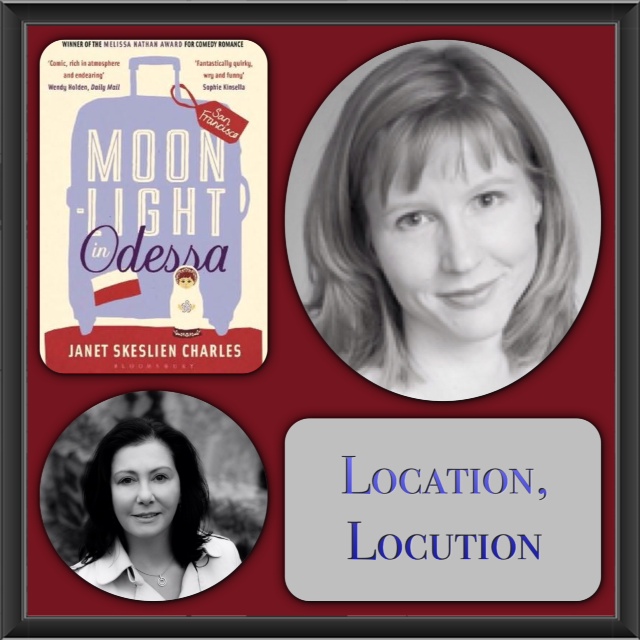
LOCATION, LOCUTION: Janet Skeslien Charles, bringing Odessa to life through writing

2013-11 jsc visual

Images, clockwise from top: Moonlight in Odessa cover art; Janet Skeslien Charles author photo; JJ Marsh author photo

In this month’s “Location, Locution”, expat crime writer JJ Marsh interviews Janet Skeslien Charles, author of Moonlight in Odessa.

Janet, welcome! Tell us a little about yourself.
I grew up on the plains of Montana, in a town of two thousand people. I have always been a writer, with a journal for observations, prose, and poetry, though for me, writing is a very private activity.

At the University of Montana, I studied English, French, and Russian. I also spent a year on a university exchange at the University of Maryland. After graduation, I went to Odessa, Ukraine, for two years as a Soros Fellow.

I found a job in France and intended to stay for a year. On my first day in France, I met the man who became my husband, and I’ve been in Paris for over ten years.

Moonlight in Odessa is truly an international effort. The novel is set in Odessa, Ukraine. My agent is English. My editor’s assistant is Japanese-Danish, my copy editor is from New Zealand. I’m American. The book was written in France and typeset in Scotland. My first fan letter came from a Swede. Rights have been sold in Germany, Italy, the Netherlands, Brazil, Sweden, Iceland, Serbia, Romania, Taiwan, and Denmark.

When you’re writing, which comes first, story or location?
My novel was an ode to Odessa, a city I love. The story grew from the place.

How do you go about evoking the atmosphere of a place?
The way my characters speak, what they eat, how they dress, who they believe, how they love, and where they go are all very particular to the city of Odessa.

Which particular features create a sense of location? Landscape, culture, food?
For me, it is how characters react to situations. Odessa is the humor capital of the former Soviet Union, which means that my characters use humor as a shield to ward off painful situations. Odessans are capable of laughing at things that would make me bawl. Their mental toughness is impressive. So for me, the sense of city is the sense of self.

Also, trying to understand what is important to characters is important. My character Daria is defined by her ambitions, which exist because of her experiences in Odessa, a comsmopolitan sea port.

How well do you need to know the place before using it as a setting?
I was immersed in Odessa for two years and am still in touch with friends there, so it was easy for me to write about the city, but I love that Jeanette Winterson wrote The Passion without visiting Venice. It is one of my favorite books and so evocative of time and place. I don’t think you need to know a place, though it helps. I think imagination and observation are the most important tools when creative a setting.

Could you give a brief example from your work which you feel brings the location to life?
Daria, my main character, is at a job interview and must decide whether she is able to do the job and stay ahead of the lecherous boss:

Chess. There’s a reason the former Soviet Union has more world champion players than any other country. Chess is strategy, persistence, cunning, and the ability to look farther into the future than an opponent. The bloodlust of killing off others, one at a time. Chess is every man for himself. Building traps and avoiding them. It is mental toughness. And sacrifice. In Odessa, life is chess. Moves. Countermoves. Feigns. Knowing your adversary and staying one step ahead of him.

I took the job.

Which writers do you admire for the way they use location?
I absolutely love Venice in Jeanette Winterson’s The Passion. Michael Perry’s Population: 485 and Julia Alvarez’s How the Garcia Girls Lost Their Accents are also great examples of how place shapes the narrative. I have also read two unpublished novels by friends — one evokes North London, the other life in small-town France — and six months later, I am still savoring these two places I have never been.

The authors are Marie Houzelle, a French woman who writes in English, and Katya Jezzard-Puyraud, who wrote about North London so convincingly, I finished her novel feeling as if I had grown up there.

Next month’s Location, Locution guest  will be Jeet Thayil, the winner of the DSC Prize for South Asian Literature, shortlisted for the 2012 Man Booker Prize and the Hindu Literary Prize 2013.

 * * *

JJ Marsh grew up in Wales, Africa and the Middle East, where her curiosity for culture took root and triggered an urge to write. After living in Hong Kong, Nigeria, Dubai, Portugal and France, JJ finally settled in Switzerland, where she is currently halfway through her European crime series, set in compelling locations all over the continent and featuring detective inspector Beatrice Stubbs.

STAY TUNED for tomorrow’s post!

If you enjoyed this post, we invite you to register for The Displaced Dispatch, a round up of weekly posts from The Displaced Nation, with seasonal recipes, book giveaways and other extras. Register for The Displaced Dispatch by clicking here!

Related posts:

LIBBY’S LIFE #87 – Behind closed doors

I wish she wouldn’t do this.

I wish my mother-in-law would be uniformly odd and infuriating all the time, so I can feel justified in complaining about her and accusing her of doing terrible things to my Sophie Conran wallpaper.

Instead, I bear the guilt of having to look at our beautiful, newly decorated living room — an elegant duck-egg blue I would have chosen myself – in our old house in Milton Keynes. If I’m honest, the place looks nicer inside after two years under Sandra’s care than it ever did under ours, especially after Jack added his own interior designs with crayons and dirty Tonka tyres. Maybe the house exterior needs a bit of TLC, but I suppose an outside paint job is our responsibility.

Oliver stands next to me, oozing smugness from every pore, and I want to slap him. He glances sideways at me, smirking with triumph.

“The house looks wonderful, Mum,” he says. “You’ve really looked after it for us. And the living room – it must have been done very recently, because I can still smell the paint.”

“They only finished two days ago.” Sandra crosses the room and adjusts the new, silver-grey, slub curtains so they hang evenly on either side of the patio doors. Surely they aren’t real silk? They look as if they could be. Even if they’re not, they’re a major improvement on the unlined drapes we’d left behind. “I’d decided to get the house spruced up, one room at a time. It seemed like it was the least I could do with me living here rent free. The decorators had just arrived, and then you phoned to ask if you could all come and stay. That’s why I was a bit off with you and had to let you know later if it would be all right. Didn’t want the kiddies sleeping in a house where there’s lots of paint fumes.”

Another puffed-out chest from Oliver, another I-told-you-so look in my direction, another pulled punch from me.

Except — and God forgive me if I’m wrong — this is Sandra talking. Sandra who, when Jack was a newborn, thought it was perfectly OK to feed him a bottle held in one hand and puff on a Benson & Hedges held in the other. Sandra, who thinks Red Bull is an acceptable beverage for a three-year-old. Yet suddenly she’s worried about her grandchildren inhaling paint fumes?

Either she’s taken a crash course in child care, or she’s up to something. Oh, come on. You know what I mean. What are the odds of us phoning her just as the decorators arrive?

There’s no point voicing my suspicions to Oliver, though. He’ll just say I’m being paranoid and nasty, and that nothing his mother does is ever good enough for me.

Without any concrete proof, he’d be right, too. But those nagging hunches persist.

Oliver runs outside through the rain to get the luggage from the car, while I show the children round the house. Jack, of course, spent the first three years of his life here, and he remembers parts of it, like the cupboard under the stairs where he once managed to lock himself while playing an overenthusiastic game of hide and seek with Fergus. I can tell he’s enjoying feeling superior to his brother and sister, whose first time it is here. But all the furniture Jack remembers is in Woodhaven, and this house in Acacia Drive looks very different with Sandra’s eclectic taste.

I say “eclectic”. “Eccentric” or “hippie” would be another way of putting it. A bead curtain in the kitchen, a hammock in the home office, a poster of Jimi Hendrix gracing the dining room. The important thing, though, is she hasn’t changed the infrastructure of the house, and any redecorating she’s done – only the living room, as far as I can tell – has been in keeping with our taste.

Jack and I are showing the twins Jack’s old bedroom (it’s still got his Lightning McQueen lampshade hanging from the ceiling, and Jack is very excited to see this old friend) when I hear Oliver trundling the suitcases into the hall and stomping his feet on the doormat. You forget how much it rains in England when you don’t live there for a while, and it occurs to me, too late, that rain gear didn’t feature highly on our packing list.

“I’ve put you and Libby in your old room.” Sandra’s voice wafts up the stairs. “The children are all in Jack’s old room, and I’m having the spare room while you’re here.”

That’s all fine and dandy, but bedtime will be a nightmare if all the kids are in one room. They’ll never get to sleep.

“Could I put Jack in the little bedroom?” I call to her. “Move his mattress in there?”

Sandra’s face appears over the banisters, looking up at me. “It’s full,” she says. “I use it as a storeroom. I’ve been collecting, um, china, and there are lots of breakable things in there. I hope you don’t mind, but I’ve kept that room locked. I’d hate the kiddies to hurt themselves.”

“You see?” Oliver mutters at me as he heaves the two suitcases on the double bed. Goodness, but it feels weird to be sleeping in someone else’s bed, in what used to be our bedroom. “You see? She’s looked after the place beautifully. She hasn’t even got any weird animals – not a tarantula in sight! You were worried about nothing.”

I don’t answer him.

My experience with Sandra is that, sooner or later, something will turn up to fill the worry void.

*  *  *

Oliver stays with us for a couple of nights before he heads off to his series of meetings in Rotterdam, and promises to be back the following weekend “if he can.” I’m not fooled by this. “Can” will soon turn into “I’ve got work to do and I’ll be more productive doing it in the hotel” which loosely translates as “I’ll be able to have a weekend lie in at the Marriott.”

The past two nights were sleepless for us both, due to all three kids operating on Eastern Standard Time and refusing to adapt to GMT. At least, as far as bedtimes go. They still haven’t got off to sleep before 1 in the morning, but are nevertheless happily bouncing around at 6:30am. Jack, in his leading role of big-brother-who-has-lived-here-before, has taken it upon himself to heave each twin out of its travel cot in the morning, and if I don’t get up to keep an eye on them all, that lovely duck-egg blue living room will need its paint touching up sooner than Sandra anticipated.

Sandra herself we don’t see much of, which has turned out to be a blessing and a curse. A blessing because it’s peaceful without her, of course. She’s got herself a little job now, working as a cashier in a pet superstore a few miles away, which I suppose explains why she hasn’t got a menagerie of her own anymore. She’s not there during the day to look after any dogs or tarantulas that her weirdo friends have foisted on her.

A curse, though, because it leaves the kids and me with a mobility problem – we can’t go anywhere. Sandra takes her car to work, and Oliver returned our hire car to Heathrow.

“You won’t need it, will you, Libs?” he said before he left.

“Not at all!” I said, throwing myself back into English living. “I’ll show the children what it’s like to get on a bus at the end of the road instead of driving everywhere! I’ll take them on a double-decker. They’ll love it.”

But:

“Taking the bus?” Sandra said with a smoker’s cackle, when I announced our plans for the first day on our own. “What bus? That bus route closed about two months after you moved to America. If you want to get a bus into town now, it’s a mile and a half to the nearest stop. That’s a long way in this weather.”

“Never mind.” I waved my hand around airily. “The rain will stop.”

Except it didn’t. Since Oliver left, we’ve been prisoners in our own house because my packing list didn’t allow for days of torrential rain. The children have only sneakers in the suitcase, and it hardly seems worth buying three pairs of wellingtons just to use here. We’ll never use them back home. In Woodhaven, you either need sneakers, flip-flops, or snow boots. Never wellingtons. Besides, we need wellingtons to get to the shops to buy wellingtons. It’s a vicious circle.

As an aside, when I had to explain what wellingtons were to a blank-faced Jack, I knew he’d crossed an invisible nationality line.

Coming home, it seems, can be even more of a wrench than living away.

 *  *  *

In the middle of Day Four, as I look out of the window at more rain and black clouds and listen to the sound of three children with raging cabin fever, I remember about The Box.

The Box, or rather, a series of Boxes, is stowed in the attic in this house. It contains things like outgrown clothes of Jack’s, Christmas decorations, small electrical appliances that we couldn’t take to the USA but didn’t want Sandra to use, and — if I remember rightly — old clothes that Oliver and I used for gardening and decorating. Clothes like, for example, rubber boots. And I’m pretty sure that I never got around to throwing out Jack’s old, sturdy shoes. I bet I can find things up there to fit all four of us.

The hatch to the attic is in the spare bedroom. After making sure none of my offspring is strangling the other two, I walk upstairs and open the door.

At least, I try to, before remembering with a sigh that Sandra has locked this room safely away from prying little fingers.

I hunt around in kitchen drawers and bedside tables for a key — in the process discovering that the house’s tidiness is indeed only skin deep — but have no luck.

“Sorry, kids,” I say. “It’s another day in paradise. Yet another day of CBeebies.”

Jack’s memory comes to our rescue, however.

“It’s like when I locked myself in the cupboard under the stairs when Fergus and me were playing hide and seek,” he says. I’d told him the story only yesterday.

“It is indeed–” I begin, and then stop.

Because, if I remember rightly, I used the key from the spare bedroom to get him out. I remember talking calmly to him, telling him to wiggle the key on the inside of the cupboard door and pull it out, darling, so that I could put the key in the outside and turn it myself and let him out… I’d tried all the spare keys in the house, hoping that one would fit and that I wouldn’t have to call the fire brigade.

So if the key to the spare bedroom works in the understairs cupboard lock, that means it should work vice versa. Right?

The key to the understairs cupboard is still in the lock. I take it out, fit it in the spare bedroom’s keyhole, and — Yes! The key, with a bit of persuasion, turns. One step nearer to raingear and freedom.

And then, as I push the door open and step into the room, I understand exactly why Sandra wants to distract us with freshly painted living rooms, and why she keeps the spare bedroom locked, and why she isn’t keen on her grandchildren — or her daughter-in-law, for that matter — having access to it.

Given the choice between our resident poltergeist and what Sandra has in here?

Come back, M.

All is forgiven.

.

Next post: LIBBY’S LIFE #88

Previous post: LIBBY’S LIFE #86 – Where the heart is

Read Libby’s Life from the first episode.

Want to read more? Head on over to Kate Allison’s own site, where you can find out more about Libby and the characters of Woodhaven, and where you can buy Taking Flight, the first year of Libby’s Life — now available as an ebook.

STAY TUNED for next week’s posts!

If you enjoyed this post, we invite you to subscribe for email delivery of The Displaced Dispatch, a round up of the week’s posts from The Displaced Nation. Sign up for The Displaced Dispatch by clicking here!

Image: Travel – Map of the World by Salvatore Vuono / FreeDigialPhotos.net; “Suitcase” © Tiff20 at Dreamstime.com – used under license; portrait from MorgueFile

JACK THE HACK: Expat authors, time to build a great and powerful blog (2/3)

The expat experience Jack Scott and his partner, Liam, had in the Turkish port town of Bodrum—they were seeking sanctuary from a pressured existence in London—proved literally to be something to write home about, as in a book! They have since returned to the UK, where they are living the life of Riley in Norwich.  Some months ago, we suggested that Jack reinvent himself as Jack the Hack and submit monthly columns targeted at those of you who are still displaced and hacking away at travelogues-cum-memoirsor, in some cases, autobiographical novels. Warning to non-Brits: Don’t be put off by his wry sense of humo(u)r!

—ML Awanohara

Last month I extolled the virtues of blogging as a way of spreading the word about your words—and, in the process, flogging that box of books you’re using as a door stop.

This month, I want to take you further down the yellow brick road to blogger glory, with answers to the following Frequently Asked Questions.

Where do I start?

First things first. Choose a blogging platform—called a “host.” This will be your blog’s home. The biggest free applications are:

  1. Blogger—easiest.
  2. WordPress—slightly more technical knowledge required.
  3. Tumblr—attracts a younger crowd and great for short posts, video and pictures.

Your host manages all the back office stuff so you don’t have to. Once you’ve signed up, you can roll out a new blog in no time. You don’t need to be technically savvy but it does help to have mastered the basics. All the blogging platforms offer online help and/or tutorials. WordPress, in particular, has a large and active user community. You will learn as you go along and this is all part of the fun. WordPress also offers a free self-hosting package through WordPress.org, providing total freedom and endless possibilities to the serious blogging geek (I’m bad but I ain’t that bad).

What’s in a name?

More than you might think. Choose a title for your blog that reflects its subject matter. Simple is best. For example, the Turkish Travel Blog does exactly what it says on the tin and works well for searching. I also like What’s for Tea Tonight, Dear? because it’s obviously about food but has a witty title.

Don’t ask me why I chose the rather obscure title of Perking the Pansies for my own blog. It’s caused endless confusion, especially across the Pond. All I can say is that it came to me in the night and seemed like a good idea at the time.

How do I make it a looker?

All blogging platforms come with a variety of appealing templates to add a dash of style. Select one; furnish it with your personal touches in words, images and music; accessorize from a menu of widgets and plugins; and, hey presto, you’ve got yourself a blog with punch and panache.

Some fancy features come at a premium but they aren’t necessary.

Your blog will be unique, so move the vases and furniture around to see what works feng shui-wise—rather like flicking through an IKEA catalogue.

Add an interesting “About Me” widget or page. The most successful blogs reveal something of the writer’s personality.

Will I be chained to the computer?

Not unless it turns you on. Posts can be written in batches and scheduled to be published over time. Try to post at least once a week, though. It’s good for what’s called search engine optimization (SEO). Don’t be spooked by this. This is just how Internet search engines index and rank your site— it’s all done in the background. Over time, posting regularly will push up your assets better than a Playtex 18-hour girdle.

What will give my blog the kiss of life?

This is the original million-dollar question. The short answer is, whatever floats your boat: something that interests you will help you write something interesting. Variety, as they say, is the spice of life—so choose a broad theme to write around.

Many authors will post book reviews or write about the writing experience itself. That’s fine and dandy, but just because you’re a writer doesn’t mean that you have to write about writing (I rarely do). And it does no harm to go off-message now and again. Surprise your audience with the occasional left fielder.

The blogosphere is an incredibly hyper-active arena. Bloggers through WordPress alone published more than 35 million posts during September this year, attracting more than 4 billion hits (yes, billion). Obviously, you’ll want your posts to stand out from the crowd. Try to ensure that the titles of your posts spark an interest. If your blog is mostly text, make the first few sentences of each post leap from the screen and get the juices flowing. Break up your words with interesting and relevant images.

In our visual, coffee-on-the-go, no-time-to-read age, the right picture can be more eloquent than a thousand words. Keep your pages clean and uncluttered. Fussy, multi-coloured fonts and busy designs can hurt the eyes and put the reader off. Don’t forget to use relevant categories and tags for each post. They’re good for SEO, too.

And the kiss of death?

If you’ve a book to flog, promote it lightly—otherwise, your readers will change channels quicker than you can say “click here.” By now, I reckon most of my regulars have either bought my book or would rather read the back of an envelope, so there’s little point banging on about it (until the next one, of course).

Don’t use your blog as a daily diary (use Facebook for this if you must). Even your dear old Grandma won’t be that interested in what you had for breakfast or that you broke a nail taking out the rubbish (unless something funny or profound happened on the way to the tip).

If you want to be seen as an authority on something, you need to write with authority.

So, until the third, and last, thrilling installment, I leave you with this final thought:

BLOGGING TIP FOR EXPAT AUTHORS NO 2:

While it’s important to blog regularly, it’s okay to take a break because real life is, well, real. If you have nothing to say, don’t say it.

* * *

Readers, any comments, further questions for Jack the Hack? He’ll be back next month with the third, and final, installment in his blogging advice trilogy: “Making Friends and Influencing People.”

Jack Scott’s debut book, Perking the Pansies—Jack and Liam move to Turkey, is a bitter-sweet tragi-comedy that recalls the first year of a British gay couple in a Muslim country. For more information on this and Jack’s other titles, go to his author site.

STAY TUNED for tomorrow’s post, another installment in the life of our fictional expat heroine, Libby. (What, not keeping up with Libby? Read the first three episodes of her expat adventures.)

If you enjoyed this post, we invite you to register for The Displaced Dispatch, a round up of weekly posts from The Displaced Nation, with seasonal recipes, book giveaways and other extras. Register for The Displaced Dispatch by clicking here!

Related posts:

Images from top, clockwise: Hand with pen / MorgueFile.com; Boats in King’s Lynn, Norfolk / MorgueFile.com; Jack Scott, used with his permission; Turkish boats / MorgueFile.com

And the October 2013 Alices go to … these 4 international creatives

 © Iamezan | Dreamstime.com Used under license

© Iamezan | Dreamstime.com
Used under license

If you are a subscriber to our weekly newsletter, Displaced Dispatch, you’re already in the know. But if you’re not (and why aren’t you? off with your head!), listen up. Every week, when that esteemed publication comes out, we present an “Alice Award” to a writer or other kind of creative person who we think has a special handle on the curious and unreal aspects of being a global resident or voyager. Not only that, but this person tries to use this state of befuddlement to their advantage, as a spur to greater creative heights.

Today’s post honors October’s four Alice recipients.

Starting with the most recent, and this time with annotations, they are (drumroll…):

1) CATHY TSANG-FEIGN, American psychologist in Hong Kong, specializing in expat psychology and adjustment issues

For her book: Keep Your Life, Family and Career Intact While Living Abroad
Published: September 2013
Snippet:
Cathy_Feign_cover

[Benjamin is a marketing buyer who was transferred to Hong Kong on a two-year contract. Having been through the phase of “elation,” he now finds himself in phase of “resistance,” with “transformation” and “integration” yet to come.]

Benjamin is getting annoyed by the frantic pace of life in Hong Kong, the indirectness of Chinese people in business, the crowds and difficulties in being understood. He is frustrated at the narrow choice of English-language entertainment on television or in cinemas and theaters. He finds himself missing his old friends, favorite foods, and the ways of doing things back home. Many foreigners in this [resistance] stage tend to associate only with others from their own country. They constantly compare everything to “back in England” (or New York or Frankfurt). Such people remain separate from the local community and establish their own secluded, privileged society. Many expatriates remain in this stage until the day they move back home.

Citation: Dr. Tsang-Feign, we wonder if in addition to Benjamin (who is presumably fictional) you might consider treating Alice in Wonderland as a textbook example of the four phases of acculturation? As you may recall from your own reading of Lewis Carroll’s story, Alice’s elation at falling down the rabbit-hole is rapidly followed by a period of resistance to the wonders found beneath. Down, down, down—Alice’s fall eventually culminates in unlocking a door to a passage through which yields the sight of the most fabulous garden. And her first taste of Wonderland is equally delightful: a drink that has “a sort of mixed flavour of cherry-tart, custard, pine-apple, roast turkey, toffee, and hot buttered toast.” However, it is not long before Alice begins to resist the local community:

“It was much pleasanter at home,” thought poor Alice, “when one wasn’t always growing larger and smaller, and being ordered about by mice and rabbits. I almost wish I hadn’t gone down that rabbit-hole—and yet—and yet—it’s rather curious, you know, this sort of life!”

Still, and as the latter statement attests, even at the height of her resistance Alice shows some potential for “transformation.” And though she never quite achieves “integration” before leaving Wonderland—she always feels a bit what we like to call displaced—her sister predicts that she will forever cherish the memories of her adventures. We can only speculate, not being psychologists ourselves, that this progress is owed to her not having had the opportunity to isolate herself with other Alices, to her having had a solo, and singular, set of experiences. Does that seem a fair assessment?

2) ANONYMOUS BLOGGER at Midwest to Midlands, who describes herself as “an American from the Midwest married to a Brit living in the English Midlands”

For her post: “First a Revisit in England”
Posted on: 23 September 2013
Snippet:

… it has taken me a while to get back on track since returning to England from out visit in the States. What do you do when you need to get yourself in gear? This time for me, some action was needed, or rather lack of action and enjoying the English countryside.

Citation:  M-to-M, we love the idea of getting over the often-rough transitions from homeland to adopted land by doing nothing and simply immersing yourself in your surroundings—we only hope you realize how lucky you are to have landed in the Cotswolds, which has been designated as an Area of Outstanding Natural Beauty. (If you lived in, say, smog-covered Shanghai, this technique would have required more imagination.) In fact, your photographic record of your desultory wanderings—first stop, a magnificent house or two made of Cotswold stone; next stop, a tea room; next, a window-box; next, a shop; next, a tree covered in golden leaves; next, an 18th-century house with an American letterbox—put us in mind of this charming passage from Lewis Carroll’s classic:

“I should see the garden far better,” said Alice to herself, “if I could get to the top of that hill: and here’s a path that leads straight to it—at least, no, it doesn’t do that—” (after going a few yards along the path, and turning several sharp corners), “but I suppose it will at last. But how curiously it twists! It’s more like a corkscrew than a path! Well, THIS turn goes to the hill, I suppose—no, it doesn’t! This goes straight back to the house! Well then, I’ll try it the other way.”

3) MANAL AHMAD KHAN: Journalist, poet, world traveler, and blogger at Windswept Words

For her post: “Thoughts on Leaving Pakistan” (her first post in a year-and-a-half, since she and her husband moved back to Pakistan from the United States, and just before they left for a new adventure in Spain)
Posted on: 4 October 2013
Snippet:

It was a parallel universe, where we all lived free, modern lives, like citizens of a free, modern country, utterly disconnected from the “other” Pakistan, the bigger Pakistan, and for all intents and purposes, the “real” Pakistan. Yet perhaps it was our only survival, the only way to keep sane and creative and happy for those of us who chose to live in our native country.

Citation: Manal, your deep love for your native land shines through your many beautiful photos and stories—as does your frustration about its “overwhelming religiosity and self-righteousness.” We are glad that, unlike Alice, you were able to get out of “that dark hall, and wander about among those beds of bright flowers and those cool fountains” from time to time. And a very pleasant little Wonderland it sounds, that part of Lahore where people meet up in New York-style cafés for mocha cappuccinos, and have children who dress up for Halloween and parties where alcohol flows freely. By the same token, we can appreciate how happy you were to leave this “schizophrenic” life for Madrid. Readers, we will hear about Manal’s latest adventures this month as she has agreed to be one of November’s featured authors!

4) KAY XANDER MELLISH, Wisconsin-born journalist and now an expat entrepreneur in Copenhagen and blogger at How to live in Denmark: An irreverent guide

For her post: Danes and Privacy—Why public nudity is OK and public ambition is not
Posted on: 24 August 2013
Snippet:

Shortly before I arrived in Denmark in 2000, one of the famous guards outside the queen’s palace at Amalieborg was fired.

… She was the first woman to guard the Royal Palace at Amalieborg. … Unfortunately, this young lady also had a part-time job. She was a prostitute. She would guard the palace by day and run her business out of the royal barracks in the evening.

… But she was NOT fired because she was a prostitute. She was fired because she’d been ordered by her commander to stop moonlighting after her side-job was first discovered, and she did not stop. … She was fired for not following orders.

Citation:  Kay, we don’t know which experience is stranger: Alice’s discovery that the Queen of Hearts has cards for guards, or yours that Margrethe II had a prostitute for a guard. But leaving that matter aside, what’s even stranger in both cases is that the rules by which a guard’s behavior is judged are far from transparent, even after an explanation is offered. The Danes you queried about the incident told you that as far as they were concerned, even a Queen’s guard can do what she wants in her private time; but insubordination is unacceptable: off with her job! Likewise, when Alice asks a couple of the Card Guards why they are painting the roses, she gets this response:

Five and Seven said nothing, but looked at Two. Two began in a low voice, “Why the fact is, you see, Miss, this here ought to have been a RED rose-tree, and we put a white one in by mistake; and if the Queen was to find it out, we should all have our heads cut off, you know. So you see, Miss, we’re doing our best, afore she comes.”

We expect you can empathize!

*  *  *

So, readers, do you have a favorite from the above, or have you read any recent posts you think deserve an Alice Award?  We’d love to hear your suggestions! And don’t miss out on these weekly sources of inspiration. Get on our subscription list now!

STAY TUNED for tomorrow’s post, another installment on blogging from JACK THE HACK.

Writers and other international creatives: If you want to know in advance whether you’re one of our Alice Award winners, sign up to receive The Displaced Dispatch, a round up of weekly posts from The Displaced Nation, with news of book giveaways, future posts, and of course, our weekly Alice Award!. Register for The Displaced Dispatch by clicking here!

Related posts:

Happy Halloween! A cauldron of 6 cautionary tales for the intrepid traveler

Image: Lake View Cemetery / MorgueFile.com

Yesterday’s Halloween post by Anthony Windram, about the top 5 ghostly settings from literature and film, got us thinking again about the ghostly and ghoulish, the mystical and macabre, the dark and demonic.

Our thoughts, however, did not turn towards the new and original, but to the jaw-clanging skeletons in the Displaced Nation’s very own Crypt.

At which point…someone (Kate Allison?) suggested that we pile all of our Gothic Tales of Old into a cauldron and chant “Bubble, bubble, toil and trouble.” All was going well until one of us—must have been the American—broke in with:

Stirring and stirring and stirring my brew…

Just as she screeched “O-o-o-o-o, o-o-o-o-o”, 6 apparitions arose from the pot: 6 terrifying tales from the Displaced Nation’s deep dark past. Each said they were there to teach travelers a lesson.

And here is what they told us:

1) The Ghost of the Mysteriously Misplaced Post

I am the ghost the represents the post titled The Displaced Nation’s Halloween post is…mysteriously displaced!, composed on Halloween night two years ago by ML Awanohara, whose blood was curdling because:

Kate Allison was supposed to post today, for Halloween…but then, pouf, she vanished without a trace!

As readers who are paying attention know, Kate has now posted 80+ episodes in the life of a fictional British expat family living in New England, called Libby’s Life. Two years ago she vanished before uploading the latest episode because of a freak snowstorm in Connecticut, her adopted home.

She finally resurfaced on On All Saint’s Day—in a MacDonald’s! (Has she gone native, or what?)

Travelers, here is the lesson I’m here to impart for your sake: Truth is stranger than fiction, where so’er you roam.

2) The Ghost of Quizzing Others on Their Supernatural Sightings

Hello there, I am the ghost that arises from THE DISPLACED Q: On your travels … have you ever seen a ghost?, which was composed by Tony James Slater just over a year ago. He impressed with his self-knowledge when he said: “I’m about as psychic as a cheese.” But then he went on to say:

And then, just occasionally, I have dreams when I’m visited by the spirits of people I’ve lost….

Is there any wonder there were no comments and no likes on his post? He scared the bejeezus out of most of his readers.

Still, point taken, and I’m here to impart an important lesson that you international travelers may not have fully considered: As you traverse the world, bear in mind that any ghosts you meet will be people you know (and left behind), not strangers.

3) The Ghost of Compiling a Master List of Grim Reapers

Greetings, I have emanated from the post called Grim Reapers around the globe: 7 creatures that say “Time’s up!”, composed by Kate Allison just over a year ago. Kate reported on the surprising number of cultures that maintain some version of the mythological conniving female who lures men to their deaths.

As frequent visitors to this site will know, Kate has a way with words. For instance, she described
Sihuanaba of Central America as follows:

Seen from the back, she’s an attractive woman with long hair; from the front, it’s a horse. (No jokes about Sex and the City, please.)

But even Kate’s rather offbeat humor could not dissuade from the freakishness of some of these figures.

As far as lasting lessons, this will have to suffice: Next time you get lost in a canyon, try blaming an ancient ghoul. Depending on where you’ve landed, as well as gender, you may just about pull it off.

4) The Ghost of Delivering a Screed against Princess Diana Dolls

A cheery hello to one and all, I am the ghost of Anthony Windram’s EXPAT MOMENTS: The Doll Collection, which he wrote almost exactly a year ago.

As anyone who came across it may recall, Mr. Windram was most distressed to find himself at a bed-and-breakfast in NEW England (he is from Jolly Olde) where the innkeeper has put her prized collection of “individually authenticated” Princess Diana dolls on display in the sitting room. He tossed and turned all night, even heard scratchings at his door.

Now, as regular visitors to this esteemed site know, Mr. Windram is no fool. On the contrary, he has has a mighty brainbox. Which is why I’m so stunned that he allowed himself to be frightened by a set of Lady Di figurines. I’m sure they were only there to cover up the fact that the house is haunted—by a young and rather vigorous ghost, which is how ghosts tend to come in America (just ask Libby). The real take-away, then, particularly for those who venture into the New World: Avoid American B&Bs like the plague if you want a decent night’s sleep.

5) The Ghost of the Expat Criminals Exposé

ML Awanohara showed some temerity in writing a post entitled What did Agatha Christie know? Expats make great criminals back when this blog first started.

As the ghost that arose from this post, I’m here to say she hit the proverbial coffin nail soundly on the head with this assertion:

Just as we don’t like to think of rats being part of the animal kingdom, we don’t like to think of conmen, pirates, gangsters, and terrorists being part of the group we have loosely defined as “global voyagers” … But trust me, they are a part of it — as are murderers.

Which leads us to the lesson I’ll impart today: Just because you’re in a part of the world where marrows tend to thrive, don’t assume the likes of Hercule Poirot will turn up and save you.

6) The Ghost of Finding Travel Inspiration in Margaret Drabble’s “Red Queen”

Not long ago compared to other posts in this collection, ML Awanohara wrote FOOTLOOSE & FANCIFUL: Margaret Drabble’s “The Red Queen”, explaining how her views of Korea had shifted after reading a book by Dame Drabble depicting a period of bloodshed and horror in the 18th-century Korean court. A real-life tale made more vivid by Drabble’s considerable fictional powers, in which the Prince is a homicidal maniac, and his father, the King, a stern Confucian. The King ultimately decides to murder his son in a style so dramatic that ML couldn’t get it out of her head next time she went to Korea. She remains haunted to this day.

As the ghost of this post about a ghost, I find myself torn. On the one hand, what kind of person would read Drabble—that serious, hip, intellectual British novelist, who likes to come across as one’s brainy, Cambridge-educated best friend—to get a handle on what the Koreans are really like? Apples and oranges—or marmite and kimchi, I should say.

On the other—and this is the lesson I’ve come to deliver: Never hesitate to use a Cambridge-educated Brit as a resource for novel sightseeing ideas.

* * *

Readers, have we got you thinking twice about those travel plans? Do let us know in the ca-ca-comments. Hey, at least we spared you the horrors of Sezin Koehler’s 15 films that depict the horrors of being abroad, or otherwise displaced; Tony James Slater’s 5 travel situations that spell H-O-R-R-O-R!; or Kate Allison’s Global grub to die for, including a rather scrumptious recipe for fried tarantula, which goes down a treat in Cambodia.

STAY TUNED for next week’s fab posts!

If you enjoyed this post, we invite you to register for The Displaced Dispatch, a round up of the week’s posts from The Displaced Nation, with our weekly Alice Award, book giveaways, and other extras. Register for The Displaced Dispatch by clicking here!


The Displaced Nation selects its top 5 chillingly atmospheric Halloween locations from literature & film

From greedy children holding up whole neighborhoods to blackmail as they seek a cheap fix for their addiction to stores selling cheap plastic masks and covering their aisles in fake cobwebs, I’ve always found Halloween to be tedious time of the year. Everything ends up looking more crappy than creepy. As the day lacks its own miserly Ebenezer Scrooge-figure I would be more than happy to fill the role.

Of course, that makes me a poor choice indeed to write a Halloween-themed post for The Displaced Nation, but we can all take solace in the knowledge that as I write this I have the lights in my living room turned off and I am ignoring the pleading of the legions of candy junkies knocking on my door asking for one last Hershey hit.

But enough whinging, Windram. Now for my picks for atmospheric locations that can send a chill down your spine:

1) Whitby, United Kingdom

Quite understandably Dracula is associated with Transylvania, but the Yorkshire coastal town of Whitby is also heavily featured in Bram Stoker’s novel as the site of Dracula’s shipwreck.

Stoker visited Whitby in 1890 and was struck by the atmospheric fishing town. It is easy to see why with the ruins of Whitby Abbey high atop the east cliff overlooking the town it is visually spectacular, which makes it a wonder why the Whitby portions of Stoker original novel have so often been ignored by filmmakers adapting Dracula. John Badham’s 1979 adaptation is one of the few movie Draculas to try and depict Whitby, though unfortunately even here the use of the Whitby storyline is disappointing as the Cornish coast in fact stood in for the Yorkshire coast. This adaptation also has Frank Langella as Count Dracula, so make of that what you will. It’s certainly not obvious casting, I’ll give them that.

2) Geneva, Switzerland

Sticking with a Gothic theme, let’s focus our attention on that other horror mainstay: Frankenstein, by Mary Shelley.

Frakenstein was inspired by Shelley’s stay in Geneva, and large parts of the novel are also set there. Of course, modern, clean, ever-so-slightly-dull Geneva is not the inspiration, but rather the Villa Diodati, a country house on the shores of Lake Geneva. It is here that famously the Shelleys, Byron, and Dr Polidori challenged each other to come up with a horror story. From this challenge Mary Shelley wrote Frankenstein.

For an appropriate bit of campy Halloween schlock, Ken Russell’s film Gothic (1986), which is about the events of that challenge, is well worth a watch.

Equally, Benjamin Markovits’ novel Imposture, about Dr Polidori and his writing of the short story “The Vampyre” during that same challenge, is recommended.

3) A field of susuki grass, Japan

This entry is something of a cheat. This is an entry about the 1964 Japanese film Onibaba (literally, “Demon Hag”), which has no specific setting beyond Medieval Japan; but it’s one of the few horror films I’ve found genuinely affecting.

This is a very brief and unsatisfying summary of the film, but during a civil war two women, one old and one young—living in poverty in an area thick with reeds—kill soldiers who find themselves lost near their home, taking their possessions to sell. The older woman is worried that the younger woman, who is having an affair with a neighbor recently returned from the war, will soon be leaving her so she will have to fend to herself. When the older woman kills a samurai wearing a demon mask, she pulls the mask off the corpse (his face is disfigured) and wears it pretending to be a demon so as to scare the younger woman. Once she puts on the mask, however, she is unable to take it off.

Wow, that summary really doesn’t do the film justice. The film’s director, Kaneto Shindo, was especially keen for the film to be shot in a field of susuki grass, which they found near a river bank in Chiba Prefecture. That setting really makes Onibaba visually arresting. Claustrophobic, but also surreal and languid, these grasses heighten the tension, which is why I feel justified in adding a susuki grass field in Japan to this list.

4) Maine, USA

Obviously this is in reference to the frighteningly prodigious novelist Stephen King, a Maine native and someone who in his work has made use of the fictional Derry, Maine.

With its atmospheric coastline, rocky and dramatic, it’s easy to see how it has inspired King in a similar way to how east cliff in Whitby inspired Stoker a century before.

5) Georgetown, Washington, DC, USA

Or, more specifically, the stone steps that are on M Street in Georgetown, which were made famous in the classic horror film The Exorcist (1973). May the power of Christ compel you to visit! Word of warning: The steps are pretty steep, so if you’re heart starts beating fast, it’s probably the cardio-vascular workout you’re getting rather than any ghoulish happening.

* * *

Readers, literature and film are of course packed with thrills and chills. Have I missed anywhere you think belongs in the Top Five? Let me know in the comments…

STAY TUNED for next tomorrow’s Halloween posts, and prepare to be scared!

If you enjoyed this post, we invite you to register for The Displaced Dispatch, a round up of the week’s posts from The Displaced Nation, with our weekly Alice Award, book giveaways, and other extras. Register for The Displaced Dispatch by clicking here!

Related posts:

Beth Geglia’s calling to make films on Central American human rights stories

Beth_Geglia_tdn

Beth Geglia (photo supplied by Beth and used with her permission)

Since the Displaced Nation began billing itself as a “home for international creatives,” we have covered plenty of fiction writers, memoirists, and foodies, as well as a few entrepreneurs (I contributed to the latter with an interview with Alison McGowan about her tourism-related business in Brazil).

But there are also expats whose creativity is expressed in political activism: they work for the causes within (and across) the countries they visit.

Today I talk to one such activist, Beth Geglia, an American who, having dedicated her life to human rights issues in Central America, has now developed filmmaking skills and released a feature-length documentary on the resilience displayed by an extraordinary group of Afro-Hondurans.

* * *

Buenas, Beth, and thanks so much for agreeing to be interviewed. Let’s start by having you tell us a bit about yourself. What first awakened your interest in human rights?
I got involved in high school, after the September 11th attacks. I was adamantly against war in both Afghanistan and Iraq, and participated in student walk-outs, teach-ins—all the big mobilizations. Next I volunteered with the Indigenous People’s Council of Oaxaca in Mexico and the Movement of Worker-Occupied Factories in Argentina, which got me working on issues of economic justice and alternative economies as part of the student fair trade movement.

Guatemala has figured large in your life. What led you there in the first place?
As a student activist, I worked closely with a local fair trade coffee-roasting cooperative in Madison, Wisconsin, called Just Coffee. They sent me to Guatemala to do work with a coffee cooperative of former revolutionary combatants and returned refugees from the country’s internal conflict, known as Santa Anita La Unión. Later we organized a delegation of student activists from Wisconsin to meet with Guatemalan producer cooperatives, and I went back a few times.

Making a life in Guatemala

I understand you ended up living in Guatemala?
I became overwhelmed with the history of Guatemala, the U.S.’s interventionist role there, and the movements to restore the memory of the violence that had taken place. I felt I was learning and changing an incredible amount, so I moved there ten days after graduating college. I stayed for two years.

I assume you speak Spanish, but were there any moments when you felt displaced, in the sense of being alienated from your surroundings?
Yes, I spoke Spanish so language was not much of an issue. However, many communities in Guatemala speak their indigenous languages, none of which I was able to learn. There were definitely moments of struggle, but I wouldn’t necessarily relate them to feelings of displacement. After all, I was working with communities who were trying to defend their rights against gold mining and other resource extraction companies—it was they who were facing displacement. Some had been forcibly displaced, while others were threatened with displacement from environmental destruction, militarization, and loss of land. The communities were still healing from the violence of the internal conflict, and some people were experiencing the threat of being locked up or assassinated. Seeing this kind of suffering close up was the hardest, most painful part of my experience. Then there’s always the challenge of understanding your role as a foreigner: what’s appropriate, what’s helpful—fully aware of the privilege of being there by choice and able to leave.

I usually tell people that living in Guatemala was the hardest thing I ever did—and, at the same time, the most important and dearest to my heart. It truly transformed me.

So, for the most part, living in war-torn Guatemala felt right to you?
Things make sense to me whenever I am surrounded by good people doing good work. The people I lived and worked with in Guatemala City, for example, are still some of the people I most respect. Cooking meals with them, hanging out on the roof or patio with a few chelas (beers)—these things really felt like home.

Practicing the filmmaking craft

At what point did you decide to become a filmmaker?
It wasn’t until I moved back to the United States and quit my job with a human rights organization a year later that I began to study documentary filmmaking. Video and film are one of the most useful tools for helping people who are struggling to get their voices heard. It’s an important skill.

RevolutionaryMedicine_poster

Poster for the film screening at Columbia School of Social Work

You have just now released a documentary, Revolutionary Medicine: A Story of the First Garífuna Hospital, a collaboration with journalist Jesse Freeston. The film is set in Honduras and tells the story of the Garífuna people and the community hospital that they built. Can you fill us in a little more?
Sure. Garífuna history has been rife with forced displacement and resistance, from the slave trade to expulsion by the British from the island of St. Vincent. Most Garífunas in Honduras live on the northern coast, on lands their people have occupied for 216 years. They continue to face many pressures, such as a lucrative foreign tourism industry, the expansion of African palm production by the country’s largest landowners, resource extraction, and foreign investors wanting to build charter cities. In addition, they face ongoing discrimination and neglect from the state, which has failed to provide them with medical services. This film is about the community coming together to build their own hospital, while fighting for their human right to health care. It’s a story about self-organization and persistence, but also about a different model of medicine having to do with community survival. According to this model, improving the health of the community is a first step in addressing structural and political issues in need of change.

It really is the “first” Garífuna Hospital?
Yes. It’s the first hospital to exist in the Garífuna’s territory.

“For the health of our people…”

How did the making of the film come about?
I was still in Guatemala when the military coup in Honduras happened in June of 2009. The people around me were remembering Guatemala’s internal conflict, which lasted 36 years and amounted to genocide: it been sparked by a CIA-orchestrated coup. Everyone was feeling the weight of that history, and there was a sense of urgency around what Honduras could suffer as a result of the coup. Upon returning to the U.S., I got involved in local activism that was exposing the DC-based lobbyists who’d been hired by Honduras’s interim coup government to essentially whitewash the coup and restore normal relations with international institutions and the Organization of American States.

That’s when I met Dr. Luther Castillo, one of the founding doctors of the First Garífuna Hospital. He was on a speaking tour denouncing the political violence and repression taking place in Honduras. I took up his invitation to come visit the hospital.

Jesse Freeston and I knew each other from DC. He had been working as a journalist in Honduras and other parts of Central America for a few years and had also gotten to know the story of the Hospital and what Garífuna communities were working to create.

It was great working with Jesse. He had years of documentary experience under his belt and in fact is now finishing up a feature-length film called Resistencia, about land-occupying farmers in the Aguán Valley of Honduras. It should be released in the spring. I think we made a good team, and I learned a lot from the collaboration.

When was the film released, and what has been the reaction amongst the Garífuna people?
We started screening the film in August. Jesse took it down the West coast of the U.S. and I went to screen it in Honduras. The Garífuna community of Ciriboya reacted very positively. You know when you make a film, you can’t cover nearly everything you’d like to, but I think the doctors in particular felt it presented a balanced version of their story. They’re now using it to raise awareness and educate others. Actually, the most gratifying thing was to see the reaction of medical students who attend the public university in the capital city, Tegucigalpa. They were so excited, they ended up organizing their own screening of the film and have entered into a longer-term relationship with the Garífuna Hospital.

What about in the United States?
In the U.S. we’ve screened for lots of different audiences, including activists, organized medical professionals, social work students, med students, and youth. We’ve worked with the Garífuna Health and Education Support Institute in New York to reach Garífuna diaspora audiences, mainly in the Bronx, and the response has been phenomenal. It’s been exciting to help connect diaspora communities with what’s going on back in their homeland. Generally, people seem to come away feeling proud and/or inspired to act. I think the best compliment we received was: “This is a great organizing tool.”

If our readers are interested in watching the film how can they go about it?
Very soon anyone will be able to order a copy of the documentary online. Until then, I suggest you follow our Facebook page to find out about screenings and distribution. You are also welcome to contact Jesse and me directly by email: me@jessefreeston.com or bgeglia@gmail.com.

What further hopes do you have for the film?
Besides the documentary being used as an educational and network-building tool—that’s why we’ve been focusing on community-based and university screenings—we hope it will give ideas to people who are working on related projects. Particularly in the U.S. I would like for it to make people think about our own health care system and what might be possible.

Having already lived in Guatemala, did making the film help you to connect with Central America in any new ways?
I learned a ton about a part of Central America I knew very little about. One thing that continuously inspired me was the resilience of communities—in particular, their ability to construct alternatives that challenge our assumptions of how society can be organized. Also, the idea of doctors playing the role of protagonist in the process wasn’t something I’d anticipated. Now I’m learning that there is a long history of health workers playing a central role in social movements, to which I’d been largely oblivious.

What are your plans for the future, both with the film and your activism?
I’m actually back in school now in DC, studying for a Ph.D. in Public Anthropology. It’s an interesting program because it leaves room to use documentary film as opposed to simply writing academic papers that will have little reach. The program promotes activism as well as embedded and participatory research, so I feel it’s a good home for me. I don’t have much free time, but when I do, I like to volunteer with a local documentary project called Lessons from the ’60s. It’s an oral history project organized by a group of older activists who want to document memories of the movements that took place in DC in the 1960s and ’70s before they are lost forever. Preserving historical memory was one of the reasons I wanted to do documentary film, so it’s great to be able to participate in this kind of a project in my hometown.

10 Questions for Beth Geglia

Finally, we’d like to ask a series of questions that we’ve asked some of our other featured authors, about your reading and writing habits:
1. Last truly great book you read: Golden Gulag, by Ruth Wilson Gilmore, on the prison system in California (being in school means I only read non-fiction).
2. Favorite literary genre: Science fiction.
3. Reading habits on a plane: It’s actually really hard for me to stay awake on planes! I’m usually passed out, and when I’m awake I listen to music to calm my nerves because I’m scared of flying.
4. The one book you’d require Barack Obama to read, and why? Am I allowed to say Open Veins of Latin America: Five Centuries of the Pillaging of a Continent? Maybe The New Jim Crow, by Michelle Alexander.
5. Favorite books as a child: I was a huge fan of Roald Dahl books when I was a kid. The Witches was my favorite one. I also loved The Chronicles of Narnia.
6. Favorite heroine: Itzá in The Inhabited Woman, by Giaconda Belli.
7. The writer, alive or dead, you’d most like to meet: Audre Lorde.
8. Your reading habits: Since I’m in school, I read all the time and I skim a lot. Coffee in hand is usually a necessity.
9. The book you’d most like to see made as a film: The Inhabited Woman, by Giaconda Belli.
10. The book you plan to read next: Pathologies of Power, by Paul Farmer.

* * *

Readers, did you find Beth’s story as inspiring as I did? Be sure to check out her documentary if you get a chance. And feel free to leave further questions or comments for her below.

STAY TUNED for tomorrow’s post, some species of Halloween confection by Anthony Windram.

If you enjoyed this post, we invite you to register for The Displaced Dispatch, a round up of weekly posts from The Displaced Nation, with seasonal recipes, book giveaways and other extras. Register for The Displaced Dispatch by clicking here!

Related posts:

images: Beth Geglia; poster for the film screening at Columbia School of Social Work.

LIBBY’S LIFE #86 – Where the heart is

I twist around in the passenger seat of our rented car, which Oliver is driving at 25mph past some M1 roadworks, and look at the children. All three are fast asleep, their mouths slightly open. Jack is snoring. If only they had been like this on the red-eye flight from Boston last night, I think; instead, they chose to be “those children” who fidget, cry, kick the seats in front, and provoke people in the seats behind into making loud comments about kids needing to be banned from transatlantic flights and why do babies need European vacations anyway.

“They’re going to see their grannies, you small-minded, provincial hicks! We are a global family, unlike you, who apparently have never travelled outside your hometowns before!” I wanted to yell — but, of course, I didn’t. I didn’t yell it because it would a) have been rude and b) not the whole truth.

Yes, the Patricks are having a spontaneous couple of weeks in the old country, and the children are going to see their grannies. But that’s not all of it. Not by a long way.

The real reason we are here is that, with the nights drawing in and the autumn winds howling around the eaves at night, I don’t want to be alone on Halloween in our antique Massachusetts house after Oliver leaves for a long business trip to Rotterdam.

Not while Jack is still carrying on animated conversations with something or someone only he can see, I don’t.

It wasn’t difficult to persuade Oliver to let us come with him, because his mother has been dropping unsubtle hints about visiting us at Thanksgiving. Given the disasters that occurred last time she spent Thanksgiving with us, when I ended up in hospital twice — first with turkey-poisoning and then with a sprained ankle — Oliver was happy for an opportunity to avoid more medical bills. Four extra plane tickets seemed like a bargain in comparison.

It wasn’t just the thought of living with Jack’s pretend friend that made me want to pay a visit to Blighty, though. Getting Jack out of the awkward environment of his kindergarten class also played a part.

Patsy Traynor, flouting the wishes we voiced at the parent-teacher meeting, went ahead and arranged for Jack to see the school psychologist on a daily basis, without telling us. This subterfuge might have gone undiscovered if I hadn’t called into school one day with Jack’s forgotten lunchbox and found him sitting in the admin office with a grey-haired man, drawing a picture of a girl which he’d labelled “Mi Frend M”. When Jack saw me and jumped up to give me a hug, the grey-haired man hastily tried to hide the evidence of Jack’s art therapy, but it was too late. Words were said, threats were issued, and sabbaticals from school until the permanent teacher returned from sick leave were planned. It’s kindergarten, for heaven’s sake — what is the worst that can happen if a child misses a few months of kindergarten? He fails nap time? Two weeks away from school while everyone cooled down would hurt no one, least of all Jack.

And then the final reason: last month I was reading my diary and came across the New Year resolutions I’d made at the beginning of 2013. One of them, quite overlooked in the drama of having to find somewhere else to live in Woodhaven, was this:

2. Go to England and see what sort of a dog’s dinner Sandra has made of our house.

When Sandra moved into our house, in July 2011, she was supposed to stay for just a few months until she found somewhere permanent to live; yet here we are in October 2013 and she’s still dossing around there, rent-free.

Oliver has been no help at all. He doesn’t see it as an issue.

“It’s not a problem,” he kept saying, whenever I suggested it might be nice to have a paying tenant to help with the mortgage. “Money’s not everything. She’s keeping the place aired. It’s someone we know. She’s looking after it.”

Except I now know he has no idea whether she’s looking after it or not. He’s never been inside the house since the day we moved out. Although he visits his mother on trips back to the head office, I found out, after some careful questioning, that she always finds a reason to meet him in a coffee shop or pub, rather than at the house.

“And you don’t find this arrangement suspicious?” I asked him.

He gave me a blank look. “Should I?”

For someone who is supposed to be intelligent, Oliver can be very dense at times. Particularly, as we already know, when it comes to his mother. He doesn’t find it suspicious that she, a woman who once covered herself and some swinger friends with white emulsion and daubed hand- and buttock-prints on the wall of the spare bedroom in a previous rented house, would prefer to meet Oliver in Starbucks or The Dog and Duck? Please.

Initially on this trip I’d planned on staying with my own parents and paying a surprise afternoon call on Sandra, but when I phoned Mum to break the glad news that her daughter and three grandchildren were descending on her house, the short notice of our impending visit sent her into a flat spin with a migraine.

“If only you’d given us more warning,” she kept saying at the end of the phone call. I could hear pill bottles rattling in the background as she looked in the medicine cabinet for Nurofen. “But the spare bedroom needs decorating, and Jack will have to sleep in your old room, and it doesn’t seem right to make a five-year-old boy sleep in a room with pink wallpaper, so that’s two rooms we have to strip and paint before you can come.”

Only my mother could think this a reasonable excuse.

“Stay with mine, then,” Oliver said, after I’d clicked the phone’s off-button as hard as I could. (I miss the old phones that you could bang down when you hung up on someone.) “It’s our house, after all — she can hardly refuse to let you and the kids stay because the bedrooms need decorating.”

He was taken aback, therefore, when Sandra was nearly as uncooperative as my own mother when he told her we were coming to stay for a few days.

Oliver, as well as being dense, can be very naive.

*  *  *

Oliver signals right, and we turn into Acacia Drive. It’s more than two years since I’ve seen the street where we lived for such a long time, and it feels both familiar and foreign at the same time.

We park in front of our house. It is not, I realise with a little shock, quite our home any more.

It’s not just because the paint on the front door is peeling, or that Sandra hasn’t pruned the yellow rosebush I was so fond of.

It’s as if a little of the love has faded.

It’s like bumping into an old boyfriend after a few years and wondering what you saw in him, and why you wasted time and energy crying when he dumped you at the school dance for that tart Zoe Watkins.

“Are you glad to be home?” Oliver asks. “It must be hard for you, coming back to the house with someone else living in it.”

I look at the house again. The picket fence we put up to stop Jack from running onto the road has lost a post and looks like a gap-toothed kindergartener itself.

I wonder what Sandra has done or not done inside, and am sadly surprised that I don’t care as much as I did even fifteen minutes ago.

“Not as hard as you’d imagine,” I say.

.

Next post: LIBBY’S LIFE #87

Previous post: LIBBY’S LIFE #85 – A trick of the light

Read Libby’s Life from the first episode.

Want to read more? Head on over to Kate Allison’s own site, where you can find out more about Libby and the characters of Woodhaven, and where you can buy Taking Flight, the first year of Libby’s Life — now available as an ebook.

STAY TUNED for next week’s posts!

If you enjoyed this post, we invite you to subscribe for email delivery of The Displaced Dispatch, a round up of the week’s posts from The Displaced Nation. Sign up for The Displaced Dispatch by clicking here!


Talking to Sharon Lorimer about starting up a business on the art of being an expat

Sharon Lorimer CollageAnyone who has been an expat has probably thought about, at some time or another, starting up a business to help ease other expats into the notion that they are now international residents. But how many of us have the knowhow and the guts to act on these thoughts?

Sharon Lorimer, a Scot who lives in New York City with her American husband, did not think of herself as having an entrepreneurial mindset until she went to business school. One thing led to another, and almost before she knew it, she’d founded doshebu, a business providing services to various kinds of clients looking to go global.

Now let’s meet Sharon and talk to her about this turn of events in her life. We know that the force of love took her to New York, but what swept her down the path of launching her own business venture?

* * *

Hi, Sharon! It’s always good to talk to a fellow New Yorker, especially a displaced one! What brought you here from Scotland originally?
I fell in love with an American. After a long-distance love affair, we had to have the big talk about where we wanted to live. We were both just out of school and thought there would be more opportunities in New York than in our hometowns of Edinburgh (mine) or DC (his). So I came to New York to get married.

What was the first chapter of your life in the Big Apple?
We joined the dotcom boom: I worked for an Internet advertising agency, and my husband, Kim Khan, has done a variety of jobs, including establishing a bureau for CNBC.com in London. We were in our late 20s and had a vibrant, creative life, with lots of international friends. But then came the dotcom bust, and we started to reassess our lives and the extent to which the dotcom model aligned with our values. I searched for the right business for me but couldn’t find a fit. In 2004, I decided to get an MBA and after graduation in 2008 I started doshebu.

What kinds of services does doshebu offer?
While still in business school, I conducted primary research in International Human Resource Management. The services doshebu provides—to corporate leaders, individuals and families, businesses (human resource units), governments and NGOs, and importers/exporters looking to go global—are based on the gaps I identified in the market. I’ve designed an individual program for each market sector. Expats who are interested can find more information on our Services page. And our online learning site has lots of free resources. We want to build a community there and are continually adding information that you can access for free.

You’ve been out of Scotland for some time. Do you ever feel “displaced”?
I feel most displaced in the places where I’m supposed to be feeling most at home. I find it tough to relate to people who don’t have similar life experiences. Sometimes other Scots don’t even believe I’m Scottish. How do you convince someone you’re not pulling their leg and are actually from the same place as them?

Do you feel more comfortable abroad than in the UK?
Usually when I strike up a conversation with someone who’s traveling the world or living abroad, I find we have lots in common. My husband is the same way. If we encounter foreign tourists in the city, we always want to tell them about really cool places to go and the history behind those places.

Expats as “warriors”

Where did your idea for “doshebu” come from?
Doshebu is an expression of my life experience. When I first moved abroad, I had no idea of how difficult it would be. I packed my suitcase, got my flight, and turned up at my fiancé’s house. It took me a while to realize how unprepared I had been. While I didn’t think of myself as an immigrant, I experienced the loss of status that immigration causes. Lots of expats approach international assignments in that way. Whenever I reach out to talk to others, I can see there is a lot of work to do to help us all understand what moving abroad has done to our lives. These days, I like to think of myself as a pioneer and imagine myself living in a “boundaryless” world, where people live where they want and do what they feel is meaningful to them.

I understand the name for the business is based on the Japanese samarai moral code, Bushidō?
Kim is a black belt in the martial arts. Both of us have experienced the trauma of moving countries (Kim is from Virginia originally but has lived and worked in the UK and Singapore), and we think that living abroad requires something of a warrior mindset. While most people anticipate having a change in lifestyle, they are unprepared for the idea that not everything will be straightforward. For instance, some locals may not appreciate you or your values. Warriors are trained to go into hostile situations, and doshebu’s products address that possibility by educating you and discussing methods of coping. Thus the “way of the warrior” has become the “art of the expat.”

Was opening up your own business something you always wanted to do?
No, I was totally daunted. Although I’d witnessed my grandmother and mother start businesses, and admired them for that, I always shied away from taking that kind of responsibility. But now I feel the desire to build something of my own that wouldn’t exist if it weren’t for my efforts and dedication.

What has been the biggest challenge?
There are two main challenges I face:
1. Limited resources. It’s always tough no matter how big the company is, but it’s really tough when you’re a start-up.
2. Motivation. When you have to motivate yourself and there isn’t a reward at the end of the day, it’s tough to figure out how to keep going. I have to keep reminding myself of how far the company has come—it is no longer a research project but a living company; and I dream of a future when other people think it’s a great company, too.

Expats as artists

The most fulfilling aspect?
Doshebu is an Internet business and there is a lot of technical work behind the scenes. But we called it the “art of the expat” because we find that people who go abroad tend to become more creative and have more diverse interests. I enjoy trying to foster a sense of this in our clients and their families. It can be an advantage to their companies—for instance, if they make a more creative presentation on their work; but it can also be about one’s personal journey, connecting you with your creativity.

If you could do anything else, what would it be?
I’d love to make movies. I wrote a screenplay a while back, and as a photographer and writer, I love movies.

FromtheGlobalScottishKitchen_cover_tdnI see that you’ve created some cookbooks and photobooks under the Art of the Expat brand. My favorite is The Global Scottish Kitchen, with recipes for things like Cock A’ Leekie Udon.
Yes, my next book will also be a cookbook, called Coop du Monde. It’s a step-by-step guide to spicing up the traditional British Sunday Roast. It’s also about helping you be creative in the kitchen by explaining how to experiment with flavors.

In addition, I’m working on another photography book—about graffiti. I want to explore the idea of street art, the photographer and the graffiti artist as being the same person.

You can check out my various books on Blurb.

What’s on your bucket list?
I want to buy a small island and build a house on it. I like the idea of being able to build an environmentally-friendly house. But we’d have to have liquor—Kim and I have also written a book about home-style cocktails, based on our world travels and conversations with bartenders, bon vivants and drinkers. AliasNickandNorasHomestyleCocktails_cover_tdnHmmm…maybe I could sell moonshine in the local market?

* * *

Ah, said like a true entrepreneur, Sharon! Thanks so much for talking to me about your work. I must say, I find your take on “going global” truly refreshing. Readers, any questions for Sharon on what it’s like to be an expat doing a business on behalf of other expats? Fire away! Or if you want to recommend a home-style cocktail for her collection, I’m sure she’d appreciate that, too. For that matter, aren’t cocktails part of the recipe for a successful expat adventure?!

STAY TUNED for the next episode in the online expat novel, Libby’s Life, to appear tomorrow.

If you enjoyed this post, we invite you to register for The Displaced Dispatch, a round up of weekly posts from The Displaced Nation, with seasonal recipes, book giveaways and other extras. Register for The Displaced Dispatch by clicking here!

Related posts:

Images (clockwise from left): Sharon trying out her Bushidō technique(?!) outside of Gaudí’s cathedral in Barcelona; being a tourist in Venice; enjoying a stein of beer at the Oktoberfest in Munich (on the cover of her photography book Oktoberfest); and how the table looked for her and Kim’s 10th-anniversary celebration (note the tartan tablecloth!).