The Displaced Nation

A home for international creatives

Category Archives: Cool Columns

HERE BE DRAGONS: And much else besides! A fantasy-laden Halloween paves way for NaNoWriMo

http://www.flickr.com/photos/taymtaym/15520387690/

Left: Lucca comics & games 2014, by taymtaym via Flickr (CC BY 2.0); the “dragons” of Lucca, by Andrew Couch (October 2014).

For the past few months expat Andrew Couch has been helping us make the connection between a life of international travel and fantasy writing. This month he reports on how he spent Halloween. After you read it, I have only one question: train trip or mind trip or both?

—ML Awanohara

While my compatriots were out trick or treating, I was having my own kind of Halloween adventure over here in Europe, one that took me beyond my wildest imaginingssaying a lot for a fantasy writer!

Naturally, it had people in all manner of costumes wandering about. But it also presented opportunities to hear from a grown man about why he loves writing stories from the point of view of talking mice, and to explore a medieval walled city.

By now fellow geeks should be able to guess that I was attending a comic and games convention: the one that took place in Lucca, Italy, over Halloween weekend. Lucca, a city in Tuscany, is an hour from Florence and half an hour from Pisa.

Now, Lucca may not be able to boast of having a Uffizi Gallery or a leaning tower, but it does have church towers, clock towers, winding streets and odd-shaped plazas, all within a set of Renaissance-era city walls. So many fantasy stories feature towns inside of walls, and there are not many cities that still have them. I had a blast walking around on top of them. Here’s the view it yielded:

Photo credit: Andrew Couch (October 2014).

Aerial view of Lucca. Photo credit: Andrew Couch (October 2014).

You know, being an expat in Europe does have its advantages besides being able to spend Halloween in Tuscany. When in the United States, I never lived in a place big enough to have a decent Con, but in Europe, size doesn’t matter so much, and good train connections make it less of a hassle to attend (no parking woes, and maybe no need for overnight accommodations). This was my first time in Lucca, but for a few years in row now, I’ve been attending the Essen games in Germany, where I live. My first year I took a four-hour train to and from the convention on the same day. At Lucca I noticed someone buying a train ticket home to Turin, which isn’t so close either.

The costumes were a treat

It’s been seven years since I’ve seen any trick-or-treaters as Halloween isn’t widely indulged in Germany (as in other European countries, November 1, All Saint’s Day, is the holiday). But this year it didn’t matter as I had plenty of cosplayers to distract me. Cosplay, short for costume play, is a kind of performance art where we geeks dress up as our favorite characters or ideas.

Similar to Halloween, there are those who create their own original costumes around themes and those who don meticulous real-life facsimiles of 2-D drawings in a comic, game or movie.

I had fun watching both groups.

Since so much of what I like to read and write is steam punk (my fantasy world employs steam power), I enjoyed running into a troop of steam punk people:

SteampunkParade

Steampunk parade. Photo credit: Andrew Couch (October 2014).

Articulated metal hands and fancy goggles blending with romantic ideas of Victorian clothing—it’s definitely fantasy but not as over-the-top as anime and game characters. The mix of reality and fantasy is different, too. For many of the steam punk designs, you could imagine the mechanisms actually working, whereas the fellow on the other side of the street encased in red leather from head to foot? He can barely walk, let alone swing one of his many swords.

A real-life fantasy simulation

Perhaps even more helpful from my writer’s perspective was the chance to observe all of these characters circulating in the convention crowds. Writers, particularly fantasy writers, are free to create all manner of craziness—physics be damned. But seeing some of these ideas in the flesh wandering around was a reality check. The character who carries his signature 7-foot sword around on his back everywhere he goes really sticks out—even in a crowd full of people sporting wings and carrying all kinds of swords and staffs.

Wings, too, are interesting. Out of necessity they create a wider concept of personal space in a society, and potentially the need for wider doors…

So even my crowd watching was a source of reflection. Whether I want to write an over-the-top action story or a more realistic fantasy, I have an idea of what it looks like for various characters to wander around in a city. Because I’ve seen it.

Of Mice and Comics

I chose to attend this year’s Lucca Comics and Games primarily because of an American, the comic book creator David Petersen. He is the author and artist of Mouse Guard, an awesome set of comics (and a role-playing game) about talking mice in a medieval world. I waited in line for an hour to get my book signed (totally worth it!). I also sat in a old Italian church and watched him draw and listen to him talk about his creative process.

Asked about what inspires his drawings, Petersen told a story of being a young boy going with his family to a church in the States with rich wood carvings and decorative elements. He talked about how craftsmanship affected him. He liked the idea that functional items could still be beautiful and wanted his mice characters to have that.

He went on to say that he developed his storyteller muscles as a teen, when engaging in a lot of role-playing games. And he talked about the physical format of the comic book, allowing for dramatic shots and pacing. He said that the British film maker David Lean had inspired him to conceive of the comic book in these terms.

So Petersen takes part of his inspiration from movies. Who knew? And one day my written-word fantasy stories may take inspiration from comic books like his. Why not?

There was something rather stunning about Petersen talking about all this in the setting of a church, with stained glass behind him and a carved wooden ceiling above. My thoughts wandered briefly to the cathedral in Freiburg:

FreibergMinster

Inside the Freiburg Minster II, by orestART via Flickr (CC BY-SA 2.0)

The original Freiburg Minster was built in the Middle Ages, before people believed the world wasn’t round. That is still mind boggling to me as an American.

* * *

In the end I found the Lucca event so stimulating I only went two of the four days. After being in such enormous crowds, I was happy to be quiet and retreat into the introverted part of my self.

And yet those two days got me thinking more about my own stories, a good thing. I definitely felt ready to write when I got back on the train. I started NaNoWriMo (see my profile) last week along with many others and am already 10K words into the new story (with my second novella nearing completion as well). This is partly due to having a plot pre-planned and partly due to the rich stew of images generated by my time in Lucca, more nourishing for geeks like me than your average Halloween witch’s broth.

Andrew Couch has been a fantasy book nut since childhood; he really has not grown up much since then. After struggling to write his own games for years, he is now creating fantastical worlds in a series of novellas that echo the TV shows, anime and role-playing games of his youth. Beyond fantasy he is an avid blogger and a world traveler who resides in Germany. To learn more about Andrew, check out his blog, Grounded Traveler, and follow him on Twitter: @groundedtravelr.

STAY TUNED for our next fab post!

If you enjoyed this post, we invite you to register for The Displaced Dispatch, a round up of weekly posts from The Displaced Nation, with seasonal recipes, book giveaways and other extras. Register for The Displaced Dispatch by clicking here!

Related posts:

EXPAT ART AS THERAPY: Works that capture precious memories of life in other countries

ExpatArtasTherapy_Principle1As explained in my introductory post to this series, the Swiss-British philosopher (and Adult Third Culture Kid) Alain de Botton argues that art of all kinds can be a form of therapy, providing powerful solutions to many of life’s dilemmas.

But is that also true of expat works? Does our art benefit humanity more broadly, or are we creating things—memoirs, novels, films, dance and stage performances, social enterprises—that will only ever speak to people like ourselves: what fellow global soul Pico Iyer has called the great floating tribe of people “living in countries not their own”? (We currently number around 230 million, or just over 3 percent of the world’s population.)

SEND IN THE CLOUDS: "London from Hampstead Heath," by John Constable (British Museum)

SEND IN THE CLOUDS: “London from Hampstead Heath,” by John Constable (British Museum). Photo credit: John Constable, via Wikimedia Commons.

In his “Art as Therapy” lecture, de Botton specifies 6 ways art can answer human needs.

The remainder of this series will look at whether, and to what extent, these observations apply to the works of international creatives, beginning with…

Principle #1: Art can compensate for the fact that we have bad memories.
De Botton cites John Constable and his paintings of clouds above Hampstead Heath as an example of how an artist can sometimes capture something significant yet fragile they have experienced and don’t want to forget.

Will the John Constables among us please stand up? Seriously, it strikes me that we international creatives are well positioned to preserve the memories of the daily wonders we’ve encountered in far-flung parts of the world, our knowledge of which accrues over time. (Not for us the Wonders of the World, when there are so many intrepid world travelers around, eager to conquer them.)

Back in the days when I lived first in England and then in Japan, I always felt like the poor cousin of the anthropologist—I wasn’t an area specialist but that left me free to approach life with an Alice-like curiosity, never quite losing the sensation of having fallen through the rabbit hole. And to convey that to others…

But let’s look at some examples, shall we? Each of the visuals below is inspired by or belongs to the work of an international creative that has featured on this site in some way. I selected these four individuals because of their ability to conjure up an image of something rather precious within their new landscape—the expat equivalent of a dramatically shaped cloud. And, as de Botton has been invited to do at several museums, I’ve added post-it notes describing the therapeutic effects I experienced.

#1: Parabéns: We’re All Mad Here

Parabens

Photo credit: Marbela via Flickr (CC BY-SA 2.0)

OBJECT LABEL: Parabéns: We’re All Mad Here, inspired by Megan Farrell (aka Maggie Foxhole) and her book, American Exbrat in São Paulo.
ML’S POST-IT: I have never been to Brazil, but reading Farrell’s step-by-step guide for foreigners who are living (or planning to live) in São Paulo piqued my curiosity. I particularly enjoyed her vivid account of the Brazilian birthday party. What a palava! Far beyond my wildest imaginings. But what is even more curious to me is the Sweet Table, sitting in splendid isolation until the very end of the festivities. According to Farrell:

“The design of the Sweet Table is on the same level of importance for the birthday party as is the set design for a Broadway performance. It consists of hundreds of sweets, strategically placed around the other decorations. But most importantly, NO ONE TOUCHES the Sweet Table until the birthday candles have been blown out at the end of the party. No one. An interesting objective when you have anywhere from thirty to fifty children running around wild and free.”

I rather like the thought of deprivation in the midst of so much decadence: does that make the brigadeiro, when you finally get one, taste even sweeter?
FURTHER READING: Our interview with Megan Farrell, by Andy Martin: Why exbrats in São Paulo need their own book to appreciate life in Brazil’s largest city.

#2: Are Acacia Trees Humans in Disguise?

Acacia Trees

Photo credit: Gezira Sporting Club, by Jorge Láscar via Flickr (CC BY 2.0).

OBJECT LABEL: Are Acacia Trees Humans in Disguise?, inspired by Alice Award nominee Kathleen Saville‘s description of these trees in Zamalek, Gezira Island (Cairo, Egypt) in a post for her personal blog.
ML’S POST-IT: The thought of living in Egypt scares me, and I’ve been avoiding most trees ever since Hurricane Sandy. But after reading Saville’s description of Egyptian acacias—

I see folds and twists in the trunks like nothing I have ever seen in another tree. Each tree looks like a long thin body or leg covered with support hose. It’s odd because the appearance is almost human like.

—I feel calmer. Might I have a tree-hugging future?
FURTHER READING: Saville’s blog, Water Meditations, focusing on her water travels.

#3: Elephant Road Trip

Elephant Road Trip
OBJECT LABEL: Elephant Road Trip, inspired by Ruth Hartley and her novel about Africa, The Shaping of Water (Hartley grew up in that part of the world).
ML’S POST-IT: Hartley’s novel begins with the construction of the Kariba Dam, one of the largest dams in the world, over the Zambezi, the fourth-longest river in Africa, flowing into the Indian Ocean. As much as I enjoyed Hartley’s book, I could never quite wrap my head around the scale of what she describes, whether talking about the dam, a massively ambitious project, or about the problems Africa faces as it attempts to shake off the colonial yoke. Perhaps that’s why I took comfort in Hartley’s description of elephants serving as the continent’s original bulldozers:

The roads over the escarpment follow for the main part the old migratory routes taken year after year for millennia by elephants. Elephants, who for all those thousands of years would roam, not just around Zimbabwe, or just around Kenya, but all the way up sub-Saharan Africa from south to north and back again. Now human governments have decreed that elephants must obey human laws and stay within the bounds of national boundaries drawn by straight-edged rulers on maps. In the time before colonization, a mere 150 years ago, elephants travelled where they always travelled, and they walked across mountains with consummate skill and ease, always finding the most direct routes through the least difficult of the passes.

In the midst of a man-against-nature, man-against-man story, I found it a restorative to imagine these pre-colonial times when the elephant, such a magnificent beast, could be relied on to forge trails through the dense brush and trees.
FURTHER READING: Coming soon: our interview with Ruth Hartley about her book.

#4: Shanghai Mix

Shanghai Mix

Photo credit: Rachel Kanev.

OBJECT LABEL: Shanghai Mix, consisting of a photo taken by globe drifter Rachel Kanev, which she chose to feature in her iinterview with James King for our site’s “A Picture Says…” column.
ML’S POST-IT: Rachel has captured a memory of an experience I’ve had several times myself but had nearly forgotten: namely, what it’s like actually to witness Asian economic development rather than pontificate about it. As Rachel puts it in her chat with James:

In that fleeting instant, one can see Shanghai’s varied transportation, high-rise buildings and red lanterns, as well as Kate Winslet—that curious amalgamation of Western modernity and Chinese traditionalism that is everywhere around you in the city.

Perhaps because she snapped the photo just as the sun was setting, it fills me with sweet nostalgia. (I’m not remembering the smog, for a change…)
FURTHER READING: Rachel Kanev’s blog, Globe Drifting

* * *

So, readers, what do you think of the above “exhibition” of works that touch on expat experiences and emotions. Did you find it therapeutic? And are there other expat works you would recommend for this reason? Do tell in the comments.

STAY TUNED for next week’s fab posts.

If you enjoyed this post, we invite you to register for The Displaced Dispatch, a round up of weekly posts from The Displaced Nation, with Alice nominations, book giveaways, and other extras. Register for The Displaced Dispatch by clicking here!

Related posts:

DIARY OF AN EXPAT WRITER: How to fly solo without burning the tips of my wings

DiaryExpatWriterI am pleased to welcome back up-and-coming author Shannon Young. This past summer, Shannon announced she’d cut 18 inches off her hair, quit her day job to become a full-time writer, and given herself a pen name for her planned adventure novel series. And, yes, she is an expat, a kind of love refugee, in Hong Kong. Shannon has agreed to chronicle her writing adventure for us. This is her second installment.*

—ML Awanohara

Dear Displaced Diary,

As you may recall, last month I gave you some background on my decision to quit my day job and dedicate six months to writing with all my time, all my savings, and all my heart.

I already love the sensation of flying solo. As writing coach Mary Carroll Moore once said:

Books demand more time inside, to think, muse, dream, and design our stories.

But what if I love it so much I end up soaring too high and burning my wings? To continue the aviation metaphor, I mustn’t forget to touch ground and refuel every so often.

Diary, my goal this month is to find the balance between chasing my dreams and relying on much-needed feedback, input and advice from the people within my editing and writing community.

Recently I’ve learned three lessons that I think could be useful to bear in mind:

1: Languish in limbo no longer.

fire-dragons_coverThis month saw the final publication stages for the first book I ever started writing: Year of Fire Dragons. The working title for several years was Hong Kong Limbo, which is a fairly good description of this book’s journey. After writing several drafts, I worked with an excellent critique partner (fellow expat author Jane Cornelius) and asked numerous friends and relatives to beta read before querying literary agents.

To make a long story short, one of the first agents who requested the full manuscript spent two years assuring me she would get to it soon. I don’t know if she ever opened the manuscript, leaving me—and my writing career—hanging in the balance.

At the two-year mark, I withdrew my manuscript from her consideration. By that time, I had begun to believe that this particular book could find just the right home outside the New York publishing world and didn’t want to keep being strung along. I decided to take my career back into my own hands.

Three months later I had signed a book deal with Blacksmith Books, an excellent Hong Kong-based publisher, and my piece on student debt had been accepted into the competitive Kindle Singles program. That piece is now being made into an audiobook as well.

In retrospect I’m grateful for the delay that took place due because of that New York City agent. It gave me time to do some rewriting, and my manuscript was much better by the time I submitted it to Blacksmith Books.

That said, it also taught me an important lesson about taking control of my own career.

In this season as a full-time writer, I hope I’ll continue to learn when to take the initiative and be a better judge of when to rely on other people’s responses.

2: Get by with A LOT of help from your friends.

My full-time writing schedule has allowed plenty of time to work on the little details while preparing for the launch of Year of Fire Dragons—with help and feedback from others, of course!

Here are a few things that happened this month:

1) The publisher sent the final proofreading notes. I combed through the manuscript one final time, knowing that this was my very last chance to catch any errors.

2) We rewrote the blurb (again), simplifying it a bit from the previous version. It needed to be stripped down to the basics of the story. Here it is:

Year of Fire Dragons: An American Woman’s Story of Coming of Age in Hong Kong

When a bookish 22-year-old follows her Eurasian boyfriend to Hong Kong, she hopes it’ll be the happy ending to their long distance love story. But a month later, his company sends him to London. Left with a new job and a pile of student debt, she embarks on a wide-eyed newcomer’s journey through Hong Kong—alone. She works as the only foreigner in a local school and explores with other young expats. The city enchants her, forcing her to question her carefully laid plans. Soon she must make a choice between her new life and the love that first brought her to Asia.

(Is your curiosity piqued, Dear Diary?)

3) I practiced talking about the book without being annoying. This is a difficult one for me. Like many writers, I’m an introvert, and it’s a constant struggle to figure out the right balance of things to say. (If you know me in a real life and I talk about my work too much, please tell me to cut it out!)

4) I messed up, but got things sorted out in the nick of time. My publisher arranged to have an excerpt from my book published in a cool local magazine. I got the email about the opportunity shortly before I flew to Taipei for a friend’s wedding. I didn’t read the email closely enough to realize that they needed the excerpt ASAP. Several days later, I found myself in line for the elevator at Taipei 101 (the world’s second tallest building) reading an email asking where my excerpt was and could I send a photo, too? I had left my computer back in Hong Kong. At the top of Taipei 101, I tucked myself into a corner and spent most of our visit frantically trying to download the manuscript on my phone and find an appropriate photo to forward. Thank goodness for free WiFi! When we got back to the hostel I was able to use their computer to download my book and find just the right excerpt for the magazine.

5) I received blurbs offering advance praise of my book, the final full spread cover design, and a PDF with typeset pages (248!)—all the bits and pieces that make a book come to life. I’d written the pages, but my publisher had polished them, the designer had created the beautiful artwork for the cover, and the blurb writers had inspired me through their own books and offers of encouragement along the way.

Notably, all of these little victories were the direct result of other people’s input.

3: Expat life can be read as a metaphor for the editing process.

It occurred to me the other day that living in another country can be likened to the writing and editing process. An expat has to be open-minded to the cultures around him—just as a writer must learn when to accept feedback. An expat must also forge her own path—just as a writer must sometimes decide to hold fast to the words she wants to write and the career she wants to pursue.

With the near constant feedback of the other culture, an expat naturally reassesses the way they do things. Sometimes your new country doesn’t offer the same opportunities and you need to adapt, and sometimes you see a better way.

Year of Fire Dragons used to have a lot more words: awkward words, melodramatic words, giddy and petulant and angry words about my first year living as an expat in Hong Kong. The process of writing the book was a maturing process. I had to first learn to describe what I saw on the surface, with assumptions and prejudices and even rose-colored glasses. Then I had to learn to refine my perceptions even as I learned to edit my words. I had to cut to the heart of what was most important, most interesting, and most moving.

My work and my expat life are not so different, it turns out.

Diary, I still struggle with whether I’m making the right decisions. I wonder whether my book will be good enough, or if I should have spent yet another year revising. I even question whether people are just trying to be nice when they say sweet things about my book.

Throughout the next few months, I hope I’ll continue to learn how to take all the lessons offered by the wise folks around me, while still building this new life the way I want it to be.

Thank you again for following along on this journey!

Yours,

Shannon Young
www.shannonyoungwriter.com

* * *

Readers, it’s your turn. Have you ever struggled with the writing process, wondering how long you should hunker down before accepting feedback on your work, or if that feedback is genuine? Let us know in the comments!

*Shannon Young has edited an anthology, How Does One Dress to Buy Dragonfruit? True Stories of Expat Women in Asia (2014), from which she is sharing some excerpts. We’re calling them “chunks” of dragonfruit—they taste delicious!

STAY TUNED for next week’s fab posts!

If you enjoyed this post, we invite you to register for The Displaced Dispatch, a round up of weekly posts from The Displaced Nation, with snippets of worldly wisdom, exclusive book giveaways and our nominees for the monthly Alice Awards. Register for The Displaced Dispatch by clicking here!

Related posts:

TCK TALENT: Alaine Handa’s fringe fest dance performance immortalized on the big screen

One year later (August 2014), Alaine Handa finds herself dancing in Spain. (Photo credit: Alaine Handa)

One year after her Edinburgh Fringe adventure, Alaine Handa finds herself in the land of flamenco: Valencia, Spain to be precise. (Photo credit: Eveline Chang, July 2014)

Elizabeth (Lisa) Liang started up this column in summer 2013 with a two-part conversation with today’s guest, fellow TCK performing artist Alaine Handa. By the end, I for one had come to believe in the truth of Martha Graham’s assertion: “The body says what words cannot.”

—ML Awanohara

Welcome back, readers! It’s a pleasure to have choreographer/dancer and adult third culture kid Alaine Handa back with us at the Displaced Nation. As ML says, Alaine was my very first interviewee when this column made its debut last year.

I am circling back to Alaine to see what happened with her dance performance at the Edinburgh Fringe and also because, rumor has it, one of the performers has made a short documentary about this artistic adventure.

Dance and film: that’s quite a pas de deux!

* * *

Welcome back, Alaine! When we spoke to you last year you were about to premiere your newest show, Habitat, at the Edinburgh Festival Fringe. The piece “shows how different people from different backgrounds change the way they behave around others and when they are alone.” How was it received at the fest?
The Fringe is the largest arts festival in the world, so we worked very hard to get the word out about our production. We blasted out press releases, distributed physical flyers everywhere (and befriended some local shopkeepers!), and performed excerpts at the venue. All of these promotional efforts starting paying off in audience numbers as the festival progressed. The feedback from audience members was mostly positive—the stories portrayed on stage were relatable. Our negative feedback was that the performance should be longer! I guess that isn’t really a bad thing: to have the audience wanting to see more.

As I recall, the members of your multicultural ensemble lived in different countries during rehearsals, so you relied on Skype, YouTube, and email a lot. What was it like to finally rehearse and perform the piece together at Edinburgh?
I rented a studio from Dance Base in Edinburgh a week before we opened for intensive rehearsals. We also lived together for the duration of the festival run so got more comfortable with each other. The rehearsal process through the 2-D medium of video was frustrating, to be quite honest. The time difference of 12 hours between New York and Singapore meant that feedback via email would be received hours later. The rare moments when we Skyped during rehearsal, we would run into problems with connectivity. I rehearsed weekly with another dancer based in Singapore and videotaped everything to send to the other dancers in New York. By the time we came together physically, it was a dream come true but also a whirlwind. We had to fit together all the puzzle pieces and find the missing links. It proved a bit of a challenge.

One of your dancers, Laura Lamp, is also a filmmaker who made a documentary short, Dreaming to Escape, about taking Habitat to Edinburgh while also exploring your philosophical and aesthetic approach to dance. Please tell us what it was like to be the subject of a documentary when you were in the middle of premiering a new work.
Laura partnered with Kevin Tadge, who runs the film company Nesby Darbfield, to make the film. They shot a lot of their material on stage, backstage, in rehearsal, at warm-ups before the performances, during dinners, in taped interviews, and everything in between. I was a bit self-conscious at first, but after a while, I just learnt to ignore the camera like a reality TV star! Upon seeing the short, I realized I should’ve cared a bit more about my appearance during rehearsals!

Where is Dreaming to Escape being screened?
Here’s what Laura reports:

“We hope to take it to documentary and dance film festivals around the world. It would be great if it screens at the Singapore Film Festival later this year. We’ve really only begun to send it out… It’s a bit of a slow process, but we’re excited to share it with everyone.”

Alaine, I understand you have relocated back to Singapore, where you were born and spent your adolescence. What has been the best part, the worst part, and the biggest surprise about living in Singapore again?
Reverse culture shock has been hitting me hard, living back in Southeast Asia. It’s been a little over two years now and I still go through culture shock every single day I am here. Singapore has changed so much in the 2000s. I barely recognized the country when I returned. The biggest surprise is how expensive it’s gotten to live here. The cost of living has gone up tremendously!

I know one of the things you’ve been doing in Singapore is teaching dance. Please tell us where prospective students can find your classes.
Yes, I’ve been teaching at multiple locations around the island. The best way to learn more is to join my mailing list by sending me an email at ahdancecompany@gmail.com and/or join my Facebook group.

Thanks, Alaine! Readers, here is a tiny taste of what you might see in Laura Lamp’s short documentary, the trailer created last year for Habitat:

Questions or comments for Alaine? Be sure to leave them in the comments section!

STAY TUNED for Thursday’s fab post.

If you enjoyed this post, we invite you to register for The Displaced Dispatch, a round up of weekly posts from The Displaced Nation, with seasonal recipes, book giveaways and other extras. Register for The Displaced Dispatch by clicking here!

Related posts:

GLOBAL FOOD GOSSIP: Solving the obesity problem with LBDs for all

global food gossipJoanna Masters-Maggs, our resident repeat-expat Food Gossip and Creative Chef, is back with her column for like-minded food lovers.

* * *

I’ve come to believe that it would be possible to stem the tide of world-wide obesity with the standard issue to all women of a beautifully made, French, Little Black Dress. You know — the type that appears in French adverts, or as worn by Audrey Hepburn, or in silhouettes on paperbacks about Paris (also featuring delicately drawn curly patio furniture and pom-pom headed poodles). A shapely fitted confection which flares out just above the knee, worn by a pony-tailed, impossibly thin, and very definitely French jeune-fille. Ah, me, she is just a black outline on my current bottle of rosé — but I want to be her and live her life of lightly, skinnily, skipping through streets of shuttered buildings full of parked Citröens.

If I could wear that dress, look like that, I’d forgo that extra croissant. You know I would.

Hiding a multitude of chins with Standard Issue Clothing

Joanna abayahThe last time I received a standard issue item was from my husband’s company when we relocated to Saudi. Black it was indeed, but that is where its similarity with an LBD began and ended. It was, you needn’t guess, a rather large and definitely not fitted abaya with matching headscarf.

The Husband returned home from his pre-visit carrying a lovely pink and black box which whispered all sorts of possibilities of delicious contents. In retrospect, it was probably rather large for that. As abayas go, it was a racy number with hot pink and silver around the hand-obscuring sleeves and on the edge of the black chiffony scarf.

Yes, I know. What a floozy. Actually, the scarf gave me considerable pleasure. I liked to drape it and imagine myself Benazir Bhutto or Jemima Khan. While I felt quite exotic at times, the sad truth was that I was indistinguishable from any other woman in town. It wasn’t rare for a strange child to grab my hand, confusing it for that of its mother.

That abaya was a dangerous thing, though. I heard all sorts of stories about what people wore under it, from saucy knickers to tea-stained pajamas, but I wore running tights and a long-sleeved black t-shirt. Whatever we wore, though, there was never need for a constraining waistband which would pinch us after a doughnut too many. It was awfully easy to consider pudding after lunch or even an extra Middle Eastern pastry at breakfast, especially since other pastimes were fairly limited.

Obesity is in the eye of the beholder (or in the outline of the LBD)

I am told that French obesity rates are rising, but from what to what, I am hard pressed to answer. Yesterday I drank a coffee on the Cours Mirabeau, Aix’s most fashionable street, and tried to count the number of curvier types I could find. By curvier type, I am talking about those with extra rolls. There were precious few – especially when I consider towns in England or America. A little eavesdropping revealed many of these chubbier folk not to be speaking French. Lots of tourists and people whose origins were other than French seemed to be the ones adding a little padding to the city. Perhaps it is for them there is a little crêpe and Nutella stand on the appropriately named Rotonde, the lovely fountain which marks the centre of Aix.

You might say that this really isn’t a very scientific survey and you might be right, but bof to you. The French assure me that only Aix and Paris are ultra-slim, while the rest of the country is very different – said with a charming little purse of the lips and shake of the head, bien sûr. Yet this is what I see and I am convinced that it is because French ladies have a uniform, and they see it as their duty to fit into the damn thing.

If you can’t fit in the uniform, you won’t fit in at all

The uniform in Aix is a nice dress, or neat trousers, elegant tops and casual but well fitted jackets or even cardigans – but not comfy ones, darling, don’t even think of it. Colours are elegant neutrals, whites or blacks, and linen is definitely favoured for the summer. Patterns are handled with caution and fabrics are always natural. The whole package is finished of with a head of expensive beige highlights and who then, frankly, has any money left over for overeating?

One cannot wear this uniform well if there is any hint of pudge and so discipline is required. Yes, French women absolutely do hit the gym. This should make you feel much better. Do not believe what you have heard, that French women stay slim just by walking everywhere and taking the stairs. There are lots of gyms and they are full; the classes are as frenetic as anything in NYC. Sport is organized, and grown adult women enroll in athletic-, swim- and sports clubs at the annual Rentrée which follows the end of August’s national Vacances every year. Indeed, it is organized almost along military lines and involves getting medical certificates, insurance, and all sorts of paperwork. Even staying slim conforms to the national obsession with bureaucracy. You need discipline to collect and organize that much paper.

Your mother was right: eat three times a day, and only three times a day

This discipline really seems to be in a typically French Classic manner. Old-fashioned, if you like. Three sensible meals a day, one large at midday, and do not open the fridge between meals. Wine is drunk, but not in bacchanalian English or Irish excess. “Only one,” my French friend explains with a slight wag of her index finger, “at 5pm.” These are rules which we all know we can follow, but……

This is where the government would be wise to issue that frock. Just as the abaya gave hiding room for the effects of little indulgences, a little black dress does not. Better than the abaya, it would be a luxurious thing to wear and worth an hour in the gym every day in order to get into it. Once on, it would be a reminder to avoid any bloat-inducing, calorie-laden treats, which would spoil the line of its exquisite cut.

Come on! I had to wear the abaya in Saudi. It seems only right I should have to wear the classic national costume of France. Doesn’t it?

* * *

Joanna was displaced from her native England 17 years ago, and has since attempted to re-place herself and blend into the USA, Holland, Brazil, Malaysia, Venezuela, Saudi Arabia, and now France. She describes herself as a “food gossip”, saying: “I’ve always enjoyed cooking and trying out new recipes. Overseas, I am curious as to what people buy and from where. What is in the baskets of my fellow shoppers? What do they eat when they go home at night?”

Fellow Food Gossips, share your own stories with us!

STAY TUNED for tomorrow’s post!

If you enjoyed this post, we invite you to register for The Displaced Dispatch, a round up of weekly posts from The Displaced Nation, with seasonal recipes, book giveaways and other extras. Register for The Displaced Dispatch by clicking here!

Related posts:

Images: All images from Joanna’s personal photo albums, and used here with her permission

LOCATION, LOCUTION: Fran Pickering, London-based crime writer and Japanophile

Fran PickeringIn this month’s “Location, Locution”, expat crime writer JJ Marsh interviews Fran Pickering, a London-based crime and mystery writer who has lived and travelled extensively in Japan. Her experiences there provide the inspiration for her Josie Clark in Japan mystery series. She also writes about London art and events with a Japanese connection on her blog, Sequins and Cherry Blossom. Her latest Josie Clark book, The Haiku Murder, has just come out, on 13th October. Find out more at franpickering.com.

Which came first, story or location?

Location. I wanted to share my love of Japan in a way that would be interesting and non-academic, so I started writing murder mysteries about an expat Londoner in Tokyo.

What’s your technique for evoking the atmosphere of a place?

I know Japan so well now, I have to think myself back into the mind of a person encountering it for the first time and remember how strange and foreign it seemed to me originally. I go for the little, easily forgotten details – the smell of the drains in Tokyo, the sound of the mechanical cuckoo on the pedestrian crossings in Takarazuka, the complexities of different shoes and socks for different surfaces in a traditional inn. It’s the small things that bring a place alive.

Which particular features create a sense of location? Landscape, culture, food?

Food is very big for me. Japanese people are obsessed with food – they talk about it all the time – but so many people in the West think sushi and noodles is all there is to Japanese cuisine. As Josie investigates the latest murder she needs to ask a lot of questions, and the easiest way to do that is in cafes (she spends a lot of time in Starbucks) or over meals. The sort of meals people eat and where they eat them gives a clue to their character too.

Can you give a brief example of your work which illustrates place?

Here’s an excerpt from The Cherry Blossom Murder:

It was just after nine o’clock. The streets of Akasaka were crowded and noisy. A gaudily decorated pachinko parlour blasted out an advertisement for their new pinball machines, accompanied by an irritating advertising jingle; inside the parlour Josie could see people staring zombie-like at the pachinko machines as the tiny silver balls spun and fell, spun and fell, endlessly fed from the bowl beside each player.The Cherry Blossom Murder

A group of young men and women passed her, the girls in short skirts, one of them loping along drunkenly as the boys held her upright. Behind them came a group of salarymen, still in their work suits, noisily discussing their golf handicaps. They barged Josie unthinkingly off the pavement.

A fortune teller sitting on the pavement behind a table plastered with pictures of hands called to Josie to come and have her future read. For a moment she was tempted, but then she walked on, past Denny’s and Johnny’s and Cozy Corner, all brightly lit and full of people, to the familiar yellow sign of Doutor’s coffee house.

How well do you need to know the place before using it as a setting?

If it’s a real place, then you need to have been there and looked at it carefully. I try and revisit places I write about to make sure I’ve got it absolutely right, and to pick up on aspects I may have overlooked the first time. It’s remarkable how memory can play you tricks, or leave you with a superficial impression. I take photographs of key settings to refer to later.

Which writers do you admire for the way they use location?

Lee Child. He’s an English writer whose books are set in the States with an American protagonist. He really nails it; the flavour of the country leaps off the page. And Ben Aaronovitch, whose Rivers of London series takes you into every nook and cranny of Covent Garden and makes you almost believe that a building on the south side of Russell Square actually does contain the Folly.

* * *

Next month’s Location, Locution: Clare Flynn, whose books are set in Australia and India.

_(75_of_75)


JJ Marsh grew up in Wales, Africa and the Middle East, where her curiosity for culture took root and triggered an urge to write. After living in Hong Kong, Nigeria, Dubai, Portugal and France, JJ finally settled in Switzerland, where she is currently halfway through her European crime series, set in compelling locations all over the continent and featuring detective inspector Beatrice Stubbs.

STAY TUNED for our next post!

If you enjoyed this post, we invite you to register for The Displaced Dispatch, a round up of weekly posts from The Displaced Nation, with seasonal recipes, book giveaways and other extras. Register for The Displaced Dispatch by clicking here!

Related posts:

For this global nomad, botany buff and blossoming novelist, a picture says…

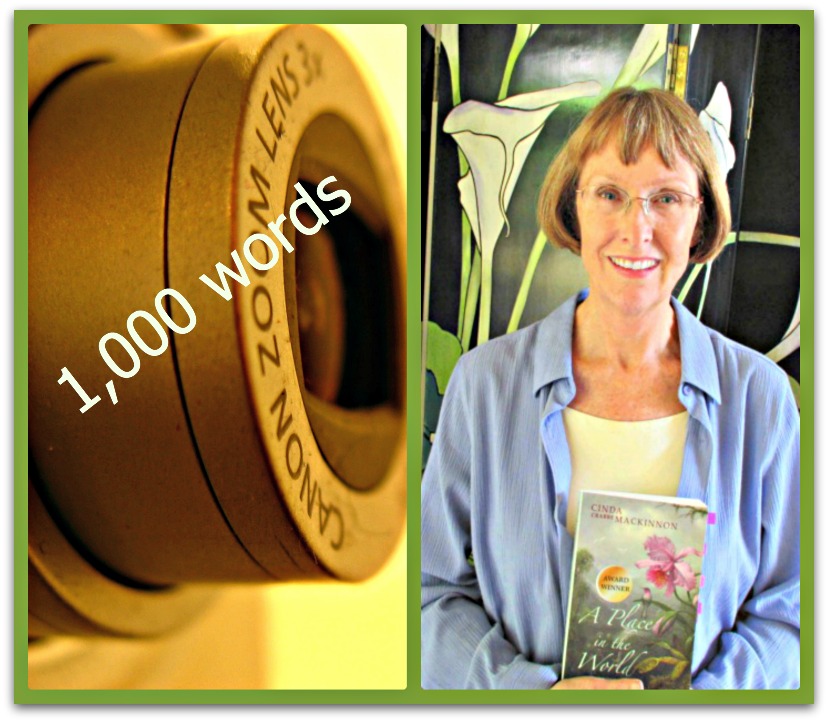
Cinda 1000 Words CollageWelcome to our monthly series “A picture says…”, created to celebrate expats and other global residents for whom photography is a creative outlet. The series host is English expat, blogger, writer, world traveler and photography enthusiast James King, who thinks of a camera as a mirror with memory. If you like what you see here, be sure to check out his blog, Jamoroki.

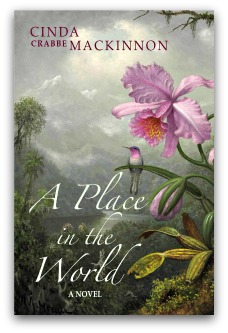
My guest this month is Cinda MacKinnon, an American who grew up overseas and is the author of an award-winning novel set in one of her former homes, Colombia. Called A Place in the World, the book was featured almost exactly a year ago on the Displaced Nation.

Cinda shoots mainly “macro” (extremely close up) pictures, a habit she developed because of her interest in nature and plants—especially wildflowers. A writer, former university lecturer, and environmental scientist, Cinda is trained in geology and has also nurtured a life-long passion for botany. It’s telling that the protagonist of her novel is a botanist!

Cinda enjoys hunting down rare plants and taking photos that show their minute details, such as the number of anthers (the part of the stamen that contains pollen), so that botanists will be able to identify them.

She now lives in northern California, where the California Native Plant Society has become a fan of her photos and sometimes asks her to supply a few of them for their newsletters and exhibits. Who knew?

* * *

Hi, Cinda. Welcome back to the Displaced Nation. I’m pleased to have the opportunity to discuss your photo-travel experiences. When I first started following your blog, I assumed you were a writer—but then was delighted to discover that you’ve also taken some excellent photos. I know you’ve already been over some of this ground in your interview with ML Awanohara, but can you tell me where you were born and when you spread your wings to start traveling on your own?
I was born on an Air Force base in Louisiana, but lived there only a week. My dad was already stationed in Greece, and my mother followed him as soon as she was able to travel. I lived in Greece and Germany as a pre-schooler and then in Colombia when my father changed his job and began working as a military attaché for U.S. embassies. Having fallen in love with Latin America, my parents retired in Costa Rica when I was in seventh grade so, happily, I was able to stay in that part of the world through high school…and beyond. After college in the United States, I moved to New Zealand with my husband (back then, they told us we had to get married to immigrate together!). We came to California when he finished his PhD. And here we’ve been ever since, although I view that move to California—I was in my thirties—as the first time I actually lived in the States. Even though my passport said I was a citizen, it has taken me a while to feel like I belong here.

You have been an expat almost since birth—what is known as a Third Culture Kid. Would you say that your wanderlust comes from your nomadic upbringing?
Once I grew up, I wanted to see more of Latin America and as a young family we could do that cheaply. Next I visited Europe to see some of the places I’d lived with my parents, but like so many others ended up falling in love with Italy and France. I think language had as much to do with it as the culture and people. Growing up speaking Spanish, it was fairly easy for me to be understood in Italian, and I found French so beautiful that I have become a perennial student. Recently, my husband and I explored Central Europe along the Danube River, from southern Germany to Budapest. That splendid trip provided fodder for at least five blog posts.

Mais oui. I have always loved the French language, too. Where exactly do you live in northern California?
We live in a semi-rural area nestled in the hills and yet are only 30 minutes from San Francisco—an unusual situation due to geography, which insures our immediate surroundings will never be developed.

“Are not flowers the stars of the earth…”—A.J. Balfour 

And now let’s have a look at a few of your shots that capture favorite memories. Can you tell us the story behind each of them, what makes them so special?
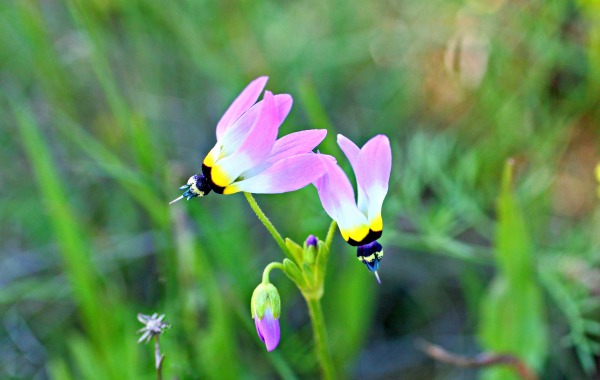
This is one of the first wildflowers I photographed and is still a great favorite of mine: a shooting star, or Dodecatheon clevelandii:

Dodecatheon clevelandii, aka shooting star. Photo credit: Cinda MacKinnonn.

Dodecatheon clevelandii, aka shooting star. Photo credit: Cinda MacKinnonn.

The next photo is of the odd-looking Tiburon Lily, Calochortus tiburonensis, which blooms only a few weeks a year and is quite rare; it evolved on serpentine soils, which gives rise to unusual plants that can tolerate this somewhat toxic chemistry. Indeed, you can find this little lily in only one place: on Ring Mountain (a single hill really), north of San Francisco:

Calochortus tiburonensis. Photo credit: Cinda MacKinnon.

Calochortus tiburonensis, found only on Ring Mountain. Photo credit: Cinda MacKinnon.


Another peculiar wildflower is C. tolmiei, nicknamed “pussy ears”. It is challenging to capture the tiny hairs and other features as it is barely 2.5 cm across—plus it tends to grow on coastal slopes where the wind wreaks havoc with your focus!
Calochortus tolmiei, aka pussy ears. Photo credit: Cinda MacKinnon.

Calochortus tolmiei, aka pussy ears. Photo credit: Cinda MacKinnon.


I’ve taken quite a few photos of wild flowers without having a clue what their names were. I’m getting a real lesson in flora here. Thank you, Cinda. I can see why they call botany the “science of beauty.”

“I perhaps owe having become a painter to flowers.”—Claude Monet

I know you have photos of scenery, too, and these next four, I believe, have a special significance for you.
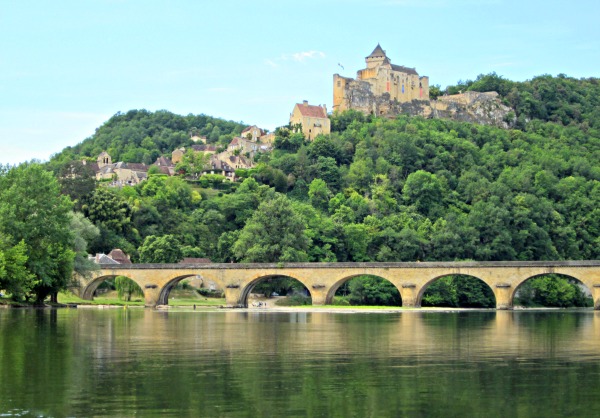
I mentioned I am a bit of a Francophile and a favorite region of mine is the Dordogne Valley. This is a place with history, from Richard the Lionheart to Joan of Arc; pre-history (the Cro-Magnon cave paintings); and beauty. I talked my husband into renting a canoe and we paddled down the Dordogne River, past castles, ancient bridges and towns. This photo with the medieval Château de Castelnaud in the background is a memento of that glorious day:

Canoeing on the Dordogne in glorious weather. Photo credit: Cinda MacKinnon.

Canoe with a view, la rivière Dordogne. Photo credit: Cinda MacKinnon.


Next, I’d like to show you a photo of a very different place, in California. Actually, I can give you a choice of two: would you rather see the California desert before a rain storm or one of Arvin, a city in southern California? Arvin is interesting because it’s set in hilly grassland that half of the year is dry and dormant but explodes into wildflowers in the spring (if the winter is wet). What’s your pleasure?

Can I have both?
Mais oui! Here’s the Sierras:

The stormy Sierras. Photo credit: Cinda MacKinnon.

The stormy Sierras. Photo credit: Cinda MacKinnon.


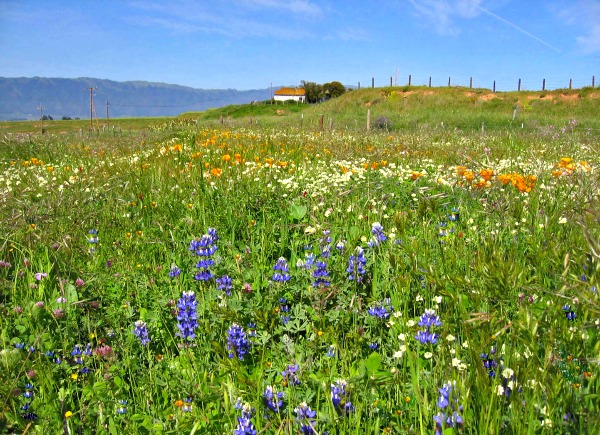
And now for Arvin in all of its glory:
A profusion of wildflowers in Arvin. Photo credit: Cinda MacKinnon.

A profusion of wildflowers in Arvin. Photo credit: Cinda MacKinnon.

Both photos are so lovely! That’s why I decided to give you this bonus. But if I really was forced to choose, the desert before the rain is so dramatic. I think you should turn it into a photo-painting using Topaz Adjust or Impression. What’s your last shot?
Another California landscape I’m fond of is Monterey County. When I was a teenager, I read all of John Steinbeck’s novels, never dreaming I would live in California much less end up working in the Salinas Valley as a hydro-geologist for several years. On arriving I felt as though I’d been there before. The town of Monterey itself has become a tourist attraction, but if you go out into the countryside there are still scenes like this one, with the adobe house on the hill:

An enchanted realm near Monterey, California. Photo credit: Cinda MacKinnon.

An enchanted realm near Monterey, California. Photo credit: Cinda MacKinnon.


Please God, don’t let them turn it into another orchard or development!

Here here! I noticed you haven’t included any photos of people. Do you feel reserved about taking photos of strangers?
Yes , and I don’t like portraits to look overly posed. So first I try to take photos surreptitiously. If that’s not possible, I try to be respectful by asking if it’s okay– preferably in their own language. No matter where I travel, I learn some basic phrases in the language of the country (Hungarian was the hardest so far!), but I’ve found that “okay?” seems to be a universal word.

You are right: “okay” seems to have been adopted by most of the planet, though it’s origins are unclear. One theory is that it was derived from a shorthand way foreign-born Americans in the 1830s developed for writing “all correct”—only they’d spelled it “korrect”!

“I will touch a hundred flowers/And not pick one.”–Edna St. Vincent Millay

What motivates you to record what you see through photographs? Is it the ability to capture something unique, which will never be seen again?
Hmmm… I barely think of myself as a photographer; it is one of several hobbies! But certainly, what you say is true of fleeting blooms, and photos do help to preserve memories of wonderful places, whose beauty could vanish. But I think what really led me to photography was my interest in plant nomenclature. I like to block out weeks of time every year to hike in hills, valleys and deserts and search for rare blooms. It is a bit of a treasure hunt, and my photos of evidence of the riches I uncover.

Your modesty is charming, but I think you definitely have an artist’s eye and many of your photographs could be transformed into beautiful pictures with a little more post processing. Which leads me to the technical stuff. Some of our readers may want to know what kind of camera and lenses you use, and how you handle post-processing.
I use a Canon Digital Rebel XT SLR with a macro lens when I am looking for wildflowers in the spring. But for traveling I’ve started to just put my trusty Canon PowerShot in my pocket. I usually use Photoshop for post-processing, but as you’ve pointed out, I’m not adept at all the advanced features. I use “auto” first, and that is generally all I need, except I often crop a shot and, if needed, adjust the lightning or clean up stray blemishes.

Finally, do you have any advice for wannabe photographers who are traveling or living abroad?
It is not the equipment—it is in the eye. Some of my better pictures were taken with a point and shoot. I asked a professional photographer friend if he thought I should buy some filters or another lens, and he said his best shots are sometimes with his cell phone! I guess the motto is “be prepared” for something that catches your eye—be ready for the special moment when the light is right. Make sure your subject doesn’t appear to have an antenna sprouting out of his head at that moment. Don’t use the “sharpen” feature for portraits as it accentuates flaws (unless you want that for character) and can give a severe look. And don’t make your friends look at 200 mediocre photos of your vacation—please cull out the unappealing or out-of-focus ones! (My rule of thumb for talks is 1 to 1.5 slides per minute—that’s 60 to 90 per hour—nobody wants to see more than that.)

Very succinct and good advice, Cinda—right up my street. I’d like to thank you for taking the time to tell your fascinating story in this interview.

* * *

front-cover-place-in-worldReaders, what do you make of Cinda’s close-up photos of exotic plants and her photography advice? I find it curious that she writes about people looking for their place in the world, yet is obsessed with the kinds of flowers that bloom where they are planted. As Georgia O’Keefe once put it:

“When you take a flower in your hand and really look at it, it’s your world for the moment.”

Please leave any questions or comments for Cinda in the comments!

Meanwhile, I suggest that you check out Cinda’s Pinterest boards for more of her botany photos. You can also get to know her better by visiting her author site and blog, and liking her Facebook page. And don’t forget to read her book if you haven’t done so yet, many glowing reviews for which can be found here.

(If you are a photographer and would like to be interviewed by James for this series, please send your information to ml@thedisplacednation.com.)

STAY TUNED for next week’s fab posts!

If you enjoyed this post, we invite you to register for The Displaced Dispatch, a round up of weekly posts from The Displaced Nation, with Alice nominees, exclusive book giveaways and other extras. Register for The Displaced Dispatch by clicking here!

Related posts:

BOOKLUST, WANDERLUST: Lawrence Osborne’s haunting tale of expats and travel in the Moroccan desert

Booklust Wanderlust Collage

Left: Oleh Slobodeniuk (CC BY-NC-SA 4.0); right: Beth Green (her own photo).

Attention displaced bookworms! Our book review columnist, Beth Green, is back. An American who lives in Prague, Beth mixes booklust with wanderlust in equal measures, which gives her just the right background for reviewing recent book releases on behalf of international creatives.

—ML Awanohara

Thanks, M.L.! And, hello again, Displaced Nationers. With the arrival of fall in the Northern hemisphere, I find myself in the mood to dig into some darker, heavier—more Halloweeny, shall we say?—material.

As a long-term traveler, third-culture kid, current expat, or all of the above in some cases, each of us has at some point or another faced a cultural divide we’ve found it difficult, if not impossible, to cross. Maybe it came down to a clash of religious or political beliefs. Or was it something to do with wealth? There are privileges that come with being an expat—and that, ironically, can cause discomfort.

But perhaps one of the most harrowing breaches of trust occurs when people possess differing concepts of justice.
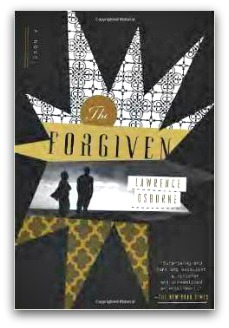
TheForgiven_colorcoverLawrence Osborne’s novel, The Forgiven, wraps all three of these tough-to-tackle subjects into a compelling tale centered around one darkly beautiful “what if”:

What if you accidentally committed a crime in another country?

Every traveler’s worst nightmare

Osborne’s protagonists, David and Jo Henniger, are a wealthy middle-aged London couple who have grown frustrated with each other and jaded about life in general. David is a society doctor in Chelsea who has just lost a malpractice suit and is also beginning to lose patients. Jo is a children’s book writer who hasn’t written a book in some time.

To get a change of scene, and perhaps a new lease on life, the couple sets off to attend a lavish party being thrown by one of David’s school friends, Richard, and his partner, Dally, at their ritzy retreat in the Moroccan desert. It’s a wild weekend-long affair tony enough to have photographers from the New York society pages chronicling it.

Now, that doesn’t sound like my travel scene, but Osborne makes it clear that what happens to Henningers could happen to any of us who dare to venture into unknown lands, where the inhabitants have different religious beliefs to ours, are poorer, and possess an unfamiliar sense of justice.

Jo to David: “I shouldn’t let you, Stumblebum.”

Overriding Jo’s objections, David decides to do the drive from Tangier through the desert in the night even though he has just consumed a bottle of wine.

Jo sulks but lets him drive.

Long after dark, while the Hennigers are trying to navigate the unfamiliar desert terrain, two Moroccan boys leap into the road ostensibly selling fossils though possibly intending to highjack the vehicle. David runs in to one of the young men, killing him. The other boy runs away.

Osborne sets up an unforgettable scene as David and Jo make their entrance to an extravagant expat party with a dead body on the back seat of their car. Not knowing what to do or how the Moroccan police will respond, the Hennigers have taken the corpse with them.

For the hosts, the situation is an embarrassment and a source of annoyance. For their Western guests, it’s a rude interruption and a source of gossip. For Moroccans like Hamid, the head servant of Richard and Dally’s estate, it’s a tragedy that brings out his deep loathing of Western values. For the family of the boy, who arrive the following day to collect the body, it’s both tragedy and crime.

But for David and Jo, it will prove life changing.

Jo to Day (another guest): “It’s like going through the Looking Glass.”

This story, rather than showing how travel erases our differences, puts the notion of “otherness” into high relief. The couple who host the party and many of their friends see Moroccans as as objects of curiosity, wisdom, servitude, and lust. David, less cosmopolitan than his hosts, falls back on traditional colonial values, regarding Morocco and Moroccans as inscrutable and inferior.

By the same token, the Moroccans in the story can’t fathom the Westerners’ lifestyles or motives. They are “unimaginable human beings,” infidels—people who don’t eat with their fingers, who don’t believe in God.

Driss, the young man who is struck and killed by David, wants desperately to break away from the life his father had. He comes from a Berber family that lives in a remote outpost of the Sahara, where children must slave away hacking out Trilobites all day long, with the hope of selling them to Western millionaires.

Driss’s father, Abdellah, more than anything else wants to avenge “the fact that he simply had never known his son at all.”

When Abdellah and his brothers arrive to pick the body up for burial, they demand to meet David. They ask that he travel with them to make atonement. Richard and Dally, keen to get on with the party, assure him that it will be for the best.

Jo to herself: “Who knew what here was artificial and what was indigenous?”

The Forgiven is a tribute to Osborne’s roots as a world-class travel writer and chronicler of the expat life. He takes us behind the scenes and into the inner lives of Moroccans as well as of the expats who choose to live in that part of the world.

Take, for instance, Osborne’s account of Moroccan versus British pessimism:

“The men of the desert know everything,” Hamid said once, like a quote out of Lawrence of Arabia. But they didn’t, really. They were just efficient pessimists, and therefore astute readers of human nature. They always assumed the worst, and that made them correct nine times out of ten. Their pessimism, however, was not like David’s. David was someone who believed that the past was superior to the present, and that was a different sort of pessimist. It was not the entire past that was superior, of course; it was mostly just the British nineteenth to the mid-twentieth century.

Or this passage about how the Moroccan villagers tend to regard Richard and Dally and their wild parties:

It was admitted that they were wealthy and that they spent their money in an exceedingly unwise and profligate way, and that this was much to the advantage of the people.

Jo to Richard: “I dare say I won’t be the same again…”

The story maintains momentum by swinging between Western and Moroccan cultures, leaving the reader almost breathless, not always sure of their footing.

As readers, we guess but aren’t sure if the lumpish David, who is clearly an alcoholic, is still drunk on his midnight drive. Did he mean to hit the young man? And, the victim of the accident—can we say he’s a victim? Flashbacks to the youth’s bravado-filled conversations with a younger, impressionable friend paint him as an unstable character, full of hatred, with a shady past…

Jo, David’s long-suffering wife, is also an enigma. An aging beauty, she feels isolated from the young, frivolous women at the party. Does she love David, or want to leave him? Does she care if justice is exacted? Or does she care only that she be, as the title suggests, forgiven?

* * *

Not wishing to give away any more of the plot, I’ll end by reiterating: Displaced Nationers, in your own experience, which topics tend to open up the widest cultural divides?

Let me also leave you with the epigraph from the novel:

“Many roads do not lead to the heart.” —Moroccan Proverb

Until next time—oh and please drive safely!

* * *

Thanks, Beth! I’ve read The Forgiven and am still haunted by it. Lawrence Osborne is a contemporary writer with a deep understanding of what it means to feel “displaced” by one’s travels. Reading the book gave me thrills and chills, not just for the story but for the beauty and precision of his prose. Readers, does this sound like a book for you?

Beth Green is an American writer and English teacher living in Prague, Czech Republic. She grew up on a sailboat and, though now a landlubber, continues to lead a peripatetic life, having lived in Asia as well as Europe. Her personal Web site is Beth Green Writes, and she is about to launch a new site called Everyday Travel Stories. To keep in touch with her in between columns, try following her on Facebook and Twitter. She’s a social media nut!

STAY TUNED for next week’s fab posts!

If you enjoyed this post, we invite you to register for The Displaced Dispatch, a round up of weekly posts from The Displaced Nation, with Alice nominations, exclusive book giveaways and other extras. Register for The Displaced Dispatch by clicking here!

Related posts:

DIARY OF AN EXPAT WRITER: Testing one, two, three…Can anybody hear me?

DiaryExpatWriterToday we welcome a brand new columnist, the up-and-coming author Shannon Young. This past summer, Shannon announced she’d cut 18 inches off her hair, quit her day job to become a full-time writer, and given herself a pen name for her new series of adventure novels. And, yes, she is an expat, a kind of love refugee, living in Hong Kong. She has generously agreed to chronicle her writing adventure for us.

—ML Awanohara

Dear Displaced Diary,

In this column, I’ll be recording my experiences as a full-time expatriate writer. Officially, this is only a test.

Let’s start with a bit of background: I have been an expat, an American in Hong Kong, for four years and one month. For the past four years, I taught English in a local primary school while harboring a desire to work in book publishing.

Originally, I wanted to be an editor, to find talented writers and help them get their work into the world. I didn’t think I had stories of my own. Then, I moved to Hong Kong. In my new expatriate life, I found stories: personal dramas, bewildering worlds, opportunities for stimulating observations, and even ideas for fiction.

So, I started writing…

I discovered I love the process: mulling over half-formed ideas, stealing character descriptions from people I saw on the street, scribbling outlines on everything, and sitting down in coffee shops for hours at a time to actually do the work.

Four years later, I’ve completed a number of projects composed of bytes and bits of code, of pages and ink, of words and stories. Each project has taught me to look closer at the world around me. Each project has challenged me to be more diligent and to look for opportunities to write something that will matter.

One of those projects, a Kindle single called Pay Off, discusses how my teaching job in Hong Kong enabled me to pay off my large student loans from a US university. I’ve been debt free since December 2013 so have been able look seriously at other occupations.

I want to keep writing…

My teaching contract ended in July 2014. By that time I had accrued some savings, some complete or nearly complete books, and a husband with permanent residency. Instead of continuing to teach, I realized that now was the time to try to make it as a writer.

This is only a test. If I am not bringing in enough money from my writing (or worse, not enjoying the work) around Chinese New Year, I will start looking for a new job.

For now, I’m jumping in with both feet, seeing if this dream is feasible.

Like becoming an expat all over again…

Quitting a day job to write full-time is a lot like moving to a new country. You might know a bit about what to expect and what to pack. You do your homework; you find stories of people who’ve done it successfully, who love their new lives. You also find stories of people who’ve failed, who didn’t gel with the new place for any number of reasons. Most expats fall somewhere in between, learning to live with the difficulties while also enjoying many good moments.

Some people say it isn’t possible to make a living as a writer. They cite the successes and insist such people are outliers: exceptionally good or exceptionally lucky. As with moving to a new country, I suspect the truth lies somewhere in between. All I can do is take the leap and see if I can make it work.

But, just as I wouldn’t move to a new country without a suitcase, I am not starting this writing journey with a blank Word document and “Once upon a time…”

I have a strategy!

Here’s what I’m “packing” for my full-time writing life:

1) A portfolio of published works—comprising not just the student debt Kindle single but also the anthology How Does One Dress to Buy Dragonfruit: True Stories of Expat Women in Asia, which I edited for a small Hong Kong publisher. It came out earlier this year.* Neither of these works is a huge moneymaker, but sales can add up slowly. More importantly, these two publications have given me valuable publishing experience.

2) A book deal. My memoir of my first year in Hong Kong, Year of Fire Dragons, is being published by Blacksmith Books, an independent Hong Kong publisher, at the end of October. Hong Kong is a small market and even healthy sales won’t pay my rent, but at least I have a book to launch and a tangible opportunity to build my career.

3) A genre series in the works. This is the essential part of my strategy, the heavy winter coat, if you will, that I’m packing as you never quite know, once you become an expat, where you might end up. (I’m in Hong Kong now, but as I never could have predicted that, shouldn’t I be prepared for the day when I move to, say, Finland?) Since late 2012 I have had the wild pleasure of working on a series of post-apocalyptic adventure novels set at sea called The Seabound Chronicles (under the pen name Jordan Rivet). I’ve planned for a four-book series and written drafts of three of the titles. Book One, Seabound, is currently with the copy editor and should be ready to launch in November. I plan to self-publish this series as e-books and POD paperbacks and, frankly, hope to make some money.

4) Last but not least, reasonable expectations. While I am hopeful that the combination of my publishing experience so far, my existing works, and a highly commercial series will enable me to continue doing what I love, I am also realistic. I don’t expect to get rich. The goal here is to build up an audience—and a long tail of sales—that will eventually enable me to pay my rent and buy the occasional plane ticket home to see my family. But my primary expectation is that I will work hard, produce the best books I can, and try to learn as I go.

“If you want a pearl, you must dive for it.”—Chinese proverb

I realize I’m taking a risk by forgoing a steady income and living on savings in order to give myself more time to write. But taking risks is second nature to expats. We leave behind everything we know, and there are never any guarantees about how things will turn out.

My own jump into expat life occurred when I followed the man I loved to his home country. At the time, I didn’t even know if we would get along when we finally lived in the same country. At first, it looked like everything would fall to pieces because a month after I arrived in Hong Kong my boyfriend’s company sent him to London. I had a year on my own in Asia, fearing that my risk had been in vain.

That story has a happy ending: that boyfriend is now my husband—and I love Hong Kong. It was a risk that paid off, but it could have gone very wrong. Now, I hope the risk I’m taking will turn out at least half as well.

And can I tell you a secret, diary? Since I stopped working and started focusing on writing full time, I’ve been deliriously happy. I love having hours to myself each day to sit down and work on my own creative projects. I love reading about the publishing industry and studying other people’s books and careers. I’m trying hard not to become an obnoxious friend who only talks about their own work because it’s all I think about these days.

Yes, I know this honeymoon period won’t last forever, but at least allow me to say: it’s been wonderful so far!

And yes, I sometimes struggle with prioritizing, but that’s because there are so many things I want to do! But I’m gradually getting used to my new routines and performing triage on my to-do lists. I’m developing the daily habits of a writer. I want to use this period well.

Each month, I’ll share a bit more with you about where this journey is taking me. I hope you’ll come along for the ride.

Thanks for reading!

Yours,

Shannon Young
www.shannonyoungwriter.com

*From now until the end of the year, Shannon will be sharing excerpts from Dragon Fruit. Stay tuned!

* * *

Readers, it’s your turn. What is a risk you’ve taken in order to follow a dream? Was it becoming an expat or something even more daring, like becoming a full-time writer? What are some difficulties you faced along the way? Let me know in the comments!

STAY TUNED for next week’s fab posts!

If you enjoyed this post, we invite you to register for The Displaced Dispatch, a round up of weekly posts from The Displaced Nation, with snippets of worldly wisdom, exclusive book giveaways and our nominees for the monthly Alice Awards. Register for The Displaced Dispatch by clicking here!

Related posts:

TCK TALENT: Even without slide projector, projection of life as a Third Culture Kid engages Reykjavík audiences

TCK in Iceland Collage

Elizabeth Liang in front of Tjarnarbíó, in downtown Reykjavík, where she performed her one-woman autobiographical show, Citizen Alien, on growing up as a TCK of mixed heritage. Photo courtesy Elizabeth Liang.

This month Elizabeth (Lisa) Liang updates us on her own creative life, which this past summer veered in the direction of an island situated at the confluence of the North Atlantic and Arctic Oceans!

Halló, vinir mínir! Hello, my friends! I’m addressing you in Icelandic because in this month’s column I’ll be re-creating my journey to Reykjavík, where I traveled in August to perform ALIEN CITIZEN: An Earth Odyssey, my one-woman show about growing up as a Third Culture Kid, or TCK, of mixed heritage.

How did I end up performing my show in Iceland? I have a friend in that part of the world who put me in touch with the artistic director of Tjarnarbíó, a creative center for professional live art in Reykjavík, who enthusiastically offered to host the show if I could cover my travel and lodging. Presented with a chance to combine three of my favorite activities—acting, writing and travel—how could I resist?

Engum flýgur sofanda steikt gæs i munn (“One cannot expect to benefit without making some effort”)—Icelandic proverb

My husband, Dan, agreed to work as my stage manager, which was perfect because he knows the show so well. I launched a successful Kickstarter campaign to raise the requisite funds for our trip, found a cozy house in Reykjavík on AirBnB for us to rent, bought our flights, started promoting the show on social media—and then off we went to the Land of Fire and Ice.

We arrived in ideal weather, cool and dry, which many Icelanders told us was lucky because it had been raining all summer. We were relieved to find that our lodgings were in a quiet, pleasant residential area that was a seven-minute walk to downtown and a 15-minute walk to Tjarnarbíó.

Tjarnarbíó is a beautiful venue with state-of-the-art technology. At the technical rehearsal, the two “techies” who adjusted the lights and projector were friendly and professional. (Incidentally, we never met anyone in Iceland who was unfriendly, and the Icelanders we encountered all spoke perfect English, some with gorgeous British accents.)

That said, we had an unexpected snafu at the tech rehearsal. There are two kinds of projections in the show:

  1. Pictures and videos that are projected onto a screen via my laptop, and
  2. Words that I project onto my torso using an old-fashioned slide projector.

During the tech rehearsal, the slide projector I’d used in the show for over a year konked out. The stage hand and I stared at the plume of smoke rising from the top and said: “It’s smoking.”

No, the problem was not the power converter. We had the right one. Nor was it the bulb. We replaced it but the projector still didn’t revive. So my Icelandic friend’s father-in-law generously loaned us his. More on this later…

Citizen Alien Photo Strip

(top to bottom) At the tech rehearsal, the lights were lowered from the ceiling–fancy!; opening night; closing night; post-show celebratory drink; with Dan in front of Hallgrímskirkja Church; with Dan in Þingvellir National Park. All photos courtesy Elizabeth Liang.

August 20, 2014: Opening Night

We had an audience! I only knew of five people who were planning to attend (of whom I’d actually met only one—my Icelandic friend). What a pleasant surprise to see twenty or so people in the house!

And they laughed! I guess the show’s humor translates.

Dan stage managed wonderfully and the light board operator did a great job, too. The only hitch was that when it came time to project slides onto my torso, the borrowed projector didn’t work, even though we’d tested it earlier. I improvised and the audience went right along with this. (Afterward, a very kind audience member offered to loan us his projector, but when we met later, he realized it had a part missing. So Iceland never got to see words projected onto my torso. Ah, well.)

The best part of opening night was the fact that I enjoyed myself on stage, which hadn’t happened in a while. There were two curtain calls and people stayed afterward to shake my hand, thank me, and say lovely things. It was such a pleasure. About half were Icelandic and the other half internationals—once again, the right people had found me and my show. Several said they would spread the word for the next performance.

A few people from Spain, France, the Czech Republic, and Iceland hung out with us at Tjarnarbíó’s cafe afterwards. They all mentioned different parts of the show that resonated for them, and one said she felt that the show does a service for nomadic and non-nomadic people—it’s like a bridge between them. They thought it should be filmed, which I’m planning to do in December.

All hail my director, Sofie Calderon, for making this show such a dynamic experience for the audience! People from far and wide have enjoyed the production, and that’s Sofie’s doing. If it had been up to me, I would have found ways to hide onstage, because performing a solo show is super scary.

August 22, 2014: Closing Night

More people in the audience, which was very moving, because I knew none of them. The word of mouth from opening night must have been good. And maybe all those promos I sent to the international school and Facebook groups helped…?

The performance didn’t feel as good—I was having less fun and getting fewer laughs—but I forged ahead. Afterward Dan and the light board operator said “No way, it was TIGHT, really good show!” Yet more proof that we actors have no idea how well we’re doing. We only know if the audience is responsive or quiet.

Just like on opening night, a bunch of people waited to speak to me afterward. One was a young adult TCK who was very moved by the show. Another was a professor at the University of Rekjavík whose field of study is TCKs. Their compliments, along with all the words of support from other audience members, was tremendously encouraging.

Because the truth is: before embarking on this Northern European adventure, I had no idea how audiences would react, or if there would be any audiences at all. I had girded myself to perform for a handful of kindly people on opening night and then possibly cancel closing night because who knew if there would be enough interest?

Reykjavík may be a small capital, but as it turns out, it has plenty of residents who are international or international in outlook, and open to trying new things.

Kleina & coffee, Björks in boots, Lutherans & lava…

Beyond the show, Dan and I had a glorious time exploring small but pretty Reykjavík; the Blue Lagoon, a thermal spa located in a lava field in Grindavík; and the Golden Circle, a route the loops from Reykjavík to central Iceland and back. Other highlights included:

  • snacking on kleina, a donut-like pastry in the shape of a trapezoid;
  • visiting Hallgrímskirkja, the Lutheran cathedral designed to resemble the lava flows of Iceland’s landscape, and Settlement House;
  • hanging out at the Boston, said to be one of the world’s best bars, and at several coffee houses; and
  • last but not least, watching singers and dancers all over town on Culture Day/Night, a day and night-long program of cultural events that takes place in August every year and is one of the country’s largest festivals.

I also got a kick out of Icelandic fashion—bright colors, unusual cuts—and, as I love boots, was pleased to see practically every woman sporting boots of some kind: ankle, knee-high, sexy, hiking, and everything in between. (Did I buy a pair? Nope. Iceland is expensive.)

On our last night, we stepped out onto our little street to see fireworks, which felt like a final burst of congratulations. I got teary-eyed!

Overall, it was a delightful trip. Dan and I left thinking we’d like to go back someday. We want to see more of the island (puffins! volcanoes!), enjoy the friendly vibe…and hopefully bring another solo show for Icelanders’ entertainment—but without any cantankerous 1980s equipment.

* * *

Thank you, Lisa! Having only been to the Blue Lagoon as a round trip from Keflavík International Airport, I really appreciated this vicarious journey into the heart of the city’s cultural scene. And, as always, I’m impressed that you were contributing to the culture as well as taking something from it! Readers, please leave questions or comments for Lisa below.

STAY TUNED for next week’s fab posts!

If you enjoyed this post, we invite you to register for The Displaced Dispatch, a round up of weekly posts from The Displaced Nation, with news, book giveaways and other extras. Register for The Displaced Dispatch by clicking here!

Related posts: