The Displaced Nation

A home for international creatives

Tag Archives: Writers we love

JACK THE HACK: Advice to all you expat writers: Publish and be damned!

JACK THE HACK _writingtipsJack Scott is back with his monthly column for all of you wannabe authors who are hacking away at travelogues-cum-memoirs (or cum-novels?). For those who don’t know, he was a Random Nomad for the Displaced Nation way back when we started this site. After an expat experience that was literally something to write home about, he and his partner, Liam, have traded in the dream for a less pressured existence back home in the UK.

—ML Awanohara

After months of burning the midnight oil, neglecting the sprogs and denying your long-suffering partner their conjugal rights, your memoir masterpiece is finally done and dusted. Whether you’re pleased with the result of your hard graft or just relieved, pop a cork. It’s quite an achievement.

So what’s next? Well, obviously you want to launch your labour of love onto an unprepared world—but how?

Essentially, you have four choices:

1) The big boys—the Holy Grail

Who wouldn’t bite the hand off a corporate suit offering a fat advance cheque, certainly not me. It sounds tantalising. Let the big boys do all the work—edit, design, promote and distribute—while you sit back and watch the royalties land on the mat. And you get to feel like a ‘proper’ author. Easy.

Except, it isn’t.  I know of no traditional publishing house that accepts unsolicited manuscripts, so don’t waste your time and money.

Mainstream publishers have cosy relationships with literary agents who filter out the dross so they don’t have to.

So, your first task is to bag yourself an agent who’s willing to take a punt on you (and a cut from you).

That’s not easy either. Agents receive thousands of manuscripts every year and few make it past the receptionist’s in-tray.

Keep the Faith. There are things you can do to avoid getting your memoir filed in the bulging bin:

  • Carefully read what an agent is looking for. Select only those who fancy a trip down memory lane. If you send your book to anyone else, you’re toast.
  • Follow the submission guidelines to the letter. If they want it double spaced in Times Roman 12, a full book proposal and a copy of your grandma’s marriage certificate then do exactly what it says on the tin.
  • Develop the patience of a saint, do not expect a quick response (if any) and don’t hassle.

2) Half-way houses—stepping into the breach

As we all know, the traditional bricks and mortar bookshop is under seize from the growth of on-line retailers (particularly Amazon), print-on-demand services and electronic books and they are transforming the market. A number of smaller publishers have sprung up to take advantage of this brave new world. For an upfront fee (often with set menu and a la carte offers), these smaller outfits will work with you to prepare your book to a professional standard (both print and e-versions) and get it onto the virtual shelves.

In return for a higher royalty rate, you will be expected to do most of your own promotion.

The advantage of print-on-demand publishing is that you can keep a stock of books in your bedroom for direct sales (to local bookshops, through your Web site and by emotionally blackmailing your nearest and dearest). The disadvantage is that most major book chains won’t give them shelf room.

3) Vanity publishing—the blind leading the desperate

We’ve all seen the “Authors Wanted” ads popping up on Google placed by companies who trade on a writer’s desire to see their name in print. For the right price, they’ll print almost anything. I’m not saying they are necessarily unscrupulous or misleading, but the quality of the written word isn’t their bag. Unfortunately, the line between the vanity publisher and the half-way housemate is becoming increasingly blurred. For me, the main distinction is selection and control. Be careful.

4) Self-publishing—the DIY approach

If your story is fit for publication (that is to say edited, proofed and formatted with a snazzy cover), why not self-publish as an e-book? It’s easier than you might think. Open an Amazon Kindle account, upload your file and let them do the conversion and listing.

And there’s always Smashwords, which will convert and distribute your e-book to all the main online retailers (including Amazon). Formatting an e-book for Smashwords is a bit fiddly but they do publish a handy style guide to lead you by the hand.

The advantage of self-publishing is that you get to keep full control over your work, including the price, and you’re paid direct without a publisher’s cut.

If you really want to see your precious words in print (and there’s nothing like the smell of a brand new book), get a printer to set the presses running. Many offer their services online and deliver to your door so you don’t even have to leave home.

Amazon also provides a print-on-demand service called CreateSpace. This way, people can order a print copy direct from them and, if you get the look and feel right, no one need ever know you did it yourself.

Postscript: Bedtime reading

Especially for expats with UK connections: The Writers and Artists Association has a comprehensive list of UK and overseas agents and their requirements. You’ll have to register first but it’s free. Their site also contains a well of advice about all aspects of the publishing business.

Which leads me to …

WRITING TIP FOR EXPATS NO 3:

Publish and be damned!

With all of the options out there, what are you waiting for?

* * *

Readers, any comments, further questions for Jack the Hack? He’ll be back next month with some more writing tips…

Jack Scott’s debut book, Perking the Pansies—Jack and Liam move to Turkey, is a bitter-sweet tragi-comedy that recalls the first year of a British gay couple in a Muslim country. For more information on this and Jack’s other titles, go to his author site.

STAY TUNED for tomorrow’s post, another in our NEW vs OLDE WORLDS series.

If you enjoyed this post, we invite you to register for The Displaced Dispatch, a round up of weekly posts from The Displaced Nation, with seasonal recipes, book giveaways and other extras. Register for The Displaced Dispatch by clicking here!

Related posts:

Images: from top, clockwise: Hand with pen / MorgueFile.com; Boats in King’s Lynn, Norfolk / MorgueFile.com; Jack Scott, used with his permission; Turkish boats / MorgueFile.com

And the May 2013 Alices go to … these 4 international creatives

 © Iamezan | Dreamstime.com Used under license

© Iamezan | Dreamstime.com
Used under license

As subscribers to our weekly newsletter will hopefully have noticed by now, each week our Displaced Dispatch presents an “Alice Award” to a writer who we think has a special handle on the curious and unreal aspects of the displaced life of global residency and travel. Not only that, but this person has used their befuddlement as a spur to creativity. He or she qualifies as an “international creative.”

Today’s post honors May’s four Alice recipients, beginning with the most recent and this time including citations.

So, without further ado: The May 2013 Alices go to (drumroll…):

1) ADAM GROFFMAN, travel blogger and expat

Source: “How a children’s book inspired my wanderlust” in Travels of Adam
Posted on: 13 April 2013
Snippet:

You see, what I loved about this book as a kid is the focus on architecture and food in this utopian society. Each family is responsible for bringing a country’s culture to the island nation.

Citation: Many of us at the Displaced Nation attribute our abilities to tolerate and even embrace life abroad (the strange foods and drinks, the loneliness, the largely incomprehensible rules) from having taken to heart Alice’s Adventures in Wonderland and its sequel, Through the Looking Glass, as kids. A good dose of literary nonsense has taken us a long way, and even to this day, we appreciate having recourse to Lewis Carroll’s great works to make sense of our rather curious lifestyles in countries other than those in which we were born.

Adam, we understand that you quit your job in Boston to travel the world and that you trace your own wanderlust to the 1947 American children’s book The Twenty-One Balloons, by William Pène du Bois, a story that in some ways is even more fanciful than Alice’s.

For those who don’t know it: The book begins when a schoolteacher, Professor William Waterman Sherman, becomes bored with his life and sets off on a journey in a hot air balloon called The Globe. He hopes the wind will blow him and his balloon all around the world. But instead he has a crash landing on the mysterious island of Krakatoa (Indonesia), where he discovers a utopian society started up by a group of wealthy families. Each family owns a restaurant of different types of foreign foods and all members of the island eat together at a different house, full of fantastic inventions, every night. Krakatoa being a volcanic island, the families are aware of the danger that the volcano could erupt at any moment (in fact its volcanoes erupted in 1883). Their escape plan consists of a platform made of balloons…

Adam, we love the idea of emulating a fictional character who favors balloon travel—the kind that begins without regard to speed and without a destination in mind. It’s also romantic to think that you expect to find, at best, utopianism, at worst, good food, in the course of your world wanderings. Perhaps it accounts for why you’ve landed your own “balloon” in Berlin, Germany’s creative capital and a city renowned for its architecture (only, how is the food there?).

2) TRACY SLATER, expat writer, author and blogger

Source: “What Does Home Mean When You Live Abroad?” in The Good Shufu
Posted on: 8 May 2013
Snippet:

I know how easy it is, when we live overseas, to lose our gimlet eye about home: to romanticize it, to see it as a kind of lost Eden, a place where we wouldn’t suffer the same disappointments or lonelinesses or defeats that we suffer in our expat lives.

Citation: Tracy, we would add to that something we learned from Alice, which is that part of the reason for cherishing the memory of home so much is that you can’t easily share what you love about it with the people you encounter in your new place. Alice experiences this when trying to talk about her beloved cat, Dinah, with the Wonderland creatures:

“I wish I hadn’t mentioned Dinah!” she said to herself in a melancholy tone. “Nobody seems to like her, down here, and I’m sure she’s the best cat in the world! Oh, my dear Dinah! I wonder if I shall ever see you any more!” And here poor Alice began to cry again, for she felt very lonely and low-spirited.

We also find inspiring your quote from the Egyptian writer and thinker André Aciman, that all exiles impulsively look for their homeland abroad. Even poor Alice suffered from that affliction—recall her trying to make herself at home at the Mad Hatter’s tea party, only to discover it is a less than civil gathering to what she is used to. First she is told there is no room for her at the table; then when she sits anyway, that her hair needs cutting. She is offered wine even though there isn’t any, and told to take more tea even though she hasn’t had any.

In fact, some of us can relate quite directly to this need to feel at home via a good cup of tea. TDN writer Kate Allison, for instance, has lived in the United States for many years but to this day fails to understand why Americans give her a cup of lukewarm water and a tea bag when she orders tea. And ML Awanohara, who lived in England before becoming an expat in Japan, often longed for English tea while sitting through the Japanese tea ceremony.

Tracy, we very much look forward to your forthcoming book, The Good Shufu: A Wife in Search of a Life Between East and West (Putnam, 2015), to help us make sense of such classic expat predicaments.

3) DANIELLA ZALCMAN, photojournalist

Source: “London + New York: A double exposure project”—an interview with Daniella by Austin Yoder on Matador Network
Posted on: 22 April, 2013
Snippet:

When [Daniella] moved from New York to London, she decided to create a series of double exposures to marry the spirit of both cities based on a combination of negative space, color, and contrast. Daniella’s double exposures create beautiful imaginary landscapes, and are captured entirely with her iPhone 4s.

“When I got to London, I knew that I wanted to capture not just the sensation of leaving NYC, but also of exploring a new city and making that environment feel like home.”

Citation: Daniella, we are enchanted by your idea of creating a composite of your beloved home city (New York) with your adopted city (London) to come up with an imaginary landscape. Indeed, we think it must be akin to the process Lewis Carroll used when creating Alice’s Wonderland—blending the bucolic English countryside surrounding Alice (she is sitting on the river bank considering making a daisy chain when the White Rabbit first appears) with the curious world that exists at the bottom of the rabbit hole, the familiar with the unfamiliar. When Alice awakens and reports her dream to her sister, the sister “half-believes” herself to be in Wonderland—if only she can suspend her disbelief for long enough to the sheep-bells tinkling in the distance as rattling teacups, the voice of the shepherd boy as the Queen’s shrill cries, and the lowing of the cattle in the distance as the Mock Turtle’s heavy sobs…

4) “SARAH SOMEWHERE”, world traveler and blogger

Source:On Freedom” in Sarah Somewhere blog
Posted on: 29 April 2013
Snippet:

I am not, by nature, a free spirit. I’m a worrier, a control freak and a chronic people pleaser. Letting go and trusting in the universe’s plan for me is not my default setting, nor is being content with what I have rather than continually striving for more. I still need some practice.

Citation: Sarah, your struggle with living life in the moment in Mexico puts us in mind of Alice, who, is constantly worrying about the impression she is leaving on the Wonderland residents, and finds it a challenge to enjoy the moment in a place as curious as Wonderland. We wish you luck in finding that sweet spot between total personal freedom and societal obligations. And, taking our cue from Alice’s sister, we envision a day when you’ll be telling stories about your adventures in Southeast Asia, China, Mexico and India to a group of children and inspiring them to follow their unique destinies:

she pictured to herself how this same little sister of hers would, in the after-time, be herself a grown woman; and how she would keep, through all her riper years, the simple and loving heart of her childhood: and how she would gather about her other little children, and make their eyes bright and eager with many a strange tale, perhaps even with the dream of Wonderland of long ago: and how she would feel with all their simple sorrows, and find a pleasure in all their simple joys, remembering her own child-life, and the happy summer days.

* * *

So, readers, do you have a favorite from the above, and do you have any posts you’d like to see among June’s Alice Awards? We’d love to hear your suggestions! And don’t miss out on these weekly sources of inspiration. Get on our subscription list now!

STAY TUNED for tomorrow’s post, another Jack the Hack column…

Writers and other international creatives: If you want to know in advance whether you’re one of our Alice Award winners, sign up to receive The Displaced Dispatch, a round up of weekly posts from The Displaced Nation, with news of book giveaways, future posts, and of course, our weekly Alice Award!. Register for The Displaced Dispatch by clicking here!

Related posts:

CAPITAL IDEA: Copenhagen: a quick guide

Welcome to another “Capital Ideas”—our somewhat idiosyncratic, ever so slightly tongue-in-cheek guide to various world cities, perfect for the ever discerning readership of this blog. We know our readers are always visitors, never tourists (an important distinction).

Do feel free to contribute your own ideas or suggestions in the comments section, we’d love to hear your thoughts, too.

Capital: Copenhagen.

Why? Because we got to get ourselves prepared for 2014that’s why!

What’s happening in Copenhagen 2014? Only the greatest thing ever! I’m talking Eurovision.

Oh dear, that was two weeks ago. Are you still withering on about that? Excuse me, if I’m still on a Eurovision high. And who wouldn’t be after the winsome, elfin like charms of Emmelie de Forest winning it for the Danes with her delightful song, “Only Teardrops.” I’ve been listening to it for two weeks straight. Having won this year’s Eurovision, Denmark will be hosting next year’s tournament giving us the perfect opportunity to go over and visit the Danish capital.

To be honest, I’m not that big a fan of Euro pop. What a sour puss! Still, there’s plenty of things for you to enjoy while I’m off getting my Euro groove on.

Such as? Grab a bike and cycle around the city.

Well, that sounds like a nice and easy way to tour around. It is! Copenhagen really is a bike friendly city. Some companies that you can rent from can be found here. In fact, you can cycle all the way to the statue of Hans Christen Andersen’s Little Mermaid, which sits on a rock in the harbor—it’s quite the tourist attraction, if a little underwhelming, but you don’t like to say as the locals are so pleasant and you don’t want to hurt their feelings as they really are proud of it.

You really are a true diplomat, aren’t you? If you find yourself really charmed by the Hans Christian Andersen theme then you can also visit the Hans Christian Andersen fairy-tale house. It’s operated by Ripley’s Believe it or Not!—so perhaps is best enjoyed if you’re bringing the kids. Although to be honest, just wandering around the New Harbor district is like stepping into one of the famed Danish writer’s stories.

And what about more adult-orientated options? Then you might want to consider visiting Freetown, Christiania—definitely best not to bring the kids if you’re going there.

What is it? A self-proclaimed autonomous neighborhood of about 850 residents—well, that’s how it’s described on Wikipedia, though you might know it best as a commune.

Hardly sounds like a tourist spot. It is a fascinating place to visit in order to see the community that has grown up in the area. Just don’tto be glib for a changebuy any of the brownies.

So I really should go there to soak up the atmosphere but not inhale it? Exactly.

Anything else other than fairy tales and hippies for me to see? I’ve two recommendations for you and they both involve Carlsberg.

The beer people? Yes.

Great. What are they? Well the first is to visit the Carlsberg brewery. They have a Visitor’s Centre located at their original brewery that will detail the history of this famous beer . . .

. . . But will I get a sample of their product? I wouldn’t countenance recommending the Visitor’s Centre if they didn’t hand out samples.

So it’s probably the best Visitor’s Centre in the world? Yes, very droll. The cost of your entry fee is good for one sample and, considering the high cost of food and drink in that part of the world, it really is the cheapest drink you’ll find in Copenhagen, unless someone offers you a bottle of something in Christiania.

And what’s the other Carlsberg suggestion? It’s the “Ny Carlsberg Glyptotek”.

Probably best that I don’t try and pronounce that after a couple of pints of Carlsberg. True.

What is it? It’s an art museum. Carl Jacobsen, the son of the founder of the Carlsberg brewery, amassed a vast collection of art that he gifted to the state. It has one of the largest Rodin collections in the world. It really is a wonderful place to lose yourself in.

Other recommendations? If you love a bit of royalty, then the Amalienborg Museum allows a glimpse into the regal side of Copenhagen. The Amalienborg itself (a square on which four identical palaces are located) is an amazingly relaxed place to visit and cycle around considering it is an official residence for the Danish royal family. I’d also recommend the Museum of Copenhagen for a fascinating overview of the history of the city.

What should I read? Well, Denmark’s golden age is marked by the writings of Hans Christian Andersen and Søren Kierkegaard. Do you want fairy tales or existential philosophy? The choice really is yours. More recently, Peter Hoeg is a Danish author who has had considerable international success with his novel Smilla’s Sense of Snow. Karen Blixen (who wrote under the name Isak Dinesen) is unarguably the most acclaimed Danish novelist of the C20th. Her best-known work, Out of Africa, is perhaps not the most evocative novel for someone planning a trip to Copenhagen on account of its Kenyan setting, but irrespective of that it is still very much worth your time.

What should I watch? Early Danish cinema is dominated by the figure of Carl Theodor Dreyer. Most of his great works—such as The Passion of Joan of Arc—were French productions after he moved there in order to find greater opportunities than offered by the early Danish film industry. Out of his Danish films, however, Leaves From Satan’s Book is a classic of the silent era. More recently, Danish cinema among an English-speaking audience has been synonymous with filmmakers such as Lars von Trier and Thomas Vinterberg who came out of the Dogme 95 Collective. Out of all their work it’s Vinterberg’s film Festen that I would most recommend you watch. Of late, Danish TV dramas have also been receiving critical attention. Police procedural The Killing spawned a poor American remake, and the political drama Borgen has developed a loyal following on BBC Four in the UK and Link TV in the US.

STAY TUNED for tomorrow’s post, another installment in the life of our fictional expat heroine, Libby. (What, not keeping up with Libby? Read the first three episodes of her expat adventures.)

If you enjoyed this post, we invite you to register for The Displaced Dispatch, a round up of weekly posts from The Displaced Nation, with seasonal recipes, book giveaways and other extras. Register for The Displaced Dispatch by clicking here!

Related posts:

Helena Halme on the displacement that can occur when moving between neighboring countries, plus a chance to win her new novel!

HelenaHalmeonBoatIt seems like only yesterday that we were reviewing Helena Halme‘s first novel, The Englishman, and today we have the pleasure of a guest post by Halme describing the themes of another new novel, Coffee and Vodka. Plus she is kindly giving away 3 copies! (Details below.) A Finnish expat in London, Halme was featured in our Random Nomad interview series, and we called on her again for an international fashion special (she is a self-confessed fashion maven). Today, though, we celebrate Halme as an international creative who bravely explores themes of displacement and cross-culturalism through fiction. So, brew yourself a cup of coffee and/or pour a glass of vodka, and let’s hear what Helena Halme has to say!

—ML Awanohara

My novel Coffee and Vodka has been dubbed “Nordic Noir meets family saga”—but its central theme is really the displacement a young girl feels when her family moves countries, from Finland to neighboring Sweden.

Eeva is eleven and lives in a small town in Finland when her father decides that they will emigrate to Sweden in search of a better life. There the displacement the family experiences causes a rift so severe Eeva is still reeling from it thirty years later, when she is forced to re-live the dramatic events of her childhood.

Outsiders tend to think of Scandinavian countries as being similar in many respects. How could the impact of emigrating to a Nordic neighbor be so severe?

But for anyone who’s ever visited Finland and Sweden, the difference between the two is obvious: Finnish is a notoriously difficult tongue, and the country’s culture has been heavily influenced by the hundred years it spent under the rule of its Eastern neighbor, Russia.

Sweden: A sovereign—and superior—neighbor

Finland fought in the Second World War, and lost a large section of its territory to the Soviet Union as part of the price of remaining independent. Already poor, Finland’s less industrialized economy suffered greatly from the war effort.

Sweden on the other hand has no history of having been subjugated to another country’s rule. It remained neutral during the war, profiting from its mineral reserves and undisturbed industry.

Sweden has traditionally been the richest of Scandinavian countries. At one time it ruled over all its neighbors, and as late as the end of 17th century, Finland too was part of Sweden—before Sweden handed it over to Russia. Many of the wealthy, land-owning Finns spoke Swedish as their native tongue.

Even today, Sweden is very much considered in Finland as its Big Brother (for better or worse). For decades after WWII, many Finns emigrated to Sweden in search of a better life. But Finns were shunned in Sweden because of their different language and customs: they were seen as poor people who drank too much, didn’t learn the language and were often violent.

Notably, had I been writing about Sweden and its other Scandinavian neighbors, Norway and Denmark, the cultural differences would have been more subtle, of the kind that expats often find between the United States and the United Kingdom. This is because Swedes, Norwegians and Danes can (more or less) understand each other’s languages. (Anyone who wants to get an appreciation for the kinds of cultural differences that exist between, for instance, Sweden and Denmark, should try watching the Danish/Swedish TV series, The Bridge.)
CoffeeandVodka_cover

Portrayal of little-known cultural differences in a novel

How to convey these historical, cultural and economic differences in a novel? First, I decided to set the story at the time, during the 1970s, when immigration from Finland to Sweden was at its peak. Also at that time, foreign travel and even foreign telephone calls were rare because so expensive. Once you’d emigrated, it was hard to go back or even have much contact with your native land again.

I thought that a story about displacement would be less poignant when you can spend hours on Skype speaking with your nearest and dearest, or can browse the Internet in your own language.

In addition, I decided that the family at the center of my story would make the move from a small town in Finland, Tampere, to the capital of Sweden, Stockholm, as a way of further highlighting the differences between the two countries, and hence the challenges facing the Finnish immigrant family.

Getting into my characters’ heads

After I’d decided on the time and the setting, I told the story the way I always approach writing; I tried to get inside the heads of the characters. I began by seeing the world through the eyes of the 11-year-old Eeva.

How would she react to being uprooted? Did it matter to her how far geographically she was going to go?

Of course not. Just moving to a different town in Finland would have shaken Eeva. But to be moved to a country where she understood nothing people said to her, and to a large capital city with a different way of life? That would be life-changing.

In the first chapter we see Eeva living in Finland, safe in her world. When her father and mother excitedly inform her and her sister, Anja, that they are moving to Sweden, Pappa says:

In Stockholm everything is bigger and better.

This simple sentence indicates that the move will have positive effect on the family’s economics circumstances.

Later, when the family first see their new flat in Stockholm, we see how impressed they all are by the size and quality of the apartment, even though they eventually realize it’s far away from the city centre, in an immigrant area.

In Stockholm the sisters get their own bedrooms—in contrast to an earlier scene where, during the last night the family spend in Finland, the girls have to share the sofa in their grandmother’s small flat.

To suggest the first chinks in the shiny new world the family have entered, I describe the first shopping trip Mamma takes with Eeva and Anja. It’s also the first time the girls hear the then-common abuse directed at Finns: Javla Finnar (Fucking Finns)—after Eeva nearly collides with a Swedish woman’s shopping trolley.

During the same shopping trip, a sales assistant is rude to Mamma when she overhears the family speaking Finnish. This episode visibly shakes Mamma, and she seems quiet and withdrawn afterwards.

Contrasting reactions

When I considered how Mamma and the girls would react to this kind of rejection, I decided that they would try to learn Swedish and blend in as quickly as possible.

I show this desire for Eeva and Anja to sound convincingly Swedish when the girls go shopping with Mamma, and on leaving the flat remind her not to speak at all (not even in Swedish) in the tunnelbana (metro) so that the people around them won’t know that they are from Finland. At this stage the girls had already mastered the language well enough to pass as being Swedish-born.

But I thought Pappa would not react as well as the female members of his family to the situation. As his family begin to enjoy Sweden, learning how to appreciate their new surroundings as well as master the language, he grows resentful. Even though he originally had hopes of his family fitting in, he becomes jealous of the women’s success at adopting and adapting to Swedish ways, and regrets the move.

And so the stage is set for a tragedy. But that’s another part of the story—one you can read in Coffee and Vodka!

As luck would have it, I have THREE COPIES to give away. All you have to do is to post a thoughtful comment on this post. I will choose three of the best comments and send to each of you, in whatever format you choose.

* * *

Kiitos—or should I say tack?—Helena! What’s more, I understand we haven’t caught up with all of your books yet—you have a new one out, The Red King of Helsinki, described as Nordic noir meets Cold War espionage. Sounds tantalizing: will you please come back again???

Readers, to whet your taste even more for Coffee and Vodka, here are some excerpts from Amazon.com reader reviews:

It’s a beautifully written story about a family in turmoil, caused partly by the displacement, but also partly due to the cracks in family dynamics which were already evident before the move to Stockholm. I really liked the voice of Eeva as a 11-year-old full of hope and fear, and then 30 years later as a grown woman who’s unable to commit to a loving relationship.

Set between Finland and Sweden, between the 1970s and the present milllenium, Coffee and Vodka reveals what it was like for a young girl to be uprooted from her home and transplanted to another country. One where she doesn’t speak the language and is despised for her nationality. I’m not ashamed to say this novel made me cry, but it also made me smile. … [E]ven if these things are as foreign to you as they are to me, along with the settings in this novel, Eeva’s story will still strike a chord.

Don’t forget to comment on Helena Halme’s post to be eligible to win a free copy! Extra points, as always, if you’re a Displaced Dispatch subscriber!

The winners will be announced in our Displaced Dispatch on June 1, 2013.

STAY TUNED for tomorrow’s post, on creative international entrepreneurship.

If you enjoyed this post, we invite you to register for The Displaced Dispatch, a round up of weekly posts from The Displaced Nation, with seasonal recipes, book giveaways and other extras. Register for The Displaced Dispatch by clicking here!

Related posts:

img: Helena Halme, taken on a ferry between Finland and Sweden, Finlandsbåt, which features in Coffee and Vodka.

Talking to Kate Allison, writer of serialized expat fiction (we’re giving away her first book!)


Taking_Flight_dropshadowToday I find myself in the enviable position of having to introduce my co-blogger and good friend, Kate Allison. As one of the founding members of the Displaced Nation, she needs no introduction to our regular readers, many of whom are as awestruck as I am at her ability to churn out well-c

rafted, entertaining episodes of Libby’s Life week after week, month after month.

For the uninitiated: Kate’s stories center on Libby Patrick, a thirty-something stay-at-home mum who has trailed her spouse, Oliver, from their native UK to Woodhaven, Massachusetts—a small New England town that, in Libby’s own words, “makes Stepford look like inner city gangland.” The Patricks live there with their three small children: preschooler Jack and infant twins, Beth and George. (At one point they also had a dog, Fergus—don’t ask.)

Libby keeps a diary of her expat adventures, and during the past two years, Kate has churned out a whopping 76 entries, an average of three per month.

In consequence, a number of us (even those who aren’t trailing spouses with families) have become certified Libby addicts—always looking forward to the next installment!

If we need a “fix” between episodes, we can go to Kate’s companion site dedicated to Libby and all things Woodhaven, where not only do we receive more information about Libby and the characters she encounters in Woodhaven, but we can also read additional posts from the other characters’ points of view!

And now there is another exciting development: Kate has just self-published the first year of Libby’s expat life in a single volume, Libby’s Life: Taking Flight. I highly recommend this aggregated version to anyone who is new to the Libby phenomenon…

And you’ll never guess what? We are giving away two copies!!! (Details below.)

But before we get to that, let’s visit with Kate and find out more about her. Having visited with her non-virtually, I can report that she really does live in a small New England town similar to Woodhaven.

What inspired her to create the lovely and loveable Libby, and what possessed her (I don’t think it’s too strong an expression) to commit herself to the potential folly of writing a novel online? Her temerity cannot be underestimated, I think you’ll agree…

* * *

Why did you decide to write a book about a trailing spouse, and how long have you been at this?
I first started “Libby’s Life” on my own blog (now extinct) just before Displaced Nation launched, a little over two years ago. I published three episodes there, and then transferred Libby to The Displaced Nation.

Libby didn’t start out as a book; she started out as a fiction blog because I found it difficult to blog about my personal life which, frankly, isn’t very interesting to anyone else. It’s easier for me to mesh snippets of facts into the fictitious world of Woodhaven. I was uncomfortable writing about my own family members—just because I like writing doesn’t give me the right to invade their privacy—but every now and then, certain incidents in Libby have happened in real life.

For example, when my son was a toddler, he was obsessed with toy cars, just as Jack is now. And the episode about Winter Storm Alfred, when Libby loses power for several days because of a freak snowstorm at Halloween, is based on a real situation. We were without power for four days ourselves after that same storm.

Fortunately, unlike Libby, we don’t have a man-eating landlady who lets herself into our house to sniff my husband’s sweatshirts.

Have you found out anything new about yourself, your own feelings of displacement, in the process?
Libby is at the beginning of her displacement journey. I’m quite a few years ahead of her, and have had to trawl through old memories to imagine how she would feel in certain situations. So the fact that I have to do that suggests I’m not terribly displaced anymore and I’ve come further than I thought.

Turning to Libby, what is her most displaced moment?
Probably when they first moved into their temporary apartment, next to a Limey-hating NRA supporter who liked shooting air soft pellets at the rhododendrons in the back garden. Poor Libs! She was quite traumatized. And also last year, when she went back to England for the first time and everything felt foreign—a reversed displacement.

What is her least displaced moment?
I think it was fairly recently, when she met Willow Reeves. Willow is from Brooklyn, very no-nonsense. She’s the first American friend Libby has made outside the expat Coffee Morning Posse, that hasn’t been via an introduction. It’s a sign that Libs is starting to fit in.

According to a recent article in the business section of the New York Times, serialized fiction, where episodes are delivered to readers in scheduled installments much like episodes in a television series, has been the subject of an unusual amount of experimentation in publishing in recent months. You seem to be ahead of the game in that respect. What have you learned from your two-year-long experiment?
I’m amazed at the number of people who do seem to follow the episodes, and yes, it is like a TV soap opera. I think Aisha at Expatlog commented a while ago that it filled the EastEnders void for her. But I didn’t intend it to be like that when I first started, envisaging instead a few blog posts dealing with certain aspects of moving abroad. I certainly hadn’t envisaged me still doing it two years later.

The main thing it’s taught me is that when I have to write a story because I’m on the Displaced Nation schedule to do so, I can do it. Novelist Peter De Vries famously said:

I write when I’m inspired, and I see to it that I’m inspired at nine o’clock every morning.

It doesn’t matter what type of writer you are—his philosophy is a good one.

What has been the most challenging part of the book-writing process?
Thinking up new topics for story lines. Every now and then I’ll put out a plea for ideas. A friend of mine jokingly said she’d like to see headlice as a Libby topic, and lo! There were headlice.

I now keep track of all the characters and story lines on a timeline program. I can see the last time a character came in, in which story line, in which episode, and I can plan ahead.

Theoretically, anyway. My actual way of planning is to sit in front of the blank screen and panic about a post that’s due in two days’ time. But I’m getting better. I even know what is going to happen in September.

What made you decided to publish the first year of Libby’s Life as a book?
I ended Libby’s Life: Taking Flight ends with Libby’s first Christmas in the United States because that was a natural break in the story. Libs had just started to spread her expat wings at that point, hence Taking Flight.

What do you intend to follow it up with?
The next one will be called Cargo Hold. Well, she’s pregnant with the twins, you see.

What audience do you intend for the Libby books?
It probably falls in the unflattering genre of “hen lit” — chick lit for the more mature woman. It seems most popular with women from thirty onwards, but then again, a friend of mine, a man who is now in his 70s, is an avid fan, so who am I to say?

What aspect of it is proving the most popular—any surprises?
Regarding the audience’s nationality, I expected it to be most popular with English women who had moved around a bit, but it turns out that one of Libby’s greatest cheerleaders is an American lady who is a keen armchair traveler. That’s pretty encouraging. (And thank you—you know who you are!)

Are you working on any other writing projects? (When’s the next book coming out?!)
At the moment I’m rereading/rewriting the 2012 episodes so I can turn them into either one or two short ebooks later this year. Additionally, I’ve gone back—yet again—to the WIP that triggered a lot of Libby characters. Woodhaven, Maggie, Melissa, Patsy, and all the Giannis were around in my imagination and in draft form long before Libby came along. The WIP is the story of Maggie’s daughter, Sara, a Woodhaven native now living in Somerset, England (my own native neck of the woods). Much of it is set in the 1980s, so you get to meet Maggie, Melissa et al when they were younger. Not sure when it will be finished…but making it public through this answer is a good spur.

10 Questions for Kate

Finally, I’d like to ask a series of questions that I’ve asked some of our other featured authors, about your reading and writing habits:
Last truly great book you read: There are two I’ve read several times in the last few years and each time thought “Damn, I wish I’d written that”: The Time Traveler’s Wife by Audrey Niffenegger, and Behind the Scenes at the Museum by Kate Atkinson.
Favorite literary genre: Sigh. Call me predictable. Women’s fiction and travel. Anything by Joanne Harris is a great combination of the two.
Reading habits on a plane: Either some piece of fluffery from the airport bookshop or a book I’ve already read from my Kindle. My Kindle is stuffed with classics, free ebooks, and review copies for TDN. But I have to have a paperback for the times you’re required to Turn Off All Electronic Devices. If I don’t have a paperback, I’ll write in a notebook, and chances are it will be notes on a conversation taking place near me. I’m a compulsive eavesdropper. Be warned.
The one book you’d require President Obama to read, and why: ML, I really hate getting into politics! Pass!
Favorite books as a child: Anne of Green Gables; E Nesbit books, especially The Railway Children; Enid Blyton‘s Malory Towers; Sadlers Wells series by Lorna Hill; anything by Noel Streatfield; the William stories by Richmal Crompton.
Favorite heroine(s): Maggie Tulliver (George Eliot’s The Mill on the Floss) and Emma Woodhouse (Jane Austen’s Emma).
The writer, alive or dead, you’d most like to meet: Roald Dahl. I really would like to know for myself if he was as sick-minded as his books are.
Your reading habits: In bed.
The book you’d most like to see made as a film: I’m looking forward to Robert Redford’s version of Bill Bryson’s A Walk In The Woods. And I’d love to see one of my favorite books in question #1—Behind the Scenes at the Museum. But it would have to be set in the English city of York, as it is in the book, not Americanized and set in Philadelphia or wherever, as so often happens.
The book you plan to read next: My “to read” list gets ever longer. At the top is The Hare With Amber Eyes by Edmund de Waal. At the bottom, just added, is Hilary Mantel‘s Wolf Hall. And a whole lot of others in between.

* * *

Thanks so much, Kate! Long live Libs!!!

Readers, now it’s your chance to ENTER OUR DRAW TO WIN A FREE COPY of Kate Allison’s first Libby book. Kate is giving away TWO FREE COPIES and will favor comments that offer storyline ideas for future Libby posts, which will also get included in Libby at some point!!!

Extra points, as always, if you’re a Displaced Dispatch subscriber!

The winners will be announced in our Displaced Dispatch on June 1, 2013.

STAY TUNED for the next episode in the life of our fictional expat heroine, Libby! (What, not keeping up with Libby? How could you resist after reading this interview?!?!? Sign up NOW for our Displaced Dispatch and you’ll receive the first three chapters!!!)

If you enjoyed this post, we invite you to register for The Displaced Dispatch, a round up of weekly posts from The Displaced Nation, with seasonal recipes, book giveaways and other extras. Register for The Displaced Dispatch by clicking here!

Related posts:

JACK THE HACK: How do you know whether you want to write a memoir or a novel, and what’s the difference?

JACK THE HACK _writingtipsJack Scott is back with his monthly column for all of you wannabe authors who are hacking away at travelogues-cum-memoirs (cum-novels?). For those who don’t know, he was a Random Nomad for the Displaced Nation way back when we started this site. After an expat experience that was literally something to write home about, he and his partner, Liam, have traded in the dream for a less pressured existence back home in the UK.

—ML Awanohara

Hmmm… Is it easier to turn expat stories or travel adventures into a memoir or a novel, and how does one decide?

As with all such questions, the answer is a resounding “it depends”.

Let’s look at some definitions:

Memoir (noun) – a historical account or biography written from personal knowledge.
Travelogue (noun) – a film, book, or illustrated lecture about the places visited by or experiences of a traveller.
Novel (noun) – a fictional narrative, typically having a plot that is unfolded by the actions, speech, and thoughts of the characters.

So it seems that travelogues and biographies can’t be novels because, by definition, they’re based on real events by real people in real places.

Does this matter?

I think not.

False dichotomies

For me, writing a memoir is like telling a story and every story, even a real-life one, needs order, pace, plot, a compelling blend of highs and lows and a sense of purpose.

I learned some valuable lessons from David Steddall, the English teacher at my South London grammar school back in the big hair, bell-bottomed Seventies.

“A story should have a beginning, a middle and an end,” Mr Steddall would say.

We’ve all heard the mantra, haven’t we?

Mr Steddall seemed to like my essays, even if they were sometimes a little risqué in a post-pubescent, hormone-raging kind of way. He would often give me top marks and have me recite my work in class. His encouragement gave me confidence—a confidence that lay dormant for thirty-odd years until a little sun-kissed nourishment breathed life into it like rains in a desert.

I’ve stayed faithful to Dave(as I now think of him)’s cause. My own memoir has a beginning, a middle and an end. It’s not a random series of observations like a diary. Who’d want to read that? Let’s face it, I’m not Anne Frank, Kenneth Williams or Samuel Pepys.

Make it work!

Here’s the trick. Just because a memoir can’t be a novel, it doesn’t mean it can’t be written as if it were. The greatest challenge is to give memoir a plot that readers will find convincing and engaging enough to make them turn the page.

For me, that meant very little fat. One of the first tips I picked up from my publisher was to dump storylines and characters that weren’t key to the main event or didn’t add interesting flavour. I tackled this by creating a story board, much like they do in the movies. This meant I could identify gaps in the narrative, ensure continuity and shoot down the flights of fancy.

Does this mean it’s not true?

Well, as I wrote at the top of my first book:

This book is based on actual events. To protect the privacy of the persons involved, and in the interest of narrative clarity, some names, characterizations, locations, conversations and timescales have been changed.

This was necessary to protect the guilty, avoid a brick through my window and keep me out of the courts. The end result is that all the characters are true, if renamed and heavily disguised, and all the events actually happened, though not necessarily as chronologically written. Once I accepted this, I could let my imagination run riot and had enormous fun assembling the pieces of my life abroad like one huge colourful jigsaw.

I admit, though, I may have left some little gems on the cutting-room floor.

It’s the risk you take.

Glossy travelogues and expat classics

Most people are familiar with the lavish and beautifully crafted travel book, heavy enough to stop a burglar or prop open the living room door. Every coffee table should have one.

But I don’t really think of travelogues as memoir as their primary purpose is to inform the reader about foreign places in words and (often) pictures.

As for the kind of expat book that has ended up appealing to a mass audience—Peter Mayle’s A Year in Provence and Chris Stewart’s Driving Over Lemons come to mind—the formula calls for lots of descriptions of majestic landscapes as well as a plot centered around building a dream home out of a hovel in the rolling hills.

Which leads me to …

WRITING TIP FOR EXPATS NO 2:

My advice to the budding expat writer: find your own angle; don’t waste your time reinventing the wheel.

In my case, I wrote about the (sometimes grubby) reality of expat life from the unique perspective of a gay man in a Muslim land. It’s something no one had done before, and why would they? There weren’t many of us there.

* * *

Readers, any comments, further questions for Jack the Hack? He’ll be back next month with some more writing tips…

Jack Scott’s debut book, Perking the Pansies — Jack and Liam move to Turkey, is a bitter-sweet tragi-comedy that recalls the first year of a British gay couple in a Muslim country. For more information on this and Jack’s other titles, go to his author site.

STAY TUNED for tomorrow’s “Capital Ideas” post, by Anthony Windram.

If you enjoyed this post, we invite you to register for The Displaced Dispatch, a round up of weekly posts from The Displaced Nation, with seasonal recipes, book giveaways and other extras. Register for The Displaced Dispatch by clicking here!

Related posts:

Images from top, clockwise: Hand with pen / MorgueFile.com; Boats in King’s Lynn, Norfolk / MorgueFile.com; Jack Scott, used with his permission; Turkish boats / MorgueFile.com

And the April 2013 Alices go to … these 5 international creatives

 © Iamezan | Dreamstime.com Used under license

© Iamezan | Dreamstime.com
Used under license

As subscribers to our weekly newsletter, The Displaced Dispatch, may have noticed, we are now presenting our “Alice Awards” in that esteemed publication. Each week, we give an “Alice” to someone who has a special handle on the the curious and unreal aspects of the displaced life of global residency and travel. Not only that, but they have used their befuddlement as a spur to creativity of all kinds.

Today’s post honors our first five Alice recipients, beginning with the most recent and this time including citations.

So, without further ado: The April 2013 Alices went to …

1) MICHELLE GARRETT, expat blogger

Source:Has Your Expat Life Inspired You To Write A Book?” in Expat Focus (e-zine for anyone moving or living abroad)
Posted on: 19 April 2013
Snippet:

By definition is an “expat novel” about an expat? Or does it need to be more than that—does an expat novel need to be about an expat experiencing expat life? You know, the culture shock, the language differences, the homesickness …

I have always written and always wanted to be a Writer so for me the motivation to write a novel was more about “you want to write? Start by writing what you know’” rather than, “I’m an expat with adventures—I think I’ll write about them!”

Citation: Should we expats write books about the wonderlands we’ve experienced on our travels, or should we write because we enjoy writing (and just so happen to live abroad)? Michelle, you’re sounding a little Mad Hatterish by posing this riddle with no answer, and we feel duty bound to point out that Alice herself felt that her adventures could be worth writing about:

When I used to read fairy-tales, I fancied that kind of thing never happened, and now here I am in the middle of one! There ought to be a book written about me, that there ought!

But listen, if our enjoyment of your blog, The American Resident, is any indication, we’re going to love the novel you’re writing about an expat woman but that isn’t an expat novel. We also look forward to your book of tips for expats with long and sad tales, like the Mouse’s.

2) JUDY LEE DUNN, award-winning blogger on blogging and former humanitarian aid worker

Source:Judy Lee Dunn on words, maps, and inspiration“—an interview with Judy conducted by author Lisa Ahn (notably, Lisa’s own favorite words are “once upon a time”!).
Posted on: 17 April 2013
Snippet:

For as long as I can remember, I have been enchanted by the power of words to transport readers to a world they don’t yet know.

And when I was a child, maps were a metaphor for a world I had not yet seen …

Whenever my two passions intersected, I was truly inspired. As manager of Writing Resources for World Vision, words and maps perfectly converged to send me to West Africa as part of a documentary team to tell the stories of projects helping third world families become self-sufficient. …

Now, I’ve finally reached the point where I am putting together the pieces of my life, word by word, shining a light on one of the recurring themes of my life. Finding just the right words to express a life map of sorts: to understand where I started and where I am going.

Citation: Judy, we feel certain you would approve of our fondness for Lewis Carroll, believing as you do in the power of words to transport us to other worlds (and also having worked as a first-grade teacher!). We’re with you on the map thing, too, as evidenced by our “Here be dragons” banner. And we love the idea of someone who has worked abroad, as you have (in West Africa), writing a “life map.” May we borrow this term?

3) ANN PATCHETT, best-selling American author

Source:What now? Advice on Writing and Life from Ann Patchett“—a post by Maria Popova on her Brain Pickings blog, containing extracts from Patchett’s 2006 commencement address at Sarah Lawrence, which has been published as a book, What Now?
Snippet:

Coming back is the thing that enables you to see how all the dots in your life are connected, how one decision leads you to another, how one twist of fate, good or bad, brings you to a door that later takes you to another door, which aided by several detours—long hallways and unforeseen stairwells—eventually puts you in the place you are now. … But when you look ahead there isn’t a bread crumb in sight—there are just a few shrubs, a bunch of trees, a handful of skittish woodland creatures.

Citation: Ann, we know you intended your words for the ears of graduates from your alma mater, but they could easily apply to us displaced types, who spend a good deal of our time feeling lost and clueless. You go on to say: “Sometimes not having any idea where we’re going works out better than we could possibly have imagined.” What a marvelous assertion! Far more reassuring than the series of unhelpful responses Alice elicits from the Cheshire Cat after asking him: “Would you tell me, please, which way I ought to go from here?” (What’s more, you’ve followed your own advice, booking a trip to the Amazon as soon as you decided to set your sixth novel there.)

4) LAINIE LIBERTI, world traveler and blogger

Source:Reentry Observations—Washington DC,” an entry on her blog, Raising Milo on the Road of Life—a single mom and son’s nomadic adventures as they travel around the world together.
Posted on: 29 March 2013
Snippet:

I imagined this country’s politicians, their assistants, their staff, all rushing away from the Capital, eager to go somewhere else. I imagined this was the group of stressed people who were running the United States of America. … I clearly have a different feeling about the United States now. I feel as if I’m on foreign soil. I don’t perceive the energy as welcoming.

Citation: Lainie, your description of Washington VIPs dashing about reminds us of Alice’s encounters with the White Rabbit. And we join you in wondering: don’t they realize that someday their actions will seems as trivial as some might perceive the ancient cultures of Peru? (Certainly puts it in perspective!)

5) LAURA J. STEPHENS, psychotherapist and author

Source: “Overcoming Isolation,” an entry on her author blog (she is the author of An Inconvenient Posting: an expat wife’s memoir of lost identity).
Posted on: 9 March 2013
Snippet:

For me, there was nothing in my experience quite so isolating as arriving in an unfamiliar country and trying to orientate myself, whilst experiencing the losses of “home” and all the while thinking I should be grateful for my new existence.

Citation: Laura, it’s great to know that someone out there understands the tendency for us expat Alices to declare “I am so very tired of being all alone here!” and then to suffer “pool of tears” moments… Not only that, but you provide practical tips to keep from drowning. What more can we ask?

* * *

So, readers, do you have a favorite from the above, and do you have any posts you’d like to see among May’s Alice Awards? We’d love to hear your suggestions! And don’t miss out on these weekly sources of inspiration. Get on our subscription list now!

STAY TUNED for tomorrow’s post—more writing advice from Jack (the Hack) Scott!

Writers and other international creatives: If you want to know in advance whether you’re one of our Alice Award winners, sign up to receive The Displaced Dispatch, a round up of weekly posts from The Displaced Nation, with news of book giveaways, future posts, and of course, our weekly Alice Award!. Register for The Displaced Dispatch by clicking here!

Related posts:

Talking to expat entrepreneur Alison McGowan about cracking the hard nut of Brazil’s tourism market

Hidden Pousatas Brazil CollageAlison McGowan is rather famous among us expats in Brazil: a foreigner who has settled here and “made it” as an entrepreneur. Her business is called Hidden Pousadas Brazil. Pousada literally means “place to land” or “place to stay”; but as McGowan explains on her About Us page, unlike in Portugal where a pousada is usually a luxury inn in a restored historical building, in Brazil the concept encompasses a much wider range of price and accommodation.

Alison has visited and vetted many of Brazil’s pousadas on behalf of Western tourists who might be overwhelmed by a country of Brazil’s size and complexity. She offers a set of well-honed marketing services to pousadas that come up to her standard, consisting of an English-language Web page on her site optimized for Google, from which they can receive direct bookings. (She will also add social media and PR for a further fee.) And she provides an English-speaking interface for those pousada owners who lack the requisite linguistic skills to attract foreign guests.

Perhaps you’ve heard of Alison’s pousada business, too? Word has traveled far and wide among the English-speaking world thanks to some choice publicity. Seth Kugal chose to include it in his write-up on Brazil for the New York Times‘s Frugal Traveler series, urging those looking to make Brazil more affordable to try

a rare English-language pousada site nicely curated by an expatriate Englishwoman, Alison McGowan.

And the intrepid Michael Palin, while he finally added Brazil to his itinerary with a four-part BBC series last year, gave a shout-out to McGowan for her “gorgeous pousada” recommendations.

Yet her accomplishment can’t have been easy. According to recent data, 40 percent of Brazilian start-up businesses do not survive for more than two years after opening due to the “excess of laws, regulations, taxes, paperwork…”

I caught up with McGowan recently on behalf of the Displaced Nation and peppered her with questions about her business success story. Any wannabe displaced entrepreneurs out there, listen up!

Olá, Alison! Tudo bem? Thanks for agreeing to be interviewed for the Displaced Nation. How long have you been working in Brazil?
I established Hidden Pousadas Brazil in 2008 but have a long history of working with and in Brazil dating back to 1979 when I was sent out to set up the first office for Oxford University Press. In 1984 I decided to return to UK but continued working with Brazil over the next 18 years before returning to the country definitively in 2002, bringing my old business in educational marketing—called Florence Associates—with me. This lasted me very well until 2008, when the increased use of broadband Internet and students booking direct with schools effectively put paid to the business model. Hidden Pousadas Brazil was a very lucky idea which came to me at just the right time. It never occurred to me to go “home” when the other business ended.

Let’s go back even further in time. What first attracted you to the country both of us now call home?
I lived in Paris for a year in the early 70s and that was where I first discovered Brazilian music, and Brazilian musicians. I fell in love with both!

What do you love most about living here?
I love the people, the attitude, the optimisim, the energy and the light.

As an Englishwoman, do you ever feel “displaced”?
I rarely feel “displaced” but had one such moment yesterday when I realized I had spent over a thousand reais paying company bills which were actually optional. My Britishness and desire to be up to date with payments had blinded me to the possibility that anyone would or could legally send an official demand for something which I actually didn’t have to pay.

Have you reached a point where you now feel more comfortable in Brazil than in Britain?
I feel totally comfortable in both countries and move easily between them, partly because I am pretty well bilingual and understand both cultures very well. People here often refer to me as a gringa carioca—basically a foreigner who is at the same time someone from Rio de Janeiro. Brazilian musician friends just introduce me to others as a fellow musician. Nationality isn’t usually mentioned.

You said that Hidden Pousadas Brazil was a “lucky idea.” Where did it come from?
I was super stressed from running a huge cello festival in Rio and asked a friend for a recommendation of somewhere to stay where I could just chill out in peace for a while. He immediately told me to go to the Pousada Santa Clara on Boipeba. I had no idea at the time where Boipeba was or indeed what a pousada was, but I went and discovered paradise—a traffic free island with endless deserted sandy beaches fringed by palm trees and a lovely, friendly pousada guesthouse to stay at. I thought if this paradise existed there must be other paradises in Brazil, and I reckoned I knew quite a lot of people who would like to be in paradise if they only knew it existed! Hidden Pousadas Brazil was born.

Was opening up your own business something you always wanted to do?
Had I not lost my rather well-paid job in the UK, I might not have started down the entrepreneurial path. That was the original stimulus. But now that I’m on my second business, I can’t imagine working for someone else again!

What’s been the biggest challenge of running your own business in Brazil?
The most challenging part is undoubtedly Brazilian bureaucracy and tax system. It is both expensive and time consuming to get it right.

The most fulfilling?
Meeting so many satisfied travelers who have been choosing pousadas and trips just using the recommendations on www.hiddenpousadasbrazil.com.

If you could do anything else, what would it be?
I can’t imagine doing anything else right now. Once Hidden Pousadas Brazil is in a mature phase and is no longer challenging, a logical step would be to move into consultancy, public speaking and training for pousada owners, but whatever I do would still have to allow me extensive travel in offbeat Brazil!

What’s on your bucket list?
Right at the moment a few pousadas on deserted beaches in Piauí, Ceará, Maranhão, and Rio Grande do Norte are beckoning; also some places near the capital city of Brasília such as Pirenópolis and São Jorge in the neighboring state of Goias, as well as in the historical cities of Minas Gerais.

It sounds as though you still have a lot to explore. Have you left Britain behind, or will you go back to live some day?
I will be here in Brazil for as long as good is good, but I still go back to the UK twice a year, and could easily run the business the other way round, living in the UK and coming over to Brazil a few times a year.

Do you have any advice for anyone else wanting to be an entrepreneur in Brazil?
I wouldn’t do it unless you speak Portuguese fluently, understand the culture, have tons of patience, considerable money and support behind you, AND see a gap in the market for that brilliant idea you are passionate about! If you’ve got all that then go for it! The rewards are enormous.

We understand you are creative in another way: as a travel writer. Do you have any books planned?
I have plans for two forthcoming books: one just entitled The Hidden Pousadas of Brazil and the other on foreign immigration and entrerpreneurship in the Amazon in early-20th century Brazil (title still to be decided).

É boa pra caramba! We look forward to featuring one day on the Displaced Nation.

* * *

Readers, I found talking to Alison McGowan quite a trip! Do you have any questions for her before she ventures off in hot pursuit of the next Brazilian paradise? You can also follow Hidden Pousadas Brazil on Twitter, like them on Facebook, and subscribe to their YouTube station, where the latest video shows Alison giving advice for anyone planning a trip to Brazil for the World Cup in 2014 (coming soon!) or the Rio Olympics in 2016. As an avid football fan myself, I have only one comment to make on Alison’s creative enterprise: Vai Brasil! O Brasil é o número um! For the purposes of today’s celebration of Alison, this football rallying cry may be translated as “Go to Brazil! It’s the number-one country!”

STAY TUNED for tomorrow’s post, about a theatrical enterprise…

If you enjoyed this post, we invite you to register for The Displaced Dispatch, a round up of weekly posts from The Displaced Nation, with seasonal recipes, book giveaways and other extras. Register for The Displaced Dispatch by clicking here!

Related posts:

Images: (Clockwise from Alison McGowan’s headshot) Pousada Araras Eco Lodge, in the northern Pantanal (home of the Hyacinth Macaw); Pousada Uacari (in the Mamirauá reserve, home of the uacari monkey); Pousada de Selva Mato Limpo (in the hills of the Serra da Mantiqueira); and Hidden Posadas Brazil logo.

6 Alice-in-Wonderland themes for creatives abroad to explore in their works

 © Iamezan | Dreamstime.com Used under license

© Iamezan | Dreamstime.com
Used under license

Call us zany, but when we first started this site two years ago, someone (no, not me!) had the bright idea of picking a literary or historical figure and using that person as a source of inspiration for a month-long series of posts.

June 2011, for instance, was Alice in Wonderland month; July, Pocahontas month; September, Robert Persig month; and October, Julia Child month.

You’ll never guess which one of these themes proved most popular: why, Alice of course! What international traveler or expat hasn’t experienced the sensation of stepping through the looking glass or falling down the rabbit hole? Like Alice, those of us who venture beyond borders must furiously navigate the new environments we uncover. Also like Alice, we are prone to feeling lonely and a bit sorry for ourselves on occasion.

Most expats can also relate to Alice’s gradual loss of self-identity. As she confesses to the Caterpillar:

“I can’t explain myself, I’m afraid, Sir, because I’m not myself, you see.”

In today’s post, I propose to revisit Lewis Carroll’s masterpiece for themes that are worth exploring from a creative angle. Here are six that I find myself thinking about a lot, when trying to parse my own expat experience (an American, I lived first in England and then in Japan). WARNING: Tongue-in-cheek, but only somewhat!

1) The old adage about trusting your gut doesn’t always work when it comes to your actual gut.

ALICE PASSAGE: In Alice’s Wonderland, a jar labeled “Orange Marmalade” is not actually a jar full of orange marmalade.
APPLIES TO: Expats in Japan, who are always biting into pastries in the hopes of tasting chocolate and tasting azuki bean paste instead. Indeed, should you ever be in need of an Alice-like culinary experience, Japan has got to be your place. There’s the wasabi Kit Kats, of course. And how about the time when Carole Hallett Mobbs’s friend in Tokyo bought a sandwich with a lumpy filling? As Carole reported in her guest post for us:

A gentle squeeze sent a whole cooked potato shooting across the room.

ANOTHER ALICE FOOD PASSAGE: Fearing the contents of the “Drink Me” bottle may be poison, Alice is pleasantly surprised:

it had, in fact, a sort of mixed flavour of cherry-tart, custard, pine-apple, roast turkey, toffee, and hot buttered toast.

APPLIES TO: International travelers who venture to remote spots and are pleasantly surprised by the local cuisine. Actually, you don’t even have to be somewhere remote. Tokyo was where I developed a fondness for hirezake (hot sake with fugu fin) — talk about poisonous cocktails! And travel author Janet Brown told us she dreaded trying fried grasshoppers while living in Bangkok,  only to find she liked them as much as popcorn! But even dedicated locavores, such as Jessica Festa, can have an Alice moment from time to time. I’ll never forget the story about her first experience eating cuy (guinea pig) in Ecuador. As she tells it, she saw it on the grill and thought it resembled her childhood pet, Joey. Repressing her better instinct not to eat anything she grew up playing with, she took a bite and said: “Holy crap, this is delicious!”

2) Communications with others and in general are far from satisfactory.

ALICE PASSAGE: When Alice is “opening out like the largest telescope that ever was, saying good-bye to her feet, she cries “Curiouser and curiouser!”—and then feels surprised that “for the moment she quite forgot how to speak good English.”
APPLIES TO: Native English speakers living in a non-English speaking country. Their English inevitably morphs into the version the locals speak; spelling, too, deteriorates, and doesn’t come back.

ANOTHER ALICE MISCOMMUNICATION: Alice repeatedly offends the creatures in Wonderland without even trying.
APPLIES TO: Anyone who finds themselves “tone deaf” in Bangkok, as the aforementioned Janet Brown once did. (NOTE: Applies equally to those struggling to learn other Asian tonal languages such as Mandarin Chinese.) As she explained in her interview with us:

The most common mistake for foreigners is to tell someone their baby is beautiful, while actually announcing that the infant is bad luck.

3) Committing to another country can sometimes mean altering your body size (or wishing you could).

ALICE PASSAGE: When Alice first lands in Wonderland, she finds herself too large for the doorway out of the dark hall into the beautiful garden.
APPLIES TO: Anyone over 5’5″ living in Japan, Korea or Southeast Asia, who has to keep their head down when entering traditional dwellings for fear of getting a concussion.

ANOTHER BODY-CHANGING ALICE MOMENT: At the instruction of the Caterpillar, Alice tries eating portions of mushroom he’s been sitting on, which make her grow and shrink.
APPLIES TO: Repeat expats, or rex-pats, who find themselves going back and forth between the obesity epidemic in United States and almost anywhere else in the world, where people simply eat less and walk more. While living in Tokyo I soon reached my lowest body weight ever without even trying: all those meals of clear soup, rice, veggies and fish. Now that I’m back in America, I weigh ten pounds more, while in England I was somewhere in between…

4) People in other countries have their own relationships with Father Time.

ALICE PASSAGE: Alice experiences the full gamut: from the White Rabbit dashing about with his stopwatch for fear of being late for an important date, to the slackers at the Mad Hatter’s tea party, who waste time “asking riddles that have no answers.”
APPLIES TO: Repeat expats, or rex-pats, who’ve had the chance to live in Southern Europe, South America, or other places notorious for their laid-back approach to time, as well as in Germany, Switzerland or Japan where people pride themselves on their punctuality. Compared to Japan, I found England a Southern European country. When I was living in Tokyo and visiting the UK during summers, I was always late to appointments because I’d forgotten that trains don’t run on time (or at all). And most of the time, I had their sympathies. Whereas in Japan, I swear a White Rabbit must be in charge of public transport. You can set your watch by the trains! No excuses for lateness…

5) The laws and practices of another land can take some getting used to.

ALICE PASSAGE:

“No, no!” said the Queen. “Sentence first—verdict afterwards.”
“Stuff and nonsense!” said Alice loudly. “The idea of having the sentence first!”

APPLIES TO: Anyone who displaces themselves to a country with a radically different life philosophy. For instance, as an American I found that one of the biggest challenges of getting used to England and then Japan, the two small-island nations where I lived, was that I could never quite accept the natives’ stoicism. As I wrote in the first of my “Lessons from Two Small Islands” posts:

Where the citizens of each of these countries saw grace, strength, endurance, and perseverance, I saw passivity, masochism, fatalism and pain. “Why is everyone bowing so readily to their fates?” I would ask myself repeatedly.

And, though I never committed an act of “queue rage” while standing in line at the post office in the English town where I lived, I came pretty close—especially when watching others who’d come in after I did get served before me.

On those occasions, I felt like crying out: why don’t we try a serpentine line instead?

And what about all those expats living in countries with byzantine immigration laws? Apparently, Alice’s own home, the UK, is among the worst. As we learned from interviewing New Zealander Vicki Jeffels, it essentially tells any wannabe immigrants: “Off with your heads!” Even if you’re from the Commonwealth! Still, at least they no longer discriminate… (Jeffels sorted out her visa problems in the end but has since repatriated.)

6) “Pool of tears” moments eventually build resilience.

ALICE PASSAGES: Alice goes from “shedding gallons of tears, until there was a large pool all round her, about four inches deep” to holding her own in Wonderland (see #5).
APPLIES TO: Well, really all of us. In the previous incarnation of the Displaced Nation, I had a Random Nomads column in which I would interview expats or veterans of international travel and ask them to describe their “most displaced” and “least displaced” moments. Many had difficulty with the former request, I guess because they felt uncomfortable going down the Rabbit Hole and examining their hearts more closely. The American Brian MacDuckston, though, was the rare exception. His “pool of tears” moment was his very first day of work as an English teacher in Japan. He somehow managed to get on the wrong train (every foreigner in Japan’s nightmare) and ended up in a “depot storage yard with an attendant yelling at me in a language I didn’t understand.” He was late for his first class and wanted to quit. Since then, however, he has emerged as one of the leading experts on Japanese ramen. Last we heard, he’d been offered a few gigs on Japanese TV shows as a “ramen reporter” and successfully pitched his first magazine article about a best-of-ramen list. Way to go, Brian, in treating that screaming railway worker as a Jack of Spades!

* * *

So, are you ready to inject a bit of Alice into your Great Work on the voluntarily displaced life? And can you think of any more inspirational passages from Lewis Carroll? (No doubt there are more, and I will think of some of them as soon as I post this.)

Meantime, the Displaced Nation will continue its tradition of awarding “Alices” to writers who capture the curious, unreal side of the displaced life—only we will now be awarding one per week, via our Displaced Dispatch. What, not a subscriber yet? CLICK HERE NOW—or off with your head! Recommendations of posts (your own, other bloggers’) for Alices are also warmly appreciated. Please send to ML@thedisplacednation.com.

STAY TUNED for tomorrow’s post, another in our Old World/New World series.

If you enjoyed this post, we invite you to register for The Displaced Dispatch, a round up of weekly posts from The Displaced Nation, with seasonal recipes, book giveaways and other extras. Register for The Displaced Dispatch by clicking here!

Related posts:
For author Lana Penrose, expat “curveballs” come in threes

curveballToday we welcome back best-selling Australian author Lana Penrose, who last visited us in December to commiserate with those who were spending the holidays separated from their dearest and no longer nearest. Today’s occasion? The publication of Lana’s third memoir on her life abroad in Europe. Wait, did I just write “third”? Yes, this indefatigable Aussie managed to get a trilogy out of her expat experience, and is here today to explain.

—ML Awanohara

I’ve been asked to explain what motivated me to write my latest mini-memoir Addicted to Love, and it’s a very good question—one that I pose to myself often, particularly while in the throes of insomnia.

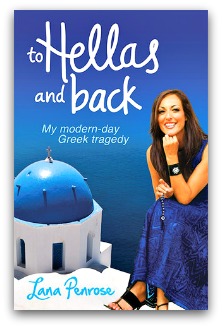
ToHelasandBack_dropshadowFor the uninitiated, I’m the author of To Hellas and Back, which chronicles my true-life tale of following the love of my life to the ends of the Earth (Greece) only to wind up losing my mind.

I then Nutbushed over to the UK to work for a world-renowned pop star and in the process wrote Kickstart My Heart, which details my attempt to negotiate my newly single life à la Bridget Jones—only with an axe through her head. As the book’s subtitle says: “A carnival of dating disasters”.

KickstartmyHeart_dropshadowNow these two books are rife with comedy, tragedy and my own human failings, so why scoop out what’s left of my heart and smear it across my shirtsleeve?

Like I said … a very good question.

More to the story…

The truth is that my story absolutely did not end with me leaving London to re-sample Greece after again being lured by love’s enchantment. In fact what happened next is something that I’ve kept close to my chest because it was downright shocking. I spent considerable time deliberating over whether I should share it at all.

AddictedtoLove_cover_dropshadowBut as many of you displaced writers know, the problem with being an author (one of the many!) is that you can’t seem to stop writing. And life has been more than accommodating in throwing me the odd curveball, the sort of material I feel compelled to purge away with my pen.

And so Addicted to Love was born: a mini-memoir that proves once and for all that truth really is stranger than fiction.

It’s set on the beautiful Greek island of Kythera, where I faced an impossible situation that I can’t go into here without issuing a spoiler alert … but rest assured that it’s gripping and you’ll digest it quite quickly, because it’s been described as “a page turner.”

Finally, an answer (of sorts)

But back to the original question: What motivated me to write this book? Well, thankfully (and unfortunately), experience has shown that there are many people who go through similar triumphs and tragedies to mine, particularly while traversing the globe. I like to connect with such people, and book writing is my way of holding out a hand and saying: “What—you, too?”and “You’re not alone.”

To Hellas and Back, Kickstart My Heart and Addicted to Love form a trilogy of the victories and pitfalls I experienced as an everyday person hurdling life abroad.

Each book can be read as a stand-alone, but I (predictably) suggest that you start at the very beginning to understand the depths of where I wound up.

* * *

Hey, Lana—you wound up here, at the Displaced Nation! That’s not the depths, surely? Readers, any questions for Lana or words of support? If you’re not familiar with Lana’s works, you can find the entire trilogy on Amazon or Smashwords. And don’t forget to follow her advice and begin at the beginning: by going to hellas and back!

Sydney-based (and no longer displaced) author Lana Penrose has had various incarnations, including music journalist, record company promotions gal, music television producer and personal assistant to an iconic pop sensation whose name shall never be revealed unless she’s subjected to Chinese water torture. She also once worked with the now-infamous Simon Cowell, which she today finds really odd. You can read more about her and her works on her author blog and/or follow her on Twitter: @LanaPenrose

STAY TUNED for tomorrow’s post, when we’ll be revisiting one of the earliest themes on this blog, Alice in Wonderland, but from the perspective of an international creative.

If you enjoyed this post, we invite you to register for The Displaced Dispatch, a round up of weekly posts from The Displaced Nation, with seasonal recipes, book giveaways and other extras. Register for The Displaced Dispatch by clicking here!

Related posts:

Image: MorgueFile

