The Displaced Nation

A home for international creatives

Tag Archives: USA

DIARY OF AN EXPAT WRITER: Turning into Jordan Rivet, writer of post-apocalyptic adventures, for an entire month

DiaryExpatWriterAs regular readers of the Displaced Nation will know, Shannon Young* recently took the decision to quit her day job to become a full-time writer in Hong Kong, where she lives with her half-Chinese husband. She joins us today to update the diary of this new phase of her life—and this time has brought along Jordan Rivet, her alter-ego. Hmmm…should be interesting!

—ML Awanohara

Dear Displaced Diary,

I hope you don’t mind if I allow Jordan Rivet to contribute to this month’s entry. I created Jordan Rivet as the pen name for my post-apocalyptic adventure series, which I first started writing during National Novel Writing Month, aka NaNoWriMo (often shortened even further, to NaNo), two years ago. For those who aren’t familiar, NaNo challenges people to write 50,000 words of a novel in the 30 days of November.

Nowadays, writers across the world come out in force to meet this challenge. (Hmmm… Shouldn’t it be renamed INTERnational Novel Writing Month: IntNoWriMo?)

But enough from me: The next portion of this entry will be from Jordan.

* * *

Thank you, Shannon. Displaced Diary, I’ll start out by saying how grateful I am for NaNo: it’s what brought me, Jordan Rivet, into existence. By the end of the month of November two years ago, I had produced 57,002 words about a floating city one disaster away from extinction, and I now have a book out under my name! (I even have my own email and twitter accounts.)

Last time Shannon wrote to you, she talked about going through the final publication stages for her memoir, Year of Fire Dragons—with a lot of help from her friends.

This month, though, has been all about me. I am back and am writing away furiously, having joined NaNo again, here in Hong Kong.

There are writers in Hong Kong!

Hong Kong is sometimes accused of lacking a literary culture. The scene definitely exists, but it can be hard to find. There’s a lot of pressure in this city to focus on purely commercial pursuits—and people are busy.

Yet every November, lots of us creative types come out of the woodwork—pros, beginners, and hobbyists alike. We are a mix of locals, expats, and returners who were educated abroad. You’ll find students and teachers and lawyers and marketers and homemakers. Unlike me, they don’t necessarily have time to write every day, but they do love books. They carve out time for writing in the midst of busy schedules and obligations. They get excited about stories and about inventing new worlds. Their energy is infectious.

People come and go a lot here, but I make new writing friends for Shannon every November, particularly at the NaNo write-ins, where participants gather to chat, write, laugh, and drink coffee together.

Being an adventuresome sort, I particularly love it when we have visitors at our write-ins who are just traveling through the city or who’ve made special trips from Macau and Shenzhen to connect with their fellow NaNo participants.

“Bird by bird, buddy. Just take it bird by bird.” —Kenneth Lamott

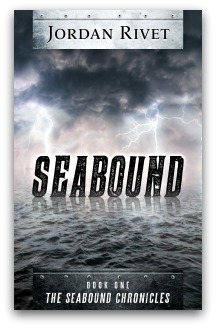
Seabound - Jordan RivetThis is my third November working on a novel in Shannon’s post-apocalyptic adventure series set at sea, called The Seabound Chronicles.

As already mentioned, Shannon just now launched my first book in this series, which I’d drafted in November 2012. It’s called Seabound, but back then I’d titled it The Vertigo. Shannon loved it immediately: it was her first foray into fast-paced genre fiction. “Planning and writing a grand adventure is just as much fun as reading one,” she told me.

Now every November I hammer out a very rough draft of another installment in the series, and it always reminds Shannon how much fun writing actually is. (Actually, I wrote the first draft of the sequel the spring after that first NaNo. In November of 2013 I wrote the prequel.)

In Bird by Bird, her classic mediation on the writing life, Anne Lamott argues that writers should produce “shitty first drafts.” Her point is that by giving ourselves permission to write rough, messy, and even bad work, writers can avoid the kind of perfectionism and fear that stifles creativity.

That’s why I’m so glad Shannon invented me during NaNoWriMo. She was thinking that NaNo is a great time to produce what may well be a shitty first draft in the madcap rush to reach 50,000 words in thirty days, and that revisions can always come later.

I love that I get to do the first draft, which is all about discovery. As I’ve said, adventure is my thing!

I’m now working on what I believe will be the fourth and final book in the Seabound Chronicles (27,555 words and going strong). This is the part where I get to figure out what happens in the end.

Though I’m enjoying it to the hilt, I have to tell you that writing my final first draft is bittersweet. Of course Shannon will call me in again, as the series still needs a lot of work. But will I still have a life after it finishes? That is the question…

Since I don’t know the answer, I’ll give you back to Shannon.

* * *

Priorities, priorities

Thanks, Jordan. Diary, I must confess that ever since I quit my job to write full time, I’m finding there are still a lot of things that pull me away. These are all writing-related tasks: answering emails, writing blog posts, updating my websites, requesting reviews, promoting my books, etc.

And, as Jordan reported, I’ve been working on formatting and uploading all the files for the e-book and paperback of Seabound, a task I kind of love but it’s time consuming.

As you know, I want to make the most of this time. I’m slowly developing strategies to keep me on task. Even if the miscellaneous stuff is writing-related, I still have to make sure the real writing comes first.

Thank goodness Jordan has reappeared to keep me on track this month.

It’s not New York City, but…

Once upon a time, I dreamed of living in New York City. I imagined renting a loft in Brooklyn, going to book launches every weekend, and having lunch with authors (ideally as an editor at a major publishing house). It was a very particular sort of dream.

Then this crazy, wonderful expat life happened.

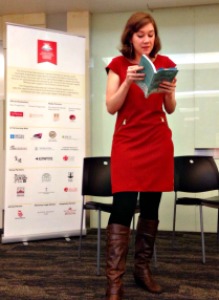
Shannon Young at HKILF

Shannon Young at the Hong Kong Literary Festival earlier this month, reading from her memoir of her first year in Hong Kong, Year of Fire Dragons.

When I first moved to Hong Kong, I worried I’d have to give up my book publishing dreams. A little over four years later, it’s amazing how wrong I was. Hong Kong may not have a deeply entrenched literary and publishing scene like New York’s, but it has provided opportunities for me to chase a more evolved version of my dream. And Hong Kong writers have an energy and optimism that’s all their own.

Earlier this month, I attended the Hong Kong International Literary Festival as one of the featured writers. I got to be on the radio, visit a local secondary school, attend the opening and closing parties, and read from my book, Year of Fire Dragons, at an event.

This expat life isn’t what I planned. I meet people all the time who also didn’t mean to end up in Hong Kong. But through chance and circumstance, here we are. As it turns out, there are plenty of opportunities to follow our dreams, and I wouldn’t want it any other way.

Thanks for continuing to follow my expat writing journey.

Yours,

Shannon (& Jordan)

www.shannonyoungwriter.com

* * *

Readers, I hope you are finding writing buddies wherever you are, as well as alter egos who are as fun (and productive!) as Jordan is. And if you’re participating in NaNoWriMo, get back to work!

*Shannon Young (not Jordan Rivet!) has edited an anthology, How Does One Dress to Buy Dragonfruit? True Stories of Expat Women in Asia (2014), from which she is sharing some excerpts. We’re calling them “chunks” of dragonfruit—they taste delicious!

STAY TUNED for next week’s fab posts!

If you enjoyed this post, we invite you to register for The Displaced Dispatch, a round up of weekly posts from The Displaced Nation, with snippets of worldly wisdom, exclusive book giveaways and our nominees for the monthly Alice Awards. Register for The Displaced Dispatch by clicking here!

Related posts:

TCK TALENT: Nina Sichel, writer, editor, and guiding light on the Third Culture Kid experience

Nina Sichel_TCK TalentElizabeth (Lisa) Liang is back with her monthly column about Adult Third Culture Kids (ATCKs) who work in creative fields, Lisa herself being a prime example. A Guatemalan-American of Chinese-Spanish-Irish-French-German-English descent, she has developed her own one-woman show about growing up as a TCK, which she has taken all over the country. In fact, she turned up as the convocation speaker at Carleton College on October 31st, where my niece, now a Carleton freshman, had the pleasure of watching her perform some excerpts!

—ML Awanohara

Welcome back, readers! Today I’m honored to be interviewing Nina Sichel, co-editor of the seminal TCK / global-nomad anthology Unrooted Childhoods, which includes essays by several famous TCK writers such as:

  • Pico Iyer: “I fold up my self and carry it round with me as if it were an overnight case”;
  • Isabel Allende (she fled her homeland for political survival); and
  • Military brat Pat Conroy: “Each year I began my life all over again . . . and I think it damaged me.”

In addition, she co-edited the TCK / global-nomad anthology Writing Out of Limbo—to which I contributed. Thank you, Nina, for the hard work you did on my first published essay!

Nina grew up in Venezuela and “repatriated” to the USA for college and beyond; she is a writer, editor, and leader of memoir-writing workshops in Virginia.

* * *

Welcome to The Displaced Nation, Nina. I understand that you grew up in a multicultural household as a TCK in Caracas—the daughter of an American mom and a German-Jewish dad. With Thanksgiving around the corner, my thoughts are turning to the upcoming holidays. Did any particular holiday traditions or celebrations take precedence over others in your household as you were growing up?
My father had to leave Germany when he was 11 and grew up in Uruguay. He seldom spoke about his childhood. He came to the U.S. for college, and, after marrying my mother, lived in Puerto Rico and the Dominican Republic before settling in Venezuela. After all of those moves, his identity was not at all tied to nationality, and, like so many other choices in his life, citizenship was a matter of practicality. So national holidays were completely unimportant.

What about your mother?
My mother was a nostalgic American—more so when she was in Venezuela than when she was anywhere else. But she was an expat, and U.S. national holidays were not celebrated in that country. My parents’ friends were multinationals—our social circle was not defined by nationality. And, even though my father’s sister and mother, Uruguayan citizens by then, lived in Caracas, close by, we were secular Jews, only going to synagogue on the High Holidays and mostly not even then. We had an abbreviated seder, we lit candles at Chanukah. That Jewish identity, more ethnic, perhaps, than religious, was important to my parents. Yet we had very little religious training. I think things were assumed more than instructed… I remember going to summer camp in the States with Jewish girls from Long Island—and feeling I had absolutely nothing in common with them.

Did you celebrate other holidays?
We had a Christmas tree with lots of presents and sang carols. Santa Claus came till we were too old for him, but there were still gifts afterwards. We dressed up for carnaval, and the Easter bunny came to visit us. Hmmm… I’ve given you a long answer to what should be a simple question—but then, some things are not so simple. Like composite identities.

I was raised with no real roots, an American child in Venezuela…

Writing_Out_of_Limbo_coverWhich brings us to your wonderful essay, “Outsider,” which appears in Writing Out of Limbo. You mention in that piece that there was a lot of turnover among your friends at your international schools. Can you tell us a little more about what that was like?
I never knew, from one school year to the next, which of my classmates would actually be back. I don’t remember ever talking about it; this was normal, nothing remarkable. I remember a few friends who left with advance notice, and I tried to keep in touch with them—pen pals during a time when letters would take one or two weeks to reach their destinations. Those friendships faded over time. Quite a few friends were sent away to boarding school once they reached high school; sometimes they’d be back for summer vacations, but by then I’d usually be in the States. There were also, of course, quite a few children whose parents would stay in Venezuela indefinitely, till retirement and after. And then there were the kids who rotated in and out every couple of years, many of whom were Americans. Recently, I’ve been thinking a lot about how different the ones who stayed as long-term residents were from the ones who rotated in and out. And how difficult it is to make general statements about any of this—there are layers and layers of outsiderness, not just one sort of expat or TCK identity.

Have you still got friends from that period?
I’ve kept strong ties to some friends from my youth, and to me this is very special—they are more like family than friends now. I’ve learned to invest deeply in relationships I hope will last, perhaps because the chances are so fleeting. I’ve felt incredibly lucky to be able to contact some people from my past via the Internet, and rekindle friendships from long ago, and learn how TCK life has affected them, their choices, their lives.

Our memories are the part of life we get to keep and take with us…

After an entire adulthood in the USA, tell us what you still miss about Venezuela. I’m also curious to know how many of those things can still be found there, and how many are connected to memories of family and/or friends who are no longer there?
Though I have lived my adulthood in the U.S., my parents remained in Venezuela, and I went back often to visit until they passed away. The place changed—all places do—and I also changed. My memories now are interwoven with nostalgia for what was or might have been. But there are also tangible things. Venezuela is a beautiful country, and there are things about nature I miss. I miss smells—that thick Caribbean salt air, the tangy grass. I miss tropical light, and will miss it more and more now that we’re approaching winter here.

Nowadays, do you feel at home in the United States?
I do feel “at home” in the States in general; just not rooted in any particular place. As you know from my essays, I’ve lived in several places. I lived in a small town in upstate New York, then Manhattan; I lived in the Deep South two different times; in rural Michigan; in West Palm Beach and then urban Miami; and now I live outside Washington, DC. In the smaller towns, what I missed was diversity—of language, ethnicity, experience, culture. I had to seek it out in the people I befriended and the kind of work I chose to do. But even in the cities, I felt outside the mainstream. Remember, coming to the States was not coming home for me; it was immersion in a different culture.

Unrooted_Childhoods_coverIn Unrooted Childhoods, your co-editor, Faith Eidse, writes about her yearning “for thick gumbo-limbo roots.” Do you sometimes wish your roots were deeper in this country?
I remember being fascinated by a friend’s roots in the Deep South that went back many generations. As my family does not have that history, it was something new and rather foreign to me, an oddity. But it was not something I wanted, as it felt too confining, to be defined by your predecessors that way.

Do you have “itchy feet,” which still make you want to move frequently? Or are you the kind who prefers to have a home base and travel only for pleasure?
Yes yes yes. All of the above. o I have to choose?

You mentioned longing to find other people with the experience of having lived overseas. Have you found that “your people” tend to be other ATCKs in creative fields—or does it really depend on the individual and what s/he evokes in you, whether it’s a resonance that’s artistic or political or personality-related or life-experience related, etc.?
I tend to fall in love with people, with aspects of people, and am constantly surprised that all my friends don’t automatically feel the same about each other as I feel about each of them! So, yes, I think it’s about that resonance that you mentioned, but it’s a different resonance in each person, a different connection I respond to. In any case, I never knew about TCKs or ATCKs until I began to work on Unrooted Childhoods.

I want to choose and gather the markers by which to remember our years here…

Like other ACTKs including myself, you were drawn to the craft of writing as a means of self-expression. Is there a particular piece that you think expresses your feelings of transience or loneliness or instability—or freedom or curiosity or love of travel—that you are most proud of? And where can we read it?
I’m not going to choose among my babies, but anyone who is interested can read my essays in Unrooted Childhoods and Writing Out of Limbo. I also wrote much of the introductory material in both books. There was an essay of mine published recently in Brain, Child Magazine, titled “Leaving,” which many of the readers of this column will surely respond to. And I’ve been posting short blogs on the Children’s Mental Health Network website, to inform readers about issues concerning TCKs.

We both lead workshops for people who want to write about their own lives. Tell us what got you started as a memoir workshop leader.
I’ve always felt torn between creative expression and nurturing others—as though I had to choose, as though the work I’d always done (teaching, counseling, raising children) wasn’t already a combination of the two. When I moved to the Washington, DC area, I developed the memoir and other writing programs I currently offer and am always expanding the menu of choices. The workshops are theme-based, and range in topic from creative change and transformation to intercultural exchange to turning points to writing about place to parenting to… I had a program that I developed once specifically for au pairs, which I’d like to offer again at some point. I keep the workshops small, intimate, supportive. We do not engage in critiquing—most of my writers are beginners in memoir, and need to both give and receive positive feedback to grow into the writers they are becoming. I feel honored by their trust, in bearing witness to their journeys.

It’s wonderful that you enjoy helping others make the most of this genre. Of course a good example of that is Unrooted Childhoods, which is a book of memoirs by people who grew up in multiple countries.
Memoir is a wonderful genre, open to many forms, and helping writers find their voices, their unique expression, their subject, is a joy for me. There are strands in life that one thinks of as separate, and I have figured out a way to braid them together. There is so much self-discovery in the process—I can’t tell you how many times students have told me, “I had no intention of writing about that. And I’m so glad I did.”

Where can people find those workshops?
My regular memoir-writing workshops are offered through Northern Virginia Community College in Annandale, outside Washington, DC. I’ve offered other types of reflective writing programs in various community and art centers in the area, and am open to offers elsewhere. I’m happy to share more detailed information upon request.

Thank you, Nina, for sharing the story of your creative life with readers at the Displaced Nation. So, any questions or comments for Nina? Be sure to leave them in the comments!

*All subheds are quotes from Nina’s essay for Brain, Child Magazine, “Leaving” (April 2014).

STAY TUNED for our next fab post.

If you enjoyed this post, we invite you to register for The Displaced Dispatch, a round up of weekly posts from The Displaced Nation, with seasonal recipes, book giveaways and other extras. Register for The Displaced Dispatch by clicking here!

Related posts:

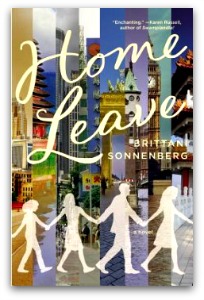
BOOKLUST, WANDERLUST: Brittani Sonnenberg’s gem of a novel about an expat family for whom home is everywhere–and nowhere

Booklust Wanderlust Collage

Left: Oleh Slobodeniuk (CC BY-NC-SA 4.0); right: Beth Green (her own photo).

Attention displaced bookworms! Our book review columnist, Beth Green, is back. An American who lives in Prague, Beth mixes booklust with wanderlust in equal measures, which gives her just the right background for reviewing recent book releases on behalf of international creatives.

—ML Awanohara

November greetings, Displaced Nationers! I’ve been reading up a storm lately (including Tana French’s latest addition to the Dublin Murder Squad series that I reviewed here this past summer—another great book!). But as I contemplated which work to pull down from my digital bookshelf for this month’s review, my attention came to rest on a super example of Third Culture Kid fiction: Home Leave, the debut novel from Brittani Sonnenberg, which came out earlier this year.

Home_Leave_coverPerhaps I was attracted to this book because the story Sonnenberg tells, about a globetrotting family, reminds me of my own. As some of you may know, I grew up on a boat and spent most of my life before high school outside the US—we were seven years in the Caribbean and two in the South Pacific.

But if it’s my story, it’s also Sonnenberg’s. She spent her childhood alternating between her native US and the UK, Germany, China, and Singapore, and, like many of us TCKs, has opted to become a “chronic expat” in her adulthood. She has worked as a journalist in Germany, China, and throughout Southeast Asia. (Currently, she resides in Berlin but is also a visiting lecturer in Hong Kong.)

Until Home Leave, Sonnenberg was known primarily for her short stories and NPR commentaries about life in Berlin.

In fact, her novel started as a memoir, but then one of her agents encouraged her to try re-approaching the material through fiction.

There must be more to life than having everything!”—Maurice Sendak

Home Leave concerns an American nuclear family, the Kriegsteins. The parents, Chris and Elise, determine to escape their dreary lives in the US by living and working overseas as expats. As Chris pursues a career at several international companies, their two daughters, Leah and Sophie, learn what it is to feel at home abroad and a stranger “at home” in the US. They revel in their uniqueness, but they also sometimes long for putting down roots and living like kids back home.

Sonnenberg makes a creative decision not to have a single character as the protagonist. Each of the Kriegsteins is a main character, and there are multiple narrators.

But for me, the book did have a star, and that was Leah. Sonnenberg links Leah’s emotional and personal success as a young adult to her peripatetic childhood, delivering in her a multifaceted portrait of a Third Culture Kid to whom other TCKs can relate.

“Home is where one starts from.”—T.S. Eliot

Leah is the elder daughter, and her toddler years abroad insert themselves into her identity almost from the moment when the family moves back to the US for a few years. As Sonnenberg writes:

Even Leah, with eleven-year-old pretensions of grandeur, craved a “next,” though her memories of “before” Atlanta were limited to the backyard in London, fish and chips, and falling blossoms in a British park…Leah grumbled that they always went to the airport to pick people up but never went anywhere themselves.

Her wish is granted when the family departs to Asia, where they begin a tradition of going on home leave back to the United States:

Like Persephone’s annual permitted return to her mother aboveground, by the gods in Olympus, the powers that be at Chris’s company will grant the Kriegstein women “home leave” once a year, each summer, when they will stay with friends and relatives, the flights covered by the company. In September they will be forced to leave again, back to China. This habit of home leave will cement Atlanta as “home” in their minds, since they always fly back to the Atlanta airport.

Of course, the price to pay for home leave is a complicated definition of where “home” is. As Sonnenberg writes:

When the Kriegsteins leave Atlanta for Shanghai in 1992…they are desperate to be overseas again. After three months in Shanghai, they will be desperate to return home.

And once Leah is an adult, she faces the classic Adult Third Culture Kid dilemma—how to answer the unanswerable: “Where’s home?” Speaking for myself, I never seem to answer it the same way twice in a row!

But what if one must re-start from tragedy?

There is a further twist to the Kriegsteins’ story, which is that Leah’s younger sister, Sophie, dies unexpectedly in their teen years—another parallel to Sonnenberg’s own life (she lost her own sister, Blair).

If you haven’t read the book yet, please note: to tell you about Sophie’s death is not a spoiler. Her death is referred to in the book before it happens, and at one point, her ghost actually narrates the story.

Now, Leah’s strongest relationship is with Sophie—something any TCK out there will understand. As children in foreign places, Leah and Sophie are sometimes each other’s only playmate. As preteens, they look out for each other in Shanghai and share a conspiracy to run away back to Atlanta—a plan only foiled when airport staff won’t accept their father’s credit card without their dad present.

Not surprisingly, Sophie’s death breaks the teenaged Leah, influencing how she perceives her place in the world and reality for years afterward:

Was Sophie’s death a foregone conclusion in any geography, a heart failure built into her system that would have struck her down on any continent? Later, the doctors would say, “There was nothing you could have done. Undetectable heart conditions are just that: undetectable. You mustn’t blame yourselves.” But because the death will happen in Singapore, its occurrence will be unimaginable anywhere else. Thus, in the parallel (irrational) universe, where they stay in Atlanta, where the good years never end, Sophie never dies.

Likewise, Sophie’s abandonment of Leah comes to affect her definition of “home”:

Years later, as an adult, when asked where she is from, Leah will always say “Atlanta,” as if we come from our joy, as if, aside from their goodness, there was anything to say about the good years.

Living in not-so-splendid isolation

The late, great David Pollock, a recognized authority on TCKs, once wrote*:

The TCK frequently builds relationships to all of the cultures, while not having full ownership in any. Although elements from each culture may be assimilated into the TCK’s life experience, the sense of belonging is in relationship to others of similar background.

Sonnenberg gives us a sense of the disjointedness of the TCK upbringing, and the many identity issues this results in, by having each chapter of Home Leave read like its own short story, with its own narrator. Thus we go from Elise delivering an electric first-person narration of how she coped with her daughter’s death, to therapist appointments written like scenes in a play, to a first-person-plural foray into describing how a group of young TCK women experience university.

Although this style can be jarring for the reader—the book you pick up in the afternoon doesn’t feel like the same book you put down in the morning—taken as a whole, Home Leave feels as fragmented as a life abroad sometimes feels.

Most importantly of all, Sonnenberg’s book does not shy away from the irony of the TCK experience, which is that although a family may travel abroad to broaden its horizons, none of its members ends up having any long-standing relationships except with each other. And, in the case of the family she depicts in Home Leave, even those relationships are uncertain. As the novel’s action unfolds, the older Kriegsteins are shown to be deeply flawed people whose naivety toward the world, and indifference to the needs of their own children, is sometimes astounding.

Home Leave left me feeling sorry for the Kriegsteins: they appear to have been impoverished by their life abroad, not enriched. Throughout the story, I kept wishing they might form a real connection to the places they inhabit and the people they encounter. But, except for the touching scene when Elise is pregnant in Germany, Chris’s ambitions and their own dysfunction buffers them from opportunities to create authentic bonds.

The sections about Shanghai seemed particularly sad, though perhaps that’s only because we see the city partially through the lens of an awkward, pubescent Leah.

But, although not all TCKs will find that the Kriegsteins’ experiences are close to their own, Home Leave is a gem of story suitable for anyone with international experience. And the quality of Sonnenberg’s writing is such that I’m really looking forward to seeing what she produces next.

* * *

Now for a parting thought for my fellow TCKs, some of whom may be feeling rather wistful after reading this review:

Home life is no more natural to us than a cage is natural to a cockatoo.

—George Bernard Shaw

Till next month!

*Third Culture Kids: Growing Up Among Worlds, by David Pollock and Ruth Ven Reken (2009, rev. 2010).

* * *

Thanks, Beth! I note that the New York Times reviewer of Home Leave concluded that in putting Leah at the book’s emotional core, not her parents, Sonnenberg has opened the door for the next generation of international creatives, no mean feat! Readers, any thoughts or responses?

Beth Green is an American writer and English teacher living in Prague, Czech Republic. She grew up on a sailboat and, though now a landlubber, continues to lead a peripatetic life, having lived in Asia as well as Europe. Her personal Web site is Beth Green Writes, and she is about to launch a new site called Everyday Travel Stories. To keep in touch with her in between columns, try following her on Facebook and Twitter. She’s a social media nut!

STAY TUNED for next week’s fab posts!

If you enjoyed this post, we invite you to register for The Displaced Dispatch, a round up of weekly posts from The Displaced Nation, with Alice nominations, exclusive book giveaways and other extras. Register for The Displaced Dispatch by clicking here!

Related posts:

And the October 2014 Alices go to … these 3 international creatives

 © Iamezan | Dreamstime.com Used under license

© Iamezan | Dreamstime.com
Used under license

If you are a subscriber to our weekly newsletter, the Displaced Dispatch, you’re already in the know. But if you’re not, listen up. (Hey, why aren’t you? Off with your head!)

Every week, when that esteemed publication comes out, we present contenders for a monthly “Alice Award,” most of whom are writers or other kinds of international creatives who appear to have a special handle on the curious and unreal aspects of being a global resident or voyager.

Not only that, but this person tries to use this state of befuddlement as a spur to greater creative heights.

Today’s post hono(u)rs our three Alice recipients for October. They are (drumroll…):

2) Maya Kachroo-Levine, New Yorker in Los Angeles

For her post: “5 Things an East Coast Transplant Misses on the West Coast,” in Thought Catalog
Posted on: 15 October 2014

"But I'm not used to it!" pleaded poor Alice in a piteous tone. And she thought of herself, "I wish the creatures wouldn't be so easily offended!" "You'll get used to it in time," said the Caterpillar; and it put the hookah into its mouth and began smoking again. Photo credit: Arthur Rackham [Public domain], via Wikimedia Commons.

“But I’m not used to it!” pleaded poor Alice in a piteous tone. And she thought of herself, “I wish the creatures wouldn’t be so easily offended!”
“You’ll get used to it in time,” said the Caterpillar; and it put the hookah into its mouth and began smoking again. Photo credit: Arthur Rackham [Public domain], via Wikimedia Commons.

Alice Connection:

[Y]ou occasionally find yourself feeling that your sarcasm is falling flat, and you want someone to appreciate it. Or better, you want them to argue with you. I miss that.

Citation: Maya, if you think navigating between East and West Coasts is bad in terms of sarcasm and irony, try the UK versus the USA. The former is a lot more irreverent, a difference can cause misunderstanding and even offense (not to mention homesickness for the perpetrator). You have our deepest condolences. What’s more, your point about having to drive two hours merely to go apple picking reminds us of Alice repeatedly trying to reach the garden at the top of the hill at the start of Through the Looking Glass. Likewise in your case it seems reasonable to ask: how hard can it be to reach a deciduous fruit tree? Thank you for your thoughtful (no pun or irony intended!) post. We wonder if the best way to endure this domestic culture shock would be to seek out a Caterpillar equivalent, who in the current California context would most likely manifest itself as a mindfulness guru. Until then, deep breathing; and, as one of that state’s more renowned self-help proponents used to say, try not to sweat the small stuff!

2) Sarah O’Meara, former lifestyle editor for Huffington Post UK turned China expat

Alice_in_Wonderland_by_Arthur_Rackham_The_Pool_of_Tears

It was high time to go, for the pool was getting quite crowded with the birds and animals that had fallen into it: there were a Duck and a Dodo, a Lory and an Eaglet, and several other curious creatures. Alice led the way, and the whole party swam to the shore. Photo credit: Arthur Rackham [Public domain], via Wikimedia Commons.

For her post: “The art of swimming in China,” for Telegraph Expat
Posted on: 27 September 2014
Alice Connection:

Many young Chinese men prefer to conquer, rather than swim, in the water. They thrash their arms around, causing enough splash to choke fellow lane users, yet never quite enough to move them forward. While underneath the surface, their legs flail, neither acting as propellers or buoyancy aids.

Citation: Sarah, we have to say that after reading your wonderfully amusing post, we are still processing the image of women wearing pencil skirts walking very slowly on running machines in heels. Still, we commend your decision to focus not on Chinese sports centers but on the risks one faces “of being half-drowned by frothing waves, or hit in the face” when venturing into China’s public swimming pools. And, just as Alice concludes she may be better off swimming to shore, we applaud your solution to the problem. Joining a private pool, where, as you say, the proportion of non-swimmers is lower, must be much safer, even if you can never quite escape the young men who have adopted the walking and thrashing style of Mao crossing the Yangzte. (My, my. That Mao has a lot to answer for…)

3) Jenny Miller, NYC-based food and travel writer

For her post: “I Ate Tarantulas In Cambodia. And Liked It,” for Food Republic
Posted on: 23 September 2014

'—then you don't like all insects?' the Gnat went on, as quietly as if nothing had happened. 'I like them when they can talk,' Alice said. 'None of them ever talk, where I come from.' Photo credit: John Tenniel.Slatifs at en.wikipedia [Public domain or Public domain], from Wikimedia Commons.

“—then you don’t like all insects?’ the Gnat went on, as quietly as if nothing had happened.
“I like them when they can talk,” Alice said. “None of them ever talk, where I come from.” Photo credit: John Tenniel.Slatifs at en.wikipedia [Public domain or Public domain], from Wikimedia Commons.

Alice Connection:

We might have gone on sampling this towering insect buffet, but Megan made our excuses in Khmer and we walked down the road for an ice cream instead.

Citation: Jenny, we’ve got to hand it to you. What kind of traveler knows exactly what to say when, bumming around Southeast Asia, they find themselves on a bus sitting next to a Peace Corps volunteer named Megan who says she lives in Skuon, Cambodia? Only one who has read her Lonely Planet Cambodia guide from cover to cover! And then, as though being able to conduct a lively conversation with Megan about Skuon’s insect-eating habits were not enough, you take her up on her offer to visit and eat some tarantulas! Now that takes some guts, as you appear to realize once you reach “Cambodia’s spider central.” For sure, you show greater courage than poor Alice, who, upon being informed by the Gnat that a bread-and-butterfly is crawling at her feet, draws her feet back “in some alarm”. She certainly doesn’t think about eating it, even though, compared to your spiders, a bread-and-butterfly meal doesn’t sound half bad:

“Its wings are thin slices of bread, its body is a crust, and its head is a lump of sugar.”

Hmmm… Perhaps you should have read Lewis Carroll more thoroughly?

*  *  *

So, readers, do you have a favorite from the above, or have you read any recent posts you think deserve an Alice Award? We’d love to hear your suggestions! And don’t miss out on the shortlist of Alice contenders we provide in each week’s Dispatch, which are sources of creative thought if nothing else! Get on our subscription list now!

STAY TUNED for more fab posts.

Writers and other international creatives: If you want to know in advance the contenders for our monthly Alice Award winners, sign up to receive The Displaced Dispatch, a round up of weekly posts from The Displaced Nation, with news of book giveaways, future posts, and of course, our weekly Alice Award!. Register for The Displaced Dispatch by clicking here!

Related posts:

DIARY OF AN EXPAT WRITER: How to fly solo without burning the tips of my wings

DiaryExpatWriterI am pleased to welcome back up-and-coming author Shannon Young. This past summer, Shannon announced she’d cut 18 inches off her hair, quit her day job to become a full-time writer, and given herself a pen name for her planned adventure novel series. And, yes, she is an expat, a kind of love refugee, in Hong Kong. Shannon has agreed to chronicle her writing adventure for us. This is her second installment.*

—ML Awanohara

Dear Displaced Diary,

As you may recall, last month I gave you some background on my decision to quit my day job and dedicate six months to writing with all my time, all my savings, and all my heart.

I already love the sensation of flying solo. As writing coach Mary Carroll Moore once said:

Books demand more time inside, to think, muse, dream, and design our stories.

But what if I love it so much I end up soaring too high and burning my wings? To continue the aviation metaphor, I mustn’t forget to touch ground and refuel every so often.

Diary, my goal this month is to find the balance between chasing my dreams and relying on much-needed feedback, input and advice from the people within my editing and writing community.

Recently I’ve learned three lessons that I think could be useful to bear in mind:

1: Languish in limbo no longer.

fire-dragons_coverThis month saw the final publication stages for the first book I ever started writing: Year of Fire Dragons. The working title for several years was Hong Kong Limbo, which is a fairly good description of this book’s journey. After writing several drafts, I worked with an excellent critique partner (fellow expat author Jane Cornelius) and asked numerous friends and relatives to beta read before querying literary agents.

To make a long story short, one of the first agents who requested the full manuscript spent two years assuring me she would get to it soon. I don’t know if she ever opened the manuscript, leaving me—and my writing career—hanging in the balance.

At the two-year mark, I withdrew my manuscript from her consideration. By that time, I had begun to believe that this particular book could find just the right home outside the New York publishing world and didn’t want to keep being strung along. I decided to take my career back into my own hands.

Three months later I had signed a book deal with Blacksmith Books, an excellent Hong Kong-based publisher, and my piece on student debt had been accepted into the competitive Kindle Singles program. That piece is now being made into an audiobook as well.

In retrospect I’m grateful for the delay that took place due because of that New York City agent. It gave me time to do some rewriting, and my manuscript was much better by the time I submitted it to Blacksmith Books.

That said, it also taught me an important lesson about taking control of my own career.

In this season as a full-time writer, I hope I’ll continue to learn when to take the initiative and be a better judge of when to rely on other people’s responses.

2: Get by with A LOT of help from your friends.

My full-time writing schedule has allowed plenty of time to work on the little details while preparing for the launch of Year of Fire Dragons—with help and feedback from others, of course!

Here are a few things that happened this month:

1) The publisher sent the final proofreading notes. I combed through the manuscript one final time, knowing that this was my very last chance to catch any errors.

2) We rewrote the blurb (again), simplifying it a bit from the previous version. It needed to be stripped down to the basics of the story. Here it is:

Year of Fire Dragons: An American Woman’s Story of Coming of Age in Hong Kong

When a bookish 22-year-old follows her Eurasian boyfriend to Hong Kong, she hopes it’ll be the happy ending to their long distance love story. But a month later, his company sends him to London. Left with a new job and a pile of student debt, she embarks on a wide-eyed newcomer’s journey through Hong Kong—alone. She works as the only foreigner in a local school and explores with other young expats. The city enchants her, forcing her to question her carefully laid plans. Soon she must make a choice between her new life and the love that first brought her to Asia.

(Is your curiosity piqued, Dear Diary?)

3) I practiced talking about the book without being annoying. This is a difficult one for me. Like many writers, I’m an introvert, and it’s a constant struggle to figure out the right balance of things to say. (If you know me in a real life and I talk about my work too much, please tell me to cut it out!)

4) I messed up, but got things sorted out in the nick of time. My publisher arranged to have an excerpt from my book published in a cool local magazine. I got the email about the opportunity shortly before I flew to Taipei for a friend’s wedding. I didn’t read the email closely enough to realize that they needed the excerpt ASAP. Several days later, I found myself in line for the elevator at Taipei 101 (the world’s second tallest building) reading an email asking where my excerpt was and could I send a photo, too? I had left my computer back in Hong Kong. At the top of Taipei 101, I tucked myself into a corner and spent most of our visit frantically trying to download the manuscript on my phone and find an appropriate photo to forward. Thank goodness for free WiFi! When we got back to the hostel I was able to use their computer to download my book and find just the right excerpt for the magazine.

5) I received blurbs offering advance praise of my book, the final full spread cover design, and a PDF with typeset pages (248!)—all the bits and pieces that make a book come to life. I’d written the pages, but my publisher had polished them, the designer had created the beautiful artwork for the cover, and the blurb writers had inspired me through their own books and offers of encouragement along the way.

Notably, all of these little victories were the direct result of other people’s input.

3: Expat life can be read as a metaphor for the editing process.

It occurred to me the other day that living in another country can be likened to the writing and editing process. An expat has to be open-minded to the cultures around him—just as a writer must learn when to accept feedback. An expat must also forge her own path—just as a writer must sometimes decide to hold fast to the words she wants to write and the career she wants to pursue.

With the near constant feedback of the other culture, an expat naturally reassesses the way they do things. Sometimes your new country doesn’t offer the same opportunities and you need to adapt, and sometimes you see a better way.

Year of Fire Dragons used to have a lot more words: awkward words, melodramatic words, giddy and petulant and angry words about my first year living as an expat in Hong Kong. The process of writing the book was a maturing process. I had to first learn to describe what I saw on the surface, with assumptions and prejudices and even rose-colored glasses. Then I had to learn to refine my perceptions even as I learned to edit my words. I had to cut to the heart of what was most important, most interesting, and most moving.

My work and my expat life are not so different, it turns out.

Diary, I still struggle with whether I’m making the right decisions. I wonder whether my book will be good enough, or if I should have spent yet another year revising. I even question whether people are just trying to be nice when they say sweet things about my book.

Throughout the next few months, I hope I’ll continue to learn how to take all the lessons offered by the wise folks around me, while still building this new life the way I want it to be.

Thank you again for following along on this journey!

Yours,

Shannon Young
www.shannonyoungwriter.com

* * *

Readers, it’s your turn. Have you ever struggled with the writing process, wondering how long you should hunker down before accepting feedback on your work, or if that feedback is genuine? Let us know in the comments!

*Shannon Young has edited an anthology, How Does One Dress to Buy Dragonfruit? True Stories of Expat Women in Asia (2014), from which she is sharing some excerpts. We’re calling them “chunks” of dragonfruit—they taste delicious!

STAY TUNED for next week’s fab posts!

If you enjoyed this post, we invite you to register for The Displaced Dispatch, a round up of weekly posts from The Displaced Nation, with snippets of worldly wisdom, exclusive book giveaways and our nominees for the monthly Alice Awards. Register for The Displaced Dispatch by clicking here!

Related posts:
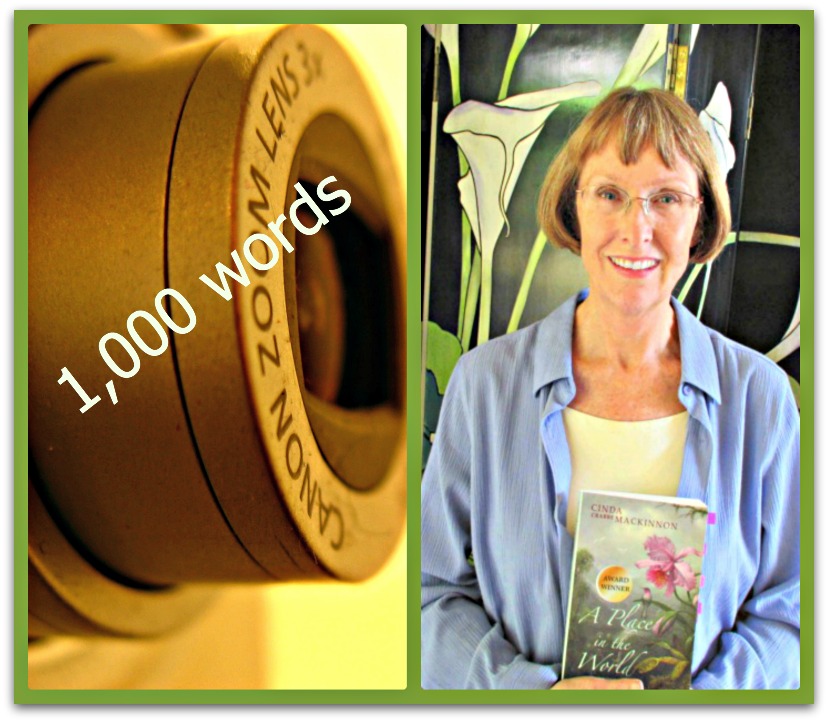
For this global nomad, botany buff and blossoming novelist, a picture says…

Cinda 1000 Words CollageWelcome to our monthly series “A picture says…”, created to celebrate expats and other global residents for whom photography is a creative outlet. The series host is English expat, blogger, writer, world traveler and photography enthusiast James King, who thinks of a camera as a mirror with memory. If you like what you see here, be sure to check out his blog, Jamoroki.

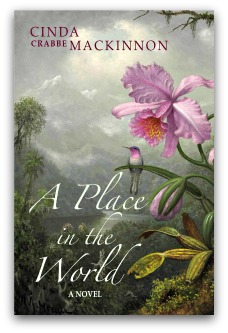
My guest this month is Cinda MacKinnon, an American who grew up overseas and is the author of an award-winning novel set in one of her former homes, Colombia. Called A Place in the World, the book was featured almost exactly a year ago on the Displaced Nation.

Cinda shoots mainly “macro” (extremely close up) pictures, a habit she developed because of her interest in nature and plants—especially wildflowers. A writer, former university lecturer, and environmental scientist, Cinda is trained in geology and has also nurtured a life-long passion for botany. It’s telling that the protagonist of her novel is a botanist!

Cinda enjoys hunting down rare plants and taking photos that show their minute details, such as the number of anthers (the part of the stamen that contains pollen), so that botanists will be able to identify them.

She now lives in northern California, where the California Native Plant Society has become a fan of her photos and sometimes asks her to supply a few of them for their newsletters and exhibits. Who knew?

* * *

Hi, Cinda. Welcome back to the Displaced Nation. I’m pleased to have the opportunity to discuss your photo-travel experiences. When I first started following your blog, I assumed you were a writer—but then was delighted to discover that you’ve also taken some excellent photos. I know you’ve already been over some of this ground in your interview with ML Awanohara, but can you tell me where you were born and when you spread your wings to start traveling on your own?
I was born on an Air Force base in Louisiana, but lived there only a week. My dad was already stationed in Greece, and my mother followed him as soon as she was able to travel. I lived in Greece and Germany as a pre-schooler and then in Colombia when my father changed his job and began working as a military attaché for U.S. embassies. Having fallen in love with Latin America, my parents retired in Costa Rica when I was in seventh grade so, happily, I was able to stay in that part of the world through high school…and beyond. After college in the United States, I moved to New Zealand with my husband (back then, they told us we had to get married to immigrate together!). We came to California when he finished his PhD. And here we’ve been ever since, although I view that move to California—I was in my thirties—as the first time I actually lived in the States. Even though my passport said I was a citizen, it has taken me a while to feel like I belong here.

You have been an expat almost since birth—what is known as a Third Culture Kid. Would you say that your wanderlust comes from your nomadic upbringing?
Once I grew up, I wanted to see more of Latin America and as a young family we could do that cheaply. Next I visited Europe to see some of the places I’d lived with my parents, but like so many others ended up falling in love with Italy and France. I think language had as much to do with it as the culture and people. Growing up speaking Spanish, it was fairly easy for me to be understood in Italian, and I found French so beautiful that I have become a perennial student. Recently, my husband and I explored Central Europe along the Danube River, from southern Germany to Budapest. That splendid trip provided fodder for at least five blog posts.

Mais oui. I have always loved the French language, too. Where exactly do you live in northern California?
We live in a semi-rural area nestled in the hills and yet are only 30 minutes from San Francisco—an unusual situation due to geography, which insures our immediate surroundings will never be developed.

“Are not flowers the stars of the earth…”—A.J. Balfour 

And now let’s have a look at a few of your shots that capture favorite memories. Can you tell us the story behind each of them, what makes them so special?
This is one of the first wildflowers I photographed and is still a great favorite of mine: a shooting star, or Dodecatheon clevelandii:

Dodecatheon clevelandii, aka shooting star. Photo credit: Cinda MacKinnonn.

Dodecatheon clevelandii, aka shooting star. Photo credit: Cinda MacKinnonn.

The next photo is of the odd-looking Tiburon Lily, Calochortus tiburonensis, which blooms only a few weeks a year and is quite rare; it evolved on serpentine soils, which gives rise to unusual plants that can tolerate this somewhat toxic chemistry. Indeed, you can find this little lily in only one place: on Ring Mountain (a single hill really), north of San Francisco:

Calochortus tiburonensis. Photo credit: Cinda MacKinnon.

Calochortus tiburonensis, found only on Ring Mountain. Photo credit: Cinda MacKinnon.


Another peculiar wildflower is C. tolmiei, nicknamed “pussy ears”. It is challenging to capture the tiny hairs and other features as it is barely 2.5 cm across—plus it tends to grow on coastal slopes where the wind wreaks havoc with your focus!
Calochortus tolmiei, aka pussy ears. Photo credit: Cinda MacKinnon.

Calochortus tolmiei, aka pussy ears. Photo credit: Cinda MacKinnon.


I’ve taken quite a few photos of wild flowers without having a clue what their names were. I’m getting a real lesson in flora here. Thank you, Cinda. I can see why they call botany the “science of beauty.”

“I perhaps owe having become a painter to flowers.”—Claude Monet

I know you have photos of scenery, too, and these next four, I believe, have a special significance for you.
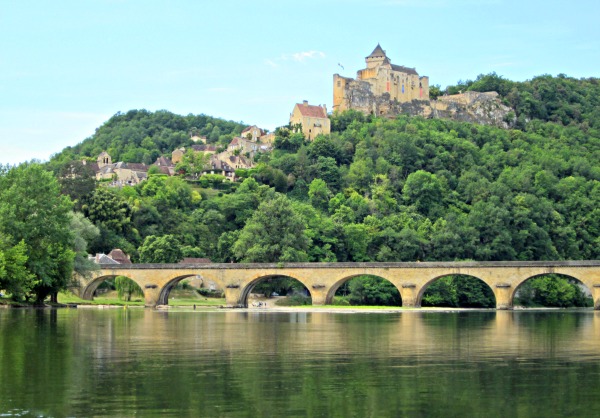
I mentioned I am a bit of a Francophile and a favorite region of mine is the Dordogne Valley. This is a place with history, from Richard the Lionheart to Joan of Arc; pre-history (the Cro-Magnon cave paintings); and beauty. I talked my husband into renting a canoe and we paddled down the Dordogne River, past castles, ancient bridges and towns. This photo with the medieval Château de Castelnaud in the background is a memento of that glorious day:

Canoeing on the Dordogne in glorious weather. Photo credit: Cinda MacKinnon.

Canoe with a view, la rivière Dordogne. Photo credit: Cinda MacKinnon.


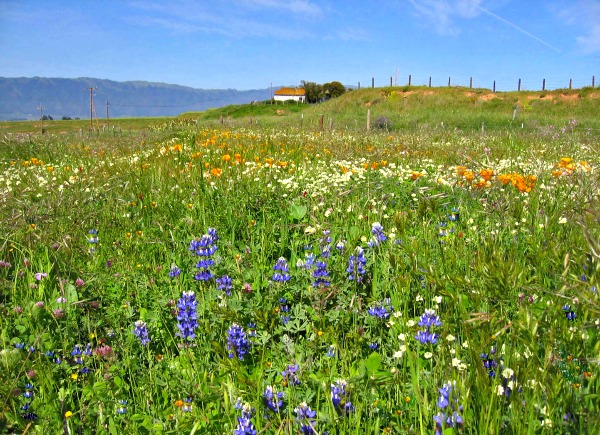
Next, I’d like to show you a photo of a very different place, in California. Actually, I can give you a choice of two: would you rather see the California desert before a rain storm or one of Arvin, a city in southern California? Arvin is interesting because it’s set in hilly grassland that half of the year is dry and dormant but explodes into wildflowers in the spring (if the winter is wet). What’s your pleasure?

Can I have both?
Mais oui! Here’s the Sierras:

The stormy Sierras. Photo credit: Cinda MacKinnon.

The stormy Sierras. Photo credit: Cinda MacKinnon.


And now for Arvin in all of its glory:
A profusion of wildflowers in Arvin. Photo credit: Cinda MacKinnon.

A profusion of wildflowers in Arvin. Photo credit: Cinda MacKinnon.

Both photos are so lovely! That’s why I decided to give you this bonus. But if I really was forced to choose, the desert before the rain is so dramatic. I think you should turn it into a photo-painting using Topaz Adjust or Impression. What’s your last shot?
Another California landscape I’m fond of is Monterey County. When I was a teenager, I read all of John Steinbeck’s novels, never dreaming I would live in California much less end up working in the Salinas Valley as a hydro-geologist for several years. On arriving I felt as though I’d been there before. The town of Monterey itself has become a tourist attraction, but if you go out into the countryside there are still scenes like this one, with the adobe house on the hill:

An enchanted realm near Monterey, California. Photo credit: Cinda MacKinnon.

An enchanted realm near Monterey, California. Photo credit: Cinda MacKinnon.


Please God, don’t let them turn it into another orchard or development!

Here here! I noticed you haven’t included any photos of people. Do you feel reserved about taking photos of strangers?
Yes , and I don’t like portraits to look overly posed. So first I try to take photos surreptitiously. If that’s not possible, I try to be respectful by asking if it’s okay– preferably in their own language. No matter where I travel, I learn some basic phrases in the language of the country (Hungarian was the hardest so far!), but I’ve found that “okay?” seems to be a universal word.

You are right: “okay” seems to have been adopted by most of the planet, though it’s origins are unclear. One theory is that it was derived from a shorthand way foreign-born Americans in the 1830s developed for writing “all correct”—only they’d spelled it “korrect”!

“I will touch a hundred flowers/And not pick one.”–Edna St. Vincent Millay

What motivates you to record what you see through photographs? Is it the ability to capture something unique, which will never be seen again?
Hmmm… I barely think of myself as a photographer; it is one of several hobbies! But certainly, what you say is true of fleeting blooms, and photos do help to preserve memories of wonderful places, whose beauty could vanish. But I think what really led me to photography was my interest in plant nomenclature. I like to block out weeks of time every year to hike in hills, valleys and deserts and search for rare blooms. It is a bit of a treasure hunt, and my photos of evidence of the riches I uncover.

Your modesty is charming, but I think you definitely have an artist’s eye and many of your photographs could be transformed into beautiful pictures with a little more post processing. Which leads me to the technical stuff. Some of our readers may want to know what kind of camera and lenses you use, and how you handle post-processing.
I use a Canon Digital Rebel XT SLR with a macro lens when I am looking for wildflowers in the spring. But for traveling I’ve started to just put my trusty Canon PowerShot in my pocket. I usually use Photoshop for post-processing, but as you’ve pointed out, I’m not adept at all the advanced features. I use “auto” first, and that is generally all I need, except I often crop a shot and, if needed, adjust the lightning or clean up stray blemishes.

Finally, do you have any advice for wannabe photographers who are traveling or living abroad?
It is not the equipment—it is in the eye. Some of my better pictures were taken with a point and shoot. I asked a professional photographer friend if he thought I should buy some filters or another lens, and he said his best shots are sometimes with his cell phone! I guess the motto is “be prepared” for something that catches your eye—be ready for the special moment when the light is right. Make sure your subject doesn’t appear to have an antenna sprouting out of his head at that moment. Don’t use the “sharpen” feature for portraits as it accentuates flaws (unless you want that for character) and can give a severe look. And don’t make your friends look at 200 mediocre photos of your vacation—please cull out the unappealing or out-of-focus ones! (My rule of thumb for talks is 1 to 1.5 slides per minute—that’s 60 to 90 per hour—nobody wants to see more than that.)

Very succinct and good advice, Cinda—right up my street. I’d like to thank you for taking the time to tell your fascinating story in this interview.

* * *

front-cover-place-in-worldReaders, what do you make of Cinda’s close-up photos of exotic plants and her photography advice? I find it curious that she writes about people looking for their place in the world, yet is obsessed with the kinds of flowers that bloom where they are planted. As Georgia O’Keefe once put it:

“When you take a flower in your hand and really look at it, it’s your world for the moment.”

Please leave any questions or comments for Cinda in the comments!

Meanwhile, I suggest that you check out Cinda’s Pinterest boards for more of her botany photos. You can also get to know her better by visiting her author site and blog, and liking her Facebook page. And don’t forget to read her book if you haven’t done so yet, many glowing reviews for which can be found here.

(If you are a photographer and would like to be interviewed by James for this series, please send your information to ml@thedisplacednation.com.)

STAY TUNED for next week’s fab posts!

If you enjoyed this post, we invite you to register for The Displaced Dispatch, a round up of weekly posts from The Displaced Nation, with Alice nominees, exclusive book giveaways and other extras. Register for The Displaced Dispatch by clicking here!

Related posts:

And the September 2014 Alices go to … these 2 international creatives

 © Iamezan | Dreamstime.com Used under license

© Iamezan | Dreamstime.com
Used under license

If you are a subscriber to our weekly newsletter, the Displaced Dispatch, you’re already in the know. But if you’re not, listen up. (Hey, why aren’t you? Off with your head!)

Every week, when that esteemed publication comes out, we present contenders for a monthly “Alice Award,” most of whom are writers or other kinds of international creatives who appear to have a special handle on the curious and unreal aspects of being a global resident or voyager.

Not only that, but this person tries to use this state of befuddlement as a spur to greater creative heights.

Today’s post hono(u)rs September’s two Alice recipients. They are (drumroll…):

1) DANIEL ROUSE, Shropshire-born expat living in Toronto, Canada, and Telegraph Expat blogger

For his post: “Class doesn’t matter in Toronto,” for Telegraph Expat
Posted on: 19 September 2014
Snippet:

Back in Shropshire…it wasn’t uncommon to have friends with nicknames deriving from their occupation; that’s how they are identified. It can be to the extent where a job is married with a first name without pause for breath: “you know my mate Ronnie-the-plumber.” I am guilty of this….

Over here it doesn’t matter what people do for a living, so people from all walks of life socialise together. Being worth a decent conversation is all that matters.

Citation: Daniel, we had rather assumed that the British class obsession would be fading by now. It’s been quite a few years since Maggie-the-Grocer’s-Daughter assumed power, followed by John-the-Circus-Performer’s-Son. Then there was Tony-the-Grandson-of-Actors-&-Grocers. And let’s not forget Kate-the-Party-Planners’-Daughter. But it seems that with the ascendance of David-the-Descendant-of-William IV (albeit via an illegitimate line), class considerations are permeating the land again—having now reached Shropshire. Some may say it’s a good thing—long may class distinctions flourish! A society can’t function if people don’t know their place. And besides, as Downtown Abbey has taught us, upper and lower classes have always been the best of friends. We must confess, however, that we do not find this very sensible. Rather, we think that names, rather than being associated with professions or parents’ professions (and therefore educations, incomes, and class profiles), should be reminders of what a person looks like. The source of our wisdom is the redoubtable Humpty Dumpty, in this exchange with Alice:

“MUST a name mean something?” Alice asked doubtfully.

“Of course it must,” Humpty Dumpty said with a short laugh: “MY name means the shape I am—and a good handsome shape it is, too. With a name like yours, you might be any shape, almost.”

Now some may think Humpty Dumpty has prosopagnosia, but surely he’s just being practical? We also believe that expats would do well to employ this kind of mnemonic device when they first go abroad and are immersed in a phantasmagoria of new faces, body shapes, clothing, hair styles… In your part of the world, for instance, we could imagine epithets like “Big-Boots-xxx” or “Bushy-Beard-xxx” coming in handy. (Listen, you say you know your Canadian friends really well, but we still don’t advise using these nicknames to their faces, just in case…) Congrats on this fine post, Daniel, and we look forward to re-encountering some of this material in your short stories!

2) LINDA RUBRIGHT, former expat in Europe and the Caribbean, and founder of the travel and lifestyle blog the delicious day

For her post: “8 Secrets No One Tells You about Being an Expat,” for Sherry Ott’s new career break site, Meet Plan Go
Posted on: 25 September 2014
Snippet:

Secret #4: You are the punch line to a lot of jokes.
…The tiny differences are enormous differences, and what can you do about it? Expect a lot of laughs—in your direction.

Citation: Linda, you are so right, and have such a good way of putting it: how truly strange a culture can look when you are stuck in its “deep catacombs” (see Secret #2). For sure, “catacombs” are a telltale sign of having fallen down a rabbit hole. And we agree with your premise that exploring said catacombs without a compass can induce “profound loneliness and feelings of complete incompetence” (#2 again) not to mention homesickness (#8). We’d further like to point out that even on Alice’s through-the-looking glass adventure, when she stays above ground, such feelings of discombobulation continue, especially when she repeatedly tries to climb the hill near the house to the beautiful garden—only to find herself back at the house. Did an encounter with the Red Queen shed light on her frustrations? Hardly:

“Well, in OUR country,” said Alice, still panting a little, “you’d generally get to somewhere else—if you ran very fast for a long time, as we’ve been doing.”

“A slow sort of country!” said the Queen. “Now, HERE, you see, it takes all the running YOU can do, to keep in the same place. If you want to get somewhere else, you must run at least twice as fast as that!”

Still, at least the Red Queen was kind enough to attempt an explanation of basic cultural differences. She didn’t laugh at Alice. Which is more than we can say for you that time when you witnessed your Spanish boyfriend’s first attempt to pump gas in the United States and apparently found it uncontrollably funny that, being from Spain, which is 100% full service, he was also not used to gallons, credit cards, or zip codes, and kept fumbling with the machine. But we have news for you, Linda: the joke may be on you in the end. Little did you realize that the most successful expats are gluttons for punishment, and the eight points you list as drawbacks to the expat life in fact don’t perturb us all that much. Why do you think your BF is now your husband, living with you in Colorado? He loves being the object of your humor! In any case, thanks for this great post, and good luck to the pair of you with your travel advice site.

*  *  *

So, readers, do you have a favorite from the above, or have you read any recent posts you think deserve an Alice Award? We’d love to hear your suggestions! And don’t miss out on the shortlist of Alice contenders we provide in each week’s Dispatch, which are sources of creative thought if nothing else! Get on our subscription list now!

STAY TUNED for more fab posts.

Writers and other international creatives: If you want to know in advance the contenders for our monthly Alice Award winners, sign up to receive The Displaced Dispatch, a round up of weekly posts from The Displaced Nation, with news of book giveaways, future posts, and of course, our weekly Alice Award!. Register for The Displaced Dispatch by clicking here!

Related posts:

CHUNKS OF DRAGONFRUIT: A tale by a Chinese American expat woman in China

Dorcas and Dragonfruit cover, courtesy Shannon Young. Purple dragonfruit cubes by http://www.flickr.com/photos/mikebehnken/4996063234/

Dorcas Cheng-Tozun and Dragonfruit cover, courtesy Shannon Young. Purple dragonfruit by Mike Behnken (CC BY 2.0)

How Does One Dress to Buy Dragonfruit? True Stories of Expat Women in Asia is a new anthology edited by our latest columnist, Shannon Young. For the sake of the Displaced Nation audience, Shannon has generously agreed to carve out a few tasty morsels from the writings of the 26 female writers within the collection that highlight their feelings of displacement within Asia. Take it away, Shannon!

—ML Awanohara

Thanks, ML. I’m excited to be doing this. The very first excerpt comes from a piece by Dorcas Cheng-Tozun, called “The Weight of Beauty,” which covers the insecurities she experienced as a Chinese American woman living in China. Dorcas worries that her command of the language doesn’t match her Asian face and her average American weight is considered fat in China (she knows because strangers tell her!). Despite the difficulties, she finds an unexpected connection with her slim, beautiful, bilingual Mandarin teacher.

Here is the beginning of her story:

“The Weight of Beauty,” by Dorcas Cheng-Tozun

“If you went running every day, you could lose some weight.” A maintenance worker with a receding hairline squinted at me as the elevator in our apartment building rose far too slowly. This was the first time I had ever interacted with this man. Unfortunately, he was speaking Cantonese, which meant that I understood him perfectly.

“Mmm…” I responded, avoiding his eyes.

“Really. If you ran every day, you could lose some weight,” he repeated, concerned that I had not given him a proper reply.

I flashed him a tight smile, but I did not trust myself to say anything else before he stepped out of the elevator. As I watched his stooped, retreating back, I tried to remember how I was considered “petite” and “tiny” by my American friends. But the US was, literally, half a world away.

When my husband and I moved to China in the summer of 2008, my body’s relative mass seemed to triple during the time it took us to cross the Pacific Ocean. From my first day living in the industrial city of Shenzhen, my weight was a favorite conversation topic of friends, colleagues, and acquaintances alike. “You’re rather fat,” I would often hear. Or, “Did you gain weight? You look fatter.” If I stepped into a shop, sales clerks would rush forward, stopping my progress with wild gesticulations communicating that they had no merchandise remotely close to my size.

My figure was not the only thing wrong with me in the Middle Kingdom. I had grown up speaking Cantonese in the United States, but I knew barely any Mandarin. And judging by the reaction of the locals, my lack of language skills was by far my greater sin. Restaurant waitresses turned up their noses at me; grocery store cashiers clucked their tongues at me; taxi drivers quizzed me endlessly about my deficiency in Mandarin. My life in China at times felt like a series of one-act plays in which characters emerged with the sole purpose of telling me how stupid, fat, and just plain wrong I was.

“Ignore them,” my husband Ned, whose Turkish and Jewish roots had combined to make him look generically Caucasian, urged me.

“How can I?” I protested. “They’re everywhere.”

“But their opinions don’t matter. They don’t know you.”

That was the problem: they thought they knew me. I was a Chinese woman living in urban China, so knowing how to speak Mandarin was the minimum criterion for proving my sentience. It was equal to a blonde, blue-eyed woman in a cowboy hat and boots in rural Texas barely comprehending a word of English. It just wasn’t supposed to happen.

In exasperating contrast, the locals regarded Ned like a creature with magical properties. They were entranced by his height and broad shoulders, his light hair and green eyes, and they immediately set the bar for cultural competence at zero. All he had to do was say, “Ni hao,” and the same individuals who had been glaring at me as if I had insulted their ancestors as far back as the Tang Dynasty would glow with beatific smiles and tell Ned how amazing his Mandarin was. Ni hao was Ned’s universal password to obtain what would forever be denied to me: respect, attentive service, automatic entry into heavily guarded buildings, and a mysterious fount of Chinese joy and happiness that seemed to emerge only at the white man’s touch.

“He’s so handsome,” Chinese women would tell me, glancing at him through fluttering eyelashes. “Is he your boyfriend?”

“He’s my husband” was a Mandarin phrase I quickly learned to say.

Under the daily barrage of insults and sneers, my former life in the United States as an independent, competent, well-adjusted young woman began to recede from memory. It was as if that old version of me had never existed, as if I had always been the overweight, bumbling idiot that 1.3 billion people seemed to think I was.

I learned to wear an I-don’t-care-what-you-think expression on my face, but in reality, my defenses were only shadows of battlements. I felt as if I was constantly under siege; even the most innocuous encounter could become a surprise assault.

One day I greeted a deliveryman at the door of the office where Ned and I worked. I had done this several times before, and the routine was easy. All I had to do was say “Ni hao,” take the package, and sign for it.

But this time, when I handed the clipboard back to the deliveryman, he scrutinized my signature before eyeing me suspiciously. “Why don’t you have a Chinese signature?” he asked in Mandarin, a stony expression on his face.

“I’m American. I only have an English name.” I spoke slowly and gave him a small, apologetic smile.

“Why don’t you have a Chinese signature?” he repeated stubbornly, red blotches blooming across his forehead.

“I was born in the US I only have an English name,” I repeated just as stubbornly, all traces of the smile gone.

I didn’t understand any of the words he spat at me after that; he was speaking too fast and I was too shocked at his venomous tone. Knowing that I had just been deeply insulted, I refused to give him a response. We faced off in silence for a few tense moments before he turned on his heel, continuing to mutter vitriol under his breath as he walked away.

At that moment, learning Mandarin became my top priority. I contacted a company called New Concept Mandarin, which focused on teaching conversational survival Mandarin. They promptly responded, offering to send a company representative to my office the following day. When I told Ned about it, he asked to join in on the meeting to see if the classes were right for him as well.

The next afternoon, when I heard a knock at the office door, I jumped up from my desk. “I’ll get it,” I announced to the office in general.

Easing the door open, I called a cheery “Ni hao” into the dimly lit hallway. Then I froze.

“Ni hao,” responded the supermodel standing in the doorway.

I couldn’t stop the thought from entering my mind: If this woman isn’t from New Concept Mandarin, she must be a high-class prostitute. My eyes locked first on her dress, a body-hugging, black-and-white-striped mini that revealed every impeccable curve on her petite form. The shine of her straight, long black hair, which she casually tossed behind one shoulder, mesmerized me; her wide almond-shaped brown eyes, her thin upturned nose, and her closed-lip smile left me in awe.

As I stared at her, I remembered how I had barely brushed my hair that morning; how I had a grease stain on my blouse from lunch; how I had an angry zit on my forehead that was probably doubling in size at that very moment.

“Are you from New Concept Mandarin?” I asked in a squeaky voice.

“Yes,” the vision said confidently, with only a trace of a Chinese accent. “My name is Joanna.” She held out a tiny hand adorned by a French manicure.

Feeling oafish, I extended my sweaty, un-manicured hand and awkwardly shook hers. “Please come in.”

I shuffled to the conference table in the middle of the office, conscious that five pairs of eyes followed our progress. The room suddenly felt too open, too public. I didn’t want all my colleagues—and certainly not my husband—seeing what I saw: this epitome of Chinese beauty in juxtaposition with the ungainly, unkempt Chinese American who actually liked to eat.

I invited Joanna to sit in a black swivel chair. She descended gracefully into the seat and crossed her slender legs. I attempted to imitate her movements, but instead I had to steady myself on the armrests when I nearly missed my seat. Clearing my throat to hide my embarrassment, I asked Ned to join us.

* * *

Readers, I hope you enjoyed that morsel! Want to read more of Dorcas’s story? It’s the second in the book, so you’ll be able to finish it if you download the free sample on Amazon. (The e-book and paperback of Dragonfruit are available at all major online retailers.)

And if you’re curious to find out more about Dorcas Cheng-Tozun and her writing, she can be found at chengtozun.com.

I look forward to sharing more excerpts from the Dragonfruit anthology over the next few months.

* * *

Thank you so much, Shannon! Displaced Nationers, any comments on what Dorcas had to say in this passage? Have you ever had the experience of having people look at you but not believe you were (or weren’t) speaking their language? I speak of the phenomenon known as cognitive dissonance…which can make one feel very displaced. Tell us about it, or any other responses you’ve had to this excerpt, in the comments!

STAY TUNED for tomorrow’s announcement of the September Alice Awards.

If you enjoyed this post, we invite you to register for The Displaced Dispatch, a round up of weekly posts from The Displaced Nation, with snippets of worldly wisdom, exclusive book giveaways and our nominees for the monthly Alice Awards. Register for The Displaced Dispatch by clicking here!

Related posts:
DIARY OF AN EXPAT WRITER: Testing one, two, three…Can anybody hear me?

DiaryExpatWriterToday we welcome a brand new columnist, the up-and-coming author Shannon Young. This past summer, Shannon announced she’d cut 18 inches off her hair, quit her day job to become a full-time writer, and given herself a pen name for her new series of adventure novels. And, yes, she is an expat, a kind of love refugee, living in Hong Kong. She has generously agreed to chronicle her writing adventure for us.

—ML Awanohara

Dear Displaced Diary,

In this column, I’ll be recording my experiences as a full-time expatriate writer. Officially, this is only a test.

Let’s start with a bit of background: I have been an expat, an American in Hong Kong, for four years and one month. For the past four years, I taught English in a local primary school while harboring a desire to work in book publishing.

Originally, I wanted to be an editor, to find talented writers and help them get their work into the world. I didn’t think I had stories of my own. Then, I moved to Hong Kong. In my new expatriate life, I found stories: personal dramas, bewildering worlds, opportunities for stimulating observations, and even ideas for fiction.

So, I started writing…

I discovered I love the process: mulling over half-formed ideas, stealing character descriptions from people I saw on the street, scribbling outlines on everything, and sitting down in coffee shops for hours at a time to actually do the work.

Four years later, I’ve completed a number of projects composed of bytes and bits of code, of pages and ink, of words and stories. Each project has taught me to look closer at the world around me. Each project has challenged me to be more diligent and to look for opportunities to write something that will matter.

One of those projects, a Kindle single called Pay Off, discusses how my teaching job in Hong Kong enabled me to pay off my large student loans from a US university. I’ve been debt free since December 2013 so have been able look seriously at other occupations.

I want to keep writing…

My teaching contract ended in July 2014. By that time I had accrued some savings, some complete or nearly complete books, and a husband with permanent residency. Instead of continuing to teach, I realized that now was the time to try to make it as a writer.

This is only a test. If I am not bringing in enough money from my writing (or worse, not enjoying the work) around Chinese New Year, I will start looking for a new job.

For now, I’m jumping in with both feet, seeing if this dream is feasible.

Like becoming an expat all over again…

Quitting a day job to write full-time is a lot like moving to a new country. You might know a bit about what to expect and what to pack. You do your homework; you find stories of people who’ve done it successfully, who love their new lives. You also find stories of people who’ve failed, who didn’t gel with the new place for any number of reasons. Most expats fall somewhere in between, learning to live with the difficulties while also enjoying many good moments.

Some people say it isn’t possible to make a living as a writer. They cite the successes and insist such people are outliers: exceptionally good or exceptionally lucky. As with moving to a new country, I suspect the truth lies somewhere in between. All I can do is take the leap and see if I can make it work.

But, just as I wouldn’t move to a new country without a suitcase, I am not starting this writing journey with a blank Word document and “Once upon a time…”

I have a strategy!

Here’s what I’m “packing” for my full-time writing life:

1) A portfolio of published works—comprising not just the student debt Kindle single but also the anthology How Does One Dress to Buy Dragonfruit: True Stories of Expat Women in Asia, which I edited for a small Hong Kong publisher. It came out earlier this year.* Neither of these works is a huge moneymaker, but sales can add up slowly. More importantly, these two publications have given me valuable publishing experience.

2) A book deal. My memoir of my first year in Hong Kong, Year of Fire Dragons, is being published by Blacksmith Books, an independent Hong Kong publisher, at the end of October. Hong Kong is a small market and even healthy sales won’t pay my rent, but at least I have a book to launch and a tangible opportunity to build my career.

3) A genre series in the works. This is the essential part of my strategy, the heavy winter coat, if you will, that I’m packing as you never quite know, once you become an expat, where you might end up. (I’m in Hong Kong now, but as I never could have predicted that, shouldn’t I be prepared for the day when I move to, say, Finland?) Since late 2012 I have had the wild pleasure of working on a series of post-apocalyptic adventure novels set at sea called The Seabound Chronicles (under the pen name Jordan Rivet). I’ve planned for a four-book series and written drafts of three of the titles. Book One, Seabound, is currently with the copy editor and should be ready to launch in November. I plan to self-publish this series as e-books and POD paperbacks and, frankly, hope to make some money.

4) Last but not least, reasonable expectations. While I am hopeful that the combination of my publishing experience so far, my existing works, and a highly commercial series will enable me to continue doing what I love, I am also realistic. I don’t expect to get rich. The goal here is to build up an audience—and a long tail of sales—that will eventually enable me to pay my rent and buy the occasional plane ticket home to see my family. But my primary expectation is that I will work hard, produce the best books I can, and try to learn as I go.

“If you want a pearl, you must dive for it.”—Chinese proverb

I realize I’m taking a risk by forgoing a steady income and living on savings in order to give myself more time to write. But taking risks is second nature to expats. We leave behind everything we know, and there are never any guarantees about how things will turn out.

My own jump into expat life occurred when I followed the man I loved to his home country. At the time, I didn’t even know if we would get along when we finally lived in the same country. At first, it looked like everything would fall to pieces because a month after I arrived in Hong Kong my boyfriend’s company sent him to London. I had a year on my own in Asia, fearing that my risk had been in vain.

That story has a happy ending: that boyfriend is now my husband—and I love Hong Kong. It was a risk that paid off, but it could have gone very wrong. Now, I hope the risk I’m taking will turn out at least half as well.

And can I tell you a secret, diary? Since I stopped working and started focusing on writing full time, I’ve been deliriously happy. I love having hours to myself each day to sit down and work on my own creative projects. I love reading about the publishing industry and studying other people’s books and careers. I’m trying hard not to become an obnoxious friend who only talks about their own work because it’s all I think about these days.

Yes, I know this honeymoon period won’t last forever, but at least allow me to say: it’s been wonderful so far!

And yes, I sometimes struggle with prioritizing, but that’s because there are so many things I want to do! But I’m gradually getting used to my new routines and performing triage on my to-do lists. I’m developing the daily habits of a writer. I want to use this period well.

Each month, I’ll share a bit more with you about where this journey is taking me. I hope you’ll come along for the ride.

Thanks for reading!

Yours,

Shannon Young
www.shannonyoungwriter.com

*From now until the end of the year, Shannon will be sharing excerpts from Dragon Fruit. Stay tuned!

* * *

Readers, it’s your turn. What is a risk you’ve taken in order to follow a dream? Was it becoming an expat or something even more daring, like becoming a full-time writer? What are some difficulties you faced along the way? Let me know in the comments!

STAY TUNED for next week’s fab posts!

If you enjoyed this post, we invite you to register for The Displaced Dispatch, a round up of weekly posts from The Displaced Nation, with snippets of worldly wisdom, exclusive book giveaways and our nominees for the monthly Alice Awards. Register for The Displaced Dispatch by clicking here!

Related posts:

TCK TALENT: Even without slide projector, projection of life as a Third Culture Kid engages Reykjavík audiences

TCK in Iceland Collage

Elizabeth Liang in front of Tjarnarbíó, in downtown Reykjavík, where she performed her one-woman autobiographical show, Citizen Alien, on growing up as a TCK of mixed heritage. Photo courtesy Elizabeth Liang.

This month Elizabeth (Lisa) Liang updates us on her own creative life, which this past summer veered in the direction of an island situated at the confluence of the North Atlantic and Arctic Oceans!

Halló, vinir mínir! Hello, my friends! I’m addressing you in Icelandic because in this month’s column I’ll be re-creating my journey to Reykjavík, where I traveled in August to perform ALIEN CITIZEN: An Earth Odyssey, my one-woman show about growing up as a Third Culture Kid, or TCK, of mixed heritage.

How did I end up performing my show in Iceland? I have a friend in that part of the world who put me in touch with the artistic director of Tjarnarbíó, a creative center for professional live art in Reykjavík, who enthusiastically offered to host the show if I could cover my travel and lodging. Presented with a chance to combine three of my favorite activities—acting, writing and travel—how could I resist?

Engum flýgur sofanda steikt gæs i munn (“One cannot expect to benefit without making some effort”)—Icelandic proverb

My husband, Dan, agreed to work as my stage manager, which was perfect because he knows the show so well. I launched a successful Kickstarter campaign to raise the requisite funds for our trip, found a cozy house in Reykjavík on AirBnB for us to rent, bought our flights, started promoting the show on social media—and then off we went to the Land of Fire and Ice.

We arrived in ideal weather, cool and dry, which many Icelanders told us was lucky because it had been raining all summer. We were relieved to find that our lodgings were in a quiet, pleasant residential area that was a seven-minute walk to downtown and a 15-minute walk to Tjarnarbíó.

Tjarnarbíó is a beautiful venue with state-of-the-art technology. At the technical rehearsal, the two “techies” who adjusted the lights and projector were friendly and professional. (Incidentally, we never met anyone in Iceland who was unfriendly, and the Icelanders we encountered all spoke perfect English, some with gorgeous British accents.)

That said, we had an unexpected snafu at the tech rehearsal. There are two kinds of projections in the show:

  1. Pictures and videos that are projected onto a screen via my laptop, and
  2. Words that I project onto my torso using an old-fashioned slide projector.

During the tech rehearsal, the slide projector I’d used in the show for over a year konked out. The stage hand and I stared at the plume of smoke rising from the top and said: “It’s smoking.”

No, the problem was not the power converter. We had the right one. Nor was it the bulb. We replaced it but the projector still didn’t revive. So my Icelandic friend’s father-in-law generously loaned us his. More on this later…

Citizen Alien Photo Strip

(top to bottom) At the tech rehearsal, the lights were lowered from the ceiling–fancy!; opening night; closing night; post-show celebratory drink; with Dan in front of Hallgrímskirkja Church; with Dan in Þingvellir National Park. All photos courtesy Elizabeth Liang.

August 20, 2014: Opening Night

We had an audience! I only knew of five people who were planning to attend (of whom I’d actually met only one—my Icelandic friend). What a pleasant surprise to see twenty or so people in the house!

And they laughed! I guess the show’s humor translates.

Dan stage managed wonderfully and the light board operator did a great job, too. The only hitch was that when it came time to project slides onto my torso, the borrowed projector didn’t work, even though we’d tested it earlier. I improvised and the audience went right along with this. (Afterward, a very kind audience member offered to loan us his projector, but when we met later, he realized it had a part missing. So Iceland never got to see words projected onto my torso. Ah, well.)

The best part of opening night was the fact that I enjoyed myself on stage, which hadn’t happened in a while. There were two curtain calls and people stayed afterward to shake my hand, thank me, and say lovely things. It was such a pleasure. About half were Icelandic and the other half internationals—once again, the right people had found me and my show. Several said they would spread the word for the next performance.

A few people from Spain, France, the Czech Republic, and Iceland hung out with us at Tjarnarbíó’s cafe afterwards. They all mentioned different parts of the show that resonated for them, and one said she felt that the show does a service for nomadic and non-nomadic people—it’s like a bridge between them. They thought it should be filmed, which I’m planning to do in December.

All hail my director, Sofie Calderon, for making this show such a dynamic experience for the audience! People from far and wide have enjoyed the production, and that’s Sofie’s doing. If it had been up to me, I would have found ways to hide onstage, because performing a solo show is super scary.

August 22, 2014: Closing Night

More people in the audience, which was very moving, because I knew none of them. The word of mouth from opening night must have been good. And maybe all those promos I sent to the international school and Facebook groups helped…?

The performance didn’t feel as good—I was having less fun and getting fewer laughs—but I forged ahead. Afterward Dan and the light board operator said “No way, it was TIGHT, really good show!” Yet more proof that we actors have no idea how well we’re doing. We only know if the audience is responsive or quiet.

Just like on opening night, a bunch of people waited to speak to me afterward. One was a young adult TCK who was very moved by the show. Another was a professor at the University of Rekjavík whose field of study is TCKs. Their compliments, along with all the words of support from other audience members, was tremendously encouraging.

Because the truth is: before embarking on this Northern European adventure, I had no idea how audiences would react, or if there would be any audiences at all. I had girded myself to perform for a handful of kindly people on opening night and then possibly cancel closing night because who knew if there would be enough interest?

Reykjavík may be a small capital, but as it turns out, it has plenty of residents who are international or international in outlook, and open to trying new things.

Kleina & coffee, Björks in boots, Lutherans & lava…

Beyond the show, Dan and I had a glorious time exploring small but pretty Reykjavík; the Blue Lagoon, a thermal spa located in a lava field in Grindavík; and the Golden Circle, a route the loops from Reykjavík to central Iceland and back. Other highlights included:

  • snacking on kleina, a donut-like pastry in the shape of a trapezoid;
  • visiting Hallgrímskirkja, the Lutheran cathedral designed to resemble the lava flows of Iceland’s landscape, and Settlement House;
  • hanging out at the Boston, said to be one of the world’s best bars, and at several coffee houses; and
  • last but not least, watching singers and dancers all over town on Culture Day/Night, a day and night-long program of cultural events that takes place in August every year and is one of the country’s largest festivals.

I also got a kick out of Icelandic fashion—bright colors, unusual cuts—and, as I love boots, was pleased to see practically every woman sporting boots of some kind: ankle, knee-high, sexy, hiking, and everything in between. (Did I buy a pair? Nope. Iceland is expensive.)

On our last night, we stepped out onto our little street to see fireworks, which felt like a final burst of congratulations. I got teary-eyed!

Overall, it was a delightful trip. Dan and I left thinking we’d like to go back someday. We want to see more of the island (puffins! volcanoes!), enjoy the friendly vibe…and hopefully bring another solo show for Icelanders’ entertainment—but without any cantankerous 1980s equipment.

* * *

Thank you, Lisa! Having only been to the Blue Lagoon as a round trip from Keflavík International Airport, I really appreciated this vicarious journey into the heart of the city’s cultural scene. And, as always, I’m impressed that you were contributing to the culture as well as taking something from it! Readers, please leave questions or comments for Lisa below.

STAY TUNED for next week’s fab posts!

If you enjoyed this post, we invite you to register for The Displaced Dispatch, a round up of weekly posts from The Displaced Nation, with news, book giveaways and other extras. Register for The Displaced Dispatch by clicking here!

Related posts: