The Displaced Nation

A home for international creatives

Tag Archives: Strange sightings

CHUNKS OF DRAGONFRUIT: A tale of an Australian expat navigating her own way in Japan

Dorcas Cheng-Tozun and Dragonfruit cover, courtesy Shannon Young. Purple dragonfruit by Mike Behnken (CC BY 2.0)

Kathryn Hummel and Dragonfruit cover, courtesy Shannon Young. Purple dragonfruit by Mike Behnken (CC BY 2.0)

How Does One Dress to Buy Dragonfruit? True Stories of Expat Women in Asia is a new anthology edited by columnist Shannon Young. For the benefit of Displaced Nation readers, Shannon has generously carved out a few tasty morsels from the writings of the collection’s 26 female contributors, highlighting their feelings of displacement within Asia. This is the second installment. The first can be read here.

—ML Awanohara

For our October excerpt, I’ve chosen Kathryn Hummel, an accomplished poet whose prose immediately stuck out to me for its lyrical quality. She uses intricate details to make her life as an Australian expat in Japan come alive, and she captures the emotions of displacement beautifully.

Kathryn also uses a unique structure featuring a poem followed by a meditation on the stages of expat life: from arrival to finding community to a mid-life crisis of sorts to acceptance. Kathryn draws the full map of a life abroad.

I hope you’ll enjoy the beginning of Kathryn’s piece, which is titled “Charting Koenji.” (Kōenji, for those unfamiliar with Tokyo’s layout, is a neighborhood on the outer western edges of the city.)

“Charting Koenji,” by Kathryn Hummel

Sometimes there are moments that catch in the flow of the everyday like a taped-up tear in a reel of film. Afterwards, there is an almost imperceptible change in the tension and projection of life, when I feel more than I see that Koenji is not my place. While I am closer than a stranger, I am still at a distance: this I measure from the inside out, since I can’t get far enough away to see it as an onlooker, detached but still interested in how the scene rolls on. For the past two years, the everyday scenes of my life have had Japan as a setting: most of these have been concentrated in the district of Koenji-minami, Suginami Ward, Tokyo. During my first weeks here, I intoned that address so many times it became a mantra, a verbal talisman to guard against losing myself in the city. Although being an expatriate—a collection of syllables I don’t often apply to myself—places me in a position of being both inside and outside, when I hear the wooden heels of my shoes clip the now familiar walkways of my neighbourhood, I am reminded only of this place, my present.

I. Arrival

Arrival is not signified by
the unburdening of suitcases
but the mechanics of realisation.
This is where I am, will be:
I have come now to the place
where before I was going.

Being present in a place means you inevitably paint yourself in the picture, draw the map around you. Slip outside these bounds and you are lost, or so I once thought. In 2004 I had stopped in Japan on my way from China to Australia and was delighted by my weeklong visit. I knew that living and working in Japan would be harder than traveling through, when my only responsibility had been to find the best way to be happy before my set departure date. Still, I had friends in Japan and their phone numbers to call; a Japanese language certificate and alphabet flashcards; a few tatami mats’ worth of rented space and a position, courtesy of an arts-exchange program, to write words for an intimate Koenji gallery wanting to commune with the English-speaking art world. If the present was a leafy bough, my future (as well as my literary imagery) would be heavy with the fruit of my Japanese incarnation.

I arrived in Osaka and rested for a few days at the home of Quentin, a university friend who had spent the last three years of his life traveling back to Japan to teach English, a compulsion he would spend another three years satisfying. At Quentin’s suggestion, I made my way to Tokyo on a journey of acclimatisation and language practice. I took a slow train to Hamamatsu to go on a gyoza (dumpling) hunt and traveled on to Yaizu, where, walking to the beach to see the distant Fuji-san bathed in the light of sunset, I met and later made love to a fish-factory worker from Peru. Yet even this encounter had the day-seizing quality of one made on a transient journey only.

When I reached Tokyo, the city was so miserably wet I thought it would never dry out. As arranged, I was met at Koenji station by my landlord, whose easy graciousness flickered warmth over my arrival, and accompanied to the building where my first studio apartment was waiting. After giving me a tour, which consisted of opening the bathroom door and indicating to the rest of the open-plan space, diminished by a folded futon and my wet bags, my landlord retreated with a bow. I was not delighted by Tokyo so far but wanted to be, so I gave my wool scarf a tighter wind, armed myself with an umbrella and ventured out. During my walk, I found that the compass on my Bleu Bleuet watch was only for show—an incidental discovery, since instinct is the direction I rely on above all. At that particular moment, I had none, and the rain didn’t help clarify my position. It leaked somehow through my umbrella and under my collar, where it remained without guiding me. As it usually happens when I walk the streets of a new place, I got lost.

The houses lost me. Or I lost myself in them. Every grey, dun, or cream-colored structure fit together in a maze of reinforced concrete. Some homes were irregularly shaped to sit correctly on their blocks; others had strange additions that seemed the architectural equivalent to tusks and antlers; oddly shaped, overgrown bonsai sprouting various thicknesses of branch and colors of foliage mingled with low electrical wires; antennas, rubbish bins, sometimes just inexplicable but neatly arranged collections of junk, assembled to give the impression that it was still of use, awaited their purpose. There was an element of seediness that did not feature in my memory of Japan: paint peeled from wooden walls and bald light globes had been left burning after midday. In the alleys behind restaurants, I was met with cardboard boxes, broken brooms and wooden pallets, rusty machinery and empty cans of cooking oil. The rain blurred the scenes without actually softening them, making greyer what was already dismal.

I told myself not to try to make sense of the maze. Tomorrow I would find my way to the gallery where I would be working and meet Kenzo-san, its owner, and all would be well if I believed all would be well. At the same time I thought, with naïveté or impatience, that I had to have a plan, that aimlessness would prevent me connecting to Koenji.

Before I left Osaka, Quentin studied my face as if trying to read its meaning. “You should have a Japanese name,” he told me. “Kat-san isn’t so easy to say.”

To me it didn’t seem as difficult as “Kassorin-san,” but I already had thought of a name that sounded appropriately Japanese. “What about Katsu?” I asked. “It’s a mixture of my first and second names: Kathryn Susannah.”

Quentin shook his head. “No. It will make people think of tonkatsu (deep-fried pork). They’ll think it’s strange. Why not choose something that represents you—a tree, or an animal?”

Quentin’s advice may have worked admirably for him in his various Japanese incarnations, but has never yielded the same results for me. I was then, and remain, “Kassorin-san,” a woman who navigates her own way. On that first afternoon in Koenji, I continued to walk until I at last saw something that indicated my flat was not far off: a secondhand bookshop I never have learned the name of, though I did eventually begin to buy books there that I hope to read, one day, with ease. The bookshop is recognisable during the day by its awning of green-and-white stripes, at night, by its security doors. Each of the three doors is painted with a face: one with running mascara and a Clara Bow hairdo, one with a sweat-beaded forehead and a guilty laugh, the last with an angry eye and an imperious-looking nose.

These faces, which remain guarding the bookshop until 11:00 am each day, signal more than my location—they are signposts for my mood. Depending on whether my mind is full or empty as I walk past on my way to the gallery or language lessons or the house of a friend, I either ignore or sympathize with whatever I can read in their expressions: their moods always change. It seems charmingly whimsical to write that these faces were my first friends, though when I realised this, I knew it was time to stop observing and start finding my community in Koenji.

* * *

Poems From Here KHummelReaders, if you enjoyed that morsel, I hope you will consider downloading a sample of the Dragonfruit anthology from Amazon. (The e-book and paperback of are available at all major online retailers.)

And if this excerpt has made you curious to learn more about Kathryn Hummel, her new collection of poetry called Poems from Here has recently been published by Walleah Press. You can also find out more about Kathryn at her author site: KathrynHummel.com.

I look forward to sharing more excerpts from the Dragonfruit anthology over the next couple of months.

* * *

Thank you so much, Shannon! Displaced Nationers, any comments on what Kathryn had to say in this passage? Having lived in Tokyo myself, I found her description of the city captivating. I was also impressed by her determination to “navigate her own way” in a city that makes many of us Westerners feel we’ve stepped through the looking glass.

STAY TUNED for next week’s fab posts!

If you enjoyed this post, we invite you to register for The Displaced Dispatch, a round up of weekly posts from The Displaced Nation, with snippets of worldly wisdom, exclusive book giveaways and our nominees for the monthly Alice Awards. Register for The Displaced Dispatch by clicking here!

Related posts:

And the September 2014 Alices go to … these 2 international creatives

 © Iamezan | Dreamstime.com Used under license

© Iamezan | Dreamstime.com
Used under license

If you are a subscriber to our weekly newsletter, the Displaced Dispatch, you’re already in the know. But if you’re not, listen up. (Hey, why aren’t you? Off with your head!)

Every week, when that esteemed publication comes out, we present contenders for a monthly “Alice Award,” most of whom are writers or other kinds of international creatives who appear to have a special handle on the curious and unreal aspects of being a global resident or voyager.

Not only that, but this person tries to use this state of befuddlement as a spur to greater creative heights.

Today’s post hono(u)rs September’s two Alice recipients. They are (drumroll…):

1) DANIEL ROUSE, Shropshire-born expat living in Toronto, Canada, and Telegraph Expat blogger

For his post: “Class doesn’t matter in Toronto,” for Telegraph Expat
Posted on: 19 September 2014
Snippet:

Back in Shropshire…it wasn’t uncommon to have friends with nicknames deriving from their occupation; that’s how they are identified. It can be to the extent where a job is married with a first name without pause for breath: “you know my mate Ronnie-the-plumber.” I am guilty of this….

Over here it doesn’t matter what people do for a living, so people from all walks of life socialise together. Being worth a decent conversation is all that matters.

Citation: Daniel, we had rather assumed that the British class obsession would be fading by now. It’s been quite a few years since Maggie-the-Grocer’s-Daughter assumed power, followed by John-the-Circus-Performer’s-Son. Then there was Tony-the-Grandson-of-Actors-&-Grocers. And let’s not forget Kate-the-Party-Planners’-Daughter. But it seems that with the ascendance of David-the-Descendant-of-William IV (albeit via an illegitimate line), class considerations are permeating the land again—having now reached Shropshire. Some may say it’s a good thing—long may class distinctions flourish! A society can’t function if people don’t know their place. And besides, as Downtown Abbey has taught us, upper and lower classes have always been the best of friends. We must confess, however, that we do not find this very sensible. Rather, we think that names, rather than being associated with professions or parents’ professions (and therefore educations, incomes, and class profiles), should be reminders of what a person looks like. The source of our wisdom is the redoubtable Humpty Dumpty, in this exchange with Alice:

“MUST a name mean something?” Alice asked doubtfully.

“Of course it must,” Humpty Dumpty said with a short laugh: “MY name means the shape I am—and a good handsome shape it is, too. With a name like yours, you might be any shape, almost.”

Now some may think Humpty Dumpty has prosopagnosia, but surely he’s just being practical? We also believe that expats would do well to employ this kind of mnemonic device when they first go abroad and are immersed in a phantasmagoria of new faces, body shapes, clothing, hair styles… In your part of the world, for instance, we could imagine epithets like “Big-Boots-xxx” or “Bushy-Beard-xxx” coming in handy. (Listen, you say you know your Canadian friends really well, but we still don’t advise using these nicknames to their faces, just in case…) Congrats on this fine post, Daniel, and we look forward to re-encountering some of this material in your short stories!

2) LINDA RUBRIGHT, former expat in Europe and the Caribbean, and founder of the travel and lifestyle blog the delicious day

For her post: “8 Secrets No One Tells You about Being an Expat,” for Sherry Ott’s new career break site, Meet Plan Go
Posted on: 25 September 2014
Snippet:

Secret #4: You are the punch line to a lot of jokes.
…The tiny differences are enormous differences, and what can you do about it? Expect a lot of laughs—in your direction.

Citation: Linda, you are so right, and have such a good way of putting it: how truly strange a culture can look when you are stuck in its “deep catacombs” (see Secret #2). For sure, “catacombs” are a telltale sign of having fallen down a rabbit hole. And we agree with your premise that exploring said catacombs without a compass can induce “profound loneliness and feelings of complete incompetence” (#2 again) not to mention homesickness (#8). We’d further like to point out that even on Alice’s through-the-looking glass adventure, when she stays above ground, such feelings of discombobulation continue, especially when she repeatedly tries to climb the hill near the house to the beautiful garden—only to find herself back at the house. Did an encounter with the Red Queen shed light on her frustrations? Hardly:

“Well, in OUR country,” said Alice, still panting a little, “you’d generally get to somewhere else—if you ran very fast for a long time, as we’ve been doing.”

“A slow sort of country!” said the Queen. “Now, HERE, you see, it takes all the running YOU can do, to keep in the same place. If you want to get somewhere else, you must run at least twice as fast as that!”

Still, at least the Red Queen was kind enough to attempt an explanation of basic cultural differences. She didn’t laugh at Alice. Which is more than we can say for you that time when you witnessed your Spanish boyfriend’s first attempt to pump gas in the United States and apparently found it uncontrollably funny that, being from Spain, which is 100% full service, he was also not used to gallons, credit cards, or zip codes, and kept fumbling with the machine. But we have news for you, Linda: the joke may be on you in the end. Little did you realize that the most successful expats are gluttons for punishment, and the eight points you list as drawbacks to the expat life in fact don’t perturb us all that much. Why do you think your BF is now your husband, living with you in Colorado? He loves being the object of your humor! In any case, thanks for this great post, and good luck to the pair of you with your travel advice site.

*  *  *

So, readers, do you have a favorite from the above, or have you read any recent posts you think deserve an Alice Award? We’d love to hear your suggestions! And don’t miss out on the shortlist of Alice contenders we provide in each week’s Dispatch, which are sources of creative thought if nothing else! Get on our subscription list now!

STAY TUNED for more fab posts.

Writers and other international creatives: If you want to know in advance the contenders for our monthly Alice Award winners, sign up to receive The Displaced Dispatch, a round up of weekly posts from The Displaced Nation, with news of book giveaways, future posts, and of course, our weekly Alice Award!. Register for The Displaced Dispatch by clicking here!

Related posts:

HERE BE DRAGONS: A pox on your expat life! How suffering an illness abroad can inspire fantasy writing

Here Be Dragons Pox

(Clockwise from top) Detail of the medieval map Carta marina; one-day old chicken pox blister, by Evanherk at Dutch Wikipedia (CC BY-SA 3.0); neem leaves, by Miansari66 (CC BY-SA 3.0); Freiberg, by kaffeeeinstein (CC BY-SA 2.0).

HERE BE DRAGONS is back, a column produced by fantasy writer Andrew Couch, an American expat in Germany. We at the Displaced Nation have long been aware of the strong connection between fantasy (think Alice in Wonderland) and a life of international travel and residency. And now Andrew has got us pondering the idea of turning our (mis)adventures into fantasy stories!

—ML Awanohara

A few weeks ago I came down with an adult case of the chicken pox. Seriously, I am in my mid-thirties and never had chicken pox as a kid.

The experience got me thinking about the oddities of dealing with a disease as an expat living abroadand then about how this could become a source of material for a writer like myself, who enjoys leading characters around fantasy realms.

Getting sick in Germany is not the same as getting sick in the United States. To begin with, we don’t have a car, so my wife took me on the tram to see the doctor. He subsequently told me that I shouldn’t really have left the house; my local health service would call me.

In the U.S., we would be driving everywhere and the local health service (do we have one?) couldn’t care less about a case of the chickenpox.

In the end I didn’t get a call from the local health service, nor did my Twitter friends’ predictions I would end up being quarantined come true. And yet I can’t stop thinking about the exposure to disease that comes from riding the trams. Did I get sick because someone else had to ride the trams? Public transport is a glorious thing, but it definitely carries health risks.

Another thing that was strange: the German doctor told me to pretty much suck it up and try not to scratch. Germany, in my experience, is not the super-medicated world we commonly find in the United States.

In the end, despite the fear-inducing comments from friends about how horrible the chicken pox can be as an adult, I had only one day of itchiness amidst a week of hideous red bumps.

Okay, you might be saying, that was really awful, but what does it have to do with fantasy writing? Well, as I mentioned in my first post of the series, the expat experience is a wonderful metaphor for encountering a fantasy world. Why not use the episodes and observations from your life overseas to conjure up fantastical tales?

Here are three ways I can envision using my illness in future stories:

1) Add a plot twist about the threat of sickness and disease and search for a cure. Perhaps I’ll given one of my characters a fever and have a foreign medicine woman tell him to rub certain leaves all over his body. How does he respond? Ohand if you think this is just the realm of fantasy, I did have a friend recommend some Indian neem leaves as a powerful agent for curing skin conditions. I even would have tried them had we been able to figure out how to import them into Germany.

This device could cut another way as well. Perhaps my characters are living in the depths of a jungle, with medicine oozing from every berry, leaf and root. They would likely feel creeped out if required to pay a visit to a city doctor, whose remedy consists of handing out bottles of nondescript white tablets.

2) Use sickness to explore my characters at their worst. In my case, for instance, all I want to do when ill is snuggle under a blanket, drink massive amounts of orange juice, eat grilled cheese sandwiches and watch movies until it goes away. I also want someone to bring me these things. I really would be in trouble if I was not supposed to leave home and didn’t have a wonderful wife (or even friends) to bring me food.

Would my fantasy characters become similarly dependent? How would they cope if deprived of their favorite comfort foods and activities?

3) Explore the fear that comes from a disfiguring illness. You may have had chicken pox when you were small and can no longer remember how you felt. But I tell you this, as an adult with an active imagination, chicken pox are frightening. Bubbly boils cover the body and itch like crazy. Without a ton of stretching (oh, and the fever helped this, too), my imagination could easily have convinced me I had the plague. I refrained from looking in the mirror much, but my wife tells me that I looked as awful as I felt.

And now let’s transfer this physical aspect of disease to fantasy culture. What if my characters didn’t know the long-term impact of the pox? What kind of panic would this induce? Or maybe they know the pox to be non-fatal, but how do they deal with having something that makes them look hideous? Another possibility is that an alien character gets the pox but doesn’t understand when the natives don’t react: is this because they expect that person to die, or because they know the disease will run its course? Terror prevails until that question is answered…

* * *

A few weeks later, I am recovered mostly. I am left with stories to tell.

I also have a mind full of diseases to inflict on future characters in fantasy stories. As the Germans say:

Auf jeden Regen folgt auch Sonnenschein

“After every rain, there will be sunshine.” Similar to “every cloud has a silver lining” but not quite the same as it speaks more to the inevitability of change. “This, too, will pass” would be a closer translation.

For expats, the risk of getting seriously ill while abroad is greater than it is for occasional travelers. Try to recall your first time being sick and dealing with the local culture. Was it more frightening than at home? What about trying to communicate with doctors in another language while suffering from fever? What if your favorite remedy or comfort food just didn’t exist? All of these are situations you can include in your fantasy stories.

Andrew Couch has been a fantasy book nut since childhood; he really has not grown up much since then. After struggling to write his own games for years, he is now creating fantastical worlds in a series of novellas that echo the TV shows, anime and role-playing games of his youth. Beyond fantasy he is an avid blogger and a world traveler who resides in Germany. To learn more about Andrew, check out his blog, Grounded Traveler, and follow him on Twitter: @groundedtravelr.

STAY TUNED for our next fab post!

If you enjoyed this post, we invite you to register for The Displaced Dispatch, a round up of weekly posts from The Displaced Nation, with seasonal recipes, book giveaways and other extras. Register for The Displaced Dispatch by clicking here!

Related posts:

HERE BE DRAGONS: All those cities you’ve visited on your travels? They’re the lego bricks for cityscapes in fantasy writing

Citiscapes Collage

(Clockwise from top) Detail of the medieval map Carta marina; the Speicherstadt (warehouse district) in Hamburg, Germany (photo credit: Andrew Couch); tram in Naples (photo credit: Andrew Couch); legos (photo credit: Morguefiles).

HERE BE DRAGONS is back, a column produced by fantasy writer Andrew Couch, an American expat in Germany. We at the Displaced Nation have long been aware of the strong connection between fantasy (think Alice in Wonderland) and a life of international travel and residency. And now Andrew has got us pondering the idea of turning our adventures into fantasy stories!

—ML Awanohara

Last month on HERE BE DRAGONS, we talked about landscapes: the soaring mountains, unusual geographical formations, torrential storms, and other distinctive natural phenomena that can be used to build a whole new world for a fantasy story.

This month we move to cityscapes: the landscape’s urban counterpart, which has been largely shaped by the hands of man (or beast, depending on your story).

One thing I am learning while writing fantasy novellaswhich has only been reinforced by the posts for this columnis how much I’ve been influenced by my expat life and international travels when attempting to construct my own worlds.

When the bricks stick together, great things can be accomplished…

After living in Europe for several years, I now have a catalog of cityscapes to draw on, from grungy parts of London to quiet Parisian parks to industrialized Hamburg. What’s more, each area of every city has its own distinct sights, sounds and smells. And I’ve come to think of these various parts as my lego bricks for assembling the fantasy cityscape that features in my novellas.

I have heard that the second book is often harder for writers than the first. I am definitely finding this to be the case, but mostly due to character and plot, not setting. The setting of my next few novellas is the city of Resholm, which is perched on the line of cliffs called the Dropline. In creating Resholm I was heavily influenced by my impressions of Hamburg, a city in northern Germany that has a long history of being a free port. Resholm, too, is a port:

QueenOfCloudPirates_cover

A skyline of towers along the ridge watched over the cargo and warehouse districts which dripped down the side of the steep slope, nearly to the edge of the cliffs themselves. Soaring arches piled on soaring arches cut the area in various places to hold up the docking piers. A handful of ships were moored across the area.

Hamburg also has the Speicherstadt, an area where goods could come and go without having to pay customs. I got to thinking, what would a city feel like if it had been created solely for the purpose of moving goods and not for the people in it? Resholm grew from this contemplation. In the stories, the police force exists primarily to safeguard the movement of goods in and out of the port, not to protect residents from harm:

“I don’t know,” Arnhelm said. An hour had passed since the officers of the Teeth had shuffled Jason and him into separate rooms. “Why don’t you ask her? Why are you even hounding my uncle and me? One of her goons nearly killed us and blew up a building in the docks.”

“Listen here, sonny,” the man said. “First off, neither the town nor its populace is in our jurisdiction. Resholm survives on its free port and our duty is to keep it safe. Safe for goods, safe for money and safe for free trade. In my experience, people take care of themselves. If they are smart.”

He leaned forward, picked up a piece of paper from the table between them and began to read. “Endangering goods in the warehouses. Bypassing a checkpoint. Reckless endangerment of transport. And that is before we even talk about the destroyed building in the docklands.”

Could I have created Resholm by studying photos of cityscapes found on the Internet? Probably, but I don’t think the result would have been as rich. Walking around a city is the best way to pick up its sounds, smells and sensations. Building a fantasy city from such memories, you become aware of the details that need to be included. For instance, I decided to include Hamburg’s tall, red-brick warehouses in the Speicherstadt, complete with their cranes and rails to move goods, in Resholm as well. The architecture so happens to date back to the late 1800s, which is the time period I am aiming to replicate in my story.

Sometimes it doesn’t matter what you are building…as long as you’re enjoying the fantasy!

Of course, Hamburg is on water and isn’t dripping down the side of a cliff with airships docked at each level, but hey, it’s fantasy, which means I have the freedom to do what I want:

Only one bulb remained lit and he and Lucia left the tram car. They walked up a set of steps to the road which ran along the level five terrace. The smell of engine exhaust, unwashed humanity and a hint of damp stone assaulted Lors’ nose. The constant wind he had gotten used to didn’t seem to penetrate the row of buildings enough to clear the miasma. Despite the lack of wind, the street was cold. The docklands were in perpetual shadow on the northern slope. He could see the sky between the airships docked at the level above, but its light was so weak that lamps on poles shed he needed the scattered poles with their glowing globes to see anything in the eternal twilight.

A pair of tracks ran down the center of the road. Men stood on carts which ran back and forth controlling them with long handles. Sidings led off to both sides at each building. There was plenty of space to walk on either side, but they had to dodge carts and step carefully to make much headway. This was a place built for shipping goods. People served the crates they carried, not the other way around.

By no means does a fantasy city have to be built from a single real world city. The town square of Resholm is based on my memories of Poznań, Poland. The funiculars that service the docklands are from a day I spent wandering in Naples, Italy, and became fascinated with its tramway network. There are also some pieces of the city that owe to my meanderings in New York. But again, these are my lego bricks that I used to construct a stage for my characters to act upon and interact with each other.

Although my books fall more into the adventure—the characters must traverse a wide terrain—there is an entire genre of urban fantasy set solely in cities. If this kind of thing intrigues you, check out the following works:

* * *

Wannabe fantasy writers who are also travel buffs, how about you? Have you collected some cityscapes on your wanderings you think will affect your writing one day, or perhaps already has? Let me know in the comments. Also, if you’ve been fantasizing about particular topics, let me know, and I’ll attempt to stretch my imagination to discuss in a future post.

Andrew Couch has been a fantasy book nut since childhood; he really has not grown up much since then. After struggling to write his own games for years, he is now creating fantastical worlds in a series of novellas that echo the TV shows, anime and role-playing games of his youth. Beyond fantasy he is an avid blogger and a world traveler who resides in Germany. To learn more about Andrew, check out his blog, Grounded Traveler, and follow him on Twitter: @groundedtravelr.

STAY TUNED for next week’s fab posts!

If you enjoyed this post, we invite you to register for The Displaced Dispatch, a round up of weekly posts from The Displaced Nation, with seasonal recipes, book giveaways and other extras. Register for The Displaced Dispatch by clicking here!

Related posts:

Soccer players for sure, but shouldn’t Germany also be loaning us words? With cherries! say British expat comedy writing duo (huh?)

Denglish 3 Collage

Adam Fletcher (bald) and Paul Hawkins at a book fair, in a screenshot from their Denglish video; Paul atop his Batman car in Prague. All photos supplied by Paul Hawkins.

Like other U.S.-based World Cup fans, I’ve been thinking a lot about Germany lately. The nation certainly has been generous in loaning the U.S. national team all kinds of soccer coaching and playing talent. Coach Jürgen Klinsmann is a German soccer legend, and five players on the U.S. squad spent most of their lives in Germany, including one of the team’s star players, Jermaine Jones (his father, an African American U.S. army soldier, met his German mother while stationed in West Germany; they later divorced).

But is it possible Germany should be offering us even more, as in new words and language possibilities? The answer to this question will require the help of today’s guest, Paul Hawkins, a young British expat in Berlin. With his writing partner and fellow British expat, Adam Fletcher, Paul recently produced Denglish for Better Knowers, an illustrated book of German words and sayings that, in the view of this comedy duo, ought to be imported into the English language.

(German, really? Doesn’t it have lots of rules and too much grammar??)

AND WE ARE GIVING AWAY A SIGNED (PAPERBACK) COPY! Just leave a comical comment on this post, to be eligible.

Paul and Adam may be expats but they are tapping into the long and great British tradition of finding comedy in the quirkiness of everyday life, something I came to value during my expat years in the UK (and still miss). What’s unusual about this pair, however, is that they aren’t afraid to dig for material in a country that has long been reviled by the English (see my recent post on the World Cup). It helps, no doubt, that they’re Millennials. But has their creativity also been sparked by the sheer act of being displaced, of having to navigate another cultural and linguistic tradition? Let’s hear what Paul has to say.

* * *

HowtobeGerman_cover_ds

The book was published in German and English, each language beginning at either side of the book, by C H Beck.

Hi, Paul, and welcome to the Displaced Nation. Before you and Adam came out with Denglish for Better Knowers, Adam produced an earlier work, How to Be German in 50 Easy Steps. What exactly was the impetus for this series?
Well, How to be German was sort of this big, happy accident of Adam’s, where he poked and prodded the various eccentricities of his long-suffering German girlfriend, Annett, and then extrapolated his findings to about 80 million people. But to be fair, he’d also lived in Berlin for seven or so years, during which time he’d had lots of humorous experiences with the curious creatures known as Germans. In fact, the book grew out of an article of the same name Adam wrote, full of his observations about what makes Germans German, from their love for sparkling apple juice to collecting insurance contracts and tilting their windows. His post struck a massive nerve and went viral. Adam describes the book as a “love letter to the German people,” who had somehow adopted him for having such profound insights into their national character. Thanks to him, they were no longer being portrayed as eating sausages, drinking beer, and wearing leather shorts…

Is your German not the yellow from the egg?

And Denglish?
Denglisch for Better Knowers is a follow-up of sorts, a kind of “love letter to the German language,” where we get to celebrate and poke fun at Deutsch (even as we struggle to learn it!), in hopefully a way that only dumb aliens to the language could. Oh, and although I’d assisted Adam with the first book, this time around he roped me into being a co-author. I don’t remember why, but I think it might because I have hair.

And the pair of you also run an online business of sorts, called The Hipstery. In fact, that’s how I first discovered you. How does your entrepreneurial venture fit in with the book writing projects?
Adam and I are creative, but we don’t have very long attention spans.The Hipstery has proved the perfect way to exploit these independently useless character traits. It’s a kind of long-running shambles of a gift business. In fact, it’s been a few different things at a few different times, depending mostly on mismanaged excitement, deluded whims, and confused expectations—perhaps the least impressive of which was an actual shop in Berlin, which, by the end of its short, lazy lifespan was only open for about two hours a week, on a Thursday afternoon, sometimes, maybe. We would get excited, make a little product (a poster, a T-shirt, a game, for example) and quickly release it, after which we got bored and moved on to the next thing.

denglishforbetterknowers_cover_ds

Published in German and English, each language beginning at either side of the book, by Ullstein Verlag.

And at some point the “next thing” became Denglisch for Better Knowers?
In fact, the book began its life as a nice design on a poster, and then one day we saw a lot more humorous potential in the concept.

Let’s talk about Denglisch the word. What does it mean exactly?
Denglisch refers to the increasing amount of English words sneaking into the German language, in place of working, pre-existing German alternatives. It gets used a lot in the German media and tends to consist of ‘”cool”, buzzy, international, marketing-type words such as upgedated, downgeloadet, outgesourcet… Well, our idea was that German has so many great and often humorously unique words that English doesn’t, it should lend us some words, too. In the book, we make a case for our favorite “German” ways to enrich the English language.

With the German language is very good cherry eating

I visited the picture gallery of ten colorful German expressions, watched the promotional video, and even took the Denglish Quiz (got 70%) on the book site. Of all the German words and expressions that appear in your work, which are your top three faves and why?
I guess my three personal favorites would be:
1) Ear worm (Ohrwurm)—describes the phenomenon of getting a song stuck in your head. It’s such a simple, perfect word, it’s amazing English has nothing like it.
2) Hand shoes (Handschuhe)—German for gloves. It’s so lovely. I know this flies in the face of everything I just said about German words that English doesn’t have, but I don’t care. I want it!
3) Is it art, or can I chuck it? (Ist das Kunst, oder kann das weg?)—a wonderful idiom and great example of German humor. I don’t think it needs explaining. It just needs using. It becomes especially useful whenever the British artist Tracey Emin is selling something…

Hmmm… Were there any German words or expressions that didn’t make the book, as the concepts they express are too foreign to be used in English?
There’s quite a lot which didn’t make the book, but I have the time-bothered memory of a deranged old lunatic, so I can’t think of that many examples now. Oh, there was that expression Himmel, Arsch und Zwirn!, which we didn’t include for some reason. It translates literally as “Sky, Arse, and Thread!” and serves as an exclamation of annoyance, like shouting “Damn!” or “Blast!” or “Bollocks!” (if you’re English). It’s pure nonsense (or “nonsense, with sauce,” as you’d say in German), and I guess that’s why we couldn’t include it. You can’t fight fire with fire, and you can’t write nonsense with nonsense, because galactic haircut trouser squabbling. Indeed.

OooKay! Probably I need to read the book to interpret that last statement. I’m curious, how did you and Adam meet, and was it “collaboration” at first sight?
Despite us both being English and both living in Berlin, in fact we first met in the Czech Republic. Basically, I flew out to Prague on a whim in 2012 because friends of mine were driving a convertible painted like Superman there as part of a car rally, after which they planned to dump it. I told them to give it to me. I didn’t have any plans or ideas what to do with the car… all I knew was that if you can get a Superman convertible for free in Prague, you’d be an damned fool/respectable citizen not to do so. Not long after my arrival in the Czech Republic capital, I posted a message on CouchSurfing…something like, “Hello, I’m an idiot who came to Prague, and I don’t know any one, and I’m bored, and do you want to meet for a coffee or a beer?” Well, Adam, who was also in Prague with a friend, replied to my message, and we met up. We soon got talking about what we did: writing, well, actually comedy writing…actually, fairly absurd comedy writing. And upon realizing we were pretty much writing the same kinds of stuff, in the same kind of style, with the same kind of humor, it wasn’t long before we decided to try something together. Pretty weird, right?

Um, what’s the best and worst part of working as a team?
Writing as a team is mostly very fun. The best part is getting to make and hear jokes all day—as opposed to sitting alone, typing gibberish, and always wondering: “Is this funny…? Maybe it’s funny… I don’t know…” The worst part, however, is when you come up with a hilarious punchline like “Congratulations, Binky!”, only to find Adam wont let you use it for some boring reason like: “It doesn’t make any sense.” Which might be true, of course, but let’s not take Adam’s side here.

Is your English all under the pig?

Which part of the UK do you and Adam come from?
I come from London, or North London, or North of London, or Broxbourne, depending on whether I think you know where it is. Adam is from a different place, most notable for it being totally unmemorable. I guess he’s told me about forty times where he’s from, and the only thing I can tell you about it for sure is it has a dreadful school and might be vaguely near Norwich.

And how did you end up choosing to live in Berlin?
Adam moved to Leipzig for a job around seven years ago and then to Berlin about two years later when he became self-employed. I moved here a year and a half ago, for similar reasons. It’s a great place to live and roam free amongst all the freelancers. We call it the Mecca of Delayed Responsibility.

Do you think you will ever repatriate back to the UK?
I don’t think Adam will repatriate because he was never a big fan of England (small talk, weather, having to think before speaking, etc.) and because he’s increasingly becoming somewhat of a reluctant, and highly unqualified, pundit of German culture—something he’s trying to correct throughout his next book, Make Me German. As for me, I could still imagine living in London, just as soon as I become a mega rich oil-baron oligarch with unlimited Oyster card funding. One key difference between me and Adam is the amount of German we’ve learned. The more time you’ve invested in the language, the less you can bear the thought of wasting it by leaving! He’s a lot more invested than I am…

You said that Adam is working on another book. How about you: any more creative projects in the pipeline?
Yes, Adam is hard at work on his next book, Make Me German, which entails undertaking a series of amusing challenges in pursuit of finally learning enough about Germans and Germany to justify his nonsensical position as a spokesperson for their sense of humor. He was last seen trying to write a Schlager song and Nordic-walking in the most German place of all German places, Majorca. As for me, I’ve just finished a book, which comes out in Germany at the end of August, called How to Operate a Human (Gebrauchsanleitung Mensch, in German!) It’s a fun little book rather like an iPhone manual (except for people), which I won’t be able to read.

What do you mean you won’t be able to read it? How is your German coming along these days?
Mein Deutsch hat sich verbessert, aber ich kann meinen eigenen Unsinn immer noch nicht lesen.

Which leaves me with only one thing left to say: Alles klar!

* * *

So, readers, any COMMENTS or QUESTIONS for Paul? Or do you find yourself nonplussed, without words, for what you’ve just heard? In case his rants have made you curious, be sure to:

YOU CAN ALSO LEAVE A COMMENT BELOW to be eligible to win your own free copy!

Can’t wait to order the book? Paul suggests doing so from the Hipstery site, which offers worldwide shipping.

Finally, should you wish to follow Paul’s brilliant career, he can be found at his author site, Hencewise, on Twitter and on Facebook.

To reiterate, alles klar!

STAY TUNED for next week’s fab posts!

If you enjoyed this post, we invite you to register for The Displaced Dispatch, a round up of weekly posts from The Displaced Nation, with seasonal recipes, book giveaways and other extras. Register for The Displaced Dispatch by clicking here!

Related posts:

For this global travel buff who meditates with camera in hand and HDR on screen, a picture says…

Andy Harvard A Picture Says Collage

Canon zoom lens; photo credit: Morguefiles. Andy Harvard enjoying an ice-cold Hansa in a hotel bar off the coast of Durban (photo source: Andy Harvard).

Welcome to our monthly series “A picture says…”, created to celebrate expats and other global residents for whom photography is a creative outlet. The series host is English expat, blogger, writer, world traveler and photography enthusiast James King, who thinks of a camera as a mirror with memory. If you like what you see here, be sure to check out his blog, Jamoroki.

My guest this month is the 45-year-old South African photographer, traveller and chef Andrew (Andy) Harvard. Most chefs enjoy eating and are by nature creative people. Andy is no exception and his creative talents, ideas and passion spill over into his passion for photography, which he indulges on travels in South Africa and worldwide. He has a blog that celebrates all three passions under the descriptive title “snap fly cook”.

An early bird, Andy often wakes-up at 03h00 in summers to be on the beach in Durban, where he lives, in time for first light and sunrise an hour or so later. He is also fond of seeking out “hard to access” locations and revels in the hours spent working and reworking his photos through his favorite software packages. As he puts it:

I find this process very calming and am sometimes like a kid in awe when something magical happens. It is a meditation of sorts for me, an “addiction” that has to be fed. Oh! The wonders of HDR processing.

* * *

Hi, Andy. Even though we haven’t met face to face, we’ve had a fair amount of electronic communication over the past six months, and I’m pleased we’re finally doing this interview. Before we start I’d like to thank you for the support you gave me when I was grappling with the real basics of DLSR and HDR photographylike how to take the lens cap off so my photos wouldn’t look so dark! I know you were born in Durban, which was the first place I visited in South Africa, in 1990. When did you spread your wings and start travelling around photographing different places?
It all started in 1999 at the end of a relationship. My ex-girlfriend and I had travelled to destinations such as Mauritius and the Maldives luxuriating in 4 & 5 star hotels and resorts. As part of our very amicable breakup, she gave me a free return flight to England, where I met my (now) best friend, Jason. He and I flew from England to Amsterdam for three nights. Remember the adage “what goes on tour stays on tour”? Well, I will say no more than it was a good tour and the start of my real travel and photography adventures.

Now we all want to know more; please carry on, Andy.
Well, I have mostly travelled alone and up until meeting my wife, have enjoyed adventuring by myself. I found that travelling with others has the potential to cause unnecessary complications. Maybe you want to eat Italian and your companion wants to eat Indian. One wants to head into Northern India, and the other wants to go spend a week in a houseboat in Kerala, a state in southwest India. I have no problem talking to strangers, mingling and keeping myself very busy. Budget accommodation and street food are my favorites, although I have been known to spend 5,000 INR (Indian rupees, around 80 USD) on a lobster and 14,000 INR (around $2,300 USD) on a hotel room in Mumbai, as well as similar amounts in other locations. But that is only once in a blue moon. It will, therefore, come as no surprise that on each occasion I have been to India, I have suffered from food poisoning.

Concentrate the mind on the present moment – Buddhist precept

You’ve been to quite a number of places in the world. Can you give us a clearer idea of the range?
I have travelled on business to Swaziland and many other destinations in South Africa. In pursuit of the Buddhist spiritual path, I have been to Germany, Spain and the UK to participate in retreats and festivals. I have an appetite for grassroots communication that has taken me to countries such as Brazil, Thailand, Croatia, Turkey and Lesotho. Meeting people from various cultures has been a great inspiration. According to Trip Advisor, I have been to 18 countries and 115 cities.

I understand you like to disconnect completely when you’re on a trip?
When I travel, I have minimal to nil contact with my home country. I purposely detach myself from everyday life for the time I am away so that I can dissolve into a dreamland of new discoveries and possibilities.

Despite having gone North, South, East and West, you are currently living in your birthplace, Durban, a city of which I have fond memories. It’s so long since I was there! What is life like in your hometown these days?
Durban (Zulu: eThekwini, from itheku, meaning “bay/lagoon’), for those who don’t know it as well as you do, is the largest city in the South African province of KwaZulu-Natal and the busiest port in South Africa and Africa. Though a major manufacturing hub, it’s also a major centre of tourism because of its subtropical climate and fabulous beaches. I don’t think it’s changed much since you left. We Durbanites have always been “laid back”. Our roads are nowhere near as busy as those in the capital, Johannesburg. The beach is still magnificent for surfers and sun lovers, but swimmers must take care. The surf is big and the sharks bite! It’s never cold as you will know, but often the humidity is high. Let’s see, what else can I tell you? Oh, I know. Durban is the home of the Sharks Rugby Union, who are usually title contenders (rugby being our national sport).

It still sounds like a great place to be, but as I became an adopted Capetonian, I afraid I can’t support the Sharks. It’s the Stormers for me.

Receive the present moment, pleasant or unpleasant, just as it is… – Buddhist precept

Let’s get down to one of your passions that is fast becoming one of mine, too—photography. First, you have kindly agreed to share three photos that capture some of your favorite memories. Can you describe the story behind each one and what makes them so special for you?
These three photos are from 2009 and 2010, before the photography bug really bit me hard. But they have each etched a place in my heart.
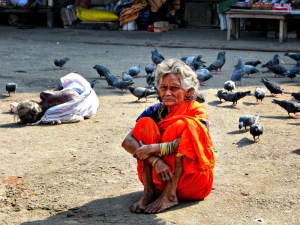
Calcutta_1

The grim reality of poverty in Kolkata; photo credit: Andy Harvard.

This photograph, taken in Kolkata (aka Calcutta), India, shows an elderly, thin, grey-haired lady in an orange sari. The lady in the white sari, lying curled up on the ground, I’d previously seen walking hunchbacked, slowly and in considerable pain, toward Mother Teresa’s home. I had a strong suspicion she was desperately trying to reach Mother Teresa’s Home for the destitute, sick and dying. I do not recall having ever having seen poverty of this magnitude when walking the main and side roads of South Africa, or anywhere else.

The picture alone tells a tragic story but your explanation adds a lot more. Thank you.

Calcutta_2

Another view of poverty in Kolkata, slightly more uplifting; photo credit: Andy Harvard.

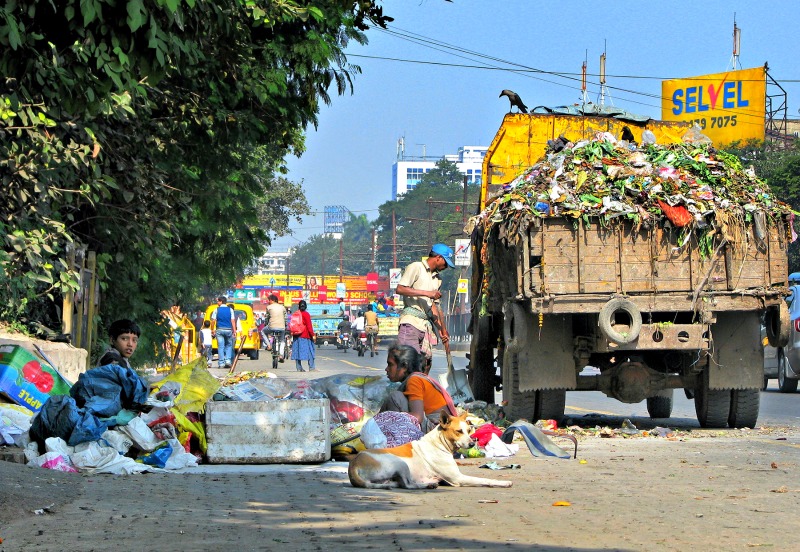
This photo, also taken in Kolkata, indicates how desperate the lives of some people still are. The driver shovels refuse onto the truck while the crows watch in anticipation of scraps as a lady and her son appear to do so as well. The lady was searching for food and maybe something of value whilst her son sat quietly guarding their personal belongings. The dog, relaxed, watched as drivers constantly hooted and maneuvered around one another. A lot of noise but minimal fuss, no road rage or the time-consuming jams we tend to associate with dense traffic. The Kolkata experience was very brief, but I felt a sense of spirituality here. Small shrines are erected on the sides of most roadssometimes seen every fifty metres or so. Every person (other than the beggars at the temple), including the crows, dogs and cows appeared to be busy, desperately doing something meaningful in their quest for survival.

Knowing the story behind this photo helps us to appreciate how well you have captured a small corner of peace and quiet surrounded by a cacophony of noise.

WorldCup_SouthAfrica

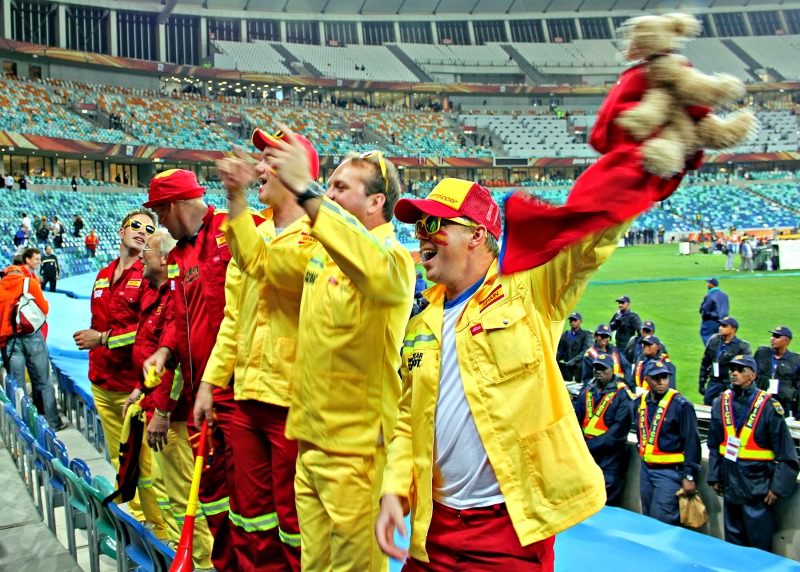
The 2010 World Cup quarter-final match Uruguay vs. Spain, held in Durban, SA (Spain won to eventually take home the title); photo credit: Andy Harvard

Spain beat Germany in Durban on 7 July 2010. They reached a World Cup final for the first time and went on to beat Holland in Johannesburg. The only goal in Durban came from a header by Carles Puyol. This was the first time I had witnessed extreme soccer fever, and this photo won a competition in one of Durban’s newspapers.

In this photo you have captured the spirit of the occasion, which is now upon us again in Brazil. Congratulations on your award.

The key to happiness is inner peace – Buddhist precept

Next we’re going to talk about some of your current favorite places to take photographs. Can you explain why these three places inspire you and how it shows in the photos you’ve selected?
1) Huge mountains, deep valleys, tranquillity, big skies, rural living, clean fresh breezes, golden lightMonteseel, in the Valley of One Thousand Hills, makes one realize how small and insignificant certain problems we all have actually are:
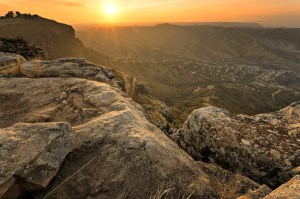
Monteseel, in the  Valley of 1000 Hills, South Africa; photo credit: Andy Harvard.

Monteseel, in the Valley of 1000 Hills, South Africa; photo credit: Andy Harvard.

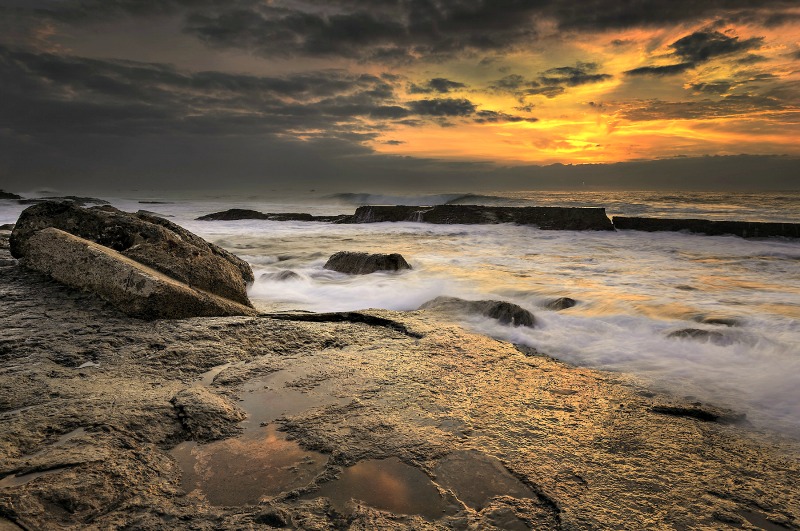
2) This unspoiled coastline with restricted access is literally around the corner from Durban’s Central Business District, which we call CBD. It’s a photographer’s paradise:
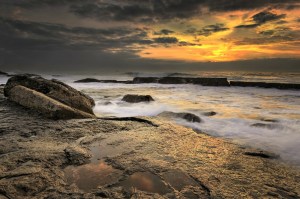
SouthAfricanBeach

Northern Bluff coastline, Durban, South Africa; photo credit: Andy Harvard.

3) Early mornings at this spot are full of activity: surfers, ski boats, fishermen, sailboats, people exercising, seine netters, photographers, holiday makers, recovering late night revellers and more. After a year of hard slogging, I managed to take this serene pier shot:

MoyoPier

Moyo uShaka Pier, Durban, South Africa; photo credit: Andy Harvard.

This photo actually won first place in my photo club’s monthly competition. The chairman said:

Brilliant, love the symmetric composition with a warm and cold side, slightly reminiscent of Turner’s sky in The Fighting Temeraire.

I know that Monteseel is an awesome place, so powerful it’s almost overpowering. It’s a great capture. Your photo of CBD is so dramatic that, although I know how warm the sea is, it looks positively cold. Why have you never shown me this before? It’s awesome. So you had to work a bit to get the last one! Well done.

You should move with a sharp consciousness… – Buddhist precept

Would you say that photography and the ability to be able to capture something unique, which will never be seen again, is a powerful force for you?
Yes, but more importantly, photography is the way I choose to meditate. I go into a semi-transcendental state when shooting and later when processing the photos on the computer. I believe the habit dates from my mother’s death in early 2013. When we visited her in hospital, we would all sit on the veranda outside the ward while I took night-time photos. Later, when going through some boxes of photos she had taken in her youth, I learned that she had been a photographer of “social” note. Not long after, I got hooked on HDR photography. I was a member of a Buddhist tradition for two years, attending teachings and meditation classes about 6–7 hours a week. Now my “meditation” is taking photos while a new day dawns in near complete silence and then sitting for hours post-processing photos to create a work of art. It isn’t a jobit’s a passion; and I want to keep it that way and share the results with others.

Thank you, Andy, for sharing such a fascinating personal story. Now for the technical stuff. What kind of camera and lenses do you use?
I have a Canon 6D, 17/40mm and 24/105mm. I also have my “old” baby Canon 550D which uses either lens above when not in use by “big brother”.

And which software do you use for post-processing?
Which software do I not use? I will use any software available to manipulate my photos to achieve the look I want to see. I know no bounds in this regard. I started with Photomatix HDR software and would attempt to “HDR” everything I could at any time of the dayi.e., dogs, people, machinery and trees. Later I learnt that this was a little foolish but, as I realized when reading this article on the topic, a necessary part of my progression. Lately, I’ve been shooting fewer exposures and manually blending them in Photoshop with layers and masks. I am new at this and on another learning curve.

Sounds like you are a post-processing junkie. I can identify with that and hope to move up to your level when I understand a lot more about the various programs. Finally, do you have any advice for wannabe photographers who are traveling or living abroad?
Be confident and take charge. Keep the camera in hand or on a sling (not deep in a bag). Take lots of photos and even different angles on the same scene. Go into a tunnel zone where you are only thinking about and taking photos. Get down on the street and get dirty. Find top photographers who you admire and follow them. Study their work and every word on their pages (great tips sometimes come hidden in a few sentences). Look at the best photo you find and think “I can do this and better, it might just take some time”. Some really kind photographers offer free tutorials in video or written formatmake the time to find them and work through them.

* * *

Thank you, Andy. I have really enjoyed our interview. Your story is so compelling and you do approach things from a different angle to many of us.

Readers, what do you make of Andy’s experiences and his photography advice? And do you have any questions for him on his photos and/or experiences? Please leave them in the comments!

And if you want to know more about Andy, don’t forget to visit his blog, Snap Fly Cook. You can also connect with him on Facebook and visit his gallery of “special” photos on Pixels.com.

(If you are a photographer and would like to be interviewed by James for this series, please send your information to ml@thedisplacednation.com.)

STAY TUNED for next week’s fab posts!

If you enjoyed this post, we invite you to register for The Displaced Dispatch, a round up of weekly posts from The Displaced Nation, with seasonal recipes, book giveaways and other extras. Register for The Displaced Dispatch by clicking here!

Related posts:

From soccer hater to World Cup fanatic: A most peculiar expat tale

FIFA World Cup Collage

The Brazilian player Edmilson Santos, by AK Bijuraj; CocaCola FIFA World Cup Soccer, by Mike Mozart; FIFA World Cup trophy, by Warrenski (all CC).

To mark the start of the 2014 World Cup in Brazil, I have updated a post I wrote four years ago, in time for 2010 World Cup, in South Africa. I wrote it for the now-defunct Pond Parleys, the brainchild of esteemed writers Toni Hargis (a British expat in the US, with an American husband) and Mike Harling (an American expat in the UK, with an English wife).

In America, of course, we call it soccer. But I am content to say “football.” If there’s one thing I learned from living in England for nearly ten years, it’s to use the English language with precision (in which case, shouldn’t it be “foot-and-head ball”?).

So, herewith, an attempt to tell the rather twisted tale of my conversion to football fandom, though part of me will always wonder: is my story more typical than one imagines? Surely, a taste for football isn’t easily acquired by those who don’t have it in their national DNA?

PART I: Why I Never Liked Football Whilst Living in England

This little tale of mine begins on a dark and stormy night in the latter years of the 20th century. I am living in football-mad England but am rapidly developing an aversion to the sport, squandering my first real opportunity to see it played at a professional level.

Chalk it up to my contrarian nature. I’m not one to throw myself into chanting, banner waving, and other tribal behaviors before I’ve had a chance to study what’s going on and make a full appraisal. And it did not take me long to find things I was less than enamored of, including:

1) The game itself—the endless running up and down the pitch with hardly any scoring. The few times I watched a football match, I inevitably got up to make a cup of tea, or dozed off, just as the one goal of the match was being made.

2) The fans—mostly male, many of them yobbos (some of whom are now chavs?). But even if we leave social class out of the equation, a good number of the UK’s football fans appeared to be hooligans, not exactly the most appealing lot—especially to a grad student like me, whose images of England had been formed from a steady diet of Jane Austen novels and Merchant-Ivory period movies. Occasionally violent male bonding rituals weren’t on the agenda. (I’m sure it didn’t help that my arrival in England coincided with football hooliganism reaching new levels of hysteria.)

3) The jingoistic tabloid coverage—which reaches its height whenever England plays Germany. I happened to be living in London in 2006, when the semifinals of the European finals, between England and Germany, took place at Wembley Stadium. What a palaver! The British mass-circulation paper The Daily Mirror ran a front-page headline “Achtung! Surrender!” over a photo of two England stars wearing World War II helmets. Years later, when England met Germany in the 2010 World Cup, held in South Africa, John F. Burns contributed an article to the New York Times contending that such “rib-poking” has provided catharsis for England and Germany over the years. Who am I to contradict Burns, the Times‘s London bureau chief and an expert on interpreting his native culture? Still, I couldn’t help but think of the late American historian Howard Zinn‘s warning that harmless pride can become an “arrogant nationalism dangerous to others and to ourselves.” Red card!

It’s perhaps worth noting that of all the reasons I came up with not to like football, none of them included the argument that occasionally surfaces in right-wing circles in the United States, which is that football is collectivist and carries the threat of “socializing” Americans’ taste in sports.

As an expat, I had a choice: keep skating along the surface and pretend football doesn’t exist, or else try and go closer to the beating heart of my adopted culture and see what makes it tick.

So I gave football a miss and moved back to pursuing a life of cream teas, theatre performances, cricket…wait did I just say “cricket”? I must be getting batty… (hahaha)

PART II: How I Came to Change My Mind About Football, or At Least the World Cup

Am I looking forward to this year’s World Cup championship games in Brazil? Why soitenly! Numbskull that I am, I’ve finally gotten with the program!!

Herewith, the second part of my most peculiar tale. As explained in Part I, I never paid much attention to the sport despite nearly a decade of exposure; on the contrary, I developed an abhorrence for it.

But four years ago all of that changed. Having settled back in the United States, I found myself powerfully drawn to the championship that took place in South Africa, and I expect it will be no different this time around, with the World Cup being hosted by Brazil. (While I’m sad that Paul the Octopus is no longer with us, I take comfort in the thought of Nelly the Elephant taking his place—her punditry is apparently on a similar level.)

I can’t pinpoint the precise moment when my conversion happened, especially as football still has all the same drawbacks I’d once noted: goals are few and far between, the fans are predominantly male, and jingoism reigns, particularly between the English and the Germans.

All I know is that it wasn’t until I was back in my own culture that I felt comfortable giving the sport a chance. Yes, I know this is ironic considering that the UK is considered to be the cradle of the game (the English have been kicking balls competitively since at least 1314), whereas we Yanks still aren’t quite there.

My top three reasons for fanning football are:

1) It’s the World Cup, stupid. Living in England, I couldn’t see the World Cup forest from the local English football club trees. But when watching the very best players in the world compete, even a hardened skeptic like me can start to appreciate why they call it The Beautiful Game. Those feet of theirs—they are using them like hands! That Messi fellow: it looks as though the ball is glued to his feet; how extraordinary! Xavi Hernández and Andrés Iniesta: it’s incredible how they can pass the ball through the midfields! And let’s not forget Yaya Touré and the way he switches gears. Robin van Persie has a left foot to die for! And so on…

2) It’s a much-needed distraction from other kinds of world events. There’s nothing quite like a soaring soccer ball to lift the spirits, not to mention the vicarious pleasure of seeing a team, and a nation, carry off the trophy. I can still recall the thrill of watching the first European team win outside Europe, at the tournament in South Africa. ‪Viva España!‬

3) It’s on a par with, or perhaps even better than, the Olympics. Ironically, even though there is nothing quite like football to arouse nationalistic urges, the World Cup is, as the name suggests, a world competition, with 32 nations competing. (Compare that to America’s World Series—now that’s a misnomer!) Repeat expats like me, who are a hybrid of nationalities, are the ideal supporters of such sporting events. I think it also helps that I don’t really have a dog in the race. Though America competes, we aren’t yet a serious contender for the cup. This leaves me free to throw my support behind almost any athlete or team that I think are the world’s best. The Olympics of course provide many such opportunities; but that’s the problem: there’s too much choice. What I love about the FIFA World Cup is that it’s a singular occasion. There can be no bigger stage, literally as well as figuratively, than the vast pitch on which this ultimate sporting drama takes

*  *  *

It’s time to hear from you, dear reader. Is my conversion complete, or should I be bending the case for football still more, by stressing its potential for opening up intergalactic communication and fostering truly universal harmony? And even if you don’t share this new-found enthusiasm of mine, can you at least relate to the experience of getting to know and love a sport outside the ones you grew up playing and watching? Do tell!

STAY TUNED for next week’s fab posts!

If you enjoyed this post, we invite you to register for The Displaced Dispatch, a round up of weekly posts from The Displaced Nation, with seasonal recipes, book giveaways and other extras. Register for The Displaced Dispatch by clicking here!

Related posts:

HERE BE DRAGONS: Dreaming up a landscape from your world travels for a work of fantasy

HBD Landscape CollageWelcome to the second post in our new series, HERE BE DRAGONS, in which fantasy writer Andrew Couch, an American expat in Germany, brings our attention to the connection between fantasy writing and a life of international travel and residency. In the series opener, he pointed out how expat life in all of its glorious strangeness can be a feed for the fantasy writer’s imagination. And today? He talks about how one’s travels can inspire other-worldly landscapes.

—ML Awanohara

Many people think that fantasy is a genre set apart, but fantasy stories, like those in any other genre, center on compelling characters and the struggles they face. As epic fantasy author Patrick Rothfuss once said:

If you want to write a fantasy story with Norse gods, sentient robots, and telepathic dinosaurs, you can do just that. Want to throw in a vampire and a lesbian unicorn while you’re at it? Go ahead. Nothing’s off limits. But the endless possibility of the genre is a trap. It’s easy to get distracted by the glittering props available to you and forget what you’re supposed to be doing: telling a good story.

Yet clearly there are some elements that set fantasy writing apart, and today I want to talk about one of them: landscapes. By “landscapes” I of course refer to the great swaths of nature not created by man. Often in fantasy writing, they are more than just a backdrop—they represent the force of primal nature that must be appeased or overcome. A landscape can also inform how a society is built and what drives it. (I will devote some time to urban-scapes and architecture in future posts.)

Obviously, setting plays a major part in other genres—see the works featured by JJ Marsh in her Location, Locution column—but I would argue that in fantasy writing, a great deal of time should be devoted to conjuring up a physical landscape for your make-believe world. Tolkien understood this very well. The Lord of the Rings would not have the same impact without those soaring mountain ranges.

“What are men to rocks and mountains?” —Jane Austen

Speaking of Lord of the Rings: After joining my wife in New Zealand during her round-the-world trip some years ago, I suddenly understood why Peter Jackson filmed his Lord of the Rings series in his native land. (Older TV series such as Xena: Warrior Princess and Disney’s Hercules were likewise filmed in New Zealand.) The landscape is so varied, so grand and… well…conducive to fantasy! I don’t know which portions of the Rings movies were filmed where, but I certainly had some ideas on our day through Fiordland National Park, which occupies the South Island’s southwest corner. This is the park surrounding Milford Sound, considered to be one of the world’s top travel destinations.

Due to my fear of flying, I never imagined I would make it as far as New Zealand (literally, half a world away)—but I’m so glad I did. After stopping in Queenstown, we took an overnight bus trip out to Milford Sound. Our bus was glass topped—our first hint of the wonders to come. Between Queenstown and the park entrance are lakes and rolling hills—pretty enough; but once you hit the edge of the park, the scenery becomes much more fantastic. We entered a dense beech forest that evoked visions of natural spirits. Then, after traversing the three valleys toward Milford, we caught sight of the mountains.

How to describe those mountains, which the early Queenstown settlers nicknamed The Remarkables? The human mind tries to makes sense of new experiences based on information it has already collected. For instance, we compare a new food to something we’ve already eaten or a a new piece of technology to X on steroids. But the mountains in Fiordland did not really compare to anything I’d seen before. Those I’d seen before were big, but somehow these were even bigger, and more awe-inspiring.

Sitting at the top of the Homer Tunnel gazing down into the valley, I could readily imagine ten thousand orcs (mythical humanoid creatures, the idea for which was developed by Tolkien) rushing up to besiege our bus of a dozen tourists.

We were surrounded on three sides by enormous sheer rock faces with what looked like trickles of water flowing down them, about a handspan wide. But then our guide informed us that these streams were a meter wide, which meant the mountains were not as close as I’d thought: they were a couple of miles away. So much bigger than I’d imagined! Um…my vision of ten thousand orcs began to seem rather pitiful.

Steam-powered dreams

Queenstown is in Otago, a region that opened up after gold was struck in the 1860s. This led to an influx of foreign miners, many of whom were goldrush veterans.

So while the landscape before me conjured up the feeling of Middle-earth, the setting for most of Tolkien’s fantasy writings, in reality most of the region’s early settlers were part of the Steam Age.

QueenOfCloudPirates_coverI didn’t consciously think about it during our tour, but now that I’m writing a series of fantasy novellas, Crossing the Dropline, I can see that my impressions of the mountains, along with my thoughts about the steam era, have fed into my imaginative process. For instance, Cloud Rock is a precious resource in the story. It powers flight and comes from only one region, called Beyond the Dropline, a harsh landscape that is both protected and contested by different groups. So the challenge becomes: can the power of Cloud Rock be harnessed outside of the Dropline?

South of the Dropline, raw ore [Cloud Rock] no longer had as much power. The real breakthrough of rotor technology was how to use it outside of the ranges. Natives had been floating with ore for centuries before the league explorers brought a sample back and engineers developed a way of refining and attuning it to the energy of Air in the rest of the world. That was only thirty years ago and hailed as the advent of powered flight. From that point on the Iron League had controlled the skies and had grown in influence. They had shifted from sea vessels to airships and proceeded to grow their trade empire around the Circle Sea and over the mountains into the west. Lors had heard on the news that the other nations were growing uncomfortable, but the news man had reassured them that the League diplomacy corps had everything under control.

At the mercy of nature

Nature is sometimes a primal force that characters in a fantasy story must overcome. My wife and I had perfect weather on our trip through Fiordland, but it was not hard to imagine a torrential storm ricocheting off the mountains and threatening to wash us over a steep cliff. In my novella series, the characters have to contend with not only human antagonists but with mountains that float in the sky:

He could see the front of the dark clouds out beyond the floating mountain peaks. An ever churning mass of dark clouds stacked into a formidable wall moving slowly away from them. Then another flash lit the sky and Lors saw what Arnhelm had been watching.

On top of the massive wall of clouds strode the figure of a bearded man. He loomed the size of one of the tall steel buildings in downtown Ironholme and was wrapped in a robe made of the clouds. He shone with a pale white light. Every step he took on the clouds caused sparks to ripple out and illuminate the sky.

“Storm giant,” Jason said from next to Lors. “Pretty, isn’t it?”

The first book only hints at it, but soon the spirits of the howling North will try to tempt the characters. They will become more present as the series develops.

* * *

I made the trip to Fjordland years before I started writing novellas, but the memory of those mountains continues to haunt—and inspire—me.

How about you? Do you have a landscape in mind you think will affect your writing one day, or perhaps already has? Let me know in the comments. Also, if you’ve been fantasizing about particular topics, let me know, and I’ll attempt to stretch my imagination to discuss in a future post.

Andrew Couch has been a fantasy book nut since childhood; he really has not grown up much since then. After struggling to write his own games for years, he is now creating fantastical worlds in a series of novellas that echo the TV shows, anime and role-playing games of his youth. Beyond fantasy he is an avid blogger and a world traveler who resides in Germany. To learn more about Andrew, check out his blog, Grounded Traveler, and follow him on Twitter: @groundedtravelr.

STAY TUNED for the next fab post!

If you enjoyed this post, we invite you to register for The Displaced Dispatch, a round up of weekly posts from The Displaced Nation, with seasonal recipes, book giveaways and other extras. Register for The Displaced Dispatch by clicking here!

Related posts:

For this globe drifter and Adult Third Culture Kid, a picture says…

Rachel Kanev Collage

Canon zoom lens; photo credit: Morguefiles; Rachel (right) with her friend Sara experimenting with make-up and photography with the help of a bottle of wine (or two?) and some props (photo credit: Rachel Kanev).

Welcome to our monthly series “A picture says…”, created to celebrate expats and other global residents for whom photography is a creative outlet. The series host is English expat, blogger, writer, world traveler and photography enthusiast James King, who thinks of a camera as a mirror with memory. If you like what you see here, be sure to check out his blog, Jamoroki.

My guest this month is 24-year-old Rachel Kanev. She has a Bulgarian father and German Jewish mother but grew up in England, where she studied French and Chinese languages. She feels she got “…caught somewhere in between” these many cultures:

With my Jewish nose, Bulgarian skin and English accent, I at once belong to British, East German, Bulgarian, Jewish, French and Chinese cultures and yet to none of them at all.

Her grandmother, by contrast, lived in Berlin for decades but was more English than Tetley tea.

Indications of Rachel’s escalating identity crisis are borne out in the images that bombard you upon reaching her engaging blog, Global Drifting, in which she says she is drifting across the globe in hopes of stumbling upon enlightenment…

* * *

Hi, Rachel. I’m pleased your globe-drifting has taken you to the shores of the Displaced Nation, which gives us the opportunity to discuss your photo-travel experiences. For one so young you’ve travelled a fair bit, but where were you actually born?
I was born in my mother’s hometown of Berlin, at the traffic lights on the way to hospital. My mother said I looked like a hedgehog that day, and my family still calls me Igel (“Hedgehog” in German). A few months later, the Berlin Wall came down and one year after that, we all moved to England.

So you were a Third Culture Kid in Britain. When did you spread your wings to start travelling?
My nursery and primary school classes were filled with international children. Eugenia—a Spanish girl from Madrid with long black hair and a passion for witchcraft and the Greek goddess Athena—soon became my best friend. In the momentary way that often strikes a child, I was devastated when she left me to return home for good. So, at the tender age of nine, I boarded a plane alone, in my size 1 shoes, to visit Eugenia in Spain. As I began my first solo journey, I experienced a thirst for discovery, which, as yet, has not been quenched. Since that first adventure, I have visited Italy, Holland, France, Austria, Switzerland, Réunion Island and China. I plan to step (in my now size 5 shoes) into Morocco and perhaps Israel this coming summer.

What do you love so much about travel?
I love travel because everything is new and unknown; we share no past and perhaps no future with the things we see and people we meet. The errant wanderer therefore has no choice but to revel in the present.

Will I ever get over the pull I feel to both of these places?

Despite your age, I think I can put you in the category of seasoned traveller. Tell me, what inspires your decision to travel to particular places?
My inspiration comes partly from a love of languages and partly from the idealistic images of France I painted in my head when watching French films and listening to French music, which I did while revising for my exams at university. Aided by the amazing Erasmus, that towering figure of the Renaissance, I had taken a university year abroad in the island paradise of Réunion, near Africa. It’s a French overseas department so qualifies for the European Union’s Erasmus Programme, which finances students to spend up to a year of their university courses in a university in another European country. But it wasn’t until after finishing university that I had a chance to visit France itself. I meandered through southern French villages like an aimless hippie, reveling in its rural chic.

I understand you also have a passion for China?
Chinese was my third language at university. After graduating, I remained in England saving pennies as a waitress to finance spending a year in the land of silk. I lived in a city about an hour from Beijing.

I’m curious: where are you right now and what are you up to?
Right now I’m back living in my English hometown of Cambridge, selling nutritional products to vitamin-mad French and German customers—and saving up for my next Chinese/Moroccan/Spanish/Israeli adventure this summer. As I look out of the window, I am visualizing being there already, far from the Land of Vitamins C and D!

RK_SouthofFrance

No use crying over spilled wine! Rachel in the cellar of a now-defunct winery near Perpignan, France; photo credit: Rachel Kanev.

Hmmm… I think I detect something of the entrepreneur in you, alongside your intrepid traveller’s spirit! And now let’s have a look at a few of your favorite photos from your travels to France and China.
Sure! I took this first photo in a wine cellar in a small hamlet near Perpignan, some way off the coast of southern France. I’d been helping out, but it was late December, and there was very little work left. Besides, the winemaker, whose name was Bernard, had gone bankrupt due to the stresses of organic farming. Our main task for the day, as his helpers, was to pour bottle upon bottle of wine down the drain as he looked on bemoaning the demise of the modern world. It proved a good way to get skillful with a corkscrew!! And I think poor Bernard appreciated our efforts quite a lot. Just think if he’d drunk all that wine in his cellar, it would have sent him spiraling into an even deeper fit of depression…

RK_dragonriceterraces

China’s Longji (Dragon’s Backbone) Terraced Rice Fields are so named because of their resemblance to a dragon’s scales; photo credit: Rachel Kanev.

The next photo provides a glimpse of the glorious Dragon rice terraces of Longshen, in China’s Guangxi province. Amazing terraces stretch as far as the eye can see. I visited some years ago and remember being in awe at the combination of nature’s beauty and the skillfulness of the human hand. I had quite an adventure ambling through the fields with two of my Chinese friends. We got lost and at one point envisaged spending a cold night cuddled up to the cows. In the end we reached our hostel, at the top of the terraces, by nightfall. I returned again last year and was saddened to see that the beauty of the fields has been marred by the greedy hand of tourism. Huge plastic cable cars now transport visitors to the top, and the local villagers are paid to dress in traditional clothes.

RK_AnotherBernard

A French farmer, another Barnard; photo credit: Rachel Kanev.

Last in this series we have another Bernard who stumbled into my traveller’s path. This Bernard is an 80-year-old farmer with whom I lived on my own for a week. His farm is an hour away from the nearest town and is completely self-sufficient. He grows his own organic vegetables and was fit enough to hack up the ground with a pickaxe when the underwater pipes burst (ironically, I had left the home of Bernard number 1 because his pipes had burst and the water system needed to be repaired, only to be faced with more burst pipes at the home of Bernard number 2!).

I love the first photo just because it looks as though you’ve broken into someone’s cellar and are drinking all the wine!! The dragon terraces appear so surreal to me because they are so different to the flat rice fields of Thailand, where I live. I wish I could see them one day. I know you take a lot of photos and these next four, I believe, have a special significance for you. Can you explain?

Not all who wander are lost…

The following is a photo I took of a photo of Bernard number 2, which was taken some fifty years ago, when his newly polished army boots took their very first steps away from the small village on the outskirts of the Pyrenees, where he was born. He bid farewell to the farm he’d grown up on and to the parents who’d raised both him and the thriving trees and crops that had formed the backdrop to his childhood. By the time I encountered Bernard, nature had outlived his parents but their legacy remained. He is now a beekeeper and organic vegetable farmer, tending to the very same trees and plants that his father and his father’s father had cared for. Though he has no human family, the trees you see in my other photo of Bernard (above) appear to me to be his forefathers; they are equally his children.

Bernard as a young man

The French farmer Bernard as a young soldier; photo credit: Rachel Kanev.

The next photo was a fluke as I managed to capture an ad for Longines watches showing Kate Winslet just as the sun was setting. In that fleeting instant, one can see Shanghai’s varied transportation, high-rise buildings and red lanterns—that curious amalgamation of Western modernity and Chinese traditionalism that is everywhere around you in the city.

RK_ShanghaiSunset

A British beauty, a Swiss watch and a Shanghai sunset; photo credit: Rachel Kanev.

Cambridge is my home town and I think of it much like a family member, having watched it age and evolve just as it has silently witnessed me grow and change. I love its grandiose architecture, endless greenery, and the way winter and spring intertwine in front of the University’s palace-like structures that are fit for if not a queen then the rulers of academia, to which I never belonged.

RK_CambridgeUK

The dreaming spires of Cambridge; photo credit: Rachel Kanev.

Here my sister explores the labyrinth-like forestry of a park near where we live in Cambridge. It has amazing multi-coloured plants I have never seen anywhere else before and huge trees that watch over you like silent giants. I like this photo because she looks like Alice in Wonderland with her long, thick flowing locks!

RK_SisterinPark

The great outdoors near Cambridge, UK; photo credit: Rachel Kanev.

Is photography sometimes a moral decision?

I love your explanations as they show us the profound effects a picture can have on its creator, something the viewer can never fully appreciate. Tell me, do you ever feel reserved about taking photos of people, particularly when they are conscious that you are doing so?
For me, the morality of taking photos of strangers has always been ambiguous. I think of it whenever I see photos of human suffering. I believe I have the right to use my camera to record the world but without intruding on it. At what point does the power of images and the need for education and understanding through the push of a button and flash of a light become intrusive and affect the lives of others in a negative way? I’ll give you an example from my own experience. The Western media has focused almost exclusively on China’s explosive economic growth when in fact 1.6 million people (11.8 percent of the population) still live below the poverty line. When taking the train, part of me would like to photograph the dirt-covered, barefooted children asleep on newspapers or the train door frozen from the inside as passengers are left to deal with the icy temperatures of the North (-37°C). But feeling intrusive, I refrain.

Do you also feel self-conscious in Asia?
It’s difficult being subtle, given the colour of my hair and skin, and the stamp on my passport. Noticing me walking the streets of China, many Chinese will assume, quite rightly, that I am Western but quite wrongly that I must therefore have dollar bills rolling from my body like a central bank printing press. Often I do not wish to fuel their prejudices by whipping out a digital camera, however small, before their eyes.

As a resident in Thailand, I can empathize with those views, especially the general Asian misconception that all Westerners are rich. Although this can be annoying, I do believe these views are changing for the better, as the younger generation becomes more socially aware through travel and better education. Now let’s turn to the technical stuff. Some of our readers may want to know what kind of camera and lenses you use.
I have a small Samsung camera that fits neatly in the palm of my hand. It’s nothing fancy and often leaves something to be desired in terms of quality, but it was a birthday gift years ago and has sentimental value, having been my only travel partner across unknown lands. Whatever it lacks in lens quality, Windows Photo Gallery makes up for in magical editing power!

Finally, do you have any advice for wannabe photographers who are traveling or living abroad?
Wander through villages, peel garlic with a farmer, shake hands with a prince, run through jungles, leap into waterfalls, swing across the rainforest wilderness and lose a leg to the marble rocks—see the world and allow the world to be seen. Travel, live, eternalize what you see with a photo.

Great non-technical advice, Rachel, that’s right up my street! I’d like to thank you for taking the time to tell your fascinating story in this interview.

* * *

Readers, what do you make of Rachel’s experiences and her photography advice? And do you have any questions for her on her photos or her travels? Please leave them in the comments!

And if you want to know more about Rachel Kanev, don’t forget to visit her blog, Globe Drifting. You can also follow her on Twitter or even shoot her an email.

(If you are a photographer and would like to be interviewed by James for this series, please send your information to ml@thedisplacednation.com.)

STAY TUNED for next week’s fab posts!


If you enjoyed this post, we invite you to register for The Displaced Dispatch, a round up of weekly posts from The Displaced Nation, with seasonal recipes, book giveaways and other extras. Register for The Displaced Dispatch by clicking here!

Related posts:

And the April 2014 Alices go to … these 4 international creatives

 © Iamezan | Dreamstime.com Used under license

© Iamezan | Dreamstime.com
Used under license

If you are a subscriber to our weekly newsletter, Displaced Dispatch, you’re already in the know. But if you’re not, listen up. (Hey, why aren’t you? Off with your head!)

Every week, when that esteemed publication comes out, we present contenders for a monthly “Alice Award,” most of whom are writers or other kinds of international creatives who appear to have a special handle on the curious and unreal aspects of being a global resident or voyager.

Not only that, but this person tries to use this state of befuddlement as a spur to greater creative heights.

Today’s post honors April’s four Alice recipients. They are (drumroll…):

1) TONI HARGIS, author, blogger, and British expat in Chicago

For her post:  “Learn to Take a Compliment, Brits in America” in Mind the Gap, a resource blog for British expats in America on BBCAmerica.com
Posted on: 18 April 2014
Snippet:

Many British teachers admitted that they and their students found it very hard to fill in applications for American colleges because they were asked for “accomplishments and strengths” as well as academic achievements. As one contributor put it, U.K. teachers “are not very good at waxing lyrical about [their] students other than in academic terms.”

Citation: Toni, what an absolutely marvelous post! Only don’t you think you should have promoted your credentials a little more? After all, you’ve written a book called The Stress-Free Guide to Studying in the States, the contents of which we expect could be useful to Bashful Brits. Actually, you do refer to the book in passing—but don’t provide the title or a link. Hey, never miss an opportunity to blow your own trumpet! But listen, as you insist upon being so self-effacing, we feel justified in presenting you with this inspirational passage from Through the Looking Glass, where a banquet is being held in honor of the diffident Queen Alice, who can’t quite believe she’s been made a queen:

[Alice] didn’t see why the Red Queen should be the only one to give orders; so, as an experiment, she called out “Waiter! Bring back the pudding!” and there it was again in a moment, like a conjuring trick. It was so large that she couldn’t help feeling a little shy with it…; however, she conquered her shyness by a great effort, and cut a slice and handed it to the Red Queen.

“What impertinence!” said the Pudding. “I wonder how you’d like it, if I were to cut a slice out of you, you creature!”

It spoke in a thick, suety sort of voice, and Alice hadn’t a word to say in reply: she could only sit and look at it and gasp.

“Make a remark,” said the Red Queen: “it’s ridiculous to leave all the conversation to the pudding!”

One last word of advice, if we may: Should you feel at all embarrassed about accepting an Alice, rest assured, a simple “thanks” will do. No need to curtsey… Notably, this last accords with what the point you make at the end of your excellent (as well as thought-provoking!) post:

…when someone praises you, your spouse, your children, your dog or your house, a simple “Thank you” will both suffice and move the conversation swiftly along without too much excruciation on your part.

Again, as the Red Queen puts it to Alice: “You ought to return thanks in a neat speech.”

2) Anthony The Travel Tart, Australian travel addict and blogger

For his post: “You Know That You’ve Been Living in Japan Too Long When…,” on The Travel Tart
Posted on: 18 March 2014
Snippet:

You know that you’ve been living in Japan too long when…

  • A room the size of a cubic metre feels rather large.
  • Capsule hotels feel quite spacious.
  • Wide open spaces freak you out.

Citation: Anthony, we assume you met quite a few expats during your time in Japan. Because your inference that the longer a foreigner stays in Japan the stranger he or she becomes is spot on (and one of us speaks from a too-long experience of having lived in that small-island nation). Picture for a moment what happens to Alice after she enters the White Rabbit’s house and downs the contents of the “Drink Me” bottle:

She went on growing, and growing, and very soon had to kneel down on the floor: in another minute there was not even room for this, and she tried the effect of lying down with one elbow against the door, and the other arm curled round her head. Still she went on growing, and, as a last resource, she put one arm out of the window, and one foot up the chimney.

This is actually a case where one might prefer to be Alice rather than an expat. She at least has the ability to drink potions or eat pieces of mushroom to change her body size. But many gaijin remain permanently stuck in the White Rabbit’s house (not for nothing has Japan achieved notoriety as the “rabbit-hutch nation”). Downing the contents of a bottle of Suntory whisky or taking a bite of a matsutake (pine mushroom, prized for its spicy aroma) won’t make the blindest bit of difference. Oh, and incidentally, it’s arigato, not origato, but that’s okay as it means you didn’t stay too long—though you may want to add “correcting other foreigners’ Japanese” to the list.

3) MATT HERSHBERGER, writer and blogger at A Man Without a Country, and 4) British dialect coach ANDREW JACK

For the post: “A quick video guide to the accents of the British Isles”, by Matt Hershberger on Matador Network, which features Andrew Jack’s brilliant video (produced by Philip Barker).
Posted on: 20 April 2014
Snippet: Matt, who once lived in England, says:

As an American, I can’t even replicate the accents properly, so if I tried to ask for help distinguishing an accent from a British friend later, the best I could hope would be that I’d sound sort of like Stewie Griffin, and nothing like the accent I’d heard.

Citation: Matt, we take your point that when venturing abroad to a country where they speak the same language, it is most disconcerting when you can’t understand what people are saying because of their heavy accents—a true “through the looking glass” moment. (We fear that Brits may have some of the same troubles in the U.S., but let’s face it, you’d expect that in a country of this size, not of one as tiny as Britain.) We appreciate that you highlighted the video of Andrew providing 14 regional accents from the British Isles in 84 seconds: how awesome is that? As one of the YouTube commenters says, “good for ignorant North Americans”—some of whom, me might add, may plan to be (or have already been) expats in the UK. And we appreciate it even more when recalling that Poor Alice had no interpreter for the White Queen’s methods of communication:

“My finger’s bleeding! Oh, oh, oh, oh!”

Her screams were so exactly like the whistle of a steam-engine, that Alice had to hold both her hands over her ears.

“Oh, much better!” cried the Queen, her voice rising to a squeak as she went on. “Much be-etter! Be-etter! Be-e-e-etter! Be-e-ehh!”

The last word ended in a long bleat, so like a sheep that Alice quite started.

*  *  *

So, readers, do you have a favorite from the above, or have you read any recent posts you think deserve an Alice Award? We’d love to hear your suggestions! And don’t miss out on the shortlist of Alice contenders we provide in each week’s Dispatch, which are sources of creative thought if nothing else! Get on our subscription list now!

STAY TUNED for more fab posts.

Writers and other international creatives: If you want to know in advance the contenders for our monthly Alice Award winners, sign up to receive The Displaced Dispatch, a round up of weekly posts from The Displaced Nation, with news of book giveaways, future posts, and of course, our weekly Alice Award!. Register for The Displaced Dispatch by clicking here!

Related posts: