The Displaced Nation

A home for international creatives

Tag Archives: Movable feasts

When a Julia Child-like curiosity about French cuisine leads to a displaced life — bienvenue au October theme

The first time I was introduced to the Slow Food movement was in the land of its birth, Italy. My husband and I were in Florence for the wedding of his niece, and we ended up befriending and dining out with a couple of the other guests: a Chinese-American brother and sister from California who were serious gourmets and would only go to Slow-Food restaurants.

Ever since then, I’ve been puzzled.

Not by the concept of Slow Food itself. I get the idea of savoring a meal that is cooked from fresh, locally-sourced ingredients and that has not been prepared in advance — we’re talking the anti-Fast Food.

What’s more, I had enormous fun in Florence peering at all the restaurant doorways to see if they had a snail symbol. “No snail? Well then we’re not eating there,” I would declare to my husband.

No, what I find confounding is that the movement started in Italy, not in France.

For me, Italian food, with its pizzas, anti-pastas and gelatos, comes fairly close to being the fast food of Europe.

That could never be true, of course, of French cooking. (And what better symbol of French cooking than a snail, btw?)

I feel certain Julia Child would agree with me. An expat in Paris for many years, Julia belongs in the Displaced Nation’s Hall of Fame because of her refusal to be satisfied with her native country’s Anglo-derived plain food consisting of meat and potatoes and two veggies — let alone the fast-food version: meat (as it were), bun, French (quel insult!) fries, no veg.

Addressing just one of these nefarious ingredients, Julia once said:

How can a nation be called great if its bread tastes like Kleenex?

For Julia, France was a spiritual as well as culinary homeland. As she wrote in her memoir, My Life in France:

I fell in love with French food — the tastes, the processes, the history, the endless variations, the rigorous discipline, the creativity, the wonderful people, the equipment, the rituals.

A date with destiny

Julia’s first forays into foreign cuisine occurred when she worked for the Office of Strategic Services (the precursor to the CIA) during World War II.

She was posted first to Kandy, Ceylon (now Sri Lanka), and then to Kunming, China. Along the way, she met, and fell in love with, Paul Child, an early example of a foodie. At Paul’s initiative, they entertained themselves by exploring Ceylonese and Chinese cuisine and culture.

The pair married the year after the war ended, and Paul went to work for the American Embassy in Paris — a move that proved fortuitous in the extreme for his wife’s career.

For their first meal on French soil, Paul ordered sole meunière. For Julia, it was an epiphany — “the most exciting meal of my life.” The scales fell not just from the fish but from her eyes. She could see what American WASPs like herself were missing out on: sauces made with fresh herbs, butter, wine, and so forth.

The rest is history.

Bon appétit — say what?

Well, not quite. To be honest, I don’t think Julia’s approach to French cooking ever really took hold here in the U.S. We pretended that it did because we loved Julia so much. We loved her for her jolly-jape sense of humor and melodious voice.

But half the time, we didn’t understand what she was wittering on about.

Now, Julia knew that her fellow citizens were mostly flimsies (her word for people who aren’t serious about food). But she thought that the key to converting us was to provide a step-by-step outline of the centuries-old techniques that the French learn like a language: how to make foundation sauces, how to do a roux, how to lay in flavor, how to be patient.

The blogger Julie Powell tried to cook all 524 recipes in Child’s encyclopedic Mastering the Art of French Cooking, in a single year. Some say it was a gimmick, but I say, hey, she deserves the fame — including the honor of having Amy Adams play her in the ensuing Nora Ephron film, Julie & Julia.

‘Fess up: when was the last time you cracked open Julia Child’s magnum opus and gave her recipes a try?

Food writer Regina Schrambling wrote in a post for Slate just after the film’s release, analyzing the problem:

Consider the boeuf bourguignon depicted so romantically in the movie… The ingredients and instructions for its recipe span three pages, and that is before you hit the fine print: The beef stock, braised pearl onions, and sautéed mushrooms all require separate procedures. Step 1 involves making lardons and simmering them for 10 minutes in a precise amount of water; seven steps later, the fat is finally skimmed off the sauce, which is either boiled down to thicken or adjusted with liquid if it’s too thick.

And this is considered an entry-level recipe….Even simple sautéed veal scallops with mushrooms involve 18 ingredients and implements and two pages of instruction.

TDN’s October theme

Still, if expat blogs are anything to go by, a Julia Child-like curiosity with France and French cuisine has continued unabated since Julia’s own time. There is no shortage of Americans (also some Canadians and South Americans) who have relocated to France and intend to stay for as long as it takes to learn the art of French cooking at some level.

Partly out of curiosity, partly out of jealousy, The Displaced Nation will peer into the lives — and kitchens — of several of these expats during October.

What is it actually like to make the Ultimate Slow Food your focus? It any less daunting because of living in France and adopting the French lifestyle? And like Displaced Hall of Famer Julia Child, do today’s expats have (or hope to have) a spoon in the soup back here: are they planning to stir things up and convert us?

Readers, do you have any questions you’d like us to explore on this theme? Vas-y! Let us know!

If you enjoyed this post, we invite you to subscribe to The Displaced Dispatch, a weekly round up of posts from The Displaced Nation, plus some extras such as seasonal recipes and occasional book giveaways. Sign up for The Displaced Dispatch by clicking here!

Image: MorgueFile

“My country, ’tis of thee” applies to my expat mum but not to me

We take a break from road trips today with this guest post from Lawrence Hunt, a recent graduate of Warwick University (UK). Followers of The Displaced Nation may recall that we interviewed two cross-cultural married couples last summer. Hunt is the product of a cross-cultural union between an American mother and an English father. Let’s listen to what he has to say regarding the oft-perplexing matter of cultural identity. NOTE: This post has not been edited for British spelling or punctuation.

One of the things that expats like to tell themselves is that home is a state of mind.

But for me, the child of an English father and an American mother, home stands for a physical place: the one where I was born and grew up, England.

For years my mother has sipped her morning coffee from the same extravagantly large mug, Stars and Stripes boldly printed around the outside. She picked it up at an airport in Washington DC where we were visiting her sister. It’s curvaceous and welcoming, a daily caffeinated hit of homeland comfort. I’ve started drinking from it, too — but more as an ironic gesture.

Mum grew up reciting the Pledge of Allegiance in class, but in ultra-PC Britain, patriotism has to be decidedly lower key. It seems commonplace to see flags hoisted outside American homes, but over here the very act of being seen with a St George’s flag in any context other than sporting events or royal weddings is infrequent enough to draw stares. People see you with it and instantly wonder what fanatical scheme for national purification you’re plotting behind closed doors.

Now, I don’t fault my mum for being proud of her cultural upbringing. I think in some ways her extended absence makes her all the more keen to assert her identity and share it with us.

She did some family history research recently that confirmed we’re the distant descendants of Charles Carroll of Carrollton, the only Catholic and longest surviving signatory of the Declaration of Independence. That’s my strongest claim to fame, and I’m holding onto it.

Chocolate — the way to an English child’s heart

That said, America has never played much of a role in our regular family rituals. For one thing, traditions like the Fourth of July and Labour Day just aren’t compatible with the British calendar.

I do remember Mum hosted a wonderful Thanksgiving dinner once with some other American expats when I was little. Without having the next day off to recuperate, however, everyone left early and I think she found the mountain of washing up too colossal to repeat the effort.

The one institution she has passed down to us (and this is something I cannot thank her enough for) was the American Easter basket hunt. The concept, as I explain it to my friends, is simple but ingenious – essentially, it’s what all kids in England do but with two key differences: 1) More chocolate, and 2) Baskets.

While other English kids were being handed single Cadbury creme eggs in flimsy cardboard boxes, my brothers and I were racing around the garden looking for mighty hoards of chocolate hidden among the shrubbery by a miraculously literate bunny that knew how to spell our names on post-it notes.

As American as everyone else in Britain?

Basket cases aside, it’s difficult to say exactly how ‘Americanized’ I am as a result of my mother, and how much of it is just living in a country where America’s influence pervades almost every cultural platform.

The most differentiating feature of mum’s background has always been her accent. I can do a pretty convincing American accent on a good day, and I used to mimic my mother so often when I was a child that I still lapse into it sometimes without realising.

But even my mother, having lived here for almost thirty years, isn’t really that American any more in her diction. I think the few Americanisms I sometimes find myself using, like ‘movie’ rather than ‘film’, or ‘take-out’ rather than ‘takeaway’, are more because I hear them in American movies and prefer them than because I’ve picked them up from her.

I certainly feel something for the States — a fondness and a familiarity, I suppose. I’ve been lucky enough to go with her on visits to her family almost every other year since I was a baby. Some of my favourite memories have come from spending summers at lake houses in North Carolina, climbing the mountains of West Virginia and walking down endless blocks of New York.

When I was seventeen I took a position teaching at a French camp in the woods in Minnesota, and made friends who I still keep in contact with.

America as distant entity

But America lives for me, as it does for many Brits, more in fiction than in reality. From the moment I read JD Salinger, I was hooked, and I’ve probably read more American writers than British ones: Steinbeck, Fitzgerald and Kerouac, right through to more recent contemporaries like Bret Easton Ellis, David Foster Wallace and Jonathan Franzen.

They all essentially seem to be commenting on the same thing: the tragic failure of American life to live up to its promises. Paradoxically though, in the richness of the characters and landscapes they describe, they evoke a utopia in my mind that’s been hard to shake.

In my final year at university I enrolled in a contemporary American Literature module — ‘States of Damage — US Writing and Culture in the Post 9/11 Context’. I didn’t know what I was getting myself into. It was a step-by-step dissection of everything wrong with free market America, from George Trow’s attack on media culture in ‘Within the Context of No Context’ to Naomi Klein’s The Shock Doctrine, an expose on America’s foreign policy over the past 40 years.

The critique seemed appallingly one-sided to me, and an hour a week for an entire year I felt compelled to fight America’s corner against the scathing intellects of my fellow students. Truth be told, I just like a good debate, and this was a difficult one. There’s a lot about American politics that we find objectionable in British culture — even though we’re implicated in most of the same hypocrisies ourselves.

To be fair, however, my fellow students showed a very different side on Obama’s inauguration night. The Students Union had been decked out in American flags and YESWECAN posters, and multitudes of students were queuing up to buy hotdogs and other American staples. I voted in that election, and it was a night when I felt nothing but pride to be half American.

My mum’s sweet land of liberty

I sometimes think it would be nice to use my dual citizenship and live on the other side of the Atlantic for a while, preferably near the coast. Mum believes that on the whole, Americans are more open, friendlier (at least on the outside) and more honest than British people. She’s even been known to point out these qualities in my brothers and me, when they appear, as our ‘American side’.

I’m sceptical that you can generalise about such vast groups of people in any meaningful way, especially as the world becomes increasingly mixed.

Ultimately, I think when you spend very little time in a place, and you miss it greatly, you begin to feel connected to a idealised version of it, one that’s perhaps better than the reality. When I ask about America, the memories my mother recalls from behind the vapours of her star-spangled mug are those of the pioneering Midwest. She tells me she always wanted to be one of the pioneers in Little House on the Prairie, struggling against the elements and striking out on her own.

That adventurousness is, ironically, probably part of what made her leave America for pastures new in the first place.

I can see the real things she’s had to give up in establishing her new life here — the family, the friends, the holiday traditions, a million different flavours and details that in some cases are only slightly different here from what she grew up with. Those are also the things I take for granted about my own life in Britain.

I was born here, and that counts for a great deal more than where my mother was born.

img: Lawrence Hunt with his mum’s stars-and-stripes mug, at home in Chorley Wood

STAY TUNED for Monday’s post, in which Matthew Cashmore, aka The London Biker, relays his personal “Zen” of this rather risky, albeit exhilarating, mode of travel.

If you enjoyed this post, we invite you to subscribe to The Displaced Dispatch, a weekly round up of posts from The Displaced Nation, plus some extras such as seasonal recipes and occasional book giveaways. Sign up for The Displaced Dispatch by clicking here!

Related posts:

RANDOM NOMAD: Kirsty Rice, Freelance Writer & Blogger

Born in: Renmark*, South Australia
Passport: Australia (no one else will have me!)
Countries lived in: Australia (Adelaide & Perth): 1997-98; Indonesia (Jakarta): 1999 – 2001; Malaysia (Kuala Lumpur): 2001-02; Libya (Tripoli): 2002-04; Canada (Calgary): 2004-08; USA (Houston): 2008-09; Qatar (Doha): 2010-present.
Cyberspace coordinates: 4 kids, 20 suitcases and a beagle (blog)
*A small town of 7,500; my parents still live there.

What made you leave your homeland in the first place?
I am married to a former expat child. I know the term is Third Culture Kid, but I don’t really think it applies to him. He was always keen on doing the “expat” thing. I, on the other hand, was raised in the same town that I was born in and wasn’t a great lover of change. Our first move was the result of a promotion for my husband and the fact that I was pregnant with our first child. The plan was to do a two-year posting in Indonesia and to return “home”. That was 7 countries and 12 years ago. I now thrive on change.

So your husband was already “displaced”?
My husband’s parents were expats. He was actually born in New Zealand and then they went to the Philippines for many years before moving to Sydney, then Melbourne, and finally to Brisbane.

How about your kids?
My children were all born in different countries. We were living in Jakarta when I had my first child, my second was born in KL, the third in Malta and the fourth in Canada. Although none of them have lived permanently in Australia (our longest stint has been during school holidays, so a maximum of 12 weeks), they all think of themselves as Australian. My husband and I have both worked hard for that to be the case.

Describe the moment when you felt most displaced.
When we first moved to Tripoli — it was the middle of summer and I had a two-week-old baby and a two-year-old. We then had to endure months of housing hell — we couldn’t find one! For a while, I shared a “guest house” with about sixty men who were rotating in and out of the desert: there were no other women. Breast feeding amongst men who hadn’t seen a woman for a couple of months was a rather unique experience. Due to the weather, fruit and vegetables were limited and small in size. I can remember standing in a fruit and vegetable stand with a screaming baby and a restless toddler wondering how I was going to cook carrots the size of my little finger. I was continually getting lost, and the simplest of tasks seemed very overwhelming. There were many days that I considered getting on a plane — but I’m so pleased I didn’t. Three months later, we had a house, the weather was better, I made friends, and I loved our life in Libya. I was devastated to leave.

Describe the moment when you felt least displaced.
I feel like that here in Qatar. Our children are at a fabulous school, I have a place to write, and my husband works for a Qatari company and really enjoys it. There is so much here in the community for expats, and we are made to feel very welcome. I have made local friends and love heading to the local souqs. I feel that this is very much our second home. In other locations I have felt that we were passing through, but not here.

You may bring one curiosity you’ve collected from your adopted country into The Displaced Nation. What’s in your suitcase?
From Indonesia: A jamu (traditional medicine) woman made of silver, given to me by a very dear friend.
From Malaysia: The Selangor pewter tea set I was given as a gift. Each time I use it I think of my friends.
From Libya: A wedding blanket with traditional jewellery pinned to it, which was given as a farewell present. It is such a unique gift and always a talking point when people spot it in our house.
From Canada: Nothing material, just the memory of what it was like to be back to work full time. In Calgary, I returned to the “old” me, remembering who I was pre children and travel. That was Canada’s gift — along with a huge appreciation of weather!
From the U.S. (Houston): A fantastic painting of an American flag that I picked up in San Antonio. It’s 3D and not in the traditional colors. It reminds me that America is far more layered and multidimensional that what I’d given it credit for.

You’re invited to prepare one meal based on your travels for other Displaced Nation members. What’s on the menu?
We’ll have some kind of soup for starters: either Indonesian soto ayam (chicken soup), Libyan soup* (I love it!), or the Canadian version of Italian wedding soup. Though I come from an area in Australia that has a large Italian community, I’d never heard of Italian Wedding Soup — turns out it’s more of a North American thing.

For the mains, perhaps I’ll offer a choice between Malaysian curry or maybe a nasi goreng from Indonesia.

And for drinks, we’ll have margaritas. I learned to make a mean margarita in Houston.

For dessert, a caramel cheesecake — a recipe I picked up from a fellow Aussie in Houston.

You may add one word or expression from the country you’re living in to The Displaced Nation argot. What will you loan us?
From Indonesia: Satu lagi (one more) — I said that way to often!
From Malaysia: I just loved how you could put lah on the end of everything and automatically make a sentence sound friendlier.
From Tripoli: Shokran (thank you). It was the first Arabic word I learned and makes me think of how special the people in Libya are — so kind and helpful. Incidentally, in learning how to say “pregnancy test,” I discovered that hamil is the word for “pregnant” in Indonesia, Malaysia and Tripoli.
From Canada: Hey — kind of the same as lah in Malaysian.
From the U.S. (Houston): I found myself describing things differently. It wasn’t just “the big tree out the front” but “the big ‘ol tree out the front.”
From Qatar: Right now I’m back to learning Arabic (unsuccessfully). Oh how I wish I had a chip I could just insert into my brain to switch languages. Why haven’t they invented that yet?

It’s Zen and the Art of the Road Trip month at The Displaced Nation. Robert M. Pirsig, author of Zen and the Art of Motorcycle Maintenance, famously said: “Sometimes it’s a little better to travel than to arrive.” Do you agree?
I disagree. I like to arrive, settle and learn how a city/country works. You can learn so much about a place just by trying to get the telephone connected! Traveling through is just a brief picture. I love that we’ve been able to become part of a community everywhere we have lived.

Pirsig’s book details two types of personalities: 1) those who are interested mostly in gestalts so focus on being in the moment, not rational analysis; and 2) those who seek to know the details, understand the inner workings, and master the mechanics. Which type are you?
If you read my blog you’ll see there is usually a romantic viewpoint or flowery end to a posting. I’m a big believer in things happening for a reason and not always being logical. Having said that, I am a stickler for details, I hate to enter into things blindly and have to know exactly what the story is. Which personality am I in my expat life? I’m a bit of both. I don’t believe that anyone can be a successful expat without having the flexibility to change with the situation. In our daily lives as expats we need to quickly learn the rules, find out the details, go with the flow and just enjoy the ride. You have to be both.

* Libyan soup is a tomato-based soup. There are many variations. The one I loved was with lamb.

Ingredients:
1/2 to 1/3 lb. lamb meat cut into small pieces
1/4 cup oil or “samn” (vegetable ghee)
one large onion
1 tablespoon tomato paste
2-3 tomatoes
1 lemon
1/2 cup orzo, salt, red pepper, Libyan spices (Hararat) or cinnamon

Directions:
Sauté the onion with meat in oil.
Add parsley and sauté until meet is brown.
Add chopped tomatoes, tomato paste, salt, spices, and stir while sizzling.
Add enough water to cover meat, simmer on medium heat until meat is cooked.
Add more water if needed, and bring to a boil.
Add orzo, simmer until cooked.
Before serving, sprinkle crushed dried mint leaves, and squeeze fresh lemon juice to taste.

Readers — yay or nay for letting Kirsty Rice into The Displaced Nation? Tell us your reasons. (Note: It’s fine to vote “nay” as long as you couch your reasoning in terms we all — including Kirsty — find amusing.)

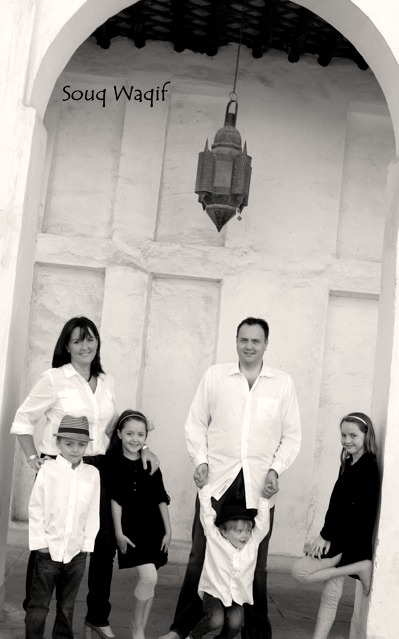
img: Kirsty Rice with her family (sans the beagle) at Souq Waqif, Doha, Qatar.

STAY TUNED for tomorrow’s installment from our displaced fictional heroine, Libby, whose rather dramatic road-trip adventure has come to an end. Time to face reality again in Woodhaven! What, not keeping up with Libby? Read the first three episodes of her expat adventures.

If you enjoyed this post, we invite you to register for The Displaced Dispatch, a round up of weekly posts from The Displaced Nation. Includes seasonal recipes and book giveaways. Register for The Displaced Dispatch by clicking here!

Related posts:

RANDOM NOMAD: Camden Luxford, Hostel Owner, Freelance Writer/Blogger & Student

Born in: Mackay, Queensland, Australia
Passport: Australia
Countries lived in: United Kingdom (Brighton, Oxford, Edinburgh, and a country hotel near Crickhowell, Powys, Mid Wales): 2005-06; Peru (Cusco): 2009-present.
Cyberspace coordinates: The Brink of Something Else (blog)

What made you leave your homeland in the first place?
I left, at 20, because I’d always had an itch. As a kid, I’d poured over National Geographics and Lonely Planets, plotting these exotic routes across strange lands. I think I imagined myself some kind of Lara Croft-type figure. Then I grew up and didn’t really know what I wanted to do with the rest of my life, so I boringly did what thousands of Australian 20-somethings do every year — took off to the UK for a couple of years.

Is anyone else in your immediate family displaced?
Dad’s displaced — in a jet-setting, corporate type of way. He always traveled a lot for work when I was young, domestically and internationally, and now he’s semi-retired and living most of the year in Italy. It’s handy, ‘cos now I have a great place to stay close to really good pizza and wine.

Describe the moment when you felt most displaced.
Waiting at the police station to report an alcoholic Latino ex for threatening to kill me, and having the cops not really care. I just thought in that moment, what I wouldn’t do to be back home, away from this machismo, in a place were I instinctively understand how men and women relate to each other.

Describe the moment when you felt least displaced.
Every Wednesday I get together with my closest friends here in Cusco for lunch. We cook, open a few bottles of wine, and laugh away all the week’s problems and dramas. It’s my Cusco family, and when we sit around the table, teasing each other mercilessly, I feel completely at home.

You may bring one curiosity you’ve collected from your adopted country into The Displaced Nation. What’s in your suitcase?
I tend not to hold on to things, just memories — and a hard drive full of photos. So I’ll describe a treasured photo from each country, instead.

From England: One of myself and my friends on the pebbly beach of Brighton. It’s a candid, and nobody’s posing, we’re just scattered about doing our thing. A couple of the boys are playing chess, a small group is talking, I’m reading a book, someone’s playing guitar. It’s a lovely slice of our lives that summer.

From Wales: Tintern Abbey caught just as the sun set. I was driving, turned a corner, and that sight took my breath away.

From Scotland: An entire album covering my 22nd birthday — from the moment my roommates woke me up with fairy bread and beer until about 4:00 a.m. the following morning. The deteriorating respectability is spectacularly documented.

From Peru: A Photoshopped-together photo of “Yamanyá,” the name of my hostel, spelled out in fire. We were camping by the Templo de la Luna (Moon Temple) outside of Cusco, and after half a bottle of rum I pulled out the camera and an Argentinian friend lit a stick on fire. It kept us entertained for more than an hour.

You’re invited to prepare one meal based on your travels for other Displaced Nation members. What’s on the menu?
Definitely a starter of ceviche: thin fish strips flash-marinated in lime with a touch of coriander, a load of chile, and a pile of fresh red onion, accompanied by a very cold Cusqueña beer. Served on the sand within spraying distance of the waves.

Then, in anticipation of my upcoming move to Buenos Aires, it’s a thick Argentinian steak cooked rare, with a glass of Malbec. Good meat is hard to come by in Cusco, and I miss it.

For dessert we’ll visit Dad in Italy: tiramisu, and then a strong espresso to finish the caffeine kick.

Then the Pisco gets opened, and it’s chilcanos all round: Pisco, ginger ale, a drop of Angostura bitters and a squeeze of lime.

You may add one word or expression from the country you’re living in to The Displaced Nation argot. What will you loan us?
From the UK: Minging has always stuck with me; I have no idea why. For the uninitiated it means disgusting, ugly, gross.
From Peru: Sí, no? — a delightfully Limeñan turn of phrase whose English translation (yes, no?) doesn’t make any sense at all.

It’s Zen and the Art of the Road Trip month at The Displaced Nation. Robert M. Pirsig, author of Zen and the Art of Motorcycle Maintenance, famously said: “Sometimes it’s a little better to travel than to arrive.” Do you agree?
I’ve always loved long, uncomfortable journeys, whether in car, train, bus, boat, or on foot — the process of being in transit, of movement, of change. I even have a sick fascination with long stopovers in airports: sleeping curled up on an uncomfortable bench, announcements blaring over the loudspeakers.

So for me, yes, the journey is a little better. Having been here, in Cusco, for almost two years, I’m growing uncomfortably restless. My mother argues that this is fear of commitment on an epic scale, but I like my life most — feel like I’m learning the most — when I’m on the move, and in the first blush of a new life in a new place.

I will point out in my own defense that I maintain my work and studies even while on the road. In a very stop-start sort of fashion, I’m finishing a Bachelor of Arts in International Studies and a Bachelor of Commerce in Economics from Deakin University in Melbourne, as part of their off-campus program. So I’m not completely irresponsible. (So there, Mum.)

Pirsig’s book details two types of personalities: 1) those who are interested mostly in gestalts so focus on being in the moment, not rational analysis; and 2) those who seek to know the details, understand the inner workings, and master the mechanics. Which type are you?
Despite a thoroughly scientific upbringing and education — Dad’s an engineer — and a very rational approach to my studies, when it comes to travel and expat life I’m all about the gestalts. I stayed in Cusco on little more than a whim, and recently returned from an ill-planned but exhilaratingly unpredictable road trip to Ecuador in a Volkswagen Kombi. Every moment of that road trip was a surprise — the cast of characters, a rotating mix of backpackers and South American musicians and circus performers. We followed the sun north, took a minor detour inland to teach a music and clowning workshop to the children in a poor community, and played music on the beach.

But although I laughed and made wonderful new friends and was constantly surrounded by music, this road trip, with its constant visits to mechanics, was also the reminder I needed of the importance of the rational type of personality. Road trips in general are a wonderful encapsulation of this duality, I think. Driving with the windows down on the highway with the music blaring, going where the wind takes you…but going there in a machine that needs care and understanding and maintenance. I’ve leaned too heavily to the romantic side, and it’s time to start taking better care of my machine.

Readers — yay or nay for letting Camden Luxford into The Displaced Nation? Tell us your reasons. (Note: It’s fine to vote “nay” as long as you couch your reasoning in terms we all — including Camden — find amusing.)

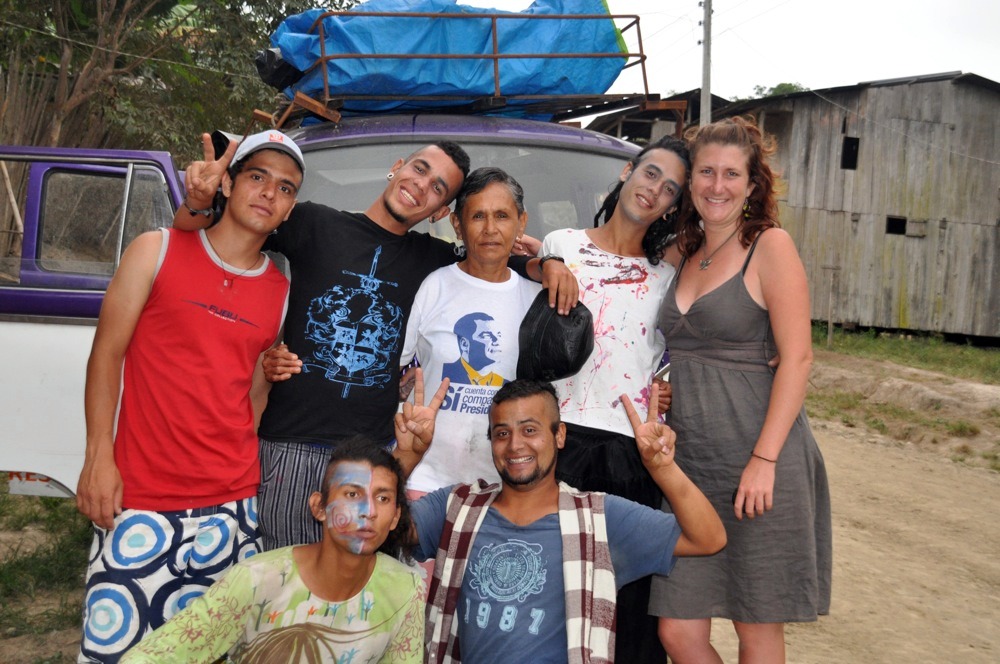
img: Camden Luxford on her recent road trip — in a tiny community about two hours form Pedernales in Ecuador, where she helped put on a juggling (among other things) workshop. She is posing with some of the kids and a teacher, along with members of the Colombian cumbia band she had as passengers for a couple of weeks. Yes, that’s the famous Kombi in the background!

STAY TUNED for tomorrow’s installment from our displaced fictional heroine, Libby, whose road-trip adventure of last week ended on a dramatic note. What, not keeping up with Libby? Read the first three episodes of her expat adventures.

If you enjoyed this post, we invite you to register for The Displaced Dispatch, a round up of weekly posts from The Displaced Nation. Includes seasonal recipes and book giveaways. Register for The Displaced Dispatch by clicking here!

Related posts:

RETURN TRIP: Even in Paris, expats can’t escape former lives: A celebration of displaced novelist Corine Gantz

As summer draws to a close, The Displaced Nation is reissuing some posts that, for one reason or another, have enchanted our readers. Enjoy these “return trips”!
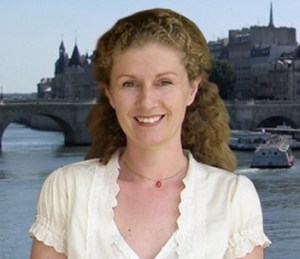
This past spring, The Displaced Nation interviewed Corine Gantz, a popular expat blogger, about her newly published novel, Hidden in Paris. The action centers on a group of expat Americans trying to start their lives afresh in the City of Light. At that time, TDN was exploring the theme of Gothic Tales. We wanted Mme Gantz to tell us more about the premise at the heart of her book — the idea that people travel to other lands to escape their former lives. How does it usually play out: as a dream come true or as a recurring nightmare?

The Displaced Nation has been examining the “gothic” side of expat life over the past couple of weeks. Thus it may seem odd that today we have chosen to celebrate a book that takes place in La Ville-Lumière (“The City of Light” or “The Illuminated City”) by an author who lives near the City of Angels.

But looks can be deceiving — and the cover of Corine Gantz’s debut novel, Hidden in Paris, is quite a cunning ruse. It shows a Parisian balcony with French doors reflecting the Eiffel Tower, and a flower box bursting with hot-pink geraniums. What could possible be amiss within such a picture-perfect setting, you may wonder? Plenty, it turns out.

But before we get into that, let’s begin our fête in honor of Mme Gantz and her book. To put ourselves in the proper mood, we have prepared a special cocktail, a French 75. We’ve also gone all out with our canapés. There’s a savory gougère, brie en croûte, duck rillettes, chilled asparagus with mustard sauce, a Puy lentil salad — and, in honor of Mme Gantz, her family favorite, taramasalata on toast (see her father’s recipe below).

Okay, seats, please! Our honored guest has agreed to kick off the festivities by answering a few questions from The Displaced Nation team. After that, the floor is yours, dear reader.

Hidden in Paris coverYour new novel, Hidden in Paris, may not tell a gothic tale per se, but we think it relates to our theme because it centers on three women who are running away from their lives. Is that a fair assessment?
People who say they love to be scared amuse me. They have a fascination with horror flicks, they read vampire books, they ride roller coasters. Yet they might be the same people who walk great circles around a pile of bills or make every effort to avoid a difficult phone call. What can be scarier than real life?

I think there is a limit to what we can handle, and at some point the tendency is to want to run way, literally or figuratively. In Hidden in Paris three strangers — all American women — have reached the point of terminal discomfort, when tackling real issues feels more terrifying than running away abroad.

Lola is running away from her husband, Althea from an eating disorder, and Annie, although she pretends to be the most high functioning member of the group, is hiding the biggest secret of all. (Just to add some spice, there is also a male character, Lucas, who is hiding his love for Annie.)

People often fantasize that “elsewhere” — particularly Paris because of the attached notion of romance — will solve their problems, or at least make the problems go away for a while. Well, we long-term expats know better. Moving to another country brings great logistical changes to one’s life, which can distract you into thinking you’ve left your pathos behind, when, in fact, you’ve brought it along in your suitcase. Wherever you go, you bring your own personal gothic tale with you.

In the case of these three female characters, the disruptions to their routines, along with new encounters, bring them to the tipping point toward change.

The thing is, as in real life, my characters fight the change they need kicking and screaming, which makes for fun story telling.

Food is another obsession of ours at The Displaced Nation. We detect from reading an excerpt from Hidden in Paris that it also plays a big role in your book.
You detect correctly. For me, writing a novel is a barely disguised way for me to talk about food — the novel being a vehicle for food just as grilled toast is a vehicle for foie gras.

I grew up in France on my mother’s terrific cooking. But she is the type of cook who wants no help in the kitchen, so at age 23 I arrived in the United States never having cooked an egg. I was terribly homesick and depressed and needed to “taste home” again — so had no choice but to teach myself how to cook. The saving grace was that I had a copy of a recipe book filled with my mother’s recipes, so I proceeded to recreate the food, and jolly myself out of my depression. Cooking gave my life a purpose: it became my creative outlet.

I think the preparation of food can be extremely healing, meaningful and joyful. Food is, after all, the soul and spirit of a home. I enjoy cooking as much as I enjoy eating, and when I’m not doing one or the other I’m telling stories where food turns out to be one of the principal characters.

You are a Française who has been “displaced” to the Los Angeles area for a couple of decades, where you live with your American husband and two sons. Does your novel echo that experience?
Had I landed on an alien planet I doubt I would have been any more confused and out of place. I understood none of the codes, none of the cultural references, of Los Angeles. I could not understand people or express myself — and I resented them for that.

Writing sprouted from this: the frustrated need for self-expression and communication. Like my protagonist, Annie, I had to figure out how to function, and I would be lying to say I functioned well. Also like Annie, I resisted my country of adoption for years. I did not have both feet in it. A part of me felt in limbo: I was standing by for my eventual return to my home country.

Twenty years later I don’t even feel French anymore, but no one here lets me forget I’m not American either. Americans seem fascinated with my Frenchness, as though it defines me. For example, it’s often about how I say things rather than what I say. Yesterday I was saying to a friend: “On the envelope my husband gave me for mother’s day there was a…” She interrupted and said: “Could you repeat that?” I repeated and she fell into peals of laughter: “I just love how you said the word ‘envelope’!”

In Hidden in Paris, I wanted to transpose my experience and reverse it. I wanted to bring American women to France and see how well they coped with that set of codes and cultural idiosyncrasies. That’s only fair, don’t you think? I’m a little miffed to report that they are more adaptable than I was.

You have a popular blog, Hidden in France, where you’ve been entertaining Francophiles and others with stories of the writing life, décor, food, family, travel and all things French. In fact, The Displaced Nation has featured one of your posts — about the time you fell into your swimming pool when the first day of spring brought heavy rains to the LA area. Tell us, has your blog had an influence on your writing? Also, why have you chosen the trope “hidden in”?
The blog has everything to do with my writing. Before the blog, I was a closet writer, ashamed that my English was too imperfect. The blog gave me a sense of just how forgiving and supportive readers were. I have readers now, and I have fans! Had I based my self-worth as a writer on agent rejections, I would have changed my hobby to fly-fishing. Readers are what make someone a writer.

The word “hidden” is significant only in the sense that I was hiding for years behind an alias as a blogger, and I just recently came out as writer for the world to see (speaking of fear…).

When it came time to settle on a title for the book, it felt natural to give it the same title as the blog — but I decided against it because there was already a memoir by that name. So Hidden in France became Hidden in Paris.

Finally, The Displaced Nation supports a fictional character, Libby, who is about to move from London to Boston with her husband. Do you have any advice for her?
Well, how about if I let my own fictional character, Annie — who moved from Boston to Paris to follow her own husband twelve years ago — speak to Libby directly:

Don’t do it, Libby! Kidding! Well I would suggest you have more babies, some siblings for your son, Jack, and fast. They will keep you busy and busy is the name of the game: no time to think! And if you decide against having more babies, then take on a hobby (such as cooking and eating) to keep your sanity without demanding that your husband become your everything for companionship, friendship and intellectual stimulation.

Don’t be like me in other words. Don’t forget that the man has a job and he is tired at the end of the day and nobody needs a needy wife. (Sorry for the harsh words, Libby, but this is the truth.)

You could also take a run-down house and remodel it. I did. You will have no skin left on your fingers but lifting bags of concrete makes for pretty shapely biceps. The remodeling might bring you to financial ruin but if that becomes the case, you will always have eating, which you can become very good at.

Without further ado, let’s pour the champagne for a toast to Corine Gantz. Tchin-tchin! And now, patient reader, it’s your turn. Questions, please, for this très gentille debut novelist… If you want to check out her book a little more, go to her author’s site, and to buy it, go to her Amazon page.

Taramasalata on toast — Corine Gantz’s family recipe
You will need:

  • one packet of smoked cod roe (seriously, can you even find this in the US?)
  • 8 tablespoons safflower oil
  • 2 tablespoons lemon juice.

Mix fish roe and lemon juice, then slowly beat with a fork and add the oil as you would do to make mayonnaise.Spread thinly on toasts and serve with very good champagne, et voilà! Très festif.

Images: Author’s photo; Hidden in Paris cover, artwork by Robin Pickens.

If you enjoyed this post, we invite you to subscribe to The Displaced Dispatch, a weekly round up of posts from The Displaced Nation, plus some extras such as seasonal recipes and occasional book giveaways. Sign up for The Displaced Dispatch by clicking here!

Related posts:
RETURN TRIP: Random Nomad – Charlotte Day, High School Student (Sixth Former)

While our writers take off on what they hope will be enchanting August breaks, The Displaced Nation will occasionally be reissuing some posts that, for one reason or another, enchanted our readers. Enjoy these “return trips”!
As youngsters head back to school, we’re reissuing a Random Nomad interview ML Awanohara did with Charlotte Day, a displaced teenager in England. Charlotte spent a chunk of her summer taking a Russian-language course in St. Petersburg and living with a Russian family. She has produced a travel yarn on her adventures, which will appear on Monday.

Born in: Sydney, Australia
Passports: Australia, UK and US Green Card
Countries lived in: Australia (Sydney): 1994-2001; United States (New York, New York): 2001-2010; England (Sevenoaks, Kent): 2010-present

What made you leave your homeland in the first place?
My father is Australian and my mother English. They split up when I was two. When I was six, my mother met and married an Australian who had been living in New York for thirty years. I was rather disgruntled about moving to the United States and for two or three years, remained determined never to accept it as “home.” At that time, I was deeply patriotic to my native country — though this sentiment has dissipated since.

Is anyone else in your immediate family a “displaced” person?
My mother’s family, originally from England, has long been displaced. My mother herself was born in Kenya, in 1961. Following the Mau Mau Uprising, her parents were forced to relocate, and my grandfather, presented with a choice between Australia and Canada, chose the warmer of the two countries. My mother spent her childhood bouncing between schools in England and Australia. She eventually grew so fed up with packing and unpacking, she decided to leave school at the age of 16. Her father agreed to the plan provided she spend a final year at the school in Switzerland his own mother had attended as a girl. My mother moved on from Swiss finishing school to work in London, Paris and Sydney. But she appears to have made New York her last port of call. Indeed, we had a fairly solid life in the city until I decided to take myself off to boarding school in England.

Describe the moment when you felt most displaced over the course of your many displacements.
It must have been when I first arrived in New York as a six-year-old. I stepped out of the JFK arrivals terminal into a snowy March night. My stepfather was wearing a leather coat, the interior of his car smelled of leather — and the world outside the car window seemed an undulating stream of black and silver. Though it was the end of 2001’s warm winter, my Australian blood froze beneath my first-ever coat. And their apartment — that was all leather as well. It smelled of musk and cologne. Since that time, I have felt similar pangs of displacement, some of which lasted for considerable periods. But those first few moments in New York stand out as the most acute concentration of “displacedness” I have ever known.

Describe the moment when you felt least displaced.
For the last five or so years in New York, I have felt more at home than I ever did in Sydney. I ascribe this to growing up: at a certain age, one can take possession of a city, know its streets, bridges, tunnels and transportation system. I was too young when I lived in Sydney to reach that kind of comfort level. But when have I felt the most like a New Yorker? Perhaps it was the last time I came home for the holidays, and took the 4 train uptown for the first time in months. At that moment I realized how much this train had been a part of my life — conveying me home from school every day for two years. My old life would always be waiting for me on the subway, ready for me to pick it up again. That’s something only a New Yorker could say!

You may bring one curiosity you’ve collected from each of the countries where you’ve lived into the Displaced Nation. What’s in your suitcase?
From Australia: A miniature wooden wombat figurine — a gift from my grandfather. It conjures memories of a childhood spent beating about the bush (literally) and fishing for yabbies at the dam in the company of audacious dogs who stuck their heads down wombat holes, to no good end.
From New York: A pair of fake Harry Potter glasses. These defined my first six months in New York — I even wore them to my first day of school. I think it is telling that even at the age of six, I was unwilling to give all of my real self to this new home.
From England: My school tie — representative of the alternative universe I seem to have entered. At boarding school, the sense of removal from reality can be disconcerting — especially after having spent a decade in the city I regard as the world’s capital.

You’re invited to prepare one meal based on your travels for other Displaced Nation members. What’s on your menu?
I’d like to make you a Sydney breakfast: scrambled eggs, made with cream, salt and pepper and served on a bed of Turkish toast, with avocado and stewed tomato on the side (is this being greedy?). Our meal will be accompanied by a large “flat white”: what we call perfectly strong, milky coffee without excessive froth. I suggest we consume it overlooking a beach on a Sunday morning. At least, I assume The Displaced Nation has beaches?

You may add one word or expression from each of the countries you’ve lived in to The Displaced Nation argot. What words do you loan us?
From Australia: Daggy. I use this word all the time — and did not realize it was exclusively Australian until I was informed of the etymology. Apparently, it comes from trimming the soiled wool around a sheep’s bottom. Which part of this repugnant whole is actually the “dag,” I do not remember. (No, I’m not a proper Australian!) But as I understand it, “daggy” means sloppy in appearance or badly put together.
From New York: There are so many words, and most are second nature by now. However, I will choose grande-soy-chai-tea-latte because I still shudder to think of myself as the kind of person who can utter such a phrase, at great speed, with great insistence. In fact, I’m still in denial about my love for Starbucks: having known Sydney coffee, my standards should be higher.
From England: Banter. I still do not know the precise meaning of this word, but it seems to encapsulate everything that makes someone my age feel socially acceptable — and, of course, I have no banter whatsoever. I think it means the capacity for combining wit with meaningless conversation. But there are other components, too, which seem to me unfathomable.

Question: Readers, tell us what you think: should we welcome Charlotte Day to The Displaced Nation and if so, why? (Note: It’s fine to vote “no” as long as you couch your reasoning in terms you think we all — Charlotte included — will find amusing.)

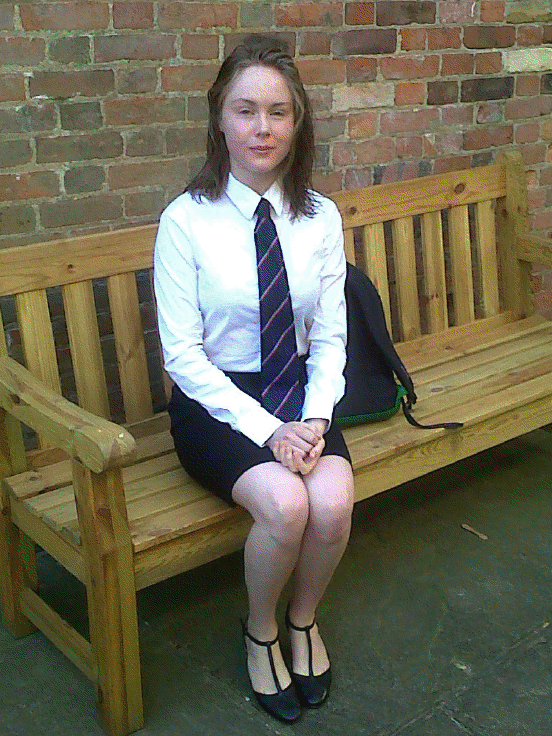
img: Charlotte Day at her boarding school in southeast England

If you enjoyed this post, we invite you to subscribe to The Displaced Dispatch, a weekly round up of posts from The Displaced Nation, plus some extras such as seasonal recipes and occasional book giveaways. Sign up for The Displaced Dispatch by clicking here!

Related posts:

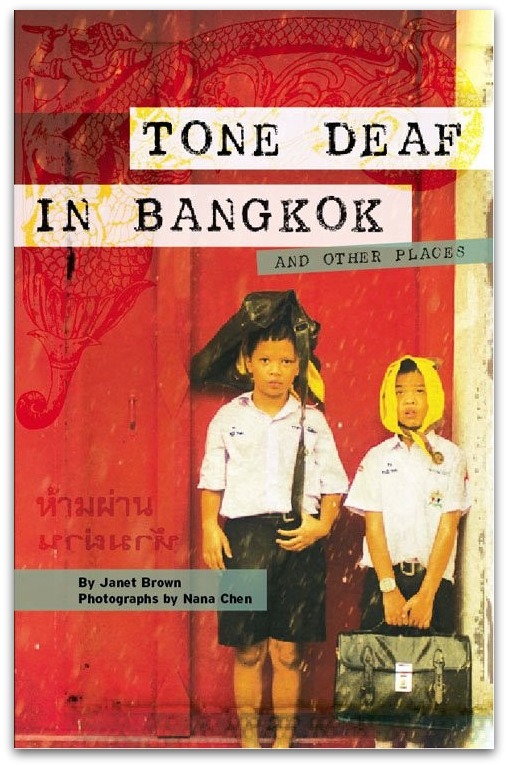
RETURN TRIP: Travel author Janet Brown channels Alice in Wonderland’s “tone deaf” adventures

While our writers take off on what they hope will be enchanting August breaks, The Displaced Nation will occasionally be reissuing some posts that, for one reason or another, enchanted our readers. Enjoy these “return trips”!
June was “Alice in Wonderland” month in The Displaced Nation, and the enchanting travel author Janet Brown came to our online tea party. She answered ML Awanohara’s questions on the curious and unreal aspects of her life in Thailand. Last time we checked in with Janet, she was in the process of moving back to the States. Will her counterculture shock prove to be another Alice adventure? We hope to hear back from Janet in the coming months.

As you may have noticed, The Displaced Nation has gone Alice-in-Wonderland mad since around the first of June. To take just a few examples:

And now, to top that all off, the extraordinary travel writer Janet Brown is paying us a visit. Brown could almost be a stand-in for the Lewis Carroll heroine herself, having published a book on travel to and life in Thailand called Tone Deaf in Bangkok, to much acclaim.

“Tone deaf” — it puts one in mind of poor Alice’s plea to the Mouse, “I didn’t mean it…But you’re so easily offended, you know!”

But if Brown sees herself as tone deaf, her readers regard her as anything but. Here is a sampling of her reader reviews on Amazon:

It has been ages since I have loved a piece of travel literature…, and so when I read TONE DEAF IN BANGKOK, I was thrilled. This is a good travel book, and it is a good book, period.

I am not a traveler, nor do I typically read travel books. Shame on me, I know, but here’s the thing: … The author brought Bangkok to life in a way that made me want to go there, yes, but it was her own story that captivated me and kept me turning the pages. Now I’d read anything Janet Brown writes!

Janet Brown’s TONE DEAF IN BANGKOK is a travelogue, to be sure. Yet it is more, so much more. It’s also an investigation into how dislocated we can become by ourselves, by our priorities and by all that we demand of the cultures in which we live. … That she has a gift for spotting the universal in the exotic makes this collection all the more profound.

Janet Brown has graciously agreed to answer some of my Alice-related questions. After that, dear reader, I urge you to chime in!

Before we go down the rabbit-hole, can you tell me a little bit more about your background?
My parents turned me into a gypsy before I was two, by taking me on their journey by jeep from New York City to Alaska when the 49th state was still a territory and the Alcan Highway was still an unpaved trail into the frozen north. I have wandered ever since, most recently in Southeast Asia with Bangkok as my home, writing down the stories I encounter as I explore. My books include:

Maybe because I’m so steeped in Alice-of-Wonderland lore this month, I think of you as Alice Personified. To what extent can you relate to Alice’s sense of disorientation? Going back not just to the first time you went to Thailand but also when your family dragged you to Alaska…
I was 18 months old when my family moved to Alaska from Manhattan. I coped with any displacement issues by making my mother read my favorite book over and over again — a truly saccharine Little Golden Book called The New Baby. The main character had the same name as I so that was the big attraction — all about me! My mother swears she can still recite it verbatim after having two martinis.

Alice came to mind constantly in my first months in Bangkok — and frequently thereafter. I knew I’d gone through the looking glass — or had entered the postcard — and asked myself often if that experience had been as painful for Alice as it often was for me.

Can you describe your worst “Pool of Tears” moment in Bangkok, where you wished you hadn’t decided on living there?
I’ve tried to make light of that time when I wrote about it in Tone Deaf in Bangkok, but it nearly demolished me. When the manager of my apartment turned me into Ryan’s Daughter by listening in on my phone calls and then entertaining the neighborhood with highly embroidered versions of my life — and when people fell silent when I walked down the street and began gabbling excitedly after I’d passed — I felt as though my life had been stolen from me and I shut down to the point of hypothermia. If my students hadn’t helped me find a new neighborhood, I would have gone home a gibbering mess.

Thailand is renowned for its distinctive cuisine. Was there anything that carried an “Eat me” label that you felt hesitant about at first, but then discovered you loved?
I’ve written about durian in Tone Deaf, how I thought its smell in the market was sewer gas and then how I was forced to taste it, with happy results. Fried grasshoppers were another thing I didn’t warm to at first sight and then liked as much as I do popcorn — they have much the same crunch and texture.

By the same token, were there any foods that you thought might be good but then didn’t acquire a taste for? (For Alice, of course, that was the Duchess’s over-peppered soup.)
One night I stopped to buy green papaya salad from a food cart to take home for supper. There was something in a little plastic bag that looked like a sort of relish, so I bought that, too.When I opened it at home a smell of rot filled the air, but remembering the delightful surprise that durian had proved to be, I took a generous spoonful. It was pla ra — fermented fish, a Northeastern Thailand culinary staple that is meant to be added and mixed judiciously with the salad, not eaten like peanut butter. There wasn’t enough toothpaste in the world to rid my mouth of that thoroughly foul taste.

As already mentioned, Alice finds it’s easy to offend the creatures in Wonderland without even trying. Why did you choose the expression “tone deaf” for the title of your book on Bangkok?
“Tone deaf” can be taken quite literally. Thai is a tonal language with five different tones giving meaning to every word. Use the wrong tone and at best you’re incomprehensible, at worst shocking. The most common mistake for foreigners is to tell someone their baby is beautiful, while actually announcing that the infant is bad luck. Another pitfall is confusing the word “near” with the word for “far” — they are the same sound, differentiated by a crucial tone.

But travelers to Thailand can also be “tone deaf” when it comes to figuring out the Thais’ communication style. As a Thai-American friend has observed, the important things are what remain unsaid. “You looked so beautiful yesterday” probably means today you resemble dogfood and ought to go home and rectify that at once. Subtlety is the hallmark of Thai communication, and is often expressed through a quirk of an eyebrow or a famous Thai smile, which has at least one hundred different meanings — including disdain or outright menace.

Describe the biggest faux pas you’ve made since settling in Bangkok.
Oh, how to choose — it’s impossible not to make faux pas every second because Thai etiquette is demanding and complex. The one that makes me cringe most is in my first week when I set off on my first solo bus ride. I was clutching a twenty-baht note, which like all bank notes in Thailand bears the countenance of the King. He is revered to the point of near godhood in his kingdom and his picture is always elevated to the highest spot in a room — nothing is above the King. But I was fresh off the boat and when I dropped my money and it was caught in a little breeze, I put out my foot (the lowest and most ignominious part of the body) and stepped on the picture of the King’s face to secure my bus fare. I was too clueless to pick up on the ripples of horror that this caused others at the bus stop, but now I writhe when I remember this.

“Off with her head!” as the chief royal in Alice’s story is wont to proclaim. Actually, never mind your head. Your mention of your foot makes me think of how physically awkward Alice feels around the creatures in Wonderland. As a farang in Bangkok, do you often feel self conscious?
I’m short and dark in a family of pale-skinned people, so I was used to being an anomaly from early childhood. In Bangkok, if I dressed like a Thai woman and wore sunglasses and walked slowly, I felt as though I blended in. But one day I walked down a quiet street on my way to a class, and someone looked up and said, “Look at the foreigner.” “How did she know?” I asked my class of teenage girls. “Your hair,” they said. “No, lots of Thai women have dyed their hair brown,” I replied — to which they responded: “Your nose.” It was my big American nose that gave me away every time — and since I hate pain and surgery, I just had to accept that.

Have you tweaked your personal style at all so as to fit in better?
Yes — I adopted the conservative “Don’t show your bare shoulders” school of dressing that prevailed in Bangkok when I first arrived and slowed my pace to that of the women around me. I learned to keep my facial expression as bland as I possibly could to achieve the quiet Thai “public face,” and I ironed everything, including my Levis. Now women are much more casual in the way they dress but I’m still stuck in the cultural mores of the 90s. To foreign women who live here now, my introductory years in Bangkok seem like fiction — things have changed so drastically in the past 16 years.

Time for a quote from the Cheshire Cat: “…we’re all mad here. I’m mad. You’re mad.” Can you relate?
Riding on the back of a motorcycle taxi down a crowded city sidewalk, buying a glass of Shiraz to take with my popcorn into a movie theater, being drenched to the bone during Thai New Year’s — this is actually the most difficult question you’ve asked so far because at this point it all seems normal.

If you were to hold your own Mad Hatter’s Tea Party in Bangkok, whom would you invite, and why?
Anais Nin, because she would love the unbridled hedonism of this place, Evelyn Waugh because he would satirize the expat scene so well, Ho Chi Minh because he could help put together the revolution that is needed here, Emily Hahn because she has always been my role model since I first read her when I was twelve, and Elvis because in Bangkok he is still the king.

Alice becomes aware that Wonderland is turning her into a different person, unrecognizable to the one she used to be. Has your identity has shifted in fundamental ways since living in Bangkok?
This is a very complex question — I’ve written one book about it and am working on a second one, Almost Home. I’m always drawn back to the US because my children are there. Seeing them for two weeks a year doesn’t work for me. Once I get back to the US this time around, I’ll return here but plan to spend the bulk of my time near family in the Pacific Northwest. I won’t know how much I’ve been changed by this recent incarnation in Bangkok until then. Ask me again in several months.

Can you offer any advice for newcomers to Bangkok, who aren’t sure who they are any more?
Tone Deaf in Bangkok and my next book, Almost Home, are where I directly address the challenges of feeling like an Alice in Thailand. In addition, the recently published Lost and Found Bangkok, for which I wrote the text, may be helpful for newcomers. It’s a book in which five different photographers — two American men, two Thai men (both from Bangkok), and one Taiwanese-American woman — show the city they live in. New arrivals can look at the photos and see some great places to get lost — and find out who they are — in this Wonderland-like city.

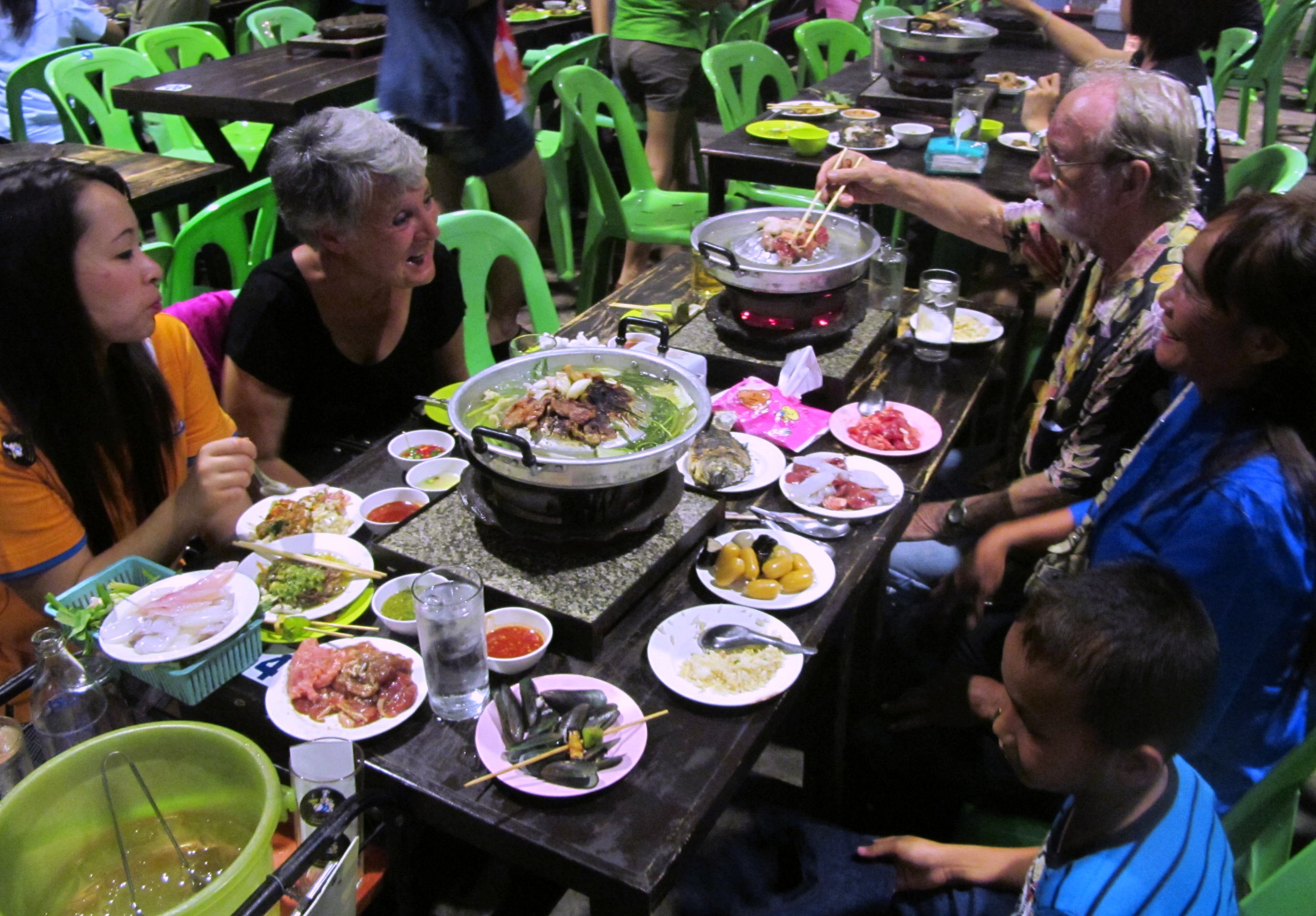
img: Janet Brown with friends at an all-you-can-eat DIY barbecue at a huge restaurant under a bridge in Bangkok, by Will Yaryan.

If you enjoyed this post, we invite you to subscribe to The Displaced Dispatch, a weekly round up of posts from The Displaced Nation, plus some extras such as seasonal recipes and occasional book giveaways. Sign up for The Displaced Dispatch by clicking here!

Related posts:
RANDOM NOMAD: Jo Gan, Director of Foreign Teachers, Author & Blogger

Born in: Columbia, Missouri USA
Passport: USA
Country lived in: China (Yuyao City, Zhejiang Province): 2009-11
Cyberspace coordinates: Life Behind the Wall | Thoughts and Experiences of a Black American Woman in China (blog)

What made you leave your homeland in the first place?
I left America due to the economy. I worked in the mortgage field and when the housing market crashed, I needed to find something else to do…or be on unemployment. So I chose to take a job teaching English in China. Two years ago, I got married to a Chinese man whom I met in Yuyao. No, he wasn’t one of my students, as most people assume. I met him in a bar. He came over and asked if he could buy me a beer. We exchanged telephone numbers, and he started calling me every day, three times a day… Six months later, we were married. Yes, it was fast by most people’s standards but I’m not one to waste time — nor is he. It’s been an interesting couple of years.

Is anyone else in your immediate family displaced?
No one else in my family — except a great uncle who lived in Germany most of his life — has ever lived abroad for a long period. Some have been in the military and traveled around, but they always lived on base.

Describe the moment when you felt most displaced.
When I arrived at the airport in Shanghai — it was my very first time coming to China. My luggage had been lost, and I couldn’t communicate with anyone to tell them or report it. I felt frustrated and angry. Then once I got all the paperwork finished, I needed to take a bus to the next city. I couldn’t find the bus station, and no one could understand what I was saying. At that point, I wanted to just get back on the plane and go home.

Describe the moment when you felt least displaced.
When I went home to visit for the first time. Everything looked familiar but felt unfamiliar. I had spent a lot of time missing home, but when I finally got there, it didn’t feel right. In Yuyao, as I walk through the streets or sit in a restaurant and people recognize me, it makes me feel part of the community.

You may bring one curiosity you’ve collected from your adopted country into the Displaced Nation. What’s in your suitcase?
Wow! I guess I’d like to take a Chinese person — if you’d let me in with a companion rather than a suitcase. Yeah…the way they think and perceive things is so different from us Americans. Their ideas of “face,” status, and beauty are so alien to me that I am sometimes at a loss for words to explain it. I can’t get used to the fact that face — losing face, giving face and having face — is of the utmost importance to them. Also, their standard of beauty is so different: very white and very thin. The only way for you to get an accurate view of Chinese culture would be for me to bring a Chinese person along to explain it all to you.

You’re invited to prepare one meal based on your travels for other Displaced Nation members. What’s on the menu?
Since I live in Southeast China, the menu would have to consist of:

  • Steamed seafood. (I apologize in advance for its high salt content.)
  • Chicken feet that have been boiled and then fried.
  • Four kinds of eggs: tea eggs, thousand-year-old eggs, fried eggs with tomato, and boiled salted eggs that have been fertilized (there’s a chicken embryo inside).
  • And of course green vegetables… (By the way, the Chinese call all green leafy veggies “green vegetables.”)

For dessert we would have yangmei  (yumberry fruit), the local favorite.

And for drinks, a choice of:

You may add one word or expression from the country you’re living in to The Displaced Nation argot. What will you loan us?
I will choose Ni chifan le ma? (Have you eaten yet?). Everywhere you go in China, people greet you with Ni chifan le ma? Food is just so important to this culture. Weddings, birthdays, funerals — all of these events involve banquets lasting several hours. Everything tends to be associated with food, and there are many food idioms.

It’s Pocahontas month at The Displaced Nation, and we’re focusing on cross-cultural communications (or the lack). What would you say is the top challenge of an interracial, intercultural marriage — and can you recommend any coping techniques?
First I will say that the most challenging part of being in an intercultural marriage is the people around you. Usually, other people are more concerned about your marriage situation than you are, especially if you live in China. They tend to spend a lot of time telling you what is wrong, or can go wrong, with your marriage. They question the reasons you got married. For example, Chinese people will ask my husband if he married me to get a green card. He tells them: “We live in China, not America. How would a green card help me here?”

As for our personal relationship, we have learned to accept each other’s differences. If something one of us does bothers the other person, we compromise. For example, Chinese men have the tendency to put pork bones, chicken bones, sunflower seed shells, and fish bones directly on the dinner table when they are eating; I find this disgusting. So now we put a bowl beside my husband’s plate for him to discard these things. If you really want to make a relationship to work, any relationship, it takes respect, consideration, and a willingness to compromise.

QUESTION: Readers — yay or nay for letting Jo Gan into The Displaced Nation? Tell us your reasons. (Note: It’s fine to vote “nay” as long as you couch your reasoning in terms we all — including Jo — find amusing.)

img: Jo Gan hamming it up in the classroom by trying on her student’s sunglasses, taken by the student on her iPhone.

STAY TUNED for tomorrow’s installment from our displaced fictional heroine, Libby, when the Patrick family is held to ransom by an army of packing crates from their new home.

If you enjoyed this post, we invite you to subscribe for email delivery of The Displaced Nation. That way, you won’t miss a single issue. SPECIAL OFFER: New subscribers receive a FREE copy of “A Royally Displaced Tea.”

Related posts:

RANDOM NOMAD: Simon Wheeler, Steel Automotives Project Leader & Former Cricketer

Born in: Aylesbury, Bucks, England
Passport: English (never ever say British!)
Countries lived in: Australia (Adelaide): 1996-98; California (Newport Beach): 2006-09; Slovakia (Plavé Vozokany): 2006-present
Cyberspace coordinates: Rambling Thoughts of Moon | Englishman’s travelling thoughts from England, California and now Slovakia, Plavé Vozokany… Ahoj !! (blog)

What made you leave your homeland in the first place?
My initial travels to Australia came through boredom of work. Having worked in a large pharmaceutical company from 17, at 24 I realized that I needed to have some new adventures. I am a firm believer that if you don’t like your current situation, change it. When I was asked to go play cricket at Grade A level for the Fulham Cricket Club in Adelaide, I packed my bags and left. Actually, I got cold feet about two weeks before I was due to leave. But then a close friend was suddenly struck ill on a Friday, and sadly died two days later. That was the kick I needed.

Is anyone else in your immediate family displaced?
My sister is now a Canadian citizen living in Vancouver. She has been away from England for over 15 years.

Describe the moment when you felt most displaced over the course of your many displacements.
Can I have two? The first occurred just after I’d gotten married to my gorgeous wife on top of Grouse Mountain in Vancouver. After the wedding, she had to go back to her job in California, while I continued waiting in Vancouver for my visa to be approved. In those three months of waiting, the uncertainty of not knowing if I would be allowed to join her made for very stressful times. We could simply have flown back to England, where a job was being held for me in the City. That would have been so easy, but that said, we have never chosen the easy option.

The other time occurred much earlier: May 24th, 1997. A very precise date, but I remember it so well. I was on the road from Melbourne to Sydney, all on my own, on my birthday, and not one person said “Happy Birthday” or even knew it was my special day.

Describe the moment when you felt least displaced.
I’d have to say right now. We moved to my wife’s homeland two years ago. The culture shock, combined my lack of language skills, was daunting at first. The people, especially her family, have been incredible, but finding a life was very tough. Since we moved here, we have both found jobs in the same company; had our first child, the adorable Matej; and are about two months away from moving into the cottage we are renovating in the village next door to Plavé Vozokany (we’ve been living here with my wife’s parents since our arrival). So, right now, I am on the verge of having all I have ever wanted. To settle into a new country takes time, a lot of time, especially one that is so different to your homeland. I still have some time to go, but with the growing family, a supportive wife, a good job, and soon my dream house, I am ticking all the right boxes.

You may bring one curiosity you’ve collected from each of the countries where you’ve lived into the Displaced Nation. What’s in your suitcase?
From England: My St George’s flag — not because I wish to be associated with rowdy football supporters but because it’s a symbol of my country that I’m very proud of.
From Australia: My Ugg boots from the open-air market in Port Adelaide. I have them on right now!
From California: My photographs from the incredible national and state parks in the Western United States: Grand Canyon, Death Valley, Zion, Bryce, Joshua Tree, Big Sur… I could go on…
From Slovakia: A bottle of homemade Slivovica, a plum brandy strong enough to blow your socks off!

You’re invited to prepare one meal based on your travels for other Displaced Nation members. What’s on the menu?
Whoa, that’s tough… But let me try. To start, we’d have fresh prawns and seafood from Australia. As my main, I’d offer my Mum’s Christmas dinner: turkey, sausages and bacon, Brussels sprouts, veggies galore, roast potatoes, cranberries, stuffing… And if there’s still room, I’d throw in some sushi from Masa Sushi, a tiny, simple, dirty-looking place off 19th Street and Habour in Costa Mesa, California — the host/chef really knows what he’s doing. For dessert, we’d have fresh, homemade cream cakes from my mother-in-law here in Slovakia. It would all be washed down with an Australian white, a pint of Coopers (Southern Australian beer), and a couple of shots of Slivovica.

You may add one word or expression from each of the countries you’ve lived in to The Displaced Nation argot. What words do you loan us?
From Australia: Beauty (said in a heavy Aussie accent). It’s used all the time — but most especially on the cricket fields, after a player hits a good shot or the bowler gets a wicket.
From England“In England’s green and pleasant land…” We sang “Jerusulem” at my wedding and on many drunken occasions. It always takes me home…
From California: Awesome — but I’d advise that you restrict the usage to things that are truly awesome; otherwise, it loses its meaning. That pair of shoes is AWESOME; that TV show is AWESOME; You are AWESOME — no! The Grand Canyon is awesome — yes!

It’s Pocahontas month at The Displaced Nation, and we’re focusing on cross-cultural communications (or the lack). By living in your wife’s country, do you find that you’re relying on her to serve as your “interpreter” for Slovakian language and culture? Does this place a special stress on the marriage, and if so, how do the two of you cope with it?
Yes, it definitely does. When you go away on holiday and do, say, exploratory grocery shopping, it’s all a bit of fun trying to cope, but when you actually move to the country it’s totally different. So many things to sort out: banks, mortgages, identity cards, driving license — the list is endless. And she has to do all of this. Even if I have to make a trip to the doctor’s, she has to come. When you are sitting there having two people discuss your health, and you cannot understand what they’re saying, it’s very stressful. As I mentioned earlier, we are renovating an old Slovak cottage. But to communicate with all the different workers and tradesmen, again, she has to do it all… You can imagine what a workload she carries for this project, and the uselessness I feel in not being able to help her.

Our relationship, like so many others, works because one of us takes the lead, and in our case, that happens to be her. Imagine Monica Geller from Friends — well, that is my wife. She likes to be in control. Even when we were living in America, she was in charge. So for us, with some blips, it does work. But whenever I want to do things — relieve her of some of her workload and stress — it’s a struggle. My Slovak is improving, but it is not good enough to cope with these kinds of demands. It’s a very tough language, and at 40, I am a poor student.

QUESTION: Readers — yay or nay for letting Simon Wheeler into The Displaced Nation? Tell us your reasons. (Note: It’s fine to vote “nay” as long as you couch your reasoning in terms we all — including Simon — find amusing.)

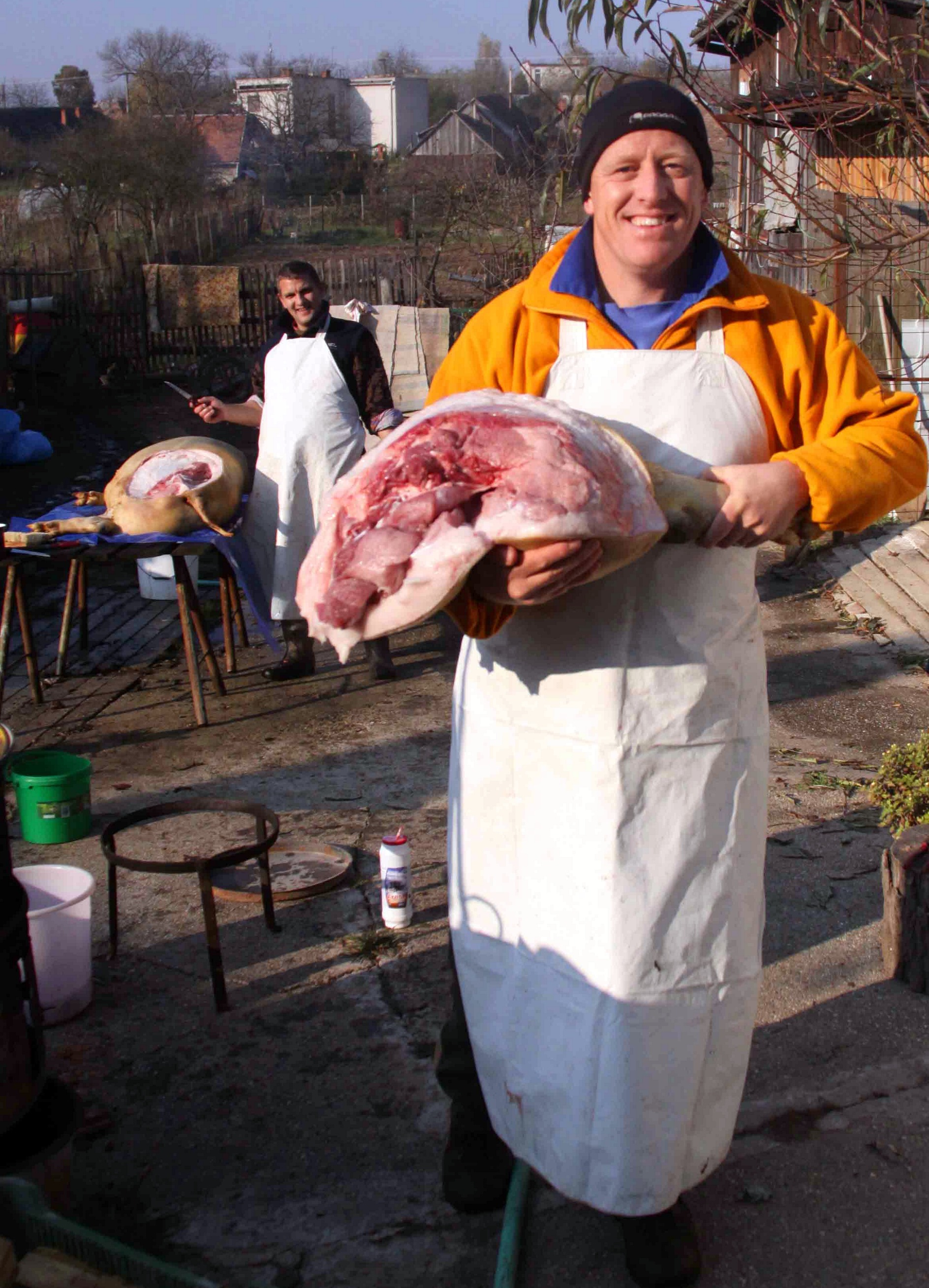
img: Simon participating in the traditional slaughter of pigs that occurs in his Slovakian village every year. His comment: “Most village families rear a couple of pigs every year for this purpose. The custom was new to me, and I didn’t like the idea — never ever thought I’d be doing this kind of thing! But it does mean you can fill your freezer with good quality, home-bred meat and sausages, and I’ve gotten used to it.”

STAY TUNED for tomorrow’s installment from our displaced fictional heroine, Libby, who encounters her very first 4th of July celebrations.

If you enjoyed this post, we invite you to subscribe for email delivery of The Displaced Nation. That way, you won’t miss a single issue. SPECIAL OFFER: New subscribers receive a FREE copy of “A Royally Displaced Tea.”

Related posts:

The Displaced Nation celebrates American — and its own — independence

Today being the Fourth of July, the whole of America is celebrating its independence from Great Britain.

The Displaced Nation is celebrating, too, but in our usual idiosyncratic style. According to the mini-introduction on our site:

Here at The Displaced Nation, we are passionate about the experience of becoming a global resident.

Celebrating one country’s detachment from another, 235 years ago, doesn’t seem quite in keeping with this Declaration of Independence from nationhood of the conventional kind.

So instead of looking back to 1776, two of us are looking back only to this time last year — to a time when The Displaced Nation didn’t even have a name.

Kate Allison:
This time in 2010, I blogged about the Queen’s visit to New York, which tactfully had been scheduled to start just after the Fourth. In my post I described the awkwardness of representing the very country from which America was celebrating its independence:

Imagine gatecrashing a silver wedding anniversary bash, given in honor of your ex-husband and his subsequent wife, and that’s pretty much what it’s like to be a Brit in America on the 4th of July.

And yet last year was better than others had been in the past. The reason?  I’d discovered an online world full of other people who had lived away from their home country for some time, who weren’t sure any more where the heart was, and therefore didn’t know where to call Home.

Two of those people, of course, are my fellow writers, Anthony Windram and ML Awanohara, at The Displaced Nation. When ML first emailed to ask if I would be interested in this joint venture, being a fan of her own site I naturally said yes. But I had no idea what a lifesaver this intense project would turn out to be, during a difficult time for me.

It’s been an exhilarating three months since the site went live. So although I can never quite get to grips with the spirit of Fourth of July, I’m going to celebrate anyway.

Fire up the barbecue, cue the fireworks, and pass a Corona. Cheers!

ML Awanohara:
I was feeling very misplaced, out of place, out of sorts last Fourth of July. I wrote a rather caviling post maintaining that celebrations of American Independence Day haven’t seemed the same since I repatriated to the U.S., after so many years in the UK and Japan.

I had three main gripes:
1) The latest poll showing that most Americans didn’t know from which nation we’d declared our independence. In the version being circulated in 2010, some had actually speculated it was from Japan or China.
2) Inferiority of American fireworks to those I’d seen over the Sumida River in Tokyo. Why hadn’t we bothered to update them?
3) Boring barbecues. At the very least, I thought it was time for Americans to consider expanding their grilling repertoires to include British bangers.

Two Brits who’ve displaced themselves to the United States, Kate Allison and Anthony Windram, read my post — and stepped up to offer their cyber-friendship.

One year later, I’m thinking about how delighted I am to have have joined forces with them in founding a nation for displaced types like ourselves.

What’s more, The Displaced Nation has just turned three months old, as of July 1. That’s nothing, of course, compared to the American nation (whose 235 years is nothing compared to China’s 5,000 years of history, let alone the histories of most European countries).

But surely it’s something in cyberspace?

We hope that you, too, by now are beginning to put down roots in The Displaced Nation, and we thank you for your contributions to our nation-building efforts.

QUESTION: Which kinds of posts would make you feel even more at home on The Displaced Nation site? We’d love to get your suggestions and input.

STAY TUNED for tomorrow’s post, proposing a new theme (woo hoo!) for The Displaced Nation to explore for the remainder of the month.

If you enjoyed this post, we invite you to subscribe for email delivery of The Displaced Nation. That way, you won’t miss a single issue. SPECIAL OFFER: New subscribers receive a FREE copy of “A Royally Displaced Tea.”

Related post: