The Displaced Nation

A home for international creatives

Tag Archives: Memoir | Travel | Food Writers

BOOKLUST, WANDERLUST: Giving thanks for expat and repat writers whose novels have an international flavor

booklust-wanderlust-2015

Attention displaced bookworms! Our book review columnist, Beth Green, an American expat in Prague (she is also an Adult Third Culture Kid), is back with several recommended reads!

Hello again, Displaced Nationers!

This week is Thanksgiving in the USA. Many Americans abroad skip this holiday for one reason or another—one main reason being the cost of frozen turkey (a friend in Thailand recently posted a picture of one selling for $200 at the expat grocery store!).

But I always try to do something a little bit special. The way I see it, there can never be enough occasions to sit down with friends to a table full of good food!

In addition to planning for Thanksgiving and the holiday season, I’ve been cruising through the rest of my 2015 To-Be-Read list. This month, I’ve been feasting, so to speak, on three books by current or former expats who write fiction set against international landscapes. Two of them are first-time novels and the other is a thriller. One came out with a small press, and the other two are self-pubbed. Take a look!

1) Summer on the Cold War Planet, by Paula Closson Buck (Fomite, 2015)

Summer Cold War Buck

A first novel about expats in late 1980s Berlin, written by a former Fulbright fellow who has written poems and short stories about her travels? Sounds like a perfect choice for the Displaced Nation! Paula Closson Buck directs the creative writing program at Bucknell University in Pennsylvania, and is currently at work on a novel set in Venice—keep your eyes open for a review of that book, too, when it publishes.

Summer on the Cold War Planet tells the story of Lyddie, a young American woman who is living in Berlin a few years before reunification and studying architecture. She encounters a trio of German artists/activists and also meets her future husband, an American botanist named Phelps.

Most of the action takes place, as the title suggests, the summer before the Berlin Wall falls. At that time, Phelps disappears while conducting botanical research in Kurdistan and so Lyddie, now pregnant, returns to Berlin to examine her feelings for the absent Phelps—and rediscover who she is.

Buck brings the period to life through gorgeous details such as:

In the simple way the young East German at the border touched Lyddie’s face, tipping her chin this way and that as he scrutinized her features in relation to her passport, Lyddie felt she understood the meaning of Cold War. He returned her passport with a hint of a smirk and nodded her release.

But, although I was transported to the intense atmosphere of 1989 Berlin, I often felt at arm’s length from Lyddie, I think because, especially in the flashback scenes, she seemed to be letting others make choices for her.

Later, when the action shifts to the Cycladic Islands in Greece, Lyddie becomes more relatable. My favorite character in the novel, I’d like to add, is another point-of-view character, a Greek painter who learns to paint canvases underwater. A new thing to try next time I go scuba diving!

2) A Decent Bomber, by Alexander McNabb (November 2015)

McNabb Decent Bomber

This book also ticked two boxes for inclusion in this column—an expat author and an internationally relevant plot. Alexander McNabb is a former journalist who has lived abroad—mostly in the Middle East—for about 30 years. He is author of several other international thrillers, including the “Levant Cycle” books, all three of which were featured on the Displaced Nation.

The action of McNabb’s previous international thrillers centers on the Middle East, but he sets A Decent Bomber in Europe, mostly in Ireland.

Now, I find it fun to read thrillers (“fun” in that kind of macabre sense), and this one has an enjoyable premise. A retired, reformed bomb-maker for the Irish Republican Army reluctantly agrees to build new bombs, this time for African terrorists—and then tries to save the day before his bombs explode. McNabb keeps the pacing tight, the action scenes believable, and the violence just on this side of gruesome.

Perhaps because of recent current events, I was also impressed with how delicately he handles the multiculturalism of present-day Ireland, as well as the long, contentious history between the English and Irish. Take, for example, the following scene, set in a mosque in Northern Ireland:

“Welcome. I am Abdelkader Ul-Haq.”

“Hello, Father. My name’s Pat.”

Abdelkader hobbled to behind the desk and lowered himself into the wooden armchair. “I am not your father. May I sit?”

“Of course. I’m not holding you up. And father is we call our priests.”

“I know. I was joking with you. It is always best to joke with men who have guns, I am finding.”

“What gun?”

“I know the shapes guns make in clothes, Mister Pat. I come from a troubled place.’

“Well you’ve certainly hopped out of the frying pan into the fire.”

“Belfast? It is peaceful now. Before, there were troubles. No more. How may I be of assistance to you?”

Lest you be put off by the idea of following the adventures of a lone cowboy (indeed, Pat is such a cowboy that he actually owns cows), I should mention that our hero is rarely alone. He is joined on the chase by his college-student niece along with a group of police officers and politicians from both the Republic of Ireland and Northern Ireland, all of whom provide moments of comic relief. As we know from the Displaced Nation’s previous encounters with McNabb, he has a sense of humo(u)r.

3) I Have Lived Today, by Steven Moore (October 2014)

I have lived today Moore

I included this book in this particular round-up because of the author’s international credentials, and because it has received 130+ five-star reviews on Amazon. Steven Moore is the man behind the visually stunning travel blog, Twenty First Century Nomad (he also has an author site). He has been working and traveling abroad for at least twenty years. He now lives in Mexico, and one suspects his adventures aren’t over yet!

But, now, let’s burrow into the pages of Moore’s book, his first. Although the novel does have scenes both in the UK and in New York City, it is principally a coming-of-age story about a boy whose travels have to do with discovering his own conscience. I Have Lived Today takes place in the 1960s and follows the turbulent journey of Tristan Nancarrow, a boy so badly treated by his alcoholic father that he was never allowed to attend school.

Tristan’s mother is forced to run for her life, and not long after, Tristan makes his escape from the isolated island where the family lives. He spends the bulk of the book trying to reunite with his mother—having plenty of adventures, along with his share of small triumphs and bitter tragedies, along the way.

I especially enjoyed the parts of the novel when Tristan discovers what he was missing out on while under his father’s control. One of the first things he does after escaping is go to a bookstore and buy an atlas:

Tristan turned the pages delicately, as if he was looking at a priceless and ancient manuscript. To him it was an object of beauty, a treasure from a museum, and indeed the musty old store had a museum feel about it, or at least that’s how Tristan imagined a museum would seem, having never been to one.

There are times in I Have Lived Today when the tone takes on a moralistic edge and the pacing becomes steady and unrushed in a manner reminiscent of a Grimm’s fairy tale (though, to be sure, without any witches or other supernatural beings).

Our hero, Tristan, despite his father’s brutal abuse, remains an innocent who chooses to embrace a white-knight moral code even as the world shows him how cruel it can be. Through switches in point of view, Moore lets the reader peek into other characters’ motivations, but the focus is always on Tristan and his choice to reject his personal demons. This hero has resilience—the quality that we expats need—in spades.

* * *

So, Displaced Nationers, if you’re lucky enough to have a few moments to yourself over Thanksgiving or before the holiday season gets into full swing, you might want to check out these three books. They’re as different as the sides at a potluck Thanksgiving, and no less delicious for that!

p.s. And, since it’s Thanksgiving, may I say a hearty thank you to my readers! Please keep in touch and let me or ML know if you have any suggestions for books you’d like to see reviewed here! Last but not least, I urge you to sign up for the DISPLACED DISPATCH, which has at least one Recommended Read every week.

STAY TUNED for next week’s fab posts!

Beth Green is an American writer living in Prague, Czech Republic. She grew up on a sailboat and, though now a landlubber, continues to lead a peripatetic life, having lived in Asia as well as Europe. Her personal Web site is Beth Green Writes. She has also launched the site Everyday Travel Stories. To keep in touch with her in between columns, try following her on Facebook and Twitter. She’s a social media nut!

If you enjoyed this post, we invite you to subscribe to The Displaced Dispatch, a weekly round up of posts from The Displaced Nation and much, much more. Sign up for The Displaced Dispatch by clicking here!

Related posts:

LOCATION, LOCUTION: Trish Nicholson, a writer whose talents have blossomed in unusual places

Location Locution
Columnist Lorraine Mace, aka Frances di Plino, is back with her latest interview guest.

My guest this month, Trish Nicholson, is something of an exotic plant—the kind one discovers flowering profusely in a far-flung part of the world.

Trish’s birthplace, the Isle of Man, sounds remote to many of us—but not so for Trish, who, despite being half Manx (a mix of Celtic and Nordic), wasn’t able to bloom where she was planted. Following in the footsteps of some of her intrepid ancestors, she left her birthplace and hasn’t looked back.

Her first destination was the UK, in pursuit of higher education and a career. Trish is also half-Scottish, but, though she lived in Scotland for 12 years, her roots did not prove deep enough and she moved on to Europe and much further afield…transplanting herself to Papua New Guinea!

Yes, Trish was stationed in the West Sepik (Sandaun) Province of Papua New Guinea for five years working on aid and development projects while also serving as Honorary Consul for the British High Commission. Rest assured, conditions here were exotic enough for Trish not only to put down roots but to blossom and thrive. As she attests in the travel memoir she published last month, PNG contains the wildest places in the tropics. Among other challenges, she had to contend with crocodiles (the book is titled Inside the Crocodile), sorcery and near-fatal malaria.

Photo credits (clockwise from upper left): Mooragh Park Lake, Ramsey (Isle of Man), by Tony Hisgett via Flickr (CC BY 2.0); Trisha Nicholson (supplied); Explosions (in PNG), by Taro Taylor via Flickr (CC BY 2.0) .

Photo credits (clockwise from upper left): Mooragh Park Lake, Ramsey (Isle of Man), by Tony Hisgett via Flickr (CC BY 2.0); Trisha Nicholson (supplied); Explosions (in PNG), by Taro Taylor via Flickr (CC BY 2.0) .

The so-called Land of Surprises must have been a hard act to follow, but Asia Pacific being Trish’s most nurturant habitat, she soon found other challenges—the next one being to direct the Voluntary Service Overseas (VSO) operations in the Philippines while completing her doctorate in social anthropology. After the Philippines, she obtained a research grant to study indigenous tourism in Vietnam and Australia.

And I mustn’t forget to mention that along the way there have also been frequent trips to South America and Africa, along with treks in Bhutan, Tibet and Nepal.

Trish did return to England eventually—only to decide the time had come to try transplanting herself to the “winterless” far north of New Zealand, where, as she says in her blog:

native trees grow even more in winter than summer because they have more moisture.

Hmmm… sounds a little like Trish?

And now let’s talk about Trish’s body of works. A compulsive scribbler, she has produced plenty of what she calls “creative nonfiction”—from articles for mainstream media to a book on responsible travel tourism—as well as short stories during her twenty years of wandering the globe.

More recently, since moving to New Zealand, she has published a series of e-books on her travels—one of the most popular of which is the illustrated travelogue Journey in Bhutan: Himalayan Trek in the Kingdom of the Thunder Dragon. And now there is the aforementioned Inside the Crocodile: The Papua New Guinea Journals.

Trish’s nonfiction output also includes a volume on creative reading/writing as well as a guide to becoming a non-fiction author. And let’s not forget the historical anthology of storytelling, which she intends to sit down and write now that she’s settled on a quiet New Zealand hillside. That’s when she’s not hiding in her tree house or blogging. Her blog is called, appropriately enough, “Words in the Treehouse.”

* * *

Welcome, Trish, to Location, Locution. I know that your travels have led to much of your writing, but which tends to come first, story or location?

Thank you for inviting me, Lorraine.

It depends on what kind of writing I’m doing, of course. For short stories it’s usually character that comes first for me, but it’s close because characters are an integral part of their setting. In building up the story, character and setting feed upon each other. Location can affect a character’s mood, sometimes their whole outlook on life, and a change of location can be a turning point. But, as I said, it’s a two-way influence; people can also have an impact on their surroundings.

For my travelogues, experience of location came first, but the same principle applies: people feed off setting and vice versa. In this case, of course, the “characters” are actual people I met along the way.

Notably, you were right in saying that my travels led to my writing. I did not set out to write a book at the beginning of either of the two travelogues I have produced. I was inspired to visit Bhutan by an article in a 1914 National Geographic magazine my aunt had left me in a box of dusty old books. It was full of the most amazing photographs of mist threaded mountains, exotic architecture, and distinguished looking men wearing what appeared to be navy blue dressing gowns with broad white cuffs… Papua New Guinea, as you explained in your introduction, was a five-year work assignment, fulfilling a teenage dream to work overseas. Only afterwards did these locations compel me to write about them.

What techniques do you use for evoking the atmosphere of a place? After all, you’ve faced the challenge of describing places very few of the rest of us have visited.

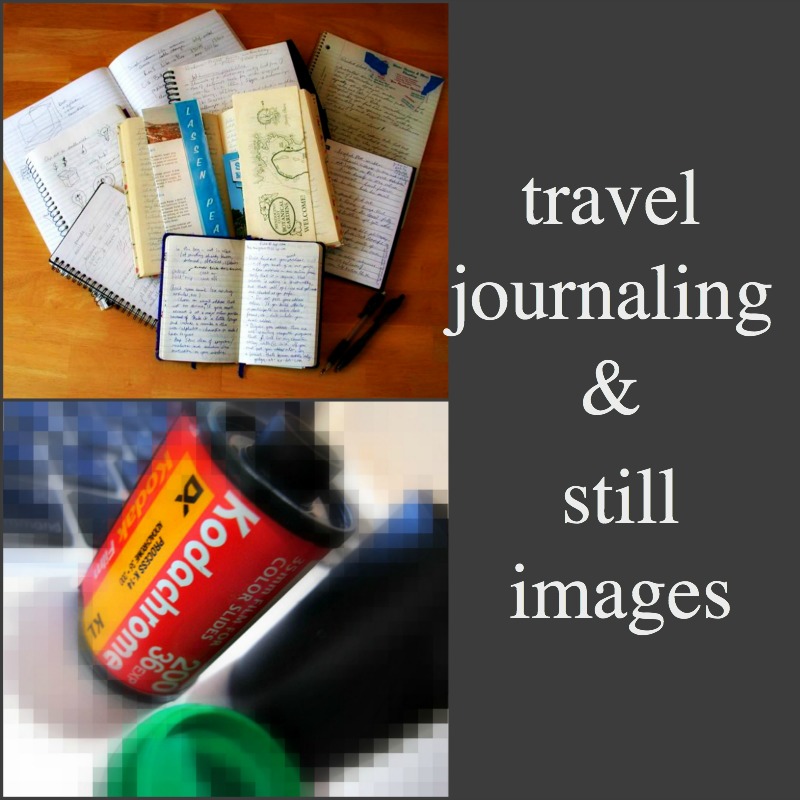
I’m not sure if it’s a technique because it’s not something I do consciously as I write, but your question made me think about it. It’s not so easy to explain, but I seem to identify a feature that is characteristic of a particular place and use my senses to link to it emotionally—trying to recreate in words what I felt when I was there. It’s not simply “place” though, but more a series of “moments-in-place.” The atmosphere of a place changes depending on time of day, seasons and events. It’s possible to keep track of these changes if you maintain a detailed journal as I always do—scraps of information about everything I see, hear, smell and feel. With buildings and landscapes, for example, I record how light and weather affect them. A grey stone wall, for instance, may look hard and forbidding in Scotland, but under a tropical sun it feels surprisingly soft and warm. I note sounds and snippets of overheard conversation, clothes, colours, rhythms of people’s movements—all of which suggest place. Scribbling is a bit of an obsession with me, perhaps a way of hanging on to something I don’t want to end. My other obsession is photography, probably for the same reason. In my early travelling days I used Kodachrome but film was expensive; now you can take large memory cards and click away without a thought. When I’m writing, I scroll through my images and they recall whole scenes for me. The jottings and photographs aid my memory for those sensuous details that I believe evoke atmosphere.

Two of Trish's tools for capturing the details of places. Photo credits: (top) Notebook collection, by Dvortygirl via Flickr (CC BY-SA 2.0); Kodachrome, by Pittaya Sroilong via Flickr (CC BY 2.0).

Two of Trish’s tools for capturing the details of place. Photo credits: (top) Notebook collection, by Dvortygirl via Flickr (CC BY-SA 2.0); Kodachrome, by
Pittaya Sroilong via Flickr (CC BY 2.0).

Which particular features create a sense of location? Landscape, culture, food?

They all can, of course, depending on the story and a writer’s personal interests. I’m certainly no foodie, but even I can feel the tropical heat of Papua New Guinea when recalling drinking kulau (Tok Pisin for “juice from a young green coconut”) straight from a young coconut—the rough, dry shell on my lips, the smooth sweet coolness dribbling down my chin. Language, too, has always been a significant feature for me. Many writers avoid using dialect or foreign words in dialogue so as not to stress the reader, but there are ways of making it easier, and readers enjoy a little challenge. I write dialect or local language in short stories and in travelogues because it draws readers closer to people. And if I want to create the sense of a very specific location, I focus on whatever features are found only in that one place—for example, in Bhutan, the painted red bands around a building that tells you there are sacred relics inside, or in Australia, the surreal landforms of the Bungle Bungles that seem to stride across the landscape enacting their own primordial drama.

Which of your works provides the best illustration of place, and can you give us a brief example?

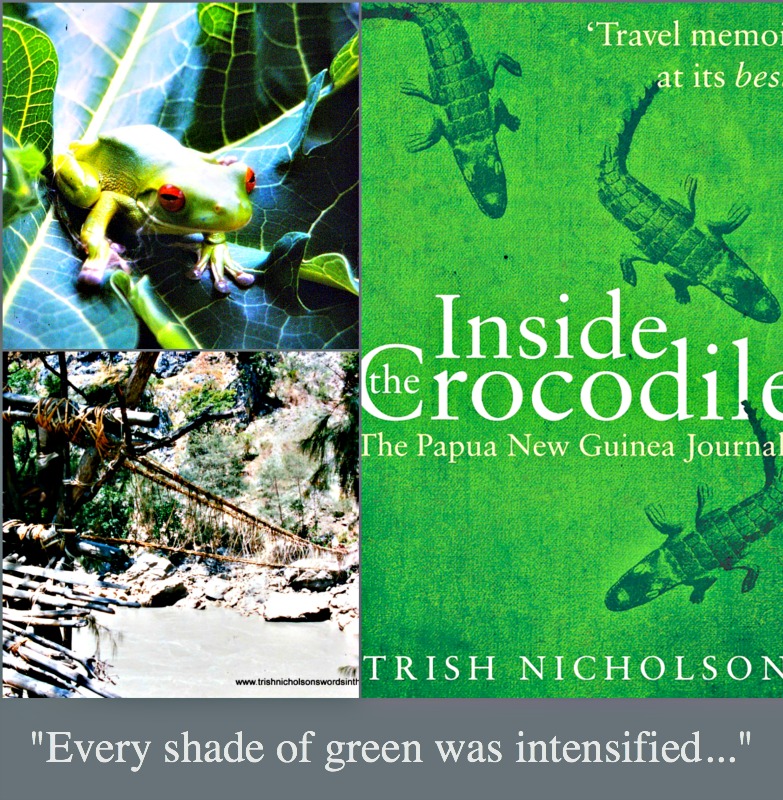
From Inside the Crocodile, a jungle moment on the hair-raising trek from Oksapmin to Lake Kopiago:

The heavy shower was reduced to drizzle under the canopy and it invigorated the forest; every shade of green was intensified, glistening and vivid. Lazy drops of water glided along leaves, dripping silently onto moss beneath. Fine hairs on the ribs of fern fronds, usually invisible, were lit-up by tiny twinkling water droplets like miniature fairy lights. And the air was filled with the fecund mustiness of moist earth seasoned with the tang of wet foliage … the forest stood in strange, expectant silence, muffled by the press of growing, spreading vegetation all around us. Yet every surface, especially the dark underside, was teeming with life we could not see, or would not recognise if we did, and we couldn’t see beyond the next tree trunk or veil of hanging moss. The sense of being enclosed, entrapped within an unknowable multitude, was overpowering.

Photo credits: (top) A frog inside the papaya tree, one of many critters found in PNG; one of many disintegrating bamboo bridges in PNG (by Trish Nicholson, supplied).

Photo credits: (top) A frog inside the papaya tree, one of many critters found in PNG; one of many disintegrating bamboo bridges in PNG (by Trish Nicholson, supplied).

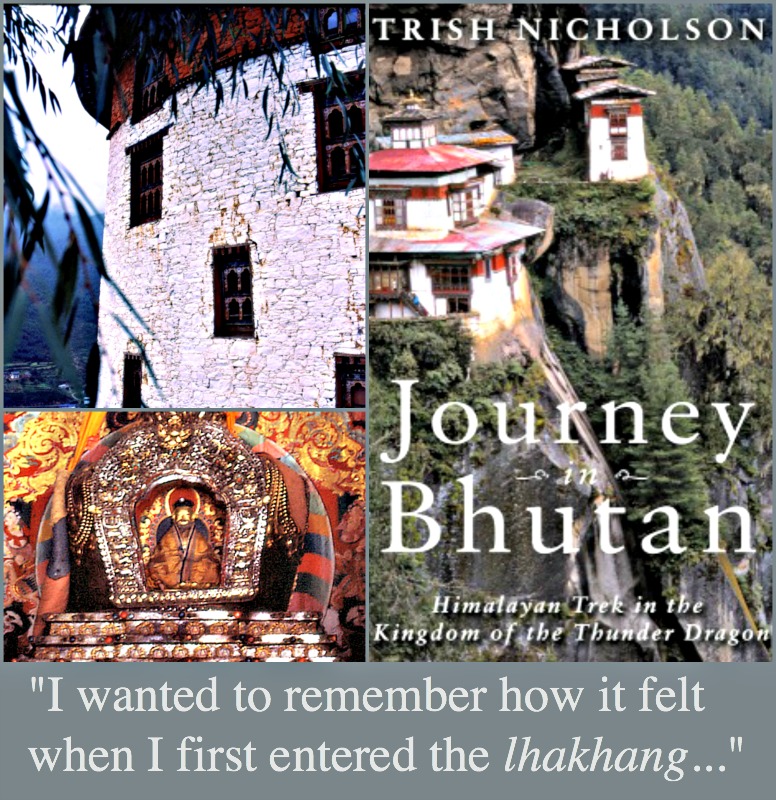
And if I’m allowed another little one, from Journey in Bhutan, my journal entry the evening after we visited the ancient temple of Kyichu Lhakhang:

… I want to remember how it felt when I first entered the lhakhang – the dark wooden floor, polished and worn into grooves by centuries of calloused feet; distant chanting heard through a haze of incense; Buddhas lustrous in the flickering light of butter lamps – thirteen centuries of reverence are distilled in that room creating an almost palpable sanctity. I feel the balm of its atmosphere as I write – it’s almost like a presence.

Photo credits: (clockwise from top left) Rinpung Dzong, a large dzong (Buddhist monastery and fortress) found in Paro District, Bhutan; book cover art; ancient religious relics inside the lhakhang (all photos supplied by Trish Nicholson).

Photo credits: (top) Rinpung Dzong, a large dzong (Buddhist monastery and fortress) found in Paro District, Bhutan; book cover art; ancient religious relics inside the lhakhang (by Trish Nicholson, supplied).

How well do you need to know a place before using it as a setting?

This is a particularly interesting question because I believe one can be in a location too long. The point is not how much time is spent in a place, but how well we “see” it. In an urban setting, I can spend an hour leaning against a wall on a street corner, or a day walking the streets at random, and gather a huge number of impressions and factual details. In remote areas it takes longer because the changing elements have a greater affect on atmosphere. But this may be enough for the setting of a single story. Obviously, for a travelogue, longer immersion is necessary to reach a depth of understanding across time and seasons. But it depends also on how one writes about a place, the scope of the account. I was in Bhutan for a month, much of that time trekking, so although I included monasteries and temples, and carried out a lot of research on cultural and historical background, Journey in Bhutan focuses on the trek rather than trying to cover the whole country superficially. So, how long is too long? After a few years in Papua New Guinea I noted in my journal:

I’m losing all sense of “normal”.

I began taking for granted what seemed extraordinary to a visitor. Fortunately, I had recorded early events that revealed my astonishment and joy and alienation as a greenhorn during those first months. Without the journals, Inside the Crocodile would have lacked that perspective on the location because, after a while, we cease to “see” so clearly.

Which writers do you admire for the way they use location?

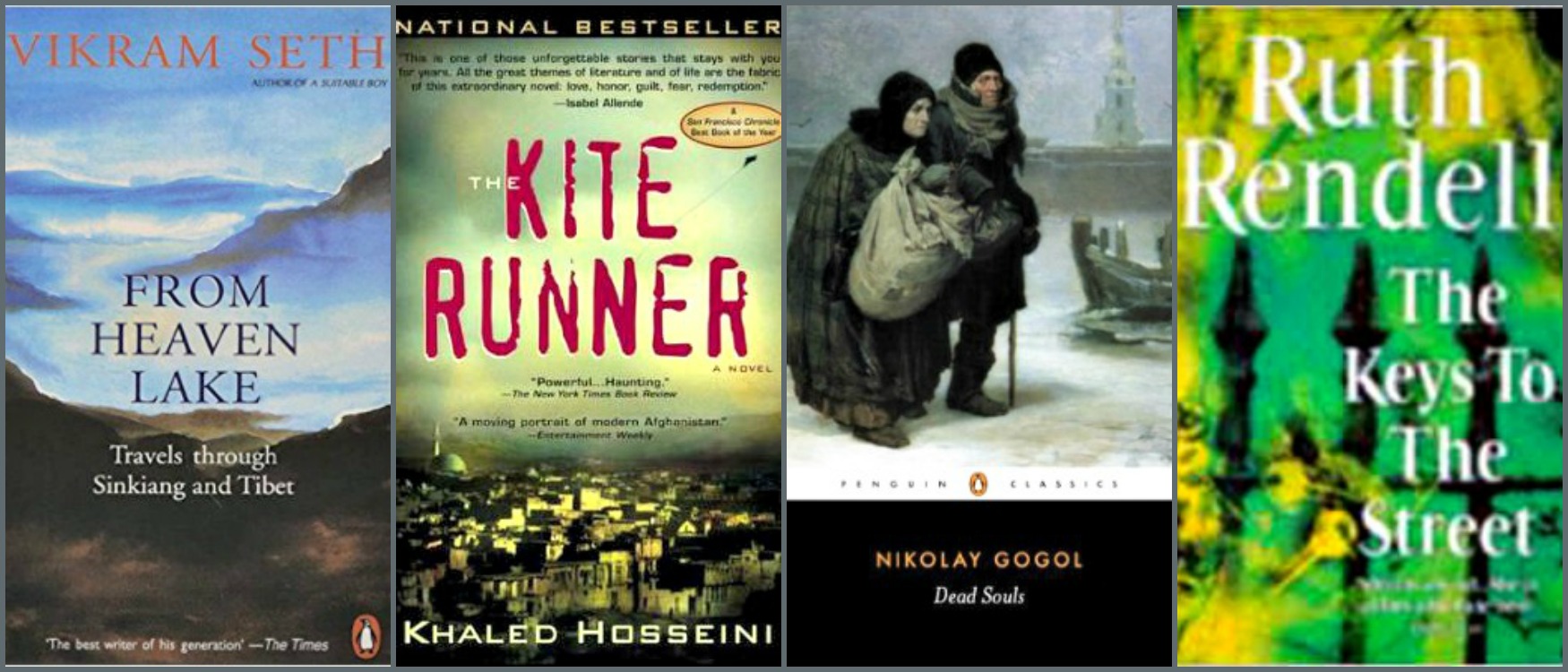
Hard to pick a few from so many: Vikram Seth for his depiction of India—but his first book, From Heaven Lake, was a vivid travelogue of Sinkiang and Tibet; he was still a student but the novelist is already burgeoning in those pages. Khaled Hosseini, who so cleverly weaves his characters into the texture of place in The Kite Runner, and Nikolai Gogol, especially in Dead Souls, where his detailing of personal possessions in a room reveals not only a distinctly Russian steppes atmosphere, but also a character’s past and present. And one more: Ruth Rendell appears to break all the “rules” in The Keys to the Street by opening with almost two pages describing London’s ornamental iron railings—but in such a way that with the first paragraph we are already anxious about those spikes.

Trish's picks for writers who have mastered the art of writing about place.

Trish’s picks for writers who have mastered the art of writing about place.

Thanks so much, Trish! I can easily see why one reviewer described you as “full of humour, adventure, and iron determination…”

* * *

Readers, any questions for Trish Nicholson? Please leave them in the comments below before she disappears back into her treehouse.

And if you’d like to discover more about Trish, why not visit her author site. She also chirps on twitter at @TrishaNicholson.

Until next month!

Lorraine Mace writes for children with the Vlad the Inhaler books. As Frances di Plino, she writes crime in the D.I. Paolo Storey series. She is a columnist for both of the UK’s top writing magazines, has founded international writing competitions and runs a writing critique service, mentoring authors on three continents.

STAY TUNED for the next fab post!

If you enjoyed this post, we invite you to register for The Displaced Dispatch, a round up of weekly posts from The Displaced Nation, with weekly updates and much, much more. Register for The Displaced Dispatch by clicking here!

Related posts:

Photo credits (top of page): The World Book (1920), by Eric Fischer via Flickr; “Writing? Yeah.” by Caleb Roenigk via Flickr (both CC BY 2.0).

DIARY OF AN EXPAT WRITER: Still reeling from reaching the end of my 4-book series in 3 years!

Diary of an Expat Writer
American expat in Hong Kong Shannon Young quit her day job a year ago to become a full-time writer. Here’s the latest entry in her expat writer’s diary.

Dear Displaced Diary,

Yesterday I finished writing the Seabound Chronicles. It’s hard to wrap my head around that sentence:

I…AM…FINISHED…WRITING…THE…SEABOUND…CHRONICLES.

I first got the idea for this series, set on a post-apocalyptic cruise ship called the Catalina, three years ago. I wrote the first words on November 1st, 2012. The series has been my primary writing project ever since, influencing what I read, research, and think about on a daily basis. And now it is complete.

The total word count for the series is 322,000. That works out to 80,000 for Seabound, 73,000 for Seaswept, 73,000 for Burnt Sea, and a whopping 96,000 for Seafled.

Photo credit: Chart via Pixabay.

Photo credit: Chart via Pixabay.

I’ve spent hundreds of hours in this world…

The characters have become increasingly real to me as I’ve figured out how they think, what happens to them, how they react. I’ve lost count of how many dreams I’ve had set on cruise ships. They never take place on the actual Catalina or include characters from the books, but they are often incredibly vivid.

I’ve been walking around for the past day trying to figure out how I feel about this ending. To be honest, I feel hazy, almost hung-over. My reactions are a little slower, lights are a little too bright, and I’m not sure what to do with myself.

Part of this is likely because my week writing the final draft was very intense. I taught five days at two schools far out by the Chinese border. In order to meet my deadline, I stayed at Starbucks until closing several nights that week, and spent eight straight hours writing on both Wednesday (a public holiday) and Sunday.

Except when teaching, I was totally disengaged from the real world. I’m sure I still owe some people some emails.

Trying to get my head around how this feels…

I’m reminded of when I graduated from college. I honestly feel like the three years I spent writing this series was akin to getting a degree. I now have a Masters in Writing Seabound. And like many degrees (my double major in Classical Studies, for example), it’s something I’ll never use again. At least, not directly.

Photo credit: Graduation—my masters degree, by Sarah Stierch via Flickr (CC BY 2.0).

Photo credit: Graduation—my masters degree, by Sarah Stierch via Flickr (CC BY 2.0).

Soon, I’ll be able to look at the lessons I learned from this series and apply them to the next one, which is already in progress.

Soon, I’ll be able to step back and remember that the series isn’t really finished because I still have to format and upload the final book.

Soon, I’ll be able to appreciate that my readers are still deeply engaged in this world and there are more of them out there who haven’t discovered it yet.

Soon, I’ll be able to break this down into a nice takeaway message or two.

But today, I am just absorbing the feelings…

There’s some joy, some sadness, some melancholy, some triumph. Right now all I can do is feel and process. And maybe even write down those feelings. Isn’t that what diaries are for?

Thanks for listening.

Yours,

Shannon Young
AKA Jordan Rivet
www.shannonyoungwriter.com
JordanRivet.com

The Seabound Chronicles is a post-apocalyptic adventure series set on a souped-up cruise ship. It features a prickly female mechanic named Esther. The first three books are out now under the pen name Jordan Rivet. The final book, Seafled, launches on November 30th.

Photo credit: Cruise ship via Pixabay.

Photo credit: Cruise ship via Pixabay.

* * *

Wow, that’s quite a milestone, Shannon—congratulations! It makes sense to me that you feel both happy and relieved as well as numb and somewhat bereft. It’s been an intense three years! Readers who are also writers, can you relate to Shannon’s mixed emotions? Please share your own experiences in the comments. ~ML

STAY TUNED for next week’s fab posts!

If you enjoyed this post, we invite you to register for The Displaced Dispatch, a round up of weekly posts from The Displaced Nation and much, much more. Register for The Displaced Dispatch by clicking here!

Related posts:

BOOKLUST, WANDERLUST: In “The Porcelain Thief,” ATCK and expat writer Huan Hsu assembles shards of his Chinese heritage

booklust-wanderlust-2015

Attention displaced bookworms! Our book review columnist, Beth Green, an American expat in Prague (she is also an Adult Third Culture Kid), is back with a new recommended read!

Hello again Displaced Nationers!

After a long absence (in which I got to satisfy some wanderlust, go me!), I’m resuming my column just in time for the crisp autumn weather that is conducive to some serious reading.

This month I’m excited to tell you about one book in particular I uploaded to my Kindle since we last met: The Porcelain Thief: Searching the Middle Kingdom for Buried China—a memoir of a journey through Mainland China and Taiwan by Chinese American journalist Huan Hsu.

Photo credits: Top third of an antique Chinese vase (Pixabay); cover art; Huan Hsu's author portrait by Martijn van Nieuwenhuyzen.

Photo credits: Top third of a Chinese antique porcelain vase (Pixabay); cover art; Huan Hsu’s author portrait, by Martijn van Nieuwenhuyzen.

Hsu currently lives in Amsterdam and teaches creative writing at Amsterdam University College, but he grew up in Utah. His parents had immigrated to the US from China via Taiwan. Hsu had never set foot in Asia until, as an adult, he started investigating the family legend that sparked this book.

I think one of the reasons Hsu’s account of his travels within China resonated with me so much is that I returned to the United States this summer after a two-year absence and, as usual, felt disoriented. In my case, of course, it was reverse culture shock. I just couldn’t get over the novelty of understanding everything. I started eavesdropping on conversations not because I wanted to but just because I could! Sometimes when people asked me questions, I would stare at them blankly before realizing I could understand what they were saying and respond. I found all the signs and labels, which I often tune out in my life in Prague, distracting. Man, counter culture shock can be tiring!

But whereas I was going home again, Hsu was recounting his very first journey to his homeland, another kind of (and more challenging, I think) Through-the-Looking-Glass experience.

Hsu goes to Shanghai ostensibly to work in an uncle’s semiconductor chip business, but really he wants to interview his grandmother to see what she knows about the family tale of his great-great grandfather having buried a vast collection of prized antique porcelain just before he and his family fled the town of Xingang, on the Yangtze River, to escape the Japanese occupation.

In a place he’s never been—but which many people expect him to regard as “home”

In Shanghai, Hsu finds himself in a place he’s never been—but which many people expect him to regard as “home.” Coming to China without fluent Mandarin, he’s just as much at-sea as many other American expats; but the people he encounters treat him differently than they do other foreigners. In fact, they don’t really consider him an “expat”; rather, they see him as “Chinese”—as much as he would have been if his family had never left that part of the world.

Invisible foreigner in Shanghai

Photo credits: “Just a ‘Small Crowd,'” by Kyle Taylor via Flickr (CC BY 2.0); invisible man (via Pixabay); middle third of Chinese antique porcelain vase (via Pixabay).

This honorary insider status frequently works to Hsu’s advantage as he tries to uncover the truth—if any is to be found—about the complicated events that led to his ancestor burying his precious porcelain pots before taking flight and becoming displaced.

To be honest, I would have been perfectly happy if Hsu’s entire book had been about his experiences as an American-born Chinese exploring China. As Hsu himself says in an essay published earlier this year just before The Porcelain Thief came out, “while books about the Chinese-American experience in America are plentiful, … the story of Chinese-Americans in China remains unstudied.”

It is a story that interests me personally as my now-husband, who is half Chinese, and I once lived in China, where he could pass for Chinese as long as he didn’t talk too much, whereas I was the visible foreigner. (Now that we live in Prague, our “visibilites” are reversed.)

Hsu talks about the times he had it easier adjusting to China because of his ancestry (fewer stares, more acceptance in some areas), but I was happy to see him also address the down side of this situation:

“…(F)etishization of Westerners was perhaps the most exasperating part of being an ABC [American-Born Chinese] in China…the Chinese still regarded laowai [foreigner] as an ethnicity, not a nationality, so we lacked the necessary skin tone and hair color.”

Likewise, other expats fail to see him:

“…I felt wounded when a fellow expat’s gaze passed over me without acknowledgment. Non-Chinese foreigners seemed to always notice one another on the street, sharing a knowing, conspiratorial glance, and when I tried to catch their eyes, they probably regarded me as just another impolite, ogling local. Though I stood out to the local Chinese, I was also invisible to many of my countrymen.”

Hsu’s refreshing honesty about the difficulties of living in China

One of the dangers of many travel memoirs (one that I sometimes fall prey to in my own writing) is to only write about the trip’s highlights. But perhaps because of his journalist background, Hsu is refreshingly honest. He calls it as he sees it:

“To face the absurdities of daily life, expats in Shanghai keep a mantra: This is China. The Middle Kingdom was not so much a foreign country as it was a parallel universe that managed to offend all five senses plus one more—common.”

Hmm… As I can attest from my own experience, it’s not only expats in Shanghai who feel that way!

And if he is honest about the difficulties of living in China, Hsu is also honest about the difficulties of studying Chinese. Anyone who has signed up for language classes after a move abroad will identify with this passage:

“Their Mandarin sounded familiar, and their speech didn’t seem fast to me, and sometimes I could even understand a good number of the words. But I couldn’t comprehend a thing because I was missing all the important ones, so I would hear something like, ‘Okay, and now we’re going to talk about [blank] and why you [blank] and [blank] because [blank] [blank] [blank] [blank] [blank] [blank] otherwise [blank] [blank] [blank]. Any questions?’”

Good memoirs are a little raw; this one is. Just as Hsu doesn’t pull any punches when describing China, he is equally blunt about owning up to his family’s quirks and talking about his own difficulties surmounting culture shock. Regarding this last, he writes about people having “the same personal space as puppies” on public transportation, and about his cringing embarrassment when he sees people drying their laundry on telephone poles in less-affluent areas of the city. I think anyone who has been an expat in China has made a similar list of initial observations. I can remember doing so after moving to China in 2006.

So much more than just a TCK-experiencing-Culture-One memoir

But in the end, the book is so much more than just a TCK-experiencing-Culture-One memoir. Tsu also introduces the reader to the art of Chinese porcelain, which serves in turn as a kind of symbol of modern China, a nation of fragments.

Photo credit: Chinese antique porcelain vase (Pixabay).

Photo credit: Chinese antique porcelain vase (Pixabay).

In fact the bulk of the book is devoted to Hsu actively searching for any remaining pieces of the family treasure. He flies to Taiwan and Hong Kong to locate the heart of the old porcelain industry. He finally visits the old family property that his great-greats had fled and in so doing turns up long-forgotten shirttail relations.

In the course of this quest, Hsu pieces together beautifully imagined scenes of his family’s escape from the Japanese into the Chinese diaspora.

I enjoyed The Porcelain Thief on all kinds of levels: as memoir, travelogue, art history, and social history. I’d particularly urge anyone who has lived as an expat in China, or who is thinking of doing so, to give it a try.

* * *

So, readers, have you ever had the experience of being an “invisible” expat or know someone who has felt that way? Let us know in the comments. And if you have ideas for books to review for this column, please leave a comment or let me know on Twitter! Last but not least, I urge you to sign up for the DISPLACED DISPATCH, which has at least one Recommended Read every week.

STAY TUNED for next week’s fab posts!

Beth Green is an American writer living in Prague, Czech Republic. She grew up on a sailboat and, though now a landlubber, continues to lead a peripatetic life, having lived in Asia as well as Europe. Her personal Web site is Beth Green Writes. She has also launched the site Everyday Travel Stories. To keep in touch with her in between columns, try following her on Facebook and Twitter. She’s a social media nut!

If you enjoyed this post, we invite you to subscribe to The Displaced Dispatch, a weekly round up of posts from The Displaced Nation and much, much more. Sign up for The Displaced Dispatch by clicking here!

Related posts:


For this peripatetic Sardinian writer who has settled down (for now) in Rome, a picture says…

KONICA MINOLTA DIGITAL CAMERAGreetings, Displaced Nationers who are also photography buffs! “A Picture Says…” columnist James King is still away, so I am filling in again.

My guest this month is Angela Corrias, a well-traveled freelance writer who was born in the Italian island of Sardinia.

There’s a lot about Angela’s story that captivates me. For a start, there’s this photo of her on her Chasing the Unexpected blog’s About Me page, where she’s wearing a head scarf and looks Middle Eastern.

I had seen her “I heart my city” article on the National Geographic Traveler‘s site, which was all about Rome (where she now lives), so I assumed she was Italian… But was my assumption incorrect?

I also knew from her NatGeo article that she has traveled extensively and been an expat several times.

Hmm…that still doesn’t explain why she’s wearing a head scarf.

As I read more about Angela, I became even more intrigued. “[W]hat I like the most when I travel,” she writes on her About page, “is to dig deep into other countries’ culture, traditions, social customs and explore them in all their idiosyncrasies. I’ve always tried to avoid filling my posts with the basic information available by performing a simple Google search, and strived to publish more personal impressions instead.”

Something new I learned from her blog was that she is also a “wannabe photographer.”

It was at that point I knew that we had to feature Angela in “A Picture Says…,” and luckily she was “angel” enough to oblige!

Angela Corrias in Jiasalmer, India, one of the many stops in her travels (photo supplied)

In front of India’s Golden City, Jaisalmer, stands Angela Corrias, the woman who finds gold in all her travels. (Photo supplied)

* * *

Hi, Angela, and welcome to the Displaced Nation. I’d like to start by asking: where were you born, and when did you spread your wings to start traveling?
Hi, ML, and thank you for inviting me to take part in this column. And just to clear up your confusion, no, I’m not Middle Eastern. I was born in Sardinia, Italy’s second biggest island off the coast of Rome, and while my first international trip was to nearby France to visit relatives when I was just three years old, I’ve always considered my travel initiation to have been the first time I crossed the equator at the age of 13 to go to Brazil. It was my first long-haul flight and very first immersion in a culture different from mine. Maybe that’s why I’ve always had a soft spot for Brazil.

Now, I know from reading that Nat Geo article that, since reaching adulthood, you’ve traveled far and wide and also been an expat. What are some of the countries you’ve been to, and which have you actually lived in?
I’ve traveled extensively around Europe, living for two years each in Dublin and London. I’ve visited countries like Spain, France, Germany, Poland, Finland, Romania, Turkey and even Monte Carlo (once). In the Middle East, I’ve been to Lebanon, the UAE and Iran (many times). I’ve also spent a great deal of time in Asia. I lived for one year in China (Shanghai) and was able to travel around visiting countries like India, Sri Lanka, Thailand, Singapore and Cambodia. And I mustn’t forget Brazil. I’ve traveled there many times with a quick jaunt to Argentina once—the only two countries I’ve visited in South America so far.

Ah, so THAT explains the head scarf! All those trips to Iran… Where are you living right now and why?
After almost ten years of the expat and nomadic lifestyle, I decided two years ago to come back to Italy and live in Rome. While I’m not ruling out completely another expat/nomadic experience, I’m liking it here so far. The city is extremely lively and constantly inspires me for writing and taking pictures. And it has an international airport, which makes it easy for me to book flights to any destination.

“To one that watches, everything is revealed.” —Italian proverb

Moving right along to the part we’ve all been waiting for: a chance to appreciate a few of your photos. Can you share with us three photos that capture some of your favorite memories of what has clearly been for you a “displaced” life of global travel? And for each photo, can you briefly tell us the memory that the photo captures, and why it remains special to you?
I’ll start with a photo that I took last year at the beautiful Imam Square at the center of Isfahan, Iran, a city that boasts an amazing history, impressive architecture and one the world’s most beautiful bazaars. Recently Iran has become for me one of the countries where I feel most at home—not just because locals actually mistake me for an Iranian and refuse to believe that I don’t speak Persian, but because I feel I can just unwind and enjoy what the country has to offer, from its stunning art to its beautiful and diverse nature to the warmth of its people.

The vast Iman Square in Iran, an important historical site. Photo credit: Angela Corrias (supplied).

The vast Iman Square, an important historical site in Iran. Photo credit: Angela Corrias (supplied).

Another place where I feel at home is my actual home, Sardinia. I left it some 17 years ago and go back far less than I would like to. I took this photo in the lovely coastal town of Bosa this past August, when I treated myself with a full 12-day stay after years of never visiting for more than a week. Sardinia is actually the kind of place where many people, including foreigners, can easily feel comfortable, and eventually settle down. A quiet, laid-back and relaxed lifestyle, its own cuisine, and a hospitable atmosphere—these are just a few of the features that can make anyone feel at home.

Fishing plays an important role in the economy of Basa, Sardinia. Photo credit: Angela Corrias (supplied).

Fishing plays an important role in the economy of Basa, Sardinia. Photo credit: Angela Corrias (supplied).

I took this third photo at a tea market in Shanghai, when living in China. For me it represents a truly traditional Chinese moment. Before moving to China, I had lived in Dublin for two years and in London for another two years, but neither of these cities made me feel I wanted to stay, and from the beginning I knew I would leave once I’d had the experience I was looking for. This changed in China. Despite the initial culture shock, once I started Chinese-language classes and began to speak with the locals, who are always very happy to see foreigners making the effort to learn their extremely difficult language, I instantly felt comfortable and as though I could settle for some time.

Sampling Chinese tea culture in Shanghai. Photo credit: Angela Corrias (supplied).

Sampling Chinese tea culture in Shanghai. Photo credit: Angela Corrias (supplied).

Wow, you’ve taken us from a vast square in Iran to an intimate setting of a tea house in Shanghai, which gives me a clear idea of the breadth of your travels. And that photo of the insides of a fishing boat in your native Sardinia—it seems so intimate. I can tell how much you know and love your homeland, or should I say “homeisland”?

“It all ends with biscuits and wine.” —Italian proverb

Having seen these first three photos, I expect it’s a bit of a tough choice, but which are the top three locations you’ve most enjoyed taking photos in—and can you offer us an example of each?
Everywhere I go, one of the first places I visit are the local markets. I took this photo at a market in the town of Roulos in Cambodia, near Siem Reap, where most vendors lay out their products and merchandise on the ground. Witnessing this feast of fruits, veggies and different local fish being sold by locals to locals was a great way to soak up the local atmosphere and sense of community.

The market in Roulos, Cambodia. Photo credit: Angela Corrias (supplied).

Roadside market in Roulos, Cambodia (not far from Ankor Wat). Photo credit: Angela Corrias (supplied).

Iran is also a place where I very much enjoy taking photos. First of all, the people are always willing to be photographed and they often take it as a chance to strike up a conversation, which is the best possible outcome of a day out as a traveler. Secondly, it’s not very hard to take nice photos thanks to the beauty of its historical landmarks, architecture, parks and bazaars. Finally, Iranian style has a certain opulence, which translates into lavish meals, sophisticated art and loud gatherings. I took this photo at my friend’s house in the city of Lahidjan, in Gilan Province, Iran (on the Caspian Sea). Her mother had prepared some traditional dishes so that I could sample the local cuisine.

An Iranian feast. Photo credit: Angela Corrias (supplied).

A sumptuous feast of traditional foods in Lahijan, Iran. Photo credit: Angela Corrias (supplied).

Maybe because I live here now, but Rome is also one of my favorite places to capture with my camera. It offers many diverse subjects and situations, ranging from ancient Roman baths and villas to the traditional life of the Garbatella area, the industrial archaeology of the Ostiense neighborhood or the urban pop art that is gradually turning Rome’s suburbs into open-air museums. The photo I chose is from an area called Quadraro, once mainly considered a working-class district and now revamped thanks to a street art project that has taken over most walls around the neighborhood.

Street art livens up Quadraro, a neighborhood in Rome’s southeast periphery. Photo credit: Angela Corrias (supplied).

Street art livens up Quadraro, a neighborhood in Rome’s southeast periphery. Photo credit: Angela Corrias (supplied).

Wow, that last one makes me think of an Italian Alice in Wonderland! And the two food photos were amazing, each in their own way.

“When in Rome…” —early Christian proverb (now universal)

I wonder: do you ever feel reserved taking photos of people, particularly when they are conscious of your doing so? How do you handle it?
Yes, I do feel I need to be cautious when taking photos of people as I’m essentially capturing a moment of their life. I must admit, I love taking photos of the locals as they add to the value of the image and give a great sense of place, but obviously if I’m close and have the chance to converse, I always try to get familiar and make them feel more at ease. I also try not to point my lens directly in anyone’s face.

In Cambodia, for example, I had the opportunity to visit two floating villages, Kompong Khleang near Siem Reap and Phsar Krom on the way to Phnom Penh, and while I understand that tours are organized to make visitors experience life on the water and show them how Cambodians live, I sometimes felt as if we were invading their private space. I could imagine the locals wondering why tourists were so interested in their daily life—a life that seemed to me a never-ending struggle for survival.

Here is a photo from that trip, which perhaps helps to demonstrate my point:

Kompong Khleang, considered the most authentic of the three floating villages around Siem Reap, Cambodia. Photo credit: Angela Corrias (supplied).

Kompong Khleang, a floating village near Siem Reap, Cambodia, and home to around 1,800 families. Photo credit: Angela Corrias (supplied).

“Take pleasure in your dreams…” —Giotto di Bondone

When did you become interested in photography?
Ever since I decided to work as a freelance writer, I’ve taken photos to accompany my articles. Gradually, however, especially after I took a course on reportage photography in Rome, photography has became more of a passion and a source of inspiration, so much so that I’m starting to think about focusing on photography alone and having an exhibition one day. I enjoy devoting a whole day to taking pictures. And of course, the more I take photos the better I do with my writing. It gives me ideas for blog posts.

What is it about this art form that drew you in?
Sometimes with a camera you can capture moments, looks, colors that maybe you don’t notice and you realize only afterwards, when looking at the photos. I also like the way images can be interpreted differently depending on the viewer’s perspective. We need words, too, to avoid misunderstandings, but when it comes to art forms, an image can convey emotions and a kind of poetry that speaks to other people.

And now switching over to the technical side of things: what kind of camera, lenses, and post-processing software do you use?
After seven years of Nikon D50, I upgraded my photo gear with a Nikon D7100 last year, and I love it. I have four lenses: the normal 18-55 that I bought with my first camera and that I’m about to replace with one with bigger aperture; a Nikon 70-200; a Sigma 10-20; and a Nikon 50mm. While I started as a self-learner, I eventually felt the need to take a course, during which I improved a lot, especially when it comes to choosing the appropriate lens for particular subjects and situations. For post-processing software I use Adobe Photoshop—an early version, though, which I might need to upgrade.

“Either learn, or leave.” —Roman proverb

Finally, can you offer a few words of advice for wannabe photographers who are traveling the world or living abroad?
My advice would be to take time to interact with locals as much as possible. Understanding the host culture is crucial in order to take the pictures that will capture the essence of a place. Another piece of advice that I always try to follow myself, even though I know it’s not as straightforward as it may sound, is to get out of your comfort zone, even if this means feeling confused at first. You will adapt eventually; human beings always do. Finally, never be so arrogant to travel with the idea of imposing your own lifestyle and values on others, because it’s hardly ever the case that one culture is superior. It’s always better to travel with the idea of learning rather than teaching.

Thank you, Angela! I appreciate your sharing a selection of photos that show us how deeply you connect with the local scenery and people on your travels into various parts of the world. You seem to take the opposite approach to that of the Roman statesman Julius Caesar, he of veni, vidi, vici (I came, I saw, I conquered) fame. At the same time, you clearly feel a strong connection with your native Sardinia and your new home of Rome. Your travels appear to have made you appreciate Italy’s own brand of beauty. Thank you again for doing this interview. Essere uno stinco di santo.

* * *

Readers, what do you make of Angela’s peripatetic life and her photography advice? Please leave any questions or feedback for her in the comments!

If you want to get to know Angela Corrias and her creative works better, I suggest you visit her author site, where if you sign up for her e-newsletter, you’ll receive a free photo ebook on the Venice Carnival. Going to Rome any time soon? Visit Angela’s other site, Rome Actually, about her Roman adventures. You can also follow her on Facebook, Twitter, and Instagram.

NOTE: If you are a travel-photographer and would like to be interviewed for this series, please send your information to ml@thedisplacednation.com.

STAY TUNED for more fab posts!

If you enjoyed this post, we invite you to register for The Displaced Dispatch, a round up of weekly posts from The Displaced Nation and SO much more! Register for The Displaced Dispatch by clicking here!

Related posts:

DIARY OF AN EXPAT WRITER: The highs, but also the lows, of the writing life

Diary of an Expat Writer
American expat in Hong Kong Shannon Young quit her day job a year ago to become a full-time writer. Here’s the latest entry in her expat writer’s diary.

Dear Displaced Diary,

As you’ve no doubt noticed over these many months, most of my entries have focused on the good things happening in my life as a writer. I prefer to take an optimistic view of my progress. But there are hard days, too—when I don’t see the results I’d like or accomplish as much as I want. On such days, uncertainty and frustration overwhelm the logic telling me I’m on the right track. Yesterday was an especially low day, so this month I want to share with you a sense of the ups and downs of the expat writer’s day-to-day existence—take you on a kind of roller coaster ride.

One of the worst lows: Comparisonitis

I try not to obsess over how other people’s books are selling (except for research purposes), but the desire to look at a comparable book’s sales rank and wonder why mine isn’t doing as well can creep in like an evil sprite. That can lead to insecurity and jealousy over things that are 100% out of my control.

That way lies madness!

The flip side of comparisonitis is reading a great book and feeling like I’ll never be able to write something as good. I’ll say to myself: “Of course they’re selling better than I am! Their book is gripping and sexy and funny and I can’t put it down! Why can’t I do that!”

Borders in Ann Arbor, by Joanna Poe via Flickr (CC BY-SA 2.0).

Borders in Ann Arbor, by Joanna Poe via Flickr (CC BY-SA 2.0).

How I deal with it: The old adage about the overnight success that takes ten years is absolutely true. Behind every book that takes off like a shot there’s a writer who has put in the time, sweat, and tears to get to that tipping point. I have to remind myself, sometimes on a daily basis, that I’m putting in the work now that will hopefully pay off in a big way later (both from a sales perspective and a skill perspective). This is a craft, and I am still an apprentice in many ways. I also need to remind myself to focus exclusively on the things I can control, such as writing the best books I possibly can—and occasionally stepping away from the Internet.

One of the best highs: Fans!

Yes, I officially have fans. This month I received my first fan letter for the Jordan Rivet books from someone who is in no way connected with me or anyone I know. She wrote me again this week to tell me that she finished Burnt Sea and loved it!

While I was in Arizona, I also got to meet up with two different readers who are friends with my mom (one read Seabound before I ever met her, the second I’ve known for many years). One told me she felt star struck to be having coffee with me. The other had highlighted her favorite passages from Burnt Sea and shared them over Chipotle. To hear that she enjoyed these sentences I’d been poring over for months was incredibly gratifying. Both women made me feel great about my work—and that kind of encouragement can’t be understated, especially on the low days.

Jodan Rivet fans

Stateside Jordan Rivet fans Trine and Julie (photos supplied).

Another low: Rejection

I’ve chosen the indie-publishing road for my Jordan Rivet books, and it comes with its own share of rejection. There are a few promotion sites that are real heavy hitters. I’ve been accepted by some of the big ones, but rejected by the biggest of all (Bookbub). Sometimes this is just a matter of scheduling, but it still stings.

Much of my work as Shannon Young is not self-published, though. I’ve been waiting for a response on a particular piece for six months. This week I finally got an answer: no. It’s time to reassess and decide whether I want to release this particular work as is or develop it into a longer project.

Rejection Mug

Photo credit: “Journal of Universal Rejection” coffee mug, by Tilemahos Efthimiadis via Flickr (CC BY-SA 2.0).

How I deal with it: Even though six months have elapsed since I submitted the piece, I’m realizing I may need to step away from it a bit longer before I can make a clear-eyed decision. There are a lot of emotions tied up in rejection, and I need to make an intelligent decision about whether to move on, keep trying, or do something differently. That takes time and perspective.

A kind of high: Not reading reviews!

This high isn’t what you might guess. The reviews for my work have generally been positive, but for me the real triumph is that I’ve finally gotten to a place where I no longer read my reviews. I’ve come to realize that, at the end of the day, reviews exist for readers, not for writers. They are there to help other people decide whether or not they’ll like a book and to give the reviewers a chance to express their thoughts about it. None of that has anything to do with the author.

If I do read my reviews—including positive ones—here’s what happens: I fixate on the critiques. I can’t help it. I’m an optimistic person, possibly confident to a fault, yet it’s always the critiques I remember. And you know what, diary? There’s absolutely nothing I can do to fix things at that point. The book is done and dusted. I can’t change it. So why obsess over the one thing that didn’t work for a reader who enjoyed the book as a whole?

(Note: I follow my writers’ groups’ critiques like gospel. I’m always trying to improve my work, but when a book is finished and published that no longer applies.)

Thus reading reviews is a recipe for utterly futile stress. So while I am incredibly thankful for people who take the time to write reviews (and they’re essential for the success of a book), I won’t read them. Instead, I’ll focus on making every book better than the last.

Yet another low: Missed deadlines

I’ve mentioned before that I like to make checklists and to-do lists for myself. Crossing off items on time or early never fails to make me happy. On the other hand, if I miss my deadlines it can be equally frustrating.

Case in point: my new part-time teaching job starts on October 5th. The timing of the classes means I’ll have to rework my writing schedule to stay productive. I wanted to finish the final book in the Seabound Chronicles before then. My goal was to finish the current draft on Friday. Well, on Monday the book was 80,000 words. By Friday, it had grown to 86,000 words, but I had only reached the 51,000-word mark in my edit. Adding all those scenes took a lot more time and thought than anticipated, so now I probably won’t finish the draft until Thursday at the earliest. This leaves me with less buffer time than I had hoped before the Great Schedule Shuffle begins.

Photo credit: Pixabay.

Photo credit: Pixabay.

How I deal with it: Like always, I need to glue myself to my chair and just get on with it! The book will be finished when it’s finished, and I’m not going to put out a half-baked project (or even 80% baked). The worst thing I could do would be to let frustration or impatience paralyze me.

The knack of staying on an even keel

This emotional rollercoaster is normal for a full-time writer. It’s important not to let either extreme get in the way of my work. The key is to accept the reality of the lows and to figure out ways to deal with them so as not to become derailed.

Thank you, Displaced Diary, for giving me a chance to process. Sometimes that’s all it takes to get the day turned around and become productive.

Yours,

Shannon Young
AKA Jordan Rivet
www.shannonyoungwriter.com
JordanRivet.com

* * *

Shannon, thank you for giving us such a clear window onto the highs and lows you’ve experienced as a full-time writer. TBH, it brings me back to the days when I was a graduate student in the UK and how frustrated I felt on the days when my thesis-writing wasn’t going well (or at all). When you have to keep producing page after page, you can become very isolated, and you’re already feeling somewhat isolated to begin with as an expat. It’s great you have found such a supportive writers’ community in Hong Kong. You also seem to have a much better ability than I did at the same age, to trust in the process! Readers who are also writers, can you relate to Shannon’s vacillating emotions? Please share your own experiences in the comments. ~ML

STAY TUNED for next week’s fab posts!

If you enjoyed this post, we invite you to register for The Displaced Dispatch, a round up of weekly posts from The Displaced Nation and much, much more. Register for The Displaced Dispatch by clicking here!

Related posts:


WONDERLANDED: The Girl in the Mirror–from “Beautiful Affliction,” by expat writer Lene Fogelberg

Lene thru the looking glass

Photo credits (clockwise from top left): Lene Fogelberg author photo (supplied); “Alice through the Looking Glass”, Guildford, by Colin Smith via Wikimedia Commons (CC BY-SA 2.0); icu 2, by Jo Naylo via Flickr (CC BY 2.0).

A couple of days ago we were Wonderlanded with the award-winning Swedish poet Lene Fogelberg, who is now an expat and a writer. This post, which I’ve titled “The Girl in the Mirror,” is an excerpt from Chapter 44 of Lene’s newly published memoir, Beautiful Affliction. It describes the moment when Lene was staring into a mirror in a hospital room having removed all her clothes in preparation for emergency open-heart surgery. (As those who read her interview will know, she was diagnosed with a congenital heart defect shortly after her arrival with her family on the East Coast of the United States, and given only a week to live unless she had medical intervention.)

Unlike Alice, however, Lene has little desire to step through the looking-glass without knowing whether she will end up queen of her own heart…

* * *

IT IS A SMALL ROOM. A toilet. A sink. A soap and disinfectant dispenser on the wall. A single lamp over the mirror. A pale face. Is this me? These eyes, small blood vessels, black pupils dilated. I have nowhere to run. The door is locked and there is no window where I could crawl out, and even if there had been one, I would force myself to stay.

Everything. She said everything.

My shoes. Into the bag. Sweatpants. On top of my shoes. Sweater next. Fold. Into the bag. I’m getting dizzy bending over and getting up, but I have to do this. Slowly. T-shirt. Bra. Underpants. Socks.

Who will open this bag, take out these clothes, unfold them? The floor is cold under my feet.
No jewelry. No rings, no necklace. Nothing to keep my hair from my face. Just skin.

The girl in the mirror is shaking and fighting back tears and her eyes tell me: Do not look away do not dare look away you have to see this. Her chest swelling and shrinking, narrow shoulders, purple nipples, bluish skin stretched over her ribs.

It was all just pretend, she says, the roles you played, the costumes you wore. This is the real you.

Here is my body. Which I have fought and pleaded with and commanded and cared for and decorated and dressed and undressed and loved and hated. Here it is. Pale and thin. And yet it has been heavy, so heavy to carry. In a way it would be a relief to finally step out of it, fold it, and put it in a coffin.

But in these eyes I can see Ingrid and Stina dancing, and in these hands I can feel Anders’s touch, and on this forehead I can feel him stroking me gently, and in this scalp I can feel the pull of my mother braiding my hair, and on these shoulders I can feel the weight of my dad’s arm telling me he loves me without using words. They are all there; my body remembers them, all the memories written on my skin and in every movement.

My body remembers them

Photo credits (clockwise from top left): Getting ready to go out, by Lars Ploughmann via Flickr (CC BY-SA 2.0); release via pixabay; children’s dance via pixabay; Hans via pixabay.

There. My skin is soft under my fingers, will be soft under the scalpel. But my ribs are hard, resisting the line I’m drawing, the curve, showing the way to my heart.

Is this how it will end?

Can she be the queen of hearts

Photo credits; Heart via Pixabay; Red Queen of Hearts, by Suzanne Schroeter via Flickr (CC BY-SA 2.0).

I have done everything they told me. Followed the instructions. But this is the point where that’s not enough. It has to be my own decision. It has to be me reaching for the robe. Me putting it on. Me reaching for the bag. Me looking into the mirror one last time.

The girl in the mirror is staring at me, pleading, please don’t make me.

Is this really happening? Or am I down in the corner, my head in my hands, refusing to make this decision? Crying that it is not fair, it is not fair.

Please, please, don’t make me.

There, there.

Please, don’t.

There is no other way. You know it.

And the girl in the mirror is silent. And she looks away.

The doorknob is cold in my hand.

Click.

Push.

I open the door.

Cold doorknob

Open the door, by Hernán Piñera via Flickr (CC BY-SA 2.0).

Excerpt from Beautiful Affliction: A Memoir, by Lene Fogelberg

* * *

Thank you so much, Lene! I find it extraordinary that you can write so poetically about your adventure of stepping through such a macabre looking-glass and confronting the “real you”. Your powers of self-observation make me think of Alice’s declaration:

I could tell you my adventures—beginning from this morning; but it’s no use going back to yesterday, because I was a different person then.

Except Alice was a timid young woman, whereas you write from your heart about your heart. As you put it in a recent tweet:

There is no shortcut when you write from your heart. You drill through every layer protecting your innermost secrets.


Readers, what do you think? Has this excerpt from Lene’s book moved you, and made you want to read more? Beautiful Affliction, published by She Writes Press, is now available from Amazon or Good Reads. You can also visit Lene’s author site, whee she keeps a blog, and/or stay social by following her on Twitter, Facebook, and Instagram. And of course you can also express appreciation for Lene in the comments below. ~ML

STAY TUNED for next week’s fab posts.

If you enjoyed this post, we invite you to register for The Displaced Dispatch, a round up of weekly posts from The Displaced Nation, and much, much more. Register for The Displaced Dispatch by clicking here!

Related posts:


Wonderlanded with Lene Fogelberg, award-winning poet, writer, and double open-heart surgery survivor

There’s something from Alice in Lene Fogelberg’s story. Photo credits (clockwise, from top left): NecoZAlenky (original Czech film poster for Something from Alice) via Wikimedia Commons; Lene Fogelberg author photo (supplied); operating room via Pixabay.

Welcome back to the Displaced Nation’s Wonderlanded series, being held in gratitude for Lewis Carroll’s Alice’s Adventures in Wonderland, which turns 150 this year and, despite this advanced age, continues to stimulate and reassure many of us who have chosen to lead international, displaced, “through the looking glass” lives.

This month we travel
d
o
w
n
the hole with Lene Fogelberg, a Swede who has lived in quite a few places but right now can be found in Jakarta, Indonesia.

With her long red hair and blue eyes, she looks a little like a Swedish Alice. What’s more, her biography of her early years is not dissimilar to that of Alice Liddell, the muse behind the Lewis Carroll story. Growing up in a small town by the sea, Lene was full of curiosity about the wider world and also in love with words. Describing her youth in a recent guest blog post, Lene says that for her,

written words danced lightly as feathers on the page. I loved to read and made weekly visits to our small town library, the bicycle ride home always wobbly with the heavy pile of books on the rack.

But while similarities are rife to Carroll’s Alice, the “wonderlanded” story Lene lived as an adult in fact comes closer to Czech director Jan Švankmajer’s surrealistic interpretation in his 1988 film, Něco z Alenky.

Něco z Alenky means “something from Alice,” and Lene ended up taking something from Alice’s story when, after moving to the United States with her husband and children, she found herself being wheeled through a rabbit warren of hospital rooms into an operating theatre. As in Švankmajer’s film, she was in a bizarre dream rather than a classic fairy tale.

Strangely, from the time she was young Lene had suspected there was something wrong with her heart. She even harbored a not-so-secret fear of dying young, trying to make the most of each moment. But Swedish doctors repeatedly dismissed her concerns, treating her like a hypochondriac.

And then, it happened: her worst nightmare came true. Shortly after arriving in America she went to have a physical so she could get an American driver’s license—and the American woman doctor informed her she had a congenital heart condition and only a week to live.

Lene survived two emergency open-heart surgeries to tell her story: quite literally! Her memoir (and first book), Beautiful Affliction, is out this week from She Writes Press. Until now, Lene had written in Swedish, mostly poetry, for which she has won some awards. But even though she chose to write her memoir in English, she retains her poetic style, as we will see later in the week when we publish a short book excerpt.

But before that happens, let’s have Lene will take us down into her rather harrowing rabbit hole. True, she’s had some reprieve since since recovering from her surgeries and moving to Jakarta—but only some, as Jakarta is the kind of place where you have to take your life into your own hands to cross the street. But I’m getting ahead of the story—over to Lene!

* * *

Lene Fogelberg: Thank you, ML, and greetings, Displaced Nation readers. Just to give you a little more of my background: I grew up in the south of Sweden, in a small town by the ocean. As ML says, I often stood looking out over the ocean following the waves in my imagination, wondering about all the exciting places in this world. In my youth I spent a couple of summers in France studying French and falling in love with this beautiful country.

As newlyweds my husband and I moved to Germany as students for a year, where I learned the language and took care of our newborn baby (just three months old when we arrived). After Germany, we moved back to Sweden and stayed there until my husband’s employer offered him a position in the United States. We moved to a small town outside of Philadelphia, called Radnor. That became the scene of my life-threatening health crisis. How it erupted and played out is the topic of my book, which, as ML mentioned, came out this week.

We spent a year and a half in the United States in total and then moved back to Sweden for a couple of years. Nearly four years ago we relocated to Jakarta, but in December we will be moving again: to Kuala Lumpur, Malaysia.

“Stop this moment, I tell you!” But [Alice] went on all the same, shedding gallons of tears…

After moving to the US there was a huge pool of tears because of the drama that unfolded in the weeks following the transition. My husband and I had to have physicals prior to getting our American driver’s licenses, and as soon as the doctor put the stethoscope to my chest she reacted to the sound of my heart. It turned out I had a fatal congenital heart disease and that I’d lived longer with this disease than anyone the US doctors had ever met.

Beautiful Affliction story

As Lene attests in her newly published memoir, her “rabbit-hole” experience was full of heart, tears and physical drama. Photo credits (clockwise from top left): Front and back cover art for Lene’s book (supplied); Alice’s Adventures in Wonderland illustration by Milo Winter (1916), via Wikimedia Commons; The White Rabbit’s House, by Kurt Bauschardt via Flickr (CC BY-SA 2.0).

[S]he felt a little nervous about this; “for it might end, you know,’ said Alice to herself, ‘in my going out altogether, like a candle. I wonder what I should be like then?”

The events that unfolded are covered in my book Beautiful Affliction, which is a crazy story, full of heart and physical drama, not unlike Alice’s own confrontations with her changing body.

“Where should I go?” –Alice. “That depends on where you want to end up.” –The Cheshire Cat

Although my physical crisis was great, Jakarta has been one of the biggest challenges in a “wonderland” sense. The city is chaotic, with heavy traffic that is always jammed, making it difficult to navigate. I was shell-shocked for the first six months.

“Oh, I beg your pardon!” [Alice] exclaimed in a tone of great dismay…

Here in Jakarta where the population is mostly Muslim I try not to show too much skin. I wear clothes with sleeves and never skirts shorter than the knees.

skirt and shoes Alice in Wonderland

Photo credit: Alice shoes, by Shimelle Laine via Flickr (CC BY 2.0).

“Well, then,” the Cat went on, “you see, a dog growls when it’s angry and wags its tail when it’s pleased. Now I growl when I’m pleased, and wag my tail when I’m angry.”

Greeting people here in Indonesia can be a minefield. The safest bet is to put my hands together and say, “Namaste.”

“There’s certainly too much pepper in that soup!” Alice said to herself, as well as she could for sneezing.

I love nasi goreng and all the Indonesian dishes—but without the chili, which is too spicy for me.

Nasi Goreng Hold the Chili

Photo credits: Nasi goreng (fried rice), by Tracy Hunter; (inset) Nothing is real, nibble and drink me…, by Wonderlane. Both images via Flickr (CC BY 2.0).

Recipe for a Mad Hatter’s Tea Party

I would invite my family and friends from Sweden and serve all the delicious fruit that can be found here in Indonesia. I know how you can long for sunshine during the long, dark Swedish winters and I would love to give them all a vacation full of sunshine and fruit smoothies.

Tropical Tea Party

Photo credits: A Swedish Mad Hatter [my description], by Rodrigo Parás via Flickr (CC BY 2.0); Fruit stall in Bali, by Midori via Wikimedia Commons (CC BY 3.0).

“Well!” thought Alice to herself. “After such a fall as this, I shall think nothing of tumbling downstairs!”

I am getting more and more courageous. I guess living abroad gives me a sense of “I can do this” and when faced with challenges I can now say to myself: “You have been through worse.”

Advice for those who have only just stepped through the looking glass

Stay busy so you don’t lose yourself to too much introspection. Especially if you are a traveling spouse coming with your expat partner. Make friends who can go with you to explore your new country. And whenever you go on excursions, try to learn the language so you can speak with locals and really get to know the country more than from a tourist’s point of view. The feeling of discovering gems of knowledge that are not in the tourist guides, like a local saying, is very rewarding and makes you feel connected to your new “home”.

Alice had begun to think that very few things indeed were really impossible…

My next writing project is a novel that takes place here in Jakarta. It is a hilarious and heart-breaking story where I combine the ancient myths of Java with modern society and where East meets West. The first draft is basically finished and I hope to follow up my debut book with this story. It is kind of crazy and sometimes I wonder why I am writing it, but I am in love with the characters so I keep going. It is very much a fruit of my “down the rabbit hole” feelings. I would say that most of my writing comes from a place deep inside where I feel like I have discovered something unsettling with the world we live in and, because I need to pinpoint it, I write about it, in an effort to grasp it.

* * *

Thank you, Lene! Being wonderlanded with you was a moving experience. I sense you are a very special person to have survived so much and still be full of curiosity about the world. Readers, please leave your responses to Lene’s story in the comments. And be sure to tune in later in the week when we feature a sample of her writing! ~ML

STAY TUNED for the next fab post: an example of how Lene writes about her wonderlanded experience.

If you enjoyed this post, we invite you to register for The Displaced Dispatch, a round up of weekly posts from The Displaced Nation, and much, much more. Register for The Displaced Dispatch by clicking here!

Related posts:

BOOKLUST, WANDERLUST: The story of Jo Parfitt and her expat press, Summertime Publishing

booklust-wanderlust-2015

Attention displaced bookworms! As our book review columnist, Beth Green, an American expat in Prague (she is also an Adult Third Culture Kid), is still honeymooning (literally—congratulations, Beth!), we have loaned her space this month to seasoned expat and freelance writer Ana McGinley, who will tell us the story of a well-known international creative in the expat book world: Jo Parfitt, founder of Summertime Publishing.

Hello, readers, and thanks Displaced Nation for this opportunity to talk about Jo Parfitt. A journalist, editor, writer, speaker and teacher, Jo has lived abroad for 26 years—in France, Dubai, Oman, Norway, the Netherlands, Brunei and now Malaysia. She is the founder of Summertime Publishing, which specializes in publishing books by and for people living abroad.

Eighteen years ago, Jo published A Career in Your Suitcase, her guide to creating a portable career. Now in its 4th edition, the book continues to grow in popularity as the number of expat accompanying partners, mostly women, find themselves seeking new mobile careers to replace the jobs and careers relinquished to embark on a global relocation.

Jo Parfitt and A Career in a Suitcase

Jo Parfitt on Bankastraat, Den Haag, Netherlands, one of many former homes; book cover art for her bestseller, A Career in a Suitcase, now in its 4th edition.

Jo’s own career in a suitcase

The success of that book inspired Jo to set up her own business mentoring expats in search of suitable career opportunities. Having written 31 books herself, Jo decided to extend her training to include writing skills guidance for new authors. Several of them have partnered with her to publish their works, and Summertime Publishing—which she’d first set up to publish her cookbook, Dates, written while living in Oman—took off.

After nearly two decades, Summertime has a catalogue of over 100 publications covering many facets of expat life, including:

Summertime Top Five

Jo recruits her dream team…

A year ago, Jo enlisted the help of former Displaced Nation columnist Jack Scott, he of Jack the Hack fame. Jack had published his book, Perking the Pansies (a memoir based on his popular expat blog of that name), with Jo (he now has a sequel out: Turkey Street).

In addition to Jack, Jo has hired Jane Dean (who was Jack’s editor).

Jo, Jane and Jack have British roots, although Jane is now a US citizen, yet all three are based in different global locations: Jo in Kuala Lumpur; Jack in Norwich, UK; and Jane in The Hague, Netherlands. All three have in common the experience of relinquishing previous careers to accompany their partners—and establishing successful portable careers in the publishing world.

(Left to right) Jo Parfitt, Jack Scott and Jane Dean (supplied).

(Left to right) Jo Parfitt, Jack Scott and Jane Dean (supplied).

Today Jo takes care of sales and marketing, business growth, client intake, big-picture edits and manuscript assessment at Summertime Publishing. Jane is the chief editor and production manager, and Jack is responsible for royalties, administration, digitization and social media.

Business is conducted digitally via computer networking and bi-monthly business meetings on Skype—and regular Skype meetings with their team of designers. The three aim to physically meet each year for the company annual general meeting.

Jo says that the recent expansion of her business is directly related to the growth in the globally mobile workforce. As more people relocate to new locations, the thirst for knowledge about expat issues, both unique and common to specific destinations, increases. Expats tend to be well-educated individuals capable of resettling in unfamiliar places and adjusting to new cultures, without losing their own cultural identity. By necessity expat partners often dive deep into the culture of their new destination, interacting with local people and services daily. These accrued experiences, good and bad, can form a strong basis for a good story.

The summertime—& sunshine—of the expat life

Anyone who is familiar with Jo has noticed a theme running through her life and work having to do with summertime and sunshine. Jo says she named her press “Summertime” after the song by Gershwin, which she sees as her theme tune. “I am a positive person and love the optimism and hope in the lyrics,” she says.

Having spent ten years in the intense sunshine of the Middle East, Jo has also published a novel called Sunshine Soup, about expat life in Dubai, and she currently keeps a blog about the life she leads with her husband in Malaysia, called Sunny Interval, because after postings in Europe they get to enjoy the sunshine again.

Photo credit: A Sunny Interval[http://sunnyinterval.com/2014/11/23/life-ocean-microwave/]

Photo credit: A Sunny Interval.

There is also, of course, Jo’s sunny disposition to consider. “I am an optimist at heart and like to see the good in everyone,” she says, adding that, since setting up her press, “my motto has been Sharing What I Know to Help Others to Grow.”

Further to which, in closing I’d like to share some tips Jo has for expats who dream of writing a book:

• Do your own market research to see whether books covering your topic already exist. Most mainstream bookstores do not have a specified section for expatriate books—so look online.

• Visit Expat Bookshop and Summertime Publishing. (Interested in publishing with us? Send a message via the contact form on the site.)

• Download the free booklets offered by Summertime Publishing:

• Consider the practical aspects of publishing a book. Writers who enter a contract with Summertime Publishing will be offered editing, printing and promoting services tailored to suit their individual needs.

• Most importantly, assess your available time and lifestyle and evaluate the real possibilities of being able to regularly focus on your book project. writing a book demands a high level of focus.

And now for Jo’s parting pearls:

I believe everyone has a story in them. I tell someone that if their story is likely to inspire, support, inform or entertain another person then it is worth telling.

* * *

Thank you, Ana, for introducing us to Jo Parfitt. Her dedication to the cause of publishing expat works, along with her sunny disposition, has extended the feeling of summertime for me a little longer! Readers, how about you? Any questions for Ana +/or Jo?

STAY TUNED for the next fab post!

Born in Australia, Ana McGinley has now lived in seven countries in 15 years, so more than qualifies as a serial expat. She writes, edits, reviews and researches articles for various online publications, including serving as the review coordinator for Summertime Publishing—all of which distracts her from finishing her book about caring for ageing parents from abroad, a topic related to her previous work as a social worker with older people. She currently lives in the Netherlands with her Canadian husband and four children, all born on different continents. To get to know Ana better, please follow her HuffPost column. You can also view her portfolio of published works here.

If you enjoyed this post, we invite you to subscribe to The Displaced Dispatch, a weekly round up of posts from The Displaced Nation and much, much more. Sign up for The Displaced Dispatch by clicking here!

Related posts:

DIARY OF AN EXPAT WRITER: How I spent my summer vacation

Diary of an Expat Writer
American expat in Hong Kong Shannon Young quit her day job a year ago to become a full-time writer. Here’s the latest entry in her expat writer’s diary.

Dear Displaced Diary,

It’s still blazing hot here in Hong Kong, but the kids are heading back to school and expats are returning from home leave visits to their families across the globe.

Speaking of school kids: In the tradition of every good elementary school student, I thought I would report to you on how I spent my summer vacation.

Every July since moving to Asia in 2010, I’ve boarded a plane for the US and headed to Arizona, where my parents and siblings live, or to Oregon, where my grandparents live. From the moment I stepped off the plane, I would enter a whirlwind of visits, barbecues, catch-ups, family dinners, appointments, Five Guys runs, overdue conversations, and late-night chocolate-chip-cookie-baking hangouts.

This year, however, I stayed put in Hong Kong. A friend was visiting during the two weeks when my whole family is normally in Oregon, and I knew I needed to focus on my writing in order to hold to my publication schedule. I was a full-time teacher for five years, but I gave that up a year ago, remember? As a writer, I get to keep working right through the summer!

All work…

I mentioned in my last diary that I’m taking a part-time teaching contract this fall. I don’t yet know exactly how the part-time hours will affect my writing schedule, so I’m buckling down to finish the remaining books in The Seabound Chronicles, a post-apocalyptic adventure series set at sea, as soon as possible, which as you know I write under the name Jordan Rivet. My goal is to have all four books out in time for Christmas. Over the course of the summer I finished, edited, proofread, formatted, and uploaded the full-length prequel Burnt Sea. It officially went live on August 30th!

Burnt Sea_live on Aug 30

I found that despite the stifling conditions of summer in Hong Kong, I wanted to work more and more, including on weekends. I typically write for five hours a day, five days a week, but adding in three hours or so on some Saturdays and Sundays helped to up my game. When it is hot and rainy by turns, installing myself in an air-conditioned coffee shop feels like the sensible thing to do!

Hong Kong summer collage

Photo credits (top to bottom): it’s been a long rainy life, by Jaume Escofet; Big Buddha, Po Lin Monastery on Lantau, Hong Kong, by Robin Zebrowski, and Cafe, SOHO, Hong Kong, by Stephen Kelly; Rainy day in Hong Kong, by Jeremy Thompson. All via Flickr (CC BY 2.0).

This summer I also completed two substantial revisions of the final book in the Seabound Chronicles, one in July and one this past week. This included writing the actual ending scenes to the series, which was pretty cool. A few people are reading the draft right now, and I’ll be ready to dive into another round of revisions when I get their feedback in mid-September. The full series is weighing in at 306,000 words!

…and some play

Writing is a lot of fun, but sometimes it’s good to step away from the work to have other kinds of fun. I took a break to show our friend around (although she did some solo sightseeing as well). We got to revisit some of the great Hong Kong sites, fitting in jaunts to Lamma Island, Stanley, the Big Buddha, and other famous Hong Kong attractions–and eateries. I love any excuse to go to Din Tai Fung (a chain that originated in Taiwan, it specializes in soup dumplings).

Through the prompting of some very active friends, we also went hiking (taking one of the toughest walks in Hong Kong on what turned out to be the hottest day in 130 years!) and spent a weekend on Lantau, one of the large outlying islands. We stayed in an old village, very atmospheric, where we trekked through a river to get to a kite-surfing lesson and spent a day enjoying the waves at an out-of-the-way beach.

It was a nice reminder that Hong Kong is home to wonderful natural beauty, and it doesn’t actually take that long to escape the concrete jungle.

Hong Kong Natural Beauty

Photo credits: Kite-surfing beach on Lantau Island and view of the greenery (supplied).

…and some play/work

Another bit of fun was when Kevin Kwon, the author of bestselling novel Crazy Rich Asians, now being made into a film, came to Hong Kong for a Q&A session at the KEE Club. The event was the first weekend in August, and any other summer I would have missed it. Instead, I got my book signed and listened to the charming and unassuming author talk about his work. (The visit was part of his tour for the sequel, China Rich Girlfriend, which, incidentally, was announced in the Displaced Dispatch.) He told us he is working on the next installment in the series.

Kevin Kwan Talk HK

Photo credits: Kevin Kwan book cover art; Kwan at the KEE Club in Hong Kong (supplied).

Which reminds me that in addition to lots of writing, I crammed in time for plenty of reading this summer. Highlights included:

I’ve always read a lot, but I’m finding that it’s more important to carve out time than it was in the days when I had a long commute every day. I believe my upcoming part-time job will involve a fair bit of commuting, so I’m looking forward to having built-in reading time again. I read to learn and I read for enjoyment, and there are never enough hours in the day…

All in all, it has been a successful summer full of literary pursuits and unexpected adventures…

…with a plot twist!

It turns out I’m going back to the US after all! My husband noticed an eye-wateringly affordable Cathay FanFare, so just last week I booked a ticket home. I left on August 30th, so I was actually in the sky when the people who pre-ordered Burnt Sea saw the book pop up on their Kindles.

I’m looking forward to a quick visit that will mostly involve monopolizing the attention of my eight-month-old nephew. I’ll hang out with my siblings, eat a whole bunch of American food, and be ready to dive into the fourth draft of the Seabound finale when I return! I enjoy pushing through the work, but sometimes it’s important to step away and enjoy a bit of downtime, too.

But enough about me! What did you get up to this summer, Displaced Diary? What was your favorite summer read? Do you have any amazing adventures to report?

Shannon Young
AKA Jordan Rivet
www.shannonyoungwriter.com
JordanRivet.com

* * *

Shannon, I must confess that I never made it all the way through a Tokyo summer, it was just too hot and humid! I’m impressed that you made it until August 30th. Readers, do you have any summer achievements worth sharing on your creative pursuits? Please leave in the comments. ~ML

STAY TUNED for next week’s fab posts!

If you enjoyed this post, we invite you to register for The Displaced Dispatch, a round up of weekly posts from The Displaced Nation and much, much more. Register for The Displaced Dispatch by clicking here!

Related posts: