The Displaced Nation

A home for international creatives

Tag Archives: Memoir | Travel | Food Writers

The artichoke of cross-cultural love: Italy calls!

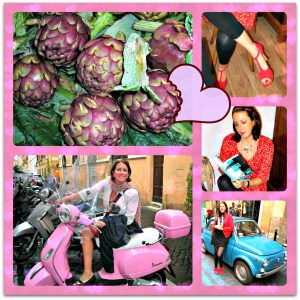
Signora Stella CollageAmore é gioia, amore é gelosia, amore é soffrire, amore é tenerezza, amore é calore. Amore sei tu! Is it any wonder that Italians always make the top-10 list whenever women are asked to rate the world’s best lovers? We are truly fortunate, then, in having the displaced author Estelle Jobson as today’s guest blogger. As you will see, this South African likens falling in love with an Italian man to feasting on a succulent artichoke — a rather curious analogy, to be sure, until one remembers that artichokes are cultivated in the Mediterranean. It is also a rather mysterious vegetable. How exactly do you eat it? As Jobson shows, it’s a matter of  peeling off the outer petals, one at a time… We are also fortunate in that Signora Stella is giving away an autographed copy of the book she wrote on her Roman love story! Grazie mille, Signora! (Details below.)

— ML Awanohara

The first call to write about Italy came when I was ten. With a smudgy HB pencil, I outlined an epic in my lockable, pink diary. It was to be about an extended Italo-American family who would make it big selling tyres. The main character, Pia, was to be my age, torn (theatrically) between her Italian roots and her American life. There would be family dramas (dramatic!), cascades of curls (curly!), Virgin Maries (statues and exclamations), and a stout grandma overseeing boiling pots of pasta. The novel would be shot through with shouting, gesticulating, and emotional-blackmail-meets-amore.

This literary project was soon shelved on the grounds of inadequate content knowledge: I knew nothing of the tyre business and had exhausted my repertoire on Italians. So the plot was filed amongst my many “books to write one day”.

Loving the individual

??????????What I did finish writing, in my thirties, is Finding Rome on the Map of Love, in which travel narrative meets love story. It is an autobiographical account of moving to Rome with an Italian man. It is about love radiating out from the heart of my Italo-South African couple, to love for a family, language, people, culture, and country. Just like the concentric rings within an artichoke. This happens in all relationships, however it is much more pronounced when the language, culture, and people are not those you grew up with. The rings within the artichoke make it very difficult to know which characteristic belongs to whom. Is it your beloved who is prone to interrupting others mid-speech? A family trait? Or that of the whole nation?

Just as Italians are sometimes drawn to the prudish, earnest, and ploddish Protestant way, so are we Anglo-Saxons drawn to their swaggering, flamboyant charm — and sometimes alarmingly cavalier approach to work. It threatens us to the core, yet opposites attract. And how! A part of us secretly longs to become the other. But since we can’t quite pull it off, the next best is to have them close to our hearts. Or better still, right in the bed. We say “Be mine.”

So the beloved in question — termed “the Meterosexual” for his dapper grooming — was in varied and bewitching ways the very opposite of what I grew up with. Unlike the wooden, roughly-hewn South African man, an Italian one may adore you, quite tangibly and vocally (poetically even), from head to toe. Because in his culture, your coiffure and your shoes are crucial. Core-shakingly so. The Meterosexual debated how I should do my hair for a job interview (“Hup? Down? No, hup. More professional!”) and set me straight on shoes that were an insult to an outfit. Certain footwear was actually banned from leaving the cupboard!

For a woman to have her appearance critiqued by a man, even an exquisitely stylish one, demands a certain thickness of skin.

But being South African, I had it.

Loving the family and culture

The next ring of artichoke love is that for your sweetheart’s family and culture. First I had la mamma pressing a hairdryer upon me lest I got a cervicale (the special Italian, wet-hair induced crick in the neck).

And soon thereafter, I was up against what felt like an entire nation (in this case, 60 million citizens) all clucking, fussing, and advising on health, the risk of catching a cold, and what food may be consumed at specific times of day, linked to its digestibility. This counsel was dispatched entirely unsolicited, but with tenderness.

Which is almost the same as love, isn’t it?

Italians regarded me, being Anglo-Saxon, as afflicted with a lumpishly undiscerning cultural palate. I was urged by strangers to read Dante Alighieri, listen to Vivaldi, and, above all, focus on what went into my mouth. The Meterosexual brought home gifts of emerald olive oil, popping with vitality, and parcels of pastries wrapped in a bow, popping with calories. His mother served me the Tuscan carciofini fritti (deep-fried artichokes). And his countryfolk served me regional cuisine, ubiquitous coffees, plus the unloseable gift: an ability to discern the superiority of mozzarella di bufala (female buffalo) over mucca (cow).

Loving a language

Further spirals of love lay in the process of gaining Italian language skills. Italian has delightful suffixes, to make words bigger, smaller, cosier, cuter, or nastier and uglier versions of themselves. This, to an English-speaker, is like playing Lego® with language.

With my ability to converse came a gradual adaptation to local ways. Although, truth be told, it’s easier to learn a foreign language than, for example, to wend your way successfully through the Italian national health system or to fathom the quasi-pagan fetishizing of the modern Catholic saint.

Loving the modus operandi

Living in Rome, I learned to ride a scooter in the city’s hair-raising traffic. This turned out to be a superbly transferable skill, relevant to many other Italian things, such as being honest. Telling the truth, the Italian way, is a flexible, savvy and self-preserving art. People lie with flair. In fact, it isn’t really lying at all, they explain. It’s being diplomatic, being furbo (smart). Banging your head against all this with rigid Protestant morals will only make your cranium ring. The Italians have taught me that blurting out the truth willy-nilly is ill-advised. It is gauche, hurts other people’s feelings, and counter-productive.

Now I know: one good lie deserves another.

Becoming the other

So it is that you start off in love with a foreign person and you end up assimilating their culture. Over time, some of the once-exotic features become yours and you may even lose bits of your cultural DNA, for lack of use (e.g., wearing ugly shoes). When I find myself using an Italian gesture or expression, because nothing else will do, I know I am no longer mimicking.

This is a moment of profound integration: deeper than love, more metaphysical than the first sip of the first cappuccino of the day. It will always be yours. It’s like becoming your own artichoke.

* * *

Readers, I have a confession to make. I’ve always found the artichoke a bit intimidating. I’m not sure I’m any less intimidated after hearing what Estelle has to say — but thanks to her, I’m can now appreciate its succulent taste and tender heart. And I know I prefer it steamy!

I can imagine her dashing Roman metrosexual calling her not just Stella but mia stella polare — his polar star! (And how can I get me a pair of those cool red shoes?)

What about you? Are you eager to hear more about Estelle’s love adventure with an Italian, and with Italy itself?

Listen to what readers of her book had to say:

Liesl Jobson (Estelle’s sister, still in South Africa and also a writer — one who wins awards for her short stories!):

Finding Rome on the Map of Love is an utterly enchanting and fabulously funny journey outwardly, into the city of Rome, but inwardly, Estelle bravely squares up her options in love and life. Her sharp eye investigates the real and the imagined and her inimitable voice always rings true. … [W]hile the focus is Rome, it is as much about being a stranger in a foreign country and the resourcefulness that is required to learn a language, understand the customs and become familiar with the ways of any new place.

Amazon reviewer:

You will adore this book; Estelle and her quirks will delight you, you’ll fall passionately in lust with the Eternal City and its people and be sad when it’s over. … Estelle’s writing skills will astonish you and you will ask, “Where has this writer been and why have I not heard of her?”

Amazon reviewer:

When I started reading Estelle Jobson’s observations on Italian culture, I felt I had run into an old friend on a common wavelength. Yes, me too!

Amazon reviewer:

Estelle Jobson is a very talented writer with a wonderful ear for the nuance and absurdity of language, and for the cross-culturally bizarre. … The book also boasts an extensive glossary that is bound to satisfy even the most pedantic of linguists.

And let’s not forget the back-cover blurb:

Estelle has an admirable career in publishing and a hectic, yet rich life. When her Italian diplomat boyfriend gets posted to Rome, she throws it all up to accompany him. There, she reinvents herself as Signora Stella, a casalinga (housewife) on the city’s highest hill, Monte Mario. Starting in autumn, she muses on life amongst the Italians and cycles through the seasons and sentiments of the Italian psyche. Signora Stella commences and ends at the same place: Follie, the local hairdresser run by Salvatore, a gay Neapolitan. This book captures a year’s worth of quirky, humorous, vivid observations about life amongst the Italians.

Can’t wait to read it? Jobson has published an excerpt on Italian Intrigues, the blog kept by one of our recent Random Nomads, Patricia Winton.

And now it’s your chance to ENTER OUR DRAW TO WIN A FREE AUTOGRAPHED COPY!!! Simply leave a comment in answer to the question:
**What has been your most entertaining experience with a cross-cultural relationship?**
Extra points for likening it to a vegetable; double the points if you’re a Displaced Dispatch subscriber!!!

The winner will be announced in our Displaced Dispatch on March 2, 2013.

NOTE: If you’re not the lucky winner but would still like a print copy, send an e-mail to findingrome@gmail.com.

Estelle Jobson has over a dozen years’ experience in book publishing and a Masters in Publishing from New York University which she attended on a Fulbright. She speaks five languages and has lived in as many countries; three years in Rome. She now lives in Geneva. To find out more about the book and follow its promotion, like the Finding Rome FB page. You can also follow Jobson on Twitter and read her occasional blog posts — for instance, this one on adopting Italian nationality, which she wrote for Novel Adventurers.

STAY TUNED for tomorrow’s post, when we announce the films that have qualified for this year’s Displaced Oscars!

If you enjoyed this post, we invite you to register for The Displaced Dispatch, a round up of weekly posts from The Displaced Nation, with seasonal recipes, book giveaways and other extras. Register for The Displaced Dispatch by clicking here!

Related posts:

Images: All photos supplied by Estelle Jobson.

CAPITAL IDEA: Paris: A quick guide

Welcome to another “Capital Ideas” – our somewhat idiosyncratic, ever so slightly tongue-in-cheek guide to various world cities, perfect for the ever discerning readership of this blog. We know our readers are always visitors, never tourists (an important distinction). As it’s Valentine’s Day we thought it only right to take a look at the world capital of romance – Paris (not very original — ed.).

Do feel free to contribute your own ideas or suggestions in the comments section, we’d love to hear your thoughts, too.

Capital: Paris

Paris, Texas? Um, no.

Don’t be too quick to judge. I hear it’s lovely. I’m sure it is. I liked the movie, if that helps.

Not really. So I guess you’re this is all about the other Paris — the city of love? That’s the one.

Ahh, so this is an easy Valentine’s Day tie-in post? I’m disappointed. Could you have not gone with something a little more left-field for a romantic destination? Such as?

I dunno. Cardiff? Sacramento? Sometimes it’s best to stick with the tried and tested.

Why should I go? I think the British expat writer Lawrence Durrell put it well when he wrote the following about Paris:

The national characteristics … the restless metaphysical curiosity, the tenderness of good living and the passionate individualism. This is the invisible constant in a place with which the ordinary tourist can get in touch just by sitting quite quietly over a glass of wine in a Paris bistro.

But I heard Paris can send a man mad. You’re probably thinking about the likes of Toulouse-Lautrec and the perils of consuming too much absinthe.

No, I mean modern-day tourists. Ah, then you’re probably thinking about Paris Syndrome; it is, in the words of Wikipedia, a transient psychological disorder encountered by some individuals (primarily Japanese tourists) when they visit Paris. It is characterized by a number of psychiatric symptoms such as acute delusional states, hallucinations, feelings of persecution (perceptions of being a victim of prejudice, aggression, or hostility from others), derealization, depersonalization, anxiety, and also psychosomatic manifestations such as dizziness, tachycardia, sweating, and others.

Sounds weird. It is. One of the contributing factors is that many Japanese visitors have an idealized image of Paris as the city of romance and sophistication and trying to reconcile that image with the rude and noisy metropolis they instead encounter is simply overwhelming.

Um, so you’ve written a guide extolling me to go to Paris as it’s Valentine’s Day and Paris is the city of romance and at the very same time you’re also telling me if I go with that expectation I could break down with a psychological disorder? Amazing. You know this would never happen in Sacramento. True, they are no reported cases of Paris Syndrome affecting visitors to Sacramento.

Well, if I go — and I manage not to break down with a psychological disorder — what should I do? The obvious tourist checklist is taking a walk along the Seine, having a wander around Montmartre, making a visit to Notre Dame, climbing the Eiffel Tower, and catching an unsatisfactory glance of the Mona Lisa at the Louvre.

But I thought this site (and this nascent series) prided itself on shying away from the obvious? We do, we do. If you’re looking to uncover the “hidden” Paris you can take that suggestion literally and go to the Catacombs.

I see what you did there. Merci beaucoup! Catacombes de Paris were built following the removal and evacuation of the Saints Innocents Cemetery (Cimetière des Innocents) in the late 18th century as the medieval cemetery was no longer sanitary and was considered the cause of numerous infections in the area. On a related note, you may want to read Pure (2011), by the somewhat displaced English novelist Andrew Miller — about the breaking up of the cemetery.

Thanks for that, but can we move onto a different topic? I don’t think visiting catacombs is a particularly romantic move on my part. Do you have any romantic suggestions? I know a couple who spent the weekend trying to find the best macaroons in the city. If you’ve got a sweet tooth, you may want to give that a try. Laudree is famous for theirs — in fact, they claim to have invented them, so you may want to start there. Another macaroon purveyor definitely worth trying is Pierre Herme. Indeed you’ll do well to resist eating all their pastries and sweets.

You’re going to try and convince me to go on a guided walk, aren’t you? You seem obsessed with them. I do think walking around a city rather than hopping from metro to taxi is a better way of getting to grips with a city, and if you can do that with a knowledgeable guide, so much the better. I’ve heard good things about Paris Walks, so you may want to give them a try. Alternatively, we are living in the age of smart phones. If you don’t want to be with a tourist crowd (and I totally understand why that may be the case), then why not download a walking tour direct to your phone? Invisible Paris offers three walking tours for you to download that are absolutely free. The walks highlight aspects of the city that other guides ignore.

What’s a must-do? Embrace the cliche and go for an evening stroll along the Seine.

Is it easy to get around? Yes, the Metro system makes getting round the city easy. As a visitor it’s well worth purchasing a Paris Visite Pass, which allows you access to all of the city’s public transport

And where’s good to eat? Any recommendations? It’s Paris. You won’t struggle for decent places to eat. You know the drill when it comes to avoiding tourist traps.

What should I read? If you want to brush up on Paris, then you may want to give Graham Robb‘s Parisians: An Adventure History of Paris (2010) a try. Also worth a look for the befuddled foreigner trying to make sense of the city is The Sweet Life in Paris, by displaced American food writer David Lebovitz — it tells the story of his move to Paris. For a solid historical overview of France’s capital city, try The Seven Ages of Paris (2002), by British historian and TCK Alistair Horne. And for a work of fiction sometimes the obvious is the most appropriate — and that’s The Hunchback of Notre-Dame (Notre-Dame de Paris, “Our Lady of Paris”), by Victor Hugo.

What should I watch? You can go all New Wave cool and watch The 400 Blows (1959, dir. François Truffaut), Breathless (1960, dir. by Jean-Luc Godard), or Bande à part (1964, also dir. by Jean-Luc Godard). The antithesis of these is the Old Hollywood glamor of An American in Paris (1951, dir. Vincente Minnelli). Of course, what I’d really advise you to watch is one of my all-time-favourite movies — Les Enfants du Paradis (1945, dir. Marcel Carné). In fact, as it’s Valentine’s Day today, watch it tonight!

But I have reservations at the Sizzler tonight! The Sizzler?

Hey, it’s Valentine’s. I thought, why not splurge? Hmmm, maybe Paris isn’t right for you after all.

STAY TUNED for a new Displaced Nation post on Monday.

If you enjoyed this post, we invite you to register for The Displaced Dispatch, a round up of weekly posts from The Displaced Nation, with seasonal recipes, book giveaways and other extras. Register for The Displaced Dispatch by clicking here!

Related posts:

The 9 Muses for international artists and writers – which one is yours?

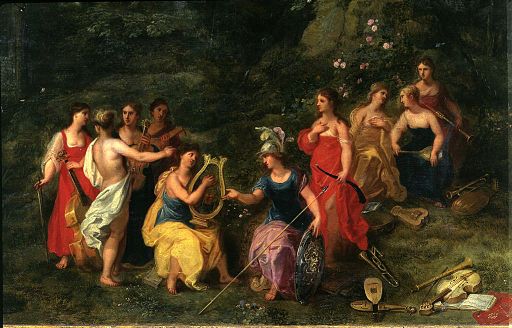
512px-Minerva_among_the_MusesAs modern, global writers and artists, we all have those wonderful days when we feel we are just holding the pen or brush while another “being” does the creative work and sends up firebolts of ideas into the imagination.

Some of us like to call this “Being” our “Muse.”

The original 9 Muses of Greek Mythology were a group of sister goddesses who inspired artists and philosophers to create artistic masterpieces. Ancient writers such as Homer appealed to the Muses for help and inspiration, and as Homer’s Iliad and Odyssey are still in print nearly 3000 years later, it’s probably fair to say these appeals to the sibling deities worked.

Nevertheless, even with his divine assistance, Homer probably had plenty of bad writing days,  just as we have days when the Muse is elusive, and everything we create is no better than our third-grade efforts many years ago.

On days like those, it’s wise to remember that times and fashions have changed since Ancient Greece, and perhaps the reason the Muses don’t come is because we don’t recognise them in their present forms. Unless you’re trying to write at a toga party, they probably won’t look like they do in the painting above. They come in all shapes and sizes.

So, to assist you in finding inspiration when the creative rivers run dry — meet the new generation of global Muses.

Bloggoria –  Muse of Travel Writing

Descendant of: Calliope; Muse of epic poetry; emblem – a writing tablet.
Modern Muse’s emblem: An iPad.
Sometimes disguised as: The female in the cafe who, when she sees you scribbling in your trusty Moleskin, wants to know what you’re writing and says that she could write a novel if only she had the time. If she doesn’t have the time but is so full of ideas that she has to tell strangers about them, her brain is ripe for shameless picking.

Sirius – Muse of Navigation (AKA Siri)

Descendant of: Urania; Muse of Astronomy; emblem – globe and compass.
Modern Muse’s emblem: Sirius can’t map-read to save her life, let alone navigate by the stars, so she goes for a more up-to-date look with a GPS box.
Sometimes disguised as: That woman you’ve passed three times while you’re lost and driving around a new city.  The woman your male companion won’t stop to ask directions because a) he doesn’t like asking for directions and b) this person looks a bit odd. The odder she looks, the more likely she is to be a Muse, and will end up as an anecdote or character in your next book. Don’t place too much faith in her directions, though.

Empithrie: Muse of music

Descendant of: Euterpe; Muse of music or flutes; emblem – a flute.
Modern Muse’s emblem: A set of earbuds.
Sometimes disguised as: The female DJ on a new radio station who plays the right song at the right time, one that just happens to fit your mood and gets the creative juices flowing. Also, pay attention to buskers: you never know when Muses (of either gender) are in unusual places, as in this video:

Fenderene: Muse of song lyrics

Descendant of: Erato; Muse of lyric and love poetry: emblem – a lyre.
Modern Muse’s emblem: A guitar pick.
Sometimes disguised as: That really good guitarist in the subway, singing Carole King songs. Don’t confuse her with the next Muse,

Slammia: Muse of modern poetry.

Descendant of: Polyhymnia; Muse of sacred poetry; emblem – a veil.
Modern Muse’s emblem: A joss stick
Sometimes disguised as: The only good entrant in a pub poetry slam.

Depressoria: Muse of tragedy

Descendant of: Melpomene; Muse of tragedy; emblem – a tragic mask.
Modern Muse’s emblem: A bottle of Prozac.
Sometimes disguised as: That person you get stuck next to on the train, who insists on telling you her life story which sounds like the outline for a bad country song. (See “Fenderene” and “Empithria”) Take notes, if you can.

Nostalgene: Muse of history and reminiscence

Descendant of: Clio; Muse of history; emblem – a scroll
Modern Muse’s emblem: An old photograph album
Sometimes disguised as: Your granny when she’s talking about her childhood.

Standuporia: Muse of alternative comedy

Descendant of: Thalia; Muse of comedy; emblem – a comic mask.
Modern Muse’s emblem: A large snake called Monty.
Sometimes disguised as: Like love, comedy is all around you. Just keep listening for those throwaway one-liners.

Bunionaria: Muse of dancing

Descendant of:  Terpsichore; Muse of dancing; emblem – dancing, holding a lyre.
Modern Muse’s emblem: A pair of satin, worn out ballet shoes.
Sometime disguised as: Dancing Muses at places like Covent Garden or Teatro alla Scala are rarely disguised. Buy a ticket, watch, be inspired. Do, however, avoid Irish pubs on St. Patrick’s Day, when everyone thinks they can out-tap Michael Flatley. And avoid Ibizan hotel dance floors at all times if you don’t want to lose all your other Muses (with the exception of Standuporia.)

STAY TUNED for next week’s posts.

If you enjoyed this post, we invite you to register for The Displaced Dispatch, a round up of weekly posts from The Displaced Nation, with seasonal recipes, book giveaways and other extras. Register for The Displaced Dispatch by clicking here!

Related posts:

Image: Minerva among the Muses, via Wikimedia Commons

CAPITAL IDEA: London: A quick guide

LondonWelcome to the first “Capital Ideas”. It is a new feature here at The Displaced Nation. It’s our somewhat idiosyncratic, ever so slightly tongue-in-cheek guide to various world cities, perfect for the ever discerning readership of this blog. We know our readers are always visitors, never tourists (an important distinction).  Do feel free to contribute your own ideas or suggestions in the comments section, we’d love to hear your thoughts, too.

City: London

Where is it? On some damp, mildew-ridden island in the north Atlantic.

Why should I go? Because it’s one of the world’s great cities. An exciting modern city with a diverse population of eight million there’s something for everyone. With hosting the Olympics, 2012 was a great year for the city and infused it with a self-confidence unusual to the British. Quite simply, this is the perfect time to visit London.

So is it true that when a man tires of London he is tired of life? Not if he’s living in Dalston.

I don’t know anything about Dalston. You’re not missing much.

What are the must sees? Well, if you want to be that tourist, you know the one who wears pristine white sneakers and white socks, keeps their passport safe in their fannypack and planned their trip after taking out a Rick Steeves travel book from 1986, then the basic checklist is Big Ben, Buckingham Palace, St Paul’s, Tower of London. You can do all that by popping on one of those tourist trap sightseeing bus tours. You’ll get to sit on the top of a double-decker with other fannypack wearers — it’ll be beautiful.

Hmm, I don’t have a fannypack. Not to worry. You’re a The Displaced Nation reader, you want something a little more “not for tourists,” don’t you?

You know me so well. Tours can be good fun for the visitor limited in time. However, instead of those overpriced bus tours, we recommend London Walks. Brunel’s Thames tunnel, in particular, is one we’d recommend for a fascinating and sadly forgotten part of London’s history — it was once considered the eighth wonder of the world.

What about a walking tour that sounds a bit more “fun”? Well, provided you’re not traveling with kids, you could also do a pub crawl. That fun enough for you?

Absolutely. Any other suggestions? Spend a morning at Lincoln’s Inn Fields. There you’ll be able to visit two fascinating museums that are among our London favorites. There’s the Hunterian Museum (an C18th collection of anatomical specimens including the skeleton of Charles Byrne, known as the “Irish giant”) at the Royal College of Surgeons and across the fields is Sir John Soanes’s Museum (the former home of architect Sir John Soanes, the museum contains his extensive collection of antiquities and paintings). Or, if you’re in the city in the summer then venture to the north of the city and visit Highgate Cemetery. There you’ll be able to get a guided tour of the western cemetery – resting place of Michael Faraday and Christina Rossetti. In the eastern cemetery rests Karl Marx.

What’s a must-do? Spending time on the South Bank. Here you’ll find the National Theatre, the Royal Festival Hall, the Globe and the BFI Southbank (formerly known as the National Film Theatre). So the perfect place to take to showcase the city’s cultural merits.

Is the city easy to get around? Yes, although Londoners like moaning about the public transport, the city is home to one of the world’s best public transport systems. Familiarize yourself with the London Underground (known as “the tube”) and you can travel around the city easily and relatively cheaply. If you are a night owl then you need to remember that the underground stops running trains between 12.00am and 12.30am.

I hear the British cooking is awful. Do I need to pack sandwiches when visiting London? That outdated stereotype. London is home to some of the world’s best restaurants. And don’t forget how I mentioned earlier that London had such a diverse population, that’s reflected in the city’s restaurants. Whatever you fancy, be it Eritrean or Burmese, you can find it in London. Our recommendation is that you take a trip to Brick Lane for a slap-up Indian dinner.

Hmm, my mate John visited London last year and said the food still sucked. Did John stick with the tourist traps? New York is a great city for eating, but if you only go to restaurants at Time’s Square you’re not going to get that impression. One easy tip, never eat in an Angus Steak House.

So the locals don’t all eat jellied eels? No, but if you do want to experience an old cockney-style pie and mash shop, then we recommend Goddard’s at Greenwich. If you’re being really adventurous and want to unleash your inner pearly queen by having some jellied ell then this is the place to do it.

Have you ever tried it? Yes.

Did you like it? Let’s just say it was interesting.

What should I read? If you want to brush up on London, then we’d suggest Peter Ackroyd’s London for a nice, meaty read about the city, as well as his book The Thames. Other books we’d suggest are Iain Sinclair’s London: City of Disappearances, Henry Mayhew’s London and the London Poor and James Boswell’s London Journal. And, of  course, you can’t visit London and not be reminded of Dickens (do make a trip to the Charles Dickens Museum  , at 48 Doughty Street). We think Bleak House and Our Mutual Friend best show off  Dickens’s writing on London.

What should I watch? Notting Hill.

Really? Yes, it’s the most accurate cinematic depiction of the city.

I’m going to say this again, really? It’s so accurate that there’s even now a Notting Hill Carnival. This happens once a year where fans of the film get together and dress up as their favorite characters from the film and reenact their favorite scenes. Our top tip is that if you’re in London at the same time as the carnival, you should dress up as Julie Roberts or Hugh Grant and go up to people and tell them your favorite lines from the movie. They’ll love.

I really don’t think that’s what the Notting Hill Carnival is all about. Hand on heart, it’s true.

Hmmmm . . .

STAY TUNED for tomorrow’s post, a new Random Nomad interview.

If you enjoyed this post, we invite you to register for The Displaced Dispatch, a round up of weekly posts from The Displaced Nation, with seasonal recipes, book giveaways and other extras. Register for The Displaced Dispatch by clicking here!

Related posts:

Image: awindram

The 10 Muses of Expat & International Adventure Writing and their 5 most popular tunes

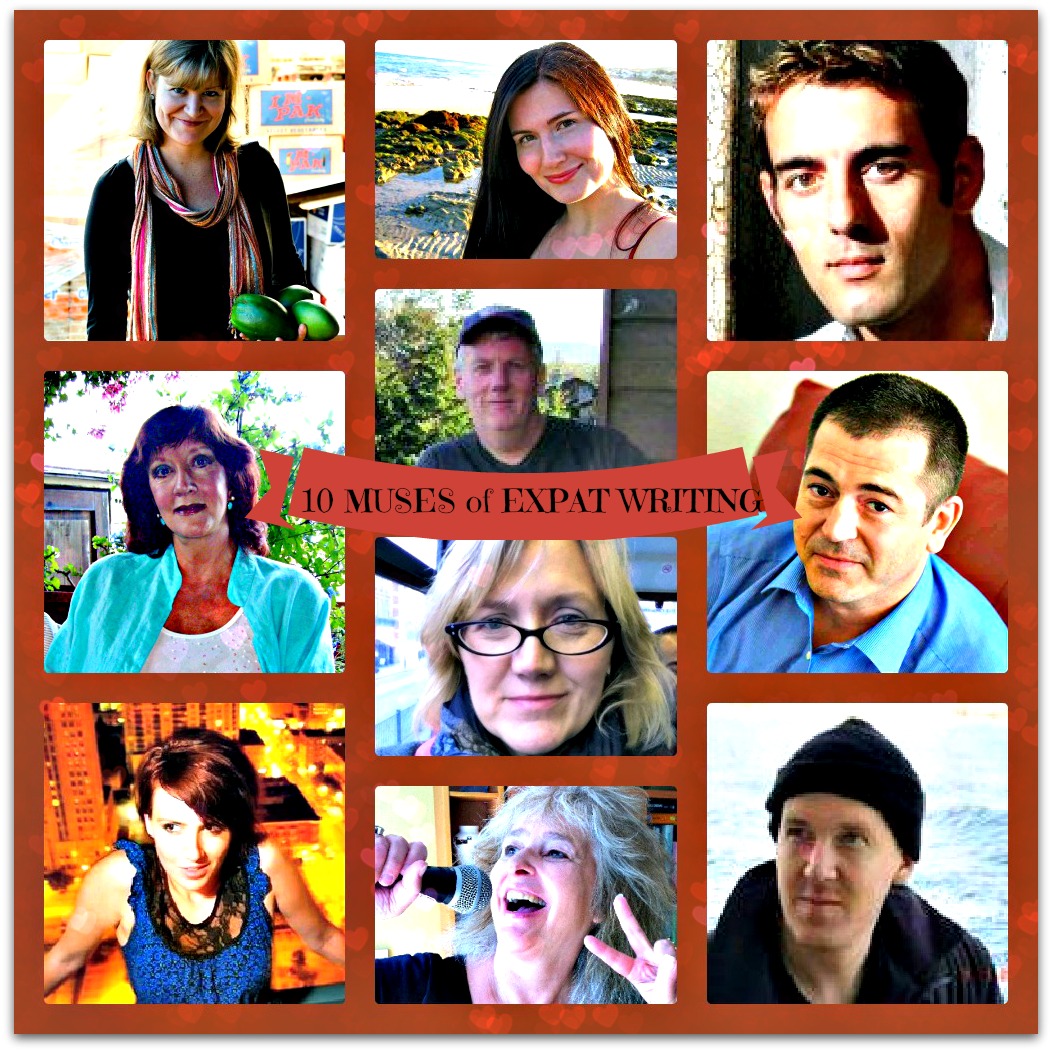
10 muses collageGreetings, Displaced Nation-ers! Ready for a little more intellectual stimulation?

A couple of weeks ago, I wrote about Great Thinkers who can help with task of embracing the well-traveled life and teasing out its deeper meaning, in the new year.

And today I will address the needs of those who have resolved to tackle a major writing project in 2013.

It’s a well-known fact that many of us who live in foreign lands aspire to write novels, memoirs and travelogues about our overseas adventures. But many of us also live in isolated situations (by definition).

So who can aid us, provide our inspiration?

Why, the muses of course!

Tell us, O muses, how to tell our stories…

And we don’t even have to look heavenwards to invoke them! The 10 Muses (that’s one more than the ancients got!) of Expat and International Travel Writing are right in our midst. They have already shared the joys, wonders and value of writing with Displaced Nation readers:

  1. Barbara Conelli, author of the Chique Travel Book series, filled with the charm, beauty, secrets and passion of Italy…
  2. Martin Crosbie, who is writing a trilogy entitled My Temporary Life; in December of last year, he published Book Two: My Name Is Hardly.
  3. Helena Halme, author of the novel The Englishman (2012)
  4. Laura Graham, author of the novel Down a Tuscan Alley (2011)
  5. Matt Krause, author of the memoir A Tight Wide-open Space: Finding love in a Muslim land (2011)
  6. Meagan Adele Lopez, author of the novel Three Questions: Because a quarter-life crisis needs answers (2011)
  7. Edith McClintock, author of the mystery novel Monkey Love and Murder (2013)
  8. Alexander McNabb, who is writing the Levant Cycle, a trilogy of books about the Middle East; he released the second book, Beirut — An Explosive Thriller, last September.
  9. Tony James Slater, erstwhile regular at the Displaced Nation and author of a two-book series: The Bear That Ate My Pants: Adventures of a real idiot abroad (2011) and Don’t Need the Whole Dog!, which came out in December.
  10. Wendy Nelson Tokunaga, author of Marriage in Translation: Foreign Wife, Japanese Husband (2011) and of several novels that explore cross-cultural themes between the United States and Japan.

Over the past year on our site, if you were listening closely, these heaven-sent muses were singing a number of tunes. Here are their five top hits:

SONG #1: “Yes, it’s hard; yes it’s uphill. But you’re living the dream, which makes writing a thrill!”

In one of the Displaced Nation’s most popular posts of the past year, Tony James Slater tried to make it out that the life of an expat writer is far from glamorous. Don’t believe him. He was pulling your leg, as usual — or singing off key, to continue the metaphor.

Alexander McNabb has the more accurate rendition. Here’s his account of the prep for his latest thriller, Beirut:

While writing it, I spent hours walking around the city, along the curving corniche and up into the busy streets that cling to the foothills rising from the coast up to the snow-capped mountains. Walking with friends, walking alone — day and night, spring and summer. From the maze of funky little bars of Hamra to the boutiques of Verdun, from the spicy Armenian groceries of Bourj Hammoud to the cafés overlooking the famous rocks at Raouché…

Barbara Conelli is another inspirational example. She explores every nook and cranny of Milan so as to take the reader on an armchair journey. And now she is doing the same with Rome, which will be the subject of her third book in the Chique Travel series.

Great work, if you can get it!

SONG #2: “It’s time to make your creative debut — so why not make it all about you?”

These days it’s hard to tell the difference between a heavily autobiographical novel and a memoir, though one of our muses, Helena Halme, insists that there is a distinction. When questioned about her decision to write The Englishman as a novel — it’s about a young Finnish woman, Kaisa, who meets a dashing British naval officer, a plot that echoes very closely her own life story — she had the following to say:

I tried to write a memoir, but couldn’t! Much of this story is, however, true — but I didn’t think I could call it a memoir as some things were pure fiction. I am a novelist and just keep making stories up.

Hmmm… By that reckoning, perhaps Tony James Slater should be a novelist, too? As regular readers of this blog will know, his favorite topic consists of his own, rather daring but also bumbling, world adventures.

But did a bear really eat his pants, or is he exaggerating for comic effect?

The mind boggles…

But whatever the form, the point is that quite a few of our muses have found plenty of material in their own life experiences. Besides Halme and Slater, we have

  • Martin Crosbie: His protagonist, Malcolm, leaves Scotland for Canada at a formative age, just as he did.
  • Laura Graham: Her protagonist, Lorri, arrives in Italy as a forty-something single and finds a younger Italian man, just as she did.
  • Matt Krause: He has written a memoir on the portion of his life that involved meeting a Turkish woman on a plane and following her back to Turkey. (Reader, he married her!)
  • Meagan Adele Lopez: The protagonist of her debut novel, Del, is offered three questions by her British fiancé (just as Lopez was offered three questions by hers).
  • Edith McClintock: Her protagonist, Emma, works as a researcher in the very Amazonian rainforest where she once conducted her own research.

To conclude, the old adage is alive and well, even (especially?) in expat and travel writing: “Write about what you know and care for…”

SONG #3: “Looking for inspiration from above? The answer lies in cross-cultural love.”

Another theme running through the works of several of our muses is the love that takes place across cultures, usually resulting in marriage. I just now referred to the cross-cultural love stories at the heart of the books produced by Helena Halme (Finnish woman, English man), Laura Graham (Englishwoman, Italian man), Matt Krause (American man, Turkish woman) and Meagan Adele Lopez (American woman, Scotsman).

To this list should be added Wendy Nelson Tokunaga, who has written about Western women getting involved with Japanese men — one of the stranger of all possible unions, to be sure! 😉 — in both fiction and nonfiction (the latter being a bit of a self-help book).

SONG #4: “As your brainstorming proceeds apace, never forget the appeal of place.”

Since travel is a constant for all of us, it should come as no surprise that particular places can become a pull for certain expat writers. They cannot rest until they’ve depicted a place they’ve experienced so that others can live vicariously. Several of our muses represent this principle:

  • Barbara Conelli and her love for “capricious, unpredictable” Milan. To quote from her book: “When the streets of Milan ask you to dance, there’s nothing else to do but put on your ballet shoes and surrender…”
  • Alexander McNabb and his obsession with Beirut. “There can be few places on earth so sexy, dark, cosmopolitan and brittle…,” he writes in his Displaced Nation post.
  • Edith McClintock and her preoccupation with the rainforest and a place called Raleighvallen in the Central Suriname Nature Reserve. As her main character, Emma, says:

    I fell completely and irretrievably in love with the rainforest that week — the deep rich smells of dirt and decay and teeming, thriving life; the warm soft light of the rocky moss-covered paths hidden beneath layers of climbing and tumbling lianas and roots; soaring tree trunks wrapped in colorful bromeliads, orchids, moss, and lichens; and the canopy of leaves of every conceivable size and shape….

SONG #5: “Growing weary of fruitless writing sessions? Time to take some acting lessons!”

Four of our ten muses could double as the muses of acting and entertainment:

  • Tony James Slater and Meagan Adele Lopez trained as actors (Lopez actually starred in a bad horror film!) before embarking on their world travels.
  • Laura Graham enjoyed a long career as a stage actress in Britain, working for the Royal Shakespeare Company and the Young Vic, and on television, before setting herself up as an expat in Tuscany.
  • Wendy Nelson Tokunaga first went to Japan because she won a prize in a songwriting contest sponsored by Japan Victor Records. She is an accomplished karaoke artist who can sing jazz as well as j-pop and enka, a type of sentimental ballad.

Why are so many of the Muses of Expat Writing multi-talented, you may ask? Does a former acting/singing career work to one’s advantage when it comes to overseas travel and writing? I like to think so.

Just as Dickens used to act out the dialogue of his characters, I like to think of Tony James Slater reenacting his wild adventures on the road, in the confines of his flat in Perth…

And sometimes this versatility can add a further dimension to the writing. Last we heard from Lopez, she had created a trailer for her book and was trying to convert it to a screenplay. Tokunaga composed and sang an enka to accompany her novel Love in Translation. (It’s impressive!)

Plus these four could always hew to the tradition of wandering minstrel, one of the oldest careers in the book, if their works don’t sell. (Hey, it’s never a bad idea to have a fallback option when you’re a long ways away from family and friends…)

* * *

So, writers out there, did our 10 Muses sing to you? And will you listen to some of their songs again as you face the blank page in 2013? Let me know in the comments. (Only, be careful of criticizing the Muses — they have been known to be vengeful!)

STAY TUNED for tomorrow’s post, another installment in the life of our fictional expat heroine, Libby. (What, not keeping up with Libby? Read the first three episodes of her expat adventures.)

If you enjoyed this post, we invite you to register for The Displaced Dispatch, a round up of weekly posts from The Displaced Nation, with seasonal recipes, book giveaways and other extras. Register for The Displaced Dispatch by clicking here!

Related posts:

Images: Our Ten Muses (left to right, top to bottom) — Edith McClintock, Barbara Conelli, Tony James Slater; Laura Graham, Martin Crosbie, Helena Halme, Alexander McNabb; Meagan Adele Lopez, Wendy Nelson Tokunaga, Matt Krause.

5 displaced reads for tickling an expat/global wanderer’s intellect

Hello again, expats, global nomads, serial wanderers, world citizens, and internationals!

As suggested in my post of last week about mentors and muses, it being January, we have resolved to think Big Thoughts about displacement.

We all know what it feels like to venture across borders to travel and/or live. But how often do we stand back and look at the trees? Or, as Burt Bacharach and Hal David put it in their theme song for the 1966 British film starring Michael Caine:

What’s it all about, Alfie?

To help us figure it out, I propose that we turn to the works of Big Thinkers. I’m talking about the kinds of people who take the kind of life we lead — living here, there and everywhere — for granted, and are more interested in questions of what we’re all doing on this planet and can learn from each other and from ourselves, for that matter.

Against that rather dramatic background, here are 5 displaced — and displacing — reads for your consideration:

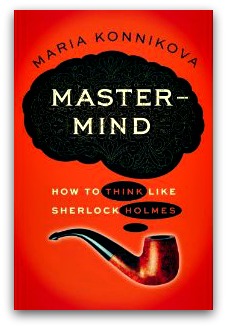
Mastermind_cover_pm1) Mastermind: How to Think Like Sherlock Holmes (Viking, January 2013)

Author: Maria Konnikova
Genre: Self-Help; Cognitive Psychology
Synposis: A primer on increasing one’s mindfulness, based on the lessons imparted by British master sleuth Sherlock Holmes.
Author’s displaced credentials: Born in Russia, Konnikova arrived in the United States at age 4. Though a Third Culture Kid, she has adapted very well to the American scene. She was educated at Harvard, writes the “Literally Psyched” blog for Scientific American, and is doing a PhD at Columbia University in psychology. That said, she has found a muse in an unexpected place: in the fictional works of the terribly Victorian Sir Arthur Conan Doyle.
Why it’s stimulating: So many of us are caught up in the literal idea of travel that we forget that the most interesting voyage of them all lies in exploring the inner workings of our own minds. But Konnikova takes us one step further. She suggests displacing ourselves into the mind of the hyper-observant Sherlock Holmes. To show us how, she does a bold thought experiment — something that most of us, especially those who are living in isolation from family and friends, would find anathema: she downloads Freedom, a program that blocks Internet access completely for a specified amount of time, and sees how it affects her writing. She is shocked by the results. Her conclusion:

Thinking like Sherlock Holmes isn’t just a way to enhance your cognitive powers. It is also a way to derive greater happiness and satisfaction from life.

How we heard about it: Konnikova’s recent article in Slate, “Do You Think Like Sherlock Holmes?”

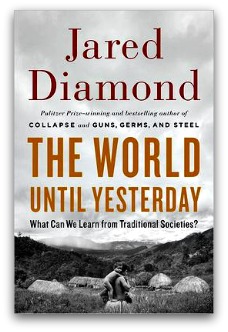
TheWorldUntilYesterday_cover_pm2) The World Until Yesterday: What Can We Learn from Traditional Societies? (Viking, December 2012)

Author: Jared Diamond
Genre: Social History
Synposis: An account of how people in traditional societies — the New Guinea Highlanders, the Inuit, the Amazonian Indians, the Kalahari San — live and what they can teach the rest of us.
Author’s displaced credentials: A polymath and one of the foremost writers of popular science, Diamond was born in the United States, got a degree from Cambridge University, and has had careers in physiology, ecology (specializing in New Guinea and nearby islands), and geography. With the publication of Guns, Germs, and Steel: The Fates of Human Societies, his most popular work to date, he became known for his mastery of global history.
Why it’s stimulating: Diamond displaces us to our (not-so-distant) past by taking us to remote corners of the earth — from the New Guinea Highlands and the Amazon rainforest, to Africa’s Kalahari Desert and the Arctic Circle — where it’s possible to encounter people who are managing without air travel, telecommunications and other fruits of modernity. Pointing out that such accoutrements are extremely recent, he asks: what can traditional peoples teach those of us who live in “complex” societies about how we might live better today? As it turns out, Diamond says, we may be better off dialing down the complexity and living closer to our ancestors:

We get ideas about how to bring up our children. We get ideas about how to have a better old age. We get ideas about how not to die of cancer, heart attacks and stroke.

How we heard about it: An interview with Jared Diamond in Smithsonian Magazine.

Immigrant_Advantage_Book_Cover_pm3) The Immigrant Advantage: What We Can Learn from Newcomers to America about Health, Happiness, and Hope (Free Press, October 2011)

Author: Claudia Kolker
Genre: Social Sciences; Immigration
Synposis: An examination of some of the customs imported by America’s newest residents.
Author’s displaced credentials: A journalist and Third Culture Kid (her mother was from Mexico and father from Ukraine), Claudia Kolker once worked as a freelance reporter in El Salvador from 1992 to 1995, where she covered the Salvadoran postwar recovery as well as social issues throughout Central America, Cuba, Haiti and the Dominican Republic. She has also reported from Japan and India. She now lives in Houston.
Why it’s stimulating: Kolker was spurred to do her research after discovering that most immigrants to the United States, even those from poor or violence-wracked countries, are physically and mentally healthier — they actually live longer! — than most native-born Americans. In a work that in some ways parallels Jared Diamond’s (#2 above), her book takes us on a tour of immigrant households in the United States — Mexican, Hispanic, Chinese, Korean, Vietnamese, Jamaican, etc. — and shows us that there are things about their values we should not only respect but emulate. I don’t know about you, but I find it refreshing to think that privileged Americans like us, who choose to displace ourselves to other lands, could stand to learn some major life lessons from the forcibly displaced. Kudos to Kolker for turning the tables!
How we heard about it: From a recent interview with Kolker on PBS Newshour.

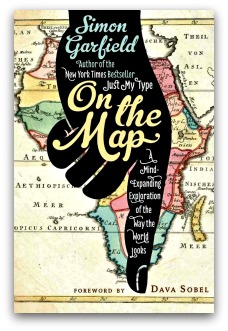
onthemap_cover_pm4) On the Map: A Mind-expanding Exploration of the Way the World Looks (Gotham, December 2012)

Author: Simon Garfield
Genre: Social Sciences; Human Geography
Synposis: A history of mankind’s love affair with maps, beginning with Ptolemy’s world map (one of the 100 diagrams that changed the world); moving through the “cartographic dark ages,” which lasted for about a thousand years; and culminating in our modern obsession with maps, which in fact dates from 1450s Venice, when the atlas became a craze.
Author’s displaced credentials: By splitting his life between London and St. Ives, Cornwall, Garfield could be described as a “domestic expat” within the UK.
Why it’s stimulating: “Displacement” of the sort we talk about in this blog requires constant rewriting and editing of the map you were born with — both figuratively and literally. Garfield shows us that while some of our cases may be extreme (the Displaced Nation being a prime example, with our “Here Be Dragons” obsession), mapmaking is something we humans can’t get enough of:

Maps relate and realign our history. They reflect our best and worst attributes — discovery and curiosity, conflict and destruction — and they chart our transitions of power. Even as individuals, we seem to have a need to plot a path and track our progress, to imagine possibilities of exploration and escape.

How we heard about it: From a 1 Jan 2013 post by Maria Popova on her Brain Pickings blog.

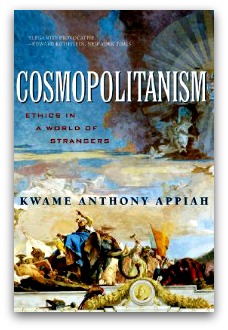
Cosmopolitanism-Appiah-Kwame_cover_pm5) Cosmopolitanism: Ethics in a World of Strangers (W.W. Norton, 2007)

Author: Kwame Anthony Appiah
Genre: Politics; Philosophy; Ethics; Globalization
Synposis: An examination of the ancient philosophy of “cosmopolitanism” — the idea that all human ethnic groups belong to a single community based on a shared morality — and the influence it has had on the Enlightenment, the French Revolution, and the UN’s Universal Declaration of Human Rights.
Author’s displaced credentials: Appiah is the product of a cross-cultural union: his mother was an English author and daughter of the statesman Sir Stafford Cripps, and his father a Ghanaian barrister and politician, who was constantly exhorting his children to remember that they were “citizens of the world.” Raised in Ghana and educated in England, Appiah has taught philosophy on three continents and is now a professor at Princeton University.
Why it’s stimulating: Whether we realize it or not, those of us who venture across borders are making a step towards reducing our culturally isolation. We are opening our minds to seeing the world outside our own contextual walls. But how far can we actually take this? Pretty far, claims Appiah, pointing out that we humans are an inter-cultural, intertwined, and interdependent species, just like every other on the planet — replete with cross-pollinations of language, religion, art, dress, rites, metaphysical outlooks, and progeny. But if Appiah rejects the Sam Huntington view of an inevitable clash of civilizations, he is also not a universalist:

Cosmopolitans suppose that all cultures have enough overlap in their vocabulary of values to begin a conversation. But they don’t suppose, like some Universalists, that we could all come to agreement if only we had the same vocabulary.

How we heard about it: The book was a Global Niche Bookshelf pin, by GlobalNiche.net, on Pinterest.

* * *

Whoa, are you still with me? That was quite a Head Trip! Readers, any responses to this list — any other works to suggest? Much obliged for your input! I think I’ve had a little too much stimulation for one blog post and need to give my brainbox a rest…

STAY TUNED for another episode in the life of our fictional expat heroine, Libby. (What, not keeping up with Libby? Read the first three episodes of her expat adventures.)

If you enjoyed this post, we invite you to register for The Displaced Dispatch, a round up of weekly posts from The Displaced Nation, with seasonal recipes, book giveaways and other extras. Register for The Displaced Dispatch by clicking here!

Related posts:

5 things de Tocqueville can teach expats to US

LibertyI imagine that over the last two or so years the rapid rise of the iPad and other tablet devices has led to a decline in the use of toilet libraries, by which I mean those little collections of books many people keep in their bathrooms for those leisurely times when they have a particularly challenging movement to sit through (perhaps you have your own toilet library. Feel free to share your favorite reads in the comments below).

My own toilet library shows me to be a rather self-righteous, aspiring autodidact. Among my little pile can be found Empires of the World by Nicholas Ostler, The Oxford Book of English Poetry, and Bertrand Russell’s History of Western Philosophy. The books are all left there in the rather grand belief that in the privacy of the privy I might finally learn something. That’s all gone to pot since I got an iPad as I now simply read twitter or play Football Manager on there instead. The books are, sadly, left mostly unread.

One book that should be added to the above trinity – and one that I have fitfully gone through in the last few years – is de Tocqueville’s Democracy in America. When I moved to the US it seemed, unsurprising enough, a cornerstone text that I should familiarize myself with.

For those who don’t already know, Democracy in America  is a study in American society by an aristocrat from Normandy, Alexis de Tocqueville. He journeyed to America in 1831 when he was sent, along with Gustave de Beaumont, to look into the American penal system, although natural curiosity led to both men investigating a lot more than just prisons.

Book II of Democracy in America, in particular, can move me away from reading twitter and reading an actual book. Its short chapters mark it as perfect for inclusion in any toilet library, and it is extremely perceptive into America and Americans. With that in mind, here’s 5 thing that de Tocqueville can teach expats to the US

Warning: de Tocqueville scholars should look away now. No insightful analysis will be found here.

5. An outsider can bring an interesting perspective to US society

Yesterday two of my least favorite people met on CNN, Piers Morgan and Alex Jones (what incidentally is the collective noun for gits?). Jones, a conspiracy theorist firebrand, was behind the recent campaign to have Piers Morgan in light of his views on gun control. Jones screamed “1776!” over and over again at Morgan as well as calling him a “redcoat”. Morgan’s views on gun control aren’t particularly out-of-the-ordinary within the mainstream media, but his foreignness means that, for some, it is doubly offensive when he attacks a text (the second amendment) that they consider sacrosanct.

Morgan clearly is not a modern de Tocqueville, but it is worth remembering that your own outsider status allows you to see US society with fresh eyes and that you can, respectfully and tactfully, challenge certain assumptions.

4. Regardless of how irritating it is when misused, theoretically American exceptionalism is a fascinating, even wonderful, thing.

Most non-Americans understandably roll their eyes when US politicians, particularly when seeking election, proclaim the US as the greatest country in the world, a country unlike any other that is innately superior. That most US political rallies don’t end with a rousing chorus of “America, f#@k yeah!” from Team America is surprising.

However, the first person to describe America as exceptional was de Tocqueville, and in his writings you’ll find that there is much talk of America as a democratic society as opposed to those Monarchic, aristocratic societies of the Old World. It serves as a reminder that America, for all its faults, is founded upon impressive ideals. The main idea underpinning exceptionalism is not American superiority, but that it is qualitatively different from other nations, the first to build an identity based upon its independence. We can certainly debate that this exceptionalism is no longer the case, but in de Tocqueville’s period I do not think it a contentious claim – indeed, it’s an exciting and invigorating thought.

3. Cynicism need not be the default mode for the Western European dealing with America.

It’s easy to be weary when dealing with American life and Americans. They can be unabashed, earnest, loud. The default mode, of which I am very much guilty of, is to mock and sneer and snark about many aspects of American life. The phrase “only in America” is often invoked for some of the worst aspects of American life, de Tocqueville shows that “only in America” can also be positive.

2. “Never mind the quality, feel the length.” A reminder of the sheer size of America.

The America that6 de Tocqueville visited is half the size that the country is now. But the America of the 1830s was a still a vast land and Democracy in America is, in its own dry way, a travelogue to a new land of strange sights. New expats to the US would do well to remember that they don’t just have a country to discover, but a continent.

1. The gift that keeps giving.

The first thing that you many notice about Democracy in America is that it is a hefty tome. For those expats blogging about life in US, you need never worry that you’ll be short of material. The US really is the gift that keeps giving. Look at dear departed Alistair Cooke, he managed to keep ploughing this particular field for over 60 years. You may never fully understand this country, but you can have an interesting time coming to terms with it.

STAY TUNED for tomorrow’s post on reads to tickle the expat’s imagination and intellect.

If you enjoyed this post, we invite you to register for The Displaced Dispatch, a round up of weekly posts from The Displaced Nation, with seasonal recipes, book giveaways and other extras. Register for The Displaced Dispatch by clicking here!

Related posts:

Image: Awindram

Expats, here’s how to enrich your lives in 2013: Choose a mentor or a muse!

Expats and other world adventurers, let me guess. You have you spent the past week making resolutions about

  • staying positive about your new life in Country X;
  • indulging in less of the local stodge;
  • giving up the smoking habit that no one is nagging you about now that you’re so far away from home;
  • and/or taking advantage of travel opportunities within the region that may never come your way again

— while also knowing full well that at some point in the not-distant future, you’ll end up stuffing your face with marshmallows (metaphorically speaking).

Never mind, it happens to the best of us, as psychologist Walter Mischel — he of the marshmallow experimentrecently told Abby Hunstman of the Huffington Post. Apparently, it has something to do with the way impulses work in the brain. The key is to trick the brain by coming up with strategies to avoid the marshmallow or treat it as something else.

Today I’d like to propose something I found to be one of the most effective strategies for turning away from the marshmallows you’ve discovered in your new home abroad or, for more veteran expats, turning these marshmallows into something new and exotic. My advice is to find a mentor or a muse in your adopted land — someone who can teach you something new, or who inspires you by their example to try new things…

Trust me, if you choose the right mentor +/or muse, benefits like the following will soon accrue:

1) More exotic looks — and a book deal.

Back when I lived abroad, first in England and then in Japan, I was always studying other women for style and beauty tips. I made a muse of everyone from Princess Diana (I could hardly help it as her image was being constantly thrust in front of me) to the stewardesses I encountered on All Nippon Airways. Have you ever seen the film Fear and Trembling, based on the autobiographical novel of that name, by the oft-displaced Amélie Nothomb? On ANA flights, I behaved a little like the film’s young Belgian protagonist, Amélie, who secretly adulates her supervisor Miss Fubuki. I simply couldn’t believe the world contained such attractive women…

The pay-off came upon my repatriation to the US. With such a wide array of fashion and beauty influences, I’d begun to resemble Countess Olenska in The Age of Innocence — with my Laura Ashley dresses, hair ornaments, strings of (real) pearls, and habit of bowing to everyone.

Is it any wonder my (Japanese) husband-to-be nicknamed me the Duchess? (Better than being the sheltered May Welland, surely?)

My one regret is that I didn’t parlay these style tips into a best-seller — unlike Jennifer Scott, one of the authors who was featured on TDN this past year. While studying in Paris, Scott was in a mentoring relationship with Madame Chic and Madame Bohemienne. (The former was the matriarch in her host family; the latter, in her boyfriend’s host family.) Mme C & Mme B took her under their wing and taught her everything she knows about personal style, preparation of food, home decor, entertaining, make-up, you name it…and is now imparting to others in her Simon & Schuster-published book.

2) More memorable dinner parties.

As mentioned in a previous post, I adopted actress and Indian cookbook writer Madhur Jaffrey as my muse shortly after settling down in the UK. I was (still am) madly in love with her, her cookbooks, even her writing style.

And her recipes do me proud to this day.

Right before Christmas I threw a dinner party for 10 featuring beef cooked in yogurt and black pepper, black cod in a coriander marinade, and several of her vegetable dishes.

It was divine — if I say so myself! To be fair, the guests liked it, too…

3) Improved language skills.

Now the ideal mentor for an adult seeking to pick up a new foreign language is a boyfriend or girlfriend in the local culture — preferably one with gobs of patience. The Japanese have the perfect expression for it: iki jibiki, or walking dictionary.

Just one caveat: If you’re as language challenged as Tony James Slater, it could prove a headache and, ultimately, a heartache.

Still, nothing ventured, nothing gained…

(Married people, you might want to give up on this goal. I’m serious…)

4) A fondness for angels who dance on pinheads.

After seeing the film Lost in Translation, I became an advocate for expats giving themselves intellectual challenges. Really, there’s no excuse for ennui of the sort displayed by Scarlett Johansson character, in a well-traveled life.

It was while living in the UK as a grad student that I discovered the extraordinary scholar-writer Marina Warner, who remains an inspiration to this day. Warner, who grew up in Brussels and Cambridge and was educated at convent school and Oxford University, is best known for her books on feminism and myth.

After reading her book Monuments and Maidens, I could never look at a statue in the same way again!

In her person, too, she is something of a goddess. Though I’d encountered women of formidable intellect before, I found her more appealing than most, I think because she wears her learning lightly and has an ethereal presence, like one of the original Muses.

Booker prizewinner Julian Barnes has written of her “incandescent intelligence and Apulian beauty” (she is half Italian, half English). The one time I met her — I asked her to sign my copy of her Booker Prize-shortlisted novel, The Lost Father — I could see what he meant.

I was gobsmacked.

Major girl crush!

(Don’t have a girl crush? Get one! It will enrich your life immeasurably.)

5) Greater powers of mindfulness — and a book deal.

Third Culture Kid Maria Konnikova was born in Moscow but grew up and was educated in the US. She has started the new year by putting out a book with Viking entitled Mastermind: How to Think Like Sherlock Holmes. Who would guess that a young Russian-born woman would use Conan Doyle’s fictional creations, Holmes and Watson, as her muses? But, as she explains in a recent article in Slate, she has learned everything she knows about the art of mindfulness from that master British sleuth:

Mindfulness allows Holmes to observe those details that most of us don’t even realize we don’t see.

So moved is she by Holmes’s example — and so frustrated by her own, much more limited observational powers — Konnikova does the boldest of all thought experiments: she gives up the Internet…

So does her physiological and emotional well-being improve as a result? Does her mind stop wandering away from the present? Does she become happier? I won’t give it away lest you would like to make Konnikova this year’s muse and invest in her book. Hint: If you do, we may not see you here for a while. 😦

6) The confidence to travel on your own.

We expats tend to be a little less intrepid than the average global wanderer: we’re a little too attached to our creature comforts and may need a kick to become more adventuresome. But even avid travelers sometimes lose their courage, as Amy Baker recently reported in a post for Vagabondish. She recounts the first time she met a Swedish solo traveler in Morocco, who had lived on her own in Zimbabwe for 10 years. This Swede is now her friend — and muse:

She was level-headed, organized and fiercely independent — all characteristics that I aim to embody as a female traveler.

With this “fearless Swedish warrior woman” in mind, Amy started venturing out on her lonesome — and hasn’t looked back.

* * *

Readers, the above is not intended as an exhaustive list as I’m hoping you can contribute your own experiences with mentors and muses abroad: What do you do to avoid the “marshmallows” of the (too?) well-traveled life? Who have you met that has inspired you to new creative, intellectual, or travel heights? Please let us know in the comments. In the meantime, I wish you a happy, healthy — and most of all, intellectually stimulating — new year!

STAY TUNED for next week’s posts.

If you enjoyed this post, we invite you to register for The Displaced Dispatch, a round up of weekly posts from The Displaced Nation, with seasonal recipes, book giveaways and other extras. Register for The Displaced Dispatch by clicking here!

Related posts:


Thanksgiving: Shine, shine, shine, dear writers, however displaced

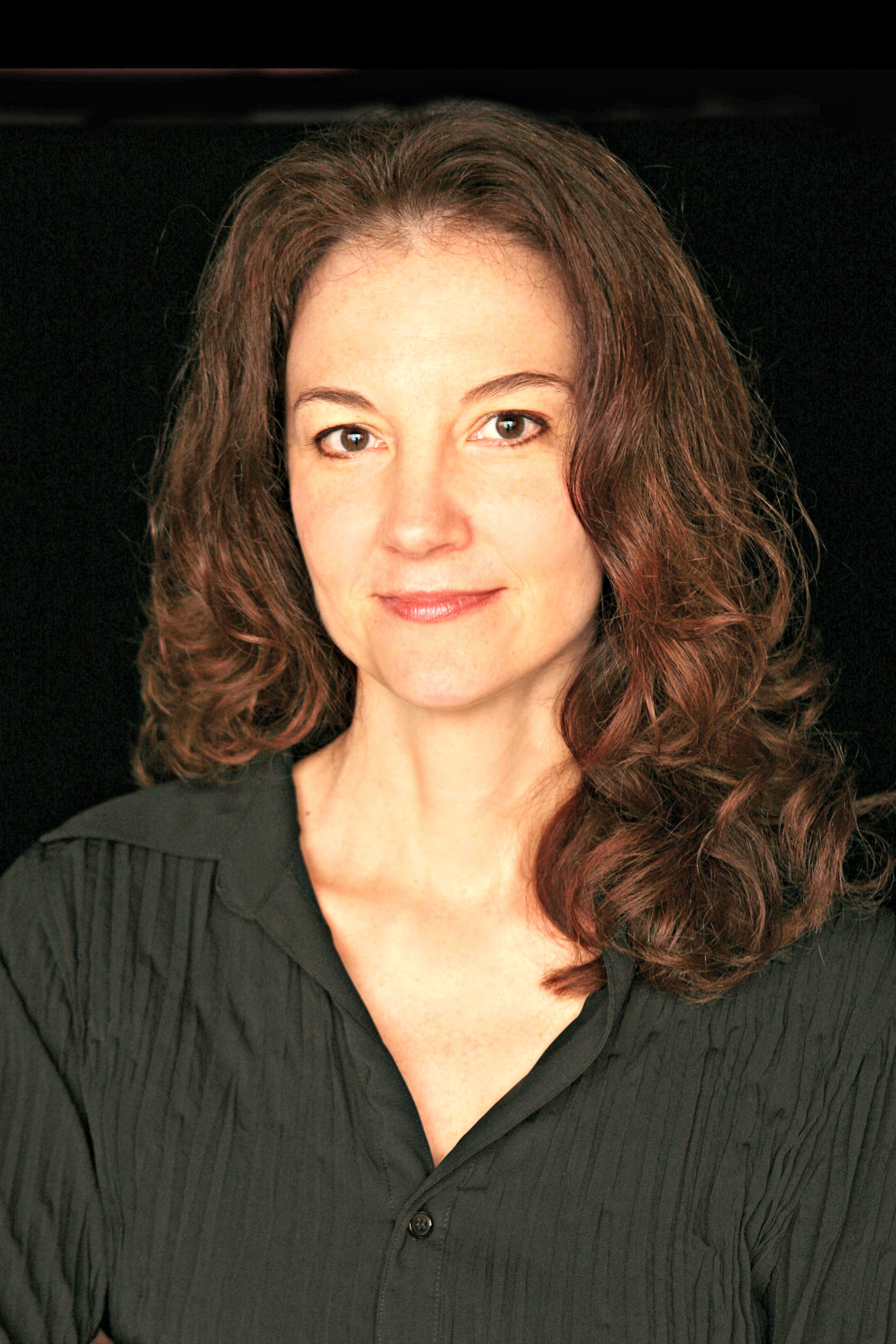
Today’s guest blogger, Kristin Bair O’Keeffe, is a cultural spelunker. With a husband from Ireland, a daughter from Vietnam, nearly five years as an expat in Shanghai, China, and an insatiable appetite for place, how could she not be? She’s also an author with an MFA degree in fiction writing, 18 years of experience as a writing instructor, a writerhead passionista, and the curator of #38Write, a monthly series of online writing workshops for place-passionate culture junkies around the world. Let’s listen up and hear why Kristin thinks Thanksgiving is a time for us displaced writers to shine!

— ML Awanohara

On Thursday, November 22, friends and families all over the United States (as well as oodles of displaced/replaced U.S.-ians around the world) will gather together to celebrate Thanksgiving. While this holiday can be traced back to the English Reformation and Henry VIII, it is now a secular holiday during which participants are expected to do just three simple things:

  1. eat turkey and pumpkin pie until we groan and bloat up like petrified puffer fish.
  2. endure our Great Aunt Pru, who smells like mothballs and passes out linty lozenges that look like they’ve been in the bottom of her purse since the Reformation.
  3. give thanks.

Writers of all ilk love this holiday. After all, it’s a day for us to shine! A day for us to show off by expressing our thanks far more eloquently than the neighbor who is slouched in front of his television in a tryptophan-induced haze.

We do, of course, have a lot to live up to:

“Thanksgiving Day, a function which originated in New England two or three centuries ago when those people recognized that they really had something to be thankful for—annually, not oftener—if they had succeeded in exterminating their neighbors, the Indians, during the previous twelve months instead of getting exterminated by their neighbors, the Indians.” ~ Mark Twain

“There is one day that is ours…Thanksgiving Day is the one day that is purely American.” ~ O. Henry [except, Mr. Henry forgot to add, those damn Canadians a bit to our north, who horn in on our gratefulness territory and dare to give thanks of their own, albeit on a different day]

“I come from a family where gravy is considered a beverage.” ~ Erma Bombeck

But no matter how splendid the thanks of those who came before us, this is a day on which writers can strut their best stuff!

So whether or not you’re American (U.S. American, that is), grab this opportunity to make a list of things for which you are thankful. Hurl yourself into the craft of thanks! Then, when your Thanksgiving host pauses just before cutting the first slice of turkey and says, “Would anyone like to share a thing or two for which you’re grateful?” you can whip out that slip of paper, clear your throat, and in your best writerly voice, make ’em weep in their cranberry sauce.

Here are a handful of mine:

1) Despite my great love for China, I am wildly thankful I will not be sitting face to face with the still-raw, almost-gobbling, dripping-blood, trying-to-limp-away turkey I once faced in Shanghai (ordered weeks in advance, mind you, from a fancy, well-respected, Western-y hotel and for which we paid a pretty-pretty RMB). All hail the year of mashed potatoes as the main dish! (We should have stuck with jiaozi.)

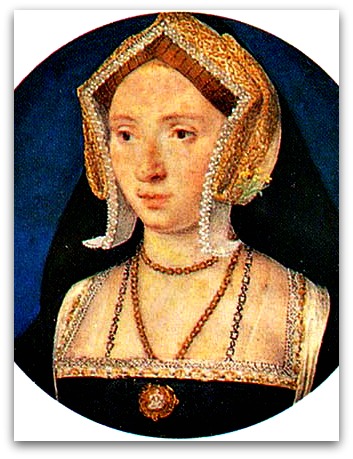
2) I am so, so, so grateful I am not living during the English Reformation and that I am not required to wear contraptions like this on my head:

Anne Boleyn

3) I am grateful that Maya Angelou called to read me a new poem. (Sorry, sorry, sorry! This is actually one of Oprah’s moments of thankfulness, not mine. But it sounds good, doesn’t it?)

4) I am thankful for my amazing family and friends from Ireland, Vietnam, Germany, India, China, the U.S., the U.K., and so many more places—all those who guide me, teach me, love me, and put up with me in my best and worst moments as a human being.

5) I am thankful and excited and inspired that writers around the world are flocking to my #38Write workshops and that my vision for contributing—and helping other writers contribute—to the global conversation of story is being realized. Whoop! Whoop!

6) I am grateful that there are writers all around the globe (like you!) who are driven to explore, write stories about the cultures and places in which they live, and connect.

Your turn! What are you thankful for?

CONNECT: If you’d like to learn more or if you’d like to register for one of Kristin Bair O’Keeffe’s #38Write workshops, grab a cup of coffee and pop over to her Web site and blog WRITERHEAD. Registration for December’s #38Write workshop is now open. You can Tweet Kristin at @kbairokeeffe, friend her on Facebook, and/or check out the #38Write group boards on Pinterest.

STAY TUNED for tomorrow’s post, Part 2 of Zeynep Kilic’s search for love in her adopted country.

If you enjoyed this post, we invite you to register for The Displaced Dispatch, a round up of weekly posts from The Displaced Nation, with seasonal recipes, book giveaways and other extras. Register for The Displaced Dispatch by clicking here!

Related posts:

Images: Kristin Bair O’Keeffe portrait; Anne Boleyn, courtesy Wikimedia Commons.

THE DISPLACED Q: Expats, repats, what’s the most outlandish tweak you’ve made to your Thanksgiving menu?

Since my repatriation to America, Thanksgiving has become my very favorite holiday here. This is partly because of a tweak that I make to the menu, but we’ll get to that later.

I wasn’t always so thankful for Thanksgiving. I only celebrated this American holiday twice while living abroad for many years, first in England and then in Japan — and to be honest, I didn’t really miss it.

Both celebrations took place when I was pursuing graduate studies at a British university.

The first time was for my very first Thanksgiving away from my family. I joined several other American grad students in preparing a traditional Thanksgiving dinner to serve in the dorm. Our guests were mostly other international students who were curious to experience an authentic version of this quintessentially American custom — as I recall, there were very few Brits.

At one point, a rather bitter argument erupted between Anna, a Harvard-educated woman who was pursuing a higher degree in feminist studies, and Andy, a Georgetown-educated man who was doing an M.A. in politics.

Andy didn’t like the fact that Anna was carving the turkey, proclaiming to the assembled guests:

It can’t be Thanksgiving if a WOMAN is carving the turkey.

I don’t really remember what happened after that — whether Andy insisted upon taking over, or Anna stormed out of the room. But it did cast a bit of a pall over the proceedings.

The food, though, was a close facsimile to the meals I’d enjoyed at home. And the arguing part? That was something I could relate to as well.

And there was snow, which we could see through the huge dorm windows, covering the panoramic Constable (literally) landscape below.

Thanksgiving-on-the-Hill

The only other time occurred a few years later, when an American friend came to live in North London on a teaching exchange with the Harrow School.

He, too, was spending his first Thanksgiving away from home, so decided to host a potluck Thanksgiving dinner in his living quarters.

Again, I think the food was good, but as I recall, the guests, most of whom were English, thought that potluck was a funny way to do a formal dinner. And the setting wasn’t exactly conducive to re-creating a New World feast. Walking from Harrow-on-the-Hill station, we passed by boys in the quaint Harrow uniform, including black ties (allegedly they are still in mourning for Queen Victoria!).

My Thankgiving-less years

After that rather harrowing (sorry, couldn’t resist) experience, I stopped doing Thanksgiving. I married a Brit and we invariably went to his family for Christmas dinner, which — probably not coincidentally — resembles the Thanksgiving meal enjoyed by the Pilgrims. Turkey is the most popular main, cranberry sauce and all. (No pumpkin pie, though!)

Even when we moved to Japan, where there were more Americans, I didn’t reinstate the custom. It seemed too much like hard work competing at the international grocery stores for vastly overpriced frozen turkeys (specially imported for the occasion) and cans of pumpkin.

What’s more — and I probably should have mentioned this earlier — I’ve never been especially keen on turkey. Once, when I was an early teen, I got food poisoning from an undercooked bird, a memory I’ve found hard to erase.

Something else I forgot to mention is that although I enjoy cooking, I’m not a roaster or a baker. I have never achieved the requisite culinary skills to produce a Thanksgiving dinner on my lonesome — even to this day, when I’m living in the U.S. again.

Nor did I especially enjoy the production such a big meal entails. If I’m going to spend a lot of time in the kitchen, I’d prefer to be producing something a little less bland than a roasted turkey, such as a Madhur Jaffrey Indian spread.

New thought: Maybe going abroad gave me the chance to escape from Thanksgiving? I wonder…

Giving thanks for Thanksgiving…but for one tweak!

So it is strange, the inordinate fondness I now have for this late November holiday. I like it because, unlike Christmas, it’s secular, so you don’t have to hesitate in wishing someone a happy Thanksgiving. It’s also less commercial, consisting primarily of an elegant meal with family and friends (I’m good at tuning out football).

I even enjoy eating turkey more than I used to — especially the dark meat. According to the Wall Street Journal, it’s the sides that American people sometimes tweak. But I like the sides. My absolute favorites are the stuffing and mashed potatoes, in that order.

All of that said, I do feel compelled to make one major tweak because of my hybrid background. Instead of turkey sandwiches the day after, I prefer chirashi-turkey-zushi!!!

Chirashi is Japanese for “scattered” — a scattered bowl of assorted fresh ingredients. Most likely you have tried chirashizushi: a bowl of sushi rice topped with a variety of sashimi (raw fish) and other garnishes. (See #2 in the photo.)

What my (second) husband, who is Japanese, and I like to do, on the day after Thanksgiving, is to substitute leftover turkey for the raw fish.

Chirashi-turkey-zushi is tasty, fast, and easy to make — particularly if you can get ahold of:

  • microwavable Japanese rice (use two or three packets for four people)
  • chirashi seasoning mix, containing five vegetables — typically, carrots, lotus, bamboo shoots, and shiitake mushrooms — sushi vinegar, seasoning, and nori (seaweed).
  • Kizami nori (shredded seaweed), to use as a topping.

There are no hard and fast rules as long as you get the seasoning right. And in my (admittedly rather biased) view, turkey goes as well with that seasoning as raw fish does!

* * *

Okay, your turn to tell me: what’s your idiosyncratic contribution to America’s national feast? Or if you’re not American, what do you do to internationalize your native festive spreads this time of year? I’m all ears, and tastebuds…!

STAY TUNED for another Thanksgiving post, by guest blogger Kristin Bair O’Keeffe.

If you enjoyed this post, we invite you to register for The Displaced Dispatch, a round up of weekly posts from The Displaced Nation, with seasonal recipes, book giveaways and other extras. Register for The Displaced Dispatch by clicking here!

Related posts: