The Displaced Nation

A home for international creatives

Tag Archives: Greece

For this adult TCK writer with an ocean-loving soul and a passion for travel, a picture says…

Canon zoom lens; photo credit: Morguefiles. Rita Gardner at home in California.

Canon zoom lens; photo credit: Morguefiles. Rita Gardner at home in California.

Welcome to our monthly series “A picture says…”, created to celebrate expats and other global residents for whom photography is a creative outlet. The series host is English expat, blogger, writer, world traveler and photography enthusiast James King, who thinks of a camera as a mirror with memory. If you like what you see here, be sure to check out his blog, Jamoroki.

My guest this month is 67-year-old Rita Gardner, who grew up on her expatriate family’s coconut farm in a remote seaside village in the Dominican Republic. Her father declared them to be the luckiest people on earth. In reality, the family was in the path of hurricanes and in the grip of a brutal dictator, Rafael Trujillo.

But if life was far from the Eden her father had envisioned, Rita developed a set of childhood passions that sustains her to this day: writing, traveling, hiking—and photography.

TheCoconutLatitudes_cover_dropshadowShe may no longer live in the Dominican Republic but she continues to dream in Spanish, dance the merengue, and gather inspiration from nature and the ocean. Her favorite color is Caribbean blue.

And now Rita has written a memoir about her life as a Third Culture Kid in República Dominicana. Due out from She Writes Press in September, the book is evocatively titled The Coconut Latitudes: Secrets, Storms and Survival in the Caribbean.

Rita contacted me because she is enjoying “A Picture Says…” I am pleased that she can be this month’s featured guest.

* * *

Hi, Rita, and welcome to the Displaced Nation. I’m delighted to hear you’re enjoying “A Picture Says…” and to have the opportunity to do this interview. Before we get down to the nitty gritty, can you tell me a little more about how your family ended up living in the Caribbean?
My father was an electrical engineer and traveled all over the world installing hydro-electric dams. I think my travel wings must have sprouted in the womb since my parents were in Uruguay on a job site when my mother got pregnant. They flew back to the U.S. so I could be born, and six weeks later we were on another plane, this time to an engineering job in the Dominican Republic. My parents fell in love with that Caribbean island nation, and my father quit his engineering job and “went off the grid” to become a coconut farmer on an isolated beach on the country’s northern coast. It became our permanent home for the next 19 years, and, as you already mentioned, our Caribbean life is the subject of my forthcoming memoir, The Coconut Latitudes.

I guess that being born into an expat family was a passport, so to speak, to a life of travel?
That’s true. It influenced me in other ways as well. I tend to travel “close to the ground,” getting to know the people where I’m visiting. I also travel light as I want to be free to immerse myself (to the extent possible) in other cultures, exploring commonalities as well as differences. Most of my travels have been within Latin America, where I’ve been able to put my Spanish-language skills to use.

And I gather that growing up where you did, on a Caribbean island, you sometimes encountered real adventurers? Did they inspire you as well?
Yes. Those who made it as far as our isolated coconut farm were pretty intrepid and would have stories to tell. Because they were so rare, these visitors made a big impression on me, and their stories made me thirst for the day when I could venture out into the wider world myself. In my new memoir I chronicle one such encounter with a group of strangers who shipwrecked near our farm, and turned out to be not who they appeared to be. Someone else who inspired me was my older sister. By the time she was in her fifties, she’d traveled to over seventy countries.

Wow, she does sound adventuresome. How about you—which countries have you visited?
Most of the islands in the Caribbean, several of them by sailboat, plus Mexico, Costa Rica, Argentina, and Uruguay. In Europe I’ve been to Italy (where I attempted to speak Italian but it came out Spanish), France, and Greece (island-hopping by small boat plus a side trip to Athens).

A day at the beach restores the soul…

South America is a part of the world I have never been but the three weeks I spent in Trinidad more than thirty years ago gave me an idea of what it may be like. I’m sure you have some wonderful memories and I look forward to reading them soon in The Coconut Latitudes. I see you now live in North America. Can you tell us where?
I’m in northern California, right on San Francisco Bay. I found my way here a few decades ago. I’ve always chosen to live near the ocean. Like most people, I had to earn a living, so travel was only an option during vacations. Luckily, I’ve recently retired so have more to time to travel, take pictures, and write.

RG1 Smoking Bride

The smoking bride; photo credit: Rita M. Gardner.


Photo credit: Rita M. Gardner.

Wading chairs; photo credit: Rita M. Gardner.


Photo credit: Rita M. Gardner.

A sitting duck; photo credit: Rita M. Gardner.

Speaking of taking pictures, let’s have a look at a few in your collection that capture favorite memories. Can you describe the story behind each one and what makes them so special?
I visited France for the first time last year with a dear friend, and one of our favorite things to do was meander about. We saw this bridal couple in Monmartre. The bride’s leg-baring gown and the cigarette struck me as being improper yet fun.

She obviously stepped out of the part for a while, which makes for a lovely scene—almost like an actor taking a break on a film set. What else do you have for us?
The next one is from Boca Chica Beach, in the Dominican Republic, whose pastel turquoise waters I had loved since the time I was a small child. I recently went back to the Dominican Republic to attend a friend’s mother’s 100th birthday party. A group of us decided to pay a visit to this beach. I liked the whimsy of the chairs in the shallows, as if they were bathing.

So you didn’t put the chairs there yourself?
No—it was un-staged! The third photo won “Best of Show” earlier this year in a camera club I belong to. If you look closely, you’ll see a small duck in the foreground, which I didn’t notice when I got the shot. The ship itself is one of the last Liberty ships that had been built for action in World War II by the Kaiser Shipyards, near where I now live. At the peak of the war, ships were being turned out at the rate of one almost every week! It’s now “mothballed”, and volunteers, some of whom saw action in that war, maintain it. They’re getting pretty old…

“Seas” the day!

That may not be such a small duck but it certainly is a big ship. And now can you share some examples of your favorite places to take photographs? What is it about these places that inspires you?
It’s a bit of a mixture really. One of my favorite subjects is nature. Growing up on a Caribbean island, I saw the entire range, from watching in awe as thundering waves destroyed our pier and pitch-poled fishing boats, to contemplating sunsets that painted calm seas with exuberant color, to enjoying the deep chorus of frogs announcing rain. To this day, I love to take pictures out of doors. I enjoy finding unusual patterns in nature and looking for images that are “hidden in plain sight.” My other favorite subject is people: I am endlessly curious. Sometimes I plunge into crowds in hopes of getting opportunities for candid people shots.

This photo was taken in the midst of a parade in Santo Domingo, where the child’s attention was riveted to the action beyond the scene.

Photo credit: Rita M. Gardner.

Out of this displaced world; photo credit: Rita M. Gardner.

I took the next photo, of leaf patterns, at nearby Phoenix Lake during a hike with friends. I love the variety of colors and shapes.

Photo credit: Rita M. Gardner.

Leaf patterns; photo credit: Rita M. Gardner.

This third photo, taking in Mykonos, combines my love of nature and people. It feels meditative to me; clearly the fisherman is at one with his environment.

Photo credit: Rita M. Gardner.

Fishing for serenity of mind; photo credit: Rita M. Gardner.

I particularly love the fisherman shot because I have had many wonderful holidays in Mykonos, where I’ve taken photos—but never witnessed a scene like this one. In fact it is one that most people would not associate with Mykonos. Moving on, I know some people feel reserved about taking photos of people, particularly when they are conscious that they are doing so. What’s your feeling about this?
I feel respect more than reserve, and if it seems that taking pictures would not be a welcome experience, I back away from doing it.

In that case, do you ask permission before taking people’s photographs? And how do you get around any problem of language?
I’m a pretty friendly person, so if I’ve caught someone’s eye,I might engage them in a brief conversation and ask if it’s OK if I take their picture. I find smiles break through a lot of language barriers. Also, most people I meet like to practice their English, so language is not usually a problem. That said, some of the best photos are candid ones. Sometimes I try to capture a shot without the subject being aware—I don’t engage in conversation in those instances.

Would you say that photography and the ability to be able to capture something unique which will never be seen again is a powerful force for you and has changed the way you look at life?
I consider myself extremely lucky when I’ve managed to capture an image that is unusual and unlikely to be photographed again. I don’t think the experience changes me. My chief emotion is to feel grateful that I have an eye for images that others may lack.

Sea-ing the light

Photographers never tire of discussing cameras and lenses. What kind of equipment do you use?
I gave up my SLR and its array of lenses for the convenience of a small digital camera. I use a Canon PowerShot and my i-Phone. Both fit in pockets, so I can travel light. Also, I prefer to shoot in natural light rather than use a flash (unless it’s absolutely necessary). So I guess I could say I travel light, and I shoot “light.” How’s that for a quick summary of my style?

Well said! I see nothing wrong with using smaller cameras. Their power and versatility is improving all the time, so unless you need big images for printing they do a great job, sufficient for posting on websites and social media. What is your take on post-processing?
I don’t manipulate my photos other than with the standard tools for cropping, adjusting exposure, etc. I don’t use Photoshop or any the other software products available. Okay, I have to confess I just discovered some apps for the i-Phone camera which I’m having fun with, but mostly “what I see is what I get.” That said, I’m not a purist; I may get into photo software at some point in the future.

The results are good so don’t tell anyone!!! Finally, do you have any advice from your experiences for wannabe photographers who are traveling or living abroad?
Given the ability to erase unwanted images on digital cameras, just shoot away, assuming you get a photo card with enough memory that it doesn’t fill up quickly. Always carry an extra battery and extra film card, because it does you no good to have those items tucked away in your suitcase, or wherever you are lodging! Oh, and do have a battery charger if you are on a long trip so you don’t have to worry about running out of juice. So to speak.

Thanks so much for all these practical tips and for sharing these photos, Rita, and may I take this opportunity to wish you the very best when you launch The Coconut Latitudes this coming month.

* * *

Readers, what do you make of Rita’s experiences and her photography advice? And do you have any questions for her on her photos and/or travels? Please leave them in the comments!

And if you want to know more about Rita, don’t forget to visit her author site and like her author page on Facebook. You can also follow her on Twitter and Pinterest.

Last but not least, I would highly recommend that you pre-order a copy of Rita’s Dominican memoir, The Coconut Latitudes, from Amazon.

(If you are a photographer and would like to be interviewed by James for this series, please send your information to ml@thedisplacednation.com.)

STAY TUNED for next week’s fab posts!

If you enjoyed this post, we invite you to register for The Displaced Dispatch, a round up of weekly posts from The Displaced Nation, with seasonal recipes, book giveaways and other extras. Register for The Displaced Dispatch by clicking here!

Related posts:

LOCATION, LOCUTION: Jessica Bell – Australian contemporary fiction author in Ithaca, Greece

black and white_Jessica BellIn this month’s “Location, Locution”, expat crime writer JJ Marsh interviews Jessica Bell, a thirty-something Australian-native contemporary fiction author, poet and singer/songwriter/ guitarist. Jessica is the Publishing Editor of Vine Leaves Literary Journal and the director of the Homeric Writers’ Retreat & Workshop on the Greek island of Ithaca. She makes a living as a writer/editor for English Language Teaching Publishers worldwide, such as Pearson Education, HarperCollins, MacMillan Education, Education First and Cengage Learning.

Which came first, story or location?

Neither. My characters always start off a story. But if I had to choose, I would say location comes before story as I think the location of the story would have a lot of impact on how it’s told.

What’s your technique for evoking the atmosphere of a place?

I try to incorporate as many of the senses as possible. Utilizing the six senses (see, hear, smell, taste, touch, and instinct) can really bring your writing to life. To do this successfully, you need to “show, not tell.” Otherwise, these senses will not really be senses. The reader won’t actually experience them, they will only “read about” them. And the whole point of reading a great book is to feel like you aren’t actually reading. Right? Right. Using the six senses in an effective way will accomplish this.

The key to using sense in your writing, however, is to limit your use of the words, see, feel, hear, smell and taste. That’s not to say you shouldn’t ever use these words, but just be aware you don’t overuse them.

The most ideal way to incorporate senses is to employ language in which sense is already a part of. For example, instead of saying the kitchen smelled sweet with melted chocolate, show the reader what’s cooking, and consequently that taste and scent will be present in the narrative without you having to point it out.

Using the six senses well is also not only about having your characters sense things, it’s about making your readers sense things—even elements that your characters aren’t feeling, i.e., if the reader knows more than your character(s) do, or if you’re showing something that you might react to differently than the characters in the book.

If you’d like more of my advice on writing craft, take a gander at Writing in a Nutshell.

Which particular features create a sense of location? Landscape, culture, food?

Oh, everything!

Can you give a brief example of your work which illustrates place?

Sure! This excerpt is from String Bridge:

String Bridge paperback coverThe island’s windy mountainous roads are framed with olive groves and air so crisp you could snap it like celery. The houses are stained with whitewash and embedded with old-style wooden shutters, tailored by the locals to keep the summer swelter out. They are painted blue, red, or green, but occasionally you may come across the odd pink or orange shutters, which are more often than not inhabited by the eccentric barmy type who are colour-blind, or the young and loaded foreigner who believes an island revolution should be in order.

Goats meander about the streets, butting each other’s heads senselessly as they try to escape oncoming cars and motorcycles. The roosters, chickens, and geese fire up the locals at the first sign of sunrise. Birds chirp, cicadas “jijiga” in the olive trees, and dogs bark as the bread truck, a red beat-up Ute, delivers fresh hot loaves to each residence, and slips the required amount of bread into handmade cloth bags hanging from wire fencing.

Summer on this island engraves your skin with a longing to spend sunrise to sunset lying on a small, empty, white-pebbled beach in a secluded cove at the end of a private dirt track. At midday, it gets so hot you need to wade through the heat waves rising from the uneven tarred road like kindred spirits before you can wade in the Ionian Sea to cool off—a flat, motionless oil bath which glows with an infinite turquoise glint. It may seem you are stepping into velvet, however, you emerge covered in a thin salty crust you can brush off like sand when it dries.

How well do you need to know the place before using it as a setting?

For the above example, I knew the setting extremely well as I have spent at least a quarter of my life on this Greek island. However, I don’t think you necessarily need to know a place to write about it well. For example, if you want to write about a Greek beach, just think of another beach you’ve been to, imagine it smaller, imagine pebbles instead of sand, how would that setting change affect your senses? Just use knowledge gleaned from other places you’ve been to and be smart about incorporating the differences. You’d be surprised what you can find on the Internet to help you.

Which writers do you admire for the way they use location?

Definitely Margaret Atwood, Neil Gaiman, and Marilynne Robinson.


Writing in a Nutshell_Jessica BellSign up to Jessica’s newsletter and receive Book #1 of the Writing in a Nutshell Series, Show & Tell in a Nutshell, or Muted: A Short Story in Verse, for free.

Connect with Jessica online:

Website | Retreat & workshop | Blog | Vine Leaves Literary Journal | Facebook | Twitter


* * *

Next month’s Location, Locution: Scottish-born/Canadian-raised Catriona Troth, whose books Gift of the Raven and Ghost Town encompass 1970s Canada through the eyes of a young boy, and Britain’s 1980s race riots respectively. .

_(75_of_75)


JJ Marsh grew up in Wales, Africa and the Middle East, where her curiosity for culture took root and triggered an urge to write. After living in Hong Kong, Nigeria, Dubai, Portugal and France, JJ finally settled in Switzerland, where she is currently halfway through her European crime series, set in compelling locations all over the continent and featuring detective inspector Beatrice Stubbs.

STAY TUNED for our next post!

If you enjoyed this post, we invite you to register for The Displaced Dispatch, a round up of weekly posts from The Displaced Nation, with seasonal recipes, book giveaways and other extras. Register for The Displaced Dispatch by clicking here!

Related posts:

For semi-retired expat blogger James King, a picture says…

Welcome back to our series “A picture says…”, which we created to celebrate those for whom photography is a creative outlet—who rely on a camera to register the look, character, and ambiance of the people and places that capture their fancy as they move around the globe.

Today’s guest is English expat, blogger, writer, world traveler and photography enthusiast James King. From December onwards, James will take over the hosting of this column from Andy Martin and publish it monthly.

As James plans to ask his interviewees to provide a selection of photos that help to tell their personal travel stories, it seems only fair that we require him to undergo the same exercise. What pix would he use to illustrate his peripatetic life of the past 25 years?

Indeed, “peripatetic” seems an apt descriptor for James. Semi-retired and now living in Chiang Mai, Thailand, he has traveled to over twenty countries. He lived in South Africa for a couple of decades and Thailand for the past five years. Here, in summary, are his vital travel stats:
Place of birth: England, UK
Passports: UK and EU (British citizen)
Resident in: UK (Bristol): 1942 to 1995; South Africa (Durban, Johannesburg, Cape Town): 1995 to 2008; Thailand (Chiangmai): 2008 to present.
Main countries visited: France, Spain, Greece, Italy, Morocco, Gambia, Kenya, Botswana, South Africa, USA, Thailand, Malaysia, West Indies.
Business interests: Majority shareholder in WestJewel (Pty) Ltd., a Cape Town jewelry wholesaler he founded in 2004.
Social media coordinates:
Twitter: @JimKing28265666
Facebook: Jim King
Linkedin: James King
Google+: jamoroki@gmail.com
Blog: Jamoroki.com

* * *

A bloomin’ late bloomer!

Hi, James. I see you were born in England during World War II. When did you actually start traveling?
Life was pretty austere after the war, we had rationing and people lived a fairly simple life. There were very few restaurants and I don’t actually remember ever going out to eat with my parents. Don’t get me wrong, we weren’t on the “bread line”; but it just didn’t happen in those days. We had TV for the first time in 1953, and it wasn’t until I was 24 that I first traveled overseas; to Paris in fact. When I got into my thirties, then I really started to spread my wings but I was very busy trying to make a living so I didn’t have the freedom I gained later in life. Only then was the adventurous side of me given wings, so to speak. Eventually, at the age of 53, I packed my bags and emigrated to South Africa after a few sorties there in the three years before.
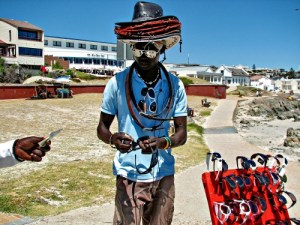
SouthAfricanBeach_JK

Photo credit: James King

Okay, time to see your first photo. What’s the story behind this one?
This guy wears many hats and makes a living selling his wares on the beach at Bloubergsands, which is close to the house that I bought (and am now trying to sell!) in Table View in Cape Town. Generally these traders are not South African. They often travel a very long way from neighboring countries such as Zimbabwe, Zambia and Mozambique. Many of them dodge border posts by hiding in the back of goods trucks. They all hope to make a new life in South Africa after escaping from oppressive regimes or poverty. Some of them are intelligent, articulate and well educated, as I remember this guy was.

What do you like most about this shot?
I like that it highlights the harshness of Cape Town light. The ozone layer is so thin there—I had to be far more careful of the sun than I do in the tropics. I also like the photo because at that time, I wasn’t into photography at all and had even less idea about what I was doing than I do now. I always have to be aware of what harsh light can do to my pics.

Okay, let’s move along to another photo that speaks to your South Africa experience.
Can I have two shots, please? One of the Cape of Good Hope and the other of Table Mountain, with Cape Town below.
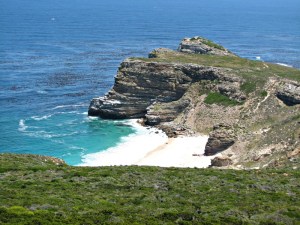
EndoftheEarth_JK

Photo credit: James King

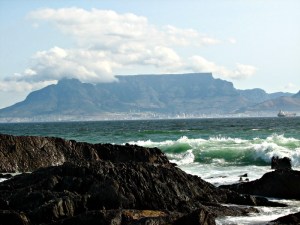
TableMountain

Photo credit: James King

For me, these photos bring back memories of how wonderful the landscape is in that part of the world. So overwhelming, you really have to experience it in person. Just think, we are at the Cape of Good Hope, the bottom of Africa! And, despite how beautiful it looks, you don’t want to know how cold that water is. Naked you may survive ten minutes in there!

What particularly appeals to you about the Table Mountain photo?
I love how the clarity changes as soon as you hit the shore line below the mountain. It really is like that and not a cock-up on my part. It won’t win awards, but it is very personal so I love it.

How did you end up in Cape Town?
How long have you got? Things went a bit wrong for me in England after I got divorced, and then I met a guy who used to live in Durban and still had some business interests there. His wife had died the previous year so we were both single and hit it off. He had to go to South Africa again, so we decided to go and work together. That’s the “nutshell” version.

Semi-retirement in the Thai tropics

And now 20 years later you are in Thailand. How did that happen?
I’ll have to get the “nutshell” out again. In 2004, with some backing, I bought a jewelry wholesale business. Most of our silver is sourced and manufactured in Thailand, and I took on the responsibility of buying overseas. So I started traveling to Bangkok to meet suppliers and go to the Gems and Jewelry Fair in March and September. I met so many new people and also took a couple of holidays in Phuket before going back to Cape Town. Gradually I got a taste for SE Asia and, after a few years, decided to stay for four months getting to know more whilst still working remotely. That was it. Semi-retirement in the tropics beckoned and I was hooked!

I imagine it’s all been plain sailing since you moved to Thailand. Just kidding! I see from your blog you’ve had your struggles.
It is very difficult to précis my life over the last four years. I wrote my first book, the memoir MASK, to try and show the different sides to Thailand, its people and their culture. The book isn’t everybody’s cup of tea, but it was a cathartic exercise and helped me a lot. I should add that I didn’t include everything in it. The rest may come out later. But now I have a new lease of life and am so pleased I found blogging and photography because I believe the two go hand in glove. Writing, which has been a passion of mine for a long time, can embellish the photos and photos can enhance the writing, so in blogging you have the best of both worlds.

You say that photography gives you the ability to be able to capture something unique, which will never be seen again. What brought you to this realization?
I have always admired great photography while not having time to pursue it because I was working. Now, through my blog, I am learning how to incorporate photos into my posts. It’s fair to say my appreciation is growing as I hope will my knowledge. Writing is still my primary passion, but I now have another tool in my observation box. Although late in life for me, we are so lucky to be living in a technological age where we have the tools to enable us to express ourselves like never before. Sorry to take over the interviewing, but don’t you think it is so amazing?
Thailand2_JK

Photo credit: James King

But of course! Getting back to you and the photos that capture special memories: what do you choose next?
Actually, on my “to do” list is scanning some of the photos from my pre-digital collection, beginning in the 1970s, a number of which carry powerful memories and should help to create some rather interesting blog posts. In the meantime I have selected three of my more recent favorites for you.

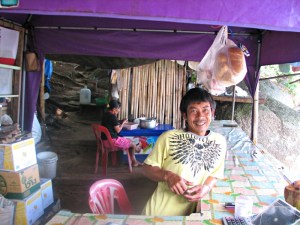
The first one shows this guy and his wife who live in their little house at the end of Kata Noi, a beach on Koh Phuket. Every grain of sand is polished every day, they welcome everyone whether you want a drink or something to eat or just to say hello. They have a few beach loungers as well if you want to relax there. If you can have a more simple stress free existence, I’d like to know about it. On this particular day, I visited early one morning before the tourists woke up, and they made me feel most welcome.
Thailand3_JK

Photo credit: James King

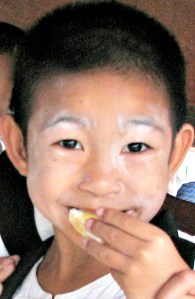
This little seven-year-old boy lives in my village in Chiang Mai. As you can imagine he is very naughty and the older children tease him unmercifully. So he comes to my house at weekends to annoy me and get chocolate and biscuits. He always wants me to take his pic, and on this occasion I caught him waiting for the school bus. He felt very proud.

Let’s not get technical

What kind of camera and lenses do you use?
Please don’t ask me anything technical. It says on the bottom “Canon PC1130” and on the front “Power Shot S2 IS”. One fixed lens 12x Optical Zoom with lots of numbers on it. It has lots of settings but I don’t know what they are for so I leave it on auto-pilot and hope for the best. Oh, and most importantly, the rechargeable batteries are held in with an elastic band. I haven’t got a clue whether it is any good or not: I just shoot and ask questions afterwards. But sometimes I do worry that my photos are not so good when I see many accomplished photographers blogs. I just console myself I must work extra hard on the subject matter.
ThaiWhiteTemple_jk

Photo credit: James King

I think you have one more Thai photo?
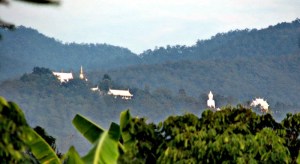
Yes, this one: the white temple in the forest, which can be viewed from my village. This is very special because most of the time, although I know it is there, I can’t see it for mist or haze. Then one evening it was there and so was I with my camera!

Where have been your very favorite places to take photographs?
On safari in Kenya, Mykonos Island in Greece, and here in Chiang Mai where, even though I say it myself, I’ve managed to capture some beautiful morning and evening landscapes.
MykonosTown_JK

Photo credit: James King

Do you have a shot that’s your all-time favorite?
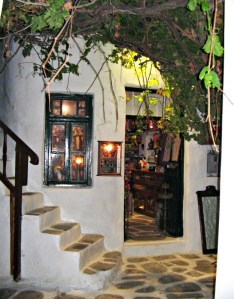
I pick this one, of a house in Mykonos Town, taken in 2005. I think it will always be one of my favorites.

A few parting shots

Do you feel reserved about taking photos of people, particularly when they are conscious that you are doing so?
It’s a very good question because I am always conscious that they may be shy and so I try and make a quick judgement call. But I do have an aversion to posed photos in the natural environment, so getting the balance right is important to me.

Do you ask permission before taking people’s photographs?
I just try and feel how they feel if they are aware I want to shoot them. I prefer to take them when they are unaware, then smile and say thanks. Otherwise I don’t get the naturalness I want. Look, I’m not experienced so I am not over-confident and I need all the advantages I can get. I find people will show you pretty quickly if they don’t want their picture taken.

But how do you get around problems of language?
Funnily enough I find not speaking the same language gives me an excuse not to ask. I have a smattering of Thai so the people here know I’m not a tourist, which definitely helps a bit.

Finally, do you have any advice for wannabe photographers who are traveling or living abroad?
In a nutshell (there I go again!), here are two pieces of advice:

  1. Never leave your camera at home or you may miss the shot of a lifetime out of nowhere. (Up until recently I have regretted not taking my camera on so many occasions. Now I hardly go anywhere without it, so much so that I often feel like a Japanese tourist. Believe it or not, most of my best shots were taken when I forgot to put in the SD card!)
  2. If, like me, you are not proficient, use other skills such as writing and storytelling or bizarre scenes, so that the photos don’t have to stand alone, to be judged naked.

* * *

Thank you, James! Readers, what do you make of James’s experiences and his photography advice? And do you have any questions for him on his photos and/or travels? Please leave them in the comments! (If you are a photographer and would like to be interviewed by James for this series, please let me know: ml@thedisplacednation.com.)

Once again, if you want to read more of James, be sure to check out his blog, Jamoroki.com. (Hmmm…I suspect there’s a story in that name!)

STAY TUNED for tomorrow’s post, an interview with November’s featured author, a novelist!

If you enjoyed this post, we invite you to register for The Displaced Dispatch, a round up of weekly posts from The Displaced Nation, with seasonal recipes, book giveaways and other extras. Register for The Displaced Dispatch by clicking here!

Related posts:

Main image at top of page: Camera lens from Morguefile; James King at the Khao Panong Rung Khmer Temple near Buriram, NE Thailand. All other images by James King.

And the August 2013 Alices go to … these 3 international creatives

 © Iamezan | Dreamstime.com Used under license

© Iamezan | Dreamstime.com
Used under license

As subscribers to our weekly newsletter know, our Displaced Dispatch presents a weekly “Alice Award” to a writer or other kind of creative person who we think has a special handle on the curious and unreal aspects of the displaced life of global residency and travel. Not only that, but this person likes to use their befuddlement as a spur to creativity.

Today’s post honors August’s three Alice recipients. Beginning with the most recent, they are (drumroll…):

1) CALLISTA FOX, TCK blogger and author of the serial novel Suite Dubai

Source: “Friday Night Lights vs. The Eurotrash Girl on CallistaFox.com
Posted on: 26 June 2013
Snippet:

Our boarding school offered cheer leading as an afternoon activity… I signed up because it sounded better than typing or drafting and my parents wouldn’t pay for dressage. We knew only a handful of cheers. None of us could name a proper jump, let alone do one. We wore white tennis skirts and blue sweatshirts and any color of hightop Reebok we owned. When we ran out onto the field to do our pathetic cartwheels the audience was quiet, a few laughed. True, the grass was wet and my roommate Samantha slipped and skidded on her chin. We didn’t have our routine perfected.

Citation: Who stole the tarts, Callista? Who stole the tarts? Your account of your bout with cheer leading at a boarding school in Austria suggests that you were in a classic Alice-in-Wonderland situation, perhaps without even realizing it. Because no young American woman in her right mind would cheer an Austrian team playing Australia in American-style football on a field marked for soccer, unless they’d stepped through the looking glass. Indeed, your description is missing some crucial details, for instance:

  1. Were the teams using a koala bear as the ball? Koalas being to Austria what flamingos are to England—namely, more New World than Old. (Notably, koalas like to eat the leaves of the eucalyptus tree, which doesn’t exactly thrive in The Land of Long-needled Pines.)
  2. Did anyone propose a trial for all of those unruly fans in the half-filled stands who were throwing things at you and the other cheerleaders?

All of which brings us back to our original question: was it an Aussie or an Ausie, the Knave who stole the tarts? That’s what we (and presumably your all-American Texan husband) would most like to know.

Still, we did find amusing the tales of ThirdCultureKid-land that you told to your better half. Clearly your quintessentially TCK life had its moments, including the time you watched a guy eat glass in a bar in Nicosia, Cyprus, when you were only 14.

Is it any wonder that when your parents moved you back to Norman, Oklahoma, when you were 20, you felt exactly like Alice, who told her sister: “Oh, I’ve had such a curious dream!” (You did make a lot of it up, right?)

2) CHRIS ALDEN, British expat; author and journalist

For his book: “101 Reasons to Live Abroad…and 100 Reasons Not To”
Published: March 2013
From the book description:

Do you dream of living abroad? If so, you’re in good company. Tens of thousands of people every year emigrate from the UK—leaving behind the security of work, family and friends for the promise of better weather (hopefully), better prospects (sometimes) and a carefree existence (keep dreaming).

So is now the time to leave Britain and start life as an expat? Or have you already started planning the big move overseas?

101 Reasons to Live Abroad … & 100 Reasons Not To helps you discover if living abroad is right for you. It’s an uplifting guide to the positive sides of life as an expatriate—and a reality check about the challenges that relocation brings.

Citation: Chris, we understand that you’re also the author of 250 Things to Do in Cyprus on a Sunny Day, so would encourage you at some point to compare notes with your fellow Alice awardee, Callista Fox. In the post cited above, Callista reports that, when attending boarding school in Nicosia, she and her friends particularly enjoyed hanging out in a bar drinking Carlsberg with UN soldiers (they were there to keep the peace between Cypriots and Turks). We’re genuinely curious: does this particular activity rank in your Top 250? Or perhaps you think it’s better left for a rainy day? (Actually, does Cyprus even have rainy days? Oh, that’s right: it’s only semi-arid.)

Anyway, we’re awarding you an Alice because, like Lewis Carroll’s little heroine, you appear to appreciate both the positive and negative aspects of turning one’s life upside down, with the balance tipped every so slightly towards the positive. We believe Alice would be impressed that you offer a final, 101st reason to live abroad for those who, having been offered as many as a hundred reasons both for and against, still find themselves dithering. After all, when Alice’s sister urges her to run inside to get her tea, she obliges her “thinking while she ran, as well she might, what a wonderful dream it had been.”

3) LINDA JANSSEN, writer, speaker, consultant, global adventurer and cultural enthusiast

For her book: “The Emotionally Resilient Expat”
Published: 22 June 2013
From the book description:

Linda A. Janssen combines candid personal stories from experienced expats and cross-culturals, with a wealth of practical tools, techniques and best practices from emotional, social and cultural intelligence, positive psychology, mindfulness, stress management, self-care and related areas.”

Citation: Linda, as you know, we’ve been an avid follower of yours on Adventures in Expatland, which has helped to stimulate many of our own “through the looking glass” insights. And now we see you’ve contributed a tome to the discourse on what to do when you fall through the rabbit hole and feel culturally discombobulated. According to your book, which is sprinkled with expat stories and anecdotes, the answer lies in calling on (or developing) reserves of emotional resilience—a quality Alice had in spades, so to speak. Upon hearing of the Queen of Heart’s intention to have her decapitated, she retorted thus:

You’re nothing but a pack of cards!

At which point

the whole pack rose up into the air, and came flying down upon her: she gave a little scream, half of fright and half of anger, and tried to beat them off, and found herself lying on the bank, with her head in the lap of her sister, who was gently brushing away some dead leaves that had fluttered down from the trees upon her face.

Now if that isn’t resilience, what is?

From now on, we look forward to reading about your Adventures in Repatland, which as we noticed from your last post, are only just beginning:

At long last I’m beginning to surface, coming up for air in a new stage in a new place in a country and culture which seem familiar yet I don’t always recognize.

Hey, if it helps to know, we’ve got your back on this one!

* * *

So, readers, do you have a favorite from the above, or have you read any recent posts you think deserve an Alice Award?  We’d love to hear your suggestions! And don’t miss out on these weekly sources of inspiration. Get on our subscription list now!

STAY TUNED for our next post!

Writers and other international creatives: If you want to know in advance whether you’re one of our Alice Award winners, sign up to receive The Displaced Dispatch, a round up of weekly posts from The Displaced Nation, with news of book giveaways, future posts, and of course, our weekly Alice Award!. Register for The Displaced Dispatch by clicking here!

Related posts:

For author Lana Penrose, expat “curveballs” come in threes

curveballToday we welcome back best-selling Australian author Lana Penrose, who last visited us in December to commiserate with those who were spending the holidays separated from their dearest and no longer nearest. Today’s occasion? The publication of Lana’s third memoir on her life abroad in Europe. Wait, did I just write “third”? Yes, this indefatigable Aussie managed to get a trilogy out of her expat experience, and is here today to explain.

—ML Awanohara

I’ve been asked to explain what motivated me to write my latest mini-memoir Addicted to Love, and it’s a very good question—one that I pose to myself often, particularly while in the throes of insomnia.

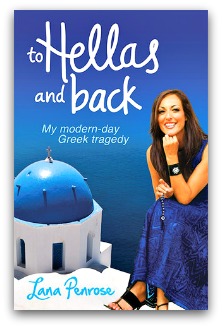
ToHelasandBack_dropshadowFor the uninitiated, I’m the author of To Hellas and Back, which chronicles my true-life tale of following the love of my life to the ends of the Earth (Greece) only to wind up losing my mind.

I then Nutbushed over to the UK to work for a world-renowned pop star and in the process wrote Kickstart My Heart, which details my attempt to negotiate my newly single life à la Bridget Jones—only with an axe through her head. As the book’s subtitle says: “A carnival of dating disasters”.

KickstartmyHeart_dropshadowNow these two books are rife with comedy, tragedy and my own human failings, so why scoop out what’s left of my heart and smear it across my shirtsleeve?

Like I said … a very good question.

More to the story…

The truth is that my story absolutely did not end with me leaving London to re-sample Greece after again being lured by love’s enchantment. In fact what happened next is something that I’ve kept close to my chest because it was downright shocking. I spent considerable time deliberating over whether I should share it at all.

AddictedtoLove_cover_dropshadowBut as many of you displaced writers know, the problem with being an author (one of the many!) is that you can’t seem to stop writing. And life has been more than accommodating in throwing me the odd curveball, the sort of material I feel compelled to purge away with my pen.

And so Addicted to Love was born: a mini-memoir that proves once and for all that truth really is stranger than fiction.

It’s set on the beautiful Greek island of Kythera, where I faced an impossible situation that I can’t go into here without issuing a spoiler alert … but rest assured that it’s gripping and you’ll digest it quite quickly, because it’s been described as “a page turner.”

Finally, an answer (of sorts)

But back to the original question: What motivated me to write this book? Well, thankfully (and unfortunately), experience has shown that there are many people who go through similar triumphs and tragedies to mine, particularly while traversing the globe. I like to connect with such people, and book writing is my way of holding out a hand and saying: “What—you, too?”and “You’re not alone.”

To Hellas and Back, Kickstart My Heart and Addicted to Love form a trilogy of the victories and pitfalls I experienced as an everyday person hurdling life abroad.

Each book can be read as a stand-alone, but I (predictably) suggest that you start at the very beginning to understand the depths of where I wound up.

* * *

Hey, Lana—you wound up here, at the Displaced Nation! That’s not the depths, surely? Readers, any questions for Lana or words of support? If you’re not familiar with Lana’s works, you can find the entire trilogy on Amazon or Smashwords. And don’t forget to follow her advice and begin at the beginning: by going to hellas and back!

Sydney-based (and no longer displaced) author Lana Penrose has had various incarnations, including music journalist, record company promotions gal, music television producer and personal assistant to an iconic pop sensation whose name shall never be revealed unless she’s subjected to Chinese water torture. She also once worked with the now-infamous Simon Cowell, which she today finds really odd. You can read more about her and her works on her author blog and/or follow her on Twitter: @LanaPenrose

STAY TUNED for tomorrow’s post, when we’ll be revisiting one of the earliest themes on this blog, Alice in Wonderland, but from the perspective of an international creative.

If you enjoyed this post, we invite you to register for The Displaced Dispatch, a round up of weekly posts from The Displaced Nation, with seasonal recipes, book giveaways and other extras. Register for The Displaced Dispatch by clicking here!

Related posts:

Image: MorgueFile

Expats and travelers, the adage is true: There’s no place like home for the holidays

“I’ll be home for Christmas if only in my dreams” — Bing Crosby’s closing line has special meaning for best-selling Australian author Lana Penrose. As reported below, she will never forget spending the holidays in Europe during her decade-long stint as an expat, beginning in Greece — highlights from which are chronicled in two memoirs: To Hellas and Back and Kickstart My HeartNOTE: As a special gift to Displaced Nation readers, Lana is giving away a print copy of To Hellas and Back! See details below.

— ML Awanohara

It’s that time again: Christmas, where the cynical amongst us are found warbling, “‘Tis the season to be melancholy.” For the displaced expat, this period really can be an odd time. If you’re remaining in your adopted country, you may catch yourself yearning for your friends, family and homeland. Somehow drunken Uncle Ernie who likes to lick your neck vanishes from memory.

Yes, there’s no place like home, particularly on Christmas Day. I know this because (a) I lived as an expat in Athens for 5 years; (b) I also lived as an expat in London for 5 years; and (c) I’ve written books about it, one a bestseller titled To Hellas and Back (see what I did there?).

So I get it. I truly do.

And I’m no stranger to grappling with the unfamiliar during the festive season. Actually, make that most celebratory occasions.

Hell yeah!

I believe it all started when I was encouraged to join “The Circle.” No, it wasn’t a cult (arguably), although there was a noticeable absence of Kool-Aid and Nike trainers.

I was attending a Greek boyfriend’s cousin’s engagement party in my native country of Australia. It was to be my first head-on collision with Hellenic culture. I distinctly recall being led by the hand towards my beau’s extended family. And as Greek folk music wailed from tinny speakers, I watched relatives dance around and around connected by tightly clutched handkerchiefs.

The leg-scissoring madness was mesmerizing — and there was nothing else for it but to clap along as though attending a barn dance, get hitched and relinquish my country for at least half a decade.

As the years passed, I swallowed more foreign tradition than I did dolmades. I was now living in Greece. And as I’d done so many times before, come Easter I was straddling yet more unfamiliar customs. There I was ingesting mageiritsa soup, traditionally made from lambs’ tongue, lungs, liver and intestines.

It seemed all about innards as my own sighed dejectedly.

A misplaced gift

I also remember a Christmas where I was presented with a gift from a bone fide Athenian native. I excitedly opened a grey velvet box — and there, inside, was a flashy faux gold necklace of the type preferred by gangland hos.

It kind of made sense considering he’d once also given me a birthday present in the form of a pair of black and gold shoes and a fluffy white vest.

At the end of the day, the gesture was beautiful and I couldn’t wait to try everything on as an ensemble … and submit a job application to the Black Eyed Peas.

Food — a substitute for love?

But that stuff’s plain amusing. The toughest part about spending auspicious occasions away from home is missing the people you love most, which thankfully at Christmas usually means the perfect excuse for unprecedented weight gain (if you’re in a country that celebrates such things).

In contrast to Easter, for me Greek Christmases meant hoovering up* delicious fare — including egg and lemon chicken, rice soup, roast pork, turkey stuffed with ground beef, spinach and cheese pies, stuffed cabbage leaves and salads of every description, followed by sesame baklava and cinnamon melomakarona.

My standout memory of a Christmas abroad, however, is the time that an older Greek couple lamented how sorry they were that I wasn’t able to spend the festive season with my family. They “got” it. Because they’d lived as expats, too.

That couple promised to do all in their power to make my day happy, and they succeeded simply by being mindful, considerate and absolutely lovely.

The sentiment was so touching that it will stay with me forever.

So, yeah, the pros and cons of celebrating Christmas abroad. The anomalies are hardly going to kill you, but sometimes you just want to click your shiny red shoes and declare, “There’s no place like home.”
*Canadian slang for “eat very fast and too much.” (Lana, where and when did you pick that up?!)

* * *

And now to that giveaway! Readers, Lana Penrose has offered to send a copy of her best-selling memoir, To Hellas and Back, to the person who leaves the best comment in answer to the question:  Where are you spending the holidays this year, and will you feel at home or displaced? To tempt you even more, consider the fact that To Hellas and Back, which was first published by Penguin, has been described as an “Eat, Pray, Love face-ploughing into a steaming pile of moussaka.” Its dedication coincidentally reads: “For the displaced.” So if you’re tired of reading about the joys of successfully renovating Tuscan homes and the like, this book might be for you!

Sydney-based (and no longer displaced!) author Lana Penrose has had various incarnations, including music journalist, record company promotions gal, music television producer and personal assistant to an iconic pop sensation whose name shall never be revealed unless she’s subjected to Chinese water torture. She also once worked with the now-infamous Simon Cowell, which she today finds really odd. You can read more about her and her works on her author blog and/or follow her on Twitter: @LanaPenrose

STAY TUNED for tomorrow’s post, when we’ll be checking in on some of our Random Nomads from earlier in the year and find out what they’re up to for the holidays and beyond.

If you enjoyed this post, we invite you to register for The Displaced Dispatch, a round up of weekly posts from The Displaced Nation, with seasonal recipes, book giveaways and other extras. Register for The Displaced Dispatch by clicking here!

Related posts:


CLEOPATRA FOR A DAY: Fashion & beauty diary of expat Helena Halme

Today we introduce a new feature: “Cleopatra for a Day.” Displaced citizens open their little black books and spill the fashion and beauty secrets they’ve collected on their travels. First up is Helena Halme. One of TDN’s Random Nomads, Halme is a Finnish expat in London and a self-professed fashion maven.

BEAUTY

When my husband (“The Englishman”) and I did a house-swap in Los Angeles in the nineties, I discovered Origins, then a skin care range that wasn’t universally available here in the UK. Anything close to nature was an upcoming trend, and the Origins shops in LA looked quite revolutionary — all wooden flooring and straw shopping baskets. I still use a lot of Origins products and couldn’t live without their foot cream, Reinventing the Heel.

Some time ago, an English friend recommended that I try Elizabeth Arden’s Eight Hour cream — I couldn’t live without it now. If I’d ever end up on a desert island, this would be the one luxury item I’d crave for.

HAIR

When I’d only lived in the UK for a matter of months, I cut my hair very, very short. The Englishman was away at sea and when he came back he was quite shocked to see my blonde locks all gone. But, gentleman that he is, he told me the new style suited me. (I’m not so sure it did!) Much more recently, I’ve discovered the the Brazilian blow dry, a luxurious treatment that makes my thick Nordic locks gleam. I feel like a film star!

FASHION

A few years ago on an annual girls’ trip with my school friends, this time to Rome, I bought a long down coat which has been my winter staple ever since. It was weird shopping for warm winter wear in the humid late summer heat in Rome, but it was great to have the style advice of good friends. I understand that the Displaced Nation has been been debating whether down coats can be fashionable. I’d be curious to hear your verdict on my Roman find!

LINGERIE

I seem to always run out of underwear when on holiday, so I have bought some in Rome, New York, Stockholm, Seville… Now what I bought — that would be telling!

JEWELRY

When on holiday in Puglia, Italy, a few years ago, I bought a set of plastic beads. I love them so much I still wear them. They’re a wonderful color that goes with everything.

WEARING RIGHT NOW

Crickey! It’s a miserably cold and rainy Sunday here in London so I’m in my favorite beige-colored Uniqlo jeans, an All Saints double layer t-shirt (bought at their London store in Spitalfields) and my blonde cashmere poncho from Plum. Underwear is Marks and Spencer (it is the one and only store for underwear for me) and there are warm & cozy Ugg boots on my feet.

DAILY FASHION FIX

There are two magazines I cannot live without: Vogue and Grazia. Vogue is for trying to keep up to date with high fashion, Grazia for street style and gossip. I’m also an avid follower and reader of blogs. My favorites are:

STYLE ICON

I don’t really have style icons — I believe that style is a very individual thing; but one person who I really admire is Helena Bonham-Carter. She used to come into the bookshop I worked at in North London and always looked wonderful, in her extremely unique way. However, I could not pull off her style.

STREET FASHION

Two great places to people watch are Selfridges on Oxford Street and Liberty’s on Regent Street. There are lovely cafes in both stores where you can sip your latte and feel as though you’re on the front row of a Mulberry or McQueen show.

TOP BEAUTY/STYLE LESSONS FROM TRAVELS

1) When on holiday to Greece, I learned to try saving my fair skin from burning through the application of sunscreen and after-sun moisturizer.
2) From watching French and Italian women on my trips to Paris or Rome, I learned about how to use a splash of color when wearing neutrals.
3) From my trips to New York I learned about simple lines, neat tailoring, and the chicness of one color (black) or two (eg, beige turtleneck with black trouser suit) — as perfected by designers like Michael Kors, Donna Karan and Ralph Lauren.

Helena Halme blogs at Helena’s London Life and tweets at @HelenaHalme. She will soon be releasing a digital book based on a popular series of her posts, “How I came to be in England,” entitled The Englishman.

STAY TUNED for tomorrow’s post, a male perspective on how to travel and look good.

If you enjoyed this post, we invite you to register for The Displaced Dispatch, a round up of weekly posts from The Displaced Nation, with seasonal recipes, book giveaways and other extras. Register for The Displaced Dispatch by clicking here!

Related posts:

Images: (clockwise beginning with main photo) Helena Halme modeling her Italian down coat in Harrod’s food hall; posing with The Englishman in Italy, just after picking up the beloved beaded necklace; showing off her hair after a Brazilian blow dry in London; staying warm and stylish in London in her blonde cashmere poncho, just a few days ago.

RANDOM NOMAD: Liv Hambrett, Australian Expat in Germany

Place of birth: Sydney, Australia
Passport: Just my little blue Australian one. And I’d like to keep it.
Geographical history: Greece (Santorini): for several three-month stints since 2008; Germany (Münster, Nord Rhine-Westphalia): 2010 – TODAY, LEAP DAY! (February 29, 2012); Germany (Weiden in der Oberpfalz, Bavaria): TOMORROW onwards!!!
Current occupation: Writer and language trainer.
Cyberspace coordinates: A Big Life | An Australian in Germany (blog) and @LivWrites (Twitter handle)

What made you leave your homeland in the first place?
The only thing that really made me leave my home was me. I had traveled on and off throughout my studies and was ready for something a bit more … daring. I wanted to live in Europe, not just travel through it whenever I could get enough money and find enough time. I am incredibly lucky to come from the country I do. To return to it would be no problem, to have its passport is a blessing. I just wanted to try something different, and in Germany I found something more solid to assuage my constantly itching feet.

Was anyone else in your family “displaced”?
My parents are both travelers and my mother spent a year working in London in her twenties. My uncle spent four years living in South Africa and traveling through Europe, before meeting his Swiss wife and bringing her back to Australia — she’s now displaced. I think many Australians are nomadic by nature — we like to wander, we like to see what’s out there. It’s in our blood.

Describe the moment when you felt most displaced since making your home in the historic university city of Münster.
Münster is one of the “nicest” cities in the world, so my displacement here is usually a case of: “What’s a girl like me doing in a nice city like this?” I’m pleasantly displaced, in other words! But while there haven’t been precise moments of aggravation, there have been parts of the ongoing adjustment process that made me want to click my heels together three times. As much as I love it, Germany has this thing with bureaucracy and paperwork and red tape; and sometimes, when I am drowning in letters from my insurance company, or wading through the healthcare system, or putting together paperwork for my visa renewal, or trying and failing to understand the language, I do think: wouldn’t it just be easier if you were at home? I’ll soon be moving to Bavaria — and all the bureaucracy that will come with a new job, a new visa and a new state (or as some Germans would have you believe, a new country) will probably have me hurling abuse at walls every so often. Just for therapy. Oh yes, and when it is -18 degrees celsius, I start thinking: what the hell am I doing in this country?

Have you also had some moments when you feel more at home in Germany than you did in Oz?
Any time I have a cup of tea in hand and am talking to a good friend, I feel as if I could be anywhere in the world, and this person and I would still have stories to share and understanding to give. It isn’t a matter of feeling more at home than in my home country, it is a matter of feeling as at home — and I think that’s as comfortable as it gets.

You may bring one curiosity you’ve collected from your adopted country into The Displaced Nation. What’s in your suitcase?
Probably an enormous amount of würste in the many and varied forms it comes in.

Food is close to the heart of all Displaced Nation citizens. Are there any other special German foods you’d like to offer us besides German sausages?
Yes — Schnitzel (deep-fried veal) and rotkohl (German red cabbage).

I assume you’d drain the cabbage in your Villeroy & Boch colander? I saw a photo of it on your blog — rather whimsical and wonderful! And now you may add a word or expression from the country where you live in to The Displaced Nation argot. What will you loan us?
From Germany: Actually, I have two: Das stimmt (that’s true) — it rolls off the tongue; and schnabel (a bird’s beak or bill) … because it is SO CUTE.
From Greece: Siga siga (slowly slowly) — it sums them up perfectly.

This month, because of Valentine’s Day, The Displaced Nation has been delving into the topic of finding love abroad. And today is Leap Day, when according to legend, women get to propose to men. Have you found a candidate in Gerany?
I met the Significant German — I call him SG on my blog — within four months of moving to Münster. I wrote about our story in a blog post last November. As I said then, if I had to give a tagline to the movie poster for my life as it currently is, it would be “she came for the adventure and stayed for love.” Sounds romantic and exciting, doesn’t it? But it’s a new one for me.

I read that on Leap Day (February 29), women are allowed to propose to men. Any plans?
Well, I’m starting my second big life in Germany TOMORROW when I move to Bavaria to be with SG.

On a more prosaic note, are German men very different from their Aussie counterparts?
Oh Lord, the differences are many. The main thing — and this applies to Australian men as compared to many European cultures, not just Germany — is that Australian men have this ongoing thing with being a “bloke”: masculinity in its conventional sense is quite important to an Australian male’s identity, even if they aren’t aware of it.

Also, this month we’ve been looking at expat and travel films, in honor of the Oscars. Do you have any favorite films in this “genre”?
Bienvenue chez les Ch’tis” (Welcome to the Sticks) — not exactly about an expat, but the character moves towns in France. It captures the essence of moving and feeling like an alien, then adapting, perfectly! And as far as the Love theme of February goes: Love Actually. Always Love Actually.

Readers — yay or nay for letting Liv Hambrett into The Displaced Nation? Tell us your reasons. (Note: It’s fine to vote “nay” as long as you couch your reasoning in terms we all — including Liv — find amusing.)

STAY TUNED for tomorrow’s installment from our displaced fictional heroine, Libby. Having de-stresed with Oliver on their Valentine’s Day weekend, she thinks she may be ready to face the Woodhaven world again and its tribulations. But as we all know, it takes more than a facial and pedicure to attain such a level of serenity. (What, not keeping up with Libby? Read the first three episodes of her expat adventures.)

If you enjoyed this post, we invite you to register for The Displaced Dispatch, a round up of weekly posts from The Displaced Nation, with seasonal recipes, book giveaways and other extras. Register for The Displaced Dispatch by clicking here!

Related posts:

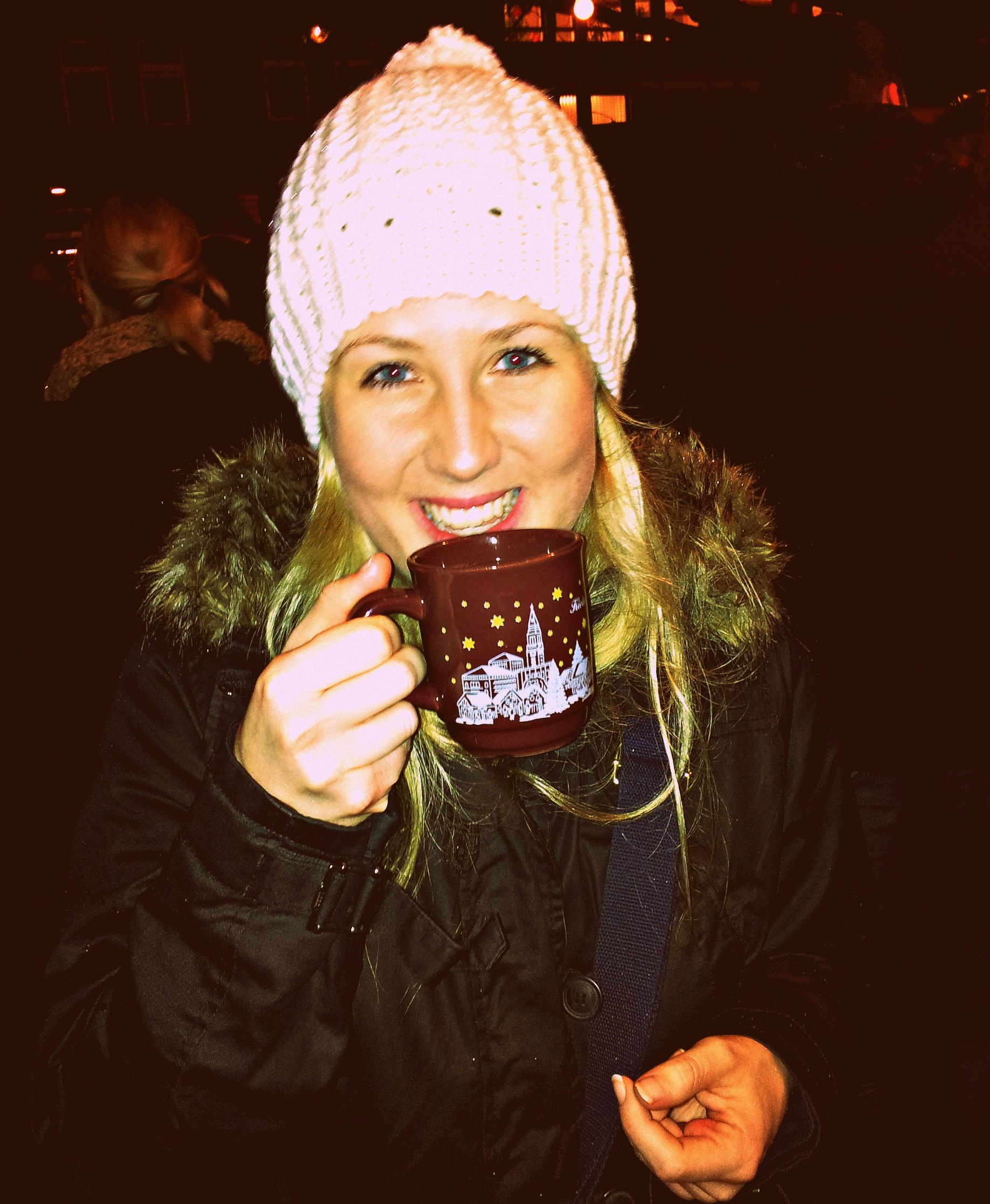
img: Liv Hambrett with her mug of glühwein in Münster, Germany.