The Displaced Nation

A home for international creatives

Tag Archives: Finland

BOOK REVIEW: “The Englishman” by Helena Halme

Today we are delighted to review Helena Halme’s book, The Englishman. Helena is a regular visitor to The Displaced Nation, where she has been featured both as a Random Nomad, and as Cleopatra For The Day. The Englishman is available from Amazon (UK and US) and for a limited time this week, is free to download as a Kindle ebook!

TITLE: The Englishman
AUTHOR: Helena Halme
AUTHOR’S CYBER COORDINATES:
Blog: Helena’s London Life
Twitter: @HelenaHalme
PUBLICATION DATE: August 2012
FORMAT: Ebook (Kindle)
GENRE: Fiction
SOURCE: Review copy from author

Author Bio:

Helena Halme grew up in Finland and Sweden, and left Finland for good when she married her English husband. She now lives in London. The Englishman is her first book.

Summary:

At the age of twenty, Kaisa has her life mapped out. After university in Helsinki, she’s going to marry her well-to-do fiancé, Matti, and live happily ever after. But in October 1980, she’s invited to a British Embassy cocktail party, and meets a dashing Naval officer. In the chilly Esplanade Park the Englishman and Kaisa share passionate, secret kisses and promise to meet up again. But they live thousands of miles apart – and Kaisa is engaged to be married.

At the height of the Cold War the Englishman chases Russian submarines whilst Kaisa’s stuck in a country friendly with the Soviet Union. Will their love go the distance?

(Source: Amazon.com book description)

Review:

The Englishman is semi-autobiographical, based on the author’s blog posts on How I came to be in England, which, after an enthusiastic response from readers, she was inspired to turn into a fully fledged novel.

It is a love story: the account of the long-distance romance between English Naval officer Peter and Finnish student Kaisa, as this star-crossed couple discovers that Shakespeare’s words are still true, even in the 1980s, and the course of true love never runs smooth. Together, they contend with a broken engagement, long separations, the Falklands War, inevitable cultural differences, and the small matter of a member of the British armed forces wanting to marry a citizen of a country bordering the Soviet Union.

No matter where you are from, or even if you and your partner are from the same cultural background – if you’ve ever been in a long-distance relationship, The Englishman will strike a chord. Loving from afar in the early 1980s was a different matter than it is now: no Skype, no Facebook, no texting, but instead the sweet agony of waiting for letters in the mail and for the landline telephone to ring. Kaisa and her Englishman remind us of the forgotten pleasures of delayed, rather than immediate, gratification.

TDN verdict:

Especially recommended for romantics who grew up listening to Chrissie Hynde and wearing leg warmers the first time they were in fashion.

“The Englishman” can be purchased from Amazon.co.uk and Amazon.com, and from October 8 – 12 is available to download free of charge.

STAY TUNED for tomorrow’s ghosty posty, a spooky Displaced Q from Tony James Slater!

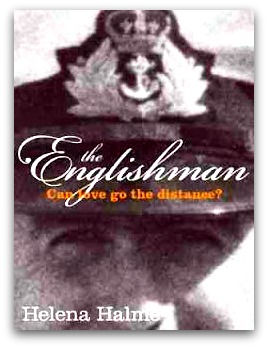
Image: Book cover — “The Englishman”

If you enjoyed this post, we invite you to register for The Displaced Dispatch, a round up of weekly posts from The Displaced Nation, with seasonal recipes, book giveaways and other extras. Register for The Displaced Dispatch by clicking here!

Related posts:
How to throw a party for a bunch of global nomads

One year has passed since our first random nomad, Anita McKay, crashed through the gates of The Displaced Nation, bribing the guards with chicken tikka masala and cranachan and shouting “bollocks” at several of us who tried to stop and question her.

And now there are 40 such nomads within our ranks — the latest being Annabel Kantaria, who insisted on bringing an alarm clock that looks like a miniature mosque — it rings every morning with the call to prayer. (Note to other founders: perhaps we need to find guards who aren’t so easily intimidated when travelers show a bit of temerity…)

Still, as we now have 40 nomads, randomly selected, why not make the best of the situation and throw a party? And what better excuse than The Displaced Nation’s 1st birthday — which, as announced by Kate Allison in a post a couple of days ago, took place on April 1 (no fooling!).

Further to that end, I’ve come up with a Party Primer that I think should work for this group — as well as for similar gatherings.

PARTY PRIMER FOR DISPLACED NOMADS

Click on the headlines below to go to each section:

  1. INVITATIONS
  2. DRESS CODE
  3. DECORATIONS
  4. MUSIC
  5. TABLE ASSIGNMENTS
  6. FOOD
  7. TOPICS FOR SMALL TALK
  8. PHOTOGRAPHY
  9. GAMES
  10. SONGS

INVITATIONS

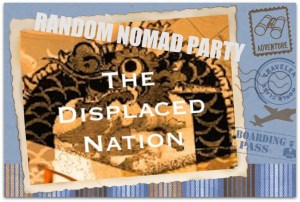
As this party marks a special occasion (who ever thought we’d make it to be one year old?), a deluxe printed invitation is in order. The only thing is, our invitees are a bunch of nomads! We’ll be lucky if we can catch them on email, let alone at a fixed address. Let’s compromise on an attractively designed message: see mock-up at top of this page.

DRESS CODE

As some of you may know, Cleopatra recently paid a visit to The Displaced Nation. Based on her observations of today’s international travelers, we’ll be doing well if we can get the men to shower and change before joining us. As for the women, well, allow me to offer these pearls of wisdom from Jennifer Scott — the American guru of Parisian chic who was featured on this blog last week. Jennifer says:

There are certain occasions that always warrant dressing up. Generally any gathering … where others went to a lot of effort for your sake.

DECORATIONS

The theme is easy: the wide wide world! (Rather the opposite of Disney’s “It’s a small world after all” concept.) This calls for tablecloths imprinted with the world map (to make it easy for guests to point out where exactly “Moldova” etc is); globe-patterned balloons (can we coin a new term: globalloons?); and for the centerpieces, flags from each of the adopted country represented at the table in question.

Optional extras include party hats, noisemakers and loot bags. It’s fun when the loot contains some surprises. Given all the items our nomads have insisted upon carrying into The Displaced Nation, we should have plenty to choose from, eg:

  • mosque alarm clocks (thanks, Annabel!)
  • hairy coo fluffy toys (thanks, Nerissa!)
  • fake Harry Potter glasses (thanks, Charlotte!)
  • boomerangs (thanks, Kim & Vicki!)
  • brie bakers (thanks, Toni!)

MUSIC

As Todd Lyon, author of a number of party and lifestyle books, puts it:

Without music, a party isn’t a party. It might be an assembly, a meeting, or a bee, but it can never be a shindig, a bust-up or a ball unless there’s fine tunes that never stop.

Not being a party tunes buff myself, I’ve consulted with The Displaced Nation’s resident music expert, Kate Allison, about the kind of soundtrack that would cultivate just the right ambience. Her suggestions include:

Everybody all around the world, gotta tell you what I just heard
There’s gonna be a party all over the world…

TABLE ASSIGNMENTS

8-10 person tables work well. Since we’ll have 40 guests, I’ve decided on five tables of eight people each, and to mix everyone up as much as possible. Hostesses must also, of course, take steps to reduce the risk of a “silent table,” where people just eat and don’t talk. To be honest, I don’t there is too much risk of that with this crowd — have you ever watched a bunch of expats try to outdo each other with stories of their (cross-cultural, linguistic and travel) adventures? But just in case, I’m offering some “hostess notes” for each table (the hostess’s job being to introduce everyone and make sure the conversation keeps flowing!).

TABLE 1
Matthew Chozick (American expat in Japan)
Tom Frost (American expat in China)
Lyn Fuchs (American expat in Mexico — Sacred Ground Travel Magazine)
Turner Jansen (American canine in Holland)
Annabel Kantaria (English expat in Dubai — Telegraph Expat blog)
Kirsty Rice (Australian expat in Qatar — 4 kids, 20 suitcases and a beagle)
Jack Scott (English expat in Turkey — Perking the Pansies)
Karen van der Zee (Dutch/American expat in Moldova — Life in the Expat Lane)
Hostess notes: Introduce Tom Frost to Matthew Chozick — Tom used to live in Japan and speaks Japanese. Kirsty Rice should sit next to Turner Jansen, as she travels around with a beagle. Annabel Kantaria, Jack Scott and Kirsty all have in common life in the Middle East. Karen van der Zee and and Lyn Fuchs should find each other fascinating, as both have had some extraordinary adventures (Karen could entertain Lyn with her crocodile tale and Lyn, keep Karen amused talking about the time he went paddling with orcas.)

TABLE 2
Balaka Basu (Indian American in New York City)
Santi Dharmaputra (Indonesian expat in Australia)
Michelle Garrett (American expat in UK — The American Resident)
Robin Graham (Irish expat in Spain — a lot of wind)
Anita McKay (Indonesian expat in Australia — Finally Woken)
Brian Peter (Scottish expat in Brazil — A Kilt and a Camera)
Kate Reuterswärd (American expat in Sweden — Transatlantic Sketches)
Wendy Tokunaga (Former American expat in Japan)
Hostess notes: You might want to break up Santi Dharmaputra and Anita McKay, who are the same nationality (Indonesian) and already friends. Anita should definitely be introduced to Brian Peter, who like her hubby, is Scottish, and will probably be amused by her stories of toasting oatmeal in whisky. And make sure Anita also talks to Wendy Tokunaga — I know from personal experience how intrigued Anita is by stories of Western woman marrying Asian men. To be honest, everyone at this table should really be socializing with everyone else, as each and every one of them has a partner of a different nationality! (Now if that isn’t a talking point, I don’t know what is…)

TABLE 3
Kim Andreasson (Swedish expat in Vietnam)
Jo Gan (American expat in China– Life behind the wall)
Jennifer Greco (American expat in France — Chez Loulou)
David Hagerman (American expat in Malaysia — SkyBlueSky)
Helena Halme (Finnish expat in UK — Helena’s London Life)
Vicki Jeffels (Kiwi expat in UK — Vegemite Vix)
Janet Newenham (Irish internationalist — Journalist on the run)
Adria Schmidt (former Peace Corps worker in the Dominican Republic)
Hostess notes: Seat David Hagerman next to Jennifer Greco — since his wife is a well-known food writer and expert cook, he’ll find nothing strange in her quest to sample all the known French cheeses. Janet Newenham should be near Adria Schmidt and Kim Andreasson as they are all interested in international affairs. Vicki should be introduced to Helena as I’m sure the latter would love to hear about her recent spa experience in Cyprus. Jo Gan, too, should meet Vicki as she is now experiencing visa problems with the Chinese authorities — on a level that may even surpass Vicki’s own nightmare experience in Britain.

TABLE 4
Aaron Ausland (American expat in Colombia — Staying for Tea)
Emily Cannell (American expat in Japan — Hey from Japan)
Charlotte Day (Australian expat in UK)
Toni Hargis (English expat in USA — Expat Mum)
Vilma Ilic (Former aid worker in Uganda)
Jennifer Lentfer (Former American expat in Africa — How Matters)
Camden Luxford (Australian expat in Argentina — The Brink of Something Else)
Piglet in Portugal (English expat in Portugal — Piglet in Portugal)
Hostess notes: Aaron Ausland will naturally gravitate towards Jennifer Lentfer as they are both deeply involved in global aid and development. Make sure you introduce the pair of them to Piglet in Portugal — she’ll ask them some thought-provoking questions about whether it’s better to save the world or cultivate your own garden. Jennifer should also be near Vilma as the two will want to share their Africa experiences, and you might urge Emily Cannell to join that conversation as well — she has such an adventuresome spirit! Along with Toni Hargis, who runs her own charity supporting a school in Ghana. As for Camden Luxford, she’s an easy one: a social butterfly! Perhaps she could take fellow Aussie Charlotte Day under her wing (ha ha) and make sure she gets plenty of material to write about for her courses at Oxford next year!

TABLE 5
Lei Lei Clavey (Australian expat in New York City)
Matt Collin (American expat in UK)
Megan Farrell (American expat in Brazil — Born Again Brazilian)
Liv Hambrett (Australian expat in Germany — A Big Life)
Mardi Michels (Australian expat in Canada — eat. live. travel. write | culinary adventures, near and far)
Iain Mallory (English adventurer — Mallory on Travel | Making Everyday an Adventure)
Nerissa Muijs (Australian expat in Holland — Adventures in Integration)
Simon Wheeler (English expat in Slovakia — Rambling Thoughts of Moon)
Hostess notes: As soon as Lei Lei Clavey, Liv Hambrett, Mardi Michels and Nerissa Muijs discover they all have Australia in common, they will be blabbing away — just hope it doesn’t turn into an Ozfest! Also, make sure Mardi connects with Matt — I suspect he may need her counseling about how to seek creative refuge from academia. Iain Mallory and Simon Wheeler will form a natural pair, exchanging stories of their travel adventures and perhaps even breaking into a rousing chorus of “Jerusalem.” But should their antics get too raucous, ask Mardi to step in: she teaches cooking classes to 9-11-year-old boys in Canada. Megan Farrell should connect with Nerissa and Simon on the topic of what it’s like to raise a child in a nationality (and language) other than your own.

FOOD

One of the purposes of gathering together nomads from the four corners of the earth has to be eating, especially if each of them brings along some of their favorite dishes. For our party, we will have a dazzling tableaux brimming over with rare and exotic foods. (We know that because our Random Nomads have already described their faves to us in their interviews.)

Shall we go over the list? (Warning: Don’t read on an empty stomach, or if on a restricted diet!)

NIBBLES/STARTERS

  • Guacamole & chips (Kim — recipe provided)
  • Selection of mezze with pita bread (Annabel Kantaria)
  • Assorted pinchos (Megan Farrell)
  • Avocado & mango salad (Matt Collin)
  • Bhelpuri (Tom Frost)
  • Satay sticks (Nerissa Muijs)
  • Four kinds of eggs: tea eggs, thousand-year-old eggs, fried eggs with tomato, and boiled salted eggs with a chicken embryo inside (Jo Gan)
  • Shrimp & grits (Lei Lei Clavey)
  • Vietnamese caramelized chili prawns (Mardi)
  • Ceviche (Camden Luxford)
  • Bluff oysters from New Zealand (Vicki Jeffels)
  • Gravad lax with Finnish rye bread (Helena Halme)
  • Tuna sashimi with ponzu sauce (Emily Cannell)

COCKTAILS

  • Traditional Bloody Marys (Lei Lei Clavey)
  • Caipirinhas (Megan Farrell)
  • Margaritas (Kirsty Rice)

WINE

  • Rich red wines from Lebanon (Annabel K)
  • Red wine from Macedonia (Vilma Ilic)
  • Malbec wine from Argentina (Camden Luxford)
  • Shiraz from Australia (Vicki Jeffels)
  • White wine from Australia (Simon Wheeler)
  • Chilled sake (Tom Frost)
  • Rice wine (Jo Gan)

BEER

  • Carlsberg browns (Matt Collin)
  • Cusqueña beer (Camden Luxford)
  • Mexican Pacifico (Tom Frost)
  • Harbin beer (Jo Gan)
  • Coopers beer (Simon Wheeler)

MAINS
Meat dishes:

  • Carne de Porco a Alentejana (Piglet in Portugal)
  • Schnitzel served with rotkohl (Liv Hambrett)
  • Bondiola-chevre-basil wraps and nattō (Tom Frost)
  • Fried chicken sandwiches with hand-cut fries (Lei Lei Clavey)
  • Chicken tikka masala (Anita McKay)
  • Libyan soup (Kirsty Rice — recipe provided)
  • Cuban ropa vieja (Mardi)
  • Argentinian steak cooked rare (Camden Luxford)
  • Tapola black sausage with lingonberry jam (Helena Halme)
  • Barbecued steak, snags & lamb chops (Nerissa Muijs)

Fish dishes:

  • Paella Valenciana (Megan Farrell)
  • Llish in mustard and chili paste, smoked in banana leaves (Balaka Basu)
  • Chambo curry with nsima (Matt Collin)
  • Moreton Bay bugs (Vicki Jeffels)
  • Grilled salmon on a plank (Emily Cannell)
  • Sushi (Simon Wheeler)

Vegetarian offerings:

  • Peanut butter vegetable stew (Jennifer Lentfer)
  • Overcooked spaghetti with carnation milk, canned tomatoes and corn (Adria Schmidt)

DESSERTS

  • Summer pudding (Toni Hargis)
  • Apple crumble (Matt Collin)
  • Cranachan (Anita McKay)
  • Hot fudge sundaes (Lei Lei Clavey)
  • Blackberry gelato (Balaka Basu)
  • Caramel cheesecake (Kirsty Rice)
  • Bread pudding with Bourbon sauce (Jennifer Greco)
  • Île flottante (Mardi)
  • Molotof cake (Piglet in Portugal)
  • Mouse de maracujá (Megan Farrell)
  • Tiramisu (Camden Luxford)
  • Homemade Slovakian cream cakes (Simon Wheeler)
  • Dutch waffles (Turner Jansen)
  • Oblande, tulumbe, kadaif & krempite (Vilma Ilic)
  • Umm Ali (Annabel Kantaria)
  • Sigara borek (Jack Scott)
  • Juustoleipä with fresh cloudberries and cream (Helena Halme)
  • Yangmei fruit (Jo Gan)
  • Languedoc cheese: Roquefort, Pélardon and Tomette des Corbières (Jennifer Greco)

AFTER-DINNER DRINKS

  • Chlicanos (Camden Luxford)
  • Rakija (Vilma Ilic)
  • Fernet (Tom Frost)
  • Homemade Slivovica (Simon Wheeler)
  • Dragon-wall green tea (Jo Gan)
  • Espresso (Balaku Basu)
  • Large “flat whites” (Charlotte Day)

FOR THE TOAST(S):
New Zealand champenoise (Vicki Jeffels)

NOTE: Charlotte Day will be cooking a Sydney-style breakfast for diehards who care to linger to the next morning. (And Nerissa Muijs will be frying up some bacon!)

TOPICS FOR SMALL TALK

There are some topics that should be avoided at all costs. As style writer Rita Konig puts it,

It is very dull to talk about journeys. Once you have arrived somewhere, try to keep quiet about how long it took you to get there.

Should you notice anyone engaging in this, put the kibosh on it by asking them to help with pouring drinks, or with putting away coats in the spare room.

PHOTOGRAPHY

Fortunately, there’s usually one great photographer or two in a group of global nomads, thereby saving unnecessary expenditure. (We will ask David Hagerman — he’s sensational!)

GAMES

Games are a great ice breaker. Here are a few that might be appropriate for a well-traveled crowd:
1) Musical countries: Draw a big map on a piece of vinyl (back of a Twister mat might do), and give everyone a flagpole. When the music stops, they must place the flagpole on a country, Anyone whose flagpole ends up in the ocean is out.

2) Variation on “Pin the Donkey”: Pin the rudder on the 747! (Contributed by Kate Allison.)

3) Word games: As we’ve found out from our interviews, global nomads pick up words and expressions from here and there. Taking some of these and mixing them together, we can come up with some pretty strange exchanges. (Prizes for anyone who manages to decipher!)

A: Prego, could you get me a ba ba ba? Kippis!
B: Inshallah, a barbie would also be awesome. And how about la ziq?
A: Avustralyalılaştıramadıklarımızdanmışsınızcasına.
B: So desu ne!

A: Tudo bem? You look a bit daggy.
B: Life can be arbit sometimes.
A: Zvakaoma.

A: Hey.
B: Hey. Das stimmt, sorry to be such a Debbie Downer but I’m knackered after all this work.
A: Bless!
B: Zikomo.

A: Oh la vache! You are lost. Siga, siga. Ni chifan le ma?
B: Bollocks! [Sucking air through gritted teeth.] I think I got lost in the wopwops.
A: Well, there’s the big ol’ tree out the front.
B: Bula! Okay-la. Le bon ton roule!

TOASTS

Toasts should be made repeatedly throughout the latter half of the dinner. Just in case no one feels inspired, prepare one or two classics for the host or hostess to offer, eg:

I’d rather be with all of you than with the finest people in the world.

SONGS

Songs can be sung in several languages. In this case, a stirring rendition of “Happy Birthday” is called for, sung not only in English but in:
Dutch (Karen, Nerissa)
Finnish (Helena)
French (Jennifer, Mardi)
Indonesian (Anita & Santi)
Japanese (Emily, Matthew, Tom, Wendy)
Spanish (Aaron, Adria, Camden, Lyn, Megan, Robin)
Swedish (Kate, Kim)
Woof-woof (Turner)

Finally, the party should end with the Displaced Nation founders treating the guests to a round of:

For you are all jolly good fellows, for you are all jolly good fellows,
For you are all jolly good fellows…
Kate, Anthony, Tony: And so say all of us!
ML: Which nobody can deny!

* * *
Have I left out any important details? Any tweaks you can suggest? Your turn!!! Let’s work together to make this the most awesome gathering of global nomads ever. Onegaishimasu, shokran — and all that!

STAY TUNED for tomorrow’s installment from our displaced fictional heroine, Libby. She is expecting a visitor: her own mother, who is — in theory — coming to help as her due date gets closer. Will Granny Jane be an improvement on Sandra, the MIL from hell — or will she prove to be one more spanner in the works for our poor displaced heroine? (What, not keeping up with Libby? Read the first three episodes of her expat adventures.)

If you enjoyed this post, we invite you to register for The Displaced Dispatch, a round up of weekly posts from The Displaced Nation, with seasonal recipes, book giveaways and other extras. Register for The Displaced Dispatch by clicking here!

Related posts:

CLEOPATRA FOR A DAY: Fashion & beauty diary of expat Helena Halme

Today we introduce a new feature: “Cleopatra for a Day.” Displaced citizens open their little black books and spill the fashion and beauty secrets they’ve collected on their travels. First up is Helena Halme. One of TDN’s Random Nomads, Halme is a Finnish expat in London and a self-professed fashion maven.

BEAUTY

When my husband (“The Englishman”) and I did a house-swap in Los Angeles in the nineties, I discovered Origins, then a skin care range that wasn’t universally available here in the UK. Anything close to nature was an upcoming trend, and the Origins shops in LA looked quite revolutionary — all wooden flooring and straw shopping baskets. I still use a lot of Origins products and couldn’t live without their foot cream, Reinventing the Heel.

Some time ago, an English friend recommended that I try Elizabeth Arden’s Eight Hour cream — I couldn’t live without it now. If I’d ever end up on a desert island, this would be the one luxury item I’d crave for.

HAIR

When I’d only lived in the UK for a matter of months, I cut my hair very, very short. The Englishman was away at sea and when he came back he was quite shocked to see my blonde locks all gone. But, gentleman that he is, he told me the new style suited me. (I’m not so sure it did!) Much more recently, I’ve discovered the the Brazilian blow dry, a luxurious treatment that makes my thick Nordic locks gleam. I feel like a film star!

FASHION

A few years ago on an annual girls’ trip with my school friends, this time to Rome, I bought a long down coat which has been my winter staple ever since. It was weird shopping for warm winter wear in the humid late summer heat in Rome, but it was great to have the style advice of good friends. I understand that the Displaced Nation has been been debating whether down coats can be fashionable. I’d be curious to hear your verdict on my Roman find!

LINGERIE

I seem to always run out of underwear when on holiday, so I have bought some in Rome, New York, Stockholm, Seville… Now what I bought — that would be telling!

JEWELRY

When on holiday in Puglia, Italy, a few years ago, I bought a set of plastic beads. I love them so much I still wear them. They’re a wonderful color that goes with everything.

WEARING RIGHT NOW

Crickey! It’s a miserably cold and rainy Sunday here in London so I’m in my favorite beige-colored Uniqlo jeans, an All Saints double layer t-shirt (bought at their London store in Spitalfields) and my blonde cashmere poncho from Plum. Underwear is Marks and Spencer (it is the one and only store for underwear for me) and there are warm & cozy Ugg boots on my feet.

DAILY FASHION FIX

There are two magazines I cannot live without: Vogue and Grazia. Vogue is for trying to keep up to date with high fashion, Grazia for street style and gossip. I’m also an avid follower and reader of blogs. My favorites are:

STYLE ICON

I don’t really have style icons — I believe that style is a very individual thing; but one person who I really admire is Helena Bonham-Carter. She used to come into the bookshop I worked at in North London and always looked wonderful, in her extremely unique way. However, I could not pull off her style.

STREET FASHION

Two great places to people watch are Selfridges on Oxford Street and Liberty’s on Regent Street. There are lovely cafes in both stores where you can sip your latte and feel as though you’re on the front row of a Mulberry or McQueen show.

TOP BEAUTY/STYLE LESSONS FROM TRAVELS

1) When on holiday to Greece, I learned to try saving my fair skin from burning through the application of sunscreen and after-sun moisturizer.
2) From watching French and Italian women on my trips to Paris or Rome, I learned about how to use a splash of color when wearing neutrals.
3) From my trips to New York I learned about simple lines, neat tailoring, and the chicness of one color (black) or two (eg, beige turtleneck with black trouser suit) — as perfected by designers like Michael Kors, Donna Karan and Ralph Lauren.

Helena Halme blogs at Helena’s London Life and tweets at @HelenaHalme. She will soon be releasing a digital book based on a popular series of her posts, “How I came to be in England,” entitled The Englishman.

STAY TUNED for tomorrow’s post, a male perspective on how to travel and look good.

If you enjoyed this post, we invite you to register for The Displaced Dispatch, a round up of weekly posts from The Displaced Nation, with seasonal recipes, book giveaways and other extras. Register for The Displaced Dispatch by clicking here!

Related posts:

Images: (clockwise beginning with main photo) Helena Halme modeling her Italian down coat in Harrod’s food hall; posing with The Englishman in Italy, just after picking up the beloved beaded necklace; showing off her hair after a Brazilian blow dry in London; staying warm and stylish in London in her blonde cashmere poncho, just a few days ago.

RANDOM NOMAD: Helena Halme, Book Seller, Fashion Addict & Writer

Born in: Tampere, Finland
Passport: Finnish (only, and proud of it!)
Countries lived in: Sweden (Stockholm): 1971-74; Finland (Turku): 1975; Finland (Helsinki): 1975-84; England (Portsmouth): 1984-86, 1988; England (Plymouth): 1987; England (Wiltshire): 1989-2010; England (London): 2011-present
Cyberspace coordinates: Helena’s London Life | A Nordic view on style, fashion, art, literature, food and love in the city (blog)

What made you leave your homeland in the first place?
I left Finland for the first time as a 10-year-old with my family due to my father’s work, then moved back again for the same reason. And then I left Finland for good to marry my English husband. I’ve written 48 blog posts — soon to be a Kindle book called The Englishman — about how I came to be in England.

Is anyone else in your immediate family displaced?
My father is the only member of the family who still lives in Finland. My mother lives in Stockholm (she is remarried), and my sister lives also in Sweden (she married a Swedish man). Oh dear, that makes it sound as though we are are very man-dependent women, but I can assure you we’re strong and independent — really.

Describe the moment when you felt most displaced over the course of your many displacements.
I felt most displaced when I moved back to Finland at the age of 14. I didn’t want to leave Stockholm and felt completely alien in my home country. Since then I haven’t really felt at home anywhere. Although the two countries are divided only by the Baltic Sea, Finland was — and still is to a certain extent — a very different country to Sweden. The Finnish language is notoriously difficult, and in those days the culture was heavily influenced by Finland’s proximity to Russia (then the Soviet Union). Having lived in the very Western European city of Stockholm for three years, I saw my home country as being part of the Eastern bloc (even though it most certainly wasn’t). The radio played little pop music, and the TV was full of political broadcasts and dark plays about the struggle of the working classes. Western films took longer to arrive, and most people seemed dull and depressing. Nobody smiled and they all dressed in old-fashioned clothes. There seemed to be nothing you could buy in the shops. My sister and I would take the ferry across to Stockholm for many years afterwards — and wow our friends with the H&M clothes we brought back.

Describe the moment when you felt least displaced.
Once I had my children in the UK, I felt I belonged much more — although I took care to make sure they knew they were half-Finnish. To this day, we combine Finnish and English customs: have two Christmases, grow special grass for Easter called rairuoho, and so on… No particular moment stands out in my head where I’ve felt especially at home — yet! That said, the move to London last year has given me an even greater sense of belonging… Perhaps that’s it; perhaps it happened just this year, when we moved to Northwest London?

You may bring one curiosity you’ve collected from each of the countries where you’ve lived into the Displaced Nation. What’s in your suitcase?
From Finland (even though it’s my homeland, it remains somewhat foreign): A Finnish knife (puukko).
From Sweden: A slice of the traditional Swedish cake known as Prinsesstårta.
From England: BBC Radio 4.

You’re invited to prepare one meal based on your travels for other Displaced Nation members. What’s on the menu?
I love food and don’t think I’ve changed my tastes all that much since coming to the UK. Thus my menu for The Displaced Nation is mostly Scandinavian but with one concession to British tastes. (These days, of course, you can get almost any foodstuffs from Finland in London. Bless this multicultural city!)

You may add one word or expression from each of the countries you’ve lived in to The Displaced Nation argot. What words do you loan us?
From Sweden: Fy fan (bloody hell), because it just sounds right for a sense of frustration.
From Finland: Kippis (cheers) — it sounds like “get pissed” to an Englishman’s ears.
From the UK: That’s very interesting… The person who utters these words is usually dying of boredom. (A typical English white lie…)

A statement on your blog’s Home Page strikes us as being very Alice-like: “Rye bread not toast, pickled herring not fish & chips, cinnamon buns not Victoria sponge, ice-hockey not football, wander in a forest not walk in a park, silence not polite conversation.” Does the Alice-in-Wonderland story speak to the life you’ve led in the UK?
In England I’ve always felt as if I were the largest person in the room, particularly against the slight “English roses” — just as Alice did when she entered Wonderland. When I first arrived in this country, I’d often recall the words of the Queen of Hearts to Alice at the trial: “All persons more than a mile high must leave the court.”

QUESTION: Readers — yay or nay for letting Helena Halme into The Displaced Nation? Tell us your reasons. (Note: It’s fine to vote “nay” as long as you couch your reasoning in terms we all — including Helena — find amusing.)

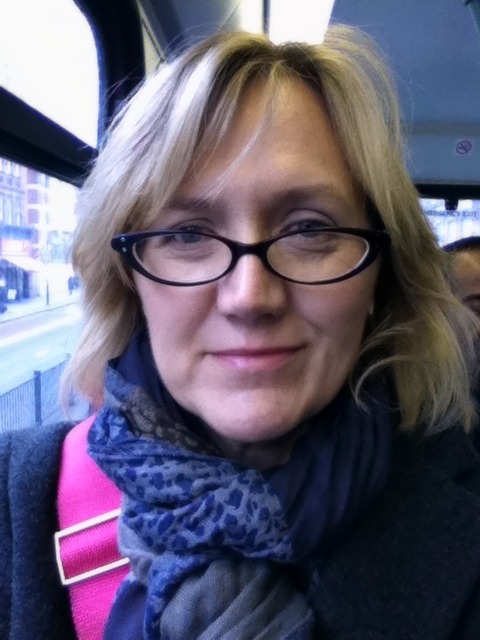
img: Helena Halme’s self-portrait on the number 13 bus. As Halme explained in a blog post last month, the No 13 featured in the British TV series On the Buses, which was broadcast on Finnish TV in the 1970s and was an early influence on her view of men in England. Also please note that Halme’s hair in this picture owes to her own efforts; she hadn’t yet discovered the Brazilian blow dry.

STAY TUNED for tomorrow’s installment from our displaced fictional heroine, Libby, who is debating whether Woodhaven, Massachusetts, is really the picture-perfect Wonderland it seemed at first sight. (She also meets a realtor who is most decidedly a Red Queen…)

If you enjoyed this post, we invite you to subscribe for email delivery of The Displaced Nation. That way, you won’t miss a single issue. SPECIAL OFFER: New subscribers receive a FREE copy of “A Royally Displaced Tea.”

Related posts:

What the Finnish Spring can teach us about expats and politics

SPECIAL TREAT FOR TDN READERS: Anu Partanen, though she’s currently on the road, has promised to “come in” and respond to your comments and questions over the next few days. So, ask away!

Anu Partanen has done the impossible. She has made me care about the Finnish Spring, and I’ve never once been to Finland.

No, we’re not talking travel here, though I’d love to go to her country someday and see the ice melt and the vivid violet sinivuokko push their way through the leaves.

Rather, I refer to Finnish politics. Partanen wrote an op-ed that caught my eye in the May 13 edition of the New York Times. It was about Finland’s parliamentary elections, which took place with the arrival of the sinivuokko, on April 17 — the outcome of which, she claims, is the Finnish equivalent of the Arab Spring.

No, the Finns did not have any armed uprisings, just a quiet, proper democratic election. But the results were just as revolutionary:

Overnight, Finland seemed transformed from possibly the most sensible, even boring, country in Europe — known for excellent schools, zero corruption, gender equality, and a pro-European Union approach to politics — into the nationalistic, populist, Euro-skeptic home of the True Finn Party.

The only thing is, I haven’t quite decided yet what to make of the True Finns. According to Partanen, as an American, I “might consider them the equivalent of Tea Partiers (if they didn’t support the welfare state, that is).”

Most significantly, the True Finns will do anything they can to block Finland from contributing its share to bailing out bankrupt European countries — Portugal being the latest example, following on the heels of Greece and Ireland.

Notably, Partanen, too, admits to some ambivalence about the European experiment, for the first time in her life:

Myself, I’ve benefited a great deal from the European Union — I’ve studied abroad, traveled easily, enjoyed a strong euro. … Yet I was shaken when I learned that we Finns were supposed to lend money to Greece. It didn’t seem fair that my taxes would go to a country that had been living beyond its means.

Political voyeurism

But another big reason why I’m so captivated by Partanen’s take on Finnish politics is that she’s an expat based in the United States. Currently living in Brooklyn, she continues to work as a journalist for several Finnish publications. In addition, she is writing a memoir about being Scandinavian in America.

Partanen told me in an email exchange that the book is still in the early stages. I’ll be curious to see what it has to say about the challenge of participating in home-country politics from a distance.

That was something I used to think about a lot during my own expat years. If you care about the politics of your home country — as Partanen clearly does, as I did — then why aren’t you living there? Unlike me, Partanen keeps a foot in Finnish politics by continuing to write articles for the national media.

Still, it must be strange for someone as highly politicized as she is to be in the United States while an important debate is taking place about what kind of country Finland is, and wants to be.

In her Times op-ed, Partanen mentions that although she has offered her couch in Brooklyn to friends from home who would like to become political refugees, as yet no one has taken her up:

…my friends in Helsinki seem to be deciding that this is no time for retreat. Instead they’ll stay to help determine the future of their country.

Hmmm… Is that a reason why, despite my love of living overseas, I eventually bit the bullet and came back to the United States?

Politics not as usual

By the same token, Partanen shows us that living abroad can help you see your own country’s politics, and those of other nations, in a new light. Domestic politics can be very village like, and in my experience, it’s not until you step away from the village tribe that you begin to discern your own beliefs.

As already mentioned, Partanen has discovered since leaving Finland that she has developed some sympathy for the idea of setting limits on how much of its wealth Finland should share with other Europeans.

In her Times article, Partanen suggests that her position may have something in common with that held by the Americans who’ve expressed a reluctance to contribute to universal health care. Noting that America is twice the size of the European Union, she says:

It’s not quite parallel, but if Finns were asked to contribute to the health care of the Greeks, the Irish, and the Portuguese, they might feel a little like the Americans.

My experience is rather different from Partanen’s: I was an American living abroad, first in England and then in Japan, which meant listening to everyone excoriate the United States. But like her, I found that getting physically outside of my country was a stimulus to thinking outside the box and deciding on my own core truths — never mind what the mainstream parties and their media outlets (the village elders) kept telling me to think.

Also like Partanen, I moved further to the right (I hope she won’t mind me using that term) — but not on universal health care. I benefited from socialized medicine in both the UK and Japan so can be counted as a fan of Obamacare, though I do wish it included a public option.

What I came to appreciate much more fully was the tough role the United States has been assigned in world affairs. I can’t tell you how many times I felt like saying to the European and Asian critics who accosted me: “You try policing the globe, and see how much you enjoy it!”

(There were of course far more European critics than Asian ones. The Japanese, though they don’t relish the thought of our Marines continuing to be based on Okinawa, see it as their best hedge against, among other things, the wacky North Korean leadership.)

Now, that’s a true political awakening — call it an Expat Spring.

* * *

Question: How about you? Are you an expat, and if so, what’s your relationship with your home country’s politics — do you remain involved, and have you adjusted any of your basic political beliefs since going abroad?

If you enjoyed this post, we invite you to subscribe for email delivery of The Displaced Nation. That way, you won’t miss a single issue. SPECIAL OFFER: New subscribers receive a FREE copy of “A Royally Displaced Tea.”

Related posts: