The Displaced Nation

A home for international creatives

Tag Archives: Europe

LOCATION, LOCUTION: The Way of expat author Joan Fallon lies in writing about the Camino and other Spain-related themes

Location Locution
Columnist Lorraine Mace, aka Frances di Plino, is back with her latest interview guest.

The theologian Richard Niebuhr once wrote:

Pilgrims are poets who create by taking journeys.

In that sense, today’s author, Joan Fallon, can be considered a modern-day pilgrim, of the kind often encountered within the Displaced Nation. She may not have walked the Camino de Santiago—but the path she took in her life led her to a place where she could write a novel about someone who did.

Joan was born with a foot in two cultural camps: her father was Irish and her mother, Scottish. Her first journey into a brand new culture was made as a child, when her family moved from Dumfries, Scotland, to the south of England, which many Celts consider to be a foreign country.

Joan went on to spend her formative years in England. She married, had a family (a son and a daughter), and worked as a teacher while also earning a BA from the Open University in History and Literature.

But in England, Joan was still a pilgrim; she hadn’t yet found the Way. In fact, she lost her way for some time after her son dropped dead unexpectedly when he was only 17. She abandoned her career in teaching (she couldn’t bear being around kids his age) to become a management trainer.

Soon, though, it was time to don her pilgrim’s boots again, this time for a journey into southern Spain. When her husband took early retirement, the couple set off just before the start of the new millennium for their new home in Benajarafe, a coastal village that is a few miles east of Málaga, in Andalusia.

This journey, which brings us to where we find Joan now, led her to the goal she was seeking all along: an opportunity to try out the life of full-time writer. As she put it in a recent interview:

It is something that I had been waiting all my life to do.

Joan completed an Open University course in creative writing, but it wasn’t until she’d spent six years taking journeys within Spain, learning the language and talking to people, that she would embrace her destiny fully. (She was also settling in, finding out how to cope with Spanish bureaucracy and generally dealing with the numerous everyday things that we take for granted in our home country or don’t need: obtaining an identity card, a social security card, becoming a tax resident, registering at the town hall, changing to Spanish number plates, making friends, finding a hairdresser that you like, a new dentist, a new doctor, a vet, a plumber…)

Eventually, her immersion in the Spanish language and local culture paid off. Always interested in social history, Joan decided to interview a number of older Spanish women about how their lives had changed since Franco had died in 1975. She translated the interviews into English, which led to her first published book, Daughters of Spain.

The research for this book also produced two novels:

Joan Fallon's writing career has flowered in Benajarafe, initially with books set in the Franco era

Joan Fallon’s writing career has flowered in Benajarafe, initially with books set in the Franco era. Photo credits: Joan Fallon’s author photo and book covers (supplied); Benajarafe, by Tony Bowden (CC BY-SA 2.0).

One of Joan’s subsequent novels grew out of her experiences of mixing with both Spanish and foreign nationals: Loving Harry, a story about two women in love with the same man, set in expat Spain.

Joan’s frequent visits to other parts of Spain have also inspired books. It was a trip to Galicia that gave her the idea of writing Santiago Talesabout a woman whose life is in tatters and who decides to walk the Camino de Santiago seeking solutions.

Likewise a visit to the Moorish ruins at Madinat al Zahra near Córdoba inspired her to research and write The Shining City, a novel set in Moorish Spain during 10th century.

All of Joan’s novels feature strong women as their heroineswomen who face some kind of difficulty and have to overcome it.

* * *

Welcome, Joan, to Location, Locution. Spain clearly has had a powerful effect on your writing, but which comes first, story or location?

Thank you for inviting me, Lorraine. It depends on the book I am writing whether location or story is the most important. Santiago Tales, as you’ve explained, was set on the Camino de Santiago in northern Spain—location was essential to the story. Spanish Lavender is a love story set in the Spanish Civil War, but it takes place specifically in Málaga, a city I know very well—and therefore I started with the location. In another of my books, The Only Blue Door, which you didn’t mention, I wrote about three children sent to Australia during wartime. Never having been to Australia, I found it hard to write about a place I did not know personally so had to rely on my research. In this case, it was the story that was predominant, not the location.

It sounds as though you like to know the place very well before using it as a setting?

Yes, I prefer to write about places I know. If I don’t know the location well, then I will visit it a number of times noting the layout, the atmosphere and anything else I can put into my writing. Sometimes I will interview someone about a place when I know that they have a greater knowledge of the location than I do. This is what I did with Santiago Tales. I knew the area well but not from the point of view of a pilgrim, so I interviewed a woman who had walked the 800 km of the Camino and was delighted to tell me of her exploits. This gave me the little details that I needed to make my story credible.

Photo credits: Puente rústico, by José Antonio Gil Martínez via Flickr (CC BY 2.0) .

Photo credits: Puente rústico, by José Antonio Gil Martínez via Flickr (CC BY 2.0); book cover art (supplied).

What’s your technique for evoking the atmosphere of a place?

I try to remember as many details as I can, imagining that I am there again and then imagining the character in the location as I knew it. If my story is set somewhere that I have only visited on a few occasions, then it needs more effort to conjure up the required atmosphere, and I will read about the location and look at photographs. Sometimes it is something as simple as knowing if there are hills in the area that the character has to climb or rivers that he has to cross or when he sits down what he can see. All this helps to transport the reader to the location that you have chosen. For me it is a mixture of combining what I know the place is like with the atmosphere I am trying to convey for the story.

Which of your works provides the best illustration of place, and can you give us a brief example?

Place is an especially important factor in The Shining City, which I wrote after visiting the ruins of a city near Córdoba called Madinat al Zahra. I was fascinated by the place and the fact that, although it was once a very prosperous and cultured city, it was abandoned and fell into complete disrepair after only 70 years. It seemed the ideal place to set a historical novel about the Moors in Spain.

Here is a passage from my book, depicting a character from England’s West Country who is following the French Way of the Way of St. James:

The Galician countryside is distinctive. It reminds her a little of her own West Country, with its small fields and dry-stone walls. The change was obvious as soon as she reached O’Cebreiro, set in the green, rolling hills across the border from León, and saw the round stone houses of the area, with their straw roofs and Iron Age design. She has even passed Celtic crosses at the roadside, so like the ones in Cornwall, and fields of fat, contented brown and white cattle. Just like the west coast of Britain and Ireland, Galicia receives its fair share of Atlantic wind and rain and this is evident in the verdure of its countryside. No, she is no longer walking through the dry Meseta; this part of Spain is very different and, to her, feels more like home.

Photo credits: Book cover art (supplied); Medina Azahara - Cordoba, by Roberto Venturini via Flickr (CC BY 2.0).

Photo credits: Book cover art (supplied); Medina Azahara – Cordoba, by Roberto Venturini via Flickr (CC BY 2.0).

Is landscape the only feature you look at to create a sense of location? What about culture, or even food?

All of those and more, depending on the location. Returning to the example of The Shining City, about a place that I had visited when it was a ruin, I had to do a lot of research into what it would have been like when it was a thriving city. I needed to know what food was available at the time, what they grew and what they imported, what type of housing people lived in, how they dressed and what the climate was like. Although this is a historical novel, set in 10th-century Spain, the fact that I live in Spain and know the area well made it so much easier to create the right atmosphere; I knew from experience what the weather was like at different times of the year, which flowers were in bloom and when; and I could imagine easily what the roads to the city were like then from what I could see today.

Which writers do you admire for the way they use location?

I read a book by John Lanchester called Capital, which was the story of a street in London told through the lives of the people who lived there. He used location very well and made it the central pivot for his novel. Donna Tartt also uses location very well and creates a rich and detailed background to her novels. Another writer that gives great importance to location in her novels is Barbara Kingsolver, and Elena Ferrante’s Neapolitan novels about two girls growing up in Naples recreate the atmosphere of that wild-child city beautifully.

Fallon Faves

Joan’s picks for writers who have mastered the art of writing about place

Thanks so much, Joan!

* * *

Readers, any questions for Spain-obsessed Joan Fallon? Please leave them in the comments below.

And if you’d like to discover more about Joan, why not visit her author site +/or her site dedicated to her books that are set in Spain, A Spanish Notebook. You can also follow her on twitter at @joan_fallon and @notesonspain +/or like her Facebook page.

Until next month!

Lorraine Mace writes for children with the Vlad the Inhaler books. As Frances di Plino, she writes crime in the D.I. Paolo Storey series. She is a columnist for both of the UK’s top writing magazines, has founded international writing competitions and runs a writing critique service, mentoring authors on three continents.

STAY TUNED for the next fab post!

If you enjoyed this post, we invite you to register for The Displaced Dispatch, a round up of weekly posts from The Displaced Nation, with weekly updates and much, much more. Register for The Displaced Dispatch by clicking here!

Related posts:

Photo credits (top of page): The World Book (1920), by Eric Fischer via Flickr; “Writing? Yeah.” by Caleb Roenigk via Flickr (both CC BY 2.0).

WORLD OF WORDS: There’s a word for that homesickness that grips expats and overseas travelers, and it’s French!

Marianne Bohr in the Luxembourg Gardens in Paris—is she reading or indulging in reveries about words?

Marianne Bohr in the Luxembourg Gardens in Paris—is she reading or indulging in reveries about French words?

Columnist Marianne Bohr, whose first book, Gap Year Girl, came out at the start of this month with She Writes Press, recounts a time during her travels in France when she and her husband felt suddenly out of place and full of longing for home. Ironically, however, the most apt expression she could think of to describe this feeling was French!

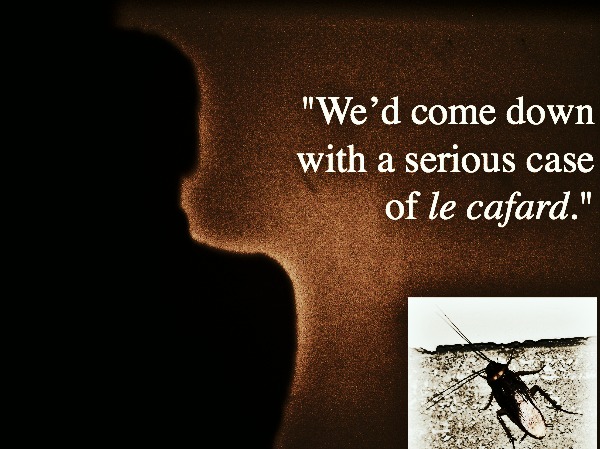
They’re inevitable. Those days that occasionally, and sometimes from out of nowhere, invade the life of a long-term international traveler or expat. You miss home, you’re a stranger in an alien place, you’re gripped by le cafard.

While French has an expression for homesickness (mal du pays), I prefer the other term, le cafard, to describe this dark visitor. It literally means “the cockroach”.

Le_cafard_cockroach

Photo credits: Alone In The Dark, Nobody Waiting, by Môsieur J.; (inset) Gaspard le cafard, by InOutPeaceProject. Both images via Flickr (CC BY-SA 2.0).

The creepy cockroach of homesickness

Seven weeks into our year of living in Europe, homesickness hit and hit hard. My husband, Joe, and I were in southwestern France. The fall weather had turned decidedly cold under steely gray skies and thick cloud cover—never good for lifting one’s spirits. Though we never imagined our adventure abroad would be daily champagne and constant merriment, we didn’t expect the blues to make their appearance so soon.

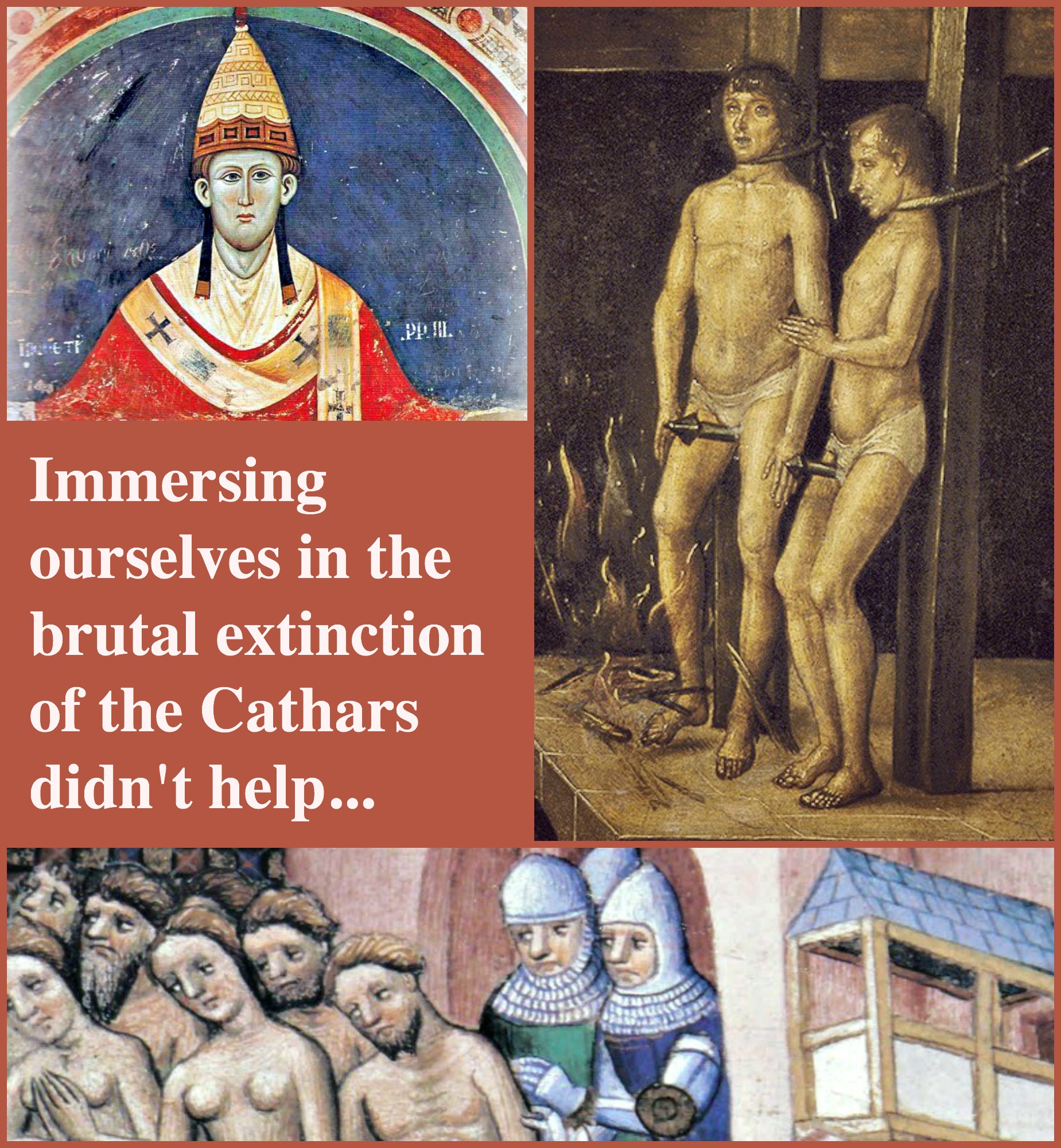
Exploring endless desolate, medieval stone hamlets had darkened our mood. Everything had been touched not only by the savagery of the Hundred Years’ War between the French and English in the 14th and 15th centuries but also by the 13th-century Cathar Crusade.

Prior to leaving for Europe, I’d read extensively about the Cathars and decided that we had to visit the region in which this shameful yet fascinating period of history took place.

The bloodthirsty military campaign of the pope, ironically named Innocent III, to eliminate the dualist offshoot of Catholicism in Languedoc-Roussillon was conducted with abandon against the heretics. No one was spared—men, women, children, and the elderly were all slaughtered. And when Catholics refused to give up their Cathar neighbors, one religious leader (a monk, no less) famously declared: “Kill them all. God will know his own.”

In a sunnier clime, this history might have been remote and intriguing. But against a backdrop of unrelenting gray with no access to the Internet, it left us feeling fogged in and low. Very low. After visiting so many places that witnessed sieges, starvation, plagues, pestilence, and butchery, even the cheeriest of souls would have succumbed to its grip.

Cathar Crusade

Photo credits (clockwise from top left): Pope Innocent III wearing a Y-shaped pallium, by unknown 13th-century artist; “Saint Dominic presiding over an Auto da fe” (detail), by Pedro Berruguete; Expulsion of the inhabitants from Carcassone in 1209, taken from the manuscript Grandes Chroniques de France. All images via Wikimedia Commons.

It’s a bug that thrives in the dark—and in the Dark Ages!

Melancholia, tinged with some serious mal du pays, reared its ugly head without warning. Perhaps we’d had our fill of cold, antiquated spaces and lonely, abandoned stone villages. Or perhaps the total absence of others to provide even a bit of people-watching diversion had brought us down. But maybe we were just in a trough of the normal vicissitudes of travel.

To put it simply, we missed our children and we missed our country—we’d come down with a serious case of le cafard.

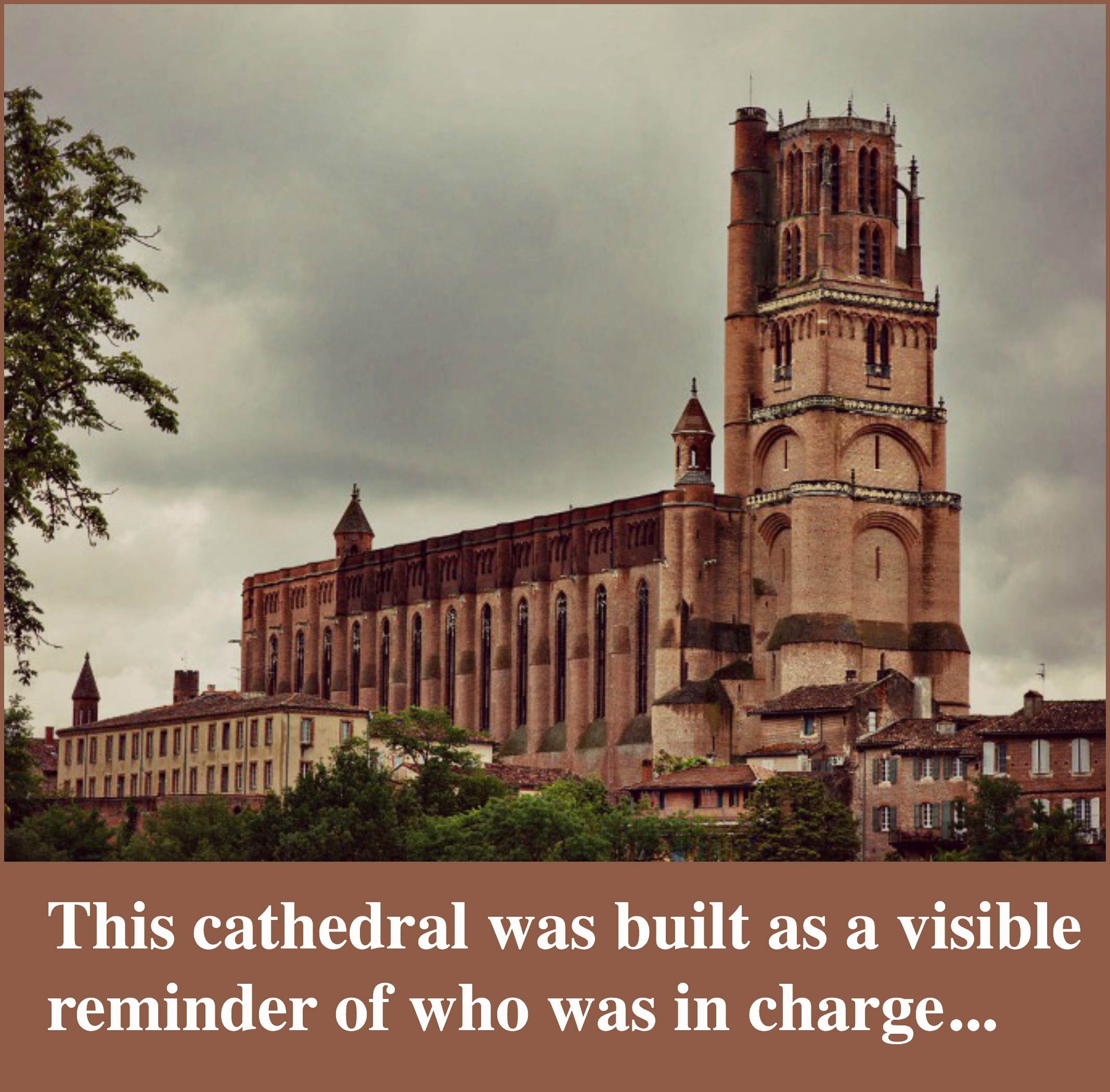
Despite knowing that immersing ourselves in the brutal extinction of the Cathars might not be what we needed to improve our dispositions, we plowed ahead toward our next destination: Caunes-Minervois, just north of Carcassonne. On the way, we stopped and hiked the steep Cathar hill town of Cordes-sur-Ciel, where the region’s alleged heretics had taken refuge, and took a long midday break for a sunny, outdoor lunch in Albi (home of Toulouse-Lautrec), with its austere, imposing redbrick cathedral of Sainte-Cécile, unlike any other church in the world. We noted that the cylindrical exterior of its nave looked like a space shuttle ready for launch. Sainte-Cécile was built after the Cathars were wiped out as a visible reminder to those who might be thinking of defying Rome not to forget who was in charge.

Sainte-Cécile Cathedrale

Photo credit: Cathédrale Sainte-Cécile d’Albi, vue de la rive opposée du Tarn, by Jean-Christophe BENOIST via Wikimedia Commons (CC BY-SA 3.0).

Back on the road, we drove farther south into the Montagne Noire to our ultimate destination: the constricted streets of Caunes-Minervois, where our Internet-enabled hotel awaited. It had been over a week since we’d communicated with our children, and we were lost in reverie about what we would learn when we fired up our laptops. Our son had had an interview the last time we spoke. Did he get the job? we wondered. Our daughter was coming down with a cold. Was she feeling better? Did my latest Amex payment process, and was the house we hoped to rent in Spain still available?

Just can’t get rid of it…

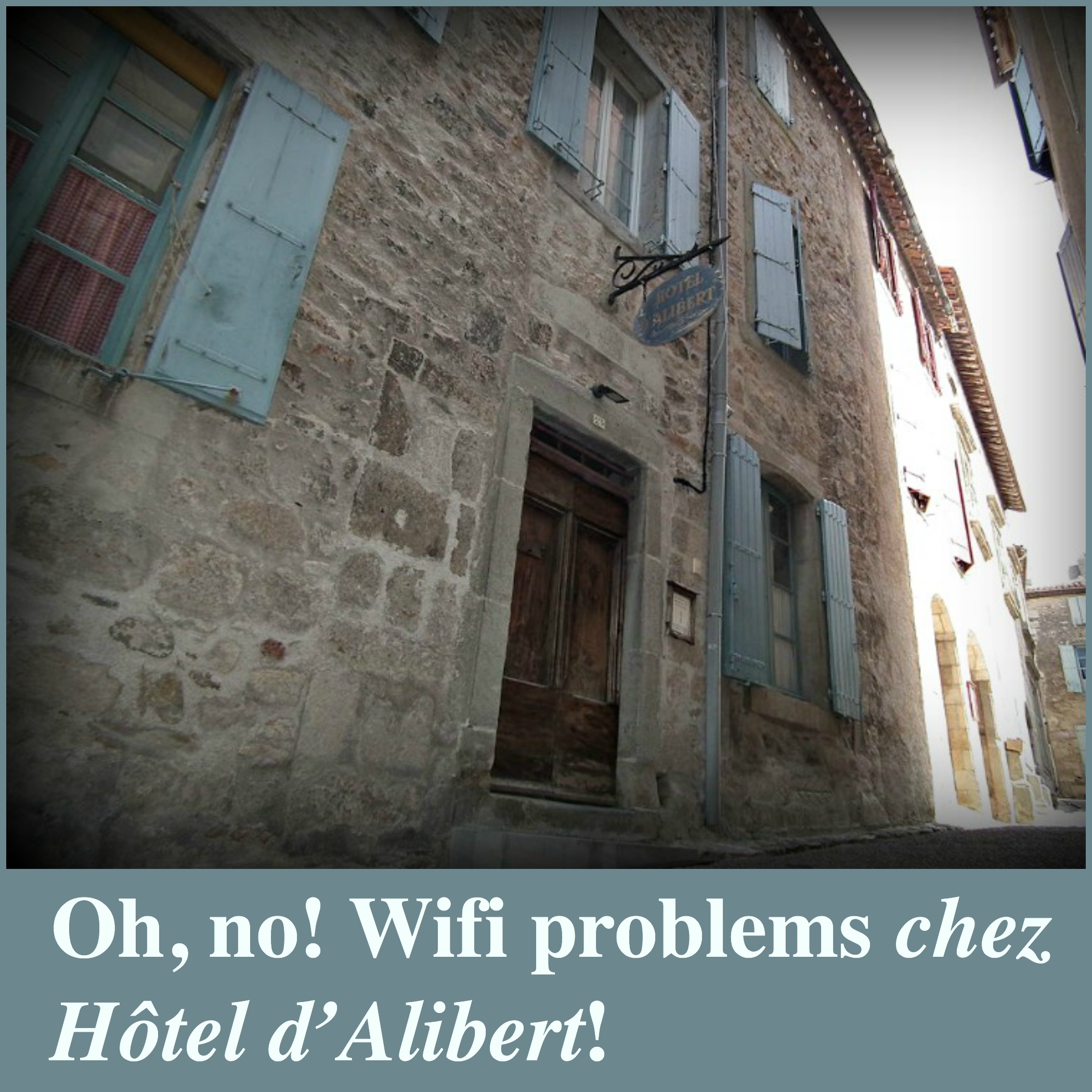
Our home for the next three nights was the Hôtel d’Alibert, an age-old townhome in the heart of the medieval quarter. The affable but quirky owner (you cannot arrive at the hotel between 2:00 and 5:00 p.m. because he is napping—it says so right on the door) lets us in through the French doors of the hotel’s restaurant at just after five. (The front portal remained inexplicably locked all day.)

The coda to our arrival in Caunes-Minervois was this: “Yes, the hotel has free Wi-Fi,” the proprietor confirmed, “but I’m afraid it’s not working; there have been problems.”

Wifi problems at Hotel dAlibert

Photo credit: Hôtel d’Alibert à Caunes-Minervois, by Gaël Gendrotvia Wikimedia Commons (CC BY-SA 3.0).

We were enraged and on the verge of tears. Here we were in yet another deserted town with no means to connect. We dragged our devastated spirits up the spiral stone stairway to our room and dropped our luggage. Le cafard attacked with a vengeance. For the rest of the evening, in a fit of pique, we seriously contemplated the possibility of returning home—of giving up on this gap year business—but finally agreed that all would be better in the morning.

After our night of frustration and reflection, the morning light bolstered our resolve to rally.

* * *

Now back stateside, I still refer to a bout with the blues as le cafard. It just seems so perfect a term. How do other languages express this feeling of profound melancholia? Are there expressions in other languages as accurate as the French?

* * *

Thank you, Marianne! How well you’ve described, with the help of that vivid French metaphor, the sense of alienation that at some point or another plagues all of us who venture beyond borders to travel or live. The word we use on this site, “displaced”, simply isn’t strong enough! Readers, do you have any suggestions for words or sayings in other languages that can convey these feelings? Do let us know in the comments!

Marianne C. Bohr is a writer, editor and French teacher whose book, Gap Year Girl: A Baby Boomer Adventure Across 21 Countries, was published in early September (She Writes Press). She married her high school sweetheart and travel partner, and with their two grown children, follows her own advice and travels at every opportunity. Marianne lives in Bethesda, Maryland, where after decades in publishing, she has followed her Francophile muse to teach French. She has an author site where she keeps a blog, and is active on Facebook and Twitter.

STAY TUNED for the next fab post!

If you enjoyed this post, we invite you to register for The Displaced Dispatch, a round up of weekly posts from The Displaced Nation, and SO much more. Register for The Displaced Dispatch by clicking here!

Related posts:

Wonderlanded with Lene Fogelberg, award-winning poet, writer, and double open-heart surgery survivor

There’s something from Alice in Lene Fogelberg’s story. Photo credits (clockwise, from top left): NecoZAlenky (original Czech film poster for Something from Alice) via Wikimedia Commons; Lene Fogelberg author photo (supplied); operating room via Pixabay.

Welcome back to the Displaced Nation’s Wonderlanded series, being held in gratitude for Lewis Carroll’s Alice’s Adventures in Wonderland, which turns 150 this year and, despite this advanced age, continues to stimulate and reassure many of us who have chosen to lead international, displaced, “through the looking glass” lives.

This month we travel
d
o
w
n
the hole with Lene Fogelberg, a Swede who has lived in quite a few places but right now can be found in Jakarta, Indonesia.

With her long red hair and blue eyes, she looks a little like a Swedish Alice. What’s more, her biography of her early years is not dissimilar to that of Alice Liddell, the muse behind the Lewis Carroll story. Growing up in a small town by the sea, Lene was full of curiosity about the wider world and also in love with words. Describing her youth in a recent guest blog post, Lene says that for her,

written words danced lightly as feathers on the page. I loved to read and made weekly visits to our small town library, the bicycle ride home always wobbly with the heavy pile of books on the rack.

But while similarities are rife to Carroll’s Alice, the “wonderlanded” story Lene lived as an adult in fact comes closer to Czech director Jan Švankmajer’s surrealistic interpretation in his 1988 film, Něco z Alenky.

Něco z Alenky means “something from Alice,” and Lene ended up taking something from Alice’s story when, after moving to the United States with her husband and children, she found herself being wheeled through a rabbit warren of hospital rooms into an operating theatre. As in Švankmajer’s film, she was in a bizarre dream rather than a classic fairy tale.

Strangely, from the time she was young Lene had suspected there was something wrong with her heart. She even harbored a not-so-secret fear of dying young, trying to make the most of each moment. But Swedish doctors repeatedly dismissed her concerns, treating her like a hypochondriac.

And then, it happened: her worst nightmare came true. Shortly after arriving in America she went to have a physical so she could get an American driver’s license—and the American woman doctor informed her she had a congenital heart condition and only a week to live.

Lene survived two emergency open-heart surgeries to tell her story: quite literally! Her memoir (and first book), Beautiful Affliction, is out this week from She Writes Press. Until now, Lene had written in Swedish, mostly poetry, for which she has won some awards. But even though she chose to write her memoir in English, she retains her poetic style, as we will see later in the week when we publish a short book excerpt.

But before that happens, let’s have Lene will take us down into her rather harrowing rabbit hole. True, she’s had some reprieve since since recovering from her surgeries and moving to Jakarta—but only some, as Jakarta is the kind of place where you have to take your life into your own hands to cross the street. But I’m getting ahead of the story—over to Lene!

* * *

Lene Fogelberg: Thank you, ML, and greetings, Displaced Nation readers. Just to give you a little more of my background: I grew up in the south of Sweden, in a small town by the ocean. As ML says, I often stood looking out over the ocean following the waves in my imagination, wondering about all the exciting places in this world. In my youth I spent a couple of summers in France studying French and falling in love with this beautiful country.

As newlyweds my husband and I moved to Germany as students for a year, where I learned the language and took care of our newborn baby (just three months old when we arrived). After Germany, we moved back to Sweden and stayed there until my husband’s employer offered him a position in the United States. We moved to a small town outside of Philadelphia, called Radnor. That became the scene of my life-threatening health crisis. How it erupted and played out is the topic of my book, which, as ML mentioned, came out this week.

We spent a year and a half in the United States in total and then moved back to Sweden for a couple of years. Nearly four years ago we relocated to Jakarta, but in December we will be moving again: to Kuala Lumpur, Malaysia.

“Stop this moment, I tell you!” But [Alice] went on all the same, shedding gallons of tears…

After moving to the US there was a huge pool of tears because of the drama that unfolded in the weeks following the transition. My husband and I had to have physicals prior to getting our American driver’s licenses, and as soon as the doctor put the stethoscope to my chest she reacted to the sound of my heart. It turned out I had a fatal congenital heart disease and that I’d lived longer with this disease than anyone the US doctors had ever met.

Beautiful Affliction story

As Lene attests in her newly published memoir, her “rabbit-hole” experience was full of heart, tears and physical drama. Photo credits (clockwise from top left): Front and back cover art for Lene’s book (supplied); Alice’s Adventures in Wonderland illustration by Milo Winter (1916), via Wikimedia Commons; The White Rabbit’s House, by Kurt Bauschardt via Flickr (CC BY-SA 2.0).

[S]he felt a little nervous about this; “for it might end, you know,’ said Alice to herself, ‘in my going out altogether, like a candle. I wonder what I should be like then?”

The events that unfolded are covered in my book Beautiful Affliction, which is a crazy story, full of heart and physical drama, not unlike Alice’s own confrontations with her changing body.

“Where should I go?” –Alice. “That depends on where you want to end up.” –The Cheshire Cat

Although my physical crisis was great, Jakarta has been one of the biggest challenges in a “wonderland” sense. The city is chaotic, with heavy traffic that is always jammed, making it difficult to navigate. I was shell-shocked for the first six months.

“Oh, I beg your pardon!” [Alice] exclaimed in a tone of great dismay…

Here in Jakarta where the population is mostly Muslim I try not to show too much skin. I wear clothes with sleeves and never skirts shorter than the knees.

skirt and shoes Alice in Wonderland

Photo credit: Alice shoes, by Shimelle Laine via Flickr (CC BY 2.0).

“Well, then,” the Cat went on, “you see, a dog growls when it’s angry and wags its tail when it’s pleased. Now I growl when I’m pleased, and wag my tail when I’m angry.”

Greeting people here in Indonesia can be a minefield. The safest bet is to put my hands together and say, “Namaste.”

“There’s certainly too much pepper in that soup!” Alice said to herself, as well as she could for sneezing.

I love nasi goreng and all the Indonesian dishes—but without the chili, which is too spicy for me.

Nasi Goreng Hold the Chili

Photo credits: Nasi goreng (fried rice), by Tracy Hunter; (inset) Nothing is real, nibble and drink me…, by Wonderlane. Both images via Flickr (CC BY 2.0).

Recipe for a Mad Hatter’s Tea Party

I would invite my family and friends from Sweden and serve all the delicious fruit that can be found here in Indonesia. I know how you can long for sunshine during the long, dark Swedish winters and I would love to give them all a vacation full of sunshine and fruit smoothies.

Tropical Tea Party

Photo credits: A Swedish Mad Hatter [my description], by Rodrigo Parás via Flickr (CC BY 2.0); Fruit stall in Bali, by Midori via Wikimedia Commons (CC BY 3.0).

“Well!” thought Alice to herself. “After such a fall as this, I shall think nothing of tumbling downstairs!”

I am getting more and more courageous. I guess living abroad gives me a sense of “I can do this” and when faced with challenges I can now say to myself: “You have been through worse.”

Advice for those who have only just stepped through the looking glass

Stay busy so you don’t lose yourself to too much introspection. Especially if you are a traveling spouse coming with your expat partner. Make friends who can go with you to explore your new country. And whenever you go on excursions, try to learn the language so you can speak with locals and really get to know the country more than from a tourist’s point of view. The feeling of discovering gems of knowledge that are not in the tourist guides, like a local saying, is very rewarding and makes you feel connected to your new “home”.

Alice had begun to think that very few things indeed were really impossible…

My next writing project is a novel that takes place here in Jakarta. It is a hilarious and heart-breaking story where I combine the ancient myths of Java with modern society and where East meets West. The first draft is basically finished and I hope to follow up my debut book with this story. It is kind of crazy and sometimes I wonder why I am writing it, but I am in love with the characters so I keep going. It is very much a fruit of my “down the rabbit hole” feelings. I would say that most of my writing comes from a place deep inside where I feel like I have discovered something unsettling with the world we live in and, because I need to pinpoint it, I write about it, in an effort to grasp it.

* * *

Thank you, Lene! Being wonderlanded with you was a moving experience. I sense you are a very special person to have survived so much and still be full of curiosity about the world. Readers, please leave your responses to Lene’s story in the comments. And be sure to tune in later in the week when we feature a sample of her writing! ~ML

STAY TUNED for the next fab post: an example of how Lene writes about her wonderlanded experience.

If you enjoyed this post, we invite you to register for The Displaced Dispatch, a round up of weekly posts from The Displaced Nation, and much, much more. Register for The Displaced Dispatch by clicking here!

Related posts:

LOCATION, LOCUTION: For Stephanie Patterson, the role of expat historical novelist seems to have been predestined

Location Locution
Columnist Lorraine Mace, aka Frances di Plino, is back with her latest interview guest.

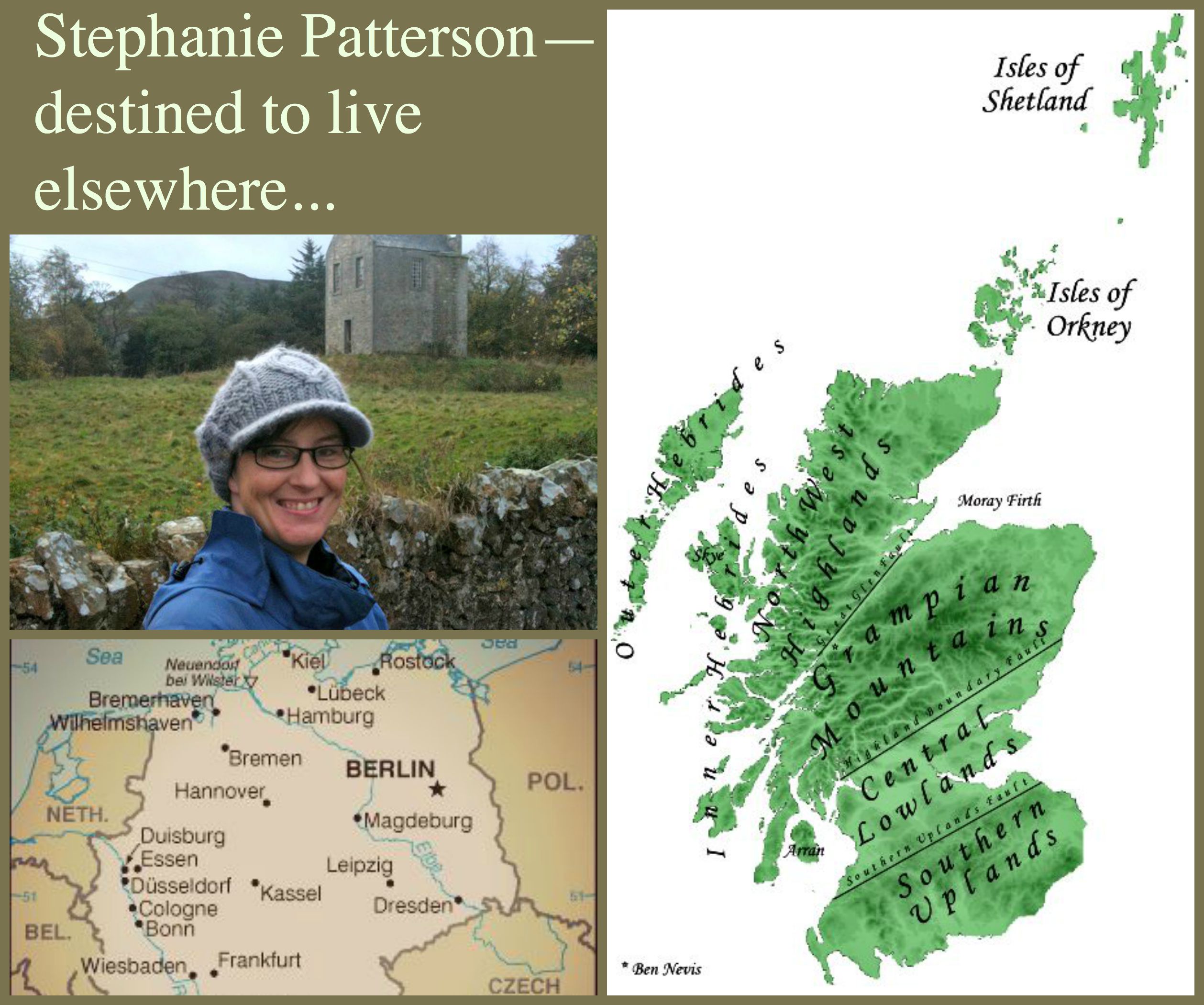
Hello again, readers. Last month I introduced you to expat writer Oliver Tidy, who found his calling in writing crime novels set in the UK once he became an expat in Turkey. For my guest this month, Stephanie Patterson, it was the other way around. Stephanie developed an early passion for places other than her home country of Germany, and for the English and Scottish medieval periods. In other words, it seemed almost predestined that she would move to the UK and write historical novels set in these places and times.

Although Stephanie first lived in Kent when she arrived in the UK 18 years ago, she relocated to Aberdeen and then, after a stint in Wales (Cardiff), where she met her British husband, Laurence, has lived in Edinburgh for the past 10 years.

Stephanie Patteson destiny

Photo credits (left): Stephanie Patterson in her beloved Scottish Highlands (supplied); Map of Germany, by Central Intelligence Agency; The main geographical divisions of Scotland, by SFC9394—both images via Wikimedia Commons (CC BY-SA 3.0).

Not surprising, given her proclivities, Stephanie believes the key to settling into a new country is total immersion. In her case this technique greatly improved her grasp of the language (she is a certified translator of English to German). It has also enabled her to write romantic suspense and adventure set in Scotland, England and Normandy under the pen name of Cathie Dunn.

In 2011, Stephanie and Laurence set up Crooked Cat Publishing on the model of an independent US publisher. To date, Crooked Cat has published over eighty paperbacks and e-books with authors across the world, several of which have won (or been shortlisted for) prizes. It has quickly developed a reputation for producing quality fiction.

As Cathie Dunn, Stephanie has two historical novels published with Crooked Cat:

  • Highland Arms, a romantic Scottish adventure (originally released through Wild Rose Press), set in Stephanie’s favourite area of the Scottish Highands: Lochaber. It’s the first in her Highland Chronicles series.
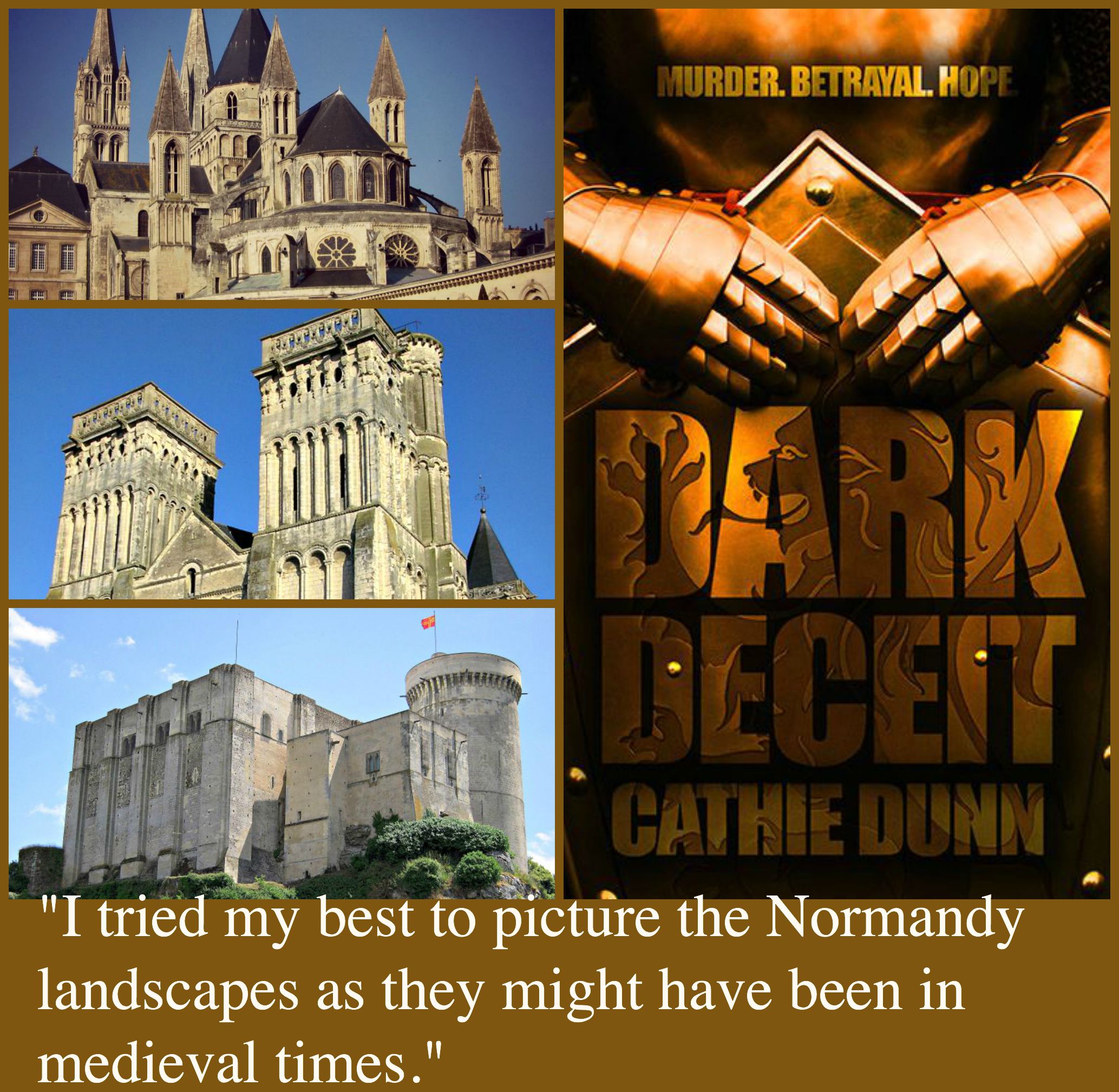
  • Dark Deceit, the action of which takes place in 1140s England and Normandy, when a brutal civil war is taking place. It’s the first in her Anarchy Trilogy, set mainly in medieval Normandy.

She has also self-published Silent Deception, a romantic paranormal novella set in Victorian Cornwall.

When she isn’t writing, editing or publishing, Stephanie is visiting castles, towns and cathedrals throughout the UK. A hobby historian, she has taken university modules in Tudor Studies and Scottish Studies. While in Wales, she took part in medieval re-enactment (the medieval and Jacobite eras being her favorites).

Stephanie’s love for medieval Norman history saw her back in Normandy for a holiday in July. Ultimately, she (and her husband) would not rule out moving to France one day, and, yes, she is currently studying French to improve her knowledge of language and culture.

* * *

Welcome, Stephanie, to the Displaced Nation. I think I can guess the answer but I’ll ask you anyway: which comes first, story or location?

Yes, as you probably guessed, I’m usually inspired by location and/or architecture first, which I then combine with potential plot ideas. My Scottish romance, Highland Arms, was born when I travelled through Glencoe and along the dramatic Loch Linnhe in the Scottish Highlands. The forbidding scenery (helped by the adverse weather of sleet, rain and fog) was the perfect setting for an adventure set in the 1720, featuring a smuggler. I always carry a notepad, and on that occasion I found it very useful for jotting down ideas.

Photo credits (clockwise from top left): Highland Arms cover art; A view of Glencoe, by Ronhjones via Wikimedia Commons[https://commons.wikimedia.org/wiki/File:Gleann_comhainn.jpg] (CC BY-SA 3.0) [http://creativecommons.org/licenses/by-sa/3.0/]. Loch Linnhe, by Moralist via Wikimedia Commons[https://commons.wikimedia.org/wiki/File:Vy_i_skottland.JPG](CC BY-SA 3.0) [http://creativecommons.org/licenses/by-sa/3.0/].

Photo credits (clockwise from top left): Highland Arms cover art; A view of Glencoe, by Ronhjones; Loch Linnhe, by Moralist. Both images via Wikimedia Commons (CC BY-SA 3.0).

What’s your technique for evoking the atmosphere of a place?

For Highland Arms, I was fortunate enough to find booklets by local historians about the era, which allowed me to paint a more realistic picture. This, in combination with a number of visits during different seasons, allowed me to set the scene quite realistically. I did the same for Dark Deceit, which is partly set in Gloucestershire and partly in Normandy. I took hundreds of photos during a holiday in Normandy and kept going back to my travel diary for pointers. I prefer to write about areas I’ve visited. If I can convey my own feelings and impressions, it helps create the atmosphere.

Is landscape the only feature you look at to create a sense of location? What about culture, or even food?

As I write historical adventures, I tend to focus on history and landscape. I found Normandy hugely inspiring for its medieval history and the buildings that have survived from that era. The castles and cathedrals paint a vivid picture of 12th-century life, and I try my best to capture it and convey it into my stories. As you mentioned, I consider myself a hobby historian and have bookshelves full of history tomes, in English and French. It helps that I love the culture.

Can you give a brief example of your work which illustrates place?

Here is a passage from Highland Arms:

Catriona nodded. “Thank you, Mr MacKinnon. I wasn’t looking forward to scaling those peaks.” Her gaze scanned the shimmering surface high up, so glaringly white against the deep blue morning sky. Hidden under layers of cloud the day before, the steep hillsides now presented themselves in all their dangerous glory. Stunned by the beauty yet relieved she did not have to cross them, Catriona smiled as she gazed across crags as sharp as a dagger’s edge.

Relaxing in the stillness of her surroundings, she was surprised at her own reaction. Instead of the misery that held her in its grasp for the last few weeks, a new sense flowed through her.

A feeling of…belonging?

She shook her head in disbelief. What brought this on? The eerie stillness should unnerve her, but instead it calmed and steadied her. Taking a deep breath, she gave her mare a nudge with her heel. Perhaps this journey was going to be good for her after all. No longer banishment, but rather an escape. Perhaps even a fortunate escape.

By the time they reached a small settlement by the shore of Loch Linnhe, the sun had crossed its zenith. Melted snow, and the footfalls of men and horses, turned the ground into a muddy slush. A handful of cottages stood scattered along the path, their walls covered in a thick layer of mud to repel the winds. Smoke swirled through holes in the roofs, filling the air with the smell of peat.

Catriona took a deep breath, enjoying the dusky scent. While she waited for MacKinnon to return from a cottage he’d entered on their arrival, she nudged her mare to the water’s edge to let her drink. Her gaze roamed over the large loch, to the far shore and back to where a narrow arm of water branched off into Loch Leven, disappearing from sight between high peaks behind her. The rugged beauty pulled her in.

How well do you need to know the place before using it as a setting?

Though not always possible, I find it easier to describe a setting once I’ve visited it for long enough to develop a “feel” for the location. For Dark Deceit, I developed an impression of what life was like in that region during medieval times by exploring the abbeys in Caen and Falaise Castle, among other monuments from that era. The book’s hero is originally from a town called Mortagne, in today’s southern Normandy. During our holiday, we drove down to the town and had a wander through it. I took in the surrounding forests (which haven’t changed too much since the 1100s) and ignored the more modern aspects. I try my best to picture the landscapes as they might have been.

Which writers do you admire for the way they use location?

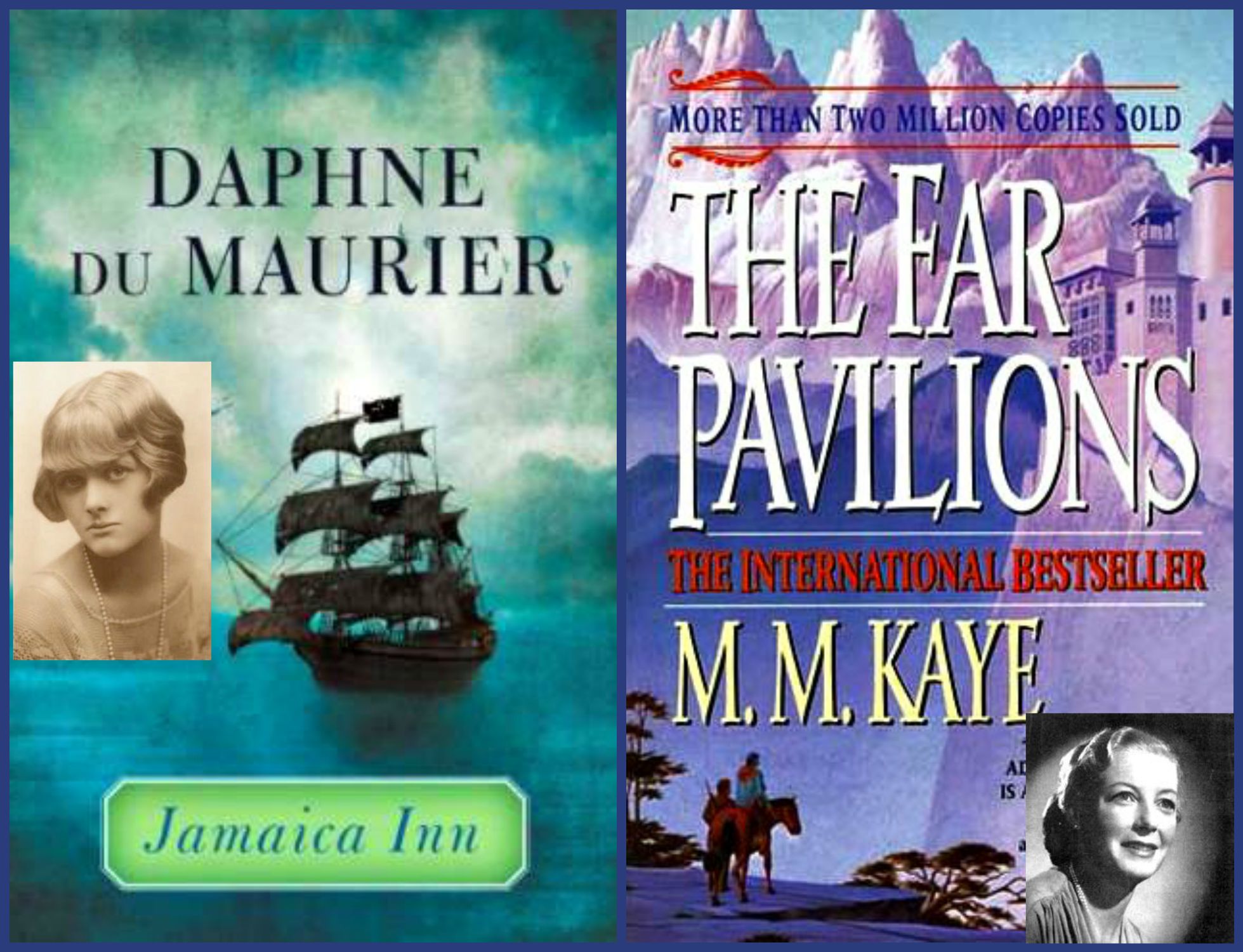
One of my favourite novels is Daphne du Maurier’s Jamaica Inn. The way she describes the desolate landscape, the remoteness of the location, is compelling. You have a real sense of being there. I also enjoy reading MM Kaye’s novels, mostly set in India and Africa. A Third Culture Kid (she was born in Simla and lived all over the world as an adult), Kaye evoked a sense of place that many other authors writing about those areas don’t manage in quite the same way.

Patterson faves

Photo credits: Cover art; insets: Young Daphne du Maurier (about 1930), by The Chichester Partnership via Wikimedia Commons (CC BY-SA 3.0); M.M. Kaye via goodreads.

Thanks so much, Stephanie!

* * *

Readers, any questions for the intrepid Stephanie Patterson? Please leave them in the comments below.

And if you’d like to discover more about Stephanie, why not visit her author site. You can also follow her on twitter at @cathiedunn.

Until next month!

Lorraine Mace writes for children with the Vlad the Inhaler books. As Frances di Plino, she writes crime in the D.I. Paolo Storey series. She is a columnist for both of the UK’s top writing magazines, has founded international writing competitions and runs a writing critique service, mentoring authors on three continents.

STAY TUNED for the next fab post!

If you enjoyed this post, we invite you to register for The Displaced Dispatch, a round up of weekly posts from The Displaced Nation, with weekly updates and much, much more. Register for The Displaced Dispatch by clicking here!

Related posts:

Photo credits (top of page): The World Book (1920), by Eric Fischer via Flickr; “Writing? Yeah.” by Caleb Roenigk via Flickr (both CC BY 2.0).


WORLD OF WORDS: How a mysterious passion for learning French has shaped the life of writer Marianne Bohr

Marianne Bohr in the Luxembourg Gardens in Paris—is she reading or indulging in reveries about words?

Marianne Bohr in the Luxembourg Gardens in Paris—is she reading or indulging in reveries about French words?

New columnist Marianne Bohr, whose first book, Gap Year Girl, is about to come out with She Writes Press, is here with her second post attesting to how a passion for learning languages can engender a passion for travel.

I decided long ago that I was born in the wrong country. There must have been some mistake. But then again, if I’d been born in l’Hexagone, my passion for all things French wouldn’t exist. I’d have been raised with the language’s romantic euphony, and the fluid succession of words would be part of my everyday world. Some other tongue and faraway culture would have caught my fancy—so perhaps, just perhaps, it’s fortuitous my birthplace was Fort Wayne, Indiana, and not Paris.

Passions are essential to a happy life. When we care about something, it shrinks the world to a human scale, breaking it into wieldy pieces to love and nurture. My passion for French shapes my world, yet why I love this lyrical language so dearly is an essential mystery I’ll never fully understand.

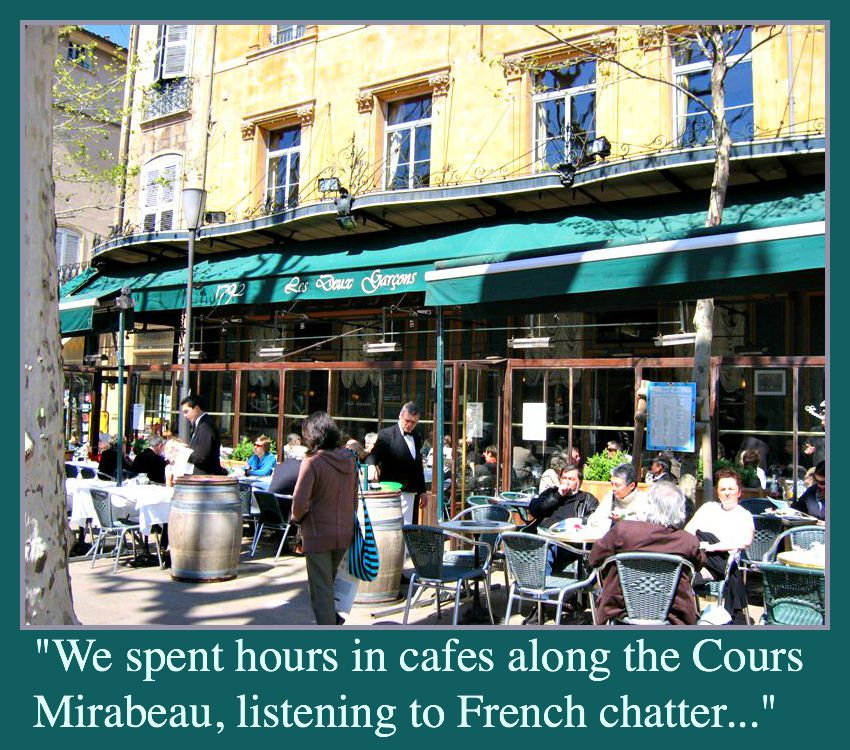
In my first post I spoke about the decision my husband, Joe, and I made to do a senior year abroad at age 55. For the final six weeks of our “gap year” traveling through Europe, we settled into Aix-en-Provence, a stylish, sun-kissed university town in the south of France. We delighted in the daily outdoor markets and spent hours in cafes along the Cours Mirabeau, sipping rosé wine and listening to the mellifluous French chatter around us.

Photo credit: Les Deux Garçons, by tpholland via Flickr (CC BY 2.0).

I signed up for daily French conversation classes, hoping to further exercise my sometimes-lazy American jaw in preparation for the new career that awaits me back in the States. Over thirty years in book publishing is behind me and armed with the degree I completed before we left for our gap year, I’m ready to embrace being a French teacher, full throttle.

First day of school

I’ve always loved being a student of French, no matter my age, but on the first day of my class at IS Aix-en-Provence (a language institute that specializes in teaching French to adults), I’m predictably nervous, as I’ve been on day one of every school year of my life. I lay out my clothes the night before and imagine first days of school gone by: my freshly ironed plaid uniform, crisp white blouse, just-purchased navy knee socks with tags still attached, and newly polished oxfords. I pack a snack, just as I did in grammar school, and I’m ready to go.

My giddy younger self emerges the moment I cross the classroom threshold, polished floorboards creaking, where I am once again a wide-eyed schoolgirl eagerly poised over a blank composition book, pencil sharpened and my ardor for the subject on my sleeve.

My class of ten includes students from Australia, Finland, the Netherlands, Spain, and Sweden, none of us a youngster and all on an educational vacation in summertime Aix. I introduce myself and stumble on the choice of tense. Do I use the present or the future tense of “to be”? Do I affirm I am a French teacher, or do I demur and say I’ll soon be a French teacher? I opt for the former, Je suis prof de français. It bolsters my confidence with a frisson of pride.

My prof is Céline—gorgeous, funny, and particularly warm. I so wish I could be like her—une jolie française who speaks lovely French. As I walk home from class, it hits me, as it has so often before: yes, I am a newly minted French teacher, but no matter how I try, no matter how I practice, no matter how fiercely I study, I’ll never be French. I’ll never be française. I’ll never sound like Céline. I’ll forever be on the outside looking in, my face and palms pressed against the linguistic glass. I plunge into a microflash of depression. But I proceed across town, under soaring sycamores, content to have a passion I can call my very own.

The French and their apocopes

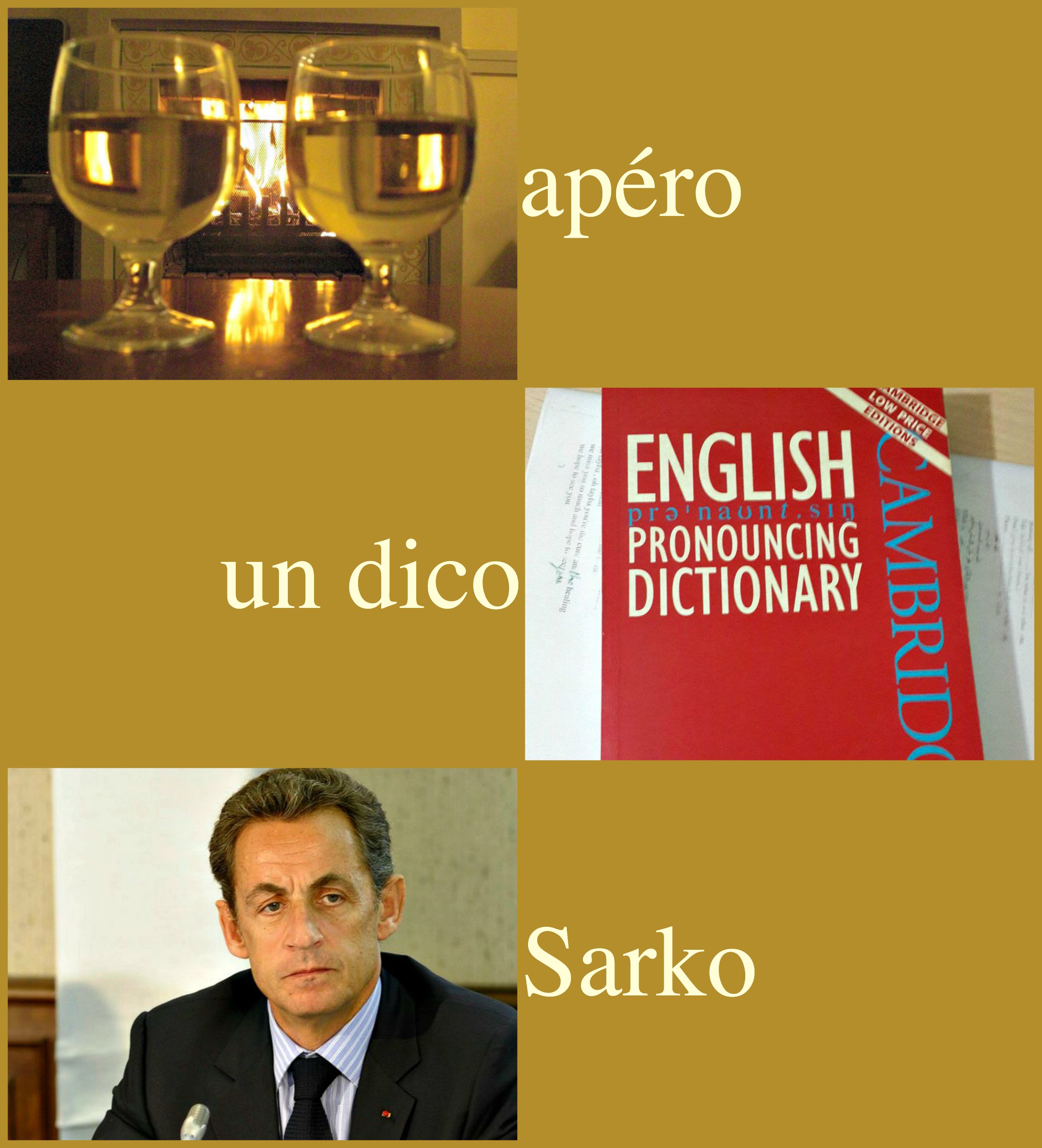
The French often truncate words by dropping the final syllables and adding an “o.” Apéro, McDo, and resto (aperitif, McDonald’s, and restaurant) have long been staples of my French vocabulary, but thanks to my classes, I add abbreviations to my repertoire:

  • accro hooked on
  • les actus (the news),
  • un ado (an adolescent),
  • bio (organic),
  • un dico (a dictionary),
  • perso (personal), and,
  • (my favorite) Sarko (Nicolas Sarkozy).
Shortened French words

A few examples of the Gallic fondness for apocopes. Photo credits: Apéro au coin du feu, by Sébastien Bertrand via Flickr (CC BY 2.0); English-language dictionary via Pixabay; _EPP Summit, by European People’s Party via Flickr (CC BY 2.0).

Each week in class, we prepare presentations about les actus, and I do one on social media. Twitter and blogger have now entered the daily lexicon as regular “-er” verbs. We learn the quirky French term for “walkie-talkie” (talkie-walkie), that the expression vachement bien (amazingly good), which was very popular thirty years ago, is much less in vogue nowadays, and that it is très chic to say super (pronounced “sue pair”—accent on the “sue”), especially if you’re a woman.

The café was super-bon; your dress is super-chic; he looks super. I imagine the French language police, the Académie Française, must be super-fâché (very angry) about all the new Franglais.

Why won’t anyone speak French with me?

Indeed, much has changed in France over the past 35 years. There’s a new generation with kinder attitudes, more customer-service orientation, and lots of English spoken, so unlike the France of days gone by. Everyone wants to speak English, but I want to speak French. I’m bolstered by Joe, who always encourages, “Make them speak French, babe,” so we have uneven, lopsided exchanges:

“Good evening, madame.”

“Bonsoir, monsieur.”

“Would you like an aperitif?”

“Oui, je prends un kir, s’il vous plaît.”

“Very good. And you, sir?”

“Un kir aussi, merci.”

It’s initially disconcerting, but they eventually get the point and give us what we want. They speak to us in French! We really do appreciate the attempt to be accommodating and their eagerness to practice our language. If only we Americans would exhibit the same passion for learning new tongues.

* * *

Thank you, Marianne! How about the rest of you out there? Do you have a passion for a foreign language and if so, what kind of lengths have you gone to in its pursuit? Do let us know in the comments!

Marianne C. Bohr is a writer, editor and French teacher whose book, Gap Year Girl: A Baby Boomer Adventure Across 21 Countries, will be published in September 2015 (She Writes Press). She married her high school sweetheart and travel partner, and with their two grown children, follows her own advice and travels at every opportunity. Marianne lives in Bethesda, Maryland, where after decades in publishing, she has followed her Francophile muse to teach French. She has an author site where she keeps a blog, and is active on Facebook and Twitter.

STAY TUNED for the next week’s fab posts!

If you enjoyed this post, we invite you to register for The Displaced Dispatch, a round up of weekly posts from The Displaced Nation, and SO much more. Register for The Displaced Dispatch by clicking here!

Related posts:

LOCATION, LOCUTION: An expat life in Istanbul frees Oliver Tidy to write crime novels set in places he knows well (and Turkey, too!)

Location Locution
Columnist Lorraine Mace, aka Frances di Plino, is back with her second interview guest: fellow crime writer Oliver Tidy.

Hello, readers. My guest this month is Oliver Tidy, who on his author site refers to himself as a “semi-professional fantasist” and an “attention seeking vanity publisher” who is “living in exile.”

He also says he has a “yearning for yarning”—so how much of this is true and how much an exaggeration?

Well, it’s patently true he is a self-published author, currently with nine books available for download through Amazon:

  • four in his Romney and Marsh Files British police procedural series. Newly promoted Detective Sergeant Joy Marsh is shipped out to Dover on the Kent coast to work under Detective Inspector Romney, a cantankerous copper who nevertheless is good at his job…
  • three in his Acer Sansom thriller series. British soldier Acer Sansom resurfaces a year after the world thought he was dead, possessed with a single-minded need for vengeance…
  • two in his Booker & Cash mystery story series. An unlikely detective team, David Booker and Jo Cash, solve mysteries in Romney Marsh, a wetland area in southeast England…

As for the “exile” part, Oliver tells me he left the UK in 2009 looking for change and ended up in Istanbul, where he “got change in spades.”

He is currently working in a Turkish school teaching English as a foreign language to young learners. It’s a job that affords him enough time for writing, something he deeply appreciates:

When I lived in the UK, I tried a couple of times to write, but with the responsibility of property and family and work, and the distractions of television and radio and newspapers and people I never got anywhere with it. One of the many things that I have learned about writing is that you have to sit down and write—often.

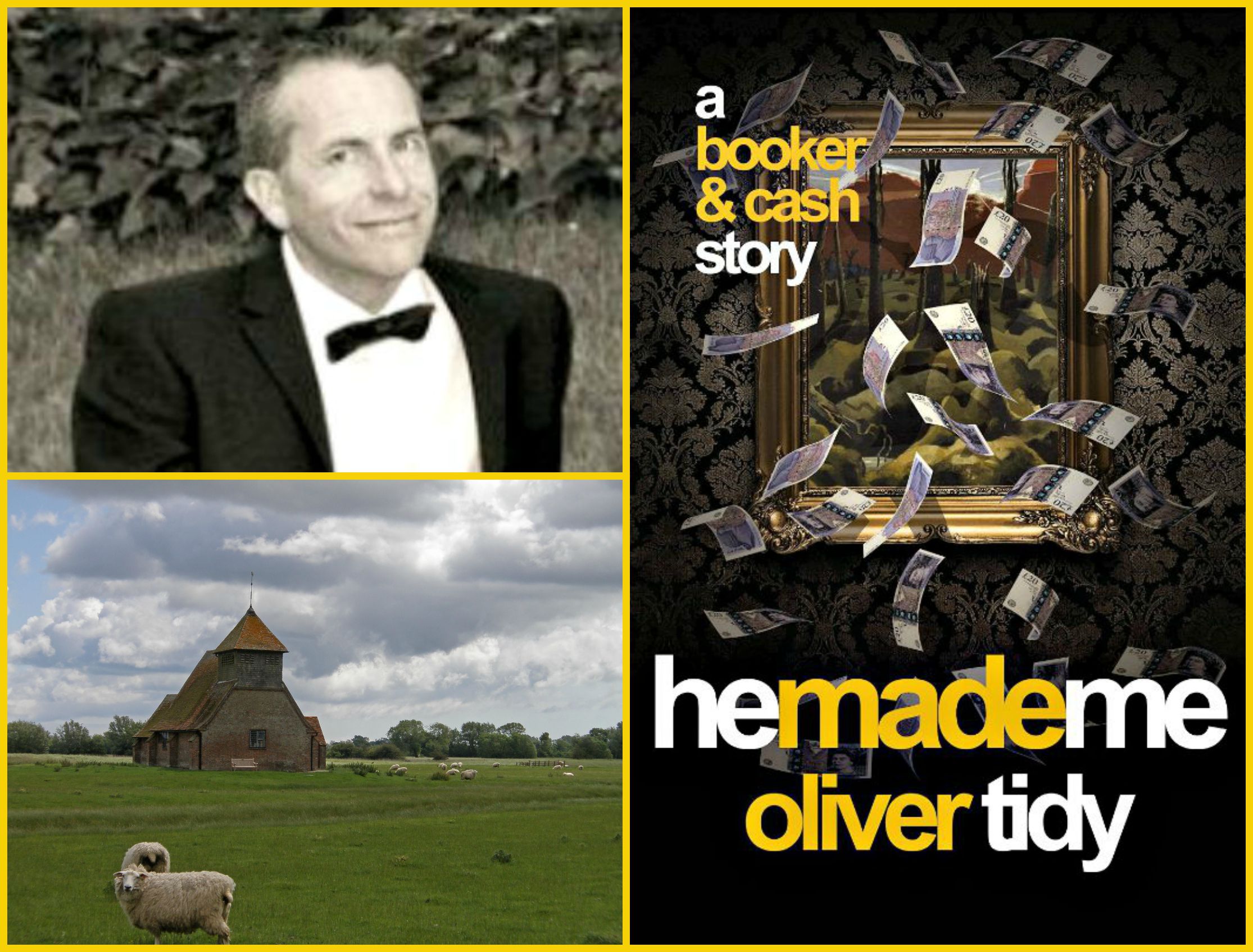
Now that he lives in Istanbul, Turkey, Oliver Tidy is able to write stories set in his homeland, the most recent one being He Made Me. Photo credits: (clockwise) Oliver Tidy (supplied) and book cover art; St Thomas Becket, Fairfield, Kent, by Amanda Slater via Flickr (CC BY-SA 2.0).

Living in Istanbul, Turkey, Oliver Tidy has been able to write books set in the place where he was born and bred, the most recent one being He Made Me, which takes place in Romney Marsh, UK. Photo credits: (clockwise) Oliver Tidy (supplied) and book cover art; St Thomas Becket, Fairfield, Kent, by Amanda Slater via Flickr (CC BY-SA 2.0).

As for the vanity publishing, Oliver also confesses he initially tried to get a literary agent because he never wanted to self-publish, believing that self-publishing was tainted with shades of ego-tripping.

“How wrong I was,” he said. “How wonderful and liberating self-publishing truly is. If I had not taken the step to self-publish, my readership would still be limited to my mum and me—and I’m sure that mum skim-reads most of my stuff.”

Judging by the Amazon reviews he receives, his audience extends far beyond his mum—and what his fans seem to love the most about his writing is its “local colour,” “sense of place,” and “wonderful descriptions of settings.”

Let’s find out how he does it, shall we?

* * *

Which comes first, story or location?

Why does this make me think of chickens and eggs? Such a hard opening question. I hope they’re not all going to be like this. I much prefer questions about my favourite things: raindrops on roses and whiskers on kittens, that sort of thing.

Anyway, here goes. As you mentioned in you kind introduction, I write three different series of books: one is set in Dover, Kent—The Romney and Marsh Files; one is set on Romney Marsh—Booker & Cash Stories; and one where, in three books so far, my central protagonist has shot up several different countries on a variety of continents—the Acer Sansom novels. (Acer is a great advert for Brits abroad. Bit of a one-man stag party.)

With the Romney and Marsh Files, story and location had an equal weighting in development. With the Booker and Cash stories it was certainly location first—I am Romney Marsh born and bred. As for the Acer Sansom novels, the first, Dirty Business, involved him visiting Istanbul, a city that I’d been living in for about a year. Acer went from Istanbul to Bodrum, a seaside resort town in Turkey that I’d spent the summer in. That book was definitely heavily influenced by my geographical experiences. The subsequent two books were predominantly plot led.

What’s your technique for evoking the atmosphere of a place?

Tumble weed moment. In six years of writing I’m yet to experience writer’s block…until now. Give me a minute. I’ll come back to this one at the end. (I came back to it at the end and I still couldn’t answer it. Sorry.)

Which particular features create a sense of location? Landscape, culture, food?

These questions are providing an opportunity to really reflect on my writing—something I’m feeling I don’t do enough of.

I don’t write much about what my characters eat. I write a little more than nothing on the cultures of my settings. Physical geography features more than either of the other two in all of my series. As far as my globe-trotting Acer Sansom novels go, after the first book—where I did have experience of the locations involved—I have to say a massive thank you to the Internet, especially Google maps, Google earth, Google street view. Maybe I should just say thanks Google. I’ve also obtained good insight from some travel blogs. Some of those are a wonderful resource for armchair writers.

Can you give a brief example of your work which illustrates place?

I’ll use a short passage from the first Acer Sansom novel. One of my characters has driven from Istanbul to Bodrum.

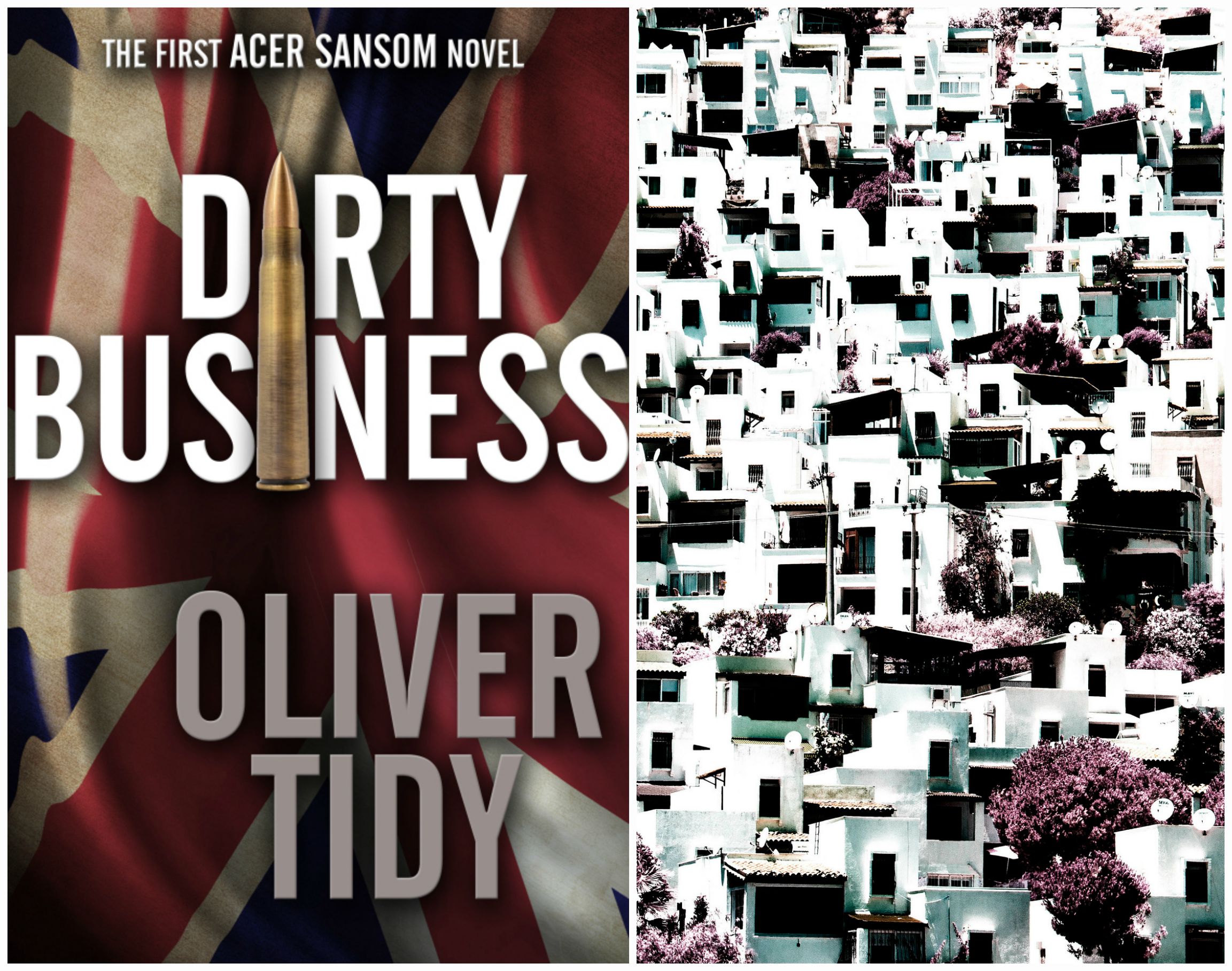
Oliver Tidy’s first Acer Sansom thriller, Dirty Business, is set partly in Bodrum, Turkey, where he lived for a year. Photo credit: Cover art; The best place to live! by Tuncay Coşkun via Flickr (CC BY 2.0).

Before long the vista opened up before her. As she sometimes had in the years that she had driven to Bodrum, she pulled into a loose gravel pocket at the side of the road and got out of the car.

From her lofty vantage point high up in the hills that embraced the area, she was able to look down at the sprawling panorama of the holiday capital of Turkey. Little enclaves of white boxes, taking advantage of the best geography, were packed so tightly together in places that they might have been one huge solid mass of concrete.

The steep hills that backed these separate little communities demonstrated both the developers’ greed and the sun-seekers’ need for yet more building as newer communities sprang up, patching the arid landscape white like some poorly-designed chess board.

At this time of year Bodrum would be heaving not just with the Turks who could afford to escape the suffocating heat and humidity of the bigger cities but also thousands of holidaymakers of all ages and nationalities.

Once, she thought, the place must have looked like paradise from where she stood—before Man’s concrete assault paradoxically began the ruination of the very environment that made him invest in the area. Would it always be only a matter of time and money before the need to develop areas of outstanding natural beauty outstripped Man’s admiration for them? Thank goodness there were still some idyllic pockets of the area where the authorities had elected to cease development. She felt grateful, if a little hypocritical, that her family owned a villa in one of them.

Her gaze took in the superb sweep of the Aegean, glistening in the early morning light, stretching out towards Greek territory; the differing hues of green and blue combined to create the most inviting scene. She tried to make out details of the ships anchored across the bay but was too far away.

How well do you need to know the place before using it as a setting?

Having lived on Romney Marsh for over forty years has made the two stories—the third is under construction—in my Booker & Cash series much easier in the penning-the-setting stakes. My memories of the place are vivid and unshakeable and I return there for a few weeks each year in the summer which allows me to top them up.

I know Dover fairly well, having spent a lot of time there a few years ago. When I return to the UK I like to jump on the bus from my home on Romney Marsh to Dover for the day just to refresh my memory and see what’s new.

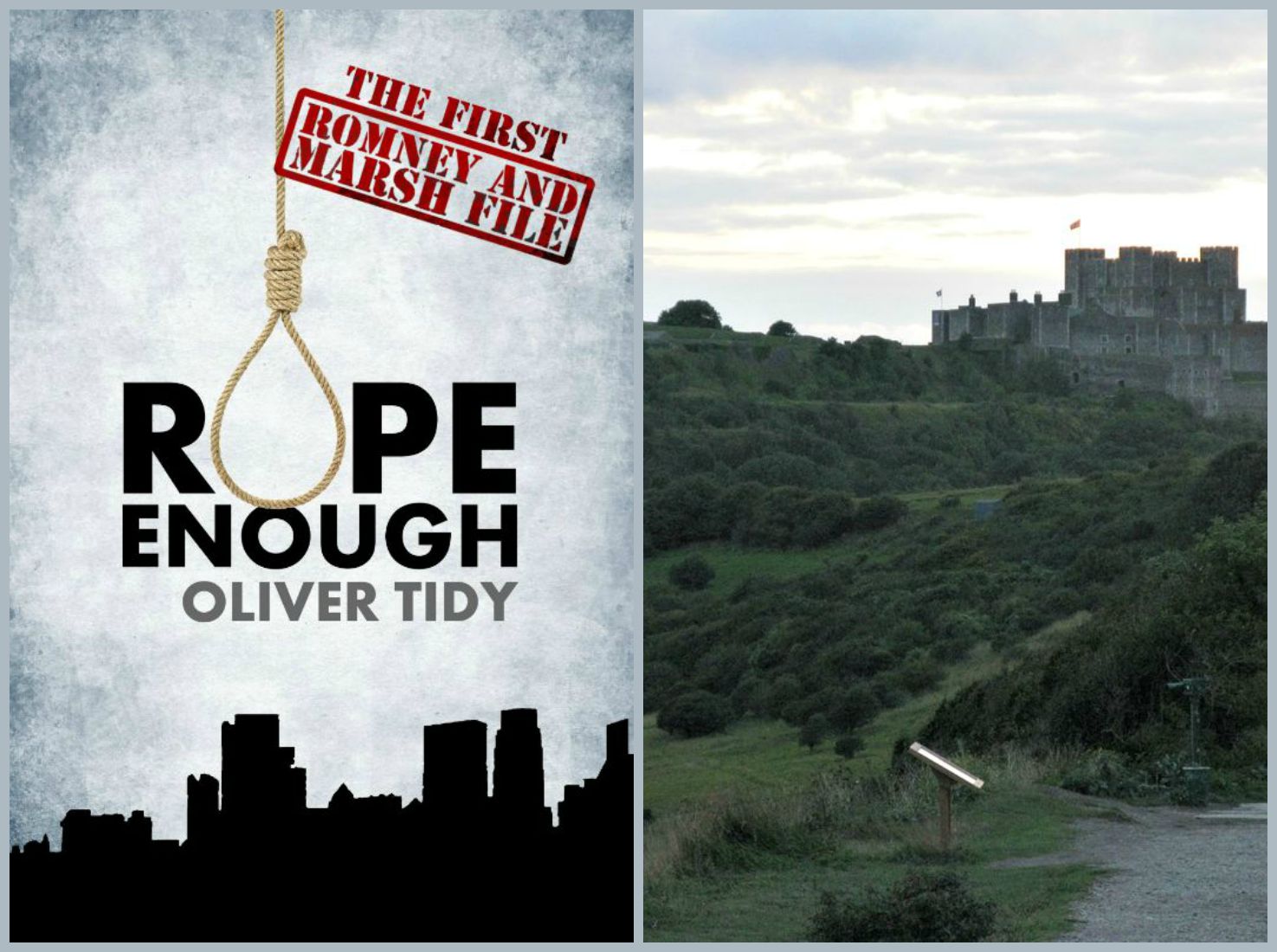
Cover art of Rope Enough, first in police procedural series set in Dover; Dover Castle, by Andrew and Annemarie (CC BY-SA 2.0).

Cover art for Rope Enough, first in Tidy’s “Romney and Marsh File” police procedural series set in Dover; Dover Castle, by Andrew and Annemarie (CC BY-SA 2.0).

As I mentioned, in the first Acer Sansom book I used Istanbul and Bodrum for my exotic locations—two places that I felt I had enough experience of to write convincingly about them. Most of Acer’s locations in the subsequent two books I have never visited. I’m always waiting to be taken to task by readers who have personal and insightful experiences of the places I’ve depicted. What can you do sometimes? You need to write about somewhere you’ve never been. You log on, do some research and then your best.

Which writers do you admire for the way they use location?

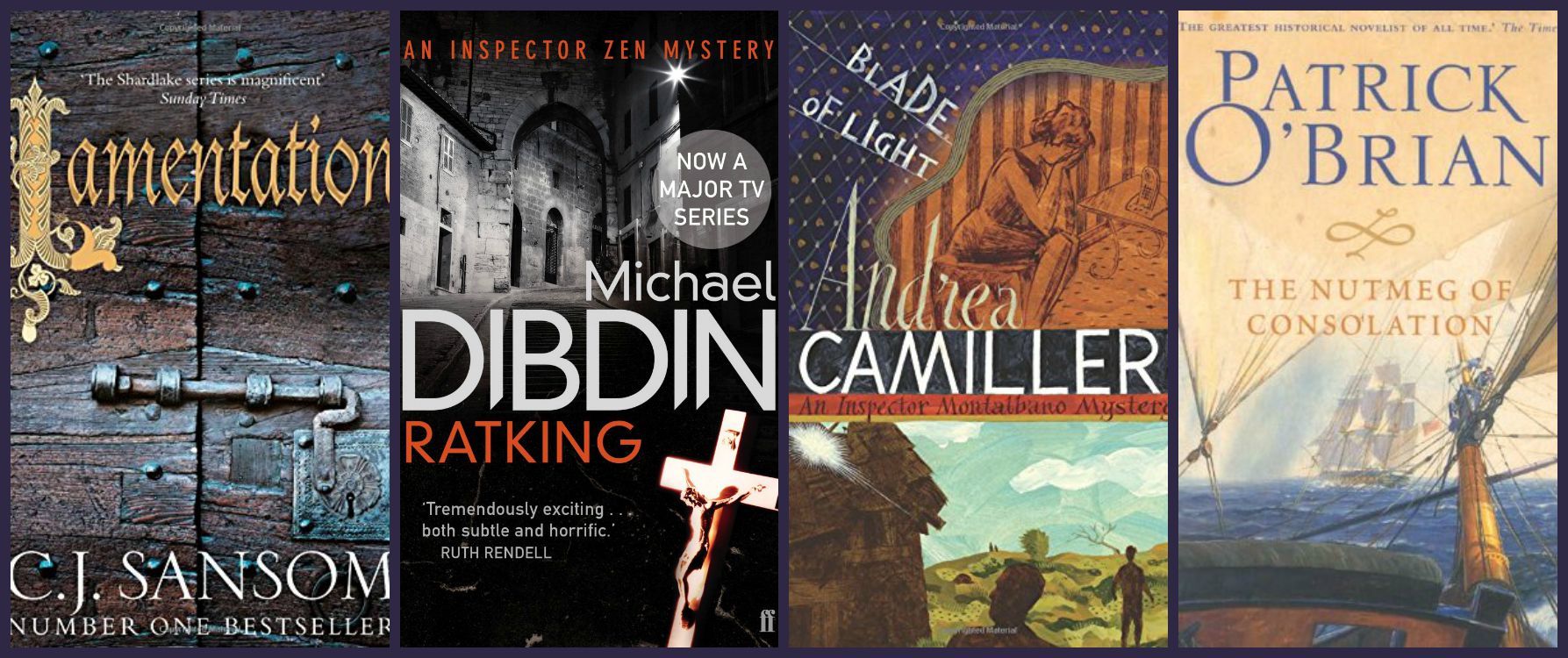
CJ Sansom for the way he portrays London in Tudor times; Michael Dibdin and Andrea Camilleri for their descriptions of Italy, and the unbeatable Patrick O’Brian for his depictions of any location, be it land or sea, that he touches upon in any of his Aubrey/Maturin novels. What a writer.

A few of Tidy's favorite authors, who know how to handle "location, locution."

A few of Tidy’s favorite authors, who have demonstrated a mastery of “location, locution.”

Thanks so much, Oliver!

* * *

Readers, any questions for the jolly Oliver Tidy? Please leave them in the comments below.

And if you’d like to discover more about Oliver Tidy, why not pay a visit to his author site. You can also follow him on twitter at @olivertidy.

Until next month!

Lorraine Mace writes for children with the Vlad the Inhaler books. As Frances di Plino, she writes crime in the D.I. Paolo Storey series. She is a columnist for both of the UK’s top writing magazines, has founded international writing competitions and runs a writing critique service, mentoring authors on three continents.

STAY TUNED for the next fab post!

If you enjoyed this post, we invite you to register for The Displaced Dispatch, a round up of weekly posts from The Displaced Nation, with weekly updates and much, much more. Register for The Displaced Dispatch by clicking here!

Related posts:

Photo credits (top of page): The World Book (1920), by Eric Fischer via Flickr; “Writing? Yeah.” by Caleb Roenigk via Flickr (both CC BY 2.0).


For this expat writer who has photographed everything from the Gulf of Alaska to her own back garden, a picture says…

KONICA MINOLTA DIGITAL CAMERAGreetings, Displaced Nationers who are also photography buffs! “A Picture Says…” columnist James King is still away, so I am filling in again. But the good news is, he approves of the columns I’ve produced thus far! I know I’ve enjoyed spending time with the previous two guests, fearless and feisty photography pro Steve Davey and fine-art photographer Dave Long.

And today I’m excited to introduce Madeleine Lenagh, an American who, having lived in Holland for more than four decades, has made it her base for an impressive range of creative pursuits.
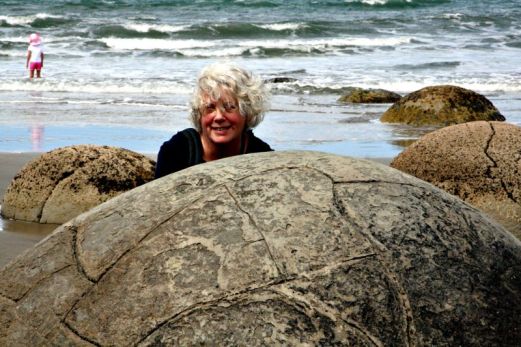
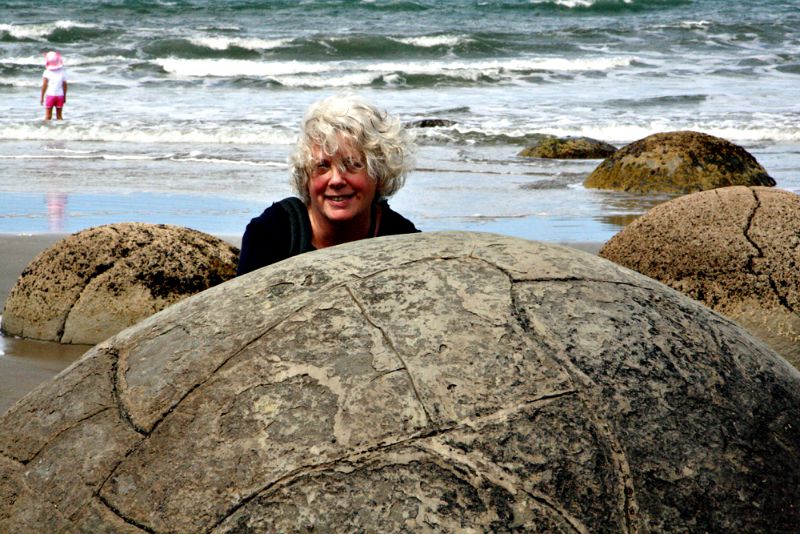
Madeleine Lenagh moeraki

A photo of Madeleine Lenagh taken in New Zealand, among the magnificent Moeraki Boulders.

I first heard about Madeleine from Springtime Books, which published her memoir, Passage of the Stork, Delivering the Soul: One Woman’s Journey to Self-Realization and Acceptance, several months ago.

As those who perused our summer reading recommendations may know, Madeleine’s book was one of my picks. I was intrigued that she chose to tell her life story using poetic vignettes and commentary by archetypes from Nordic mythology and fairy tales.

From the title of the book alone, it’s possible to discern that that Madeleine is in touch with nature at an almost spiritual level. She looks to the stork to deliver her soul (in ancient Egypt, a drawing of the stork served as the hieroglyphic for “soul”). And if you read the book’s prologue, you’ll see that her view of nature includes mermaids—as evidenced by the prologue’s very first sentence:

Three mermaids play in the huge rolling waves, splashing and diving in the curling spray.

It comes as little surprise, then, to discover that besides being an author and blogger, mother and grandmother, and life coach and counselor, Madeleine is a shamanic practitioner. She has been influenced by Dutch shamanic teacher Daan van Kampenhout, whose method fosters connections with helping spirits and ancestors.

What I didn’t realize, though, is how much Madeleine loves to travel and take photographs. She even has her own photography site.

Now let’s see what other worlds Madeleine can conjure up for us with her photos!

* * *

Hi, Madeleine, and welcome to the Displaced Nation. I’ll start the same way as James, by asking: where were you born, and when did you spread your wings (an apt metaphor in your case, given your fondness for storks) to start traveling?
Hi, ML, thank you for inviting me to take part in this column. In answer to your first question: I grew up in Westport, Connecticut. When I was two years old, my stepfather was sent to Europe as a Naval attaché to the NATO. For three years, we lived in Paris, Bad-Homburg, and London. We returned to Westport when I was five. Although I have few memories of those early years, I believe my love of traveling was born then.

So you didn’t end up being raised as a Third Culture Kid?
No, I didn’t leave the United States again until I was 21, when I coaxed my family into giving me a trip to Europe for my 21st birthday. I traveled all around Western Europe and down into former Yugoslavia. At the end of the summer, I was in The Netherlands and my money was running out. I didn’t want to go home yet and found an au-pair job for six months.

Which countries have you visited thus far, and of those, which have you actually lived in?
My travels have taken me all through Europe, as well as to India (Rajasthan), Indonesia (Java and Bali), Costa Rica, and New Zealand (South Island). I believe that Canada and Alaska deserve a separate mention as they are beautiful and remote parts of the world. But, apart from those few years when I was a small child, I have only lived in the United States and The Netherlands.

It’s interesting to me that you chose to make The Netherlands your home for your adult life. What made you settle there in particular?
When I became an au pair in The Netherlands 45 years ago, I sold my return trip ticket to buy winter clothing. Somehow I never got around to leaving. It often amazes me that I, a lover of wild places in nature, could feel so comfortable in this relatively “tame” country. There were key moments in my life when I asked myself, so where am I going now? But there was always more reason to stay than to go. Passage of the Stork, Delivering the Soul describes, among other things, my struggle to put down roots and find a sense of permanency.

“She will always love the sea…” —from the Prologue to Passage of the Stork

Moving right along to the part we’ve all been waiting for: a chance to appreciate a few of your photos. Can you share with us three photos that capture some of your favorite memories of the so-called “displaced” life of global travel? And for each photo, can you briefly tell us the memory that the photo captures, and why it remains special to you?
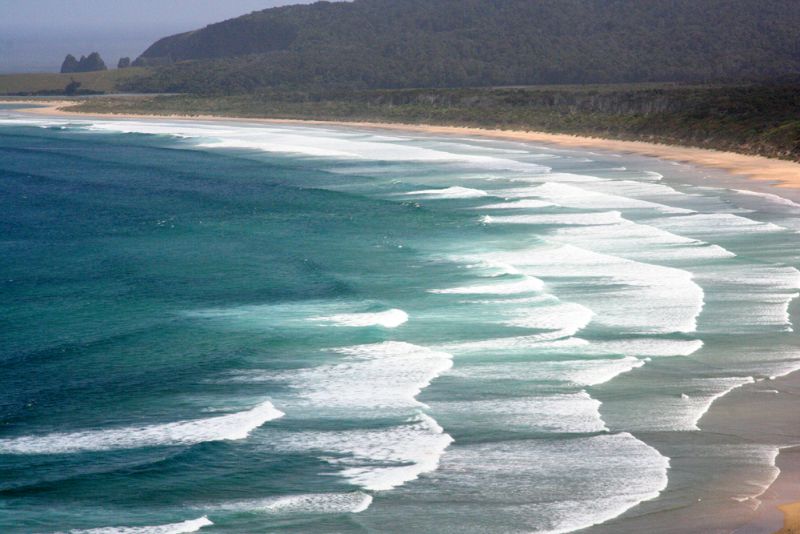
Occasionally I arrive somewhere and think, I could live here. One of those places was South Island, New Zealand. I love the wild remote land, the warm friendliness of the people, and the ever-changing scenery. The photo I have chosen here is the perfect arch of a totally deserted beach in the Catlins, way down on the southern end of the island.
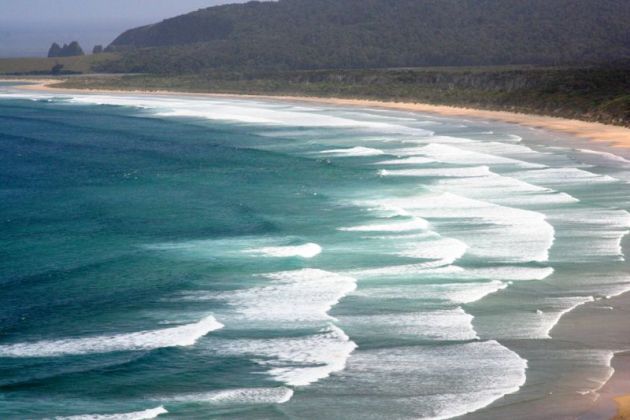
catlins_800x

Untainted by the modern world, the Catlins are the kind of place where a mermaid might appear. Photo credit: Madeleine Lenagh

Wow, that’s the kind of place where it would be easy to imagine mermaids! I have only been to New Zealand’s Northern Island, but even there, I felt that it attracts people who want to get away from it all…
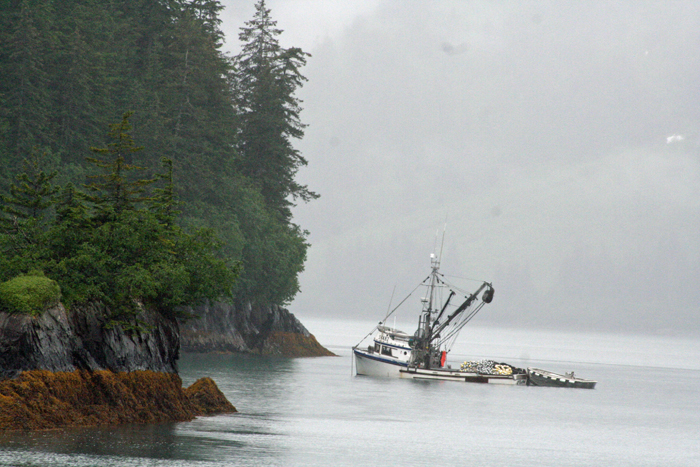
Along the same lines, another place I would be seriously tempted to live, if it weren’t so cold and dark in the winter, is Alaska. I love the pioneer spirit of the people who live there. My brother runs nature tours out of Paxson, which is located in one of the prettiest spots in the state. To the north of the Denali Highway, one sees the dramatic Alaska Range, with its snow-capped peaks and glaciers. An outstretched tundra lies to the south. However, the photo I have chosen, of a fishing boat near the shore, was taken down on Prince William Sound, during a day cruise in 2010. I like the muted colors, with only the bright splash of red on the boat to off-set the fog.
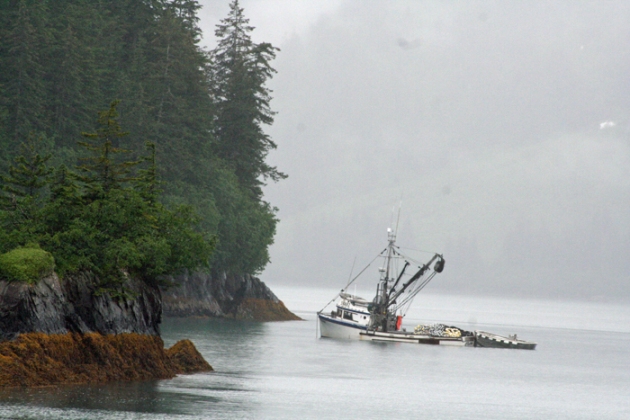
alaska77

While cruising through the calm, protected—and mysterious—waters of Prince William Sound. Photo credit: Madeleine Lenagh

Ooh, I really like this photo. So moody and atmospheric… Though I’ve never been to Alaska, I picture it as having this kind of mystique. Where are you taking us next?
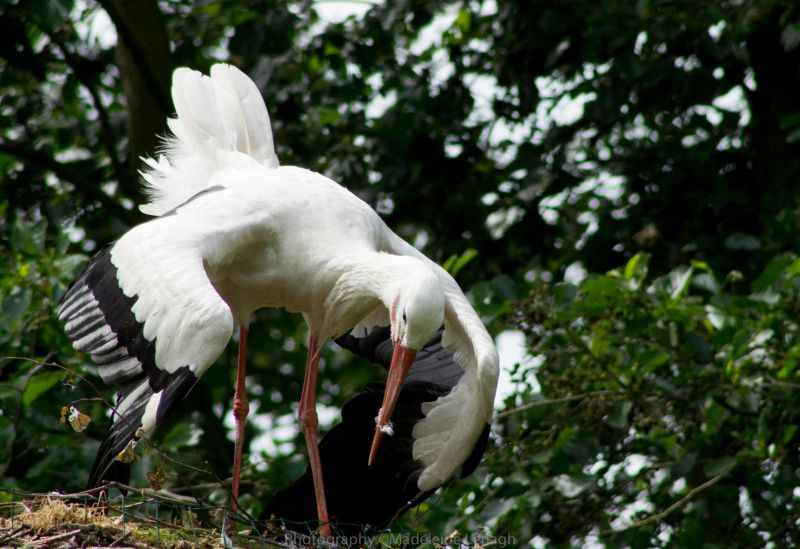
This summer I traveled back to the New England of my youth. I realized how much at home I feel there, in spite of having left 45 years ago. Those of you who have read my book know that I have a special relationship with storks. One of the things they reflect about me is their migratory nature, feeling at home in more than one place. I love this photo of a white stork, taken near my home in The Netherlands, doing its special bill-clacking dance as it returns to the nest.
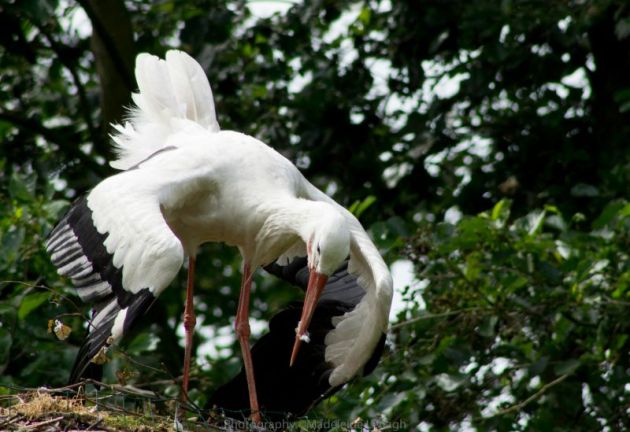
stork-s_800x

Time for a spot of beak-clapping, says this Dutch stork. Photo credit: Madeleine Lenagh

Hm, until now I have always associated storks with the arrival of babies. But after hearing what you have to say, I may start thinking of them as the avian counterpart of the serial expat!

“I lie on my stomach, hearing gossamer wings rush by.” —from the Prologue to Passage of the Stork

Having seen your first three photos, I expect it’s a bit of a tough choice, but which are the top three locations you’ve most enjoyed taking photos in—and can you offer us an example of each?
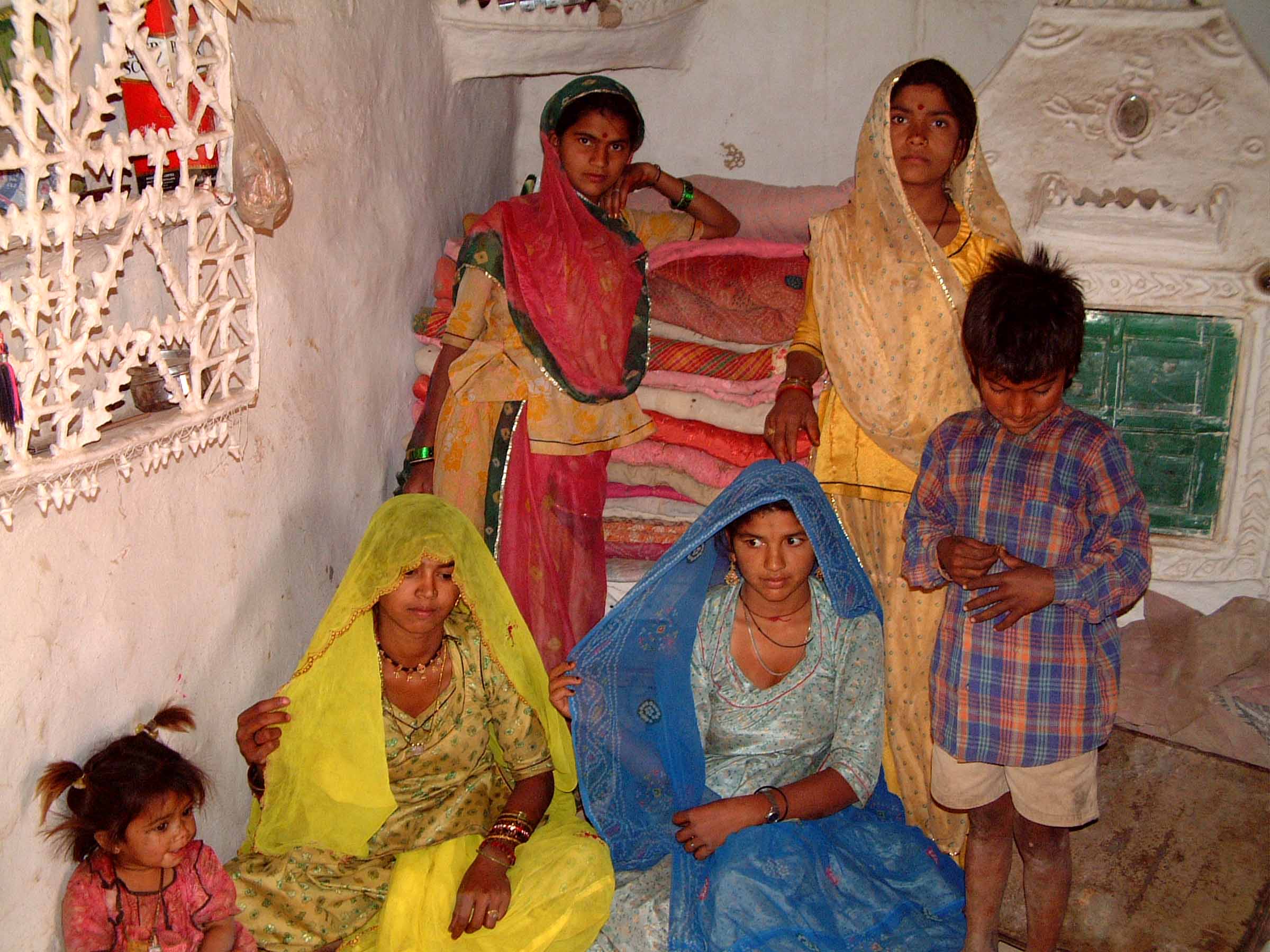
I’m actually going to pick three new places for you. The first one is India. It is a riot of color and ornate decorations, a photographer’s paradise. The photo I have chosen illustrates this perfectly: a group of children posing for me in the “best room” of their desert compound near Jaisalmer.
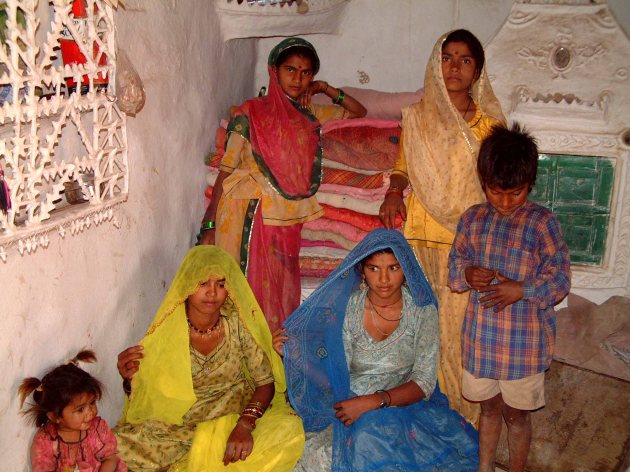
212_desert

Colorful life in India’s Thar desert. Photo credit: Madeleine Lenagh

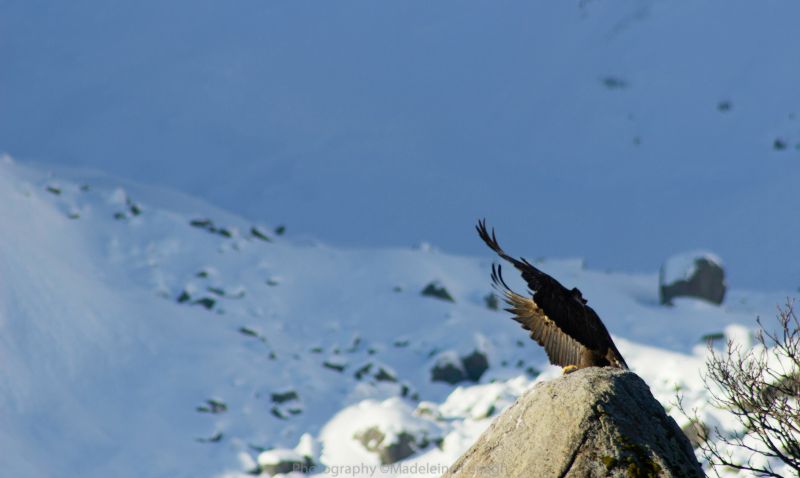
I also have a special relationship with Norway (disclosed in my book) and I love photographing birds. Up in the Lofoten archipelago, I had the unique opportunity to photograph white-tailed sea-eagles. I’m very proud of this shot, catching the bird just as it had landed on a rock.
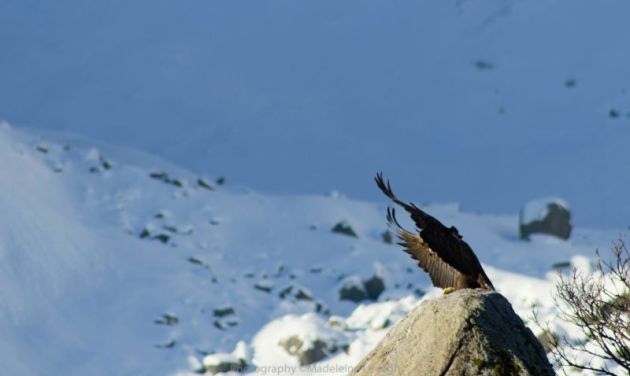
eagle_800x

A white-tailed sea-eagle touches down on this untouched land within the Arctic Circle. Photo credit: Madeleine Lenagh

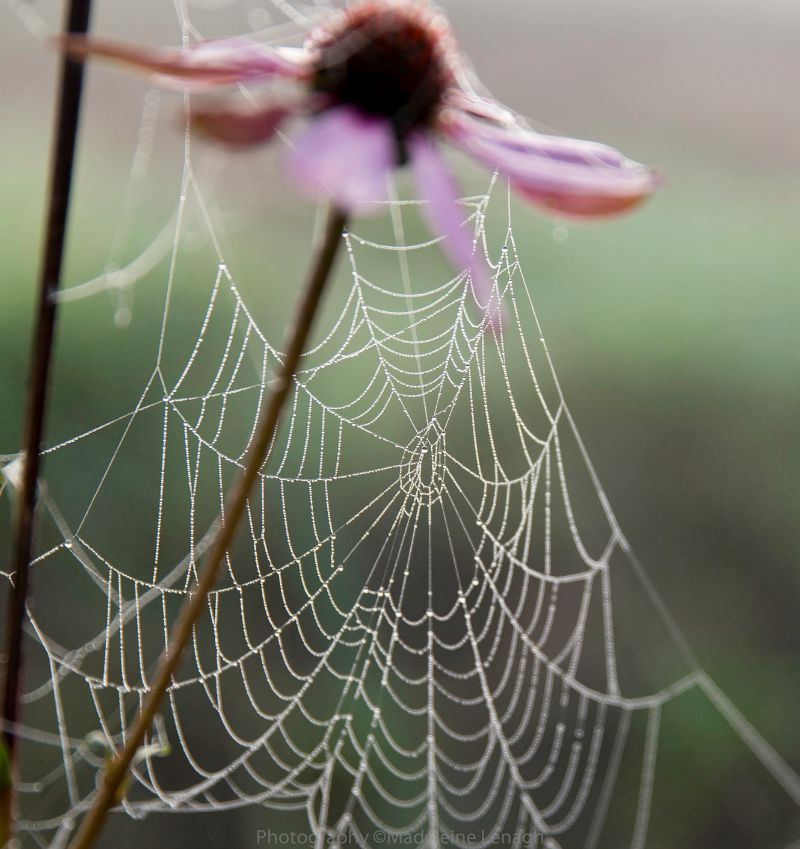
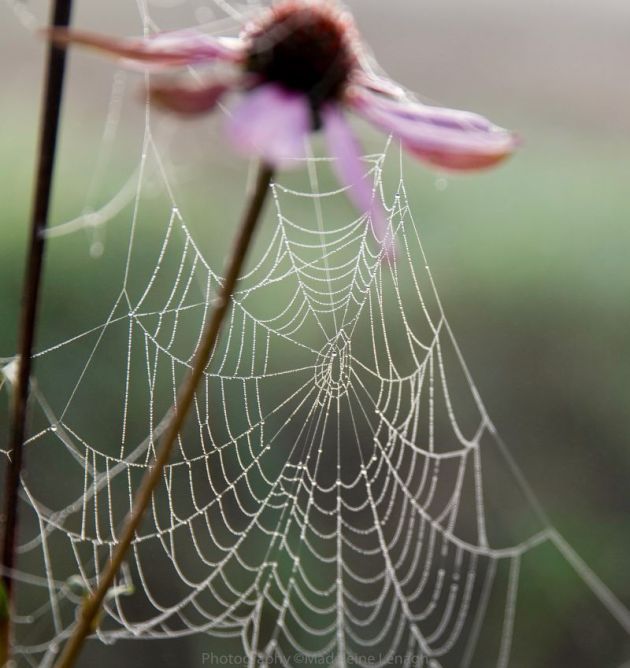
Finally, though I’ve taken you far afield, my last pick for favorite photography locations is my own garden! I love the simple beauty of the nature I find there. A perfect illustration is this photo of a spider web covered with droplets of fog.
spiderweb-s_800x

Is it a spider web or the finest lace? Photo credit: Madeleine Lenagh

I love that you’ve taken us back to your own garden! It makes me think of a fellow New Englander of yours, Emily Dickinson, who took companionship as well as inspiration from her garden in Amherst.

“You can cage a bird, but you can’t make him sing.” (French-Jewish saying)

Going back to your photo of the children in India, I wonder: do you ever feel reserved taking photos of people, particularly when they are conscious of your doing so? How do you handle it?
I am very reserved about taking photos of people, especially in other cultures, and will only do so if they have given me permission. Usually, asking people if you can take their photograph is a wonderful way of making contact with them and often leads to spectacular portraits. The photograph of the children in India is a good example. I love how the two sitting girls (unmarried and therefore veiled) unveiled their faces for the photo.

When did you become interested in photography and what is it about this art form that drew you in?
I believe I have photography encoded in my DNA. My grandfather was taking brilliant photographs in the 1920s. My mother never went anywhere without her 1953 Leica. My Norwegian father (caution: book spoiler!) was a cinematographer. I started taking photographs (and working in a darkroom) when I was about 18 years old. I believe that I was originally drawn in by the fact that it required no real motor skills and I was dreadful at drawing! I’ve always had the urge to express my feelings in some creative fashion, whether it be writing, photography, painting, or dance. Currently, my greatest motivation to photograph is to share the beauty of the natural world with others; to draw them into the same sense of awe and majesty that I feel when I’m in touch with nature.

“Listen to all, plucking a feather from every passing goose, but, follow no one absolutely.” (Chinese saying)

And now switching over to the technical side of things: what kind of camera, lenses, and post-processing software do you use?
Most of these photos were taken with earlier cameras but, at the moment, I use a Canon EOS 6D, a full-frame camera. My favorite lens is a 70-200mm f 2.8 lens. I have been using a 2x extender to get up to 400mm, but recently decided that it slows down the focus too much so I will be looking for a good telephoto lens soon. I find that, as my experience grows, I grow more and more fussy about my equipment! I photograph in RAW format and process the images in Adobe Lightroom.

Finally, can you offer a few words of advice for wannabe photographers who are traveling the world or living abroad?
I suppose the most important advice is just to go out and photograph the things you love. Good photography takes practice and more practice. Study the manual of your camera and don’t be afraid to experiment with settings. Study paintings and sculpture by the artists you admire, to develop a sense for light and composition. As I develop as a photographer I find myself growing more and more critical of my work. It’s not just about showing the things I’ve seen or taking good photos. It’s about taking great photos that show a unique moment.

And I think the most important advice to any aspiring photographer was voiced by Pablo Picasso:

“Learn the rules like a pro, so you can break them like an artist.”

Thank you, Madeleine! I appreciate your sharing a selection of photos that illustrate your deep connection with nature. I’m impressed that you can find so much beauty and wonder on your own doorstep as well as on your travels to the world’s most unpopulated and unspoiled places.

* * *

Readers, what do you make of Madeleine’s travel-photo experiences and her photography advice? Please leave any questions or feedback for her in the comments!

If you want to get to know Madeleine and her creative works better, I suggest you visit her author site and her photography site. You can also follow her on Facebook (she posts her latest photos) and Twitter. But to really get to know Madeleine, I recommend getting her book, Passage of the Stork, Delivering the Soul. You’ll never look at storks, or mermaids, in the same way again!

NOTE: If you are a travel-photographer and would like to be interviewed for this series, please send your information to ml@thedisplacednation.com.

STAY TUNED for next week’s fab posts!

If you enjoyed this post, we invite you to register for The Displaced Dispatch, a round up of weekly posts from The Displaced Nation and SO much more! Register for The Displaced Dispatch by clicking here!

Related posts:

TCK TALENT: Lisa Liang takes her show back on the road; second stop: Cape Town, South Africa (1/2)

TCK Talent columnist Lisa and her husband (and techie), Dan, head to Cape Town. Photo credits: (from left) Alien Citizen poster; Lisa and Dan in front of Little Theatre on University of Cape Town campus; and view of xxx through bus window (supplied).

TCK Talent columnist Lisa and her husband (and techie), Dan, head to Cape Town. Photo credits: (from left) Alien Citizen poster; Lisa and Dan in front of Little Theatre on University of Cape Town campus (supplied, by Daniel Lawrence); and view of Table Mountain through bus window (supplied, by Lisa Liang).

For the second month running, our TCK Talent columnist Elizabeth (Lisa) Liang updates us on her own creative life. This is the first of a two-part post on her South African experience.

Howzit, dear readers—molweni!

I’m devoting this month’s column to the experience of taking  Alien Citizen: an earth odyssey, my one-woman show about growing up as a Third Culture Kid (TCK) of mixed heritage, to Cape Town, South Africa.

The occasion was the 2015 Women Playwrights International (WPI) Conference, held June 29–July 3. WPI has brought together women playwrights and allied theatre artists, cultural workers, and scholars since 1988. It facilitates communication and collaboration among the international community of women in theatre by holding conferences every three years.

In last month’s column I remarked: “It sounds like my kind of crowd.”

Well…it was!!

It felt enormously special to be at the conference’s 10th assembly and its first gathering on the African continent—my first time back in Africa since I graduated from high school, and my first visit to Cape Town. I’ll always be grateful to the donors who financed the trip via my online crowd-funding campaign.

Into Africa

It takes a gajillion hours to get from Los Angeles, California, where I live, to Cape Town (with a layover at Heathrow). My husband (and techie), Dan, and I can’t sleep on planes (!) so were jet lagged on arrival—and only too glad to reach our lodging at Graça Machel Hall at the University of Cape Town (a residence hall, or dorm), the cost of which was generously covered by a housing grant from the Writers’ Guild of Norway.

The room and especially the communal bathrooms gave us flashbacks to our college years—except this dorm was cleaner and full of adult delegates to WPI and other conferences, which we appreciated. We were also happy that the bathrooms provided a good hot shower—and were taken aback (but ultimately impressed) by the free condoms offered in every bathroom on campus.

Note to travelers: If you visit Cape Town in winter (May–July), be warned: indoors is colder than outdoors. Virtually no one has heating or insulation, so bring thermal socks and long johns to wear beneath your pajamas at night, and a thick sweater for any day you lounge indoors—and you’ll be fine. I also recommend gloves and winter hats, unless you’re from a below-freezing-in-winter climate, in which case you’ll likely shake your head and chuckle at all the other tourists complaining of the cold. (The Canadian delegates seemed to be the most bemused by the rest of us.)

The conferencing experience

Every day Dan and I rode the shuttle taking WPIC delegates to the conference site on UCT’s Hiddingh Campus. During the 15-minute drive along the highway, we thrilled at the sight of Table Mountain, Lion’s Head, Devil’s Peak, the harbor, and the Atlantic. It’s impossible to miss the mountains—they loom over, or cradle (depending on your perspective), Cape Town and are magnificent.

My conferencing mornings began with a fantastic keynote by an African theatremaker or a fascinating panel of mostly African playwrights, all women. This was followed by a tea/coffee/yummy-snack break, then workshops led by theatremakers from all over the world, and then a tasty lunch provided by WPIC. Then: readings of excerpts from plays written by playwrights from everywhere and read by South African actors of every race/ethnicity, doing accents from all over Africa and the English-speaking world. Then another tea break, more readings, then panels/sessions/networking/presentations, then supper break (not provided, and we learned that we could not get a bad meal in Cape Town—every dinner out was delicious). The evenings ended with full-length performances.

I was conferencing 12–13 hours daily, and there was usually a smorgasbord of offerings from which to choose in any given hour.

She's really there! Typical beak between conference sessions 9selfie); conference poster on campus (supplied, by Daniel Lawrence).

She’s really there! Photo credits: Typical break between conference sessions (supplied, selfie); conference poster on campus (supplied, by Daniel Lawrence).

Prep for show time

Dan, meanwhile, toured around Cape Town—but joined me for the two technical rehearsals for Alien Citizen in the Little Theatre on campus. After the classroom debacle learning experience at SIETAR Europa in Valencia in May, we were so happy to be in an actual theatre again! The theatre was a bit run down, but it had a booth, professional lighting grid, and Sean (WPIC15’s excellent production manager), so we were stylin’.

If you’ve been following this column for at least a year, then you know what happened with my first old-fashioned slide projector in Iceland. (Woe.) Well, it nearly happened again. I forgot to attach the slide projector to the voltage converter that I bought expressly for Valencia and Cape Town. Instead, I plugged the projector to the wall with a little plug adapter…and it roared as a burning-wires-and-plastic smell permeated the air.

Gah!!!!

I unplugged everything, made adjustments, replaced the bulb, et voila! The projector worked normally…as long as you could ignore the lingering odor of burned something-or-other.

Conferencing highlights

After making sure that my laptop could communicate with the theatre’s screen projector (EVERY venue’s screen projector is its own special starflake), Dan went back to his Cape Town exploring while I attended another conference lunch. Lunches tended to be three quarters sociable (talktalktalk) and one quarter zombie apocalypse (many of us on iPads/iPhones while digesting). At every lunch, I sat with new people, all of whom were interesting and amiable and from everywhere. That was one of my favorite aspects of the conference.

Other highlights of the conference included:

  • the opening keynote by Zambian-born Mwenya Kabwe, who spoke humorously and eloquently about theatre and being an African woman theatremaker.
  • the performance of Walk: South Africa, which taught us a grim statistic, that half of all South African women will be raped in their lifetimes.
  • Kenyan actress-playwright Mũmbi Kaigwa’s reading of an excerpt from her smart, funny, and moving solo show, They Call Me Wanjikũ.
  • a panel of extraordinary South African theatremakers who told us that all theatre in South Africa in the 1980s was held in protest to Apartheid, but nowadays the theatre scene has become very segregated—it has regressed.
  • the workshop on Community Play Creation lead by Hope McIntyre of Sarasvàti Productions in Canada.
  • countless amazing women, including another ATCK playwright who grew up in many more countries than I did, and an Egyptian professor who was a budding playwright, which brought back happy memories of Egypt.
  • the final keynote by the incredibly accomplished Napo Masheane of South Africa. She spoke of working in a jewelry store as a teen, where adult white men would come in and immediately say: “Can I please talk to someone more intelligent?” She ended her speech with a poem that had a beautiful refrain, which she repeated with evocative gestures more and more quietly until she was only mouthing the words while making the gestures, and it made me cry:

    Do not shut your temple doors, whatever you seek seeks you, whatever you want wants you, whatever you need needs you.

    Do not shut your temple doors, there is enough space for all of us to shine, let us dance with fire under the stars.

SouthAfricatheatreconference_arrow

The delegates to the 2015 Women Playwrights International Conference, in Cape Town. Photo credit: Nardus Englebrecht Photography.

Show time!

After the final keynote, Dan and I had another tech rehearsal for Alien Citizen to program the lights. Sean gave the sandstorm-in-Casablanca a nice effect with upstage lights flickering, and the high-school-dance-in-Cairo was even more humorous because he spotlit me in purple with white polka dots that shimmied back and forth, reminiscent of a disco ball’s reflection.

And then it was showtime. After my experience in Valencia, I couldn’t help but have doubts over whether we would have a decent audience. But while I was waiting in the wings I heard delegates enter and sing along to some pre-show music (“Dancing Queen” and “Stand by Me”). I was glad they were getting into the mood, and it sounded like there were a lot more than 20! When I began the performance I could see that it was a “good house” (theatre jargon for “numerous seats filled”) and there were lots of laughs (which sounded slightly surprised, probably because most of the other shows at the conference had been about harrowing subject matter).

Afterwards I received amazing feedback from delegates from South Africa, Canada, Lebanon, Sweden, Egypt, India, Indonesia, Germany, Hungary, New Zealand, USA, Australia, Spain, Singapore, Kenya, Brazil, Jamaica, and more. Several said that the show was a great way to end the conference. I felt relieved, gratified, and honored.

That night, we met with other delegates at Addis in Cape for tasty Ethiopian food (and a cosmo for me). I’m always slightly braindead after performing, but it was lovely to “wind down” with other theatremakers who were very positive about the show. The next morning at breakfast, and again as we checked out of the dorm, more delegates praised Alien Citizen, which was the best way to end the conference for me.

Before, during, after the show. Photo credits: Drama of the slide projector (selfie by Lisa Liang, supplied); the show, which closed the conference; post-show cosmo at Addis in Cape Town (the latter two by Daniel Lawrence, supplied).

Can’t get over Africa

Thank you for reading, and stay tuned next month for Part 2 of Alien Citizen: an earth odyssey’s trip to Cape Town, to include tours of the winelands, the Cape Peninsula, Robben Island (where Nelson Mandela was imprisoned for 18 of the 21 years he served behind bars), District Six Museum (a tribute to the 60,000 inhabitants of District Six, a former residential area of Cape Town, who were displaced by the apartheid regime), the aforementioned Table Mountain, and more! Until then…hamba kahle!

* * *

Thank you, Lisa! Once again, you’ve taken us on a vicarious journey—not only into a part of the world to which I’ve never been but also into the midst of theatre people, your creative tribe! I found it fascinating, as I’m sure others will as well. Readers, please leave questions or comments for Lisa below.

STAY TUNED for the next fab post!

If you enjoyed this post, we invite you to register for The Displaced Dispatch, a round up of weekly posts from The Displaced Nation, with news, book giveaways and other extras. Register for The Displaced Dispatch by clicking here!

Related posts:

WORLD OF WORDS: For writer Marianne Bohr, travel is a way to indulge a craving for language

Marianne Bohr in the Luxembourg Gardens in Paris—is she reading or indulging in reveries about words?

Marianne Bohr in the Luxembourg Gardens in Paris—is she reading or indulging in reveries about words?

Today we welcome new columnist Marianne Bohr, whose first book, Gap Year Girl, is about to come out. Marianne contributes a post showing how her love of languages intersects with her love of travel.

At age 55, my husband and I took a “senior year abroad.” We quit our jobs, sold the house, the car and most of our belongings to travel across Europe in search of adventure.

Part of that adventure was physical. Highlights of our 12-month sojourn across 21 countries included running the Paris Marathon and doing a seven-day hike along the Tour du Mont Blanc.

Part of it was about meeting new people and trying new foods.

But for me the adventure also had to do with words. Having always been a “word” person, I was fascinated by the myriad languages we encountered. So often I’ve wondered: Is it possible to overstate the importance of language in forging friendships across borders? And my response has always been, I don’t think so.

Language itself can be a window on the world, one that opens wide when either a common tongue is shared or you look behind the vocabulary of a language other than your own.

In future posts, I’ll look at specific words and expressions, especially those in French, since I’m a Francophile through and through. But for now, I have adapted a few passages from my book that contain a few observations about language that I made during our year abroad. Enjoy!

* * *

The trip from Grindelwald, Switzerland to Chamonix, France, requires four train changes and one bus. As the crow flies, the distance isn’t far, but crossing the Alps can be a multilegged, many-houred proposition.

On one of the neat and tidy Swiss mountain trains, a Japanese couple traveling alone takes their places across from a dapper, middle-aged local gentleman on the banquette seats next to ours. He jumps up to help them with their luggage and once the bags are in place, proceeds to initiate a friendly conversation in Japanese. The look of pure, unadulterated joy on the couple’s faces lights up the train. They’re on their own, far from home, and the serendipity of selecting seats next to someone who speaks their mother tongue is priceless.

Lively conversation among the three fast friends ensues as the Swiss gentleman moves over to sit facing the twosome. He animatedly points to features of the surrounding peaks and comments on the houses we pass by as our train proceeds down the valley. I’m transfixed by the exchange. The travelers laugh, heads nodding and smiles widening, and my heart warms as I imagine the talk turning from our magnificent Alpine surroundings to families, travel, and Japan.

When the train slows for the native son’s stop, they exchange cards and, hands at their sides, quickly bow their goodbyes. Surely the encounter will be one of the most memorable of the visiting couple’s trip.

*

In Grindelwald, where we’ve arrived for eight days of hiking, we attend an evening barbecue at our hotel in the shadow of the Eiger and meet a couple that hails from Dresden, in the former East Germany. They speak passable English (which was significantly better than our almost nonexistent German). They tell us that nowadays, all schoolchildren learn English from a very early age, but that they didn’t take it up until they were adults. They apologize for their lack of fluency, acknowledging that Russian was the requirement when they were growing up. Subjugators, of course, demand that the subjugated learn their language in a decisive power play.

We end up thoroughly enjoying our outdoor buffet in the company of our new friends, having learned much about their formative years behind the Iron Curtain—all because our companions have breached the language barrier.

*

Language is key for forging ties across boundaries but it’s a delicate art. We were also amused on occasion during our gap year by the quirky use of English by some of the people we meet.

  • I overhear an Italian traveler in a quiet Roman museum triumphantly exclaim when his English friend caught up with him, “The bull has now entered into the china store.”
  • Our pretty young guide in Dubrovnik, after she asked us if we were familiar with an anecdote she shared about her city and St. Blaise inquires, “Is that bell not ringing for you?”

Such endearing errors highlight the subtle nature of language and the translation of idioms in particular, but they shouldn’t inhibit us from giving another tongue our best effort. Learning other languages has always helped me listen to and use my own language more carefully and to pay closer attention to expressions that could be difficult to understand by non-native speakers.

*

I snap back from my linguistic reverie as our Swiss train slows and we pull into the station near the French border. It’s time to transfer to the next train that will drop us at the bus depot for the final leg to Chamonix. We are our way to Provence, where we’ll retreat for the summer.

My heart flutters knowing we’ll soon be back in the promised land of the quintessential romance language—my beloved French—where once again my language window will be open on the world. I may at times speak it like a bull that’s entered into the china store, but le français will always help keep my language bell ringing.

* * *

Thank you, Marianne! How about the rest of you out there? How do you look at languages other than your native tongue: are they an impediment or a lure for overseas travel and/or living adventures? Do let us know in the comments!

Marianne C. Bohr is a writer, editor and French teacher whose book, Gap Year Girl: A Baby Boomer Adventure Across 21 Countries, will be published in September 2015 (She Writes Press). She married her high school sweetheart and travel partner, and with their two grown children, follows her own advice and travels at every opportunity. Marianne lives in Bethesda, Maryland, where after decades in publishing, she has followed her Francophile muse to teach French. She has an author site where she keeps a blog, and is active on Facebook and Twitter.

STAY TUNED for the next week’s fab posts!

If you enjoyed this post, we invite you to register for The Displaced Dispatch, a round up of weekly posts from The Displaced Nation, and SO much more. Register for The Displaced Dispatch by clicking here!

Related posts:

CULTURE SHOCK TOOLBOX: Expats, if success in another country is what you’re after, throw the tools away and go for total immersion

Fiona Citkin for Culture Shock Toolbox
For her column this month, transitions enthusiast H.E. Rybol interviews displaced creative Fiona Citkin about her culture shock memories and coping strategies.

Hello, Displaced Nationers! Today I’m excited to introduce you to Fiona Citkin, who is a professional “diversiculturalist.” She runs her own consultancy on intercultural business competence and has written a major work on the link between intercultural competency and diversity in business, for which she was named Champion of Diversity in 2012.

Lately she has turned her attention to women leaders in the United States who are immigrants. These women came from other countries and “made” it in the world’s most competitive society, despite facing what Fiona calls “quadruple jeopardy”: 1) being women; 2) being mothers; 3) being ambitious; and 4) being foreign born. Fiona’s book is called Cracking the Code: How American Immigrant Women Leaders Achieve Success under Stress. If you’re curious to find out more, I urge you to follow her Huffington Post column, where she provides monthly reports on her research findings.

Fiona has experienced no small measure of that immigrant stress, and success, herself. She grew up and was educated in the Ukraine but has now made the leap to New Jersey.

Though Fiona is constantly on the go, I was able to catch up with her and ask her a few questions about her own culture shock experiences and tools for dealing with them. Here’s what she had to say…

* * *

Hi, Fiona, and welcome to the Displaced Nation. Can you tell us a little about your background?

I was born in Ukraine and lived there most of my life. I started a family; defended two doctorates; wrote an academic book on terminology and translation science; and became head of the English Department at Uzhgorod State University in Transcarpathia (Western Ukraine). I was a visiting professor at the Universities of Budapest, Hungary; Vienna, Austria; Bern, Switzerland, etc.—and have attended many linguistic conferences all over Europe. The longest time I stayed abroad while living in Ukraine was for a teacher-study semester at the University of Edinburgh in Scotland. In short, I knew the taste of success in my homeland. And then I became a Fulbright Scholar to the United States, which gave me the experience of what it means to have one’s old life burn down and try to be a phoenix in a foreign land. As a newcomer in America, I have reinvented myself more than once.

In the context of transitioning from Europe to the United States, did you ever put your foot in your mouth? Can you share any memorable stories?

Here’s a story: I’ve been taught British English, like everybody in Europe. Learning the differences between the British and the American English seems funny now—but wasn’t then. For example, my co-worker Hugh, a friendly guy, suddenly started paying compliments to me, like “Oh, your pants are beautiful” – “Another pair of pretty pants, Fiona” – “I wish my fiancé had such nice pants as yours.” I felt confused and didn’t respond, because in Britain “pants” typically denotes ladies’ underwear…what does he want, I thought? Finally, a girlfriend explained to me that Hugh meant to praise my choice of what in Britain is referred to as “trousers.”

He likes my pants

Photo credit: Pixabay.

What does one do in a situation like that?

When I am not sure what to say, I say nothing and just smile.

Looking back on your transition from the Ukraine to the East Coast of the U.S., can you recall any situations that you handled with surprising finesse?

I hate to brag about “finesse” in cultural matters. No amount of time you live in your new/adopted country can guarantee your 100% integration and “finesse”—because deep down you’ll always be yourself, have a soft spot for your native land, and retain some inborn traits of your original culture. For my upcoming book I have interviewed 50 outstanding American women achievers who happen to be first-generation immigrants, so I have not only my own experience but also their accumulated know-how of how to handle cultural transition. The main fact is: cultural integration is a must for those who want to succeed in a new country.

If you had to give advice to someone who just moved to a new country, what’s the tool you’d tell them to develop first and why?

First, focus on strategies rather than tools, or tactics, because first things should come first, right? After twenty years of living and working in the United States, I have some worthy advice to share—and my books’ subjects have even more. To put it in a nutshell:

  1. Get the best education you can, hopefully in the field that’s most desirable in the host country (high-tech is the best for the USA).
  2. Learn the language BEFORE you come as an immigrant—but remember that culture trumps language, e.g., cultural integration is more important.
  3. Learn to be outgoing, friendly, and helpful to others; participate in the work of your local community.
  4. Be entrepreneurial—as this is the best way to sustain yourself: immigrants experience difficulties in getting jobs, everywhere.
  5. Last but not the least, use whatever your cultural heritage equipped you with to your best advantage.
American Flag and immigrant women successes

Photo credits: Ivana Trump, by Lloyd Klein via Flickr (CC BY 2.0); Firma de Isabel Allende, by Pedro Cambra via Flickr (CC BY 2.0); Gloria Estefan, by Louise Palanker via Flickr (CC BY-SA 2.0). American flag by Pixabay.

Finally, before my book comes out, you can pick up ideas and pieces of advice from my monthly blogs at the Huffington Post.

Thank you so much, Fiona, for taking the time to share your culture shock stories. Developing an outgoing personality—but also knowing when to smile and say nothing—sounds to me like the kind of gauge or caliper we could all use in our cultural transitions. And if you’re in it to win it, so to speak, then it’s time to throw the toolbox away and immerse yourself, hook, line and sinker!

* * *

Readers, what do you make of Fiona’s advice? It would be particularly interesting to hear from those who meet her quadruple stress test (woman, mother, ambitious, foreign) but still have managed to achieve some success: do you have anything to add to Fiona’s prescriptions?

Well, hopefully this has you “fixed” until next month.

Until then. Prost! Santé!

H.E. Rybol is a TCK and the author of Culture Shock: A Practical Guide and Culture Shock Toolbox. She loves animals, piano, yoga and being outdoors. You can find her on Twitter, Linkedin and Goodreads. She is currently working on her new Web site and her second book.  

STAY TUNED for next week’s fab posts.

If you enjoyed this post, we invite you to register for The Displaced Dispatch, a round up of weekly posts from The Displaced Nation—and much, much more! Register for The Displaced Dispatch by clicking here!

Related post: