The Displaced Nation

A home for international creatives

Tag Archives: Acquired tastes

DEAR MARY-SUE: Can you tell me how to stomach other countries’ bizarre food obsessions?

Mary-Sue Wallace, The Displaced Nation’s agony aunt, is back. Her thoughtful advice eases and soothes any cross-cultural quandary or travel-related confusion you may have. Submit your questions and comments here, or else by emailing her at thedisplacednation@gmail.com.

Well, this month I’ve been asked to deal with your food-based queries. That’s pretty easy for this gal! I love to chow down. Not in a Paula Deen kinda way, you understand, but I sure do love a refined meal and am pretty well known on the Tulsa culinary scene.

****************************************************************************************

Dear Mary-Sue,

Fermented salted herring — how does that sound to you as a national dish? [Not great. Think roadkill cooked up in the finest Ozarks tradition sound preferable, if I’m being honest – M-S]  As an American living in Northern Sweden, I have yet to acquire the taste let alone abide the smell. However, a friend at my new church has invited me to a party where they’ll be serving surströmmingsklämma — that’s a sandwich made with slices of surströmming (the name for this fish — quite a mouthful, too, though at least it’s not fermented!) between two pieces of the hard and crispy kind of bread they love so much up here. The bread is buttered and there is a further layer of boiled and sliced or else mashed potatoes.

What to do? Do I accept my friend’s invitation or pretend to be busy “settling in”?

– Mary-Louise from Umeå, Sweden

Dear Mary-Louise,

You don’t have to pretend to be Anthony Bourdain if you don’t want to be. Look at Samantha Brown, she travels all the world and never once leaves her comfort zone or experiences something new.

Also, you’re in Sweden, not some village in the third world where they are honoring you by offering you a slice of roast anteater rump. I’m sure you won’t be insulting anyone by politely declining. Just be graceful and say you’re not big into fish.

Mary-Sue

*****************************************************************************************

Dear Mary-Sue,

I know you’re very pro-USA, but as an English expat who has just spent his first summer in the United States, I haven’t been able to get the hang of some of your summer desserts.

Take, for instance, strawberry shortcake — overly sweetened strawberries on a sweet biscuit, which should actually be called a scone. Whose bright idea was that? I guess that person hadn’t heard of strawberries and cream?

Moving right along to that traditional American Girl Scout favorite, s’mores. The chocolate and graham crackers are fine, but a roasted marshmallow — that’s OTT. Please, sir, can I have no-more?

I could go on about the American obsession with eating ice cream in a wide variety of sickening flavors, when there’s absolutely nothing wrong with chocolate and vanilla (okay, strawberry, too, if you like) — but I’ll stop there.

Here’s the thing, old girl [??????? M-S]. I would love to tell my various American hosts that nothing beats a tall glass of Pimm’s on a summer’s day, and a slice of summer pudding, but I’m guessing that wouldn’t go down too well.

Nigel of Nevada

Dear Nigel,

Old girl??! Why, aren’t you a little slice of honey pie? I’d certainly like to beat you with a tall glass of Pimms. It actually isn’t too difficult to get hold of a Pimms cup here in the land of the free. As for the rest of your letter: yeah, we like our desserts to be sweet. What a surprise!

Mary-Sue

********************************************************************************************************

Dear Mary-Sue,

I’m originally from Winnipeg, in Manitoba, Canada, and am teaching English in Korea. The other day one of my students went so far as to tell me that the reason the Korean economy has gotten strong is because they all eat so much kimchi.

I wanted to tell him that I think there’s something strange about a nation being so obsessed with what is essentially spicy fermented cabbage.

I mean, can’t they think of anything else to brag about?

– Sally from Seoul

Dear Sally,

First Mary-Louise’s problems with fermented fish and now this. I don’t know what it is with foreigners and fermentation — seems crazy to me. The Mary-Sue rule is that unless you’re fermenting something that I can make into a mimosa or margarita, then it’s best not to bother.

My hubby, Jake, is always going off to the Korean barbeque in town. If the owner is sending back all the money he makes off dear ol’ hubby, well, it’s probably that that’s keeping the Korean economy strong.

Mary-Sue

********************************************************************************************************

Dear Mary-Sue,

Oh. My. God. Do people really eat this stuff? I’m an American student staying with a British family as part of a semester abroad, and they SERIOUSLY just offered me the most foul-tasting stuff imaginable on toast. I thought I was going to spit it out. I mean, it was soooo salty! And then they presented the jar to me as a GIFT! What am I supposed to do with it?!?!?!?

– Patti in Plymouth

Dear Patti,

I’m assuming you’re talking about Marmite. I wouldn’t worry too much, it probably won’t make it past customs when you return to the land of milk and honey.

Mary-Sue

___________________________________________

Anyhoo, that’s all from me readers. I’m so keen to hear about your cultural issues and all your juicy problems. Do drop me a line with any problems you have, or if you want to talk smack about Delilah Rene.

Mary-Sue is a retired travel agent who lives in Tulsa with her husband Jake. She is the best-selling author of Traveling Made Easy, Low-Fat Chicken Soup for the Traveler’s Soul, The Art of War: The Authorized Biography of Samantha Brown, and William Shatner’s TekWar: An Unofficial Guide. If you have any questions that you would like Mary-Sue to answer, you can contact her at thedisplacednation@gmail.com, or by adding to the comments below.

STAY TUNED for tomorrow’s post by Jack Scott.

If you enjoyed this post, we invite you to register for The Displaced Dispatch, a round up of weekly posts from The Displaced Nation, with seasonal recipes, book giveaways and other extras. Register for The Displaced Dispatch by clicking here!

Related posts:


EXPAT MOMENTS: A Question of Sport

As this summer, for me at least, has been a summer of sport, I thought I would continue this Expat Moments series with a post I originally put in 2010 on my own blog Culturally Discombobulated. They are thoughts I had while watching a San Francisco giants baseball game. That season the giants would go on to win the World Series, and the fans celebrating outside my apartment elicited a sound like that of a dying whale.


I’m in AT&T Park, San Francisco. It’s the top of the 4th innings and the San Francisco Giants trail the Arizona Diaomondbacks 6 – 1. It is little surprise therefore that the atmosphere in the stadium is tetchy. The main object of the crowd’s impatience is the Giant’s pitcher Barry Zito who to use a British expression is “having a ‘mare.” Even to me – a man who could write everything he knows about the art of pitching on the back of a postage stamp – it is apparent that Zito is a player struggling with confidence and that’s affecting his ability to settle into a rhythm. Within minutes of the game starting he had allowed Arizona to wrest the initiative. That disaster of a first innings would see Arizona score 6 quick runs – now they’re hoping to add more. Zito is in trouble again as he preps himself to pitch at Reynolds. Young has already walked and LaRoche hit a single. There’s an unpleasant air of expectancy in the ground as Zito pulls his left arm back readying himself to throw. It doesn’t feel as if the crowd expect much from this pitch – at least not heroics from Zito. There’s a palpable feeling of a crowd readying itself for disappointment, a collective anxiety over the failure they anticipate. Crack!! It’s a sweet hit from Reynolds. The crowd groans in anguish. Jesus, they knew it, they just knew it was going to happen. As the groan turns into boos, Young, LaRoche and Reynolds pass home plate. Arizona Diamondbacks 9 – San Francisco Giants 1.

A few minutes later and Zito is “relieved”, to use a baseball term, by Ramirez, another of the Giants’ pitchers. Relieved: to free from anxiety, fear, pain – that sounds about right. Zito trudges off the field disappointed. Some of the crowd feel the need to make their feelings known. “You suck, Zito!!” Despite the anger of those shouting, as someone used to English soccer fans, the language the baseball fans employ is clean – unimaginative even. For me, I am disappointed that Zito is off. He is one of the few players I’d bothered to read about before the game and was vital in my attempt to try and pass as being vaguely knowledgable about the Giants. I feel disconnected from the rest of the crowd; alone in the communal. Various things have confused me. I don’t get why the National Anthem was performed by a guitarist who looks Will Ferrell done up as a generic rock star for an SNL sketch. I don’t get why the Giants came out to Radiohead’s Idoteque; surely the oddest choice of song to get 30,000 people pumped up? And then there’s the game itself, following it takes effort. Though I think of myself as a sports fan, this game is not my sporting heritage and mythology. I am having to start from scratch, learning new rules and new idols. Though some aspects of the game are familiar, for me it is still the Other, it is still foreign. I feel like a Christian pilgrim worshipping in a mosque. This feeling is made worse (or better) by the opportunity for contemplation and reflection that the game allows. It is in that respect that I find baseball most like cricket – quick bursts of action punctuated by long periods of anticipation, the moments where it pleases me to sit and think.

And as I think, I’m reminded of an old teacher of mine. He was American, first-generation. Possessing both an Ivy League and Oxbridge education he was smart, but not overbearing about it, and though now mature in his years he had the height and broad shoulders of a man who back in college must have made for a hell of a footballer. To my mind, he was like a character out of a Philip Roth novel. And here at AT&T Park, I am reminded of a conversation I once had with him, a conversation that hadn’t really registered much with me at the time, but now a few years later is striking a chord. Like so many American stories, it centres around a child’s grievances against their father. In this case, my teacher told me about how he had unfairly resented his immigrant father for not understanding or enjoying the same sports as he did. Unlike his friends’ fathers, his didn’t play catch with him in the backyard or explain the rules of baseball or football. When it came to sport they spoke different languages: the son spoke in the vernacular of the New World, of Red Sox and Yankees, of touchdowns and home runs; the accented father could only speak of the weird and unknown – of Dynamos and Red Stars. And so my teacher, as a boy, would observe his friends and their fathers and how they bonded over sport. Fathers teaching sons how best to catch, how best to bat. When they did this, they would mention how the Babe gripped the bat, how DiMaggio hit the ball, without knowing it they were passing down an ocular history of American sport, a sense of identity ever bit as important as tales of Washington or Lincoln. To my teacher’s young self, his father was failing in the very purpose a father was meant for. He wasn’t giving him this rites of passage that all the other fathers were giving their sons. Heck, if a father can’t show you how to throw a curveball, just what use is he? Today, I feel like that father.

For me, dealing with sport in America is like having a whole idiom and vocabulary removed; I feel emasculated even. All those useless little facts and figures that I know about sport are useless here. No one knows of Dixie Dean or has an opinion on the relative merits of the Duke ball against the Kookaburra ball. Where once I was confident with the sports round in a pub quiz or in a game of trivia pursuit, it’s now my weakest subject and to be avoided at all costs. When a discussion turns to Roger Clemens or Brett Favre I have to Wikipedia them to remind myself just who they are and what sport they play. I try to learn a few facts so I have something that I can at least talk about. For this Giants game, by rote I have learnt the following: that the Giants were until 1957 the New York Giants after which they oved to San Francisco; that since leaving New York they have failed to add to their tally of five World Series; that game 3 of the 1989 World Series against local rivals Oakland Athletics was disrupted by the Loma Prieta earthquake; that Giants pitcher Barry Zito has a teddy bear collection and is the nephew of Dallas actor Patrick Duffy. But they’re just random facts that I have learnt, it’s not as if I have an opinion about any of these sports. And if you don’t have dumb sports opinions then it is difficult to connect with 90% of American males. What noticeable about my time here is that I’ve found that I don’t get along with American men as much as American women. Put a group of men together and talk quickly descends into discussing the minutiae of sport. When that happens I find I have little to say and so for the most part keep quiet.

I am going to try and change that. I often feel that I’m only in America when I step out of my apartment. Thanks to the web, my apartment remains de facto British soil where I can still listen to British radio, read the British papers and watch British sport. By that token, I remember coming across a photograph of Kim Philby; it had been taken late in his life when he was exiled in Moscow. Behind him, you could clearly see a bookshelf, and on the shelf where fat, yellow volumes of Wisden – the cricket lovers bible. That image has stuck with me. Though Philby had defected to the USSR and had betrayed his country, he still couldn’t escape the trappings of his Britishness – nor I guess did he have any intention of. I imagine Philby struggling to explain to his KGB handlers about just how important Test cricket is and resenting them for their indifference. And I’m guilty of that too, isolating myself culutrally from those around me. I need to make a concerted effort to change that and understand American sports better. With the baseball season getting to its interesting stage and the football season about to start, it seems an opportune time to make a greater effort to learn this new (for me) language though I will still, from time to time, talk of Dynamos and Red Stars.

STAY TUNED for Monday’s post where Kate will be reviewing a chocolate app.

If you enjoyed this post, we invite you to register for The Displaced Dispatch, a round up of weekly posts from The Displaced Nation, with seasonal recipes, book giveaways and other extras. Register for The Displaced Dispatch by clicking here!

Related posts:

Images: by Anthony Windram.

Lessons from Two Small Islands — 4) Keep Calm and Focus on Your Core

Keep calm and focus on your core — it sounds as though I’m about to lead a Pilates class!

Is that what life on two small islands taught me — the value of doing daily sit-ups and push-ups?

Hardly. I wasn’t into exercise routines in either England or Japan, the two small islands where I lived for almost as long as I’d (consciously) lived in my birth country, the United States.

It was only after repatriating that I ventured into my first Pilates class — and ended up cursing Joseph Pilates for developing, in essence, a set of military exercises for civilians. Hup two! Hup two!

I asked around at the class but no one seemed to have a clue who the founder of this torture had been. I did some investigation and discovered, somewhat to my surprise, that Mr Pilates had led a displaced life not dissimilar from mine.* He was descended from a family of Greeks who’d emigrated to Germany — German kids would taunt him for being “Christ’s killer” because they thought “Pilates” sounded like “Pontius Pilate.” Still, he had something going for him: an athletic physique. His father having been a prize-winning gymnast, Pilates Junior was a gymnast, a diver and a body-builder. He moved to England in 1912 to earn a living as a professional boxer and circus performer. Eventually, he would emigrate to the United States, where he set up his first exercise studio for professional dancers and other performers, offering them a routine that focused on core postural muscles.

What impressed me the most about Mr Pilates’s life, though, was that at his most displaced moment, his instinct was to think about his core. That moment occurred few years after he arrived in England. World War I broke out, and because of being German, he was rounded up and sent to an internment camp on the Isle of Wight. In great physical condition himself, he wanted to help the other prisoners, who included some wounded German soldiers, stay in shape, too. He thoughht it would lift their spirits. The exercises he developed for them, for strengthening the core, were the precursors of what we now call the Pilates routine. (See, I wasn’t so far from the mark: military exercises for civilians!)

No core, no cry

I thought about my core a lot, too, when leading my life of displacement first in England and then in another shimaguni (island country), Japan.

To begin with, I was convinced that it was my very lack of a cultural core that enabled me to live in other cultures for as long as I did. What does it mean to be an American from Delaware, of all places? I didn’t have any clear cultural identity — yet it didn’t really bother me. It meant I could go with the flow.

I still remember my first job in Tokyo, which involved working as an editor in the research department of a British stockbrokers that had been taken over by a major Swiss bank.

Being a displaced person myself after several years of living in the UK, I looked forward to working in what I thought would be a mini-UN: Brits, Swiss and Japanese.

It did not take long to disabuse me of that fantasy. The Brits and the Swiss were always clashing, and the Japanese kept themselves to themselves (they probably wished they’d never allowed foreign bankers into their country!).

There were three or four of us Yanks in the department, and we tended to be the ones who tried to be pleasant to everyone else and didn’t bear grudges. A couple of us (not including me) were great speakers of Japanese so were often called on to facilitate when “war” broke out.

“Why can’t we all get along?” was our motto. “Go with the flow.”

But that was then…

By the time I got back to the United States, however, I envied the residents of the two island nations where I’d lived for knowing what they were about — for having such a strong sense of core, or self. Which, when you think about it, is no easy feat in the face of globalization!

Not only did I envy them, but I was grateful for the bits of each nation’s core that I’d picked up on my travels. These are the principles I keep going back to in times of stress, particularly when I’m struggling to readjust to life in my native U.S. — which is what this series is about.

Indeed, if it weren’t for those core pieces I’ve borrowed from other countries, I think I’d now feel like the tin man wishing for a heart, the scarecrow wondering what it would be like to have a brain, the lion yearning for courage… (Boy, did L. Frank Baum ever understand his native country!)

England would not be England without…

A couple of months ago, a group of Britophiles and Brits were debating the essence of Britishness on our site. They were responding to a list created by the gardening journalist Alan Titchmarsh (could there be any more British name than that?) beginning with “England would not be England without…”

Some were disputing the items on the list as being hopelessly out of date and romanticized — Miss Marple, daisies in the lawn, and cucumber sandwiches without crusts. Come on, what century is he living in?

Meanwhile, the author of the post, Kate Allison, maintained that Britain had become more like a mini-US in recent years.

But I didn’t agree with any of that. After spending so many years in the UK, I am ALWAYS overjoyed when encountering someone else who “gets” the part of me that’s anglicized. It means they share my need to discuss politics over a beer, my love of creamy desserts, my preference for baths not showers, my excitement at seeing fresh rhubarb and gooseberries at the green market, or my passion for public transport and national healthcare.

Now if I, a quasi-Brit, feel this way, how much more so must the true natives feel?

Japan would not be Japan without…

Likewise in Japan — or perhaps even more so, as that nation adopted a policy of isolating itself from the outside world, which lasted over two centuries. Plenty of time to develop a core of Japanese-ness.

Again, I am not a true Japanese — but I was the only foreigner in a Japanese office for four years, when I was more or less adopted by the group and taught their code of ethics. I used to joke with my colleagues and say, “I’m a bad Japanese,” as they often had to nudge me about some protocol I’d forgotten.

Still, they trained me well. To this day, I can rattle off a long list of what it means to be Japanese. Surely, Japan would not be Japan without sakura (cherry blossoms) set lunches, soba, slurping soba, sushi, sashimi, shiatsu, shinkansen, and sumo? And that’s just the “s”es. Japanese traits run the gamut from A (amae) to Z (“Zen”).

Even tonight, when I was walking down 9th Street in the East Village and heard the sound of obon music in front of one of the Japanese restaurants, I longed to hear the beat of taiko and join in a traditional dance… Now that’s at the very core of Japanese culture — and I happily went there, still would!

America would not be America without…

What is the American core? Despite Joseph Pilates’s efforts, I don’t see much of one. Here is my attempt to brainstorm a list.

America would not be America without:

  • wide highways chockerblock with traffic (at least here on the East Coast, where it’s one person, one car)
  • gas-guzzling cars
  • poor people using the Emergency Room for their health care
  • shooting sprees every so often by young men who are too easily able to buy guns
  • racial incidents/slurs (even against the president — we still seem to be fighting the civil war)
  • rudeness and the blame game (there’s so much rage here!)
  • supersized food portions
  • junk food of all kinds
  • children with obesity/diabetes
  • mindless popular culture as represented by Kate Perry, Lindsay Lohan, Britney Spears…
  • gridlocked politics and a Supreme Court with a political agenda
  • men in power who think they know what’s best for women
  • men in power who act like cowboys
  • religious nuts who home-school their kids so that they won’t learn evolution

Of course I know there are good things about being American — such as the freedom and openness we represent to oppressed people, our generosity in helping strangers, our inventiveness, our can-do attitude (not for us “ten reasons why not” as it was for many of the people in both of my small-island homes), Hollywood, jazz, and of course the old stand-bys of baseball and apple pie — can we also throw in some Sonoma Valley wine?!

But several of these positive aspects were breaking down when I left this country to live abroad, and now the situation seems so much worse! Indeed, our much-vaunted openness to outsiders seems to be in question now that so many states are threatening to send hard-working  immigrants back to their countries. (Strange, given that such immigrants are among the few left who carry some core-building potential…)

Why don’t we have a proper core, on which we continue to build an identity? Is it because we are too big or too new? Size probably has a lot to do with it — and the fact that we are divided into states.

Several cities/states/regions have stronger cores — I’m thinking of New York, Vermont, Texas, Silicon Valley, the Deep South — than the nation as a whole.

But our national core seems to be as hallow as the European Union’s is proving to be.

Newness, too, could be the reason our core is underdeveloped. Both England and Japan have lived through hard times, which have given their people a sense of who they are. Thus far our hard times — e.g., 9/11 — bring us together only for a brief respite, after which we are more divided than ever.

Readers, please tell me that I’m wrong — that America has a sound core, but I just haven’t seen it?

Next time I do Pilates, I’m going to breathe in thought the nose, out through the mouth, so that I can keep calm, and focus not only on strengthening my own core, but on what we citizens can do to strengthen that of our native land…
* I herewith nominate Joseph Pilates for the Displaced Nation’s Displaced Hall of Fame!

STAY TUNED for Thursday’s post, another in our “Expat Moments” series, by Anthony Windram.

If you enjoyed this post, we invite you to register for The Displaced Dispatch, a round up of weekly posts from The Displaced Nation, with seasonal recipes, book giveaways and other extras. Register for The Displaced Dispatch by clicking here!

Related posts:


TRAVEL YARN: Two madcap Indonesian ladies in weird & wonderful Japan (1/2)

Japan — the country that many Westerners have likened to Lewis Carroll’s “wonderland” for its quality of wacky unpredictability. But what about for other Asians — do they feel as displaced and disoriented there as we do? Our very first Random Nomad, Anita McKay, ventured into the Land of the Rising Sun for the first time this summer, in the company of another Indonesian, P, who had been there once before as a student. McKay reports on the pair’s adventures in this two-part travel yarn.

The message exchange between my travel buddy, P, and me, in May, went like this:

Me: “So have we decided where we want to go this July?”

P: “How about Japan?

Me: “Okay.”

P had lived in Japan decades ago for a student exchange program. She hadn’t been back since, and thought this year would be a good time.

I, on the other hand, didn’t really have any specific destination in mind — just so long as I could go somewhere I hadn’t been to. As I explained in my interview with the Displaced Nation, although I am from Indonesia originally, I have lived for extended periods in Aberdeen, Scotland, and in Australia. But I still hadn’t made it to Japan.

P suggested Tokyo, Kyoto, and Kobe. I added Yokohama to the list because there’s a blog buddy I wanted to meet up with. She and I had been trying to catch up forever and everywhere — UK, Singapore, and Indonesia — but kept missing each other. If I went to Yokohoma, where she is now based, surely we would finally get together?

I prepared myself for the trip by scanning some pages in Trip Advisor and the Lonely Planet guidebook. At least I would have an idea of what to do and where to go — and wouldn’t be entirely dependent on P, who speaks and reads Japanese and has lived there before so presumably knew how to get around.

Madcap traveler’s motto: Be unprepared!

When we landed at Narita Airport, I suggested that we take a taxi because it was 9:00 a.m., and I had taken the notion of a red-eye quite literally — my eyes looked red as I was still recovering from flu. I desperately wanted to have a quick nap before exploring the city.

We crossed the road, dragging our gigantic suitcases with us, and I let P speak with the men at the taxi rank. When she showed them the address of the hotel, one guy frowned and looked at us. “Tokyo?” he asked in disbelief.

We nodded eagerly. The drivers exchanged glances and apparently decided we weren’t crazy. One of them spoke in Japanese to P, who translated: “It’s 23,000 yen.”

I did a quick calculation, and almost fainted when I found out it will cost us almost 300 AUD [around the same in US$] for a taxi to our hotel.

“300 bucks??” I asked P. She nodded calmly, but her eyes couldn’t lie. She was just as shocked as I was.

“No! Cancel!” I shook my head furiously, while P apologized to the drivers. The men just laughed and pointed us back to the airport. “Take the train instead,” I think they said. “Like normal people.” Maybe they said that, too!!

Now we know why there was no one queuing for a taxi, whereas there was a long queue at the train ticket window. And we thought we were being smart!

Everyone had warned us that Japan — Tokyo in particular — is “very expensive!” The city ranks number 1 in the list of the most expensive cities in the world, while Perth, where I now live, is number 19. But really, if the taxi would cost us almost 300 bucks, what kinds of prices could we expect to find in Tokyo?

P had no memory of taxis from the airport. Years ago when she landed in Tokyo, she was picked up by a shuttle bus.

She’d also paid no attention to the length of the journey — she’d been too busy meeting and getting to know the other students. Both of us were surprised when it took almost an hour for the Narita Express to reach Tokyo Station. P had assumed it would be like Jakarta airport to the city centre (just because), and I must have skipped that page in the guidebook…

Well, at least we now knew why it was so expensive to take a taxi: the distance is more like Heathrow to London.

We just kept laughing at our silliness.

It’s food?!?!?

By the time we’d reached our hotel in Chiyoda, a quiet area near the Imperial Palace, we were both rather hungry and decided food would come first on the agenda, before tackling the first sight on our list: Sensō-ji, Tokyo’s oldest temple, in Asakusa.

Food is important to us Indonesians. We eat all the time. In Japan for the first time, I wanted to try something new: not sushi, yakiniku, donburri (rice bowl), soba, or ramen.

“Let’s try this!” I excitedly pointed at one restaurant name in the guidebook. “It’s in Asakusa and it looks…exotic enough.”

P agreed, and under the glare of the July sun we made our way to a restaurant called Komagata Dojo, only to be greeted by the sight of a rather long queue. If there is a queue, then the food must be good, we assured each other. Plus it seems as though most of the people in the queue are locals, so the taste must be authentic.

As it turned out, the restaurant is in its sixth generation of owners, and is famous for its dojo: a tiny freshwater fish like an eel or sardine, cooked in a cast iron pot.

We ordered what seemed to be everyone’s favorite, dojo nabe (hot pot), and also asked for two bowls of rice.

The waitress lit the charcoal burner in front of us, set the pot down on top of it, and told us to sprinkle the spring onions, or negi, on top of the fish.

We looked at each other after the first gulp.

“What do you think?” I asked P.

“What do you think?” she replied back.

“Well…it’s…all right. Weird.”

She nodded. “The rice is very good though.”

I can’t describe the taste. It’s rather bland for my liking, as I grew up in Indonesia, which is famous for its spicy dishes. Not just hot spicy, but lots of flavors in every dish. But dojo nabe isn’t tasteless either. Lots of soft flavors, like soy and spring onions.

When we were about to finish our lunch, I asked P how come Japanese people look so slim if, like the rest of us Asians, they enjoy eating all the time. We were thinking that their diet of raw seafood might be the answer.

“But this isn’t raw,” I pointed at the dojo. “It’s cooked. Plus the size of the rice is rather big.”

We looked around at the other patrons — and, to our horror, we were the only ones who’d seemed to have ordered a bowl of rice each! The rest of the customers were adding the spring onions to their fish but had no rice bowls.

“That’s the only thing they eat for lunch!” I hissed to P. “Spring onions and tiny fish! No wonder they’re slim!”

“No wonder the waiter asked if we wanted one or two bowls of rice,” P admitted when we were at the cashier. “I thought it was because of my rusty Japanese, but now I know because she didn’t believe two small girls can eat that much!”

Hanging our heads in shame, we slipped out of the restaurant and determined we would burn away the calories by walking to Sensō-ji temple. The temple, however, was only a few minutes’ walk away. Still, we had fun taking photos of ourselves under the gigantic red lantern at the temple gate, and looking at the stalls lining the 200-metre-long Nakamise-dōri, the street approaching the temple — selling every manner of Japanese trinket and souvenir, including yukata robes (cotton kimono), tenugui (hand towel, often used as a headband), furoshiki (rectangular cloth for gift wrapping) and folding fans. There were also local snacks for sale, of a kind I’d never seen before in my life, in every shape and color possible, in beautiful packaging.

Kyoto and the Indonesian connection

After two days in Tokyo, we took the shinkansen to Kyoto and stayed in a ryokan — a traditional Japanese guesthouse where you sleep on tatami mats. Being shoppers at heart (another trait of Indonesian tourists!), we were pleased to see that the ryokan was just two minutes away from Nishiki Market, which we saved for our last day.

At first I was skeptical. How “weird and wonderful” can the Nishiki market wares be? I’m an Asian, I’ve seen lots of weird and wonderful things, I don’t think that the Japanese can produce anything that would shock me. Well, I was wrong. From pickled eggplants to live turtles, from grilled sea-eels to rakugan (tea-ceremony sweets) shaped as sushi — every single stall was full of wonders that had me alternatively oohing and ahing, or eek-ing and yuck-ing (along with a few WOWs and OMGs).

But I’m getting ahead of myself. We ended up having a better experience in Kyoto because of making an Indonesian connection on our very first day. After encountering the tail end of the Gion Matsuri, one of Japan’s most famous festivals, named for Kyoto’s Gion district, we stopped in one of the shops in Gion, where the owner happily chatted with us in English. He knew about Indonesia’s first president (I guess because the third of Soekarno’s nine wives was a Japanese woman), and explained to me that the stuff I was buying wasn’t candy but rakugan, made of sugar and starchy powder and often served in Japanese tea ceremony to offset the bitterness of the green tea.

Arranged in a pretty box, the rakugan have the most beautiful soft colors, from baby pink to green. Each was in a floral shape, with delicate carvings on the surface — yet each was only as big as my smallest fingernail. How they could make such detailed coverings in such a small space, I had no idea.

We told the shop owner we were hoping to eat a good soba for dinner. He said to go straight ahead until we reached the kabuki theatre. Next door to that theatre is a famous soba place called Matsuba, he said.

We found the place easily (thanks to P’s ability to read the restaurant sign!), and had fantastic soba with smoked herring.

Our luck didn’t stop there. The next day, after wandering around Kiyomizu-dera, a famously beautiful temple in Eastern Kyoto, and spending a fortune buying souvenirs, cookies and ice cream from virtually every shop along the temple street, we made a quick stop at a proper store to buy sunglasses for P. One of the staff turned out to be an Indonesian. He recommended a bar not far from our hotel for a drink, where the owners are Japanese sisters but can speak Indonesian. Thanks to this advice, we ended up spending our last night in Kyoto befriending a set of Indonesian-speaking Japanese twins.

IT’S FOOD!!!

I queried the twins about where to have lunch on our last morning. They booked us into Gion Nishikawa — 2 stars in the Japanese Michelin Guide and the first restaurant in Japan that made me appreciate how wonderful Japanese food can be. The eight-course, kaiseki-style lunch cost only around 70 AUD and was served directly by the cute chef (whom P rather fancied!) from across the counter. No other Japanese food I’d had before in my life could compare to this.

The chef would tell us (in Japanese, of course) what type of dish he was putting on our plates, and which food goes with which sauce. By the fourth course, which featured three types of fish, even we were starting to feel rather full, and P decided not to finish it — she wanted to save some space for course No. 8. When the chef cleared her dish, he saw that there was still some fish left, put it back in front of her and told her to finish it! I assumed he did that because it was such a costly delicacy.

Meanwhile, I was amazed that one of the fish in the bowl was koi (carp or goldfish) — yes, koi, what people normally keep as a pet! I looked at the chef in disbelief and he only laughed at me and said (as translated by P) that of course they eat koi.

Hahaha — I still felt as though I was eating my own cat…

By the eighth course both P and I swore we wouldn’t eat again until tomorrow. Famous last words! 🙂 We’re Indonesians, remember?

* * *

Readers, do you have any questions or comments for Anita? Stay tuned for the second part of her travel yarn, when the madcap duo move on to Kobe and Yokohama, and then back to Tokyo, to be posted within the next two weeks.

Anita McKay is a property consultant, travel junkie, cat lover, food enthusiast. She resides in Perth with her Scottish husband but is still searching for a place called home. To learn more about her, check out her blog, Finally Woken, and/or follow her on Twitter: @finallywoken.

STAY TUNED for tomorrow’s interview with a hilariously funny British expat author.

If you enjoyed this post, we invite you to register for The Displaced Dispatch, a round up of weekly posts from The Displaced Nation, with seasonal recipes, book giveaways and other extras. Register for The Displaced Dispatch by clicking here!

Related posts:

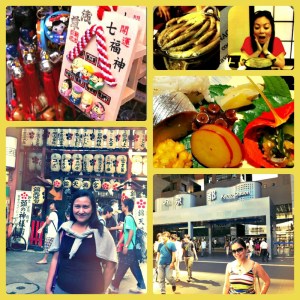
Images (clockwise from top left): Japanese trinkets for sale at the famed Nakamise-dori in Asakusa, Tokyo; Anita McKay deciding that dojo nabe may be an acquired taste (at a famous Tokyo restaurant); one of the many fabulous lunch courses at Gion Nishikawa in Kyoto; one half of the dynamic duo (A) outside of the JR Station in Kyoto; the other half of the dynamic duo (P) at Nishiki Tenmangu Shrine, just outside Nishiki Market, Kyoto. All photos from Anita McKay’s personal collection.

RANDOM NOMAD: Liv Gaunt, Accidental Serial Expat and Feeder of Sharks

Place of birth: Luxembourg
Passport: UK
Overseas history: England (Sevenoaks, Kent): 1981–98); Turkey (Fethiye, Ölüdeniz, Fethiye again): 1998–99, 2001–02, 2004; Kenya (Watamu): 1999–2000; Egypt (Dahab): 2000-01, Bahamas (Nassau and Family Islands): 2002–03; Barbados (Bridgetown): 2004–05; England (London): 2006–10; Australia (Cairns, Brisbane, Esperance): 2011 – present. (Gosh, I feel like a serial expat listing so many places!)
Occupation: Journalist and scuba instructor
Cyberspace coordinates: The World is Waiting — Expat humour, travel tips, handy hints, photos and inspiration for travellers (site); @worldswaiting (Twitter handle); The World is Waiting (Facebook); WorldsWaiting (Pinterest); and Liv G (foursquare).

What made you leave your homeland in the first place?
Though I am fond of Britain, I left because I was seeking work as a scuba diving instructor and underwater photographer. The jobs available overseas offered a better diving experience and a better lifestyle. Photographing sharks, filming turtles, and teaching people to dive in an island paradise conditions are not things you can do in Britain.

Is anyone else in your immediate family “displaced”?
My parents were expats in Luxembourg, which is where I was born. For a few years my father was based in Barbados for work, so I guess it runs in the family — but nobody other than me is displaced at this moment.

Your chosen profession of diving and underwater photography has led you to settling, at least for a time, in quite a few different countries. Tell me about the moment when you felt the most displaced.
I believe it is the people who make the place. I feel most displaced when I am surrounded by people who do not treat others with what I consider to be the most basic level of respect — basically, as they would wish to be treated. Discovering cultural differences can be fascinating; but living with discrimination day in day out is frustrating and awful. Living in Egypt I found it really frustrating that men would not take me seriously simply because I am female. They completely disregarded the fact that I had more experience and was more qualified than they were. Of course I understand there are significant differences between Arab and Western culture. But being in a male-dominated industry (scuba diving) in a paternal society (Egypt) was simply not for me.

Was there one specific moment during your time in Egypt that catalyzed this feeling for you?
No, I think it was more the growing realization that I would never be taken seriously.

Describe the moment when you felt your least displaced — i.e., when you felt more or less at home in one of your adopted countries.
The first time I lived somewhere other than with my parents, was in Turkey in my late teens. I took on the responsibility of earning enough to pay rent, bills and to feed myself — and it was all in Turkish. It was a classic example of me diving in at the deep end, so to speak. As a result, I quickly gained a working knowledge of the Turkish language as well as an understanding of the country, culture and its people. Initially I thought that my Turkish friends would be horrified by my near constant butchering of their language. But they only ever encouraged me — and even nicknamed me “the Turkish-English girl.” Nowadays, whenever I visit Turkey I feel very at home there. I don’t have the normal visitor’s questioning of things. I still have quite a few Turkish habits like always removing my shoes indoors, being quick to hit the horn whilst driving, and showing hospitality to visitors.

You may bring one curiosity you’ve collected from each of your adopted countries into The Displaced Nation. What’s in your suitcase?
From Turkey: An evil eye. Evil eyes are so-called, rather misleadingly, as they are believed to ward off evil. They are usually made from glass or ceramics and are often seen hanging over entrances to offices and people’s homes.
From Kenya: Some beaded sandals made from leather and old car tyres. They are the most comfortable sandals I ever had.
From Egypt: Egyptian hibiscus tea. They serve it warm with a classy piece of foil over the top of the glass!
From the Bahamas: Pink sand from Harbour Island. All Bahamian sand is silky soft and impressive frankly but on Harbour Island it is even more beautiful for being a dusky pink.
From Barbados: An amazing reggae soundtrack.
From Australia: Can I bring a quokka? They are small marsupials, a bit like a large-bottomed mini-kangaroo. I find them endlessly amusing.

And now you are invited to prepare one meal based on your travels for other members of The Displaced Nation. What’s on your menu?

Starters: A huge plate of Turkish meze including filled filo pastries, various dips, Turkish bread, olives, cheese and some köfte.
Main: Bahamian conch fritters — the conch will be fresh from the sea and delicately fried — served with lime coconut dip and salad.
Dessert: An Australian pavlova, covered in fresh fruit.
Drinks: To include Caribbean piña coladas and mojitos, and Turkish cherry juice.

It would be a strange meal perhaps, but very tasty!

I wonder if you could also add a word or expression from one of the countries you’ve lived in to The Displaced Nation argot.
Ubuntu, which is an African ethical philosophy. Nelson Mandela explained it thus:

A traveller through a country would stop at a village and he didn’t have to ask for food or for water. Once he stops, the people give him food, entertain him. That is one aspect of Ubuntu, but it will have various aspects. Ubuntu does not mean that people should not enrich themselves. The question therefore is: Are you going to do so in order to enable the community around you to be able to improve?

Your life thus far has been quite an odyssey. You’ve traveled to 42 countries and lived in six. Do you think of yourself as a travel pro?
I don’t consider myself a professional traveler. To me, that term implies that I am paid to travel, which is certainly not the case. I am inspired to continue traveling to new places because I enjoy learning about people’s lives and cultures, and seeing the world through their eyes. I find the different foods interesting as well. Travel also allows you to see where you have come from in a whole new light.

What’s still on your bucket list?
Oh, it’s endlessly growing! Top of the list currently are the Philippines and the Galápagos.

But you are a professional scuba diver. Did you watch the diving events in the London Olympics?
I wasn’t able to watch most of the Olympics because of the time difference between Australia and Britain and a recent spate of overtime at my job. However, to answer your question, no, I have little interest in competition diving. I am not a competitive person generally and rather believe that at the end of the day the only person you ever truly compete with is yourself.

What made you so certain you wanted to be a scuba diver?
I enjoy interacting with the creatures of the deep. Watching as a shark cruises out of the blue towards you, having a curious manta ray investigate you, or sharing a moment with a cheeky turtle is far more fun to me than being faster or more coordinated than someone else. I also enjoy the challenge of capturing the underwater critters on camera.

As it happens, this week marks the 25th anniversary of Shark Week, the Discovery Channel’s longest-running programming event. The purpose is to draw the attention to the shark species, one third of which is at risk for extinction. (We must all stop eating shark fin soup — up to 73 million sharks are killed each year for their fins!) I understand that you love to video and photograph sharks. Is that the riskiest thing you’ve done under water?
Most people would say the riskiest thing I have done underwater is feed sharks. It’s not about thrill-seeking, though, but about providing divers with an up-close encounter, which I think is the best way to educate people about and ultimately protect the sharks.

But while you are a shark lover, you have an aversion for sea urchins. Why is that?
If you ask me that question, I have to assume you have never accidentally brushed past one and received an ankle full of their bloody painful spines?!

But have you ever eaten uni in a Japanese restaurant?
No. I love sushi but haven’t managed any sea urchin yet. Have you, is it good?!

Readers — yay or nay for letting Liv Gaunt into The Displaced Nation? Is she above water or is there something fishy about her application? (Note: It’s fine to vote “nay” as long as you couch your reasoning in terms we all — including Liv — find amusing!)

STAY TUNED for tomorrow’s compendium of books on travel to Tuscany.

If you enjoyed this post, we invite you to register for The Displaced Dispatch, a round up of weekly posts from The Displaced Nation, with seasonal recipes, book giveaways and other extras. Register for The Displaced Dispatch by clicking here!

Related posts:

img: Liv Gaunt videoing a shark feed in the Bahamas.

Christmas in July & other Winter’s Tales from an expat Down Under

After sweltering through America’s hottest July on record, three of us Displaced Nation writers have been imploring the fourth, Tony James Slater, for some cooling stories from his newly adopted home of Perth, Australia.

I noticed a Christmas tree in my gym a couple of weeks ago. I wondered what the hell it was doing there, until some kind staff member — presumably on hearing me curse in the middle of the foyer — decided to enlighten me.

Christmas in July, the Aussies call it — for no apparent reason other than that most countries celebrate Christmas when it’s freezing cold outside, with snow on the ground and cards covered in penguins and polar bears decorating the mantle piece.

July is as cold as it gets in Perth. The temperature — sometimes — dips into the single digits overnight, and we wake up to a sensation overly familiar to a Brit like me: not wanting to get up because it’s warmer in bed!

Once upon a time, when I made my first visit to Oz from Thailand, all those years ago, I arrived (in my infinite wisdom) in June. At 6:00 a.m.

I had no idea Australia had seasons. From the postcards and other literature, I’d assumed it was the Land of Eternal Summer.

It was achingly cold, pouring it down with rain — and I was wearing a pair of shorts and a vest [tank top], because that’s all the clothing I owned!

I’m now super careful when advising my friends who plan on visiting: “Don’t come November to February,” I tell them. “It’ll be way too hot. You won’t be able to breathe.

But don’t come June to August either — it’ll be too cold! And all sensible Australians will be holed up inside with our mitts wrapped around a hot cup of Milo.”

Mmmmmm…. Have you ever had Milo? It’s a hot chocolate malt drink. I must say, it really hits the spot this time of year.

Storm warning!

We have our blistering hot summers, too, down in Oz. In fact, the whole country is geared around this inevitability. That may be why no one seems quite prepared for the winter.

It rains, of course — it has to, otherwise we’d be in an even worse state come summer. But no one here is quite ready for it when it does.

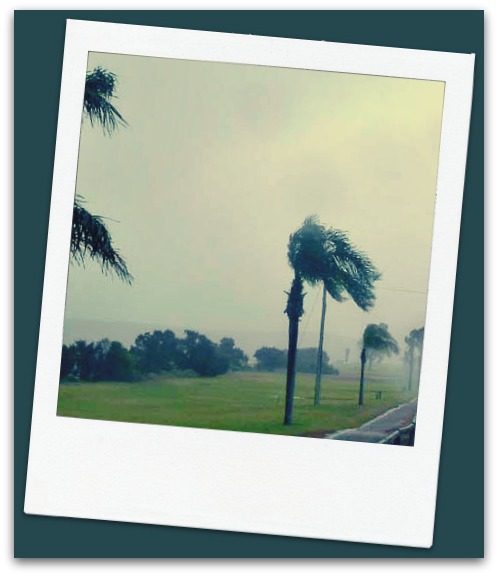
Take the Great Perth Storm of 2012, for example. Several weeks ago now, there was a severe weather warning issued. Businesses closed early. Employees scurried home, fearing what would happen if they were caught in traffic when The Big One hit. By the time it started raining, the streets were deserted – which was probably a good thing. Boy, did it rain! It rained, and rained, and the good folk of Perth cowered indoors, until…the rain stopped.

And that was it.

I honestly think half of them didn’t expect to survive it.

They were most upset when they had to drive to work the next morning, through rapidly drying puddles.

The four seasons in one day

But let’s not get carried away; to those of you fanning yourselves under an air-con unit, wishing you’d remembered to get it serviced before the heat-wave hit, I can sympathize — it’s not exactly cold here all the time.

Even in winter, the middle of each day is quite pleasant — probably what you’d call “beach weather” on most of the rest of the planet.

Charles Dickens’s description of an English springtime seems most appropriate:

It was one of those [March] days when the sun shines hot and the wind blows cold: when it is summer in the light, and winter in the shade.

Have you ever worn a hat indoors?

Perhaps because of this, the houses here are built without insulation, and without any form of central heating. Most of them have a little wood-burning stove in a corner of the family room, but that’s it — and of course no double glazing!

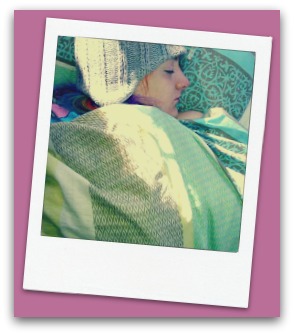
Houses built like this in Europe would never pass the building code, but it seems that the housing industry here just doesn’t worry about it. Yeah, sure, they’re building houses that’ll be a bit cold in winter. But the owners can always wear a jumper! Or, as frequently happens when we visit my father-in-law in his house in the Perth hills, a scarf, gloves and a beanie…

In an unheated, un-insulated house at night, there are only two things to do — and one of them doesn’t really belong on a public forum like this. The other, of course, is to wear as many layers as you can — kind of like you’re going hiking in a blizzard — and try to keep exposed flesh to a bare (sorry!) minimum.

Of course, this being winter, you can find that blizzard. Just about. There’s nothing between the bottom of Australia and the top of Antarctica, so our southern seas get a little chilly around now. We have snow-capped mountains – okay, we have a snow-capped mountain. Sometimes…

But the scene over in neighboring New Zealand is a little frostier!

In fact, my sister is there right now, training to be a skiing instructor.

And because the architecture over there is mostly derived from what we have over here…her house also doesn’t have any heating either.

All things being equal…

I’m content to be cold once in a while. It reminds me of home — just a little, in a slightly-chilled-’till-the-sun-comes-up kind of way. Not like actually being back in England — where, even though it’s summer, I think it’s colder than here… I mean, did you see that beach volleyball tournament? Only in London could they import twenty tonnes of sand and play beach sports in torrential rain…in bikinis.

Now there’s a refreshing image!

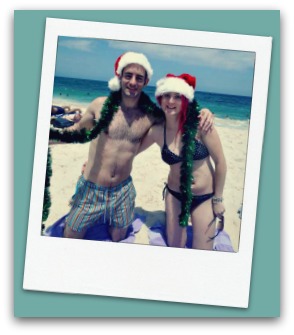
So instead of feeling sorry for yourselves over there in sweltering America, please do feel pity for us over here. After the terrible inconvenience of our slightly chilly winter, we have plenty of other ordeals to face — like Christmas on the beach!

* * *

So tell me: would you rather be here — or where you are right now? Let me know in the comments, or on Twitter: @DisplacedNation +/or @TonyJamesSlater. Now back to my nice mug of Milo before it gets cold — cheers!

STAY TUNED for tomorrow’s Random Nomad, who, too, has some stories to help alleviate the effects of the heat…

If you enjoyed this post, we invite you to register for The Displaced Dispatch, a round up of weekly posts from The Displaced Nation, with seasonal recipes, book giveaways and other extras. Register for The Displaced Dispatch by clicking here!

Related posts:

Main image:  “Polaroids” are all from Tony James Slater’s collection: The Great Perth Storm of 2012; Tony’s wife, Roo, asleep in her dad’s house in the hills of Perth (2012); Tony & Roo celebrating Christmas on Cottesloe Beach, near Perth, Australia (December 2011).

RANDOM NOMAD: Brian MacDuckston, American Expat in Tokyo & Expert Ramen Slurper

Place of birth: San Francisco, California USA
Passport: USA
Overseas history: Japan (Saitama, Hiroshima, Tokyo): 2006 – present.
Occupation: Food consultant and freelance English teacher (available for high school classes, after-school programs, private lessons, children’s events…)
Cyberspace coordinates: Ramen Adventures (blog); @macduckston (Twitter handle); and Ramen Adventures (Facebook).

What made you leave your homeland in the first place?
Around 2004 I took a colloquial Mandarin Chinese class, hoping to learn a bit to help with the massive amounts of Kung Fu movies I was into at the time — I soon learned that Cantonese, not Mandarin, is used in these flicks. One of my classmates was going to China for a year to teach English. I did some Internet searching and decided I really wanted to check this out. I was stressed with my computer job, and a year abroad seemed like a good idea. Opportunities abound in China, Korea, and Japan. Japan just seemed like a good choice to me.

You’ve now lived in Japan for more than five years. Tell me about the moment when you felt the most displaced.
My first day of work in Saitama, I somehow managed to get on an empty train that had reached its last stop. A minute later and I was in the depot storage yard with an attendant yelling at me in a language I didn’t understand. I was late to my very first English lesson. I wanted to quit right away. Things got better, obviously.

Is there any particular moment or moments that stand out as your least displaced?
Whenever I’m on the road here in Japan. I ride a motorcycle — very few foreigners do that. Something about being able to navigate across mountain ranges on poorly marked roads fills me with a great sense of accomplishment.

Hmmm…are you sure it’s safe? And now you may bring one curiosity you’ve collected from your adopted country into The Displaced Nation. What’s in your suitcase?
A curiosity? I am actually quite a minimalist, collecting only photos. My Nikon camera is technically a Japanese thing. I guess I would choose that. Or perhaps I should consider bringing a few of my Japanese cooking knives. Beautifully crafted and razor sharp, they are amazing things.

Ah, cooking! I’m glad you mentioned that. You are invited to prepare one meal based on your travels for other members of The Displaced Nation. What’s on your menu?

Ramen of course! Let’s go ahead and serve it after the drinks. After many drinks. Ramen is one of the best hangover prevention foods. All that fat and all those carbs do wonders for the next morning.

And now you may add a word or expression from the country you live in to The Displaced Nation argot. What will you loan us?
Umai is a great food word in Japanese. Most people first learn oishii to mean delicious, but umai is a bit stronger, a bit more cool. It’s mostly a guy word, though. I hope that’s okay with the female occupants of the Displaced Nation?

Perfectly okay! This summer, thanks to the London Olympics, all of us Displaced Nation residents, whether male or female, have become obsessed with displays of machismo and strength. In fact, this may be a good time to bring up your hobby of eating ramen in as many Tokyo venues as possible. How did you get launched in such a curious culinary sport — and become so accomplished that you and your blog were featured in the Travel section of the New York Times?
After living in Hiroshima for a bit, I knew that I needed to live in the big city.  So I finished my contract, signed up for unemployment insurance, and moved to Tokyo. Suddenly I found myself with a massive amount of time on my hands — and not a lot of money in my pockets. I decided to wait in the ridiculously long ramen shop line that I had seen many times across the street from a massive bookstore in Ikebukuro, one of Tokyo’s multiple city centers.

I was shocked how good it was. Completely worth the hour wait outside in the cold. A bit of research later, and I had a list of the 30 best shops in Tokyo…a nice place to start.

Thirty shops sounds rather daunting, particularly if each one involves standing in line for hours! What keeps you going, and do you still like ramen after the upteempth bowl of it?
What keeps me going? A job that doesn’t pay much! In fact, it’s the kind of random fun that comes with this obsession that keeps me going. When I can somehow influence someone to have the best bowl of ramen they have ever had, I feel like it is worth it.

Would you say that you’ve now graduated from amateur to pro?
Becoming a pro in such a niche corner of the food world is tough, but I suppose the few guidebook articles or magazine pieces I have worked on would put me up there.

Readers — yay or nay for letting Brian MacDuckston into The Displaced Nation once he’s finished slurping up his latest bowl of noodles? Tell us your reasons. (Note: It’s fine to vote “nay” as long as you couch your reasoning in terms we all — including Brian — find amusing!)

STAY TUNED for tomorrow’s Displaced Q, about nationalism and the Olympics.

If you enjoyed this post, we invite you to register for The Displaced Dispatch, a round up of weekly posts from The Displaced Nation, with seasonal recipes, book giveaways and other extras. Register for The Displaced Dispatch by clicking here!

Related posts:

img: Brian at a ramen-ya in Tokyo, pursuing his favorite “sport.”

LESSONS FROM TWO SMALL ISLANDS — 3) Keep calm and eat curry

Mid-July in Manhattan, and I’m thinking that New York deserves its reputation as The City That Never Sleeps. Not because we’re all out partying — far from it. We’re lying there tossing and turning because we can’t regulate our air-conditioning units.

“High” puts you in Siberia; “Low” sends you down into the Tropics. There are no in-betweens, except for the brief period just after you’ve gotten out of bed to adjust the setting. But by then you’re awake again…

It has always surprised me that New Yorkers are willing to put up with such primitive cooling methods. It’s not like them to suffer silently. My theory is that they simply don’t know any better. As the world begins and ends in New York (isn’t Times Square supposed to be the center of the universe?), this must be the best of all possible air conditioning systems.

Regardless. The point is that I am finding summer a terrible trial now that I’ve repatriated — one that at times requires Olympic strength and endurance.

As summer wears on, I wear out. Not only do I never sleep but I never eat — or eat only minimally. My appetite dwindles at the thought of passing yet another uncomfortable night at the mercy of Simon-Aire products.

All of that changed, however, a few nights ago. Actually, the night had started normally enough: I had gone to bed and was freezing cold so couldn’t sleep. But just as I was lying there thinking about getting up to turn the air con down or else searching the closet for another blanket, I had a sudden, heartwarming thought: “I could kill for a curry!”

How did I go from cursing Dr. Cool, whose workers had installed a supposedly upgraded Simon-Aire unit in the bedroom at considerable cost, to a happy craving for curry? I can only surmise that my subconscious mind was trying to restore my spirits by reminding me of my curry-eating days in the two small islands where I’d lived as an expat, England and Japan. I felt calm again, and my appetite returned…

America — a nation that has deprived itself of a serious curry experience

When I first moved to New York, I was beyond thrilled to discover that the Indian actress and cookbook author Madhur Jaffrey lived here, too. To my utter surprise (and delight) — I had always assumed she lived in London — she has been residing in an apartment on the Upper East Side for the past several decades. (She also has a farmhouse in the Hudson Valley.)

Surprised in a good way, yes — but also somewhat mystified. Why would Jaffrey choose to live in America for so long, given the sorry state of Indian cuisine in this part of the world?

I guess it has to do with husbands — she came to the city with her first husband, the Indian actor, Saeed Jaffrey, and then after their divorce, married an American.

Or perhaps she just likes a challenge? In Jaffrey’s very first cookbook, An Invitation to Indian Cooking, written not long after her arrival on American soil, she says she is writing the book because

there is no place in New York or anywhere in America where top-quality Indian food could be found, except, of course, in private Indian homes.

That was nearly forty years ago, and I have to say, her efforts to improve the situation, beginning with that book, have yet to pay off. Manhattan now has a couple of Indian restaurant neighborhoods, and then there’s Jackson Heights in Queens — but in general curry hasn’t caught on in a big way with Americans. If we want to eat spicy food, we usually turn to Mexican or Thai, not Indian.

As Jaffrey herself put it in an interview with an American reporter last year:

America as a whole has not embraced Indian food like they have with Chinese, or with sushi. It’s beginning to change, but only in big cities. Something is needed, something real. I have waited for this revolution, but it hasn’t happened yet.

This is in stark contrast to England and Japan — both of which embraced the curry cause on first exposure and now behave as though they’d invented certain dishes. Indeed, chicken tikka is considered to be a national dish in the UK, while “curry rice” (pronounced karē raisu) rapidly achieved the status of a national dish in Japan.

Nostalgia: Going out for a curry in England

England, my England — where Madhur Jaffrey is a household name, and curry houses abound!

Britain got the hots for curry during the 19th century, when there was an enthusiasm for all things Indian. And I got the hots for the Brits’ late-20th-century version of curry when living in an English town as an expat. My friends and I would spice up our evenings by going out for curries. We always ordered a biriani, chicken tikka masala, and a couple of vegetable dishes (one was usually sag paneer, which remains a favorite to this day).

Our starters would be onion bhaji and papadums, and drinks would be pints of lager. If we had the space for dessert, it was usually chocolate ice cream — none of us ever acquired the taste for Indian desserts (dessert of course being an area where the British excel!).

But even more special were the times when friends invited me to their homes for meals they’d concocted using Madhur Jaffrey’s recipes. One memory that stands out for me is an occasion when my former husband, a Brit, and I joined four other couples for a friend’s 40th birthday party. The hostess, the birthday-boy’s wife, presented a dazzling array of Madhur Jaffrey dishes that looked like something out of a food magazine. I’ve been to much ritzier birthday parties before and since, but none have struck me as being as elegant as this one — partly because of the splendid display and partly because by then I knew how much chopping and dicing of garlic, ginger and onion, how much grinding of spices must have been involved. What a labor of love!

Yes, by then I’d begun experimenting with Indian cookery myself thanks to the influence of a very good friend, who’d given me the classic Madhur Jaffrey work, Indian Cookery (which had been a BBC series), along with all the spices I would need for making the recipes: nutmeg, cinnamon, cardamon, mustard seeds, coriander, cumin turmeric, cloves… To this day, I always keep an array of Indian spices in my pantry so that I can make my own garam masala at the drop of a hat. Now if only I could find some friends who would drop their hats! (Hey, I even have the old coffee grinder ready for grinding the spices, just as Jaffrey instructs.)

Nostalgia: Curry rice & curry lunches in Japan

Eventually, I moved away from England to another small island, Japan — where I was relieved to discover I would not need to give up my new-found passion for Indian food (though I would be foregoing my beloved basmati rice unless I smuggled it in at customs).

Thankfully, the Brits had gotten there about a hundred years before me and had introduced curry to the Japanese, with great success.

Because of “r” being pronounced like an “l” in the Japanese language, we foreigners couldn’t resist making many tasteless jokes about eating curried lice, but that didn’t stop us from having our fill of the tasty national dish, curry rice.

As in the UK, I found it a nice contrast to the traditional fare, which, though healthy, can be rather bland.

At this point, I’d like to loop back to Madhur Jaffrey and note that she disapproves of the word “curry” being used to describe India’s great cuisine — says it’s as degrading as the term “chop suey” was to Chinese cuisine. But I wonder if she might make an exception to the Japanese usage? Apparently, Indians themselves when speaking in English use “curry” to to distinguish stew-like dishes. And Japanese curry rice is the richest of stews, made from a “roux” that can be bought in a box if you do it yourself.

My first box of curry roux was a gift from a Japanese friend. It was accompanied by her recipe for enriching the stew with fresh shrimp and scallops. Oishii!

Still, the curry I crave most often from Japan isn’t curry rice at all, which I find on the heavy side. No, my deepest nostalgia is reserved for the set lunches in Tokyo’s Indian restaurants, which I used to partake in with office colleagues.

The (mostly Indian) chefs have tweaked the ingredients to appeal to the Japanese palate: little dishes of curry that are artistically arranged on a platter, accompanied by naan. freshly baked (fresh is very important to the Japanese) and a side of Japanese pickles: pickled onions, or rakkyōzuke (a tiny, whole, sweet onion); and pickled vegetables, or fukujinzuke.

(The addition of Japanese pickles, by the way, is genius! Try it — you’ll love it!)

All of this is capped by coffee or masala tea, both of which are so well executed they can fill in as desserts.

My takeaways (I wish!)

I fear there may not be many takeaways for my fellow Americans from Lesson #3. After all, the world’s leading authority on Indian cuisine has tried to convert us and failed.

Nevertheless I’ll suggest a few scenarios, with pointers on how you might attempt to introduce a curry-eating tradition into your circle:

1 — Summer is getting to you, so you suggest to a group of friends that you all go out for a curry. When they stare at you blankly, do a little head bobble, smile charmingly and say: “Why ever not?”

2 — Summer is getting to you, and you decide to build a shrine to Madhur Jaffrey in your home by buying as many of her books as you can — including her children’s book on the Indian elephant, Robi Dobi, and her memoir of her childhood, Climbing Mango Trees. You arrange them around a screen that is playing Shakespeare Wallah, a film she appeared in in the 1960s (directed by James Ivory and starring Felicity Kendal). Invite some friends over and when they ask you about the shrine, start talking about the joys of Indian cookery and see if you can make some converts. Perhaps offer to lend out a book or two. (I might start with her newest work, which emphasizes “quick and easy” methods — bless the 78-year-old Jaffrey, she’s indefatigable!) And you can always dip into the books yourself if the heat is making you sleepless. Jaffrey writes beautifully.

3 — Summer is getting to you, but you decide that when the heat breaks, you will start up a Curry Club with a few of your friends, encouraging everyone to contribute one Madhur Jaffrey dish or a Japanese curry made from roux. Even if most of them drop out and you end up cooking a dish for yourself, perhaps this exercise will satisfy your craving until winter. (I find I get these cravings roughly every six months, usually in summer and winter.)

* * *

Well, I’m off to see if I can resume my sweetly fragrant dreams of my expat culinary adventures — just hope it does the trick of distracting me from my ancient “aircon” (popular Japanese contraction) units!

In the meantime, let me know what you think of this lesson. Are you a curry lover? And if so, could you live in a nation that doesn’t share your craving? How would you put some spice into your life under such sorry circumstances? Do tell!

STAY TUNED for Thursday’s post, another in our “Expat Moments” series, by Anthony Windram.

If you enjoyed this post, we invite you to register for The Displaced Dispatch, a round up of weekly posts from The Displaced Nation, with seasonal recipes, book giveaways and other extras. Register for The Displaced Dispatch by clicking here!

Related posts:

Image: MorgueFile

RANDOM NOMAD: Melissa Stoey, Former Expat in UK and Incurable Britophile

Place of birth: Northern Virginia, USA
Passports: USA
Overseas history: England (Huntingdon, Cambridgeshire + Shefford, Bedfordshire): 1988-91.
Occupation: Research technician (basically I do data analysis) and part-time professional blogger.
Cyberspace coordinates: Smitten by Britain: Home of the Britophile (blog); @SmittnbyBritain (Twitter handle); Facebook page; and Pinterest.

What made you leave your homeland in the first place?
I’m intrigued by other cultures and more specifically by the British culture. I have been fascinated by Britain since I was a young teen. I have always had the itch for travel and I knew I definitely wanted to visit the UK, if not live there. My love for travel one of the reasons I joined the military. I put England down as my first choice for duty station and I got it!

Where were you stationed?
At Chicksands air base (Chicks for shorts). It’s now Royal Air Force (RAF) Chicksands. Britain’s Ministry of Defense has since taken it over.

You ended up marrying a Brit, right?
Yes. My first husband, and the father of my son, was stationed at what was then RAF Brampton, which is in Cambridgeshire. At first we lived in Huntingdon, but then he got transferred to a base in Hitchin, which is closer to Chicks, so we moved to Shefford.

Is anyone else in your immediate family “displaced”?
Ironically, my brother was stationed at Chicks three years before, so it sort of felt like I was meant to go there. Right now, I don’t have any displaced relatives, but my son is a dual national between the U.S. and U.K. I suspect at some point he may move to the U.K. after he fulfills his dream of living and teaching in Japan for a year. We’ll see! It may be a case of like mother, like son.

So you and your son now live in the United States?
Yes. His father and I are divorced. We came back and lived in Texas for a year, then West Virginia. We now live in Pennsylvania. Meanwhile, his father has gone back to Scotland, where he is from.

How often do you return to the U.K.?
My son and I, and my second husband — I am now married to an American! — try to go every year or at least once very two years, depending on funds and time off.

Can you describe the moment in your association with Britain when you felt the most displaced?
The first night I was in England the culture shock was horrible. I lived around sixty miles north of London in a small village where there were no street lights, and when I looked out the window there was complete and utter darkness. It felt as if I’d landed on a different planet with no signs of life. This was 1988 when almost everything closed much earlier than it does now and wasn’t open on Sundays. If you switched on the radio you might pick up two or three stations, the television had only four channels and of course there was no Internet. It felt much more isolating than if you moved to England today; it has changed by leaps and bounds in the last 25 years as far as conveniences go. I envy current expats who have so many wonderful resources available to help limit the culture shock and make the transition easier.

Is there any particular moment that stands out as your “least displaced”?
We had a great night back in July of 2010 when we met a Glaswegian couple at a curry house in the west end of Glasgow. They invited us to the pub for drinks where we spent the night taste testing different whiskies. I felt totally at home, like I had known this couple my whole life. The Scots have a way — similar to Americans — of making one feel welcomed and accepted. I can say this because of having once been married to a Scot and having spent a lot of time there. My ex-husband was, and still is, one of the friendliest people I know.

You may bring one curiosity you’ve collected from your adopted country into The Displaced Nation. What’s in your suitcase?
My bag is always full of tea and sweets from England. I never return without them. I always pack a few British newspapers as well because my parents are Anglophiles, have been to England many times and enjoy reading them. Rumor has it that some of you Displaced Nation citizens are avid tea drinkers and readers, and that you rarely turn down sweets.

You are invited to prepare one meal based on your travels for other members of The Displaced Nation. What’s on your menu?

I will fix my favorite meal which is a nice Sunday roast that includes roast beef, roasted potatoes, carrots, peas, and Yorkshire pudding (I don’t do sprouts, thank you.) We’ll finish it off with a nice pot of tea and a slice of Victoria sponge, with jam and whipped cream.

And now you may add a word or expression from each of the countries where you’ve lived to The Displaced Nation argot. What will you loan us?
I’m feeling peckish. I say that quite often and it always results in the odd look or two. It’s just not used here, at least where I live. To feel “peckish” means to feel slightly hungry.

Earlier this month, we did a series of posts on Queen Elizabeth’s Diamond Jubilee. Incurable Britophile that you are, I presume you celebrated from a distance?
I watched the River Pageant, which was on early in the morning East Coast time, and then hosted my own Diamond Jubilee lunch (see photos on my blog). The food was great — we nibbled on leftovers for days! Even though I didn’t have a big party (it was just for my family), I was glad to do it to show my blog readers that you don’t have to be in Britain to celebrate properly. You can still enjoy yourself and take part in your own little way.

A couple of us on The Displaced Nation team thinks that the Queen deserves an Olympic medal for having survived almost being displaced by Princess Diana. Do you agree?
I don’t agree that the Queen was almost displaced by Diana; if she was going to be displaced it would have been due to her actions (or lack of) that left the British public feeling as if she was heartless and out of touch. However, I still don’t think she would have been displaced. Time heals and I think many of us now understand the dilemma she faced as a grandmother trying to protect her grandchildren who just lost their mother. However, as Head of State I do wish she had at least made a televised message to the public within the first 24 hours. Waiting five days was a bit much.

Americans seem to love the Royal Family. Do you think the United States might benefit from having one?
The idea of the United States having a royal family at this point is a silly one. It doesn’t fit our history or where we are headed as a country. Let’s leave that to the nation that does Monarchy the best.

Readers — yay or nay for letting Melissa Stoey into The Displaced Nation? Tell us your reasons. (Note: It’s fine to vote “nay” as long as you couch your reasoning in terms we all — including Melissa — find amusing!)

STAY TUNED for tomorrow’s episode in Libby’s Life, our fictional expat series set in small town New England. (What, not keeping up with Libby? Read the first three episodes of her expat adventures and/or check out “Who’s Who in Libby’s Life.”)

If you enjoyed this post, we invite you to register for The Displaced Dispatch, a round up of weekly posts from The Displaced Nation, with seasonal recipes, book giveaways and other extras. Register for The Displaced Dispatch by clicking here!

Related posts:

img: Melissa Stoey at Stirling Castle, Scotland, then and now — in 1989, when she was displaced (and cold!), and in 2010, when she was visiting (and warmer!).

RANDOM NOMAD: Lynne Murphy, American Expat in UK & Champion Linguist

Place of birth: Western New York State, USA
Passports: USA + UK
Overseas history: South Africa (Johannesburg): 1993-97; Texas, USA (Waco): 1997-99 — definitely a different country!; England, UK (Brighton): 2000 – present.
Occupation: Senior Lecturer in Linguistics, University of Sussex
Cyberspace coordinates: Separated by a Common Language — observations on British and American English by an American linguist in the UK (blog); @LynneGuist (Twitter handle).

What made you leave your homeland in the first place?
What made me move were jobs. I am a theoretical lexicologist. Not many places want a theoretical lexicologist, so I applied far and wide and have been rewarded with some very interesting jobs and living experiences.

Is anyone else in your immediate family “displaced”?
I was the first person in my immediate family-of-birth to own a passport.

Can you describe the moment when you felt the most displaced?
The night after the American student Amy Biehl was killed in South Africa, in August 1993. At that point, I lived in a granny flat — an outbuilding behind a house in a Johannesburg suburb. I came home to find my neighbours in the main house packing up and leaving for a safe place to stay, as they’d been robbed during the day. As they left, they told me the thieves had taken the spare keys to my flat — and had already come back to steal the bicycles from the garage. At that point, I had no car, no telephone (setting one up there took FOREVER), nowhere to go and no way to get there. I stayed up all night with the lights on and with a newspaper with the story of Biehl’s murder on the front page, feeling very alone and very scared.

Is there any particular moment that stands out as your “least displaced”?
Sometimes it’s funny to reflect on the fact that my own child speaks with an English accent, and I feel most absolutely at home with her. But I also often feel really divorced from the US when I read the news. When the hullabaloo about “Obamacare” was going on, I just couldn’t believe that I came from a place where many people seem not to see good medical care as a basic right for all. And it especially galled when I saw some Americans spreading lies about how British healthcare works and others willing to believe those lies. The National Health Service isn’t perfect, but it has saved my life, and I have more confidence in its care for me than I had in the insurance-industry-driven care I had in the US.

You may bring one curiosity you’ve collected from your adopted country into The Displaced Nation. What’s in your suitcase?
From South Africa: It’s the art that’s lasted! Two pieces by Ezekiel Madiba, a print and one of his printing blocks — which is nice because it’s sturdy enough to put in a suitcase and to hug every once in a while.
From Texas: My doctor’s instructions on what to do the next time I’m stung by a fire ant (to try to avoid being bed-ridden for a week, like the first time).
From England: My wedding ring. It’s a one-off, made by a Brighton goldsmith, and it’s a curiosity, because I hadn’t thought I was the marrying type.

You are invited to prepare one meal based on your travels for other members of The Displaced Nation. What’s on your menu?

Starter/Appetizer: South African biltong. A nice peppery one—but I don’t mind if it’s beef or game. Maybe a selection.
Main course: For this, I’ll bring together the British and the American — not fancy but delicious. I haven’t given it a name, but here’s the recipe: Toast crumpets. cover with cheddar cheese and put under the broiler/grill. Slather on A1 Steak Sauce. Eat with knife and fork.
Dessert: Eton mess with raspberries instead of strawberries.
Drinks: South African wine (I never had a South African wine I didn’t like while I was in South Africa– the exported stuff is of more variable quality, in my experience); Castle Lager (a South African beer); and Schweppes Bitter Lemon (a popular soft drink in South Africa, no longer being produced in this part of the world as far as I know).

And now you may add a word or expression from each of the countries where you’ve lived to The Displaced Nation argot. What will you loan us?
From South Africa: Putting hey? on the ends of sentences. It was so easy to start doing, since I’d grown up using the “Canadian” eh? (Though I hadn’t realized I said it till I moved from upstate New York to Massachusetts, where they don’t say it.) It’s been a while since I lived in South Africa, but I still find myself doing it.
From the UK: There are so many great expressions, but the thing that’s invaded my language most is lovely. When I write emails, I have to go back at the end and take out half of the lovelies because I say it so terrifically much.

This month we have been doing some posts on Queen Elizabeth’s Diamond Jubilee. How did you spend the Bank Holiday weekend? Did you celebrate?
We’re not much into the monarchy in my house, so we just enjoyed the extra time off. But we did go to a friend’s house and eat red-white-and-blue cupcakes — which we should probably have called “fairy cakes” if we wanted to take the whole Rule Britannia thing seriously.

A couple of us on The Displaced Nation team thinks that the Queen deserves an Olympic medal for being on the throne for so long. Do you agree?
I respect the queen for handling many awkward situations with grace, but all she has done to be on the throne so long is not die yet. She got a national holiday for the occasion—I think that’s sufficient!

Readers — yay or nay for letting Lynne Murphy into The Displaced Nation? Tell us your reasons. (Note: It’s fine to vote “nay” as long as you couch your reasoning in terms we all — including Lynne — find amusing!)

STAY TUNED for tomorrow’s episode in Libby’s Life, our fictional expat series set in small town New England. (What, not keeping up with Libby? Read the first three episodes of her expat adventures and/or check out “Who’s Who in Libby’s Life.”)

If you enjoyed this post, we invite you to register for The Displaced Dispatch, a round up of weekly posts from The Displaced Nation, with seasonal recipes, book giveaways and other extras. Register for The Displaced Dispatch by clicking here!

Related posts:

img: Lynne Murphy looking rather other-worldly — or  “out of this displaced world,” as we like to say — in a Brighton pub.