The Displaced Nation

A home for international creatives

NEW VS OLDE WORLDS: Would you rather chat about weather with a rugged Aussie or a whingeing Brit?

Libby Collage New&OldRegular readers of the Displaced Nation are treated every other week to a new episode in the life of fictional expat Libby Patrick, a 30-something British woman who has relocated with her spouse to a town outside Boston. Her diary, Libby’s Life, by Kate Allison, is replete with observations about life in New England vs. England. In the weeks when Libby isn’t published, we are featuring posts by writers who are sensitive to the subtle yet powerful differences between new and “olde” worlds. Today we hear from an occasional contributor, Kym Hamer, whose thoughts on the topic immediately drifted to the ten winters she has spent in her adopted home of London. Hmm…is that because her native Melbourne now has highs of 8°C, or 46°F (and overnight lows of -1°C, or 30°F)?

—ML Awanohara

Kym Outdoor Entertaining Australia Day 2008As an Australian who moved to the UK in 2004 and who continues to make London her home almost ten years on, I can’t really afford to have any quarrel with the weather.

It is one of the quintessential British-isms, this obsession with weather, and it is the question I find myself in the midst of most debate aboutalways at the first meeting and often well into several years of cross-cultural friendship.

The stereotype of Australia’s big blue skies, fresh-faced outdoorsy-ness and neighbourly games of cul-de-sac cricket prevails so strongly in the British psyche, that any suggestion that all is not what it appears Down Under comes across as churlish, un-conversational and bordering on arrogant ungraciousness.

It’s not worth arguing: the Brits like to be right about this.

But what has struck me most about these conversations is that they usually occur in overheated pubs, lounge-rooms, Tube carriages and lifts with the protagonists sitting or standing around in their shirtsleeves complaining about the cold.

I have never met a nation so unwilling to put a jumper on.

(Which reminds me of a rather bad joke: what do you get when you cross a kangaroo and a sheep? A woolly jumper!)

Wrap up warm, but not too warm

I’ve been caught out myself, rugging up [putting on lots of clothes in anticipation of going somewhere bl**dy freezing] upon leaving the house on a chilly morning. Silently congratulating myself on my toasty (sometimes even thermal) attire, I find myself wishing I could dispense with three quarters of it half an hour later.

And let me tell you, it’s a royal pain to carry around a heavy winter coat and quite embarrassing to sit sweating profusely in a job interview because everything you could have possibly taken offand still remain decent, let alone remotely “put together”has been shed.

So I’ve learnt to avoid the thermal underwear and to dress in layers. More or less like a pass the parcel parcel.

Tuning into the daily weather forecast on the radio as I open one sleepy eye each morning, I’ve learnt that it pays to double check that the light spring coat hanging at the ready should not be replaced by something more…or less.

Accessorize!

But the biggest lesson I’ve learnt is this: it’s the extremities that matter and the right hat, scarf and gloves can make all the difference.

As the temperature and wind chill factor pas de deux through London during any given month, the right “weight” of this essential triumvirate can have me either swanning about in a state of slightly disheveled fabulous-ness or looking as though I’ve been dragged through a damp hedge backwards.

As such I have acquired:

  • several right “hats”
  • a range of pashminas—from warm woolly to just to keep the chill off on a “summer” evening
  • many suitable scarves (they are defined by being more slender in shape than a pashmina)
  • not one but two perfect pairs of gloves—a heavy-duty, super-warm pair and a lightweight purple leather set.

Which reminds me how hacked off I was to lose one of the heavy duty duo in January—and must make a note to myself to buy the perfect replacement pair. I’ve learnt that’s harder than it sounds. Who knew such things would become so important to me?

And then there’s the bag. My handbag grew exponentially into a “tote” during my first few years in London, becoming big enough to stuff in one or any combination of this trio as I climbed up/down Tube escalators, entered offices and interview rooms, got on and off buses and hugged friends in the doorways of their toasty digs.

Thank goodness other essentialsphones, umbrellas, (e)bookshave gotten smaller.

“Bring something warm—if it’s dry we’ll be sitting outside!”

But when I am at home and the climate is just my own again, slippers and cozy throws abound, whether I’m curled up on the couch in the lounge room, cooking up a frenzy in the kitchen or tucked under the duvet in my bedroom. The heating does get turned on but only when a jumper just isn’t enough.

I am famous (or infamous?) for invitations tagged with “bring something warmif it’s dry we’ll be sitting outside.” Guests laugh knowingly and remark about taking the girl out of Australia and all of that.

But baby, when it’s cold outside, quite frankly you should already know the drill:

Put a bl**dy jumper on!

* * *

Thanks, Kym, for that impassioned account of what it’s like for an Aussie to live in the midst of limeys who’d prefer to moan about the cold instead of taking practical measures. And speaking of whingeing limeys, you’ve given us Yanks yet another reason to feel pleased that we declared our independence from Britain on this day 237 years ago!

Born and raised in Melbourne, Kym Hamer has worked in London in sales and marketing for nearly ten years. She writes the popular blog Gidday from the UK. Also follow Kym on Twitter: @giddayfromtheuk.

STAY TUNED for next week’s series of posts—and a Happy 4th of July Weekend, meanwhile, to US-based readers!

If you enjoyed this post, we invite you to register for The Displaced Dispatch, a round up of weekly posts from The Displaced Nation, with seasonal recipes, book giveaways and other extras. Register for The Displaced Dispatch by clicking here!

Related posts:

Img: Photo of Kym Hamer entertaining outdoors, glass of wine in hand, in honor of Australia Day (January 26).

Portrait of woman from MorgueFile; Lighthouse (R) from MorgueFile; Lighthouse (L) from MorgueFile

GLOBAL FOOD GOSSIP: Pastry or pie dough? Whatever you call it, it’s child’s play.

JoannaJoanna Masters-Maggs, our resident Food Gossip, is back with her monthly column for like-minded food gossips.

This month, Joanna comes clean about the reasons for her dissatisfaction with the world today. Who knew that pastry (that’s pie dough to Americans) could be such a contentious subject?

* * *

You know how it is when you have known someone for a while.  Not long, but a while.  Things are so pleasant, and positive and fun, you can’t imagine ever getting irritated with them.  Then one day, you just are.  I’m afraid, my darlings, it is the day of revelation of a certain grumpiness in my personality.  A grumpiness that I usually do backbends to hide, but now I feel our relationship demands a little more honesty.

What on earth, you must be asking, could make Sunshine Lady feel less than, well, sunshiney?  Well, if you must know (and you know you must)  — it’s the sad state of the world’s flaky pastry.  We have come to a point in our culinary evolution where we have all but lost respect for the art of pastry making.  Supermarket shelves are heaving with the frozen stuff, and ready-made pie-crusts are to be found in abundance.  Marie-Antoine Carême, that French master of the art of the Mille Feuille  or thousand leaves of pastry, must be turning in his grave like a poorly controlled rotary whisk. That his peaceful rest is being tampered with can only make me feel justified in my fury.

Child’s play (doh)

Flaky pastry is a subject dear to my heart.  I first learned the rudiments of the art at the tender age of 12.  It was the pinnacle of a year’s pastry training.  We began with scones, worked up to shortcrust, then rough puff or cheat’s flaky, and then to flaky.  By the age of 15 or 16 we were all capable of producing a three course meal which included bread, a béchamel or similar sauce and pastry from scratch in a space of but 2 ½ hours.  Having survived this exam it’s difficult to be impressed by the stresses of Masterchef, or indeed the controlling of flight patterns at Heathrow. I may be exaggerating with the Air Traffic Controller bit, but I stand by my comments on Masterchef.  You see, flaky pastry wasn’t even the star of the show, it was just a skill to be demonstrated alongside the rest — in a very short space of time.

Nowadays, I like to make a day of my pastry making.  I download some good Radio 4 programmes to listen to.  In Our Time with Melvyn Bragg always hits the spot, and I take far longer than 2 ½ hours to make a large batch to use and freeze.  I find the rolling, addition of butter, folding and rolling, a therapeutic, meditational and endlessly gratifying process.  Best, is that the end, the product, homemade, without additives and addictively light, is without parallel.

I’ll repeat that. Homemade pastry is without equal — and I dare to write that, albeit behind locked shutters, in France.

A pastry protest

A few years ago I cancelled my subscription to BBC Good Food magazine.  It was in protest against their increasingly habitual calls for frozen pastry in their recipes.  Not “or you can buy some frozen pastry if pushed for time”, but brazenly, “2 sheets of good frozen pastry” as if it was the most reasonable thing in the world.  “Good frozen pastry” should be a shocker of an oxymoron to anyone who takes their food even halfway seriously.  For heaven’s sake, that their readers bought a magazine with the title “Good Food” suggests not only they have an interest in GOOD Food but that they might be open to the gentle suggestion they make their own pastry?  Indeed, BBC, it is possible that they expect to make their own pastry and require a recipe for it?

If I am wrong — and in this mood it’s hard to own the possibility — might I politely suggest the title is renamed BBC  OK, But Not Quite Good Enough FoodBBC Good Food is not the only transgressor, of course, but it is the only magazine for which I had a subscription and thus the opportunity to register my grievances.

French frozen pastry — it’s got to be better, right?

I can understand why you would buy pastries from a patissier here in France.  A qualified patissier is well-trained and takes a pride in being in the van of pastry production.  A patissier’s products are worlds away from frozen products mass-produced in some factory on the outskirts of Dijon. I believe the patissiers of France share my outrage at the frozen product of which I speak.  (Surely, surely they must?) 

In the spirit of fairness and a desire to appear reasonable, I decided to try a few samples of available frozen pastry here in France.  The stuff has taken over in the same depressing way the Nespresso machine has sidelined truly great coffee, and the world seems to be willing to accept mediocre as long as it is reliably so.

I tried to pick out the pure butter pastries or the ones that advertised themselves as Granny’s best, as if I were a BBC Good Food reader searching for two good sheets.  I took them home, baked them, carefully labeled them to avoid mix-ups and then herded my four kids into the kitchen for the taste test.   I had some misgivings about that last part.  They can be annoying at times, but they are my own, and by now, I had read the ingredients on the packets.  Despite the promises of “sans additives” and “pur buerre” I was perturbed by some of the contents. What flavourings do you need in a butter pastry other than butter itself ?  As for Granny, well — she evidently swapped the butter for palm and sunflower oil, and spent the savings on gin.  She certainly wasn’t sober when she made the thick and flabby batch I sampled, which cooked up into an oily mess.

Happily the kids survived, and the general consensus was that the pastry samples were all “OK” — just not very tasty.  Generally, the pastries rose into crisp puffs with an empty hollow where 947 leaves would have been expected. But OK, I take the point that not all of us have the time or inclination to spend a day listening to Melvyn in the kitchen, no matter how divine he might be.  If that is your case and pastry-making is a bother to you, I think it would be better to whip up a simple bowl of pasta or salad with some nice bread and forget about the quiches and tarts.

Homemade — it really is best.

Mass produced, marketed, and well-travelled frozen flaky pastry doesn’t have a hope in hell of bettering anything made at home. If you are going down the frozen route, just be sure to read the packets carefully.  Even some of the pure butter brands slip in various extras and a great deal of salt, if my raging thirst that night was anything to go by.

But stop!  Why issue advice on how to buy this stuff?   The top advice is to get into the kitchen and discover that most of the hours involved in making this kind of pastry are actually spent waiting for it to chill in the fridge between rollings.  An ideal time for a cup of tea or a glass of rose – and you’re still, technically, ‘working’.

It’s a win-win situation.

“If a  Bunch of 12 year Old Girls Can Do It, So Can You” Flaky Pastry Recipe

IMG_0091I can’t accept any credit for this recipe. It’s the first I learned.  Since then I have tried many other wonderful recipes and many methods of making flaky pastry, but this one is delicious and reliable.  The lard gives the pastry the short crispiness which one should demand in a flaky pastry, while the butter gives the flavor.  Lard is fat from the stomach of the pig.  It is clarified for use in much the same way as ghee is clarified.  If you are American, you might well be asking if Crisco is lard.  The short answer is “no”.  Crisco is vegetable based and lard is an animal fat.  Neither should be eaten in vast quantity, but at least lard is natural.  Use Crisco if you will, but use lard if you want excellence.

I should have mentioned that if you are worried about the fat content, you are in the wrong place.  It’s the fat that gives the flavour and texture.  If you are unhappy about it, go and buy a lettuce.

You will need:

  • 225 g plain flour pinch of salt
  • 80 g lard
  • 80 g butter      (blend both fats together and chill well)
  • Chilled water — about 120 mls
  • Dash of lemon juice

Rub a quarter of the fat into the flour and salt.  Then slowly add enough chilled water (about 120 mls) with a dash of lemon juice to bring the mixture together into a messy ball.  Now roll out into a rectangle shape about the size of a brownie pan.  Use a knife to score lines 1/3 and 2/3 down.  Use about a ¼ of the remaining butter to “dob” over the top two-thirds.  Fold up the bottom layer and down the top layer to form an envelope.  Turn the dough around to the vertical and repeat the process twice, but without butter.  Wrap in cling film and chill for 10 minutes.

Repeat the process until you have used up the remaining two quarters of fat. Wrap well and chill for at least an hour.

After the first few rollings you will find this pastry very easy to handle.  That’s the thing about flaky pastry, despite its reputation — it is very easy-going.

You can use this basic flaky for any recipe that calls for frozen pastry!  I love to make beef pies with it, but it is equally useful for sweet recipes.

Once you have mastered it, you can start to explore other methods.  This, though, is a good start..  Do try it and, please, never go back to frozen.   I hope that my work is done here.

Joanna was displaced from her native England 16 years ago, and has since attempted to re-place herself and blend into the USA, Holland, Brazil, Malaysia, Venezuela, Saudi Arabia, and now France. She describes herself as a “food gossip”, saying: “I’ve always enjoyed cooking and trying out new recipes. Overseas, I am curious as to what people buy and from where. What is in the baskets of my fellow shoppers? What do they eat when they go home at night?”

Fellow Food Gossips, share your own stories with us!

STAY TUNED for tomorrow’s post!

If you enjoyed this post, we invite you to register for The Displaced Dispatch, a round up of weekly posts from The Displaced Nation, with seasonal recipes, book giveaways and other extras. Register for The Displaced Dispatch by clicking here!

Related posts:

Images: Joanna’s daughter, Catherine, proving that even 11-year-olds can make flaky pastry


And the June 2013 Alices go to… these 5 international creatives

 © Iamezan | Dreamstime.com Used under license

© Iamezan | Dreamstime.com
Used under license

As subscribers to our weekly newsletter know, each week our Displaced Dispatch presents an “Alice Award” to a writer who we think has a special handle on the curious and unreal aspects of the displaced life of global residency and travel. Not only that, but this person has used their befuddlement as a spur to their own (or others’) creativity.

Today’s post honors June’s five Alice recipients, beginning with the most recent and this time including citations.

So, without further ado: The June 2013 Alices go to (drumroll…):

1) LILLIAN AFRICANO, president of the Society of American Travel Writers

Source:How to use words to cinematic effect in your travel writing.” in Matador Network
Posted on: 21 June 2013
Snippet:

Once a satisfying story has been told, it needs an ending, ideally, one that circles around to the beginning and gracefully achieves a satisfying sense of closure. If a good travel story is like a cinema of the mind, then whoever heard of a movie that had no ending?

Citation: Lillian, your advocacy of the cinematic style puts us in mind of Alice, who, before plunging into her adventures, expresses a similar thought:

…once or twice she had peeped into the book her sister was reading, but it had no pictures or conversations in it, “and what is the use of a book,” thought Alice “without pictures or
conversation?”

And although Alice’s creator, Lewis Carroll, died around the time the first motion picture camera was invented, he clearly believed in telling stories in clear, vivid word pictures. What’s more, the story of Alice’s wonderland adventures circles round to where it began, with Alice waking up on the lap of her sister, who is brushing stray leaves from her face. Like many of us who return from a long international journey, Alice can’t quite believe that she actually underwent such a metamorphosis. Still, she manages to persuade her sister, who after sending Alice to get her tea, dozes off while watching the sun set half-believing herself to be in Wonderland. (Hmmm…if you can persuade the kind of person who doesn’t read picture books, that’s some pretty good storytelling!)

2) ACe Callwood & the other creators of Coffitivity

Source: “How the Hum of a Coffee Shop Can Boost Creativity“— a report on Coffitivity by Anahad O’Connor in the New York Times
Posted on: 21 June 2013
Snippet: As the Times article explains, Coffitivity plays an ambient coffee shop soundtrack that, according to researchers, helps people concentrate. Co-founder ACe Callwood says that, although the site attracted only just over a hundred page views when it first started on March 4th, since then traffic has “exploded”:

Seoul, Korea, is our top user city. New York City is second, followed by London, L.A. and Chicago.

Citation: ACe, we understand that you and your partners are now developing new coffee shop soundtracks tailored to specific countries. For the sake of us creative internationals (see #4, Mike Sowden, below), we wonder if you’d also consider a “Lewis Carroll” track since many of us in that category are trying to account for topsy-turvy ideas of life we’ve obtained from living overseas. We are aware it will take some research to find the right sounds, but our hunch is that some mix of rustling grass, rippling waters, tinkling sheep-bells, a bit of Victorian singing, and Pre-Raphaelite Brotherhood chatter will do the trick.

3) ANNABEL KANTARIA, Telegraph Expat blogger

Source: “Do you suffer from fake accent syndrome?” in Telegraph Expat blog
Posted on: 6 June 2013
Snippet:

Just like the “transatlantic twang” of those who divide their time between the UK and US, the generic global accent of the UAE takes a little from English, Arabic, Hindi and Tagalog, and spits out some sort of accent and vocabulary that we all hope everyone will be able to understand.

Citation: Hmmm… Annabel, especially given those blonde locks of yours, are you sure you’re not Alice reincarnated? Because this is the SECOND time we’ve awarded you an Alice. Either you know the works of Lewis Carroll very well and/or life in the Emirates has given you a special grasp on his canon of works. Last time you received an Alice, it was for a post that told us about the importance of playing by the rules, which reminded us of Alice’s croquet match under the Queen of Hearts’s stern command. This time, you talk about the odd, fake-sounding accents people pick up in foreign spots—which reminds us of poor Alice’s initial meeting with Mouse:

“Perhaps it doesn’t understand English,” thought Alice; “I daresay it’s a French mouse, come over with William the Conqueror.” … So she began again: “Ou est ma chatte?: which was the first sentence in her French lesson-book. The Mouse gave a sudden leap out of the water, and seemed to quiver all over with fright. “Oh, I beg your pardon!” cried Alice hastily, afraid that she had hurt the poor animal’s feelings. “I quite forgot you didn’t like cats.”

Stuff and nonsense, to be sure!

4) MIKE SOWDEN, travel writer

Source: “Why I Blog (On A Napkin)” in Fevered Mutterings—Misadventures in Travel & Storytelling blog
Posted on: 26 May, 2013
Snippet: Notably, Sowden should be a consultant for Coffitivity’s “international creative” app (see #2 above). He reports that he is writing this post

…next to a sunlit window in a Costa coffee house in Birmingham… A regular Chai latte is to the right of my laptop, and I’m fascinated by the lazy snow of cinnamon drifting to the bottom of the glass.

But the passages we really love refer to his napkin diagram:

  • “[Potential blog] [s]ponsors hover in the middle reaches of napkin-space.”
  • “Let’s soar into the upper napkinsphere. … It’s the ideal audience of your blog: anyone with a brain and a pulse.”
  • “This is what the fold in the napkin is all about, just under that line/curve. It’s a mountain you have to climb. A mountain made of enormous amounts of hard work, business planning, Art, applied psychology, smart, non-spammy marketing and all sorts of heart-on-sleeve public-facing transparency and vulnerability. It’s a process of learning how to make something those people will genuinely find meaningful. In business, this is the hardest thing in the world. It’s a mountain littered with the remains of failed expeditions, and it’ll probably end up littered with some of your own.”

Citation: Wow, Mike, you are certainly drinking the coffee if you can see a mountain in the folds of a Costa napkin, and use that image to tell a story about the thru-the-looking-glass challenges most bloggers face. Say, no wonder they pay you (or should be paying you) the big bucks for travel writing! I think other expat and travel bloggers will agree with us that it’s a fantasy feat worthy of Carroll.

5) PATRICIA WINTON, crime writer, food guru and American expat in Rome

Source: “The Tiramisù Is Out of This World” in Italian Intrigues blog
Posted on: 23 May 2013
Snippet: In this post, Winton reports that Chef Davide Scabin, whose restaurant (near Turin) ranks as one of the world’s 50 best, was chosen to prepare a new menu of Italian foods for the astronauts who took off in the European supply spacecraft Albert Einstein ATV [automated transfer vehicle], on June 5th (note: it successfully docked with the International Space Station on June 15th):

Each meal must also have a 36-month shelf life and be prepared without salt. Against this rigorous backdrop, Chef Scabin discovered another challenge. “The olfactory system doesn’t function at 100 percent in space. The astronauts eat with the sensation of having a cold,” he said…

Thanks to Chef Scabin’s efforts, the crew—who include one Italian, Luca Parmitano—are now feasting not on food from NASA or Roskosmoson (its Russian counterpart), but on lasagna, risotto, caponata, eggplant Parmesan, and for dessert—tiramisù.
Citation: To be honest, we weren’t sure whether to award the Alice to Chef Scabin, for spending two years thinking about how to translate Italian food for outer space without turning it into a Mad Hatter’s tea party; Luca Parmitano, for blogging(!) about his “out of this displaced world” experience from the spacecraft; or to Patricia Winton, for making this strange tale known to the expat and travel community. But we decided to go with Winton. Given her penchant for mystery and deceit, could it even be that she fabricated this story just because she fancied a world where astronauts could feast on tiramisù instead of the freeze-dried ice cream served by NASA on the Apollo missions? Stranger things have happened! 🙂

* * *

So, readers, do you have a favorite from the above, and do you have any posts you’d like to see among July’s Alice Awards? We’d love to hear your suggestions! And don’t miss out on these weekly sources of inspiration. Get on our subscription list now!

Speaking of creative chefs, STAY TUNED for tomorrow’s post, by Global Food Gossip Joanna Masters-Maggs.

Writers and other international creatives: If you want to know in advance whether you’re one of our Alice Award winners, sign up to receive The Displaced Dispatch, a round up of weekly posts from The Displaced Nation, with news of book giveaways, future posts, and of course, our weekly Alice Award!. Register for The Displaced Dispatch by clicking here!

Related posts:

LIBBY’S LIFE #80 – A place of our own

Melissa stands in our hallway and jabs at her clipboard with a purple pen. I feel my upper lip curl into a sneer; I don’t trust anyone who uses purple ink.

“So,” she says, prodding the clipboard and tapping her high-heeled foot in a staccato rhythm. All she needs is a washboard and bells and she could be a one man band. “So. The scratches on the floors in the foyer –”

“I keep telling you, they were there when we moved in! Fergus and the kids had nothing to do with those. More likely you caused them with your stupid shoes.”

She smirks. “Prove it.”

I can’t, of course. When we moved in, it didn’t occur to us to take photographs of every floorboard, every rug, or every kitchen cupboard.

“The scratches,” she continues. “The stain on the master bedroom carpet –”

“Caused by the disrepair of the skylight, which was your responsibility.”

She waits patiently for me to finish, then says, “Replacement of locks, permanent marker on kitchen cabinet, scratched hardwoods, and stained carpets. I’ll get a quote for repairs but it won’t be less than $600. Professional cleaning, $400. Landscaping outside because you let it get overgrown…another $400 or so.”

I swear, she makes this stuff up as she goes along. The garden is no more overgrown than it ever was, but again — we don’t have photographs to prove it. And professional cleaning? Really? I’m perfectly capable of coming in myself with a vacuum cleaner and duster, and frankly, if the professional cleaner is the same one who came before Oliver and I moved in, I’ll do a better job. Just give me the fee.

After a quick calculation, I say, “That leaves $200 to come back from our security deposit, correct?”

She frowns. “Oh, and I nearly forgot — the deck needs power-washing because you let it get splashed with grease while you were barbecuing. So that will be…”

Let me guess. $200 to clean the deck.

“…another $200. Looks like you won’t be getting any of your security deposit back, Libby!”

*  *  *

“Where are you moving to?” she asks as she pokes through the closet in the hall; looking for something else to bill us for, I suppose. Her oily voice suggests she knows exactly where we are going to live, but I tell her anyway.

“The apartments near the mall, until we find a house we are able to buy.” I choose my words carefully. Are able to buy doesn’t mean the same as can afford.

“Have you looked at the new houses in Banbury? They’re very nice.”

Well, she would say that, wouldn’t she? Seeing as she’s the selling realtor and her new boyfriend built them.

“Yes,” I say, unable to keep my temper any longer. “We’ve looked at them, but frankly I’d rather live in a cardboard box in the middle of the road than line your boyfriend’s pockets by buying one of those crammed-on little hen-houses.”

An error of judgment to let my temper show. Melissa emerges from the closet and announces that there’s a cracked floor tile that needs replacing, which will cost another —

OK. That’s it. I’ve had enough of Melissa Harvey Connor and her real estate bullshit.

“Of course,” I interrupt, “we really wanted to buy that old house on Main Street. The antique. But the owner didn’t accept our offer, and we weren’t willing to offer more because it needs such a lot doing to it.”

I watch her. She’s avoiding my eye and has a fixed smile on her face, the one she always has when she’s trying to hide something.

“That’s right,” she says. ” I talked to the owner and gave him your offer, but to be honest, he was insulted. It’s priced very reasonably as it is.”

Actually, it isn’t. In the last couple of weeks, I’ve done some investigating, and although the price might have been OK a year ago, if at the top end of the range, house prices in this area have taken a nose dive since then. It’s now way overpriced. All right, so our offer might have been cheekily low, but seeing as no one else had bought it, you’d think the seller would be willing to enter negotiations.

And anyway, how did she talk to the owner? Maggie has been trying to get in touch with him for two weeks with no luck.

“You’d think the seller would have made a counter offer, though,” I say to Melissa, fishing for more clues. “If you were talking to him on the phone, I’m assuming you tried to actually, you know, sell the house for him.”

She opens and shuts her mouth a couple of times, looking like a surprised trout that I’ve caught and am slowly reeling in.

“He was much too insulted,” she says eventually. “He said he’d rather burn the place to the ground than sell it to someone who offers such a stupid price.”

Lies, all lies. I know when Melissa is lying, and I’ve seen “Melissa’s patented excuse” expression before. While she might fancy herself as an actress, she’s not going to give Meryl Streep any sleepless nights.

“Seriously,” Melissa says, trying to look serious but failing, “you should look again at those houses in Banbury. They’re really cute. I don’t know what you’ve got against them, they’re ready to move into, they’re brand new, not like that dusty old barn on Main Street. Who would want to buy that old shack?

“I can think of someone.”

Melissa and I both jump, and we turn towards the voice at the front door. While we’ve been arguing, Maggie has quietly let herself in with the spare key I gave her for emergencies.

“Maybe one person who would like to buy it is the selling realtor,” she says. “The one who has done her best to keep the ‘old shack’ for herself until she can get rid of her tenants and sell the house she’s been renting out. Then she can buy the ‘old shack’ and sell it to her property developer boyfriend for a little more profit. But he still gets a good deal because he’s going to parcel up the 12 wooded acres it’s built on, apply for planning permission, and put a couple of dozen cookie-cutter houses there instead. Of course,” Maggie adds, “it would help if more people would buy his latest batch of cookie-cutters in Banbury because right now he doesn’t have the means to buy the ‘old shack’ himself, which is why Melissa here is trying to get it for a good price by feeding the seller of the house a lot of lies about how no one is interested in it.”

Melissa puts her hands on her hips. She’s put weight on recently. She has a lot more hip than hand.

“I could sue you for that,” she says. “That’s libel.”

“Only libel if it’s in writing, although you’ve given me an idea. My contact at the Woodhaven Observer might be interested in a little investigative journalism. By the way,” Maggie gestures to a tall figure stepping into the hallway, stomping his wet shoes on the doormat, “I’d like you to meet a friend of mine.”

The man finishes wiping his feet and nods at me and Melissa.

“Who is this?” Melissa demands. “Are we having a party here or something that I didn’t know about? I came here for a professional visit, and you just barge in with your boyfriend and your spare key –”

The man turns to Maggie. “Yep. I see what you mean about her.”

“Melissa.” Maggie’s voice is soft. Dangerously so. “If we’re going to talk about professionalism, I’d be careful what I said, if I were you.”

She smiles brightly at me and Melissa. “As I was saying. This is a friend of mine. Or more accurately, the son of a dear, deceased friend of mine. I believe Melissa has corresponded with him on occasion.” She emphasises the last word. “And this,” she says to him, “is my very good friend Libby.”

The man steps forward and holds out his hand to me.

“Chuck Morande,” he says. “A pleasure to meet you, Libby. I hear you’re interested in buying my mother’s house. If I hadn’t had a phone call from Maggie here, I would never have known, so I thought a trip to my hometown was in order to take care of things properly. Woodhaven realtors today aren’t the professionals they were in my day, it seems.”

And however much I regretted not having a camera at the ready to take photos of this house two years ago, it was nothing compared to the regret I felt at being without a camera now to take a picture of Melissa’s face.

*  *  *

“A toast, I think.” Maggie takes a bottle from her fridge and pours out four glasses of sparkling wine for the adults, and three plastic cups of cranberry juice for the children. We decided to come back to Maggie’s house for celebrations; the air in our own was still too thick with the atmosphere of accusations and Melissa’s defeat. “To Chuck — for making the trip from Montana when a telephone call would have sufficed.”

Maggie, Oliver and I raise our glasses. “To Chuck.”

Chuck sips at his wine and looks faintly embarrassed. “It was only an airplane ticket.”

“Ah, but without that ticket, Libby here would have to live fifteen miles away near the mall, and I wouldn’t see her anymore.” Maggie smiles at me. “I’d be quite lonely without Libby in Woodhaven. As it is, she will be living in Cathy’s old house just five minutes away.”

“I wouldn’t have sold my mother’s house to that realtor anyway.” Chuck drains his glass and holds it out to Maggie, who refills it. “My own toast now — to Libby and Oliver. I hope you’ll be as happy in that house as my parents were.”

Oliver and I exchange glances. Chuck had been more than willing to accept our “insulting” low offer, and had even offered another reduction to help us with our closing costs. He was just pleased that his mother’s property was going to a family who loved it for what it was and who wouldn’t turn it into twelve acres of McMansions.

“I’m sure we will,” Oliver says, “thanks to you. In a few weeks, we’ll be in a place of our own again.”

He clinked his glass against mine.

“We’ve missed that, haven’t we, Libs?”

I nod, barely able to speak for the lump in my throat.

A place of our own. Yes.

.

Next post: LIBBY’S LIFE #81 – Send the past packing

 Previous post: LIBBY’S LIFE #79 – Gladiator games

Read Libby’s Life from the first episode

Want to read more? Head on over to Kate Allison’s own site, where you can find out more about Libby and the characters of Woodhaven, and where you can buy Taking Flight, the first year of Libby’s Life — now available as an ebook.

 STAY TUNED for next week’s posts!

If you enjoyed this post, we invite you to subscribe for email delivery of The Displaced Dispatch, a round up of the week’s posts from The Displaced Nation. Sign up for The Displaced Dispatch by clicking here!

Image: Travel – Map of the World by Salvatore Vuono / FreeDigitalPhotos.net

CAPITAL IDEA: Vaduz: A quick guide

Welcome to another “Capital Ideas”—our somewhat idiosyncratic, ever so slightly tongue-in-cheek guide to various world cities, perfect for the ever discerning readership of this blog.

We know our readers are always visitors, never tourists (an important distinction). Do feel free to contribute your own ideas or suggestions in the comments section, we’d love to hear your thoughts, too.

Capital: Vaduz.

Umm . . . I think I’m going to be saying this quite a bit, but why?  Because great things come in small packages.

No really, why? Why not?

No seriously, why? The element of surprise is wonderful, isn’t it?

It is? Oh, most certainly. Did you expect me to suggest Vaduz?

I have no idea what Vaduz is or if it’s real. Precisely. What a surprise that is!

I was rather hoping that you might do Rio this month. I’ve been watching the Confederations Cup and, civil strife to one side for a moment, my appetite is very much whetted for next year’s World Cup. I’ll bear it in mind, but today I thought we could discuss Vaduz.

Venezuela? Ha! That’s Caracas. You’re not even close continent wise.

Okay, clearly I have no idea. Just tell me where it is. It’s in Liechtenstein. Isn’t that exciting?

Not particularly, no! Oh, come on, it is a little bit.

Little seems to be the operative word. Vaduz must be one of the smallest capitals in the world. It’s certainly not large. It has a population of under 6,000.

So a pulsating nightlife must be on offer, then? Apparently, you could try a Club Z, Liechtenstein’s premier nightclubI’m sure it’s wild! But be warned: it does not have a dance ring.

Hmm. Was there any ulterior motive in your choosing Vaduz? Ulterior motive? Me? Why the very idea! Of course not!

Apologies for impugning your good name. That’s okay, you’re forgiven. I can assure you that there are no ulterior motives here. I absolutely was not struggling with a deadline and thought that a small city would mean that I could quicker meet that deadline.

A-ha, the plot thickens. Are you trying to shortchange me by fobbing Vaduz off me. Smaller city means less work for you. Unfortunately, it’s not true. A smaller city does not mean less work. There’s enough reason to visit Vaduz to more than fill up a post here. There’s charm and history aplenty. Who doesn’t want to stroll around a small town filled with medieval and baroque architecture?

Please, never ever use the word “aplenty” again. So how do I even get there? I’m assuming that there isn’t a direct flight from Heathrow or JFK. And you’d be right, but you can get a flight to Zurich and from there get the train from Zurich to Sargans where you can then hop on to a bus to Vaduz. More information can be found here.

And once there, do I need to worry about getting round town? No, this isn’t one of those entries where I tell you about how to navigate the local subway system. This is a town of five and a half thousand, after all.

What is there to see in Vaduz? Well, wherever you are in town you can’t really help but see Vaduz Castle. (You can see it in the above photo.) Set in a hilltop overlooking the town it really is picture postcard pretty. It’s the home to the reigning Price of Liechtenstein, Hans-Adam II. Unlike other European monarchies, the Prince of Liechtenstein has an extremely large amount of political power – he has, for instance, veto power over the government.

So I can’t visit the castle? No, and as the Prince of Liechtenstein is Europe’s wealthiest monarch with an estimated fortune of $4 billion, there’s no pressing need for him to open the castle up to get those tourist coffers in. But given that its presence in the city is all pervading, you’ll be able to take some wonderful shots of it from every street corner; and if you were to take a tour of the city – you know how much we love our walking tours here on The Displaced Nation – you’ll learn lots about the castle’s history.  Some more information can be found here.

What else can I do. Under six thousand residents? Sounds like it’s really a village in name only. Well even if he’s not letting you into his castle, you could always go and visit the wine cellars of the Prince.

I’m always up for some wine tasting, but I don’t recall ever having wine from Liechtenstein before. Is it any good? Liechtenstein actually has an ideal climate for wine. They’ve been growing wine in that region for over 2,000 years so it’s not entirely surprising that a bunch of grapes can be found on Vaduz’s coat of arms.  If you’re traveling by car, take a trip into the countryside and visit one of the many wineries. Sit back and have a refreshing glass of gewürztraminer – it’s a favorite of mine. Plenty of information can be found here.

And for a more cultural suggestion? Hey, I would contend that you can’t get more cultural than a wine tasting, but if you’re after something more artistic then you should visit the Kunstmuseum Liechtenstein (Liechtenstein Museum of Fine Arts). An interesting piece of architecture in itself (an intriguing black cube, it has been voted one of the world’s ugliest buildings, but I absolutely don’t agree with that assessment), it houses an extensive collection of modern art from around the world as well as Liechtenstein’s national art collection. So to your earlier suggestion that Vaduz was a village in name only, this is precisely the sort of thing one would not expect to find in your local village. Vaduz offer more than a duck pond and a Spar shop. You could also visit the National Museum (Liechtensteinisches Landesmuseum). This is rather less imposing than the Kunstmuseum. Unlike that with all it’s modern architectural pizzazz, the National Museum is housed in a former tavern and customhouse. Covering the folklore and history of the principality, it’s well worth your time, particularly if you aren’t planning on doing an historical walking tour. Finally, if – like me – you are a sucker for visiting old churches, then you should pop into the neo-Gothic Cathedral of St. Florin.

What should I read? Normally I use this part of a Capital Ideas post to expand from merely writing about whichever featured city we’re looking at so that I can highlight a larger national literature. This month that isn’t quite so easy. For why that’s the case I refer you to an interview with the Liechtenstein writer Stefan Sprenger, who was featured in the 2011 edition of Dalkey Archive Press‘s acclaimed Best European Fiction anthology series. In an interview translated by Jeffrey Zuckerman, Sprenger declares: “There is no Liechtenstein literature, and never has been.” Also worth a read is this interesting blog post on the subject.

What should I watch?  Again, I’m cheating a bit but as it’s about a small European nation still far too enthralled to a crusty almost farcical form of government that combines absolute and constitutional monarchy, but as it may be somewhat relevant, I’d suggest The Mouse That Roared, starring Peter Sellers, who plays both the Grand Duchess and Prime Minister of the fictional Duchy of Grand Fenwick. It’s a fun little British comedy from the late 1950s, which was based on a 1955 Cold War satirical novel by Irish-American writer Leonard Wibberley.

STAY TUNED for tomorrow’s post, another installment in the life of our fictional expat heroine, Libby. (What, not keeping up with Libby? Read the first three episodes of her expat adventures.)

If you enjoyed this post, we invite you to register for The Displaced Dispatch, a round up of weekly posts from The Displaced Nation, with seasonal recipes, book giveaways and other extras. Register for The Displaced Dispatch by clicking here!

Related posts:

An American writer in Brazil is transformed from “exbrat” to politically awakened expat

Sao Paulo June Protests CollageWell, the best-laid plans of mice and menand international creatives—often go astray. Today, instead of Andy Martin interviewing Megan Farrell about her excellent book, American Exbrat in São Paulo: Advice, Stories, Tips and Tricks for Surviving South America’s Largest City, Megan herself will post about the transformational effect that the protests in her adopted country are having on her world outlook. (Not to worry, barring further major events, Andy’s interview with Megan should appear next month.)

—ML Awanohara

For nearly a week solid, I was locked to social media sites, doling out information about the protests in Brazil, via blogs, Facebook and Twitter. Along with other expat friends here in Brazil, I was been trying to make up for the fact that global news outlets were doing little to spread the word about the public demonstrations going on in São Paulo and other large cities.

Like a large percentage of my foreign friends, I have a closer connection to the country than your average expat. I have a Brazilian husband, and though she was born in New York City, a daughter who is a Brazilian national.

Ignorance was bliss

I’ll admit, before June 13, the night when police “lost control,” using rubber bullets against protesters and even journalists covering the events, I had little real knowledge about the injustices occurring in my new home country. I chose not to let such things enter my world.

Being displaced often makes it easy to be removed from your own surroundings.

Being displaced also makes it easy to be in a bit of denial.

But that Thursday night in mid-June, as my husband and I sat in a bar near our apartment and watched as the streets filled with protesters, my perspective on my adopted country changed.

The bar’s manager wasn’t allowing patrons to leave out of fear we would be exposed to the enthusiastic, but angry, crowd—some of whom were attempting to start fires to distract the police from blocking their access to Avenida Paulista, the central thoroughfare of São Paulo.

The protest eventually moved on, and we were able to leave, but my interest in what had initiated this movement lingered.

Not just about 20 centavos

By now, many of you hopefully understand that millions hit the streets of Brazil over more than a bus fare increase. Yes, that act was the catalyst. A 20 centavos increase meant an additional monthly expense of eight reais (R$8 is about US $4). It may not sound like a lot to you and I, but as minimum monthly wage in Brazil is R$675 per month (about US $300), every centavo is accounted for in the household of the working poor (i.e. the emerging middle class).

But the fare increase also speaks to deeper issues concerning the government’s priorities. Many Brazilians are finding it hard to stand by and watch as the government attempts to squeeze them for more, all the while spending millions of dollars on preparing stadiums for the 2014 World Cup—millions more than other countries who have hosted the event. Meanwhile, public services within Brazil remain abominable.

A few examples:

  • Across the country, emergency rooms of public hospitals are filled to the brim with patients hoping to get care, yet doctors have no means to help the majority.
  • Public school teachers often don’t show up to conduct class.
  • Police are untrained and uneducated, often looking to supplement their meager incomes with bribes.
  • Public transportation is decrepit in many cities.

“Its hour come round at last…” W.B. Yeats

As I wrote in my recent book, American Exbrat in São Paulo, one of the more frustrating aspects of living in Brazil can be the Brazilians’ passive attitude on the inefficiencies and transgressions that occurred in their country. Be it that the post office ran out of stamps (again) or the police never showed up when called, a local’s response to this would be some version of, “That’s Brazil.”

So when hundreds of thousands took to the street in protest, with a list of complaints in hand, no one was more surprised than the Brazilians.

The media took it lightly at first, burying the story about a bus far increase in the back of the papers. Then, the focus was on the violence of the demonstrations. But the reality is that when you gather such a large group (everyone was invited by social media), there are bound to be a few who are there to express extreme anger or simply to commit acts of violence.

But as one who sits within the scene, I’ve found the protests mostly peaceful and the intentions positive. The people of Brazil want change and want the world to understand that their country isn’t satisfied with the samba and beach party persona. There are real issues within the nation’s borders that need addressing.

Whither the rest of the world?

As mentioned at the outset of this post, sharing information about the realities of Brazil’s protest movement has become an important objective for me. Friends, both foreign and Brazilian, and I have been passing along videos, news articles and photos that depict the main events as well as the sentiments of the people.

Many of us who have blogs about being in Brazilmine is Born Again Brazilianhave written posts on these topics. For instance, I have just posted on Dilma Vana Rousseff, president of Brazil, who has stood in support of the Brazilian protesters.

Yet many friends and family members in the U.S. were still sharing updates on Facebook about their morning meals, their cats, sports teams, and other notices. These felt like irrelevant nonsense. How could this be? How could they just not care?

But then I recalled that I have friends in Turkey, who are going through the current protests. I have friends with family members who are in Greece and must have lived through the two years of protest in that country. I know little about what is happening in Ethiopia, where the first large-scale protest since 2005 has just broken out. And before June 13th, I was blissfully sharing little more than food photos and trip pics.

It is easy to be self-absorbed, content to contemplate the details of one’s own little world. It is even easier as an expat, when so much of your surroundings are of an unfamiliar nature. You take comfort in that which is close to home.

But now I have a different attitude and think about my power to disseminate information. It’s satisfying to share the details of what goes on in the politics of this country and have people you know respond positively.

But it is as important, especially for those of us who have an audience through blogs and other outlets, to keep tabs on what is happening elsewhere in the world and use our skills to move toward justice and peace.

This episode in Brazilian history has changed me forever.

Or so I hope…

* * *

Readers, any questions or comments for Megan about what she is experiencing? Have you had any similar moments of political (re)awakening—or do you not “do” politics as an expat?

STAY TUNED for tomorrow’s post, a new episode in our Capital Ideas series, by Anthony Windram.

If you enjoyed this post, we invite you to register for The Displaced Dispatch, a round up of weekly posts from The Displaced Nation, with seasonal recipes, book giveaways and other extras. Register for The Displaced Dispatch by clicking here!

Related posts:

images: Surrounding Megan Farrell (aka Maggie Foxhole) and her book cover photo are several photos taken by TDN writer Andy Martin. Go to his photo blog to see more.

What’s it like to “come out” as a Third Culture Kid on stage? Elizabeth Liang tells all!

Liang Alien Citizen dancingAs reported here last month, Elizabeth Liang spent the month of May performing, at a venue in Los Angeles, a one-woman show about being a Third Culture Kid, or TCK. As some readers may recall, Liang is a self-described Guatemalan-American business brat of Chinese-Spanish-Irish-French-German-English descent. She was brought up by peripatetic parents in Central America, North Africa, the Middle East, and Connecticut. Many of us were curious about not only how she could pack all of that personal history into a solo stage performance, but also how the (mostly American) audiences would respond. Today is the day we get to find out. Take it away, Elizabeth!

—ML Awanohara

I had no idea what to expect from audiences when I opened my solo show, Alien Citizen, in Hollywood, California, on May 3rd (it closed June 1st).

Since the show is about my upbringing as a dual citizen of mixed heritage in six countries, I assumed it would appeal mainly to Adult Third Culture Kids (ATCKs) and people of mixed heritage—the people I wrote it for, since we rarely see our stories portrayed on stage or screen.

I wanted the show to be funny, but wasn’t sure if the humor would translate.

And I wanted people to be moved by the story.

Some pleasant surprises

As it turned out:
1) I was happily surprised by the composition of the audience. People of all backgrounds, ethnicities, and ages came to see my performance. Some were Americans who had never left their home state until college, others had moved domestically countless times as kids. By the same token, I was pleased that the audience did include ATCKs, global nomads, people of mixed heritage, expats, and immigrants.

2) Many of the houses were full. I had tentatively hoped the story would resonate with enough people to fill the house because the play is about identity, which everyone grapples with. That said, I didn’t expect everyone to empathize with my lifelong experience as an outsider of some kind and even feared that this experience would alienate some audience members… The full houses suggested that the show was actually resonating with most people. For this I must give credit to my director, Sofie Calderon, because she guided me to a brave and inclusive performance. I also take pride in the script, which I worked on for two years.

3) The audience laughed in the right places, mostly. I was astounded at the number of laughs I got in my preview performance. It was wonderful. This continued once the play got under way, although I did have a few quiet nights, when the audience was listening intently and smiling rather than laughing. (Then there was the night when a man in the front row fell asleep. This thickened my skin…after I considered quitting!)

4) The audiences were moved—not only at the end of the play where it was intended, but throughout the performance. People told me that they oscillated between tears and laughter for a large part of the performance—the highest praise I could have hoped for.

Nights to remember

The performance that stands out most for me was the first time my parents, brother, and aunt came to watch me. They had all traveled internationally or cross-country to see it.

My parents and brother are characters in the show, so I was unsure of how they might react. That night got some of the biggest laughs, and my family told me afterward that while they certainly laughed, they also wept throughout the performance because I was telling their story, too. The show brought back experiences they hadn’t thought of in years.

Opening and closing nights were wildly different and weirdly similar. I performed in abject terror on opening weekend, and while I kept it hidden from the audience, it was difficult to enjoy myself on stage. Through the run, I gained heaps of confidence, and was able to relax and “play” more.

However, the final show was reminiscent of opening night in that it wasn’t my best. An actor’s performance is like a speeding train with no seats—ideally, the actor makes a flying leap to catch it, hangs onto the rails, and rides it without falling. Sometimes, though, the actor has to sprint for some time to catch the train, using every skill s/he has—and then keeps slipping from the handrails and grabbing them again, never able to “coast” and enjoy the ride.

I was sorry that my closing night wasn’t a great ride for me, but the good thing about performing for different groups of people each night is that the audience has no idea of what to expect, yet the story remains the same. So closing night still managed to get a standing ovation, as had other nights.

Lessons learned from “coming out” on stage

Performing Alien Citizen was a “coming out” for me. Although I told the story as entertainingly as possible, the play explores the darker aspects of having a peripatetic childhood, being a child of color and mixed heritage in the socially segregated USA of my youth, and being a girl blooming into womanhood on the hostile sidewalks of North Africa and the cold campus of a women’s college in the States.

I had never told these stories publicly (and rarely in private) because I didn’t want to seem ungrateful for all of the wondrous experiences I’d had as a TCK (including life in North Africa and at college), but also because I’m accustomed to listeners failing to understand my point. Hearing negative stories, people tend to conclude that a peripatetic childhood is terrible, or that the country in question is not worth visiting. But that isn’t what I’m trying to say.

Alien Citizen was my attempt to pronounce that:

  1. Being a nomad, a kid of mixed heritage, and a girl can be hard.
  2. This doesn’t nullify the glorious experiences to be had from having any or all of these selves.
  3. The accompanying stories—positive and negative—have a right to be told. They are rarely told, they validate many people’s experiences, and they make a good yarn.

The overwhelmingly positive response of my audiences, night after night, taught me that my story is relatable and interesting, and that it’s a testament to my own strength as a human being, something I hadn’t known would be the case.

Doing the show also confirmed my belief that if a story is told with humor, people will listen to the darker side of it, and empathize.

I’ve been approached by universities in and out of state, as well as venues in Central America, to perform the show and teach workshops on how to create a solo show.

I hope to take the show all over the world.

I’m profoundly grateful that the world premiere of Alien Citizen has led to so many opportunities. I will also teach workshops in Los Angeles starting this fall.

* * *

Readers, I feel moved by this report even though I didn’t get to witness Elizabeth Liang’s deeply moving performance. (Elizabeth, please bring the show to New York so that I can see it!) How about you—any further questions for this brave and bold artist?

STAY TUNED for next week’s posts, featuring yet more international creatives as well as the latest episode in our fictional expat series, Libby’s Life.

If you enjoyed this post, we invite you to register for The Displaced Dispatch, a round up of weekly posts from The Displaced Nation, with seasonal recipes, book giveaways and other extras. Register for The Displaced Dispatch by clicking here!

Related posts:

img: Elizabeth Liang performing Alien Citizen in LA.

Getting carried away with author Lisa Egle on a magic carpet, or is it a chicken bus? (Win a copy of her travel memoirs!)

Lisa E Collage for TNBack in the days when my nieces were small—and I’d just repatriated to the United States after quite a few years abroad—I got to know them again through long bouts of playing make-believe at my mother’s (their grandmother’s) house.

We particularly enjoyed Magic Carpet. We had our own home-made version. Adorning ourselves in Grandma’s silk scarves, we would plonk down on her quilted bedspread for a flight of fancy, à la Arabian Nights (not for us the Disney version!):

Whoever sitteth on this carpet and willeth in thought to be taken up and set down upon other site will, in the twinkling of an eye, be borne thither, be that place nearhand or distant many a day’s journey and difficult to reach.

I trust this anecdote will explain why I’m so excited about hosting new author Lisa Egle today. It’s Magic Carpet time again, and this time I get to be the kid, listening to Egle tell of the off-the-beaten-track adventures that are captured in her travel memoirs, Magic Carpet Seduction.

Hey, we even have prizes! Two of our readers will be the lucky recipients of a copy of Egle’s book (see giveaway details below). The giveaway is now over! 😦

Hmmm… The only thing is, I suspect that before we board the Magic Carpet, Egle will ask us to ride on a chicken bus. (Leave the silk scarves at home, girls!)

* * *
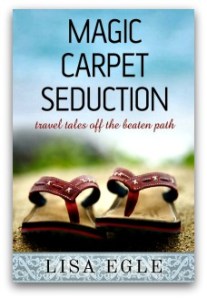
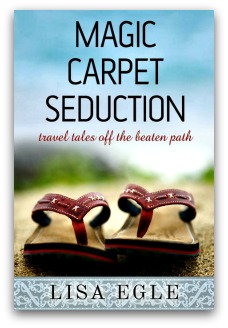
MagicCarpetSeduction_cover_pmHi, Lisa! I won’t need too much persuasion to be seduced by your writing. I’m already a follower of your travel blog, ChickyBus. And I know you’re an American like me, living in New Jersey. Why made you decide to travel in the first place?
After taking short solo trips in the U.S. back in the 1990s, I went on a two-week group tour of Egypt and thought it was the most exciting thing I’d ever done. I then went on another tour, of Ecuador, which turned out to be a life-changing experience (for many reasons, including the fact that I moved there a few months later). While living in Ecuador, I began to travel independently and realized how much I enjoyed it. From that point on, I entered the ranks of “travel addicts.”

How many countries have you been to at this point?
In total, I’ve been to 36 countries, on five continents. I was an expat twice: in Ecuador for a year and half and in Spain for a year. Recently, I spent two months in Indonesia.

And home is now New Jersey?
Yes. I’m a full-time ESL professor at a two-year college in Bloomfield.

I don’t get it. Is a “chicken bus” magical?

Where does the epithet “Chicky Bus” come from?
“Chicky Bus” is the name of one of the stories in my book. It’s about a quirky 12-hour “chicken bus” ride I took in Central America that led me to have epiphanies about living in the moment. When I started my blog, I thought “ChickyBus” would be a cool domain name—one that related to travel and one that people would remember. I also liked it as a blog concept. I’m the “driver” taking readers—”passengers”—on “rides” with me, allowing them to experience the same random moments and unexpected journeys that I do.

There’s also a deeper meaning, however. “Chicky bus” is a metaphor for my unique style of travel—being in the moment while venturing off the beaten path and taking risks (nothing too crazy, of course). It refers to that place of magic and self-discovery that I find wherever I go.

Why did you decide to publish some of your travel stories as a book?
Years ago, while blogging about general topics on a site called http://www.gaia.com, I began sharing travel tales. The feedback was incredibly positive; people were inspired and entertained by what I wrote and said they felt like they were right there with me. After a while, I decided to go all the way with it, to write more stories and to compile them into a book—four major “rides” to different regions of the world (and a total of 9 countries: China, Nicaragua, El Salvador, Guatemala, Mexico, Turkey, Jordan, Syria and Lebanon).

Are any of your chapters based on blog posts?
Interestingly, none of the stories are based on blog posts. I wrote most of the book before I started ChickyBus. There are, however, a few stories (simplified versions) on the blog that came from the book.

Mostly magical connections

We like to talk about “displaced moments” on the Displaced Nation. We can see you’ve experienced your fair share: from close encounters with Carpet Casanovas in Turkey, to meeting with a hermit in the Lebanese mountains, to experiencing political intrigue in a Chinese classroom, to receiving a marriage proposal on that infamous chicken bus in Nicaragua. But we still have to ask you: which is the MOST displaced moment that you’ve included in this book?
The moments you mention were truly unique ones and—believe it or not—I didn’t feel as displaced as one might think. Because I was in the moment and going with the flow, I felt quite comfortable and that I was where I needed to be.

There were a few instances, however, in which I did have that “displaced” feeling—the most extreme of which occurred in China.

It was 1999 and I was teaching English at a university in Changsha in Hunan Province, which was definitely considered off the beaten path back then. For most of my time there, I was in a deep state of culture shock. I struggled with many things, from freedom of speech issues to getting to know my students. There were many “displaced moments”—and even days. Fortunately, after a while, things leveled out and went more smoothly.

So from what you’ve just said, I guess there is a lot of competition for your LEAST displaced moment, when you felt you actually belonged with all of these characters you discovered off the beaten track?
One of my least displaced moments (and possibly favorite) was when a friend and I ended up spending the night with a Mexican family we barely knew. They’d invited us over for lunch. We were planning to take a bus to another city that night because we had to fly home from there the next day. It got later and later and because we were so comfortable, we didn’t want to leave. We ended up staying (and sleeping in two very tiny beds, slightly larger than coffins) and having a wonderful time being part of the family.

P.S. A little Boone’s Farm wine went a long way in helping make us even more comfortable…

Don’t exit until the rug has made a complete stop!

Okay, time to get off that chicken bus and onto that magic carpet. On your post announcing the book’s publication, you say:

So imagine that my book is the equivalent of an invitation to a Bedouin lounge of sorts. If you decide to join me, we’ll get comfy on the cushions and share some tea (or coffee or whichever beverage you like). When you’re ready, I’ll start telling you my favorite travel tales—and together, we’ll take a magic carpet ride.

Why did you choose this metaphor, and indeed use “magic carpet” in your title?
When I was a kid, my friends and brother and I used to sit on the front porch and listen to my mother telling us stories. Years later, I found myself doing the same thing with friends and later, on a blog. Then, I spent time with the Bedouins in Wadi Rum, Jordan. We told our own stories while sharing tea and sitting on the sand under a tent or on a cushion inside a house. In retrospect, I believe that the “invitation” into the Bedouin lounge has something do with each of these experiences.

Re: the title, when people see the words “magic carpet,” the freedom to travel anywhere, magically, usually comes to mind. Also, “Magic Carpet Seduction” is the name of one of the stories in the book. It’s about two men, seemingly different, trying to sell me a carpet and what happens I see through their each one’s sales pitch/ploy.

Also in your blog post announcing the book’s publication, you confess to being exhausted. (I confess to having had similar feelings after long games of Magic Carpet with my nieces!) What was the most challenging part of the writing process?
Mostly, it was finishing the book, editing it and formatting it while maintaining my blog and my full-time teaching job, and being on social media. At times, it was difficult to prioritize and I often felt burnt out.

Overall, however, I would say that editing took a lot out of me. There were a few times when I thought I was finished with a certain stage of the process; then, I’d realize that I wasn’t. Having said this, that is where I learned the most and what helped me become a better writer. So, in the end, it was a positive experience.

Capturing the magic of self-publishing

Why did you self-publish the book?
I took this route mostly because I wanted creative control; I believe the book is unique and slightly nichey. Also, I didn’t want to have to spend a lot of time pursuing an agent and traditional publisher. Mostly, I wanted to get the book done my own way and on my own schedule.

Can you offer any tips for others who are contemplating going down this path?
My best tips for anyone who’d like to self-publish are:

• Hire a professional editor and a proofreader—two (even three) people. Also, get a critique done before you pass the manuscript on to an editor. It’s important because each editor has his/her own specialty and will probably catch something another didn’t.

• Have a cover professionally designed. I know there are ways to do this cheaply or yourself, but it’s worth spending money to do this right since the cover is first thing that people see when searching for a book.

• Have your blog (and social media accounts) set up/established before you publish the book. I’ve seen many people do it the other way around. They finish and publish their book, then set up a blog and join Twitter. Many aren’t sure what to do—they just tweet about their book and don’t interact with others. This tends to hurt them more than help them.

• Don’t give up. I can’t begin to tell you how many times I wanted to quit just because of the sheer amount of work (blog, social media, the book itself, etc.) You can burn out very easily and, if you’re not careful, your health can suffer. Keep going, though, and you’ll cross that finish line!

What audience did you have in mind when writing the book?
I’ve always envisioned the audience as:

  • armchair travelers and those who take tours and fantasize about breaking away
  • other independent travelers/expats
  • non-travelers with an interest in countries often in the news
  • anyone curious about the cultural perspective/insights of a female American traveler.

Is it reaching those readers?
I don’t know the customer demographics yet, but I know that a few men have written reviews on Amazon—and that makes me happy. As is the case with ChickyBus, the book is for people of all ages and both genders. It’s definitely not just for women.

I see you’ve opened your own publishing company and are working on some more ambitious travel-cum-writing projects. Can you tell us some more about that?
I set up a small publishing company for a number of reasons, including accounting and taxes. More than that, I thought it made sense because I will be publishing more books and hopefully, a collection of travel tales written by others. This is a longer-term goal, but definitely something I’m considering for the future.

Are you already working on your next book?
I’m currently working on a trilogy about Native American-style healing journeys in the U.S. (in the Northeast and the Southwest). After that, I’ll hopefully wrap up the rough draft of a book about life-changing experiences I had in Ecuador. That, like the trilogy, would fall under a “spiritual travel” genre.

10 Questions for Lisa

Finally, I’d like to ask a series of questions that I’ve asked some of our other featured authors, about your reading and writing habits:
1. Last truly great book you read: Grey Wolves and White Doves, by John Balian
2. Favorite literary genre: Political thrillers; travel literature.
3. Reading habits on a plane: (what kinds of things do you tend to read and by what means?) Now, because I own a Kindle, this is much easier. I usually have several books to choose from: one I’m sure I’ll love and lose myself in and—a few that I’m curious about. One thing I love to do on a plane (and during my trip) is keep a journal. During my return flight, I re-read the journal and re-experience the trip. I almost always do that and love it!
4. The one book you’d require President Obama to read, and why: Hmmm. That’s a tough question. Maybe my book? I’d want him to see that there are Americans who embrace the rest of the world, despite the media’s distortions of it. Also, I think my book would show him how travel, the way I approach it—focusing mostly on meeting the locals—can help people to connect in a very real way and to overcome cultural misconceptions, ultimately helping make world peace more attainable. Another reason I’d want him to read it is because I think it would provide good escapism since it’s quite humorous. He’s got a tough job and might enjoy it for the entertainment value alone.
5. Favorite books as a child: The Outsiders, a coming-of-age novel by S.E. Hinton; and Go Ask Alice, by Beatrice Sparks.
6. The writer, you’d most like to meet, who is no longer living: Aldous Huxley
7. The writer, you’d most like to meet, who is still alive today: Daniel Keyes
8. Your reading habits: I have a pretty short attention span, so there are many books that I start to read that I don’t finish. However, if a book really gets my attention, then I can’t stop. It becomes something I look forward to and put aside other things to do. Unfortunately, since I started my blog a few years ago, I’ve been reading less than previously. I spend more time reading other blogs and articles than reading actual books. When I seem to read the most is when I’m traveling and find myself without Internet. I end up loving it, too.
9. The book you’d most like to see made as a film: A cyber suspense I’ve written about two women who “meet” on the Internet and what happens when the bond they’ve formed takes a dysfunctional and frightening turn. It’s now in rough draft form (about 15,000 words), but I’m hoping to publish it on Amazon (just for Kindle) in a few months.
10. The book you plan to read next: Actually, there’s a book I’m itching to finish reading—and that’s Shantaram. I always start it and then get interrupted. It’s a very long book (over 900 pages). I think Gregory David Roberts is an awesome writer. His storytelling ability—the way he writes dialogue, how he describes characters, settings and situations, and the way he uses metaphor—makes his experiences incredibly real to me.

* * *

Thanks so much, Lisa! That was absolutely magical, a carpet ride to write home (to my nieces) about! And that chicken bus? It wasn’t half bad! 🙂

What about you, readers? Has she seduced you?

Lisa Egle writes a blog, Chicky Bus, the concept of which is “finding yourself off the beaten path.” Over the past three years, it has been recognized on two “Top 100” lists of independent travel blogs. Egle is also Assistant Professor of ESL at Passaic County Community College in Paterson, New Jersey, where she teaches students from all over the world, especially Latin America and the Middle East. She holds a BA in Social Sciences from New York University and an MA in TESOL (Teaching English to Speakers of Other Languages) from Fairleigh Dickinson University. Lisa recently published a humorous piece in OH SANDY! An Anthology of Humor for a Serious Purpose (sales of which help victims of Hurricane Sandy), and an article on one of her quirkier adventures in Indonesia in LifeLift, the Oprah.com blog. She received an honorable mention in the 77th Annual Writer’s Digest Contest, in the Inspirational category.

STAY TUNED for tomorrow’s post, by guest blogger Elizabeth Liang, who will be updating us on her one-woman play about the TCK life, Alien Citizen.

If you enjoyed this post, we invite you to register for The Displaced Dispatch, a round up of weekly posts from The Displaced Nation, with seasonal recipes, book giveaways and other extras. Register for The Displaced Dispatch by clicking here!

Related posts:

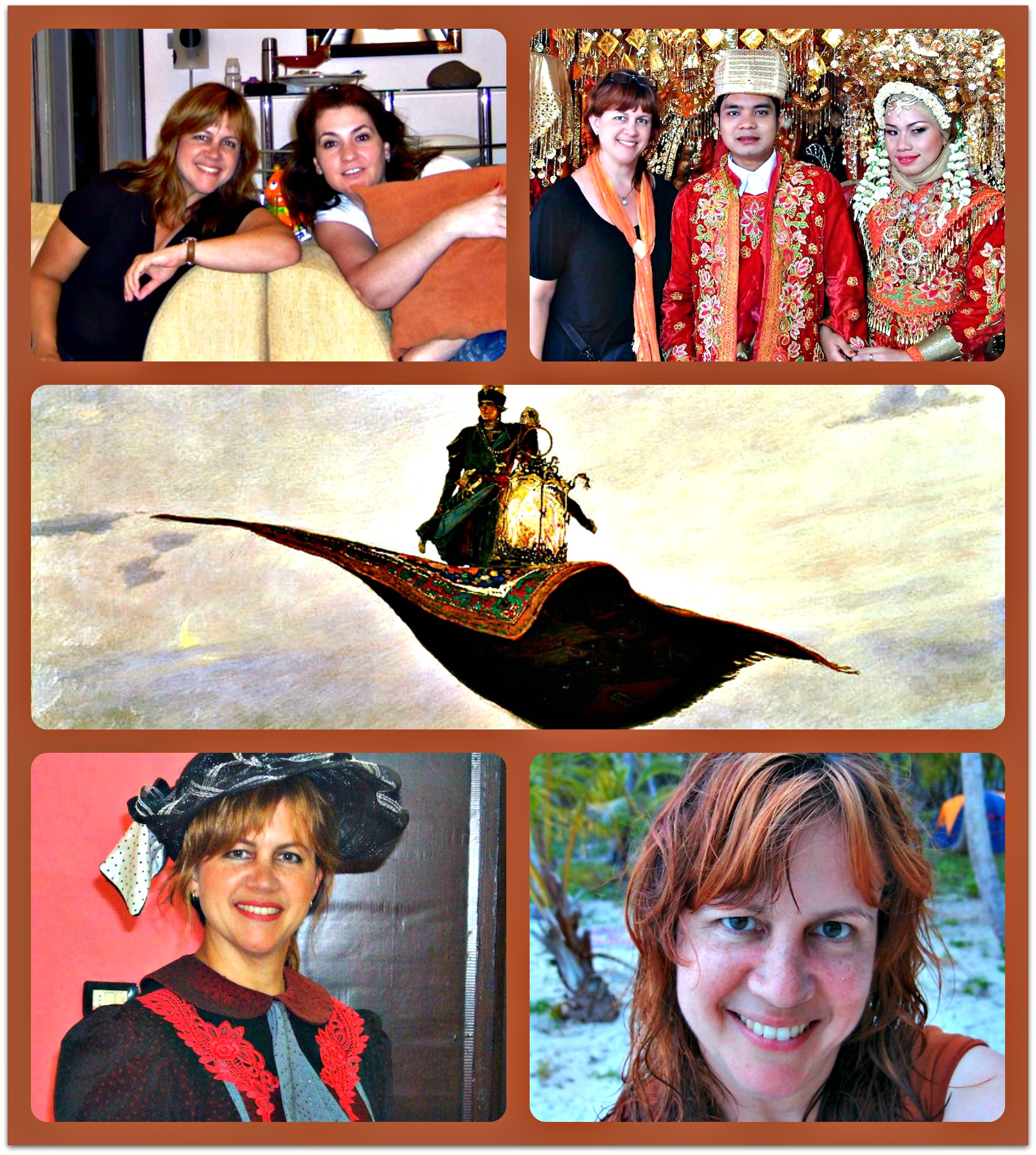
Images (clockwise, starting top left): Lisa at the home of her Cirassian-Jordanian friend, Souzan, with whom she was staying before the latter’s move to New Jersey(!) [this photo is in the book]; Lisa at a wedding in a Minangkabau village in Sumatra (hey, you can’t attend without posing with the bride and groom); Lisa camping in San Blas, Panama, during rainy season and a full moon (a displaced moment, to be sure, as the local Kuna indigenous believe that a full moon equals a curse); and Lisa after being recruited to be on a famous TV show in Damascus, which aired during Ramadan afforded an opportunity to meet one of the most famous actors in Syria—Qusai Khouli (she is wearing a late 1800s outfit, in case you were wondering). The painting in the center is “The Flying Carpet,” by Viktor Vasnetsov (1880), courtesy Wikipedia.

LOCATION, LOCUTION: Expat author JJ Marsh on bringing a location to life through writing

jill 3Today we welcome expat crime writer JJ Marsh to the Displaced Nation. JJ grew up in Wales, Africa and the Middle East, where her curiosity for culture took root and triggered an urge to write. Having at this point lived in Hong Kong, Nigeria, Dubai, Portugal and France—she finally settled in Switzerland—JJ certainly belongs in our midst! But what makes her even more special is that she has offered to impart her knowledge to other international creatives about the portrayal of “place” in one’s works.

Currently halfway through her European crime series, set in compelling locations all over the continent and featuring detective inspector Beatrice Stubbs (on loan from Interpol), today JJ begins a new series for us, entitled “Location, Locution.” In the opening post, she will answer the questions she plans to ask other displaced authors in future posts.

JJ, we are positively THRILLED (in more ways than one!) to have you as a new columnist. Welcome! And now to get to know you a little better…

Which comes first, story or location?
Story, always. Or at least the bare bones of the plot. Then I audition various places before beginning to write. I have to know the setting, even before populating the novel with characters. The place IS a character. For example, once I knew the victims would be corporate Fat Cats in Behind Closed Doors, the first in my Beatrice Stubbs series, I looked around for a financial centre with the right kind of atmosphere. Turns out my home town of Zürich fitted the bill and even gave me the title.

How do you go about evoking the atmosphere of a place?
I’d say by really looking at it and digging deep. Not only that, but try to look at it from the perspective of your reader. It’s no coincidence that in many European languages, one asks for a description using the word “How”.

Como é?
Wie war es?

Yet in English, we say “What is it like?” We want comparisons to what we know. I actively chose to use a foreigner arriving in a strange country/city, so as to look at it with new eyes.

Which particular features create a sense of location? Landscape, culture, food?
I start with the senses. We notice sights, sounds and smells first, and add to our impressions with tastes and textures, all the while comparing them to our expectations. Food and drink are essential, as they reveal something of the region but also much about the characters. Cultural differences have to be treated with great care in fiction. Lumpen great dumps of information are poison to pace. But subtle observations can be woven into the story, provided they are relevant. I’ve just abandoned a book set in Rome which was clumsily pasted chunks of guidebook against a sub-par Eat, Pray, Love plot. The reader wants to be immersed in the world of the book, not subjected to the author’s holiday snaps.

How well do you need to know the place before using it as a setting?
Speaking for myself, extremely well. I feel insecure describing an area I’ve never visited. But that’s not true for everyone. Stef Penney, who wrote The Tenderness of Wolves, created a beautiful story set against the backdrop of the frozen wastes of Canada. She’d never even been there.

While I am awed by that achievement, I don’t think I could do it. I need to ‘feel’ the place and also, to understand the people.

My nomadic past and interest in culture led me to study the work of Geert Hofstede and Fons Trompenaars. One of their models is to analyze culture like an onion. The outer layer is Symbols—what represents the country to outsiders/its own people? The next is Heroes—who do the people worship and venerate? Peel that away and explore its Rituals—on a national and personal level. At the centre of the Onion, you will find its values, the hardest part of a culture to access. But that’s where the heart is.

Could you give a brief example from your work which you feel brings the location to life?
The recent UK horsemeat scandal amused me, as it’s part of the average menu in Switzerland. Here my combative detectives, one Swiss, one British, have just finished lunch.

Beatrice patted her mouth with her napkin. “Herr Kälin, your recommendation was excellent. I thoroughly enjoyed that meal.”

“Good. Would you like coffee, or shall I get the bill?”

“I’ve taken up enough of your time. Let’s pay up and head for home.” Beatrice finished her wine.

Kälin hailed the waitress. “I wasn’t sure you’d like this kind of farmer’s food.”

“Farmer’s food is my favourite sort. Solid and unpretentious. Not the sort of fare they would serve in those crisp white tents at the polo park.”

Kälin let out a short laugh. Beatrice cocked her head in enquiry.

“It would definitely be inappropriate at the polo park, Frau Stubbs. We’ve just eaten Pferdefleisch. Horse steak.”

Which writers do you admire for the way they use location?
Val McDermid, particularly for A Place of Execution. Not only place but period done with impressive subtlety. Kate Atkinson, for making the environment vital to the plot in a book such as One Good Turn. Monique Roffey for bringing Trinidad to life in The White Woman on the Green Bicycle. Alexander McCall Smith enriches his stories with a wealth of local detail, be it Botswana or Edinburgh. And Kathy Reichs for making her dual identity an advantage. Donna Leon’s Venetian backdrop, Scotland according to Iain Banks in Complicity, and Peter Høeg’s Copenhagen in Smilla’s Sense of Snow.

There are many, many more.

* * *

Thank you, JJ! Readers, any further questions to JJ on her portrayal of “place”, or authors you’d like to see her interview in future posts? Please leave your suggestions in the comments. You may also enjoy checking out the first three books in JJ Marsh’s Beatrice Stubbs series:

  • Behind Closed Doors: Takes place in Zürich, where someone is bumping off bankers.
  • Raw Material: Takes place between London and Pembrokeshire. Here Beatrice is joined by wannabe sleuth, Adrian. Amateur detectives and professional criminals make a bad mix.
  • Tread Softly: Unfolds in the Basque Country of Northern Spain. Beatrice is supposedly on sabbatical, but soon finds herself up to her neck in corruption, murder and Rioja.

STAY TUNED for tomorrow’s interview with Lisa Egle, author of Magic Carpet Seduction, two copies of which we’ll be giving away!

If you enjoyed this post, we invite you to register for The Displaced Dispatch, a round up of weekly posts from The Displaced Nation, with seasonal recipes, book giveaways and other extras. Register for The Displaced Dispatch by clicking here!

Images: Typewriter from MorgueFile; picture of JJ Marsh and her book cover supplied by herself; map from MorgueFile

LIBBY’S LIFE #79 – Gladiator games

June.

Summertime. Crickets, cicadas. Long evenings, hot days.

Or, back on Planet Earth in 2013: June. Thunderstorms. Hailstones, lightning. Flood warnings, incessant rain. Central heating returning for another encore, and cabin fever causing small children to ricochet off walls and demand opportunities to test the effectiveness of recently purchased wellington boots.

Rain or no rain, after several days cooped up inside, we are going for a walk this afternoon.

It’s a slow process, though, I’m discovering. It’s taken nearly five minutes to get Jack, plus the twins in their double pushchair, from the front door to the other side of our street, because the very puddles I need to avoid with the pushchair are those in which Jack wants to jump with his new, camo-patterned rainboots.

As the children and I bicker and squelch past the entrance to Maggie’s long gravel drive, I spot Maggie trotting from her house towards us, holding a black and red golfing umbrella above her head and squinting into the driving rain.

“You do know,” she shouts, “that if someone who is not English sees you out in this downpour, they will call child protection services? Or at the very least, they’ll call the men in white coats?”

We laugh. The Woodhaveners’ attitude to rain is a private joke between me and Maggie. Woodhaveners will happily cope with two feet of snow and an ice storm, but send them a bit of rain and they flap around, panicking about damp basements and aquaplaning cars.

I explain about the cabin fever and Jack’s new wellies. “What’s your excuse for going out in it?” I ask.

“Checking the mail for Montana-postmarked letters,” she says, and I groan softly.

Maggie’s been waiting for a letter from Montana for about a week now. A letter from Chuck, the current owner of the house I want to buy. Chuck is strangely inaccessible by modern communication. After our liquid lunch in the Maxwell Plum, Maggie phoned the emergency number he gave her a few years ago — his neighbours’ number — and left a message.

The message was that Maggie thought he should know that someone (me) was interested in buying his mother’s house, and Maggie had reason to believe he might not know this (because we think Melissa, his real estate agent, hadn’t told him we’d put in an offer) so would he please call Maggie back ASAP.

After two days with no response, she phoned again. Chuck’s neighbours sounded slightly annoyed and told her they’d most certainly passed on the message to Chuck, who had said he would write a letter to Maggie. Yes, they told her, a real letter. On paper, in an envelope, with a stamp, with her address on it. Surely she had heard of such an invention in Massachusetts?

“More to the point, hasn’t he heard of Facebook in Montana?” I asked. “Who writes letters on real paper these days, for goodness’ sake?”

“People who live in the middle of nowhere and communicate mainly with horses, apparently,” Maggie said.

Now, as Maggie opens her mailbox and I see that it contains only this week’s issue of the Woodhaven Observer, I’m starting to think that he’d decided to bypass the postal system and deliver it himself. On horseback.

I voice this theory to Maggie, who looks at me sympathetically.

“At least you’ve got somewhere to live in July now,” she says. “You won’t be homeless.”

This is true. Oliver, via his company’s HR contacts, has managed to get a three-bedroomed apartment near the mall, in the same complex we stayed when we first arrived in America, two years ago. So, no, we won’t be homeless —  but the apartment faces the freeway, it’s noisy with the heavy traffic, and I’m not counting on many undisturbed nights from the twins. It’s most irritating, because they’d both just started sleeping through the night.

We looked at some new houses in Banbury, two towns away. The houses that Melissa’s new boyfriend built. This detail would have been enough to put me off buying one, if the cost hadn’t already done so. The base prices of the houses seemed reasonable enough, but once you started adding in the cost of options, the real prices zoomed vertically, because the “options” weren’t terribly optional. The houses don’t come with decks, for example; not a big problem, you might think, until you realise that the French windows (or French doors, as they call them here) leading out into the back garden have a five foot drop to the ground when you open them.

Both Oliver and I want, more than ever, to stay in Woodhaven, in the magical old house that used to belong to Maggie’s friend, Cathy.  Oliver even calls it “our house” whenever we drive past it.

If only we could speak with Chuck, the actual seller, instead of having to go through real estate agents who have their own unscrupulous agendas. Because Maggie, Oliver, and I are absolutely convinced that Melissa has her own agenda in all this. It’s no coincidence that a house with a lot of acreage and a need for fixing up isn’t selling if she’s a) representing the seller and b) dating a local builder/property tycoon.

But without Chuck’s side of the story, we have no proof.

As we all stand in the rain, a black Escalade tears up the street and drives through the water-filled pothole next to us in the road, sweeping a wave of muddy rainwater onto the sidewalk and all over our little group. Beth and George are safe behind their clear plastic rainshield, but Jack, who was nearest the road, is drenched. He bursts into tears, and sobs that his new rainboots are broken because they’re filled with water.

“No, they’re not broken. They just don’t work when the puddles come from above,” I say, mopping his face as best I can with a tissue that is similarly damp. “We’d better get you home and dried off. Honestly, some drivers, no common courtesy or even common sense…”

“That’s our Melissa, all right,” Maggie murmurs.

I look up. The black Escalade is now parked on the driveway of my house and, sure enough, Melissa Harvey Connor is getting out of it.

“What’s she doing here?” Maggie asks.

“Beats me. Can we disappear up your driveway and hide until she goes away?”

Too late. She’s already seen us and is gesturing furiously.

“I suppose I’d better see what she wants. You wouldn’t like to come with me for moral support, would you?”

“Much as I love a nice bit of gladiatorial entertainment with my afternoon tea,” Maggie says, “I’m expecting a parcel delivery, so I’d better not. Good luck,” she adds, as she starts to wade up her driveway towards her house.

Who is the gladiator and who is the lion?  She doesn’t say.

I look across the street at Melissa, who has seemingly forgotten I changed the locks on her house eighteen months ago and is trying to open the front door with a key that doesn’t work.

When I eventually reach the door, I get my own key out of my purse and Melissa steps aside.

“I’m here to inspect the house for damage,” she says, and my heart sinks. Three children, two adults, and a dog have lived in this house in the last two years. “You know, for things that have to be put right before you move out, that you have to pay for.”

She holds up her useless key.

“New lock system, for example.” She smiles, baring sharp canine teeth. Or perhaps feline.  I’m the gladiator, it turns out; the one facing a big cat. “Cost to you: $300. And that’s before we even get inside the house, Libby.”

.

Next post: LIBBY’S LIFE #80 – A place of our own

Previous post: LIBBY’S LIFE #78 – Trust no agent

Read Libby’s Life from the first episode

Want to read more? Head on over to Kate Allison’s own site, where you can find out more about Libby and the characters of Woodhaven, and where you can buy Taking Flight, the first year of Libby’s Life — now available as an ebook.

 STAY TUNED for next week’s posts!

If you enjoyed this post, we invite you to subscribe for email delivery of The Displaced Dispatch, a round up of the week’s posts from The Displaced Nation. Sign up for The Displaced Dispatch by clicking here!

Image: Travel – Map of the World by Salvatore Vuono / FreeDigitalPhotos.net