The Displaced Nation

A home for international creatives

Thoughts on the Booker, and 5 Booker Prize winners for expats to read

salmanI passed a miserable morning at Barnes and Noble. Suffering a vexatious bout of man-flu and with teething baby daughter in tow, I thought a visit to my local bookstore might be cheering and – after three days stuck at home – a pleasant change of scenery. I was wrong. Almost as quiet as a morgue, a few pensioners sipping overpriced Starbucks coffee, a handful of stragglers who sit reading in the fiction aisles, but who appear not to be purchasing anything. I noticed books on angels reduced to clearance, kitten calendars for 2014, a survivalist magazine, and, most disturbingly of all, a whole display table given over to the writings of Bill O’Reilly.

For the tens of dozens of O’Reilly books there, I could find only one copy of Bring Up the Bodies, the most recent winner of the Man Booker Prize.

That may change in my little corner of American suburbia after last week’s announcement that the Man Booker Prize would be expanding its selection criteria to include American writers from 2014 onwards. Of course, the future eligibility of American writers for the Booker does not open the Pulitzer for British writers; like our extradition treaty with the US, it is not an entirely equitable agreement.

In the interest of fairness, I should add that this change to widen the Booker from being a prize for British and Commonwealth (as well as Irish and Zimbabwean) authors is not just about including Americans, although you would be forgiven for thinking that was indeed the case if you had read any of the handwringing articles in the British press over fears that the Yanks will end up dominating the prize in future. Instead, there is a compelling case to be made that this is a necessary change. That as there is so much interesting writing in English being written all over the world, it would be wrong to discount it on account of the writer’s passport.

As Sophie Hardach wrote in The Atlantic, as English becomes more inclusive so too must the Booker, and in doing so better reflect the increasing diversity of the UK. ” All over London, Spanish-staffed coffee chains sit next to West Indian chicken stalls and Turkish hairdressers. Britain is becoming more like America: a magnet to migrants from all over the world. This includes migrant writers, and not ones just from former colonies.”

ritesofpassageOf course, the more cynical have pointed that all laudable claim for being inclusive are  just a smokescreen and the change in eligibility is an attempt to counteract the recently created Folio Prize set up to compete with the Booker and which is open to writers in English regardless of their nationality.

Anyhow, being aware of the nature of this site, I thought I would include five Booker winning novels that I feel might be interesting for an expat to read.

Midnight’s Children (1981) – Salman Rushdie 

Not just any Booker winner, but the winner of the Booker of Bookers, a sort of literary equivalent of Countdown’s champion of champions tournaments. A magical realism take on Indian independence, it is a richly evocative novel with a main character and narrator whose life is intertwined with that of his home nation.

The Siege of Krishnapur (1973) – J.G. Farell

The second novel in Farell’s loose Empire trilogy detailing the decline of the British Emprire. Based upon the Indian rebellion of 1857, it is, at times, a surprisingly funny novel.

Rites of Passage (1980) – William Golding

Living thousands of miles from home is easy in the jet age. That 6,000 mile journey can be traversed in a ten hour flight. The account of a young British artistocrat’s journey on a warship as he makes his way to Australia in the early 1800s may give current expats pause for thought.

oscarThe Inheritance of Loss (2006) – Kiran Desai

A fairly recent winner, one of the major plots in this work follows the journey of Biju, an illegal immigrant in the US.

Oscar and Lucinda (1986) – Peter Carey

Like Rites of Passage, this novel also tells the tale of a young Englishman traveling to Australia in the nineteenth century, don’t let that fool you, however, as they are both very different novels. My personal favorite of Carey’s works.

Mark Hillary delivers reality check to gringos who moan about Brazil, in self-published book (2/2)

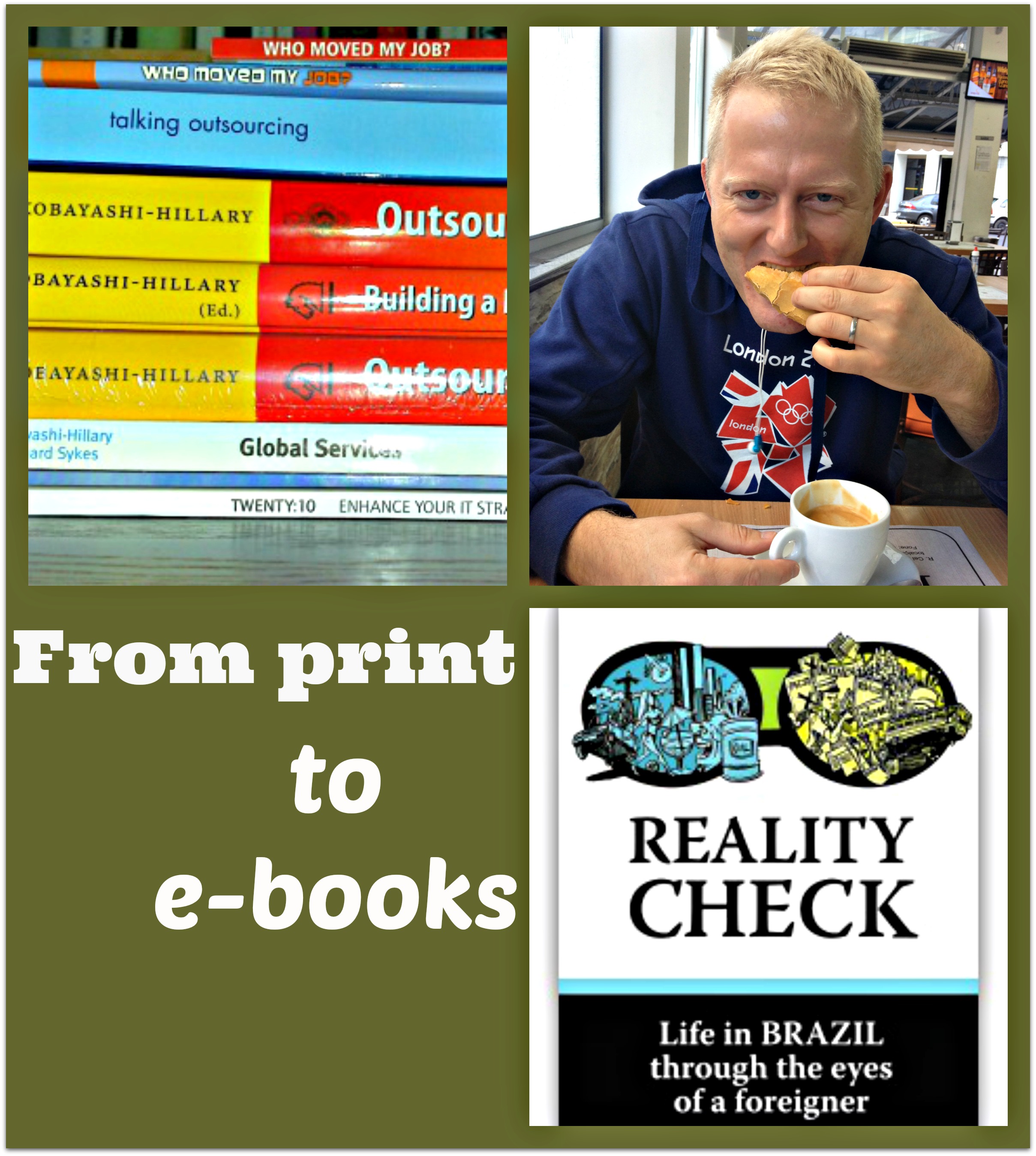
Mark Hillary Part 2 CollageIn Part 1 of my interview with Mark Hillary, a fellow Brit and amigo in São Paulo, we learned about what spurred him to write a book called Reality Check: Life in BRAZIL through the eyes of a foreigner.

A lively discussion ensued about what makes Brazil such a contentious country for expats (short answer: it’s a country of extremes).

Today I’ll ask Mark about his decision to publish Reality Check as an e-book. As I mentioned last week, Mark is well published in his chosen field of technology and globalization. He is a HuffPo columnist and has also blogged for Reuters about British politics. But Reality Check represents his first venture into the Amazon e-book platform.

I was curious about why he chose this route and also had some questions about his reading and writing habits generally.

* * *

Mark, Reality Check isn’t the first book that you’ve written. Can you tell us something about your other books?
It’s actually my tenth book. I used to be quite a senior IT manager in a bank, managing people all over the world. I had already started contributing articles to technology magazines while I was at the bank, and eventually I was sent off to India to help the company build up a big new office in Bangalore. I was hiring hundreds of technical team members and then trying to sell their services bank to other sections of the bank. It was quite an experience, especially as it occurred right at the beginning of the big push to India by many technology companies.

I wrote a book about it all, which was published by the respected German publisher Springer and well received in journals and newspapers such as the FT.

After that I carried on writing about the connection between work, technology, and globalization.

It’s impressive that you can span the range from big IT questions to a foreigner’s take on life in Brazil.
I’m interested in many areas, which is probably why my three times at university have included courses on computer science, business and management, and psychology. My earlier work on outsourcing naturally led me to how companies are changing and globalization, and this has naturally led onto my writing about being an expat. If there’s a connecting thread, it’s work and the changing nature of work in our time. That said, I wouldn’t want to only ever comment on a single topic. Life is a lot more complex than that.

You decided to release Reality Check in the Amazon Kindle format. Why did you make that decision?
I’ve been asked that question a lot. Six of my books were published using traditional publishers, and three were self-published via Lulu. And now, with the Brazil book, I’ve used the Amazon Kindle format. I went into some detail on the pros and cons of each of these methods in a recent Huffington Post article, but in short the important thing to remember is how the publishing market is changing. Obviously there is still a lingering sense of kudos with the traditional publishers. A novel published by Penguin is still seen as “better” than something self-published, but it doesn’t have to be. The platform and process of publishing itself has just been democratized and made available to all.

If you know how to write and you can market your work to an audience, then it is much faster to publish with Amazon or Lulu. And, not only can you reach a global audience instantly—you earn a far greater percentage of the sale price.

In the case of Reality Check, I wanted it to be available around the world as quickly as possible, and Amazon has a great system for doing that. Plus you don’t actually need a Kindle: iPads and phones are all being used to read this book.

Do you think it helps that you already had a following through your writings and other books?
Reality Check has has been in the Amazon top 20 books about Brazil since publication on September 1st, and yesterday when I checked, it was the number one book about Brazil and number two book about South America. So people have been noticing it.

I think it does help if you already have a following. It used to be that publishers and agents acted as the gatekeeper, so readers could be confident a book that ended up in the shops was good. Now anyone can publish any old rubbish, so there is no longer that guarantee of a published book being any good.

The much-celebrated poet Seamus Heaney is a good example. He has been lauded as one of the greatest writers of the past century, and he had plenty of work published by traditional publishers. But he was self-publishing new work before his recent death.

Do you plan to make Reality Check anything other than an e-book?
I’m planning to also release a paper version of the book, but it will not be until the second edition—planned to come out just before the World Cup football competition in June next year.

Are you working on any other writing projects at the moment?
The present one is about my own experience of ghostwriting. I’ve written for ambassadors and company CEOs, and I once had to help astronaut Neil Armstrong add a few jokes to his standard Apollo 11 speech. The work I have written for others to be delivered in their name has often, but not always, gone down well, and I wanted to explore that. And in the tech area, I’m working on a book project that aims to be a graduates’ guide to how you get a job in a job market where nobody wants to pay you a salary.

10 Questions for Mark Hillary

Finally, I’d like to ask a series of questions that we’ve asked some of our other featured authors, about your reading and writing habits:

1. Last truly great book you read: I recently read all of Ira Levin’s novels back to back—all great; but I’ll go for Paul Trynka’s biography of David Bowie, which I just now finished.
2. Favorite literary genre: Dystopian novels: Burgess, Orwell, Ballard.
3. Reading habits on a plane: I read fiction and non-fiction and always carry my Kindle because it’s so much better for travel than lugging around a lot of books. This week I was on a plane and I read The Default Line, by Faisal Islam—about the financial crash of 2008 and what has happened since.
4. The one book you’d require David Cameron to read, and why: Why It’s Kicking Off Everywhere: The new global revolutions, by Paul Mason. It’s a study of the various riots, uprisings and protests around the world, particularly in 2011. I think the UK has more unrest to come because living standards and earnings are in decline—the people are going to kick off again one day.
5. Favorite books as a child: Those by Roald Dahl, though everyone seems to think he was actually a nasty piece of work in real life.
6. Favorite heroine: Harper Lee. To Kill a Mockingbird was her only book and she never courted any publicity. It challenged racism over 50 years ago and still retains its power today.
7. The writer, alive or dead, you’d most like to meet: Oscar Wilde. He wrote 20th-century books and plays in the 19th century and despite his sad downfall, is still remembered and loved today.
8. Your reading habits: I mostly read in the evening. I don’t watch TV, other than for movies so that gives me more time. I tend to read one or two books a week unless I’m traveling a lot then it’s more just because of the endless time spent in airports or on buses.
9. The book you’d most like to see made as a film: The Drowned World, by J.G. Ballard. Life after the oceans have risen and the world we know now is flooded.
10. The book you plan to read next: Jesse Norman’s biography of Edmund Burke—already on the Kindle waiting for me.

* * *

Readers, any more questions for Mark? He may sound a bit intimidating, but in fact he’s very approachable and happy to answer any questions about e-publishing. (Though he doesn’t write fiction, he also has views on publishing platforms for novels.) Meanwhile, if you’re interested in Reality Check, you can purchase it on Amazon. I would also recommend becoming a fan of its Facebook page and following Mark on Twitter: @MarkHillary

STAY TUNED for tomorrow’s post, by another Englishman who is also an expat albeit in California: Anthony Windram.

If you enjoyed this post, we invite you to register for The Displaced Dispatch, a round up of weekly posts from The Displaced Nation, with seasonal recipes, book giveaways and other extras. Register for The Displaced Dispatch by clicking here!

Related posts:

images: Mark Hillary surrounded by his traditional books and his e-book cover.

LOCATION, LOCUTION: Liza Perrat on writing a location to life

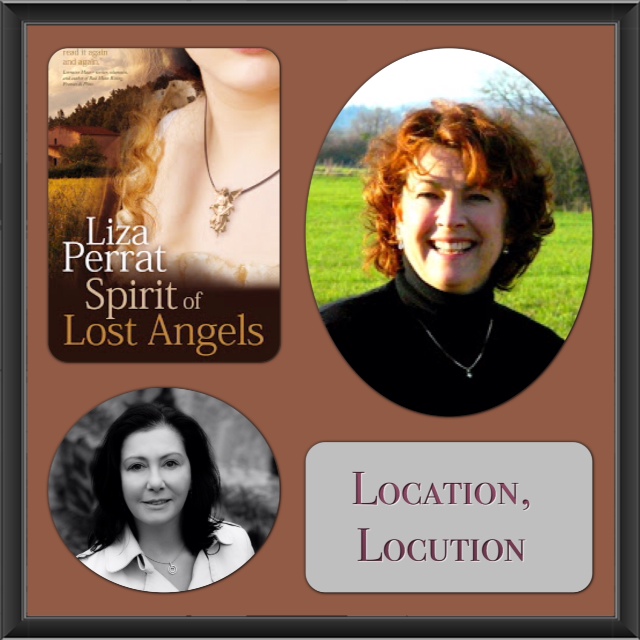
Liza Perrat visualIn this month’s “Location, Locution”, expat crime writer JJ Marsh interviews  Liza Perrat, author of Spirit of Lost Angels.

Liza grew up in Wollongong, Australia, where she worked as a general nurse and midwife for fifteen years. When she met her French husband on a Bangkok bus, she moved to France, where she has been living with her husband and three children for twenty years. She works part-time as a French-English medical translator.

Spirit of Lost Angels tells the story of Victoire Charpentier and her courage in facing injustice and abuse in revolutionary France. Wolfsangel (due out in November 2013) follows Victoire’s descendant, Celeste, who finds that under Nazi occupation, the personal is political.

*  *  *

Which comes first, story or location?
So far, for me, it has been location. I’m enthused, enthralled or nostalgic about a place, and want to use it as a backdrop around a story. In the case of my current novels, the location has become as much a character as the real-life ones.

How do you go about evoking the atmosphere of a place?
My novels are set in the French rural area in which I live, which makes it much easier to evoke atmosphere. I take loads of photos of the countryside, the people and the buildings, during each different season. The local historical association has lots of sketches and documents on what it looked like through the ages. As I walk the dog, I jot down descriptions of sunrises, sunsets, stormy light, fruit on the trees, snow on the hills, flowers in spring and the icy river in winter.

Which particular features create a sense of location? Landscape, culture, food?
Landscape, culture and food, certainly. But most of all, for me, it is the people who create a sense of location. Often, the people are the place. Also language, especially expressions, plays a part. Architecture too, gives a feel for a place. Smells also, create a sense of location.

How well do you need to know the place before using it as a setting?
Intimately well. I’d have trouble creating a believable atmosphere if I’d not been to a place, or at least read widely on it.

Could you give a brief example from your work which you feel brings the location to life?
Many reviewers of Spirit of Lost Angels commented positively on the atmosphere created of La Salpêtrière asylum in Paris, during the late 1700s:

… I found the scenes of cruelty in the Salpêtrière Asylum painful to read – not because of the way in which they were written, but simply to have been shown such unpalatable truths …

… the section of the novel concerning Victoire’s stay in La Salpêtrière vividly illustrates what a horrible experience it must have been…

… part of the reason I waved to savour this book so much was because of the scenery and the settings…

The book vividly depicts the violent and inhumane methods doctors used to “treat” mental illness at Salpêtrière. To me, this was perhaps the most fascinating portion of the story- descriptions of the appalling conditions under which the women were kept, the rivalries that developed among cell mates, the rules one had to learn in order to survive this prison. The narrative was stark and believable and, believe it or not, educational. Since I’ve finished the book, I’ve been looking up the history of the Salpêtrière Hospital, intrigued at how low mental health care and the care of women had deteriorated at that time. Introducing an urge to learn more, dear readers, is the mark of excellent historical fiction.

Which writers do you admire for the way they use location?
Ones that come to mind:

  • Stef Penney’s The Tenderness of Wolves. Even more amazing as, apparently, she’s never been to the wilderness snowscapes of Canada.
  • Joanne Harris’s Chocolat evokes the small French village.
  • Nikki Gemmell’s Cleave and Kate Grenville’s The Idea of Perfection, describe so well the desolate landscape of central Australia.
  • Jennifer Worth’s Call the Midwife brings to life 1950s East End London.
  • Emma Donoghue’s Room brilliantly portrays an entire existence in a single, small room.

Thank you, Liza!

Next month, my guest on Location, Locution will be Paulo Coelho, author of The Alchemist, The Devil and Miss Prym and Eleven Minutes

* * *

JJ Marsh grew up in Wales, Africa and the Middle East, where her curiosity for culture took root and triggered an urge to write. After living in Hong Kong, Nigeria, Dubai, Portugal and France, JJ finally settled in Switzerland, where she is currently halfway through her European crime series, set in compelling locations all over the continent and featuring detective inspector Beatrice Stubbs.

STAY TUNED for next week’s posts!

If you enjoyed this post, we invite you to register for The Displaced Dispatch, a round up of weekly posts from The Displaced Nation, with seasonal recipes, book giveaways and other extras. Register for The Displaced Dispatch by clicking here!

Related posts:

Mark Hillary delivers reality check to gringos who moan about Brazil, in self-published book (1/2)

Mark_HillaryA little while ago I interviewed Megan Farrell, a fellow gringo in São Paulo, about the book she had written about “exbrat” life in the city. As far as I’m aware, Megan’s was the first book to be written about life in SP by a foreigner, although she seems to have started a new trend because within the last fortnight another has emerged: Reality Check: Life in BRAZIL through the eyes of a foreigner.

Reality Check is by Mark Hillary, a fellow Brit in São Paulo (he recently moved outside the city), who is an author, blogger, and advisor on technology and globalization. He has already published a number of books and is a contributor to Huffington Post, Reuters, The Guardian, and Computer Weekly.

Mark is also a friend of mine. We connected through Twitter just over a year ago. We eventually met at a local bar when—unsurprisingly, given his background in technology and social media—he organized a meet-up of gringos who had connected online but had yet to meet up in the flesh.

Since then he and I have continued to meet up, although less so since his move to the countryside. We had a particularly memorable trip in June to Rio to watch England play Brazil in football at the brand new Maracanã Stadium. (As anyone who follows my posts should recall, I’m a bit of a football geek.)

Over the past year Mark has written, in his column for the Huffington Post, a number of insightful articles about life as a foreigner in Brazil—most notably, “No HP Sauce, Endless Red Tape: Would You Want to Live in Brazil?, which responded to a gringo Facebook forum that had listed all the reasons why foreigners hated living in this country.

It was to my pleasant surprise, then, when Mark announced he had extended his account of life in Brazil and intended to publish it as an e-book.

Leaving aside my acquaintance with Mark (and the fact he gives a nod to my personal blog in the book!), I must say that I found Reality Check a very enjoyable read. It is a thoughtful and critical, yet balanced, account of his experiences in Brazil and of the country in general—and frankly, I’m rather annoyed that I haven’t written it myself.

Mark’s book also seems to be a good accompaniment to Megan’s. Whilst hers is a straightforward, step-by-step guide to life in São Paulo, his is a narrative providing a broad overview of gringo life. Either way, both books will be of use to those who are either moving to Brazil or perhaps are simply interested in finding out a bit more about South America’s largest and most populous country (it’s also the world’s fifth largest economy).

Anyway, enough of my wittering on. Let’s hear more from Mark himself.

* * *

RealityCheck_bookcoverHi, Mark. Congratulations on your new book and thanks for agreeing to this interview. First off, can you say a little more about what inspired you to write it?
As you already mentioned, I wrote the book in large part as a reaction to the negative posts about Brazil in online gringo communities. Everyone has their own reasons for moving and living away from their home country, but the majority of the groups I’ve encountered online are full of complaints about Brazilian food, prices, bureaucracy… Anyone who reads the posts made in the Facebook group for Gringoes.com would think that the UK and US offer a utopian paradise that would be madness to ever leave.

As you said in your intro, I wrote an article for the Huffington Post where I tried to give a more balanced view on life in Brazil.

Then I thought that, as someone who has rented and bought a home, started a company, hired people, and married a Brazilian, I could probably give a more detailed opinion on the experience—hence the book.

So being married to a Brazilian was what brought you to Brazil?
Yes, we were living in London, but after the financial crash in 2008 my business was much slower than before. By 2010 it became clear that there were many more opportunities for me to build a research and publishing business in Brazil than in the UK and so we moved just before the end of that year, nearly four years ago.

We recently featured another book about expat life in Brazil: American Exbrat in São Paulo, by Megan Farrell. Megan’s focus was on the “exbrat” community in São Paulo—i.e., those who are transferred here for work by a large company. My impression is that your focus is less specific and more of a broad overview of life in Brazil as a foreigner.
I’m not really interested in the exbrats. If a big company transfers someone to Brazil and they have their home taken care of and a driver to ferry them around, and they only ever go for a drink in expat pubs, then I don’t think they are experiencing the real Brazil. I’m not suggesting that the only authentic Brazil experience is living in a favela, but there are other kinds of foreigners here—journalists, teachers, people from all walks of life—who are constantly looking for ways to explore their new home.

Did you have a specific audience in mind when you wrote the book?
I really set out to explore some of my own experiences, with the expectation that people investing in Brazil or looking for a job here might have an interest in the book.

The book has only just been published (2nd September) so I guess it is a little early to tell, but how has it been received so far?
It is very recent, but there is already a very positive review from a Brazilian reader on Amazon. I started my author Facebook page when I published the book, and that community is growing by around a hundred people every day—so people are noticing it. One of the biggest newspapers in Brazil (Folha de SP) has been in touch to interview me about the book—despite my not having done any press promotion for the book due to my traveling almost every day since the publication!

Did you connect with São Paulo and/or Brazil in any new ways whilst writing the book?
It made me more determined to plug areas outside of Rio, which has a lot of friends already. I’ve really enjoyed living in both São Paulo the city and interior—SP needs a few gringo fans to speak out and remind people that the city is not just about concrete and cops murdering civilians.

You recently moved to the countryside outside São Paulo—how and why did that come about?
We spent two years living in the centre of São Paulo and just wanted to find something a bit quieter. I love it where we are now. There is a great sense of community; the neighbours all know each other. There is none of the security paranoia you find in the city centre, and there is some fantastic scenery on our doorstep.

Do you miss SP at all?
I miss being able to go out to see my friends in the city, or go to concerts by international bands that will only ever play in major cities. But we are planning to get a very small apartment in SP soon, so we don’t completely lose touch with it.

You mentioned the “security paranoia” in SP. In my observation, most of us gringos carry a fear that is at odds with how our Brazilian partners and/or friends feel. I enjoyed reading the section of your book covering this perception gap. Do you think that more positive accounts of Brazil by writers/bloggers like you and myself can help to shift these perceptions?
If people like you and me can get visitors to realize that they can walk down Avenida Paulista or along Copacabana Beach without fearing for their life, that would help. On more than one occasion I have met business contacts who flew into town and then were shocked when I suggested meeting away from their hotel. Standard advice from American and European companies is often to stay inside when in Brazil because of all the street crime.

The Brazilians, too, should play a part in correcting this situation. I don’t think we have much influence because we are seen as outsiders, but as more Brazilians get exposed to alternative cultures through travel, I hope it can change a little.

Last year I brought my wife’s teenage cousin on a trip to the USA, just to show her what life is like outside of Brazil. She found it incredible that you could walk up to the front of so many celebrity homes in Los Angeles—that anyone could walk into Sylvester Stallone’s garden. That’s unimaginable in Brazil.

What are you thoughts on foreign media portrayals of Brazil? Do you feel, for example, that persistent foreign criticisms of Brazil’s preparations for the World Cup and Olympics have been fair?
Every World Cup and Olympic games gets this negative press, so I don’t know if it is any worse than the last time. Anyone from the UK should be able to recall how the London Games were going to be a disaster right up to the week of the Games—the attitude seemed to change only when everyone saw that spectacular opening ceremony.

All I know from personal experience is that when you and I went to the Brazil v England football game at the Maracanã in June, the organization was superb. The stadium looked good, the public transport all worked, and the volunteers helping the crowd were great. I couldn’t fault it—so I’m really looking forward to the World Cup.

From the way you write so passionately about Brazil it is clear that you love living here, but there must have been the odd difficult moment when you wondered whether you’d made the right decision in fleeing the economically stagnant UK for your wife’s native land. When have you felt most displaced?
Sometimes the bureaucracy in daily life does get perverse and goes beyond just the criticism of a foreigner claiming that it all works better in Europe. Examples include having to pay someone to get my car registered to a new address or being fined for not paying my stamp duty on the day I agreed a mortgage with the bank—even though I paid on the day I got the documents myself. Sometimes I wonder if there is ever going to be any government that sweeps away this nonsense. I also fear that the job cuts created by improved efficiency means we are stuck with much of this.

Conversely, when have been your least displaced moments, when it all seemed to make sense?
I live in a really beautiful place now surrounded by a lot of wonderful people. Every morning when I take my dog for a walk then start work for the day I know I’m lucky to be here.

* * *

Readers, I will be talking to Mark again on Tuesday of next week, when we focus on his decision to self-publish his book. Any further questions for him, meantime? And don’t forget, if you’re interested in Reality Check, you can purchase it on Amazon. I would also recommend becoming a fan of its Facebook page and following Mark on Twitter: @MarkHillary

STAY TUNED for tomorrow’s post, a new episode in our “Location, Locution” series, by JJ Marsh.

If you enjoyed this post, we invite you to register for The Displaced Dispatch, a round up of weekly posts from The Displaced Nation, with seasonal recipes, book giveaways and other extras. Register for The Displaced Dispatch by clicking here!

Related posts:

images: Mark Hillary’s author image and book cover

TCK TALENT: Diahann Reyes is in her element as writer, actor & storytelling coach

DiahannReyes_headshot_pmWelcome to the second installment of “TCK Talent,” Elizabeth (Lisa) Liang’s monthly column about adult Third Culture Kids who work in creative fields. As some readers may recall, Lisa—a Guatemalan-American of Chinese-Spanish-Irish-French-German-English descent—has written and performed a one-woman show about being a Third Culture Kid, or TCK. (It debuted in LA in the spring and is coming next week to NYC!)

—ML Awanohara

My guest today is Diahann Reyes, a professional writer/actor who is launching a new blog, writing a memoir, and beginning an additional career as a writer’s editor/coach. Diahann grew up in six countries, worked as a journalist for CNN before becoming an actor, and currently lives in Los Angeles, California.

Growing up here and there and everywhere

Greetings, Diahann, and welcome to the Displaced Nation. I understand you’re the TCK child of Filipino parents. Can you fill us in a little more: why did your family move around and which countries did you live in as a kid?
My dad was a marketing expat. I learned how to speak English with a Kiwi accent in New Zealand, discovered my love for books in Argentina, rode my first camel in Pakistan, went through puberty in the US, attended junior prom in the Philippines, and graduated from high school in Indonesia.

Of all those cultures, did you identify with one in particular?
Like you, I’m a “mash up” of the different cultures I’ve lived in. Living in America for most of my life now, I feel most at home here, which is its own kind of cultural mishmash. In my twenties, I realized that I had to pick one of my “home” cultures as my main one or I’d continue to feel ungrounded. I also identify with particular subcultures that aren’t necessarily considered mainstream, such as the artist culture.

Where and when were you happiest while growing up?
My family’s two years in Argentina were some of my happiest, probably because my mom, dad, sister, and I were all so excited to be living in a new country together. Moving to a different culture was still an adventure of which I had yet to grow weary. Also, at age 8, I was still very much myself and hadn’t been impacted yet by the pressures of puberty and the need to fit in.

What lies beneath the surface…

Speaking of puberty and the female body brings me to the launching of your new blog, Stories from the Belly: A Blog About the Female Body and Its Appetites. What inspired you to begin it and what can followers look forward to from the blog?
For women especially, there are so many truths, emotions, and desires that we tend to suppress: they get buried deep down in our bodies. My blog is my way of excavating this buried inner emotional landscape. I want to talk about the female body in ways not normally touched upon in mainstream media. My blog will include personal stories as well as commentary on relevant current events.

You’ve been working on a memoir. Is it specific to a time and place in your life?
Yes. My memoir is about my latest “move,” only this time rather than going to live in a new country, I’ve spent the last decade “moving into” and learning how to fully inhabit my own body. Location-wise, I take the reader across the globe to some of the places I’ve lived growing up, but the main action takes place in my body.

What themes are you exploring?
The story I tell is absolutely personal, but it does touch on a lot of bigger ideas involving the female body and its objectification and how this can impact a woman’s relationship to herself and others. Desirability, cultural assumptions, sexuality, power, pleasure, and wholeness are some of the through-lines in the book.

Owning who she is

On your website you describe how you fell in love with reading and acting. Did you always know you would pursue both of these interests as careers, or did you struggle with the decision?
I knew I wanted to be a writer from the time I could read, but it took me a long time to own that this is who I am, in part because the grownup me couldn’t imagine that my younger self could just “know” this. Still, writing has been the primary way I’ve made a living—as a TV news writer, an editor, a ghostwriter, and now a blogger, so I guess I didn’t need to know I was a writer to be one.

The decision to act was tougher. I didn’t start to pursue acting until my 30th birthday, and by then I had established a pretty good career in journalism and online media, so I was giving up a lot to change focus. But acting was like this siren calling to me, saying “act, act, act.”

You and I grew up reading many of the same (mostly American and British) authors: Ingalls Wilder, L’Engle, Cleary, Blyton… I remember the day I realized I would never get cast as Jo in any theatrical production of Alcott’s Little Women because I was a girl of color. Did you ever have a moment like this, and if so, which beloved character(s) and book(s) or play(s) did you realize you wouldn’t get to explore as an actress?
I always thought I could be anyone because while growing up I’ve had to be a chameleon. “Adapt and assimilate and fit in” was one of my mantras as a global nomad. But when I got to LA and started auditioning, I realized that I would never be able to play certain characters because I was the wrong ethnicity or type. I was primarily limited to not even Asian parts but Latina roles because I look more Hispanic than Southeast Asian. This meant that I was likely never going to play Maggie from Cat on a Hot Tin Roof or Caroline Ingalls in any future Little House on the Prairie remake, and parts that were for people of my actual ethnicity were out, too. Fortunately, the industry has changed, and more minorities are getting cast outside of ethnicity and stereotype.

What sorts of roles are you attracted to now?
I love parts that call for emotional depth and angst.

I wonder if one of the reasons we’re writers is that we have more autonomy to tell stories than we do as actresses?
I love that I can write what I want—I don’t need anyone to “cast” me first. And I can create characters that aren’t limited by ethnicity or type. I am thinking of creating a solo show that would probably require me to write and play different characters.

I understand you also write poetry. What drew you to that?
I kept diaries growing up and would process my feelings through poetry. With both nonfiction and poetry, I can just be myself. After so many years of working hard at adapting and assimilating to fit in, getting to just be me on the page is a relief.

Helping others to own their stories

You’re about to begin a new endeavor as a writer’s editor/coach. What inspired you to follow this new path?
I know what it is like to have something to say and to struggle with fully expressing my truth—especially when the fears come up—and I want to help other writers overcome these obstacles so they can get their stories out there. I want to work with people who are just as engaged in their process as they are in having a finished product.

What are you looking for in a student/client?
I work with nonfiction writers, bloggers, storytellers, and essayists, and other people with writing and online content projects. Healers and people with unusual business ideas like to work with me, too.

Do you have any other projects coming up?
I hope to publish my memoir next year. The film Out of Her Element, in which I play a therapist with a pill addiction, will premiere soon.

* * *

I must congratulate Diahann on her exciting new ventures, which I believe will resonate with people working in creative fields—and with female travelers and TCKs, especially! Readers, please leave questions or comments for Diahann below.

STAY TUNED for tomorrow’s post, when Andy Martin will talk to Mark Hillary about his new book, Reality Check: Life in Brazil through the Eyes of a Foreigner.

If you enjoyed this post, we invite you to register for The Displaced Dispatch, a round up of weekly posts from The Displaced Nation, with seasonal recipes, book giveaways and other extras. Register for The Displaced Dispatch by clicking here!

Related posts:

img: Diahann Reyes

LIBBY’S LIFE #84 – Stages of youth


“No. For the last time, she can’t come to school with us,” I say to Jack, as I lock the front door behind us and start to hustle the three children into the car. “We’re already late. You want to meet your teacher today, ready for when school starts tomorrow, don’t you?”

Jack pouts. “But she wants to. M says she’ll be lonely if I go without her. She says she’ll break something in the house if we leave her on her own.”

You know, I’ve had just about enough of Jack’s overactive imagination and this pretend friend.

“M” has been an invisible fixture in the house for the last six weeks, and she’s a demanding little sod — worse than my own three, live, already demanding children. I have to lay an extra place for her at every mealtime, and recently I’ve been evicted from my favourite spot on the recliner chair in the living room because Jack says that M is already sitting there.

Now the brat is ready to smash my china if she doesn’t get her own way.

I could just play along with the game and say, “Of course M can come with us”, but that would precipitate the need for an extra car seat because M is not old enough to sit in the front seat, Jack says.

And the name. What sort of name for a girl is “M”, for crying out loud, unless you happen to be Judi Dench in a Bond film?

“She’s very upset,” Jack says, with the air of someone washing his hands of all blame for the consequences. “You’re going to be sorry.”

“I hope you’re not threatening me,” I say, as I make sure his seat belt is fastened properly. “Otherwise it won’t be me who is sorry. I promise you that.”

Jack is unrepentant.

“I was just telling you what she said.”

Thank goodness school starts properly tomorrow, is all I can say, when Jack will (I hope) make new, human friends and forget about the fictitious girl in our house. The same girl who now has the nerve to  threaten vandalism if I don’t allow her to come along to kindergarten orientation with us.  I mean, it’s obvious she can’t come. She isn’t even enrolled at the sch–

Oh, this is ridiculous.

It’s got to the point where I almost believe in her myself.

*  *  *

Before I take Jack to meet his new teacher, I drive to Maggie’s house on our old street. Maggie is looking after the twins while Jack and I go to school for the morning.

“So it’s not Jack’s first proper day of school today?” she asks. “It’s just a meet and greet with the teacher, find out where the sand box is, that kind of thing?”

“Breaking them in gently, that’s right.”

“Didn’t happen in my day,” a Southern, male voice chips in from Maggie’s armchair. “My mother stayed in bed and let me walk to school with the neighbour’s kid on my first day.”

Derek. Maggie’s ex who, if I’m not mistaken – and I hope to God I am mistaken — will shortly be her ex-ex.

He arrived in Boston with her on the flight from Miami nearly three weeks ago, and seems in no hurry to return to his home in Virginia, or Maryland, or Delaware, or whichever state he comes from. We met on the second day of his visit, and took an immediate dislike to each other.

“We Northerners must be made of softer stuff than you tough Southerners,” Maggie says in a sugary voice that’s quite unlike the acid tone this comment would elicit from her had it been made by anyone else.

I have no idea what witchcraft Maggie’s ex has spun on my friend, but in the four weeks she was in the Keys, Maggie changed. She’s never been one to show or act her age — “Age is but a number” she is fond of saying — but since she came back, she’s been nearer in mental age and outlook to Jack than to me.

I did wonder if she was starting to become prematurely senile, until I saw Maggie and Derek together one afternoon. Then I realised what had happened.

They’ve teleported themselves back forty years. She is behaving as she did when she was nineteen, and he thinks he’s the dashing young state trooper who stopped a redheaded English woman for speeding in a borrowed Corvette.

And it won’t work. You can’t be teenagers when you’re drawing a pension — at least, you can’t be the same teenagers that you used to be. By all means, have a second youth; but the key word there is “second”.

Reliving their first one will end in a pool of tears, I’m sure of it.

Maggie’s my best friend, and I don’t want to see her hurt. But what can I do?

*  *  *

At the elementary school, Dr Felix Roth, the Principal,  is in his element as he greets all the parents in the foyer.

I tell a lie. He doesn’t greet all the parents. He greets the parents who know him well enough to call him by his first name because they’re on the PTA, and he gives a weak smile down his nose to all the others. I get my own back by pretending not to know who he is, and Jack and I make our way to Room 43, where Jack will be spending the next year with his kindergarten teacher, Mrs Healy. My friend Willow tells me that Mrs Healy is a plump, cosy, grandmotherly type, close to retirement age.  A lucky class placement for Jack, says Willow.

Room 43 is heaving with babies, toddlers, and five-year-old children. Jack pushes his way into a group of boys who are playing in a nylon igloo tent, and I look around the room to see if I recognise anyone.

With a sigh and feeling of déjà vu, I see Jodee Addison, mother of Jack’s Valentine crush this year, Crystal. Then, to my absolute dismay, I see Caroline Michaels.

Caroline, the wife of Oliver’s boss, whose son Dominic was the catalyst for Jack’s defection from Patsy Traynor’s nursery school. I’d heard on the grapevine that Caroline was going back to England and divorcing her boss husband after the fiasco at the Christmas party last year, but her presence in the classroom suggests that she prefers the expat-married-to-a-slimeball lifestyle to the divorced-and-living-in-Milton Keynes version.

As the teacher doesn’t seem to have arrived yet, I move closer to Jodee and Caroline, who are venting their opinions on something, and eavesdrop shamelessly.

“It’s too bad,” Jodee is saying loudly. ” You’d think someone in her position of trust would look after her health better instead of eating saturated fat all day. Such a bad example for the children.”

“It’s not just her suffering because of her bad health choices,” Caroline says, her lips pursed self-righteously.  “I mean, a heart attack? Really? Only herself to blame. Thoughtless, I call it.”

Jodee nods vigorously.

Wow. Some woman has had a heart attack and this is the sympathy these witches give her. I wonder who they’re talking about. Poor soul.

Caroline says: “There should be mandatory six-monthly physicals for teachers, and they should be made to diet down to an acceptable weight or lose their jobs. Having a heart attack in your late 50s, when it’s entirely preventable, is nothing short of selfish. And now our children have to suffer.”

Wait. Is she talking about Mrs Healy?

I’m about to turn and ask the mother next to me, who is also listening, jaw on the floor, to Caroline and Jodee, when the Principal enters the room.

In his high, squeaky voice, he tells the gathered parents that, as some of us may already know — here, Jodee and Caroline look smugly at each other — Mrs Healy sadly had a heart attack two days ago, and is still in the ICU at St Whatsit’s Hospital. Her condition is stable but critical, and she will not be coming back for the foreseeable future. With school starting tomorrow, parents will appreciate that time was of the essence, he says, and the school is extremely fortunate to have found a longterm substitute teacher with much experience, who comes with glowing recommendations.

“Someone who is probably known to many of you from pre-school,” he adds, with a smile that can only be described as arch. “May I introduce to you — “ he looks behind him, out into the corridor, and beckons to someone with his arm “– Mrs Patsy Traynor, who will be taking over the captain’s wheel of your child’s kindergarten ship until Mrs Healy is able to return to work.”

Patsy looks over the classroom, sees Jodee and Caroline, and beams broadly at them.

Then she sees me.

I wonder how easy it is for Jack to be transferred to another school.

*  *  *

Two hours later, back home, I unlock the front door and Jack races into the dining room.

“M! I’m back!” he shouts.

And then: “Mummy, I told you she wouldn’t like it if I went out.”

On the dining room floor, in shattered pieces, is the despised Dresden shepherdess that my mother’s aunt gave Oliver and me on our wedding day.

Well, I reflect with a shiver, as I sweep up the bits before Beth and George can toddle over them in their bare feet – everything is clear now.

And I suppose that,  if we have to have a poltergeist in the house, at least this one appears to share my taste in internal decor.

.

Next post: LIBBY’S LIFE #85

Previous post: LIBBY’S LIFE #83 – Letters from afar

Read Libby’s Life from the first episode.

Want to read more? Head on over to Kate Allison’s own site, where you can find out more about Libby and the characters of Woodhaven, and where you can buy Taking Flight, the first year of Libby’s Life — now available as an ebook.

STAY TUNED for tomorrow’s post!

If you enjoyed this post, we invite you to subscribe for email delivery of The Displaced Dispatch, a round up of the week’s posts from The Displaced Nation. Sign up for The Displaced Dispatch by clicking here!

Image: Travel – Map of the World by Salvatore Vuono / FreeDigialPhotos.net; “Suitcase” © Tiff20 at Dreamstime.com – used under license; portrait from MorgueFile

GLOBAL FOOD GOSSIP: How (not) to feed a convalescent expat

JoannaJoanna Masters-Maggs, our resident Food Gossip, is back with her column for like-minded food gossips.

This month: The state of worldwide hospital food.

* * *

“The last thing you need on top of everything else when you are in hospital is red wee.”

So ended my husband’s texted tirade after a few days in an Abu Dhabi hospital following an emergency appendectomy which turned out to be less than straightforward.  The indignities, pain, and discomfort could be handled with fortitude, but the food had caused the British stiff upper lip some serious challenges.  Beetroot was served at every meal and in every conceivable form — none of which was remotely welcome to this convalescent.

Almost unbelievably, the day after my husband was admitted to a Middle Eastern hospital, my 9-year-old son was diagnosed with the same condition and admitted to Taunton Hospital, in Somerset, England, for the same operation.  Patrick took it all in his stride, only threatening mutiny when a disposable bottle, apparently made of the same recycled cardboard as egg cartons, was proffered in response to his request to go to the loo.  With furious determination he heaved himself upright  and made his way to the bathrooms, wheeling his drip ahead of him and making my heart swell with maternal pride.

Several hours later, when wrinkled potato wedges and bright orange fish fingers confronted him, Patrick’s attitude was rather different.  My husband’s texted complaint lacked the colour a human voice could give the words.  My son’s anguished “Why, why, why?” however, provided a glimpse of  The Husband’s state of mind when he composed his text.  The pitch of “Why can’t I just have a tuna sandwich?”  swung from already-stressed contralto to end-of-tether soprano.

KISS: Keep It Simple, Sandwich

This question is one I ask myself every time I face airline food.  Why not a sandwich? A simple sandwich is perfect food for those on the go; ask any hill-walker. It is easily transported and eaten and requires little in the way of tableware.  It certainly beats sub-standard wannabe home-cooking, or, more depressingly, wannabe gourmet cooking.  KLM used to do a nice sandwich on granary, a little oatcake and a good cup of tea or coffee on their London to Schiphol shuttle.  I have never enjoyed airborne eating as much.  Flights since, even champagne-soaked upgrades, have never hit the spot as well.

Hospitals, like airlines, are susceptible to the curse of being the girl who tries too hard at parties and embarrasses everyone, for different reasons of course.  Airlines because they feel they are part of the same package as the business trip or holiday and have to provide something special.  Hospitals, being in the health business. feel under pressure to produce something healthy and balanced.  Easy healthy and balanced is a lump of protein, a lump of carbohydrate and some boiled veg.  Each element can be whatever is readily to hand in the locale.  Obviously, beetroot is easy to come by in Abu Dhabi – who’d have thought?

A few years ago I found myself admitted with an unpleasant stomach bug to a hospital in Kuala Lumpur.  During my recovery, meal after meal was placed in front of me,  each consisting of overdone, indigestible chicken in glutinous sauce with rice and boiled vegetables. (Never talk to me again about English food.) Not appetizing at any time, but certainly not in the recovery period.  At the end of day two I was begging for cream crackers and jelly.  Even if I was unable to eat them, they were easier to tolerate the look of in the post-prandial two hours that the staff took to remove the debris.

The Victorians –now, they knew how to run a sickroom

When I’m sick I crave the ideal Victorian sickroom.  I want chicken soup, broth, and little crustless sandwiches cut into triangles.  I want food that makes me feel pampered and I want it in miniature form.  What I don’t want is big hunks of meat that I have to take a hacksaw to.  I don’t want to bother with a knife and fork.  I’d like little sips of water, or tea and maybe the odd ginger biscuit.  Some soft-boiled eggs and soldiers (fingers of toast) would be nice too.  In short, give me the whole Victorian sickroom vibe complete with flowery china and a little vase of flowers.  Do that and I’ll put on a white nighty, brush my hair and smarten up my convalescent act accordingly.

What explains this wanton disregard for dainty and light in preference for The Undigestibles? I suggest it is because hospitals the world over want us out, and want us out fast. In cash-strapped UK NHS land, beds are at a premium and waiting lists must be kept down.  Make things too comfortable and delicious and who knows how long malingering patients will stay?  I also imagine American insurance companies would like to minimize the number of nights their customers spend in hospitals which are often more costly than excellent hotels.

If you can’t keep it simple, keep it real

So, what’s my point talking about all this in our “displaced” world?  I suppose it is simple, really.  I want any experience that takes place outside of my own country to be distinctive and of that place.  If a hospital cannot, or will not, convert its menu into something I might find in Little Women, I want to lose my appetite for something distinctive.  If I have some indescribably unpleasant stomach complaint and find myself again in hospital in KL, I want to be unable to eat Malaysian food, truly Malaysian food.  If I’m not eating, give me beef rendang to reject and not boiled chicken breasts.  If I am in Rio, I want to lose my appetite for black beans and chiffonade of couve (actually, that will never happen) and if I ever end up in a  Abu Dhabi hospital, I want to reject grated raw beetroot.

You see, be it Victorian pampered convalescent on a chaise longue, or expat overseas, I yearn to feel special when I am sick.  Is that really too much to ask?

* * *

Joanna was displaced from her native England 16 years ago, and has since attempted to re-place herself and blend into the USA, Holland, Brazil, Malaysia, Venezuela, Saudi Arabia, and now France. She describes herself as a “food gossip”, saying: “I’ve always enjoyed cooking and trying out new recipes. Overseas, I am curious as to what people buy and from where. What is in the baskets of my fellow shoppers? What do they eat when they go home at night?”

Fellow Food Gossips, share your own stories with us!

Image:

STAY TUNED for tomorrow’s post!

If you enjoyed this post, we invite you to register for The Displaced Dispatch, a round up of weekly posts from The Displaced Nation, with seasonal recipes, book giveaways and other extras. Register for The Displaced Dispatch by clicking here!

Related posts:

Don Quixote & Sancho, John Steinbeck & Charley…Olga & George? A travelogue for the expat annals (plus we’re giving away a copy!)

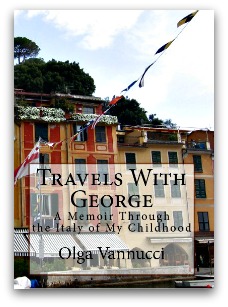
Olga Vannucci CollageWhen I first stumbled across Olga Vannucci’s memoir, Travels with George, I wondered whether the title alluded to John Steinbeck’s book Travels with Charley, about his road trip across America in the company of his French standard poodle, Charley.

Turns out, I got it right. Born in Italy, Olga went to Brown University and currently lives in rural New Jersey. As she tells it, she was driving through Doylestown, Pennsylvania, one day when Steinbeck’s travelogue popped into her head, and she knew she wanted to call her book “Travels with George.” When she announced this to her son (the “George” of the title), he said: “So I’m the dog?”

As you can gather from this story, mother and son make quite a pair.

Olga says she’s no Steinbeck, though she does prefer a plain and honest writing style. Also like Steinbeck, she had the desire to see her native land again.

So, how did she find the Italy of today: did she still fit in? And what did her sidekick, George, the blonde all-American kid, make of his mammina‘s homeland? Did he enjoy these escapades or feel puzzled by his mother’s motives? Perhaps the story he saw himself in wasn’t Steinbeck’s at all, but a modern Italian version of Don Quixote, in which he occupied the role of a skeptical Sancho Panza?

Olga has kindly agreed to give away one copy of the book to the reader who is keenest to find out the answers to these questions (see giveaway details below).

But before we get into that, let’s talk to Olga and hear some more about the travels that inspired her to put pen to paper…

* * *

Travels with George Book CoverCiao, Olga! Let’s begin at the beginning. Tell us more about your decision to take a trip to Italy with your young son and write about it.
I was born in Italy (Milano), lived in Brazil two different times as a child, and came to the United States to attend college. I’ve been here ever since. When my son was seven years old, I realized suddenly that I hadn’t been back to Italy in ten years, and I went, taking him along. I thought he would learn about Italy and acquire a feel for what it’s like. I also hoped he would learn some Italian. I don’t know how much of that was accomplished, but I loved showing him around. We went back four more times over the course of six years (he is now 14). I wrote the book about those trips: a mix of travelogue, personal history, and little anecdotes, with some humor.

What impact did writing about the experience have on you—did it help you process your childhood memories?
It was wonderful to see the locales of my childhood again. At this point, my memories are either indelibly fixed or just gone—for instance, I can remember clearly sitting on the steps with my friends Sassello, in Ligurio, as I recount here:

[My sister and I] had two friends in Sassello, two girls the same age as [us]—Paola and Maria Elena. They spent their summers thirty meters from where we spent ours, and we spent hours and hours of every day together.

[George and I] walk by the steps where we used to sit. I expect to see them, I expect them to be there, but they’re not. No one is. It’s all the same, but it isn’t.

Did you also learn something about yourself, in taking these excursions down Memory Lane?
I did find out about my current self through the book, but primarily from what others told me my words said about me—for example that I’m kind, funny, and honest. It was also interesting to hear from others about the things that they could relate to in the book, ranging from the more profound to the totally mundane situations. That was amazing, to realize that what I wrote spoke to others.

George’s ordeal

Do you think it will help George someday, in understanding part of his heritage that might not otherwise be accessible?
George has not read the book because, he says, “I was there, I don’t need to read about it.” I do hope and trust that both the experience and the writing will be a part of him, that he will consider the book a gift.

What was your most displaced moment when you & George were touring Italy, when you thought of yourself as a stranger within your homeland?
I always struggle with whether I am Italian or, at this point, American, or, more likely, not really either one. What makes me feel at home in Italy is the fact that it’s largely so unchanged. What makes me feel displaced is that the people of the older generation, my parents’ generation, who are the people I particularly associate with Italy, are passing. They’re my biggest connection with Italy, and they will soon be gone. After that, I may feel displaced…

I gather you don’t feel nearly as comfortable with younger generations of Italians?
Yes. I’m not sure why not. Possibly because the younger generation is doing its own thing and is more all over the place, unlike the older, which has stayed put.

What was your least displaced moment, when it all seemed to make sense for you and George to be there—that you fit right in?
On all the trips we visited my aunt, my mother’s sister, and stayed at her house, where we slipped naturally into being part of the family. I had coffee with her in the morning, we planned meals, I helped her water her garden, George fed her goldfish, and we watched television in the evening.  There was not an ocean or even a smidge of formality between us.

I love the description you provide of your aunt in the book:

My aunt is a lovely person, she’s beautiful and she likes to dress well. She’s 80 now, and she still looks good in her clothes, she wears fashionable clothes. She is cheerful and tells funny stories. She loves to do stuff and see people, she’s chatty. She’s fun to be around.

In that same passage, you mention the “recurring nightmare” of finding food that George likes to eat. What was the most challenging thing about traveling with a young child?
I did not realize how jarring the experience would be for George. To me, Italy is pleasant, and while I knew it would all be new to him, I didn’t realize how different it really was. Being in a completely unrecognizable place where he didn’t understand the language was way outside his comfort zone. I also probably didn’t verbalize things enough. I could have prepared him more and explained things better.

The other thing about traveling with a small child is that I, as the adult, had to be “on” 100% of the time.  Not only did I have to plan and handle everything, but I also had to manage him and make sure I didn’t lose him, which was something I actually worried about, and when I became stressed I had to try to hide it so he wouldn’t become stressed, which I didn’t do very well. He’s very perceptive.

What do you think he took from the experience?
The knowledge that he can survive a terrible ordeal… Possibly I took him on a few too many hikes up hills. It wasn’t always fun and idyllic. I do believe that the trips will serve as a foundation for him to understand that the world is large and diverse and for him to appreciate differences.

The potential perils of writing about one’s offspring

What was the most difficult part of the book-writing process?
It was hard to write about others and protect their privacy at the same time, particularly with my son. I find him very amusing, but he doesn’t intend to amuse me, and he is sensitive to it. He thinks I’m making fun of him, basically. So I’m always walking that line, writing about him, but trying to be respectful of him.

I understand you decided to self-publish the book. Why is that, and do you have any advice for other writers who opt for self-publishing?
I made some attempts to get an agent but ultimately I went with self-publishing because I didn’t have the patience to wait. What I like about self-publishing is that it’s all mine, I created the book cover, I chose the font, I decided to favor the comma over all other punctuation, and it’s been incredibly fun and very rewarding.

There are so many options today to publish and distribute and get the word out, and it can be done without a big financial investment. All you need is the investment of time. Given that this is your passion, you want to spend your time on it anyway. And there are so many people who are open to help. I would encourage other writers not to be afraid to ask. Putting your thoughts out there to share with others is a gift, and people respond very kindly.

What audience did you intend for the book, and has it been reaching those people?
I thought it was a mother/son book, which it is, but it’s very much a book for people who love Italy, who have been there, or who plan to go. My writing is very direct and the book is written in the present tense, so readers feel like they’re there along with me. It combines some very personal time in Italy–with family or revisiting places of personal significance—with visits to the big tourist destinations like Venice and Rome.

Are you working on any other ambitious writing projects?
I am working on a book about traveling with George in America. It’s not an organized itinerary, it’s just places we’ve been or will go to. Mostly in the northeast, plus San Fran and Arizona. It’s still in the infant stages, this project. But I promise it will be extra funny!

10 questions for Olga Vannucci

Finally, I’d like to ask a series of questions that I’ve asked some of our other featured authors, about your reading and writing habits:
1. Last truly great book you read: Don’t Let’s Go to the Dogs Tonight, by Alexandra Fuller, about growing up in Africa.
2. Favorite literary genre: Definitely travel!
3. Reading habits on a plane: I don’t like to fly so I bring an easy-reading book that I know will keep me engaged, and paperback so it’s lightweight.
4. The one book you’d require President Obama to read, and why: He has such a tough job. I would wish, not require exactly but only wish, for him to read a book that his daughters like, so he can have a topic of conversation that they can share and enjoy. He will then tackle his job rejuvenated.
5. Favorite book as a child: Mary Poppins—the P.L. Travers book and the Disney movie, too. I think I had it in both languages. It was just magical, different, not at all like my daily life with my mother and sister.
6. Favorite heroine: Martha Gellhorn, who was a great journalist and writer. She was married to the literary giant Ernest Hemingway yet always retained a strong sense of herself.
7. The writer, alive or dead, you’d most like to meet: I would like Calvin Trillin to take me out to eat in New York, in the Village, to all his favorite eating places. It might take several days because he has a lot of favorite eateries. I would like to hear all about Alice, about his daughters, and about his long and brilliant career.
8. Your reading habits: I read in bed every single night, and I have been reading more during the day recently. I’ve been deliberate about carving out more time in the day, when it’s otherwise easy to get caught up in other activities.
9. The book you’d most like to see made as a film: Any book that takes place overseas, so I can see the place in which the events take place.
10. The book you plan to read next: Hard to tell… I have a stack of some thirty books in my bedroom, and I’m not sure which one is next. I may need to devise a lottery system to determine the reading order…

* * *

Grazie tanto, Olga! Your story certainly sounds amusing while also saying something profound about parent-child relationships and the quest to go home again. Something to rival the wisdom of Steinbeck or Miguel de Cervantes, for sure.

Readers, it’s time for you to ENTER OUR DRAW TO WIN A FREE COPY of Olga Vannucci’s book, by entering a comment below. Olga says she will favor comments that tell her why you’d like to read about her and George’s adventures.

Extra points, as always, if you’re a Displaced Dispatch subscriber!

The winner will be announced in our Displaced Dispatch on September 28, 2013.

To read more excerpts from Travels with George, go to Olga Vannucci’s author site. You can also keep up with her on the book’s very active Facebook page. Also feel free to order the book from Amazon.com.

STAY TUNED for tomorrow’s quota of Global Food Gossip. Rumor has it, Joanna Masters-Maggs has something particularly tasty in store for us!

If you enjoyed this post, we invite you to register for The Displaced Dispatch, a round up of weekly posts from The Displaced Nation, with seasonal recipes, book giveaways and other extras. Register for The Displaced Dispatch by clicking here!

Related posts:

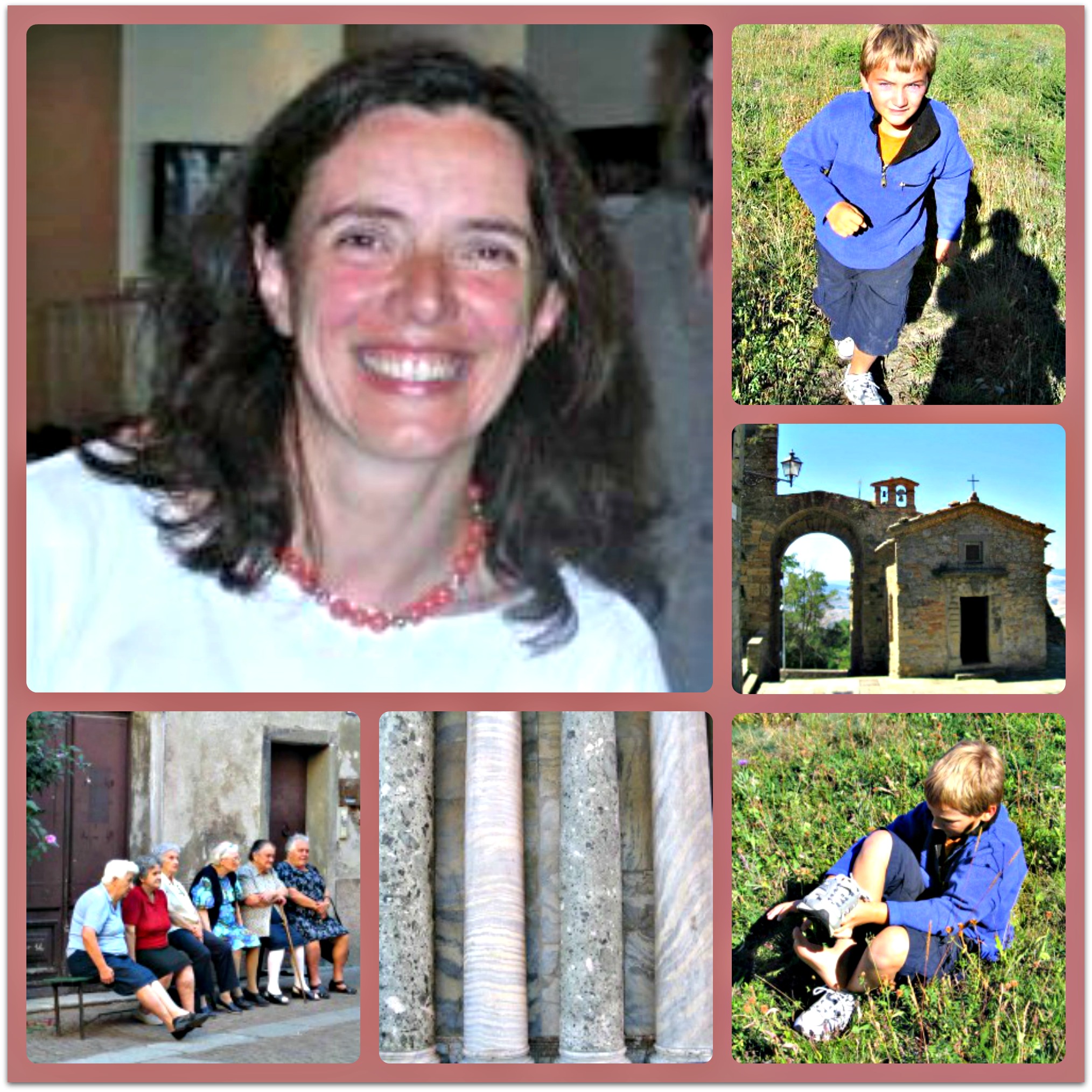
Images: Olga Vannucci and George, interspersed with Italian scenery. Of the George photos, Olga writes:

Let me provide the audio from George: “Where are we going? How much longer? I have something in my shoe. I want to go back. Why are we doing this? Do you know where we are? Do you know where we’re going? Mammaaaaaaa!”

JACK THE HACK: Expat authors, let’s review the reviewer situation

JACK THE HACK _writingtipsAfter an expat experience in Bodrum, Turkey, that was literally something to write home about (as in a book!), Jack Scott traded in the dream for a less pressured existence back in the UK, than the one he was originally escaping from. In his monthly column for the Displaced Nation, he attempts to give back something to the poor souls out there who are still displaced and hacking away at travelogues-cum-memoirs or, in some cases, autobiographical novels. Jack the Hack has been there and done that and can lend a helping hand. Warning to non-Brits: Don’t be put off by his wry sense of humo(u)r!

—ML Awanohara

There’s no doubt that a sparkling set of reviews is one of the most potent ways to market a book (or anything else for that matter). Conversely, bad reviews (or no reviews at all) are poison.

So, how difficult is it to elicit those five gold stars everyone’s chasing?

Apart from emotionally blackmailing your nearest and dearest (something I assume you’ve already done), there are a number of little tricks you can try when it comes to beefing up your scrapbook.

Tricks of the trade

Here are three basics:
1) Whenever someone writes something positive about your masterpiece on social media or on your blog, do the right thing and thank them. While you’re at it, ask if they wouldn’t mind posting a review on Amazon or Goodreads. Some won’t but some will.

2) Search out book review sites online. Some review for free, some for a small fee—and all will expect a freebie. Many of these sites will post their review on the major bookselling sites as well as their own website.

3) Raise your game even further by approaching the Amazon top reviewers. Click on a reviewer, check out their interests and if they have listed their contact details, drop them a begging letter. This won’t guarantee you a good review (or one at all)—and be careful to select someone who is interested in your type of book. Someone into soft porn vampire romps is unlikely to rave about your expat escapades, however worthy and well written they are.

Damning with faint praise

There’s a downside to all this. Reviewing can be a rum business. Amateur hacks, often anonymous and sometimes with an axe to grind or with lofty literary pretensions, can damn with faint praise or go nuclear with their toxic pen.

Naturally, no book appeals to everyone. Literature, as with art, is in the eye of the beholder.

Even writers at the top of the heap get mixed critiques. Someone once wrote that Captain Corelli’s Mandolin was “…the worst book I’ve ever read.” Sure, it’s not everyone’s cup of tea—but the worst book ever?

Was the author, Louis de Bernières, much bothered? Not with a fat cheque for the film rights in his back pocket, he wasn’t.

Should a review like that count? Well, here’s the rub. Mass appeal retailers who positively encourage reviews as part of their business model are far too egalitarian. There’s very little discernment and no filter. Generally speaking, every comment carries equal weight. (A notable exception is something written by one of Amazon’s top reviewers, as mentioned earlier. These guys do have clout).

Hoisted by their own petard? If only…

Have you ever read a book review that’s so badly written, it’s barely readable? I know I have. Talk about irony. It’s like a playground brat screaming “I don’t like you so there!” just because he can.

For my part, if I don’t have anything good to say, I tend not to say it at all. It’s bad karma.

Like it or lump it, mixed reviews are an occupational hazard. People are entitled to express their view about something they’ve paid hard cash to read. Good, bad or indifferent, as long as it’s honest and not gratuitously offensive, it’s fair comment even when you think it’s unfair. Just hope the good drowns out the bad.

As for me, I’ve gotten off lightly. Reviews for my book have been very positive, but I’ve had the odd wobbly moment, too. Someone once joined Goodreads just to trash my book and make sure it dropped down a reading list by voting up every other title. Who was the literary troll? I will never know. Was I hurt? Sure was.

Rogue reviewers? It reminds me of why dogs lick themselves—because they can.

Which leads to—

WRITING TIP FOR EXPATS NO 6:

The best you can do is rise above the din, turn the other cheek and keep you own counsel. It doesn’t do to spit back even when sorely provoked.

* * *

Readers, any comments, further questions for Jack the Hack? He’ll be back next month with some more writing tips…

Jack Scott’s debut book, Perking the Pansies—Jack and Liam move to Turkey, is a bitter-sweet tragi-comedy that recalls the first year of a British gay couple in a Muslim country. For more information on this and Jack’s other titles, go to his author site.

STAY TUNED for next week’s fab posts!

If you enjoyed this post, we invite you to register for The Displaced Dispatch, a round up of weekly posts from The Displaced Nation, with seasonal recipes, book giveaways and other extras. Register for The Displaced Dispatch by clicking here!

Related posts:

Images: from top, clockwise: Hand with pen / MorgueFile.com; Boats in King’s Lynn, Norfolk / MorgueFile.com; Jack Scott, used with his permission; Turkish boats / MorgueFile.com

And the August 2013 Alices go to … these 3 international creatives

 © Iamezan | Dreamstime.com Used under license

© Iamezan | Dreamstime.com
Used under license

As subscribers to our weekly newsletter know, our Displaced Dispatch presents a weekly “Alice Award” to a writer or other kind of creative person who we think has a special handle on the curious and unreal aspects of the displaced life of global residency and travel. Not only that, but this person likes to use their befuddlement as a spur to creativity.

Today’s post honors August’s three Alice recipients. Beginning with the most recent, they are (drumroll…):

1) CALLISTA FOX, TCK blogger and author of the serial novel Suite Dubai

Source: “Friday Night Lights vs. The Eurotrash Girl on CallistaFox.com
Posted on: 26 June 2013
Snippet:

Our boarding school offered cheer leading as an afternoon activity… I signed up because it sounded better than typing or drafting and my parents wouldn’t pay for dressage. We knew only a handful of cheers. None of us could name a proper jump, let alone do one. We wore white tennis skirts and blue sweatshirts and any color of hightop Reebok we owned. When we ran out onto the field to do our pathetic cartwheels the audience was quiet, a few laughed. True, the grass was wet and my roommate Samantha slipped and skidded on her chin. We didn’t have our routine perfected.

Citation: Who stole the tarts, Callista? Who stole the tarts? Your account of your bout with cheer leading at a boarding school in Austria suggests that you were in a classic Alice-in-Wonderland situation, perhaps without even realizing it. Because no young American woman in her right mind would cheer an Austrian team playing Australia in American-style football on a field marked for soccer, unless they’d stepped through the looking glass. Indeed, your description is missing some crucial details, for instance:

  1. Were the teams using a koala bear as the ball? Koalas being to Austria what flamingos are to England—namely, more New World than Old. (Notably, koalas like to eat the leaves of the eucalyptus tree, which doesn’t exactly thrive in The Land of Long-needled Pines.)
  2. Did anyone propose a trial for all of those unruly fans in the half-filled stands who were throwing things at you and the other cheerleaders?

All of which brings us back to our original question: was it an Aussie or an Ausie, the Knave who stole the tarts? That’s what we (and presumably your all-American Texan husband) would most like to know.

Still, we did find amusing the tales of ThirdCultureKid-land that you told to your better half. Clearly your quintessentially TCK life had its moments, including the time you watched a guy eat glass in a bar in Nicosia, Cyprus, when you were only 14.

Is it any wonder that when your parents moved you back to Norman, Oklahoma, when you were 20, you felt exactly like Alice, who told her sister: “Oh, I’ve had such a curious dream!” (You did make a lot of it up, right?)

2) CHRIS ALDEN, British expat; author and journalist

For his book: “101 Reasons to Live Abroad…and 100 Reasons Not To”
Published: March 2013
From the book description:

Do you dream of living abroad? If so, you’re in good company. Tens of thousands of people every year emigrate from the UK—leaving behind the security of work, family and friends for the promise of better weather (hopefully), better prospects (sometimes) and a carefree existence (keep dreaming).

So is now the time to leave Britain and start life as an expat? Or have you already started planning the big move overseas?

101 Reasons to Live Abroad … & 100 Reasons Not To helps you discover if living abroad is right for you. It’s an uplifting guide to the positive sides of life as an expatriate—and a reality check about the challenges that relocation brings.

Citation: Chris, we understand that you’re also the author of 250 Things to Do in Cyprus on a Sunny Day, so would encourage you at some point to compare notes with your fellow Alice awardee, Callista Fox. In the post cited above, Callista reports that, when attending boarding school in Nicosia, she and her friends particularly enjoyed hanging out in a bar drinking Carlsberg with UN soldiers (they were there to keep the peace between Cypriots and Turks). We’re genuinely curious: does this particular activity rank in your Top 250? Or perhaps you think it’s better left for a rainy day? (Actually, does Cyprus even have rainy days? Oh, that’s right: it’s only semi-arid.)

Anyway, we’re awarding you an Alice because, like Lewis Carroll’s little heroine, you appear to appreciate both the positive and negative aspects of turning one’s life upside down, with the balance tipped every so slightly towards the positive. We believe Alice would be impressed that you offer a final, 101st reason to live abroad for those who, having been offered as many as a hundred reasons both for and against, still find themselves dithering. After all, when Alice’s sister urges her to run inside to get her tea, she obliges her “thinking while she ran, as well she might, what a wonderful dream it had been.”

3) LINDA JANSSEN, writer, speaker, consultant, global adventurer and cultural enthusiast

For her book: “The Emotionally Resilient Expat”
Published: 22 June 2013
From the book description:

Linda A. Janssen combines candid personal stories from experienced expats and cross-culturals, with a wealth of practical tools, techniques and best practices from emotional, social and cultural intelligence, positive psychology, mindfulness, stress management, self-care and related areas.”

Citation: Linda, as you know, we’ve been an avid follower of yours on Adventures in Expatland, which has helped to stimulate many of our own “through the looking glass” insights. And now we see you’ve contributed a tome to the discourse on what to do when you fall through the rabbit hole and feel culturally discombobulated. According to your book, which is sprinkled with expat stories and anecdotes, the answer lies in calling on (or developing) reserves of emotional resilience—a quality Alice had in spades, so to speak. Upon hearing of the Queen of Heart’s intention to have her decapitated, she retorted thus:

You’re nothing but a pack of cards!

At which point

the whole pack rose up into the air, and came flying down upon her: she gave a little scream, half of fright and half of anger, and tried to beat them off, and found herself lying on the bank, with her head in the lap of her sister, who was gently brushing away some dead leaves that had fluttered down from the trees upon her face.

Now if that isn’t resilience, what is?

From now on, we look forward to reading about your Adventures in Repatland, which as we noticed from your last post, are only just beginning:

At long last I’m beginning to surface, coming up for air in a new stage in a new place in a country and culture which seem familiar yet I don’t always recognize.

Hey, if it helps to know, we’ve got your back on this one!

* * *

So, readers, do you have a favorite from the above, or have you read any recent posts you think deserve an Alice Award?  We’d love to hear your suggestions! And don’t miss out on these weekly sources of inspiration. Get on our subscription list now!

STAY TUNED for our next post!

Writers and other international creatives: If you want to know in advance whether you’re one of our Alice Award winners, sign up to receive The Displaced Dispatch, a round up of weekly posts from The Displaced Nation, with news of book giveaways, future posts, and of course, our weekly Alice Award!. Register for The Displaced Dispatch by clicking here!

Related posts: