The Displaced Nation

A home for international creatives

Category Archives: Pot Luck

Would I travel for food? It depends…on whether it’s pizza or haggis!

Third Culture Kid Tiffany Lake-Haeuser is back, to tell us what she thinks about gluttony as a motive for travel.

As a Third Culture Kid who was raised in the United States and Abu Dhabi before returning to my native Germany, I’ve learned that every culture has its own traditional foods — but the idea of trying them all? I’ll take that with a pinch of salt, so to speak.  Some of the world’s most celebrated foods are very good; others, not so much.

At my international school in Frankfurt, I’ve found it amusing to walk around at lunchtime and see what the different nationalities are eating. Obviously, we students are somewhat limited by what the cafeteria offers, but once a year on International Day — a day for celebrating all the nationalities at our school — things get a bit more interesting. We get to choose between egg noodles at the Thai stand and the burgers at the U.S. stand, among others…

Food for thought

Would I travel for food? I know that the Displaced Nation has covered this topic obsessively last month. I discussed it with a few of my schoolmates — ironically, during our lunch period — and we agreed that while most of us have a certain sweet or other type of food we make a habit of eating or buying when we are in certain countries, we would not be inclined to go on a food tour.

One of my friends said she makes it a priority to buy “double stuf” oreos in the U.S. Though hardly a delicacy in America, this cookie is seen as an exotic treat at our school.

Other friends mentioned their efforts to avoid certain traditional foods at all costs. For instance, one of them said she loathed eating haggis in Scotland — even though that’s where she is originally from! For those of you who don’t know what haggis is, it is a savory pudding of sheep lung, liver and heart encased with other ingredients in an animal’s stomach. Mmmmm!

Another friend reported she’d found eating snails in France less than appetizing. The snails slimy and chewy, not pleasurable as French people like to claim.

Rice…again!

My own most memorable food experience associated with travel occurred when I was attending international school in Abu Dhabi. I refer to my eighth-grade week-long school trip to Thailand. Every day, we were given plain white rice to eat; it came with every single meal. By the end of the week, we just couldn’t face another bowl of rice! (On the rare occasions when we were served French fries, the students would attack them and within minutes they would be gone.)

However, on the last day of our trip, we were taken to a school and taught how to make chicken curry and spring rolls. Not only was it the best meal I’d had all week (which is of course not biased to the fact that I was the cook!), but I also found it so interesting to see the way these foods were made.

So maybe I would consider a cookery tour one day?

By the way, that still didn’t stop me from refusing to even consider eating rice for another month after that trip!

Pasta & pizza — perfect!

By the time this post goes up, I will be traveling in Italy, which is by far my favorite country to eat in. Pasta and pizza are two of my favorite things to eat in the world — and let’s face it, Italy does these foods better than anywhere else.

Honestly, I don’t even know how I will stop eating, but that’s a different problem.

I guess everyone needs to decide for themselves how far they are willing to travel for scrumptious or adventuresome eats. As for me, I will not be taking the train to Paris (where my dad now lives) every time I want a croissant — even if the original is truly amazing.

* * *

Readers, any thoughts on or reactions to Tiffany Lake-Haeuser’s skepticism about linking international travel to food experiences? Please put them in the comments. You can also follow what she is up to on her blog, Girl on the Run.

STAY TUNED for the Displaced Nation’s agony aunt, Mary-Sue Wallace, who will attempt to offer expat readers solace on their horrifying experiences in tomorrow’s post.

If you enjoyed this post, we invite you to register for The Displaced Dispatch, a round up of weekly posts from The Displaced Nation, with seasonal recipes, book giveaways and other extras. Register for The Displaced Dispatch by clicking here!

Related posts:


RANDOM NOMAD: Jessica Festa, Backpacker, Offbeat Traveler & Locavore

Place of birth: Long Island, New York, USA
Passport: USA — but I’m planning on starting the papers for my Italian passport soon (my grandparents were born there).
Overseas history: Australia (Sydney): 2008. I’ve also backpacked through western Europe (for partying and food!), South America (for surreal landscapes and hiking trails), and Southeast Asia/China and Ghana (for volunteer projects).
Occupation: Freelance travel writer. I have my own site and also write for Gadling, Viator and Matador, among others.
Cyberspace coordinates: Jessie on a Journey — Taking you beyond the guidebook (travel-zine); @JessonaJourney (Twitter handle); Jessie on a Journey (FB page for backpacking community); and Jessie on a Journey (Pinterest).

What made you leave the United States for the Land of Oz?
I chose Australia for studying abroad because I wanted to be able to communicate in English — it was my first time going abroad alone.

On your site you describe yourself as a “natural backpacker.” How did you find living in one country?
It’s so different living somewhere than just traveling to it. When you have a part-time job, class schedule, gym membership, local hangout, go-to grocery store, etc, you really begin to feel a strong connection to a place. Sydney is such a great city. That said, I did not give up my backpacking habit entirely. I also traveled a lot through Australia when studying!

Tell me about the moment on your travels when you felt the most displaced.
I had many moments like that when I did a homestay for a month in Ghana, in West Africa. I was doing orphanage work, and absolutely loved the experience — but the culture is just completely different. Especially in city areas, it’s very loud and chaotic, and people will shout at you and grab your skin to feel if it’s real. They don’t get many tourists, so they’re just curious and wanting to get to know you — but sometimes it got a little too intense.

When have you felt the most comfortable?
In Sydney. I actually called my family crying the night before my flight back to New York, saying I had a new home and would not be returning. I had this camaraderie with my neighbors and so many connections to the community, I really felt like a local.

You may bring one curiosity you’ve collected from each of the countries where you’ve traveled or lived into The Displaced Nation. What’s in your suitcase?
My collection of paintings, jewelry and handcrafted items:

  • Ghanaian artwork and wooden masks
  • Handmade jewelry from Sydney and Bolivia
  • A handwoven purse from Peru
  • Alpaca socks from Ecuador
  • Banksy artwork from the UK
  • Masapán (bread dough art) from Calderón, Ecuador
  • A hand-sewn water-bottle holder from Thailand

You are also invited to prepare one meal based on your travels for other members of The Displaced Nation. What’s on the menu?

Appetizer: Locro, a thick soup with potatoes, avocado, cheese and vegetables from the Andes.
Main: A pesto pasta with some kind of meat mixed in from the Cinque Terre in Italy.
Dessert: Salzburger Nockerl, a sweet soufflé from Austria.
Drink: Malbec wine from Argentina.

I wonder if you could also add a word or expression from one or more of the countries you’ve visited to the Displaced Nation’s argot.
“No worries” from Australia. Such a great phrase for life. I have it tattooed on my foot!

This week you received a “Food Alice” from the Displaced Nation for your post about the first time you tried cuy, or guinea pig, in Ecuador — you said your dinner reminded you of your pet guinea pig, Joey, named after a school crush. So, does food play a big role in your travels?
For me it’s about trying new things. It doesn’t need to be in the fanciest restaurant or prepared by a Michelin chef, just something truly local. For example, in South America while many of the other backpackers went to guidebook-rated restaurants, I always opted for the tiny, simple, dimly-lit local hangouts. I ate 2- and 3-course meals for a $1, and the food was fresh and local. It was exactly what everyday people in the community were having, and that was important to me.

If you were to design a world tour based on food, what would be your top five recommendations?
1) Mendoza, Argentina — try asado (barbecued meat) with a glass of Malbec.
2) Cinque Terre, Italy — try the pesto pasta that I served to you in my meal!
3) Naples, Italy — try the pizza.
4) Cuzco, Peru — try the cuy (guinea pig) or, if you’re too squeamish, the lomo saltado: strips of marinated steak served over white rice and with French fries.
5) Munich, Germany — try the brätwurst. It is like no other sausage I’ve ever tasted, and tastes so much better in Germany!

To be honest, I’m not so sure about going to Cuzco for cuy.
Really? I love it. I’m planning to go back, and possibly move, to Peru or Ecuador in March. I’m already looking forward to getting my fill of cuy again!

Readers — yay or nay for letting Jessica Festa into The Displaced Nation? At least she’s not planning to serve us guinea pig for dinner — that’s a mercy! (Note: It’s fine to vote “nay” as long as you couch your reasoning in terms we all — including Jessie — find amusing!)

STAY TUNED for tomorrow’s post, which will most likely be on food. (No, we haven’t finished gorging ourselves yet!)

If you enjoyed this post, we invite you to register for The Displaced Dispatch, a round up of weekly posts from The Displaced Nation, with seasonal recipes, book giveaways and other extras. Register for The Displaced Dispatch by clicking here!

Related posts:

img: Jessie Festa enjoying one of the biggest and best empanadas in all of Peru, at the Point Hostels in Máncora (May 2012).

THE DISPLACED Q: What’s the cheapest — yet tastiest — meal you’ve discovered on your world travels?

So what is the tastiest cheap-eat I’ve come across whilst traversing the globe? Not being much of a foodie, and being a writer, cheap — yet tasty — is what I’m all about.

Well, I hate to be boring and predictable — so I won’t be. Yeah, the street food you get in Thai markets is to die for when you’re hungry. Not only that but you can eat three full meals back to back for the price of a loaf of bread in Australia.

But that’s not what I’m going for. No, for sheer cheapness compared with mouth-watering deliciousness, I’m going to have to go with an old favorite: Indo Mi goreng, an instant-noodle brand produced by the world’s largest instant noodle manufacturer, located in Indonesia.

Not just any old noodles!

Now you could be forgiven for thinking I’ve gone off my rocker here. There are countless brands of instant noodles floating around out there, and they’re pretty much all unified by one thing: being rubbish.

Nutritionally rubbish. Tasteless. Processed. Crap.

But not these noodles! I ate them almost every day on my rejuvenating hike across Western Australia — mostly because they were light enough to carry in a full rucksack and impossible to mess up in terms of cooking. These ones are nice, super nice even. And when I went back to England recently and discovered I couldn’t buy them there, the wife made me order them wholesale! I think they came directly from Indonesia. Forty packet… Oh, yes, this is how much we love these noodles.

Even though we buy them in bulk, they still cost less than the postage!

All the Asians in my area of Australia buy them — either in ten-packs, or in the same giant box I had delivered to me in England. That’s how you know they’re good noodles — when your Malaysian housemates fill their shelves with them!

But I can’t devote this entire post to one brand of instant noodles, can I? Um…no. But I’m hard pressed to think of anything else that’s so delicious for less than 50 cents.

A case of “you get what you pay for”?

Well, Canadian athlete Joe Sakic spoke true when he said:

Any free meal is a good meal, you know?

Or did he? I’ve come across a few ways of getting free food in my time — from famous vegan soup kitchens in a hippie commune in Margaret River (Western Australia) to the delightful food they served me in hospital when I was selling my body to medical science (also know as being a guinea pig for medical testing). And none of these meals were especially delicious.

You know, they would shoot me full of weird, untested drugs, imprison me in a hospital for weeks at a time, make me sleep on rubber sheets and wake me every morning at 4:00 a.m. to take my blood.

But still, the worst thing about the whole experience was the food.

Free is only good if you don’t have to have it; being forced to eat isn’t great no matter the quality of the food. Which, unsurprisingly, wasn’t great.

Tastes that refuse to be acquired

Then, of course, there are the meals in foreign lands that people treat you to. In my experience, that can be risky.

On my last morning in South America, my Ecuadorian girlfriend took me for a surprise breakfast she’d been planning for some time.

She led me all through the suburbs of Quito, to a restaurant which was famous for one dish in particular: ceviche.

Now, I’m not a fan of seafood. I can just about choke down a fish-finger — as long as I can’t see the insides of it. Ugh!

Of course, this topic had never come up; one of the myriad disadvantages to starting a relationship when you don’t share even one common language. We communicated mostly in sign language, and the half-assed version of Spanish I was picking up.

So naturally, I’d never mentioned my intense dislike of seafood, in much the same way as she thought it would be too much effort to explain what her surprise was. As a result, neither of us knew what to expect until I lifted the lid on my service and saw what it was: namely, half the cast of Finding Nemo, after being put in a blender with some brown sauce and chillies…

I tried to eat it, honestly I did!

I didn’t succeed though.

At least, the bit I did eat came back up so rapidly we have to make our excuses and leave the restaurant at top speed…

So remember that, whilst free food is irresistible, you should always season your desire for a cheap eat with a little caution, especially when traveling. The old adage is true: there is no such thing as a free lunch (or breakfast).

There are few things worse than being violently ill in the middle of a country where no one speaks your language. Far from home. Far from healthcare you trust… And wearing most of your raw-seafood breakfast.

That is almost never a good look. :0)

* * *

So, that’s all from me on this particular displaced Q! Now it’s your turn! What experiences have you had in your search for cheap eats around the world? Any tasty morsels? Anything we should avoid? Any scrumptious stories…? We’d love to hear from you! You can also hit us up on Twitter: @TonyJamesSlater +/or @displacednation.

STAY TUNED for Tuesday’s post, the second part of a two-part travel yarn about two madcap Indonesian ladies who are taking Japan by storm!

If you enjoyed this post, we invite you to register for The Displaced Dispatch, a round up of weekly posts from The Displaced Nation, with seasonal recipes, book giveaways and other extras. Register for The Displaced Dispatch by clicking here!

Related posts:

Img: The contents of Tony James Slater’s shopping bag, taken on 9 September 2012 in his current home of Perth, Australia.

Repatriation is just relocation — with benefits

Today’s guest blogger, Anastasia Ashman, has been pioneering a new concept of global citizenship. Through various publications, both online and in print, and now through her GlobalNiche initiative, she expresses the belief that common interests and experiences can connect us more than geography, nationality, or even blood. But what happens when someone like Ashman returns to the place where she was born and grew up? Here is the story of her most recent repatriation.

I recently relocated to San Francisco. Three decades away from my hometown area, I keep chanting: “Don’t expect it to be the same as it was in the past.”

Since leaving the Bay area, I’ve lived in 30 homes in 4 countries, journeying first to the East Coast (Philadelphia Mainline) for college, then to Europe (Rome) for further studies, back to the East Coast (New York) and the West Coast (Los Angeles) for work, over to Asia (Penang, Kuala Lumpur) for my first overseas adventure, back to the USA (New York), and finally, to Istanbul for my second expat experience.

My daily mantra has become: “Don’t expect to be the same person you once were.”

With each move, my mental map has faded, supplanted by new information that will get me through the day.

Back in San Francisco, I repeat several times a day: “This place may be where I’m from, but it’s a foreign country now. Don’t expect to know how it all works.”

What a difference technology makes (?!)

Today my work travels, just as it did when I arrived in Istanbul with a Hemingway-esque survival plan to be on an extended writing retreat and emerge at the border with my passport and a masterpiece.

I knew from my previous expat stint in Malaysia that I needed to tap into a local international scene. But I spent months in limbo without local friends, nor being able to share my transition with the people I’d left.

This time is different. Now I’m connected to expat-repat friends around the world on the social Web with whom I can discuss my re-entry. I’ve built Twitter lists of San Francisco people  (1, 2, 3) to tap into local activities and lifestyles, in addition to blasts-from-my-Berkeley-past.

I’ve already drawn some sweet time-travely perks. To get a new driver’s license I only needed to answer half the test questions since I was already in the system from teenhood.

After Turkey’s Byzantine bureaucracy and panicky queue-jumpers, I appreciated the ease of making my license renewal appointment online even if the ruby-taloned woman at the Department of Motor Vehicles Information desk handed me additional forms saying: “Oh, you got instructions on the Internet? That’s a different company.”

One of the reasons my husband and I moved here is to more closely align with a future we want to live in, so it’s cool to see the online-offline reality around us in San Francisco’s tech-forward atmosphere.

It doesn’t always translate to an improved situation though. Just as we are searching for staff to speak to in person at a ghost-town Crate & Barrel, a suggestion card propped on a table told us to text the manager “how things are going.”

So, theoretically I can reach the manager — I just can’t see him or her.

So strange…yet so familiar

It took a couple of months to identify the name for what passes as service now in the economically-depressed United States: anti-service. Customer service has been taken over by scripts read by zombies.

When I bought a sticky roller at The Container Store, the clerk asked me, “Oh, do you have a dog?”

“No, a cat,” I countered into the void.

He passed me the bag, his small-talk quota filled. He wasn’t required by his employer to conclude the pseudo-interaction with human-quality processing, like, “Ah, gotta love ’em.”

What I didn’t plan for are the psychedelic flashbacks to my childhood. I may have moved on, but this place seems set in amber. The burrito joints are still playing reggae (not even the latest sounds of Kingston or Birmingham) and the pizza places, ’70s classic rock stations (Steve Miller Band’s “Fly Like An Eagle,” anyone?). The street artists are still peddling necklaces of your name twisted in wire. Residents are still dressed like they’re going for a hike in the hills with North Face fleece jackets and a backpack.

A bid for minimalism

The plan is also to be somewhat scrappy after years of increasing bloat. My Turkish husband and I got rid of most of our stuff in Turkey in a bid for minimalism. We camped out on the floor of our apartment in San Francisco until we could procure some furniture.

If it was a literal repositioning, it was also a conscious one — for a different set of circumstances. We’d expanded in Istanbul with a standard 3-bedroom apartment and “depot” storage room, and affordable house cleaners to maintain the high level of cleanliness of a typical Turkish household. In California, I intended to shoulder more of the housework.

I was soon reminded of relocation’s surprises that can make a person clumsy and graceless. I should have kept my own years-in-the-making sewing kit since I can’t find a quality replacement for it in an American market flooded with cheap options from China — and now have to take a jacket to the tailor to sew on a button, something I used to be able to do myself.

When the lower-quality dishwasher door in our San Francisco rental drops open and bangs my kneecap, I recall the too-thin cling wrap and tinfoil that I ripped to shreds in Istanbul, or the garden hose in Penang that kinked and unkinked without warning, spraying me in the face.

New purchases

“We’re getting too old for this,” my husband and I keep telling each other as we shift on our polyester-filled floor pillows that looked a lot bigger and less junky on Amazon. (We were abusing one-day delivery after years of not buying anything online due to difficulties with customs in Istanbul. Cat litter can be delivered tomorrow! Pepper grinder! Then I read about the harsh conditions faced by fulfillment workers in Amazon’s warehouses and cut back.)

One of our first purchases Stateside was a television. Not that we’re going to start watching local TV, but we did flick through some satellite channels. It’s something I like to do upon relocating: watch TV and soak up the local culture like a cyborg.

Since I last lived in the US, reality shows like COPS — where the camera would follow policemen on their seedy beats — have gone deeper into the underbelly of life, and now there are reality shows about incarceration.

The Discovery Channel has also gone straight to the swamp. That’s where I caught a moonshiner reality show featuring shirtless (and toothless) men in overalls called “Popcorn” and “Grandad.”

It’s an America I am not quite keen to get to know.

But I can take these reverse culture shocks lightly because my repatriation is part of a continuum. It’s not a hiatus from anything nor a return home. I’m not missing anything elsewhere, I haven’t given up anything for good. Being here now is simply the latest displacement. Today is a bridge to where I’m headed.

ANASTASIA ASHMAN is the cultural writer/producer behind the Expat Harem book and discussion site.  The Californian has been on a global rollercoaster: fired in Hollywood, abandoned on a snake-infested island off Borneo, married in an Ottoman palace, interviewed by Matt Lauer on the Today show. She brings it all home in the “Web 3.0 & Life 3.0” educational media startup GlobalNiche.net, empowering creative, adventurous, self-improving people to tap into a wider world of personal and pro opportunity no matter where you are. Get your copy of the Global You manifesto here.

STAY TUNED for tomorrow’s episode in the life of our fictional expat heroine, Libby. (What, not keeping up with Libby? Read the first three episodes of her expat adventures.)

If you enjoyed this post, we invite you to register for The Displaced Dispatch, a round up of weekly posts from The Displaced Nation, with seasonal recipes, book giveaways and other extras. Register for The Displaced Dispatch by clicking here!

Related posts:
Images: Anastasia Ashman (2012), her World Champions ring, and a view of the bridge to where she’s headed right now.

RANDOM NOMAD: Liv Gaunt, Accidental Serial Expat and Feeder of Sharks

Place of birth: Luxembourg
Passport: UK
Overseas history: England (Sevenoaks, Kent): 1981–98); Turkey (Fethiye, Ölüdeniz, Fethiye again): 1998–99, 2001–02, 2004; Kenya (Watamu): 1999–2000; Egypt (Dahab): 2000-01, Bahamas (Nassau and Family Islands): 2002–03; Barbados (Bridgetown): 2004–05; England (London): 2006–10; Australia (Cairns, Brisbane, Esperance): 2011 – present. (Gosh, I feel like a serial expat listing so many places!)
Occupation: Journalist and scuba instructor
Cyberspace coordinates: The World is Waiting — Expat humour, travel tips, handy hints, photos and inspiration for travellers (site); @worldswaiting (Twitter handle); The World is Waiting (Facebook); WorldsWaiting (Pinterest); and Liv G (foursquare).

What made you leave your homeland in the first place?
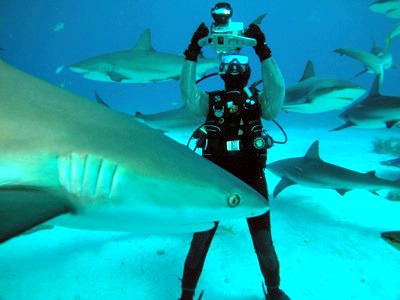
Though I am fond of Britain, I left because I was seeking work as a scuba diving instructor and underwater photographer. The jobs available overseas offered a better diving experience and a better lifestyle. Photographing sharks, filming turtles, and teaching people to dive in an island paradise conditions are not things you can do in Britain.

Is anyone else in your immediate family “displaced”?
My parents were expats in Luxembourg, which is where I was born. For a few years my father was based in Barbados for work, so I guess it runs in the family — but nobody other than me is displaced at this moment.

Your chosen profession of diving and underwater photography has led you to settling, at least for a time, in quite a few different countries. Tell me about the moment when you felt the most displaced.
I believe it is the people who make the place. I feel most displaced when I am surrounded by people who do not treat others with what I consider to be the most basic level of respect — basically, as they would wish to be treated. Discovering cultural differences can be fascinating; but living with discrimination day in day out is frustrating and awful. Living in Egypt I found it really frustrating that men would not take me seriously simply because I am female. They completely disregarded the fact that I had more experience and was more qualified than they were. Of course I understand there are significant differences between Arab and Western culture. But being in a male-dominated industry (scuba diving) in a paternal society (Egypt) was simply not for me.

Was there one specific moment during your time in Egypt that catalyzed this feeling for you?
No, I think it was more the growing realization that I would never be taken seriously.

Describe the moment when you felt your least displaced — i.e., when you felt more or less at home in one of your adopted countries.
The first time I lived somewhere other than with my parents, was in Turkey in my late teens. I took on the responsibility of earning enough to pay rent, bills and to feed myself — and it was all in Turkish. It was a classic example of me diving in at the deep end, so to speak. As a result, I quickly gained a working knowledge of the Turkish language as well as an understanding of the country, culture and its people. Initially I thought that my Turkish friends would be horrified by my near constant butchering of their language. But they only ever encouraged me — and even nicknamed me “the Turkish-English girl.” Nowadays, whenever I visit Turkey I feel very at home there. I don’t have the normal visitor’s questioning of things. I still have quite a few Turkish habits like always removing my shoes indoors, being quick to hit the horn whilst driving, and showing hospitality to visitors.

You may bring one curiosity you’ve collected from each of your adopted countries into The Displaced Nation. What’s in your suitcase?
From Turkey: An evil eye. Evil eyes are so-called, rather misleadingly, as they are believed to ward off evil. They are usually made from glass or ceramics and are often seen hanging over entrances to offices and people’s homes.
From Kenya: Some beaded sandals made from leather and old car tyres. They are the most comfortable sandals I ever had.
From Egypt: Egyptian hibiscus tea. They serve it warm with a classy piece of foil over the top of the glass!
From the Bahamas: Pink sand from Harbour Island. All Bahamian sand is silky soft and impressive frankly but on Harbour Island it is even more beautiful for being a dusky pink.
From Barbados: An amazing reggae soundtrack.
From Australia: Can I bring a quokka? They are small marsupials, a bit like a large-bottomed mini-kangaroo. I find them endlessly amusing.

And now you are invited to prepare one meal based on your travels for other members of The Displaced Nation. What’s on your menu?

Starters: A huge plate of Turkish meze including filled filo pastries, various dips, Turkish bread, olives, cheese and some köfte.
Main: Bahamian conch fritters — the conch will be fresh from the sea and delicately fried — served with lime coconut dip and salad.
Dessert: An Australian pavlova, covered in fresh fruit.
Drinks: To include Caribbean piña coladas and mojitos, and Turkish cherry juice.

It would be a strange meal perhaps, but very tasty!

I wonder if you could also add a word or expression from one of the countries you’ve lived in to The Displaced Nation argot.
Ubuntu, which is an African ethical philosophy. Nelson Mandela explained it thus:

A traveller through a country would stop at a village and he didn’t have to ask for food or for water. Once he stops, the people give him food, entertain him. That is one aspect of Ubuntu, but it will have various aspects. Ubuntu does not mean that people should not enrich themselves. The question therefore is: Are you going to do so in order to enable the community around you to be able to improve?

Your life thus far has been quite an odyssey. You’ve traveled to 42 countries and lived in six. Do you think of yourself as a travel pro?
I don’t consider myself a professional traveler. To me, that term implies that I am paid to travel, which is certainly not the case. I am inspired to continue traveling to new places because I enjoy learning about people’s lives and cultures, and seeing the world through their eyes. I find the different foods interesting as well. Travel also allows you to see where you have come from in a whole new light.

What’s still on your bucket list?
Oh, it’s endlessly growing! Top of the list currently are the Philippines and the Galápagos.

But you are a professional scuba diver. Did you watch the diving events in the London Olympics?
I wasn’t able to watch most of the Olympics because of the time difference between Australia and Britain and a recent spate of overtime at my job. However, to answer your question, no, I have little interest in competition diving. I am not a competitive person generally and rather believe that at the end of the day the only person you ever truly compete with is yourself.

What made you so certain you wanted to be a scuba diver?
I enjoy interacting with the creatures of the deep. Watching as a shark cruises out of the blue towards you, having a curious manta ray investigate you, or sharing a moment with a cheeky turtle is far more fun to me than being faster or more coordinated than someone else. I also enjoy the challenge of capturing the underwater critters on camera.

As it happens, this week marks the 25th anniversary of Shark Week, the Discovery Channel’s longest-running programming event. The purpose is to draw the attention to the shark species, one third of which is at risk for extinction. (We must all stop eating shark fin soup — up to 73 million sharks are killed each year for their fins!) I understand that you love to video and photograph sharks. Is that the riskiest thing you’ve done under water?
Most people would say the riskiest thing I have done underwater is feed sharks. It’s not about thrill-seeking, though, but about providing divers with an up-close encounter, which I think is the best way to educate people about and ultimately protect the sharks.

But while you are a shark lover, you have an aversion for sea urchins. Why is that?
If you ask me that question, I have to assume you have never accidentally brushed past one and received an ankle full of their bloody painful spines?!

But have you ever eaten uni in a Japanese restaurant?
No. I love sushi but haven’t managed any sea urchin yet. Have you, is it good?!

Readers — yay or nay for letting Liv Gaunt into The Displaced Nation? Is she above water or is there something fishy about her application? (Note: It’s fine to vote “nay” as long as you couch your reasoning in terms we all — including Liv — find amusing!)

STAY TUNED for tomorrow’s compendium of books on travel to Tuscany.

If you enjoyed this post, we invite you to register for The Displaced Dispatch, a round up of weekly posts from The Displaced Nation, with seasonal recipes, book giveaways and other extras. Register for The Displaced Dispatch by clicking here!

Related posts:

img: Liv Gaunt videoing a shark feed in the Bahamas.

A classic TCK dilemma: Which of my 3 heritages counts for the Olympics?

We welcome back Third Culture Kid Tiffany Lake-Haeuser to the Displaced Nation. (She last joined us during fashion month.) Born in the United States to German parents, Tiffany returned “home” to Frankfurt when she was six. But then at age 13, she moved with her family to Abu Dhabi, UAE. Now back in Frankfurt, this 16-year-old divides her time between this city and Paris, where her father currently resides. So which team(s) does Tiffany support in the Olympics? That’s the million-euro (or is it dollar?) question.

I was never really very interested in sports. This year, during the Olympics, that changed. You still won’t find me glued to the television to see all the events, but I’m definitely more interested than in the past.

Then of course, there is the somewhat confusing decision of which country to cheer for. Do I support my heritage and the country I now live in, Germany? Or do I support the country I was born in and often associate with, the USA? Well for me it was easy to decide. You see, I am extremely competitive and enjoy cheering for the country that wins, which for the most part leads to me cheering for the USA.

I watched the pre-Olympic trials for the American gymnastics team when I was in the United States visiting childhood friends earlier this summer. I was gobsmacked — not only by the amazing talent of the athletes, but also by the enthusiasm shown by the spectators.  I think that’s when I caught the Olympic bug. Suddenly I was eager to see the team compete for gold in London.

German apathy

But when I got back in Germany, there was barely any sign that the Games were fast approaching. Maybe I was just in the wrong environment, but no one was even talking about it. Even when the Games started, it felt like no one cared. The most excitement I observed was a small promotional program by a pharmacy(!). Unless I was on some social networking site, I barely ever exchanged views with anyone about what was happening at the Olympics.

While waiting for the Games to start, I did some research and found out that since the modern Olympic Games began, the USA has always been in the top three countries when it came to the number of medals won.

This history made me even more inclined to support my other “home” country. I love cheering for countries that are doing well. I love being a fan.

Go USA! Hmmm…unless it’s soccer?

As anyone who read my March interview with The Displaced Nation knows, I’m something of a fashionista. I love the idea of showing some pride for the US team by wearing red, white and blue. It may seem petty, but half the fun of watching the Olympics for a non-athlete like me is getting dressed up and painting your face in your team’s colors.

That’s something I picked up from Germany, in fact. Germans get truly pumped up for one thing: soccer. It’s our pride and joy. During the European Cup or the World Cup, Germany is transformed into a black, red and golden country. While in the USA people have flags hanging by their doors all year long, in Germany that happens only during these major soccer events.

One test of which side I was on in the Olympics came when a friend tried to bug me by saying that Germany was being beaten by his country in some sport. To be honest, I didn’t mind that much. All I could think about how well Gabby Douglas was doing in gymnastics.

Does this mean I am not proud of my German heritage? It definitely doesn’t; by the next soccer game you will see me losing my voice for cheering on Germany.

So it really isn’t that straightforward or clear. You never truly stop cheering for a country that means something to you. All you can really hope for is that the two countries’ teams never play against each other…

Go women athletes!

On a different note, I was excited to hear about how every country sent women to the Olympics this year. I wouldn’t call myself a feminist, but I do think gender equality is important, and that a country that is sending its women athletes to compete in the Olympics for the first time is taking a big step. I hope that gender equality in sports can become the new standard. Some day, perhaps, it will be considered so normal it won’t even make the headlines.

Having lived for three years in Abu Dhabi, I was particularly interested in the news about Saudi Arabian women participating in the Games. I know from experience how easy it is for us Westerners to look at Arab women wearing the hijab and think they are less liberated than we are. When I saw the Saudi women walking behind the men during the London opening ceremony, I was not surprised so much as humbled. Not everyone sees equality in the same way as we Westerners do.

Likewise, I didn’t think it was fair for the International Olympic Committee to consider banning the judo wrestler Wodjan Ali Seraj Abdulrahim Shahrkhani from dressing according to the traditions by which she was raised.  (In the end, they compromised on a cap for her to wear instead of the hijab.) To some degree, I admire Saudi Arabia for insisting upon preserving its cultural identity and traditions in face of the influence of Westernization.

By the time the Games end on Sunday, I think my favorite part will not be about having supported a particular country. The best part, in my opinion, has been seeing the people who rise to the occasion and do phenomenally well. It sounds cheesy, but you can see in their eyes the joy and relief that all their hard work and training has finally paid off — in the moment that counted, they were able to be the best they could be.

* * *

Readers, any thoughts on or reactions to Tiffany Lake-Haeuser’s dilemma? Please put them in the comments. You can also follow what she is up to on her blog, Girl on the Run.

STAY TUNED for tomorrow’s episode in the life of our fictional expat heroine, Libby. (What, not keeping up with Libby? Read the first three episodes of her expat adventures.)

If you enjoyed this post, we invite you to register for The Displaced Dispatch, a round up of weekly posts from The Displaced Nation, with seasonal recipes, book giveaways and other extras. Register for The Displaced Dispatch by clicking here!

Related posts:


To live the Olympic Ideal, I need to stop watching the Olympics

So the Olympics continue and with it my continuing — and ugly — obsession with the American broadcasting network NBC is laid bare.

Now if I were being fair — and I so rarely am — I would admit that NBC does have a nifty, free Olympics app that is a pretty decent way of keeping track (terrible pun, sorry) of what is happening, but all the goodwill that engenders in me evaporates as soon as I turn on the TV for my nightly fix.

Having already vented in a previous post, I should clearly give this issue a rest, but in all honesty the snide, masochistic side of my personality adores being able to shout each night as the bland features of Bob Costas (a face you forget even while looking at it) illuminate TV screens across the USA.

Six hours a night I’ve been yelping, tutting, and admonishing the TV. My long-suffering wife deals stoically with my piggish behaviour. It starts with my local NBC affiliate, who are staging all their Olympic coverage from the nearby Thunder Valley Casino — because as everyone knows, if you want to see Olympic specimens you head to the lobby of a casino. Once in a while, they cut to Deirdre Fitzpatrick, who each day provides pointless, meandering ten-minute videos of herself wandering round London — Rick Steves is positively Bruce Chatwin-like in comparison. A choice example saw our Deirdre (make-up immaculate, of course, but in that female US newcaster’s way, whereby its effect is disturbingly artificial and it’s impossible to gauge what her true age is) by a footpath on the South Bank. “Everywhere you go, there’s an impromptu performance,” she says as the camera zooms in on a man playing an acoustic guitar. Deirdre, it’s called busking.

But then comes the main event as we cut to Bland Bob Costas. You may even get to see a little bit of sport, but not too much as Mary Carillo is then wheeled out for 15 minutes each night to give a patronising look into some aspect of British life that would even make VisitBritain cringe. She is not quite at Deirdre levels of annoyance, but then poor Deirdre’s day often seems to involve finding an American tourist to talk to, or the most embarrassing old British codger that she can find to interview. Mary, however, has access to various echelons of British society to paint her twee picture of my homeland. I was particularly irate when only the last lap of the 10,000m race was shown — we then moved on to Mary fronting a 15-minute video about bagpipes in Glasgow. I understand that the race had been shown live earlier in the day, but I don’t think anyone was tuning in that night for a piece about the modern renaissance of bagpipes. If this has any place — and that is a big if — it is on The Today Show (which, too, has camped out in London for the duration of the games), not on the actual evening highlights.

Baron Pierre de Coubertin in establishing the modern Olympics probably did not envisage how mass media throughout the 20th century would transform the games, and certainly did not foresee how social media is transforming them again. In the interests of his Olympic Ideal, it seems utterly wrong that I am spending my time moaning into the void-like Internet, rather than celebrating the likes of Usain Bolt, Oscar Pistorius, and Jessica Ennis. I will take a deep breath, count to ten, and smile when Bob beams that ineffectual smile of his when coverage starts. Or perhaps I’ll try and figure out how to get the Canadian coverage of the games.

If you enjoyed this post, we invite you to register for The Displaced Dispatch, a round up of weekly posts from The Displaced Nation, with seasonal recipes, book giveaways and other extras. Register for The Displaced Dispatch by clicking here!

Related posts:
Bob Costas as the ugly American: NBC and the Olympics

Yesterday’s post was on the opening ceremony of the London Olympics. Here in the US, I was able to watch it (hours after the rest of the world) on NBC.

I hadn’t planned to write a post about the Olympics and the opening ceremony. In fact, I was vehemently against the idea when it was suggested to me. However, as the days have gone on, I’ve found my attitude softening.

They are two reasons for this.

Firstly, the Games have made me homesick. My usual cynicism is no match for the enthusiasm of my London friends, all of whom seem to be attending events (if Facebook is anything to go by) while I sit watching it in one of the dullest towns in California. The opening ceremony elicited in me a mixture of pride and embarrassment — and as such, perfectly encapsulated for me what it is to be British. The ceremony also irritated Rush Limbaugh — so clearly job well done on Danny Boyle‘s part there.

The second reason I’ve decided to backtrack on my decision to blog on the Games is I am enduring the NBC coverage. Those of you spending too much of your time on Twitter have probably already noticed that the channel has been receiving a fair amount of criticism for its decision to time-delay the opening ceremony, its cutting of the “memorial” wall tribute from the ceremony as they didn’t feel it relevant to a US audience (yeah, because NBC knows what’s relevant to a US audience), its role in the suspension of journalist Guy Adams from Twitter, and the really awful library-esque studio they’ve set up for Bob Costas. Each night Bob reminds me of the narrator from The Rocky Horror Show. Oh God, do you think he’s got pantyhose under that desk?

This is the second Summer games that I have watched in the US, so I am not surprised that NBC in its prime time slots edits the games more like a reality show, such as American Idol, than an actual sporting event. They are filmed inserts galore highlighting particular favored US Olympians giving us a look into their struggles and achievements, their family dynamics, and ideally some terrible (juicy) tragedy that has befallen them.

What has really irritated me, however, has been NBC’s commentary. I understand that Trevor Nelson had some role in the BBC commentary during the opening ceremony, so in the interest of fairness I imagine that was pretty dire, too; but it was disappointing to see Matt Lauer, Bob Costas and Meredith Vieira prove so adept in their roles as ugly Americans.

On behalf of those blessed without NBC, I re-watched the opening ceremony and parade of nations this morning. I give you the following comments from said broadcast:

On London mayor Boris Johnson

By the way if you think he’s been so busy, he couldn’t get a haircut — this is his haircut.

Actually, fair enough.

On British English

A billion — that’s with a ‘b’ — will watch at home on what they call “the telly” around here.

On the reveal of the giant baby

I don’t know whether that’s cute or creepy. — Matt Lauer

Coincidentally, I had the same thought on seeing Meredith Vieira.

On Tim Berners-Lee

If you haven’t heard of him — we haven’t either.

Yes, Meredith, let’s revel in our ignorance.

On various countries

Australia was famously settled as a penal colony in the late-1700s.

Belgium, as you know, is homeland to IOC President, Dr Jacques Rogge, who competed as a sailor for them three times in ’68, ’72 and ’76.

We’re meant to know that, but not about Tim Berners-Lee?

Central African Republic is made up of more than 80 ethnic groups and they each have their own language, which I’m guessing makes subtitles at the movies a major undertaking.

Jesus Christ, it’s like watching the games with your unfunny uncle.

And that leads me perfectly to Croatia: their flag-bearer Venio Losert is the goalkeeper of the handball team. This is a sport that just doesn’t have a great foothold in the United States, but if you’re looking for a way to get a medal in the Olympics it would be a good sport to take up.

Yup, the US doesn’t play it, so handball must be a piece of piss.

On Kim Jong-Il and golf

Bob Costas: Matt, as a golfer you’d know that North Korea’s greatest athletic achievement belonged to the Dear Leader Kim Jong-il, who, according to his official biography, carded 11 holes in one. Not over a lifetime, but over the first he ever played. I’m guessing the ones off the windmill and the clown’s nose were especially impressive.”

Matt Lauer: Sure, you joke. You’re not going to vacation there.

Bob Costas: Unlikely.

Feel free to contribute to my Kickstarter campaign to help raise funds to send Bob Costas to North Korea for his vacation.

On badminton coverage

Bob Costas: If you’re looking for badminton coverage, and who isn’t, you’ll find it on our cable networks and streaming live on nbcolympics.com throughout the games.

Matt Lauer: Let’s not make light, this is not your backyard, picnic variety badminton. This is tough stuff.

Bob Costas: No, that shuttle cock moves at “daunting” speeds!

Like those competing in handball, the badminton players should be thankful Bob Costas isn’t playing their easy-peasy sport. Bob can also bitch-slap Chuck Norris.

On various countries

Djibouti — now, there’s a few countries whose names simply make you smile. Djibouti would win the gold medal in that category. Maybe Cameroon taking the silver.

Don’t leave us in suspense, Matt. Who comes in bronze?

Germany is next. Long-time Olympic power, the medal count has slipped in recent years, so they’ve now returned to East German-style Olympic schools to better train their young athletes — but they’re quick to point out their talking about the positive aspects of such a program.

Thank God, for a moment I thought they’d brought the Stasi back.

Madagascar — a location associated with a few huge animated movies.

The Maldives are the lowest country on earth. A couple of medals here might boost them up a little bit.

A few medals will sort out the rising sea levels!

Next is Pakistan. While world leaders keep a wary eye on this country, of much less importance Pakistani athletes to keep an eye are likely to be found in field hockey.

Seamless, Bob. Absolutely seamless.

Winston Churchill once described the African nation of Uganda and its lush landscape as the pearl of Africa. Of course, Churchill never met Idi Amin.

On the speed of the Parade of Nations

Bob Costas: I don’t know if you can sense this, folks, but we’re having to edit through our notes. We have never seen a parade of nations move at a clip like this.

Matt Lauer: Just means we get to the United States and Great Britain a little earlier.

Bob: Tsch, we have to sit through all these other countries.

On athletes smiling

As all these Olympians enter, smiling and quickly, I think part of this is in deference to the 86-year-old Queen who made — along with James Bond — one of the great entrances in Olympic history earlier.

I mean, what other reasons are there for an athlete to be smiling at making the Olympics?

On London pubs and football

You’ll see signs in the windows of London pubs sometimes saying no football jerseys allowed because the mere sight of the wrong jersey can ignite a brawl. But nobody is in a brawling mood tonight.

That ending is worthy of Alan Partridge. Also, as someone who has drank in far more London pubs than Bob Costas and Matt Lauer, I have never seen such a sign.

.

If you enjoyed this post, we invite you to register for The Displaced Dispatch, a round up of weekly posts from The Displaced Nation, with seasonal recipes, book giveaways and other extras. Register for The Displaced Dispatch by clicking here!

Related posts:

THE DISPLACED Q: In your world travels, which Olympics athletic skill would come in most handy?

As I travel around, I often wonder what it would be like to be an Olympic-quality athlete. No, really! I do. I just LOVE the idea of pushing my body to extremes, of being all I can be.

I find it curious that the Dutch sprinter Fanny Blankers-Koen, who won four gold medals in 1948 — the last time the Summer Olympics were held in London — commented afterwards:

All I’ve done is run fast. I don’t see why people should make much fuss about that.

A humble sentiment, to be sure — but, hey, there’s something to be said for displaying your prowess at times.

The way I see it, the pursuit of excellence — in anything, from sprinting to eating a banana to waiting for a bus — should always be applauded. Why be average at anything when you can be great at it?

And if I haven’t managed it yet, that’s not for want of trying! Except in one area. Like many travelers and expats I know I find traveling rather thirsty work — and have developed the skill of lifting a pint, or a large gin and tonic, with the best of them!

But with the London Games soon upon us, I keep imagining all the Olympic-champion-level skills that would come in handy for your average traveler, if only we could enhance our bodies in certain ways.

For example:

CYCLING

As a powerful cyclist, you could transport yourself the length of a continent without ever having to squeeze onto a chicken-infested bus.

WEIGHT-LIFTING

That would help out when it came to backpacking – no need to ban your girlfriend from taking a hairdryer anymore! Just man up and shoulder the extra weight.

SAILING

Did you know sailing was an Olympic sport? (It was actually known as yachting for its first 100 years…)

Top-notch sailing skills would not only make international crossings a pleasure, but you might also be able to pick up a bit of work here and there — maybe even end up crewing a mega-yacht for the rich and famous! (I know someone who is doing this job at the moment. He reports it’s quite enjoyable…)

GYMNASTICS

For the life of me, I can’t figure out how diving or gymnastics could ever be useful. They’re just totally random skills that take a lifetime of effort to acquire and perfect, and are good for exactly two weeks in every four years, until you turn twenty and suddenly become too old. Well, I guess if you’re really lucky, you could launch a clothing label or a perfume brand to finance your travels.

TAEKWONDO and/or KARATE

Taekwondo and karate are both Olympic sports and both fiercely competitive (well, fierce when compared to, say, figure skating!).

Imagine the healthy glow of confidence you’d project strutting around the globe as one of the world’s top martial artists! Downtown in a strange city in the dead of night, you could nip out for a taco safe in the knowledge that any low-life waiting to mug you was about to get an education.

In all seriousness, though, I honestly believe that some self-defense training is essential for the modern traveler. Not so much because you might get a chance to use it, but just knowing some basic moves to defend yourself boosts your confidence a hundredfold. And people out to cause trouble can often tell this at a distance — just by watching the way you walk. They look for easy targets; if you don’t present one, you may never even know you were in danger.

WRESTLING

This could be the all-time winner for us traveling types. Last in line for a ticket? Only one croissant left at the deli? Wrestle your way through!

Caught without enough money after living it up in a posh restaurant? Try skipping out. The maître d’ will never see it coming…

Of course, traveling with bottles and bottles of baby oil is going to present its own challenges — not least when customs wants to know exactly what it’s for. Then again…you could always show ’em!

MARATHON

Ah, the Olympic marathon — traditionally the last event of the athletics calendar, with a finish inside the Olympic stadium, often within hours of, or even incorporated into, the closing ceremonies.

I’ve always fancied myself as an endurance athlete, as a marathon runner — if I was ever in the right place long enough to train for it. That kind of endurance, the ability to not give up even when it becomes impossibly hard — that’s the Olympic-level skill I value the most.

Because, as I said, traveling can be hard. It can be grueling, unpleasant, dangerous and occasionally downright painful!

But as is so often the case in life, if you can just see past all that to the bigger picture — can take a step back from the hardship of the moment and find the strength and positivity to carry you through — you’ll be able to go the distance.

You’ll be the one still traveling when all the others give up and go home; the one who perseveres with the difficult language, makes new friends from scratch and/or manages to fully integrate into an unfamiliar culture.

And that’s where the real rewards come from, the traveler’s equivalent of winning gold: being able to appreciate what you’ve achieved in spite of all the obstacles that were placed in your way.

Because, no matter how competitive some of us world travelers are, the fact remains that travel is not a race. You are only really competing with yourself — trying to see how many life experiences you can assimilate and how far you can go towards achieving your dreams.

And more often than not in that quest, slow and steady is the way to go.

* * *

So what do YOU think? Which areas of athletic prowess would you prefer to master, and why? Any Olympic skill is fair game (hahaha). Let me know in the comments!

STAY TUNED for tomorrow’s interview with Olympian author Wendy Nelson Tokunaga.

If you enjoyed this post, we invite you to register for The Displaced Dispatch, a round up of weekly posts from The Displaced Nation, with seasonal recipes, book giveaways and other extras. Register for The Displaced Dispatch by clicking here!

Related posts:

img: Chronicling Tony James Slater’s attempts to become a gymnast, a martial artist and a weightlifter of note.

5 reasons why American aviatrix Amelia Earhart could be an expat heroine

The American aviatrix Amelia Earhart has been propelling her way into the news headlines this week. Yesterday marked the 75th anniversary of her Lockheed Electra disappearing over the Pacific Ocean.

And today marked the beginning of an expedition, led by an American nonprofit group, to locate the wreckage from her plane. The group plans to scan the depths of the Pacific Ocean near a remote island where they believe Earhart and her navigator, Fred Noonan, died as castaways.

With America’s most famous aviatrix back on our horizons, it seems a timely moment to nominate her for our Displaced Hall of Fame, where we put all of our expat heroes and heroines.

What, was she an expat, too? I can hear you asking. In fact, she was an expat briefly — during World War I, when she went to visit her sister in Toronto and ended up staying on as a nurse’s aide in a military hospital.

But I’ll admit that Earhart seems more of a domestic heroine — as American as apple pie, you might say. Born in Atchison, Kansas, in America’s heartland, Amelia grew up tall and willowy like the corn in the fields. As the Reigning Queen of the Air, she became the nation’s sweetheart and to this day retains a special place in the hearts of young American women.

What’s more, recruiting her to serve as a heroine for global nomads, many of whom have hybrid nationalities, might not fly with my fellow Americans. Secretary of State Hillary Clinton has endorsed the expedition to hunt for Earhart’s plane, saying that Earhart embodies the “spirit of America coming of age and increasingly confident, ready to lead in a quite uncertain and dangerous world…”

But in reviewing the main facts of Earhart’s life, I have found plenty of aspects that show how “displaced” she actually was — “displaced” in the sense of being “removed from the usual or proper place” (see definition on our About page) — and hence belongs in our orbit. Here are five of my top reasons:

1) She was born with wings.

Veteran expats and long-term travelers cannot afford to have fear, or dislike of, flying. Should we incline at all in this direction, it may help to lie back in your airplane seat (or pretend you have a seat where it’s possible to lie back) and think of Earhart, who took to the skies without hesitation, as though the airplane wings were her own. Legend has it that she first caught the aviation bug while an expat in Canada. She went to see an exhibition of stunt flying at a fair in Toronto and later wrote about the sensation she’d felt as a pilot began diving at her and her friend:

I remember the mingled fear and pleasure which surged over me as I watched that small plane at the top of its earthward swoop. I did not understand it at the time, but I believe that little red airplane said something to me as it swished by.

From then on, it was all she could do to keep her feet on the earth. Of her first airplane flight she said: “As soon as we left the ground, I knew I had to fly.” In 1921 she took her first flying lesson, and soon saved enough money to buy a second-hand plane.

Of course it helped that in the early days, flying was a romantic sport for the lucky few, not a form of transport where everyone from pilot to passenger feels as though they’re herding or being treated like cattle. Earhart named her first plane “Canary” because of its bright yellow color. Perhaps she felt like a canary when setting her first women’s record: rising to an altitude of 14,000 feet.

By the time she became the first female pilot to cross the Atlantic solo (Charles Lindbergh was first to do so), she had her own little red airplane — a cherry-colored Lockheed Vega, reputed to be the world’s fastest aircraft and therefore favored by pioneering aviators. Hmmm… Did it make her feel like a cardinal?

2) Always restless with the status quo, she let it drive her adventures.

What’s the litmus test for being a travel or expat type? A person who is always upping the ante. We’re a gang of permanent malcontents!

No sooner had Earhart become the first woman to cross the Atlantic (as a passenger) — a flight that made headlines because three women had died within the same year in trying to achieve it — but she sought to become the first woman to fly solo across the Atlantic (1932) and the first person to fly solo across the Pacific, from Honolulu to Oakland (1935), among other achievements.

At that point, there was nothing for it but to make a bid to become the first person to fly around the world (1937).

One wonders what Earhart might have done next, had she not gone down in her plane on the very last leg of the journey. Perhaps she would she have concluded that she’d peaked out too early? (No doubt many of you serial expats and repats can relate…)

3) She had no qualms whatsoever about the risks involved in an adventuresome life.

In the lore surrounding Earhart, great emphasis is placed on her early feminism. Much of it is said to be due to her mother, who had very little interest in bringing up Amelia and her younger sister as “nice little girls” — she even allowed them to wear bloomers!

Clad in this comfortable attire (Amelia would later design a clothing line for women who wanted comfort), the Earhart sisters climbed trees, hunted rats with a rifle, and “belly-slammed” their sleds downhill.

The young Amelia also kept a scrapbook of newspaper clippings about successful women in predominantly male fields, including film direction and production, law, advertising, management, and mechanical engineering.

Although she did marry eventually — to the publisher George Putnam — she always referred to the marriage as a “partnership” with “dual control,” and did not change her last name.

When she became the first woman to fly solo across the Atlantic, Earhart said it proved that men and women were equal in “jobs requiring intelligence, coordination, speed, coolness and willpower.”

(No doubt she would be knocked out to learn that women’s boxing will be included in the London 2012 Olympics for the very first time.)

But to me, what’s even more impressive about Earhart’s life is that she knew about the risks involved in her chosen occupation — but decided not to let them hold her back. That same kind of risk-taking is at the heart of the overseas travel enterprise, which goes against the grain of most people’s common sense. (“You want to go THERE? And FOR HOW LONG?” Expats and global nomads know the drill of fielding constant questions and doubts from the people back home.)

When Earhart set out on her second attempt to circumnavigate the world (the first had ended in a crash when a tire blew out on take-off), she wrote to her husband: “Please know I am quite aware of the hazards.” And then she went ahead and packed a jar of freckle cream. (I say that because a jar of freckle cream was found on the Pacific Island that’s now being searched.)

4) She was never more in her element than when out of her element (quite literally).

There is something that draws all of us to the displaced life. Since it’s a life of challenges, I have to assume that for most of us, it’s that feeling of being a pioneer, of going the way no one else in our circles has gone before…

In Earhart’s case, the displacement was quite literal: she loved being in the empty sky and facing the unknown. In that sense she was like a character out of Greek myth — a female Icarus. As she once said of an early flight:

The stars seemed near enough to touch and never before have I seen so many. I always believed the lure of flying is the lure of beauty…

Jane Mendelsohn was inspired to write her first novel, I Was Amelia Earhart, after reading that a piece of what may have been Earhart’s plane had been recovered on an atoll in the Pacific. Imagining the life that Earhart and Noonan might have led as castaways, Mendelsohn shows Earhart coming into her own in the desert-island setting, and finding peace of mind.

Random House editor Kristin Fritz commends Mendelsohn for creating a whole new iteration of Earhart as

a woman who had perhaps “taken this journey in order to escape the madness of the world,” a woman who “didn’t give a damn if she was alone” and finally a woman who would “live the rest of her long and brilliant life on this wild and desolate island.”

Now that’s displaced! And if Fritz is right and Medelsohn captured the essence of Earhart in her novel, then we should not feel too bad that she perished on an island out in the middle of nowhere. That’s how she would have wanted it…

5) Last but not least, she appears to have known the value of chocolate.

Here we come to the true test of an expat or international traveler: do they like chocolate? Are they addicted to that sudden charge of energy, the little lift, one gets from the sugar and the caffeine? Most seasoned expats and international travelers know that we could never have prevailed during the inevitable moments of loneliness and displacement the life entails without a chocolate supply of some sort.

When Earhart embarked on her 2,408-mile solo flight across the Pacific in 1935, she packed a thermos of hot chocolate in case she felt chilled. As she later observed:

Indeed, that was the most interesting cup of chocolate I have ever had sitting up eight thousand feet over the middle of the Pacific Ocean, quite alone.

* * *

Now that we’re touching down, I feel the need to quote from Mendelsohn’s recent op-ed for the New York Times:

We still wonder what happened to Amelia Earhart — perhaps soon we may even find out — but do we know what to do with her? Do we know how to make not just her mysterious disappearance but also her miraculous life relevant and inspiring to our global society? And could she matter across the globe, that ball around which she tried to fly that feels so much smaller today but is in fact exactly the same size as it was then?

For me there’s an easy answer to all three of Mendelsohn’s questions: YESSSSSSS!!! It’s time Amelia Earhart went global, and not just literally…don’t you agree?

STAY TUNED for Wednesday’s post, another in our Expat Moments series by Anthony Windram — and yes, it does have to do with the 4th of July!

If you enjoyed this post, we invite you to register for The Displaced Dispatch, a round up of weekly posts from The Displaced Nation, with seasonal recipes, book giveaways and other extras. Register for The Displaced Dispatch by clicking here!

Related posts: