The Displaced Nation

A home for international creatives

Category Archives: Cool Columns

GLOBAL FOOD GOSSIP: Home is where the hearty food is

global food gossipJoanna Masters-Maggs, our resident repeat-expat Food Gossip and Creative Chef, is back with her column for like-minded food lovers.

This month: Joanna despairs over the modern inability to enjoy the simple foods in expat life.

UPDATE: Due to popular request after this post first went live, Joanna has included her recipe for the Beef and Guinness Pie she made for her St. Patrick’s Day party. Read on!

* * *

“It’s a bit samey,” said The Husband as he cast his eye over this latest piece. “Just you telling everyone how we ex-pats are up our own arses over food.”

Fair point — but I can’t help grinding the same old axe.  I think that there is a lot of up-arseness the world over when it comes to food.  Am I alone in being so irritated by people who call themselves “foodies” as though there is some sort of originality in their love of eating?

The truth is everyone loves good food, but not everyone is lucky enough to get it that often. Have you ever met someone who smugly tells you that they have expensive tastes, as though no one else has ever wanted an Aston Martin or a Chanel suit? The very reason these things are desirable is because they are expensive and out of the reach of most. “Foodyism” isn’t much different. “Foodies” are just a bunch of people trying hard to be special, but they’re no different from anyone else.

The sad result is that we have lost the confidence to love regular everyday food that speaks, truly speaks, of the place where we find ourselves.

Drizzle with pomegranate coulis. Post photo to Facebook. Serve immediately.

It’s the same the world over. No one cooks simple food for one another anymore. If we cook, it has to be restaurant worthy, or at least it has to look it. Those who can’t cook that way get hopelessly behind and become the kind of people who never invite back for a reciprocal dinner at their place.

The more cookery programmes there are on our screens, the less we cook. These shows present cooking in a way that sets us up for failure. Recipes and presentation are so dauntingly complicated that often we don’t bother at all. When we do successfully follow a complicated recipe, we are so proud of ourselves that we post photos of it on Facebook (along with other irritating posts charting our kids’ successful routes to medical school.)  We know it annoys others but we just can’t help it. “Look at me! look at me!”

The expat is particularly prone to Food Narcissism. It’s just too easy and too tempting to show off unusual items we have seen in far-flung places. Or the exotic meals eaten in little places we have found in some unfashionable part of town. No one back home is going to know that the food stall we just happened upon has been featured in KL Expat Today, or Foreign Workers in Caracas, or some such publication.

Gosh, I even irritate myself and it takes an intolerable level of smugness to be able to annoy yourself.

Comfort food shouldn’t be a source of discomfort

A few weeks ago I decided to get in touch with my Irish side and host a St Patrick’s day party. I agonized for a long time over what to serve. Many of my guests surprised me by not knowing what St Patrick’s Day celebrations entail. There was even a soupçon of concern over where to find green cocktail frocks, which only served to intensify my preoccupation with the menu. Although I reassured my guests that they were to wear anything green that they could find at home and were absolutely not to go out and buy a fancy frock, I realized I too was complicating what should be a fun and easy supper. It was horrible to realize that I was afraid to serve Irish food in case it was too simple and that my cooking might be seen as a bit dull, basic even. There I was, actually trying to tart up the Irish recipes to a degree where they would be indistinguishable from French ones. Little piles of salmon on delicate rounds of soda and individual servings of boxty (a sort of Irish rosti) piled up and garnished with drizzles of sauce.

It was in dealing with the matter of the emerald-green silk dress hunt that I realized where my own lack of confidence in real food was landing me. How ridiculous. Instead of serving simple and comfortable food, I was trying to turn it into something fancy.

The question hung in my mind in Green, Orange and White letters: “Why?”

Why indeed?

Giving myself a metaphorical slap around the chops, I got a grip, squared my shoulders, and returned to basics. I would serve the food I grew up with. Irish Stew, Soda bread with salmon, and Beef and Guinness pie.

Oh all right, not the pie. My mother wasn’t keen on making pastry at all, citing hot hands as her excuse, but actually we all knew she would rather settle down to a glass of Guinness and watch a simple stew take shape than hand-make pastry. But the rest, you get my meaning. The memories flooded back. The stew in a big, cream enamel pan on the hob, the warm soft “stocklike” aroma of cooking lamb on its bone with plain old carrots and potato punched up with plenty of pepper, white pepper, and of course the resulting condensation on the kitchen windows.

Culinary childhood in a bowl.

When in Rio, shop and cook as the Cariocas do

We expats often live behind a two-way glass where we do not socialize with the people around us. Barriers — language, cultural, time, work —  impede us. Yet the rare glimpses into the everyday life of the places where we live create the most special and evocative moments. Food produces some of the strongest memories. Memories of great restaurants are one thing, but home cooking is another thing altogether, being a part of the fabric of everyday life.

I was lucky enough to have a maid when I lived in Brazil. At the time I thought I was lucky to have someone to help with the housework and kids, but in retrospect, I realize that she represented so much more than that. She made a Maria-shaped hole in the glass I lived behind, bringing some of the everyday world of a Carioca (someone born in Rio) into my kitchen. Every Monday, Maria would arrive ready to cook up a few days’ supply of black beans. These shiny black nuggets were blasted soft in a pressure cooker, then cooked with onions, a large pile of garlic and a few bay leaves then cooked long and slowly into rich and satisfying stew.

The secret to getting a great flavor into these beans is the addition of salted pork extremities to the mix. Ears, trotters, tails, you name it, are all used. As they break down in the cooking they have a thickening effect too. I had seen great piles of waxy, white and vaguely familiar items in the meat sections of supermarkets, but had given them a wide berth. Under Maria’s tutelage, I got over my silliness and grew to appreciate their value as they became an intrinsic part of my shopping list.

The best times were when couve was available. Couve, or collard greens, deep green palm-like leaves, which she would roll up and finely slice and stir fry with garlic and seasoning and nothing else. A pharmacist once told me that folic acid isn’t really needed for expectant mums in Brazil. The combination of the beans with the couve produces a cocktail of minerals easily absorbable by the body and priceless in reducing the risk of spin bifida. Is there anything not to love in Brazil’s national dish?

The black bean memory doesn’t include a fancy restaurant to boast of. No little food stall tucked away in the back of a very “local” area of town. Here was just a woman producing basic home food with the intention of filling an empty belly until the next day. These memories are more evocative of life in Rio to me know than my endless photos of Christ the Redeemer or Sugar Loaf Mountain. Maria made my experience of the place.

Cooking is for life, not just for Instagram

So, despite all my talk, I haven’t been able to circumvent the curse of expat “showing offness”. For what I seem to be saying is that anyone can book a couple of weeks in Rio and see the sights on a safe and comfortable air-conditioned bus tour, but to have really experienced the place you need memories akin to the memories of childhood. Maybe; or perhaps the truth is a little kinder? Simple home cooking is an everyday experience. There is no need to photograph it or put it on Facebook because it happens all the time. It’s as common as teeth-cleaning or walking the kids to school. Because of that, we experience it directly and fully, since we are not watching from behind the tiny lens of a camera, video, or smartphone. Instead, it is the comfortable and expansive background of life which seeps into us, unnoticed, to become a collection of memories; memories that can be triggered by a kitchen aroma, or by the way a woman holds a knife to crush a bulb of garlic.

After all, if a plate of madeleines inspired seven volumes of Remembrance of Things Past, perhaps I can be forgiven for the sameness of my own little bits of writing.

Epilogue

“So,” I expect you are asking, “how did the Irish food go down?”

Well — since you ask — rather well, actually. All eaten and, I hope, enjoyed, particularly the beef and Guinness pie. It a good thing that hot-hands skipped a generation. So I raise my glass of black velvet (Guinness and Champagne – a disaster for both drinks, but much fun) to simple home cooking. Slap a pan of stew on your tables, and put out a couple of bumper size pies and let everyone dig in.

I, for one, will be repeating the experience.

* * *

Beef and Guinness Pie My Way

(“My Way” includes metric measures — if you prefer to measure in cups or ounces, this conversion website will be useful.)

First make a beef and Guinness stew. This needs to be done a day in advance.

  • 1kg grams stewing beef
  • 30 grams flour
  • 2 tbsp oil
  • 2 large chopped onion
  • 2 large chopped carrot
  • 500 ml of Guinness
  • 300 ml of stock – a good homemade beef stock will pay you dividends
  • but water will do if needs must.
  • Handful of stoned prunes, chopped finely (finely) these will add depth of flavor but, ideally, not change the texture of the stew.
  • 2 bay leaves
  • Salt and pepper
  1. Cut meat into 2.5cm cubes and roll in seasoned flour.
  2. Heat oil and quickly sear the meat in batches putting the sealed meat on a plate to one side.
  3. Heat a little more oil and add onion to pan. Cook slowly and gently until the onions almost caramelize
  4. Return the meat to the pan and add any left over flour with the carrots, Guinness, stock and bay leaves.
  5. Bring the whole to a boil then cover and simmer for two hours. Traditionally this would have been cooked on the hob, but I think it is easier to pop the stew into a casserole with the lid firmly in place and cook at 140°C or 275°F for at two hours. At this point add the prunes, stir well, recover and cook for a further half hour or until the stew is thick.
  6. When the stew is ready, remove from the oven and wait until it is cool enough to place in the refrigerator overnight.

The Pastry

I used to make a puff pastry for this pie, but I recently tried a Nigella Lawson recipe for pastry, which she gives for her chicken pot pie. It is a firm textured, but buttery pastry, which is ideal for a robust beef pie.

  • 375 grams of plain flour (all-purpose)
  • 226 grams of cold butter
  • 3 eggs (one will be used for gluing and glazing purposes only)

(This mixture will make two medium size pies or one large one. I like to make a double quantity and freeze for another time.)

  1. Put the flour and cubed butter into a metal tray and shake to evenly distribute it over the metal surface. Place in the freezer to chill for 10 minutes (Nigella exhorts us not to skip this stage since this is the step that makes the pastry so easy to handle and so delicate. She’s so right!
  2. While the pastry is chilling, beat two of the eggs with two tablespoons of cold water and place in the fridge.
  3. Next, place the flour and butter into a processor and pulse until you have a fine mixture. Do this quickly, don’t be tempted to overwork the mixture as the texture will suffer. Add the eggs while the processor works until the mixture starts forming a ball, then stop.
  4. Now you can divide the dough into two, press flat, cover with cling film and chill.

This mixture will make two medium size pies or one large one. I like to make a double quantity and freeze for another time.

Putting it Together

This is the part I like most, putting my homespun stew between two sheets of the Divine Ms Lawson’s pastry. I have yet to become bored by the idea.

  1. So, roll out the pastry to line whichever tins you wish to use. Please do use metal dishes, as you will neatly side-step the problem of a soggy bottom.
  2. Fill with the cold stew.
  3. Use the remaining egg to seal together the bottom and top of the pie and to brush the top.
  4. Place on a metal tray in an oven pre-heated to 200°C (400°F) for 20 minutes. You can protect your pie from burning, until the last minute, with foil, or you can pop it in naked and white-knuckle it.

I really hope you enjoy it!

* * *

Joanna was displaced from her native England 16 years ago, and has since attempted to re-place herself and blend into the USA, Holland, Brazil, Malaysia, Venezuela, Saudi Arabia, and now France. She describes herself as a “food gossip”, saying: “I’ve always enjoyed cooking and trying out new recipes. Overseas, I am curious as to what people buy and from where. What is in the baskets of my fellow shoppers? What do they eat when they go home at night?”

Fellow Food Gossips, share your own stories with us!

STAY TUNED for tomorrow’s post!

If you enjoyed this post, we invite you to register for The Displaced Dispatch, a round up of weekly posts from The Displaced Nation, with seasonal recipes, book giveaways and other extras. Register for The Displaced Dispatch by clicking here!

Related posts:

Images: All images from Joanna’s personal photo albums, and used here with her permission

THE LADY WHO WRITES: Even before you write the last word of your novel, start rehearsing the book trailer!

LadyWhoWrites_brandApril blossoms (and showers) are here, which means it’s time to welcome Meagan Adele Lopez, aka The Lady Who Writes, back to the Displaced Nation. Meagan is a repeat expat in the UK (last time Bristol, this time London). Besides writing, her talents include acting, blogging, and crafting ads for social media. In this monthly column, she is doling out advice to international creatives who are contemplating writing a novel about their novel, shall we say, life experiences.

—ML Awanohara

Hello again, Displaced Nationers. I wonder, how many of you caught ML’s interview with British screenwriter Tim John, posted at the end of last week? Tim spent seven years as an expat in LA chasing the dream of selling scripts to Hollywood studio executives and producers. Reading about his (mis)adventures got me thinking about my own Hollywood days—as well as about book trailers, a pet topic of mine.

Like Tim, I tried to make it in Hollywood for a time: first as an actress and then as a casting agent. I poured what I learned from this experience into creating Dell, the heroine of my first novel, Three Questions: Because a quarter-life crisis needs answers. As anyone who has read it will know, the novel is about the developing love between two young people who have only met each other once, by chance, on a night out in Las Vegas. The love interest, Guy, is from England, while Dell is from America. And the complication is that neither are willing to give up their life plans. Dell is on route to Hollywood to seek her fame and fortune, while Guy is heading to Africa in search of adventure.

Perhaps this portion of my background also explains why, the first time I saw a book trailer, I knew I had to have one for my novel. The trailer was for One Day, by English novelist and screenwriter David Nicholls. By my count, Nicholls actually created a total of four “One Day” book trailers. Here is one of them:

I had never seen a book trailer before, and this one made a strong impression on me. I thought: Gosh, this book I’m about to read is going to be turned into a film—and I’m one of the lucky few who gets to read it before the movie comes out.

In fact, when the movie did come out—with Anne Hathaway playing the female lead—it was a flop, even though Nicholls had also written the screenplay. (The consensus among critics on Rotten Tomatoes is that the movie “lacks the emotion, depth, or insight of its bestselling source material.”)

What the *&%$ is a book trailer?

Good question. A book trailer is akin to a movie trailer. It’s an advertisement for the book in visual form. I saw it as another way to reach my audience—another way to inspire and motivate potential readers to buy the book.

But now that I’m in the position to hand out advice to wannabe novelists, I recommend you start thinking about your book trailer even before you finish writing.

Many writing coaches will tell you to read your book aloud before submitting it to an editor for review. It gives you a sense of where you need to improve the dialogue, shorten sentences, change words, and so on. (See Joanna Penn’s post: “7 Reasons Why You Should Read Your Book Out Loud.”)

But I would add that acting out your book trailer in advance can also be helpful. Book trailers are generally scenes, or splices of scenes acted out from the novel. Preferably, the book trailer will end on a cliff hanger. If no one wants to know more, then what’s the point?

By the way, should you feel a tad peculiar acting out scenes from your novel, be sure to remind yourself that Charles Dickens, who was drawn to the theatre and dabbled in acting, had no qualms about acting out the characters he was writing in the mirror and then describing what he saw in his novels.

Should you actually make a book trailer?

Some of you may be nearly finished with your Great Work and wondering: what’s the ROI (return on investment) for a book trailer? “Investment” is exactly the right word. Your trailer will need to be high quality. If it looks like a cheaply made home video, no one will care to learn more. What’s more, they won’t share it with their friends, which is the way to best way to clock up more sales.

I did a lot of research but never found any studies that make the ROI case for book trailers. Similar to billboard advertisements or TV commercials, there is no solid way to measure why people bought your product or how many took action after seeing an ad. As one of my favorite author bloggers, Allison Winn Scotch, has written:

No one knows what the hell sells books.

In fact, I can’t see any demographic data (besides the country they are from) on the purchases made on my novel. (I wish Amazon would change that.)

In the end, though, I decided to spend $1,500 on my book trailer (used from the money that I raised on Kickstarter for turning my book into a film). I researched how much the big companies were charging compared with the indie companies, and got my number.

Perhaps because of my background in film, I knew that I wanted a book trailer as a marketing tool in addition to everything else I was doing: guest blogging (including on this site!), email marketing, social media marketing, book signings, giveaways (including on this site!), PR, etc.

I had a secondary reason for making one as well—I figured it would be a great way to get the eye of a publishing house or agent. All they have to do is click “Play” and watch for two minutes to see if the story intrigues them.

If I were measuring purely on book sales, I can tell you that my book trailer currently has 921 views so far. If every single person who watched the trailer bought my paperback book, I would have made my money back.

Perhaps it’s just another tool for making a book stand out from the crowd. Or maybe I just really enjoyed making it… But I should let you judge for yourself:

And now, without further ado, here’s Novel Writing Tip No 3 for International Creatives:

While in the process of writing your novel, ask yourself: Which scenes would go into my book trailer? And don’t be afraid to act them out, even if you have to play all the parts.

* * *

Readers, what do you make of this book trailer idea of Meagan’s? Do you see the value in having one, or at least in rehearsing as though you might have one someday? And do you have any further questions for Meagan, THE LADY WHO WRITES, any topics you wish she would cover in future columns? Please share in the comments…

Meagan Adele Lopez grew up in the U.S. with a Cuban-born father and American mother, and at one time enjoyed an acting/casting career in Hollywood, something you can detect in the beautiful trailer for her novel, Three Questions. Her day job these days is in social media advertising. To learn more about Meagan, go to her Web site.

STAY TUNED for tomorrow’s announcement of our March “Alice” winners!

If you enjoyed this post, we invite you to register for The Displaced Dispatch, a round up of weekly posts from The Displaced Nation, with seasonal recipes, book giveaways and other extras. Register for The Displaced Dispatch by clicking here!

Related posts:

EMERALD CITY TO “KANSAS”: Linda Janssen on seeing the Wizard of Expat Life and returning home

Linda Janssen author photo; the Ruby Slippers (CC); corn path (Morguefiles).

Linda Janssen author photo; the Ruby Slippers (CC); corn path (Morguefiles).

Welcome to “Emerald City to ‘Kansas,'” a brand new series in which we focus on expatriate-into-repatriate stories. To kick it off, we are delighted to have Linda Janssen at the Displaced Nation for the first time. As many of you know, she blogs at Adventures in Expatland and is the author of  The Emotionally Resilient Expat. Until recently, she was an expat in the Netherlands. Without further ado, here is Linda’s riff on the classic tale.

—ML Awanohara

Follow (your own) yellow brick road…

For me, moving abroad has always been a matter of “not if, but when”simply a natural evolution of how life has unfolded. I’m married to an adult Third Culture Kid, and we both have studied and worked in and around the international arena throughout our careers. We always looked for an opportunity to take the next obvious step of moving our family overseas to live in another culture.

I can certainly see The Wizard of Oz as an apt metaphor for what we were seeking (i.e., the movie’s characters searching for brains, courage, heart and home). We wanted to soak up as much knowledge, information andmost importantly—firsthand experiences about this incredible world we live in, and our place within that. We wanted to go beyond the “what if” stage of dreaming about making such a move, muster our courage to go outside our comfort zone and just do it. There was such a strong emotional pull to embracing the wayfaring soul within us, we felt compelled to heed this call of the heart.

Unlike Dorothy, though, I had a growing sense that home is wherever you make your life, and I looked forward to learning how that might carry over in a different culture.

“You’ve always had the power, my dear, you just had to learn it for yourself.” – Glinda

Throughout the years we lived in the Netherlands and during these early months of repatriation, I’ve reflected continually on lessons learned—many of which will reverberate for the rest of our lives. In that respect, I think the overarching insight I’ve taken away from our cross-cultural experience is that lessons are never simply learned and put away. We learn and relearn and learn anew from our life experiences; like the turning of a kaleidoscope, the prisms offer us alternative perspectives and new ways of viewing ourselves and our lives.

Living in another culture afforded wonderful opportunities to learn to live more in the moment amid the barrage of new experiences, a deeper sense of our common humanity despite nuanced differences, and even some difficult challenges. It taught me about a tiny slice of our world, but also so much more about myself and my place in it.

Another lesson that echoes is the importance of relationships, not only of family and friends, but of pushing yourself out of your comfort zone to make the connections with others which ground you in your life. It’s easy for us to fall into the trapoften unconsciouslyof feeling as though we’ve got these social/emotional connections covered. It’s when we’re complacent about developing new relationships that we risk being blindsided by loss of people and places which matter to us, or of biding our time until the next move.

There’s no place like home?!

In some ways, yes, absolutely, there is a sense of belonging experienced in returning to our own culture. But there can also be moments of alienation and feeling apart from or not in synch with aspects of that as well. We’ve found treating repatriation as we would a new cross-cultural experience has helped, because both we and the people/culture around us have changed in the intervening years, and I think that’s a healthy attitude to have throughout life.

Returning to the United States has deepened my understanding that while home does have elements of place within it, it is our loved onesfamily and closest friendsthat make a place “home.” We feel that this is our home-base, where we want to be and return to, from which we will launch ourselves on new adventures in the years ahead. We’re part of a larger global community, and that’s reflected in our connectedness with others here and around the world, and my husband’s and my recent decisions to pursue careers in international consulting.

“Not in Kansas any more” feelings?

So far, there haven’t been any particularly cataclysmic events to speak of, more a series of small moments when we’re reminded we’re in new territory. After all, life is a series of cross-cultural experiences, isn’t it?

* * *

Thank you, Linda! And thanks for being so willing to trade the Alice in Wonderland meme (something your blog has in common with ours) for the Wizard of Oz! Readers, any comments or questions for the extraordinary Linda? After reading this, I am harboring the suspicion that Linda is actually Glinda—the Good Witch of the expat world! On that note, be sure to check out her book, The Emotionally Resilient Expat, which is chock full of material about how to engage, adapt, and thrive across cultures.

STAY TUNED for next week’s fab posts!

If you enjoyed this post, we invite you to register for The Displaced Dispatch, a round up of weekly posts from The Displaced Nation, with seasonal recipes, book giveaways and other extras. Register for The Displaced Dispatch by clicking here!

Related posts:

For this Swiss ethnographer with a fondness for remote parts of China, a picture says…

Gaetan in China Collage

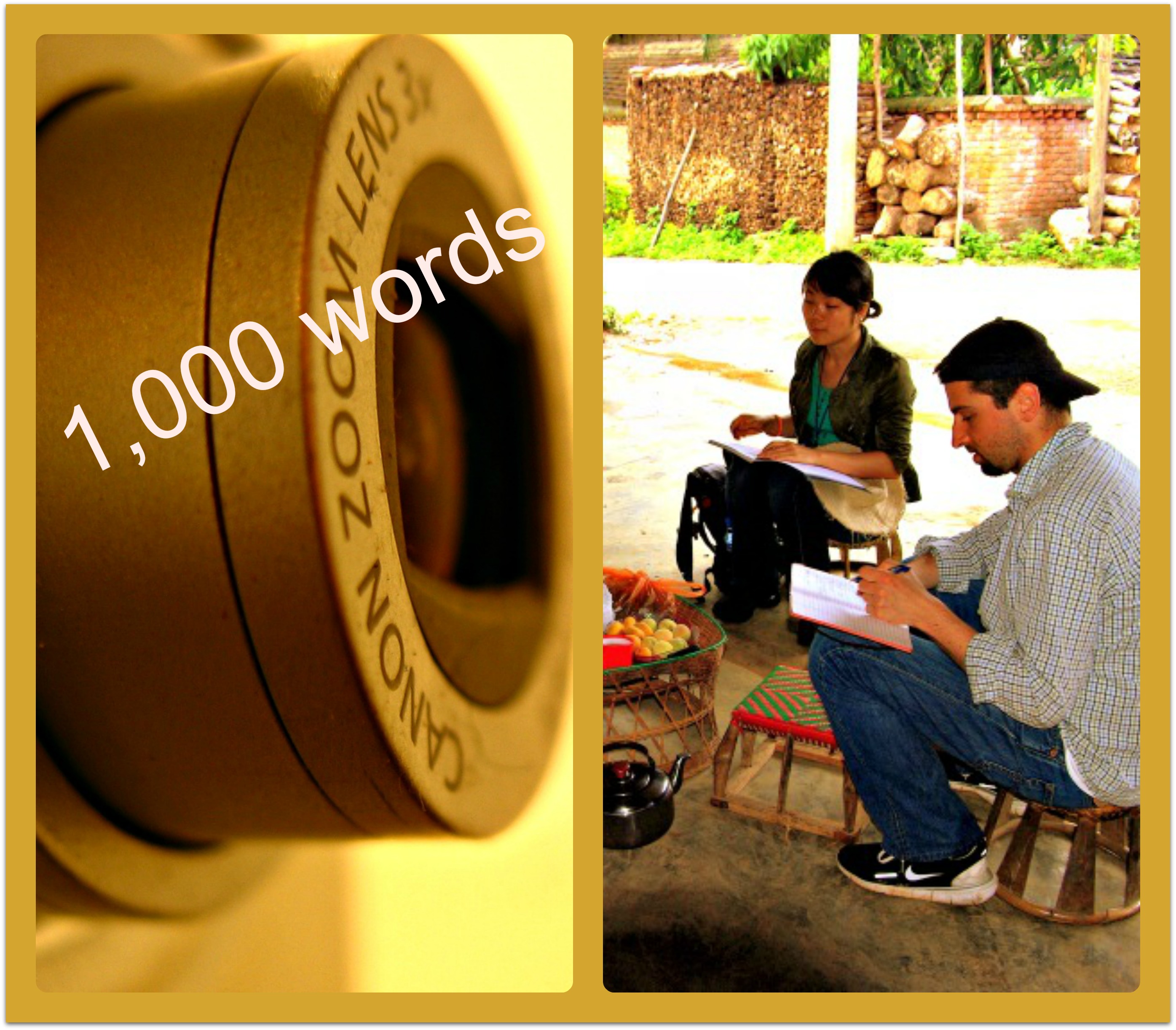
Canon zoom lens; photo credit: Morguefiles. Gaetan Green doing fieldwork in Xishuangbanna, a region of Southwest China squeezed between Laos and Burma; photo credit: Gaetan Green.

Welcome to our monthly series “A picture says…”, created to celebrate expats and other global residents for whom photography is a creative outlet. The series host is English expat, blogger, writer, world traveler and photography enthusiast James King, who thinks of a camera as a mirror with memory. If you like what you see here, be sure to check out his blog, Jamoroki.

My guest this month is 33-year-old Swiss national Gaetan Green, who has spent the last 12 years between China, Europe and North America. After graduating university, Gaetan studied and conducted ethnographic research in remote parts of China. He went back to do field work in the country’s ethnic borderland when pursuing a master’s degree in geography at a university in Vancouver.

For the past three years Gaetan has lived in one of China’s mega-cities, but he always grabs the opportunity to travel in the countryside, where he can indulge in his current passion for the  ancient and ethnic villages of south and southwest China, with a “minor focus on Guangzhou and the Pearl River Delta.”

Gaetan keeps a fascinating blog, Travel Cathay. He posts about his off-the-beaten-path travels to parts of China most of us wouldn’t know existed.

* * *

Hi Gaetan. I have been following your blog for a while now and am very pleased to have the opportunity to interview you for the Displaced Nation. Let’s start with some background on you, shall we? Where were you born, and when did you spread your wings to start traveling?
I grew up in a ski resort in the middle of the Swiss Alps and I started travelling as soon as my parents would allow it. My first trips were to Southern and Eastern Europe with classmates—that started when we were around 16 years old. But my travels became a lot more serious when I left Switzerland for my first trip around the world, at age 20. This trip changed my life for good.

So your wanderlust dates from an early age. Why do you think that was?
There were essentially two things that inspired me to travel. The first was a map of the world that I discovered at home when I was an inquisitive eight-year-old. The map made me realize the world was much bigger than the valley surrounded by big snow-capped mountains where we lived. I was itching to discover the reality behind all the exotic place names. The second source of inspiration was my home country. With its pure air, snow-capped mountains, green valleys and quaint mountain villages, Switzerland is beautiful—but way too small. The boy I was then saw a world so big, I knew I had to leave.

Which countries did you travel to?
Besides southern and eastern Europe, I visited Australia, Peru, Bolivia, Ecuador, Malaysia, Philippines, and Singapore. And of course, eventually, China.

And now China has become a second home for you.
Although I have traveled to other countries, China is the one I know best because that is where I have spent most of my time so far, and I have only five provinces left to discover. My love story with China started at age 20: I spent three months of my round-the-world trip traveling within its vast terrain. When I returned home, I started to learn Mandarin (some of my friends thought I was seriously deranged!!). Then one thing lead to another: I studied for two years in Chongqing (a city of 15 million people in central China), worked as an ethnographer in remote parts of Yunnan province, taught English in Kunming, and conducted academic research between Vancouver and Xishuangbanna. Although China is a country, it gives the impression of being a continent because it is very diverse. Contrary to what many people think, China does not have a monolithic culture. I speak Mandarin, so that makes travel easier. I can venture into the countryside knowing I’ll be understood.

“Let’s all go up to the mountain to be close to the flowers and songs.” – Dong folk ballad

I’m sure that speaking the language gives you a huge advantage. Tell us more about the life you now lead in China.
I am currently working as a sourcing agent and living in one of China’s megacities. Recently I have developed mixed feelings about the megacity life. Megacities can be convenient places to live, providing easy access to food, entertainment, communication and transportation; but I find them overcrowded. Dangerous levels of pollution and food hygiene are growing concerns and also the reasons why some of my expat friends have already left.

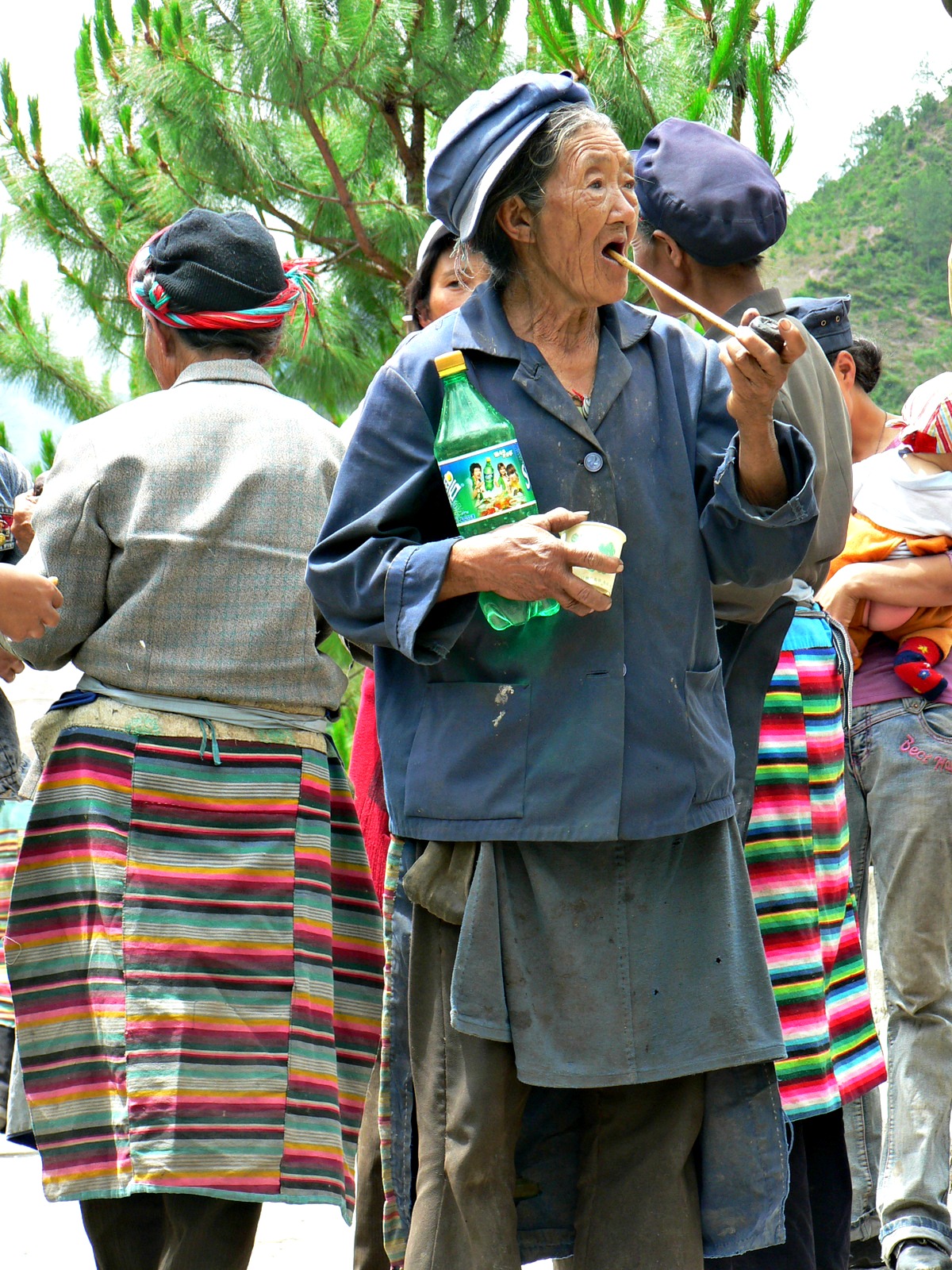
Old woman in a Tibetan Catholic community; photo credit: Gaetan Green.

An elderly woman pushing barley alcohol in north Yunan; photo credit: Gaetan Green.

Some friends of mine have recently moved to China to work in Shanghai but they refuse to live in the city for the same reasons you mention. But let’s get away from the megacity and take a look at your first three photos, which take us far away from that scene. Can you tell us what makes each of these photos so special?
This first photo reminds me of the time when I was doing ethnographic research about Tibetan Catholic communities in remote regions of north Yunnan province. On that particular occasion, I had the opportunity to witness a ceremony during which villagers prayed that it would rain on the graves of French missionaries who’d been assassinated at the beginning of the 20th century during anti-Christian violence in the region. There was a steep hike to reach the graves. At end of the ceremony, this woman started giving everyone barley alcohol in a paper cup. I remember going back to the village half-drunk after she challenged me to a second glass of firewater.

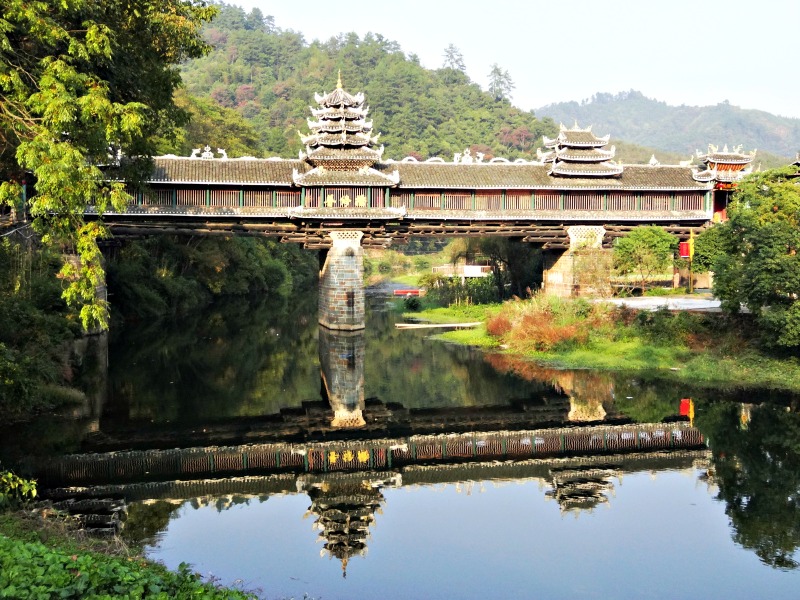
Wind and Rain Bridge, Tondao. Photo credit: Gaetan Green

Blown away by the Puxiu Wind and Rain Bridge in Tondao; photo credit: Gaetan Green

The second photo was taken after I’d missed the last afternoon bus and got stuck in the small town of Tongdao (southwest Hunan province), which I’d never heard of. I eventually ended up hiring a taxi driver for the afternoon to show me around. We went to a few ethnic villages and by 4:00 p.m., we had arrived by this amazing covered bridge, which is an example of a “wind and rain” (fengyu) bridge common to the Dong ethnic minority region. Missing my bus was the best thing that happened to me that day.

Taoist Temple, Macau; photo credit: Gaetan Green.

The Jade Emperor’s generals on their joss paper thrones; photo credit: Gaetan Green.

The third photo records the time I got lost in Macau somewhere between the Ruínas de São Paulo and the Camões Garden, I went to a Taoist temple. In one hall, I noticed that some statues had uneven stacks of joss paper (spirit money) under them. I asked the temple caretaker: “Why?” He explained that there were, in that particular hall, the statues of the 60 heavenly generals who help the Jade Emperor to supervise human life on earth. There is one heavenly general for each birth year, and the more joss paper there is under the statues that matches your birth year, the luckier you will get. I decided to boost my luck and bought stacks of joss paper to boost my heavenly general higher. The temple caretaker gave me three sticks of incense to burn; he said a long prayer in Cantonese and gave me a red talisman. I definitely enjoyed doing business with the gods, though I didn’t feel any luckier afterwards.

“Who can rob me of the songs I learned?” – Dong folk ballad

I love all three photos, and, yes, you are right, missing the bus and staying in Tondau must have been divine providence. Now, I’m keen to know where your favourite places to take photographs are, and why these places inspire you and how that shows in your next three photos?
Now that I live in a big Chinese city, the places that inspire me the most are the ethnic and ancient villages. In the cities, many historical buildings and old streets have been knocked down to give way to shopping malls and skyscrapers. Ethnic and ancient villages are real windows on the past and the cultural diversity of China. I chose the next three photos to make this point.

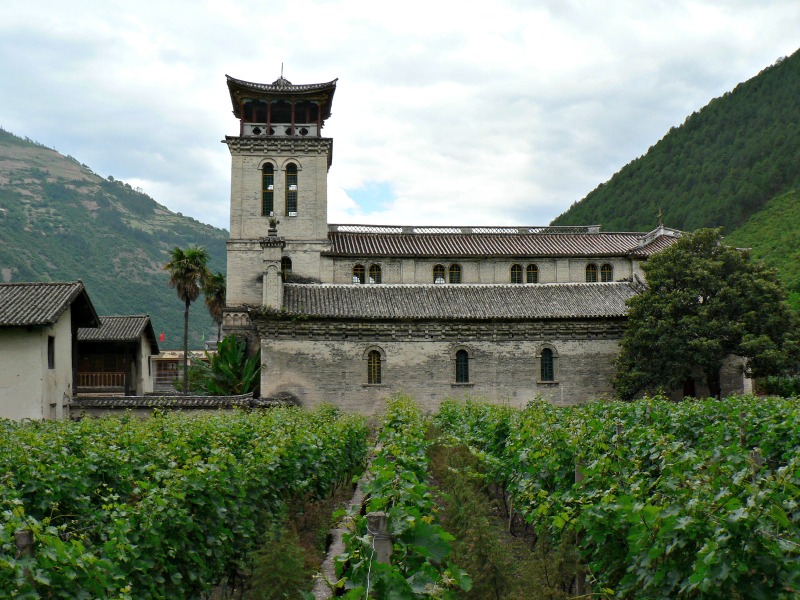
Cizhong Catholic Church; photo credit: Gaetan Green.

A Roman Catholic Church in an unexpected spot: by the Lancang (Mekong) River at Cizhong; photo credit: Gaetan Green.

The first is of the Catholic church at Cizhong, a remote village of north Yunnan province that is home to a community of Tibetan Catholics who were converted by French missionaries more than 100 years ago. The church seems out of place in this land of Buddhism. The mountains surrounding the village make it a picturesque spot.

Yunnanyi Gaetan Green

If these walls could talk: Yunnanyi village on the Tea Horse Road; photo credit: Gaetan Green.

The second photo is of Yunnanyi village, in Yunnan province, which was an important stop on the Tea Horse Road that linked Southeast Asia to the Tibetan plateau. Horse caravans carrying tea, spices and other goods stopped in Yunnanyi. In 1936, the communist armies of Mao Zedong stopped in Yunnanyi to rest during the Long March. Then, during WWII, the rice fields behind the village were transformed into a U.S. airfield. Planes that had flown from India over the Himalayas (to avoid the Japanese-controlled Burmese airspace) landed in Yunnanyi with supplies for the Chinese armies. The history of this unknown village is inspiring. The mud-brick courtyard houses have seen a lot. I wish these walls could talk.

Stepping back in time in Qianyang; photo credit: Gaetan Green.

Stepping back in time in Qianyang; photo credit: Gaetan Green.

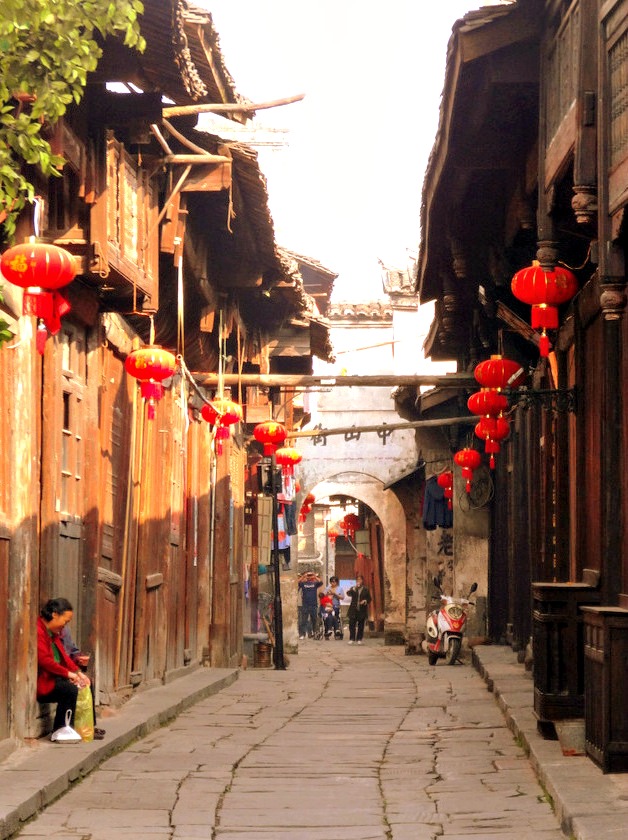
The final photo is of Qianyang, in Shaanxi, an ancient regional political centre that has been forgotten in China’s rush to develop. The streets are lined with dozens of temples, an ancestral hall, and courtyard mansions that belonged to local officials. Most of the city’s walls and four out of fives gates are still standing. There were no tourists when I visited. It felt like stepping back in time and taking a walk in China’s past.

What I find amazing in these pictures is the beautiful architecture and the pristine condition of such old buildings and the cleanliness of the streets. Tell me something, I notice that many of your photos are of buildings or streets. Do you feel reserved about taking photos of people, particularly when they are conscious that you are doing so?
I do feel reserved about taking pictures of other people so I rarely do. The exception is when I have the opportunity to witness a ceremony or special event.

I know this is a similar question but do you ask permission before taking people’s photographs and how do you get around any problem of language?
Since I now travel mostly in China, I ask in Chinese. If I am in a region where people do not speak Mandarin, a hand gesture is usually enough.

Would you say that photography and the ability to be able to capture something unique which will never be seen again is a powerful force for you?
It is indeed. I would add that photography also has the ability to monitor change. In a country like China where everything is growing and changing so fast, photography can be a tool to record how the landscape is transforming.

That’s a very pertinent point, particularly when applied to China. Was there a particular moment when you realized that?
I thought about it a lot while on a business trip to Ningbo, a city of nine million people that is just a couple of hours by train from Shanghai. I had been able to take an afternoon off and wander in the city. I discovered an entire neighbourhood of stone houses built during the late Qing Dynasty (late 19th century), all of which were empty. They were going to be knocked down to build a shopping mall and high-density residential buildings. In China I am constantly thinking that what I see today may be different or not even exist tomorrow.

If someone wants to learn from me, I’ll teach him songs as melodious as cicadas.” – Dong folk ballad

I know exactly what you mean. It almost feels like you are running out of time. I have many old pre-digital photos (35 years old and more). I didn’t realise until now how precious they are. Moving on to the technical stuff (I’m not too good at tech but getting better). Some of our readers will want to know what kind of camera and lenses you use.
I use a very simple point-and-shoot Sony camera.

I must say it works really well and the shooter has a good eye! Finally, do you have any advice for wannabe photographers who are traveling or living abroad?
I think I am in the same position as you. I need advice.

Gaetan, I’d like to thank you for taking the time to tell the story of your exciting journey and for sharing so much interesting information. You may not consider yourself to be a good photographer, but your “point and shoot” pictures embellish your narrative beautifully. Keep following your way and I am sure you will inspire other young people to travel the globe as you are doing. I, for one, will be checking your progress.

* * *

Readers, what do you make of Gaetan’s experiences? Do you have any questions about his photos or his travels? Please leave them in the comments!

And if you want to know more about Gaetan, don’t forget to visit his excellent blog, Travel Cathay. You can also follow him on Twitter: @TravelCathay.

(If you are a photographer and would like to be interviewed by James for this series, please send your information to ml@thedisplacednation.com.)

STAY TUNED for tomorrow’s fab post!

If you enjoyed this post, we invite you to register for The Displaced Dispatch, a round up of weekly posts from The Displaced Nation, with seasonal recipes, book giveaways and other extras. Register for The Displaced Dispatch by clicking here!

Related posts:

TCK TALENT: Heidi Durrow, Afro-Viking Renaissance Woman and Award-winning Novelist

Heidi Durrow Collage Drop ShadowElizabeth (Lisa) Liang is back with her monthly column about Adult Third Culture Kids (ATCKs) who work in creative fields, Lisa herself being a prime example. A Guatemalan-American of Chinese-Spanish-Irish-French-German-English descent, she has developed her own one-woman show about being a TCK, which will be the closing keynote at this month’s Families in Global Transition (FIGT) conference, “The Global Family.”

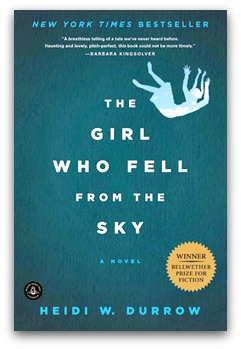
Today I’m excited to introduce Heidi Durrow, the author of the New York Times best-selling novel The Girl Who Fell From the Sky (Algonquin Books), which received writer Barbara Kingsolver’s 2008 PEN/Bellwether Prize for Socially Engaged Fiction. Heidi grew up in Turkey, the USA, and Germany. She and I first met at the Mixed Roots Literary & Film Festival that Heidi co-founded, which celebrates storytelling of the Mixed racial and cultural experience.

* * *

Welcome to The Displaced Nation, Heidi. As the TCK child of an American Air Force dad and a Danish mom, you’ve lived in North Carolina, Turkey, Washington state, and Germany. Can you tell us a little more about the chronology of the moves?
I was born in Seattle and moved to Turkey at the age of six months. The next years until I was 11, I was in North Carolina and Germany, with summers and holidays in Denmark. Since college, which was at Stanford, I have lived in NYC for grad school, Connecticut for law school, and now I split my time between the East and West Coasts.

Do you remember being happier in one place in particular?
I was pretty happy in all the places where I grew up—I was still very young. I never felt out of place or unwelcome.

Repatriations can be the hardest moves of all for TCKs, and repeated repatriation can be particularly tough, so I’m curious to know if this was true for you whenever you returned to the United States.
I had never thought of the moves as “repatriations” but that’s interesting. I think when I was very young I wasn’t aware of a lot of difficulties. But when we finally moved back to the States when I was 11, it was very difficult.  I was at an age of awareness. I felt more like an immigrant. It was so interesting to me that I had an idea of what America was when I lived overseas, and I learned quickly that America didn’t operate the way I’d imagined it from far away.

“We family.”—African-American proverb

Tell us about your summers and holidays in Denmark with your mom’s family.
It was awesome for me—in particular because my mother raised us speaking Danish and English. I am forever grateful that I have both languages. It made me infinitely closer to my aunts and cousins, whom I adore. As an adult, it’s been interesting to see how Denmark is changing. I remember going back when I was in college. I hadn’t been in ten years. My cousins had Copenhagen boyfriends, and they’d laugh whenever I talked. It wasn’t because they didn’t understand what I was saying, but they found my country accent strange. I guess I sounded like someone from Birmingham, Alabama, visiting NYC. It’s English, but it sounds very different. For years after that visit, I have often wondered whether certain traditions or sayings I learned were in fact Danish or just my mom’s own quirks.

Do you identify most with a particular culture or cultures? Or are you like many TCKs who are more likely to identify with people who have similar interests and perhaps similar cross-cultural backgrounds? (And of course it’s not a given that we’ll identify with them, either.)
I identify myself as an Afro-Viking—that is a small but growing demographic, by the way! In terms of who I am most likely to identify with—well, I think for many years in my adulthood I was very interested in finding other “mixed” friends. I wanted to know how they negotiated being multiracial and multicultural. I have found that I still have that affinity, but now I am more drawn to people who have the same career interests, who are moving on the same path at the same rate.

Studies have shown that TCKs have similar identity issues and struggles to children of mixed heritage. You and I are TCKs of mixed heritage, which makes our identities more layered than most, and makes for quite an identity struggle during adolescence. And sometimes there are shifts. I was culturally Guatemalan when I was very little, but that hasn’t been my main identity for decades.  
I haven’t shed any of my identities—I feel like I’ve added on to them over time. I remember in college I was essentially “passing” as Latina. I lived in the Hispanic-theme dorm, took Spanish classes and became the second-vice-chair of the Latino Electrical Engineering Society. I liked the idea that in latino culture they had already thought about the idea of the mestizo. So I added that on to my identity. And then when I moved to NYC I found that people thought I was what they were. Bangladeshis thought I was Bangladeshi, Puerto Ricans thought I was Puerto Rican, Greeks thought I was Greek. I’m not any of those things, but I feel like the fact that people see me as part of their own tribes has added another layer to my identity: a layer of belonging.

“He hath need of his wits who wanders wide.”—Old Norse proverb

I can relate: I was very pleased to be mistaken for Turkish when my husband and I honeymooned in Turkey. As an adult TCK, do you ever suffer from “itchy feet,” which make you want to move (locations, jobs, etc.) frequently?
You got me. I actually live on two coasts—flying back and forth every few days. I fly more than 100,000 miles per year. I can’t stay still. The same has been true for my career: I’ve been a Hallmark greeting-card writer, a journalist, a lawyer, a life skills trainer to NFL and NBA players, a podcaster, a festival producer and now a writer. Who knows what’s next?!

I often wonder if ATCKs who pursue writing careers do so because the story is entirely in their hands as opposed to the experienced upheaval of their peripatetic childhoods. Meanwhile, a peripatetic childhood fosters so many incredible experiences and thus stories to tell! Did your TCK upbringing influence your desire to become a writer?
My TCK upbringing has been great fuel for my writing, but it’s not the reason I wanted to become a writer. I do remember having a special feeling about writing as a child because of my upbringing—I loved to write letters. I’d write letters to the friends I moved away from and to my family—they were always far away. I was the kid who would save money to buy stationary and stamps.

girl-who-fell-from-sky-coverBut isn’t it fair to say that your choice of topic for your debut novel, The Girl Who Fell from the Sky, was influenced by your TCK upbringing and mixed-race heritage?
The story is autobiographical only insofar as it is about a biracial and bicultural girl growing up in the Northwest. I guess that is to say: the confusion of the character is a confusion I experienced. But the story—about a girl who survives a family tragedy—well, that was inspired by a real story I’d read in the news many years ago.

The Girl Who Fell from the Sky was fantastically well received. Did you learn something pivotal about yourself and your TCK upbringing in the process of writing it?
Oh gosh. I learned so much. I am still learning—in particular as the book reaches students in high school and college as required reading. I’m always so interested in the ways in which readers identify their own “displacement” with that of the main character, Rachel. I think the TCK experience is one of being an outsider in all places—and, strangely, that feeling is universal, familiar even to those who have grown up in one place their whole lives.

On your author site and your blog, Light-Skinned-ed Girl, as well as on your Mixed Experience Podcast, you mention that you’re working on a second novel. Can you tell us anything about it?
The new novel is still a work in progress. I’m on the verge of finishing a good complete draft at last! All I can say about it is that it’s about my obsessions again—about identity, and race and culture and grief; it’s about beauty and connectedness. Hopefully it’s something folks can relate to.

* * *

Thank you, Heidi! I wish you all the best in your endeavors, and feel confident you’ll soon be repeating your amazing successes. I understand you’ve got the Mixed Remixed Festival coming up in mid-June here in LA, which will celebrate the stories of the Mixed experience through films and books—something Displaced Nationers would love to hear more about. Readers, please leave questions or comments for Heidi below.

STAY TUNED for next week’s fab posts!

If you enjoyed this post, we invite you to register for The Displaced Dispatch, a round up of weekly posts from The Displaced Nation, with seasonal recipes, book giveaways and other extras. Register for The Displaced Dispatch by clicking here!

Related posts:

LOCATION, LOCUTION: Amanda Hodgkinson, author of “22 Britannia Road” and “Spilt Milk”

OLYMPUS DIGITAL CAMERA

Author photo – Amanda Hodgkinson

In this month’s “Location, Locution”, expat crime writer JJ Marsh interviews Amanda Hodgkinson, author of 22 Britannia Road and Spilt Milk.

Born in Somerset but raised in a village on the Blackwater estuary in Essex, Amanda has childhood memories of  shingle beaches and mudflats, grey-green heather, salt marshes, messing about in boats, gangs of rowdy kids playing all day along the sea-walls, and the ever-present cries of seagulls.

As an adult, she moved inland to Suffolk. She took an MA in Creative Writing at the University of East Anglia and after the MA, she and her husband, with two young daughters, upped sticks and bought a property in south west France. She intended to write a novel but spent the first few years of their new life mixing concrete to fix their house. She also had to learn French, settle her daughters into school and deal with the ups and downs of living in a country miles away from friends and family. Finally though, the family made a home in France. And she finished the novel…

22 Britannia Road became an international bestseller. Spilt Milk came out in February 2014 (Penguin Books) and a novella Tin Town (Grand Central Penguin US) will be published this summer. Meanwhile Amanda has begun work on a third novel. You can find out more about Amanda at her website, www.amandahodgkinson.com

Which came first, story or location?

With Spilt Milk, I was inspired by a location. I was visiting friends in rural Suffolk. It was late October, that lovely, damp time of year when the smell of leafmould is everywhere in the country. We went walking and ended up on the banks of a small river. I knew there and then that I wanted it to be the location for my next novel. I was amazed by the stillness of the place. The river had a timelessness to it. I suppose the slow moving waters suited the themes I was interested in writing about – the passing of time in families, the stories we keep and the ones we allow to slip away from us. By the time we’d walked back home, I had the beginnings of the novel in my head.

What’s your technique for evoking the atmosphere of a place?

When I am writing about a time and a place I find evoking colour, smell and the sounds of that place help create mood. I know it’s considered old-fashioned to use landscape to create mood and emotional intensity but I not only love writing which evokes emotion in that way, I also believe there is a strong connection between our identities and the geographic landscapes we inhabit.

Which particular features create a sense of location? Landscape, culture, food?

All those but also I find the light is important. I adore Edward Hopper’s paintings for his use of light and I find writing can experiment in a similar way with light, creating mystery or clarity and deepening character.

Can you give a brief example of your work which illustrates place?

In the following passage set in 1970, Nellie, who is a very old lady, watches her family as they picnic together by the river that she has known since she was a small child.

SpiltMilkNellie sat in the shade of summer-green willows, watching the procession of men, women and children making their way down to the riverbank, one after the other, their hands drifting through the day’s fragile bloom of field poppies, all the new-born crimson petals falling at their touch.

Slowly, the murmur of voices, the greetings and talk turned to seasons remembered, harvests and ploughing, days long gone. They discussed winters whose legendary harshness were in retrospect to be marvelled at and even doubted a little, particularly this deep in the year when the barley fields were pale gold and in the distance beyond the farm, the village with its church spire shimmered into the vagueness of a heat haze.

Black and white farm dogs lay low, eyeing Tupperware boxes of sandwiches and sausage rolls. The transistor radio announced cricket scores. A tartan rug was spread out by the bulrushes, and a baby in its frilly white knickers and matching bonnet wriggled and laughed while the women cooed over her. Sunburnt men sprawled in the grass with bottled beers, straw hats tipped low across their brows. Oh, heavens, Nellie thought, eyeing the new baby. And how did I get to be so old?

How well do you need to know the place before using it as a setting?

A place can inspire a novel but I don’t think it is necessary (at least not for me as a writer) to know a place intimately before I begin a story. It is a starting point and as both my books have been set in the past, my research has also been looking at photographs, old films and reference books.

It feels liberating to be able to know a landscape physically and than allow it to become a place of the imagination. I recently wrote a historical novella for an anthology and spent a day exploring an old World War Two airfield which I then used as the basis for the story. While I stuck very closely to the layout of the airfield in the story, I still had to imagine how it must have been back in the 1940s. As in my novels, the landscape was a starting point for my fiction.

Which writers do you admire for the way they use location?

Lots! Thomas Hardy, DH Lawrence, Toni Morrison, Annie Proulx, Paul Harding, Marilynne Robinson, John Steinbeck, Robert Macfarlene, Tracy Chevalier, Jane Smiley, to name a few.

Author bio and photograph from Amanda’s website

Next month’s Location, Locution:  Jill interviews Andrea Cheung, whose Hungarian/Chinese heritage informs her multicultural prize-winning children’s stories.

 * * *

_(75_of_75)JJ Marsh grew up in Wales, Africa and the Middle East, where her curiosity for culture took root and triggered an urge to write. After living in Hong Kong, Nigeria, Dubai, Portugal and France, JJ finally settled in Switzerland, where she is currently halfway through her European crime series, set in compelling locations all over the continent and featuring detective inspector Beatrice Stubbs.

STAY TUNED for our next post!

If you enjoyed this post, we invite you to register for The Displaced Dispatch, a round up of weekly posts from The Displaced Nation, with seasonal recipes, book giveaways and other extras. Register for The Displaced Dispatch by clicking here!

Related posts:

GLOBAL FOOD GOSSIP: Gourmet coffee vs The Pod — France’s answer to England’s “Lapsang Souchong vs PG Tips”

global food gossipJoanna Masters-Maggs, our resident repeat-expat Food Gossip and Creative Chef, is back with her column for like-minded food lovers. This month: Coffee, the Achilles heel of French cuisine.

* * *

“I wouldn’t mind French coffee being quite so terrible, if they would just admit it,”  my English friend said in exasperation as she clicked her cup back into its saucer.  “It’s the equivalent of British tea, from an urn, at a railway station in 1930s Huddersfield.”  There was a pause as she picked up her croissant for my inspection. “But I suppose there are compensations.”

If you have spent any significant time in France, you will have noticed that it is very difficult to find a really good cup of coffee.  If you have never visited, I’m sure you will find that difficult to believe, such is France’s reputation for wonderful food, wine and coffee.  So, take a breath, retrieve your eyebrows from your hairline and trust me on this one:

If you’re not a fan of Starbucks, France might just be the place to drive you there.  If you can find one, that is.

Why is French coffee in so unpalatable?  It has the power to cause involuntary facial spasms and to make my stomach roil.  At first I put these symptoms down to my taste buds being insufficiently sophisticated to appreciate its forceful nature.  After two and half years, my friend’s comment helped me to recover some self-esteem and quit making a victim of myself.

Maybejust maybeit’s not only me.

Tea: A Brit’s second language

IMG_2742

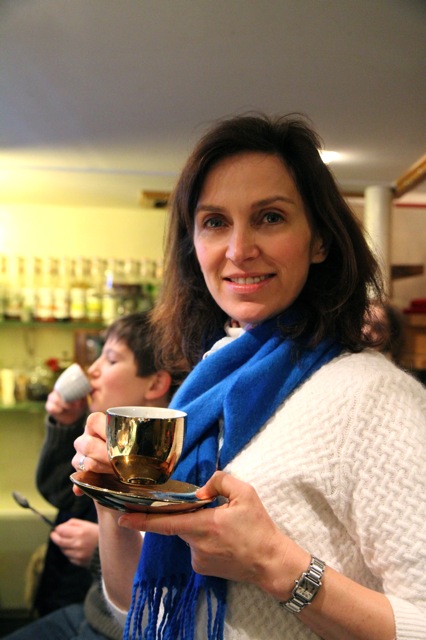
Joanna, apparently mildly surprised at her enjoyment of French coffee

I drink the tea this way, because that’s how I was brought up drinking it.  We drink it for comfort, to stay awake, to go to sleep, or to get over a nasty shock.  It comes with its own social language.  Offering tea to an upset friend shows concern when we cannot find words.  Failing to offer it to an unexpected guest says they should not expect to stay long.  Giving some to a workman is a way to show your respect for them and to ensure a good job.  Thus, overseas, tea is a rock of sameness I cannot let go of.  In fact, it is the only overseas product I really must have if I must have something from home.  It works for me.

Coffee: A rough guide

The coffee in France, therefore, should appeal to my rough taste in beverages.  It is largely made from robusta beans which are recklessly roasted until the flavor verges on the acridity of all things cremated.  It is drunk black, the addition of milk or cream deemed unsophisticated; ironic, given the rough, bad manners of the coffee itself.  The tiny cups are instead dangerously laced with extreme amounts of sugar or sweetener and then downed rapidly in a way Mary Poppins would have approved of.  And why not?  Sometimes even the French should be allowed a break from tasting and judging good food and drink.  My tea gives me the comfort and hit I demand, so why can’t I accept that the French should also be allowed, sometimes, to demand substance over style?

With coffee, the French give themselves a break from the world’s demand for them to be so effortlessly chic.  Coffee is not approached as is, say, wine, with a sort of intellectual or artistic mindset.   The routines of coffee tasting are not observed.  Whereas wine is lifted to the light, swirled, inhaled luxuriously and sucked over the tongue, coffee is knocked back as if by a Russian soldier engaged in long evening of vodka toasting. Coffee is not cupped with the hand to prevent the aroma escaping prematurely before the nose is lowered to inhale the intensified aromas.  It is not sucked over the tongue to seek the full range of flavor.

I must admit, it does the heart good to see the French behaving so badly.

Coffee climate change in Montpellier

IMG_2736

Coffee in Montpellier

I understand, though, that this is changing.  There are increasing numbers of little cafés which roast their own beans and grind to order.  Little places where robusta beans are eschewed for the more subtle delights of arabicas.  It’s been a while since I have had the time to hunt down these places in Paris.  However, last week I was in Montpellier and had the great good fortune to find two of these hallowed places.

Café Solo is an adorable place where the smell of coffee can be enjoyed a considerable distance from the front door even on a rainy February day.  I had forgotten this smell.  You don’t get it in a Starbucks or a Costa or any of the many similar establishments.  The tiny interior is crammed with drawers of beans, a counter of homemade delights in little covered cake stands and, in a corner, a large roasting machine.   My family and I discovered it quite by chance while exploring the streets of Montpellier.

Here we enjoyed what can only be described as a consultation with the artiste who would make our drinks.  She listened to what we like and do not like, and pronounced her judgement on what would suit.  Describing the flavours of each of the beans in that day’s selection, she guided our choice.   Then we waited and watched while our coffee was made.  It arrived in charming mismatched espresso cups and, thoughtfully, with little jugs of frothed milk– just in case.  Hmmmthere was me thinking I am a coffee hooligan who needs the milky stuff, just like a kid, but I absolutely did not need a drop of it.  My mocha bean from Ethiopia was soft and smooth with a tumble of flavours which lasted in the most pleasant way.   It was a delightful surprise.  I am so accustomed to a punch in the back of the throat from a tough one-dimensional over-roast.  Not so here.

“You see,” explained the artiste behind our coffees, “we French make terrible coffee.  We just don’t know how to make it.”    She smiled broadly, knowing full well that we could not agree with her.

We found a similar place a few streets later and just had to go in to try another.  Would it be possible to find two great coffees in one day?  Yes, it was. This time Columbian for me; a bit more acidity, but absolutely no acridity. Lovely.  Again, intoxicating smell of roasting coffee beans.

As we returned to our hotel, nursing the residual flavor of our coffees, we saw a Nespresso shop and just had to go in.  We knew that the chic, modern interior with its rows geometrically displayed and pristine pods as well as the absolute absence of the smell of real coffee would round off our day perfectly.  Today that clinical chicness, instead of depressing us, would only intensify the memory of the delightful little stores we had just left.  How deliciously wonderful it is to confirm how right I was.  Clutching my bags of beans from Café Solo to my nose, I knew in that moment I would never succumb to the clinical pod.  May my work surfaces be forever stained by the work of my little espresso machine and my walls stained by the periodic explosions to which the enthusiastic amateur is prone.

I thought I had no sophistication when it comes to coffee, but, perhaps because I don’t drink tea for the tea itself, I do drink coffee for the coffee itself.  I am much more open to trying different flavours and I am very willing to drink a lot of bad coffee until I find it.  Since I can manage without coffee, I am not lured by the siren call of Nespresso machines, Starbucks, or any of the lesser places.  I found absolute delight in those two shops which sell the stuff the way it should be sold.  I am willing to keep trying everywhere, until I next hit coffee gold.

Perhaps the next big discovery I will make is that the French acceptance of routinely bad coffee has freed them to become gourmet tea drinkers.  It would be fun to think so.

* * *

Joanna was displaced from her native England 16 years ago, and has since attempted to re-place herself and blend into the USA, Holland, Brazil, Malaysia, Venezuela, Saudi Arabia, and now France. She describes herself as a “food gossip”, saying: “I’ve always enjoyed cooking and trying out new recipes. Overseas, I am curious as to what people buy and from where. What is in the baskets of my fellow shoppers? What do they eat when they go home at night?”

Fellow Food Gossips, share your own stories with us!

STAY TUNED for tomorrow’s post!

If you enjoyed this post, we invite you to register for The Displaced Dispatch, a round up of weekly posts from The Displaced Nation, with seasonal recipes, book giveaways and other extras. Register for The Displaced Dispatch by clicking here!

Related posts:

Images: All images from Joanna’s personal photo albums, and used here with her permission

For this Filipina with a passion for immersive escapades, a picture says…

Jean Alaba Collage

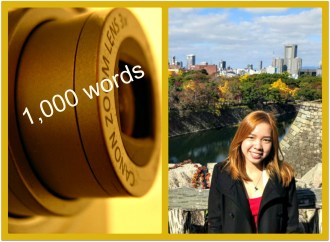
Canon zoom lens; photo credit: Morguefiles. Jean Alaba in front of moat surrounding Osaka Castle, Osaka, Japan. Photo credit: Jean Alaba.

Welcome to our monthly series “A picture says…”, created to celebrate expats and other global residents for whom photography is a creative outlet. The series host is English expat, blogger, writer, world traveler and photography enthusiast James King, who thinks of a camera as a mirror with memory. If you like what you see here, be sure to check out his blog, Jamoroki.

My February guest is 20+ Filipina Jean Alaba. An extrovert who describes herself as a “God-fearing human being” and a “firm believer of living vividly,” Jean is, without a doubt, fulfilling her passion in life: TO TRAVEL. As she explains on the About page of her blog, The Eager Traveller, travel affords her an opportunity to move outside her comfort zone and grow as a person.

Jean was motivated to start up her blog just over a year ago, as a space to record the re-collections of her travels—which she modestly calls “my humble escapades”—in hopes of inspiring others to “nurture their zeal for new adventures” and of promoting the joy of immersing yourself in “the vibrant cultures across the globe.”

Why am I not surprised that Jean has gathered a considerable following in just over one year? My interview with her may provide a few clues as to why other avid travellers are drawn to Jean and her suggested itineraries.

* * *

Hi Jean. I know it has taken us a bit of time to connect, but I’m glad we finally managed to find some time to discuss your photo-travel experiences. Firstly, I see that you are 20+ (I am also 20+: 20 + 50!!), and for one so young you have travelled a fair bit. Can you tell us where you were born and when did you spread your wings to start travelling?
I was born in the Philippines. This may sound like a cliché but my first source of inspiration for travelling was a National Geographic magazine I saw in our school library.

National Geographic is a wonderful publication. I love it.
But I didn’t spread my wings until I made my first trip to West Coast USA. The Strip struck me the most because everyone there seemed to be having the time of their lives. There was such a lot to experience and yet the time was way too short. After that, I developed a passion to immerse myself in new cultures, interact with unfamiliar nationalities and engage in overseas adventures.

To a fearless person, no fence is high enough.—Filipino tagalong proverb

I assume you mean the famous Sunset Strip that has featured in so many movies over the years? I want to know more about your travels, but let’s start with what it’s like to be a solo female traveller.
So far I’ve travelled for pleasure and for business but as yet have never travelled alone. That’s a hurdle I hope to cross this year. I realize it can be risky, but from the inspiring articles I’ve read online, it’s clear it can also be rewarding.

Even though stepping into the unknown by yourself can sometimes be difficult, even for seasoned travellers, I believe preparation is the key. I’m sure you will be fine. Next I would love to know what what countries you have already visited?
So far, I’ve only been to the United States, India, Singapore, Japan, South Korea, Hong Kong, China and Taiwan. I lived in Singapore as an exchange student for four months, which gave me a a sense of independence and responsibility. Another highlight was my six-week business trip in India, where I had the opportunity of visiting Mumbai, Agra, New Delhi and Jaipur. Here are two photos I took on that trip:
Q9-Taj-Mahal

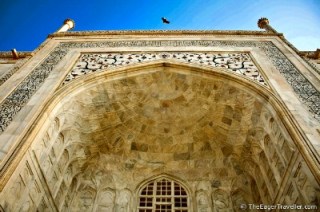
The Taj Mahal in all of its intricacy. Photo credit: Jean Alaba

The first is of the Taj Mahal. I immediately fell in love with its intricate design. By pure luck, a bird flew across at the moment when I snapped this shot. It was only when I was viewing my photos on my laptop that I realized I had captured such an amazing moment. For me, the bird is special: it symbolizes freedom from all the worries in one’s life and from whatever is holding you back from achieving your dreams.
Q9-Bhawani

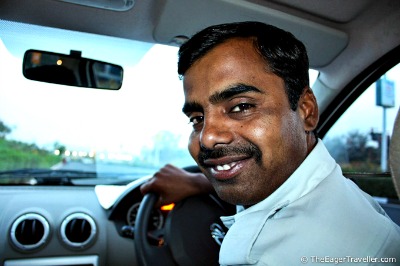
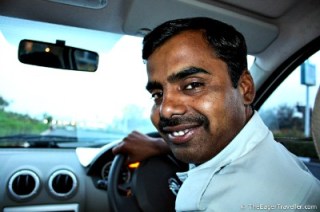
The jolly Jaipur driver Bhawani. Photo credit: Jean Alaba

The second is of Bhawani, the driver assigned to my group during our two-day outing to Jaipur. It reminds me of his kindness and positive disposition in life. He had to take us around Jaipur in the burning hot summer, but never once did he become irritated or impatient. He always had a smile on his face, and that kept us all in a good mood during the trip. In fact, the following week when we went to New Delhi, the company driver assigned to us was totally rude and inconsiderate. At one point he left us in the car sleeping (engine shut off!) while he had his dinner. Worse, when we lightly honked the car to signal that we were awake and frankly not amused, he completely ignored us.

I loved your photo of the Taj Mahal when I first saw it on your blog’s Home Page, but I have to be honest, I never noticed the bird until you pointed it out just now. Maybe that’s good as I was able to appreciate the intricate carvings. Now I’m worried I’ll miss the building and concentrate on the bird!! You’ve captured Bhawani exactly as you describe him; perfect.

One finds a way, or finds a reason to do something.—Filipino tagalong proverb

You are very modest to say you’ve been to “only” eight countries. That’s a lot more than most people visit in a lifetime. So tell us about where are you right now and why.
Well, as you know, James, I am currently in my country of birth, the Philippines, but I’m working out a deal that will hopefully pave the way for life in a new place. I’ll keep you posted.
Q9-Baler

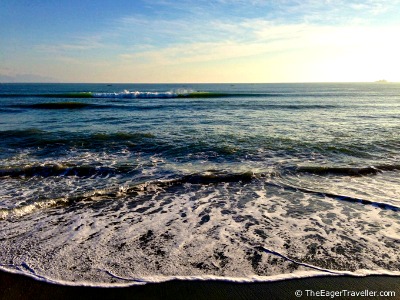
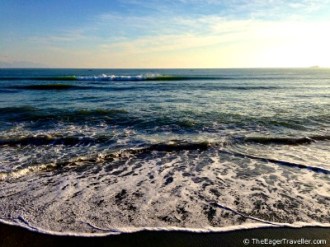
Baler, nicknamed the Philippines’ surfing capital. Photo credit: Jean Alaba

So you are keeping the secret for now, but I’m sure your blog will be give the game away when you are on the move again. The Philippines is a beautiful country and I see you have included one picture in your selection.
Yes, I’ve included this photo of Baler, which is in Aurora province. I like it because it reminds me of my first time attempting to surf and for someone not sporty, I didn’t do too badly. This was also my first time to go beyond my comfort zone in my own part of the world: I travelled for six hours just to catch the waves. It was a spontaneous weekend that proved to be pretty rewarding.

For me, the Baler surf lapping the shore looks just like a welcoming carpet in someone’s lounge.

If you plant, you will harvest.—Filipino tagalong proverb

I know you take a lot of photos but where, so far, are your favourite places to do so? and Can you explain why these places inspire you and how it shows in your next three photos?
My favourite places to take photos so far are India, Japan and Hong Kong. I’ve included one photo of each.
Q10-India

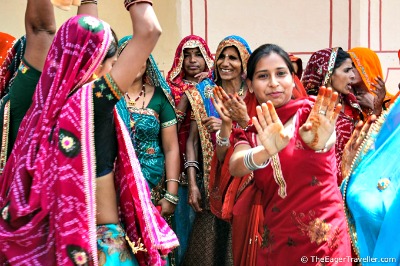
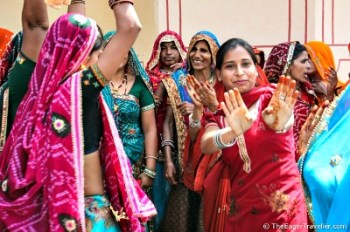
Indian women in colorful saris. Photo credit: Jean Alaba

I like taking photos in India because Indians are very proud of their heritage. This was apparent everywhere we went in India, regardless of the people’s social status.
Q10 Japan

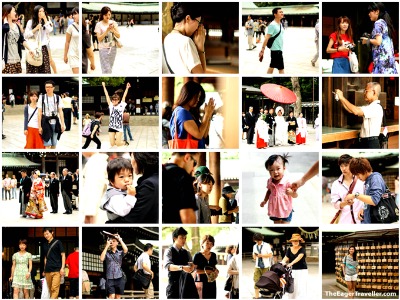
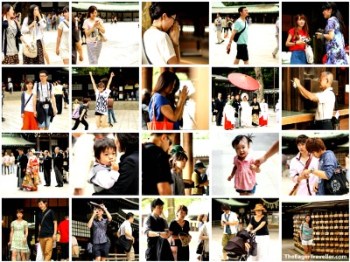
Portraits of Japanese people. Photo credit: Jean Alaba

Japan is a favorite of mine because the people are so organized, disciplined and polite. I never run out of things to see and admire.
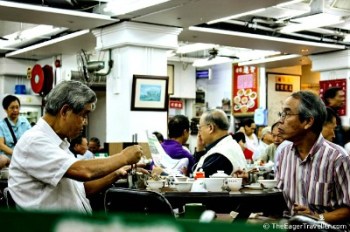
Q10-Hong-Kong

A Hong Kong eatery. Photo credit: Jean Alaba

Hong Kong inspires me because of the food! I should think its vast array of local dishes are enough to inspire anyone!

I like that you manage to get a handle on people from the different countries you visit, without actually living in that place. You are clearly a good observer of people, as well as a keen researcher. Tell me, do you feel reserved about taking photos of people, particularly when they are conscious you are doing so?
Not really unless I see they’re offended. But so far, no one has reacted angrily when they see me taking their photo. This is a good thing since I like shooting people. Capturing their unique expressions enables me to glimpse who they are and the kind of lives they lead. I must have taken a thousand portrait shots while in India. Perhaps I’ll get some of these printed and make it my wall art.

I’m the same. I hate to take “posed” photos so never get into a discussion with my subjects. I either take the pic or I don’t. So you like shooting people? Don’t worry; I know what you mean! I think the wall art is a great idea. I know this is a similar question but do you ever ask permission before taking people’s photographs. And how do you get around any language barriers?
Most of the time, I don’t ask but when I was in Japan, where permission needs to be secured for taking photographs of infants and kids, I would politely approach one of the parents and ask them in Japanese—of course with the help of sign language (pointing to my camera and their kids).

Thanks to you, I won’t get into trouble if I ever go to Japan. Would you say that you are motivated by the possibility of capturing something unique, which will never be seen again?
Definitely. You always have to live in the moment, and there is nothing more rewarding than being able to capture the special moments that, unless you have a time machine, you’ll never be able to bring back. Those photos may give you inspiration just when you need it most.

I have to agree, as I think most photographers would. So when did you first realize the power of photography, and how has it changed you?
I first realized it after borrowing a decent SLR for my trip to Hong Kong in 2008. I was able to take high-quality photos to serve as a memento. Ever since, I’ve made it a point to capture moments with my camera, whether during a vacation or simply at a gathering of family or friends—moments I’ll be wanting to view when I get old and grey.

I know what you mean. The picture for me is like a diary of an event in visual form. The photographer can write about it but no one else could.

When the sheets are short, one needs to make do.—Filipino tagalong proverb

Most readers will know by now that I’m not too good on the technical stuff but some of our readers will want to know what kind of camera and lenses you use.
I’m still using the borrowed camera; it’s a Canon 450D. I use the kit lens and a prime lens. It’s outdated equipment now.

You sound a bit like me except that I haven’t managed to borrow any equipment yet. And you aren’t asking me for technical advice. That’s great!! Finally, do you have any advice for wannabe photographers who are traveling or living abroad?
I don’t feel I’m in a position to give advice since I haven’t really achieved anything noteworthy. But I would say from my experience, don’t hesitate to take as many pictures as you can while travelling. Before embarking on a journey, research and learn from the professionals online. You can try copying them, using a trial and error process.

I actually think that is very good non-technical advice, Jean. I’d like to thank you for taking the time to tell your story so far in this interview. On your blog you say:

It has been a spectacular life so far but there is so much more to be seen! I have yet to find that life-changing opportunity which will allow me to do my passion for travelling and blogging as a living.

I have no doubt you will find that opportunity. I’m booking you in for a follow up interview next year to check your progress!!

* * *

Readers, what do you make of Jean’s experiences and her photography advice? And do you have any questions for her on her photos and/or travels? Please leave them in the comments!

And if you want to know more about Jean, don’t forget to visit her excellent blog, The Eager Traveller. You can also follow her on social media:
Twitter: @eagertraveller
Instagram: theeagertraveller
Google+: Jean Alaba

(If you are a photographer and would like to be interviewed by James for this series, please send your information to ml@thedisplacednation.com.)

STAY TUNED for tomorrow’s fab post!

If you enjoyed this post, we invite you to register for The Displaced Dispatch, a round up of weekly posts from The Displaced Nation, with seasonal recipes, book giveaways and other extras. Register for The Displaced Dispatch by clicking here!

Related posts:

LOCATION, LOCUTION: Chris Pavone, author of “The Expats”, on why story and location are inseparable

Cover art "The Accident; Author photo Chris Pavone; Author photo JJ Marsh

Cover art “The Accident; Author photo Chris Pavone; Author photo JJ Marsh

In this month’s “Location, Locution”, expat crime writer JJ Marsh interviews author Chris Pavone, whose  first novel, The Expats, was published in 2012, and was a New York Times and international bestseller, with nearly twenty foreign editions and a major film deal.

The Expats was nominated for a Los Angeles Times Book Prize and a Macavity, and awards from the Strand Magazine Critics Circle, the Mystery Booksellers Association, and the International Thriller Writers. It received the 2013 Edgar Award and the 2013 Anthony Award for Best First Novel.

Pavone’s new book, The Accident, will be published in March 2014.


Which comes first, story or location?
For some books I think the story and location are inextricably intertwined: the story is about the location. My thriller The Expats is one of those, defined by taking place in a country that’s not the protagonist’s home. The plot is driven by this situation, by her sense of disassociation and isolation, by the necessity of her reinvention.

How do you go about evoking the atmosphere of a place?
I love walking around cities, looking around at the architecture and the shops and the restaurants, at the people and their pets. My characters do the same, using all their senses to inhabit the world around them. Of course walking around, in and of itself, isn’t the type of action that does much to drive a plot forward, so characters should also be doing something else while walking around. Something such as spying…

Which particular features create a sense of location? Landscape, culture, food?
On the written page, I think the clearest evocation is via the physical landscape, especially when it echoes the culture. New York is the big brashness of skyscrapers and noise; London is the polite order of elegant uniformity; Rome is cheerful dilapidated chaos.

How well do you need to know the place before using it as a setting?
As much as my characters. If they’re only in a city for a day, they don’t know that much about the place, and I don’t need to either. Both The Expats and my next book, The Accident, use a variety of locations, and the amount of time the characters spend in placesLuxembourg, Paris, the Alps, Amsterdam, London, Zurich, Los Angeles, etc.is roughly proportionate to the amount of time I’ve spent there.

Could you give a brief example from your work which you feel brings the location to life?
This is the final sentence of The Expats . . .

Kate watches them merge into the flow of the dense crowd, all the streetlights and lamplights ignited in the Carrefour de l’Odeon, a little red Fiat beeping at a bright green Vespa that’s weaving in the traffic, the policeman oblivious while he continues to flirt with the pretty girl, cigarette smoke wafting from the tables filled with wineglasses and tumblers and carafes and bottles, plates of ham and slabs of foie-gras terrine and napkin-lined baskets of crusty sliced baguette, women wearing scarves knotted at the neck and men in plaid sport jackets, peals of laughter and playful smirks, hand-shaking and cheek-kissing, saying hello and waving good-bye, in the thick lively humanity of early night in the City of Light, where a pair of expats is quickly but quietly disappearing.

Which writers do you admire for the way they use location?
Hemingway was not only a master of evoking location, but also of using physical atmosphere as emotional metaphor. Empty barges on the Seine can represent a lot more than just boats.

Next month on Location, Locution:  award-winning author Amanda Hodgkinson.

 * * *

JJ Marsh grew up in Wales, Africa and the Middle East, where her curiosity for culture took root and triggered an urge to write. After living in Hong Kong, Nigeria, Dubai, Portugal and France, JJ finally settled in Switzerland, where she is currently halfway through her European crime series, set in compelling locations all over the continent and featuring detective inspector Beatrice Stubbs.

STAY TUNED for our next post!

If you enjoyed this post, we invite you to register for The Displaced Dispatch, a round up of weekly posts from The Displaced Nation, with seasonal recipes, book giveaways and other extras. Register for The Displaced Dispatch by clicking here!

Related posts:

TCK TALENT: Why do so many Adult Third Culture Kids gravitate toward acting, and is that the best use of their talents?

Com & Trag Collage

Tragedy and Comedy, Scarborough Hotel, Bishopgate, Leeds. Photo credit: Tim Green via Flickr.

Elizabeth (Lisa) Liang is back with her monthly column about Adult Third Culture Kids (ATCKs) who work in creative fields, Lisa herself being a prime example. A Guatemalan-American of Chinese-Spanish-Irish-French-German-English descent, she has developed her own one-woman show about being a TCK, which will be the closing keynote at this year’s Families in Global Transition (FIGT) conference, “The Global Family.”

In my last column, I interviewed Laura Piquado, a professional actress based in New York who grew up in six countries, including Egypt, where we were drama classmates in high school. As a result of the interview, Laura, editor ML Awanohara, and I had a lively discussion about Laura’s career change from education/activism to acting.

ML said she was puzzled as to why so many intelligent, well-educated Adult Third Culture Kids feel so at home in the acting world. She expressed concern that acting might cultivate a narcissistic outlook on life, which is the opposite of a TCK’s worldly upbringing. She said she found it particularly jarring that Laura could go from go from almost doing a PhD on women’s education in post-conflict societies, to enrolling in acting school—and not look back.

Laura’s response was so eloquent that I am posting it here.

Before you read it, I recommend watching this TED Talk by British actor Thandie Newton:

Born to a Zimbabwean mother and English father, Newton always felt disconnected or “other” while growing up in the UK:

“From about the age of 5, I was aware that I didn’t fit. I was the black, atheist kid in the all-white, Catholic school run by nuns. I was an anomaly.”

Acting gave her a chance to play with her different selves.

And now from Laura Piquado:

I had a similar reaction to yours, Lisa, in seeing acting described by ML as a narcissistic endeavor. While I can certainly understand that reputation (indeed, the Golden Globe awards), I have always idealized what theatre can be: life-changing, hopeful, inspiring, and necessary. It’s the worst to be onstage with someone who’s “masturbating” their way through a show (and equally as painful for an audience member).

I was in Maine a few years ago at a craft school (I’m a potter), and I sat next to a visiting artist at dinner (the amazing Hungarian-born sculptor Gyöngy Lake). She asked me what I did. When I told her I was an actor she said:

“We love you! We need you! You tell the stories of our lives!”

Now while that sounds uber-maudlin, I was completely overwhelmed. I had known this woman for less than two minutes, but she had described, for me, what the essence of art is.

On the other hand, I don’t want to get beaten over the head with social and political commentary every time I go to the theatre. I mean, I love Brecht, but can you imagine if that’s all theatre was? Mother Courage after Mother Courage, after The Caucasian Chalk Circle, after Arturo Ui…ugh. People would stop going. There’s room for pomp-y, wacky, ridiculousness (all hail The Book of Mormon), and everything in between. But I do think theatre at its best, the stories that stay with you, are the ones that connect to a deeper human context.

I was reading an interview with Supreme Court Justice Stephen Breyer in the New York Review of Books where he recounts a story he heard while a law student:

At the turn of the last century, the court was called upon to decide a case on prices for theater tickets—could they be considered basic necessities, and could they be regulated as such? The majority thought the theatre was not a necessity. The great Justice Olive Wendell Holmes Jr. replied in his dissent: “We have not that respect for art that is one of the glories of France. But to many people, the superfluous is the necessary.”

The interview was a larger discourse on France and Proust, but the point Holmes made about the necessity of art resonates.

ML also made the comment:

An interest in international affairs implies that you care about effecting positive social change on behalf of less fortunate people… Do you foresee bringing those two strands of your life together at some point?

The notion of “effecting positive social change” is what I’ll respond to. Again, it’s what I believe theatre can be, from Winter Miller‘s In Darfur to Moisés Kaufman‘s The Laramie Project. Being a part of that kind of theatre is deeply gratifying and something I always seek out. (Or as a potter: being able to go to communities to work with local artisans to make pots that filter clean, potable water falls into that same category.)

The leap from one discipline (social justice through academia) to another (theatre) wasn’t so quantum for me. And while they are vastly different on so many practical and actual levels, “effecting positive social change,” for me, lies at the heart of both.

* * *

So, readers, do you have anything to add to the debate? Are we ATCKs doing ourselves, and the world, a disservice by turning to acting, or can acting be one of our more profound contributions?

STAY TUNED for next week’s fab posts!

If you enjoyed this post, we invite you to register for The Displaced Dispatch, a round up of weekly posts from The Displaced Nation, with seasonal recipes, book giveaways and other extras. Register for The Displaced Dispatch by clicking here!

Related posts: