The Displaced Nation

A home for international creatives

JESS IN JAPAN: Tokyo’s top 6 delights from my newbie expat perch

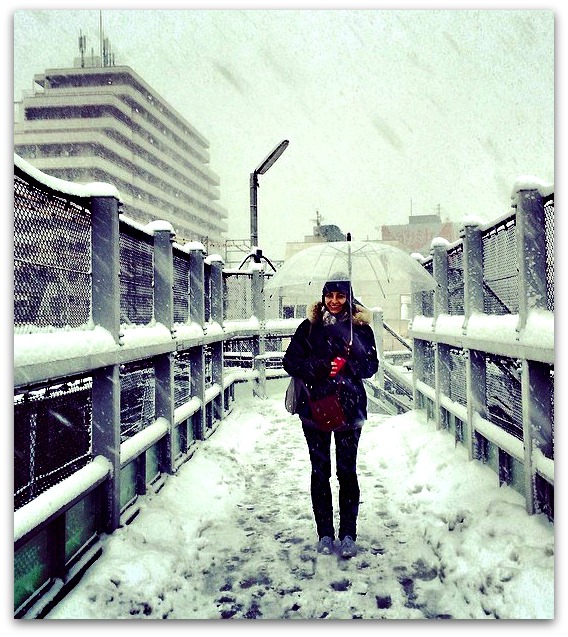
So is snow the same in Tokyo? Kind of, except everyone carries see-through plastic umbrellas! Jess in Tokyo's first February snowfall. Photo credit: Hiro Awanohara

So is snow the same in Tokyo? Kind of, except everyone carries see-through plastic umbrellas! JESS IN JAPAN in a rare heavy snowfall earlier this month. Photo credit: Hiro Awanohara

Today we welcome a new guest columnist: Jessica Awanohara. Any relation, you may wonder? Yes, she’s the American wife of my nephew by marriage, Hiro. The pair, who’d become dyed-in-the-wool New Yorkers, surprised us all by announcing they were moving to Tokyo at the end of 2013. Naturally, I was curious: how is Jessica adjusting to life in that “through-the-looking glass” city? Is it different to live there versus just visit (which she’s done many times in the past)?

—ML Awanohara

There are many things to love about moving to a new country and a few things not to love. Most expats eventually strike a balance between the two.

But are there also places where the love-hate continuum doesn’t apply? I’m beginning to think so ever since I moved from New York to Tokyo in late December of last year. A bad mood is impossible to sustain in this city because everything is hilarious. Wherever you turn, there is something riotous laying in wait…and the next thing you know, you are collapsing in fits of laughter.

I’ve been in Tokyo for over a month now, and have delighted endlessly in many things.

Here are six off the top of my head:

1) Trains are in happy colors.

I live on the Keiō Inokashira railway line, the color of which is bright pink. Not the barfy green of the 4/5/6, nor the almost-royal blue of the A/C, nor the vibrantly atrocious orange of the B/D/F, in New York City. Rather, this line is a sparkling and spritely pink mixed with what I imagine to be the color equivalent of delicious farm-fresh milk. It’s the pink of the gods: the Disney Princess Gods.

2) Subway stations are deeply amusing, so to speak.

Think of New York City’s deepest subway platform: the 63rd Street station on the F Line near Hunter College, or the 191st Street Station on the 1 Line. Imagine how long those escalators are, and now double it—no, triple it! Triple it, and add a couple of extra escalators and a brick-and-mortar set of stairs to the street, and now you have an idea how deep the average street to subway platform trip is in Tokyo. Have you ever tried going to Roppongi, or Azabu-Jūban? Try it!! You may feel as though you’ve walked far enough to be back in New York. Good for quite a few laughs!

3) People on the subway may be dressed much better than us, but they smell just as funny.

How could men in suits and overcoats, or women in designer outfits, smell as bad as we much more disheveled Americans do on the subway? Before taking the leap of moving to Tokyo, I dreaded the idea of being taller, sweatier, and worse smelling than the average citizen on a notoriously packed Japanese train car. Rest assured, inquiring minds, curdled humans smell much the same in Tokyo as in New York: like sweat socks… By the time summer arrives—I’ve visited here often enough to know that summer is no joke!—I should blend in perfectly fine, a thought I find immensely entertaining.

4) Furniture delivery can be farcical, especially when it doesn’t fit through doors.

After a month of living out of another person’s apartment, my husband and I moved into our own place a couple weeks ago. We ordered what can aptly be described as the world’s most beautiful bargain basement sofa and had it delivered to our new, completely empty home. No sooner did our large and lovely couch arrive, than it was exchanged for its tiny, two-seater cousin—that is, tiny enough to actually fit through our front door. In Japan, small is beautiful. How could we have overlooked this basic principle? Our hilarity could not be contained…

5) In Tokyo, cost-of-living statistics are a bit of a joke.

Really, Expatistan.com? I appreciate the cost-of-living data you supply for this great world’s great cities, and am aware that countless magazines and listservs use your data for splashy articles sizing up one city against another. But I’m confused about your aim. On your website it says you want to give people the information “to live as nicely as you live currently.” That means…what exactly? How does one measure the quality of life across cultures? And what about that ideal, which many of us expats hold dear, of “When in Rome…” I can lead the same life materially in Tokyo as I led in New York, but that’s not what makes me happier in this city. Sure, living the luxury life in Tokyo is expensive, but numbers are not the point. The point is, cost-of-living stats are hilarious in a city that gives me such joy!

6) Appliance installation is a riot and a half.

In a related hilarity, it is true that most Tokyo apartments are not outfitted with appliances normally packaged with an apartment in NYC. We had to order our own refrigerator and washing machine (both standard fixtures for the Tokyoite). Our refrigerator, a lovely and highly rated model, cost us all of $500; the washing machine was comparably rated and lower priced. As with anything you buy larger than a shopping bag, you have it delivered to your home for maybe $30 or $50 additional dollars, or oftentimes for free. The hilarity lies in the fact we had two choices when the refrigerator and washing machine were shipped—the delivery men would either leave them at our front door OR huff them up countless flights of stairs and install the machines for the low, low price of…one U.S. dollar. Tough choice, right? Hahaha.

No doubt about it, Japan is a barrel of laughs. Reaching beyond the cruel and unusual TV game shows, the Hello Kitty cafes, the Fruits magazine documenting outlandish clothes in the Harajuku area, and other enduring staples of pop culture in this part of the world, I’ve found countless things to delight me during my first month of residency in Tokyo. My main takeaway is how excited I am to let this town continue to delight me for years to come.

* * *

Readers, what do you think of Jess in Japan’s observations of her new home? I don’t know about you, but I find it ever-so-amusing that so many of her thoughts are focused on subways and apartments: not so different from life here in New York!

STAY TUNED for next week’s fab posts!

If you enjoyed this post, we invite you to register for The Displaced Dispatch, a round up of weekly posts from The Displaced Nation, with seasonal recipes, book giveaways and other extras. Register for The Displaced Dispatch by clicking here!

Related posts:

For this Filipina with a passion for immersive escapades, a picture says…

Jean Alaba Collage

Canon zoom lens; photo credit: Morguefiles. Jean Alaba in front of moat surrounding Osaka Castle, Osaka, Japan. Photo credit: Jean Alaba.

Welcome to our monthly series “A picture says…”, created to celebrate expats and other global residents for whom photography is a creative outlet. The series host is English expat, blogger, writer, world traveler and photography enthusiast James King, who thinks of a camera as a mirror with memory. If you like what you see here, be sure to check out his blog, Jamoroki.

My February guest is 20+ Filipina Jean Alaba. An extrovert who describes herself as a “God-fearing human being” and a “firm believer of living vividly,” Jean is, without a doubt, fulfilling her passion in life: TO TRAVEL. As she explains on the About page of her blog, The Eager Traveller, travel affords her an opportunity to move outside her comfort zone and grow as a person.

Jean was motivated to start up her blog just over a year ago, as a space to record the re-collections of her travels—which she modestly calls “my humble escapades”—in hopes of inspiring others to “nurture their zeal for new adventures” and of promoting the joy of immersing yourself in “the vibrant cultures across the globe.”

Why am I not surprised that Jean has gathered a considerable following in just over one year? My interview with her may provide a few clues as to why other avid travellers are drawn to Jean and her suggested itineraries.

* * *

Hi Jean. I know it has taken us a bit of time to connect, but I’m glad we finally managed to find some time to discuss your photo-travel experiences. Firstly, I see that you are 20+ (I am also 20+: 20 + 50!!), and for one so young you have travelled a fair bit. Can you tell us where you were born and when did you spread your wings to start travelling?
I was born in the Philippines. This may sound like a cliché but my first source of inspiration for travelling was a National Geographic magazine I saw in our school library.

National Geographic is a wonderful publication. I love it.
But I didn’t spread my wings until I made my first trip to West Coast USA. The Strip struck me the most because everyone there seemed to be having the time of their lives. There was such a lot to experience and yet the time was way too short. After that, I developed a passion to immerse myself in new cultures, interact with unfamiliar nationalities and engage in overseas adventures.

To a fearless person, no fence is high enough.—Filipino tagalong proverb

I assume you mean the famous Sunset Strip that has featured in so many movies over the years? I want to know more about your travels, but let’s start with what it’s like to be a solo female traveller.
So far I’ve travelled for pleasure and for business but as yet have never travelled alone. That’s a hurdle I hope to cross this year. I realize it can be risky, but from the inspiring articles I’ve read online, it’s clear it can also be rewarding.

Even though stepping into the unknown by yourself can sometimes be difficult, even for seasoned travellers, I believe preparation is the key. I’m sure you will be fine. Next I would love to know what what countries you have already visited?
So far, I’ve only been to the United States, India, Singapore, Japan, South Korea, Hong Kong, China and Taiwan. I lived in Singapore as an exchange student for four months, which gave me a a sense of independence and responsibility. Another highlight was my six-week business trip in India, where I had the opportunity of visiting Mumbai, Agra, New Delhi and Jaipur. Here are two photos I took on that trip:
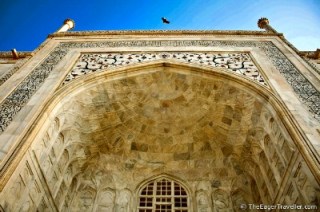
Q9-Taj-Mahal

The Taj Mahal in all of its intricacy. Photo credit: Jean Alaba

The first is of the Taj Mahal. I immediately fell in love with its intricate design. By pure luck, a bird flew across at the moment when I snapped this shot. It was only when I was viewing my photos on my laptop that I realized I had captured such an amazing moment. For me, the bird is special: it symbolizes freedom from all the worries in one’s life and from whatever is holding you back from achieving your dreams.
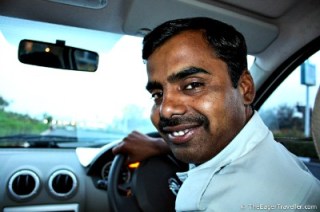
Q9-Bhawani

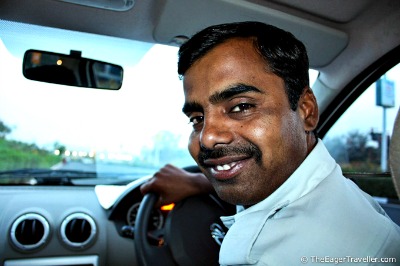
The jolly Jaipur driver Bhawani. Photo credit: Jean Alaba

The second is of Bhawani, the driver assigned to my group during our two-day outing to Jaipur. It reminds me of his kindness and positive disposition in life. He had to take us around Jaipur in the burning hot summer, but never once did he become irritated or impatient. He always had a smile on his face, and that kept us all in a good mood during the trip. In fact, the following week when we went to New Delhi, the company driver assigned to us was totally rude and inconsiderate. At one point he left us in the car sleeping (engine shut off!) while he had his dinner. Worse, when we lightly honked the car to signal that we were awake and frankly not amused, he completely ignored us.

I loved your photo of the Taj Mahal when I first saw it on your blog’s Home Page, but I have to be honest, I never noticed the bird until you pointed it out just now. Maybe that’s good as I was able to appreciate the intricate carvings. Now I’m worried I’ll miss the building and concentrate on the bird!! You’ve captured Bhawani exactly as you describe him; perfect.

One finds a way, or finds a reason to do something.—Filipino tagalong proverb

You are very modest to say you’ve been to “only” eight countries. That’s a lot more than most people visit in a lifetime. So tell us about where are you right now and why.
Well, as you know, James, I am currently in my country of birth, the Philippines, but I’m working out a deal that will hopefully pave the way for life in a new place. I’ll keep you posted.
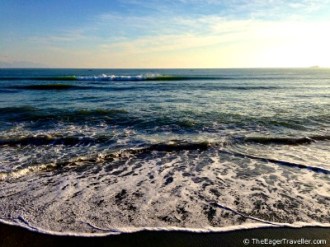
Q9-Baler

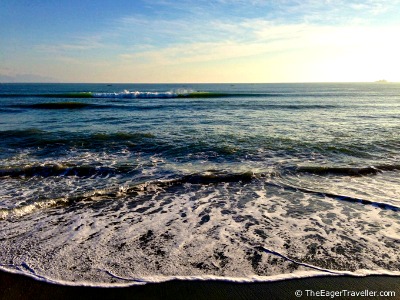
Baler, nicknamed the Philippines’ surfing capital. Photo credit: Jean Alaba

So you are keeping the secret for now, but I’m sure your blog will be give the game away when you are on the move again. The Philippines is a beautiful country and I see you have included one picture in your selection.
Yes, I’ve included this photo of Baler, which is in Aurora province. I like it because it reminds me of my first time attempting to surf and for someone not sporty, I didn’t do too badly. This was also my first time to go beyond my comfort zone in my own part of the world: I travelled for six hours just to catch the waves. It was a spontaneous weekend that proved to be pretty rewarding.

For me, the Baler surf lapping the shore looks just like a welcoming carpet in someone’s lounge.

If you plant, you will harvest.—Filipino tagalong proverb

I know you take a lot of photos but where, so far, are your favourite places to do so? and Can you explain why these places inspire you and how it shows in your next three photos?
My favourite places to take photos so far are India, Japan and Hong Kong. I’ve included one photo of each.
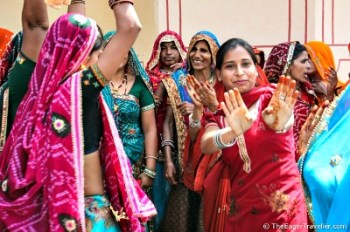
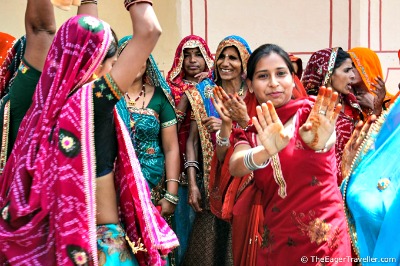
Q10-India

Indian women in colorful saris. Photo credit: Jean Alaba

I like taking photos in India because Indians are very proud of their heritage. This was apparent everywhere we went in India, regardless of the people’s social status.

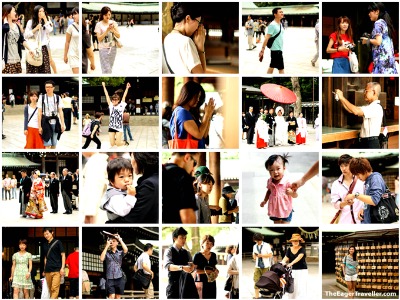
Q10 Japan

Portraits of Japanese people. Photo credit: Jean Alaba

Japan is a favorite of mine because the people are so organized, disciplined and polite. I never run out of things to see and admire.
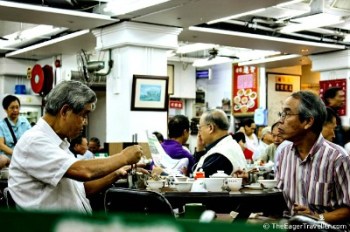
Q10-Hong-Kong

A Hong Kong eatery. Photo credit: Jean Alaba

Hong Kong inspires me because of the food! I should think its vast array of local dishes are enough to inspire anyone!

I like that you manage to get a handle on people from the different countries you visit, without actually living in that place. You are clearly a good observer of people, as well as a keen researcher. Tell me, do you feel reserved about taking photos of people, particularly when they are conscious you are doing so?
Not really unless I see they’re offended. But so far, no one has reacted angrily when they see me taking their photo. This is a good thing since I like shooting people. Capturing their unique expressions enables me to glimpse who they are and the kind of lives they lead. I must have taken a thousand portrait shots while in India. Perhaps I’ll get some of these printed and make it my wall art.

I’m the same. I hate to take “posed” photos so never get into a discussion with my subjects. I either take the pic or I don’t. So you like shooting people? Don’t worry; I know what you mean! I think the wall art is a great idea. I know this is a similar question but do you ever ask permission before taking people’s photographs. And how do you get around any language barriers?
Most of the time, I don’t ask but when I was in Japan, where permission needs to be secured for taking photographs of infants and kids, I would politely approach one of the parents and ask them in Japanese—of course with the help of sign language (pointing to my camera and their kids).

Thanks to you, I won’t get into trouble if I ever go to Japan. Would you say that you are motivated by the possibility of capturing something unique, which will never be seen again?
Definitely. You always have to live in the moment, and there is nothing more rewarding than being able to capture the special moments that, unless you have a time machine, you’ll never be able to bring back. Those photos may give you inspiration just when you need it most.

I have to agree, as I think most photographers would. So when did you first realize the power of photography, and how has it changed you?
I first realized it after borrowing a decent SLR for my trip to Hong Kong in 2008. I was able to take high-quality photos to serve as a memento. Ever since, I’ve made it a point to capture moments with my camera, whether during a vacation or simply at a gathering of family or friends—moments I’ll be wanting to view when I get old and grey.

I know what you mean. The picture for me is like a diary of an event in visual form. The photographer can write about it but no one else could.

When the sheets are short, one needs to make do.—Filipino tagalong proverb

Most readers will know by now that I’m not too good on the technical stuff but some of our readers will want to know what kind of camera and lenses you use.
I’m still using the borrowed camera; it’s a Canon 450D. I use the kit lens and a prime lens. It’s outdated equipment now.

You sound a bit like me except that I haven’t managed to borrow any equipment yet. And you aren’t asking me for technical advice. That’s great!! Finally, do you have any advice for wannabe photographers who are traveling or living abroad?
I don’t feel I’m in a position to give advice since I haven’t really achieved anything noteworthy. But I would say from my experience, don’t hesitate to take as many pictures as you can while travelling. Before embarking on a journey, research and learn from the professionals online. You can try copying them, using a trial and error process.

I actually think that is very good non-technical advice, Jean. I’d like to thank you for taking the time to tell your story so far in this interview. On your blog you say:

It has been a spectacular life so far but there is so much more to be seen! I have yet to find that life-changing opportunity which will allow me to do my passion for travelling and blogging as a living.

I have no doubt you will find that opportunity. I’m booking you in for a follow up interview next year to check your progress!!

* * *

Readers, what do you make of Jean’s experiences and her photography advice? And do you have any questions for her on her photos and/or travels? Please leave them in the comments!

And if you want to know more about Jean, don’t forget to visit her excellent blog, The Eager Traveller. You can also follow her on social media:
Twitter: @eagertraveller
Instagram: theeagertraveller
Google+: Jean Alaba

(If you are a photographer and would like to be interviewed by James for this series, please send your information to ml@thedisplacednation.com.)

STAY TUNED for tomorrow’s fab post!

If you enjoyed this post, we invite you to register for The Displaced Dispatch, a round up of weekly posts from The Displaced Nation, with seasonal recipes, book giveaways and other extras. Register for The Displaced Dispatch by clicking here!

Related posts:
THE LADY WHO WRITES: Wannabe novelists, before you write: Read, and read some more…

LadyWhoWrites_brandIntroducing…The Lady Who Writes, Meagan Adele Lopez—a repeat expat in the UK (she now lives in London). Besides writing, her talents include acting, blogging (during her first UK stint, she kept the blog “The Lady Who Lunches”), and crafting ads for social media. In this monthly column, which began yesterday with a self-introduction, Meagan is doling out advice to international creatives who are contemplating writing a novel about their novel, shall we say, life experiences.

—ML Awanohara

Hello again, Displaced Nationers! After my self-introduction yesterday, I’m happy to be back today to discuss my first topic: reading.

Yes, you heard that correctly: reading. Before you even begin to write, you really need to know how to read.

Reading is not just about absorbing the words on the page. You have to be as observant in your reading as you are in your own writing.

Perhaps I am telling you something you’ve already seen in book-writing manuals—but it still remains the best advice I received before writing my novel about an expat love affair, called Three Questions: Because a quarter-life crisis needs answers.

I was always an avid reader, but somehow got out of it once I finished college. By the time I’d decided to write a novel, I was shocked to realize it had been a few years since I’d read more than one book in a year.

Always one to kill multiple birds with one stone (that’s an awful phrase, isn’t it? I really would rather not kill any birds but, alas, the phrase says I must), I formulated a plan to read as much as I could before starting to write.

I would read books that would help me understand the rhythm of the sort of book I intended to produce, while also learning what my target audience was interested in.

And to do that, I would develop a sort of focus group of people who would give me honest and relevant feedback.

The Ladies Who Read

How did I create this? I started a book club for women. BUT this was no ordinary book club. Oh no! This was a book club with sass, spunk and activities, called the Ladies Who…(yes, I am fond of this moniker).

Our group would meet every month to tackle a different book and create some sort of experience based off the book.

One month, we were Ladies Who Cooked. Another month, we were Ladies who Karaoke-ed. Another month, we were the Ladies who Roller Skated. The topic didn’t always completely correlate to the book, but we did our best and always had a blast doing it.

And, although the novel I ended up writing—Three Questions—belongs to the “chick lit” genre, the books we read weren’t necessarily chick lit, and they weren’t just fluff. Some were literary, some were trashy but popular, and others were largely autobiographical.

“Let us read; and let us dance…” — Voltaire

One thing these books did have in common, though: my fellow “ladies” were interested in reading them.

Before, during or after our “Ladies who…” events, we discussed the book: what we liked about it, what we wished the author had thought more about, what bored us, what gripped us, the ins and outs of the character development—and I took notes.

To me, this was better than sitting in a classroom with fellow writers because I was getting first-hand knowledge of what the people wanted out of a good woman’s fiction novel.

The best part about it? One month it was my book that we did this to!

For me, reading before I started writing was immensely helpful. As I mentioned, being able to understand the ebb and flow of what makes a good narrative is extremely important.

I wanted to keep my readers always wanting more, never getting bored (I’m an actress, remember)—but also not jarring them by jumping from scene to scene. It’s a difficult task to accomplish, but reading other successful novels helps. For me, novel writing is not a science. It’s more of a feeling, an art form…

Notably, I found it more difficult to continue reading while I was in the throes of writing because I found myself subconsciously writing in the same style of whatever author I happened to be reading at the time. This caused my writing to become disjointed, confused and derivative, lacking its own identity. I had to separate myself from reading others’ writings during the course of my novel-writing for this reason.

Others might be different, but this was my experience.

Turning the page

Am I saying you must start a book club immediately in order to kill all those birds at once? OK, I’ve got to come up with a different metaphor. How about: “Throwing the baby out with the bath water”? (Ugh, equally as horrible, if not worse.) Actually, this is where the author must come up with her own! Writing your own metaphors, avoiding clichés and repeating phrases could be its own blog post entirely. I digress…

No, I’m not saying that you need to start a book club. What I am saying is for you to know your genre inside and out.

To sum up, here’s Novel Writing Tip No 1 for International Creatives:

Be the master of what you are writing about. Let no one else understand how to let that cliff hang, those lovers love, or that monster scare little children like you can. NO ONE.

* * *

Readers, any questions for Meagan, THE LADY WHO WRITES? What do you think of her book club suggestion? Zany, helpful—or both? Perhaps you have alternative suggestions? Please share in the comments…and let’s get a “Ladies Who Talk About Writing” club going. (Men, you are welcome, too!)

Meagan Adele Lopez grew up in the U.S. with a Cuban-born father and American mother, and at one time enjoyed an acting/casting career in Hollywood, something you can detect in the beautiful trailer for her novel, Three Questions. Her day job these days is in social media advertising. To learn more about Meagan, go to her personal site.

STAY TUNED for next week’s fab posts!

If you enjoyed this post, we invite you to register for The Displaced Dispatch, a round up of weekly posts from The Displaced Nation, with seasonal recipes, book giveaways and other extras. Register for The Displaced Dispatch by clicking here!

Related posts:

THE LADY WHO WRITES: Expats, there may be a novel in your novel life!

LadyWhoWrites_brandMeagan Adele Lopez has always been on the move. By the time she was 12, she had lived in 12 places within the U.S. As a young adult, she moved to Paris and then Bristol, UK. She repatriated to the U.S. but recently crossed The Pond again to settle in London. Meagan’s talents include actress, blogger (she kept the blog “The Lady Who Lunches” while in Bristol), novelist and social media guru. And now, for the Displaced Nation audience, she will deliver advice on writing a novel. Introducing…THE LADY WHO WRITES!

—ML Awanohara

When ML Awanohara asked me to write a series of guest posts about writing a novel, I was a bit taken aback. Who am I to tell you lovely readers how to write a novelI’ve only written one, and it wasn’t a bestseller on the New York Times!

Then I started thinking about what I could contribute to the Displaced Nation, what I know I did really well, and what I know I didn’t do well. Surely the successes and learnings from any first-time author are worth a contribution of, say, a series of at least six guest posts?

After all, I did have 30,000 people download the book in the first six monthsthat’s worth something, right?

Plus, being an expat myself (this is my third try!), hopefully I will be coming from a perspective that you all know and understand. I was lucky enough to be able to write my novel, Three Questions: Because a quarter-life crisis needs answers, while living abroad in England back in 2008. I’m back in England again (London, to be specific) after living in Chicago for three yearsand, yes, I’ve started writing again.

The odd thing is that I found it difficult to write in my own country. My imagination isn’t sparked like it is when I am abroad, and out of my comfort zone. Living in America (where I’m from), I go through the motions of my day-to-day life without digging deeperand this, in my mind, makes my writing dull and uninspired.

When I’m in Europe, I question more, observe more, and simply write more because I have to in order to survive. My writing in Europe comes almost out of a necessity.

It’s more than that, though. For me, when I’m in Europe, I’m curious about everything around me—I am constantly walking around with a slight tilt of my head, wondering how humans are so much alike and yet so different. I question my own actions and why I do the things I do, because the Brits, the French, the Germansthey don’t act the way I act. Simple phrases I would say without thinking in an American bar, like “double fisting” (to carry and consume two alcoholic beverages simultaneously), can cause serious offense, or fits of giggles, in Britain. Saying my name in France makes people think of a car. Even walking on the sidewalk in England I don’t seem to do right.

When walking becomes a struggle, writing becomes a source of solace.

Do you feel this way at all, fellow expats? We all need inspiration in order to write, and for me that comes when I’m put in situations that are out of the ordinary.

So, this blog series won’t be about telling the musts and mustn’ts of novel writing in a step-by-step manner. We all have a different method, and there is no right/wrong way. Rather, this column will provide six things to think about before, during and after writing a novel that maybe you’ve thought about, maybe you haven’t. I hope you will find my ideas inspiring, and never boring!

I’ll be back tomorrow with my first suggestion, which has to do with READING, the first step to writing…

* * *

Readers, any questions for our new monthly columnist, THE LADY WHO WRITES? Anything in particular you would like to see her cover in her series?

Meagan Adele Lopez grew up in the U.S. with a Cuban-born father and American mother, and at one time enjoyed an acting/casting career in Hollywood, something you can detect in the beautiful trailer for her novel, Three Questions. Her day job these days is in social media advertising. To learn more about Meagan, go to her personal site.

STAY TUNED for Meagan’s first piece of writing advice, scheduled for tomorrow!

If you enjoyed this post, we invite you to register for The Displaced Dispatch, a round up of weekly posts from The Displaced Nation, with seasonal recipes, book giveaways and other extras. Register for The Displaced Dispatch by clicking here!

Related posts:

LOCATION, LOCUTION: Chris Pavone, author of “The Expats”, on why story and location are inseparable

Cover art "The Accident; Author photo Chris Pavone; Author photo JJ Marsh

Cover art “The Accident; Author photo Chris Pavone; Author photo JJ Marsh

In this month’s “Location, Locution”, expat crime writer JJ Marsh interviews author Chris Pavone, whose  first novel, The Expats, was published in 2012, and was a New York Times and international bestseller, with nearly twenty foreign editions and a major film deal.

The Expats was nominated for a Los Angeles Times Book Prize and a Macavity, and awards from the Strand Magazine Critics Circle, the Mystery Booksellers Association, and the International Thriller Writers. It received the 2013 Edgar Award and the 2013 Anthony Award for Best First Novel.

Pavone’s new book, The Accident, will be published in March 2014.


Which comes first, story or location?
For some books I think the story and location are inextricably intertwined: the story is about the location. My thriller The Expats is one of those, defined by taking place in a country that’s not the protagonist’s home. The plot is driven by this situation, by her sense of disassociation and isolation, by the necessity of her reinvention.

How do you go about evoking the atmosphere of a place?
I love walking around cities, looking around at the architecture and the shops and the restaurants, at the people and their pets. My characters do the same, using all their senses to inhabit the world around them. Of course walking around, in and of itself, isn’t the type of action that does much to drive a plot forward, so characters should also be doing something else while walking around. Something such as spying…

Which particular features create a sense of location? Landscape, culture, food?
On the written page, I think the clearest evocation is via the physical landscape, especially when it echoes the culture. New York is the big brashness of skyscrapers and noise; London is the polite order of elegant uniformity; Rome is cheerful dilapidated chaos.

How well do you need to know the place before using it as a setting?
As much as my characters. If they’re only in a city for a day, they don’t know that much about the place, and I don’t need to either. Both The Expats and my next book, The Accident, use a variety of locations, and the amount of time the characters spend in placesLuxembourg, Paris, the Alps, Amsterdam, London, Zurich, Los Angeles, etc.is roughly proportionate to the amount of time I’ve spent there.

Could you give a brief example from your work which you feel brings the location to life?
This is the final sentence of The Expats . . .

Kate watches them merge into the flow of the dense crowd, all the streetlights and lamplights ignited in the Carrefour de l’Odeon, a little red Fiat beeping at a bright green Vespa that’s weaving in the traffic, the policeman oblivious while he continues to flirt with the pretty girl, cigarette smoke wafting from the tables filled with wineglasses and tumblers and carafes and bottles, plates of ham and slabs of foie-gras terrine and napkin-lined baskets of crusty sliced baguette, women wearing scarves knotted at the neck and men in plaid sport jackets, peals of laughter and playful smirks, hand-shaking and cheek-kissing, saying hello and waving good-bye, in the thick lively humanity of early night in the City of Light, where a pair of expats is quickly but quietly disappearing.

Which writers do you admire for the way they use location?
Hemingway was not only a master of evoking location, but also of using physical atmosphere as emotional metaphor. Empty barges on the Seine can represent a lot more than just boats.

Next month on Location, Locution:  award-winning author Amanda Hodgkinson.

 * * *

JJ Marsh grew up in Wales, Africa and the Middle East, where her curiosity for culture took root and triggered an urge to write. After living in Hong Kong, Nigeria, Dubai, Portugal and France, JJ finally settled in Switzerland, where she is currently halfway through her European crime series, set in compelling locations all over the continent and featuring detective inspector Beatrice Stubbs.

STAY TUNED for our next post!

If you enjoyed this post, we invite you to register for The Displaced Dispatch, a round up of weekly posts from The Displaced Nation, with seasonal recipes, book giveaways and other extras. Register for The Displaced Dispatch by clicking here!

Related posts:
And the January 2014 Alices go to … these 3 international creatives

 © Iamezan | Dreamstime.com Used under license

© Iamezan | Dreamstime.com
Used under license

If you are a subscriber to our weekly newsletter, Displaced Dispatch, you’re already in the know. But if you’re not (and why aren’t you? off with your head!), listen up.

Every week, when that esteemed publication comes out, we present contenders for a monthly “Alice Award,” most of whom are writers or other kinds of international creatives who appear to have a special handle on the curious and unreal aspects of being a global resident or voyager.

Not only that, but this person tries to use this state of befuddlement as a spur to greater creative heights.

Today’s post honors January’s three Alice recipients. Starting with the most recent, they are (drumroll…):

1) AMBER PAULEN, American freelance writer and copyeditor based in Rome, and blogger at Descriptedlines

For her post: “Paesaggio Interiore” (Interior Passages)
Posted on: 17 January 2014
Snippet:

Dreamers are thought to be opposite of the practical, yet I see no difference. Imagining is a practicality that we use in order to survive—an imagined outcome may prevent us from a certain action—but it also makes our lives better. Imagination is the begetter of empathy and the foundation of utopias. It is also, on a minute basis, a way of interpreting the world—the wider these interpretations span, the farther the imagination sees, the more adaptable we are, one of the human race’s single best attributes. Try to find an intelligent mind with a small imagination.

Citation: Amber, we could not agree more with you about the practicality of dreaming, and about the need to put greater value on the life of the mind. Scrolling through the endless photos of man-made and natural scenery that occupy so many travel blogs and Pinterest boards these days can have a numbing effect, reducing life to a set of exterior images—in denial of the fact that each of us possesses some pretty vivid, not to say revealing, internal scenery. What’s more, we believe that the imagination is an extremely powerful, as well as much under-rated, survival tool for expats—the key to our adaptability, as you might put it. On the days when your new life in X country is looking rather grim or mundane, you can always slip into a fantasy land, pretending you’re a royal or a hungry hyena, just as Lewis Carroll’s Alice was wont to do:

And here I wish I could tell you half the things Alice used to say, beginning with her favourite phrase “Let’s pretend.”

She had had quite a long argument with her sister only the day before—all because Alice had begun with “Let’s pretend we’re kings and queens;” and her sister, who liked being very exact, had argued that they couldn’t, because there were only two of them, and Alice had been reduced at last to say, “Well, YOU can be one of them then, and I’LL be all the rest.”

And once she had really frightened her old nurse by shouting suddenly in her ear, “Nurse! Do let’s pretend that I’m a hungry hyaena, and you’re a bone.”

2) DRAKE BAER, contributing writer at Fast Company and co-author of Everything Connects

For his post: “Why weird people are often more creative,” in Fast Company
Posted on: 10 January 2014
Snippet:

In a 2003 study, Carson found that eminent creative achievers were seven times more likely to to have low rather than high latent intelligence scores. That insight prompted her to form a hypothesis: that cognitive disinhibiting allows for way more info to enter into your conscious mind–which you can then tinker with and recombine. The result: creative ideas.

Citation: Drake, we commend you for marshalling the evidence to support something that Lewis Carroll knew intuitively, without the benefit of Carson’s (or anyone else’s) study. Indeed, the world Alice discovers when she steps through the looking glass is teeming with flaming weirdos who, while they may seem rather dim witted at times, let’s face it, are super creative. Take this encounter with Humpty Dumpty, for example, in Through the Looking Glass:

“You seem very clever at explaining words, Sir,” said Alice. “Would you kindly tell me the meaning of the poem called ‘Jabberwocky'”?’

“Let’s hear it,” said Humpty Dumpty. “I can explain all the poems that were ever invented—and a good many that haven’t been invented just yet.”

3) MILDA RATKELYTE, writer, photographer and a budding filmmaker based in Singapore

For her post: “Lessons from 2013,” in her blog, Milda Ratkelyte Photography
Posted on: 1 January 2014
Snippet:

This year I am starting with one simple resolution—slow down and find the time every single day to smell the roses. Although 2013 was probably the hardest year in my life, I am grateful to all the strength it gave me and all the invaluable lessons I’ve learnt along the way…Never take your loved ones for granted, because life is so fragile that you never know if you will get a chance to see them again. Pick up the phone, tell them you love them NOW, not tomorrow or next week. Trust me it will make a huge difference.

Citation: Milda, we have appreciated your lens on the wider world ever since we featured you and some of your photographs in our monthly column “A Picture Says…” And now that you are learning the price of a peripatetic life—living far away from your loved ones, who may be suffering—we appreciate your emotional honesty. As Alice herself discovered when parted from her beloved cat, Dinah:

Down, down, down. There was nothing else to do, so Alice soon began talking again. “Dinah’ll miss me very much to-night, I should think!” (Dinah was the cat.) “I hope they’ll remember her saucer of milk at tea-time. Dinah my dear! I wish you were down here with me! There are no mice in the air, I’m afraid, but you might catch a bat, and that’s very like a mouse, you know.”

While Alice’s concerns are trivial compared to those currently confronting you, we wish that like her, you discover a garden of red roses (only in your case, may they not smell of fresh paint!).
 

*  *  *

So, readers, do you have a favorite from the above, or have you read any recent posts you think deserve an Alice Award?  We’d love to hear your suggestions! And don’t miss out on the shortlist of Alice contenders we provide in each week’s Dispatch, which are sources of creative thought if nothing else! Get on our subscription list now!

STAY TUNED for tomorrow’s post, an interview with some American entrepreneurs in Senegal.

Writers and other international creatives: If you want to know in advance the contenders for our monthly Alice Award winners, sign up to receive The Displaced Dispatch, a round up of weekly posts from The Displaced Nation, with news of book giveaways, future posts, and of course, our weekly Alice Award!. Register for The Displaced Dispatch by clicking here!

Related posts:

TCK TALENT: Why do so many Adult Third Culture Kids gravitate toward acting, and is that the best use of their talents?

Com & Trag Collage

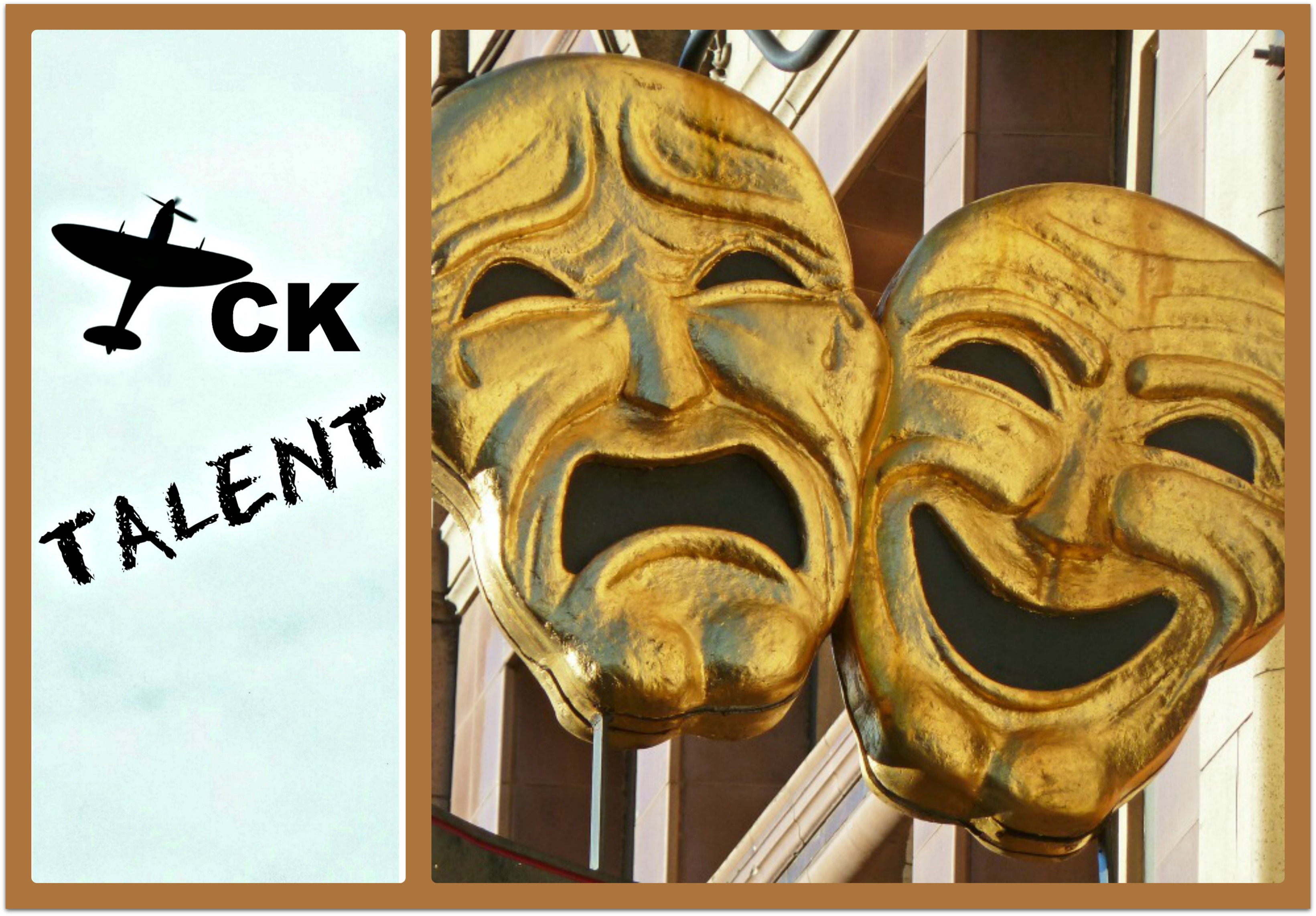
Tragedy and Comedy, Scarborough Hotel, Bishopgate, Leeds. Photo credit: Tim Green via Flickr.

Elizabeth (Lisa) Liang is back with her monthly column about Adult Third Culture Kids (ATCKs) who work in creative fields, Lisa herself being a prime example. A Guatemalan-American of Chinese-Spanish-Irish-French-German-English descent, she has developed her own one-woman show about being a TCK, which will be the closing keynote at this year’s Families in Global Transition (FIGT) conference, “The Global Family.”

In my last column, I interviewed Laura Piquado, a professional actress based in New York who grew up in six countries, including Egypt, where we were drama classmates in high school. As a result of the interview, Laura, editor ML Awanohara, and I had a lively discussion about Laura’s career change from education/activism to acting.

ML said she was puzzled as to why so many intelligent, well-educated Adult Third Culture Kids feel so at home in the acting world. She expressed concern that acting might cultivate a narcissistic outlook on life, which is the opposite of a TCK’s worldly upbringing. She said she found it particularly jarring that Laura could go from go from almost doing a PhD on women’s education in post-conflict societies, to enrolling in acting school—and not look back.

Laura’s response was so eloquent that I am posting it here.

Before you read it, I recommend watching this TED Talk by British actor Thandie Newton:

Born to a Zimbabwean mother and English father, Newton always felt disconnected or “other” while growing up in the UK:

“From about the age of 5, I was aware that I didn’t fit. I was the black, atheist kid in the all-white, Catholic school run by nuns. I was an anomaly.”

Acting gave her a chance to play with her different selves.

And now from Laura Piquado:

I had a similar reaction to yours, Lisa, in seeing acting described by ML as a narcissistic endeavor. While I can certainly understand that reputation (indeed, the Golden Globe awards), I have always idealized what theatre can be: life-changing, hopeful, inspiring, and necessary. It’s the worst to be onstage with someone who’s “masturbating” their way through a show (and equally as painful for an audience member).

I was in Maine a few years ago at a craft school (I’m a potter), and I sat next to a visiting artist at dinner (the amazing Hungarian-born sculptor Gyöngy Lake). She asked me what I did. When I told her I was an actor she said:

“We love you! We need you! You tell the stories of our lives!”

Now while that sounds uber-maudlin, I was completely overwhelmed. I had known this woman for less than two minutes, but she had described, for me, what the essence of art is.

On the other hand, I don’t want to get beaten over the head with social and political commentary every time I go to the theatre. I mean, I love Brecht, but can you imagine if that’s all theatre was? Mother Courage after Mother Courage, after The Caucasian Chalk Circle, after Arturo Ui…ugh. People would stop going. There’s room for pomp-y, wacky, ridiculousness (all hail The Book of Mormon), and everything in between. But I do think theatre at its best, the stories that stay with you, are the ones that connect to a deeper human context.

I was reading an interview with Supreme Court Justice Stephen Breyer in the New York Review of Books where he recounts a story he heard while a law student:

At the turn of the last century, the court was called upon to decide a case on prices for theater tickets—could they be considered basic necessities, and could they be regulated as such? The majority thought the theatre was not a necessity. The great Justice Olive Wendell Holmes Jr. replied in his dissent: “We have not that respect for art that is one of the glories of France. But to many people, the superfluous is the necessary.”

The interview was a larger discourse on France and Proust, but the point Holmes made about the necessity of art resonates.

ML also made the comment:

An interest in international affairs implies that you care about effecting positive social change on behalf of less fortunate people… Do you foresee bringing those two strands of your life together at some point?

The notion of “effecting positive social change” is what I’ll respond to. Again, it’s what I believe theatre can be, from Winter Miller‘s In Darfur to Moisés Kaufman‘s The Laramie Project. Being a part of that kind of theatre is deeply gratifying and something I always seek out. (Or as a potter: being able to go to communities to work with local artisans to make pots that filter clean, potable water falls into that same category.)

The leap from one discipline (social justice through academia) to another (theatre) wasn’t so quantum for me. And while they are vastly different on so many practical and actual levels, “effecting positive social change,” for me, lies at the heart of both.

* * *

So, readers, do you have anything to add to the debate? Are we ATCKs doing ourselves, and the world, a disservice by turning to acting, or can acting be one of our more profound contributions?

STAY TUNED for next week’s fab posts!

If you enjoyed this post, we invite you to register for The Displaced Dispatch, a round up of weekly posts from The Displaced Nation, with seasonal recipes, book giveaways and other extras. Register for The Displaced Dispatch by clicking here!

Related posts:
For this displaced Irish writer and cultural chameleon, a picture says…

Aisha Ashraf Collage

Canon zoom lens; photo credit: Morguefiles. Aisha Ashraf at Air Canada Centre, Toronto, for her very first live ice hockey game, 2013.

Welcome to our monthly series “A picture says…”, created to celebrate expats and other global residents for whom photography is a creative outlet. The series host is English expat, blogger, writer, world traveler and photography enthusiast James King, who likes to think of a camera as a mirror with memory. If you like what you see here, be sure to check out his blog, Jamoroki.

A happy new year to one and all at the Displaced Nation. My guest today is 38-year-old Irish expat, blogger, traveller and photographer Aisha Ashraf. She is currently based in Canada with her husband and three children. A freelance features writer, Aisha has published articles in newspapers, magazines and a range of expat and mental health websites. She says she has been a cultural chameleon since she first emigrated from Ireland to England at the age of eight. She is also a friend to the Displaced Nation and a recent recipient of one of its “Alice Awards” for a post on her Expatlog blog, provocatively entitled “My mother was a nun.”

Today I’ve asked Aisha to shares with us her experiences and view of the world via a selection of photos from her peripatetic life. I have followed Aisha on Expatlog for a short while and am so impressed by her pictures and the stories behind them.

* * *

From the glamor of Europe (Paris, France)…

Hi, Aisha. It’s good to meet you here at the Displaced Nation. I understand you now live in Canada. But where were you born, and when did you spread your wings and start traveling?
I was born in the same Dublin hospital as Bono from U2 and spent my early childhood roaming the family farm on the broad plains and bogs of Co Kildare, Ireland. Following my father’s diagnosis of bipolar disorder (“manic depression” in those days), we emigrated to England so that my mother could be nearer her family, swapping the farm for suburban living. I was eight when we left and it was many years before the night-time tears of homesickness subsided.

I have seen U2 twice. A great experience and I wonder if Bono knows he was born in the same hospital as you!! I trust those difficult times are now a distant memory, and I know travel has featured quite a lot in your adult life.
Aside from travelling all over the British Isles (we moved house almost annually after leaving Ireland), I didn’t travel abroad again until I met my husband. Together we explored Europe—we drove all over Malta in a yellow convertible. We also loved Paris so much we kept returning. He proposed to me in the bar of the Metropole Hotel in Brussels—a gorgeous historical landmark in the centre of Belgium’s capital, the setting for numerous films and host to royalty, foreign dignitaries, presidents and film stars.

That gives us quite a lot in common. In 1995 I had a great holiday in Malta, and Paris is a favourite of mine, too. And now I would love to know how you and your husband finally ended up in Canada.
Just before our second child turned one, my husband took a post in Libya while I held the fort at home in the UK. He travelled around the country seeing the sights and even sleeping under the stars in the Sahara, but the long absences were tough on all of us. After six months we were certain we didn’t want to continue living apart and considered moving our family to Tripoli. Luckily for us a post in Canada was offered because in the following months expats were evacuated when the revolutionary spirit that had taken Tunisia by storm spread to Libya, and the Gaddafi regime crumbled. We began the Canadian chapter of our life in 2010 and have been here since.

…to the rugged beauty of North America (Paris, Ontario)

scenefromAishaslife

Paris, Ontario. Photo credit: Aisha Ashraf

Canada is a big country. Where exactly do you live, and what is life like in those parts?
We live in Ontario, just outside Toronto. Initially my husband was slotted for a Toronto office but when Canadian HR learned he had a family they felt we’d be happier in Whitby, a once-bustling port on the banks of Lake Ontario, now a haven for families. It’s a great base from which to explore natural wonders like Niagara Falls and Algonquin Provincial Park, along with historic settlements like Kingston, Stratford, Bracebridge and Paris—Ontario!—which you can see in this first photo. I took it from the bridge spanning the Grand River.

A moment

A moment in the Distillery District, Toronto. Photo credit: Aisha Ashraf

Boywithtincup

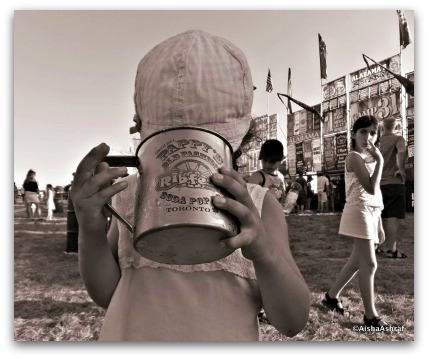
The local ribfest. Photo credit: Aisha Ashraf

Thank you for sharing some of the photos that capture a few of your favourite memories of Canada thus far. I’ve never been there, but I can see it is an amazing place. Can you tell us a bit more about these next two photos, which I believe are of your children?
This first one, of my son standing awestruck before a monstrous sculpture with an exploded head, brings to mind a bitterly cold winter’s day spent exploring Toronto’s Distillery District, where the kids got to meet Santa and the Victorian architecture and cobbled streets made us nostalgic for home. Back then we still felt like tourists. The second one is of my youngest child taking a deep draught from a tin mug at the local ribfest. I’m recalling a day of competitive rib-eating and blazing sunshine that melted into a night of flashing lights and fairground rides. Children are always such rewarding subjects—their innocence and unselfconsciousness makes them great fun to photograph—and the photos I take of my own children of course have special meaning.

hawkbyAisha

Soaring turkey vulture. Photo credit: Aisha Ashraf

And this next must be a New World bird of prey?
Yes, it’s called a turkey vulture. I got lucky after several attempts of zooming in and losing it to the vastness of a magnified sky. The photo always reminds me of an afternoon spent at the slipway, watching people get their boats in and out of the lake whilst navigating some particularly plentiful algae—it was more entertaining than TV.

The irresistible pull of the Great Outdoors

I think that is so interesting because, recently, I have been looking back over photos I took 35 years ago in many different countries and there isn’t a single one that doesn’t bring on a flood of memories. Photos are like that for me, a trigger, and they always have a story attached. Your two shots of the children are quite compelling—I love the girl picking her nose in the fairground photo—and the vulture is a great shot. Do you have any favorite places in Canada to take photographs?
Without a doubt, it has to be Lake Ontario—it’s where we head to chill, explore, reconnect and refocus. I actually get withdrawal symptoms if I don’t go regularly. The ever-changing light and character mean I snap lots of pictures that, once home, I usually find I have failed to capture whatever elusive quality it was I was trying for. We go for walks on trails and in conservation areas so I have countless photos of woods and water. Here are just a few that I really like:

Daughterwalkingoncliff

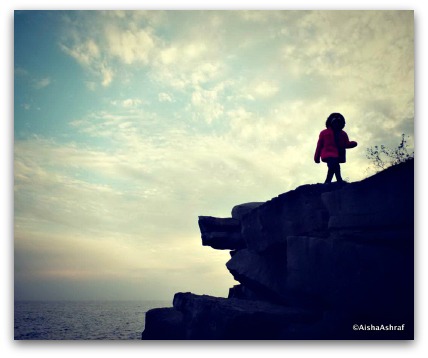
Cliff walk near Lake Ontario. Photo credit: Aisha Ashraf

boyinpumpkinfield

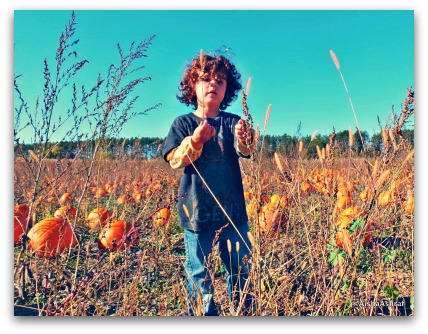
Pumpkin field near Zephyr, Uxbridge, Ontario. Photo credit: Aisha Ashraf

Wavesofthelake

Lake Ontario. Photo credit: Aisha Ashraf

The one of your daughter in the field full of pumpkins is so vital, and the naturalness of the colours brings your lovely composition to life. By complete contrast, your daughter on the rocks is positively Neolithic and, although it’s Canada, so Cornish! Nourishing stuff. And I understand that the black-and-white photo of the sea lapping the shore of the lake is a real favourite of yours. Can you explain why these places inspire you?
I love nature—perhaps it was growing up on a farm and spending most of my time outdoors. I have a condition called Borderline Personality Disorder (BPD) and getting outside is a big factor in alleviating its debilitating hold. I see incredible, uncomplicated beauty in the natural world that I find soothing and strengthening. I try to capture it with my camera in a way that may allow others to be moved/nourished by it, too.

Thank you for your honesty about your condition, Aisha. I feel exactly the same about photographing the natural world: it allows us to capture not just the picture but the way we feel at that particular moment. Unfortunately, unlike you I am only at a level where I am trying to move and nourish myself. If others are moved also, that’s a bonus. Now I know you enjoy photographing your kids, but do you ever go to the other extreme: ie, taking photos of people you don’t know in the places where you visit, and do you find that awkward?
Absolutely! I know my shyness has cost me many a great photo-op. I’m not sure if it’s my BPD or my peripatetic life, but I always feel like an observer, standing in the periphery looking in. This translates into a preference for my subjects to be oblivious to me and my camera. I like to capture the raw moment.

Yes, I know that feeling. You want to melt into the undergrowth and take the most natural shot possible. Do you ask permission before taking people’s photographs and how do you get around any language barriers?
I have, on occasion, screwed up my courage and asked someone if they’d mind if I took their picture—come to think of it, no one’s ever said no. I think if language were a barrier, it might make things easier. Tourists get away with a lot!

I understand. Taking people photos can be a bit personal. It’s so much easier shooting a mountain as it’s too far away to argue! Would you say that photography and the ability to be able to capture something unique which will never be seen again is a powerful force for you?
Capturing memories and the perfect picture are my twin obsessions. I’m in love with light and the effect it has on everything: the study, the photographer, the viewer. Is there anything else so intangible, potent and unspoken, and whose experience is unique to each individual?

When did you come to realise the importance of light?
Ever since I can remember, I’ve been transported by the tone of light or the way it falls—it triggers memories for me like nothing else can. Not so much of occasions, but of feeling and being. For a few brief seconds I’m caught in a flashback. Time slows so that even the dialogue in my head is distorted, becoming deep and stretched like treacle, a voice on a tape recorder played too slow.

Such powerful analogies. Now for the technical stuff which I am not very good at. What kind of camera and lenses do you use?
I have a Fuji FinePix f750EXR—it’s just a regular compact camera, no fancy lenses or anything. If I couldn’t fit it in my pocket, I wouldn’t be able to take it everywhere with me. Photography is as much about identifying a good picture as it is about capturing it, and many great photographers have started with a basic machine. A good eye is evident whatever tool you have at your disposal.

I can’t tell you how much better that makes me feel! Finally, do you have any advice for wannabe photographers (like me) who are traveling or living abroad?
Never leave home without your camera. Mine even comes grocery shopping with me—you just never know where that next great shot will be. Sometimes you find the sublime in the ordinary, and for me that’s the sign of a great photographer—that ability to show the beauty in the everyday.

Thank you so much, Aisha, for joining me in this interview. It really has been a pleasure talking to you.

* * *

Readers, what do you make of Aisha’s experiences and her photography advice? And do you have any questions for her on her photos and/or travels? Please leave them in the comments!

And if you want to know more about Aisha, don’t forget to visit her excellent blog, Expatlog. You are also welcome to contact her at aisha-a@hotmail.co.uk +/or follow her on social media:
Twitter: @AishaAshraf1
Facebook: Expatlog FB Page
Linkedin: Linkedin profile
Google+: Linkedin Profile

(If you are a photographer and would like to be interviewed by James for this series, please send your information to ml@thedisplacednation.com.)

STAY TUNED for tomorrow’s post, when our fictional expat heroine, Libby, returns to the Displaced Nation to update us on her many adventures. (What, not keeping up with Libby? Read the first three episodes of her expat adventures.)

If you enjoyed this post, we invite you to register for The Displaced Dispatch, a round up of weekly posts from The Displaced Nation, with seasonal recipes, book giveaways and other extras. Register for The Displaced Dispatch by clicking here!

Related posts:
LOCATION, LOCUTION: JD Smith – from Cornwall to 3rd century Syria

Book cover art, Tristan & Iseult; JD Smith author photo; JJ Marsh author photo

Book cover art, Tristan & Iseult; JD Smith author photo; JJ Marsh author photo

In this month’s “Location, Locution”, expat crime writer JJ Marsh interviews  JD Smith, author of the novella Tristan and Iseult and the first in The Rise of Zenobia series, Overlord, based in ancient Palmyra, to be released in early 2014.

JD Smith lives in the English Lake District. She has worked in the graphic design industry for over a dozen years, and now specialises in book cover design and typesetting.

The pseudonym JD Smith was adopted as her preferred Editor’s title when launching the writing magazine Words with JAM.

Which comes first, story or location?
Always the story. The location is influential to the story, but the story is the most important thing, the part which excites me as a reader. The location is the background upon which the story is played out, and the history is the framework upon which it is hung.

How do you go about evoking the atmosphere of a place?
With great difficulty. In writing Tristan and Iseult I evoked the wet and wind the British know only too well. I’ve always lived on the coast, though in the north, not Cornwall (Kernow), but those salt winds and perpetually grey skies are the same. The Rise of Zenobia is based in 3rd century Syria, and I’m finding that much harder. I didn’t grow up with the atmosphere ingrained in me. I haven’t spent years of my childhood visiting the remains, the palaces and the fortifications. I rely on films a lot. Being a designer I’m an incredibly visual person, and seeing it played out, filmed in the locations I’m trying to conjure on the written page, helps immensely.

Which particular features create a sense of location? Landscape, culture, food?
All of the above, definitely. Although I think in order to relate better to a reader I am all in favour of sacrificing certain aspects which readers might not gel with, and using others to push plotlines forward. Of course, all of these things give a clue as to the time, as well as the place, in which a book is set.

How well do you need to know the place before using it as a setting?
I’ve never visited Syria but I’m writing about it. You need to know it to a degree, but I think you need to know your characters more. Location is secondary. You can paint the background afterwards. Of course it depends. I write historical novels based on historical events and people, and knowing them and the history of the place, rather than the place as it stands, is key.

Could you give a brief example from your work which you feel brings the location to life?
These two extracts are my favourite descriptions of the weather in Britain which for me was a huge part of the setting of Tristan and Iseult:

Rustling emanates from the dense forest, even though the wind has dropped. White mist shrouds us. I tense to stop cold shivers taking hold. The rain is fine, yet a hand through my hair proves it is wetter than the streams in springtime and my footing slides on the muddy grass as we pick our way through undergrowth.

And:

‘Ireland is no home for me,’ she says. ‘I was at home with the sea and the sand and the shingle of my shores, with the salt spray in my hair.’

Which writers do you admire for the way they use location?
Tricky one. I tend to admire writers for their story, and their characters, not for their use of location. And for me it’s both the time and the place that work together as one with any author’s writing, because I love historical fiction. Time and place are tied so tightly together one does not exist without the other. Sarah Bower’s descriptions are second to none.  Philippa Gregory evokes the royal court with ease. And Bernard Cornwell can describe a battle on any field.

Next month on Location, Locution:  award-winning author Amanda Hodgkinson.

 * * *

JJ Marsh grew up in Wales, Africa and the Middle East, where her curiosity for culture took root and triggered an urge to write. After living in Hong Kong, Nigeria, Dubai, Portugal and France, JJ finally settled in Switzerland, where she is currently halfway through her European crime series, set in compelling locations all over the continent and featuring detective inspector Beatrice Stubbs.

STAY TUNED for tomorrow’s post!

If you enjoyed this post, we invite you to register for The Displaced Dispatch, a round up of weekly posts from The Displaced Nation, with seasonal recipes, book giveaways and other extras. Register for The Displaced Dispatch by clicking here!

Related posts:
GLOBAL FOOD GOSSIP: The Mysterious Case of the Missing Pastries

global food gossipJoanna Masters-Maggs, our resident repeat-expat Food Gossip and Creative Chef, is back with her column for like-minded food lovers.

This month: The regrettable global takeover of the Cronut, and what should be getting the publicity instead.

* * *

“What in dog-breeding hell is a Cronut?” demanded my son Seb, reading over my shoulder while swigging milk from the bottle in that annoying way 16-year-olds have. Baffled for a second, I realized the confusion and laughed.  My German Shepherd, Sophie, is my obsession and I am always reading articles about breeding and training.  Today, though, I was reading a food magazine which discussed trends for the New Year. Seb had seen a headline that asked:

“2013 was the year of the Cronut and Duffin but what does 2014 hold?”

Those of you elsewhere — anywhere except France, that is — may laugh, but Seb’s assumption that a Cronut is German Shepherd-related rather than food-related was completely justifiable.  My own ignorance of Cronuts and other “blended” pastries was only brought to my attention in December, when a friend living in Kuala Lumpur posted that they had finally arrived there.

I think it true to say that the Cronut hasn’t yet arrived in France and probably never will.

Some dishes deserve to go global

I do hope the same will not be the case for other treats that, my magazine suggested, will be sweeping tastebuds worldwide this year.  I was particularly happy to see the arepa from Venezuela and Columbia on the list. My hips might not want to revisit my interest in these delectable goodies, but I am smacking my lips in anticipation.

I first met arepas in Maracaibo, Venezuela, and our friendship deepened while I lived in Caracas.  These flattened balls of unleavened maize flour-based dough are fried and then filled with a cornucopia of ingredients, depending on the region. North Western Venezuela, where I first fell in love with the arepa, has its own speciality, the Arepa Cabimera, whose filling consists of the improbable combination of cheese, jam, chicken and boiled eggs.  You know when someone is eating a Cabimera as the arepas are unusually square.  Other varieties often include queso guayanés  — a mild, medium-soft cheese similar to mozzarella, shredded chicken and, if you are very lucky, crispy pork rind.

Global — with the exception of France, that is

The idea that I will miss such delights as they sweep the world is distressing, but our ignorance of the Cronut is a sad portent of what might come.  How had the Year of the Cross-bred Pastry missed France? Perhaps it’s not such a surprise; France is not culturally inclined to faddy trends as is, say, London or New York.  Why a “need-to-please” hybrid, when a classic, small, and delightfully buttery croissant is available?  How intolerably vulgar to take such perfection and, presumably, add jam and deep-fry it.

I can feel a thousand thin and elegantly clad Parisian shoulders shudder at the thought.

Hybrid – it’s the new pedigree

On further reflection, my less-thin shoulders shudder too.  As my son’s comment shows, cross-bred dogs are very much at the front of people’s minds at the moment.  Maybe the Cockerpoo, Labradoodle, and Schitzpoo are the canine equivalents of our human desire to have our cake and eat it.  A dog that doesn’t shed and mess up the carpet and sinuses, and a croissant that doesn’t — oh, wait. It does crumble.  Well, a pastry that isn’t a croissant or a doughnut but which still makes a crumbly mess…

Why?  Why make a mash-up of existing pastries when you could come up with something less plagiaristic or stick with what already works?  Oh, listen to me: maybe I do belong in France!  After all, for each hybrid that works there are the unlucky ones in each batch which fail to inherit the best of both worlds and instead exhibit the worst of each.  A croissant where the delicate buttery flavor has been killed by over-sweetening?  A  Labradoodle which sheds anyway and isn’t a pedigree but which costs the same and has the potential to inherit the congenital defects of two different breeds?

What’s more, the frying of such a delicate thing as croissant pastry is not for amateurs.  Getting the layers of pastry and butter to open in the heat of an oven is no mean feat; getting them to do the same in hot fat is entirely different.  Apart from that, think how easily butter burns.  That’s a lot of worry when pâtissierières across France already have mastered the art of injecting chocolate into croissants to make pain au chocolate or, better, almond paste.

For me the almond croissant is the pinnacle of pastry pleasure.  This marriage of crisp pastry with nutty and unctuous almond paste represents the Paul Newman and Joanne Woodward of the Pâtisserie.

The Cronut is, as yet, a Brangelina wannabe and everyone is already asking how much longer is it going to last.

“New” but not necessarily “improved”

The French disdain for change for change’s sake can be seen everywhere.  Fashion classics which stand the test of time are valued over the new and the shocking.  London fashion is all about iconoclasm and rebellion, rather than restraint.   Surely, when it comes to food, good taste should not be derided.  Maybe the French are right not to jump on the bandwagon of each new craze, instead waiting to see what stands the test of time and has what it takes to become part of the pâtisserie canon.

I doubt that the Duffin will ever be the Little Black Dress of the pâtisserie world; certainly not with a name that makes it sound like something an ageing hippie would wear on a cold winter day in Glastonbury, UK.

Hmm, pause for thought indeed.  At least with baking, we can bin the rejects; we cannot do the same with our canine friends who don’t pass the successful hybrid test.

How, then, can a modern culinary classic find acceptance in France?

So, let me find order to my reasoning.  The French, so far, have not accepted the hybrid pastry which tries too hard to please and lacks the elegant restraint of better behaved French patisserie staples.  However, history reveals that the French will eventually accept what will not go away: dishes with an enduring appeal, such as the pizza so…

…let’s return to my arepa whose pedigree cannot be questioned.  This is a traditional, tried and tested, and regionally variable dish.  Given time, I am hopeful that the French, who enjoy regional variety in cheese and wine, should be open to accepting this newcomer.  France has already embraced with overwhelming enthusiasm the pizza and tweaked it to French tastes – crème fraiche anyone?  There is a little van with a wood burning stove on most street corners in every city, town and village of the country.  For every Domino there are scores of restaurants, parlours, and vans, nearly all of them French owned and run.

For the arepa this is hopeful news indeed. I may have to wait longer than a resident of London, Birmingham or, indeed, Kuala Lumpur, but I have hope that the Venezuelans are coming to Aix.

* * *

Joanna was displaced from her native England 16 years ago, and has since attempted to re-place herself and blend into the USA, Holland, Brazil, Malaysia, Venezuela, Saudi Arabia, and now France. She describes herself as a “food gossip”, saying: “I’ve always enjoyed cooking and trying out new recipes. Overseas, I am curious as to what people buy and from where. What is in the baskets of my fellow shoppers? What do they eat when they go home at night?”

Fellow Food Gossips, share your own stories with us!

STAY TUNED for tomorrow’s post!

If you enjoyed this post, we invite you to register for The Displaced Dispatch, a round up of weekly posts from The Displaced Nation, with seasonal recipes, book giveaways and other extras. Register for The Displaced Dispatch by clicking here!

Related posts:

Images: All images from Joanna’s personal photo albums, and used here with her permission