The Displaced Nation

A home for international creatives

Tag Archives: USA

RANDOM NOMAD: Jessica Festa, Backpacker, Offbeat Traveler & Locavore

Place of birth: Long Island, New York, USA
Passport: USA — but I’m planning on starting the papers for my Italian passport soon (my grandparents were born there).
Overseas history: Australia (Sydney): 2008. I’ve also backpacked through western Europe (for partying and food!), South America (for surreal landscapes and hiking trails), and Southeast Asia/China and Ghana (for volunteer projects).
Occupation: Freelance travel writer. I have my own site and also write for Gadling, Viator and Matador, among others.
Cyberspace coordinates: Jessie on a Journey — Taking you beyond the guidebook (travel-zine); @JessonaJourney (Twitter handle); Jessie on a Journey (FB page for backpacking community); and Jessie on a Journey (Pinterest).

What made you leave the United States for the Land of Oz?
I chose Australia for studying abroad because I wanted to be able to communicate in English — it was my first time going abroad alone.

On your site you describe yourself as a “natural backpacker.” How did you find living in one country?
It’s so different living somewhere than just traveling to it. When you have a part-time job, class schedule, gym membership, local hangout, go-to grocery store, etc, you really begin to feel a strong connection to a place. Sydney is such a great city. That said, I did not give up my backpacking habit entirely. I also traveled a lot through Australia when studying!

Tell me about the moment on your travels when you felt the most displaced.
I had many moments like that when I did a homestay for a month in Ghana, in West Africa. I was doing orphanage work, and absolutely loved the experience — but the culture is just completely different. Especially in city areas, it’s very loud and chaotic, and people will shout at you and grab your skin to feel if it’s real. They don’t get many tourists, so they’re just curious and wanting to get to know you — but sometimes it got a little too intense.

When have you felt the most comfortable?
In Sydney. I actually called my family crying the night before my flight back to New York, saying I had a new home and would not be returning. I had this camaraderie with my neighbors and so many connections to the community, I really felt like a local.

You may bring one curiosity you’ve collected from each of the countries where you’ve traveled or lived into The Displaced Nation. What’s in your suitcase?
My collection of paintings, jewelry and handcrafted items:

  • Ghanaian artwork and wooden masks
  • Handmade jewelry from Sydney and Bolivia
  • A handwoven purse from Peru
  • Alpaca socks from Ecuador
  • Banksy artwork from the UK
  • Masapán (bread dough art) from Calderón, Ecuador
  • A hand-sewn water-bottle holder from Thailand

You are also invited to prepare one meal based on your travels for other members of The Displaced Nation. What’s on the menu?

Appetizer: Locro, a thick soup with potatoes, avocado, cheese and vegetables from the Andes.
Main: A pesto pasta with some kind of meat mixed in from the Cinque Terre in Italy.
Dessert: Salzburger Nockerl, a sweet soufflé from Austria.
Drink: Malbec wine from Argentina.

I wonder if you could also add a word or expression from one or more of the countries you’ve visited to the Displaced Nation’s argot.
“No worries” from Australia. Such a great phrase for life. I have it tattooed on my foot!

This week you received a “Food Alice” from the Displaced Nation for your post about the first time you tried cuy, or guinea pig, in Ecuador — you said your dinner reminded you of your pet guinea pig, Joey, named after a school crush. So, does food play a big role in your travels?
For me it’s about trying new things. It doesn’t need to be in the fanciest restaurant or prepared by a Michelin chef, just something truly local. For example, in South America while many of the other backpackers went to guidebook-rated restaurants, I always opted for the tiny, simple, dimly-lit local hangouts. I ate 2- and 3-course meals for a $1, and the food was fresh and local. It was exactly what everyday people in the community were having, and that was important to me.

If you were to design a world tour based on food, what would be your top five recommendations?
1) Mendoza, Argentina — try asado (barbecued meat) with a glass of Malbec.
2) Cinque Terre, Italy — try the pesto pasta that I served to you in my meal!
3) Naples, Italy — try the pizza.
4) Cuzco, Peru — try the cuy (guinea pig) or, if you’re too squeamish, the lomo saltado: strips of marinated steak served over white rice and with French fries.
5) Munich, Germany — try the brätwurst. It is like no other sausage I’ve ever tasted, and tastes so much better in Germany!

To be honest, I’m not so sure about going to Cuzco for cuy.
Really? I love it. I’m planning to go back, and possibly move, to Peru or Ecuador in March. I’m already looking forward to getting my fill of cuy again!

Readers — yay or nay for letting Jessica Festa into The Displaced Nation? At least she’s not planning to serve us guinea pig for dinner — that’s a mercy! (Note: It’s fine to vote “nay” as long as you couch your reasoning in terms we all — including Jessie — find amusing!)

STAY TUNED for tomorrow’s post, which will most likely be on food. (No, we haven’t finished gorging ourselves yet!)

If you enjoyed this post, we invite you to register for The Displaced Dispatch, a round up of weekly posts from The Displaced Nation, with seasonal recipes, book giveaways and other extras. Register for The Displaced Dispatch by clicking here!

Related posts:

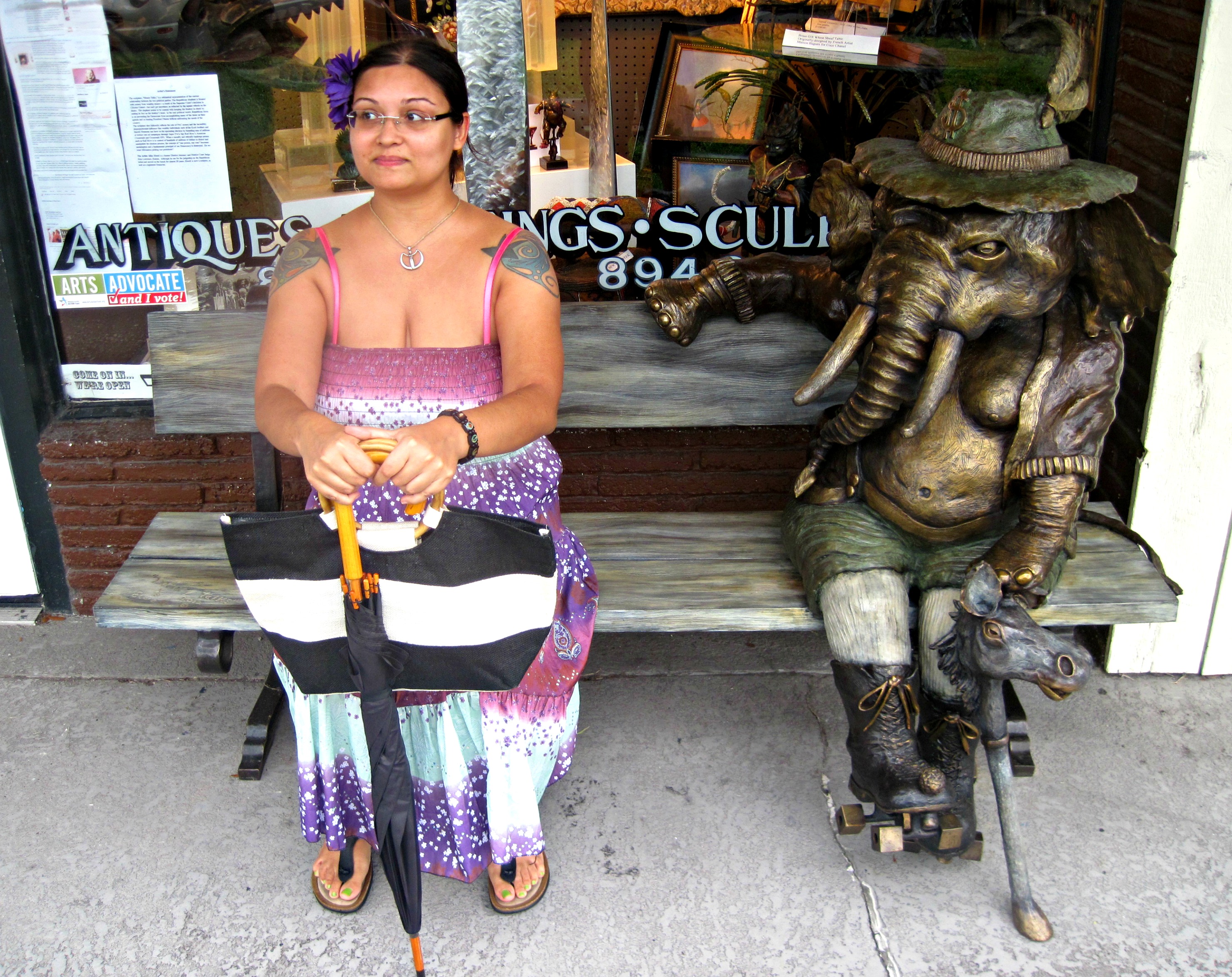
img: Jessie Festa enjoying one of the biggest and best empanadas in all of Peru, at the Point Hostels in Máncora (May 2012).

And the Alices go to … these 7 writers for their revealing posts on food and world travel

 © Iamezan | Dreamstime.com Used under license

© Iamezan | Dreamstime.com
Used under license

Autumn is finally here, and those of us who lost our appetite during the onslaught of this summer’s heat and humidity find that we can breathe — and eat — again!

Accordingly, the Displaced Nation has turned its attention to food — though in a way that conjures up the magical dreamscape of Alice in Wonderland rather than a blog populated by posts on typical and traditional world cuisines.

On the one hand, we’ve heard from the Top Hatter — I refer to Anthony Windram’s avatar — on the pleasures of indulging in beef tongue at a Kyoto restaurant. On the other, we’ve encountered Duchess Kate (Allison) just as she was pronouncing on the Queen’s favorite chocolate and inviting us to join her in a chocolate cocktail.

Last week when Tony James Slater appeared on the site, he was looking for all the world like Lewis Carroll’s Caterpillar, smoking his hookah and talking in short, somewhat rude sentences. His topic was the time he became violently ill (to use more polite language than he did) on mansaf on his visit to Jordan.

And personally I’ve yet to recover from last week’s encounter with the curious and curiouser Mark Wiens, who said he

would be very happy to fly to a destination and not do any of the normal tourist attractions, but just eat.

What’s more, he had the cheek to propose serving durian to The Displaced Nation! Off with his nose!!!

While putting together this menu of “It’s food!” posts, I’ve found it entertaining to read as many foodie posts as possible on other expat, repat, and travel blogs. And today I’d like to acknowledge some of their writers for what they’ve taught me about food and world travel.

A year-and-a-half ago, I had the pleasure of handing out the Displaced Nation’s Alice Awards to 7 writers who clearly understand — and aren’t afraid to reveal — the curious, unreal side of international travel.

Today I will hand out another set of Alices — you might call them the “Foodie Alices” — to writers who share the Displaced Nation’s down-the-rabbit-hole disposition toward world cuisines, i.e., who aren’t afraid to try mushrooms that make you grow, potions that make you shrink, tea parties where they don’t serve tea, and also feel duty bound to report these experiences to the rest of us.

So, without further ado, the Alices go to (in reverse chronological order):

1) AMANDA VAN MULLIGEN

Awarded for: “Do I Not Like Mushy Peas”, in A Letter from the Netherlands (personal blog about life as an Englishwoman in Holland)
Posted on: 19 September 2012
Choice morsel:

[Regular readers will know I am a fan of the Great British fish and chips.] However, there is no way, no how, I will eat fish and chips with mushy peas. They are vile. Foul. By far, mushy peas are … [t]he most disgusting monstrous green mess that has ever passed my lips. They turn my stomach.

Citation: Amanda, we award you this Food Alice or the feat of turning the typical “foods I miss from home” post on its head. That’s what it means to step through the looking glass. You’re a smart cookie and the rest of us would do well follow your example and focus on the “evil” accompaniments to our native cuisines that for health reasons alone, we’re lucky to have escaped from.

2) ANDREW COUCH

Awarded for: “Making Pancakes from a Bottle,” in Grounded Traveler (personal blog covering expat life in Germany), Posted on: 21 September 2012
Choice morsel:

We do not have a griddle. I imagine very few Germans have a griddle, at least not one useful for pancakes. So I get a set of 3 in a pan and the whole bottle [of Mondamin Pfannkuchen Teig-Mix] makes 12 or so, so I was doing several batches. … It works great, but well.. umm.. the Celsius temperatures still seem hard to understand for me. So while I didn’t overcook the cakes, I did almost burn my finger…

Citation: Andrew, you showed derring-do in experimenting with using bottled German pancake mix (and no griddle) to produce one of your favorite breakfast foods from home. Such bravery merits an Alice as does your acknowledged befuddlement over temperatures in Celsius, the vagaries of baking soda performance across the globe, and the extortionate prices of maple syrup. (Hey, we’ve all been there…)

3) KATE BAILWARD

Awarded for: “Sunday Supper,” in Driving Like a Maniac (personal blog about life as an Englishwoman in Sicily), part of her “Eating like a maniac” series.
Posted on: 3 September 2012
Choice morsel:

A Sunday night chuck it together kind of a lazy supper for one, to use up whatever you’ve got left in the fridge. I had a medium aubergine, a small courgette and some ricotta, as well as a jar of passata vellutata. You could say it was a very bastardised version of parmigiana alla melanzana, or you could just take it on its own merits and call it courgette, ricotta and aubergine rolls in tomato sauce. Or something else entirely. Whatever takes your fancy.

Citation: Kate — Katja, if we may — we give you an Alice for your versatility in writing foodie posts. Just after you published this piece, you wrote a post for Travel Belles on the joys of rustling up one’s own caponata, which you described as the “very essence of traditional Sicilian food.” Clearly, your training as an actor has borne fruit (and veggies!) if you can segue from harried EFL teacher chucking together a pseudo-Italian dinner, to full-fledged cookery expert. (What’s wrong with trifle, btw?)

4) JESSICA FESTA

Awarded for: “Eating My First Pet in Ecuador,” in Jessie on a Journey (personal travel blog)
Posted on: 24 August 24 2012
Choice morsel:

The body is sliced down the middle, opened like a thick book, on top of sizzling coals. Tiny hands, still with finger nails, reach into the air as if their last plea for help had gone completely unnoticed. Bright white teeth gleam out of mouths open in a scream and faces twist in agony. Apparently, the miniature murder scene I am witnessing is about to be my dinner.

Despite having been excited to try the popular Ecuadorian meal, something inside me feels a bit uneasy. My mind wanders back to my first pet, a guinea pig I named Joey after a school crush.

Citation: Jessica, we award you this Alice for your refusal to let “mental discomfort” stop you from ordering cuy, a popular South American dish, just because it resembles your Joey. (I for one never let sentiment get in the way of my enjoyment of koi, or goldfish, in Japan.) You’ve more than delivered on your promise to take us “beyond the guidebook.” We’re also very pleased that you found the dish delicious. Another one to add to our “must try” list, alongside Anthony Windram’s beef tongue.
COMING ON WEDNESDAY: A Random Nomad interview with the cuy-eating Jessie!

5) GERALDINE

Awarded for: “7 Badass Bavarian Foods You Must Try,” in The Everywhereist (personal blog about a trailing spouse’s adventures)
Posted on: 8 May 2012
Choice morsel:

Do you want to eat Bavarian food? OF COURSE YOU DO. It is rich and doughy and filling and is the only thing on the planet that can soak up German beer. Every other fare will simply hide in the corner of your stomach, petrified at the sheer awesomeness of the brew that resides in there with it, and it will never get digested.

In short: if you don’t eat Bavarian food while in Germany, you could die.

Citation: Geraldine, you’re full o’ beans, but we love you for that. Most “10 best foods” posts are about Southeast Asia or, more specifically, Thailand, home of cheap, tasty yet healthy food. But you realized that the market was already satiated for such posts and that it was time to give “badass Bavarian” food — of the kind that puts hairs on one’s chest — more of a chance. Not only that but you persuaded us. Pass the schweinshaxe.

6) & 7) MICHAEL HARLING & TONY HARGIS

Awarded for: “Is America too Sweet or Britain too Bland?” in Pond Parleys (joint blog, now defunct)
Posted on: 13 March 2011
Choice morsel:

Mike: I was surprised, on our recent visit, at how sweet America was: the beer, the bread, the pretzels (sugar-coated pretzels—honest to God) and even, oddly enough, the candy. And if it wasn’t infused with sugar, it was too salty and/or covered in cinnamon. After nearly ten years in UK, I found it all a bit too cloying.
Toni: While I do agree that American food has some strange stuff added to it, I wouldn’t call British food particularly bland. Rather than sweet, there is often a surprisingly savoury taste when you least expect it. While Cumberland sausage can have a peppery bite to it, Americans actually build their sweetness into the sausage, with maple syrup mixed right in.

Citation: Mike and Toni, we know you aren’t publishing Pond Parleys any more, but surely this post goes down in the annals and therefore deserves an Alice. I commented on it at the time it was published, wrote a post about it on TDN, and here I am writing about it again. The pair of you had a genius for pinpointing the kinds of things that routinely throw off American expats in Britain and vice versa, without their even knowing it. In the case of this food post, it turns out that we Yanks, just like the Duchess in Alice’s Adventures in Wonderland, may be allergic to all that pepper in the sausage! And who would have guessed that the sweets-loving Brits would recoil from our foods for their high sugar content?

* * *

So, readers, do you have a favorite from the above, and do you have any other writers/posts to nominate for our next round of Alices? I’d love to hear your suggestions!

STAY TUNED for tomorrow’s post, another Displaced Q focused on food by the anti-foodie Tony James Slater!

If you enjoyed this post, we invite you to register for The Displaced Dispatch, a round up of weekly posts from The Displaced Nation, with seasonal recipes, book giveaways and other extras. Register for The Displaced Dispatch by clicking here!

Related posts:

LIBBY’S LIFE #60 – Cotswold espionage

You can take the girl out of England, but you’ll never take England out of the girl. It’s home, and always will be.

At least, that’s what I thought until Oliver and I landed at a major British airport at stupid o’clock yesterday morning, after a night flight with a cranky four-year-old and two wailing five-month-olds in tow.

“Welcome home!” the uniformed bloke on passport control said to us. “This is your first time back in nearly eighteen months? Well, it’s great to have you in the country!”

OK, I’m lying. He said nothing of the sort. He scowled at me and Oliver, then shot a death-glare at Beth and George. “They’re American,” he said suspiciously, holding Beth’s blue passport by one corner as if it were radioactive.

“Well, technically they have dual–” I began, before he interrupted me.

“No UK passports?”

This visit was planned quite quickly, and although we’d got the twins official and legal as US citizens, they didn’t have the British paperwork yet.

“No, I haven’t got around to registering the birth with–”

The uniform held up one hand to silence me.

“How long will they be in the United Kingdom?”

Oliver passed him our travel itinerary which stated we would be going back to America in two weeks’ time.

“And you’re all travelling together for the duration of your visit?” the uniform asked.

“That’s right,” Oliver said.

“They’re five months old,” I said, sotto voce. “We thought we’d give them another couple of years before we sent them InterRailing round Europe on their own, but if you think they’re up to it now…”

Oliver trod heavily on my foot, and I muffled a squeal. My feet were swollen after a six hour flight with George asleep on my lap.

Another official wandered up to the booth.

“Have you got a problem, Derek?” she asked.

“He certainly has,” I muttered, and Oliver trod on my other foot.

The second official looked from Beth to her passport photo. Good luck to her trying to find the resemblance between Beth’s two month old self and as she was now, three months later. “They’ll need to be registered as UK citizens as soon as possible,” she said, “or it could cause a lot of problems.”

Goodness. The grilling now was not, therefore, classed as a “problem”?

“OK,” she said reluctantly to the first uniform. “Let them in.”

I gazed at my blameless infants as their passports were stamped and grudgingly handed back again.

“Poor little things,” I cooed at them as we walked away towards the baggage carousel. “You came home for a little light espionage, and they spoiled all your fun.”

Thankfully, I had run out of feet for Oliver to tread on.

* * *

So here I am, back in England, in the Cotswolds. It’s an unfamiliar region to me, as I’ve never been farther west than Reading before, so it isn’t technically “home”; but they still drive on the left, and I can buy Crunchie bars in the corner shop. It’s home enough for me.

You’d think that, given my extended absence, I’d have some introspective observations to bring you — Libby’s Thoughts On Returning Home — but all I can observe is how small everything is. The roads are Victoria Beckham-slim, the cars are like Matchbox toys, and as for the bed Oliver and I are sleeping in…Well. Give me King Size over Cosy, any day.

But the bed has to be cosy. King Size wouldn’t get up the narrow staircase in our rented cottage which, according to the plaque over the door, was built in 1723. It’s a tiny chocolate box house, all honey stone and honeysuckle on the outside, and low ceilings, plaster walls, and unexpected beams inside. Oliver is already sporting a lump on his bald patch.

Egg-sized lumps aside, though, it’s an idyllic place to spend two weeks. The front window looks out onto the high street, with its ancient market square cross, medieval church, and Ye Olde Gifte Shoppe selling tea towels and corn dollies to gullible tourists. For a real village — as opposed to Harry Potter’s Hogsmeade — this is as escapist as they get.

Better make the most of it before Mum and Sandra arrive next week, though. Thank God the house is too small for them to stay overnight, and they will be forced to sleep at the bed-and-breakfast down the road. For this first week, however, Oliver, the children, and I are on our own in this little Wiltshire backwater that has managed to bypass social evolution for the last 200 years.

OK, maybe not social evolution. They wear jeans and T-shirts, not smocks and straw hats, which is how everyone in Milton Keynes imagines West Country types. But they’re a bit behind in the technology race in Chipping Magna. There’s still a working red phone box in the High Street, which I thought was very quaint and sweet, because most red phone boxes have been bought up by Hollywood luvvies and converted to shower cubicles.

After half an hour in the cottage, we discovered the reason why the last non-shower phone box stood in this village. There’s no mobile phone signal in Chipping Magna.

“This is a disaster!” Oliver held out his useless cell phone in one hand and raked his — decidedly thinning, I noticed — hair with the other. “I’m supposed to be on a conference call with Seattle on Monday! How am I supposed to check my emails? Does this house have wi-fi?”

I gave him a pitying look. “I’d say this place has only just been hooked up to the national grid, wouldn’t you? Think yourself lucky that we’ve got electric lights instead of tallow candles.”

Then I turned away before Oliver could see me smirk.

I could be helpful and tell him that there was an internet cafe in the supermarket five miles away, where we stopped to get bread and milk. But here’s the thing. I don’t want him to be on the phone or emailing — and it’s not just because he’s on holiday and shouldn’t have to work for the next two weeks.

No. You see, if he can’t phone or email, he can’t communicate with Melissa Harvey Connor.

Bet you thought I’d decided to let that one lie, hadn’t you? Come on. You know me better than that. I’ve been doing some quiet investigations back in Woodhaven. That she started working for Oliver at precisely the same time that we were having marital problems, together with her husband Jeffrey stomping out of the house two weeks after she began, did little to allay my suspicions. No wonder the Posse had decided that she and Oliver were an item. But still — this is Oliver we are talking about. He’s no saint, but Melissa just isn’t his type. He might be OK as her boss, but I know that in a social (or more) situation, she would terrify him. I just can’t see it. He’d be mincemeat.

And yet — as my dad would say — there’s no smoke without fire. The question is: where did the fire start, and who lit the match?

I’m hoping that these two weeks with limited social opportunity — no phone, no internet, no texting — two weeks of Oliver and me being forced to sit and talk to each other, in other words, might give me a clue about what’s going on.

Because when the next coffee morning rolls around, I need to be able to stand up to the Posse and say, “Guess what, ladies? You owe me and my husband an apology.”

The jobsworth at the airport, worrying that our baby twins were here for some 007 spying, was barking up the wrong tree.

I’m the queen of espionage round here.

* * *

.

Next post: LIBBY’S LIFE #61 – A voice in the dark

Previous post: LIBBY’S LIFE #59 – Fanning the flames

A note for Libby addicts: Check out Woodhaven Happenings, where from time to time you will find more posts from other characters. Want to remind yourself of Who’s Who in Woodhaven? Click here for the cast list!

Read Libby’s Life from the first episode.

STAY TUNED for Monday’s round-up of the web’s top food posts!

If you enjoyed this post, we invite you to subscribe for email delivery of The Displaced Dispatch, a round up of the week’s posts from The Displaced Nation. Sign up for The Displaced Dispatch by clicking here!

Image: Travel – Map of the World by Salvatore Vuono / FreeDigitalPhotos.net

RANDOM NOMAD: Mark Wiens, Traveling Entrepreneur and Street Food Addict

Place of birth: Phoenix, Arizona, USA
Passport: USA
Overseas history: France (Albertville): 1990–91); Democratic Republic of Congo (Tandala): 1991–94; Kenya (Nairobi): 1995–2004; Thailand (Bangkok): 2009 – present.
Occupation: Freelance writer, blogger, video blogger, and food lover.
Cyberspace coordinates: Migrationology — Cultural Travel and Street Food Around the World (blog); Eating Thai Food (blog); @migrationology (Twitter handle); Migrationology (Facebook); and Migrationology (YouTube channel).

What made you leave your homeland in the first place?
I grew up traveling and living overseas with my parents, who are Christian missionaries. So after returning to the United States to attend university, I was ready to get back to traveling again.

Is anyone else in your immediate family “displaced”?
My parents are now residing in Tanzania. My father is now in leadership so he ventures into remote parts of Africa frequently and gets to see some pretty cool things!

As a Third Culture Kid, you’ve grown up living in several different countries. Tell me about the moment when you felt the most displaced.
What makes me feel out of place? Showing up at the airport, train station or bus station of a new city and not knowing how to get to the city center. That happened a lot when I first began solo traveling. I didn’t do enough initial research before arriving in a country.

One time I flew into Clark Airport in the Philippines thinking it was in Manila, but in reality it’s located about three hours from the city, and there’s no easy way to get to Manila center. I should have known this before arriving and getting lost!

I now still don’t do a lot of planning, but I always do a bit of research to figure out the best way to get from the airport (or station) to the city center!

Wow, you sound pretty comfortable in the big wide world out there, if you don’t even bother doing research before a trip. When have you felt the most comfortable?
Whenever I’m eating delicious food cooked by a local — that’s when I feel the least displaced. In Sri Lanka, for instance, I got into the habit of stopping to eat food along the side of the road. I would always be greeted by genuinely friendly and hospitable people. So in addition to delicious food, I would be connecting with others. That’s how I feel at home in a foreign place.

You may bring one curiosity you’ve collected from your travels into The Displaced Nation. What’s in your suitcase?
Durian from Southeast Asia — the most amazing fruit in the world! It makes me very happy!

And now you are invited to prepare one meal based on your travels for other members of The Displaced Nation. What’s on the menu?

Appetizer: Poke, the Hawaiian sashimi: cubed pieces of raw fish marinated in onions, soy sauce, and sea salt.
Main: Sichuan fish hot pot, known as Shuizhuyu. It’s the signature dish in Sichuan cooking.
Dessert: Either Thai-style sticky rice with durian, or just plain durian fruit.
Drink: Stoney, a strong ginger soda from East Africa that burns going down.

I wonder if you could also add a word or expression from one or more of the countries you’ve lived in to The Displaced Nation argot.
From Kenya: Sema boss, a slang term for greeting the person who is in charge. It’s a good way to connect.
From Thailand: Mai pen rai, how Thais say “don’t worry about it” or “no problem.” It’s a polite phrase.
From Mexico: Pansa llena, corazón contento: “Stomach full, heart is happy.” When I lived in the US, I had many friends from Mexico who would use that expression with me as they knew I loved to eat. I also have visited northern Mexico a number of times.

This month we’ve been exploring the idea of organizing one’s travels around the wish to try particular foods. I understand that many of your travels are motivated by food interests?
Yes, nowadays just about all my travels are motivated by food. I do travel to see other countries and meet new people, but my main passion is food and that’s what I enjoy searching for. I would be very happy to fly to a destination and not do any of the normal tourist attractions, but just eat. A few months ago I took just a short 24-hour trip to Malaysia with a strict mission to eat. It was an amazing food binge!

Are you more motivated by the idea of trying new foods or by finding the very best of particular foods?
I’d say I’m equally motivated to try new foods and to find the very best foods that I’ve already eaten previously. I’m always excited to try something I’ve never seen or heard of before, but at the same time if I hear about the best bowl of Thai boat noodles, or the most amazing seafood restaurant, I’m quite tempted too!

If you were to design a world tour based on food, what would be your top five stops/foods to try?
I couldn’t narrow it down to five, so here are six:
1) Thailand — try the gaeng som (sour spicy soup), som tam (green papaya salad), and boo pad pongali (crab yellow curry).
2) Malaysia — try the nasi campur (mixed curry and rice), nasi lemak (rice and toppings), and roti canai (roti bread with curry).
3) China — try the Sichuan hot pot and all kinds of exotic delicacies.
4) India — try the thali (rice with a variety of curries), dhosa (pancake with curries) and home-cooked curries.
5) Mexico — try the tacos, burritos, mole (chocolate curry), carne asada (grilled meat), and ceviche (seafood salad).
6) Ethiopia — try the mahaberawi, a platter that includes injera (white spongy bread) topped with a variety of spicy curries.

Readers — yay or nay for letting Mark Wiens into The Displaced Nation? He’s an adventuresome eater, that’s for sure, but can you stand the smell of what’s in his suitcase? (Note: It’s fine to vote “nay” as long as you couch your reasoning in terms we all — including Mark — find amusing!)

STAY TUNED for tomorrow’s episode in the life of our fictional expat heroine, Libby. (What, not keeping up with Libby? Read the first three episodes of her expat adventures.)

If you enjoyed this post, we invite you to register for The Displaced Dispatch, a round up of weekly posts from The Displaced Nation, with seasonal recipes, book giveaways and other extras. Register for The Displaced Dispatch by clicking here!

Related posts:

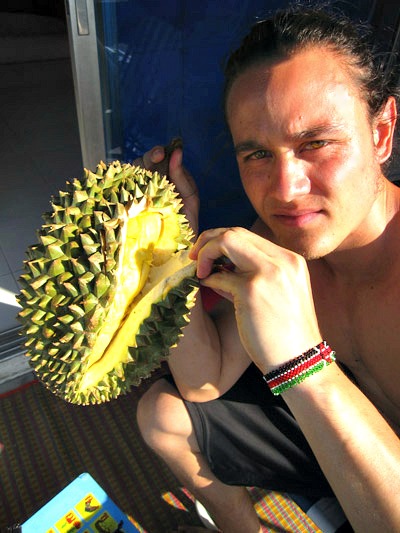
img: Mark Wiens in the act of trying, for the first time, to cut open a durian fruit, on his balcony in Bangkok.

The accidental repatriate

Last time Sezin Koehler wrote for us, she was bidding farewell to “strange, Lovecraftian” Prague, where she and her husband had lived for four years. Also in the Czech Republic, Koehler succeeded in producing her first (horror) novel, American Monsters. After a short stint in Germany, the couple is now saying hello to sunny, but bugbear-filled, Florida. Koehler describes the emotional transition.

When I left the US for Europe in 2002 I had no intention of ever again living in America. Violence, backwards politics, a horrible job market, and a provincial outlook on the world made an extreme contrast with my global, Third Culture Kid background. I am half American, half Sri Lankan, and my mother worked for UNICEF, so the family lived all over the world.

Not to mention I was suffering from extreme post-traumatic stress disorder after witnessing the murder of a dear friend when the two of us were robbed at gunpoint by a gang banger in Hollywood.

Ten years later and a forced repatriation determined by economics rather than desire, I am at a loss for how much worse off this country is since I left. I know a decade is a long time — but surely not long enough to usher in political rhetoric that would take this nation back to pre-1950s? My mind boggles.

One big dark nation

Gun violence has ever increased — to the point where we find so-called Stand Your Ground laws that allow citizens to kill each other with impunity, under the guise of “I felt threatened” — even when that threat consists merely of a young African-American boy, armed with nothing but iced tea and a bag of Skittles.

I’m back in the world of mad gunmen going on shooting sprees. Sikhs mistaken for Muslims and murdered. Women getting abducted and raped at gunpoint while waiting for a bus — this happened just recently not far from where I live.

Post-9/11 America has seen the sharpest increase in the infringement of civil liberties as matters of homeland security and anti-terrorism. The arrests of journalists covering Occupy Wall Street events brought the US’s rank of journalistic freedom down 27 points, putting the country at 47, just behind Comoros and Romania.

Xenophobia abounds as states pass laws against the teaching of ethnic studies, and even literature written by Native and Mexican Americans, in schools. Such developments are exponentially more ironic when considering that this country’s immigrant history.

The worst (and rudest!) of times

After college it took me almost a year to get a proper job. Upon returning, I’ve had trouble securing even a retail job: all applications are now submitted online and don’t give you an option to upload a cover letter or even your full resume. Not only are American jobs outsourced to China, the application process has been tech-sourced to boot, as machines vet your application — even if you live right down the street from the store to which you’re applying.

I was shocked to find that retail jobs pay exactly what they did a whole ten years ago. Way to move forward, America.

America might have progressed in terms of technology; I see a smart phone in every hand. However, common courtesy has gone out the window as people text, Facebook, Tweet, right in the middle of an actual face-to-face interaction, without even a twinge of remorse.

Call me old fashioned, or a kindred spirit to Hannibal Lecter, in believing it’s the epitome of rude to fiddle with one’s phone (or any other such object of distraction) whilst another human being is talking to you.

The wheels on the bus go back-backwards.

Monsters are the best friends I ever had

To add insult to injury, I find myself in a particularly devoid area of Florida, easily one of the most vapid places on the planet. Plastic people who can spend an hour telling you about their lunch salad are the antithesis of the cultured individuals with whom I spent my time while living elsewhere.

Who would have thought the rabbit hole I fell down when I left Prague would lead to a place scarily resembling Hell, with its torturous circles and its staggering temperatures?

Each day I force myself to review the positives:

It seems incredible that the America I left ten years ago — the one that traumatized me so badly — is actually a better version than the one in which I live now.

So frustrated have I been by absurd American conservatism and the zombie hordes of consumerism around me, I’ve resorted to a new persona: Zuzu Grimm, a creature who writes wicked dystopic visions of where this country is headed if it continues down this current path of willful ignorance and fear mongering.

Bored now

But that’s not been the only struggle: For years I defined myself as an expat. My blog was filled with anthropological tales of living in Switzerland, France, Spain, Turkey, the Czech Republic and Germany. More than that: stories of growing up in Sri Lanka, Zambia, Thailand, Pakistan, India.

While I’m still a Third Culture Kid — never really at home anywhere — my expat identity became a cornerstone of who I was. It worked, and was so much less confusing to explain. The expat label made me feel ultimately more interesting. Writing a novel in Prague sounds infinitely more exotic than writing from an essentially retiree community of ten thousand.

Oy vey.

Accepting that this is who I am now, and this is where I am, has been even harder than the absolute culture shock upon repatriation.

Being an expat gives a person a sense of uniqueness that may or may not be deserved. Yes, you’re a foreigner who must negotiate language/cultural/social barriers. But it’s also your choice. And for many people economics determines whether you can or can’t participate.

Kind of like having kids. You can complain all you want about how hard it is, but it’s something you elected to do, not something that was forced upon you.

(Well…unless Republicans head up the White house; with their insane ideas on abortion there’ll be thousands more women forced to carry rapists’ babies to term. Disgusting. Terrifying. Yet another grotesque example of the New America I find on return.)

I’m nobody, who are you?

My former life as an expat has taken on so many more shades of meaning as I consider how it must have seemed to those in my position right now: How glamorous. How decadent. How lucky. How dare they criticize my government when they’ve jumped ship. I have to live here. I’m thousands of dollars in debt. I don’t have the luxury of leaving.

Maybe one day when my husband wins the lottery, that’s just what we’ll do. Leave. Maybe for Buenos Aires, or Addis Ababa. Maybe in the meantime we’ll find a better city in the US, one that offers more by way of creativity, culture, and history — the things I miss most about life in Europe.

Until then, I have to make peace with being plain old Sezin Koehler who lives in and writes from Florida. Hopefully some time soon I’ll be okay with that. Any minute now. It’s going to happen.

That’s fine. I’ll wait.

And pray I don’t get sick in the meantime, because even with Obamacare, I still can’t afford health insurance.

Sezin Koehler, author of American Monsters, is a woman either on the verge of a breakdown or breakthrough writing from Lighthouse Point, Florida. Culture shock aside, she’s working on four follow-up novels to her first, progress of which you can follow on her Pinterest boards. Her other online haunts are Zuzu’s Petals‘, Twitter, and Facebook — all of which feature eclectic bon mots, rants and raves.

STAY TUNED for tomorrow’s post, another displaced Q from anti-foodie Tony James Slater.

If you enjoyed this post, we invite you to register for The Displaced Dispatch, a round up of weekly posts from The Displaced Nation, with seasonal recipes, book giveaways and other extras. Register for The Displaced Dispatch by clicking here!

Related posts:

img: Sezin Koehler in St. Petersburg, Florida, by Steven Koehler (2012).

BOOK REVIEW: “The Elopement: A Memoir” by Dipika Kohli

TITLE: The Elopement
AUTHOR: Dipika Kohli
AUTHOR’S CYBER COORDINATES:
Website: kismuth.com
Twitter: @DipikaKohli
Kismuth on Facebook
PUBLICATION DATE: July 2012
FORMAT: Ebook (Kindle) available from Amazon
GENRE: Memoir
SOURCE: Review copy from author

Author Bio:

A former journalist, raised in America by her Indian parents, Dipika Kohli has previously lived in Japan and Ireland, and now lives in Durham, NC, with her husband and son. The third volume in her Kismuth series will be published in October 2012.

Summary:

When American-born Karin Malhotra elopes to Ireland with her college sweetheart, she botches the dreams her parents had for her when they left New Delhi with a stalwart philosophy on what a good life “ought” to be. “Opportunity,” her father said, “is in the U.S. That’s why we came.”

But finding herself in Ireland, juxtaposed in not one, but two additional cultures (her new husband is Japanese), Karin finds herself thinking about the early years of her own parents’ married lives, and wondering if, like her, they questioned their decision to leave everything familiar for the mere promise of a better life.

She tumbles headlong without any preparation into a small village in the corner of Ireland. Not only does she have to contend with a new suite of social mores, she wonders what it would have been like had she not quit home.

(Source: Amazon.com book description)

Review:

The Elopement is the second book in a four-part memoir series, Kismuth, which, in Hindi, means “destiny”. Karin’s grandmother defined destiny as:

We’re all meant to be someplace…And when we get there, wherever it is, that’s what’s supposed to happen.

This implies a passiveness about the process, a casting off of responsibility for our futures, yet many would argue that destiny is of our own making. You reap what you sow, is another way of putting it.

Karin Malhotra’s ambitious parents left Delhi in search for a new life, for better opportunities for them and their children. Sadly, by forcing their own ambitions onto Karin, they sowed what they would later reap: an unhappy daughter, rejecting her family’s strict expectations by following her heart and searching for her own “better opportunities”. Her interpretation of the phrase, unfortunately, did not agree with that of her parents, who refused even to acknowledge Karin’s relationship with Japanese boyfriend Yoshi.

Little wonder that, when Karin finds the acceptance from Yoshi’s parents that she never had from her own, elopement seems an attractive, fairytale-like option. But of course, everyone knows that not all fairytales have happy endings. And while it might be possible to create one’s own destiny, the lesson we can learn from this book is that it is folly to try to create someone else’s.

The Elopement is a fascinating read, beautifully and eloquently written. Dipika Kohli’s next book, The Dive, starts where The Elopement ends. I am already counting the days until its publication on October 10.

Notable quotes:

On being a TCK:

[My parents’] choices, and the consequences that arose, ought not affect my own. If they didn’t think the trade was worth it — the one where they gave up everything in a familiar context in India to take a chance on a new opportunity abroad — well, that wasn’t my problem, was it?

On interculteral relationships:

Our summer of trying out…this intercultural relationship thing, felt like wearing a happened-upon outfit I’d never imagined could fit, but thought, once in a while, why not break that one out? …This “once in a while” was about to become my new look.

On Ireland:

Ireland had the kinds of places and people that would make you stop what you were doing, and sit up and pay full attention, to the degree that you felt really aware and present, maybe for the first time in your life.

.

STAY TUNED for Thursday’s post!

Image: Book cover – “The Elopement”

If you enjoyed this post, we invite you to register for The Displaced Dispatch, a round up of weekly posts from The Displaced Nation, with seasonal recipes, book giveaways and other extras. Register for The Displaced Dispatch by clicking here!

Related posts:

LIBBY’S LIFE #59 – Fanning the flames

Somehow, I manage to get away from that hideous coffee morning. As I drive, I automatically answer Jack’s questions about the finer details of Ironman’s personal habits — “I have no idea how he goes to the bathroom. No, I can’t imagine Ironman wearing Pampers.  Yes, I suppose he might go rusty if he’s not careful.” — but I’m not really paying attention.

Anita’s words keep looping around in my head.

“Jeffrey Connor’s gone back to Shelley,” she’d said. Shelley, his first wife, whom he’d left for Melissa Harvey. Jeffrey and Shelley Connor had been Melissa’s tenants — just as Oliver and I are now.

I cringe every time I replay my innocent reply:

“Why? What happened to him and Melissa?”

And Anita’s embarrassed answer: “We all assumed you would know about that.”

Her meaning was unmistakable: We assumed you knew because you are involved in this situation. Or, rather, not me, but Oliver.

It was as if someone had smacked me over the head with a large stick. Everything made sense: the sudden silence as I entered Anita’s house, as if they had been talking about me; Charlie’s protectiveness, as she loudly emphasised my “post-natal depression” as the excuse for my four-month absence from Posse society.

It wasn’t post-natal depression, not in the conventional sense. It was my inability to face anyone because of the issues Oliver and I were having about his father’s marital history.

Now, though, I wish I’d been brave enough to venture onto the coffee morning rounds. Without me there to set the story straight, rumours had flourished like unattended dandelions. In my absence, everyone had gossiped behind my back, assuming I wasn’t showing my face in public because Melissa Harvey Connor was having it away with yet another tenant of hers: Oliver.

How ridiculous. Right? I mean — when would Oliver see Melissa?

Yet here’s the thing: while I can keep telling myself that it’s all conjecture and careless whispers amongst silly women with too much time and not enough brain cells, and I don’t believe a word of it, at the back of my head a little voice of paranoia insists that rumours have to come from somewhere.  As my Dad would say: “There’s no smoke without fire, Libby.”

What to do now? I wonder.

Do I ignore the smoke? Douse the embers? Or — fan the flames?

If the topic comes up, I decide, I will probe.

*  *  *

“How was your day?” Oliver asks over dinner. “Did you go to Charlie’s leaving do?”

I pause. “Yep,” I say, trying to keep my voice light and casual, and instead hearing it come out high-pitched and tense.

“Everything all right?” Oliver shoots me a look which I interpret as concerned.

Concerned for whom? Me? Or him?

“Fine,” I say, hoping my voice sounds more natural.

“OK,” he says. Oliver tends to take things at face value. If I say I’m fine, then I must be.

“I hear Jeffrey’s gone back to England.” I cut into a piece of chicken on my plate, and glance up quickly to watch Oliver’s expression, which is a study in nonchalance.

“Yeah. He decided our landlady wasn’t a good enough trade-in for his first wife. Gone back with his tail between his legs.”

“It took him this long to work that out? Everyone else could have told him Melissa’s a complete bitch.”

Oliver raises his eyebrows. “She’s not that bad. A bit overbearing, maybe. Jeffrey didn’t handle her right. You’ve got to be firm with her.”

I choke, cough, and run into the kitchen where I splutter out a wad of half-chewed chicken.

“And you’d know about this, I suppose,” I say, when I return to the table.

“Well, yes. Of course I would.” He looks around the table for ketchup. Honestly, it drives me nuts how Oliver insists on drowning everything with ketchup. If I took him to Alain Ducasse, he’d be asking for ketchup to go with the foie gras. “Seeing as she’s been working at the company for — what?  Three months now.”

I lean back in my chair, aware that my jaw is dropping open unattractively.

“She works at your place? Why? She’s a realtor. You never told me.”

Oliver shrugs. “Housing market has tanked around here, and Jeffrey got her this admin job. I suppose she joined when we…when you and I weren’t talking much to each other.”

And whose fault was that? I want to scream, but instead I count to ten, very slowly, because I need to know more.

Suddenly the Posse’s whispers don’t seem so careless any more.

“Do you see much of her at work?” I ask in that same fake-casual voice.

“She works for me. Technically, I’m her boss.”

“And there is no connection between that and the fact that Jeffrey has decided to return to his first wife.”

He hesitates, just a fraction of a second too long, and my internal bullshit radar switches to high alert.

“Now you’re just being silly,” he says, sticking out his chin.

We finish our meal.

There is silence in the room, marred only for me by my internal radar’s sirens and red flashing strobe lights.

*  *  *

.

Next post: LIBBY’S LIFE #60 – Cotswold espionage

Previous post: LIBBY’S LIFE #58 – Careless whispers

A note for Libby addicts: Check out Woodhaven Happenings, where from time to time you will find more posts from other characters.  Want to remind yourself of Who’s Who in Woodhaven? Click here for the cast list!

Read Libby’s Life from the first episode.

STAY TUNED for Monday’s food-related Displaced Q!

If you enjoyed this post, we invite you to subscribe for email delivery of The Displaced Dispatch, a round up of the week’s posts from The Displaced Nation. Sign up for The Displaced Dispatch by clicking here!

Image: Travel – Map of the World by Salvatore Vuono / FreeDigitalPhotos.net

DEAR MARY-SUE: Can you tell me how to stomach other countries’ bizarre food obsessions?

Mary-Sue Wallace, The Displaced Nation’s agony aunt, is back. Her thoughtful advice eases and soothes any cross-cultural quandary or travel-related confusion you may have. Submit your questions and comments here, or else by emailing her at thedisplacednation@gmail.com.

Well, this month I’ve been asked to deal with your food-based queries. That’s pretty easy for this gal! I love to chow down. Not in a Paula Deen kinda way, you understand, but I sure do love a refined meal and am pretty well known on the Tulsa culinary scene.

****************************************************************************************

Dear Mary-Sue,

Fermented salted herring — how does that sound to you as a national dish? [Not great. Think roadkill cooked up in the finest Ozarks tradition sound preferable, if I’m being honest – M-S]  As an American living in Northern Sweden, I have yet to acquire the taste let alone abide the smell. However, a friend at my new church has invited me to a party where they’ll be serving surströmmingsklämma — that’s a sandwich made with slices of surströmming (the name for this fish — quite a mouthful, too, though at least it’s not fermented!) between two pieces of the hard and crispy kind of bread they love so much up here. The bread is buttered and there is a further layer of boiled and sliced or else mashed potatoes.

What to do? Do I accept my friend’s invitation or pretend to be busy “settling in”?

– Mary-Louise from Umeå, Sweden

Dear Mary-Louise,

You don’t have to pretend to be Anthony Bourdain if you don’t want to be. Look at Samantha Brown, she travels all the world and never once leaves her comfort zone or experiences something new.

Also, you’re in Sweden, not some village in the third world where they are honoring you by offering you a slice of roast anteater rump. I’m sure you won’t be insulting anyone by politely declining. Just be graceful and say you’re not big into fish.

Mary-Sue

*****************************************************************************************

Dear Mary-Sue,

I know you’re very pro-USA, but as an English expat who has just spent his first summer in the United States, I haven’t been able to get the hang of some of your summer desserts.

Take, for instance, strawberry shortcake — overly sweetened strawberries on a sweet biscuit, which should actually be called a scone. Whose bright idea was that? I guess that person hadn’t heard of strawberries and cream?

Moving right along to that traditional American Girl Scout favorite, s’mores. The chocolate and graham crackers are fine, but a roasted marshmallow — that’s OTT. Please, sir, can I have no-more?

I could go on about the American obsession with eating ice cream in a wide variety of sickening flavors, when there’s absolutely nothing wrong with chocolate and vanilla (okay, strawberry, too, if you like) — but I’ll stop there.

Here’s the thing, old girl [??????? M-S]. I would love to tell my various American hosts that nothing beats a tall glass of Pimm’s on a summer’s day, and a slice of summer pudding, but I’m guessing that wouldn’t go down too well.

Nigel of Nevada

Dear Nigel,

Old girl??! Why, aren’t you a little slice of honey pie? I’d certainly like to beat you with a tall glass of Pimms. It actually isn’t too difficult to get hold of a Pimms cup here in the land of the free. As for the rest of your letter: yeah, we like our desserts to be sweet. What a surprise!

Mary-Sue

********************************************************************************************************

Dear Mary-Sue,

I’m originally from Winnipeg, in Manitoba, Canada, and am teaching English in Korea. The other day one of my students went so far as to tell me that the reason the Korean economy has gotten strong is because they all eat so much kimchi.

I wanted to tell him that I think there’s something strange about a nation being so obsessed with what is essentially spicy fermented cabbage.

I mean, can’t they think of anything else to brag about?

– Sally from Seoul

Dear Sally,

First Mary-Louise’s problems with fermented fish and now this. I don’t know what it is with foreigners and fermentation — seems crazy to me. The Mary-Sue rule is that unless you’re fermenting something that I can make into a mimosa or margarita, then it’s best not to bother.

My hubby, Jake, is always going off to the Korean barbeque in town. If the owner is sending back all the money he makes off dear ol’ hubby, well, it’s probably that that’s keeping the Korean economy strong.

Mary-Sue

********************************************************************************************************

Dear Mary-Sue,

Oh. My. God. Do people really eat this stuff? I’m an American student staying with a British family as part of a semester abroad, and they SERIOUSLY just offered me the most foul-tasting stuff imaginable on toast. I thought I was going to spit it out. I mean, it was soooo salty! And then they presented the jar to me as a GIFT! What am I supposed to do with it?!?!?!?

– Patti in Plymouth

Dear Patti,

I’m assuming you’re talking about Marmite. I wouldn’t worry too much, it probably won’t make it past customs when you return to the land of milk and honey.

Mary-Sue

___________________________________________

Anyhoo, that’s all from me readers. I’m so keen to hear about your cultural issues and all your juicy problems. Do drop me a line with any problems you have, or if you want to talk smack about Delilah Rene.

Mary-Sue is a retired travel agent who lives in Tulsa with her husband Jake. She is the best-selling author of Traveling Made Easy, Low-Fat Chicken Soup for the Traveler’s Soul, The Art of War: The Authorized Biography of Samantha Brown, and William Shatner’s TekWar: An Unofficial Guide. If you have any questions that you would like Mary-Sue to answer, you can contact her at thedisplacednation@gmail.com, or by adding to the comments below.

STAY TUNED for tomorrow’s post by Jack Scott.

If you enjoyed this post, we invite you to register for The Displaced Dispatch, a round up of weekly posts from The Displaced Nation, with seasonal recipes, book giveaways and other extras. Register for The Displaced Dispatch by clicking here!

Related posts:


LIBBY’S LIFE #58 – Careless whispers

OK. Let’s do this.

My finger hovers over the doorbell for a couple of seconds before I push the button. Inside, a torrent of barks from Anita’s dog, Champion, reminds me of the morning at this house, nearly a year ago, when the same dog diagnosed my pregnancy, literally sniffing it out.

Approaching footsteps in the hall, accompanied by the skittering of doggy claws on slippery wooden floorboards.

Anita opens the front door wide, and I catch a glimpse of the Coffee Morning Posse chattering in the kitchen, at the end of the corridor behind her. Everyone turns to see who’s arrived, and the chatter stops; as if someone flicked a volume switch to “Mute”.

“Libby,” Anita says, at first looking at me, then quickly averting her eyes. “We didn’t… expect you. Come in.”

She takes Jack’s hand and the twins’ changing bag, and leads the way to the back of the house. I follow, feeling like Scarlett O’Hara when Rhett forces her to go to Melanie’s party after she and Ashley are caught in a clandestine clinch. It’s clear from the silence and Anita’s awkwardness that I’ve been the subject of conversation.

Could they know about Oliver and his bigamist father? I wonder. No. That would be impossible. No one in Woodhaven knew about that except Maggie, and she would never say anything to anyone — least of all to the Posse.

I haven’t seen any of the Posse since early May, a couple of weeks after the twins’ birth, when Anita brought round a Tupperware-encased casserole for our freezer. Two days after the arrival of that Chicken a la King, Oliver’s half-sister Tania paid us her fateful surprise visit, and my life turned towards the sign marked “Hades on Earth”. Hanging out with the Expat Sisters over lattes, pretending everything was hunky dory chez Patrick, didn’t feature on my agenda after that.

Silly to assume my absence went unnoticed, though. I’ve turned down so many invitations to coffee, dinner, and pot luck lunches that the gossip machine must have been working overtime. “Bring all the children, and let’s have dinner!” the phone conversations would start, and my inner reaction would be Let’s not. Let me just hide. Outwardly, I would mumble an excuse, but since I’m no Meryl Streep, the other person surely knew I was fobbing them off. “Another time, then,” they would say.

Except that after a while, of course, there were no other times.

Naturally, it was Maggie who set me back on the path to social redemption.

“You can’t hide away forever,” she said to me at regular intervals over the last few weeks. “You need more company. You need people your own age.”

Eventually, after Oliver and I reached our tenuous truce, I felt my wounds had been sufficiently licked and the time was right to enter the outside world again. An email from Anita, sent to all the English Posse wives, offered the opportunity I needed.

Charlie and Lee are heading back to sunny Milton Keynes! the email said. We will be holding a farewell party for Charlie on August 23 at my house. Please RSVP…..etc etc etc

I didn’t RSVP, though. I didn’t trust myself to keep a promise to attend. Glancing round Anita’s kitchen now, meeting the curious stares and false smiles, I wish I hadn’t come.

“How they’ve grown!” Charlie appears at my side, gives me a hug, and bends down to take a better look at the twins. “They’re — what, about three months now?”

“Four months. Exactly.” I wish with all my heart that it was someone else’s farewell party. Anyone except Charlie. Caroline would be my top pick of people to dispatch back to Milton Keynes. I can see her on the other side of the family room, standing next to her awful brat who’d made Jack’s life a misery. She’s holding her own new baby, which is dressed in a black Harley Davidson onesie with fake leather boots and a kelly-green elasticated headband. Boy or girl? It’s still anyone’s guess.

“They’re beautiful,” she says. “And you look very well, too. Post-natal blues are such a curse — I hope you’re feeling a bit better now?”

Charlie speaks the last sentence in a slightly louder tone, as if to make sure the rest of the room hears clearly. She nods slightly at me, encouraging me to say something, to play along with her.

“Much better,” I say, wondering where this is leading.

“Good! I hear there are some wonderful drugs available for depression these days. I expect you know all about that, though.”

“Well, I’m not actually—”

“Come and sit down where it’s quieter.” Charlie interrupts me, then picks up George’s car seat and carries it through to Anita’s formal living room. I follow with Beth. As I sidle past the basement door, I hear Jack issuing orders about the rules of a made-up game involving Ironman and Captain America. Sad, I think. Has Lightning McQueen had his day in Jack’s world?

“I think you should know,” Charlie says, flopping down next to me on Anita’s leather sofa, “that there’ve been a lot of theories about your absence. Rumours spread very quickly around here, as you know, but as soon as anyone voiced an opinion, I simply stepped in and told them you’ve been suffering from PND. I figured that it probably wasn’t too far from the truth.”

I reflect on this. Yes — I’d been depressed following the twins’ birth, although the two events weren’t connected.

“That’s about right,” I say.

“And I presumed you’d rather have that circulating as general knowledge than the real reason.”

I nod, before remembering that no one could possibly know about Oliver and Tania.

“Wait — what ‘real reason’?” I ask, but Charlie is already getting up.

“They’re calling me,” she says. “Time to cut the cake.” And off she rushes, back to the kitchen.

By the time I’ve gathered up the two baby seats and lumbered with them towards the cake room, Anita is in full flow with an emotional goodbye-to-Charlie speech.

“The best thing about being here in Woodhaven,” she says, blinking hard, “is the lovely people you meet. The worst thing is when you have to say goodbye to them.” She sniffs. “I’m going to miss you so much, Charlie.”

You and me both, I think.

Julia passes a couple of large gift-wrapped boxes to Charlie.

“This is from all of us,” Julia says, and I feel guilty, because I haven’t contributed anything.

Charlie murmurs her slightly embarrassed thanks, and begins unwrapping them. There’s a big coffee-table book full of photos of Massachusetts; a lace tablecloth which I recognise as being from the craft store in Woodhaven; a pottery house — a miniature of the one on Main street that belongs to the Historic Society. Right at the bottom of the second box, there’s a map of Milton Keynes and a copy of the Highway Code. A joke, of course — Charlie doesn’t need either, but it’s a reminder that she’s been away from her home town for nearly five years, and she might need a refresher course in driving on the left.

“Give our love to Milton Keynes,” Julia says.

“And to Jeffrey and Shelley, of course,” pipes up Caroline from the back of the room. She looks over at me and smirks, but I don’t know why.

Everyone else in the room knows, though. The heavy silence descends again.

Jeffrey and Shelley? I think. I only know one Jeffrey, the one who is married to Melissa Harvey Connor.

“Does she mean Jeffrey Connor?” I whisper to Anita, who’s standing next to me.

Anita casts a glance around, as if searching for a door to take her into a parallel universe, far away from here. “That’s right,” she says.

“So — he’s in England now?” Oliver never mentioned it. “What about Melissa? Has she gone too?”

It’s so long since I’ve seen Melissa. The last time I saw her was the week of the early winter storm, when I caught her sniffing Oliver’s sweatshirt in our bedroom, and I got the locks changed the following week.

Anita stares at the floor. Perhaps she can see the door to the other universe. “He’s gone back to Shelley,” she says at last. “The wife he had when he first came out here, five years ago.”

“Goodness.” So much scandal for such a small town. “So what happened to him and Melissa?” I ask.

Anita’s very quiet, for a long time. “We all assumed you would know about that,” she says at last. “I’m sorry, Libby.”

.

Next post: LIBBY’S LIFE #59 – Fanning the flames

Previous post: LIBBY’S LIFE #57 – Coming clean

A note for Libby addicts: Check out Woodhaven Happenings, where from time to time you will find more posts from other characters.  Want to remind yourself of Who’s Who in Woodhaven? Click here for the cast list!

Read Libby’s Life from the first episode.

STAY TUNED for Monday’s post.

If you enjoyed this post, we invite you to subscribe for email delivery of The Displaced Dispatch, a round up of the week’s posts from The Displaced Nation. Sign up for The Displaced Dispatch by clicking here!

Image: Travel – Map of the World by Salvatore Vuono / FreeDigitalPhotos.net
Repatriation is just relocation — with benefits

Today’s guest blogger, Anastasia Ashman, has been pioneering a new concept of global citizenship. Through various publications, both online and in print, and now through her GlobalNiche initiative, she expresses the belief that common interests and experiences can connect us more than geography, nationality, or even blood. But what happens when someone like Ashman returns to the place where she was born and grew up? Here is the story of her most recent repatriation.

I recently relocated to San Francisco. Three decades away from my hometown area, I keep chanting: “Don’t expect it to be the same as it was in the past.”

Since leaving the Bay area, I’ve lived in 30 homes in 4 countries, journeying first to the East Coast (Philadelphia Mainline) for college, then to Europe (Rome) for further studies, back to the East Coast (New York) and the West Coast (Los Angeles) for work, over to Asia (Penang, Kuala Lumpur) for my first overseas adventure, back to the USA (New York), and finally, to Istanbul for my second expat experience.

My daily mantra has become: “Don’t expect to be the same person you once were.”

With each move, my mental map has faded, supplanted by new information that will get me through the day.

Back in San Francisco, I repeat several times a day: “This place may be where I’m from, but it’s a foreign country now. Don’t expect to know how it all works.”

What a difference technology makes (?!)

Today my work travels, just as it did when I arrived in Istanbul with a Hemingway-esque survival plan to be on an extended writing retreat and emerge at the border with my passport and a masterpiece.

I knew from my previous expat stint in Malaysia that I needed to tap into a local international scene. But I spent months in limbo without local friends, nor being able to share my transition with the people I’d left.

This time is different. Now I’m connected to expat-repat friends around the world on the social Web with whom I can discuss my re-entry. I’ve built Twitter lists of San Francisco people  (1, 2, 3) to tap into local activities and lifestyles, in addition to blasts-from-my-Berkeley-past.

I’ve already drawn some sweet time-travely perks. To get a new driver’s license I only needed to answer half the test questions since I was already in the system from teenhood.

After Turkey’s Byzantine bureaucracy and panicky queue-jumpers, I appreciated the ease of making my license renewal appointment online even if the ruby-taloned woman at the Department of Motor Vehicles Information desk handed me additional forms saying: “Oh, you got instructions on the Internet? That’s a different company.”

One of the reasons my husband and I moved here is to more closely align with a future we want to live in, so it’s cool to see the online-offline reality around us in San Francisco’s tech-forward atmosphere.

It doesn’t always translate to an improved situation though. Just as we are searching for staff to speak to in person at a ghost-town Crate & Barrel, a suggestion card propped on a table told us to text the manager “how things are going.”

So, theoretically I can reach the manager — I just can’t see him or her.

So strange…yet so familiar

It took a couple of months to identify the name for what passes as service now in the economically-depressed United States: anti-service. Customer service has been taken over by scripts read by zombies.

When I bought a sticky roller at The Container Store, the clerk asked me, “Oh, do you have a dog?”

“No, a cat,” I countered into the void.

He passed me the bag, his small-talk quota filled. He wasn’t required by his employer to conclude the pseudo-interaction with human-quality processing, like, “Ah, gotta love ’em.”

What I didn’t plan for are the psychedelic flashbacks to my childhood. I may have moved on, but this place seems set in amber. The burrito joints are still playing reggae (not even the latest sounds of Kingston or Birmingham) and the pizza places, ’70s classic rock stations (Steve Miller Band’s “Fly Like An Eagle,” anyone?). The street artists are still peddling necklaces of your name twisted in wire. Residents are still dressed like they’re going for a hike in the hills with North Face fleece jackets and a backpack.

A bid for minimalism

The plan is also to be somewhat scrappy after years of increasing bloat. My Turkish husband and I got rid of most of our stuff in Turkey in a bid for minimalism. We camped out on the floor of our apartment in San Francisco until we could procure some furniture.

If it was a literal repositioning, it was also a conscious one — for a different set of circumstances. We’d expanded in Istanbul with a standard 3-bedroom apartment and “depot” storage room, and affordable house cleaners to maintain the high level of cleanliness of a typical Turkish household. In California, I intended to shoulder more of the housework.

I was soon reminded of relocation’s surprises that can make a person clumsy and graceless. I should have kept my own years-in-the-making sewing kit since I can’t find a quality replacement for it in an American market flooded with cheap options from China — and now have to take a jacket to the tailor to sew on a button, something I used to be able to do myself.

When the lower-quality dishwasher door in our San Francisco rental drops open and bangs my kneecap, I recall the too-thin cling wrap and tinfoil that I ripped to shreds in Istanbul, or the garden hose in Penang that kinked and unkinked without warning, spraying me in the face.

New purchases

“We’re getting too old for this,” my husband and I keep telling each other as we shift on our polyester-filled floor pillows that looked a lot bigger and less junky on Amazon. (We were abusing one-day delivery after years of not buying anything online due to difficulties with customs in Istanbul. Cat litter can be delivered tomorrow! Pepper grinder! Then I read about the harsh conditions faced by fulfillment workers in Amazon’s warehouses and cut back.)

One of our first purchases Stateside was a television. Not that we’re going to start watching local TV, but we did flick through some satellite channels. It’s something I like to do upon relocating: watch TV and soak up the local culture like a cyborg.

Since I last lived in the US, reality shows like COPS — where the camera would follow policemen on their seedy beats — have gone deeper into the underbelly of life, and now there are reality shows about incarceration.

The Discovery Channel has also gone straight to the swamp. That’s where I caught a moonshiner reality show featuring shirtless (and toothless) men in overalls called “Popcorn” and “Grandad.”

It’s an America I am not quite keen to get to know.

But I can take these reverse culture shocks lightly because my repatriation is part of a continuum. It’s not a hiatus from anything nor a return home. I’m not missing anything elsewhere, I haven’t given up anything for good. Being here now is simply the latest displacement. Today is a bridge to where I’m headed.

ANASTASIA ASHMAN is the cultural writer/producer behind the Expat Harem book and discussion site.  The Californian has been on a global rollercoaster: fired in Hollywood, abandoned on a snake-infested island off Borneo, married in an Ottoman palace, interviewed by Matt Lauer on the Today show. She brings it all home in the “Web 3.0 & Life 3.0” educational media startup GlobalNiche.net, empowering creative, adventurous, self-improving people to tap into a wider world of personal and pro opportunity no matter where you are. Get your copy of the Global You manifesto here.

STAY TUNED for tomorrow’s episode in the life of our fictional expat heroine, Libby. (What, not keeping up with Libby? Read the first three episodes of her expat adventures.)

If you enjoyed this post, we invite you to register for The Displaced Dispatch, a round up of weekly posts from The Displaced Nation, with seasonal recipes, book giveaways and other extras. Register for The Displaced Dispatch by clicking here!

Related posts:

Images: Anastasia Ashman (2012), her World Champions ring, and a view of the bridge to where she’s headed right now.