The Displaced Nation

A home for international creatives

Tag Archives: Travel yarn

And the July 2014 Alices go to … these 4 international creatives

 © Iamezan | Dreamstime.com Used under license

© Iamezan | Dreamstime.com
Used under license

If you are a subscriber to our weekly newsletter, the Displaced Dispatch, you’re already in the know. But if you’re not, listen up. (Hey, why aren’t you? Off with your head!)

Every week, when that esteemed publication comes out, we present contenders for a monthly “Alice Award,” most of whom are writers or other kinds of international creatives who appear to have a special handle on the curious and unreal aspects of being a global resident or voyager.

Not only that, but this person tries to use this state of befuddlement as a spur to greater creative heights.

Today’s post honors July’s four Alice recipients. They are (drumroll…):

1) STEVE LUNT, British barrister and expat in the Far East (first Hong Kong and now the Philippines)

For his post: “My invitation to paradise was printed on a T-shirt,” on Telegraph Expat
Posted on: 25 July 2014
Snippet:

The tidal rhythms of island life seem to suit the mind and body. After a week in Boracay, you might forget that other world, where you have to strive more, earn more and worry more.

Small wonder then that so many expats forget to leave.

Citation: First off, Mr. Lunt QC, we’d like to pass judgement on this little adventure of yours. Let’s see. According to your testimony, you were having a “chilly winter” in Hong Kong when you happened to notice someone wearing a T-shirt promoting Boracay, the Philippines’ most popular tourist destination. It read:

Quit your job. Buy a ticket. Fall in love. Stay forever …

—and you decided to do just that. Now, does the defendant plead guilty or not guilty of barmy behavior? Off with your head… (Sorry, this is the first chance we’ve had to use that line in an Alice citation, and we simply couldn’t resist.) Moving right along to your observation about expats who are guilty of staying forever: we note that in your own case, you left the white sands of Boracay for the bright lights of Manila after 10 months. While this is a healthy sign, the jury is still out on your long-term intentions. All we can say is that forgetfulness is surprisingly common among us displaced types. Take Alice for instance. After stepping through the looking-glass, she enters the wood where things have no names and immediately forgets her own name:

“What do you call yourself?” the Fawn said at last. Such a soft sweet voice it had!

“I wish I knew!” thought poor Alice. She answered, rather sadly, “Nothing, just now.”

Suffice it to say that the moment you hear a Palawan Bearded Pig cry out, “I’m a Palawan Bearded Pig! and dear me! You’re an English barrister!”, it will be time to get the heck out of there. We rest our case.

2) LUCILLE CELANO, indie author and New Zealander in New Caledonia

For her post: The downsides of living in a Pacific paradise on Stuff.co.nz
Posted on: 15 July 2014
Snippet:

International contracts in mining and development bring in [to New Caledonia] entire families who must cope with a life not their own. Kids are thrown into school wondering what planet they’ve arrived on. No allowances are made for these children in the local system and the French syllabus of reading, writing and mathematics (and nothing else) seems alien to parents used to school rooms full of colour and creativity.

Citation: Lucille, we’ve long suspected that Paradise has many downsides, so thank you for writing this post. But, as to this business of expat children receiving a French-style education, are you sure that’s not an upside? Maybe we’ve been drinking the Pamela Druckerman Koolaid for too long (has her book, Bringing Up Bébé, reached New Caledonia yet?), but Drukerman, an American expat in Paris, pretty much has us persuaded that if your bébé isn’t doing well in school, it’s a sign of bad parenting. According to Druckerman, the French have a knack for getting the balance right between good parenting and good teaching, the evidence being the kids themselves. French kids are much better behaved than—while also being just as boisterous, curious and creative as—kids elsewhere. That said, it sounds as though you’ve got enough toxic matter in the air from that nickel smelter, and we wouldn’t want Druckerman’s thesis to add any more. The way things are going with that New Calendonian expat crowd, we predict it won’t be long before a Mock Turtle stands up and says he’s had the “best of educations,” far superior to anyone else’s in the room. And just think, if said Mock Turtle held sway, all expat offspring would be forced to study the “different branches of Arithmetic—Ambition, Distraction, Uglification, and Derision.” On the other hand, his idea of classes taking place in the sea might have a certain appeal. Isn’t New Caledonia one of THE diving spots in the South Pacific? Yes, yes, we know it’s no paradise, or if it is, it’s a paradise with flaws. Actually, now that you’ve gotten us thinking about French-style learning, we’re remembering a line of Victor Hugo’s that you may wish to use on the expat crowd, next time things get on your nerves:

An intelligent hell would be better than a stupid paradise.

3) BARNABY EALES, freelance journalist and director of a translation service, former expat but now living in East Sussex, UK

For his post: A return to my beautiful, mad school in Paris, on Telegraph Expat
Posted on: 7 July 2014
Snippet:

Madame Boulic, the mother of my second host French family, dropped me off at the [British School of Paris]’s anniversary party and reunion. To her amusement, a banner at the entrance to the school read: “We are all mad here.”

Ahead of the evening BBQ party, the theme of the summer fête was Alice in Wonderland, and in the cultural sense, living in this part of France is all about being in wonderland: exposed to French culture and language while receiving a British education. An outsider within.

Citation: Barnaby, thank you for sharing this charming story of your misspent youth at a school for (predominantly, at the time you went there) British expats in France. And we’re head over heels for the idea of an Alice-themed summer fête being thrown by such a displaced institution. In our book, that’s calling a spade a spade, or should we say, a heart a heart? We have just one item in need of clarification, though, after reading your post. You mention beer and Jägermeister being enjoyed. But what about wine? We are recalling, of course, this exchange between Alice and the March Hare:

“Have some wine,” the March Hare said in an encouraging tone.

Alice looked all round the table, but there was nothing on it but tea. “I don’t see any wine,” she remarked.

“There isn’t any,” said the March Hare.

That would not be terribly civil, to use Alice’s word, especially in light of the growing numbers of French students at BSP. À la vôtre!

4) EMMA THIEME, fifth-generation Maine girl living off-the-grid in Washington County, Matador Network contributor and MatadorU faculty member

For her post: The First Time I Felt Independence, on Matador Network
Posted on: 4 July 2014
Snippet:

I wish I could say that this worry gene didn’t pass on to me, but I too have felt myself hugging a loved one too tightly when saying goodbye. I’ve saved countless voicemails as if they were soon-to-be artifacts. I’ve even gone so far as imagining the minute details of myself, distraught, at a funeral. What would I wear? Who would bring me? How soon would I return to work?

Citation: Listen, Emma, “worry” is Alice in Wonderland’s middle name! Honestly, has there ever been a bigger fretter in the history of English literature? Don’t even think about competing with her. But the nice thing about Alice, and we suspect you have this gene as well, is that despite her aversion to nasty predicaments, she handles them with aplomb. How about the time when she eats the cookie in the White Rabbit’s house and grows to the point where her arms and legs are sticking out the windows and doors, yet still has the presence of mind to conduct a little conversation with her extremities:

“Good-bye, feet!” (for when she looked down at her feet, they seemed to be almost out of sight, they were getting so far off). “Oh, my poor little feet, I wonder who will put on your shoes and stockings for you now, dears? I’m sure I shan’t be able! I shall be a great deal too far off to trouble myself about you: you must manage the best way you can;—but I must be kind to them,’ thought Alice, “or perhaps they won’t walk the way I want to go!”

And, while we don’t wish to be too literal, perhaps your worrying nature has kept your feet, which are clearly itching to travel and have adventures, from fulfilling their true potential. Had you thought of talking to your feet, as Alice does, and reassuring them of your intention to let them lead the way? We feel certain they appreciated your outburst at the Denver airport: “Wow, I’m alive!” (Hmmm…and now that you’re a domestic expat, having moved from Maine to Washington State, are they getting ideas about moving abroad? It would not surprise us.)

*  *  *

So, readers, do you have a favorite from the above, or have you read any recent posts you think deserve an Alice Award? We’d love to hear your suggestions! And don’t miss out on the shortlist of Alice contenders we provide in each week’s Dispatch, which are sources of creative thought if nothing else! Get on our subscription list now!

STAY TUNED for more fab posts.

Writers and other international creatives: If you want to know in advance the contenders for our monthly Alice Award winners, sign up to receive The Displaced Dispatch, a round up of weekly posts from The Displaced Nation, with news of book giveaways, future posts, and of course, our weekly Alice Award!. Register for The Displaced Dispatch by clicking here!

Related posts:

For this RVer who roams far and wide, iPhone in pocket, a picture says…

Becky RV Collage

Canon zoom lens; photo credit: Morguefiles. Becky Schade at Charlies Bunion, along the Appalachian Trail in the Smoky Mountains (photo credit: Becky Schade).

Welcome to our monthly series “A picture says…”, created to celebrate expats and other global residents for whom photography is a creative outlet. The series host is English expat, blogger, writer, world traveler and photography enthusiast James King, who thinks of a camera as a mirror with memory. If you like what you see here, be sure to check out his blog, Jamoroki.

My guest this month is 30-year-old American Becky Schade. Becky started traveling around America alone in her truck and RV (for those not in the know, RV stands for recreational vehicle, or mobile home) on September 14th, 2012. As she says on her blog, Interstellar Orchard, becoming a full-time RVer was a way to fulfill her dream of perpetual travel, exploration, and adventure, and to make her life the best it can be, right now, no holds barred. “And if I can do it, so can you,” she says.

She goes on:

Even if your Big Dream is going to take some time to realize, there are things you can do, right now, to improve the quality of your life. And they don’t all require a fortune or every free waking hour of your week.

Before pulling up her roots, Becky used to work with monkeys. She is an outdoor enthusiast and also a fantasy/sci-fi fan as well as gamer geek.

I have been waiting a while to interview her and write her fascinating story. Now I have my opportunity.

* * *

Welcome, Becky, and thank you for taking out some time from your adventures for this interview. I believe you were born and raised in Wisconsin but then, at the age of 25, became what is known in the States as a “domestic expat,” moving with a friend to coastal South Carolina. When did you really decide to break out and travel all around America as an RVer?
I loved how different South Carolina was from my home state of Wisconsin, but inside I knew I wanted to keep traveling and exploring. The truth is, I didn’t want to pay for a removal truck every time I moved, so started researching RVing as an alternative. In other words, I would be my own removal truck—taking my house everywhere with me. I eventually hit the road as a full-time RVer at the ripe old age of 28.

Your new-found freedom is clearly a wonderful experience, but do you ever feel homesick?
Home is where I park my RV travel trailer, which I pull with my trusty 2001 Dodge Dakota. Some people might call me a minimalist or even a gypsy because all that I own fits in my RV and truck. I don’t own or rent property anywhere, but I am always home. I get asked many questions about my lifestyle, like, do I feel crowded and cramped inside my little home? It may be difficult to visualize, but my “living space” includes the yard where I park my RV and the wonderful locations I visit. So I enjoy the free and constantly changing views from my bedroom windows that many house-bound folks might pay a fortune for. In reality I have more space than most people do.

The average person moves home, say, five times in their lives, whereas I imagine you could move five times in a month. I’m sure you’re often asked if you feel safe traveling alone, as a young single woman.
I am often asked that question, but you know something? The world is not as scary as the media would have us believe. Common sense is a person’s best safety tool and in my year-and-a-half on the road, I have never once felt threatened. If a place feels off when I arrive, I simply drive to the next place.

You obviously can’t work while traveling except when you stop in a place for a while. Do you ever worry about money?
No, one doesn’t need to be wealthy to live like I do. I saved up the money for the initial outlay from my last “real” job. With my accommodation and truck already paid for, I can explore the country comfortably on an income of $16,000 or less a year, which I make from working seasonal jobs in interesting places. I have at least six weeks a year where I don’t work at all and can focus on my hobbies as well as visit friends and family. I have health insurance, an emergency fund in case of accident or illness, and an IRA. Life on the road doesn’t have to be a gamble. There are smart ways to go about it that minimize the risks. It’s not an extended vacation but a way of life. I’ll continue traveling until I feel the urge to do something different.

I can relate somewhat to the things you are saying as I enjoy my own company, probably more than others enjoy it! And fortunately I have never experienced a feeling of loneliness. How about you, how do you find being alone on the road?
I don’t feel lonely. Being alone and being lonely are two very different things. I love quiet time by myself out in nature, and when I start feeling the need for human interaction, it’s usually not hard to find. Sitting outside your RV in a campground reading a book is viewed by many passersby as an open invitation to stop and say hello. I’ve met some of the most interesting people on my travels, with whom I’ve had some of the best conversations. I also keep in touch and visit with friends I had before hitting the road full time, and am a member of several online communities for RVers.

“Home is where I park it.” (classic RVer saying)

Something usually triggers or inspires a person to travel. Was that true in your case?
Since I was a teenager I’ve had this feeling that the typical American Dream of college, steady job, marriage, a big house, and a family wasn’t going to be my cup of tea—but it’s definitely what my parents expected. I was the dutiful daughter and followed that plan up to finishing college and getting a steady job, but I felt trapped and miserable. I wanted adventure. I wanted more than two weeks of vacation a year to explore. I wanted to learn by experience instead of just seeing things on TV or reading about them in a book. Those were the things that inspired me to pursue a different path and look into full-time RV-ing. At first I thought you had to belong to the realm of rich retirees, the kinds of people who invest a couple hundred thousand dollars in a gigantic, 40′ motorhome. Then I dug deeper and found that some younger folks were discovering a better work/life balance through life on the open road.

You are clearly a very determined young woman. Since you drove off on that September day in 2012, what places have you visited?
Last summer I worked retail at Badlands National Park, in southwestern South Dakota, and explored the Black Hills region—along with Crazy Horse Memorial and Mount Rushmore—in my days off work. This past winter I was a volunteer at a conservation centre with the University of Florida and visited sinkholes and crystal clear springs. This coming fall I’ll be working at a warehouse out near Reno, Nevada, and plan to be photographing mountains and Lake Tahoe around that.

I’ll be looking forward to the pictures. So where are you now, how did you end up there and what is life like in your latest hometown?
Right now I’m just outside of Atlanta in Fairburn, Georgia, performing at the Georgia Renaissance Festival. Getting paid to sing at a renaissance festival has been on my bucket list for many years, but I could never work it around a real job. Traveling the way I do now has given me the opportunity, finally. I love what I’m doing, but the location is a different story. I prefer the country and have never lived in a city, so navigating the busy streets of Atlanta has been an experience. Never be afraid to try new things, though—otherwise, how do you learn what you really like and don’t like?

Absolutely, Becky. New experiences always open the mind, and the more I try new things, the more I realize how much I still have to learn. And now let’s see some of your photographs, which capture a few of your favorite memories. Can you tell me the story behind them and what makes them special for you?

BeckyPix_1

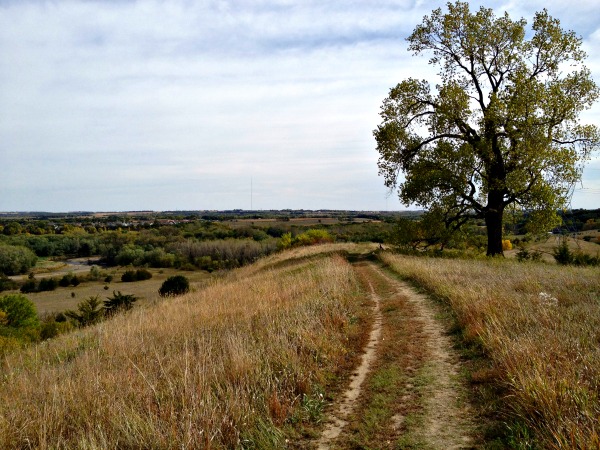
Celebrating a new life of recreation at Big Sioux Recreation Area. Photo credit: Becky Schade.

This picture was taken at Big Sioux Recreation Area, just outside of Sioux Falls, South Dakota. I’d been on the road for less than a week driving from South Carolina to South Dakota to make it my new residency state. I got my driver’s license and plates and then took a hike to the top of this hill to see Sioux Falls and the surrounding countryside. I sat on a bench and realized it was Thursday. In my old life I’d have been hard at work, but instead I was at this wonderful place. This is when it really hit me that I was living my dream, that life would never be the same. It was magical.
BeckyPix_2

The early bird catches the view at Folly Beach Country Park near Charleston. Photo credit: Becky Schade.


The second photo is of Folly Beach Country Park, just outside Charleston, South Carolina. Six years ago, my best friend and I were a year out of college and had earned some vacation time with our first “real” jobs. We used the two weeks to road-trip to South Carolina. I’d lived in Wisconsin all my life and was itching for a change of scenery; this was probably when I caught the travel bug. I took this photo at sunrise. We’d woken up at 4:00 a.m. to make sure we got to the beach before sunrise. I’m not an early riser, but getting to see the pink glow over the lighthouse was so worth the effort. We ended up liking our trip here so much that we moved to SC a year later, where I stayed until I hit the road.

BeckyPix_3

Inspired by spires of granite near Sylvan Lake. Photo credit: Becky Schade.

The third picture was taken in June of last year, when I was working at a gift shop in Badlands National Park. On a day off, I headed over to Custer State Park, in the Black Hills. I had no itinerary and spent the morning in the south of the park watching bison. Then, after happening upon a couple of neat looking lakes, I decided to study the park brochures and find the best lake in the Black Hills. Beautiful Sylvan Lake caught my eye. The road that leads to the lake is the Needles Highway. The drive along that highway was amazing, more so because I had no idea it was there, and every vista was a surprise. This photo is of the Needle, a huge spire of granite that wind and water had hollowed out into a needle shape.

Nature—cheaper than therapy

It makes such a difference when you know the story attached to the pictures. Until you told me that story about the last one, all I could see was a silhouette of a girl leaning back with long flowing hair–not a needle! Where are your favorite places to take photographs?
I love natural places, I always feel most content and closest to the divine when I’m out in nature. And there’s such variety to be found, as the next three photos demonstrate. I don’t think I’ll ever get tired of it.

BeckyPix_4

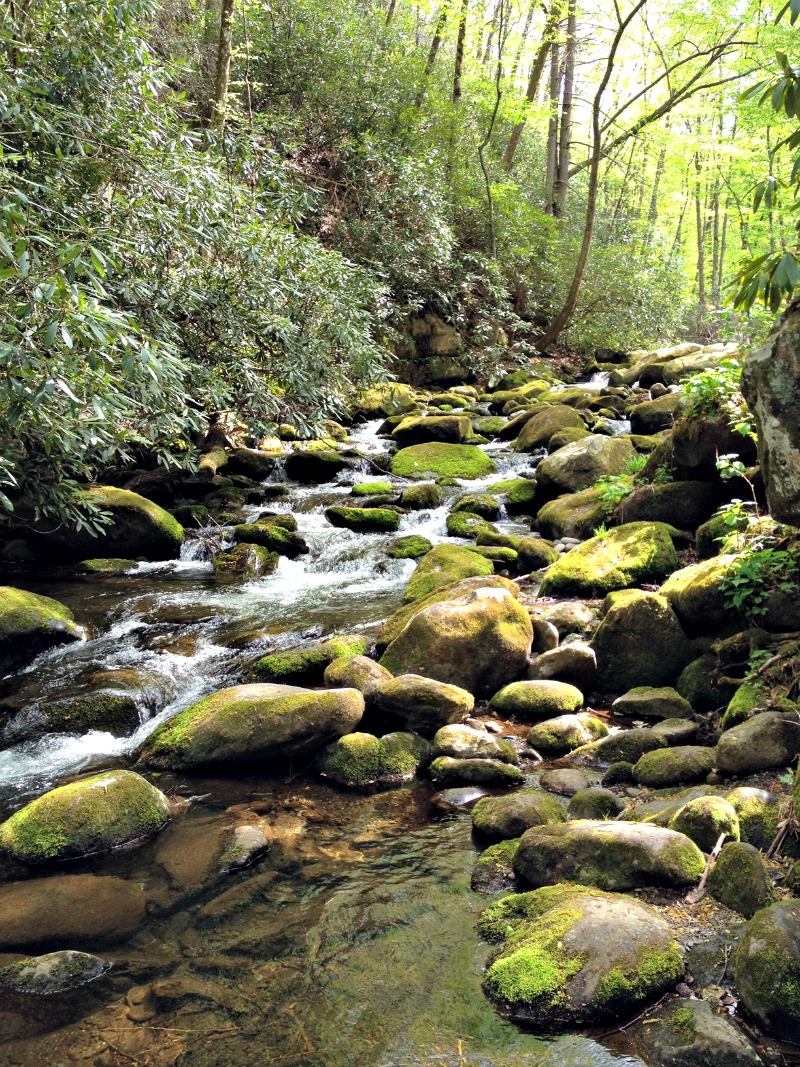
Holy smokes! Nature in all its glory in Great Smokey Mountain National Park, NC/TN. Photo credit: Becky Schade.

BeckyPix_5

Nothing bad about that! Badlands National Park, SD. Photo credit: Becky Schade.

BeckyPix_6

The forces of erosion at work in Hunting Island State Park, SC. Photo credit: Becky Schade.

I know how you feel. Photographing a natural scene that is forever changing feels so fulfilling. I’d like to know if you ever feel reserved about taking photos of people, particularly when they are conscious that you are doing so?
Yes, I do. I don’t take pictures of people without their permission if they are to be the subject. But if they happen to be in the background of a shot, it’s not usually an issue.

Would you say that photography and the ability to be able to capture something unique which will never be seen again is a powerful force for you?
That’s an interesting question. For me, photography is a hobby and not the main reason for travel. I have no desire to get trapped behind the lens trying to take the perfect picture and miss the beauty of a magic moment. Having said that, there certainly is a magic to that rare photograph that captures the essence of a time or place. Maybe it’s because I’m a novice or that I make a point of not staging photos, but when I snap my shutter I never know ahead of time if I’m taking that kind of picture. It’s something I find out later as I’m reviewing the photos in my computer.

I can empathize. In my case if I’m not present in the moment I can neither photograph nor write with passion.

“The best camera is the one you have with you.” —Chase Jarvis

Now for the technical stuff. What kind of camera and lenses do you use? And which software do you use for post-processing?
Haha, hoo boy—I’m about to get laughed right out of this column…or maybe, just maybe, help a few people understand that you don’t have to buy a thousand dollar SLR to be a photographer. My camera is my iPhone 4s—with no apps to change the functionality. That’s all I have. I don’t even own a point-and-shoot. Because I have no optical zoom whatsoever, it definitely limits the kinds of photos I can take, but for me the extremely high portability and low cost (relatively speaking) make up for that drawback. My phone fits in my pants pocket and has a waterproof and shock-resistant case, so I don’t fear taking it to rugged locales. Some might say that a smartphone is more expensive than many point-and-shoots you can buy, which is true, but when it functions as my phone and GPS as well as my primary camera, having all three in one package is definitely cheaper than owning them as individual gadgets. I use Adobe Photoshop 7.0, which I had actually gotten years ago for the purpose of drawing and coloring digital art from scratch. It wasn’t until much later that I decided to put it to the use it was designed for.

I hear no laughter, and if you can handle Photoshop you’re no dummy! If it makes you feel better, I am probably one of a small minority who have a DSLR camera but no mobile phone. Actually, I have a mobile phone that isn’t smart—it only makes phone calls; but I hardly ever turn it on. Now I hear some laughter!! Finally, do you have any advice for wannabe photographers or travelers?
First off, never let someone else’s definition of travel or photography determine your own by default. You don’t need all the newest gear to be a photographer, and you don’t need to book a plane halfway around the world to be a traveler. Take some time to think about what you really want from your experience, and let that be your guide. Second, if this is your dream, the life you want to live, don’t put it off for later. Later might never come. You want to be a photographer? Get out today and take some photos. Practice makes perfect. You want to start traveling? Start planning now and get to work on making it a reality. Set a date by which you’ll be out there.

Becky, I’ve really enjoyed our time together. Your story is an inspiration to us all. I only wish I was 40 years younger because I’m sure I would be tooling up an RV as fast as I could right now.

* * *

Readers, what do you make of Becky’s RV life and her photography advice? She has certainly taken the road less traveled. If you have any questions for her about her photos and/or experiences, please leave them in the comments!

And if you want to know more about Becky, don’t forget to visit her blog, Interstellar Orchard. You can also like the blog’s Facebook page, connect with her on Twitter, or send her an email.

(If you are a photographer and would like to be interviewed by James for this series, please send your information to ml@thedisplacednation.com.)

STAY TUNED for next week’s fab posts!

If you enjoyed this post, we invite you to register for The Displaced Dispatch, a round up of weekly posts from The Displaced Nation, with seasonal recipes, book giveaways and other extras. Register for The Displaced Dispatch by clicking here!

Related posts:

BOOKLUST, WANDERLUST: Peter Hessler’s “Country Driving” is a pleasure cruise for Western expats in China

Booklust Wanderlust Collage

Left: Oleh Slobodeniuk (CC BY-NC-SA 4.0); right: Beth Green (her own photo).

All hail, displaced bookworms! Our book review columnist, Beth Green, is back. An American who lives in Prague, Beth is an intrepid traveler and voracious reader, who mixes booklust with wanderlust in equal measures. In other words, she has the perfect background for reviewing recent book releases on behalf of international creatives. Hmmm…but will we enjoy her reviews more than the actual works?

—ML Awanohara

Hello again, Displaced Nationers! As a long-time traveler and reader, I’m drawn to books set somewhere I’ve lived in or gotten to know well. Reading an absorbing travel tale covering ground I once knew intimately, I am lingering again on the streets I once walked, recapturing the taste of meals I once savored, and recalling tiny details about a place that, until that moment, had been lost to memory.

country-driving_cover_pmThis month’s book is the third in Peter Hessler’s award-winning trilogy on China, called Country Driving: A Chinese Road Trip. I was excited about reading it as I’ve lived in China twice.

Any of you who are China hands will be familiar with Peter Hessler. Originally from Columbus, Missouri, he initially went to China with the Peace Corps and taught English and American literature at a teachers college located in Fuling, a small city on the Yangtze River. Along with a fellow teacher, he was the first foreigner to be in this part of Sichuan province for 50 years.

After the Peace Corps, Hessler settled in Beijing for about a decade, producing articles and books on the socioeconomic upheavals he observed all around him in China.

I devoured Hessler’s first two memoirs on China: River Town: Two Years on the Yangtze (based on his Peace Corps experience) and Oracle Bones: A Journey Through Time in China. Peter Hessler CollageI read the first just before moving to China and the second, right in the middle of my stay. Like other China-based expats, I found that Hessler’s descriptions of teaching English in Sichuan Province, along with his detailed portraits of the people he met all across China, helped me understand—and even anticipate—many of the experiences common to Western foreigners in China.

Country Driving follows suit, weaving together stories from the many road trips Hessler took while on assignment for several Western publications: National Geographic, The Wall Street Journal, and The New Yorker.

“Reading ten thousand books is not as useful as traveling ten thousand miles.” — Chinese proverb

Country Driving is divided into three sections. In the first, which was also my favorite, Hessler chronicles his 7,000-mile trip across northern China, following the Great Wall all the way from the East China Sea to the Tibetan Plateau, in a rented two-wheel-drive SUV he’s not supposed to take out of Beijing. The reader accompanies him through rush hour traffic, dings and scrapes with other drivers, roadside scams, rutty roads and the wide-open desert leading to the Tibetan Plateau.

As he introduces the reader to the chaos of Chinese roads, he quotes the often bizarre multiple choice questions Chinese driving students are forced to answer, e.g.:

When overtaking another car, a driver should pass
a) on the left.
b) on the right.
c) wherever, depending on the situation.

When passing an elderly person or child, you should
a) slow down and make sure you pass safely.
b) continue at the same speed.
c) honk the horn to tell them to watch out.

When he picks up hitchhikers, who are a common sight on rural highways where there’s often a shortage of direct buses, he tells us their ages, describes their appearances, and reports what their occupations and, often, aspirations are. For instance, in a passage about taking a hairstylist and her grandfather to a city near or in Shaanxi province, Hessler writes:

The old man wore a weathered cap and rough blue cotton clothes. He was mostly toothless: a wispy beard hung from his chin. His traveling companion was the most strikingly pretty woman I ever saw in the north. She was twenty years old, with hair that had been dyed a light red; her lipstick was bright pink and a tiny beauty mark had been tattooed between her eyebrows.

About halfway through the first section of the book, I realized I was reading unusually slowly. Country Driving is a meaty 400 plus pages but Hessler’s prose is smooth enough to make those pages zoom by like one of the tinted-window “cadre cars” he avoids on the highway.

What was happening?

I started paying more attention—and realized that, instead of focusing on Hessler’s descriptions, I was busy daydreaming about China stories of my own. This passage, for instance, really rang home for me:

…(We) continued on foot to the gridlock, where drivers explained what had happened. It all started with a few trucks whose fuel lines had frozen. The trucks stalled…truckers had crawled beneath their rigs, where they lit road flares and held them up to frozen fuel lines. The tableau had a certain beauty: the stark snow-covered steppes, the endless line of black Santanas, the orange fires dancing beneath blue Liberation trucks.

Except in my story it’s not a truck that has the frozen fuel line, it’s a bus. And I’m not admiring the beauty of the landscape; I’m on the bus. And the flares were straw, the bus caught fire, and soon I (and my parents, who were visiting) had to hitch a ride on a different bus.

“If you want happiness in a lifetime, help someone else.” — Chinese proverb

In the second section of the book, “The Village,” Hessler zooms in on Sancha, a rundown village north of Beijing near the Great Wall, where he and a friend end up renting a small house. Whereas before, Hessler was entertaining us with road rules, now he is regaling us with stories of small-town politics. Hessler becomes good friends with his entrepreneurial landlord, and we hear all about this man’s business ventures and political campaigning.

The landlord has a sickly son, to whom Hessler is “Uncle Monster.” At the time Hessler’s rented car is the only reliable transportation in the village, and at one point the story becomes more emotional, when Hessler helps to save the boy’s life in a medical emergency.

Hessler is particularly good at illuminating tiny nuances of Chinese culture and life for the sake of us clueless Westerners. He provides literal translations of road signs and propaganda slogans for our amusement, and he is careful to let us in on passing conversations that point to larger issues.

“Be not afraid of growing slowly, be afraid only of standing still.” — Chinese proverb

The third part of the book, “The Factory,” loses some of the intimacy built up in the first two sections. We go from travelogue to investigative reporting as Hessler ventures down into the mountainous coastal region of Zhejiang to observe a newly industrialized area, one virtually unknown to the outside world, where single cities produce single products.

What he loses in personal perspective, he makes up with research, interviews, and some great anecdotes. It’s only one third of the book, but could have stood alone.

The stories Hessler tells of the individuals working in this province are some of the most memorable in the whole book: stories whose subjects range from migrants seeking their fortune—at pennies an hour—on the East Coast, to the 50,000 residents of a river valley about to be dammed, to bosses under pressure to build a viable business. One entrepreneur he meets is planning to make his fortune by manufacturing the tiny rings that appear on every bra strap.

StrangeStones_bookcovrCountry Driving was excellent. It captures a lot of the aspects of China I enjoyed while living there—the plucky optimistic people I met, the amazing scenery and some of the wacky, like-nowhere-else experiences I had—but it also shines a light on many of the reasons I decided that my second time living in China would be my last: pollution, decisions made based on “face” or convenience rather than practicality or legality, arbitrary and changing rules.

Last year Hessler has published a fourth book, a collection of previously published stories, called Strange Stones: Dispatches from East and West, and although I’ve already read a few of the stories, I’ll be picking it up for a browse soon.

* * *

Thanks, Beth, for another fascinating column! I almost feel as though I’ve been on a whirlwind trip to China, which is saying a lot, given the vastness of the territory. Readers, are you like Beth: do you like to read about places where you’ve lived as an expat? Why or why not?

Beth Green is an American writer and English teacher living in Prague, Czech Republic. She grew up on a sailboat and, though now a landlubber, continues to lead a peripatetic life, having lived in Asia as well as Europe. Her personal Web site is Beth Green Writes, and she is about to launch a new site called Everyday Travel Stories. To keep in touch with her in between columns, try following her on Facebook and Twitter. She’s a social media nut!

STAY TUNED for the next fab post!

If you enjoyed this post, we invite you to register for The Displaced Dispatch, a round up of weekly posts from The Displaced Nation, with seasonal recipes, book giveaways and other extras. Register for The Displaced Dispatch by clicking here!

Related posts:

For this global travel buff who meditates with camera in hand and HDR on screen, a picture says…

Andy Harvard A Picture Says Collage

Canon zoom lens; photo credit: Morguefiles. Andy Harvard enjoying an ice-cold Hansa in a hotel bar off the coast of Durban (photo source: Andy Harvard).

Welcome to our monthly series “A picture says…”, created to celebrate expats and other global residents for whom photography is a creative outlet. The series host is English expat, blogger, writer, world traveler and photography enthusiast James King, who thinks of a camera as a mirror with memory. If you like what you see here, be sure to check out his blog, Jamoroki.

My guest this month is the 45-year-old South African photographer, traveller and chef Andrew (Andy) Harvard. Most chefs enjoy eating and are by nature creative people. Andy is no exception and his creative talents, ideas and passion spill over into his passion for photography, which he indulges on travels in South Africa and worldwide. He has a blog that celebrates all three passions under the descriptive title “snap fly cook”.

An early bird, Andy often wakes-up at 03h00 in summers to be on the beach in Durban, where he lives, in time for first light and sunrise an hour or so later. He is also fond of seeking out “hard to access” locations and revels in the hours spent working and reworking his photos through his favorite software packages. As he puts it:

I find this process very calming and am sometimes like a kid in awe when something magical happens. It is a meditation of sorts for me, an “addiction” that has to be fed. Oh! The wonders of HDR processing.

* * *

Hi, Andy. Even though we haven’t met face to face, we’ve had a fair amount of electronic communication over the past six months, and I’m pleased we’re finally doing this interview. Before we start I’d like to thank you for the support you gave me when I was grappling with the real basics of DLSR and HDR photographylike how to take the lens cap off so my photos wouldn’t look so dark! I know you were born in Durban, which was the first place I visited in South Africa, in 1990. When did you spread your wings and start travelling around photographing different places?
It all started in 1999 at the end of a relationship. My ex-girlfriend and I had travelled to destinations such as Mauritius and the Maldives luxuriating in 4 & 5 star hotels and resorts. As part of our very amicable breakup, she gave me a free return flight to England, where I met my (now) best friend, Jason. He and I flew from England to Amsterdam for three nights. Remember the adage “what goes on tour stays on tour”? Well, I will say no more than it was a good tour and the start of my real travel and photography adventures.

Now we all want to know more; please carry on, Andy.
Well, I have mostly travelled alone and up until meeting my wife, have enjoyed adventuring by myself. I found that travelling with others has the potential to cause unnecessary complications. Maybe you want to eat Italian and your companion wants to eat Indian. One wants to head into Northern India, and the other wants to go spend a week in a houseboat in Kerala, a state in southwest India. I have no problem talking to strangers, mingling and keeping myself very busy. Budget accommodation and street food are my favorites, although I have been known to spend 5,000 INR (Indian rupees, around 80 USD) on a lobster and 14,000 INR (around $2,300 USD) on a hotel room in Mumbai, as well as similar amounts in other locations. But that is only once in a blue moon. It will, therefore, come as no surprise that on each occasion I have been to India, I have suffered from food poisoning.

Concentrate the mind on the present moment – Buddhist precept

You’ve been to quite a number of places in the world. Can you give us a clearer idea of the range?
I have travelled on business to Swaziland and many other destinations in South Africa. In pursuit of the Buddhist spiritual path, I have been to Germany, Spain and the UK to participate in retreats and festivals. I have an appetite for grassroots communication that has taken me to countries such as Brazil, Thailand, Croatia, Turkey and Lesotho. Meeting people from various cultures has been a great inspiration. According to Trip Advisor, I have been to 18 countries and 115 cities.

I understand you like to disconnect completely when you’re on a trip?
When I travel, I have minimal to nil contact with my home country. I purposely detach myself from everyday life for the time I am away so that I can dissolve into a dreamland of new discoveries and possibilities.

Despite having gone North, South, East and West, you are currently living in your birthplace, Durban, a city of which I have fond memories. It’s so long since I was there! What is life like in your hometown these days?
Durban (Zulu: eThekwini, from itheku, meaning “bay/lagoon’), for those who don’t know it as well as you do, is the largest city in the South African province of KwaZulu-Natal and the busiest port in South Africa and Africa. Though a major manufacturing hub, it’s also a major centre of tourism because of its subtropical climate and fabulous beaches. I don’t think it’s changed much since you left. We Durbanites have always been “laid back”. Our roads are nowhere near as busy as those in the capital, Johannesburg. The beach is still magnificent for surfers and sun lovers, but swimmers must take care. The surf is big and the sharks bite! It’s never cold as you will know, but often the humidity is high. Let’s see, what else can I tell you? Oh, I know. Durban is the home of the Sharks Rugby Union, who are usually title contenders (rugby being our national sport).

It still sounds like a great place to be, but as I became an adopted Capetonian, I afraid I can’t support the Sharks. It’s the Stormers for me.

Receive the present moment, pleasant or unpleasant, just as it is… – Buddhist precept

Let’s get down to one of your passions that is fast becoming one of mine, too—photography. First, you have kindly agreed to share three photos that capture some of your favorite memories. Can you describe the story behind each one and what makes them so special for you?
These three photos are from 2009 and 2010, before the photography bug really bit me hard. But they have each etched a place in my heart.
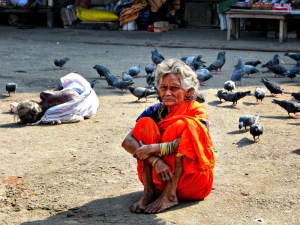
Calcutta_1

The grim reality of poverty in Kolkata; photo credit: Andy Harvard.

This photograph, taken in Kolkata (aka Calcutta), India, shows an elderly, thin, grey-haired lady in an orange sari. The lady in the white sari, lying curled up on the ground, I’d previously seen walking hunchbacked, slowly and in considerable pain, toward Mother Teresa’s home. I had a strong suspicion she was desperately trying to reach Mother Teresa’s Home for the destitute, sick and dying. I do not recall having ever having seen poverty of this magnitude when walking the main and side roads of South Africa, or anywhere else.

The picture alone tells a tragic story but your explanation adds a lot more. Thank you.

Calcutta_2

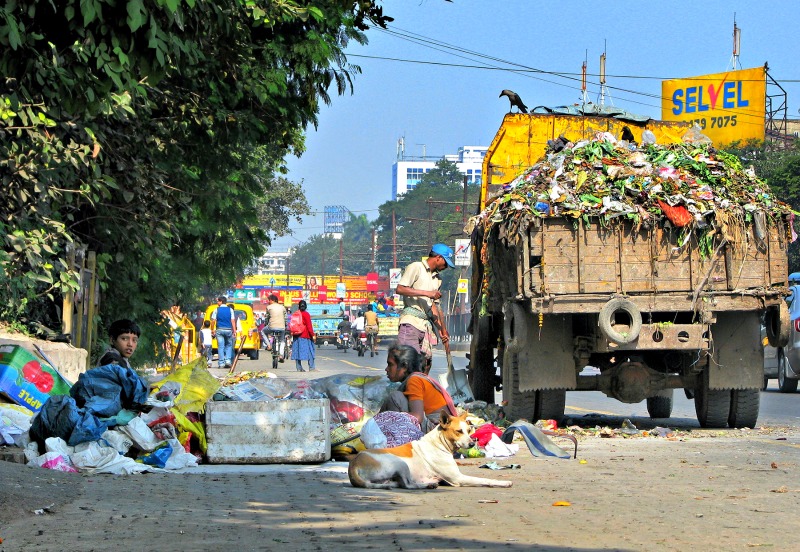
Another view of poverty in Kolkata, slightly more uplifting; photo credit: Andy Harvard.

This photo, also taken in Kolkata, indicates how desperate the lives of some people still are. The driver shovels refuse onto the truck while the crows watch in anticipation of scraps as a lady and her son appear to do so as well. The lady was searching for food and maybe something of value whilst her son sat quietly guarding their personal belongings. The dog, relaxed, watched as drivers constantly hooted and maneuvered around one another. A lot of noise but minimal fuss, no road rage or the time-consuming jams we tend to associate with dense traffic. The Kolkata experience was very brief, but I felt a sense of spirituality here. Small shrines are erected on the sides of most roadssometimes seen every fifty metres or so. Every person (other than the beggars at the temple), including the crows, dogs and cows appeared to be busy, desperately doing something meaningful in their quest for survival.

Knowing the story behind this photo helps us to appreciate how well you have captured a small corner of peace and quiet surrounded by a cacophony of noise.

WorldCup_SouthAfrica

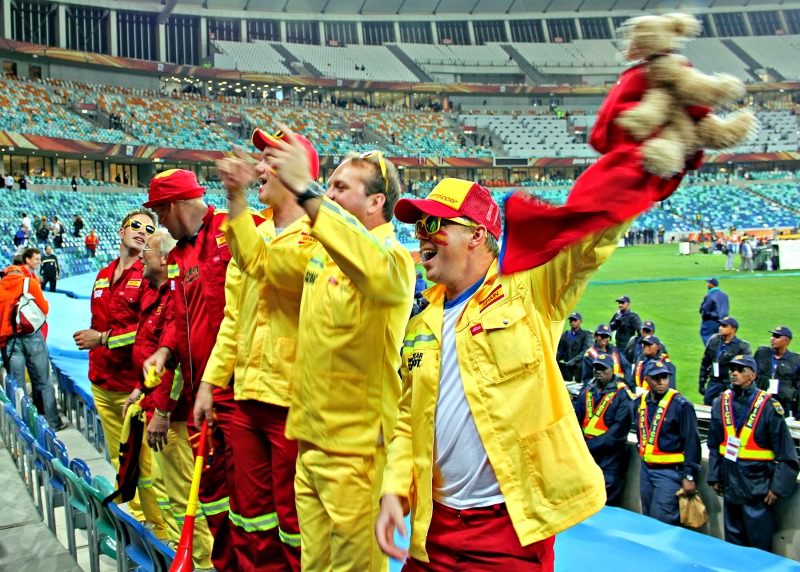
The 2010 World Cup quarter-final match Uruguay vs. Spain, held in Durban, SA (Spain won to eventually take home the title); photo credit: Andy Harvard

Spain beat Germany in Durban on 7 July 2010. They reached a World Cup final for the first time and went on to beat Holland in Johannesburg. The only goal in Durban came from a header by Carles Puyol. This was the first time I had witnessed extreme soccer fever, and this photo won a competition in one of Durban’s newspapers.

In this photo you have captured the spirit of the occasion, which is now upon us again in Brazil. Congratulations on your award.

The key to happiness is inner peace – Buddhist precept

Next we’re going to talk about some of your current favorite places to take photographs. Can you explain why these three places inspire you and how it shows in the photos you’ve selected?
1) Huge mountains, deep valleys, tranquillity, big skies, rural living, clean fresh breezes, golden lightMonteseel, in the Valley of One Thousand Hills, makes one realize how small and insignificant certain problems we all have actually are:
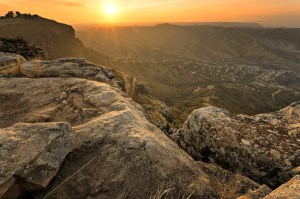
Monteseel, in the  Valley of 1000 Hills, South Africa; photo credit: Andy Harvard.

Monteseel, in the Valley of 1000 Hills, South Africa; photo credit: Andy Harvard.

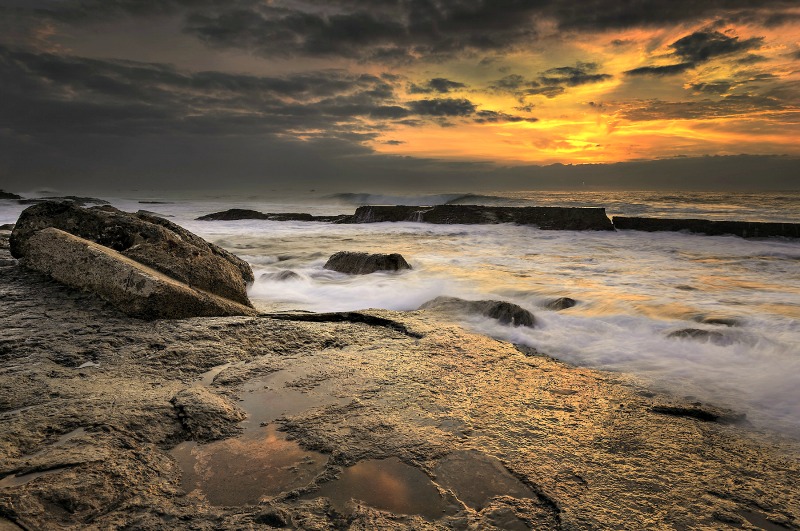
2) This unspoiled coastline with restricted access is literally around the corner from Durban’s Central Business District, which we call CBD. It’s a photographer’s paradise:
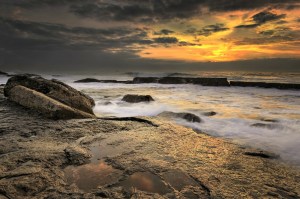
SouthAfricanBeach

Northern Bluff coastline, Durban, South Africa; photo credit: Andy Harvard.

3) Early mornings at this spot are full of activity: surfers, ski boats, fishermen, sailboats, people exercising, seine netters, photographers, holiday makers, recovering late night revellers and more. After a year of hard slogging, I managed to take this serene pier shot:

MoyoPier

Moyo uShaka Pier, Durban, South Africa; photo credit: Andy Harvard.

This photo actually won first place in my photo club’s monthly competition. The chairman said:

Brilliant, love the symmetric composition with a warm and cold side, slightly reminiscent of Turner’s sky in The Fighting Temeraire.

I know that Monteseel is an awesome place, so powerful it’s almost overpowering. It’s a great capture. Your photo of CBD is so dramatic that, although I know how warm the sea is, it looks positively cold. Why have you never shown me this before? It’s awesome. So you had to work a bit to get the last one! Well done.

You should move with a sharp consciousness… – Buddhist precept

Would you say that photography and the ability to be able to capture something unique, which will never be seen again, is a powerful force for you?
Yes, but more importantly, photography is the way I choose to meditate. I go into a semi-transcendental state when shooting and later when processing the photos on the computer. I believe the habit dates from my mother’s death in early 2013. When we visited her in hospital, we would all sit on the veranda outside the ward while I took night-time photos. Later, when going through some boxes of photos she had taken in her youth, I learned that she had been a photographer of “social” note. Not long after, I got hooked on HDR photography. I was a member of a Buddhist tradition for two years, attending teachings and meditation classes about 6–7 hours a week. Now my “meditation” is taking photos while a new day dawns in near complete silence and then sitting for hours post-processing photos to create a work of art. It isn’t a jobit’s a passion; and I want to keep it that way and share the results with others.

Thank you, Andy, for sharing such a fascinating personal story. Now for the technical stuff. What kind of camera and lenses do you use?
I have a Canon 6D, 17/40mm and 24/105mm. I also have my “old” baby Canon 550D which uses either lens above when not in use by “big brother”.

And which software do you use for post-processing?
Which software do I not use? I will use any software available to manipulate my photos to achieve the look I want to see. I know no bounds in this regard. I started with Photomatix HDR software and would attempt to “HDR” everything I could at any time of the dayi.e., dogs, people, machinery and trees. Later I learnt that this was a little foolish but, as I realized when reading this article on the topic, a necessary part of my progression. Lately, I’ve been shooting fewer exposures and manually blending them in Photoshop with layers and masks. I am new at this and on another learning curve.

Sounds like you are a post-processing junkie. I can identify with that and hope to move up to your level when I understand a lot more about the various programs. Finally, do you have any advice for wannabe photographers who are traveling or living abroad?
Be confident and take charge. Keep the camera in hand or on a sling (not deep in a bag). Take lots of photos and even different angles on the same scene. Go into a tunnel zone where you are only thinking about and taking photos. Get down on the street and get dirty. Find top photographers who you admire and follow them. Study their work and every word on their pages (great tips sometimes come hidden in a few sentences). Look at the best photo you find and think “I can do this and better, it might just take some time”. Some really kind photographers offer free tutorials in video or written formatmake the time to find them and work through them.

* * *

Thank you, Andy. I have really enjoyed our interview. Your story is so compelling and you do approach things from a different angle to many of us.

Readers, what do you make of Andy’s experiences and his photography advice? And do you have any questions for him on his photos and/or experiences? Please leave them in the comments!

And if you want to know more about Andy, don’t forget to visit his blog, Snap Fly Cook. You can also connect with him on Facebook and visit his gallery of “special” photos on Pixels.com.

(If you are a photographer and would like to be interviewed by James for this series, please send your information to ml@thedisplacednation.com.)

STAY TUNED for next week’s fab posts!

If you enjoyed this post, we invite you to register for The Displaced Dispatch, a round up of weekly posts from The Displaced Nation, with seasonal recipes, book giveaways and other extras. Register for The Displaced Dispatch by clicking here!

Related posts:

For this globe drifter and Adult Third Culture Kid, a picture says…

Rachel Kanev Collage

Canon zoom lens; photo credit: Morguefiles; Rachel (right) with her friend Sara experimenting with make-up and photography with the help of a bottle of wine (or two?) and some props (photo credit: Rachel Kanev).

Welcome to our monthly series “A picture says…”, created to celebrate expats and other global residents for whom photography is a creative outlet. The series host is English expat, blogger, writer, world traveler and photography enthusiast James King, who thinks of a camera as a mirror with memory. If you like what you see here, be sure to check out his blog, Jamoroki.

My guest this month is 24-year-old Rachel Kanev. She has a Bulgarian father and German Jewish mother but grew up in England, where she studied French and Chinese languages. She feels she got “…caught somewhere in between” these many cultures:

With my Jewish nose, Bulgarian skin and English accent, I at once belong to British, East German, Bulgarian, Jewish, French and Chinese cultures and yet to none of them at all.

Her grandmother, by contrast, lived in Berlin for decades but was more English than Tetley tea.

Indications of Rachel’s escalating identity crisis are borne out in the images that bombard you upon reaching her engaging blog, Global Drifting, in which she says she is drifting across the globe in hopes of stumbling upon enlightenment…

* * *

Hi, Rachel. I’m pleased your globe-drifting has taken you to the shores of the Displaced Nation, which gives us the opportunity to discuss your photo-travel experiences. For one so young you’ve travelled a fair bit, but where were you actually born?
I was born in my mother’s hometown of Berlin, at the traffic lights on the way to hospital. My mother said I looked like a hedgehog that day, and my family still calls me Igel (“Hedgehog” in German). A few months later, the Berlin Wall came down and one year after that, we all moved to England.

So you were a Third Culture Kid in Britain. When did you spread your wings to start travelling?
My nursery and primary school classes were filled with international children. Eugenia—a Spanish girl from Madrid with long black hair and a passion for witchcraft and the Greek goddess Athena—soon became my best friend. In the momentary way that often strikes a child, I was devastated when she left me to return home for good. So, at the tender age of nine, I boarded a plane alone, in my size 1 shoes, to visit Eugenia in Spain. As I began my first solo journey, I experienced a thirst for discovery, which, as yet, has not been quenched. Since that first adventure, I have visited Italy, Holland, France, Austria, Switzerland, Réunion Island and China. I plan to step (in my now size 5 shoes) into Morocco and perhaps Israel this coming summer.

What do you love so much about travel?
I love travel because everything is new and unknown; we share no past and perhaps no future with the things we see and people we meet. The errant wanderer therefore has no choice but to revel in the present.

Will I ever get over the pull I feel to both of these places?

Despite your age, I think I can put you in the category of seasoned traveller. Tell me, what inspires your decision to travel to particular places?
My inspiration comes partly from a love of languages and partly from the idealistic images of France I painted in my head when watching French films and listening to French music, which I did while revising for my exams at university. Aided by the amazing Erasmus, that towering figure of the Renaissance, I had taken a university year abroad in the island paradise of Réunion, near Africa. It’s a French overseas department so qualifies for the European Union’s Erasmus Programme, which finances students to spend up to a year of their university courses in a university in another European country. But it wasn’t until after finishing university that I had a chance to visit France itself. I meandered through southern French villages like an aimless hippie, reveling in its rural chic.

I understand you also have a passion for China?
Chinese was my third language at university. After graduating, I remained in England saving pennies as a waitress to finance spending a year in the land of silk. I lived in a city about an hour from Beijing.

I’m curious: where are you right now and what are you up to?
Right now I’m back living in my English hometown of Cambridge, selling nutritional products to vitamin-mad French and German customers—and saving up for my next Chinese/Moroccan/Spanish/Israeli adventure this summer. As I look out of the window, I am visualizing being there already, far from the Land of Vitamins C and D!

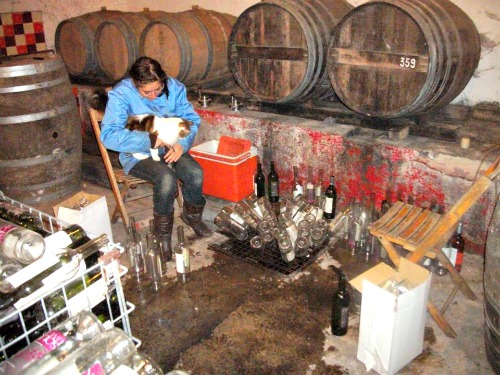
RK_SouthofFrance

No use crying over spilled wine! Rachel in the cellar of a now-defunct winery near Perpignan, France; photo credit: Rachel Kanev.

Hmmm… I think I detect something of the entrepreneur in you, alongside your intrepid traveller’s spirit! And now let’s have a look at a few of your favorite photos from your travels to France and China.
Sure! I took this first photo in a wine cellar in a small hamlet near Perpignan, some way off the coast of southern France. I’d been helping out, but it was late December, and there was very little work left. Besides, the winemaker, whose name was Bernard, had gone bankrupt due to the stresses of organic farming. Our main task for the day, as his helpers, was to pour bottle upon bottle of wine down the drain as he looked on bemoaning the demise of the modern world. It proved a good way to get skillful with a corkscrew!! And I think poor Bernard appreciated our efforts quite a lot. Just think if he’d drunk all that wine in his cellar, it would have sent him spiraling into an even deeper fit of depression…

RK_dragonriceterraces

China’s Longji (Dragon’s Backbone) Terraced Rice Fields are so named because of their resemblance to a dragon’s scales; photo credit: Rachel Kanev.

The next photo provides a glimpse of the glorious Dragon rice terraces of Longshen, in China’s Guangxi province. Amazing terraces stretch as far as the eye can see. I visited some years ago and remember being in awe at the combination of nature’s beauty and the skillfulness of the human hand. I had quite an adventure ambling through the fields with two of my Chinese friends. We got lost and at one point envisaged spending a cold night cuddled up to the cows. In the end we reached our hostel, at the top of the terraces, by nightfall. I returned again last year and was saddened to see that the beauty of the fields has been marred by the greedy hand of tourism. Huge plastic cable cars now transport visitors to the top, and the local villagers are paid to dress in traditional clothes.

RK_AnotherBernard

A French farmer, another Barnard; photo credit: Rachel Kanev.

Last in this series we have another Bernard who stumbled into my traveller’s path. This Bernard is an 80-year-old farmer with whom I lived on my own for a week. His farm is an hour away from the nearest town and is completely self-sufficient. He grows his own organic vegetables and was fit enough to hack up the ground with a pickaxe when the underwater pipes burst (ironically, I had left the home of Bernard number 1 because his pipes had burst and the water system needed to be repaired, only to be faced with more burst pipes at the home of Bernard number 2!).

I love the first photo just because it looks as though you’ve broken into someone’s cellar and are drinking all the wine!! The dragon terraces appear so surreal to me because they are so different to the flat rice fields of Thailand, where I live. I wish I could see them one day. I know you take a lot of photos and these next four, I believe, have a special significance for you. Can you explain?

Not all who wander are lost…

The following is a photo I took of a photo of Bernard number 2, which was taken some fifty years ago, when his newly polished army boots took their very first steps away from the small village on the outskirts of the Pyrenees, where he was born. He bid farewell to the farm he’d grown up on and to the parents who’d raised both him and the thriving trees and crops that had formed the backdrop to his childhood. By the time I encountered Bernard, nature had outlived his parents but their legacy remained. He is now a beekeeper and organic vegetable farmer, tending to the very same trees and plants that his father and his father’s father had cared for. Though he has no human family, the trees you see in my other photo of Bernard (above) appear to me to be his forefathers; they are equally his children.

Bernard as a young man

The French farmer Bernard as a young soldier; photo credit: Rachel Kanev.

The next photo was a fluke as I managed to capture an ad for Longines watches showing Kate Winslet just as the sun was setting. In that fleeting instant, one can see Shanghai’s varied transportation, high-rise buildings and red lanterns—that curious amalgamation of Western modernity and Chinese traditionalism that is everywhere around you in the city.

RK_ShanghaiSunset

A British beauty, a Swiss watch and a Shanghai sunset; photo credit: Rachel Kanev.

Cambridge is my home town and I think of it much like a family member, having watched it age and evolve just as it has silently witnessed me grow and change. I love its grandiose architecture, endless greenery, and the way winter and spring intertwine in front of the University’s palace-like structures that are fit for if not a queen then the rulers of academia, to which I never belonged.

RK_CambridgeUK

The dreaming spires of Cambridge; photo credit: Rachel Kanev.

Here my sister explores the labyrinth-like forestry of a park near where we live in Cambridge. It has amazing multi-coloured plants I have never seen anywhere else before and huge trees that watch over you like silent giants. I like this photo because she looks like Alice in Wonderland with her long, thick flowing locks!

RK_SisterinPark

The great outdoors near Cambridge, UK; photo credit: Rachel Kanev.

Is photography sometimes a moral decision?

I love your explanations as they show us the profound effects a picture can have on its creator, something the viewer can never fully appreciate. Tell me, do you ever feel reserved about taking photos of people, particularly when they are conscious that you are doing so?
For me, the morality of taking photos of strangers has always been ambiguous. I think of it whenever I see photos of human suffering. I believe I have the right to use my camera to record the world but without intruding on it. At what point does the power of images and the need for education and understanding through the push of a button and flash of a light become intrusive and affect the lives of others in a negative way? I’ll give you an example from my own experience. The Western media has focused almost exclusively on China’s explosive economic growth when in fact 1.6 million people (11.8 percent of the population) still live below the poverty line. When taking the train, part of me would like to photograph the dirt-covered, barefooted children asleep on newspapers or the train door frozen from the inside as passengers are left to deal with the icy temperatures of the North (-37°C). But feeling intrusive, I refrain.

Do you also feel self-conscious in Asia?
It’s difficult being subtle, given the colour of my hair and skin, and the stamp on my passport. Noticing me walking the streets of China, many Chinese will assume, quite rightly, that I am Western but quite wrongly that I must therefore have dollar bills rolling from my body like a central bank printing press. Often I do not wish to fuel their prejudices by whipping out a digital camera, however small, before their eyes.

As a resident in Thailand, I can empathize with those views, especially the general Asian misconception that all Westerners are rich. Although this can be annoying, I do believe these views are changing for the better, as the younger generation becomes more socially aware through travel and better education. Now let’s turn to the technical stuff. Some of our readers may want to know what kind of camera and lenses you use.
I have a small Samsung camera that fits neatly in the palm of my hand. It’s nothing fancy and often leaves something to be desired in terms of quality, but it was a birthday gift years ago and has sentimental value, having been my only travel partner across unknown lands. Whatever it lacks in lens quality, Windows Photo Gallery makes up for in magical editing power!

Finally, do you have any advice for wannabe photographers who are traveling or living abroad?
Wander through villages, peel garlic with a farmer, shake hands with a prince, run through jungles, leap into waterfalls, swing across the rainforest wilderness and lose a leg to the marble rocks—see the world and allow the world to be seen. Travel, live, eternalize what you see with a photo.

Great non-technical advice, Rachel, that’s right up my street! I’d like to thank you for taking the time to tell your fascinating story in this interview.

* * *

Readers, what do you make of Rachel’s experiences and her photography advice? And do you have any questions for her on her photos or her travels? Please leave them in the comments!

And if you want to know more about Rachel Kanev, don’t forget to visit her blog, Globe Drifting. You can also follow her on Twitter or even shoot her an email.

(If you are a photographer and would like to be interviewed by James for this series, please send your information to ml@thedisplacednation.com.)

STAY TUNED for next week’s fab posts!


If you enjoyed this post, we invite you to register for The Displaced Dispatch, a round up of weekly posts from The Displaced Nation, with seasonal recipes, book giveaways and other extras. Register for The Displaced Dispatch by clicking here!

Related posts:
And the April 2014 Alices go to … these 4 international creatives

 © Iamezan | Dreamstime.com Used under license

© Iamezan | Dreamstime.com
Used under license

If you are a subscriber to our weekly newsletter, Displaced Dispatch, you’re already in the know. But if you’re not, listen up. (Hey, why aren’t you? Off with your head!)

Every week, when that esteemed publication comes out, we present contenders for a monthly “Alice Award,” most of whom are writers or other kinds of international creatives who appear to have a special handle on the curious and unreal aspects of being a global resident or voyager.

Not only that, but this person tries to use this state of befuddlement as a spur to greater creative heights.

Today’s post honors April’s four Alice recipients. They are (drumroll…):

1) TONI HARGIS, author, blogger, and British expat in Chicago

For her post:  “Learn to Take a Compliment, Brits in America” in Mind the Gap, a resource blog for British expats in America on BBCAmerica.com
Posted on: 18 April 2014
Snippet:

Many British teachers admitted that they and their students found it very hard to fill in applications for American colleges because they were asked for “accomplishments and strengths” as well as academic achievements. As one contributor put it, U.K. teachers “are not very good at waxing lyrical about [their] students other than in academic terms.”

Citation: Toni, what an absolutely marvelous post! Only don’t you think you should have promoted your credentials a little more? After all, you’ve written a book called The Stress-Free Guide to Studying in the States, the contents of which we expect could be useful to Bashful Brits. Actually, you do refer to the book in passing—but don’t provide the title or a link. Hey, never miss an opportunity to blow your own trumpet! But listen, as you insist upon being so self-effacing, we feel justified in presenting you with this inspirational passage from Through the Looking Glass, where a banquet is being held in honor of the diffident Queen Alice, who can’t quite believe she’s been made a queen:

[Alice] didn’t see why the Red Queen should be the only one to give orders; so, as an experiment, she called out “Waiter! Bring back the pudding!” and there it was again in a moment, like a conjuring trick. It was so large that she couldn’t help feeling a little shy with it…; however, she conquered her shyness by a great effort, and cut a slice and handed it to the Red Queen.

“What impertinence!” said the Pudding. “I wonder how you’d like it, if I were to cut a slice out of you, you creature!”

It spoke in a thick, suety sort of voice, and Alice hadn’t a word to say in reply: she could only sit and look at it and gasp.

“Make a remark,” said the Red Queen: “it’s ridiculous to leave all the conversation to the pudding!”

One last word of advice, if we may: Should you feel at all embarrassed about accepting an Alice, rest assured, a simple “thanks” will do. No need to curtsey… Notably, this last accords with what the point you make at the end of your excellent (as well as thought-provoking!) post:

…when someone praises you, your spouse, your children, your dog or your house, a simple “Thank you” will both suffice and move the conversation swiftly along without too much excruciation on your part.

Again, as the Red Queen puts it to Alice: “You ought to return thanks in a neat speech.”

2) Anthony The Travel Tart, Australian travel addict and blogger

For his post: “You Know That You’ve Been Living in Japan Too Long When…,” on The Travel Tart
Posted on: 18 March 2014
Snippet:

You know that you’ve been living in Japan too long when…

  • A room the size of a cubic metre feels rather large.
  • Capsule hotels feel quite spacious.
  • Wide open spaces freak you out.

Citation: Anthony, we assume you met quite a few expats during your time in Japan. Because your inference that the longer a foreigner stays in Japan the stranger he or she becomes is spot on (and one of us speaks from a too-long experience of having lived in that small-island nation). Picture for a moment what happens to Alice after she enters the White Rabbit’s house and downs the contents of the “Drink Me” bottle:

She went on growing, and growing, and very soon had to kneel down on the floor: in another minute there was not even room for this, and she tried the effect of lying down with one elbow against the door, and the other arm curled round her head. Still she went on growing, and, as a last resource, she put one arm out of the window, and one foot up the chimney.

This is actually a case where one might prefer to be Alice rather than an expat. She at least has the ability to drink potions or eat pieces of mushroom to change her body size. But many gaijin remain permanently stuck in the White Rabbit’s house (not for nothing has Japan achieved notoriety as the “rabbit-hutch nation”). Downing the contents of a bottle of Suntory whisky or taking a bite of a matsutake (pine mushroom, prized for its spicy aroma) won’t make the blindest bit of difference. Oh, and incidentally, it’s arigato, not origato, but that’s okay as it means you didn’t stay too long—though you may want to add “correcting other foreigners’ Japanese” to the list.

3) MATT HERSHBERGER, writer and blogger at A Man Without a Country, and 4) British dialect coach ANDREW JACK

For the post: “A quick video guide to the accents of the British Isles”, by Matt Hershberger on Matador Network, which features Andrew Jack’s brilliant video (produced by Philip Barker).
Posted on: 20 April 2014
Snippet: Matt, who once lived in England, says:

As an American, I can’t even replicate the accents properly, so if I tried to ask for help distinguishing an accent from a British friend later, the best I could hope would be that I’d sound sort of like Stewie Griffin, and nothing like the accent I’d heard.

Citation: Matt, we take your point that when venturing abroad to a country where they speak the same language, it is most disconcerting when you can’t understand what people are saying because of their heavy accents—a true “through the looking glass” moment. (We fear that Brits may have some of the same troubles in the U.S., but let’s face it, you’d expect that in a country of this size, not of one as tiny as Britain.) We appreciate that you highlighted the video of Andrew providing 14 regional accents from the British Isles in 84 seconds: how awesome is that? As one of the YouTube commenters says, “good for ignorant North Americans”—some of whom, me might add, may plan to be (or have already been) expats in the UK. And we appreciate it even more when recalling that Poor Alice had no interpreter for the White Queen’s methods of communication:

“My finger’s bleeding! Oh, oh, oh, oh!”

Her screams were so exactly like the whistle of a steam-engine, that Alice had to hold both her hands over her ears.

“Oh, much better!” cried the Queen, her voice rising to a squeak as she went on. “Much be-etter! Be-etter! Be-e-e-etter! Be-e-ehh!”

The last word ended in a long bleat, so like a sheep that Alice quite started.

*  *  *

So, readers, do you have a favorite from the above, or have you read any recent posts you think deserve an Alice Award? We’d love to hear your suggestions! And don’t miss out on the shortlist of Alice contenders we provide in each week’s Dispatch, which are sources of creative thought if nothing else! Get on our subscription list now!

STAY TUNED for more fab posts.

Writers and other international creatives: If you want to know in advance the contenders for our monthly Alice Award winners, sign up to receive The Displaced Dispatch, a round up of weekly posts from The Displaced Nation, with news of book giveaways, future posts, and of course, our weekly Alice Award!. Register for The Displaced Dispatch by clicking here!

Related posts:

JESS IN JAPAN: After all the hype, cherry blossom season underwhelms

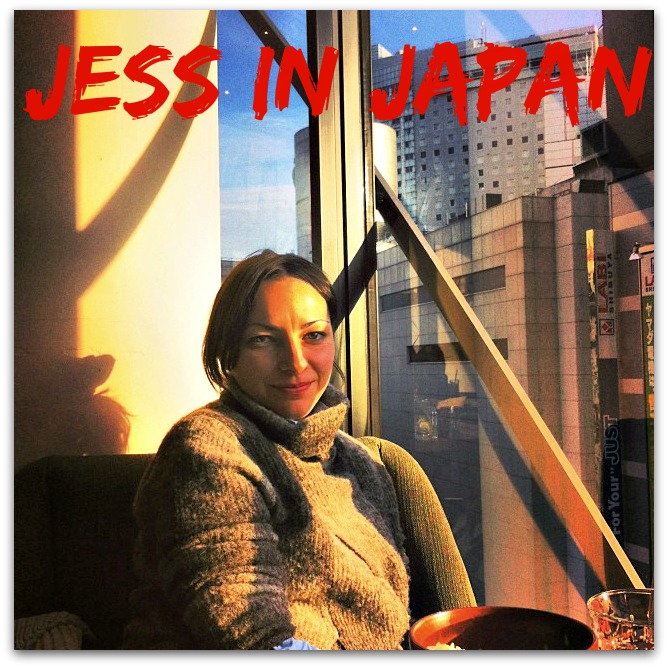
JessinJapan_column

Jessica Awanohara in Tokyo (winter 2014); photo credit: Hiro Awanohara.

Jessica Awanohara moved from New York to Tokyo with her Japanese husband, Hiro, at the end of last year. What is it like to step “through the looking glass” and treat Japan as a home rather than a quirky place to visit? Jess keeps us abreast of her progress via this occasional column-cum-photos.

After a long, cold, all-around terrible winter, April is here, and in at least half of this beautiful world of ours, that means that spring has sprung! Crocuses are peaking through the nearly frozen plains of Central Park; monarch butterflies are beginning their multi-generational migration from Mexico to northerly climes; and in Tokyo, where I now reside, the most spectacular seasonal transition of them all—the blooming of the cherry trees, or sakura—has been taking place.

This being my first sakura season in Japan, I wasn’t entirely prepared for the national obsession with tracking when, where and how to best view the blossoms. In fact, for at least three weeks, sakura viewing was the only thing anyone talked about. Friends regaled us with stories of sakura seasons past, advising on the best and worst parks in Tokyo for beholding the spectacle of the storied blossoms. Like stock tips, they whispered these insights authoritatively, as though acting upon them would determine our very future.

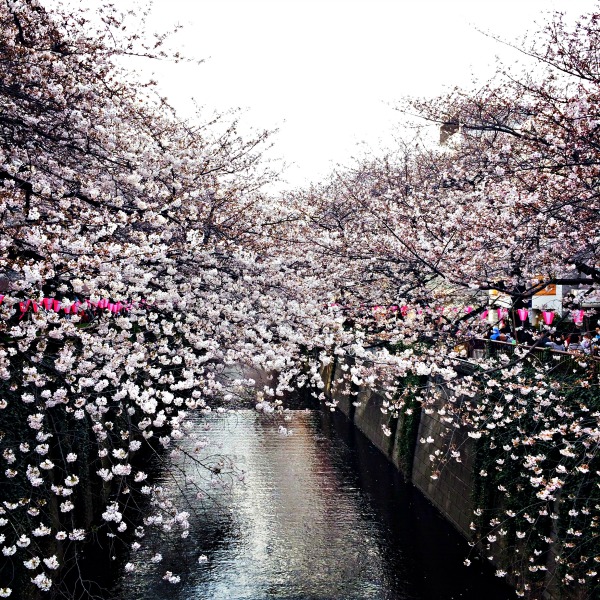
I learned, for instance, that Inokashira Park, in the northwestern part of the city, was “too crowded, wild, and ‘diverse'” while Nakameguro, in the southeast, was the “ideal spot for a first-timer” like myself.

Meanwhile, the sakura craze was heightened by CNN-style coverage on TV. Whole segments of the morning and evening news were dedicated to maps, predictions, histories, and images detailing the slow ascension of blossoms from Okinawa to Hokkaido.

By the time the trees were showing their first buds, all I could think about was the prospect of attending a viewing party. In case you haven’t heard, celebrating under a fully blossomed cherry tree, a festival known as ohanami, is as eagerly anticipated as the blossoms themselves. All of Tokyo, it seems, comes out for marathon sessions of en plein air eating and drinking, presumably turning as pink as the flowers.

But as luck would have it, this year things would be different. Tokyo was soaked by two straight weeks of hard rain and cold weather. The delicate pink sakura petals were washed away before they were able to reach full bloom.

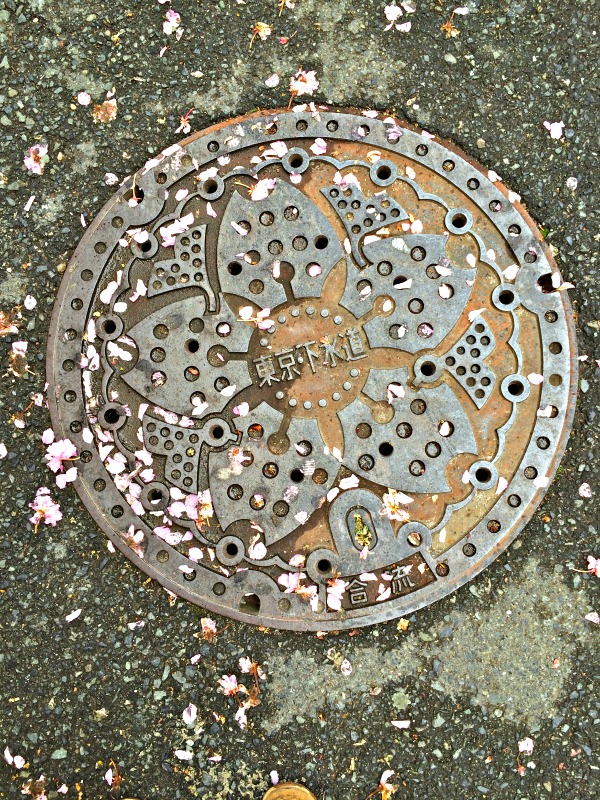
Braving these inclement conditions, my husband and I biked to a couple of nearby parks and well-known streets to soak up whatever we could (hopefully without getting too soaked!). But the grey skies and cold weather kept our spirits, along with the blooms, at bay. In fact, it was almost too depressing to document the mostly bare branches and paltry spray of revelers, but here, readers, are a few mementos of my first cherry blossom season in Tokyo:

Early sakura in Nakameguro; photo credit: Jessica Awanohara.

Early sakura in Nakameguro, alongside Meguro River, the recommended destination for newbies; photo credit: Jessica Awanohara.

At least someone is trying to get his party blooms on; photo credit: Jessica Awanohara.

At least someone (see man on curb) is trying to get his party blooms on; photo credit: Jessica Awanohara.

The actual best spot to view cherry blossoms this year, snapped on the way to an interview in Shinsen; photo credit: Jessica Awanohara.

The actual best spot to view cherry blossoms this year, snapped on the way to an interview in Shinsen; photo credit: Jessica Awanohara.

* * *

Thanks, Jessica. Sorry to hear it was such a wash-out! Readers, Jess’s experiences raises a classic Displaced Q: How many of you have sought an iconic experience during your stay abroad that didn’t quite live up to your expectations?

STAY TUNED for tomorrow’s fab post!

If you enjoyed this post, we invite you to register for The Displaced Dispatch, a round up of weekly posts from The Displaced Nation, with seasonal recipes, book giveaways and other extras. Register for The Displaced Dispatch by clicking here!

Related posts:
For this intrepid Irish “ruin hunter,” a picture says…

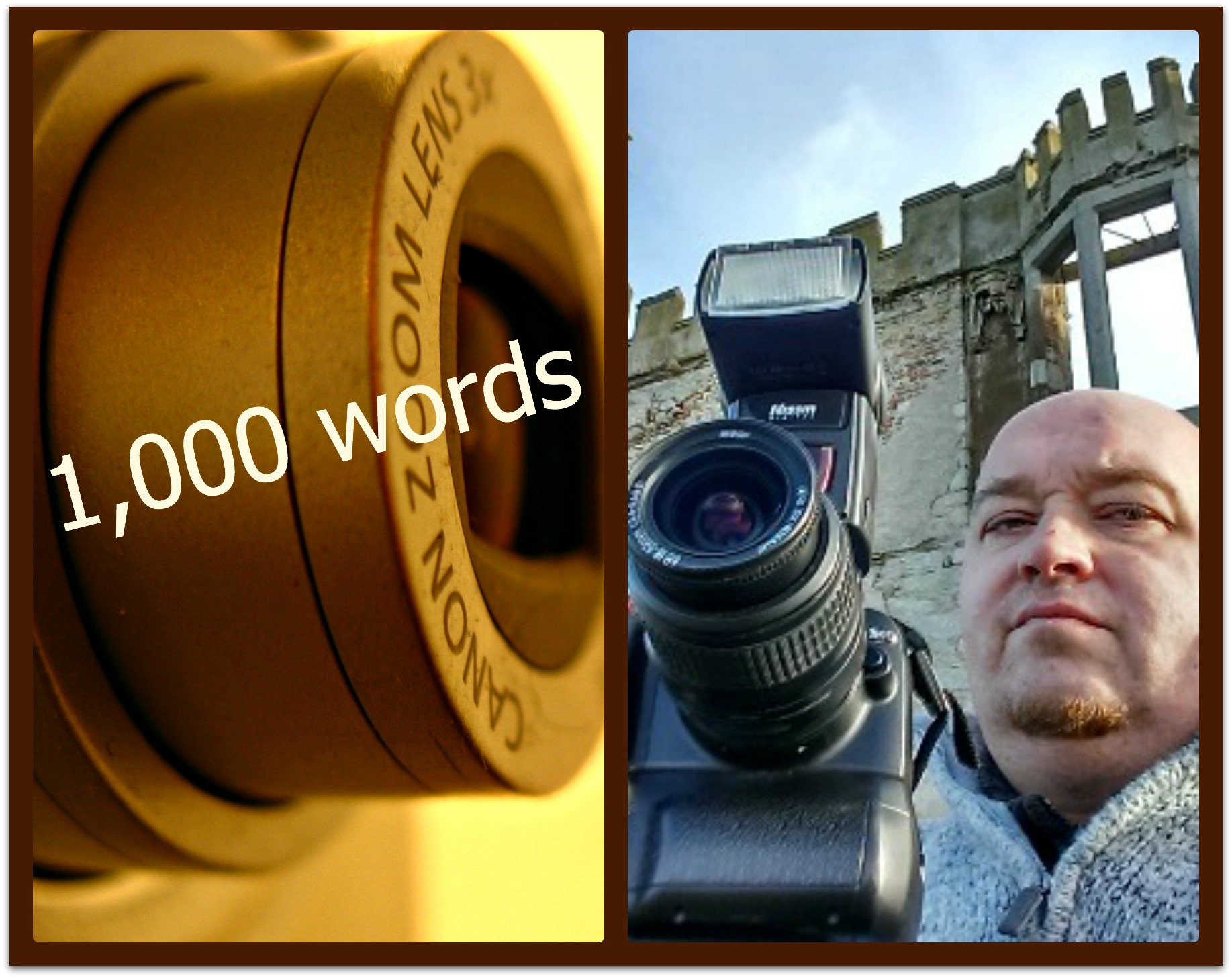
Ed Mooney 1,000 words Collage

Canon zoom lens; photo credit: Morguefiles; Ed Mooney in front of the ruins of Ducketts Grove, County Carlow (photo credit: Ed Mooney).

Welcome to our monthly series “A picture says…”, created to celebrate expats and other global residents for whom photography is a creative outlet. The series host is English expat, blogger, writer, world traveler and photography enthusiast James King, who thinks of a camera as a mirror with memory. If you like what you see here, be sure to check out his blog, Jamoroki.

My guest this month is 38-year-old Irishman Edward (Ed) Mooney. His story is quite different from previous guests for several reasons, the main one being that he is not an expat. On the contrary, he travels within the confines of his native Ireland.

That said, Ed does cross boundaries, at least in a temporal sense. He loves nothing more than to immerse himself in an obscure historical site, exploring Irish history, lore and mythology while also photographing the surrounding ruins, to keep a record of what remains from generations past.

I really like the name Ed has given to his hobby: “ruin-hunting”. Ed tells me that ruin-hunting merges Past, Present & Future. By researching the history behind a place, he pays tribute to the Past. By writing about the experience, he brings it into the Present. And by posting his article, along with his photos, on his blog, he preserves his findings for the Future.

I have been following Ed for some months and love the way he weaves historic research into (mostly) black-and-white images.

* * *

Hi, Ed. Thanks for joining me at the Displaced Nation. I know you live with your young family in Kildare, but where were you born and what gave you the urge to travel around Ireland photographing ancient ruins?
I was born in Dublin, where I lived until flying the coop at 17. I moved to Kildare for work. I only got into photography seriously three or four years ago. With a young family, I don’t get to go abroad very often. But I am fortunate enough to travel within Ireland itself, which with its rich heritage offers an abundance of fascinating sights. And the crazy thing is, the majority of them are relatively unknown and rarely visited. It is these off-the-beaten-track places that I tend to concentrate on while traveling the country, attempting to capture them with my DSLR camera.

“I love everything that’s old…” —Oliver Goldsmith

You seem to have found an interesting niche. Can you tell us a little more about this “ruin hunting” hobby of yours?
It all started in 2011. I had just gotten my first DSLR and joined the local camera club, but had very little opportunity to get out and about shooting. I wasn’t into wildlife or landscape photography like some of the other club members. I guess I was searching for my niche, as you put it. One day a flyer came through the letterbox, which had an image of a nearby historical site called the Rock of Dunamase, in County Laois. Though I didn’t know it at the time, this was the beginning of what would become an obsession. A few days later, I located Dunamase and went exploring. Now, looking back at the photos, I cringe—but at the time I thought they were the best shots I’d ever taken. Around this time I had starting blogging and decided to post a brief essay on the history of Dunamase, along with the images. Next thing I knew, I was spending all of my spare time searching out new sites. Now that the kids are a little older, I have been able to take them on some of my trips. To date I have explored sites in nine counties with plans for many more over the coming months.

When you said “a flyer came through the letterbox…,” I immediately thought of a WWII fighter pilot. I would love to know more about what inspires you to spend so much of your spare time visiting historical places.
My inspiration comes from my deep love of history. In my early twenties, I joined what was then known as the Heritage Awareness Group, or HAG. We visited sites such as Newgrange, Tara and Baltinglass Abbey. Nowadays my favourite ruins are castles and Neolithic sites such as stone circles and cairns, although I am forever coming across many ecclesiastical sites which are interesting in their own right and make for some stunning shots. It’s quite hard to find the locations so I’ve created maps for each county, and make a point of recording every site I visit on my blog along with an interactive map showing the exact location to assist other travellers.

It’s great that you record your findings in so much detail and include exact locations in case others are inspired to follow in your footsteps. Ireland is a small country, unless you get lost. Tell us, where are you now, how did you end up there and what is life like in that part of the world?
We have been in Monasterevin, Kildare, for almost seven years now and absolutely love it. It’s a different way of life to Dublin. If I didn’t have to commute daily to the City to work, I would probably return there rarely. The great thing about Monasterevin, besides the relaxed atmosphere and close community, is that I am situated almost in the centre of Ireland. I can travel to any part of the country in two to three hours, which is great considering the amount of travelling involved in “ruin hunting”.

Rock of Dunamase. Photo credit: Ed Mooney

Rock of Dunamase. Photo credit: Ed Mooney

I’ve never been outside Dublin but I hear the countryside is beautiful. Other benefits are that you never run out of Guinness and you just won the Six Nations rugby! Thank you for sharing some of your photo shots which capture a few of your favourite memories. Can you describe the story behind them and what makes them so special?
These three are from recent shoots. The first, of the Rock of Dunamase, is a special place not just for the stunning views and fascinating history but also because it’s where my journey started.

Church ruins in Laois; photo credit: Ed Mooney.

Church ruins in Laois; photo credit: Ed Mooney.

The second photo is of another site I discovered in neighbouring Laois, which, with its stunning views, constitutes a ruin hunter’s paradise. This one is special on a personal level as well, being the first ruin I visited with all three children. In the chancel to the rear of the church is an old iron gate blocking the entrance to a vaulted mortuary chamber. Ryan, my eldest, had an interesting observation on the chamber: “Daddy, that’s where the Vampires live.” Now how the heck did he come up with that? Have you ever tried convincing an eight-year-old that something doesn’t exist?

Skryne Hill Church; photo credit: Ed Mooney.

Skryne Hill Church; photo credit: Ed Mooney.

The third is of the church that sits on Skryne Hill, the site of an early Christian settlement. To this day my memory of Skryne remains vivid. The tower is inaccessible due to a very heavy iron gate that on examination appeared to be rusted shut. I shone my torch through the bars on one of the windows. Inside were a number of interesting stone artifacts that I wanted to capture. So I set up my flashgun and shot through the bars. On the second or third flash something physically grabbed my camera strap and pulled it into the tower. It all happened so fast, but somehow I managed to pull that camera away from the window while shouting a few expletives. At first I wondered if it might have been a draft of some kind that had caught my strap, but it could not have been as I was pressed right up against the opening and there was no wind to cause a draft. Then I thought that maybe someone was inside, but there was no way for a person to get in or out of the tower. To this day I still can’t explain what happened. But it certainly left a lasting memory.

“Memory, in widow’s weeds, … stands on a tombstone.” —Aubrey de Vere

Great memoriesand that last story is quite eerie. But I suppose you would expect the odd ghost or two in buildings so old? Now, out of these many destinations, do you have any that stand out as your favorites?
If you haven’t already guessed, old ruins are what attract my attention, be it a crumbling castle, a neolithic stone circle or standing stone, or an ancient church overgrown with ivy. Here are three of my favorite places:

Brownshill Dolmen, County Carlow; photo credit: Ed Mooney.

Brownshill Dolmen, County Carlow; photo credit: Ed Mooney.

Ballymoon Castle, County Carlow. Photo credit: Ed Mooney

Ballymoon Castle, County Carlow; photo credit: Ed Mooney.

Cillbharrog Church & cemetery; photo credit: Ed Mooney.

Cillbharrog Church & Cemetery; photo credit: Ed Mooney.

Can you explain why these particular places inspire you?
It’s kind of hard to explain but once I set foot on the site of an ancient monument, something about the atmosphere affects me, and a flip switches in my head. I feel as though I’m stepping back in time. The modern world disappears for a while and I get to experience something really special. With my photography I try to capture that experience and hopefully portray it to the viewer. Mood, atmosphere and a sense of the past are the most important elements for me to enjoy shooting at a location.

I can assure you, Ed, that, for me, you usually achieve it. Your photos make me feel as though I’m there, not you. I know people aren’t a part of your ruin hunting but I want to ask you all the same if you ever feel reserved about taking photos of people on your travels, particularly when they are conscious you are doing so?
I still enjoy getting out and doing some street photography from time to time and I have never really had an issue with shooting people, but then again I have had plenty of experience ranging from large events in Dublin down to small country festivals. I guess at the start I was a bit shy and unsure of how to approach shooting strangers, but once you learn how to engage with a subject it becomes fun. Some of the best shots I have taken were the result of strangers coming up to me wanting to have their pictures taken. Parades and street festivals are probably the best for doing this as everyone is relaxed and having a good time.

Do you ask permission before taking people’s photographs?
Most times I don’t have to. I find it amazing how people start posing once they see a camera in your hand. Obviously, with children you have to be really careful these days and should always get parental permission.

“Ireland’s ruins are historic emotions surrendered to time.”—Horace Sutton

Interesting—that last point would never be considered in Thailand, where I live. So would you say that photography and the ability to be able to capture something unique which will never be seen again is a powerful force for you?
Absolutely, I would say that most photographers constantly strive to get that once-in-a-lifetime shot. In my case the deeper motivation is to capture historic sites for posterity. As in many other countries, Ireland’s local and national heritage sites continue to disappear for good. Most people don’t care and the government is only interested in money. Take my home town of Tallaght, a suburb of Dublin. There were several castles in the area up until about 40 years ago. Now only a part of one remains. This scenario recurs with alarming regularity. So if I can capture the essence of a place before it is wiped away for good, I have done my job.

I see you use the word “job”. But I see it more as a calling and you, as a preservationist and historian. Either way you are doing an excellent “job”–one that incidentally reminds me of my last interview subject, Gaetan Green. He is trying to record China’s traditional landscapes before they fall to the forces of modernization. So when did you realize this deeper purpose?
Right from the start. The need to preserve the past was a major factor in motivating me to choose this path for my photography.

Now for the technical stuff at which I am far from proficient. What kind of camera and lenses do you use? And which software do you use for post-processing?
I still use my trusty Nikon D40 with kit lens. Yes it is outdated by today’s standards, but it has served me well over the last few years and taken a lot more punishment than it should have. I am planning to upgrade later this year and hopefully the D40 will be converted to shoot Infra Red, which is something I really want to experiment with. For my raw images ACR is a must, but my one stop shop for post processing has to be Photoshop. I currently use CS6 and it does everything I need. I still have various other programs sitting on my desktop but these rarely get a look-in.

Finally, do you have any advice for wannabe photographers who are traveling or living abroad?
If I was starting photography now I would say take the time to enjoy what you do and most importantly, research, research, research. Find out as much as possible about the place you are travelling to. Look at as many images of the place as you can, take inspiration from them and don’t go and shoot the same scene as everybody else. Look for a new angle or view. Don’t be afraid to get creative.

Thank you, Ed. It has been a real pleasure to interview you. Your story so far is fascinating. I say so far because I know one day you will run out of ruins in Ireland and you’ll be dreaming up your next historical project in places further afield.

* * *

Readers, what do you make of Ed’s experiences and his photography advice? And do you have any questions for him on his photos and/or experiences? Please leave them in the comments!

And if you want to know more about Ed Mooney, don’t forget to visit his excellent photography site. You can also like his Facebook page, follow him on Twitter, connect with him on LinkedIn, or shoot him an email.

(If you are a photographer and would like to be interviewed by James for this series, please send your information to ml@thedisplacednation.com.)

STAY TUNED for tomorrow’s post, the start of a brand new column on travel and fantasy writing, by Andrew Couch.

If you enjoyed this post, we invite you to register for The Displaced Dispatch, a round up of weekly posts from The Displaced Nation, with seasonal recipes, book giveaways and other extras. Register for The Displaced Dispatch by clicking here!

Related posts:

And the March 2014 Alices go to … these 3 international creatives

 © Iamezan | Dreamstime.com Used under license

© Iamezan | Dreamstime.com
Used under license

If you are a subscriber to our weekly newsletter, Displaced Dispatch, you’re already in the know. But if you’re not (and why aren’t you? off with your head!), listen up.

Every week, when that esteemed publication comes out, we present contenders for a monthly “Alice Award,” most of whom are writers or other kinds of international creatives who appear to have a special handle on the curious and unreal aspects of being a global resident or voyager.

Not only that, but this person tries to use this state of befuddlement as a spur to greater creative heights.

Today’s post honors March’s three Alice recipients. Starting with the most recent, they are (drumroll…):

1) CANDACE ROSE RARDON, travel writer and sketch artist

For her interview:  “Watercolouring Her Way Around the World,” on Linda Fairbairn‘s Journey Jottings blog
Posted on: 14 March 2014
Snippet:

“In a way, my sketchbook also helps create the moments I record in it. I might head to a café to draw a street-scape, start talking with the man next to me, and then jot down a line or two from our dialogue on the sketch itself. Sketching has become both my muse and medium on the road—it creates the very stories I love to tell, stories of connection and serendipity, and I now can’t imagine ever travelling without my sketchbook.”

Citation: Candace, we think we should invent a new award for you: a “Poppins.” Your watercolors look so inviting that we want to jump right into them and share in your adventures, just as Mary Poppins jumps into Burt’s chalk drawings. (Incidentally, we refer to the animated sequence in the movie, of which P.L. Travers did not approve, only to be overruled by Walt Disney.) Poor Alice doesn’t go down the rabbit hole because of its visual stimulation; quite the opposite! She goes down the hole due to boredom with her sister’s book “without pictures or conversations.” Our sense is that, were you to receive an “Alice,” it would need to be presented by the Mock Turtle, art lessons having played a role in his superior education:

“Well, there was Mystery,” the Mock Turtle replied, counting off the subjects on his flappers, “—Mystery, ancient and modern, with Seaography: then Drawling—the Drawling-master was an old conger-eel, that used to come once a week: HE taught us Drawling, Stretching, and Fainting in Coils.”

Though he doesn’t mention “water” art, it seems likely he would sanction it. Definitely he would not be a fan of our alternative suggestion unless we agreed to call the prize a “Puffins” instead of a Poppins. But enough of these qualifications; suffice it to say, we are in awe of your ambition to “watercolour” your way around the world. You paint, girl!

2)”The Expat” in Korea

For his post: “The Reincarnation Lottery,” on ExpatHell.com
Posted on: 18 March 2014
Snippet:

We may be dogs, but we are dogs with memories. Memories of where we came from. Memories of hot summer days, clear blue skies, people smiling, people laughing, wind slicing through large trees with leaves whisking and shimmering in the sun like waves washing over a million shiny round stones. We are four dogs with memories of home, and somehow, we are all going back. This is what we wail about during the pitch black nights and all we dream about during the hazy grey days.

Citation: The Expat, we have been around the world a few times so are well aware of South Korea’s proclivity for dog meat consumption. This may be why we find your description of yourself and your three mates as a pack of four large wailing dogs on a dog farm “in the lonely cold mountains and valleys of the Korean countryside” alarming. But no more alarming, we suppose, than Alice’s own sense of transformation as she progresses through Wonderland:

Alice took up the fan and gloves, and, as the hall was very hot, she kept fanning herself all the time she went on talking: “Dear, dear! How queer everything is to-day! And yesterday things went on just as usual. I wonder if I’ve been changed in the night? Let me think: was I the same when I got up this morning? I almost think I can remember feeling a little different. But if I’m not the same, the next question is, Who in the world am I? Ah, THAT’S the great puzzle!” 

A good thing she doesn’t prolong her stay in Wonderland, that’s all we can say. Can she be far off from imagining herself as a caged rabbit that is about to be thrown into the cauldron of pepper soup being stirred by the Duchess’s cook? In any case, we really appreciate your honesty in telling the story, in such a creative way, of four American men arriving in Korea in hopes of a fresh start as English teachers, only to end up “starting over and starting lower.” We can certainly see why you aspire to returning to our “dog eat dog” society here in the West. Only please promise that between now and then, you won’t land in a bowl of Korean soup, which, needless to say, will be a great deal more firey than the Duchess’s.

3) ALEX BAACKES (aka Alex in Wanderland), freelance writer and New York native on the move

For her post: “My Top 8 Animal Encounters Around the World,” on Michael Hodson‘s Go, See, Write blog
Posted on: 20 February 2014
Snippet:

Today, I seek out encounters with animals that are willing participants in sharing their space with me; one where everyone walks—or swims—away happy. . . . While I’m still not quite sure how sailors once mistook manatees for mermaids, I can now attest to the fact that these bulbous creatures move with a surprising amount of grace. Braving the chilly winter waters? Worth every shiver to share a swim with these beauties.

Citation: Alex, we are struck by how quickly you have come to the realization that, while it can be fine, even fun, to encounter other human beings on your travels, you should not miss out on the opportunity to interact with new kinds of mammals—relationships with whom could end up being much more therapeutic, especially if they’re the kind you can swim with. Alice, of course, had no qualms about swimming with the Wonderland creatures:

It was high time to go, for the pool was getting quite crowded with the birds and animals that had fallen into it: there were a Duck and a Dodo, a Lory and an Eaglet, and several other curious creatures. Alice led the way, and the whole party swam to the shore.

But in Alice’s case, she was swimming in a pool made of her own tears. We congratulate you on being much more sensible in heading Crystal River, near Orlando, which plays host to the migrating manatees from October to March.

*  *  *

So, readers, do you have a favorite from the above, or have you read any recent posts you think deserve an Alice Award?  We’d love to hear your suggestions! And don’t miss out on the shortlist of Alice contenders we provide in each week’s Dispatch, which are sources of creative thought if nothing else! Get on our subscription list now!

STAY TUNED for next week’s fab posts.

Writers and other international creatives: If you want to know in advance the contenders for our monthly Alice Award winners, sign up to receive The Displaced Dispatch, a round up of weekly posts from The Displaced Nation, with news of book giveaways, future posts, and of course, our weekly Alice Award!. Register for The Displaced Dispatch by clicking here!

Related posts:
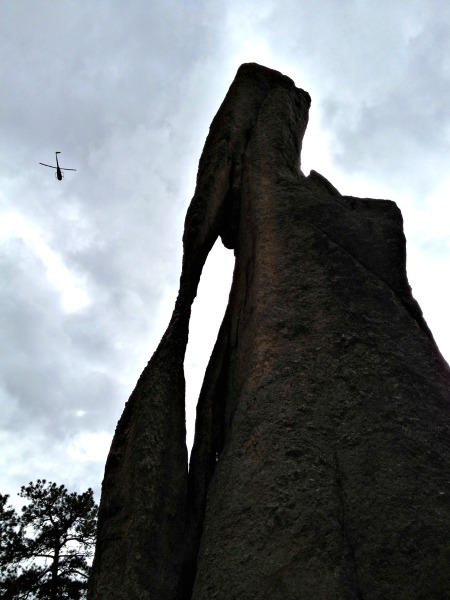
For this Swiss ethnographer with a fondness for remote parts of China, a picture says…

Gaetan in China Collage

Canon zoom lens; photo credit: Morguefiles. Gaetan Green doing fieldwork in Xishuangbanna, a region of Southwest China squeezed between Laos and Burma; photo credit: Gaetan Green.
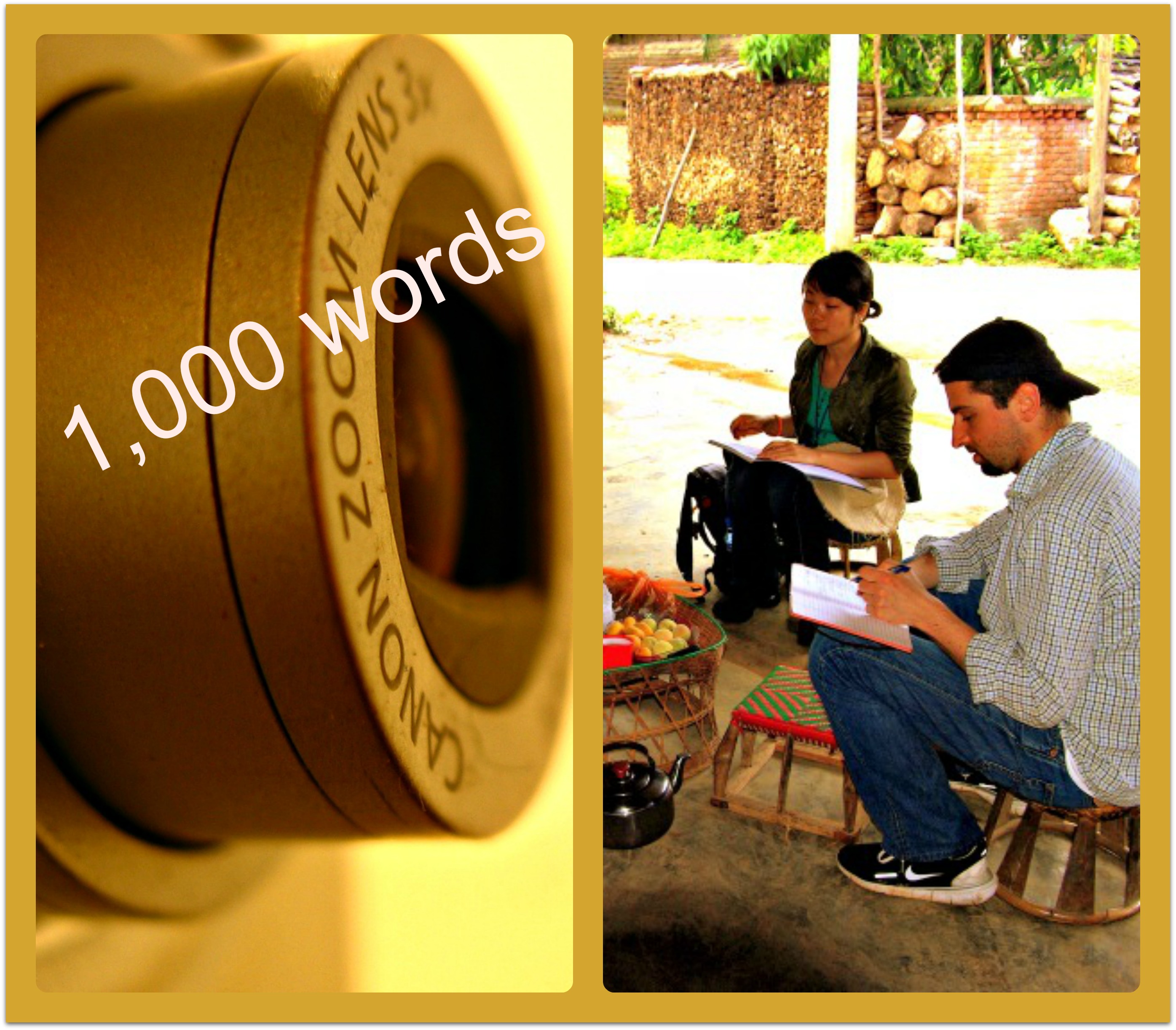
Welcome to our monthly series “A picture says…”, created to celebrate expats and other global residents for whom photography is a creative outlet. The series host is English expat, blogger, writer, world traveler and photography enthusiast James King, who thinks of a camera as a mirror with memory. If you like what you see here, be sure to check out his blog, Jamoroki.

My guest this month is 33-year-old Swiss national Gaetan Green, who has spent the last 12 years between China, Europe and North America. After graduating university, Gaetan studied and conducted ethnographic research in remote parts of China. He went back to do field work in the country’s ethnic borderland when pursuing a master’s degree in geography at a university in Vancouver.

For the past three years Gaetan has lived in one of China’s mega-cities, but he always grabs the opportunity to travel in the countryside, where he can indulge in his current passion for the  ancient and ethnic villages of south and southwest China, with a “minor focus on Guangzhou and the Pearl River Delta.”

Gaetan keeps a fascinating blog, Travel Cathay. He posts about his off-the-beaten-path travels to parts of China most of us wouldn’t know existed.

* * *

Hi Gaetan. I have been following your blog for a while now and am very pleased to have the opportunity to interview you for the Displaced Nation. Let’s start with some background on you, shall we? Where were you born, and when did you spread your wings to start traveling?
I grew up in a ski resort in the middle of the Swiss Alps and I started travelling as soon as my parents would allow it. My first trips were to Southern and Eastern Europe with classmates—that started when we were around 16 years old. But my travels became a lot more serious when I left Switzerland for my first trip around the world, at age 20. This trip changed my life for good.

So your wanderlust dates from an early age. Why do you think that was?
There were essentially two things that inspired me to travel. The first was a map of the world that I discovered at home when I was an inquisitive eight-year-old. The map made me realize the world was much bigger than the valley surrounded by big snow-capped mountains where we lived. I was itching to discover the reality behind all the exotic place names. The second source of inspiration was my home country. With its pure air, snow-capped mountains, green valleys and quaint mountain villages, Switzerland is beautiful—but way too small. The boy I was then saw a world so big, I knew I had to leave.

Which countries did you travel to?
Besides southern and eastern Europe, I visited Australia, Peru, Bolivia, Ecuador, Malaysia, Philippines, and Singapore. And of course, eventually, China.

And now China has become a second home for you.
Although I have traveled to other countries, China is the one I know best because that is where I have spent most of my time so far, and I have only five provinces left to discover. My love story with China started at age 20: I spent three months of my round-the-world trip traveling within its vast terrain. When I returned home, I started to learn Mandarin (some of my friends thought I was seriously deranged!!). Then one thing lead to another: I studied for two years in Chongqing (a city of 15 million people in central China), worked as an ethnographer in remote parts of Yunnan province, taught English in Kunming, and conducted academic research between Vancouver and Xishuangbanna. Although China is a country, it gives the impression of being a continent because it is very diverse. Contrary to what many people think, China does not have a monolithic culture. I speak Mandarin, so that makes travel easier. I can venture into the countryside knowing I’ll be understood.

“Let’s all go up to the mountain to be close to the flowers and songs.” – Dong folk ballad

I’m sure that speaking the language gives you a huge advantage. Tell us more about the life you now lead in China.
I am currently working as a sourcing agent and living in one of China’s megacities. Recently I have developed mixed feelings about the megacity life. Megacities can be convenient places to live, providing easy access to food, entertainment, communication and transportation; but I find them overcrowded. Dangerous levels of pollution and food hygiene are growing concerns and also the reasons why some of my expat friends have already left.

Old woman in a Tibetan Catholic community; photo credit: Gaetan Green.

An elderly woman pushing barley alcohol in north Yunan; photo credit: Gaetan Green.

Some friends of mine have recently moved to China to work in Shanghai but they refuse to live in the city for the same reasons you mention. But let’s get away from the megacity and take a look at your first three photos, which take us far away from that scene. Can you tell us what makes each of these photos so special?
This first photo reminds me of the time when I was doing ethnographic research about Tibetan Catholic communities in remote regions of north Yunnan province. On that particular occasion, I had the opportunity to witness a ceremony during which villagers prayed that it would rain on the graves of French missionaries who’d been assassinated at the beginning of the 20th century during anti-Christian violence in the region. There was a steep hike to reach the graves. At end of the ceremony, this woman started giving everyone barley alcohol in a paper cup. I remember going back to the village half-drunk after she challenged me to a second glass of firewater.

Wind and Rain Bridge, Tondao. Photo credit: Gaetan Green

Blown away by the Puxiu Wind and Rain Bridge in Tondao; photo credit: Gaetan Green

The second photo was taken after I’d missed the last afternoon bus and got stuck in the small town of Tongdao (southwest Hunan province), which I’d never heard of. I eventually ended up hiring a taxi driver for the afternoon to show me around. We went to a few ethnic villages and by 4:00 p.m., we had arrived by this amazing covered bridge, which is an example of a “wind and rain” (fengyu) bridge common to the Dong ethnic minority region. Missing my bus was the best thing that happened to me that day.

Taoist Temple, Macau; photo credit: Gaetan Green.

The Jade Emperor’s generals on their joss paper thrones; photo credit: Gaetan Green.

The third photo records the time I got lost in Macau somewhere between the Ruínas de São Paulo and the Camões Garden, I went to a Taoist temple. In one hall, I noticed that some statues had uneven stacks of joss paper (spirit money) under them. I asked the temple caretaker: “Why?” He explained that there were, in that particular hall, the statues of the 60 heavenly generals who help the Jade Emperor to supervise human life on earth. There is one heavenly general for each birth year, and the more joss paper there is under the statues that matches your birth year, the luckier you will get. I decided to boost my luck and bought stacks of joss paper to boost my heavenly general higher. The temple caretaker gave me three sticks of incense to burn; he said a long prayer in Cantonese and gave me a red talisman. I definitely enjoyed doing business with the gods, though I didn’t feel any luckier afterwards.

“Who can rob me of the songs I learned?” – Dong folk ballad

I love all three photos, and, yes, you are right, missing the bus and staying in Tondau must have been divine providence. Now, I’m keen to know where your favourite places to take photographs are, and why these places inspire you and how that shows in your next three photos?
Now that I live in a big Chinese city, the places that inspire me the most are the ethnic and ancient villages. In the cities, many historical buildings and old streets have been knocked down to give way to shopping malls and skyscrapers. Ethnic and ancient villages are real windows on the past and the cultural diversity of China. I chose the next three photos to make this point.

Cizhong Catholic Church; photo credit: Gaetan Green.

A Roman Catholic Church in an unexpected spot: by the Lancang (Mekong) River at Cizhong; photo credit: Gaetan Green.

The first is of the Catholic church at Cizhong, a remote village of north Yunnan province that is home to a community of Tibetan Catholics who were converted by French missionaries more than 100 years ago. The church seems out of place in this land of Buddhism. The mountains surrounding the village make it a picturesque spot.

Yunnanyi Gaetan Green

If these walls could talk: Yunnanyi village on the Tea Horse Road; photo credit: Gaetan Green.

The second photo is of Yunnanyi village, in Yunnan province, which was an important stop on the Tea Horse Road that linked Southeast Asia to the Tibetan plateau. Horse caravans carrying tea, spices and other goods stopped in Yunnanyi. In 1936, the communist armies of Mao Zedong stopped in Yunnanyi to rest during the Long March. Then, during WWII, the rice fields behind the village were transformed into a U.S. airfield. Planes that had flown from India over the Himalayas (to avoid the Japanese-controlled Burmese airspace) landed in Yunnanyi with supplies for the Chinese armies. The history of this unknown village is inspiring. The mud-brick courtyard houses have seen a lot. I wish these walls could talk.

Stepping back in time in Qianyang; photo credit: Gaetan Green.

Stepping back in time in Qianyang; photo credit: Gaetan Green.

The final photo is of Qianyang, in Shaanxi, an ancient regional political centre that has been forgotten in China’s rush to develop. The streets are lined with dozens of temples, an ancestral hall, and courtyard mansions that belonged to local officials. Most of the city’s walls and four out of fives gates are still standing. There were no tourists when I visited. It felt like stepping back in time and taking a walk in China’s past.

What I find amazing in these pictures is the beautiful architecture and the pristine condition of such old buildings and the cleanliness of the streets. Tell me something, I notice that many of your photos are of buildings or streets. Do you feel reserved about taking photos of people, particularly when they are conscious that you are doing so?
I do feel reserved about taking pictures of other people so I rarely do. The exception is when I have the opportunity to witness a ceremony or special event.

I know this is a similar question but do you ask permission before taking people’s photographs and how do you get around any problem of language?
Since I now travel mostly in China, I ask in Chinese. If I am in a region where people do not speak Mandarin, a hand gesture is usually enough.

Would you say that photography and the ability to be able to capture something unique which will never be seen again is a powerful force for you?
It is indeed. I would add that photography also has the ability to monitor change. In a country like China where everything is growing and changing so fast, photography can be a tool to record how the landscape is transforming.

That’s a very pertinent point, particularly when applied to China. Was there a particular moment when you realized that?
I thought about it a lot while on a business trip to Ningbo, a city of nine million people that is just a couple of hours by train from Shanghai. I had been able to take an afternoon off and wander in the city. I discovered an entire neighbourhood of stone houses built during the late Qing Dynasty (late 19th century), all of which were empty. They were going to be knocked down to build a shopping mall and high-density residential buildings. In China I am constantly thinking that what I see today may be different or not even exist tomorrow.

If someone wants to learn from me, I’ll teach him songs as melodious as cicadas.” – Dong folk ballad

I know exactly what you mean. It almost feels like you are running out of time. I have many old pre-digital photos (35 years old and more). I didn’t realise until now how precious they are. Moving on to the technical stuff (I’m not too good at tech but getting better). Some of our readers will want to know what kind of camera and lenses you use.
I use a very simple point-and-shoot Sony camera.

I must say it works really well and the shooter has a good eye! Finally, do you have any advice for wannabe photographers who are traveling or living abroad?
I think I am in the same position as you. I need advice.

Gaetan, I’d like to thank you for taking the time to tell the story of your exciting journey and for sharing so much interesting information. You may not consider yourself to be a good photographer, but your “point and shoot” pictures embellish your narrative beautifully. Keep following your way and I am sure you will inspire other young people to travel the globe as you are doing. I, for one, will be checking your progress.

* * *

Readers, what do you make of Gaetan’s experiences? Do you have any questions about his photos or his travels? Please leave them in the comments!

And if you want to know more about Gaetan, don’t forget to visit his excellent blog, Travel Cathay. You can also follow him on Twitter: @TravelCathay.

(If you are a photographer and would like to be interviewed by James for this series, please send your information to ml@thedisplacednation.com.)

STAY TUNED for tomorrow’s fab post!

If you enjoyed this post, we invite you to register for The Displaced Dispatch, a round up of weekly posts from The Displaced Nation, with seasonal recipes, book giveaways and other extras. Register for The Displaced Dispatch by clicking here!

Related posts: