The Displaced Nation

A home for international creatives

Tag Archives: Third Culture Kid

Jackie Townsend’s novel examines a cross-cultural relationship up close, imperfections and all

Jackie_Townsend

Jackie Townsend in Rome (photo used with her permission)

As a veteran of cross-cultural relationships (I am now on my second marriage to someone from another country), I tend to fancy myself as something of an expert on the topic. On the one hand, I know the joys of living in an intimate relationship with someone from another culture. On the other, I am only too aware of the pitfalls, a few of which I listed in an early post that still gets lots of hits: “Cross-cultural marriage: Four good reasons not to rush into it.”

I was therefore delighted to come across the novel Imperfect Pairings, by Jackie Townsend. From the outset of the book, I could see that here is a writer who understands that marrying someone from another country not only means marrying the family—but marrying the culture, by which one means the REAL culture, not the tourist version.

The imperfect pairing at the center of Jackie’s novel are Jamie, an American career woman, and Jack/Giovanni, who received his education at MIT but is from an old Italian family. The reason he has two names? Because, when he gets to Italy, he “literally turns into another person with another name,” as Jamie informs her mother at one stage.

Unsure of the relationship at first, Jamie finds herself powerfully drawn to Jack/Giovanni. Not only is he physically attractive, but he’s a man of hidden depths, who seems to understand her better than anyone else.

Eventually, the pair get married—but it’s not a fairytale wedding in the Italian countryside. Rather, it happens in city hall—Jamie has offered to help Jack get his green card. But despite this rather unromantic beginning, the couple grow close, and Jamie gradually immerses herself in Giovanni’s life, especially after he quits his job in the United States to help out with resurrecting the vineyards on his family’s estate.

As one reviewer said of Jackie’s novel:

It’s a brilliantly-written small gem, with exquisite detail and equally exquisite crafting of language, by an American author with her own Italian husband and her own Italian experience. It’s a guidebook to Italy, and a guidebook to how Italians really live their lives.

So can love cross borders? Fortunately, Jackie has agreed to answer some questions about her own life and the book. And she has kindly offered to GIVE AWAY ONE FREE E-COPY to the person who leaves the most interesting comment!

* * *

ImperfectPairings_cover_pmHi / ciao, Jackie. Thanks so much for agreeing to be our featured author this month. First can you tell us what made you decide to write a novel focusing on a cross-cultural relationship between an American woman and an Italian man?
I am 16 years married to an Italian who came to the U.S. for university and stayed.

And you called the novel “Imperfect Pairings”–why?
I got tired hearing all the oohs and ahs: “Oh you’re married to an Italian, how wonderful!” It’s so much more complex than that, and I wanted to dispel the notion of the romantic Italian love story, but in a real and true way, which means also dispelling the romanticism of relationships. The novel is about a couple dealing with real issues and real life, and learning to love each other even more in the midst of all that.

Did writing the book help you to process your own experience of getting into a cross-cultural relationship?
My own experience of being married to a foreigner exposed me to the parallels between cultural differences and marital differences. Entering a foreign country can be like entering a relationship and vise versa. To get to know someone, to understand them, you need the cross the border into their country, the country of their mind and soul. But even if you do eventually learn their “language,” you will never speak their native tongue, not really anyway. Which leaves the question, “Is it possible to ever really know the person you love?”

How much of the book is autobiographical?
Only about thirty percent of the story is autobiographically based. It took me much longer than Jamie to truly open myself up to my Italian family. Part of my writing the book, is homage to that, and them.

The Italian wine-making industry figures large in the novel. Did that emerge from an actual experience?
My husband’s family lives outside Turin, in Northern Italy, not far from the Barolo region. They did once have a summer villa there, where they made wine, and this is what inspired me to use wine and the resurrection of the family vineyard as a catalyst for the story. I love the way Italians treat wine, casually, like a member of the family, an old friend. Wine is a relationship. It requires love and care and tending to if it’s going to survive and grow, and, still, you don’t know what that wine will ultimately be, how it will taste. It became the perfect metaphor for the book.

Why a novel and not a memoir?
I’ve always written fiction, that’s the genre that comes naturally to me. I like the freedom, the idea of letting the characters take the story where they want to go, as when Jamie and Giovanni head to Southern Italy, to Napoli, at the end of the story.

Staying on the theme of your own life and travels, how and where did you meet your Italian husband?
My husband grew up in Italy, Australia, and Bangkok. He moved to the United States for college. We met four years later at business school in Berkeley. I had no idea he was Italian. He was raised in international schools and learned English very early on and worked hard to fit in, to have no Italian accent. But in Italy, he’s the opposite, staunchly Italian and working hard to rid himself of his American accent because he needs this sense of heritage, of home.

The inner nuances of Italian life

In the book you describe Jamie’s many displaced moments: her initial discomfort at being thrown into a physically demonstrative family that loves sitting down to home-cooked meals; her surprise at discovering that her American values of self-reliance and a can-do spirit do not really register with Giovanni’s people; and, perhaps most shockingly of all, her perception that her husband’s allegiance to football trumps all else. At one point she actually wonders if she and he have been “raised on different planets.” What was your most displaced moment when visiting Italy with your husband?
In the beginning of our relationship, it was knowing that he might be embarrassed my me, and my rather bawdy Americanism.

That reminds me of the first time Jamie and Giovanni visit Italy, not long after they’ve met, and she suggests that he sleep in her room. He gets angry and says: “It’s just not something you do here.” I know that you and your husband live in New York City. Have you ever considered moving to Italy?
Early on we had lofty dreams about living in Italy. The idea sounded romantic, but the reality was that the more and more we visited, the more and more I realized that moving to Italy would mean essentially moving in with his family—more disconcertingly his mother, a lovely kind woman, but also, well, I’ll let you imagine. The other reality was that it’s not easy to move to Italy and work. Job opportunities there just can’t compete with those in the States. Will we give it all up some day and move there? We’ll see.

What was your least displaced moment, when the Italian way of life made sense, and you felt as though you belonged in that part of the world—or as Jamie puts it when she comes to tolerate football, “accidentally entered some alternative universe”?
Three years ago our Roman cousin (the inspiration for the character Silvestro) asked me to be the godmother to his third child. Italians take this duty seriously, and I was very touched that he asked me, for Romans can often be all about Rome, and yet he skipped over all these other family members, even my husband, for the Americana. I’ve never felt so naturally a part of things (this, after 12 years)—standing in this magnificent church in the center of Rome, holding his baby in my arms as the priest christened him, trying not to shake or trip or fumble, surrounded by all of our Italian family, those who had so easily and truly made me part of their lives. I think I finally let myself believe it. It takes time, years, for cultural barriers to fall down, to really get to know someone from another country. But what I’ve learned is that you can. It’s something I would never have believed earlier on in my relationship with my in-laws.

That’s a touching story. Does having a non-American husband make you look at life in the United States any differently? In the book, Jamie comes to reappraise her sister and brother-in-law’s values after being exposed to a different part of the world.
Absolutely. It gives me perspective. My husband’s view is always global, from the outside in, sometimes infuriatingly so. While my view, the view of most Americans, will be from the inside out. We are the center of the world. But in fact, we are not. You can’t get this perspective, I don’t believe, unless you are intimately involved with another country, you “marry” them. I feel so lucky to have this experience and perspective in my life.

Self-publishing, a Writer’s Digest prize & praise from Italian Americans

Moving on to the book: What was the most difficult part of the book-writing process?
My writing is very subtle. I want my readers to read between the lines, to feel what’s going on in the quiet places. In as such, bringing out the romance between Jamie and Giovanni proved difficult. Because I believe that love is very personal and private, between two people only, and so to expose Jamie and Giovanni’s love felt like I was tainting it. I had to get past this. Knowing when to let love surface, getting the balance right, was difficult. It took a lot of time, and many of rewrites.

What was your path to getting it published?
I self-publish my novels through my own imprint, Ripetta Press. It’s a decision I came to a few years back when my first novel, Reel Life, came close but ultimately had no success in finding a publisher. When Imperfect Pairings came along, I didn’t even bother trying to find a publisher. I became accustomed to the freedom of being able to do what I wanted with the book. And I was going to have to market it myself anyway.

Are you comfortable with indie publishing—is it working for you?
It’s become relatively easy to self-publish, though it might not be for everyone. In my case, I’m able to garner enough press and sales to sustain myself and find inspiration. Speaking of self-publishing, Imperfect Pairings just won an honorable mention award for literary fiction in the Writer’s Digest Self-Published Book awards, which of course I was very pleased about. My plan is to have the book translated, first in Italian, and work to find an international distributer.

Wow, congratulations! And well deserved. I must say, was impressed by how elegantly and lyrically you write. So what audience did you have in mind for the book? Has it been reaching those people?
Some people from the pure Romance genre got a hold of my book early on, and were wildly disappointed. This is not your typical Italian love story, and far from your steamy romance. It’s an adult romance, and people who get that really enjoy it.

The best reception of the book has been from the Italian American community, people who have some connection with Italy, second or third generation transplants. Many of those readers can really relate to the idea of an Italian’s displacement and the differing cultural dynamics between America and Italy.

I noticed your first book was about sisters, and this book has a sister relationship at its heart. Are you working on the next book now? What is about, and will it have a pair of sisters?
Funny you should ask. Yes, my next book has a sister theme. Two young adult women from different countries and cultures—one is Italian and one is American—will discover that they have the same father.

I presume you have a sister or sisters in real life?
Yes, I have two sisters (and a brother) who drive me crazy. But I love them. They provide inspiration for a lot of material!

10 Questions for Jackie Townsend

Finally, I’d like to ask a series of questions that I’ve asked some of our other featured authors, about your reading and writing habits:
1. Last truly great book you read: Hologram for a King, by Dave Eggers.
2. Favorite literary genres: Fiction, novels and short story collections, both classical and contemporary.
3. Reading habits on a plane: I travel frequently, and often far. Planes are my excuse to spend uninterrupted hours getting lost in a novel. I travel with my Kindle. It gives me this sense, tucked into my purse, that I’m traveling with all my books.
4. The one book you’d require President Obama to read, and why: 1984, by George Orwell but only because I couldn’t think of anything else.

5. Favorite books as a child: To Kill A Mockingbird; Catcher in the Rye.
6. Favorite heroine: Dorothea in Middlemarch
7. The writer, alive or dead, you’d most like to meet: Joan Didion
8. Your reading habits: At night, before bed, but I will also sometimes get up and read in the morning, for inspiration. I am always inspired to write when I read great fiction.

9. The book you’d most like to see made as a film: Mine.

10. The book you plan to read next: The Lowland, by Jhumpa Lahiri

* * *

Thank you, Jackie! As mentioned, I loved the book—everything from the big picture of the cross-cultural relationship to the little details, like Jamie having to get used to the fact that Italians don’t snack between meals. I also love something you said just now: “Entering a foreign country can be like entering a relationship and vise versa.” I believe there’s something in this book for every expat or serious traveler.

Readers, how about you? Any further questions for Jackie, or comments? Remember that if you leave a comment, you’ll be eligible to receive a free e-copy of the book! So, comment away! Extra points, as always, if you’re a Displaced Dispatch subscriber!

The winner will be announced in our Displaced Dispatch on November 30, 2013.

Can’t wait to read the book? You can always order a copy at Amazon.

STAY TUNED for next week’s fab posts!

If you enjoyed this post, we invite you to register for The Displaced Dispatch, a round up of weekly posts from The Displaced Nation, with seasonal recipes, book giveaways and other extras. Register for The Displaced Dispatch by clicking here!

Related posts:

Images: Jackie Townsend in Rome; book cover art.

TCK TALENT: Wendy Laura Belcher, best-selling author, memoirist, and distinguished scholar of her adopted cultures

wendy-l-belcher-tck-collageWelcome to the third installment of “TCK Talent,” Elizabeth (Lisa) Liang’s monthly column about adult Third Culture Kids who work in creative fields. As some readers may recall, Lisa—a Guatemalan-American of Chinese-Spanish-Irish-French-German-English descent—has written and performed a one-woman show about being a Third Culture Kid, or TCK. It debuted in LA in the spring, and I had the pleasure of seeing it during its too-short run in New York City last month. It was stupendous!

—ML Awanohara

Greetings, readers, and thanks, ML, for that vote of confidence in my work. But it cannot compare to the output of today’s guest, a woman of extraordinary talents. Wendy Laura Belcher is a professor of African literature at Princeton University as well as a published memoirist, produced playwright, popular workshop leader, and author of the best-selling Writing Your Journal Article in Twelve Weeks: A Guide to Academic Publishing Success.

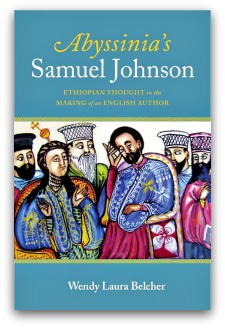
Wendy grew up in Ethiopia, Ghana, and the USA, and has been a writer since childhood. Her most recent book, Abyssinia’s Samuel Johnson: Ethiopian Thought on the Making of an English Author, is a finalist for the African Studies Association’s 2013 Ogot Award (to be announced in Baltimore at the end of next month).

* * *

Welcome to The Displaced Nation, Wendy, and thank you for joining us. I’ve known you for years and yet don’t know as much as I should about your TCK childhood, so am happy to take this opportunity to learn more. You are the daughter of an American dad and a Canadian mom. What’s the story behind why your family moved to Ethiopia and Ghana?
My father is a physician and my mother always loved to travel, so she convinced him to move to Ethiopia. Her idea was that he would teach and do clinical work at a public health college in Gondar, and she would be the college librarian. My first memories are of Ethiopia. I moved back to the US when I was 14. But my specific geographical trajectory is as follows: Philadelphia (birth), Boston, Seattle, Gondar (Ethiopia), Seattle, Accra (Ghana), Seattle, and South Hadley (Massachusetts). After that I lived in Tamale (Ghana). Then back to Washington DC, Accra, Los Angeles, Princeton, Addis Ababa (Ethiopia), and now Princeton again.

That’s an impressively peripatetic life! When and where were you happiest while growing up?
As a child, I loved Ethiopia the best, perhaps because it was the first place my family went and perhaps because, as a child who loved reading, it seemed like a magical place. There was a castle in my backyard as well as oxen threshing grain like in the Bible. On the throne was a descendant of King David. From a child’s perspective, it was like living in a book.

How did you find your first “repatriation” to the United States, at age 14?
I never got used to Seattle, it was very parochial in the 1970s when we moved there, and the weather was too gloomy for someone who had spent a significant part of her childhood in the tropics.

At home, but without a role, in Africa

Has your relationship to Africa evolved as an adult?
As an adult, I settled in the US and not Africa, returning to Africa only a few times until 1997, after which I started going every third year or so. Since 2009, I’ve gone every year to Ethiopia. I thought I might settle in Africa, but as an adult my relationship with Africa was more vexed.

That is, what could my role in Africa be as a white American woman?

I wasn’t particularly interested in “helping,” as it seemed to me that Africans were perfectly adept at solving their own problems and only didn’t do so because of all the “help” they received from the West.

But also, I was in a bind. In the US I often didn’t feel a strong sense of calling in my work, but I felt more satisfied emotionally. In Africa, I felt a strong sense of calling in my work, but I was often lonely.

The problem for me as an adult in Africa as a single woman without children was the lack of female friendships. In the 1980s and 1990s I found it difficult to find in Africa other career women like myself with whom I would have something in common.

One of the reasons I’ve found it easier to return to Ethiopia and have done so regularly in the recent past is that I’ve found some good Ethiopian female friends.

Where do you think of as “home” these days?
My mother always thought that my father never really had a sense of home as a particular place, because he had an identical twin brother. It was the presence of one other human being from the beginning that meant home was someone to him, not somewhere. He didn’t really know what loneliness was, she thought.

I may be somewhat similar albeit for different reasons. I don’t think of anywhere as home.

I lived in Los Angeles for 20 years and loved many things about it, but I mostly think of it as a place where my network of affection is. It isn’t the place so much but the people who make it a kind of home.

At the same time, I still have good friends in Seattle, and my family of origin is still there, so it is also a kind of home.

Are you like many TCKs in finding yourself drawn to people of similar backgrounds?
Almost all my friends are people who live straddling some boundary: either geographically, being from elsewhere or spending significant time outside the US, or racially (growing up as minorities). I am almost never in a room with people who mostly look like me.

Writing calls from an early age

I often wonder if TCKs who pursue writing careers do so because the story is entirely in their hands as opposed to the experienced upheaval of their itinerant childhoods. Did your TCK upbringing influence a) your desire to be a writer and b) what you wrote about?
Growing up in Africa, I was surrounded by literary culture. In Ethiopia, a country with a 3,000-year-old written civilization, people read illuminated manuscripts on sheepskin bound with wood. In Ghana, hand-written epigrams adorned most vehicles, and my father’s Ghanaian colleagues traded bon mots in Latin. At school, I would pick a promising library shelf and work my way through it from left to right. I wrote my first novel when I was nine, titled Shipwrecked at Silver Lagoon. I had set myself the task of writing the best title for a book ever and, after I came up with this, decided it was too good to go unwritten. It was about two English girls in the 17th century who, after their ship is wrecked off the American coast, go on to discover what happened to the disappeared colony of Roanoke: it had moved into an underground, underwater kingdom. The book ground to a halt on page 40, perhaps because, as I tried to articulate issues that were all too real to me (the loss of home and the entry into the hybrid colonial world), my imagination foundered on the demands of the adventure form.

After that, I wrote for my middle school and high school newspapers, where I was the editor.

I was shy, partly due to all the moving and not being sure how to fit in, so I spent most of my time reading. Reading allowed me to immerse myself in a world where I could watch and not be watched (or judged). It also allowed me to develop skills in “reading” people and situations, which is essential to surviving so much moving.

HoneyfromtheLion_coverTell us what drew you to write your memoir, Honey from the Lion: An African Journey, when you were in your twenties.
I had enough credits to graduate from Mount Holyoke in three years so I spent my junior year back in Ghana. While working for a nonprofit organization that was spreading literacy and translating the Bible into local languages, I spent a weekend in a village with an Irish Bible translator. A series of events transpired, the impact of which was so powerful I decided I wanted to write about it. It was a gift: the story was so fascinating that I didn’t worry about writing it. Even if I wrote it poorly, I thought people would find it compelling.

Do you ever go back to the memoir now, and if so, does it resonate very differently due to the passage of time?
I can’t bring myself to read the book now. It seems like a different self wrote itsomeone who was more religious for one.

Congratulations on Abyssinia’s Samuel Johnson being selected as a finalist for a prestigious academic award. Please tell us what inspired you to write the book.
Belcher_AbyssiniaSamJohnson_coverIn 2002, I was talking with an Ethiopian friend about reading Samuel Johnson’s Rasselas, an eighteenth-century fiction he wrote about an Ethiopian prince. This Ethiopian friend surprised me by saying that he had read the book and quite liked it. When I asked him why, he said the book was “very Ethiopian.” I started to correct him, but then I began to wonder if he could be right, if a book written by a European could be Africanin particular, if it could be animated by African discourse. It’s my hope that my book will be convince others about the importance of African thought to the European canon.

From offering TCK courses at Princeton to helping junior faculty

At Princeton you teach courses that I wish had been offered when I was in college, like “Growing Up Global: Novels and Memoirs of Transnational Childhoods” and “Model Memoirs: The Life Stories of International Fashion Models.” You also teach workshops around the world to aid faculty in publishing academic articles. Please tell us the countries in which you’ve taught the workshops.
The workshops have taken place in Norway, Sudan, Malawi, Ethiopia, Indonesia, Canada and all over the USA.

What led you to teach academics about how to write for publication?

belcher_writingyourjournalarticle_coverI did two master’s degrees in the early nineties and I struggled in writing my classroom papers. What did these professors want and why did some papers succeed and others didn’t? I decided not to go on for a doctorate and when people asked me why, I said I just didn’t feel like I got the hang of being a graduate student and in particular about how to write in graduate school.

To my surprise, I found that most other graduate students felt the same way and were as confused and uncertain as I had been. Then UCLA Extension asked me to teach a writing class. I had always sworn I would never teach, but I think you grow when you do things you are terrified of, so I agreed and found that three of my first six students were academics looking for help with their writing.

UCLA Extension agreed to let me restructure the next class around writing for academic journals. The restructured class was a massive success and changed my life.

Within a few years I was teaching “Writing and Publishing the Academic Article” twice a year at UCLA to graduate students, where the class was in great demand, as well as at other universities and institutes around the world. I wrote the workbook Writing Your Journal Article in Twelve Weeks: A Guide to Academic Publishing Success for people who could not take the workshop.

Turning back to your writing, can you tell us what you are working on at present?
I have several writing and translation projects; here are the top three:
1) The Life and Struggles of Our Mother Walatta Petros: A Translation of the Earliest African Biography of an African Woman. Thirty years after the death of a revered African religious leader who led a successful nonviolent movement against European incursions, her Ethiopian disciples (many of whom were women) wrote this vivid book, full of dialogue and drama. The original text, which was written in 1672 by Africans for Africans in an African language, is unknown in the United States (Walatta Petros does not have a Wikipedia entry, for instance). Thanks to the Fulbright US Scholar Award that I held during my third year at Princeton, I was able to spend ten months in Ethiopia devoting myself to archival research. I worked on the translation with Michael Kleiner, a leading scholar and translator of Ge’ez. We believe it will electrify the fields of early modern and gender studies.
2) The Black Queen of Sheba: A Global History of an Ethiopian Idea. Those familiar with the sixth century BCE biblical tale of the Queen of Sheba’s visit to King Solomon may be surprised to hear that there is also an Ethiopian version, variations on which have in fact circulated for centuries, far beyond the Ethiopian highlands. According to the medieval text Kəbrä Nägäśt, the biblical Queen of Sheba was an Ethiopian woman—the wisest, the wealthiest, and the most powerful woman in the world. Tricked by Solomon into sleeping with him, she gives birth to their biracial son, who later takes the Ark of the Covenant to Ethiopia forever. My book traces how the Ethiopian tale came about and the impact it had on not just literature but the world. The emergence of the religion of Rastafari is one of its most far-reaching effects…
3) A Wardrobe of Selves: The Literature of Transnational Childhoods. Based on my life experiences, observing those of my TCK friends, and reading lots of memoirs, I am thinking of writing a book about memoirs by those who have spent their childhood crossing boundaries (in terms of culture, nation, state, language, gender, school, etc.). It would attend to how the narrators like Barack Obama, John McCain, Edward Said, Eva Hoffman, Gloria Anzaldua, Diana Abu-Jaber, Alice Kaplan, Gene Luen Yang, and Mohsin Hamid construct meaningful identities through narrative. These writers—usually considered separately, as part of American ethnic literatures like Arab American, African American, Asian American, or Latino—often negotiate the intricacies of identity in similar ways and should be considered together. That is, this would be a broad comparative project on diasporic memoir in the context of American ethnic literature.

* * *

Thanks, Wendy! You are so prolific, it’s an inspiration to all of us creatives! If we could accomplish just a fraction of what you’ve already done, what a life we’d be leading! Readers, any questions or comments for the amazing Wendy? Please leave them below. And…see you next month!

STAY TUNED for tomorrow’s post, when we hear from an international traveler who has started up her own business in New York City, catering to expats.

If you enjoyed this post, we invite you to register for The Displaced Dispatch, a round up of weekly posts from The Displaced Nation, with seasonal recipes, book giveaways and other extras. Register for The Displaced Dispatch by clicking here!

Related posts:

Images: Wendy Belcher; Wendy with her brother in front of a castle in Gondar, Ethiopia; detail from the cover of Wendy’s latest book, Abyssinia’s Samuel Johnson.

For TCK writer Cinda MacKinnon, fiction is a way to revisit “homes” she has cherished

Cinda MacKinnon CollageWhen I first returned to the United States after my extended expat journey, I remember humming to myself:

There’s a place for me,
Somewhere a place for me.

But then last month, when I went to see our monthly columnist Elizabeth Liang perform her one-woman show, Alien Citizen, I realized that my displacement, which took place as an adult, does not compare to that of Third Culture Kids. Most expats have been global residents by choice, whereas TCKs had no choice in being dragged around the globe by their parents. They and they alone have earned the epithet of “global nomad”.

Elizabeth has found a place for herself in theatrical circles. And today we talk to another adult TCK, Cinda Crabbe MacKinnon, who has found a place in fiction writers’ groups. Based on the first novel she produced, tellingly entitled A Place in the World, it seems fair to say that Cinda thrives on creating fictional characters whose lives resemble her own in some way, and then placing them in a part of the world where she has fond memories of spending some portion of her formative years, as a TCK.

In brief, A Place in the World centers around a young American woman named Alicia, who marries a Colombian and goes to live on his family’s remote coffee finca in the “cloud” forests of the Andes Mountains. Calamities strike one after another and Alicia ends up running the finca alone.

According to the book description, A Place in the World is a romantic adventure story, with a multicultural cast of characters, in the same vein as Isak Dineson’s Out of Africa.

Unlike Dineson’s work, however, it is not a memoir. Cinda may have loved her time in Colombia, but she didn’t marry a Colombian. And though she always wanted to be a biologist, she became an environmental scientist instead.

Well, enough from me. Let’s find out more about Cinda, why she wrote the book, and the book-writing process. And don’t forget to comment at the end of the interview! As Cinda has agreed to be this month’s featured author, we will be giving away ONE FREE E-COPY of her book to the person who leaves the most interesting comment!

* * *

APlaceintheWorld_coverCinda, pura vida. Thanks so much for agreeing to this interview. Let’s begin at the beginning: what made you decide to write a novel about an American woman who lives in the cloud forests of Colombia?
Well, like all writers the story was simply in my head. Contrary to what I’d been told to do, I wrote for myself, without the idea of publishing—at least when I first got started. But I guess there were also some motivating factors. As you mentioned, I grew up as a Third Culture Kid, or TCK. My family lived in Greece, Germany, Colombia, and Costa Rica because my father was in the United States Air Force and then worked as an attaché to American embassies. I spent my formative years—and by far the longest time—in Colombia and Costa Rica. I wanted to be a rainforest biologist. That didn’t happen, but I’ve been able to live this dream through my protagonist, Alicia. Writing the book gave me an excuse to visit and study tropical nature in several places.

What impact did writing about the experience have on you overall—did it help you process what you’d been through as a TCK?
I love Latin America—the setting and culture are comfortable to me. The book gave me a chance to write about the people in that part of the world who were enormously kind to me. Growing up as a girl without a country, I came “home” for the first time to the States for college and felt totally out of place. Writing gave expression to some of this unanticipated culture shock.

What kinds of books have influenced you as a writer?
When I look at my Goodreads list of top 40 favorite books I see there is a definite multicultural theme: 30 are set in other countries, written by foreign authors or about expats. A few eclectic examples:

  • The Poisonwood Bible, by Barbara Kingsolver
  • Crime and Punishment, by F. Dostoyevsky
  • Zorba the Greek, by N. Kazantzakis
  • Tortilla Curtain, by T.C  Boyle
  • Small Kingdoms, by A. Hobbet
  • How the García Girls Lost Their Accents, by J. Alvarez
  • Eva Luna, by I. Allende
  • Caravans and Hawaii, by James Michener
  • The Thorn Birds, by C. McCullough
  • Pillars of the Earth, by K. Follett;
  • The Paris Wife, P. McLain;
  • Lost in Translation (different from the movie), by N. Mones
  • Dreaming in Cuban, by C. Garcia.

A fish out of water…

As you know, we like to talk about “displacement” on this site. When you were growing up as a TCK, what was your most displaced moment?
When I was working in New Zealand as a young adult. I’d lived in four or five different countries and could make myself understood in several languages so wasn’t expecting that to be a problem in NZ. I remember being with a colleague trying to order a milkshake, and the lady behind the counter asked me to repeat myself. “A chocolate milkshake, please,” I said as clearly as I could. She looked at me blankly and said, “Say it one more time dear, I’m trying very hard to understand you, but your accent is so thick.” As we left the shop, I told my work mate, “I don’t know what I got, but it sure isn’t chocolate!” Alistair smiled and replied, “I thought you asked for ‘banahnah’”!  Go figure!

Yes, having been to New Zealand, I can kind of imagine that! What was your least displaced moment, when you felt that the peripatetic life suited you, and you were at “home”?
As an eighth grader arriving in Costa Rica from Colombia. My first week I was accepted as part of the class and invited to a party. I spoke Spanish and felt I fit in. Costa Ricans are a hospitable people, but I think I was also especially lucky to have been in that particular class. They were—and are—an exceptionally nice group of people; they still meet every month or so for dinner, and any classmate who happens to be in town is invited to drop in. I found life in Costa Rica to be nurturing.

You mentioned the counter culture shock you experienced when coming back to America for college. What was the biggest challenge you faced at that moment?
Well, it wasn’t one thing but all the little things: I was dressed “wrong”, didn’t know the music, had never been to a football game… I just really felt like a fish out of water and wanted to go back to Costa Rica—so, after a couple years, I did! (For a while…)

Clearing the writing & publishing hurdles

Moving on to A Place in the World: what was the most difficult part of the book-writing process?
Beginnings are the most difficult for me, as well as writing synopses for agents and publishers. In general, however, the answer is: time. Finding time to write while I was still working; finding time to meet my indispensable writing critique group; and once edited and published, finding time to speak at bookstores, do interviews, and write posts for my own blog!

What was your path to publishing?
Like any previously unpublished author, I had a difficult time. I had one agent hold onto my novel for six months as we discussed strategies and then (with the downturn in the markets) told me they had decided not to handle unpublished writers anymore. This has become a mantra with traditional publishers. (J.K. Rowlings was turned down dozens of times before finding a publisher for Harry Potter.) After a couple of years (during which time I was polishing the manuscript with my critique group), I decided to “indie” publish. There is a range of providers between traditional publisher and self publishing; and my publisher, VirtualBookworm, is one of those in the middle. I paid for my own editor (she was great—an expat who married a Latino) and a very small fee towards printing; but I get a bigger percentage per book than with a big publisher. I’ve been happy with all the support they have given me and would do it again.

What audience did you intend for the book? Has it been reaching those people?  Can other kinds of expats, who haven’t lived in Latin America, relate to Alicia’s story as well?
I think of it as “mainstream” fiction that will appeal to anyone who likes to read about other places and cultures; but yes, it has been popular with expats. I rather thought that alumni from the overseas schools I went to would be interested, and that has been the case. I’m heartened and amazed at the support and e-mails I’ve received from adults of all ages.

Are you working on any other writing projects?
Yes (she says hesitantly). Hesitantly because, as you might guess from what I’ve already told you, I’m working pretty much FT—and finding time for creative writing is harder than usual! I do have several ideas that I’ve started: one set in Hawaii, another in Costa Rica, and a third in Europe. This last might be of interest to your followers, as it will be about a group of kids in an international school in Switzerland written from the point of view several different characters, taking their experiences into adulthood. And then my writers group thinks I should do a memoir. So I don’t know which of these schemes will “win”, but I intend to set priorities before the New Year.

10 Questions for Cinda MacKinnon

Finally, I’d like to ask a series of questions that I’ve asked some of our other featured authors, about your reading and writing habits:
1. Last truly great book you read: The Help, by Kathryn Stockett, comes to mind, but how great is great? I could go back to Zorba the Greek, by Nikos Kazantzakis.
2. Favorite literary genre: Literary and mainstream—especially multicultural or historical.

3. Reading habits on a plane: Anything—even the airline magazine in a pinch, but I usually take my Kindle with a good novel. Also, planes provide great down time to write!

4. Book(s) you would recommend to other TCKs, expats: Other than my “multicultural” fiction list above, it would be two books: Tales of Wonder, a fascinating autobiography about growing up in China almost a century ago, by Huston Smith; and I’m a Stranger Here Myself—Bill Bryson’s funny take on coming home after years abroad.

5. Favorite books as a child: Fairy Tales, by Brothers Grimm. When I was a little older, the Nancy Drew mysteries and I enjoyed reading Dr. Seuss to my little brother.
6. Favorite heroine: In fiction: Nancy Drew? In real life: There are too many to choose just one.

7. The writer, alive or dead, you’d most like to meet: Barbara Kingsolver and John Steinbeck.
8. Your reading habits: I take a break every afternoon and I get a little reading in, and then my husband and I always read before turning out the light.
9. The book you’d most like to see made as a film: A Place in the World! Seriously, two fans have suggested this and I love the idea. I visualize the opening as the cloud forest seen from the air and then zooming in to the tiled roof house with the veranda and bougainvillea. (This is actually a possibility! A colleague of mine is a script writer and mentioned that it would make a good movie.)
10. The book you plan to read next:  I just started Flight Behavior, by Barbara Kingsolver. Then I’ll probably read The Old Way: A Story of the First People, by Elizabeth Marshall Thomas, or Cristina García’s new novel, King of Cuba.

* * *

Thanks, Cinda! Though I’ve never been to Colombia, I find myself enamoured of the idea of finding a place for myself in a cloud forest. It’s actually an apt metaphor for how many of us “displaced” types live: with our heads in the clouds, pretending we are somewhere else half the time.

Readers, how about you? Is your head in the cloud (forest) after listening to Cinda? BTW, if you’re as new to Colombian cloud forests as I am, I suggest that you check out Cinda’s Pinterest boards. You can also get to know her better by visiting her author site and blog, and liking her Facebook page.

And don’t forget to comment on this post! Extra points, as always, if you’re a Displaced Dispatch subscriber!

The winner will be announced in our Displaced Dispatch on November 2, 2013.

NOTE: If you can’t wait to read the book, you can always get a softcover copy here and the e-book version in various formats on Smashwords or Amazon.

STAY TUNED for tomorrow’s post, when monthly columnist JJ Marsh talks “location, locution” with best-selling Brazilian author Paulo Coelho.

If you enjoyed this post, we invite you to register for The Displaced Dispatch, a round up of weekly posts from The Displaced Nation, with seasonal recipes, book giveaways and other extras. Register for The Displaced Dispatch by clicking here!

Related posts:

Images (left to right): Valle de Cocora in Columbia, with wax palms towering over the cloud forest, courtesy McKay Savage on Flickr (Creative Commons license CC BY 2.0); Cinda MacKinnon as a child in Colombia; Cinda MacKinnon now (she lives in northern California); and Cinda with her husband in front of Monserrate, a mountain that dominates the city center of Bogotá, Colombia, taken just this past summer.

TCK TALENT: Diahann Reyes is in her element as writer, actor & storytelling coach

DiahannReyes_headshot_pmWelcome to the second installment of “TCK Talent,” Elizabeth (Lisa) Liang’s monthly column about adult Third Culture Kids who work in creative fields. As some readers may recall, Lisa—a Guatemalan-American of Chinese-Spanish-Irish-French-German-English descent—has written and performed a one-woman show about being a Third Culture Kid, or TCK. (It debuted in LA in the spring and is coming next week to NYC!)

—ML Awanohara

My guest today is Diahann Reyes, a professional writer/actor who is launching a new blog, writing a memoir, and beginning an additional career as a writer’s editor/coach. Diahann grew up in six countries, worked as a journalist for CNN before becoming an actor, and currently lives in Los Angeles, California.

Growing up here and there and everywhere

Greetings, Diahann, and welcome to the Displaced Nation. I understand you’re the TCK child of Filipino parents. Can you fill us in a little more: why did your family move around and which countries did you live in as a kid?
My dad was a marketing expat. I learned how to speak English with a Kiwi accent in New Zealand, discovered my love for books in Argentina, rode my first camel in Pakistan, went through puberty in the US, attended junior prom in the Philippines, and graduated from high school in Indonesia.

Of all those cultures, did you identify with one in particular?
Like you, I’m a “mash up” of the different cultures I’ve lived in. Living in America for most of my life now, I feel most at home here, which is its own kind of cultural mishmash. In my twenties, I realized that I had to pick one of my “home” cultures as my main one or I’d continue to feel ungrounded. I also identify with particular subcultures that aren’t necessarily considered mainstream, such as the artist culture.

Where and when were you happiest while growing up?
My family’s two years in Argentina were some of my happiest, probably because my mom, dad, sister, and I were all so excited to be living in a new country together. Moving to a different culture was still an adventure of which I had yet to grow weary. Also, at age 8, I was still very much myself and hadn’t been impacted yet by the pressures of puberty and the need to fit in.

What lies beneath the surface…

Speaking of puberty and the female body brings me to the launching of your new blog, Stories from the Belly: A Blog About the Female Body and Its Appetites. What inspired you to begin it and what can followers look forward to from the blog?
For women especially, there are so many truths, emotions, and desires that we tend to suppress: they get buried deep down in our bodies. My blog is my way of excavating this buried inner emotional landscape. I want to talk about the female body in ways not normally touched upon in mainstream media. My blog will include personal stories as well as commentary on relevant current events.

You’ve been working on a memoir. Is it specific to a time and place in your life?
Yes. My memoir is about my latest “move,” only this time rather than going to live in a new country, I’ve spent the last decade “moving into” and learning how to fully inhabit my own body. Location-wise, I take the reader across the globe to some of the places I’ve lived growing up, but the main action takes place in my body.

What themes are you exploring?
The story I tell is absolutely personal, but it does touch on a lot of bigger ideas involving the female body and its objectification and how this can impact a woman’s relationship to herself and others. Desirability, cultural assumptions, sexuality, power, pleasure, and wholeness are some of the through-lines in the book.

Owning who she is

On your website you describe how you fell in love with reading and acting. Did you always know you would pursue both of these interests as careers, or did you struggle with the decision?
I knew I wanted to be a writer from the time I could read, but it took me a long time to own that this is who I am, in part because the grownup me couldn’t imagine that my younger self could just “know” this. Still, writing has been the primary way I’ve made a living—as a TV news writer, an editor, a ghostwriter, and now a blogger, so I guess I didn’t need to know I was a writer to be one.

The decision to act was tougher. I didn’t start to pursue acting until my 30th birthday, and by then I had established a pretty good career in journalism and online media, so I was giving up a lot to change focus. But acting was like this siren calling to me, saying “act, act, act.”

You and I grew up reading many of the same (mostly American and British) authors: Ingalls Wilder, L’Engle, Cleary, Blyton… I remember the day I realized I would never get cast as Jo in any theatrical production of Alcott’s Little Women because I was a girl of color. Did you ever have a moment like this, and if so, which beloved character(s) and book(s) or play(s) did you realize you wouldn’t get to explore as an actress?
I always thought I could be anyone because while growing up I’ve had to be a chameleon. “Adapt and assimilate and fit in” was one of my mantras as a global nomad. But when I got to LA and started auditioning, I realized that I would never be able to play certain characters because I was the wrong ethnicity or type. I was primarily limited to not even Asian parts but Latina roles because I look more Hispanic than Southeast Asian. This meant that I was likely never going to play Maggie from Cat on a Hot Tin Roof or Caroline Ingalls in any future Little House on the Prairie remake, and parts that were for people of my actual ethnicity were out, too. Fortunately, the industry has changed, and more minorities are getting cast outside of ethnicity and stereotype.

What sorts of roles are you attracted to now?
I love parts that call for emotional depth and angst.

I wonder if one of the reasons we’re writers is that we have more autonomy to tell stories than we do as actresses?
I love that I can write what I want—I don’t need anyone to “cast” me first. And I can create characters that aren’t limited by ethnicity or type. I am thinking of creating a solo show that would probably require me to write and play different characters.

I understand you also write poetry. What drew you to that?
I kept diaries growing up and would process my feelings through poetry. With both nonfiction and poetry, I can just be myself. After so many years of working hard at adapting and assimilating to fit in, getting to just be me on the page is a relief.

Helping others to own their stories

You’re about to begin a new endeavor as a writer’s editor/coach. What inspired you to follow this new path?
I know what it is like to have something to say and to struggle with fully expressing my truth—especially when the fears come up—and I want to help other writers overcome these obstacles so they can get their stories out there. I want to work with people who are just as engaged in their process as they are in having a finished product.

What are you looking for in a student/client?
I work with nonfiction writers, bloggers, storytellers, and essayists, and other people with writing and online content projects. Healers and people with unusual business ideas like to work with me, too.

Do you have any other projects coming up?
I hope to publish my memoir next year. The film Out of Her Element, in which I play a therapist with a pill addiction, will premiere soon.

* * *

I must congratulate Diahann on her exciting new ventures, which I believe will resonate with people working in creative fields—and with female travelers and TCKs, especially! Readers, please leave questions or comments for Diahann below.

STAY TUNED for tomorrow’s post, when Andy Martin will talk to Mark Hillary about his new book, Reality Check: Life in Brazil through the Eyes of a Foreigner.

If you enjoyed this post, we invite you to register for The Displaced Dispatch, a round up of weekly posts from The Displaced Nation, with seasonal recipes, book giveaways and other extras. Register for The Displaced Dispatch by clicking here!

Related posts:

img: Diahann Reyes

Don Quixote & Sancho, John Steinbeck & Charley…Olga & George? A travelogue for the expat annals (plus we’re giving away a copy!)

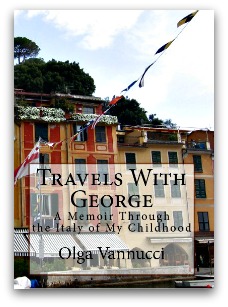
Olga Vannucci CollageWhen I first stumbled across Olga Vannucci’s memoir, Travels with George, I wondered whether the title alluded to John Steinbeck’s book Travels with Charley, about his road trip across America in the company of his French standard poodle, Charley.

Turns out, I got it right. Born in Italy, Olga went to Brown University and currently lives in rural New Jersey. As she tells it, she was driving through Doylestown, Pennsylvania, one day when Steinbeck’s travelogue popped into her head, and she knew she wanted to call her book “Travels with George.” When she announced this to her son (the “George” of the title), he said: “So I’m the dog?”

As you can gather from this story, mother and son make quite a pair.

Olga says she’s no Steinbeck, though she does prefer a plain and honest writing style. Also like Steinbeck, she had the desire to see her native land again.

So, how did she find the Italy of today: did she still fit in? And what did her sidekick, George, the blonde all-American kid, make of his mammina‘s homeland? Did he enjoy these escapades or feel puzzled by his mother’s motives? Perhaps the story he saw himself in wasn’t Steinbeck’s at all, but a modern Italian version of Don Quixote, in which he occupied the role of a skeptical Sancho Panza?

Olga has kindly agreed to give away one copy of the book to the reader who is keenest to find out the answers to these questions (see giveaway details below).

But before we get into that, let’s talk to Olga and hear some more about the travels that inspired her to put pen to paper…

* * *

Travels with George Book CoverCiao, Olga! Let’s begin at the beginning. Tell us more about your decision to take a trip to Italy with your young son and write about it.
I was born in Italy (Milano), lived in Brazil two different times as a child, and came to the United States to attend college. I’ve been here ever since. When my son was seven years old, I realized suddenly that I hadn’t been back to Italy in ten years, and I went, taking him along. I thought he would learn about Italy and acquire a feel for what it’s like. I also hoped he would learn some Italian. I don’t know how much of that was accomplished, but I loved showing him around. We went back four more times over the course of six years (he is now 14). I wrote the book about those trips: a mix of travelogue, personal history, and little anecdotes, with some humor.

What impact did writing about the experience have on you—did it help you process your childhood memories?
It was wonderful to see the locales of my childhood again. At this point, my memories are either indelibly fixed or just gone—for instance, I can remember clearly sitting on the steps with my friends Sassello, in Ligurio, as I recount here:

[My sister and I] had two friends in Sassello, two girls the same age as [us]—Paola and Maria Elena. They spent their summers thirty meters from where we spent ours, and we spent hours and hours of every day together.

[George and I] walk by the steps where we used to sit. I expect to see them, I expect them to be there, but they’re not. No one is. It’s all the same, but it isn’t.

Did you also learn something about yourself, in taking these excursions down Memory Lane?
I did find out about my current self through the book, but primarily from what others told me my words said about me—for example that I’m kind, funny, and honest. It was also interesting to hear from others about the things that they could relate to in the book, ranging from the more profound to the totally mundane situations. That was amazing, to realize that what I wrote spoke to others.

George’s ordeal

Do you think it will help George someday, in understanding part of his heritage that might not otherwise be accessible?
George has not read the book because, he says, “I was there, I don’t need to read about it.” I do hope and trust that both the experience and the writing will be a part of him, that he will consider the book a gift.

What was your most displaced moment when you & George were touring Italy, when you thought of yourself as a stranger within your homeland?
I always struggle with whether I am Italian or, at this point, American, or, more likely, not really either one. What makes me feel at home in Italy is the fact that it’s largely so unchanged. What makes me feel displaced is that the people of the older generation, my parents’ generation, who are the people I particularly associate with Italy, are passing. They’re my biggest connection with Italy, and they will soon be gone. After that, I may feel displaced…

I gather you don’t feel nearly as comfortable with younger generations of Italians?
Yes. I’m not sure why not. Possibly because the younger generation is doing its own thing and is more all over the place, unlike the older, which has stayed put.

What was your least displaced moment, when it all seemed to make sense for you and George to be there—that you fit right in?
On all the trips we visited my aunt, my mother’s sister, and stayed at her house, where we slipped naturally into being part of the family. I had coffee with her in the morning, we planned meals, I helped her water her garden, George fed her goldfish, and we watched television in the evening.  There was not an ocean or even a smidge of formality between us.

I love the description you provide of your aunt in the book:

My aunt is a lovely person, she’s beautiful and she likes to dress well. She’s 80 now, and she still looks good in her clothes, she wears fashionable clothes. She is cheerful and tells funny stories. She loves to do stuff and see people, she’s chatty. She’s fun to be around.

In that same passage, you mention the “recurring nightmare” of finding food that George likes to eat. What was the most challenging thing about traveling with a young child?
I did not realize how jarring the experience would be for George. To me, Italy is pleasant, and while I knew it would all be new to him, I didn’t realize how different it really was. Being in a completely unrecognizable place where he didn’t understand the language was way outside his comfort zone. I also probably didn’t verbalize things enough. I could have prepared him more and explained things better.

The other thing about traveling with a small child is that I, as the adult, had to be “on” 100% of the time.  Not only did I have to plan and handle everything, but I also had to manage him and make sure I didn’t lose him, which was something I actually worried about, and when I became stressed I had to try to hide it so he wouldn’t become stressed, which I didn’t do very well. He’s very perceptive.

What do you think he took from the experience?
The knowledge that he can survive a terrible ordeal… Possibly I took him on a few too many hikes up hills. It wasn’t always fun and idyllic. I do believe that the trips will serve as a foundation for him to understand that the world is large and diverse and for him to appreciate differences.

The potential perils of writing about one’s offspring

What was the most difficult part of the book-writing process?
It was hard to write about others and protect their privacy at the same time, particularly with my son. I find him very amusing, but he doesn’t intend to amuse me, and he is sensitive to it. He thinks I’m making fun of him, basically. So I’m always walking that line, writing about him, but trying to be respectful of him.

I understand you decided to self-publish the book. Why is that, and do you have any advice for other writers who opt for self-publishing?
I made some attempts to get an agent but ultimately I went with self-publishing because I didn’t have the patience to wait. What I like about self-publishing is that it’s all mine, I created the book cover, I chose the font, I decided to favor the comma over all other punctuation, and it’s been incredibly fun and very rewarding.

There are so many options today to publish and distribute and get the word out, and it can be done without a big financial investment. All you need is the investment of time. Given that this is your passion, you want to spend your time on it anyway. And there are so many people who are open to help. I would encourage other writers not to be afraid to ask. Putting your thoughts out there to share with others is a gift, and people respond very kindly.

What audience did you intend for the book, and has it been reaching those people?
I thought it was a mother/son book, which it is, but it’s very much a book for people who love Italy, who have been there, or who plan to go. My writing is very direct and the book is written in the present tense, so readers feel like they’re there along with me. It combines some very personal time in Italy–with family or revisiting places of personal significance—with visits to the big tourist destinations like Venice and Rome.

Are you working on any other ambitious writing projects?
I am working on a book about traveling with George in America. It’s not an organized itinerary, it’s just places we’ve been or will go to. Mostly in the northeast, plus San Fran and Arizona. It’s still in the infant stages, this project. But I promise it will be extra funny!

10 questions for Olga Vannucci

Finally, I’d like to ask a series of questions that I’ve asked some of our other featured authors, about your reading and writing habits:
1. Last truly great book you read: Don’t Let’s Go to the Dogs Tonight, by Alexandra Fuller, about growing up in Africa.
2. Favorite literary genre: Definitely travel!
3. Reading habits on a plane: I don’t like to fly so I bring an easy-reading book that I know will keep me engaged, and paperback so it’s lightweight.
4. The one book you’d require President Obama to read, and why: He has such a tough job. I would wish, not require exactly but only wish, for him to read a book that his daughters like, so he can have a topic of conversation that they can share and enjoy. He will then tackle his job rejuvenated.
5. Favorite book as a child: Mary Poppins—the P.L. Travers book and the Disney movie, too. I think I had it in both languages. It was just magical, different, not at all like my daily life with my mother and sister.
6. Favorite heroine: Martha Gellhorn, who was a great journalist and writer. She was married to the literary giant Ernest Hemingway yet always retained a strong sense of herself.
7. The writer, alive or dead, you’d most like to meet: I would like Calvin Trillin to take me out to eat in New York, in the Village, to all his favorite eating places. It might take several days because he has a lot of favorite eateries. I would like to hear all about Alice, about his daughters, and about his long and brilliant career.
8. Your reading habits: I read in bed every single night, and I have been reading more during the day recently. I’ve been deliberate about carving out more time in the day, when it’s otherwise easy to get caught up in other activities.
9. The book you’d most like to see made as a film: Any book that takes place overseas, so I can see the place in which the events take place.
10. The book you plan to read next: Hard to tell… I have a stack of some thirty books in my bedroom, and I’m not sure which one is next. I may need to devise a lottery system to determine the reading order…

* * *

Grazie tanto, Olga! Your story certainly sounds amusing while also saying something profound about parent-child relationships and the quest to go home again. Something to rival the wisdom of Steinbeck or Miguel de Cervantes, for sure.

Readers, it’s time for you to ENTER OUR DRAW TO WIN A FREE COPY of Olga Vannucci’s book, by entering a comment below. Olga says she will favor comments that tell her why you’d like to read about her and George’s adventures.

Extra points, as always, if you’re a Displaced Dispatch subscriber!

The winner will be announced in our Displaced Dispatch on September 28, 2013.

To read more excerpts from Travels with George, go to Olga Vannucci’s author site. You can also keep up with her on the book’s very active Facebook page. Also feel free to order the book from Amazon.com.

STAY TUNED for tomorrow’s quota of Global Food Gossip. Rumor has it, Joanna Masters-Maggs has something particularly tasty in store for us!

If you enjoyed this post, we invite you to register for The Displaced Dispatch, a round up of weekly posts from The Displaced Nation, with seasonal recipes, book giveaways and other extras. Register for The Displaced Dispatch by clicking here!

Related posts:

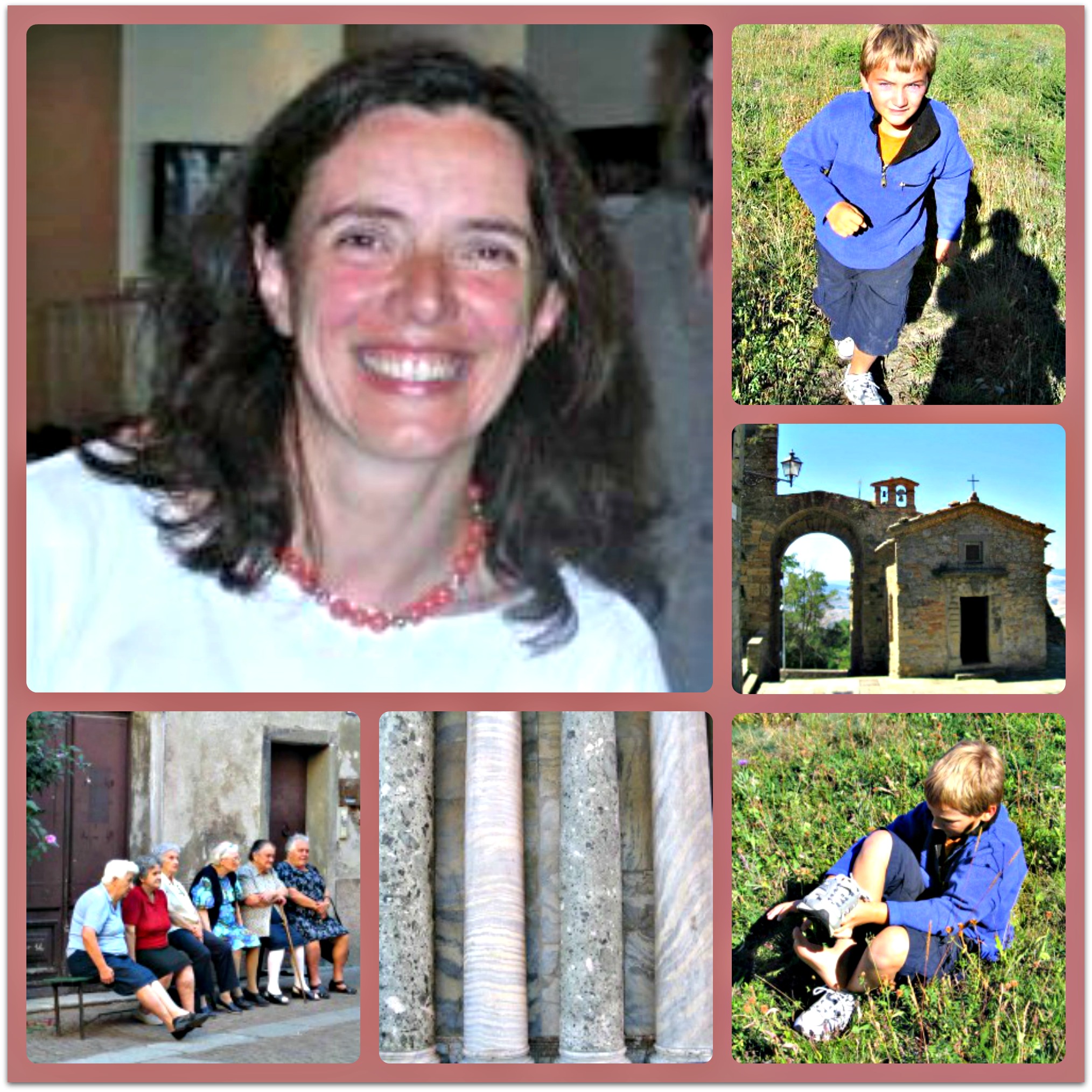
Images: Olga Vannucci and George, interspersed with Italian scenery. Of the George photos, Olga writes:

Let me provide the audio from George: “Where are we going? How much longer? I have something in my shoe. I want to go back. Why are we doing this? Do you know where we are? Do you know where we’re going? Mammaaaaaaa!”

TCK TALENT: Alaine Handa choreographs her way to festivals in Toronto and now Edinburgh (2/2)

Habitat CollageNew columnist Elizabeth (Lisa) Liang continues her conversation with fellow TCK performing artist Alaine Handa. (Be sure to check out Part 1 if you haven’t already.)

—ML Awanohara

Hi, everyone! Yesterday, I talked to Alaine Handa about her Third Culture Kid background and what led her to produce her first international touring show, Chameleon. Today we’ll finish up our Chameleon conversation and move on to talking about Alaine’s brand new show, Habitat, which is having its world premiere at the Edinburgh Fringe Festival. (If you happen to be in Edinburgh, scroll down to the bottom of this post for details.)

* * *

Act 2: Chameleon, continued…

Welcome back, Alaine. I can relate to so much of what you said about Chameleon. The creative/rehearsal process can be so fulfilling that the performance itself is often the icing on the cake for the performer-creator. Whom did you have in mind for the wider audience?
As a proud TCK and Global Citizen, I felt the stories of TCKs needed to have a voice that supports all the research, books, blogs, and memoirs that have been written on our lives—yet can transcend boundaries of spoken language through dance and movement, something all cultures can understand. Perhaps my ideas were grandiose, but I really hoped that productions of Chameleon would touch the lives of all those who identify with living cross-culturally and existing as cultural mixes.

It sounds as though Chameleon provided a voice for a cross-section of nomadic, mixed-heritage, intercultural people, not to mention everyone who has ever felt unheard or unseen—which is everyone at some point in their lives. I did the same with Alien Citizen and am wondering if we should create a TCK festival for performing artists like us… But, back to you! How was the performance received?
Every single performance of Chameleon had at least one person in tears because they identified so much with it. After each performance, we spent quite a lot of time talking to audience members. I made a lot of new friends around the world!

Were there any surprises?
The biggest surprise for me came from the TCK student performance at Utahloy International School, in Guangzhou. The students were very receptive and open to sharing their TCK stories with me, as well as on stage. It brought tears to my eyes.

Did you learn anything about yourself in the process?
By telling my story and other TCK/CCK stories, not only did I come to understand myself better, but I also felt a strong sense of community among the globally mobile citizens of the world.

Act 3: Preparing a new show, Habitat, for the Edinburgh Fringe

And now you have a new show, Habitat. Is this your first time at the Edinburgh Fringe?
Yes! We are very excited. One of my dancers has performed in the Fringe before so he will be super helpful during the festival.

In your promotional materials for Habitat, you have the following statement:


Our personal space is the environment in which we confine ourselves to become our truest selves.


Can you explain?
As a TCK, I am constantly meeting people of different backgrounds, and I change my behavior and mannerisms accordingly. Thinking about this, I wanted to explore the transition to one’s personal habitat, where you can finally relax and just “be” who you are.

Who is the intended audience, and is it different than the audience from the one you had in mind for Chameleon?
This piece is more universal. It shows how different people from different backgrounds change the way they behave around others and when they are alone.

I see the cast is multicultural, with dancers from Singapore, USA, Portugal, and Indonesia. Was it a challenge to bring together a cast from so many different places?
To be honest, although it’s “easier” to label the cast by our passport countries, we are, in fact, a collection of multicultural individuals who have lived in different parts of the world at various times. Right now, two of us live in Singapore and the other two in New York. The biggest challenge we faced was rehearsing on separate continents, given the time difference. We relied heavily on email and YouTube, and later on Skype. As the choreographer, I faced the challenge of conveying what I wanted to see from the 2-D perspective of video. Slowly but surely, the show has come together piece by piece, like a jigsaw puzzle.

How did you find the other dancers?
I’ve worked with Laura on Chameleon and was working with her on the creation of draft material prior to my move back to Singapore last year. I met Ezekiel in Singapore; we both teach dance for the same company. Belinda and I are friends from New York; she and I met at an audition for a choreographer I danced for while living there. We found out that we trained with the same jazz dance instructor while I was growing up here in Singapore and took the same classes.


Are the other dancers also TCKs or “displaced” in some way?
I think I’m the only TCK, but of the other three cast members, two are expats and the other is bi-cultural, with both parents originating from different countries and cultures. I guess you could say we are a “displaced” group. I knew I wanted to work with a multicultural cast again because it made for such an interesting group dynamic with Chameleon—although in this case, the cast has not worked together before.

You’re now in Edinburgh. What’s it been like so far?
When we first arrived, we had about 20 hours of rehearsal (including tech and dress rehearsals). The pieces are gradually falling into place.

Act 4: Life after Edinburgh?


Do you have plans to take Habitat anywhere else?
Yes, we are encouraging theatre venue producers, programmers, agents, etc. to come see Habitat during the Fringe in hopes it can be produced in other venues around the world.

Where do you think the show will go next?
I’m not sure—I’d like to bring it down to Australia. I also really enjoyed Toronto Fringe a couple years ago and might bring Habitat there. We are also looking to get this show booked for different venues across Europe, Asia, and North America.

* * *

If you happen to be in Edinburgh, here are the details for Alaine’s show:

  • Number of performers: four, including Alaine
  • Show length: 45 minutes
  • When and where: July 31 – August 13, 2013 @ C Venues (Venue 34), Adam House, Chambers Street, Edinburgh, United Kingdom.
  • Time: 1:50 pm every day.
  • Purchase tickets here.
  • Trailer:

Habitat in Edinburgh Fringe Festival from Alaine Handa on Vimeo.

Questions for Alaine? Be sure to leave them in the comments section!

STAY TUNED for next week’s fab posts.

If you enjoyed this post, we invite you to register for The Displaced Dispatch, a round up of weekly posts from The Displaced Nation, with seasonal recipes, book giveaways and other extras. Register for The Displaced Dispatch by clicking here!

Related posts:

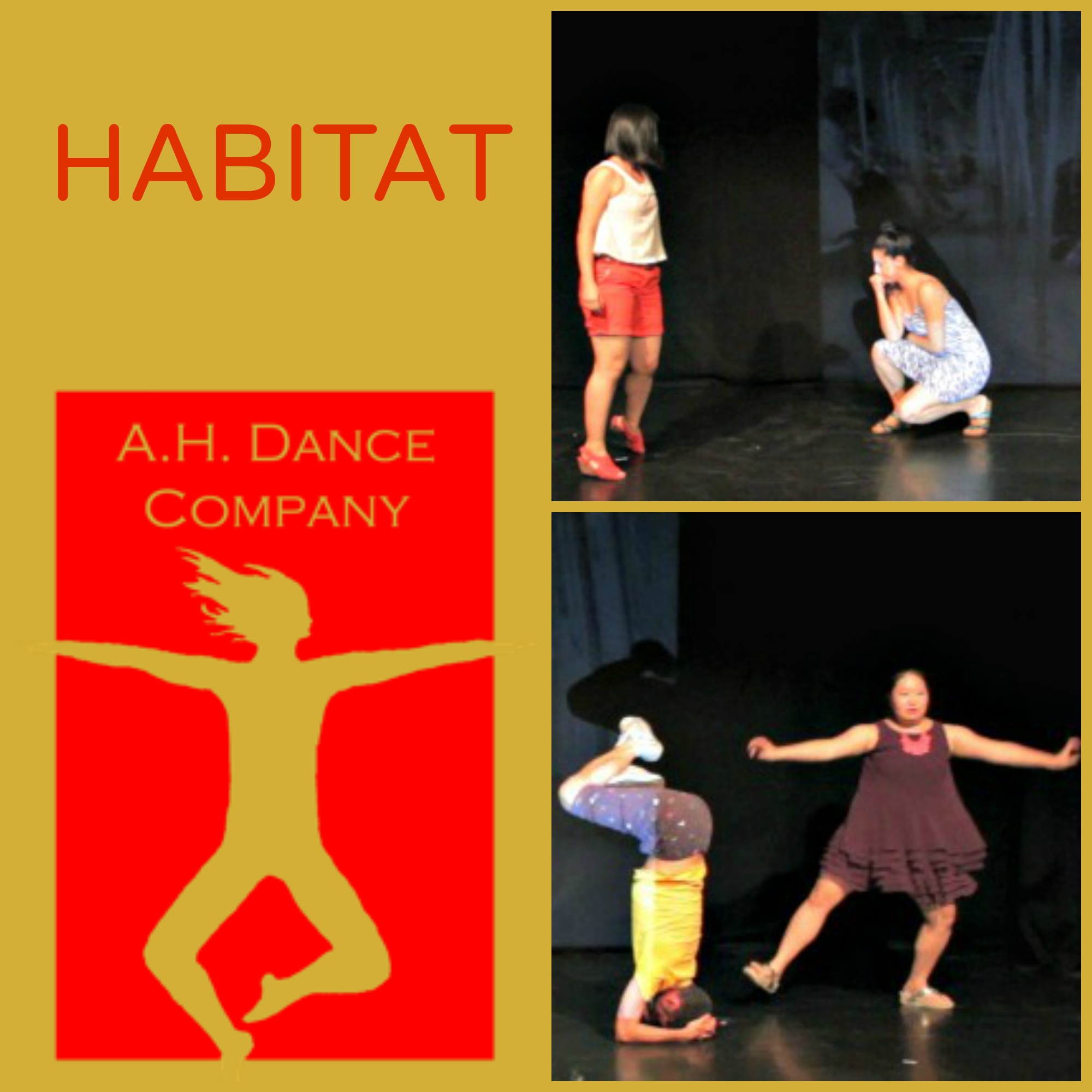
img: Video Stills by Kevin Tadge, taken from preview performances of Habitat at the Edinburgh Fringe (2013).

TCK TALENT: Alaine Handa choreographs her way to festivals in Toronto and now Edinburgh (1/2)

AlaineHanda_pmToday we introduce a new monthly column by Elizabeth (Lisa) Liang. Remember that Guatemalan-American of Chinese-Spanish-Irish-French-German-English descent who was putting on a one woman show in LA about being a Third Culture Kid? You know, she “came out” as a TCK on stage, and lived to write a post about it? Lisa will be searching for other TCK talents to interview for the series. She debuts with a two-part conversation with fellow TCK performing artist Alaine Handa (pictured). Part 2 is here.

—ML Awanohara

Third Culture Kids (TCKs) are making headlines these days for their creative output. We see them being featured in established news outlets and online magazines, as well as on popular blogs. I suspect that the emergence of Barack Obama as national and global leader—he is an Adult TCK (ATCK)—has contributed to the phenomenon.

Still, ATCKs in the performing arts remain relatively rare, so as an ATCK actress-writer I’m always happy to learn of fellow ATCK performing artists like Alaine Handa, a second-generation TCK who works as a choreographer/dancer.

Alaine was born in Singapore. She spent her childhood in Jakarta and adolescence in Singapore. She went to college in Los Angeles, California, and then moved to New York, where she formed her own troupe in December 2007: A.H. Dance Company.

She has since moved back to Singapore, where she has lived for the last year.

In this, the first of a two-part interview, I ask Alaine to tell us about her company, her TCK background, and her first internationally touring show, Chameleon: The Experiences of Global Citizens. In Part Two of the interview, to be posted tomorrow, we’ll move on to talking about her production that is about to premiere (!) at the Edinburgh Fringe Festival.

* * *

Hi, Alaine. I’m curious: what led you to form your own dance company?
Ever since I was a young teenaged dancer, I aspired to have a professional dance company that toured the world performing in different venues, festivals and theaters. I think it was because I longed to have my own choreographic voice to create dance pieces that meant something to me. Still, the decision wasn’t easy to go from dancer/choreographer to choreographer first and dancer second. After moving to New York, I continued performing for other choreographers and project-based dance companies. I only decided at the end of 2009 to focus solely on choreography while performing occasionally. I guess you could say I never lost my determination to make that happen.


Can you tell us more about your background as a second-generation Third Culture Kid?
Both my parents are TCKs. My heritage is mostly Hakka Chinese (with a bit of mix in there somewhere along the lineage). My grandparents and great-grandparents were Chinese immigrants from somewhere in China who settled in Jakarta. My mom attended an English school until it was shut down due to political pressure. She then was sent to boarding schools in Hong Kong and Sydney, and she graduated from an Australian university outside of Sydney. Meanwhile, my Dad attended a Chinese school in Jakarta before it was shut down. He helped his parents for a couple of years and then was sent to Singapore to learn English. After a year, he went to London to attend university and then to Boston to obtain a doctoral degree in optometry.

Which culture do you most identify with?
I attended American international schools in Jakarta and Singapore so I’d say I’m culturally very American. I majored in dance through UCLA’s Department of World Arts & Cultures, which looked at dance and the arts in a sociological-anthropological way and as a community-building catalyst. And then I spent seven years performing, teaching, choreographing, living, creating, loving, and building a community of TCKs in New York.

ACT 1: Chameleon goes to the Toronto Fringe Festival


A couple of years ago, your company put on a show at the Toronto Fringe Festival entitled Chameleon: The Experiences of Global Citizens. I enjoyed watching the video clip of your performance. Please tell us more about it.
Chameleon, the Experiences of Global Citizens is a full dance production with a rotating cast of three to six dancers using film, spoken word, jewelry design, music, and photography, to support the personal stories of TCKs, Cross-Cultural Kids (CCKs), and Global Citizens. Each dancer performs a solo in the production in addition to dancing in the group sections.

The video excerpt is only one section of the production: my solo. (Thanks for watching!) I layered together three different poems for the sound:

  1. “Uniquely Me,” by Alex Graham James from Ruth Van Reken and David C. Pollock’s book, Third Culture Kids: Growing up Among Worlds.
  2. “De Främmande Länderna” by Edith Södergran (translated into English), a Swedish poet I studied while attending UCLA.
  3. Last but not least, “Eulogy to my multi-racial / Multi-cultural ancestors / Also known as the anti-eulogy / To my multi-racial / Multi-cultural ancestors,” by Leilani Chan, an Asian-American theatre director in LA.

It sounds as though you’ve rolled TCK and CCK art into one cohesive piece—much like a TCK or CCK individual is the sum of many seemingly disparate parts, creating a vivid, unique entity. What was the thought process that produced this art?
Hmmm…my thought process in creating Chameleon was a lengthy one as it is very personal to me. A little trip down memory lane is probably the best way to describe it.

I graduated high school in 2001 and then moved to Southern California to attend Pitzer College. 9/11 happened a couple of weeks in. Everyone in the States was in patriotic mode. I didn’t quite fit in. Many journal entries, tears, frustrations, and conversations later, I wrote about my experience as an outsider/insider and drafted a dance piece about my mixed up cultural identity that I wanted to choreograph for my senior project. I transferred to UCLA for my third and fourth year. I experienced bouts of severe depression and several anxiety attacks throughout my college years and began to see the “light” at the end of the dark tunnel my final year.

A friend told me about the Third Culture Kids book in 2003, and a life-changing epiphany happened. I returned to my journal entries and found my ideas to create a dance piece about my experience as a TCK for my senior project. I cast a multicultural group of dancers, interviewed TCKs I knew for my very first documentary film “I am a TCK,” and rented a theatre in L.A. for my senior project and titled the piece “Third Culture Kids.” The first part of the production was the half-hour documentary film followed by a 20-minute dance piece that was autobiographical in nature. This would become the very first draft of Chameleon.

After graduation from UCLA, I was burnt out and moved to New York to pursue a career in dance. I knew that my TCK dance piece needed to be re-created again at some point. I performed for a bunch of independent choreographers, dance companies, and was teaching dance in the public schools in Brooklyn. I formed A.H. Dance Company at the end of 2007 and we had two performing seasons before I decided the time was right to tackle the stories and experiences of TCKs again. I cast dancers that were cross-cultural or TCKs, a TCK actress, a TCK jewelry designer (who created our prop pieces that were an amalgamation of HER TCK experiences), and TCK/CCK/TCA photographers submitted their work to be used as backdrops for the dance sections. I also extended and re-edited the film “I am a TCK” by interviewing even more TCKs. We premiered the piece at University Settlement in New York as part of their Spring Season in 2010, after receiving some funding from Singapore International Foundation, which also funded the performance at the Toronto Fringe Festival.

ACT II: Chameleon travels widely and goes global

We toured the production to festivals and organizations with community programming. I even presented portions of the piece, including the rehearsal process, twice at the annual Families in Global Transitions (FIGT) conference, where I met Ruth Van Reken, Tina Quick, Apple Gidley, Jo Parfitt, Julia Simens, Judy Rickatson, and many more of the TCK researchers, expat writers/bloggers, international educators, and more.

I am very proud of this work and how it has traveled around the world. Currently, Chameleon has taken on a more educational approach. I’ve re-set portions of the piece for student TCK dancers from Singapore American School and they performed it in Kuala Lumpur as well as in Singapore. In January this year, I traveled to Guangzhou to re-set a simpler version on TCK students (a lot of them were non-dancers) at the Utahloy International School for a week-long residency that culminated in a performance. The rehearsal process of telling the personal stories of TCKs through movement and dance with spoken word was equally as rewarding as the student performance itself.

* * *

This just in from Alaine at the Edinburgh Festival: The preview performances of her latest production, Habitat, have been going well, and they’ve even received a recommendation from a local newspaper, behind famous greats like Carlos Acosta and the Bolshoi Ballet (which are actually playing in London). Kudos, Alaine!

Tomorrow we’ll talk to Alaine about how this production came about. Any questions for her, meantime?

STAY TUNED for Part 2 of Lisa Liang’s conversation with Alaine Handa.

If you enjoyed this post, we invite you to register for The Displaced Dispatch, a round up of weekly posts from The Displaced Nation, with seasonal recipes, book giveaways and other extras. Register for The Displaced Dispatch by clicking here!

Related posts:

img: Alaine Handa, by Anthony Schiavo, courtesy A.H. Dance Company.

Meet author Rosie Whitehouse, who trailed her spouse into a war zone (and enter to win her book!)

Rosie Whitehouse CollageOne of the expressions I picked up from living in England for many years is “Keep the home fires burning.” For some reason, that expression, along with the WWI song from which it comes, is running through my head as I contemplate talking to today’s featured author, Rosie Whitehouse (click here to hear it being sung):

Keep the Home Fires Burning,
While your hearts are yearning.
Though your lads are far away
They dream of home.
There’s a silver lining
Through the dark clouds shining,
Turn the dark cloud inside out
Till the boys come home.

For me, Rosie is an up-to-date version of what the songwriters had in mind. Educated at the University at London, with a career as a BBC journalist, she chose to stay at home with her children and keep the house warm and welcoming, and the family’s spirits up, while her husband, the journalist Tim Judah, went off to report on various wars for The Economist and other newspapers.

Rosie even went the further step of moving the family home to be closer to Tim for a time. Ironically, she kept the home fires burning in the very place where World War I began, the Balkans. She flew out to a crumbling Bucharest—it had been knocked down by the notorious Ceaușescu, whose secret police killed hundreds during Romania’s 1989 revolution—with one child in tow and another one on the way.

Then, when it seemed possible that her own home could go up in flames as war spread across the former Yugoslavia, Rosie did not give up. She stayed for a total of five years before returning to London, by which time “keeping the home fires burning” was second nature both for her and the couple’s five kids (Tim carried on covering wars in Iraq, Afghanistan, and the Congo).

Having revived her career as a freelance journalist, she decided to write her first book: Are We There Yet? Travels with my Frontline Family—a copy of which we’ll be giving away! (See details below). The book is a tribute to families who have been “burners of the home fires,” whose emotional pain tends to go unheralded. It is also, in her words, “quite funny.” (Hey, growing up in Bucharest, Belgrade, Croatia and Bosnia can be fun!)

By now you must be as curious as I am to meet the intrepid Rosie Whitehouse and learn more about what motivated her to seek out such an unusually displaced (at least by most of our standards!) life. I note that she has an Irish mother—perhaps that explains it?! (I’m thinking Queen Boudicea…)

* * *
AreWeThereYet_cover_dropshadowHi, Rosie. In your book you say that your husband’s journalist colleagues in Romania, all of whom were single, were shocked to hear he had a two-year-old son and another child on the way. Did people often tell you you were crazy?
Yes, lots of people thought I was crazy.

As a former journalist with a background in Russian studies, do you think you felt a tinge of envy for Tim’s opportunities—which made you want to be on the scene?
Not really, as I would not have been able to cope with going to morgues and so on.

I know you’re going to challenge our definition of “displacement,” but I’ll go ahead and ask: what was your most displaced moment during your stay in the Balkans—when you had to explain Daddy’s muddy boots (he’d been walking in a mass grave), when you visited empty supermarkets, or when you heard the first shots of the conflict in Bosnia while strolling around Sarajevo with the kids?
Those things were reality so in that one doesn’t feel displacement. Quite the opposite in fact. I was intimately plugged into life and death at those moments.

How did you keep yourself sane?
I coped with stressful moments by bunkering down. I wouldn’t send the kids to school and cuddled up with them instead. As long as I shut my front door, where ever I am and whatever is going on, and it is just us, I am able to feel at home.

But getting back to your question about displacement: My best moment in a foreign country was when I saw my mother drive off in a taxi in Bucharest and realizing that apart from my two year old son I didn’t know a soul in the country (my husband was away in Albania for weeks). Wow, at last no one to tell me what to do! Freedom!

More seriously, most displacements do not happen by choice, and my most displaced moments have been as a result of this. I recount a story in the book when I took the kids to Berlin ten years ago. My mother-in-law was born there but fled in 1933 as she was Jewish. The family settled in Paris. As a result I have half French children who speak fluent French and we don’t speak a word of German.

It was a rather stressful visit as we searched for old family homes, one of which the family were still trying to reclaim. My daughter Esti got a headache. I pointed to the department store and suggested that we go in to buy an aspirin. It was Wertheims. My mother in law’s mother was a Wertheim and was murdered in Aushwitz. Esti said:

What, first they give me a headache by stealing the department store and murdering my great granny–and now I am expected to go in and buy an aspirin to make it better? You have to be kidding!

That’s displacement.

Child-rearing on the frontlines

What was the biggest challenge about having children with you on the frontlines?
The biggest challenge was often the simplest thing such as getting them something to eat and getting hold of baby milk.

Did anything surprise you?
Life never ceases to surprise me where ever I am and what ever is going on. The terrible things and the good things always amaze me.

What do you think the kids got out of the experience?
The kids learnt a lot. My eldest son, Ben, would ask about why there was no food in Romania. For me it was a matter of telling simple tales of communism and 1917. For him it began a life-long interest in Russia. He is following in his father’s footsteps.

My eldest daughter, Esti, would like to work for an NGO like Human Rights Watch.

For all of us, it drew us closer together. We are a tight-knit family.

I’ve heard of war reporters feeling bored when they come back to “reality” in their home countries. Did your family experience any of that after five years in the Balkans? What was it like to go “home” again?
Going home is just as difficult as moving to a new country. By the way, the wars didn’t stop either after we got back. My husband has since covered lots of wars and famines including Afghanistan, Iraq and the Congo.

Writing a book, but from the backlines

After you left the Balkans, it took quite a few years before you decided to write the book. What was the catalyst?
It was during the invasion of Iraq in 2003. I was standing in the supermarket and they had just installed a TV with a live feed from Iraq by the checkout. Some soldiers were running across a street in Basra, where some of the heaviest fighting took place, followed by a reporter and camera man. All of their faces were clearly visible. My husband was in Baghdad covering the story for The Economist. I had actually popped out for five minutes of fresh air before the bombers took off from the UK and the countdown to the blitz on Baghdad began.

I realized, to my horror, you could be buying a packet of frozen peas and watch your husband killed in front of your eyes. I know this thought had never entered the mind of the supermarket manager who had simply installed the TV to attract customers.

That evening I found my ten-year-old glued to a grainy grey screen showing an image of Baghdad as the cruise missiles were expected. What do you say? I had to make dinner and she had to do her homework. The UK had a huge debate about the war and the way it was covered, and I felt nobody knew what it was really like to be part of it and a kid to boot.

I also found that very quickly after the Berlin Wall came down that people forgot in Western Europe just how hard life had been under communism, especially in Romania and Albania. No surprise in that, really, as since 1945 most people in Western Europe just forgot the East existed.

I also found people in the UK quick to judge and condemn people in Southeastern Europe as being violent and prone to war. I wanted them to realize we are no different. That is why I’ve also included a chapter on Ireland in the book.

And I wanted to describe the multicultural experience of bringing up half-French, half-Jewish, part-Irish children in various countries, something I found fascinating.

Was it also part of your mission to show others what it is like to be married to, the child of, a war reporter?
Yes, not just to a war reporter but also those who are married to soldiers—especially those who are part-time soldiers and live in the community.

Did you have any personal motives in writing the book, to help you process what you’d been through and to provide your children with a record of where they’d lived?
No, not really. I didn’t write it for us but to make people think about what was going on. I am sure that the kids will appreciate it when they are older.

What was the most difficult part of the book-writing process?
Getting time to do it. I often wrote with my computer on the kitchen side as I was cooking dinner, which was good as I could hear kids talking; and as I was writing about them, it helped to have them there doing their thing.

Did you find it easy to find a publisher for the book?
No it was hard. publishing is a tough business. I started my own publishing company, Reportage Press, which closed a few years ago. Are We There Yet? is on Amazon as a self-published download these days. We also have a number of journalist friends who are taking the self-publishing route quite successfully.

What audience did you intend for the book? Did you think it would also appeal to other kinds of expats, who don’t go to war-torn countries?
Yes, there is a large expat element to the readership, and I know the book has touched the hearts of women feeling lonely and bewildered in a new country. I have been hugged and kissed by quite a few of them. One lady said reading the book had saved her marriage. I’m not sure it was me, but I hope I helped her realize it wasn’t so bad being lonely in London. It is hard being in a strange country with children. It is you who have to interpret it for them and as you are far from the family support group and friends, it is inevitably all up to you to be their world. It’s a tough job. That said, the book is far from serious. It’s actually quite funny.

Can you give us some examples of humorous moments in the book?
The kids are a laugh a minute, so whatever was going on they would often say or do something funny. For example:

For me the market in Piaţă Amzei is the focal point of life in the city centre [of Bucharest]…

“Let’s see the old ladies with the cheese. Come on!” shouts Ben as he darts out of the pushchair and into a smelly covered hall, where they sell heaps of yellowy looking curds, which are akin to feta.They are covered in flies.

The old women with their long black skirts and headscarves beckon him over and offer him little crumbs. He watches their lips and toothy grins with fascination. They look unnerving, like witches with crunched up dirty teeth, but he doesn’t run away. He has come deliberately to stare at them. He studies an old lady’s face carefully as she says something he can’t possibly understand. He is like his father, never frightened of anything and intrigued by the smallest thing. He loves the bizarre and the quirky.

* * *

“Where’s Mr Parking? Why doesn’t he find us a space?” asks Ben as we drive up and down the street outside our flat. Ben loves Mr Parking. I can’t see him anywhere.

Mr Parking is the man who organises the parking lots outside Belgrade town hall. It’s an elegant 1880s building that was once the royal palace and is right next to our block of flats. For a tip, he lets us park in the lots reserved for local officials. I haven’t seen him for weeks and have to be careful where I put the car, or we’ll be towed.

“I think he has gone back to Bosnia to fight, Ben.”

“What!” Ben is horrified.

“Why? I want to park the car. Doesn’t he want to stay here?”

“No, I expect he wanted to go home and defend his village.”

“Where is his village?”

“He’s from eastern Bosnia, the bit between here and Sarajevo [Bosnia’s capital city]. He told Dad he comes from Kamenica. It’s in one of the last bits there that’s still under Muslim control.” It’s a village close to the town of Srebrenica [the town where a massacre took place in 1995, said to be a crime of genocide].

“What! He’s a Muslim?” Ben is amazed: “But he looks like everyone else!”

“Of course, he does! You don’t look different if you’re Muslim. Bosnians look the same whether they are Muslims or not.” My mother has just sent him a book about the Crusades.

“I thought Muslims looked like Arabs.”

Are you working on any other ambitious writing projects?
I would like to write an expat guide to Britain. I spend a lot of time explaining Britain to people as I live in an expat world in the UK to a certain extent as my children have been or go to the French Lycée, and we have a lot of foreign friends who live in London.

Ten Questions for Rosie Whitehouse

Finally, I’d like to ask a series of questions that I’ve asked some of our other featured authors, about your reading and writing habits:
1. Last truly great book you read: Malaparte is on my mind as I am driving to Ukraine. His book on the 1941 invasion of Russia is unforgettable.
2. Favorite literary genre: Novels
3. Reading habits on a plane: Nothing. I am too tense on a plane as I hate flying. If I am calm enough I love to look out of the window.
4. The one book you’d require President Obama to read, and why: My son Ben’s book on Russia: Fragile Empire: How Russia fell in and out of love with Vladimir Putin. It’s a great portrait of contemporary Russia. I am his mum—what else am I supposed to say to this one?
5. Favorite books as a child: I loved Little House on the Prairie but above all I loved the stories my dad used to tell me.
6. Favorite heroine: She doesn’t have a name. She is one of the millions of women who have struggled to keep their families together against the odds. These are the mums who keep the world turning.
7. The writer, alive or dead, you’d most like to meet: I always wanted to meet William Shirer. He must have had an extraordinary experience living in Berlin at the start of World War II. Perhaps the ultimate expat experience! I suggested an interview programme with him to BBC World Service in the 80s but they didn’t have the cash to send me to America to do it. A pity as he died after that.
8. Your reading habits: I read a lot. If you want to write you have to read. I also have to read a lot for work.
9. The book you’d most like to see made as a film: None, really. If you love a book, the last thing you want is for it to become a film as you have the pictures in your head and they are your pictures not someone else’s.
10. The book you plan to read next: Vasily Grossman‘s An Armenian Sketchbook is in my suitcase. I love Grossman. He is a fantastic writer. If you haven’t read Life and Fate, you have really missed out.

* * *

Thanks so much, Rosie! Personally, I found your story very moving and think we should confer on you a “home fires” medal for all you’ve achieved!

Readers, it’s time for you to ENTER OUR DRAW TO WIN A FREE COPY of Rosie Whitehouse’s book. Rosie is giving away ONE COPY and will favor comments that tell her why you’d like to read the book.

Extra points, as always, if you’re a Displaced Dispatch subscriber!

The winner will be announced in our Displaced Dispatch on August 2, 2013.

Rosie Whitehouse is a parenting journalist and mother of five. She is one of the UK’s leading experts on family travel. She has written widely on family matters and traveling with children for The Sunday Telegraph, The Independent, The Guardian, The Daily Mail, Sunday Express, Family Circle, The Economist, and others, as well as for the Web sites B4Baby.com and Raisingkids.co.uk. She has also spoken at events and on television and radio on parenting matters, promoting her travel books and her autobiography, Are We There Yet? Travels with my Frontline Family. You can follow her latest adventures at http://www.rosiewhitehouse.co.uk/.

STAY TUNED for tomorrow’s post in our Olde vs New World series, by guest blogger Claire Bolden.

If you enjoyed this post, we invite you to register for The Displaced Dispatch, a round up of weekly posts from The Displaced Nation, with seasonal recipes, book giveaways and other extras. Register for The Displaced Dispatch by clicking here!

Related posts:

Images (clockwise from left): Rosie Whitehouse at “home” in London; Ben and his baby sister, Esti, living it up on the balcony in Bucharest (July 1991); Ben trying on his dad’s new bulletproof jacket, with Rosie’s mother in background (Belgrade, May 1992).

What’s it like to “come out” as a Third Culture Kid on stage? Elizabeth Liang tells all!

Liang Alien Citizen dancingAs reported here last month, Elizabeth Liang spent the month of May performing, at a venue in Los Angeles, a one-woman show about being a Third Culture Kid, or TCK. As some readers may recall, Liang is a self-described Guatemalan-American business brat of Chinese-Spanish-Irish-French-German-English descent. She was brought up by peripatetic parents in Central America, North Africa, the Middle East, and Connecticut. Many of us were curious about not only how she could pack all of that personal history into a solo stage performance, but also how the (mostly American) audiences would respond. Today is the day we get to find out. Take it away, Elizabeth!

—ML Awanohara

I had no idea what to expect from audiences when I opened my solo show, Alien Citizen, in Hollywood, California, on May 3rd (it closed June 1st).

Since the show is about my upbringing as a dual citizen of mixed heritage in six countries, I assumed it would appeal mainly to Adult Third Culture Kids (ATCKs) and people of mixed heritage—the people I wrote it for, since we rarely see our stories portrayed on stage or screen.

I wanted the show to be funny, but wasn’t sure if the humor would translate.

And I wanted people to be moved by the story.

Some pleasant surprises

As it turned out:
1) I was happily surprised by the composition of the audience. People of all backgrounds, ethnicities, and ages came to see my performance. Some were Americans who had never left their home state until college, others had moved domestically countless times as kids. By the same token, I was pleased that the audience did include ATCKs, global nomads, people of mixed heritage, expats, and immigrants.

2) Many of the houses were full. I had tentatively hoped the story would resonate with enough people to fill the house because the play is about identity, which everyone grapples with. That said, I didn’t expect everyone to empathize with my lifelong experience as an outsider of some kind and even feared that this experience would alienate some audience members… The full houses suggested that the show was actually resonating with most people. For this I must give credit to my director, Sofie Calderon, because she guided me to a brave and inclusive performance. I also take pride in the script, which I worked on for two years.

3) The audience laughed in the right places, mostly. I was astounded at the number of laughs I got in my preview performance. It was wonderful. This continued once the play got under way, although I did have a few quiet nights, when the audience was listening intently and smiling rather than laughing. (Then there was the night when a man in the front row fell asleep. This thickened my skin…after I considered quitting!)

4) The audiences were moved—not only at the end of the play where it was intended, but throughout the performance. People told me that they oscillated between tears and laughter for a large part of the performance—the highest praise I could have hoped for.

Nights to remember

The performance that stands out most for me was the first time my parents, brother, and aunt came to watch me. They had all traveled internationally or cross-country to see it.

My parents and brother are characters in the show, so I was unsure of how they might react. That night got some of the biggest laughs, and my family told me afterward that while they certainly laughed, they also wept throughout the performance because I was telling their story, too. The show brought back experiences they hadn’t thought of in years.

Opening and closing nights were wildly different and weirdly similar. I performed in abject terror on opening weekend, and while I kept it hidden from the audience, it was difficult to enjoy myself on stage. Through the run, I gained heaps of confidence, and was able to relax and “play” more.

However, the final show was reminiscent of opening night in that it wasn’t my best. An actor’s performance is like a speeding train with no seats—ideally, the actor makes a flying leap to catch it, hangs onto the rails, and rides it without falling. Sometimes, though, the actor has to sprint for some time to catch the train, using every skill s/he has—and then keeps slipping from the handrails and grabbing them again, never able to “coast” and enjoy the ride.

I was sorry that my closing night wasn’t a great ride for me, but the good thing about performing for different groups of people each night is that the audience has no idea of what to expect, yet the story remains the same. So closing night still managed to get a standing ovation, as had other nights.

Lessons learned from “coming out” on stage

Performing Alien Citizen was a “coming out” for me. Although I told the story as entertainingly as possible, the play explores the darker aspects of having a peripatetic childhood, being a child of color and mixed heritage in the socially segregated USA of my youth, and being a girl blooming into womanhood on the hostile sidewalks of North Africa and the cold campus of a women’s college in the States.

I had never told these stories publicly (and rarely in private) because I didn’t want to seem ungrateful for all of the wondrous experiences I’d had as a TCK (including life in North Africa and at college), but also because I’m accustomed to listeners failing to understand my point. Hearing negative stories, people tend to conclude that a peripatetic childhood is terrible, or that the country in question is not worth visiting. But that isn’t what I’m trying to say.

Alien Citizen was my attempt to pronounce that:

  1. Being a nomad, a kid of mixed heritage, and a girl can be hard.
  2. This doesn’t nullify the glorious experiences to be had from having any or all of these selves.
  3. The accompanying stories—positive and negative—have a right to be told. They are rarely told, they validate many people’s experiences, and they make a good yarn.

The overwhelmingly positive response of my audiences, night after night, taught me that my story is relatable and interesting, and that it’s a testament to my own strength as a human being, something I hadn’t known would be the case.

Doing the show also confirmed my belief that if a story is told with humor, people will listen to the darker side of it, and empathize.

I’ve been approached by universities in and out of state, as well as venues in Central America, to perform the show and teach workshops on how to create a solo show.

I hope to take the show all over the world.

I’m profoundly grateful that the world premiere of Alien Citizen has led to so many opportunities. I will also teach workshops in Los Angeles starting this fall.

* * *

Readers, I feel moved by this report even though I didn’t get to witness Elizabeth Liang’s deeply moving performance. (Elizabeth, please bring the show to New York so that I can see it!) How about you—any further questions for this brave and bold artist?

STAY TUNED for next week’s posts, featuring yet more international creatives as well as the latest episode in our fictional expat series, Libby’s Life.

If you enjoyed this post, we invite you to register for The Displaced Dispatch, a round up of weekly posts from The Displaced Nation, with seasonal recipes, book giveaways and other extras. Register for The Displaced Dispatch by clicking here!

Related posts:

img: Elizabeth Liang performing Alien Citizen in LA.

LOCATION, LOCUTION: Expat author JJ Marsh on bringing a location to life through writing

jill 3Today we welcome expat crime writer JJ Marsh to the Displaced Nation. JJ grew up in Wales, Africa and the Middle East, where her curiosity for culture took root and triggered an urge to write. Having at this point lived in Hong Kong, Nigeria, Dubai, Portugal and France—she finally settled in Switzerland—JJ certainly belongs in our midst! But what makes her even more special is that she has offered to impart her knowledge to other international creatives about the portrayal of “place” in one’s works.

Currently halfway through her European crime series, set in compelling locations all over the continent and featuring detective inspector Beatrice Stubbs (on loan from Interpol), today JJ begins a new series for us, entitled “Location, Locution.” In the opening post, she will answer the questions she plans to ask other displaced authors in future posts.

JJ, we are positively THRILLED (in more ways than one!) to have you as a new columnist. Welcome! And now to get to know you a little better…

Which comes first, story or location?
Story, always. Or at least the bare bones of the plot. Then I audition various places before beginning to write. I have to know the setting, even before populating the novel with characters. The place IS a character. For example, once I knew the victims would be corporate Fat Cats in Behind Closed Doors, the first in my Beatrice Stubbs series, I looked around for a financial centre with the right kind of atmosphere. Turns out my home town of Zürich fitted the bill and even gave me the title.

How do you go about evoking the atmosphere of a place?
I’d say by really looking at it and digging deep. Not only that, but try to look at it from the perspective of your reader. It’s no coincidence that in many European languages, one asks for a description using the word “How”.

Como é?
Wie war es?

Yet in English, we say “What is it like?” We want comparisons to what we know. I actively chose to use a foreigner arriving in a strange country/city, so as to look at it with new eyes.

Which particular features create a sense of location? Landscape, culture, food?
I start with the senses. We notice sights, sounds and smells first, and add to our impressions with tastes and textures, all the while comparing them to our expectations. Food and drink are essential, as they reveal something of the region but also much about the characters. Cultural differences have to be treated with great care in fiction. Lumpen great dumps of information are poison to pace. But subtle observations can be woven into the story, provided they are relevant. I’ve just abandoned a book set in Rome which was clumsily pasted chunks of guidebook against a sub-par Eat, Pray, Love plot. The reader wants to be immersed in the world of the book, not subjected to the author’s holiday snaps.

How well do you need to know the place before using it as a setting?
Speaking for myself, extremely well. I feel insecure describing an area I’ve never visited. But that’s not true for everyone. Stef Penney, who wrote The Tenderness of Wolves, created a beautiful story set against the backdrop of the frozen wastes of Canada. She’d never even been there.

While I am awed by that achievement, I don’t think I could do it. I need to ‘feel’ the place and also, to understand the people.

My nomadic past and interest in culture led me to study the work of Geert Hofstede and Fons Trompenaars. One of their models is to analyze culture like an onion. The outer layer is Symbols—what represents the country to outsiders/its own people? The next is Heroes—who do the people worship and venerate? Peel that away and explore its Rituals—on a national and personal level. At the centre of the Onion, you will find its values, the hardest part of a culture to access. But that’s where the heart is.

Could you give a brief example from your work which you feel brings the location to life?
The recent UK horsemeat scandal amused me, as it’s part of the average menu in Switzerland. Here my combative detectives, one Swiss, one British, have just finished lunch.

Beatrice patted her mouth with her napkin. “Herr Kälin, your recommendation was excellent. I thoroughly enjoyed that meal.”

“Good. Would you like coffee, or shall I get the bill?”

“I’ve taken up enough of your time. Let’s pay up and head for home.” Beatrice finished her wine.

Kälin hailed the waitress. “I wasn’t sure you’d like this kind of farmer’s food.”

“Farmer’s food is my favourite sort. Solid and unpretentious. Not the sort of fare they would serve in those crisp white tents at the polo park.”

Kälin let out a short laugh. Beatrice cocked her head in enquiry.

“It would definitely be inappropriate at the polo park, Frau Stubbs. We’ve just eaten Pferdefleisch. Horse steak.”

Which writers do you admire for the way they use location?
Val McDermid, particularly for A Place of Execution. Not only place but period done with impressive subtlety. Kate Atkinson, for making the environment vital to the plot in a book such as One Good Turn. Monique Roffey for bringing Trinidad to life in The White Woman on the Green Bicycle. Alexander McCall Smith enriches his stories with a wealth of local detail, be it Botswana or Edinburgh. And Kathy Reichs for making her dual identity an advantage. Donna Leon’s Venetian backdrop, Scotland according to Iain Banks in Complicity, and Peter Høeg’s Copenhagen in Smilla’s Sense of Snow.

There are many, many more.

* * *

Thank you, JJ! Readers, any further questions to JJ on her portrayal of “place”, or authors you’d like to see her interview in future posts? Please leave your suggestions in the comments. You may also enjoy checking out the first three books in JJ Marsh’s Beatrice Stubbs series:

  • Behind Closed Doors: Takes place in Zürich, where someone is bumping off bankers.
  • Raw Material: Takes place between London and Pembrokeshire. Here Beatrice is joined by wannabe sleuth, Adrian. Amateur detectives and professional criminals make a bad mix.
  • Tread Softly: Unfolds in the Basque Country of Northern Spain. Beatrice is supposedly on sabbatical, but soon finds herself up to her neck in corruption, murder and Rioja.

STAY TUNED for tomorrow’s interview with Lisa Egle, author of Magic Carpet Seduction, two copies of which we’ll be giving away!

If you enjoyed this post, we invite you to register for The Displaced Dispatch, a round up of weekly posts from The Displaced Nation, with seasonal recipes, book giveaways and other extras. Register for The Displaced Dispatch by clicking here!

Images: Typewriter from MorgueFile; picture of JJ Marsh and her book cover supplied by herself; map from MorgueFile