The Displaced Nation

A home for international creatives

Tag Archives: Strange sightings

Live your life, take chances—raise alpacas? A curious expat tale that has yielded a book-worthy yarn

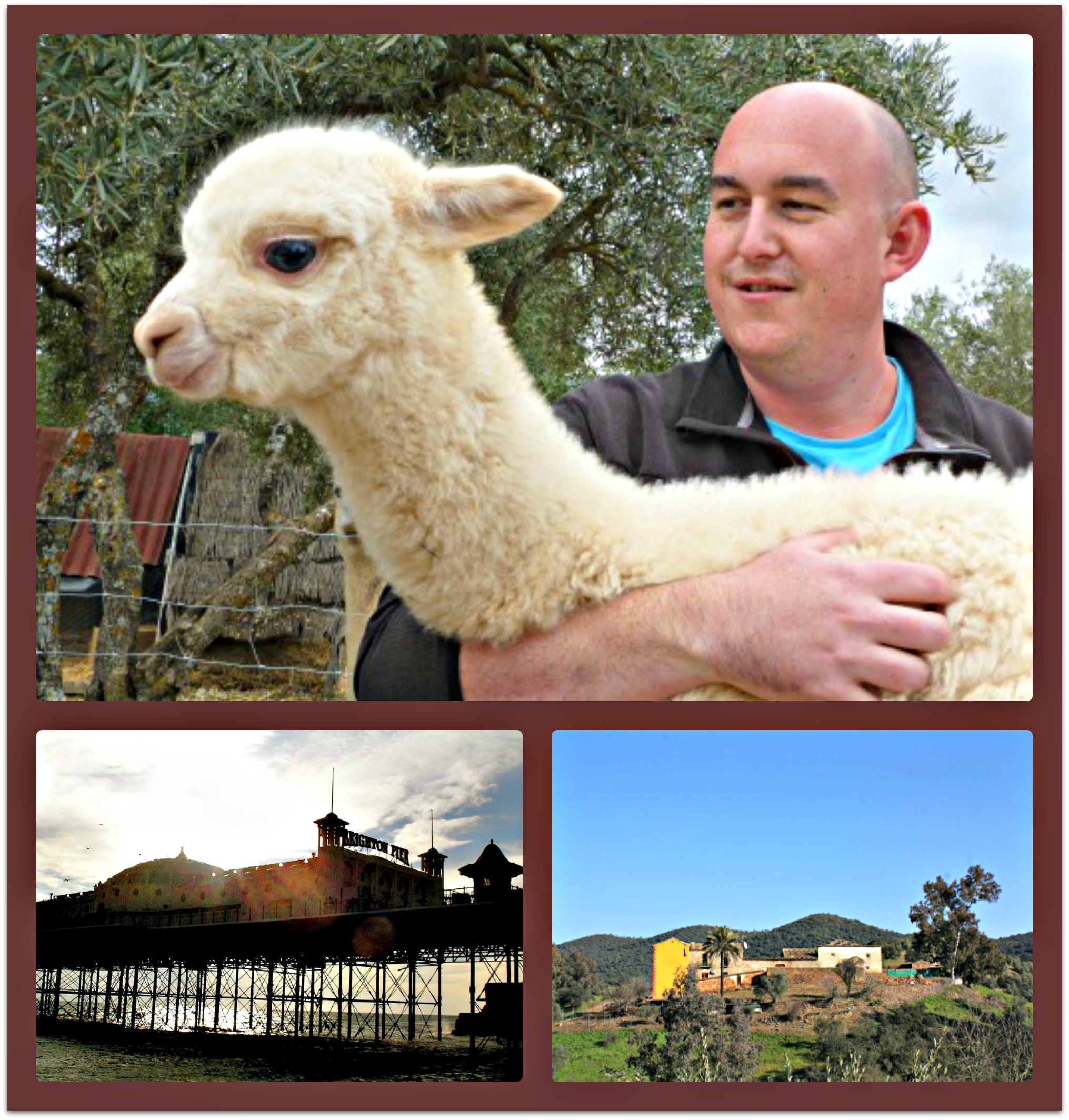
Seriously Mum Collage

(Clockwise from top) Alan Parks with a friend’s alpaca; the converted olive mill where he and his partner, Lorna, now live; Brighton Pier, scene of their former abode (photo credit: Photo Monkey via Flickr Creative Commons).

The most amazing thing about the expat memoir penned by my guest today, Alan Parks, is not simply its title, though Seriously Mum, What’s an Alpaca? is quite a doozy.

It’s not even the zaniness of the alpacas that appear throughout the narrative: Bermuda, Cassandra, Lily, Baby Rafa… BTW, they are just a few among many animals Alan and his partner, Lorna Penfold, keep. (There’s a tally of how many and what kinds at the start of each chapter.)

No, the most amazing thing about Alan Parks’s memoir is that fellow expats, particularly fellow Brits (but also one German), are the villains of the piece—the least trustworthy of all the people he and Lorna have encountered on their madcap adventure. I say “madcap” as I think the decision the couple made, six years ago, to abandon their home in Brighton (in their native UK) for a renovated olive mill near Montoro in Spain’s Córdoba Province, which is within the autonomous territory of Andalusia, to raise alpacas justifies my choice of that adjective.

From the book’s beginning, Alan’s instinct is not to stick with the expat community—as he puts it:

I don’t think we would have mixed with many of these people at home, so we should not feel forced to by circumstances.

And boy does that instinct prove right! While the Spanish merely think he and Lorna are crazy (so far as they’re concerned, the British pair may as well be raising giraffes!), their fellow Brits are out to take advantage of them in all kinds of ways. And despite Alan’s better instincts, his limited Spanish at times gives him little choice but to get involved with some pretty unscrupulous characters.

Mind you, the Spanish don’t always come off well either, especially when it comes to their treatment of animals. In light of Mahatma Gandhi’s proclamation—

“The greatness of a nation and its moral progress can be judged by the way its animals are treated.”

—it would not be too far fetched to say that the animals are the book’s true heroes. They are what keep Alan and Lorna going in face of a seemingly unending series of challenges. In tribute, Alan gives various pets a voice at the end of occasional chapters. (It’s sad when they lose them, though.)

But the reason we are assembled here today to give Alan himself a voice in telling us about his book, which I urge you to read if you haven’t already. It’s done super well on Amazon for a reason: it’s terrific! And please LEAVE A COMMENT at the end of this post to be eligible to win a FREE COPY. (Alan has kindly agreed to give one of his books away: your choice of alpacas or donkeys! And there may also be prizes for runners-up!!!)

* * *

SeriouslyMumAlpaca_bookcover_dropshadowWelcome to the Displaced Nation, Alan! Between you and your partner, Lorna Penfold, you have produced three memoirs about your life in Spain. There’s the book we’re featuring today: Seriously Mum, What’s an Alpaca?. There’s also the sequel: Seriously Mum, Where’s That Donkey? And Lorna has just now published From Sequins to Sunshine: Year One. Tell me, what has made the pair of you so prolific?
The books were never planned. Two years ago, after being told many times that I should write a book about our adventures, I decided to give it a go. Seriously Mum, What’s an Alpaca? was the result. It started out being called Bloody Hell, What’s an Alpaca?—an exact quote for how Lorna’s daughter, Frankie, responded when we told her about our plans. But the use of the word “hell” hindered sales in the US. After I released the sequel, we thought people might like to read Lorna’s point of view. She had started a blog when we first moved here, so we turned her posts from the first year into an e-book. So far the reaction has been good.

What was the impulse that led to your packing it all in and moving to the South of Spain?
Lorna was a dance teacher in the UK and I used to work in retail. Lorna developed a condition called sarcoidosis, which made working difficult. One day we were talking about the possibility of her giving up work, and I suggested moving to Florida, but that was too far away. I blurted out “What about Spain?” Crazy really, as I had never ever been here.

Hey, craziness is what makes the world round! And how about this idea of raising alpacas, where did that come from?
We had heard about alpacas in the UK and thought that would be a good business for us to get in to (it wasn’t).

Okay, seeing as I know nothing about the alpaca business, what makes it so challenging?
An alpaca is not a cheap animal, yet you can’t eat it, and it doesn’t produce milk to drink. You make money by selling them to other breeders. But sales, and the selling price, have gone down since the world financial crisis.

What about their wool?
We try to sell as much of our alpacas’ wool as possible to local people who spin, knit and use it for crafting, but the market here in Spain is miniscule and postage costs prohibitive.

Do Spanish people think you and Lorna are crazy for your devotion to these animals?
People in Spain have never heard of alpacas. To a Spaniard, a goat is a much more useful animal.

Why do you still keep your alpacas if you’re not making any money on them?
For one there is no one to sell them to, and for two, they are part of our family and we love them. We also like it when people come and stay at our farm and can experience walking and feeding the alpacas. And finally, if there were no alpacas, there would be no books.

Ah, yes, the books. We’ll get to that, but first let me ask another alpaca question. The New York Times had an article last year talking about llamas being good pets. I think the alpaca is meant to be the llama’s quirky cousin. So is the same true of them?
It depends….they are no good if you want an animal to pet and stroke. But if you have an acre of land and you need the grass kept short, they could be good. Bear in mind, though, that they need to be kept in groups of at least three!

Out of the grey skies of England and into the frying pan of Spain

Moving right along to the weather: having been an expat in Britain myself, I can imagine you were keen to leave behind its grey skies and unpredictable climate. But were you aware that the interior of Andalusia, where you were headed, is the hottest area in all of Europe?
We didn’t find out about this area being called “The Frying Pan of Spain” until much further down the line. We were sorting some paperwork at the Spanish Embassy in London, and a lady said to us, “You do know they call it the Frying Pan of Spain, don’t you?” In the summer it can easily hit 45 degrees during the day. Siestas are a necessity.

Can you give us some sense of how you spend a typical day in your new life versus when you lived in Brighton?
In Brighton I was often out the door at 7:30 a.m. and got back home about 7:00 p.m. Lorna worked in the evenings, often not returning home until 9:00 or 10:00 p.m. Also, she had to work a lot of Sundays, so we never got to see each other. In Spain our life is much more relaxed. We spend our days looking after the animals and maintaining the house, and we are now together 24/7. You could say we went from one extreme to another.

I understand you met Lorna on the Internet. How long had you known each other before hatching this plan to live in Spain?
We had been together for four years and living together for three before we made the move, so we at least knew we could live together.

Did starting up a totally new life in a foreign land put a strain on your relationship or draw you closer?
I wouldn’t say our relationship has ever been strained, although as you can read in our books, we have been through some tough times together.

Be careful what you wish for…

Having read your book, I know there were quite a few moments in Spain when you felt like a bit like aliens, but which moment stands out as your most displaced, when you wondered if you’d made a mistake?
I think our “What are we doing here?” moment came after about 18 months. We had spent all our money with an English builder renovating our new house in the sun, and we experienced the worst Spanish winter rains for a hundred years. It turned out the builder was a conman and all the roofs he’d built started leaking. On top of that two of our alpacas died in the months before. I remember us standing in our kitchen as water cascaded from the ceiling. We were both in tears.

Wow, a literal “pool of tears” moment! But I know you also have things you love about your new life. Can you tell us about your least displaced moment, when you felt you were born to be in Spain’s Frying Pan rather than your native UK?
Andalucia feels like home to us now, although it is difficult to pinpoint the exact moment when we turned the corner. I think we are most aware of it when we are sitting outside having something to eat and drink with friends at 2:00 a.m. in the middle of August, wearing only a t-shirt. That is what life is about, not whether or not you can afford the latest version of the iPad!

Would you say you’ve assimilated to the point where returning to the UK gives you counter culture shock?
Lorna visits the UK regularly as she now has three grandchildren that weren’t even thought about when we first moved here. I have not been back for five years but will head back for a weekend in June to visit my relatives and attend a diamond wedding celebration for my grandparents. In all honesty, I am a bit nervous about it, I am not looking forward to being in crowds. Here in Spain we live in the countryside outside a small town and some days we do not see a single person. Plus in June, I only ever wear shorts and a t-shirt, but in the UK I may need jumpers (sweaters) and trousers.

An Amazon bestseller in Travel with Pets and Travel in Europe

Moving on to your e-books: why did you decide to self-publish?
I wrote my first book just as self-publishing was really taking off. I submitted the manuscript to one publishing house, got a thanks-but-no-thanks letter back, so decided to publish it myself.

Are there any drawbacks to self-publishing?
As a self-publisher, the hardest part is clicking the button to publish. A traditionally published author has that taken away from them, and even if they get mixed reviews they have the backing of the publishing house. We are responsible for everything, from cover, to content, to editing mistakes. If there are problems, or mistakes in the manuscript, that is our fault.

What audience did you have in mind for the book, and has it been reaching those people?
Initially I thought it would appeal mainly to other alpaca breeders, but I have had emails from readers all over the world who say they’ve enjoyed reading about our Spanish adventure. In fact, I was so overwhelmed by the response to Seriously Mum, What’s an Alpaca? I just had to write the sequel, Seriously Mum, Where’s that Donkey?

Your book has done very well on Amazon. Do you do a lot to promote it?
I run a FB group called We Love Memoirs, which has over a thousand members, all of whom enjoy books like mine. The best way to promote is by word of mouth. If somebody recommends your book to their friend, nothing beats that. As a self publisher I am actually against the Amazon Select program, where you make your book available exclusively on Kindle. My books are available on Amazon but also everywhere else: iTunes, Barnes and Noble, Kobo and even smaller retailers.

What’s next—more books?
I would like to release a third book this year, and Lorna has years 2 and 3 in her From Sequins to Sunshine series to work on.

How are the alpacas doing?
The alpacas are good, and if all is well, we may have some babies at the end of the year.

SONY DSC10 Questions for Alan Parks & Lorna Penfold

Finally, I know that both you and Lorna have become avid readers while living in Spain, so I’m curious to hear both of you answer a series of questions that I’ve asked some of our other featured authors, about your reading and writing habits:
1. Last truly great book you read: Alan: I’m not sure I have ever read a truly great book. The books I read tend not to get put in that category. Lorna: A Thousand Splendid Suns, by Khaled Hosseini. Alan: I also have read A Thousand Splendid Suns, but I didn’t have the same reaction Lorna did.
2. Favorite literary genre: Alan: Comedy memoir. Lorna: Everything except horror.
3. Reading habits on a plane: Alan: I haven’t been on a plane for six years. Before it would have been an old fashioned book, but now I would read on a kindle app on my phone. Lorna: Always a paperback (whatever I happen to be reading).
4. The one book you’d require PM Cameron to read: Alan: Mine, of course! I think it would do him the world of good to find out that people can be happy living a more simple life, with less materialistic ideals in life! Lorna: Mine of course, just to give him a look at a day to day life of a “normal” working class person.
5. Favorite books as a child: Alan: The “Adventure” Series, by Willard Price.
6. Favorite hero/heroine in fiction: Alan: Jack West Junior, who appears in a book series by Australian author Matthew Reilly. Lorna: Mariam from A Thousand Splendid Suns, by Khaled Hosseini.
7. The writer, alive or dead, you’d most like to meet: Alan: Peter Mayle. Lorna: Khaled Hosseini.
8. Your reading habits: Alan: I read in bed at night, and a lot in the summer. Lorna: I read lots in summer as we do not watch television at all then. Plus other times of course.
9. The book you’d most like to see made as a film: Alan: Anything by Matthew Reilly, it would be like Indiana Jones on speed. And my own book of course. Lorna: My partner’s book Seriously Mum, what’s an Alpaca?
10. The book you plan to read next: Alan: Escape to Mulberry Cottage by Victoria Connelly. Lorna: The next on the shelf, whatever it is!

* * *

So, readers, any COMMENTS or QUESTIONS for Alan? Hey, it’s not every day you get to discuss the world’s most captivating camelids! And don’t forget, there’s a free digital copy on offer…

And if you can’t wait to read the book or don’t win, Seriously, Mum, What’s an Alpaca? is available from Amazon(among other venues). Be sure to grab a copy! You can also visit its companion site, like the book’s Facebook page (and be treated to lots of cute alpaca pix!) +/or follow Alan on Twitter.

STAY TUNED for next week’s fab posts!<!–tomorrow’s post, when our fictional expat heroine, Libby, returns to the Displaced Nation to update us on her many adventures. (What, not keeping up with Libby? Read the first three episodes of her expat adventures.)–>

If you enjoyed this post, we invite you to register for The Displaced Dispatch, a round up of weekly posts from The Displaced Nation, with seasonal recipes, book giveaways and other extras. Register for The Displaced Dispatch by clicking here!

Related posts:

JESS IN JAPAN: After all the hype, cherry blossom season underwhelms

JessinJapan_column

Jessica Awanohara in Tokyo (winter 2014); photo credit: Hiro Awanohara.

Jessica Awanohara moved from New York to Tokyo with her Japanese husband, Hiro, at the end of last year. What is it like to step “through the looking glass” and treat Japan as a home rather than a quirky place to visit? Jess keeps us abreast of her progress via this occasional column-cum-photos.

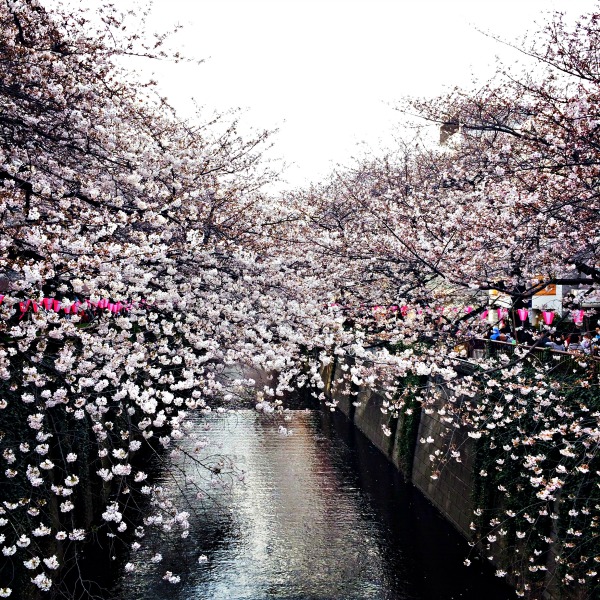
After a long, cold, all-around terrible winter, April is here, and in at least half of this beautiful world of ours, that means that spring has sprung! Crocuses are peaking through the nearly frozen plains of Central Park; monarch butterflies are beginning their multi-generational migration from Mexico to northerly climes; and in Tokyo, where I now reside, the most spectacular seasonal transition of them all—the blooming of the cherry trees, or sakura—has been taking place.

This being my first sakura season in Japan, I wasn’t entirely prepared for the national obsession with tracking when, where and how to best view the blossoms. In fact, for at least three weeks, sakura viewing was the only thing anyone talked about. Friends regaled us with stories of sakura seasons past, advising on the best and worst parks in Tokyo for beholding the spectacle of the storied blossoms. Like stock tips, they whispered these insights authoritatively, as though acting upon them would determine our very future.

I learned, for instance, that Inokashira Park, in the northwestern part of the city, was “too crowded, wild, and ‘diverse'” while Nakameguro, in the southeast, was the “ideal spot for a first-timer” like myself.

Meanwhile, the sakura craze was heightened by CNN-style coverage on TV. Whole segments of the morning and evening news were dedicated to maps, predictions, histories, and images detailing the slow ascension of blossoms from Okinawa to Hokkaido.

By the time the trees were showing their first buds, all I could think about was the prospect of attending a viewing party. In case you haven’t heard, celebrating under a fully blossomed cherry tree, a festival known as ohanami, is as eagerly anticipated as the blossoms themselves. All of Tokyo, it seems, comes out for marathon sessions of en plein air eating and drinking, presumably turning as pink as the flowers.

But as luck would have it, this year things would be different. Tokyo was soaked by two straight weeks of hard rain and cold weather. The delicate pink sakura petals were washed away before they were able to reach full bloom.

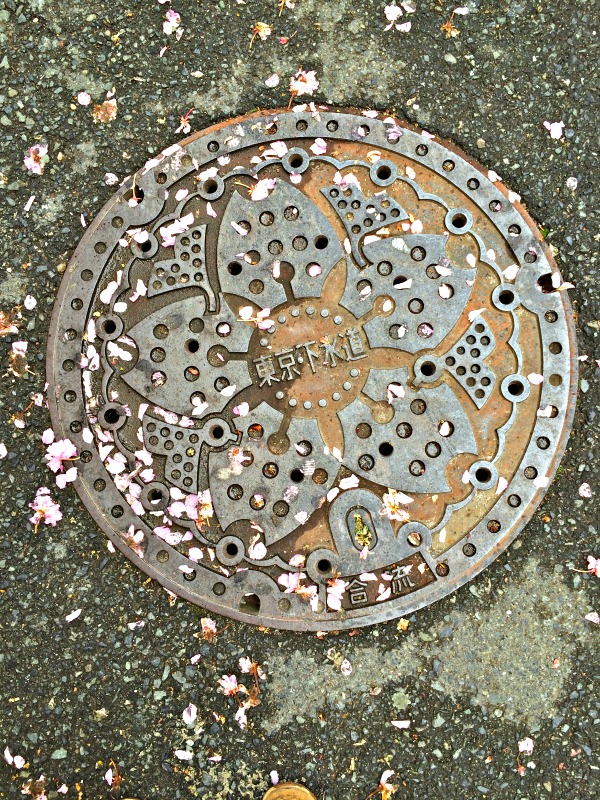
Braving these inclement conditions, my husband and I biked to a couple of nearby parks and well-known streets to soak up whatever we could (hopefully without getting too soaked!). But the grey skies and cold weather kept our spirits, along with the blooms, at bay. In fact, it was almost too depressing to document the mostly bare branches and paltry spray of revelers, but here, readers, are a few mementos of my first cherry blossom season in Tokyo:

Early sakura in Nakameguro; photo credit: Jessica Awanohara.

Early sakura in Nakameguro, alongside Meguro River, the recommended destination for newbies; photo credit: Jessica Awanohara.

At least someone is trying to get his party blooms on; photo credit: Jessica Awanohara.

At least someone (see man on curb) is trying to get his party blooms on; photo credit: Jessica Awanohara.

The actual best spot to view cherry blossoms this year, snapped on the way to an interview in Shinsen; photo credit: Jessica Awanohara.

The actual best spot to view cherry blossoms this year, snapped on the way to an interview in Shinsen; photo credit: Jessica Awanohara.

* * *

Thanks, Jessica. Sorry to hear it was such a wash-out! Readers, Jess’s experiences raises a classic Displaced Q: How many of you have sought an iconic experience during your stay abroad that didn’t quite live up to your expectations?

STAY TUNED for tomorrow’s fab post!

If you enjoyed this post, we invite you to register for The Displaced Dispatch, a round up of weekly posts from The Displaced Nation, with seasonal recipes, book giveaways and other extras. Register for The Displaced Dispatch by clicking here!

Related posts:

HERE BE DRAGONS: The expat life as fuel for fantasy writing

Serpent Map Collage Drop Shadow

(Clockwise from top): Detail of the medieval map Carta marina; the Speicherstadt (warehouse district) in Hamburg, Germany; Andrew Couch (photo credit: Andrew Couch).

Welcome to the Displaced Nation’s very own Game of Thrones. To be eligible, you simply have to be, or have been, an expat or world traveler of some kind, and open to seeing the connection between the international life and fantasy fiction. Andrew Couch, an American expat in Germany, will be our coach (no pun intended!). Though he has not been playing the game for long, having published his first fantasy novella only last month, he is already dancing with dragons, and thinks that you should be, too…

—ML Awanohara

Living as an expat in another culture forces you to interact with the world in a different way. You cannot rely on the habits of your home and things around you are strange—sometimes really really strange.

Yet they are perfectly normal to the locals.

This echoes my experience of reading (and now writing) fantasy fiction. I didn’t really think about it that way until I started writing this post, but I guess it should have been obvious all along.

Trip the “expat life” fantastic

I’ve always loved the fantasy genre, ever since I could read. The first book I remember was Voyage of the Dawn Treader, by C.S. Lewis, although I certainly delved into Tolkien’s The Hobbit very early on as well. Both are fantasy but also involve travel. As a child, I was drawn to the imagery of the strange places depicted in these books.

Maybe that feeling of diving into fantastical worlds is what led me to a life of travel as an adult, and ultimately to the life I now have in Germany as an expat.

The characters in fantasy novels accept their world as it is. They might accept that magic exists in a specific form—or that elves, trolls and ogres wander the street selling sausages.

Is this really so much of a stretch from what we accept as expats sometimes?

After living for six years in Germany, I almost take for granted how orderly everything is: I like knowing that the tram will come at an exact time. I’ve also come to appreciate being able to sit in a restaurant all evening without anyone shoving the bill at me to pay and leave.

I do notice, though, that the more I integrate with the local life, the more I crave a creative outlet. Several years ago, when I’d been living in Freiburg for a couple of years, my apartment lease was running out and I had to decide: should I find a new place to live, or was it time to move on? In the end, I decided to buy my own apartment, which tied me still more closely to the wonderful town of Freiburg. I was happy but also felt that doors were closing, and I needed to seek other outlets. I ended up starting a blog, Grounded Traveler: Expat life in Germany and still seeing the world. I tried writing fiction, too, but must not have been ready.

Just last year I made a career shift. For 13 years I had worked as a Web developer for an employer, but I decided to leave and start my own freelancing business. Being my own boss has given me the freedom to do what I want when I want, but there are limits on that freedom as I must constantly be on the lookout for projects.

QueenOfCloudPirates_coverCraving the fantastic once again, I started writing a series of fantasy novellas. I self-published the first episode, Queen of the Cloud Pirates, in March and am working on the next one now, based on the inspiration of living and traveling abroad.

Thinking of blue almonds (Polish for “daydreaming”)

Much of my inspiration for writing fantasy comes from the places my wife and I visit on our travels. My follow-on novella to Queen of the Cloud Pirates (I’ve just finished the first draft) is set in a fantasy port city.

Not long ago, my wife and I traveled to Hamburg for a few days and spent time in Speicherstadt, an area of the city full of canals and towering brick warehouses with elevators and cranes around them. On that occasion I let my imagination go, wondering what a sword fight among the ropes and narrow stairs would be like. This has driven a fair amount of the book’s setting.

Of course inspiration can come from anywhere, not just from a city’s wonderfully distinct architecture but also from more mundane settings. For instance, here is a snippet I wrote after glimpsing an unusual face on the subway in Berlin:

A man sat hunched over in the subway seat, his chin piled on top of both hands steadying himself on his cane. A white fluffy mustache flowed over the side of his hands like a cascade of falling clouds. His oh-so-attentive eyes, in contrast to his nearly decrepit body, watched from beneath equally fluffy eyebrows that flowed up in the same way the mustache floated down. Was this a visitor from the realm of clouds come to watch us on earth? I pondered the significance of seeing this man underground as I got off at my stop and watched him through the window as the train sped away.

I am constantly collecting such snippets and images on my travels. In fact, I’m now half-way through another story based on a mis-heard subway announcement about the train ending and needing to transfer to the “elephants”—well, that’s not what the conductor said but it’s how I heard it. I have been thinking about the story so much I can’t really remember the original line, but I expect I heard something about transferring to bus line 11 (elf in German) and, despite being fluent in German, thought of elephants.

Here Be Dragons (in Latin, Hic Sunt Dracones)

Readers, do you collect thoughts and ideas when traveling to, or living in, strange surroundings? And if so, are you inclined to turn these snippets into stories?

While I have a fantasy-oriented imagination, and tend to see dragons or other fantastical beasts when venturing into new territory, I imagine that such snippets could support any genre of writing.

I look forward to seeing you next month, when I will continue exploring how encounters with different landscapes, cultures, cities, architecture, and people can stimulate the imagination in some strange and wonderful directions. Let me know in the comments if you’re fantasizing about any particular topics, and I’ll see if my imagination can stretch to accommodate.

Andrew Couch has been a fantasy book nut since childhood; he really has not grown up much since then. After struggling to write his own games for years, he is now creating fantastical worlds in a series of novellas that echo the TV shows, anime and role-playing games of his youth. Beyond fantasy he is an avid blogger and a world traveler who resides in Germany. To learn more about Andrew, check out his blog, Grounded Traveler, and follow him on Twitter: @groundedtravelr.

STAY TUNED for next week’s fab posts!

If you enjoyed this post, we invite you to register for The Displaced Dispatch, a round up of weekly posts from The Displaced Nation, with seasonal recipes, book giveaways and other extras. Register for The Displaced Dispatch by clicking here!

Related post:

For this intrepid Irish “ruin hunter,” a picture says…

Ed Mooney 1,000 words Collage

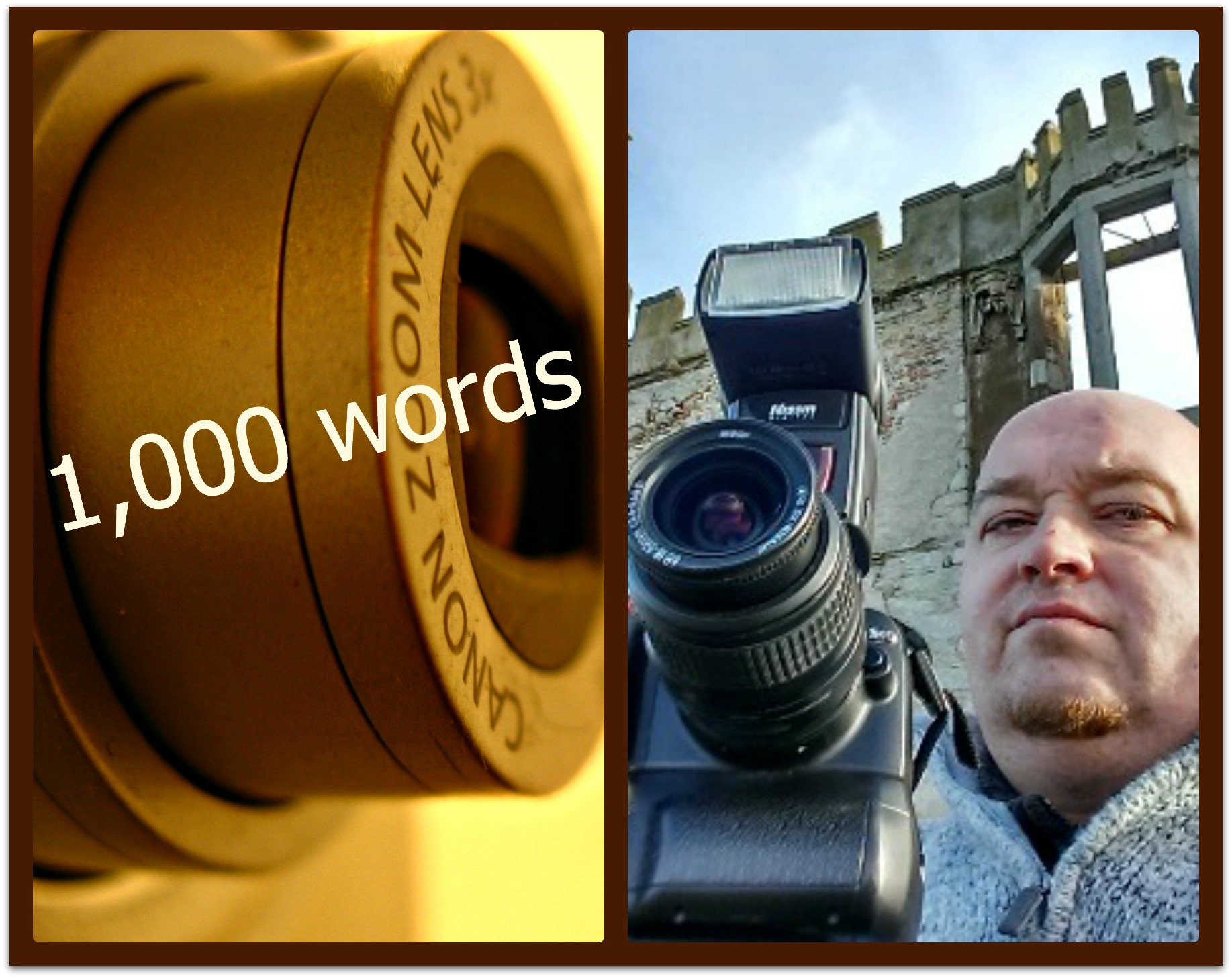
Canon zoom lens; photo credit: Morguefiles; Ed Mooney in front of the ruins of Ducketts Grove, County Carlow (photo credit: Ed Mooney).

Welcome to our monthly series “A picture says…”, created to celebrate expats and other global residents for whom photography is a creative outlet. The series host is English expat, blogger, writer, world traveler and photography enthusiast James King, who thinks of a camera as a mirror with memory. If you like what you see here, be sure to check out his blog, Jamoroki.

My guest this month is 38-year-old Irishman Edward (Ed) Mooney. His story is quite different from previous guests for several reasons, the main one being that he is not an expat. On the contrary, he travels within the confines of his native Ireland.

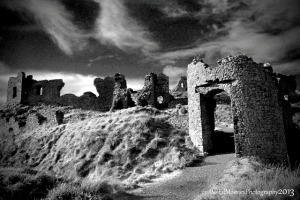
That said, Ed does cross boundaries, at least in a temporal sense. He loves nothing more than to immerse himself in an obscure historical site, exploring Irish history, lore and mythology while also photographing the surrounding ruins, to keep a record of what remains from generations past.

I really like the name Ed has given to his hobby: “ruin-hunting”. Ed tells me that ruin-hunting merges Past, Present & Future. By researching the history behind a place, he pays tribute to the Past. By writing about the experience, he brings it into the Present. And by posting his article, along with his photos, on his blog, he preserves his findings for the Future.

I have been following Ed for some months and love the way he weaves historic research into (mostly) black-and-white images.

* * *

Hi, Ed. Thanks for joining me at the Displaced Nation. I know you live with your young family in Kildare, but where were you born and what gave you the urge to travel around Ireland photographing ancient ruins?
I was born in Dublin, where I lived until flying the coop at 17. I moved to Kildare for work. I only got into photography seriously three or four years ago. With a young family, I don’t get to go abroad very often. But I am fortunate enough to travel within Ireland itself, which with its rich heritage offers an abundance of fascinating sights. And the crazy thing is, the majority of them are relatively unknown and rarely visited. It is these off-the-beaten-track places that I tend to concentrate on while traveling the country, attempting to capture them with my DSLR camera.

“I love everything that’s old…” —Oliver Goldsmith

You seem to have found an interesting niche. Can you tell us a little more about this “ruin hunting” hobby of yours?
It all started in 2011. I had just gotten my first DSLR and joined the local camera club, but had very little opportunity to get out and about shooting. I wasn’t into wildlife or landscape photography like some of the other club members. I guess I was searching for my niche, as you put it. One day a flyer came through the letterbox, which had an image of a nearby historical site called the Rock of Dunamase, in County Laois. Though I didn’t know it at the time, this was the beginning of what would become an obsession. A few days later, I located Dunamase and went exploring. Now, looking back at the photos, I cringe—but at the time I thought they were the best shots I’d ever taken. Around this time I had starting blogging and decided to post a brief essay on the history of Dunamase, along with the images. Next thing I knew, I was spending all of my spare time searching out new sites. Now that the kids are a little older, I have been able to take them on some of my trips. To date I have explored sites in nine counties with plans for many more over the coming months.

When you said “a flyer came through the letterbox…,” I immediately thought of a WWII fighter pilot. I would love to know more about what inspires you to spend so much of your spare time visiting historical places.
My inspiration comes from my deep love of history. In my early twenties, I joined what was then known as the Heritage Awareness Group, or HAG. We visited sites such as Newgrange, Tara and Baltinglass Abbey. Nowadays my favourite ruins are castles and Neolithic sites such as stone circles and cairns, although I am forever coming across many ecclesiastical sites which are interesting in their own right and make for some stunning shots. It’s quite hard to find the locations so I’ve created maps for each county, and make a point of recording every site I visit on my blog along with an interactive map showing the exact location to assist other travellers.

It’s great that you record your findings in so much detail and include exact locations in case others are inspired to follow in your footsteps. Ireland is a small country, unless you get lost. Tell us, where are you now, how did you end up there and what is life like in that part of the world?
We have been in Monasterevin, Kildare, for almost seven years now and absolutely love it. It’s a different way of life to Dublin. If I didn’t have to commute daily to the City to work, I would probably return there rarely. The great thing about Monasterevin, besides the relaxed atmosphere and close community, is that I am situated almost in the centre of Ireland. I can travel to any part of the country in two to three hours, which is great considering the amount of travelling involved in “ruin hunting”.

Rock of Dunamase. Photo credit: Ed Mooney

Rock of Dunamase. Photo credit: Ed Mooney

I’ve never been outside Dublin but I hear the countryside is beautiful. Other benefits are that you never run out of Guinness and you just won the Six Nations rugby! Thank you for sharing some of your photo shots which capture a few of your favourite memories. Can you describe the story behind them and what makes them so special?
These three are from recent shoots. The first, of the Rock of Dunamase, is a special place not just for the stunning views and fascinating history but also because it’s where my journey started.

Church ruins in Laois; photo credit: Ed Mooney.

Church ruins in Laois; photo credit: Ed Mooney.

The second photo is of another site I discovered in neighbouring Laois, which, with its stunning views, constitutes a ruin hunter’s paradise. This one is special on a personal level as well, being the first ruin I visited with all three children. In the chancel to the rear of the church is an old iron gate blocking the entrance to a vaulted mortuary chamber. Ryan, my eldest, had an interesting observation on the chamber: “Daddy, that’s where the Vampires live.” Now how the heck did he come up with that? Have you ever tried convincing an eight-year-old that something doesn’t exist?

Skryne Hill Church; photo credit: Ed Mooney.

Skryne Hill Church; photo credit: Ed Mooney.

The third is of the church that sits on Skryne Hill, the site of an early Christian settlement. To this day my memory of Skryne remains vivid. The tower is inaccessible due to a very heavy iron gate that on examination appeared to be rusted shut. I shone my torch through the bars on one of the windows. Inside were a number of interesting stone artifacts that I wanted to capture. So I set up my flashgun and shot through the bars. On the second or third flash something physically grabbed my camera strap and pulled it into the tower. It all happened so fast, but somehow I managed to pull that camera away from the window while shouting a few expletives. At first I wondered if it might have been a draft of some kind that had caught my strap, but it could not have been as I was pressed right up against the opening and there was no wind to cause a draft. Then I thought that maybe someone was inside, but there was no way for a person to get in or out of the tower. To this day I still can’t explain what happened. But it certainly left a lasting memory.

“Memory, in widow’s weeds, … stands on a tombstone.” —Aubrey de Vere

Great memoriesand that last story is quite eerie. But I suppose you would expect the odd ghost or two in buildings so old? Now, out of these many destinations, do you have any that stand out as your favorites?
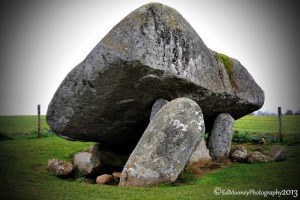
If you haven’t already guessed, old ruins are what attract my attention, be it a crumbling castle, a neolithic stone circle or standing stone, or an ancient church overgrown with ivy. Here are three of my favorite places:

Brownshill Dolmen, County Carlow; photo credit: Ed Mooney.

Brownshill Dolmen, County Carlow; photo credit: Ed Mooney.

Ballymoon Castle, County Carlow. Photo credit: Ed Mooney

Ballymoon Castle, County Carlow; photo credit: Ed Mooney.

Cillbharrog Church & cemetery; photo credit: Ed Mooney.

Cillbharrog Church & Cemetery; photo credit: Ed Mooney.

Can you explain why these particular places inspire you?
It’s kind of hard to explain but once I set foot on the site of an ancient monument, something about the atmosphere affects me, and a flip switches in my head. I feel as though I’m stepping back in time. The modern world disappears for a while and I get to experience something really special. With my photography I try to capture that experience and hopefully portray it to the viewer. Mood, atmosphere and a sense of the past are the most important elements for me to enjoy shooting at a location.

I can assure you, Ed, that, for me, you usually achieve it. Your photos make me feel as though I’m there, not you. I know people aren’t a part of your ruin hunting but I want to ask you all the same if you ever feel reserved about taking photos of people on your travels, particularly when they are conscious you are doing so?
I still enjoy getting out and doing some street photography from time to time and I have never really had an issue with shooting people, but then again I have had plenty of experience ranging from large events in Dublin down to small country festivals. I guess at the start I was a bit shy and unsure of how to approach shooting strangers, but once you learn how to engage with a subject it becomes fun. Some of the best shots I have taken were the result of strangers coming up to me wanting to have their pictures taken. Parades and street festivals are probably the best for doing this as everyone is relaxed and having a good time.

Do you ask permission before taking people’s photographs?
Most times I don’t have to. I find it amazing how people start posing once they see a camera in your hand. Obviously, with children you have to be really careful these days and should always get parental permission.

“Ireland’s ruins are historic emotions surrendered to time.”—Horace Sutton

Interesting—that last point would never be considered in Thailand, where I live. So would you say that photography and the ability to be able to capture something unique which will never be seen again is a powerful force for you?
Absolutely, I would say that most photographers constantly strive to get that once-in-a-lifetime shot. In my case the deeper motivation is to capture historic sites for posterity. As in many other countries, Ireland’s local and national heritage sites continue to disappear for good. Most people don’t care and the government is only interested in money. Take my home town of Tallaght, a suburb of Dublin. There were several castles in the area up until about 40 years ago. Now only a part of one remains. This scenario recurs with alarming regularity. So if I can capture the essence of a place before it is wiped away for good, I have done my job.

I see you use the word “job”. But I see it more as a calling and you, as a preservationist and historian. Either way you are doing an excellent “job”–one that incidentally reminds me of my last interview subject, Gaetan Green. He is trying to record China’s traditional landscapes before they fall to the forces of modernization. So when did you realize this deeper purpose?
Right from the start. The need to preserve the past was a major factor in motivating me to choose this path for my photography.

Now for the technical stuff at which I am far from proficient. What kind of camera and lenses do you use? And which software do you use for post-processing?
I still use my trusty Nikon D40 with kit lens. Yes it is outdated by today’s standards, but it has served me well over the last few years and taken a lot more punishment than it should have. I am planning to upgrade later this year and hopefully the D40 will be converted to shoot Infra Red, which is something I really want to experiment with. For my raw images ACR is a must, but my one stop shop for post processing has to be Photoshop. I currently use CS6 and it does everything I need. I still have various other programs sitting on my desktop but these rarely get a look-in.

Finally, do you have any advice for wannabe photographers who are traveling or living abroad?
If I was starting photography now I would say take the time to enjoy what you do and most importantly, research, research, research. Find out as much as possible about the place you are travelling to. Look at as many images of the place as you can, take inspiration from them and don’t go and shoot the same scene as everybody else. Look for a new angle or view. Don’t be afraid to get creative.

Thank you, Ed. It has been a real pleasure to interview you. Your story so far is fascinating. I say so far because I know one day you will run out of ruins in Ireland and you’ll be dreaming up your next historical project in places further afield.

* * *

Readers, what do you make of Ed’s experiences and his photography advice? And do you have any questions for him on his photos and/or experiences? Please leave them in the comments!

And if you want to know more about Ed Mooney, don’t forget to visit his excellent photography site. You can also like his Facebook page, follow him on Twitter, connect with him on LinkedIn, or shoot him an email.

(If you are a photographer and would like to be interviewed by James for this series, please send your information to ml@thedisplacednation.com.)

STAY TUNED for tomorrow’s post, the start of a brand new column on travel and fantasy writing, by Andrew Couch.

If you enjoyed this post, we invite you to register for The Displaced Dispatch, a round up of weekly posts from The Displaced Nation, with seasonal recipes, book giveaways and other extras. Register for The Displaced Dispatch by clicking here!

Related posts:

And the March 2014 Alices go to … these 3 international creatives

 © Iamezan | Dreamstime.com Used under license

© Iamezan | Dreamstime.com
Used under license

If you are a subscriber to our weekly newsletter, Displaced Dispatch, you’re already in the know. But if you’re not (and why aren’t you? off with your head!), listen up.

Every week, when that esteemed publication comes out, we present contenders for a monthly “Alice Award,” most of whom are writers or other kinds of international creatives who appear to have a special handle on the curious and unreal aspects of being a global resident or voyager.

Not only that, but this person tries to use this state of befuddlement as a spur to greater creative heights.

Today’s post honors March’s three Alice recipients. Starting with the most recent, they are (drumroll…):

1) CANDACE ROSE RARDON, travel writer and sketch artist

For her interview:  “Watercolouring Her Way Around the World,” on Linda Fairbairn‘s Journey Jottings blog
Posted on: 14 March 2014
Snippet:

“In a way, my sketchbook also helps create the moments I record in it. I might head to a café to draw a street-scape, start talking with the man next to me, and then jot down a line or two from our dialogue on the sketch itself. Sketching has become both my muse and medium on the road—it creates the very stories I love to tell, stories of connection and serendipity, and I now can’t imagine ever travelling without my sketchbook.”

Citation: Candace, we think we should invent a new award for you: a “Poppins.” Your watercolors look so inviting that we want to jump right into them and share in your adventures, just as Mary Poppins jumps into Burt’s chalk drawings. (Incidentally, we refer to the animated sequence in the movie, of which P.L. Travers did not approve, only to be overruled by Walt Disney.) Poor Alice doesn’t go down the rabbit hole because of its visual stimulation; quite the opposite! She goes down the hole due to boredom with her sister’s book “without pictures or conversations.” Our sense is that, were you to receive an “Alice,” it would need to be presented by the Mock Turtle, art lessons having played a role in his superior education:

“Well, there was Mystery,” the Mock Turtle replied, counting off the subjects on his flappers, “—Mystery, ancient and modern, with Seaography: then Drawling—the Drawling-master was an old conger-eel, that used to come once a week: HE taught us Drawling, Stretching, and Fainting in Coils.”

Though he doesn’t mention “water” art, it seems likely he would sanction it. Definitely he would not be a fan of our alternative suggestion unless we agreed to call the prize a “Puffins” instead of a Poppins. But enough of these qualifications; suffice it to say, we are in awe of your ambition to “watercolour” your way around the world. You paint, girl!

2)”The Expat” in Korea

For his post: “The Reincarnation Lottery,” on ExpatHell.com
Posted on: 18 March 2014
Snippet:

We may be dogs, but we are dogs with memories. Memories of where we came from. Memories of hot summer days, clear blue skies, people smiling, people laughing, wind slicing through large trees with leaves whisking and shimmering in the sun like waves washing over a million shiny round stones. We are four dogs with memories of home, and somehow, we are all going back. This is what we wail about during the pitch black nights and all we dream about during the hazy grey days.

Citation: The Expat, we have been around the world a few times so are well aware of South Korea’s proclivity for dog meat consumption. This may be why we find your description of yourself and your three mates as a pack of four large wailing dogs on a dog farm “in the lonely cold mountains and valleys of the Korean countryside” alarming. But no more alarming, we suppose, than Alice’s own sense of transformation as she progresses through Wonderland:

Alice took up the fan and gloves, and, as the hall was very hot, she kept fanning herself all the time she went on talking: “Dear, dear! How queer everything is to-day! And yesterday things went on just as usual. I wonder if I’ve been changed in the night? Let me think: was I the same when I got up this morning? I almost think I can remember feeling a little different. But if I’m not the same, the next question is, Who in the world am I? Ah, THAT’S the great puzzle!” 

A good thing she doesn’t prolong her stay in Wonderland, that’s all we can say. Can she be far off from imagining herself as a caged rabbit that is about to be thrown into the cauldron of pepper soup being stirred by the Duchess’s cook? In any case, we really appreciate your honesty in telling the story, in such a creative way, of four American men arriving in Korea in hopes of a fresh start as English teachers, only to end up “starting over and starting lower.” We can certainly see why you aspire to returning to our “dog eat dog” society here in the West. Only please promise that between now and then, you won’t land in a bowl of Korean soup, which, needless to say, will be a great deal more firey than the Duchess’s.

3) ALEX BAACKES (aka Alex in Wanderland), freelance writer and New York native on the move

For her post: “My Top 8 Animal Encounters Around the World,” on Michael Hodson‘s Go, See, Write blog
Posted on: 20 February 2014
Snippet:

Today, I seek out encounters with animals that are willing participants in sharing their space with me; one where everyone walks—or swims—away happy. . . . While I’m still not quite sure how sailors once mistook manatees for mermaids, I can now attest to the fact that these bulbous creatures move with a surprising amount of grace. Braving the chilly winter waters? Worth every shiver to share a swim with these beauties.

Citation: Alex, we are struck by how quickly you have come to the realization that, while it can be fine, even fun, to encounter other human beings on your travels, you should not miss out on the opportunity to interact with new kinds of mammals—relationships with whom could end up being much more therapeutic, especially if they’re the kind you can swim with. Alice, of course, had no qualms about swimming with the Wonderland creatures:

It was high time to go, for the pool was getting quite crowded with the birds and animals that had fallen into it: there were a Duck and a Dodo, a Lory and an Eaglet, and several other curious creatures. Alice led the way, and the whole party swam to the shore.

But in Alice’s case, she was swimming in a pool made of her own tears. We congratulate you on being much more sensible in heading Crystal River, near Orlando, which plays host to the migrating manatees from October to March.

*  *  *

So, readers, do you have a favorite from the above, or have you read any recent posts you think deserve an Alice Award?  We’d love to hear your suggestions! And don’t miss out on the shortlist of Alice contenders we provide in each week’s Dispatch, which are sources of creative thought if nothing else! Get on our subscription list now!

STAY TUNED for next week’s fab posts.

Writers and other international creatives: If you want to know in advance the contenders for our monthly Alice Award winners, sign up to receive The Displaced Dispatch, a round up of weekly posts from The Displaced Nation, with news of book giveaways, future posts, and of course, our weekly Alice Award!. Register for The Displaced Dispatch by clicking here!

Related posts:

Does an expat life in Los Angeles ever go according to script? Read Tim John’s memoir to find out…

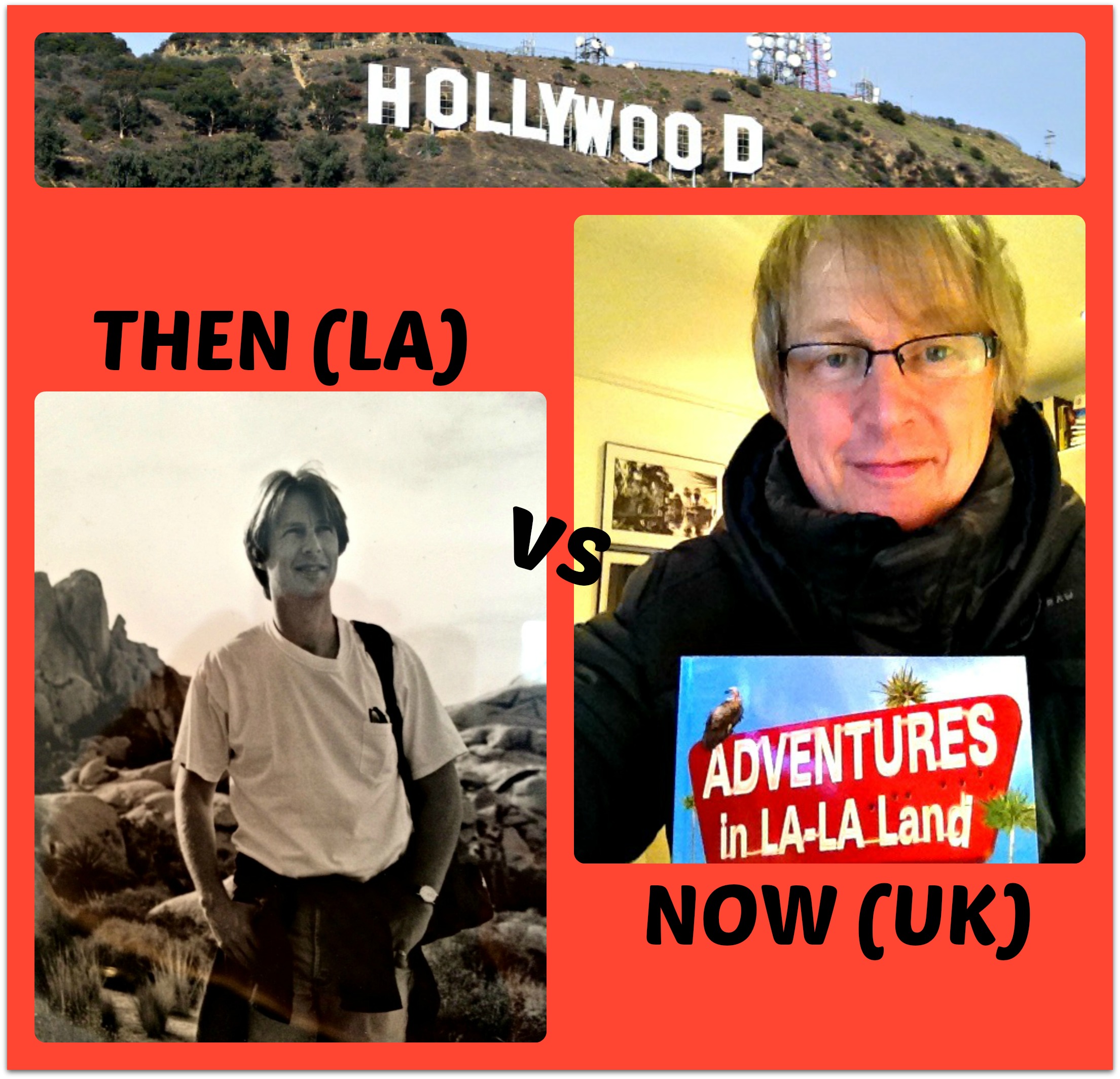
Tim John Hollywood CollageFor many of us, the calling to the expat life is not really a calling at all, but more of a vague (albeit rather deep-seated) need to escape our surroundings in search of adventure. We have no idea of what we’re looking for until we’ve arrived at a place and put down roots. Even then, we still have the mentality of drifters, and it take us a while to access our muses.

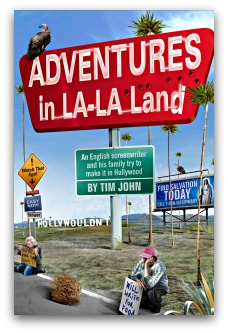
My guest today, the screenwriter Tim John, does not belong in that mould, as soon becomes clear from the first few pages of his new book, Adventures in LA-LA Land, an account of the seven years he spent in Los Angeles with his wife, Jenny, and their two young daughters.

You see, Tim plunged into his particular expat adventure with the script already written, both literally (he had a project in the works) and figuratively. Heading for Hollywood was Plan B after he lost his job with a London advertising agency during the recession of the early 1990s, and started dabbling in screenwriting.

The late Christopher Hitchens, another English writer who chose to be based in the United States, once described LA as a city “mostly full of nonsense and delusion and egomania.” But in the script Tim had written for himself and family, it was LA-LA Land—a place where they could have it all, great climate, a house with swimming pool, and (hopefully) big money.

So did Hollywood feed Tim’s creative muses (and fill his coffers) in the manner he expected? You’ll have to read the book to find out. I read it, and found myself surprisingly moved by the story of a man who lives for the movies. In fact, the pace can be likened to that of a roller coaster ride—fun but also harrowing at times.

On that note, it’s time to welcome Tim to the Displaced Nation to talk about his book. And just a heads up: Tim will be “screening” the comments for the person who leaves the best pitch for why they’d like to read it. That lucky individual will be under contract for a free digital copy!!!

* * *
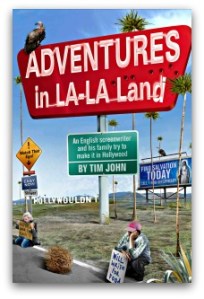
AdventuresinLALALand_coverHi, Tim, and welcome to the Displaced Nation. Can you tell me why you decided to write a memoir about your years in Hollywood?
I’d read so many books about how to write a Hollywood screenplay, but never found one that also told you what it was like living there, so I decided to write my own, based on the seven years I lived there with my wife and two daughters.

Have you thought about turning it into an actual script for a movie?
I would love to turn it into a screenplay, too.

I understand you lived in LA from 1991 to 1998. I’m curious why you produced the book so long after the fact?
I’m not really sure why I waited so long to write it, possibly because I’ve been doing more and more teaching over the last couple of years and I’m often aware that students often don’t get taught important skills that are crucial to being successful as a screenwriter, such as being able to pitch and how to balance writing life with social life and family life. I thought that relating my experiences could be useful for others. If nothing else, they could learn from my mistakes as well as my successes!

In the end, the movie (of my life) was about…

Has your perspective on the experience deepened with time?
I suppose gaining some distance in time and geographically helped me to see Hollywood from a more objective perspective.

What impact did your writing about the experience have on you?
Definitely part of it was cathartic, to process the bizarre experience.

You worked in advertising for a while. When exactly did you catch the movie-making bug?
I worked a copywriter and then as a creative director—both of which are extremely useful if you want to go into film as they teach you so much about writing for a particular audience and how to write pithy dialogue and how to edit, etc. I always loved film mainly because it was such a great escape. As a kid, The Jungle Book was a big favorite. Mutiny on the Bounty and Lawrence of Arabia got me pretty scared, as did that spider in Doctor No!

Yes, I recall your mentioning in the book your fear of spiders when you found yourself face to face with a black widow at your house in LA. I’m still shuddering at the thought of being bitten by a brown recluse, by the way!

Was there a single epiphanic moment?

Your book is chockerblock with what we like to refer to on this site as “displaced moments” as a result of your encounters with not just deadly spiders but also shrieking peacocks, rats, snakes, and even some neighbors who believed in extraterrestrial burglars—and that’s before we get to the highly venomous creatures who populate the Hollywood film industry. Does any one moment stand out as your most displaced?
Wow. There were many moments when I thought “What on Earth am I doing in this bizarre place?” One that sticks out in my professional life was that time I went to pitch to Disney and the exec said “Great to meet you guys, we’re looking for some comedy writers” and I self-effacingly said: “Then you should meet these guys I play tennis with—they’re hilarious.” None of the execs could see I was joking and at the end of the meeting, the development girl took me aside, discreetly handed me a business card and said: “If you continue to have self-esteem issues, see my shrinkshe’s fabulous!”

That makes me think of Johnny Carson’s line: “In Hollywood if you don’t have a shrink, people think you’re crazy.” And I think the Northridge earthquake of 1994 displaced you and your family rather literally.
Yes, the whole house rattled and creaked for over forty seconds and there were waves in the pool.

Ah, the pool… You also talk about how much you loved the weather, having a pool, and taking drives to some fabulous scenery. Can you pinpoint your LEAST displaced moment, when you felt you were born to be in LA-LA Land rather than your native UK?
There were so many great moments. Personally, living in that sunshine, with a pool, a hot tub, etc., along with plenty of money and also plenty of free time (even though you’re constantly thinking of ideas to pitch), seems like a dream for anyone who’s come from the UK climate and ever struggled to make ends meet. It’s like living in a vacationuntil you realize it will all collapse if you don’t sell your next idea, and you’re going to have to sell it far sooner than you expected because the cost of living is very high, especially when you factor in things you’d never had to pay for before, such as earthquake insurance. Never forget that “writer” is only one letter away from “waiter”.

Professionally, when you get to chat with famous stars and talented directors and they take your comments seriouslythat feels unreal but also great. Probably the greatest moment for me was just before I moved to LA, being able to go to the tenth birthday party for George Harrison’s film company, HandMade Films. For anyone English, I think having a chat with a Beatle tops it all.

What did you and George chat about?
I’d worked on two screenplays for his company, so we talked about that. The funniest thing, I thought, at the company’s birthday party, was when George and Ringo joined the band playing on stage. If anyone requested they perform a Beatles’ song, George said: “I don’t know that one.”

In the end, the film was about spirit…

I understand you found LA a culture shock.
Wow, there are so many things that are culturally different about living in the UK and living in America, especially in Hollywood, which many Americans find totally unreal, too. Ones that really stand out: the almost constant sunshine for a start. The smog levels on bad days. The way so many Americans are so welcoming, where so many Brits can be snooty and suspicious. The way so many Americans are optimistic and so many Brits are pessimistic (or maybe more realistic than many film people). I never forgot that Hollywood has been described as “the only town where you can die of encouragement.”

I know you decided to leave LA in part because of your mother’s health and in part because of your daughters’ education. The family, particularly your daughters, didn’t want to go. What were the biggest adjustments?
Tiny parking spaces, terrible weather, high cost of living but a wonderful sense of humor. I did miss my irony in LA. We also hadn’t realized quite how much UK house prices had rocketed during the period when we’d sold ours to live abroad!

What do you think were the chief benefits you and your family derived from being Los Angelenos for a time?
I’m sure that our seven years in LA and coming home taught us all to adapt to change. My elder daughter had enjoyed an ice skating career in the US, which didn’t continue in the UK. But at least she learned that if you set goals and envision yourself achieving those goals, it will seriously boost your chances of success. The rest of us learned that you can probably have all the things you’d like in life—you just can’t have them all at the same time!

Looking back, what was your single most professional achievement during your time in LA?
Not one single thing; rather, it was learning the craft and how to work with industry people sufficiently well to be able get regular work from the studios (but not all the time!).

How do you make a living these days?
Right now, I’m rushing out to give six hours worth of lectures on dialogue to students at Bournemouth University. I also teach on and off about creative writing in general and about writing for advertising, at various universities: Bournemouth Uni, where I teach part of the MA in Advertising, at Southampton Solent, where I do some spots on Advertising and some on Screenwriting, to students at all levels, and at the Arts University in Poole, where I teach adult classes in all sorts of writing. But teaching is just part-time. I also do some freelance copywriting. And most of my time goes into writing screenplays still!

Do you still feel like a Los Angeleno in some respects?
Only in that I have several great friends in LA and I feel totally at home with film industry people. I probably see myself as neither totally British any more or completely Californian. I’m obviously some sort of mongrel.

Writing for publication: A different animal?

Moving back to the book: what was the most difficult part of the writing process?
The hardest part was the guilt I occasionally feel for what I see as building up all the family’s hopes by showing them a few years of a dream lifestyle, then waking them up from that dream by saying we have to go back to the harsh reality of living back in the UK. BUT, as mentioned, the family all feel really lucky to have had those seven great years and have made all those extra friends without staying away from their old friends and family for so long they felt like strangers. (That’s what they tell me anyway. I have an extremely supportive family!)

Why did you decide to self-publish?
Because I’d had two books published by a big publisher many years ago and never felt they did much to promote them. My agent said most publishers only push big brand names and my wife had a friend who did very well self-publishing a memoir, so I thought I’d give it a go.

What audience did you have in mind for the book, and has it been reaching those people? Is it mainly for wannabe British scriptwriters like yourself, or do you think it has broader appeal—for instance, to any Brit who might be thinking of living in America?
I hope the book will appeal to anyone who likes a laugh, to anyone who is interested in a family fish-out-of-water story and to anyone who wonders how you can make it in the film business. There’s plenty in there about the American school my wife taught in, the ones the kids went to, about my eldest daughter making it as an ice-skating champion… It’s by no means just about the movies, but, as I mentioned earlier, it will show you far more about how to make it as a screenwriter than books that simply tell you about the script, the formats, and nothing else.

Of all the advice you transmit to wannabe Hollywood screenwriters, which is the most important?
Make sure you enjoy the writing process as much as possible. Don’t pin everything on whether you sell it or it gets made. Enjoy the small triumphs, such as writing a great scene or even a great line of dialogue. All the little triumphs can add up into a pretty rewarding experience. And never forget that you may well learn more from your mistakes than from your successes.

What’s next for you in terms of creative projects?
I’ve just finished a UK thriller “Living in Sin”; I’m currently doing a re-write for a sci-fi project for a Californian director, and I have a UK drama that I wrote written with a writing partner, Jon Rolls, for which the producers have just this week started looking for a top director and cast—I’m still going for it!

10 Questions for Tim John

Finally, I’d like to ask a series of questions that I’ve asked some of our other featured authors, about your reading and writing—and in your case, also film-watching—habits:
1. Last truly great book you read / film you watched: Paper Towns, by John Green; The Way Way Back (2013), directed by Nat Faxon and Jim Rash.
2. Favorite literary / film genre: It varies enormously but I’d say “comedy drama” for both (eg, Little Miss Sunshine).
3. Reading/film watching habits on a plane: I only ever read paper books and magazines. Generally I watch films on long flights—but nothing involving flights in danger. I’m a nervous flyer. I can never sleep.
4. The one book you’d require President Obama to read, or film you’d require him to watch, and why: War and Peace, so he’s fully aware what Russians can do if stirred up. No films to recommend—I’d rather he kept his eye on world news!
5. Favorite books/films as a child: The Secret Garden; The Jungle Book and Bond movies and then Paper Moon when I was slightly older. Also the musical Oliver.
6. Favorite hero/heroine in fiction/film: Heroines: Victoria Wood as a writer; Kathy Bates as an actress. Heroes: No book heroes apart from Bilbo Baggins (when I was ten); in film, the cheeky little boy in Cinema Paradiso and later Léon in the film of that name.
7. The writer, alive or dead, you’d most like to meet: Woody Allen, as I’m nearly always amazed at how inventive he can be and how, against the odds, he so frequently gets cross-genre movies to work, certainly during his Crimes and Misdemeanors period.
8. Your reading/film-watching habits: I don’t read that many books as I find it hard to give authors the benefit of 50 or 60 pages to get into it. I far prefer books that grab me almost immediately, but with their style and outlook on life, not with purely mechanical plot like Dan Brown or John Grisham. I find those stories generally too thin to keep reading. I frequently start books and leave them if they don’t hold my interest. As far as films go, I go to the cinema at least once a week. I also watch endless boxed sets: generally US drama such as Breaking Bad, The Sopranos, The Wire, House… I really got into The Bridge and Spiral. My worst DVD marathon took place in the early series of 24, when I watched 13 episodes over a single weekend.
9. The book you’d most like to see made as a film: On Mermaid Avenue, a great American novel that I’ve optioned and written a screenplay from.
10. The book you plan to read next / film you plan to watch next: The Fault in Our Stars, by John Green; currently, I don’t have any films I’m looking forward to watching.

* * *

Bravo, Tim! If we ever host the Displaced Oscars, something we’ve been threatening to do for some time now, you’ll definitely be receiving a statue.

So, any COMMENTS or QUESTIONS for Tim, or PITCHES for why you’d like to read the book? Don’t forget, there’s a free digital copy on offer…

And if you can’t wait to read the book or don’t win, Adventures in LA-LA Land is available from Amazon. Be sure to grab a copy! You can also visit Tim’s writer site, like his book’s Facebook page +/or follow him on Twitter.

STAY TUNED for next week’s (month’s) fab posts!

If you enjoyed this post, we invite you to register for The Displaced Dispatch, a round up of weekly posts from The Displaced Nation, with seasonal recipes, book giveaways and other extras. Register for The Displaced Dispatch by clicking here!

Related posts:
For this Swiss ethnographer with a fondness for remote parts of China, a picture says…

Gaetan in China Collage

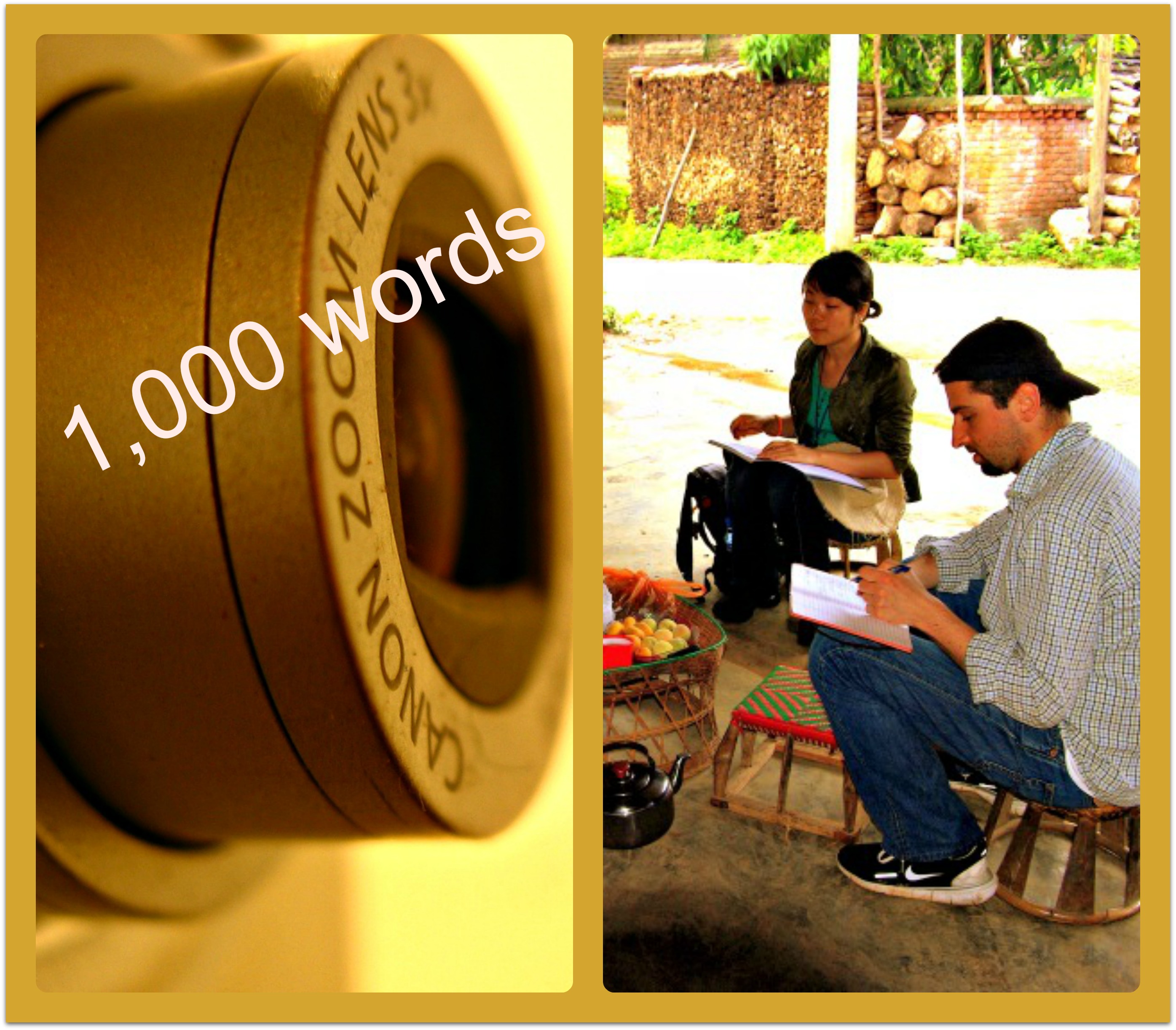
Canon zoom lens; photo credit: Morguefiles. Gaetan Green doing fieldwork in Xishuangbanna, a region of Southwest China squeezed between Laos and Burma; photo credit: Gaetan Green.

Welcome to our monthly series “A picture says…”, created to celebrate expats and other global residents for whom photography is a creative outlet. The series host is English expat, blogger, writer, world traveler and photography enthusiast James King, who thinks of a camera as a mirror with memory. If you like what you see here, be sure to check out his blog, Jamoroki.

My guest this month is 33-year-old Swiss national Gaetan Green, who has spent the last 12 years between China, Europe and North America. After graduating university, Gaetan studied and conducted ethnographic research in remote parts of China. He went back to do field work in the country’s ethnic borderland when pursuing a master’s degree in geography at a university in Vancouver.

For the past three years Gaetan has lived in one of China’s mega-cities, but he always grabs the opportunity to travel in the countryside, where he can indulge in his current passion for the  ancient and ethnic villages of south and southwest China, with a “minor focus on Guangzhou and the Pearl River Delta.”

Gaetan keeps a fascinating blog, Travel Cathay. He posts about his off-the-beaten-path travels to parts of China most of us wouldn’t know existed.

* * *

Hi Gaetan. I have been following your blog for a while now and am very pleased to have the opportunity to interview you for the Displaced Nation. Let’s start with some background on you, shall we? Where were you born, and when did you spread your wings to start traveling?
I grew up in a ski resort in the middle of the Swiss Alps and I started travelling as soon as my parents would allow it. My first trips were to Southern and Eastern Europe with classmates—that started when we were around 16 years old. But my travels became a lot more serious when I left Switzerland for my first trip around the world, at age 20. This trip changed my life for good.

So your wanderlust dates from an early age. Why do you think that was?
There were essentially two things that inspired me to travel. The first was a map of the world that I discovered at home when I was an inquisitive eight-year-old. The map made me realize the world was much bigger than the valley surrounded by big snow-capped mountains where we lived. I was itching to discover the reality behind all the exotic place names. The second source of inspiration was my home country. With its pure air, snow-capped mountains, green valleys and quaint mountain villages, Switzerland is beautiful—but way too small. The boy I was then saw a world so big, I knew I had to leave.

Which countries did you travel to?
Besides southern and eastern Europe, I visited Australia, Peru, Bolivia, Ecuador, Malaysia, Philippines, and Singapore. And of course, eventually, China.

And now China has become a second home for you.
Although I have traveled to other countries, China is the one I know best because that is where I have spent most of my time so far, and I have only five provinces left to discover. My love story with China started at age 20: I spent three months of my round-the-world trip traveling within its vast terrain. When I returned home, I started to learn Mandarin (some of my friends thought I was seriously deranged!!). Then one thing lead to another: I studied for two years in Chongqing (a city of 15 million people in central China), worked as an ethnographer in remote parts of Yunnan province, taught English in Kunming, and conducted academic research between Vancouver and Xishuangbanna. Although China is a country, it gives the impression of being a continent because it is very diverse. Contrary to what many people think, China does not have a monolithic culture. I speak Mandarin, so that makes travel easier. I can venture into the countryside knowing I’ll be understood.

“Let’s all go up to the mountain to be close to the flowers and songs.” – Dong folk ballad

I’m sure that speaking the language gives you a huge advantage. Tell us more about the life you now lead in China.
I am currently working as a sourcing agent and living in one of China’s megacities. Recently I have developed mixed feelings about the megacity life. Megacities can be convenient places to live, providing easy access to food, entertainment, communication and transportation; but I find them overcrowded. Dangerous levels of pollution and food hygiene are growing concerns and also the reasons why some of my expat friends have already left.

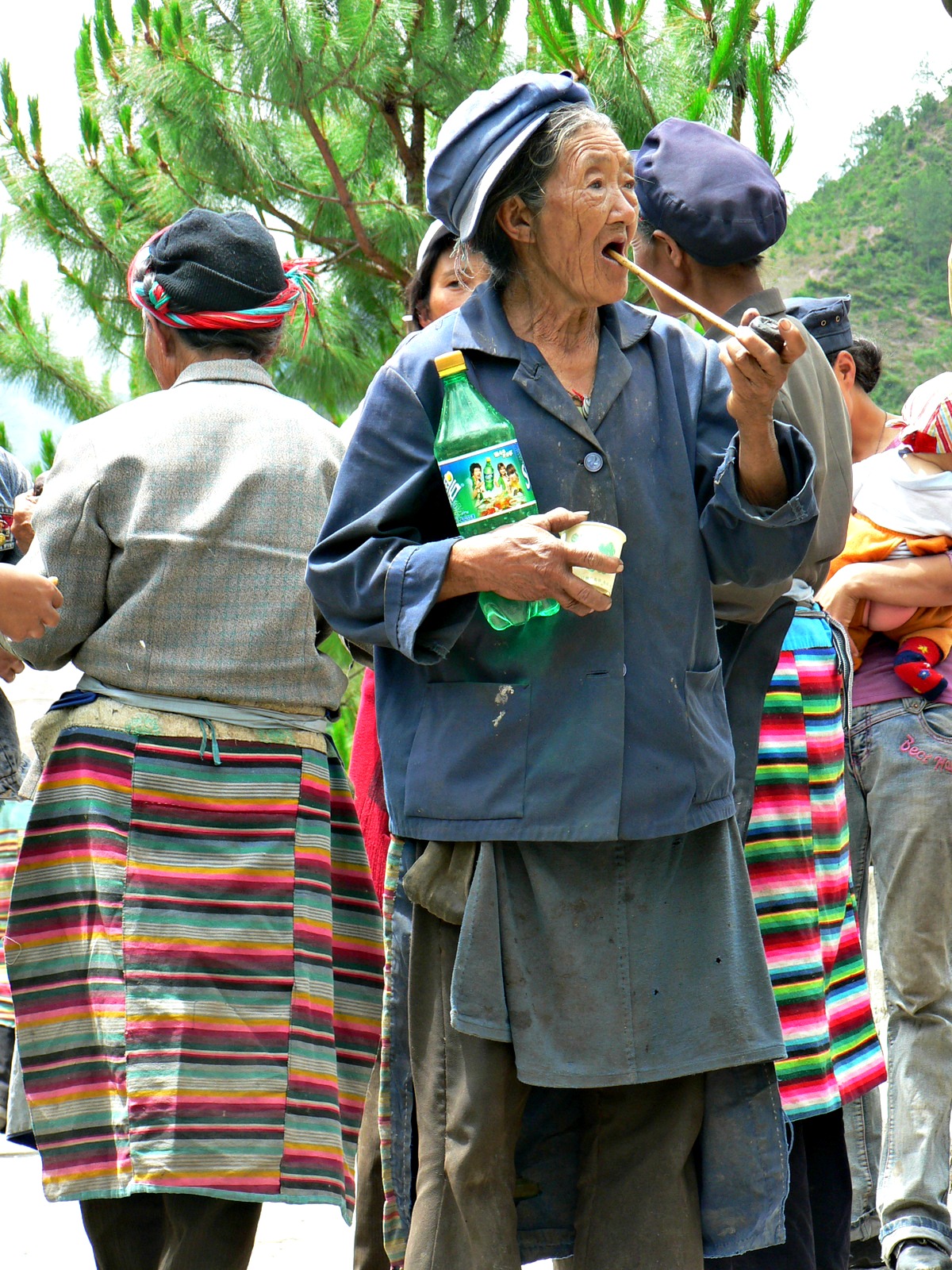
Old woman in a Tibetan Catholic community; photo credit: Gaetan Green.

An elderly woman pushing barley alcohol in north Yunan; photo credit: Gaetan Green.

Some friends of mine have recently moved to China to work in Shanghai but they refuse to live in the city for the same reasons you mention. But let’s get away from the megacity and take a look at your first three photos, which take us far away from that scene. Can you tell us what makes each of these photos so special?
This first photo reminds me of the time when I was doing ethnographic research about Tibetan Catholic communities in remote regions of north Yunnan province. On that particular occasion, I had the opportunity to witness a ceremony during which villagers prayed that it would rain on the graves of French missionaries who’d been assassinated at the beginning of the 20th century during anti-Christian violence in the region. There was a steep hike to reach the graves. At end of the ceremony, this woman started giving everyone barley alcohol in a paper cup. I remember going back to the village half-drunk after she challenged me to a second glass of firewater.

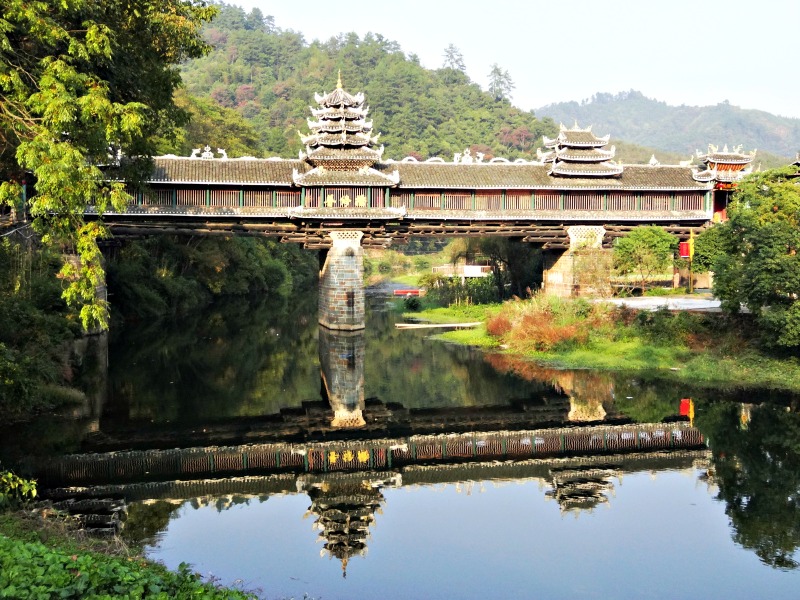
Wind and Rain Bridge, Tondao. Photo credit: Gaetan Green

Blown away by the Puxiu Wind and Rain Bridge in Tondao; photo credit: Gaetan Green

The second photo was taken after I’d missed the last afternoon bus and got stuck in the small town of Tongdao (southwest Hunan province), which I’d never heard of. I eventually ended up hiring a taxi driver for the afternoon to show me around. We went to a few ethnic villages and by 4:00 p.m., we had arrived by this amazing covered bridge, which is an example of a “wind and rain” (fengyu) bridge common to the Dong ethnic minority region. Missing my bus was the best thing that happened to me that day.

Taoist Temple, Macau; photo credit: Gaetan Green.

The Jade Emperor’s generals on their joss paper thrones; photo credit: Gaetan Green.

The third photo records the time I got lost in Macau somewhere between the Ruínas de São Paulo and the Camões Garden, I went to a Taoist temple. In one hall, I noticed that some statues had uneven stacks of joss paper (spirit money) under them. I asked the temple caretaker: “Why?” He explained that there were, in that particular hall, the statues of the 60 heavenly generals who help the Jade Emperor to supervise human life on earth. There is one heavenly general for each birth year, and the more joss paper there is under the statues that matches your birth year, the luckier you will get. I decided to boost my luck and bought stacks of joss paper to boost my heavenly general higher. The temple caretaker gave me three sticks of incense to burn; he said a long prayer in Cantonese and gave me a red talisman. I definitely enjoyed doing business with the gods, though I didn’t feel any luckier afterwards.

“Who can rob me of the songs I learned?” – Dong folk ballad

I love all three photos, and, yes, you are right, missing the bus and staying in Tondau must have been divine providence. Now, I’m keen to know where your favourite places to take photographs are, and why these places inspire you and how that shows in your next three photos?
Now that I live in a big Chinese city, the places that inspire me the most are the ethnic and ancient villages. In the cities, many historical buildings and old streets have been knocked down to give way to shopping malls and skyscrapers. Ethnic and ancient villages are real windows on the past and the cultural diversity of China. I chose the next three photos to make this point.

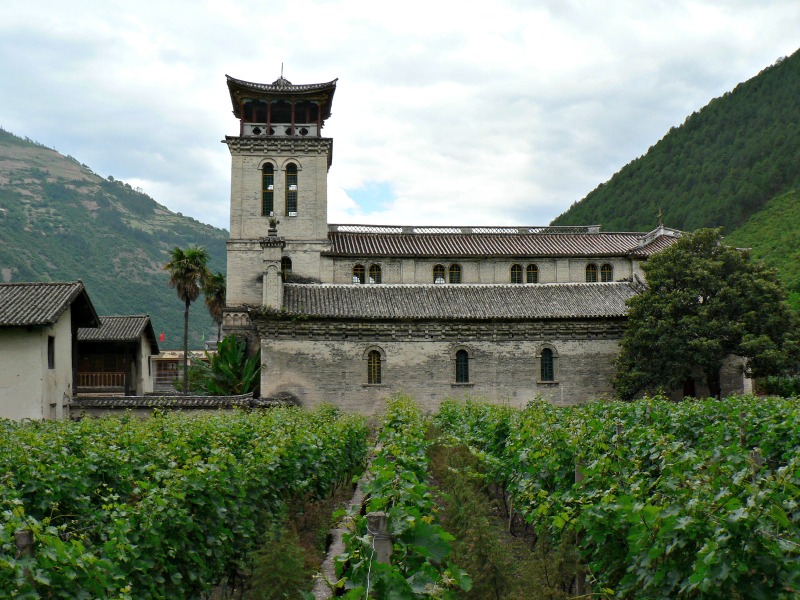
Cizhong Catholic Church; photo credit: Gaetan Green.

A Roman Catholic Church in an unexpected spot: by the Lancang (Mekong) River at Cizhong; photo credit: Gaetan Green.

The first is of the Catholic church at Cizhong, a remote village of north Yunnan province that is home to a community of Tibetan Catholics who were converted by French missionaries more than 100 years ago. The church seems out of place in this land of Buddhism. The mountains surrounding the village make it a picturesque spot.

Yunnanyi Gaetan Green

If these walls could talk: Yunnanyi village on the Tea Horse Road; photo credit: Gaetan Green.

The second photo is of Yunnanyi village, in Yunnan province, which was an important stop on the Tea Horse Road that linked Southeast Asia to the Tibetan plateau. Horse caravans carrying tea, spices and other goods stopped in Yunnanyi. In 1936, the communist armies of Mao Zedong stopped in Yunnanyi to rest during the Long March. Then, during WWII, the rice fields behind the village were transformed into a U.S. airfield. Planes that had flown from India over the Himalayas (to avoid the Japanese-controlled Burmese airspace) landed in Yunnanyi with supplies for the Chinese armies. The history of this unknown village is inspiring. The mud-brick courtyard houses have seen a lot. I wish these walls could talk.

Stepping back in time in Qianyang; photo credit: Gaetan Green.

Stepping back in time in Qianyang; photo credit: Gaetan Green.

The final photo is of Qianyang, in Shaanxi, an ancient regional political centre that has been forgotten in China’s rush to develop. The streets are lined with dozens of temples, an ancestral hall, and courtyard mansions that belonged to local officials. Most of the city’s walls and four out of fives gates are still standing. There were no tourists when I visited. It felt like stepping back in time and taking a walk in China’s past.

What I find amazing in these pictures is the beautiful architecture and the pristine condition of such old buildings and the cleanliness of the streets. Tell me something, I notice that many of your photos are of buildings or streets. Do you feel reserved about taking photos of people, particularly when they are conscious that you are doing so?
I do feel reserved about taking pictures of other people so I rarely do. The exception is when I have the opportunity to witness a ceremony or special event.

I know this is a similar question but do you ask permission before taking people’s photographs and how do you get around any problem of language?
Since I now travel mostly in China, I ask in Chinese. If I am in a region where people do not speak Mandarin, a hand gesture is usually enough.

Would you say that photography and the ability to be able to capture something unique which will never be seen again is a powerful force for you?
It is indeed. I would add that photography also has the ability to monitor change. In a country like China where everything is growing and changing so fast, photography can be a tool to record how the landscape is transforming.

That’s a very pertinent point, particularly when applied to China. Was there a particular moment when you realized that?
I thought about it a lot while on a business trip to Ningbo, a city of nine million people that is just a couple of hours by train from Shanghai. I had been able to take an afternoon off and wander in the city. I discovered an entire neighbourhood of stone houses built during the late Qing Dynasty (late 19th century), all of which were empty. They were going to be knocked down to build a shopping mall and high-density residential buildings. In China I am constantly thinking that what I see today may be different or not even exist tomorrow.

If someone wants to learn from me, I’ll teach him songs as melodious as cicadas.” – Dong folk ballad

I know exactly what you mean. It almost feels like you are running out of time. I have many old pre-digital photos (35 years old and more). I didn’t realise until now how precious they are. Moving on to the technical stuff (I’m not too good at tech but getting better). Some of our readers will want to know what kind of camera and lenses you use.
I use a very simple point-and-shoot Sony camera.

I must say it works really well and the shooter has a good eye! Finally, do you have any advice for wannabe photographers who are traveling or living abroad?
I think I am in the same position as you. I need advice.

Gaetan, I’d like to thank you for taking the time to tell the story of your exciting journey and for sharing so much interesting information. You may not consider yourself to be a good photographer, but your “point and shoot” pictures embellish your narrative beautifully. Keep following your way and I am sure you will inspire other young people to travel the globe as you are doing. I, for one, will be checking your progress.

* * *

Readers, what do you make of Gaetan’s experiences? Do you have any questions about his photos or his travels? Please leave them in the comments!

And if you want to know more about Gaetan, don’t forget to visit his excellent blog, Travel Cathay. You can also follow him on Twitter: @TravelCathay.

(If you are a photographer and would like to be interviewed by James for this series, please send your information to ml@thedisplacednation.com.)

STAY TUNED for tomorrow’s fab post!

If you enjoyed this post, we invite you to register for The Displaced Dispatch, a round up of weekly posts from The Displaced Nation, with seasonal recipes, book giveaways and other extras. Register for The Displaced Dispatch by clicking here!

Related posts:
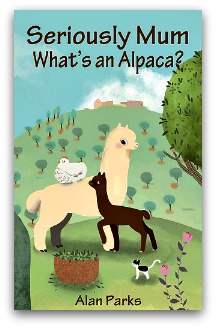
JESS IN JAPAN: Tokyo’s top 6 delights from my newbie expat perch

So is snow the same in Tokyo? Kind of, except everyone carries see-through plastic umbrellas! Jess in Tokyo's first February snowfall. Photo credit: Hiro Awanohara

So is snow the same in Tokyo? Kind of, except everyone carries see-through plastic umbrellas! JESS IN JAPAN in a rare heavy snowfall earlier this month. Photo credit: Hiro Awanohara

Today we welcome a new guest columnist: Jessica Awanohara. Any relation, you may wonder? Yes, she’s the American wife of my nephew by marriage, Hiro. The pair, who’d become dyed-in-the-wool New Yorkers, surprised us all by announcing they were moving to Tokyo at the end of 2013. Naturally, I was curious: how is Jessica adjusting to life in that “through-the-looking glass” city? Is it different to live there versus just visit (which she’s done many times in the past)?

—ML Awanohara

There are many things to love about moving to a new country and a few things not to love. Most expats eventually strike a balance between the two.

But are there also places where the love-hate continuum doesn’t apply? I’m beginning to think so ever since I moved from New York to Tokyo in late December of last year. A bad mood is impossible to sustain in this city because everything is hilarious. Wherever you turn, there is something riotous laying in wait…and the next thing you know, you are collapsing in fits of laughter.

I’ve been in Tokyo for over a month now, and have delighted endlessly in many things.

Here are six off the top of my head:

1) Trains are in happy colors.

I live on the Keiō Inokashira railway line, the color of which is bright pink. Not the barfy green of the 4/5/6, nor the almost-royal blue of the A/C, nor the vibrantly atrocious orange of the B/D/F, in New York City. Rather, this line is a sparkling and spritely pink mixed with what I imagine to be the color equivalent of delicious farm-fresh milk. It’s the pink of the gods: the Disney Princess Gods.

2) Subway stations are deeply amusing, so to speak.

Think of New York City’s deepest subway platform: the 63rd Street station on the F Line near Hunter College, or the 191st Street Station on the 1 Line. Imagine how long those escalators are, and now double it—no, triple it! Triple it, and add a couple of extra escalators and a brick-and-mortar set of stairs to the street, and now you have an idea how deep the average street to subway platform trip is in Tokyo. Have you ever tried going to Roppongi, or Azabu-Jūban? Try it!! You may feel as though you’ve walked far enough to be back in New York. Good for quite a few laughs!

3) People on the subway may be dressed much better than us, but they smell just as funny.

How could men in suits and overcoats, or women in designer outfits, smell as bad as we much more disheveled Americans do on the subway? Before taking the leap of moving to Tokyo, I dreaded the idea of being taller, sweatier, and worse smelling than the average citizen on a notoriously packed Japanese train car. Rest assured, inquiring minds, curdled humans smell much the same in Tokyo as in New York: like sweat socks… By the time summer arrives—I’ve visited here often enough to know that summer is no joke!—I should blend in perfectly fine, a thought I find immensely entertaining.

4) Furniture delivery can be farcical, especially when it doesn’t fit through doors.

After a month of living out of another person’s apartment, my husband and I moved into our own place a couple weeks ago. We ordered what can aptly be described as the world’s most beautiful bargain basement sofa and had it delivered to our new, completely empty home. No sooner did our large and lovely couch arrive, than it was exchanged for its tiny, two-seater cousin—that is, tiny enough to actually fit through our front door. In Japan, small is beautiful. How could we have overlooked this basic principle? Our hilarity could not be contained…

5) In Tokyo, cost-of-living statistics are a bit of a joke.

Really, Expatistan.com? I appreciate the cost-of-living data you supply for this great world’s great cities, and am aware that countless magazines and listservs use your data for splashy articles sizing up one city against another. But I’m confused about your aim. On your website it says you want to give people the information “to live as nicely as you live currently.” That means…what exactly? How does one measure the quality of life across cultures? And what about that ideal, which many of us expats hold dear, of “When in Rome…” I can lead the same life materially in Tokyo as I led in New York, but that’s not what makes me happier in this city. Sure, living the luxury life in Tokyo is expensive, but numbers are not the point. The point is, cost-of-living stats are hilarious in a city that gives me such joy!

6) Appliance installation is a riot and a half.

In a related hilarity, it is true that most Tokyo apartments are not outfitted with appliances normally packaged with an apartment in NYC. We had to order our own refrigerator and washing machine (both standard fixtures for the Tokyoite). Our refrigerator, a lovely and highly rated model, cost us all of $500; the washing machine was comparably rated and lower priced. As with anything you buy larger than a shopping bag, you have it delivered to your home for maybe $30 or $50 additional dollars, or oftentimes for free. The hilarity lies in the fact we had two choices when the refrigerator and washing machine were shipped—the delivery men would either leave them at our front door OR huff them up countless flights of stairs and install the machines for the low, low price of…one U.S. dollar. Tough choice, right? Hahaha.

No doubt about it, Japan is a barrel of laughs. Reaching beyond the cruel and unusual TV game shows, the Hello Kitty cafes, the Fruits magazine documenting outlandish clothes in the Harajuku area, and other enduring staples of pop culture in this part of the world, I’ve found countless things to delight me during my first month of residency in Tokyo. My main takeaway is how excited I am to let this town continue to delight me for years to come.

* * *

Readers, what do you think of Jess in Japan’s observations of her new home? I don’t know about you, but I find it ever-so-amusing that so many of her thoughts are focused on subways and apartments: not so different from life here in New York!

STAY TUNED for next week’s fab posts!

If you enjoyed this post, we invite you to register for The Displaced Dispatch, a round up of weekly posts from The Displaced Nation, with seasonal recipes, book giveaways and other extras. Register for The Displaced Dispatch by clicking here!

Related posts:
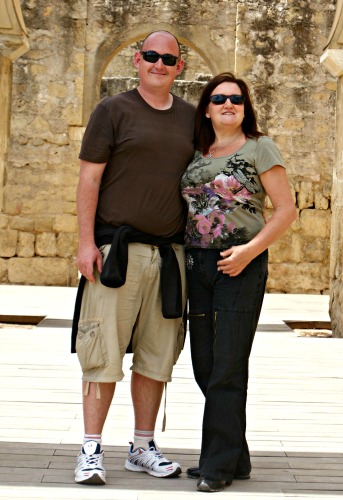
Happy Halloween! A cauldron of 6 cautionary tales for the intrepid traveler

Image: Lake View Cemetery / MorgueFile.com

Yesterday’s Halloween post by Anthony Windram, about the top 5 ghostly settings from literature and film, got us thinking again about the ghostly and ghoulish, the mystical and macabre, the dark and demonic.

Our thoughts, however, did not turn towards the new and original, but to the jaw-clanging skeletons in the Displaced Nation’s very own Crypt.

At which point…someone (Kate Allison?) suggested that we pile all of our Gothic Tales of Old into a cauldron and chant “Bubble, bubble, toil and trouble.” All was going well until one of us—must have been the American—broke in with:

Stirring and stirring and stirring my brew…

Just as she screeched “O-o-o-o-o, o-o-o-o-o”, 6 apparitions arose from the pot: 6 terrifying tales from the Displaced Nation’s deep dark past. Each said they were there to teach travelers a lesson.

And here is what they told us:

1) The Ghost of the Mysteriously Misplaced Post

I am the ghost the represents the post titled The Displaced Nation’s Halloween post is…mysteriously displaced!, composed on Halloween night two years ago by ML Awanohara, whose blood was curdling because:

Kate Allison was supposed to post today, for Halloween…but then, pouf, she vanished without a trace!

As readers who are paying attention know, Kate has now posted 80+ episodes in the life of a fictional British expat family living in New England, called Libby’s Life. Two years ago she vanished before uploading the latest episode because of a freak snowstorm in Connecticut, her adopted home.

She finally resurfaced on On All Saint’s Day—in a MacDonald’s! (Has she gone native, or what?)

Travelers, here is the lesson I’m here to impart for your sake: Truth is stranger than fiction, where so’er you roam.

2) The Ghost of Quizzing Others on Their Supernatural Sightings

Hello there, I am the ghost that arises from THE DISPLACED Q: On your travels … have you ever seen a ghost?, which was composed by Tony James Slater just over a year ago. He impressed with his self-knowledge when he said: “I’m about as psychic as a cheese.” But then he went on to say:

And then, just occasionally, I have dreams when I’m visited by the spirits of people I’ve lost….

Is there any wonder there were no comments and no likes on his post? He scared the bejeezus out of most of his readers.

Still, point taken, and I’m here to impart an important lesson that you international travelers may not have fully considered: As you traverse the world, bear in mind that any ghosts you meet will be people you know (and left behind), not strangers.

3) The Ghost of Compiling a Master List of Grim Reapers

Greetings, I have emanated from the post called Grim Reapers around the globe: 7 creatures that say “Time’s up!”, composed by Kate Allison just over a year ago. Kate reported on the surprising number of cultures that maintain some version of the mythological conniving female who lures men to their deaths.

As frequent visitors to this site will know, Kate has a way with words. For instance, she described
Sihuanaba of Central America as follows:

Seen from the back, she’s an attractive woman with long hair; from the front, it’s a horse. (No jokes about Sex and the City, please.)

But even Kate’s rather offbeat humor could not dissuade from the freakishness of some of these figures.

As far as lasting lessons, this will have to suffice: Next time you get lost in a canyon, try blaming an ancient ghoul. Depending on where you’ve landed, as well as gender, you may just about pull it off.

4) The Ghost of Delivering a Screed against Princess Diana Dolls

A cheery hello to one and all, I am the ghost of Anthony Windram’s EXPAT MOMENTS: The Doll Collection, which he wrote almost exactly a year ago.

As anyone who came across it may recall, Mr. Windram was most distressed to find himself at a bed-and-breakfast in NEW England (he is from Jolly Olde) where the innkeeper has put her prized collection of “individually authenticated” Princess Diana dolls on display in the sitting room. He tossed and turned all night, even heard scratchings at his door.

Now, as regular visitors to this esteemed site know, Mr. Windram is no fool. On the contrary, he has has a mighty brainbox. Which is why I’m so stunned that he allowed himself to be frightened by a set of Lady Di figurines. I’m sure they were only there to cover up the fact that the house is haunted—by a young and rather vigorous ghost, which is how ghosts tend to come in America (just ask Libby). The real take-away, then, particularly for those who venture into the New World: Avoid American B&Bs like the plague if you want a decent night’s sleep.

5) The Ghost of the Expat Criminals Exposé

ML Awanohara showed some temerity in writing a post entitled What did Agatha Christie know? Expats make great criminals back when this blog first started.

As the ghost that arose from this post, I’m here to say she hit the proverbial coffin nail soundly on the head with this assertion:

Just as we don’t like to think of rats being part of the animal kingdom, we don’t like to think of conmen, pirates, gangsters, and terrorists being part of the group we have loosely defined as “global voyagers” … But trust me, they are a part of it — as are murderers.

Which leads us to the lesson I’ll impart today: Just because you’re in a part of the world where marrows tend to thrive, don’t assume the likes of Hercule Poirot will turn up and save you.

6) The Ghost of Finding Travel Inspiration in Margaret Drabble’s “Red Queen”

Not long ago compared to other posts in this collection, ML Awanohara wrote FOOTLOOSE & FANCIFUL: Margaret Drabble’s “The Red Queen”, explaining how her views of Korea had shifted after reading a book by Dame Drabble depicting a period of bloodshed and horror in the 18th-century Korean court. A real-life tale made more vivid by Drabble’s considerable fictional powers, in which the Prince is a homicidal maniac, and his father, the King, a stern Confucian. The King ultimately decides to murder his son in a style so dramatic that ML couldn’t get it out of her head next time she went to Korea. She remains haunted to this day.

As the ghost of this post about a ghost, I find myself torn. On the one hand, what kind of person would read Drabble—that serious, hip, intellectual British novelist, who likes to come across as one’s brainy, Cambridge-educated best friend—to get a handle on what the Koreans are really like? Apples and oranges—or marmite and kimchi, I should say.

On the other—and this is the lesson I’ve come to deliver: Never hesitate to use a Cambridge-educated Brit as a resource for novel sightseeing ideas.

* * *

Readers, have we got you thinking twice about those travel plans? Do let us know in the ca-ca-comments. Hey, at least we spared you the horrors of Sezin Koehler’s 15 films that depict the horrors of being abroad, or otherwise displaced; Tony James Slater’s 5 travel situations that spell H-O-R-R-O-R!; or Kate Allison’s Global grub to die for, including a rather scrumptious recipe for fried tarantula, which goes down a treat in Cambodia.

STAY TUNED for next week’s fab posts!

If you enjoyed this post, we invite you to register for The Displaced Dispatch, a round up of the week’s posts from The Displaced Nation, with our weekly Alice Award, book giveaways, and other extras. Register for The Displaced Dispatch by clicking here!


CAPITAL IDEA: Bangkok: A quick guide

bangkokWelcome to another “Capital Ideas”—our somewhat idiosyncratic, ever so slightly tongue-in-cheek guide to various world cities, perfect for the ever discerning readership of this blog. We know our readers are always visitors, never tourists (an important distinction).

Do feel free to contribute your own ideas or suggestions in the comments section, we’d love to hear your thoughts, too.

Capital: Bangkok

That reminds me I saw The Hangover Part 2 recently. Great movie. Um, no, it isn’t.

What are you crazy? A chain-smoking capuchin monkey and that guy who is in The Office wakes up to a Mike Tyson-style face tattoowhat’s not to love? Its content? Anyway, why are you blathering on about The Hangover Part 2?

Because dude, it’s set in Bangkok. As is Bangkok Dangerous. What a surprise!

Anyway, you’ve got my attention. Those films have certainly piqued my interest in visiting Thailand’s capital city. Well, that is good to hear.

Yes, I think I could have a fun, hedonistic vacation. Is it as crazy as it seems in those films? It’s a city of over eight million. I’m sure you can find some craziness if you’re so inclined, but there’s far more to this city than some of your preconceptions.

Oh yeah, I’m sure that is the case, and I’m all ears regarding all that culture nonsense that I know you love, but still, I might want to take in a ping pong show in Soi Cowboy. How can you go to Bangkok and not see its seedy underbelly? Fairly easily. This is not a guide for sex tourists.

Oh, you’re such a square! Okay, what would you have me see? Take a ferry to the Old City. There you’ll be able to visit the ornate Grand Palace built in the 18th century for the Thai king and Wat Phra Kaew, where you can find Emerald Buddha. A trip to Wat Arun is also a must.

The Grand Palace, you say? They’re pretty big on their Royal Family, aren’t they? You can say that again. Indeed, you’ll find portraits of the current King, Bhumibol Adulyadej, as well as some of his predecessors, in most restaurants.

So jokes about the King probably won’t go down too well? No. In fact, lèse majesté, which is the crime of violating majesty, is enshrined in law, so no, probably not the best idea to make a joke about the Thai King as it could lead to a prison sentence.

Blimey! Kind of appreciate that I can make all those jokes about Prince Charles’s ears with impunity. Absolutely!

Anything else I need to know on this? Yes, Thai nationals have to stand for the national anthem by law.

I think I’m going to regret saying this, but what do you recommend? I’ve got one word for you—puppets.

Oh God, I wished I hadn’t asked. No, hear me out. Traditional Thai puppetry is fascinating. The Aksra Theatre in Bangkok puts on a great introductory show for tourists that also showcase traditional Thai music too. The puppets will depict scenes from the Ramakien, Thailand’s national epic. Go, you’ll love it, I promise!

Trust this guide to push some weird recommendation on me. What? Me? The very idea! … I think I might rather try my hand at the ping pong show. No!!!! Go with the puppet show.

I’m guessing I’ll eat well in Bangkok? You guess right. Really, you can’t go wrong. You don’t need to find out who the fanciest, trendiest chefs in town are, just take a wander and keep is simple. You’ll be able to eat very well and by spending very little.

Sounds great, and how do I get around the city? The city has three rapid transit systems: the BTS Skytrain, the underground MRT and the elevated Airport Rail Link. They’re all pretty good if you’re going long distances across the city. For shorter distances just take a taxi. I would, however, give one warning on this, based on personal experience. Bangkok taxi drivers don’t have the best of reputationsdon’t allow yourself to be ripped off. Some unscrupulous taxi drivers will refuse to put on their meters and will quote you outrageous sums when you first step in their cab to get you to your destination, because they see you’re a farang. If they’re not prepared to negotiate to a sum you feel is reasonable, then don’t feel shy about exiting their cab and searching for another taxi.

What should I read to prepare for the journey? More than any other expat destination, Bangkok seems to have inspired cringe-worthy expat books about crime and sin in the capital or “hard man” accounts from Westerners who’ve ended up in Thai prisons for drug smuggling. They’re for the most part best avoiding. If you must have something that touches on the sin and crime of the city, then John Burdett‘s Bangkok 8 is an entertaining read for a flight over to Thailand. If you’re particularly ambitious you could also try reading The Ramakien (in translation).

What should I watch? You could watch the original Thai version of Bangkok Dangerous from 1999 if you were interested by the American remake. Also, in recent years a number of Thai films have gained attention at the Cannes Film Festival. Blissfully Yours and Tropical Malady are worth investigating.

STAY TUNED for next week’s Displaced Nation posts.

If you enjoyed this post, we invite you to register for The Displaced Dispatch, a round up of weekly posts from The Displaced Nation, with seasonal recipes, book giveaways and other extras. Register for The Displaced Dispatch by clicking here!

Related posts:
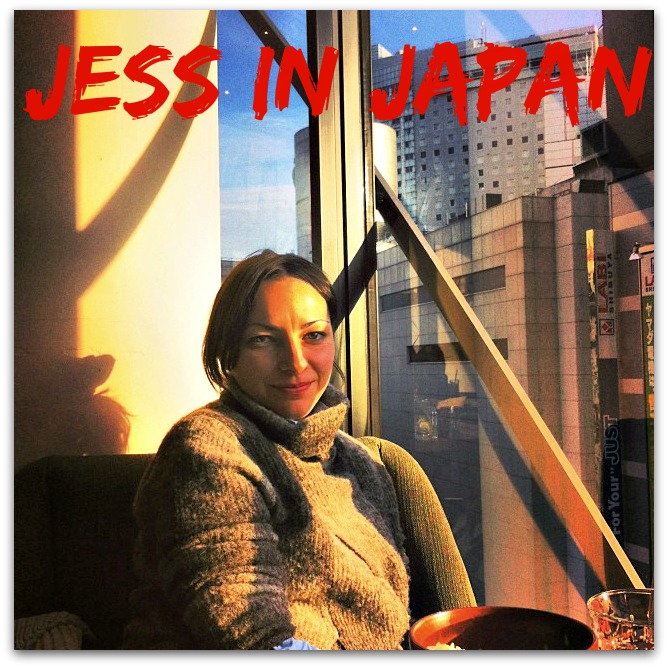
Image: awindram