The Displaced Nation

A home for international creatives

Tag Archives: Spain

And the May 2014 Alices go to … these 3 international creatives

 © Iamezan | Dreamstime.com Used under license

© Iamezan | Dreamstime.com
Used under license

If you are a subscriber to our weekly newsletter, the Displaced Dispatch, you’re already in the know. But if you’re not, listen up. (Hey, why aren’t you? Off with your head!)

Every week, when that esteemed publication comes out, we present contenders for a monthly “Alice Award,” most of whom are writers or other kinds of international creatives who appear to have a special handle on the curious and unreal aspects of being a global resident or voyager.

Not only that, but this person tries to use this state of befuddlement as a spur to greater creative heights.

Today’s post honors May’s three Alice recipients. They are (drumroll…):

1) CHRISTINE GILBERT, blogger, American traveling mom & expat in Barcelona

For her post:  “Why it must suck to be a parent in the US,” on her blog, Almost Fearless
Posted on: 16 May 2014
Snippet:

So we’re traveling across the US after living in Mexico for nearly a year and half, on our way to Europe. … [W]hen we drive to New Orleans it starts. Suddenly I am a bad parent.

… I admit, I am a permissive parent. My basic rules are this: it has to be safe and it can’t infringe on other people. … In short, my children are feral beasties but if required they can sit nicely and say “Please and Thank You” (or at least I try to get them to do that).

But I’m an American, so I have strong opinions about the idea that I have the RED WHITE AND BLUE, PATRIOTIC RIGHT to raise my children however I see fit, whether that’s homeschooling them and teaching them to speak in Klingon or letting them climb trees and juggle knives. Back off.

Citation: Christine, we never cease to enjoy a good round of the old debate about moral relativism (because no parenting method is objectively right or wrong, we ought to tolerate the behavior of all parents) versus moral universalism (a universal parenting norm applies to ALL parents regardless of age, background, ethnicity, etc.)—especially when relayed from the perspective of an expat, and one that writes as entertainingly as you do. While our own inclination is towards tolerance, we would ask you to bear in mind Alice’s “agony of terror” when she first meets the Duchess and her pig-baby. An “unusually large” saucepan flies by the baby’s head and almost take its ear off. “Oh, PLEASE mind what you’re doing!” Alice cries, to which the Duchess responds, in a hoarse growl:

“If everybody minded their own business, the world would go round a deal faster than it does.”

Now, do you identify with Alice or the Duchess? It’s a bit of a moral quandary, correct? What’s more, we’d be curious to hear if your views change at all after living with your family in Barcelona, Spain, for a while. One of us has learned firsthand of a case of an American who is bilingual in Spanish. She brought her two young daughters to Spain last summer to learn Spanish, only to discover, to her considerable consternation, that they were less obedient than Spanish kids in the playground. (No saucepans, please! We’re simply trying to make the world go round faster…)

2) Jon Langford, blogger at BBC America’s “Mind The Gap” and British expat in Manhattan

For his post: Are You Australian?: A British Expat Discusses Mistaken Nationality in America
Posted on: 5 May 2014
Snippet:

Communicating effectively with Americans through a thick Yorkshire accent on a daily basis can be both confusing and traumatizing.

Even though my life would be made significantly easier if I adapted my speech a little, I simply can’t bring myself to say things like war-der, toe-may-do and vie-dah-min. Not that there’s anything wrong with speaking this way, it’s just I’d rather wade through the conversational swamp than surrender my Yorkshire tongue for the sake of convenience.

Citation: Jon, your take-no-prisoners attitude towards preserving your Yorkshire accent, even at the expense of being misunderstood, strikes us as being a trifle, if we may be so bold, bloody minded. (Hey, they don’t call it Yorkshire-stubborn for nothing!) While we can appreciate your need to hold up the side for God’s Own Country, we wonder if you are coming across almost like the Hatter does in Alice in Wonderland. As you may recall, Alice feels “dreadfully puzzled” when he makes a remark that seems “to have no sort of meaning in it, and yet it was certainly English.” But while her response is to say, as politely as she can, “I don’t quite understand you,” our fear is that New Yorkers may dispense with such courtesies and simply blurt out: “You talkin’ to me?” As you have no doubt discovered by now, they take pride in being found the rudest of all rude peoples of America. (Hmmm….has the Yorkshireman met his match?)

3) NIENKE KROOK, blogger and Dutch expat in London

For her post: Bologna Italy: Why you don’t need a map to explore this city, on her blog, The Travel Tester
Posted on: 29 April 2014
Snippet:

Ditch the map in Bologna. Like any classic Italian city, the whole joy of a visit to Bologna is getting lost and losing track of time and space.

Citation: Nienke, we congratulate you for being so willing to let go of your Type A personality while traveling in Italy. especially when exploring a city of Bologna’s ample charms. We would, however, suggest just one small addition to your declaration: “Ditch the map and the watch in Bologna.” If one must carry a timepiece in Italy, let it be the Hatter’s, not the White Rabbit’s! As you may recall from reading Alice in Wonderland as a kid (they read it in Holland, right?), the Hatter and Time do not get along. His watch is frozen at six o’clock. Fascinated by this revelation, Alice says: “Is that the reason so many tea-things are put out here?” Yes, indeed, it is, Alice. In Wonderland you can always have tea and cakes, while in Italy you can always feast on a bit of the sweet life, or la dolce vita, just as long as all five senses are open to the possibility. To repeat (which we think may be necessary for a Type A person), pleasure and indulgence do not come from checking one’s watch!

*  *  *

So, readers, do you have a favorite from the above, or have you read any recent posts you think deserve an Alice Award? We’d love to hear your suggestions! And don’t miss out on the shortlist of Alice contenders we provide in each week’s Dispatch, which are sources of creative thought if nothing else! Get on our subscription list now!

STAY TUNED for more fab posts.

Writers and other international creatives: If you want to know in advance the contenders for our monthly Alice Award winners, sign up to receive The Displaced Dispatch, a round up of weekly posts from The Displaced Nation, with news of book giveaways, future posts, and of course, our weekly Alice Award!. Register for The Displaced Dispatch by clicking here!

Related posts:

Live your life, take chances—raise alpacas? A curious expat tale that has yielded a book-worthy yarn

Seriously Mum Collage

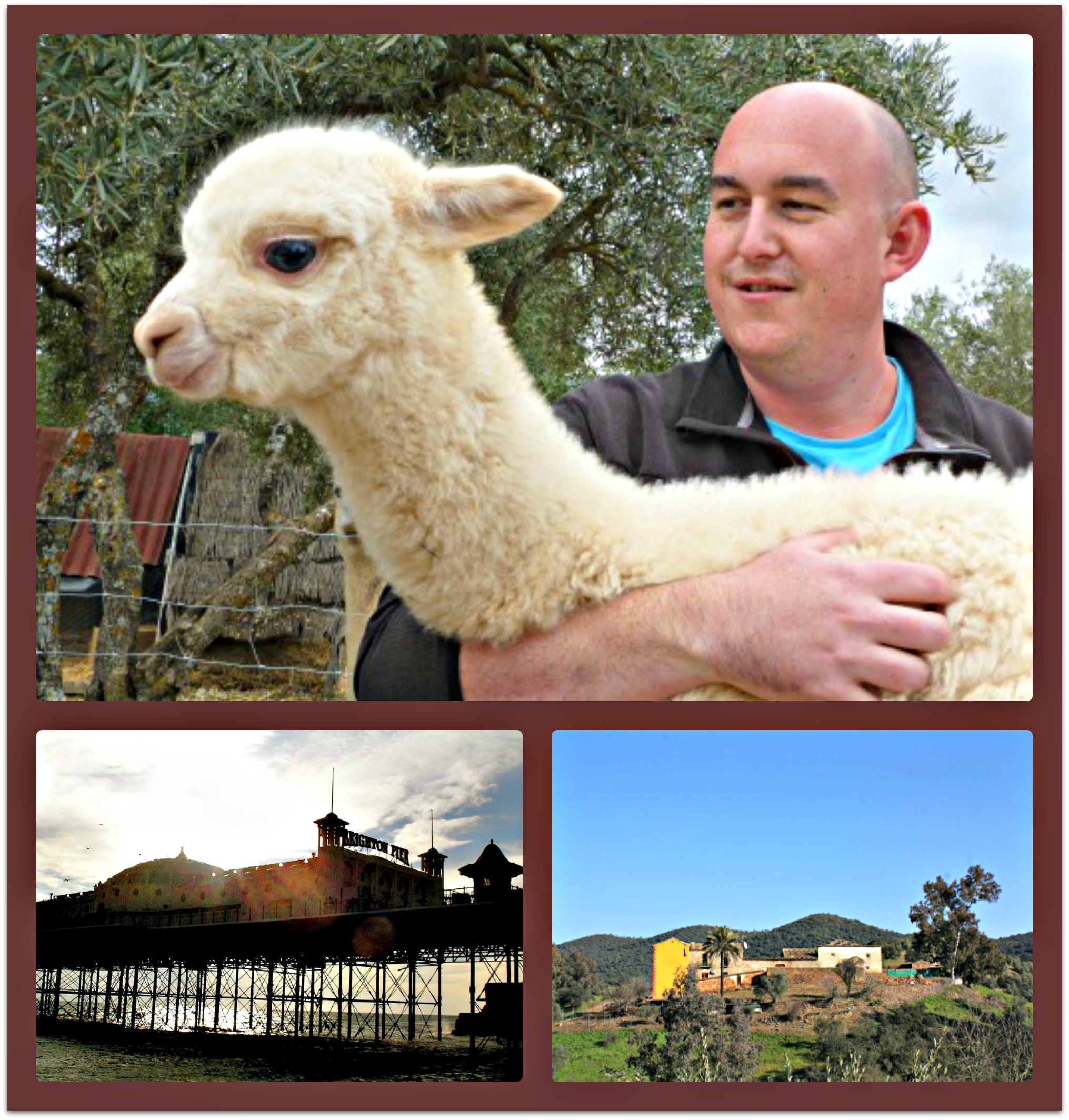
(Clockwise from top) Alan Parks with a friend’s alpaca; the converted olive mill where he and his partner, Lorna, now live; Brighton Pier, scene of their former abode (photo credit: Photo Monkey via Flickr Creative Commons).

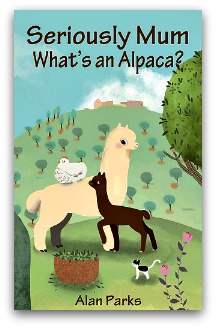
The most amazing thing about the expat memoir penned by my guest today, Alan Parks, is not simply its title, though Seriously Mum, What’s an Alpaca? is quite a doozy.

It’s not even the zaniness of the alpacas that appear throughout the narrative: Bermuda, Cassandra, Lily, Baby Rafa… BTW, they are just a few among many animals Alan and his partner, Lorna Penfold, keep. (There’s a tally of how many and what kinds at the start of each chapter.)

No, the most amazing thing about Alan Parks’s memoir is that fellow expats, particularly fellow Brits (but also one German), are the villains of the piece—the least trustworthy of all the people he and Lorna have encountered on their madcap adventure. I say “madcap” as I think the decision the couple made, six years ago, to abandon their home in Brighton (in their native UK) for a renovated olive mill near Montoro in Spain’s Córdoba Province, which is within the autonomous territory of Andalusia, to raise alpacas justifies my choice of that adjective.

From the book’s beginning, Alan’s instinct is not to stick with the expat community—as he puts it:

I don’t think we would have mixed with many of these people at home, so we should not feel forced to by circumstances.

And boy does that instinct prove right! While the Spanish merely think he and Lorna are crazy (so far as they’re concerned, the British pair may as well be raising giraffes!), their fellow Brits are out to take advantage of them in all kinds of ways. And despite Alan’s better instincts, his limited Spanish at times gives him little choice but to get involved with some pretty unscrupulous characters.

Mind you, the Spanish don’t always come off well either, especially when it comes to their treatment of animals. In light of Mahatma Gandhi’s proclamation—

“The greatness of a nation and its moral progress can be judged by the way its animals are treated.”

—it would not be too far fetched to say that the animals are the book’s true heroes. They are what keep Alan and Lorna going in face of a seemingly unending series of challenges. In tribute, Alan gives various pets a voice at the end of occasional chapters. (It’s sad when they lose them, though.)

But the reason we are assembled here today to give Alan himself a voice in telling us about his book, which I urge you to read if you haven’t already. It’s done super well on Amazon for a reason: it’s terrific! And please LEAVE A COMMENT at the end of this post to be eligible to win a FREE COPY. (Alan has kindly agreed to give one of his books away: your choice of alpacas or donkeys! And there may also be prizes for runners-up!!!)

* * *

SeriouslyMumAlpaca_bookcover_dropshadowWelcome to the Displaced Nation, Alan! Between you and your partner, Lorna Penfold, you have produced three memoirs about your life in Spain. There’s the book we’re featuring today: Seriously Mum, What’s an Alpaca?. There’s also the sequel: Seriously Mum, Where’s That Donkey? And Lorna has just now published From Sequins to Sunshine: Year One. Tell me, what has made the pair of you so prolific?
The books were never planned. Two years ago, after being told many times that I should write a book about our adventures, I decided to give it a go. Seriously Mum, What’s an Alpaca? was the result. It started out being called Bloody Hell, What’s an Alpaca?—an exact quote for how Lorna’s daughter, Frankie, responded when we told her about our plans. But the use of the word “hell” hindered sales in the US. After I released the sequel, we thought people might like to read Lorna’s point of view. She had started a blog when we first moved here, so we turned her posts from the first year into an e-book. So far the reaction has been good.

What was the impulse that led to your packing it all in and moving to the South of Spain?
Lorna was a dance teacher in the UK and I used to work in retail. Lorna developed a condition called sarcoidosis, which made working difficult. One day we were talking about the possibility of her giving up work, and I suggested moving to Florida, but that was too far away. I blurted out “What about Spain?” Crazy really, as I had never ever been here.

Hey, craziness is what makes the world round! And how about this idea of raising alpacas, where did that come from?
We had heard about alpacas in the UK and thought that would be a good business for us to get in to (it wasn’t).

Okay, seeing as I know nothing about the alpaca business, what makes it so challenging?
An alpaca is not a cheap animal, yet you can’t eat it, and it doesn’t produce milk to drink. You make money by selling them to other breeders. But sales, and the selling price, have gone down since the world financial crisis.

What about their wool?
We try to sell as much of our alpacas’ wool as possible to local people who spin, knit and use it for crafting, but the market here in Spain is miniscule and postage costs prohibitive.

Do Spanish people think you and Lorna are crazy for your devotion to these animals?
People in Spain have never heard of alpacas. To a Spaniard, a goat is a much more useful animal.

Why do you still keep your alpacas if you’re not making any money on them?
For one there is no one to sell them to, and for two, they are part of our family and we love them. We also like it when people come and stay at our farm and can experience walking and feeding the alpacas. And finally, if there were no alpacas, there would be no books.

Ah, yes, the books. We’ll get to that, but first let me ask another alpaca question. The New York Times had an article last year talking about llamas being good pets. I think the alpaca is meant to be the llama’s quirky cousin. So is the same true of them?
It depends….they are no good if you want an animal to pet and stroke. But if you have an acre of land and you need the grass kept short, they could be good. Bear in mind, though, that they need to be kept in groups of at least three!

Out of the grey skies of England and into the frying pan of Spain

Moving right along to the weather: having been an expat in Britain myself, I can imagine you were keen to leave behind its grey skies and unpredictable climate. But were you aware that the interior of Andalusia, where you were headed, is the hottest area in all of Europe?
We didn’t find out about this area being called “The Frying Pan of Spain” until much further down the line. We were sorting some paperwork at the Spanish Embassy in London, and a lady said to us, “You do know they call it the Frying Pan of Spain, don’t you?” In the summer it can easily hit 45 degrees during the day. Siestas are a necessity.

Can you give us some sense of how you spend a typical day in your new life versus when you lived in Brighton?
In Brighton I was often out the door at 7:30 a.m. and got back home about 7:00 p.m. Lorna worked in the evenings, often not returning home until 9:00 or 10:00 p.m. Also, she had to work a lot of Sundays, so we never got to see each other. In Spain our life is much more relaxed. We spend our days looking after the animals and maintaining the house, and we are now together 24/7. You could say we went from one extreme to another.

I understand you met Lorna on the Internet. How long had you known each other before hatching this plan to live in Spain?
We had been together for four years and living together for three before we made the move, so we at least knew we could live together.

Did starting up a totally new life in a foreign land put a strain on your relationship or draw you closer?
I wouldn’t say our relationship has ever been strained, although as you can read in our books, we have been through some tough times together.

Be careful what you wish for…

Having read your book, I know there were quite a few moments in Spain when you felt like a bit like aliens, but which moment stands out as your most displaced, when you wondered if you’d made a mistake?
I think our “What are we doing here?” moment came after about 18 months. We had spent all our money with an English builder renovating our new house in the sun, and we experienced the worst Spanish winter rains for a hundred years. It turned out the builder was a conman and all the roofs he’d built started leaking. On top of that two of our alpacas died in the months before. I remember us standing in our kitchen as water cascaded from the ceiling. We were both in tears.

Wow, a literal “pool of tears” moment! But I know you also have things you love about your new life. Can you tell us about your least displaced moment, when you felt you were born to be in Spain’s Frying Pan rather than your native UK?
Andalucia feels like home to us now, although it is difficult to pinpoint the exact moment when we turned the corner. I think we are most aware of it when we are sitting outside having something to eat and drink with friends at 2:00 a.m. in the middle of August, wearing only a t-shirt. That is what life is about, not whether or not you can afford the latest version of the iPad!

Would you say you’ve assimilated to the point where returning to the UK gives you counter culture shock?
Lorna visits the UK regularly as she now has three grandchildren that weren’t even thought about when we first moved here. I have not been back for five years but will head back for a weekend in June to visit my relatives and attend a diamond wedding celebration for my grandparents. In all honesty, I am a bit nervous about it, I am not looking forward to being in crowds. Here in Spain we live in the countryside outside a small town and some days we do not see a single person. Plus in June, I only ever wear shorts and a t-shirt, but in the UK I may need jumpers (sweaters) and trousers.

An Amazon bestseller in Travel with Pets and Travel in Europe

Moving on to your e-books: why did you decide to self-publish?
I wrote my first book just as self-publishing was really taking off. I submitted the manuscript to one publishing house, got a thanks-but-no-thanks letter back, so decided to publish it myself.

Are there any drawbacks to self-publishing?
As a self-publisher, the hardest part is clicking the button to publish. A traditionally published author has that taken away from them, and even if they get mixed reviews they have the backing of the publishing house. We are responsible for everything, from cover, to content, to editing mistakes. If there are problems, or mistakes in the manuscript, that is our fault.

What audience did you have in mind for the book, and has it been reaching those people?
Initially I thought it would appeal mainly to other alpaca breeders, but I have had emails from readers all over the world who say they’ve enjoyed reading about our Spanish adventure. In fact, I was so overwhelmed by the response to Seriously Mum, What’s an Alpaca? I just had to write the sequel, Seriously Mum, Where’s that Donkey?

Your book has done very well on Amazon. Do you do a lot to promote it?
I run a FB group called We Love Memoirs, which has over a thousand members, all of whom enjoy books like mine. The best way to promote is by word of mouth. If somebody recommends your book to their friend, nothing beats that. As a self publisher I am actually against the Amazon Select program, where you make your book available exclusively on Kindle. My books are available on Amazon but also everywhere else: iTunes, Barnes and Noble, Kobo and even smaller retailers.

What’s next—more books?
I would like to release a third book this year, and Lorna has years 2 and 3 in her From Sequins to Sunshine series to work on.

How are the alpacas doing?
The alpacas are good, and if all is well, we may have some babies at the end of the year.

SONY DSC10 Questions for Alan Parks & Lorna Penfold

Finally, I know that both you and Lorna have become avid readers while living in Spain, so I’m curious to hear both of you answer a series of questions that I’ve asked some of our other featured authors, about your reading and writing habits:
1. Last truly great book you read: Alan: I’m not sure I have ever read a truly great book. The books I read tend not to get put in that category. Lorna: A Thousand Splendid Suns, by Khaled Hosseini. Alan: I also have read A Thousand Splendid Suns, but I didn’t have the same reaction Lorna did.
2. Favorite literary genre: Alan: Comedy memoir. Lorna: Everything except horror.
3. Reading habits on a plane: Alan: I haven’t been on a plane for six years. Before it would have been an old fashioned book, but now I would read on a kindle app on my phone. Lorna: Always a paperback (whatever I happen to be reading).
4. The one book you’d require PM Cameron to read: Alan: Mine, of course! I think it would do him the world of good to find out that people can be happy living a more simple life, with less materialistic ideals in life! Lorna: Mine of course, just to give him a look at a day to day life of a “normal” working class person.
5. Favorite books as a child: Alan: The “Adventure” Series, by Willard Price.
6. Favorite hero/heroine in fiction: Alan: Jack West Junior, who appears in a book series by Australian author Matthew Reilly. Lorna: Mariam from A Thousand Splendid Suns, by Khaled Hosseini.
7. The writer, alive or dead, you’d most like to meet: Alan: Peter Mayle. Lorna: Khaled Hosseini.
8. Your reading habits: Alan: I read in bed at night, and a lot in the summer. Lorna: I read lots in summer as we do not watch television at all then. Plus other times of course.
9. The book you’d most like to see made as a film: Alan: Anything by Matthew Reilly, it would be like Indiana Jones on speed. And my own book of course. Lorna: My partner’s book Seriously Mum, what’s an Alpaca?
10. The book you plan to read next: Alan: Escape to Mulberry Cottage by Victoria Connelly. Lorna: The next on the shelf, whatever it is!

* * *

So, readers, any COMMENTS or QUESTIONS for Alan? Hey, it’s not every day you get to discuss the world’s most captivating camelids! And don’t forget, there’s a free digital copy on offer…

And if you can’t wait to read the book or don’t win, Seriously, Mum, What’s an Alpaca? is available from Amazon(among other venues). Be sure to grab a copy! You can also visit its companion site, like the book’s Facebook page (and be treated to lots of cute alpaca pix!) +/or follow Alan on Twitter.

STAY TUNED for next week’s fab posts!<!–tomorrow’s post, when our fictional expat heroine, Libby, returns to the Displaced Nation to update us on her many adventures. (What, not keeping up with Libby? Read the first three episodes of her expat adventures.)–>

If you enjoyed this post, we invite you to register for The Displaced Dispatch, a round up of weekly posts from The Displaced Nation, with seasonal recipes, book giveaways and other extras. Register for The Displaced Dispatch by clicking here!

Related posts:

And the February 2014 Alices go to … these 3 international creatives

 © Iamezan | Dreamstime.com Used under license

© Iamezan | Dreamstime.com
Used under license

If you are a subscriber to our weekly newsletter, Displaced Dispatch, you’re already in the know. But if you’re not (and why aren’t you? off with your head!), listen up.

Every week, when that esteemed publication comes out, we present contenders for a monthly “Alice Award,” most of whom are writers or other kinds of international creatives who appear to have a special handle on the curious and unreal aspects of being a global resident or voyager.

Not only that, but this person tries to use this state of befuddlement as a spur to greater creative heights.

Today’s post honours February’s three Alice recipients. Starting with the most recent, they are (drumroll…):

1) MICHELLE WELSCH, writer, traveler, founder of Project Exponential

For her post: “Quitting everything to go to Nepal was the best thing I’ve done” on Medium.com
Posted on: 27 December 2013
Snippet:

And everywhere I went, there were EYES. Always eyes. Constant staring, asking the same questions: Where are you from? What are you doing in Nepal? How long have you been here? How old are you? Are you married? Why not?

Sometimes I just wanted to “blend in” and not be reminded of my whiteness and the privileges that come with being an American…

So no, not every day was perfect. But even the imperfect days added to the experience.

One of the monks asked me, “If there is no night, how can there be day?”

Citation: Michelle, the monk’s line of questioning puts us in mind of the cross-examination to which Alice is subjected upon encountering the Caterpillar:

“You!” said the Caterpillar contemptuously. “Who are YOU?”

Which brought them back again to the beginning of the conversation. Alice felt a little irritated at the Caterpillar’s making such VERY short remarks, and she drew herself up and said, very gravely, “I think, you ought to tell me who YOU are, first.”

“Why?” said the Caterpillar.

Also, if you were bothered by all the eyes staring at you, imagine how poor Alice felt when being scrutinized by a creature with twelve eyes. Yes, that’s what caterpillars have, a dozen eyes. That said, the Caterpillar, whose one and only job is to eat (it increases its body mass by 1,000 times or more), would undoubtedly admire your fortitude in being able to drink tea with sugar and consume lots of carbs without obsessing about food or weight or calories. All told, while your post helps us to understand the charms of this South Asian land, we are still shaking our heads at the notion of monks enjoying water balloons. As the Caterpillar will tell you, water balloons don’t rate, their potential to become psychedelic hallucinogens being rather too limited.

2) AMY R., blogger and British serial expat

For her post: “Expat Life: Love Lessons Learned” on her blog, The Tide That Left
Posted on: 14 February 2014
Snippet:

We ended 2013 by moving to Tanzania. It was the year of learning to be flexible; most importantly to be flexible with each other. I used to be the kind of girl who needed her life mapped out, but since we started our expat life together we’ve both had to find a way to go with the flow. We’ve chosen a lifestyle that throws up the unexpected, and we wouldn’t be able to cope if we didn’t roll with the changes.

Citation: “Roll with the changes”—Amy, that’s exactly what Alice decided to do when her eye fell on a little glass box that was lying under the table, which turned out to contain a very small cake, on which the words “EAT ME: were beautifully marked in currants:

“Well, I’ll eat it,” said Alice, “and if it makes me grow larger, I can reach the key; and if it makes me grow smaller, I can creep under the door; so either way I’ll get into the garden, and I don’t care which happens!”

As you can see, in a land where cakes can make you grow larger or smaller, there is little point in mapping out one’s life, especially when you have reasonable hope of getting into the garden eventually. We’re ever so glad you realized that, and just in time for entering your own Garden of Love! (Hope you and your hubby had a happy Valentine’s Day!)

3) MANAL KHAN, journalist, poet, essayist, photographer, and storyteller

For her post: How to Make Friends in a New City—Tip #5, on her blog, Windswept Words
Posted on: 28 January 2014
Snippet

So, if you ever find yourself lost, alone and friendless in a new city, wondering why on God’s earth you ever transplanted yourself in the first place: don’t worry! It takes time for a plant to adjust to new soil, a new atmosphere. But once it gets over the wilting, drooping, moping period—”transplant shock” in botanical terms—it thrives.

Citation: Manal, imagine yourself, like Alice, having landed in a garden where the flowers can talk “very nicely,” for no apparent reason:

“Put your hand down, and feel the ground,” said the Tiger-lily. “Then you’ll know why.”

Alice did so. “It’s very hard,” she said, “but I don’t see what that has to do with it.”

“In most gardens,” the Tiger-lily said, “they make the beds too soft—so that the flowers are always asleep.”

That’s some transplant shock, don’t you think? In any event, we agree entirely that the botanical analogy goes a long way towards explaining why some of us feel displaced when attempting to put down a few roots in our new culture. Until the process is complete, there is little else we can do but indulge in the occasional wilt/droop/mope, as you say. And just think, if the soil proves sustaining, we may one day flower to the point of talking “very nicely” in the native tongue…

*  *  *

So, readers, do you have a favorite from the above, or have you read any recent posts you think deserve an Alice Award?  We’d love to hear your suggestions! And don’t miss out on the shortlist of Alice contenders we provide in each week’s Dispatch, which are sources of creative thought if nothing else! Get on our subscription list now!

STAY TUNED for tomorrow’s fab post.

Writers and other international creatives: If you want to know in advance the contenders for our monthly Alice Award winners, sign up to receive The Displaced Dispatch, a round up of weekly posts from The Displaced Nation, with news of book giveaways, future posts, and of course, our weekly Alice Award!. Register for The Displaced Dispatch by clicking here!

Related posts:

For this peripatetic Argentine, now an expat in Queensland, a picture says…

Canon zoom lens; photo credit: Morguefiles. Belu in Buddha Truth Relic Temple, Singapore; photo credit: Belu.

Canon zoom lens; photo credit: Morguefiles. Belu in Buddha Truth Relic Temple, Singapore; photo credit: Belu.

Welcome back to our series “A picture says…”, created to celebrate expats and other global residents for whom photography is a creative outlet. The new series host is English expat, blogger, writer, world traveler and photography enthusiast James King, who blogs at Jamoroki and truly believes a camera is a mirror with memory…

Greetings, Displaced Nation-ers. My guest today is the 35-year-old Argentine Belu: an expat, blogger, world traveller and photography enthusiast. Belu studied industrial design at university in Argentina and then moved to Europe. Not long ago, she relocated to Australia, where she sells her designs at street markets and travels as much as her finances allow.

Belu brings her experiences and unique view of the world to her photography blog, BeluChi, and to the travel blog, Travel Tips and Pictures, where she is the main travel writer.

I have followed Belu for a short while and love the simple, down-to-earth way she brings her pictures and the stories behind them to life through her writings.

* * *

South American but with deep European roots

Hi, Belu. Thanks for agreeing to this interview. Can we begin by having you tell us: where did you live in Argentina, and when did you spread your wings, leave the nest and start your world travels?
I was born in Mar del Plata, a pretty big town located 500km south of Buenos Aires. I lived there until I was 25, and it was about that time that I became curious about travel and ended up moving to Europe.

So you got the travel bug. I can relate to that—but what really inspired you to travel?
Travelling for me is a way to get connected with people and to nature. I so love meeting people, and I knew travelling would give me that opportunity better than anything else. I love it when people tell me about their lives, their cultures and traditions, stories and dreams. I learn so much from my travels.

I know exactly what you mean. It’s quite addictive and I can see you are a compulsive globe-trotter. Tell me what countries have you visited so far?
Aside from Argentina and southern Brazil, I’ve travelled mostly around Europe: Portugal, Spain, France, Italy, Monaco, Belgium, England, Scotland and Ireland. And now, because I live in Australia, I’m starting to be more in touch with Oceania and Asia—Indonesia and Singapore, for example. I’m planning a trip to China next year, and in 2015 I hope to travel to India and some countries in Africa.

Wow, that’s quite a package! Tell us, how did you end up in Australia, and what is life like for you your new home?
I met my partner when travelling in Australia over two years ago, when living in Barcelona. So, after going back and forth several times, we decided to live together here in beautiful Cairns, a city in the far north of Queensland. So far, so good. I believe that how you feel in a different place and culture depends mostly on how you connect and interact with the people in your new environment, at least in my case. Weather is also important to me because I’m a “sunlight” lover.

Pizza San Marco, Venice Italy. Photo credit: Belu

Piazza San Marco, Venice, Italy. Photo credit: Belu

You offered this photo—of you and all the pigeons in the Piazza San Marco in Venice—as one of your favorite shots that captures cherished memories. Thank you for sharing it. Can you tell us more about why it’s so special?
This photo brings me back to the first time my parents came to Barcelona to visit me. We went to Venice and Rome—spectacular!—and then to Lettopalena, a tiny little village up on the top of a mountain in Chieti Province, around 200km from Rome. It was the place where my grandmother was born. I met my Italian family, who are still living there. That trip was exiting because of the contrasts.

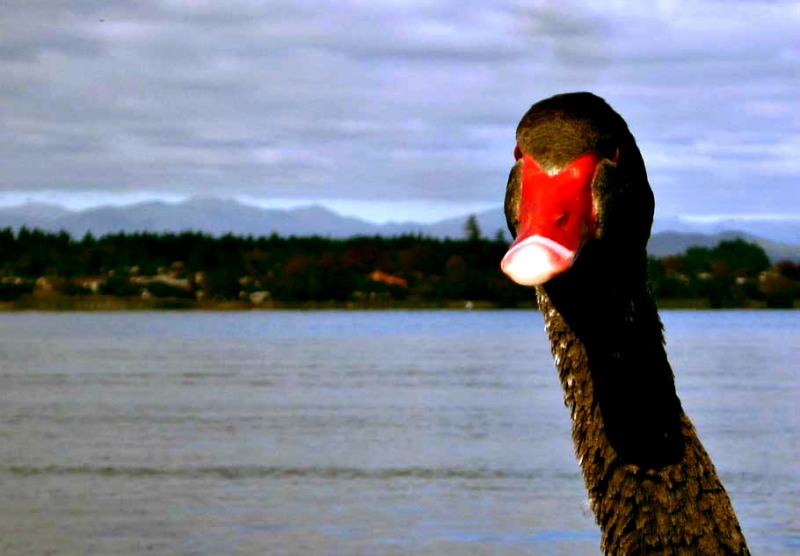
Taupo Lake, Taupo, New Zealand. Photo credit: Belu.

Black swan on Lake Taupo, New Zealand. Photo credit: Belu.

Solo travel and staying with locals

That must be a very personal piece of your life. Now moving on to your photo of a beautiful black swan on Lake Taupo in Taupo, New Zealand.
Lake Taupo is in the centre of the North Island. My trip to New Zealand was unforgettable because of the natural beauty. It was also solo-travel, so I could be more in contact with locals and travellers from everywhere. I love this kind of travel. I usually have a “tentative plan” that I hardly ever follow. I love the freedom of changing and re-organising my itinerary according to my feelings.

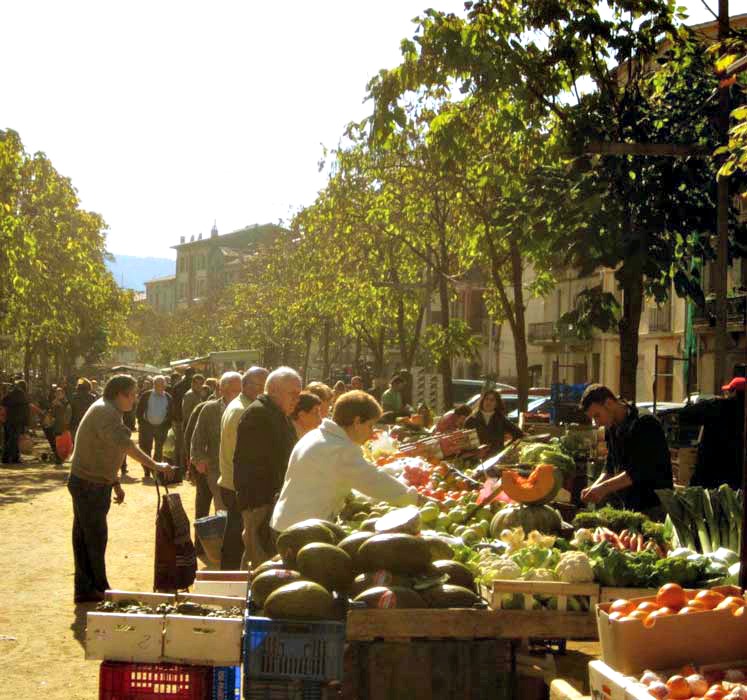
Oh! I know the feeling well. No one to nag you. Free as a bird (so to speak). Okay, so now for a photo of the everyday scene—a street market in Ripoll, Girona (one of the four provinces comprising Catalonia), Spain. My favourite country!

Street market in Ripoll, Spain. Photo credit: Belu.

Street market in Ripoll, Spain. Photo credit: Belu.

I spent a Saturday morning strolling around the heart of Catalonia, in southeastern Spain. I had the honour of staying at my friend’s parents’ home, always with locals… that made this travel special. I did visit popular tourist spots in that area, but when you are with local inhabitants, it makes the place so much more interesting and you learn so much more about their culture. They told me folk tales and stories that you’ll never find in any guidebook.

I seem to be agreeing with everything you say, but it’s difficult to argue with that. So many people travel but never really integrate with the local people. They miss so much. But we must move on now. Where were or are your favourite spots to take photographs?
My favourite spots are high viewpoints and streets.From high viewpoints you get to admire the whole picture, almost like aerial photography. I find that very exhilarating. And when I am in the streets I am close to the people and can really feel the ambiance and capture the essence of the place.

High vs low, scenery vs people

The last three photos you’ve chosen illustrate the difference between high (looking down) and low (streets at ground level) admirably:

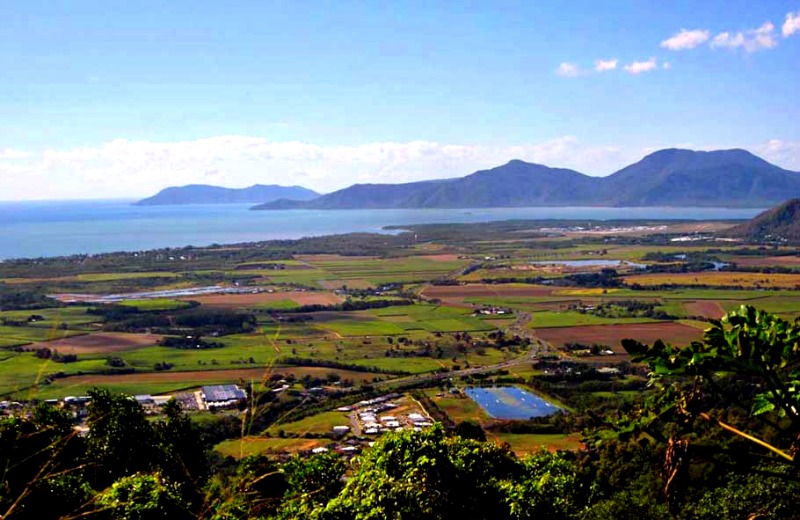
Cairns, Queensland, Australia. Photo credit: Belu.

Cairns, Queensland, Australia. Photo credit: Belu.

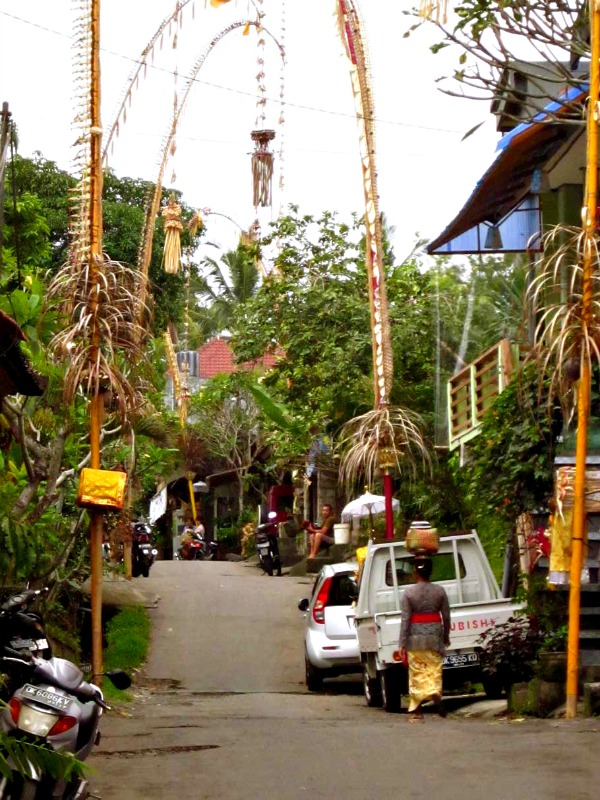
Back street, Bali, Indonesia. Photo credit: Belu.

Back street, Bali, Indonesia. Photo credit: Belu.

London (near St. Paul's), England. Photo credit: Belu.

London (near St. Paul’s), England. Photo credit: Belu.

The photo of Bali is so typical of a Southeast Asian back street. And the one of London, showing a tramp walking between a dust cart and a City businessman with St. Paul’s Cathedral as the backdrop, is an absolute gem. Actually, this photo leads to my next question: do you ever feel reserved about snapping photos of people, particularly when they are conscious that you are doing so? And do you ask permission before taking people’s photographs? How do you get around any problem of language?
It usually depends on the situation and the local culture. I sometimes ask permission by words or sign language, especially if I feel the person is uncomfortable because of the camera. Fortunately, I have never had any problem about that. Most of the time people say “yes”.

That must make it easier to take natural shots; so would you say that photography and the ability to be able to capture something unique which will never be seen again is a powerful force for you?
For me the answer to that is “most definitely, yes!” When I left Argentina I, maybe unconsciously, realised what a powerful force pictures are. To be able to produce something that can never be repeated exactly is quite amazing.

Let’s get technical

Now for the technical stuff which I am not very good at. What kind of camera and lenses do you use?
I have a Canon Ixus 107 called “Anastasia”. She is always in my bag. It isn’t a professional camera but it works as it were! A useful camera for me must be compact and not too expensive, because I don’t want to be too worried about it when travelling.

Finally, do you have any advice for wannabe photographers (like me) who are travelling or living abroad?
Well, the Internet has plenty of information, videos, etc, for those in search of photography tips. But I can tell you what I do: stay curious, learn from others, and meet people.

* * *

Readers, what do you make of Belu’s experiences and her photography advice? And do you have any questions for her on her photos and/or travels? Please leave them in the comments! 

Once again, if you want to read more of Belu, don’t forget to visit her sites (see links above). You can also contact her via aquibeluchi@gmail.com.

(If you are a photographer and would like to be interviewed by James for this series, please send your information to ml@thedisplacednation.com.)

STAY TUNED for next week’s fab posts, including an interview with this month’s featured author!

If you enjoyed this post, we invite you to register for The Displaced Dispatch, a round up of weekly posts from The Displaced Nation, with seasonal recipes, book giveaways and other extras. Register for The Displaced Dispatch by clicking here!

Related posts:

Repeat expat Manal Khan lives in fact, in fiction–and everywhere in between

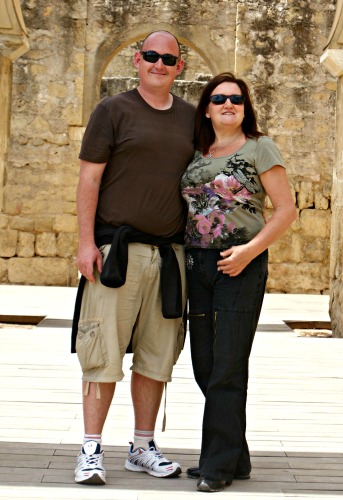
ManalinSpain

Manal Khan, taken by her husband on a day trip to Segovia.

The Displaced Nation is on a mission to celebrate the contributions made by borderless travelers and global residents to creative pursuits.

Owing to our Western bias, we tend to feature Westerners who have ventured to other parts of the world, but there are plenty of other internationals who, too, deserve kudos—I refer to our counterparts in the less developed world, many of whom flock to the United States and Europe for higher education and employment opportunities, and in the course of that, find their own creative paths.

Is that because they feel as displaced as we do?

Perhaps I’ll uncover some answers in today’s post. I’ll be talking to journalist, poet, essayist, photographer, and storyteller Manal A. Khan, who says that she lives in fact, in fiction—and everywhere in between. Born in Pakistan, Manal has a journalism degree from Berkeley and has worked for an independent news organization in New York City.

I discovered Manal’s magnificent blog, “Windswept Words.”, around the time the Displaced Nation started and have been eager to interview her ever since. But when I tried contacting her, she’d just repatriated to Pakistan. She did not see my request until recently, when she and her husband (also Pakistani) moved abroad again, this time to Europe.*

I am so pleased to be able to catch up with Manal in her latest port of call: Madrid, Spain. I predict that you, too, dear reader, will be as blown away, so to speak, as I was by her windswept words…

* Ironically, on the very day when Manal answered my request, she was awarded one of our Alices for a recent blog post that expresses, at one and the same time, her love for her native Pakistan as well as her discomfort with its social inequalities and excessive religiosity.

* * *

Greetings, Manal. It’s so good to have the chance to catch up with you at long last. I’d like to start by quoting from one of your poems, called “Foreigner”:

sometimes, i wish
i didn’t feel like such a foreigner
in my own country
among my own people
that i wouldn’t be polite,
embarrassed, awkward
that punjabi or urdu would flow from my mouth
as effortlessly as english…

What led you to compose these words?
I wrote “Foreigner” eight years ago, during my college days in my hometown, Lahore. Pakistan is an extremely socially-divided country. If you happen to be born “privileged,” chances are you will get the best lifestyle, the best education, and the best work opportunities that the country has to offer. And if you happen to be born outside of that tiny privileged class—the middle-class barely exists in Pakistan—chances are you will be struggling most of your life just to put food on the table. I happened to be born into the former class, and while I know that I was fortunate, that terrible divide is something I could never reconcile myself with.

And it was not just about money, or wealth. It was about culture, and language, and a sense of belonging. Pakistan used to be a British colony, and gained independence in 1947, along with the rest of the Indian subcontinent. But in many ways, we remain “colonized” by the English language. English is still the language of the powerful, of the elite, and a huge divider of class, culture and people.

So all these different things were swimming in my head when I wrote the poem. You could say that I felt “displaced,” even when I lived in my native country.

I can relate—and I was born in America! Another poem of yours I enjoyed was this short one: “Not Being,”. Allow me to share the first two lines:

If home is where the heart is, my heart is forever moving, a gypsy
If a piece of cloth and a stadium slogan is a test of nationalism, I have no nation…

“Not Being” was written in New York. It was inspired by many different things, but the theme of not belonging, or not quite fitting in—in this case, to Pakistani society—is similar to “Foreigner.” For instance, the definition of a “good” Pakistani, according to accepted norms, is basic and black-and-white: intensely patriotic, passionate about cricket, virulent about America, and careful about fasting in Ramadan and attending Friday prayers; somebody who is dutiful to family, loyal to friends, lives up to expectations, and sticks to his or her roots. I was getting a lot of pressure, directly and indirectly, to be this sort of person from people I knew back home, and from feedback on my blogs published in The Express Tribune. I felt confused. I didn’t agree with or conform to any of those norms, so did that make me a “bad” Pakistani? The poem was an expression of that conflict.

Was the audience you intended for these poems primarily Pakistani?
To be honest, I intended no audience. I published “Foreigner” on Windswept Words a few years ago—it had been sitting in an old notebook till then; and “Not Being” only reached my regular blog readers. But now you mention it, I may submit the poems to one of the Pakistani blog sites I write for. It would be interesting to see people’s reactions.

“Embrace the day with laughing heart…”

Did writing about these themes help you to process the peripatetic life you’ve led as a young Pakistani woman who went to j-school in California and has lived in New York City?
Not only the poems, but most of the writing on my blog over the past few years has revolved around these themes. It’s interesting to see how one’s feelings of displacement evolve over time. Initially, when you are “fresh off the boat,” a foreigner in a foreign land, you feel compelled to uphold a sense of distinction, your separate identity (see my post “When in America, do as the Americans don’t”). At another level, you also want to assimilate, because you don’t to be viewed as an outsider forever (“Change”). And then there is that other level, when you stop waxing nostalgic and start viewing your own country critically (“The Freedom to Be”).

Is writing therapeutic?
Oh yes, definitely. My experience living abroad has changed me inalterably, and writing about it helps to make sense of things, to sift through the good and the bad of places, situations.

LakeSaifulMalook_MK

Photo credit: Manal Khan

You also translate Pakistani stories into English: I’m thinking of your work-in-progress “The Legend of Saif-ul-Malook.” Can you tell us how that got started, and the audience you hope to reach with these tales?
Oh yes! Saif-ul-Malook is the name of a beautiful lake located in the Himalayas, in the northwestern province of Pakistan. It’s a breathtaking region, full of snow-capped mountains, lush pine forests, and startlingly blue lakes. When I was growing up, our family would travel to the mountains every summer, driving from the torrid heat of flat and dusty Lahore to the cool green valleys of Kaghan, Swat, Nathiagali. I first visited Saif-ul-Malook when I was 12 and fell in love with the place for its beauty and for the enchanting legend associated with it, a fairytale that has been penned in several local languages but never in English. So, the next time I went there (four years ago), I was sure to take an audio recorder and capture the full version of the story in the words of the resident raconteur.

This I transcribed, translated into English, and re-wrote with my own little additions (see “The Legend of Saif-ul-Malook Part I”). I have still to write the last part, the epilogue.

But the response I’ve received to the story has been truly wonderful, and so encouraging. English-speaking Pakistanis are thrilled to find this favorite tale of theirs in an accessible form.

I want to continue this sort of storytelling, translating and transforming Pakistani fairytales, many of them unwritten, into English, for an English-speaking audience. I have a few stories in mind, told to me in childhood by an old lady called Bua, who used to work for my grandmother and later lived with my family for many years. She was the quintessential storyteller, silver-haired and toothless, with fabulous tales at the tip of her tongue and a different twist each time she narrated one. (See my profile of Bua.)

Where did you meet your husband, and does he share your feelings of being between cultures?
I met my husband in Lahore many years ago. Like me, he grew up in Lahore, though his family is originally from a Pashtu-speaking tribal region of northwest Pakistan. He also studied in the U.S., and we both lived and worked there together, so, yes, he does share many of my feelings about being in between cultures. But he does not dwell on it as much as I do; he is quite at peace with himself, wherever he is and whatever he is doing. I, on the other hand, have to think and think and write and write before I am able to find that peace, that balance, the position where I stand and where I am comfortable! Still, it helps a lot to be able to discuss these things with him. He is also always my first reader!

“My heart is forever moving…”

In your search for that peace and balance, as you put it, do you recall one moment in particular when living in America that stands out as your most displaced?
I can’t think of any one moment in the U.S. when I felt especially displaced. I think it’s because I lived in such big, multicultural cities (San Francisco Bay Area and New York City), where people were mostly very tolerant and open-minded, and where there were always so many “ethnic” options. In New York if I missed Pakistani food, I could quickly hop over to Haandi or Lahori Kabab Restaurant on Lexington Ave for a hearty, spicy, almost-authentic meal; if I missed the music and dancing, there was no shortage of Bhaṅgṛā– or Bollywood-themed dance clubs; and if I missed Urdu conversation, Pakistani jokes, or just reminiscing about home, there were many lovely people from Pakistan whom I knew from before or had met in the U.S.; and we congregated quite regularly for these chai-biscuit sessions.

How about in Madrid?
In Spain, the experience has been a little bit different. There is hardly any Pakistani or Indian community in Madrid. The American or British expats mostly hang out within their own cliques. Madrilenos are very warm and welcoming, but language is the biggest barrier to cross before you can really feel like a part of the city. Still, we are very new, I’ve started learning Spanish, and we’ve already met some terrific people. So I am not too worried about settling in!

And during your repatriation?
During our recent year and a half in Pakistan, one thing I could not bring myself to get accustomed to was our culture of live-in servants. Even though I had grown up in that environment—and we were always taught to be extremely courteous with the domestic staff—it was very difficult to go back to it after living independently for so long. I think I experienced moments of displacement every single day, in my interaction with the servants in my parents’-in-laws home, where we lived. A part of me abhorred the idea of making a distinction between “them” and “us”—the employers, the masters. But the practical part of me knew that even the servants would consider it wrong, or strange and awkward, if I was to behave in any other way, outside of the conventional master-servant relationship.

I also remember certain conversations, with friends or family, in which somebody would innocently discuss: “Where should the new servant girl sleep? Not in that empty bedroom upstairs, no—she may steal something. Perhaps in the hallway?” To be followed by: “I bought a gorgeous new outfit from so-and-so designer’s store the other day—only Rs. 30,000 (US$280) on sale!”—probably ten times the servant girl’s monthly salary. I always felt so uncomfortable, and so out-of-place, for feeling uncomfortable—yet powerless to do anything or say anything that would make any difference.

What was your least displaced moment, when the peripatetic life made sense, and you felt as though you belonged in the Western world?
For me, feeling at home somewhere is all about making meaningful connections with people, and being free to be yourself. It doesn’t matter where you are, and it need not necessarily be the land of your birth.

One of the places I felt most at home at was the International House in Berkeley, California. A six-story dormitory for both American and foreign students at UC Berkeley, the I-house was a cozy, colorful, microcosmic universe in itself. There we were, young people from every corner of the world, each with our own unique culture, language, background, story, sharing the singular experience of studying and learning in a foreign land, a new place; a place that was beautiful and accepting of our differences, that celebrated our diversity. Even an ordinary meal in the I-house cafeteria—notorious for its tasteless food—was an adventure. I could be sitting next to a Lebanese civil engineer on one side, a Japanese-American graphic artist on the other; an Italian composer and a Korean mathematician in front; and conversation never ran dry. We laughed a lot, and learnt much from each other; and we never felt alone. That life wasn’t “real,” I know; it was and could only be a temporary phase. But I cherish those memories everyday. My one-year fellowship at Democracy Now in New York was a similar experience. We were a diverse, energetic team, united by a shared vision; and we all loved our fair-trade coffee and double-chocolate cupcakes!

How about during your recent sojourn in Pakistan: despite your conflicted feelings, were there moments when you felt entirely at home?
As for Pakistan—it is and always will be home, home at the end of the day. What I loved most during our recent sojourn was traveling within Pakistan. We explored the Karakorum Mountains, the Hindukush, the Himalayas, the Salt Range. We camped by flowing white rivers, under dazzlingly starry skies. We ate unbelievably delicious chapli kababs at nameless roadside restaurants, washing them down with steaming cups of sweet kaava. We tracked brown bears and chased golden marmots in the second-highest plateau in the world. We had tea with a jeep-driver and his eight daughters in their warm three-room cottage on the hillside. I discovered a Pakistan that I had never known before—a Hindu Pakistan, a Buddhist Pakistan, an animist Pakistan, the ancient Pakistan of the Indus Valley Civilization. A much richer Pakistan. And being outside of Lahore, outside of the noisy, constricted city, I felt at home. I felt like another character in the sweeping history of this aged and beautiful land that I loved, yet did not conventionally fit into.

A picture says…

Lahore_MK

Photo credit: Manal Khan

I understand you also use photography as a creative outlet. Can you share some examples with us?
I took this photo in the Old City of Lahore last summer. It was early evening, and the moon had just come up. All the different sources of light—the full moon, the halogen lights in the shops, the headlights of the motorbike behind the tonga—gave the scene a very magical, unreal feel. I love the lights, the shadows and silhouettes in this photo, as well as the depth of the crisscrossing cables overhead, fading away into mist.


Gypsies_MK

Photo credit: Manal Khan

I agree, it’s enchanting, and the cables are an amazing juxtaposition. I believe you have one more photo to share?
Yes, one that I took this summer in Deosai Plains, the second-highest plateau in the world, located in the remote Baltistan region of Pakistan. This region is also home to K2, second-highest mountain in the world. We were crossing the plains in jeeps, when we came upon a caravan of gypsies, traveling in the opposite direction with their children, mules, dogs and horses. I cannot find any information about these people, where they come from, what their destination is, even what language they speak. But they make the trek across Deosai Plains every summer. I love the clarity of this photo, the crispness of the colors; and generally I loved the mystery of these people, in this remote, unpeopled part of the world.

What are your writing plans for the coming year? Will you attempt to put some of your writings together in a book?
I wish! Writing a book, either a novel or a collection or short stories or essays, is definitely something I hope to achieve within the next five years. For the coming year, I want to focus on writing regularly on my blog, about my adventures and experiences in Spain, from multiple perspectives of displacement! I also want to continue the translation, or “transformation” of Pakistani fairy tales into English.

10 Questions for Manal A. Khan

Finally, I’d like to ask a series of questions that I’ve asked some of our other featured authors, about your reading and writing habits:
1. Last truly great book you read: Samarkand, by French-Lebanese writer Amin Maalouf
2. Favorite literary genre: Magical realism, historical and fantasy fiction, creative nonfiction, short stories
3. Reading habits on a plane: I always take one book with me, normally a novel, slim enough to stuff into a handbag, easily readable but thought-provoking: e.g., The White Tiger, by Aravind Adiga.
4. The one book you’d require Mamnoon Hussain to read, and why: He is so new to the Pakistani political scene that I really don’t know much about him! But I would recommend every Pakistani leader to read Jinnah, Pakistan and Islamic Identity, a revisionist biography of Pakistan’s founding father, by Akbar S. Ahmed.
5. Favorite books as a child: The Anne of Green Gables series, by L.M. Montgomery; The Faraway Tree Stories and The Famous Five series, by Enid Blyton; Chronicles of Narnia, by C.S. Lewis; all of Road Dahl; abridged versions of Jules Verne.
6. Favorite heroines: Anne Shirley of Anne of Green Gables and Scheherazade of The Arabian Nights.
7. The writers, alive or dead, you’d most like to meet: Gabriel García Marquez, J.R.R. Tolkien, Ismat Chughtai
8. Your reading habits: I read mostly at night, before bed, or while traveling, or on lazy afternoons curled up on the sofa with a cup of tea.
9. The books you’d most like to see made as a film: One is a novella by celebrated Indian-Muslim authoress Ismat Chughtai, translated from Urdu as The Heart Breaks Free. The other is a collection of satirical short stories by Naguib Mahfouz, titled Arabian Nights & Days. I would love to see both these works as short films, and maybe even produce them myself one day!
10. The book you plan to read next: Don Quixote—because I am in Spain!

* * *

Thank you, Manal! I must say, I love how you combine the spirit and creativity of Anne of Green Gables with the story-telling power of Scheherazade! Like most gifted writers, you are still a child at heart!

Readers, do you have any further questions or comments for Manal? Once again, if you want to read more of her insights, be sure to check out her blog, Windswept Words.

STAY TUNED for Monday’s post, another episode in the life of Libby, our fictional expat heroine…

If you enjoyed this post, we invite you to register for The Displaced Dispatch, a round up of weekly posts from The Displaced Nation, with seasonal recipes, book giveaways and other extras. Register for The Displaced Dispatch by clicking here!

Related posts:

Main image at top of page: Manal Khan, taken by her husband on a day trip to Segovia. All other images are by Manal Khan, and are posted here with her permission.

And the October 2013 Alices go to … these 4 international creatives

 © Iamezan | Dreamstime.com Used under license

© Iamezan | Dreamstime.com
Used under license

If you are a subscriber to our weekly newsletter, Displaced Dispatch, you’re already in the know. But if you’re not (and why aren’t you? off with your head!), listen up. Every week, when that esteemed publication comes out, we present an “Alice Award” to a writer or other kind of creative person who we think has a special handle on the curious and unreal aspects of being a global resident or voyager. Not only that, but this person tries to use this state of befuddlement to their advantage, as a spur to greater creative heights.

Today’s post honors October’s four Alice recipients.

Starting with the most recent, and this time with annotations, they are (drumroll…):

1) CATHY TSANG-FEIGN, American psychologist in Hong Kong, specializing in expat psychology and adjustment issues

For her book: Keep Your Life, Family and Career Intact While Living Abroad
Published: September 2013
Snippet:
Cathy_Feign_cover

[Benjamin is a marketing buyer who was transferred to Hong Kong on a two-year contract. Having been through the phase of “elation,” he now finds himself in phase of “resistance,” with “transformation” and “integration” yet to come.]

Benjamin is getting annoyed by the frantic pace of life in Hong Kong, the indirectness of Chinese people in business, the crowds and difficulties in being understood. He is frustrated at the narrow choice of English-language entertainment on television or in cinemas and theaters. He finds himself missing his old friends, favorite foods, and the ways of doing things back home. Many foreigners in this [resistance] stage tend to associate only with others from their own country. They constantly compare everything to “back in England” (or New York or Frankfurt). Such people remain separate from the local community and establish their own secluded, privileged society. Many expatriates remain in this stage until the day they move back home.

Citation: Dr. Tsang-Feign, we wonder if in addition to Benjamin (who is presumably fictional) you might consider treating Alice in Wonderland as a textbook example of the four phases of acculturation? As you may recall from your own reading of Lewis Carroll’s story, Alice’s elation at falling down the rabbit-hole is rapidly followed by a period of resistance to the wonders found beneath. Down, down, down—Alice’s fall eventually culminates in unlocking a door to a passage through which yields the sight of the most fabulous garden. And her first taste of Wonderland is equally delightful: a drink that has “a sort of mixed flavour of cherry-tart, custard, pine-apple, roast turkey, toffee, and hot buttered toast.” However, it is not long before Alice begins to resist the local community:

“It was much pleasanter at home,” thought poor Alice, “when one wasn’t always growing larger and smaller, and being ordered about by mice and rabbits. I almost wish I hadn’t gone down that rabbit-hole—and yet—and yet—it’s rather curious, you know, this sort of life!”

Still, and as the latter statement attests, even at the height of her resistance Alice shows some potential for “transformation.” And though she never quite achieves “integration” before leaving Wonderland—she always feels a bit what we like to call displaced—her sister predicts that she will forever cherish the memories of her adventures. We can only speculate, not being psychologists ourselves, that this progress is owed to her not having had the opportunity to isolate herself with other Alices, to her having had a solo, and singular, set of experiences. Does that seem a fair assessment?

2) ANONYMOUS BLOGGER at Midwest to Midlands, who describes herself as “an American from the Midwest married to a Brit living in the English Midlands”

For her post: “First a Revisit in England”
Posted on: 23 September 2013
Snippet:

… it has taken me a while to get back on track since returning to England from out visit in the States. What do you do when you need to get yourself in gear? This time for me, some action was needed, or rather lack of action and enjoying the English countryside.

Citation:  M-to-M, we love the idea of getting over the often-rough transitions from homeland to adopted land by doing nothing and simply immersing yourself in your surroundings—we only hope you realize how lucky you are to have landed in the Cotswolds, which has been designated as an Area of Outstanding Natural Beauty. (If you lived in, say, smog-covered Shanghai, this technique would have required more imagination.) In fact, your photographic record of your desultory wanderings—first stop, a magnificent house or two made of Cotswold stone; next stop, a tea room; next, a window-box; next, a shop; next, a tree covered in golden leaves; next, an 18th-century house with an American letterbox—put us in mind of this charming passage from Lewis Carroll’s classic:

“I should see the garden far better,” said Alice to herself, “if I could get to the top of that hill: and here’s a path that leads straight to it—at least, no, it doesn’t do that—” (after going a few yards along the path, and turning several sharp corners), “but I suppose it will at last. But how curiously it twists! It’s more like a corkscrew than a path! Well, THIS turn goes to the hill, I suppose—no, it doesn’t! This goes straight back to the house! Well then, I’ll try it the other way.”

3) MANAL AHMAD KHAN: Journalist, poet, world traveler, and blogger at Windswept Words

For her post: “Thoughts on Leaving Pakistan” (her first post in a year-and-a-half, since she and her husband moved back to Pakistan from the United States, and just before they left for a new adventure in Spain)
Posted on: 4 October 2013
Snippet:

It was a parallel universe, where we all lived free, modern lives, like citizens of a free, modern country, utterly disconnected from the “other” Pakistan, the bigger Pakistan, and for all intents and purposes, the “real” Pakistan. Yet perhaps it was our only survival, the only way to keep sane and creative and happy for those of us who chose to live in our native country.

Citation: Manal, your deep love for your native land shines through your many beautiful photos and stories—as does your frustration about its “overwhelming religiosity and self-righteousness.” We are glad that, unlike Alice, you were able to get out of “that dark hall, and wander about among those beds of bright flowers and those cool fountains” from time to time. And a very pleasant little Wonderland it sounds, that part of Lahore where people meet up in New York-style cafés for mocha cappuccinos, and have children who dress up for Halloween and parties where alcohol flows freely. By the same token, we can appreciate how happy you were to leave this “schizophrenic” life for Madrid. Readers, we will hear about Manal’s latest adventures this month as she has agreed to be one of November’s featured authors!

4) KAY XANDER MELLISH, Wisconsin-born journalist and now an expat entrepreneur in Copenhagen and blogger at How to live in Denmark: An irreverent guide

For her post: Danes and Privacy—Why public nudity is OK and public ambition is not
Posted on: 24 August 2013
Snippet:

Shortly before I arrived in Denmark in 2000, one of the famous guards outside the queen’s palace at Amalieborg was fired.

… She was the first woman to guard the Royal Palace at Amalieborg. … Unfortunately, this young lady also had a part-time job. She was a prostitute. She would guard the palace by day and run her business out of the royal barracks in the evening.

… But she was NOT fired because she was a prostitute. She was fired because she’d been ordered by her commander to stop moonlighting after her side-job was first discovered, and she did not stop. … She was fired for not following orders.

Citation:  Kay, we don’t know which experience is stranger: Alice’s discovery that the Queen of Hearts has cards for guards, or yours that Margrethe II had a prostitute for a guard. But leaving that matter aside, what’s even stranger in both cases is that the rules by which a guard’s behavior is judged are far from transparent, even after an explanation is offered. The Danes you queried about the incident told you that as far as they were concerned, even a Queen’s guard can do what she wants in her private time; but insubordination is unacceptable: off with her job! Likewise, when Alice asks a couple of the Card Guards why they are painting the roses, she gets this response:

Five and Seven said nothing, but looked at Two. Two began in a low voice, “Why the fact is, you see, Miss, this here ought to have been a RED rose-tree, and we put a white one in by mistake; and if the Queen was to find it out, we should all have our heads cut off, you know. So you see, Miss, we’re doing our best, afore she comes.”

We expect you can empathize!

*  *  *

So, readers, do you have a favorite from the above, or have you read any recent posts you think deserve an Alice Award?  We’d love to hear your suggestions! And don’t miss out on these weekly sources of inspiration. Get on our subscription list now!

STAY TUNED for tomorrow’s post, another installment on blogging from JACK THE HACK.

Writers and other international creatives: If you want to know in advance whether you’re one of our Alice Award winners, sign up to receive The Displaced Dispatch, a round up of weekly posts from The Displaced Nation, with news of book giveaways, future posts, and of course, our weekly Alice Award!. Register for The Displaced Dispatch by clicking here!

Related posts:

LOCATION, LOCUTION: Paulo Coelho, on the monuments that immortalise cities

2010-26In this month’s “Location, Locution”, expat crime writer JJ Marsh talks with Paulo Coelho, the Brazilian best-selling author of The Alchemist, The Devil and Miss Prym, and The Witch of Portobello, among many others.

*  *  *

When I asked Paulo Coelho to take part in the “Location, Locution” concept, he was happy to oblige.

But he wanted to do it his way. So in a change to our usual format, here’s Paulo Coelho on place.

The moving monument

I have visited many monuments in this world that try to immortalize the cities that erect them in prominent places. Imposing men whose names have already been forgotten but who still pose mounted on their beautiful horses. Women who hold crowns or swords to the sky, symbols of victories that no longer even appear in school books. Solitary, nameless children engraved in stone, their innocence for ever lost during the hours and days they were obliged to pose for some sculptor that history has also forgotten.

And when all is said and done, with very rare exceptions (Rio de Janeiro is one of them with its statue of Christ the Redeemer), it is not the statues that mark the city, but the least expected things. When Eiffel built a steel tower for an exposition, he could not have dreamed that this would end up being the symbol of Paris, despite the Louvre, the Arc de Triomphe, and the impressive gardens. An apple represents New York. A not much visited bridge is the symbol of San Francisco. A bridge over the Tagus is also on the postcards of Lisbon. Barcelona, a city full of unresolved things, has an unfinished cathedral (The Holy Family) as its most emblematic monument. In Moscow, a square surrounded by buildings and a name that no longer represents the present (Red Square, in memory of communism) is the main reference. And so on and so forth.

Perhaps thinking about this, a city decided to create a monument that would never remain the same, one that could disappear every night and re-appear the next morning and would change at each and every moment of the day, depending on the strength of the wind and the rays of the sun. Legend has it that a child had the idea just as he was … taking a pee. When he finished his business, he told his father that the place where they lived would be protected from invaders if it had a sculpture capable of vanishing before they drew near. His father went to talk to the town councilors, who, even though they had adopted Protestantism as the official religion and considered everything that escaped logic as superstition, decided to follow the advice.

Another story tells us that, because a river pouring into a lake produced a very strong current, a hydroelectric dam was built there, but when the workers returned home and closed the valves, the pressure was very strong and the turbines eventually burst. Until an engineer had the idea of putting a fountain on the spot where the excess water could escape.

With the passing of time, engineering solved the problem and the fountain became unnecessary. But perhaps reminded of the legend of the little boy, the inhabitants decided to keep it. The city already had many fountains, and this one would be in the middle of a lake, so what could be done to make it visible?

And that is how the moving monument came to be. Powerful pumps were installed, and today a very strong jet of water spouts 500 liters per second vertically at 200 km per hour. They say, and I have confirmed it, that it can even be seen from a plane flying at 10,000 meters. It has no special name, just “Water Fountain” (Jet d’Eau), the symbol of the city of Geneva (where there is no lack of statues of men on horses, heroic women and solitary children).

Once I asked Denise, a Swiss scientist, what she thought of the Water Fountain.

“Our body is almost completely made of water through which electric discharges pass to convey information. One such piece of information is called Love, and this can interfere in the entire organism. Love changes all the time. I think that the symbol of Geneva is the most beautiful monument to Love yet conceived by any artist.”

I don’t know how the little boy in the legend would feel about it, but I think that Denise is absolutely right.

© Translated by James Mulholland

www.paulocoelhoblog.com

Read JJ Marsh’s 2011 interview with Paulo Coelho for Words with JAM magazine

Next on Location, Locution: Janet Skeslien Charles, author of Moonlight in Odessa

* * *

JJ Marsh grew up in Wales, Africa and the Middle East, where her curiosity for culture took root and triggered an urge to write. After living in Hong Kong, Nigeria, Dubai, Portugal and France, JJ finally settled in Switzerland, where she is currently halfway through her European crime series, set in compelling locations all over the continent and featuring detective inspector Beatrice Stubbs.

STAY TUNED for next week’s posts!

If you enjoyed this post, we invite you to register for The Displaced Dispatch, a round up of weekly posts from The Displaced Nation, with seasonal recipes, book giveaways and other extras. Register for The Displaced Dispatch by clicking here!

Related posts:

Image: Paulo Coelho, 2010 – PauloCoelho.com, used with permission.

LOCATION, LOCUTION: Expat author JJ Marsh on bringing a location to life through writing

jill 3Today we welcome expat crime writer JJ Marsh to the Displaced Nation. JJ grew up in Wales, Africa and the Middle East, where her curiosity for culture took root and triggered an urge to write. Having at this point lived in Hong Kong, Nigeria, Dubai, Portugal and France—she finally settled in Switzerland—JJ certainly belongs in our midst! But what makes her even more special is that she has offered to impart her knowledge to other international creatives about the portrayal of “place” in one’s works.

Currently halfway through her European crime series, set in compelling locations all over the continent and featuring detective inspector Beatrice Stubbs (on loan from Interpol), today JJ begins a new series for us, entitled “Location, Locution.” In the opening post, she will answer the questions she plans to ask other displaced authors in future posts.

JJ, we are positively THRILLED (in more ways than one!) to have you as a new columnist. Welcome! And now to get to know you a little better…

Which comes first, story or location?
Story, always. Or at least the bare bones of the plot. Then I audition various places before beginning to write. I have to know the setting, even before populating the novel with characters. The place IS a character. For example, once I knew the victims would be corporate Fat Cats in Behind Closed Doors, the first in my Beatrice Stubbs series, I looked around for a financial centre with the right kind of atmosphere. Turns out my home town of Zürich fitted the bill and even gave me the title.

How do you go about evoking the atmosphere of a place?
I’d say by really looking at it and digging deep. Not only that, but try to look at it from the perspective of your reader. It’s no coincidence that in many European languages, one asks for a description using the word “How”.

Como é?
Wie war es?

Yet in English, we say “What is it like?” We want comparisons to what we know. I actively chose to use a foreigner arriving in a strange country/city, so as to look at it with new eyes.

Which particular features create a sense of location? Landscape, culture, food?
I start with the senses. We notice sights, sounds and smells first, and add to our impressions with tastes and textures, all the while comparing them to our expectations. Food and drink are essential, as they reveal something of the region but also much about the characters. Cultural differences have to be treated with great care in fiction. Lumpen great dumps of information are poison to pace. But subtle observations can be woven into the story, provided they are relevant. I’ve just abandoned a book set in Rome which was clumsily pasted chunks of guidebook against a sub-par Eat, Pray, Love plot. The reader wants to be immersed in the world of the book, not subjected to the author’s holiday snaps.

How well do you need to know the place before using it as a setting?
Speaking for myself, extremely well. I feel insecure describing an area I’ve never visited. But that’s not true for everyone. Stef Penney, who wrote The Tenderness of Wolves, created a beautiful story set against the backdrop of the frozen wastes of Canada. She’d never even been there.

While I am awed by that achievement, I don’t think I could do it. I need to ‘feel’ the place and also, to understand the people.

My nomadic past and interest in culture led me to study the work of Geert Hofstede and Fons Trompenaars. One of their models is to analyze culture like an onion. The outer layer is Symbols—what represents the country to outsiders/its own people? The next is Heroes—who do the people worship and venerate? Peel that away and explore its Rituals—on a national and personal level. At the centre of the Onion, you will find its values, the hardest part of a culture to access. But that’s where the heart is.

Could you give a brief example from your work which you feel brings the location to life?
The recent UK horsemeat scandal amused me, as it’s part of the average menu in Switzerland. Here my combative detectives, one Swiss, one British, have just finished lunch.

Beatrice patted her mouth with her napkin. “Herr Kälin, your recommendation was excellent. I thoroughly enjoyed that meal.”

“Good. Would you like coffee, or shall I get the bill?”

“I’ve taken up enough of your time. Let’s pay up and head for home.” Beatrice finished her wine.

Kälin hailed the waitress. “I wasn’t sure you’d like this kind of farmer’s food.”

“Farmer’s food is my favourite sort. Solid and unpretentious. Not the sort of fare they would serve in those crisp white tents at the polo park.”

Kälin let out a short laugh. Beatrice cocked her head in enquiry.

“It would definitely be inappropriate at the polo park, Frau Stubbs. We’ve just eaten Pferdefleisch. Horse steak.”

Which writers do you admire for the way they use location?
Val McDermid, particularly for A Place of Execution. Not only place but period done with impressive subtlety. Kate Atkinson, for making the environment vital to the plot in a book such as One Good Turn. Monique Roffey for bringing Trinidad to life in The White Woman on the Green Bicycle. Alexander McCall Smith enriches his stories with a wealth of local detail, be it Botswana or Edinburgh. And Kathy Reichs for making her dual identity an advantage. Donna Leon’s Venetian backdrop, Scotland according to Iain Banks in Complicity, and Peter Høeg’s Copenhagen in Smilla’s Sense of Snow.

There are many, many more.

* * *

Thank you, JJ! Readers, any further questions to JJ on her portrayal of “place”, or authors you’d like to see her interview in future posts? Please leave your suggestions in the comments. You may also enjoy checking out the first three books in JJ Marsh’s Beatrice Stubbs series:

  • Behind Closed Doors: Takes place in Zürich, where someone is bumping off bankers.
  • Raw Material: Takes place between London and Pembrokeshire. Here Beatrice is joined by wannabe sleuth, Adrian. Amateur detectives and professional criminals make a bad mix.
  • Tread Softly: Unfolds in the Basque Country of Northern Spain. Beatrice is supposedly on sabbatical, but soon finds herself up to her neck in corruption, murder and Rioja.

STAY TUNED for tomorrow’s interview with Lisa Egle, author of Magic Carpet Seduction, two copies of which we’ll be giving away!

If you enjoyed this post, we invite you to register for The Displaced Dispatch, a round up of weekly posts from The Displaced Nation, with seasonal recipes, book giveaways and other extras. Register for The Displaced Dispatch by clicking here!

Images: Typewriter from MorgueFile; picture of JJ Marsh and her book cover supplied by herself; map from MorgueFile

Expats, do you play with your identities? Are you an imposter or a chameleon?

Pretending to be a dead child is the cruelest trick you could play on a family.

Insinuating yourself into their lives, claiming falsely the intimacy and bonds that only exists between immediate family — mother and son; brother and sister — and to convince them that that son, that brother, that they feared murdered, has returned. There was, it transpires, nothing to worry about all along. You were fine. You are alive.

To succeed in such a deception scarcely seems possible. It sounds like the plot of a mystery novel, but it is, in fact, chillingly true. We have ourselves a real-life Talented Mr Ripley.

This post is concerned with the case of Frédéric Bourdin, a 23-year-old brown-eyed Frenchman who convinced a Texan family, the Barclays, that he was Nicholas, their missing blue-eyed teenage son and brother.

A conman, a fantasist, a sociopath, Bourdin already had a history of impersonating destitute children when in 1997 he convinced authorities in France and the US that he was the unruly child who at aged thirteen had disappeared from the Barclay family in San Antonio, Texas. The police presumed Nicholas was dead until Bourdin concocted a tale that the child had been snatched by a pedophile ring and brought to Europe. Bourdin lived with the Barclay family for three months before a private investigator revealed the truth.

With the release of the documentary film, The Imposter, directed by Bart Layton, the story of Bourdin has returned to the news. The film, a success at Sundance, is now in limited release in the US. Bourdin’s masquerade is so hard to believe, and so stranger than fiction, that it is of little surprise that is perfect material for a documentary.

This is not, however, the first time that the story of Bourdin has been depicted on the cinema screens. In 2010 a fictionalized account entitled The Chameleon was released, directed by Jean-Paul Salomé.

To be honest, The Chameleon is a disappointing film that despite being based on the most compelling of true-life tales is never itself compelling. (For anyone in the US who might be interested, it is available for streaming on Netflix.)

A better use of your time may be spent reading about Bourdin in David Grann’s essay “The Chameleon,” which belongs to his essay collection The Devil & Sherlock Holmes. This is where I first came across the story. The essay is actually available on The New Yorker Web site and I can’t recommend it enough.

Why, however, have we chosen this topic for The Displaced Nation? Well, we think that The Imposter is a film that you may be fascinated by, but we also think that there’s something about Bourdin’s tale, undeniably horrific and callous as it, that resonates with an expat audience. How did this man with his French accent convince others that he was an American teenager? In an interview with The Daily Telegraph, Bourdin stated that there was an unspoken collusion on the part of Nicholas Barclay’s mother, Beverly Dollarhide — that she knew damn well that this was not her son:

Most people who go to church don’t believe in God, very few of them really believe, but somewhere deep inside they try to convince themselves there is a God. It’s the same thing for the Dollarhide family. It happened exactly the same way.

Bourdin throughout his life has cruelly taken playing roles to an extremity. Despite being jailed for identity fraud after it is was revealed that he was not Nicholas Barclay, he continued to pass himself off as teenagers. In 2004 he claimed to be a Spanish adolescent whose mother had been killed in that year’s Madrid train bombings. The next year he again pretended to be a Spanish orphan, this time claiming that he lost his parents in a car accident.

While none of us play roles to that extent, this imposter and chameleon aspect of Bourdain’s personality is — though I am aware that I over-reaching here somewhat to make a point — reflected in many of our lives as expats.

I know that I find myself occupying roles I had previously not thought I would before. Sometimes I am the imposter. I play a role that isn’t me. In my case, it may be exaggerating national characteristics and language that I feel people expect of me, but that I would never use back home. At other times, I find myself trying to be the chameleon. Trying to scrub away my otherness so that no attention is drawn to me because I sound different, or behave differently.

What about you? What sort of an expat do you find yourself to be. In your adopted home, do you find yourself, at time, to be a chameleon? Or are you more an imposter?

STAY TUNED for Tuesday’s post, a list of travel situations that spell H-O-R-R-O-R!

If you enjoyed this post, we invite you to register for The Displaced Dispatch, a round up of weekly posts from The Displaced Nation, with seasonal recipes, book giveaways and other extras. Register for The Displaced Dispatch by clicking here!

Related posts:

Image: MorgueFile 

In search of Spanish paradise, Joe Cawley finds his salsa in the writing life

Hands up, anyone who’s ever thought of jacking it all in — running away to a paradise island, opening a bar and living the easy life?

I know I have. So many times! Thank God I didn’t, though, because Joe Cawley got there first and wrote a book about it — and in the process discovered that the easy life is not quite as idyllic as you’d imagine. In fact, it was terrifying!

Joe’s book, More Ketchup Than Salsa: Confessions of a Tenerife Barman, is a hilarious account of his decision to trade in working in a cold fish market in Bolton, Lancashire, England, for running a bar in the sunshine of Tenerife, the largest and most populous of Spain’s Canary Islands. Accompanied by his girlfriend, Joy, Joe anticipates a paradise of sea, sand and siestas — but instead ends up with a life of chaos, full of crazy locals, irritating expats, gangsters, con men, and the endless nightmare of Spanish bureaucracy.

It’s a great book, and I loved it.

Today we’re lucky enough to feature an interview with Joe that was published the week before last on the excellent writing blog Woman On The Edge Of Reality. Linda Parkinson-Hardman is that edgy woman, and she has very graciously allowed me to share this interview with you — because Joe Cawley is a hero of mine! By the end of this, I’m sure he’ll be one of yours, too!!

Here’s Linda:

In More Ketchup than Salsa, Joe had me laughing so hard that I spilled a cup of tea all over the bed. His tale of travelling from Bolton Fish Market to Tenerife, Costa del Bognor, opens up the can of worms that most of us never even consider when we are sitting sipping coffee on a terrace and dreaming. His daily battles with cockroaches, the local mafia, animals and the never-ending variety of people that stepped through his door, was the wake-up call I needed to think again about what it was I might just do if I ever decided to take the plunge and live abroad. This is the perfect book to take on holiday with you especially if you are already planning to make that move.

Hello, Joe, and welcome to the hot seat. As you know, I start every interview off with the same question: “What is one thing that no one would usually know about you?”
That I was once appeared as an alien in a US TV commercial for Chevrolet. Not the proudest moment of my life, or the most comfortable. I had to stand outside in 100 degree heat painted from head to toe in silver and wearing a silicone head extension. I’ve looked better.

What did the best review you ever had say about you and your work?
That More Ketchup than Salsa was: “Fantastic, hilarious, painful. Completely un-put-downable. Probably the best book I have read this millennium!” And no, it wasn’t written by me. Or my mother. (Linda’s Aside: I have to agree, it was brilliant and I’m looking forward to a sequel.)

How did you choose a title for your book?
I was at the Carnival in Tenerife watching lithe Latinos strutting their stuff to the salsa beats. A pocket of Brits were trying to copy, but their movements were all over the place and sloppy. I thought it looked more like ketchup than salsa.

Have you ever wished that you could be or do anything else instead of writing, and if so what?
Absolutely not. I love it…best job in the world. Although if pushed, I’d say drummer in a rock band. I nearly got there with that one but was foiled by a bowl of sugar, a broken tooth and an over-zealous immigration official.

Have you ever written naked?
Hell yeah! I often wake up in the middle of the night with some inspired idea for a chapter. And not being one for pyjamas, I’ll sit butt naked at my desk and write for hours while my dog gives me quizzical looks. I try to finish up before the postman arrives though.

Do you have any hints or tips for aspiring writers?
Write. The difference between “aspiring writers” and “writers” is that the latter have finished something.

What has been the best experience you have ever had in your life?
Apart from having two gorgeous kids, I’d have to say sleeping in an open-sided hut in the Peruvian Amazon while a tropical lightning storm exploded all around me.

Are you jealous of other writers?
Not jealous, but definitely inspired. D. H. Lawrence was my first inspiration. I just love the way he paints with words. Bill Bryson was my second. In fact I’m inspired by any author who has great success. It makes me think there’s no reason why I can’t do it.

What was the most important thing you learned at school?
Kissing girls who wear braces can be painful. (Linda’s Aside: Oh dear, I was one of those girls!)

What is the book that you wished you had written?
The Bible. Though I’d have included full-page photos. It would make it seem all that more believable.

Tea, coffee, water, juice, wine or beer: which do you prefer when writing?
Water while writing during the day, wine for creative stints in the evening. And maybe the odd Jack Daniels and Coke or single malt if I’m feeling very pleased with myself.

* * *

So, readers, any further questions for Joe — especially from an expat or travel perspective?

You can meet Joe online on his author site; you can also read his work in The Sunday Times, Telegraph, Independent, Express, New York Post, and Taipei Times; and/or you can join him on Twitter: @theWorldofJoe

You can also download the book onto your Kindle from More Ketchup than Salsa from Amazon UK or Amazon US.

What are you waiting for? You’ve still got two weeks of summer left! And thanks again to Linda for letting us share this awesome interview.

STAY TUNED for a guest post tomorrow from long-time friend of the Displaced Nation, cultural writer/producer Anastasia Ashman.

If you enjoyed this post, we invite you to register for The Displaced Dispatch, a round up of weekly posts from The Displaced Nation, with seasonal recipes, book giveaways and other extras. Register for The Displaced Dispatch by clicking here!

Related posts: