It seems like only yesterday that we were reviewing Helena Halme‘s first novel, The Englishman, and today we have the pleasure of a guest post by Halme describing the themes of another new novel, Coffee and Vodka. Plus she is kindly giving away 3 copies! (Details below.) A Finnish expat in London, Halme was featured in our Random Nomad interview series, and we called on her again for an international fashion special (she is a self-confessed fashion maven). Today, though, we celebrate Halme as an international creative who bravely explores themes of displacement and cross-culturalism through fiction. So, brew yourself a cup of coffee and/or pour a glass of vodka, and let’s hear what Helena Halme has to say!
—ML Awanohara
My novel Coffee and Vodka has been dubbed “Nordic Noir meets family saga”—but its central theme is really the displacement a young girl feels when her family moves countries, from Finland to neighboring Sweden.
Eeva is eleven and lives in a small town in Finland when her father decides that they will emigrate to Sweden in search of a better life. There the displacement the family experiences causes a rift so severe Eeva is still reeling from it thirty years later, when she is forced to re-live the dramatic events of her childhood.
Outsiders tend to think of Scandinavian countries as being similar in many respects. How could the impact of emigrating to a Nordic neighbor be so severe?
But for anyone who’s ever visited Finland and Sweden, the difference between the two is obvious: Finnish is a notoriously difficult tongue, and the country’s culture has been heavily influenced by the hundred years it spent under the rule of its Eastern neighbor, Russia.
Sweden: A sovereign—and superior—neighbor
Finland fought in the Second World War, and lost a large section of its territory to the Soviet Union as part of the price of remaining independent. Already poor, Finland’s less industrialized economy suffered greatly from the war effort.
Sweden on the other hand has no history of having been subjugated to another country’s rule. It remained neutral during the war, profiting from its mineral reserves and undisturbed industry.
Sweden has traditionally been the richest of Scandinavian countries. At one time it ruled over all its neighbors, and as late as the end of 17th century, Finland too was part of Sweden—before Sweden handed it over to Russia. Many of the wealthy, land-owning Finns spoke Swedish as their native tongue.
Even today, Sweden is very much considered in Finland as its Big Brother (for better or worse). For decades after WWII, many Finns emigrated to Sweden in search of a better life. But Finns were shunned in Sweden because of their different language and customs: they were seen as poor people who drank too much, didn’t learn the language and were often violent.
Notably, had I been writing about Sweden and its other Scandinavian neighbors, Norway and Denmark, the cultural differences would have been more subtle, of the kind that expats often find between the United States and the United Kingdom. This is because Swedes, Norwegians and Danes can (more or less) understand each other’s languages. (Anyone who wants to get an appreciation for the kinds of cultural differences that exist between, for instance, Sweden and Denmark, should try watching the Danish/Swedish TV series, The Bridge.)
Portrayal of little-known cultural differences in a novel
How to convey these historical, cultural and economic differences in a novel? First, I decided to set the story at the time, during the 1970s, when immigration from Finland to Sweden was at its peak. Also at that time, foreign travel and even foreign telephone calls were rare because so expensive. Once you’d emigrated, it was hard to go back or even have much contact with your native land again.
I thought that a story about displacement would be less poignant when you can spend hours on Skype speaking with your nearest and dearest, or can browse the Internet in your own language.
In addition, I decided that the family at the center of my story would make the move from a small town in Finland, Tampere, to the capital of Sweden, Stockholm, as a way of further highlighting the differences between the two countries, and hence the challenges facing the Finnish immigrant family.
Getting into my characters’ heads
After I’d decided on the time and the setting, I told the story the way I always approach writing; I tried to get inside the heads of the characters. I began by seeing the world through the eyes of the 11-year-old Eeva.
How would she react to being uprooted? Did it matter to her how far geographically she was going to go?
Of course not. Just moving to a different town in Finland would have shaken Eeva. But to be moved to a country where she understood nothing people said to her, and to a large capital city with a different way of life? That would be life-changing.
In the first chapter we see Eeva living in Finland, safe in her world. When her father and mother excitedly inform her and her sister, Anja, that they are moving to Sweden, Pappa says:
In Stockholm everything is bigger and better.
This simple sentence indicates that the move will have positive effect on the family’s economics circumstances.
Later, when the family first see their new flat in Stockholm, we see how impressed they all are by the size and quality of the apartment, even though they eventually realize it’s far away from the city centre, in an immigrant area.
In Stockholm the sisters get their own bedrooms—in contrast to an earlier scene where, during the last night the family spend in Finland, the girls have to share the sofa in their grandmother’s small flat.
To suggest the first chinks in the shiny new world the family have entered, I describe the first shopping trip Mamma takes with Eeva and Anja. It’s also the first time the girls hear the then-common abuse directed at Finns: Javla Finnar (Fucking Finns)—after Eeva nearly collides with a Swedish woman’s shopping trolley.
During the same shopping trip, a sales assistant is rude to Mamma when she overhears the family speaking Finnish. This episode visibly shakes Mamma, and she seems quiet and withdrawn afterwards.
Contrasting reactions
When I considered how Mamma and the girls would react to this kind of rejection, I decided that they would try to learn Swedish and blend in as quickly as possible.
I show this desire for Eeva and Anja to sound convincingly Swedish when the girls go shopping with Mamma, and on leaving the flat remind her not to speak at all (not even in Swedish) in the tunnelbana (metro) so that the people around them won’t know that they are from Finland. At this stage the girls had already mastered the language well enough to pass as being Swedish-born.
But I thought Pappa would not react as well as the female members of his family to the situation. As his family begin to enjoy Sweden, learning how to appreciate their new surroundings as well as master the language, he grows resentful. Even though he originally had hopes of his family fitting in, he becomes jealous of the women’s success at adopting and adapting to Swedish ways, and regrets the move.
And so the stage is set for a tragedy. But that’s another part of the story—one you can read in Coffee and Vodka!
As luck would have it, I have THREE COPIES to give away. All you have to do is to post a thoughtful comment on this post. I will choose three of the best comments and send to each of you, in whatever format you choose.
* * *
Kiitos—or should I say tack?—Helena!What’s more, I understand we haven’t caught up with all of your books yet—you have a new one out, The Red King of Helsinki, described as Nordic noir meets Cold War espionage. Sounds tantalizing: will you please come back again???
Readers, to whet your taste even more for Coffee and Vodka, here are some excerpts from Amazon.com reader reviews:
It’s a beautifully written story about a family in turmoil, caused partly by the displacement, but also partly due to the cracks in family dynamics which were already evident before the move to Stockholm. I really liked the voice of Eeva as a 11-year-old full of hope and fear, and then 30 years later as a grown woman who’s unable to commit to a loving relationship.
Set between Finland and Sweden, between the 1970s and the present milllenium, Coffee and Vodka reveals what it was like for a young girl to be uprooted from her home and transplanted to another country. One where she doesn’t speak the language and is despised for her nationality. I’m not ashamed to say this novel made me cry, but it also made me smile. … [E]ven if these things are as foreign to you as they are to me, along with the settings in this novel, Eeva’s story will still strike a chord.
Don’t forget to comment on Helena Halme’s post to be eligible to win a free copy! Extra points, as always, if you’re a Displaced Dispatch subscriber!
The winners will be announced in our Displaced Dispatch on June 1, 2013.
STAY TUNED for tomorrow’s post, on creative international entrepreneurship.
If you enjoyed this post, we invite you to register for The Displaced Dispatch, a round up of weekly posts from The Displaced Nation, with seasonal recipes, book giveaways and other extras. Register for The Displaced Dispatch by clicking here!
Don’t miss our 4 polls below! Results to be announced in March 2nd Displaced Dispatch! Enjoy!
When I first repatriated to the United States, I relished the chance to watch the Oscars again. For some reason — I’m not sure why, particularly as I was never a big movie buff — I regretted missing out on the pinnacle of Hollywood glamour during my years of living overseas, first in England and then in Japan.
It did not take long, however, before the novelty wore off. I grew bored with the dresses — they all seemed so same-y. And a tux is a tux is a tux.
I also grew bored with the selection of films. Typically, Oscar-nominated films take place within a single country’s borders — and when people cross these borders, it is in the service of maintaining them (IT’S WAR!!!). Apart from when Sofia Coppola was singled out for her Lost in Translation screenplay, the plots do not exactly speak to me and my prior situation of displacement.
Case-in-point: 2013 Oscar nominees
A great example of what I’m talking about are the two historical — or, more accurately, historically informed — movies that are up for this year’s Oscars:
Steven Spielberg’s Lincoln — the quintessential American biographical period piece that the Academy loves (it is predicted to win five Oscars, including best director for Spielberg).
Les Misérables, the film of the musical theatre adaptation — which in turn is based on an historical novel by Victor Hugo (1862), depicting life in the aftermath of the French Revolution. (Les Mis is likely to win for its score, sound mixing, makeup and hair styling, and best supporting actress for Anne Hathaway.)
Actually, make that three historical films, as Quentin Tarantino’s Django Unchained (up for best picture, cinematography and best original screenplay) can come under that rubric as well. The first half is a mock Western and the second, a mock-revenge melodrama about slavery. At least, though, it has one foreign character: German bounty hunter King Schultz (Christoph Waltz). Posing as a dentist, he gallivants around Texas, speaking perfect English. And you’ll never guess what? He’s a villain. He does have manners — but does that mitigate or enhance his villainy? One can never tell with Mr Tarantino…
Likewise, Argo (likely to win best picture along with some other prizes) and Zero Dark Thirty (likely to win for best original screenplay) depict epic events in the — albeit much more recent — American past. And although each of these films portrays Americans abroad, it shows them acting in the service of president and country — with the aim of protecting other Americans. Nothing too displaced about that.
The comedy-drama Silver Linings Playbook (likely to win Best Actress for Jennifer Lawrence) is about two people who bond over shared neuroses — could anything be more American? Not to mention their common love of pro-football (no, Andy, not the soccer kind!).
Perhaps the best of this year’s films for anyone with a proclivity for venturing across borders is Life of Pi (likely to win for best original score and visual effects). The story is about an Indian family that is emigrating to Winnipeg, Canada. Yet, as even those of us who haven’t seen the film know by now, Pi Patel (Suraj Sharma) gets stranded on a lifeboat in the Pacific with a Bengal tiger. (That’s after the steamliner carrying his family’s zoo is pulled underwater during a freak storm.)
Over the course of months, the two unlikely castaways must depend on each other to survive — a scenario that provides an occasion for reflecting on cross-spiritualism, not cross-culturalism. (Pi, who was born a Hindu, loves Jesus and practices Islam.)
It also provides an occasion for displaced Taiwanese filmmaker Ang Lee to try his hand at 3D storytelling.
Why are we trying so hard to fit in when we were born to stand out?
WELCOME TO THE 2013 DISPLACED OSCARS. If we don’t fit into the Hollywood version, we may as well host our own event. We invite you to vote on your favorite films in the four categories we have created below. Preliminary results were announced in the Displaced Dispatch that came out on Saturday, February 23rd. Final results will appear in the Dispatch that comes out on Saturday, March 2nd. Be sure to sign up if you haven’t already!
1) Best Film Exploring Themes of Interest to Expats & International Travelers
This category honors the films that put cross-cultural themes right at the center. And the nominees are:
1) Shanghai Calling (2012, dir. by Daniel Hsia) SUMMARY: Manhattanite Sam (Daniel Henney), an arrogant young lawyer, is transferred to his firm’s Shanghai office. He bungles his first assignment and finds his career in jeopardy. With the help of his beautiful relocation specialist, among others, he just might be able to save his job and learn to appreciate the wonders that Shanghai has to offer. WHAT CRITICS ARE SAYING: How often do we get to see Shanghai on the big screen? That said, the plot is somewhat shallow and fails to make the most of Sam’s background as a Chinese American.
2) The Best Exotic Marigold Hotel (2012, dir. by John Madden) SUMMARY: A group of British retirees — played by British acting greats like Judi Dench, Maggie Smith and Bill Nighy — have outsourced their retirement, attracted by the less expensive and seemingly exotic India. They are enticed by advertisements about the newly restored Marigold Hotel and given false dreams of a life with leisure. WHAT CRITICS ARE SAYING: At the 2012 Mumbai Film Festival, the film was honored for showcasing Indian filming locations — a view not necessarily shared by viewers outside the subcontinent. Some of us feel that India was slighted by being treated as the shimmering background to a story about retirement-age self-renewal.
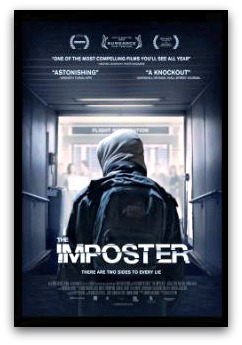
3) The Imposter (2012, dir. by Bart Layton) SUMMARY: Thirteen-year-old Nicholas Barclay disappeared from his home in San Antonio, Texas, in 1994. Three and a half years later, he is allegedly found alive, thousands of miles away in a village in southern Spain with a story of kidnapping and torture. His family is overjoyed to bring him home. But all is not quite as it seems. The boy bears many of the same distinguishing marks he always had, but why does he now have a strange accent? Why does he look so different? This British documentary concerns the 1997 case of French serial imposter Frédéric Bourdin. WHAT CRITICS ARE SAYING: By common consensus, The Imposter is one of the year’s most provocative pictures. Certainly, Displaced Nation writer Anthony Windram found it that way. In one of our most popular posts of last year, he mused that Bourdin’s story is not entirely unfamiliar to expats, all of whom have chameleon-like qualities.
CAST YOUR VOTE HERE!
2) Best Foreign Displaced Film
This category honors films about displacement that take place in non-English speaking countries and therefore require English speakers to read subtitles while learning about other cultures. And the nominees are:
1) Tabu (2012, dir. by Portugal’s Miquel Gomes) SUMMARY: The action in this experimental fiction ranges from contemporary Lisbon to an African colony in the distant past, in what was Portuguese Mozambique. First we are introduced to a cantankerous elderly Portuguese lady with a gambling addition. Then we flashback to her youth as a beautiful young woman living a kind of White Mischief existence at the foot of Mount Tabu, where she falls in love with a handsome adventurer…(Notably, the film’s title references the 1931 German silent film of that name, which took place in the South Seas.) WHAT CRITICS ARE SAYING: The film shows what happens to expats who live too long — there are no remnants of “paradise” left. But some — e.g., A.O. Scott of the New York Times — have faulted the director for glossing over the issues of colonialism in the film in favor of simple aestheticism.
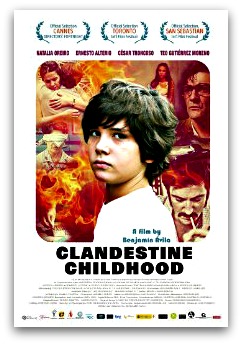
2) Clandestine Childhood (2011, dir. by Benjamín Ávila) SUMMARY: A cinematic memoir drawn from Ávila’s own experiences, the film paints an unsettling portrait of families affected by military dictatorships. The year is 1979, five years after Perón’s death, and the family of 12-year-old Juan, who have been living in exile in Cuba, returns secretly to Argentina. Juan’s parents are members of an underground organization and for sake of their cover, he must assume the name of “Ernesto” and pretend to be a newcomer from northern Argentina. WHAT CRITICS ARE SAYING: Juan’s parents aren’t fleeing the law because of their past misdeeds but are trying violently to overthrow a current dictatorship. The film therefore raises the question: do urban guerrillas make good parents? After all, they are asking their son, a Third Culture Kid, to act the part of a native in the homeland he never knew, for the sake of their political ideals. But while this question is intriguing, the story is driven almost entirely by clichés. As one critic remarked:
[T]he writing needs to be sharper to avoid feeling like a generic coming-of-ager.
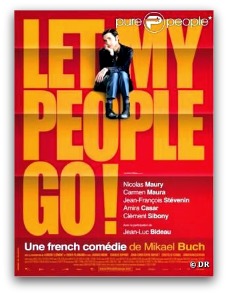
3) Let My People Go (2011, dir. by Mikael Buch) SUMMARY: French immigrant Reuben (Nicolas Maury) is living in fairytale Finland — where he got his MA in “Comparative Sauna Cultures” — with his gorgeous Nordic boyfriend Teemu (Jarkko Niemi). He works as the mailman in a neighborhood whose colorful houses look like Scandinavian Skittles. Then, after a misunderstanding involving a parcel full of Euros, Teemu casts his lover out of Eden, sending him back to where he came from: Paris. WHAT CRITICS ARE SAYING: Ruben’s return to Paris — where he finds his family weathering various crises as well as emotional instability — demonstrates why he left in the first place. (Aren’t most expats escaping something?) However, the scenes with his wacky, feuding family members soon become tedious. As one critic puts it:
The movie’s labored attempt at creating comedy mostly means lots of scenes with Ruben cringing as relatives shout.
CAST YOUR VOTE HERE!
3) Most Displaced Director
This category honors the director who has shown the most chutzpah in raiding the literature of other cultures to make a commercially successful movie (note: they do not cast the natives!). This year’s nominees are:
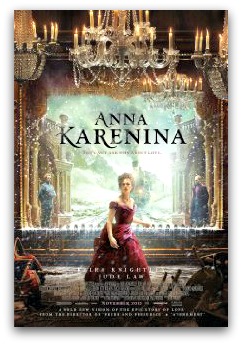
1) Joe Wright for doing a British version of Anna Karenina (2012), casting his muse (Keira Knightly) in the titular role WHAT CRITICS ARE SAYING: Some enjoyed Wright’s bold new interpretation of this classic Russian novel, while others felt that he did Tolstoy a terrible injustice — for instance, New Yorker critic Richard Brody had this to say:
Wright, with flat and flavorless images of an utterly impersonal banality, takes Tolstoy’s plot and translates it into a cinematic language that’s the equivalent of, say, Danielle Steel, simultaneously simplistic and overdone.
2) Tom Hooper for casting a bunch of Aussies, Brits and Americans in Les Misérables WHAT CRITICS ARE SAYING: Since Hooper previously won the Best Director Oscar for the terribly English drama The King’s Speech (historical drama, yay!), many found it odd that he would choose to take on this sprawling French story, and beloved musical, to create what he calls “an oil tanker of a picture.” But for what it’s worth, Hooper had no qualms about directing a film having to do with French history instead of his own. He is persuaded that Victor Hugo’s story speaks to issues of concern today:
Hugo’s story of populist uprising in 1832 Paris resounds in an era of the Arab Spring, the Occupy protests and general frustration over economic inequality.
3) Korean director Hur Jin-ho for making an Asian version of Dangerous Liaisons (2012) — which was originally an 18th-century novel by Pierre Choderlos de Laclosset — and setting it in 1930s Shanghai WHAT CRITICS ARE SAYING: Many have complimented Hur Jin-ho’s decorous adaptation, saying it was clever of him to swap the insular, decadent world of de Laclos’ book, which takes place pre-French Revolution, with the similarly gilded cage of Chinese aristocrats just prior to the Japanese invasion. But the film isn’t particularly sophisticated on a political or historical level. As one critic writes: “It’s all just window-dressing: pretty, but substance-free.”
CAST YOUR VOTE HERE!
4) Most Displaced Actor/Actress
This category honors the actor who has performed this year’s greatest feat of playing a role that requires them to take on a whole new nationality. We’re talking Versatility Plus! And the nominees are:
1) Daniel Day-Lewis, the Anglo-Irish actor who portrayed Abe Lincoln in Lincoln WHAT CRITICS ARE SAYING: Apparently, there was no American actor good enough to play one of the most exceptional presidents the nation has ever known as critics have had nothing but praise for Day Lewis’s performance. Here is a sampling:
His Lincoln is tall and tousled and bent over with the weight of melancholy responsibility in the fourth year of the Civil War.
[Day-Lewis] manages to inject so much quiet humour into what could have been a very reverential portrait.
[The actor] inhabits the ageing figure of the 16th President of the United States with exquisite poise, intellect and grace.
2) Anne Hathaway for playing saintly prostitute Fantine in Les Misérables WHAT CRITICS ARE SAYING: Many find it impressive that Hathaway, cast as the tragic Fantine, sings the show-stopping “I Dreamed a Dream” in one take. (Tom Hooper’s contribution to the genre was having the actors sing rather than lip synch.) And some say that her willingness to have her locks shorn off on screen shows her commitment to her craft. That said, her performance is not to everyone’s taste. “Rarely have the movies seen such an embarrassingly naked plea for applause,” writes Australian film critic Jake Wilson — the implication being the Victor Hugo’s Fantine would have had more dignity.
3) Swedish actress Alicia Vikander for taking on two non-Swedish roles: Caroline Matilda of Great Britain (she served as Queen of Denmark and Norway in the 18th century) in A Royal Affair (2012); and Kitty in Anna Karenina (2012) WHAT CRITICS ARE SAYING: Vikander’s “moxie” is apparently what landed her both of these parts. According to A Royal Affair director Nikolaj Arcel, every actress in Denmark wanted the role of Mathilde, but only Vikander had the requisite “regal quality.” She even went to Copenhagen two months before shooting began to learn to speak Danish fluently. Likewise, Anna Karenina director Joe Wright saw in her the qualities to play Kitty, a flirtatious young woman who believes the dashing Count Vronsky is her Prince Charming, only to find love with a kind-hearted farmer named Levin. It is not uncommon for movie-goers to remark that she outshines Kiera Knightly’s Anna.
CAST YOUR VOTE HERE!
* * *
Are we missing out on any films/categories? Please leave your suggestions in the comments below.
If you enjoyed this post, we invite you to register for The Displaced Dispatch, a round up of weekly posts from The Displaced Nation, with seasonal recipes, book giveaways and other extras. Register for The Displaced Dispatch by clicking here!
One year has passed since our first random nomad, Anita McKay, crashed through the gates of The Displaced Nation, bribing the guards with chicken tikka masala and cranachan and shouting “bollocks” at several of us who tried to stop and question her.
And now there are 40 such nomads within our ranks — the latest being Annabel Kantaria, who insisted on bringing an alarm clock that looks like a miniature mosque — it rings every morning with the call to prayer. (Note to other founders: perhaps we need to find guards who aren’t so easily intimidated when travelers show a bit of temerity…)
Still, as we now have 40 nomads, randomly selected, why not make the best of the situation and throw a party? And what better excuse than The Displaced Nation’s 1st birthday — which, as announced by Kate Allison in a post a couple of days ago, took place on April 1 (no fooling!).
Further to that end, I’ve come up with a Party Primer that I think should work for this group — as well as for similar gatherings.
PARTY PRIMER FOR DISPLACED NOMADS
Click on the headlines below to go to each section:
As this party marks a special occasion (who ever thought we’d make it to be one year old?), a deluxe printed invitation is in order. The only thing is, our invitees are a bunch of nomads! We’ll be lucky if we can catch them on email, let alone at a fixed address. Let’s compromise on an attractively designed message: see mock-up at top of this page.
DRESS CODE
As some of you may know, Cleopatra recently paid a visit to The Displaced Nation. Based on her observations of today’s international travelers, we’ll be doing well if we can get the men to shower and change before joining us. As for the women, well, allow me to offer these pearls of wisdom from Jennifer Scott — the American guru of Parisian chic who was featured on this blog last week. Jennifer says:
There are certain occasions that always warrant dressing up. Generally any gathering … where others went to a lot of effort for your sake.
DECORATIONS
The theme is easy: the wide wide world! (Rather the opposite of Disney’s “It’s a small world after all” concept.) This calls for tablecloths imprinted with the world map (to make it easy for guests to point out where exactly “Moldova” etc is); globe-patterned balloons (can we coin a new term: globalloons?); and for the centerpieces, flags from each of the adopted country represented at the table in question.
Optional extras include party hats, noisemakers and loot bags. It’s fun when the loot contains some surprises. Given all the items our nomads have insisted upon carrying into The Displaced Nation, we should have plenty to choose from, eg:
mosque alarm clocks (thanks, Annabel!)
hairy coo fluffy toys (thanks, Nerissa!)
fake Harry Potter glasses (thanks, Charlotte!)
boomerangs (thanks, Kim & Vicki!)
brie bakers (thanks, Toni!)
MUSIC
As Todd Lyon, author of a number of party and lifestyle books, puts it:
Without music, a party isn’t a party. It might be an assembly, a meeting, or a bee, but it can never be a shindig, a bust-up or a ball unless there’s fine tunes that never stop.
Not being a party tunes buff myself, I’ve consulted with The Displaced Nation’s resident music expert, Kate Allison, about the kind of soundtrack that would cultivate just the right ambience. Her suggestions include:
“Rockin’ All Over the World,” version by Status Quo. Actually a John Fogerty song but Quo and Springsteen both recorded it. Quo opened Live Aid with it.
“World Party,” by the Waterboys (band popular in UK in 80s/90s).
“Dancing on the Ceiling,” by Lionel Richie. (Particularly apt for the Random Nomads who are living Down Under.)
“All Over The World,” by ELO. (They’re still going today, but with different line up.) The song starts:
Everybody all around the world, gotta tell you what I just heard
There’s gonna be a party all over the world…
TABLE ASSIGNMENTS
8-10 person tables work well. Since we’ll have 40 guests, I’ve decided on five tables of eight people each, and to mix everyone up as much as possible. Hostesses must also, of course, take steps to reduce the risk of a “silent table,” where people just eat and don’t talk. To be honest, I don’t there is too much risk of that with this crowd — have you ever watched a bunch of expats try to outdo each other with stories of their (cross-cultural, linguistic and travel) adventures? But just in case, I’m offering some “hostess notes” for each table (the hostess’s job being to introduce everyone and make sure the conversation keeps flowing!).
TABLE 1 Matthew Chozick (American expat in Japan) Tom Frost (American expat in China) Lyn Fuchs (American expat in Mexico — Sacred Ground Travel Magazine) Turner Jansen (American canine in Holland) Annabel Kantaria (English expat in Dubai — Telegraph Expat blog) Kirsty Rice (Australian expat in Qatar — 4 kids, 20 suitcases and a beagle) Jack Scott (English expat in Turkey — Perking the Pansies) Karen van der Zee (Dutch/American expat in Moldova — Life in the Expat Lane) Hostess notes: Introduce Tom Frost to Matthew Chozick — Tom used to live in Japan and speaks Japanese. Kirsty Rice should sit next to Turner Jansen, as she travels around with a beagle. Annabel Kantaria, Jack Scott and Kirsty all have in common life in the Middle East. Karen van der Zee and and Lyn Fuchs should find each other fascinating, as both have had some extraordinary adventures (Karen could entertain Lyn with her crocodile tale and Lyn, keep Karen amused talking about the time he went paddling with orcas.)
TABLE 2 Balaka Basu (Indian American in New York City) Santi Dharmaputra (Indonesian expat in Australia) Michelle Garrett (American expat in UK — The American Resident) Robin Graham (Irish expat in Spain — a lot of wind) Anita McKay (Indonesian expat in Australia — Finally Woken) Brian Peter (Scottish expat in Brazil — A Kilt and a Camera) Kate Reuterswärd (American expat in Sweden — Transatlantic Sketches) Wendy Tokunaga (Former American expat in Japan) Hostess notes: You might want to break up Santi Dharmaputra and Anita McKay, who are the same nationality (Indonesian) and already friends. Anita should definitely be introduced to Brian Peter, who like her hubby, is Scottish, and will probably be amused by her stories of toasting oatmeal in whisky. And make sure Anita also talks to Wendy Tokunaga — I know from personal experience how intrigued Anita is by stories of Western woman marrying Asian men. To be honest, everyone at this table should really be socializing with everyone else, as each and every one of them has a partner of a different nationality! (Now if that isn’t a talking point, I don’t know what is…)
TABLE 3 Kim Andreasson (Swedish expat in Vietnam) Jo Gan (American expat in China– Life behind the wall) Jennifer Greco (American expat in France — Chez Loulou) David Hagerman (American expat in Malaysia — SkyBlueSky) Helena Halme (Finnish expat in UK — Helena’s London Life) Vicki Jeffels (Kiwi expat in UK — Vegemite Vix) Janet Newenham (Irish internationalist — Journalist on the run) Adria Schmidt (former Peace Corps worker in the Dominican Republic) Hostess notes: Seat David Hagerman next to Jennifer Greco — since his wife is a well-known food writer and expert cook, he’ll find nothing strange in her quest to sample all the known French cheeses. Janet Newenham should be near Adria Schmidt and Kim Andreasson as they are all interested in international affairs. Vicki should be introduced to Helena as I’m sure the latter would love to hear about her recent spa experience in Cyprus. Jo Gan, too, should meet Vicki as she is now experiencing visa problems with the Chinese authorities — on a level that may even surpass Vicki’s own nightmare experience in Britain.
TABLE 4 Aaron Ausland (American expat in Colombia — Staying for Tea) Emily Cannell (American expat in Japan — Hey from Japan) Charlotte Day (Australian expat in UK) Toni Hargis (English expat in USA — Expat Mum) Vilma Ilic (Former aid worker in Uganda) Jennifer Lentfer (Former American expat in Africa — How Matters) Camden Luxford (Australian expat in Argentina — The Brink of Something Else) Piglet in Portugal (English expat in Portugal — Piglet in Portugal) Hostess notes: Aaron Ausland will naturally gravitate towards Jennifer Lentfer as they are both deeply involved in global aid and development. Make sure you introduce the pair of them to Piglet in Portugal — she’ll ask them some thought-provoking questions about whether it’s better to save the world or cultivate your own garden. Jennifer should also be near Vilma as the two will want to share their Africa experiences, and you might urge Emily Cannell to join that conversation as well — she has such an adventuresome spirit! Along with Toni Hargis, who runs her own charity supporting a school in Ghana. As for Camden Luxford, she’s an easy one: a social butterfly! Perhaps she could take fellow Aussie Charlotte Day under her wing (ha ha) and make sure she gets plenty of material to write about for her courses at Oxford next year!
TABLE 5 Lei Lei Clavey (Australian expat in New York City) Matt Collin (American expat in UK) Megan Farrell (American expat in Brazil — Born Again Brazilian) Liv Hambrett (Australian expat in Germany — A Big Life) Mardi Michels (Australian expat in Canada — eat. live. travel. write | culinary adventures, near and far) Iain Mallory (English adventurer — Mallory on Travel | Making Everyday an Adventure) Nerissa Muijs (Australian expat in Holland — Adventures in Integration) Simon Wheeler (English expat in Slovakia — Rambling Thoughts of Moon) Hostess notes: As soon as Lei Lei Clavey, Liv Hambrett, Mardi Michels and Nerissa Muijs discover they all have Australia in common, they will be blabbing away — just hope it doesn’t turn into an Ozfest! Also, make sure Mardi connects with Matt — I suspect he may need her counseling about how to seek creative refuge from academia. Iain Mallory and Simon Wheeler will form a natural pair, exchanging stories of their travel adventures and perhaps even breaking into a rousing chorus of “Jerusalem.” But should their antics get too raucous, ask Mardi to step in: she teaches cooking classes to 9-11-year-old boys in Canada. Megan Farrell should connect with Nerissa and Simon on the topic of what it’s like to raise a child in a nationality (and language) other than your own.
FOOD
One of the purposes of gathering together nomads from the four corners of the earth has to be eating, especially if each of them brings along some of their favorite dishes. For our party, we will have a dazzling tableaux brimming over with rare and exotic foods. (We know that because our Random Nomads have already described their faves to us in their interviews.)
Shall we go over the list? (Warning: Don’t read on an empty stomach, or if on a restricted diet!)
NIBBLES/STARTERS
Guacamole & chips (Kim — recipe provided)
Selection of mezze with pita bread (Annabel Kantaria)
Assorted pinchos (Megan Farrell)
Avocado & mango salad (Matt Collin)
Bhelpuri (Tom Frost)
Satay sticks (Nerissa Muijs)
Four kinds of eggs: tea eggs, thousand-year-old eggs, fried eggs with tomato, and boiled salted eggs with a chicken embryo inside (Jo Gan)
Shrimp & grits (Lei Lei Clavey)
Vietnamese caramelized chili prawns (Mardi)
Ceviche (Camden Luxford)
Bluff oysters from New Zealand (Vicki Jeffels)
Gravad lax with Finnish rye bread (Helena Halme)
Tuna sashimi with ponzu sauce (Emily Cannell)
COCKTAILS
Traditional Bloody Marys (Lei Lei Clavey)
Caipirinhas (Megan Farrell)
Margaritas (Kirsty Rice)
WINE
Rich red wines from Lebanon (Annabel K)
Red wine from Macedonia (Vilma Ilic)
Malbec wine from Argentina (Camden Luxford)
Shiraz from Australia (Vicki Jeffels)
White wine from Australia (Simon Wheeler)
Chilled sake (Tom Frost)
Rice wine (Jo Gan)
BEER
Carlsberg browns (Matt Collin)
Cusqueña beer (Camden Luxford)
Mexican Pacifico (Tom Frost)
Harbin beer (Jo Gan)
Coopers beer (Simon Wheeler)
MAINS
Meat dishes:
Carne de Porco a Alentejana (Piglet in Portugal)
Schnitzel served with rotkohl (Liv Hambrett)
Bondiola-chevre-basil wraps and nattō (Tom Frost)
Fried chicken sandwiches with hand-cut fries (Lei Lei Clavey)
Chicken tikka masala (Anita McKay)
Libyan soup (Kirsty Rice — recipe provided)
Cuban ropa vieja (Mardi)
Argentinian steak cooked rare (Camden Luxford)
Tapola black sausage with lingonberry jam (Helena Halme)
Llish in mustard and chili paste, smoked in banana leaves (Balaka Basu)
Chambo curry with nsima (Matt Collin)
Moreton Bay bugs (Vicki Jeffels)
Grilled salmon on a plank (Emily Cannell)
Sushi (Simon Wheeler)
Vegetarian offerings:
Peanut butter vegetable stew (Jennifer Lentfer)
Overcooked spaghetti with carnation milk, canned tomatoes and corn (Adria Schmidt)
DESSERTS
Summer pudding (Toni Hargis)
Apple crumble (Matt Collin)
Cranachan (Anita McKay)
Hot fudge sundaes (Lei Lei Clavey)
Blackberry gelato (Balaka Basu)
Caramel cheesecake (Kirsty Rice)
Bread pudding with Bourbon sauce (Jennifer Greco)
Île flottante (Mardi)
Molotof cake (Piglet in Portugal)
Mouse de maracujá (Megan Farrell)
Tiramisu (Camden Luxford)
Homemade Slovakian cream cakes (Simon Wheeler)
Dutch waffles (Turner Jansen)
Oblande, tulumbe, kadaif & krempite (Vilma Ilic)
Umm Ali (Annabel Kantaria)
Sigara borek (Jack Scott)
Juustoleipä with fresh cloudberries and cream (Helena Halme)
Yangmei fruit (Jo Gan)
Languedoc cheese: Roquefort, Pélardon and Tomette des Corbières (Jennifer Greco)
AFTER-DINNER DRINKS
Chlicanos (Camden Luxford)
Rakija (Vilma Ilic)
Fernet (Tom Frost)
Homemade Slivovica (Simon Wheeler)
Dragon-wall green tea (Jo Gan)
Espresso (Balaku Basu)
Large “flat whites” (Charlotte Day)
FOR THE TOAST(S):
New Zealand champenoise (Vicki Jeffels)
NOTE: Charlotte Day will be cooking a Sydney-style breakfast for diehards who care to linger to the next morning. (And Nerissa Muijs will be frying up some bacon!)
TOPICS FOR SMALL TALK
There are some topics that should be avoided at all costs. As style writer Rita Konig puts it,
It is very dull to talk about journeys. Once you have arrived somewhere, try to keep quiet about how long it took you to get there.
Should you notice anyone engaging in this, put the kibosh on it by asking them to help with pouring drinks, or with putting away coats in the spare room.
PHOTOGRAPHY
Fortunately, there’s usually one great photographer or two in a group of global nomads, thereby saving unnecessary expenditure. (We will ask David Hagerman — he’s sensational!)
GAMES
Games are a great ice breaker. Here are a few that might be appropriate for a well-traveled crowd: 1) Musical countries: Draw a big map on a piece of vinyl (back of a Twister mat might do), and give everyone a flagpole. When the music stops, they must place the flagpole on a country, Anyone whose flagpole ends up in the ocean is out.
2) Variation on “Pin the Donkey”: Pin the rudder on the 747! (Contributed by Kate Allison.)
3) Word games: As we’ve found out from our interviews, global nomads pick up words and expressions from here and there. Taking some of these and mixing them together, we can come up with some pretty strange exchanges. (Prizes for anyone who manages to decipher!)
A: Prego, could you get me a ba ba ba? Kippis!
B: Inshallah, a barbie would also be awesome. And how about la ziq?
A: Avustralyalılaştıramadıklarımızdanmışsınızcasına.
B: So desu ne!
A: Tudo bem? You look a bit daggy.
B: Life can be arbit sometimes.
A: Zvakaoma.
A: Hey.
B: Hey. Das stimmt, sorry to be such a Debbie Downer but I’m knackered after all this work.
A: Bless!
B: Zikomo.
A: Oh la vache! You are lost. Siga, siga. Ni chifan le ma?
B: Bollocks! [Sucking air through gritted teeth.] I think I got lost in the wopwops.
A: Well, there’s the big ol’ tree out the front.
B: Bula! Okay-la. Le bon ton roule!
TOASTS
Toasts should be made repeatedly throughout the latter half of the dinner. Just in case no one feels inspired, prepare one or two classics for the host or hostess to offer, eg:
I’d rather be with all of you than with the finest people in the world.
SONGS
Songs can be sung in several languages. In this case, a stirring rendition of “Happy Birthday” is called for, sung not only in English but in: Dutch (Karen, Nerissa) Finnish (Helena) French (Jennifer, Mardi) Indonesian (Anita & Santi) Japanese (Emily, Matthew, Tom, Wendy) Spanish (Aaron, Adria, Camden, Lyn, Megan, Robin) Swedish (Kate, Kim) Woof-woof (Turner)
Finally, the party should end with the Displaced Nation founders treating the guests to a round of:
For you are all jolly good fellows, for you are all jolly good fellows,
For you are all jolly good fellows… Kate, Anthony, Tony: And so say all of us! ML: Which nobody can deny!
* * *
Have I left out any important details? Any tweaks you can suggest? Your turn!!! Let’s work together to make this the most awesome gathering of global nomads ever. Onegaishimasu, shokran — and all that!
STAY TUNED for tomorrow’s installment from our displaced fictional heroine, Libby. She is expecting a visitor: her own mother, who is — in theory — coming to help as her due date gets closer. Will Granny Jane be an improvement on Sandra, the MIL from hell — or will she prove to be one more spanner in the works for our poor displaced heroine? (What, not keeping up with Libby? Read the first three episodes of her expat adventures.)
If you enjoyed this post, we invite you to register for The Displaced Dispatch, a round up of weekly posts from The Displaced Nation, with seasonal recipes, book giveaways and other extras. Register for The Displaced Dispatch by clicking here!
SPECIAL TREAT FOR TDN READERS: Anu Partanen, though she’s currently on the road, has promised to “come in” and respond to your comments and questions over the next few days. So, ask away!
Anu Partanen has done the impossible. She has made me care about the Finnish Spring, and I’ve never once been to Finland.
No, we’re not talking travel here, though I’d love to go to her country someday and see the ice melt and the vivid violet sinivuokko push their way through the leaves.
Rather, I refer to Finnish politics. Partanen wrote an op-ed that caught my eye in the May 13 edition of the New York Times. It was about Finland’s parliamentary elections, which took place with the arrival of the sinivuokko, on April 17 — the outcome of which, she claims, is the Finnish equivalent of the Arab Spring.
No, the Finns did not have any armed uprisings, just a quiet, proper democratic election. But the results were just as revolutionary:
Overnight, Finland seemed transformed from possibly the most sensible, even boring, country in Europe — known for excellent schools, zero corruption, gender equality, and a pro-European Union approach to politics — into the nationalistic, populist, Euro-skeptic home of the True Finn Party.
The only thing is, I haven’t quite decided yet what to make of the True Finns. According to Partanen, as an American, I “might consider them the equivalent of Tea Partiers (if they didn’t support the welfare state, that is).”
Most significantly, the True Finns will do anything they can to block Finland from contributing its share to bailing out bankrupt European countries — Portugal being the latest example, following on the heels of Greece and Ireland.
Notably, Partanen, too, admits to some ambivalence about the European experiment, for the first time in her life:
Myself, I’ve benefited a great deal from the European Union — I’ve studied abroad, traveled easily, enjoyed a strong euro. … Yet I was shaken when I learned that we Finns were supposed to lend money to Greece. It didn’t seem fair that my taxes would go to a country that had been living beyond its means.
Political voyeurism
But another big reason why I’m so captivated by Partanen’s take on Finnish politics is that she’s an expat based in the United States. Currently living in Brooklyn, she continues to work as a journalist for several Finnish publications. In addition, she is writing a memoir about being Scandinavian in America.
Partanen told me in an email exchange that the book is still in the early stages. I’ll be curious to see what it has to say about the challenge of participating in home-country politics from a distance.
That was something I used to think about a lot during my own expat years. If you care about the politics of your home country — as Partanen clearly does, as I did — then why aren’t you living there? Unlike me, Partanen keeps a foot in Finnish politics by continuing to write articles for the national media.
Still, it must be strange for someone as highly politicized as she is to be in the United States while an important debate is taking place about what kind of country Finland is, and wants to be.
In her Times op-ed, Partanen mentions that although she has offered her couch in Brooklyn to friends from home who would like to become political refugees, as yet no one has taken her up:
…my friends in Helsinki seem to be deciding that this is no time for retreat. Instead they’ll stay to help determine the future of their country.
Hmmm… Is that a reason why, despite my love of living overseas, I eventually bit the bullet and came back to the United States?
Politics not as usual
By the same token, Partanen shows us that living abroad can help you see your own country’s politics, and those of other nations, in a new light. Domestic politics can be very village like, and in my experience, it’s not until you step away from the village tribe that you begin to discern your own beliefs.
As already mentioned, Partanen has discovered since leaving Finland that she has developed some sympathy for the idea of setting limits on how much of its wealth Finland should share with other Europeans.
In her Times article, Partanen suggests that her position may have something in common with that held by the Americans who’ve expressed a reluctance to contribute to universal health care. Noting that America is twice the size of the European Union, she says:
It’s not quite parallel, but if Finns were asked to contribute to the health care of the Greeks, the Irish, and the Portuguese, they might feel a little like the Americans.
My experience is rather different from Partanen’s: I was an American living abroad, first in England and then in Japan, which meant listening to everyone excoriate the United States. But like her, I found that getting physically outside of my country was a stimulus to thinking outside the box and deciding on my own core truths — never mind what the mainstream parties and their media outlets (the village elders) kept telling me to think.
Also like Partanen, I moved further to the right (I hope she won’t mind me using that term) — but not on universal health care. I benefited from socialized medicine in both the UK and Japan so can be counted as a fan of Obamacare, though I do wish it included a public option.
What I came to appreciate much more fully was the tough role the United States has been assigned in world affairs. I can’t tell you how many times I felt like saying to the European and Asian critics who accosted me: “You try policing the globe, and see how much you enjoy it!”
(There were of course far more European critics than Asian ones. The Japanese, though they don’t relish the thought of our Marines continuing to be based on Okinawa, see it as their best hedge against, among other things, the wacky North Korean leadership.)
Now, that’s a true political awakening — call it an Expat Spring.
* * *
Question: How about you? Are you an expat, and if so, what’s your relationship with your home country’s politics — do you remain involved, and have you adjusted any of your basic political beliefs since going abroad?
If you enjoyed this post, we invite you to subscribe for email delivery of The Displaced Nation. That way, you won’t miss a single issue. SPECIAL OFFER: New subscribers receive a FREE copy of “A Royally Displaced Tea.”
Hillstreet Blues… Law and Order… Crime Scene Investigation(CSI)… Bones… I could keep going, but point made: American TV is the undisputed godfather of the crime series genre.
But, not so fast. There’s a rookie on the scene that is taking on the veteran. I refer to the Danish crime series, The Killing, which is currently airing on AMC.
Now, what do the Danes know about crime — apart from suicide (regicide, too, if we go as far back as Hamlet)? Well, I’m here to tell you that this “smorgasbord thriller” has fast achieved cult status in the UK and now the US. As Alessandra Stanley wrote in her New York Times review:
It’s unnerving how well the Nordic sensibility fits a genre that for a long time seemed indisputably and inimitably violent and American, particularly given that Sweden, Norway and Denmark have homicide rates that suggest that they have more mystery writers per capita than murders.
Having become a a diehard (haha!) fan of the Danish noir series after a couple of episodes, I’ve been thinking about it of late in the context of The Displaced Nation. What happens when a TV series becomes expatified? Can we who have chosen to displace ourselves to other countries glean anything from its acculturation process?
Here are three hardboiled observations:
1) America is not Britain.
I was an expat in the UK for many years so am fated to have this thought nearly everyday: America is not Britain. Still, it’s gratifying to have it confirmed by third-party sources. Gratifying and, I must say, somewhat surprising given how quickly the UK appears to have become Americanized since I left. (I mean, pub grub now includes peanut-butter-and-jelly sandwiches! That would NEVER have happened in my day!)
Here’s the thing: the UK imported the original Danish series, entitled Forbydelsen, and simply added subtitles. Which completely makes sense to me — yes, I remain that anglicized.
But for an American audience, of course, subtitles won’t do. Thus AMC hired Veena Sud to come up with an adaptation. Sud moved the action to Seattle, which, she says, is the “closest American city, viscerally, to Copenhagen.”
2) Sud is right: Seattle is as creepy as Copenhagen.
Who knew that Seattle could be so creepy? Certainly not me. Though I’ve never had the honor of visiting that Pacific Northwest city, being an East Coaster I have always held a romantic view of it. At one point I even thought of Seattle as a place I might like to live in some day — especially as the people are reputed to behave with greater decency towards each other than us competitive, dog-eat-dog New Yorkers.
But The Killing has quashed this “domestic expat” fantasy of mine, at least for now.
It underlines a truth we’ve been exploring recently on The Displaced Nation: horrific crimes can happen anywhere, even in settings where people are bending over backwards to be pleasant to one another.
3) But the series also addresses themes that transcend national borders, at least in Western countries.
Setting is important — one of the reasons for the series’ popularity in Britain is that so many people coveted the female detective’s classic Feroese sweater, and I think some fans of the AMC production enjoy watching a crime drama that takes place in Seattle, not New York or L.A.
But if setting is a crucial hook, it’s by no means the only reason The Killing has captivated viewers beyond Denmark and made such a killing for the Danish Broadcasting Corporation.
The show also addresses themes of widespread concern to Western countries: most notably, the fact that even in our supposedly civilized societies (we don’t have female genital mutilation! we don’t have honor killings!), many young women continue to be victims of violence.
The killing to which the title refers is that of a teenage girl, and each each one-hour episode depicts 24 hours in the police investigation, during which we are able to observe the impact of the tragedy has had on the girl’s family, her community, and the people involved in the investigation.
Another theme running through the series is xenophobia: the distrust American and European societies have for Muslim immigrants. America has yet to process the legacy of 9/11, while the Danes are still reeling from the incident involving cartoonist Kurt Westergaard. (To this day, he receives death threats for his cheeky portrayal of the Prophet Muhammad.)
For better or for worse, this Danish crime thriller holds up a mirror to Western culture and shows how easy it is for us to pin the murder of the girl on the Muslim teacher. It eerily reflects the times we live in — perhaps its most chilling facet.
Question: Do you have an experience with a TV show or series that made you look at your own and/or other cultures in a fresh light?
If you enjoyed this post, we invite you to subscribe for email delivery of The Displaced Nation. That way, you won’t miss a single issue. SPECIAL OFFER: New subscribers receive a FREE copy of “A Royally Displaced Tea.”
CLICK HERE TO REGISTER for THE DISPLACED DISPATCH. It’s delivered to your inbox and features:
* new works by expats or other international creatives;
* debate-worthy topics in the expat realm;
* surprising discoveries expats have made; &
* a couple of the latest Displaced Nation posts. SIGN UP NOW. (On temporary hiatus; next issue to appear in Spring 2018)
FOR, BY & ABOUT DISPLACED CREATIVES
We have interviewed many displaced creatives: memoirists, novelists, entrepreneurs & artists of various kinds. Check out the collection for possible soulmates!
About The Displaced Nation
The founders of The Displaced Nation share a passion for what we call the "displaced life" of global residency and travel—particularly when it leads to creative pursuits, be it writing, art, food, business or even humo(u)r.













 The Displaced Nation