The Displaced Nation

A home for international creatives

Tag Archives: Random Nomads

RANDOM NOMAD: Jeff Jung, American Expat in Colombia & Career Break Travel Guy

Jeff JungPlace of birth: Fredericksburg, Texas USA
Passport: USA*
Overseas history: South Africa (Vanderbijlpark): 1988-1989; Argentina (Buenos Aires): 2007 (on and off between March-December 2007, continuously from September-December); Colombia (Bogotá): 2009 – present.
Occupation: Editor of CareerBreakSecrets.com and producer/host of the soon-to-be-globally-televised “The Career Break Travel Show.”
Cyberspace coordinates: Career Break Secrets Website/blog, Facebook page and YouTube channel; @CareerBrkSecret (Twitter handle).
*It’s filled up again so time to get to the embassy to add pages.

What made you leave your homeland in the first place?
Originally, I left to go travel the world when I took a career break from the corporate world in 2007. When I left, I didn’t know that I was going to start as an expat. But, while traveling, I met someone here in Colombia and wound up staying.

Is anyone else in your immediate family “displaced”?
I have many family members who have a bit of wanderlust in their soul. But, I think I am the only one who is living as an expat.

Can you describe the moment when you felt the most displaced?
That would probably be my trip to Egypt in 2008. I normally feel at home on the road. I love to travel. But, in Egypt, I just couldn’t seem to make a connection with the people, the culture or the country. I spent about ten days traveling with a friend. The combination of the heat, the constant sales pitches in the streets, and the culture of backsheesh just wore me out. It wasn’t all bad though. I had a few days on a felucca on the Nile and a few days to hang out in Luxor. But, when we returned for our final two days to Cairo, I didn’t go out. I hid in my room — not my travel style at all. I just wanted to rest and wait until it was time to go to the airport and leave.

Is there any particular moment that stands out as your “least displaced”?
That’s easy. I was an exchange student to South Africa just after high school. I had such an amazing year. Between four host families and a lot of great friends that I made at my host school, I didn’t want to leave. It’s probably why I’ve been back six times since then. On my last trip in 2009, I got to see the country preparing for the World Cup. I was so proud of South Africa. I’ve seen it go from pariah apartheid state to emerging world influencer — with many bumps along the way. It really is a special place. It’s been a few years since I’ve been, so I’m probably due for a visit again. I’m missing a good braai (barbeque) with my friends. My dream is to have a place in or just outside of Cape Town someday, with a view onto the ocean.

You may bring one curiosity you’ve collected from your adopted country into The Displaced Nation. What’s in your suitcase?
From Argentina: Breakfast foods — coffee, facturas (sweet Argentinian pastries with various fillings) and medialunas (Argentinian croissants).
From South Africa: Some bottles of wine, probably red. No, definitely red.
From Colombia: My mochila (over-the-shoulder daybag). These are used by everyone in Colombia, men and women, and they are perfect for carrying your stuff while you’re out running around.

You are invited to prepare one meal based on your travels for other members of The Displaced Nation. What’s on your menu?

Oh, this is going to be fun!
Appetizers: A selection of dips and finger foods from Turkey. I love the food there and really miss it.
Main course: A pork barbecue prepared by my dad who is a national award-winning BBQer in the US. Maybe we’ll have some fresh Patagonian lamb with it too. The meat will be served with a Greek salad and lots of veggie dishes — the veggies will have been bought fresh from La Vega Central, the produce market in Santiago, Chile. Finally, there will be plenty of my Dad’s award-winning sauce to go with the meal.
Drinks: Of course there will be plenty of wine from South Africa and we’ll also have sparkling water for a non-alcoholic option.
Dessert: Why select one? It’s a dinner party so there should be a variety! Brigadeiro (chocolate bonbons) from Brazil, ice cream from Argentina (unexpectedly amazing!), fresh fruit from Ecuador and Colombia, and churros from Spain (that can be a dessert, right?).
Nightcap: Amarula (cream liqueur) from South Africa, served with Segafredo coffee from Italy.

And now you may add a word or expression from the country where you live in to The Displaced Nation argot. What will you loan us?
Chucha (pronounced choo-chah): This Spanish word has multiple meanings across Latin America. In Chile, Ecuador and Peru, where I picked it up, it’s an interjection meaning “sh**” or “shoot.” In Colombia, it has two entirely different meanings depending on where you say it. In Bogotá, it means armpit odor and in Cartagena, it means vagina. People often look at me funny here when I say it. I’m sure the Displaced Nation has occasions when you could use a confusing swear word…

Put it this way: we like anything that makes people laugh! And this month we are looking at ways of achieving “la dolce vita” — by that we mean, indulging in life with all your senses. Can you describe an instance on your travels when you felt you were living la dolce vita?
In 2008, I traveled through Patagonia and had an amazing six weeks. The first part of the trip was on a Chilean ferry called Navimag, which cruises north to south from central Chile to the southern tip. You are in protected waters (most of the time) and on both sides of the ship is this beautiful, untouched landscape full of snow-capped volcanoes, lush green countrysides, enormous glaciers (some of the biggest in the world), and tiny, remote villages. You can also see marooned ships and the occasional dolphin. The weather can change from clear, sunny skies to blustery snow in a heartbeat. That trip is one of my most special trips ever. I really felt like I was living La Dolce Vita during those four days.

I personally think that the yearning for la dolce vita increases as one grows older. I know you are an expert on adult gap years. What made you decide to take one for yourself?
My catalytic moment was the night I went out with some friends to dinner on the River Walk in San Antonio, Texas, on a hot, balmy Friday night. They could tell I was down, and had been for some time. They asked me what it was going to take to make me happy. I didn’t have a good response that night. But, the question haunted me all weekend. I finally had an epiphany that I really wanted to leave my corporate job and get out in the world and travel. I traveled for almost two years mostly through South America, parts of Europe, Turkey and Egypt.

And then you decided to set up a business to encourage others to do the same?
Once I decided to settle in Colombia, I chose the entrepreneurial path and set up CareerBreakSecrets.com. I wanted to help popularize the idea of taking a career break and show other people that they can do it with just a little bit of guidance and inspiration. We’re now in our third year and will be releasing a book and launching our show, The Career Break Travel Show, globally later this year. I love hearing from real people who have decided to take their own break and if they set up a blog, follow them around the world on their travels. The people I’ve encountered have ranged from teachers to social workers to business people who have done some amazing things like volunteer and share their skills, hike Patagonia, bike across New Zealand, or take transcontinental train rides.

Readers — yay or nay for letting Jeff Jung into The Displaced Nation? Tell us your reasons. (Note: It’s fine to vote “nay” as long as you couch your reasoning in terms we all — including Jeff — find amusing!)

STAY TUNED for tomorrow’s diary entry from our fictional expat heroine, Libby, who is desperately trying to hang onto her sanity…and her marriage. (What, not keeping up with Libby? Read the first three episodes of her expat adventures.)

If you enjoyed this post, we invite you to register for The Displaced Dispatch, a round up of weekly posts from The Displaced Nation, with seasonal recipes, book giveaways and other extras. Register for The Displaced Dispatch by clicking here!

Related posts:

img: Jeff Jung with baby cheetahs near Oudtshoorn, South Africa, September 2009.

RANDOM NOMAD: Isabelle Bryer, French Expat in the City of Angels

Place of birth: Bourgoin, France — a small town between Lyon and Grenoble.
Passport: France and now USA*
Overseas history: USA (New York City): 1990; USA (Los Angeles): 1991 – present.
Occupation: Artist and art instructor
Cyberspace coordinates: Isabelle Bryer Paintings (artist site and blog); Isabelle Bryer Paintings (Facebook page); and @IsaBryerArt (Twitter handle).
*I decided to become a US citizen after I had my first baby. Since she was an American, I thought it would be prudent to be a citizen, too — I’m not sure what I was afraid of! To this day, I can remember swearing allegiance to the American flag in a giant room full of 6,000 immigrants with the song “God Bless the USA” blasting through loudspeakers. It felt surreal but I found it hard not to get emotional with people crying all around me. Some of them had waited many, many years for this moment and were escaping countries where they had few rights and even less opportunities. It made me feel spoiled, coming from France and seeing this process simply as an administrative hurdle.

What made you leave your homeland in the first place?
I left because I couldn’t wait to start living my own life. In France I always felt “the daughter of” or “the sister of” (I have three older brothers). I felt that everything I was doing was dictated by what was expected of me by everyone else. When I arrived in New York, I felt as though I could reinvent myself. Of course my new identity was that of “the French girl” — but at least it felt exotic! I loved that everything was odd, new and exciting.

It took me three months to be able to speak English efficiently, and still I was constantly making mistakes! To this day, I make some mistakes, which never cease to make my husband and two kids laugh! Mainly, I put accents on the wrong part of some words — in French everything is pronounced “flat” with no emphasis on any particular syllable.

During that year in New York, I worked as a fashion consultant. I went back and forth between New York and Europe about five times within the year. I would visit European cities — Paris, Barcelona, Milan, Florence — and act as a “fashion spy,” taking photos and sketches of trendy designs that might inspire American designers. Then I would go back to NYC and compile everything in books that were sold to clothing manufacturers. The job was very badly paid, but it was way more exciting than my old life!

I met my husband when he was in New York on business. A few months later, I moved with him to Los Angeles.

So your husband is an American. Is anyone else in your immediate family “displaced”?
I was the first and only one of my family to leave my town. They all still live there, which is good because I can easily see everyone when I go for a visit.

Can you describe the moment when you felt the most displaced?
When I was living in New York, I was going home late from work by subway. There was a homeless guy in the car trying to eat his hand and screaming. It really terrified me, but I didn’t want to exit before my stop because I was afraid of I’d get lost in the wrong neighborhood. That was the moment when I realized “I’m definitely not in Bourgoin anymore!”

That said, I also remember walking alone down one of the avenues on the west side of New York on a sunny Sunday morning. I felt like a French country girl who’d been dropped in the middle of West Side Story. Everywhere I looked seemed like a movie set. I felt entirely displaced while also having the sense of floating on air. I just loved it.

Is there any particular moment that stands out as your “least displaced”?
When I’m alone and painting in my art studio, I have the feeling of being in the exact right place. I am not sure that I would have found in France what I was supposed to do in life. Sometimes you have to leave your familiar surroundings to start over and become who you were meant to be.

Can you describe the kind of art you do?
I guess the closest description might be “naive surrealism.” My work is very much inspired by folktales.

You may bring one curiosity you’ve collected from your adopted country into The Displaced Nation. What’s in your suitcase?
I’d like to carry in a couple of memories of curious times.

From New York: A night at the wild nightclub Copacabana. In the early 1990s it was the place to be: beautiful people, drag queens and transsexuals, with everyone dancing to disco music. You could see Madonna’s dancers practicing “voguing” in the back room. One night I also found myself starstruck — I was going down the stairs behind Iggy Pop.

From L.A.: A typical afternoon at my favorite place, Cafe Mimosa in Topanga Canyon, which I think must have been the birthplace of the peace and love culture. Mimosa is owned by Claire, also a French native. The most amazing crowds assemble there, making you feel as though you’re a character in a hippie revival play. It’s not uncommon to see barefoot people, a man with a huge cockatoo on his shoulder, another one carrying a baby goat. You might run into someone who wants to read your aura for free. The ads on the cafe’s bulletin board offer the services of horse or dog whisperers, dream interpreters, or people ready to loan you their herd of goat to mow your lawn in an environmentally friendly way. It is one of the best places in the world to sip your vanilla chai and people watch. I would love for you all to experience it.

You are invited to prepare one meal based on your travels for other members of The Displaced Nation. What’s on your menu?

Appetizer: Lemon rolls (spicy tuna on the inside, fresh tuna on the outside, topped with thin lemon slices and pine nuts in a delicious sauce) and Asian rolls from my favorite sushi place in LA, Kushiyu.
Main course: Baked sweet potatoes with marshmallows on top. Watching my mother-in-law serve this dish for the first time was an absolute culture shock. I couldn’t wait to call my family in France to tell them that these crazy Americans put rows of chamallows on top of sweet potatoes to bake in the oven and serve with turkey. To this day, I refuse to eat these baked sweet potatoes with meat but love to have them for dessert.
Dessert: A Galette des Rois that I would make myself. It’s a French cake made of puffed pastry stuffed with frangipane (a mix of sugar, almond powder and eggs). You hide little figurines of a queen and a king inside the galette before you serve it, and whoever finds one in their slice gets to wear a crown for the day. I have successfully introduced this tradition to my family and friends in the United States.

And now you may add a word or expression from the country where you live in to The Displaced Nation argot. What will you loan us?
One of the first expressions I learned when living in New York was “That’s how the cookie crumbles” — basically the American equivalent of “C’est la vie!

This month we are looking at the concept of “la dolce vita” — by that we mean living with an open heart and soul, indulging in life with all your senses. Can you tell me about a recent instance when you felt you were living la dolce vita?
I remember floating on my back in my swimming pool on a perfect warm April morning, watching hummingbirds fluttering by (and also a few helicopters since it’s Los Angeles, after all!). Living in California is still exotic to me. I feel like I’m on a permanent vacation, which I love.

If you were to take the adult equivalent of a “gap year” now or in the near future, where would you go and what would you do?
If I could take a year off, I would take my family to visit a few far-away places like India, China and Japan. I would pack drawing pads and a digital camera and keep a record of all the beautiful things we encountered on our travels. I would use it for inspiration when back in my studio.

Readers — yay or nay for letting Isabelle Bryer into The Displaced Nation? Tell us your reasons. (Note: It’s fine to vote “nay” as long as you couch your reasoning in terms we all — including Isa — find amusing!)

STAY TUNED for tomorrow’s episode of “Libby’s Life”, with another bulletin from Kate — who seems to be regretting her rash promise to “stay with Libby for a while.” (What, not keeping up with Libby? Read the first three episodes of her expat adventures.)

If you enjoyed this post, we invite you to register for The Displaced Dispatch, a round up of weekly posts from The Displaced Nation, with seasonal recipes, book giveaways and other extras. Register for The Displaced Dispatch by clicking here!

Related posts:
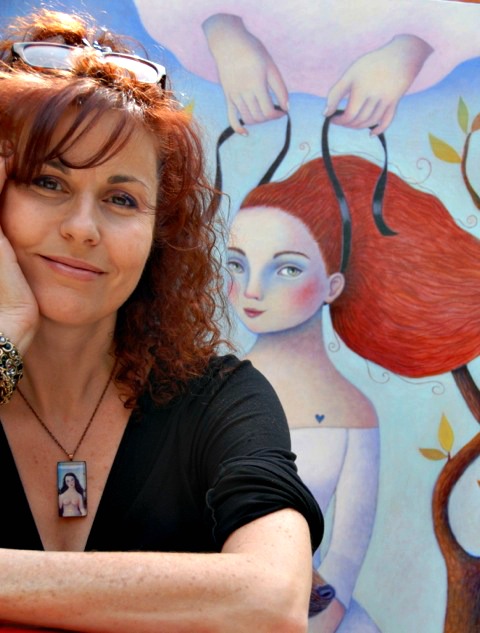
img: Isabelle Bryer and four of her paintings.

RANDOM NOMAD: Suzanne Kamata, American Expat in Japan

Place of birth: Grand Haven, Michigan, a charming tourist town on the shores of Lake Michigan.
Passport: USA
Overseas history: France (Avignon): 1985; Japan (various towns + now Aizumi, Tokushima Prefecture, Shikoku Island): 1988 – present.
Occupation: Author* and TEFL teacher
Cyberspace coordinates: Suzanne Kamata (author site); @shikokusue (Twitter handle)
*Suzanne Kamata is the author of a novel, Losing Kei; a short story anthology, The Beautiful One Has Come (listed on The Displaced Nation’s top books for, by and about expats in 2011); and a picture book, Playing for Papa — all of which concern bicultural relationships and/or families. She is the editor of several anthologies — the most recent being Call Me Okaasan: Adventures in Multicultural Mothering.

What made you leave your homeland in the first place?
A sense of adventure! I wanted to see the world, which I’d glimpsed through reading novels set in other countries, and I wanted to gather up interesting, exotic experiences for the stories and books I would one day write.

Toward the end of my college career, I planned on going into the Peace Corps to teach English in Cameroon. As a fallback, my brother suggested a new program he’d read about in the newspaper. The Japanese government had set up the Japan Exchange and Teaching (JET) Programme to get native English speakers into public schools. I’d studied Asian history in college, and had an interest in Japan (especially the Heian Age, when nobles communicated via poetry), so I applied. After rigorous interviews for both, I was accepted into both the Peace Corps and the JET Program. I decided to go to Japan first, because the JET Program was a one-year program. I figured I’d do a two-year stint in the Peace Corps later, but then I wound up meeting a Japanese guy…

Is anyone else in your immediate family “displaced”?
My brother spent a year in Germany as an exchange student during high school. I think I was influenced a bit by his experience.

You’ve lived in Japan for a long time. Does any one moment stand out as your “most displaced”?
When I was about to give birth to my twins via C-section. My mother and father were on the other side of the world, and my husband was out in the waiting room. I was surrounded by Japanese-speaking strangers. I wondered if I would be able to remember how to speak Japanese during the operation. I think entering motherhood is like going into another country for everyone, but it’s especially surreal in a foreign hospital.

Is there any particular moment that stands out as your “least displaced”?
No one moment but all the moments when I’m with my children. Whenever I spend time with them, I feel completely at home. My children have never lived in my native country, and they have Japanese passports. When I’m away from them I feel a little bit lost.

Do your kids ever go to the United States for visits?
My kids have been to the States numerous times. Most recently, my son went on a school trip to Hawaii, where, for once in his life, he blended in perfectly. There are many mixed race kids in Hawaii. I think my kids feel pretty comfortable in the States, but being on vacation is different from actually living there.

You may bring one curiosity you’ve collected from your adopted country into The Displaced Nation. What’s in your suitcase?
A furoshiki — a Japanese wrapping cloth — dyed with locally grown indigo. It will be easy to tuck into my suitcase, and I’m sure I’ll find ways to use it during my stay at The Displaced Nation. In Japan, I use wrapping cloths to carry books, covered dishes, and oddly shaped parcels. They’re durable and more attractive and ecological than paper or plastic bags. The color will remind me of the area where I’ve lived for over twenty years. The name of the town where I now live is Aizumi, which means “indigo dwelling place.”

You are invited to prepare one meal based on your travels for other members of The Displaced Nation. What’s on your menu?

Starter: A few slices of sea bream sashimi from the straits of Naruto, with a squeeze of sudachi and soy sauce mixed with wasabi on the side for dipping.
Main course: Cubes of grilled Kobe beef strewn with fresh herbs (julienned shiso leaves, coriander, parsley, slivers of ginger root), steamed barley and rice, and miso soup made with fresh wakame — served with a nice Côtes du Rhône wine.
Dessert: Sudachi pie (my own creation: it’s Key lime pie made with sudachi juice instead of lime), served with espresso. I’d also put a plate of sliced Asian pears on the table.

And now you may add a word or expression from the country where you live in to The Displaced Nation argot. What will you loan us?
I like the Japanese word natsukashii, which refers to nostalgia or a longing for things of the past. I don’t think there’s a perfect equivalent in English. At any rate, Americans don’t go around saying “I’m feeling nostalgic!” whereas natsukashii is frequently used in Japan. If someone brings up a memory from the past, another person, filled with nostalgia, might say, “Natsukashii!”

Today, appropriately enough, is “East Meets West Day.” can you tell us about any parties or celebrations you’ve held since you becoming displaced from your native land, that in some way illustrate this theme?
In Japan, only children’s birthdays are celebrated, usually with a store-bought cake. In our family, everyone, including the adults, gets a birthday party. Typically, we have a meal with celebratory dishes such as rice with red beans, or everybody’s favorite sushi, with a homemade birthday cake for dessert. We sing “Happy Birthday to You” in English, and the birthday person makes a wish before blowing out the candles on the cake. (The Japanese have adopted the custom of candles on a child’s birthday cake, but not the making of wishes.)

The Displaced Nation has just turned one year old. Can you give us some advice on themes to cover in our second year — anything you think should be on our radar?
You might consider interviewing Edward Sumoto, who runs a variety of events for Mixed Race/Third Culture individuals in Japan, and the filmmakers/photograhers/writers involved in the Hafu Project. I believe their long-awaited documentary will debut this year.

Readers — yay or nay for letting Suzanne Kamata into The Displaced Nation? Tell us your reasons. (Note: It’s fine to vote “nay” as long as you couch your reasoning in terms we all — including Suzanne — find amusing!)

STAY TUNED for a diversion from the usual updates from life in Woodhaven. In tomorrow’s post, Kate Allison will be reporting on her latest meeting with Libby. (What, not keeping up with Libby? Read the first three episodes of her expat adventures.)

If you enjoyed this post, we invite you to register for The Displaced Dispatch, a round up of weekly posts from The Displaced Nation, with seasonal recipes, book giveaways and other extras. Register for The Displaced Dispatch by clicking here!

Related posts:
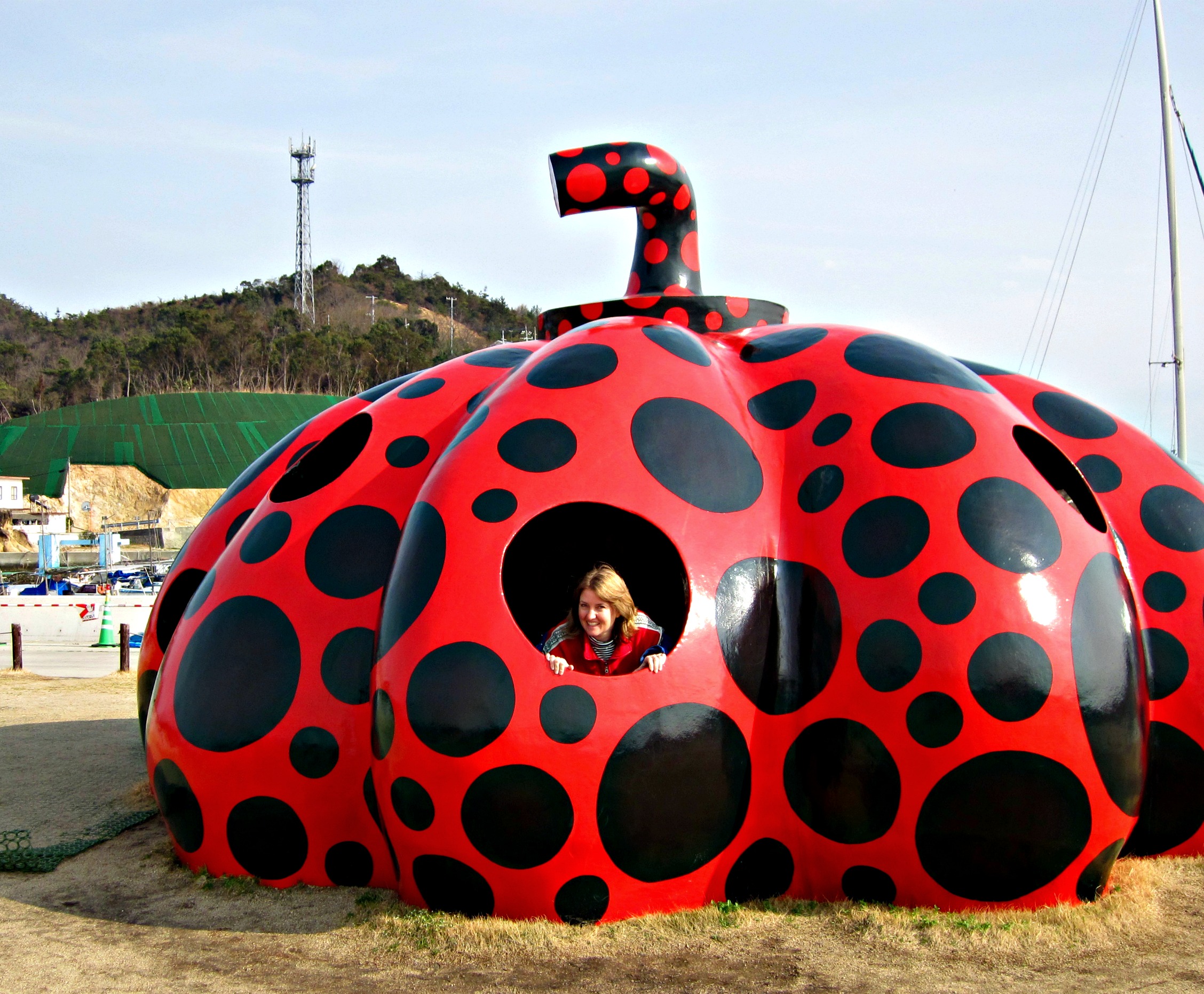
img: Suzanne Kamata standing inside a pumpkin sculpture on the Japanese island of Naoshima (March 2011). The sculpture was created by the well-known artist Yayoi Kusama, who was herself an expat for awhile. (She lived in New York City in the 1960s.)

RANDOM NOMAD: Wendy Williams, Canadian Expat in Austria

Place of birth: Northern Ontario, Canada
Passport: Canadian, and apparently I can live in Austria forever now with my unlimited Aufenhaltsbewilligung.
Overseas history: Austria (present), Germany, Switzerland, Slovak Republic, UK. I have also worked on a project basis for extended periods in Sweden, Tunisia, Holland and Estonia.
Occupation: Author*
Cyberspace coordinates: The Glolo Blog; The Globalisation of Love (Facebook page); and @WilliamsGloLo (Twitter handle)
*Wendy Williams is the author of The Globalisation of Love, one of the top books for expats in 2011.

What made you leave your homeland in the first place?
Burning curiosity! I just love to know what is around the next corner — and the corner after that, too. My grandparents are all immigrants to Canada from Europe, and I guess listening to their stories about their homelands got me thinking that “home” can be very different and it can be anywhere.

Is anyone else in your family “displaced” besides your grandparents?
I am the only of my siblings who went back across the pond, as my grandmother would say — though they certainly come to visit me in Austria (and to ski!).

You’ve lived in quite a few places in Europe before moving to Vienna with your Austrian husband. Does any one moment of that time abroad stand out as your “most displaced”?
While vacationing on one of the Canary Islands, which belong to Spain, I fell ill and required an injection in my, ahem, gluteus maximus. It was 1995, when the so-called Turbot War took place between Canada and Spain — a dispute over fishing rights along the coast of Canada that challenged international diplomatic relations between the two countries. The doctor held up the rather long needle and said, “So, you’re from Canada are you? You like to fish?” I remember thinking, “Uh-oh, this is going to hurt!” It may be conjecture, but I felt the jab of the needle was particularly forceful.

Is there any particular moment that stands out as your “least displaced”?
It happens all the time while skiing in Austria. I grew up skiing on a tiny little bump of a hill and always dreamed about the long alpine slopes of Austria. I was lucky enough to marry an Austrian who is also a passionate skier, and we ski frequently throughout the winter. I feel right at home as I swish, swish down the slopes. I enjoy the après ski, too!

You may bring one curiosity you’ve collected from your adopted country into The Displaced Nation. What’s in your suitcase?
From Georgia in the Caucasus: Antique brass candle holders
From Murano, a series of islands in the Venetian Lagoon: A red Murano chandelier
From Morocco: An onyx stone bathroom sink
From Austria: An 18th-century Tyrolean kitchen table
From France: A yellow ceramic Pernot jug
My house is a diary of my travels through life, and as you can see, I plan to continue living that way on The Displaced Nation — even though it will entail dragging in a rather large and heavy suitcase!

You are invited to prepare one meal based on your travels for other members of The Displaced Nation. What’s on your menu?

Appetizer: My husband’s pumpkin soup with 100% pure Austrian pumpkin seed oil
Salad: Arugula mixed salad with blue cheese, grapes, cranberries, pear and pistachios — as served at the Loriot in Washington, D.C.
Main course: Viennese Schnitzel with potato salad … of course!
Dessert: My mom’s lemon meringue pie
Drinks: Bubbly to start — Crémant d’Alsace is one of my favourites; and for the main course, red wine from Burgenland in Austria.

And now you may add a word or expression from the country where you live in to The Displaced Nation argot. What will you loan us?
Actually, I would like to loan you an expression that my husband picked it up while living in Australia: Happy as Larry. (I picked it up from him while living in Austria.)

This month we are looking into parties and celebrations abroad. What has been your most memorable party or celebration since you became “displaced” from your native land?
The celebration of my 10th wedding anniversary, in 2008! My husband and I had about 50 friends in a small restaurant in Vienna that served elegant, locally-sourced organic food. An opera singer sang “‘O Sole Mio” so beautifully we thought the wine glasses would burst like in a cartoon. We gave a speech about our 10 years together and then announced what we had planned for the upcoming years — I was four months pregnant. The crowd went wild with excitement and gave a 10-minute standing ovation amongst congratulatory hugs, tears and high fives. It was total kitsch and corny Hollywood romance — and we loved every minute of it!

The Displaced Nation has just turned one year old. Can you give us some advice on themes to cover in our second year — anything you think should be on our radar?
Multicultural couples — what I call GloLo couples — usually meet in interesting ways. Chance and coincidence often conspire to bring two people together. It would be fun if The Displaced Nation could feature some stories from GloLo couples about how they met — and whether their displaced lives brought them together — and how they worked things out so they can stay together.

Editor’s note: In February Wendy Williams contributed a post to The Displaced Nation that has remained very popular: Why “expat” is a misleading term for multicultural couples.

Readers — yay or nay for letting Wendy William into The Displaced Nation? Tell us your reasons. (Note: It’s fine to vote “nay” as long as you couch your reasoning in terms we all — including Wendy — find amusing.)

STAY TUNED for tomorrow’s installment from our displaced fictional heroine, Libby, as she discovers that Oliver’s mum and her own mother have more in common than she’d realized. (What, not keeping up with Libby? Read the first three episodes of her expat adventures.)

If you enjoyed this post, we invite you to register for The Displaced Dispatch, a round up of weekly posts from The Displaced Nation, with seasonal recipes, book giveaways and other extras. Register for The Displaced Dispatch by clicking here!

Related posts:
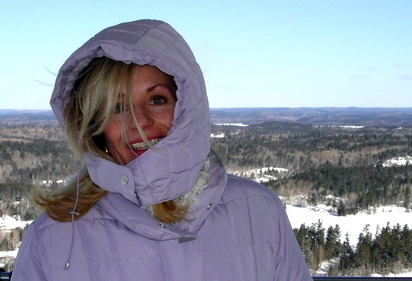
img: Wendy wrapped up against the elements — but is she in Austria, her adopted home, or Northern Ontario, her birthplace? (Hint: It was minus 25 degrees Celsius.)

How to throw a party for a bunch of global nomads

One year has passed since our first random nomad, Anita McKay, crashed through the gates of The Displaced Nation, bribing the guards with chicken tikka masala and cranachan and shouting “bollocks” at several of us who tried to stop and question her.

And now there are 40 such nomads within our ranks — the latest being Annabel Kantaria, who insisted on bringing an alarm clock that looks like a miniature mosque — it rings every morning with the call to prayer. (Note to other founders: perhaps we need to find guards who aren’t so easily intimidated when travelers show a bit of temerity…)

Still, as we now have 40 nomads, randomly selected, why not make the best of the situation and throw a party? And what better excuse than The Displaced Nation’s 1st birthday — which, as announced by Kate Allison in a post a couple of days ago, took place on April 1 (no fooling!).

Further to that end, I’ve come up with a Party Primer that I think should work for this group — as well as for similar gatherings.

PARTY PRIMER FOR DISPLACED NOMADS

Click on the headlines below to go to each section:

  1. INVITATIONS
  2. DRESS CODE
  3. DECORATIONS
  4. MUSIC
  5. TABLE ASSIGNMENTS
  6. FOOD
  7. TOPICS FOR SMALL TALK
  8. PHOTOGRAPHY
  9. GAMES
  10. SONGS

INVITATIONS

As this party marks a special occasion (who ever thought we’d make it to be one year old?), a deluxe printed invitation is in order. The only thing is, our invitees are a bunch of nomads! We’ll be lucky if we can catch them on email, let alone at a fixed address. Let’s compromise on an attractively designed message: see mock-up at top of this page.

DRESS CODE

As some of you may know, Cleopatra recently paid a visit to The Displaced Nation. Based on her observations of today’s international travelers, we’ll be doing well if we can get the men to shower and change before joining us. As for the women, well, allow me to offer these pearls of wisdom from Jennifer Scott — the American guru of Parisian chic who was featured on this blog last week. Jennifer says:

There are certain occasions that always warrant dressing up. Generally any gathering … where others went to a lot of effort for your sake.

DECORATIONS

The theme is easy: the wide wide world! (Rather the opposite of Disney’s “It’s a small world after all” concept.) This calls for tablecloths imprinted with the world map (to make it easy for guests to point out where exactly “Moldova” etc is); globe-patterned balloons (can we coin a new term: globalloons?); and for the centerpieces, flags from each of the adopted country represented at the table in question.

Optional extras include party hats, noisemakers and loot bags. It’s fun when the loot contains some surprises. Given all the items our nomads have insisted upon carrying into The Displaced Nation, we should have plenty to choose from, eg:

  • mosque alarm clocks (thanks, Annabel!)
  • hairy coo fluffy toys (thanks, Nerissa!)
  • fake Harry Potter glasses (thanks, Charlotte!)
  • boomerangs (thanks, Kim & Vicki!)
  • brie bakers (thanks, Toni!)

MUSIC

As Todd Lyon, author of a number of party and lifestyle books, puts it:

Without music, a party isn’t a party. It might be an assembly, a meeting, or a bee, but it can never be a shindig, a bust-up or a ball unless there’s fine tunes that never stop.

Not being a party tunes buff myself, I’ve consulted with The Displaced Nation’s resident music expert, Kate Allison, about the kind of soundtrack that would cultivate just the right ambience. Her suggestions include:

Everybody all around the world, gotta tell you what I just heard
There’s gonna be a party all over the world…

TABLE ASSIGNMENTS

8-10 person tables work well. Since we’ll have 40 guests, I’ve decided on five tables of eight people each, and to mix everyone up as much as possible. Hostesses must also, of course, take steps to reduce the risk of a “silent table,” where people just eat and don’t talk. To be honest, I don’t there is too much risk of that with this crowd — have you ever watched a bunch of expats try to outdo each other with stories of their (cross-cultural, linguistic and travel) adventures? But just in case, I’m offering some “hostess notes” for each table (the hostess’s job being to introduce everyone and make sure the conversation keeps flowing!).

TABLE 1
Matthew Chozick (American expat in Japan)
Tom Frost (American expat in China)
Lyn Fuchs (American expat in Mexico — Sacred Ground Travel Magazine)
Turner Jansen (American canine in Holland)
Annabel Kantaria (English expat in Dubai — Telegraph Expat blog)
Kirsty Rice (Australian expat in Qatar — 4 kids, 20 suitcases and a beagle)
Jack Scott (English expat in Turkey — Perking the Pansies)
Karen van der Zee (Dutch/American expat in Moldova — Life in the Expat Lane)
Hostess notes: Introduce Tom Frost to Matthew Chozick — Tom used to live in Japan and speaks Japanese. Kirsty Rice should sit next to Turner Jansen, as she travels around with a beagle. Annabel Kantaria, Jack Scott and Kirsty all have in common life in the Middle East. Karen van der Zee and and Lyn Fuchs should find each other fascinating, as both have had some extraordinary adventures (Karen could entertain Lyn with her crocodile tale and Lyn, keep Karen amused talking about the time he went paddling with orcas.)

TABLE 2
Balaka Basu (Indian American in New York City)
Santi Dharmaputra (Indonesian expat in Australia)
Michelle Garrett (American expat in UK — The American Resident)
Robin Graham (Irish expat in Spain — a lot of wind)
Anita McKay (Indonesian expat in Australia — Finally Woken)
Brian Peter (Scottish expat in Brazil — A Kilt and a Camera)
Kate Reuterswärd (American expat in Sweden — Transatlantic Sketches)
Wendy Tokunaga (Former American expat in Japan)
Hostess notes: You might want to break up Santi Dharmaputra and Anita McKay, who are the same nationality (Indonesian) and already friends. Anita should definitely be introduced to Brian Peter, who like her hubby, is Scottish, and will probably be amused by her stories of toasting oatmeal in whisky. And make sure Anita also talks to Wendy Tokunaga — I know from personal experience how intrigued Anita is by stories of Western woman marrying Asian men. To be honest, everyone at this table should really be socializing with everyone else, as each and every one of them has a partner of a different nationality! (Now if that isn’t a talking point, I don’t know what is…)

TABLE 3
Kim Andreasson (Swedish expat in Vietnam)
Jo Gan (American expat in China– Life behind the wall)
Jennifer Greco (American expat in France — Chez Loulou)
David Hagerman (American expat in Malaysia — SkyBlueSky)
Helena Halme (Finnish expat in UK — Helena’s London Life)
Vicki Jeffels (Kiwi expat in UK — Vegemite Vix)
Janet Newenham (Irish internationalist — Journalist on the run)
Adria Schmidt (former Peace Corps worker in the Dominican Republic)
Hostess notes: Seat David Hagerman next to Jennifer Greco — since his wife is a well-known food writer and expert cook, he’ll find nothing strange in her quest to sample all the known French cheeses. Janet Newenham should be near Adria Schmidt and Kim Andreasson as they are all interested in international affairs. Vicki should be introduced to Helena as I’m sure the latter would love to hear about her recent spa experience in Cyprus. Jo Gan, too, should meet Vicki as she is now experiencing visa problems with the Chinese authorities — on a level that may even surpass Vicki’s own nightmare experience in Britain.

TABLE 4
Aaron Ausland (American expat in Colombia — Staying for Tea)
Emily Cannell (American expat in Japan — Hey from Japan)
Charlotte Day (Australian expat in UK)
Toni Hargis (English expat in USA — Expat Mum)
Vilma Ilic (Former aid worker in Uganda)
Jennifer Lentfer (Former American expat in Africa — How Matters)
Camden Luxford (Australian expat in Argentina — The Brink of Something Else)
Piglet in Portugal (English expat in Portugal — Piglet in Portugal)
Hostess notes: Aaron Ausland will naturally gravitate towards Jennifer Lentfer as they are both deeply involved in global aid and development. Make sure you introduce the pair of them to Piglet in Portugal — she’ll ask them some thought-provoking questions about whether it’s better to save the world or cultivate your own garden. Jennifer should also be near Vilma as the two will want to share their Africa experiences, and you might urge Emily Cannell to join that conversation as well — she has such an adventuresome spirit! Along with Toni Hargis, who runs her own charity supporting a school in Ghana. As for Camden Luxford, she’s an easy one: a social butterfly! Perhaps she could take fellow Aussie Charlotte Day under her wing (ha ha) and make sure she gets plenty of material to write about for her courses at Oxford next year!

TABLE 5
Lei Lei Clavey (Australian expat in New York City)
Matt Collin (American expat in UK)
Megan Farrell (American expat in Brazil — Born Again Brazilian)
Liv Hambrett (Australian expat in Germany — A Big Life)
Mardi Michels (Australian expat in Canada — eat. live. travel. write | culinary adventures, near and far)
Iain Mallory (English adventurer — Mallory on Travel | Making Everyday an Adventure)
Nerissa Muijs (Australian expat in Holland — Adventures in Integration)
Simon Wheeler (English expat in Slovakia — Rambling Thoughts of Moon)
Hostess notes: As soon as Lei Lei Clavey, Liv Hambrett, Mardi Michels and Nerissa Muijs discover they all have Australia in common, they will be blabbing away — just hope it doesn’t turn into an Ozfest! Also, make sure Mardi connects with Matt — I suspect he may need her counseling about how to seek creative refuge from academia. Iain Mallory and Simon Wheeler will form a natural pair, exchanging stories of their travel adventures and perhaps even breaking into a rousing chorus of “Jerusalem.” But should their antics get too raucous, ask Mardi to step in: she teaches cooking classes to 9-11-year-old boys in Canada. Megan Farrell should connect with Nerissa and Simon on the topic of what it’s like to raise a child in a nationality (and language) other than your own.

FOOD

One of the purposes of gathering together nomads from the four corners of the earth has to be eating, especially if each of them brings along some of their favorite dishes. For our party, we will have a dazzling tableaux brimming over with rare and exotic foods. (We know that because our Random Nomads have already described their faves to us in their interviews.)

Shall we go over the list? (Warning: Don’t read on an empty stomach, or if on a restricted diet!)

NIBBLES/STARTERS

  • Guacamole & chips (Kim — recipe provided)
  • Selection of mezze with pita bread (Annabel Kantaria)
  • Assorted pinchos (Megan Farrell)
  • Avocado & mango salad (Matt Collin)
  • Bhelpuri (Tom Frost)
  • Satay sticks (Nerissa Muijs)
  • Four kinds of eggs: tea eggs, thousand-year-old eggs, fried eggs with tomato, and boiled salted eggs with a chicken embryo inside (Jo Gan)
  • Shrimp & grits (Lei Lei Clavey)
  • Vietnamese caramelized chili prawns (Mardi)
  • Ceviche (Camden Luxford)
  • Bluff oysters from New Zealand (Vicki Jeffels)
  • Gravad lax with Finnish rye bread (Helena Halme)
  • Tuna sashimi with ponzu sauce (Emily Cannell)

COCKTAILS

  • Traditional Bloody Marys (Lei Lei Clavey)
  • Caipirinhas (Megan Farrell)
  • Margaritas (Kirsty Rice)

WINE

  • Rich red wines from Lebanon (Annabel K)
  • Red wine from Macedonia (Vilma Ilic)
  • Malbec wine from Argentina (Camden Luxford)
  • Shiraz from Australia (Vicki Jeffels)
  • White wine from Australia (Simon Wheeler)
  • Chilled sake (Tom Frost)
  • Rice wine (Jo Gan)

BEER

  • Carlsberg browns (Matt Collin)
  • Cusqueña beer (Camden Luxford)
  • Mexican Pacifico (Tom Frost)
  • Harbin beer (Jo Gan)
  • Coopers beer (Simon Wheeler)

MAINS
Meat dishes:

  • Carne de Porco a Alentejana (Piglet in Portugal)
  • Schnitzel served with rotkohl (Liv Hambrett)
  • Bondiola-chevre-basil wraps and nattō (Tom Frost)
  • Fried chicken sandwiches with hand-cut fries (Lei Lei Clavey)
  • Chicken tikka masala (Anita McKay)
  • Libyan soup (Kirsty Rice — recipe provided)
  • Cuban ropa vieja (Mardi)
  • Argentinian steak cooked rare (Camden Luxford)
  • Tapola black sausage with lingonberry jam (Helena Halme)
  • Barbecued steak, snags & lamb chops (Nerissa Muijs)

Fish dishes:

  • Paella Valenciana (Megan Farrell)
  • Llish in mustard and chili paste, smoked in banana leaves (Balaka Basu)
  • Chambo curry with nsima (Matt Collin)
  • Moreton Bay bugs (Vicki Jeffels)
  • Grilled salmon on a plank (Emily Cannell)
  • Sushi (Simon Wheeler)

Vegetarian offerings:

  • Peanut butter vegetable stew (Jennifer Lentfer)
  • Overcooked spaghetti with carnation milk, canned tomatoes and corn (Adria Schmidt)

DESSERTS

  • Summer pudding (Toni Hargis)
  • Apple crumble (Matt Collin)
  • Cranachan (Anita McKay)
  • Hot fudge sundaes (Lei Lei Clavey)
  • Blackberry gelato (Balaka Basu)
  • Caramel cheesecake (Kirsty Rice)
  • Bread pudding with Bourbon sauce (Jennifer Greco)
  • Île flottante (Mardi)
  • Molotof cake (Piglet in Portugal)
  • Mouse de maracujá (Megan Farrell)
  • Tiramisu (Camden Luxford)
  • Homemade Slovakian cream cakes (Simon Wheeler)
  • Dutch waffles (Turner Jansen)
  • Oblande, tulumbe, kadaif & krempite (Vilma Ilic)
  • Umm Ali (Annabel Kantaria)
  • Sigara borek (Jack Scott)
  • Juustoleipä with fresh cloudberries and cream (Helena Halme)
  • Yangmei fruit (Jo Gan)
  • Languedoc cheese: Roquefort, Pélardon and Tomette des Corbières (Jennifer Greco)

AFTER-DINNER DRINKS

  • Chlicanos (Camden Luxford)
  • Rakija (Vilma Ilic)
  • Fernet (Tom Frost)
  • Homemade Slivovica (Simon Wheeler)
  • Dragon-wall green tea (Jo Gan)
  • Espresso (Balaku Basu)
  • Large “flat whites” (Charlotte Day)

FOR THE TOAST(S):
New Zealand champenoise (Vicki Jeffels)

NOTE: Charlotte Day will be cooking a Sydney-style breakfast for diehards who care to linger to the next morning. (And Nerissa Muijs will be frying up some bacon!)

TOPICS FOR SMALL TALK

There are some topics that should be avoided at all costs. As style writer Rita Konig puts it,

It is very dull to talk about journeys. Once you have arrived somewhere, try to keep quiet about how long it took you to get there.

Should you notice anyone engaging in this, put the kibosh on it by asking them to help with pouring drinks, or with putting away coats in the spare room.

PHOTOGRAPHY

Fortunately, there’s usually one great photographer or two in a group of global nomads, thereby saving unnecessary expenditure. (We will ask David Hagerman — he’s sensational!)

GAMES

Games are a great ice breaker. Here are a few that might be appropriate for a well-traveled crowd:
1) Musical countries: Draw a big map on a piece of vinyl (back of a Twister mat might do), and give everyone a flagpole. When the music stops, they must place the flagpole on a country, Anyone whose flagpole ends up in the ocean is out.

2) Variation on “Pin the Donkey”: Pin the rudder on the 747! (Contributed by Kate Allison.)

3) Word games: As we’ve found out from our interviews, global nomads pick up words and expressions from here and there. Taking some of these and mixing them together, we can come up with some pretty strange exchanges. (Prizes for anyone who manages to decipher!)

A: Prego, could you get me a ba ba ba? Kippis!
B: Inshallah, a barbie would also be awesome. And how about la ziq?
A: Avustralyalılaştıramadıklarımızdanmışsınızcasına.
B: So desu ne!

A: Tudo bem? You look a bit daggy.
B: Life can be arbit sometimes.
A: Zvakaoma.

A: Hey.
B: Hey. Das stimmt, sorry to be such a Debbie Downer but I’m knackered after all this work.
A: Bless!
B: Zikomo.

A: Oh la vache! You are lost. Siga, siga. Ni chifan le ma?
B: Bollocks! [Sucking air through gritted teeth.] I think I got lost in the wopwops.
A: Well, there’s the big ol’ tree out the front.
B: Bula! Okay-la. Le bon ton roule!

TOASTS

Toasts should be made repeatedly throughout the latter half of the dinner. Just in case no one feels inspired, prepare one or two classics for the host or hostess to offer, eg:

I’d rather be with all of you than with the finest people in the world.

SONGS

Songs can be sung in several languages. In this case, a stirring rendition of “Happy Birthday” is called for, sung not only in English but in:
Dutch (Karen, Nerissa)
Finnish (Helena)
French (Jennifer, Mardi)
Indonesian (Anita & Santi)
Japanese (Emily, Matthew, Tom, Wendy)
Spanish (Aaron, Adria, Camden, Lyn, Megan, Robin)
Swedish (Kate, Kim)
Woof-woof (Turner)

Finally, the party should end with the Displaced Nation founders treating the guests to a round of:

For you are all jolly good fellows, for you are all jolly good fellows,
For you are all jolly good fellows…
Kate, Anthony, Tony: And so say all of us!
ML: Which nobody can deny!

* * *
Have I left out any important details? Any tweaks you can suggest? Your turn!!! Let’s work together to make this the most awesome gathering of global nomads ever. Onegaishimasu, shokran — and all that!

STAY TUNED for tomorrow’s installment from our displaced fictional heroine, Libby. She is expecting a visitor: her own mother, who is — in theory — coming to help as her due date gets closer. Will Granny Jane be an improvement on Sandra, the MIL from hell — or will she prove to be one more spanner in the works for our poor displaced heroine? (What, not keeping up with Libby? Read the first three episodes of her expat adventures.)

If you enjoyed this post, we invite you to register for The Displaced Dispatch, a round up of weekly posts from The Displaced Nation, with seasonal recipes, book giveaways and other extras. Register for The Displaced Dispatch by clicking here!

Related posts:
RANDOM NOMAD: Annabel Kantaria, British Expat in Dubai

Place of birth: London, UK
Passport: UK
Overseas travel history: United Arab Emirates (Dubai): 1998 – present.
Occupation: Former journalist and one of four official expat bloggers for The Weekly Telegraph
Cyberspace coordinates: Telegraph Expat blog (Annabel Kantaria) and @BellaKay (Twitter handle)

What made you leave your homeland in the first place?
Despite being 100 percent British, I never felt at home in England. As young as six years old I used to wake up feeling “displaced.” I was unable to identify that feeling until I moved to Dubai and realized that the feeling had gone. To be honest, I think “home” could be anywhere that has a positive attitude, hot sun, blue sky and a glittering sea.

Was anyone else in your family “displaced”?
My father grew up in India as the child of expat parents and so my own childhood in England was full of stories of hill retreats, jungles, hot sun, ayas and curries. My mother was born to expat parents in Romania. My aunt emigrated from the UK to Canada.

My husband, whom I met at university in the UK, is also displaced — I don’t think it’s a coincidence we ended up together. Of Indian origin, he grew up largely in Kenya and did his secondary schooling and university in the UK. We were married in Nairobi and then lived in the UK for one year. My husband went to Dubai on business, brought me back a book about Dubai and said “Let’s move there!” I didn’t need any convincing. We sold our house and cars, and shipped all our possessions over and have, so far, never looked back. 🙂

So you’ve felt the most displaced in your homeland?
Yes. Growing up in England, I felt like an alien. Throughout my teenage years I plotted my escape. I knew I would leave as soon as I could. It was just a matter of when, where and with whom. Even now, when I go back, I feel like a foreigner.

Is there any particular moment in Dubai that stands out as your “least displaced”?
Probably the first weekend after my husband and I moved to Dubai — when we sitting on the public beach watching the sun go down and the sand turn from white to pink and listening to the azaan (call to prayer) echo across the beach. I had that first flutter of “This is home! We’re not on holiday!” excitement, which still continues, even after 14 years.

You may bring one curiosity you’ve collected from your adopted country into The Displaced Nation. What’s in your suitcase?
A plastic mosque alarm clock that wakes you with the azaan [see photo inset].

You are invited to prepare one meal based on your travels for other members of The Displaced Nation. What’s on your menu?

Emirati food revolves largely around meat and I am a vegetarian, so I would have to broaden it to include other Middle Eastern cuisines. Rather than three courses, I’d offer you a selection of mezze (small dishes):

We’d wash it down with a rich red wine from Lebanon’s Château Musar, Ksara or Kefraya.

For dessert I would offer you a delicious Umm Ali — an Egyptian version of hot, bread pudding, served with a little vanilla sauce. And, of course, a cardamom-laced Arabic coffee to finish.

And now you may add a word or expression from the country where you live in to The Displaced Nation argot. What will you loan us?
Inshallah (If it’s God’s will) — it’s the word you hear the most when you want to get something done and you’re begging for a commitment that it will be. It’s also a word that UAE expats use, in their transient lives, to acknowledge that they aren’t entirely sure of what may happen next. “We’ll be staying here for two years, Inshallah.”

This month we are looking into beauty and fashion. What are the best Emirati beauty secrets you’ve discovered?
From observing highly groomed Arab ladies, I’ve learned the value of the perfectly shaped eyebrow – something to which I’d barely paid any attention in England. I’ve also discovered the joys of a good scrub in the hammam. It’s not Emirati per se, but does have a long history here. And although you don’t often see a UAE national lady without her shayla (rectangular headscarf), the beauty salons are full of Emirati ladies having their hair blow-dried — I’ve learned to get my hair professionally “blown” before any major social event. It gives you an instant polish that makes all the difference.

What about fashion — any beloved outfits, jewelry, or other accessories you’ve collected in the UAE?
Emirati ladies put a lot of thought into accessories such as sunglasses, handbags and shoes, given that the rest of them is covered by the abaya (robe-like dress or cloak) when out in public. I’ve picked up their habit of using a great handbag to pull a look together. I also have a beautiful, jewelled black thobe (ankle-length garment traditionally worn by Arab men) that doubles up as a great evening dress.

Editor’s note: Annabel Kantaria was awarded one of The Displaced Nation’s “Alices” for a post she composed about the need for “behavior lessons” before working in the UAE.

Readers — yay or nay for letting Annabel Kantaria into The Displaced Nation? Tell us your reasons. (Note: It’s fine to vote “nay” as long as you couch your reasoning in terms we all — including Annabel — find amusing.)

STAY TUNED for tomorrow’s installment from our displaced fictional heroine, Libby, who is once again on her own while her feckless husband clocks up more hotel points and air miles — perhaps he intends to be present at the birth of their twins via Skype? (What, not keeping up with Libby? Read the first three episodes of her expat adventures.)

If you enjoyed this post, we invite you to register for The Displaced Dispatch, a round up of weekly posts from The Displaced Nation, with seasonal recipes, book giveaways and other extras. Register for The Displaced Dispatch by clicking here!

Related posts:
img: Annabel Kantaria at a polo match in Dubai; inset: her plastic mosque alarm clock, which she proposes to bring into The Displaced Nation.

RANDOM NOMAD: Lei Lei Clavey, Australian Expat in New York

Place of birth: Melbourne, Australia
Passport: Australia + USA
Overseas travel history: France (Paris): 2005; USA (Santa Barbara, California): 2008-09; USA (New York, New York): May 2011 – present.
Current occupation: Casting director for StyleLikeU, an online fashion magazine based in New York City.
Cyberspace coordinates: Style Like U | Freedom of expression through personal style (work) and @LeiLeiClavey (Twitter handle)

What made you leave your homeland in the first place?
I’ve had the travel bug for as long as I can remember. A lot of it came from my parents, who took me around the world shortly after I was born. The excitement of being in a different country, immersed in a new culture and environment — it’s something I now crave.

Of course, travel is one thing; living in a place for an extended period is another. To make a home amongst strangers takes you out of your comfort zone and tests your courage in new ways. I enjoy the challenge. I always learn new things about myself as I open my eyes to different people, perspectives, and ways of life.

Was anyone else in your family “displaced”?
My father is what you might call permanently displaced. Born in Chicago, he attended Colorado State University and then left the US to live in Taiwan and study Chinese language and herbal medicine. Taiwan was where he met my mother, who was likewise displaced (she is Chinese Australian). My parents lived in Taipei for five years and then moved to Mainland China for two more years before settling permanently in Melbourne, Australia, where my mother was born and grew up — my father now practices there as a Chinese herbal doctor. (Incidentally, The Displaced Nation interviewed my mother, whose name is Gabrielle Wang, last summer about a book she had written on a half-Chinese, half-Aborigine girl who lived in 19th-century Australia.)

A couple of my cousins share my passion for travel and have recently embarked on an adventure in the UK, where many Australians choose to live (the two-year work visa for Australians under 25 is a relatively straightforward process).

Another of my cousins recently shaved her head and embarked on a solo, life-changing adventure in India. I have yet to hear her tales firsthand. All I know is that she has more guts than I ever will to have done that by herself.

Describe the moment when you felt most displaced since making your home in New York City.
I don’t believe anything could surpass how I felt on my first night in New York City. Before leaving Australia I had arranged to stay with a friend of a friend for a month. He told me: “When you arrive, come to 10th, between A and B, and up to the third floor.” A and B: what country uses letters as street names? Surely they must be abbreviations for something!

It was close to midnight by the time I arrived at East 10th Street between Avenue A and Avenue B (thank you, taxi driver, for clearing that up!).

But then I had another challenge. I was exhausted and ready to collapse after my 22-hour plane flight from Melbourne to LA and another five hours to New York City. After dragging my 32kg (70lbs) suitcase up three flights of stairs — yes, it was a walk-up! — bed was the only thing I had in mind. I knocked and waited. No answer. I knocked again. Still no answer. I sat on my suitcase and was feeling very sorry for myself, wondering why I had ever decided to move to NYC, when three young men walked up the stairs. They were surprised and a little bemused to see me sitting outside the door to their apartment. After exchanging glances, they informed me that I was on the 4th floor, not the 3rd. (In the US there is no such thing as a “ground floor” like we have in Australia. The ground floor is the first floor.) So I struggled my way back down one flight of stairs and walked into an artist’s hazy East Village apartment.

People, music and smoke filled the room. It was community open-mic night, held weekly in this man’s apartment in exchange for rent (a great deal, I now realize!). The owner was asleep on the couch, despite the noise of someone playing the Asian zither.

My eyes scanned the audience, and then I saw Will, the friend of my friend. I could finally relax.

I had entered an alternative universe, an environment utterly foreign to me. But I knew at that moment, my New York adventure had begun and my life would be changed forever.

How about the moment when you have felt least displaced?
When I first came to New York City as a tourist, in 2008, it was as if I had lived here before, perhaps in a past life. I loved the city’s multicultural feeling. So many different faces, cultures and languages — I immediately felt at home. Since coming to live in the city ten months ago, I will occasionally bump into the few people I know in the street. That this can happen even in a city of over eight million gives me a buzz.

You may bring one curiosity you’ve collected from each of your adopted countries into The Displaced Nation. What’s in your suitcase?
From Paris: The 2-hour lunch break. Unlike Parisians, New Yorkers work too hard and I believe with no better results than if they were to have a decent break, get refreshed and go back to work. Australia, unfortunately, is following in America’s footsteps. Surely, citizens of The Displaced Nation could enjoy a reasonable work-life balance?
From New York City: The concept of convenience. For most New Yorkers, it is only a short walk to the grocery store, bank or coffee shop. In fact, I have all three on my block — I love it! On the other hand, New Yorkers like to push those convenience boundaries and have EVERYTHING delivered. Convenience has never been so lazy! The Displaced Nation should find a way to have convenience without the laziness.
From Santa Barbara: The practice of recycling. Santa Barbara does a great job of keeping the University of California-Santa Barbara campus, city streets and beaches clean. They understand the need for it and how trash impacts the environment. I cannot stand how dirty the streets are in New York City. I would therefore urge The Displaced Nation to institute Californian-style recycling policies (if you haven’t already!).

You are invited to prepare one meal based on your travels for other members of The Displaced Nation. What’s on your menu?

My menu is inspired by New York City brunches*. I always crave a nice weekend brunch when I fly back to Australia on holiday!
Appetizer: Shrimp and grits, based on a recipe from Peels** with two (allegedly) secret ingredients: a little Budweiser and a lot of tasso, a Cajun-spiced ham.
Main: Fried chicken sandwich, with chilli lime aioli & pickled egg on sweet-potato focaccia with hand-cut fries — based on a recipe from Diner in Williamsburg, Brooklyn.
Dessert: Chocolate sundae consisting of vanilla and malt ice cream, hot fudge, whipped cream, brownie bites, nuts, and pretzels — based on a Peels** recipe.
Drinks: Traditional Bloody Mary, a solid brunch favorite!
*This is an imaginary meal so ignore the high calorie count and just enjoy it!
**Peels is an American diner with a Southern-inspired menu in NYC’s East Village. I used to host there.

And now you may add a word or expression from the country where you live in to The Displaced Nation argot. What will you loan us?
From New York: Debbie Downer, slang for someone who frequently adds bad news and negative feelings to a gathering, thereby bringing down the mood of everyone around them. I hear it being said all the time in the streets of New York. (It was also the name of a fictional character from Saturday Night Live.)
From Paris: La ziqmu/la ziq (music) — an example of verlan, which, similar to Pig Latin, transposes syllables of individual words (la musique) to create slang words (la ziqmu, often shortened to la ziq). Verlan combinations are endless and have become a part of everyday French, especially for younger people.

This month we are looking into beauty and fashion. What’s the best beauty treatment you’ve discovered while abroad?
New Yorkers are crazy about spa treatments, facials, massages, manicures and pedicures. It seems to be everyone’s de-stressing fix, and I have to agree there’s something very relaxing about someone picking dead skin off your feet. Last September, on the weekend when Hurricane Irene was threatening to hit NYC, can you believe that the places that were most packed out were the nail salons? (Besides liquor stores and bars, that is.) There are also speciality barber shops for men in New York. Australian men, take heed! Men in this city have no shame in caring about their looks as much as women do: they see it as a masculine thing.

What about fashion — can you tell us about any beloved outfits, jewelry, or other accessories you’ve collected in your adopted country or countries?
Living in New York and working at an online fashion magazine, I’ve been exposed to the the cutting edge of weird and wonderful styles. Really anything goes, unlike in Australia! No matter how far-out the boundary you feel you are pushing, someone else will always out-do you. I love that! The city has inspired me to accessorize more: to jazz up an otherwise regular outfit with hats, statement jewelry and/or shoes. Also, New York is a walking city, so clothing also has to be practical — a hat to keep your head warm in winter or the sun off your face in summer, and shoes you can actually walk in (more than cab-to-curb, that is!).

Readers — yay or nay for letting Lei Lei Clavey into The Displaced Nation? Tell us your reasons. (Note: It’s fine to vote “nay” as long as you couch your reasoning in terms we all — including Lei Lei — find amusing.)

STAY TUNED for tomorrow’s installment from our displaced fictional heroine, Libby. (What, not keeping up with Libby? Read the first three episodes of her expat adventures.)

If you enjoyed this post, we invite you to register for The Displaced Dispatch, a round up of weekly posts from The Displaced Nation, with seasonal recipes, book giveaways and other extras. Register for The Displaced Dispatch by clicking here!

Related posts:
img: Lei Lei Clavey outside a favorite coffee shop of hers in the East Village, New York City.

RANDOM NOMAD: Liv Hambrett, Australian Expat in Germany

Place of birth: Sydney, Australia
Passport: Just my little blue Australian one. And I’d like to keep it.
Geographical history: Greece (Santorini): for several three-month stints since 2008; Germany (Münster, Nord Rhine-Westphalia): 2010 – TODAY, LEAP DAY! (February 29, 2012); Germany (Weiden in der Oberpfalz, Bavaria): TOMORROW onwards!!!
Current occupation: Writer and language trainer.
Cyberspace coordinates: A Big Life | An Australian in Germany (blog) and @LivWrites (Twitter handle)

What made you leave your homeland in the first place?
The only thing that really made me leave my home was me. I had traveled on and off throughout my studies and was ready for something a bit more … daring. I wanted to live in Europe, not just travel through it whenever I could get enough money and find enough time. I am incredibly lucky to come from the country I do. To return to it would be no problem, to have its passport is a blessing. I just wanted to try something different, and in Germany I found something more solid to assuage my constantly itching feet.

Was anyone else in your family “displaced”?
My parents are both travelers and my mother spent a year working in London in her twenties. My uncle spent four years living in South Africa and traveling through Europe, before meeting his Swiss wife and bringing her back to Australia — she’s now displaced. I think many Australians are nomadic by nature — we like to wander, we like to see what’s out there. It’s in our blood.

Describe the moment when you felt most displaced since making your home in the historic university city of Münster.
Münster is one of the “nicest” cities in the world, so my displacement here is usually a case of: “What’s a girl like me doing in a nice city like this?” I’m pleasantly displaced, in other words! But while there haven’t been precise moments of aggravation, there have been parts of the ongoing adjustment process that made me want to click my heels together three times. As much as I love it, Germany has this thing with bureaucracy and paperwork and red tape; and sometimes, when I am drowning in letters from my insurance company, or wading through the healthcare system, or putting together paperwork for my visa renewal, or trying and failing to understand the language, I do think: wouldn’t it just be easier if you were at home? I’ll soon be moving to Bavaria — and all the bureaucracy that will come with a new job, a new visa and a new state (or as some Germans would have you believe, a new country) will probably have me hurling abuse at walls every so often. Just for therapy. Oh yes, and when it is -18 degrees celsius, I start thinking: what the hell am I doing in this country?

Have you also had some moments when you feel more at home in Germany than you did in Oz?
Any time I have a cup of tea in hand and am talking to a good friend, I feel as if I could be anywhere in the world, and this person and I would still have stories to share and understanding to give. It isn’t a matter of feeling more at home than in my home country, it is a matter of feeling as at home — and I think that’s as comfortable as it gets.

You may bring one curiosity you’ve collected from your adopted country into The Displaced Nation. What’s in your suitcase?
Probably an enormous amount of würste in the many and varied forms it comes in.

Food is close to the heart of all Displaced Nation citizens. Are there any other special German foods you’d like to offer us besides German sausages?
Yes — Schnitzel (deep-fried veal) and rotkohl (German red cabbage).

I assume you’d drain the cabbage in your Villeroy & Boch colander? I saw a photo of it on your blog — rather whimsical and wonderful! And now you may add a word or expression from the country where you live in to The Displaced Nation argot. What will you loan us?
From Germany: Actually, I have two: Das stimmt (that’s true) — it rolls off the tongue; and schnabel (a bird’s beak or bill) … because it is SO CUTE.
From Greece: Siga siga (slowly slowly) — it sums them up perfectly.

This month, because of Valentine’s Day, The Displaced Nation has been delving into the topic of finding love abroad. And today is Leap Day, when according to legend, women get to propose to men. Have you found a candidate in Gerany?
I met the Significant German — I call him SG on my blog — within four months of moving to Münster. I wrote about our story in a blog post last November. As I said then, if I had to give a tagline to the movie poster for my life as it currently is, it would be “she came for the adventure and stayed for love.” Sounds romantic and exciting, doesn’t it? But it’s a new one for me.

I read that on Leap Day (February 29), women are allowed to propose to men. Any plans?
Well, I’m starting my second big life in Germany TOMORROW when I move to Bavaria to be with SG.

On a more prosaic note, are German men very different from their Aussie counterparts?
Oh Lord, the differences are many. The main thing — and this applies to Australian men as compared to many European cultures, not just Germany — is that Australian men have this ongoing thing with being a “bloke”: masculinity in its conventional sense is quite important to an Australian male’s identity, even if they aren’t aware of it.

Also, this month we’ve been looking at expat and travel films, in honor of the Oscars. Do you have any favorite films in this “genre”?
Bienvenue chez les Ch’tis” (Welcome to the Sticks) — not exactly about an expat, but the character moves towns in France. It captures the essence of moving and feeling like an alien, then adapting, perfectly! And as far as the Love theme of February goes: Love Actually. Always Love Actually.

Readers — yay or nay for letting Liv Hambrett into The Displaced Nation? Tell us your reasons. (Note: It’s fine to vote “nay” as long as you couch your reasoning in terms we all — including Liv — find amusing.)

STAY TUNED for tomorrow’s installment from our displaced fictional heroine, Libby. Having de-stresed with Oliver on their Valentine’s Day weekend, she thinks she may be ready to face the Woodhaven world again and its tribulations. But as we all know, it takes more than a facial and pedicure to attain such a level of serenity. (What, not keeping up with Libby? Read the first three episodes of her expat adventures.)

If you enjoyed this post, we invite you to register for The Displaced Dispatch, a round up of weekly posts from The Displaced Nation, with seasonal recipes, book giveaways and other extras. Register for The Displaced Dispatch by clicking here!

Related posts:
img: Liv Hambrett with her mug of glühwein in Münster, Germany.

RANDOM NOMAD: Megan Farrell, American Expat in São Paulo, Brazil

Place of birth: Chicago, Illinois USA
Geographical history: USA (Chicago, Illinois; West Palm Beach, Florida; Ventura, California; Washington, DC): 1969 – 2002; Spain (Barcelona): 2001; USA (Princeton, New Jersey; New York, New York): 2002-10; Brazil (São Paulo): 2010 – present.
Passport: USA — my daughter, however, has three: USA, Brazil & Germany.
Current occupation: Aspiring novelist and screenplay writer, business school lecturer, and former research director at a Wall Street firm.
Cyberspace coordinates: Born Again Brazilian (blog) and @BornAgainBrazil (Twitter handle)

What made you leave your homeland in the first place?
Ever since I was a child, I wanted to explore the world and always had it in my head that I would live in other countries. I think it was because I used to read a lot as a kid, stories about other places, some of my favorites being James and the Giant Peach and The Little Prince. I also loved Laura Ingalls Wilder‘s Little House series. By the time I reached adulthood, I was open to opportunities to travel and explore new cities as a local.

Describe the moment when you felt most displaced since making your home in Brazil’s largest city, São Paulo.
Wandering lost, in the rain, in an unfamiliar neighborhood, after a boy on a bike tried to wrestle my iPhone out of my hands. I’d grabbed it out of his hands, but he still hung around yelling something at me and trying to get the phone. It seemed incredible to me this was happening because although it was raining, it was broad daylight and I was on a street where there was a row of little shops. So after putting a bit of distance between us, I stopped and started screaming like a horror movie starlet and pointing at him. People came out of their shops and of course he got scared — I think mostly because he thought I was crazy. I’d never before experienced anything so bold.

Your blog is called Born Again Brazilian. I imagine you’ve also had many moments when you feel more at home in Brazil than you do in the USA. When have you felt least displaced?
While sitting on the beach of Leblon, in Rio de Janeiro, viewing the ocean. On a beautiful day, it absolutely makes you feel as though all is right with the world and you are exactly where you are meant to be.

You may bring one curiosity you’ve collected from each of your adopted countries into The Displaced Nation. What’s in your suitcase?
No need for a suitcase as what I’d most like to bring with me to The Displaced Nation is a couple of intangible items:
From Brazil: Jeitinho or jeito, the ability to get in, out and/or around something despite a law, a regulation, a contract, physics or gravity.
From Barcelona: The recipe for survival possessed by local shops, which seem to close and open at random times — and when you enter, the owners or employees often act as though you are completely putting them out by wanting to buy something. It’s hilarious and curious at the same time.

Food is close to the heart of all Displaced Nation citizens. We would therefore like to invite you to make a meal for us. What will you offer?
I can offer a choice of two classic menus:
1) Brazilian (São Paulo/Rio de Janeiro)
Appetizer: Bolinho de bacalhau (codfish cakes), served with Original cerveja (beer)
Main: Feijoada (traditional bean stew with beef and pork), served with caipirinhas (Brazilian national cocktail, made with rum, sugar and lime)
Dessert: Mouse de maracujá (passion fruit mousse)
2) Spanish (Barcelona)
Appetizer: Assorted pinchos (bar snacks eaten with toothpicks), served with cider
Main: Paella Valenciana (Valencian paella), served with a nice Spanish white wine
Dessert: Flan (crème caramel)

What’s your pleasure?

You may add a word or expression from the country where you live in to The Displaced Nation argot. What will you loan us?
Tudo bem! When you greet someone in Brazil, you say tudo bem instead of hello, but you use it like a question: “Tudo bem?” (All is well?) And you might respond with tudo bem (all is well) or tudo otimo (all is great) or simply tudo (all). Brazilians must use this greeting countless times a day. What I love about tudo bem is that it represents how familiar and personal the Brazilian culture is. A stranger in the elevator will greet you by asking if all is right in the world for you. That is totally Brazilian.

This month, in honor of Valentine’s Day, The Displaced Nation has been delving into the topic of finding love abroad. I understand you have a Brazilian husband. Where and how did the pair of you meet, and was it love at first sight?
I met my husband while we were getting our MBAs at Georgetown University (in Washington, DC). The first time I met him, I thought he was pretty stern — little did I know he had just arrived to the country the day before and wasn’t so comfortable with his English. I kind of wrote him off as one of the machismo Latin guys that didn’t like to work closely in a business setting with women. But after the final exams of our first semester, we wound up at the same party. I actually attempted to hook him up with my friend — he is tall and she is tall — but it turned out he was more interested in me. After I saw a few of his dance moves…it was love at second sight!

Thanks to Gisele, many people have an image of Brazilian women as very attractive. Is that also true of the men, and do they make good husbands?
First, my husband is not your typical Brazilian man. He spent a great deal of his childhood in Germany with his grandparents and has his behavior has been heavily influenced by his German father. Typical Brazilian men see the roles of men and women as clearly defined channels. From what I’ve seen and heard from my Brazilian and American friends married to Brazilians, the menfolk rarely if ever help out with household chores or issues, as they feel that is the woman’s role — even if she is working a full-time job! However, for the most part, Brazilian men are very charming, complimentary and romantic. They see themselves as Prince Charming, and if that is what a woman is looking for, a Brazilian man is a good catch.

You said you fantasized about traveling to other lands from the time you were a child. How about marrying someone from another land?
I never thought much about it, but before my husband, I only dated All-American guys, so I think it came as a surprise to my parents. However, when my now husband asked me to marry him, I knew that my life would never be boring, and always full of adventure. And I was right!

Now that Valentine’s is over, The Displaced Nation is moving on to look at expat and travel films, in time for the Oscars. Do you have a favorite film(s) in this “genre”? I see you’re interesting in screenplay writing, which makes me doubly curious.
I think the first movies that inspired travel for me were Cocktail with Tom Cruise (he finds love while working in a bar in Jamaica) and Only You with Marisa Tomei (she follows the man she thinks will be her true love to Italy). When I was a bit older, I was definitely was drawn to seeing the world by a beautifully filmed, but wildly depressing, New Zealand-Australian-British film by Jane Campion titled An Angel At My Table. It’s based on Janet Frame‘s autobiographical series about growing up in New Zealand, leaving and returning.

Readers — yay or nay for letting Megan Farrell into The Displaced Nation? Tell us your reasons. (Note: It’s fine to vote “nay” as long as you couch your reasoning in terms we all — including Megan — find amusing.)

STAY TUNED for tomorrow’s installment from our displaced fictional heroine, Libby, who is discovering that Valentine’s Day in the US is quite different from the UK version — a fact that doesn’t come naturally to her three-year-old son. (What, not keeping up with Libby? Read the first three episodes of her expat adventures.)

If you enjoyed this post, we invite you to register for The Displaced Dispatch, a round up of weekly posts from The Displaced Nation, with seasonal recipes, book giveaways and other extras. Register for The Displaced Dispatch by clicking here!

Related posts:

img: Megan Farrell poses at the nature center in Parque Estadual do Pico do Itacolomi, which is outside Ouro Preto, Minas Gerias (July 2011).

RANDOM NOMAD: Toni Hargis, British Expat in the Windy City

Place of birth: Wallsend*, UK
Geographical history: England (Newcastle upon Tyne, Bristol, London): 1961-1990; Wales (Cricieth): circa 1964; USA (Dallas): 1990-1991; USA (Chicago): 1991 – present.
Passports: UK and USA (since 2002)
Current occupation: Writer** (currently working on two books), blogger, and philanthropist (in 2009 Hargis established Caring Kid Connections to support a school in Ghana, West Africa).
Cyberspace coordinates: Expat Mum (blog) and @ToniHargis (Twitter handle).
*At the end of the Roman Wall, in the far northeast of England. Hargis: “I never actually lived there, but my grandparents did. Not quite sure why I was born there, though.”
**Hargis is the author of Rules, Britannia: An Insider’s Guide to Life in the United Kingdom.

What made you leave your homeland in the first place?
I left England in 1990 when I married an American. We met while we both worked in London; he was there for three years. I didn’t really think about the move at the time, and in retrospect it was a fairly huge decision!

Is anyone else in your immediate family displaced?
No one in my immediate family although I have a lot of second cousins spread all over the world: New York, Cyprus, Canada…

Describe the moment when you felt most displaced since coming to the United States.
Although I like Americans (being married to one and with three American kids) I often finding myself wondering what the heck is going on over here. I find the culture very different from the one I grew up in, and that quite often makes me feel displaced. For example, there’s a lot of scare-mongering at the moment about “big government” and “socialism.” Growing up in the UK, with a welfare state and a safety net to ensure that no one falls through the cracks, it frustrates me that people here can’t see that not everything to go with the government is wrong and sinister. And the gun culture here is appalling. The saying that “guns don’t kill people, people do” is absurd to me, and it bothers me that my children might grow up with this attitude.

Describe the moment when you felt least displaced — when you felt more at home in the United States than you had in England.
I don’t think I’ve ever had a moment when I felt more at home in the US than in the UK, although having been away from “home” for over 20 years now, there have been a lot of changes in the UK and I never know what I’m going to discover when I go back to England every summer. When I have British guests here, and I have to explain some of the more unfamiliar customs or words to them, it makes me aware of how much I am a “native” now — but I still don’t feel American.

You may bring one curiosity you’ve collected from each of your adopted countries into the Displaced Nation. What’s in your suitcase?
From the UK it would probably be a Yorkshire pudding mix that I could then turn into fluffy Yorkshire puddings. I could serve to your displaced Brits, and other nationalities could try it as well. (I would make the Yorkshire puddings from scratch except ingredients in the US are slightly different and I assume the same would be true at The Displaced Nation — meaning I wouldn’t get the fluffiness quite right.) From the States it would probably be some unnecessary but totally brilliant kitchen gadget. I saw a Brie baker in a store today! How have I managed to live this long without one?

I’m glad you mentioned food — a topic close to the heart of all Displaced Nation citizens. Is there any other food besides Yorkshire pudding you’d like to prepare for us?
If I were in a good mood, you’d get treated to Summer Pudding. It’s an easy but tasty English pudding and it’s delicious. Basically you line a bowl with bread, pour in various fruits and berries which have been cooking in sugar, leave it for hours and hours till the fruit syrup soaks the bread, then turn it upside down and serve it with cream. But if I felt a bit wicked, I would probably insist on serving something like black pudding (made of disgusting innards and guts and things), which I love — or tripe, which is cow’s stomach!

You may add one word or expression from each of the countries you’ve lived in to The Displaced Nation argot. What will you loan us?
From America: The phrase BTDubs, which I’ve just learned from my teens. (They would cringe if they saw this!) Basically, instead of saying BTW (“by the way”), they are now actually saying BTDubs, which I think is hilarious. I’m far too old to be using it myself, but I do like it.
From the UK: Probably knackered, which is what I am most of the time. Knackered things are broken and knackered people are tired.

This month, in honor of Valentine’s Day, The Displaced Nation is delving into the topic of finding love abroad. Right now women in America are glued to Downton Abbey, and I imagine some of them may be fantasizing about marrying a British lord. You went the other way and married an American. How did that happen?
We met when husband came to work for the same company as me, in London. I was actually responsible for the work scheduling at the time, and he was supposed to be transferring from the Dallas office. Because of delays with his visa, I had to keep re-assigning his work, so I wasn’t too impressed with this American who was making my life difficult. I ended up transferring out of that group before he arrived and met him in the local pub a few weeks later! We saw each other around a lot because we had friends in common; it was over a year before we became “an item.” We got engaged four months before we were married, which meant a lot of rushing around for me, trying to organize a wedding and a visa application at the same time. We were married in London, and he had to return to the States without me as my visa paperwork got lost in the system for a while.

What was his attraction? Did you find his accent charming?
The British guys that I worked with were a little wild, so my husband probably came across as more conservative or “mature” at the time. He also had a lot of sayings that I didn’t really understand. He used the word “copacetic” a lot, and I had never heard it before. You could always tell the Americans though — the guys wore braces (suspenders) and their suit trousers were a little shorter!

Any special plans for Valentine’s Day?
No special plans at this point, but I know I will be busy — with the kids. Americans go nuts for Valentine’s Day so I will probably have to prepare 18 treats for my eight-year-old to take into school. We are going skiing in Copper Mountain, Colorado, the following week, so at that point my husband and I might get to have a nice meal!

Later in the month, The Displaced Nation will be paying homage to films that in some way feature expats and/or international travel. Do you have a favorite film in this “genre”?
I can’t think of a particular film, but I do like to watch small-screen footage of Brits coming over to the States, as in Jamie Oliver and the Top Gear crowd. It’s interesting to hear what they have to say on various parts of the States, especially when they get right off the beaten track. I haven’t seen the series Stephen Fry did so I would love to get hold of that — and could probably recommend it without having seen it as I know his comments would be incredibly pithy. Eddie Izzard is also a hoot when he’s talking about Americans. And he does a great accent, too!

Readers — yay or nay for letting Toni Hargis into The Displaced Nation? Tell us your reasons. (Note: It’s fine to vote “nay” as long as you couch your reasoning in terms we all — including Toni — find amusing.)

STAY TUNED for tomorrow’s installment from our displaced fictional heroine, Libby, who continues to deal with the thickening plot at her son’s American nursery school. (What, not keeping up with Libby? Read the first three episodes of her expat adventures.)

If you enjoyed this post, we invite you to register for The Displaced Dispatch, a round up of weekly posts from The Displaced Nation, with seasonal recipes, book giveaways and other extras. Register for The Displaced Dispatch by clicking here!

Related posts:

img: Toni Hargis and her American husband, Mark, in a “photo taken for grandma” in 2011. (The love bird is native to The Displaced Nation.)