The Displaced Nation

A home for international creatives

Tag Archives: Memoir | Travel | Food Writers

For this expat writer who has photographed everything from the Gulf of Alaska to her own back garden, a picture says…

KONICA MINOLTA DIGITAL CAMERAGreetings, Displaced Nationers who are also photography buffs! “A Picture Says…” columnist James King is still away, so I am filling in again. But the good news is, he approves of the columns I’ve produced thus far! I know I’ve enjoyed spending time with the previous two guests, fearless and feisty photography pro Steve Davey and fine-art photographer Dave Long.

And today I’m excited to introduce Madeleine Lenagh, an American who, having lived in Holland for more than four decades, has made it her base for an impressive range of creative pursuits.

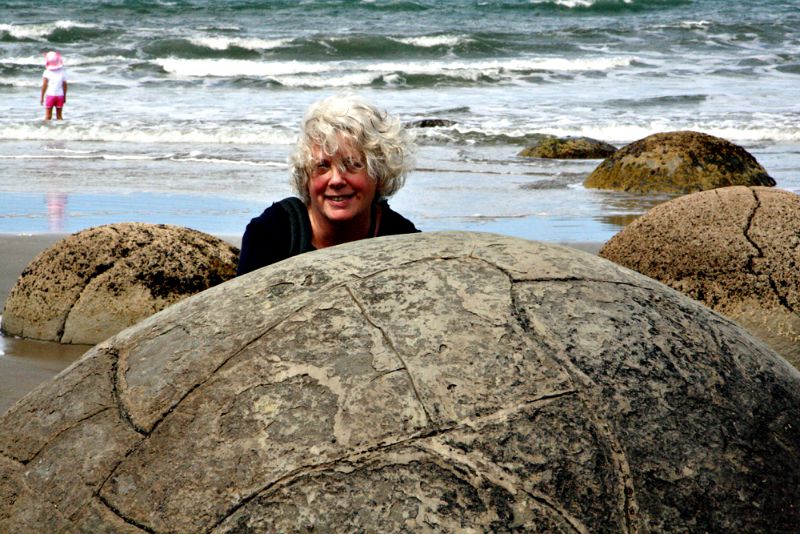
Madeleine Lenagh moeraki

A photo of Madeleine Lenagh taken in New Zealand, among the magnificent Moeraki Boulders.

I first heard about Madeleine from Springtime Books, which published her memoir, Passage of the Stork, Delivering the Soul: One Woman’s Journey to Self-Realization and Acceptance, several months ago.

As those who perused our summer reading recommendations may know, Madeleine’s book was one of my picks. I was intrigued that she chose to tell her life story using poetic vignettes and commentary by archetypes from Nordic mythology and fairy tales.

From the title of the book alone, it’s possible to discern that that Madeleine is in touch with nature at an almost spiritual level. She looks to the stork to deliver her soul (in ancient Egypt, a drawing of the stork served as the hieroglyphic for “soul”). And if you read the book’s prologue, you’ll see that her view of nature includes mermaids—as evidenced by the prologue’s very first sentence:

Three mermaids play in the huge rolling waves, splashing and diving in the curling spray.

It comes as little surprise, then, to discover that besides being an author and blogger, mother and grandmother, and life coach and counselor, Madeleine is a shamanic practitioner. She has been influenced by Dutch shamanic teacher Daan van Kampenhout, whose method fosters connections with helping spirits and ancestors.

What I didn’t realize, though, is how much Madeleine loves to travel and take photographs. She even has her own photography site.

Now let’s see what other worlds Madeleine can conjure up for us with her photos!

* * *

Hi, Madeleine, and welcome to the Displaced Nation. I’ll start the same way as James, by asking: where were you born, and when did you spread your wings (an apt metaphor in your case, given your fondness for storks) to start traveling?
Hi, ML, thank you for inviting me to take part in this column. In answer to your first question: I grew up in Westport, Connecticut. When I was two years old, my stepfather was sent to Europe as a Naval attaché to the NATO. For three years, we lived in Paris, Bad-Homburg, and London. We returned to Westport when I was five. Although I have few memories of those early years, I believe my love of traveling was born then.

So you didn’t end up being raised as a Third Culture Kid?
No, I didn’t leave the United States again until I was 21, when I coaxed my family into giving me a trip to Europe for my 21st birthday. I traveled all around Western Europe and down into former Yugoslavia. At the end of the summer, I was in The Netherlands and my money was running out. I didn’t want to go home yet and found an au-pair job for six months.

Which countries have you visited thus far, and of those, which have you actually lived in?
My travels have taken me all through Europe, as well as to India (Rajasthan), Indonesia (Java and Bali), Costa Rica, and New Zealand (South Island). I believe that Canada and Alaska deserve a separate mention as they are beautiful and remote parts of the world. But, apart from those few years when I was a small child, I have only lived in the United States and The Netherlands.

It’s interesting to me that you chose to make The Netherlands your home for your adult life. What made you settle there in particular?
When I became an au pair in The Netherlands 45 years ago, I sold my return trip ticket to buy winter clothing. Somehow I never got around to leaving. It often amazes me that I, a lover of wild places in nature, could feel so comfortable in this relatively “tame” country. There were key moments in my life when I asked myself, so where am I going now? But there was always more reason to stay than to go. Passage of the Stork, Delivering the Soul describes, among other things, my struggle to put down roots and find a sense of permanency.

“She will always love the sea…” —from the Prologue to Passage of the Stork

Moving right along to the part we’ve all been waiting for: a chance to appreciate a few of your photos. Can you share with us three photos that capture some of your favorite memories of the so-called “displaced” life of global travel? And for each photo, can you briefly tell us the memory that the photo captures, and why it remains special to you?
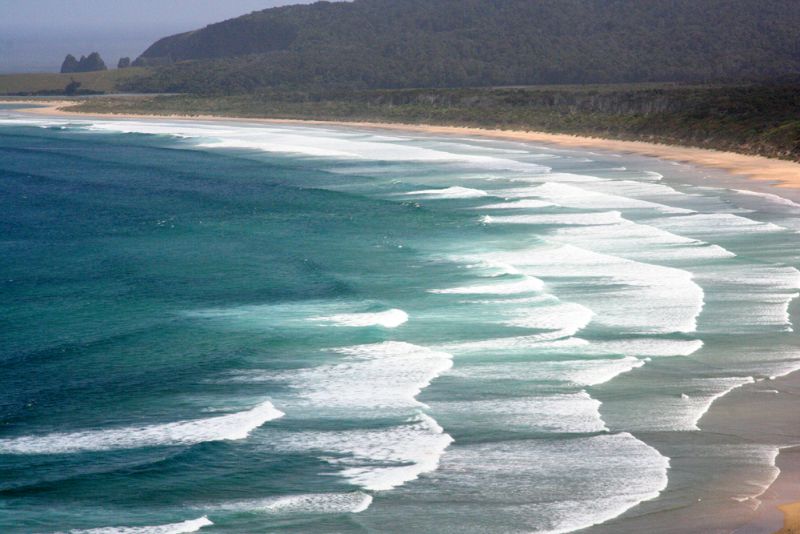
Occasionally I arrive somewhere and think, I could live here. One of those places was South Island, New Zealand. I love the wild remote land, the warm friendliness of the people, and the ever-changing scenery. The photo I have chosen here is the perfect arch of a totally deserted beach in the Catlins, way down on the southern end of the island.

catlins_800x

Untainted by the modern world, the Catlins are the kind of place where a mermaid might appear. Photo credit: Madeleine Lenagh

Wow, that’s the kind of place where it would be easy to imagine mermaids! I have only been to New Zealand’s Northern Island, but even there, I felt that it attracts people who want to get away from it all…
Along the same lines, another place I would be seriously tempted to live, if it weren’t so cold and dark in the winter, is Alaska. I love the pioneer spirit of the people who live there. My brother runs nature tours out of Paxson, which is located in one of the prettiest spots in the state. To the north of the Denali Highway, one sees the dramatic Alaska Range, with its snow-capped peaks and glaciers. An outstretched tundra lies to the south. However, the photo I have chosen, of a fishing boat near the shore, was taken down on Prince William Sound, during a day cruise in 2010. I like the muted colors, with only the bright splash of red on the boat to off-set the fog.

alaska77

While cruising through the calm, protected—and mysterious—waters of Prince William Sound. Photo credit: Madeleine Lenagh

Ooh, I really like this photo. So moody and atmospheric… Though I’ve never been to Alaska, I picture it as having this kind of mystique. Where are you taking us next?
This summer I traveled back to the New England of my youth. I realized how much at home I feel there, in spite of having left 45 years ago. Those of you who have read my book know that I have a special relationship with storks. One of the things they reflect about me is their migratory nature, feeling at home in more than one place. I love this photo of a white stork, taken near my home in The Netherlands, doing its special bill-clacking dance as it returns to the nest.

stork-s_800x

Time for a spot of beak-clapping, says this Dutch stork. Photo credit: Madeleine Lenagh

Hm, until now I have always associated storks with the arrival of babies. But after hearing what you have to say, I may start thinking of them as the avian counterpart of the serial expat!

“I lie on my stomach, hearing gossamer wings rush by.” —from the Prologue to Passage of the Stork

Having seen your first three photos, I expect it’s a bit of a tough choice, but which are the top three locations you’ve most enjoyed taking photos in—and can you offer us an example of each?
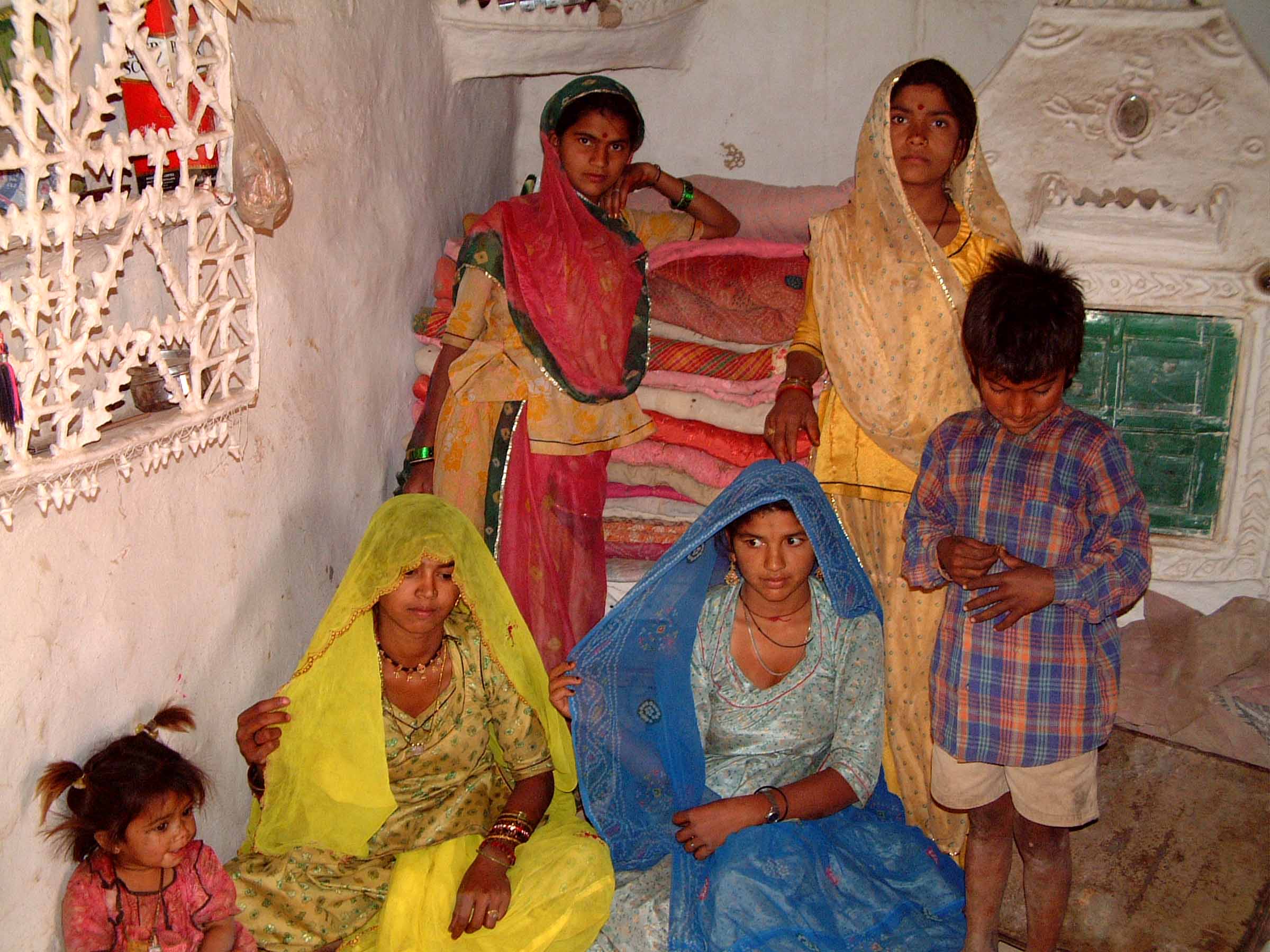
I’m actually going to pick three new places for you. The first one is India. It is a riot of color and ornate decorations, a photographer’s paradise. The photo I have chosen illustrates this perfectly: a group of children posing for me in the “best room” of their desert compound near Jaisalmer.

212_desert

Colorful life in India’s Thar desert. Photo credit: Madeleine Lenagh

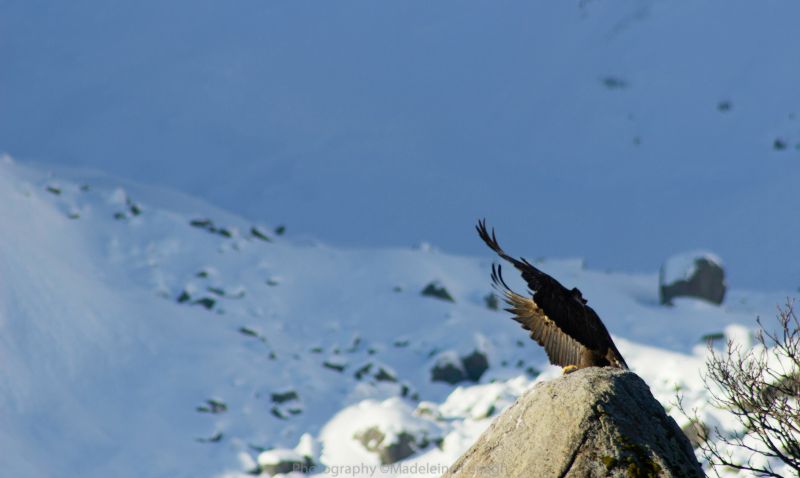
I also have a special relationship with Norway (disclosed in my book) and I love photographing birds. Up in the Lofoten archipelago, I had the unique opportunity to photograph white-tailed sea-eagles. I’m very proud of this shot, catching the bird just as it had landed on a rock.

eagle_800x

A white-tailed sea-eagle touches down on this untouched land within the Arctic Circle. Photo credit: Madeleine Lenagh

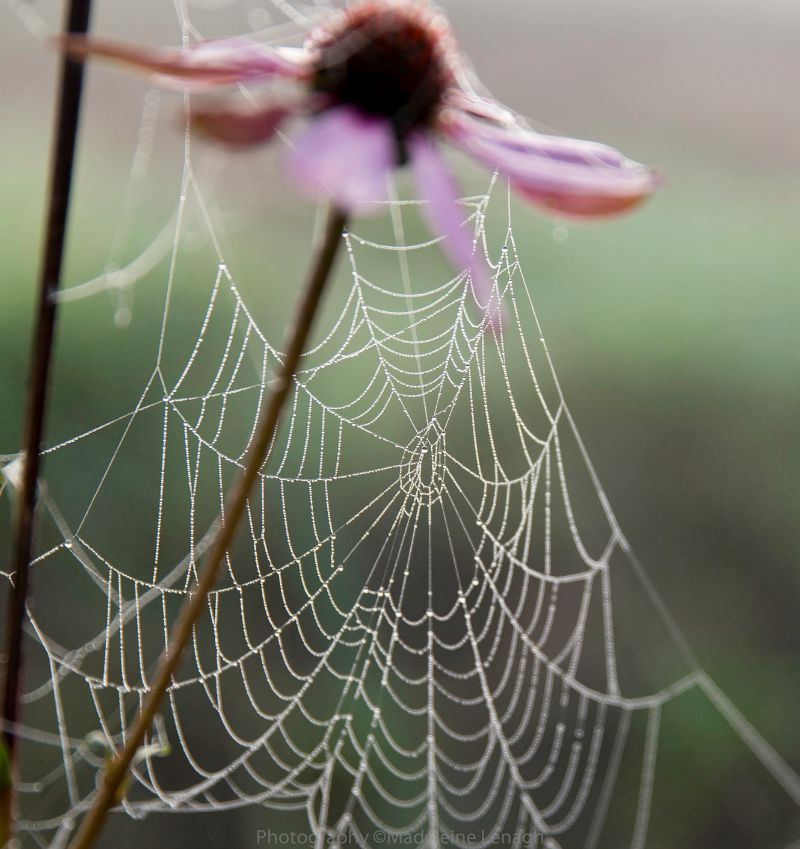
Finally, though I’ve taken you far afield, my last pick for favorite photography locations is my own garden! I love the simple beauty of the nature I find there. A perfect illustration is this photo of a spider web covered with droplets of fog.

spiderweb-s_800x

Is it a spider web or the finest lace? Photo credit: Madeleine Lenagh

I love that you’ve taken us back to your own garden! It makes me think of a fellow New Englander of yours, Emily Dickinson, who took companionship as well as inspiration from her garden in Amherst.

“You can cage a bird, but you can’t make him sing.” (French-Jewish saying)

Going back to your photo of the children in India, I wonder: do you ever feel reserved taking photos of people, particularly when they are conscious of your doing so? How do you handle it?
I am very reserved about taking photos of people, especially in other cultures, and will only do so if they have given me permission. Usually, asking people if you can take their photograph is a wonderful way of making contact with them and often leads to spectacular portraits. The photograph of the children in India is a good example. I love how the two sitting girls (unmarried and therefore veiled) unveiled their faces for the photo.

When did you become interested in photography and what is it about this art form that drew you in?
I believe I have photography encoded in my DNA. My grandfather was taking brilliant photographs in the 1920s. My mother never went anywhere without her 1953 Leica. My Norwegian father (caution: book spoiler!) was a cinematographer. I started taking photographs (and working in a darkroom) when I was about 18 years old. I believe that I was originally drawn in by the fact that it required no real motor skills and I was dreadful at drawing! I’ve always had the urge to express my feelings in some creative fashion, whether it be writing, photography, painting, or dance. Currently, my greatest motivation to photograph is to share the beauty of the natural world with others; to draw them into the same sense of awe and majesty that I feel when I’m in touch with nature.

“Listen to all, plucking a feather from every passing goose, but, follow no one absolutely.” (Chinese saying)

And now switching over to the technical side of things: what kind of camera, lenses, and post-processing software do you use?
Most of these photos were taken with earlier cameras but, at the moment, I use a Canon EOS 6D, a full-frame camera. My favorite lens is a 70-200mm f 2.8 lens. I have been using a 2x extender to get up to 400mm, but recently decided that it slows down the focus too much so I will be looking for a good telephoto lens soon. I find that, as my experience grows, I grow more and more fussy about my equipment! I photograph in RAW format and process the images in Adobe Lightroom.

Finally, can you offer a few words of advice for wannabe photographers who are traveling the world or living abroad?
I suppose the most important advice is just to go out and photograph the things you love. Good photography takes practice and more practice. Study the manual of your camera and don’t be afraid to experiment with settings. Study paintings and sculpture by the artists you admire, to develop a sense for light and composition. As I develop as a photographer I find myself growing more and more critical of my work. It’s not just about showing the things I’ve seen or taking good photos. It’s about taking great photos that show a unique moment.

And I think the most important advice to any aspiring photographer was voiced by Pablo Picasso:

“Learn the rules like a pro, so you can break them like an artist.”

Thank you, Madeleine! I appreciate your sharing a selection of photos that illustrate your deep connection with nature. I’m impressed that you can find so much beauty and wonder on your own doorstep as well as on your travels to the world’s most unpopulated and unspoiled places.

* * *

Readers, what do you make of Madeleine’s travel-photo experiences and her photography advice? Please leave any questions or feedback for her in the comments!

If you want to get to know Madeleine and her creative works better, I suggest you visit her author site and her photography site. You can also follow her on Facebook (she posts her latest photos) and Twitter. But to really get to know Madeleine, I recommend getting her book, Passage of the Stork, Delivering the Soul. You’ll never look at storks, or mermaids, in the same way again!

NOTE: If you are a travel-photographer and would like to be interviewed for this series, please send your information to ml@thedisplacednation.com.

STAY TUNED for next week’s fab posts!

If you enjoyed this post, we invite you to register for The Displaced Dispatch, a round up of weekly posts from The Displaced Nation and SO much more! Register for The Displaced Dispatch by clicking here!

Related posts:

DIARY OF AN EXPAT WRITER: How far I have come in a year…and what’s next

Diary of an Expat Writer
American expat in Hong Kong Shannon Young quit her day job last year to become a full-time writer. Here’s the latest entry in her expat writer’s diary.

Dear Displaced Diary,

I write to you on the occasion of my one-year full-time writing anniversary!

One year ago I quit my job as an English teacher to write full-time. As I’m wrapping up my anniversary month, I’m taking some time to reflect on what I’ve learned and accomplished. I’ve described for you many of the details of my work over the past year, but in this missive I want to step back and consider the big picture.

One thing I’ve gone on about at some length is my affection for outlines and checklists, so before talking about what’s next, I’ll share a few lists: overarching goals I set at the beginning, struggles along the way, milestones achieved.

Intense! Shannon's to-do list, displaying just a few months of her year of full-time writing.

Intense! Shannon’s to-do list for February to May of this year.

Taking stock of Year One

Goals set at the beginning:
-Write full-time for at least six months.
-Complete the Seabound Chronicles (post-apocalyptic series) and publish it independently.
-Promote the release of my traditionally published travel memoir.

Challenges I encountered along the way:
-Establish a daily routine.
-Manage my expectations after a slow start to sales.
-Block out sales stats and reviews to focus on writing.
-Settle in for the long haul.

Milestones achieved:
-Completed three of the novels in the Seabound series: Seabound, Seaswept, and Burnt Sea (launches August 30th).
-Wrote early drafts of two novels (Seafled, a new book), one short non-fiction project (TBA), along with numerous articles and posts.
-Promoted the Hong Kong release (November) and worldwide release (July) of my memoir, Year of Fire Dragons.
-Stretched savings to keep writing for an additional six months.
-First 100-sales day.
-First 10,000-word writing day.

COMING SOON: Burnt Sea, the prequel for Shannon Young's Seabound Chronicles, due out in September.

COMING SOON: Burnt Sea, the prequel for Shannon Young’s Seabound Chronicles, due out in September.

Coming to an assessment

Overall, this has been a very positive year. I love the work, and I’m seeing a steady rise in sales. I’m learning a lot about the business and how to actually move books. Some of the things I’ve learned are helping me to streamline my strategy for the coming year (price promotions supported by advertising sell more books than blog tours, for example, and take WAY less time away from writing). My writing process is becoming more efficient, and the more I write the more ideas I have. But there’s another facet to any career change that needs to be addressed . . .

The money!

I haven’t reached my income targets yet. Although I am writing full-time, I am not making a full-time living (an amount that is different for each individual; I live in an expensive city, but we have no children). I’ve been living on the money I saved during the nine months between when I paid off my last student loan and when I got my last teaching paycheck.

Amazon now sends me a decent check every month and I’m seeing promising and consistent sales trends. I estimate that my monthly sales will produce enough income for me to continue writing full-time by Christmas.

What’s next?

At this point I’m close enough to the tipping point that it doesn’t make sense to look for a new permanent job. However, my savings are running low so I’ve decided to take a ten-week part-time teaching contract to get me through to that tipping point, beginning in October.

My new challenge over those ten weeks will be to maintain my writing momentum with a different schedule. I’ll only be teaching for two hours a day, but it will require a new routine and renewed focus during the rest of the working day.

I don’t yet know the details of my new post. Just in case it turns out to be more disruptive than anticipated, I’m doubling down during the two months between now and the start of the contract. I plan to finish the rewrites for Seafled, the final book in the Seabound Chronicles, by the end of September to make sure my publication schedule continues uninterrupted. While I’m doing the part-time work, I’ll use the rest of the day to write rough drafts for my next series!

I’m looking forward to getting out and about in Hong Kong a bit. Hopefully the ideas will flow and the more constrained schedule will push me to new levels of productivity. I completed all the books published under my Shannon Young name and wrote early drafts of three of the four Jordan Rivet novels while working full-time, so I know I can do this.

That’s it for now, dear Diary. I talk about my writing anniversary in a new video here if you’d like to take a look.

Thanks for everything!

Shannon Young
AKA Jordan Rivet
www.shannonyoungwriter.com
JordanRivet.com

* * *

It must be a sign of aging but for me it seems like only yesterday that Shannon embarked on this writing adventure, and my, she has accomplished a lot! But, alas, money is a perennial concern for creative types of any ilk, including those who live in far-flung places like Hong Kong (that’s an expensive city!). Readers, any thoughts, words of encouragement or other kinds of responses to Shannon’s latest diary entry? Please leave in the comments. ~ML

STAY TUNED for next week’s fab posts!

If you enjoyed this post, we invite you to register for The Displaced Dispatch, a round up of weekly posts from The Displaced Nation and much, much more. Register for The Displaced Dispatch by clicking here!

Related posts:

EXPAT ART AS THERAPY: Works that capture unexpectedly beautiful moments of life in other countries

ExpatArtasTherapy_principle_no_two

As the summer wears on—and I’m wondering what I am doing working long hours in a big city while everyone else seems to have escaped to beaches or mountains or on other adventures—I’m returning to my series based on the ideas of pop philosopher Alain de Botton. As those familiar with his work will recall, de Botton maintains that art can provide relief from as well as solutions to one’s angst.

But does the art we expats produce play a role in improving people’s lives? That’s what this series of posts explores.

No doubt, the works of international creatives has some appeal to what global soul Pico Iyer has called the great floating tribe of people “living in countries not their own.” (Expats currently number around 230 million, or about 3 percent of the world’s population.)

But are the works expats produce too specific to their own situations, or do these works, too, speak to broader life problems?

De Botton outlines six specific ways art can respond to human needs. My last post examined his first principle, that art can compensate for the fact that we have bad memories. I offered some examples of how international creatives have preserved precious moments of their lives in other countries in their works, not only for themselves but for posterity.

Today let’s look at de Botton’s

PRINCIPLE #2: Art can give us hope. Simple images of happiness touch us. We tend to be moved by small expressions of beauty—not because we are sentimental but precisely because so much of life is not pretty.

The example de Botton cites is Claude Monet’s Water Lilies, (or Nymphéas), a series of around 250 oil paintings that depict the French impressionist’s garden at Giverny. Monet painted the series during the last years of his life, while suffering from cataracts.

Claude_Monet_Nympheas_1915_Musee_Marmottan_Paris

Nymphéas, 1915, Musée Marmottan Monet, Paris. via Wikimedia Commons (public domain).

De Botton is of course stirring it up by insisting that beautiful art serves an important purpose. Artists of today seem to be in a race to outdo each other in the outrageous stakes. I’m thinking of Damien Hirst, who built his reputation on artworks displaying dead animals, or their parts, in formaldehyde tanks. Providing a respite from the ugliness of life is the last thing on his mind. Likewise for Jen Lewis, who uses her own menstrual blood to create abstract designs. Provocative, yes, but not my idea of beauty.

Returning to de Botton’s second principle: which expat artists have excelled at producing the kind of beauty that provides relief from life’s less pleasant aspects? (Who are our displaced Monets?)

By way of an answer I’ve arranged a small “exhibition” of works by four visual artists, three painters and one photographer, all of whom have been affiliated in some way with the Displaced Nation. As de Botton has done at several museum exhibitions, I’ve added post-it notes describing the therapeutic effects I’ve experienced upon viewing these artists’ works.

#1: “Lost on a Mountaintop,” by Candace Rose Rardon

Lost_on_a_Mountaintop_by_candace-rardon_800x

POST-IT: Those of us who have traversed international boundaries carry in our hearts the fear that we may someday lose our way—literally, of course, but even figuratively, with no family or old friends around to serve as mentors or sounding boards. Candace Rose Rardon shows us the flip side: how glorious to be lost on the top of a mountain range with the world stripped down to pines, sun, wind and hills, ready for you to paint your own scenes on it. Even a stay-at-home curmudgeon could be struck down with wanderlust, at such a prospect. Candace is a writer, sketch artist and illustrator without a location. She tells stories about the world through her words and watercolors.
OUR CONNECTION: Candace was the recipient of one of our Alice Awards.
SEE ALSO: Candace’s blog, The Great Affair; and her first book of travel sketches: Beneath the Lantern’s Glow: Sketches and stories from Southeast Asia and Japan.

#2: Les Mimosas de Mesubenomori,” by Julie Harmsworth

les-mimosas-de-mesubenomori-2013-800x-acrylique-et-pastel-c3a0-lhuile-sur-papier
POST-IT: My first (and only) visit to Nagasaki, made while I was living in Japan, had a lasting impact. To this day I carry around images of the damage wreaked on that city from my visit to the Atomic Bomb Museum. But for Julie, who moved to Nagasaki from the United States to teach English, the city was the place of her rebirth as an artist. She often walked to this local park, and this painting is her tribute to its flowering mimosa trees. For a moment her painting makes me forget the pain this city endured, along with the horror for war it engenders. Though one can never lose sight of the darkness, it’s possible to be touched by these simple, beautiful trees.
OUR CONNECTION: We are mutual blogging admirers. Julie, btw, has now moved to France, where she continues her work as a fine artist (hence the French title of her painting).
SEE ALSO: Julie’s portfolio site.

#3: “Russian Market—Phnom Penh,” by A. Spaice

Russian-Market-PhnomPenh_framed
POST-IT: I’ve never been to Phnom Penh but imagine it might be a variation on other Southeast Asian cities (Bangkok, Kuala Lumpur, Jakarta, Saigon) I’ve visited. From reading descriptions of the Russian Market, which lies in the southern part of Cambodia’s capital city, I can certainly picture it: a narrow warren of stalls, crowded, busy and sweltering, full of the kinds of goods you see in all of the markets in that part of the world (though apparently at better prices), everything from handicrafts to fake Swiss watches to pirated software to designer clothes considered unfit to be shipped abroad because of small flaws. The global economy at its finest! But what does writer and sometime photographer A. Spaice offer us? A glimpse of a splendidly isolated flower and flower-to-be. Such a beautiful reminder that the “I shop therefore I am” credo of Asia isn’t all there is to life!
OUR CONNECTION: A. Spaice was our first international creative to be “wonderlanded” (read her interview and an excerpt from her short book, Bangkok).
SEE ALSO: A. Spaice’s Design Kompany site and weekly e-zine.

#4: “End of the Drought,” by Antrese Wood

Endofthedrought_Antrese_Wood
POST-IT: The Pampas grasslands of Argentina are one of the most fertile areas in the world. When a drought occurs and its crops are destroyed, not only farmers—but also does the rest of the world—suffers, as world food prices are nudged higher. Antrese’s painting of the grasslands landscape “after the drought” reminds us that even when nature gives the earth and its inhabitants a terrible beating, the rain returns eventually and the beauty of the landscape is restored. If a glimpse of such beauty helps us forget the pain even for a moment, then perhaps it is possible to regroup and carry on. (Note to self: Come back to this painting once the dog days of August have arrived.) An American married to an Argentinian, Antrese has been living in Argentina since 2011.
OUR CONNECTION: Antrese was one of the interviewees in our long-running Random Nomad series. At that time she was about to embark on an ambitious project, “A Portrait of Argentina.”
SEE ALSO: Her portfolio site and her podcast series for artists, SavvyPainter.

Note: All four artists’ works are reproduced here with their permission.

* * *

So, readers, what do you think of the above “exhibition” of works that capture unexpected moments of appreciation for life’s beauty? I know that writing about these works helped to lift me out of my late-July funk, but did you, too, find it therapeutic? And are there other expat works you would recommend for this reason? Do tell in the comments.

STAY TUNED for the next fab post.

If you enjoyed this post, we invite you to register for The Displaced Dispatch, a round up of weekly posts from The Displaced Nation, with Alice nominations, book giveaways, and other extras. Register for The Displaced Dispatch by clicking here!

Related posts:

WONDERLANDED: “Bewildered, Bewitched & Bothered,” by expat writer Sally Rose

bewildered bewitched and bothered

Photo credits: (Row 1) Cheshire Cat, by thethreesisters via Flickr (CC BY 2.0); (Row 2) Alice in Wonderland Cosplay, by Michael Miller via Flickr (CC BY 2.0). Other photos supplied.

A couple of days ago we were Wonderlanded in Santiago, Chile, with American expat writer Sally Rose. She nearly had us twirling in teacups as she took us on a tour of the curiouser and curiouser aspects of her adopted home.

Today we have a chance to sample Sally’s writing and its distinctly wonderlanded quality with this excerpt from her recently published memoir, A Million Sticky Kisses, which recounts her early days as a volunteer English teacher at a not-so-well-off school in Santiago. How does Sally write about being a stranger in a strange land? NOTE: For the purposes of this post, I’ve titled this passage “Bewildered, Bewitched & Bothered” as that seemed an apt way to describe the scenes Sally depicts.

AMillionStickyKisses_cover_pm

* * *

Bewildered, Bewitched & Bothered (Part 2, Chapter 7 of A Million Sticky Kisses, by Sally Rose):

I got up early the next morning because the supervisor had granted me permission to attend the meeting which started at 8:00am. I was at the Metro station by 7:30, where the free newspaper hawkers were setting out stacks of papers. As I walked by, I started to take one from a stack. The male hawker slapped his hand on top of the paper to hold it down. I looked at him as he let out a rapid stream of Spanish, but I had absolutely no idea what he was saying. I tugged again at the paper. “¡No!” He would not let me have it.

“No entiendo. ¿Por qué?” I don’t understand.

From the corner of his eye, he glanced at me. ¡Gringa! I saw him almost relent for a second before tightening his stance as he started explaining again. I listened hard, but without success. He was one of those Chileans that I could not understand at all.

Finally, the woman, who was guarding the other free paper, came over to me and, like she might explain to a 5-year-old who was just learning how to tell time, she pointed to my watch and made a quarter circle with her finger. I understood her, but couldn’t believe it.

“¿Ocho menos cuarto?” 7:45? I had to wait until 7:45 before I could take one of their free papers? She nodded her head.

I realized that it wouldn’t do any good to try and finagle it. This was one of those mysterious Chilean customs that made no sense to a gringa, especially a gringa living in New York, where the papers sat in huge stacks and you could take as many as you liked.

As I walked away, bewildered, I noticed that there were several people already forming a line, willing to wait 15 minutes so that one of the hawkers could hand them a newspaper. They watched our exchange closely to make sure that I didn’t get a newspaper before they did.

I couldn’t wait 15 minutes, not if I wanted to be on time for the meeting. Not that I expected it to actually start at 8:00, but She-Who-Can-Never-Be-Late didn’t want to risk it. I descended the Metro steps without getting my newspaper after all.

"Out of time" street art, which has now been painted over (supplied).

Sally may be in Chile but she doesn’t want to be late! Photo credits: “Out of time” street art, which has now been painted over (supplied); Suivez le lapin blanc, by thierry ehrmann via Flickr (CC BY 2.0)

Incredibly, the meeting started at 8:05. The supervisor was a no-nonsense Chilean who spoke excellent English. I mostly just listened, but Marisol [Sally’s colleague, a Chilean English teacher] told me later, “I think she was nervous around you.”

Then, she added, “Jacqueline [another gringa English teacher] would really like it if you went to her classes today. The supervisor has given her another bad mark. She has received bad marks all year. Without telling her that they will not have her back next year, they have interviewed three other people to replace her. Yesterday, BAY-ACHAY-ESSAY [nickname for Victor Hugo Salinas, head of the English volunteer program] knocked at her door and told her that someone else would be teaching her classes that day. Then, a job applicant took over her classes while poor Jacqueline had to stand and watch.”

Her teaching skills needed improvement, but I almost could not comprehend the cruelty of this. I trudged off to find Jacqueline. Her classes, and now her career at this school, were a lost cause.

After school, I was invited to go with the chorus to the annual Christmas concert at a nearby cathedral. Students from each of The Network’s schools participated. My kids were partnered with girls from the adjacent high school.

We left in a large van from the school, zigging and zagging down narrow backstreets to arrive at the church just in time. We hurried the kids in to find our pews. In the 90-degree heat, my clothes clung to me, but inside the church, it was blissfully cool and smelled of candle wax and furniture polish.

I sat with one of the mother chaperones and kept an eye on the kids. In our chorus were eighteen girls and one boy. They were the only ones wearing their “every day” uniforms, the same gray sweat suits that they wore to school. Choir members from the other schools had on school uniforms, as well, but they were cleaner, dressier, and more expensive.

White shirts, navy pants for boys and white shirts with navy jumpers for girls. I had never seen my kids in any uniform except the sweat suit and I wondered if my school might be the poorest in The Network.

Behind me, I heard commotion and turned to find little girls pushing off and sliding from one end of the well-buffed pew to the other. I gave them a look that included an arched eyebrow and they settled down again, giggling.

The concert began with “It Came upon a Midnight Clear,” in Spanish. My kids were next. I didn’t recognize their song, but it was beautiful with their voices echoing strong in the vaulted cathedral. They accompanied the song by clapping their hands in flamenco-style rhythm while the youngest girl pinged on a triangle.

Sally doesn't mind her kids being in sweat suits when they perform well (photo supplied).

Sally doesn’t mind her kids being in sweat suits when they sing beautifully (photo supplied).

Out of the twenty or more songs, I only recognized five. The rest were traditional Chilean Christmas songs.

Afterward, going home later than usual, the train was crowded. A man entered after me and moved past me. Then, he called attention to himself by bumping into me as he moved in front of me again. “Permiso,” he said as he circled around. I thought he would be getting off at the next station since he stood by the door, but instead of facing the door, he turned around to face me.

All this moving around put me on guard. I was holding my purse, my school bag, and my sweater when I felt something funny going on with my purse. I looked down and saw a sweater hanging over the top of it. His sweater. Then, I felt something fiddling with the zipper. His hand?

Quickly, I moved away to the middle of the car, out of his range. Keeping my eyes on his, I felt around inside my purse to make sure everything was still there. I glared at him with mal de ojo, the evil eye, until he jumped off at the next stop.

Metro and evil eye

You have to have an evil eye on the Santiago Metro if you don’t want to be pickpocketed. Photo credit: Metro Universidad de Chile, by Guillermo Perez via Flickr (CC BY 2.0).

* * *

Thanks, Sally! I love it, especially the section where you descend into the Metro muttering the equivalent of: “I’m late, I’m late, for an important date.” And your mal de ojo (evil eye) powers must be on a par with the Queens of Hearts’s “Off with your head!” Also, I’m glad your version of Wonderland includes children’s music.

Readers, what do you think? Has this excerpt from Sally’s book made you want to read more? If so, you can order A Million Sticky Kisses from Amazon or Good Reads. You can also visit Sally’s author site, where she keeps a blog and/or stay social with Sally by following her on Twitter, Facebook, Pinterest, and Instagram. And of course you can also express appreciation for Sally in the comments below. ~ML

STAY TUNED for next week’s fab posts.

If you enjoyed this post, we invite you to register for The Displaced Dispatch, a round up of weekly posts from The Displaced Nation, and much, much more. Register for The Displaced Dispatch by clicking here!

Related posts:


Wonderlanded in Santiago with Sally Rose, expat writer, teacher and (above all) learner

Photo credits: Santiago (top) and New York City via Pixabay; Sally in Chile & Sally's Alice in Wonderland  painting by Russian artist. (supplied).

Being Wonderlanded with Sally Rose means going from the City That Never Sleeps to the City of Madhouse Parties. Photo credits: Santiago (top) and New York City via Pixabay; Sally in Chile & Sally’s Alice in Wonderland painting by Russian artist. (supplied).

Welcome back to the Displaced Nation’s Wonderlanded series, being held in gratitude for Lewis Carroll’s Alice’s Adventures in Wonderland, which turns 150 this year and, despite this advanced age, continues to stimulate and reassure many of us who have chosen to lead international, displaced, “through the looking glass” lives.

This month we travel
d
o
w
n
the hole with Sally Rose to Santiago, Chile.

At first glance, Sally may not seem to have a strong connection to Alice in Wonderland, having been born and bred in the piney woods of East Texas. But I assure you her life has taken the kinds of twists and turns that would give Alice some serious competition.

First, Sally faced the struggle of getting out of a conservative small town in Texas, which simply didn’t have enough Mad Hatters in it to satisfy her curiosity. As she says in the introduction to her recently published memoir:

At night, I’d lie awake and listen to the whistle of the midnight train as it passed through like clockwork. I always pondered where it might be going. In my imagination, it was always somewhere “exotic” and exciting. Where to tonight? Chicago? New York? Out West?

Once she was old enough to leave home, Sally tried living in the Cajun Country of Louisiana, the plains of Oklahoma, and the “enchanted” land of New Mexico—only to make her way, eventually, to the East Coast and New York City, where she dreamed of writing the Great American Novel.

But even the Big Apple wasn’t enough to sate her restless, adventuresome spirit. Soon it was time to expand her horizons again and go abroad. Having been to Chile on a holiday, she signed up for a volunteer program teaching English in Santiago.

At last she had stepped though the looking glass! From the moment she arrived to live in Santiago, she found herself struggling with both language and culture, along with a whole host of unfamiliar characters—from avaricious school owners to boisterous school kids. She was a “stranger in a strange land.” Would she get out alive and unharmed, with her wallet safe (no joke!). Perhaps if she hadn’t been the recipient of a million sticky kisses, as her memoir is titled, she would have exited her Alice in Wonderland story by now, screaming “Off with their heads!”

But instead she embraced the adventure and has now become a permanent resident of Santiago, a displaced creative. In addition to A Million Sticky Kisses, which chronicles her earliest encounters with her Chilean students, Sally has also produced a children’s book, Penny Possible, about a Golden Retriever named Penny who trained for two years to become a therapy dog for an Iraq war veteran (proceeds are donated to Warrior Canine Connection). It has been a No.1 bestseller on Amazon.

Oh, but wait! A rabbit just darted by. Let’s follow Sally and hear about her Adventures as a Gringa Teacher in the Wonderland of Santiago de Chile…

* * *

Sally Rose: Thanks, ML, and thanks, Displaced Nation readers, for accompanying me on this trip to my special version of Wonderland. As ML mentioned, I was born and raised in East Texas, in a tiny little town. That means the northeast corner between Dallas and Texarkana. I’m not sure why I chose to incarnate in small-town Texas because I always had the feeling that I was a big-city girl, and I’ve since discovered that to be true.

My path to becoming a displaced national went like this: Texas-Louisiana-Texas-Louisiana-Oklahoma-Louisiana-Texas-New Mexico-Texas-New Mexico-New York-Chile.

I’d always wanted to try living in New York, and I’d always thought I’d live overseas. Everything before that was only practice.

“Who in the world am I? Ah, that’s the great puzzle!”

I must have felt disoriented from the moment I was born. Though there were differences in each of the original four states (Texas, Louisiana, Oklahoma, New Mexico), my life before New York was fairly homogenous, but nowhere felt like “home.” Now, I realize that most of my moves have been based on trying to find my tribe. Asking myself, “Where do I fit in?”

Though many people become disoriented by being “down the rabbit hole,” I thrive on feeling that little edge of uncertainty, on feeling puzzled.

Living in New York meant getting used to high rent-tiny apartments, walking and public transit vs. car culture, different (read: NY) attitudes, too many choices, and 7,999,999 other people, yet not being connected to any of them.

Once I got into the rhythm and pace of the city, I found it exhilarating. I called New York my temperamental mistress, but I eventually felt less disoriented there than anywhere else I’d ever lived.

In 2008, I came to Chile on a vacation. Call it karma, fate, or the planets aligning—but the moment I set foot in that strange land, I knew the time had come to follow my heart and make my dream of teaching abroad a reality.

I moved to Chile on March 1, 2011, ready to conquer the world and make a difference in someone’s life.

“Curiouser and curiouser…”

Three years before I made the move, I did several stints of volunteer teaching in low-income schools where the students were considered to be “at risk.” Vulnerables. My book, A Million Sticky Kisses, covers that initial period.

I learned so much about myself that, most of that time, I wondered who was teaching whom.

In Santiago, Sally is teacher but above all learner (photo supplied).

In Santiago, Sally is teacher but above all learner (photo supplied).

“But she went on all the same, shedding gallons of tears, until there was a large pool all round her, about four inches deep…”

Once I decided to relocate to Chile, I had many moments of doubt, starting as the plane sat on the runway at JFK. Buckled in and staring out the airplane window, I had a moment of utter, can’t breathe, panic. What in the world was I doing? Leaving everything behind and moving overseas where I knew almost no one and barely spoke the language, what was I thinking?

Most “pool of tears” moments were followed by elation, the “I did it!” moments. Making the move, finding an apartment, getting my residency visa, opening a bank account, finally understanding enough Spanish to have a phone conversation, all counted as triumphs.

“If everybody minded their own business,” the Duchess said in a hoarse growl, “the world would go round a deal faster than it does.”

I haven’t changed my personal clothing style, which tends to be tailored and conservative. I actually enjoy wearing what I think of as the “Chilean granny uniform.” Wool skirt, wool sweater, wool scarf in neutral tones. And let’s not forget the sensible flats.

My short, red hair has earned me some long looks and possibly some judgment.

For young Chilean women, the hair style is long. Period. There are few exceptions. Once a woman is over 50, it’s acceptable to have shorter hair, but not spiky, red hair, like mine. This leads to suspicions that one is a lesbian, whether it’s true or not.

Sally doesn't care what Chileans think of her granny clothes & short red hair. Or does she? (Photos supplied)

Sally doesn’t care what Chileans think of her granny clothes & short red hair. Or does she? (Photos supplied)

“You’ll get used to it in time,” said the Caterpillar; and it put the hookah into its mouth and began smoking again.

It took me a long time to realize that you cannot be direct with Chileans. If you approach things openly and directly, they will often be embarrassed or offended.

This happened to me the first year that I was here. A teaching colleague had invited me to an asado, a BBQ, for Chile’s national independence day, Fiestas Patrias, September 18.

She invited me, but there were no details. What time did the party start? Would it be at her house or at her sister’s? Could she give me directions?

I sent her an email, asking these questions, but it went unanswered. I tried phoning her. She didn’t pick up. I texted her, Facebook messaged her, and phoned again, multiple times. She never responded to me and I ended up with no plans for the biggest Chilean holiday of the year.

Gringa alone on Fiestas Patrias. Photo credit: Bailando en la fonda, by Osmar Valdebenito via Flickr (CC BY-SA 2.0).

Gringa alone on Fiestas Patrias. Photo credit: Bailando en la fonda, by Osmar Valdebenito via Flickr (CC BY-SA 2.0); inset: Sally Rose (supplied).

The following week at school, she was polite, but not friendly like she’d been before. When I finally found her alone one day, I asked her what had happened. “I waited to hear from you about the BBQ. Why didn’t you respond to my messages?”

Lo que pasa es…” What had happened is that her baby had been sick and the car broke down. Then, her sister had decided not to have the party, and so on and so forth.

“I understand difficult family situations,” I told her. “What I don’t understand is why you didn’t let me know.”

She couldn’t explain this, didn’t seem to understand why it mattered nor why I felt disappointed.

Our relationship never recovered from this incident, and I was never invited again. She became distant; she avoided me. I lost a friend, but learned a lesson. To maintain Chilean friendships, I had to be less direct, or even silent, about many things, which is not my usual style.

“Well, I’ll eat it,” said Alice…

A Chilean food I love? That’s a strong word. I’ve tried octopus—too rubbery. Cochayuyo (dried seaweed)—rubbery and sticky. No love lost there. I’d have to say that my favorite Chilean dish is Pastel de Jaiba. This is a crab casserole baked in an individual clay bowl. ¡Rico!

Pastel de Jaiba, Sally's favorite Chilean dish (photo supplied).

Pastel de Jaiba, Sally’s favorite Chilean dish (photo supplied).

“Take some more tea,” the March Hare said to Alice, very earnestly.

Since my current home is approximately 55m, and my dining room table seats four people, this would be an intimate party. I would host a traditional Chilean once, with a twist or two.

Once is tea time in Chile. Not everyone observes this tradition, but many still do. Once has its roots in friends getting together for a nip in the late afternoon. In some stories, it was soldiers who began the tradition. In other stories, it was older ladies. Either way, they wanted to keep it a secret, so they called it once. The word in Spanish means eleven, after the eleven letters in aguardiente, fire water.

These days, alcohol is not usually served at once. Traditional once includes tea, bread with butter and jam, sometimes ham and cheese, and on special occasions, a cake. Chileans love sweets, and many cakes here are layered with manjar, a tooth-aching, caramelized milk filling, similar to dulce de leche.

I would use my best tablecloth and my English teapot. Manjar‘s too sweet for me, so I would serve a gooey, dark chocolate confection instead, and since I’m a gringa, I would serve a dry, bubbly espumante, in addition to the tea.

Wearing hats might be involved. Gloves, optional.

Is Sally Alice or the Mad Hatter here? (Photo supplied)

Is Sally Alice or the Mad Hatter here? (Photo supplied)

“I almost wish I hadn’t gone down that rabbit-hole—and yet—and yet—it’s rather curious, you know, this sort of life!”

My identity shift began in New York and has continued here in Chile. There is something empowering about moving into the unknown. When you start to have small victories, like navigating the subway or ordering in Spanish at a restaurant, you feel a heady success.

On the flip side, your mettle is tested on an almost-daily basis. Once you have proved to yourself that you can survive, evolve, adapt, and thrive, you get a glimpse of who you really are.

Sally in Disneyland teacup, in the days before she was wonderlanded (photo supplied).

Sally in Disneyland teacup, foreshadowing her experience of being wonderlanded (photo supplied).

Advice for those who have only just stepped through the looking glass

It’s okay to not know where you belong. Change course if necessary. Accept that you may never fit in. If something doesn’t work, be flexible. Try something else. Reinvent yourself. The good news is that you’ve already done it once, and you can do it again.

“Alice had begun to think that very few things indeed were really impossible.”

Ironically, I often work best when I am confused, challenged, or depressed. Since none of these is the case at the moment, I’m distracted by life, in general, but I have two specific projects in mind.

The first is an illustrated children’s book. It will be based in Chile, using iconic settings, and the theme will revolve around two of Santiago’s one million street dogs. I call them Bruno and Roger.

I am also in the process of reviewing and editing a former project titled Well, Why Was I Born: The Romance that Never Was. Publication goal: 2017.

sally rose books

Sally’s great works: two in the bag and two to come.

* * *

Thank you, Sally! That was a jolly good trip, both entertaining and thoughtful. Readers, I wonder if you feel like me, that there was something very special about the experience of being “wonderlanded” with Sally in Santiago? Please let us know in the comments. ~ML

STAY TUNED for the next fab post: an example of how Sally writes about place.

If you enjoyed this post, we invite you to register for The Displaced Dispatch, a round up of weekly posts from The Displaced Nation, and much, much more. Register for The Displaced Dispatch by clicking here!

Related posts:
BOOKLUST, WANDERLUST: Beach bound? Check out summer reading recommendations from featured authors (2/2)

booklust-wanderlust-2015

Attention displaced bookworms! Our book review columnist, Beth Green, an American expat in Prague (she is also an Adult Third Culture Kid), empties the remainder of her treasure chest that she brought to us two days ago, stuffed with recommended reads to take you through the summer.

Hello again. As explained in Part One of this post, I reached out to some of my bookish friends as well as a few of the authors whose books I’ve recently reviewed to see what books they recommend taking on vacation. I asked them to tell me:

Summer Reading 2015

Photo credits: Amazon Kindle PDF, by goXunuReviews via Flickr (CC BY 2.0); beach chair and sandy feet via Pixabay.

Here are the rest of the recommendations I received, including a few from yours truly and ML Awanohara (Displaced Nation’s founding editor) at the end. Enjoy!

* * *

MARK ADAMS, best-selling travel writer and author of Meet Me In Atlantis (which we reviewed in May): My recommendations are a classic travelogue, a biography of an intrepid traveler, and an adventure novel.

The-Snow_Leopard_cover_300xThe Snow Leopard, by Peter Matthiessen (Viking Press, 1978)
Shortly before he died, I had the honor of interviewing Matthiessen at his home on Long Island. I was surprised by how concerned he seemed, knowing that his death was rapidly approaching, that he would be remembered less as a novelist than as the author of The Snow Leopard. I went back to reread it for the first time in twenty years and was amazed by how good it was—a moving story about a man’s search for meaning through Zen Buddhism after the death of his young wife, intertwined flawlessly with a thrilling narrative about an incredible journey through the Himalayas. So fresh and evocative it could have been published yesterday.

Bruce-Chatwin_A-Biography_cover_300xBruce Chatwin: A Biography, by Nicholas Shakespeare (Anchor, 2001)
Chatwin, of course, is one of the great travel writers of all time; he practically reinvented the genre with books like In Patagonia and The Songlines. But as Shakespeare’s brilliant biography demonstrates, Chatwin’s greatest creation may have been the globetrotting persona that he carefully presented to the world. The descriptions—decodings might be a better term—of how Chatwin assembled his literary works will be absolutely riveting to anyone who has tried his or her hand at trying to pin down the essence of a place using only words.

State-of-Wonder_cover_300xState of Wonder, by Ann Patchett (HarperCollins, 2011)
I once heard Ann Patchett on the radio, talking about the job of a novelist. She described it as “creating a world.” No one creates worlds with quite the skill that Patchett does. Reading her descriptions of pharmaceutical research being conducted in the Amazon is like being dropped into the jungle—you can feel the sweat beading on your forehead and the buzz of malarial mosquitoes preparing to land on the back of your neck. And you know what? Patchett’s Bel Canto, which takes place in Lima, Peru, is an equally brilliant tale that performs the magic tricks that only great fiction can, allowing you to read minds and travel through time and space.


MARIANNE C. BOHR, Displaced Nationer and author of the soon-to-be-published Gap Year Girl: A Baby Boomer Adventure Across 21 Countries: My summer reads are usually of the meaty kind because as a teacher, I have more time in July and August to pay close attention and savor every word. As one who suffers wanderlust daily, my three choices all have to do with travel. They are very different books, but each grabs my heart in a different way and I could read them over and over, each time discovering something new.
Bohr Collage

The Drifters, by James A. Michener (Random House, 1971)
This book takes me back to my youth and the thirst for exotic adventure that goes along with being young.

Nothing to Declare: Memoirs of a Woman Traveling Alone, by Mary Morris (Houghton Mifflin Harcourt, 1998)
I wanted to head straight to Mexico when I read this heart-wrenching book and also felt like the author was a new friend when I finished.

An Italian Affair, by Laura Fraser (Vintage, 2001)
What a guilty pleasure immersing myself in this book of islands, romance, lust and longing is. I could read it again and again.


SHIREEN JILLA, adult TCK and former expat and author of The Art of Unpacking Your Life (which we reviewed in May) and Exiled (which we featured in 2011): I would pack three very different books:
Jilla Collage

Red Dust: A Path Through China, by Ma Jian (Vintage, 2002)
Dissident artist Ma Jian’s diary of his walk across China in the wake of his divorce and threatened arrest is utterly enlightening, moving, profound and playful. Walking is clearly an under-rated pastime.

Look at Me, by Jennifer Egan (Anchor, 2009)
A powerful, beautiful novel about the crazed nature of modern urban life, it elevates Egan to one of the greats of American literature.

Paris Stories, by Mavis Gallant (NYRB Classics, 2011)
A regular writer for the New Yorker, Gallant penned these short stories about expats and exiles in Europe particularly Paris. They are brilliantly laid bare. (Born in Montreal, Gallant moved to Paris when she was 28 determined to be a full-time writer. She lived there until her death in 2014.)


BETH GREEN, writer, expat, TCK and BOOKLUST, WANDERLUST columnist: Here are my three picks, one of which I’ve not read and two that I have:

The-Messenger-of-Athens_cover_300xThe Messenger of Athens by Anne Zouroudi (Reagan Author Books, 2010)
Summer is the best time to really sink into a mystery series. I love taking a few titles from an established series and binge reading them on the beach or by the pool. Previously, I’ve done this with Elizabeth George’s Inspector Lynley novels, Janet Evanovich’s Stephanie Plum books and Charlaine Harris’ Southern Vampire mysteries. This year I’ll be spending some time on the beach in Greece, so I’ve got my eyes set on British writer Anne Zouroudi’s Greek Inspector mysteries, which depict ugly crimes based on the seven deadly sins in beautiful Mediterranean surroundings. The series now has seven books, of which Messenger is the first. (Born in England, Zouroudi worked in the UK and the USA before giving it all up to live on a Greek island. She married a Greek as well.)

swamplandia_coverSwamplandia! by Karen Russell (Vintage, 2011)
This darkly fascinating and somewhat magical story of a girl and her siblings abandoned in a run-down theme park in Florida fascinated me when I read it a few years ago. It’s both a chilling odyssey into a swampland netherworld and an exploration of subcultures of the kind rarely seen in American books. For me it had the right amount of tension to keep you turning pages and the right amount of whimsy to keep the potentially depressing material light enough for a summer read.

Daughter-of-Fortune_cover_300xDaughter of Fortune, by Isabel Allende, trans. by Margaret Sayers Peden (Harper, 2014)
Summer is a time for voyages—or at least reading about them! I can name a whole bagful of road trip books I’d happily re-read over summer, but for pure swashbuckling joy I have to recommend Isabel Allende’s historical cross-cultural adventure Daughter of Fortune. An upper-class girl raised in an English enclave in Chile in the 1800s stows away to follow her lover to the gold fields of California. I haven’t read the sequel, Portrait in Sepia, yet, but I’m guessing it’s also worth adding to that beach bag. (Born in Peru and raised in Chile, Allende lives in California.)


ML AWANOHARA, former expat and Displaced Nation founding editor: We are constantly reporting on new displaced reads in the Displaced Dispatch, which comes out once a week. Just to give you a taste of the kinds of things we feature, here is a selection. As you can see, it comprises a work of historical nonfiction that reads like a novel, a memoir with elements of Nordic myth, and a novel by a once-displaced poet, all with beach-bag potential.

Daughters_of_the_Samurai_cover_300xDaughters of the Samurai: A Journey from East to West and Back, by Janice P. Nimura (W.W. Norton, May 2015)
Call it the early Japanese version of our gap year or junior year abroad. The story begins in 1871, after Commodore Perry’s ships opened Japan to the outside world, when five young women were sent to the United States on a mission to learn Western ways and help nurture a new generation of enlightened Japanese leaders. Three of them stayed for ten years and returned to Japan determined to revolutionize women’s education. Several critics have said the book reads like a modern fairy tale. But if the women faced many hurdles in the course of their unusual journey, the tale doesn’t necessarily end happily ever after. “I cannot tell you how I feel,” one of them remarked upon her return to her native land, “but I should like to give one good scream.” Janice Nimura, an American who is married to a Japanese, has spent time living in Japan.

Passage-of-the-stork_cover_300xPassage of the Stork: One Woman’s Journey to Self-Realization and Acceptance, by Madeleine Lenagh (Springtime Books, March 2015)
Madeleine Lenagh is American but spent her first five years as an expat child in Europe, after which she grew up in Connecticut. Rebelling against her mother’s interference in her love life, she set out to travel across Europe alone. Arriving in the Netherlands broke, she took a job as an au pair—and the rest is history. She has now been living in the land of cheese and tulips for over four decades and speaks fluent Dutch. But that’s her travel history. Her own personal history remained repressed until she wrote this memoir. One of the things that interests me about it is that Lenagh chose to weave together the narrative using Nordic mythology. (As long-term followers of the Displaced Nation will know, we are fond of doing the same with the Alice in Wonderland story.) Passage of the Stork is a publication of Springtime Books, the new fledgling of Summertime Publishing, which specializes in books by expats and for expats and is the brainchild of global nomad Jo Parfitt.

hausfrau_coverHausfrau, by Jill Alexander Essbaum (Random House, March 2015)
This novel by Texas-born American poet Jill Alexander Essbaum, her first, depicts an American woman in a cross-cultural marriage to a Swiss banker. They are living with their three young children in a postcard-perfect suburb of Zürich. In the spirit of Essbaum’s erotic poetry, Anna (yes, the name is a nod to Tolstoy’s heroine) engages in a series of messy affairs. Now, is this book the expat answer to Fifty Shades? Actually, the answer to that question interests me less than the fact that Essbaum herself was once a hausfrau in Dietlikon, near Zürich, where she moved with her first husband, an American interested in studying Jungian psychoanalysis. Like Anna, she experienced intense loneliness and isolation—albeit no torrid affairs. Who would have guessed?

* * *

Thank you so much for your recommendations, ML and everyone else! Readers, it’s your turn now. What books are you looking forward to popping in the book bag this summer? And, for our friends in the Southern Hemisphere, what books are getting you through the winter?

Also, can I echo ML’s contribution by urging you to sign up for the DISPLACED DISPATCH, which has at least one Recommended Read every week. And please feel welcome to make recommendations for books to be featured in the Dispatch, and in this column, by contacting ML at ML@thedisplacednation.com.

STAY TUNED for next week’s fab posts!

Beth Green is an American writer living in Prague, Czech Republic. She grew up on a sailboat and, though now a landlubber, continues to lead a peripatetic life, having lived in Asia as well as Europe. Her personal Web site is Beth Green Writes. She has also launched the site Everyday Travel Stories. To keep in touch with her in between columns, try following her on Facebook and Twitter. She’s a social media nut!

If you enjoyed this post, we invite you to subscribe to The Displaced Dispatch, a weekly round up of posts from The Displaced Nation and much, much more. Sign up for The Displaced Dispatch by clicking here!

Related posts:
BOOKLUST, WANDERLUST: Beach bound? Check out summer reading recommendations from featured authors (1/2)

booklust-wanderlust-2015

Attention displaced bookworms! Our book review columnist, Beth Green, an American expat in Prague (she is also an Adult Third Culture Kid), has arrived with a treasure chest full of recommended reads to take you through the summer. NOTE: Check out Part Two here.

Hello again, Displaced Nationers!

Summer is upon us—well, for readers in the northern hemisphere, that is! And for those in the United States, Fourth of July weekend is coming shortly. Even if you’re not beach bound, perhaps you are at least picturing yourself sitting in a beach chair feeling the sand through your toes, the waves pounding towards you, the fresh, bracing sea air filling your lungs…

And what’s that you have in your hand—a book or a Kindle?

I find the sound of the waves and the ocean breeze the perfect conditions for escaping into other worlds that writers conjure up for us in their books. This summer, I’ve already been to a few local parks with my e-reader, and I’ll soon be topping it up with some of the books from our best-of-2014 list for an overseas trip. But I’m always on the look-out for fresh new material, and as there are miles to go before I can flop down on the beach of my dreams, I fear I’ll run out of prime reading matter by then. With this eventuality in mind, I decided to reach out to a few of the authors whose books I’ve recently read or reviewed, along with a few of my bookish friends, to see what books they recommend taking on vacation. I asked them to tell me:

Summer Reading 2015

Photo credits: Amazon Kindle PDF, by goXunuReviews via Flickr (CC BY 2.0); beach chair and sandy feet via Pixabay.

They responded with recommendations that seem tailor made for an audience of international creatives. Enjoy! Part 2 will be posted on Friday.

* * *

ALLI SINCLAIR, world traveler, Australian romance author and former co-blogger at Novel Adventurers: I recommend that you bring one travel book, one classic, and one novel. The following make a good combination:

ChasingtheMonsoon_cover_x300Chasing the Monsoon: A Modern Pilgrimage Through India, by Alexander Frater (Henry Holt & Co, May 1992)
There are some books that touch something in your soul that stays with you forever. For me, Chasing the Monsoon falls into that category. Originally published in the early nineties (and thankfully, still available!), Alexander Frater follows the monsoonal rains from the Kerala backwaters in southern India to Cherrapunji, in northern India—known as the wettest place on earth. Frater connects beautifully with the people he meets and he writes for all senses, giving the reader a full immersion into one of the most captivating countries on Earth.

The Ascent of Rum Doodle_cover_x300The Ascent of Rum Doodle, by W.E. Bowman (Vintage Classics, 2010)
Originally published in 1956 but still in print, this book is one of the most celebrated mountaineering stories of all time. The 1950s saw some of the world’s highest mountains successfully climbed (including Everest), and this book is a parody of mountaineering at it’s finest…er, worst. There’s a route finder who is constantly lost, a diplomat who continually argues, and a doctor who is always ill. Rum Doodle will most definitely appeal to fans of Bill Bryson, who wrote the introduction to the book’s international edition (published in 2010).

HellofromtheGillespies_cover_x300Hello From The Gillespies, by Monica McInerney (Penguin, 2014)
I’m a long time fan of Monica McInerney’s books, maybe because Monica is a “displaced” person: having grown up in Australia, she has split her time between Australia and Ireland for the past 20 years. This book is mostly set in outback Australia but with ties to England. Angela Gillespie, a mother of four adult children, has sent out a regular Christmas letter to friends and family for thirty years. The notes are always cheery and full of good news but this year, her note details the unsettling truth of how her family has fallen apart. If you enjoy family sagas with humour and heart, you can’t go wrong with this book. (True, some people recommend it for the holidays, but it’s summer in Australia at Christmas time, remember?)


BRITTANI SONNENBERG, adult TCK, current expat and author of Home Leave (which we reviewed in November): I would pack the following books (assuming I’d be packing it for someone else, who hadn’t read them yet).
Sonnenberg_collage

The Dog, by Joseph O’Neill (Vintage, September 2014)
It’s a devilish, compelling take on cosmopolitan and expat life by the TCK author of Netherland. (Joseph O’Neill was born in Cork, Ireland, in 1964 and grew up in Mozambique, South Africa, Iran, Turkey, and Holland. He now lives in New York City.)

Ghana Must Go, by Taiye Selasi (Penguin, 2014)
This is an intimate examination of a splintered family, set in Accra, Lagos, London, and New York.

All My Puny Sorrows, by Miriam Toews (McSweeney’s, 2014)
One of the saddest and funniest books I’ve ever read; an honest, moving portrayal of sisters and mental illness.


CHRISTINE KLING, author of travel- and sailing-related thrillers: I’ve just finished up the edits on a the third novel in my Shipwreck Adventure series, and I’m looking forward to taking a bit of time off from writing and working at reading my way through some of the long list of books I’ve been wanting to read. The three books I’d take in my beach bag include two novels and a combination cookbook/memoir/travelogue.

The-Janissary-Tree_cover_x300The Janissary Tree, by Jason Goodwin (Sarah Crichton Book, 2006)
My husband and I are contemplating building a new boat in Turkey, and after our recent visit, I’ve fallen in love with the country. Jason Goodwin has written travel books, histories, and thrillers, and I’ve been waiting for the chance to begin reading his work. The Janissary Tree, winner of the 2007 Edgar Award for Best Novel, is the first in what is now his five-book series set in in the waning days of the Ottoman Empire’s Istanbul. The series features a very unique protagonist Yashim Togalu, a eunuch guardian. In this book, Yashim is called upon to investigate a series of crimes including murder and theft of jewels.

Marina_cover_x300Marina by Carlos Ruiz Zafón (Little, Brown Books for Young Readers, 2014)
The first book I read by this author was The Shadow of the Wind, which I often cite as one of my favorite books of all time. I knew Zafón had written a young adult novel that was published in 1999 and became a “cult classic” in Spanish, and since I enjoy good YA novels like the Harry Potter series and the Hunger Games, I was happy to see this book finally released in English in 2014. Marina is set in Barcelona around 1980 at the end of Franco’s regime. This gothic tale is touted as containing elements of mystery, romance and horror as a young boarding school boy meets the exotic, dark Marina. Together they embark on a series of adventures where they meet the kind of grotesque Barcelona characters Zafón does so well.

Sea-Fare_cover_x300Sea Fare: A Chef’s Journey Across the Ocean, by Victoria Allman (Norlightspress Com, 2013)
Years ago I worked as a chef on our owner-operated charter sailboat, and I know what it is like to have to create meals for demanding guests. Victoria Allman is in an entirely different category as she trained as a chef and has worked your years on multi-million dollar yachts. In Sea Fare, Allman has combined the tales from her beginning as a green Canadian chef looking for a job in the charter yacht industry to the joys of shopping in exotic markets from Italy to Vietnam. From the descriptions of her experiences on board the yacht, dealing with crew problems and falling in love with the captain, the stories are grand, but the recipes and the outstanding color photos of the food, will probably cut my trip to the beach short as I head home to try some new dish.


HEIDI NOROOZY, adult TCK, translator and author of multicultural fiction: I just returned from a research trip to Germany, and my choices seem to reflect that! (I went there because I’m writing a novel about an East German detective, Johannes Christian Alexander Freiherr von Maibeck—I know, it’s a bit of a mouthful—I created for a short story I once wrote. The setting is Leipzig, German Democratic Republic, 1981.)

The-Leipzic-Affair_cover_x300The Leipzig Affair, by Fiona Rintoul (Aurora Metro Press, May 2015)
Set in 1985, this novel tells the story of a Scottish student at Leipzig University who falls in love with an East German girl and stumbles into a world of shifting half-truths. Well written and fast paced, the story captures the atmosphere of its setting very well, a world where nothing is ever quite what it seems. As one reviewer writes: “The book is expertly written and seems to me to be a very comprehensive picture of what it was like to live in the East German state.” (Rintoul, a Scot who lives in Glasgow, gathered her material for the book by visiting East Germany and meeting a woman who had been imprisoned. She also looking at extracts of STASI files on people she met.)

Zoo-Station_cover_x300Zoo Station: Adventures in East and West Berlin, by Ian Walker (Atlantic Monthly Press, 1988)
British journalist Ian Walker, who once covered Central America for the Observer (and never managed to write his promised volume on Nicaragua), produced this travelogue on the two Berlins back in 1988. It depicts bohemian life in the once-divided city, where everyone seemed to be from somewhere else: West Berlin was full of Brits, Asians, Danes, Turks and East German exiles; East Berlin, of Anglo-Austrian expats. Walker’s descriptive narrative and reflections on the broader social issues of the day are what make this book stand out. As one of Amazon reviewer puts it:

Having read “Zoo Station”, I was able to understand why some people regarded East Germany as a pinnacle of socialist achievement, much more preferable to its capitalist twin in the West. It is good travel writing, and is both politically and culturally astute.

The-One-That-Got_Away_cover_300xThe One That Got Away, by Simon Wood (Thomas & Mercer, 2015)
Okay, this one isn’t about Germany, and I haven’t read it yet—but it’s at the top of my summer book bag. Tag line: “She escaped with her life, but the killer’s obsessed with the one that got away.” The story of two grad students in California who decide to take a road trip to to Las Vegas, this suspense novel deals with survivor’s guilt and is bound to be a thrilling ride. (Originally from England, Simon Wood lives in California with his wife.)

* * *

Readers, that’s it for this round; we’ll have another round on Friday (update: check it out here). Meanwhile, have you read any of the above and/or do you have summer reading recommendations to add? Please leave in the comments!

And if you need more frequent fixes, I urge you to sign up for the DISPLACED DISPATCH, which has at least one Recommended Read every week.

STAY TUNED for PART 2 of this post on July 3rd!

Beth Green is an American writer living in Prague, Czech Republic. She grew up on a sailboat and, though now a landlubber, continues to lead a peripatetic life, having lived in Asia as well as Europe. Her personal Web site is Beth Green Writes. She has also launched the site Everyday Travel Stories. To keep in touch with her in between columns, try following her on Facebook and Twitter. She’s a social media nut!

If you enjoyed this post, we invite you to subscribe to The Displaced Dispatch, a weekly round up of posts from The Displaced Nation and much, much more. Sign up for The Displaced Dispatch by clicking here!

Related posts:
DIARY OF AN EXPAT WRITER: Three expat writers walk into a bar . . . and are giving away their books (limited time only!)

American expat in Hong Kong Shannon Young quit her day job last year to become a full-time writer. Here’s the latest entry in her expat writer’s diary.
Diary of an Expat Writer
Dear Displaced Diary,

As you can see from the facetious title of this month’s diary entry, this will not be the usual report on the ups and downs of becoming a full-time expat writer in Hong Kong. I’m shifting gears a bit to tell you about a couple of other writers who share my experience of leaving behind a home in the United States and making a new home in Asia.

In a previous diary entry (it was actually written by my alter ego, Jordan Rivet), I told you about some of my writing friends here in Hong Kong. All of us share a love of writing in English. And I think we all thrive on living in this vibrant international city, which feeds our creativity in all kinds of ways.

At the same time, I’ve been able to connect online (and sometimes in person) with quite a few other expat writers in the region—through my personal blog, social media, and even email. And let’s not forget you, Displaced Diary! You, too, have given me some new connections.

Today I’d like to tell you about two of these friends: Leza Lowitz and Tracy Slater.

Yes, Leza, Tracy and I are the three expat writers who’ve walked into the bar… We are all Americans but come from different backgrounds, and we share the experience of being outsiders in the places where we live. That must be why we enjoy drinking together—and helping each other.

The reason we’ve walked in the bar?

This summer all of us are celebrating the release of our memoirs talking about how we found love, life, and a home abroad.

Here are the stories in question:

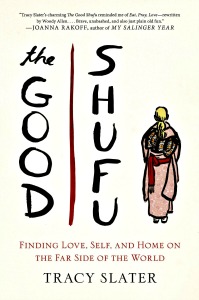
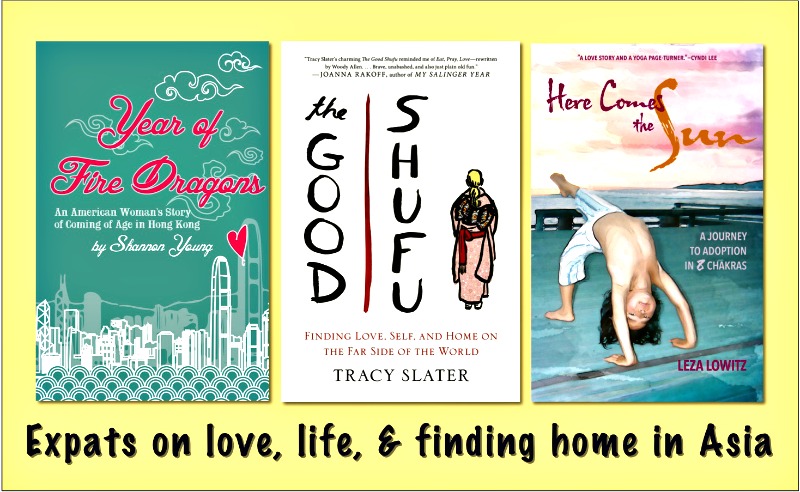
TheGoodShufu_coverThe Good Shufu: Finding Love, Self, & Home on the Far Side of the World, by Tracy Slater (Putnam/Penguin, June 30, 2015)
The Good Shufu is a true story of multicultural love, marriage, and mixups. When Tracy Slater, a highly independent American academic, falls head-over-heels in love with the least likely person in the world—a traditional Japanese salaryman who barely speaks English—she must choose between the existence she’d meticulously planned in the US and life as an illiterate housewife in Osaka. Rather than an ordinary travel memoir, this is a book about building a whole life in a language you don’t speak and a land you can barely navigate, and yet somehow finding a truer sense of home and meaning than ever before. A Summer ’15 Barnes & Noble Discover Great New Writers Selection (as reported in the Displaced Dispatch), The Good Shufu is a celebration of the life least expected: messy, overwhelming, and deeply enriching in its complications.

Fire-Dragons_cover Year of Fire Dragons: An American Woman’s Story of Coming of Age in Hong Kong, by Shannon Young (Blacksmith Books, June 15, 2015)
In 2010, bookish 22-year-old Shannon follows her Eurasian boyfriend to Hong Kong, eager to forge a new love story in his hometown. She thinks their long-distance romance is over, but a month later his company sends him to London. Shannon embarks on a wide-eyed newcomer’s journey through Hong Kong—alone. She teaches in a local school as the only foreigner, explores Asia with other young expats, and discovers a family history of her own in Hong Kong. The city enchants her, forcing her to question her plans. Soon, she must make a choice between her new life and the love that first brought her to Asia. Susan Blumberg-Kason, author of Good Chinese Wife, has called Year of Fire Dragons “a riveting coming-of-age story” and “a testament to the distance people will travel for love.”

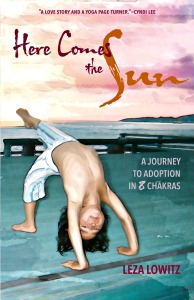
HereCometheSun_coverHere Comes the Sun: A Journey to Adoption in 8 Chakras , by Leza Lowitz (Stonebridge Press, June 2015)
At 30, Californian Leza Lowitz is single and traveling the world, which suits her just fine. Coming of age in Berkeley during the feminist revolution of the 1970s, she learned that marriage and family could wait. Or could they? When Leza moves to Japan and falls in love with a Japanese man, her heart opens in ways she never thought possible. But she’s still an outsider, and home is far away. Rather than struggle to fit in, she opens a yoga studio and makes a home for others. Then, at 44, Leza and her Japanese husband seek to adopt—in a country where bloodlines are paramount and family ties are almost feudal in their cultural importance. She travels to India to work on herself and back to California to deal with her past. Something is still not complete until she learns that when you give a little love to a child, you get the whole world in return. The author’s deep connection to yoga shows her that infertile does not mean inconceivable. By adapting and adopting, she transcends her struggles and embraces the joys of motherhood. “Here Comes the Sun proves that love is not bound by blood. I highly recommend it to anyone interested in that which connects us, holds us together, and makes us family.”—MC Yogi

The bartender looks up and says . . .is this a joke?

Three expat writers— Leza, Tracy and Shannon—walk into the bar…and the bartender wonders what they, and their books, could possible have in common.

True, I tell him, Tracy, Leza and I are rather different. Tracy and Leza are both from liberal Jewish families and are members of Generation X; I’m a Millennial from a large homeschooling family. Leza is from Berkeley; Tracy is from Boston; I’m from Phoenix. Leza writes about yoga; Tracy writes about therapy; I write about fencing. Tracy and Leza live in Japan; I live in Hong Kong. Tracy and Leza each pursued motherhood late in life; I’m a few years away from being ready for children.

Yet the similarities in our life choices and challenges are where our real connections lie. All three of us chose love over the comfort of our home countries. We struggle every day with living far from our families and making our time with them really count, and occasionally experience the joy of connecting unexpectedly with people in our new homes, from in-laws to coworkers to students. We have tried, and keep trying, to make sense of our lives in light of our rather unusual surroundings.

In short we three are displaced; nevertheless we are determined to make the most of the situation and to appreciate that it has fed our creative lives as writers. We have turned ourselves into what the Displaced Nation calls international creatives.

I have read Leza and Tracy’s books and can say without hesitation that if you like Year of Fire Dragons, you will also enjoy The Good Shufu and Here Comes the Sun. Each is a memoir that features a romantic relationship with a man from Asia that has in some way drawn us into our expatriate lives. Each book explores the process of building a new home and life in a new country with someone we love. More importantly, each story is about falling in love with a new place and accepting our new selves.

And now for the fun part, Dear Diary!

3ExpatMemoirsBanner
Click here to enter in the Rafflecopter giveaway.

Three expat writers— Leza, Tracy and I—walk into the bar and start toasting each other, but we’re also carrying a bag with three three books, two paperbacks and one hardback, to give away.

Displaced Nationers who are fans of this column, we’d like you to participate!! Simply click on the above link, and enter your email address in the box. That will count for one entry. You can also tweet and/or comment on this post for additional entries (up to 4). The deadline for entries is July 7; we’ll email the winner on July 8.

By doing this giveaway, we hope to build an even bigger community of people with similar experiences, who can help each other in some of the tough moments of expat and writing life. Finding a community when moving to a new country is vital, and finding a community of like-minded readers and writers is just as important.

It’s also great, as a writer, to feel on occasion that you don’t have to go it alone when it comes to promoting your works, even if you’re an expat living on the other side of the world.

On that note, let’s all raise our glasses.

Cheers!

Gān bēi!

Kanpai!

Shannon Young
AKA Jordan Rivet
www.shannonyoungwriter.com
JordanRivet.com

* * *

Readers, it’s fascinating to discover that three such different American women have all connected overseas and have memoirs coming out at the same time. I think we should offer a toast to them!!

STAY TUNED for next week’s fab posts!

If you enjoyed this post, we invite you to register for The Displaced Dispatch, a round up of weekly posts from The Displaced Nation and much, much more. Register for The Displaced Dispatch by clicking here!

Related posts:

For this fearless and feisty travel photography pro, a picture says…

KONICA MINOLTA DIGITAL CAMERA

Steve Davey at a New Year's celebration in Laos, 2011 (supplied).

Steve Davey at a New Year’s celebration in Laos, 2011 (supplied).

A Picture Says… columnist James King is away this month, so ML Awanohara is pinch hitting in his place.

Greetings, Displaced Nationers who are also photography buffs!

Once again, I am the feeble stand-in for James King, who will be back in August. That said, I am happy to be the vehicle for bringing to you such an exciting interview subject: Steve Davey, a professional photographer who is also an intrepid wanderer around Planet Earth, with the creds to prove it. Steve has produced two best-selling BBC travel books, one about unforgettable islands to escape to, the other about unforgettable places that should be on everyone’s bucket list.

He has also written a photography book about festivals around the world as well as a guide to location photography.

And he has started up his own business leading travel-photography tours, about which a participant has written:

“Your love of photography and travel is infectious and I can honestly say I have never laughed or learnt so much on a holiday before!”

I recall that when I first stumbled across Steve’s photography site, I found him an amiable character—on his About Page he says is is a “crap sightseer” who is “more interested in how places work and often how they don’t, than in visiting monuments and museums.” I could also sense his insatiable curiosity about the wider world coupled with a certain fearlessness. This mix of qualities suggests not only that he takes great photos but also that he isn’t easily daunted.

Let’s find out if these impressions were right by giving Steve the floor.

* * *

Hi, Steve, and welcome to the Displaced Nation. Let’s start in the same way James always does: where were you born, and when did you spread your wings to start traveling?
I was born in a small village near Bristol. I longed to head out and explore the world, and as soon as I was old enough I headed off around Europe on an Inter-rail pass. That year I got as far as Hungary. The following year I got even further—to Romania in the days of Ceausescu.

Which countries have you visited thus far, and have you lived in any of them?
I have been to almost ninety countries in the course of my work. Some of these, I have been to dozens of times. I am a compulsive traveler but have always been based in London, travelling where the work takes me. As you mentioned in your introduction, I’ve shot a couple of books for the BBC. Each of these required taking all the photos for about twenty-five chapters in a single year. For the Unforgettable Islands book, I did the equivalent of 6.5 times around the world on 99 different flights.

So you’ve never been an expat?
There are some parts of the world I’ve visited that I would love to have lived in, but my feelings about this are always changing. So I figure it’s best to base myself in London and have the option of returning to the latest place that has taken my fancy.

Well, I love London, so that’s fine by me. Which part of the city do you live in?
South London. Brixton. About the closest you can come to living in a foreign land but without leaving the UK. It is an eclectic area with a multicultural flavour. My local breakfast cafe is Eritrean. There is a large Caribbean market nearby and people of every culture. My daughter’s school is like a 1990s Benneton advertisement.

I lived in South London myself at one stage: Kennington. I remember Brixton well and can picture exactly what you are talking about.

“Art flourishes where there is a sense of adventure.” —Alfred North Whitehead

Moving right along to the part we’ve all been waiting for: a chance to appreciate a few of your photos. Can you share with us three photos that capture some of your favorite memories of the so-called “displaced” life of global travel? And for each photo, can you briefly tell us the memory that the photo captures, and why it remains special to you?
Before starting, I should tell you that I love to photograph festivals. I love the chaos and the sheer exuberance of these events. They are when a destination comes alive and when a place is at its most characteristic for the people who live there (festivals are not put on for tourists). So I’ll be sharing three photos of the most memorable festivals I’ve had the honor of witnessing.

First, the Sonepur Mela (Cattle Fair) in the state of Bihar, India. I have attended a number of festivals in India, from the largest gathering of humans on the planet to remote gatherings in the Himalayas and elephant temple festivals in Kerala in the South, but the Sonepur Mela is one of my favourites. There’s a vast animal market including the Haathi Bazaar, where elephants are lined up for sale. There’s also religious bathing in the confluence of the rivers Gandak and Ganges. The Sonepur Mela attracts few tourists and I consider it one of the hidden cultural gems of India.

Sonepur Mela_India

Elephants for sale at Sonepur Mela in India. Photo credit: Steve Davey


Wow! I have a theory that it’s why we all travel: to see the “elephant.” Clearly, you’ve done that. So what’s next in the photo-fest, so to speak?
Next is one of a festival held by the Kalash people, who live in three remote valleys in the north of Pakistan on the border of Afghanistan. They trace their lineage back to the soldiers of Alexander the Great. They tend to have piercing blue eyes and fair skin. Animist non-Muslims, they drink, wear bright clothes, and permit men and women to dance together. This makes them rather unpopular in the region. Guarding this event were some 3,000 special forces commandos. Despite this, the festival atmosphere was lively and chaotic. It was one of the great privileges of my career to have experienced and photographed this event.
Kalash_Pakistan

The Kalash people have a handle on what it means to be festive. Photo credit: Steve Davey

Steve, you are opening new windows for me on the world. I never knew about this unique tribe of people in that part of the world. So what’s your last pick?
Last but not least is this incredible festival that takes place on Pentecost Island, one of the islands within the remote archipelago of Vanuatu, in Oceania. It involves the village menfolk hurling themselves from high towers, with their fall only broken by vines fixed to their ankles. I’ve wanted to photograph this ever since I saw the film of the so-called land divers shot by the great David Attenborough. I finally got the opportunity when working on the “unforgettable islands” book for the BBC. It was a humbling rite to witness, and I managed to shoot some stunning pictures, too! This photo represents for me the kind of doors that have been opened in my life due to being a photographer who specializes in travel. I have managed to witness, and take part in, so much more of the world than I ever would have done without a camera.

Vanuatu

The precursor to bungee jumping, but a lot more risky. Photo credit: Steve Davey


Truly, you have seen such a wide swathe of life’s rich tapestry. Being presented with what is clearly just a fraction of the photo evidence has been humbling for me.

“Travel makes one modest, you see what a tiny place you occupy in the world.” —Gustave Flaubert

Having seen your first three photos, I expect it’s a bit of a tough choice, but which are the top three locations you’ve most enjoyed taking photos in—and can you offer us an example of each?
It is a tough choice, so I’ll give you four:

I love India. I can’t get enough of the place. I love the utterly bewildering variety it offers. I have been all over the country and attended a number of religious festivals, including the Kumbh Mela—officially the largest gathering of humans on the planet. But that’s not all there is. Here is a shot of a Buddhist monk in Ladakh, in the Indian Himalayas:

Ladakh monk

A Thikse Buddhist monk blows a conch horn announcing prayers. Photo credit: Steve Davey

I first travelled to Laos years ago, soon after it opened up to foreign visitors. There were few roads up in the north, and the only way to get around was by boat. I love the country’s atmosphere, its people—and could not resist photographing this line of monks heading out at dawn to collect food, or alms.

Laos monks alms

The tak bat, or Buddhist monks’ morning collection of food (alms), in Luang Prabang. Photo credit: Steve Davey

I still love Morocco. It is the most crazy place that you can visit from London on a low-cost airline. Over the years I’ve noticed that the people have become less friendly to photography, making it more stressful to walk around and take pictures; but there are few places that excite me more than the Jemaa el-Fnaa square in Marrakesh. Home to snake charmers, acrobats, fake dentists, herbalists, drummers and some of the best street food this side of Delhi. Electric!

Morocco

Don’t make the mistake of catching the snake charmer’s eyes! Photo credit: Steve Davey


I have to interrupt for a moment to say that of all the photos you’ve shared thus far, this is my favorite. Even though I’m not fond of rattlesnakes, it captures an atmosphere that is utterly different and seductive. Now, you said you had four?
The last one is my wildcard. I usually love hot, dusty places with people. Svalbard is my Achilles Heel. I love the cold, the wildlife and the stunning scenery. I have seen it from ships, by snowmobile and on foot. I love the ever-present danger, the midnight sun and the sense of true adventure.
Svalbard

Polar bear viewing in the crown of Arctic Norway. Photo credit: Steve Davey


Incredible! The Moroccan rattlesnakes definitely scared me, but, though I know I should also be scared of the polar bears, I can’t help thinking how cute they look.

“Photography is the only language that can be understood anywhere in the world.” —Bruno Barbey

I notice that you often photograph people, whereas quite a few of the interviewees for this column stick to scenery. Do you ever feel reserved taking photos of people, particularly when they are conscious of your doing so? How do you handle it?
I seldom photograph people without approaching them and interacting with them in some way. Spend even a small amount of time with someone and you can come up with an engaged and atmospheric portrait. This is a difficult skill to develop, but once you have mastered it then taking people’s picture is a much less fraught experience and far more enjoyable for both the photographer and the person being photographed.

Here are a couple of examples where I’ve applied those principles:

A Sadhu (holy man) at the Ganga Sagar Mela (festival) in West Bengal, India; a pilgrim at the Korzok Gustor festival in Ladakh, Northern India.

Examples of Steve Davey’s people shots: A Sadhu (holy man) at the Ganga Sagar Mela (festival) in West Bengal, India; a pilgrim at the Korzok Gustor festival in Ladakh, Northern India.

“Eyes like a shutter, mind like a lens.” —Anonymous

And now switching over to the technical side of things: what kind of camera, lenses, and post-processing software do you use?
I shoot exclusively on Nikon pro camera and lenses. I shoot either with the Nikon D3X, Nikon D800 or Nikon D810. I have a cupboard of pensioned off cameras, including a brace of F4s and a brace of F5s. Cameras don’t tend to hold their value: especially when I have finished with them. I am a believer in going for the utmost quality in work. To me this is the mark of a professional photographer, shooting with the best lenses and filters. I always shoot in the RAW format and post process with Adobe Lightroom.

I suspect I need to read your photography guide or take one of your tours to fully appreciate the wisdom of what you just said. But I trust you!

“A journey of a thousand miles begins with a cash advance.” —Anonymous

Finally, can you offer a few words of advice for wannabe photographers who are traveling the world or living abroad?
Working as a professional travel photographer is bloody tough. There are a lot of talented amateurs who shoot a few good shots and virtually give them away; and a bunch of fauxtographers who have the website and the business card but the only way that they can get work is to work for free in the hope that they can break into the industry. Best to work at something that makes you money and take photographs for pleasure. Taking pictures for love and not money is a dream for most of us professional photographers!

Thank you, Steve! It’s been a memorable virtual journey into corners of the world I didn’t know existed!

* * *

Readers, that was something else! I’d never even heard of some of these places before, and Steve has been to them several times over. What do you make of his vast range of travel experiences and photography advice? Any questions for him on on his photos or extensive travels? Please leave them in the comments!

If you want to get to know Steve and his photography better, I suggest you visit his photography site. You can also follow him on Facebook. You may also be interested in checking out his travel-photography books:

Or why not consider joining one of his tours and getting some hands-on photography instruction? It would be an experience to go down in the annals!

NOTE: If you are a travel-photographer and would like to be interviewed for this series, please send your information to ml@thedisplacednation.com.

STAY TUNED for next week’s fab posts!

If you enjoyed this post, we invite you to register for The Displaced Dispatch, a round up of weekly posts from The Displaced Nation and much, much more! Register for The Displaced Dispatch by clicking here!

Related posts:
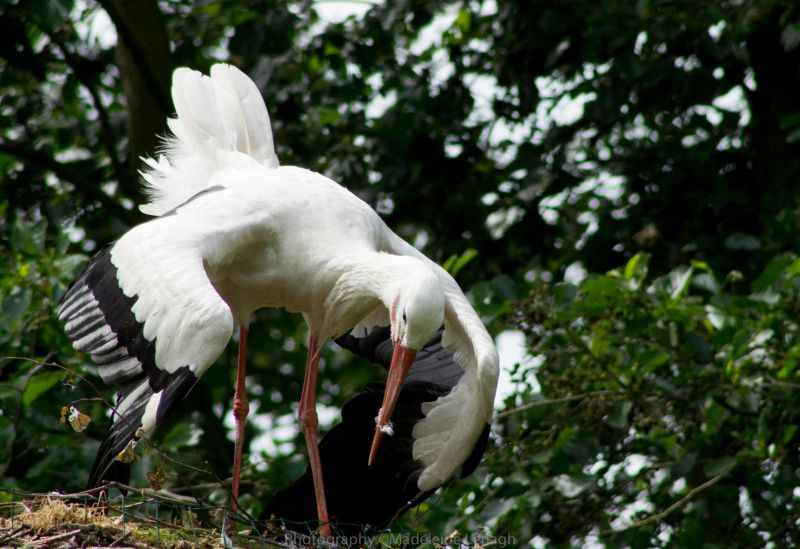
WONDERLANDED: “Shadows & Reflections,” by long-term expat Paul Scraton

Shadows and Reflections Berlin

Photo credits: (left) Rummelsburg Bay in Berlin via Pixabay; Volkspark Hasenheide, Berlin-Neukölln, by Zusammen via Flickr (CC BY-SA 2.0) .


Just the other day we were “wonderlanded” in Berlin with British expat writer Paul Scraton. We found out what it was like to live “slightly on the edge of the scene”: in Paul’s view, “that’s where the interesting stuff happens.”

Today we hear from Paul again on the topic of displacement—only this time he will be speaking through a piece of his own writing. “Shadows & Reflections”* is a post he wrote two-and-a-half years ago for the British online forum Caught by the River, which, like Alice’s own story, was “born on a bankside.”

* * *

We are taking a train back from Munich to Berlin on a Sunday afternoon at the start of December, a six-hour train ride home that will take us through some of Germany’s most beautiful countryside at over a hundred and fifty kilometres an hour. A few hours north of Munich, just over the old border between the former West and East of the country, the fields are covered in a light layer of snow, the forests engulfed in mist. Whenever the first snow flurries of the winter arrive it never fails to remind me of the day I moved to Germany, landing at a snowy Schönefeld Airport, still on high alert a couple of months after September 11th.

Train Ride to Berlin quote

Photo credits: (top) The scenery from the train window, by Paul’s partner, Katrin Schönig; “Keep the track focused!” by Axel Schwenke via Flickr (CC BY-SA 2.0).

I did not imagine then that I would still be living in Berlin over a decade later, and that Germany would have become my home. Or is it? The Germans have a wonderful word that to my mind has no proper translation into English. Usually the word Heimat is turned into “homeland”—but it means something more than that, a feeling about a place that involves an almost spiritual sense of belonging even in the non-religious. It might be Berlin, or even a district of the city. It might be a stretch of the Baltic coastline, or a village in the north of Bavaria. It could be a certain landscape, a place of particular traditions and culture. Germany is a fractured country, only put together for the first time in 1871, and local, regional pride still runs strong.

Yes, Berlin and Germany has become my home over the past twelve years, but it is certainly not my Heimat… And at the same time, a handful of trips back to England over this year has made me realise that if it is not here, it might not be there either.

During the three trips, to London, my old stomping ground of West Yorkshire, and new discoveries in Northumbria, I realised once again that although there are certain elements of returning that are as comfortable as a favourite old jumper, being away means you miss certain developments and that marks you down as an outsider, whether it is a particular band an old friend is raving about, or a certain slang term that you start to notice being used on social media or in streamed BBC shows that you think you understand but you cannot be sure.

So in this year of journeys—to England, but also through Germany to the Baltic coast, the Oder River and the forests and lakes around Berlin—I reflected a lot on belonging and what it means to be home. When I first learned the word Heimat it made me think of certain places that meant something strong to me, but I realised—as I conjured images of the Welsh coast and mountains, the Yorkshire moors and dales, the Dock Road in Liverpool and the potato fields of West Lancashire—that this was more an exercise in memory and nostalgia than anything else. And the thing with memory and nostalgia is that even when you go back, return for a visit or even to stay, you realise that not only is the place subtly different than you remember it, but you are also not the same person as the one that was there before.

Heimat Two Seas

Photo credits: (top) “Choppy seas,” by psyberartist via Flickr (CC BY 2.0); Baltic sea by Paul’s partner, Katrin Schönig.

Living in Germany for a dozen years has, of course, shaped and changed me. If I am looking for a shadow in these reflections, perhaps this is it. The paths you take always leave you the chance to wonder about those that you did not. If you are of a mind to spend much time with your memories and nostalgia, then you cannot help but reflect on how things could have been different. You cannot possibly know how you yourself would then have changed with a different job, a different house, perhaps even different people around you, except to know that you most certainly would have.

As the train rushes through the rolling landscape of Thüringen, just before the flatlands of the north, I think of how my appreciation of such scenes has changed over the past 12 years. From my list above you could work out that the landscape I grew up with, and which continues to touch me—of moors and mountains, wild cliffs and the white horses of the Irish Sea.

But over my time in Germany I have come to appreciate the very different landscape that surrounds me…the flat, melancholic beauty of the Baltic coast, the lakes north of Berlin and the pine forests that encroach on the city. And I realise I am happy to have learned to love something so different, that I need not continue any surely futile search for a Heimat that deep down I know does not exist. That is, perhaps, both the cost and the benefit of having grown up in one place and chosen to live and love somewhere else.

As the train reaches the outskirts of Berlin I look out of the window into the darkness, searching for the first glimpse of the Television Tower in the distance. Then I will know that I am nearly there. Home.

*”Shadows and Reflections” is republished here with Caught by the River’s permission.

* * *

Thank you, Paul, for this enlightening series of “wonderlanded” posts. Readers, I hope that by now you are, like me, full of wonder at Paul’s insights into a life of displacement similar to the ones many of us have led. 

As it happens, the very first issue of the new journal of Elsewhere: A Journal of Place, of which Paul is founding editor, is out today. Please join me in wishing Paul a hearty congratulations! And, say, if you like what Paul has to say about place, why not think about subscribing? I would also urge you to follow his blog, under a grey sky… ~ML

STAY TUNED for the next week’s fab posts.

If you enjoyed this post, we invite you to register for The Displaced Dispatch, a round up of weekly posts from The Displaced Nation, and much, much more. Register for The Displaced Dispatch by clicking here!

Related posts: