The Displaced Nation

A home for international creatives

Tag Archives: London

LOCATION, LOCUTION: Fran Pickering, London-based crime writer and Japanophile

Fran PickeringIn this month’s “Location, Locution”, expat crime writer JJ Marsh interviews Fran Pickering, a London-based crime and mystery writer who has lived and travelled extensively in Japan. Her experiences there provide the inspiration for her Josie Clark in Japan mystery series. She also writes about London art and events with a Japanese connection on her blog, Sequins and Cherry Blossom. Her latest Josie Clark book, The Haiku Murder, has just come out, on 13th October. Find out more at franpickering.com.

Which came first, story or location?

Location. I wanted to share my love of Japan in a way that would be interesting and non-academic, so I started writing murder mysteries about an expat Londoner in Tokyo.

What’s your technique for evoking the atmosphere of a place?

I know Japan so well now, I have to think myself back into the mind of a person encountering it for the first time and remember how strange and foreign it seemed to me originally. I go for the little, easily forgotten details – the smell of the drains in Tokyo, the sound of the mechanical cuckoo on the pedestrian crossings in Takarazuka, the complexities of different shoes and socks for different surfaces in a traditional inn. It’s the small things that bring a place alive.

Which particular features create a sense of location? Landscape, culture, food?

Food is very big for me. Japanese people are obsessed with food – they talk about it all the time – but so many people in the West think sushi and noodles is all there is to Japanese cuisine. As Josie investigates the latest murder she needs to ask a lot of questions, and the easiest way to do that is in cafes (she spends a lot of time in Starbucks) or over meals. The sort of meals people eat and where they eat them gives a clue to their character too.

Can you give a brief example of your work which illustrates place?

Here’s an excerpt from The Cherry Blossom Murder:

It was just after nine o’clock. The streets of Akasaka were crowded and noisy. A gaudily decorated pachinko parlour blasted out an advertisement for their new pinball machines, accompanied by an irritating advertising jingle; inside the parlour Josie could see people staring zombie-like at the pachinko machines as the tiny silver balls spun and fell, spun and fell, endlessly fed from the bowl beside each player.The Cherry Blossom Murder

A group of young men and women passed her, the girls in short skirts, one of them loping along drunkenly as the boys held her upright. Behind them came a group of salarymen, still in their work suits, noisily discussing their golf handicaps. They barged Josie unthinkingly off the pavement.

A fortune teller sitting on the pavement behind a table plastered with pictures of hands called to Josie to come and have her future read. For a moment she was tempted, but then she walked on, past Denny’s and Johnny’s and Cozy Corner, all brightly lit and full of people, to the familiar yellow sign of Doutor’s coffee house.

How well do you need to know the place before using it as a setting?

If it’s a real place, then you need to have been there and looked at it carefully. I try and revisit places I write about to make sure I’ve got it absolutely right, and to pick up on aspects I may have overlooked the first time. It’s remarkable how memory can play you tricks, or leave you with a superficial impression. I take photographs of key settings to refer to later.

Which writers do you admire for the way they use location?

Lee Child. He’s an English writer whose books are set in the States with an American protagonist. He really nails it; the flavour of the country leaps off the page. And Ben Aaronovitch, whose Rivers of London series takes you into every nook and cranny of Covent Garden and makes you almost believe that a building on the south side of Russell Square actually does contain the Folly.

* * *

Next month’s Location, Locution: Clare Flynn, whose books are set in Australia and India.

_(75_of_75)


JJ Marsh grew up in Wales, Africa and the Middle East, where her curiosity for culture took root and triggered an urge to write. After living in Hong Kong, Nigeria, Dubai, Portugal and France, JJ finally settled in Switzerland, where she is currently halfway through her European crime series, set in compelling locations all over the continent and featuring detective inspector Beatrice Stubbs.

STAY TUNED for our next post!

If you enjoyed this post, we invite you to register for The Displaced Dispatch, a round up of weekly posts from The Displaced Nation, with seasonal recipes, book giveaways and other extras. Register for The Displaced Dispatch by clicking here!

Related posts:

DIARY OF AN EXPAT WRITER: Testing one, two, three…Can anybody hear me?

DiaryExpatWriterToday we welcome a brand new columnist, the up-and-coming author Shannon Young. This past summer, Shannon announced she’d cut 18 inches off her hair, quit her day job to become a full-time writer, and given herself a pen name for her new series of adventure novels. And, yes, she is an expat, a kind of love refugee, living in Hong Kong. She has generously agreed to chronicle her writing adventure for us.

—ML Awanohara

Dear Displaced Diary,

In this column, I’ll be recording my experiences as a full-time expatriate writer. Officially, this is only a test.

Let’s start with a bit of background: I have been an expat, an American in Hong Kong, for four years and one month. For the past four years, I taught English in a local primary school while harboring a desire to work in book publishing.

Originally, I wanted to be an editor, to find talented writers and help them get their work into the world. I didn’t think I had stories of my own. Then, I moved to Hong Kong. In my new expatriate life, I found stories: personal dramas, bewildering worlds, opportunities for stimulating observations, and even ideas for fiction.

So, I started writing…

I discovered I love the process: mulling over half-formed ideas, stealing character descriptions from people I saw on the street, scribbling outlines on everything, and sitting down in coffee shops for hours at a time to actually do the work.

Four years later, I’ve completed a number of projects composed of bytes and bits of code, of pages and ink, of words and stories. Each project has taught me to look closer at the world around me. Each project has challenged me to be more diligent and to look for opportunities to write something that will matter.

One of those projects, a Kindle single called Pay Off, discusses how my teaching job in Hong Kong enabled me to pay off my large student loans from a US university. I’ve been debt free since December 2013 so have been able look seriously at other occupations.

I want to keep writing…

My teaching contract ended in July 2014. By that time I had accrued some savings, some complete or nearly complete books, and a husband with permanent residency. Instead of continuing to teach, I realized that now was the time to try to make it as a writer.

This is only a test. If I am not bringing in enough money from my writing (or worse, not enjoying the work) around Chinese New Year, I will start looking for a new job.

For now, I’m jumping in with both feet, seeing if this dream is feasible.

Like becoming an expat all over again…

Quitting a day job to write full-time is a lot like moving to a new country. You might know a bit about what to expect and what to pack. You do your homework; you find stories of people who’ve done it successfully, who love their new lives. You also find stories of people who’ve failed, who didn’t gel with the new place for any number of reasons. Most expats fall somewhere in between, learning to live with the difficulties while also enjoying many good moments.

Some people say it isn’t possible to make a living as a writer. They cite the successes and insist such people are outliers: exceptionally good or exceptionally lucky. As with moving to a new country, I suspect the truth lies somewhere in between. All I can do is take the leap and see if I can make it work.

But, just as I wouldn’t move to a new country without a suitcase, I am not starting this writing journey with a blank Word document and “Once upon a time…”

I have a strategy!

Here’s what I’m “packing” for my full-time writing life:

1) A portfolio of published works—comprising not just the student debt Kindle single but also the anthology How Does One Dress to Buy Dragonfruit: True Stories of Expat Women in Asia, which I edited for a small Hong Kong publisher. It came out earlier this year.* Neither of these works is a huge moneymaker, but sales can add up slowly. More importantly, these two publications have given me valuable publishing experience.

2) A book deal. My memoir of my first year in Hong Kong, Year of Fire Dragons, is being published by Blacksmith Books, an independent Hong Kong publisher, at the end of October. Hong Kong is a small market and even healthy sales won’t pay my rent, but at least I have a book to launch and a tangible opportunity to build my career.

3) A genre series in the works. This is the essential part of my strategy, the heavy winter coat, if you will, that I’m packing as you never quite know, once you become an expat, where you might end up. (I’m in Hong Kong now, but as I never could have predicted that, shouldn’t I be prepared for the day when I move to, say, Finland?) Since late 2012 I have had the wild pleasure of working on a series of post-apocalyptic adventure novels set at sea called The Seabound Chronicles (under the pen name Jordan Rivet). I’ve planned for a four-book series and written drafts of three of the titles. Book One, Seabound, is currently with the copy editor and should be ready to launch in November. I plan to self-publish this series as e-books and POD paperbacks and, frankly, hope to make some money.

4) Last but not least, reasonable expectations. While I am hopeful that the combination of my publishing experience so far, my existing works, and a highly commercial series will enable me to continue doing what I love, I am also realistic. I don’t expect to get rich. The goal here is to build up an audience—and a long tail of sales—that will eventually enable me to pay my rent and buy the occasional plane ticket home to see my family. But my primary expectation is that I will work hard, produce the best books I can, and try to learn as I go.

“If you want a pearl, you must dive for it.”—Chinese proverb

I realize I’m taking a risk by forgoing a steady income and living on savings in order to give myself more time to write. But taking risks is second nature to expats. We leave behind everything we know, and there are never any guarantees about how things will turn out.

My own jump into expat life occurred when I followed the man I loved to his home country. At the time, I didn’t even know if we would get along when we finally lived in the same country. At first, it looked like everything would fall to pieces because a month after I arrived in Hong Kong my boyfriend’s company sent him to London. I had a year on my own in Asia, fearing that my risk had been in vain.

That story has a happy ending: that boyfriend is now my husband—and I love Hong Kong. It was a risk that paid off, but it could have gone very wrong. Now, I hope the risk I’m taking will turn out at least half as well.

And can I tell you a secret, diary? Since I stopped working and started focusing on writing full time, I’ve been deliriously happy. I love having hours to myself each day to sit down and work on my own creative projects. I love reading about the publishing industry and studying other people’s books and careers. I’m trying hard not to become an obnoxious friend who only talks about their own work because it’s all I think about these days.

Yes, I know this honeymoon period won’t last forever, but at least allow me to say: it’s been wonderful so far!

And yes, I sometimes struggle with prioritizing, but that’s because there are so many things I want to do! But I’m gradually getting used to my new routines and performing triage on my to-do lists. I’m developing the daily habits of a writer. I want to use this period well.

Each month, I’ll share a bit more with you about where this journey is taking me. I hope you’ll come along for the ride.

Thanks for reading!

Yours,

Shannon Young
www.shannonyoungwriter.com

*From now until the end of the year, Shannon will be sharing excerpts from Dragon Fruit. Stay tuned!

* * *

Readers, it’s your turn. What is a risk you’ve taken in order to follow a dream? Was it becoming an expat or something even more daring, like becoming a full-time writer? What are some difficulties you faced along the way? Let me know in the comments!

STAY TUNED for next week’s fab posts!

If you enjoyed this post, we invite you to register for The Displaced Dispatch, a round up of weekly posts from The Displaced Nation, with snippets of worldly wisdom, exclusive book giveaways and our nominees for the monthly Alice Awards. Register for The Displaced Dispatch by clicking here!

Related posts:

THE LADY WHO WRITES: Get over yourself, and start promoting that novel!

LadyWhoWrites_brandThe Lady Who Writes, Meagan Adele Lopez, is back today: we’ve missed her! Once again, she’ll be doling out practical advice based on her own experience for expats and other international creatives who are engaged in writing novels using some of the material gathered from their novel, shall we say, life stories. Meagan is a repeat expat in the UK (last time Bristol, this time London). Besides writing, her talents include acting, blogging, and crafting ads for social media.

—ML Awanohara

So—you’ve written the book, you’ve got the editor, your friends and family love it, you’ve done the Kickstarter to raise the money and your blog has a steady readership.

(Even if you have just written the book and don’t have the rest in that list, you’re a million times ahead of anyone who has just spoken about writing a book. You’ve DONE something.)

Don’t you think you deserve—no, the WORLD deserves—to get a chance to know it exists?

The fact is, most of us writers are a little afraid of self-promotion. But by the time you finish reading today’s column, I hope you will have gotten over that fear and are full of determination to plug your Great Work like crazy.

Excuses, excuses

You don’t have a manager? You don’t have a PR team? You don’t know a graphic designer?

All good! Even if you had all those things, you’d still be expected to do as much, if not more than, the promotional team, who are working on other books as well as yours. Obviously, having a group of PR professionals around you wouldn’t hurt. But c’mon! You’ve been preparing for this your entire life. You got this!

To quote Eminem—just because the song Lose Yourself never fails to get me pumped up to do really GREAT things:

Look, if you had, one shot, or one opportunity
To seize everything you ever wanted, one moment
Would you capture it?
Or just let it slip, yo

Facebook’s (literal) wall

Now I want to tell you about the time when I took a walk through Facebook headquarters to pitch to Walmart and Facebook about why my team was worth their investment of millions of dollars. I noticed many inspiring quotes on their (literal!) walls, one of which really lept out at me:

"Done is better then..." on Facebook's literal wall, by Meagan Adele Lopez

“Done is better then…” on Facebook’s literal wall. Photo credit: Meagan Adele Lopez

Notice the misspelling and the comma in a weird place? It certainly makes a statement, doesn’t it?

Don’t get me wrong: it’s a great idea to comb through the final manuscript, edit the spelling mistakes and make sure your character arcs are outlined appropriately.

But how long have you been working on this novel? One year? Two years? Ten?!

Get it out there. Done is better than perfect. Done is even better than good—or as Elizabeth Gilbert of Eat, Pray, Love fame says:

I want to make as many things as I can, taking on as many projects as I can possibly tackle. Each one exciting. Each one good enough. Each one DONE, to make room for the next, and the next, and the next…

Wouldn’t that be a wonderful way to live?

Take me, for instance…

This article is a perfect example, actually. I have written and re-written it about five times. Twice because my computer crashed, and three times in my head because I didn’t feel like I had anything relevant to add to this topic.

Wait, did I just say I have nothing to add? I work in ADVERTISING and MARKETING for God’s sake. How could I not have something to say?

All of our heads get in the way sometimes, and that’s OK as long as you don’t let it run you. I know this article is supposed to be about promoting your novel, but I think the most useful thing I can tell you is to get over yourself and realize that you are damn good enough to have other people read your book, now that it’s finished.

Regardless of what other writers on writing would have you believe, there are no secret tips to marketing and promoting your novel. Yes, there are the basics—advertising campaigns, blogs, newsletters, etc. But the most important thing is to refuel that passion you had when you were dining with your characters, when you were rehearsing your book trailer and reading every other author’s done works, and use it to drive your promotional efforts.

Set some goals

Thus I’m not going to give you step-by-step instructions on how to promote your novel. There are plenty of other google-able articles out there—for example:

But I will tell you to have goals. Do you want to sell 50 copies or tens of thousands? Do you want to make the New York Times Bestseller list, or do you just want your entire family to read it? Do you want to write articles or be interviewed for great sites like The Displaced Nation?

Once you’ve set some goals, how you go about achieving them becomes a lot easier.

What I can also say is that everything you write after you finish your book will be a promotion for that book. For example, at the end of this article is a little blurb about who I am and what I’ve written. Same for this interview I did in 2011 about publishing on Kindle, this article I wrote about taking the time to make change happen, and this article I wrote just recently for BBC America about combining British and American weddings (a version of which appeared two years ago on the Displaced Nation).

And now, without further ado, here’s Novel Writing Tip No 6 for International Creatives:

Once you write a book—everything you do will help promote it. So finish with the finishing touches, get out there and start talking about it!

* * *

Readers, what do you make of this final piece of advice of Meagan’s, which I take to be a kind of a kick in the pants (or trousers, if you prefer)? And do you have any further questions for Meagan, THE LADY WHO WRITES, before she leaves us? Please share in the comments…

Meagan Adele Lopez grew up in the U.S. with a Cuban-born father and American mother, and at one time enjoyed an acting/casting career in Hollywood, something you can detect in the beautiful trailer for her novel, Three Questions. Her day job these days is in social media advertising. To learn more about Meagan, go to her Web site.

STAY TUNED for next week’s fab posts!

If you enjoyed this post, we invite you to register for The Displaced Dispatch, a round up of weekly posts from The Displaced Nation, with seasonal recipes, book giveaways and other extras. Register for The Displaced Dispatch by clicking here!

Related posts:

LOCATION, LOCUTION: JJ Marsh looks back on a year with TDN

jill 3One year ago, Displaced Nation asked me to conduct a series of regular interviews with writers on their use of location. Place is vitally important to my writing and that of my colleagues at  Triskele Books . It’s our USP. After a year of interviews with authors from Brazil, America, South Africa, Ireland, France, India, Hungary/China, I’m looking back.

First, I’ve selected ten of favourite answers, on how these writers approach weaving literary magic carpets to transport readers to Bombay or Berlin, Syria or Odessa.
Secondly, I’ve added five of the most books that held me spellbound; works which make place a character in its own right.

Happy Anniversary!

Which came first, story or location?

 Jeet Thayil, author of Narcopolis:
“I knew Narcopolis would be set in Bombay. I started with that city and that period in mind. It was about telling a story that hadn’t been told before, in a way that Indian fiction doesn’t really tell stories. Unsentimental, brutal and beautiful. When I realised that was what the book would be like, it revealed itself to me.”

Charlotte Otter, author of Balthasar’s Gift:
“The two are intertwined. When the first images began to flash in my head more than eight years ago, the setting was immediately clear: my home town in South Africa, Pietermaritzburg. BV is a post-apartheid novel and PMB is struggling to become an effective post-apartheid city. It was the natural setting for the story that was starting to unspool before me.”


How do you go about evoking the atmosphere of a place?

Chris Pavone, author of The Expats and The Accident:
“I love walking around cities, looking around at the architecture and the shops and the restaurants, at the people and their pet. My characters do the same, using all their senses to inhabit the world around them. Of course walking around, in and of itself, isn’t the type of action that does much to drive a plot forward, so characters should also be doing something else while walking around. Something such as spying.”

JD Smith, author of Tristan and Iseult, and The Rise of Zenobia:
“With great difficulty. In writing Tristan and Iseult I evoked the wet and wind the British know only too well. I’ve always lived on the coast, though in the north, not Cornwall (Kernow), but those salt winds and perpetually grey skies are the same. The Rise of Zenobia is based in 3rd century Syria, and I’m finding that much harder. I didn’t grow up with the atmosphere ingrained in me. I haven’t spent years of my childhood visiting the remains, the palaces and the fortifications. I rely on films a lot. Being a designer I’m an incredibly visual person, and seeing it played out, filmed in the locations I’m trying to conjure on the written page, helps immensely.”

Which particular features create a sense of location? Landscape, culture, food?

Amanda Hodgkinson, author of Spilt Milk:
“All those but also I find the light is important. I adore Edward Hopper’s paintings for his use of light and I find writing can experiment in a similar way with light, creating mystery or clarity and deepening character.”

Janet Skeslien Charles, author of Moonlight in Odessa:
“For me, it is how characters react to situations. Odessa is the humor capital of the former Soviet Union, which means that my characters use humor as a shield to ward off painful situations. Odessans are capable of laughing at things that would make me bawl. Their mental toughness is impressive. So for me, the sense of city is the sense of self.”

How well do you need to know the place before using it as a setting?

Steven Conte, author of The Zookeeper’s War:
“With skill, only moderately well, though it’s probably wise to minimise the difference between your characters’ supposed knowledge of a setting and your own. This aside, the best fiction implies more than it states (Hemingway’s iceberg principle), and a few vivid details can be enough to evoke an entire town or city or region. I’d recommend not writing about famous landmarks, since locations such as the Brooklyn Bridge, the Eiffel Tower and the Brandenburg Gate will remain clichés of place however brilliantly they might be described.”

AD Miller, author of Snowdrops:
“You need to know it, and then you need to unknow it. A novel isn’t a travelogue or an encyclopaedia; you enlist only those aspects or details of a place that serve the narrative.”

Which writers do you admire for the way they use location?

James Ferron Anderson, author of The River and the Sea:
“Charles Dickens in Chapter Three of Great Expectations uses the weather to bring alive his location when Pip runs in the morning to meet Magwitch. ‘The mist was heavier yet when I got out upon the marshes, so that instead of my running at everything, everything seemed to run at me.’ Wonderful stuff that took me to that location so effectively I still picture it. Anton Chekhov is marvellous for both countryside and city. Yalta is so alive, so liveable-in, in Lady With a Lapdog. W.G. Sebald, not a favourite writer of mine, is nevertheless someone whose ability to put me in his location I much admire.”

Share an extract from your work which illustrates place.

Paulo Coelho, author of The Alchemist and Eleven Minutes, on Geneva’s Water Fountain:

“Our body is almost completely made of water through which electric charges pass to convey information. One such piece of information is called Love, and this can interfere in the entire organism. Love changes all the time. I think that the symbol of Geneva is the most beautiful monument to Love yet conceived by any artist.”

Books I’d recommend for use of location:

* * *

In next month’s Location, Locution, our guest will be Jessica Bell, an Australian expat living in Greece, who writes fiction, advice for authors, and makes music too.

JJ Marsh grew up in Wales, Africa and the Middle East, where her curiosity for culture took root and triggered an urge to write. After living in Hong Kong, Nigeria, Dubai, Portugal and France, JJ finally settled in Switzerland, where she is currently halfway through her European crime series, set in compelling locations all over the continent and featuring detective inspector Beatrice Stubbs.

_(75_of_75)

Author photo: J J Marsh

STAY TUNED for our next post!

If you enjoyed this post, we invite you to register for The Displaced Dispatch, a round up of weekly posts from The Displaced Nation, with seasonal recipes, book giveaways and other extras. Register for The Displaced Dispatch by clicking here!

Related posts:


LOCATION, LOCUTION: Charlotte Otter – South African expat and crime writer living in Germany

charlotte otter

Author photo: Charlotte Otter

In this month’s “Location, Locution”, expat crime writer JJ Marsh interviews Charlotte Otter, a South African crime writer who lives in Germany.

Charlotte has worked as a writer since leaving university. Balthasar’s Gift is her first novel. It was published in Germany in 2013 as as Balthasars Vermaechtnis, by Argument Verlag mit Ariadne, a Hamburg publisher that focuses on crime fiction by women. It is also available as an e-book, published by Culturbooks. The English version will be published in June 2014 by South Africa’s Modjaji Books.

Charlotte blogs at Charlotte’s Web and takes coffee breaks on Twitter (@charlwrites). She is presently working on her second novel – an eco-conspiracy called Karkloof Blue.

When she is not thinking up ways to kill people, Charlotte is a corporate hack, mother of three, reader, traveller, feminist and optimist. She is happily married to the love of her life.

Check out her author site.

* * *

Which comes first, story or location?
The two are intertwined. When the first images for Balthasars Vermaechtnis began to flash in my head more than eight years ago, the setting was immediately clear: my home town in South Africa, Pietermaritzburg, often informally abbreviated as PMB. BV is a post-apartheid novel and PMB is struggling to become an effective post-apartheid city. It was the natural setting for the story that was starting to unspool before me.

How do you go about evoking the atmosphere of a place?
I wrote a blog post a few years ago called I am from, and someone said to me they would love to read a novel with those elements in. I realised that my childhood memories of monkeys in the garden, chameleons on a bush and eating granadillas off the vine were not everyone’s memories and that some of them could be put to good use in landscaping a novel.

Which particular features create a sense of location? You’ve mentioned animals and fruits. Is it landscape, culture, food, all of the above?
All of the above. However, as I’m sure all writers say, they have to serve the story. The elements of location have to be sprinkled through the story with a light hand, serving to shine a light on the narrative and not distracting from it. Huge chunks of location, just like huge chunks of ill-disguised research, serve to pull the reader out of the story and that’s the last thing a writer wants. I try to be sparing and frugal with my detail, but at the same time apt. Location details are highlighters or amplifiers of the core narrative, never the story itself.

How well do you need to know the place before using it as a setting?
In my case, I knew it very well. I would never be brave enough to set a novel in a place I didn’t know, because I would be nervous about making mistakes and looking like an idiot. For me authenticity is everything.

Could you give a brief example from your work which you feel brings the location to life?

The city centre hummed with Saturday shoppers carrying glistening bags full of summer bargains from the fashion palaces on Church Street, gangs of teenagers flirting with each other, pavement hairdressers giving people their weekend dos. Radios blared, taxis hooted and added to the chaos by swerving across lanes, risking the lives of their passengers and all pedestrians. She dodged one self-styled ‘Road Warrior’ and swore. The driver leant out of his window and winked at her. ‘Calm down.’ Was this a message from the universe? Or had all the town’s taxi drivers ganged up to irritate her with their insistence on her remaining serene and tranquil?”

Which writers do you admire for the way they use location?
I think Barbara Kingsolver is a master of location. She is the best nature writer I know and she mostly sets her novels in rural surroundings. She does an incredible job of evoking a sense of place through her deep, abiding love of nature.

I Am From
I am from Africa. I am from blue skies, tropical breezes, and sunshine on my back. I am from tall trees that throw great shadows. I am from monkeys in the garden and a chameleon on a bush. I am from mountains that rarely see snow, beaches with huge waves, sharks behind the shoreline. I am from banana plants, sugar-cane and mealies. I am from huge moths and flying ants. I am from humidity, from thunderstorms that build up as black towers in the sky, and rain so hard it hurts my skin.

I am from eating outside. I am from the intense smell of a slightly under-ripe naartjie that I pick from its tree, dig open with dirty fingernails, and devour despite the sourness. I am from plucking granadillas off the vine and greedily sucking the juice. I am from braai meat, salad and crunchy white rolls. I am from mussels gathered from the sea.

I am from lucky beans. I am from a hoary old magnolia tree that bursts forth luscious, vanilla-scented blooms that decorate the Christmas table. I am from a red-brick house that looks out over trees and a hot town. I am from black and white tiles that cool hot summer feet. I am from the smell of dogs being washed. I am from the sound of Zulu hymns as I fall asleep.

I am from Marmite sandwiches. I am from a schoolbag digging into my shoulder as I walk home. I am from the smell of an over-chlorinated swimming-pool in my wet hair. I am from giggling. I am from eating all the cookie mixture. I am from marathon card games. I am from the thwack of tennis balls. I am from kissing boys.

I am from little brothers playing cricket on the lawn. I am from long car journeys. I am from beach holidays. I am from sand in my hair, from fairy gardens and dreaming I can fly. I am from blonde people. I am from children go to bed early. I am from fragrant grandmothers and laughing aunts. I am from a funny dad. I am from a little brother who shared my nightmares. I am from a mother who said, “You can do anything.”

Where are you from?

* * *

Next month’s Location, Locution:  Incredibly, it is now a year since Jill wrote her first “Location, Locution” column! In next month’s post, Jill will pick some of her favorite responses from her interviewees.

JJ Marsh grew up in Wales, Africa and the Middle East, where her curiosity for culture took root and triggered an urge to write. After living in Hong Kong, Nigeria, Dubai, Portugal and France, JJ finally settled in Switzerland, where she is currently halfway through her European crime series, set in compelling locations all over the continent and featuring detective inspector Beatrice Stubbs.

_(75_of_75)

Author photo: J J Marsh

STAY TUNED for our next post!

If you enjoyed this post, we invite you to register for The Displaced Dispatch, a round up of weekly posts from The Displaced Nation, with seasonal recipes, book giveaways and other extras. Register for The Displaced Dispatch by clicking here!

Related posts:

And the May 2014 Alices go to … these 3 international creatives

 © Iamezan | Dreamstime.com Used under license

© Iamezan | Dreamstime.com
Used under license

If you are a subscriber to our weekly newsletter, the Displaced Dispatch, you’re already in the know. But if you’re not, listen up. (Hey, why aren’t you? Off with your head!)

Every week, when that esteemed publication comes out, we present contenders for a monthly “Alice Award,” most of whom are writers or other kinds of international creatives who appear to have a special handle on the curious and unreal aspects of being a global resident or voyager.

Not only that, but this person tries to use this state of befuddlement as a spur to greater creative heights.

Today’s post honors May’s three Alice recipients. They are (drumroll…):

1) CHRISTINE GILBERT, blogger, American traveling mom & expat in Barcelona

For her post:  “Why it must suck to be a parent in the US,” on her blog, Almost Fearless
Posted on: 16 May 2014
Snippet:

So we’re traveling across the US after living in Mexico for nearly a year and half, on our way to Europe. … [W]hen we drive to New Orleans it starts. Suddenly I am a bad parent.

… I admit, I am a permissive parent. My basic rules are this: it has to be safe and it can’t infringe on other people. … In short, my children are feral beasties but if required they can sit nicely and say “Please and Thank You” (or at least I try to get them to do that).

But I’m an American, so I have strong opinions about the idea that I have the RED WHITE AND BLUE, PATRIOTIC RIGHT to raise my children however I see fit, whether that’s homeschooling them and teaching them to speak in Klingon or letting them climb trees and juggle knives. Back off.

Citation: Christine, we never cease to enjoy a good round of the old debate about moral relativism (because no parenting method is objectively right or wrong, we ought to tolerate the behavior of all parents) versus moral universalism (a universal parenting norm applies to ALL parents regardless of age, background, ethnicity, etc.)—especially when relayed from the perspective of an expat, and one that writes as entertainingly as you do. While our own inclination is towards tolerance, we would ask you to bear in mind Alice’s “agony of terror” when she first meets the Duchess and her pig-baby. An “unusually large” saucepan flies by the baby’s head and almost take its ear off. “Oh, PLEASE mind what you’re doing!” Alice cries, to which the Duchess responds, in a hoarse growl:

“If everybody minded their own business, the world would go round a deal faster than it does.”

Now, do you identify with Alice or the Duchess? It’s a bit of a moral quandary, correct? What’s more, we’d be curious to hear if your views change at all after living with your family in Barcelona, Spain, for a while. One of us has learned firsthand of a case of an American who is bilingual in Spanish. She brought her two young daughters to Spain last summer to learn Spanish, only to discover, to her considerable consternation, that they were less obedient than Spanish kids in the playground. (No saucepans, please! We’re simply trying to make the world go round faster…)

2) Jon Langford, blogger at BBC America’s “Mind The Gap” and British expat in Manhattan

For his post: Are You Australian?: A British Expat Discusses Mistaken Nationality in America
Posted on: 5 May 2014
Snippet:

Communicating effectively with Americans through a thick Yorkshire accent on a daily basis can be both confusing and traumatizing.

Even though my life would be made significantly easier if I adapted my speech a little, I simply can’t bring myself to say things like war-der, toe-may-do and vie-dah-min. Not that there’s anything wrong with speaking this way, it’s just I’d rather wade through the conversational swamp than surrender my Yorkshire tongue for the sake of convenience.

Citation: Jon, your take-no-prisoners attitude towards preserving your Yorkshire accent, even at the expense of being misunderstood, strikes us as being a trifle, if we may be so bold, bloody minded. (Hey, they don’t call it Yorkshire-stubborn for nothing!) While we can appreciate your need to hold up the side for God’s Own Country, we wonder if you are coming across almost like the Hatter does in Alice in Wonderland. As you may recall, Alice feels “dreadfully puzzled” when he makes a remark that seems “to have no sort of meaning in it, and yet it was certainly English.” But while her response is to say, as politely as she can, “I don’t quite understand you,” our fear is that New Yorkers may dispense with such courtesies and simply blurt out: “You talkin’ to me?” As you have no doubt discovered by now, they take pride in being found the rudest of all rude peoples of America. (Hmmm….has the Yorkshireman met his match?)

3) NIENKE KROOK, blogger and Dutch expat in London

For her post: Bologna Italy: Why you don’t need a map to explore this city, on her blog, The Travel Tester
Posted on: 29 April 2014
Snippet:

Ditch the map in Bologna. Like any classic Italian city, the whole joy of a visit to Bologna is getting lost and losing track of time and space.

Citation: Nienke, we congratulate you for being so willing to let go of your Type A personality while traveling in Italy. especially when exploring a city of Bologna’s ample charms. We would, however, suggest just one small addition to your declaration: “Ditch the map and the watch in Bologna.” If one must carry a timepiece in Italy, let it be the Hatter’s, not the White Rabbit’s! As you may recall from reading Alice in Wonderland as a kid (they read it in Holland, right?), the Hatter and Time do not get along. His watch is frozen at six o’clock. Fascinated by this revelation, Alice says: “Is that the reason so many tea-things are put out here?” Yes, indeed, it is, Alice. In Wonderland you can always have tea and cakes, while in Italy you can always feast on a bit of the sweet life, or la dolce vita, just as long as all five senses are open to the possibility. To repeat (which we think may be necessary for a Type A person), pleasure and indulgence do not come from checking one’s watch!

*  *  *

So, readers, do you have a favorite from the above, or have you read any recent posts you think deserve an Alice Award? We’d love to hear your suggestions! And don’t miss out on the shortlist of Alice contenders we provide in each week’s Dispatch, which are sources of creative thought if nothing else! Get on our subscription list now!

STAY TUNED for more fab posts.

Writers and other international creatives: If you want to know in advance the contenders for our monthly Alice Award winners, sign up to receive The Displaced Dispatch, a round up of weekly posts from The Displaced Nation, with news of book giveaways, future posts, and of course, our weekly Alice Award!. Register for The Displaced Dispatch by clicking here!

Related posts:

THE LADY WHO WRITES: Your novel finished, it’s down, down, down into KDP Select Freebie Land

LadyWhoWrites_brandThe Lady Who Writes, Meagan Adele Lopez, is paying us her monthly visit today. Once again, she’ll be doling out some practical advice, based on her own experience, for expats and other international creatives who are engaged in writing novels using the material gathered from their novel, shall we say, life stories. Meagan is a repeat expat in the UK (last time Bristol, this time London). Besides writing, her talents include acting, blogging, and crafting ads for social media.

—ML Awanohara

Okay, Displaced Nation-ers who are also wannabe novelists. Let’s say you’ve followed all my advice up to this point. You’ve gone through the work of reading similar genres before you start writing—perhaps even started up your own book club. You’ve dined on a daily basis with your characters. You’ve rehearsed your book trailer and have opted to publish your novel yourself. (I will go through the steps of the self-publishing process in the next post.)

So now, what about marketing that baby to the masses?

At the top of your list should be a free e-book promotion.

Only, don’t follow my example.

Do what I say, not what I did!

I was told to plan 30 days in advance—I started planning the giveaway of the novel I wrote based on my own expat adventures, Three Questions, the night before.

Once you sign up with Kindle Direct Publishing (KDP) Select, giving Amazon exclusive rights to publish the electronic version of your book for 90 days, you have five days to promote your book for free over that period. Most people tell you to use just two or three days at most, your first time. I used four.

Some things I did right: I waited until I had some strong reviews of the book posted before offering it for free. And after the promotion started, I tracked the book’s rankings and didn’t give up until I’d reached my two goals:

  1. Earn a spot on the coveted Amazon Best Sellers in Kindle Store, Top 100 Free list.
  2. Break five figures (XX,XXX) in downloads.

But, to reiterate, I didn’t plan the freebie promotion; I did it by the seat of my pants. To be honest, I wasn’t entirely sure about the benefits of giving away my book for free. I was afraid the freebie would “devalue” my book—which was silly because it wasn’t selling more than a few a day anyway.

I also had to overcome my fear that I was giving Amazon too much power. However, my Barnes and Noble Nook e-book wasn’t selling at all, so in the end I figured I might as well enroll in KDP Select for three months, even if that meant I couldn’t make it available through any other outlets, including publishing extracts on my blog.

How to get that new novel of yours noticed

First, the hard facts: Amazon has 3,000+ new titles going for free nearly every day. The competition is tough.

As I fell down, down, down into KDP Select Freebie Land, I obsessively read every post I could find with tips on how to make it a success. (Hey, A for effort!) FYI: One of the best articles I found was on Novel Publicity & Co.: “KDP Select free days: Targeted advertising is the key to success; here’s a list of resources.”

Besides learning that I should have been planning the promotion a month in advance—giving “free Kindle ebook” websites at least three weeks’ notice about my intention to offer a freebie for a few days—I quickly realized that I would need to dedicate a LOT OF TIME peddling it over that period through every available avenue: my social media networks, family and friends, and some of the dozens of sites that announce free e-books.

I had missed out on the top site, Pixel of Ink, which requires at least 30 days’ notice. But I did manage to get listed on some of the heavy hitter free e-book blogs, with thousands and tens of thousands of followers—the ones that the majority of free Kindle seekers go to (they come up first in Google searches).

Here’s where I submitted FOR FREE:

  • Digital Book Today: They have paid and free promotional opportunities. I submitted my novel for free via the form on this page, which requires you have at least 10+ reviews with an average of 4+ stars rating. They posted my novel, but the site’s founder, book industry veteran Anthony Wessel, wasn’t too happy at my last-minute submission—again, please don’t do what I did!
  • eReader News Today: I was supposed to submit three days before the beginning of the promo, and in order to be considered, you have to have a high rating in your reviews for them to post it. My mom happened to notice it was up—as she subscribes to their Facebook page—and mine was the first on their daily listing!
  • Freebies4Mom: This site is under the radar compared to the others. It’s run by stay-at-home mom Heather Fernandez. She has over 300k fans on Facebook. That’s A LOT of mommy fans. I believe her site pushed my novel over the five-digit download mark.
  • Kindle Nation Daily (PAID): They offer a Free Book Highlighter Service (scroll down to the bottom). I took $30 out of my Kickstarter money to participate. It was worth it.

Here’s a few more sites that picked me up, which you might consider submitting to (should you follow my advice and plan well in advance):

  • BookGorilla.com: This is another site that sends daily email bulletins to subscribers listing free e-books in categories of interest.

Last but not least, these sites tweeted about my novel and might also be useful to you as indie authors:

  • The aforementioned Digital Ink Today (@DIGITALInkToday): This popular site has 30.2k Twitter followers.
  • Masquerade Crew (@MasqCrew): Site founder Mark Lee currently has 34.6k Twitter followers.

The all-important numbers

Before the book promotion, I was selling at my peak three e-books per day. I never reached higher than #300,000 on Kindle’s bestsellers list. The night before I launched the book, I was ranked about 1,500,000 in Amazon’s e-books—insignificant.

During the promotion, my book gained in momentum each day. Though conventional wisdom advises giving up after two days, I just couldn’t do it. The way I saw it, the more days I was ranking, the more exposure I was getting. To start again from ZERO in a few weeks seemed pointless.

At the end of the first day, I was already #57 in the Kindle store’s free Contemporary Fiction, but hadn’t yet ranked anywhere in the entire Kindle store.

The end of the second day, I was getting closer! I was now just under the top 200 within the entire Kindle store, and had climbed to #16 in Contemporary Fiction.

Over 3,000 people had downloaded the book so far.

But it wasn’t until the third day (a Friday) that extraordinary stuff started happening. This is when the websites started posting about my book, and the downloads became fast and furious.

When I hit #8 in Contemporary Fiction, and saw my name next to THE John Grisham—it was certainly a shock, and made me realize just how many people now had their hands on my novel.

I finally ended the promotion on Saturday night—with over 11,000 downloads just in the United States (the UK hit didn’t garner nearly as many). At its peak, my novel hit #28 in the entire Kindle Books and #6 in Contemporary Fiction—I had accomplished my goal!

The immediate aftermath—any sales?

The big question was, would I make any money after the promotion was over? I was, after all, giving the book away for free.

My ranking disappeared for a few hours, and when it reappeared, my novel was certainly higher than it had ever been. Three days after the promotion ended my novel remained within the top 3,000-5,000 paid Kindles. I sold more in those three days than I’d ever sold before in the same time frame.

On a side note, the day after the promo ended, I received my first negative review and a second great review. Unfortunately, the first reviewer didn’t take the time to read the entire book (that’s another blog post altogether—ouch, it hurt!); and the second reviewer pleaded with people to finish the book. YES, PLEASE!

Time to recap: What would I do differently?

With the benefit of hindsight, I would have

  • taken more time to plan, and put more thought into the audiences to reach out to.
  • jacked up the price the day before the promotion (value would have seemed better to those getting the free download).
  • seeded the community with teasers.

But overall, I was extremely happy with how it turned out, and highly recommend it to other indie authors. Hey, you never know, you might be able to turn those downloads into a book deal!

And now, without further ado, here’s Novel Writing Tip No 4 for International Creatives:

Heed (at least some of) the wisdom of writers who have gone before you and plan a freebie promotion campaign for Kindle a few weeks in advance, not the the night before; commit to working hard on the promotions, and tracking your numbers, for the duration.

* * *

Readers, what do you make of this latest advise of Meagan’s? Did you ever imagine you’d be giving away your precious novel for free? And do you have any further questions for Meagan, THE LADY WHO WRITES, any topics you wish she would cover in future columns? Please share in the comments…

Meagan Adele Lopez grew up in the U.S. with a Cuban-born father and American mother, and at one time enjoyed an acting/casting career in Hollywood, something you can detect in the beautiful trailer for her novel, Three Questions. Her day job these days is in social media advertising. To learn more about Meagan, go to her Web site.

STAY TUNED for tomorrow’s announcement of our March “Alice” winners!

If you enjoyed this post, we invite you to register for The Displaced Dispatch, a round up of weekly posts from The Displaced Nation, with seasonal recipes, book giveaways and other extras. Register for The Displaced Dispatch by clicking here!

Related posts:

LOCATION, LOCUTION: James Ferron Anderson, weaver, glassblower, soldier – and award-winning novelist

Author photo – James Ferron Anderson

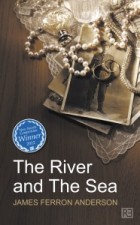
In this month’s “Location, Locution”, expat crime writer JJ Marsh interviews James Ferron Anderson, author of  The River and The Sea.

James was born in Northern Ireland, and worked there as a weaver, glassblower and soldier. He eventually had children, moved to Norwich, UK, studied at UEA, and began to write in different forms, including poetry, short stories, plays and, more recently, novels. One of his first short stories, The Bog Menagerie, won the Bryan MacMahon Short Story Award. He won an Escalator Award winner for I Still Miss Someone, and a Writers’ Centre Free Reads Award winner. The River and The Sea won the Rethink Press New Novels Award in 2012, and was published in November 2012.

The River and The Sea is set in British Columbia. James is currently working on Terminal City, set in Vancouver. While he’s visited British Columbia and Vancouver many times (his once estranged brother lives there, but that’s another story) he has never lived there.

Visit his website at jamesferronanderson.com.

Which came first, story or location?
Location, and more so as I continue to write. I’ll stick with Terminal City, the novel I am currently working on, but it applies equally to The River and The Sea. I was already studying the history of British Columbia, and focusing on Vancouver, when I read that Errol Flynn had died there. It was the human touch that caught my attention: once flamboyant athletic actor reduced, much against his will, to selling his last possession of any worth, his yacht. Shattered, riddled with diseases, looking like seventy instead of the fifty he actually was, he dies. But if my head had not already been filled with images of Vancouver from its lumber town days in the early 1900s to its evolution into the city of glass it is today I may not have found myself, I would say unintentionally, making up stories based around a Flynn-type character.

Politics and mores are as an integral part of a location as are its streets or hills. It was what I knew of the political aspects of this West Coast city in the 30s and 40s that determined that Terminal City would be a crime story. I wanted that mixture of danger and timidity that noir provides: the lure of the forbidden and the pulling back from it. I’d say location determined the form, feel and nature of the book. The rest was my regular desire to tell stories of how people need each other, hate each other, love each other and dispense with each other.

Simply put, it begins with location, finding an interesting event and/or person in that location when I’m not knowingly looking, and getting hooked.

What’s your technique for evoking the atmosphere of a place?
I think finding myself writing a story set in Vancouver (and it felt like finding more than choosing) was a just a wonderful gift. For a start, almost no one in the book was born in the city. They have a past at variance with their present, having come there from across the world for their own purposes. They are testing it, examining it, seeing what they can get from it. Will they be satisfied with what they’ve found? With the people they become over the twenty years of living there from 1939 to 1959? It makes the city, like the Thompson River in The River and The Sea, a protagonist in the book.

Which particular features create a sense of location? Landscape, culture, food?
Vancouver is a mild-weather city with plenty of rain. For noir it knocks LA into a cocked hat. It’s a city on a great bay so there are beaches, ships pass in and out visibly and constantly, there are well-forested and, for large parts of the year, snowy mountains rearing up just across Burrard Inlet. The wild and magnificent outdoors is no more than half an hour away, even in 1959.

Vancouver is a port, and more culturally mixed than an interior city. It’s in the far west of the continent: the final destination, like it or not, for the drifter or seeker after a better life. A large Asian presence leant, certainly in the period of which I am writing, a feeling of tension to nightlife, whether justified or not. My desire to use all that shaped the story.

Buildings matter. I have old all-wood housing from when Vancouver first laid down its streets side by side with the rise of its first multi-storey offices: a city in flux, home to people from elsewhere, also in flux, looking for roots and stability, looking for meaning too in the aftermath of a war.

How well do you need to know the place before using it as a setting?
I couldn’t imagine locating a story in a place I didn’t know well. I was relishing knowing Vancouver more and more anyway. To set a novel there was an excuse to know it better again, from visiting, diving into the City Archives on-line, to examining Google Earth Street View for hours. Plenty, then. I want to make what I write correct as well as relevant to the story. That doesn’t mean that very much of what I know has to go on the page. I read a comment that Colm Toibin in writing his novel on Henry James, The Master, wore his learning lightly. I want to know everything that’s relevant, and more, and use it lightly. The tip of the iceberg theory.

There are tricks also. Why would a local person wonder or remark on anything like the view or the tram tracks in the streets? I feel description has to grow out of incident and dialogue in the narrative. The first person narrator of Terminal City has, in the 1939 scenes, only lived in Vancouver for a year and is still coming to terms with it. He can wonder and notice and remark a little more freely and yet, hopefully, realistically. In 1959 he can reflect on changes, good and bad.

Could you give a brief example from your work which you feel brings the location to life?

The River and The SeaFrom The River and The Sea:

‘Snow was falling and visibility down to a few feet. We stopped in the afternoon and managed to light a fire and had tea and sugar. In a break in the snow Harry saw a raven. That meant there were caribou, and on the move.’

‘It did, did it?’

‘For a certainty, Harry said. We crossed a frozen lake, for easier walking, and came back onto the river. The wind was unrelenting. Even on the lake it took us four hours to make a couple of miles.’ Edward drank his tea. This was the most talking any of us had done for a long time. ‘We found a little clump of spruce. We ate some of the hide matting for the first time, but neither of us slept from the cold and the need to keep the fire going.’

It’s a narrative told to inform someone else and, almost incidentally, informs the reader. The intention was to convey their location as a site of cold, hunger and desperation, but it had to be an integral part of the story, not a piece of description standing to one side.

Which writers do you admire for the way they use location?
Charles Dickens in Chapter Three of Great Expectations uses the weather to bring alive his location when Pip runs in the morning to meet Magwitch.The mist was heavier yet when I got out upon the marshes, so that instead of my running at everything, everything seemed to run at me.’ Wonderful stuff that took me to that location so effectively I still picture it. Anton Chekhov is marvellous for both countryside and city. Yalta is so alive, so liveable-in, in Lady With a Lapdog. W.G. Sebald, not a favourite writer of mine, is nevertheless someone whose ability to put me in his location I much admire.


Next month’s Location, Locution:  Jill interviews Charlotte Otter, South African author – now living in Germany, whose homeland provides fertile fictional soil.

 * * *

JJ Marsh grew up in Wales, Africa and the Middle East, where her curiosity for culture took root and triggered an urge to write. After living in Hong Kong, Nigeria, Dubai, Portugal and France, JJ finally settled in Switzerland, where she is currently halfway through her European crime series, set in compelling locations all over the continent and featuring detective inspector Beatrice Stubbs.

_(75_of_75)

Author photo: J J Marsh

STAY TUNED for our next post!

If you enjoyed this post, we invite you to register for The Displaced Dispatch, a round up of weekly posts from The Displaced Nation, with seasonal recipes, book giveaways and other extras. Register for The Displaced Dispatch by clicking here!

Related posts:

Live your life, take chances—raise alpacas? A curious expat tale that has yielded a book-worthy yarn

Seriously Mum Collage

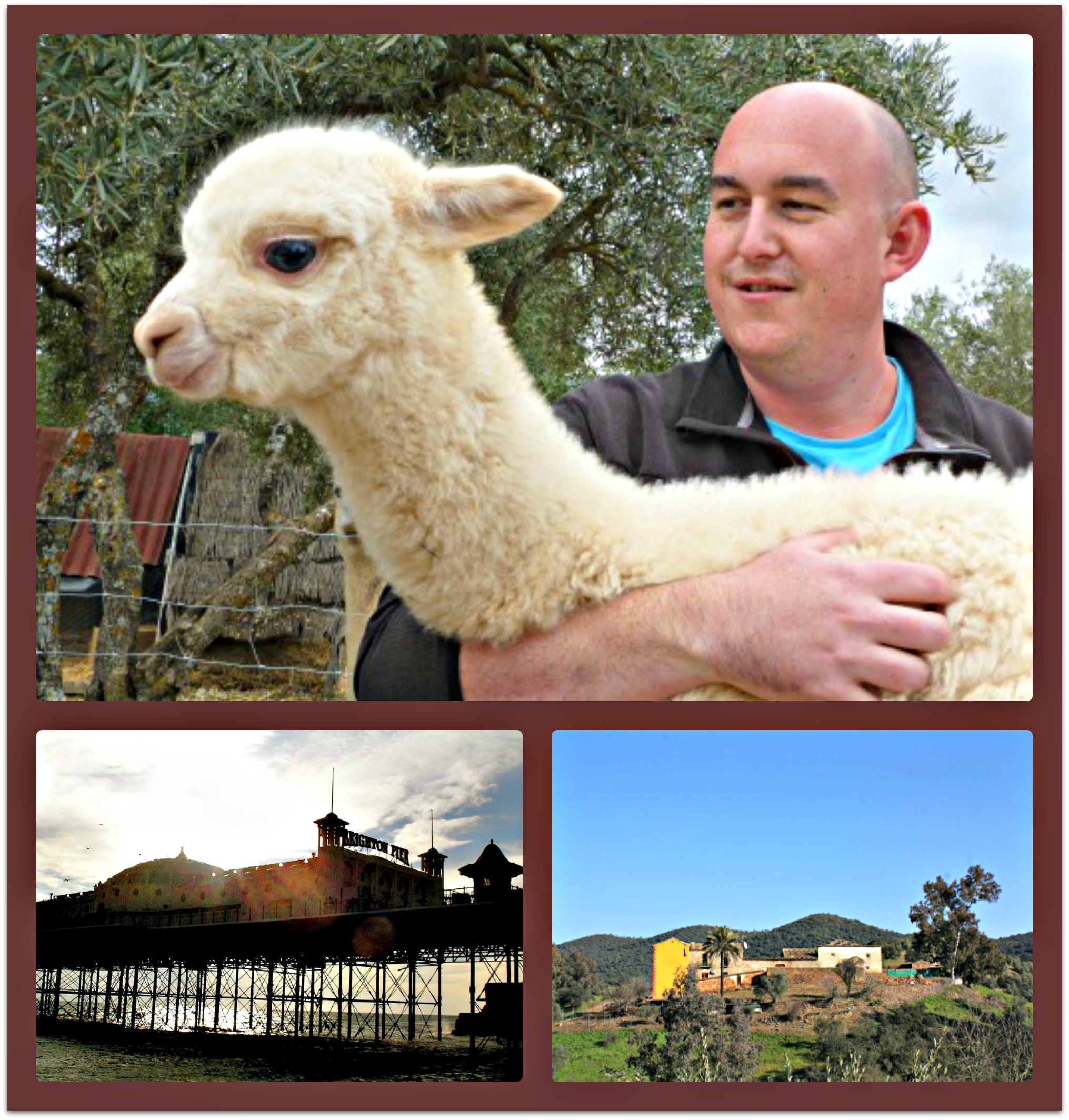
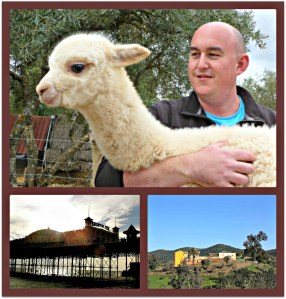
(Clockwise from top) Alan Parks with a friend’s alpaca; the converted olive mill where he and his partner, Lorna, now live; Brighton Pier, scene of their former abode (photo credit: Photo Monkey via Flickr Creative Commons).

The most amazing thing about the expat memoir penned by my guest today, Alan Parks, is not simply its title, though Seriously Mum, What’s an Alpaca? is quite a doozy.

It’s not even the zaniness of the alpacas that appear throughout the narrative: Bermuda, Cassandra, Lily, Baby Rafa… BTW, they are just a few among many animals Alan and his partner, Lorna Penfold, keep. (There’s a tally of how many and what kinds at the start of each chapter.)

No, the most amazing thing about Alan Parks’s memoir is that fellow expats, particularly fellow Brits (but also one German), are the villains of the piece—the least trustworthy of all the people he and Lorna have encountered on their madcap adventure. I say “madcap” as I think the decision the couple made, six years ago, to abandon their home in Brighton (in their native UK) for a renovated olive mill near Montoro in Spain’s Córdoba Province, which is within the autonomous territory of Andalusia, to raise alpacas justifies my choice of that adjective.

From the book’s beginning, Alan’s instinct is not to stick with the expat community—as he puts it:

I don’t think we would have mixed with many of these people at home, so we should not feel forced to by circumstances.

And boy does that instinct prove right! While the Spanish merely think he and Lorna are crazy (so far as they’re concerned, the British pair may as well be raising giraffes!), their fellow Brits are out to take advantage of them in all kinds of ways. And despite Alan’s better instincts, his limited Spanish at times gives him little choice but to get involved with some pretty unscrupulous characters.

Mind you, the Spanish don’t always come off well either, especially when it comes to their treatment of animals. In light of Mahatma Gandhi’s proclamation—

“The greatness of a nation and its moral progress can be judged by the way its animals are treated.”

—it would not be too far fetched to say that the animals are the book’s true heroes. They are what keep Alan and Lorna going in face of a seemingly unending series of challenges. In tribute, Alan gives various pets a voice at the end of occasional chapters. (It’s sad when they lose them, though.)

But the reason we are assembled here today to give Alan himself a voice in telling us about his book, which I urge you to read if you haven’t already. It’s done super well on Amazon for a reason: it’s terrific! And please LEAVE A COMMENT at the end of this post to be eligible to win a FREE COPY. (Alan has kindly agreed to give one of his books away: your choice of alpacas or donkeys! And there may also be prizes for runners-up!!!)

* * *
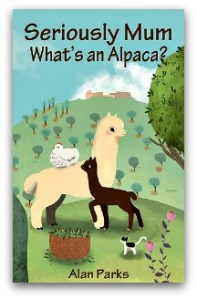
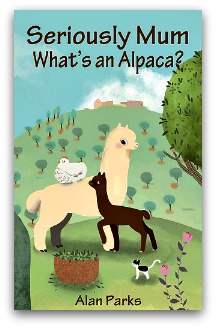
SeriouslyMumAlpaca_bookcover_dropshadowWelcome to the Displaced Nation, Alan! Between you and your partner, Lorna Penfold, you have produced three memoirs about your life in Spain. There’s the book we’re featuring today: Seriously Mum, What’s an Alpaca?. There’s also the sequel: Seriously Mum, Where’s That Donkey? And Lorna has just now published From Sequins to Sunshine: Year One. Tell me, what has made the pair of you so prolific?
The books were never planned. Two years ago, after being told many times that I should write a book about our adventures, I decided to give it a go. Seriously Mum, What’s an Alpaca? was the result. It started out being called Bloody Hell, What’s an Alpaca?—an exact quote for how Lorna’s daughter, Frankie, responded when we told her about our plans. But the use of the word “hell” hindered sales in the US. After I released the sequel, we thought people might like to read Lorna’s point of view. She had started a blog when we first moved here, so we turned her posts from the first year into an e-book. So far the reaction has been good.

What was the impulse that led to your packing it all in and moving to the South of Spain?
Lorna was a dance teacher in the UK and I used to work in retail. Lorna developed a condition called sarcoidosis, which made working difficult. One day we were talking about the possibility of her giving up work, and I suggested moving to Florida, but that was too far away. I blurted out “What about Spain?” Crazy really, as I had never ever been here.

Hey, craziness is what makes the world round! And how about this idea of raising alpacas, where did that come from?
We had heard about alpacas in the UK and thought that would be a good business for us to get in to (it wasn’t).

Okay, seeing as I know nothing about the alpaca business, what makes it so challenging?
An alpaca is not a cheap animal, yet you can’t eat it, and it doesn’t produce milk to drink. You make money by selling them to other breeders. But sales, and the selling price, have gone down since the world financial crisis.

What about their wool?
We try to sell as much of our alpacas’ wool as possible to local people who spin, knit and use it for crafting, but the market here in Spain is miniscule and postage costs prohibitive.

Do Spanish people think you and Lorna are crazy for your devotion to these animals?
People in Spain have never heard of alpacas. To a Spaniard, a goat is a much more useful animal.

Why do you still keep your alpacas if you’re not making any money on them?
For one there is no one to sell them to, and for two, they are part of our family and we love them. We also like it when people come and stay at our farm and can experience walking and feeding the alpacas. And finally, if there were no alpacas, there would be no books.

Ah, yes, the books. We’ll get to that, but first let me ask another alpaca question. The New York Times had an article last year talking about llamas being good pets. I think the alpaca is meant to be the llama’s quirky cousin. So is the same true of them?
It depends….they are no good if you want an animal to pet and stroke. But if you have an acre of land and you need the grass kept short, they could be good. Bear in mind, though, that they need to be kept in groups of at least three!

Out of the grey skies of England and into the frying pan of Spain

Moving right along to the weather: having been an expat in Britain myself, I can imagine you were keen to leave behind its grey skies and unpredictable climate. But were you aware that the interior of Andalusia, where you were headed, is the hottest area in all of Europe?
We didn’t find out about this area being called “The Frying Pan of Spain” until much further down the line. We were sorting some paperwork at the Spanish Embassy in London, and a lady said to us, “You do know they call it the Frying Pan of Spain, don’t you?” In the summer it can easily hit 45 degrees during the day. Siestas are a necessity.

Can you give us some sense of how you spend a typical day in your new life versus when you lived in Brighton?
In Brighton I was often out the door at 7:30 a.m. and got back home about 7:00 p.m. Lorna worked in the evenings, often not returning home until 9:00 or 10:00 p.m. Also, she had to work a lot of Sundays, so we never got to see each other. In Spain our life is much more relaxed. We spend our days looking after the animals and maintaining the house, and we are now together 24/7. You could say we went from one extreme to another.

I understand you met Lorna on the Internet. How long had you known each other before hatching this plan to live in Spain?
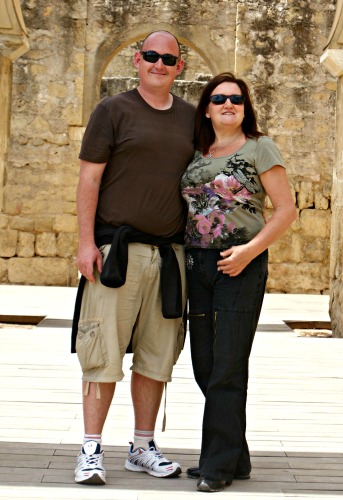
We had been together for four years and living together for three before we made the move, so we at least knew we could live together.

Did starting up a totally new life in a foreign land put a strain on your relationship or draw you closer?
I wouldn’t say our relationship has ever been strained, although as you can read in our books, we have been through some tough times together.

Be careful what you wish for…

Having read your book, I know there were quite a few moments in Spain when you felt like a bit like aliens, but which moment stands out as your most displaced, when you wondered if you’d made a mistake?
I think our “What are we doing here?” moment came after about 18 months. We had spent all our money with an English builder renovating our new house in the sun, and we experienced the worst Spanish winter rains for a hundred years. It turned out the builder was a conman and all the roofs he’d built started leaking. On top of that two of our alpacas died in the months before. I remember us standing in our kitchen as water cascaded from the ceiling. We were both in tears.

Wow, a literal “pool of tears” moment! But I know you also have things you love about your new life. Can you tell us about your least displaced moment, when you felt you were born to be in Spain’s Frying Pan rather than your native UK?
Andalucia feels like home to us now, although it is difficult to pinpoint the exact moment when we turned the corner. I think we are most aware of it when we are sitting outside having something to eat and drink with friends at 2:00 a.m. in the middle of August, wearing only a t-shirt. That is what life is about, not whether or not you can afford the latest version of the iPad!

Would you say you’ve assimilated to the point where returning to the UK gives you counter culture shock?
Lorna visits the UK regularly as she now has three grandchildren that weren’t even thought about when we first moved here. I have not been back for five years but will head back for a weekend in June to visit my relatives and attend a diamond wedding celebration for my grandparents. In all honesty, I am a bit nervous about it, I am not looking forward to being in crowds. Here in Spain we live in the countryside outside a small town and some days we do not see a single person. Plus in June, I only ever wear shorts and a t-shirt, but in the UK I may need jumpers (sweaters) and trousers.

An Amazon bestseller in Travel with Pets and Travel in Europe

Moving on to your e-books: why did you decide to self-publish?
I wrote my first book just as self-publishing was really taking off. I submitted the manuscript to one publishing house, got a thanks-but-no-thanks letter back, so decided to publish it myself.

Are there any drawbacks to self-publishing?
As a self-publisher, the hardest part is clicking the button to publish. A traditionally published author has that taken away from them, and even if they get mixed reviews they have the backing of the publishing house. We are responsible for everything, from cover, to content, to editing mistakes. If there are problems, or mistakes in the manuscript, that is our fault.

What audience did you have in mind for the book, and has it been reaching those people?
Initially I thought it would appeal mainly to other alpaca breeders, but I have had emails from readers all over the world who say they’ve enjoyed reading about our Spanish adventure. In fact, I was so overwhelmed by the response to Seriously Mum, What’s an Alpaca? I just had to write the sequel, Seriously Mum, Where’s that Donkey?

Your book has done very well on Amazon. Do you do a lot to promote it?
I run a FB group called We Love Memoirs, which has over a thousand members, all of whom enjoy books like mine. The best way to promote is by word of mouth. If somebody recommends your book to their friend, nothing beats that. As a self publisher I am actually against the Amazon Select program, where you make your book available exclusively on Kindle. My books are available on Amazon but also everywhere else: iTunes, Barnes and Noble, Kobo and even smaller retailers.

What’s next—more books?
I would like to release a third book this year, and Lorna has years 2 and 3 in her From Sequins to Sunshine series to work on.

How are the alpacas doing?
The alpacas are good, and if all is well, we may have some babies at the end of the year.
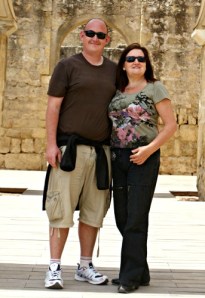
SONY DSC10 Questions for Alan Parks & Lorna Penfold

Finally, I know that both you and Lorna have become avid readers while living in Spain, so I’m curious to hear both of you answer a series of questions that I’ve asked some of our other featured authors, about your reading and writing habits:
1. Last truly great book you read: Alan: I’m not sure I have ever read a truly great book. The books I read tend not to get put in that category. Lorna: A Thousand Splendid Suns, by Khaled Hosseini. Alan: I also have read A Thousand Splendid Suns, but I didn’t have the same reaction Lorna did.
2. Favorite literary genre: Alan: Comedy memoir. Lorna: Everything except horror.
3. Reading habits on a plane: Alan: I haven’t been on a plane for six years. Before it would have been an old fashioned book, but now I would read on a kindle app on my phone. Lorna: Always a paperback (whatever I happen to be reading).
4. The one book you’d require PM Cameron to read: Alan: Mine, of course! I think it would do him the world of good to find out that people can be happy living a more simple life, with less materialistic ideals in life! Lorna: Mine of course, just to give him a look at a day to day life of a “normal” working class person.
5. Favorite books as a child: Alan: The “Adventure” Series, by Willard Price.
6. Favorite hero/heroine in fiction: Alan: Jack West Junior, who appears in a book series by Australian author Matthew Reilly. Lorna: Mariam from A Thousand Splendid Suns, by Khaled Hosseini.
7. The writer, alive or dead, you’d most like to meet: Alan: Peter Mayle. Lorna: Khaled Hosseini.
8. Your reading habits: Alan: I read in bed at night, and a lot in the summer. Lorna: I read lots in summer as we do not watch television at all then. Plus other times of course.
9. The book you’d most like to see made as a film: Alan: Anything by Matthew Reilly, it would be like Indiana Jones on speed. And my own book of course. Lorna: My partner’s book Seriously Mum, what’s an Alpaca?
10. The book you plan to read next: Alan: Escape to Mulberry Cottage by Victoria Connelly. Lorna: The next on the shelf, whatever it is!

* * *

So, readers, any COMMENTS or QUESTIONS for Alan? Hey, it’s not every day you get to discuss the world’s most captivating camelids! And don’t forget, there’s a free digital copy on offer…

And if you can’t wait to read the book or don’t win, Seriously, Mum, What’s an Alpaca? is available from Amazon(among other venues). Be sure to grab a copy! You can also visit its companion site, like the book’s Facebook page (and be treated to lots of cute alpaca pix!) +/or follow Alan on Twitter.

STAY TUNED for next week’s fab posts!<!–tomorrow’s post, when our fictional expat heroine, Libby, returns to the Displaced Nation to update us on her many adventures. (What, not keeping up with Libby? Read the first three episodes of her expat adventures.)–>

If you enjoyed this post, we invite you to register for The Displaced Dispatch, a round up of weekly posts from The Displaced Nation, with seasonal recipes, book giveaways and other extras. Register for The Displaced Dispatch by clicking here!

Related posts:

LOCATION, LOCUTION: Andrea Cheng, award-winning children’s author

Author photo: Andrea Cheng

Author photo: Andrea Cheng

In this month’s “Location, Locution”, expat crime writer JJ Marsh interviews Andrea Cheng, award-winning author of  books for children and young adults.  

Cheng’s first novel, Marika, was selected by the city of Cincinnati for “On the Same page,” a citywide reading program.  Honeysuckle House, Anna the Bookbinder, and Shanghai Messenger received Parent’s Choice Awards.  Grandfather Counts was featured on Reading Rainbow. Where the Steps Were, the first book that Cheng has both written and illustrated, received starred reviews in both Publisher’s Weekly and Kirkus. The Year of the Book, a Junior Library Guild selection, was reviewed in the NY Times and was followed by The Year of the Baby (2013 May). Cheng’s most recent title is Etched in Clay.

Some of Cheng’s books draw on her background as the child of Hungarian immigrants as well as the background of her husband, the son of immigrants from China. Others draw on the lives of her children growing up in inner city Cincinnati where she and her husband now live.  Andrea studied Chinese at Cornell University where she received a Masters degree in linguistics.  She and her family have traveled to both Budapest and Shanghai to get to know their extended families.

Which came first, story or location?
I think character comes first in my writing, followed by location, atmosphere, etc.  Plot or ‘story” come later.  I usually start with a character at a particularly salient moment in a specific place, and go from there.

Year of the Book

Cover art: The Year of the Book, by Andrea Cheng

What’s your technique for evoking the atmosphere of a place?
I have to have spent a fair amount of time in a place before I can evoke the atmosphere.  I have to know how it smells and tastes and looks and feels.

Which particular features create a sense of location? Landscape, culture, food?
Everything!  I think I focus a lot on language, the way people talk. I think it would be very hard for me to write a story that takes place in a location in which I cannot speak the native language of the people who live there.

Can you give a brief example of your work which illustrates place?
This is from my chapter book called THE YEAR OF THE FORTUNE COOKIE, coming out with Houghton Mifflin in May 2014.  It is for grades 3-6.  The main character, Ana Wang, is in Beijing:

It starts to rain.  The sky is almost dark, and the air smells like gasoline and charcoal.  We turn down an ally and wind our way behind some buildings.  “This is my home,” Fan says finally, opening a door with her key.

Inside the light is dim.  Her brother is watching television and her mother is cooking on a hot plate.  “This is my friend from America,” Fan says.  

How well do you need to know the place before using it as a setting?
I have to have spent time in the place and I have to understand the language of the people there.  The more time the better.

Which writers do you admire for the way they use location?
I just read Jhumpa Lahiri’s new novel, Lowland.  Although I think the book has some problems, I love her sense of place.

Next month’s Location, Locution:  Jill interviews James Ferron Anderson – weaver, glassblower, soldier, and now writer.

 * * *

JJ Marsh grew up in Wales, Africa and the Middle East, where her curiosity for culture took root and triggered an urge to write. After living in Hong Kong, Nigeria, Dubai, Portugal and France, JJ finally settled in Switzerland, where she is currently halfway through her European crime series, set in compelling locations all over the continent and featuring detective inspector Beatrice Stubbs.

_(75_of_75)

Author photo: J J Marsh

STAY TUNED for our next post!

If you enjoyed this post, we invite you to register for The Displaced Dispatch, a round up of weekly posts from The Displaced Nation, with seasonal recipes, book giveaways and other extras. Register for The Displaced Dispatch by clicking here!

Related posts: