
The Displaced Nation

A home for international creatives

Tag Archives: Japan

Marriage, cross-cultural style: Two veterans tell all (Part 1)

In the life of the global traveler, one of the most thrilling escapades you can have is a romantic encounter with someone you meet in a far-flung land.

But should your story involve going the further step and hitching your wagon to a person from a completely different culture — well, that’s another level of adventure altogether.

For marriage, you will need the ability to stand by the courage of your convictions.

Or, as one of our Random Nomads, Helena Halme put it in her comment on last week’s post covering this topic, cross-cultural marriage tends to be “for the mad bad and young — or foolish.”

Today and next Monday, one half of each of two cross-cultural couples have agreed to take the floor and answer my questions about what made them take the plunge:


GABRIELA SMITH has been married to Daniel for eight years. She was born in Venezuela to Spanish parents, but ended up in the UK, where she met Daniel and they currently live.


JEFFREY HUFFMAN has been married to Naoko for 19 years. They met in Nagoya, Japan, where Jeffrey, an American, had journeyed for his work. They now live in Seattle.

How did you meet your spouse-to-be?


GABRIELA: We were working for the same company in the UK; we met on my first day at work.


JEFFREY: We’re something of a cliché couple. She was a student in the summer Teaching English as a Foreign Language (TOEFL) prep course I was teaching in Nagoya. She had just graduated from college and wanted to pursue a second degree at a university in the U.S. and needed to pass the TOEFL to do so.

What made you think that this is the person for me? Did culture have anything to do with it?


JEFFREY: Definitely, Naoko represented a tie to the Japanese culture that I wanted to have. Seattle has a pretty large Asian community, I had taken Japanese at university with dozens of nikkei-jin, and I had been to Japan on visits twice before. But it wasn’t until I went to live there that it all fell in place.


GABRIELA: I arrived in the UK at 23 — marriage was not even in my mind. Additionally, I had no wish to stay in the UK so wasn’t looking for an Englishman to marry. I was going to travel more. I actually had a one way ticket to Italy when I fell in love with my husband.

Did you have any reservations before deciding to tie the knot, having to do with the other person being a different nationality?


JEFFREY: No reservations on my side, probably because Naoko had lived in the States for a year as an undergrad by the time I met her, and because her English was so good.


GABRIELA: Not at all. I thought — and I still think — that culture has very little effect on the “amount of risk” in a relationship. Values are important, of course, and I considered my husband’s values as an individual — not by placing him within a category ruled by his nationality.

How long were you together before you decided to get married?


JEFFREY: A point of no small contention with my wife. We’d been together for four years, two in Japan and two in the States, before I finally got around to asking her formally. Naoko was just about to graduate from Seattle University, and I’d been accepted at Columbia for grad school when I finally woke up and realized the time had come…


GABRIELA: Exactly 12 months after the day we met for the first time. Daniel asked me.

Where were your weddings held? Did you have cross-cultural ceremonies?

GABRIELA: The civil wedding was held in England; from my side there was just me. The religious ceremony was held in Venezuela a week after; from my husband’s side there was just him. The ceremony was in Spanish, a language that he does not speak! We held the reception party three weeks later when we were back in England — again, just me from my side. I even looked for a wedding dress on my own, and was on my own at the hairdressers on my wedding day. People may have thought it was strange, but I never minded. I thought it was all very exciting.


JEFFREY: We were married in my parent’s living room by a family friend who was a county judge. He wrote the ceremony for us, and it was very nice – just family and a few friends. We did a recommitment ceremony a few years later in Hawaii. Naoko didn’t want any kind of ceremony in Japan. She comes from Aichi-ken, where weddings tend to be an extravaganza. (Of course the real reason is that she was embarrassed to be marrying me — just kidding.)

Which makes me think of another question… What was it like meeting your in-laws for the first time? Did you have any awkward moments?


GABRIELA: Of course we’ve had some communication barriers, but mainly been due to my accent. I just have to repeat several times a word, or get my husband to “translate” for me. Ah, and the fact that I never drink tea or eat Christmas pudding seems to surprise his family each time!


JEFFREY: I think her parents and older brother initially took a dim view of our relationship, because I didn’t speak Japanese very well. To this day, my wife is my conduit with her parents (their Aichi-ben still leaves me lost a lot of the time). Overall, though, I think they are comfortable with me as I’m pretty comfortable with the culture.

How much of your married life has been spent in each other’s countries? And have you also lived in countries that are foreign to both of you?


GABRIELA: I don’t exactly have a country as my parents are originally from Spain but I grew up in Venezuela. Daniel and I have yet to live in a Spanish-speaking culture. We did, however, spend six years of our married life in a country foreign to us both: France. Otherwise, we’ve been in the UK.


JEFFREY: We’ve never lived anywhere else besides our home countries, and we’ve lived much longer in the U.S. than in Japan. Our time in Japan as a married couple consisted of three years in the Greater Tokyo area in the mid-1990s.

Are you settled down where you are now, or do you think you will change countries again?

JEFFREY:
Seattle is home for the time being. That said, I know Naoko misses her family. We’ve had some very emotional send-offs by family and friends in Japan. If fortuitous circumstances presented themselves (i.e. we were both offered obscene amounts of money and guaranteed vacation time), we’d be fools to not go. Barring that Disney scenario, we fully expect to spend at least part of the year in Japan in retirement, which isn’t that far off. It’s just eight years until our youngest is in college.


GABRIELA: What attracted me the most to my husband is that he also wanted to travel and live in other countries. I think things would have been very different if he said he wanted to stay in England “forever.” Now that we’ve spent six years in France I’ve realized that the weather really influences the social life and, to some extent, how people behave. It would be easier for my career if I stayed in the UK, but I have always placed my lifestyle before my career. Thankfully, my husband is quite happy with the idea of having late dinners on a terrace, under the sun, with wine and cheese on the table! Being Spanish, I would love for us to live in Spain one day.

What language do you speak with your respective spouses?


JEFFREY: Painful as it is to admit, about 99% English.


GABRIELA: Always English.

Tell me more about your kids.


GABRIELA: We have two wonderful children — a girl, 6, and a boy, 2. They were born in France, I was five months pregnant when we moved. Communicating with the midwives during childbirth was … interesting.


JEFFREY: We also have a girl and a boy, but they are a little older. Our girl is 14, and our boy, 9. Our daughter was born in Kawasaki, and our son in Seattle.

What language do you and your partner speak with the kids?


JEFFREY: The children are just now taking formal Japanese lessons.


GABRIELA: Spanish and English with my children. Occasionally I tease them — and my husband — in French. I must say that no matter what language I speak they all reply to me in English.

We look forward to hearing more from Jeffrey and Gabriela — and their spouses — next week. Let them know any comments or questions in the meantime!

If you enjoyed this post, we invite you to subscribe for email delivery of The Displaced Nation. That way, you won’t miss a single issue. SPECIAL OFFER: New subscribers receive a FREE copy of “A Royally Displaced Tea.”

Related posts:

Cross-cultural marriage? 4 good reasons not to rush into it…

painting of Pocahontas and John Rolfe, by J.W. GlassAs announced last week, The Displaced Nation is honoring Pocahontas this month for the role she played in advancing communications between two very different cultures.

This week, we take a closer look at Pocahontas’s decision to marry the Jamestown settler John Rolfe.

Did the Rolfes have an easy time of it in their married life? History doesn’t tell us, but as the veteran of two cross-cultural marriages myself (first to a Brit, now to a Japanese), I tend to think not.

Sure, the union had its advantages for both parties. We know for a fact that two years after marrying Rolfe, Pocahontas was invited to voyage to England with her husband, where she met many prominent people, including King James I.

We know also that Pocahontas’s father, King Powhatan, gave the newlyweds property just across the James River from Jamestown, spanning thousands of acres.

But being in the mood to play devil’s advocate, today I will make the case for why Pocahontas and Rolfe should have hesitated before tying the knot.

Here are my top four reasons for cautioning against cross-cultural marriages like theirs:

1. Marriage across cultures is rarely seen as one of equals.

Rolfe felt he had to defend his decision to marry Pocahontas to his fellow colonists. Here’s what he wrote in a letter addressed to Sir Thomas Dale:

Nor was I ignorant of the heavie displeasure which almightie God conceived against the sonnes of Levie and Israel for marrying strange wives, nor of the inconveniences which may thereby arise,…which made me looke about warily and with good circumspection, into the grounds…which thus should provoke me to be in love with one whose education hath bin rude, her manners barbarous, her generation accursed, and so discrepant in all nurtriture frome my self.

After much soul searching, Rolfe decided he could marry Pocahontas despite her crude education, barbarous manners and different colored skin — as long as she converted to Christianity.

In the above portrait of the couple, by J.W. Glass, Rolfe is instructing Pocahontas in Christian doctrines.

And now let’s turn to Pocahontas. Did she see Rolfe as her equal, given that he was a mere tobacco farmer, and a foreign invader, and she was the daughter of the most powerful chief in the region?

According to historical records, the news of the liaison was well received by the Powhatan tribes, helping to create a climate of peace toward the Jamestown colonists for several years.

I find it instructive to compare Pocahontas with Cleopatra on this point.  Faced with the rising tide of Roman expansionism, Cleopatra seduced Julius Caesar and Marc Anthony to protect her country from being swallowed up. Likewise, Pocahontas may have seen it as her duty to marry John Rolfe, as it meant she could continue working on behalf of her people. (In that sense, Disney may have been right about Pocahontas’s preference for Captain John Smith — but only because he had more power than Rolfe.)

2. The fantasy quotient in such marriages can lead to huge disappointments.

In Glass’s portrait of the couple, John Rolfe gazes down lovingly into the eyes of a young woman with long, straight, dark hair. He seems to be thinking of Pocahontas as his trophy Indian princess — how exotic she is compared to his English wife (who died on the boat coming over).

But what if, at that very moment, Pocahontas is calculating the advantages that could accrue to her and her tribe from their liaison — including representing her father’s tribes to the powers-that-be in London and arguing against their displacement.

Would it crush Rolfe to learn the practical agenda she had in mind for their marriage?

At the same time, though, the painting shows Pocahontas gazing upwards at her husband-to-be. A young girl, she must have harbored a few fantasies as well. Maybe she found Rolfe much more refined than the Indian men she had known — she’d already had an Algonquian husband by then.

In that case, how disappointed she must have felt when, after the wedding, she discovered his habit of chewing and spitting tobacco, overheard him swearing like the sailor he once was, and noticed his tendency to stomp around the place. Why can’t he be more like an Algonquian man and walk as quietly as a leopard?

3. Sons tend to turn into their fathers, and daughters into their mothers — but how can you possibly anticipate this if you can’t read the culture?

Having been married to a Brit myself, I find it amusing to pretend that Pocahontas met Rolfe’s parents before deciding whether to marry him. In my imagination, she, like me, fails to pick up on all the important cues — things like the necessity of being able to produce a Sunday dinner of roasted meat, potatoes, and two veggies, while her husband rests up from his weekly labors. (Rolfe, by the way, is credited with the first successful cultivation of tobacco from the colony of Virginia.)

Likewise, had Rolfe been able to meet Pocahontas’s mother, I imagine he would have thought of her as a kindly Indian squaw — having no idea of her ability to control, coerce and manipulate others to her will.

4. In times of strife, the last thing you want is a cross-cultural misunderstanding.

We marry for better or for worse, but during the worst of times, most of us could do without a partner who is culturally clueless.

For example, if Pocahontas received word that one of her close relations had died — how would she feel if Rolfe resorted to trying to cheer her up with sarcastic British humor: “Well, at least that’s one less Injun for us to worry about!”

By the same token, if Rolfe’s tobacco crop failed due to drought, he may not have felt like dancing with Pocahontas, despite her insistence it would bring on the rains.

* * *

Most of the above, of course, is pure conjecture, but it is also based very closely on my own observations. I’ve witnessed quite a few romances in the Rolfe-Pocahontas mould — particularly while living in Japan. And I’ve seen quite a few of them turn sour.

I’ve also experienced firsthand how devastating it can be if one’s spouse can’t communicate properly when the going gets rough and you don’t have the energy to make allowances for the fact that they come from a different culture.

In my experience, the most important quality one needs to have for a successful cross-cultural marriage is that of being a glutton for punishment — a quality I just so happen to have in spades.

Not wanting an easy life — that’s what it all boils down to. And, unless you have a calling for handling complication piled on complication, then I would suggest choosing a mate who lived in the same neighborhood as you growing up — preferably next door.

Question: Do you agree that cross-cultural marriages are unusually challenging?

img: Detail of “John Rolfe and Pocahontas,” by James William Glass (early 1850s), courtesy Wikipedia (public domain)

STAY TUNED for tomorrow’s RANDOM NOMAD interview, in which our special guest will answer a Pocahontas-related question.

If you enjoyed this post, we invite you to subscribe for email delivery of The Displaced Nation. That way, you won’t miss a single issue. SPECIAL OFFER: New subscribers receive a FREE copy of “A Royally Displaced Tea.”

Related posts:

For curious and unreal travel, Tokyo sure beats Wonderland

Today we welcome Carole Hallett Mobbs to The Displaced Nation as a guest blogger. During June, TDN is looking at what the story of Alice in Wonderland can tell us about displacement of the curious, unreal kind — as anchored by Kate Allison’s “5 Lessons Wonderland taught me about the expat life, by Lewis Carroll’s Alice.” Hallet Mobbs can identify, having just left Japan — a country that Western travelers have long regarded as the ultimate topsy-turvy destination — after four-and-a-half years of living with her family in Tokyo.

“I’ve believed seen as many as six impossible things before breakfast”: this seems the most logical place to begin my account of life in Wonderland Japan.

In Tokyo, you can see a minimum of six impossible or incredible things before breakfast.

And then another six after breakfast.

In fact, I can safely say that a day spent in Tokyo will guarantee you a double-take moment approximately every ten minutes.

I know this, because I timed myself one day, using an oversized pocket watch.

Jaw-dropping sights abound — and I never failed to be delighted and amazed every single day during my four-and-a-half-year stay.

And if,  like me, you prefer seeing to believing, then Tokyo is the place to be.

Curiouser…

Whilst driving my young daughter, Rhiannon, to school one day, I absentmindedly pointed out a Routemaster bus.

Double take! A red double-decker is a London inhabitant, not normally seen outside the Big Smoke. What on earth was one doing trundling its way around Tokyo?

These beasts are not known for their flying abilities but it had obviously migrated somehow. I discovered that a Japanese diplomat who’d been posted to Britain persuaded London Transport to donate one of these wonderful buses to Japan. It’s now a cruising restaurant.

People, too, arrest your attention. With their unique, carefully honed fashion sense, Tokyoites take style to a whole new dimension.

Real Alice in Wonderlands trip along the fashionable Harajuku, mixing with other young people dressed in adult-sized furry romper suits complete with ears. (Rabbits and bears are favorites.)

A particularly memorable vision in that section of town was a fully decked-out Stormtrooper from Star Wars, casually walking up the road.

Then there are those whom I thought of as “dormice folk.” Due to their heavy workloads, many so-called salarymen need to catch forty winks whenever and wherever they can. Favorite snoozing spots include crashing out across a table in Starbucks or on a bench. And they’ve even been known to take advantage of armchair displays in department stores.

Nobody dreams of waking them; that would show a deep lack of respect.

…and curiouser

Look! That’s a baby in a sling. Oh, my mistake, it’s a white rabbit.

Stuff and nonsense… Or is it?

As well as people watching, I can highly recommend pet-watching as a surreal Tokyo pastime.

Peer into a buggy expecting to see a cute, chubby baby with spiky black hair and instead see — no, not a pig, but more than likely a dog or two.

Yes, canines are cosseted creatures in Tokyo. More often than not, they are the size of guinea pigs, and almost all wear fashionable outfits.

Is that a giant caterpillar? No, it’s a dressed-up dog. Dogs in kimono. Dogs wearing tutus with real diamond necklaces. Dogs in leather jackets and sunglasses. Dogs in boots…

More than once I had a curious conversation with fellow dog owners. I have a Japanese Shiba-Inu (unclothed). This caused much admiration — a gaijin with this special Japanese dog was a big hit — as well as some puzzlement. “But that’s a Japanese dog. How did you teach her to understand English?”

And it’s not just pets that are dreamlike.

Crows are as big as ravens, woodpeckers as small as wrens.

Saucer-sized butterflies flit by like vibrant handkerchiefs, and hornets are so large they need their own air traffic control center.

Drink me! Eat me!

Japanese interpretations of Western food can be a trifle bizarre. Experimentation is rife, and experiments include drinks such as iced Earl Grey lattes and cucumber Pepsi.

Being taken by surprise during a snack is commonplace.

Thrilled by finding some doughnuts that appeared to have jam inside, I took a huge bite. The “jam” was azuki bean paste. Not my favorite.

Another shock was a Wasabi Kit Kat. I still haven’t recovered from that one.

Some time in recent history, the sandwich reached Japan. I imagine the conversation went a little like this.

“What is a sandwich?”

“Well, it’s two slices of bread with a filling between the slices.”

“What filling goes into this sandwich?”

“Oh, anything really…”

One day a friend bought a sandwich with a lumpy filling. A gentle squeeze sent a whole cooked potato shooting across the room.

Through the looking-glass

Beckoning looks like waving goodbye.

Keys turn the wrong way.

Books and magazines are read from back to front.

Writing follows its own rules. The elegantly beautiful yet complex Chinese characters, known as kanji, are written vertically in columns and read from top to bottom and right to left.

Tell me, please, which way I should go from here?

Notably, as an Englishwoman in Europe, I can usually work out rough meanings by utilizing my limited knowledge of Latinate and Germanic languages.

In Japan, though, I was suddenly completely illiterate.

Imagine the fun my husband and I had on our car journeys. Trying to decipher the name of our destination on the map, he would say: “Look out for a sitting man, a picnic table, noughts and crosses, a ‘7”and a jellyfish.” Predictably, we got lost rather a lot.

Going somewhere on foot was no easier. Streets are not well labeled, or labeled at all. In fact, being lost in Tokyo is so common — even for Tokyoites — that everyone carries their own little maps with landmarks.

If you stand around looking pathetic for a while, a stranger will miraculously appear and guide you to your destination — and then disappear, leaving only a grin behind…

English words are considered interesting and “cool,” so are often used for shop names and slogans. But a love of English isn’t always correlated with an understanding of how our words link together — leaving us foreigners as clueless as ever.

“Tokyo Teleport Station” is just outside the city. Sadly, it’s just a train station, not a link to other worlds.

One that still puzzles me is a sign declaring “SLOB! Oxidised Sophistication.” I just have no idea.

The “Hotel Yesterday” has the tagline “Welcome to Yesterday.” I often feel like that.

Is Tokyo really a wonderland?

Goodness, what a long sleep I’ve had! Such a curious dream!

Though I’ve enjoyed using “Alice” allusions to describe my Tokyo adventures, I’m not sure if it’s of much use in helping other expats adjust to this very real yet extraordinary city.

The key to living in and enjoying Japan is to keep an open mind, embrace eccentricity and expect the unexpected at all times.

And if that’s too tall an order on any given day — rather like Alice’s serpent neck — then I suggest you follow her sister’s advice and “run in to your tea.” But if I were you, I’d give the “jam” doughnuts a miss!

Question: Can you think of any other cities that merit a “through the looking glass” reputation, or is Tokyo an extreme, as Carole Hallett Mobbs suggests?

Carole Hallett Mobbs is a trailing spouse and freelance writer. Her blog on life in Tokyo is called Japanory. After moving to Berlin with her family in April, she started up another blog, Berlinfusion, and is writing a book on expat children. Her Twitter moniker is @TallOracle.

img: Carole and her daughter, Rhiannon, caught in an Alice-like pose by 37 Frames (Tokyo).

STAY TUNED for tomorrow’s Displaced Q having to do with one of our — and Alice’s — favorite topics: food!

If you enjoyed this post, we invite you to subscribe for email delivery of The Displaced Nation. That way, you won’t miss a single issue. SPECIAL OFFER: New subscribers receive a FREE copy of “A Royally Displaced Tea.”

Related posts:

DISPLACED Q: In the words of The Clash, “Should I stay or should I go?”; When reality bites in your adopted country, are you more — or less — determined to stay as an expat?

In our post on March 20, When in doubt, have a pint of Guinness, we drew attention to the Britons who resolutely stayed in post-earthquake Japan rather than fleeing with the majority of their expat countrymen back to the UK. Despite the danger of the nuclear situation, one man interviewed by the Telegraph said

“I actually feel a bit of a duty not to leave.”

Friends in need

Although this person’s mother couldn’t see his point, I understand this mentality. The events of September 11, 2001, so close to our home in Virginia, made me defensive of my adopted country, and outraged at such an audacious attack. To leave at this stage was unthinkable. That would mean we were just fair weather friends of the USA.

Instead, we taped a small American flag to our mailbox, as the rest of our neighbors did to theirs. It couldn’t help the 3,000 who died that day, but it showed our sympathy and solidarity, which didn’t go unnoticed: a neighbor made a point of telling me how touched she was that I, a foreigner, had done this.

Yet I suppose expats here did leave to go back home after 9/11, because it’s human nature to think the grass is greener – or safer – on the other side.

More trolls, not greener grass

It’s not greener or safer, of course. I know this from years of frequent news reports of IRA bombings.  The Spanish know this from decades of Basque separatist attacks. 2009 saw 10,999 terrorist attacks worldwide, and while 60 percent of these occurred in Iraq, Afghanistan, and Pakistan, that still leaves over 4,000 to be shared by the rest of the globe.

As chance had it, I arrived at Heathrow the day before the 2005 bombings of London’s transport system, and had planned to take the tube into the city the following morning to do some sightseeing with my children. Had we not been tired from jetlag and therefore overslept on July 7th, we could easily have been on one of the trains that were destroyed.

Was I as upset by 7/7 as I had been by 9/11? Undoubtedly. Yet there was something else, too – a feeling of deja vu, of “here we go again” or – dare I say it? – resignation.

Whether you run or stay, there is a difference between enduring atrocities in your own country and suffering them on another’s turf.

Not all disasters are manmade

It doesn’t have to be a terrorist atrocity, as our friends drinking Guinness in Tokyo can testify. Perhaps you were an expat in Christchurch, New Zealand during the last two earthquakes; perhaps you were posted to New Orleans just before Katrina hit the Gulf Coast. Only two days ago, Joplin, Missouri was devastated by a deadly tornado.

The world is a dangerous place. There are no certainties, especially when it comes to safety. To quote The Clash again:

“If I go there will be trouble

And if I stay it will be double.”

So, tell us:  What’s an expat to do when disaster strikes?

If you enjoyed this post, we invite you to subscribe for email delivery of The Displaced Nation. That way, you won’t miss a single issue. SPECIAL OFFER: New subscribers receive a FREE copy of “A Royally Displaced Tea.”

Related posts:

In the jaws of political or natural disaster: When reality bites for expats

Lately I’ve been thinking about plot lines for movies based on adventure travel. The one I like the most involves a round-the world traveler spotting a shark while scuba diving in the Indian Ocean…

In the hands of the right director, I could see it becoming a remake of Jaws.

Speaking of which, did you notice that first prize for the Matador Network’s “When Travel Goes Wrong” photo contest went to a young woman whose travel bag — containing passport, wallet and cell phone — fell down a Swiss sewage drain and got fished out by a kind, thin stranger. Now that has real Jaws potential!

Unfortunately, however, travel is not today’s focus. Rather, my goal is to highlight some of the mishaps that occur when a global voyager becomes a global resident.

“Boring!” I can hear you say. And having been an expat myself twice over, I have to admit, at some level, you are right.

They’re a privileged set, those expats.

Privileged with insider knowledge. You’re not going to catch them on the street with the open sewers.

Privileged with accommodation. Not for them a stay in Fawlty Towers, or the equivalent.

Still, reality has a way of impinging even on the most glittering expat lives, and in my experience, global residents tend to be even more traumatized than their short-stay counterparts when something goes badly amiss.

(Is that because they’re spoiled? I’ll let you decide…)

Gothic horror redux

In case you haven’t been tuning into The Displaced Nation of late, our posts have been exploring cases where individual expats have had their lives turned upside down, or worse (see “related posts” below).

My colleagues and I have put forth incontrovertible evidence that the expat life, like any other, can have its gothic moments.

Lest any skeptics remain, may I draw your attention to the Friday May 13 incident in Spain’s Canary Islands. A homeless Bulgarian man stabbed and hacked off the head of a 62-year-old British resident of Tenerife, after which he paraded into the street, holding his “treasure” up by the hair for all to see.

According to one eyewitness, who, too, is a long-term British resident of the Canaries:

When I saw the man holding the head, the first thing that popped into my mind was the scene from “Clash Of The Titans,” where the hero holds up the Gorgon’s head — but his was real.

Disruption en masse

Now let’s turn to the instances where the expat life gets disrupted en masse by natural disaster or political upheaval.

Emily Cannell, an American who’s been living in Tokyo with her family since last year, paid a visit to The Displaced Nation as a random nomad last Thursday. She told us about what it was like to be in that city when the Great East Japan Earthquake struck on March 11. In just a few moments, she went from a woman whose biggest worry was driving to car pool on time, to wondering if her kids were alive or dead.

And let’s not forget Tony Roberts, who was an honored guest on our site several weeks ago. His story, now written up in the form of a novel, is about what it was like being a teenager in Iran in 1979, just before the revolution took place. The trauma came when his family was given just 24 hours to evacuate back to their home in Kansas, and he had no time to say good-bye to his friends. For some time afterwards, this Third Culture Kid suffered from General Anxiety Disorder, “with feelings of unresolved anger,” as the psychologists put it. He tweeted recently: “Revolution will do that.”

Snatched from the jaws of [domestic terrorism]

I myself had an experience of this ilk towards the end of my stay in Japan, when the religious cult Aum Shinrikyo attacked the Tokyo subway with sarin gas — killing a couple of people in the station just down the street from my house. In all, 13 people died, and thousands more suffered from after-effects. It was and remains the most serious incident of this kind in Japanese history.

As I struggled to come to grips with the idea of nice, safe Japan being populated by terrorists, quite a few thoughts raced through my head; for instance:

1) This place is weirder than I’d realized.
I’d never before heard of the kind of cult where the adherents are well-off, educated young people and their leader, a bearded mystic with a destructive political agenda. (Needless to say, I hadn’t heard of al-Qaeda. But even if I had, Japan is the Far, not the Middle, East.)

2) Do the authorities know what they are doing?
From what I’d observed of the Japanese police, they seemed pretty wimpy, precisely because the country doesn’t have a high incidence of violent crime. Did they really have the chops to capture Shoko Asahara and put an end to his madness? (The attack on the subway took place on March 20, and they didn’t find him until May 16. He was hiding inside the wall of a cult building in the group’s compound near Mt Fuji, dressed in purple robes and in good health.)

3) Who’s looking out for us foreigners?
I suspected that we foreign residents would be the last to know if further incidents were likely to take place. (For weeks following the subway attack, rumors of imminent attacks were rife, and I didn’t know whom to believe.)

Though I eventually got on the Tokyo subway again, the incident took its toll on how I felt about living in that city. Little did I know that I would one day be working in New York City and reliving many of the same emotions — ignorance, disenfranchisement, and vulnerability — in the wake of 9/11.

I discovered, however, in comparing these two incidents that when reality bites in one’s native land, it’s not nearly as unsettling as when it happens abroad.

After 9/11, I wanted to stay in NYC and carry on — it was a way of fighting back. Whereas after the subway attack in Tokyo, I started to fantasize about leaving Japan.

* * *

Are there any world travelers out there who’ve stuck with me throughout this catalogue of woes? I wouldn’t be surprised if you’ve come to the conclusion that your nomadic life, even with its many dangers, is preferable to that of most world residents.

Or perhaps you’re feeling a touch of envy? In that case, you may wish to check out Bootsnall’s virtual tour of the top 10 shark-infested beaches in the world.

Question: Have you had any experiences of large-scale disasters during your stay abroad, and if so, how did it affect your perceptions of your adopted country — did it make you feel any less “at home” there?

If you enjoyed this post, we invite you to subscribe for email delivery of The Displaced Nation. That way, you won’t miss a single issue. SPECIAL OFFER: New subscribers receive a FREE copy of “A Royally Displaced Tea.”

Related posts:
RANDOM NOMAD: Emily Cannell, Housewife & Mother

Born in: Houston, Texas
Passport(s): USA
States/countries lived in: Pennsylvania (Philadelphia): 1989-1990, 1993-1997, 1999-2004, 2006-2010; Louisiana (New Orleans): 1990-1993; Washington (Seattle): 1997-1999; Arizona (Scottsdale): 2004-2006; Japan (Tokyo): 2010-present
Cyber coordinates: Hey from Japan — Notes on Moving (blog)

What made you leave your homeland in the first place?
My husband’s company offered him a job in Japan. We were living near Philadelphia at the time, our fourth “tour of duty” in that city. We jumped at the chance to go somewhere new — location wasn’t that important. Unlike most citizens of the Displaced Nation, I’d never lived overseas. I should point out, though, that in the American vernacular “expat” is often used to describe a person who moves beyond a 50-mile radius from where they were born. By that standard, I’ve long been considered an expat, with Louisiana, Texas, Alabama, Florida, Pennsylvania, Arizona, and Washington state on my resume. At one point, back in the days when I was working as a jack-of-all-trades in the pharmaceuticals industry, I commuted to New Jersey — which in dog years counts as exile in Siberia.

Is anyone else in your immediate family a “displaced” person?
My father is a displaced Canadian living in the US. Does that count? Seriously, he was born in Edmonton, Alberta. After attending medical school, he left to do his residency, internship, and fellowships in the US, which had more cutting-edge techniques and offered more advanced studies than the Canadian system. Eventually, he became too involved in academia to return to Canada, although he still goes back and forth.

Describe the moment when you felt most displaced over the course of your many displacements.
It probably won’t surprise you when I say that the earthquake on March 11th produced one of the worst feelings of displacement — literal as well as psychological — I’ve ever experienced. I was in a small grocery store in Tokyo at the time, trying to read the back of a ready-mix pancake box. The rest of the boxes on the shelves started falling on me, and I could hear glass breaking as wine bottles fell to the floor. The other shoppers, who were mostly Japanese housewives, and I made a beeline for the door. As we reached the street, I saw a man holding on to a street lamp that was swaying back and forth, the top almost touching the ground at my feet. I remember thinking: “These 40-year-old buildings are going to fall on top of me. Where do I go to stay alive?” I headed toward the intersection, stumbling as I went — it was like running on a trampoline with someone else jumping on it. Once I reached the middle of the intersection, I stood there watching and saying nothing while vending machines crashed down, plants fell off balconies, and bikes toppled over. In that moment, I wondered how my biggest worry went from driving car pool on time, to staying alive so I could find my family — alive or dead. (Fortunately, they were all safe.)

Describe the moment when you felt least displaced.
One activity that remains consistent no matter where we live is the kids’ participation in track. Since track meets are an all-day event, my husband and I pitch tent and settle in as though we were on a campsite. This year, just like every other, we hammered in the stakes, opened the cooler, and fed or watered every kid on the track team. And our kids referred to us as “Mr. and Mrs. Noddin’” — not our real names.

You may bring one curiosity you’ve collected from the country where you’ve lived into the Displaced Nation. What’s in your suitcase?
I’ve been toying with the idea of bringing a ninja for their home security value, but once gunpowder was introduced to Japan, the profession went into decline. Besides, the poor man might suffocate if he had to be packed in my suitcase. So instead I’ll carry in these wonderful carved wooden fish I discovered in a Tokyo antique shop. Two fish are looped together with ropes to which big hooks are attached — ideal for hanging pots in the kitchen.

Speaking of the kitchen: you’re invited to prepare one meal based on your travels for other Displaced Nation members. What’s on the menu?
I can make a mean plate of fried green tomatoes, fried okra, collards, corn bread, fried chicken, and black eyed peas. To that I’ll add two dishes that are popular in the Western U.S.: 1) grilled salmon on a plank and 2) fajitas with homemade guacamole. For starters, there will be a choice of Louisiana gumbo (for which I’m famous) and tuna sashimi with ponzu sauce — yes, I’m learning how to “cook” Japanese! Please note that I haven’t chosen to include any of the traditional Amish-country foods despite my many years as a Pennsylvania resident. I can’t make any of the good stuff, and the bad stuff — especially scrapple (pon haus) — is really bad. Residents of The Displaced Nation should not be eating pork scraps if they can avoid it — though I understand your numbers include a dog named Fergus? But dogs are rather spoiled nowadays, and I suspect Fergus may turn his nose up, too.

You may add one word or expression from each of the countries you’ve lived in to the Displaced Nation argot. What words do you loan us?
From the South: Hey. It’s the most common greeting. By adopting this term, you’ll have an easy way of knowing if someone is an outsider. Do they say “hello” or “hi”? Then they’re not from these parts.
From Pennsylvania: Goomba, meaning a male friend. Use it often, and it will detract the kinds of visitors you don’t want.
From the Southwest: Ride ’em hard and put ’em away wet — referring, of course, to how one rides a horse. My husband and I approach parenting in a similar manner.
From Louisiana: Le bon ton roule! Cajun for “Let the good times roll!”
From Washington state: Chinook — a type of salmon. You gotta know your salmon (also true in Japan, of course).
From Japan: So desu ne — meaning “Oh, is that so?” It’s a way of showing that you’re listening when the other person is talking — and I suspect that some Displaced Nation citizens could use some help in that department. I mean, all of us expats want to tell our stories, but how much do we want to listen?

Question: Readers, tell us what you think: should we welcome Emily Cannell to The Displaced Nation and if so, why? (Note: It’s fine to vote “no” as long as you couch your reasoning in terms we all — Emily included — find amusing.)

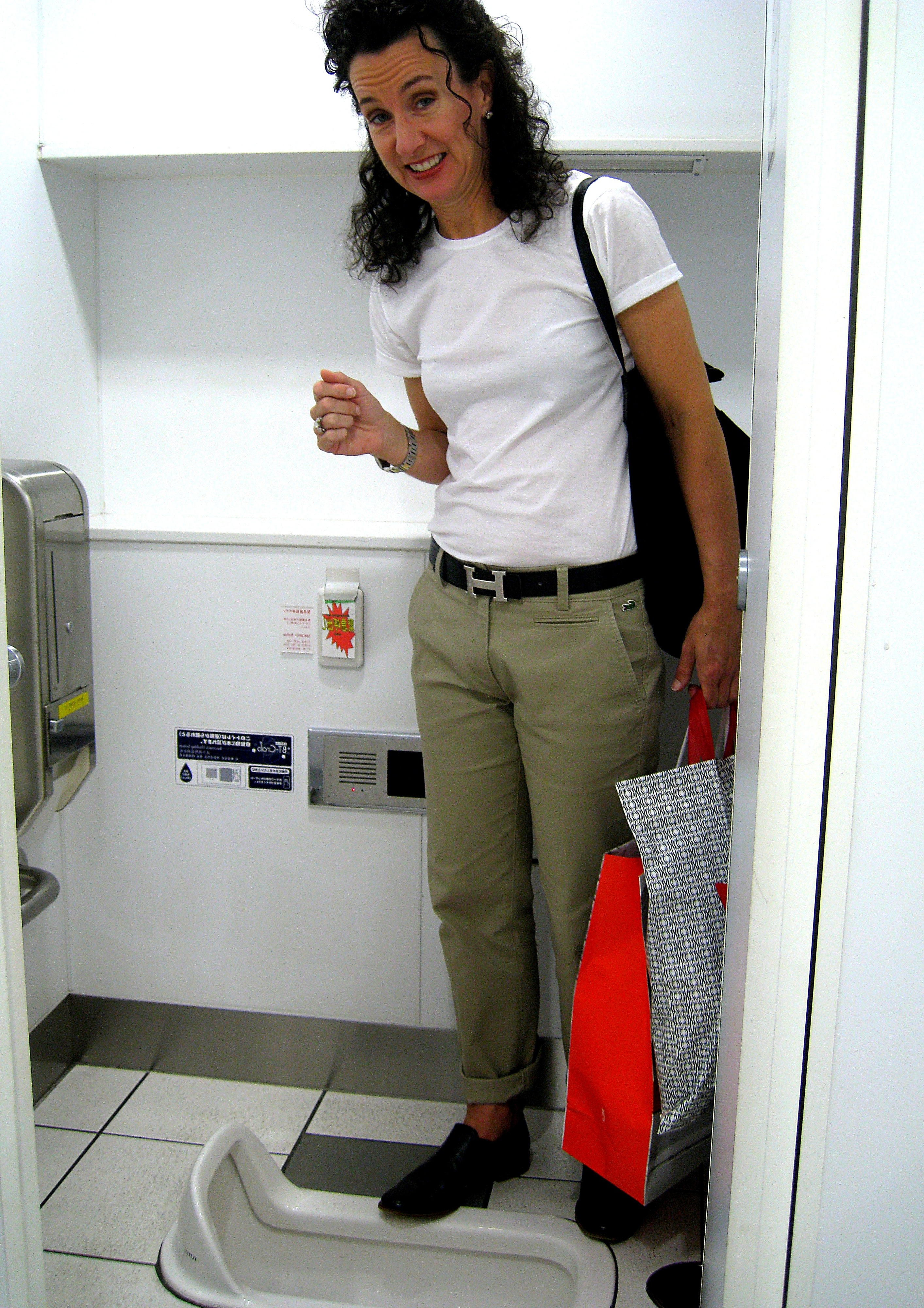
img: Emily Cannell deciding whether to put her carrier bags down and use the facilities in Tokyo’s Harajuku station.

If you enjoyed this post, we invite you to subscribe for email delivery of The Displaced Nation. That way, you won’t miss a single issue. SPECIAL OFFER: New subscribers receive a FREE copy of “A Royally Displaced Tea.”

Related posts:
CLASSIC EXPAT WRITING: Letter From London — Sōseki

So with my last entry, on James Joyce’s Paris, I was left bemoaning the term Expat Writer. Partly, I’m annoyed with myself for choosing such a term as “Classic Expat Writing” for this series of blog posts. Ultimately, who wants to read a series of posts called “Classic Expat Writing”? It assumes too much and adopts a slightly superior attitude. And, most importantly, it’s dry and not all catchy. Instead, think of this as writing by the displaced.

The reason that I opted to do this series of posts was so I could share some writing that has moved me, and present it to an audience that is likely to in some way be attuned and empathetic to its contents, either through their own personal experience or particular interests. If people then go off and look at the authors in more detail, so much the better. It’s for these reasons why I am particularly excited with this week’s example.

I have to confess that I was not familiar with the name Sōseki until I visited Japan. My knowledge of Japanese literature is embarrassingly slight and doesn’t really extend beyond Mishima and Murakami. But a few years back, when visiting Tokyo, I sought out the Kinokuniya bookstore near Shinjuku because it had a large selection of English-language books. Having a few days before visiting the Temple of the Golden Pavilion in Kyoto, I was keen to buy Mishima’s novel The Temple of the Golden Pavilion. But when left in a bookstore I can’t help but browse and one book, in particular, caught my eye: The Tower of London: Tales of Victorian London by Sōseki. At this point, I had never before heard about Sōseki Natsume (1867 – 1916), and had no idea about his place in the canon of Japanese literature. If I had been in Japan a few years earlier, it may have passed me unnoticed that the two 1,000 yen notes I would use to buy this book, in fact, featured Sōseki’s portrait.

Instead from a position of ignorance I picked up the book and was intrigued by it. It’s a collection of essays and writings that Sōseki wrote about his time in London.* In the summer of 1900, as a young, unknown professor, he traveled to London on a somewhat meagre scholarship that was provided to him by the Japanese government.  Sōseki was to spend the next two years in the city, unhappy and isolated.

Now being a miserable monoglot, I am entirely dependent upon skilled translators when it comes to foreign (well “foreign” from my perspective) literature. Obviously, I’m not in a position to comment on how accurately Damian Flanagan’s translation conveys the flavor of  Sōseki’s prose, but I did find it to be an incredible read with crisp and clean prose.

The title essay is a phenomenal piece of literature, but it is Sōseki’s Letter from London that I’m highlighting today. Sōseki conveys in a way that I’ve not seen from others that awkward, slippery sense of dislocation of being in an alien country. Even politeness takes on a faintly threatening edge.

One of the things I’ve noticed in the Expat blogging community, we seem to like it when we find writing that we can relate to, that reiterates thoughts and fears that we have had. Of course, there is a place for  that. With Expat blogging it can help develop relationships, it helps builds an audience, and there is very much a place for it. But it can also act like comfort food.

Sōseki, by contrast, has observations and thoughts about the city that I don’t think anybody other than himself could have had. And, for me, that’s what is so interesting and so worthwhile about this book.

This collection, which is published by Tuttle publishing, really should be read by more people. Go buy it and then read it, pronto.

Once outside, everyone I meet is depressingly tall. Worse, they all have unfriendly faces. If they imposed a tax on height in this country they might come up with a more economically small animal. But these are the words of one who cannot accept defeat gracefully, and, looked at impartially, one would have to say that it was they, not I, who look splendid. In any case, I feel small. An unusually small person approaches. Eureka! I think. But when we brush past one another I see he is about two inches taller than me. A strangely complexioned Tom Thumb approaches, but now I realize this is my own image reflected in a mirror. There is nothing for it but to laugh bitterly, and, naturally, when I do so, the image laughs, bitterly, too …

… Generally, people are of a pleasant disposition. Nobody would ever grab me and start insulting and abusing me. They do not take any notice of me. Being magnanimous and composed in all things is in these parts one qualification of being a gentleman. Overtly fussing over trifles like some pickpocket or staring at a person’s face with curiosity is considered vulgar … Pointing at people is the height of rudeness. Such are the customs, but of course London is also the workshop of the world, so they do not laughingly regard foreigners as curiosities. Most people are extremely busy. The ir heads seem to be so teeming with thoughts of money that they have no time to jeer at us Japanese as yellow people. (‘Yellow people’ is well chosen. We are indeed yellow. When I was in Japan I knew I was not particularly white but I regarded myself as being close to a regular human colour, but in this country I have finally realized that I am three leagues away from a human colour – a yellow person who saunters amongst the crowds going to watch plays and shows).

But sometimes there are people who surreptitiously comment on my country of origin. The other day I was standing in looking around a shop somewhere when two women approached me from behind, remarking, “least-poor Chinese”. “Least-poor” is an extraordinary adjective. In one park I heard a couple arguing whether I was a Chinaman or a Japanese. Two or three days ago I was invited out somewhere and set off in my silk hat and frock-coat only for two men who seemed like workmen to pass by saying, “A handsome Jap.” I do not know whether I should be flattered or offended.

*I’m not entirely sure what it says about me that in browsing a large selection of Japanese literature in an effort to get a better understanding of Japan, I picked up a book that is centered around impressions of London and the English.

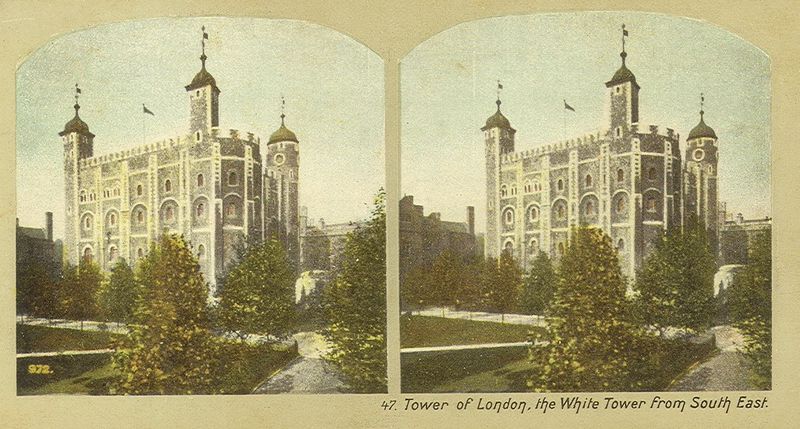
Img: White Tower, Tower of London, from the South East, c. 1890-1910, courtesy Wikimedia Commons

If you enjoyed this post, we invite you to subscribe for email delivery of The Displaced Nation. That way, you won’t miss a single issue.

Related posts:

Seven deadly dishes — global grub to die for

A Briton abroad spends a surprising amount of time defending his native national cuisine. I remember going to a steak house in Connecticut where the waitress, upon taking our order and hearing our accents, said brightly, “From England, huh? I hear you don’t get anything good to eat over there. ”  When she brought the filet mignon to the table, she did so with the pitying smile of one delivering alms to the starving.

British super-chefs like Gordon Ramsay and Jamie Oliver may be taking the US by storm, but still this delusion of bad food persists. To which I say: whatever the perceived faults of English cuisine, at least no one has to take out extra life insurance before eating Yorkshire pudding.

Yet there are quite a few delicacies from countries without this dismal food reputation, where a top-up premium might be useful before you take that first bite.

In ascending order of danger or toxicity:

7.   Snake wine – Vietnam, Southeast Asian, Southern China.
An assortment of herbs, small snakes, and a large venomous snake are steeped for many months in a glass jar of rice wine, then consumed in small shots for medicinal purposes. Fortunately, the ethanol renders snake venom harmless.

6.   Surströmming – Sweden.
Fermented  Baltic herring. Stored in cans, where the fermentation continues, causing the cans to bulge. In 2006, Air France and British Airways banned surstromming from their flights because they said the cans were potentially explosive.  According to a Japanese study, the smell of this Scandinavian rotten fish is the most putrid food smell in the world.

5.   Fried tarantula – Cambodia.
Tarantulas, tossed in MSG, sugar, and salt, are fried with garlic  until their legs are stiff and the abdomen contents less liquid. The flesh tastes a little like chicken or white fish, and the body is gooey inside. Certain breeds of tarantula have urticating hairs on their abdomen, which they use for self-defense. If the spiders are not prepared properly – i.e., if the offending hairs are not removed with a blow torch or similar – these hairs can cause pharyngeal irritation in the consumer.

4.   Sannakji – Korea.
Small, live, wriggling octopus, seasoned with sesame and sesame oil. The suction cups are still active, so bits of tentacle may stick to your throat as you swallow, especially if you’ve had one too many drinks before dinner. The trick is to chew thoroughly so no piece is big enough to take hold of your tonsils. Some veteran sannakji eaters, however, enjoy the feel of longer pieces of writhing arm and are prepared to take the risk.

3.   Stinkhead – Alaska
Heads of salmon, left to ferment in a hole in the ground for a few weeks. Traditionally, the fish was wrapped in long grasses and fermented in cool temperatures, but then someone discovered Baggies and plastic buckets, which increase the speed of the process. Unfortunately, they also increase the number of botulism cases.

2.   Casu Marzu – Sardinia
Made by introducing the eggs of the cheese fly to whole Pecorino cheese (hard cheese made from sheep’s milk) and letting the cheese ferment to a stage of terminal decomposition. Locally, the cheese is considered dangerous to eat when the maggots are dead, so you eat them live and squirming. As the larvae can jump six inches in the air, it is advisable to cover your cheese sandwich with your hand while eating to prevent being smacked in the face by grubs. An alternative is to put the cheese in a paper bag to suffocate the maggots, then eat it straight away. The maggots will jump around in the bag for a while, making a sound, I imagine, not unlike that of popcorn in the microwave. Although the European Union outlawed this food for a while, it has since been classified as a “traditional” food and therefore exempt from EU food hygiene regulations.

1.   Fugu (Puffer fish) – Japan
Considered to be the second most toxic vertebrate in the world, puffer fish is a delicacy in Japan, but preparation of the food is strictly controlled, with only specially trained chefs in licensed restaurants permitted to deal with the fish. Fugu contains tetrodotoxin, a poison about 1200 times stronger than cyanide, which is most highly concentrated in the fish’s liver —  the tastiest part. Sadly, for gourmets who like to live life on the edge, fugu liver in restaurants was banned in Japan in 1984.

Question: What is the most adventurous dish you’ve ever eaten?

For tamer foods that won’t mean a trip to the emergency room, sign up to receive our posts by email and receive your free copy of “A Royally Displaced Tea,” with recipes for Victoria Sponge, Fruit Scones, Princess Pairs, Queen of Puddings and Tiffin. All English. All good.

If you enjoyed this post, we invite you to subscribe for email delivery of The Displaced Nation. That way, you won’t miss a single issue.

How many years should an expat stay? The answer is blowin’ in the wind…

Most human beings feel disconcerted when they lose the self-validating “mirror” that tells them who they are. That’s what we hear from the relocation experts — as cited by Kate Allison in her article exploring how even people who move within the same country can have something akin to an expat experience.

But in my own experience of being displaced, first in England and then in Japan, trying to live in a country where you share a great deal — ethnically, culturally, linguistically — with the natives is easier to sustain for lengthy periods. Under those conditions, it’s possible to maintain the illusion of the mirror still being in place.

After all, quite a few Americans — comedians like Ruby Wax and Reginald D. Hunter, writers like Bill Buford and Bill Bryson — have made it in England. In Japan, by contrast, although foreigners can become talento, they will never achieve the same level of belonging.

Thus when I first learned the news that Junichi Kinoshita had won this year’s Taipei Literature Award, the first non-native writer to do so in 13 years, I thought, well, no wonder. On the face of it, Taiwan should be a relatively easy adjustment for a Japanese person.

But does Kinoshita actually feel that way? Yes and no. His first impression of the Taiwanese was how similar they looked to the Japanese, and though he found learning Mandarin a challenge, he eventually mastered it to the point where he was able to write his debut novel in Chinese, and at a level that garnered it a prestigious award.

On the other hand, life in Taiwan posed a considerable culture shock as people there tend to be much more hospitable than the Japanese. In Kinoshita’s book, the title of which can be roughly translated as Dandelion Floss, five Japanese expatriates in Taipei struggle to adjust to the local culture — and when they finally get the hang of it, must grapple with the question of when (and whether) to go home to Japan.

At the end of the novel, one of them says:

I think every expatriate is following some kind of mysterious calling from their heart. There is some predestined relationship between a person and a city. One leaves the city when the affinity ends, be it a few months or 10 years, it just happens.

Kinoshita intended his book as a swan song to his life in Taipei. After submitting it to the contest, he planned to return to Japan with his wife, who is also Japanese. Now, however, they are rethinking their next step: perhaps the prize is a signal that Kinoshita isn’t finished with the city yet? Besides, he has already decided on a theme for his next work of fiction, as well as a language: Chinese again.

If you enjoyed this post, we invite you to subscribe for email delivery of The Displaced Nation. That way, you won’t miss a single issue.

Displaced by choice, architect comes to aid of compatriots displaced by fate

The word “displaced” connotes being forcibly removed from one’s home or homeland. Fleeing from war or natural disaster, displaced people have little in common with the expats we encounter at the Displaced Nation, most of whom have voluntarily chosen a life of displacement and adventure.

Japanese architect Shigeru Ban belongs in the tradition of Japanese fashion designers and other creative people who have chosen to live outside their native land, gravitating to artistic enclaves in Paris or Manhattan.

But if Ban is displaced by choice, he does not hesitate to help his countrymen who’ve been displaced by fate. When an earthquake struck Kobe in 1995, Ban was there, building emergency housing for survivors with beer-crate foundations and walls made of recycled cardboard paper tubes. (The paper tube is a Ban speciality. He got the idea of using paper tubes after observing the solidity of rolls of fax paper and experimenting with the idea for several years.)

And now Ban is in Japan again, lending a helping hand to those made homeless by the Tōhoku earthquake and tsunami. He is building simple partitions to place between families who have been evacuated to gymnasiums and other large-roof facilities. He hopes that by enjoying more privacy, they will experience greater peace of mind.

Ban prides himself on the ability to work quickly and well when the exigency of circumstances demands it. Asked in a March 24 New York Times interview to comment on why in the wake of disaster, innovative ideas designers present for shelters never get built, he said:

We don’t need innovative ideas. We just need to build normal things that can be made easily and quickly. A house is a house.

And if you’re lucky enough to land in one of Ban’s shelters, it’s a house that brings you one step closer to having a home again.

If you enjoyed this post, we invite you to subscribe for email delivery of The Displaced Nation. That way, you won’t miss a single issue.

