The Displaced Nation

A home for international creatives

Tag Archives: Japan

TRAVEL YARN: Two madcap Indonesian ladies in weird & wonderful Japan (2/2)

Japan — the country that many Westerners have likened to Lewis Carroll’s “wonderland” for its quality of wacky unpredictability. But what about for other Asians — do they feel as displaced and disoriented there as we do? Our very first Random Nomad, Anita McKay, ventured into the Land of the Rising Sun for the first time this summer, in the company of another Indonesian, P, who had been there once before as a student. This is Part 2 of the pair’s adventures. (See also Part 1.)

After Tokyo and Kyoto, P and I headed to Kobe — with Kobe beef as our main target. We’re Indonesians, remember? Which means we’re always looking forward to our next meal.

Gluttons for gourmet food

Our hotel in Kobe had booked us a table at Mouriya, a restaurant that prides itself on serving superior quality beef from the Kobe Cow and the Tajima Cow. Mmmm…

The meat was really delicious, but not long afterwards, I was craving sushi again. Fortunately, I was able to indulge in some serious sushi eating one last time with my blogging buddy from Yokohama, whom we met on our way back up to Tokyo. She and I went out for a meal at Kyubey, a high-end sushi restaurant in the Ginza. (P couldn’t join as she actually had to work in Tokyo for her Indonesian company for the last two days of our trip.)

Kyubey, which is actually two restaurants across the street from each other, doesn’t take bookings and always has a long queue. Luckily, my friend and I were able to get a table — and, to our delight, the chef had rather fluent English.

He patiently explained to us about the fish we were eating. One particular sushi had to be held with chopsticks in a certain way and nibbled at from the side, not the front.

We told the chef that both of us weren’t too keen on tuna, as the tuna we’d tried had been chewy or smelled too fishy — so we preferred salmon instead. He smiled and then put some tuna on our plates and told us to try it. We soon realized that this might be the best thing we’d ever eaten — melted like butter in our mouths.

Our nine-course lunch, which included eel (unagi), tuna, scallop, and squid, cost only about AUD 50 (around the same in US$). I would happily go back to Kyubey again and again and again.

P, upset at being stuck in the office while my friend and I were feasting on sushi, insisted that we go to Tsukiji market on our last morning in Japan. We got to the market just after 6:00 a.m. — but by then had already missed the tuna auction.

Still, we took a good look around at all the weird and wonderful sea creatures for sale, and then decided to have a sushi assortment for breakfast. While at the sushi restaurant, I discovered that different parts of the tuna are sold at different prices. I also came to realize that tuna costs 2-3 times more than salmon. Remembering what I’d told the chef at Kyubei about salmon and tuna, I think he must have been laughing at us!

Sex (and hugs), please, we’re Japanese!

Our first night in Kobe, P and I had wandered around looking for a place to have a drink after dinner. It was only 9:00 p.m., but outside nearly every club were girls in miniskirts handing out pamphlets.

(If guys, not girls, were standing outside the clubs, it was to advertise that “go go dancing” was on offer. Hmmm…is that a euphemism?)

We passed one big place claiming to be an Arabian club (actually, the building did have a Middle Eastern look), with a big banner of three Japanese girls dressed as nurses and “A Whole New World” blasting loudly.

We passed a couple who looked as though they were in their mid-50s and had had too much fun too early. The lady was leaning against a tree and wrenching; not exactly the picture of elegance!

We decided just to go back to our hotel instead.

Later, when we joined my blogging buddy for some shopping at the Yokohama Red Brick Warehouse, we rested over coffee as she regaled us with some stories she’d collected of strange and rather lewd behavior engaged in by Japanese men.

And then, as if to illustrate her story, something rather creepy happened. Ever the snap-happy tourist, P had decided to take a parting shot of me and my blogging buddy with the Red Brick Warehouse in the background. There was a young couple doing the same thing, who turned out to be Indonesians, sent by their companies for a training session in Yokohama.

While we were busy exchanging e-mails and phone numbers, a young Japanese man popped up out of nowhere.

He shook my hand, asked my name (in English), and mumbled something I couldn’t understand. He then walked over to my blogging buddy, repeated the same series of gestures — and then hugged her. He walked over to P and did the same thing. And then it was the turn of the young Indonesian couple.

By then, all of us had realized there was something “not right” about this guy — but as he seemed harmless enough, we waited patiently until he finished hugging the last person in the group.

At that point, he walked back to my blogging buddy and hugged her again.

I laughed a little because it seemed so strange — also because I was the only one he hadn’t hugged so felt safe.

But then, to my horror, he came back to me, shook my hand again, asked my name again, and then really hugged me and wouldn’t let go.

My blogging buddy, seeing the expression on my face, started walking away as fast as she could. The rest of us followed her. I broke free and followed her as well. As we looked back at Hugger Boy, he just waved and started laughing.

Another funny, weird, horrifying tale for my blogging buddy’s collection!

Some seriously good people watching

As our time in Japan drew to a close, I entertained myself by staring at the Frank Lloyd Wright wall in Tokyo’s Imperial Hotel, spying on a wedding procession at Meiji Shrine — and, best of all, people watching.

As I was sitting on the subway, I noticed two very pretty girls sitting right in front of me. Their hair was almost light brown (a favorite color in Japan), very long and slightly wavy (favorite style in Japan). They also wore fake eyelashes, but there was something about them that made me keep staring at them. After a few minutes I realized that their eyeballs were unusually large, more like dolls than human.

Later I consulted with Google and found that Japanese girls sometimes wear special contact lens that do make their irises look bigger. Odd…

More odd stuff: both P and I had been wondering why so many young Japanese men carry bags just like us girls. There was one guy in the subway who carried a black Dior tote bag. And if that wasn’t weird enough, I saw a guy carrying a brown city messenger bag by Balenciaga. (Google the bag and your jaw will drop, just as mine did.) Oh, and there was also a man with matching red tote bag and shoes in Bvlgari’s Il Café in Omotesandō, where P and I stopped for martinis.

Still, I did enjoy watching that particular man, who was accompanied by his two pooches. One dog kept begging from the cute girl at the next table, while the other kept demanding food from him.

Meow — or should it be nyan?!

Actually, I’m more of a cat person — so before we flew home I wanted to visit the Calico Cat Café in Shinjuku, where people can enjoy coffee or tea in the company of real cats. P still had to work so I went by myself. I didn’t even get lost!

The café has two floors and charges the guest by the first hour, then per 15 minutes. I saw a wide variety of cat breeds: Maine Coon, Abyssinian, Ragdoll, Persian, Scottish Fold, and so on. No Sphinx, though.

The café has strict rules about entering the cat area: you have to change your shoes to slippers, clean your hands with disinfectant, and not take any photos with a flash.

All of the cats seemed rather spoiled. They refused to be petted unless you gave them a snack first. A Scottish Fold named Apollo apparently thought he was the cashier, so he sat at the cashier counter, looking at us lazily.

One hour passed by so quickly that I wished I could spend at least another day in Tokyo! P, meanwhile, wished she didn’t have to work so she could experience the cat café as well.

A fond sayonara

We spent our last minutes at the airport buying Tokyo bananas and green-tea Kit Kats for friends and family back home. I was pondering about buying sake, but then all of a sudden, it was time for boarding!

P is determined to go back again, and I, too would love to go back. But as the seat belt sign went off, we looked at the world map spread in our screen, and started day-dreaming about our next adventure…

* * *

Readers, any questions or comments for Anita? Where do you think she’ll go next?!

Anita McKay is a property consultant, travel junkie, cat lover, food enthusiast. She resides in Perth with her Scottish husband but is still searching for a place called home. To learn more about her, check out her blog, Finally Woken, and/or follow her on Twitter: @finallywoken.

STAY TUNED for tomorrow’s review of an expat memoir of a cross-cultural elopement.

If you enjoyed this post, we invite you to register for The Displaced Dispatch, a round up of weekly posts from The Displaced Nation, with seasonal recipes, book giveaways and other extras. Register for The Displaced Dispatch by clicking here!

Related posts:

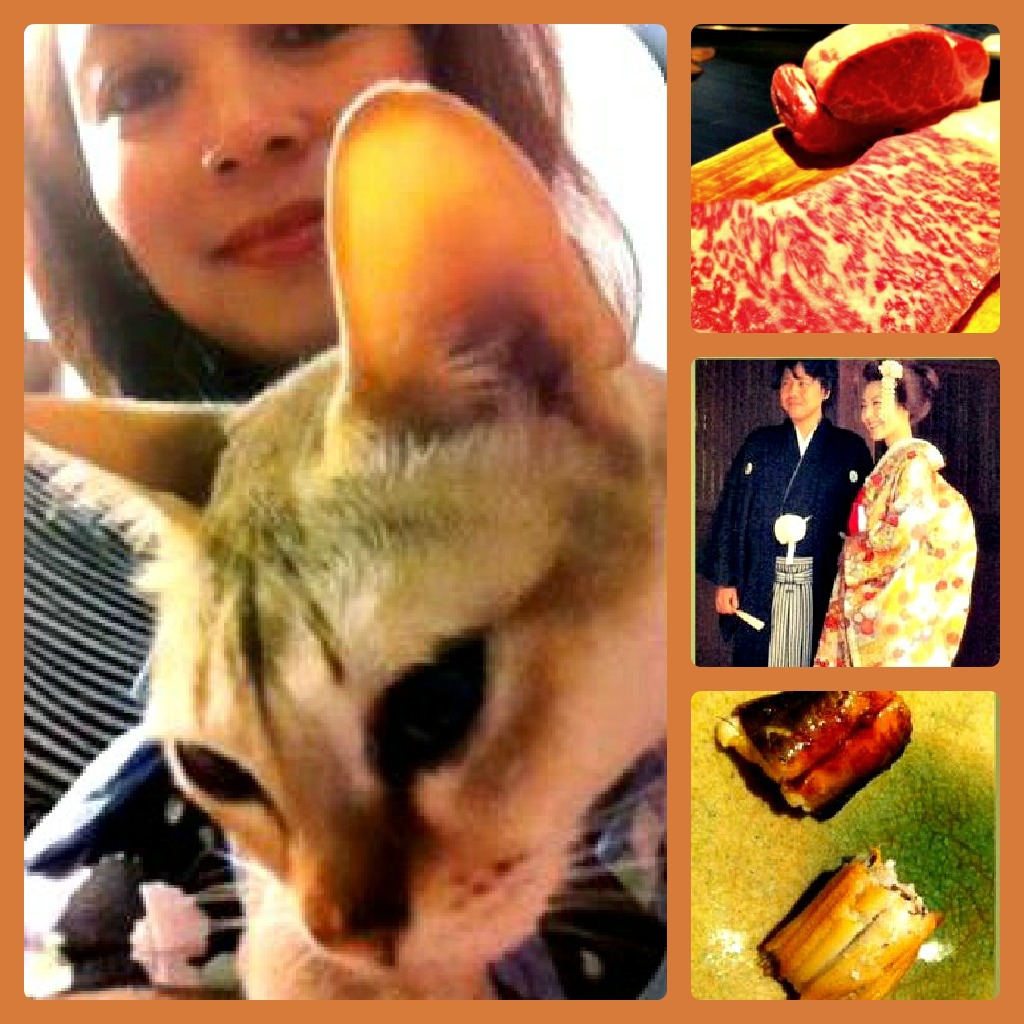
Images (clockwise): Anita McKay making a feline friend in Café Calico in Shinjuku, Tokyo; the marble-ous Kobe beef; the bride and groom at a Japanese wedding at the Meiji Shrine; and Kyubey sushi (all from Anita McKay’s extensive collection).

EXPAT MOMENTS: A Question of Sport

As this summer, for me at least, has been a summer of sport, I thought I would continue this Expat Moments series with a post I originally put in 2010 on my own blog Culturally Discombobulated. They are thoughts I had while watching a San Francisco giants baseball game. That season the giants would go on to win the World Series, and the fans celebrating outside my apartment elicited a sound like that of a dying whale.


I’m in AT&T Park, San Francisco. It’s the top of the 4th innings and the San Francisco Giants trail the Arizona Diaomondbacks 6 – 1. It is little surprise therefore that the atmosphere in the stadium is tetchy. The main object of the crowd’s impatience is the Giant’s pitcher Barry Zito who to use a British expression is “having a ‘mare.” Even to me – a man who could write everything he knows about the art of pitching on the back of a postage stamp – it is apparent that Zito is a player struggling with confidence and that’s affecting his ability to settle into a rhythm. Within minutes of the game starting he had allowed Arizona to wrest the initiative. That disaster of a first innings would see Arizona score 6 quick runs – now they’re hoping to add more. Zito is in trouble again as he preps himself to pitch at Reynolds. Young has already walked and LaRoche hit a single. There’s an unpleasant air of expectancy in the ground as Zito pulls his left arm back readying himself to throw. It doesn’t feel as if the crowd expect much from this pitch – at least not heroics from Zito. There’s a palpable feeling of a crowd readying itself for disappointment, a collective anxiety over the failure they anticipate. Crack!! It’s a sweet hit from Reynolds. The crowd groans in anguish. Jesus, they knew it, they just knew it was going to happen. As the groan turns into boos, Young, LaRoche and Reynolds pass home plate. Arizona Diamondbacks 9 – San Francisco Giants 1.

A few minutes later and Zito is “relieved”, to use a baseball term, by Ramirez, another of the Giants’ pitchers. Relieved: to free from anxiety, fear, pain – that sounds about right. Zito trudges off the field disappointed. Some of the crowd feel the need to make their feelings known. “You suck, Zito!!” Despite the anger of those shouting, as someone used to English soccer fans, the language the baseball fans employ is clean – unimaginative even. For me, I am disappointed that Zito is off. He is one of the few players I’d bothered to read about before the game and was vital in my attempt to try and pass as being vaguely knowledgable about the Giants. I feel disconnected from the rest of the crowd; alone in the communal. Various things have confused me. I don’t get why the National Anthem was performed by a guitarist who looks Will Ferrell done up as a generic rock star for an SNL sketch. I don’t get why the Giants came out to Radiohead’s Idoteque; surely the oddest choice of song to get 30,000 people pumped up? And then there’s the game itself, following it takes effort. Though I think of myself as a sports fan, this game is not my sporting heritage and mythology. I am having to start from scratch, learning new rules and new idols. Though some aspects of the game are familiar, for me it is still the Other, it is still foreign. I feel like a Christian pilgrim worshipping in a mosque. This feeling is made worse (or better) by the opportunity for contemplation and reflection that the game allows. It is in that respect that I find baseball most like cricket – quick bursts of action punctuated by long periods of anticipation, the moments where it pleases me to sit and think.

And as I think, I’m reminded of an old teacher of mine. He was American, first-generation. Possessing both an Ivy League and Oxbridge education he was smart, but not overbearing about it, and though now mature in his years he had the height and broad shoulders of a man who back in college must have made for a hell of a footballer. To my mind, he was like a character out of a Philip Roth novel. And here at AT&T Park, I am reminded of a conversation I once had with him, a conversation that hadn’t really registered much with me at the time, but now a few years later is striking a chord. Like so many American stories, it centres around a child’s grievances against their father. In this case, my teacher told me about how he had unfairly resented his immigrant father for not understanding or enjoying the same sports as he did. Unlike his friends’ fathers, his didn’t play catch with him in the backyard or explain the rules of baseball or football. When it came to sport they spoke different languages: the son spoke in the vernacular of the New World, of Red Sox and Yankees, of touchdowns and home runs; the accented father could only speak of the weird and unknown – of Dynamos and Red Stars. And so my teacher, as a boy, would observe his friends and their fathers and how they bonded over sport. Fathers teaching sons how best to catch, how best to bat. When they did this, they would mention how the Babe gripped the bat, how DiMaggio hit the ball, without knowing it they were passing down an ocular history of American sport, a sense of identity ever bit as important as tales of Washington or Lincoln. To my teacher’s young self, his father was failing in the very purpose a father was meant for. He wasn’t giving him this rites of passage that all the other fathers were giving their sons. Heck, if a father can’t show you how to throw a curveball, just what use is he? Today, I feel like that father.

For me, dealing with sport in America is like having a whole idiom and vocabulary removed; I feel emasculated even. All those useless little facts and figures that I know about sport are useless here. No one knows of Dixie Dean or has an opinion on the relative merits of the Duke ball against the Kookaburra ball. Where once I was confident with the sports round in a pub quiz or in a game of trivia pursuit, it’s now my weakest subject and to be avoided at all costs. When a discussion turns to Roger Clemens or Brett Favre I have to Wikipedia them to remind myself just who they are and what sport they play. I try to learn a few facts so I have something that I can at least talk about. For this Giants game, by rote I have learnt the following: that the Giants were until 1957 the New York Giants after which they oved to San Francisco; that since leaving New York they have failed to add to their tally of five World Series; that game 3 of the 1989 World Series against local rivals Oakland Athletics was disrupted by the Loma Prieta earthquake; that Giants pitcher Barry Zito has a teddy bear collection and is the nephew of Dallas actor Patrick Duffy. But they’re just random facts that I have learnt, it’s not as if I have an opinion about any of these sports. And if you don’t have dumb sports opinions then it is difficult to connect with 90% of American males. What noticeable about my time here is that I’ve found that I don’t get along with American men as much as American women. Put a group of men together and talk quickly descends into discussing the minutiae of sport. When that happens I find I have little to say and so for the most part keep quiet.

I am going to try and change that. I often feel that I’m only in America when I step out of my apartment. Thanks to the web, my apartment remains de facto British soil where I can still listen to British radio, read the British papers and watch British sport. By that token, I remember coming across a photograph of Kim Philby; it had been taken late in his life when he was exiled in Moscow. Behind him, you could clearly see a bookshelf, and on the shelf where fat, yellow volumes of Wisden – the cricket lovers bible. That image has stuck with me. Though Philby had defected to the USSR and had betrayed his country, he still couldn’t escape the trappings of his Britishness – nor I guess did he have any intention of. I imagine Philby struggling to explain to his KGB handlers about just how important Test cricket is and resenting them for their indifference. And I’m guilty of that too, isolating myself culutrally from those around me. I need to make a concerted effort to change that and understand American sports better. With the baseball season getting to its interesting stage and the football season about to start, it seems an opportune time to make a greater effort to learn this new (for me) language though I will still, from time to time, talk of Dynamos and Red Stars.

STAY TUNED for Monday’s post where Kate will be reviewing a chocolate app.

If you enjoyed this post, we invite you to register for The Displaced Dispatch, a round up of weekly posts from The Displaced Nation, with seasonal recipes, book giveaways and other extras. Register for The Displaced Dispatch by clicking here!

Related posts:

Images: by Anthony Windram.

Lessons from Two Small Islands — 4) Keep Calm and Focus on Your Core

Keep calm and focus on your core — it sounds as though I’m about to lead a Pilates class!

Is that what life on two small islands taught me — the value of doing daily sit-ups and push-ups?

Hardly. I wasn’t into exercise routines in either England or Japan, the two small islands where I lived for almost as long as I’d (consciously) lived in my birth country, the United States.

It was only after repatriating that I ventured into my first Pilates class — and ended up cursing Joseph Pilates for developing, in essence, a set of military exercises for civilians. Hup two! Hup two!

I asked around at the class but no one seemed to have a clue who the founder of this torture had been. I did some investigation and discovered, somewhat to my surprise, that Mr Pilates had led a displaced life not dissimilar from mine.* He was descended from a family of Greeks who’d emigrated to Germany — German kids would taunt him for being “Christ’s killer” because they thought “Pilates” sounded like “Pontius Pilate.” Still, he had something going for him: an athletic physique. His father having been a prize-winning gymnast, Pilates Junior was a gymnast, a diver and a body-builder. He moved to England in 1912 to earn a living as a professional boxer and circus performer. Eventually, he would emigrate to the United States, where he set up his first exercise studio for professional dancers and other performers, offering them a routine that focused on core postural muscles.

What impressed me the most about Mr Pilates’s life, though, was that at his most displaced moment, his instinct was to think about his core. That moment occurred few years after he arrived in England. World War I broke out, and because of being German, he was rounded up and sent to an internment camp on the Isle of Wight. In great physical condition himself, he wanted to help the other prisoners, who included some wounded German soldiers, stay in shape, too. He thoughht it would lift their spirits. The exercises he developed for them, for strengthening the core, were the precursors of what we now call the Pilates routine. (See, I wasn’t so far from the mark: military exercises for civilians!)

No core, no cry

I thought about my core a lot, too, when leading my life of displacement first in England and then in another shimaguni (island country), Japan.

To begin with, I was convinced that it was my very lack of a cultural core that enabled me to live in other cultures for as long as I did. What does it mean to be an American from Delaware, of all places? I didn’t have any clear cultural identity — yet it didn’t really bother me. It meant I could go with the flow.

I still remember my first job in Tokyo, which involved working as an editor in the research department of a British stockbrokers that had been taken over by a major Swiss bank.

Being a displaced person myself after several years of living in the UK, I looked forward to working in what I thought would be a mini-UN: Brits, Swiss and Japanese.

It did not take long to disabuse me of that fantasy. The Brits and the Swiss were always clashing, and the Japanese kept themselves to themselves (they probably wished they’d never allowed foreign bankers into their country!).

There were three or four of us Yanks in the department, and we tended to be the ones who tried to be pleasant to everyone else and didn’t bear grudges. A couple of us (not including me) were great speakers of Japanese so were often called on to facilitate when “war” broke out.

“Why can’t we all get along?” was our motto. “Go with the flow.”

But that was then…

By the time I got back to the United States, however, I envied the residents of the two island nations where I’d lived for knowing what they were about — for having such a strong sense of core, or self. Which, when you think about it, is no easy feat in the face of globalization!

Not only did I envy them, but I was grateful for the bits of each nation’s core that I’d picked up on my travels. These are the principles I keep going back to in times of stress, particularly when I’m struggling to readjust to life in my native U.S. — which is what this series is about.

Indeed, if it weren’t for those core pieces I’ve borrowed from other countries, I think I’d now feel like the tin man wishing for a heart, the scarecrow wondering what it would be like to have a brain, the lion yearning for courage… (Boy, did L. Frank Baum ever understand his native country!)

England would not be England without…

A couple of months ago, a group of Britophiles and Brits were debating the essence of Britishness on our site. They were responding to a list created by the gardening journalist Alan Titchmarsh (could there be any more British name than that?) beginning with “England would not be England without…”

Some were disputing the items on the list as being hopelessly out of date and romanticized — Miss Marple, daisies in the lawn, and cucumber sandwiches without crusts. Come on, what century is he living in?

Meanwhile, the author of the post, Kate Allison, maintained that Britain had become more like a mini-US in recent years.

But I didn’t agree with any of that. After spending so many years in the UK, I am ALWAYS overjoyed when encountering someone else who “gets” the part of me that’s anglicized. It means they share my need to discuss politics over a beer, my love of creamy desserts, my preference for baths not showers, my excitement at seeing fresh rhubarb and gooseberries at the green market, or my passion for public transport and national healthcare.

Now if I, a quasi-Brit, feel this way, how much more so must the true natives feel?

Japan would not be Japan without…

Likewise in Japan — or perhaps even more so, as that nation adopted a policy of isolating itself from the outside world, which lasted over two centuries. Plenty of time to develop a core of Japanese-ness.

Again, I am not a true Japanese — but I was the only foreigner in a Japanese office for four years, when I was more or less adopted by the group and taught their code of ethics. I used to joke with my colleagues and say, “I’m a bad Japanese,” as they often had to nudge me about some protocol I’d forgotten.

Still, they trained me well. To this day, I can rattle off a long list of what it means to be Japanese. Surely, Japan would not be Japan without sakura (cherry blossoms) set lunches, soba, slurping soba, sushi, sashimi, shiatsu, shinkansen, and sumo? And that’s just the “s”es. Japanese traits run the gamut from A (amae) to Z (“Zen”).

Even tonight, when I was walking down 9th Street in the East Village and heard the sound of obon music in front of one of the Japanese restaurants, I longed to hear the beat of taiko and join in a traditional dance… Now that’s at the very core of Japanese culture — and I happily went there, still would!

America would not be America without…

What is the American core? Despite Joseph Pilates’s efforts, I don’t see much of one. Here is my attempt to brainstorm a list.

America would not be America without:

  • wide highways chockerblock with traffic (at least here on the East Coast, where it’s one person, one car)
  • gas-guzzling cars
  • poor people using the Emergency Room for their health care
  • shooting sprees every so often by young men who are too easily able to buy guns
  • racial incidents/slurs (even against the president — we still seem to be fighting the civil war)
  • rudeness and the blame game (there’s so much rage here!)
  • supersized food portions
  • junk food of all kinds
  • children with obesity/diabetes
  • mindless popular culture as represented by Kate Perry, Lindsay Lohan, Britney Spears…
  • gridlocked politics and a Supreme Court with a political agenda
  • men in power who think they know what’s best for women
  • men in power who act like cowboys
  • religious nuts who home-school their kids so that they won’t learn evolution

Of course I know there are good things about being American — such as the freedom and openness we represent to oppressed people, our generosity in helping strangers, our inventiveness, our can-do attitude (not for us “ten reasons why not” as it was for many of the people in both of my small-island homes), Hollywood, jazz, and of course the old stand-bys of baseball and apple pie — can we also throw in some Sonoma Valley wine?!

But several of these positive aspects were breaking down when I left this country to live abroad, and now the situation seems so much worse! Indeed, our much-vaunted openness to outsiders seems to be in question now that so many states are threatening to send hard-working  immigrants back to their countries. (Strange, given that such immigrants are among the few left who carry some core-building potential…)

Why don’t we have a proper core, on which we continue to build an identity? Is it because we are too big or too new? Size probably has a lot to do with it — and the fact that we are divided into states.

Several cities/states/regions have stronger cores — I’m thinking of New York, Vermont, Texas, Silicon Valley, the Deep South — than the nation as a whole.

But our national core seems to be as hallow as the European Union’s is proving to be.

Newness, too, could be the reason our core is underdeveloped. Both England and Japan have lived through hard times, which have given their people a sense of who they are. Thus far our hard times — e.g., 9/11 — bring us together only for a brief respite, after which we are more divided than ever.

Readers, please tell me that I’m wrong — that America has a sound core, but I just haven’t seen it?

Next time I do Pilates, I’m going to breathe in thought the nose, out through the mouth, so that I can keep calm, and focus not only on strengthening my own core, but on what we citizens can do to strengthen that of our native land…
* I herewith nominate Joseph Pilates for the Displaced Nation’s Displaced Hall of Fame!

STAY TUNED for Thursday’s post, another in our “Expat Moments” series, by Anthony Windram.

If you enjoyed this post, we invite you to register for The Displaced Dispatch, a round up of weekly posts from The Displaced Nation, with seasonal recipes, book giveaways and other extras. Register for The Displaced Dispatch by clicking here!

Related posts:


TRAVEL YARN: Two madcap Indonesian ladies in weird & wonderful Japan (1/2)

Japan — the country that many Westerners have likened to Lewis Carroll’s “wonderland” for its quality of wacky unpredictability. But what about for other Asians — do they feel as displaced and disoriented there as we do? Our very first Random Nomad, Anita McKay, ventured into the Land of the Rising Sun for the first time this summer, in the company of another Indonesian, P, who had been there once before as a student. McKay reports on the pair’s adventures in this two-part travel yarn.

The message exchange between my travel buddy, P, and me, in May, went like this:

Me: “So have we decided where we want to go this July?”

P: “How about Japan?

Me: “Okay.”

P had lived in Japan decades ago for a student exchange program. She hadn’t been back since, and thought this year would be a good time.

I, on the other hand, didn’t really have any specific destination in mind — just so long as I could go somewhere I hadn’t been to. As I explained in my interview with the Displaced Nation, although I am from Indonesia originally, I have lived for extended periods in Aberdeen, Scotland, and in Australia. But I still hadn’t made it to Japan.

P suggested Tokyo, Kyoto, and Kobe. I added Yokohama to the list because there’s a blog buddy I wanted to meet up with. She and I had been trying to catch up forever and everywhere — UK, Singapore, and Indonesia — but kept missing each other. If I went to Yokohoma, where she is now based, surely we would finally get together?

I prepared myself for the trip by scanning some pages in Trip Advisor and the Lonely Planet guidebook. At least I would have an idea of what to do and where to go — and wouldn’t be entirely dependent on P, who speaks and reads Japanese and has lived there before so presumably knew how to get around.

Madcap traveler’s motto: Be unprepared!

When we landed at Narita Airport, I suggested that we take a taxi because it was 9:00 a.m., and I had taken the notion of a red-eye quite literally — my eyes looked red as I was still recovering from flu. I desperately wanted to have a quick nap before exploring the city.

We crossed the road, dragging our gigantic suitcases with us, and I let P speak with the men at the taxi rank. When she showed them the address of the hotel, one guy frowned and looked at us. “Tokyo?” he asked in disbelief.

We nodded eagerly. The drivers exchanged glances and apparently decided we weren’t crazy. One of them spoke in Japanese to P, who translated: “It’s 23,000 yen.”

I did a quick calculation, and almost fainted when I found out it will cost us almost 300 AUD [around the same in US$] for a taxi to our hotel.

“300 bucks??” I asked P. She nodded calmly, but her eyes couldn’t lie. She was just as shocked as I was.

“No! Cancel!” I shook my head furiously, while P apologized to the drivers. The men just laughed and pointed us back to the airport. “Take the train instead,” I think they said. “Like normal people.” Maybe they said that, too!!

Now we know why there was no one queuing for a taxi, whereas there was a long queue at the train ticket window. And we thought we were being smart!

Everyone had warned us that Japan — Tokyo in particular — is “very expensive!” The city ranks number 1 in the list of the most expensive cities in the world, while Perth, where I now live, is number 19. But really, if the taxi would cost us almost 300 bucks, what kinds of prices could we expect to find in Tokyo?

P had no memory of taxis from the airport. Years ago when she landed in Tokyo, she was picked up by a shuttle bus.

She’d also paid no attention to the length of the journey — she’d been too busy meeting and getting to know the other students. Both of us were surprised when it took almost an hour for the Narita Express to reach Tokyo Station. P had assumed it would be like Jakarta airport to the city centre (just because), and I must have skipped that page in the guidebook…

Well, at least we now knew why it was so expensive to take a taxi: the distance is more like Heathrow to London.

We just kept laughing at our silliness.

It’s food?!?!?

By the time we’d reached our hotel in Chiyoda, a quiet area near the Imperial Palace, we were both rather hungry and decided food would come first on the agenda, before tackling the first sight on our list: Sensō-ji, Tokyo’s oldest temple, in Asakusa.

Food is important to us Indonesians. We eat all the time. In Japan for the first time, I wanted to try something new: not sushi, yakiniku, donburri (rice bowl), soba, or ramen.

“Let’s try this!” I excitedly pointed at one restaurant name in the guidebook. “It’s in Asakusa and it looks…exotic enough.”

P agreed, and under the glare of the July sun we made our way to a restaurant called Komagata Dojo, only to be greeted by the sight of a rather long queue. If there is a queue, then the food must be good, we assured each other. Plus it seems as though most of the people in the queue are locals, so the taste must be authentic.

As it turned out, the restaurant is in its sixth generation of owners, and is famous for its dojo: a tiny freshwater fish like an eel or sardine, cooked in a cast iron pot.

We ordered what seemed to be everyone’s favorite, dojo nabe (hot pot), and also asked for two bowls of rice.

The waitress lit the charcoal burner in front of us, set the pot down on top of it, and told us to sprinkle the spring onions, or negi, on top of the fish.

We looked at each other after the first gulp.

“What do you think?” I asked P.

“What do you think?” she replied back.

“Well…it’s…all right. Weird.”

She nodded. “The rice is very good though.”

I can’t describe the taste. It’s rather bland for my liking, as I grew up in Indonesia, which is famous for its spicy dishes. Not just hot spicy, but lots of flavors in every dish. But dojo nabe isn’t tasteless either. Lots of soft flavors, like soy and spring onions.

When we were about to finish our lunch, I asked P how come Japanese people look so slim if, like the rest of us Asians, they enjoy eating all the time. We were thinking that their diet of raw seafood might be the answer.

“But this isn’t raw,” I pointed at the dojo. “It’s cooked. Plus the size of the rice is rather big.”

We looked around at the other patrons — and, to our horror, we were the only ones who’d seemed to have ordered a bowl of rice each! The rest of the customers were adding the spring onions to their fish but had no rice bowls.

“That’s the only thing they eat for lunch!” I hissed to P. “Spring onions and tiny fish! No wonder they’re slim!”

“No wonder the waiter asked if we wanted one or two bowls of rice,” P admitted when we were at the cashier. “I thought it was because of my rusty Japanese, but now I know because she didn’t believe two small girls can eat that much!”

Hanging our heads in shame, we slipped out of the restaurant and determined we would burn away the calories by walking to Sensō-ji temple. The temple, however, was only a few minutes’ walk away. Still, we had fun taking photos of ourselves under the gigantic red lantern at the temple gate, and looking at the stalls lining the 200-metre-long Nakamise-dōri, the street approaching the temple — selling every manner of Japanese trinket and souvenir, including yukata robes (cotton kimono), tenugui (hand towel, often used as a headband), furoshiki (rectangular cloth for gift wrapping) and folding fans. There were also local snacks for sale, of a kind I’d never seen before in my life, in every shape and color possible, in beautiful packaging.

Kyoto and the Indonesian connection

After two days in Tokyo, we took the shinkansen to Kyoto and stayed in a ryokan — a traditional Japanese guesthouse where you sleep on tatami mats. Being shoppers at heart (another trait of Indonesian tourists!), we were pleased to see that the ryokan was just two minutes away from Nishiki Market, which we saved for our last day.

At first I was skeptical. How “weird and wonderful” can the Nishiki market wares be? I’m an Asian, I’ve seen lots of weird and wonderful things, I don’t think that the Japanese can produce anything that would shock me. Well, I was wrong. From pickled eggplants to live turtles, from grilled sea-eels to rakugan (tea-ceremony sweets) shaped as sushi — every single stall was full of wonders that had me alternatively oohing and ahing, or eek-ing and yuck-ing (along with a few WOWs and OMGs).

But I’m getting ahead of myself. We ended up having a better experience in Kyoto because of making an Indonesian connection on our very first day. After encountering the tail end of the Gion Matsuri, one of Japan’s most famous festivals, named for Kyoto’s Gion district, we stopped in one of the shops in Gion, where the owner happily chatted with us in English. He knew about Indonesia’s first president (I guess because the third of Soekarno’s nine wives was a Japanese woman), and explained to me that the stuff I was buying wasn’t candy but rakugan, made of sugar and starchy powder and often served in Japanese tea ceremony to offset the bitterness of the green tea.

Arranged in a pretty box, the rakugan have the most beautiful soft colors, from baby pink to green. Each was in a floral shape, with delicate carvings on the surface — yet each was only as big as my smallest fingernail. How they could make such detailed coverings in such a small space, I had no idea.

We told the shop owner we were hoping to eat a good soba for dinner. He said to go straight ahead until we reached the kabuki theatre. Next door to that theatre is a famous soba place called Matsuba, he said.

We found the place easily (thanks to P’s ability to read the restaurant sign!), and had fantastic soba with smoked herring.

Our luck didn’t stop there. The next day, after wandering around Kiyomizu-dera, a famously beautiful temple in Eastern Kyoto, and spending a fortune buying souvenirs, cookies and ice cream from virtually every shop along the temple street, we made a quick stop at a proper store to buy sunglasses for P. One of the staff turned out to be an Indonesian. He recommended a bar not far from our hotel for a drink, where the owners are Japanese sisters but can speak Indonesian. Thanks to this advice, we ended up spending our last night in Kyoto befriending a set of Indonesian-speaking Japanese twins.

IT’S FOOD!!!

I queried the twins about where to have lunch on our last morning. They booked us into Gion Nishikawa — 2 stars in the Japanese Michelin Guide and the first restaurant in Japan that made me appreciate how wonderful Japanese food can be. The eight-course, kaiseki-style lunch cost only around 70 AUD and was served directly by the cute chef (whom P rather fancied!) from across the counter. No other Japanese food I’d had before in my life could compare to this.

The chef would tell us (in Japanese, of course) what type of dish he was putting on our plates, and which food goes with which sauce. By the fourth course, which featured three types of fish, even we were starting to feel rather full, and P decided not to finish it — she wanted to save some space for course No. 8. When the chef cleared her dish, he saw that there was still some fish left, put it back in front of her and told her to finish it! I assumed he did that because it was such a costly delicacy.

Meanwhile, I was amazed that one of the fish in the bowl was koi (carp or goldfish) — yes, koi, what people normally keep as a pet! I looked at the chef in disbelief and he only laughed at me and said (as translated by P) that of course they eat koi.

Hahaha — I still felt as though I was eating my own cat…

By the eighth course both P and I swore we wouldn’t eat again until tomorrow. Famous last words! 🙂 We’re Indonesians, remember?

* * *

Readers, do you have any questions or comments for Anita? Stay tuned for the second part of her travel yarn, when the madcap duo move on to Kobe and Yokohama, and then back to Tokyo, to be posted within the next two weeks.

Anita McKay is a property consultant, travel junkie, cat lover, food enthusiast. She resides in Perth with her Scottish husband but is still searching for a place called home. To learn more about her, check out her blog, Finally Woken, and/or follow her on Twitter: @finallywoken.

STAY TUNED for tomorrow’s interview with a hilariously funny British expat author.

If you enjoyed this post, we invite you to register for The Displaced Dispatch, a round up of weekly posts from The Displaced Nation, with seasonal recipes, book giveaways and other extras. Register for The Displaced Dispatch by clicking here!

Related posts:

Images (clockwise from top left): Japanese trinkets for sale at the famed Nakamise-dori in Asakusa, Tokyo; Anita McKay deciding that dojo nabe may be an acquired taste (at a famous Tokyo restaurant); one of the many fabulous lunch courses at Gion Nishikawa in Kyoto; one half of the dynamic duo (A) outside of the JR Station in Kyoto; the other half of the dynamic duo (P) at Nishiki Tenmangu Shrine, just outside Nishiki Market, Kyoto. All photos from Anita McKay’s personal collection.
RANDOM NOMAD: Brian MacDuckston, American Expat in Tokyo & Expert Ramen Slurper

Place of birth: San Francisco, California USA
Passport: USA
Overseas history: Japan (Saitama, Hiroshima, Tokyo): 2006 – present.
Occupation: Food consultant and freelance English teacher (available for high school classes, after-school programs, private lessons, children’s events…)
Cyberspace coordinates: Ramen Adventures (blog); @macduckston (Twitter handle); and Ramen Adventures (Facebook).

What made you leave your homeland in the first place?
Around 2004 I took a colloquial Mandarin Chinese class, hoping to learn a bit to help with the massive amounts of Kung Fu movies I was into at the time — I soon learned that Cantonese, not Mandarin, is used in these flicks. One of my classmates was going to China for a year to teach English. I did some Internet searching and decided I really wanted to check this out. I was stressed with my computer job, and a year abroad seemed like a good idea. Opportunities abound in China, Korea, and Japan. Japan just seemed like a good choice to me.

You’ve now lived in Japan for more than five years. Tell me about the moment when you felt the most displaced.
My first day of work in Saitama, I somehow managed to get on an empty train that had reached its last stop. A minute later and I was in the depot storage yard with an attendant yelling at me in a language I didn’t understand. I was late to my very first English lesson. I wanted to quit right away. Things got better, obviously.

Is there any particular moment or moments that stand out as your least displaced?
Whenever I’m on the road here in Japan. I ride a motorcycle — very few foreigners do that. Something about being able to navigate across mountain ranges on poorly marked roads fills me with a great sense of accomplishment.

Hmmm…are you sure it’s safe? And now you may bring one curiosity you’ve collected from your adopted country into The Displaced Nation. What’s in your suitcase?
A curiosity? I am actually quite a minimalist, collecting only photos. My Nikon camera is technically a Japanese thing. I guess I would choose that. Or perhaps I should consider bringing a few of my Japanese cooking knives. Beautifully crafted and razor sharp, they are amazing things.

Ah, cooking! I’m glad you mentioned that. You are invited to prepare one meal based on your travels for other members of The Displaced Nation. What’s on your menu?

Ramen of course! Let’s go ahead and serve it after the drinks. After many drinks. Ramen is one of the best hangover prevention foods. All that fat and all those carbs do wonders for the next morning.

And now you may add a word or expression from the country you live in to The Displaced Nation argot. What will you loan us?
Umai is a great food word in Japanese. Most people first learn oishii to mean delicious, but umai is a bit stronger, a bit more cool. It’s mostly a guy word, though. I hope that’s okay with the female occupants of the Displaced Nation?

Perfectly okay! This summer, thanks to the London Olympics, all of us Displaced Nation residents, whether male or female, have become obsessed with displays of machismo and strength. In fact, this may be a good time to bring up your hobby of eating ramen in as many Tokyo venues as possible. How did you get launched in such a curious culinary sport — and become so accomplished that you and your blog were featured in the Travel section of the New York Times?
After living in Hiroshima for a bit, I knew that I needed to live in the big city.  So I finished my contract, signed up for unemployment insurance, and moved to Tokyo. Suddenly I found myself with a massive amount of time on my hands — and not a lot of money in my pockets. I decided to wait in the ridiculously long ramen shop line that I had seen many times across the street from a massive bookstore in Ikebukuro, one of Tokyo’s multiple city centers.

I was shocked how good it was. Completely worth the hour wait outside in the cold. A bit of research later, and I had a list of the 30 best shops in Tokyo…a nice place to start.

Thirty shops sounds rather daunting, particularly if each one involves standing in line for hours! What keeps you going, and do you still like ramen after the upteempth bowl of it?
What keeps me going? A job that doesn’t pay much! In fact, it’s the kind of random fun that comes with this obsession that keeps me going. When I can somehow influence someone to have the best bowl of ramen they have ever had, I feel like it is worth it.

Would you say that you’ve now graduated from amateur to pro?
Becoming a pro in such a niche corner of the food world is tough, but I suppose the few guidebook articles or magazine pieces I have worked on would put me up there.

Readers — yay or nay for letting Brian MacDuckston into The Displaced Nation once he’s finished slurping up his latest bowl of noodles? Tell us your reasons. (Note: It’s fine to vote “nay” as long as you couch your reasoning in terms we all — including Brian — find amusing!)

STAY TUNED for tomorrow’s Displaced Q, about nationalism and the Olympics.

If you enjoyed this post, we invite you to register for The Displaced Dispatch, a round up of weekly posts from The Displaced Nation, with seasonal recipes, book giveaways and other extras. Register for The Displaced Dispatch by clicking here!

Related posts:

img: Brian at a ramen-ya in Tokyo, pursuing his favorite “sport.”

Trying — but failing — to keep up with Wendy Nelson Tokunaga, Olympic e-book author and karaoke star

**Announcing a giveaway of one of Wendy Nelson Tokunaga’s Kindle e-books. open to DISPLACED DISPATCH SUBSCRIBERS  & ANYONE WHO COMMENTS. And guess what? You get to take your pick! Woo hoo!!**

During this summer’s London Olympics there will be endless displays of speed grace, strength, masochism, endurance, pain, and perseverance.

Just the the thought of it makes me feel exhausted and a little bit nauseous.

But I don’t necessarily have to look toward the Orbit (I refer to the “eyeful tower” that looms over London’s Olympic Stadium) to feel that way. Instead I can direct my weary gaze towards the Golden Gate Bridge, near to where the once-displaced Wendy Nelson Tokunaga resides.

Tokunaga was a special guest at The Displaced Nation before as one of our 12 Nomads of Christmas. We have invited her back today to showcase what it means to be an “Olympian author.” She has just completed the marathon-like feat of publishing three e-books — two novels and one work of nonfiction — in a period of 12 months.

Has she tired you out yet?

I ask because that’s not the whole story. A talented writer, Tokunaga is what the Japanese call a talento: she can sing jazz as well as j-pop and enka (a type of sentimental ballad). Put it this way: you do not want to compete with her in a karaoke contest!

If you don’t believe me, listen to her singing this enka she composed for one of her novels — you would never know that Tokunaga is a native-born Californian who’d spent time in Japan!

Just one of the many reasons why you’ll never keep up with her…or if you dare to try, you’ll be huffing and puffing, just as I am. (Why oh why did I agree to sing a few bars of “My Way” with her?)

* * *

[Catching my breath…] Thank you, Wendy, for agreeing to this interview with The Displaced Nation. While I rest for a bit, can you tell me a little more about yourself — where you were born and how you ended up living in Japan?
I was born in San Francisco and have lived in the Bay Area all my life except for when I lived in Tokyo during the early 1980s. I had been studying Japanese language and culture at San Francisco State University when I won a prize in a songwriting contest sponsored by Japan Victor Records. It allowed me to perform my song at Nakano Sun Plaza in Tokyo. After that I moved to Japan to pursue music, teach English and do narration work.

While I’m still catching my breath — let’s hope I don’t have a heart attack here — why don’t you tell us about all your books? I understand you’ve published eight of them in the past 12 years, of which three of them came out in the past 12 months?
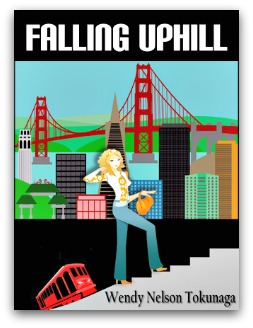
I self-published my first novel, No Kidding, in 2000 with iUniverse. Then I wrote two books for elementary-school students with Kid Haven Press: Famous People: Christine Aguilera (2003) and Wonders of the World: Niagra Falls (2004). Next came two novels that featured Japan, both of which were published by St. Martin’s Griffin: Midori by Moonlight and Love in Translation. And then I self-published three Kindle e-books within the past 12 months: Marriage in Translation: Foreign Wife, Japanese Husband, in 2011; Falling Uphill and His Wife and Daughters, both in 2012.

I suppose you’re working on another book right now?
Yes, a mystery/thriller.

Crossing publishing platforms…

Turning to your three recent books: what made you decide to join the Kindle e-book world?
Falling Uphill was a “trunk novel” I wrote in 2004 that never got published. With the popularity of e-books I decided to revise it a bit and put it out instead of having it gather dust on my hard drive. My agent at the time came close to selling His Wife and Daughters to a major publisher in 2011, but in the end things didn’t work out. I still wanted to bring the book out, so making it available as an e-book seemed like a great idea. I’d gotten a few bites from publishers regarding Marriage in Translation, which was based on a series of blog interviews I’d done of Western women married to Japanese men. But dealing with a publisher would mean the book would take at least a year to come out and would probably need to be longer. I just wanted to get it out as soon as I could to take advantage of the momentum of the blog. Coincidentally, when I was in the finishing stages, the disastrous earthquake and tsunami occurred in Japan. I brought out the book shortly after and for a time gave 50 percent of the proceeds to Japan relief.

Do you think you can reach a different audience through self-publishing?
What’s exciting about e-books is that I can reach an audience! For various reasons, these books wouldn’t have seen the light of day, so I’m happy to continually find readers for them. And, yes, I think I’m reaching a wider geographical audience. And another bonus is that in the e-book world, unlike in the traditional publishing world, the pub date is irrelevant — people can continue to discover my books and I can promote them as summer reads, fall reads or whatever. And e-books don’t ever go “out of print.” I couldn’t be happier with this platform, but it doesn’t mean that I don’t still appreciate traditional publishing and don’t rule out traditional publishing in the future.

Crossing genres…

You got your MFA in creative writing. You also teach and consult on creative writing. What was it like trying your hand at a nonfiction book Marriage in Translation?
These days, non-fiction written in the manner of creative non-fiction and/or narrative non-fiction has lots in common with novels. I think it can be easier for fiction writers to tackle non-fiction, but there might be more challenges for the strictly non-fiction writer to undertake writing fiction.

Why is it so challenging for nonfiction writers to switch over to fiction?
Some — not all — non-fiction writers find it difficult to “make things up” and use their imagination after being so ingrained at using “just the facts.” And, for journalists, I think it can be a challenge to structure a novel that doesn’t reveal everything at once and fight the tendency to go about verifying each point.

Crossing cultures…

Turning to Japan and its influence on your writing. For a while there, Japan was your lodestar. Both Midori by Moonlight and Love in Translation had strong Japanese themes, as does Marriage in Translation. But in your two latest novels your protagonists are all Americans. I’ve read His Wife and Daughters — and enjoyed it very much. There was a scene set in Japan — involving one of the daughters, Phoebe — but otherwise it’s about an American politician who has an affair that causes him to lose his job. I haven’t read Falling Uphill — does it have any Japanese references?
Falling Uphill doesn’t have any Japanese references, at least that I can recall! And in His Wife and Daughters, I thought that for the particular purpose of depicting a certain time in Phoebe’s life that setting it in Tokyo made sense because of the bar hostess culture there. Otherwise, Japan really wouldn’t have played any part in that novel.

Are you moving away from Japan, or will it always be something you write about?
There have been times when I’ve felt that I’ve said all I can say about Japan and need to move on, though it will always be a part of me. I’ve enjoyed writing about Japan and Japanese culture and I even had a Japan-themed short story published in the recent Tomo anthology published by Stone Bridge Press, but I do enjoy writing about topics other than Japan. Yet I am careful to “never say never” about most things.

That said, I think Japanese might enjoy His Wife and Daughters. They have plenty of sex scandals, the most recent one involving the political kingpin Ichiro Ozawa. But in that case, the wife has spoken out — and is trying to poison his career. What was the inspiration behind the book —  do you like politics?
I don’t see His Wife and Daughters as a particularly political book. I was more attracted to the theme of exploring why some women stand by their men in these situations and withstand the humiliation, as well as the fascinating dynamics of a dysfunctional family affected by serial adultery and public scandal.

Crossing art forms…

And now I’ve just got to ask you about your musical career. Are you still pursuing music alongside all this writing?
I’ve been singing and playing music for longer than I’ve been writing. And music is what originally got me to Japan so it’s very important to me. But I don’t have as much time to devote to music right now. My husband and I occasionally play together at home for fun (he plays keyboards), but we haven’t done any gigs for several years. And I wish I had time to keep up with J-pop and enka and go to karaoke! I do manage to catch some music shows via the TV-Japan satellite service, but that’s about it.

Didn’t you and your husband collaborate on a theme song for your book Love in Translation?
Yes we did. That was our last major musical project.

Do you listen to music when you’re writing?
Not usually, but I often have Pandora playing quietly downstairs from my office (the cat likes it!) on a variety of eclectic stations: piano jazz, trip hop, ambient, etc.

Last but not least, I’d like to quiz you about your reading and writing habits:
Last truly great book you read: Gone Girl, by Gillian Flynn
Favorite literary genre: Books that are well written, fast paced and full of surprises.
Reading habits on a plane: I read on my iPad.
The one book you’d require the president to read: He’s so well read that I think he’s way ahead of me.
Favorite books as a child: I especially liked the Edward Eager Magic Series (Half Magic, Magic by the Lake, Seven Day Magic, etc.) as well as The Borrowers series by Mary Norton and The Summer Birds by Penelope Farmer.
Favorite heroine: I always liked books about girls who had special magical powers or mysterious backgrounds.
The writer, dead or alive, you’d most like to meet: I’m constantly networking with fellow writers and have gotten the opportunity to meet with many that I admire, but I suppose it would be quite fascinating to talk with Joan Didion, a writer who definitely excels at both fiction and non-fiction.
Your reading habits: I’m a pretty fast reader. I sometimes take notes and I am mainly reading electronically now. I do find myself constantly analyzing the books I read for craft and structure so it’s sometimes hard to get lost in a good book like I used to be able to back in those Edward Eager days.
Your favorite of your own books: Always the latest one: His Wife and Daughters.
The book of yours you’d most like to see as a film: Any of them!!!
The book you plan to read next: The Expats, by Chris Pavone.

Say, would you do a review for The Displaced Nation on what you think of Chris Pavone’s book?
I’m happy to do a review, but I can’t promise any time soon. I’m in the midst of some very big projects right now. So if there’s not a firm deadline, then I can say yes. 🙂

(See what I mean about how you just can’t keep up with her?) Okay, one final question before I let you go. Since you’ve been so prolific of late, I wonder if you have any advice to impart to other writers who struggle to wrap up their books?
I wish I knew the secret! I’m struggling with my current book and don’t know when the heck I’ll finish it. Writing takes discipline and there’s no magic formula, I’m afraid. And some books come quicker than others.

* * *

Readers, any more questions for Wendy? Please put them in the comments. To reiterate, we are doing a giveaway of one of Wendy’s Kindle e-books to Displaced Dispatch subscribers and to ANYONE WHO COMMENTS! As I can assure you from my own experience, you WANT TO WIN one of these books — they are THE PERFECT SUMMER READS!!!

STAY TUNED for some more fiction tomorrow, with another episode in the life of our fictional expat heroine, Libby. (What, not keeping up with Libby? Read the first three episodes of her expat adventures.)

If you enjoyed this post, we invite you to register for The Displaced Dispatch, a round up of weekly posts from The Displaced Nation, with seasonal recipes, book giveaways and other extras. Register for The Displaced Dispatch by clicking here!

Related posts:

img: Wendy Nelson Tokunaga throwing her considerable energy into yet another round of karaoke…

LESSONS FROM TWO SMALL ISLANDS — 3) Keep calm and eat curry

Mid-July in Manhattan, and I’m thinking that New York deserves its reputation as The City That Never Sleeps. Not because we’re all out partying — far from it. We’re lying there tossing and turning because we can’t regulate our air-conditioning units.

“High” puts you in Siberia; “Low” sends you down into the Tropics. There are no in-betweens, except for the brief period just after you’ve gotten out of bed to adjust the setting. But by then you’re awake again…

It has always surprised me that New Yorkers are willing to put up with such primitive cooling methods. It’s not like them to suffer silently. My theory is that they simply don’t know any better. As the world begins and ends in New York (isn’t Times Square supposed to be the center of the universe?), this must be the best of all possible air conditioning systems.

Regardless. The point is that I am finding summer a terrible trial now that I’ve repatriated — one that at times requires Olympic strength and endurance.

As summer wears on, I wear out. Not only do I never sleep but I never eat — or eat only minimally. My appetite dwindles at the thought of passing yet another uncomfortable night at the mercy of Simon-Aire products.

All of that changed, however, a few nights ago. Actually, the night had started normally enough: I had gone to bed and was freezing cold so couldn’t sleep. But just as I was lying there thinking about getting up to turn the air con down or else searching the closet for another blanket, I had a sudden, heartwarming thought: “I could kill for a curry!”

How did I go from cursing Dr. Cool, whose workers had installed a supposedly upgraded Simon-Aire unit in the bedroom at considerable cost, to a happy craving for curry? I can only surmise that my subconscious mind was trying to restore my spirits by reminding me of my curry-eating days in the two small islands where I’d lived as an expat, England and Japan. I felt calm again, and my appetite returned…

America — a nation that has deprived itself of a serious curry experience

When I first moved to New York, I was beyond thrilled to discover that the Indian actress and cookbook author Madhur Jaffrey lived here, too. To my utter surprise (and delight) — I had always assumed she lived in London — she has been residing in an apartment on the Upper East Side for the past several decades. (She also has a farmhouse in the Hudson Valley.)

Surprised in a good way, yes — but also somewhat mystified. Why would Jaffrey choose to live in America for so long, given the sorry state of Indian cuisine in this part of the world?

I guess it has to do with husbands — she came to the city with her first husband, the Indian actor, Saeed Jaffrey, and then after their divorce, married an American.

Or perhaps she just likes a challenge? In Jaffrey’s very first cookbook, An Invitation to Indian Cooking, written not long after her arrival on American soil, she says she is writing the book because

there is no place in New York or anywhere in America where top-quality Indian food could be found, except, of course, in private Indian homes.

That was nearly forty years ago, and I have to say, her efforts to improve the situation, beginning with that book, have yet to pay off. Manhattan now has a couple of Indian restaurant neighborhoods, and then there’s Jackson Heights in Queens — but in general curry hasn’t caught on in a big way with Americans. If we want to eat spicy food, we usually turn to Mexican or Thai, not Indian.

As Jaffrey herself put it in an interview with an American reporter last year:

America as a whole has not embraced Indian food like they have with Chinese, or with sushi. It’s beginning to change, but only in big cities. Something is needed, something real. I have waited for this revolution, but it hasn’t happened yet.

This is in stark contrast to England and Japan — both of which embraced the curry cause on first exposure and now behave as though they’d invented certain dishes. Indeed, chicken tikka is considered to be a national dish in the UK, while “curry rice” (pronounced karē raisu) rapidly achieved the status of a national dish in Japan.

Nostalgia: Going out for a curry in England

England, my England — where Madhur Jaffrey is a household name, and curry houses abound!

Britain got the hots for curry during the 19th century, when there was an enthusiasm for all things Indian. And I got the hots for the Brits’ late-20th-century version of curry when living in an English town as an expat. My friends and I would spice up our evenings by going out for curries. We always ordered a biriani, chicken tikka masala, and a couple of vegetable dishes (one was usually sag paneer, which remains a favorite to this day).

Our starters would be onion bhaji and papadums, and drinks would be pints of lager. If we had the space for dessert, it was usually chocolate ice cream — none of us ever acquired the taste for Indian desserts (dessert of course being an area where the British excel!).

But even more special were the times when friends invited me to their homes for meals they’d concocted using Madhur Jaffrey’s recipes. One memory that stands out for me is an occasion when my former husband, a Brit, and I joined four other couples for a friend’s 40th birthday party. The hostess, the birthday-boy’s wife, presented a dazzling array of Madhur Jaffrey dishes that looked like something out of a food magazine. I’ve been to much ritzier birthday parties before and since, but none have struck me as being as elegant as this one — partly because of the splendid display and partly because by then I knew how much chopping and dicing of garlic, ginger and onion, how much grinding of spices must have been involved. What a labor of love!

Yes, by then I’d begun experimenting with Indian cookery myself thanks to the influence of a very good friend, who’d given me the classic Madhur Jaffrey work, Indian Cookery (which had been a BBC series), along with all the spices I would need for making the recipes: nutmeg, cinnamon, cardamon, mustard seeds, coriander, cumin turmeric, cloves… To this day, I always keep an array of Indian spices in my pantry so that I can make my own garam masala at the drop of a hat. Now if only I could find some friends who would drop their hats! (Hey, I even have the old coffee grinder ready for grinding the spices, just as Jaffrey instructs.)

Nostalgia: Curry rice & curry lunches in Japan

Eventually, I moved away from England to another small island, Japan — where I was relieved to discover I would not need to give up my new-found passion for Indian food (though I would be foregoing my beloved basmati rice unless I smuggled it in at customs).

Thankfully, the Brits had gotten there about a hundred years before me and had introduced curry to the Japanese, with great success.

Because of “r” being pronounced like an “l” in the Japanese language, we foreigners couldn’t resist making many tasteless jokes about eating curried lice, but that didn’t stop us from having our fill of the tasty national dish, curry rice.

As in the UK, I found it a nice contrast to the traditional fare, which, though healthy, can be rather bland.

At this point, I’d like to loop back to Madhur Jaffrey and note that she disapproves of the word “curry” being used to describe India’s great cuisine — says it’s as degrading as the term “chop suey” was to Chinese cuisine. But I wonder if she might make an exception to the Japanese usage? Apparently, Indians themselves when speaking in English use “curry” to to distinguish stew-like dishes. And Japanese curry rice is the richest of stews, made from a “roux” that can be bought in a box if you do it yourself.

My first box of curry roux was a gift from a Japanese friend. It was accompanied by her recipe for enriching the stew with fresh shrimp and scallops. Oishii!

Still, the curry I crave most often from Japan isn’t curry rice at all, which I find on the heavy side. No, my deepest nostalgia is reserved for the set lunches in Tokyo’s Indian restaurants, which I used to partake in with office colleagues.

The (mostly Indian) chefs have tweaked the ingredients to appeal to the Japanese palate: little dishes of curry that are artistically arranged on a platter, accompanied by naan. freshly baked (fresh is very important to the Japanese) and a side of Japanese pickles: pickled onions, or rakkyōzuke (a tiny, whole, sweet onion); and pickled vegetables, or fukujinzuke.

(The addition of Japanese pickles, by the way, is genius! Try it — you’ll love it!)

All of this is capped by coffee or masala tea, both of which are so well executed they can fill in as desserts.

My takeaways (I wish!)

I fear there may not be many takeaways for my fellow Americans from Lesson #3. After all, the world’s leading authority on Indian cuisine has tried to convert us and failed.

Nevertheless I’ll suggest a few scenarios, with pointers on how you might attempt to introduce a curry-eating tradition into your circle:

1 — Summer is getting to you, so you suggest to a group of friends that you all go out for a curry. When they stare at you blankly, do a little head bobble, smile charmingly and say: “Why ever not?”

2 — Summer is getting to you, and you decide to build a shrine to Madhur Jaffrey in your home by buying as many of her books as you can — including her children’s book on the Indian elephant, Robi Dobi, and her memoir of her childhood, Climbing Mango Trees. You arrange them around a screen that is playing Shakespeare Wallah, a film she appeared in in the 1960s (directed by James Ivory and starring Felicity Kendal). Invite some friends over and when they ask you about the shrine, start talking about the joys of Indian cookery and see if you can make some converts. Perhaps offer to lend out a book or two. (I might start with her newest work, which emphasizes “quick and easy” methods — bless the 78-year-old Jaffrey, she’s indefatigable!) And you can always dip into the books yourself if the heat is making you sleepless. Jaffrey writes beautifully.

3 — Summer is getting to you, but you decide that when the heat breaks, you will start up a Curry Club with a few of your friends, encouraging everyone to contribute one Madhur Jaffrey dish or a Japanese curry made from roux. Even if most of them drop out and you end up cooking a dish for yourself, perhaps this exercise will satisfy your craving until winter. (I find I get these cravings roughly every six months, usually in summer and winter.)

* * *

Well, I’m off to see if I can resume my sweetly fragrant dreams of my expat culinary adventures — just hope it does the trick of distracting me from my ancient “aircon” (popular Japanese contraction) units!

In the meantime, let me know what you think of this lesson. Are you a curry lover? And if so, could you live in a nation that doesn’t share your craving? How would you put some spice into your life under such sorry circumstances? Do tell!

STAY TUNED for Thursday’s post, another in our “Expat Moments” series, by Anthony Windram.

If you enjoyed this post, we invite you to register for The Displaced Dispatch, a round up of weekly posts from The Displaced Nation, with seasonal recipes, book giveaways and other extras. Register for The Displaced Dispatch by clicking here!

Related posts:

Image: MorgueFile

LESSONS FROM TWO SMALL ISLANDS — 2) Keep calm and learn to enjoy imperfection

I must have been born with a melancholy nature, because it didn’t take me long to work out that we live in an imperfect world.

Imagine my discomfort, then, when I realized that many of the people who surrounded me in my nation of birth — my fellow Americans — were obsessed with having perfect teeth, perfect bodies and a perfect appearance during their brief time on this earth.

“What’s that about?” I thought to myself at a relatively early age (I was around 6, already on the way to driving my mother, an eternal optimist, crazy). “We’re all going to grow old and die regardless.”

By the time I reached adolescence, I decided that the need to be flawless was my birth nation’s fatal flaw. It was our best feature — hey, no one can deny how good we look flashing those orthodontically-enhanced smiles — but also our worst. The list is long of fabulously talented Americans who have perished in the pursuit of physical perfection.

That lists always begins with Marilyn Monroe — a pretty and bright young thing who ruthlessly remade herself into a sex symbol, and died at age 36. (Among other things, she got work done on her nose and chin to create her classic, timeless look.) And culminates in Michael Jackson, for whom it apparently wasn’t enough to be blessed with good looks and an extraordinary musical talent. No, the King of Pop felt compelled to have lots of plastic surgery — even if it meant destroying his career and himself.

Endearing little imperfections (England)

It’s a pity Marilyn and Michael were never offered the chance to study abroad in England, that’s all I can say. My prolonged stint as a graduate student at a British university soon cured me of any lingering fixations on fixing my looks.

Why bother when the people around you seem so oblivious? None of the Brits I knew seemed to mind that the politicians who were gracing their TV screens had funny eyebrows (cue Michael Heseltine), dowdy outfits (cue Shirley Williams) or speech impediments like rhotacism, pronouncing the sound r as w (cue the now-departed Roy Jenkins).

And not just politicians but also British actresses seemed much less interested than their American counterparts in their looks. On the contrary, such glamorous types appear to thrive on their imperfections — Kate Winslet proudly flaunting her curves, Helen Mirren daring to be sexy despite having wrinkles.

And now we have the English singer Adele (Laurie Blue Adkins), who is fond of saying things like: “Fans are encouraged that I’m not a size 0 — that you don’t have to look a certain way to do well.”

Have I mentioned teeth yet? An American journalist once complimented the comedian Ricky Gervais on being prepared to wear unflattering false teeth for his role as an English dentist in the film Ghost Town — only those were his real chompers! As Gervais told a BBC reporter:

He was horrified that I could have such horrible real teeth. It’s like the biggest difference between the Brits and the Americans, they are obsessed with perfect teeth.

Imperfection is perfection (Japan)

And then I reached my second small island, Japan, which I soon came to see as the Land of Melancholy — and hence as a kind of spiritual home for someone of my proclivities. I instantly appreciated the fact that Japanese revere the cherry blossom not so much for its beauty as for the brevity of that beauty. The blossom lasts just a few days before its petals scatter to the wind.

The Japanese aesthetic that attracts so many of us in the West is based on this notion of flawed beauty. We’re talking wabi-sabi here — the value derived from the Buddhist teaching on life’s impermanence. Wabi-sabi stands in stark contrast to the Greek ideals of beauty and perfection found in many Western countries. (Hey, those Greeks have a lot to answer for, besides their spendthrift ways!)

A good example is the tea ceremony bowl: not quite symmetrical, rough in texture, and often deliberately chipped or nicked at the bottom. You turn it around slowly to appreciate its hidden beauty, a kind of diamond in the rough…

And did I mention teeth yet? Japan is the land of REALLY crooked teeth. Even some young girls who don’t have crooked teeth apparently are asking their dentists to give them a fang-like yaeba (snaggletooth) as they think it’s charming to be imperfect. Japanese celebrities too, are imperfectly perfect.

Don’t overcultivate your garden

On the face of it, the English cottage garden has very little in common with the Japanese garden — the former full of flowers and exuberance, the latter much more subdued and restrained.

But I think they are alike in one important respect: both embrace imperfection. As California horticulturalist and lover of English gardens Mary Lou Heard once said:

The thing about a cottage garden is that it is not perfect. It is not a sterile place; there is always a lot happening and changing.

Not sterile — I like that. It means that something is breathing, growing, alive…and probably imperfect. To my way of thinking, as informed by my long expat life, a row of perfect brilliant white teeth looks a bit like a row of tomb stones, and a facelifted face, like a death mask.

A Japanese garden celebrates imperfection as well — but by using elements that have a natural, rough finish. If the garden features a wooden bridge, for example, it will be made of planks of different sizes, and the wood itself will have crooked edges or knobs.

For the Japanese, the point is not to restructure reality but to embrace its quirks. That’s why they’d rather see pile of rocks in different colors and sizes than a statue surrounded by carefully landscaped bushes.

My takeaways

As I mentioned in my first post in the series, “Keep Calm and Carry On,” repatriating to the United States has been a feat of Olympian proportions. Clearly I left it a little too long! But at least I stayed away for long enough that, upon coming home again, I have conquered the part of me that says I must always be striving for physical perfection. I no longer fear looking imperfect.

Thus, while my countrymen and women engage in excessive exercising, crash dieting, and surgical enhancements, I am free to sit back and enjoy the beautiful — precisely because it is imperfect — world we live in.

This means I’m not keeping up with the Kardashians. And for a long time, I assumed Mitt Romney was from central casting, not an actual presidential candidate. (I understand he has a problem of coming across as real enough, even among mainstream Americans, which is saying a lot. If I were his image consultant, I’d suggest growing his eyebrows to look more like those of the Archbishop of Canterbury, Rowan Williams. Now that would give him some character.)

If you are a fellow American and are reading this, I suggest that you, too, try weaning yourself off our nation’s physical-perfection kick. Here are a few scenarios close to some I’ve experienced, with pointers on appropriate responses:

1 — The dentist says that in his opinion, you’d look a lot better with straight teeth. Keep calm and inform him that you’ve learned to enjoy nature’s little imperfections. If he persists, then say you were actually thinking of getting a snaggletooth, and does he happen to have any expertise in that area? If not, then whip out a photo of Ricky Gervais’s fangs to show him. (Notably, I did not take my own advice on this. Shortly I returned to the Land of the Straight Teeth, I succumbed to my dentist’s suggestion that I get braces again!)

2 — A woman stops you on the subway to point out you have a run in your stockings, or a work colleague comes up to you to tuck in the label hanging out the back of your blouse. Keep calm and tell them you’ve learned to appreciate life’s little imperfections, and they, too, may wish to get some wabi-sabi in their lives.

3 — You’re picking a mini-labradoodle puppy, and your husband wants to get the one that looks “normal,” but you like the one whose markings have asymmetry, because of her parti-colored poodle father. Keep calm and instruct your husband that the one with the strange spots is much more beautiful, and that one day people will make offers to take her away from you. (True story — my imperfect dog is perfection itself! And no, that is not her in the photo…)

* * *

So, tell me: does any of this make sense, or has living abroad for so long rendered me totally bonkers?!

STAY TUNED for Thursday’s post, another in our new “Expat Moments” series, by Anthony Windram.

If you enjoyed this post, we invite you to register for The Displaced Dispatch, a round up of weekly posts from The Displaced Nation, with seasonal recipes, book giveaways and other extras. Register for The Displaced Dispatch by clicking here!

Related posts:

Image: MorgueFile

LESSONS FROM TWO SMALL ISLANDS — 1) Keep Calm and Carry On

Justin Mussler is traveling around the world with his wife and two kids, recording their adventures in the blog “The Great Family Escape.” In a recent post defending his family’s decision to eschew a conventional lifestyle for one of constant travel, he says:

By the time it’s time to go home, we all realize that home is just not where we want to be.

Hmmmm… “Home is just not where we want to be.” Once upon a time, I could relate to those sentiments. I spent a significant chunk of my adult life living on two small (and rainy!) islands, England and Japan. I never expected to go home again.

But that was then and this is now. As regular readers of this blog will know, I’m now back in my native land, the United States — though still living on a small, mercifully less rainy, island (Manhattan).

So, can you go home again?

The conventional wisdom is that you can NEVER go home again, particularly if you spend more than three years abroad.

To which I say: “Poppycock!”

Well, not really. I’ve definitely had my Rip Van Winkle moments in attempting to get used to the United States again. Still do, in fact.

But unlike Mr Mussler and his family, home is exactly where I want to be right now.

By “home,” of course, I mean my original nation of birth. I mention that in case you’re one of those people who has lived abroad for so long that you no longer know where “home” is or have reached the point of questioning what “home” really means.

(If you are a Third Culture Kid who has never lived in your nation of birth, this post doesn’t really apply — though I’m happy to point you towards some blogs with plenty of posts that would.)

A few overall discoveries I’ve made since repatriating:
1) Travels are like stories: they need a beginning, middle — and an end — to have true meaning. By going home again, you can begin to see what you’ve actually retained from the experience. No doubt you changed some of your behavior — but how much of that was due to expediency and how much to actual lessons learned?
2) Hard as it may seem, travelers can contribute something of what they’ve learned to their native lands. Coming home again gives you a chance to do that.
3) We long-term expats, rex-pats and round-the-world travelers enjoy a good challenge. Trust me, going home again is a challenge of Olympian proportions — which just so happens to fit the theme The Displaced Nation will be exploring this summer.

Lesson #1: Keep Calm and Carry On!

And now to begin my new, occasional series for The Displaced Nation. Through my own expat-to-repat experience, I will try to demonstrate that going home again can be just as enriching as venturing across borders to travel and live.

So what did I learn from being displaced within two small-island countries for so long? I’ll start with the most obvious lesson that anyone who is at all familiar with Japan and/or England has doubtless picked up on:

KEEP
CALM
AND
CARRY
ON

In England it’s known as Stiff Upper Lip (SUL); in Japan, as gaman.

In America we use many words to describe this quality — perseverance, patience, fortitude, stoicism — but I think that’s because we don’t have a single cultural concept that corresponds to what the English mean by SUL or the Japanese by showing gaman.

This may be why I didn’t take to the concept in either country right away. On the contrary, I took to it kicking and screaming. Where the citizens of each of these countries saw grace, strength, endurance, and perseverance, I saw passivity, masochism, fatalism and pain. “Why is everyone bowing so readily to their fates?” I would ask myself repeatedly.

And, though I never committed an act of “queue rage” while standing in line at the post office in the English town where I lived, I came pretty close — especially when watching others who’d come in after I did get served before me.

On those occasions, I felt like crying out: why don’t we try a serpentine line instead? (You know the kind of line I mean — when all customers are funneled into one big snaking queue, demarcated by ropes or barriers. When you reach the head of the queue, you are directed to the next available server.*) But I was too polite to do so.
*Fellow serpentine-line enthusiasts should check out Seth Stevenson’s terrific article on the topic, published just now in Slate.

It’s the weather, stupid!

Thank you, Jared Diamond, for your book that supports, in scholarly depth and detail, the inkling I had while living in Japan and Britain that climate has much to do with how people behave. For a long time, I’d been convinced that it’s the weather on both of these small islands that builds stoicism.

My mental image of gaman is the famous woodblock print by Hiroshige depicting figures huddling under straw umbrellas as they cross a bridge in a driving, chilling rain — carrying on despite. Hiroshige was much admired in Europe for the slanting lines in his prints. But I suspect the Europeans didn’t fully understand the conditions that inspired him to portray rain in this manner — it’s a rainy (and windy) old island, Honshu.

My mental image of England is — well, in fact, it’s what happened on the River Thames Flotilla Spectacular for Queen Elizabeth’s Diamond Jubilee this past week-end. Yes, it rained on that dear lady’s parade, yet she carried on despite…

Now, I don’t mean to equate the English stiff upper lip with Japanese gaman. The Japanese have a grounding in the Buddhist religion, which shapes their understanding of this concept. In addition, they must often contend with fairly severe climactic conditions — earthquakes as well as typhoons. No wonder they tend to emphasize the fatalistic aspect of keeping calm and carrying on. There’s nothing you can do about Mother Nature’s whims, so just bow to the inevitable and make the best of it.

The English, by contrast, tend to feel that they should make the best of situations by finding some humor in them. SUL is called for in situations where you might otherwise be overwhelmed by huge feelings (to the point where your upper lip might start to tremble). Black humor along with understatement can provide some welcome relief or distraction: “I won’t let the Jerries spoil our picnic! What’s a few bombs on a sunny day?” (Hey, I wonder if the Queen cracked a joke about the rain the other day? She’s reputed to have a sense of humor…)

Respect for the aged

In my view, however, the overlap between England and Japan on this point is greater than the differences. It’s interesting, for instance, that both countries have created a special category for those who’ve mastered their professions through years of persistence. Japan confers the title of Living National Treasure, or Preserver of Important Intangible Cultural Properties, to prominent artists or craftspeople of advanced years.

Likewise in England, knighthoods and dame-hoods (is that a word?) go to artists, entrepreneurs, and other major contributors to British society once they’ve reached a certain age — Dame Judi Dench, Sir Richard Branson, Sir Paul McCartney (almost 70 and still rockin’ with no signs of stoppin’!).

And then there’s the veneration shown to Queen Elizabeth herself. Having bounced back from her self-proclaimed annus horribilis, she now finds herself admired precisely for the quality that people (myself included!) at one time loathed: her ability to keep calm and do her duty. As the political journalist Anne Applebaum put it in her Slate column this week:

…the queen, simply by living so long, has come to epitomize an increasingly rare idea of duty that many in Britain, and elsewhere, admire. She doesn’t quit, she doesn’t complain, she doesn’t talk to the press or protest when people draw nasty caricatures or say unpleasant things about her family…

My, she has aged well!

My queenly umbrella

When touring Nova Scotia in the rain this time last year, I ended up buying the exact same “birdcage” umbrella that the Queen uses. A product of the Royal warranted umbrella maker, Fulton, the umbrella is transparent so that the Queen’s public can still see her, but then trimmed with the appropriate color so that it matches her outfit exactly. (Mine is trimmed in gold.)

Notably, that’s the brand of umbrella she and Camilla were carrying as they stepped off the royal barge when Sunday’s Jubilee pageant came to an end at Tower Bridge.

I think I was attracted to the umbrella not just because the Queen uses it but because it reminded me of the transparent umbrellas you can buy everywhere in Japan — helps you to see where you’re going when you’re bent over in the wind and rain like a Hiroshige figure.

Of late a couple of my friends have remarked that I remind them of the Queen. At first I was horrified: are they trying to say I’m getting on? But I think they might have been referring to my habit of wearing hats to protect my skin from sun and rain (which I picked up in Japan, actually) — and now, of course, there’s my Fulton umbrella! 🙂

My takeaways

The lesson of “keep calm and carry on” enriches my current life in all kinds of ways and, I’m convinced, can enrich the lives of my fellow Americans. Here are a few scenarios close to some I’ve experienced, with pointers on appropriate responses:

1 — Two airplanes crash into the twin towers in your city and there are constant rumors of another attack on the subways. Keep calm and carry on — and take the bus for a change. It’s slower, but the culture is a lot more pleasant.

2 — Your dentist asks you if you mind a slight pinprick from the needle used to inject the novocaine for fixing your cavity. Keep calm and carry on — and resist the temptation to remark: “Yanks are such wimps!” Instead, make a joke: “That’s going to make it damn tricky to keep talking to you.” He won’t laugh, but at least you’ll be seizing the occasion to practice your black humor, a key component of SUL.

3 — You’ve gathered together a group of friends from your apartment building to go out for dinner. You all meet in the lobby, but just as you’re about to step outside it starts raining like it does in the tropics. Your friends show hesitancy and want to call off the evening’s festivities. Keep calm and carry on — and think of the Queen. After checking that everyone is wearing the proper foot gear (wellies), go out the door first, wielding your queenly umbrella. So what if you get a bit wet? Just smile and be regal. If anyone looks at you as though they think you’re crazy, give them the royal wave. How dare they intrude on this, your finest hour? Off with their heads!

* * *

So, tell me: does any of this make sense, or has living abroad for so long rendered me totally bonkers?!

STAY TUNED for Thursday’s post, a Displaced Q on patriotism and the expat life, by Tony James Slater.

If you enjoyed this post, we invite you to register for The Displaced Dispatch, a round up of weekly posts from The Displaced Nation, with seasonal recipes, book giveaways and other extras. Register for The Displaced Dispatch by clicking here!

Related posts:

Image: MorgueFile

RANDOM NOMAD: Suzanne Kamata, American Expat in Japan

Place of birth: Grand Haven, Michigan, a charming tourist town on the shores of Lake Michigan.
Passport: USA
Overseas history: France (Avignon): 1985; Japan (various towns + now Aizumi, Tokushima Prefecture, Shikoku Island): 1988 – present.
Occupation: Author* and TEFL teacher
Cyberspace coordinates: Suzanne Kamata (author site); @shikokusue (Twitter handle)
*Suzanne Kamata is the author of a novel, Losing Kei; a short story anthology, The Beautiful One Has Come (listed on The Displaced Nation’s top books for, by and about expats in 2011); and a picture book, Playing for Papa — all of which concern bicultural relationships and/or families. She is the editor of several anthologies — the most recent being Call Me Okaasan: Adventures in Multicultural Mothering.

What made you leave your homeland in the first place?
A sense of adventure! I wanted to see the world, which I’d glimpsed through reading novels set in other countries, and I wanted to gather up interesting, exotic experiences for the stories and books I would one day write.

Toward the end of my college career, I planned on going into the Peace Corps to teach English in Cameroon. As a fallback, my brother suggested a new program he’d read about in the newspaper. The Japanese government had set up the Japan Exchange and Teaching (JET) Programme to get native English speakers into public schools. I’d studied Asian history in college, and had an interest in Japan (especially the Heian Age, when nobles communicated via poetry), so I applied. After rigorous interviews for both, I was accepted into both the Peace Corps and the JET Program. I decided to go to Japan first, because the JET Program was a one-year program. I figured I’d do a two-year stint in the Peace Corps later, but then I wound up meeting a Japanese guy…

Is anyone else in your immediate family “displaced”?
My brother spent a year in Germany as an exchange student during high school. I think I was influenced a bit by his experience.

You’ve lived in Japan for a long time. Does any one moment stand out as your “most displaced”?
When I was about to give birth to my twins via C-section. My mother and father were on the other side of the world, and my husband was out in the waiting room. I was surrounded by Japanese-speaking strangers. I wondered if I would be able to remember how to speak Japanese during the operation. I think entering motherhood is like going into another country for everyone, but it’s especially surreal in a foreign hospital.

Is there any particular moment that stands out as your “least displaced”?
No one moment but all the moments when I’m with my children. Whenever I spend time with them, I feel completely at home. My children have never lived in my native country, and they have Japanese passports. When I’m away from them I feel a little bit lost.

Do your kids ever go to the United States for visits?
My kids have been to the States numerous times. Most recently, my son went on a school trip to Hawaii, where, for once in his life, he blended in perfectly. There are many mixed race kids in Hawaii. I think my kids feel pretty comfortable in the States, but being on vacation is different from actually living there.

You may bring one curiosity you’ve collected from your adopted country into The Displaced Nation. What’s in your suitcase?
A furoshiki — a Japanese wrapping cloth — dyed with locally grown indigo. It will be easy to tuck into my suitcase, and I’m sure I’ll find ways to use it during my stay at The Displaced Nation. In Japan, I use wrapping cloths to carry books, covered dishes, and oddly shaped parcels. They’re durable and more attractive and ecological than paper or plastic bags. The color will remind me of the area where I’ve lived for over twenty years. The name of the town where I now live is Aizumi, which means “indigo dwelling place.”

You are invited to prepare one meal based on your travels for other members of The Displaced Nation. What’s on your menu?

Starter: A few slices of sea bream sashimi from the straits of Naruto, with a squeeze of sudachi and soy sauce mixed with wasabi on the side for dipping.
Main course: Cubes of grilled Kobe beef strewn with fresh herbs (julienned shiso leaves, coriander, parsley, slivers of ginger root), steamed barley and rice, and miso soup made with fresh wakame — served with a nice Côtes du Rhône wine.
Dessert: Sudachi pie (my own creation: it’s Key lime pie made with sudachi juice instead of lime), served with espresso. I’d also put a plate of sliced Asian pears on the table.

And now you may add a word or expression from the country where you live in to The Displaced Nation argot. What will you loan us?
I like the Japanese word natsukashii, which refers to nostalgia or a longing for things of the past. I don’t think there’s a perfect equivalent in English. At any rate, Americans don’t go around saying “I’m feeling nostalgic!” whereas natsukashii is frequently used in Japan. If someone brings up a memory from the past, another person, filled with nostalgia, might say, “Natsukashii!”

Today, appropriately enough, is “East Meets West Day.” can you tell us about any parties or celebrations you’ve held since you becoming displaced from your native land, that in some way illustrate this theme?
In Japan, only children’s birthdays are celebrated, usually with a store-bought cake. In our family, everyone, including the adults, gets a birthday party. Typically, we have a meal with celebratory dishes such as rice with red beans, or everybody’s favorite sushi, with a homemade birthday cake for dessert. We sing “Happy Birthday to You” in English, and the birthday person makes a wish before blowing out the candles on the cake. (The Japanese have adopted the custom of candles on a child’s birthday cake, but not the making of wishes.)

The Displaced Nation has just turned one year old. Can you give us some advice on themes to cover in our second year — anything you think should be on our radar?
You might consider interviewing Edward Sumoto, who runs a variety of events for Mixed Race/Third Culture individuals in Japan, and the filmmakers/photograhers/writers involved in the Hafu Project. I believe their long-awaited documentary will debut this year.

Readers — yay or nay for letting Suzanne Kamata into The Displaced Nation? Tell us your reasons. (Note: It’s fine to vote “nay” as long as you couch your reasoning in terms we all — including Suzanne — find amusing!)

STAY TUNED for a diversion from the usual updates from life in Woodhaven. In tomorrow’s post, Kate Allison will be reporting on her latest meeting with Libby. (What, not keeping up with Libby? Read the first three episodes of her expat adventures.)

If you enjoyed this post, we invite you to register for The Displaced Dispatch, a round up of weekly posts from The Displaced Nation, with seasonal recipes, book giveaways and other extras. Register for The Displaced Dispatch by clicking here!

Related posts:

img: Suzanne Kamata standing inside a pumpkin sculpture on the Japanese island of Naoshima (March 2011). The sculpture was created by the well-known artist Yayoi Kusama, who was herself an expat for awhile. (She lived in New York City in the 1960s.)