The Displaced Nation

A home for international creatives

Tag Archives: Expat novelists

In fiction and in life, this expat pursues paradise

As regular readers of The Displaced Nation will know, Pocahontas is the heroine of our blog this month. Sprightly, playful, well-featured and solicitous — unencumbered by the corrupting influences of civilization, in tune with Nature — she, and other women of her ilk, conformed to the vision Europeans held of the New World.

They were also the subject of many a European man’s romantic fantasy.

After meeting a Pocahontas, a European could brag to his friends back home that he’d found Paradise on Earth.

Flash forward almost four hundred years, and we find something similar going on with certain groups of international travelers. I speak of those who are restlessly searching for places that have yet to be touched by Western materialism and other corrupting ideas — where people lead simpler lives and are more decent.

And for male travelers, that vision usually encompasses finding their own Pocahontas: a native woman with long, dark hair, who unlike her Western sisters, still knows how to care for a man…
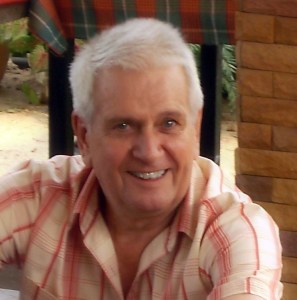
Mark DamaroydAgainst this background, we welcome author Mark Damaroyd to The Displaced Nation. As an expat in Thailand, Damaroyd lives — and has written about — the utopian life to which no small number of men who’ve ventured into foreign countries aspire.

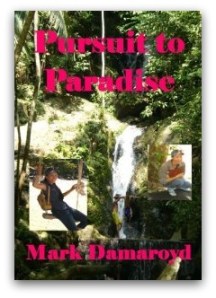
His first work of fiction, published in 2010, is called Pursuit to Paradise. Described by one reviewer as a “tale of romantic intrigue that keeps the pages turning,” the novel takes place in Thailand and the UK, and centers around an Englishman’s relationship with an exotic Thai woman.

Mark Damaroyd has kindly agreed to answer some of my questions about his life and book, and about the challenges of cross-cultural relationships more generally. After that, the floor is open — be sure to chime in!

Can you tell us something about yourself?
Firstly, ML, thank you so much for your invitation to be interviewed by The Displaced Nation.

I’m English, born in Cambridge, but not lucky enough to go to university there. I spent many years in Devon, a beautiful county in Southwest England. I still sometimes miss the thatched country pubs, pasties and cider.

Bitten by the travel bug in 1968 — yes, I really am that old! — I traveled overland from England to India in a camper van. You may have heard about the “Hippie Era,” the “Make love not war” days. I was a short-haired, beardless hippie.

In those days, we got our thrills journeying as a group through countries like the former Yugoslavia, Iran and Afghanistan — so many treasured memories.

Since those days, I’ve lived and worked in Australia, Spain, Portugal and Thailand, taking periods out to sail round the world in a couple of the old passenger ships, now out of service.

Back home in 2005, I found myself jobless at an age where finding new employment was just about impossible. In the wake of failed marriages that produced three offspring, adult and doing their own thing now, I packed my bags, gave up everything in the UK and headed for Thailand, where sales jobs in the holiday industry happened to be available.

I met my Thai bride-to-be in 2007, married the next year, inherited two stepsons, now aged ten and five, and live happily in Isaan, Northeast Thailand, not far from the Laos border.

Having retired a couple of years ago, after a lifetime in sales and marketing, I decided to write Pursuit to Paradise my first published novel, released in 2010.

If I ever get the next book off the drawing board, it’ll be about an English family uprooting to make a new life in Thailand. I envision it as a comedy drama, suitable for family reading.

What made you decide to write a novel rather than a travel book about Thailand?
I’ve always enjoyed writing fiction; a couple of earlier manuscripts still sit on the shelf gathering dust. In addition, there are numerous travel books about the country. I doubt I’d find a loophole in that area.

And why did you decide on the genre of romance?
I sort of fell into that genre by accident. I started out intending to write a mildly erotic action adventure. As the characters developed, the plot veered more towards romance and relationships.

Did you have a real island in mind when creating the “paradise island” of Koh Pimaan?
The Gulf of Thailand has several islands, mostly with similar features. But, having lived on Koh Samui, I think the settings for the book resemble that island more than the rest.

Koh Samui? That’s the kind of place where supermodels go because they like the snorkeling.
It even gets Angelina Jolie popping over for tattoos!

Tell us a little more about your protagonist, Ben. To what extent is he based on your own experiences? Is there anything of you in him?
Ben is hotheaded – I created him that way. He’s also fearful of failure in business and relationships. When he finds himself in a bit of a predicament, his snap reaction hurtles him into an adventure beggaring belief. I must admit there’s a bit of myself in him.

Do you think that most Western men who go to Thailand in search of love and adventure will relate to Ben?
Some Western men who come to Thailand will relate to him. It’s a fact this country attracts men of all ages. Older men come seeking new partners, often ending up with women many years younger. The media understandably focuses on this aspect in order to achieve a bit of sensationalism. But there are also younger guys in their 20’s to 40’s who find the lifestyle, business opportunities and the local girls suit them.

And now let’s talk about the women in the book. Again, did you have any real-life models in mind for Ben’s English ex-girlfriend, Gail, and his Thai love interest, Nataya?
No, there were absolutely no real-life models for these women. I portrayed Gail as something of a nuisance purely to add drama to the story. She’s linked with another character causing headaches for Ben. Nataya can be contrasted with her best friend, Kanita: they have completely different personalities and backgrounds – essential to the story. Western men who are keen to meet Thai girls think they all have beautiful faces, long, shiny black hair, flashing white teeth and slender bodies. The girls in my book fit this description. Obviously, the nation’s females aren’t all like this!

Would it have been possible to write the same kind of novel without exploring the “steamy” side of life in Thailand including erotic moviemaking?
The story could work without mentioning the steamy side of life. To be honest, it was a late decision to introduce erotic moviemaking. I guess it occurred on a day when I felt bored with the plot! However, by adding this element, several new characters emerged that seemed to fit in nicely.

Is the sex industry integral to life in Thailand, especially as seen from the foreign perspective?
Although the glitzy nightlife is famous, Thailand has an abundance of fascinating places to visit far off the beaten track. Many tourists come purely for the history and culture.

Whom did you see as the primary audience for your book?
Originally, I aimed the book at a male readership made up of expats and those with connections or interest in Thailand. That was before I secured a publishing contract with an American company specializing in romantic fiction for women. Their marketing focused on American female readers, so we ended up with a mishmash promotion. Now the book has a new publisher in Bangkok, whose target is much the same as my initial plan.

Will the book ever be translated into Thai?
No.

How does your book compare to other Westerners’ novels about Thailand?
Over the years, many Western men have written novels concentrating almost exclusively on relationships with Thai girls. Generally, they break down into subject matter best described as Sexy Encounters, Finding My Thai Dream Girl, or Humorous/Amorous Adventures. Some authors have moved away from these well-worn genres, producing quality thrillers and mysteries, often set in Bangkok.

A number of female writers have created brilliant stories based on their own experience of life in Thailand. A fine example is Mai Pen Rai Means Never Mind, written by American Carol Hollinger back in 1965 but still relevant, with a reprint in 2000. Her honest and lively anecdotes of this exotic country and its people, and the difficulties and delights foreigners have in adjusting to life in a completely new environment, is refreshingly different.

In my book, I’ve attempted to incorporate a little sensuality, humor, action, mystery and romance. Some scenes are set in England, providing a sharply contrasting backdrop to the sunny paradise locations concealing shady goings on. A strong subplot should keep the reader guessing to the end.

This month, The Displaced Nation has been exploring Pocahontas as a symbol for cross-cultural communications and marriages. In your experience, what are the biggest sources of miscommunication between Westerners and Thais — and can you give some examples?
A huge problem arises from language barriers. Some Westerners make no effort to learn Thai, yet expect their partners to learn English – or whatever the chap’s native language happens to be. Amazingly, Thais manage to grasp passable English extremely quickly, eager to improve communication. Another source of miscommunication is lack of respect or understanding of cultural differences. In Thailand, the Buddhist religion teaches respect, love and compassion. Top of the list is respect for parents and elders. Love and compassion encompasses providing financial support should it be required at any stage in life, as well as physically taking care of parents in old age. Foreigners often misinterpret this obligation, depicting Thai women as money-grabbers. Countless numbers of girls working bars in tourist areas do so because they have no other way to earn money. Yes, it’s fair to say some do attempt to exploit Westerners. On the other hand, many Westerners take advantage, so why accuse the girls?

Finally, from your own experience, what would you say is the top challenge of an interracial, intercultural marriage, and can you recommend any coping strategies?
In the majority of Western-Thai relationships, one partner will be living in a foreign land. The ability to accept that many things are going to be a million miles removed from your own preferences, habits and requirements is essential. Your partner will need to accept that you, too, have some cultural differences. You may not want to eat rice for breakfast, and your partner may consider sausage, bacon, eggs, beans and hash browns a trifle unhealthy. If you see rising early to houseclean or pray to Buddha as unnecessary, then bury your head in the pillow and enjoy an extra hour in bed, knowing the chores are in capable hands.

Being willing to give and take, and having a genuine desire to understand a different culture, will be rewarded by firm bonding and appreciation. Never state that your own way of life is — or was — the best. We can all glean much from each other if we care to do so.

Can you sum it all up in a Native American-style proverb?
“Blending the familiar with the unfamiliar can lead to a more purposeful existence.”

img: Book cover and photo of Mark Damaroyd in Isaan.

STAY TUNED for tomorrow’s installment of our displaced fictional heroine, Libby, who has escaped from her prison of cardboard boxes and is busy exploring her new habitat of small town New England.

If you enjoyed this post, we invite you to subscribe for email delivery of The Displaced Nation. That way, you won’t miss a single issue. SPECIAL OFFER: New subscribers receive a FREE copy of “A Royally Displaced Tea.”

Related posts:

In search of 007th heaven: A travel yarn in three parts (Part 3)

We welcome back Sebastian Doggart for the final installment of his story about the pilgrimage he made to Goldeneye, the Jamaican coastal retreat where Ian Fleming wrote all the James Bond novels. In Part 1, Sebastian reports on his clever ploy to gain admission to the birthplace of James Bond. In Part 2, he registers disappointment at the conversion of Goldeneye into GoldenEye, a soulless bolt-hole for the rich and famous. In this final part, he tracks down the original locations where some famous scenes in two early Bond films were shot.

Back on the cactus-studded road, fortified with a cup of 007’s favorite Blue Mountain coffee, I — along with my two Bond girls: my lovely girlfriend, Emily, and our cheeky six-month-old daughter, Alma — renewed the quest to find some legitimate traces of Britain’s greatest spy.

The movie that pays greatest tribute to Fleming’s love for Jamaica is Dr. No (1962). Filmed just outside the island’s capital city, Kingston, on the south coast, Dr. No features the first Bond car chase, as glimpsed in the film’s original trailer. (Notably, I did not encourage our red-eyed Jamaican driver to hit the accelerator and, for Alma’s sake, was relieved to see a large blue traffic safety sign saying: “SPEED KILLS. Don’t be in a hurry to eternity”.)

Also as glimpsed in this trailer, Dr. No also introduced the world to the first Bond Girl: Ursula Andress as Honey Ryder — emerging from the waves, cuddling a conch shell.

No matter that her voice was dubbed in the final film, Ms. Andress in a bikini was a vision that launched a million erotic fantasies, including my own. The beach where this iconic scene was filmed is as hard to reach today as it was for Bond in the movie. Located four miles west of Ocho Ríos, behind the Roaring River generating station, on a privately owned, rentable estate, it is approached by an unmarked track that ends at a security gate. The Laughing Waters stream — in which Bond and Honey concealed themselves — still pours into the sea.

But Bond and Honey’s actual hiding place is now a very unromantic drainage ditch.

In both the movie and the book, Honey’s beach lies on the island of Crab Key, which is Dr. No’s well-appointed hide-out. Bond and Honey make their way from the beach, through a lush forest, where they find a stunning waterfall in which to wash off.

I would do the same thing…

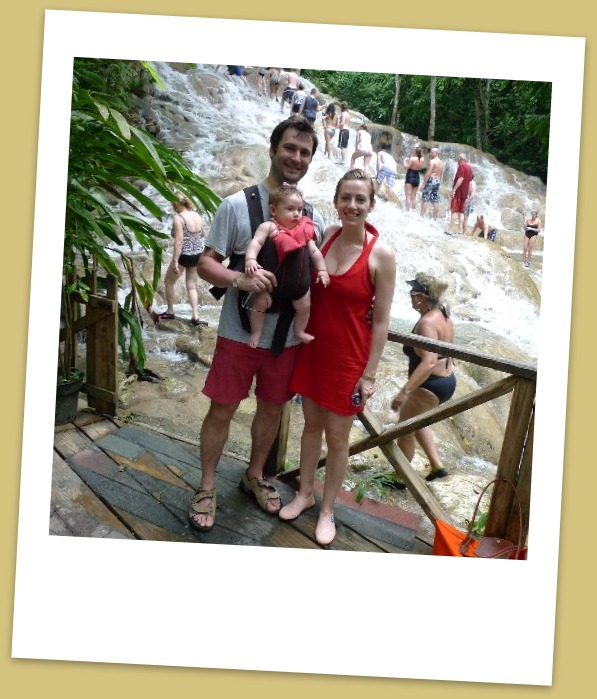
The cascade used for the movie is now one of Jamaica’s top tourist attractions, Dunn’s River Falls. As we reached this reputedly picturesque spot, the first thing we noticed were grotesque conga lines of cruise-ship passengers — mainly American, but with a large smattering of Chinese — clambering over the rocks. How I wished I’d had a Walther PPK pistol to silence the tour-guides as they orchestrated raucous football chants.

(Afterwards, Alma exacted her own ruthless revenge on the commercialized desecration of the waterfall. As we were waiting for our driver to pull up, a septuagenarian American couple, all sunhats and positive energy, approached us. Alma served up her gummiest, sweetest grin to the lady, whose tired face melted. “Awww,” she cooed, “you are the cuutest ba–“, at which moment she stumbled sharply and fell face first on to the asphalt. A blackish red liquid oozed from her mouth. Emily shielded Alma’s gaze from the horror. The husband yelled for help. A call went out to out to an ambulance, which — do they have one permanently stationed at the Falls to handle tourists tumbling down the rocks? — arrived within minutes. The lady was carried into the back of the ambulance, as her husband asked a fellow cruise passenger to tell the captain not to leave until she had been patched up and discharged.)

Dr. Julius No’s lair was where he entertained Bond and Honey for dinner…and concealed the laser that could disable American missiles. It also contained the nuclear reactor where he would meet his death, sinking into the boiling liquid from which he was unable to escape because of his metal hands.

The building used for the reactor’s exterior is a bauxite plant that sits beside the main road on the crescent harbor of Discovery Bay. It’s owned and operated by the American company Kaiser. Beneath its russet-stained dome is where the “red gold” that is Jamaica’s second-leading money earner after tourism is transformed into aluminium for export to U.S. refineries.

The other movie where Jamaica plays a major role is Live and Let Die (1974), the first film to star Roger Moore as James Bond.

Jamaica stands in as the Louisiana bayou for the classic scene in the crocodile farm owned by the evil Mr. Big. In the film, Mr. Big’s real name is Kananga, which was taken from real-life crocodile wrangler Ross Kananga, who was the double for Moore in the scene where Bond escapes by running over a phalanx of crocodiles.

In this clip you can see all five takes of Kananga performing this perilous stunt for Moore. The location was an actual crocodile farm called Swamp Safari, near the town of Falmouth. (It was being refurbished when we visited and is due to re-open next year.)

In Live and Let Die, Jamaica is also the fictional Caribbean island of San Monique. In the original novel, Bond comes here to track down what his MI6 boss, M, believes to be a stash of gold that was originally amassed by the notorious pirate Henry Morgan, himself an early foreign resident of Jamaica. That gold was being used by the criminal network SMERSH to fund nefarious activities in America.

In the movie, Kananga’s base was conceived of as a cathedral-like cave beneath a cemetery. It was here where the infamous drug lord kept his submarine. And it was here, in a shark-infested lagoon, that Moore kills Kananga by stuffing a bullet of compressed air down his throat, causing him to explode.

The Kananga scenes were shot in the real-life Green Grotto and Runaway Caves near Discovery Bay. They comprise a network of limestone caves and a limpid lake, 120 feet below sea level. Originally a Taíno place of worship, the caves had a recent incarnation as a nightclub — but after revelers damaged the stalactites, it was closed down. Today, tour guides are scrupulously protective of the green algae on the walls.

As my Bond girls and I wound up our 007 tour and headed back to New York, I was re-energized to write my own Bond novel. It will begin with our hero discovering that his mother, whom he has not seen since he was very young, is alive but has been kidnapped by a mysterious criminal gang.

With Bond’s fascination for women clearly linked to an Oedipal complex and an impossible love for his mother, this will set up the highest stakes of any 007 story ever. In an extraordinary final twist, his mother will be revealed as none other than…M herself!

M for Mummy! Genius!

What do you think? Will this effectively reboot the Bond franchise?

img: The intrepid Sebastian Doggart with his equally intrepid “Bond girls,” girlfriend Emily and their daughter Alma, snapped in front of Dunn’s River Falls, Jamaica, with conga lines of cruise-ship passengers in the background.

STAY TUNED for tomorrow’s installment from our displaced fictional heroine, Libby, who, having just said good-bye to her London home, is about to embark on her long-anticipated relocation adventure.

If you enjoyed this post, we invite you to subscribe for email delivery of The Displaced Nation. That way, you won’t miss a single issue. SPECIAL OFFER: New subscribers receive a FREE copy of “A Royally Displaced Tea.”

Related posts:
See also:

CLASSIC DISPLACED WRITING: Ian Fleming

As The Displaced Nation has been serializing Sebastian Doggart’s article (part 1 and part 2) about visiting Ian Feming’s Goldeneye estate in Jamaica, it seemed like a good time to take a brief look at Fleming’s writing with a Classic Displaced Writing Post.

Sebastian’s posts have been concerned with Fleming and his love of Jamaica, and while Jamaica and the Caribbean is used numerous times as a backdrop in the Bond novels, through the course of the novels Bond visits dozens of  different countries that Fleming has to conjure up for the reader.

What is clear on reading Fleming is just how important food and drink is to Fleming in order to allow him to describes new and exotic (at least for the vast majority of readers in austerity Britain of that time) locations. I don’t think it’s unfair of me to say that Fleming fetishes food and drink. At times, reading a Bond novel is like reading food porn. While the Bond films now do an expert and cynical job of name dropping as many brands as they can in 2 hours, the Bond novels don’t shy away with the name dropping of food or of alcoholic brand names. The Bond of the novels isn’t solely a Martini drinker. He’s aways one to try anything local that’s on offer. In Jamaica he’ll drink a glass of Red Stripe, in the US he’ll have a Millers Highlife beer. Throughout the novels Fleming uses food and drink to convey an alien culture, demonstrate social status, show Bond’s mood and his sophistication and ease with the world.

For ten minutes Bond stood and gazed out across the sparkling water barrier between Europe and Asia, then he turned back into the room, now bright with sunshine, and telephoned for his breakfast. His English was not understood, but his French at last got through. He turned on a cold bath and shaved patiently with cold water and hoped that the exotic breakfast he had ordered would not be a fiasco.

He was not disappointed. The yoghourt, in a blue china bowl, was a deep yellow and with the consistency of thick cream. The green figs, ready peeled, were bursting with ripeness, and the Turkish coffee was jet black and with the burned taste that showed it had been freshly ground. Bond ate the delicious meal on a table drawn up beside the open-window.

From Russia with Love (1957)

Video of some more examples –

STAY TUNED for Monday’s post, when guest blogger Sezin Koehler riffs off Alice in Wonderland to capture the curious, unreal aspects of her life in Prague.

If you enjoyed this post, we invite you to subscribe for email delivery of The Displaced Nation. That way, you won’t miss a single issue. SPECIAL OFFER: New subscribers receive a FREE copy of “A Royally Displaced Tea.”

Related posts:

In search of 007th heaven: A travel yarn in three parts (Part 2)

GoldenEye collageWe welcome back Sebastian Doggart for the second in his three-part travel yarn about his attempt to infiltrate the Caribbean retreat called GoldenEye, where Ian Fleming composed all the Bond books. In Part 1, Sebastian reports on his arrival on Jamaica’s northern coast and admission at the gates of the compound that marks the birthplace of James Bond — newly remade into a resort for the super-rich. Stay tuned for Part 3, where Sebastian continues his Bond-worthy quest for traces of Fleming elsewhere in Jamaica.

Alighting from the car, I was greeted by Jenny Wood, GoldenEye’s English general manager, whose plummily cheerful efficiency had echoes of Miss Moneypenny. She welcomed us warmly and introduced us to a Jamaican employee called Henry, who would take us to our friends, the Usmanovs.

As Henry led us down a stone path, I asked him about visiting Fleming’s house. He said that, the week before, Bono had been staying there, but that it was now vacant.

Thrillingly, Henry promised he would get a key and take us to see inside.

He took us through a wooded area, where the trees had all been planted by a celebrity guest. Handwritten signs showed a tamarind planted by Princess Margaret, a royal palm by the Clintons, a lime by Harrison Ford, an ackee by River Phoenix, a cinnamon by Willie Nelson, and a guava by Johnny Depp.

Surely, this was the most eco-friendly example of name-dropping in the world.

Shaken, not stirred

We came to the luxuriously simple main restaurant, which also housed a bar in the very gazebo where Fleming would do some of his writing. Henry informed us that, when British Prime Minister Anthony Eden visited in 1956, he used this as a command post.

It was a perfect spot for a quick drink. I eschewed the obvious choice of a dry martini, shaken not stirred and ordered instead Bond’s own creation, a Vesper. Named after his Casino Royale lover Vesper Lynd, it’s made of three measures of Gordon’s gin, one of grain vodka, half a measure of Kina Lillet, all shaken until iced cold, and served with a slice of lemon peel in a champagne goblet.

Energized, we walked on to a wooden bridge, over an emerald waterway that drifted into the sea, through a maze of discreet wooden buildings, each bordering a lagoon, to our friends’ own villa.

They welcomed us with a rum punch, made from Blackwell’s own self-named brand. We sat on the back deck, listening to the resort’s own reggae-oriented radio station, and savoring the sweet scent of marijuana wafting from the neighboring cabana. I slipped into my bathing suit and leapt into the cool water.

On the other shore of the lagoon nestled the spa, described in the resort guidebook as a place where guests have “a license to chill,” and where Bond himself “would willingly put down his guns, girls and gadgets to lose himself — and find himself.”

I went back inside my friends’ cabana for a shower. The bedroom smelled of fresh cedar and was immaculately decorated. The bathroom, adorned with new Villeroy & Boch taps and a craw-feet tub, was outside — shielded by a bamboo fence and festooned with bougainvillea.

I hope you can swim, Goodnight.

Soon after, Henry returned to honor his promise to take us to Bond’s actual birthplace, and we said goodbye to our friends.

Henry led us to the private beach where Fleming used to don flippers and a diving mask (but no snorkel) to look at parrotfish and snapper, and to spear lobsters and octopi for his dinner. A glass-bottomed boat is now available for guests to peer for barracuda.

On the shore, hotel lounge-chairs broke the natural rhythms. A rock pool that Fleming built for his son, Casper, teemed with black crabs — the same beasts that Dr. No used to torture Honey Rider. I wondered whether Fleming and his “Jamaican wife,” Blanche Lindo, might have indulged in some related zoologically erotic games.

Overlooking the beach was a charming sunken garden which Fleming had hallowed out for dining al fresco. Shaded by a proscenium arch of almond trees, he and his illustrious chums would sit here feasting on ackee, curried goat, and grilled salt-fish.

Henry took out a key to show us inside the complex known as “The Fleming House.” The renovations have expanded Fleming’s own modest footprint to embrace four houses, all built around a new, sunken swimming pool. The main building is an enlarged version of Fleming’s original bungalow, and there are three neighboring villas, which contain guest rooms and a private cinema.

Time to face gravity!

To stay in the Fleming House is beyond most mortals’ spending power: it rents for between $7,000 and $21,000 a night, depending on the season.

To put that in context, Henry, whom Chris Blackwell was paying $60 a week, would have to work seven years — and incur no other expenditures — in order to take his family to the Fleming House for just one night.

My first impression on entering the main building was similar to that of Noël Coward,
who, in a teasing ode he wrote to Fleming, complained about the hard furniture and the airless rooms.

Totemic African statues stared threateningly down into the cavernous living room. Paintings of a conch shell and a sea-view looked as though they had been bought from the local market. The floor was made of cold, pale stone.

The master bedroom was where Fleming did most of his writing, but this too was disappointing. Below a framed black-and-white photograph of Fleming stood a bullet-wood corner desk, but Henry admitted that it was a replica.

There was no sign either of the Imperial typewriter that Fleming used to write most of the Bond novels, or of the gold-plated Royal Quiet DeLuxe portable that he later purchased from the Royal Typewriter Company in New York. (The Royal, I learned later, had been sold to Bond actor Pierce Brosnan for a reported $75,000.)

As Henry led me back to my car, past a lime tree planted by Yoko Ono, the whole place suddenly felt fake and exploitative. It seemed more a celebration of celebritocracy than a tribute to the creative spirit — more akin to Scaramanga’s island than to Fleming’s original Goldeneye.

And as the iron gates clanged behind us, I suspected that, if Fleming had a chance to see how his erstwhile 007th heaven has been transformed, he would feel that Chris Blackwell has leapt on an ugly Bondwagon — and, like Auric Goldfinger, may be suffering from a deadly Midas complex.

img: (top to bottom) Fleming’s private beach; Fleming’s sunken garden; GoldenEye villa outdoor bath; GoldenEye villa bedroom — all by Sebastian Doggart.

STAY TUNED for Part 3, in which Sebastian continues his search for 007 on the beach where Ursula Andress appeared, in evil Doctor Kananga’s limestone caves, and in Dr. No’s lair on Coral Key. And before that we have tomorrow’s post — an interview with Random Nomad Vicki Jeffels, who answers an Alice question.

If you enjoyed this post, we invite you to subscribe for email delivery of The Displaced Nation. That way, you won’t miss a single issue. SPECIAL OFFER: New subscribers receive a FREE copy of “A Royally Displaced Tea.”

Related post:

In search of 007th heaven: A travel yarn in three parts (Part 1)

We welcome Sebastian Doggart to The Displaced Nation as a guest blogger. Sebastian won one of our Alice Awards for a Telegraph Expat blog post entitled “Elegy to English shepherd’s pie.” Today, however, Sebastian will be giving Displaced Nation readers a break from our Alice theme, with the first in a three-part travel yarn about his chase after Goldeneye — the Caribbean retreat where Ian Fleming wrote all of his Bond books. Stay tuned for Parts 2 & 3 in the coming weeks.

On the northern coast of Jamaica, fringed by icing-sugar beaches and rocky coves, lies the holy place where Ian Fleming wrote all the James Bond novels. Now populated by the rich and famous in search of paradise, it is one of the most desired and exclusive oases on earth. Its name is GoldenEye.

Over the last two years, this secluded tract of land has been mysteriously shut to the world. The official story has been that the site has been undergoing a $75 million renovation. As with arch-villain Francisco Scaramanga’s private island, its inaccessibility has made it even more appealing as a travel destination. So when I heard that the legendary site was re-opening to a handful of invited guests, I was ready to risk life and limb to gain access.

I called the number listed on GoldenEye’s new Web site, and a lilting Jamaican voice gave me an email address for a London-based PR company. Its boss, whose broken English suggested she might in fact be the murderous Rosa Klebb, declined my request to write an article on the resort — unless I could come up with $21,000 a night.

I had neither the resources of Blofeld to satisfy her demand, nor a willingness to accept her rejection. With the ingenious forces of Q behind me, I devised a cunning plan to infiltrate the compound. Two friends were getting married and had been granted a honeymoon suite in GoldenEye. I would take my chances and show up on their doorstep for a celebratory cup of tea.

The name’s Bond. James Bond.

The approach to GoldenEye is a coastal road that passes the brand new Ian Fleming International Airport. Opened in January 2011 to cater for the super high-end tourist, it is specifically designed to welcome small jets. Rolling Stone Keith Richards, who has a house in nearby Ocho Ríos is a grateful new user.

I passed a sign marking the border of the town where GoldenEye geographically sits, Oracabessa. Once a banana port, it has fallen on hard times as Jamaica’s economy has struggled. Oracabessa’s name, a derivation from the Spanish oro cabeza, or golden head, is one of the various inspirations that Fleming has cited for his home’s own name.

No sign marked the entrance to GoldenEye. After driving past twice, I stopped and ask a local shopkeeper where the entrance was. She gave me a grave look of disapproval, as if I were complicit in a rich white man’s folly, but still had the grace to direct me to an unmarked iron gate, flanked by high walls. I pulled up and saw, hidden discreetly amongst the trees, a guard-post. I felt as nervous as if I were trying to break in to Dr. No’s lair on Coral Key.

As further ammunition to melt the guard’s heart, I was accompanied by two lovely ladies: my partner, Emily, who is even lovelier than Mary Goodnight; and my six-month-old daughter, who shares a birthday, November 11, with Bond himself.

“Good afternoon,” I said, breezily. “We’re here for tea with the Usmanovs.”

“Are they expecting you?” he asked, his wariness visibly dissolving as he glanced at my Bond girls.

“They are indeed. They’re the happy newly-weds.”

“One moment, please.”

The guard retreated into his bunker. With this level of security, I felt our chances were slim. Our friends would probably be out of their room, frolicking in the pool.

But we were in luck. The guard returned. “Drive through. Follow the path, keeping to your left. You will be escorted to the cabana of the Usmanovs.”

As the heavy gates swung open, and I scrunched over the gravel to within GoldenEye’s walls, my heart was pounding. The dream of seeing the birthplace of one my greatest heroes was about to come true…

Mr. Bond, it’s good to see you again…

The story of GoldenEye — originally spelled Goldeneye, without the upper case “e” — is an epic one. The estate’s first known owner was Henry Morgan, the 17th century Welsh pirate. He made use of its location, on a headland with a panoramic view, to look out for Spanish fleets heading for Havana. When he saw a new ship, he would send a signal to his own boat hidden behind an island, and its captain would then sail forward to claim their bounty.

Morgan used his piratic skills to help the British acquire Jamaica as a colony in 1658. He reveled in the pleasures of nearby Port Royal, “the richest and wickedest city in Christendom,” and would leave his name on every bottle of Captain Morgan rum.

Little is known of Goldeneye until the early 20th century, when it became a donkey racecourse. This is what Ian Fleming, then a commander in British naval intelligence, first saw in 1943, vowing to return after the war had ended. In 1946, he purchased the property from a powerful Jamaican land-owner, Blanche Lindo, with whom he began a life-long love affair. On the site of the racecourse café that once served banana dumplings and coconut oil, he built a white-walled bungalow.

Explaining its name in a later interview with Playboy, Fleming said:

I had happened to be reading Reflections in a Golden Eye by Carson McCullers, and I’d been involved in an operation called Goldeneye during the war: the defence of Gibraltar, supposing that the Spaniards had decided to attack it; and I was deeply involved in the planning of countermeasures which would have been taken in that event.

Goldeneye became Fleming’s winter retreat, where he would spend at least two months a year. He hosted an increasingly illustrious group of friends, including Graham Greene, Evelyn Waugh, Cecil Beaton, Laurence Olivier, and Truman Capote. His friend Noël Coward, who built his own house, Firefly, a few miles away, described his first visit thus:

We arrived before dusk. It is quite perfect, a large sitting room sparsely furnished, comfortable beds and showers, an agreeable staff, a small private coral beach with lily white sand and warm clear water. The beach is unbelievable. We swam after a delicious dinner, and lay on the sand unchilled under a full moon.

Honey Ryder: “Looking for shells?” Bond: “No, I’m just looking.”

Like Bond, Fleming was a womanizer, and Goldeneye was a fine place to woo a lady. In 1948, he brought Lady Ann Rothermere, whose response was effusive: “The air is so clear of dirt or dust, there is an illusion of a vast universe, and the sea horizon is very round.”

Fleming gave Ann a gift, the latest edition of Field Guide to Birds of the West Indies, by an American ornithologist named James Bond. He nicked the name for the hero of his first novel, Casino Royale, which he began writing in 1952, soon after he had discovered that Ann was pregnant and married her.

When writing, Fleming closed Goldeneye’s glassless, wooden shutters called jalousies, to avoid the distraction of the Caribbean horizon. He went on to create all 13 of his Bond novels in those surroundings. He would write later:

Would these books have been born if I had not been living in the gorgeous vacuum of a Jamaican holiday? I doubt it… I suppose it is the peace and silence and cut-offness from the madding world that urges people to create here…. A wonderful escape from the cold and grime of winters in England, into blazing sunshine, natural beauty and the most healthy life I could wish to live.

The Flemings’ marriage deteriorated into bickering, and Ann stopped coming to Jamaica. Our hero’s attentions turned to his “Jamaican wife,” Blanche. She was herself married — to Joseph Blackwell, an heir to the Crosse & Blackwell food family; but that only added spice to the affair. Blanche Blackwell gave Fleming a romantic gift of a coracle named Octopussy with which to explore the surrounding coves. The boat’s name became the title of the fourteenth and final Bond tale, published posthumously as part of a short story collection in 1966.

A lover of the sea, Blanche was the inspiration for Dr. No’s Honeychile Rider, whom Bond first sees emerging from the sea — naked in the book, bikini-clad in the movie. She was also the basis for Pussy Galore in Goldfinger.

You only live twice, Mr. Bond…

Blanche had a son, Chris Blackwell, who would go on to become a location manager on the movie Dr. No. He would then found the indie record label Island Records, which launched artists like Bob Marley and U2. Chris describes his first visit:

I went with my mother to a party that Ian Fleming was giving for friends. Noël Coward was there. It was a casual affair — with lunch served under the almond trees and overlooking the beach — and what I remember most is a lot of laughter.

In 1964, two years after both the release of the movie Dr. No and Jamaica’s independence from Britain, Fleming came to Goldeneye to write his last and most nostalgic Bond novel, The Man with the Golden Gun:

My own life has been turned upside down at, or perhaps even by, [this] small house … that I built 18 years ago… I sat down at the red bullet-wood desk where I am now typing this and, for better or worse, wrote the first of 12 best selling thrillers that have sold around twenty million copies and been translated into 23 languages.

Fleming died soon after, undramatically, of a heart attack, and was buried in Wiltshire, where he would later be joined by his son Casper (who tragically died of a drug overdose, aged 22) and his wife Ann.

The Fleming family held on to Goldeneye, which gradually fell into disrepair, until 1977, when they put it on the market. Bob Marley was interested, but eventually decided it was “too posh”. Encouraged by his mother, Chris Blackwell himself stepped in and purchased the property. He bought further land, increasing the estate from 16 to 100 acres and building what he called “a model for residential tourism” — a network of luxury villas that hosted celebrities including Naomi Campbell, Quincy Jones, Rachel Weisz, and Martha Stewart.

Two years ago, Blackwell shut it all down to embark on a $75 million renovation, with the goal of creating “a community of free spirits dedicated to living an inventive, balanced life where the imagination and the environment could co-exist in perfect harmony.”

We were now some of the first people to assess whether he had achieved this dream with the latest incarnation, GoldenEye.

STAY TUNED for Part 2, in which Sebastian continues his search for 007 — and for Monday’s post, where we’ll return to Wonderland for further scrutiny of its sense of humor (or the lack).

If you enjoyed this post, we invite you to subscribe for email delivery of The Displaced Nation. That way, you won’t miss a single issue. SPECIAL OFFER: New subscribers receive a FREE copy of “A Royally Displaced Tea.”

CLASSIC EXPAT WRITING: Nabokov — Pnin

Few characters in literature deal with discombobulation to quite the extent as Vladimir Nabokov’s Timofey Pnin. Pnin, a Russian-born professor at the “somewhat provincial institution” of Waindell College, is a somewhat absent-minded and culturally confused man. Nabokov begins the novel with Pnin catching the wrong train, thus missing an important lecture he was due to give.

Despite such a farcical beginning, Pnin is not a campus farce. Yes, it is deeply comic, but it is also a novel that plays on Nabokov’s own experiences as a Russian émigré marooned in American academia. There is a phrase I like a lot — I like it so much I named my own blog after it. It is the term “culturally discombobulated.” I think this is something that Pnin struggled under the weight of. For all his intelligence, Pnin struggles with English — “If his Russian was music, his English was murder,” writes Nabokov — and who constantly seems out of step with the society he is living in.

The extract I want to highlight this week comes from early in the novel. Pnin has boarded a train for his lecture, but oblivious to him he has boarded the wrong train — a fact he won’t discover for a number of hours. As Pnin sits in the  train, the novel’s narrator allows us a closer look at Pnin’s history and some of his shortcomings.

Pnin, despite his many shortcomings, had about him a disarming old-fashioned charm, which Dr. Hagen, his staunch protector, insisted before morose trustees was a delicate imported article worth paying in domestic cash. Whereas the degree in sociology and political economy that Pnin had obtained with some point at the University of Prague around 1925 had become by mid-century a doctorate in desuetude, he was not altogether miscast as a teacher of Russian. He was beloved not for any essential ability but for those unforgettable digressions of his, when he would remove his glasses to beam at the past while massaging the lenses of the present. Nostalgic excursions in broken English. Autobiographical tidbits. How Pnin came to the Soedinyonnie Shtati (the United States). “Examination on ship before landing. Very well! ‘Nothing to declare?’ ‘Nothing.’ Very well! Then political questions. He asks: ‘Are you anarchist?’ I answer” — time out on the part of the narrator for a spell of cozy mute mirth — “‘First what do you understand under “anarchism”? Anarchism practical, metaphysical, theoretical, mystical, abstractical, individual, social? When I was young,’ I say, ‘all this had for me signification.’ So we had a very interesting discussion, in consequence of which I passed two whole weeks on Ellis Island” — abdomen beginning to heave; heaving; narrator convulsed …

… And he still did not know that he was on the wrong train.

A special danger in Pnin’s case was the English language. Except for such not very helpful odds and ends as “the rest is silence,” “nevermore,” “weekend,” “who’s who,” and a few ordinary words like “eat,” “street,” “fountain pen,” “gangster,” “Charleston,” “marginal utility,” he had no English at all at the time he left France for the States. Stubbornly he sat down to the task of learning the language of Fenimore Cooper, Edgar Poe, Edison, and thirty-one Presidents. In 1941, at the end of one year of study, he was proficient enough to use glibly terms like “wishful thinking” and “okey-dokey.” By 1942 he was able to interrupt his narration with the phrase, “To make a long story short.” By the time Truman entered his second term, Pnin could handle practically any topic, but otherwise progress seemed to have stopped despite his efforts, and by 1950 his English was still full of flaws.

If you enjoyed this post, we invite you to subscribe for email delivery of The Displaced Nation. That way, you won’t miss a single issue. SPECIAL OFFER: New subscribers receive a FREE copy of “A Royally Displaced Tea.”

Related posts:

Even in Paris, expats can’t escape former lives: A celebration of displaced novelist Corine Gantz

SPECIAL ANNOUNCEMENT: Ever wanted to escape to Paris in the springtime? Today you can do so, as it were, in the company of the très très charmante Corine Gantz. Originally from the City of Light but now living near the City of Angels, Mme Gantz has just released her debut novel about a group of American women who try to start afresh in Paris. She has kindly agreed to respond to our questions and comments. 

The Displaced Nation has been examining the “gothic” side of expat life over the past couple of weeks. Thus it may seem odd that today we have chosen to celebrate a book that takes place in La Ville-Lumière (“The City of Light” or “The Illuminated City”) by an author who lives near the City of Angels.

Hidden in Paris coverBut looks can be deceiving — and the cover of Corine Gantz’s debut novel, Hidden in Paris, is quite a cunning ruse. It shows a Parisian balcony with French doors reflecting the Eiffel Tower, and a flower box bursting with hot-pink geraniums. What could possible be amiss within such a picture-perfect setting, you may wonder? Plenty, it turns out.

But before we get into that, let’s begin our fête in honor of Mme Gantz and her book. To put ourselves in the proper mood, we have prepared a special cocktail, a French 75. We’ve also gone all out with our canapés. There’s a savory gougère, brie en croûte, duck rillettes, chilled asparagus with mustard sauce, a Puy lentil salad — and, in honor of Mme Gantz, her family favorite, taramasalata on toast (see her father’s recipe below).

Okay, seats, please! Our honored guest has agreed to kick off the festivities by answering a few questions from The Displaced Nation team. After that, the floor is yours, dear reader.

Corine GantzYour new novel, Hidden in Paris, may not tell a gothic tale per se, but we think it relates to our theme because it centers on three women who are running away from their lives. Is that a fair assessment?
People who say they love to be scared amuse me. They have a fascination with horror flicks, they read vampire books, they ride roller coasters. Yet they might be the same people who walk great circles around a pile of bills or make every effort to avoid a difficult phone call. What can be scarier than real life?

I think there is a limit to what we can handle, and at some point the tendency is to want to run way, literally or figuratively. In Hidden in Paris three strangers — all American women — have reached the point of terminal discomfort, when tackling real issues feels more terrifying than running away abroad.

Lola is running away from her husband, Althea from an eating disorder, and Annie, although she pretends to be the most high functioning member of the group, is hiding the biggest secret of all. (Just to add some spice, there is also a male character, Lucas, who is hiding his love for Annie.)

People often fantasize that “elsewhere” — particularly Paris because of the attached notion of romance — will solve their problems, or at least make the problems go away for a while. Well, we long-term expats know better. Moving to another country brings great logistical changes to one’s life, which can distract you into thinking you’ve left your pathos behind, when, in fact, you’ve brought it along in your suitcase. Wherever you go, you bring your own personal gothic tale with you.

In the case of these three female characters, the disruptions to their routines, along with new encounters, bring them to the tipping point toward change.

The thing is, as in real life, my characters fight the change they need kicking and screaming, which makes for fun story telling.

Food is another obsession of ours at The Displaced Nation. We detect from reading an excerpt from Hidden in Paris that it also plays a big role in your book.
You detect correctly. For me, writing a novel is a barely disguised way for me to talk about food — the novel being a vehicle for food just as grilled toast is a vehicle for foie gras.

I grew up in France on my mother’s terrific cooking. But she is the type of cook who wants no help in the kitchen, so at age 23 I arrived in the United States never having cooked an egg. I was terribly homesick and depressed and needed to “taste home” again — so had no choice but to teach myself how to cook. The saving grace was that I had a copy of a recipe book filled with my mother’s recipes, so I proceeded to recreate the food, and jolly myself out of my depression. Cooking gave my life a purpose: it became my creative outlet.

I think the preparation of food can be extremely healing, meaningful and joyful. Food is, after all, the soul and spirit of a home. I enjoy cooking as much as I enjoy eating, and when I’m not doing one or the other I’m telling stories where food turns out to be one of the principal characters.

You are a Française who has been “displaced” to the Los Angeles area for a couple of decades, where you live with your American husband and two sons. Does your novel echo that experience?
Had I landed on an alien planet I doubt I would have been any more confused and out of place.  I understood none of the codes, none of the cultural references, of Los Angeles. I could not understand people or express myself — and I resented them for that.

Writing sprouted from this: the frustrated need for self-expression and communication. Like my protagonist, Annie, I had to figure out how to function, and I would be lying to say I functioned well. Also like Annie, I resisted my country of adoption for years. I did not have both feet in it. A part of me felt in limbo: I was standing by for my eventual return to my home country.

Twenty years later I don’t even feel French anymore, but no one here lets me forget I’m not American either. Americans seem fascinated with my Frenchness, as though it defines me. For example, it’s often about how I say things rather than what I say. Yesterday I was saying to a friend: “On the envelope my husband gave me for mother’s day there was a…” She interrupted and said: “Could you repeat that?” I repeated and she fell into peals of laughter: “I just love how you said the word ‘envelope’!”

In Hidden in Paris, I wanted to transpose my experience and reverse it. I wanted to bring American women to France and see how well they coped with that set of codes and cultural idiosyncrasies. That’s only fair, don’t you think? I’m a little miffed to report that they are a more adaptable than I was.

You have a popular blog, Hidden in France, where you’ve been entertaining Francophiles and others with stories of the writing life, décor, food, family, travel and all things French. In fact, The Displaced Nation has featured one of your posts — about the time you fell into your swimming pool when the first day of spring brought heavy rains to the LA area. Tell us, has your blog had an influence on your writing? Also, why have you chosen the trope “hidden in”?
The blog has everything to do with my writing. Before the blog, I was a closet writer, ashamed that my English was too imperfect. The blog gave me a sense of just how forgiving and supportive readers were. I have readers now, and I have fans! Had I based my self-worth as a writer on agent rejections, I would have changed my hobby to fly-fishing. Readers are what make someone a writer.

The word “hidden” is significant only in the sense that I was hiding for years behind an alias as a blogger, and I just recently came out as writer for the world to see (speaking of fear…).

When it came time to settle on a title for the book, it felt natural to give it the same title as the blog — but I decided against it because there was already a memoir by that name. So Hidden in France became Hidden in Paris.

Finally, The Displaced Nation supports a fictional character, Libby, who is about to move from London to Boston with her husband. Do you have any advice for her?
Well, how about if I let my own fictional character, Annie — who moved from Boston to Paris to follow her own husband twelve years ago — speak to Libby directly:

Don’t do it, Libby! Kidding! Well I would suggest you have more babies, some siblings for your son, Jack, and fast. They will keep you busy and busy is the name of the game: no time to think! And if you decide against having more babies, then take on a hobby (such as cooking and eating) to keep your sanity without demanding that your husband become your everything for companionship, friendship and intellectual stimulation.

Don’t be like me in other words. Don’t forget that the man has a job and he is tired at the end of the day and nobody needs a needy wife. (Sorry for the harsh words, Libby, but this is the truth.)

You could also take a run-down house and remodel it. I did. You will have no skin left on your fingers but lifting bags of concrete makes for pretty shapely biceps. The remodeling might bring you to financial ruin but if that becomes the case, you will always have eating, which you can become very good at.

Without further ado, let’s pour the champagne for a toast to Corine Gantz. Tchin-tchin! And now, patient reader, it’s your turn. Questions, please, for this très gentille debut novelist… If you want to check out her book a little more, go to her author’s site, and to buy it, go to her Amazon page.

Taramasalata on toast — Corine Gantz’s family recipe
You will need:

  • one packet of smoked cod roe (seriously, can you even find this in the US?)
  • 8 tablespoons safflower oil
  • 2 tablespoons lemon juice.

Mix fish roe and lemon juice, then slowly beat with a fork and add the oil as you would do to make mayonnaise.Spread thinly on toasts and serve with very good champagne, et voilà! Très festif.

Images: Hidden in Paris cover, artwork by Robin Pickens; author’s photo.

If you enjoyed this post, we invite you to subscribe for email delivery of The Displaced Nation. That way, you won’t miss a single issue. SPECIAL OFFER: New subscribers receive a FREE copy of “A Royally Displaced Tea.”

Related posts:
Expat life as psychological thriller? An unholy appreciation of novelist Shireen Jilla

SPECIAL TDN ANNOUNCEMENT: Dear readers, we have some thrills and chills in store for you: a chance to engage with expat writer Shireen Lilla. She has kindly agreed to respond to our comments and questions on her new novel, Exiled.

Please accept this candle. You’ll need it to light your way to the faux coffin where we’re serving Victorianesque nibbles and “finger” foods in honor of the novelist Shireen Jilla.

Be sure to try our house speciality: fried tartantula. Such an exquisite dish! Or how about some maggoty cheese, imported straight from Sardinia for the occasion? It makes an excellent pairing with our special punch. (Go on, have a sip! It’s only bubbling because we added dry ice to the bowl.)

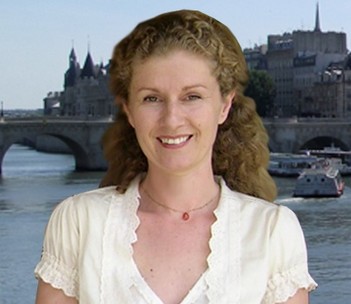
Our honored guest looks lovely, doesn’t she, in her long black cape with the red-satin collar? But don’t be fooled. Looks are extremely deceiving in her case. Jilla harbors no illusions about the dark side of expat life — and she isn’t afraid to grasp you by the hand and seduce you into entering that netherworld for an adventure.

Many an expat veteran has advised that being stationed overseas isn’t necessarily the life of Riley. But how many of them have ever warned us of the dangers lurking on the other side: everything from psychological breakdown to murder most foul?

Slyvia Plath, the American poet who’d been living in a bucolic a part of the English countryside, put her head in the oven upon returning to London. Nancy Kissel, who was living in an exclusive Parkview high-rise apartment complex in Hong Kong, allegedly killed her husband with a blunt instrument and rolled up his body in an Oriental rug.

But why dwell on real-life cases when Jilla’s imagination can provide us with all the macabre details we need?

Deliciously “exiled”

Shireen Jilla
Let us raise our goblets to Jilla’s debut novel, Exiled, a dark, dysfunctional psychodrama set in New York City.

The novel tells the story of Anna, who is so in love with her husband, Jessie, an ambitious British diplomat, that she can’t wait to start a new chapter of their life together in New York. Jessie is the ticket (quite literally!) for Anna to leave her old life in rural Kent far behind.

At first, New York lives up to its promise. The couple find a brownstone on the Upper West Side and fall into the rhythm of New York life. But then disaster strikes, again and again.

As Anna herself puts it in her Foreword to the story:

I couldn’t imagine that my romantic dream would turn into a dark battle for everything I loved.

In our current gothic mood, we laud the idea of this book (unfortunately, we’ve only read excerpts as it’s not yet available in the U.S.) for:

1) Defying stereotypes: Many outsiders who write about New York are tempted to extol the city’s glitz and glamor a la Sex and the City. Not Jilla. As one critic put it, she gives us a New York that is “a teeming pit of hissing vipers, only just covered with a finely buffed veneer of sophistication.”

Exiled2) Pushing the envelope: Jilla, a Third Culture Kid (she is half English, half Persian, and grew up in Germany, Holland and England) who has also been an expat — in Paris, Rome, and New York — hasn’t simply replicated her experience but has dug deeper to reveal psychological truths about the people she has observed. Anna’s step-mother-in-law is a powerful socialite and philanthropist of precisely the sort seen on The Real Housewives of New York City. In Jilla’s rendering, though, she is further revealed as calculating, manipulative — and evil. As one reader-reviewer on Amazon says:

Imagine the stark terror of Rosemary’s Baby firmly grounded in reality. Shireen Jilla has created the sharp thrill of horror in a world of utterly true and compelling characters.

3) Presenting a heroine who could almost be Libby’s alter-ego: Now who is Libby, you might ask? She is the Displaced Nation’s fictional about-to-be expat wife. Her diary entries appear every Friday on this blog. After hearing about Anna, we can’t help but wonder: will Libby’s life take a sinister turn once she reaches Boston? No, Boston isn’t New York — but how long before Libby encounters a Boston Brahmin…or two?!

Time to break the spell?

Before we blow out our candles, it’s your turn, dear reader:

Has Shireen Jilla also illuminated something for you by exploring the gothic side of our displaced lives? Does she speak to your own experience — to the times when you’ve been face to face with people who seemed evil, or with nefarious doings?

And do you have any questions for Jilla about what motivated her to write such a gloriously dark book?

img: New York Skyline, by plastAnka.

If you enjoyed this post, we invite you to subscribe for email delivery of The Displaced Nation. That way, you won’t miss a single issue. SPECIAL OFFER: New subscribers receive a FREE copy of “A Royally Displaced Tea.”

Related posts:
A displaced American writer, awash in sea of Royal Wedding apathy

Today we welcome Kristen Ashley to The Displaced Nation as a guest blogger. She wrote this post in response to Kate Allison’s “Jerry Seinfeld — the Royal Wedding’s Answer to Ricky Gervais.” Kristen is Kate’s opposite number: an American (originally from Indiana) who has been living in England: in a small seaside town in the West Country.

When I was asked to write an American’s perspective on Britain’s perspective on The Royal Wedding, at first I demurred. I did this because usually I have a lot to say on any subject but this one I didn’t.

This isn’t because I hold disdain for the upcoming nuptials. Indeed, back in the day when I was just thirteen, I, like many other Americans, woke up at an ungodly hour to watch Diana marry Charles. I did this with excitement akin to waking up Christmas morning. Well before their wedding day I was devoted follower of Diana and I still think she was a very stylish, kind and compassionate woman. And, living in England for eight years, I’ve come to respect Charles. And, lastly, it appears they raised two fine sons. In fact, the Royals as a whole seem okay in my book. I know they have their foibles but don’t we all?

Wedding — what wedding?

No, the reason I demurred from writing this piece was because no one here cares much about The Royal Wedding. In fact, William and Kate were engaged for days before I knew they’d made the announcement, and I only found out about it from seeing the Facebook statuses of my American brethren. Just yesterday, less than two weeks before the big event, I learned that Kate was given Diana’s ring, she wore blue during the announcement and did her own makeup. All this came from my sister who lives in Phoenix.

Therefore, considering the lack of interest was the piece, once I’d agreed to write it, I started to pay attention. By no means did I do any statistical research but I did make the effort to scan the magazines at the checkout counters, none of which, for weeks, had picture one of the happy couple and they still don’t.

A good day for a street party…or to mow the lawn

We get a bank holiday here for the wedding and that’s the only subject I’ve noted of any non-instigated chatter about The Wedding. Even so, no one I know is going to be sitting at home watching it. They’ll likely be in their gardens or on a jaunt to the seafront or some such British activity.

So, I brought up the subject, and not to talk about the bank holiday. When I suggested to a group of friends that we have a Royal Wedding party at my house, I received blank faces. The kind where someone is trying desperately to find a good lie where they can say they’re doing something important like grooming their cat and couldn’t possibly attend your party. The conversation died at that point and even when I told them I’d have plentiful Pimm’s and lemonade on hand there were no takers.

They did talk about the amusing anecdote of an article in the local newspaper describing how one small town was surprised that no one had applied to have a street party on the Big Day. Another indication that folks were taking the bank holiday not to celebrate the nuptials but to trim their rose bushes.

Time to load up on choccie biccies

I have noted, of late, that Clinton’s Cards has Union Jack decorations for sale should there be any takers but this display has only sprung up recently. And McVities has a commemorative tin of biscuits available — but it’s already on special offer and the event hasn’t even passed.

Other than that, it’s business as usual on this sceptred isle with everyone far more interested in what’s happening with Cheryl Cole and Katie Price than their future king claiming his bride.

As for me, I’m undecided. I’m curious about Ms. Middleton’s dress. That’s as far as I can build my interest. Perhaps it’s the lack of enthusiasm that surrounds me or perhaps the ugly, public and, in the end, literal death of the fairytale for William’s mother has soured me on the whole shebang.

I know this, if it’s sunny like it has been here for days, it’s unlikely I’ll be inside in front of a TV. This is England after all and you’re likely to be put to death if you sit inside when it’s sunny. I’m certain there will be plenty of photos on hand where I can examine the future queen’s wedding gown in detail.

But I’ll undoubtedly find them on American Web sites.

Question: How will you spend April 29th? And should the extra British holiday for the Royal Wedding be donated to a more enthusiastic audience?

Kristen Ashley is a novelist and the author of the Rock Chick Book Series. She offers downloadable chapters of her books, great recipes, and much more at www.kristenashley.net.

img: author photograph – Kristen Ashley

If you enjoyed this post, we invite you to subscribe for email delivery of The Displaced Nation. That way, you won’t miss a single issue.

Ho’ omaika’i ‘Ana to TCK writer Tony Roberts

Aloha, reader. We would love for you to join our celebration of writer Anthony H. [“Tony”] Roberts, who produced our favorite article of the week, “No Time for Goodbyes,” a gripping account of his family’s sudden departure from Iran in 1978, when he was just 17.

Tony wrote his piece for Denizen, the online magazine for Third Culture Kids — kids who grew up in a culture or cultures other than their own.

Tony now lives on the Big Island of Hawai’i, so our fete in his honor, which has just begun, consists of a min-luau with traditional foods, mai-tais, and a hula performance.

You will also have a chance to engage with Tony directly as he’s agreed to respond to your comments and questions. (Mahalo, Tony!)

In fact, the hula dance is about to begin. Watch the series of three dances telling us why Tony’s life is so special:

#1: TRAGEDY

From Tony, we can learn about what it is like to be displaced by circumstance rather than by choice. Tony spent five years of his childhood exploring deserts in Saudi Arabia and three years as a teenager running wild in the streets and hillsides of the ancient city of Tehran. Then suddenly the Islamic revolution occurred, and before he had a chance to click his heels even once, he, along with his mother and sister, were transported back to their small farm town in Kansas, where he’d been born but no longer thought of as home:

The greatest sadness of leaving Iran in 1978 was its speed. Our departures were so fast that there was no time for goodbyes. All of my closest high school friends scattered to the winds. Tens of thousands of Americans lived in Tehran when I was there, and by the end of 1979 there were only 52 left — the American hostages.

#2: TRIUMPH

Tony has done something many expats only dream of: he’s written up his experience in a work of historical fiction. His book, published in February of this year, is called Sons of the Great Satan. It tells the story of an American teenager forging a friendship with an Iranian teenager in the last golden hours before the Shah of Iran falls and the country is engulfed by a whirlwind of chaos. Go to YouTube trailer.

#3: MULTICULTURALISM

Tony and his family embody our ideal of global citizens. His wife is a Kiwi, his son a Cherokiwi, and they live in Hawai’i, a melting pot of cultures from around the world, with influences from China, the Philippines, Japan, Korea, Portugal and Puerto Rico, to name a few. And let’s not forget Ziggy, the family pet. He’s a Boxador, a cross between the Boxer and the Labrador Retriever. (Ziggy, assuming Fergus makes it to The Displaced Nation, we’re sure he would enjoy palling around with you.)

And now, it’s time to adorn Tony with leis and drink a toast to his honor. Okole maluna! Cheers, Tony!

If you enjoyed this post, we invite you to subscribe for email delivery of The Displaced Nation. That way, you won’t miss a single issue.