The Displaced Nation

A home for international creatives

Tag Archives: Crosscultural marriage

Why “expat” is a misleading term for multicultural couples

Today we welcome author and “global love” expert Wendy Williams to The Displaced Nation. A Canadian, she lives in Vienna with her Austrian husband and their daughter. But is she an expat or an immigrant? Yes, that old chestnut! Except…Williams has a novel way of addressing it.

“At the risk of sounding like a snooty intellectual or immigrant diva, I think it’s time to clear up some confusion about the term ‘expat,'” I announced to a features editor recently.

“Oh no,” she warned me, “don’t get bogged down with tedious definitions and classifications. Just write something about the joys and the dramas of being an expat couple. And offer some good advice, too,” she added cheerily.

As the author of The Globalisation of Love — a book about multicultural romance and marriage — I am frequently asked for advice on “expat relationships.” And that’s my whole point today — what is an expat relationship, anyway? And are multicultural couples and expat couples one and the same?

An “expat couple” — what exactly does that mean?

Expat is a term that is bandied about, dare I say recklessly, to describe someone who is living in a foreign country and it is often used to describe couples where one or more partners are foreign born.

Exhibit A: I am Canadian and my husband is Austrian. We live in Vienna. Often we are referred to as an “expat couple” — or even as an “expat family” if our born-in-Austria daughter is included. Granted, I have pretty high standing as matriarch of my family of three, yet does just one “expat” in the family make us an “expat family”? My husband and daughter are living in the country where they were born after all. Other than a bit of English and a lot of peanut butter that I smuggle in from Canada, there is very little “expat” about them.

Yet expat is a label given to anyone with any kind of international flair.

So, time to get to the heart of this worldly weighty matter. An “expatriate,” in my understanding, as well as that of Merriam Webster and even Wikipedia, is “any person living in a different country from where he or she is a citizen.”

Expats usually start their international lives on assignment for a multinational corporation — unless they are Australian, in which case they begin by bussing tables in London’s grottier pubs or teaching Dutch guests to ski in Austria.

Typically, expats enjoy a long list of job perks to deal with the “stresses” of life abroad so they get free rent, paid trips back to the motherland and private school for the kids. Paying income tax seems to be optional. Expats are like visitors to a country: they deal with external issues like culture, language, and religion. Usually they live from one to five years in a given location “making the most of it” exploring the region and learning about the local culture. They always know they will be going home at some point, even if there are more international postings along the way.

Vs a “GloLo couple” — now there’s a precise label!

A multicultural relationship, by contrast, is one where each partner is from a different country or culture. Multicultural couples — or what I call “GloLo couples” in The Globalisation of Love (blatant self-promotion, I know) — deal with issues like culture, language, and religion within the relationship. GloLo couples do not usually have the job perks of expats because they work locally, so they pay their own rent, they have to pay taxes and their kids go to the local school.

Whether they live in his country or her country — or swing back and forth between the two countries every few years — there is a sense of permanence about the geography. The imported partner is an immigrant really, although “immigrant” has taken on some negative connotations in our nilly-willy live-here-work-there globalized society.

Barring bureaucracy and ludicrous immigration laws (Austria, this means you!), GloLo partners may even gain citizenship in the country into which they have married. At the risk of more shameless self-promotion, I call it the “globalization of love.”

So here is my point: An expat couple and a multicultural couple are not necessarily the same relationship constellation and should not be confused with one another. An expat couple can be a GloLo couple if they have different nationalities, however a GloLo couple is not necessarily an expat couple, even if one partner is an expatriate. It is only when a GloLo couple live in a third neutral country that they become an expat couple as well.

Aren’t you glad we cleared that up?

Meanwhile, the features editor still wants some advice on dealing with the joys and the dramas of being an expat couple though. Hmm, how about make the most of it, explore the region and learn about the local culture?

And my advice for multicultural couples? Well, there’s this book I should tell you about…

Question for readers: How do you define “expat” vs “immigrant” — and does Williams’s “glo-lo” term strike you as being useful?

WENDY WILLIAMS is the author of The Globalisation of Love, which was featured in The Displaced Nation’s post Best of 2011: Books for, by and about expats. You can learn more about Williams and her book at her author site, The Globalisation of Love.

STAY TUNED for Monday’s post, an introduction to March’s Cleopatra(!) theme…

If you enjoyed this post, we invite you to register for The Displaced Dispatch, a round up of weekly posts from The Displaced Nation, with seasonal recipes, book giveaways and other extras. Register for The Displaced Dispatch by clicking here!

Related posts:

RANDOM NOMAD: Liv Hambrett, Australian Expat in Germany

Place of birth: Sydney, Australia
Passport: Just my little blue Australian one. And I’d like to keep it.
Geographical history: Greece (Santorini): for several three-month stints since 2008; Germany (Münster, Nord Rhine-Westphalia): 2010 – TODAY, LEAP DAY! (February 29, 2012); Germany (Weiden in der Oberpfalz, Bavaria): TOMORROW onwards!!!
Current occupation: Writer and language trainer.
Cyberspace coordinates: A Big Life | An Australian in Germany (blog) and @LivWrites (Twitter handle)

What made you leave your homeland in the first place?
The only thing that really made me leave my home was me. I had traveled on and off throughout my studies and was ready for something a bit more … daring. I wanted to live in Europe, not just travel through it whenever I could get enough money and find enough time. I am incredibly lucky to come from the country I do. To return to it would be no problem, to have its passport is a blessing. I just wanted to try something different, and in Germany I found something more solid to assuage my constantly itching feet.

Was anyone else in your family “displaced”?
My parents are both travelers and my mother spent a year working in London in her twenties. My uncle spent four years living in South Africa and traveling through Europe, before meeting his Swiss wife and bringing her back to Australia — she’s now displaced. I think many Australians are nomadic by nature — we like to wander, we like to see what’s out there. It’s in our blood.

Describe the moment when you felt most displaced since making your home in the historic university city of Münster.
Münster is one of the “nicest” cities in the world, so my displacement here is usually a case of: “What’s a girl like me doing in a nice city like this?” I’m pleasantly displaced, in other words! But while there haven’t been precise moments of aggravation, there have been parts of the ongoing adjustment process that made me want to click my heels together three times. As much as I love it, Germany has this thing with bureaucracy and paperwork and red tape; and sometimes, when I am drowning in letters from my insurance company, or wading through the healthcare system, or putting together paperwork for my visa renewal, or trying and failing to understand the language, I do think: wouldn’t it just be easier if you were at home? I’ll soon be moving to Bavaria — and all the bureaucracy that will come with a new job, a new visa and a new state (or as some Germans would have you believe, a new country) will probably have me hurling abuse at walls every so often. Just for therapy. Oh yes, and when it is -18 degrees celsius, I start thinking: what the hell am I doing in this country?

Have you also had some moments when you feel more at home in Germany than you did in Oz?
Any time I have a cup of tea in hand and am talking to a good friend, I feel as if I could be anywhere in the world, and this person and I would still have stories to share and understanding to give. It isn’t a matter of feeling more at home than in my home country, it is a matter of feeling as at home — and I think that’s as comfortable as it gets.

You may bring one curiosity you’ve collected from your adopted country into The Displaced Nation. What’s in your suitcase?
Probably an enormous amount of würste in the many and varied forms it comes in.

Food is close to the heart of all Displaced Nation citizens. Are there any other special German foods you’d like to offer us besides German sausages?
Yes — Schnitzel (deep-fried veal) and rotkohl (German red cabbage).

I assume you’d drain the cabbage in your Villeroy & Boch colander? I saw a photo of it on your blog — rather whimsical and wonderful! And now you may add a word or expression from the country where you live in to The Displaced Nation argot. What will you loan us?
From Germany: Actually, I have two: Das stimmt (that’s true) — it rolls off the tongue; and schnabel (a bird’s beak or bill) … because it is SO CUTE.
From Greece: Siga siga (slowly slowly) — it sums them up perfectly.

This month, because of Valentine’s Day, The Displaced Nation has been delving into the topic of finding love abroad. And today is Leap Day, when according to legend, women get to propose to men. Have you found a candidate in Gerany?
I met the Significant German — I call him SG on my blog — within four months of moving to Münster. I wrote about our story in a blog post last November. As I said then, if I had to give a tagline to the movie poster for my life as it currently is, it would be “she came for the adventure and stayed for love.” Sounds romantic and exciting, doesn’t it? But it’s a new one for me.

I read that on Leap Day (February 29), women are allowed to propose to men. Any plans?
Well, I’m starting my second big life in Germany TOMORROW when I move to Bavaria to be with SG.

On a more prosaic note, are German men very different from their Aussie counterparts?
Oh Lord, the differences are many. The main thing — and this applies to Australian men as compared to many European cultures, not just Germany — is that Australian men have this ongoing thing with being a “bloke”: masculinity in its conventional sense is quite important to an Australian male’s identity, even if they aren’t aware of it.

Also, this month we’ve been looking at expat and travel films, in honor of the Oscars. Do you have any favorite films in this “genre”?
Bienvenue chez les Ch’tis” (Welcome to the Sticks) — not exactly about an expat, but the character moves towns in France. It captures the essence of moving and feeling like an alien, then adapting, perfectly! And as far as the Love theme of February goes: Love Actually. Always Love Actually.

Readers — yay or nay for letting Liv Hambrett into The Displaced Nation? Tell us your reasons. (Note: It’s fine to vote “nay” as long as you couch your reasoning in terms we all — including Liv — find amusing.)

STAY TUNED for tomorrow’s installment from our displaced fictional heroine, Libby. Having de-stresed with Oliver on their Valentine’s Day weekend, she thinks she may be ready to face the Woodhaven world again and its tribulations. But as we all know, it takes more than a facial and pedicure to attain such a level of serenity. (What, not keeping up with Libby? Read the first three episodes of her expat adventures.)

If you enjoyed this post, we invite you to register for The Displaced Dispatch, a round up of weekly posts from The Displaced Nation, with seasonal recipes, book giveaways and other extras. Register for The Displaced Dispatch by clicking here!

Related posts:

img: Liv Hambrett with her mug of glühwein in Münster, Germany.

How NOT to review Iran’s first Oscar-winning movie, “A Separation”

On Sunday night, A Separation became the first Iranian (and Middle Eastern) film to pick up the Academy Award for Best Foreign Language Film. Although the film has already received rave reviews from mainstream critics, we asked a former expat in the Middle East who recently published a book about his adventures in Turkey, Matt Krause, to direct our attention to what’s interesting and important.

When The Displaced Nation asked me to review the Iranian film A Separation, I hadn’t seen it yet. I don’t follow film much, so even though the movie was up for a couple of Oscars, I hadn’t heard of it.

I am currently living in a very small town in California that’s far from Los Angeles and San Francisco. While I was searching for some alternative way to watch the movie, I read up on it. That was my first mistake.

Based on the descriptions I found, I thought it would be about some combination of seeking a better life abroad, caring for an elderly parent, and the strains of life affecting a marriage. These are all topics near and dear to my heart, and I looked forward to seeing what A Separation had to say about them from an Iranian viewpoint.

Before I found the movie I thought about what I would say in the review. I thought about how I would talk about seeking a better life abroad. I thought about how I would talk about caring for an elderly parent. I thought about how I would talk about the strains of life affecting a marriage. I thought about differences between American society and Iranian society. My review was practically written before I had even seen the movie.

I know, it was ridiculous for me to think I could form an opinion on this or any other movie without watching it with my own eyes, but that was Mistake No 2.

I finally located the movie and watched it. As the closing credits rolled I realized none of what I had planned to say was even remotely relevant. I sat in front of the screen slack-jawed wondering, “Whoa, what am I going to say about this one?”

A Separation is a great movie. It is one of the best movies I have seen in a long time and I would definitely recommend it.

Here are three of the elements I responded to most:

1) The theme transcends the particular to examine universal questions.

The movie’s opening scene introduces a married couple being pulled apart by the struggle between searching for a freer life and fulfilling obligations to others. I thought the movie would be about how that conflict plays out in this particular marriage. However, as the story unfolded, I realized this was not a movie about two people negotiating that conflict. It is about how both sides of that conflict duke it out inside of each one of us, how that internal conflict is an inescapable part of being human, and how, despite our attempts to quiet it, that conflict is unresolvable and will be with us until the day we die. We humans want to be free, but we also want others to depend on us.

2) The cinematography conveys the impression of a tight spiritual space.

When that struggle comes to a head, spiritual space can feel awfully tight. A Separation brings that tightness to life not only in the storyline, but also in the cinematography. The camera angles are tight and the spaces feel cramped, whether the scenes take place in a small apartment, a tiny government office, or a crowded city street. In fact, many of the movie’s scenes take place in rooms so crowded there is barely room for the characters to stand.

3) The action relies on tight story-telling, not music and special effects.

Following the movie’s storyline is excellent mental exercise. There are plot twists, and then there are twists to the plot twists, and then there are twists to those twists. Lesser movies use multiple plot twists to cover up for lazy writing, the writers perhaps hoping the plot twists will distract viewers from the writers’ own inability to tell a good story. In A Separation, however, storytelling discipline remains tight through each plot twist. The characters are as baffled by the twists as we are. The twists do not distract us, they simply allow us to view the central conflict from a new angle, before returning us to the original angle in the final scene.

A Separation uses little or no music, not until the end of the final scene when the closing credits are about to roll. Where most movies use music to guide the viewers through the building and release of tension, A Separation relies on tight storytelling to provide that guidance. The lack of music seems almost like the director accepted his own dare to raise the storytelling bar so high music would be unnecessary.

* * *

Watching A Separation was an excellent investment of my time, and I suspect you will think it is of yours, too. Don’t start out expecting this movie to represent anything except itself, though. Check your baggage at the door and listen to what this movie has to say.

Question: Have you seen A Separation and if so, what did you think?

As American from California who specializes in international trade and operations, MATT KRAUSE has spent forty percent of his life abroad, with stints living and working in China and Turkey. Last year he self-published his memoir, A Tight Wide-open Space: Finding love in a Muslim land. The book appeared on The Displaced Nation’s list Best of 2011: Books for, by and about Expats and was reviewed this month by Kate Allison. After finishing the book, Matt decided to walk 1,500 miles from Turkey to Jerusalem, a journey of about six months. You can read about it on his blog Heathen Pilgrim.

STAY TUNED for tomorrow’s Random Nomad interview.

If you enjoyed this post, we invite you to register for The Displaced Dispatch, a round up of weekly posts from The Displaced Nation, with seasonal recipes, book giveaways and other extras. Register for The Displaced Dispatch by clicking here!

Related posts:
RANDOM NOMAD: Megan Farrell, American Expat in São Paulo, Brazil

Place of birth: Chicago, Illinois USA
Geographical history: USA (Chicago, Illinois; West Palm Beach, Florida; Ventura, California; Washington, DC): 1969 – 2002; Spain (Barcelona): 2001; USA (Princeton, New Jersey; New York, New York): 2002-10; Brazil (São Paulo): 2010 – present.
Passport: USA — my daughter, however, has three: USA, Brazil & Germany.
Current occupation: Aspiring novelist and screenplay writer, business school lecturer, and former research director at a Wall Street firm.
Cyberspace coordinates: Born Again Brazilian (blog) and @BornAgainBrazil (Twitter handle)

What made you leave your homeland in the first place?
Ever since I was a child, I wanted to explore the world and always had it in my head that I would live in other countries. I think it was because I used to read a lot as a kid, stories about other places, some of my favorites being James and the Giant Peach and The Little Prince. I also loved Laura Ingalls Wilder‘s Little House series. By the time I reached adulthood, I was open to opportunities to travel and explore new cities as a local.

Describe the moment when you felt most displaced since making your home in Brazil’s largest city, São Paulo.
Wandering lost, in the rain, in an unfamiliar neighborhood, after a boy on a bike tried to wrestle my iPhone out of my hands. I’d grabbed it out of his hands, but he still hung around yelling something at me and trying to get the phone. It seemed incredible to me this was happening because although it was raining, it was broad daylight and I was on a street where there was a row of little shops. So after putting a bit of distance between us, I stopped and started screaming like a horror movie starlet and pointing at him. People came out of their shops and of course he got scared — I think mostly because he thought I was crazy. I’d never before experienced anything so bold.

Your blog is called Born Again Brazilian. I imagine you’ve also had many moments when you feel more at home in Brazil than you do in the USA. When have you felt least displaced?
While sitting on the beach of Leblon, in Rio de Janeiro, viewing the ocean. On a beautiful day, it absolutely makes you feel as though all is right with the world and you are exactly where you are meant to be.

You may bring one curiosity you’ve collected from each of your adopted countries into The Displaced Nation. What’s in your suitcase?
No need for a suitcase as what I’d most like to bring with me to The Displaced Nation is a couple of intangible items:
From Brazil: Jeitinho or jeito, the ability to get in, out and/or around something despite a law, a regulation, a contract, physics or gravity.
From Barcelona: The recipe for survival possessed by local shops, which seem to close and open at random times — and when you enter, the owners or employees often act as though you are completely putting them out by wanting to buy something. It’s hilarious and curious at the same time.

Food is close to the heart of all Displaced Nation citizens. We would therefore like to invite you to make a meal for us. What will you offer?
I can offer a choice of two classic menus:
1) Brazilian (São Paulo/Rio de Janeiro)
Appetizer: Bolinho de bacalhau (codfish cakes), served with Original cerveja (beer)
Main: Feijoada (traditional bean stew with beef and pork), served with caipirinhas (Brazilian national cocktail, made with rum, sugar and lime)
Dessert: Mouse de maracujá (passion fruit mousse)
2) Spanish (Barcelona)
Appetizer: Assorted pinchos (bar snacks eaten with toothpicks), served with cider
Main: Paella Valenciana (Valencian paella), served with a nice Spanish white wine
Dessert: Flan (crème caramel)

What’s your pleasure?

You may add a word or expression from the country where you live in to The Displaced Nation argot. What will you loan us?
Tudo bem! When you greet someone in Brazil, you say tudo bem instead of hello, but you use it like a question: “Tudo bem?” (All is well?) And you might respond with tudo bem (all is well) or tudo otimo (all is great) or simply tudo (all). Brazilians must use this greeting countless times a day. What I love about tudo bem is that it represents how familiar and personal the Brazilian culture is. A stranger in the elevator will greet you by asking if all is right in the world for you. That is totally Brazilian.

This month, in honor of Valentine’s Day, The Displaced Nation has been delving into the topic of finding love abroad. I understand you have a Brazilian husband. Where and how did the pair of you meet, and was it love at first sight?
I met my husband while we were getting our MBAs at Georgetown University (in Washington, DC). The first time I met him, I thought he was pretty stern — little did I know he had just arrived to the country the day before and wasn’t so comfortable with his English. I kind of wrote him off as one of the machismo Latin guys that didn’t like to work closely in a business setting with women. But after the final exams of our first semester, we wound up at the same party. I actually attempted to hook him up with my friend — he is tall and she is tall — but it turned out he was more interested in me. After I saw a few of his dance moves…it was love at second sight!

Thanks to Gisele, many people have an image of Brazilian women as very attractive. Is that also true of the men, and do they make good husbands?
First, my husband is not your typical Brazilian man. He spent a great deal of his childhood in Germany with his grandparents and has his behavior has been heavily influenced by his German father. Typical Brazilian men see the roles of men and women as clearly defined channels. From what I’ve seen and heard from my Brazilian and American friends married to Brazilians, the menfolk rarely if ever help out with household chores or issues, as they feel that is the woman’s role — even if she is working a full-time job! However, for the most part, Brazilian men are very charming, complimentary and romantic. They see themselves as Prince Charming, and if that is what a woman is looking for, a Brazilian man is a good catch.

You said you fantasized about traveling to other lands from the time you were a child. How about marrying someone from another land?
I never thought much about it, but before my husband, I only dated All-American guys, so I think it came as a surprise to my parents. However, when my now husband asked me to marry him, I knew that my life would never be boring, and always full of adventure. And I was right!

Now that Valentine’s is over, The Displaced Nation is moving on to look at expat and travel films, in time for the Oscars. Do you have a favorite film(s) in this “genre”? I see you’re interesting in screenplay writing, which makes me doubly curious.
I think the first movies that inspired travel for me were Cocktail with Tom Cruise (he finds love while working in a bar in Jamaica) and Only You with Marisa Tomei (she follows the man she thinks will be her true love to Italy). When I was a bit older, I was definitely was drawn to seeing the world by a beautifully filmed, but wildly depressing, New Zealand-Australian-British film by Jane Campion titled An Angel At My Table. It’s based on Janet Frame‘s autobiographical series about growing up in New Zealand, leaving and returning.

Readers — yay or nay for letting Megan Farrell into The Displaced Nation? Tell us your reasons. (Note: It’s fine to vote “nay” as long as you couch your reasoning in terms we all — including Megan — find amusing.)

STAY TUNED for tomorrow’s installment from our displaced fictional heroine, Libby, who is discovering that Valentine’s Day in the US is quite different from the UK version — a fact that doesn’t come naturally to her three-year-old son. (What, not keeping up with Libby? Read the first three episodes of her expat adventures.)

If you enjoyed this post, we invite you to register for The Displaced Dispatch, a round up of weekly posts from The Displaced Nation, with seasonal recipes, book giveaways and other extras. Register for The Displaced Dispatch by clicking here!

Related posts:

img: Megan Farrell poses at the nature center in Parque Estadual do Pico do Itacolomi, which is outside Ouro Preto, Minas Gerias (July 2011).

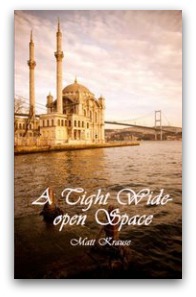
BOOK REVIEW: “A Tight Wide-open Space,” by Matt Krause

Subscribers to the Displaced Dispatch already know that our next free giveaway is a signed copy of today’s featured book! If you would like to enter the draw for this great prize, sign up for the Displaced Dispatch before Friday by clicking here!

TITLE: A Tight Wide-open Space: Finding love in a Muslim land
AUTHOR: Matt Krause
PUBLICATION DATE: August 2011
FORMAT: Ebook for Kindle and Nook; paperback; PDF (from author’s Web site)
GENRE: Travel memoir (Middle East)
SOURCE: PDF file from author’s website

Summary:

In 2003, when the shockwaves of 9/11 still echoed through the US and the country was fighting two wars in Muslim countries, Matt Krause met a beautiful Turkish woman on an airplane and decided to follow her to Turkey. This is the story of what happened there.

Matt figured adjusting to life in Turkey would entail some challenges, and he certainly wasn’t disappointed. He survived bomb attacks, lost his cool around beggar kids, drove a jewelry business into the ground, and got into fistfights over parking. Along the way though, he saw beauty in ruins older than the Roman Empire, was wowed by tales of Bulgarian freedom fighters, tried not to hit cows in the road, and drank plenty of peach-flavored Lipton iced tea.

…A Tight Wide-open Space is the story of falling in love not only with a woman, but with a city and a country. (Amazon.com)

Review:

Matt Krause met and wooed his Turkish wife-to-be in a way seldom seen outside Hollywood scripts. A chance meeting on a flight from San Francisco to Hong Kong; Matt’s sixth sense inkling that this woman was The One; his Google search for her name upon his return (“I sent her an email and tried not to sound too much like a stalker”); his impulsive decision, a few short months later, to rent out his Seattle home and follow her back to Turkey (“I thought about the situation for about 10 seconds and then I said ‘Well, I’ll come with you.'”) — yes, there’s a Valentine’s tale there, all right.

The book is a stimulating mix of the anecdotal and informational: first-hand accounts of the (excellent) Turkish health care and (not so excellent) law enforcement combine with Turkish History 101 and swift lessons on the Ottoman Empire. Running like a silver thread through these yarns is the deeply personal and affectionate — the reason for Matt’s presence in Turkey. The love story.

For all that this is a love story, however, Matt pulls no punches in the telling of it. The introduction chapter, a description of the slaughter of a ram for Kurban Bayram (Feast of the Sacrifice) is vivid — lurid, even. Yet it gets the point across as little else could: that a guy who has spent thirty-three years in the haven of America’s West Coast is now a long distance outside his comfort zone.

For me, the biggest charm of A Tight Wide-open Space is the author’s honesty. Matt doesn’t try to put himself in a better light just because a few thousand people are reading about his overreaction to a persistent little boy who wants to shine his shoes :

What on earth had possessed me to act like that? I had just blown up at a little kid on the street in broad daylight. I had just threatened to snuff the life out of a little boy barely tall enough to reach my belt. I hadn’t even been in Turkey for three months yet. What was I becoming?

In the face of this engaging frankness, it’s impossible not to get drawn into Matt’s story. His frankness extends to accounts of his wedding, a trip to hospital, an almighty row with his new wife. A book — appropriately enough, for Valentine’s Day — written from the heart.

As I have no plans for a subheading called “Spoiler Alerts”, I will say no more — except that the book’s twists and turns along the way only remind us that, yes, this is indeed real life.

Not Hollywood.

Words of wisdom:

One thing I learned early on about Turks is that you can never go wrong with a big smile and an enthusiastic introduction.

When we meet someone else, someone from another religion, or another country, or even another profession or another social class, it is our duty to that other person to remember that our understanding of that person is probably incorrect. And it is our duty to ourselves to overcome that incorrectness.

Home is not a place. Home is not Seattle, California, Texas, Ohio, or Kathmandu. Home is the people we love.

Verdict:

At around 190 pages, this is an easy read, but by no means a shallow one. Whatever Matt’s plans might be for the future, I hope they include more writing.

STAY TUNED for Wednesday’s Random Nomad post.

If you enjoyed this post, we invite you to register for The Displaced Dispatch, a round up of weekly posts from The Displaced Nation, with seasonal recipes, book giveaways and other extras. Register for The Displaced Dispatch by clicking here!

Related posts:

THE DISPLACED Q: Does love conquer all — even language barriers?

Last week Tony James Slater, the newest addition to the TDN team, reported on his success with finding love abroad. But it wasn’t always that easy for him. He may be an incurable adventureholic, but when Cupid’s arrow led to a romance with a woman who didn’t speak English, even he had to wonder if there were limits…

Here’s the scenario:

You’re minding your own business in a friendly sort of bar, enjoying the heady mix of cultures as foreigners — a mix of holiday-makers, transients and expats — rub shoulders with the locals.

Suddenly you see him — or her — across the crowded room. This gorgeous individual is staring right at you, smiling seductively. You make contact with those smoldering eyes…and that’s where it ends.

Because she doesn’t speak your language, and you speak none of hers.

So really, what are you going to say to her?

Can romance transcend the language barrier?

It’s a tricky one.

No lo entiendo, mi amor

I have a little experience in this area; once upon a time, when I doing a three-month stint of volunteering at an animal shelter in Ecuador, I fell madly in lust with a gorgeous Latino woman.

Of course she didn’t speak English — there was no one who could for miles in any direction. I spoke no Spanish, because until that moment there had never seemed enough reasons to learn it.

I was captivated by her — she was the kind of exotic beauty you read about in well, the kind of books that I don’t read. Ahem.

So what do you do?

Two obvious tactics spring to mind.

The first is what I did: get horribly drunk and throw yourself at the poor woman, in the hope that you’ll never remember the embarrassment in the morning, if she laughs in your face.

As it happens, this tactic worked — but it should be noted that this is the first time ever, in the history of mankind, that this has been the case. As a rule, I cannot endorse extreme inebriation as a successful method of flirtation; truly, this must have been Cupid himself in action.

The second tactic is to get a friend who does speak both languages to make some kind of introduction. This can help you get over that incredibly awkward initial stage when neither of you is really sure if the other is genuinely interested.

This is the tactic I should have used, as I had a perfectly good friend with the requisite language skills. Of course by the time I’d thought of that, I was already too drunk to pronounce even English words. It was quite a way down the road when I finally got to communicate in words with my new lover, through an interpreter.

At that point, it was great to have it confirmed that she felt the same way about me as I felt about her!

It was slightly less great to discover that she was already married and had two children. But then, that’s the chance you take when you practice tactic no.1.

Thankfully, she was separated from her husband — although as our relationship progressed, I did hear some disturbing rumors that her husband was looking for me…with a machete. I fervently hoped that was just my boss trying to wind me up. (If it was, he succeeded!)

Pidgin Spanish and pantomime…are there limits?

Although she was beautiful, the thought of meeting her again terrified me anew each time. I felt like such an idiot, struggling to express myself in pidgin Spanish and pantomime. I lived in fear of those awkward moments, when neither of us could make the other understand some fundamental issue.

That said, it definitely motivated me to learn Spanish! After every date I’d come back fired up with the desire to study. I never did any studying, of course — my day job (mucking out animal cages) kept me way too busy for that — but the desire was there. The desire, in fact, had never been a problem!

But how far can a relationship really go, when you don’t even have a language in common? Think how close you can get to someone in a long-term relationship; a connection bordering on the psychic, where you’re almost reading each other’s minds — it just doesn’t work when you’re constantly guessing at what the other person is saying.

The Austrian-British language philosopher Ludwig Wittgenstein once remarked:

The limits of my language are the limits of my world.

If he is right, then isn’t the lack of a shared language the very essence of incompatibility?

Relationship experts the world over agree that couples must work hard to bridge communication gaps. Well, when the gaps of linguistic understanding are wide enough to fly a 747 through — and it can feel like a long-distance relationship even when you’re standing next to each other — bridge-building can be something of a challenge.

My Ecuadorian love and I were together three months, after which I left to fly back home. Ironically, we’d each learned just enough of each other’s languages to really get to know each other’s thoughts, hopes, fears and frustrations — the day before my flight to England.

I’d like to open it up to the floor at this point!

Has anyone got any experience of this that they wouldn’t mind sharing? Or an opinion, on whether or not it’s possible?

Can love really conquer all — including that ultimate bad guy of cross-cultural barriers, linguistics?

What do you think?

I’d love to know!

TONY JAMES SLATER is a self-confessed adventureholic. For the last six years he’s been traveling nonstop around the world, working at a variety of jobs including yacht deliverer in the Mediterranean, professional diver in Thailand and snow boarder in New Zealand. Last year, Slater published his first book, That Bear Ate My Pants!, an account of his misadventures while volunteering at the animal refuge in Ecuador. (The book was featured in The Displaced Nation’s list of 2011 expat books.) He is currently working on a second book set in Thailand, while exploring his new home in Perth, Australia.

STAY TUNED for Tuesday’s post, a review of Matt Krause’s memoir recounting how he met a woman on a plane — and followed her all the way to Turkey! NOTE: Subscribers to our weekly DISPLACED DISPATCH are eligible to win a free, autographed copy!

If you enjoyed this post, we invite you to register for The Displaced Dispatch, a round up of weekly posts from The Displaced Nation, with seasonal recipes, book giveaways and other extras. Register for The Displaced Dispatch by clicking here!

Related posts:

In honor of Valentine’s Day, top 10 travel and expat posts on finding love abroad

My mother used to disapprove of Valentine’s Day. Although she would indulge our need to cut out elaborate paper valentines and bake heart cookies, she always made sure my sisters and I knew what she thought — that it was a fabricated consumer holiday for boosting sales during the winter doldrums.

Despite her remonstrations, I always used to look forward to February 14 — even (especially!) when living outside the United States.

For a start, they have much better chocolate abroad. Plus you get to try new foods that other cultures find seductive — see Kate Allison’s scrumptious post of a couple of days ago.

And your idea of what constitutes romantic adventure changes, too, as you expand your visual repertoire to include the world’s most stunning settings. Indeed, why not pop the question as the sun sets over the City Palace and Lake Pichola in India’s Land of the Kings? (For this and nine other exotic locations for marriage proposals, see Annie Fitzsimmons’ recent article for Forbes.)

In that connection, I was distressed to learn that couples who are thinking of heading to Venice, that magical city of watery landscapes, for a Valentine’s escape may need tips from Guardian Travel on how to avoid feeling ripped off. From the sound of things, it may be safer, and perhaps a good deal more enjoyable, to stay at home and watch The Tourist

But let’s leave the film discussion for later in the month, when we’ll be doing a series of posts in honor of the Oscars. Right now we’re honoring Valentine’s Day, and I’m urging you all to get into the Valentine’s spirit. To aid you in that aim,  I’ve compiled a list of 10 online articles that address the specific needs of those who are looking for romance abroad. As usual, and as befits our blog’s slightly irreverent tone, they’re from a mix of indie and conventional publications.

Click on any or all categories that apply:

Stories of love on the road

In addition to the story told by TDN’s own Tony James Slater of his own love affair — which sparked off no end of wonderful romantic tales in the comments — I enjoyed these two posts:

1) Modern Love — A Place to Lay My Heart (8 January 2012)
Author: Elisabeth Eaves (@ElisabethEaves)
Publication: New York Times, Sunday Style section (@nytimes)
Synopsis: Two single journalists in their 30s meet up in Mexico to write about tequila. At first, romance seems off the table. Both are commitment phobes: they see travel as their first love and like nothing better than plunging into a foreign culture. But then…something happens, and for the first time, instead of opting for a distance relationship, they take the leap. (Tequila will be served at the wedding.)

2) 10 Reasons Why You Should Marry a Foreigner (Like I Did) (Archived: 10 November 2010)
Author: Corey Heller (@MultiLingLiving)
Publication: Multilingual Living blog
Synopsis: Chances are, if you spend a lot of time abroad, you may end up marrying, God forbid, a foreigner! Hey, it’s not the worst thing that can happen. Some of us have done it multiple times and lived to tell the story. Still others, such as this week’s Random Nomad, Toni Hargis, fell for a foreigner in their home countries and followed him/her abroad. Heller, who met her husband in Ireland (he trailed her back to the US), lists her own ten reasons for committing such a foolhardy act — everything from his “glorious accent” to her enjoyment of a challenge to the fact that he is her true love (now fancy that!). Actually, the one that sticks with me is #3: being a German (no, he’s not Irish), he craves good chocolate just as much as she does! (But perhaps that says more about me than it does about them?)

The practicalities of dating abroad

If you do decide to make someone you meet in another culture the object of your affections, there may still be some practical concerns. These four posts should help you finesse these sometimes awkward moments:

3) Dating expectations worldwide: Who pays? (4 February 2011)
Author: C. Noah Pelletier (@flyingknuckle)
Publication: Matador Network (@matadornetwork)
Synopsis: From Pelletier’s unofficial survey of dating etiquette across nine cultures, we learn that German men excel at subtle flirting whereas Turks are much more direct; French don’t really “date”; Mexican men wear clean suits; and Japanese are into group dating. But on the all-important question of “who pays,” all nations are in agreement: THE MAN!!!

4) Don’t pull out the chair — but do hold open the door! (Archived: 26 October 2011)
Author: Tanja from Germany
Publication: InterNations blog (@InterNationsorg)
Synopsis: Notably, one of Tanja’s top concerns is:

Who pays for the meal? Does one split the bill, or does he expect to pay — or even worse, must I pay?!

Too bad Noah Pelletier’s post for the Matador Network wasn’t yet available for Tanja’s perusal (see #3 above), or she needn’t have fretted — especially as it’s Mexico, where men have been known to TAKE OFFENSE if a woman offers to pay. Also, she might not have been surprised when she received more flowers on first dates in Mexico than in her entire life in Germany. Still, Tanja’s story (which ends very happily) is a tribute to the power of persistence and the efficacy of muddling one’s way through. Just one thing I’m still not clear on: do Mexican men expect you to open the door for them, rather like Japanese men expecting you to let them exit the elevator first? (See her post title.)

5) Ten Foreign Words for a Romantic Valentine’s Day (9 February 2012)
Author: Justine Ickes (@justineickes)
Publication: Culture Every Day blog
Synopsis: So as not to be totally culturally clueless, it’s important to master a few other romantic terms/concepts. In Japan, for instance, if you hear someone say bakushan as they look you in the face, then they’re probably not a romantic prospect. The expression is used when you think someone looks cuter from behind! (If, on the other hand, you hear the word kawaii, things may be looking up!)

6) Sex when traveling: location, location, location (29 January 2012)
Author: Laurence Norah (@lozula)
Publication: Finding the universe blog
Synopsis: Norah illustrates (literally — yet tastefully, I hasten to add) various options that travelers have for “getting jiggy on the road”: dorm rooms, tents, showers, beaches, backs of camper vans, and (best of all!) private rooms.

Lonely hearts in foreign lands

When all the world is going gaga for romantic love, it can be lonely if you’re not doing so well in that department, particularly if you’re already feeling isolated because of being so far away from your homeland. The following four posts should help with that predicament:

7) 8 Empowering Ways a Traveling Single Female Should Celebrate Valentines Day (Archived: 13 February 2011)
Author: Lainie Liberti (@ilainie)
Publication: Raising Miro blog
Synopsis: From LA, Laine has been traveling with her son, Miro, since 2009 in search of a simpler life. When still in the States, spending Valentine’s Day on her own was no big deal:

it was easy to ignore the day all together or grab a group of my amazing single girl friends and have an AbFab marathon complete with bottomless cosmos.

But what about now that she’s on the road? Though the post is a year old, her suggestions — some aimed at those who enjoy solitude (movies, nature, dinner-in for one), and others, at those who would prefer being with people (volunteering, meet-ups) — won’t go out of style any time soon, and are good for any day of the year.

8) Help! Nobody Wants to Date Me! (Archived: 15 December 2011)
Author: Chris Laub (@Travel_rtw)
Publication: Backpacker Savings blog
Synopsis: Chris claims he’s “undateable” because of his need to spend almost half of the year traveling. He’s not proud of that fact:

The truth is I want to be in relationship, but my deeper desire to travel and have fun makes it seemingly impossible.

Still, the travel addict’s life does have its compensations. He’s moving to Brazil for the 2014 World Cup, leaving him free to hook up with a Brazilian woman. As he sees it:

…running around chasing women in exotic countries and enjoying no-strings-attached travel romances isn’t a bad alternative

— though methinks he doth protest too much!

9) Offbeat Traveler: Unromantic places around the world (6 February 2012)
Author: Jason La
Publication: Los Angeles Times travel section (@latimestravel)
Synopsis: Kissing a well-kissed stone in Ireland, encountering the venomous Komodo dragon in Indonesia, peering into the Gates of Hell in northern Turkmenistan — after such experiences, being wounded by Cupid’s arrow may seem like light relief. (In addition to his seven unromantic suggestions, La thoughtfully provides a link to the LA Times‘s post on 10 romantic cities, in case you get lucky at some point! Chris — see #8 above — may be in with a chance: Rio is on the list. Venice, however, doesn’t make it — not even as a “dishonorable mention.”)

10) Valentine’s Day — the perfect holiday for one (4 February 2012)
Author: Amy Chavez (@JapanLite)
Publication: The Japan Times (@japantimes)
Synopsis: On Valentine’s Day in Japan, the custom is for men to get showered in chocolates by women — women have to hold out for “White Day” when men allegedly return to the favor. But as Chavez points out in her Japan Times column, Japanese women tend to buy just as much chocolate for themselves as they do for the guys, while also indulging themselves with a Hello Kitty trinket or two. I believe that Chavez intends the title of her column — “the perfect holiday for one” — to sound ironic as she finds the Japanese interpretation of Valentine’s Day a little twisted. Perhaps I lived in Japan too long, but I don’t agree. Or maybe it is twisted, but I can hardly blame the Japanese for that. (The other day I noticed that an Asian publication was carrying a story about how the Bronx Zoo encourages people to pay money to give their sweetheart’s name to one of its Madagascar hissing cockroaches, in time for Valentine’s day. After being bombarded with information like this, is it any wonder that Asian women would prefer to buy their own Valentine’s gifts?) What’s more, all women (and not just those who are single) stand to learn a lot from our Japanese sisters: 1) if you can’t rely on the men, then eat chocolate; and 2) never mind diamonds, Hello Kitty charms are a girl’s best friend!

Bonus feature: “Valentine’s Day and the displaced life”

Living abroad can have other benefits besides finding your perfect mate. It can also help you adopt a more expansive vision of life’s rich tapestry and where “love” fits in. To take but one example, the Sufi notion of love entails falling in love with ideal attributes rather than particular people — which, as Turkish writer Mustafa Akyol points out in his article “The Shariah of Love”, leads to a great deal less heartache than Western “romantic love.” (Hmmm…the idea that love shouldn’t hurt — how novel!)

Another potential benefit of the displaced life is the joy in discovering what it feels like to love an actual place, as was the case for British journalist Jane Alexander when she visited Jerusalem. Despite not being religious, she fell smack dab in love with the city and all it stands for:

Love. Total overwhelming Love. Unconditional love that sweeps away all prejudice, all difference, all wanting, all needing, all sense of I, of ego.

Sounds pretty cool, doesn’t it? And no need to worry if it’s unrequited…

What’s more, travel can also open your mind to rebooting Valentine’s Day itself. This year Causes.com is on a mission to rename it as Generosity Day, and I noticed just now that one of the causes we featured on this blog during Global Philanthropy Month, Free the Children, is asking for donations to empower Kenyan women in bee-keeping businesses. “Bee my Valentine!” sounds a great deal less corny when you know it’s for the sake of others on the globe whose lives are less fortunate…

Come to think of it, could my mother have been right about Valentine’s Day being overly commercial? Best to make that up to her on Mother’s Day — except she doesn’t believe in that either! 😦

* * *

Question: Can you suggest any other posts that should have made the list?

STAY TUNED for Monday’s post, when Tony James Slater, who is rapidly becoming our in-house expert on searching for love in foreign lands, takes up the timely topic of transcending language barriers with potential partners.

If you enjoyed this post, we invite you to register for The Displaced Dispatch, a round up of weekly posts from The Displaced Nation, with seasonal recipes, book giveaways and other extras. Register for The Displaced Dispatch by clicking here!

Related posts:

RANDOM NOMAD: Toni Hargis, British Expat in the Windy City

Place of birth: Wallsend*, UK
Geographical history: England (Newcastle upon Tyne, Bristol, London): 1961-1990; Wales (Cricieth): circa 1964; USA (Dallas): 1990-1991; USA (Chicago): 1991 – present.
Passports: UK and USA (since 2002)
Current occupation: Writer** (currently working on two books), blogger, and philanthropist (in 2009 Hargis established Caring Kid Connections to support a school in Ghana, West Africa).
Cyberspace coordinates: Expat Mum (blog) and @ToniHargis (Twitter handle).
*At the end of the Roman Wall, in the far northeast of England. Hargis: “I never actually lived there, but my grandparents did. Not quite sure why I was born there, though.”
**Hargis is the author of Rules, Britannia: An Insider’s Guide to Life in the United Kingdom.

What made you leave your homeland in the first place?
I left England in 1990 when I married an American. We met while we both worked in London; he was there for three years. I didn’t really think about the move at the time, and in retrospect it was a fairly huge decision!

Is anyone else in your immediate family displaced?
No one in my immediate family although I have a lot of second cousins spread all over the world: New York, Cyprus, Canada…

Describe the moment when you felt most displaced since coming to the United States.
Although I like Americans (being married to one and with three American kids) I often finding myself wondering what the heck is going on over here. I find the culture very different from the one I grew up in, and that quite often makes me feel displaced. For example, there’s a lot of scare-mongering at the moment about “big government” and “socialism.” Growing up in the UK, with a welfare state and a safety net to ensure that no one falls through the cracks, it frustrates me that people here can’t see that not everything to go with the government is wrong and sinister. And the gun culture here is appalling. The saying that “guns don’t kill people, people do” is absurd to me, and it bothers me that my children might grow up with this attitude.

Describe the moment when you felt least displaced — when you felt more at home in the United States than you had in England.
I don’t think I’ve ever had a moment when I felt more at home in the US than in the UK, although having been away from “home” for over 20 years now, there have been a lot of changes in the UK and I never know what I’m going to discover when I go back to England every summer. When I have British guests here, and I have to explain some of the more unfamiliar customs or words to them, it makes me aware of how much I am a “native” now — but I still don’t feel American.

You may bring one curiosity you’ve collected from each of your adopted countries into the Displaced Nation. What’s in your suitcase?
From the UK it would probably be a Yorkshire pudding mix that I could then turn into fluffy Yorkshire puddings. I could serve to your displaced Brits, and other nationalities could try it as well. (I would make the Yorkshire puddings from scratch except ingredients in the US are slightly different and I assume the same would be true at The Displaced Nation — meaning I wouldn’t get the fluffiness quite right.) From the States it would probably be some unnecessary but totally brilliant kitchen gadget. I saw a Brie baker in a store today! How have I managed to live this long without one?

I’m glad you mentioned food — a topic close to the heart of all Displaced Nation citizens. Is there any other food besides Yorkshire pudding you’d like to prepare for us?
If I were in a good mood, you’d get treated to Summer Pudding. It’s an easy but tasty English pudding and it’s delicious. Basically you line a bowl with bread, pour in various fruits and berries which have been cooking in sugar, leave it for hours and hours till the fruit syrup soaks the bread, then turn it upside down and serve it with cream. But if I felt a bit wicked, I would probably insist on serving something like black pudding (made of disgusting innards and guts and things), which I love — or tripe, which is cow’s stomach!

You may add one word or expression from each of the countries you’ve lived in to The Displaced Nation argot. What will you loan us?
From America: The phrase BTDubs, which I’ve just learned from my teens. (They would cringe if they saw this!) Basically, instead of saying BTW (“by the way”), they are now actually saying BTDubs, which I think is hilarious. I’m far too old to be using it myself, but I do like it.
From the UK: Probably knackered, which is what I am most of the time. Knackered things are broken and knackered people are tired.

This month, in honor of Valentine’s Day, The Displaced Nation is delving into the topic of finding love abroad. Right now women in America are glued to Downton Abbey, and I imagine some of them may be fantasizing about marrying a British lord. You went the other way and married an American. How did that happen?
We met when husband came to work for the same company as me, in London. I was actually responsible for the work scheduling at the time, and he was supposed to be transferring from the Dallas office. Because of delays with his visa, I had to keep re-assigning his work, so I wasn’t too impressed with this American who was making my life difficult. I ended up transferring out of that group before he arrived and met him in the local pub a few weeks later! We saw each other around a lot because we had friends in common; it was over a year before we became “an item.” We got engaged four months before we were married, which meant a lot of rushing around for me, trying to organize a wedding and a visa application at the same time. We were married in London, and he had to return to the States without me as my visa paperwork got lost in the system for a while.

What was his attraction? Did you find his accent charming?
The British guys that I worked with were a little wild, so my husband probably came across as more conservative or “mature” at the time. He also had a lot of sayings that I didn’t really understand. He used the word “copacetic” a lot, and I had never heard it before. You could always tell the Americans though — the guys wore braces (suspenders) and their suit trousers were a little shorter!

Any special plans for Valentine’s Day?
No special plans at this point, but I know I will be busy — with the kids. Americans go nuts for Valentine’s Day so I will probably have to prepare 18 treats for my eight-year-old to take into school. We are going skiing in Copper Mountain, Colorado, the following week, so at that point my husband and I might get to have a nice meal!

Later in the month, The Displaced Nation will be paying homage to films that in some way feature expats and/or international travel. Do you have a favorite film in this “genre”?
I can’t think of a particular film, but I do like to watch small-screen footage of Brits coming over to the States, as in Jamie Oliver and the Top Gear crowd. It’s interesting to hear what they have to say on various parts of the States, especially when they get right off the beaten track. I haven’t seen the series Stephen Fry did so I would love to get hold of that — and could probably recommend it without having seen it as I know his comments would be incredibly pithy. Eddie Izzard is also a hoot when he’s talking about Americans. And he does a great accent, too!

Readers — yay or nay for letting Toni Hargis into The Displaced Nation? Tell us your reasons. (Note: It’s fine to vote “nay” as long as you couch your reasoning in terms we all — including Toni — find amusing.)

STAY TUNED for tomorrow’s installment from our displaced fictional heroine, Libby, who continues to deal with the thickening plot at her son’s American nursery school. (What, not keeping up with Libby? Read the first three episodes of her expat adventures.)

If you enjoyed this post, we invite you to register for The Displaced Dispatch, a round up of weekly posts from The Displaced Nation, with seasonal recipes, book giveaways and other extras. Register for The Displaced Dispatch by clicking here!

Related posts:

img: Toni Hargis and her American husband, Mark, in a “photo taken for grandma” in 2011. (The love bird is native to The Displaced Nation.)

Love, love, love — love (& film) is all an expat needs… Welcome to February!

Two expats — he from England and she from Germany — first lock eyes in the lobby of a posh hotel in the Big Apple.

Returning to his room from the gym, he stops in his tracks, bowled over by her exotic Northern European beauty, while she is drawn to his toned and muscular physique. (Did we mention that he is of mixed — Nigerian and Brazilian — ancestry, and wearing bicycle shorts?)

She is, as it happens, already carrying another man’s child. But luck is on his side: she has split up with that man, some months back, after catching him in the arms of a jewelry heiress.

The goddess is available!

He wastes no time in sweeping her off her feet and, after less than a year, invites her to a custom-built igloo in British Columbia on the top of an glacier in uncharted terrain — kitted out with a bed, rose petals, and candles — to ask for her hand.

The couple are of course Seal and Heidi Klum — who until recently were the exemplar of a cross-cultural, cross-racial expat marriage.

Happy Valentine’s Day

But we’re here today to celebrate — not caution against — such unions. It’s February 1, and Valentine’s Day is just around the corner.

The Displaced Nation is dedicating the month to international nomads who are out there looking for their own Heidi/Seal. Some of you may already have found a candidate, in which case you are busy decking out your version of Seal’s igloo with hearts and champagne, in preparation.

But whether you’ve found someone or not, the Displaced Nation is where you’ll want to hang out this month. We’ll have posts on Valentine’s Day customs, seductive foods, hook-up stories, and testimony from those who, unlike our celebrity example, have lived happily ever after — all with an international flavor.

And we’ll be celebrating love’s robust and free-wheeling spirit, as unleashed in the following lines:

Love, love, love, love, love, love, love, love, love.
There’s nothing you can do that can’t be done.
Nothing you can sing that can’t be sung.
Nothing you can say but you can learn how to play the game
It’s easy.

Notably, John Lennon composed these lyrics after the Beatles were to come up with a song for Our World, the first live global television link (it was watched by 400 million in 26 countries). He was told it had to contain a simple message to be understood by all nationalities.

John and Yoko — there’s another international, interracial couple. They were living in New York. Would they still be together if John were alive? One likes to think so…

Hey, listen — should love not prove as easy as the song suggests, our blog can assist with that, too. One of our most frequently visited posts is one I wrote during Pocahontas month last summer: “Cross-cultural marriage? 4 good reasons not to rush into it…” (I’m not exactly proud of that, given that I’m the veteran of two cross-cultural marriages — a case of “don’t do what I do but what I say”?)

Pocahontas-John Smith are of course an archetype of cross-cultural, cross-racial marriage à la Lennon-Ono, Seal-Klum.

Just sayin’!

Movie-ing right along…

I promise I’ll come back for you. I promise I’ll never leave you.
–Hungarian geographer, Count László de Almásy (Ralph Fiennes) to his married lover, Katharine Clifton (Kristin Scott Thomas), in The English Patient

Sometimes fiction can be more wondrous than truth. Certainly that is the hope of those magicians of cinematography, who seek to manipulate us by reaching through the big screen to move our hearts and change how we see the world, remind us we have a soul…

If you’re a cinema lover, you’re in luck — because we are also dedicating this month to the movies.

In honor of film award season — the BAFTAs as well as the Oscars — The Displaced Nation will spend part of February paying homage to films that in some way feature expats and/or international travel.

Ah, the movies… As you get older, how much preferable it seems to experience danger and romance via the big screen. Why? Because you’re so much more aware of the risks.

Now, if only there weren’t so much bromance about. All of this male bonding is enough to make you long for Hollywood’s Glory Days, when stars were paired for their sizzling on-screen chemistry. Is is any wonder so many of us have turned to the small screen — namely, Downton Abbey — for that sort of thing of late?

Downton has the expat theme going for it, too, with an American heiress — played by Elizabeth McGovern, herself an American expat in England with an English husband — at the heart of the action (her money has kept the British estate from going under). And Shirley MacLaine will be arriving in Season 3 to play her mother!

Okay, I’ve gone off on a tangent. Back to what celluloid has to offer. When asked by Charlie Rose in November to explain the allure of film, Alexander Payne, director of the Oscar-nominated film The Descendants, said:

Like so many people, I’ve been madly in love with film as long as I can remember. If you love film, you love life. It’s the most verisimil [sic] mirror we have… If we look to art in general to be a mirror of our lives, to give us context, give us something to reflect off of — we’ve been waiting millennia for film… it really is us. And it also captures time, it defeats death in a way… You can capture moments of in life, core samples of someone’s life…

I don’t know about you, but I think we displaced types deserve a piece of that action!

Questions: Do you have any Valentine’s Day abroad stories to share with us? Are you rooting for any particular films at this year’s Oscars? And is anyone else besides us left feeling oddly bereft at the news of Heidi and Seal’s break-up?

STAY TUNED for tomorrow’s episode in the life of our fictional displaced heroine, Libby Oliver. Having uncovered corruption in Patsy’s Munchkinland, Libs wonders what to do. Should she inform WikiLeaks of the situation, or write a strongly worded letter to the Woodhaven Observer? Or is it just simpler to say ‘if you can’t beat them, join them’? (What, not keeping up with Libby? Read the first three episodes of her expat adventures.)

If you enjoyed this post, we invite you to register for The Displaced Dispatch, a round up of weekly posts from The Displaced Nation, with seasonal recipes, book giveaways and other extras. Register for The Displaced Dispatch by clicking here!

Related posts:

12 NOMADS OF CHRISTMAS: Kate Reuterswärd, American expat in Sweden (12/12)

Current home: Lund, Sweden
Past overseas locations: Italy (Perugia) and Austria (Vienna) — both for six months
Cyberspace coordinates: transatlantic sketches (personal blog), Expat Blog (guest blog for Swedish Institute, a division of the Swedish government) and @kwise321 (Twitter handle)
Recent posts: “You’re Celebrating on the Wrong Day! — and other things you didn’t know about Christmas in Sweden” (Expat Blog: December 27, 2011); “Work makes me happy” (transatlantic sketches: December 29, 2011); “What a year!” (Expat Blog: December 31, 2011)

Where are you spending the holidays this year?
Actually, it’s my first Christmas outside the United States! I’ll be in Lund with my husband and his parents, his sister and her family, and some family friends. I’m looking forward to it.

What do you most like doing during the holidays?
In the US, I always looked forward to baking Christmas cookies and getting gifts for my family and friends. Sometimes my gifts are homemade, sometimes bought at a store, but I love brainstorming the perfect thing for someone. Here, though, the season is full of Christmassy activities: attending glögg parties, decorating the house with lights and going to Christmas markets. It’s the active part of the holiday season that I like the most in Sweden.

Will you be on or offline?
Totally online and hopefully Skyping with my family and friends on a regular basis.

Are you sending any cards?
My husband and I just got married and it was a sort of spur-of-the-moment decision, so we’re sending a combination Christmas/“Oh hey, we’re married!” card. We’ll be writing thank you’s to the people who were there and a little update to people who weren’t.

What’s the thing you most look forward to eating?
Panettone. My family eats this traditional Italian holiday bread for Christmas breakfast with fruit salad, coffee, and mimosas every year. They sell it in Sweden, too, so I’ll be introducing the tradition here.

Have you read any good books this year other expats or “internationals” might enjoy?
I have really enjoyed these two essay collections (though I have to admit that I haven’t finished either of them yet):
1) The Art of Travel, by Alain de Botton (Pantheon, 2002): A thoughtful contemplation on different aspects of travel. As de Botton says, “Few things are as exciting as the idea of travelling somewhere else, but the reality of travel seldom matches our daydreams.”
2) A Supposedly Fun Thing I’ll Never Do Again: Essays and Arguments, by David Foster Wallace (Little, Brown, 1997): His essay on taking a week long cruise in the Caribbean was so true and so funny that I laughed out loud at several points.

If you could travel anywhere for the holidays, where would it be?
No travel dreams for Christmas unless it were to assemble my family and my husband’s all in the same place at the same time. But for New Year’s Eve, I’d love to return to the countryside in County Cork, Ireland, where I went two years ago with a group of eight friends, one of whom has a cabin there. We would all hole up that cabin again to eat, drink lots of champagne, and welcome in the New Year.

What famous person do you think it would be fun to spend New Year’s Eve with?
Despite having attended some exciting New Year’s Eve parties in the U.S. and Europe, I’m not sure I would want to spend New Year’s Eve with a famous person I didn’t feel close to. That said, Dorothy Parker would be hilarious to sit next to at an event like New Year’s Eve — as long as she didn’t turn against me. I would just want to be a fly on the wall.

What’s been your most displaced holiday experience?
Two days come to mind — both having to do with the Fourth of July, not Christmas. The first was in 2010. I had flown back to the States for my friend’s wedding, and then on July 4th I had to fly back to Vienna to go back to work. I spent the entire day in the no man’s land of the Charlotte, JFK, Dusseldorf, and Vienna airports. (I am an extreme budget flyer.) Actually, I’m not sure whether this counts — I didn’t really experience a displaced holiday; I just missed it altogether.

The other time was July 4, 2009. I was spending the summer in Sweden with my then boyfriend (now husband) — my first extended stay in which I started to really get to know his friends and family. We tried to throw a 4th of July party, but something was off. We grilled, we had flags, we had Jell-o shots for a little novelty Americana, but there wasn’t any patriotism and there weren’t any fireworks. For me it felt like a regular barbecue party trying too hard to be something else rather than an actual holiday.

How about the least displaced experience — when you’ve felt the true joy of the season?
Again, it wasn’t Christmas but Thanksgiving, in 2010. I cooked a traditional Thanksgiving feast with all of my mom’s recipes for almost 30 Swedes. We borrowed a friend’s parents’ apartment to fit everyone in, and it was the coziest, most wonderful celebration. My husband downloaded the Macy’s Day Parade for me as a surprise and streamed it while we were cooking and eating. Best of all, one of my Swedish friends asked me halfway through the meal, “Aren’t we supposed to say what we’re thankful for?” I hadn’t wanted to force them to do that, but everyone got really excited about it, and the whole group took turns saying what they were thankful for in what turned out to be really beautiful toasts to the people in their lives. It was amazing.

How do you feel when the holidays are over?
Rested but a little bit sad. So much energy goes into enjoying the holiday season, anticipating Christmas and New Year’s, gift-giving, baking, merry making — and then suddenly it’s all over! And you’ve got all of January and February to slog through until spring is on its way again.

On the first day of Christmas, my true love said to me:
TWELVE STRANGE TRADITIONS,
ELEVEN CAMERAS CLICKING,
TEN SPROUTS A-BRUSSELING,
NINE CELLPHONES DANCING,
EIGHT WHOOPHIS WHOOPING,
SEVEN SKIERS A-PARTYING,
SIX SPOUSES TRAILING,
FIVE GOOOOOOOFY EXPATS.
FOUR ENGLISH CHEESES,
THREE DECENT WHISKIES,
TWO CANDY BOXES,
& AN IRISHMAN IN A PALM TREE!

STAY TUNED for Monday’s post, setting a new theme for the month’s posts on the connection between the displaced life and spiritual awakenings.

If you enjoyed this post, we invite you to register for The Displaced Dispatch, a round up of weekly posts from The Displaced Nation, with seasonal recipes, book giveaways and other extras. Register for The Displaced Dispatch by clicking here!

Related posts:
