The Displaced Nation

A home for international creatives

Tag Archives: Crosscultural marriage

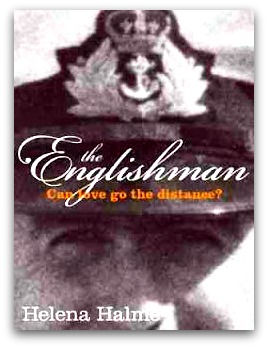
BOOK REVIEW: “The Englishman” by Helena Halme

Today we are delighted to review Helena Halme’s book, The Englishman. Helena is a regular visitor to The Displaced Nation, where she has been featured both as a Random Nomad, and as Cleopatra For The Day. The Englishman is available from Amazon (UK and US) and for a limited time this week, is free to download as a Kindle ebook!

TITLE: The Englishman
AUTHOR: Helena Halme
AUTHOR’S CYBER COORDINATES:
Blog: Helena’s London Life
Twitter: @HelenaHalme
PUBLICATION DATE: August 2012
FORMAT: Ebook (Kindle)
GENRE: Fiction
SOURCE: Review copy from author

Author Bio:

Helena Halme grew up in Finland and Sweden, and left Finland for good when she married her English husband. She now lives in London. The Englishman is her first book.

Summary:

At the age of twenty, Kaisa has her life mapped out. After university in Helsinki, she’s going to marry her well-to-do fiancé, Matti, and live happily ever after. But in October 1980, she’s invited to a British Embassy cocktail party, and meets a dashing Naval officer. In the chilly Esplanade Park the Englishman and Kaisa share passionate, secret kisses and promise to meet up again. But they live thousands of miles apart – and Kaisa is engaged to be married.

At the height of the Cold War the Englishman chases Russian submarines whilst Kaisa’s stuck in a country friendly with the Soviet Union. Will their love go the distance?

(Source: Amazon.com book description)

Review:

The Englishman is semi-autobiographical, based on the author’s blog posts on How I came to be in England, which, after an enthusiastic response from readers, she was inspired to turn into a fully fledged novel.

It is a love story: the account of the long-distance romance between English Naval officer Peter and Finnish student Kaisa, as this star-crossed couple discovers that Shakespeare’s words are still true, even in the 1980s, and the course of true love never runs smooth. Together, they contend with a broken engagement, long separations, the Falklands War, inevitable cultural differences, and the small matter of a member of the British armed forces wanting to marry a citizen of a country bordering the Soviet Union.

No matter where you are from, or even if you and your partner are from the same cultural background – if you’ve ever been in a long-distance relationship, The Englishman will strike a chord. Loving from afar in the early 1980s was a different matter than it is now: no Skype, no Facebook, no texting, but instead the sweet agony of waiting for letters in the mail and for the landline telephone to ring. Kaisa and her Englishman remind us of the forgotten pleasures of delayed, rather than immediate, gratification.

TDN verdict:

Especially recommended for romantics who grew up listening to Chrissie Hynde and wearing leg warmers the first time they were in fashion.

“The Englishman” can be purchased from Amazon.co.uk and Amazon.com, and from October 8 – 12 is available to download free of charge.

STAY TUNED for tomorrow’s ghosty posty, a spooky Displaced Q from Tony James Slater!

Image: Book cover — “The Englishman”

If you enjoyed this post, we invite you to register for The Displaced Dispatch, a round up of weekly posts from The Displaced Nation, with seasonal recipes, book giveaways and other extras. Register for The Displaced Dispatch by clicking here!

Related posts:

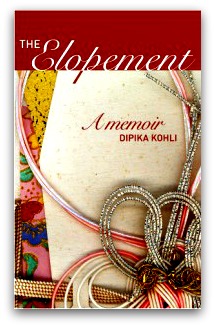
BOOK REVIEW: “The Elopement: A Memoir” by Dipika Kohli

TITLE: The Elopement
AUTHOR: Dipika Kohli
AUTHOR’S CYBER COORDINATES:
Website: kismuth.com
Twitter: @DipikaKohli
Kismuth on Facebook
PUBLICATION DATE: July 2012
FORMAT: Ebook (Kindle) available from Amazon
GENRE: Memoir
SOURCE: Review copy from author

Author Bio:

A former journalist, raised in America by her Indian parents, Dipika Kohli has previously lived in Japan and Ireland, and now lives in Durham, NC, with her husband and son. The third volume in her Kismuth series will be published in October 2012.

Summary:

When American-born Karin Malhotra elopes to Ireland with her college sweetheart, she botches the dreams her parents had for her when they left New Delhi with a stalwart philosophy on what a good life “ought” to be. “Opportunity,” her father said, “is in the U.S. That’s why we came.”

But finding herself in Ireland, juxtaposed in not one, but two additional cultures (her new husband is Japanese), Karin finds herself thinking about the early years of her own parents’ married lives, and wondering if, like her, they questioned their decision to leave everything familiar for the mere promise of a better life.

She tumbles headlong without any preparation into a small village in the corner of Ireland. Not only does she have to contend with a new suite of social mores, she wonders what it would have been like had she not quit home.

(Source: Amazon.com book description)

Review:

The Elopement is the second book in a four-part memoir series, Kismuth, which, in Hindi, means “destiny”. Karin’s grandmother defined destiny as:

We’re all meant to be someplace…And when we get there, wherever it is, that’s what’s supposed to happen.

This implies a passiveness about the process, a casting off of responsibility for our futures, yet many would argue that destiny is of our own making. You reap what you sow, is another way of putting it.

Karin Malhotra’s ambitious parents left Delhi in search for a new life, for better opportunities for them and their children. Sadly, by forcing their own ambitions onto Karin, they sowed what they would later reap: an unhappy daughter, rejecting her family’s strict expectations by following her heart and searching for her own “better opportunities”. Her interpretation of the phrase, unfortunately, did not agree with that of her parents, who refused even to acknowledge Karin’s relationship with Japanese boyfriend Yoshi.

Little wonder that, when Karin finds the acceptance from Yoshi’s parents that she never had from her own, elopement seems an attractive, fairytale-like option. But of course, everyone knows that not all fairytales have happy endings. And while it might be possible to create one’s own destiny, the lesson we can learn from this book is that it is folly to try to create someone else’s.

The Elopement is a fascinating read, beautifully and eloquently written. Dipika Kohli’s next book, The Dive, starts where The Elopement ends. I am already counting the days until its publication on October 10.

Notable quotes:

On being a TCK:

[My parents’] choices, and the consequences that arose, ought not affect my own. If they didn’t think the trade was worth it — the one where they gave up everything in a familiar context in India to take a chance on a new opportunity abroad — well, that wasn’t my problem, was it?

On interculteral relationships:

Our summer of trying out…this intercultural relationship thing, felt like wearing a happened-upon outfit I’d never imagined could fit, but thought, once in a while, why not break that one out? …This “once in a while” was about to become my new look.

On Ireland:

Ireland had the kinds of places and people that would make you stop what you were doing, and sit up and pay full attention, to the degree that you felt really aware and present, maybe for the first time in your life.

.

STAY TUNED for Thursday’s post!

Image: Book cover – “The Elopement”

If you enjoyed this post, we invite you to register for The Displaced Dispatch, a round up of weekly posts from The Displaced Nation, with seasonal recipes, book giveaways and other extras. Register for The Displaced Dispatch by clicking here!

Related posts:

A day in the life of an expat writer

So, today I’ve been asked to share with you all what it’s like to be an expat writer. I looked around for a real writer to ask, but they’re notoriously hard to spot in the middle of the day, so I’m afraid you’re stuck with me. Currently, I’m working on a sequel to my first book, That Bear Ate My Pants! — a second light-hearted travelogue that covers my volunteering adventures in Thailand (amongst other things).

The fantasy:

It is, as you can well imagine, an extremely glamorous life, full of high-octane car chases, explosions and pithy one-liners… At least, inside my head it is.

The reality:

I wake up at 6:40 a.m. I’ve no choice, because that’s what time my wife wakes up. Much as I would love to moan at her about it, she’s doing it for me — in fact, she gets up, gets breakfast and goes out to work, all in the name of supporting me while I lounge around at home, pretending to be a writer.

So, yeah, I figure it’s best not to grumble.

Even though it’s bloody freezing at 7 a.m.!

It continues to surprise me that it can be this cold in Australia. Who knew? (But I’ve already written a post about that.)

At random intervals throughout the day I receive instructions from the wife via text message.

“It’s sunny out! Go for a walk.”

“It’s raining — bring the washing in!”

“Don’t forget to clean the bathroom today!”

“Eat something!”

It’s because she loves me, but also because she’s lived with me long enough to know that I’m an idiot. Without these helpful prompts she’d get home to find I’d tweeted my heart out, e-mailed everyone I know in this hemisphere and written thousands of words of my new manuscript — but that I hadn’t eaten anything since breakfast.

Then, when she takes me to the gym, I end up fainting halfway through the class.

Oz is for artists

Australia is an amazing place for such a wide variety of reasons that I could fill this entire blog post waffling about them; but there’s one stand-out fact that makes a real difference at this point.

The wages here are good. Very good. So good, in fact, that my wife, working part time as a cleaner, can comfortably support us both!

Now, we’ve been backpackers long enough to know how to live frugally. We rent the room on the top floor of a share-house, for example, rather than splashing out on our own flat. (Hey, it’s a nice share-house, not a rat-infested dump like most of them!)

Other than that, I’d say we do okay. We eat out plenty, go to parties and the cinema, and have a gym membership so ridiculously expensive I sweat more thinking about it than I do using it — but we manage it all quite comfortably, on one part-time wage. (Ever since sales of my book took off in February, I’ve been earning just about a minimum wage from it; before then, it was pocket change!)

I’ve never found another country where this is possible.

Back to my productive morning

After wading through a mountain of emails, tweets and Facebook messages — some of which aren’t even spam — I finally get to start on the real work. And then…

10:00 a.m.: Check my sales.
10:02 a.m.: Shout “WOOHOO!” unnecessarily loudly, pissing off my student friend in the next room, who doesn’t have to be up ’till 12:00.
10:05 a.m.: Celebrate with a coffee.
10:10 a.m : Back to work, until…
10:30 a.m.: Check sales again — just to be sure I wasn’t imagining things.
10:32 a.m.: Wake up student again with another cry of “Woohoo!”
10:35a.m.: Celebrate with another coffee…

There is a compulsion amongst self-published authors to constantly check our sales and our Amazon rankings. This is because, unlike “properly” published authors, we have access to this information in real time. Watching sales tick up one by one — or watching them stubbornly refuse to do so — is a highly addictive (and utterly pointless) pastime.

I DO NOT suffer from this.

I check less than five times a day — except on the days when I check more often. Which is quite often.

But I don’t suffer from the compulsion. At all.

I also don’t do denial.

The sounds of silence

So, we’ve reached lunch. Or rather, we should have. By this time I’m usually quite deep into the world I’m writing in — which for me is my own torrid past. Having to nail it down so completely, with colors and gestures and remembering what people said, sends me into such a vivid re-living of the event I’m describing that I lose all track of time.

If I don’t get that text from my wife telling me to eat, I don’t eat lunch.

Which is one reason why I’m so skinny, despite sitting in front of my desk all day.

When I do get the text, it scares the hell out of me.

I’m usually sitting in silence. I can’t work with music on, or else I end up listening to the lyrics and, inevitably, singing along with gusto. As the student in the next room can attest, I’m one of the worst singers in the entire country. Maybe even the world.

So all is calm and quiet. Only the rhythmic clacking of keys disturbs the air as I try to produce 2,000 words (my daily minimum) — 2,000 good words (5-6 pages), not random churned-out waffle. Then my phone screeches at me and I jump three feet off my chair, in a move that amazes anyone lucky enough to see it happen.

“How the hell do you jump that high while you’re sitting down?” they ask.

“You must have some potent muscles in your arse!”

“Why thank-you,” I tell them. “It’s all the practice I get, talking out of it.”

A man works from sun to sun…

My wife gets home and takes me out to the gym. I rely on her because I can’t drive. Actually, I tell a lie: I can now. I took a test last December (my first, at age 33) and passed with flying colors. But I haven’t driven since, so I tend to rely on her — not just for money but as a taxi service, too.

Poor woman.

Anyway, we only have one car. Or more accurately, about two-thirds of a car; it’s gotten considerably shorter since she crashed it into the back of the taxi a few months ago. But it still works, so what’s the problem?

Although I do have to put my hand under the bonnet to start it.

After the gym — assuming we’re not going straight out for dinner with friends, to pile all the calories we’ve just burnt back on at Nando’s (for those who don’t know, it’s a fried chicken chain) — we wend our weary way home.

She cooks, and I clean up afterwards because a) she’s been cleaning all day, and b) I can’t cook for toffee. Seriously — beans on toast is the pinnacle of my culinary ability. And I usually burn at least one component of it.

While she cooks, I finish off whatever piece of writing was rudely interrupted by the end of her working day.

But social media is never done!

After dinner I tweet, do Facebook, and send e-mail — but from the comfort of our bed, where we sit with our legs propped up watching a movie.

And we’re often also eating ice cream, because if you’re going to go to the gym four times a week, you might as well make it worthwhile. :0)

And then it’s 10:00 p.m.: well-earned sleep time for the wife. After all, she’s got to be up at 6:40 the next morning.

So I tuck her in and sneak downstairs, where I carry on twittering, writing the odd guest post, sending out review copies of my book to bloggers, replying to e-mails from readers, making posts on forums and indulging in my two main vices: drinking a glass of wine and allowing myself to write a bit of my first novel, a work of science fiction, which I hope one day to publish. Right now it’s just a guilty pleasure for when I’ve finished my “real” writing. Ah, good times!

At around 2:00 a.m. I generally remember that I’ll be getting up at 6:00 as well, as it’s impossible to get back to sleep after seeing the wife off to work; it’s also usually around this time that someone living in a far more sensible time-zone strikes up an interesting conversation on Twitter…

But I try to be in bed by 4:00.

I don’t always make it.

Y’see? I told you! Pure, unadulterated glamour…

If you enjoyed this post, we invite you to register for The Displaced Dispatch, a round up of weekly posts from The Displaced Nation, with seasonal recipes, book giveaways and other extras. Register for The Displaced Dispatch by clicking here!

Related posts:

Images (clockwise, left to right): TJS’s desk, TJS in embarrassing gym costume, the Slater-mobile, and TJS’s long-suffering wife, Krista, in her wild pants and equally wild hair (all from Tony James Slater’s personal collection).

Repatriation is just relocation — with benefits

Today’s guest blogger, Anastasia Ashman, has been pioneering a new concept of global citizenship. Through various publications, both online and in print, and now through her GlobalNiche initiative, she expresses the belief that common interests and experiences can connect us more than geography, nationality, or even blood. But what happens when someone like Ashman returns to the place where she was born and grew up? Here is the story of her most recent repatriation.

I recently relocated to San Francisco. Three decades away from my hometown area, I keep chanting: “Don’t expect it to be the same as it was in the past.”

Since leaving the Bay area, I’ve lived in 30 homes in 4 countries, journeying first to the East Coast (Philadelphia Mainline) for college, then to Europe (Rome) for further studies, back to the East Coast (New York) and the West Coast (Los Angeles) for work, over to Asia (Penang, Kuala Lumpur) for my first overseas adventure, back to the USA (New York), and finally, to Istanbul for my second expat experience.

My daily mantra has become: “Don’t expect to be the same person you once were.”

With each move, my mental map has faded, supplanted by new information that will get me through the day.

Back in San Francisco, I repeat several times a day: “This place may be where I’m from, but it’s a foreign country now. Don’t expect to know how it all works.”

What a difference technology makes (?!)

Today my work travels, just as it did when I arrived in Istanbul with a Hemingway-esque survival plan to be on an extended writing retreat and emerge at the border with my passport and a masterpiece.

I knew from my previous expat stint in Malaysia that I needed to tap into a local international scene. But I spent months in limbo without local friends, nor being able to share my transition with the people I’d left.

This time is different. Now I’m connected to expat-repat friends around the world on the social Web with whom I can discuss my re-entry. I’ve built Twitter lists of San Francisco people  (1, 2, 3) to tap into local activities and lifestyles, in addition to blasts-from-my-Berkeley-past.

I’ve already drawn some sweet time-travely perks. To get a new driver’s license I only needed to answer half the test questions since I was already in the system from teenhood.

After Turkey’s Byzantine bureaucracy and panicky queue-jumpers, I appreciated the ease of making my license renewal appointment online even if the ruby-taloned woman at the Department of Motor Vehicles Information desk handed me additional forms saying: “Oh, you got instructions on the Internet? That’s a different company.”

One of the reasons my husband and I moved here is to more closely align with a future we want to live in, so it’s cool to see the online-offline reality around us in San Francisco’s tech-forward atmosphere.

It doesn’t always translate to an improved situation though. Just as we are searching for staff to speak to in person at a ghost-town Crate & Barrel, a suggestion card propped on a table told us to text the manager “how things are going.”

So, theoretically I can reach the manager — I just can’t see him or her.

So strange…yet so familiar

It took a couple of months to identify the name for what passes as service now in the economically-depressed United States: anti-service. Customer service has been taken over by scripts read by zombies.

When I bought a sticky roller at The Container Store, the clerk asked me, “Oh, do you have a dog?”

“No, a cat,” I countered into the void.

He passed me the bag, his small-talk quota filled. He wasn’t required by his employer to conclude the pseudo-interaction with human-quality processing, like, “Ah, gotta love ’em.”

What I didn’t plan for are the psychedelic flashbacks to my childhood. I may have moved on, but this place seems set in amber. The burrito joints are still playing reggae (not even the latest sounds of Kingston or Birmingham) and the pizza places, ’70s classic rock stations (Steve Miller Band’s “Fly Like An Eagle,” anyone?). The street artists are still peddling necklaces of your name twisted in wire. Residents are still dressed like they’re going for a hike in the hills with North Face fleece jackets and a backpack.

A bid for minimalism

The plan is also to be somewhat scrappy after years of increasing bloat. My Turkish husband and I got rid of most of our stuff in Turkey in a bid for minimalism. We camped out on the floor of our apartment in San Francisco until we could procure some furniture.

If it was a literal repositioning, it was also a conscious one — for a different set of circumstances. We’d expanded in Istanbul with a standard 3-bedroom apartment and “depot” storage room, and affordable house cleaners to maintain the high level of cleanliness of a typical Turkish household. In California, I intended to shoulder more of the housework.

I was soon reminded of relocation’s surprises that can make a person clumsy and graceless. I should have kept my own years-in-the-making sewing kit since I can’t find a quality replacement for it in an American market flooded with cheap options from China — and now have to take a jacket to the tailor to sew on a button, something I used to be able to do myself.

When the lower-quality dishwasher door in our San Francisco rental drops open and bangs my kneecap, I recall the too-thin cling wrap and tinfoil that I ripped to shreds in Istanbul, or the garden hose in Penang that kinked and unkinked without warning, spraying me in the face.

New purchases

“We’re getting too old for this,” my husband and I keep telling each other as we shift on our polyester-filled floor pillows that looked a lot bigger and less junky on Amazon. (We were abusing one-day delivery after years of not buying anything online due to difficulties with customs in Istanbul. Cat litter can be delivered tomorrow! Pepper grinder! Then I read about the harsh conditions faced by fulfillment workers in Amazon’s warehouses and cut back.)

One of our first purchases Stateside was a television. Not that we’re going to start watching local TV, but we did flick through some satellite channels. It’s something I like to do upon relocating: watch TV and soak up the local culture like a cyborg.

Since I last lived in the US, reality shows like COPS — where the camera would follow policemen on their seedy beats — have gone deeper into the underbelly of life, and now there are reality shows about incarceration.

The Discovery Channel has also gone straight to the swamp. That’s where I caught a moonshiner reality show featuring shirtless (and toothless) men in overalls called “Popcorn” and “Grandad.”

It’s an America I am not quite keen to get to know.

But I can take these reverse culture shocks lightly because my repatriation is part of a continuum. It’s not a hiatus from anything nor a return home. I’m not missing anything elsewhere, I haven’t given up anything for good. Being here now is simply the latest displacement. Today is a bridge to where I’m headed.

ANASTASIA ASHMAN is the cultural writer/producer behind the Expat Harem book and discussion site.  The Californian has been on a global rollercoaster: fired in Hollywood, abandoned on a snake-infested island off Borneo, married in an Ottoman palace, interviewed by Matt Lauer on the Today show. She brings it all home in the “Web 3.0 & Life 3.0” educational media startup GlobalNiche.net, empowering creative, adventurous, self-improving people to tap into a wider world of personal and pro opportunity no matter where you are. Get your copy of the Global You manifesto here.

STAY TUNED for tomorrow’s episode in the life of our fictional expat heroine, Libby. (What, not keeping up with Libby? Read the first three episodes of her expat adventures.)

If you enjoyed this post, we invite you to register for The Displaced Dispatch, a round up of weekly posts from The Displaced Nation, with seasonal recipes, book giveaways and other extras. Register for The Displaced Dispatch by clicking here!

Related posts:

Images: Anastasia Ashman (2012), her World Champions ring, and a view of the bridge to where she’s headed right now.

Christmas in July & other Winter’s Tales from an expat Down Under

After sweltering through America’s hottest July on record, three of us Displaced Nation writers have been imploring the fourth, Tony James Slater, for some cooling stories from his newly adopted home of Perth, Australia.

I noticed a Christmas tree in my gym a couple of weeks ago. I wondered what the hell it was doing there, until some kind staff member — presumably on hearing me curse in the middle of the foyer — decided to enlighten me.

Christmas in July, the Aussies call it — for no apparent reason other than that most countries celebrate Christmas when it’s freezing cold outside, with snow on the ground and cards covered in penguins and polar bears decorating the mantle piece.

July is as cold as it gets in Perth. The temperature — sometimes — dips into the single digits overnight, and we wake up to a sensation overly familiar to a Brit like me: not wanting to get up because it’s warmer in bed!

Once upon a time, when I made my first visit to Oz from Thailand, all those years ago, I arrived (in my infinite wisdom) in June. At 6:00 a.m.

I had no idea Australia had seasons. From the postcards and other literature, I’d assumed it was the Land of Eternal Summer.

It was achingly cold, pouring it down with rain — and I was wearing a pair of shorts and a vest [tank top], because that’s all the clothing I owned!

I’m now super careful when advising my friends who plan on visiting: “Don’t come November to February,” I tell them. “It’ll be way too hot. You won’t be able to breathe.

But don’t come June to August either — it’ll be too cold! And all sensible Australians will be holed up inside with our mitts wrapped around a hot cup of Milo.”

Mmmmmm…. Have you ever had Milo? It’s a hot chocolate malt drink. I must say, it really hits the spot this time of year.

Storm warning!

We have our blistering hot summers, too, down in Oz. In fact, the whole country is geared around this inevitability. That may be why no one seems quite prepared for the winter.

It rains, of course — it has to, otherwise we’d be in an even worse state come summer. But no one here is quite ready for it when it does.

Take the Great Perth Storm of 2012, for example. Several weeks ago now, there was a severe weather warning issued. Businesses closed early. Employees scurried home, fearing what would happen if they were caught in traffic when The Big One hit. By the time it started raining, the streets were deserted – which was probably a good thing. Boy, did it rain! It rained, and rained, and the good folk of Perth cowered indoors, until…the rain stopped.

And that was it.

I honestly think half of them didn’t expect to survive it.

They were most upset when they had to drive to work the next morning, through rapidly drying puddles.

The four seasons in one day

But let’s not get carried away; to those of you fanning yourselves under an air-con unit, wishing you’d remembered to get it serviced before the heat-wave hit, I can sympathize — it’s not exactly cold here all the time.

Even in winter, the middle of each day is quite pleasant — probably what you’d call “beach weather” on most of the rest of the planet.

Charles Dickens’s description of an English springtime seems most appropriate:

It was one of those [March] days when the sun shines hot and the wind blows cold: when it is summer in the light, and winter in the shade.

Have you ever worn a hat indoors?

Perhaps because of this, the houses here are built without insulation, and without any form of central heating. Most of them have a little wood-burning stove in a corner of the family room, but that’s it — and of course no double glazing!

Houses built like this in Europe would never pass the building code, but it seems that the housing industry here just doesn’t worry about it. Yeah, sure, they’re building houses that’ll be a bit cold in winter. But the owners can always wear a jumper! Or, as frequently happens when we visit my father-in-law in his house in the Perth hills, a scarf, gloves and a beanie…

In an unheated, un-insulated house at night, there are only two things to do — and one of them doesn’t really belong on a public forum like this. The other, of course, is to wear as many layers as you can — kind of like you’re going hiking in a blizzard — and try to keep exposed flesh to a bare (sorry!) minimum.

Of course, this being winter, you can find that blizzard. Just about. There’s nothing between the bottom of Australia and the top of Antarctica, so our southern seas get a little chilly around now. We have snow-capped mountains – okay, we have a snow-capped mountain. Sometimes…

But the scene over in neighboring New Zealand is a little frostier!

In fact, my sister is there right now, training to be a skiing instructor.

And because the architecture over there is mostly derived from what we have over here…her house also doesn’t have any heating either.

All things being equal…

I’m content to be cold once in a while. It reminds me of home — just a little, in a slightly-chilled-’till-the-sun-comes-up kind of way. Not like actually being back in England — where, even though it’s summer, I think it’s colder than here… I mean, did you see that beach volleyball tournament? Only in London could they import twenty tonnes of sand and play beach sports in torrential rain…in bikinis.

Now there’s a refreshing image!

So instead of feeling sorry for yourselves over there in sweltering America, please do feel pity for us over here. After the terrible inconvenience of our slightly chilly winter, we have plenty of other ordeals to face — like Christmas on the beach!

* * *

So tell me: would you rather be here — or where you are right now? Let me know in the comments, or on Twitter: @DisplacedNation +/or @TonyJamesSlater. Now back to my nice mug of Milo before it gets cold — cheers!

STAY TUNED for tomorrow’s Random Nomad, who, too, has some stories to help alleviate the effects of the heat…

If you enjoyed this post, we invite you to register for The Displaced Dispatch, a round up of weekly posts from The Displaced Nation, with seasonal recipes, book giveaways and other extras. Register for The Displaced Dispatch by clicking here!

Related posts:

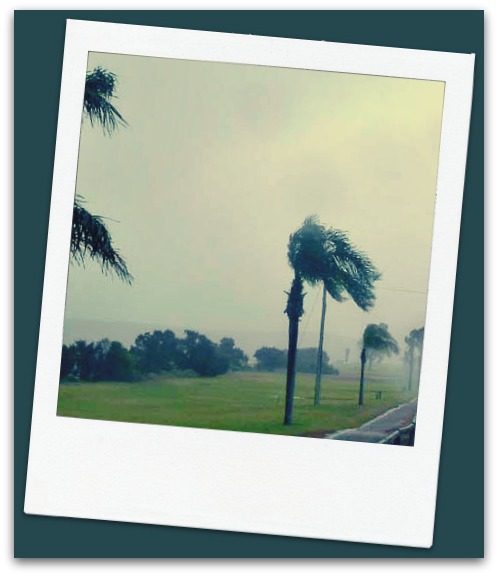
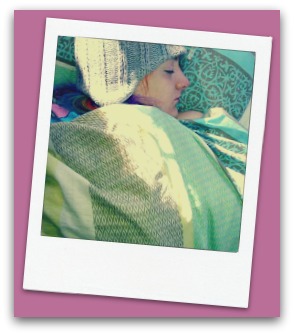
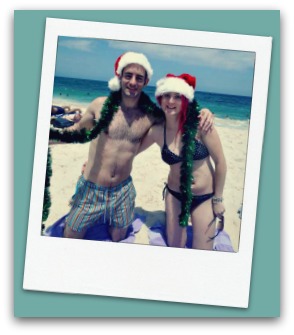
Main image:  “Polaroids” are all from Tony James Slater’s collection: The Great Perth Storm of 2012; Tony’s wife, Roo, asleep in her dad’s house in the hills of Perth (2012); Tony & Roo celebrating Christmas on Cottesloe Beach, near Perth, Australia (December 2011).

Trying — but failing — to keep up with Wendy Nelson Tokunaga, Olympic e-book author and karaoke star

**Announcing a giveaway of one of Wendy Nelson Tokunaga’s Kindle e-books. open to DISPLACED DISPATCH SUBSCRIBERS  & ANYONE WHO COMMENTS. And guess what? You get to take your pick! Woo hoo!!**

During this summer’s London Olympics there will be endless displays of speed grace, strength, masochism, endurance, pain, and perseverance.

Just the the thought of it makes me feel exhausted and a little bit nauseous.

But I don’t necessarily have to look toward the Orbit (I refer to the “eyeful tower” that looms over London’s Olympic Stadium) to feel that way. Instead I can direct my weary gaze towards the Golden Gate Bridge, near to where the once-displaced Wendy Nelson Tokunaga resides.

Tokunaga was a special guest at The Displaced Nation before as one of our 12 Nomads of Christmas. We have invited her back today to showcase what it means to be an “Olympian author.” She has just completed the marathon-like feat of publishing three e-books — two novels and one work of nonfiction — in a period of 12 months.

Has she tired you out yet?

I ask because that’s not the whole story. A talented writer, Tokunaga is what the Japanese call a talento: she can sing jazz as well as j-pop and enka (a type of sentimental ballad). Put it this way: you do not want to compete with her in a karaoke contest!

If you don’t believe me, listen to her singing this enka she composed for one of her novels — you would never know that Tokunaga is a native-born Californian who’d spent time in Japan!

Just one of the many reasons why you’ll never keep up with her…or if you dare to try, you’ll be huffing and puffing, just as I am. (Why oh why did I agree to sing a few bars of “My Way” with her?)

* * *

[Catching my breath…] Thank you, Wendy, for agreeing to this interview with The Displaced Nation. While I rest for a bit, can you tell me a little more about yourself — where you were born and how you ended up living in Japan?
I was born in San Francisco and have lived in the Bay Area all my life except for when I lived in Tokyo during the early 1980s. I had been studying Japanese language and culture at San Francisco State University when I won a prize in a songwriting contest sponsored by Japan Victor Records. It allowed me to perform my song at Nakano Sun Plaza in Tokyo. After that I moved to Japan to pursue music, teach English and do narration work.

While I’m still catching my breath — let’s hope I don’t have a heart attack here — why don’t you tell us about all your books? I understand you’ve published eight of them in the past 12 years, of which three of them came out in the past 12 months?
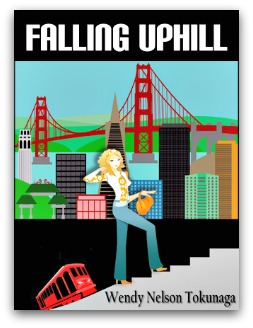
I self-published my first novel, No Kidding, in 2000 with iUniverse. Then I wrote two books for elementary-school students with Kid Haven Press: Famous People: Christine Aguilera (2003) and Wonders of the World: Niagra Falls (2004). Next came two novels that featured Japan, both of which were published by St. Martin’s Griffin: Midori by Moonlight and Love in Translation. And then I self-published three Kindle e-books within the past 12 months: Marriage in Translation: Foreign Wife, Japanese Husband, in 2011; Falling Uphill and His Wife and Daughters, both in 2012.

I suppose you’re working on another book right now?
Yes, a mystery/thriller.

Crossing publishing platforms…

Turning to your three recent books: what made you decide to join the Kindle e-book world?
Falling Uphill was a “trunk novel” I wrote in 2004 that never got published. With the popularity of e-books I decided to revise it a bit and put it out instead of having it gather dust on my hard drive. My agent at the time came close to selling His Wife and Daughters to a major publisher in 2011, but in the end things didn’t work out. I still wanted to bring the book out, so making it available as an e-book seemed like a great idea. I’d gotten a few bites from publishers regarding Marriage in Translation, which was based on a series of blog interviews I’d done of Western women married to Japanese men. But dealing with a publisher would mean the book would take at least a year to come out and would probably need to be longer. I just wanted to get it out as soon as I could to take advantage of the momentum of the blog. Coincidentally, when I was in the finishing stages, the disastrous earthquake and tsunami occurred in Japan. I brought out the book shortly after and for a time gave 50 percent of the proceeds to Japan relief.

Do you think you can reach a different audience through self-publishing?
What’s exciting about e-books is that I can reach an audience! For various reasons, these books wouldn’t have seen the light of day, so I’m happy to continually find readers for them. And, yes, I think I’m reaching a wider geographical audience. And another bonus is that in the e-book world, unlike in the traditional publishing world, the pub date is irrelevant — people can continue to discover my books and I can promote them as summer reads, fall reads or whatever. And e-books don’t ever go “out of print.” I couldn’t be happier with this platform, but it doesn’t mean that I don’t still appreciate traditional publishing and don’t rule out traditional publishing in the future.

Crossing genres…

You got your MFA in creative writing. You also teach and consult on creative writing. What was it like trying your hand at a nonfiction book Marriage in Translation?
These days, non-fiction written in the manner of creative non-fiction and/or narrative non-fiction has lots in common with novels. I think it can be easier for fiction writers to tackle non-fiction, but there might be more challenges for the strictly non-fiction writer to undertake writing fiction.

Why is it so challenging for nonfiction writers to switch over to fiction?
Some — not all — non-fiction writers find it difficult to “make things up” and use their imagination after being so ingrained at using “just the facts.” And, for journalists, I think it can be a challenge to structure a novel that doesn’t reveal everything at once and fight the tendency to go about verifying each point.

Crossing cultures…

Turning to Japan and its influence on your writing. For a while there, Japan was your lodestar. Both Midori by Moonlight and Love in Translation had strong Japanese themes, as does Marriage in Translation. But in your two latest novels your protagonists are all Americans. I’ve read His Wife and Daughters — and enjoyed it very much. There was a scene set in Japan — involving one of the daughters, Phoebe — but otherwise it’s about an American politician who has an affair that causes him to lose his job. I haven’t read Falling Uphill — does it have any Japanese references?
Falling Uphill doesn’t have any Japanese references, at least that I can recall! And in His Wife and Daughters, I thought that for the particular purpose of depicting a certain time in Phoebe’s life that setting it in Tokyo made sense because of the bar hostess culture there. Otherwise, Japan really wouldn’t have played any part in that novel.

Are you moving away from Japan, or will it always be something you write about?
There have been times when I’ve felt that I’ve said all I can say about Japan and need to move on, though it will always be a part of me. I’ve enjoyed writing about Japan and Japanese culture and I even had a Japan-themed short story published in the recent Tomo anthology published by Stone Bridge Press, but I do enjoy writing about topics other than Japan. Yet I am careful to “never say never” about most things.

That said, I think Japanese might enjoy His Wife and Daughters. They have plenty of sex scandals, the most recent one involving the political kingpin Ichiro Ozawa. But in that case, the wife has spoken out — and is trying to poison his career. What was the inspiration behind the book —  do you like politics?
I don’t see His Wife and Daughters as a particularly political book. I was more attracted to the theme of exploring why some women stand by their men in these situations and withstand the humiliation, as well as the fascinating dynamics of a dysfunctional family affected by serial adultery and public scandal.

Crossing art forms…

And now I’ve just got to ask you about your musical career. Are you still pursuing music alongside all this writing?
I’ve been singing and playing music for longer than I’ve been writing. And music is what originally got me to Japan so it’s very important to me. But I don’t have as much time to devote to music right now. My husband and I occasionally play together at home for fun (he plays keyboards), but we haven’t done any gigs for several years. And I wish I had time to keep up with J-pop and enka and go to karaoke! I do manage to catch some music shows via the TV-Japan satellite service, but that’s about it.

Didn’t you and your husband collaborate on a theme song for your book Love in Translation?
Yes we did. That was our last major musical project.

Do you listen to music when you’re writing?
Not usually, but I often have Pandora playing quietly downstairs from my office (the cat likes it!) on a variety of eclectic stations: piano jazz, trip hop, ambient, etc.

Last but not least, I’d like to quiz you about your reading and writing habits:
Last truly great book you read: Gone Girl, by Gillian Flynn
Favorite literary genre: Books that are well written, fast paced and full of surprises.
Reading habits on a plane: I read on my iPad.
The one book you’d require the president to read: He’s so well read that I think he’s way ahead of me.
Favorite books as a child: I especially liked the Edward Eager Magic Series (Half Magic, Magic by the Lake, Seven Day Magic, etc.) as well as The Borrowers series by Mary Norton and The Summer Birds by Penelope Farmer.
Favorite heroine: I always liked books about girls who had special magical powers or mysterious backgrounds.
The writer, dead or alive, you’d most like to meet: I’m constantly networking with fellow writers and have gotten the opportunity to meet with many that I admire, but I suppose it would be quite fascinating to talk with Joan Didion, a writer who definitely excels at both fiction and non-fiction.
Your reading habits: I’m a pretty fast reader. I sometimes take notes and I am mainly reading electronically now. I do find myself constantly analyzing the books I read for craft and structure so it’s sometimes hard to get lost in a good book like I used to be able to back in those Edward Eager days.
Your favorite of your own books: Always the latest one: His Wife and Daughters.
The book of yours you’d most like to see as a film: Any of them!!!
The book you plan to read next: The Expats, by Chris Pavone.

Say, would you do a review for The Displaced Nation on what you think of Chris Pavone’s book?
I’m happy to do a review, but I can’t promise any time soon. I’m in the midst of some very big projects right now. So if there’s not a firm deadline, then I can say yes. 🙂

(See what I mean about how you just can’t keep up with her?) Okay, one final question before I let you go. Since you’ve been so prolific of late, I wonder if you have any advice to impart to other writers who struggle to wrap up their books?
I wish I knew the secret! I’m struggling with my current book and don’t know when the heck I’ll finish it. Writing takes discipline and there’s no magic formula, I’m afraid. And some books come quicker than others.

* * *

Readers, any more questions for Wendy? Please put them in the comments. To reiterate, we are doing a giveaway of one of Wendy’s Kindle e-books to Displaced Dispatch subscribers and to ANYONE WHO COMMENTS! As I can assure you from my own experience, you WANT TO WIN one of these books — they are THE PERFECT SUMMER READS!!!

STAY TUNED for some more fiction tomorrow, with another episode in the life of our fictional expat heroine, Libby. (What, not keeping up with Libby? Read the first three episodes of her expat adventures.)

If you enjoyed this post, we invite you to register for The Displaced Dispatch, a round up of weekly posts from The Displaced Nation, with seasonal recipes, book giveaways and other extras. Register for The Displaced Dispatch by clicking here!

Related posts:

img: Wendy Nelson Tokunaga throwing her considerable energy into yet another round of karaoke…

RANDOM NOMAD: Antrese Wood, American Expat in Argentina and Artist on an Epic Expedition

Place of birth: Pomona Valley Hospital. I grew up in Claremont, California — in fact, my mother still lives in the house she brought me home to.
Passport: USA
Overseas history: Honduras (San Pedro Sula): 1986; Argentina (San Antonio de Arredondo + Villa Carlos Paz), 2010-11 + 2011 – present.
Occupation: Artist (painter).
Cyberspace coordinates: Antrese.com (art site + blog); @antresewood (Twitter handle);  Antrese Wood Artist Page (Facebook); and Antrese Wood (Pinterest) — see “A Portrait of Argentina” board.

What made you leave your homeland in the first place?
A friend of mine in high school asked me to go with her to an American Field Service (AFS) meeting. I went because she didn’t want to go alone. I had no idea what it was, but after the meeting I thought, “Awesome! I’m in!!” I ended up going to San Pedro Sula, Honduras, for six months. I didn’t speak a word of Spanish when I left. I memorized the three questions I thought I would get asked most: What is your name, where are you from & how old are you? Unfortunately, I got them mixed up. When someone asked “What is your name?,” with a huge smile I would answer: “I’m 15 years old!” By the time I left, my Spanish was pretty good.

I didn’t travel much until after college, and I didn’t practice my Spanish, so I lost most of it. After college, I got bit by the travel bug again. I would go anywhere if I had the chance. I worked in the video game department at Disney for years, and got to travel a lot with them — all over the US, Vancouver, Montreal, London, Paris, even to the South of France. On my own, I went to South Korea. I also lived in Alaska for a short while (not a foreign country but compared to the Los Angeles culture, it might as well be). At one point I decided I wanted to do a semester with NOLS (the National Outdoor Leadership School). I choose their semester in Patagonia, and thinking this was my last chance to see South America, I spent a few months exploring Chile, Argentina, Peru, and Ecuador.

Indirectly, that is how I met my husband. A friend was worried about my traveling alone, so she introduced me to her friend from Argentina (“even though she doesn’t live there, she can at least give you a few phone numbers just in case…”). Years later, my new Argentine friend introduced me to my future husband.

Which brings me to why I left Los Angeles to live in Argentina: I fell in love.

Wow — that’s some wanderlust! So is anyone else in your immediate family “displaced”?
No one else in my family is displaced. My mother and I both travel as much as possible, but my brothers and sisters are happy where they are.

Can you describe the moment in your Argentinian life when you felt the most displaced?
My husband and I first lived in a tiny town called San Antonio de Arredondo. It’s in el campo — literally, the countryside. But when you move from Los Angeles to a town of barely 5,000…you call it the boondocks. Some friends rented us their quincho (guest house) while they were out of the country. It was in a new neighborhood with few other houses and lots of empty lots. Green and beautiful, but no natural gas, no phone lines…and worst of all, no Internet!

I was used to 24-hour access to everything. The Internet, grocery stores, restaurants…everything. Another thing: San Antonio and Carlos Paz (where we currently live), both honor the siesta. Everything closes between 1:30 and 5:00 p.m.

It was quaint and beautiful at first, but I got tired of riding my bike to the next town to check my email. I’m completely dependent on the Internet. It was in those moments when I admittedly thought “Oh my god, what have I done!?” When we moved to Carlos Paz, the first question I had about the apartment was: “Does it have high-speed Internet?”

And does it?
YES IT DOES!!!….yay!

Now that you have Internet access and are feeling more at home, is there any particular moment that stands out as your least displaced?
As I contemplate this question, a series of images and moments flashes through my head: our house filled with friends for an impromptu dinner; the huge smile on my husband’s face when he cooks for a crowd (he loves it!); looking at the clock and being surprised that it’s already 4:00 a.m…. A big cultural difference is that you can call friends for a dinner, and within an hour or two, your house is filled with all your friends and all their kids. There is always room for just one more.

If I had to pick one event where I didn’t feel displaced, it would definitely be our wedding. It was the best of both worlds. Friends and family from the US, along with about 200 of our “closest” friends from Argentina, came to celebrate. We had a huge asado (barbecue), lots of wine, dancing until 6:30 a.m.

Sounds amazing. And now you may bring one curiosity you’ve collected from your adopted country into The Displaced Nation. What’s in your suitcase?
Really? only one!?

I’m tempted to pack some fernet, but I’ll bring my mate instead.

Drinking mate is a national pastime in Argentina. The mate is a hollowed out gourd that you fill with tea leaves called yerba. You add hot water and drink the tea from a bombilla (a kind of straw with a filter at the bottom). Typically, it’s shared with other people — one person serves the mate to the circle. Drinking mate plays an important social role; it’s the preferred excuse to get together and hang out. “Let’s have a mate” really means “Let’s hang out and chat for a while.” Most gas stations have a hot water dispenser at exactly the right temperature, and almost any restaurant will fill your thermos regardless of whether you eat there. They understand the importance.

There are various subtleties to preparing mate (sugar, no sugar, with mint, water temperature, etc.), and the opinions on how to properly prepare mate are strong and sometimes fiercely debated. When a person drinks mate alone for the first time, its like a right of passage into adulthood. When my husband came home and found me drinking mate by myself, he said: “AHA!! now you are an Argentine!!”

Let’s move on to food. You are invited to prepare one meal based on your travels for other members of The Displaced Nation. What’s on your menu?

Now we’re talking! This one is pretty easy:

Appetizer: Empanadas — dough filled with just about anything and then baked or fried. They’re a staple here. A common filling is ground beef, olives, hard boiled egg, paprika, cumin and salt. My favorite is the árabes, which is ground beef “cooked” with lemon and aromatic spices.

Main: Definitely an asado: various cuts of Argentine beef, and lamb. The meat here is so good, people are surprised how much flavor it has. Typically the only condiment used is salt. (Argentina would be a difficult place for vegetarians!)

Dessert: We could have ice cream — call and have it delivered (yes, they do!!); but I think I’d prefer to introduce you to alfajores from Las delicias de Mamushka. An alfajor is like a cookie sandwich: two cookies made from cornmeal, filled with dulce de leche. I never liked them until I tried Mamushka’s. Now I’m addicted.

Wine & after-dinner drinks: A nice Malbec wine. I like Trapiche. A few hours later, after dessert and coffee, an ice-cold Fernet con Coka.

And now you may add a word or expression from the country you live in to The Displaced Nation argot. What will you loan us?
There are so many — again, hard to choose.

Che and “más vale!” are among my favorites.

Che is used all the time here, especially in the province of Córdoba. Depending on the context, it means “hey…” or “umm…” Sometimes, it seems to be used in the same way we Californians use the word “like.” Che Guevara is from this area. He is actually called Che because when he went to Cuba, he used the word so frequently, people just started calling him “Che.”

Más vale is equivalent to “Hell, yeah!!” — and also has a bit of “Let’s do this!!”

This summer we’ve been doing some posts with an Olympics theme. Are you planning to watch the Summer Olympics in London? If so, who will you be rooting for: Americans, Argentines, both, or neither?
I’ll be rooting for them both. In the event that the U.S. squares off against Argentina in a soccer match, I will be wearing a helmet and full body armor — and cheering for the US!

Are Agentines excited about the Games?
In general, Argentines are fanatical about sports. Especially soccer. Messi is a God. During the World Cup, It seemed like every man, woman and child in this country was wearing a blue-and-white striped #10 jersey. We went to a  friend’s house to watch a game. Normally busy streets were completely deserted. The city had literally shut down. There was an eerie silence occasionally broken by simultaneous cheers erupting from the houses and (closed) shops. During national playoffs, you see grown men sobbing uncontrollably after their local team has lost. The first time I saw this, I was flipping channels on TV. As the camera switched from one sobbing man to another, I thought there had been a national disaster. So, yes, I think it’s safe to say that there will be plenty of excitement about the Games!

The Olympics gives me a segue way into your 8-month project to paint Argentina. That strikes me as being an Olympian feat. Can you say a little bit more about it?
Now that you mention it, it is an Olympian feat! The project is called “A Portrait of Argentina.” I will spend eight months visiting the country’s 23 provinces, traversing something like 15,600 miles, painting portraits of the people I meet. I’ll listen to their stories and then paint en plein-aire, the scenes from their daily life. I’m hoping to deliver a cultural portrait of my adopted home.

When did you first conceive of the project?
The idea came out of a period of misery after I left Los Angeles to live in Argentina. The first year I lived here, I saw everything from a touristic point of view. It was quaint, beautiful and…a little quirky. But the second year was more difficult. It was no longer cute and quirky; the honeymoon was over. I made unfair comparisons and was judging everything. My normally optimistic and upbeat attitude shifted to “This sucks.”

I had two obvious choices: go back to California — or change my outlook, appreciate all that is good, and stay. My husband (fiancé at the time) left it up to me (no pressure, eh?). We could pack everything up and head back to Los Angeles, or I could give Argentina another try.

I realized that much of my misery was self imposed. It came from the fact that I had not integrated and was spending the majority of my time alone, working out of the house. You can’t love anything until you take the time to develop a relationship with, and really get to know, it. Here I was, on an adventure of living in another country, and I wasn’t even willing to give it the time of day. What a wasted opportunity!

As I integrated myself more and became determined to learn as much as I could about Argentina, I started taking classes at the university and began developing this idea about painting my way across the country. Painting has always been my way of making sense out of the world. It forces me to pause and really look at my subject.

Is the project having the effect that you’d hoped — is it improving your attitude?
Just by researching the project, looking for “known” and “unknown” people and places, I have a new-found appreciation for this country. I’m realizing how easy it would be to say I know Argentina because I’ve lived here for two years. The fact is, I know a lot about one region in one province of a very large country, and a little bit about a dozen other places. A native New Yorker and a native Alaskan may live in the same country, but they are culturally worlds apart. The same can be said for a Porteño (a person from Buenos Aires) and a person from La Quiaca near the Bolivian border. Same country, worlds apart.

I’m also overjoyed that so many people here seem excited about my project. Obviously, I’m super excited about it (it’s my baby, after all), but when I share my vision with Argentines and their response is equally enthusiastic, it’s just amazing.

I’ve barely started, and already my outlook has changed. I’m owning the project in a way I didn’t at the start.

What do you hope the project will ultimately accomplish?
“A Portrait of Argentina” is both a personal and a professional journey. I expect to be surprised, challenged, and profoundly affected by it. I’ll be seeking out people from diverse backgrounds, looking to honor those who have dedicated their lives to their passion and whose work positively impacts others: scientists, athletes, artists, musicians, teachers, even the abuelita (little old lady) on the street corner. It’s a collaborative project, and I hope to involve as many people as possible. Luckily, the people I’m meeting are quick to offer help and introduce me to others who might want to participate.

Do you ever feel daunted by the scale of the project?
Argentina is a huge country so I’ve set myself a very ambitious goal to cover this much ground in just eight months. When I break it down into small chunks, it feels manageable. When I think about its entirety, it’s overwhelming.

Finance was another daunting prospect. When I first thought about the funds it would take to get me to and from so many places, it seemed completely insane and impossible. I decided to launch a Kickstarter campaign with a $25k goal. Kickstarter is all or nothing, so if I didn’t hit the goal, my five-week campaign would end with $0.

There were days when I did let the campaign get to me and was sure it would fail. To keep going, I would sometimes just think, okay, how can I raise just $100?

In addition to a herculean effort by family and friends, I was fortunate to have some key influencers get excited about the project and promote it. In the end, with just 17 hours to spare, I made my goal!

I’m sure I will have some of these same feelings on the road, but I’ve developed a number of tactics to deal with it. I don’t give up easily. Besides, there are too many people supporting me and cheering me on. I know it will be hard, but am I ready for it? Más vale!!

Readers — yay or nay for letting Antrese Wood into The Displaced Nation once she’s finished her travels for her project? Tell us your reasons. (Note: It’s fine to vote “nay” as long as you couch your reasoning in terms we all — including Antrese — find amusing!)

STAY TUNED for tomorrow’s episode in Libby’s Life, our fictional expat series set in small town New England. (What, not keeping up with Libby? Read the first three episodes of her expat adventures and/or check out “Who’s Who in Libby’s Life.”)

If you enjoyed this post, we invite you to register for The Displaced Dispatch, a round up of weekly posts from The Displaced Nation, with seasonal recipes, book giveaways and other extras. Register for The Displaced Dispatch by clicking here!

Related posts:

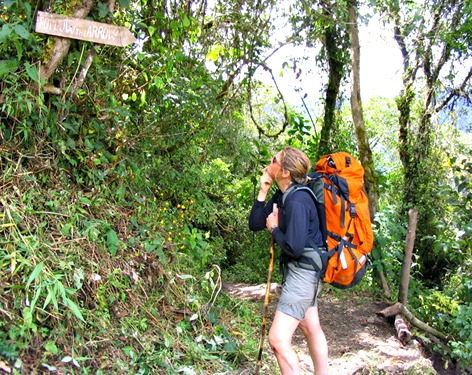
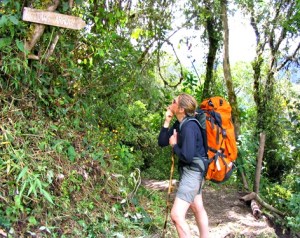
img: Antrese Wood displaying her intrepid travel skills on the Machu Picchu trail in Peru. Her comment: “I thought the Follow the Arrow sign was hilarious because 1) the trail is so well marked I cant imagine anyone getting lost; and 2) this was the one and only sign on the trail and it was near the end of the four-day hike. The other hilarious thing about the photo, at least to me, is that if you look closely, you can see my knee is bleeding. I had just spent 80 days carrying a backpack two-three times as heavy in seriously remote back country, no trails, no markers, nothing. We had to sign a waiver acknowledging the understanding that if something should happen, it could take a helicopter up to a week to arrive. I made it through without a scratch. Here, on this comparative cake-walk, on a perfectly even trail, I fell for no apparent reason and totally skinned up my knee.”
RANDOM NOMAD: Melissa Stoey, Former Expat in UK and Incurable Britophile

Place of birth: Northern Virginia, USA
Passports: USA
Overseas history: England (Huntingdon, Cambridgeshire + Shefford, Bedfordshire): 1988-91.
Occupation: Research technician (basically I do data analysis) and part-time professional blogger.
Cyberspace coordinates: Smitten by Britain: Home of the Britophile (blog); @SmittnbyBritain (Twitter handle); Facebook page; and Pinterest.

What made you leave your homeland in the first place?
I’m intrigued by other cultures and more specifically by the British culture. I have been fascinated by Britain since I was a young teen. I have always had the itch for travel and I knew I definitely wanted to visit the UK, if not live there. My love for travel one of the reasons I joined the military. I put England down as my first choice for duty station and I got it!

Where were you stationed?
At Chicksands air base (Chicks for shorts). It’s now Royal Air Force (RAF) Chicksands. Britain’s Ministry of Defense has since taken it over.

You ended up marrying a Brit, right?
Yes. My first husband, and the father of my son, was stationed at what was then RAF Brampton, which is in Cambridgeshire. At first we lived in Huntingdon, but then he got transferred to a base in Hitchin, which is closer to Chicks, so we moved to Shefford.

Is anyone else in your immediate family “displaced”?
Ironically, my brother was stationed at Chicks three years before, so it sort of felt like I was meant to go there. Right now, I don’t have any displaced relatives, but my son is a dual national between the U.S. and U.K. I suspect at some point he may move to the U.K. after he fulfills his dream of living and teaching in Japan for a year. We’ll see! It may be a case of like mother, like son.

So you and your son now live in the United States?
Yes. His father and I are divorced. We came back and lived in Texas for a year, then West Virginia. We now live in Pennsylvania. Meanwhile, his father has gone back to Scotland, where he is from.

How often do you return to the U.K.?
My son and I, and my second husband — I am now married to an American! — try to go every year or at least once very two years, depending on funds and time off.

Can you describe the moment in your association with Britain when you felt the most displaced?
The first night I was in England the culture shock was horrible. I lived around sixty miles north of London in a small village where there were no street lights, and when I looked out the window there was complete and utter darkness. It felt as if I’d landed on a different planet with no signs of life. This was 1988 when almost everything closed much earlier than it does now and wasn’t open on Sundays. If you switched on the radio you might pick up two or three stations, the television had only four channels and of course there was no Internet. It felt much more isolating than if you moved to England today; it has changed by leaps and bounds in the last 25 years as far as conveniences go. I envy current expats who have so many wonderful resources available to help limit the culture shock and make the transition easier.

Is there any particular moment that stands out as your “least displaced”?
We had a great night back in July of 2010 when we met a Glaswegian couple at a curry house in the west end of Glasgow. They invited us to the pub for drinks where we spent the night taste testing different whiskies. I felt totally at home, like I had known this couple my whole life. The Scots have a way — similar to Americans — of making one feel welcomed and accepted. I can say this because of having once been married to a Scot and having spent a lot of time there. My ex-husband was, and still is, one of the friendliest people I know.

You may bring one curiosity you’ve collected from your adopted country into The Displaced Nation. What’s in your suitcase?
My bag is always full of tea and sweets from England. I never return without them. I always pack a few British newspapers as well because my parents are Anglophiles, have been to England many times and enjoy reading them. Rumor has it that some of you Displaced Nation citizens are avid tea drinkers and readers, and that you rarely turn down sweets.

You are invited to prepare one meal based on your travels for other members of The Displaced Nation. What’s on your menu?

I will fix my favorite meal which is a nice Sunday roast that includes roast beef, roasted potatoes, carrots, peas, and Yorkshire pudding (I don’t do sprouts, thank you.) We’ll finish it off with a nice pot of tea and a slice of Victoria sponge, with jam and whipped cream.

And now you may add a word or expression from each of the countries where you’ve lived to The Displaced Nation argot. What will you loan us?
I’m feeling peckish. I say that quite often and it always results in the odd look or two. It’s just not used here, at least where I live. To feel “peckish” means to feel slightly hungry.

Earlier this month, we did a series of posts on Queen Elizabeth’s Diamond Jubilee. Incurable Britophile that you are, I presume you celebrated from a distance?
I watched the River Pageant, which was on early in the morning East Coast time, and then hosted my own Diamond Jubilee lunch (see photos on my blog). The food was great — we nibbled on leftovers for days! Even though I didn’t have a big party (it was just for my family), I was glad to do it to show my blog readers that you don’t have to be in Britain to celebrate properly. You can still enjoy yourself and take part in your own little way.

A couple of us on The Displaced Nation team thinks that the Queen deserves an Olympic medal for having survived almost being displaced by Princess Diana. Do you agree?
I don’t agree that the Queen was almost displaced by Diana; if she was going to be displaced it would have been due to her actions (or lack of) that left the British public feeling as if she was heartless and out of touch. However, I still don’t think she would have been displaced. Time heals and I think many of us now understand the dilemma she faced as a grandmother trying to protect her grandchildren who just lost their mother. However, as Head of State I do wish she had at least made a televised message to the public within the first 24 hours. Waiting five days was a bit much.

Americans seem to love the Royal Family. Do you think the United States might benefit from having one?
The idea of the United States having a royal family at this point is a silly one. It doesn’t fit our history or where we are headed as a country. Let’s leave that to the nation that does Monarchy the best.

Readers — yay or nay for letting Melissa Stoey into The Displaced Nation? Tell us your reasons. (Note: It’s fine to vote “nay” as long as you couch your reasoning in terms we all — including Melissa — find amusing!)

STAY TUNED for tomorrow’s episode in Libby’s Life, our fictional expat series set in small town New England. (What, not keeping up with Libby? Read the first three episodes of her expat adventures and/or check out “Who’s Who in Libby’s Life.”)

If you enjoyed this post, we invite you to register for The Displaced Dispatch, a round up of weekly posts from The Displaced Nation, with seasonal recipes, book giveaways and other extras. Register for The Displaced Dispatch by clicking here!

Related posts:

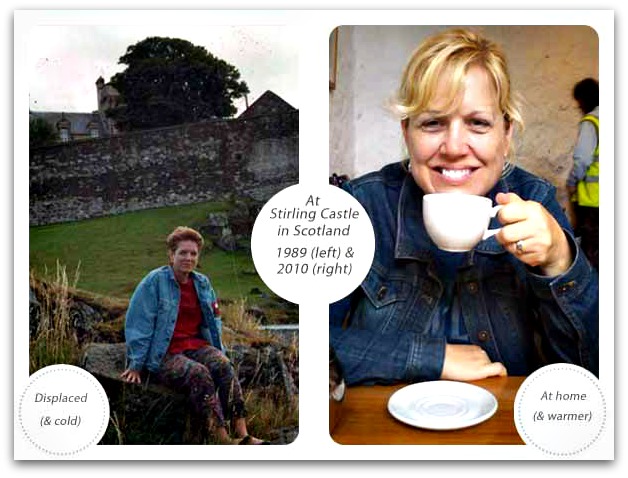
img: Melissa Stoey at Stirling Castle, Scotland, then and now — in 1989, when she was displaced (and cold!), and in 2010, when she was visiting (and warmer!).

THE DISPLACED Q: On your travels, what’s the most memorable chance encounter that brought you closer to The Sweet Life?

Since the beginning of May, I’ve been posing weekly questions as a way of getting at how we travelers experience La Dolce Vita, or The Sweet Life.

Seeking truths by your own lights — that’s what’s known as the Socratic method!

But while my questions thus far have focused on the sensory delights that travel offers — heart-stopping sights, delightful sounds, intoxicating scents, delicate flavors — today’s question is a little different. I want to know about the people you’ve encountered by chance on your travels, who’ve opened your heart and mind to the possibility of living The Sweet Life.

I’ve been very lucky in my life. I’ve met quite a few individuals who have inspired me in one way or another. Perhaps it’s because I’m a big believer in fate; I’ve always thought that everything will play out according to plan, if I just let it.

Not that I sit around and do nothing. Rather, I try to do as much as I possibly can, in the hope that I’ll end up doing enough of the Right Things to shape my life to come. Some of those things will reveal their hidden meaning only years later, in hindsight…

“Life is what happens to us while we are making other plans.”

— American cartoonist Allen Saunders, 1957 (later featured in a John Lennon song)

A couple of early mentors

I owe this philosophy in part to something that happened to me when I was still living in the UK, thinking I was going to become an actor. In order to help my sister, Gillian, integrate into university life, I took her to a kung-fu class. The teacher (or sifu) became more than just a friend to her, he became a spiritual mentor.

What Gill learned passed through to me, and eventually we both attended a personal development seminar that changed our whole worldview. I became more open and generous, rejecting the lessons I’d learned at acting school about clawing my way to the top over the bodies of those less fortunate. My epiphany led me to see that acting was an every-man-for-himself type industry — not exactly good for my soul.

So I gave it up. I went traveling instead. When volunteering in Ecuador, I met Toby, who also helped shape the course of my life. Toby was my boss at the Ecuadorian animal shelter; and, as I recount in my book, That Bear Ate My Pants!, he was confident and capable, at ease in his own skin — just the way I wanted to be.

Toby told me all about his adventures as a professional diver in Thailand, and I began to crave that life as though it was the answer to all my heart’s desires.

He also tricked me into getting my head shaved, the bugger.

A Sheila who suddenly showed up in my life

After three months in Ecuador, I suffered some pretty severe reverse culture shock when I got back to England. I got quite depressed, and wanted nothing more than to leave again. Well, it’s England — can you blame me? (No offense to those who are enjoying the Queen’s Diamond Jubilee celebrations while reading this…)

Around that same time, Gillian was traveling in the USA with a bunch of friends she’d met while working for Camp America. I decided to fly out and meet up with them, in the hope that a few more adventures would dispel my unhappiness.

By the time I got there, she only had two companions left, a young Kiwi-Aussie couple called Richie and Krista. We hung out together for a couple of weeks and had fun, and one by one they, and then the two of us, left for home.

Back in England again, I busied myself trying to recapture the combination of excitement and contentment I’d found in Ecuador, but to no avail. In the end I left for Thailand, following Toby’s advice, hoping that another stint of volunteering would sort my head out.

By pure chance, Gill had invited Krista to come and explore England with her; I flew out the same day she flew in, and we met briefly at the bus station. I said my good-byes and was gone. Though my original plan was to stay away for three months, I got kind of caught up in things and didn’t come back for over two years.

The two girls meanwhile, roamed around the UK until their money ran out, and Krista flew back to Australia. Gill promised to return the visit as soon as she could afford to.

In Thailand, I neither knew nor cared about such things! I was having a great time, diving for a living and partying every opportunity I got.

Toby would be proud, I thought.

Until one day I woke up broke. I’d lost a lot of money to fraud and then had what was left stolen from my bungalow. I realized I would never survive on my meager diving wages. My friends supported me for a while, but I knew I couldn’t ask this of them for long.

It was time to face facts; I was going to have to go home.

Hang on, there’s that Sheila again!

By this time, Gill was in Australia, exploring the country with Krista in a knackered van covered in multi-colored handprints. In a series of tearful emails to my sis, I poured my heart out — telling her how much I hated the idea of abandoning all my hopes and dreams and going home.

She wrote back with an offer from Krista: I could come over to Perth and stay with her family! Krista had even lined up an interview for me with a local job agency — I could hardly believe it! I still didn’t want to leave Thailand, but at least this way I could carry on traveling. (Krista and Gill also pointed out that there were plenty of spare seats in their van…)

I flew to Australia without the price of a cup of coffee. I didn’t even own enough clothing to fill a bag. The girls met me in the airport with their crumbling van (nicknamed Rusty!), and I immediately learned a few things about Krista:

  1. She was prettier than I remembered.
  2. She was now single.
  3. She was a whole lot of fun to be around!

Six years later, after many adventures together, Krista and I were married in the grounds of Taunton Castle, in Somerset in England. Her whole family flew out to join in the medieval-themed celebration, and not long after they flew back, we followed them, back to Perth, where we now live.

Of course, it was a LOT more complicated than that.

But as chance encounters go — and in terms of the ones that influence your life the most — well, that one, for me, takes the biscuit!

What about you? I want to know what chance encounters have affected you the most during your travels — leading to new experiences you wouldn’t have otherwise had. And did they ultimately take you closer to The Sweet Life, as in my case?

Spill the beans in the comments below. (You know you want to!)

STAY TUNED for Monday’s post, a tribute to Queen Elizabeth for lasting 60 years on the throne, despite a period of displacedness.

If you enjoyed this post, we invite you to register for The Displaced Dispatch, a round up of weekly posts from The Displaced Nation, with seasonal recipes, book giveaways and other extras. Register for The Displaced Dispatch by clicking here!

Related posts:

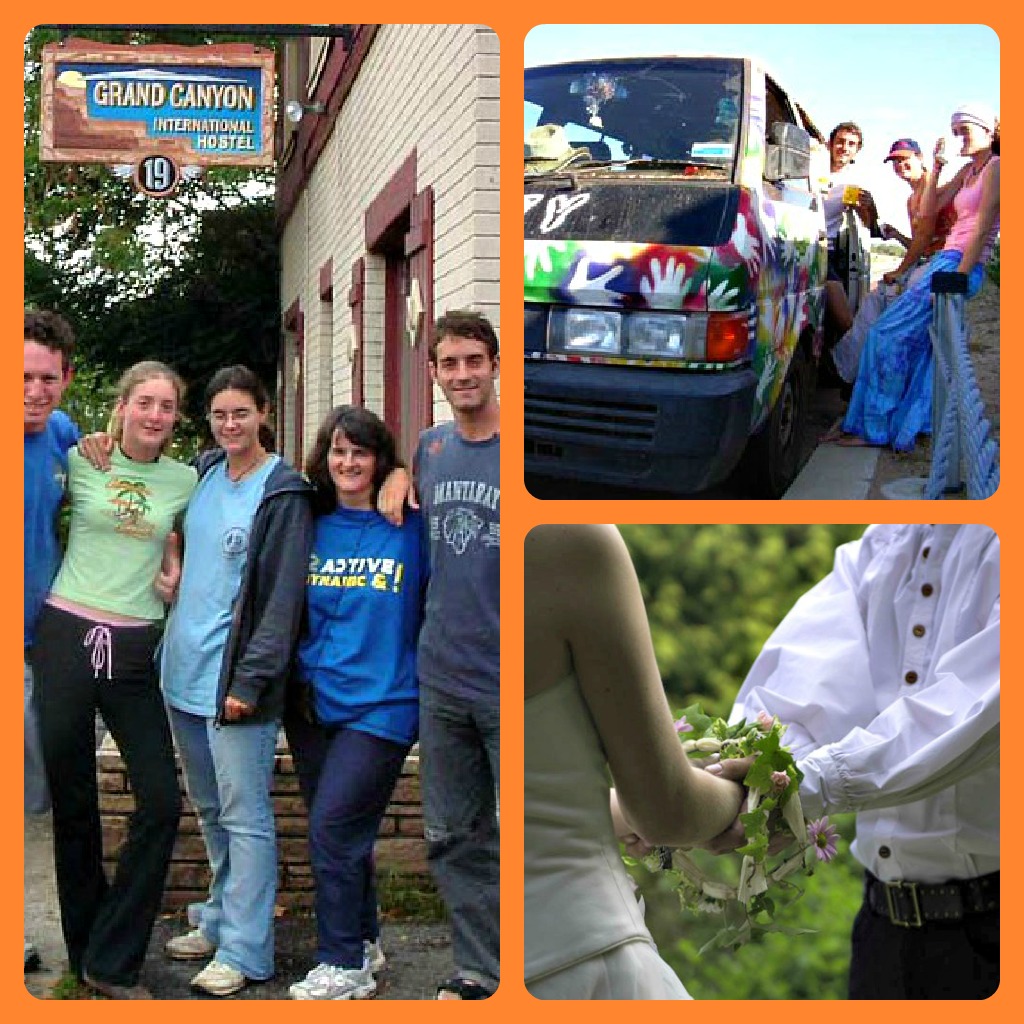
Images from Tony James Slater’s personal collection: Touring the Grand Canyon with Krista (she is in the green tee shirt), her boyfriend and his sister, Gill; his reunion with Krista and Gill in Perth, Australia, some years later (Tony is driving Rusty); all of this leading to Tony and Krista’s medieval-themed wedding in the UK (this is their “hand fasting”).

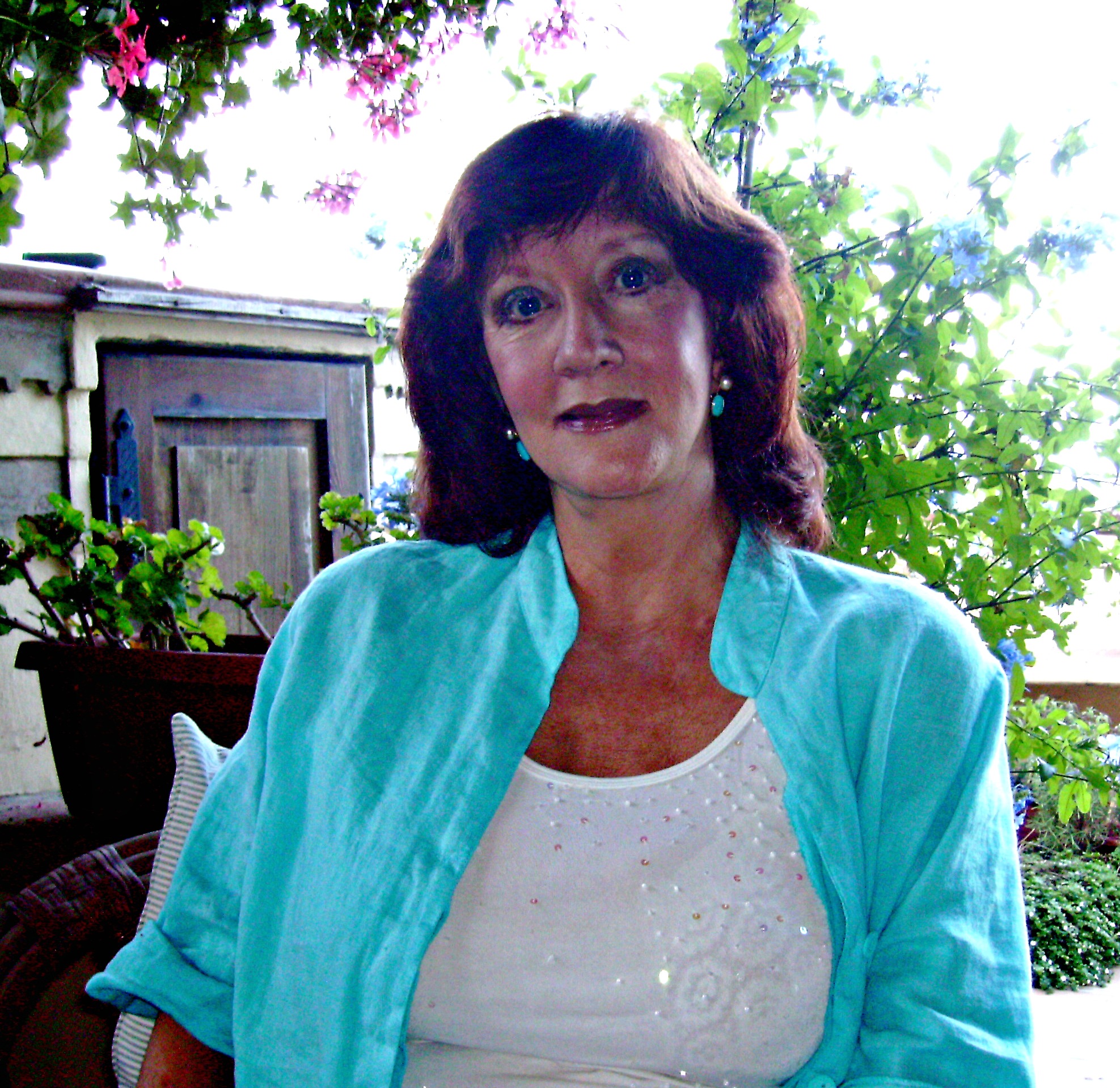
For expat novelist Laura Graham, even a dark Tuscan alley has La Dolce Vita to spare

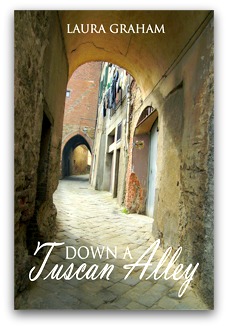
“Down a Tuscan Alley” — when I first heard the title of Laura Graham’s debut novel about an Englishwoman in Tuscany, I assumed it would be a thriller or mystery. Something nefarious would happen down a Tuscan alley, and the protagonist, whose name is Lorri, would find herself enmeshed in events beyond her comprehension, fearful of getting caught in the crossfire between rival Mafia gangs…

The book is no such thing, I’m happy to report (I’m not a fan of Mafia thrillers). Strange things do happen in the dark alley outside of the tiny flat where Lorri lives in the Centro Storico (village on a hill) of the Tuscan town of Sinalunga — but nothing worse than a peeping Tom. And at one point there’s a shady-looking man following Lorri — but he turns out to be (relatively speaking) harmless.

No, the book’s real mystery has to do with why Lorri is living in a tiny Tuscan village on her own. Well, she’s not on her own but has two cats. The last time she was in Sinalunga, it was with her husband, Richard. They had bought the flat together and Richard fixed it up. But now their marriage is over because of Richard’s infidelity. Or Lorri thinks it is over — Richard is having second thoughts.

Lorri, however, is determined. She has come to Italy to get lost in the culture and start her life again. But is she doing the right thing? Her Italian neighbors treat her with some suspicion: what’s a woman doing living on her own, with no visible means of support? (She has decided to do B&B in her little flat, but since it has only one bedroom, when the guests come, she has to sleep on the sitting room floor.)

And she also has to persuade herself to trust her gut instincts. As she says toward the start of the novel:

Am I crazy to come here? Hardly any grasp of the language, forty-seven, alone and with virtually no money? Many would think so…

Lest you think we’re venturing into Under the Tuscan Sun territory, rest assured, we’re not. Lorri does not take life, let alone her midlife predicament, too seriously. This is a flat overlooking an alley we’re talking about, not a 250-year-old villa. And so what if she ends up seizing an opportunity to get involved with the handsome young builder Ronaldo? Isn’t La Dolce Amore the quickest way to obtain La Dolce Vita?

But before I get too carried away with the story, let me turn the conversation over to Laura Graham, who has graciously agreed to answer a few questions about both her book and her life story — which, as she freely admits, the novel is based on.

The decision to write an autobiographical novel

Thank you so much, Laura, for agreeing to this chat. Your story — both in the book and in real life — neatly combines the two themes we’ve been talking about on The Displaced Nation this month: the quest for La Dolce Vita and the need for taking a “midlife gap year,” which sometimes heralds an even bigger life change. But let’s start by having you talk a little about your background — where you were born, what you studied and why you went to live in Italy.
I was born and brought up on the Isle of Tiree on the West Coast of Scotland for the first six years of my life. I then came to London and entered a convent school.

Later, as an adult, I won a scholarship to study drama at the London Academy of Music and Dramatic Art for two years. I received the prize for being the most promising student and immediately got a job understudying Helen Mirren in The Balcony at the Aldwych Theatre in London. I had a long and successful acting career at the Royal Shakespeare Company and the Young Vic, also on television.

When my long relationship ended with my former partner, I felt the need to turn my life around and decided to begin again in Italy. About ten years before, I’d invested £6,000 in a tiny hilltop village apartment in Tuscany, never thinking that one day it would become my permanent home. I still live in the village, but in a house, with my partner Rosalbo, a property restorer and an artist (he paints cats!). Besides writing, I run my own holiday agency, called “Laura’s Houses.”

Down the Tuscan Alley is your first novel. Have you written anything else?
I have also written a book for children called A Tale of Two Tuscan Cats, which was published last October. It has recently come out in Italian. Rosalbo did the illustrations.

What made you decide to write a novel about a middle-aged woman who is determined to change her life by moving abroad?
Because I’ve experienced it and thought it would make a good story — and might help others so inclined.

Why a novel and not a memoir?
I wrote my story in a novel form to protect the people I wrote about — I’ve changed their names, although some of them are now dead.

What audience did you have in mind when writing the book?
Women like myself, who want more from life than just settling into middle age with nothing but memories. Life is to be lived!

One of your Amazon reviewers wrote: “Brava! Brava! Brava! I loved reading Down a Tuscan Alley. The comic cast of characters brought me to the heart of bellisima Italia.” Other readers, however, said they were grateful that the book isn’t just about how beautiful Italy is. To which parts of the story have most readers responded?
The parts that are thought-provoking — about losing oneself in another culture in order to find oneself — and the humor are what people seem to enjoy.

Getting to the heart of La Dolce Vita…

From the time she arrives Italy, Lorri seems to be in touch with the little things that make her Tuscan alley so different from the Devonshire alley where she was living with friends, just before she left: the old stone steps, the steeple of the magnificent ochre-colored church she can see from her window, the birdsong… Is there something special about Italy that awakens the five senses?
In my opinion it is the light that awakens the senses. The light in Tuscany touches something in you, brings you to life — it’s like a medicine, a tonic.

Since you’re a former actress, would you say that daily life in Italy is more theatrical?
Living in Italy is certainly more theatrical than living in the UK. The people here are open and spontaneous.

And Lorri immediately becomes part of that drama. As her elderly English-speaking neighbor in Sinalunga, Lionello Torossi, says: “The people are delighted to see you…You are their portable theater.” But doesn’t some of the charm of a place have to do with its novelty value? Wouldn’t an Italian feel charmed by a Devonshire alley?
I think the Italians would be fascinated by a Devonshire back alley, if only to think — how is it possible to live there?

…and La Dolce Amore

At one point, Lorri is contemplating her affair with Ronaldo and says to herself: “How can you speak with your heart when you don’t know the words?” Call me a skeptic, but couldn’t their relationship change for the worse once their verbal communications improve?
No, I think Lorri would still find Ronaldo enchanting once she’s able to understand more of the language. But perhaps also more infuriating at times!

Lorri also says, with reference to Ronaldo: “These torrid passions are what happens to English women in hot countries.” Is romance so very different in Italy as compared to the UK?
Torrid passions indeed! The Italian art of seduction is very different from the UK. An Italian makes a woman feel every inch a woman and delights in her beauty and femininity no matter what her age.

Many of The Displaced Nation’s readers are in cross-cultural relationships. What do you find to be the biggest challenge about getting together with someone of another culture?
I cannot pretend it’s easy getting together for a long time with someone of a different culture — although it’s not the culture so much as the mentality. There are many things to learn, mainly about one’s self — and that’s always a challenge. Here in Italy, it’s the language I find most difficult and the humor, which is somewhat different from ours. Of the two, language is the bigger difficulty. Communicating is the key to success when living in another country. Otherwise, you can’t offer as much as yourself as you would like to.

The challenge of exporting La Dolce Vita

After living in a small Italian community for so long, do you think you could ever fit back into living in Britain?
No, I can’t imagine myself living again in the UK even though I go back twice a year and enjoy it. But if I had to I would adjust simply because I’m English. But the biggest culture shock — apart from the food — would be the people. I’ve grown so used to the warmth of the Italians.

Could you bottle the formula you’ve developed for La Dolce Vita in Tuscany and bring it back with you?
The only way to bottle the formula of the Tuscan Dolce Vita is to carry it inside my heart — and take it with me wherever I go.

Coming soon!

Please tell me that you’re working on another book. By the time I finished Down a Tuscan Alley, I’d grown fond of Lorri, Ronaldo and the various neighbors — and felt bereft!
I am on the last chapter of my next book: The Story of Kelly McCloud. This is also set in Italy and is about a young woman who takes a job as a housesitter in an Italian villa. Amongst an eccentric English family, a fallen angel and a dragon, she discovers how to use the whole of her brain and realizes the potentiality of the human race.

Assolutamente favoloso! Thanks so much, Laura!

Readers, you can purchase Down a Tuscan Alley on Amazon. You can also read more about Laura Graham at her author site. And, should you now feel tempted into trying out La Dolce Vita for yourself, then consider renting one of her two houses in the Centro Storico of Sinalunga. What are you waiting for?!

STAY TUNED for tomorrow’s episode in the life of our fictional expat heroine, Libby, who has traded her Boston Red Sox cap for a Sherlock Holmes deerstalker in her quest to uncover her husband’s roots. (What, not keeping up with Libby? Read the first three episodes of her expat adventures.)

If you enjoyed this post, we invite you to register for The Displaced Dispatch, a round up of weekly posts from The Displaced Nation, with seasonal recipes, book giveaways and other extras. Register for The Displaced Dispatch by clicking here!

Related posts:

img: Laura Graham, on the terrace outside her house in Tuscany.