The Displaced Nation

A home for international creatives

Tag Archives: Alice in Wonderland

And the March 2014 Alices go to … these 3 international creatives

 © Iamezan | Dreamstime.com Used under license

© Iamezan | Dreamstime.com
Used under license

If you are a subscriber to our weekly newsletter, Displaced Dispatch, you’re already in the know. But if you’re not (and why aren’t you? off with your head!), listen up.

Every week, when that esteemed publication comes out, we present contenders for a monthly “Alice Award,” most of whom are writers or other kinds of international creatives who appear to have a special handle on the curious and unreal aspects of being a global resident or voyager.

Not only that, but this person tries to use this state of befuddlement as a spur to greater creative heights.

Today’s post honors March’s three Alice recipients. Starting with the most recent, they are (drumroll…):

1) CANDACE ROSE RARDON, travel writer and sketch artist

For her interview:  “Watercolouring Her Way Around the World,” on Linda Fairbairn‘s Journey Jottings blog
Posted on: 14 March 2014
Snippet:

“In a way, my sketchbook also helps create the moments I record in it. I might head to a café to draw a street-scape, start talking with the man next to me, and then jot down a line or two from our dialogue on the sketch itself. Sketching has become both my muse and medium on the road—it creates the very stories I love to tell, stories of connection and serendipity, and I now can’t imagine ever travelling without my sketchbook.”

Citation: Candace, we think we should invent a new award for you: a “Poppins.” Your watercolors look so inviting that we want to jump right into them and share in your adventures, just as Mary Poppins jumps into Burt’s chalk drawings. (Incidentally, we refer to the animated sequence in the movie, of which P.L. Travers did not approve, only to be overruled by Walt Disney.) Poor Alice doesn’t go down the rabbit hole because of its visual stimulation; quite the opposite! She goes down the hole due to boredom with her sister’s book “without pictures or conversations.” Our sense is that, were you to receive an “Alice,” it would need to be presented by the Mock Turtle, art lessons having played a role in his superior education:

“Well, there was Mystery,” the Mock Turtle replied, counting off the subjects on his flappers, “—Mystery, ancient and modern, with Seaography: then Drawling—the Drawling-master was an old conger-eel, that used to come once a week: HE taught us Drawling, Stretching, and Fainting in Coils.”

Though he doesn’t mention “water” art, it seems likely he would sanction it. Definitely he would not be a fan of our alternative suggestion unless we agreed to call the prize a “Puffins” instead of a Poppins. But enough of these qualifications; suffice it to say, we are in awe of your ambition to “watercolour” your way around the world. You paint, girl!

2)”The Expat” in Korea

For his post: “The Reincarnation Lottery,” on ExpatHell.com
Posted on: 18 March 2014
Snippet:

We may be dogs, but we are dogs with memories. Memories of where we came from. Memories of hot summer days, clear blue skies, people smiling, people laughing, wind slicing through large trees with leaves whisking and shimmering in the sun like waves washing over a million shiny round stones. We are four dogs with memories of home, and somehow, we are all going back. This is what we wail about during the pitch black nights and all we dream about during the hazy grey days.

Citation: The Expat, we have been around the world a few times so are well aware of South Korea’s proclivity for dog meat consumption. This may be why we find your description of yourself and your three mates as a pack of four large wailing dogs on a dog farm “in the lonely cold mountains and valleys of the Korean countryside” alarming. But no more alarming, we suppose, than Alice’s own sense of transformation as she progresses through Wonderland:

Alice took up the fan and gloves, and, as the hall was very hot, she kept fanning herself all the time she went on talking: “Dear, dear! How queer everything is to-day! And yesterday things went on just as usual. I wonder if I’ve been changed in the night? Let me think: was I the same when I got up this morning? I almost think I can remember feeling a little different. But if I’m not the same, the next question is, Who in the world am I? Ah, THAT’S the great puzzle!” 

A good thing she doesn’t prolong her stay in Wonderland, that’s all we can say. Can she be far off from imagining herself as a caged rabbit that is about to be thrown into the cauldron of pepper soup being stirred by the Duchess’s cook? In any case, we really appreciate your honesty in telling the story, in such a creative way, of four American men arriving in Korea in hopes of a fresh start as English teachers, only to end up “starting over and starting lower.” We can certainly see why you aspire to returning to our “dog eat dog” society here in the West. Only please promise that between now and then, you won’t land in a bowl of Korean soup, which, needless to say, will be a great deal more firey than the Duchess’s.

3) ALEX BAACKES (aka Alex in Wanderland), freelance writer and New York native on the move

For her post: “My Top 8 Animal Encounters Around the World,” on Michael Hodson‘s Go, See, Write blog
Posted on: 20 February 2014
Snippet:

Today, I seek out encounters with animals that are willing participants in sharing their space with me; one where everyone walks—or swims—away happy. . . . While I’m still not quite sure how sailors once mistook manatees for mermaids, I can now attest to the fact that these bulbous creatures move with a surprising amount of grace. Braving the chilly winter waters? Worth every shiver to share a swim with these beauties.

Citation: Alex, we are struck by how quickly you have come to the realization that, while it can be fine, even fun, to encounter other human beings on your travels, you should not miss out on the opportunity to interact with new kinds of mammals—relationships with whom could end up being much more therapeutic, especially if they’re the kind you can swim with. Alice, of course, had no qualms about swimming with the Wonderland creatures:

It was high time to go, for the pool was getting quite crowded with the birds and animals that had fallen into it: there were a Duck and a Dodo, a Lory and an Eaglet, and several other curious creatures. Alice led the way, and the whole party swam to the shore.

But in Alice’s case, she was swimming in a pool made of her own tears. We congratulate you on being much more sensible in heading Crystal River, near Orlando, which plays host to the migrating manatees from October to March.

*  *  *

So, readers, do you have a favorite from the above, or have you read any recent posts you think deserve an Alice Award?  We’d love to hear your suggestions! And don’t miss out on the shortlist of Alice contenders we provide in each week’s Dispatch, which are sources of creative thought if nothing else! Get on our subscription list now!

STAY TUNED for next week’s fab posts.

Writers and other international creatives: If you want to know in advance the contenders for our monthly Alice Award winners, sign up to receive The Displaced Dispatch, a round up of weekly posts from The Displaced Nation, with news of book giveaways, future posts, and of course, our weekly Alice Award!. Register for The Displaced Dispatch by clicking here!

Related posts:

And the February 2014 Alices go to … these 3 international creatives

 © Iamezan | Dreamstime.com Used under license

© Iamezan | Dreamstime.com
Used under license

If you are a subscriber to our weekly newsletter, Displaced Dispatch, you’re already in the know. But if you’re not (and why aren’t you? off with your head!), listen up.

Every week, when that esteemed publication comes out, we present contenders for a monthly “Alice Award,” most of whom are writers or other kinds of international creatives who appear to have a special handle on the curious and unreal aspects of being a global resident or voyager.

Not only that, but this person tries to use this state of befuddlement as a spur to greater creative heights.

Today’s post honours February’s three Alice recipients. Starting with the most recent, they are (drumroll…):

1) MICHELLE WELSCH, writer, traveler, founder of Project Exponential

For her post: “Quitting everything to go to Nepal was the best thing I’ve done” on Medium.com
Posted on: 27 December 2013
Snippet:

And everywhere I went, there were EYES. Always eyes. Constant staring, asking the same questions: Where are you from? What are you doing in Nepal? How long have you been here? How old are you? Are you married? Why not?

Sometimes I just wanted to “blend in” and not be reminded of my whiteness and the privileges that come with being an American…

So no, not every day was perfect. But even the imperfect days added to the experience.

One of the monks asked me, “If there is no night, how can there be day?”

Citation: Michelle, the monk’s line of questioning puts us in mind of the cross-examination to which Alice is subjected upon encountering the Caterpillar:

“You!” said the Caterpillar contemptuously. “Who are YOU?”

Which brought them back again to the beginning of the conversation. Alice felt a little irritated at the Caterpillar’s making such VERY short remarks, and she drew herself up and said, very gravely, “I think, you ought to tell me who YOU are, first.”

“Why?” said the Caterpillar.

Also, if you were bothered by all the eyes staring at you, imagine how poor Alice felt when being scrutinized by a creature with twelve eyes. Yes, that’s what caterpillars have, a dozen eyes. That said, the Caterpillar, whose one and only job is to eat (it increases its body mass by 1,000 times or more), would undoubtedly admire your fortitude in being able to drink tea with sugar and consume lots of carbs without obsessing about food or weight or calories. All told, while your post helps us to understand the charms of this South Asian land, we are still shaking our heads at the notion of monks enjoying water balloons. As the Caterpillar will tell you, water balloons don’t rate, their potential to become psychedelic hallucinogens being rather too limited.

2) AMY R., blogger and British serial expat

For her post: “Expat Life: Love Lessons Learned” on her blog, The Tide That Left
Posted on: 14 February 2014
Snippet:

We ended 2013 by moving to Tanzania. It was the year of learning to be flexible; most importantly to be flexible with each other. I used to be the kind of girl who needed her life mapped out, but since we started our expat life together we’ve both had to find a way to go with the flow. We’ve chosen a lifestyle that throws up the unexpected, and we wouldn’t be able to cope if we didn’t roll with the changes.

Citation: “Roll with the changes”—Amy, that’s exactly what Alice decided to do when her eye fell on a little glass box that was lying under the table, which turned out to contain a very small cake, on which the words “EAT ME: were beautifully marked in currants:

“Well, I’ll eat it,” said Alice, “and if it makes me grow larger, I can reach the key; and if it makes me grow smaller, I can creep under the door; so either way I’ll get into the garden, and I don’t care which happens!”

As you can see, in a land where cakes can make you grow larger or smaller, there is little point in mapping out one’s life, especially when you have reasonable hope of getting into the garden eventually. We’re ever so glad you realized that, and just in time for entering your own Garden of Love! (Hope you and your hubby had a happy Valentine’s Day!)

3) MANAL KHAN, journalist, poet, essayist, photographer, and storyteller

For her post: How to Make Friends in a New City—Tip #5, on her blog, Windswept Words
Posted on: 28 January 2014
Snippet

So, if you ever find yourself lost, alone and friendless in a new city, wondering why on God’s earth you ever transplanted yourself in the first place: don’t worry! It takes time for a plant to adjust to new soil, a new atmosphere. But once it gets over the wilting, drooping, moping period—”transplant shock” in botanical terms—it thrives.

Citation: Manal, imagine yourself, like Alice, having landed in a garden where the flowers can talk “very nicely,” for no apparent reason:

“Put your hand down, and feel the ground,” said the Tiger-lily. “Then you’ll know why.”

Alice did so. “It’s very hard,” she said, “but I don’t see what that has to do with it.”

“In most gardens,” the Tiger-lily said, “they make the beds too soft—so that the flowers are always asleep.”

That’s some transplant shock, don’t you think? In any event, we agree entirely that the botanical analogy goes a long way towards explaining why some of us feel displaced when attempting to put down a few roots in our new culture. Until the process is complete, there is little else we can do but indulge in the occasional wilt/droop/mope, as you say. And just think, if the soil proves sustaining, we may one day flower to the point of talking “very nicely” in the native tongue…

*  *  *

So, readers, do you have a favorite from the above, or have you read any recent posts you think deserve an Alice Award?  We’d love to hear your suggestions! And don’t miss out on the shortlist of Alice contenders we provide in each week’s Dispatch, which are sources of creative thought if nothing else! Get on our subscription list now!

STAY TUNED for tomorrow’s fab post.

Writers and other international creatives: If you want to know in advance the contenders for our monthly Alice Award winners, sign up to receive The Displaced Dispatch, a round up of weekly posts from The Displaced Nation, with news of book giveaways, future posts, and of course, our weekly Alice Award!. Register for The Displaced Dispatch by clicking here!

Related posts:

JESS IN JAPAN: Tokyo’s top 6 delights from my newbie expat perch

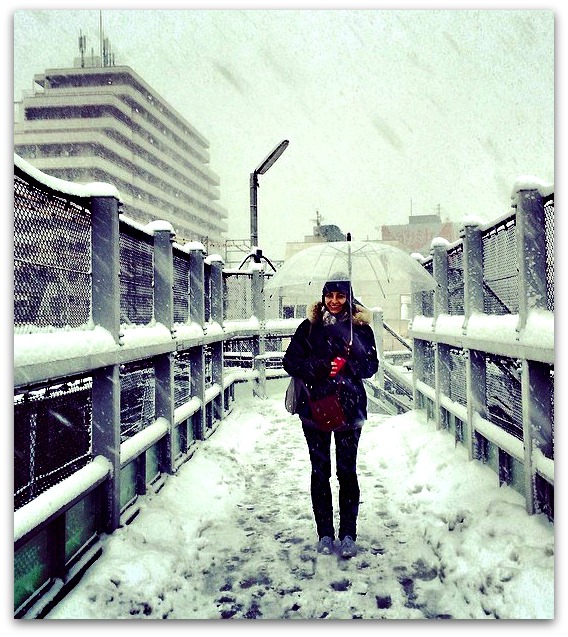
So is snow the same in Tokyo? Kind of, except everyone carries see-through plastic umbrellas! Jess in Tokyo's first February snowfall. Photo credit: Hiro Awanohara

So is snow the same in Tokyo? Kind of, except everyone carries see-through plastic umbrellas! JESS IN JAPAN in a rare heavy snowfall earlier this month. Photo credit: Hiro Awanohara

Today we welcome a new guest columnist: Jessica Awanohara. Any relation, you may wonder? Yes, she’s the American wife of my nephew by marriage, Hiro. The pair, who’d become dyed-in-the-wool New Yorkers, surprised us all by announcing they were moving to Tokyo at the end of 2013. Naturally, I was curious: how is Jessica adjusting to life in that “through-the-looking glass” city? Is it different to live there versus just visit (which she’s done many times in the past)?

—ML Awanohara

There are many things to love about moving to a new country and a few things not to love. Most expats eventually strike a balance between the two.

But are there also places where the love-hate continuum doesn’t apply? I’m beginning to think so ever since I moved from New York to Tokyo in late December of last year. A bad mood is impossible to sustain in this city because everything is hilarious. Wherever you turn, there is something riotous laying in wait…and the next thing you know, you are collapsing in fits of laughter.

I’ve been in Tokyo for over a month now, and have delighted endlessly in many things.

Here are six off the top of my head:

1) Trains are in happy colors.

I live on the Keiō Inokashira railway line, the color of which is bright pink. Not the barfy green of the 4/5/6, nor the almost-royal blue of the A/C, nor the vibrantly atrocious orange of the B/D/F, in New York City. Rather, this line is a sparkling and spritely pink mixed with what I imagine to be the color equivalent of delicious farm-fresh milk. It’s the pink of the gods: the Disney Princess Gods.

2) Subway stations are deeply amusing, so to speak.

Think of New York City’s deepest subway platform: the 63rd Street station on the F Line near Hunter College, or the 191st Street Station on the 1 Line. Imagine how long those escalators are, and now double it—no, triple it! Triple it, and add a couple of extra escalators and a brick-and-mortar set of stairs to the street, and now you have an idea how deep the average street to subway platform trip is in Tokyo. Have you ever tried going to Roppongi, or Azabu-Jūban? Try it!! You may feel as though you’ve walked far enough to be back in New York. Good for quite a few laughs!

3) People on the subway may be dressed much better than us, but they smell just as funny.

How could men in suits and overcoats, or women in designer outfits, smell as bad as we much more disheveled Americans do on the subway? Before taking the leap of moving to Tokyo, I dreaded the idea of being taller, sweatier, and worse smelling than the average citizen on a notoriously packed Japanese train car. Rest assured, inquiring minds, curdled humans smell much the same in Tokyo as in New York: like sweat socks… By the time summer arrives—I’ve visited here often enough to know that summer is no joke!—I should blend in perfectly fine, a thought I find immensely entertaining.

4) Furniture delivery can be farcical, especially when it doesn’t fit through doors.

After a month of living out of another person’s apartment, my husband and I moved into our own place a couple weeks ago. We ordered what can aptly be described as the world’s most beautiful bargain basement sofa and had it delivered to our new, completely empty home. No sooner did our large and lovely couch arrive, than it was exchanged for its tiny, two-seater cousin—that is, tiny enough to actually fit through our front door. In Japan, small is beautiful. How could we have overlooked this basic principle? Our hilarity could not be contained…

5) In Tokyo, cost-of-living statistics are a bit of a joke.

Really, Expatistan.com? I appreciate the cost-of-living data you supply for this great world’s great cities, and am aware that countless magazines and listservs use your data for splashy articles sizing up one city against another. But I’m confused about your aim. On your website it says you want to give people the information “to live as nicely as you live currently.” That means…what exactly? How does one measure the quality of life across cultures? And what about that ideal, which many of us expats hold dear, of “When in Rome…” I can lead the same life materially in Tokyo as I led in New York, but that’s not what makes me happier in this city. Sure, living the luxury life in Tokyo is expensive, but numbers are not the point. The point is, cost-of-living stats are hilarious in a city that gives me such joy!

6) Appliance installation is a riot and a half.

In a related hilarity, it is true that most Tokyo apartments are not outfitted with appliances normally packaged with an apartment in NYC. We had to order our own refrigerator and washing machine (both standard fixtures for the Tokyoite). Our refrigerator, a lovely and highly rated model, cost us all of $500; the washing machine was comparably rated and lower priced. As with anything you buy larger than a shopping bag, you have it delivered to your home for maybe $30 or $50 additional dollars, or oftentimes for free. The hilarity lies in the fact we had two choices when the refrigerator and washing machine were shipped—the delivery men would either leave them at our front door OR huff them up countless flights of stairs and install the machines for the low, low price of…one U.S. dollar. Tough choice, right? Hahaha.

No doubt about it, Japan is a barrel of laughs. Reaching beyond the cruel and unusual TV game shows, the Hello Kitty cafes, the Fruits magazine documenting outlandish clothes in the Harajuku area, and other enduring staples of pop culture in this part of the world, I’ve found countless things to delight me during my first month of residency in Tokyo. My main takeaway is how excited I am to let this town continue to delight me for years to come.

* * *

Readers, what do you think of Jess in Japan’s observations of her new home? I don’t know about you, but I find it ever-so-amusing that so many of her thoughts are focused on subways and apartments: not so different from life here in New York!

STAY TUNED for next week’s fab posts!

If you enjoyed this post, we invite you to register for The Displaced Dispatch, a round up of weekly posts from The Displaced Nation, with seasonal recipes, book giveaways and other extras. Register for The Displaced Dispatch by clicking here!

Related posts:

And the January 2014 Alices go to … these 3 international creatives

 © Iamezan | Dreamstime.com Used under license

© Iamezan | Dreamstime.com
Used under license

If you are a subscriber to our weekly newsletter, Displaced Dispatch, you’re already in the know. But if you’re not (and why aren’t you? off with your head!), listen up.

Every week, when that esteemed publication comes out, we present contenders for a monthly “Alice Award,” most of whom are writers or other kinds of international creatives who appear to have a special handle on the curious and unreal aspects of being a global resident or voyager.

Not only that, but this person tries to use this state of befuddlement as a spur to greater creative heights.

Today’s post honors January’s three Alice recipients. Starting with the most recent, they are (drumroll…):

1) AMBER PAULEN, American freelance writer and copyeditor based in Rome, and blogger at Descriptedlines

For her post: “Paesaggio Interiore” (Interior Passages)
Posted on: 17 January 2014
Snippet:

Dreamers are thought to be opposite of the practical, yet I see no difference. Imagining is a practicality that we use in order to survive—an imagined outcome may prevent us from a certain action—but it also makes our lives better. Imagination is the begetter of empathy and the foundation of utopias. It is also, on a minute basis, a way of interpreting the world—the wider these interpretations span, the farther the imagination sees, the more adaptable we are, one of the human race’s single best attributes. Try to find an intelligent mind with a small imagination.

Citation: Amber, we could not agree more with you about the practicality of dreaming, and about the need to put greater value on the life of the mind. Scrolling through the endless photos of man-made and natural scenery that occupy so many travel blogs and Pinterest boards these days can have a numbing effect, reducing life to a set of exterior images—in denial of the fact that each of us possesses some pretty vivid, not to say revealing, internal scenery. What’s more, we believe that the imagination is an extremely powerful, as well as much under-rated, survival tool for expats—the key to our adaptability, as you might put it. On the days when your new life in X country is looking rather grim or mundane, you can always slip into a fantasy land, pretending you’re a royal or a hungry hyena, just as Lewis Carroll’s Alice was wont to do:

And here I wish I could tell you half the things Alice used to say, beginning with her favourite phrase “Let’s pretend.”

She had had quite a long argument with her sister only the day before—all because Alice had begun with “Let’s pretend we’re kings and queens;” and her sister, who liked being very exact, had argued that they couldn’t, because there were only two of them, and Alice had been reduced at last to say, “Well, YOU can be one of them then, and I’LL be all the rest.”

And once she had really frightened her old nurse by shouting suddenly in her ear, “Nurse! Do let’s pretend that I’m a hungry hyaena, and you’re a bone.”

2) DRAKE BAER, contributing writer at Fast Company and co-author of Everything Connects

For his post: “Why weird people are often more creative,” in Fast Company
Posted on: 10 January 2014
Snippet:

In a 2003 study, Carson found that eminent creative achievers were seven times more likely to to have low rather than high latent intelligence scores. That insight prompted her to form a hypothesis: that cognitive disinhibiting allows for way more info to enter into your conscious mind–which you can then tinker with and recombine. The result: creative ideas.

Citation: Drake, we commend you for marshalling the evidence to support something that Lewis Carroll knew intuitively, without the benefit of Carson’s (or anyone else’s) study. Indeed, the world Alice discovers when she steps through the looking glass is teeming with flaming weirdos who, while they may seem rather dim witted at times, let’s face it, are super creative. Take this encounter with Humpty Dumpty, for example, in Through the Looking Glass:

“You seem very clever at explaining words, Sir,” said Alice. “Would you kindly tell me the meaning of the poem called ‘Jabberwocky'”?’

“Let’s hear it,” said Humpty Dumpty. “I can explain all the poems that were ever invented—and a good many that haven’t been invented just yet.”

3) MILDA RATKELYTE, writer, photographer and a budding filmmaker based in Singapore

For her post: “Lessons from 2013,” in her blog, Milda Ratkelyte Photography
Posted on: 1 January 2014
Snippet:

This year I am starting with one simple resolution—slow down and find the time every single day to smell the roses. Although 2013 was probably the hardest year in my life, I am grateful to all the strength it gave me and all the invaluable lessons I’ve learnt along the way…Never take your loved ones for granted, because life is so fragile that you never know if you will get a chance to see them again. Pick up the phone, tell them you love them NOW, not tomorrow or next week. Trust me it will make a huge difference.

Citation: Milda, we have appreciated your lens on the wider world ever since we featured you and some of your photographs in our monthly column “A Picture Says…” And now that you are learning the price of a peripatetic life—living far away from your loved ones, who may be suffering—we appreciate your emotional honesty. As Alice herself discovered when parted from her beloved cat, Dinah:

Down, down, down. There was nothing else to do, so Alice soon began talking again. “Dinah’ll miss me very much to-night, I should think!” (Dinah was the cat.) “I hope they’ll remember her saucer of milk at tea-time. Dinah my dear! I wish you were down here with me! There are no mice in the air, I’m afraid, but you might catch a bat, and that’s very like a mouse, you know.”

While Alice’s concerns are trivial compared to those currently confronting you, we wish that like her, you discover a garden of red roses (only in your case, may they not smell of fresh paint!).
 

*  *  *

So, readers, do you have a favorite from the above, or have you read any recent posts you think deserve an Alice Award?  We’d love to hear your suggestions! And don’t miss out on the shortlist of Alice contenders we provide in each week’s Dispatch, which are sources of creative thought if nothing else! Get on our subscription list now!

STAY TUNED for tomorrow’s post, an interview with some American entrepreneurs in Senegal.

Writers and other international creatives: If you want to know in advance the contenders for our monthly Alice Award winners, sign up to receive The Displaced Dispatch, a round up of weekly posts from The Displaced Nation, with news of book giveaways, future posts, and of course, our weekly Alice Award!. Register for The Displaced Dispatch by clicking here!

Related posts:

And the December 2013 Alices go to … these 2 international creatives

 © Iamezan | Dreamstime.com Used under license

© Iamezan | Dreamstime.com
Used under license

If you are a subscriber to our weekly newsletter, Displaced Dispatch, you’re already in the know. But if you’re not (and why aren’t you? off with your head!), listen up. Every week, when that esteemed publication comes out, we present contenders for a monthly “Alice Award,” most of whom are writers or other kinds of international creatives who appear to have a special handle on the curious and unreal aspects of being a global resident or voyager. Not only that, but this person tries to use this state of befuddlement to their advantage, as a spur to greater creative heights.

Today’s post honors December’s two Alice recipients.

Starting with the most recent, and this time with annotations, they are (drumroll…):

1) LAURENCE BROWN, British expat in Indiana and blogger at Lost in the Pond

For his post: “7 British Christmas Songs That Somehow Never Made it Big in the US” 
Posted on: 27 November 2013
Snippet:

Growing up in the United Kingdom, one of the more memorable elements of Christmas was the music that bombarded the airwaves day-in-day-out from November onward. And I’m talking huge hits, many of which shot to number one and continued their popularity some twenty, thirty, perhaps forty years after their release. And yet, as I embark on my sixth Christmas in the United States, it has come to my attention that these same hits—ones I initially assumed were likely just as big in the U.S.—are nowhere to be heard.

Citation:  Frankly, Lawrence, we were so busy lamenting the lack of attention given to Carols from Kings that it hadn’t yet dawned on us that Americans are also missing out on Cliff Richard crooning “Christmas time, mistletoe and wine…” And you have a point: Why would anyone States-side wish to hear yet another rendition of Andy Williams singing “Everybody knows some turkey”—yep, that’s you, Andy!—”and some mistletoe/Help to make the season bright…” when they could break it up with Cliff from time to time? And you are so right, the song’s Christian overtones would not go amiss in this part of the world. (Forgive the aside, but does anyone in Indiana know the words to the Robert-Burns-poem-converted-to-New-Year’s-dirge “Auld Lang Syne”, or is that a lacuna as well? Genuinely curious…) We congratulate you for uncovering some prime through-the-looking-glass territory. It’s jolly difficult to have a proper holiday if the music is missing or doesn’t sound right, as anyone who spends Christmas in Vietnam will tell you—there the bands in the restaurants serenade you with things like: “Have yourself a merry little Crease-mass.” And as Alice herself found out when she joined the Mad Hatter for what she thought would be a proper tea party:

“’Twinkle, twinkle, little bat!
How I wonder what you’re at!’

You know the song, perhaps?”

“I’ve heard something like it,” said Alice.

“It goes on, you know,’ the Hatter continued, “in this way:—

‘Up above the world you fly,
Like a tea-tray in the sky.
Twinkle, twinkle—'”

2) JULIE FALCONER, travel writer and social media consultant, Californian based in London, and blogger at A LADY IN LONDON

For her post: Lady’s Expat Holiday Blunders
Posted on: 28 November 2013
Snippet:

I picked [a cracker] up, pulled both ends, popped out the surprise gift and paper crown, and looked up to find everyone at the table staring at me in horror. It was one of a long series of expat moments when I knew that I had done something wrong, and that nobody was going to tell me exactly what.

I gently set the cracker and its contents down, flashed my most sheepish “sorry, I’m a foreigner” smile, and waited. Slowly, each person at the table picked up one end of a cracker, offered the other end to someone else, and played a little game of tug of war. So that’s what I did wrong.

Citation:  Julie, we are sorry to have to inform you of this, but it’s time to crack on with the old cracker techniques because, crackpot as it may sound, crackers have arrived over here in the United States, at Target no less! Though the difference is that you have to show your driver’s license when you buy them because they are technically “firecrackers.” Now that’s crackers, if you ask us! Now, we do hope the English friends who witnessed their rather unfortunate self-cracking episode were a little more tolerant than Alice’s Red Queen (perhaps they thought it fitting in this era of selfies?) and let you keep the surprise gift and paper crown. In which case, you can count yourself a little luckier than our poor sweet heroine:

“You look a little shy; let me introduce you to that leg of mutton,” said the Red Queen. “Alice—Mutton; Mutton—Alice.” The leg of mutton got up in the dish and made a little bow to Alice; and Alice returned the bow, not knowing whether to be frightened or amused.

“May I give you a slice?” she said, taking up the knife and fork, and looking from one Queen to the other.

“Certainly not,” the Red Queen said, very decidedly: “it isn’t etiquette to cut any one you’ve been introduced to. Remove the joint!”

*  *  *

So, readers, do you have a favorite from the above, or have you read any recent posts you think deserve an Alice Award?  We’d love to hear your suggestions! And don’t miss out on the shortlist of Alice contenders we provide in each week’s Dispatch, which are sources of creative thought if nothing else! Get on our subscription list now!

STAY TUNED for tomorrow’s post, a TCK Talent interview by Lisa Liang!

Writers and other international creatives: If you want to know in advance the contenders for our monthly Alice Award winners, sign up to receive The Displaced Dispatch, a round up of weekly posts from The Displaced Nation, with news of book giveaways, future posts, and of course, our weekly Alice Award!. Register for The Displaced Dispatch by clicking here!

Related posts:

And the November 2013 Alices go to … these 5 international creatives

 © Iamezan | Dreamstime.com Used under license

© Iamezan | Dreamstime.com
Used under license

If you are a subscriber to our weekly newsletter, Displaced Dispatch, you’re already in the know. But if you’re not (and why aren’t you? off with your head!), listen up. Every week, when that esteemed publication comes out, we present an “Alice Award” to a writer or other kind of creative person who we think has a special handle on the curious and unreal aspects of being a global resident or voyager. Not only that, but this person tries to use this state of befuddlement to their advantage, as a spur to greater creative heights.

Today’s post honors November’s five Alice recipients.

Starting with the most recent, and this time with annotations, they are (drumroll…):

1) MATT HERSHBERGER, intrepid traveler, former expat in UK, and blogger at A Man Without a Country

For his post: Why I don’t take pictures when I travel, on Matador Network
Published: 18 November 2013
Snippet:

If you’re a good photographer, by all means, keep taking pictures. I need something to fuel my nostalgia addiction when I’m trapped in my cubicle at work. But if you’re not a great photographer, put down the camera. Enjoy the giraffe.

Citation: Matt, as you may know, Charles Lutwidge Dodgson, aka Lewis Carroll, fancied himself as something of a photographer, even toying with the idea of making a living from his photos. But it’s a good thing for posterity that he decided to turn to words instead (while still leaving us with a photo or two of his youthful muse, Alice Liddell). And probably also a good thing that he left off illustrating the book; otherwise, we’d be deprived of the extraordinary drawings of Sir John Tenniel. (That said, Carroll’s own drawings of Alice aren’t half bad.) We suspect that Charles/Lewis would chime in with you and say: “Like me, you moderns should find your niche and stick to it; practice your craft and stop faffing about.” Unfortunately, though, we suspect that even (especially?) Mr. Carroll would be fatally attracted to some of our modern-day gadgetry and communications techniques, the ubiquitous cell phone having turned us all into Victorian tinkerers of a sort, who attempt to do everything from blogging to design to photography to videos without much (if any) training—a case of doing many things badly instead of a few things well. And the presence of social media encourages us to share the rather meager fruits of our labors with everyone else, as though they were works of staggering genius. Still, we unreservedly endorse your “enjoy the giraffe” campaign—so much more creative.

2) Architectural historian JANIE RICE BROTHER, American expat in UK and blogger at FH & FAG

For her post: “The Geffrye Museum and the History of the Almshouse” for the Smitten by Britain blog
Posted on: 22 November 2013
Snippet (after noting that the Geffrye Museum in Shoreditch occupies the building and grounds of a former almshouse, or poorhouse):

The Geffrye is the only museum in the United Kingdom dedicated to the history of the domestic interiors of the urban middle class. . . . [I]t took an excellent collection of buildings—home for many people over the generations—and preserved not only the structures themselves but the fleeting and changing sense of home and its traditions over the years.

Citation:  Janie-Rice, we love the sense of wonder with which you approach this almshouse-turned-museum. It reminds us of Alice’s excitement when showing her black kitten, Kitty, the “little PEEP of the passage in Looking-glass House”:

Oh, Kitty! how nice it would be if we could only get through into Looking-glass House! I’m sure it’s got, oh! such beautiful things in it! Let’s pretend there’s a way of getting through into it, somehow, Kitty.

A Looking-glass House, an almshouse, a museum of houses…whatever floats your (house)boat and spurs your creativity, we heartily approve.

3) JOSH, blogger at Real Life English

For his post: How Your Personality Changes When You Speak in a Foreign Language
Posted on: 16 April 2012
Snippet:

…what happens when you speak a foreign language using the rhythm from your native language? The effect is that even if everything else is perfect, the listener might not understand everything you say because it still seems like you’re speaking a foreign language. The following video demonstrates this concept quite well. In it there are a group of Italians singing in what seems to be English, but if you listen carefully you will realize that they are speaking gibberish. . . .

Citation: Josh, we love the idea of developing another personality when living in another culture. Far too many of us internationals cling to the naive belief that we can go around the world just being ourselves. As you point out, the only way to be yourself is to adopt the rhythms of the other language/culture, which paradoxically entails acting like someone else. And here is where Alice comes in: she tries to use reasoning suited to the above-ground world, only to find that no one understands her, and some even feel quite offended by what she says. (Mind you, it was a tad culturally insensitive of her to mention her cat, Dinah, in front of Mouse, and to go on about Dinah’s hunting skills to the creatures in the Caucus Race.) Gradually it dawns on her that she must adopt Wonderland’s logic of nonsense, even if that means risking becoming someone she doesn’t recognize:

But if I’m not the same, the next question is ‘Who in the world am I?’ Ah, that’s the great puzzle!

International creatives, if you take nothing else from this citation please remember that having an identity crisis is a positive sign. At some point, you will find it an asset to have multiple personalities to draw on.

4) DAWN RUTHERFORD MARCHANT, American expat in London and Quora community member

For her post: US Expat Describes The Best And Worst Things About England (a re-publication of her answer to a Quora question: What is it like to move to England from the United States?)
Posted on: 2 November 2013
Snippet:

Houses are very expensive and you will live in a house half the size you’d expect in the US, often attached to your neighbour and with a one car garage (if you are lucky). There are no basements, so you feel cramped and everything is cluttered—I’ve never seen a walk-in closet to date. You will cram everything into a ‘wardrobe’ the size of your coat closet.

Citation: Dawn, at this point in your narrative, we began to picture you as Alice when, after drinking an unmarked bottle of liquid, grows into a giant with her arms and legs shooting out the windows and doors of the White Rabbit’s house. Perhaps the only consolation is that with one of your arms out the window, you should find it easier to hang the laundry out to dry (another of the bugbears you mention about life in the UK). Further to which, we wouldn’t advise “giving up your arm” for an American washer and dryer. That said, you do have a point about the ironing. It can’t be easy bending an elbow under such conditions! In any event, thank you for painting such a vivid portrait of life in the UK, cramps and all.

4) AISHA ASHRAF, Irish expat in Canada, freelance writer and blogger at Expatlog

For her post: My mother was a nun
Posted on: 7 March 2013
Snippet (pertaining to the times she and her sisters would accompany their mother on visits to her former convent):

Looking back, I see that we were also entering a different culture, an insulated bubble within the larger alien culture of middle England. Like Inception—a dream within a dream. It was all very different from the Irish farm, but it felt like being part of a family, something I came to idealise later on when mine turned out to be so dysfunctional.

Citation: Aisha, leave it to you to bring us to even greater depths by suggesting that expats can find alien worlds within alien worlds, wonderlands within wonderlands, ad infinitum, rather like the mirror reflecting the mirror in Velázquez’s baroque masterpiece, Las Meninas. What’s more, you’ve suggested that a person can come to appreciate the relationships formed within these wonderlands even more than their original relationships with family. If that isn’t going through the looking glass, we’re not sure what is! Thanks for such a cosmic post, from which we’re still reeling (in a good way, of course!).

*  *  *

So, readers, do you have a favorite from the above, or have you read any recent posts you think deserve an Alice Award?  We’d love to hear your suggestions! And don’t miss out on these weekly sources of inspiration. Get on our subscription list now!

STAY TUNED for tomorrow’s post, another installment on blogging from JACK THE HACK.

Writers and other international creatives: If you want to know in advance whether you’re one of our Alice Award winners, sign up to receive The Displaced Dispatch, a round up of weekly posts from The Displaced Nation, with news of book giveaways, future posts, and of course, our weekly Alice Award!. Register for The Displaced Dispatch by clicking here!

Related posts:

And the October 2013 Alices go to … these 4 international creatives

 © Iamezan | Dreamstime.com Used under license

© Iamezan | Dreamstime.com
Used under license

If you are a subscriber to our weekly newsletter, Displaced Dispatch, you’re already in the know. But if you’re not (and why aren’t you? off with your head!), listen up. Every week, when that esteemed publication comes out, we present an “Alice Award” to a writer or other kind of creative person who we think has a special handle on the curious and unreal aspects of being a global resident or voyager. Not only that, but this person tries to use this state of befuddlement to their advantage, as a spur to greater creative heights.

Today’s post honors October’s four Alice recipients.

Starting with the most recent, and this time with annotations, they are (drumroll…):

1) CATHY TSANG-FEIGN, American psychologist in Hong Kong, specializing in expat psychology and adjustment issues

For her book: Keep Your Life, Family and Career Intact While Living Abroad
Published: September 2013
Snippet:
Cathy_Feign_cover

[Benjamin is a marketing buyer who was transferred to Hong Kong on a two-year contract. Having been through the phase of “elation,” he now finds himself in phase of “resistance,” with “transformation” and “integration” yet to come.]

Benjamin is getting annoyed by the frantic pace of life in Hong Kong, the indirectness of Chinese people in business, the crowds and difficulties in being understood. He is frustrated at the narrow choice of English-language entertainment on television or in cinemas and theaters. He finds himself missing his old friends, favorite foods, and the ways of doing things back home. Many foreigners in this [resistance] stage tend to associate only with others from their own country. They constantly compare everything to “back in England” (or New York or Frankfurt). Such people remain separate from the local community and establish their own secluded, privileged society. Many expatriates remain in this stage until the day they move back home.

Citation: Dr. Tsang-Feign, we wonder if in addition to Benjamin (who is presumably fictional) you might consider treating Alice in Wonderland as a textbook example of the four phases of acculturation? As you may recall from your own reading of Lewis Carroll’s story, Alice’s elation at falling down the rabbit-hole is rapidly followed by a period of resistance to the wonders found beneath. Down, down, down—Alice’s fall eventually culminates in unlocking a door to a passage through which yields the sight of the most fabulous garden. And her first taste of Wonderland is equally delightful: a drink that has “a sort of mixed flavour of cherry-tart, custard, pine-apple, roast turkey, toffee, and hot buttered toast.” However, it is not long before Alice begins to resist the local community:

“It was much pleasanter at home,” thought poor Alice, “when one wasn’t always growing larger and smaller, and being ordered about by mice and rabbits. I almost wish I hadn’t gone down that rabbit-hole—and yet—and yet—it’s rather curious, you know, this sort of life!”

Still, and as the latter statement attests, even at the height of her resistance Alice shows some potential for “transformation.” And though she never quite achieves “integration” before leaving Wonderland—she always feels a bit what we like to call displaced—her sister predicts that she will forever cherish the memories of her adventures. We can only speculate, not being psychologists ourselves, that this progress is owed to her not having had the opportunity to isolate herself with other Alices, to her having had a solo, and singular, set of experiences. Does that seem a fair assessment?

2) ANONYMOUS BLOGGER at Midwest to Midlands, who describes herself as “an American from the Midwest married to a Brit living in the English Midlands”

For her post: “First a Revisit in England”
Posted on: 23 September 2013
Snippet:

… it has taken me a while to get back on track since returning to England from out visit in the States. What do you do when you need to get yourself in gear? This time for me, some action was needed, or rather lack of action and enjoying the English countryside.

Citation:  M-to-M, we love the idea of getting over the often-rough transitions from homeland to adopted land by doing nothing and simply immersing yourself in your surroundings—we only hope you realize how lucky you are to have landed in the Cotswolds, which has been designated as an Area of Outstanding Natural Beauty. (If you lived in, say, smog-covered Shanghai, this technique would have required more imagination.) In fact, your photographic record of your desultory wanderings—first stop, a magnificent house or two made of Cotswold stone; next stop, a tea room; next, a window-box; next, a shop; next, a tree covered in golden leaves; next, an 18th-century house with an American letterbox—put us in mind of this charming passage from Lewis Carroll’s classic:

“I should see the garden far better,” said Alice to herself, “if I could get to the top of that hill: and here’s a path that leads straight to it—at least, no, it doesn’t do that—” (after going a few yards along the path, and turning several sharp corners), “but I suppose it will at last. But how curiously it twists! It’s more like a corkscrew than a path! Well, THIS turn goes to the hill, I suppose—no, it doesn’t! This goes straight back to the house! Well then, I’ll try it the other way.”

3) MANAL AHMAD KHAN: Journalist, poet, world traveler, and blogger at Windswept Words

For her post: “Thoughts on Leaving Pakistan” (her first post in a year-and-a-half, since she and her husband moved back to Pakistan from the United States, and just before they left for a new adventure in Spain)
Posted on: 4 October 2013
Snippet:

It was a parallel universe, where we all lived free, modern lives, like citizens of a free, modern country, utterly disconnected from the “other” Pakistan, the bigger Pakistan, and for all intents and purposes, the “real” Pakistan. Yet perhaps it was our only survival, the only way to keep sane and creative and happy for those of us who chose to live in our native country.

Citation: Manal, your deep love for your native land shines through your many beautiful photos and stories—as does your frustration about its “overwhelming religiosity and self-righteousness.” We are glad that, unlike Alice, you were able to get out of “that dark hall, and wander about among those beds of bright flowers and those cool fountains” from time to time. And a very pleasant little Wonderland it sounds, that part of Lahore where people meet up in New York-style cafés for mocha cappuccinos, and have children who dress up for Halloween and parties where alcohol flows freely. By the same token, we can appreciate how happy you were to leave this “schizophrenic” life for Madrid. Readers, we will hear about Manal’s latest adventures this month as she has agreed to be one of November’s featured authors!

4) KAY XANDER MELLISH, Wisconsin-born journalist and now an expat entrepreneur in Copenhagen and blogger at How to live in Denmark: An irreverent guide

For her post: Danes and Privacy—Why public nudity is OK and public ambition is not
Posted on: 24 August 2013
Snippet:

Shortly before I arrived in Denmark in 2000, one of the famous guards outside the queen’s palace at Amalieborg was fired.

… She was the first woman to guard the Royal Palace at Amalieborg. … Unfortunately, this young lady also had a part-time job. She was a prostitute. She would guard the palace by day and run her business out of the royal barracks in the evening.

… But she was NOT fired because she was a prostitute. She was fired because she’d been ordered by her commander to stop moonlighting after her side-job was first discovered, and she did not stop. … She was fired for not following orders.

Citation:  Kay, we don’t know which experience is stranger: Alice’s discovery that the Queen of Hearts has cards for guards, or yours that Margrethe II had a prostitute for a guard. But leaving that matter aside, what’s even stranger in both cases is that the rules by which a guard’s behavior is judged are far from transparent, even after an explanation is offered. The Danes you queried about the incident told you that as far as they were concerned, even a Queen’s guard can do what she wants in her private time; but insubordination is unacceptable: off with her job! Likewise, when Alice asks a couple of the Card Guards why they are painting the roses, she gets this response:

Five and Seven said nothing, but looked at Two. Two began in a low voice, “Why the fact is, you see, Miss, this here ought to have been a RED rose-tree, and we put a white one in by mistake; and if the Queen was to find it out, we should all have our heads cut off, you know. So you see, Miss, we’re doing our best, afore she comes.”

We expect you can empathize!

*  *  *

So, readers, do you have a favorite from the above, or have you read any recent posts you think deserve an Alice Award?  We’d love to hear your suggestions! And don’t miss out on these weekly sources of inspiration. Get on our subscription list now!

STAY TUNED for tomorrow’s post, another installment on blogging from JACK THE HACK.

Writers and other international creatives: If you want to know in advance whether you’re one of our Alice Award winners, sign up to receive The Displaced Dispatch, a round up of weekly posts from The Displaced Nation, with news of book giveaways, future posts, and of course, our weekly Alice Award!. Register for The Displaced Dispatch by clicking here!

Related posts:

After 6 years, this expat still finds his adopted home utterly enchanting

Michael in CuritibaLand CollageMany of us “international creatives” are attracted to the world’s major cities. Take me, for instance. I live in, and write about, São Paulo, the largest city in Brazil, and in the Southern Hemisphere. Today I’m happy to introduce a fellow expat who has ventured out as far as Curitiba, the largest city in Brazil’s South Region. B. Michael Rubin has a creative job, and he also finds Curitiba, a forerunner of the eco-city, a source of daily enchantment.

—Andy Martin

My first night in Curitiba, I awoke at 3:00 a.m., jet lagged after too many hours of solo travel with a ridiculous amount of luggage. I got up and drank some water, and it was then I noticed birds singing outside my window. I wondered if all expats were greeted by nocturnal serenades.

In the morning, surprisingly, it seemed the same birds were still singing. I could hear their melodious songs even though my apartment was on the tenth floor, making them a flock of super-birds.

The conclusion of an American on his first expat experience: the birds here are so happy they can’t stop singing; they must think they’re in paradise.

Adam and Eve discovered that paradise can be transitory, but after six years I have no desire to leave the lovely city of Curitiba, in the Brazilian state of Paraná.

Through the Curitiban looking glass

As every expat ascertains, adjusting to a new world is not easy; it’s a challenge simply to be polite in a foreign culture. I’ve learned to say “Excuse me” when I enter someone’s home, and that it’s acceptable to kiss a woman I’m meeting for the first time.

I’ve discerned it’s impolite to ask anyone to close her window at home or in the car, even on a cold winter day in the south of Brazil. Unfortunately, this lesson was revealed while asking my frail Brazilian mother-in-law why she had her apartment windows open, as she sat buried under a mountain of blankets.

For expats, daily life is an adventure in wonderment. I wonder how no one expects a tip herenot the taxi driver, the barber, or the pizza delivery guy.

I wonder how the price of everything is negotiable, and when I negotiate with an offer of cash, I can still pay with a credit card if I don’t want parcelas [paying in installments]. When I pay a doctor, I get a discount if I don’t request a receipt.

I marvel at the everyday site of twenty people in a Curitiba restaurant having a pleasant family lunch. In the US, this only happens at a wedding or a funeral because twenty family members don’t live in the same city. If they did, there would be trouble.

There is always more mystery…

Living in a new world becomes easier when we focus on the similarities—aren’t we all humans sharing the same planet? There’s a crazy comfort in knowing Brazilians are as preposterous as everyone else.

In other words, every country is a mystery.

For instance, I can’t explain how Brazilians have so effortlessly embraced the 21st century: Forty years ago, no one in Curitiba had a telephone, a car, or had been on an airplane.

I don’t understand politics in Brazil. How can a country govern itself with more than thirty political parties? In the US, two parties are sufficient to create chaos.

Meanwhile, the electronic banking system here is outstanding. Americans don’t believe me when I tell them it’s possible to pay the mortgage at an ATM.

Another wonderful mystery: In the days of the military government, Curitiba “elected” a visionary urban planner to be mayor for 12 years. It is a rare opportunity when an urban planner/architect runs a city. During that time, Jaime Lerner built one of the best urban bus systems anywhere; established mandatory recycling for all homes and businesses; created the first outdoor pedestrian mall in Brazil; and expanded a park system that made Curitiba one of the greenest cities in the world. Senhor Lerner was so good at city planning that the population has doubled in 40 years. Who knew.

After I’d survived my first melodic night in Curitiba, my future wife suggested a leisurely walk around the neighborhood. Having moved from New York, I was accustomed to seeing the homeless camped out on sidewalks. I remarked that I hadn’t seen any in Curitiba. “Don’t worry,” she said, “you will.”

Sure enough, a few minutes later we entered the local mall, and I observed three young men in the mall’s restroom brushing their teeth. My girlfriend, however, refused to accept my homeless sighting, a trio no less, and insisted we wait nearby.

When the three men emerged from the restroom, I noticed they were very well-dressed for homeless. “See, they work in the mall,” she said, with a look of “I thought Americans were smart?”

It was my first, but not my last, moment of supreme cultural stupidity. Men in their twenties brushing their teeth at work. Who knew.

The myths are true!

Today, I know that my wife keeps a toothbrush in her office so clients won’t see food in her teeth. For the same reason, women in the supermarket on Saturday morning are in full make-up and high heels with silk scarves that match their nail polish.

Like the proud, beautiful city of Curitiba, Brazilians are a proud, beautiful people.

The myths I’d heard are true. Who knew.

* * *

Readers, your turn! Do you feel similarly enamoured of your adopted land, or has the enchantment worn off? Please leave your thoughts for Michael and me in the comments!

B. Michael Rubin is an American living in Curitiba, Paraná, Brazil. He is the editor of the online magazine Curitiba in English.

STAY TUNED for tomorrow’s interview with this month’s featured author, Cinda MacKinnon!

If you enjoyed this post, we invite you to register for The Displaced Dispatch, a round up of weekly posts from The Displaced Nation, with seasonal recipes, book giveaways and other extras. Register for The Displaced Dispatch by clicking here!

Related posts:
Images (from left): B. Michael Rubin in João Pessoa (no, he doesn’t have a photo of himself in Curitiba!) and the Curitiba tubo, courtesy marcusrg via Flickr (Creative Commons license CC BY 2.0). We think it doesn’t take much imagination to see the cylindrical, clear-walled tube bus stations as the Curitiban equivalent of Alice’s rabbit hole or looking glass. After all, the city’s Rapid Bus Transit System (Rede Integrada de Transporte, or RIT) is rather wondrous: the first of its kind in the world.

And the April 2013 Alices go to … these 5 international creatives

 © Iamezan | Dreamstime.com Used under license

© Iamezan | Dreamstime.com
Used under license

As subscribers to our weekly newsletter, The Displaced Dispatch, may have noticed, we are now presenting our “Alice Awards” in that esteemed publication. Each week, we give an “Alice” to someone who has a special handle on the the curious and unreal aspects of the displaced life of global residency and travel. Not only that, but they have used their befuddlement as a spur to creativity of all kinds.

Today’s post honors our first five Alice recipients, beginning with the most recent and this time including citations.

So, without further ado: The April 2013 Alices went to …

1) MICHELLE GARRETT, expat blogger

Source:Has Your Expat Life Inspired You To Write A Book?” in Expat Focus (e-zine for anyone moving or living abroad)
Posted on: 19 April 2013
Snippet:

By definition is an “expat novel” about an expat? Or does it need to be more than that—does an expat novel need to be about an expat experiencing expat life? You know, the culture shock, the language differences, the homesickness …

I have always written and always wanted to be a Writer so for me the motivation to write a novel was more about “you want to write? Start by writing what you know’” rather than, “I’m an expat with adventures—I think I’ll write about them!”

Citation: Should we expats write books about the wonderlands we’ve experienced on our travels, or should we write because we enjoy writing (and just so happen to live abroad)? Michelle, you’re sounding a little Mad Hatterish by posing this riddle with no answer, and we feel duty bound to point out that Alice herself felt that her adventures could be worth writing about:

When I used to read fairy-tales, I fancied that kind of thing never happened, and now here I am in the middle of one! There ought to be a book written about me, that there ought!

But listen, if our enjoyment of your blog, The American Resident, is any indication, we’re going to love the novel you’re writing about an expat woman but that isn’t an expat novel. We also look forward to your book of tips for expats with long and sad tales, like the Mouse’s.

2) JUDY LEE DUNN, award-winning blogger on blogging and former humanitarian aid worker

Source:Judy Lee Dunn on words, maps, and inspiration“—an interview with Judy conducted by author Lisa Ahn (notably, Lisa’s own favorite words are “once upon a time”!).
Posted on: 17 April 2013
Snippet:

For as long as I can remember, I have been enchanted by the power of words to transport readers to a world they don’t yet know.

And when I was a child, maps were a metaphor for a world I had not yet seen …

Whenever my two passions intersected, I was truly inspired. As manager of Writing Resources for World Vision, words and maps perfectly converged to send me to West Africa as part of a documentary team to tell the stories of projects helping third world families become self-sufficient. …

Now, I’ve finally reached the point where I am putting together the pieces of my life, word by word, shining a light on one of the recurring themes of my life. Finding just the right words to express a life map of sorts: to understand where I started and where I am going.

Citation: Judy, we feel certain you would approve of our fondness for Lewis Carroll, believing as you do in the power of words to transport us to other worlds (and also having worked as a first-grade teacher!). We’re with you on the map thing, too, as evidenced by our “Here be dragons” banner. And we love the idea of someone who has worked abroad, as you have (in West Africa), writing a “life map.” May we borrow this term?

3) ANN PATCHETT, best-selling American author

Source:What now? Advice on Writing and Life from Ann Patchett“—a post by Maria Popova on her Brain Pickings blog, containing extracts from Patchett’s 2006 commencement address at Sarah Lawrence, which has been published as a book, What Now?
Snippet:

Coming back is the thing that enables you to see how all the dots in your life are connected, how one decision leads you to another, how one twist of fate, good or bad, brings you to a door that later takes you to another door, which aided by several detours—long hallways and unforeseen stairwells—eventually puts you in the place you are now. … But when you look ahead there isn’t a bread crumb in sight—there are just a few shrubs, a bunch of trees, a handful of skittish woodland creatures.

Citation: Ann, we know you intended your words for the ears of graduates from your alma mater, but they could easily apply to us displaced types, who spend a good deal of our time feeling lost and clueless. You go on to say: “Sometimes not having any idea where we’re going works out better than we could possibly have imagined.” What a marvelous assertion! Far more reassuring than the series of unhelpful responses Alice elicits from the Cheshire Cat after asking him: “Would you tell me, please, which way I ought to go from here?” (What’s more, you’ve followed your own advice, booking a trip to the Amazon as soon as you decided to set your sixth novel there.)

4) LAINIE LIBERTI, world traveler and blogger

Source:Reentry Observations—Washington DC,” an entry on her blog, Raising Milo on the Road of Life—a single mom and son’s nomadic adventures as they travel around the world together.
Posted on: 29 March 2013
Snippet:

I imagined this country’s politicians, their assistants, their staff, all rushing away from the Capital, eager to go somewhere else. I imagined this was the group of stressed people who were running the United States of America. … I clearly have a different feeling about the United States now. I feel as if I’m on foreign soil. I don’t perceive the energy as welcoming.

Citation: Lainie, your description of Washington VIPs dashing about reminds us of Alice’s encounters with the White Rabbit. And we join you in wondering: don’t they realize that someday their actions will seems as trivial as some might perceive the ancient cultures of Peru? (Certainly puts it in perspective!)

5) LAURA J. STEPHENS, psychotherapist and author

Source: “Overcoming Isolation,” an entry on her author blog (she is the author of An Inconvenient Posting: an expat wife’s memoir of lost identity).
Posted on: 9 March 2013
Snippet:

For me, there was nothing in my experience quite so isolating as arriving in an unfamiliar country and trying to orientate myself, whilst experiencing the losses of “home” and all the while thinking I should be grateful for my new existence.

Citation: Laura, it’s great to know that someone out there understands the tendency for us expat Alices to declare “I am so very tired of being all alone here!” and then to suffer “pool of tears” moments… Not only that, but you provide practical tips to keep from drowning. What more can we ask?

* * *

So, readers, do you have a favorite from the above, and do you have any posts you’d like to see among May’s Alice Awards? We’d love to hear your suggestions! And don’t miss out on these weekly sources of inspiration. Get on our subscription list now!

STAY TUNED for tomorrow’s post—more writing advice from Jack (the Hack) Scott!

Writers and other international creatives: If you want to know in advance whether you’re one of our Alice Award winners, sign up to receive The Displaced Dispatch, a round up of weekly posts from The Displaced Nation, with news of book giveaways, future posts, and of course, our weekly Alice Award!. Register for The Displaced Dispatch by clicking here!

Related posts:

6 Alice-in-Wonderland themes for creatives abroad to explore in their works

 © Iamezan | Dreamstime.com Used under license

© Iamezan | Dreamstime.com
Used under license

Call us zany, but when we first started this site two years ago, someone (no, not me!) had the bright idea of picking a literary or historical figure and using that person as a source of inspiration for a month-long series of posts.

June 2011, for instance, was Alice in Wonderland month; July, Pocahontas month; September, Robert Persig month; and October, Julia Child month.

You’ll never guess which one of these themes proved most popular: why, Alice of course! What international traveler or expat hasn’t experienced the sensation of stepping through the looking glass or falling down the rabbit hole? Like Alice, those of us who venture beyond borders must furiously navigate the new environments we uncover. Also like Alice, we are prone to feeling lonely and a bit sorry for ourselves on occasion.

Most expats can also relate to Alice’s gradual loss of self-identity. As she confesses to the Caterpillar:

“I can’t explain myself, I’m afraid, Sir, because I’m not myself, you see.”

In today’s post, I propose to revisit Lewis Carroll’s masterpiece for themes that are worth exploring from a creative angle. Here are six that I find myself thinking about a lot, when trying to parse my own expat experience (an American, I lived first in England and then in Japan). WARNING: Tongue-in-cheek, but only somewhat!

1) The old adage about trusting your gut doesn’t always work when it comes to your actual gut.

ALICE PASSAGE: In Alice’s Wonderland, a jar labeled “Orange Marmalade” is not actually a jar full of orange marmalade.
APPLIES TO: Expats in Japan, who are always biting into pastries in the hopes of tasting chocolate and tasting azuki bean paste instead. Indeed, should you ever be in need of an Alice-like culinary experience, Japan has got to be your place. There’s the wasabi Kit Kats, of course. And how about the time when Carole Hallett Mobbs’s friend in Tokyo bought a sandwich with a lumpy filling? As Carole reported in her guest post for us:

A gentle squeeze sent a whole cooked potato shooting across the room.

ANOTHER ALICE FOOD PASSAGE: Fearing the contents of the “Drink Me” bottle may be poison, Alice is pleasantly surprised:

it had, in fact, a sort of mixed flavour of cherry-tart, custard, pine-apple, roast turkey, toffee, and hot buttered toast.

APPLIES TO: International travelers who venture to remote spots and are pleasantly surprised by the local cuisine. Actually, you don’t even have to be somewhere remote. Tokyo was where I developed a fondness for hirezake (hot sake with fugu fin) — talk about poisonous cocktails! And travel author Janet Brown told us she dreaded trying fried grasshoppers while living in Bangkok,  only to find she liked them as much as popcorn! But even dedicated locavores, such as Jessica Festa, can have an Alice moment from time to time. I’ll never forget the story about her first experience eating cuy (guinea pig) in Ecuador. As she tells it, she saw it on the grill and thought it resembled her childhood pet, Joey. Repressing her better instinct not to eat anything she grew up playing with, she took a bite and said: “Holy crap, this is delicious!”

2) Communications with others and in general are far from satisfactory.

ALICE PASSAGE: When Alice is “opening out like the largest telescope that ever was, saying good-bye to her feet, she cries “Curiouser and curiouser!”—and then feels surprised that “for the moment she quite forgot how to speak good English.”
APPLIES TO: Native English speakers living in a non-English speaking country. Their English inevitably morphs into the version the locals speak; spelling, too, deteriorates, and doesn’t come back.

ANOTHER ALICE MISCOMMUNICATION: Alice repeatedly offends the creatures in Wonderland without even trying.
APPLIES TO: Anyone who finds themselves “tone deaf” in Bangkok, as the aforementioned Janet Brown once did. (NOTE: Applies equally to those struggling to learn other Asian tonal languages such as Mandarin Chinese.) As she explained in her interview with us:

The most common mistake for foreigners is to tell someone their baby is beautiful, while actually announcing that the infant is bad luck.

3) Committing to another country can sometimes mean altering your body size (or wishing you could).

ALICE PASSAGE: When Alice first lands in Wonderland, she finds herself too large for the doorway out of the dark hall into the beautiful garden.
APPLIES TO: Anyone over 5’5″ living in Japan, Korea or Southeast Asia, who has to keep their head down when entering traditional dwellings for fear of getting a concussion.

ANOTHER BODY-CHANGING ALICE MOMENT: At the instruction of the Caterpillar, Alice tries eating portions of mushroom he’s been sitting on, which make her grow and shrink.
APPLIES TO: Repeat expats, or rex-pats, who find themselves going back and forth between the obesity epidemic in United States and almost anywhere else in the world, where people simply eat less and walk more. While living in Tokyo I soon reached my lowest body weight ever without even trying: all those meals of clear soup, rice, veggies and fish. Now that I’m back in America, I weigh ten pounds more, while in England I was somewhere in between…

4) People in other countries have their own relationships with Father Time.

ALICE PASSAGE: Alice experiences the full gamut: from the White Rabbit dashing about with his stopwatch for fear of being late for an important date, to the slackers at the Mad Hatter’s tea party, who waste time “asking riddles that have no answers.”
APPLIES TO: Repeat expats, or rex-pats, who’ve had the chance to live in Southern Europe, South America, or other places notorious for their laid-back approach to time, as well as in Germany, Switzerland or Japan where people pride themselves on their punctuality. Compared to Japan, I found England a Southern European country. When I was living in Tokyo and visiting the UK during summers, I was always late to appointments because I’d forgotten that trains don’t run on time (or at all). And most of the time, I had their sympathies. Whereas in Japan, I swear a White Rabbit must be in charge of public transport. You can set your watch by the trains! No excuses for lateness…

5) The laws and practices of another land can take some getting used to.

ALICE PASSAGE:

“No, no!” said the Queen. “Sentence first—verdict afterwards.”
“Stuff and nonsense!” said Alice loudly. “The idea of having the sentence first!”

APPLIES TO: Anyone who displaces themselves to a country with a radically different life philosophy. For instance, as an American I found that one of the biggest challenges of getting used to England and then Japan, the two small-island nations where I lived, was that I could never quite accept the natives’ stoicism. As I wrote in the first of my “Lessons from Two Small Islands” posts:

Where the citizens of each of these countries saw grace, strength, endurance, and perseverance, I saw passivity, masochism, fatalism and pain. “Why is everyone bowing so readily to their fates?” I would ask myself repeatedly.

And, though I never committed an act of “queue rage” while standing in line at the post office in the English town where I lived, I came pretty close—especially when watching others who’d come in after I did get served before me.

On those occasions, I felt like crying out: why don’t we try a serpentine line instead?

And what about all those expats living in countries with byzantine immigration laws? Apparently, Alice’s own home, the UK, is among the worst. As we learned from interviewing New Zealander Vicki Jeffels, it essentially tells any wannabe immigrants: “Off with your heads!” Even if you’re from the Commonwealth! Still, at least they no longer discriminate… (Jeffels sorted out her visa problems in the end but has since repatriated.)

6) “Pool of tears” moments eventually build resilience.

ALICE PASSAGES: Alice goes from “shedding gallons of tears, until there was a large pool all round her, about four inches deep” to holding her own in Wonderland (see #5).
APPLIES TO: Well, really all of us. In the previous incarnation of the Displaced Nation, I had a Random Nomads column in which I would interview expats or veterans of international travel and ask them to describe their “most displaced” and “least displaced” moments. Many had difficulty with the former request, I guess because they felt uncomfortable going down the Rabbit Hole and examining their hearts more closely. The American Brian MacDuckston, though, was the rare exception. His “pool of tears” moment was his very first day of work as an English teacher in Japan. He somehow managed to get on the wrong train (every foreigner in Japan’s nightmare) and ended up in a “depot storage yard with an attendant yelling at me in a language I didn’t understand.” He was late for his first class and wanted to quit. Since then, however, he has emerged as one of the leading experts on Japanese ramen. Last we heard, he’d been offered a few gigs on Japanese TV shows as a “ramen reporter” and successfully pitched his first magazine article about a best-of-ramen list. Way to go, Brian, in treating that screaming railway worker as a Jack of Spades!

* * *

So, are you ready to inject a bit of Alice into your Great Work on the voluntarily displaced life? And can you think of any more inspirational passages from Lewis Carroll? (No doubt there are more, and I will think of some of them as soon as I post this.)

Meantime, the Displaced Nation will continue its tradition of awarding “Alices” to writers who capture the curious, unreal side of the displaced life—only we will now be awarding one per week, via our Displaced Dispatch. What, not a subscriber yet? CLICK HERE NOW—or off with your head! Recommendations of posts (your own, other bloggers’) for Alices are also warmly appreciated. Please send to ML@thedisplacednation.com.

STAY TUNED for tomorrow’s post, another in our Old World/New World series.

If you enjoyed this post, we invite you to register for The Displaced Dispatch, a round up of weekly posts from The Displaced Nation, with seasonal recipes, book giveaways and other extras. Register for The Displaced Dispatch by clicking here!

Related posts:

