The Displaced Nation

A home for international creatives

Tag Archives: Acquired tastes

And the November 2014 Alices go to … these 3 international creatives

 © Iamezan | Dreamstime.com Used under license

© Iamezan | Dreamstime.com
Used under license

If you are a subscriber to our weekly newsletter, the Displaced Dispatch, you’re already in the know. But if you’re not, listen up. (Hey, why aren’t you? Off with your head!)

Every week, when that esteemed publication comes out, we present contenders for a monthly “Alice Award,” most of whom are writers or other kinds of international creatives who appear to have a special handle on the curious and unreal aspects of being a global resident or voyager.

Not only that, but this person tries to use this state of befuddlement as a spur to greater creative heights.

Today’s post hono(u)rs our three Alice recipients for November. Listed in order of most to least recent, they are (drumroll…):

1) Becky Ances, American expat in China and creator behind the Moo-Cow Fan Club, an award-winning children’s magazine & book series

For her post: “No I DO NOT Want to Drink F&%#%$ Hot Water,” to her personal blog, Writer Traveler Tea Drinker: Doing all three in China
Posted on: 18 November 2014
Queen Alice Drink CollageAlice Connection:

“Drink more hot water”
This is the most annoying piece of advice you hear ALL THE TIME when living in China. My friend smashed her elbow, the bone, and went to the hospital. Their recommendation? Drink hot water.

Citation: Becky, please forgive us for having found your post about what happened when you came down with a “major disgusting, hocking, snotty nose, bleary-eyed” case of flu in your adopted home of China highly amusing. That is actually a compliment, coming from us! We also think, moreover, that you may have overreacted slightly to being told repeatedly by Chinese students and friends to drink hot water. We refer you to the “Queen Alice” chapter in Through the Looking Glass, specifically the section where Alice, having found herself wearing a golden crown, arrives at a party being held in her honor. She is surprised to be serenaded by a solo singer with a shrill voice pretending to be her stand-in. She is even more surprised when the hundreds of looking-glass creatures (animals, birds, even a few flowers) who are attending as guests join in a refrain that proposes concocting drinks full of cats and mice, treacle and ink, etc., for a special toast. Looping back to your situation in China: Be grateful it was only hot water they were prescribing (besides, isn’t hot water safer to drink in China?). Under other circumstances, your Chinese friends might have been foisting snake wine or other therapeutic drinks on you as curatives. You are absolutely right, however, to avoid people who sneeze and don’t cover their mouths. And we hope you are also sensible enough to know that if someone offers you a  bottle labeled 我喝 to pour the contents into a flower pot when no one’s looking. (The flowers will thank you for it!) Get well soon, Becky. We wish to read more of your posts!

2) Ruth Van Reken, Adult Third Culture Kid writer, editor, and lecturer; and author of the memoir Letters Never Sent

For her interview: “Exploring Her Third Culture Through Journaling with Ruth Van Reken,” by Eric for geodip
Posted on: 3 November 2014
Alice Connection:
Alice Cheshire Cat Collage

It is from this frequent changing of worlds and communities that the two main challenges of growing up global form. The question of identity: Which of my many selves am I? and the matter of unresolved grief. With so many cycles of transition, if people don’t process the inevitable losses as they happen, the grief that is inherent in losing things that we love will have to go somewhere deep inside.

Citation: Ruth, reading about your struggle to embrace your multiple identities and channel your grief at saying so many goodbyes at a young age—well, let’s say it makes Alice’s confession of an identity crisis to the Cheshire Cat seem a bit of a cake walk. Alice presumably had only one other self, that of a well-behaved Victorian girl, to reconcile with the adventuresome spirit she’d become in Wonderland. You by contrast have had to deal with multiple selves after spending your first 13 years in Nigeria with your missionary parents. We must say, it was brilliant of you to use journaling as your Cheshire Cat when you found yourself, in your late thirties, suffering from a depression about these unresolved emotions. Translating feelings of loss, grief and confusion into the written word has clearly been a tonic. It has left you with a grin about your cross-cultural life, which you’ve generously shared with others through your memoir and other writings. Kudos, Ruth, and thank you.

3) Hannah Reyes, photographer, travel enthusiast, Filipina expat in Phnom Penh, Cambodia, and National Geographic Young Explorer

For her interview: “I Heart My City: Hannah’s Phnom Penh,” in Beyond the Guidebook, a feature of NationalGeographic.com’s Intelligent Travel section.
Posted on: 22 October 2014
Tweedle Dums Collage

The most random thing about my city is the quantity of people going about their workdays dressed in matching, printed pajamas.

Citation: Hannah, our first concern, after reading your engrossing interview post, is whether there’s a way to tell “dee” from “dum” when you see two people wearing identical pajamas—and if not, would they consider embroidering their names on their collars? Also, the concept of wearing pajamas during the workday sounds most unusual to those of us who know Japan, where pajama costumes might be worn to the hot springs bath but certainly not to work. Finally, we are curious about the print on the pajamas. Most uniforms we’ve seen, including those for Tweedle Dum and Tweedle Dee, don’t involve prints (apart, that is, from the stripes on their caps). We hope for your sake that the print is subtle rather than garish. Otherwise, there might be too much “ditto”, as Tweedledum might say, or “ditto ditto” as Tweedle Dee would respond. To sum up, Hannah, your interview has left us curiouser and curiouser. Well done!

*  *  *

So, readers, do you have a favorite from the above, or have you read any recent posts you think deserve an Alice Award? We’d love to hear your suggestions! And don’t miss out on the shortlist of Alice contenders we provide in each week’s Dispatch, which are sources of creative thought if nothing else! Get on our subscription list now!

STAY TUNED for more fab posts.

Writers and other international creatives: If you want to know in advance the contenders for our monthly Alice Award winners, sign up to receive The Displaced Dispatch, a round up of weekly posts from The Displaced Nation, with news of book giveaways, future posts, and of course, our weekly Alice Award!. Register for The Displaced Dispatch by clicking here!

Related posts:

And the October 2014 Alices go to … these 3 international creatives

 © Iamezan | Dreamstime.com Used under license

© Iamezan | Dreamstime.com
Used under license

If you are a subscriber to our weekly newsletter, the Displaced Dispatch, you’re already in the know. But if you’re not, listen up. (Hey, why aren’t you? Off with your head!)

Every week, when that esteemed publication comes out, we present contenders for a monthly “Alice Award,” most of whom are writers or other kinds of international creatives who appear to have a special handle on the curious and unreal aspects of being a global resident or voyager.

Not only that, but this person tries to use this state of befuddlement as a spur to greater creative heights.

Today’s post hono(u)rs our three Alice recipients for October. They are (drumroll…):

2) Maya Kachroo-Levine, New Yorker in Los Angeles

For her post: “5 Things an East Coast Transplant Misses on the West Coast,” in Thought Catalog
Posted on: 15 October 2014

"But I'm not used to it!" pleaded poor Alice in a piteous tone. And she thought of herself, "I wish the creatures wouldn't be so easily offended!" "You'll get used to it in time," said the Caterpillar; and it put the hookah into its mouth and began smoking again. Photo credit: Arthur Rackham [Public domain], via Wikimedia Commons.

“But I’m not used to it!” pleaded poor Alice in a piteous tone. And she thought of herself, “I wish the creatures wouldn’t be so easily offended!”
“You’ll get used to it in time,” said the Caterpillar; and it put the hookah into its mouth and began smoking again. Photo credit: Arthur Rackham [Public domain], via Wikimedia Commons.

Alice Connection:

[Y]ou occasionally find yourself feeling that your sarcasm is falling flat, and you want someone to appreciate it. Or better, you want them to argue with you. I miss that.

Citation: Maya, if you think navigating between East and West Coasts is bad in terms of sarcasm and irony, try the UK versus the USA. The former is a lot more irreverent, a difference can cause misunderstanding and even offense (not to mention homesickness for the perpetrator). You have our deepest condolences. What’s more, your point about having to drive two hours merely to go apple picking reminds us of Alice repeatedly trying to reach the garden at the top of the hill at the start of Through the Looking Glass. Likewise in your case it seems reasonable to ask: how hard can it be to reach a deciduous fruit tree? Thank you for your thoughtful (no pun or irony intended!) post. We wonder if the best way to endure this domestic culture shock would be to seek out a Caterpillar equivalent, who in the current California context would most likely manifest itself as a mindfulness guru. Until then, deep breathing; and, as one of that state’s more renowned self-help proponents used to say, try not to sweat the small stuff!

2) Sarah O’Meara, former lifestyle editor for Huffington Post UK turned China expat

Alice_in_Wonderland_by_Arthur_Rackham_The_Pool_of_Tears

It was high time to go, for the pool was getting quite crowded with the birds and animals that had fallen into it: there were a Duck and a Dodo, a Lory and an Eaglet, and several other curious creatures. Alice led the way, and the whole party swam to the shore. Photo credit: Arthur Rackham [Public domain], via Wikimedia Commons.

For her post: “The art of swimming in China,” for Telegraph Expat
Posted on: 27 September 2014
Alice Connection:

Many young Chinese men prefer to conquer, rather than swim, in the water. They thrash their arms around, causing enough splash to choke fellow lane users, yet never quite enough to move them forward. While underneath the surface, their legs flail, neither acting as propellers or buoyancy aids.

Citation: Sarah, we have to say that after reading your wonderfully amusing post, we are still processing the image of women wearing pencil skirts walking very slowly on running machines in heels. Still, we commend your decision to focus not on Chinese sports centers but on the risks one faces “of being half-drowned by frothing waves, or hit in the face” when venturing into China’s public swimming pools. And, just as Alice concludes she may be better off swimming to shore, we applaud your solution to the problem. Joining a private pool, where, as you say, the proportion of non-swimmers is lower, must be much safer, even if you can never quite escape the young men who have adopted the walking and thrashing style of Mao crossing the Yangzte. (My, my. That Mao has a lot to answer for…)

3) Jenny Miller, NYC-based food and travel writer

For her post: “I Ate Tarantulas In Cambodia. And Liked It,” for Food Republic
Posted on: 23 September 2014

'—then you don't like all insects?' the Gnat went on, as quietly as if nothing had happened. 'I like them when they can talk,' Alice said. 'None of them ever talk, where I come from.' Photo credit: John Tenniel.Slatifs at en.wikipedia [Public domain or Public domain], from Wikimedia Commons.

“—then you don’t like all insects?’ the Gnat went on, as quietly as if nothing had happened.
“I like them when they can talk,” Alice said. “None of them ever talk, where I come from.” Photo credit: John Tenniel.Slatifs at en.wikipedia [Public domain or Public domain], from Wikimedia Commons.

Alice Connection:

We might have gone on sampling this towering insect buffet, but Megan made our excuses in Khmer and we walked down the road for an ice cream instead.

Citation: Jenny, we’ve got to hand it to you. What kind of traveler knows exactly what to say when, bumming around Southeast Asia, they find themselves on a bus sitting next to a Peace Corps volunteer named Megan who says she lives in Skuon, Cambodia? Only one who has read her Lonely Planet Cambodia guide from cover to cover! And then, as though being able to conduct a lively conversation with Megan about Skuon’s insect-eating habits were not enough, you take her up on her offer to visit and eat some tarantulas! Now that takes some guts, as you appear to realize once you reach “Cambodia’s spider central.” For sure, you show greater courage than poor Alice, who, upon being informed by the Gnat that a bread-and-butterfly is crawling at her feet, draws her feet back “in some alarm”. She certainly doesn’t think about eating it, even though, compared to your spiders, a bread-and-butterfly meal doesn’t sound half bad:

“Its wings are thin slices of bread, its body is a crust, and its head is a lump of sugar.”

Hmmm… Perhaps you should have read Lewis Carroll more thoroughly?

*  *  *

So, readers, do you have a favorite from the above, or have you read any recent posts you think deserve an Alice Award? We’d love to hear your suggestions! And don’t miss out on the shortlist of Alice contenders we provide in each week’s Dispatch, which are sources of creative thought if nothing else! Get on our subscription list now!

STAY TUNED for more fab posts.

Writers and other international creatives: If you want to know in advance the contenders for our monthly Alice Award winners, sign up to receive The Displaced Dispatch, a round up of weekly posts from The Displaced Nation, with news of book giveaways, future posts, and of course, our weekly Alice Award!. Register for The Displaced Dispatch by clicking here!

Related posts:

And the September 2014 Alices go to … these 2 international creatives

 © Iamezan | Dreamstime.com Used under license

© Iamezan | Dreamstime.com
Used under license

If you are a subscriber to our weekly newsletter, the Displaced Dispatch, you’re already in the know. But if you’re not, listen up. (Hey, why aren’t you? Off with your head!)

Every week, when that esteemed publication comes out, we present contenders for a monthly “Alice Award,” most of whom are writers or other kinds of international creatives who appear to have a special handle on the curious and unreal aspects of being a global resident or voyager.

Not only that, but this person tries to use this state of befuddlement as a spur to greater creative heights.

Today’s post hono(u)rs September’s two Alice recipients. They are (drumroll…):

1) DANIEL ROUSE, Shropshire-born expat living in Toronto, Canada, and Telegraph Expat blogger

For his post: “Class doesn’t matter in Toronto,” for Telegraph Expat
Posted on: 19 September 2014
Snippet:

Back in Shropshire…it wasn’t uncommon to have friends with nicknames deriving from their occupation; that’s how they are identified. It can be to the extent where a job is married with a first name without pause for breath: “you know my mate Ronnie-the-plumber.” I am guilty of this….

Over here it doesn’t matter what people do for a living, so people from all walks of life socialise together. Being worth a decent conversation is all that matters.

Citation: Daniel, we had rather assumed that the British class obsession would be fading by now. It’s been quite a few years since Maggie-the-Grocer’s-Daughter assumed power, followed by John-the-Circus-Performer’s-Son. Then there was Tony-the-Grandson-of-Actors-&-Grocers. And let’s not forget Kate-the-Party-Planners’-Daughter. But it seems that with the ascendance of David-the-Descendant-of-William IV (albeit via an illegitimate line), class considerations are permeating the land again—having now reached Shropshire. Some may say it’s a good thing—long may class distinctions flourish! A society can’t function if people don’t know their place. And besides, as Downtown Abbey has taught us, upper and lower classes have always been the best of friends. We must confess, however, that we do not find this very sensible. Rather, we think that names, rather than being associated with professions or parents’ professions (and therefore educations, incomes, and class profiles), should be reminders of what a person looks like. The source of our wisdom is the redoubtable Humpty Dumpty, in this exchange with Alice:

“MUST a name mean something?” Alice asked doubtfully.

“Of course it must,” Humpty Dumpty said with a short laugh: “MY name means the shape I am—and a good handsome shape it is, too. With a name like yours, you might be any shape, almost.”

Now some may think Humpty Dumpty has prosopagnosia, but surely he’s just being practical? We also believe that expats would do well to employ this kind of mnemonic device when they first go abroad and are immersed in a phantasmagoria of new faces, body shapes, clothing, hair styles… In your part of the world, for instance, we could imagine epithets like “Big-Boots-xxx” or “Bushy-Beard-xxx” coming in handy. (Listen, you say you know your Canadian friends really well, but we still don’t advise using these nicknames to their faces, just in case…) Congrats on this fine post, Daniel, and we look forward to re-encountering some of this material in your short stories!

2) LINDA RUBRIGHT, former expat in Europe and the Caribbean, and founder of the travel and lifestyle blog the delicious day

For her post: “8 Secrets No One Tells You about Being an Expat,” for Sherry Ott’s new career break site, Meet Plan Go
Posted on: 25 September 2014
Snippet:

Secret #4: You are the punch line to a lot of jokes.
…The tiny differences are enormous differences, and what can you do about it? Expect a lot of laughs—in your direction.

Citation: Linda, you are so right, and have such a good way of putting it: how truly strange a culture can look when you are stuck in its “deep catacombs” (see Secret #2). For sure, “catacombs” are a telltale sign of having fallen down a rabbit hole. And we agree with your premise that exploring said catacombs without a compass can induce “profound loneliness and feelings of complete incompetence” (#2 again) not to mention homesickness (#8). We’d further like to point out that even on Alice’s through-the-looking glass adventure, when she stays above ground, such feelings of discombobulation continue, especially when she repeatedly tries to climb the hill near the house to the beautiful garden—only to find herself back at the house. Did an encounter with the Red Queen shed light on her frustrations? Hardly:

“Well, in OUR country,” said Alice, still panting a little, “you’d generally get to somewhere else—if you ran very fast for a long time, as we’ve been doing.”

“A slow sort of country!” said the Queen. “Now, HERE, you see, it takes all the running YOU can do, to keep in the same place. If you want to get somewhere else, you must run at least twice as fast as that!”

Still, at least the Red Queen was kind enough to attempt an explanation of basic cultural differences. She didn’t laugh at Alice. Which is more than we can say for you that time when you witnessed your Spanish boyfriend’s first attempt to pump gas in the United States and apparently found it uncontrollably funny that, being from Spain, which is 100% full service, he was also not used to gallons, credit cards, or zip codes, and kept fumbling with the machine. But we have news for you, Linda: the joke may be on you in the end. Little did you realize that the most successful expats are gluttons for punishment, and the eight points you list as drawbacks to the expat life in fact don’t perturb us all that much. Why do you think your BF is now your husband, living with you in Colorado? He loves being the object of your humor! In any case, thanks for this great post, and good luck to the pair of you with your travel advice site.

*  *  *

So, readers, do you have a favorite from the above, or have you read any recent posts you think deserve an Alice Award? We’d love to hear your suggestions! And don’t miss out on the shortlist of Alice contenders we provide in each week’s Dispatch, which are sources of creative thought if nothing else! Get on our subscription list now!

STAY TUNED for more fab posts.

Writers and other international creatives: If you want to know in advance the contenders for our monthly Alice Award winners, sign up to receive The Displaced Dispatch, a round up of weekly posts from The Displaced Nation, with news of book giveaways, future posts, and of course, our weekly Alice Award!. Register for The Displaced Dispatch by clicking here!

Related posts:

And the August 2014 Alices go to … these 3 international creatives

 © Iamezan | Dreamstime.com Used under license

© Iamezan | Dreamstime.com
Used under license

If you are a subscriber to our weekly newsletter, the Displaced Dispatch, you’re already in the know. But if you’re not, listen up. (Hey, why aren’t you? Off with your head!)

Every week, when that esteemed publication comes out, we present contenders for a monthly “Alice Award,” most of whom are writers or other kinds of international creatives who appear to have a special handle on the curious and unreal aspects of being a global resident or voyager.

Not only that, but this person tries to use this state of befuddlement as a spur to greater creative heights.

Today’s post honours August’s three Alice recipients. They are (drumroll…):

1) JESSICA WRAY, overthinking Californian, serial expat (currently in Madrid), and blogger

For her post: Seven Reasons Why English Food Doesn’t Actually Suck on her blog, Curiosity Travels
Posted on: 13 August 2014
Snippet:

3. Yorkshire Pudding
Not the pudding we are used to, this version doesn’t come from a powdered Jello packet. Instead, the Yorkshire pudding is actually referring to the pastry-like cooked dough which holds an assortment of heart attack inducing savory foods.

This specific Yorkshire pudding came with mashed potatoes, sausage and smothered in gravy. Accompanied by an ale, it was great for my soul but horrible for my waistline.

Citation: Jessica, the title of your post goes down in the annals. If that isn’t damning with faint praise, we don’t know what is. Your British hosts would be impressed. And it’s rather too literally gutsy of you to champion the cause of as many as 10 stogy foods merely because of “having dated a Brit for an extended period of time” and after having visited the country only twice. And while we don’t wish to stop you from acquiring a taste for stodge (British victuals need all the support they can get!), we worry you’ve become too focused on the gravy that’s smothering the Yorkshire pud and what it’s doing to your waistline to take in the protocol surrounding the British Sunday roast tradition. Alice, too, forgot her manners after stepping through the looking glass. We refer to the faux pas she committed when attempting to carve the leg of mutton just after having been introduced to it—only to be informed by the Red Queen:

“It isn’t etiquette to cut any one you’ve been introduced to. Remove the joint!”

Should you be possessed by a similar urge to seize the carving knife, don’t be surprised if your hosts are less than appreciative. You may wish to say something cheeky just as Alice did, i.e.:

“I won’t be introduced to the pudding, please, or we shall get no dinner at all.”

Then again, you could always utter an Americanism like: “Don’t get your panties in a bunch.” After all, the Brits have a comparable expression about getting their knickers in a twist. (What’s the worst that can happen—you don’t get invited back and have to make do with the food in Madrid?)

2) KEN SEEROI, American expat in Japan and professional writer, photographer and blogger

For his post: How to Stop Learning Japanese on his blog, Japanese Rule of 7
Posted on: 2 August 2014
Snippet:

Who knew languages had so many components? It’s all those words—that’s the real problem. First, I only wanted to know enough Japanese to order a beer. I figured I’d be happy with one word. But then I wanted another beer, so I needed another word. See, I told you I don’t think about the future.

Citation: We can empathize, Ken. How beautiful life in Japan would be if we foreigners didn’t have to grapple with the “devil’s tongue”. One minute you’re ordering a beer, and the next you find you’ve been captured and hooked: condemned to the life of an eternal student. And the struggle to learn vocabulary that doesn’t resemble Latin in any way is only the half of it. You also have to get into the mode of thinking that what isn’t said is usually far more important than what is said—the (in)famous wa factor. Indeed, if you have wa going, then your listeners should be able to finish your sentences for you—which is great if you’ve forgotten the verb, but not so great if they fill in the blank in the wrong way and you find you’ve agreed to something like tutoring their child in English for the rest of his born days when you were actually trying to say you’re giving up tutoring because you’re writing a book. Another challenging aspect of wa is the tendency to allow emotion to take over in favor of clarity. After all, stating something clearly may mean that that the speaker commits to something and thus would get the blame if the situation goes awry. Should you become the victim of this, you could always do a Humpty Dumpty—we refer to the (in)famous exchange between Alice and Humpty Dumpty over semantics, in Through the Looking Glass:

“When I use a word,” Humpty Dumpty said in rather a scornful tone, “it means just what I choose it to mean—neither more nor less.”

“The question is,” said Alice, “whether you CAN make words mean so many different things.”

“The question is,” said Humpty Dumpty, “which is to be master—that’s all.”

All things considered, though, you may be better off floating in a sea of vagueness. You had the right instincts, Ken, when ordering that beer and realizing one might not be enough. Well done!

3) DR. KATE EVANS, British zoologist, founder of Elephants for Africa (based in Botswana), and expat in Germany

For her remarks in an interview, The Expat that African Elephants Will Never Forget, with Claire Bolden McGill in Global Living Magazine (July/August 2014)
Posted on: 18 August 2014
Snippet:

The sounds we wake up to at night are very different. In Botswana my nights are disturbed by the roaring of a lion, the cackle of hyena or the rumble of an elephant, and I wake up to the sounds of the local franklin (a small chicken-like bird that is common throughout Southern Africa and very funny to watch running).

Citation: Dr. Kate, first of all we must congratulate you on heading up an organization that is doing one of the most noble deeds on the planet—attempting to save the African elephant from extinction. And although we know you have a list of degrees as long as an arm for doing such important work, we also suspect it’s your Alice-like curiosity that makes you so suited to the task. It is not at all surprising to us when you tell Claire (who btw was an Alice winner back in June and has also guest posted for our “New vs. Olde Worlds” series), that you feel more at home in the bush than you do in “hectic lifestyle of the West”. Your comfort level among African wildlife brings to mind this passage from Through the Looking-Glass:

…[Alice] found herself sitting quietly under a tree—while the Gnat (for that was the insect she had been talking to) was balancing itself on a twig just over her head, and fanning her with its wings.

It certainly was a VERY large Gnat: “about the size of a chicken,” Alice thought. Still, she couldn’t feel nervous with it, after they had been talking together so long.

You go on to tell Claire that your expat life owes to a promise you made to an elephant at the age of seven. Were you aware you were channeling Alice?!

*  *  *

So, readers, do you have a favorite from the above, or have you read any recent posts you think deserve an Alice Award? We’d love to hear your suggestions! And don’t miss out on the shortlist of Alice contenders we provide in each week’s Dispatch, which are sources of creative thought if nothing else! Get on our subscription list now!

STAY TUNED for more fab posts.

Writers and other international creatives: If you want to know in advance the contenders for our monthly Alice Award winners, sign up to receive The Displaced Dispatch, a round up of weekly posts from The Displaced Nation, with news of book giveaways, future posts, and of course, our weekly Alice Award!. Register for The Displaced Dispatch by clicking here!

Related posts:

GLOBAL FOOD GOSSIP: Summer in a bottle…we’re jammin’

global food gossipJoanna Masters-Maggs, our resident repeat-expat Food Gossip and Creative Chef, is back with her column for like-minded food lovers.

* * *

“I heard that wine makers in the Napa Valley have found that picking grapes at night yields better wine,” I said to my husband as we walked the dog around our little neighbourhood.

He followed my line of vision to an apricot tree, which, every June, heaves with the luscious yellow fruit.

“I still think it would be a stretch for that snippet of hearsay to justify nicking the neighbour’s apricots to make jam,” he said.

“As if I would think of it,” I snapped.

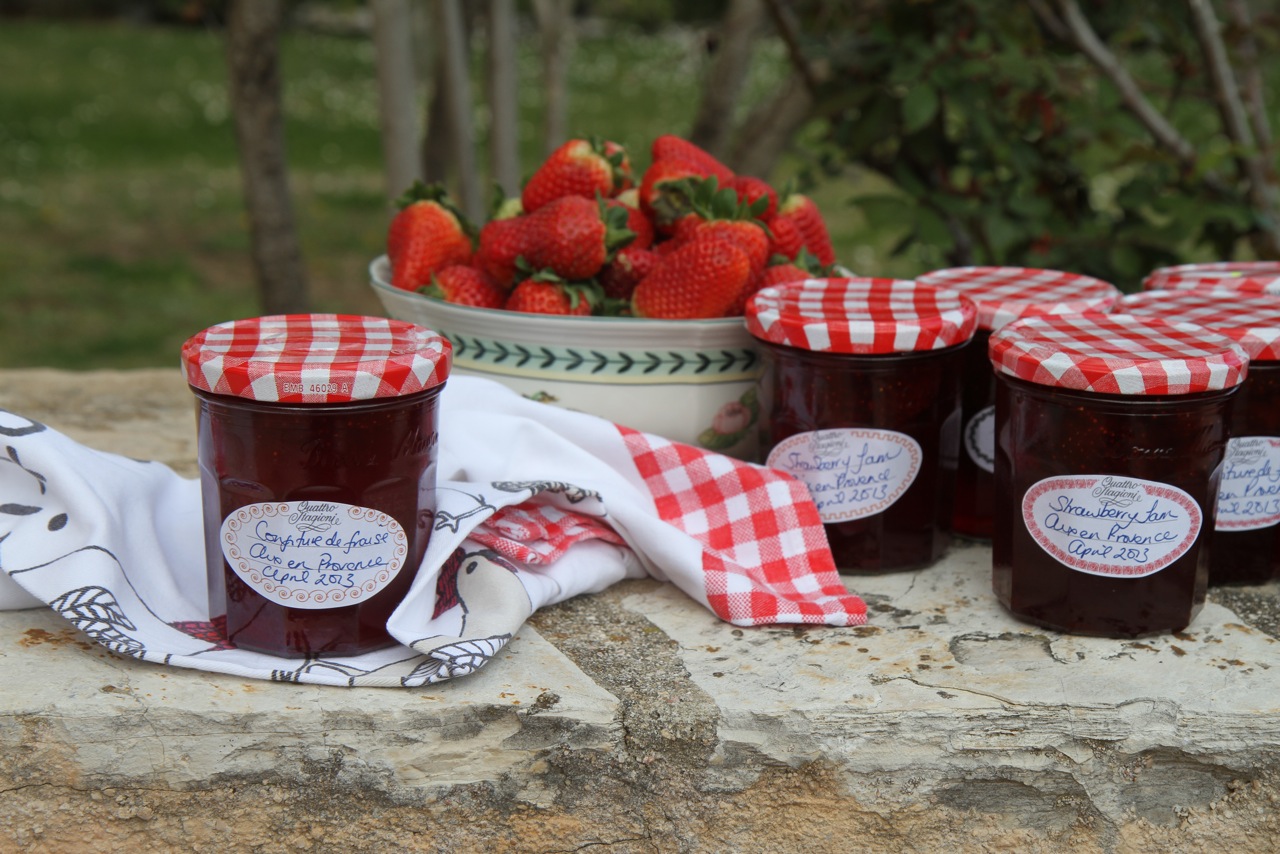
But of course, I have thought of it, and often. After three years of living in France, I realize that I have entered into the kind of seasonal cooking that would make the hearts of certain editors of food magazines sing. Preserving has become a huge part of my life. Whenever I see a tree bursting with fruit, I am mentally pulling my preserving pan out of the pantry. Indeed, no tree is safe. My own cherry tree has been stripped bare of its rich dark cherries, which are now satisfyingly preserved in jars with wide red and white checked lids and little fruit decorated labels. Kitsch? Twee? Call it what you will.

Preserving the past

Seasonal preserving not only makes me feel smugly capable, it also provides a connection with a past where preserving was a necessity and not a lifestyle choice. In France the changing seasons are very clear and marked by the varieties of available produce. This is not always the case in other countries where I have lived. Sometimes seasons are blurred due to imports for those able to pay, while in others there is a shortage of actual seasons.  I have always thought we should be grateful Vivaldi was not born in Malaysia.

Jo's strawberrys and raspberrys

At the market

Here in Aix I buy my fruit and vegetables in a large farm shop. As the year progresses, the produce changes. Strawberries come in around April or May and I watch the prices drop and drop until 4 Euros buys you 2 kilos and you are happy to macerate and preserve to your heart’s content. As the supply of strawberries peaks and peters out, in come the apricots, at jaw-droppingly low prices. In England I would feel guilty to pay that much and make jam, preferring instead to use fewer and to put them where they are visible. So the season goes on with harvests of figs, walnuts, grapes and avocados. Even after years of living overseas, it still amazes me that something as special to a Brit as artichokes or avocados can be displayed in barrels as if they were as common as potatoes in Ireland.

I hope I never lose the delight in this aspect of expat life.

Gorgeous Cheddar, where seasonal quality trumps year-round quantity

I can get quite upset thinking of the English strawberry. The best of the best, produced in the county of my birth, Somerset, in the little village of Cheddar. Poor Cheddar, famous for its wonderful cheese, which has been knocked off and plasticized the world over until most people outside the UK don’t even know what real Cheddar is. On top of this, the reduction of its strawberry industry too. The problem was that for all its well-drained and optimal facing slopes, the season was only weeks long. It couldn’t produce enough fruit to satisfy the appetite of the nation which stamped its foot and demanded more and cheaper strawberries, and a longer season to boot.

The nation should be careful what it wishes for. Fruit varieties have been tampered with and grown under plastic so that we can enjoy strawberries for longer than the two weeks of Wimbledon. Flavor has been compromised — of that there can be no doubt. But you can still buy the real thing in Cheddar, or grow your own, and it’s well worth doing if only to see what this fruit should actually taste like: strawberry, if you are interested, and not water.

Then there are the imports. I am all for world travel, but not for soft fruit on which an indefinite travel ban should be imposed. The waxy Spanish strawberry is not only nearly devoid of the flavor of strawberry, but its texture is decidedly unappealing, being as coarse and waxy as an ageing fruit-pickers cheeks.

How much do I love a good strawberry? A bushel and a peck and some in a gourd.

Having said all that, I am (somewhat surprisingly) delighted to see the vast quantities of Spanish strawberries in my French market. There are two points in my rather shifty defense. Firstly, they are cheap, which justifies their use in jam. Turning a perfectly grown, traditional Cheddar strawberry into jam would be a crime, but boiling the heck out of the Spanish and adding sugar can only act to improve the flavor they lack. Secondly, the presence of the Carpentras strawberry gives a taste of how things should be.

The village of Carpentras, in the Vaucluse region of Southern France, hosts a strawberry festival in April each year. I like to think of this village as Soft Fruit Soul Sister to Cheddar. Yet, unlike Cheddar, Carpentras has been successful, in that typically French way, of protecting its strawberry: as fiercely as Champagne growers have protected their name under a registered trademark since 1987. We have much to learn from them.

Several varieties are grown. 90% of production is given over to the parajo, while its posher cousins, the ciflorette and the garriguette, are favored respectively by patissieres and those who like their fruit as it comes. These elite strawberries have retained their, well, strawberrishness with a deeper, fuller flavor. Price is higher but it is a price that locals and fancy restaurants alike are willing to pay for flavor. My favorite is the garriguette which, at 3.90 Euros this morning for 250g (16 strawberries), is nearly double the price of the regular Carpentras, but so well worth it.

This is the taste of the homegrown strawberries I remember from my youth, complete with that rich, almost caramel-like flavour. Heaven, and worth every centime.

Joanna's jam

Joanna’s jam

Bottling summer sunshine for winter days ahead

So here in France I can enjoy quality in my tarts and quantity for my preserves, and that, I think, is a perfect combination. In England it is less of a clear cut and easy situation. Most of my local Pick Your Own farms have closed in recent years and, outside of two or three beloved greengrocers, everything is plastic punneted mediocrity. Not awful, but not good and definitely not strawberry.

Back in France, as the year progresses, so my level of stress rises. Two batches of strawberry, one of cherry, brined olives rinsed and now bottled in olive oil, and apricot in the making, have placed considerable strain on my supply of jars. Yet I am always thinking greedily ahead. Figs are already on my mind, yet here I am in the throes of moving house. Somehow, the making of that Fig Confit must happen. I can’t miss figs at those sorts of prices. They must be preserved before my pans are packed. Or immediately after arriving at the new place before my boxes are fully unloaded. Will I be able to do it? I feel the panic rising. No amount of telling myself that I don’t actually have to do it this year has any effect. I have to. I must. It’s just the rhythm of the year and I can’t bear to miss the joy of opening a jar at Christmas in the midst of an English winter. Just a little ray of Provence sunshine from my other home on a cold, cold day. A little fig confit to serve with the foie gras adds a French touch to the festive season.

The stress is intensive by that Apricot tree which still preys on my mind. Those wasted golden globes are just asking for my attention. It really would be a crime to let them wither on the tree. Wouldn’t it?

* * *

Joanna was displaced from her native England 17 years ago, and has since attempted to re-place herself and blend into the USA, Holland, Brazil, Malaysia, Venezuela, Saudi Arabia, and now France. She describes herself as a “food gossip”, saying: “I’ve always enjoyed cooking and trying out new recipes. Overseas, I am curious as to what people buy and from where. What is in the baskets of my fellow shoppers? What do they eat when they go home at night?”

Fellow Food Gossips, share your own stories with us!

STAY TUNED for tomorrow’s post!

If you enjoyed this post, we invite you to register for The Displaced Dispatch, a round up of weekly posts from The Displaced Nation, with seasonal recipes, book giveaways and other extras. Register for The Displaced Dispatch by clicking here!

Related posts:

Images: All images from Joanna’s personal photo albums, and used here with her permission

From soccer hater to World Cup fanatic: A most peculiar expat tale

FIFA World Cup Collage

The Brazilian player Edmilson Santos, by AK Bijuraj; CocaCola FIFA World Cup Soccer, by Mike Mozart; FIFA World Cup trophy, by Warrenski (all CC).

To mark the start of the 2014 World Cup in Brazil, I have updated a post I wrote four years ago, in time for 2010 World Cup, in South Africa. I wrote it for the now-defunct Pond Parleys, the brainchild of esteemed writers Toni Hargis (a British expat in the US, with an American husband) and Mike Harling (an American expat in the UK, with an English wife).

In America, of course, we call it soccer. But I am content to say “football.” If there’s one thing I learned from living in England for nearly ten years, it’s to use the English language with precision (in which case, shouldn’t it be “foot-and-head ball”?).

So, herewith, an attempt to tell the rather twisted tale of my conversion to football fandom, though part of me will always wonder: is my story more typical than one imagines? Surely, a taste for football isn’t easily acquired by those who don’t have it in their national DNA?

PART I: Why I Never Liked Football Whilst Living in England

This little tale of mine begins on a dark and stormy night in the latter years of the 20th century. I am living in football-mad England but am rapidly developing an aversion to the sport, squandering my first real opportunity to see it played at a professional level.

Chalk it up to my contrarian nature. I’m not one to throw myself into chanting, banner waving, and other tribal behaviors before I’ve had a chance to study what’s going on and make a full appraisal. And it did not take me long to find things I was less than enamored of, including:

1) The game itself—the endless running up and down the pitch with hardly any scoring. The few times I watched a football match, I inevitably got up to make a cup of tea, or dozed off, just as the one goal of the match was being made.

2) The fans—mostly male, many of them yobbos (some of whom are now chavs?). But even if we leave social class out of the equation, a good number of the UK’s football fans appeared to be hooligans, not exactly the most appealing lot—especially to a grad student like me, whose images of England had been formed from a steady diet of Jane Austen novels and Merchant-Ivory period movies. Occasionally violent male bonding rituals weren’t on the agenda. (I’m sure it didn’t help that my arrival in England coincided with football hooliganism reaching new levels of hysteria.)

3) The jingoistic tabloid coverage—which reaches its height whenever England plays Germany. I happened to be living in London in 2006, when the semifinals of the European finals, between England and Germany, took place at Wembley Stadium. What a palaver! The British mass-circulation paper The Daily Mirror ran a front-page headline “Achtung! Surrender!” over a photo of two England stars wearing World War II helmets. Years later, when England met Germany in the 2010 World Cup, held in South Africa, John F. Burns contributed an article to the New York Times contending that such “rib-poking” has provided catharsis for England and Germany over the years. Who am I to contradict Burns, the Times‘s London bureau chief and an expert on interpreting his native culture? Still, I couldn’t help but think of the late American historian Howard Zinn‘s warning that harmless pride can become an “arrogant nationalism dangerous to others and to ourselves.” Red card!

It’s perhaps worth noting that of all the reasons I came up with not to like football, none of them included the argument that occasionally surfaces in right-wing circles in the United States, which is that football is collectivist and carries the threat of “socializing” Americans’ taste in sports.

As an expat, I had a choice: keep skating along the surface and pretend football doesn’t exist, or else try and go closer to the beating heart of my adopted culture and see what makes it tick.

So I gave football a miss and moved back to pursuing a life of cream teas, theatre performances, cricket…wait did I just say “cricket”? I must be getting batty… (hahaha)

PART II: How I Came to Change My Mind About Football, or At Least the World Cup

Am I looking forward to this year’s World Cup championship games in Brazil? Why soitenly! Numbskull that I am, I’ve finally gotten with the program!!

Herewith, the second part of my most peculiar tale. As explained in Part I, I never paid much attention to the sport despite nearly a decade of exposure; on the contrary, I developed an abhorrence for it.

But four years ago all of that changed. Having settled back in the United States, I found myself powerfully drawn to the championship that took place in South Africa, and I expect it will be no different this time around, with the World Cup being hosted by Brazil. (While I’m sad that Paul the Octopus is no longer with us, I take comfort in the thought of Nelly the Elephant taking his place—her punditry is apparently on a similar level.)

I can’t pinpoint the precise moment when my conversion happened, especially as football still has all the same drawbacks I’d once noted: goals are few and far between, the fans are predominantly male, and jingoism reigns, particularly between the English and the Germans.

All I know is that it wasn’t until I was back in my own culture that I felt comfortable giving the sport a chance. Yes, I know this is ironic considering that the UK is considered to be the cradle of the game (the English have been kicking balls competitively since at least 1314), whereas we Yanks still aren’t quite there.

My top three reasons for fanning football are:

1) It’s the World Cup, stupid. Living in England, I couldn’t see the World Cup forest from the local English football club trees. But when watching the very best players in the world compete, even a hardened skeptic like me can start to appreciate why they call it The Beautiful Game. Those feet of theirs—they are using them like hands! That Messi fellow: it looks as though the ball is glued to his feet; how extraordinary! Xavi Hernández and Andrés Iniesta: it’s incredible how they can pass the ball through the midfields! And let’s not forget Yaya Touré and the way he switches gears. Robin van Persie has a left foot to die for! And so on…

2) It’s a much-needed distraction from other kinds of world events. There’s nothing quite like a soaring soccer ball to lift the spirits, not to mention the vicarious pleasure of seeing a team, and a nation, carry off the trophy. I can still recall the thrill of watching the first European team win outside Europe, at the tournament in South Africa. ‪Viva España!‬

3) It’s on a par with, or perhaps even better than, the Olympics. Ironically, even though there is nothing quite like football to arouse nationalistic urges, the World Cup is, as the name suggests, a world competition, with 32 nations competing. (Compare that to America’s World Series—now that’s a misnomer!) Repeat expats like me, who are a hybrid of nationalities, are the ideal supporters of such sporting events. I think it also helps that I don’t really have a dog in the race. Though America competes, we aren’t yet a serious contender for the cup. This leaves me free to throw my support behind almost any athlete or team that I think are the world’s best. The Olympics of course provide many such opportunities; but that’s the problem: there’s too much choice. What I love about the FIFA World Cup is that it’s a singular occasion. There can be no bigger stage, literally as well as figuratively, than the vast pitch on which this ultimate sporting drama takes

*  *  *

It’s time to hear from you, dear reader. Is my conversion complete, or should I be bending the case for football still more, by stressing its potential for opening up intergalactic communication and fostering truly universal harmony? And even if you don’t share this new-found enthusiasm of mine, can you at least relate to the experience of getting to know and love a sport outside the ones you grew up playing and watching? Do tell!

STAY TUNED for next week’s fab posts!

If you enjoyed this post, we invite you to register for The Displaced Dispatch, a round up of weekly posts from The Displaced Nation, with seasonal recipes, book giveaways and other extras. Register for The Displaced Dispatch by clicking here!

Related posts:

Why did the chicken cross an international border? Because this expat told it to!

sharon lorimer chicken hat

Sharon Lorimer graces the cover of Coop du Monde sporting a chicken hat; photo credit: Kim Khan.

Sharon Lorimer is joining us again today. Last time she and I met, she had on her entrepreneurial hat to tell me about the ingredients she used to start up her company, doshebu. We discussed the company’s mission of helping overseas employees become versed in the “art” of being an expat—her knowledge of which is based, in no small part, on her own experience of being a Scottish expat in New York City and of her husband’s experience as an American ATCK (he has lived in London and Singapore).

This time around, however, Sharon is sporting a chicken hat. Why is that, you may wonder? For the simple reason that she has her eggs in more than one basket. She may be a businesswoman but she also loves cooking. She self-published a photo cookbook named Coop Du Monde at the end of last year, which offers suggestions for jazzing up your basic roast chicken recipe ranging from Pilgrim’s Fowl to Nippon Coop to Mi Amore Coop.

And just now she put out The Seasoner’s Handbook, a companion to her very first cookbook, From the Global Scottish Kitchen, in which she reinvented dishes from her native Scotland by adding flavors picked up from her “gastronomic journey.”

Cock a’ Leekie Udon, anyone?

Sharon’s culinary creativity will be our topic today. She tells me that she has always enjoyed experimenting with food, but by now it should be clear that flying the Scottish coop has pushed her in some new directions.

* * *

CoopduMonde_cover_dropshadowHi, Sharon. Welcome back to the Displaced Nation! Tell me, why did you decide to write a book about roast chicken?
I think it grew out of my fondness for the Sunday Roast ritual in the UK. Even when I was growing up in Scotland, I always preferred to spice it up. But since coming to the United States and leading a more international life, I’ve taken these experiments up a level.

But why chicken? When I lived in Britain, I remember having a lot of lamb and beef.
Well, chicken is probably the most popular for the home cook and besides, it’s eaten all over the world.

I’ve had a look at your book and I’m impressed that it offers a step-by-step guide to roasting a chicken and then suggesting a number of variations.
In fact, the point of the book is not so much to give people recipes as to help them be creative when they cook. I explain the process of blending spices and herbs together and choosing vegetables so that you can invent your own Coop du Monde.
TheSeasoner'sHandbook_cover_dropshadow

Which came first, spices or travels?

You seem to be obsessed with spices. In your newest book, The Seasoner’s Handbook, you explain how to use chili peppers, pomegranate seeds, saffron, mole, truffles…
These are some of the flavors I’ve picked up on my gastronomic journey. Take the pomegranate seed, for instance. I first had a dish seasoned with this fruit in London. As I explain in the book, I hadn’t tasted it before but it made the meal so enjoyable that I thought about how I could use it in other dishes. It has a mellow flavor that combines well with stronger and more subtle flavors.

Your Scottish cookbook, to which this book is a companion, reinterprets your native cuisine in light of what you have learned about the cuisines of the US, Mexico, France, Japan and Greece. In a post discussing the book on your blog, you say:

If I had created a cookbook that represented my travels, the contents would be traditional dishes made authentically. Thinking globally about taste lets you use different aspects of cuisines to develop new ideas.

It sounds as though you’re making a case for fusion cuisine, but is that right?
Cuisines are identified by nationality, and fusion means blending two national cuisines. I want people to understand that it’s less about replicating other people’s cuisines, or competing to be the best at a style of cuisine, and more about exploring what you like. Lots of us expats want to find ways of expressing all the influences we’ve picked up on our travels. What better way to blend them than in cooking?

“Ain’t nobody here but us chickens” – Louis Jordan

How big a role does cooking play in your everyday life?
My husband and I make very simple food during the week. He is a good cook, too, and we take turns cooking for each other. One thing that makes it on to the table every month is Anthony Bourdain’s recipe for whole roasted fish Tuscan style, which essentially means baking it in salt. Bourdain just talks about it in his book Kitchen Confidential. We tried replicating it from the description. It’s really easy. You just stuff herbs, garlic and lemon it to the belly of the fish. Pour olive oil on the fish and encrust in lots of Kosher salt and bake for 45-60 minutes at 375°F.

Mmmm…sounds good. Fish has been one of my staples ever since I lived in Japan.
Well, don’t overlook the beauty of chicken. My new favorite easy meal is a Cook Yourself Thin recipe for butterflied chicken breast marinated in olive oil, rosemary and lemon juice. It only takes 30 minutes to marinate and 10 minutes on the grill. Delicious.

Struttin’ her stuff on Blurb

Moving back to the two books: Why did you choose to publish them on Blurb?
Blurb makes self-publishing easy, and it’s ideal for coffee-table-style books that feature photography.

Yes, I know you’re a keen photographer, but was there a learning curve for taking photos of food?
I’m a professional photographer, but there’s a learning curve with any new project. The most important thing to remember when you start to make books is that printers need higher-resolution shots than websites. You have to print a hard copy with Blurb, even if you don’t want to sell it. Make the shots good enough so that you can display it in your home or give it to family and friends. The other thing I had to learn is that I have to shoot with the book in mind. I had some old chicken shots I wanted to use for the Coop du Monde, but the resolution was wrong and they looked out of place. In the end we had to work from the concept to create a cohesive book. In fact, my husband shot the front and back covers.

I see you’re getting into video more and more these days, and that Coop du Monde includes a teaching video.
I always find it easier to replicate a recipe if I have watched someone else do it first, don’t you? Yes, the video is embedded in the ebook.

What’s the biggest challenge in putting together a cookbook?
My biggest challenge is writing down recipes. I cooked for years without documenting any of it and even today, I still forget to write down what I’ve done. I have an app but it hasn’t really helped me solve the problem. I never cook to a recipe and I don’t really want to. It spoils the experience for me.

What audience do you have in mind for your photo cookbooks, and are they reaching those people?
The most popular post ever on the Art of the Expat blog is “Indian Meat and Potatoes” (it centers on a keema recipe that’s from From the Global Scottish Kitchen, which, believe it or not given that keema is Indian, includes pomegranates!). Food tends to be more accessible than other topics. People are always looking for ways to incorporate and understand other nations’ cuisines, especially ones they usually can’t have unless they eat out. I thought the Brits would like Coop du Monde because of their love of roast chicken, but most visitors to my blog are Americans. More recently, we’ve had a lot of Swedish visitors…but presumably they are also fans of chicken.

What’s next—more cookbooks? Other creative projects?
My husband and I are planning lots more live broadcasts at doshebu.tv focusing on news events and expat topics. On the creative side, I’ve started to write another screenplay. I think this will give me the outlet for creativity that I need when I get depressed about troubleshooting code!

* * *

Thank you, Sharon! Readers, don’t be too chicken to leave questions or comments for Sharon. Or perhaps you’d like to suggest a roast chicken recipe that you’ve enhanced with spices or other exotic ingredients? Just think, if Sharon were to include it in her next Blurb book, what a coup it would be…

STAY TUNED for next week’s fab posts!

If you enjoyed this post, we invite you to register for The Displaced Dispatch, a round up of weekly posts from The Displaced Nation, with seasonal recipes, book giveaways and other extras. Register for The Displaced Dispatch by clicking here!

Related posts:

And the April 2014 Alices go to … these 4 international creatives

 © Iamezan | Dreamstime.com Used under license

© Iamezan | Dreamstime.com
Used under license

If you are a subscriber to our weekly newsletter, Displaced Dispatch, you’re already in the know. But if you’re not, listen up. (Hey, why aren’t you? Off with your head!)

Every week, when that esteemed publication comes out, we present contenders for a monthly “Alice Award,” most of whom are writers or other kinds of international creatives who appear to have a special handle on the curious and unreal aspects of being a global resident or voyager.

Not only that, but this person tries to use this state of befuddlement as a spur to greater creative heights.

Today’s post honors April’s four Alice recipients. They are (drumroll…):

1) TONI HARGIS, author, blogger, and British expat in Chicago

For her post:  “Learn to Take a Compliment, Brits in America” in Mind the Gap, a resource blog for British expats in America on BBCAmerica.com
Posted on: 18 April 2014
Snippet:

Many British teachers admitted that they and their students found it very hard to fill in applications for American colleges because they were asked for “accomplishments and strengths” as well as academic achievements. As one contributor put it, U.K. teachers “are not very good at waxing lyrical about [their] students other than in academic terms.”

Citation: Toni, what an absolutely marvelous post! Only don’t you think you should have promoted your credentials a little more? After all, you’ve written a book called The Stress-Free Guide to Studying in the States, the contents of which we expect could be useful to Bashful Brits. Actually, you do refer to the book in passing—but don’t provide the title or a link. Hey, never miss an opportunity to blow your own trumpet! But listen, as you insist upon being so self-effacing, we feel justified in presenting you with this inspirational passage from Through the Looking Glass, where a banquet is being held in honor of the diffident Queen Alice, who can’t quite believe she’s been made a queen:

[Alice] didn’t see why the Red Queen should be the only one to give orders; so, as an experiment, she called out “Waiter! Bring back the pudding!” and there it was again in a moment, like a conjuring trick. It was so large that she couldn’t help feeling a little shy with it…; however, she conquered her shyness by a great effort, and cut a slice and handed it to the Red Queen.

“What impertinence!” said the Pudding. “I wonder how you’d like it, if I were to cut a slice out of you, you creature!”

It spoke in a thick, suety sort of voice, and Alice hadn’t a word to say in reply: she could only sit and look at it and gasp.

“Make a remark,” said the Red Queen: “it’s ridiculous to leave all the conversation to the pudding!”

One last word of advice, if we may: Should you feel at all embarrassed about accepting an Alice, rest assured, a simple “thanks” will do. No need to curtsey… Notably, this last accords with what the point you make at the end of your excellent (as well as thought-provoking!) post:

…when someone praises you, your spouse, your children, your dog or your house, a simple “Thank you” will both suffice and move the conversation swiftly along without too much excruciation on your part.

Again, as the Red Queen puts it to Alice: “You ought to return thanks in a neat speech.”

2) Anthony The Travel Tart, Australian travel addict and blogger

For his post: “You Know That You’ve Been Living in Japan Too Long When…,” on The Travel Tart
Posted on: 18 March 2014
Snippet:

You know that you’ve been living in Japan too long when…

  • A room the size of a cubic metre feels rather large.
  • Capsule hotels feel quite spacious.
  • Wide open spaces freak you out.

Citation: Anthony, we assume you met quite a few expats during your time in Japan. Because your inference that the longer a foreigner stays in Japan the stranger he or she becomes is spot on (and one of us speaks from a too-long experience of having lived in that small-island nation). Picture for a moment what happens to Alice after she enters the White Rabbit’s house and downs the contents of the “Drink Me” bottle:

She went on growing, and growing, and very soon had to kneel down on the floor: in another minute there was not even room for this, and she tried the effect of lying down with one elbow against the door, and the other arm curled round her head. Still she went on growing, and, as a last resource, she put one arm out of the window, and one foot up the chimney.

This is actually a case where one might prefer to be Alice rather than an expat. She at least has the ability to drink potions or eat pieces of mushroom to change her body size. But many gaijin remain permanently stuck in the White Rabbit’s house (not for nothing has Japan achieved notoriety as the “rabbit-hutch nation”). Downing the contents of a bottle of Suntory whisky or taking a bite of a matsutake (pine mushroom, prized for its spicy aroma) won’t make the blindest bit of difference. Oh, and incidentally, it’s arigato, not origato, but that’s okay as it means you didn’t stay too long—though you may want to add “correcting other foreigners’ Japanese” to the list.

3) MATT HERSHBERGER, writer and blogger at A Man Without a Country, and 4) British dialect coach ANDREW JACK

For the post: “A quick video guide to the accents of the British Isles”, by Matt Hershberger on Matador Network, which features Andrew Jack’s brilliant video (produced by Philip Barker).
Posted on: 20 April 2014
Snippet: Matt, who once lived in England, says:

As an American, I can’t even replicate the accents properly, so if I tried to ask for help distinguishing an accent from a British friend later, the best I could hope would be that I’d sound sort of like Stewie Griffin, and nothing like the accent I’d heard.

Citation: Matt, we take your point that when venturing abroad to a country where they speak the same language, it is most disconcerting when you can’t understand what people are saying because of their heavy accents—a true “through the looking glass” moment. (We fear that Brits may have some of the same troubles in the U.S., but let’s face it, you’d expect that in a country of this size, not of one as tiny as Britain.) We appreciate that you highlighted the video of Andrew providing 14 regional accents from the British Isles in 84 seconds: how awesome is that? As one of the YouTube commenters says, “good for ignorant North Americans”—some of whom, me might add, may plan to be (or have already been) expats in the UK. And we appreciate it even more when recalling that Poor Alice had no interpreter for the White Queen’s methods of communication:

“My finger’s bleeding! Oh, oh, oh, oh!”

Her screams were so exactly like the whistle of a steam-engine, that Alice had to hold both her hands over her ears.

“Oh, much better!” cried the Queen, her voice rising to a squeak as she went on. “Much be-etter! Be-etter! Be-e-e-etter! Be-e-ehh!”

The last word ended in a long bleat, so like a sheep that Alice quite started.

*  *  *

So, readers, do you have a favorite from the above, or have you read any recent posts you think deserve an Alice Award? We’d love to hear your suggestions! And don’t miss out on the shortlist of Alice contenders we provide in each week’s Dispatch, which are sources of creative thought if nothing else! Get on our subscription list now!

STAY TUNED for more fab posts.

Writers and other international creatives: If you want to know in advance the contenders for our monthly Alice Award winners, sign up to receive The Displaced Dispatch, a round up of weekly posts from The Displaced Nation, with news of book giveaways, future posts, and of course, our weekly Alice Award!. Register for The Displaced Dispatch by clicking here!

Related posts:

GLOBAL FOOD GOSSIP: Home is where the hearty food is

global food gossipJoanna Masters-Maggs, our resident repeat-expat Food Gossip and Creative Chef, is back with her column for like-minded food lovers.

This month: Joanna despairs over the modern inability to enjoy the simple foods in expat life.

UPDATE: Due to popular request after this post first went live, Joanna has included her recipe for the Beef and Guinness Pie she made for her St. Patrick’s Day party. Read on!

* * *

“It’s a bit samey,” said The Husband as he cast his eye over this latest piece. “Just you telling everyone how we ex-pats are up our own arses over food.”

Fair point — but I can’t help grinding the same old axe.  I think that there is a lot of up-arseness the world over when it comes to food.  Am I alone in being so irritated by people who call themselves “foodies” as though there is some sort of originality in their love of eating?

The truth is everyone loves good food, but not everyone is lucky enough to get it that often. Have you ever met someone who smugly tells you that they have expensive tastes, as though no one else has ever wanted an Aston Martin or a Chanel suit? The very reason these things are desirable is because they are expensive and out of the reach of most. “Foodyism” isn’t much different. “Foodies” are just a bunch of people trying hard to be special, but they’re no different from anyone else.

The sad result is that we have lost the confidence to love regular everyday food that speaks, truly speaks, of the place where we find ourselves.

Drizzle with pomegranate coulis. Post photo to Facebook. Serve immediately.

It’s the same the world over. No one cooks simple food for one another anymore. If we cook, it has to be restaurant worthy, or at least it has to look it. Those who can’t cook that way get hopelessly behind and become the kind of people who never invite back for a reciprocal dinner at their place.

The more cookery programmes there are on our screens, the less we cook. These shows present cooking in a way that sets us up for failure. Recipes and presentation are so dauntingly complicated that often we don’t bother at all. When we do successfully follow a complicated recipe, we are so proud of ourselves that we post photos of it on Facebook (along with other irritating posts charting our kids’ successful routes to medical school.)  We know it annoys others but we just can’t help it. “Look at me! look at me!”

The expat is particularly prone to Food Narcissism. It’s just too easy and too tempting to show off unusual items we have seen in far-flung places. Or the exotic meals eaten in little places we have found in some unfashionable part of town. No one back home is going to know that the food stall we just happened upon has been featured in KL Expat Today, or Foreign Workers in Caracas, or some such publication.

Gosh, I even irritate myself and it takes an intolerable level of smugness to be able to annoy yourself.

Comfort food shouldn’t be a source of discomfort

A few weeks ago I decided to get in touch with my Irish side and host a St Patrick’s day party. I agonized for a long time over what to serve. Many of my guests surprised me by not knowing what St Patrick’s Day celebrations entail. There was even a soupçon of concern over where to find green cocktail frocks, which only served to intensify my preoccupation with the menu. Although I reassured my guests that they were to wear anything green that they could find at home and were absolutely not to go out and buy a fancy frock, I realized I too was complicating what should be a fun and easy supper. It was horrible to realize that I was afraid to serve Irish food in case it was too simple and that my cooking might be seen as a bit dull, basic even. There I was, actually trying to tart up the Irish recipes to a degree where they would be indistinguishable from French ones. Little piles of salmon on delicate rounds of soda and individual servings of boxty (a sort of Irish rosti) piled up and garnished with drizzles of sauce.

It was in dealing with the matter of the emerald-green silk dress hunt that I realized where my own lack of confidence in real food was landing me. How ridiculous. Instead of serving simple and comfortable food, I was trying to turn it into something fancy.

The question hung in my mind in Green, Orange and White letters: “Why?”

Why indeed?

Giving myself a metaphorical slap around the chops, I got a grip, squared my shoulders, and returned to basics. I would serve the food I grew up with. Irish Stew, Soda bread with salmon, and Beef and Guinness pie.

Oh all right, not the pie. My mother wasn’t keen on making pastry at all, citing hot hands as her excuse, but actually we all knew she would rather settle down to a glass of Guinness and watch a simple stew take shape than hand-make pastry. But the rest, you get my meaning. The memories flooded back. The stew in a big, cream enamel pan on the hob, the warm soft “stocklike” aroma of cooking lamb on its bone with plain old carrots and potato punched up with plenty of pepper, white pepper, and of course the resulting condensation on the kitchen windows.

Culinary childhood in a bowl.

When in Rio, shop and cook as the Cariocas do

We expats often live behind a two-way glass where we do not socialize with the people around us. Barriers — language, cultural, time, work —  impede us. Yet the rare glimpses into the everyday life of the places where we live create the most special and evocative moments. Food produces some of the strongest memories. Memories of great restaurants are one thing, but home cooking is another thing altogether, being a part of the fabric of everyday life.

I was lucky enough to have a maid when I lived in Brazil. At the time I thought I was lucky to have someone to help with the housework and kids, but in retrospect, I realize that she represented so much more than that. She made a Maria-shaped hole in the glass I lived behind, bringing some of the everyday world of a Carioca (someone born in Rio) into my kitchen. Every Monday, Maria would arrive ready to cook up a few days’ supply of black beans. These shiny black nuggets were blasted soft in a pressure cooker, then cooked with onions, a large pile of garlic and a few bay leaves then cooked long and slowly into rich and satisfying stew.

The secret to getting a great flavor into these beans is the addition of salted pork extremities to the mix. Ears, trotters, tails, you name it, are all used. As they break down in the cooking they have a thickening effect too. I had seen great piles of waxy, white and vaguely familiar items in the meat sections of supermarkets, but had given them a wide berth. Under Maria’s tutelage, I got over my silliness and grew to appreciate their value as they became an intrinsic part of my shopping list.

The best times were when couve was available. Couve, or collard greens, deep green palm-like leaves, which she would roll up and finely slice and stir fry with garlic and seasoning and nothing else. A pharmacist once told me that folic acid isn’t really needed for expectant mums in Brazil. The combination of the beans with the couve produces a cocktail of minerals easily absorbable by the body and priceless in reducing the risk of spin bifida. Is there anything not to love in Brazil’s national dish?

The black bean memory doesn’t include a fancy restaurant to boast of. No little food stall tucked away in the back of a very “local” area of town. Here was just a woman producing basic home food with the intention of filling an empty belly until the next day. These memories are more evocative of life in Rio to me know than my endless photos of Christ the Redeemer or Sugar Loaf Mountain. Maria made my experience of the place.

Cooking is for life, not just for Instagram

So, despite all my talk, I haven’t been able to circumvent the curse of expat “showing offness”. For what I seem to be saying is that anyone can book a couple of weeks in Rio and see the sights on a safe and comfortable air-conditioned bus tour, but to have really experienced the place you need memories akin to the memories of childhood. Maybe; or perhaps the truth is a little kinder? Simple home cooking is an everyday experience. There is no need to photograph it or put it on Facebook because it happens all the time. It’s as common as teeth-cleaning or walking the kids to school. Because of that, we experience it directly and fully, since we are not watching from behind the tiny lens of a camera, video, or smartphone. Instead, it is the comfortable and expansive background of life which seeps into us, unnoticed, to become a collection of memories; memories that can be triggered by a kitchen aroma, or by the way a woman holds a knife to crush a bulb of garlic.

After all, if a plate of madeleines inspired seven volumes of Remembrance of Things Past, perhaps I can be forgiven for the sameness of my own little bits of writing.

Epilogue

“So,” I expect you are asking, “how did the Irish food go down?”

Well — since you ask — rather well, actually. All eaten and, I hope, enjoyed, particularly the beef and Guinness pie. It a good thing that hot-hands skipped a generation. So I raise my glass of black velvet (Guinness and Champagne – a disaster for both drinks, but much fun) to simple home cooking. Slap a pan of stew on your tables, and put out a couple of bumper size pies and let everyone dig in.

I, for one, will be repeating the experience.

* * *

Beef and Guinness Pie My Way

(“My Way” includes metric measures — if you prefer to measure in cups or ounces, this conversion website will be useful.)

First make a beef and Guinness stew. This needs to be done a day in advance.

  • 1kg grams stewing beef
  • 30 grams flour
  • 2 tbsp oil
  • 2 large chopped onion
  • 2 large chopped carrot
  • 500 ml of Guinness
  • 300 ml of stock – a good homemade beef stock will pay you dividends
  • but water will do if needs must.
  • Handful of stoned prunes, chopped finely (finely) these will add depth of flavor but, ideally, not change the texture of the stew.
  • 2 bay leaves
  • Salt and pepper
  1. Cut meat into 2.5cm cubes and roll in seasoned flour.
  2. Heat oil and quickly sear the meat in batches putting the sealed meat on a plate to one side.
  3. Heat a little more oil and add onion to pan. Cook slowly and gently until the onions almost caramelize
  4. Return the meat to the pan and add any left over flour with the carrots, Guinness, stock and bay leaves.
  5. Bring the whole to a boil then cover and simmer for two hours. Traditionally this would have been cooked on the hob, but I think it is easier to pop the stew into a casserole with the lid firmly in place and cook at 140°C or 275°F for at two hours. At this point add the prunes, stir well, recover and cook for a further half hour or until the stew is thick.
  6. When the stew is ready, remove from the oven and wait until it is cool enough to place in the refrigerator overnight.

The Pastry

I used to make a puff pastry for this pie, but I recently tried a Nigella Lawson recipe for pastry, which she gives for her chicken pot pie. It is a firm textured, but buttery pastry, which is ideal for a robust beef pie.

  • 375 grams of plain flour (all-purpose)
  • 226 grams of cold butter
  • 3 eggs (one will be used for gluing and glazing purposes only)

(This mixture will make two medium size pies or one large one. I like to make a double quantity and freeze for another time.)

  1. Put the flour and cubed butter into a metal tray and shake to evenly distribute it over the metal surface. Place in the freezer to chill for 10 minutes (Nigella exhorts us not to skip this stage since this is the step that makes the pastry so easy to handle and so delicate. She’s so right!
  2. While the pastry is chilling, beat two of the eggs with two tablespoons of cold water and place in the fridge.
  3. Next, place the flour and butter into a processor and pulse until you have a fine mixture. Do this quickly, don’t be tempted to overwork the mixture as the texture will suffer. Add the eggs while the processor works until the mixture starts forming a ball, then stop.
  4. Now you can divide the dough into two, press flat, cover with cling film and chill.

This mixture will make two medium size pies or one large one. I like to make a double quantity and freeze for another time.

Putting it Together

This is the part I like most, putting my homespun stew between two sheets of the Divine Ms Lawson’s pastry. I have yet to become bored by the idea.

  1. So, roll out the pastry to line whichever tins you wish to use. Please do use metal dishes, as you will neatly side-step the problem of a soggy bottom.
  2. Fill with the cold stew.
  3. Use the remaining egg to seal together the bottom and top of the pie and to brush the top.
  4. Place on a metal tray in an oven pre-heated to 200°C (400°F) for 20 minutes. You can protect your pie from burning, until the last minute, with foil, or you can pop it in naked and white-knuckle it.

I really hope you enjoy it!

* * *

Joanna was displaced from her native England 16 years ago, and has since attempted to re-place herself and blend into the USA, Holland, Brazil, Malaysia, Venezuela, Saudi Arabia, and now France. She describes herself as a “food gossip”, saying: “I’ve always enjoyed cooking and trying out new recipes. Overseas, I am curious as to what people buy and from where. What is in the baskets of my fellow shoppers? What do they eat when they go home at night?”

Fellow Food Gossips, share your own stories with us!

STAY TUNED for tomorrow’s post!

If you enjoyed this post, we invite you to register for The Displaced Dispatch, a round up of weekly posts from The Displaced Nation, with seasonal recipes, book giveaways and other extras. Register for The Displaced Dispatch by clicking here!

Related posts:

Images: All images from Joanna’s personal photo albums, and used here with her permission

And the March 2014 Alices go to … these 3 international creatives

 © Iamezan | Dreamstime.com Used under license

© Iamezan | Dreamstime.com
Used under license

If you are a subscriber to our weekly newsletter, Displaced Dispatch, you’re already in the know. But if you’re not (and why aren’t you? off with your head!), listen up.

Every week, when that esteemed publication comes out, we present contenders for a monthly “Alice Award,” most of whom are writers or other kinds of international creatives who appear to have a special handle on the curious and unreal aspects of being a global resident or voyager.

Not only that, but this person tries to use this state of befuddlement as a spur to greater creative heights.

Today’s post honors March’s three Alice recipients. Starting with the most recent, they are (drumroll…):

1) CANDACE ROSE RARDON, travel writer and sketch artist

For her interview:  “Watercolouring Her Way Around the World,” on Linda Fairbairn‘s Journey Jottings blog
Posted on: 14 March 2014
Snippet:

“In a way, my sketchbook also helps create the moments I record in it. I might head to a café to draw a street-scape, start talking with the man next to me, and then jot down a line or two from our dialogue on the sketch itself. Sketching has become both my muse and medium on the road—it creates the very stories I love to tell, stories of connection and serendipity, and I now can’t imagine ever travelling without my sketchbook.”

Citation: Candace, we think we should invent a new award for you: a “Poppins.” Your watercolors look so inviting that we want to jump right into them and share in your adventures, just as Mary Poppins jumps into Burt’s chalk drawings. (Incidentally, we refer to the animated sequence in the movie, of which P.L. Travers did not approve, only to be overruled by Walt Disney.) Poor Alice doesn’t go down the rabbit hole because of its visual stimulation; quite the opposite! She goes down the hole due to boredom with her sister’s book “without pictures or conversations.” Our sense is that, were you to receive an “Alice,” it would need to be presented by the Mock Turtle, art lessons having played a role in his superior education:

“Well, there was Mystery,” the Mock Turtle replied, counting off the subjects on his flappers, “—Mystery, ancient and modern, with Seaography: then Drawling—the Drawling-master was an old conger-eel, that used to come once a week: HE taught us Drawling, Stretching, and Fainting in Coils.”

Though he doesn’t mention “water” art, it seems likely he would sanction it. Definitely he would not be a fan of our alternative suggestion unless we agreed to call the prize a “Puffins” instead of a Poppins. But enough of these qualifications; suffice it to say, we are in awe of your ambition to “watercolour” your way around the world. You paint, girl!

2)”The Expat” in Korea

For his post: “The Reincarnation Lottery,” on ExpatHell.com
Posted on: 18 March 2014
Snippet:

We may be dogs, but we are dogs with memories. Memories of where we came from. Memories of hot summer days, clear blue skies, people smiling, people laughing, wind slicing through large trees with leaves whisking and shimmering in the sun like waves washing over a million shiny round stones. We are four dogs with memories of home, and somehow, we are all going back. This is what we wail about during the pitch black nights and all we dream about during the hazy grey days.

Citation: The Expat, we have been around the world a few times so are well aware of South Korea’s proclivity for dog meat consumption. This may be why we find your description of yourself and your three mates as a pack of four large wailing dogs on a dog farm “in the lonely cold mountains and valleys of the Korean countryside” alarming. But no more alarming, we suppose, than Alice’s own sense of transformation as she progresses through Wonderland:

Alice took up the fan and gloves, and, as the hall was very hot, she kept fanning herself all the time she went on talking: “Dear, dear! How queer everything is to-day! And yesterday things went on just as usual. I wonder if I’ve been changed in the night? Let me think: was I the same when I got up this morning? I almost think I can remember feeling a little different. But if I’m not the same, the next question is, Who in the world am I? Ah, THAT’S the great puzzle!” 

A good thing she doesn’t prolong her stay in Wonderland, that’s all we can say. Can she be far off from imagining herself as a caged rabbit that is about to be thrown into the cauldron of pepper soup being stirred by the Duchess’s cook? In any case, we really appreciate your honesty in telling the story, in such a creative way, of four American men arriving in Korea in hopes of a fresh start as English teachers, only to end up “starting over and starting lower.” We can certainly see why you aspire to returning to our “dog eat dog” society here in the West. Only please promise that between now and then, you won’t land in a bowl of Korean soup, which, needless to say, will be a great deal more firey than the Duchess’s.

3) ALEX BAACKES (aka Alex in Wanderland), freelance writer and New York native on the move

For her post: “My Top 8 Animal Encounters Around the World,” on Michael Hodson‘s Go, See, Write blog
Posted on: 20 February 2014
Snippet:

Today, I seek out encounters with animals that are willing participants in sharing their space with me; one where everyone walks—or swims—away happy. . . . While I’m still not quite sure how sailors once mistook manatees for mermaids, I can now attest to the fact that these bulbous creatures move with a surprising amount of grace. Braving the chilly winter waters? Worth every shiver to share a swim with these beauties.

Citation: Alex, we are struck by how quickly you have come to the realization that, while it can be fine, even fun, to encounter other human beings on your travels, you should not miss out on the opportunity to interact with new kinds of mammals—relationships with whom could end up being much more therapeutic, especially if they’re the kind you can swim with. Alice, of course, had no qualms about swimming with the Wonderland creatures:

It was high time to go, for the pool was getting quite crowded with the birds and animals that had fallen into it: there were a Duck and a Dodo, a Lory and an Eaglet, and several other curious creatures. Alice led the way, and the whole party swam to the shore.

But in Alice’s case, she was swimming in a pool made of her own tears. We congratulate you on being much more sensible in heading Crystal River, near Orlando, which plays host to the migrating manatees from October to March.

*  *  *

So, readers, do you have a favorite from the above, or have you read any recent posts you think deserve an Alice Award?  We’d love to hear your suggestions! And don’t miss out on the shortlist of Alice contenders we provide in each week’s Dispatch, which are sources of creative thought if nothing else! Get on our subscription list now!

STAY TUNED for next week’s fab posts.

Writers and other international creatives: If you want to know in advance the contenders for our monthly Alice Award winners, sign up to receive The Displaced Dispatch, a round up of weekly posts from The Displaced Nation, with news of book giveaways, future posts, and of course, our weekly Alice Award!. Register for The Displaced Dispatch by clicking here!

Related posts: