The Displaced Nation

A home for international creatives

12 NOMADS OF CHRISTMAS: Brian Peter, Scottish expat in Brazil (3/12)

Current home: Rio das Ostras, RJ, Brazil
Past overseas location: Houston, Texas, USA
Cyberspace coordinates: A Kilt and a Camera | Travel tales, reviews, photos, interviews and crazy goings on. Because you never know what’s going to happen (blog) and @KiltandaCamera (Twitter handle)
Most recent post: Brazil — “Getting to know Aldeia Velha,” by Peg Peter [Brian’s American photographer wife] (December 19, 2011)

Where are you spending the holidays this year?
In Houston.

What will you do when you first arrive?
Peg will arrive three weeks before I do, so the first thing I want to do is hug my wife. After that I’ll put my feet up and relax after the long flight from Rio for a few hours. That night we will spend the evening with good friends we haven’t seen in way too long.

What do you most like doing during the holidays?
Relax. We are living in Brazil while I’m working as a manufacturing and production manager in the oil and gas field. The growth in the industry has been enormous. I’ve been working long hours, and long weeks, for too many months. I’m going to turn off my phone, keep my laptop shut and switch my mind off.

So you’ll be offline?
Pegs is the Internet junkie of the team so I trust she’ll let me know if anything important happens out in cyberworld.

Are you sending any cards?
Peg will send a few Christmas cards for us. As for a Christmas letter, we do too many things and go to too many places each year to write something brief. Our family and friends who want to know more about what we’re doing can take a look at our Web site.

What’s the thing you most look forward to eating?
A bloody decent whiskey, and a tin of haggis. If I can find a good smoked mackerel, I’ll eat that too. I really wish I could get my hands on an Orkney black pudding.

Can you recommend any good books other expats or “internationals” might enjoy?
Because of work I haven’t had time to read a single book all year, unless you count industrial engineering books as a good read. But Peg always has her nose in a book. Right now she says she’s really enjoying Barbara Kingsolver’s The Poisonwood Bible. The sense of stepping into another world is something any traveler or expat can relate to.

If you could travel anywhere for New Year’s Eve, where would it be?
I’d love to do an Old Year’s Night in Comrie, a small village in the Scottish highlands. As I remember, its Hogmanay ritual starts in the evening with the kids in a fancy-dress parade riding on the back of a lorrie — a kind of float. That goes on until nearly midnight, when the whole community gathers at the bridge on the side of town near Oban and throws three flambeaux (flaming torches) over it into the River Earn. Then there’s a procession through the village with a pipe band leading the way — the villagers in the middle, the float bringing up the rear. When they reach the bridge at the other end of town, they throw the remaining flambeaux into the river. The whole thing is a ritual to protect the village from evil spirits for the year. Back in the center of town the party, including a céilidh, will go on for hours.

My sister has lived there for the past twenty years. Someday I’ll take Peg back there to show her how my family of Scots does an old fashioned Old Year’s Night properly.

What’s been your most displaced celebration of the holidays?
My first Christmas in Houston. I spent the day in shorts, roasting by the pool. It just doesn’t feel like Christmas without freezing your b*******s off.

How about the least displaced — when you’ve felt the true joy of the season?
Even though we live in Brazil, we always go back to Houston to spend the holidays with Peg’s kids. I’ve enjoyed the last few holidays with them, among new family, but I still don’t feel at home as much as I did back in Scotland– especially since I’m so far away from my own adult sons.

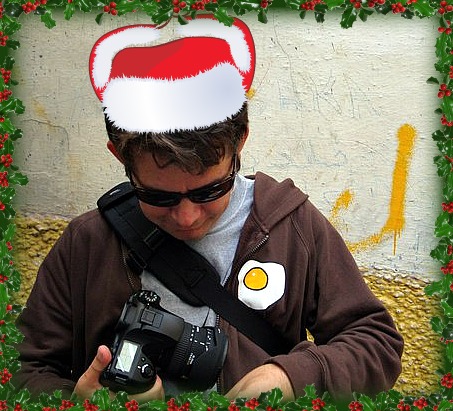
However, last year was a bit more exciting because Peg and I had a big secret plan between us. On Boxing Day we hopped on a plane and flew to the Caribbean. One long haul, three airports, three islands and one ferry later we arrived on St. John in the US Virgin Islands, where we eloped on the beach on December 28th. The photo above was taken of us on the ferry ride over to the courthouse in Charlotte Amalie to pick up our marriage license the day before. This year, of course, we’ll have our first anniversary!

How do you feel when the holidays are over?
It’s a bit anti-climactic. I start the new year with a long flight back to Brazil, which is a country we love living in, but it means back to work for a while. When my job is done there, we’ll have more time to travel when we please. In the meantime, we’ll enjoy as much of Brazil as we can. We both love to travel and look forward to the day when we can just keep going.

On the first day of Christmas, my true love said to me:
THREE DECENT WHISKIES,
TWO CANDY BOXES,
& AN IRISHMAN IN A PALM TREE!

STAY TUNED for tomorrow’s featured nomad (4/12) in our 12 Nomads of Christmas series.

If you enjoyed this post, we invite you to register for The Displaced Dispatch, a round up of weekly posts from The Displaced Nation, with seasonal recipes, book giveaways and other extras. Register for The Displaced Dispatch by clicking here!

Related posts:

12 NOMADS OF CHRISTMAS: Wendy Tokunaga, American Japanophile (2/12)

Current home: San Francisco Bay Area, USA
Past overseas location: Tokyo, Japan
Cyberspace coordinates: Wendy Nelson Tokunaga | Fiction writer and manuscript consultant (author site) and @Wendy_Tokunaga (Twitter handle)

Where are you spending the holidays this year?
At home, in the Bay Area.

What do you most like doing during the holidays?
Eating!

Will you be on or offline?
Good question. I spend so much time online (Twitter and Facebook mainly) networking with readers and other writers, but I do go offline when I’m on vacation. I’m thinking of foregoing social media between Christmas and New Year’s, even though I’ll be in town. We’ll see if I can hold out.

Are you sending any cards?
I used to love to send out Xmas cards and would give much thought each year as to which ones to choose. But now with keeping touch so much via social media, I’ve stopped sending cards and just exchange holiday greetings with people via Twitter, Facebook and email. My husband and I sometimes upload a holiday photo of the two of us. I have never in my life sent out the dreaded Xmas bragfest newsletter.

What’s the thing you most look forward to eating?
See’s Candies and my husband’s Xmas prime rib.

Can you recommend any good books other expats or “internationals” might enjoy?
I’m going to look so tacky here, but I’d like to plug my own e-book (blush), which is called Marriage in Translation: Foreign Wife, Japanese Husband. It consists of interviews with 14 Western women involved in cross-cultural relationships. It’s a fascinating (if I say so myself!) glimpse into these couples’ lives and will appeal to anyone interested in international marriage and culture shock.

If you could travel anywhere for the holidays, where would it be?
Maui!

What’s been your most favorite holiday experience — when you’ve felt the true joy of the season?
I don’t know about the true joy of the season, but I do have a fond memory of spending Xmas in Tokyo and having it be a regular workday, which I quite enjoyed. I sometimes get weary of the constant pressure and obligation in the U.S. to have a family-filled Xmas and be happy and spend money. In Tokyo there are plenty of Xmas trees and lights (my fave parts of Xmas), but it is just a regular day and that’s appealing.

How do you feel when the holidays are over?
I actually like it. There’s a new, fresh sense of energy in starting a new year and anticipating exciting things to come.

On the first day of Christmas, my true love said to me:
TWO CANDY BOXES,
& AN IRISHMAN IN A PALM TREE!

STAY TUNED for Monday’s featured nomad (3/12) in our 12 Nomads of Christmas series.

If you enjoyed this post, we invite you to register for The Displaced Dispatch, a round up of weekly posts from The Displaced Nation, with seasonal recipes, book giveaways and other extras. Register for The Displaced Dispatch by clicking here!

Related posts:

12 NOMADS OF CHRISTMAS: Robin Graham, Irish Expat in Spain (1/12)

Current home: Tarifa, Spain
Past overseas locations: UK, Netherlands, Israel, and a previous stay in Spain
Cyberspace coordinates: a lot of wind… (blog) and @robinjgraham (Twitter handle)
Most recent post: “Gran Bretaña” (December 21, 2011)

Where are you spending the holidays this year?
In Hampshire, England. My mother lives there now with her husband, as does my brother and his family.

What will you do when you first arrive?
Once all the greetings are out of the way I may well go for a walk. I’ll be in the town where I spent my adolescent years and there will be memories and perhaps one or two stories for my fiancée, who will be visiting for the first time.

What do you most like doing during the holidays?
TV off, lights off. Candles on, perhaps a fire. To sit in the near dark and talk; to feel connected to all the people who are doing that around the world and to those who have done it down through the centuries. I am not religious but something about gathering with loved ones in the depths of winter seems to run deep.

Will you be on or offline?
I will tell myself to be offline and will fail. Lessline? Halfline? Online Lite?

Are you sending any cards?
Don’t do cards as a result of a selfish and entirely misspent youth. Not going to start now.

What’s the thing you most look forward to eating?
Tricky. I don’t have much of a sweet tooth. If there’s goose I’ll be happy. Roast potatoes never hurt either.

Can you recommend any good books other expats or “internationals” might enjoy?
Ghosts of Spain (2008) is an account of a journalist’s (Giles Tremlett‘s) trips around the country in search of its hidden history, particularly with regard to the civil war and Franco era, and how the country has changed since that era ended with his death in the mid-seventies. It fills a gap that I would have thought was there for many expats in many countries; a chance to get under the skin of your adopted country in your own language.

Foreign Flavours is the second anthology from the online writers group Writers Abroad. The theme is food (and drink) as experienced by the expat, and the collection is nothing if not varied — from short stories to journalistic pieces to recipes; it’s a real kitchen companion. All of the proceeds from the book go to the Book Bus, a registered charity that aims to provide books to and increase literacy rates among children in the developing world.

If you could travel anywhere for Christmas, where would it be?
I was brought up on the premise that an ideal Christmas would involve snow and reindeer, so the notion of an isolated but cosy log cabin in the woods of Lapland has a distinct appeal. Family around me — great. Just my fiancée — better.

What famous person do you think it would be fun to spend some time time with over the holidays?
Richard Dawkins. We could pontificate on the merits of an atheist world view whilst getting tipsy on eggnog, pigging out on Advent chocolates and singing Christmas carols. I hear he does a mean rendition of “Silent Night,” and I’m sure he’d be good company.

What’s been your most displaced Christmas experience?
I spent one Christmas entirely alone in Holland. Broke. Cue violins — it was an episode in that misspent youth I mentioned. My least Christmassy Christmas.

How about the least displaced experience — when you’ve felt the true joy of the season?
When I was a child most Christmas cards, cookie tins and cake wrappers would, for some reason, feature images of snow-laden Bavarian countryside. Castles and cutesy villages with snowy candlelit windows in the darkness. So to find myself in Bavaria a few years ago with my fiancee’s folks, watching families sled down a nearby hill in the evening, attending midnight mass in a 14th century church with an exquisitely painted ceiling, sitting in the house with candles and glühwein and stollen; that would have to be the one that ticked all the boxes for me.

This Christmas coming will be special, too — a family gathering such as there hasn’t been for long time.

How do you feel when the holidays are over?
Honestly? Relieved, ready to get on with it!

On the first day of Christmas, my true love said to me:
AN IRISHMAN IN A PALM TREE!

STAY TUNED for tomorrow’s featured nomad (2/12) in our 12 Nomads of Christmas series.

If you enjoyed this post, we invite you to register for The Displaced Dispatch, a round up of weekly posts from The Displaced Nation, with seasonal recipes, book giveaways and other extras. Register for The Displaced Dispatch by clicking here!

Related posts:

I may be a Third Culture Kid, but bring me the (gluten-free) figgy pudding!

We welcome back our Third Culture Kid columnist, Charlotte Day, for her final post of 2011. Melding together an interest in food with philosophical musings, she has crafted an ornament of love to what she calls her “triply displaced” Christmas.

Within the context of celebrating a displaced Christmas, my family offers an interesting case study.

In Australia, where I spent my first six years, my maternal grandparents always valiantly brought out a hot ham oozing brown sugar glaze, at a time of year when most Australians took to the beaches, celebrating over seafood and chilled beer.

In our vapor-filled family stronghold, we gathered about the fireplace, though no winter’s cold threatened outside, listening to carols from King’s College Cambridge.

Fired up by dreams of a white Christmas

My mother and I were forbidden from leaving the United States in December 2002, while our green card applications were being processed. So we settled on Jackson Hole, Wyoming, as a place sure to bring us the then unfamiliar Christmas apparition: snow.

Snow it did, forcing my stepfather on to the ski slopes for the first time — a foray into the unknown he hopes never to repeat.

In our hotel room kitchen, we managed to melt the plastic mould around the Christmas pudding, setting off the hotel fire alarms. Yet even this misadventure did not chasten our efforts to bring English tradition with us, wherever we found ourselves celebrating.

This year’s family cook-fest

Now ensconced at an English boarding school, I have come “home” for Christmas to New York City, where my mother and stepfather live.

What fresh culinary (mis)adventures await? The ham lies in its canvas bag, in anticipation of that most keenly felt indignity: pineapple and toothpicks. My mother has produced two gluten-dairy free Christmas puddings, determined that I should not feel shortchanged in a season that can be unkind to those with restricted diets.

Her mince pies, however, were a failure, after the dairy free butter and shortening could not be pummeled into a shapely dough.

My stepfather’s choice of fowl has diverged from tradition: he settled on a pair of Cornish hens and a duck after months of deliberation, spurning turkey early on but then toying with chicken and goose. My mother and I forbade him from using the barbecue, barring all vestiges of Australia from our emphatically English pageantry.

The “true” meaning of Christmas — the wrong question?

When considering my family’s triple displacement — an English Christmas, celebrated by Australians in America — I sometimes wonder: is there some kernel of truth we are missing out on, by not being true to the home traditions of the cultures we live in? And are we missing out on the true meaning of Christmas anyway, amid the holiday’s surface distractions?

Taking the second question first, my answer is no. For me, the sensuality of Christmas is one of the best things about it. Before we can seek truth and integrity, we must first acknowledge that the vast majority of us revel in the commerciality, the gluttony, the clichés and platitudes, no matter how much we may condemn them.

John Betjeman does an excellent job of stripping back the excess in his poem “Christmas.” It is not the holiday’s religious significance alone, but the disparity between this significance (regardless of whether or not this resonates with us) and our concerns with triviality, that should give pause.


And is it true,
This most tremendous tale of all,
Seen in a stained-glass window’s hue,
A Baby in an ox’s stall?
The Maker of the stars and sea
Become a Child on earth for me?

And is it true? For if it is,
No loving fingers tying strings
Around those tissued fripperies,
The sweet and silly Christmas things,
Bath salts and inexpensive scent
And hideous tie so kindly meant,

No love that in a family dwells,
No carolling in frosty air,
Nor all the steeple-shaking bells
Can with this single Truth compare —
That God was man in Palestine
And lives today in Bread and Wine.

But whereas Betjeman emphasizes the inadequacy of mankind’s efforts to celebrate the wonder of Christmas, I think we should not be so hard on ourselves. Is it not enough that there is a time of year when we all seem to bear a little more good will towards each other than usual, when we couple shameless self-indulgence with generosity?

Trivial, exuberant, voluptuous — why ever not?

The Christmas truce of 1914, when unofficial ceasefires took place along the Western Front, involved no burdensome reflections on the holiday’s true meaning. Rather, simple gestures like sharing tobacco transformed these few days into a symbol of fraternity, exemplifying the best of humanity.

As it happens, exchanging things, often trivial things, is a very potent expression of human feeling. The medium is, without a doubt, inadequate, but it is one with which we are comfortable — and is therefore as profoundly human as any Truth, spiritual, cultural, universal or otherwise.

Returning, then, to my family’s Christmas mishmash: my family associates English stodge with the best of human sentiment, and indulge in it to the full. We do not attempt to deny our weaknesses and are shamelessly gluttonous and commercial. We may not be faithful to the holiday traditions of the cultures that host us, but we have at least remained true to our innermost desires, and to what seems natural to us.

For what would a celebration of the best of human sentiment be, untempered by these most exuberant and voluptuous of our follies? In asserting this, I do not mean to glorify the self-indulgent: we would do well to become less so. I simply feel that our self-indulgence is as deeply human — and reflects as pertinent a truth — as any more outwardly meaningful way of celebrating this oft-contentious season.

Readers, any responses to Charlotte Day’s thoughts on her triply displaced Christmas and the holiday’s true meaning?

STAY TUNED for tomorrow’s post, the first of our 12 Nomads of Christmas.

If you enjoyed this post, we invite you to subscribe to The Displaced Dispatch, a weekly round up of posts from The Displaced Nation, plus some extras such as seasonal recipes and occasional book giveaways. Sign up for The Displaced Dispatch by clicking here!

Related posts by or about Charlotte Day:

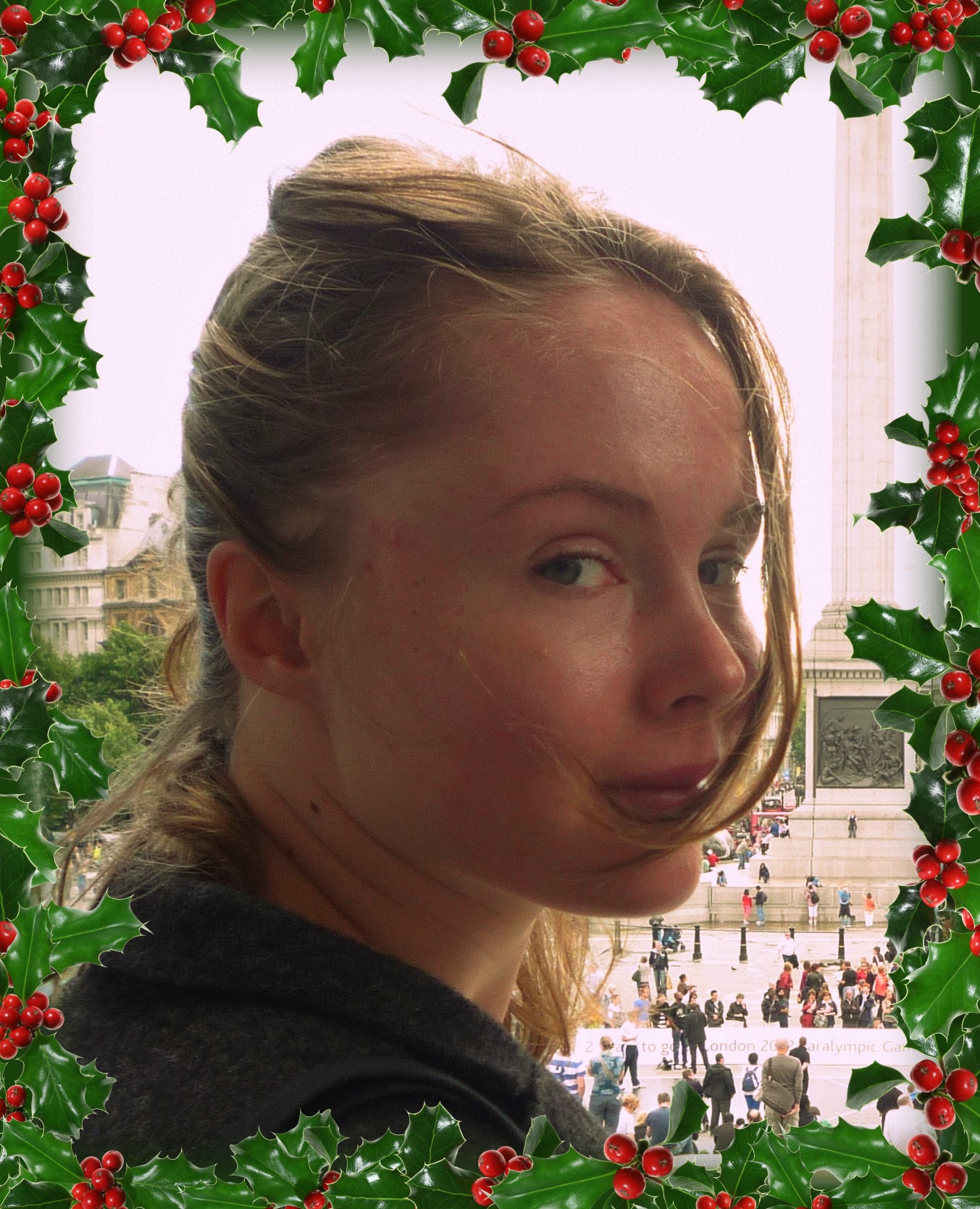
img: Charlotte Day surveying Trafalgar Square in London, this time with a jolly holly border (no ivy, though — that’s for next year!).

CLASSIC DISPLACED WRITING: Dickens — A Christmas Carol


As no points are being handed out for originality (at least, I hope not) this particular edition of Classic Displaced Writing will be yuletide-themed and our text of choice is going to be Dickens’s A Christmas Carol.

I know what a surprise, right?

I am working on the assumption that I needn’t relay to you the basic plot of A Christmas Carol. We’re all familiar with it. Even those who have never picked up the book (and shame on you if you’ve never read it — no matter how good The Muppet Christmas Carol is) will be familiar with the story beats of A Christmas Carol. It has been retold, inverted, and reemphasized since its original publication (168 years ago yesterday, if you are interested). It resonates beyond the Victorian canon, becoming more like a modern myth or fairy tale.

But other than reminding us all of the yuletide season, why feature A Christmas Carol on what is after all an expat-focused blog? Ebenezer Scrooge is most certainly not a character from expat literature, he doesn’t head off to Tuscany to harvest lemons / grow olives / farm terrapins. There’s no cultural misunderstandings with the locals as Scrooge enjoys his year in Provence. Indeed, other than a brief excursion into the English countryside with the Ghost of Christmas Past, this is tale that is contained in the City of London, not venturing beyond the square mile.

So is it just the mulled wine talking or do I have one eye on SEO that leads me to featuring A Christmas Carol in this irregular series? Well, while I may be guilty on both counts there, in the case of Ebenezer Scrooge we have a man who is displaced. Not geographically, but emotionally. The story of his redemption is the story of his realignment with humanity. This is the man we are first introduced to at the beginning of the novella. A man whom beggars, and children, and dogs avoid. He is presented not as a man but as an elemental force, a malevolent wind that blows through Cornhill.

Oh! But he was a tight-fisted hand at the grind-stone, Scrooge! a squeezing, wrenching, grasping, scraping, clutching, covetous, old sinner! Hard and sharp as flint, from which no steel had ever struck out generous fire; secret, and self-contained, and solitary as an oyster. The cold within him froze his old features, nipped his pointed nose, shrivelled his cheek, stiffened his gait; made his eyes red, his thin lips blue; and spoke out shrewdly in his grating voice. A frosty rime was on his head, and on his eyebrows, and his wiry chin. He carried his own low temperature always about with him; he iced his office in the dog-days; and didn’t thaw it one degree at Christmas.

External heat and cold had little influence on Scrooge. No warmth could warm, no wintry weather chill him. No wind that blew was bitterer than he, no falling snow was more intent upon its purpose, no pelting rain less open to entreaty. Foul weather didn’t know where to have him. The heaviest rain, and snow, and hail, and sleet, could boast of the advantage over him in only one respect. They often “came down” handsomely, and Scrooge never did.

Nobody ever stopped him in the street to say, with gladsome looks, “My dear Scrooge, how are you? When will you come to see me?” No beggars implored him to bestow a trifle, no children asked him what it was o’clock, no man or woman ever once in all his life inquired the way to such and such a place, of Scrooge. Even the blind men’s dogs appeared to know him; and when they saw him coming on, would tug their owners into doorways and up courts; and then would their tails as though they said, “No eye at all is better than an evil eye, dark master!”

But what did Scrooge care! It was the very thing he liked. To edge his way along the crowded paths of life, warning all human sympathy to keep its distance, was what the knowing ones call “nuts” to Scrooge.

By contrast, at the end of A Christmas Carol we have the iconic scene of the reformed miser who with a new-found joie de vivre leaps out of his bed, throws open his window and commands of a passing boy to tell him what day it is. One of the most noticeable aspects of the reformed Scrooge is his ability to now joke with others and find humor in life. It is with laughter and good humor that we show that we are not displaced but are integrated with others. “There is nothing in the world,” writes Dickens, “so irresistibly contagious as laughter and good-humor.”

To return to the scene of the reformed Scrooge awakening on Christmas morning, Alistair Sim with his portrayal of Scrooge in the 1951 film adaptation does an excellent job of depicting the delirious glee and humor of the reformed Scrooge. Therefore, it should come as no surprise that the last action we see of Scrooge is him playing a practical joke on Bob Cratchit.

But he was early at the office next morning. Oh, he was early there. If he could only be there first, and catch Bob Cratchit coming late! That was the thing he had set his heart upon.

And he did it; yes, he did! The clock struck nine. No Bob. A quarter past. No Bob. He was full eighteen minutes and a half behind his time. Scrooge sat with his door wide open, that he see him come into the Tank.

His hat was off, before he opened the door; his comforter too. He was on his stool in a jiffy; driving away with his pen, as if he were trying to overtake nine o’clock.

“Hallo!” growled Scrooge, in his accustomed voice, as near as he could feign it. “What do you mean by coming here at this time of day?”

“I am very sorry, sir,” said Bob. “I am behind my time.”

“You are?” repeated Scrooge. “Yes. I think you are. Step this way, sir, if you please.”

“It’s only once a year, sir,” pleaded Bob, appearing from the Tank. “It shall not be repeated. I was making rather merry yesterday, sir.”

“Now, I’ll tell you what, my friend,” said Scrooge, “I am not going to stand this sort of thing any longer. And therefore,” he continued, leaping from his stool, and giving Bob such a dig in the waistcoat that he staggered back into the Tank again; “and therefore I am about to raise your salary!”

Bob trembled, and got a little nearer to the ruler. He had a momentary idea of knocking Scrooge down with it, holding him, and calling to the people in the court for help and a strait-waistcoat.

“A merry Christmas, Bob!” said Scrooge, with an earnestness that could not be mistaken, as he clapped him on the back. “A merrier Christmas, Bob, my good fellow, than I have given you, for many a year! I’ll raise your salary, and endeavour to assist your struggling family, and we will discuss your affairs this very afternoon, over a Christmas bowl of smoking bishop, Bob! Make up the fires, and buy another coal-scuttle before you dot another i, Bob Cratchit!”

STAY TUNED for tomorrow’s post by our monthly third-culture kid columnist, Charlotte Day.

If you enjoyed this post, we invite you to subscribe to The Displaced Dispatch, a weekly round up of posts from The Displaced Nation, plus some extras such as seasonal recipes and occasional book giveaways. Sign up for The Displaced Dispatch by clicking here!

Related posts:

DISPLACED Q: Where and how would you spend your ideal Christmas?


For the last 14 years, we have spent Christmas in Connecticut. It sounds ideal – it’s the name of a classic Christmas film, for goodness’ sake – yet recently, more and more, I’ve wished to spend the festive season elsewhere.

By ‘elsewhere’ I don’t necessarily mean Olde England. Although I may be overtaken by the occasional yearning to spend a foggy afternoon in a pub while Slade and Wizzard bellow Christmas songs in the background, the feeling usually passes after two aspirin and ten minutes in a darkened room.

No; now that youngest child is healthily skeptical and I don’t have to invent elaborate fibs about how Santa Claus is going to track us down at another location, more and more I would prefer to spend Christmas somewhere — well, warmer. Much warmer. Maybe in another hemisphere, even.

But (someone is bound to say) you’re in New England! You have White Christmases!

It’s cold, certainly. But white? Not really. Of the fourteen Christmases here, only one has been properly white. While we have snow, and lots of it, the timing is always spectacularly bad. In any case, any aesthetic pleasure in snow is dimmed by the worry of whether the power lines will collapse before or after the beef comes out of the electric oven, and if it will be necessary to raid the kids’ Christmas toys for batteries for flashlights.

Speaking of my kids, they’re a traditional lot. They like Mum’s roast beef and Yorkshire puddings (the British roast turkey was shelved long ago when it became apparent that you can have turkey for Christmas or Thanksgiving, but not both) and my last suggestion of being anywhere but Smalltown, Connecticut on December 25th was met with howls of distress.

Christmas in Aruba? Barbados? Cancun? You’d think I’d suggested Christmas In The Workhouse.

I showed the kids a photo of Santa-hatted people frolicking in the waves at Bondi Beach.

“Doesn’t this look great?” I pleaded.

One of them sniffed. “Christmas is meant to be cold,” he said.

Cold outside with the central heating turned up to 75 degrees, that is.

“How about Disney World?” suggested another. “It’s supposed to be really nice at Disney at Christmas.”

OK, I can see a couple of advantages: above-frigid temperatures, and fake snow that won’t cut your electricity off. The disadvantages: too many to enumerate, but enduring a Disney Character Christmas Dinner would come top of the list and make me wish that either we or Mickey and friends were, indeed, spending Christmas In The Workhouse.

So, in the absence of family enthusiasm for an alternative location, I guess visions of sugar-plums will stay in Connecticut, while my own visions of barbecued shrimp under waving palm trees will just have to stay hold for a little longer.

I’ll keep working on it. Maybe next year.

QUESTION: Where would you spend your ideal Christmas?

STAY TUNED…for Tuesday’s Classic Displaced Writing, when Anthony discusses — who else, at this time of year? — Charles Dickens.

If you enjoyed this post, we invite you to subscribe for email delivery of The Displaced Dispatch, a round up of the week’s posts from The Displaced Nation. Sign up for The Displaced Dispatch by clicking here!

Related posts:

BOOK REVIEW: “The Globalisation of Love,” by Wendy Williams

Writer Wendy Williams has described her new book, The Globalisation of Love, as being about “global love stories, inter-cultural romance and marriage.” A Canadian expat living with her Austrian husband in Vienna, it is of little surprise that Williams is interested in intercultural romances and her book could be best described as an expat take on the self-help, relationship genre — a Men Are from Mödling, Women Are from Vancouver, if you will.

As Williams writes,

…one of the most profound effects on globalisation is that people from everywhere are falling in love with people from everywhere else. There is a world of romance happening out there and it is called the globalisation of love.

That is certainly reflected in the readership of The Displaced Nation, where a large number of you, myself included, are involved in inter-cultural relationships or marriages so I imagine there are those among you or friends you know who may need this book with its advice and anecdotes on how to circumnavigate the occasionally choppy waters and discombobulating experiences of being, in Williams’s neologism, a GloLo couple. Williams explains the problems a GloLo couple may experience in dealing with parents-in-law, marriage ceremonies, immigration officials — all that “fun” stuff many of us have experienced.

Williams has a very conversational turn-of-phrase and peppers her book with references to romantic comedies, and I suspect her style will delight and grate in equal measure. Whether you find yourself charmed by the idea of a GloTini cocktail (recipe included in the book) is probably a fair indicator of whether you are going to curl up with The Globalisation of Love or hurl it across your living room.

With each topic tackled, Williams brings up case studies from a whole ranges of GloLo couples that she has interviewed. For me, this is undoubtably where the book is strongest as you find yourself either charmed or cringing at the experiences of each couple. Williams, also brings in the story of her own marriage, always in a disarmingly self-deprecating way, so at times The Globalisation of Love reads almost like a quasi-memoir.

I do think there are drawbacks. The over-classification of GloLo couples can quickly become confusing. At times I felt that I required some kind of chart to work out what sort of GloLo I’m defined under, though I suspect I probably snugly fit into what Williams classifies as “the scoffer.” The quick, breezy glossing over of the issue of mail-order brides did not sit comfortably with me, and I also thought the look at those who meet on the Internet was a missed opportunity. I’ve heard of a number of people who have found their partner via the Web — not through a dating site, but from regularly participating on a discussion forum centered around an area both partners have a common interest. This often involves those who previously wouldn’t have entered into a GloLo relationship, and perhaps have never once traveled out of their home country despite starting a relationship with someone on the other side of the globe.

While by no means a book that is going to radically change your opinion on self-help, relationship books, it is a worthwhile addition to the genre.

You can buy The Globalisation of Love here.

STAY TUNED for Monday’s post, a displaced Q about the Ideal Christmas Holiday.

If you enjoyed this post, we invite you to subscribe to The Displaced Dispatch, a weekly round up of posts from The Displaced Nation, plus some extras such as seasonal recipes and occasional book giveaways. Sign up for The Displaced Dispatch by clicking here!

Related posts:

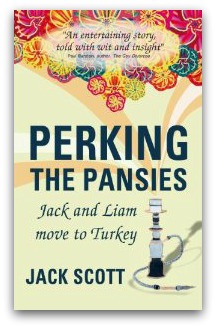
BOOK REVIEW: “Perking the Pansies — Jack and Liam move to Turkey,” by Jack Scott

For some months, I’ve been a big fan of Jack Scott and his blog, Perking the Pansies. Judging by the readership numbers, I’m not the only one, but that’s unsurprising.  Apart from the fact that Jack is one of the nicest bloggers on the block, how could anyone not be enticed by his introduction?

“Imagine the absurdity of two openly gay, recently “married”, middle-aged, middle class men escaping the liberal sanctuary of anonymous London to relocate to a Muslim country.”

Imagine, indeed. Even when it transpires that the Muslim country is Turkey and not Iran —

“We had no desire to be lynched from the nearest olive tree by the Revolutionary Guard”

— newcomers to the blog can be forgiven for wondering, “Guys – what were you thinking?”

Finding Paradise

Thankfully, the imminent publication of Jack Scott’s memoir, Perking the PansiesThe Book, means that readers will no longer have to scroll through months of blog posts for the answer to that question. While the blog’s first post gives a brief account of how Jack and his husband Liam left London for Turkey, the book fleshes out the logistics in a far more satisfactory manner.

Most people “of a certain age” will identify with the events leading up to this dramatic change in lifestyle. A midlife crisis, a middle-aged realization that personal happiness and mental health are worth infinitely more than a big number in the bank account, plus a couple of pieces of golden luck to make it all happen – how many of us have dreamed of just this, to leave the rat race behind and live in our own little Paradise?

Paradise Lost

Naturally, it’s not as simple as that. In leaving the corporate rat race behind, Jack and Liam encountered a new one – the expat rat race. It doesn’t matter where you are an expat – if you’ve ever lived abroad among fellow countrymen with whom you have nothing in common except nationality, you will recognize the competitors in this race. Jack describes them in detail enough to make the reader wince in sympathy.

The truly awful landlady, Chrissy, would be one reason for many people to put their suitcases back in the taxi and return to the airport. A member of The Ignorati  —

“Those who live in utter ignorance of the history and culture of their foster land, shout loudly in English, and see the world at large through the narrow-minded pages of the Daily Mail”

— Chrissy, for me, conjured up the image of a younger Alison Steadman in full-on Mrs Bennet mode. (Later, when Jack likened a hideous expat soiree to “Abigail’s Party without Demis Roussos” I was thrilled to have my impressions confirmed.)

Another memorable character, Clement, I imagined as the likely product of a coupling between a James Bond villain and Noel Coward. Jack deliciously described him as:

“The dotty but loveable old maiden aunt who always pitched up at Christmas and drank all the sherry.”

While I could continue to reminisce about other people I met between the pages of PTP, I won’t. Suffice it to say that Perking The Pansies is not so much about Jack’s Adventures Through The Looking Glass, but more about Who He Found There – a refreshing change from the many memoirs whose authors are constantly center-stage.

Compromise in Paradise

Many readers will also recognize the doubts Jack had about his new life:

“Sad people, bad people, expats-in-a-bubble people. They hate the country they came from; they hate the country they’ve come to. This was my social life. This is what I gave everything up for. This was Liam’s bloody Nirvana. We were the mad ones, not them.”

But eventually, when rid of the expat posse, Jack has this to say of Turkey and its own people:

“Turkey is a magical land graced by a rich culture, gorgeous people and an intrinsic love of the family. A respect for difference won’t destroy that. It’s okay to be queer….At times I think we’re floundering about like idiots, but now and then I think we’re making a real difference.”

Oh Jack — if only all your expat acquaintances could say the same thing.

I’m looking forward to your next book already.

Perking The Pansies by Jack Scott is available from Amazon.co,uk

STAY TUNED for tomorrow’s installment from our displaced fictional heroine, Libby, who is celebrating her mother-in-law’s departure before the holidays. (What, not keeping up with Libby? Read the first three episodes of her expat adventures.)

If you enjoyed this post, we invite you to subscribe to The Displaced Dispatch, a weekly round up of posts from The Displaced Nation, plus some extras such as seasonal recipes and occasional book giveaways. Sign up for The Displaced Dispatch by clicking here!

Related post:

CONTEMPORARY DISPLACED WRITING: Marías — The Man of Feeling

NOTE: Our review of Wendy Williams’ The Globalization of Love has been postponed until this Friday, December 16. In the meantime we’d like to share with you one of our favorite displaced writers, Javier Marías.

At school, an English teacher told my class that good writing should be like a scalpel. Quite what he meant by this was not entirely clear to me, but he said it with such intensity and with an accompanying, ever so disturbing stabbing gesture that I felt I should really take note of what he said. However, on first reading the work of Javier Marías, I finally understand something of what my teacher was trying to explain to my doltish teenage self. Marías’s ability to expertly set up a scene and then dissect the thought processes of his protaganists is a joy.

If you haven’t read any of Marías’s work you really should. Without a doubt he is one of the finest writers currently living and though he has a loyal readership in the English-speaking world, it should be much larger than it is.

When reading his novella The Man of Feeling , I came across one passage that struck me as being perfectly appropriate for featuring as a Contemporary Displaced Writing post. The narrator of The Man of Feeling is a young opera star who is constantly traveling as he tours the world. For the most part, this is not a glamorous life; it is, in fact, a stultifying life spent in rehearsal rooms and hotel bars — they are all different but yet they are all the same, too.

The extract I want to share has our opera star narrator relating his feelings when he first visits a new city:

… I enjoy the feeling that I am in a new and unfamiliar city; getting into public places and being aware that the people there speak a language I know only imperfectly or not at all; studying the clothes and hats (though nowadays one sees fewer of the latter) that the good citizens choose to wear in the streets; finding out if shops are full or empty during office hours; seeing how the news is treated in the newspapers; looking at certain examples of domestic architecture that one can only find in that particular part of the world; noting the typefaces that predominate in shop signs (and reading these like a savage, understanding nothing); scrutinizing the faces in the metro and on the buses which I frequent for that very reason; picking out particular faces and wondering whether I might or might not meet them elsewhere; deliberately getting lost in parts of the city where I have already learned to find my way, that is, with map in hand if I need it; observing the inimitable passing of each languishing day at each point on the globe and the uncertain and variable instant when the lights are lit; setting foot in places where our feet leave no trace, on the luminous asphalt of the morning or on some dusty, ancient stone pavement illuminated by a single street lamp as evening falls; visiting bars full of indistinguishable, blithely insignificant murmurings that cover and erase everything; mingling with the people in the white streets of the south or in the grey avenues of the north at the declining hour when people are going out for a stroll or coming home from work, that brief respite, seeing how the women go out in the evening or perhaps at night, all dressed up, and seeing the cars in their many colors waiting for them; imagining the parties they are going to; wasting time.

And in each city I visit I would like to meet people, to meet those smartly dressed women, who are perhaps climbing into their glossy, impleccable cars to drive to the opera to hear Leon de Napoles: to go and see me.

Extract from Margaret Jull Costa’s translation published by New Directions, available here. You should read it, you know. You really should.

STAY TUNED for tomorrow’s post, a review of the new expat autobiography Perking the Pansies, by Jack Scott.

If you enjoyed this post, we invite you to subscribe to The Displaced Dispatch, a weekly round up of posts from The Displaced Nation, plus some extras such as seasonal recipes and occasional book giveaways. Sign up for The Displaced Dispatch by clicking here!

Related posts:

Image: MorgueFile

Best of 2011: Books for, by and about expats

One of our Random Nomads in November, Aaron Ausland, had this to say about those of us who venture across borders:

Travel to a new place for three weeks and you can write a book, travel for three months and you can write an article, travel for three years and you’ll likely have nothing to say.

While that may be true, I’m afraid it hasn’t stopped many of us who’ve spent large chunks of our lives gallivanting around the globe trying out life in different countries, from taking up the pen.

As with any other group, some are born writers (and thrive on new surroundings), while others have become writers (attempting to make sense of their adventures), while still others have had writing thrust upon them (responding to invitations to share their experiences).

At the Displaced Nation, we revere people who publish books, fiction or non, that in some way assist those of us who are (or have been) engaged in overseas travel and residency. We feature — and do giveaways of — their works. And, for established writers with a global following, we’ve created a unique “category” called the Displaced Hall of Fame.

In this spirit — and in the December tradition of looking back at the past year’s highlights — I present the following (admittedly incomplete) list of books for, by, and about expats that were published in 2011, in these five sections (click on the title to go to each section):

  1. NOVELS ABOUT EXPATS
  2. NOVELS ABOUT “HOME”
  3. EXPAT MEMOIRS
  4. SELF-HELP, CROSS-CULTURAL & OTHER NONFICTION WORKS
  5. INSPIRATIONAL ANTHOLOGIES

A few more points to note:

  • Books in each category are arranged from most to least recent.
  • I’ve mixed indie books with those by conventional publishers (it suits our site’s somewhat irreverent tone).
  • To qualify for the list, authors must have been expats for at least six months at some point.

* * *

NOVELS ABOUT EXPATS

Three Questions: Because a quarter-life crisis needs answers (CreateSpace, October 2011)
Author: Meagan Adele Lopez
Genre: Women’s fiction
Synposis: A love story based loosely on the author’s own romance with a lad from Bristol, the action traverses continents through letters and features a quarter-life crisis, a road trip to Vegas, and two crazy BFFs.
Expat credentials: An American, Lopez lived as an expat in the UK for a while (she is now back in Chicago).
How we heard about it: Melissa of Smitten by Britain was a fan of Lopez’s blog (originally titled The Lady Who Lunches). The pair met her London in the summer of 2010, when Lopez was still living in England. Recently, Melissa has been supporting Lopez’s attempt to gain sponsorship for turning the novel into a screenplay.
Sunshine Soup: Nourishing the Global Soul (Summertime, October 2011)
Author: Jo Parfitt
Genre: Women’s fiction
Synopsis: Six expat women from the UK, US, Thailand, Ireland, Norway and Holland converge in Dubai in 2008. The action centers on a Brit, who is on her first posting, and an American, who is on her 25th. The Brit learns the ropes and settles in, while the American woman’s world begins to crumble.
Expat credentials: A prolific author, publisher and pioneer in addressing the issues of accompanying spouses and aspiring expat writers worldwide, Parfitt has been an expat for nearly a quarter of a century. Born British, she now lives in the Hague.
How we heard about it: We noticed a couple of interviews with Parfitt — one by expat coach Meg Fitzgerald and another by Expat Women.

The Beautiful One Has Come: Stories (Wyatt-MacKenzie Publishing, July 2011)
Author: Suzanne Kamata
Genre: Cross-cultural romance
Synopsis: Twelve short stories reveal the pains and the pleasures experienced by expat women, most of whom live in Japan.
Expat credentials: Kamata is an American who has lived in Japan for 20 years.
How we heard about it: Kamata and her book were featured on Kristin Bair O’Keeffe’s Writerhead Wednesday in July of this year.

Hidden in Paris (Carpenter Hill Publishing, April 2011)
Author: Corine Gantz
Genre: Women’s fiction
Synopsis: Three strangers — all American women — have reached the point of terminal discomfort with their lives so run away to Paris to begin anew.
Expat credentials: Gantz is a French expat living near Los Angeles. She is getting her own back by writing about American expats in Paris.
How we heard about it: We are long-time fans of Gantz’s blog, Hidden in France — in fact, we promoted one of her posts (about falling into her swimming pool) with the launch of TDN in April. We also interviewed her about her first novel as part of our “gothic tales” theme this past May.

Exiled (Quartet Books, April 2011)
Author: Shireen Jilla
Genre: Psychological thriller
Synopsis: The wife of an ambitious British diplomat, whose first posting brings them to New York, looks forward to escaping from Kent and leading the high-profile life of a successful expat — only to find her world being threatened by dark psychological forces on a par with those depicted in Rosemary’s Baby.
Expat credentials: A Third Culture Kid (she is half English, half Persian, and grew up in Germany, Holland and England), Jilla has also been an expat in Paris, Rome, and New York.
How we heard about it: TDN writer ML Awanohara read a review of Jilla’s novel by Kate Saunders in the Sunday Times. She approached Jilla in May about having an exchange with our readers about the gothic themes in her novel, in line with our site’s own delvings into the gothic aspects of expat life. Our readers loved her!

NOVELS ABOUT “HOME”

Lady Luck (Colorado Mountain Series)
Author: Kristen Ashley
Genre: Romance
Synopsis: Ex-con hero, wrongly imprisoned, gets mixed up with unlucky heroine, who will stop at nothing to help him get revenge.
Expat credentials: Born in Gary, Indiana, Ashley grew up in Brownburg and then moved to Denver, where she lived for 12 years. She now lives with her husband in a small seaside town in Britain’s West Country, where she has produced more than twenty books featuring rock-chick, Rocky Mountain, and other all-American heroines.
How we heard about it: Ashley is the friend of an old schoolfriend of TDN writer Kate Allison, who invited her to do a guest post for us on Britain’s (lack of) Royal Wedding preparations  for our Royal Wedding coverage.

Queen by Right: A Novel (Touchstone, May 2011)
Author: Anne Easter Smith
Genre: Historical romance
Synopsis: This is the fictional story of Cecily of York, mother of two kings and said to be one of the most intelligent and courageous women in English history.
Expat credentials: The daughter of an English army colonel, Easter Smith spent her childhood in England, Germany and Egypt. She came to New York City at age 24, and as she puts it:

Many years, two marriages, two children and five cross-country moves later I’m very definitely a permanent resident of the U.S. — but my love for English history remains.

(She now lives in Plattsburgh, New York.)
How we heard about it: Easter Smith and her book were featured on Kristin Bair O’Keeffe’s Writerhead Wednesday in October.

Dance Lessons (Syracuse University Press, March 2011)
Author: Áine Greaney
Genre: Irish Studies, Women’s Fiction
Synopsis: The action centers on a woman of French-Canadian background who marries an Irish emigrant who is working illegally in a bar in Boston. After his death by drowning, she visits Ireland for the first time and finds out what a shattered man he actually was.
Expat credentials: She may be a resident of Boston’s North Shore, but Greaney continues to identify herself as an Irish writer (County Mayo).
How we heard about it: Greaney and her book were featured on Kristin Bair O’Keeffe’s Writerhead Wednesday in October.
Pentecost: A Thriller (The Creative Penn, January 2011)
Author: Joanna Penn
Genre: Thriller
Synopsis: The Keepers of the stones from Jesus’s tomb — which enabled the Apostles to perform miracles — are being murdered. The stones have been stolen by those who would use them for evil in a world. An Oxford University psychologist spearheads a search for them in a race against time…
Expat credentials: English by birth, Penn grew up as a third-culture-kid and at the time of producing her first novel, was living in Australia.
How we heard about it: We are avid followers of Penn’s blog, The Creative Penn. Several months ago, TDN writer ML Awanohara deconstructed Penn’s post about what “home” means for writers for what it might teach expats and others who struggle with this issue as well. For Penn, home means some sort of spiritual kinship, which she has with two places: Oxford, where she went to university and near where her father now lives, and Jerusalem, which she’s visited at least ten times because she loves it there so much. Not surprisingly, she chose to set much of the action for her debut novel in these two cities.

EXPAT MEMOIRS
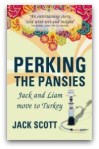
Perking the Pansies: Jack and Liam move to Turkey (Summertime Publishing, December 2011)
Author: Jack Scott
Synopsis: Dissatisfied with suburban life and middle management, Scott and his civil partner, Liam, abandon the sanctuary of liberal London for an uncertain future in Bodrum, Turkey. The book is based on Scott’s irreverent blog of the same name, which after its launch in 2010, quickly became one of the most popular English language blogs in Turkey.
How it came to our attention: Scott was featured as one of our Random Nomads in May of this year and since then, has done us the favor of commenting on and liking several of our posts. **Kate Allison will be reviewing his book for our site on Wednesday.**

Ramblings of a Deluded Soul (CreateSpace, September 2011)
Author: Jake Barton
Synopsis: In his inimitable style, the British-born Barton strings together snippets from new novels and try-outs with reminiscences and, for the first time, insight into his own remarkable experiences as a traveler and expat in Europe (he once owned a small French vineyard and had another job he’s not supposed to talk about). NOTE: Barton’s first novel, Burn, Baby, Burn, burned its way into the Top Ten of the Amazon All Books list.
How it came to our attention: Barton is an online acquaintance of TDN writer Kate Allison. We celebrated him in the early days of our blog for his insights on foreign-language learning in Spain.

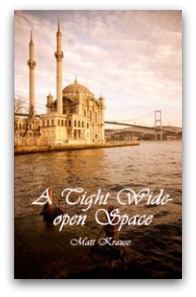
A Tight Wide-open Space: Finding Love in a Muslim Land (Delridge Press, August 2011)
Author: Matt Krause
Synopsis: A Californian who is now a Seattle-ite recounts how he became an Istanbullu, all for the love of a beautiful Turkish woman he met on a airplane. The year is 2003, and he can still hear the echoes of 9/11 as well as being acutely conscious of America’s engagement in two wars in Muslim countries. Eventually, he comes to love his new home more deeply than he might have expected.
How we heard about it: Linda Janssen, who writes the blog Adventures in Expatland, interviewed Krause about his book in October.

Planting Dandelions: Field Notes from a Semi-Domesticated Life (Penguin, April 2011)
Author: Kyran Pittman
Synopsis: A native of Newfoundland (her father was a well-known Newfoundler poet), Pittman writes about co-parenting with her charming Southern U.S. hubbie (they have three rambunctious boys); keeping the fiscal wolf from the door of their home in Little Rock, Arkansas; and honoring her marriage vows despite her refusal to give up her party-girl persona.
How we heard about it: Pittman came to our notice when she was a guest on Kelly Ryan Keegan‘s Bibliochat in late September.

Big in China: My Unlikely Adventures Raising a Family, Playing the Blues, and Becoming a Star in Beijing (Harper, March 2011)
Author: Alan Paul
Synopsis: Paul tells the story of trailing his journalist-wife to China and unwittingly becoming a rock star. His Chinese American blues rock band, called Woodie Alan, even earned the title of Beijing’s best band.
How we heard about it: We were early fans of Alan Paul’s back in the days of his Wall Street Journal online column, “The Expat Life.” Also, Paul and his book were featured on Kristin Bair O’Keeffe’s Writerhead Wednesday this past April.

The Foremost Good Fortune (Knopf, February 2011)
Author: Susan Conley
Synopsis: Conley, her husband, and their two young sons say good-bye to their friends, family, and house in Maine for a two-year stint in a high-rise apartment in Beijing. All goes well until Conley learns she has cancer. She goes home to Boston for treatment and then returns to Beijing, again as a foreigner — to her own body as well.
How we heard about it: Conley and her book were featured on Kristin Bair O’Keeffe’s Writerhead Wednesday in early October.

SELF-HELP, CROSS-CULTURAL AND OTHER NONFICTION WORKS

The Globalisation of Love (Summertime, November 2011)
Author: Wendy Williams
Genre: Relationships, self-help, humor
Synopsis: Williams interviews multicultural, interfaith and biracial partners from all over the world on what it feels like to “marry out” of one’s culture, religion and/or race. She also talks to experts on the topic and coins a term for it: “GloLo.”
Expat credentials: From a British-Ukrainian-Canadian family, Williams has been married to an Austrian for 13 years and lives in Vienna.
How we heard about it: TDN writer ML Awanohara listened to Jo Parfitt’s interview with Williams on her Writers Abroad show (Women’s International Network) and was attracted to the ideas of a book that treats this topic with humor. **TDN writer Anthony Windram will review the book for our site tomorrow (Tuesday).**

Modern Arab Women — The New Generation of the United Arab Emirates (Molden Verlag, November 2011)
Author: Judith Hornok
Genre: Women’s studies
Synopsis: The book consists of 20 chapters, each a stand-alone interview with an Emirati woman from disciplines as varied as business, film, medicine and politics. The women talk to Hornok about their careers, philosophies of life and plans for the future. The book, which is published in German and English, aims to dispel some of the Western myths surrounding Arab women.
Expat credentials: While not quite an expat, Hornok has been moving between the UAE and her home in Vienna, Austria, for eight years.
How we heard about it: TDN writer ML Awanohara read an article on the book in The National (UAE English-language publication) and became intrigued.

Expat Women: Confessions — 50 Answers to Your Real-life Questions about Living Abroad (Expat Women Enterprises Pty Ltd ATF Expat Women Trust, May 2011)
Authors: Andrea Martins and Victoria Hepworth (foreword by Robin Pascoe)
Genre: Women’s self-help, family, relationships
Synopsis: Experienced expats share wisdom and tips on topics that most expat women face, such as the trauma of leaving family back home, the challenges of transitioning quickly, intercultural relationships, parenting bilingual children and work-life balance. They also tackle more difficult issues such as expat infidelity, divorce, alcoholism and reverse culture shock. The book is based on the “confessions” page of Expat Women, the largest global Web site helping women living overseas.
Expat credentials: Andrea Martins is the director and co-founder of Expat Women. An Australian who has spent many years abroad, she began dreaming of connecting expat women worldwide when an expat in Mexico City. Victoria Hepworth is a New Zealander who has lived in Japan, China, Russia, Sweden, India and is currently living in Dubai, UAE. She is a trained psychologist who specializes in expat issues.
How we heard about it: Andrea Martins announced the publication of the book to much fanfare on Twitter and in other social media venues. It has been widely reviewed on expat blogs.

Marriage in Translation: Foreign Wife, Japanese Husband (CultureWave Press, April 2011)
Author: Wendy Nelson Tokunaga
Genre: Relationships, self-help
Synopsis: Tokunaga conducts a series of candid conversations with 14 Western women about the challenges in making cross-cultural marriages work both inside and outside Japan. She quizzes them about the frustrations, as well as the joys, of adapting to a different culture within married life.
Expat credentials: Born in San Francisco, Tokunaga has spent numerous years studying, living, working and playing in Japan. She is the author of two Japan-related novels, published by St. Martins Griffin. Oh, and did we mention her Japanese “surfer-dude” husband?
How we heard about it: Sometimes one tweet is all it takes! (We follow Wendy Tokunaga on Twitter.)

A Modern Fairytale: William, Kate and Three Generations of Royal Love (Hyperion/ABC Video Book, April 2011)
Author: Jane Green
Genre: Romance, royalty
Synopsis: In this video book for ABC News, produced just in time for the Royal Wedding in March, best-selling chick-lit novelist Jane Green follows the stories of three generations of royal love from their meeting up to and after their respective wedding days. She concludes that Kate and William have a much better chance than William’s parents of enjoying a relationship on their own terms.
Expat credentials: Born in London, Green worked as a feature writer for The Daily Express before trying her hand at writing novels. She now lives in Westport, Connecticut, with her second husband and their blended family.
How we heard about it: One of us noticed that Jane Green had been tapped to provide coverage of the Royal Wedding for ABC News. We then invited her to talk about her e-book and engage with our readers in a debate on whether women should still aspire to be “princesses” in the 21st century — a post that received a record number of comments.

INSPIRATIONAL ANTHOLOGIES

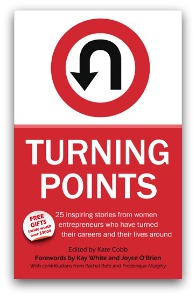
Turning Points: 25 inspiring stories from women entrepreneurs who have turned their careers and their lives around (Summertime Publishing, November 2011)
Editor: Kate Cobb
Synopsis: In this collection of stories from women all over the world, the focus is on the moments, or short passages of time, when a woman was facing something challenging and came out the other side smiling.
Expat credentials: Cobb is a British woman living in France, and about a third of the contributors — including Jo Parfitt and Linda Janssen — are expats who now run their own businesses.
How we heard about it: Linda Janssen promoted the book on her blog, Adventures in Expatland.

Indie Chicks: 25 Women 25 Personal Stories (Still Waters Publishing, October 2011)
Compiler: Cheryl Shireman
Synopsis: 25 indie novelists share personal stories in hopes of inspiring other women to live the life they were meant to live. (All proceeds go to the Susan G. Komen Foundation for breast cancer research.)
Expat credentials: Close to half of these indie authors are expats or have done significant overseas travel. To take a few examples: After living in Portland, Oregon, for most of her life, Shéa MacLeod now makes her home in an Edwardian town house in London just a stone’s throw from the local cemetery. Linda Welch was born in a country cottage in England, but then married a dashing young American airman, left her homeland, raised a family, and now lives in the mountains of Utah. Julia Crane is from the United States but recently moved to Dubai with her huband and family (her personal story concerns the adjustment process).
How we heard about it: Again, sometimes all it takes it a tweet (we picked up one of Linda Welch’s).

* * *

Questions: Have you read any of the above works and if so, what did you think of them? And can you suggest other works to add to the list? My colleagues and I look forward to reading your comments below!

STAY TUNED for tomorrow’s post, a review of The Globalisation of Love, by Wendy Williams, and for Wednesday’s post, a review of Perking the Pansies, by Jack Scott.

If you enjoyed this post, we invite you to subscribe to The Displaced Dispatch, a weekly round up of posts from The Displaced Nation, plus some extras such as seasonal recipes and occasional book giveaways. Sign up for The Displaced Dispatch by clicking here!

Related posts: