The Displaced Nation

A home for international creatives

To live the Olympic Ideal, I need to stop watching the Olympics

So the Olympics continue and with it my continuing — and ugly — obsession with the American broadcasting network NBC is laid bare.

Now if I were being fair — and I so rarely am — I would admit that NBC does have a nifty, free Olympics app that is a pretty decent way of keeping track (terrible pun, sorry) of what is happening, but all the goodwill that engenders in me evaporates as soon as I turn on the TV for my nightly fix.

Having already vented in a previous post, I should clearly give this issue a rest, but in all honesty the snide, masochistic side of my personality adores being able to shout each night as the bland features of Bob Costas (a face you forget even while looking at it) illuminate TV screens across the USA.

Six hours a night I’ve been yelping, tutting, and admonishing the TV. My long-suffering wife deals stoically with my piggish behaviour. It starts with my local NBC affiliate, who are staging all their Olympic coverage from the nearby Thunder Valley Casino — because as everyone knows, if you want to see Olympic specimens you head to the lobby of a casino. Once in a while, they cut to Deirdre Fitzpatrick, who each day provides pointless, meandering ten-minute videos of herself wandering round London — Rick Steves is positively Bruce Chatwin-like in comparison. A choice example saw our Deirdre (make-up immaculate, of course, but in that female US newcaster’s way, whereby its effect is disturbingly artificial and it’s impossible to gauge what her true age is) by a footpath on the South Bank. “Everywhere you go, there’s an impromptu performance,” she says as the camera zooms in on a man playing an acoustic guitar. Deirdre, it’s called busking.

But then comes the main event as we cut to Bland Bob Costas. You may even get to see a little bit of sport, but not too much as Mary Carillo is then wheeled out for 15 minutes each night to give a patronising look into some aspect of British life that would even make VisitBritain cringe. She is not quite at Deirdre levels of annoyance, but then poor Deirdre’s day often seems to involve finding an American tourist to talk to, or the most embarrassing old British codger that she can find to interview. Mary, however, has access to various echelons of British society to paint her twee picture of my homeland. I was particularly irate when only the last lap of the 10,000m race was shown — we then moved on to Mary fronting a 15-minute video about bagpipes in Glasgow. I understand that the race had been shown live earlier in the day, but I don’t think anyone was tuning in that night for a piece about the modern renaissance of bagpipes. If this has any place — and that is a big if — it is on The Today Show (which, too, has camped out in London for the duration of the games), not on the actual evening highlights.

Baron Pierre de Coubertin in establishing the modern Olympics probably did not envisage how mass media throughout the 20th century would transform the games, and certainly did not foresee how social media is transforming them again. In the interests of his Olympic Ideal, it seems utterly wrong that I am spending my time moaning into the void-like Internet, rather than celebrating the likes of Usain Bolt, Oscar Pistorius, and Jessica Ennis. I will take a deep breath, count to ten, and smile when Bob beams that ineffectual smile of his when coverage starts. Or perhaps I’ll try and figure out how to get the Canadian coverage of the games.

If you enjoyed this post, we invite you to register for The Displaced Dispatch, a round up of weekly posts from The Displaced Nation, with seasonal recipes, book giveaways and other extras. Register for The Displaced Dispatch by clicking here!

Related posts:

THE DISPLACED Q: As an expat, do you ever get confused about which team to support at the Olympics?

The long-anticipated Games of the XXX Olympiad, also known as London 2012, are now in full swing. Some members of the Displaced Nation team are looking a tad bleary eyed after staying up late several nights in a row to watch their favorite events (gymnastics, anyone? or how about some synchronized diving?).

Maybe we’re getting grouchy from the lack of sleep, but we’re beginning to engage in some surprisingly heated debates — surprising given how much we looked forward to the arrival of the Games.

Or perhaps it’s not surprising given that most, if not all, of us residents have confused, hybrid nationalities…

In any event, here’s my displaced question for YOU: What if an athlete or team from your native land ends up competing with one from your adopted country?

Now pay heed, because this could be important.

I studied in Cardiff, Wales, where this sort of thing can be a matter of life and death. I’m English y’see, and while Wales may be part of the United Kingdom, it’s also its own country. For which I can hardly blame it…

Historically, Wales and England have not been the best of friends — in fact in one English city, it’s still legal to shoot a Welshman with a bow and arrow at certain times of the year.

For some reason it’s one law they just keep forgetting to appeal…

To say the English have treated the Welsh unfairly is…well, fair. We were utter bastards to them back in the day, as we were to pretty much every other civilization with which we came into contact. That’s why they all rose up and threw us out at various points in time.

Unfortunately, we haven’t learned our lesson — that infamous stiff upper lip isn’t the only national trait we’re known for. Yes, we Brits are an arrogant lot — legendarily so — and never more so than in the arena of international sport.

Luckily we’re not very good at most of it, or we’d have been involved in even more wars.

The art of living dangerously in a country of sore losers

But the Welsh, alas, aren’t much better; on the contrary, they have a horrible habit of being even worse than we are. Rugby is supposed to be their game, yet we English keep beating them at it. And if you’re the only English bloke in the immediate vicinity shortly after such a humiliating defeat occurs…well, the Welsh aren’t known for having a magnanimous, forgiving nature. They are known, rather, as barbarian tribes so unruly that even the Romans couldn’t subjugate them.

I never once tried to subjugate anyone, but in my three years at university I was on the short end of a serious subjugation every time the Welsh lost to England. Which was depressingly often.

So, herein lies the dilemma: You’re an expat. Your birth-home team is playing your adopted-home team. Do you:
a) Cheer for the local team to curry popularity — even if you’re dying inside with every goal scored by the locals?
b) Cheer for your native country’s team to show character, and honesty, and that you’re not afraid – even if, inside, you are actually terrified at what the locals may do to you afterwards?
c) Find a nice, comfy hole to lie in for a week or so until all the excitement dies down? (Note: Not for heroes. I’ve been known to adopt this tactic.)

Both a) and b) are seriously risky strategies. When questioned by a drunk and excitable Welshman, approximately five feet tall and about the same girth — along with ten of his veteran drinking buddies — it was always something of a lottery. Declare for my homeland, and pray I was in better shape athletically (or at least less drunk) than any of them; or declare for Wales, and risk getting beaten up anyway because they thought I was taking the mickey.

My answer varied (like my patriotism) with the number of pints I’d drunk.

(Note to self: Singing “God Save The Queen” loudly in response is almost never a good idea, even if you are drunk enough to hardly feel a thing. And especially when you haven’t even bothered to learn the words…)

The art of not having an opinion

Thankfully, I have since come up with my patented Ultimate Solution™ to this problem, after years of suffering one way or the other — or sometimes both ways simultaneously — at the hands of my ancestral foes.

I don’t cheer for my home team. Either of them. Because to be honest, I don’t give two figs about a sport unless I’m actually playing it, and then if I win, at least I’m dressed in the right gear for running away.

Let’s break this strategy down a little more.

PRINCIPLE #1: CHEER FOR THE WINNERS, REGARDLESS OF NATIONALITY
Taking this approach means you can celebrate every goal. If “your” team loses, you’re not too heavily committed, having cheered equally for both sides in their best moments.

Indeed, no one will be 100% sure which side you’re on, and as you’ve shared at least a few cheers with their side, they’re bound to feel more kindly disposed towards you than if you’d been screaming obscenities at their favorite player.

The second, and even more important part of this strategy is:

PRINCIPLE #2: BE THE LOSER!

As Leo “The Lip” Durocher, manager of several Major League baseball teams, once said (in 1946):

Nice guys finish last.

It doesn’t matter who wins in the end. No, really, it doesn’t. That’s the whole point of the saying “It’s only a game!” — because it is.

And while some people honestly admire a winner, and are happy to let them enjoy their well-earned celebration, in my experience most people have a bitter spot in their hearts for those who beat them — or their team. And it’s not a healthy place to be for anyone — basically, they can’t stand someone who beats them.

But everyone loves a loser.

If your birth-home team loses, be the humble eater-of-pie. Congratulate your new-found compatriots and maybe let slip — in an unguarded moment — that you knew they would win anyway as you’d had a horrible feeling that they were actually a much better team.

And if your adopted-home team loses — join them in commiserating. Because let’s face it, people from your home country are a bunch of so and sos — except you, of course. Which is why you’re here, and not there… “They” never play fairly. One day, hopefully soon, the local team will show ’em who’s boss. And until then, well, you might as well drown your sorrows with the rest of the losers…

Either way it goes, you get points for being a good sportsman. That’s what I call winning by default.

* * *

Okay, readers, now it’s your turn to weigh in on this vexed question. Do you ever feel confused about who you should be rooting for at the Olympics, or is this a moment when blind nationalism sets in, and it’s your home athlete/team or nothing?

Tell me what you think!

STAY TUNED for Monday’s post, another in our “expat moment” series…

If you enjoyed this post, we invite you to register for The Displaced Dispatch, a round up of weekly posts from The Displaced Nation, with seasonal recipes, book giveaways and other extras. Register for The Displaced Dispatch by clicking here!

Related posts:

Image: MorgueFile

RANDOM NOMAD: Brian MacDuckston, American Expat in Tokyo & Expert Ramen Slurper

Place of birth: San Francisco, California USA
Passport: USA
Overseas history: Japan (Saitama, Hiroshima, Tokyo): 2006 – present.
Occupation: Food consultant and freelance English teacher (available for high school classes, after-school programs, private lessons, children’s events…)
Cyberspace coordinates: Ramen Adventures (blog); @macduckston (Twitter handle); and Ramen Adventures (Facebook).

What made you leave your homeland in the first place?
Around 2004 I took a colloquial Mandarin Chinese class, hoping to learn a bit to help with the massive amounts of Kung Fu movies I was into at the time — I soon learned that Cantonese, not Mandarin, is used in these flicks. One of my classmates was going to China for a year to teach English. I did some Internet searching and decided I really wanted to check this out. I was stressed with my computer job, and a year abroad seemed like a good idea. Opportunities abound in China, Korea, and Japan. Japan just seemed like a good choice to me.

You’ve now lived in Japan for more than five years. Tell me about the moment when you felt the most displaced.
My first day of work in Saitama, I somehow managed to get on an empty train that had reached its last stop. A minute later and I was in the depot storage yard with an attendant yelling at me in a language I didn’t understand. I was late to my very first English lesson. I wanted to quit right away. Things got better, obviously.

Is there any particular moment or moments that stand out as your least displaced?
Whenever I’m on the road here in Japan. I ride a motorcycle — very few foreigners do that. Something about being able to navigate across mountain ranges on poorly marked roads fills me with a great sense of accomplishment.

Hmmm…are you sure it’s safe? And now you may bring one curiosity you’ve collected from your adopted country into The Displaced Nation. What’s in your suitcase?
A curiosity? I am actually quite a minimalist, collecting only photos. My Nikon camera is technically a Japanese thing. I guess I would choose that. Or perhaps I should consider bringing a few of my Japanese cooking knives. Beautifully crafted and razor sharp, they are amazing things.

Ah, cooking! I’m glad you mentioned that. You are invited to prepare one meal based on your travels for other members of The Displaced Nation. What’s on your menu?

Ramen of course! Let’s go ahead and serve it after the drinks. After many drinks. Ramen is one of the best hangover prevention foods. All that fat and all those carbs do wonders for the next morning.

And now you may add a word or expression from the country you live in to The Displaced Nation argot. What will you loan us?
Umai is a great food word in Japanese. Most people first learn oishii to mean delicious, but umai is a bit stronger, a bit more cool. It’s mostly a guy word, though. I hope that’s okay with the female occupants of the Displaced Nation?

Perfectly okay! This summer, thanks to the London Olympics, all of us Displaced Nation residents, whether male or female, have become obsessed with displays of machismo and strength. In fact, this may be a good time to bring up your hobby of eating ramen in as many Tokyo venues as possible. How did you get launched in such a curious culinary sport — and become so accomplished that you and your blog were featured in the Travel section of the New York Times?
After living in Hiroshima for a bit, I knew that I needed to live in the big city.  So I finished my contract, signed up for unemployment insurance, and moved to Tokyo. Suddenly I found myself with a massive amount of time on my hands — and not a lot of money in my pockets. I decided to wait in the ridiculously long ramen shop line that I had seen many times across the street from a massive bookstore in Ikebukuro, one of Tokyo’s multiple city centers.

I was shocked how good it was. Completely worth the hour wait outside in the cold. A bit of research later, and I had a list of the 30 best shops in Tokyo…a nice place to start.

Thirty shops sounds rather daunting, particularly if each one involves standing in line for hours! What keeps you going, and do you still like ramen after the upteempth bowl of it?
What keeps me going? A job that doesn’t pay much! In fact, it’s the kind of random fun that comes with this obsession that keeps me going. When I can somehow influence someone to have the best bowl of ramen they have ever had, I feel like it is worth it.

Would you say that you’ve now graduated from amateur to pro?
Becoming a pro in such a niche corner of the food world is tough, but I suppose the few guidebook articles or magazine pieces I have worked on would put me up there.

Readers — yay or nay for letting Brian MacDuckston into The Displaced Nation once he’s finished slurping up his latest bowl of noodles? Tell us your reasons. (Note: It’s fine to vote “nay” as long as you couch your reasoning in terms we all — including Brian — find amusing!)

STAY TUNED for tomorrow’s Displaced Q, about nationalism and the Olympics.

If you enjoyed this post, we invite you to register for The Displaced Dispatch, a round up of weekly posts from The Displaced Nation, with seasonal recipes, book giveaways and other extras. Register for The Displaced Dispatch by clicking here!

Related posts:

img: Brian at a ramen-ya in Tokyo, pursuing his favorite “sport.”

Bob Costas as the ugly American: NBC and the Olympics

Yesterday’s post was on the opening ceremony of the London Olympics. Here in the US, I was able to watch it (hours after the rest of the world) on NBC.

I hadn’t planned to write a post about the Olympics and the opening ceremony. In fact, I was vehemently against the idea when it was suggested to me. However, as the days have gone on, I’ve found my attitude softening.

They are two reasons for this.

Firstly, the Games have made me homesick. My usual cynicism is no match for the enthusiasm of my London friends, all of whom seem to be attending events (if Facebook is anything to go by) while I sit watching it in one of the dullest towns in California. The opening ceremony elicited in me a mixture of pride and embarrassment — and as such, perfectly encapsulated for me what it is to be British. The ceremony also irritated Rush Limbaugh — so clearly job well done on Danny Boyle‘s part there.

The second reason I’ve decided to backtrack on my decision to blog on the Games is I am enduring the NBC coverage. Those of you spending too much of your time on Twitter have probably already noticed that the channel has been receiving a fair amount of criticism for its decision to time-delay the opening ceremony, its cutting of the “memorial” wall tribute from the ceremony as they didn’t feel it relevant to a US audience (yeah, because NBC knows what’s relevant to a US audience), its role in the suspension of journalist Guy Adams from Twitter, and the really awful library-esque studio they’ve set up for Bob Costas. Each night Bob reminds me of the narrator from The Rocky Horror Show. Oh God, do you think he’s got pantyhose under that desk?

This is the second Summer games that I have watched in the US, so I am not surprised that NBC in its prime time slots edits the games more like a reality show, such as American Idol, than an actual sporting event. They are filmed inserts galore highlighting particular favored US Olympians giving us a look into their struggles and achievements, their family dynamics, and ideally some terrible (juicy) tragedy that has befallen them.

What has really irritated me, however, has been NBC’s commentary. I understand that Trevor Nelson had some role in the BBC commentary during the opening ceremony, so in the interest of fairness I imagine that was pretty dire, too; but it was disappointing to see Matt Lauer, Bob Costas and Meredith Vieira prove so adept in their roles as ugly Americans.

On behalf of those blessed without NBC, I re-watched the opening ceremony and parade of nations this morning. I give you the following comments from said broadcast:

On London mayor Boris Johnson

By the way if you think he’s been so busy, he couldn’t get a haircut — this is his haircut.

Actually, fair enough.

On British English

A billion — that’s with a ‘b’ — will watch at home on what they call “the telly” around here.

On the reveal of the giant baby

I don’t know whether that’s cute or creepy. — Matt Lauer

Coincidentally, I had the same thought on seeing Meredith Vieira.

On Tim Berners-Lee

If you haven’t heard of him — we haven’t either.

Yes, Meredith, let’s revel in our ignorance.

On various countries

Australia was famously settled as a penal colony in the late-1700s.

Belgium, as you know, is homeland to IOC President, Dr Jacques Rogge, who competed as a sailor for them three times in ’68, ’72 and ’76.

We’re meant to know that, but not about Tim Berners-Lee?

Central African Republic is made up of more than 80 ethnic groups and they each have their own language, which I’m guessing makes subtitles at the movies a major undertaking.

Jesus Christ, it’s like watching the games with your unfunny uncle.

And that leads me perfectly to Croatia: their flag-bearer Venio Losert is the goalkeeper of the handball team. This is a sport that just doesn’t have a great foothold in the United States, but if you’re looking for a way to get a medal in the Olympics it would be a good sport to take up.

Yup, the US doesn’t play it, so handball must be a piece of piss.

On Kim Jong-Il and golf

Bob Costas: Matt, as a golfer you’d know that North Korea’s greatest athletic achievement belonged to the Dear Leader Kim Jong-il, who, according to his official biography, carded 11 holes in one. Not over a lifetime, but over the first he ever played. I’m guessing the ones off the windmill and the clown’s nose were especially impressive.”

Matt Lauer: Sure, you joke. You’re not going to vacation there.

Bob Costas: Unlikely.

Feel free to contribute to my Kickstarter campaign to help raise funds to send Bob Costas to North Korea for his vacation.

On badminton coverage

Bob Costas: If you’re looking for badminton coverage, and who isn’t, you’ll find it on our cable networks and streaming live on nbcolympics.com throughout the games.

Matt Lauer: Let’s not make light, this is not your backyard, picnic variety badminton. This is tough stuff.

Bob Costas: No, that shuttle cock moves at “daunting” speeds!

Like those competing in handball, the badminton players should be thankful Bob Costas isn’t playing their easy-peasy sport. Bob can also bitch-slap Chuck Norris.

On various countries

Djibouti — now, there’s a few countries whose names simply make you smile. Djibouti would win the gold medal in that category. Maybe Cameroon taking the silver.

Don’t leave us in suspense, Matt. Who comes in bronze?

Germany is next. Long-time Olympic power, the medal count has slipped in recent years, so they’ve now returned to East German-style Olympic schools to better train their young athletes — but they’re quick to point out their talking about the positive aspects of such a program.

Thank God, for a moment I thought they’d brought the Stasi back.

Madagascar — a location associated with a few huge animated movies.

The Maldives are the lowest country on earth. A couple of medals here might boost them up a little bit.

A few medals will sort out the rising sea levels!

Next is Pakistan. While world leaders keep a wary eye on this country, of much less importance Pakistani athletes to keep an eye are likely to be found in field hockey.

Seamless, Bob. Absolutely seamless.

Winston Churchill once described the African nation of Uganda and its lush landscape as the pearl of Africa. Of course, Churchill never met Idi Amin.

On the speed of the Parade of Nations

Bob Costas: I don’t know if you can sense this, folks, but we’re having to edit through our notes. We have never seen a parade of nations move at a clip like this.

Matt Lauer: Just means we get to the United States and Great Britain a little earlier.

Bob: Tsch, we have to sit through all these other countries.

On athletes smiling

As all these Olympians enter, smiling and quickly, I think part of this is in deference to the 86-year-old Queen who made — along with James Bond — one of the great entrances in Olympic history earlier.

I mean, what other reasons are there for an athlete to be smiling at making the Olympics?

On London pubs and football

You’ll see signs in the windows of London pubs sometimes saying no football jerseys allowed because the mere sight of the wrong jersey can ignite a brawl. But nobody is in a brawling mood tonight.

That ending is worthy of Alan Partridge. Also, as someone who has drank in far more London pubs than Bob Costas and Matt Lauer, I have never seen such a sign.

.

If you enjoyed this post, we invite you to register for The Displaced Dispatch, a round up of weekly posts from The Displaced Nation, with seasonal recipes, book giveaways and other extras. Register for The Displaced Dispatch by clicking here!

Related posts:

The opening ceremony of the London Olympics — from an expat who witnessed Beijing’s spectacle firsthand

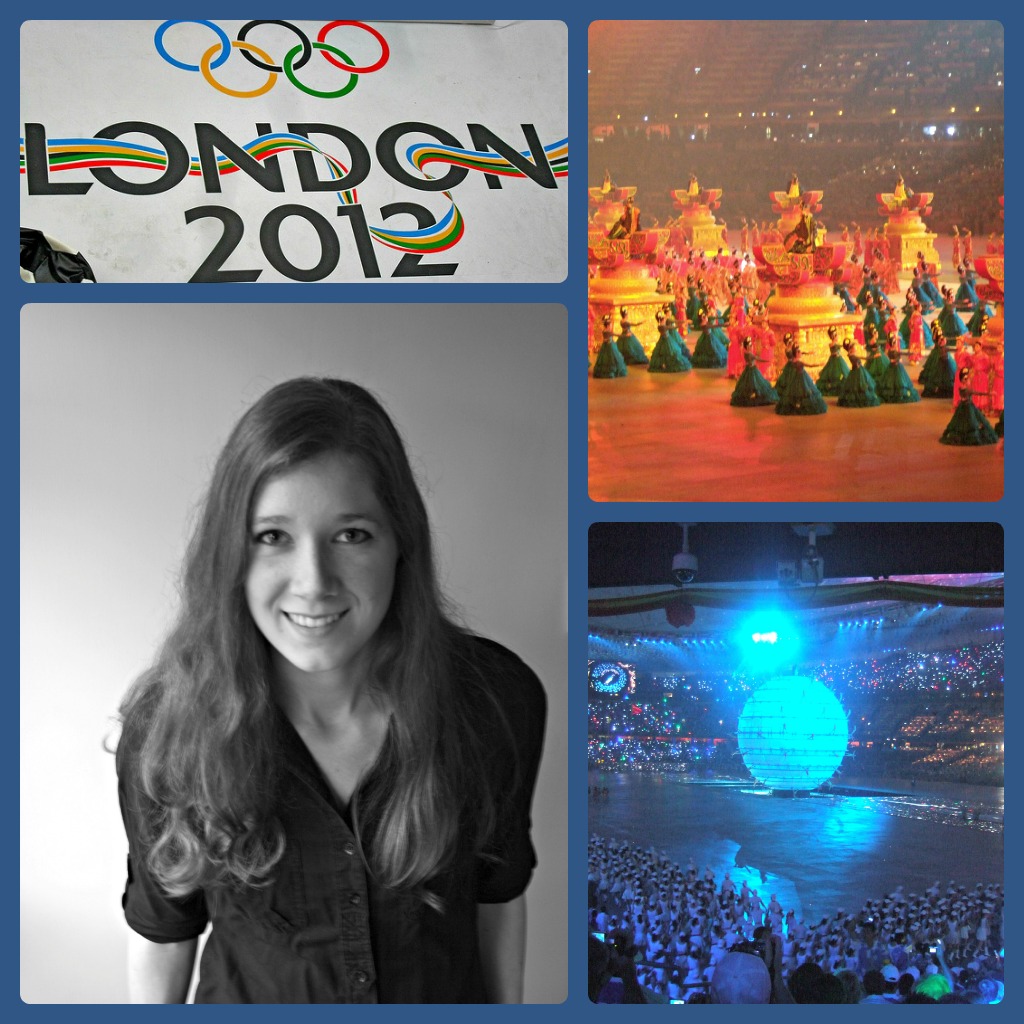
As regular readers will know, The Displaced Nation has some special connections to Britain. We therefore held our collective breath when the Olympic ceremony opened on Friday evening in London. How would the Brits measure up to the Chinese extravaganza of four years ago? Britain is after all a declining power — which is not exactly true of China! Today we turn to guest poster Shannon Young, an expat in Hong Kong who has written a book about her firsthand experience of attending the Beijing Games, for a verdict.

Four years ago, 2,008 drummers opened the Summer Olympics in Beijing with a thunderous rhythm heard ’round the world. Spectacular feats of coordination, drama and energy followed, wowing the world with the precision and ambition of the production.

Heralded as the greatest live performance in history, Beijing’s opening ceremony was a tough act to follow.

It was a tough act for me to follow as well. I’d been in the stands as the rumble of the drums swelled through Beijing’s Bird’s Nest stadium. But as the opening ceremony of the London Games was about to begin, I found myself at the kitchen table of my grandparents’ home in Oregon (I am back in the United States for a visit) watching a live stream on my computer.

Oh we can be heroes…just for one day

A landscape that looked rather like a shire appeared, complete with sheep and idyllically dressed country folk. The agrarian scene was quickly replaced with the frenetic energy of the Industrial Revolution, but the contrast was obvious: London was not trying to “beat” China.

Quirky, funny and nuanced. Those three words characterize the July 27th, 2012, ceremony. It displayed the heart and humor for which the British are famous — especially in the form of Rowan Atkinson (Mr. Bean), whose rendition of “Chariots of Fire” completely stole the show.

London brought the opening ceremony of the Summer Olympics back down to a human level. It was no Beijing, but it was the kind of show that speaks to people.

Famous for such films as Trainspotting and Slumdog Millionaire, director Danny Boyle infused the London ceremony with a cinematic flare.

Like many other spectators around the world, I loved the short film in which James Bond picked up Queen Elizabeth in a helicopter, which they (or their stunt doubles) proceeded to jump out of, for their “entrance” into the stadium.

There were other nods to cinematography throughout the production, including to Boyle’s own films, mixing the mediums of live performance and cinema. The costumes were intricate when viewed through a zoomed-in camera, but I had to wonder how much of this was for the camera and not the live audience. The spectators in the stands may not have been able to enjoy the details.

Only rock ‘n roll (but I like it)

There was a rock-and-roll feeling to the show. The dance numbers were more like big parties than expertly timed performances. They were full of mini-storylines and surprises.

The segment that began with a nightmare of the villains of children’s literature ended with the raucous defeat of a gigantic Lord Voldemort by none other than Mary Poppins.

The soundtrack was fun and familiar, liberally paying homage to Britain’s many contributions to culture.

A high-octane production like the Olympics opening ceremony needs to have quiet moments, too.

In Beijing there were eerie performances, such as a single dancer gliding across a glowing scroll.

In London, the quiet moments were solemn. There was a moving dance performance dedicated to the victims of the July 7th bombings on London transport, and a moment of silence for those who fell in the two world wars.

New takes on old classics

The Parade of Nations was faster than usual, bringing 204 teams into the stadium in record time.

The production culminated in the lighting of the torch, which was done in a particularly elegant fashion. David Beckham delivered the torch to retired British rower Sir Stephen Redgrave in a neon speedboat on the Thames.

In a touching act, Britain’s venerated Olympian then delivered the torch to seven promising young athletes, who lit the torch together. The torch itself was composed of many copper petals which rose together on long stems to create the Olympic cauldron.

London’s opening ceremony drew many laughs and perhaps a few tears. There weren’t as many breathtaking moments as in Beijing, but the show was like the British: quirky, personable, and utterly self-assured.

Shannon Young is an American writer currently living in Hong Kong. She is the author of The Olympics Beat: A Spectator’s Memoir of Beijing. She writes a blog called A Kindle in Hong Kong and tweets @ShannonYoungHK.

EDITOR’S NOTE: We will be giving away several copies of Shannon Young’s mini travel memoir of the Beijing Olympics this month. The first will go to a commenter on this post — please share your favorite moment from London’s opening ceremony, or a memorable moment from a previous Olympics.

STAY TUNED for tomorrow’s Expat Moment with Anthony Windram!

If you enjoyed this post, we invite you to register for The Displaced Dispatch, a round up of weekly posts from The Displaced Nation, with seasonal recipes, book giveaways and other extras. Register for The Displaced Dispatch by clicking here!

Related posts:

Images: A London Olympics sign courtesy e-costa on Flickr; author Shannon Young and two of her photos from the opening ceremony of the 2008 Summer Olympics in Beijing.

LIBBY’S LIFE #56 – Falling up

I’m trapped in a dream and am falling, falling, falling, towards a pit of boiling lava. It serves me right, I tell myself in my dream, for believing pink satin pointe shoes would be appropriate attire in which to climb Mount Etna. Having lost my balance while performing an arabesque on the rim of the volcano, I’m now drifting towards the centre of the earth at a languid pace. “If I’d only practised harder at ballet, this would never have happened,” I admonish myself on the way down, regardless of the fact that I’d never taken a ballet class in my life, and wouldn’t know an arabesque from the macarena.

With a jolt and a kick to the duvet, I wake myself up just before my satin-clad feet hit the churning lava.

Sweating slightly from the warm night, and from relief that the dark nightmare has ended, I lie still, breathing hard. The relief doesn’t last long, though, because after a few seconds, my brain kicks into semi-wakefulness and the real nightmare comes flooding back — the one in which my husband came home last night to a silent house, made a secretive phone call to a mystery woman — of course it was a woman — and immediately went out again to see her.

That is not a nightmare I can wake up from. When we were kids, we used to say that if you actually hit the ground in that falling dream, it would be too late and you’d be dead for real from a heart attack. For a second I contemplate the possibility of finding a high building, enacting the dream, hitting the ground and ending it for real, but the obligations of being a mother to Jack and the twins are too great, and—

The twins. I spring upright in bed, and strain my eyes to see the time on the digital alarm clock. It’s getting light outside; I have slept — I do a quick calculation — six hours straight, and neither twin has woken me for a wee hours feed.

I swing my legs out of bed, pull on a dressing-gown, and pad over to their matching Moses baskets, under the window in the alcove of the bedroom.

The baskets are empty, the covers pulled back.

I panic. You hear of these kidnap-to-order abductions. Then — oh, thank God! — I hear a muffled cry from somewhere else in the house. It’s George, not Beth; George’s cry is hoarse, loud, and very persistent.

I run out of the bedroom, in the direction of the stairs, and stop when I hear the cry again. It’s coming from the spare bedroom where Oliver has slept for the last six weeks or so.

Pushing the spare bedroom door open, I peer across the room. Oliver lies in the middle of the bed, a twin snuggled under each arm. His right hand is awkwardly curved round as he holds a bottle of milk to George’s mouth.

I reach to the side of the door and turn the landing light on. Oliver looks up. He gives me a half-smile, then mouths “Shhh.”

Shhh? I don’t think so. For the last three months, I have single-handedly looked after our three children and run our home while Oliver indulged himself in his midlife crisis. Knowing what I do now, after last night’s little secret-phone-call episode, I’m in no mood to Shhh.

“What are you doing?” I ask. My voice sounds very loud in the dawn quiet, when even the birds are still rubbing sleep from their eyes.

“I’m feeding the twins. This is George’s second bottle. He eats a lot, doesn’t he?”

If Oliver had paid any attention to his children over the last few weeks, this wouldn’t have been a revelation to him.

“Why are you doing that?” I ask.

Oliver shifts slightly in the queen-sized bed, and removes the bottle from George’s mouth with a gentle popping sound. George lies back, his eyes almost closed, a dribble of milk running from one side of his mouth. Automatically, I reach into my dressing-gown pocket for a clean tissue, and lean forward to wipe the dribble away before it solidifies in the folds of his fat little neck.

“You needed a break,” Oliver answers.

Sorry. It’s too late for that. “Guilty conscience at last, eh? Or did she tell you to keep me sweet? ‘Oliver, you must be nice to poor Libby.’ Well, I’m telling you, I’ve managed perfectly well since April, and just because your fancy woman tells you to feel sorry for me—”

“Wait.” Oliver tries to raise his head, but Beth whimpers in protest at the change in her sleeping position. “Wait. What woman?”

“The one you were out with last night!” My voice is raised now, but I don’t care. “I heard you on the phone, making plans for a hot date. ‘I can see you now,’ you said. ‘She’s in bed,’ you said. ‘See you in fifteen minutes,’ you said. Who is it? Did Melissa Harvey Connor finally get her claws into her latest victim?”

I stand back, arms folded.

To my astonishment, Oliver starts to laugh.

“How dare you laugh!” I shout, and both babies fling their arms out, startled. I can’t remember the last time I screamed like this at my husband, but it feels good. All the pent-up anger and frustration is coming out now — and yet all he can do is laugh?

Oliver stops laughing. “You thought I was out with Melissa? Please.”

“So who was it?”

He’s quiet for a moment.

“There is no one else. I was at Maggie’s.”

I’m silent. I can’t think what to say.

“Why?” I ask eventually. “Why with Maggie and not with me?”

He breathes in, holds it for a few seconds, then lets it out in a rush.

“Because she wanted to bawl me out. She thinks I’ve been a complete bastard.” He looks down at Beth and drops a kiss on her head. “And she’s right,” he said quietly.

I sit on the edge of the bed, but still don’t say anything.

“My father,” Oliver says hesitantly. He takes another deep breath. “I know you know about it. I should have told you before, but my mother made me promise never to say anything. You know what she’s like, not that it’s an excuse, but…I should have told you. I should have broken that promise to my mother.”

He stops. The light coming in at the window is stronger now, and I can see tears shining in his eyes.

I can’t help it. Despite everything I’ve gone through recently, despite the way he’s behaved, I feel sorry for him. When all’s said and done, he’s my Oliver, we have three children together, and we owe it to them, and ourselves, to make this work.

“When you’re ready,” I say, and reach across and squeeze his hand.

He squeezes mine in return. We glance shyly at each other, then look away.

It’s going to be all right, I think. It will take a while — but it’s going to be all right.

.

Next post: LIBBY’S LIFE #57 – Coming clean

Previous post: LIBBY’S LIFE  – Oliver’s side of the story 

A note for Libby addicts: Check out Woodhaven Happenings, where from time to time you will find more posts from other characters.  Want to remind yourself of Who’s Who in Woodhaven? Click here for the cast list!

Read Libby’s Life from the first episode.


STAY TUNED for Monday’s post.

If you enjoyed this post, we invite you to subscribe for email delivery of The Displaced Dispatch, a round up of the week’s posts from The Displaced Nation. Sign up for The Displaced Dispatch by clicking here!

Image: Travel – Map of the World by Salvatore Vuono / FreeDigitalPhotos.net

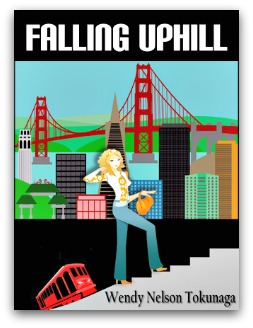
Trying — but failing — to keep up with Wendy Nelson Tokunaga, Olympic e-book author and karaoke star

**Announcing a giveaway of one of Wendy Nelson Tokunaga’s Kindle e-books. open to DISPLACED DISPATCH SUBSCRIBERS  & ANYONE WHO COMMENTS. And guess what? You get to take your pick! Woo hoo!!**

During this summer’s London Olympics there will be endless displays of speed grace, strength, masochism, endurance, pain, and perseverance.

Just the the thought of it makes me feel exhausted and a little bit nauseous.

But I don’t necessarily have to look toward the Orbit (I refer to the “eyeful tower” that looms over London’s Olympic Stadium) to feel that way. Instead I can direct my weary gaze towards the Golden Gate Bridge, near to where the once-displaced Wendy Nelson Tokunaga resides.

Tokunaga was a special guest at The Displaced Nation before as one of our 12 Nomads of Christmas. We have invited her back today to showcase what it means to be an “Olympian author.” She has just completed the marathon-like feat of publishing three e-books — two novels and one work of nonfiction — in a period of 12 months.

Has she tired you out yet?

I ask because that’s not the whole story. A talented writer, Tokunaga is what the Japanese call a talento: she can sing jazz as well as j-pop and enka (a type of sentimental ballad). Put it this way: you do not want to compete with her in a karaoke contest!

If you don’t believe me, listen to her singing this enka she composed for one of her novels — you would never know that Tokunaga is a native-born Californian who’d spent time in Japan!

Just one of the many reasons why you’ll never keep up with her…or if you dare to try, you’ll be huffing and puffing, just as I am. (Why oh why did I agree to sing a few bars of “My Way” with her?)

* * *

[Catching my breath…] Thank you, Wendy, for agreeing to this interview with The Displaced Nation. While I rest for a bit, can you tell me a little more about yourself — where you were born and how you ended up living in Japan?
I was born in San Francisco and have lived in the Bay Area all my life except for when I lived in Tokyo during the early 1980s. I had been studying Japanese language and culture at San Francisco State University when I won a prize in a songwriting contest sponsored by Japan Victor Records. It allowed me to perform my song at Nakano Sun Plaza in Tokyo. After that I moved to Japan to pursue music, teach English and do narration work.

While I’m still catching my breath — let’s hope I don’t have a heart attack here — why don’t you tell us about all your books? I understand you’ve published eight of them in the past 12 years, of which three of them came out in the past 12 months?
I self-published my first novel, No Kidding, in 2000 with iUniverse. Then I wrote two books for elementary-school students with Kid Haven Press: Famous People: Christine Aguilera (2003) and Wonders of the World: Niagra Falls (2004). Next came two novels that featured Japan, both of which were published by St. Martin’s Griffin: Midori by Moonlight and Love in Translation. And then I self-published three Kindle e-books within the past 12 months: Marriage in Translation: Foreign Wife, Japanese Husband, in 2011; Falling Uphill and His Wife and Daughters, both in 2012.

I suppose you’re working on another book right now?
Yes, a mystery/thriller.

Crossing publishing platforms…

Turning to your three recent books: what made you decide to join the Kindle e-book world?
Falling Uphill was a “trunk novel” I wrote in 2004 that never got published. With the popularity of e-books I decided to revise it a bit and put it out instead of having it gather dust on my hard drive. My agent at the time came close to selling His Wife and Daughters to a major publisher in 2011, but in the end things didn’t work out. I still wanted to bring the book out, so making it available as an e-book seemed like a great idea. I’d gotten a few bites from publishers regarding Marriage in Translation, which was based on a series of blog interviews I’d done of Western women married to Japanese men. But dealing with a publisher would mean the book would take at least a year to come out and would probably need to be longer. I just wanted to get it out as soon as I could to take advantage of the momentum of the blog. Coincidentally, when I was in the finishing stages, the disastrous earthquake and tsunami occurred in Japan. I brought out the book shortly after and for a time gave 50 percent of the proceeds to Japan relief.

Do you think you can reach a different audience through self-publishing?
What’s exciting about e-books is that I can reach an audience! For various reasons, these books wouldn’t have seen the light of day, so I’m happy to continually find readers for them. And, yes, I think I’m reaching a wider geographical audience. And another bonus is that in the e-book world, unlike in the traditional publishing world, the pub date is irrelevant — people can continue to discover my books and I can promote them as summer reads, fall reads or whatever. And e-books don’t ever go “out of print.” I couldn’t be happier with this platform, but it doesn’t mean that I don’t still appreciate traditional publishing and don’t rule out traditional publishing in the future.

Crossing genres…

You got your MFA in creative writing. You also teach and consult on creative writing. What was it like trying your hand at a nonfiction book Marriage in Translation?
These days, non-fiction written in the manner of creative non-fiction and/or narrative non-fiction has lots in common with novels. I think it can be easier for fiction writers to tackle non-fiction, but there might be more challenges for the strictly non-fiction writer to undertake writing fiction.

Why is it so challenging for nonfiction writers to switch over to fiction?
Some — not all — non-fiction writers find it difficult to “make things up” and use their imagination after being so ingrained at using “just the facts.” And, for journalists, I think it can be a challenge to structure a novel that doesn’t reveal everything at once and fight the tendency to go about verifying each point.

Crossing cultures…

Turning to Japan and its influence on your writing. For a while there, Japan was your lodestar. Both Midori by Moonlight and Love in Translation had strong Japanese themes, as does Marriage in Translation. But in your two latest novels your protagonists are all Americans. I’ve read His Wife and Daughters — and enjoyed it very much. There was a scene set in Japan — involving one of the daughters, Phoebe — but otherwise it’s about an American politician who has an affair that causes him to lose his job. I haven’t read Falling Uphill — does it have any Japanese references?
Falling Uphill doesn’t have any Japanese references, at least that I can recall! And in His Wife and Daughters, I thought that for the particular purpose of depicting a certain time in Phoebe’s life that setting it in Tokyo made sense because of the bar hostess culture there. Otherwise, Japan really wouldn’t have played any part in that novel.

Are you moving away from Japan, or will it always be something you write about?
There have been times when I’ve felt that I’ve said all I can say about Japan and need to move on, though it will always be a part of me. I’ve enjoyed writing about Japan and Japanese culture and I even had a Japan-themed short story published in the recent Tomo anthology published by Stone Bridge Press, but I do enjoy writing about topics other than Japan. Yet I am careful to “never say never” about most things.

That said, I think Japanese might enjoy His Wife and Daughters. They have plenty of sex scandals, the most recent one involving the political kingpin Ichiro Ozawa. But in that case, the wife has spoken out — and is trying to poison his career. What was the inspiration behind the book —  do you like politics?
I don’t see His Wife and Daughters as a particularly political book. I was more attracted to the theme of exploring why some women stand by their men in these situations and withstand the humiliation, as well as the fascinating dynamics of a dysfunctional family affected by serial adultery and public scandal.

Crossing art forms…

And now I’ve just got to ask you about your musical career. Are you still pursuing music alongside all this writing?
I’ve been singing and playing music for longer than I’ve been writing. And music is what originally got me to Japan so it’s very important to me. But I don’t have as much time to devote to music right now. My husband and I occasionally play together at home for fun (he plays keyboards), but we haven’t done any gigs for several years. And I wish I had time to keep up with J-pop and enka and go to karaoke! I do manage to catch some music shows via the TV-Japan satellite service, but that’s about it.

Didn’t you and your husband collaborate on a theme song for your book Love in Translation?
Yes we did. That was our last major musical project.

Do you listen to music when you’re writing?
Not usually, but I often have Pandora playing quietly downstairs from my office (the cat likes it!) on a variety of eclectic stations: piano jazz, trip hop, ambient, etc.

Last but not least, I’d like to quiz you about your reading and writing habits:
Last truly great book you read: Gone Girl, by Gillian Flynn
Favorite literary genre: Books that are well written, fast paced and full of surprises.
Reading habits on a plane: I read on my iPad.
The one book you’d require the president to read: He’s so well read that I think he’s way ahead of me.
Favorite books as a child: I especially liked the Edward Eager Magic Series (Half Magic, Magic by the Lake, Seven Day Magic, etc.) as well as The Borrowers series by Mary Norton and The Summer Birds by Penelope Farmer.
Favorite heroine: I always liked books about girls who had special magical powers or mysterious backgrounds.
The writer, dead or alive, you’d most like to meet: I’m constantly networking with fellow writers and have gotten the opportunity to meet with many that I admire, but I suppose it would be quite fascinating to talk with Joan Didion, a writer who definitely excels at both fiction and non-fiction.
Your reading habits: I’m a pretty fast reader. I sometimes take notes and I am mainly reading electronically now. I do find myself constantly analyzing the books I read for craft and structure so it’s sometimes hard to get lost in a good book like I used to be able to back in those Edward Eager days.
Your favorite of your own books: Always the latest one: His Wife and Daughters.
The book of yours you’d most like to see as a film: Any of them!!!
The book you plan to read next: The Expats, by Chris Pavone.

Say, would you do a review for The Displaced Nation on what you think of Chris Pavone’s book?
I’m happy to do a review, but I can’t promise any time soon. I’m in the midst of some very big projects right now. So if there’s not a firm deadline, then I can say yes. 🙂

(See what I mean about how you just can’t keep up with her?) Okay, one final question before I let you go. Since you’ve been so prolific of late, I wonder if you have any advice to impart to other writers who struggle to wrap up their books?
I wish I knew the secret! I’m struggling with my current book and don’t know when the heck I’ll finish it. Writing takes discipline and there’s no magic formula, I’m afraid. And some books come quicker than others.

* * *

Readers, any more questions for Wendy? Please put them in the comments. To reiterate, we are doing a giveaway of one of Wendy’s Kindle e-books to Displaced Dispatch subscribers and to ANYONE WHO COMMENTS! As I can assure you from my own experience, you WANT TO WIN one of these books — they are THE PERFECT SUMMER READS!!!

STAY TUNED for some more fiction tomorrow, with another episode in the life of our fictional expat heroine, Libby. (What, not keeping up with Libby? Read the first three episodes of her expat adventures.)

If you enjoyed this post, we invite you to register for The Displaced Dispatch, a round up of weekly posts from The Displaced Nation, with seasonal recipes, book giveaways and other extras. Register for The Displaced Dispatch by clicking here!

Related posts:

img: Wendy Nelson Tokunaga throwing her considerable energy into yet another round of karaoke…

THE DISPLACED Q: In your world travels, which Olympics athletic skill would come in most handy?

As I travel around, I often wonder what it would be like to be an Olympic-quality athlete. No, really! I do. I just LOVE the idea of pushing my body to extremes, of being all I can be.

I find it curious that the Dutch sprinter Fanny Blankers-Koen, who won four gold medals in 1948 — the last time the Summer Olympics were held in London — commented afterwards:

All I’ve done is run fast. I don’t see why people should make much fuss about that.

A humble sentiment, to be sure — but, hey, there’s something to be said for displaying your prowess at times.

The way I see it, the pursuit of excellence — in anything, from sprinting to eating a banana to waiting for a bus — should always be applauded. Why be average at anything when you can be great at it?

And if I haven’t managed it yet, that’s not for want of trying! Except in one area. Like many travelers and expats I know I find traveling rather thirsty work — and have developed the skill of lifting a pint, or a large gin and tonic, with the best of them!

But with the London Games soon upon us, I keep imagining all the Olympic-champion-level skills that would come in handy for your average traveler, if only we could enhance our bodies in certain ways.

For example:

CYCLING

As a powerful cyclist, you could transport yourself the length of a continent without ever having to squeeze onto a chicken-infested bus.

WEIGHT-LIFTING

That would help out when it came to backpacking – no need to ban your girlfriend from taking a hairdryer anymore! Just man up and shoulder the extra weight.

SAILING

Did you know sailing was an Olympic sport? (It was actually known as yachting for its first 100 years…)

Top-notch sailing skills would not only make international crossings a pleasure, but you might also be able to pick up a bit of work here and there — maybe even end up crewing a mega-yacht for the rich and famous! (I know someone who is doing this job at the moment. He reports it’s quite enjoyable…)

GYMNASTICS

For the life of me, I can’t figure out how diving or gymnastics could ever be useful. They’re just totally random skills that take a lifetime of effort to acquire and perfect, and are good for exactly two weeks in every four years, until you turn twenty and suddenly become too old. Well, I guess if you’re really lucky, you could launch a clothing label or a perfume brand to finance your travels.

TAEKWONDO and/or KARATE

Taekwondo and karate are both Olympic sports and both fiercely competitive (well, fierce when compared to, say, figure skating!).

Imagine the healthy glow of confidence you’d project strutting around the globe as one of the world’s top martial artists! Downtown in a strange city in the dead of night, you could nip out for a taco safe in the knowledge that any low-life waiting to mug you was about to get an education.

In all seriousness, though, I honestly believe that some self-defense training is essential for the modern traveler. Not so much because you might get a chance to use it, but just knowing some basic moves to defend yourself boosts your confidence a hundredfold. And people out to cause trouble can often tell this at a distance — just by watching the way you walk. They look for easy targets; if you don’t present one, you may never even know you were in danger.

WRESTLING

This could be the all-time winner for us traveling types. Last in line for a ticket? Only one croissant left at the deli? Wrestle your way through!

Caught without enough money after living it up in a posh restaurant? Try skipping out. The maître d’ will never see it coming…

Of course, traveling with bottles and bottles of baby oil is going to present its own challenges — not least when customs wants to know exactly what it’s for. Then again…you could always show ’em!

MARATHON

Ah, the Olympic marathon — traditionally the last event of the athletics calendar, with a finish inside the Olympic stadium, often within hours of, or even incorporated into, the closing ceremonies.

I’ve always fancied myself as an endurance athlete, as a marathon runner — if I was ever in the right place long enough to train for it. That kind of endurance, the ability to not give up even when it becomes impossibly hard — that’s the Olympic-level skill I value the most.

Because, as I said, traveling can be hard. It can be grueling, unpleasant, dangerous and occasionally downright painful!

But as is so often the case in life, if you can just see past all that to the bigger picture — can take a step back from the hardship of the moment and find the strength and positivity to carry you through — you’ll be able to go the distance.

You’ll be the one still traveling when all the others give up and go home; the one who perseveres with the difficult language, makes new friends from scratch and/or manages to fully integrate into an unfamiliar culture.

And that’s where the real rewards come from, the traveler’s equivalent of winning gold: being able to appreciate what you’ve achieved in spite of all the obstacles that were placed in your way.

Because, no matter how competitive some of us world travelers are, the fact remains that travel is not a race. You are only really competing with yourself — trying to see how many life experiences you can assimilate and how far you can go towards achieving your dreams.

And more often than not in that quest, slow and steady is the way to go.

* * *

So what do YOU think? Which areas of athletic prowess would you prefer to master, and why? Any Olympic skill is fair game (hahaha). Let me know in the comments!

STAY TUNED for tomorrow’s interview with Olympian author Wendy Nelson Tokunaga.

If you enjoyed this post, we invite you to register for The Displaced Dispatch, a round up of weekly posts from The Displaced Nation, with seasonal recipes, book giveaways and other extras. Register for The Displaced Dispatch by clicking here!

Related posts:

img: Chronicling Tony James Slater’s attempts to become a gymnast, a martial artist and a weightlifter of note.

Summer reading list: an Olympic selection of books

Welcome to our summer list of reading suggestions. With only four days to go until the first official day of the 2012 London Olympics, we offer no prizes for guessing the theme of this list! What we have tried to do, however, is find you some books that are a little outside the usual “History of the Olympics” mold.

2012 London Olympics: Some fun facts and figures

8,000 torchbearers
26 sports
8.8 million tickets
10,490 athletes
350 miles of cabling
5,000 anti-doping samples
10,000 temporary toilets
356 pairs of boxing gloves
4 skeletons removed from prehistoric settlement on site
(Source: http://www.london2012.com

A spectator’s eye view:

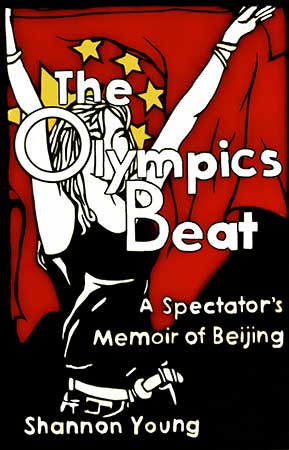
The Olympics Beat: A Spectator’s Memoir of Beijing
by Shannon Young

Published May 2012

About the author:
An American writer living in Hong Kong, Shannon Young writes a blog called A Kindle in Hong Kong, featuring her walking tours, book reviews, and bookspotting adventures.

Cyber coordinates:
Blog: A Kindle in Hong Kong
Twitter: @ShannonYoungHK
Facebook:  A Kindle in Hong Kong

Overview of book:
The drama, the variety, the spectacle – Shannon can’t get enough of it. She is an American student who has always been fascinated by the Olympic Games; her father has a lifelong love affair with China. They team up for the Beijing games and the adventure of a lifetime. Without the filter of a small screen, Shannon and her father are hypnotized by the passion of a great nation unveiling itself to the world. This mini travel memoir is a picture of a new China and the experiences that would change one American girl’s life forever.
(Amazon product description)

Displaced Nation review:
A search for “Olympics” on Amazon will bring up many hits: history of the Olympics, Olympics in ancient times, autobiographies of famous Olympic competitors, lots of picture books for children about the Olympics, and so on. Unique on this list, however, is Shannon Young’s autobiographical account of what it is like to be a spectator at the Games.

As a young university student, Shannon received a fellowship to go to the Beijing Olympics and study the effects the Games had on the city. The resultant academic paper, she felt, was dry and earnest and did nothing to capture the  excitement of the sights and atmosphere, so, three years later, she decided to write a memoir of her personal experience there. Although the book is mainly travelogue, there is also a touching glimpse into the relationship between Shannon and her father, with whom she traveled, and who wants to impart his love of China to his daughter.

At only 60 pages, this is a very short and easy read — quite manageable before the Games start in four days’ time. While Shannon traveled to Beijing for academic purposes, this memoir is not a commentary on the political situation in China in 2008. It is simply the honest observations of a twenty-year-old at the world’s most important sporting event, in a country that is trying to show its best, Botoxed, surgically enhanced face to the rest of that world. The final paragraph of the book sums this up so well:

We returned to the US TV coverage of the remaining events, and it focused on China’s problems: air quality, protesters confined to limited spaces, rumours of human rights violations and trouble. But that wasn’t the Olympics we witnessed. We saw a city full of people who were proud of their accomplishments… The athletes, volunteers, and spectators had poured their souls into welcoming people to their city, and they wanted the world to know how great China was. We knew it — because we were there.

A survivor’s eye view:

Running for My Life: One Lost Boy’s Journey from the Killing Fields of Sudan to the Olympic Games
by Lopez Lomong, Mark Tabb

Published July 2012

About the author:
Lopez Lomong was born in southern Sudan in 1985. After his village was attacked by rebel soldiers when he was 6 years old, he spent ten years in Kenyan refugee camp before moving to the United States, where he was fostered by a family in New York. He became a professional runner in 2007, and a US citizen in 2008, the year he also represented the US at the Beijing Olympics.

Cyber coordinates:
Website: lopezlomong.com
Twitter: @LopezLomong
Facebook: https://www.facebook.com/LopezLomong

Overview of book:
Lopez Lomong chronicles his inspiring ascent from a barefoot lost boy of the Sudanese Civil War to a Nike sponsored athlete on the US Olympic Team. Though most of us fall somewhere between the catastrophic lows and dizzying highs of Lomong’s incredible life, every reader will find in his story the human spark to pursue dreams that might seem unthinkable, even from circumstances that might appear hopeless. (Barnes and Noble product overview)

One reader’s review:
“Lopez Lomong’s story is certainly one of pain, suffering and hardship but all that is overshadowed by his tremendous drive, hope and selfless endeavors for the people of South Sudan.” (Review at “Reflecting from here”)


A stranger-than-fiction eye view:

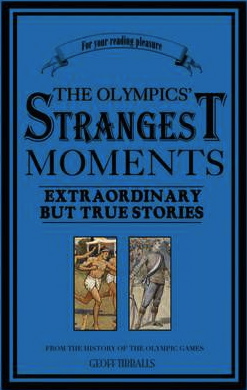
The Olympics’ Strangest Moments: Extraordinary but True Stories from the History of the Olympic Games
by Geoff Tibballs

Published July 2008

About the author:
Geoff Tibballs is a former sports journalist who has written nearly 100 books. He is “an accomplished armchair sportsman, [who] believes his life-long devotion to Millwall Football Club has enabled him to appreciate the ridiculous.” (Random House author bio)

Cyber coordinates:
Author’s page on publisher’s website: Random House/ Geoff Tibballs

Overview of book:
The Olympics’ Strangest Moments recounts the bizarre, controversial, inept, heroic and plain unlucky from the first modern games in 1896 to the return of the games to their birthplace in Athens in 2004 and up to the Beijing 2008 games. (Amazon book description)

One reader’s review:
“The early episodes offer a glimpse into a very different world than the one we know today… The 1900 Paris Olympics featured a cricket competition with only two teams entered…The swimming events were staged in the River Seine…This book is sometimes funny, occasionally tragic, but always entertaining. You don’t have to be fanatical about the Olympics to enjoy this book.” (Amazon.com review)

An insider’s eye view:

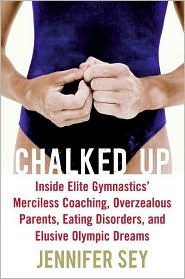
Chalked Up: Inside Elite Gymnastics’ Merciless Coaching, Overzealous Parents, Eating Disorders, and Elusive Olympic Dreams
by Jennifer Sey

Published October 2009

About the author:
Jennifer Sey is an American writer, producer and former gymnast. She began competing in the sport of gymnastics at the age of six and went on to become 1986 National Gymnastics Champion and seven-time national team member.  She lives with her husband and two sons in San Francisco. (Amazon/Wikipedia bio)

Cyber coordinates:
Author’s page on publisher’s website: Harper Collins/Jennifer Sey

Overview of book:
“Chalked Up” presents the story of the 1986 US National Gymnastics champion whose life long dream was to compete in the 1988 Olympics – until anorexia, injuries, coaching abuses, and parental hopes and neglect nearly destroyed her. (Amazon.com book description)

One reader’s review:
“Jennifer Sey is telling her story. She is not preaching nor is she telling you to remove your child from the sport of gymnastics. Although a painful side of gymnastics, which so many of us are scared to acknowledge, it is a reality in the elite world of gymnastics. Twenty two years after winning the national title, a crown that all elite gymnasts dream of, Sey still struggles with a love/hate gymnastics relationship.” (Amazon.com review)

.

Img: Olympic Torch with laurel wreath by nirots/freedigitalphotos.net

STAY TUNED for another Displaced Q!

If you enjoyed this post, we invite you to subscribe for email delivery of The Displaced Dispatch, a round up of the week’s posts from The Displaced Nation. Sign up for The Displaced Dispatch by clicking here!

Related posts:

Expat book review: “The Chalk Circle” by Tara L. Masih

Expat book reivew: “Chique Secrets of Dolce Amore” by Barbara Conelli

Expat book review: “Picky, Sticky or Just Plain Icky?” by Valerie Hamer

Expat book review: “A Tight Wide-open Space,” by Matt Krause

EXPAT MOMENTS: Unravelling the enigma of American fireworks booths

Another post in our series focusing on little moments or images of expat experience.

Like a fungal spore, they appeared unannounced one morning about four weeks ago. Every parking lot in town had one — a single compact wooden booth covered in brightly colored posters.

Inside each of these booth, sweating in the summer heat, sat a vendor surrounded by merchandise – box upon box of fireworks. The vendor lists off the inventory, the names sounding more like dive-bar cocktails than pyrotechnics: Shagadellic Mojos; Fiery Frogs; Round Red Dahlias; Falcons Rising; Dragons’s Tears.

Over the next few weeks, I learn two things about these booths. First, that each booth has been set up by local group, that depending which booth you choose you are, in fact, deciding which school or church or local charity you want to help raise funds for. I calculate that there must be around 200 of these booths around town. That is a lot of local groups and non-profits and yet my response is an apathetic one, the response of a man who feels untethered to this community, who has no cause here he wants to endorse and support. The second thing I learn, from those who cast me a conspiratorial glance, is that I don’t want to waste my time with these booths. They know a man. He has “stuff” from Mexico. It’ll blow your mind, and possibly your arm — Shagadellic Mojos these ain’t.

And then, a week or so after July 4th and just as quickly as they appeared, one morning you wake and the booths have gone. 

STAY TUNED for next Monday’s post – a round up of Olympics books.

If you enjoyed this post, we invite you to register for The Displaced Dispatch, a round up of weekly posts from The Displaced Nation, with seasonal recipes, book giveaways and other extras. Register for The Displaced Dispatch by clicking here!

Related posts: